Official Paper

LIC AAO Prelims 4 May 2019 Shift 1 Memory Based Paper (Previous Year Paper)

100 questions · 60 minutes · with answers · free

Reasoning Ability (35 questions)

Read the following information carefully and answer the question that follows:

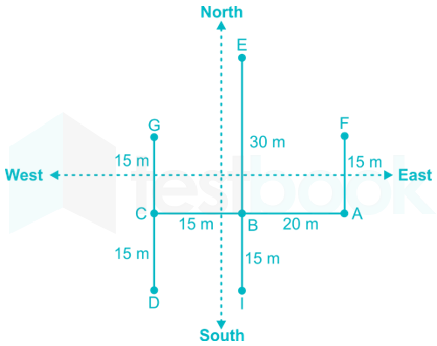
B is in the 20 m west of A. F is in the 15 m north of A. E is to the 30 m north of B. C is to the 15 m west of B. G is to the 15 m north of C. D is to the 30 m south of G. I is to the 15 m south of B.

1

Find the odd one (as per the direction). 

  1. ((a))

    EA

  2. ((b))

    GB

  3. ((c))

    GA

  4. ((d))

    CI

  5. ((e))

    BD

Show Answer
Answer: ((e))

BD

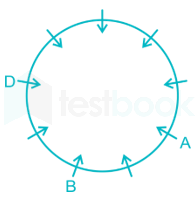
The direction chart is as follows:

Here, except BD, all others are in the south-east direction from first to the second point.

Hence, 'BD' is the odd one.

2

B is in which direction with respect to D?

  1. ((a))

    North

  2. ((b))

    North-east

  3. ((c))

    South-west

  4. ((d))

    South-east

  5. ((e))

    East

Show Answer
Answer: ((b))

North-east

The direction chart is as follows:

Hence, B is in the north-east direction with respect to D.

3

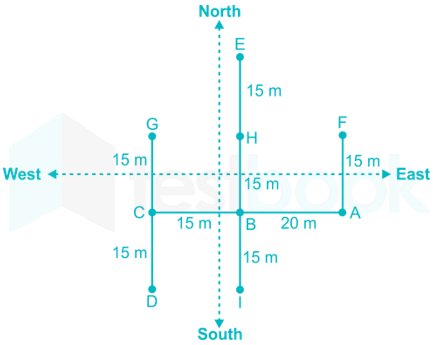
If H is 15 m south of E, at which distance and in which direction H is with respect to B?

  1. ((a))

    20 m, East

  2. ((b))

    20 m, West

  3. ((c))

    30 m, North

  4. ((d))

    15 m, North

  5. ((e))

    15 m, South

Show Answer
Answer: ((d))

15 m, North

The direction chart is as follows:

Hence, H is 15 m towards the north with respect to B.

Study the following information and answer the question given below:

9 people, A, B, C, D, E, F, G, H, and J are sitting around a circular table, facing inside.

A is to the second right of B. There are 3 people between A and D. E is third to the right of D. C is between G and D. G is to the second right of H. J is a neighbour of G.

4

How many persons are sitting between A and F (if counted to the right of F)?

  1. ((a))

    Only G

  2. ((b))

    Both G and J

  3. ((c))

    Both B and E

  4. ((d))

    Only H

  5. ((e))

    Only C

Show Answer
Answer: ((c))

Both B and E

9 people: A, B, C, D, E, F, G, H, and J

  1. A is to the second right of B.

  2. There are 3 people between A and D.

Case I:

Case II:

  1. E is third to the right of D. C is between G and D.

  2. G is to the second right of H.

  3. J is a neighbour of G.

(Eliminates case II)

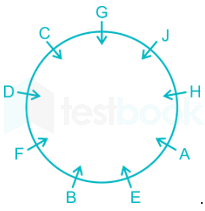
The final arrangement is:

Hence, both B and E are sitting between A and F (if counted to the right of F).

5

How many people are between H and D (if counted to the right of D)?

  1. ((a))

    Two

  2. ((b))

    One

  3. ((c))

    None

  4. ((d))

    More than three

  5. ((e))

    Three

Show Answer
Answer: ((d))

More than three

9 people: A, B, C, D, E, F, G, H, and J

  1. A is to the second right of B.

  2. There are 3 people between A and D.

Case I:

Case II:

  1. E is third to the right of D. C is between G and D.

  2. G is to the second right of H.

  3. J is a neighbour of G.

(Eliminates case II)

The final arrangement is:

Hence, there are more than three people between H and D.

6

What is the position of B with respect of C?

  1. ((a))

    Second to the right

  2. ((b))

    Third to the right

  3. ((c))

    Second to the left

  4. ((d))

    Third to the left

  5. ((e))

    Fourth to the right

Show Answer
Answer: ((b))

Third to the right

9 people: A, B, C, D, E, F, G, H, and J

  1. A is to the second right of B.

  2. There are 3 people between A and D.

Case I:

Case II:

  1. E is third to the right of D. C is between G and D.

  2. G is to the second right of H.

  3. J is a neighbour of G.

(Eliminates case II)

The final arrangement is:

Hence, B is third to the right of C.

7

Find the odd one.

  1. ((a))

    EF

  2. ((b))

    BA

  3. ((c))

    GH

  4. ((d))

    HE

  5. ((e))

    CJ

Show Answer
Answer: ((b))

BA

9 people: A, B, C, D, E, F, G, H, and J

  1. A is to the second right of B.

  2. There are 3 people between A and D.

Case I:

Case II:

  1. E is third to the right of D. C is between G and D.

  2. G is to the second right of H.

  3. J is a neighbour of G.

(Eliminates case II)

The final arrangement is:

Here, except BA, from first to second, it is written in the clockwise direction.

Hence, 'BA' is the odd one.

8

Complete the given series (as per the seating arrangemnet):

AB, FG, JB, FH, AG, ___.

  1. ((a))

    HA

  2. ((b))

    CF

  3. ((c))

    GH

  4. ((d))

    BG

  5. ((e))

    JC

Show Answer
Answer: ((e))

JC

9 people: A, B, C, D, E, F, G, H, and J

  1. A is to the second right of B.

  2. There are 3 people between A and D.

Case I:

Case II:

  1. E is third to the right of D. C is between G and D.

  2. G is to the second right of H.

  3. J is a neighbour of G.

(Eliminates case II)

The final arrangement is:

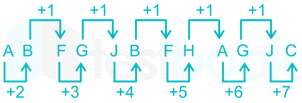
The pattern of series id as follows:

Hence, the next term will be 'JC'.

9

According to numerical series, How many pairs of digits are there in the number “67289574” each of which has as many digits between them as in the numerical series in both forward and backward directions?

  1. ((a))

    None

  2. ((b))

    One

  3. ((c))

    Two

  4. ((d))

    Three

  5. ((e))

    More than three

Show Answer
Answer: ((e))

More than three

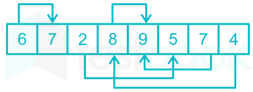
According to the given information,

Hence, there are more than 3 pairs of digits according to numerical series

10

In a certain coding language, 'HONEST' is coded as 'INODTS', and 'HEAT' is coded as 'IDBS', then how 'LENGTH' can be coded in the given coding language?

  1. ((a))

    MODUFG

  2. ((b))

    DOMGFU

  3. ((c))

    MFDUGO

  4. ((d))

    MDOFUG

  5. ((e))

    GUDMOF

Show Answer
Answer: ((d))

MDOFUG

The pattern followed here is,

HONEST:

H + 1 = I;

O - 1 = N;

N + 1 = O;

E - 1 = D;

S + 1 = T;

T - 1 = S

HEAT:

H + 1 = I;

E - 1 = D;

A + 1 = B;

T - 1 = S

Similarly,

LENGTH:

L + 1 = M;

E - 1= D;

N + 1 = O;

G - 1 = F;

T + 1 = U;

H - 1 = G

Hence, 'LENGTH’ can be coded as ‘MDOFUG’.

Study the following information carefully and answer the questions given below.

Six teachers A, B, C, D, E, and F are going to attend the meeting in a famous ground of Delhi, on different months viz. January, April and August but not necessarily in the same order. In each month, they will attend the meeting on dates 5th or 11th of the given month. Only one teacher will attend the meeting on these given dates. B will attend the meeting on 11th of any of the given month but before D. There is no one between C and D attending the meeting. Two teachers will attend the meeting between B and D. Two teachers will attend the meeting between A and F. Only one teacher will attend the meeting between F and C. C will attend the meeting in August.

11

Who among the following will attend the meeting on 5th January? 

  1. ((a))

    D

  2. ((b))

    E

  3. ((c))

    F

  4. ((d))

    A

  5. ((e))

    None of these

Show Answer
Answer: ((d))

A

Six teachers: A, B, C, D, E, and F

  1. Two teachers will attend the meeting between B and D.

  2. B will attend the meeting on 11th of any of the given month but before D.

  3. There is no one between C and D attending the meeting.

  4. Two teachers will attend the meeting between A and F.

  5. Only one teacher will attend the meeting between F and C.

  6. C will attend the meeting in August.

MonthPerson
January5thA
11thB
April5thE
11thF
August5thD
11thC

Thus, A will attend the meeting on 5th January.

12

How many teachers will attend meeting between E and D?

  1. ((a))

    Two

  2. ((b))

    Three

  3. ((c))

    Four

  4. ((d))

    Five

  5. ((e))

    One

Show Answer
Answer: ((e))

One

Six teachers: A, B, C, D, E, and F

  1. Two teachers will attend the meeting between B and D.

  2. B will attend the meeting on 11th of any of the given month but before D.

  3. There is no one between C and D attending the meeting.

  4. Two teachers will attend the meeting between A and F. 

  5. Only one teacher will attend the meeting between F and C. 

  6. C will attend the meeting in August.

MonthPerson
January5thA
11thB
April5thE
11thF
August5thD
11thC

So, there is only one teacher who attends the meeting between E and G.

13

Who among following will attend the meeting on 11th April?

  1. ((a))

    A

  2. ((b))

    E

  3. ((c))

    D

  4. ((d))

    C

  5. ((e))

    F

Show Answer
Answer: ((e))

F

Six teachers: A, B, C, D, E, and F

  1. Two teachers will attend the meeting between B and D.

  2. B will attend the meeting on 11th of any of the given month but before D.

  3. There is no one between C and D attending the meeting.

  4. Two teachers will attend the meeting between A and F. 

  5. Only one teacher will attend the meeting between F and C. 

  6. C will attend the meeting in August.

MonthPerson
January5thA
11thB
April5thE
11thF
August5thD
11thC

Hence, F will attend the meeting on 11th April.

14

How many teachers will attend the meeting after D?

  1. ((a))

    One

  2. ((b))

    Two

  3. ((c))

    Three

  4. ((d))

    No one

  5. ((e))

    Four

Show Answer
Answer: ((a))

One

Six teachers: A, B, C, D, E, and F

  1. Two teachers will attend the meeting between B and D.

  2. B will attend the meeting on 11th of any of the given month but before D.

  3. There is no one between C and D attending the meeting.

  4. Two teachers will attend the meeting between A and F. 

  5. Only one teacher will attend the meeting between F and C. 

  6. C will attend the meeting in August.

MonthPerson
January5thA
11thB
April5thE
11thF
August5thD
11thC

Hence, only one teacher will attend the meeting after D.

15

E attends the meeting on which of the following dates?

  1. ((a))

    5th April

  2. ((b))

    5th August

  3. ((c))

    11th August

  4. ((d))

    11th January

  5. ((e))

    None of these

Show Answer
Answer: ((a))

5th April

Six teachers: A, B, C, D, E, and F

  1. Two teachers will attend the meeting between B and D.

  2. B will attend the meeting on 11th of any of the given month but before D.

  3. There is no one between C and D attending the meeting.

  4. Two teachers will attend the meeting between A and F. 

  5. Only one teacher will attend the meeting between F and C. 

  6. C will attend the meeting in August.

MonthPerson
January5thA
11thB
April5thE
11thF
August5thD
11thC

E attends the meeting on 5th April.

Study the following information carefully and answer the questions following it.

Ten people A, B, C, D, E, F, G H, I and J are watching a match in a stadium and seating in a single row facing north direction.

A is sitting in third place form the right end. There are 2 people between A and C. There is one person between C and D. E is to the second left of D. H is to the fifth right of C. A is exactly sitting between B and F who is to the right of A. G is to the second left of J who is to the second left of I.

16

Who is sitting exactly between G and I?

  1. ((a))

    E

  2. ((b))

    J

  3. ((c))

    D

  4. ((d))

    C

  5. ((e))

    B

Show Answer
Answer: ((b))

J

Ten people A, B, C, D, E, F, G H, I and J

  1. A is sitting in third place form the right end.

  2. There are 2 people between A and C.

  3. There is one person between C and D.

  4. E is to the second left of D.

  5. H is to the fifth right of C.

  6. A is exactly sitting between B and F who is to the right of A.

  7. G is to the second left of J who is to the second left of I.

Hence, J is exactly sitting between G and I.

17

Which of the following statements is true?

  1. ((a))

    C and B are neighbours.

  2. ((b))

    There is one person between B and F.

  3. ((c))

    J is at one extreme end.

  4. ((d))

    H is two people away from D.

  5. ((e))

    B is exactly between C and I.

Show Answer
Answer: ((b))

There is one person between B and F.

Ten people A, B, C, D, E, F, G H, I and J

  1. A is sitting in third place form the right end. 

  2. There are 2 people between A and C. 

  3. There is one person between C and D. 

  4. E is to the second left of D. 

  5. H is to the fifth right of C. 

  6. A is exactly sitting between B and F who is to the right of A. 

  7. G is to the second left of J who is to the second left of I.

Hence, statement given only in option 2 is correct.

18

How many people are sitting between C and F?

  1. ((a))

    5

  2. ((b))

    4

  3. ((c))

    2

  4. ((d))

    3

  5. ((e))

    1

Show Answer
Answer: ((d))

3

Ten people A, B, C, D, E, F, G H, I and J

  1. A is sitting in third place form the right end. 

  2. There are 2 people between A and C. 

  3. There is one person between C and D. 

  4. E is to the second left of D. 

  5. H is to the fifth right of C. 

  6. A is exactly sitting between B and F who is to the right of A. 

  7. G is to the second left of J who is to the second left of I.

Hence, there are 3 persons are sitting between C and F.

19

What is the position of D with respect to H?

  1. ((a))

    Third to the right

  2. ((b))

    Seventh to the left

  3. ((c))

    Sixth to the left

  4. ((d))

    Third to the left

  5. ((e))

    Can't be determined

Show Answer
Answer: ((b))

Seventh to the left

Ten people A, B, C, D, E, F, G H, I and J

  1. A is sitting in third place form the right end. 

  2. There are 2 people between A and C. 

  3. There is one person between C and D. 

  4. E is to the second left of D. 

  5. H is to the fifth right of C. 

  6. A is exactly sitting between B and F who is to the right of A. 

  7. G is to the second left of J who is to the second left of I.

Hence, D is seventh to the left of H.

20

Who is sitting at the extreme ends?

  1. ((a))

    G, D

  2. ((b))

    B, E

  3. ((c))

    E, H

  4. ((d))

    A, B

  5. ((e))

    C, I

Show Answer
Answer: ((c))

E, H

Ten people A, B, C, D, E, F, G H, I and J

  1. A is sitting in third place form the right end. 

  2. There are 2 people between A and C. 

  3. There is one person between C and D. 

  4. E is to the second left of D. 

  5. H is to the fifth right of C. 

  6. A is exactly sitting between B and F who is to the right of A. 

  7. G is to the second left of J who is to the second left of I.

Hence, E and H are sitting at the extreme ends.

21

Direction: In the following question assuming the given statements to be true, find which of the conclusion among given conclusions is / are definitely true and then give your answers accordingly.

Statements: H ≥ Z > A, M = A < C, T ≥ L > H

Conclusions:

I. T > Z

II. H > M

  1. ((a))

    Both I and II are true

  2. ((b))

    Only II  is true

  3. ((c))

    Only I is true

  4. ((d))

    Either I or II is true

  5. ((e))

    None of these

Show Answer
Answer: ((a))

Both I and II are true

Given statements: H ≥ Z > A, M = A < C, T ≥ L > H

On combining: H ≥ Z > A < C, T ≥ L > H ≥ Z > A = M

Conclusions:

I. T > Z → True (as T ≥ L > H ≥ Z → T > Z)

II. H > M → True (as H ≥ Z > A = M → H > M)

Therefore, both I and II are true.

22

Directions: In the following question assuming the given statements to be true, find which of the conclusion among given conclusions is/are definitely true and then give your answers accordingly.

Statements:

U = E > N, Y ≤ Z < C, U > Y = S

Conclusions:

I. Y > N

II. E > S

  1. ((a))

    Both I and II follow

  2. ((b))

    Only II follows

  3. ((c))

    Only I follows

  4. ((d))

    Either I or II follows

  5. ((e))

    Neither I nor II follows

Show Answer
Answer: ((b))

Only II follows

Given statements: U = E > N, Y ≤ Z < C, U > Y = S

On combining: N < E = U > Y = S ≤ Z < C

Conclusions:

I. Y > N → False (as N < E = U > Y → cannot determine clear relation between Y and N)

II. E > S → True (as E = U > Y = S)

Therefore, only conclusion II is true.

23

Direction: In the following question assuming the given statements to be true, find which of the conclusion among given conclusions is/are definitely true and then give your answers accordingly.

Statements:

B > D < T ≥ V = M ≥ X > Z

Conclusions:

I. T > X

II. T = X

III. T ≥ Z

  1. ((a))

    Either I or II only follows

  2. ((b))

    I and II only follows

  3. ((c))

    Only I follow

  4. ((d))

    II and III only follows

  5. ((e))

    None of these

Show Answer
Answer: ((a))

Either I or II only follows

Given statement: B > D < T ≥ V = M ≥ X > Z

Conclusions:

I. T > X → True(As T ≥ V = M ≥ X → T ≥ M ≥ X → T ≥ X)

II. T = X → True (As T ≥ V = M ≥ X → T ≥ M ≥ X → T ≥ X)

III. T ≥ Z → False (As T ≥ V = M ≥ X > Z → T ≥ M ≥ X > Z → T > Z)

Note: Conclusion I and II forms a complimentary pair.

Hence, Either I or II is true.

24

Directions: In the following question assuming the given statements to be True, find which of the conclusion among given two conclusions is /are definitely True and then give your answers accordingly.

Statements:

U < B, B ≥ K, K = M, M ≤ H

Conclusions:

I. K ≤ U

II. H ≥ K

  1. ((a))

    Only conclusion I follows.

  2. ((b))

    Only conclusion I & II follows.

  3. ((c))

    Only conclusion II follows.

  4. ((d))

    Either I or II follows.

  5. ((e))

    Neither conclusion I nor conclusion II follows.

Show Answer
Answer: ((c))

Only conclusion II follows.

Given: U < B, B ≥ K, K = M, M ≤ H

On combining: U < B; B ≥ K = M; K = M ≤ H

Conclusions:

I.K ≤ U → False (as, no relation can be established between K and U)

II. H ≥ K → True (as K = M ≤ H)

Hence, only conclusion II follows.

25

Direction: In the following questions assuming the given statements to be true, find which of the conclusion among given conclusions is/are definitely true and then give your answers accordingly.

Statements: M ≤ N ˂ P = R ≥ T ≥ V

Conclusions:

I. M ˂ R

II. P ≥ V

  1. ((a))

    Only conclusion I follows.

  2. ((b))

    Only conclusion II follows.

  3. ((c))

    Either conclusion I or II follows.

  4. ((d))

    Neither conclusion I nor II follows.

  5. ((e))

    Both conclusions I and II follow.

Show Answer
Answer: ((e))

Both conclusions I and II follow.

Given statement: M ≤ N ˂ P = R ≥ T ≥ V

I. M ˂ R → As (M ≤ N ˂ P = R) it is clear that R ˃ M, hence true.

II. P ≥ V → As (P = R ≥ T ≥ V) it is clear that P ≥ V, hence true.

So, both conclusions I and II follow.

26

In the question below are given some statements followed by two conclusions numbered I and II. You have to take the given statements to be true even if they seem to be at variance with commonly known facts. Read all the conclusions and then decide which of the given conclusions logically follows from the given statements disregarding commonly known facts.

Statements:

Some Rusk is Biscuit.

All Fan is Biscuit.

No Namkeen is Fan.

Conclusions:

I. Some Rusk is Fan.

II. Some Namkeen is Biscuit.

  1. ((a))

    Only conclusion I follows.

  2. ((b))

    Either conclusion I or II follows.

  3. ((c))

    Only conclusion II follows.

  4. ((d))

    Neither conclusion I nor II follows.

  5. ((e))

    Both conclusions I and II follow.

Show Answer
Answer: ((d))

Neither conclusion I nor II follows.

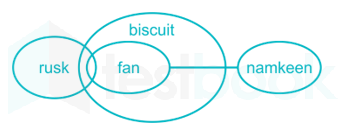
We draw the least possible Venn diagram:

Conclusions:

I. Some Rusk is Fan → It’s possible but not definite. Hence, false.

II. Some Namkeen is Biscuit → It’s possible but not definite. Hence, false.

Hence, Neither conclusion I nor II follows.

27

In the question below are given two statements followed by two conclusions numbered I and II. You have to take the given statements to be true even if they seem to be at variance with commonly known facts. Read all the conclusions and then decide which of the given conclusions logically follows from the given statements disregarding commonly known facts.

Statement:

No exercise is dance.

All dances are nests.

Conclusion:

I. Some nests are definitely exercises.

II. All exercises can be nest.

  1. ((a))

    Only conclusion I follows.

  2. ((b))

    Only conclusion II follows.

  3. ((c))

    Either conclusion I or conclusion II follows.

  4. ((d))

    Neither conclusion I nor conclusion II follows.

  5. ((e))

    Both conclusion I and conclusion II follow.

Show Answer
Answer: ((b))

Only conclusion II follows.

The least possible diagram of this question is as follows,

I. Some nests are definitely exercises → False (it is possible but not definite)

II. All exercises can be nest → True (possibility is true)

Hence, only conclusion II follows.

28

Directions: In the following question, three statements are given followed by two conclusions I, II. You have to consider the given statements to be true even if they seem to be at variance with commonly known facts. Read all the conclusions and decide which of the following logically follows from the given statements disregarding the commonly known facts.

Statements:

  1. Some words are letters.

  2. Some letters are alphabets.

  3. All alphabets are sentences.

Conclusions:

  1. At least some words are alphabet.

  2. No word is an alphabet.

  1. ((a))

    Only I follows

  2. ((b))

    Only II follows

  3. ((c))

    Either I or II follows

  4. ((d))

    Neither I nor II follows

  5. ((e))

    Both I and II follows

Show Answer
Answer: ((c))

Either I or II follows

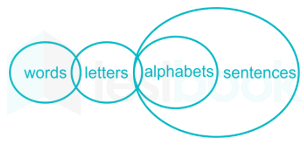
The least possible Venn diagram for the given statements is as follows,

Conclusions:

  1. At least some words are alphabet → False (It is possible but not definite)

  2. No word is an alphabet → False (It is possible but not definite)

Here, conclusions I and II are the complementary pair.

Hence, either I or II follows.

29

Directions: In the question below, there are two statements followed by two conclusions numbered I and II. You have to take the given statements to be true even if they seem to be at variance with commonly known facts and then decide which of the given conclusions logically follow(s) from the given statements.

Statements:

Some purse are bags.

No bag is handle.

Conclusions:

I. No purse is handle.

II. Some purse are handle.

  1. ((a))

    Only I follows

  2. ((b))

    Only II follows

  3. ((c))

    Both I and II follow

  4. ((d))

    Either I or II follows

  5. ((e))

    None follows

Show Answer
Answer: ((d))

Either I or II follows

The least possible Venn diagram for the given statements is as follows,

Conclusions:

I. No purse is handle → False (It is possible but not definite)

II. Some purse are handle → False (It is possible but not definite)

Conclusion I and II are complementary to each other.

Hence, either I or II follows.

30

Directions: In the question below are given three statements followed by two conclusions I and II. You have to take the given statements to be true even if they seem to be at variance from commonly known facts. Read all the conclusions and then decide which of the given conclusions logically follows from the given statements disregarding commonly known facts.

Statements:

All Ink is Red.

No White is Blue.

Some Blue is Ink.

Conclusions:

I. All Red being White is a possibility.

II. No Ink is White.

  1. ((a))

    None follows.

  2. ((b))

    Only II follows.

  3. ((c))

    Only I follows.

  4. ((d))

    Both I & II follow.

  5. ((e))

    Either I and II follows

Show Answer
Answer: ((a))

None follows.

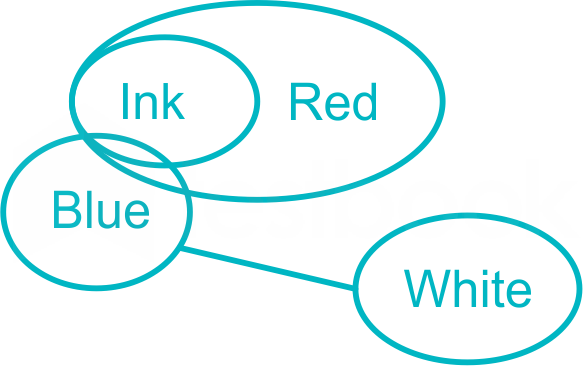
From the given statements we draw the following least possible Venn diagram:

Conclusions:

I. All Red being White is a possibility → False.

II. No Ink is White → False.

Hence, none is true.

Study the information and answer the given questions:

There are seven people viz. A, B, C, D, E, F, and G. All are standing in a queue from north to south but not necessarily in the same order.

There are more than three people between B and G. There are two people between B and E. There is only one person standing between E and G. There are three people standing between G and A. There are two people between A and C. More than three people between the F and A and F is behind G.

31

Who is at the foremost point at the line?

  1. ((a))

    A

  2. ((b))

    B

  3. ((c))

    C

  4. ((d))

    D

  5. ((e))

    E

Show Answer
Answer: ((b))

B

Seven people = A, B, C, D, E, F, and G

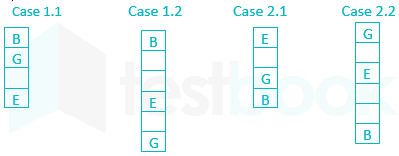
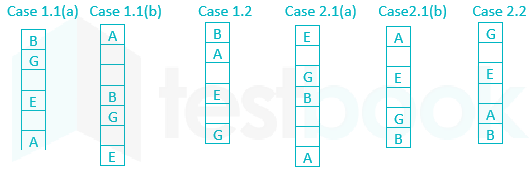
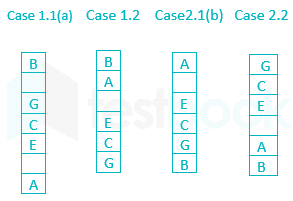
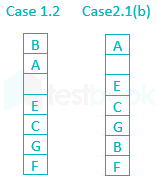
The arrangement of the given conditions is given as below:

  1. There are two people between B and E.

  2. There is only one person standing between E and G.

  1. There are three people standing between G and A.

  1. There are two people between A and C.

(Case1.1(b) and 2.1(a) gets eliminated.)

  1. More than three people are between the F and A and F is behind G.

(This is not possible in case 1.1(a), case 2.2.)

  1. There are more than three people between B and G.

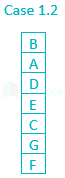
(Thus, case 2.1 gets eliminated.)

The above arrangement is the final arrangement.

Clearly, B is at the foremost point at the line.

32

What is the position of C from the foremost point?

  1. ((a))

    5th

  2. ((b))

    2nd

  3. ((c))

    4th

  4. ((d))

    3rd

  5. ((e))

    None of these

Show Answer
Answer: ((a))

5th

Seven people = A, B, C, D, E, F, and G

The arrangement of the given conditions is given as below:

  1. There are two people between B and E.

  2. There is only one person standing between E and G.

  1. There are three people standing between G and A.

  1. There are two people between A and C.

(Case1.1(b) and 2.1(a) gets eliminated.)

  1. More than three people are between the F and A and F is behind G.

(This is not possible in case 1.1(a), case 2.2.)

  1. There are more than three people between B and G. 

(Thus, case 2.1 gets eliminated.)

The above arrangement is the final arrangement.

Clearly, the position of C is fifth from the foremost point.

33

Who is the immediately ahead of D?

  1. ((a))

    C

  2. ((b))

    E

  3. ((c))

    F

  4. ((d))

    G

  5. ((e))

    A

Show Answer
Answer: ((e))

A

Seven people = A, B, C, D, E, F, and G

The arrangement of the given conditions is given as below:

  1. There are two people between B and E.

  2. There is only one person standing between E and G.

  1. There are three people standing between G and A.

  1. There are two people between A and C.

(Case1.1(b) and 2.1(a) gets eliminated.)

  1. More than three people are between the F and A and F is behind G.

(This is not possible in case 1.1(a), case 2.2.)

  1. There are more than three people between B and G. 

(Thus, case 2.1 gets eliminated.)

The above arrangement is the final arrangement.

Clearly, A is immediately ahead of D.

34

How many person/persons is/are there between D and the person who is 2nd from the back?

  1. ((a))

    Four

  2. ((b))

    Three

  3. ((c))

    Two

  4. ((d))

    One

  5. ((e))

    No one.

Show Answer
Answer: ((c))

Two

Seven people = A, B, C, D, E, F, and G

The arrangement of the given conditions is given as below:

  1. There are two people between B and E.

  2. There is only one person standing between E and G.

  1. There are three people standing between G and A.

  1. There are two people between A and C.

(Case1.1(b) and 2.1(a) gets eliminated.)

  1. More than three people are between the F and A and F is behind G.

(This is not possible in case 1.1(a), case 2.2.)

  1. There are more than three people between B and G. 

(Thus, case 2.1 gets eliminated.)

The above arrangement is the final arrangement.

Clearly, there are two persons between D and G.

35

If B is related to D and E related to G in a certain way, then A is related to?

  1. ((a))

    G

  2. ((b))

    E

  3. ((c))

    F

  4. ((d))

    C

  5. ((e))

    None of these

Show Answer
Answer: ((b))

E

Seven people = A, B, C, D, E, F, and G

The arrangement of the given conditions is given as below:

  1. There are two people between B and E.

  2. There is only one person standing between E and G.

  1. There are three people standing between G and A.

  1. There are two people between A and C.

(Case1.1(b) and 2.1(a) gets eliminated.)

  1. More than three people are between the F and A and F is behind G.

(This is not possible in case 1.1(a), case 2.2.)

  1. There are more than three people between B and G. 

(Thus, case 2.1 gets eliminated.)

The above arrangement is the final arrangement.

When B is related to D and E is related to G, the pattern followed is that there is a difference of one person between them.

Clearly, A is related to E.

Quantitative Aptitude (35 questions)

36

What should come in place of question mark (?) in the following question? (You do not have to calculate the exact value.)

√1227 – √628 = ?

  1. ((a))

    10

  2. ((b))

    12

  3. ((c))

    14

  4. ((d))

    8

  5. ((e))

    6

Show Answer
Answer: ((a))

10

√1227 – √628 = ?

Taking Approximations

⇒ √1225 – √625 = ?

∴ 35 – 25 = 10

37

What should come in place of question mark (?) in the following question? (You do not have to calculate the exact value.)

150.121 – (25.93 – ?) × 15.96 = 470.04

  1. ((a))

    46

  2. ((b))

    43

  3. ((c))

    52

  4. ((d))

    40

  5. ((e))

    41

Show Answer
Answer: ((a))

46

150.121 – (25.93 – ?) × 15.96 = 470.04

Taking Approximations

⇒ 150 – (26 – ?) × 16 = 470

⇒ –(26 – ?) × 16 = 470 – 150

⇒ –(26 – ?) × 16 = 320

⇒ –(26 – ?) = 320/16

⇒ –(26 – ?) = 20

⇒ –26 + ? = 20

∴ ? = 46

38

What should come in place of question mark (?) in the following questions? (You do not have to calculate the exact value.)

122 – ? = √785

  1. ((a))

    85

  2. ((b))

    100

  3. ((c))

    90

  4. ((d))

    116

  5. ((e))

    102

Show Answer
Answer: ((d))

116

122 – ? = √785

Taking Approximations

⇒ 122 – ? = √784

⇒ ? = 144 – 28

∴ ? = 116

39

What should come in place of question mark (?) in the following question? (You do not have to calculate the exact value.)

160.4 × 9.864 – 56.321 = ?

  1. ((a))

    1544

  2. ((b))

    1500

  3. ((c))

    1564

  4. ((d))

    1549

  5. ((e))

    1554

Show Answer
Answer: ((a))

1544

160.4 × 9.864 – 56.321 = ?

Taking Approximations

160.4 × 9.864 – 56.321 = ?

⇒ 160 × 10 – 56 = ?

⇒ 1600 – 56 = ?

∴ ? = 1544

40

What should come in place of question mark (?) in the following question? (You do not have to calculate the exact value.)

66.74% of 6090 – 60.75% of 5297 = ?

  1. ((a))

    850

  2. ((b))

    950

  3. ((c))

    1000

  4. ((d))

    750

  5. ((e))

    600

Show Answer
Answer: ((a))

850

66.74% of 6090 – 60.75% of 5297 = ?

Taking Approximations

⇒ 67% of 6100 – 61% of 5300 = ?

⇒ 67 × 61 – 61 × 53 = ?

⇒ 61(67 – 53) = ?

⇒ 61(14) = ?

∴ ? = 854 ≈ 850

41

What should come in place of question mark (?) in the following question? (You do not have to calculate the exact value.)

1474.8 ÷ 19.5 ÷ 4.2 = ?

  1. ((a))

    18

  2. ((b))

    28

  3. ((c))

    8

  4. ((d))

    10

  5. ((e))

    30

Show Answer
Answer: ((a))

18

1474.8 ÷ 19.5 ÷ 4.2 = ?

Taking Approximations

⇒ 1475 ÷ 20 ÷ 4 = ?

∴ 73.75 ÷ 4 = 18.43 ≈ 18

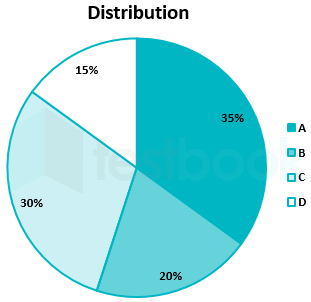
Directions: The given pie chart shows the distribution of total number of people in four different towns and the table shows the number of males in the given towns. Read the graph carefully and answer the following questions.

Total number of people = 12000

TownNumber of males
A2800
B800
C1750
D1100
42

Find the difference between total number of males in town B and females in town D and total number of males in town C and females in town A.

  1. ((a))

    1800

  2. ((b))

    1850

  3. ((c))

    1650

  4. ((d))

    2000

  5. ((e))

    2500

Show Answer
Answer: ((c))

1650

Given total number of people = 12000

No. of people in town A = 35% of 12000 = 4200

No. of people in town B = 20% of 12000 = 2400

No. of people in town C = 30% of 12000 = 3600

No. of people in town D = 15% of 12000 = 1800

No. of females in town A = 4200 – 2800 = 1400

No. of females in town B = 2400 – 800 = 1600

No. of females in town C = 3600 – 1750 = 1850

No. of females in town D = 1800 – 1100 = 700

Total number of males in town B and females in town D = 800 + 700 = 1500

Total number of males in town C and females in town A = 1750 + 1400 = 3150

Difference = 3150 – 1500 = 1650

43

Find the sum of the average of total number of males and the average of total number of females.

  1. ((a))

    3200

  2. ((b))

    3000

  3. ((c))

    2000

  4. ((d))

    3600

  5. ((e))

    2800

Show Answer
Answer: ((b))

3000

Average of total number of males = (2800 + 800 + 1750 + 1100)/4 = 6450/4.

Average of total number of females = (1400 + 1600 + 1850 + 700)/4 = 5550/4.

Required sum = 6450/4 + 5550/4 = 12000/4 = 3000

44

Total number of females in town B and town C is what percent of total number of males in town C and town D together?

  1. ((a))

    125%

  2. ((b))

    112.5%

  3. ((c))

    110%

  4. ((d))

    150%

  5. ((e))

    121%

Show Answer
Answer: ((e))

121%

Total number of females in town B and town C = 1600 + 1850 = 3450

Total number of males in town C and town D = 1750 + 1100 = 2850

Required percentage = (3450/2850) × 100 = 121

45

Find the ratio of males of town A, B and C together to females of town B and D together.

  1. ((a))

    97 : 121

  2. ((b))

    128 : 141

  3. ((c))

    146 : 97

  4. ((d))

    107 ∶ 46

  5. ((e))

    147 : 46

Show Answer
Answer: ((d))

107 ∶ 46

Number of males of town A, B and C together = 2800 + 800 + 1750 = 5350

Number of females of town B and D together = 1600 + 700 = 2300

Ratio = 5350 : 2300 = 107 : 46

46

Find the number of females in all the towns together.

  1. ((a))

    5650

  2. ((b))

    5440

  3. ((c))

    4555

  4. ((d))

    6550

  5. ((e))

    5550

Show Answer
Answer: ((e))

5550

Total number of females = 1400 + 1600 + 1850 + 700 = 5550

47

The ratio of investments of A and B is 2 ∶ 3. The ratio of time of investment of A and B is 5 ∶ 4. The profit of A is what percent less than of the profit of B?

  1. ((a))

    24%

  2. ((b))

    16.67%

  3. ((c))

    25%

  4. ((d))

    30%

  5. ((e))

    10%

Show Answer
Answer: ((b))

16.67%

Investment → A : B

           2 : 3

Time →           5 : 4

∵ We know that, Profit sharing ratio = Investment × Time

Profit sharing ratio (PSR) = Investment × Time

PSR →             A : B

       2 × 5 : 3 × 4

             5 : 6

Now, required percentage = (6 – 5)/6 × 100 = 16.66%

48

The combined cost price of A and B is Rs. 4400. A is sold at a profit of 15% and B is sold at a profit of 18%. The profit of A and B is equal. Find the cost price of B.

  1. ((a))

    Rs. 2500

  2. ((b))

    Rs. 2100

  3. ((c))

    Rs. 2000

  4. ((d))

    Rs. 2600

  5. ((e))

    Rs. 1600

Show Answer
Answer: ((c))

Rs. 2000

Let C.P. of A be Rs. X.

Then C.P of B = Rs. (4400 – x)

Given,

Profit of A = Profit of B

x × 15% = (4400 – x) × 18%

⇒ x = 4400 × 6/2400 = Rs. 2400

∴ C.P of B = (4400 – 2400) = Rs. 2000

49

The quantity of milk in a mixture is 58 lt and the quantity of water in the mixture is x lt. 3x lt of milk and 2x lt of water is added in the mixture. The final ratio of milk and water is 4 ∶ 3. Find the quantity of milk in the final mixture.

  1. ((a))

    116 lt

  2. ((b))

    216 lt

  3. ((c))

    221 lt

  4. ((d))

    232 lt

  5. ((e))

    250 lt

Show Answer
Answer: ((d))

232 lt

GIVEN :

The quantity of milk in a mixture is 58 litre and the quantity of water in the mixture is x litre.

3x litre of milk and 2x litre of water is added in the mixture.

The final ratio of milk and water is 4 ∶ 3. 

CALCULATION :

Milk = 58 litre and Water = x litre

Now, New Quantity of milk = (58 + 3x) litre

New Quantity of water = (x + 2x) litre

Again, According to the question

(58 + 3x)/(x + 2x) = 4/3

x = 58

Quantity of milk in the final mixture = 58 + 3x = 58 + 3 × 58 = 232 litre

50

A certain sum is invested at simple interest at a rate of 8% for 3 years. He invested the interest at compound interest at a rate 20% for 2 years. The amount becomes Rs. 864. Find the initial sum.

  1. ((a))

    Rs. 7600

  2. ((b))

    Rs. 7200

  3. ((c))

    Rs. 8000

  4. ((d))

    Rs. 7650

  5. ((e))

    None of these

Show Answer
Answer: ((e))

None of these

GIVEN :

When invested at SI

R = 8%

T = 3 years

When invested at CI

R = 20%

T = 2 years

The amount becomes Rs. 864.


ASSUMPTION :


Let the sum invested be Rs. P1

CALCULATION :

SI = P1 × 8 × 3/100 = (24/100)*P1

Now,

It is given that simple interest is invested at 20% for 2 years of compound interest.

Hence, the principal of compound interest is equal to the simple interest of the sum.

⇒ A = P2(1 + r/100)n

⇒ 864 = P2(1 + 20/100)2

⇒ P2 = 600

⇒ (24/100) P1 = P2 = 600 (As mentioned in the question)

⇒ P1 = 2500

51

2 dices are thrown randomly. Find the probability that the sum would be 6.

  1. ((a))

    11/36

  2. ((b))

    5/36

  3. ((c))

    25/36

  4. ((d))

    1/6

  5. ((e))

    1/18

Show Answer
Answer: ((b))

5/36

Probability = Favourable Events/Total Events

2 dices are thrown randomly.

No. of total events = 62 = 36

Favourable events that the sum would be 6.

(1,5); (5,1); (2,4); (4,2); (3,3)

No. of favourable events = 5

⇒ Probability = 5/36

52

The cost of rice A is Rs. 24 per kg and the cost of rice B is Rs. x. 30 kg of rice A and 20 kg of rice B was mixed and sold at a profit of 50% at a rate of Rs. 43.2 per kg. Find the value of x.

  1. ((a))

    24

  2. ((b))

    25

  3. ((c))

    36

  4. ((d))

    40

  5. ((e))

    48

Show Answer
Answer: ((c))

36

∵ The selling price of rice = Rs. 43.2 per kg

∴ The cost price of rice = 43.2 × 100/150 = Rs. 28.8 per kg

⇒ The cost price of 50 kg = 28.8 × 50 = Rs. 1440

According to question

⇒ 24 × 30 + 20 × x = 1440

⇒ x = Rs. 36

53

The ratio of age of son and father is 1 ∶ 5. The ratio of father and mother is 8 ∶ 7. The difference of father and mother is 5 years. Find the age of son.

  1. ((a))

    6 years

  2. ((b))

    5 years

  3. ((c))

    2 years

  4. ((d))

    8 years

  5. ((e))

    10 years

Show Answer
Answer: ((d))

8 years

Let the age of father be 8x and the age of mother be 7x.

According to question

8x – 7x = 5

⇒ x = 5

∴ Age of father = 8 × 5 = 40 years

∴ Age of son = 1/5 × 40 = 8 years

54

The surface area of a sphere is 400π. The diameter of the sphere is equal to the side of a square. Find the perimeter of the square.

  1. ((a))

    80 cm

  2. ((b))

    64 cm

  3. ((c))

    72 cm

  4. ((d))

    84 cm

  5. ((e))

    90 cm

Show Answer
Answer: ((a))

80 cm

We know that surface area of the sphere = 4πr2

⇒ 4πr2 = 400π

⇒ r = 10 cm

∴ Diameter = 20 cm

Given that the diameter of the sphere is equal to the side of the square

∴ Side of square = 20 cm

∴ Perimeter of the square = 4 × 20 = 80 cm

55

The difference of time, when a boat travels 100 km downstream and 80 km downstream is 1 hour. The speed of the stream is 1.5 km/h. Find the speed of the boat in upstream.

  1. ((a))

    12 km/h

  2. ((b))

    17 km/h

  3. ((c))

    24 km/h

  4. ((d))

    18.5 km/h

  5. ((e))

    20 km/h

Show Answer
Answer: ((b))

17 km/h

Given:

The speed of the stream is 1.5 km/h

Let the speed of the boat be x km/h.

The difference of time, when a boat travels 100 km downstream and 80 km downstream is 1 hour.

Formula used:

Time = Distance/Speed

Upstream speed = speed of the boat - speed of the stream  

Downstream speed = speed of the boat + speed of the stream  

Calculation:

According to the question

100/(x + 1.5) – 80/(x + 1.5) = 1

⇒ 20/(x + 1.5) = 1

⇒ x + 1.5 = 20

⇒ x = 18.5 km/h

∴ The speed of the boat in upstream = 18.5 – 1.5 = 17 km/h

56

The length of train A is 250 m and the length of train B is 350 m. The speed of the train A is 20 m/sec. Find the speed of the train B if both the trains cross each other in 12 sec.

  1. ((a))

    25 m/sec

  2. ((b))

    20 m/sec

  3. ((c))

    30 m/sec

  4. ((d))

    24 m/sec

  5. ((e))

    36 m/sec

Show Answer
Answer: ((c))

30 m/sec

Let the speed of the train B be x m/s.

Total distance covered by trains to cross each other = 250 + 350 = 600 m

Relative speed = (x + 20) m/s

We know that, Speed = Distance/Time

⇒ (x + 20) = 600/12

⇒ x = 30 m/s

57

A person spends 10% of his salary on rent. He spends 30% of the rest in house expense. He spends the rest of the salary on medicine and on groceries in the ratio of 3 ∶ 4. If the expense on medicine is Rs. 8100, find his salary.

  1. ((a))

    Rs. 25000

  2. ((b))

    Rs. 24000

  3. ((c))

    Rs. 32000

  4. ((d))

    Rs. 36000

  5. ((e))

    Rs. 30000

Show Answer
Answer: ((e))

Rs. 30000

Let the income of the person be 100x.

The money spent on rent = 100x × 10/100 = 10x

The money spent in house expanses = (100x – 10x) × 30/100 = 27x

Remaining amount = 90x – 27x = 63x

The money spent on medicine = 3/7 × 63x = 27x

According to the question

⇒ 27x = 8100

⇒ x = 300

∴ Total salary = 100x = 300 × 100 = Rs. 30000

58

Pipe P1 and P2 can fill the same tank in 60 minutes and 30 minutes, respectively. Another pipe P3, can empty the same tank in 45 minutes. How much time (in minutes) is required to fill the tank if all three pipes are opened together?

  1. ((a))

    15 min

  2. ((b))

    21 min

  3. ((c))

    28 min

  4. ((d))

    36 min

  5. ((e))

    45 min

Show Answer
Answer: ((d))

36 min

Work done by all the pipes in 1 min = (1/60) + (1/30) – (1/45) = 1/20 – 1/45 = 1/36

Total time taken = 36 min

59

45% of one-fourth of 50% of price of a mobile is the price of a pen drive. If price of the pen drive is 360. The price of the mobile in Rs. is

  1. ((a))

    6400

  2. ((b))

    5760

  3. ((c))

    4800

  4. ((d))

    7200

  5. ((e))

    8400

Show Answer
Answer: ((a))

6400

Let, The price of the mobile is Rs. x

45% of one-fourth of 50% of x is

=45100×14×50100×x= \frac{{45}}{{100}} \times \frac{1}{4} \times \frac{{50}}{{100}} \times x

= 9x/160

According to the question,

9x/160 = 360

⇒ x = 40 × 160

⇒ x = 6400

60

The ratio of sale of mobile phones of a shop on Monday, Tuesday, Wednesday and Thursday is 5 : 4 : 8 : 3. The sale on Wednesday was 160. Find the number of mobile phones sold on Friday if the sale of Friday is 20% more than Monday.

  1. ((a))

    30

  2. ((b))

    60

  3. ((c))

    100

  4. ((d))

    120

  5. ((e))

    240

Show Answer
Answer: ((d))

120

Shortcut Trick

Ratio of Wednesday to Monday = 8 : 5.

Given 8 units = 160 → 1 unit = 20.

Monday sale = 5 × 20 = 100.

Friday sale = 120% of Monday = 1.2 × 100 = 120.

∴ The correct answer is 120 phones.

Alternate Method

Given: Ratio Mon : Tue : Wed : Thu = 5 : 4 : 8 : 3.

Given: Sale on Wednesday = 160.

⇒ 8 units = 160

⇒ 1 unit = 160 ÷ 8 = 20

⇒ Sale on Monday = 5 units = 5 × 20 = 100

⇒ Sale on Friday = Sale on Monday + 20% of Sale on Monday

⇒ Sale on Friday = 100 + (20 ÷ 100) × 100

⇒ Sale on Friday = 100 + 20 = 120

∴ The correct answer is 120 phones.

Additional Information

Ratio and Proportion

If a : b is given and the value of 'a' is known, then b = (Value of a ÷ a) × b.

Percentage Increase

To increase a value x by k%, use the formula: New Value = x × (100 + k) ÷ 100.

Unitary Method

Calculate the value of a single unit first, then multiply by the required number of units to find any component of the ratio.

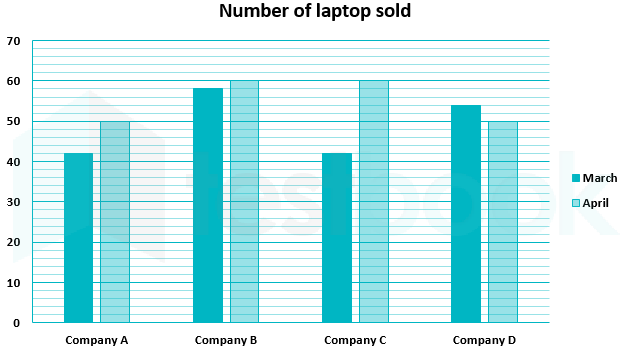
Direction: The given bar graph shows the total number of laptops sold by four companies A, B, C and D. Read the diagram carefully and answer the following questions carefully.

61

Find the average laptop sell of company A and B in the month of March.

  1. ((a))

    64

  2. ((b))

    50

  3. ((c))

    60

  4. ((d))

    40

  5. ((e))

    35

Show Answer
Answer: ((b))

50

Laptop sold by company in the month of March = 42

Laptop sold by company in the month of March = 58

Average laptop sold by company A and B = (42 + 58)/2

= 100/2 = 50

62

Find the difference between the number of laptops sold by company A in the month of April and the number of laptops sold by company A and B in the month of March.

  1. ((a))

    50

  2. ((b))

    25

  3. ((c))

    32

  4. ((d))

    38

  5. ((e))

    48

Show Answer
Answer: ((a))

50

Laptops sold by company A in the month of April = 50

Laptops sold by company A and B in the month of March = 100

Required difference = 100 – 50 = 50

63

Laptop sold by company C in the month of April is what percent more than laptop sold by company D in the month of April?

  1. ((a))

    16%

  2. ((b))

    24%

  3. ((c))

    20%

  4. ((d))

    32%

  5. ((e))

    35%

Show Answer
Answer: ((c))

20%

Laptops sold by company C in the month of April = 60

Laptops sold by company D in the month of April = 50

Required Percentage = {(60 – 50)/50} x 100

= (10/50) × 100 = 20%

64

If the cost of total sale is Rs. 10.4 lakh, find the cost of one laptop.

  1. ((a))

    Rs. 2400

  2. ((b))

    Rs. 3200

  3. ((c))

    Rs. 3000

  4. ((d))

    Rs. 2500

  5. ((e))

    Rs. 2800

Show Answer
Answer: ((d))

Rs. 2500

Total no of sold Laptops = (42 + 50 + 58 + 60 + 42 + 60 + 54 + 50) = 416

Total Cost = 10.4 lacks

Cost of 1 Laptop = 10.4 lacks/416 = Rs. 2500

65

If the sale of company D in the month of May rises by 20% with respect to April, find the total sale of company D in the month of May.

  1. ((a))

    60

  2. ((b))

    40

  3. ((c))

    50

  4. ((d))

    52

  5. ((e))

    55

Show Answer
Answer: ((a))

60

Sale of Company D in the month of May = 120% of Sale of Company D in the month of April

Sale of Company D in the month of May = 120% of 50 = 60

66

Find out the wrong number in the series:

38, 48, 36, 51, 34, 53

  1. ((a))

    38

  2. ((b))

    48

  3. ((c))

    36

  4. ((d))

    51

  5. ((e))

    34

Show Answer
Answer: ((b))

48

67

Find out the wrong number in the series:

49, 54, 59, 64, 79, 74

  1. ((a))

    54

  2. ((b))

    59

  3. ((c))

    64

  4. ((d))

    79

  5. ((e))

    49

Show Answer
Answer: ((d))

79

68

Find out the wrong number in the series:

2.5, 3, 5, 15, 60, 300, 1800

  1. ((a))

    15

  2. ((b))

    3

  3. ((c))

    60

  4. ((d))

    3000

  5. ((e))

    18000

Show Answer
Answer: ((b))

3

69

Find out the wrong number in the series:

11, 21, 61, 241, 1207, 7201

  1. ((a))

    21

  2. ((b))

    61

  3. ((c))

    241

  4. ((d))

    1207

  5. ((e))

    7201

Show Answer
Answer: ((d))

1207

Given:

11, 21, 61, 241, 1207, 7201

Calculation:

70

Find out the wrong number in the series:

600, 466, 356, 292, 256, 240, 236

  1. ((a))

    466

  2. ((b))

    356

  3. ((c))

    292

  4. ((d))

    256

  5. ((e))

    240

Show Answer
Answer: ((a))

466

English Language (30 questions)

71

Directions: The question below consists of a set of labeled sentences. Out of the four options given, select the most logical order of the sentences to form a coherent paragraph.

P: growing cities in the

Q: rated as one

R: Mumbai has been

S: world at the moment

T: of the fastest

  1. ((a))

    PSRTQ

  2. ((b))

    QSRPT

  3. ((c))

    RQPST

  4. ((d))

    RQTPS

  5. ((e))

    None of the above.

Show Answer
Answer: ((d))

RQTPS

The correct option is 4, RQTPS.

The first sentence will be R as it introduces the subject. 

Since R ends with 'has been' only P and Q can grammatically follow it. Following 'has been' with 'rated as one' makes more sense and is grammatically correct than following it with 'growing cities in the'. Hence, the second part will be Q. 

This means that the correct option is either 3 or 4. Since RQ ends with 'as one' it follows grammatically that the next part be T which is 'of the fastest'. This makes the part: Mumbai has been rated as one of the fastest.

Since option 4 is the only one which which has RQT in it, it is the correct one. 

Hence, the statement becomes:

Mumbai has been rated as one of the fastest growing cities in the world at the moment.

72

Directions: The question below consists of a set of labeled parts of a sentence. Out of the five options given, select the most logical order  to form a coherent sentence.

P: almost like the printing press,

Q: likened to a revolutionary introduction

R: hands of the masses

S: giving power into the

T: the internet has been

  1. ((a))

    RQTSP

  2. ((b))

    QSPTR

  3. ((c))

    RQPST

  4. ((d))

    TQPSR

  5. ((e))

    PQSTR

Show Answer
Answer: ((d))

TQPSR

The correct option is 4, TQPSR.

Key Points

  • The first sentence will be T as it introduces the subject.
  • Since T ends with 'has been' only Q and S can grammatically follow it.
  • Following 'has been' with 'likened to' makes more sense and is grammatically correct and it can then be logically followed by P. Hence, the second part will be P.
  • This means that the correct option is 4 as it is the only one which which has TQP in it.

Hence, the statement becomes: The internet has been likened to a revolutionary introduction almost like the printing press, giving power into the hands of the masses.

73

The question below consists of a set of labeled parts of a sentence. Out of the five options given, select the most logical order to form a coherent sentence.

P: in medication but

Q: underfunding has continued

R: there have been 

S: to keep it limited

T: considerable advances

  1. ((a))

    RSQPT

  2. ((b))

    RTPQS

  3. ((c))

    RQTPS

  4. ((d))

    QPRST

  5. ((e))

    None of them. 

Show Answer
Answer: ((b))

RTPQS

The correct option is 2, RTPQS.

The first sentence will be R as it has an introductory tone. 

Since R ends with 'have been' it has to be followed by a noun which is in the part T. Hence, the second part will be T. 

Since option 2 is the only one which has RT in the order, it is the correct one. 

Hence, the statement becomes:

There have been considerable advances in medication but underfunding has continued to keep it limited.

74

In the given question, a sentence has been divided into five parts. The question is followed by five options which give possible sequences of the rearranged parts. You must choose the option which gives the correct sequence. If the sentence is already arranged correctly, or if none of the given options forms the correct sequence, mark option 5, i.e. ‘None of the above’.

A: the Indian newsroom  

B: and equal for women 

C: or it will lose

D: must be made safe

E: all credibility

  1. ((a))

    ADBEC

  2. ((b))

    BCDEA

  3. ((c))

    ADBCE

  4. ((d))

    ACBDE

  5. ((e))

    None of the above

Show Answer
Answer: ((c))

ADBCE

The correct option is 3, ADBCE.

Key Points

  • The first sentence will be A as it has an introductory tone.
  • Since A ends with the noun 'newsroom' it must follow with a verb which is in part D. Hence, the second part will be D. This means that the correct option is either 1 or 3, as these are the only ones with AD in them.
  • C ends with the verb 'lose' and therefore it makes sense grammatically to follow it with a noun which is in E.
  • Hence the order of C and E is CE and not EC.
  • Therefore, the correct option is 3.

Hence, the statement becomes: The Indian newsroom must be made safe and equal for women or it will lose all credibility.

75

In the given question, a sentence has been divided into five parts. The question is followed by five options which give possible sequences of the rearranged parts. You must choose the option which gives the correct sequence. If the sentence is already arranged correctly, or if none of the given options forms the correct sequence, mark option 5, i.e. ‘None of the above’.

A: form but also how

B: through temple studies

C: students not only   

D: the art evolved

E: learn the dance

  1. ((a))

    CDEAB

  2. ((b))

    BCDEA

  3. ((c))

    CEADB

  4. ((d))

    ABCDE

  5. ((e))

    None of the above

Show Answer
Answer: ((c))

CEADB

The correct option is 3, CEADB.

The first sentence will be C as it has an introductory tone. Since C ends with 'not only' which means it should be followed by a verb. Hence, the next part is E. 

The only option which includes CE is option 3. 

Hence, the statement becomes:

Students not only learn the dance form but also how the art evolved through temple studies.

76

Directions: Read each sentence to find out whether there is any grammatical mistake/error in it. Choose the sentence/option which is CORRECT (without any errors in it). If all sentences are incorrect, mark option 5 as your answer.

  1. ((a))

    From his window, he could saw the entire valley laid out before him like a blanket.

  2. ((b))

    There was no one from the house when Rosie came back from school in the evening. 

  3. ((c))

    The bus reached its destination on time and the passengers were visibly elated by it.

  4. ((d))

    The world is moved towards serious climate problems in the coming years.

  5. ((e))

     All are incorrect

Show Answer
Answer: ((c))

The bus reached its destination on time and the passengers were visibly elated by it.

Among the given sentences the correct option should be option 3. The sentence is correct. 

In the sentence 'From his window, he could saw the entire valley laid out before him like a blanket' the verb 'saw' is incorrect. It should be 'see'

In the sentence 'There was no one from the house when Rosie came back from school in the evening. ' the preposition 'from' is incorrectly used. It should be 'in'.

In the sentence 'The world is moved towards serious climate problems in the coming years' the verb 'moved' is in incorrect. It should be 'moving'.

77

Directions: Read each sentence to find out whether there is any grammatical mistake/error in it. Choose the sentence/option which is CORRECT (without any errors in it). If all sentences are incorrect, mark option 5 as your answer.

  1. ((a))

    Let us all thought about the most peaceful thing that has ever happened to us. 

  2. ((b))

    This rise in the prices of daily commodities is going to ruin our economy very soon

  3. ((c))

    Any query that a employee has should be discussed with the HR.

  4. ((d))

    The protest take place at the Freedom Square in the middle of the night and everyone attended it. 

  5. ((e))

     All are incorrect

Show Answer
Answer: ((b))

This rise in the prices of daily commodities is going to ruin our economy very soon

Among the given sentences the correct option should be option 2. The sentence is correct. 

In the sentence 'Let us all thought about the most peaceful thing that has ever happened to us' the verb 'thought' is incorrect. It should be 'think'

In the sentence 'Any query that a employee has should be discussed with the HR' the article 'a' is incorrectly used. It should be 'an'.

In the sentence 'The protest take place at the Freedom Square in the middle of the night and everyone attended it' the verb 'take' is in incorrect. It should be 'took'.

78

Directions: Read each sentence to find out whether there is any grammatical mistake/error in it. Choose the sentence/option which is CORRECT (without any errors in it). If all sentences are incorrect, mark option 5 as your answer.

  1. ((a))

    We have ever assumed that Harry was anything but a gentle husband to her wife. 

  2. ((b))

    Come to me, my son, I will feed you and put you to bed, and keep you comfortable.

  3. ((c))

    There are more things in the universe that your dreams and philosophy combined. 

  4. ((d))

    You should never bother yourself with useless worrying in matters that are trivial.

  5. ((e))

     All are incorrect

Show Answer
Answer: ((b))

Come to me, my son, I will feed you and put you to bed, and keep you comfortable.

Among the given sentences the correct option should be option 2. The sentence is correct. 

In the sentence 'We have ever assumed that Harry was anything but a gentle husband to her wife' the word 'ever' is incorrect. It should be 'never'

In the sentence 'There are more things in the universe that your dreams and philosophy combined' the word 'that' is incorrectly used. It should be 'than'.

In the sentence 'You should never bother yourself with useless overthinking in matters that are trivial.' the preposition 'in' is in incorrect. It should be 'about'.

79

Directions: Read each sentence to find out whether there is any grammatical mistake/error in it. Choose the sentence/option which is CORRECT (without any errors in it). If all sentences are incorrect, mark option 5 as your answer.

  1. ((a))

    Natural selection is nature's way about keeping the populations of different species in control. 

  2. ((b))

    I never imagined that humanity have walk on moon and dream of going to Mars.

  3. ((c))

    It is only around the hope that we can live through this horror called life. 

  4. ((d))

    No one can imagine the devastation causes in Hiroshima and Nagasaki after the World War II. 

  5. ((e))

     All are incorrect

Show Answer
Answer: ((e))

 All are incorrect

Among the given sentences the correct option should be option 5. All the sentences are incorrect. 

In the sentence 'Natural selection is nature's way about keeping the populations of different species in control' the preposition 'about' is incorrect. It should be 'of'

In the sentence 'I never imagined that humanity have walk on moon and dream of going to Mars' the helping verb 'have' is incorrectly used. It should be 'will'.

In the sentence 'It is only around the hope that we can live through this horror called life' the preposition 'around' is in incorrect. It should be 'with'

In the sentence 'No one can imagine the devastation causes in Hiroshima and Nagasaki after the World War II' the verb 'causes' is in incorrect tense. It should be 'caused'

80

Directions: Read each sentence to find out whether there is any grammatical mistake/error in it. Choose the sentence/option which is CORRECT (without any errors in it). If all sentences are incorrect, mark option 5 as your answer.

  1. ((a))

    The wall of ice shall not be broken by any force- human or otherwise.

  2. ((b))

    The advancements that had taken place in the area of medicine are splendid. 

  3. ((c))

    Whenever there is a tragedy humans tend of look for sympathy in one another. 

  4. ((d))

    Social media has brings the world closer and opened a multitude of opportunities of people.

  5. ((e))

     All are incorrect

Show Answer
Answer: ((a))

The wall of ice shall not be broken by any force- human or otherwise.

Among the given sentences the correct option should be option 1. It has no grammatical mistakes. 

In the sentence 'The advancements that had taken place in the area of medicine are splendid' the helping verb used with the verb 'taken place' is incorrect. It should be 'have taken place'

In the sentence 'Whenever there is a tragedy humans tend of look for sympathy in one another' the preposition 'of' is incorrectly used. It should be 'to'.

In the sentence 'Social media has brings the world closer and opened a multitude of opportunities of people' the verb 'brings' is in incorrect tense. It should be 'brought'

In the following passage, some of the words have been left out. Read the passage carefully and select the correct answer for the given blank out of the given alternatives.

Insuring a specific body part seems like something celebrities do to get into the news. But this type of policy makes sense to the people who can A_ to buy it.

The purpose of body part coverage is to ____B____lost income if a body part is damaged, injured, C, handicapped, or lost. For example, Holly Madison, a former Playboy model, insured her breasts for $1 million. Her reason: They're her assets. If something were to happen to them, she could be out of work for months.

For that reason, they're well worth the $1 million policy, considering how much money she could ___D_____lose. The same applies to any other body part insurance policy. Because body part insurance isn't __E_____by standard insurance companies and is highly personalized, it's not accessible to the general F. But if you can afford it, there's no reason why you can't buy it, too!

81

Which of the following words fits the blank labeled as (A)?

  1. ((a))

    Afford

  2. ((b))

    Eager

  3. ((c))

    Bestow

  4. ((d))

    Spend

  5. ((e))

    Expenditure

Show Answer
Answer: ((a))

Afford

Correct answer: 1.

'Afford' is the correct answer.

Let us know the meaning of:

Bestow: confer or present (an honor, right, or gift).

Other words do not fit the context of the sentence. Options 'Spend' and 'expenditure' are close contextually and meaning-wise but they are not correct grammar-wise.

82

Which of the following words fits the blank labeled as (B)?

  1. ((a))

    Add

  2. ((b))

    Supplement

  3. ((c))

    Subtract

  4. ((d))

    Substitution

  5. ((e))

    Track

Show Answer
Answer: ((b))

Supplement

Correct answer: option 2.

'Supplement' means a thing added to something else in order to complete or enhance it.

Other words do not fit the context. The sentence is describing a substitute for lost income.

'Substitute' would have been correct but 'substitution' is the option. Hence it is wrong.

83

Which of the following words fits the blank labeled as (C)?

  1. ((a))

    Pleasurable

  2. ((b))

    Scarred

  3. ((c))

    Homely

  4. ((d))

    Guarded

  5. ((e))

    Hurted

Show Answer
Answer: ((b))

Scarred

Correct answer: option 2.

'Scarred' means to mark with a scar or scars.

Let us know the meaning of some of the other words:

Homely: simple but cozy and comfortable, as in one's own home.

Guarded: Protected.

Hurted: Hurt would have been correct as an option. 'Hurted' is the wrong usage of the word.

84

Which of the following words fits the blank labeled as (D)?

  1. ((a))

    Minutely

  2. ((b))

    Gradually

  3. ((c))

    Haphazardly

  4. ((d))

    Credibly

  5. ((e))

    Potentially

Show Answer
Answer: ((e))

Potentially

Correct answer: Option 5.

Let us know the meaning of other words:

Minutely: with great attention to detail; meticulously.

Gradually: Slow progression.

Credibly: in a believable and convincing way.

Potentially: with the capacity to develop or happen in the future.

Hence, 'potentially' is the correct answer.

85

Which of the following words fits the blank labeled as (E)?

  1. ((a))

    Taken

  2. ((b))

    Forced

  3. ((c))

    Gather

  4. ((d))

    Offered

  5. ((e))

    Provide

Show Answer
Answer: ((d))

Offered

Correct answer: Option 4.

The blank requires the -ed form of the verb hence, option 2 and 4 are the viable options. However, 'the sentence implies that the insurance companies provide something, so 'forced' is the wrong word here.

86

Which of the following words fits the blank labeled as (F)?

  1. ((a))

    Quantity

  2. ((b))

    Posterity

  3. ((c))

    Public

  4. ((d))

    Private

  5. ((e))

    Publicly

Show Answer
Answer: ((c))

Public

Correct answer: Option 3.

Let us know the meaning of the other options:

Posterity: all future generations of people.

Note: 'Publicly' is not the correct form of the word. It requires the noun form, 'public'.

Read the following passage and answer the questions given below.

Thousands of claims, customer queries and large volumes of diverse data make the insurance industry a natural use case for artificial intelligence and cognitive technologies. A recent study from Tata Consultancy Services reported that the insurance sector has invested 124millioninAI,comparedtoanaverageof124 million in AI, compared to an average of 70 million invested by other industries. From customer service to claims processing, AI is frequently cited as a disruptive force in the insurance sector which is foreseen as the power that will lead the insurance industry.

Keeping up with the speed at which data is generated on a daily basis and our need to extract insight from that data requires powerful and innovative technology that can understand and ----------------- what is contained in information beyond keyword matching. It requires cognitive technology.

In this post, we will look at some of the most common applications of AI in the insurance industry.

Artificial Intelligence in the Claims Management Process:

Insurance industry processes are both data- and time-intensive. Consider the data types used across the many steps of the claims management process: Claim form input, incident documentation, medical reports, and repair estimates contain both unstructured or semi-structured, making it more difficult to process.

The evaluation and decision-making process depends on this data in order to evaluate the validity of a claim, to ensure against fraud, and to eventually route it through all of the decision-making processes.

By automating claims processes, insurers can access and extract the relevant information from documents and reduce processing times at the same time. Automated claims management solutions have significant advantages:

  • insurers can fast-track claims, reducing the time and costs of processing while enhancing customer experience through smart automatization or RPA (robotic process automation)
  • AI can identify patterns in data and help identify fraudulent claims in the process. Using machine learning capabilities, AI systems can learn and discover new cases in new scenarios, automatically evaluating damages and predicting the costs from historical data
  • Fraudulent cases can be detected more easily, sooner and more reliably, capturing patterns and traits that would be invisible to the human eye. This helps insurers with risk evaluations to support fast, informed decision making. In the insurance industry, artificial intelligence powered chatbots are replacing human assistants to deliver always available, fast and efficient customer service.

AI-powered Chatbot:

In the insurance industry, artificial intelligence powered chatbots are replacing human assistants to deliver always available, fast and efficient customer service.

To be effective, chatbots must have natural language processing and sentiment analysis capabilities to accurately understand what customers are saying in their own Language.

Chabot applications based on artificial intelligence allow users to interact directly with your business using their own words, through natural, human-like conversations. Chatbots can be used to automatically provide information, facilitate the purchase and help connect customers to the services or information they need, 24×7, in order to provide them with a faster and optimized experience. 

Deep comprehension of the meaning of words offers a great opportunity for extracting strategic information from conversations with customers. Detailed preferences, comments, habits, feelings, needs, etc. can be identified, tracked and transformed into actionable intelligence to identify not only trends, problems, and signals but also customized requirements.
87

Directions: Given below is a sentence from the passage. Choose the correct to fill in the blank.

Keeping up with the speed at which data is generated on a daily basis and our need to extract insight from that data requires powerful and innovative technology that can understand and ------------ what is contained in the information beyond keyword matching.

  1. ((a))

    Lament

  2. ((b))

    Amend

  3. ((c))

    Suspend

  4. ((d))

    Pretend

  5. ((e))

    Comprehend

Show Answer
Answer: ((e))

Comprehend

The correct option is 5.

The meanings of all the words are given below:

Lament: a passionate expression of grief or sorrow.

Amend: make minor changes to (a text, piece of legislation, etc.) in order to make it fairer or more accurate, or to reflect changing circumstances.

Suspend: temporarily prevent from continuing or being in force or effect.

Pretend: behave so as to make it appear that something is the case when in fact it is not.

Comprehend: grasp mentally; understand.

88

Directions: Based on the passage, out of the five alternatives, select the word similar in meaning to the word given.

Volume

  1. ((a))

    Area

  2. ((b))

    Amount

  3. ((c))

    Speed

  4. ((d))

    Girth

  5. ((e))

    Span

Show Answer
Answer: ((b))

Amount

The correct option is 2.

The passage uses the word 'volume' in the sentence, 'Thousands of claims, customer queries and large volumes of diverse data make the insurance industry a natural use case for artificial intelligence and cognitive technologies'. 

Here it means the amount of data. 

The meanings of the words are given below:

Area: a region or part of a town, a country, or the world.

Amount: a quantity of something, especially the total of a thing or things in number, size, value, or extent.

Speed: the rate at which someone or something moves or operates or is able to move or operate.

Girth: the measurement around the middle of something, especially a person's waist.

Span: the full extent of something from end to end; the amount of space that something covers.

89

Directions: Based on the passage, out of the five alternatives, select the word similar in meaning to the word given.

Optimize

  1. ((a))

    Precise

  2. ((b))

    Concise

  3. ((c))

    Enhance

  4. ((d))

    Wise

  5. ((e))

    Surprise

Show Answer
Answer: ((c))

Enhance

The passage uses the word 'volume' in the sentence, 'Chatbots can be used to automatically provide information, facilitate the purchase and help connect customers to the services or information they need, 24×7, in order to provide them with a faster and optimized experience'.

Here it means the enhance of data. 

The meanings of the words are given below:

Precise: marked by exactness and accuracy of expression or detail.

Concise: giving a lot of information clearly and in a few words; brief but comprehensive.

Enhance: intensify, increase, or further improve the quality, value, or extent of.

Wise: having or showing experience, knowledge, and good judgment.

Surprise: an unexpected or astonishing event, fact, etc.

90

Directions: Given below is a sentence from the passage. Read it and choose the word closest in meaning to the word given in bold.

From customer service to claims processing, AI is frequently cited as a disruptive force in the insurance sector which is foreseen as the power that will lead the insurance industry.

  1. ((a))

    Descend

  2. ((b))

    Ascend

  3. ((c))

    Rise

  4. ((d))

    Head

  5. ((e))

    Fail

Show Answer
Answer: ((d))

Head

The correct option is 4. 

The meaning of all the words are given below:

Descend: move or fall downwards.

Ascend: go up or climb.

Rise: move from a lower position to a higher one; come or go up.

Head: be in the leading position on.

Fail: be unsuccessful in achieving one's goal.

91

What does the sentence given below mean?

Deep comprehension of the meaning of words offers a great opportunity for extracting strategic information from conversations with customers.

  1. ((a))

    It is only through an intense amount of knowledge of human vocabulary that the insurance industry function. 

  2. ((b))

    The amount of knowledge of human vocabulary which is required for insurance industry already exists.

  3. ((c))

    An intense amount of knowledge of human vocabulary is required to take the important details out of the conversations with customers. 

  4. ((d))

    No amount of knowledge of human vocabulary can help in taking the important details out of the conversations with customers. 

  5. ((e))

    An intense amount of knowledge of human vocabulary is not required to take out the important details out of the conversations with customers. 

Show Answer
Answer: ((c))

An intense amount of knowledge of human vocabulary is required to take the important details out of the conversations with customers. 

From our understanding of the passage it can be safely said that the correct option is 3. The statement given in the questions means that an intense amount of knowledge of human vocabulary is required to take the important details out of the conversations with customers.

92

According to the passage, how can AI systems learn to discover new cases in new scenarios, automatically evaluate damages and predicti the costs from historical data?

  1. ((a))

    Through machine learning. 

  2. ((b))

    Through more data compilation. 

  3. ((c))

    Through enhanced chatbots.

  4. ((d))

    Through a systematic disruption of the industry. 

  5. ((e))

    Through a new marketing strategy. 

Show Answer
Answer: ((a))

Through machine learning. 

It is given in the following line of the passage: Using machine learning capabilities, AI systems can learn and discover new cases in new scenarios, automatically evaluating damages and predicting the costs from historical data.

93

Directions: Complete the following sentence.

The evaluation and decision-making process depends on this data in order to -

  1. ((a))

    Evaluate the validity of a claim.

  2. ((b))

    Ensure against fraud.

  3. ((c))

    Eventually route the data through all of the decision-making processes.

  4. ((d))

    All of these.

  5. ((e))

    None of these. 

Show Answer
Answer: ((d))

All of these.

The correct option is 4. All of these are correct.

We can see this in the following line of the passage: The evaluation and decision-making process depends on this data in order to evaluate the validity of a claim, to ensure against fraud, and to eventually route it through all of the decision-making processes.

94

A sentence with four emboldened words is given below. See if any of the words are wrongly used based on context or spelling and mark that word accordingly. If all the words are used correctly, use option 5 as the answer.

In the week after King’s death, people rioted in more than 100 cities across America, mourning and venting rage.

  1. ((a))

    Week

  2. ((b))

    Rioted

  3. ((c))

    Mourning

  4. ((d))

    Venting

  5. ((e))

    All are correct

Show Answer
Answer: ((e))

All are correct

Correct answer: Option 5.

This sentence is grammatically and contextually correct. All the words have been used in their proper context and also the rules of grammar are followed.

95

A sentence with four emboldened words is given below. See if any of the words are wrongly used based on context or spelling, mark that word accordingly. If all the words are used correctly, use option 5 as the answer.

The need to know for those acquisitions has meant that reported figures have been of little relevance.

  1. ((a))

    Need

  2. ((b))

    Know

  3. ((c))

    Reported

  4. ((d))

    Relevance

  5. ((e))

    All are correct

Show Answer
Answer: ((b))

Know

Correct answer: Option 2.

The word 'know' is incorrectly used here. The correct word here would be 'account'.

The correct sentence: The need to account for those acquisitions has meant that reported figures have been of little relevance

96

A sentence with four emboldened words is given below. See if any of the words are wrongly used based on context or spelling and mark that word accordingly. If all the words are used correctly, use option 5 as the answer.

After the dinner got over, the lights mysteriuously failed, and we stumbled around in complete darkness.

  1. ((a))

    Got

  2. ((b))

    Mysteriuously 

  3. ((c))

    Stumbled

  4. ((d))

    Darkness

  5. ((e))

    All are correct

Show Answer
Answer: ((b))

Mysteriuously 

Correct answer: Option 2.

The word mysteriuously is incorrectly spelled. The correct spelling is mysteriously.

97

A sentence with four emboldened words is given below. See if any of the words are wrongly used based on context or spelling and mark that word accordingly. If all the words are used correctly, use option 5 as the answer.

If we did not report what was happening in the country, we would be failing in our duty.

  1. ((a))

    Report

  2. ((b))

    Happening

  3. ((c))

    Would

  4. ((d))

    In

  5. ((e))

    All are correct.

Show Answer
Answer: ((e))

All are correct.

Correct answer: Option 5.

The sentence is grammatically and contextually correct.

98

Below a word is given in three sentences. Find out which one/ones make/makes a correct usage of the given word and mark the option accordingly. If the sentences are all correct mark option 5 as the answer.

Reference

A. The book is well referenced and indexed, including a listing of cases found throughout the book.

B. I was dismissed from the library, but with a good reference.

C. My reference books have not been helpful in identifying the aircraft in the picture.

  1. ((a))

    Only A

  2. ((b))

    Only B

  3. ((c))

    Only C

  4. ((d))

    Only A and C

  5. ((e))

    All of the above

Show Answer
Answer: ((e))

All of the above

Correct answer: Option 5.

The given sentences are all correct grammatically and contextually.

Sentence A makes use of the verb form of 'reference'.

Sentence B makes use of the noun form of 'reference'.

Sentence C makes use of the adjectival form of 'reference'.

99

Below a word is given in three sentences. Find out which one/ones make/makes a correct usage of the given word and mark the option accordingly. If the sentences are all correct mark option 5 as the answer.

Spar

A. Patiently Loi and Mark set about constructing another spar.

B. Truly, though, Vishnu liked to spar in the training room.

C. Jimmy and Jill always spar with each other at meetings but they're good friends really.

  1. ((a))

    Only A

  2. ((b))

    Ony B

  3. ((c))

    A and B

  4. ((d))

    B and C

  5. ((e))

    All are correct.

Show Answer
Answer: ((e))

All are correct.

First, let us understand the meaning of the word spar, and then decide the correct sentence.

Spar refers to an argument or an intense bout of boxing. It also refers to a thick metal pole.

In the first statement, spar is used as a metal piece. Hence, it is correct.

In the second sentence, it is used as a reference to boxing practice. So the word is correctly used in the sentence.

In the third sentence, it means an argument or quarrel.

All the statements are correct. So, option 5 is the correct answer.

100

Below a word is given in three sentences. Find out which one/ones make/makes a correct usage of the given word and mark the option accordingly. If the sentences are all correct mark option 5 as the answer.

Rage

A. He flew into an abusive rage when he came to know that he was cheated.

B. His face was rage enough in order to make his enemies tremble.

C. Her note to him was full of rage.

  1. ((a))

    Only A

  2. ((b))

    Only B

  3. ((c))

    A and B

  4. ((d))

    A and C

  5. ((e))

    All of these

Show Answer
Answer: ((d))

A and C

Correct answer: Option 4.

Rage refers to uncontrollable violent anger.

In all the three sentences, the word has been referred to and used as synonymous to anger.

However, in the second sentence, the usage is not correct grammatically. It cannot be used in that manner.

Hence, option 4 is the correct answer.

Attempt this paper under real exam conditions

Timed interface, section switching, instant scoring, and question-by-question analytics — free.

Start Timed Attempt