Official Paper

NVS TGT Mathematics 2016 Official Paper (Previous Year Paper)

200 questions · 180 minutes · with answers · free

General Hindi & English (40 questions)

निम्नलिखित गद्यांश को पढ़कर प्रश्नों के लिए सही विकल्पों का चयन कीजिए :

'संस्कार' एक ऐसा शब्द है जिसका हम पोस्टमार्टम नहीं कर सकते। उसका रेशा-रेशा खोलकर नहीं दिखा सकते कि वह किन तत्वों से बना है। उसमें हमारी कितनी पुश्तों का योगदान है। एक तरह से वह हमारे मानसिक डी.एन.ए. की तरह है । कितने युगों, साधनों, स्मृतियों, परंपराओं के रासायनिक मिश्रण का योगफल । हमने उसे कब और कैसे पाया, उसमें से कितना अर्जित किया, कितना पुरखों के अनुग्रह से मिला, इसे जानना भी आसान नहीं। हमारे लिए यह जानना ज़्यादा आसान है कि अंततः वही चीज़ें बचती हैं जो प्राणवान बनी रहें। सप्राण और निष्प्राण की पहचान हम चीज़ों के बढ़ने, पनपने की अंदरूनी ताकत से करते हैं। इस ताकत का होना या न होना ही विकसने-गिरने का कारक कारण है। बढ़ने की तरह चीजें घटती भी हैं। विकृत भी होती हैं। इस क्रिया की पहचान को महादेवी जी ने सुंदर व्याख्या की है। उनका कहना है, परिवर्तन हर चीज़ का नियम है । उसे तो हर हाल में होना ही है, पर परिवर्तन के दो रूप हैं - एक रूप है विकास, दूसरा रूप है विकृति। परिवर्तन दोनों दशाओं में होता है पर दोनों को एक ही श्रेणी में नहीं रखा जा सकता। एक उन्नति का परिचायक है, दूसरा अवनति का। संस्कार को हम इसी तुला पर तौलते हैं - कौन-कौन सी चीजें, कौन-कौन से अनुभव, कौन से दृश्य, कौन-सी सूचनाएँ हमें या हमारे व्यक्तित्व को आगे ले जाती हैं, कौन-सी पीछे। किन चीज़ों का फलयोग हमारे जीवन में उत्कर्ष की तरह सामने आता है, किनका अपकर्ष की तरह। रास्तों के चुनाव और अपनी संवेदना के इस्तेमाल के लिए यह समझ कारगर सिद्ध हो सकती है।

1

परिवर्तन क्यों अनिवार्य है ?

  1. ((a))

    ऊब से बचने के लिए

  2. ((b))

    सतत विकास के लिए

  3. ((c))

    पीढ़ियों का अंतराल

  4. ((d))

    प्रकृति का नियम

Show Answer
Answer: ((d))

प्रकृति का नियम

परिवर्तन प्रकृति का नियम अनिवार्य है। 

  • गद्यांश के अनुसार:-
  • परिवर्तन प्रकृति का नियम है। उसे तो हर हाल में होना ही है, पर परिवर्तन के दो रूप हैं - एक रूप है विकास, दूसरा रूप है विकृति।
  • परिवर्तन दोनों दशाओं में होता है पर दोनों को एक ही श्रेणी में नहीं रखा जा सकता।

Key Points

  • प्रकृति- कुदरत, स्वभाव, शील, तासीर, मिजाज।
  • विलोम शब्द - 'कृत्रिम'

Additional Informationऊब:-

  • अर्थ: उकताहट, खिन्नता, बोरियत, उदासी, सामंजस्य, एकरसता, नीरसता, उकताहट, बोरियत।
  • विलोम शब्द - 'बेक़रारी'

सतत:- 

  • अर्थ: सदा, हमेशा, निरन्तर, लगातार।

अंतराल:-

  • अर्थ: दूरी, फ़ासला, अंतर, दूरत्व।
2

सप्राण और निष्प्राण की पहचान है

(a) गतिशीलता व गतिहीनता

(b) विकासशीलता - विकृति

(c) बढ़ना या घटना

(d) ज्ञेय या अज्ञेय

उपर्युक्त विशेषताओं के आधार पर सही उत्तर है

  1. ((a))

    a, b, c

  2. ((b))

    b, c, d

  3. ((c))

    a, c, d

  4. ((d))

    a, b, d

Show Answer
Answer: ((b))

b, c, d

सप्राण और निष्प्राण की पहचान है**- b, c, d**

  • गद्यांश के अनुसार:-
  • हमारे लिए यह जानना ज़्यादा आसान है कि अंततः वही चीज़ें बचती हैं जो प्राणवान बनी रहें
  • सप्राण और निष्प्राण की पहचान हम चीज़ों के बढ़ने, पनपने की अंदरूनी ताकत से करते हैं।
  • इस ताकत का होना या न होना ही विकसने-गिरने का कारक कारण है । बढ़ने की तरह चीजें घटती भी हैं । विकृत भी होती हैं।

Key Pointsविकसित:-

  • अर्थ: प्रफुल्ल, खिला हुआ, प्रसन्न।
  • विलोम शब्द - ​'अविकसित'

विकृत:-

  • अर्थ: विकारयुक्त, रोगी, बेडौल, बीमार, ख़राब, परिवर्तित, दूषित।
  • विलोम शब्द - 'अविकृत'

ज्ञेय:-

  • अर्थ: जिसका जानना योग्य या कर्तव्य हो, जानने योग्य।
  • विलोम शब्द - 'अज्ञेय'

Additional Informationगतिशीलता:-

  • अर्थ:  गतियुक्तता, सचलता, तेज़ी, तीव्रता, उग्रता, शीघ्रता, दक्षता, प्रखरता।
  • ​विलोम शब्द - 'गतिहीनता'
3

'पोस्टमार्टम' का हिंदी पर्याय है

  1. ((a))

    जाँच-परख

  2. ((b))

    चीरफाड़

  3. ((c))

    आलोचना

  4. ((d))

    समर्थन

Show Answer
Answer: ((b))

चीरफाड़

'पोस्टमार्टम' का हिंदी पर्याय है- चीरफाड़

  • अर्थ: वह परीक्षा जो किसी प्राणी की लाश को चीर फाड़कर की जाय

Key Points

  • ऐसे शब्द जिनके अर्थ समान हों, पर्यायवाची शब्द कहलाते हैं।
  • जैसे - 
  • जाँच-परख- ​अच्छी तरह देख भाल
  • आलोचना - समीक्षा, गुण-दोष, छिद्रान्वेषण, टीका-टिप्पणी।
  • समर्थन - मदद, अनुमोदन, हिमायत, सहायता।

Additional Informationकुछ महत्वपूर्ण 

  • अनुपम- अपूर्व, अतुल, अनोखा, अनूठा, अद्वितीय, अदभुत, अनन्य।
  • इज्जत- मान, प्रतिष्ठा, आदर, आबरू।
  • ईहा- मनोकामना, अभिलाषा, इच्छा, आकांक्षा, कामना।
  • उग्र- प्रचण्ड, उत्कट, तेज, महादेव, तीव्र, विकट।
  • एषणा- इच्छा, आकांक्षा, कामना, अभिलाषा, हसरत।
  • ओज- तेज, शक्ति, बल, चमक, कांति, दीप्ति, वीर्य।
4

'संस्कार' शब्द को परिभाषित करना क्यों कठिन है ?

  1. ((a))

    शाब्दिक अर्थ कठिन है ।

  2. ((b))

    यह एक लंबी प्रक्रिया का परिणाम है।

  3. ((c))

    संस्कार को समझना पेचीदा है ।

  4. ((d))

    संस्कार का अर्थ रूढ़ परंपरा समझा जाता है ।

Show Answer
Answer: ((b))

यह एक लंबी प्रक्रिया का परिणाम है।

'संस्कार' शब्द को परिभाषित करना कठिन है - यह एक लंबी प्रक्रिया का परिणाम है।

  • गद्यांश के अनुसार:-
  • ​संस्कार शब्द में कौन-कौन सी चीजें, कौन-कौन से अनुभव, कौन से दृश्य, कौन-सी सूचनाएँ हमें या हमारे व्यक्तित्व को आगे ले जाती हैं, कौन-सी पीछे । किन चीज़ों का फलयोग हमारे जीवन में उत्कर्ष की तरह सामने आता है, किनका अपकर्ष की तरह। अर्थात यह एक लंबी प्रक्रिया का परिणाम है।

Key Points

  • प्रक्रिया- वह क्रिया या प्रणाली जिससे कोई वस्तु होती, बनती या निकलती हो, (प्रोसेस)
  • परिणाम - नतीजा, रूपांतर, फल, इफ़ेक्ट, विकार, कन्क्लूज़न, रिज़ल्ट, निष्कर्ष।
  • 'परिणाम' का संधि-विच्छेद परि + नाम होगा। इसमें व्यंजन संधि है।

Additional Informationशाब्दिक:- 

  • अर्थ: शब्द संबंधी, शब्द का, शब्द पर आश्रित, शब्दमय।

संस्कार:-

  • संस्कार = सम् + कार
  • संस्कार शब्द में व्यंजन संधि होगी।
  • अर्थ: सुधारना, अलंकार, सजावट, संस्कृति, सजाना, सभ्यता, सफ़ाई।
  • विलोम शब्द - 'उद्दंडता'

पेचीदा:-

  • अर्थ: चक्करदार, मुश्किल, टेढ़ा-मेढ़ा, कठिन, परेशानी, विपत्ति, कठिनाई, मुश्किल।

रूढ़:-

  • अर्थ: परंपरा; प्रथा, चढ़ाई, चढ़ाव, वह शब्दशक्ति जिससे शब्द अपने रूढ़ अर्थ का ज्ञान कराता है।
5

किसी वस्तु की चिरंतनता को हम किस तुला पर तौलते हैं ?

  1. ((a))

    लाभदायक - हानिकारक

  2. ((b))

    परिवर्तनयुक्त - परिवर्तनमुक्त

  3. ((c))

    विकसित - विकृत

  4. ((d))

    सुंदर - असुंदर

Show Answer
Answer: ((a))

लाभदायक - हानिकारक

किसी वस्तु की चिरंतनता को हम तुला पर तौलते हैं- लाभदायक - हानिकारक

  • गद्यांश के अनुसार:-
  • किसी वस्तु की चिरंतनता को हम एक **उन्नति (**लाभदायक)  का परिचायक है, दूसरा **अवनति (**हानिकारक) इसी तुला पर तौलते हैं।

Key Points

  • लाभदायक- फ़ायदेमंद, उपादेय, उत्कृष्ट, उपयोगी, उत्तम
  • विलोम शब्द - 'हानिकारक'

Additional Informationपरिवर्तनयुक्त:-

  • अर्थ: बदलाव, हेरफेर, तबदीली, फेरबदल।
  • विलोम शब्द - 'परिवर्तनमुक्त'

विकसित:-

  • अर्थ: प्रफुल्ल, खिला हुआ, प्रसन्न।
  • विलोम शब्द - ​**'अविकसित'**

विकृत:-

  • अर्थ: विकारयुक्त, रोगी, बेडौल, बीमार, ख़राब, परिवर्तित, दूषित।
  • विलोम शब्द - 'अविकृत'

सुंदर:-

  • अर्थ: मनोहर, सुहावना, चित्ताकर्षक, रमणीक, कमनीय, उत्कृष्ट, उत्तम, सुरम्य।
  • विलोम शब्द - 'असुंदर'

निम्नलिखित गद्यांश को पढ़कर पूछे गए प्रश्नों के सही विकल्पों का चयन कीजिए :

विवेकशीलता का अर्थ है सही और गलत की पहचान कर पाना और फिर सही के समर्थन में गलत का विरोध करना । यही है वह पक्षधरता जो मनुष्य को जागरूक बनाती है। हमारी त्रासदी यह है कि दृष्टा भाव से जीने को हम एक दार्शनिक और आध्यात्मिक अर्थ देकर अनायास अपना बचाव कर लेते हैं। दृष्टा भाव से जीने का कुछ भी ऊँचा अर्थ होता हो, सही के पक्ष में खड़े होने की आवश्यकता और महत्ता उससे कम नहीं होती। आज सवाल मनुष्यता के अस्तित्व का है, मनुष्यता अर्थात् वह भावना जो मानवीय आदर्शों से हमें जोड़ती है, जो यह अहसास कराती है कि मनुष्य होने के नाते हमारा यह कर्त्तव्य बनता है कि हम उचित के पक्ष में खड़े हों। अपने भीतर वह साहस पैदा करें जो अनुचित के विरुद्ध खड़े होने की प्रेरणा बनता है। 'कोउ नृप होहि हमहीं का हानी' वाला मंथरा-दर्शन कुल मिलाकर हमें सजीव मनुष्य से निर्जीव वस्तु में ही परिणत करता है। अपने आप को निर्जीव वस्तु के रूप में देखना मनुष्य के लिए असंभव की हद तक मुश्किल है। लेकिन जब हम यह भूल जाते हैं कि सही-गलत को पहचान करके सही के साथ खड़े होना हमारी मनुष्यता का प्रमाण है, तो हमारे सजीव और सजग होने का अर्थ ही क्या रह जाता है ? सवाल मनुष्योचित सजगता को जीवित रखने का है। कहीं भी, किसी भी तरह से यदि कुछ गलत हो रहा है तो इस सजगता का तकाज़ा है कि हम अपना विरोध दर्ज कराएँ - स्वयं अपनी दृष्टि में मनुष्य बने रहने के लिए। यही है तटस्थता की विरुद्धता का दर्शन और यही हमारे मनुष्य होने का प्रमाण भी है।

6

यहाँ 'तकाज़ा' शब्द का अर्थ है-

  1. ((a))

    शिकायत

  2. ((b))

    माँग

  3. ((c))

    ऋण

  4. ((d))

    देनदार

Show Answer
Answer: ((b))

माँग

यहाँ 'तकाज़ा' शब्द का अर्थ है- माँग

  • गद्यांश के अनुसार:-
  • कहीं भी, किसी भी तरह से यदि कुछ गलत हो रहा है तो इस सजगता का तकाज़ा है कि हम अपना विरोध दर्ज कराएँ - स्वयं अपनी दृष्टि में मनुष्य बने रहने के लिए । 

Key Points

  • 'तकाज़ा' शब्द का अन्य अर्थ है-  उत्तेजना, इच्छा, खपत, अनुरोध, दावा, ज़रूरत।  
  • अरबी भाषा का शब्द

Additional Informationशिकायत:-

  • अर्थ: शिकवा, गिला, निंदा, बुराई, दोष-कथन।

ऋण:-

  • अर्थ: कर्ज़, देनदारी, उधार, कृतज्ञता, उधारी, देय, लोन।

देनदार:-

  • अर्थ: कर्ज़दार, ऋणी, आभारी, ऋणी, उपकृत, अनुगृहीत, रैयत।
7

लेखक को तटस्थता की विरुद्धता के दर्शन की आवश्यकता क्यों महसूस हुई ?

  1. ((a))

    समय की माँग

  2. ((b))

    अनेक वादों के प्रचार से बचने के लिए

  3. ((c))

    मानवता के संरक्षण के लिए

  4. ((d))

    अपने अस्तित्व की रक्षा के लिए

Show Answer
Answer: ((c))

मानवता के संरक्षण के लिए

लेखक को तटस्थता की विरुद्धता के दर्शन की आवश्यकता मानव��ा के संरक्षण के लिए महसूस हुई।

  • गद्यांश के अनुसार:-
  • हम अपना विरोध दर्ज कराएँ - स्वयं अपनी दृष्टि में मनुष्य बने रहने के लिए। यही है तटस्थता की विरुद्धता का दर्शन और यही हमारे मनुष्य होने का प्रमाण भी है।

Key Points

  • संरक्षण - बचाव, रक्षा, सुरक्षा, प्रतिरक्षा, हिफाजत, रखवाली।
  • विलोम शब्द- ​**'अरक्षण'**

Additional Informationमाँग:- 

  • अर्थ: चाह, आवश्यकता, फरमाइश, अनुरोध, आग्रह, प्रार्थना, याचना।

प्रचार:-

  • अर्थ: विज्ञापन, आचरण, गति, चलन, मार्ग, रिवाज, प्रोपगेंडा।

अस्तित्व:-

  • अर्थ: सत्ता, वजुद, विद्यमानता, उपस्थिति, मौजूदगी।
  • विलोम शब्द- 'अनस्तित्व'
8

गद्यांश में पक्षधरता से क्या आशय है ?

  1. ((a))

    सही के समर्थन से

  2. ((b))

    गलत के विरोध से

  3. ((c))

    सही-गलत में पहचान न कर पाना

  4. ((d))

    सही के समर्थन में गलत का विरोध

Show Answer
Answer: ((d))

सही के समर्थन में गलत का विरोध

गद्यांश में पक्षधरता से आशय है - सही के समर्थन में गलत का विरोध

  • गद्यांश के अनुसार:-
  • विवेकशीलता का अर्थ है सही और गलत की पहचान कर पाना और फिर सही के समर्थन में गलत का विरोध करना। यही है वह पक्षधरता जो मनुष्य को जागरूक बनाती है ।​

Key Points

  • समर्थन- किसी के मत या विचार पर सहमति जताने की क्रिया, अनुमोदन, (सपोर्ट) 
  • विलोम शब्द - 'विरोध'

Additional Informationसही:-

  • अर्थ: सत्य, यथार्थ, वास्तविक, सच, ठीक, शुद्ध। 
  • विलोम शब्द - 'गलत'
9

'दृष्टा भाव' का प्रयोग लोग अधिकतर किसलिए करते हैं ?

  1. ((a))

    आत्म-रक्षा के लिए

  2. ((b))

    अपनी कायरता छिपाने के लिए

  3. ((c))

    स्वयं को तटस्थ दिखाने के लिए

  4. ((d))

    किसी पचड़े में न पड़ने के लिए

Show Answer
Answer: ((a))

आत्म-रक्षा के लिए

'दृष्टा भाव' का प्रयोग लोग अधिकतर आत्म-रक्षा के लिए करते हैं।

  • गद्यांश के अनुसार:-
  • ​ हमारी त्रासदी यह है कि दृष्टा भाव से जीने को हम एक दार्शनिक और आध्यात्मिक अर्थ देकर अनायास अपना बचाव कर लेते हैं ।

Key Points

  • आत्मरक्षा - स्वयं की या अपनी रक्षा।

Additional Informationकायरता:-

  • कायर + ता = कायरता
  • 'कायर' मूलशब्द और **'**ता' प्रत्यय
  • अर्थ: कायरपना, डरपोकपन, दब्बूपन
  • विलोम शब्द - 'निडर'

तटस्थ:-

  • अर्थ: उदासीन, निरपेक्ष, अलग, निष्पक्ष।
  • विलोम शब्द - 'साक्षेप'
10

लेखक को मंथरा-दर्शन क्यों अच्छा नहीं लगता ?

  1. ((a))

    स्वार्थ प्रेरित

  2. ((b))

    कायरतापूर्ण

  3. ((c))

    संवेदनहीन

  4. ((d))

    निर्जीव बनाता है ।

Show Answer
Answer: ((a))

स्वार्थ प्रेरित

लेखक को मंथरा-दर्शन स्वार्थ प्रेरित अच्छा नहीं लगता।

  • गद्यांश के अनुसार:-
  • मंथरा-दर्शन कुल मिलाकर हमें सजीव मनुष्य से निर्जीव वस्तु में ही परिणत करता है। अर्थात मंथरा-दर्शन स्वार्थ प्रेरित अच्छा नहीं लगता।

Key Points

  • स्वार्थ- मतलब, लाभ, गरज़, प्रयोजन, ढंग
  • विलोम शब्द - 'निस्वार्थ'
  • प्रेरित -  प्रोत्साहित , जोश में , उद्दीपित, उत्तेजित , उत्साहित

Additional Informationकायरतापूर्ण:-

  • अर्थ: बु��दिल, कापुरुष, डरपोक, ना समझ, अशक्ति।

संवेदनहीन:-

  • अर्थ:  जिसमें संवेदना न हो, निर्मम, क्रूर।
  • विलोम शब्द - 'संवेदनशील'

निर्जीव:-

  • अर्थ:  जिसमें प्राण या जान न हो, बेजान।
  • ​विलोम शब्द - **'**सजीव'
11

निम्नलिखित वाक्यों में से सही विकल्प का चयन कीजिए :

  1. ((a))

    उसे मृत्युदंड मिला है।

  2. ((b))

    उसे मृत्यु की सज़ा मिली है।

  3. ((c))

    उसे तत्काल मौत की सज़ा मिली है।

  4. ((d))

    उसे मृत्यु का दंड मिला है।

Show Answer
Answer: ((a))

उसे मृत्युदंड मिला है।

सही उत्तर 'उसे मृत्युदंड मिला है।' है।

  • भाषा वर्तनी तथा व्याकरण की दृष्टि से 'उसे मृत्युदंड मिला है।' शुद्ध वाक्य है।
  • ​अन्य दिए गए विकल्प अशुद्ध रूप में है।

​ Key Points

अन्य विकल्पों का विश्लेषण:

  • उसे मृत्यु की सज़ा मिली है।- अशुद्ध वाक्य
  • उपर्युक्त वाक्य में वचन सम्बन्धी- अशुद्धि है।
  • वचन सम्बन्धी- अशुद्धि: हिंदी में कुछ शब्द सदैव बहुवचन में प्रयुक्त होने हैं। अतः उनका उचित बोध न होने के कारण तथा कर्त्ता एवं कर्म के वचन के अनुसार क्रिया प्रयुक्त न होने पर वाक्य अशुद्ध हो जाता है।
  • उसे तत्काल मौत की सज़ा मिली है।- अशुद्ध वाक्य
  • उपर्युक्त वाक्य में 'तत्काल' अनुप्रयुक्त शब्द है।
  • उसे मृत्यु का दंड मिला है।- अशुद्ध वाक्य
  • उपर्युक्त वाक्य में 'मृत्यु का दंड'  के स्थान पर मृत्युदंड शब्द का प्रयोग होगा।

Additional Information

  • वाक्य सम्प्रेषण की सबसे महत्वपूर्ण और सार्थक इकाई होती है।
  • अतः वाक्यगत अशुद्धियाँ को शुद्ध रूप में लिखना सम्प्रेषण को अधिक सरल बनाता है।
  • वाक्य में, संज्ञा, सर्वनाम, लिंग, वचन, क्रिया-विशेषण, क्रिया, विशेषण आदि संबंधी अशुद्धियाँ हो सकती हैं।
12

निम्नलिखित वाक्यों में से सही विकल्प का चयन कीजिए :

  1. ((a))

    गाय का शुद्ध दूध यहाँ मिलता है।

  2. ((b))

    यहाँ गाय का शुद्ध दूध मिलता है।

  3. ((c))

    शुद्ध गाय का यहाँ दूध मिलता है।

  4. ((d))

    यहाँ मिलता है गाय का दूध शुद्ध।

Show Answer
Answer: ((b))

यहाँ गाय का शुद्ध दूध मिलता है।

सही उत्तर 'यहाँ गाय का शुद्ध दूध मिलता है।' है।

  • भाषा वर्तनी तथा व्याकरण की दृष्टि से 'यहाँ गाय का शुद्ध दूध मिलता है।' शुद्ध वाक्य है।
  • ​अन्य दिए गए विकल्प अशुद्ध रूप में है।

Key Pointsअन्य विकल्पों का विश्लेषण:

  • गाय का शुद्ध दूध यहाँ मिलता है।- अशुद्ध वाक्य
  • शुद्ध गाय का यहाँ दूध मिलता है।- अशुद्ध वाक्य
  • यहाँ मिलता है गाय का दूध शुद्ध।- अशुद्ध वाक्य
  • उपर्युक्त वाक्यों में पदक्रम/क्रमभंग संबंधी अशुद्धि है।
  • क्रमभंग सम्बन्धी-वाक्य रचना के आधार पर शब्द के उचित स्थान पर प्रयुक्त न होने से भी वाक्य में शुद्धि नहीं रहती है।

Additional Information

  • वाक्य सम्प्रेषण की सबसे महत्वपूर्ण और सार्थक इकाई होती है।
  • अतः वाक्यगत अशुद्धियाँ को शुद्ध रूप में लिखना सम्प्रेषण को अधिक सरल बनाता है।
  • वाक्य में, संज्ञा, सर्वनाम, लिंग, वचन, क्रिया-विशेषण, क्रिया, विशेषण आदि संबंधी अशुद्धियाँ हो सकती हैं।
13

निम्नलिखित वाक्यों में से सही विकल्प का चयन कीजिए :

  1. ((a))

    उनके पास कोई भी सामान खाने के लिए नहीं है।

  2. ((b))

    कोई भी खाने का सामान उनके पास नहीं है।

  3. ((c))

    उनके पास खाने का कुछ भी सामान नहीं है।

  4. ((d))

    सामान नहीं है कोई भी उनके पास खाने का।

Show Answer
Answer: ((c))

उनके पास खाने का कुछ भी सामान नहीं है।

सही उत्तर 'उनके पास खाने का कुछ भी सामान नहीं है।' है।

  • भाषा वर्तनी तथा व्याकरण की दृष्टि से 'उनके पास खाने का कुछ भी सामान नहीं है।' शुद्ध वाक्य है।
  • ​अन्य दिए गए विकल्प अशुद्ध रूप में है।

Key Points अन्य विकल्पों का विश्लेषण:

  • उनके पास कोई भी सामान खाने के लिए नहीं है।- अशुद्ध वाक्य
  • कोई भी खाने का सामान उनके पास नहीं है।- अशुद्ध वाक्य
  • सामान नहीं है कोई भी उनके पास खाने का।- अशुद्ध वाक्य
  • उपर्युक्त वाक्यों में पदक्रम/क्रमभंग संबंधी अशुद्धि है।
  • क्रमभंग सम्बन्धी-वाक्य रचना के आधार पर शब्द के उचित स्थान पर प्रयुक्त न होने से भी वाक्य में शुद्धि नहीं रहती है।

Additional Information  

  • वाक्य सम्प्रेषण की सबसे महत्वपूर्ण और सार्थक इकाई होती है।
  • अतः वाक्यगत अशुद्धियाँ को शुद्ध रूप में लिखना सम्प्रेषण को अधिक सरल बनाता है।
  • वाक्य में, संज्ञा, सर्वनाम, लिंग, वचन, क्रिया-विशेषण, क्रिया, विशेषण आदि संबंधी अशुद्धियाँ हो सकती हैं।
14

निम्नलिखित वाक्यों में से सही विकल्प का चयन कीजिए :

  1. ((a))

    मेरे पिताजी के चित्र पर गुलाब की एक माला टँगी है।

  2. ((b))

    एक गुलाब की माला मेरे पिताजी के चित्र पर टँगी है।

  3. ((c))

    एक गुलाब की माला टँगी है मेरे पिताजी के चित्र पर।

  4. ((d))

    एक गुलाब की माला चित्र पर टँगी है मेरे पिताजी के।

Show Answer
Answer: ((a))

मेरे पिताजी के चित्र पर गुलाब की एक माला टँगी है।

सही उत्तर 'मेरे पिताजी के चित्र पर गुलाब की एक माला टँगी है।' है।

  • भाषा वर्तनी तथा व्याकरण की दृष्टि से 'मेरे पिताजी के चित्र पर गुलाब की एक माला टँगी है।' शुद्ध वाक्य है।
  • ​अन्य दिए गए विकल्प अशुद्ध रूप में है।

Key Pointsअन्य विकल्पों का विश्लेषण:

  • एक गुलाब की माला मेरे पिताजी के चित्र पर टँगी है।- अशुद्ध वाक्य
  • एक गुलाब की माला टँगी है मेरे पिताजी के चित्र पर।- अशुद्ध वाक्य
  • एक गुलाब की माला चित्र पर टँगी है मेरे पिताजी के। अशुद्ध वाक्य
  • उपर्युक्त वाक्यों में पदक्रम/क्रमभंग संबंधी अशुद्धि है।
  • क्रमभंग सम्बन्धी-वाक्य रचना के आधार पर शब्द के उचित स्थान पर प्रयुक्त न होने से भी वाक्य में शुद्धि नहीं रहती है।


Additional Information 

  • वाक्य सम्प्रेषण की सबसे महत्वपूर्ण और सार्थक इकाई होती है।
  • अतः वाक्यगत अशुद्धियाँ को शुद्ध रूप में लिखना सम्प्रेषण को अधिक सरल बनाता है।
  • वाक्य में, संज्ञा, सर्वनाम, लिंग, वचन, क्रिया-विशेषण, क्रिया, विशेषण आदि संबंधी अशुद्धियाँ हो सकती हैं।
15

निम्नलिखित वाक्यों में से सही विकल्प का चयन कीजिए :

  1. ((a))

    एक फूलों की माला लाओ।

  2. ((b))

    फूलों की एक माला लाओ।

  3. ((c))

    एक माला फूलों की लाओ।

  4. ((d))

    फूल की माला एक लाओ।

Show Answer
Answer: ((b))

फूलों की एक माला लाओ।

सही उत्तर 'फूलों की एक माला लाओ।' है।

  • भाषा वर्तनी तथा व्याकरण की दृष्टि से 'फूलों की एक माला लाओ।' शुद्ध वाक्य है।
  • ​अन्य दिए गए विकल्प अशुद्ध रूप में है।

Key Points


अन्य विकल्पों का विश्लेषण:

  • एक फूलों की माला लाओ।- अशुद्ध वाक्य
  • एक माला फूलों की लाओ।- अशुद्ध वाक्य
  • फूल की माला एक लाओ।- अशुद्ध वाक्य
  • उपर्युक्त वाक्यों में पदक्रम/क्रमभंग संबंधी अशुद्धि है।
  • एक फूलों की माला कभी नहीं होती है।
  • यह विरोधाभास है कि एक तरफ तो एक शब्द का प्रयोग कर रहे हैं तथा उसके पश्चात बहुवचन शब्द फूलों का प्रयोग हुआ है जो कि गलत है।
  • अतः फूलों की एक माला सही है।
  • क्रमभंग सम्बन्धी-वाक्य रचना के आधार पर शब्द के उचित स्थान पर प्रयुक्त न होने से भी वाक्य में शुद्धि नहीं रहती है।

Additional Information 

  • वाक्य सम्प्रेषण की सबसे महत्वपूर्ण और सार्थक इकाई होती है।
  • अतः वाक्यगत अशुद्धियाँ को शुद्ध रूप में लिखना सम्प्रेषण को अधिक सरल बनाता है।
  • वाक्य में, संज्ञा, सर्वनाम, लिंग, वचन, क्रिया-विशेषण, क्रिया, विशेषण आदि संबंधी अशुद्धियाँ हो सकती हैं।
16

निम्नलिखित वाक्यों में से सही विकल्प का चयन कीजिए :

  1. ((a))

    उधार लेने वाले प्रायः ऋणदाता से मुँह हटाने लगते हैं।

  2. ((b))

    उधार लेने वाले प्रायः ऋणदाता से मुँह चुराने लगते हैं।

  3. ((c))

    उधार लेनेवाले प्रायः ऋणदाता से मुँह बनाने लगते हैं।

  4. ((d))

    उधार लेने वाले प्रायः ऋणदाता से हटाने लगते हैं।

Show Answer
Answer: ((b))

उधार लेने वाले प्रायः ऋणदाता से मुँह चुराने लगते हैं।

सही उत्तर 'उधार लेने वाले प्रायः ऋणदाता से मुँह चुराने लगते हैं।' है।

  • भाषा वर्तनी तथा व्याकरण की दृष्टि से 'उधार लेने वाले प्रायः ऋणदाता से मुँह चुराने लगते हैं।' शुद्ध वाक्य है।
  • ​अन्य दिए गए विकल्प अशुद्ध रूप में है।

Key Points

 अन्य विकल्पों का विश्लेषण:

  • उधार लेने वाले प्रायः ऋणदाता से मुँह हटाने लगते हैं।- अशुद्ध वाक्य
  • उधार लेनेवाले प्रायः ऋणदाता से मुँह बनाने लगते हैं।- अशुद्ध वाक्य
  • उधार लेने वाले प्रायः ऋणदाता से हटाने लगते हैं।- अशुद्ध वाक्य
  • उपर्युक्त वाक्यों में क्रिया सम्बन्धी अशुद्धि है।
  • क्रिया सम्बन्धी अशुद्धि: क्रिया सम्बन्धी-सही क्रिया रूप प्रयुक्त न होने पर भी वाक्य अशुद्ध हो जाता है।

Additional Information 

  • वाक्य सम्प्रेषण की सबसे महत्वपूर्ण और सार्थक इकाई होती है।
  • अतः वाक्यगत अशुद्धियाँ को शुद्ध रूप में लिखना सम्प्रेषण को अधिक सरल बनाता है।
  • वाक्य में, संज्ञा, सर्वनाम, लिंग, वचन, क्रिया-विशेषण, क्रिया, विशेषण आदि संबंधी अशुद्धियाँ हो सकती हैं।
17

निम्नलिखित वाक्यों में से सही विकल्प का चयन कीजिए :

  1. ((a))

    देश पंडित नेहरू का सदा आभारी रहेगा।

  2. ((b))

    पंडित नेहरू का आभारी रहेगा सदा देश।

  3. ((c))

    पंडित नेहरू का देश रहेगा आभारी सदा।

  4. ((d))

    देश सदा आभारी रहेगा पंडित नेहरू का।

Show Answer
Answer: ((a))

देश पंडित नेहरू का सदा आभारी रहेगा।

सही उत्तर 'देश पंडित नेहरू का सदा आभारी रहेगा।' है।

  • भाषा वर्तनी तथा व्याकरण की दृष्टि से 'देश पंडित नेहरू का सदा आभारी रहेगा।' शुद्ध वाक्य है।
  • ​अन्य दिए गए विकल्प अशुद्ध रूप में है।

Key Points अन्य विकल्पों का विश्लेषण:

  • पंडित नेहरू का आभारी रहेगा सदा देश।- अशुद्ध वाक्य
  • पंडित नेहरू का देश रहेगा आभारी सदा।- अशुद्ध वाक्य
  • देश सदा आभारी रहेगा पंडित नेहरू का।- अशुद्ध वाक्य
  • उपर्युक्त वाक्यों में पदक्रम/क्रमभंग संबंधी अशुद्धि है।
  • क्रमभंग सम्बन्धी-वाक्य रचना के आधार पर शब्द के उचित स्थान पर प्रयुक्त न होने से भी वाक्य में शुद्धि नहीं रहती है।

Additional Information 

  • वाक्य सम्प्रेषण की सबसे महत्वपूर्ण और सार्थक इकाई होती है।
  • अतः वाक्यगत अशुद्धियाँ को शुद्ध रूप में लिखना सम्प्रेषण को अधिक सरल बनाता है।
  • वाक्य में, संज्ञा, सर्वनाम, लिंग, वचन, क्रिया-विशेषण, क्रिया, विशेषण आदि संबंधी अशुद्धियाँ हो सकती हैं।
18

निम्नलिखित वाक्यों में से सही विकल्प का चयन कीजिए :

  1. ((a))

    भारत में कई दर्शनीय स्थल योग्य हैं।

  2. ((b))

    भारत में कई स्थल दर्शनीय हैं।

  3. ((c))

    भारत में कई दर्शनीय स्थल हैं।

  4. ((d))

    देखने योग्य स्थल भारत में कई हैं।

Show Answer
Answer: ((c))

भारत में कई दर्शनीय स्थल हैं।

सही उत्तर 'भारत में कई दर्शनीय स्थल हैं।' है।

  • भाषा वर्तनी तथा व्याकरण की दृष्टि से 'भारत में कई दर्शनीय स्थल हैं।' शुद्ध वाक्य है।
  • ​अन्य दिए गए विकल्प अशुद्ध रूप में है।
  • जो देखने योग्य हो उसे- दर्शनीय कहा जाता है।

Key Points 

अन्य विकल्पों का विश्लेषण:

  • भारत में कई दर्शनीय स्थल योग्य हैं।- अशुद्ध वाक्य
  • उपरोक्त वाक्य में अनुपयुक्त शब्द अशुद्धि है।
  • भारत में कई स्थल दर्शनीय हैं।- अशुद्ध वाक्य
  • उपरोक्त वाक्य में क्रमभंग सम्बन्धी अशुद्धि है।
  • वाक्य रचना के आधार पर शब्द के उचित स्थान पर प्रयुक्त न होने से भी वाक्य में शुद्धि नहीं रहती है।
  • देखने योग्य स्थल भारत में कई हैं।- अशुद्ध वाक्य
  • उपरोक्त वाक्य में क्रमभंग सम्बन्धी अशुद्धि है


Additional Information 

  • वाक्य सम्प्रेषण की सबसे महत्वपूर्ण और सार्थक इकाई होती है।
  • अतः वाक्यगत अशुद्धियाँ को शुद्ध रूप में लिखना सम्प्रेषण को अधिक सरल बनाता है।
  • वाक्य में, संज्ञा, सर्वनाम, लिंग, वचन, क्रिया-विशेषण, क्रिया, विशेषण आदि संबंधी अशुद्धियाँ हो सकती हैं।
19

निम्नलिखित वाक्यों में से सही विकल्प का चयन कीजिए :

  1. ((a))

    बाढ़ के प्रकोप से लोग तबाह हो गए।

  2. ((b))

    बाढ़ के प्रकोप से अनेक लोग तबाह हो गए।

  3. ((c))

    अनेक लोग तबाह हो गए बाढ़ के प्रकोप से।

  4. ((d))

    बाढ़ अनेकों लोगों को तबाह करती है।

Show Answer
Answer: ((b))

बाढ़ के प्रकोप से अनेक लोग तबाह हो गए।

सही उत्तर 'बाढ़ के प्रकोप से अनेक लोग तबाह हो गए ।' है।

  • दिए गए वाक्यों में 'बाढ़ के प्रकोप से अनेक लोग तबाह हो गए।' शुद्ध वाक्य है।
  • ​अन्य दिए गए विकल्प अशुद्ध रूप में है।

Key Points 

अन्य विकल्पों का विश्लेषण:

  • बाढ़ के प्रकोप से लोग तबाह हो गए। - अशुद्ध वाक्य
  • उपरोक्त वाक्य में अनुपयुक्त शब्द अशुद्धि है।
  • अनेक लोग तबाह हो गए बाढ़ के प्रकोप से।- अशुद्ध वाक्य
  • उपरोक्त वाक्य में क्रमभंग सम्बन्धी अशुद्धि है।
  • वाक्य रचना के आधार पर शब्द के उचित स्थान पर प्रयुक्त न होने से भी वाक्य में शुद्धि नहीं रहती है।
  • बाढ़ अनेकों लोगों को तबाह करती है।- अशुद्ध वाक्य
  • वाक्य में 'अनेकों' शब्द में शब्द ज्ञान संबंधी अशुद्धि है, उसके स्थान पर 'अनेक' शब्द का प्रयोग होना चाहिए।

Additional Information

  • वाक्य सम्प्रेषण की सबसे महत्वपूर्ण और सार्थक इकाई होती है।
  • अतः वाक्यगत अशुद्धियाँ को शुद्ध रूप में लिखना सम्प्रेषण को अधिक सरल बनाता है।
  • वाक्य में, संज्ञा, सर्वनाम, लिंग, वचन, क्रिया-विशेषण, क्रिया, विशेषण आदि संबंधी अशुद्धियाँ हो सकती हैं।
20

निम्नलिखित वाक्यों में से सही विकल्प का चयन कीजिए :

  1. ((a))

    आप नौ बजे के करीब आए होंगे।

  2. ((b))

    आप लगभग नौ बजे आए होंगे।

  3. ((c))

    आप लगभग नौ बजे आए हैं।

  4. ((d))

    करीब-करीब नौ बजे आप आए हैं।

Show Answer
Answer: ((c))

आप लगभग नौ बजे आए हैं।

सही उत्तर 'आप लगभग नौ बजे आए हैं।' है।

  • दिए गए वाक्यों में "आप लगभग नौ बजे आए हैं।" शुद्ध वाक्य है।
  • अन्य दिए गए विकल्प अशुद्ध रूप में है।

Key Points

अन्य विकल्पों का विश्लेषण:

  • आप नौ बजे के करीब आए होंगे। - अशुद्ध वाक्य
  • आप लगभग नौ बजे आए होंगे।- अशुद्ध वाक्य
  • करीब-करीब नौ बजे आप आए हैं।- अशुद्ध वाक्य
  • उपरोक्त वाक्यों में अनुपयुक्त शब्द "करीब, लगभग और करीब-करीब" के कारण वाक्य अशुद्ध है।
  • अनुपयुक्त शब्द के कारण अशुद्धि -वाक्य में अनुपयुक्त शब्द प्रयुक्त हो जाने से भी वाक्य अशुद्ध हो जाता है।
  • अतः अनुपयुक्त शब्द को हटाकर उसके स्थान पर उपयुक्त शब्द का प्रयोग करना चाहिए।

Additional Information

वाक्य अशुद्धि शोधनवाक्यों में अनेक प्रकार की अशुद्धियाँ होती हैं जिनमें से कुछ इस प्रकार हैं –
‘वाक्य’ भाषा की महत्त्वपूर्ण इकाई है, अत: वाक्य को बोलते व लिखते समय उसकी शुद्धता, स्पष्टता और सार्थकता का ध्यान रखना आवश्यक है। यदि वाक्य में किसी तरह की अशुद्धि होती है तो आपके बोले गए वाक्य अर्थ भी बदल सकता है। सामने वाले व्यक्ति को आसानी से और सही-सही समझ आ सके उसके लिए आवश्यक है कि व्याकरण के नियमों की दृष्टि से ‘वाक्य’ को शुद्ध हो। अत: वाक्य को व्याकरण के नियमों के अनुसार शुद्ध करना ही ‘वाक्य अशुद्धि शोधन’ कहलाता है।अनुपयुक्त शब्द के कारण अशुद्धि वाक्य में अनुपयुक्त शब्द प्रयुक्त हो जाने से भी वाक्य अशुद्ध हो जाता है। अतः अनुपयुक्त शब्द को हटाकर उसके स्थान पर उपयुक्त शब्द का प्रयोग करना चाहिए। उदाहरण - अशुद्ध रूप - रातभर गधे भौंकते रहे। शुद्ध रूप - रातभर कुत्ते भौंकते रहे।

Directions : Read the passage given below and answer the questions/complete the statements with the help of the most appropriate options that follow :

The man whose work made life easier for humankind had to pay a heavy price for his success. Faraday's last years were marked by physical and psychological exhaustion. He gradually lapsed into senility and passed away quietly on 25 August, 1867.

Faraday was possibly the greatest experimental scientist the world has ever known. But Faraday, the man, was just as great as Faraday, the scientist. His fight to overcome poverty, lack of education, ill-treatment and discouragement can be a source of inspiration to mankind for years to come. At one stage in his career he deliberately gave up working as a constultant for industries so that he could concentrate on pure science, it is stoically accepted the hardship that it entailed. It was the British monarch's intervention that helped secure for him a government pension. He spared some of his time and energy to inspire young school-going children to take up careers in science. His annual Pre-Christmas lectures on science to school children were loved by them all (and by adults too).

No tribute can be greater than what Sir William Bragg, the physicist, paid Faraday : "Prometheus, they say, brought fire to the service of mankind. Of that we cannot be sure', but electricity we certainly owe to Michael Faraday."

21

Faraday is compared to Prometheus because both were

  1. ((a))

    exceptionally brilliant.

  2. ((b))

    extremely hardworking.

  3. ((c))

    benefactors of mankind.

  4. ((d))

    dedicated and diligent.

Show Answer
Answer: ((c))

benefactors of mankind.

The correct answer is benefactors of mankind.

Key Points

  • Faraday was honoured by Sir William Bragg as Prometheus, they say, brought fire to the service of mankind.
  • Faraday had made his life's work as a great experimental scientist to make life easier for mankind.

Thus benefactors of mankind is the correct answer.

Important Points 

  • Faraday is compared to Prometheus not because he's brilliant, hardworking or diligent but because of service to the mankind.
22

The word 'intervention' as used in the passage means

  1. ((a))

    encouragement

  2. ((b))

    mediation

  3. ((c))

    motivation

  4. ((d))

    promise

Show Answer
Answer: ((b))

mediation

The correct answer is Mediation.

Key Points

  • As per the passage, the British monarch's intervention helped secure Faraday a government pension.
  • The word intervention used in passage means mediation.

Thus mediation is the correct answer.

Additional Information

  • Encouragement is the action of giving someone support, confidence, or hope.
  • Motivation is the desire to act in service of a goal.
  • Promise is a a declaration or assurance that one will do something.
23

What took a heavy toll on Faraday's health ?

  1. ((a))

    Poverty

  2. ((b))

    Excessive hard work

  3. ((c))

    Disturbed family life

  4. ((d))

    Unjust criticism of his rivals

Show Answer
Answer: ((b))

Excessive hard work

The correct answer is Excessive hard work.

Key Points

  • As per the passage, Faraday's last years were marked by physical and psychological exhaustion.
  • He gradually lapsed into senility and passed away quietly on 25 August, 1867.
  • So, it explains his excessive hard work which lead to his illness.

Thus Excessive hard work is the correct answer.

24

Identify the statement which is false.

  1. ((a))

    Faraday lacked good and formal education.

  2. ((b))

    He was poor.

  3. ((c))

    He had no patron to encourage him.

  4. ((d))

    He had many professional rivals

Show Answer
Answer: ((c))

He had no patron to encourage him.

The correct answer is "He had no patron to encourage him."

Key Points

  • This statement is false because as per the passage a British monarch's intervention that helped secure for him a government pension which states that he has a patron.
  • Thus He had no patron to encourage him is the correct answer.

Additional Information

  • The remaining statements are true, i.e. 
  • Faraday lacked good and formal education.
  • He was poor.
  • He had many professional rivals which in the passage is mentioned as discouragement..
25

Pursuit of pure science entails

  1. ((a))

    Failure

  2. ((b))

    Hardships

  3. ((c))

    Risks

  4. ((d))

    Huge resources

Show Answer
Answer: ((b))

Hardships

The correct answer is Hardships.

Key Points

  • As per the passage "pure science, it is stoically accepted the hardship that it entailed" indicates the hardships Faraday faced.
  • In order to pursue pure science, one much go through several hardships before they face the success in the science stream.

Thus hardships is the correct answer.

Additional Information

  • Failure is an act or instance of failing or proving unsuccessful.
  • Risks : It is a possibility of loss or injury.
  • Huge resources : It means the unusually large in size, extent, vast amount of resources.
26

Directions : Complete each of the sentences given below with the help of the options that follow :

He was _______ by his boss for frequent late coming.

  1. ((a))

    pulled down

  2. ((b))

    pulled up

  3. ((c))

    pulled in

  4. ((d))

    pulled on

Show Answer
Answer: ((c))

pulled in

The correct answer is pulled in.

Key Points

  • The correct answer is pulled in, which completes "He was pulled in by his boss for frequent late coming".
  • Pulled in: it means to check, restrain etc.

Thus pulled in is the correct answer.

Additional Information

  • The phrasal verb pull down means to make somebody less happy, but its real meaning goes as to destroy or take down.
  • Pulled up means to check oneself or to stop etc. In different circumstances its used accordingly.
  • Pulled on means to hold onto and move (something) toward oneself.
27

Directions : Complete each of the sentences given below with the help of the options that follow :

I _______ him for 20 years.

  1. ((a))

    know

  2. ((b))

    knew

  3. ((c))

    could have known

  4. ((d))

    have known

Show Answer
Answer: ((d))

have known

The correct answer is Have known.

Key Points

  • In the given sentence, have known is to be used.
  • The reason being the time period of 20 years has passed and it is still continuing to the present.
  • So, we need to use present perfect tense.
  • ​​Example:
  • ​I have known him for four days.
  • Accordingly, 'have known' is the most appropriate verb for the given sentence.

The sentence can be completed as, I have known him for 20 years.

Additional Information

  • We often use 'for' and 'since' with perfect continuous tenses: 
  • ​For : We use 'for' to talk about a period of time : three hours, two months, one decade, etc.
  • Ex : He has been playing football for a long time.
  • Since : We use 'since' to talk about a point in past time: 9 o'clock, 1st January, Monday
  • ​Ex : I have been watching TV since 8 o'clock.
28

Directions : Complete each of the sentences given below with the help of the options that follow :

He told me that he ______ to take up the assignment.

  1. ((a))

    is willing

  2. ((b))

    was willing

  3. ((c))

    has been willing

  4. ((d))

    will be willing

Show Answer
Answer: ((b))

was willing

The correct answer is "was willing".

Key Points

  • The adjective “willing” means to be ready, eager or prepared to do something.
  • The given sentence is in indirect speech.
  • Also, the main verb 'told' is in past and in that clause, we need to use past tense of the verb i.e. was.
  • The tense required here is past tense.

Thus the correct answer is "was willing".

The sentence can be completed as, He told me that he was willing to take up the assignment.

Additional Information

  • Will be willing : Will be is used in future continuous tense, sometimes also referred to as the future progressive tense, is a verb tense that indicates that something will occur in the future and continue for an expected length of time. It is formed using the construction will + be + the present participle (the root verb + -ing).
  • Has been willing : “Has been” is used to mean that something began in the past and has lasted into the present time.
29

Directions : Complete each of the sentences given below with the help of the options that follow :

A public man should be tolerant ______ criticism.

  1. ((a))

    of

  2. ((b))

    over

  3. ((c))

    to

  4. ((d))

    on

Show Answer
Answer: ((a))

of

The correct answer is "of".

Key Points

  • The sentence is completed as, A public man should be tolerant of criticism. The appropriate Preposition will be "of".
  • A word signifying the relation between two words is known as Preposition.
  • Example: in, on, with, before, after, for etc.
  • 'Of' Preposition is used to say about a particular feature, aspect, or quality.
  • It is also used in indicating specific things.
  • It also shows concern about something.

Thus the correct answer is "of"

Additional Information

  • A preposition is a word or group of words used before a noun, pronoun, or noun phrase to show direction, time, place, location, spatial relationships, or to introduce an object.
  • Some examples of prepositions are words like "in," "at," "on," "of," and "to."
  • Examples: Snow is falling all over the country.
  • All of us went to the movie theater.
  • The map lies on the desk.
30

Directions : Complete each of the sentences given below with the help of the options that follow :

His parents often connive ______ his follies.

  1. ((a))

    upon

  2. ((b))

    at

  3. ((c))

    with

  4. ((d))

    over

Show Answer
Answer: ((b))

at

The correct answer is "at".

Key Points

  • In the given sentence, it is given that the subject's parents often ignore the subject's follies.
  • In the sentence,
  • Connive means to pretend ignorance of or fail to take action against something one ought to oppose.
  • Example: The captain connived at the smuggling of goods aboard his ship.
  • Follies means foolish acts or ideas of someone.
  • Example: His own folly caused him trouble.
  • "At" is a preposition used after a verb to show that somebody tries to do something, or partly does something.
  • Example: She nibbled at a sandwich.
  • In the given sentence, after the verb "Connive", the appropriate preposition to be used is "at".

Hence, the correct answer is option 2.

31

Directions : Complete each of the sentences given below with the help of the options that follow :

The scheme ______ for want of resources.

  1. ((a))

    fell down

  2. ((b))

    fell of

  3. ((c))

    fell through

  4. ((d))

    fell over

Show Answer
Answer: ((c))

fell through

The correct answer is "fell through"

Key Points

  • Let us understand the meaning of the given phrases:
  • "Fell down" means to fall to the ground.
  • Example: Our mango tree fell down in the storm.
  • "Fell through" means to fail or stop in a sudden or final way.
  • Example:  The contract negotiations of the two companies fell through.
  • "Fell over" means to fall on something.
  • Example: Ashes from the volcano fall over a wide area.
  • In the given sentence, it is stated that because of the deficiency of the resources the scheme was stopped.
  • Thus, the correct phrase to fill the blank will be "fell through".

Hence, the correct answer is option 3.

32

Directions : Which part of speech is the underlined word in each of the following sentences ?

They while away their evenings with books and games.

  1. ((a))

    Verb

  2. ((b))

    Adverb

  3. ((c))

    Preposition

  4. ((d))

    Conjunction

Show Answer
Answer: ((a))

Verb

The correct answer is "verb".

Key Points

  • "While away" is a phrasal verb which means to spend time (idly) and usually pleasantly.
  • Example: We whiled away the afternoon with a walk around the garden.
  • "Verb" refers to all actions, including those related to feelings and emotions.
  • Example: My dog is sleeping.
  • From the above explanation, it is clear that the "while" in the given sentence is a verb.

Hence, the correct answer is option 1.

Additional Information

  • Let us understand the meaning of the other given parts of speech:
  • An adverb is a word that modifies or describes a verb (he sings loudly), an adjective (very tall), another adverb (ended too quickly)
  • A preposition is a word or group of words used before a noun, pronoun, or noun phrase to show direction, time, place, location, spatial relationships, or to introduce an object. Some examples of prepositions are words like "in," "at," "on," "of," and "to."
  • A conjunction is a word or phrase that connects words, phrases, clauses, and sentences together.

                            The flower is white and red.

33

Directions : Which part of speech is the underlined word in each of the following sentences ?

He left his brother behind and came back alone.

  1. ((a))

    Noun

  2. ((b))

    Adverb

  3. ((c))

    Preposition

  4. ((d))

    Adjective

Show Answer
Answer: ((b))

Adverb

The correct answer is "Adverb".

Key Points

  • In the given sentence,  the word 'Behind' has been used as an adverb and indicates ' in a place or situation that one has departed from'.
  • Example: Mary stayed behind to help clean up.
  • An adverb is a word that modifies or describes a verb (he sings loudly), an adjective (very tall), another adverb (ended too quickly).
  • Example - The dog waited impatiently for his food.
  • In the given sentence, the word "behind" is used as an adverb to talk about the relation between the subject and the place where he left his brother.

Hence, the correct answer is option 2.

Additional Information

  • Let us understand the meaning of the other given part of speech:
  • A noun is a word that refers to a thing (house), a person (Harry potter), an animal (dog), a place (Odisha), a quality (firmness), an idea (justice)
  • Adjectives are words that describe the qualities or states of being of nouns: beautiful, silly, red, fun, fast. They can also describe the quantity of nouns: many, few, millions, twelve.
  • A preposition is a word or group of words used before a noun, pronoun, or noun phrase to show direction, time, place, location, spatial relationships, or to introduce an object. Some examples of prepositions are words like "in," "at," "on," "of," and "to."
  • Example: They go to bed at midnight.
34

Directions : Each of the following sentences has an error. Identify the part which has the error.

It was undoubtedly (1) / the best of (2) / the two options (3) / given to him (4).

  1. ((a))

    1

  2. ((b))

    2

  3. ((c))

    3

  4. ((d))

    4

Show Answer
Answer: ((b))

2

The correct answer is "option 2".

Key Points

  • The error lies in part 2 i.e. 'the best of'.
  • Here we use adjective of comparative degree 'better' to show the comparison between two things. 
  • For example - She is the better of the two.
  • Superlative degree (best) is used to show the comparison between more than two objects or persons.
  • For Example -  She is the best student in the class.
  • Therefore the correct sentence is - It was undoubtedly the better of the two options given to him.

Hence, the correct answer is option 2.

35

Directions : Each of the following sentences has an error. Identify the part which has the error.

He was (1) / the imaginative child (2) / and would dream of doing (3) / great things (4).

  1. ((a))

    1

  2. ((b))

    2

  3. ((c))

    3

  4. ((d))

    4

Show Answer
Answer: ((b))

2

The correct answer is option 2.

Key Points

  • The error is in part 2 of the given sentence.
  • The use of the article "the" before the word "imaginative" is incorrect.
  • An article is a short monosyllabic word that is used to define if the noun is specific or not.
  • There are three articles in English – ‘a’, ‘an’ and ‘the’. These articles are divided into two types namely:
  • Definite article: 'The’ is said to be the definite article. A definite article is used to determine something that is specific or particular.
  • Example: The sun sets in the west or The crowd sang along with the band.
  • Indefinite articlesThe articles ‘an’ and ‘an’ are termed as indefinite articles. An indefinite article, as the name suggests, is used to indicate something that is not definite or specific. It can also be used before singular nouns.
  • ‘An’ is used before words that start with vowel sounds (“an equation” or “an element”), even if the word starts with a silent consonant.
  • Example: I had an apple for breakfast or My mother is a doctor.
  • The given word "imaginative" is an adjective and it starts with the vowel sounds "i".
  • Thus, we will use  "an" before the given word imaginative.

Hence, the correct answer is option 2.

Directions : Read the passage given below and answer the questions/complete the statements with the help of the options that follow :

On 28 August, 1998, the statue of Birsa Munda was unveiled in the precincts of Parliament House by the President of India and Birsa Munda became the first tribal leader to join the galaxy of national leaders. The speeches delivered on the occasion described Birsa Munda as "a great social reformer", a "constructive genius" and above all an "enthusiastic nationalist", a "great freedom fighter", who "was like a 'Tulsi' plant grown in the premises of a household was ever ready to help others", an "exemplary son of mother India" who fought for her independence", an "emancipator of the Munda community in the long succession of Shri Ram, Shri Krishna and Jesus Christ", an "extraordinary statesman". The President of India placed the man and his movement in perspective and described Birsa Munda as an "early advocate and exponent of tribal rights" and as an "indomitable fighter against foreign rule and oppression". He led a movement which inter alia attracted a large number of women who suffered imprisonment, faced police bullets and embraced death. He underlined the relevance of the man and message for the tribals who are the protectors and preservers of "Jal, Jangle and Jantu", and appealed for the reexamination of the concept of development and progress for 'truly' sustainable development."

The family of Birsa Munda is in disarray, living in penury. The Birsaites as a whole, persecuted, harassed and isolated deserve a new deal.

The Mundas are still generally a poor and backward people and therefore a suitable strategy of accelerated development of the area and the people should be framed. The naming of the institutions and public places after Birsa Munda has continued and while the political parties and social organizations vie with one another in paying the homage to the Munda leader, only a few have come up with a concrete programme to translate rhetoric into action.

36

The author's attitude to political parties and social organisations is

  1. ((a))

    neutral

  2. ((b))

    ambivalent

  3. ((c))

    critical

  4. ((d))

    biased

Show Answer
Answer: ((c))

critical

The correct answer is critical.

Key Points

  • Critical is containing or making severe or negative judgments, careful or analytical evaluations. It also means consisting of or involving judgment of value, worth, beauty, or quality critical writings.
  • It expressing or involving an analysis of the merits and faults of a work of literature, music, or art etc.
  • As per the passage the author's attitude to political parties and social organisations is critical.

Therefore critical is the correct answer.

Additional Information

  • Neutral : Neutral is being impartial or not supporting or helping either side in a conflict, disagreement.
  • Ambivalent : It is about having mixed feelings or contradictory ideas about something or someone.
  • Biased : Biased is unfairly prejudiced for or against someone or something.
37

The word 'homage' as used in the passage means

  1. ((a))

    admiration

  2. ((b))

    servility

  3. ((c))

    love

  4. ((d))

    tribute

Show Answer
Answer: ((d))

tribute

The correct answer is Tribute.

Key Points

  • Tribute : It is an act, statement, or gift that is intended to show gratitude, respect, or admiration.
  • A tribute is a sign of respect or admiration, an award to honor a person's accomplishments.
  • As per the passage tribute is the actual meaning we get from the word Homage.

Thus the correct answer is tribute.

Additional Information

  • Admiration : Admiration is defined as something regarded as impressive or worthy of respect.
  • Servility : It is an excessive willingness to serve or please others.
  • Love : Love is an intense feeling of deep affection, a range of strong and positive emotional and mental state to the simplest pleasures.
38

To whom did Birsa Munda urge to preserve and protect, 'Jal, Jantu and Jungle' ?

  1. ((a))

    Social organisations

  2. ((b))

    The common man

  3. ((c))

    The tribals

  4. ((d))

    The government

Show Answer
Answer: ((c))

The tribals

The correct answer is The tribals.

Key Points

  • Birsa Munda urged the tribals to preserve and protect, 'Jal, Jantu and Jungle'.
  • As per the passage : He (Birsa Munda) underlined the relevance of the man and message for the tribals who are the protectors and preservers of "Jal, Jangle and Jantu", and appealed for the reexamination of the concept of development and progress for 'truly' sustainable development."

Thus The tribals is the correct answer.

39

The best tribute to Birsa Munda would be to

  1. ((a))

    bring the tribals in the mainstream.

  2. ((b))

    ensure sustainable development.

  3. ((c))

    bring about social reforms.

  4. ((d))

    industrialise the tribal belt.

Show Answer
Answer: ((a))

bring the tribals in the mainstream.

The correct answer is bring the tribals in the mainstream.

Key Points

  • As per the passage : The family of Birsa Munda is in disarray, living in penury. The Birsaites as a whole, persecuted, harassed and isolated deserve a new deal.
  • The Mundas are still generally a poor and backward people and therefore a suitable strategy of accelerated development of the area and the people should be framed.
  • This sentence of the passage explains that they are still marginalised and brining them into the mainstream would be the best tribute to Birsa Munda.

Thus bring the tribals in the mainstream is the correct answer.

40

Identify the statement which is false.

  1. ((a))

    Birsa Munda was a freedom fighter.

  2. ((b))

    He was a great educationist.

  3. ((c))

    He was an exemplary son of Mother India.

  4. ((d))

    He was a great social reformer.

Show Answer
Answer: ((b))

He was a great educationist.

The correct answer is "He was a great educationist".

Key Points

  • According to the passage : Birsa Munda as "a great social reformer", a "constructive genius" and above all an "enthusiastic nationalist", a "great freedom fighter", who "was like a 'Tulsi' plant grown in the premises of a household was ever ready to help others".
  • An "exemplary son of mother India" who fought for her independence", an "emancipator of the Munda community in the long succession of Shri Ram, Shri Krishna and Jesus Christ", an "extraordinary statesman".
  • He was all of the above but not a great educationalist as per the passage.
<br>

Thus He was a great educationist is the correct answer.

General Awareness (30 questions)

41

Match the following :

AB
(i)Raja Rammohan Roy(a)Arya Samaj
(ii)Mahadev Govind Ranade(b)Prarthana Samaj
(iii)Dayanand Saraswati(c)Brahmo Samaj
(iv)Swami Vivekanand(d)Ramkrishna Mission
  1. ((a))

    (i) - (a), (ii) - (c), (iii) - (b), (iv) - (d)

  2. ((b))

    (i) - (d), (ii) - (b), (iii) - (a), (iv) - (c)

  3. ((c))

    (i) - (c), (ii) - (b), (iii) - (a), (iv) - (d)

  4. ((d))

    (i) - (a), (ii) - (d), (iii) - (b), (iv) - (c)

Show Answer
Answer: ((c))

(i) - (c), (ii) - (b), (iii) - (a), (iv) - (d)

The correct answer is (i) - (c), (ii) - (b), (iii) - (a), (iv) - (d).

Key Points

PersonFounded
(i)Raja Rammohan Roy(c)Brahmo Samaj
(ii)Mahadev Govind Ranade(b)Prarthana Samaj
(iii)Dayanand Saraswati(a)Arya Samaj
(iv)Swami Vivekanand(d)Ramkrishna Mission
  • Hence, option (3) (i) - (c), (ii) - (b), (iii) - (a), (iv) - (d) is the correct sequence.

Additional Information

  • Brahmo Samaj
  • Brahmo Samaj was a reformist movement within Hinduism.
  • It was started at Calcutta in 1828 by Raja Ram Mohan Roy and Debendranath Tagore.​
  • Eradicate practices like the ‘Sati’ and caste system.
  • Prarthana Samaj​
  • Prarthana Samaj was founded in 1867 by Dadoba Pandurang and his brother **Atmaram Pandurang.**​
  • The motive behind it was to make people believe in one God and worship only one God.
  • It became popular after Mahadev Govind Ranade joined.
  • Arya Samaj
  • ​The Arya Samaj is a reform movement.
  • Established in Bombay in 1875 by Swami Dayananda Saraswati.
  • Ramkrishna Mission​
  • Named after and inspired by the Indian spiritual Guru Ramakrishna Paramahamsa.
  • Founded by Ramakrishna's chief disciple Swami Vivekananda on 1 May 1897.
42

Which among the following is not guaranteed as the Right to Freedom under Article 19 of the Constitution of India?

  1. ((a))

    Freedom to move freely throughout the territory of India

  2. ((b))

    Freedom of speech and expression

  3. ((c))

    Freedom from forced labour

  4. ((d))

    Freedom to reside and settle in any part of the territory of India

Show Answer
Answer: ((c))

Freedom from forced labour

The correct answer is Freedom from forced labour.

Key Points

  • Article 19 ensures the following six freedoms:-
  • Freedom of speech and Expression
  • Freedom of assembly
  • Freedom of association
  • Freedom of movement
  • Freedom of Residence and Settlement
  • Freedom of Profession, Occupation, Trade, or Business.
  • The Right Against Forced Labour (Exploitation) is guaranteed by Article 23 of the Constitution.​

Additional Information

  • The Constitution provided for six Fundamental Rights:
  • Right to equality (Articles 14-18)
  • Right to freedom (Articles 19-22)
  • Right against exploitation (Articles 23-24)
  • Right to freedom of religion (Articles 25-28)
  • Cultural and educational rights (Articles 29-30)
  • Right to constitutional remedies (Article 32)

Important Points

  • Indian Constitution came into existence on 26th November 1949.
  • The Constituent Assembly of India drafted the constitution considering features of constitutions of the other countries as well as from the Government of India Act 1935.
  • There are various sources of the Indian constitution for some features of it are borrowed.
  • **From the US:**​
  • ​Fundamental rights
  • Independence of judiciary
  • Judicial review
  • Impeachment of the president
  • Removal of Supreme Court and High Court judges
  • Post of vice-president
  • From the Soviet Union (USSR) (now, Russia):
  • ​Fundamental duties
  • Ideals of justice (social, economic, and political) in the Preamble​
  • From Ireland:
  • ​Directive Principles of State Policy (DPSP)
  • Nomination of members to Rajya Sabha
  • Method of election of the president​
  • From South Africa:
  • Procedure for amendment in the Indian Constitution

Election of members of Rajya Sabha

  • From Germany (Weimar):
  • ​Suspension of Fundamental Rights during emergency
43

The crude birth rate (CBR) is expressed as

(CBR = Crude birth rate; Bi = Live births during the year; P = Mid year population of the area)

  1. ((a))

    CBR = P/Bi × 100

  2. ((b))

    CBR = Bi/P × 100

  3. ((c))

    CBR = P/Bi × 1000

  4. ((d))

    CBR = Bi/P × 1000

Show Answer
Answer: ((d))

CBR = Bi/P × 1000

The correct answer is CBR = Bi/P × 1000.

Key Points

  • The crude birth rate (CBR) is equal to the number of live births (​Bi) in a year divided by the total midyear population (​P​), with the ratio multiplied by 1,000 to arrive at the number of births per 1,000 people.
  • The formula for crude birth is:
  • CBR = Bi/P × 1000.
  • CBR = Crude birth rate; Bi = Live births during the year; P = Mid-year population of the area).​

Additional Information

  • Crude Birth Rate (CBR)
  • Childbirths per 1,000 people each year.
  • This is a common measure of fertility for a given population.
  • The crude birth rate of India is 17.23 per 1000 people.
  • There are 10.23 million deaths in India in 2021.
44

Who among the following received Arjuna Award for Hockey in the year 2016 ?

  1. ((a))

    Sylvanus Dung Dung

  2. ((b))

    V.R. Raghunath

  3. ((c))

    Subrata Paul

  4. ((d))

    Rajat Chauhan

Show Answer
Answer: ((b))

V.R. Raghunath

The correct answer is V.R. Raghunath.

Key Points

  • V.R. Raghunath received Arjuna Award for Hockey in the year 2016.
  • He became the first hockey player from Karnataka to receive the Arjuna Award in nearly 20 years.
  • The last Arjun awardee from Karnataka was Ashish Ballal and A.B. Subbaiah in 1996.
  • Raghunath made his debut for the National team in 2005.
  • He now **has 222 caps and 132 goals.**​

Important Points 

  • Some Arjun awards winners (2021):
Sport personSports
Arpinder SingAthletics
Simranjit KaurBoxing
Shikhar DhawanCricket
Vandana KatariyaHockey
Abhishek VermaShooting
Ankita RainaTennis
Deepak PuniaWrestling
Sharad KumarPara Athletics
Nishad KumarPara Athletics


Additional Information

  • Arjuna Award:
  • First Arjuna Award was given in 1961.
  • The Arjuna Award symbol is the Bronze Statue of Arjuna with his “Bow and Scroll”.
  • The sports persons receiving this award are given 15 Lakh Rupees in cash.
  • This is the second-highest sporting honour in India.
  • The award is conferred by the Ministry of Youth Affairs and Sports, Government of India.
  • At present Anurag Thakur is the Minister of Youth Affairs and Sports.
45

Who received the Sahitya Akademi award for the Hindi literary work "Aag ki Hansi" for the year 2015?

  1. ((a))

    Ramesh Chandra Shah

  2. ((b))

    Ramdarash Mishra

  3. ((c))

    Mridula Garg

  4. ((d))

    Chandrakant Devtale

Show Answer
Answer: ((b))

Ramdarash Mishra

The correct answer is Ramdarash Mishra.

Key Points

  • Ram Darash Mishra was awarded Sahitya Akademi Award for the year 2015 for his Hindi work "Aag ki Hansi".
  • Nasira Sharma is the winner of the Hindi novel "Paarijat" in the year 2016.

Additional Information

  • The Sahitya Akademi was inaugurated by the Government of India on 12th March 1954 and it was registered as a society on 7th January 1956 under the Societies Registration Act, 1860.
  • The headquarters of the Akademi is located in New Delhi and it is the second-highest literary honour next to a Sahitya Akademi Fellowship.
  • The Sahitya Akademi award was first awarded in the year 1954.
  • It comprises a plaque and a cash price of one lakh rupees from the year 2009.
  • The Sahitya Akademi gives some other awards which are as follows:
  • Bhasha Samman Puraskar
  • Bal Sahitya Puraskar
  • Prize for Translation.

In News

  • The Sahitya Akademi, on 30 December 2021, announced its awards 2021 for literary works in 20 languages, including novels in Assamese and English.
  • In English, Author Namita Gokhale won the award for her book Things to Leave Behind.
  • Ms Gokhale was awarded for her novel Things to Leave Behind and Ms Pujari for Iyat Ekhan Aaronya Asil.
  • Daya Prakash Sinha was awarded in Hindi for Samrat Ashok (Play).
  • Among the winners for poetry were Mwdai Gahai (Bodo), Sanjiv Verenkar (Konkani), Hrushikesh Mallick (Odia), Meethesh Nirmohi (Rajasthani), Vindeshwariprasad Mishr ‘Vinay’ (Sanskrit), Arjun Chawla (Sindhi) and Gorati Venkanna (Telugu).
  • Books of short stories by writers Raj Rahi (Dogri), Kiran Gurav (Marathi), Khalid Hussain (Punjabi), Niranjan Hansda (Santali) and Ambai (Tamil) were among those chosen for the awards.
  • A biography by D.S. Nagabhushana in Kannada, an autobiography by George Onakkoor in Malayalam, a work of criticism by Wali Mohd.
  • Aseer Kashtawari in Kashmiri and a book of epic poetry by Chhabilal Upadhyaya.
  • For Hindi the Daya Prakash Sinha got the award for the  Play
46

Among the following athletes, who is considered as the greatest sprinter of all time and obtained the "triple-triple", three sprinting gold medals in three consecutive Olympics?

  1. ((a))

    Gatlin Justin

  2. ((b))

    De Grasse Andre

  3. ((c))

    Bolt Usain

  4. ((d))

    James Kirani

Show Answer
Answer: ((c))

Bolt Usain

The correct answer is Bolt Usain

Key Points

  • Bolt Usain is considered as the greatest sprinter of all time and obtained the "triple-triple", three sprinting gold medals in three consecutive Olympics.
  • He is a world record holder in the 100 meters, 200 meters, and 4 × 100 meters relay.
  • Bolt is the only sprinter to win Olympic 100 m and 200 m titles at three consecutive Olympics (2008, 2012 and 2016).
  • He gained worldwide fame for his double sprint victory in world record times at the 2008 Beijing Olympics, which made him the first person to hold both records since fully automatic time became mandatory.
  • He won consecutive World Championship 100 m, 200 m, and 4 × 100 meters relay gold medals from 2009 to 2015.

Additional Information

  • Usain Bolt is a Jamaican sprinter.
  • He is considered the greatest sprinter of all time.
  • Usain Bolt set the world record in the 100-meter sprint at 9.58 seconds in 2009.
  • Birth- 21 August 1986
47

Organise in an ascending chronological order the following dynasties of Delhi Sultanate :

  1. The Tughlaqs 2. The Slave Sultans 3. The Khaljis 4. The Lodis
  1. ((a))

    2, 3, 1, 4

  2. ((b))

    1, 2, 3, 4

  3. ((c))

    4, 1, 2, 3

  4. ((d))

    2, 1, 3, 4

Show Answer
Answer: ((a))

2, 3, 1, 4

The correct answer is 2, 3, 1, 4.

Important Points

  • Slave Dynasty(1206-1290 AD):
  • They were also called ‘Mamluks’.
  • Qutubuddin Aibak was the first king.
  • Khilji Dynasty(1290-1320 AD):
  • It was marked as the zenith of Muslim imperialism.
  • Jalaluddin Khilji was the founder.
  • Tughlaq Dynasty(1320-1414 AD):
  • Ghiyasuddin Tughlaq was the founder of the dynasty.
  • He founded Tughlaqabad city near Delhi.
  • Lodi Dynasty(1451- 1526 AD):
  • They succeeded Syyadis(1414-1451 AD) Dynasty.
  • Bahalol Lodi was the founder.
  • Accordingly, the 2-3-1-4 sequence is correct.
  • Hence, option A is correct.
48

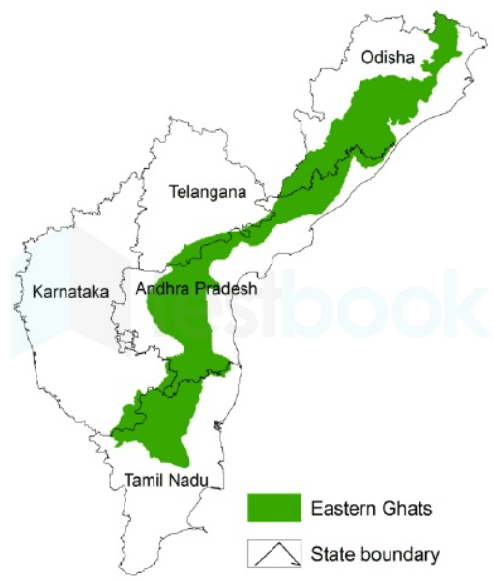
The highest peak in the Eastern Ghats is

  1. ((a))

    Anai Mudi

  2. ((b))

    Mahendragiri

  3. ((c))

    Shevroy Hills

  4. ((d))

    Javadi Hills

Show Answer
Answer: ((b))

Mahendragiri

The correct answer is Mahendragiri.

Key Points 

  • Mahendragiri (1,501 metres) is the highest peak in the Eastern Ghats among the given choices.
  • It is located in the district of Gajapati, Odisha.

Confusion Points

  • Jidhagada Peak now holds the title of the highest peak in the Eastern Ghats, taking over from Mahendra Giri Hill. Formerly, Mahendra Giri Hill was considered the highest peak, but in April 2011, a team led by Mr. Venkat Reddy Y discovered that its elevation is only 1,501 meters.
  • The elevations of key peaks are as follows:
  • Arma Konda: 1,680 meters
  • Mahendragiri: 1,501 meters
  • Jindhagada Peak: 1,690 meters
  • However, as Arma Konda and Jidhagada were not provided as options, the correct response, considering the given choices, would be Mahendragiri.

Additional Information 

Eastern Ghats:

  • A discontinuous range of mountains along India's eastern coast runs parallel to the Bay of Bengal.
  • They are eroded and cut through by the four major rivers of peninsular India, Godavari, Mahanadi, Krishna and Kaveri.
  • Some of the important ranges include the Shevaroy hills, Javadi hills, the Palconda range, the Nallamala hills, the Mahendragiri hills, etc.
  • National Parks/Tiger Reserves that come under the Eastern Ghats are:
  • Simlipal National Park, Odisha
  • Sunabeda Tiger Reserve, Odisha
  • Satkosia Tiger Reserve, Odisha
  • Amrabad Tiger Reserve, Telangana
  • Sri Venkateswara National Park, Andhra Pradesh
  • Nagarjunsagar-Srisailam Tiger Reserve, Andhra Pradesh.

49

Match the Dances (List-A) with the States (List-B) :

List-AList-B
(i)Bihu(a)Maharashtra
(ii)Mohiniattayam(b)Rajasthan
(iii)Lavani(c)Kerala
(iv)Bhavai(d)Assam
  1. ((a))

    (i) - (d), (ii) - (c), (iii) - (a), (iv) - (b)

  2. ((b))

    (i) - (d), (ii) - (a), (iii) - (b), (iv) - (c)

  3. ((c))

    (i) - (c), (ii) - (b), (iii) - (a), (iv) - (d)

  4. ((d))

    (i) - (a), (ii) - (c), (iii) - (b), (iv) - (d)

Show Answer
Answer: ((a))

(i) - (d), (ii) - (c), (iii) - (a), (iv) - (b)

The correct answer is (i) - (d), (ii) - (c), (iii) - (a), (iv) - (b).

Key Points

  • Bihu is a set of three important festivals observed in the Indian state of Assam which are-
  • Rongali or Bohag Bihu observed in April
  • Kongali or Kati Bihu observed in October
  • Bhogali or Magh Bihu observed in January
  • Mohiniyattam is one of the two classical dance forms that originated in Kerala. Hence statement 1 is incorrect.
  • Mohiniyattam was originally practiced by the Devadasis in Kerela.
  • Lavani is a folk dance in Maharashtra.
  • It is a combination of traditional song and dance, which is particularly performed to the beats of Dholki which is a percussion instrument.
  • Bhavai folk dance is performed during weddings by skilled Male or Females.
  • The male or female performers balance a number of earthen pots or brass pitchers as they dance nimbly swimming with the soles of their feet first on top of the glass and on the edge of the sword or on the rims of the brass plate during the performance.
  • Hence (i) - (d), (ii) - (c), (iii) - (a), (iv) - (b) is the correct match.
50

Which of the following characterize Indian Foreign Policy in the Nehruvian period?

  1. Non-alignment
  2. Panchsheel
  3. Promoting cooperation among South-Asian countries
  4. Working for peace and decolonisation
  1. ((a))

    1, 2, 3

  2. ((b))

    2, 3, 4

  3. ((c))

    1, 2

  4. ((d))

    1, 2, 4

Show Answer
Answer: ((d))

1, 2, 4

The correct answer is 1, 2, 4.

Key Points

  • The principles of Indian foreign policy are as follows: 
  • Pre-Independence stand of Indian foreign policy
  • Asian relations conferences
  • Non-alignment movement
  • Panch sheel
  • The leadership of third-world countries
  • The policy of Anti- Colonialism and Anti Racism
  • Peaceful settlement of International Disputes
  • Hence 1,2, and 4 is the correct answer.

Additional Information

  • Article 51 of the Indian Constitution is related to Indian Foreign Policy.
  • It is a part of the Directive Principles of the States Policy.
  • This article deals with the promotion of international peace and security.
  • It promotes honourable relations with other countries.
  • It respects international laws and treaties.
  • It also encourages the settlement of international disputes by arbitration.
51

Two South-Asian countries which became members of the Shanghai Cooperation Organisation (SCO) during the SCO summit in Uzbekistan's Capital Tashkent on June 23-24, 2016 are

  1. ((a))

    India, Sri Lanka

  2. ((b))

    India, Pakistan

  3. ((c))

    India, Afghanistan

  4. ((d))

    Pakistan, Bangladesh

Show Answer
Answer: ((b))

India, Pakistan

The correct answer is India, Pakistan.

Key Points

  • India is set to become a member of the Shanghai Cooperation Organisation (SCO) along with Pakistan when the China-dominated security grouping meets for its summit in Uzbekistan's capital Tashkent on June 23-24, 2016 which will be attended by Prime Minister Narendra Modi. (As of 2016).

In News 

  • The Shanghai Cooperation Organisation (SCO) will admit Iran as its newest member at the upcoming summit in Samarkand, Uzbekistan in September 2022.
  • This summit will be held under the Presidency of Uzbekistan.

Additional Information

  • Shanghai Cooperation Organisation (SCO)
  • It is a permanent intergovernmental international organization.
  • The SCO currently comprises eight Member States (China, India, Kazakhstan, Kyrgyzstan, Russia, Pakistan, Tajikistan and Uzbekistan).
  • The Shanghai Cooperation Organisation:
  • Headquarters: Beijing, China
  • Founded: 15 June 2001
  • Founders: Russia, China, Uzbekistan, Kazakhstan, Tajikistan, Kyrgyzstan​
52

The Human Development Report compares countries on which of the following standards?

a. Education

b. Health

c. Per-capita income

d. Happiness

  1. ((a))

    a, b, c,

  2. ((b))

    a, b

  3. ((c))

    a, b, c, d

  4. ((d))

    a, b, d

Show Answer
Answer: ((a))

a, b, c,

The correct answer is a, b, c.

Key Points

  • The Human Development Report compares countries on the basis of Education, Health (Life expectancy), and Per capita income (Standard of Living).
  • Human Development Index:
  • The United Nations Development Programme (UNDP) introduced the Human Development Index in its 1st Human Development Report in 1990.
  • It was prepared under the guidance of Mahbub-ul-Haq (Pakistani economist).
  • It is a method to assess the socio-economic development of countries around the world.
  • Indicators:
  1. Life Expectancy Index:
  • It refers to life expectancy at the time of birth, not at age 1.
  • Infant mortality is not a separate indicator in this index.
  • The long & healthy life dimension is measured by this index.
  1. Education:
  • It is the addition of the adult literacy rate & combined enrolment ratio.
  1. Standard of living:
  • It is represented by Purchasing Power Parity.
  • It is measured by gross national income per capita.
  • The gross national index is the total domestic & foreign output created by the people of that particular country.
  • Thus Happiness is not the criteria of Human Development Report.
53

Which of the following was added in the Preamble of the Indian Constitution by the 42nd amendment?

  1. ((a))

    Sovereign and democratic

  2. ((b))

    Socialist and secular

  3. ((c))

    Secular and democratic

  4. ((d))

    Sovereign and socialist

Show Answer
Answer: ((b))

Socialist and secular

The correct answer is Socialist, Secular.

 Key Points 

  • After the 42nd amendment, three new terms "Socialist, Secular, and Integrity" were added to the Preamble.
  • 42nd Amendment Act, 1976 is one of the most important amendments to the Indian Constitution.
  • It was enacted by the Indian National Congress headed by Indira Gandhi then.
  • Due to the large number of amendments this act has brought to the Indian Constitution, it is also known as the ‘Mini-Constitution.’
  • Only one time the Preamble was amended in 1976 till date.

Important Points

  • The ‘Preamble’ of the Constitution of India is a brief introductory statement that sets out the guiding purpose and principles of the document, and it indicates the source from which the document which derives its authority, meaning, the people.
  • It was adopted on 26 November 1949 by the Constituent Assembly of India and came into effect on 26th January 1950.

Additional Information 

TermMeaning
SocialistSocial and economical equality.
SecularStates that support in a neutral manner affair of all religions.
IntegrityThe state of being whole and undivided.
LibertyIt is the state of being free within the society
54

Which among these Central Public Service Sector Enterprises comes under the category of Maharatna?

  1. ((a))

    Bharat Electronics Limited

  2. ((b))

    Indian Railway Catering & Tourism Corporation Limited

  3. ((c))

    Bharat Heavy Electricals Limited

  4. ((d))

    Engineers India Limited

Show Answer
Answer: ((c))

Bharat Heavy Electricals Limited

The correct answer is Bharat Heavy Electricals Limited.

Additional Information

  • List of Maharatna Companies:
S NOMaharatna Companies
1.Power Finance Corporation Ltd (PFC)
2.National Thermal Power Corporation (NTPC)
3.Oil and Natural Gas Corporation (ONGC)
4.Steel Authority of India Limited (SAIL)
5.Bharat Heavy Electricals Limited (BHEL)
6.Indian Oil Corporation Limited (IOCL)
7.Hindustan Petroleum Corporation Limited (HPCL)
8.Coal India Limited (CIL)
9.Gas Authority of India Limited (GAIL)
10.Bharat Petroleum Corporation Limited (BPCL)
11.Power Grid Corporation of India (POWERGRID)
12.Rural Electrification Corporation Limited
13.Oil India Ltd
14.Hindustan Aeronautics Limited (HAL)

Hence Bharat Heavy Electricals Limited is the correct answer.

Additional Information

  • A company is given "Maharatna" status if it has made a net profit of more than Rs. 5,000 crore for three years in a row, has an average annual turnover of Rs. 25,000 crores for three years, or has an average annual net worth of Rs. 15,000 crore for three years.
  • It should also have operations or footprints all over the world.
55

The molecular mass of HNO3 is equal to

(u - Atomic mass units)

  1. ((a))

    62 u

  2. ((b))

    63 u

  3. ((c))

    64 u

  4. ((d))

    65 u

Show Answer
Answer: ((b))

63 u

The correct answer is 63 u.

Key Points

  • The Molecular mass of Nitric acid (HNO3) is 63 u.
  • Molecular Mass: 
  • It is the summation of all the atomic masses in a particular molecule.
  • It is expressed in atomic mass units (AMU).
  • Example:
  • the molecular mass of HNO3 can be determined as:
  • The atomic mass of H = 1u
  • The atomic mass of N = 14u
  • The atomic mass of O = 16u
  • Molecular mass of HNO3 = 1 + 14 + (16 × 3) = 63u.

The correct answer is.63 u. ​

Additional Information

  • The molecular formula of a compound that shows its constituent atoms and their number per molecule is denoted by subscripts.
  • Molecular formula if known can be used to calculate:
  • Molecular mass or molar mass.
  • Percentage of elements in the compound.
  • ​The molecular mass of any compound is calculated by adding the masses of all the constituent atoms. It is the mass of one molecule of a substance.
  • Molar mass is defined as the mass of one mole of a substance, i.e., 6.022 × 1023 number of particles of that substance.
  • The mass of one unit is expressed in the atomic mass unit, a.m.u, or simply 'u'.
  • ​If the percentage composition and molar mass is known, then it can be used to calculate the empirical formula which represents the formula in the simplest whole-number ratio.
56

The maps which are drawn to show the ownership of land property by demarcating field boundaries of agricultural land and the plan of individual houses in urban areas are called

  1. ((a))

    Topographical maps

  2. ((b))

    Atlas maps

  3. ((c))

    Geological maps

  4. ((d))

    Cadastral maps

Show Answer
Answer: ((d))

Cadastral maps

The correct answer is Cadastral maps.

Key Points

  • Cadastral Maps are drawn on a very large scale, varying from 16 inches to a mile, to 32 inches to a mile. Most of the cadastral map has a scale between 1: 500  and 1: 2,500. They show all possible details of an area. These are drawn especially to demarcate the boundaries of fields, and buildings to register the ownership.

Additional Information

  • Topographical Maps are drawn on a large scale which is smaller than that of Cadastral maps.
  • They show principal topographic forms like relief, drainage, towns, village, forests, etc.
  • The scale varies from 1:25000 to 1:50000.
  • Wall Maps are also known as classroom maps, as they are used for classroom study.
  • Their scale is smaller than that of the topographical maps but larger than the Globe.
  • The scale for wall maps ranges from 1:100000 to 1:500000.
  • Globe is drawn on a very small scale giving general information about the physical, climatic, and economic characteristics of different regions.
  • They have a scale of 1:1000000 or smaller.
57

Match the Kingdoms with their Capitals :

A (Kingdoms)B (Capitals)
(i)Pallavas(a)Badami
(ii)Chalukyas(b)Madurai
(iii)Pandyas(c)Kanchi
(iv)Kadambas(d)Vaijayanti
  1. ((a))

    (i) - (a), (ii) - (c), (iii) - (b), (iv) - (d)

  2. ((b))

    (i) - (b), (ii) - (c), (iii) - (d), (iv) - (a)

  3. ((c))

    (i) - (c), (ii) - (a), (iii) - (b), (iv) - (d)

  4. ((d))

    (i) - (c), (ii) - (a), (iii) - (d), (iv) - (b)

Show Answer
Answer: ((c))

(i) - (c), (ii) - (a), (iii) - (b), (iv) - (d)

The correct answer is (i) - (c), (ii) - (a), (iii) - (b), (iv) - (d).

Key Points

  • The capital city of the Pallavas was Kanchipuram.
  • The Pallavas emerged as a formidable power in the South around the 4th century AD and were at the height of their power in the seventh century AD.
  • The earliest Chalukyas with their capital at Badami (Vatapi) in Karnataka. They ruled from the mid-6th century.
  • They declined after the death of their greatest king, Pulakesin II in 642 AD. They were known as Badami Chalukyas.
  • The Pandyas ruled over the present-day southern Tamil Nadu.
  • Their capital was Madurai.
  • The Kadambas (345–525 CE) was an ancient royal family of Karnataka, India.
  • They ruled northern Karnataka and the Konkan from Banavasi or Vaijayanti in the present-day Uttara Kannada district.
  • Vaijayanti was the capital of the kadambas dynasty.
58

Which country was supposed to host the 19th summit of SAARC which was cancelled recently?

  1. ((a))

    Sri Lanka

  2. ((b))

    Bangladesh

  3. ((c))

    India

  4. ((d))

    Pakistan

Show Answer
Answer: ((b))

Bangladesh

The correct answer is Bangladesh.

Key Points

  • Bangladesh was supposed to host the 19th summit of SAARC.
  • The 19th SAARC summit was a scheduled diplomatic conference, which was originally planned to be held in Islamabad, Pakistan on 15–19 November 2016 but got cancelled after an attack on an Indian army camp in Kashmir.
  • The summit was to be attended by the leaders of the eight SAARC member states and representatives of observers and guest states.
  • Following the rising diplomatic tensions after the Uri terrorist attack, India announced its boycott of the summit, alleging Pakistan's involvement in the attack.
  • Later, Bangladesh, Afghanistan, and Bhutan also pulled out of the summit culminating in an indefinite postponement of the summit.

Additional Information

  • In the 1980s the idea of SAARC was initiated by General Zia Ur Rehman of Bangladesh, which resulted in the first summit of the seven leaders of the region in 1985.
  • Later, Afghanistan joined in 2007.
  • However, in the nearly 35 years of its existence, SAARC has not lived up to its promise of regional integration.
  • South Asia is the world’s least integrated region; less than 5% of the trade of SAARC countries is within.
  • A South Asian Free Trade Zone, which was agreed on in 2006, has not been materialized yet.
59

Which among the following statements about the tertiary (service) sector in India is not correct?

  1. ((a))

    This sector has become the largest producing sector.

  2. ((b))

    This sector has the largest share in the GDP.

  3. ((c))

    This sector has become important largely because of the growth in the basic services needs of the country.

  4. ((d))

    This sector has become the largest employer in the country.

Show Answer
Answer: ((d))

This sector has become the largest employer in the country.

The correct answer is This sector has become the largest employer in the country.

Key Points

  • The largest employer in the country is the Primary sector.
  • The tertiary industry is the segment of the economy that provides services to its consumers, including a wide range of businesses such as financial institutions, schools, and restaurants.
  • Sales, repair services, banking, and insurance are all part of the tertiary industry.
  • This sector's activities help in the development of the primary and secondary sectors.
  • This sector provides a huge quantity of skilled jobs and these jobs are called white-collar jobs.
  • It is also known as the 'Service Sector'.
  • The service sector accounts for 53.66% of the total of India's GVA (Gross Value Added).
  • It includes activities like transportation, financial & real estate activities, business services, hospitality services, education, health services, personal services, etc.
  • Hence this sector has become the largest employer in the country is incorrect.

Additional Information

  • Primary Sector- sources of raw materials (agriculture and allied sector services)
  • Secondary Sector-transforms one good to another increasing the utility of the product (manufacturing sector)
60

The dimensional formula for 1/2mv2 is

  1. ((a))

    [M2LT]

  2. ((b))

    [ML2T]

  3. ((c))

    [MLT-2]

  4. ((d))

    [ML2T-2]

Show Answer
Answer: ((d))

[ML2T-2]

The correct answer is [ML2T-2]

Important Points

  • Kinetic energy is defined as the object gaining energy due to its motion and it is written as;
  • E = 1/2 mv2.
  • Here we have m as the mass of the object, and v as the velocity of the object.
  • Dimensional formula of mass - [M]
  • Dimensional formula of velocity- [LT-1]
  • The dimensional formula for 1/2mv2 is [M] [LT-1]2
  • The dimensional formula is [ML2T-2]
61

Which among the following are the rights conferred on the consumer under the Consumer Protection Act of 1986?

a. Right to be informed

b. Right to choice

c. Right to represent

d. Right to redressal

  1. ((a))

    a, d

  2. ((b))

    a, b, d

  3. ((c))

    a, b, c, d

  4. ((d))

    a, c, d

Show Answer
Answer: ((b))

a, b, d

The correct answer is a, b, d.

Important Points

  • The rights conferred on the consumer under the Consumer Protection Act of 1986:
  • Right to Safety
  • This means the right to be protected against the marketing of goods and services, which are hazardous to life and property. The purchased goods and services availed of should not only meet their immediate needs but also fulfill long-term interests.
  • Right to be Informed
  • This means the right to be informed about the quality, quantity, potency, purity, standard, and price of goods so as to protect the consumer against unfair trade practices.
  • Right to Choose
  • This means the right to be assured, wherever possible of access to a variety of goods and services at a competitive price.
  • In the case of monopolies, it means the right to be assured of satisfactory quality and service at a fair price.
  • Right to be Heard
  • This means that consumers' interests will receive due consideration at appropriate forums.
  • It also includes the right to be represented in various forums formed to consider the consumer's welfare.
  • Right to Seek redressal
  • This means the right to seek redressal against unfair trade practices or unscrupulous exploitation of consumers.
  • It also includes the right to fair settlement of the genuine grievances of the consumer.
  • Right to Consumer Education
  • Means the right to acquire the knowledge and skill to be an informed consumer throughout life.
  • Ignorance of consumers, particularly of rural consumers, is mainly responsible for their exploitation.
  • Hence a, b, and d is the correct answer.
62

Match the following :

A (Schedule)B (Description)
(i)First Schedule(a)Provisions for the administration of tribal areas
(ii)Fifth Schedule(b)The States and Union Territories of India
(iii)Sixth Schedule(c)Provisions for disqualification on the grounds of defection
(iv)Tenth Schedule(d)Provisions for the administration and control of Scheduled areas and Scheduled Tribes
  1. ((a))

    (i) - (b), (ii) - (d), (iii) - (a), (iv) - (c)

  2. ((b))

    (i) - (b), (ii) - (a), (iii) - (d), (iv) - (c)

  3. ((c))

    (i) - (a), (ii) - (d), (iii) - (b), (iv) - (c)

  4. ((d))

    (i) - (a), (ii) - (b), (iii) - (c), (iv) - (a)

Show Answer
Answer: ((a))

(i) - (b), (ii) - (d), (iii) - (a), (iv) - (c)

The correct answer is (i) - (b), (ii) - (d), (iii) - (a), (iv) - (c).

The Constitution of India contains 12 Schedules which are as follows:-

First ScheduleName of States and Union Territories with their territorial jurisdiction.
Second ScheduleSalary of President, Governor, Chief judges, Judges of High Court and Supreme court, Speaker and Deputy Speaker of Lok Sabha and Legislative Assemblies of states, Chairman and Deputy Chairman of Rajya Sabha and Legislative Councils if states and Comptroller and Auditor General.
Third ScheduleForms of Oaths and Affirmations for Union Ministers, Candidates for election to the Parliament, Members of Parliament, Judges of Supreme Court and High Courts, Comptroller and Auditor General, MInisters to State Legislature, Members of State Legislature.
Fourth ScheduleAllocate seats for States and Union Territories of India in Rajya Sabha.
Fifth ScheduleAdministration and control of Scheduled Areas and Scheduled Tribes.
Sixth ScheduleProvision for the administration of Tribal areas in Assam, Meghalaya, Tripura, and Mizoram. Though these areas fall within the executive of the state, provisions have been made for District Councils and Regional Councils for the exercise of certain legislative and judicial powers in these areas.
Seventh ScheduleDivides the powers and functions between the Union and the State Government. There are three types of lists:- Union List State List Concurrent List Union List:- The Central Government or Parliament of India has the power to make decisions related to subjects included in the Union List. In total there are 100 (originally 97) subjects included in the Union List. State List:-  The respective State Government has the power to make decisions related to subjects included in the State List. In total there are 61 (originally 66) subjects included in the State List. Concurrent List:- The Central Government or Parliament of India, as well as the respective State Government, has the power to make decisions related to subjects included in the Concurrent List.
Eight ScheduleThere are 22 languages originally 14 languages recognized by the Constitution of India. Sindhi was added by 21st amendment in 1967. Konkani, Manipuri, and Nepali were added by 71st amendment in 1992. Santhali, Maithili, Bodo, and Dogri were added by 92nd  amendment in 2003.
Ninth ScheduleAdded by 1st amendment in 1951. Contains acts and orders related to legislatures dealing with land reforms and the abolition of the Zamindari system. In 2007 Supreme Court declared that the laws related to this Schedule after 24th April 1973 are now open to Judicial review.
Tenth ScheduleContains provision of disqualification on the ground of defection (Anti-defection Law). Added by 52nd amendment in 1985.
Eleventh ScheduleContains provisions related to the Panchayati Raj system (73rd amendment, 1992).
Twelfth ScheduleContains provisions related to Municipalities (74th amendment, 1992).
63

Paintings in the Mughal period was at its prime in the period of

  1. ((a))

    Jahangir

  2. ((b))

    Shahjahan

  3. ((c))

    Aurangzeb

  4. ((d))

    Akbar

Show Answer
Answer: ((a))

Jahangir

The correct answer is Jahangir.

Important Points

  • The Mughal painting reached its zenith in the period of Jahangir.
  • He was a naturalist by nature and preferred paintings of flora and fauna. The most unique trend in this era is the use of decorated margins around the paintings that were sometimes as elaborate as the painting themselves.
  • He emphasized on bringing naturals to portrait painting.
  • Foreshortening was unique to all Mughal paintings.

Additional Information

  • The Mughal paintings reflect the combination of Indian, Persian & Islamic styles.
  • It originated in the reign of Akbar in 1560 AD.
  • The Mughal school of Miniature paintings mostly depicts romantic scenes, Mughal royal courts, and battlefields, using gold & stone colours. Hence, statement 1 is correct.
  • Evolution of the Mughal paintings :
  • 3D figure making, use of foresightening and calligraphy in the paintings started in the reign of Akbar.
64

Which of the following helicopter has been developed by Hindustan Aeronautical Limited (HAL)?

  1. ((a))

    Bell UH-1Y Venom

  2. ((b))

    Light Utility Helicopter

  3. ((c))

    Boeing CH-47 Chinook

  4. ((d))

    Sikorsky UH-60 Black Hawk

Show Answer
Answer: ((b))

Light Utility Helicopter

The correct answer is Light Utility Helicopter.

Key Points

  • Light Utility Helicopter has been developed by Hindustan Aeronautical Limited (HAL).
  • LUH is designed and developed as a replacement for Cheetah & Chetak helicopters which are being operated by the Indian Armed forces.
  • LUH is a new generation helicopter in the 3-Ton class incorporating the state of the art technology features like a Glass cockpit with Multi-Function Displays (MFD) and powered by a single Turbo Shaft engine with sufficient power margin to cater to demanding high-altitude missions.
  • LUH will meet the emerging needs of this class of helicopters in the coming decades.
  • The helicopter will be capable of flying at 220 Kmph; service ceiling of 6.5 Km and a range of 350 Km with a 500 kg payload.

Additional Information

  • Hindustan Aeronautics Limited (HAL):
  • Headquarters: Bengaluru
  • Founder: Walchand Hirachand
  • Founded: 1963, Bengaluru
  • HAL is currently involved in designing and manufacturing fighter jets, helicopters, jet engines, and marine gas turbine engines, avionics, software development, spare supply, overhauling, and upgrading of Indian military aircraft.
  • Key projects under HAL
  • Tejas — Mk.1 (40 in service) , Mk.1A .
  • Tejas MK2 (MWF)— Medium weight fighter (under development) 2023 first flight expected.
  • AMCA — Mk.1 is a 5+ th generation stealth fighter (under development).
  • Dhruv — Advanced light helicopter.
  • Rudra — Armed and reconnaissance version of Dhruv.
  • Light Combat Helicopter — Light attack helicopter.
  • Light Utility Helicopter — Light utility helicopter.
  • Indian Multi-role Helicopter —  medium multi-role helicopter.
65

The method on which the process of separating the colloidal particles from the solvent and soluble solutes present in the colloidal solution by specially prepared filters, which are permeable to all substances except the colloidal particles are known as

  1. ((a))

    Vacuum filtration

  2. ((b))

    Dialysis

  3. ((c))

    Electro-dialysis

  4. ((d))

    Ultra-filtration

Show Answer
Answer: ((d))

Ultra-filtration

The correct answer is Ultra-filtration.

Key Points

  • The method in which the process of separating the colloidal particles from the solvent and soluble solutes present in the colloidal solution by specially prepared filters, which are permeable to all substances except the colloidal particles is known as Ultra-filtration.
  • The blood is filtered through three layers i.e., the endothelium of glomerular blood vessels, the epithelium of Bowman’s capsule (podocyte cells), and a basement membrane between these two layers.
  • This type of filtration is called Ultra-filtration.

Additional Information

  • Vacuum filtration is a mechanical method of dewatering sludge and Incineration units are used for the disposal of dewatered sludge.
  • Dialysis works on the principle of the diffusion of solutes and ultra-filtration of fluid across a semi-permeable membrane.
  • Diffusion is a property of substances in water; substances in water tend to move from an area of high concentration to an area of low concentration.
  • Electro Dialysis (ED) is a membrane process, during which ions are transported through a semi-permeable membrane, under the influence of an electric potential.
66

The Duleep Trophy is a domestic first-class cricket competition played in India between teams representing:

  1. ((a))

    regional cricket associations

  2. ((b))

    various universities

  3. ((c))

    winner of previous Ranji Trophy against Rest of India

  4. ((d))

    Geographical zones of India

Show Answer
Answer: ((d))

Geographical zones of India

The correct answer is Geographical zones of India. 

Key Points

  • The Duleep Trophy is a domestic first-class cricket competition played in India between teams representing geographical zones of India.
  • The Duleep Trophy is named after Kumar Shri Duleepsinhji (KS Duleepsinhji).
  • It is a domestic first-class cricket tournament played between teams representing geographical zones of India.
  • It is previously contested by three teams, namely India Red, India Blue, and India Green.
  • Since 2016-17, the tournament is played by teams chosen by selectors from the Board of Control for Cricket in India (BCCI), the apex governing body of cricket.
  • The Tournament was instituted in 1961-62 by BCCI.

Additional Information

SportsCup associated
GolfWalker Cup
FootballDurand Cup
Yacht RacingAmerican Cup
Football (India, Pakistan, Srilanka, and Myanmar)Colombo Cup
Tennis (Men)Davis Cup
Tennis (Women)Billi Jean King Cup
World Football (Soccer)Jules Rimet Trophy
Golf (Men)Ryder Cup
BadmintonSudirman Cup
World Table Tennis (Men)Swaythling cup
Asian BadmintonTunku Abdul Rahman Cup
Badminton (Women)Uber Cup
Basket BallWilliam Jones Cup
CricketPrudential World Cup
PoloEzra Cup
Lifetime Achievement Sporting Honour in IndiaDhyan Chand Award
First Class CricketDuleep Trophy
HockeyGuru Nanak Dev Gold Cup Maharaja Ranjit Singh Gold Cup
FootballRovers Cup
Boat RaceNehru Trophy
67

"On the 26th of January we are going to enter a life of contradictions. In politics we will have equality and in social and economic life we will have inequality". Who gave this statement?

  1. ((a))

    Mohandas Karamchand Gandhi

  2. ((b))

    Jawaharlal Nehru

  3. ((c))

    Dr. B.R. Ambedkar

  4. ((d))

    Jaipal Singh

Show Answer
Answer: ((c))

Dr. B.R. Ambedkar

The correct answer is Dr. B.R. Ambedkar.

Key Points

  • Dr B.R. Ambedkar said, "On the 26th of January we are going to enter a life of contradictions. In politics we will have equality and in social and economic life we will have inequality".
  • Other important statements by him:
  • Dr. B. R. Ambedkar made the statement 'The states are not vassals of the Union'.
  • Dr. B.R. Ambedkar said, " the states in our constitution are in no way dependent upon the centre for their legislative authority".

Additional Information

  • Babasaheb Ambedkar founded the Independent Labor Party in 1936.
  • In 1939, during World War II, he called upon Indians to join forces in large numbers to defeat Nazism, which, he said, was another name for Fascism.
  • He embraced Buddhism along with many of his followers on 14 October 1956. In the same year, he completed his last writing 'Buddha and His Dharma.
  • In 1990, Dr. B.R. Ambedkar was awarded the Bharat Ratna.
  • The period from 14 April 1990 to 14 April 1991 was celebrated as the 'Year of Social Justice in the memory of Babasaheb.
68

The collenchyma:

  1. ((a))

    consists of long, narrow cells with thick and lignified cell walls having a few or numerous pits. They are usually dead and without protoplasts.

  2. ((b))

    occurs in layers below the epidermis in dicotyledonous plants. It is found either as a homogeneous layer or in patches.

  3. ((c))

    performs various functions like photosynthesis, storage, secretion

  4. ((d))

    have small intercellular spaces

Show Answer
Answer: ((b))

occurs in layers below the epidermis in dicotyledonous plants. It is found either as a homogeneous layer or in patches.

The correct answer is consists of long, narrow cells with thick and lignified cell walls having a few or numerous pits. They are usually dead and without protoplasts.

Key Points

  • The collenchyma consists of long, narrow cells with thick and lignified cell walls having a few or numerous pits.
  • They are usually dead and without protoplasts.
  • Collenchyma, in plants, supports tissue of living elongated cells with irregular cell walls.
  • Collenchyma cells have thick deposits of cellulose in their cell walls and appear polygonal in cross-section.
  • The strength of the tissue results from these thickened cell walls and the longitudinal interlocking of the cells.

Additional Information 

  • Collenchyma tissue is composed of elongated living cells of uneven primary thick walls, which possess hemicellulose, cellulose, and pectic materials.
  • It provides support, structure, mechanical strength, and flexibility to the petiole, leaf veins, and stem of young plants, allowing for easy bending without breakage.
  • Collenchyma is a supporting tissue characteristic of the growing organs of many herbaceous and woody plants, and it is also found in stems and leaves of mature herbaceous plants, including those that are only slightly modified by secondary growth.
69

The first meeting of the National Institute for Transforming India (NITI) Aayog was held in

  1. ((a))

    February 2016

  2. ((b))

    February 2015

  3. ((c))

    August 2014

  4. ((d))

    May 2015

Show Answer
Answer: ((b))

February 2015

The correct answer is February 2015.

Key Points

  • The first meeting of the Governing Council of the NITI Aayog was held on 8 February 2015.
  • The Hon’ble Prime Minister urged all Chief Ministers to work with the Centre to forge a model of cooperative federalism, whereby the Centre and the States could come together to resolve differences and chart a common course to progress and prosperity.
  • The Governing Council of NITI Aayog, comprising Chief Ministers of all the States and Union Territories with legislatures and Lt Governors of other Union Territories.
  • It came into effect on 16 February 2015 via notification by the Cabinet Secretariat.
  • The Seventh Meeting of NITI Aayog was held on 7 August 2022.

Additional Information

  • About NITI Ayog:
  • NITI Aayog is the premier policy ‘Think Tank’ of the govt of the Republic of India, providing each directional and policy input. 
  • Chairperson:  Narendra Modi.
  • CEO: Nidhi Chhibber
  • Headquarters: New Delhi.
  • Formed: 1 January 2015
70

Shobha Gurtu is associated with which of the following vocal art form?

  1. ((a))

    Khayal

  2. ((b))

    Thumri

  3. ((c))

    Tarana

  4. ((d))

    Bhajan

Show Answer
Answer: ((b))

Thumri

The correct answer is Thumri.

Key Points

  • Shobha Gurtu, original name Bhanumati Shirodkar, renowned singer of Indian classical music.
  • Known for her rich earthy voice, distinctive vocal style, and mastery of various song genres, she was considered the “queen of thumri,” a light classical Hindustani style.

Additional Information 

  • Thumri:
  • Thumri originated in the Eastern part of Uttar Pradesh, mainly in Lucknow and Benares, in the 18th century AD.
  • It is influenced by Hori, Kajri and Dadra.
  • Thumri is a romantic and erotic style of singing and is also called ‘the lyric of Indian classical music.
  • The song compositions are mostly of love, separation, and devotion.
  • Its most distinctive feature is the erotic subject matter picturesquely describing the various episodes from the lives of Lord Krishna and Radha.
  • Thumri is usually performed as the last item of a Khayal concert.
  • There are three main gharanas of thumri–Banares, Lucknow, and Patiala.
  • Begum Akhtar, Gauhar Jan, Shobha Gurtu, Noor Jehan, and Prabha Atre are associated with Thumri.

Numerical Ability & Reasoning (30 questions)

71

A family consists of six members P, Q, R, X, Y and Z. Q is the son of R but R is not mother of Q. P and R a married couple. Y is the brother of R. X is the daughter of P. Z is the brother of P. How is Q related to X?

  1. ((a))

    Husband

  2. ((b))

    Father

  3. ((c))

    Brother

  4. ((d))

    Uncle

Show Answer
Answer: ((c))

Brother

A family consists of six members P, Q, R, X, Y and Z.

 Q is the son of R but R is not mother of Q. 

P and R a married couple

Y is the brother of R

 X is the daughter of P.

Z is the brother of P

Hence, the correct answer is Brother.

72

If one is subtracted from each of the numbers

Q 2 3 B 9 V 5 L S R F P

Which of the following will be the fourth to the right of the tenth from the right ?

  1. ((a))

    1

  2. ((b))

    2

  3. ((c))

    4

  4. ((d))

    8

Show Answer
Answer: ((c))

4

Fourth to the right of the tenth from the right means  10 - 4  = 6th from the right, ie 5.

But according to the question, one is subtracted from each of the numbers, so it is equal to 4.

Hence, the correct answer is 4.

73

The last day of a century cannot be

  1. ((a))

    Monday

  2. ((b))

    Wednesday

  3. ((c))

    Friday

  4. ((d))

    Saturday

Show Answer
Answer: ((d))

Saturday

100 years contain 5 odd days.

⇒ Last day of 1st century is Friday.

200 years contain (5 x 2) ≡ 3 odd days.

⇒ Last day of 2nd century is Wednesday.

300 years contain (5 x 3) = 15 ≡ 1 odd day.

⇒ Last day of 3rd century is Monday.

400 years contain 0 odd day.

⇒Last day of 4th century is Sunday.

This cycle is repeated.

⇒ Last day of a century cannot be Tuesday or Thursday or Saturday.

Hence, the correct answer is Saturday.

74

The cost price of 20 articles is the same as the selling of x articles. If the profit is 25%, then determine the value price of x ?

  1. ((a))

    14

  2. ((b))

    15

  3. ((c))

    16

  4. ((d))

    17

Show Answer
Answer: ((c))

16

Given:

CP of 20 articles = SP of x articles

Profit = 25%

Formula used:

% Profit = SPCPCP×100\frac{SP - CP}{CP}\times 100

Calculation:

According to the question,

Let the Cost Price of 20 articles be "y"

CP of 20 articles = SP of x articles = y

CP of 1 Article = y/20

SP of 1 Article = y/x

By using the above formula,

 yxy20y20×100=25\frac{\frac{y}{x}-\frac{y}{20}}{\frac{y}{20}}\times 100=25

⇒  (yxy20)(20y)=14(\frac{y}{x}-\frac{y}{20})(\frac{20}{y})=\frac{1}{4}

⇒ 20x = 5/4

⇒ x = 16

∴ The correct answer is 16.

75

Two wheels of diameter 7 cm and 14 cm start rolling simultaneously from two points A and B which are 1980 cm apart each other in opposite towards directions. Both of them make same number of revolutions per second. If both of them meet after 10 seconds, the speed of bigger wheel is

  1. ((a))

    88 cm/s

  2. ((b))

    110 cm/s

  3. ((c))

    132 cm/s

  4. ((d))

    154 cm/s

Show Answer
Answer: ((c))

132 cm/s

Given:

Diameter of wheel (r) = 7cm

Diameter of other wheel (r') = 14cm

Rolling in opposite direction in two points = 1980 cm apart

Number of revolution both makes same.

Both meet after 10 seconds

Calculation:

Radius of wheels are : 7/2cm, 7cm.

Let each wheel makes x revolution per sec.

∴ [(2π × 7/2 × x) + (2π × 7 × x)] × 10 = 1980

⇒ [(14π x + 28π x)] = 198 × 2

⇒ 21π x = 198

x = 198 × 7/(22 × 21) = 3

∴ Speed of bigger wheel = 2π × 7 × 3 = 132 cm/sec

76

Write the missing number in the sequence ?

5, 13, 41, 85, 257, ?

  1. ((a))

    516

  2. ((b))

    517

  3. ((c))

    716

  4. ((d))

    717

Show Answer
Answer: ((b))

517

LOGIC:

the number at odd digit is multiplied by 2 and 3 is added.

the number at even places is multiplied by 3 and 2 is added

so for first term “5” which is at position 1(which is odd).

5 × 2 + 3 = 13

now  13 is at position 2(even)

so 13 × 3 + 2 = 41.

similarly

41× 2 + 3 = 85

85 × 3 + 2  = 257

So:

257 × 2 + 3 = 517

Hence, the correct answer is 517.

77

Which letter is in the middle of 10th letter from left and 7th letter from right in the English alphabet ?

  1. ((a))

    M

  2. ((b))

    N

  3. ((c))

    O

  4. ((d))

    P

Show Answer
Answer: ((c))

O

Alphabetical order with its placed value:

The 10th letter from left is J.

The 7th letter from right is T.

Thus the middle letter between J and T is O.

Hence, the correct answer is O

78

Arrange the given words in a meaningful sequence:

a. Police

b. Crime

c. Justice

d. Judgement

e. Punishment

  1. ((a))

    b c a e d

  2. ((b))

    b a c d e

  3. ((c))

    a b c d e

  4. ((d))

    a b d e c

Show Answer
Answer: ((b))

b a c d e

The meaningful sequence of the given words is:

b. Crime

a. Police

c. Justice

d. Judgement

e. Punishment

When a Crime takes place, Police gets involved and catches the criminal, then a trial takes place in the court, after which the Judge gives his/her Judgement and the criminal is punished.

Hence, b a c d e  is the correct answer.

79

Find the correct statement for the following:

Mouth : Teeth : Chew : :

  1. ((a))

    Eyes: Lashes: See

  2. ((b))

    Head: Brain: Think

  3. ((c))

    Skin: Sweat: Touch

  4. ((d))

    Feet: Dance: Toe

Show Answer
Answer: ((b))

Head: Brain: Think

Logic followed here: Third is the function of the second.

Function of the teeth is Chew.

Similarly;

Function of the Brain is Think.

Hence, the correct option is 2.

80

Find the wrong number in the following sequence 

5, 8, 15, 26, 50, 98, 194

  1. ((a))

    8

  2. ((b))

    15

  3. ((c))

    26

  4. ((d))

    50

Show Answer
Answer: ((b))

15

Pattern Followed here:

5 ×  2 - 2 = 8

8 × 2 - 2 = 14 (here it is 15)

14 × 2 - 2 = 26

26 × 2 - 2 = 50

50 × 2 - 2 = 98

98 × 2 - 2 = 194.

Therefore, the correct series is 5, 8, 14, 26, 50, 98, 194.

Hence, the correct answer is 15**.**

81

Choose the correct alternative to find the missing term ?

e j o, t y d, i n s , x c h, ?

  1. ((a))

    n r w

  2. ((b))

    n s w

  3. ((c))

    m r w

  4. ((d))

    m s x

Show Answer
Answer: ((c))

m r w

Alphabetical Series with its placed Value:

LOGIC : In the given series  there is a gap of 5 letters between the first and second, second and third letters of each term, and also between the last letter of the term and first letter of next term.

Hence, the correct answer is mrw.

82

If PALAM could be given the code number 43 what number can be given to STUTTGART ?

  1. ((a))

    145

  2. ((b))

    142

  3. ((c))

    146

  4. ((d))

    148

Show Answer
Answer: ((c))

146

The logic is:

PALAM = 43

PALAM → 16 + 1 + 12 + 1 + 13 = 43

Similarly,

STUTTGART = 146

STUTTGART → 19 + 20 + 21 + 20 + 20 + 7 + 1 + 18 + 20 = 146.

Hence, the correct answer is 146

83

If MASTER is coded as 411259, then SERVANT will be coded as ?

  1. ((a))

    1 5 9 4 1 5 2

  2. ((b))

    1 9 5 1 4 5 9

  3. ((c))

    1 5 4 9 5 1 9

  4. ((d))

    1 5 9 1 4 9 5

Show Answer
Answer: ((a))

1 5 9 4 1 5 2

The pattern followed here is:

WordMASTER
Code411259

Similarly:

WordSERVANT
Code1594152

Hence, the correct option is 1.

84

Direction : ​Read the following carefully to answer the questions :

P, Q, R, S, T and U are sitting around the hexagonal table each at one corner and are facing the centre. P is second to the left of U. Q is neighbour of R and S. T is second to the left of S.

If Q takes the place of U, U takes the place of T, T takes the place of R and R takes the places of Q. Who is sitting second to the right of Q ?

  1. ((a))

    U

  2. ((b))

    S

  3. ((c))

    R

  4. ((d))

    T

Show Answer
Answer: ((c))

R

According to the given information:

I. U was sitting opposite to P, who was to the immediate left of R.

II. S was sitting to the immediate right of U.

III. T was exactly between P and S, so Q was sitting at the remaining place.

So, from above it is clear that R is sitting  second to the right of Q .

Hence, the correct answer is R.

85

​Direction : Read the following carefully to answer the questions :

P, Q, R, S, T and U are sitting around the hexagonal table each at one corner and are facing the centre. P is second to the left of U. Q is neighbour of R and S. T is second to the left of S.

Who is sitting opposite to Q ?

  1. ((a))

    P

  2. ((b))

    T

  3. ((c))

    S

  4. ((d))

    U

Show Answer
Answer: ((b))

T

According to the given information:

I. U was sitting opposite to P, who was to the immediate left of R.

II. S was sitting to the immediate right of U.

III. T was exactly between P and S, so Q was sitting at the remaining place.

Here, Q is sitting exactly to the opposite of T.

Hence, the correct answer is "Opposite to T".

86

If only the consonants in the word MEAT are changed in such a way that each of them becomes the previous letter in the English alphabet and the remaining letters are kept unchanged, then how many meaningful words can be formed with the new set of letters using each letter only once in the word ?

  1. ((a))

    one

  2. ((b))

    two

  3. ((c))

    three

  4. ((d))

    four

Show Answer
Answer: ((c))

three

Alphabetical order with its placed value:

In the given word MEAT:

Vowels are  E,A

Consonant change with previous letter

M by L

T by S

new letters according to the given statement :

E,A,S,L 

There are three word formed by the given word MEAT

SEAL

LEAS

SALE

Hence, the correct option is 3.

Additional InformationVowels: A , E, I , O , U

Consonants: all alphabetical series except A , E, I , O, U

87

Summit is heavier than Arjun but not as heavier as Rakesh, Arjun is heavier than Jayant. Keshav is heavier than Summit but not as heavier as Rakesh. Who is the heaviest ?

  1. ((a))

    Summit

  2. ((b))

    Arjun

  3. ((c))

    Rakesh

  4. ((d))

    Keshav

Show Answer
Answer: ((c))

Rakesh

Summit is heavier than Arjun  but not as heavier as Rakesh

Summit > Arjun

 Arjun is heavier than Jayant. 

Arjun > Jayant.

Keshav is heavier than Summit but not as heavier as Rakesh.

Keshav > Summit.

From the above it is clear that Rakesh is the Heaviest.

Hence, the correct answer is Rakesh.

88

How many even numbers are there in the following sequence of numbers which are immediately followed by an odd number and preceeded by an even number ?

8 5 8 6 7 6 8 9 3 2 7 5 3 4 2 2 3 5 5 2 2 8 1 1 9 3 1 7 5 1

  1. ((a))

    3

  2. ((b))

    4

  3. ((c))

    5

  4. ((d))

    None

Show Answer
Answer: ((b))

4

In the given sequence 8 5 8 6 7 6 8 9 3 2 7 5 3 4 2 2 3 5 5 2 2 8 1 1 9 3 1 7 5 1

There are 4 such sets where the number immediately followed by an odd number and preceeded by an even number.

 8 6 7, 6 8 9, 2 2 3, 2 8 1

Hence, the correct option is 4.

89

If letters in the word UNIVERSAL are arranged in the alphabetical order and each letter is assigned numerical value equal to its serial number from the left in this rearranged order, what is the difference in the total of numerical values of consonants and that of vowels ?

  1. ((a))

    19

  2. ((b))

    17

  3. ((c))

    15

  4. ((d))

    21

Show Answer
Answer: ((b))

17

Each letter is assigned numerical value equal to its serial number.

UNIVERSAL
123456789

Arranging in Alphabetical order

AEILNRSUV
123456789

The difference in the total of numerical values of consonants and that of vowels 

(4,5,6,7,9) - (1,2,3,8) 

= 31 - 14

= 17

Hence, the correct answer is 17.

90

Direction : For the questions, a statement is followed by two assumptions I and II, choose the correct option given below :

(a) If only I is implicit

(b) If only II is implicit

(c) If either I or II is implicit

(d) If neither I nor II is implicit

Statement : Equality of income throughout a community is the essential condition for maximising the total utility which the total income available could confer on the members of that community.

Assumptions :

I : If extra income were taken from the rich and given, to the poor, the total utility experienced by the community would increase.

II : Equal pay for equal work.

  1. ((a))

    a

  2. ((b))

    b

  3. ((c))

    c

  4. ((d))

    d

Show Answer
Answer: ((a))

a

The absolute utility can be amplified by balance of pay all through the local area, i.e., by giving additional pay from the rich to poor people. In this way, I is implicit. Likewise, II relates to monetary right and isn't worried about equity of pay all through the local area.  So, it is not implicit.

Hence, the correct option is 1.

91

Direction : For the questions, a statement is followed by two assumptions I and II, choose the correct option given below :

(a) If only I is implicit

(b) If only II is implicit

(c) If either I or II is implicit

(d) If neither I nor II is implicit

Statement : Traffic jams on most of the roads in the city have become a regular feature during monsoon.

Assumptions :

I : Materials used for road construction can not withstand the fury of monsoon resulting into innumerable pot holes on the roads.

II : Number of vehicles coming on the roads is much more in monsoon as compared to other seasons.

  1. ((a))

    a

  2. ((b))

    b

  3. ((c))

    c

  4. ((d))

    d

Show Answer
Answer: ((d))

d

Assumption I is not implicit because it introduces external facts about construction materials and potholes not mentioned in the statement. Assumption II is not implicit as there is no logical link established between the season and an increase in the number of vehicles.

So, from above it is clear neither I nor II is implicit.

Hence, the correct option is 4.

92

Direction : For the questions, two statements are given. Choose the correct alternative as given below :

(a) Statement I is the cause Statement II is its effect.

(b) Statement II is the cause and Statement I is its effect.

(c) Both the Statements I and II are independent causes.

(d) Both the Statements I and II are effects of independent causes.

Statements :

I : Indian women don't believe in donating blood. According to the first ever data bank on gender distribution of blood donors, India has only 6% blood donations by women. The rest 94% were male donors.

II : Just twenty five countries in the world collect more than 40% of their blood supplies from female donors, these include Australia, U.S., Thailand, Portugal, New Zealand, Zimbabwe etc.

  1. ((a))

    a

  2. ((b))

    b

  3. ((c))

    c

  4. ((d))

    d

Show Answer
Answer: ((d))

d

Both the statement don't depend on each other.

According to the first statement  India has only six percent blood donations by women. and the  rest 94% were male .

According to the statement 2  twenty five countries in the world collect more than 40% of their blood supplies from female donors. The rest 60 % were male.

so, both the statements are effects of independent causes.

Hence, the correct option is 4.

93

Direction : For the questions, two statements are given. Choose the correct alternative as given below :

(a) Statement I is the cause Statement II is its effect.

(b) Statement II is the cause and Statement I is its effect.

(c) Both the Statements I and II are independent causes.

(d) Both the Statements I and II are effects of independent causes.

Statements :

I : Importance of Yoga and exercise is being realized by all sections of the society.

II : There is an increasing awareness about health in the society particularly among middle ages group of people.

  1. ((a))

    a

  2. ((b))

    b

  3. ((c))

    c

  4. ((d))

    d

Show Answer
Answer: ((b))

b

As the mindfulness about wellbeing in the general public is expanding especially among moderately aged gathering, the significance of Yoga and exercise is being acknowledged by all segments of the general public.

so,  Statement II is the cause and Statement I is its effect.

Hence, the correct option is 2.

94

The problem figure has two blanks in it in place of the first and fourth figures. The answer figure contains four pairs of figures. You have to choose the pair which would fill in the blanks so that the first and second pairs have similar relationship.

  1. ((a))

    a

  2. ((b))

    b

  3. ((c))

    c

  4. ((d))

    d

Show Answer
Answer: ((b))

b

Logic followed in the given figure series:

From figure (1) to figure (2):

The small curves changes in the bigger curves and rotate 90 degree in clockwise direction as shown in figure.

Similar logic followed for the figure (3) to figure (4):

The small curves changes in the bigger curves and rotate 90 degree in clockwise direction as shown in figure.

The complete figures:

Hence, the correct answer is "Option (2)".​

95

A related pair of figures is given followed by four pairs of figures. Select a pair that has a relationship similar to that in the original pair :

  1. ((a))

    a

  2. ((b))

    b

  3. ((c))

    c

  4. ((d))

    d

Show Answer
Answer: ((c))

c

Logic: Number of lines.

The number of lines in question figure:

Checking all the figures one by one:

Figure (a):

Figure (b):

v

Figure (c):

Number of lines is similar to the question figure.

Figure (d):

Here, number of lines in figure (c) is similar to the question figure.

Hence, the correct answer is "Option (3)".

96

Study the following pattern

3 + 2 + 5 = 153030

8 + 4 + 3 = 243996

9 + 2 + 4 = 364872

5 + 4 + 5 = 2550100

Using the above pattern, find 7 + 2 + 5

  1. ((a))

    147070

  2. ((b))

    355050

  3. ((c))

    355070

  4. ((d))

    357070

Show Answer
Answer: ((c))

355070

LOGIC: Its expression pattern with all 3 numbers taken into consideration.

the result is combined as below if we consider three numbers as a,b and c.

a+b+c = (ac) - ((a+b)×  c+c) - (ab*c)

3 + 2  + 5 = 153030

3 × 5 = 15.

(3 + 2) × 5 + 5 = 30.

(3 × 5) × 2 = 30.

Similarly;

7 + 2 + 5 = 355070.

7 × 5 = 35.

(7+2) × 5 + 5 = 50.

(7 × 5) × 2 = 70.

Hence, the correct option is 3.

97

The maximum value of product of two numbers, whose sum is 12, is

  1. ((a))

    32

  2. ((b))

    35

  3. ((c))

    36

  4. ((d))

    20

Show Answer
Answer: ((c))

36

Given:

The sum of two numbers = 12

Concept used:

For maximum value, Put dy/dx = 0

Calculation:

Let the number be x.

Other number = 12 - x 

Product of two numbers = P = x ( 12 - x) = 12x - x2

P = 12x - x2

dP/dx = 12 - 2x = 0

⇒ 2x = 12

x = 6

∴ Pmax = 12 × 6 - (6)2 = 72 - 36 = 36

Pmax = 36

98

A can do work in 18 days. B can do the same work in 12 days. With the help of C, they did the work in 3 days. Then C can alone do the job in

  1. ((a))

    121712\frac{1}{7}days

  2. ((b))

    8378\frac{3}{7}days

  3. ((c))

    5175\frac{1}{7}days

  4. ((d))

    1371\frac{3}{7}days

Show Answer
Answer: ((c))

5175\frac{1}{7}days

Calculation:

Number of days A requires to do piece of work = 18 days

Number of days B requires to do piece of work = 12 days

Let us consider number of days C requires to do piece of work = x days

Number of days A, B and C together require to do the piece of work = 3 days

∴ Work done by A in 1 day = 1/18

work done by B in 1 day = 1/12

Work done by C in 1 day = 1/x

Work done by A, B and C together in a day = 1/3

∴ Work done by A, B and C together in 1 day is also equal to the sum of work done by each of them in 1 day = 1/18 + 1/12 + 1/x = 5/36 + 1/x

∴ 5/36 + 1/x = 1/3

⇒ (5x + 36)/36x = 1/3

⇒ 5x + 36 = 12x

⇒ 7x = 36

x = 36/7 = 5175\frac{1}{7}days

∴ C can alone do the job in 5175\frac{1}{7}days.

Alternate Method 

A = 18 days

B = 12 days

A + B + C = 3 days

So

Total work = LCM (18,12,3) = 36 units

So

Efficiency of A = 2

Efficiency of B = 3

Efficiency of A + B + C = 12

So

Efficiency ofC = 12 - 2 - 3 = 7

So

C can complete the work in = 36/7 days = 5175\frac{1}{7} days

99

Choose the correct option that will follow the same pattern :

2, 15, 41, 80, ?

  1. ((a))

    111

  2. ((b))

    121

  3. ((c))

    123

  4. ((d))

    132

Show Answer
Answer: ((d))

132

The pattern is + 13, + 26, + 39,...

Hence, the correct option is 132

100

Select the correct option for the following :

Concession : Placate : :

  1. ((a))

    Gun : Bolster

  2. ((b))

    Workout : Enervate

  3. ((c))

    Catalyst : Precipitate

  4. ((d))

    Lawyer : Mitigate

Show Answer
Answer: ((d))

Lawyer : Mitigate

Concession : Placate 

The meaning of PLACATE is to soothe or mollify especially by concessions.

Similarly;

Mitigation means reducing risk of loss from the occurrence of any undesirable event.

Additional Information

Guna weapon that is used for shooting
Bolsterto support or encourage somebody/something; to make something stronger
Enervatemake (someone) feel drained of energy or vitality.
Catalyst
a person or a thing that causes change
Precipitate
to make something, especially something bad, happen suddenly or sooner than it should

Teaching Aptitude (20 questions)

101

When teaching, a teacher periodically tests her students to monitor their progress. She uses the results of such tests to identify areas where she may need to change or modify her instruction. The type of assessment used by her is called

  1. ((a))

    Normative

  2. ((b))

    Formative

  3. ((c))

    Summative

  4. ((d))

    Diagnostic

Show Answer
Answer: ((b))

Formative

Assessment is the process of gathering, interpreting, recording, and using information about learners' responses to an educational task.

  • It helps in diagnosing the gaps in realizing the objectives of a subject and taking necessary measures to provide feedback to students about their progress and learning.

Key Points

Formative assessment:

  • It refers to the assessment for monitoring the student's progress throughout the learning and teaching process.
  • It mainly focuses on finding and diagnosing students' needs rather than grading and ranking them.
  • It is an ongoing process usually carried out by the teacher to continuously monitor students' progress in a non-threatening and supportive environment.
  • It involves qualitative feedback (rather than scores) for both students and teachers that focuses on the details of content and performance.
  • It encourages intrinsic motivation and self-esteem of students, both of which have crucial influences on learning performance.
  • It recognizes the need for students to be able to assess themselves and understand how to improve.
  • It helps the teacher to modify subsequent teaching-learning activities according to the needs of the children.

Hence, we conclude that the type of assessment used by the teacher is called formative assessment.

Additional Information

  • Diagnostic assessment is an assessment made before the learning of a unit commences in order to determine what a student does and does not know about a topic. It helps to identify where your students are in their learning and what course of action appropriate to the learning levels of the students are needed to be taken for continuing or improving their learning. For example- If the teacher is planning to teach different states of India in class VI, he needs to know whether the students are well conversant in using the Atlas.
  • Summative assessment refers to the assessment of learning that 'sums' or 'summarize' the development of students at a particular time. It is a process of assessing, grading or ranking the learning of students at a point of time. It is generally given at the end of a course to determine how much students have learned from the whole course. Examples of summative assessment annual examinations.
  • Normative assessment refers to comparing students' performance against a group norm or standard.
102

Which of the following learning outcomes are not tested appropriately by essay type questions?

  1. ((a))

    Ability to organize and integrate ideas

  2. ((b))

    Ability to sort and interpret data

  3. ((c))

    Ability to analyze facts and principles

  4. ((d))

    Problem solving ability

Show Answer
Answer: ((d))

Problem solving ability

Learning outcomes are statements that explain the knowledge or skills that students should have at the end of a course or unit and that help students understand why that knowledge and abilities will be helpful to them.

Key PointsEssay-type questions are also known as long answer questions. Essay-type questions usually do not clearly specify the exact answers required and students are free to select, organise and express their thoughts. 

  • The learning outcomes that may be expected of students through essay-type questions are related to a complex set of behaviors that involve: 
  • the ability to analyse facts and principles.
  • the ability to select, organize and integrate relevant ideas
  • the ability to sort and interpret data in written form in their own words.
  • the ability to construct answers than merely identify interpretations.

Hence, we conclude that problem-solving ability is not tested appropriately by essay-type questions.

Hint

  • As essay-type questions do not clearly specify the exact answers required. So, when the students do not know the exact answer they may still write some matter with seems to be relevant to the question but does not represent the answer that is actually required (bluffing). Hence it does not test problem-solving ability.
103

Which of the following is the major obstacle to ensure achievement of high academic standards from disadvantaged students?

  1. ((a))

    Belief that not every student is capable of mastering challenging content and skills. 

  2. ((b))

    Non-availability of sufficient instructional materials aligned with the school curriculum.

  3. ((c))

    Providing students substantial autonomy to determine what they learn and how they will learn it.

  4. ((d))

    Providing a variety of individual, small group and large activities.

Show Answer
Answer: ((a))

Belief that not every student is capable of mastering challenging content and skills. 

Disadvantaged students are those belonging to the scheduled castes, scheduled tribes, and minority groups. The children from these categories come to school with a disadvantaged tag with them and as a result, they become easy prey to differential treatment by the teacher and their classmates.

Key Points

  • The belief that not every student is capable of mastering challenging content and skills is an obstacle to ensure the achievement of high academic standards from disadvantaged students
  • Teachers' beliefs influence learning through the methods adopted by the teachers and consequents affect the motivation of the students.
  • This influence is maximum in the disadvantaged group as they suffer the most impact of generalization while they are the most vulnerable and require special attention and different teaching process.
  • A teacher who has certain beliefs against a particular community may not select students of that community for any activity, although those students deserve merit selection against all criteria.
  • The teacher should n motivate students and enhance learning by setting realistic expectations for them. The expectations should be high enough to motivate students but not so high as it could lead to anxiety and frustration in students.

Hence, it is clear that the belief that not every student is capable of mastering challenging content and skills is an obstacle to ensure the achievement of high academic standards from disadvantaged students.

Hint

  • Other options will e nsure a n inclusive and supportive learning environment for disadvantaged students. They will also ensure the achievement of high academic standards from disadvantaged students.
104

According to Article 21A of the constitution

  1. ((a))

    it is mandatory to provide free and compulsory education to children upto the age of 14 years.

  2. ((b))

    education is a fundamental right of children between the age of 0-14 years.

  3. ((c))

    education of children upto the age of 6 years is not a responsibility of the state.

  4. ((d))

    education is a fundamental right of children between the age of 6-14 years.

Show Answer
Answer: ((d))

education is a fundamental right of children between the age of 6-14 years.

Education is a lifelong process that modifies the behavior and personality of individuals thus develops them as a whole by providing nourishing and burden-free environments. 

Key Points

  • On the 26th of August 2009, the Indian Parliament passed a historic act known as the ‘Right to Education Act’ or RTE Act but the RTE Act was implemented in India with effect from 1st April 2010.
  • It is an act that aims to provide free and compulsory education to all children between the age of 6 to 14 years in India under Article 21A of the Indian Constitution.

Hence, it could be concluded that according to Article 21A of the constitution, education is a fundamental right of children between the age of 6-14 years.

Additional Information 

Features of the RTE Act - 2009 under Article 21A: 

  • Prohibition of private tuition by teachers to equalize educational opportunities to all.
  • Reservation of  25% seats for children belonging to economically weaker sections in private schools.
  • 45 hours including preparation hours as the minimum number of working hours per week for the teacher.
  • Not to deploy teachers in non-academic work except elections, population census, and disaster relief duties.
  • Establishment of primary and upper primary schools within the distance of 1km and 3kms respectively from child's house.
105

The procedures used by teachers to identify difficulties of learners in various fields of learning are part of

  1. ((a))

    placement assessment

  2. ((b))

    formative assessment

  3. ((c))

    diagnostic assessment

  4. ((d))

    summative assessment

Show Answer
Answer: ((c))

diagnostic assessment

Assessment is a process of collecting, receiving, and using data for the purpose of improvement in the learning process. There are different types of assessments which include summative, formative, diagnostic assessments, etc.

Key PointsDiagnostic Assessment:

  • The teacher should conduct a 'Diagnostic Assessment' if the teacher has to know about the students’ strengths and weaknesses before the instructional materials are organized.
  • It helps the teachers to identify the learning difficulties or gaps in learner's understanding and to know learner's individual strengths, weaknesses, skills, etc.
  • It is the base of remedial teaching that helps the teacher to provide learners with the necessary help and guidance to overcome the problems which are determined during diagnostic assessment.
  • For example, if it is found that a learner has not understood certain concepts in a particular subject, then to help him/her understand these concepts, diagnostic assessment is conducted and remediation is provided.

Steps of diagnostic assessment:

  • Identifying students who need help.
  • Locating learning difficulties/gaps.
  • Discovering the causal factors.
  • Removing learning difficulties through remedial teaching.

Hence, it could be concluded that the procedures used by teachers to identify difficulties of learners in various fields of learning are part of the Diagnostic Assessment.

Additional Information

Summative AssessmentIt is a type of assessment that measures, certifies, and reports the level of students' learning by assessing them at the end of the term.
Placement assessmentIt measures whether students possess the pre-requisite skills needed to succeed in a unit or course or to what extent students have already achieved the objectives of the planned instruction
Formative AssessmentIt is a type of assessment that refers to monitor learners' progress throughout the teaching-learning process to diagnose learner's learning difficulties.
106

Which of the following would best predict a student's academic success?

  1. ((a))

    Personality factors

  2. ((b))

    Physical health

  3. ((c))

    Motivation

  4. ((d))

    Intelligence

Show Answer
Answer: ((d))

Intelligence

The academic achievement of students reflects their abilities and caliber of students. There are many ways, we can predict the academic success of an individual. The best way to predict academic achievement is through intelligence and intelligence tests.

Key Points

Intelligence is a hypothetical construct, which is usually equated with higher-level abstract thought processes. Intelligence includes sensation, perception, association, memory, imagination, discrimination, judgment, and reasoning.

  • It is mostly correlated with traditional academic achievement or being book smart. It is best to predict a student's academic success.
  • Intelligence tests are useful in predicting mainly academic achievement. Intelligence help students to find out their level of different mental abilities.
  • Intelligence has significant implications for our everyday life, and it influences our effective functioning. It is related to various life outcomes such as academic achievement.
  • linguistic and logical-mathematical intelligence, strongly contribute to performance in the traditional school system and academic achievement; usually promoted more in our societies.
  • It is generally agreed that those who are good at abstract reasoning, problem-solving, and decision-making are more intelligent than those who are poor at these mental activities.
  • In general, intelligence underlies how well we learn, plan, solve problems, and make decisions.

Additional Information

Other factors predict academic success:

  • The factors of personality effects the personality of an individual, these factors are social factors, physical factors, economic factors, etc.
  • Motivation is the need within the individual to do something or to fulfill her desire.
  • Physical health means having physical strength, endurance, and energy to work toward your goals.

Hence, we can conclude that intelligence would best predict a student's academic success.

107

'Give me a dozen of healthy children, I can make them doctor, judge, beggar or even a thief.' This statement illustrates which one of the following learning theories?

  1. ((a))

    Classical conditioning

  2. ((b))

    Gestalt

  3. ((c))

    Field theory

  4. ((d))

    Behaviourism

Show Answer
Answer: ((d))

Behaviourism

John Broadus Watson, an American psychologist who codified and publicized behaviourism, an approach to psychology that, in his view, was restricted to the objective, experimental study of the relations between environmental events and human behaviour.

  • He had emphatically proclaimed that give me a dozen of healthy children, I can make them doctor, judge, beggar or even a thief, irrespective of his abilities.

Key Points

John B Watson is known as the founder and father of behaviourism. Behaviourism was established with the publication of Watson's classic paper "Psychology as the Behaviourist Views It".

  • Behaviourism dominated experimental psychology for several decades, and its influence can still be felt today.
  • Behaviourism is largely responsible for establishing psychology as a scientific discipline through its objective methods and especially experimentation.
  • The above-mentioned statement illustrates Behaviourism as Behaviourism focuses on the idea that all behaviours are learned through interaction with the environment.
  • This learning theory states that behaviours are learned from the environment, and says that innate or inherited factors have very little influence on behaviour.

Hence, we conclude that the above-mentioned statement illustrates Behaviourism.

Additional Information

  • Kurt Lewin did his pioneering work in the development of Field Theory, a framework for understanding human behavior that focuses on how an individual conceptualizes and responds to physical and social environments.
  • Ivan Pavlov, a Russian psychologist has propounded the 'Theory of Classical Conditioning' which emphasizes that learning as a habit formation is based on the principle of association and substitution.
  • German psychologists  Wertheimer, Kohler, Koffka, and Lewin have studied the nature of perception and are the leaders of gestalt psychology. Gestalt psychologists consider the process of learning as a gestalt - an organized whole.
108

Genetically programmed naturally occurring changes over time are

  1. ((a))

    Maturational

  2. ((b))

    Development

  3. ((c))

    Evolutionary

  4. ((d))

    Transitional

Show Answer
Answer: ((a))

Maturational

Maturation is the process by which a person's inherited traits undergo naturally occurring qualitative and quantitative changes over time. These changes emerge over time and they are relatively unaffected by the environment, except in the cases of malnutrition or severe illness. 

Key Points

  • Maturation refers to changes that occur naturally and spontaneously and that are, to a large extent, genetically programmed. It is largely dictated by the genetic blueprint which produces commonalities in our growth and development.
  • It is the process of reaching a stage of full potential or advanced development. It is a developmental process that refers to the unfolding of an individual's innate qualities or potential.
  • For example, most children can sit without support by 7 months of age, stand with support by 8 months and walk by one year. Once the underlying physical structure is sufficiently developed, proficiency in these behaviors requires an adequate environment and little practice.
  • It includes general motor skills like walking, jumping catching etc and other activities as well as fine motor skills like painting, writing, drawing, etc. It is a biological process that happens automatically and develops over time.

Hence, we conclude that genetically programmed naturally occurring changes over time are maturational.

Additional Information

  • Development refers to qualitative changes in an individual such as changes in personality or other mental and emotional aspects. The process of development continues even after the individual has attained physical maturity (growth).
  • Transitional changes are those which replace existing processes with new processes.
  • Evolution is a phenomenon in which organic matter evolves through time in order to live and adapt to its changing environment.
109

 A teacher of class VI in a coeducational school would observe perceptible differences between boys and girls in which of the following development? 

  1. ((a))

    Physical

  2. ((b))

    Intellectual

  3. ((c))

    Social

  4. ((d))

    Moral

Show Answer
Answer: ((a))

Physical

The human body changes at all stages of life but some stages are associated with a growth spurt - one is during infancy and the other significant one is during adolescence.

Key Points

  • A teacher of class VI in a coeducational school would observe perceptible differences between boys and girls in physical development as it is the time when a child is transformed into an adult man or woman.
  • It is called the stage of Puberty which is the time when external and internal physical changes in sex organs occur due to the secretion of reproductive hormones. It is the stage of life during which one become biologically and sexually mature.
  • Puberty is the one to three-year process of hormonal and physical change that causes the young person to reach sexual maturity; girls usually enter it about a year earlier than boys.
  • In girls, it starts with the onset of menstruation, and in boys with enlargement of the testes followed by the appearance of secondary sexual characters. While puberty refers to the physical and sexual maturation of both boys and girls.
  • Girls surpass boys physically in adolescence. The characteristic of the physical development of girls and boys are observed is that 'Girls are two-three years ahead in physical development as:
  • In girls, puberty usually starts between ages 9 and 11 while in boys, puberty usually starts around age 11.
  • Physical changes in girls usually start after age 12 while in boys it usually starts around age 13.
  • In girls, acne first appears at the age of 12 while in boys, acne appears around age 14.

Hence, it is clear that a teacher of class VI in a coeducational school would observe perceptible differences between boys and girls in physical development.

110

Which of the following approach views learning as an active mental process of acquiring, and using knowledge?

  1. ((a))

    Constructivist

  2. ((b))

    Behaviouristic

  3. ((c))

    Humanistic

  4. ((d))

    Social learning

Show Answer
Answer: ((a))

Constructivist

Teaching approaches are the methods used by teachers to assist children throughout the learning process. The teacher should adopt such an approach to learning in which children remain active rather than become passive listeners.

Key PointsConstructivist Approach:

  • It is based on the belief that the student as a learner can construct his/her own knowledge with the help of his/her previous experiences and through interaction with the social environment around him/her.
  • It is an active mental process of acquiring, and using knowledge as constructivism encourages students to create knowledge through experience rather than merely passing it on from teacher to student.
  • Problem-solving is the primary activity in a constructivist approach. It emphasizes the active role of the learner in building understanding and making sense of information.
  • Students ask questions, study a topic, and use a variety of resources to find answers. Students are in charge of their own learning and take the initiative by reflecting on their experiences. As a result of this process, they become experts in their own learning.
  • The teacher acts as a facilitator and facilitates the process of learning in which the students are encouraged to do the task actively as responsible members. The classroom is democratic and activities are interactive and student-centred.

Hence, we conclude that the constructivist approach views learning as an active mental process of acquiring and using knowledge.

Additional Information

  • Humanistic approach: In this approach, the human being occupies a central place. This approach emphasizes learning in the natural environment of love, peace, cooperation, freedom, and equality rather than physical values, wealth, etc.
  • Behavioristic approach describes learning as a connection between stimulus and response. It emphasizes that behaviour begins with reflexes i.e. natural response and natural behaviour results from the acquisition of new bonds of stimulus and response through experiences.
  • Social learning approach also known as observational learning emphasizes learning through observing others' behaviour and actions.
111

After teaching a content, a teacher finds that the students are able to work with action verbs namely appraise, criticize and judge. Thus, objectives have been achieved at which of the following level?

  1. ((a))

    Analysis level

  2. ((b))

    Synthesis level

  3. ((c))

    Evaluation level

  4. ((d))

    Application level

Show Answer
Answer: ((c))

Evaluation level

Bloom's taxonomy of cognitive learning was created in 1956 by a committee under the leadership of educational psychologist Dr. Benjamin Bloom to promote higher forms of thinking in education, such as analysing and evaluating concepts processes procedures and principles rather than just remembering facts. 

  • Bloom's taxonomy is a collection of 3 hierarchical models used to categorise educational learning objectives into levels of complexity and specificity.
  • The 3 Domains of educational activities are:
  • Cognitive- It covers mental skills and knowledge.
  • Affective- It includes growth in feelings or emotional areas.
  • Psychomotor- It includes manual or physical skills.

Key Points According to Bloom's taxonomy, there are 6 major categories of cognitive processes starting from the simplest to the most complex.

LevelCategoryKeywords used to describe the activity
1. (Lowest)Knowledge- recall or retrieve previously learned information.Defines, describes, identifies, knows, labels, lists, matches, names, outlines, recalls, recognises, reproduces.
2.Comprehension- Understanding the meaning of a sentence, translation, interpolation, interpretation of instructions and problems, and stating a problem in one's own words.Comprehends, converts, defends, distinguishes, estimates, explains, extends, generalises, interprets, infers, gives an example, predicts, summarises, translates.
3.Application- Use a concept in a new situation or unpromoted use of an abstraction. Applies what was learned in the classroom into novel situations in the workplace.Applies, changes, computes, constructs, demonstrates, discovers, manipulates, prepares, produces, shows, solves, uses, relates.
4.Analysis- Separate materials or concepts into component parts so that their organizational structure may be understood, and distinguish between facts and interferences.Analyses, breaks down, compares, contrasts, deconstructs, differentiates, discriminates, distinguishes, relates, selects, outlines, separates, illustrates.
5.Evaluation- Making judgments about the value of ideas or materials.Appraises, criticises, compares, concludes, contrasts, describes, judges, justifies, explains, summarises, supports, discriminates, critics, interprets.
6. (Highest)Synthesis- Build a structure or pattern from diverse elements, and put parts together to form a whole with emphasis on creating a new meaning or structure.Writes, tells, summarises, rewrites, revises, categorizes, combines, compiles, composes, creates, devises, designs, explains, generates, modifies.


Hence, we conclude that the objectives have been achieved at the evaluation level.

112

A science teacher plans to teach a unit on 'changes' to class VI While preparing for the lesson, he should first determine the

  1. ((a))

    instructional strategies be would follow

  2. ((b))

    instructional materials be would use

  3. ((c))

    ways he would evaluate students

  4. ((d))

    knowledge students already have about the topic

Show Answer
Answer: ((d))

knowledge students already have about the topic

Effective teaching is a process in which the teacher teaches and realises the objectives of the lesson on one hand and children learn with the spirit of joy, on the other hand. Proper planning of a unit is very important for the teacher's success in his teaching.

  • Lesson plan is defined as the teacher's mental and emotional visualization of the classroom experience as he plans it to occur. It is the core of effective teaching. It is the blueprint of what a teacher is going to teach.

Key PointsPhases of lesson planning-

  • Preparation: This step of preparation helps the teacher to ascertain what ideas on the particular topic his/her students possess and what knowledge they require before moving on the next step in the teaching process. The teacher through the introduction of the topic helps learners to see their need for more learning and stimulate their interest in the lesson.
  • Presentation: The teacher will plan how to present the subject matter in such a way that it is appropriate to the level of understanding of the students. It should be based on the principle of continuity, sequence and integration of ideas.
  • Summarisation/recapitulation: This is merely a revision or repetition of the knowledge learned in the classroom. The children will learn how to reproduce/recall what they've learned.
  • Evaluation and feedback: Evaluation is done to determine whether the objectives of the lesson have been achieved. Evaluation can be sectional or at the end of the lesson. It helps the teacher to know whether her teaching has been effective and to make necessary changes in the techniques of teaching.

Hence, we conclude that while preparing for the lesson the teacher should first determine the knowledge students already have about the topic.

113

According to Piaget, the use of charts, graphs, and diagrams is a useful strategy for teaching children at the 

  1. ((a))

    Sensorimotor stage

  2. ((b))

    Preoperational stage

  3. ((c))

    Concrete operational stage

  4. ((d))

    Formal operational stage

Show Answer
Answer: ((d))

Formal operational stage

Formal operational stage: This stage is characterized by applying its logic directly to real objects or situations.

Important Points

At this stage: 

  • Teachers should continue using strategies and materials used in the concrete operations stage.
  • Use charts and illustrations, as well as incorporate new more sophisticated graphs and diagrams
  • Give step by step explanations and materials
  • Students need the opportunity to explore various hypothetical situations.
  • Children in this stage should be encouraged to work in groups in school to explain and discuss hypothetical topics.
  • For example: have then discussed social issues in groups and brainstorm.

Hence, we can say that the use of charts, graphs, and diagrams is a useful strategy for teaching children at the formal operational stage.

Additional Information

Piaget’s Four Stages of Cognitive Development:

Stages of DevelopmentCharacteristics
Sensorimotor (birth to 2 yr)- Experiences the world through senses and actions (looking, hearing, touching, mouthing, and grasping) - Cognitive development begins with the baby's use of senses and movements - Develops object permanence
Pre-Operational (2-7 yr)- Learns to use language to represent objects by images and words - Classifies objects by a single feature. - Thinking is ego-centric; has difficulty taking in the point of view of others. - Develops symbolic thought
Concrete-Operational (7-11 yr)- Thinking logically about concrete events, performing concrete arithmetic operations - Achieves conservation of number (age-6), mass (age-7), and weight (age-9) - Develops operational thought
Formal Operational (11 yr and above)- Potential for more mature moral reasoning - Becomes concerned with hypothetical, future, and ideological problems - Develops abstract concepts
114

Which one of the following was of the view that anything that can be learned by direct experience can also be learned from observation. Models are most effective if they are seen as having respect, competence, high status, or power. Thus, in most cases, teachers can be highly influential models.

  1. ((a))

    Kohler

  2. ((b))

    Bandura

  3. ((c))

    Thorndike

  4. ((d))

    Skinner

Show Answer
Answer: ((b))

Bandura

Bandura’s Social Learning Theory of Personality is based on the premise that human behavior is largely acquired and that the principles of learning are sufficient to account for the development and maintenance of behavior. Bandura has done a great deal of work on social learning throughout his career and is famous for his “Social Learning Theory” which he has recently renamed, “Social Cognitive Theory”. 

Important Points

  • Bandura (1986) says that the environment also reinforces modeling, whereas contemporary learning theory proposes that both reinforcement and punishment have an indirect effect on learning.
  • People are more likely to follow the behaviors modeled by someone with whom they can identify. The more perceived commonalities and/or emotional attachments between the observer and the model, the more likely the observer will learn from the model. This term is known as Modelling.
  • That means anything that can be learned by direct experience can also be learned from observation. Models are most effective if they are seen as having respect, competence, high status, or power. Thus, in most cases, teachers can be highly influential models
  • Social Modeling can be explained as when the person witnessing other people successfully completing a task is another important source of self-efficacy. According to Bandura, when a person sees another person or persons similar to oneself succeeding by one’s sustained efforts, makes the person raise the belief that they too possess the capabilities that could help them master comparable activities and succeed.

Thus, we can conclude that Bandura is the correct option.

115

Building meaning by connecting what is to be learned with established words or images is the use of

  1. ((a))

    Mnemonic strategies

  2. ((b))

    Premack principle

  3. ((c))

    Scaffolding

  4. ((d))

    Assisted learning

Show Answer
Answer: ((a))

Mnemonic strategies

Mnemonic strategy is a teaching strategy used to help students improve their memory of important information. It links new learning to prior knowledge through the use of visual or verbal cues.

Key Points

  • Mnemonic strategies are ways to help children memorize a phrase or concept with patterns. It includes songs, rhymes, drawings, poems, pictures, and acronyms.
  • This strategy is useful for storing information in both long and short-term memory. For example, to learn the colors of the rainbow, the implementation of the acronym VIBGYOR is taught to the students.
  • These techniques are used to aid children in remembering new and unfamiliar information. It links new information to prior knowledge through pictures or letter/word combinations.
  • It reduces confusion among similar items and enhances long-term information retention and application. Students with intellectual and developmental disabilities can benefit from the mnemonic strategy, making it easier for them to remember new information.

Hence, we conclude that building meaning by connecting what is to be learned with established words or images is the use of mnemonic strategies.

Additional Information

  • Premack principle: It states that a more preferred behavior can be used as reinforcement for a less preferred behavior. For example, when a mother promises her child that if he reads for 30 minutes, she will let him go outside to play. Here, playing outside is a reinforcement and reading was an effective response.
  • Scaffolding: It is defined as the temporary support to children to bridge the gap in what they know and what they need to learn while the teaching-learning is going on. In this process, the teachers, peers, or elders help the child to do a task or understand the concept that the child is initially unable to do independently.
116

A group of children learn a lot of arithmetical skills by way of completing a project on the 'celebration of festivals'. This is a kind of

  1. ((a))

    informal learning

  2. ((b))

    incidental learning

  3. ((c))

    formal learning

  4. ((d))

    non-formal learning

Show Answer
Answer: ((b))

incidental learning

Incidental learning refers to the learning that happens accidentally as a result of activities when the learner has no deliberate objective of learning. For example, when a child plays a sport for enjoyment yet gradually develops skills over time.

Key Points

  • Incidental learning is unintentional by its nature, it is the byproduct of another activity. For example, when children learn arithmetical skills by completing a project on the "celebration of festivals".
  • Numerous techniques have been devised for the assessment of incidental learning. In one technique a person is asked to read a list of words to another person.
  • The assigned task for the reader is that of reading the words, but if he remembers something about the word or can remember the actual words, he is known to manifest incidental learning.
  • The listener is assigned the task of learning the words, but he/she may also engage in incidental learning and remember some characteristics of the reader, such as his/her accent, or how the reader was dressed.

Hence, we conclude that if a group of children learns a lot of arithmetical skills by way of completing a project on the celebration of festivals, this is a kind of incidental learning.

Additional Information

  • Informal education takes place in any kind of informal learning environment that we come across with. For example, we learn the traditions and cultures of our family by observing the different activities in our family as well as by interacting with the family members. It is the outcome of the interaction between the learner and his social environment. It is not organized and structured and can take place in a variety of physical and social settings.
  • Formal education is a structured process of organizing teaching-learning activities that include a predefined curriculum, proper plan of its transaction and implementation on a specified time schedule, daily interaction of teachers with students, centralized bodies to operate it, evaluation, and certification of performance of students. For example, education in schools and colleges.
  • Non-formal education provides flexibility in terms of time schedule, classes, duration of the program, examinations, etc. Like formal education, it is also an organized system of education that includes a centralized body for operating the system programs offered to a variety of groups, curriculum and its transaction process, evaluation, and certification. It fulfills the objective of lifelong and continuous education. For example distance education, open and distance learning, online education, etc.
117

Which of the following techniques/procedures is most useful to promote creativity in children?

  1. ((a))

    Simulation

  2. ((b))

    Experimentation

  3. ((c))

    Symposium

  4. ((d))

    Brain-storming

Show Answer
Answer: ((d))

Brain-storming

Creativity is the ability to come up with or generate creative ideas and possibilities. It involves thinking in new and original ways to reach a solution. It is goal-directed thinking which is unusual, novel, and useful.

Key PointsBrainstorming:

  • It is a group method proposed by Alex Osborn. It is a technique where people in a group setting are required to come up with as many ideas as possible without any self-censor or inhibition.
  • It is a creative technique by which efforts are made to find a conclusion for a specific task by gathering a list of ideas before starting the task. A group of teachers and students sit around a table to brainstorm a specific problem.
  • Every participant puts forward any idea which comes to his/her mind. No member of the group is allowed to discuss the merits or demerits, practicability, or impracticability of a particular idea put forward by another member.
  • In the brainstorming session, each member expresses his/her ideas without inhibition. He/she is stimulated by the creative thinking of other members.

Hence, we conclude that brainstorming is a useful technique to promote creativity in children.

Additional Information

  • Experimentation is the process of determining anything through a scientific approach, particularly in a laboratory.
  • Symposium refers to a meeting or conference with the purpose of discussing a subject, particularly one where members form an audience and deliver presentations.
  • Simulation is a quantitative procedure that describes a process by developing a model of that process and then conducting a series of organized experiments to predict the behaviour of the process over time.
118

Which of the following do you consider most important to prevent classroom discipline problems?

  1. ((a))

    Close monitoring of student's behaviour

  2. ((b))

    Establishing rules and procedure

  3. ((c))

    Creating a stimulating classroom environment

  4. ((d))

    Reward students for good behaviour

Show Answer
Answer: ((a))

Close monitoring of student's behaviour

Classroom discipline:

  • Discipline is defined as the practice of teaching others to obey rules or norms by using punishment to correct unwanted behaviors.
  • In a classroom, a teacher uses discipline to ensure routine is maintained, school rules are enforced, and the students are in a safe learning environment.
  • While the word discipline seems negative, the goal of using discipline is to teach students boundaries and limits to help students achieve personal and academic life goals.

Classroom management to maintain discipline:

  • Teachers should have class rules. It is important to have a list of expectations, such as class rules, either posted on a wall or in a syllabus to ensure students understand what is expected of them.
  • Daily routines are also important. Having routine students commit to every day is a great way to help reinforce good behavior, responsibility, and best practice. Depending on age level, this could look a few different ways.
  • Most of the time, pupils act badly through boredom, disengagement, or because they are seeking attention. Although it’s hard, try not to give the perpetrator too much of your attention. Deal with the culprit appropriately and in line with the class Code Of Conduct.
  • Great classroom discipline goes hand in hand with lessons that capture your pupil’s interests. Get to know your students and their interests so that you can tailor lessons to be as engaging as possible for them.
  • Once a pupil has suffered the consequences of their actions, there is no point in dwelling on bad behavior. No students are inherently ‘bad’ and it’s important that your pupils come to school with a fresh outlook each day. Make it clear to your pupils that you wipe the metaphorical slate clean daily and everyone gets a fresh chance each day.

Conclusion: A well-disciplined classroom means a more positive learning environment. Without discipline, learning cannot be accomplished. If students constantly disrupt the teacher, the others in the class are affected. If a student does not follow the rules and does not complete classwork or homework, that student is missing out on valuable learning opportunities. The goal of discipline is to ensure each student receives the most from their education. Framing class rule is good to bring discipline, but all students are following them in a proper way that should be monitored by the teacher. Rewarding good behavior encourages students to follow rules and behave properly, but all are not good in their behavior. So, to maintain discipline in the classroom, it is important that students should be continuously monitored for their behaviour and to follow class rules. Hence, option (1) is correct.

119

Which of the following is an objective related to the affective domain?

  1. ((a))

    Students can paint a picture

  2. ((b))

    Students can write a letter

  3. ((c))

    Students can draw a graph

  4. ((d))

    Students can value honesty

Show Answer
Answer: ((d))

Students can value honesty

Benjamin Bloom's taxonomy is a set of three hierarchical models that refers to the classification of educational learning objectives. In the taxonomy, Bloom identified three domains of learning which include cognitive, affective, and psychomotor.

Key Points

Affective domain:

  • The objectives which are related to the domain of interests, attitudes, and values bring about desirable changes in the same included in this domain.
  • Only those objectives are included that are related to the domain of interests, attitudes, and values that bring out the desirable changes in the same.
  • These objectives are related to inner feelings and emotions and the outcome can not be seen easily in someone's behavior.
  • For example, students can value honesty as they will learn about the values which will bring positive change in their behavior.

Hence, the students can value honesty as an objective related to the affective domain.

Additional Information

Cognitive domain- Those educational objectives are included that are concerned with knowledge, recognition, recall, and cater to the development of intellectual abilities and skills. - In this domain, only those objectives are included which are concerned with the intellectual abilities and skills of the learner.
Conative or psychomotor domain- ​This domain helps in the development of skills. - The training of physical activities is the main objective of this domain. - For example, the students can draw a graph or paint a picture.
120

Which of the following would be more useful to eliminate routine misbehavior of students in the classroom?

  1. ((a))

    Removing potential trouble makers from class.

  2. ((b))

    Use of non-verbal cues

  3. ((c))

    Ignoring and moving along

  4. ((d))

    Providing token reinforcers as rewards

Show Answer
Answer: ((d))

Providing token reinforcers as rewards

Student misbehaviour can be referred to as the actions of children that disrupt the classroom learning processes. The majority of the time these actions are unfavourable attitudes, such as children who don't participate in events, show disrespect, are overly sociable, participate just partially or not at all, etc.

Key PointsTechniques for behaviour management

  • Token reinforcement- This technique is a highly effective behaviour modification technique, especially with children. In this technique, desired behaviour results in the reward of a token such as a poker chip or a sticker and undesirable behaviours result in the removal of a token. When children obtain a certain number of tokens the children get a meaningful object or privilege in exchange for the tokens. Eventually the rewarding of tokens decreases and desirable behaviours display independently.
  • Extinction: Eradicating undesirable behaviour by deliberately withholding reinforcement is another popular treatment method called extinction. For example, a child who habitually shouts to attract attention may be ignored unless he or she speaks in a conversational tone. This is based on the principle that if the behaviour is not rewarded or encouraged, it will become extinct.
  • Increase your repertory of techniques: A part of misbehaviour control is using the right technique at the right time since students are individuals and react in different ways.
  • Stop disruptive behaviour in time: Do not wait until the situation is totally out of hand. Stop the act before you become angry and lose control or before the whole class gets into the act.

Hence, we conclude that providing token reinforcement as a reward would be more useful to eliminate the routine behaviour of students in the classroom.

 Hint

  • Ignoring the noise for a moment might be a technique if the teacher believes that the noise will soon subside by itself. But this technique is not effective for a long time.
  • The teacher should avoid embarrassing the student and should not remove him from the class.
  • Signals such as a finger on the lips, a frown, or shaking of the teacher's head in a disapproving way might be all that is required to get the students quietly back to their work, but it is not helpful all the time.

Subject Knowledge (80 questions)

121

An ogive is obtained by plotting the points corresponding to the ordered pairs ______ and ______ and joining them by a free hand smooth curve.

(A) Upper limit, corresponding cumulative frequency.

(B) Upper limit, corresponding  frequency.

(C) Lower limit, corresponding frequency.

(D) Lower limit, corresponding cumulative frequency.

The correct options are:

  1. ((a))

    (A) and (B)

  2. ((b))

    (B) and (C)

  3. ((c))

    (A) and (D)

  4. ((d))

    (C) and (D)

Show Answer
Answer: ((c))

(A) and (D)

Concept:

  • Ogive graph: An ogive graph, also called a cumulative frequency polygon, is a type of frequency polygon that shows the cumulative frequencies. In other words, the cumulative percentages are added on the graph from left to right.
  • An ogive graph plots the cumulative frequencies on the y-axis and the class boundaries along the x-axis. It’s very similar to a histogram, only instead of rectangles, an ogive has a single point marking. It is easier to create this kind of graph from a cumulative frequency table.
  • Cumulative Frequency: A cumulative frequency distribution is the sum of the frequencies of all classes below it in a frequency distribution.


Calculation:

By definition, an ogive is polygon that represents the cumulative frequencies of either the lower limit, the upper limit or the central value of the class-intervals of a set of observations.

Since the frequencies given in the options B and C are NOT cumulative frequencies, they are not the correct options.

∴ Both the answer options A and D are correct.


Additional Information

An example of a ogive graph:

Observations:

Marks0-1010-2020-3030-4040-5050-6060-7070-8080-9090-100
No. of Students05101120273840291406
Cumulative Frequency0515264673111151180194200


Ogive graph:

122

The marks obtained by 40 students in a test on Mathematics are given in the table below:

Marks0-2020-6060-8080-100Total
Number of Students51614540


For drawing histogram, the frequency of the 2nd class-interval is:

  1. ((a))

    16

  2. ((b))

    14

  3. ((c))

    12

  4. ((d))

    8

Show Answer
Answer: ((d))

8

Concept:

  • Histogram is a graphical display of grouped data using bars of different heights. It is similar to a Bar Chart, except for that a histogram groups the numbers into ranges (class-intervals). The height of each bar shows how many fall into each range. A histogram is an approximate representation of the distribution of numerical data.
  • If the class-intervals are not of the same size, we divide them into intervals of equal sizes and the frequency of the class-interval is divided equally among the new number of classes formed in that particular range.


Calculation:

The given data is already a grouped data, but the 2nd class-interval is double the size of the other class-intervals.

∴ We will divide the class-interval 20-60 with frequency 16, into two classes 20-40 and 40-60 of same size as others, both with a frequency of 16 ÷ 2 = 8.

Marks0-2020-4040-6060-8080-100Total
Number of Students58814540


The frequency of the actual 2nd class 20-40 will now be 8.


Important Points

A histogram DOES NOT represent cumulative frequencies. The graph which represents the cumulative frequencies is called an ogive.


Additional Information

The graph of cumulative frequencies is called an ogive.

  • Ogive graph: An ogive graph, also called a cumulative frequency polygon, is a type of frequency polygon that shows the cumulative frequencies. In other words, the cumulative percentages are added on the graph from left to right.

An ogive graph plots the cumulative frequencies on the y-axis and the class boundaries along the x-axis. It’s very similar to a histogram, only instead of rectangles, an ogive has a single point marking. It is easier to create this kind of graph from a cumulative frequency table.

  • Cumulative Frequency: A cumulative frequency distribution is the sum of the frequencies of all classes below it in a frequency distribution.
123

For data (3, 5, 7, 8, X), mean and median are equal. If X ≥ 8, then the value of X is:

  1. ((a))

    8

  2. ((b))

    10

  3. ((c))

    12

  4. ((d))

    14

Show Answer
Answer: ((c))

12

Concept:

  • Average/Mean of 'n' observations = x=Sum of Observationsn\rm \overline x=\frac{\text{Sum of Observations}}{n}.
  • Median of 'n' observations is the value at the central position when the data is arranged in ascending or descending order.

For, odd n, median is the value at the (n+12)\rm \left(\frac{n+1}{2}\right) position.

For even n, median is the mean of values at (n2)\rm \left(\frac{n}{2}\right) and (n2+1)\rm \left(\frac{n}{2}+1\right) position.


Calculation:

For the given data (3, 5, 7, 8, X), the number of observations is n = 5.

Since X ≥ 8, the given observations are already in the ascending order.

Since n = 5 is odd, the median will be the value of the observation at (5+12)\rm \left(\frac{5+1}{2}\right) = 3rd position.

∴ Median = 7.

Also, Mean = 3+5+7+8+X5\rm \frac{3+5+7+8+X}{5}.

⇒ Mean = 23+X5\rm \frac{23+X}{5}.

According to the question:

Median = Mean

⇒ 7=23+X5\rm 7=\frac{23+X}{5}

⇒ 35 = 23 + X

⇒ X = 12.


Additional Information

  • Mode of a given set of observations is the value of the observation which occurs a maximum number of times. i.e. it has the highest frequency.
  • A data can have multiple modes.
124

In a list of 7 integers, the integer denoted as x where x > 8, is unknown. The other six integers are 20, 4, 10, 4, 8 and 4. If the mode, median, and mean of these seven integers form an arithmetic progression, the value of x is:

  1. ((a))

    34

  2. ((b))

    32

  3. ((c))

    26

  4. ((d))

    40

Show Answer
Answer: ((a))

34

Concept:

  • Average/Mean of 'n' observations = x=Sum of Observationsn\rm \overline x=\frac{\text{Sum of Observations}}{n}.
  • Median of 'n' observations is the value at the central position when the data is arranged in ascending or descending order.

For, odd n, median is the value at the (n+12)\rm \left(\frac{n+1}{2}\right) position.

For even n, median is the mean of values at (n2)\rm \left(\frac{n}{2}\right) and (n2+1)\rm \left(\frac{n}{2}+1\right) position.

  • Mode of a given set of observations is the value of the observation which occurs a maximum number of times. i.e. it has the highest frequency.
  • Arithmetic Progression (AP): The series of numbers where the difference of any two consecutive terms is the same, is called an Arithmetic Progression.

If three numbers a, b and c are in AP, then b - a = c - b ⇒ 2b = a + c.


Calculation:

For the given data, the number of observations is n = 7.

Since n = 7 is odd, the median will be the value of the observation at (7+12)\rm \left(\frac{7+1}{2}\right) = 4th position.

Since x > 8, the given observations can be arranged in the ascending order as follows:

CASE 1:

4, 4, 4, 8, x, 10, 20

CASE 2:

4, 4, 4, 8, 10, x, 20

CASE 3:

4, 4, 4, 8, 10, 20, x

In all the cases, Median = 8.

And, Mean = 4+4+4+8+10+20+x7\rm \frac{4+4+4+8+10+20+x}{7}.

⇒ Mean = 50+x7\rm \frac{50+x}{7}.

Also, Mode = 4, because it occurs 3 times, more number of times than any other observation of the group.

We can observe that Mode < Median < Mean.

According to the question:

Mode, Median and Mean are in AP.

⇒ 2 × Median = Mode + Mean

⇒ 2×8=4+50+x7\rm 2\times 8=4+\frac{50+x}{7}

12=50+x7\rm 12=\frac{50+x}{7}

⇒ 84 = 50 + x

⇒ x = 34.


Additional Information

  • A data can have multiple modes.
125

Read the following table:

BankLoans disbursed by four banks (in crores of Rs.) during
2011201220132014
A13192832
B29292217
C18234530
D27331841
Total87104113120


In the year 2014, the loan disbursement was more than 30% of the disbursements by all the banks, in the bank:

  1. ((a))

    A

  2. ((b))

    B

  3. ((c))

    C

  4. ((d))

    D

Show Answer
Answer: ((d))

D

Concept:

Percentage: p% of a number x, is calculated as: x×p100\rm x\times\frac{p}{100}.


Calculation:

Total amount of loans disbursed by all the banks in 2014 = Rs. 120 crores.

30% of this total amount = 120×30100\rm 120\times\frac{30}{100} = Rs. 36 crore.

The only bank which disbursed more than Rs. 36 crore in 2014 is bank D (Rs. 41 crore).


Additional Information

The word percentage is made up of two root words: "per = every/ each" and "cent = 100". Percentage is a type of rate/ratio in which the second quantity is taken to be 100.

126

Let variable X has a binomial distribution B(6,12)\rm B\left(6, \dfrac{1}{2}\right). Then the most likely outcome is when the value of X is _______.

  1. ((a))

    2

  2. ((b))

    3

  3. ((c))

    4

  4. ((d))

    5

Show Answer
Answer: ((b))

3

Concept:

Binomial Distribution: A Binomial Distribution is an experiment in which only one out of two outcomes is possible. For example: Head or Tail, Yes or No, 1 or 0, etc.

  • It is denoted as B(n, p) where ‘n’ denotes the total number of times the experiment is conducted and ‘p’ denotes the probability of the happening of the event.
  • The probability of getting exactly ‘k’ successes in ‘n’ independent trials for a Random Variable X is expressed as P(X = k) and is given by the formula: P(X = k) = nCk pk (1 - p)n - k.
  • nCk is maximum when k = n2\rm \dfrac n 2, if n is even.
  • nCk is maximum for both k = n+12\rm \dfrac {n+1} 2 and k = n+32\rm \dfrac {n+3} 2, if n is odd.


Calculation:

Variable X has a binomial distribution B(6,12)\rm B\left(6, \dfrac{1}{2}\right).

∴ n = 6 and p = 12\rm \dfrac {1} 2.

And, 1 - p = 112=12\rm 1-\dfrac {1} 2=\dfrac {1} 2 = p.

For a random variable X, the probability is given by P(X = k) = nCk pk (1 - p)n - k.

∴ P (X = k) = 6Ck pk p6 - k

= 6Ck p6

6Ck(12)6\rm ^6C_k\left(\dfrac {1}{2}\right)^6

Now, the most likely outcome will be when P (X = k) will be maximum for k = 0, 1, 2, 3, 4, 5 or 6.

6Ck(12)6\rm ^6C_k\left(\dfrac {1}{2}\right)^6 is maximum.

⇒ 6Ck is maximum.

⇒ k = 62\rm \dfrac {6}{2} = 3.

∴ The most likely outcome is when the value of X = k = 3.

127

There are two bags - one containing 3 one rupee coins, 6 five rupee coins and the other containing 2 one rupee coins, 7 five rupee coins. One bag is chosen at random and from that one coin is drawn at random. What is the probability that it is a 5 rupee coin?

  1. ((a))

    29\dfrac{2}{9}

  2. ((b))

    718\dfrac{7}{18}

  3. ((c))

    518\dfrac{5}{18}

  4. ((d))

    1318\dfrac{13}{18}

Show Answer
Answer: ((d))

1318\dfrac{13}{18}

Concept:

The probability of drawing ‘k objects of type p’ from a collection of n = p + q + r + … objects, is given by: P=pCknCk\rm P =\dfrac{^{p}C_{k}}{^{n}C_{k}}.

Probability of a Compound Event [(A and B) or (B and C)] is calculated as:

P[(A and B) or (B and C)] = [P(A) × P(B)] + [P(C) × P(D)]

('and' means '×' and 'or' means '+')


Calculation:

The required event can be written as:

Event = (Select the first bag AND select a 5 rupee coin from it) OR (Select the second bag AND select a 5 rupee coin from it).

∴ The required probability can be calculated as:

Probability = [P(select the first bag) × P(select a 5 rupee coin from it)] + [P(select the second bag) × P(select a 5 rupee coin from it)]

(1C12C1×6C19C1)+(1C12C1×7C19C1)\rm \left(\dfrac{^{1}C_{1}}{^{2}C_{1}}\times \dfrac{^{6}C_{1}}{^{9}C_{1}}\right)+\left(\dfrac{^{1}C_{1}}{^{2}C_{1}}\times \dfrac{^{7}C_{1}}{^{9}C_{1}}\right)

(12×69)+(12×79)\rm \left(\dfrac{1}{2}\times \dfrac{6}{9}\right)+\left(\dfrac{1}{2}\times \dfrac{7}{9}\right)

= 1318\dfrac{13}{18}.

128

Two dice are thrown. The probability that the number of dots on the first dice exceeds 3 and that on the second exceeds 4 is:

  1. ((a))

    26\dfrac{2}{6}

  2. ((b))

    36\dfrac{3}{6}

  3. ((c))

    16\dfrac{1}{6}

  4. ((d))

    56\dfrac{5}{6}

Show Answer
Answer: ((c))

16\dfrac{1}{6}

Concept:

The probability of occurrence of an event A out of a total possible outcomes N, is given by P(A)=n(A)N\rm P(A)=\dfrac{n(A)}{N}, where n(A) is the number of ways in which event A can occur.

Probability of a Compound Event [(A and B) or (B and C)] is calculated as:

P[(A and B) or (B and C)] = [P(A) × P(B)] + [P(C) × P(D)]

('and' means '×' and 'or' means '+')

Calculation:

Event A is getting more than 3 on the first dice AND getting more than 4 on the second dice.

⇒ Event A is getting (4, 5, 6) on the first dice AND getting (5, 6) on the second dice.

⇒ Probability of occurring of event A = P(A) = 36×26=16\rm \dfrac36\times\dfrac26=\dfrac16.

129

Suppose P(A) = 0.4, P(B) = P and P(A ∪ B) = 0.7. If A and B are independent events, then the value of P is:

  1. ((a))

    0.5

  2. ((b))

    0.3

  3. ((c))

    0.55

  4. ((d))

    0.6

Show Answer
Answer: ((a))

0.5

Concept:

  • For two events A and B, we have: P(A ∪ B) = P(A) + P(B) - P(A ∩ B).
  • If A and B are independent events, then P(A ∩ B) = P(A) × P(B).


Calculation:

Using the concept above, because A and B are independent events, we can write:

P(A ∪ B) = P(A) + P(B) - P(A) × P(B)

⇒ 0.7 = 0.4 + P - 0.4 × P

⇒ 0.6P =0.3

⇒ P = 0.5.

130

In a jar, there are cards bearing numbers from 10 to 99. A card is chosen at random. The probability that the chosen card is bearing a prime number whose tens digit is also prime, is:

  1. ((a))

    15\dfrac{1}{5}

  2. ((b))

    110\dfrac{1}{10}

  3. ((c))

    120\dfrac{1}{20}

  4. ((d))

    340\dfrac{3}{40}

Show Answer
Answer: ((b))

110\dfrac{1}{10}

Concept:

The probability of occurrence of an event A out of a total possible outcomes N, is given by P(A)=n(A)N\rm P(A)=\dfrac{n(A)}{N}, where n(A) is the number of ways in which event A can occur.

Calculation:

Here, total number of possible outcomes N = 99 - 10 + 1 = 90.

Prime numbers are numbers that are only divisible by 1 and themselves.


The prime numbers between 10 and 99 are:


11, 13, 17, 19, 23, 29, 31, 37, 41, 43, 47, 53, 59, 61, 67, 71, 73, 79, 83,


89, 97.


Tens digit is 2:   23, 29

Tens digit is 3:   31, 37

Tens digit is 5:   53, 59

Tens digit is 7:   71, 73, 79

So, we have 2 + 2 + 2 + 3 = 9 prime numbers


Therefore, the probability = 9/90 = 1/10

131

Three of the six vertices of a regular hexagon ABCDEF are chosen at random. The probability that the triangle formed with these vertices is equilateral is:

  1. ((a))

    110\dfrac{1}{10}

  2. ((b))

    310\dfrac{3}{10}

  3. ((c))

    120\dfrac{1}{20}

  4. ((d))

    320\dfrac{3}{20}

Show Answer
Answer: ((a))

110\dfrac{1}{10}

Concept:

  • The probability of occurrence of an event A out of a total possible outcomes N, is given by P(A)=n(A)N\rm P(A)=\dfrac{n(A)}{N}, where n(A) is the number of ways in which event A can occur.
  • The total number of triangles that can be drawn using three points from a set of n non-collinear points, is given by nC3.


Calculation:

A hexagon has 6 vertices. The total number of triangles that can be drawn using these 6 vertices will be:

N=6C3=6!3!(63)!=20\rm N={^6C_{3}}=\dfrac{6!}{3!(6-3)!}=20.

An equilateral triangle can be drawn from these six vertices if we select three vertices alternately.

This leaves us with three more alternately spaced vertices, which can form another equilateral triangle.

These two triangles together cover all six vertices.

Therefore, the total number of equilateral triangles that can be drawn = 2.

Required probability = 220=110\dfrac{2}{20}=\dfrac{1}{10}.

132

Which of the following will divide 1112296 - 1?

  1. ((a))

    11 and 12

  2. ((b))

    11 and 10

  3. ((c))

    12 and 10

  4. ((d))

    only 11

Show Answer
Answer: ((c))

12 and 10

Concept:

  • If a number N is divided by p to give quotient q and remainder r, then:

N = pq + r = p(q + 1) + (r - p) = p(q - 1) + (r + p).

  • It means that a remainder of r is equivalent to a remainder of r - p which is also equivalent to a remainder of r + p, where p is the divisor.


Calculation:

11 when divided by 10 gives a remainder of 1.

∴ 1112296 - 1 when divided by 10 will give a remainder of 112296 - 1 = 1 - 1 = 0.

Also, 11 when divided by 12 gives a remainder of 11 which is equivalent to 12 - 11 = -1.

∴ 1112296 - 1 when divided by 12 will give a remainder of (-1)12296 - 1 = 1 - 1 = 0.

∴ 1112296 - 1 is completely divisible by both 10 and 12.

133

If x=12+3\rm x=\dfrac{1}{2+\sqrt{3}}, then the value of (x1x)\rm \left(\sqrt{x}-\dfrac{1}{\sqrt{x}}\right) is:

  1. ((a))

    ± 2

  2. ((b))

    ± 6

  3. ((c))

    ± √6 

  4. ((d))

    ± √2 

Show Answer
Answer: ((d))

± √2 

Concept:

Algebraic Identity:

  • (a + b)2 = a2 + 2ab + b2
  • (a - b)2 = a2 - 2ab + b2
  • (a + b)(a - b) = a2 - b2


Calculation:

x=12+3=12+3×2323=2322(3)2=2343=23\rm x=\dfrac{1}{2+\sqrt{3}}=\dfrac{1}{2+\sqrt{3}}\times \dfrac{2-\sqrt3}{2-\sqrt{3}}=\dfrac{2-\sqrt3}{2^2-(\sqrt3)^2}=\dfrac{2-\sqrt3}{4-3}=2-\sqrt3

x+1x=(23)+(2+3)=4\rm \Rightarrow x+\dfrac{1}{x} = (2-\sqrt3)+(2+\sqrt3)=4

Now, (x1x)2\rm \left(\sqrt{x}-\dfrac{1}{\sqrt{x}}\right)^2

=(x)2+(1x)22×x×1x\rm =(\sqrt{x})^2+\left (\dfrac{1}{\sqrt{x}}\right )^2-2\times \sqrt x \times\dfrac{1}{\sqrt x}

=x+1x2\rm =x+\dfrac{1}{x}-2

= 4 - 2

= 2

x1x=±2\rm \therefore \sqrt{x}-\dfrac{1}{\sqrt{x}}=\pm\sqrt2.

134

Value of 26+2+17+6+18+7+2(12)\rm \dfrac{2}{\sqrt{6}+2}+\dfrac{1}{\sqrt{7}+\sqrt{6}}+ \dfrac{1}{\sqrt{8}+\sqrt{7}}+2(1-\sqrt{2}) is:

  1. ((a))

    4

  2. ((b))

    0

  3. ((c))

    2

  4. ((d))

    √2 

Show Answer
Answer: ((b))

0

Concept:

  • Conjugate of √x ± √y is √x ∓ √y.
  • To rationalize a term involving square roots, multiply and divide it by its conjugate.
  • (a + b)(a - b) = a2 - b2.


Calculation:

26+2+17+6+18+7+2(12)\rm \dfrac{2}{\sqrt{6}+2}+\dfrac{1}{\sqrt{7}+\sqrt{6}}+ \dfrac{1}{\sqrt{8}+\sqrt{7}}+2(1-\sqrt{2})

=26+2×6262+17+6×7676+18+7×8787+222\rm =\dfrac{2}{\sqrt{6}+2}\times \dfrac{\sqrt6-2}{\sqrt6-2}+\dfrac{1}{\sqrt{7}+\sqrt{6}}\times \dfrac{\sqrt7-\sqrt6}{\sqrt7-\sqrt6}+ \dfrac{1}{\sqrt{8}+\sqrt{7}}\times \dfrac{\sqrt8-\sqrt7}{\sqrt8-\sqrt7}+2-2\sqrt{2}

=264(6)222+76(7)2(6)2+87(8)2(7)2+28\rm =\dfrac{2\sqrt6-4}{(\sqrt6)^2-2^2}+\dfrac{\sqrt7-\sqrt6}{(\sqrt7)^2-(\sqrt6)^2}+\dfrac{\sqrt8-\sqrt7}{(\sqrt8)^2-(\sqrt7)^2}+2-\sqrt{8}

=26464+7676+8787+28\rm =\dfrac{2\sqrt6-4}{6-4}+\dfrac{\sqrt7-\sqrt6}{7-6}+\dfrac{\sqrt8-\sqrt7}{8-7}+2-\sqrt{8}

=62+76+87+28\rm =\sqrt6-2+\sqrt7-\sqrt6+\sqrt8-\sqrt7+2-\sqrt8

= 0

135

If 2x = 3y = 6-z, then 1x+1y+1z\rm \frac{1}{x}+\frac{1}{y}+\frac{1}{z} is equal to:

  1. ((a))

    0

  2. ((b))

    1

  3. ((c))

    3

  4. ((d))
    • 1/2
Show Answer
Answer: ((a))

0

Concept:

Laws of exponent:

  • ax × ay = ax+y.
  • ax=1ax\rm a^{-x} = \frac{1}{a^x}.
  • ax=ka=k1x\rm a^x=k \Rightarrow a = k^{\tfrac{1}{x}}.


Calculation:

Let 2x = 3y = 6-z = k.

2=k1x\rm 2 = k^{\tfrac{1}{x}}          ...(1)

3=k1y\rm 3 = k^{\tfrac{1}{y}}          ...(2)

6=k1z\rm 6 = k^{-\tfrac{1}{z}}          ...(3)

∵ 2 × 3 = 6

∴ k1x×k1y=k1z\rm k^{\tfrac{1}{x}}\times k^{\tfrac{1}{y}}=k^{-\tfrac{1}{z}}          ...[Using equations (1), (2) and (3)]

⇒ k1x+1y=k1z\rm k^{\tfrac{1}{x}+\tfrac{1}{y}}=k^{-\tfrac{1}{z}}

⇒ 1x+1y=1z\rm \frac{1}{x}+\frac{1}{y}=-\frac{1}{z}

⇒ 1x+1y+1z=0\rm \frac{1}{x}+\frac{1}{y}+\frac{1}{z}=0.

136

The value of (0.3)3 - (0.5)3 + (0.2)3 is:

  1. ((a))

    0.003

  2. ((b))

    0.09

  3. ((c))

    0.03

  4. ((d))

    -0.09

Show Answer
Answer: ((d))

-0.09

Concept:

  • a3 + b3 + c3 = (a + b + c)(a2 + b2 + c2 - ab - bc - ca) + 3abc.
  • If a + b + c = 0, then a3 + b3 + c3 = 3abc.


Calculation:

(0.3)3 - (0.5)3 + (0.2)3 can be re-written as (0.3)3 + (-0.5)3 + (0.2)3.

Here a = 0.3, b = -0.5, c = 0.2.

a + b + c = 0.3 - 0.5 + 0.2 = 0.

∴ a3 + b3 + c3 = 3abc

⇒ (0.3)3 - (0.5)3 + (0.2)3 = 3 × 0.3 × (-0.5) × 0.2 = -0.09.

137

In the matrix equation: \(\rm x \begin{bmatrix} 2 \3 \end{bmatrix} + y \begin{bmatrix} -1 \\ \ \ 1 \end{bmatrix} = \begin{bmatrix} 10 \5 \end{bmatrix}\), the value of x is:

  1. ((a))

    -5

  2. ((b))

    3

  3. ((c))

    -4

  4. ((d))

    2

Show Answer
Answer: ((b))

3

Concept:

  • Matrix Addition: To add two matrices of the same dimensions, simply add the terms corresponding to the same positions.
  • To multiply a matrix by a scalar, simply multiply all the terms with the given scalar quantity.


Calculation:

\(\rm x \begin{bmatrix} 2 \3 \end{bmatrix} + y \begin{bmatrix} -1 \\ \ \ 1 \end{bmatrix} = \begin{bmatrix} 10 \5 \end{bmatrix}\)

\(\rm ⇒ \begin{bmatrix} \rm 2x \\rm 3x \end{bmatrix} + \begin{bmatrix}\rm -y \\ \ \ \rm y \end{bmatrix} = \begin{bmatrix} 10 \5 \end{bmatrix}\)

\(\rm ⇒ \begin{bmatrix} \rm 2x-y \\rm 3x+y \end{bmatrix}= \begin{bmatrix} 10 \5 \end{bmatrix}\)

∴ 2x - y = 10               ...(1)

And, 3x + y = 5          ...(2)

Adding equations (1) and (2), we get:

(2x - y) + (3x + y) = 10 + 5

⇒ 5x = 15

⇒ x = 3.

138

How many distinct factors of 1600 are perfect cubes?

  1. ((a))

    6

  2. ((b))

    4

  3. ((c))

    3

  4. ((d))

    2

Show Answer
Answer: ((c))

3

Concept:

The number of factors of p1a × p2b × p3c × ... which are nth powers is given by:

(an+1)(bn+1)(cn+1)...\rm (⌊\frac a n⌋ + 1)(⌊\frac b n⌋ + 1)(⌊\frac c n⌋ + 1)...

Where p1, p2, p3, ... are prime numbers and a, b, c, … are non-negative integers.

⌊n⌋ denotes the largest integer less than or equal to n.

Calculation:

1600 = 26 × 52.

∴ The number of factors which are 3rd powers (cubes) will be (63+1)(23+1)(⌊\frac 6 3⌋ + 1)(⌊\frac 2 3⌋ + 1) = (2 + 1)(0 + 1) = 3.

139

The value of 85+85267\rm \left \lfloor \dfrac{8}{5}\right \rfloor + \left \lfloor -\dfrac{8}{5}\right \rfloor -\left \lfloor -\dfrac{26}{7}\right \rfloor, where ⌊x⌋ is greatest integer function of x, is:

  1. ((a))

    2

  2. ((b))

    1

  3. ((c))

    3

  4. ((d))

    4

Show Answer
Answer: ((c))

3

Concept:

Greatest Integer Function ⌊n⌋ denotes the largest integer less than or equal to n.

e.g.: ⌊2.5⌋ = 2, ⌊-3.6⌋ = -4 etc.


Calculation:

Using the definition of greatest integer function:

85+85267\rm \left \lfloor \dfrac{8}{5}\right \rfloor + \left \lfloor -\dfrac{8}{5}\right \rfloor -\left \lfloor -\dfrac{26}{7}\right \rfloor

= ⌊1.6⌋ + ⌊-1.6⌋ - ⌊-3.581428...⌋

= 1 + (-2) - (-4)

= 1 - 2 + 4

= 3.

140

The integers 34041 and 32506 when divided by a three digit integer N leave the same remainder. What can be the value of N?

  1. ((a))

    319

  2. ((b))

    317

  3. ((c))

    307

  4. ((d))

    289

Show Answer
Answer: ((c))

307

Concept:

If a number N is divided by p to give quotient q and remainder r, then N = pq + r.


Calculation:

Let's say that the quotients are p and q respectively when 34041 and 32506 are divided by a three digit number N, and let the remainder be r in each case.

∴ 34041 = Np + r            ...(1)

And, 32506 = Nq + r            ...(2)

Subtracting equation (2) from (1), we get:

34014 - 32506 = Np + r - Nq - r

⇒ 1535 = N(p - q).

It means that N is a three digit factor of 1535.

Prime factorization of 1535 is 5 × 307.

∴ The only possible value of N is 307.

141

If (x - 3) and (x13)\rm \left(x - \dfrac{1}{3}\right) are both factors of polynomial ax2 + 5x + b, then:

  1. ((a))

    a = 5b

  2. ((b))

    a = b

  3. ((c))

    a = 3, b = 2

  4. ((d))

    a = ± b

Show Answer
Answer: ((b))

a = b

Concept:

Factor Theorem: If (x - a) is a factor of polynomial p(x), then p(a) = 0.


Calculation:

Let's say that p(x) = ax2 + 5x + b.

Given that (x - 3) and (x13)\rm \left(x - \dfrac{1}{3}\right) are factors of p(x). Therefore, using the factor theorem, we can say that:

p(3)=p(13)=0\rm p(3) = p\left(\dfrac 1 3\right) = 0

a(3)2+5(3)+b=a(13)2+5(13)+b=0\rm \Rightarrow a(3)^2 + 5(3) + b = a\left(\dfrac 1 3\right)^2+5\left(\dfrac 1 3\right) +b=0

9a+15+b=a9+53+b=0\rm \Rightarrow 9a+15+b=\dfrac a 9 +\dfrac 5 3 +b=0

​⇒ 9a + 15 + b = a + 15 + 9b

⇒ 8a = 8b

a = b.

142

Using elementary row transformations R2 → R2 - 2R1 and R3 → R3 - R1 in the matrix \(\rm \begin{bmatrix} 1 & -1 & -2 \ 2 &\ \ \ 0 &\ \ \ 4 \1 & -2 &\ \ \ 5 \end{bmatrix}\), you will obtain matrix:

  1. ((a))

    [112 0   2   8 01   7]\begin{bmatrix} 1 & -1 & -2 \ 0 &\ \ \ 2 &\ \ \ 8 \ 0 & -1 &\ \ \ 7 \end{bmatrix}

  2. ((b))

    [112 312 0   13]\begin{bmatrix} 1 & -1 & 2 \ 3 & -1 & 2 \ 0 &\ \ \ 1 & 3 \end{bmatrix}

  3. ((c))

    [3   16 212 015]\begin{bmatrix} 3 &\ \ \ 1 & 6 \ 2 & -1 & 2 \ 0 & -1 & 5 \end{bmatrix}

  4. ((d))

    [112 3   1   2 017]\begin{bmatrix} 1 & -1 & -2 \ 3 &\ \ \ 1 &\ \ \ 2 \ 0 & -1 & -7 \end{bmatrix}

Show Answer
Answer: ((a))

[112 0   2   8 01   7]\begin{bmatrix} 1 & -1 & -2 \ 0 &\ \ \ 2 &\ \ \ 8 \ 0 & -1 &\ \ \ 7 \end{bmatrix}

Concept:

Elementary Row Transformations: Each element of a row is replaced by a number obtained by adding it to the scaled element of another row.

Rm → Rm ± kRn means to replace the mth row by adding the mth row to the nth row multiplied by a non-zero number ±k.


Calculation:

\(\rm \begin{bmatrix} 1 & -1 & -2 \ 2 &\ \ \ 0 &\ \ \ 4 \1 & -2 &\ \ \ 5 \end{bmatrix}\)

Using R2 → R2 - 2R1 we get:

\(\rm \begin{bmatrix} 1 & -1 & -2 \ 2-2\times1 & 0-2\times(-1) &4-2\times(-2) \1 & -2 &\ \ \ 5 \end{bmatrix}\)

And using R3 → R3 - R1 we get:

\(\rm \begin{bmatrix} 1 & -1 & -2 \ 2-2\times1 & 0-2\times(-1) &4-2\times(-2) \1-1 & -2-(-1) & 5-(-2) \end{bmatrix}\)

On simplification, we get:

\(\rm \begin{bmatrix} 1 & -1 & -2 \ 2-2 &\ \ 0+2 & 4+4 \1-1 & -2+1 & 5+2 \end{bmatrix}\)

=[112 0   2   8 01   7]\rm = \begin{bmatrix} 1 & -1 & -2 \ 0 &\ \ \ 2 &\ \ \ 8\ 0 & -1 &\ \ \ 7 \end{bmatrix}

143

If A is a square matrix such that A2 = A then (A - I)3 + (A + I)3 - 7A is equal to:

  1. ((a))

    A - I

  2. ((b))

    A

  3. ((c))

    I + A

  4. ((d))

    3A

Show Answer
Answer: ((b))

A

Concept:

For the identity matrix I:

  • In = I
  • A × I = A

Algebraic Identity:

  • (a - b)3 = a3 - 3a2b + 3ab2 - b3
  • (a + b)3 = a3 + 3a2b + 3ab2 + b3


Calculation:

It is given that A2 = A

⇒ A× A = A × A

⇒ A3 = A2 = A

Similarly, An = A

Now, (A - I)3 + (A + I)3 - 7A

= A3 - 3A2I + 3AI2 - I3 + A3 + 3A2I + 3AI2 + I3 - 7A

= A - 3A + 3A - I + A + 3A + 3A + I - 7A

= 11A - 10A + 0

= A.

144

If for a square Matrix A of order 2, |A| = 3, then the value of |5A| is:

  1. ((a))

    135

  2. ((b))

    15

  3. ((c))

    45

  4. ((d))

    75

Show Answer
Answer: ((d))

75

Concept:

For a n×n matrix A, |kA| = kn |A|.


Calculation:

The given square matrix A has order 2, which means that n = 2.

It is also given that |A| = 3.

We know that |kA| = kn |A|.

∴ |5A| = 52 |A| = 25 × 3 = 75.

145

If 4x3x+4y3y+4z3z=0\rm \dfrac{4x-3}{x}+\dfrac{4y-3}{y}+\dfrac{4z-3}{z}=0, then the value of 1x+1y+1z\rm \dfrac{1}{x}+\dfrac{1}{y}+\dfrac{1}{z} is:

  1. ((a))

    9

  2. ((b))

    3

  3. ((c))

    4

  4. ((d))

    6

Show Answer
Answer: ((c))

4

Concept:

Distributive Law of Division: a+bx=ax+bx\rm \dfrac{a+b}{x}=\dfrac{a}{x}+\dfrac{b}{x}.


Calculation:

Using the distributive law of division, we can simplify as follows:

4x3x+4y3y+4z3z=0\rm \dfrac{4x-3}{x}+\dfrac{4y-3}{y}+\dfrac{4z-3}{z}=0

4xx3x+4yy3y+4zz3z=0\rm \Rightarrow \dfrac{4x}{x}-\dfrac{3}{x}+\dfrac{4y}{y}-\dfrac{3}{y}+\dfrac{4z}{z}-\dfrac{3}{z}=0

43x+43y+43z=0\rm \Rightarrow 4-\dfrac{3}{x}+4-\dfrac{3}{y}+4-\dfrac{3}{z}=0

3x+3y+3z=12\rm \Rightarrow \dfrac{3}{x}+\dfrac{3}{y}+\dfrac{3}{z}=12

1x+1y+1z\rm \Rightarrow \dfrac{1}{x}+\dfrac{1}{y}+\dfrac{1}{z} = 4.

146

If (3, -3) is solution of linear equation 4x + ky = 6, then linear equation parallel to this line is

  1. ((a))

    4x + 3y = 9

  2. ((b))

    x - 2y = 3

  3. ((c))

    2x - y = 4

  4. ((d))

    2x + y = 7

Show Answer
Answer: ((d))

2x + y = 7

Concept:

Slopes of parallel lines are equal.

Slope Intercept Form: The general formula is y = mx + c. m = slope, c = y-intercept of the line.


Calculation:

Here, (3, -3) is solution of linear equation 4x + ky = 6

∴ 4(3) + k(-3) = 6

⇒ 3k = 6

⇒ k = 2

Now, slope of given line 

4x + ky = 6 

⇒ 2y = 6 - 4x

y = 6/2 - (4/2)x

⇒ y = -2x + 3

So slope = - 2

Let, y-intercept of line parallel to given line be c

∴ Equation of line parallel to given line

y = -2x + c

⇒ 2x + y = c

Hence, option (4) is correct.

147

If the sum and product of zeroes of the polynomial ax2 + bx + c are equal, the value of b + c is

  1. ((a))

    1

  2. ((b))

    -1

  3. ((c))

  4. ((d))

    0

Show Answer
Answer: ((d))

0

Concept:

Consider a quadratic equation: ax2 + bx + c = 0.

Let, α and β are the roots.

  • Sum of roots = α + β = -b/a
  • Product of the roots = α × β = c/a


Calculation:

Here, the sum and product of zeroes of the polynomial ax2 + bx + c are equal

∴ -b/a = c/a

⇒ -b = c 

⇒ b + c = 0

Hence, option (3) is correct.

148

When f(x) = 2x3 - x2 + 13x + 6 is divided by g(x) = 2x + 1, then the remainder is:

  1. ((a))

    2

  2. ((b))

    1

  3. ((c))

    -1

  4. ((d))

    3

Show Answer
Answer: ((c))

-1

Concept:

Remainder Theorem: If a polynomial p(x) is divided by (ax - b), then the remainder is p(ba)\rm p\left(\dfrac{b}{a}\right) .

Calculation:

Comparing the divisor (2x + 1) with (ax - b), we can say that bab\over a = - 121\over2

∴ The remainder when f(x) is divided by (2x + 1) will be:

f(ba)=p(12)=2(12)3(12)2+13(12)+6\rm f\left(\dfrac{b}{a}\right)= p\left(-\dfrac{1}{2}\right)=2\left(-\dfrac{1}{2}\right)^3-\left(-\dfrac{1}{2}\right)^2+13\left(-\dfrac{1}{2}\right)+6

1414132+6\rm -\dfrac{1}{4}-\dfrac{1}{4}-\dfrac{13}{2}+6

1126+244\rm \dfrac{-1-1-26+24}{4} = -44\rm \dfrac{4}{4} = -1

149

The polynomials ax3 + 3x2 - 3 and 2x3 - 5x + a when divided by x - 4, leave the same remainder in each case. The value of a is:

  1. ((a))

    1

  2. ((b))

    32\dfrac32

  3. ((c))

    2

  4. ((d))

    12\dfrac{1}{2}

Show Answer
Answer: ((a))

1

Concept:

Remainder Theorem: If a polynomial p(x) is divided by (mx - n), then the remainder is p(mn)\rm p\left(\dfrac{m}{n}\right).


Calculation:

Comparing the divisor (x - 4) with (mx - n), we can say that mn\rm \dfrac{m}{n} = 4.

Let p(x) = ax3 + 3x2 - 3 and q(x) = 2x3 - 5x + a.

The remainder when p(x) is divided by x - 4 will be:

p(4) = a(4)3 + 3(4)2 - 3 = 64a + 45.

And, the remainder when q(x) is divided by x - 4 will be:

q(4) = 2(4)3 - 5(4) + a = a + 108.

According to the question, p(4) = q(4).

⇒ 64a + 45 = a + 108

⇒ 63a = 63

⇒ a = 1.

150

The sum of two numbers is 9 and the sum of their reciprocals is 920\dfrac{9}{20}. Then the difference of the numbers is:

  1. ((a))

    1

  2. ((b))

    2

  3. ((c))

    3

  4. ((d))

    7

Show Answer
Answer: ((a))

1

Concept:

Algebraic Identities:

  • (a + b)2 = a2 + 2ab + b2.
  • (a - b)2 = a2 - 2ab + b2.
  • (a + b)2 + (a - b)2 = 2(a2 + b2).
  • (a + b)2 - (a - b)2 = 4ab.


Calculation:

Let the two numbers be x and y.

According to the question:

x + y = 9.

And, 1x+1y=920\rm \dfrac{1}{x}+\dfrac{1}{y}=\dfrac{9}{20}

⇒ x+yxy=920\rm \dfrac{x+y}{xy}=\dfrac{9}{20}

⇒ 9xy=920\rm \dfrac{9}{xy}=\dfrac{9}{20}

⇒ xy = 20.

Now, (x + y)2 - (x - y)2 = 4xy.

⇒ 92 - (x - y)2 = 4(20)

⇒ (x - y)2 = 81 - 80 = 1

⇒ x - y = ±1.

∴ The difference between the two numbers is 1.

151

If x2 + ax + b = 0 and x2 + bx + a = 0, (a ≠ b), have a common root, then which of the following is true?

  1. ((a))

    a = 0

  2. ((b))

    a + b = 1

  3. ((c))

    a + 1 = 0

  4. ((d))

    a + b + 1 = 0

Show Answer
Answer: ((d))

a + b + 1 = 0

Concept:

If two polynomials p(x) = 0 and q(x) = 0 have a common root α, then p(α) = q(α) = 0.

Calculation:

Let's say that the common root between p(x) = x2 + ax + b = 0 and q(x) = x2 + bx + a = 0 is α.

Then, we must have p(α) = q(α) = 0.

⇒ α2 + aα + b = α2 + bα + a = 0

⇒ aα - bα + b - a = 0

⇒ α(a - b) - (a - b) = 0

⇒ (a - b)(α - 1) = 0

⇒ a - b = 0 OR α - 1 = 0

⇒ a = b OR α = 1.

Since, it is given that a ≠ b, therefore α = 1.

Substituting this value of α in p(α) = q(α) = 0, we get:

12 + a(1) + b = 12 + b(1) + a = 0

a + b + 1 = 0.

152

If the graphs of the equations x + y = 0 and 5y + 7x = 24 intersect at (m, n), then the value of (m + n) is:

  1. ((a))

    -1

  2. ((b))

    1

  3. ((c))

    2

  4. ((d))

    0

Show Answer
Answer: ((d))

0

Concept:

  • Two curves f(x, y) = 0 and g(x, y) = 0 cut/touch at a point (a, b) if f(a, b) = g(a, b) = 0.


Calculation:

Let's say that f(x, y) = x + y = 0 and g(x, y) = 7x + 5y - 24 = 0 cut/touch at a point (m, n).

∴ f(m, n) = g(m, n) = 0

⇒ m + n = 7m + 5n - 24 = 0

∴ The value of m + n is 0.

Extra: We can also calculate the values of m and n.

m + n = 7m + 5n - 24 = 0

⇒ 5m + 5n = 7m + 5n - 24 = 0

⇒ 5m = 7m - 24

⇒ 2m = 24

⇒ m = 12.

And, using m + n = 0, we get n = -12.

Point (12, -12) satisfies both the equations x + y = 0 and 5y + 7x = 24.

153

The area (in square units) bounded by the lines x = 0, y = 0, x + y = 1 and 2x + 3y = 6 is:

  1. ((a))

    2122 \dfrac{1}{2}

  2. ((b))

    2

  3. ((c))

    2132 \dfrac{1}{3}

  4. ((d))

    2142 \dfrac{1}{4}

Show Answer
Answer: ((a))

2122 \dfrac{1}{2}

Concept:

  • A curve f(x, y) = 0 meets/intersects the x-axis when y = 0 and the y-axis when x = 0.
  • Two curves f(x, y) = 0 and g(x, y) = 0 cut/touch at a point (a, b) if f(a, b) = g(a, b) = 0.
  • The area under the function y = f(x) from x = a to x = b and the x-axis is given by the definite integral abf(x) dx\rm \displaystyle \left|\int_a^b f(x)\ dx\right| of the x-axis in the given range.
  • If the curves are on both the sides of the x-axis, then we calculate the areas of both the sides separately and add them.
  • Definite integral: If ∫ f(x) dx = g(x) + C, then abf(x) dx=[g(x)]ab\rm \displaystyle \int_a^b f(x)\ dx = [ g(x)]_a^b = g(b) - g(a).
  • xn dx=xn+1n+1+C\rm \displaystyle \int x^n\ dx = \dfrac{x^{n+1}}{n+1}+C.


Calculation:

The given question is equivalent to finding the area bounded by the lines f(x, y) = x + y - 1 = 0, g(x, y) = 2x + 3y - 6 = 0, the x-axis (y = 0) and the y-axis (x = 0).

f(x, y) meets the x-axis at x + 0 - 1 = 0 ⇒ x = 1 ⇒ (1, 0).

f(x, y) meets the y-axis at 0 + y - 1 = 0 ⇒ y = 1 ⇒ (0, 1).

g(x, y) meets the x-axis at 2x + 0 - 6 = 0 ⇒ x = 3 ⇒ (3, 0).

g(x, y) meets the y-axis at 0 + 3y - 6 = 0 ⇒ y = 2 ⇒ (0, 2).

The resulting figure made by the four lines is as follows:

The required (shaded) area is: (Area of Δ made by g(x, y), the x-axis and the y-axis) - (Area of Δ made by f(x, y), the x-axis and the y-axis)

12×2×312×1×1\dfrac12\times2\times3-\dfrac12\times 1\times1

3123-\dfrac12

2122\dfrac12 sq. units.

Extra: The area of the shaded region can also be found as: 03(62x3) dx01(1x) dx\rm \displaystyle \left|\int_0^3 \left(\dfrac{6-2x}{3}\right)\ dx\right|-\left|\int_0^1 (1-x)\ dx\right|.

154

The number of pairs of co-prime factors of number 720 are:

  1. ((a))

    67

  2. ((b))

    65

  3. ((c))

    64

  4. ((d))

    63

Show Answer
Answer: ((a))

67

Concept:

  • Co-prime (Relatively prime) numbers are the numbers which do not have a common factor except for 1.
  • The number of factors of p1a × p2b × p3c × ... are (a + 1)(b + 1)(c + 1) ... where p1, p2, p3, ... are prime numbers and a, b, c, … are non-negative integers.


Calculation:

Let's first write the prime factorization of 720.

720 = 36 × 20 = 4 × 9 × 4 × 5 = 24 × 32 × 51.

Now, a pair of co-prime factors must have only 1 as a common divisor of them. The following cases can be considered:

(1, one prime): 7 pairs of factors.

(1, 24): 4 pairs.

(1, 32): 2 pairs.

(1, 51): 1 pair.

(1, two primes): 14 pairs of factors.

(1, 24×32): 4 × 2 = 8 pairs. (We are not considering 20 and 30, hence 4 × 2 INSTEAD OF (4 + 1) × (2 + 1)).

(1, 24×51): 4 pairs.

(1, 32×51): 2 pairs.

(1, three primes): 8 pairs of factors.

(1, 24×32×51): 8 pairs.

(one prime, one prime): 14 pairs of factors.

(24, 32): 8 pairs.

(24, 51): 4 pairs.

(32, 51): 2 pairs.

(one prime, two prime): 24 pairs of factors.

(24, 32×51): 8 pairs.

(32, 24×51): 8 pairs.

(51, 24×32): 8 pairs.

Total number of pairs of co-prime factors = 7 + 14 + 8 + 14 + 24 = 67 pairs.

155

If 2x+13x=52x + \dfrac{1}{3x}=5, the value of 5x6x2+20x+1\dfrac{5x}{6x^2 +20x+1} is

  1. ((a))

    14\dfrac{1}{4}

  2. ((b))

    16\dfrac{1}{6}

  3. ((c))

    15\dfrac{1}{5}

  4. ((d))

    17\dfrac{1}{7}

Show Answer
Answer: ((d))

17\dfrac{1}{7}

Calculations:

Given, 2x+13x=52x + \dfrac{1}{3x}=5

⇒ 6x+ 1 = 15x

Now,

 5x6x2+20x+1\dfrac{5x}{6x^2 +20x+1}

5x15x+20x\dfrac{5x}{15x +20x}

5x35x\dfrac{5x}{35x}

=535\dfrac{5}{35}

=17\dfrac{1}{7}

156

If -3 is a root of the quadratic equation 2x2 + px - 3 = 0 and the quadratic equation p(x2 + x) + k = 0 has equal roots, then the value of k is:

  1. ((a))

    45\frac{4}{5}

  2. ((b))

    54-\frac{5}{4}

  3. ((c))

    54\frac{5}{4}

  4. ((d))

    45-\frac{4}{5}

Show Answer
Answer: ((c))

54\frac{5}{4}

Concept:

  • Factor Theorem: If (ax - b) is a factor of a polynomial p(x), then p(ba)=0\rm p\left(\frac{b}{a}\right)=0.

The quantity ba\rm \frac{b}{a} is also called the root of the polynomial p(x).

  • For the quadratic equation Ax2 + Bx + C = 0, if B2 - 4AC = 0, the roots are real and equal.


Calculation:

Since -3 is a root of 2x2 + px - 3 = 0, therefore (x - 3) must be its factor.

Using the factor theorem, we must have:

2(-3)2 + p(-3) - 3 = 0

⇒ -3p = -15

⇒ p = 5

Using this value of p, the other given quadratic equation now becomes:

p(x2 + x) + k = 0

⇒ 5(x2 + x) + k = 0

⇒ 5x2 + 5x + k = 0

Comparing this with the standard form of the quadratic equation Ax2 + Bx + C = 0, we have:

A = 5, B = 5, C = k

For it's roots to be real and equal, its discriminant must be equal to 0.

i.e. B2 - 4AC = 0

⇒ 52 - 4(5)(k) = 0

⇒ 25 - 20k = 0

⇒ 20k = 25

⇒ k=54\rm k=\frac54.


Additional Information

  • Remainder Theorem: If a polynomial p(x) is divided by (ax - b), then the remainder is p(ba)\rm p\left(\frac{b}{a}\right).
  • The solution to the quadratic equation Ax2 + Bx + C = 0 can also be given by: x=B±B24AC2A\rm x=\frac{-B\pm \sqrt{B^2-4AC}}{2A}.
  • The quantity B2 - 4AC is also called the discriminant.

If B2 - 4AC ≥ 0, the roots are real.

If B2 - 4AC = 0, the roots are real and equal.

If B2 - 4AC < 0, the roots will be complex and conjugates of each other.

  • The sum of both the roots BA\rm -\frac{B}{A} and the product of the roots is CA\rm \frac{C}{A}.
  • The graph of a quadratic polynomial is a parabola.
157

If the roots of ax2 + bx + b = 0 be in the ratio of p ∶ q then pq+qp+ba\sqrt{\dfrac{p}{q}}+ \sqrt{\dfrac{q}{p}}+\sqrt{\dfrac{b}{a}} equals

  1. ((a))

    1

  2. ((b))

    -1

  3. ((c))

    2

  4. ((d))

    0

Show Answer
Answer: ((d))

0

Concept:

Let us consider the standard form of a quadratic equation, ax2 + bx + c =0

Let α and β be the two roots of the above quadratic equation. 

The sum of the roots of a quadratic equation is given by: α+β=ba=coefficient;of;xcoefficient;of;x2{\rm{\alpha }} + {\rm{\beta }} = - \frac{{\rm{b}}}{{\rm{a}}} = - \frac{{{\rm{coefficient;of;x}}}}{{{\rm{coefficient;of;}}{{\rm{x}}^2}}} 

The product of the roots is given by:  αβ=ca=constant;termcoefficient;of;x2{\rm{\alpha \beta }} = \frac{{\rm{c}}}{{\rm{a}}} = \frac{{{\rm{constant;term}}}}{{{\rm{coefficient;of;}}{{\rm{x}}^2}}}


Calculation:

Let α, β are the roots of the equation ax2 + bx + b = 0

⇒ Sum of roots = α + β = ba\rm \frac {-b}{a}

⇒ Product of roots = αβ = ba\rm \frac {b}{a}

Given: the roots of ax2 + bx + b = 0 be in the ratio of p ∶ q

αβ=pq\therefore \rm \frac {\alpha}{\beta} = \frac p q  or βα=qp\therefore \rm \frac {\beta}{\alpha} = \frac q p

Now, 

pq+qp+ba\rm \sqrt{\dfrac{p}{q}}+ \sqrt{\dfrac{q}{p}}+\sqrt{\dfrac{b}{a}}

=αβ+βα+ba=α+βαβ+ba\rm = \sqrt {\frac{\alpha }{\beta }} + \sqrt {\frac{\beta }{\alpha }} + \sqrt {\frac{b}{a}} = \rm \frac{\alpha + \beta}{\sqrt {\alpha \beta}} + \sqrt {\frac{b}{a}}

=baba+ba= \rm \frac{\frac{-b}{a}}{\sqrt{\frac{b}{a}}} + \sqrt{\frac{b}{a}}

=ba+ba= \rm -\sqrt{\frac{b}{a}} + \sqrt{\frac{b}{a}}

= 0

158

If the roots of equation 3ax2 + 2bx + c = 0 are in the ratio of 2 ∶ 3, then which one is correct?

  1. ((a))

    8b2 = 25ac

  2. ((b))

    8b2 = 9ac

  3. ((c))

    8ac = 9b2

  4. ((d))

    8ac = 25b

Show Answer
Answer: ((a))

8b2 = 25ac

Concept:

Let us consider the standard form of a quadratic equation, ax2 + bx + c =0

Let α and β be the two roots of the above quadratic equation. 

The sum of the roots of a quadratic equation is given by: α+β=ba=coefficient;of;xcoefficient;of;x2{\rm{α }} + {\rm{β }} = - \frac{{\rm{b}}}{{\rm{a}}} = - \frac{{{\rm{coefficient;of;x}}}}{{{\rm{coefficient;of;}}{{\rm{x}}^2}}} 

The product of the roots is given by:  αβ=ca=constant;termcoefficient;of;x2{\rm{α β }} = \frac{{\rm{c}}}{{\rm{a}}} = \frac{{{\rm{constant;term}}}}{{{\rm{coefficient;of;}}{{\rm{x}}^2}}}


Calculation:

Let α, β are the roots of the equation 3ax2 + 2bx + c = 0

⇒ Sum of roots = α + β = 2b3a\rm \frac {-2b}{3a}            .... (1)

⇒ Product of roots = αβ = c3a\rm \frac {c}{3a}             .... (2)

Given: the roots of equation 3ax2 + 2bx + c = 0 are in the ratio of 2 ∶ 3

So, αβ=23\rm \dfrac{α} {β} = \dfrac 2 3 

⇒ α = 2β3\dfrac{2β}{3}

Put the value of α in equation (1), we get

2β3\dfrac{2β}{3} + β  = 2b3a\rm \frac {-2b}{3a}

⇒ 5β3=2b3a\frac{5β}{3} = \rm \frac {-2b}{3a}

∴ β = 2b5a\rm \frac {-2b}{5a}

Now, α = 2β3\dfrac{2β}{3}2×2b5a3=4b15a\rm \frac{2\times \rm \frac {-2b}{5a}}{3} = \frac{-4b}{15a}

Put the value of α and β in equation (2), we get

4b15a×2b5a=c3atherefore8b2=25ac\rm \frac{-4b}{15a} \times \rm \frac {-2b}{5a} = \rm \frac {c}{3a}\\therefore 8b^2 = 25ac

159

The middle term of A.P. 5, 12, 19, ...,215 is

  1. ((a))

    110

  2. ((b))

    103

  3. ((c))

    135

  4. ((d))

    147

Show Answer
Answer: ((a))

110

Concept:

Let us consider sequence a1, a2, a3 …. an is an A.P.

  • Common difference “d”= a2 – a1 = a3 – a2 = …. = an – an – 1
  • nth term of the A.P. is given by an = a + (n – 1) d
  • Sum of the first n terms = Sn =n2\rm \frac n 2 [2a + (n − 1) × d]= n2\rm \frac n 2(a + l)

Where, a = First term, d = Common difference, n = number of terms, an = nth term and l = Last term


Calculation:

The AP is 5, 12, 19, ...,215 

First term = a = 5

Common differenece = d = 12 - 5 = 7

nth term = an = 215

As we know, nth term = an = a + (n – 1) d

⇒ 215 = 5 + (n - 1) × 7

⇒ 210 = (n - 1) × 7

⇒ (n - 1) = 30

∴ n = 31

Here, n is an odd number.

So, the middle term of the given AP will be (n+12)th\rm \left(\frac {n+1}{2}\right)^{th} term

∴ Middle term =   (n+12)th\rm \left(\frac {n+1}{2}\right)^{th} term =  (31+12)th\rm \left(\frac {31+1}{2}\right)^{th} term = 16th term

Now,

a16 = a + 15d = 5 + 15 × 7 = 5 + 105 = 110

160

Which term of an A.P. 403, 397, 391 _____ is the first negative term?

  1. ((a))

    68th

  2. ((b))

    69th

  3. ((c))

    70th

  4. ((d))

    71st

Show Answer
Answer: ((b))

69th

Concept:

Let us consider sequence a1, a2, a3 …. an is an A.P.

  • Common difference “d”= a2 – a1 = a3 – a2 = …. = an – an – 1
  • nth term of the A.P. is given by an = a + (n – 1) d
  • Sum of the first n terms = Sn =n2\rm \frac n 2 [2a + (n − 1) × d]= n2\rm \frac n 2(a + l)

Where, a = First term, d = Common difference, n = number of terms, an = nth term and l = Last term


Calculation:

Term of an A.P. 403, 397, 391 .....

So, First term = a = 403

Common difference  = d = 397 - 403 = -6

To Find: First negative term

Let nth term is the first negative term of the given AP.

Now,

nth term in AP = an = a + (n - 1) × d

= 403 + (n - 1) × -6

= 403 - 6n + 6

= 409 - 6n

Now, we have to find the suitable value of n, so that the value of (409 - 6n) is negative.

Let us take n = 68

an = 409 - 6 × 68 = 409 - 408 = 1

Which is not negative.

Now, putting n = 69, we get.

an = 409 - 6 × 69 = 409 - 414 = -5

This is the first negative term of the series.

161

If fourth term of an A.P. is zero, then t25t11\rm \dfrac{t_{25}}{t_{11}} is, where tn denotes the nth term of AP.

  1. ((a))

    2

  2. ((b))

    3

  3. ((c))

    4

  4. ((d))

    5

Show Answer
Answer: ((b))

3

Concept:

Let us consider sequence a1, a2, a3 …. an is an A.P.

  • Common difference “d”= a2 – a1 = a3 – a2 = …. = an – an – 1
  • nth term of the A.P. is given by an = a + (n – 1) d
  • Sum of the first n terms = Sn =n2\rm \frac n 2 [2a + (n − 1) × d]= n2\rm \frac n 2(a + l)

Where, a = First term, d = Common difference, n = number of terms, an = nth term and l = Last term

Calculation:

Let the first term of AP be 'a' and the common difference be 'd'

Given: Fourth term of an A.P. is zero

⇒ a4 = 0

⇒ a + (4 - 1) × d = 0

⇒ a + 3d = 0         

∴ a = -3d                     .... (1)

To Find: t25t11\rm \dfrac{t_{25}}{t_{11}}

t25t11=a+24da+10d3d+24d3d+10dˉ21d7dˉ=3\rm \Rightarrow \dfrac{t_{25}}{t_{11}} = \dfrac {a+24d}{a+10d}\=\dfrac {-3d+24d}{-3d+10d}\=\dfrac {21d} {7d}=3

162

Find the sum of all numbers divisible by 6 in between 100 to 400

  1. ((a))

    12,550

  2. ((b))

    12,450

  3. ((c))

    11,450

  4. ((d))

    11,550

Show Answer
Answer: ((b))

12,450

Concept:

Let us consider sequence a1, a2, a3 …. an is an A.P.

  • Common difference “d”= a2 – a1 = a3 – a2 = …. = an – an – 1
  • nth term of the A.P. is given by an = a + (n – 1) d
  • Sum of the first n terms = Sn =n2\rm \frac n 2 [2a + (n − 1) × d]= n2\rm \frac n 2(a + l)

Where, a = First term, d = Common difference, n = number of terms, an = nth term and l = Last term


Calculation:

Here 1st term = a = 102 (Which is the 1st term greater than 100 that is divisible by 6.) 

The last term less than 400, Which is divisible by 6 is 396. 

Terms in the AP; 102, 108, 114 … 396

Now

First term = a = 102

Common difference = d = 108 - 102 = 6

nth term = 396

As we know, nth term of AP = an = a + (n – 1) d

⇒ 396 = 102 + (n - 1) × 6

⇒ 294 = (n - 1) × 6

⇒ (n - 1) = 49

∴ n = 50

Now,

Sum =  n2\rm \frac n 2(a + l) =  502\rm \frac {50}{2}(102 + 396) = 25 × 498 = 12450

163

The first term of an A.P. is a and the sum of the first p terms is zero, then the sum of the next q terms is:

  1. ((a))

    aq(p+q1)p1\rm -\frac{aq(p+q-1)}{p-1}

  2. ((b))

    ap(p+q)p1\rm -\frac{ap(p+q)}{p-1}

  3. ((c))

    aq(p+q)p1\rm -\frac{aq(p+q)}{p-1}

  4. ((d))

    a(p+q1)p1\rm -\frac{a(p+q-1)}{p-1}

Show Answer
Answer: ((c))

aq(p+q)p1\rm -\frac{aq(p+q)}{p-1}

Concept:

  • Arithmetic Progression (AP): The series of numbers where the difference of any two consecutive terms is the same, is called an Arithmetic Progression.

If a be the first term, d be the common difference and n be the number of terms of an AP, then the sequence can be written as follows:

a, a + d, a + 2d, ..., a + (n - 1)d

The sum of the first n terms of the above series is given by:

Sn = n2[a+a+(n1)d]=(First Term+Last Term2)×n\rm \frac{n}{2}[a+{a+(n-1)d}]=\left (\frac{First\ Term+Last\ Term}{2} \right )\times n.


Calculation:

Let's say that the first term of the AP is a and the common difference is d.

The sum of the first p terms (p ≠ 0) will be:

Spp2[2a+(p1)d]\rm \frac{p}{2}[2a+(p-1)d]

According to the question:

Sp = 0

⇒ p2[2a+(p1)d]=0\rm \frac{p}{2}[2a+(p-1)d]=0

⇒ 2a + (p - 1)d = 0                   ...(1)

⇒ d=2ap1\rm d = -\frac{2a}{p-1}                   ...(2)

The sum of the next q terms will be:

Sp + q - Sp

= Sp + q - 0

p+q2[2a+(p+q1)d]\rm \frac{p+q}{2}[2a+(p+q-1)d]

Using the equations (1) and (2), we get:

p+q2[0+q(2ap1)]\rm \frac{p+q}{2}\left[0+q\left(\frac{-2a}{p-1} \right)\right]

aq(p+q)p1\rm -\frac{aq(p+q)}{p-1}.

164

If x3 + x2 + x + 1 > 0, then all the solutions of this in-equation are given by:

  1. ((a))

    x > 0

  2. ((b))

    x > -1

  3. ((c))

    x > 1

  4. ((d))

    x > 2

Show Answer
Answer: ((b))

x > -1

Concept:

  • If ab > 0, then (a > 0 AND b > 0) OR (a < 0 AND b < 0).
  • x2 ≥ 0, ∀ x ∈ R.


Calculation:

It is given that x3 + x2 + x + 1 > 0.

⇒ x2(x + 1) + (x + 1) > 0

⇒ (x + 1)(x2 + 1) > 0

⇒ (x + 1) > 0 AND (x2 + 1 ) > 0  OR (x + 1) < 0 AND (x2 + 1) < 0

Since, x2 + 1 > 0, ∀ x ∈ R, we must also have x + 1 > 0.

x > -1, which is the required solution.


Additional Information

  • If ab > 0, then (a > 0 AND b > 0) OR (a < 0 AND b < 0).
  • If ab < 0, then (a > 0 AND b < 0) OR (a < 0 AND b > 0).
  • If ab = 0, then (a = 0 AND b ≠ 0) OR (a ≠ 0 AND b = 0) OR (a = 0 AND b = 0).
165

How many numbers in the set {-4, -3, 0, 2} satisfy the conditions |y - 4| < 6 and |y + 4| < 5?

  1. ((a))

    3

  2. ((b))

    2

  3. ((c))

    4

  4. ((d))

    1

Show Answer
Answer: ((d))

1

Concept:

  • The Modulus Function '| |' is defined as: \(\rm |x|=\left{\begin{matrix}\rm \ \ \ x, &\rm x \geq 0\ \rm -x, &\rm x<0\\end{matrix}\right.\).
  • If a > b, then a + x > b + x for any x.
  • If a > b, then ax > bx for positive x and ax < bx for negative x.


Calculation:

First let us solve both the equations for the values of y.

For |y - 4| < 6:

If y - 4 ≥ 0 ⇒ y ≥ 4, then:

y - 4 < 6

⇒ y < 10.

If y - 4 < 0 ⇒ y < 4, then:

-(y - 4) < 6

⇒ y - 4 > -6

⇒ y > -2.

∴ The solution in this case is [4, 10) ∪ (-2, 4) = (-2, 10).

For |y + 4| < 5:

If y + 4 ≥ 0 ⇒ y ≥ -4, then:

y + 4 < 5

⇒ y < 1.

If y + 4 < 0 ⇒ y < -4, then:

-(y + 4) < 5

⇒ y + 4 > -5

⇒ y > -9.

∴ The solution in this case is [-4, 1) ∪ (-9, -4) = (-9, 1).

Finally, the values of y which satisfy both the in-equations will be (-2, 10) ∩ (-9, 1) = (-2, 1).

Now, the numbers in the set {-4, -3, 0, 2} which are also in the solution set (-2, 1) are: {0} only.

∴ Only 1 number in the set {-4, -3, 0, 2} satisfies the conditions |y - 4| < 6 and |y + 4| < 5.

166

I.Q. of a person is given by the formula I.Q.=M.A.C.A.×100\rm I.Q. = \frac{M.A.}{C.A.}\times 100, where M.A. is mental age and C.A. is chronological age. If 80 ≤ I.Q. < 140 for a group of children of age less than 12 years, then the range of their mental age is:

  1. ((a))

    9.6 ≤ M.A. < 16.8

  2. ((b))

    9.6 ≤ M.A. ≤ 16.8

  3. ((c))

    M.A. ≥ 9.6

  4. ((d))

    M.A. < 16.8

Show Answer
Answer: ((a))

9.6 ≤ M.A. < 16.8

Concept:

  • If a > b, then (ax > bx, ∀ x > 0) AND (ax < bx, ∀ x < 0).


Calculation:

It is given that I.Q.=M.A.C.A.×100\rm I.Q. = \frac{M.A.}{C.A.}\times 100 and 80 ≤ I.Q. < 140.

∴ 80M.A.C.A.×100<140\rm 80\leq\frac{M.A.}{C.A.}\times 100<140

Since, C.A. (chronological age) is a positive quantity, we can multiply all of them by the value of C.A. without affecting the inequality.

⇒ 80(C.A.) ≤ (M.A.) × 100 < 140(C.A.)

Dividing all by 100, we get:

⇒ 0.8(C.A.) ≤ M.A. < 1.4(C.A.)

It is also given that C.A. < 12. Substituting this maximum value of C.A. in the above inequality, we get:

⇒ 0.8(12) ≤ M.A. < 1.4(12)

⇒ 9.6 ≤ M.A. < 16.8.


Additional Information

Some rules of inequalities:

  • If a > b, then a ± x > b ± x, ∀ x ∈ R.
  • If a > b, then ax > bx, ∀ x > 0.
  • If a > b, then ax < bx, ∀ x < 0.
  • If 0 > a > b OR b < a < 0, then 1a<1b\rm \frac1a<\frac1b.
  • If a > b and x > y, then a + x > b + y. Nothing specific can be said about (a - x and b - y) or (ax and by).
167

Solve for x: x2x+114\rm \frac{x}{2x+1}\ge \frac{1}{4}.

  1. ((a))

    x ∈ (-∞, -1)

  2. ((b))

    x ∈ (1, ∞)

  3. ((c))

    x(12,0)(0,12)\rm x\in \left(-\frac{1}{2}, 0\right)\cup \left(0, \frac{1}{2}\right)

  4. ((d))

    x(,12)(12,)\rm x \in \left(-\infty , - \frac{1}{2}\right)\cup \left(\frac{1}{2}, \infty\right)

Show Answer
Answer: ((d))

x(,12)(12,)\rm x \in \left(-\infty , - \frac{1}{2}\right)\cup \left(\frac{1}{2}, \infty\right)

Concept:

Inequations:

  • Adding (or subtracting) the same quantities to both sides of the inequality, does no affect the order of inequality.

If a > b, then a ± x > b ± x, ∀ x ∈ R.

  • Multiplying (or dividing) by a negative quantity, reverses the order of inequality.

If a > b, then ax > bx, ∀ x > 0.

If a > b, then ax < bx, ∀ x < 0.


Calculation:

It is given that x2x+114\rm \frac{x}{2x+1}\ge \frac{1}{4}. We have the following two cases:

CASE 1: 2x + 1 > 0 ⇒ x>12\rm x>-\frac{1}2.

Multiplying both sides of x2x+114\rm \frac{x}{2x+1}\ge \frac{1}{4} by 4(2x + 1), gives us:

⇒ 4x ≥ 2x + 1

Subtracting 2x from both sides, we get:

⇒ 2x ≥ 1

Dividing both sides by 2, we get:

⇒ x12\rm x\geq\frac{1}2

Combining this with our assumption 2x + 1 > 0, we get:

x>12\rm x>-\frac{1}2 AND x12\rm x\geq\frac{1}2

⇒ x12\rm x\geq\frac{1}2

CASE 2: 2x + 1 < 0 ⇒ x<12\rm x<-\frac{1}2.

Multiplying both sides of x2x+114\rm \frac{x}{2x+1}\ge \frac{1}{4} by 4(2x + 1) (which is -ve in this case), will give us:

⇒ 4x ≤ 2x + 1

Subtracting 2x from both sides, we get:

⇒ 2x ≤ 1

⇒ x12\rm x\leq\frac{1}2

Combining this with our assumption, we get:

x<12\rm x<-\frac{1}2 AND x12\rm x\leq\frac{1}2

⇒ x<12\rm x<-\frac{1}2

Considering both the cases together, we can say that x12\rm x\geq\frac{1}2 OR x<12\rm x<-\frac{1}2.

⇒ x(,12)(12,)\rm x \in \left(-\infty , - \frac{1}{2}\right)\cup \left(\frac{1}{2}, \infty\right).


Additional Information

Some rules of inequalities:

  • If a > b, then a ± x > b ± x, ∀ x ∈ R.
  • If a > b, then ax > bx, ∀ x > 0.
  • If a > b, then ax < bx, ∀ x < 0.
  • If 0 > a > b OR b < a < 0, then 1a<1b\rm \frac1a<\frac1b.
  • If a > b and x > y, then a + x > b + y. Nothing specific can be said about (a - x and b - y) or (ax and by).
168

xsin1x1x2 dx\rm\int \frac{x \sin^{-1}x}{\sqrt{1-x^2}}\ dx is:

  1. ((a))

    xsin1x1x2+x+C\rm \int \frac{x \sin^{-1}x}{\sqrt{1-x^2}}+x+C

  2. ((b))

    sin1x1x2x2+sin1x+C\rm\int \frac{ \sin^{-1}x}{\sqrt{1-x^2}}\cdot x^2 +\sin^{-1}x+C

  3. ((c))

    sin1x1x2+x+C\rm -\sin^{-1}x\cdot \sqrt{1-x^2}+x+C

  4. ((d))

    sin1x1x2+x+C\rm \sin^{-1}x\cdot \sqrt{1-x^2}+x+C

Show Answer
Answer: ((c))

sin1x1x2+x+C\rm -\sin^{-1}x\cdot \sqrt{1-x^2}+x+C

Concept:

  • Integration by substitution:

If we substitute x = f(t), then dx = f'(t) dt and ∫ f(x) dx = ∫ f[f(t)] f'(t) dt.

  • Integration by Parts:

∫ f(x) g(x) dx = f(x) ∫ g(x) dx - ∫ [f'(x) ∫ g(x) dx] dx.

  • Trigonometry:

sin1x=cos11x2\rm \sin^{-1}x=\cos^{-1}\sqrt{1-x^2}.

ddxsin1x=11x2\rm \frac{d}{dx}\sin^{-1} x=\frac{1}{\sqrt{1-x^2}}.

sin dx=cosx+C\rm \int\sin\ dx=-\cos x+C.

cos dx=sinx+C\rm \int\cos\ dx=\sin x+C.


Calculation:

Let's say that I=xsin1x1x2 dx\rm I=\int \frac{x \sin^{-1}x}{\sqrt{1-x^2}}\ dx.

Let's substitute sin-1 x = t ⇒ sin t = x and 11x2dx=dt\rm \frac{1}{\sqrt{1-x^2}}dx=dt.

⇒ I = ∫ t sin t dt

Integrating by parts, we get:

⇒ I = t ∫ sin t dt - ∫ [1 ∫ sin t dt] dt

⇒ I = t (-cos t) - ∫ (-cos t) dt

⇒ I = t (-cos t) + sin t + C

Back substituting sin-1 x = t, we get:

⇒ I=(sin1x)[cos(sin1x)]+sin(sin1x)+C\rm I = \left (\sin^{-1}x \right ) \left [-\cos\left (\sin^{-1}x \right ) \right ]+\sin\left (\sin^{-1}x \right )+C

Using sin1x=cos11x2\rm \sin^{-1}x=\cos^{-1}\sqrt{1-x^2}, we get:

⇒ I=sin1x1x2+x+C\rm I=-\sin^{-1}x\cdot \sqrt{1-x^2}+x+C.

169

If Cr denotes the binomial coefficient nCr, then the value of C1C0+2C2C1+ ... +nCnCn1\rm \dfrac{C_1}{C_0}+2 \dfrac{C_2}{C_1}+\ ...\ + n\dfrac{C_n}{C_{n-1}} is equal to:

  1. ((a))

    n(n+1)2\rm \dfrac{n(n+1)}{2}

  2. ((b))

    (n1)n2\rm \dfrac{(n-1)n}{2}

  3. ((c))

    n22\rm \dfrac{n^2}{2}

  4. ((d))

    (n+12)2\rm \left(\dfrac{n+1}{2}\right)^2

Show Answer
Answer: ((a))

n(n+1)2\rm \dfrac{n(n+1)}{2}

Concept:

Combinatorics:

  • Cr = nCr = n!r!(nr)!\rm \dfrac{n!}{r!(n-r)!}.
  • n! = 1 × 2 × 3 × ... × n = n(n-1)!.
  • 0! = 1.


Progressions:

  • 1 + 2 + 3 + ... + n = n(n+1)2\rm \dfrac{n(n+1)}{2}.


Calculation:

Let us consider the value of CrCr1\rm \dfrac{C_r}{C_{r-1}}.

CrCr1=n!r!(nr)!n!(r1)![(n(r1)]!=(r1)!(nr+1)!r!(nr)!=nr+1r\rm \dfrac{C_r}{C_{r-1}}=\dfrac{\tfrac{n!}{r!(n-r)!}}{\tfrac{n!}{(r-1)![(n-(r-1)]!}}=\dfrac{(r-1)!(n-r+1)!}{r!(n-r)!}=\dfrac{n-r+1}{r}.

∴ r×C1C0=r×nr+1r=nr+1\rm r\times\dfrac{C_1}{C_0}=r\times\dfrac{n-r+1}{r}=n-r+1.

So, the given expression C1C0+2C2C1+ ... +nCnCn1\rm \dfrac{C_1}{C_0}+2 \dfrac{C_2}{C_1}+\ ...\ + n\dfrac{C_n}{C_{n-1}} can be written as:

(n - 1 + 1) + (n - 2 + 1) + (n - 3 + 1) + ... + (n - n + 1)

= n + (n - 1) + (n - 2) + ... + 1

n(n+1)2\rm \dfrac{n(n+1)}{2}.

170

The two successive terms in the expansion of (1 + x)24 whose coefficients are in the ratio 1 ∶ 4 are:

  1. ((a))

    3rd and 4th.

  2. ((b))

    5th and 6th.

  3. ((c))

    6th and 7th.

  4. ((d))

    4th and 5th.

Show Answer
Answer: ((b))

5th and 6th.

Concept:

Binomial Expansion:

  • (a + b)n = Ca+ Can-1 b + Can-2 b2 + … + Cax-r br + … + Cn-1 a bn-1 + Cbn, where C0, C1, …, Cn are the Binomial Coefficients defined as Cr = nCr = n!r!(nr)!\rm \dfrac{n!}{r!(n-r)!}.
  • The total number of terms in the expansion is n + 1.
  • The rth term in the expansion is Tr + 1 = Cr ax-r br.


Calculation:

For the expression (1 + x)24, n = 24.

(1 + x)n = C0 + C1 x + C2 x2 + … + Cr xr + … + Cn-1 xn-1 + Cn xn.

Let's say that the successive terms at (r - 1)th and rth place are the required terms.

∴ CrCr1=41\rm \dfrac{C_r}{C_{r-1}}=\dfrac{4}{1}.

Let us simplify CrCr1\rm \dfrac{C_r}{C_{r-1}}.

CrCr1=n!r!(nr)!n!(r1)![(n(r1)]!=(r1)!(nr+1)!r!(nr)!=nr+1r\rm \dfrac{C_r}{C_{r-1}}=\dfrac{\tfrac{n!}{r!(n-r)!}}{\tfrac{n!}{(r-1)![(n-(r-1)]!}}=\dfrac{(r-1)!(n-r+1)!}{r!(n-r)!}=\dfrac{n-r+1}{r}.

∴ 24r+1r=41\rm \dfrac{24-r+1}{r}=\dfrac{4}{1}

⇒ 24 - r + 1 = 4r

⇒ 5r = 25

⇒ r = 5.

∴ The required place are at r - 1 = 5 - 1 = 4th place and r = 5th place.

∴ The required terms  5th and 6th

171

The ratio of co-efficients of xn in the expansions of (1 + x)2n and (1 + x)2n-1, is

  1. ((a))

    1 ∶ 2 

  2. ((b))

    1 ∶ 3

  3. ((c))

    3 ∶ 1

  4. ((d))

    2 ∶ 1

Show Answer
Answer: ((d))

2 ∶ 1

Concept:

Binomial theorem: It is used to expand expressions raised to any power.

The general term or (r + 1)th term of expansion is given by

Tr+1 = nCr an-r br 

Where, nCr = n!r! (n  r)! {n!} \over {r!\ (n\ -\ r)!}

Calculation:

Given:

(1 + x)2n and (1 + x)2n-1 

Tr+1 = nCr an-r br 

In both expressions, a = 1

For (1 + x)2n 

nth term would be = 2nCn xn 

Coefficient xn is = 2nCn   

For (1 + x)2n-1 

nth term would be = 2n-1Cn xn 

Coefficient xn is = 2n-1Cn 

The ratio of both = 2nCn2n1Cn{^{2n}C_n }\over {^{2n-1}C_n }  

2n!n! (2n  n)!(2n  1)!n! (2n  1  n)!{{2n!} \over {n!\ (2n\ -\ n)!} }\over {{(2n\ -\ 1)!} \over {n! \ (2n\ -\ 1 \ -\ n)!} }  = 2n (2n  1)!n! n!(2n  1)!n! (n  1)!{{2n\ (2n\ -\ 1)!} \over {n!\ n!} }\over {{(2n\ -\ 1)!} \over {n! \ (n\ -\ 1 )!} }  = 2n n!1 (n  1)!{{2n\ } \over {n!} }\over {{1} \over { \ (n\ -\ 1 )!} }  

2n (n1)!n!{2n\ (n-1)!} \over {n! }  = 2n (n1)!n (n1)!{2n\ (n-1)!} \over {n \ (n-1)! }  = 21{2} \over {1}

Hence the ratio is 2:1

172

If limx3xn3nx3=108\rm \displaystyle\lim_{x\rightarrow 3} \dfrac{x^n-3^n}{x-3}=108, n ∈ N, then the value of n is:

  1. ((a))

    5

  2. ((b))

    4

  3. ((c))

    6

  4. ((d))

    2

Show Answer
Answer: ((b))

4

Concept:

Factorization:

  • an - bn = (a - b)(an-1 + an-2 b + an-3 b2 + ... + a bn-2 + bn-1).


Calculation:

We find that limx3xn3nx3\rm \displaystyle\lim_{x\rightarrow 3} \dfrac{x^n-3^n}{x-3} is of the form 00\dfrac00, therefore let us try to simplify by cancelling some terms in the numerator and the denominator.

limx3xn3nx3=limx3(x3)(xn1+xn23+xn332+ ... +x3n2+3n1)x3\rm \displaystyle \lim_{x\rightarrow 3} \dfrac{x^n-3^n}{x-3}=\lim_{x\rightarrow 3} \dfrac{(x-3)(x^{n-1}+x^{n-2}3+x^{n-3}3^2+\ ...\ +x 3^{n-2}+3^{n-1})}{x-3}

limx3(xn1+xn23+xn332+ ... +x3n2+3n1)\rm \displaystyle \lim_{x\rightarrow 3} (x^{n-1}+x^{n-2}3+x^{n-3}3^2+\ ...\ +x 3^{n-2}+3^{n-1})

= 3n-1 + 3n-23 + 3n-332 + ... + (3)3n-2 + 3n-1

= 3n-1 + 3n-1 + ... + 3n-1 (n times)

= n3n-1

Now, limx3xn3nx3=108\rm \displaystyle\lim_{x\rightarrow 3} \dfrac{x^n-3^n}{x-3}=108.

⇒ n3n-1 = 108 = 4 × 33 = 4 × 34-1

⇒ n = 4.

173

A figure obtained by joining the mid points of the adjacent sides of a rectangle of sides 8 cm and 6 cm is

  1. ((a))

    a rectangle of area 24 cm2

  2. ((b))

    a square of area 36 cm2

  3. ((c))

    a rhombus of area 24 cm2

  4. ((d))

    a trapezium of area 36 cm2

Show Answer
Answer: ((c))

a rhombus of area 24 cm2

Concept:

Rhombus: A quadrilateral with all sides being equal.

Area of a rhombus = Product of Diagonals2\frac {Product\ of \ Diagonals}{2}

Calculation:

Given:

Let PQRS be a rectangle of length 8 cm & breadth 6 cm.

Now, let A, B, C & D be the midpoints of each side, as shown in figure

In ΔAPB,

AB2 = AP2 + BP2  

AB2 = 42 + 32  

AB = 5 cm

So, ABCD is a rhombus of side 5 cm.

Area of ABCD = Product of Diagonals2=BD × AC2\frac {Product\ of \ Diagonals}{2} = \frac {BD\ \times \ AC}{2}

8 × 62\frac {8\ \times \ 6}{2}

= 24 cm2

174

If y = ex+ex+ex+ ... \rm e^{x+e^{x+e^{x+^{\ ...\ \infty}}}}, then dydx\rm \dfrac{dy}{dx} is:

  1. ((a))

    1+yy\rm \dfrac{1+y}{y}

  2. ((b))

    y1+y\rm \dfrac{y}{1+y}

  3. ((c))

    y1y\rm \dfrac{y}{1-y}

  4. ((d))

    1yy\rm \dfrac{1-y}{y}

Show Answer
Answer: ((c))

y1y\rm \dfrac{y}{1-y}

Concept:

Chain Rule of Derivatives: 

ddxf(g(x))=dd g(x)f(g(x))×ddxg(x)\rm \dfrac{d}{dx}f(g(x))=\dfrac{d}{d\ g(x)}f(g(x))\times \dfrac{d}{dx}g(x).

ddxex\rm \dfrac{d}{dx}e^x = ex.

Calculation:

It is given that y = ex+ex+ex+ ... \rm e^{x+e^{x+e^{x+^{\ ...\ \infty}}}}.

∴ y = ex+(ex+ex+ ... )=ex+y\rm e^{x+(e^{x+e^{x+^{\ ...\ \infty}}})}=e^{x+y}

Differentiating both sides with respect to x and using the chain rule, we get:

dydx=ddxex+y\rm \dfrac{dy}{dx}=\dfrac{d}{dx}e^{x+y}

⇒ dydx=ex+yddx(x+y)\rm \dfrac{dy}{dx}=e^{x+y}\dfrac{d}{dx}(x+y)

⇒ dydx=y(1+dydx)\rm \dfrac{dy}{dx}=y\left (1+\dfrac{dy}{dx} \right )

⇒ dydx=y+ydydx\rm \dfrac{dy}{dx}=y+y\dfrac{dy}{dx}

⇒ (1y)dydx=y\rm (1-y)\dfrac{dy}{dx}=y

⇒ dydx=y1y\rm \dfrac{dy}{dx}=\dfrac{y}{1-y}.

175

If y=sinx+cosxsinxcosx\rm y = \dfrac{\sin x + \cos x}{\sin x - \cos x}, then dydx\rm \dfrac{dy}{dx} at x = 0 is:

  1. ((a))

    12-\dfrac{1}{2}

  2. ((b))

    12\dfrac{1}{2}

  3. ((c))

    0

  4. ((d))

    -2

Show Answer
Answer: ((d))

-2

Concept:

Product Rule of Derivatives:

  • ddx(uv)=udvdx+vdudx\rm \dfrac{d}{dx}(uv)=u\dfrac{dv}{dx}+v\dfrac{du}{dx}.
  • ddx(uv)=vdudxudvdxv2\rm \dfrac{d}{dx}\left(\dfrac{u}{v}\right)=\dfrac{v\tfrac{du}{dx}-u\tfrac{dv}{dx}}{v^2}.

Derivatives of Trigonometric Functions:

  • ddxsinx=cosx             ddxcosx=sinx ddxtanx=sec2x           ddxcotx=csc2x ddxsecx=tanxsecx    ddxcscx=cotxcscx\rm \dfrac{d}{dx}\sin x=\cos x\ \ \ \ \ \ \ \ \ \ \ \ \ \dfrac{d}{dx}\cos x=-\sin x\ \dfrac{d}{dx}\tan x=\sec^2x\ \ \ \ \ \ \ \ \ \ \ \dfrac{d}{dx}\cot x=-\csc^2 x\ \dfrac{d}{dx}\sec x=\tan x\sec x\ \ \ \ \dfrac{d}{dx}\csc x=-\cot x\csc x.


Trigonometric Identity:

  • sin2 θ + cos2 θ = 1.


Calculation:

Using the product rule of derivatives, we can say that:

dydx=dydx(sinx+cosxsinxcosx)\rm \dfrac{dy}{dx}=\dfrac{dy}{dx}\left (\dfrac{\sin x + \cos x}{\sin x - \cos x} \right )

(sinxcosx)ddx(sinx+cosx)(sinx+cosx)ddx(sinxcosx)(sinxcosx)2\rm \dfrac{(\sin x - \cos x)\tfrac{d}{dx}(\sin x + \cos x)-(\sin x + \cos x)\tfrac{d}{dx}(\sin x - \cos x)}{(\sin x - \cos x)^2}

(sinxcosx)(cosxsinx)(sinx+cosx)(cosx+sinx)(sinxcosx)2\rm \dfrac{(\sin x - \cos x)(\cos x - \sin x)-(\sin x + \cos x)(\cos x +\sin x)}{(\sin x - \cos x)^2}

(sinxcosx)2(sinx+cosx)2(sinxcosx)2\rm \dfrac{-(\sin x - \cos x)^2-(\sin x + \cos x)^2}{(\sin x - \cos x)^2}

(sin2x+cos2x2sinxcosx)(sin2x+cos2x+2sinxcosx)(sinxcosx)2\rm \dfrac{-(\sin^2 x + \cos^2 x-2\sin x\cos x)-(\sin^2 x + \cos^2 x+2\sin x\cos x)}{(\sin x - \cos x)^2}

(12sinxcosx)(1+2sinxcosx)(sinxcosx)2\rm \dfrac{-(1-2\sin x\cos x)-(1+2\sin x\cos x)}{(\sin x - \cos x)^2}

2(sinxcosx)2\rm \dfrac{-2}{(\sin x - \cos x)^2}

dydx\rm \dfrac{dy}{dx} at x = 0 is 2(sin0cos0)2=2(01)2\rm \dfrac{-2}{(\sin 0^{\circ} - \cos 0^{\circ})^2}=\dfrac{-2}{(0 - 1)^2} = -2.

176

If 3ex+5ex4ex5exdx=ax+blog4ex5ex+C\displaystyle\int \dfrac{3e^x + 5e^{-x}}{4e^x - 5e^{-x}}dx=ax+ b \log |4e^x - 5e^{-x}|+C, then

  1. ((a))

    a=18,b=78a=-\dfrac{1}{8}, b = \dfrac{7}{8}

  2. ((b))

    a=18,b=78a=\dfrac{1}{8}, b = \dfrac{7}{8}

  3. ((c))

    a=18,b=78a=-\dfrac{1}{8}, b = -\dfrac{7}{8}

  4. ((d))

    a=18,b=78a=\dfrac{1}{8}, b = -\dfrac{7}{8}

Show Answer
Answer: ((a))

a=18,b=78a=-\dfrac{1}{8}, b = \dfrac{7}{8}

Concept:

Differentiation of integration is equal to function itself, i.e.

du(x)=u(x)d\int u(x) =u(x)

Calculation:

Given:

3ex+5ex4ex5exdx=ax+blog4ex5ex+C\displaystyle\int \dfrac{3e^x + 5e^{-x}}{4e^x - 5e^{-x}}dx=ax+ b \log |4e^x - 5e^{-x}|+C

Differentiating both sides

3ex+5ex4ex5ex=a+b (4ex+5ex)(4ex5ex)\displaystyle \dfrac{3e^x + 5e^{-x}}{4e^x - 5e^{-x}}=a+ b \ \frac {(4e^x + 5e^{-x})}{(4e^x - 5e^{-x})}

3ex+5ex=a (4ex5ex)+b (4ex+5ex){3e^x + 5e^{-x}} =a\ ({4e^x - 5e^{-x}})+ b \ {(4e^x + 5e^{-x})}

3ex+5ex=a 4ex+b 4ex  a 5ex + b 5ex{3e^x + 5e^{-x}} =a\ 4e^x + b \ 4e^x \ -\ a\ 5e^{-x} \ +\ b\ 5e^{-x}

3ex+5ex=(a + b) 4ex 5ex(a  b){3e^x + 5e^{-x}} =(a\ +\ b)\ 4e^x -\ 5e^{-x} (a\ -\ b)

Comparing coefficients on both sides, we get

4 (a + b) = 3

a + b = 3/4   ...(i)

Also, 5 = - 5 (a - b)

a - b = -1   ...(ii)

Adding (i) & (ii)

2a = 341\frac 3 4 -1

a = 18- \frac 1 8

implies, b = 78\frac 7 8

177

In the given figure, O is centre of the circle, If OQ = QR and ∠QRO = 15° then the measure of ∠QOP is


  1. ((a))

    120° 

  2. ((b))

    150° 

  3. ((c))

    135° 

  4. ((d))

    105° 

Show Answer
Answer: ((a))

120° 

Concept:

Isosceles Triangle: A triangle with two equal sides and two equal angle.

Calculation:

Given:

OQ = QR and ∠QRO = 15° 

ΔOQR is an isosceles triangle (as OQ = QR)

Hence, ∠QRO = ∠ROQ = 15° 

⇒ ∠QRO + ∠ROQ + ∠RQO = 180° 

∠RQO = 150° 

Now, ∠RQO + ∠OQP = 180°   (Linear pair)

⇒ ∠OQP = 30° 

In ΔOQP, 

OQ = OP   (Radius)

⇒  ΔOQP is isosceles triangle

Hence, ∠OQP = ∠OPQ = 30° 

∴ ∠OQP + ∠OPQ + ∠QOP = 180° 

∠QOP = 120°

178

Construction of ΔABC is not possible, if BC = 6 cm, ∠B = 45° and AB - AC (in cm) is  

  1. ((a))

    4.0

  2. ((b))

    5.0

  3. ((c))

    5.2

  4. ((d))

    6.9

Show Answer
Answer: ((d))

6.9

Concept:

Theorem: The sum of any two sides of a triangle is greater than the third side

Calculation:

Given:

BC = 6 cm, ∠B = 45° 

According to the theorem

AC + BC > AB

⇒ BC > AB - AC

⇒ 6 > AB - AC

From all the given options, only option 4 i.e. 6.9 does not satisfy the inequality.

Hence option 4 is the correct answer.

179

In the given figure, if AB = 13 cm, BC = 7 cm, AD = 15 cm and OQ = 4 cm, then PC (in cm) is

  1. ((a))

    2

  2. ((b))

    5

  3. ((c))

    4

  4. ((d))

    3

Show Answer
Answer: ((b))

5

Concept:

Theorem: Tangents drawn from a point have equal lengths

Calculation:

Given:

AB = 13 cm, BC = 7 cm, AD = 15 cm and OQ = 4 cm

OQ = OP = 4 cm   (Radius)

OPDQ is a square of side 4cm

⇒ QD = PD = 4 cm

Now, AD = AQ + QD

AQ = AD - QD = 15 - 4

AQ = 11 cm

According to the theorem, 

AQ = AR = 11 cm

BR = AB - AR = 13 - 11

BR = 2 cm

BR = BS = 2 cm   (Theorem)

SC = BC - BS = 7 - 2

SC = 5 cm

According to the theorem

PC = SC = 5 cm

PC = 5 cm

180

A straight line parallel to BC of ΔABC intersects AB and AC at points P and Q respectively. If AP = QC, PB = 4 units and AQ = 9 units, then the length of AP is 

  1. ((a))

    25 units

  2. ((b))

    3 units

  3. ((c))

    6 units

  4. ((d))

    6.5 units

Show Answer
Answer: ((c))

6 units

Concept:

A straight line parallel to BC of ΔABC intersects AB and AC at points P and Q respectively. 

APPB=AQQC\rm \dfrac{AP}{PB} = \dfrac {AQ}{QC}

Calculations:

A straight line parallel to BC of ΔABC intersects AB and AC at points P and Q respectively.

APPB=AQQC\rm \dfrac{AP}{PB} = \dfrac {AQ}{QC}

Given ,PB = 4 units and AQ = 9 units, and AP = QC = x (consider) 

⇒ x= (9)(4) 

⇒ x = 6

A straight line parallel to BC of ΔABC intersects AB and AC at points P and Q respectively. If AP = QC, PB = 4 units and AQ = 9 units, then the length of AP is 6 units

181

Point A(10, 5), B(8, 4) and C(6, 6) are vertices of a triangle, then length of median from A is

  1. ((a))

    √5 units 

  2. ((b))

    2√2 units 

  3. ((c))

    4 units

  4. ((d))

    3 units

Show Answer
Answer: ((d))

3 units

Concept:

Let A (x1, y1) and B (x2, y2) be the end points of the line AB. C be the mid point of the line AB.

The coordinate of C = (x1+x22,y1+y22)\rm (\dfrac {x_1+x_2}{2},\dfrac{y_1+y_2}{2})

By distance formula AB = (x2x1)2+(y2y1)2\rm\sqrt {(x_2-x_1)^2+(y_2-y_1)^2}


Calculations:

Given, Point A(10, 5), B(8, 4) and C(6, 6) are vertices of a triangle, 

Let D be the mid point on the Line BC.

Its coordinates is given by

D = (8+62,4+62)\rm (\dfrac {8+6}{2}, \dfrac{4+6}{2})

D = (7,5)\rm (7 ,5)

Here, then length of median from A = AD = (107)2+(55)2\rm \sqrt {(10-7)^2+ (5-5)^2}

⇒AD = 9+0\rm \sqrt {9+0}

⇒AD = 3

Point A(10, 5), B(8, 4) and C(6, 6) are vertices of a triangle, then length of median from A is 3

182

In the given figure, ΔABC is isosceles triangle with AB = AC and ∠ABC = 50°, then ∠BEC is:

  1. ((a))

    70° 

  2. ((b))

    50° 

  3. ((c))

    100° 

  4. ((d))

    80° 

Show Answer
Answer: ((c))

100° 

Concept:

Theorem: Sum of opposite angle of a cyclic quadrilateral is 180° 

Calculation:

Given:

AB = AC and ∠ABC = 50°

∠ABC = ∠ACB = 50°   (Isosceles triangle)

⇒ ∠ABC + ∠ACB + ∠CAB = 180° 

∠CAB = 80° 

Now, in cyclic quadrilateral ABEC

∠CAB + ∠BEC = 180° 

∠BEC = 180° - 80° 

∠BEC = 100°

183

In the adjoining figure PQ is diameter of a circle with centre O. If ∠PQR = 65°, ∠RPS = 40° and ∠PQM = 50°, then m(∠SPM) is

  1. ((a))

    115° 

  2. ((b))

    110° 

  3. ((c))

    90° 

  4. ((d))

    105° 

Show Answer
Answer: ((d))

105° 

Concept:

Theorem: Sum of opposite angles of a cyclic quadrilateral is 180°. 

Calculation:

Given:

As RPMQ is a cyclic quadrilateral

∠Q + ∠P = 180° 

∠P = 180° - ∠Q

∠P = 180° - (65° + 50°)

∠P = 65°

∴ ∠SPM = 40° + ∠P

= 40° + 65° 

∠SPM = 105°

184

If the points (k, 2k); (3k, 3k) and (3, 1) are collinear, then the value of k is

  1. ((a))

    23-\dfrac{2}{3}

  2. ((b))

    13-\dfrac{1}{3}

  3. ((c))

    43\dfrac{4}{3}

  4. ((d))

    43-\dfrac{4}{3}

Show Answer
Answer: ((b))

13-\dfrac{1}{3}

Concept:

If the point A = (x1, y1), B = (x2, y2) and C = (x3, y3) are collinear then , then the area of triangle ABC is zero.

The area of triangle ABC with vertices A = (x1, y1), B = (x2, y2) and C = (x3, y3) is given by, 

Area = 12[x1(y2y3)+x2(y3y1)+x3(y1y2)]\rm \dfrac 1 2[x_1(y_2-y_3)+x_2(y_3-y_1)+x_3(y_1-y_2)]


Calculations:

Given points A = (k, 2k) = (x1, y1), B = (3k, 3k) = (x2, y2) and C = (3, 1) = (x3, y3) are collinear

If the point A = (x1, y1), B = (x2, y2) and C = (x3, y3) are collinear then , then the area of triangle ABC is zero.

The area of triangle ABC with vertices A = (x1, y1), B = (x2, y2) and C = (x3, y3) is given by, 

Area = 12[x1(y2y3)+x2(y3y1)+x3(y1y2)]\rm \dfrac 1 2[x_1(y_2-y_3)+x_2(y_3-y_1)+x_3(y_1-y_2)]

⇒ 0 = 12[k(3k1)+3k(12k)+3(2k3k)]\rm \dfrac 1 2[k(3k-1)+3k(1 - 2k)+ 3(2k - 3k)]

⇒ 0 = [3k2k+3k6k23k)]\rm [3k^2-k+3k- 6k^2- 3k)]

⇒ 0 = [3k2k]\rm [-3k^2-k]

⇒ k = 13-\dfrac{1}{3}

Hence, the points (k, 2k); (3k, 3k) and (3, 1) are collinear, then the vale of k is = 13-\dfrac{1}{3}

185

If 'A' denotes the volume of a right circular cylinder of same height as its diameter and 'B' is volume of sphere of the same radius as that of cylinder, then AB\dfrac{A}{B} is

  1. ((a))

    32\dfrac{3}{2}

  2. ((b))

    43\dfrac{4}{3}

  3. ((c))

    23\dfrac{2}{3}

  4. ((d))

    34\dfrac{3}{4}

Show Answer
Answer: ((a))

32\dfrac{3}{2}

Concept:

volume of a right circular cylinder  A = πr2×2r\rm \pi r^2 \times 2r = 2πr3\rm 2\pi r^3

Volume of sphere B = 43πr3\rm \dfrac 43 \pi r^3


Calculations:

Given, 'A' denotes the volume of a right circular cylinder of the same height as its diameter and B  is the volume of a sphere of the same radius as that of cylinder

Let r be the radius of cylinder and sphere.

Height of cylinder = 2r cm

volume of a right circular cylinder  A = πr2×2r\rm \pi r^2 \times 2r = 2πr3\rm 2\pi r^3

Volume of sphere B = 43πr3\rm \dfrac 43 \pi r^3

Consider, AB\dfrac{A}{B}2πr343πr3\rm\dfrac {2 \pi r^3}{\dfrac 4 3\pi r^3}

⇒ AB\dfrac{A}{B}32\rm \dfrac 3 2

If 'A' denotes the volume of a right circular cylinder of the same height as its diameter and 'B' is a volume of a sphere of the same radius as that of a cylinder, then AB\dfrac{A}{B} is 32\rm \dfrac 3 2

186

If the vertices of a triangle are (1, -3), (4, -3) and (-9, k) and its area is 15 sq. units then value of k is

  1. ((a))

    3

  2. ((b))

    4

  3. ((c))

    7

  4. ((d))

    5

Show Answer
Answer: ((c))

7

Concept:

The area of triangle ABC with vertices A = (x1, y1), B = (x2, y2) and C = (x3, y3) is given by, 

Area = 12[x1(y2y3)+x2(y3y1)+x3(y1y2)]\rm \dfrac 1 2[x_1(y_2-y_3)+x_2(y_3-y_1)+x_3(y_1-y_2)]


Calculations:

Consider, the vertices of a triangle ABC are A = (1, -3) = (x1, y1), B = (4, -3) = (x2, y2) and C = (-9, k) = (x3, y3)

The area of triangle ABC with vertices A = (x1, y1), B = (x2, y2) and C = (x3, y3) is given by, 

Area = 12[x1(y2y3)+x2(y3y1)+x3(y1y2)]\rm \dfrac 1 2[x_1(y_2-y_3)+x_2(y_3-y_1)+x_3(y_1-y_2)]

⇒ 15 = 12[1(3k)+4(k+3)9(3+3)]\rm \dfrac 1 2[1(-3-k)+4(k+3)-9(-3+3)]

⇒ 30 = (3k+4k+12)\rm (-3-k+4k+12)

⇒ 30 = 3k + 9

⇒ k = 7

Hence, If the vertices of a triangle are (1, -3), (4, -3) and (-9, k) and its area is 15 sq. units then value of k is 7

187

The coordinates of A and B are (1, 2) and (2, 3) respectively. If P lies on AB such that PBPA=37\dfrac{PB}{PA}=\dfrac{3}{7} the coordinates of P are

  1. ((a))

    (117,187)\left(\dfrac{11}{7}, \dfrac{18}{7}\right)

  2. ((b))

    (97,117)\left(\dfrac{9}{7}, \dfrac{11}{7}\right)

  3. ((c))

    (1710,2710)\rm (\dfrac{17}{10}, \dfrac{27}{10})

  4. ((d))

    (1911,1511)\left(\dfrac{19}{11}, \dfrac{15}{11}\right)

Show Answer
Answer: ((c))

(1710,2710)\rm (\dfrac{17}{10}, \dfrac{27}{10})

Concept:

Section Formula: Section formula is used to determine the coordinate of a point that divides a line into two parts such that ratio of their length is m : n

Let A and B be the given two points (x1, y1) and (x2, y2) respectively and P(x, y) be the point dividing the line- segment AB internally in the ratio m: n

Internal Section Formula: When the line segment is divided internally in the ratio m: n, we use this formula. ⇔ P (x, y) = (m1x2+m2x1m1+m2,m1y2+m2y1m1+m2)\rm (\dfrac{m_1x_2+m_2x_1}{m_1+m_2}, \dfrac{m_1y_2+m_2y_1}{m_1+m_2})


Calculations:

Given, The coordinates of A = (1, 2) = (x1, y1) and the coordinates of B = (2, 3) = (x2, y2) respectively. 

P lies on AB such that PBPA=37\dfrac{PB}{PA}=\dfrac{3}{7}

⇒ P divides the line AB in ratio 3 : 7 = m: m2

To find the coordinates of P (x, y), use the section formula.

By Section formula, we have

P (x, y) = (m1x2+m2x1m1+m2,m1y2+m2y1m1+m2)\rm (\dfrac{m_1x_2+m_2x_1}{m_1+m_2}, \dfrac{m_1y_2+m_2y_1}{m_1+m_2})

⇒ P (x, y) = ((7)(2)+(3)(1)3+7,(7)(3)+(3)(2)3+7)\rm (\dfrac{(7)(2)+(3)(1)}{3+7}, \dfrac{(7)(3)+(3)(2)}{3+7})

⇒ P (x, y) = (1710,2710)\rm (\dfrac{17}{10}, \dfrac{27}{10})

Hence, The coordinates of A and B are (1, 2) and (2, 3) respectively. If P lies on AB such that PBPA=37\dfrac{PB}{PA}=\dfrac{3}{7} the coordinates of P are (1710,2710)\rm (\dfrac{17}{10}, \dfrac{27}{10})

188

A triangular cardboard piece has sides of 51 cm, 37 cm and 20 cm. It is painted with white paint to write a slogan on water conservation. If cost of painting 1 cm2 is Rs. 2.50, then total cost of painting (in Rs.) is

  1. ((a))

    765

  2. ((b))

    612

  3. ((c))

    918

  4. ((d))

    715

Show Answer
Answer: ((a))

765

Hint

To find the Total cost of painting (in Rs.) of A triangular cardboard piece, first find the total area of triangular cardboard piece.

Area = s(sa)(sb)(sc)\rm \sqrt {s(s-a)(s-b)(s-c)}, where  s=a+b+c2\rm s = \dfrac{a+b+c}{2}, and a, b, c are the sides of triangle.

Total cost of painting (in Rs.) = Area ×\timesThe cost of painting 1 cm2


Calculations:

A triangular cardboard piece has sides of a = 51 cm, b = 37 cm and c = 20 cm.

Its  Area = s(sa)(sb)(sc)\rm \sqrt {s(s-a)(s-b)(s-c)}, where  s=a+b+c2\rm s = \dfrac{a+b+c}{2}

s=57+37+202\rm s = \dfrac{57+37+20}{2}

⇒ s = 54

Now, Area = s(sa)(sb)(sc)\rm \sqrt {s(s-a)(s-b)(s-c)}

⇒Area =54(5451)(5437)(5420)\rm \sqrt {54(54-51)(54-37)(54-20)}

⇒Area = 306

Given, The cost of painting 1 cm2 is Rs. 2.50,

Total cost of painting (in Rs.) = Area ×\timesThe cost of painting 1 cm2

⇒Total cost of painting (in Rs.) = 306 ×\times 2.50

⇒Total cost of painting (in Rs.) = 765

Hence, A triangular cardboard piece has sides of 51 cm, 37 cm and 20 cm. It is painted with white paint to write a slogan on water conservation. If cost of painting 1 cm2 is Rs. 2.50, then the total cost of painting (in Rs.) is 765.

189

ABCD is a rectangle of dimension 12 cm × 5 cm. A circle is circumscribed about the rectangle. The area of shaded region is

  1. ((a))

    75 cm2

  2. ((b))

    72.8 cm2

  3. ((c))

    60 cm2

  4. ((d))

    929.5 cm2

Show Answer
Answer: ((b))

72.8 cm2

Hint

The area of shaded region = Area of circle - Area  of \square ABCD 

Area  of \square ABCD = length ×\times width

Area of circle = πr2\rm \pi r^2

The diameter of the circle will be the same length as the diagonal of the rectangle. The diagonal of the rectangle can be found using the Pythagorean theorem.

Calculations:

Given, ABCD is a rectangle of dimension 12 cm × 5 cm. 

The area of shaded region = Area of circle - Area  of \square ABCD 

Area  of \square ABCD = length ×\times width

= 12 cm × 5 cm. 

= 60 cm2

A circle is circumscribed about the rectangle.

Area of circle = πr2\rm \pi r^2

The diameter of the circle will be the same length as the diagonal of the rectangle. The diagonal of the rectangle can be found using the

Pythagorean theorem.

(AC)2 = (AB)2 + (BC)2

(⇒AC)2 = (12)2 + (5)2

⇒AC  = 13 

The diameter of the circle  = 13 cm

Hence, The radius of the circle  = 6.5 cm

Area of circle = πr2\rm \pi r^2

⇒ Area of circle = 227×(6.5)2\rm \dfrac {22}{7} \times (6.5)^2 = 132.785cm2 

The area of shaded region = Area of circle - Area  of \square ABCD 

⇒ The area of shaded region = 132.785 - 60 = 72.785 cm2

190

Bucket of 7 cm height has upper and lower diameters of 24 cm and 12 cm respectively. Volume of bucket in cm3 is

  1. ((a))

    1892

  2. ((b))

    1848

  3. ((c))

    1726

  4. ((d))

    1664

Show Answer
Answer: ((b))

1848

Concept:

Volume of bucket = 13π(r22+r12+r1r2)h\rm \dfrac 1 3 \pi (r_2^2+r_1^2+r_1r_2)h

Where, r1 = Upper radius of Bucket 

 r2 = Lower radius of Bucket 

 h = Height of Bucket 


Calculations:

Given, Bucket of 7 cm height has upper and lower diameters of 24 cm and 12 cm respectively

Upper Diameter of Bucket = 24 cm

⇒ Upper radius of Bucket = r= 12 cm

Lower Diameter of Bucket = 12 cm

⇒ Lower radius of Bucket = r1 = 6 cm

 Height of Bucket = h = 7 cm

Volume of bucket = 13π(r22+r12+r1r2)h\rm \dfrac 1 3 \pi (r_2^2+r_1^2+r_1r_2)h

⇒ 13×3.14[(6)2+(12)2+(6)(12)]7\rm \dfrac 1 3 \times 3.14 [(6)^2+(12)^2+(6)(12)]7

⇒ 1848

Hence, Bucket of 7 cm height has upper and lower diameters of 24 cm and 12 cm respectively. Volume of bucket in cm3 is = 1848

191

Water is flowing at the rate of 5 km/h through a pipe of diameter 14 cm into a rectangular tank which is 50 m long and 44 m wide. The time taken (in hours) for the rise in the level of water in the tank to be 3.5 cm is:

  1. ((a))

    1

  2. ((b))

    1121 \dfrac{1}{2}

  3. ((c))

    1341 \dfrac{3}{4}

  4. ((d))

    1141 \dfrac{1}{4}

Show Answer
Answer: ((a))

1

Concept:

Volume of water flowing through the cylindrical pipe in x hrs = πr2h\rm \pi r^ 2h

The volume of water flowing through the cylindrical pipe in x hrs = Vol. of water that falls in a tank in x hrs.

Calculations:

Consider, The time taken (in hours) for the rise in the level of water in the tank to be 3.5 cm is: x

Given, the rate of flow of water is 5km/hr.

Its length in x hrs = 5x =5000x metres

Water column forms a cylinder whose radius is r=142=7\rm r = \dfrac {14}{2} = 7 cm = 0.07 m

Volume of water flowing through the cylindrical pipe in x hrs = πr2h\rm \pi r^ 2h

 ⇒ 227×(0.07)2×5000x\rm\dfrac {22}{7}\times(0.07)^ 2\times5000x

⇒ 77x

Vol. of water that falls into tank = 50×44×3.510050\times 44\times \dfrac {3.5}{100} = 77 m3

But, the volume of water flowing through the cylindrical pipe in x hrs = Vol. of water that falls in a tank in x hrs.

⇒ 77x = 77

⇒ x = 1hr

Hence, Water is flowing at the rate of 5 km/h through a pipe of diameter 14 cm into a rectangular tank which is 50 m long and 44 m wide. The time taken (in hours) for the rise in the level of water in the tank to be 3.5 cm is 1 hr.

192

The radius of a circular iron rod is decreased to one fourth of its actual radius. If its volume remains constant, then the length will become

  1. ((a))

    2 times of the original length

  2. ((b))

    12 times of the original length

  3. ((c))

    8 times of the original length

  4. ((d))

    16/9 times of the original length

Show Answer
Answer: ((d))

16/9 times of the original length

Concept:

If R is the radius and L is the length of the circular rod then

Volume of the circular rod  = π R²L


Calculations:

Consider, the initial radius of a circular iron rod = R and the length of a circular iron rod is L

The radius of a circular iron rod is decreased to one-fourth of its actual radius

Now new radius R ' = RR4\rm R -\dfrac R 4 = 3R4\rm \dfrac {3R} 4

New length be L'

New volume = Initial volume

⇒π (3R4)2\rm (\frac {3R} 4)^2× L' = π R²L

 ⇒ 916\rm \frac {9} {16} L' =  L

⇒L' = 169\rm \frac {16}{9} L

Hence, The radius of a circular iron rod is decreased to one-fourth of its actual radius. If its volume remains constant, then the length will become 16/9 times of original length

193

If A + B = 90°, then the value of tanAtanB+tanAcotBsinAsecBsin2Bcos2A\rm \sqrt{\dfrac{\tan A \cdot \tan B + \tan A \cdot \cot B}{\sin A \sec B}-\dfrac{\sin^2 B}{\cos^2 A}}  is

  1. ((a))

    sec A

  2. ((b))

    tan A

  3. ((c))

    cot A

  4. ((d))

    sec B

Show Answer
Answer: ((b))

tan A

Concept:

tan (90° - θ) = cot θ 

cot (90° - θ) = tan θ 

sec (90° - θ) = cosec θ 

sin (90° - θ) = cos θ 

Calculations:

Given: A + B = 90°

So, B =  90° - A

tanAtanB+tanAcotBsinAsecBsin2Bcos2A\rm \sqrt{\dfrac{\tan A \cdot \tan B + \tan A \cdot \cot B}{\sin A \sec B}-\dfrac{\sin^2 B}{\cos^2 A}}

=tanAtan(90A)+tanAcot(90A)sinAsec(90A)sin2(90A)cos2A=\rm \sqrt{\dfrac{\tan A \cdot \tan (90 - A) + \tan A \cdot \cot (90 - A)}{\sin A \sec (90 - A)}-\dfrac{\sin^2 (90 - A)}{\cos^2 A}}

=tanAcotA+tanAtanAsinAcscAcos2Acos2A= \rm \sqrt{\dfrac{\tan A \cdot \cot A + \tan A \cdot \tan A}{\sin A \csc A}-\dfrac{\cos^2 A}{\cos^2 A}}

=1+tan2A11= \rm \sqrt{\dfrac{1+ \tan^2 A }{1}-1}

=1+tan2A1= \rm \sqrt{1+ \tan^2 A-1}

\(= \rm \sqrt {\tan^2 A}\=\tan A\)

194

If tan 7θ ⋅ tan 2θ = 1, then the value of tan 3θ is

  1. ((a))

    1

  2. ((b))

    -√3 

  3. ((c))

    √3 

  4. ((d))

    13\dfrac{1}{\sqrt{3}}

Show Answer
Answer: ((d))

13\dfrac{1}{\sqrt{3}}

Concept:

cot;θ=1tan;θ\rm cot ;\theta = \dfrac 1 {tan ;\theta}

tan (90º - 2θ) = cot 2θ


Calculations:

Given, tan 7θ ⋅ tan 2θ = 1

⇒tan 7θ  = 1tan;2θ\rm \dfrac {1}{tan ;2\theta}

⇒tan 7θ  = cot;2θ\rm cot ;2\theta

⇒tan 7θ  =  tan (90º - 2θ)

⇒ 7θ  =  (90º - 2θ)

⇒ 9θ = 90º 

⇒ θ = 10º 

Now, tan 3θ = tan 3(10º)

⇒ tan 3θ = tan 30º

⇒ tan 3θ = 13\rm\dfrac 1 {\sqrt3}

195

A cylinder circumscribes a sphere. The ratio of the volume of cylinder to that of sphere is

  1. ((a))

    2 ∶ 1 

  2. ((b))

    3 ∶ 2

  3. ((c))

    4 ∶ 3

  4. ((d))

    6 ∶ 5

Show Answer
Answer: ((b))

3 ∶ 2

Concept:

A cylinder circumscribes a sphere 

⇒Radius of cylinder = Radius of sphere(r) and Height of cylinder = Diameter of sphere (2r)

Volume of cylinder = πr2(2r)\rm \pi r^2 (2r)

Volume of sphere = 43πr3\rm \dfrac 4 3 \pi r^3


Calculations:

A cylinder circumscribes a sphere

⇒ radius of cylinder = radius of sphere(r) and height of cylinder = diameter of sphere (2r)

Volume of cylinder = πr2(2r)\rm \pi r^2 (2r)

Volume of cylinder = 2πr3\rm 2\pi r^3


and Volume of sphere = 43πr3\rm \dfrac 4 3 \pi r^3

Required Ratio = 2πr343πr3\rm \dfrac {2\pi r^3}{\dfrac 4 3 \pi r^3}

 Required Ratio = 3 : 2

 Hence, A cylinder circumscribes a sphere. The ratio of the volume of a cylinder to that of the sphere is 3 : 2

196

If sin (A + B) = 1 and cos (A - B) = 1, where 0 < A + B ≤ 90°, then 2A - B is equal to 

  1. ((a))

    0° 

  2. ((b))

    30° 

  3. ((c))

    60° 

  4. ((d))

    45° 

Show Answer
Answer: ((d))

45° 

Concept:

sin  90º = 1 and cos 0º = 1

and sin x = sin y ⇒ x = y

cos x = cos y ⇒ x = y

Calculations:

Given, sin (A + B) = 1 and cos (A - B) = 1, where 0 < A + B ≤ 90°

Consider, sin (A + B) = 1

⇒ sin (A + B) = sin  90º

⇒ A + B = 90º          ....(1) 

Similarly, cos (A - B) = 1

⇒ cos (A - B) = cos 0º

⇒ A - B = 0º             ....(2) 

From (1) and (2), we get 

⇒2A = 90º 

⇒A = 45º 

and B = 45º 

Consider, 2A - B = 2 (45º ) - 45º 

2A - B = 45º 

Hence, If sin (A + B) = 1 and cos (A - B) = 1, where 0 < A + B ≤ 90°, then 2A - B is equal to 45º

197

If 3 sin θ - 5 cos θ = 3, then the value of 5 sin θ + 3 cos θ is

  1. ((a))

    ± 8

  2. ((b))

    ± 5

  3. ((c))

    ± 3

  4. ((d))

    ± 2

Show Answer
Answer: ((b))

± 5

Concept:

sin2 θ + cos2 θ = 1


Calculations:

Given, 3 sin θ - 5 cos θ = 3

Squaring on both side, we get

(3 sin θ - 5 cos θ)2 = 9

⇒ 9 sin2 θ - 30 sin θ cos θ + 25 cos2 θ = 9       ....(1)

To find: 5 sin θ + 3 cos θ

Consider, 5 sin θ + 3 cos θ = x

Squaring on both side, we get

(5 sin θ + 3 cos θ)2 = x2

⇒ 25 sin2 θ + 30 sin θ cos θ + 9 cos2 θ = x2    ....(2)

Adding (1) and(2), we get

⇒ 34 sin2 θ + 34 cos2 θ = x2 + 9

⇒ 34 (sin2 θ + cos2 θ ) = x2 + 9

⇒ 34 = x2 + 9

⇒ x2  = 25

⇒ x=±5\rm x = \pm 5

5 sin θ + 3 cos θ = ±5\pm 5

Hence, If 3 sin θ - 5 cos θ = 3, then the value of 5 sin θ + 3 cos θ is ±5\pm 5

198

The distance between two pillars of length 16 metres and 9 metres is x metres. If the two angles of elevation of their respective tops from the bottom of the other are complementary to each other then value of x(in metre) is

  1. ((a))

    15

  2. ((b))

    12

  3. ((c))

    16

  4. ((d))

    9

Show Answer
Answer: ((b))

12

Concept:

The two angles of elevation θ;and;α\rm \theta ;and ; \alpha of their respective tops from the bottom of the other are complementary to each other

tan;α×tan;θ=1\rm tan ;\alpha \times tan ;\theta = 1


Calculations:

Consider, AB and CD are two pillars. AB = 16 m and CD = 9 m

The distance between two pillars of length 16 metres and 9 metres is x metres.

From given data, we havetan;θ=CDBD=9x\rm tan ;\theta = \dfrac {CD}{BD} = \dfrac {9}{x}

tan;α=ABBD=16x\rm tan ;\alpha = \dfrac {AB}{BD} = \dfrac {16}{x}

Given, the two angles of elevation of their respective tops from the bottom of the other are complementary to each other

tan;α×tan;θ=1\rm tan ;\alpha \times tan ;\theta = 1

16x×9x=1\rm \dfrac {16}{x} \times\dfrac {9}{x} = 1

⇒ x = 12

The distance between the two pillars of length 16 metres and 9 metres is x metres. If the two angles of elevation of their respective tops from the bottom of the other are complementary to each other, then the value of x(in metre) is = 12

199

A person walking 20 m towards a chimney in a horizontal line through its base observes that its angle of elevation changes from 30° to 45°. The height of the chimney is 

  1. ((a))

    20(√3 + 1) m

  2. ((b))

    10(√3 + 1)m

  3. ((c))

    10(√3 - 1) m 

  4. ((d))

    20(√3 - 1) m 

Show Answer
Answer: ((b))

10(√3 + 1)m

Calculations:

Given, A person walking 20 m towards a chimney in a horizontal line through its base observes that its angle of elevation changes from 30° to 45°.

Consider, x be the base and h be the height 

From the figure, we have

tan;30=hx+20\rm tan; 30^\circ = \dfrac h {x+20}

13=hx+20\rm \dfrac 1 {\sqrt3}= \dfrac h {x+20}

x+20=3h\rm x + 20 = \sqrt3 h

x=3h20\rm x = \sqrt3 h - 20....(!)

Again, 

tan;45=hx\rm tan; 45^\circ = \dfrac h {x}

1=hx\rm 1= \dfrac h {x}

x = h ....(2)

From (1) and (2), we have

h=3h20\rm h = \sqrt3 h - 20

20=3hh\rm 20 = \sqrt3 h - h

20=h(31)\rm 20 = h(\sqrt3 -1)

h=20(31)\rm h = \dfrac {20}{(\sqrt3 -1)}

h=20(31)×3+13+1\rm h = \dfrac {20}{(\sqrt3 -1)}\times \dfrac{\sqrt3+1}{\sqrt3+1}

h=10(3+1)\rm h = {10}({\sqrt3+1})

x = h=10(3+1)\rm h = {10}({\sqrt3+1})

Hence, A person walking 20 m towards a chimney in a horizontal line through its base observes that its angle of elevation changes from 30° to 45°. The height of the chimney is h=10(3+1)\rm h = {10}({\sqrt3+1})

200

The value of cos 20° cos 40° cos 80° is

  1. ((a))

    12\dfrac{1}{2}

  2. ((b))

    18\dfrac{1}{8}

  3. ((c))

    116\dfrac{1}{16}

  4. ((d))

    132\dfrac{1}{32}

Show Answer
Answer: ((b))

18\dfrac{1}{8}

Concept:

2 cos A. Cos B = 2 cos (A + B) cos (A - B)

cos(60°)=12\rm cos (60°) = \dfrac 1 2


Calculations:

Given, cos 20° cos 40° cos 80°

Multiply and divide by 2, we get

⇒ 12(2;cos20°;cos40°;cos80°)\rm \dfrac 1 2 (2;cos 20° ;cos 40°; cos 80° )

Use the property, 2 cos A. Cos B = 2 cos (A + B) cos (A - B)

12[cos(20°+40°)+cos(20°40°)];cos80°\rm \dfrac 1 2 [cos (20° + 40°) + cos (20° - 40°)];cos 80°

12[cos(60°)+cos(20°)];cos80°\rm \dfrac 1 2 [cos (60°) + cos (-20°)];cos 80°

12[12+cos(20°)];cos80°\rm \dfrac 1 2 [\dfrac 1 2 + cos (-20°)];cos 80°

14cos80°+12cos(20°)cos;80\rm \dfrac 1 4 cos 80° + \dfrac 1 2cos (-20°) cos ; 80^\circ

Again multiply and divide by 2, we get

18(2cos80°)+14[2;cos(20°);cos(;80)]\rm \dfrac 1 8 (2cos 80°) + \dfrac 1 4[2;cos (-20°) ;cos (; 80^\circ)]

Use the property, 2 cos A. Cos B = 2 cos (A + B) cos (A - B)

18(2cos80°)+14[cos(60°)+cos(100)]\rm \dfrac 1 8 (2cos 80°) + \dfrac 1 4[cos (60°) + cos (-100^\circ)]

18(2cos80°)+14[12+cos(100)]\rm \dfrac 1 8 (2cos 80°) + \dfrac 1 4[\dfrac 1 2 + cos (-100^\circ)]

14(cos80°)+18+14cos(100)]\rm \dfrac 1 4 (cos 80°) + \dfrac 1 8+ \dfrac 1 4cos (100^\circ)]

18+14(cos80°+cos100)\rm \dfrac 1 8+ \dfrac 1 4 (cos 80°+cos 100^\circ)

18+14(cos180°.cos20)\rm \dfrac 1 8+ \dfrac 1 4 (cos 180°.cos -20^\circ)

18+0\rm \dfrac 1 8+ 0

18\rm \dfrac 1 8

Attempt this paper under real exam conditions

Timed interface, section switching, instant scoring, and question-by-question analytics — free.

Start Timed Attempt