Official Paper

KVS PGT English Official Paper (Held On: 23 Feb, 2023 Shift 1) (Previous Year Paper)

180 questions · 180 minutes · with answers · free

Language Proficiency (20 questions)

1

DEFERENCE

Choose the word similar in meaning to the above word.

  1. ((a))

    Skill

  2. ((b))

    Reverence

  3. ((c))

    Prediction

  4. ((d))

    Refinement

Show Answer
Answer: ((b))

Reverence

The correct answer is: Reverence.

Key Points

  • The word "Deference" means respectful submission or yielding to the judgment, opinion, or will of another. (आदर)
  • Example: He showed deference to his teacher’s instructions during the lecture.
  • "Reverence" refers to deep respect or admiration for someone or something. (श्रद्धा)
  • Example: The students had great reverence for their principal, who guided them wisely.
  • Hence, the word similar to "Deference" is "Reverence".

Therefore, the correct answer is: Reverence.

Additional Information

Here are the other options explained along with their Hindi meanings and example sentences:

  • Skill (कौशल): The ability to do something well, often acquired through practice or training.
  • Example: Her skill in painting has earned her several awards.
  • Prediction (भविष्यवाणी): A forecast or statement about what will happen in the future.
  • Example: The weather forecast made a prediction of heavy rainfall tomorrow.
  • Refinement (परिष्करण): The process of improving or perfecting something.
  • Example: Refinement in her cooking skills was evident after attending culinary school.

2

DEARTH

Choose the word opposite in meaning to the one given above.

  1. ((a))

    Success

  2. ((b))

    Wisdom

  3. ((c))

    Surfeit

  4. ((d))

    Passion

Show Answer
Answer: ((c))

Surfeit

The correct answer is: Surfeit.

Key Points

  • The word "Dearth" means a scarcity or lack of something; it signifies insufficiency or shortage. (कमी)
  • Example: There is a dearth of clean drinking water in many rural areas.
  • "Surfeit" refers to an excessive amount of something; it is the opposite of dearth as it signifies abundance or overindulgence. (अधिकता)
  • Example: A surfeit of food was prepared for the wedding banquet.
  • Hence, we can infer that the opposite of 'Dearth' is 'Surfeit'.

Therefore, the correct answer is: Surfeit.

Additional Information

Here are the other options explained along with their Hindi meanings and example sentences:

  • Success (सफलता): Achievement of goals or objectives.
  • Example: Hard work and determination often lead to success in life.
  • Wisdom (बुद्धिमत्ता): The ability to make sound judgments based on knowledge and experience.
  • Example: He is known for his wisdom and thoughtful advice.
  • Passion (जुनून): Intense enthusiasm or desire for something.
  • Example: Her passion for painting is evident in her beautiful artwork.
3

Identify the Part of Speech of the underlined word in the sentence given below:

The children are where you left them.

  1. ((a))

    Noun

  2. ((b))

    Verb

  3. ((c))

    Pronoun

  4. ((d))

    Adjective

Show Answer
Answer: ((a))

Noun

The correct answer is Option 1 i.e 'Noun'.

Key Points

  • The underlined word "where" is acting as a noun in the sentence.
  • Nouns often name a person, place, thing, or idea. In this case, "where" refers to the place where the children were left.
  • The word "where" functions as the subject of the clause "where you left them," and therefore it is a noun.

Therefore, the correct answer is- Option 1.

Additional Information

  • Pronoun: A pronoun replaces a noun, but "where" does not replace any noun in this sentence.
  • Verb: A verb expresses an action, occurrence, or state of being. "Where" does not indicate any of these.
  • Adjective: An adjective modifies a noun or pronoun. "Where" does not describe or modify any noun in this sentence.
4

I am going to write a letter.

Choose the option in which VOICE in the above sentence has been correctly changed into Passive

Voice.

  1. ((a))

     A letter is going to be written by me.

  2. ((b))

     A letter is being written by me.

  3. ((c))

     A letter is written by me.

  4. ((d))

     A letter will be written by me.

Show Answer
Answer: ((a))

 A letter is going to be written by me.

The correct answer is Option 1.


Key Points

  • Passive voice structure: The object of the active voice sentence becomes the subject of the passive voice sentence.
  • In the active voice, the sentence is: "I am going to write a letter."
  • To convert to passive voice: Place the object "a letter" at the beginning.
  • Change the active verb form "am going to write" to "is going to be written" (future continuous passive).
  • Add the preposition "by" followed by the original subject "me."

Therefore, the correct answer is Option 1.


Correct Sentence: "A letter is going to be written by me."


Additional Information

  • Option 1: "A letter is going to be written by me." – Correct passive voice.
  • Option 2: "A letter is being written by me." – Incorrect tense (present continuous passive).
  • Option 3: "A letter is written by me." – Incorrect tense (simple present passive).
  • Option 4: "A letter will be written by me." – Incorrect tense (future simple passive).
5

Ram said, "I shall write a book."

Choose the option in which the above sentence has been changed into Indirect Narration.

  1. ((a))

    Ram said that he shall write a book.

  2. ((b))

    Ram said that he would write a book.

  3. ((c))

    Ram said that he should write a book.

  4. ((d))

    Ram said that I should write a book.

Show Answer
Answer: ((b))

Ram said that he would write a book.

The correct answer is Option 2.


Key Points

  • Indirect Speech: Ram said that he would write a book.
  • Key Conversions:
  • Pronoun Change:
  • "I" becomes "he" to match the subject (Ram).
  • Verb Change:
  • "shall" in direct speech changes to "would" in reported (indirect) speech when the reporting verb ("said") is in the past tense and denotes a simple future action.
  • Removal of Quotation Marks:
  • In indirect speech, quotation marks are removed and the statement is introduced by "that".
  • Punctuation and Format:
  • Indirect speech does not use quotation marks.
  • Pronouns and verb tenses are changed appropriately.

Therefore, the correct answer is Option 2.


Correct Sentence: Ram said that he would write a book.


Additional Information

  • Option 1: "Ram said that he shall write a book."
  • Incorrect: "shall" should change to "would" in indirect speech with a past reporting verb.
  • Option 3: "Ram said that he should write a book."
  • Incorrect: "should" expresses advice or suggestion, not simple future intent.
  • Option 4: "Ram said that I should write a book."
  • Incorrect: Pronoun "I" should change to "he" (referring to Ram), and "should" is not the correct transformation.
6

Rearrange the following jumbled words and phrases into a meaningful and grammatically correct sentence:

(A) sleeps the

(B) that knows

(C) sleep

(D) no waking

(E) she

  1. ((a))

     (E), (A), (C), (B), (D)

  2. ((b))

     (D), (B), (C), (A), (E)

  3. ((c))

     (C), (A), (B), (D), (E)

  4. ((d))

     (B), (D), (C), (A), (E)

Show Answer
Answer: ((a))

 (E), (A), (C), (B), (D)

The correct answer is Option 1.

Key Points

  • To form a meaningful and grammatically correct sentence, the phrases need to be arranged logically.
  • Option 1 has the correct sequence:
  • (E) she,
  • (A) sleeps the
  • (C) sleep
  • (B) that knows
  • (D) no waking
  • When arranged, the sentence becomes: “She sleeps the sleep that knows no waking.”
  • This arrangement is meaningful and grammatically correct.

Final Sentence after Rearrangement:

"She sleeps the sleep that knows no waking."

7

Identify the Part of Speech of the underlined word in the sentence given below:

It shall be done by then.

  1. ((a))

    Noun

  2. ((b))

    Pronoun

  3. ((c))

     Adjective

  4. ((d))

    Adverb

Show Answer
Answer: ((d))

Adverb

The correct answer is Option 4 i.e 'Adverb'.

Key Points

  • The underlined word "then" modifies the verb "done" by explaining when the action will be completed, which is a characteristic of an adverb.
  • Adverbs often answer the questions how, when, where, and to what extent. In this case, "then" is answering "when" the action will be done.
  • Adverbs can modify verbs, adjectives, or other adverbs, further specifying or qualifying the action or characteristic they are describing.

Therefore, the correct answer is- Option 4.

Additional Information

  • Adjective: An adjective modifies or describes a noun or pronoun. In the given sentence, there is no word being used to directly modify a noun in this manner.
  • Noun: A noun is a person, place, thing, or idea. In the sentence, "it" is an example of a pronoun. "Then," however, is not a noun.
  • Pronoun: A pronoun replaces a noun or noun phrase. While "it" is a pronoun in the sentence, "then" is functioning as an adverb to modify the verb "done."
8

Identify the tense of the following sentence:

I am going to Mumbai in the evening.

  1. ((a))

    Future indefinite

  2. ((b))

    Future continuous

  3. ((c))

    Present continuous

  4. ((d))

    Simple present

Show Answer
Answer: ((c))

Present continuous

The correct answer is Option 3 i.e 'Present continuous'.

Key Points

  • The sentence "I am going to Mumbai in the evening" is in the present continuous tense.
  • The present continuous tense is used to indicate an action that is happening at the moment of speaking or a future plan or arrangement.
  • It is formed using the present tense of the verb "to be" (am/is/are) followed by the present participle (-ing form) of the main verb.
  • In this sentence, "am" is the present tense of the verb "to be", and "going" is the present participle of the verb "go". Together, they indicate a present continuous action.

Therefore, the correct answer is- Option 3.

Additional Information

  • Future Indefinite: Indicates an action that will happen in the future but does not specify its duration or completion time. Example: "I will go to Mumbai tomorrow."
  • Future Continuous: Indicates an action that will be ongoing at a certain point in the future. Example: "I will be going to Mumbai tomorrow evening."
  • Simple Present: Indicates a habitual action, general truth, or a scheduled event. Example: "I go to Mumbai every month."
9

Fill in the blanks in the following sentence by choosing the correct options out of the given ones.

He looked ___________ his watch ___________his bedroom.

  1. ((a))

    at; at

  2. ((b))

    for; in

  3. ((c))

    in; at

  4. ((d))

    on; through

Show Answer
Answer: ((b))

for; in

The correct answer is Option 2 i.e 'for; in'.

Key Points

  • The first blank needs a preposition that shows an action of searching or looking for something. The correct preposition here is "for".
  • The second blank requires a preposition that indicates the location of where the search is taking place. The appropriate preposition here is "in".
  • Thus, the sentence "He looked for his watch in his bedroom" is grammatically correct and makes the most sense.

Therefore, the correct answer is- Option 2.

Additional Information

  • at; at: Incorrect because "at" does not convey the action of searching or the location properly in this context.
  • in; at: Incorrect because the preposition "in" doesn't correctly indicate the action of searching, and "at" is not appropriate for specifying the location in this sentence.
  • on; through: Incorrect as "on" and "through" do not fit the intended meaning of the sentence.
10

Fill in the blank in the following sentence by choosing the correct option out of the given ones.

He swam ___________ the river to the other bank.

  1. ((a))

    across

  2. ((b))

    into

  3. ((c))

    in

  4. ((d))

    along

Show Answer
Answer: ((a))

across

The correct answer is Option 1 i.e 'across'.

Key Points

  • The word "across" is used to indicate movement from one side of something to the other side, such as moving across a river.
  • In the given sentence, "He swam across the river to the other bank," the word "across" correctly describes the direction of swimming, which is from one side of the river to the opposite side.
  • "Into" would indicate entering the water, which does not fit the context, as the sentence specifies swimming to the other bank.
  • "In" and "along" do not convey the meaning of crossing the river to the other bank, making them incorrect in this context.

Therefore, the correct answer is- Option 1.

Additional Information

  • Across: This preposition is used to describe movement from one side of an area, surface, or line to the other. In the context of the sentence, it is the most suitable word.
  • Into: This preposition indicates movement from outside to a point inside something. It does not fit the sentence as the action is about crossing the river, not entering it.
  • In: This preposition refers to being inside something, which is different from the action described in the sentence.
  • Along: This preposition refers to movement in a linear direction alongside something, such as a road or river, and is not suitable here.
11

नीचे दिए गए गद्यांश को पढ़कर सर्वाधिक उचित विकल्प का चयन कीजिए।

अपनी समस्याओं को हल कर लेने वाला एक कल्याणकारी और प्रबल लोकमत स्थापित करने में समय लगता है। काफी लंबा समय लगता है और इस बीच हमें प्रतीक्षा करनी होगी। अतएव सामाजिक सुधार की संपूर्ण समस्या यह रूप लेती है; कहाँ हैं वे लोग, जो सुधार चाहते हैं? पहले उन्हें तैयार करो।

गद्यांश में किसकी स्थापना का उल्लेख है ?

  1. ((a))

    कल्याणकारी और सबल लोकमत

  2. ((b))

    कल्याणकारी और प्रबल लोकमत

  3. ((c))

    कल्याणकारी और लोकतांत्रिक मत

  4. ((d))

    लोकतांत्रिक और प्रबलमत

Show Answer
Answer: ((b))

कल्याणकारी और प्रबल लोकमत

इसका सही उत्तर "कल्याणकारी और प्रबल लोकमत" है।।

Key Points

गद्यांश के अनुसार,

  • सामाजिक सुधार के लिए कल्याणकारी और प्रबल लोकमत की आवश्यकता है,
  • जिसे स्थापित करने में समय लगता है और इसके लिए सुधार चाहने वाले लोगों को तैयार करना महत्वपूर्ण है।
  • इसलिए, सही उत्तर "कल्याणकारी और प्रबल लोकमत" है।

Additional Information अन्य विकल्प:

कल्याणकारी और सबल लोकमत -

  • यह विकल्प गद्यांश के अनुसार सही नहीं है क्योंकि गद्यांश में 'प्रबल' शब्द का विशेष उल्लेख किया गया है, 'सबल' का नहीं।

कल्याणकारी और लोकतांत्रिक मत -

  • गद्यांश में लोकतांत्रिक मत का उललेख नहीं है।

लोकतांत्रिक और प्रबलमत -

  • गद्यांश में विशेषकर कल्याणकारी और प्रबल लोकमत की बात की गई है, न कि लोकतांत्रिक और प्रबलमत की।
12

नीचे दिए गए गद्यांश को पढ़कर सर्वाधिक उचित विकल्प का चयन कीजिए।

अपनी समस्याओं को हल कर लेने वाला एक कल्याणकारी और प्रबल लोकमत स्थापित करने में समय लगता है। काफी लंबा समय लगता है और इस बीच हमें प्रतीक्षा करनी होगी। अतएव सामाजिक सुधार की संपूर्ण समस��या यह रूप लेती है; कहाँ हैं वे लोग, जो सुधार चाहते हैं? पहले उन्हें तैयार करो।

गद्यांश के अनुसार सामाजिक सुधार की मूल समस्या है।

  1. ((a))

    उन लोगों की तलाश जो सुधारक हैं

  2. ((b))

    उन लोगों की पहचान जो असामाजिक हैं

  3. ((c))

    सुधार हेतु लोगों को तैयार करना

  4. ((d))

    समाज सुधारक लोगों का अधिक होना

Show Answer
Answer: ((c))

सुधार हेतु लोगों को तैयार करना

इसका सही उत्तर "सुधार हेतु लोगों को तैयार करना" है।

Key Points

गद्यांश के अनुसार ,

  • समाज सुधार की महत्वपूर्ण समस्या यह है कि सुधार को चाहने वाले लोग कहाँ हैं।
  • ऐसे सुधार चाहने वालों को पहले तैयार करना आवश्यक है।
  • इसलिए सही उत्तर "सुधार हेतु लोगों को तैयार करना" है।

Additional Information अन्य विकल्प:

उन लोगों की तलाश जो सुधारक हैं -

  • यह केवल एक कार्य है, लेकिन सुधार के लिए लोगों को तैयार करना मुख्य समस्या है।

उन लोगों की पहचान जो असामाजिक हैं -

  • यह भी एक मुद्दा है, लेकिन समस्या का समाधान सुधार चाहने वालों की तैयारी में निहित है।

समाज सुधारक लोगों का अधिक होना -

  • इससे सुधार तेजी से हो सकता है, परंतु मुख्य समस्या सुधार चाहने वालों की तैयारी में है।
13

नीचे दिए गए गद्यांश को पढ़कर सर्वाधिक उचित विकल्प का चयन कीजिए।

अपनी समस्याओं को हल कर लेने वाला एक कल्याणकारी और प्रबल लोकमत स्थापित करने में समय लगता है। काफी लंबा समय लगता है और इस बीच हमें प्रतीक्षा करनी होगी। अतएव सामाजिक सुधार की संपूर्ण समस्या यह रूप लेती है; कहाँ हैं वे लोग, जो सुधार चाहते हैं? पहले उन्हें तैयार करो।

गद्यांश में लोकमत स्थापित करने के लिए क्या करने के लिए कहा गया है?

  1. ((a))

    परिवर्तन के लिए तत्परता

  2. ((b))

    परिवर्तन के लिए धैर्य

  3. ((c))

    समाज सुधार की तत्परता

  4. ((d))

    समाज सुधार की प्रबलता

Show Answer
Answer: ((b))

परिवर्तन के लिए धैर्य

इसका सही उत्तर "परिवर्तन के लिए धैर्य" है।।

Key Points

गद्यांश के अनुसार,

  • लोकमत स्थापित करने के लिए धैर्य की आवश्यकता है।
  • समय लगता है और इस बीच प्रतीक्षा करनी होती है।
  • इसलिए सही उत्तर "परिवर्तन के लिए धैर्य" है।

Additional Information अन्य विकल्प:

परिवर्तन के लिए तत्परता -

  • यह धैर्य का संकेत नहीं देता है, जबकि गद्यांश में धैर्य की बात की गई है।

समाज सुधार की तत्परता -

  • यह एक अलग पहलू है, जबकि यहाँ धैर्य की बात की गई है।

समाज सुधार की प्रबलता -

  • यह भी सही उत्तर नहीं है, क्योंकि यहाँ मुख्य रूप से धैर्य की बात की गई है।
14

नीचे दिए गए गद्यांश को पढ़कर सर्वाधिक उचित विकल्प का चयन कीजिए।

अपनी समस्याओं को हल कर लेने वाला एक कल्याणकारी और प्रबल लोकमत स्थापित करने में समय लगता है। काफी लंबा समय लगता है और इस बीच हमें प्रतीक्षा करनी होगी। अतएव सामाजिक सुधार की संपूर्ण समस्या यह रूप लेती है; कहाँ हैं वे लोग, जो सुधार चाहते हैं? पहले उन्हें तैयार करो।

गद्यांश के अनुसार कल्याणकारी लोकमत की विशेषता है।

  1. ((a))

    परोपकार की भावना

  2. ((b))

    अपनी समस्याओं को स्वयं सुलझाना

  3. ((c))

    अपनी समस्याओं से पलायन

  4. ((d))

    प्रबल प्रभुत्व वाला होना

Show Answer
Answer: ((b))

अपनी समस्याओं को स्वयं सुलझाना

इसका सही उत्तर "अपनी समस्याओं को स्वयं सुलझाना" है।।

Key Points

गद्यांश के अनुसार,

  • कल्याणकारी लोकमत की विशेषता अपनी समस्याओं को स्वयं हल करना है।
  • गद्यांश में बताया गया है कि एक कल्याणकारी लोकमत स्थापित करने के लिए समय लगता है और इसके लिए धैर्य की आवश्यकता होती है।
  • इसलिए सही उत्तर "अपनी समस्याओं को स्वयं सुलझाना" है।

Additional Information अन्य विकल्प:

परोपकार की भावना -

  • यह गद्यांश का मुख्य बिंदु नहीं है।

अपनी समस्याओं से पलायन -

  • यह गद्यांश का मुख्य विचार नहीं है।

प्रबल प्रभुत्व वाला होना -

  • यह गद्यांश का मुख्य विचार नहीं है।
15

नीचे दिए गए गद्यांश को पढ़कर सर्वाधिक उचित विकल्प का चयन कीजिए।

अपनी समस्याओं को हल कर लेने वाला एक कल्याणकारी और प्रबल लोकमत स्थापित करने में समय लगता है। काफी लंबा समय लगता है और इस बीच हमें प्रतीक्षा करनी होगी। अतएव सामाजिक सुधार की संपूर्ण समस्या यह रूप लेती है; कहाँ हैं वे लोग, जो सुधार चाहते हैं? पहले उन्हें तैयार करो।

प्रतीक्षा का समानार्थी शब्द है।

  1. ((a))

    परीक्षण

  2. ((b))

    अन्वेषण

  3. ((c))

    इंतज़ार

  4. ((d))

    चैन

Show Answer
Answer: ((c))

इंतज़ार

इसका सही उत्तर "इंतज़ार" है।।

Key Points

गद्यांश के अनुसार,

  • प्रतीक्षा का अर्थ है किसी चीज़ की राह देखना अथवा इंतज़ार करना।
  • गद्यांश में बताया गया है कि लोकमत स्थापित करने में समय लगता है और इस बीच हमें प्रतीक्षा करनी होगी।
  • इसलिए सही उत्तर "इंतज़ार" है।

Additional Information अन्य विकल्प:

परीक्षण -

  • यह प्रतीक्षा का समानार्थी नहीं है।

अन्वेषण -

  • यह प्रतीक्षा का समानार्थी नहीं है।

चैन -

  • यह प्रतीक्षा का समानार्थी नहीं है।
16

विलोम शब्द का कौन-सा युग्म सही नहीं है? 

  1. ((a))

    इहलोक-परलोक

  2. ((b))

     दुःख-सुख

  3. ((c))

    निष्काम-सकाम

  4. ((d))

    निरक्षर-अशिक्षित

Show Answer
Answer: ((d))

निरक्षर-अशिक्षित

उपर्युक्त विकल्पों में से ‘निरक्षर-शिक्षित’ सही विलोम शब्द युग्म नहीं है। अन्य विकल्प इसके सही उत्तर नहीं हैं।

Key Points

  • 'निरक्षर-शिक्षित' विलोम शब्द युग्म नहीं हैं, क्योंकि निरक्षर का अर्थ 'अनपढ़' है जबकि अशिक्षित का अर्थ 'अनपढ़' है।
  • 'निरक्षर' का सही विलोम शब्द है - साक्षर/शिक्षित
  • निरक्षर का अर्थ अनपढ़
  • साक्षर/शिक्षित का अर्थ पढ़ा-लिखा
  • अन्य सभी विकल्प सही विलोम शब्द युग्म हैं।

Additional Information

शब्दपरिभाषाउदाहरण
विलोम/विपरीतार्थकविपरीत (उल्टा) अर्थ बताने वाले शब्दों को विलोम शब्द कहते हैं।रात-दिन धरती-आकाश
17

उत्कृष्ट का पर्यायवाची शब्द है 

  1. ((a))

    उन्नति

  2. ((b))

    श्रेष्ठ

  3. ((c))

    उत्थान

  4. ((d))

    उन्मेष

Show Answer
Answer: ((b))

श्रेष्ठ

'उत्कृष्ट' का पर्यायवाची शब्द श्रेष्ठ है।

  • उन्नति- प्रगति, विकास, उभार, प्रगमन, संवर्धन।
  • श्रेष्ठ- उत्तम, उत्कृष्ट, सर्वोत्तम, श्रेष्ष्ठतम।
  • उत्थान- उद्धार, उन्नयन, उठाव, उत्थापन, सुधार।
  • उन्मेष- खुलना, प्रकाश, प्रकटना, उद्घाटन, प्रस्फुटन।

Key Points

  • जो शब्द समान अर्थ के कारण किसी दूसरे शब्द की जगह ले लेते हैं उन्हें पर्यायवाची शब्द कहते हैं।

Additional Informationकुछ महत्वपूर्ण पर्यायवाची शब्द:-

शब्दपर्यायवाची
अचलअडिग, अटल, स्थिर, दृढ, अविचल।
ईर्ष्यास्पर्धा, मत्सर, डाह, जलन, कुढ़न।
कृतज्ञऋणी, आभारी, अनुग्रहित, उपकृत।
घृणाअरुचि, नफरत, जुगुप्सा, अनिच्छा, विरति।
जगतविश्व, दुनिया, जगती, संसार, भव, जग, जहान्।
थोड़ास्वल्प, अल्प, किंचित, परिमित, लघु, कम।
18

तत्मस - तद्भव का कौन-सा युग्म असंगत है ? 

  1. ((a))

    पट्टिका-पाटी

  2. ((b))

    नृत्य- नाच

  3. ((c))

    धूम्र- धुआँ

  4. ((d))

    पक्षी- चिड़िया

Show Answer
Answer: ((d))

पक्षी- चिड़िया

सही उत्तर पक्षी- चिड़िया है।

Key Points

  • पक्षी का तद्भव रूप पंछी नहीं है।
  • तत्सम - जिन शब्दों को संस्कृत से बिना किसी परिवर्तन के ले लिया जाता है, उन्हें तत्सम शब्द कहते हैं। 
  • जैसे- अश्रु, ​इक्षु, कर्ण आदि।
  • तद्भव - जिन शब्दों में समय और परिस्थितियों के कारण कुछ परिवर्तन होने से जो शब्द बने हैं, उन्हें तद्भव कहते हैं। 
  • जैसे- आँसू, ईंख, कान आदि।​

Additional Informationकुछ अन्य महत्वपूर्ण तत्सम-तद्भव शब्द:

तत्समतद्भव
कर्पूरकपूर
दुग्धदूध
मक्षिकामक्खी
कार्यकाज / काम
वानरबंदर
प्रस्तरपत्थर
19

संधि का कौन-सा उदाहरण असंगत है -- 

  1. ((a))

    सु+आगत = स्वागत

  2. ((b))

    इति+आदि=इत्यादि

  3. ((c))

    महा+ऋषि=महर्षि

  4. ((d))

    रमा+ईश= रमीश

Show Answer
Answer: ((d))

रमा+ईश= रमीश

संधि का "रमा+ईश= रमीश" उदाहरण असंगत है। 

Key Points

  • रमा + ईश = रमेश
  • "रमेश" गुण संधि का उदाहरण है।
  • रमा + ईश आ + ई = ए)' होगा।
  • अ, आ के साथ इ, ई का मेल होने पर 'ए'; उ, ऊ का मेल होने पर 'ओ'; तथा ऋ का मेल होने पर 'अर्' हो जाता है, जैसे– देव + इन्द्र (अ + इ) = देवेन्द्र। उसे गुण संधि कहते हैं।

Important Points

  • सु+आगत  = स्वागत (यण स्वर संधि)
  • इति+आदि = इत्यादि (यण स्वर संधि)
  • महा+ऋषि= महर्षि (गुण स्वर संधि)

Additional Information

दीर्घ स्वर संधि-दो स वर्ण, ह्रस्व या दीर्घ, स्वरों के मेल होने पर दीर्घ स्वर बन जाता है, जैसे– शिव + आलय (अ + आ) = शिवालय, गिरि + इन्द्र (इ + इ) = गिरीन्द्र।
यण स्वर संधि- इ, ई, उ, ऊ या ऋ का मेल यदि असमान स्वर से हो तो इ, ई का 'य'; उ, ऊका 'व' और ऋ का 'र' हो जाता है, जैसे - यदि + अपि (इ + अ) = यद्यपि, अनु + एषण = अन्वेषण।
गुण स्वर संधि- अ, आ के साथ इ, ई का मेल होने पर 'ए'; उ, ऊ का मेल होने पर 'ओ'; तथा ऋ का मेल होने पर 'अर्' हो जाता है, जैसे– देव + इन्द्र (अ + इ) = देवेन्द्र
वृद्धि स्वर संधि- अ, आ का मेल ए, ऐ के साथ होने पर 'ऐ' तथा ओ, औ के साथ होने पर 'औ' में परिवर्तित हो जाता है, जैसे– एक + एक (अ + ए) = एकैक, परम + ओजस्वी (अ + ओ) = परमौजस्वी।
अयादि स्वर संधि- यदि ए, ऐ, ओ, औ के  साथ कोई अन्य स्वर हो तो ए का अय, ऐ का आय, ओ का अव, औ का आव हो जाता है।
20

समूह से भिन्न शब्द-युग्म है - 

  1. ((a))

    दिन-रात

  2. ((b))

    आगे-पीछे

  3. ((c))

    ऊँच-नीच

  4. ((d))

    कंकड़-धूल

Show Answer
Answer: ((d))

कंकड़-धूल

इस प्रश्न का सही उत्तर कंकड़-धूल है।

Key Points

  • कंकड़-धूल एक युग्म नहीं है, क्योंकि यह विपरीत शब्द नहीं है।

Additional Information अन्य विकल्प:

दिन-रात -

  • यह एक विपरीत शब्द युग्म है, जहां दिन और रात एक-दूसरे के विपरीत होते हैं।

आगे-पीछे -

  • यह भी विपरीत शब्दों का युग्म है, जहां आगे और पीछे एक-दूसरे के विपरीत होते हैं।

ऊँच-नीच -

  • यह विपरीत शब्द युग्म भी है, जहां ऊँच और नीच एक-दूसरे के विपरीत होते हैं।

GK, LR & Computer (20 questions)

21

What is the hexadecimal equivalent of decimal number 23 ?

  1. ((a))

    17

  2. ((b))

    7

  3. ((c))

    16

  4. ((d))

    18

Show Answer
Answer: ((a))

17

The correct answer is 17

Key Points

  • The given decimal number is 23.
  • To convert a decimal number to its hexadecimal equivalent, we repeatedly divide the decimal number by 16 and record the remainders.
  • Performing the conversion:
  • Step 1: Divide 23 by 16. The quotient is 1, and the remainder is 7.
  • Step 2: Write the quotient (1) as the most significant digit (leftmost) and the remainder (7) as the least significant digit (rightmost).
  • The hexadecimal equivalent of decimal 23 is 17 (base-16).

Additional Information

  • Hexadecimal: It is a base-16 numbering system that uses digits 0-9 and letters A-F to represent values.
  • For example, decimal 10 is represented as 'A' in hexadecimal, and decimal 15 is represented as 'F'.
  • Hexadecimal is widely used in computing and digital systems because it is more compact and easier to read than binary.
  • When converting from decimal to hexadecimal, always remember to use the remainders in reverse order (from last to first).
22

Among the following which is not advisable for having 'Earth Quake safe' buildings? 

  1. ((a))

    To consult qualified architects and structural engineers while constructing the building.

  2. ((b))

     Use heavy construction materials at roof area in the highly seismic area.

  3. ((c))

     Fix cupboards and shelves to the walls.

  4. ((d))

    Have firefighting equipment in working order.

Show Answer
Answer: ((b))

 Use heavy construction materials at roof area in the highly seismic area.

The correct answer is Use heavy construction materials at roof area in the highly seismic area.

Key Points

  • To consult qualified architects and structural engineers while constructing the building: Consulting qualified professionals ensures that the building design adheres to safety standards and takes into account seismic activity in the area. Hence, this statement is correct.
  • Use heavy construction materials at roof area in the highly seismic area: Heavy materials can increase the risk of collapse and pose a threat during an earthquake, as they add unnecessary weight to the structure. Lightweight materials are recommended for seismic safety. Hence, this statement is incorrect.
  • Fix cupboards and shelves to the walls: Securing furniture to walls prevents them from toppling during an earthquake, reducing the risk of injury or damage. Hence, this statement is correct.
  • Have firefighting equipment in working order: Earthquakes can cause fires due to gas leaks or electrical issues. Functional firefighting equipment can help mitigate the risks. Hence, this statement is correct.

Additional Information

  • Earthquake safety measures:
  • Buildings in seismic zones must be designed to withstand ground shaking. Using lightweight materials, seismic dampers, and reinforced concrete is essential.
  • Building codes: Countries like India follow the Indian Standard Codes (IS 1893) for earthquake-resistant structures. These codes provide guidelines for construction in seismic zones.
  • Examples: Japan and California are known for implementing advanced seismic safety measures, including base isolation techniques and advanced engineering designs.
  • Impact of heavy materials:
  • Heavy roofs increase the gravitational force acting on the structure during an earthquake, leading to a higher risk of collapse.
  • Lightweight materials like steel or aluminum are often preferred in earthquake-prone areas.
  • Global examples of earthquake-resistant buildings:
  • Tokyo Skytree: This tower uses base isolation systems to reduce the impact of seismic activity.
  • Burj Khalifa: Although not in a seismic zone, it incorporates advanced engineering techniques to withstand environmental forces.

Important Points

  • Earthquake-prone regions:
  • India: The Himalayan region and areas like Gujarat are prone to seismic activity.
  • Japan: Located on the Pacific Ring of Fire, it experiences frequent earthquakes and has advanced safety measures.
  • Seismic zones in India:
  • Zone V: Includes regions like Northeast India, Kashmir, and Himachal Pradesh with the highest risk.
  • Zone IV: Includes areas like Delhi and Gujarat.
23

Match List (I) with List (II) and select the correct answer using the codes given below:

List (I) (Missiles)List (II) (Month in which missile tests were conducted)
(A) Brahmos Extended Range Version(i) May, 2022
(B) Submarine Launched Ballistic Missile(ii) October, 2022
(C) Helina(iii) April, 2022
(D) Phase II Ballistic Missile Defence Interceptor(iv) November, 2022
  1. ((a))

    (A)(iv); (B)(iii); (C)(ii); (D)(i)

  2. ((b))

    (A)(i); (B)(ii); (C)(iiI); (D)(iV)

  3. ((c))

    (A)(iii); (B)(iv); (C)(i); (D)(iii)

  4. ((d))

    (A)(iii); (B)(i); (C)(iv); (D)(ii)

Show Answer
Answer: ((d))

(A)(iii); (B)(i); (C)(iv); (D)(ii)

The correct answer is (A) – (iii); (B) – (i); (C) – (iv); (D) – (ii).

Key Points

  • BrahMos Extended Range Version – April 2022: The BrahMos Extended Range (ER) version was successfully tested in April 2022. The test demonstrated the missile’s enhanced strike capability, extending its range from 290 km to around 450 km. It was launched by the Indian Navy from a destroyer off the coast of Odisha. Hence, (A) matches with (iii) April 2022.
  • ubmarine Launched Ballistic Missile – May 2022: India successfully tested its Submarine Launched Ballistic Missile (SLBM) from the INS Arihant in May 2022. This test reaffirmed the operational readiness of India’s nuclear triad capability. Hence, (B) matches with (i) May 2022.
  • Helina – November 2022: The Helina missile (Helicopter-launched Nag Anti-tank Guided Missile) was successfully flight-tested in November 2022 at a high-altitude range in Ladakh. It is an indigenously developed missile under the Integrated Guided Missile Development Programme (IGMDP). Hence, (C) matches with (iv) November 2022.
  • Phase II Ballistic Missile Defence Interceptor – October 2022: The Phase-II BMD Interceptor missile was tested by the Defence Research and Development Organisation (DRDO) in October 2022. This test validated advanced capabilities for interception of ballistic missiles outside the atmosphere. Hence, (D) matches with (ii) October 2022.

Additional Information

  • BrahMos Extended Range:
  • Jointly developed by India and Russia under BrahMos Aerospace.
  • Capable of delivering precision strikes with a supersonic speed of Mach 2.8–3.0.
  • Deployed by the Indian Navy, Army, and Air Force.
  • Extended Range version was tested after India’s entry into the MTCR (Missile Technology Control Regime) in 2016.
  • Submarine Launched Ballistic Missile (SLBM):
  • Forms part of India’s nuclear triad ensuring second-strike capability.
  • Launched from INS Arihant—India’s first indigenously built nuclear-powered ballistic missile submarine (SSBN).
  • Likely variant tested: K-15 (Sagarika) missile, range about 750 km.
  • Helina Missile:
  • Developed by DRDO and integrated with the Advanced Light Helicopter (ALH) Dhruv.
  • Has a range of around 7 km and uses an imaging infrared seeker for target tracking.
  • Designed to destroy heavily armoured tanks under all weather conditions.
  • Phase II Ballistic Missile Defence (BMD) Interceptor:
  • Part of India’s two-tier BMD system developed by DRDO.
  • Tested from Abdul Kalam Island, Odisha.
  • Capable of intercepting ballistic missiles beyond 2000 km range at exo-atmospheric altitudes.

Important Points

  • DRDO (Defence Research and Development Organisation):
  • Established in 1958 under the Ministry of Defence.
  • Responsible for developing indigenous defence technologies in missiles, radars, aircraft, and electronic systems.
  • Strategic Significance:
  • These missile tests strengthen India’s deterrence capability and reinforce the Atmanirbhar Bharat initiative in defence.
  • India’s progress in BMD systems and SLBM technology enhances strategic stability in the Indo-Pacific region.
24

Match List (I) with List (II) and select the correct answer using the codes given below:

List (I) (Arjuna awardees, 2022)List (II) (Sports/Games)
(A) Omprakash Mitharval(i) Wushu
(B) Sreeja Akula(ii) Shooting
(C) Anshu(iii) Table Tennis
(D) Parveen(iv) Wrestling
  1. ((a))

    (A)(i); (B)(ii); (C)(iv); (D)(iii)

  2. ((b))

    (A)(iv); (B)(i); (C)(iii); (D)(ii)

  3. ((c))

    (A)(ii); (B)(iii); (C)(iv); (D)(i)

  4. ((d))

    (A)(iii); (B)(iv); (C)(ii); (D)(i)

Show Answer
Answer: ((c))

(A)(ii); (B)(iii); (C)(iv); (D)(i)

The correct answer is Option 3.

Key Points

  • Omprakash Mitharval: He is associated with Shooting. He is known for his achievements in shooting sports and has represented India in various national and international competitions, including the Commonwealth Games. Hence, (A)(ii) is correct.
  • Sreeja Akula: She is a professional Table Tennis player. She has demonstrated remarkable performances in the sport and has earned recognition as one of the talented players in India. Hence, (B)(iii) is correct.
  • Anshu: She is associated with Wrestling. Anshu has represented India at international levels, showcasing her skills and winning accolades in the wrestling domain. Hence, (C)(iv) is correct.
  • Parveen: Parveen is a prominent athlete in Wushu. Wushu is a martial art form, and Parveen has excelled in this field, earning recognition as an accomplished sportsperson. Hence, (D)(i) is correct.
  • Hence, the correct answer is Option 3.

Additional Information

  • Arjuna Awards:
  • The Arjuna Awards are one of the highest honors for sportspeople in India. Established in 1961, these awards are given annually by the Ministry of Youth Affairs and Sports.
  • The award recognizes athletes for their outstanding performance in sports and games, both nationally and internationally. Recipients are chosen based on their achievements and contributions to their respective sports.
  • The award includes a bronze statue of Arjuna, a certificate, ceremonial dress, and a cash prize.
  • Shooting:
  • India has produced several renowned shooters, including Abhinav Bindra, who won the country’s first individual Olympic gold medal in 2008.
  • Omprakash Mitharval has emerged as a promising shooter, representing India in events like the ISSF World Cup and Commonwealth Games.
  • Table Tennis:
  • Sreeja Akula is recognized for her contributions to the sport, winning medals at various national and international tournaments.
  • India has seen a surge in popularity in Table Tennis, with players like Manika Batra also gaining international recognition.
  • Wrestling:
  • Anshu Malik is one of India’s promising wrestlers who has represented the country in international wrestling championships, including the Olympics.
  • Wrestling is one of the oldest sports in India and has produced legends like Sushil Kumar and Bajrang Punia.
  • Wushu:
  • Parveen, an athlete in Wushu, has earned accolades in this martial art. Wushu is a Chinese martial art that combines elements of performance and combat.
  • Wushu in India has gained popularity in recent years, with athletes participating in international championships and showcasing their skills.

Important Points

  • Significance of Sports Awards:
  • Sports awards like the Arjuna Award play a crucial role in encouraging athletes to excel in their respective fields.
  • These awards highlight the importance of sports in nation-building, promoting discipline, and fostering national pride.
  • Recognition of Athletes:
  • By acknowledging the efforts of athletes, awards like these motivate young players to pursue sports as a career.
  • They also help in creating awareness about lesser-known sports like Wushu and Table Tennis.
25

​Among the following authors whose book/title was selected for Sahitya Akademi Awards 2022 in Sanskrit ? 

  1. ((a))

    Janardan Prasad Pandey 'Mani'

  2. ((b))

    R. Ganesh

  3. ((c))

    Balram Shukla

  4. ((d))

    Sudhikanta Bharadwaja

Show Answer
Answer: ((a))

Janardan Prasad Pandey 'Mani'

The correct answer is Janardan Prasad Pandey 'Mani'.

Key Points

  • Sahitya Akademi Awards 2022: The Sahitya Akademi Awards are prestigious literary honors presented annually by the Sahitya Akademi, India’s National Academy of Letters, to recognize outstanding works in various Indian languages, including Sanskrit.
  • For the year 2022, the awards were presented for works published in twenty-four languages. This included works in poetry, novels, short stories, plays, and other literary genres.
  • Janardan Prasad Pandey 'Mani' received the award in the Sanskrit language category for his distinguished literary contribution. His work showcased the richness and depth of Sanskrit literature.
  • The awards aim to promote literary excellence across Indian languages and to encourage authors who contribute significantly to their respective fields. Sanskrit, being one of the oldest languages, holds a special place in this recognition.
  • Janardan Prasad Pandey 'Mani' is known for his remarkable work and dedication to preserving and enriching Sanskrit literature, which has historical and cultural importance in India.
  • R. Ganesh, Balram Shukla, and Sudhikanta Bharadwaja were not awarded in the Sanskrit category for the Sahitya Akademi Awards 2022. Their names may refer to authors who have contributed to literature but are not recipients in this particular context.
  • Hence, the correct answer is Janardan Prasad Pandey 'Mani'.

Additional Information

  • Sahitya Akademi Awards:
  • Established in 1954, the Sahitya Akademi Awards are given annually for the most outstanding books of literary merit published in any of the recognized Indian languages.
  • The awards are aimed at recognizing and promoting excellence in Indian literature, covering various genres such as poetry, novels, short stories, and dramas.
  • About Sanskrit Literature:
  • Sanskrit is one of the oldest known languages, with a rich tradition of literature, including Vedas, Upanishads, epics like Ramayana and Mahabharata, and classical poetry.
  • Modern Sanskrit literature continues to thrive with contributions from dedicated authors and scholars, keeping the legacy alive.
  • Janardan Prasad Pandey 'Mani':
  • He is a noted scholar and writer of Sanskrit literature. His work is celebrated for its depth, creativity, and contribution to the language's modern development.
  • Sanskrit literature requires scholarly dedication, and contributors like Janardan Prasad Pandey 'Mani' play an essential role in preserving and advancing the language's heritage.

Important Points

  • Sanskrit Language:
  • Sanskrit is considered the mother of many Indian languages. It is deeply rooted in Indian culture and forms the basis of ancient texts.
  • Although classified as a classical language, Sanskrit continues to evolve, with modern literature being created to address contemporary themes.
  • Role of Sahitya Akademi:
  • The Sahitya Akademi plays a critical role in promoting Indian literature, providing platforms for authors, and encouraging literary dialogue across languages.
  • It recognizes languages listed in the Eighth Schedule of the Constitution of India, along with other regional languages.
26

A commission of inquiry headed by Justice J.C. Shah called 'Shah Commission of Inquiry' was appointed to inquire into which of the following events in India? 

  1. ((a))

    The proclamation of emergency in 1975

  2. ((b))

    The demolition of Babri Masjid in 1992

  3. ((c))

     Indira Gandhi's assassination in 1984

  4. ((d))

     Bombay Riots 1992

Show Answer
Answer: ((a))

The proclamation of emergency in 1975

The correct answer is The proclamation of emergency in 1975.

Key Points

  • Shah Commission of Inquiry: The Shah Commission was established in 1977 by the newly elected Janata Party government under the leadership of Prime Minister Morarji Desai.
  • This commission, headed by Justice J.C. Shah, was tasked with investigating the circumstances surrounding the proclamation of Emergency (1975-1977) in India.
  • The Emergency was declared on June 25, 1975, by then Prime Minister Indira Gandhi, citing internal disturbances as the reason under Article 352 of the Indian Constitution.
  • The Shah Commission examined the alleged misuse of power, excesses committed by government officials, and the suppression of civil liberties during the Emergency.
  • The commission highlighted the role of key individuals, including Indira Gandhi and her close associates, in the decision-making process leading to the Emergency.
  • It also investigated cases of forced sterilizations, censorship of the press, unlawful detentions, and other human rights violations during the Emergency.
  • The Shah Commission report provided a detailed account of the abuses of power and recommended measures to prevent such misuse in the future. It played a crucial role in shaping public opinion against the Emergency.

Additional Information

  • Proclamation of Emergency (1975):
  • The Emergency was declared under Article 352 of the Indian Constitution, citing "internal disturbances" as the reason.
  • During the Emergency, civil liberties were suspended, opposition leaders were imprisoned, and press censorship was imposed.
  • The period is often referred to as one of the darkest phases in Indian democracy due to widespread misuse of power by the government.
  • Justice J.C. Shah:
  • Justice was a retired Chief Justice of India who headed the Shah Commission.
  • His leadership in the commission was crucial in uncovering details about the Emergency's impact on governance and individual freedoms.
  • Impact of the Shah Commission Report:
  • The report exposed the misuse of authority and the violation of democratic principles during the Emergency.
  • It led to widespread criticism of the Congress government and played a role in Indira Gandhi's defeat in the 1977 general elections.
  • The recommendations of the Shah Commission highlighted the need for constitutional safeguards to prevent the recurrence of such events.

Important Points

  • Emergency Provisions in India:
  • The Indian Constitution provides for three types of emergencies: National Emergency (Article 352), State Emergency (Article 356), and Financial Emergency (Article 360).
  • During a National Emergency, the Union Government assumes greater power, and fundamental rights can be suspended.
  • Historical Context of Emergency:
  • The Emergency of 1975-77 was declared due to political instability and judicial challenges faced by the government.
  • It remains a significant event in India's history, highlighting the importance of checks and balances in a democracy.
  • Key Recommendations of the Shah Commission:
  • The commission advocated for stronger constitutional safeguards to prevent abuse of emergency provisions.
  • It emphasized the need for accountability and transparency in governance during periods of crisis.
27

The Royal Bengal Tiger is most commonly found in which kind of forests in India? 

  1. ((a))

    Thorn Forests

  2. ((b))

    Mangrove Forests

  3. ((c))

    Montane Forests

  4. ((d))

    Tropical Evergreen Forests

Show Answer
Answer: ((b))

Mangrove Forests

The correct answer is Mangrove Forests.

Key Points

  • Royal Bengal Tiger: The Royal Bengal Tiger is the national animal of India and is one of the most majestic and endangered species found in the country.
  • Habitat: These tigers are most commonly found in mangrove forests, particularly in the Sundarbans, which is a UNESCO World Heritage site located in India and Bangladesh.
  • Mangrove Forests: Mangrove forests are coastal wetlands located at the interface between land and sea, characterized by salt-tolerant trees and shrubs.
  • Sundarbans: The Sundarbans is the largest mangrove forest in the world and is home to a significant population of Royal Bengal Tigers. These forests provide the ideal environment for tigers due to their dense vegetation and availability of prey.
  • Importance: The mangrove ecosystem plays a critical role in maintaining biodiversity and supports various species, including tigers. The Sundarbans act as a natural barrier against cyclones and tsunamis and are vital for ecological balance.

Additional Information

  • Thorn Forests:
  • Location: Found in arid regions of India, such as Rajasthan and Gujarat.
  • Characteristics: These forests consist of thorny shrubs and trees like babool and kikar.
  • Royal Bengal Tiger Habitat: Not suitable for tigers due to lack of dense vegetation and prey. Hence, this option is incorrect.
  • Montane Forests:
  • Location: Found in hilly regions like the Himalayas.
  • Characteristics: Composed of coniferous trees like pine and cedar.
  • Royal Bengal Tiger Habitat: Not a suitable habitat for tigers due to extreme climatic conditions and lack of prey. Hence, this option is incorrect.
  • Tropical Evergreen Forests:
  • Location: Found in regions with high rainfall, such as the Western Ghats.
  • Characteristics: Dense vegetation with trees like mahogany and ebony.
  • Royal Bengal Tiger Habitat: While tigers are found here, these forests are not their primary habitat. Hence, this option is not the most accurate.
  • Mangrove Forests:
  • Location: Found along coastal regions, especially in the Sundarbans.
  • Characteristics: Salt-tolerant vegetation, dense forests, and abundant prey.
  • Royal Bengal Tiger Habitat: Ideal habitat for tigers, providing dense cover and sufficient prey. This is the correct answer.

Important Points

  • Conservation Efforts:
  • Project Tiger: Initiated in 1973 by the Government of India to conserve tigers and their habitats.
  • Wildlife Protection Act: Enacted in 1972 to safeguard endangered species like the Royal Bengal Tiger.
  • Sundarbans Biosphere Reserve: Established to protect the unique mangrove ecosystem and its biodiversity.
  • Threats to Mangrove Ecosystems:
  • Climate Change: Rising sea levels threaten the mangroves and tiger habitats.
  • Deforestation: Mangrove forests are being cleared for agriculture and urban development.
  • Poaching: Tigers are hunted for their skin and bones, posing a significant threat to their population.
28

United States of America surpassed which country to become India's biggest trading partner in the year 2021-2022 ? 

  1. ((a))

    Russia

  2. ((b))

    China

  3. ((c))

    Soudi Arabia

  4. ((d))

    Indonesia

Show Answer
Answer: ((b))

China

The correct answer is China.

Key Points

  • The United States of America (USA) surpassed China to become India's largest trading partner during the financial year 2021-2022.
  • The bilateral trade between India and the USA was valued at approximately $119.42 billion during this period.
  • In comparison, India's trade with China was valued at $115.42 billion during the same financial year. Hence, the USA surpassed China in this regard.
  • The growth in trade between India and the USA reflects the strengthening economic and strategic partnership between the two nations.
  • Key exports from India to the USA included engineering goods, gems and jewelry, textiles, and pharmaceuticals.
  • India imported crude oil, machinery, aircraft, and other products from the USA, contributing to the trade volume. Hence, the statement regarding the USA being India's largest trading partner is correct.
  • Hence, the correct answer is the United States of America.

Additional Information

  • India’s Trade Relations with the USA:
  • The bilateral trade between India and the USA has seen steady growth over the years, driven by mutual interests in economic cooperation and strategic alignment.
  • India's exports to the USA typically include manufactured goods, IT services, pharmaceuticals, agricultural products, and textiles.
  • On the import side, India relies on the USA for advanced machinery, electronics, defense equipment, crude oil, and aircraft.
  • China’s Trade Relations with India:
  • China remained a major trading partner of India but was surpassed by the USA during 2021-2022.
  • India's imports from China include electronics, chemicals, machinery, and medical equipment.
  • India has been trying to reduce its reliance on Chinese imports by promoting domestic manufacturing under programs like “Make in India.”
  • Key Factors Behind the USA Surpassing China:
  • The growing strategic partnership between India and the USA, including defense and energy cooperation, has contributed to increased trade.
  • India's efforts to diversify its trade partners and reduce dependence on China played a significant role.
  • The USA has been a stable and large market for Indian goods and services, especially in the sectors of IT, pharmaceuticals, and engineering.

Important Points

  • Key Economic Indicators:
  • The trade balance with the USA is favorable for India due to higher exports than imports.
  • India has a trade deficit with China, which has been a concern for policymakers.
  • India-USA Strategic Relationship:
  • The USA and India have strengthened their ties through initiatives like QUAD, defense agreements, and mutual investment opportunities.
  • India is also a key partner for the USA in the Indo-Pacific region, contributing to geopolitical stability.
29

​Consider the following statements:

(a) Parliament in India has the power by law to provide for the abolition of the Legislative Council of a State.

(b) The Legislative Assembly of the concerned state has no say in the matter of the abolition of the Legislative Council of a State

Choose the correct answer from the codes below:

  1. ((a))

    (a) is correct but (b) is wrong

  2. ((b))

    (a) is wrong but (b) is correct

  3. ((c))

    Both (a) and (b) are correct

  4. ((d))

    Neither (a) nor (b) is correct

Show Answer
Answer: ((a))

(a) is correct but (b) is wrong

The correct answer is (a) is correct but (b) is wrong.

Key Points

  • Statement (a): Parliament in India has the power by law to provide for the abolition of the Legislative Council of a State.
  • The Indian Constitution, under Article 169, provides the procedure for the creation or abolition of a Legislative Council in states.
  • According to Article 169, the Parliament can abolish the Legislative Council of a state through legislation, but only if the Legislative Assembly of the state passes a resolution to that effect by a special majority (a majority of the total membership of the Assembly and not less than two-thirds of the members present and voting).
  • Thus, Parliament has the authority to abolish the Legislative Council of a state, but only after the state Legislative Assembly passes the resolution. Hence, statement (a) is correct.
  • Statement (b): The Legislative Assembly of the concerned state has no say in the matter of the abolition of the Legislative Council of a State.
  • This statement is incorrect, as per Article 169 of the Constitution. The Legislative Assembly of the concerned state plays a crucial role in the abolition of the Legislative Council.
  • The process of abolition or creation of the Legislative Council can only be initiated by a resolution passed in the Legislative Assembly of the concerned state.
  • The resolution must be passed by a special majority (as explained above) before the Parliament enacts the law for abolition or creation of the Council. Hence, statement (b) is wrong.
  • Thus, the correct answer is (a) is correct but (b) is wrong.

Additional Information

  • Article 169 of the Indian Constitution:
  • Article 169 deals with the creation or abolition of Legislative Councils in states.
  • This provision is unique as not all states in India have Legislative Councils; only states that choose to have them can do so based on this article.
  • Currently, only a few states such as Karnataka, Maharashtra, Telangana, and Uttar Pradesh have Legislative Councils.
  • Legislative Council:
  • The Legislative Council is the upper house in the state legislature, similar to the Rajya Sabha at the national level.
  • Its members are indirectly elected and serve different terms based on the Constitution.
  • The Legislative Council is meant to act as a revising chamber and provide expertise and experience in legislation.
  • Procedure for Abolition or Creation:
  • A resolution must be passed by the Legislative Assembly of the state concerned.
  • The resolution requires a special majority of the total membership and two-thirds of the members present and voting.
  • Once the resolution is passed, the Parliament can enact a law to abolish or create the Legislative Council.

Important Points

  • Historical Context:
  • The Legislative Council was first introduced in India during British rule under the Government of India Act, 1919.
  • After Independence, the Constitution of India retained this provision under Article 169, giving states the option to have a bicameral legislature.
  • Recent Developments:
  • The abolition of the Legislative Council has been debated in states like Andhra Pradesh and Tamil Nadu, where it was abolished and then reintroduced later.
  • Political parties often debate its utility, with arguments for and against its continuation based on costs, efficiency, and governance.
30

Assertion (A): Bacteria are single-called microorganisms without a nucleus.

Reason (R): Bacteria are Eukaryotic organisms.

Choose the correct answer from the codes below:

  1. ((a))

     (A) is correct but (R) is wrong

  2. ((b))

     Both (A) and (R) are correct and (R) explain

  3. ((c))

     Both (A) and (R) are correct but (R) does not explain (A)

  4. ((d))

     Neither (A), nor (R) is correct

Show Answer
Answer: ((a))

 (A) is correct but (R) is wrong

The correct answer is Option 1.

Key Points

  • Assertion (A): Bacteria are single-celled microorganisms without a nucleus.
  • Bacteria are prokaryotic organisms, meaning they lack a well-defined nucleus. Instead, their genetic material (DNA) is present in a region called the nucleoid.
  • Bacteria are unicellular organisms and are one of the simplest forms of life. They perform all essential life processes within a single cell.
  • Hence, Assertion (A) is correct.
  • Reason (R): Bacteria are Eukaryotic organisms.
  • This statement is incorrect because bacteria are not eukaryotic. Eukaryotic organisms have a well-defined nucleus and membrane-bound organelles, which bacteria lack.
  • Bacteria belong to the prokaryotic domain, which is fundamentally different from the eukaryotic domain.
  • Hence, Reason (R) is incorrect.
  • Since Assertion (A) is correct but Reason (R) is incorrect, the correct answer is Option 1.

Additional Information

  • Characteristics of Bacteria:
  • Bacteria are unicellular microorganisms, typically ranging in size from 0.1 to 5 micrometers.
  • They are classified as prokaryotes, meaning they lack a true nucleus and membrane-bound organelles.
  • Bacteria reproduce primarily through binary fission, a process of asexual reproduction.
  • Prokaryotes vs. Eukaryotes:
  • Prokaryotes: These include organisms like bacteria and archaea. They lack a nucleus, and their genetic material is not enclosed within a membrane.
  • Eukaryotes: These include animals, plants, fungi, and protists. They possess a true nucleus and membrane-bound organelles.
  • Examples of Bacteria:
  • Escherichia coli (E. coli): Found in the intestines of humans and animals.
  • Staphylococcus aureus: Known for causing infections in humans.
  • Lactobacillus: Used in food production, such as yogurt and fermented products.
  • Applications of Bacteria:
  • Medical field: Production of antibiotics, vaccines, and enzymes.
  • Environmental applications: Bioremediation and waste management.
  • Food industry: Fermentation processes for making products like cheese and yogurt.

Important Points

  • Key Differences Between Prokaryotes and Eukaryotes:
  • Cell structure: Prokaryotic cells lack membrane-bound organelles, while eukaryotic cells have them.
  • Nucleus: Prokaryotes have no true nucleus, whereas eukaryotes possess a well-defined nucleus.
  • Size: Prokaryotic cells are generally smaller (0.1–5 µm), while eukaryotic cells are larger (10–100 µm).
  • Importance of Bacteria:
  • Bacteria play a vital role in the ecosystem, such as nutrient cycling and decomposition.
  • They are used in biotechnology and genetic engineering for various applications, including the production of insulin and other drugs.
31

The given question is based on the following information:

P ⊗ Q means ‘P’ is the father of ‘Q’;

P @ Q means ‘P’ is the mother of ‘Q’;

P % Q means ‘P’ is the son of ‘Q’;

P # Q means ‘P’ is the brother of ‘Q’;

If ‘H # J ⊗ L @ G % F’, then how is ‘F’ related to ‘J’?

  1. ((a))

    Son

  2. ((b))

    Grandson

  3. ((c))

    Son-in-law

  4. ((d))

    Father

Show Answer
Answer: ((c))

Son-in-law

A simple family tree diagram showing different relations.

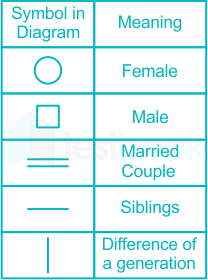
Code Language (P is of Q)
Symbol@%#
MeaningFatherMotherSonBrother

Given Expression: H # J ⊗ L @ G % F

<br>

We analyze the expression from right to left to find the relationship of F to J:

G % F: G is the son of F. (G is male)

L @ G: L is the mother of G. (L is female)

J ⊗ L: J is the father of L. (J is male)

H # J: H is the brother of J. (H is male)

Family Tree Representation (Relevant Part):

F is married to L, and L is the daughter of J.

Therefore, F is the son-in-law of J.

Hence, the correct answer is "Option 3".

32

Three statements showing relationships have been given, which are followed by two conclusions (I) and (II). Assuming that the given statements are true, find out which of the conclusions is/are definitely true.

Statements:

(1) J ≤ L

(2) L < M

(3) D ≥ M

Conclusions:

(I) D ≥ J

(II) J < D

  1. ((a))

    Only conclusion (I) is true

  2. ((b))

    Only conclusion (II) is true

  3. ((c))

    both conclusion(I) and (II) are true 

  4. ((d))

    Neither conclusion (1) nor (II) is true

Show Answer
Answer: ((b))

Only conclusion (II) is true

The given statement is: J ≤ L < M ≤ D

Conclusions:

I. D ≥ J → False (From the combined statement J ≤ L < M ≤ D, we have D > J. Now D ≥ J means either J < D or J = D. So, D > J is a possibility.)

II. J < D → True (Combining the statements: J ≤ L, L < M, and D ≥ M. We get J ≤ L < M ≤ D. This establishes a relationship between J and D as J < D. Hence, this is true).

Therefore, “Only conclusion (II) is true”.

Hence, the correct answer is "Option 2".

33

Eight friends A, B, C, D, E, F, G and H are sitting around a circle, facing at the centre. 'C' is between 'E' and 'F'. 'G' is the neighbour of 'E'. 'F' is on the immediate right of 'B'. 'H' is on the immediate left of 'A'. 'H' is not the neighbour of 'D' or 'E'.

Which of the following statement is true?

  1. ((a))

    'F' is the neighbour of 'G'

  2. ((b))

    'G' is between 'H' and 'E'

  3. ((c))

     'E' is between 'B' and 'F'

  4. ((d))

    'H' is immediate neighbour of 'A' and 'D'

Show Answer
Answer: ((b))

'G' is between 'H' and 'E'

Given: Eight friends A, B, C, D, E, F, G and H are sitting around a circle, facing at the centre.

'F' is on the immediate right of 'B'.

'C' is between 'E' and 'F'.

'G' is the neighbour of 'E'.

'H' is on the immediate left of 'A'.

'H' is not the neighbour of 'D' or 'E'.

Checking Conclusions:

  1. 'F' is the neighbour of 'G'. → False (F's neighbours are C and B).

2) 'G' is between 'H' and 'E'.True (G is between H and E).

  1. 'E' is between 'B' and 'F'. → False (E's neighbours are C and G).

  2. 'H' is immediate neighbour of 'A' and 'D'. → False (H's neighbours are A and G).

Hence, the correct answer is "Option 2".

34

Three statements are given followed by three conclusions (I), (II) and (III). You have to take these statements to be true, even if they seem to be at variance from commonly known facts. Decide which of the given conclusions logically follow(s) from the given statements

Statements:

(1) Some plates are cups.

(2) Some cups are tumblers.

(3) All tumblers are spoons.

Conclusions:

(I) Some spoons are cups

(II) Some cups are plates

(III) Some spoons are plates

  1. ((a))

    Only conclusion (I) follows

  2. ((b))

    Only conclusion (III) follows

  3. ((c))

    Only conclusions (I) and (II) follow

  4. ((d))

    Only conclusions (II) and (III) follow

Show Answer
Answer: ((c))

Only conclusions (I) and (II) follow

Given Statements:

(1) Some plates are cups.

(2) Some cups are tumblers.

(3) All tumblers are spoons.

The least possible Venn diagram for the given statements is:

Conclusions:

I. Some spoons are cups - True (Since all tumblers are spoons, and some cups are tumblers, it logically follows that some cups are spoons).

II. Some cups are plates - True (This is a direct restatement of statement (1) "Some plates are cups." Therefore, some cups are plates must be true).

III. Some spoons are plates - False (There is no definite link between Plates and Spoons, meaning a possibility exists, but it's not a definite conclusion).

So, Only conclusions (I) and (II) follow.

Hence, the correct answer is "Option 3".

35

Choose the Venn diagram from the options which represents the correct relationship amongst the given classes:

Father, Infants, Males

  1. ((a))

  2. ((b))

  3. ((c))

  4. ((d))

Show Answer
Answer: ((d))

The given classes are: Father, Infants, Males.

The relationship between these classes is:

  • All Fathers are Males. This means the circle for Father must be completely inside the circle for Males.
  • Some Infants are Males (male babies), and some are not (female babies). The Infants circle will partially overlap with the Males circle.
  • A Father cannot be an Infant, as an infant is a very young child who has not yet become a parent. Thus, the circle for Father and the circle for Infants must be completely separate.

This relationship is best represented by Option 4, where the Father circle is inside the Males circle, and the Infants circle overlaps the Males circle but not the Father circle.

Hence, the correct answer is "Option 4".

36

Which of the following features is not included in paragraph formatting?

  1. ((a))

    Making text bold

  2. ((b))

    Aligning text

  3. ((c))

    Indenting text

  4. ((d))

    Adjusting space between lines

Show Answer
Answer: ((a))

Making text bold

The correct answer is Making text bold.

Key Points

  • Paragraph formatting refers to the changes applied to the structure and layout of paragraphs in a document.
  • Features included in paragraph formatting are:
  • Aligning text: Allows text to be left, right, center, or justified.
  • Indenting text: Defines how far the paragraph is from the margins.
  • Adjusting space between lines: Controls the line spacing within a paragraph.
  • Making text bold is a feature of character formatting, not paragraph formatting. Character formatting deals with the styling of individual characters or words, such as bold, italic, or underline.

Additional Information

  • Paragraph formatting is essential for improving the readability and presentation of written content.
  • Other common paragraph formatting features include setting borders, background colors, and text alignment within tables.
  • Character formatting is applied to individual text elements, while paragraph formatting is applied to entire paragraphs.
37

The first slide of a presentation in MS-PowerPoint normally has the layout of:

  1. ((a))

    Header slide

  2. ((b))

    Content with caption

  3. ((c))

    Section Header

  4. ((d))

    Title Slide 

Show Answer
Answer: ((d))

Title Slide 

The correct answer is Title Slide

Key Points

  • The first slide of a presentation in MS-PowerPoint is typically called the Title Slide.
  • It serves as the introduction to the presentation and usually contains the title of the presentation along with a subtitle or the presenter's details.
  • The layout of the Title Slide includes placeholders for the title and subtitle, making it visually distinct from content slides.
  • It helps set the tone for the rest of the presentation and provides a professional start.

Additional Information

  • Header Slide: This layout is not typically used as the first slide in MS-PowerPoint presentations. It is meant for headers or section dividers within the presentation.
  • Content with Caption: This layout is used for slides that include textual content alongside images or graphics, but not usually as the first slide.
  • Section Header: This layout is used to introduce new sections in the presentation. It is not suitable for the first slide, which serves as the introduction to the entire presentation.
38

A software program that prohibits pop-up ads from web pages or actual pop-ups caused while coding is called 

  1. ((a))

    Ad blocker

  2. ((b))

    Popup blocker

  3. ((c))

    Firewall

  4. ((d))

    Spam blocker

Show Answer
Answer: ((a))

Ad blocker

The correct answer is Ad blocker.

Key Points

  • An Ad blocker is a software program designed to prevent unwanted advertisements, such as pop-ups, from displaying on web pages.
  • Ad blockers enhance the user experience by eliminating distractions caused by intrusive ads.
  • They can be installed as browser extensions or standalone applications.
  • Ad blockers also improve browsing performance by reducing the amount of data downloaded.

Additional Information

  • Popup Blocker: While similar to ad blockers, popup blockers specifically target popup windows that appear unexpectedly, often during browsing or coding activities.
  • Firewall: A firewall is a security system that monitors and controls incoming and outgoing network traffic based on predetermined security rules, not specifically designed to block ads.
  • Spam Blocker: Spam blockers are programs that filter and prevent unwanted email messages, not web-based advertisements.
39

The _________ key(s) acts as a toggle key. 

  1. ((a))

    Caps lock and Insert

  2. ((b))

    Shift and Insert

  3. ((c))

    Shift and Caps lock

  4. ((d))

    Shift and Ctrl

Show Answer
Answer: ((a))

Caps lock and Insert

The correct answer is Caps Lock and Insert.

Key Points

  • Caps Lock: The Caps Lock key acts as a toggle key. When you press it, it toggles the capital letter functionality on or off. If Caps Lock is on, all alphabetic characters are typed in uppercase until it is pressed again to turn it off.
  • Insert: The Insert key is another toggle key. When activated, it toggles between the "Insert" mode, which allows you to insert text at the cursor, and the "Overwrite" mode, which overwrites existing text.
  • Toggle Keys: Toggle keys are special keys on the keyboard that switch between two states each time they are pressed.

Additional Information

  • Shift Key: The Shift key is not a toggle key; it works as a modifier key to temporarily change the function of another key when pressed.
  • Ctrl Key: The Ctrl key is also a modifier key that works in combination with other keys to perform specific tasks and is not a toggle key.
  • Other Examples of Toggle Keys: The Num Lock and Scroll Lock keys also function as toggle keys, turning specific features on or off.
40

Which key combination is used to indent a paragraph in MS-Word? 

  1. ((a))

    Ctrl +N

  2. ((b))

    Ctrl+O

  3. ((c))

    Ctrl +P

  4. ((d))

    Ctrl+M

Show Answer
Answer: ((d))

Ctrl+M

The correct answer is Ctrl + M.

Key Points

  • In MS-Word, the key combination Ctrl + M is used to indent a paragraph.
  • Indenting a paragraph moves it inward from the left margin, providing better formatting and structure to the document.
  • Other key combinations like Ctrl + N, Ctrl + O, and Ctrl + P have different functions:
  • Ctrl + N: Opens a new document.
  • Ctrl + O: Opens an existing document.
  • Ctrl + P: Opens the Print dialog box.
  • Indenting is commonly used in structured documents, such as reports, essays, and letters.

Additional Information

  • Shortcut keys play a vital role in increasing efficiency while using MS-Word.
  • Some commonly used shortcuts include:
  • Ctrl + S: Saves the current document.
  • Ctrl + Z: Undoes the last action.
  • Ctrl + Y: Redoes the last undone action.
  • Ctrl + X: Cuts the selected content.
  • Ctrl + V: Pastes the copied or cut content.
  • These shortcuts help users quickly perform common tasks without navigating through menus.

Education and Leadership (40 questions)

41

What do you understand by 'Development' in child's growth? 

  1. ((a))

    Irreversible Quantitative change while child grows

  2. ((b))

    Reversible Quantitative change

  3. ((c))

    Qualitative change while child grows

  4. ((d))

    Irreversible Qualitative change 

Show Answer
Answer: ((d))

Irreversible Qualitative change 

Development in child growth refers to the progressive changes in behaviour, abilities, thinking and emotions that make the child qualitatively different from an earlier stage. These changes involve maturation, differentiation and increased complexity in functioning rather than just changes in size or number. 

Key Points

  • Development involves changes in the quality of functioning so that the child can do things differently and more complexly than before.
  • These changes are not simply increases in size or number but are reorganizations of behaviour and mental processes.
  • Once a child attains a higher level of functioning, that qualitative shift rarely reverts back to the earlier form.
  • Examples include moving from crawling to coordinated walking, from concrete to more abstract thinking, and from egocentric to perspective taking in social cognition.
  • Such changes are cumulative and form the basis for further development across domains.
  • Because development emphasizes these lasting qualitative transformations rather than temporary or purely numeric changes, the phrase captures the essence of developmental change.

Hint

  • Irreversible quantitative change confuses development with growth since quantitative changes refer to measurable increases such as height and weight rather than reorganization of functioning.
  • Development reversible and quantitative is inaccurate because development is not primarily about reversible numeric change and typically represents progressive, lasting transformations.
  • Qualitative change is closer to the concept but does not indicate the enduring and progressive nature of development that distinguishes it from transient qualitative fluctuations.

Hence, the correct answer is 'Irreversible Qualitative change'.

42

The following example would best explain 'Moral domain' of the child? 

  1. ((a))

    Argument with friend on social conflict

  2. ((b))

    Differentiating between Good and Bad

  3. ((c))

    Crying over pet dog's death

  4. ((d))

    Distribution of Birthday sweets

Show Answer
Answer: ((b))

Differentiating between Good and Bad

The moral domain of a child refers to the development of values, ideals and principles that help the child judge what is right or wrong. It includes understanding fairness, justice, rules, responsibilities and ethical behaviour.

Key Points

  • Moral development involves internalizing societal norms and making decisions based on conscience rather than external rewards or punishments.
  • Moral development involves learning to evaluate actions, intentions and situations as right or wrong.
  • When a child differentiates between Good and Bad, it shows the ability to make ethical judgments. This act reflects internal understanding of rules, values and consequences that guide decision making.
  • It represents the child's awareness of desirable and undesirable behaviour in social life.

Hint

  • An argument with a friend on a social conflict relates more to the social domain where interactions, cooperation and disagreements are part of social skills.
  • Crying over a pet dog's death belongs to the emotional domain because it reflects feelings, attachment and expression of grief.
  • Distribution of birthday sweets illustrates social and emotional sharing behaviour but does not specifically reflect moral reasoning.

Hence**, the correct answer is 'Differentiating between Good and Bad'.**

43

Which one of the following is an example of Primary Socialising Agency in Education ? 

  1. ((a))

    School

  2. ((b))

    Media

  3. ((c))

    Family

  4. ((d))

    Home

Show Answer
Answer: ((c))

Family

Primary socialisation refers to the earliest stage in a child's life when basic values, habits, language, norms and behaviour patterns are learned. It occurs in the immediate environment where the child first interacts and forms emotional bonds. 

Key Points

  • Primary socialisation happens first in the family because it is the child's earliest social environment.
  • A child learns speech, basic manners, habits, cultural practices and behavioral expectations at home with family members.
  • This setting provides emotional support and teaches early discipline, cooperation and communication. Parents and caregivers model behaviors that the child begins to imitate and internalise.
  • These early lessons strongly shape personality, social conduct and learning readiness.

Hint

  • School acts as a secondary socialising agency because children enter it after early habits and values are formed.
  • Media also contributes to secondary or tertiary socialisation as exposure happens later and builds on earlier learning.
  • Home refers to the physical place where a child lives, but the socialising role is carried out by the family members living within it, not the place itself.

Hence, the correct answer is 'Family'.

44

Which one of the following could be attributed to 'Affective domain' in child's development?

  1. ((a))

    Feeling

  2. ((b))

    Crying

  3. ((c))

    Swimming

  4. ((d))

    Thinking

Show Answer
Answer: ((a))

Feeling

The affective domain in a child’s development refers to emotional growth, feelings, attitudes, values and the way a child responds emotionally to situations. It involves developing sensitivity, expressing emotions appropriately, forming attachments and building self-concept.

Key Points

  • The affective domain is directly connected to emotional experiences and expression.
  • When a child shows feelings, it reflects emotional awareness and the ability to recognise inner states.
  • This involves understanding happiness, sadness, fear, love or anger, which are central aspects of affective development.
  • Such responses guide how the child interacts with others and interprets situations. Feeling is an internal emotional process that builds the foundation for empathy and emotional regulation.

Hint

  • Crying represents an emotional expression but it is a specific behaviour, not a broad indicator of the affective domain like feelings, which cover a wider emotional understanding.
  • Swimming belongs to the psychomotor domain as it involves physical coordination and motor skills.
  • Thinking is part of the cognitive domain which relates to mental activities such as reasoning, problem-solving and processing information.

Hence, the correct answer is 'Feeling'.

45

'Maturation' in child's development is very crucial for ____________ 

  1. ((a))

    Dancing

  2. ((b))

    Learning

  3. ((c))

    Playing

  4. ((d))

    Singing

Show Answer
Answer: ((b))

Learning

Maturation refers to the natural and genetically driven process through which a child’s body and brain develop to a level where certain skills become possible. It includes growth of the nervous system, muscles and cognitive structures that enable the child to perform new tasks.

Key Points

  • Maturation provides the basic readiness needed before learning can take place. A child can learn reading or writing only when the nervous system has matured enough to support these abilities.
  • Similarly, attention span, memory capacity and coordination improve as maturation progresses, making learning smoother.
  • Teachers and parents often wait for developmental readiness because forcing learning before maturation leads to frustration.
  • This readiness plays a central role in language learning, reasoning and problem-solving success.
  • Since learning depends on the maturity of physical and mental structures, maturation is crucial for the process of learning.

Hint

  • Dancing requires motor coordination, but it is considered a skill learned through practice, not solely dependent on maturation.
  • Playing happens naturally at different stages, but it is not the primary area where maturation is considered crucial.
  • Singing is also a skill that develops through exposure and practice rather than maturation alone.

Hence, the correct answer is 'Learning'.

46

The active participation of the child in classroom falls under: 

  1. ((a))

    Social learning

  2. ((b))

    Emotional learning

  3. ((c))

    Cognitive learning

  4. ((d))

    Experimental learning

Show Answer
Answer: ((c))

Cognitive learning

Active participation of a child in the classroom means the child is thinking, responding, questioning and engaging in learning tasks. It shows that the learner is mentally involved in understanding concepts, solving problems and processing information.

Key Points

  • Active participation requires the child to think, analyse and interpret information. It engages mental processes such as understanding, recalling and applying knowledge.
  • When a child asks questions or responds in class, it shows cognitive engagement.
  • This participation helps the learner build concepts and construct meaningful learning. Cognitive involvement results in deeper understanding and better retention of lessons.
  • Therefore, the active participation shown in the classroom directly reflects functioning of the cognitive learning domain.

Hint

  • Social learning refers to learning through interactions, imitation and observation, which may not necessarily require academic participation.
  • Emotional learning deals with feelings, attitudes and emotional expression rather than thinking-based classroom involvement.
  • Experimental learning focuses on hands-on activities and learning by doing, not general classroom participation.

Hence, the correct answer is 'Cognitive learning'.

47

The act of 'Driving car' comes under: 

  1. ((a))

    Affective domain

  2. ((b))

    Psychomotor domain

  3. ((c))

    Emotional domain

  4. ((d))

    Cognitive domain

Show Answer
Answer: ((b))

Psychomotor domain

Human abilities are generally classified into three domains of learning: cognitive, affective and psychomotor. The psychomotor domain deals with physical movement, coordination, motor skills, reflexes and muscular control.

Key Points

  • Driving a car requires coordinated use of hands, feet and eyes, which reflects motor skill development.
  • The driver has to control steering, brakes and gears through practiced physical responses. Such actions depend on muscular coordination and refined motor functioning.
  • It also involves timing, balance and quick physical reactions to road situations. These abilities improve with practice, which is a key feature of psychomotor skills.

Hint

  • Affective domain deals with emotions, attitudes and values, which are not the central elements in driving.
  • Emotional domain relates to expression of feelings but driving requires controlled physical action.
  • Cognitive domain focuses on mental processes like reasoning and problem-solving, which support driving but do not define the act itself.

Hence, the correct answer is 'Psychomotor domain'.

48

'Empathy' is an essential trait of __________ . 

  1. ((a))

    Teacher

  2. ((b))

    Doctor

  3. ((c))

    Professional counseller

  4. ((d))

    Lawyer

Show Answer
Answer: ((c))

Professional counseller

Empathy refers to the ability to understand and share the feelings of another person. It helps in building trust, offering emotional support and responding sensitively to others’ problems. Empathy is especially important in professions that deal with human emotions, personal struggles and mental well-being.

Key Points

  • A counsellor works with people who face emotional, social or psychological difficulties. To help effectively, the counsellor must understand the client’s feelings from their perspective.
  • Empathy allows the counsellor to create a safe, non-judgmental environment for sharing. This emotional connection encourages clients to express their concerns openly.
  • Through empathetic listening, the counsellor guides individuals toward healthier coping strategies. Because their work requires emotional understanding at a deep level, empathy becomes a core trait of a professional counsellor.

Hint

  • A teacher benefits from empathy, but it is not as foundational as it is for counselling.
  • A doctor also needs empathy, but the primary focus is medical diagnosis and treatment.
  • A lawyer deals mainly with legal reasoning and advocacy, where empathy is helpful but not essential to the role.

Hence, the correct answer is 'Professional counsellor'.

49

The following could be an example of physical disability: 

  1. ((a))

    Cerebral Palsy

  2. ((b))

    Autism

  3. ((c))

    Dyslexia

  4. ((d))

    Dysgraphia

Show Answer
Answer: ((a))

Cerebral Palsy

Physical disability refers to a condition that affects a person’s body movement, coordination or control of muscles. It may impact mobility, posture, balance or motor functioning. Such disabilities often arise from neurological, muscular or bone-related conditions.

Key Points

  • Cerebral Palsy affects the brain areas responsible for muscle control and coordination.
  • Children with this condition may have difficulty walking, balancing or performing fine motor tasks. It directly impacts physical movement because muscles become stiff, weak or uncoordinated.
  • This limits the child’s ability to perform normal motor activities independently. Since the condition primarily impairs physical functioning, it is categorized under physical disability.

Hint

  • Autism is a developmental disorder related to communication and social interaction, not physical mobility.
  • Dyslexia is a specific learning disability that affects reading and language processing.
  • Dysgraphia is also a learning disability related to writing skills, unrelated to physical impairment.

Hence**, the correct answer is 'Cerebral Palsy'.**

50

Which one of the following can be attributed to 'Cognitivism'?

  1. ((a))

    Drawing

  2. ((b))

    Painting

  3. ((c))

    Problem-solving

  4. ((d))

    Rote memory

Show Answer
Answer: ((c))

Problem-solving

Cognitivism is a learning theory that focuses on mental processes such as thinking, reasoning, understanding and decision-making. It explains how learners actively process information, organize knowledge and apply it to new situations.

Key Points

  • Problem solving requires analysing a situation using mental processes like reasoning and logical thinking.
  • It involves identifying the issue, evaluating possible solutions and selecting the most effective one. These steps reflect active information processing, which is central to cognitivist learning.
  • Learners draw upon prior knowledge and apply cognitive strategies during problem solving. This process strengthens understanding and supports meaningful learning rather than rote techniques.

Hint

  • Drawing focuses on creativity and motor skills and falls more under psychomotor and creative domains.
  • Painting is also a creative and motor skill-based task, not primarily cognitive in nature.
  • Rote memory involves mechanical repetition without understanding, which contradicts the principles of cognitivism.

Hence**, the correct answer is 'Problem-solving'.**

51

Which one of the following is the secondary socialising agency in the context of learning?

  1. ((a))

    Family

  2. ((b))

    Home

  3. ((c))

    School

  4. ((d))

    Media

Show Answer
Answer: ((c))

School

Socialisation is the process through which a child learns values, norms, behaviours and social skills. The earliest learning happens at home with parents and caregivers, known as primary socialisation. After this stage, the child enters wider social settings where new rules, expectations and interactions shape behavior.

Key Points

  • After the child gains initial learning from the family, school becomes the next major environment for social development.
  • Here the child learns discipline, cooperation, teamwork and social rules beyond the home.
  • Teachers, peers and school activities introduce the child to structured learning and social expectations.
  • This environment shapes attitudes, communication skills and behaviour in a more formal way.
  • School exposes the learner to diversity, shared responsibility and community values.

Hint

  • Family is the primary socialising agency because early habits and basic values are learned there.
  • Home is only the physical space, not the agency that actively socialises the child.
  • Media also contributes to socialisation but is usually considered a tertiary or supplementary agency rather than the main secondary one in educational context.

Hence, the correct answer is 'School'.

52

The 'Learning' at home comes under :

  1. ((a))

    Contextual Learning

  2. ((b))

    Formal Learning

  3. ((c))

    Informal Learning

  4. ((d))

    Non-formal Learning

Show Answer
Answer: ((c))

Informal Learning

Learning does not occur only in formal settings like schools; it also happens naturally in daily life. When a child learns through experiences, interactions and activities at home, the process is unstructured and not guided by a fixed curriculum. 

Key Points

  • Learning at home occurs without a fixed timetable or structured lessons.
  • Children pick up language, manners, values and basic life skills through everyday experiences.
  • Parents and family members guide learning naturally while interacting with the child.
  • This type of learning is not planned or assessed formally like school-based learning.
  • It relies on observation, imitation and participation in household activities.

Hint

  • Contextual learning involves connecting learning to real-life situations but is usually school-associated.
  • Formal learning refers to structured, curriculum-based learning conducted in institutions.
  • Non-formal learning includes organised learning outside school, such as hobby classes, not daily home learning.

Hence, the correct answer is Informal Learning.

53

Acquiring 'Milestones' at regular stages of child growth known as:

  1. ((a))

    Maturation

  2. ((b))

    Growth

  3. ((c))

    Skill development

  4. ((d))

    Developmental Tasks

Show Answer
Answer: ((d))

Developmental Tasks

As children grow, they achieve certain abilities at predictable ages such as sitting, walking, speaking or social interaction. These achievements are called developmental milestones. They indicate whether a child is progressing normally across different areas like physical, cognitive, emotional and social development.

Key Points

  • Developmental tasks are the abilities or skills that a child is expected to achieve at specific stages.
  • These tasks include physical, social, emotional and cognitive milestones appropriate for each age.
  • Achieving them shows that the child is growing in a balanced and expected manner. Each developmental stage has its own set of tasks that build on earlier achievements.
  • When a child acquires milestones such as crawling or forming sentences, these are considered developmental tasks.

Hint

  • Maturation refers to the natural unfolding of biological processes, not the full set of stage-wise milestones.
  • Growth focuses on physical changes like increase in height or weight, not specific abilities.
  • Skill development is the acquisition of specific abilities but does not necessarily follow fixed age-related stages.

Hence, the correct answer is Developmental Tasks.

54

The Socio-emotional dimension of child can be explained through:

  1. ((a))

    Feeling

  2. ((b))

    Facial expression

  3. ((c))

    Loud thinking

  4. ((d))

    Sleeping

Show Answer
Answer: ((b))

Facial expression

The socio emotional dimension of a child includes the ability to understand emotions, express them appropriately and build healthy relationships with others. It reflects how a child manages feelings, interacts socially and responds to situations emotionally.

Key Points

  • Facial expressions show how a child displays emotions like happiness, fear, anger or surprise. They reveal the child’s emotional understanding and ability to express feelings to others.
  • Such expressions help in forming social connections and communicating emotional states.
  • They allow caregivers and peers to understand the child’s needs and reactions. Facial expressions reflect both the emotional and social aspects of development, making them a strong indicator of socio emotional growth.

Hint

  • Feeling represents internal emotional experience but does not show social expression clearly.
  • Loud thinking is related to cognitive processes rather than socio emotional growth.
  • Sleeping is a biological activity linked to physical development, not socio emotional aspects.

Hence, the correct answer is Facial expression.

55

What is the role of 'Maturation' in learning?

  1. ((a))

    It determines readiness in learning

  2. ((b))

    It facilitates achieving milestones

  3. ((c))

    It promotes memory

  4. ((d))

    It would fix learning goals

Show Answer
Answer: ((a))

It determines readiness in learning

Maturation refers to the natural, biological growth processes that prepare a child for learning. It includes the development of the nervous system, muscles, brain functions and sensory abilities.

Key Points

  • Maturation helps a child reach the stage where learning becomes possible. Reading, writing or solving problems require a certain level of brain and motor development.
  • A child can learn to speak or walk only when the required physical structures have matured.
  • Teachers often wait for developmental readiness because learning before maturation leads to frustration.
  • This readiness ensures that the learner can understand, remember and apply new concepts effectively.
  • Thus, maturation acts as a foundation by making the child physically and mentally prepared for learning.

Hint

  • Facilitating milestones refers to overall developmental progress, not specifically the learning readiness created by maturation.
  • Promoting memory is part of cognitive development, whereas maturation mainly affects readiness.
  • Fixing learning goals is done by teachers or curriculum planners, not by biological maturation.

Hence, the correct answer is It determines readiness in learning.

56

Spenser describes education as:

  1. ((a))

    Self learning

  2. ((b))

    Preparation for life

  3. ((c))

    Complete living

  4. ((d))

    Meaningful life

Show Answer
Answer: ((c))

Complete living

Herbert Spencer was a prominent philosopher who defined education in terms of preparing individuals to live a full, productive and meaningful life. According to him, education must equip a person with the knowledge and skills needed to handle all aspects of life such as physical, intellectual, social, moral and vocational.

<br>

Key Points

  • Spencer believed that the purpose of education is not limited to academics but to prepare individuals for all duties of life.
  • He emphasized that education should help a person survive, grow, think and act effectively in real situations.
  • This includes health, livelihood, social responsibilities and moral conduct.
  • By calling education a preparation for complete living, he highlighted the holistic nature of learning.
  • It involves training for every phase of life, from childhood to adulthood.
  • Thus, Spencer’s idea connects education with overall personal and social well being, not just formal learning.

Hint

  • Self learning refers to individual effort and independence in learning, which was not Spencer’s core definition.
  • Preparation for life is close but less comprehensive compared to his broader phrase.
  • Meaningful life focuses on purpose, but Spencer stressed a more practical, all round preparation.

Hence, the correct answer is complete living.

57

The behavioural learning theory is associated with:

  1. ((a))

    Environment

  2. ((b))

    Stimulus - response

  3. ((c))

    Peer pressure

  4. ((d))

    Heredity

Show Answer
Answer: ((b))

Stimulus - response

Behavioural learning theory focuses on observable changes in behavior as a result of learning experiences. It emphasizes that learning occurs through interaction with the environment and that behaviors can be shaped by reinforcement or punishment.

Key Points

  • Behavioral learning is based on the principle that a specific stimulus can trigger a predictable response.
  • For example, a child may learn to say “thank you” when praised or to avoid a behavior that is punished.
  • Learning is measured by changes in observable behavior rather than thoughts or feelings.
  • Reinforcement strengthens the desired response, while punishment decreases undesirable behavior.
  • This connection between stimulus and response forms the foundation of behavioral approaches in education.
  • Because the focus is on external reactions to stimuli, it clearly represents the core idea of behavioral learning theory.

Hint

  • Environment influences learning but is broader and not specific to the stimulus-response mechanism.
  • Peer pressure affects behaviour socially but is not the theoretical basis of behavioural learning.
  • Heredity relates to inherited traits and potential, which behavioral theory does not primarily consider.

Hence, the correct answer is stimulus - response.

58

Name the branch of philosophy that propounded project method:

  1. ((a))

    Naturalism

  2. ((b))

    Idealism

  3. ((c))

    Pragmatism

  4. ((d))

    Realism

Show Answer
Answer: ((c))

Pragmatism

The project method is a child-centered teaching approach where learners actively engage in solving real-life problems or completing meaningful tasks. It emphasizes learning by doing, experimentation and practical application. This method encourages critical thinking, creativity and independence, rather than rote memorization.

Key Points

  • Pragmatism focuses on learning through experience and practical activity.
  • It emphasizes that knowledge is gained by interacting with the environment and applying ideas to real situations.
  • The project method aligns perfectly with this philosophy as it involves active participation, problem-solving and experimentation.
  • Children learn best when they construct knowledge by doing and reflecting on outcomes.
  • Pragmatists like John Dewey advocated projects as a way to develop skills, thinking, and social responsibility.

Hint

  • Naturalism emphasizes learning in harmony with nature and the child’s instincts rather than structured projects.
  • Idealism focuses on abstract reasoning and ideas rather than practical application.
  • Realism stresses understanding the world as it is, with observation and facts, but does not specifically promote projects as a method.

Hence, the correct answer is 'Pragmatism'.

59

What is constructivism in learning?

  1. ((a))

    Learning through logic

  2. ((b))

    Learning by doing

  3. ((c))

    The learner develops knowledge with the help of previous knowledge

  4. ((d))

    Learning by memory

Show Answer
Answer: ((c))

The learner develops knowledge with the help of previous knowledge

Constructivism is a learning theory that emphasizes how learners actively construct their own understanding and knowledge. According to this approach, learning is not just passive reception of information but involves connecting new information to what the learner already knows. 

Key Points

  • ​Constructivism emphasizes that new learning is built upon existing knowledge and experiences.
  • Learners actively interpret and integrate new information rather than simply memorizing it.
  • By linking new concepts to prior understanding, they develop deeper comprehension and critical thinking.
  • This process allows learners to personalize learning and apply it to different contexts.
  • Constructivist methods often include discussion, problem-solving and reflection to facilitate knowledge construction.
  • Hence, learning in this approach is meaningful because it connects past knowledge with new experiences.

Hint

  • Learning through logic focuses on reasoning but does not necessarily involve linking prior knowledge.
  • Learning by doing is related to experiential or pragmatic learning, which emphasizes action more than cognitive construction.
  • Learning by memory involves rote memorization and passive recall, which is contrary to the constructivist approach.

Hence, the correct answer is the learner develops knowledge with the help of previous knowledge.

60

According to psychologists-what is 'learning'?

  1. ((a))

    Directed behaviour

  2. ((b))

    Positive altered behaviour

  3. ((c))

    Focused behaviour

  4. ((d))

    Fixed behaviour

Show Answer
Answer: ((b))

Positive altered behaviour

Psychologists define learning as a relatively permanent change in behaviour or knowledge that occurs as a result of experience or practice. It involves acquiring skills, attitudes, values or understanding that influence how an individual acts in future situations.

Key Points

  • Learning leads to a change in behavior, understanding, or skill that is lasting and constructive.
  • This alteration reflects the acquisition of new knowledge, habits or attitudes. It can be observed in improved performance, better problem-solving, or application of new skills.
  • Such changes are intentional and result from experiences, practice, or instruction. The focus is on the development of behavior that enhances functioning rather than temporary or random changes.
  • Therefore, learning is best described as producing a positive alteration in behavior.

Hint

  • Directed behavior emphasizes goal-oriented action but does not necessarily involve lasting change.
  • Focused behavior refers to attention or concentration, which is part of learning but not the definition itself.
  • Fixed behavior implies rigidity or no change, which is contrary to the concept of learning.

Hence, the correct answer is positive altered behavior.

61

What should be the ideal classroom environment for effective learning? 

  1. ((a))

    Well decorated classroom

  2. ((b))

    Well ventilated classroom

  3. ((c))

    Well equipped with A.V aids classroom

  4. ((d))

    Non-threatening and supportive environment

Show Answer
Answer: ((d))

Non-threatening and supportive environment

The classroom environment plays a crucial role in effective learning. It not only includes physical aspects like space and lighting but also the psychological climate created by the teacher and peers. A positive classroom environment encourages participation, curiosity, risk-taking, and collaboration. 

Key Points

  • A non-threatening environment ensures that students feel safe to express ideas, ask questions, and make mistakes.
  • Supportive interactions with teachers and peers enhance motivation and engagement. Such an environment encourages collaborative learning, problem-solving, and active participation.
  • Students are more likely to focus on learning rather than fear of criticism or punishment. It builds self-confidence, resilience, and positive attitudes towards education.

Hint

  • A well-decorated classroom may make the space visually appealing but does not guarantee learning.
  • A well-ventilated classroom is important for physical comfort but not sufficient for engagement and motivation.
  • A classroom equipped with A.V aids facilitates teaching but cannot replace a supportive and non-threatening atmosphere.

Hence, the correct answer is Non-threatening and supportive environment.

62

Learning by doing is example of: 

  1. ((a))

    Activity based learning

  2. ((b))

    Experiential learning

  3. ((c))

    Cognitive learning

  4. ((d))

    Classical learning

Show Answer
Answer: ((b))

Experiential learning

Learning by doing emphasizes active participation in the learning process, where learners acquire knowledge and skills through direct experience. It is a hands-on approach that encourages exploration, experimentation, problem-solving, and reflection.

Key Points

  • Experiential learning is based on the idea that knowledge is constructed through experience. When a learner engages in tasks, experiments, or real-life activities, they actively process and internalize learning.
  • Reflection on these experiences further enhances understanding and skill development.
  • Learning by doing directly involves interaction with materials, environment, or situations, making knowledge meaningful.
  • It promotes critical thinking, decision-making, and application of concepts in varied contexts.
  • Thus, this method perfectly exemplifies experiential learning where experience is central to acquiring knowledge.

Hint

  • Activity-based learning involves structured activities to teach concepts but may not always involve reflective experiential processes.
  • Cognitive learning focuses on mental processes like thinking, reasoning, and understanding rather than hands-on experience.
  • Classical learning refers to traditional or rote learning methods, not learning through direct experience.

Hence, the correct answer is Experiential learning.

63

A student found helping the blindman to cross the road. It comes under: 

  1. ((a))

    Social activity

  2. ((b))

    Community service

  3. ((c))

    Hidden curriculum

  4. ((d))

    Morality

Show Answer
Answer: ((b))

Community service

Education goes beyond academics and includes activities that develop social responsibility, ethical behaviour, and civic sense. Actions performed by students that benefit others or the community reflect their values, character, and moral development. Such activities encourage empathy, cooperation, and awareness of social needs, preparing learners to contribute positively to society.

Key Points

  • Helping a blind man to cross the road is an action performed for the benefit of someone in the community. It demonstrates social responsibility, kindness, and concern for the welfare of others.
  • Such voluntary actions are purposeful and aimed at improving the well-being of individuals or society.
  • Community service provides practical experiences where learners apply moral values in real-life contexts.
  • It builds empathy, civic sense, and a sense of contribution to society.
  • Since the student’s act is a deliberate service to the community, it clearly represents community service.

Hint

  • Social activity includes general group or recreational activities but may not focus on helping others.
  • Hidden curriculum refers to values and norms learned indirectly at school, not directly through an action.
  • Morality reflects internal ethical understanding but the specific act of helping is better classified as community service.

Hence, the correct answer is community service.

64

A Democratic curriculum should have the following character: 

  1. ((a))

    Entertainment

  2. ((b))

    Leisure

  3. ((c))

    Study tour

  4. ((d))

    Development of integrated personality

Show Answer
Answer: ((d))

Development of integrated personality

A democratic curriculum emphasizes holistic education that prepares learners not only academically but also socially, emotionally, and morally. It values equality, freedom of thought, participation, and personal growth.

Key Points

  • A democratic curriculum seeks to develop all aspects of a learner’s personality – intellectual, emotional, social, moral, and physical.
  • It encourages creativity, critical thinking, problem-solving, and decision-making.
  • Learners are given opportunities to participate actively, voice opinions, and make choices in their learning. This approach fosters self-confidence, empathy, cooperation, and responsible citizenship.
  • By addressing multiple dimensions of growth, it prepares learners for real-life challenges and meaningful participation in society. Hence, the character of developing an integrated personality aligns perfectly with a democratic curriculum.

Hint

  • Entertainment and leisure are supplementary aspects and do not define the core aim of a democratic curriculum.
  • Study tours provide experiential learning but are only one of many strategies and do not represent the curriculum’s fundamental character.

Hence, the correct answer is development of integrated personality.

65

ICT applications in school education enhances: 

  1. ((a))

    Enhances peer learning

  2. ((b))

    Creativity and thinking skills

  3. ((c))

    Interest

  4. ((d))

    Attention

Show Answer
Answer: ((b))

Creativity and thinking skills

ICT (Information and Communication Technology) applications in school education involve the use of digital tools, computers, internet resources, and multimedia to support teaching and learning. 

Key Points

  • ICT tools such as simulations, animations, and educational software encourage students to explore ideas and experiment with solutions.
  • They allow learners to visualize concepts, create projects, and express understanding in innovative ways.
  • Problem-solving activities and interactive tasks foster analytical thinking and reasoning. Students are encouraged to design, plan, and evaluate their own work, enhancing creative abilities.
  • ICT promotes independent and higher-order thinking, going beyond simple knowledge acquisition. Thus, the integration of ICT in education primarily develops creativity and thinking skills.

Hint

  • Enhancing peer learning may occur with ICT but it is not the primary objective.
  • Interest and attention can be stimulated by ICT, but these are outcomes rather than the central enhancement.

Hence, the correct answer is creativity and thinking skills.

66

What is the purpose of assessment in school education ? 

  1. ((a))

    To measure ability of understanding

  2. ((b))

    To assess the subject knowledge

  3. ((c))

    Remediation and counselling

  4. ((d))

    To find out weak areas of the child

Show Answer
Answer: ((d))

To find out weak areas of the child

Assessment in school education is a systematic process of gathering information about a learner’s knowledge, skills, abilities, and overall development. Its purpose goes beyond just marking or grading; it helps teachers understand how well students are learning, identify difficulties, and guide improvement.

Key Points

  • Assessments are used to identify gaps in understanding or skills that need attention. By analyzing performance, teachers can pinpoint specific areas where a child struggles.
  • This information allows targeted interventions, additional support, or remedial instruction. It helps in tailoring teaching strategies to meet the individual needs of students.
  • Such assessment ensures that learning difficulties are addressed before they become obstacles to progress.
  • Hence, finding weak areas ensures that assessment supports learning effectively rather than just judging performance.

Hint

  • Measuring ability of understanding and assessing subject knowledge are components of assessment but are narrower in scope.
  • Remediation and counselling are actions taken after identifying issues, not the direct purpose of assessment itself.

Hence, the correct answer is to find out weak areas of the child.

67

The students can learn better through the activities: 

  1. ((a))

    Conducted in school

  2. ((b))

    Conducted out side the school

  3. ((c))

    Involvement of students in various community related program

  4. ((d))

    School laboratory

Show Answer
Answer: ((c))

Involvement of students in various community related program

Learning is most effective when students actively engage in meaningful activities rather than passively receiving information. Experiential and hands-on experiences help learners connect theory with real-life situations, develop practical skills, and enhance understanding.

Key Points

  • Community-related programs provide real-world contexts where students can apply their knowledge. Such involvement encourages problem-solving, teamwork, and social responsibility.
  • Students learn by observing, interacting, and contributing to the welfare of others, making the learning process meaningful.
  • It develops life skills, civic sense, and empathy alongside academic understanding. Active participation in these programs motivates learners and enhances critical thinking and decision-making.
  • Hence, engaging in community-related programs supports holistic learning beyond the confines of the classroom.

Hint

  • Activities conducted in school provide structured learning but may lack real-life context.
  • Activities outside school may offer exposure but are limited if not connected to purposeful engagement.
  • School laboratories support experimental learning but focus primarily on specific academic concepts rather than holistic development.

Hence, the correct answer is involvement of students in various community-related program.

68

Which of the following quality is essential among school leaders?

  1. ((a))

    Democratic attitude

  2. ((b))

    Transformation leadership

  3. ((c))

    Dictatorship

  4. ((d))

    Servant leadership

Show Answer
Answer: ((a))

Democratic attitude

School leaders play a crucial role in creating a positive learning environment, guiding teachers, and shaping the overall educational climate. Effective leadership in schools involves not only managing administrative tasks but also fostering collaboration, participation, and a sense of responsibility among staff and students.

Key Points

  • A democratic attitude involves listening to others, encouraging participation, and making decisions collaboratively.
  • School leaders with this quality promote a sense of ownership among teachers and students. It creates an inclusive environment where ideas and feedback are valued, leading to better problem-solving.
  • Such leaders foster trust, motivation, and professional growth within the school community. They balance authority with support, ensuring that policies and initiatives are effectively implemented.
  • Hence, a democratic attitude is essential for school leaders to guide the institution constructively and maintain a positive educational environment.

Hint

  • Transformational leadership focuses on inspiring change but is broader and may not always ensure participative decision-making.
  • Dictatorship represents authoritarian leadership, which suppresses collaboration and is not suitable for schools.
  • Servant leadership emphasizes serving others, which is beneficial but does not fully capture the participative and decision-sharing aspect central to school leadership.

Hence, the correct answer is democratic attitude.

69

What should be the quality of school development plan ? 

  1. ((a))

    Adequate fund should be provided

  2. ((b))

    Teachers training program to be carried out

  3. ((c))

    Should have scope for student activities

  4. ((d))

    It should take care of all living and non-living resources for the healthy development of the school

Show Answer
Answer: ((d))

It should take care of all living and non-living resources for the healthy development of the school

A school development plan is a strategic framework that outlines how a school will improve its teaching, learning environment, infrastructure, and overall functioning. It serves as a roadmap for achieving educational goals, ensuring effective use of resources, and fostering holistic growth of students.  

Key Points

  • A quality school development plan addresses both human resources (teachers, staff, students) and material resources (buildings, equipment, technology).
  • It ensures that infrastructure, teaching aids, and learning spaces are adequate and well-maintained.
  • By integrating human and material resources, the plan promotes overall efficiency and effectiveness. It supports teacher development, student engagement, and smooth administrative functioning.
  • Such a holistic approach ensures sustainable development and fosters a healthy, productive learning environment.
  • Hence, considering all resources is central to the comprehensive growth of the school.

Hint

  • Providing adequate funds is necessary but is only one component of a development plan.
  • Carrying out teacher training programs is important but does not cover the full scope of school development.
  • Including scope for student activities is valuable but represents only one part of a comprehensive plan.

Hence, the correct answer is it should take care of all living and non-living resources for the healthy development of the school.

70

What is the quality of good time-table in school?

  1. ((a))

    It should take care of co-curricular activities

  2. ((b))

    It should take care the requirement of teachers, students and administration

  3. ((c))

    It should take care of leisure time activities

  4. ((d))

    It should take care of exam schedule

Show Answer
Answer: ((b))

It should take care the requirement of teachers, students and administration

A good time-table in school is a structured schedule that organizes teaching, learning, and other school activities efficiently. It ensures that academic subjects, co-curricular activities, and administrative requirements are balanced to support holistic development.

Key Points

  • A quality time-table considers the availability and workload of teachers, ensuring they are not overburdened.
  • It accommodates students’ learning needs, attention span, and age-appropriate distribution of subjects.
  • Administrative requirements such as supervision, assembly, and breaks are also integrated effectively.
  • By balancing all these factors, the timetable ensures smooth functioning of the school. It promotes a positive learning environment where both teaching and learning can occur efficiently.
  • Hence, a good time-table is one that meets the needs of teachers,

Hint

  • Taking care of co-curricular activities is important but only one aspect of the timetable.
  • Leisure time activities and exam schedules are also components but do not alone define the quality of a good timetable.

Hence, the correct answer is it should take care the requirement of teachers, students and administration.

71

What is dysgraphia ? 

  1. ((a))

    Inability to speak

  2. ((b))

    Inability to learn

  3. ((c))

    Inability to write

  4. ((d))

    Inconsistant use of letters

Show Answer
Answer: ((c))

Inability to write

Dysgraphia is a type of specific learning disability related to written expression. It affects a child’s ability to write clearly, neatly, and efficiently. Children with dysgraphia may know the content but struggle to put their thoughts on paper.

Key Points

  • Dysgraphia refers to difficulty in performing written tasks even when the child has normal intelligence. The child may struggle with forming letters, maintaining proper spacing, or writing at an age-appropriate speed.
  • This condition affects handwriting, spelling, and the physical act of writing.
  • The difficulty is neurological in nature, not due to lack of effort or teaching.
  • Children may understand concepts well but face challenges expressing them through writing.
  • Hence, dysgraphia is best described as a problem related to the inability to write effectively.

Hint

  • Inability to speak relates to speech disorders, not dysgraphia.
  • Inability to learn is too broad and does not specifically fit dysgraphia.
  • Inconsistent use of letters may occur in dysgraphia but it is a symptom, not the definition itself.

Hence, the correct answer is inability to write.

72

What is the Quantum of Punishment Prescribed for discrimination against Divyangjan ? 

  1. ((a))

    Fine upto Rs. 5 lakhs and imprisonment upto 5 years

  2. ((b))

    Fine upto Rs. 5 lakhs and imprisonment upto 2 years

  3. ((c))

    Fine upto Rs. 50000 and imprisonment upto 1 year

  4. ((d))

    Fine upto Rs. 1 lakh and imprisonment upto 10 years

Show Answer
Answer: ((a))

Fine upto Rs. 5 lakhs and imprisonment upto 5 years

In India, discrimination against Divyangjan (persons with disabilities) is addressed under The Rights of Persons with Disabilities (RPWD) Act, 2016 which provides legal protections and penalties to prevent and punish violations of rights. 

Key Points

  • Under the RPWD Act, discrimination and violation of rights can attract penalties that include imprisonment and fine.
  • For general contraventions, repeated offences can lead to a fine that may extend up to Rs. 5 lakh.
  • In many provisions related to discrimination and denial of rights, imprisonment may extend up to two years along with a fine.
  • This reflects the intent of the law to act as a deterrent against discrimination.
  • Such penalties empower authorities to take action against those who violate disability rights.

Hence, the correct answer is Fine up to Rs. 5 lakhs and imprisonment up to 2 years.

73

What is the major challenge in schools to address mental health issues among children? 

  1. ((a))

    Lack of Infrastructure

  2. ((b))

    Lack of Funds

  3. ((c))

    Lack of Professional Counsellers

  4. ((d))

    Lack of will to do

Show Answer
Answer: ((c))

Lack of Professional Counsellers

Mental health in children is a critical aspect of overall development, affecting learning, behaviour, and social interactions. Schools play a key role in identifying and supporting students with mental health challenges. However, addressing these issues effectively requires trained personnel, structured programs, and supportive infrastructure.

Key Points

  • Many schools face the challenge of having insufficient trained mental health professionals. Without professional counsellors, early identification of emotional, behavioral, or psychological issues becomes difficult.
  • Teachers may notice problems but often lack the expertise to provide appropriate interventions or guidance.
  • Professional counsellors can offer individual or group counselling, design mental health programs, and support teachers and parents.
  • Their presence ensures that children receive timely support, reducing the risk of academic and social difficulties.

​​

Hint

  • Lack of infrastructure and funds are challenges but can be mitigated with planning and community support.
  • Lack of will to act may exist in some contexts but is not the systemic issue as widespread as the shortage of trained counsellors.

Hence, the correct answer is lack of Professional Counsellors.

74

Suggest one example of creating partnership with the industry.

  1. ((a))

    Orientation Programmes

  2. ((b))

    School visit to Industry as a study tour

  3. ((c))

    Through vocational training

  4. ((d))

    Industry shares the resources with the schools

Show Answer
Answer: ((c))

Through vocational training

Partnerships between schools and industry aim to bridge the gap between academic learning and practical skills required in the workplace. Such collaborations help students understand real-world applications of their studies, develop employable skills, and gain exposure to professional environments.

Key Points

  • Vocational training programs in partnership with industries provide students with hands-on skills relevant to specific trades or professions.
  • Industries can offer expert guidance, workshops, and practical exposure aligned with current technological and professional standards.
  • Students gain competencies that improve employability and prepare them for career opportunities. This collaboration ensures that the curriculum remains relevant to industry needs and enhances student learning outcomes.
  • Vocational training is a structured, ongoing partnership where both the school and industry actively contribute to skill development.

Hint

  • Orientation programs provide knowledge but are short-term and less skill-focused.
  • School visits to industry are mainly observational and do not provide in-depth skill development.
  • Industry sharing resources is beneficial but does not necessarily involve active learning or skill-building for students.

Hence, the correct answer is through vocational training.

75

What is significance of excursion in school education ? 

  1. ((a))

    Entertainment

  2. ((b))

    Promotes belongingness among the children

  3. ((c))

    To break monetany

  4. ((d))

    Part of Project Work

Show Answer
Answer: ((b))

Promotes belongingness among the children

Excursions in school education are organized trips outside the school to provide experiential learning opportunities. They expose students to real-world environments, historical sites, cultural places, or natural habitats, helping them connect classroom knowledge with practical experiences.

 Key Points

  • During excursions, students interact closely with peers and teachers in a less formal setting. These shared experiences foster teamwork, cooperation, and social bonding.
  • Children develop a sense of community, mutual respect, and empathy while participating in group activities.
  • Excursions also encourage communication, problem-solving, and collaboration among students.
  • Such experiences strengthen relationships and contribute to a positive classroom culture.
  • Hence, excursions are significant not only for learning but also for promoting belongingness and social cohesion among children.

Hint

  • Entertainment is a byproduct but not the primary educational purpose.
  • Breaking monotony refers to refreshment, not the main significance in education.
  • Part of project work may sometimes involve excursions, but it is not their core significance.

Hence, the correct answer is promotes belongingness among the children.

76

What is the 'Living corner in school' ? 

  1. ((a))

    Aquarium

  2. ((b))

    Park

  3. ((c))

    Garden

  4. ((d))

    Play field

Show Answer
Answer: ((a))

Aquarium

A living corner in a school is a designated area where students can observe and interact with living organisms such as plants, animals, or insects. It is designed to promote experiential learning, curiosity, and environmental awareness.

Key Points

  • An aquarium contains live aquatic animals and plants that students can observe daily. It allows children to study behaviours, life cycles, and interactions within an ecosystem.
  • Students learn to care for living organisms, fostering responsibility and empathy. It provides a hands-on learning experience that supports science education and environmental awareness.
  • An aquarium is manageable within the school environment and can be integrated into lessons on biology or ecology.
  • Hence, an aquarium effectively represents the concept of a living corner in a school.

Hint

  • A park and garden may contain plants and open spaces but are larger outdoor areas not specifically designed as living corners.
  • A play field is primarily for physical activity and does not focus on living organisms or biological observation.

Hence, the correct answer is Aquarium.

77

What is the disadvantage of self assessment ? 

  1. ((a))

    Reluctant to accept weak areas of the school

  2. ((b))

    Unhealthy comparison with other schools

  3. ((c))

    Self contented attitude

  4. ((d))

    Schools tend to be biased

Show Answer
Answer: ((c))

Self contented attitude

Self-assessment in schools involves evaluating their own performance, processes, and outcomes to identify strengths and areas for improvement. 

Key Points

  • When schools assess themselves, there is a tendency to overestimate performance and overlook areas needing improvement. This can lead to complacency and a false sense of achievement.
  • Schools may focus on successes while ignoring weaknesses or challenges that require attention. Such an attitude reduces motivation to implement changes or seek external feedback.
  • Self contentment may prevent proactive measures for improvement and hinder overall development.
  • Hence**, a major disadvantage of self-assessment is fostering a self contented attitude that limits growth.**

Hint

  • Reluctance to accept weak areas is similar but more about denial than self-assessment itself.
  • Unhealthy comparison with other schools is more relevant to benchmarking rather than self-assessment.
  • Schools tending to be biased is a concern, but the key behavioral disadvantage is self-satisfaction leading to stagnation.

Hence, the correct answer is self contented attitude.

78

NCF 2005 recommends: 

  1. ((a))

    Developments of school infrastructure

  2. ((b))

    Better funding for school education

  3. ((c))

    reducing teacher pupil ratio

  4. ((d))

    connecting knowledge to life

Show Answer
Answer: ((d))

connecting knowledge to life

The National Curriculum Framework (NCF) 2005 provides guidelines for school education in India, focusing on making learning more relevant, engaging, and meaningful for children.

Key Points

  • NCF 2005 stresses that school education should not be limited to rote memorization of facts. It advocates for teaching that relates concepts to students’ experiences, social context, and practical situations.
  • By linking knowledge to life, students can see the relevance of what they learn and apply it effectively. This approach promotes critical thinking, problem-solving, and meaningful learning.
  • It ensures that education develops skills, values, and understanding that prepare learners for real-life challenges.

Hence, connecting knowledge to life captures the central philosophy of NCF 2005.

Hint

  • Development of infrastructure, better funding, and reducing teacher-pupil ratio are important for education but are not the primary recommendations of NCF 2005.
  • The framework mainly addresses curriculum, pedagogy, and learning processes rather than administrative measures.
79

The newly proposed design of school curriculum is: 

  1. ((a))

    10 + 2 + 2 + 1

  2. ((b))

    5 + 3 + 3 + 4

  3. ((c))

    5 + 2 + 3 + 5

  4. ((d))

    4 + 3 + 4 + 4

Show Answer
Answer: ((b))

5 + 3 + 3 + 4

The National Education Policy (NEP) 2020 introduced a new school curriculum structure to make education more holistic, flexible, and multidisciplinary. This system aims to reduce rote learning and focus on critical thinking, creativity, and life skills.

Key Points

The new design divides school education into four stages:

  • Foundational stage (5 years): Pre-primary + Grades 1–2, focusing on play-based and activity-based learning.
  • Preparatory stage (3 years): Grades 3–5, introducing more formal subjects with experiential learning.
  • Middle stage (3 years): Grades 6–8, emphasizing higher-order thinking and interdisciplinary learning.
  • Secondary stage (4 years): Grades 9–12, allowing flexibility, vocational education, and multidisciplinary study.

Thus, the correct answer is 5 + 3 + 3 + 4.

80

RTE Act, 2009 section 19 deals with: 

  1. ((a))

    Transfer of students

  2. ((b))

    Recruitment of teachers

  3. ((c))

    Prohibition of unrecognized schools

  4. ((d))

    Formation of school management committee'

Show Answer
Answer: ((d))

Formation of school management committee'

The Right of Children to Free and Compulsory Education (RTE) Act, 2009 is a landmark legislation in India that ensures every child aged 6–14 years has the right to quality education.

Key Points

  • Section 19 mandates the constitution of a School Management Committee (SMC) for every government and aided school.
  • The SMC includes parents, teachers, and community representatives to oversee school functioning.
  • Its responsibilities include monitoring school activities, ensuring enrollment and retention of children, and improving teaching–learning processes.
  • It ensures transparency, accountability, and active community participation in the management of schools.
  • By involving parents and the community, SMCs strengthen governance and contribute to better educational outcomes.

Hint

  • Transfer of students, recruitment of teachers, and prohibition of unrecognized schools are addressed under different sections of the RTE Act, not Section 19.

Hence**, the correct answer is formation of school management committee.**

Subject Specific (100 questions)

Read the passage given below and answer the question that follow :

While I was in a shop on a busy road, a deafening sound ripped through my ears followed by a huge column of smoke. Soon, I realised that it was a high-decibel firecracker burst to honour a dead man as I saw a long funeral procession moving slowly and flooding the whole road with flowers only to be crushed by speeding vehicles.

While its leading fireworks team fired a blast every five minutes, the shopkeeper whispered, "There is no occassion needed to burst crackers these days. They burn them to celebrate births, to condole deaths, to announce election victories, in wedding processions, at bus stations, and on temple premises and railway platforms without the slightest regard for the law of the land about the restrictions of time and place of their use."

Some are utterly blind to where, when and how to use fireworks without endangering the lives of others. Is there no safer and harmless method to display our sentiments ?

Restrictions to burst firecrackers during festivals imposed by the courts are mostly flouted and it often goes unnoticed by the police. There are specific restrictions on the noise let out by firecrackers measured in decibels.

81

When he heard the noise of firecrackers, the writer had left home to: 

  1. ((a))

    do some shopping.

  2. ((b))

    have a cup of coffee in a restaurant.

  3. ((c))

    go to his office.

  4. ((d))

    visit a friend.

Show Answer
Answer: ((a))

do some shopping.

The correct answer is 'Option 1'.


Key Points

  • A) The writer was in a shop on a busy road when he heard the noise of firecrackers.
  • This can be inferred from the passage. The passage clearly states that the writer was in a shop on a busy road when the noise occurred.

Therefore, the correct answer is Option 1: do some shopping.


Additional Information

  • Option 2: have a cup of coffee in a restaurant: Incorrect because the passage does not mention the writer going to a restaurant.
  • Option 3: go to his office: Incorrect because the passage does not mention the writer going to his office.
  • Option 4: visit a friend: Incorrect because the passage does not mention the writer visiting a friend.
82

On hearing a loud blast, the writer was: 

  1. ((a))

    surprised

  2. ((b))

    pleased

  3. ((c))

    shocked

  4. ((d))

    curious

Show Answer
Answer: ((c))

shocked

The correct answer is 'Option 3'.


Key Points

  • A) The passage describes that a deafening sound ripped through the writer's ears and a huge column of smoke followed.
  • This indicates that the writer was shocked by the sudden loud blast.

Therefore, the correct answer is Option 3: shocked.


Additional Information

  • Option 1: surprised: Incorrect because the passage does not convey that the writer was simply surprised, but rather shocked by the intensity of the sound.
  • Option 2: pleased: Incorrect because the passage conveys a sense of disturbance, not pleasure.
  • Option 4: curious: Incorrect because the passage indicates a more immediate reaction of shock rather than curiosity.
83

The most ironic happening described in the passage is: 

  1. ((a))

     loud noise of the firecrackers.

  2. ((b))

    a huge column of smoke.

  3. ((c))

    slow movement of the funeral procession.

  4. ((d))

    flowers being crushed by the vehicles.

Show Answer
Answer: ((d))

flowers being crushed by the vehicles.

The correct answer is 'Option 4'.


Key Points

  • A) The passage mentions that the whole road was flooded with flowers for the funeral procession,
  • but ironically, these flowers were being crushed by speeding vehicles, which is a stark contrast to the solemnity and respect expected in such a situation.

Therefore, the correct answer is Option 4: flowers being crushed by the vehicles.


Additional Information

  • Option 1: loud noise of the firecrackers: Incorrect because while loud, it's not the most ironic event described.
  • Option 2: a huge column of smoke: Incorrect because it’s a description of the effect, not the irony.
  • Option 3: slow movement of the funeral procession: Incorrect because the slow movement itself is not ironic but expected.
84

What is the main complaint of the shopkeeper ? 

  1. ((a))

    There is no regard for law and order.

  2. ((b))

    Crackers are burst even to condole deaths.

  3. ((c))

    They are burst even at railway platforms.

  4. ((d))

    Crackers are burst to celebrate births.

Show Answer
Answer: ((a))

There is no regard for law and order.

The correct answer is 'Option 1'.


Key Points

  • A) The shopkeeper mentions several occasions and places where firecrackers are burst without any regard for the law of the land about the restrictions of time and place of their use.
  • This indicates his main complaint is the lack of regard for law and order when it comes to bursting firecrackers.

Therefore, the correct answer is Option 1: There is no regard for law and order.


Additional Information

  • Option 2: Crackers are burst even to condole deaths: Incorrect because while this is mentioned, it is part of a larger complaint about disregard for the law.
  • Option 3: They are burst even at railway platforms: Incorrect because this is also part of the larger issue of not following the law.
  • Option 4: Crackers are burst to celebrate births: Incorrect because this is part of the broader problem of not adhering to legal restrictions.
85

Study the following statements:

(A) Firecrackers were being burst according to a time schedule.

(B) Careless bursting of firecrackers endangers human lives.

  1. ((a))

     (A) is right and (B) is wrong.

  2. ((b))

     (B) is right and (A) is wrong.

  3. ((c))

    Both (A) and (B) are right.

  4. ((d))

    Both (A) and (B) are wrong.

Show Answer
Answer: ((b))

 (B) is right and (A) is wrong.

The correct answer is 'Option 2'.


Key Points

  • A) Firecrackers were being burst according to a time schedule.
  • Incorrect because the passage suggests there was no specific schedule, only that firecrackers were being fired every five minutes during the funeral procession, and that crackers are burst on various occasions without regard to legal restrictions on time.
  • B) Careless bursting of firecrackers endangers human lives.
  • Correct because the passage explicitly states that some are utterly blind to where, when, and how to use fireworks without endangering the lives of others.

Therefore, the correct answer is Option 2: (B) is right and (A) is wrong.


Additional Information

  • Option 1: (A) is right and (B) is wrong: Incorrect because (A) is not supported by the passage, while (B) is.
  • Option 3: Both (A) and (B) are right: Incorrect because (A) is not supported by the passage, only (B) is.
  • Option 4: Both (A) and (B) are wrong: Incorrect because (B) is correct according to the passage.
86

'... a deafening sound ripped through my ears'

The figure of Speech used here is:

  1. ((a))

    Simile

  2. ((b))

    Hyperbole

  3. ((c))

    Metonymy

  4. ((d))

    Euphenism

Show Answer
Answer: ((b))

Hyperbole

The correct answer is 'Option 2'.


Key Points

  • A) The phrase "a deafening sound ripped through my ears" is an example of hyperbole because it exaggerates the intensity of the sound to convey just how loud it was.
  • Hyperbole is a figure of speech that involves deliberate exaggeration for emphasis or effect.

Therefore, the correct answer is Option 2: Hyperbole.


Additional Information

  • Option 1: Simile: Incorrect because a simile involves a comparison using "like" or "as," and no such comparison is present in the phrase.
  • Option 3: Metonymy: Incorrect because metonymy involves substituting a word with something closely related to it, which does not apply to this phrase.
  • Option 4: Euphemism: Incorrect because a euphemism is a mild or indirect word or expression substituted for one considered to be too harsh or blunt, which is not the case here.
87

'.... to condole deaths ....'

The underlined word means the same as:

  1. ((a))

    condone

  2. ((b))

    care

  3. ((c))

    solace

  4. ((d))

    pity

Show Answer
Answer: ((c))

solace

The correct answer is 'Option 3'.


Key Points

  • To condole means to express sympathy or sorrow. The underlined word "condole" means the same as "solace".
  • "Solace" refers to the comfort or consolation in a time of distress or sadness, which is the context in which "condole" is used in the passage.

Therefore, the correct answer is Option 3: Solace.


Additional Information

  • Option 1: Condone: Incorrect because "condone" means to accept or allow behavior that is considered morally wrong or offensive.
  • Option 2: Care: Incorrect because "care" refers to the provision of what is necessary for the health, welfare, maintenance, and protection of someone or something.
  • Option 4: Pity: Incorrect because "pity" refers to the feeling of sorrow and compassion caused by the suffering and misfortunes of others, which is not a direct synonym for "condole."
88

'..... are mostly flouted'

The word opposite in meaning to the underlined one is :

  1. ((a))

    approved

  2. ((b))

    slighted

  3. ((c))

    imposed

  4. ((d))

    exceeded

Show Answer
Answer: ((a))

approved

The correct answer is: Option 1 i.e. 'approved'.

Key Points

  • The word "flouted" means to openly disregard a rule or convention. (उल्लंघन करना)
  • Example: The law was frequently flouted by criminals.
  • "Approved" means officially agreed or accepted as satisfactory. (मंजूरी देना)
  • Example: The board approved the new policy for employee conduct.

Therefore, the correct answer is: Option 1 i.e. 'approved'.

Additional Information

Here are the other options explained along with their Hindi meanings and example sentences:

  • Slighted (उपेक्षित): To treat as of little importance.
  • Example: She felt slighted when her contributions were ignored during the meeting.
  • Imposed (थोपना): To force something unwelcome or unfamiliar to be accepted or put in place.
  • Example: The new government imposed heavy taxes on luxury goods.
  • Exceeded (अधिक होना): To go beyond a set limit or scale.
  • Example: His performance in the finals exceeded all expectations.

Read the passage given below and answer the questions that follow :

On that humid morning of August 1975, squatting along the Madras (now Chennai) beach in India, I was looking at a wriggling mass of baby sea turtles in a plastic tub. These tiny turtles, weighing 60-70 grams each, had hatched out of ping-pong ball sized eggs, barely 12 hours ago. These eggs had been kept buried in a makeshift simulated hatchery on the seashore, a little over eight weeks after being collected from the beach, by an optimistic group of reptile-crazy young people from Madras city, led by Romulus and his wife Zai Whitaker.

This group of youngsters had walked along the 50-kilometer seashore from Madras to Mahabalipuram every night, for almost the previous five months, looking for adult female sea-turtles emerging out of sea onto the land to lay eggs. Their modus operandi was simple. As an emerging turtle completed the egg-laying, covered the nest and returned to the sea, the group would open the nest, collect the eggs and move them to a chickenwire-mesh serving as a fenced and covered makeshift hatchery. The eggs were reburied in pits in rows.

The temperature and moisture of each pit was monitored for upto ten weeks. The wriggling mass of baby turtles I was watching was the result of the last batch of such eggs hatching out of the pits and the baby turtles were being taken to the shore to be released back to the sea. Little did I know at that point of time that for the next 20 years sea turtles would become an integral part of my professional career.

89

The writer soon became a: 

  1. ((a))

    tourist

  2. ((b))

    writer of fiction

  3. ((c))

    marine biologist

  4. ((d))

    sea-farer

Show Answer
Answer: ((c))

marine biologist

The correct answer is 'Option 3'.


Key Points

  • The passage indicates that sea turtles became an integral part of the writer's professional career for the next 20 years.
  • This suggests that the writer likely pursued a career related to the study and conservation of marine life, specifically sea turtles.
  • Therefore, the most appropriate option that aligns with this information is "marine biologist."

Therefore, the correct answer is Option 3: Marine biologist.


Additional Information

  • Option 1: Tourist: Incorrect because there is no indication in the passage that the writer became a tourist.
  • Option 2: Writer of fiction: Incorrect because the focus of the passage is on the writer's involvement in the conservation of sea turtles, not writing fiction.
  • Option 4: Sea-farer: Incorrect because there is no indication in the passage that the writer pursued a career as a sea-farer.
90

On the Chennai beach, the writer saw: 

  1. ((a))

    a floating plastic tub.

  2. ((b))

    an abandoned plastic tub.

  3. ((c))

    a carefully supervised plastic tub.

  4. ((d))

    a tub full of turtle eggs.

Show Answer
Answer: ((c))

a carefully supervised plastic tub.

The correct answer is 'Option 3'.


Key Points

  • The passage describes the plastic tub with baby sea turtles as being part of a supervised and deliberate conservation effort.
  • The baby turtles had hatched barely 12 hours ago and were part of a conservation initiative led by a group of young people and experts.
  • The monitoring of temperature and moisture levels in the makeshift hatchery implies careful supervision and management.

Therefore, the correct answer is Option 3: A carefully supervised plastic tub.


Additional Information

  • Option 1: A floating plastic tub: Incorrect because there is no mention of the tub floating in the passage.
  • Option 2: An abandoned plastic tub: Incorrect because the passage describes the tub within the context of a supervised conservation activity.
  • Option 4: A tub full of turtle eggs: Incorrect because the tub contained baby turtles, not eggs, as the eggs had already hatched.
91

The baby turtles were about: 

  1. ((a))

    a couple of hours old

  2. ((b))

    half-a-day old

  3. ((c))

    ten weeks old

  4. ((d))

    eight weeks old

Show Answer
Answer: ((b))

half-a-day old

The correct answer is 'Option 2'.


Key Points

  • The passage mentions that the baby turtles had hatched out of ping-pong ball sized eggs, barely 12 hours ago.
  • 12 hours ago indicates that the baby turtles were about half-a-day old.

Therefore, the correct answer is Option 2: Half-a-day old.


Additional Information

  • Option 1: A couple of hours old: Incorrect because the passage specifies that the turtles were 12 hours old, which is more than a couple of hours.
  • Option 3: Ten weeks old: Incorrect because this refers to the duration for which the eggs were monitored, not the age of the baby turtles.
  • Option 4: Eight weeks old: Incorrect because this refers to the period after which the eggs had been collected and kept in the hatchery, not the age of the baby turtles.
92

Romulus and Zia were: 

  1. ((a))

    fishermen

  2. ((b))

    turtle traders

  3. ((c))

     lovers of marine life

  4. ((d))

    zoo-keepers

Show Answer
Answer: ((c))

 lovers of marine life

The correct answer is 'Option 3'.


Key Points

  • The passage states that Romulus and his wife Zai Whitaker led a group of reptile-crazy young people in efforts to collect and hatch sea turtle eggs.
  • Their involvement in sea turtle conservation indicates that they were passionate about marine life.

Therefore, the correct answer is Option 3: Lovers of marine life.


Additional Information

  • Option 1: Fishermen: Incorrect because there is no indication in the passage that Romulus and Zai were involved in fishing.
  • Option 2: Turtle traders: Incorrect because the passage describes their efforts in conservation, not trading.
  • Option 4: Zoo-keepers: Incorrect because the passage does not mention them being associated with a zoo.
93

They roamed the sea beach looking for female turtles as these turtles: 

  1. ((a))

    came out of the sea to lay eggs.

  2. ((b))

    would fetch them a good price in the market.

  3. ((c))

    could be kept in a zoo.

  4. ((d))

    had more cute looks than male turtles.

Show Answer
Answer: ((a))

came out of the sea to lay eggs.

The correct answer is 'Option 1'.


Key Points

  • The passage mentions that the group of youngsters looked for adult female sea-turtles emerging out of the sea onto the land to lay eggs.
  • Their main objective was to collect the eggs laid by these female turtles to transfer them to the makeshift hatchery for conservation.

Therefore, the correct answer is Option 1: Came out of the sea to lay eggs.


Additional Information

  • Option 2: Would fetch them a good price in the market: Incorrect because the passage does not suggest any commercial intent for fetching a market price.
  • Option 3: Could be kept in a zoo: Incorrect because the group's objective was conservation by protecting the eggs, not capturing turtles for zoos.
  • Option 4: Had more cute looks than male turtles: Incorrect because there is no mention of the turtles' appearance being a factor.
94

Chickenwire mesh fence was used to: 

  1. ((a))

    save the eggs from predators.

  2. ((b))

    make the eggs hatch properly.

  3. ((c))

    make the eggs grow in size.

  4. ((d))

    save them from floating back to sea.

Show Answer
Answer: ((a))

save the eggs from predators.

The correct answer is 'Option 1'.


Key Points

  • The passage mentions that the eggs were moved to a chickenwire-mesh serving as a fenced and covered makeshift hatchery.
  • The use of a fenced and covered makeshift hatchery indicates that the chickenwire mesh was used to protect the eggs, likely from predators.

Therefore, the correct answer is Option 1: Save the eggs from predators.


Additional Information

  • Option 2: Make the eggs hatch properly: Incorrect because while the mesh might contribute to protection, its primary purpose is to save from external threats, not directly influencing the hatching process.
  • Option 3: Make the eggs grow in size: Incorrect because the mesh would not influence the growth of the eggs.
  • Option 4: Save them from floating back to sea: Incorrect because the eggs are buried in pits, so there is no risk of them floating back to the sea.
95

'..............emerging out of the sea'

The underlined word means the same as:

  1. ((a))

    Swimming

  2. ((b))

    Surfacing

  3. ((c))

    Passing

  4. ((d))

    Floating

Show Answer
Answer: ((b))

Surfacing

The correct answer is: Option 2 i.e. 'Surfacing'.

Key Points

  • The word "emerging" means coming out into view or coming up from one situation to a better state. (उभरना)
  • Example: The butterfly is emerging from its cocoon.
  • "Surfacing" means coming to the surface or becoming visible. (सतह पर आना)
  • Example: The divers are surfacing after exploring the underwater cave.

Therefore, the correct answer is: Option 2 i.e. 'Surfacing'.

Additional Information

Here are the other options explained along with their Hindi meanings and example sentences:

  • Swimming (तैराकी): Moving through water using the limbs or fins.
  • Example: She enjoys swimming in the ocean during summers.
  • Passing (गुजरना): Moving past something or going by.
  • Example: The car was passing through the tunnel.
  • Floating (तैरना): Resting or moving on the surface of a liquid without sinking.
  • Example: The leaves were floating on the surface of the pond.
96

'........... an integral part of my professional career'

The word opposite in meaning to the underlined one is:

  1. ((a))

    Exhaustive

  2. ((b))

    Extraneous

  3. ((c))

    Complete

  4. ((d))

    Internalan integral part of my professional career' 

Show Answer
Answer: ((b))

Extraneous

The correct answer is: Option 2 i.e. 'Extraneous'.

Key Points

  • The word "integral" means very important or necessary for completeness; essential. (अभिन्न)
  • Example: She is an integral part of the team, always providing valuable insights.
  • "Extraneous" means irrelevant or unrelated to the subject being dealt with; not essential. (गैरजरूरी)
  • Example: We should eliminate extraneous details to focus on the main issue.

Therefore, the correct answer is: Option 2 i.e. 'Extraneous'.

Additional Information

Here are the other options explained along with their Hindi meanings and example sentences:

  • Exhaustive (विस्तृत): Including all possibilities; thorough.
  • Example: The research was exhaustive, leaving no stone unturned.
  • Complete (पूर्ण): Having all parts or aspects; entire.
  • Example: He delivered a complete report on the project's progress.
  • Internal (आंतरिक): Located on the inside; inner part.
  • Example: They conducted an internal audit to ensure compliance with regulations.

Read the passage given below and answer the questions that follow:

Kitta, in his mid-twenties, was a reserved man. He was a 'Man Friday' for us and a few others in the neighbourhood. He also worked as part-time gardener in one of the nearby factories.

Kitta loved feeding stray dogs. Whenever he came to our area, a pack of dogs would trail him, much to our amusement. A staunch lover of dogs, he never had any fear of being bitten. The way he took pride in feeding the crumbs or food that he would carry in his bag, pouring all his love and affection at the dogs, as he marched with the pack, was indeed a sight to behold.

Whining and moaning of dogs would herald his arrival. Some elderly walkers would grumble, for they were worried about being bitten, especially if rabid ones had strayed into the pack.

At times, the loud barks of the dogs fighting among themselves while he tended to our front lawns annoyed even dog lovers.

One day, we, the employers of Kitta, were served notice by the president of the welfare association of our colony about the stray dog menace and the possible measures to contain it. My neighbours and I could not take exception to it, for the issue had gone beyond our control. We decided to 'do the talking' without hurting Kitta.

A week later, the sudden lockdown that was declared for a month made the matter die down naturally. We did not dare call him after the lockdown too, thanks to COVID-19 that was still looming large.

97

Choose the correct option:

Kitta:

  1. ((a))

    looked after a garden in the neighbourhood.

  2. ((b))

    served several households.

  3. ((c))

    had an off day on Friday.

  4. ((d))

    was a fun loving person.

Show Answer
Answer: ((b))

served several households.

The correct answer is 'Option 2'.


Key Points

  • The passage mentions that Kitta was a 'Man Friday' for us and a few others in the neighbourhood, suggesting that he served several households.

Therefore, the correct answer is Option 2: Served several households.


Additional Information

  • Option 1: Looked after a garden in the neighbourhood: Incorrect because although Kitta worked as a part-time gardener, it's mentioned as a job in a nearby factory, not in the neighbourhood.
  • Option 3: Had an off day on Friday: Incorrect because there is no information in the passage to suggest that Kitta had an off day on Friday.
  • Option 4: Was a fun-loving person: Incorrect because the passage describes Kitta as a reserved man, not as a fun-loving person.
98

Choose the correct statement:

Kitta was a dog:

  1. ((a))

    breeder

  2. ((b))

    trainer

  3. ((c))

    lover

  4. ((d))

    trader

Show Answer
Answer: ((c))

lover

The correct answer is 'Option 3'.


Key Points

  • The passage describes Kitta as a staunch lover of dogs, indicating that he was indeed a dog lover.

Therefore, the correct answer is Option 3: lover.


Additional Information

  • Option 1: Incorrect because there is no mention in the passage of Kitta being a dog breeder.
  • Option 2: Incorrect because there is no mention in the passage of Kitta being a dog trainer.
  • Option 4: Incorrect because there is no mention in the passage of Kitta being a dog trader.
99

Study the following statements:

(A) Stray dogs used to wait for Kitta.

(B) Even pet dogs used to like him.

  1. ((a))

    (A) is right and (B) is wrong.

  2. ((b))

    (B) is right and (A) is wrong.

  3. ((c))

    Both (A) and (B) are right.

  4. ((d))

    Both (A) and (B) are wrong.

Show Answer
Answer: ((a))

(A) is right and (B) is wrong.

The correct answer is Option 1(A) is right and (B) is wrong.'


Key Points

  • The passage mentions that whenever Kitta came to the area, a pack of stray dogs would trail him, indicating that the stray dogs used to wait for him. However, there is no information about pet dogs.

Therefore, the correct answer is Statement (A) is correct.


Additional Information

  • Statement (B): Incorrect because the passage does not mention anything about pet dogs or their reaction to Kitta.
100

Which of the following statements are true and which are false ?

(A) Kitta used to march into the colony like a soldier.

(B) His dogs imitated him in marching.

(C) No dog did ever bite him.

(D) People watched with interest the pack of dogs following him.

  1. ((a))

    TTFF

  2. ((b))

     TFFT

  3. ((c))

    TFFF

  4. ((d))

    FFTT

Show Answer
Answer: ((b))

 TFFT

The correct answer is Option 2.


Key Points

  • (A) Kitta used to march into the colony like a soldier. (True)
  • The passage explicitly states: "...as he marched with the pack..." The use of the word "marched" implies a soldier-like or deliberate style of walking.
  • (B) His dogs imitated him in marching. (False)
  • The passage mentions that the dogs would "trail him" (follow him). It does not state that the dogs imitated his specific marching action; they simply followed as a pack.
  • (C) No dog did ever bite him. (False)
  • The passage states: "he never had any fear of being bitten." This describes his confidence and lack of fear, but it does not factually confirm that he was never bitten in his life. Therefore, this statement cannot be considered definitely true based on the text.
  • (D) People watched with interest the pack of dogs following him. (True)
  • The passage notes that the sight was "much to our amusement" and "was indeed a sight to behold." This confirms that people watched the spectacle with interest.

Therefore, the correct sequence is TFFT (True, False, False, True).


Additional Information

  • Option 1 (TTFF): Incorrect because statement (B) is False (dogs did not imitate marching).
  • Option 3 (TFFF): Incorrect because statement (D) is True (people did watch with interest/amusement).
  • Option 4 (FFTT): Incorrect because statement (A) is True (the text explicitly says he "marched").
101

Which of the following statements is TRUE ? 

  1. ((a))

    Some of the stray dogs were rabid.

  2. ((b))

    Elderly people were scared of stray dogs

  3. ((c))

    Such poeple refused to feed these dogs.

  4. ((d))

    They wanted to keep the strays out of the colony.

Show Answer
Answer: ((b))

Elderly people were scared of stray dogs

The correct answer is 'Option 2'.


Key Points

  • The passage mentions that some elderly walkers would grumble because they were worried about being bitten, indicating that elderly people were scared of stray dogs.

Therefore, the correct answer is Option 2: Elderly people were scared of stray dogs.


Additional Information

  • Option 1: Incorrect because the passage states that some elderly walkers were worried if rabid ones had strayed into the pack, but it does not confirm that some of the stray dogs were rabid.
  • Option 3: Incorrect because the passage does not mention that these people refused to feed the dogs.
  • Option 4: Incorrect because the passage does not explicitly state that they wanted to keep the strays out of the colony; instead, it discusses the potential measures to contain the stray dog menace.
102

Which of the following statements is TRUE ? 

  1. ((a))

    The President of the welfare association was a dog lover.

  2. ((b))

    He thought that the strays were a menace.

  3. ((c))

    The writer did not agree with him.

  4. ((d))

    He could control the dogs.

Show Answer
Answer: ((b))

He thought that the strays were a menace.

The correct answer is 'Option 2'.


Key Points

  • The passage mentions that the employers of Kitta were served notice by the president of the welfare association about the stray dog menace and the possible measures to contain it, indicating that he thought the strays were a menace.

Therefore, the correct answer is Option 2: He thought that the strays were a menace.


Additional Information

  • Option 1: Incorrect because the passage does not mention that the president of the welfare association was a dog lover.
  • Option 3: Incorrect because the passage states that the writer and neighbours did not take exception to the notice, indicating they did not disagree with him.
  • Option 4: Incorrect because the passage does not mention that the president could control the dogs.
103

'........ dogs would trail him...'

The underlined word is similar in meaning to:

  1. ((a))

    lead

  2. ((b))

    follow

  3. ((c))

    track

  4. ((d))

    fail

Show Answer
Answer: ((b))

follow

The correct answer is: Option 2 i.e. 'follow'.

Key Points

  • The word "trail" means to follow or be behind someone or something. (पीछा करना)
  • Example: The detectives trailed the suspect all day.
  • "Follow" means to come or go after someone or something. (अनुसरण करना)
  • Example: The dog followed its owner everywhere.

Therefore, the correct answer is: Option 2 i.e. 'follow'.

Additional Information

Here are the other options explained along with their Hindi meanings and example sentences:

  • Lead (नेतृत्व करना): To go in front or to be the leader of.
  • Example: He will lead the team to victory.
  • Track (पिछा करना): To follow the traces or evidence of someone or something.
  • Example: The hunters were able to track the deer through the forest.
  • Fail (विफल होना): To be unsuccessful in achieving something.
  • Example: She didn't study enough and failed the exam.
104

'A staunch lover of dogs....'

The underlined word is opposite in meaning to:

  1. ((a))

    dedicated

  2. ((b))

    shaky

  3. ((c))

    perfidious

  4. ((d))

    royal

Show Answer
Answer: ((b))

shaky

The correct answer is: Option 2 i.e. 'shaky'.

Key Points

  • The word "staunch" means firm, loyal, and committed in attitude. (दृढ़, वफादार)
  • Example: A staunch supporter of the team never missed a game.
  • "Shaky" means not firm or reliable; not established. (अस्थिर, कमजोर)
  • Example: His shaky commitment to the project was evident.

Therefore, the correct answer is: Option 2 i.e. 'shaky'.

Additional Information

Here are the other options explained along with their Hindi meanings and example sentences:

  • Dedicated (समर्पित): Devoted to a task or purpose.
  • Example: She was dedicated to her work and always gave her best effort.
  • Perfidious (कपटपूर्ण): Deceitful and untrustworthy.
  • Example: The perfidious act of betrayal by his friend left him heartbroken.
  • Royal (शाही): Relating to or befitting a king or queen.
  • Example: They enjoyed a royal feast at the palace.
105

would herald his arrival.'

The underlined word is similar in meaning to:

  1. ((a))

    announce

  2. ((b))

    whine

  3. ((c))

    recant

  4. ((d))

    recall

Show Answer
Answer: ((a))

announce

The correct answer is: Option 1 i.e. 'announce'.

Key Points

  • The word "herald" means to signal the arrival of someone or something; to announce. (घोषणा करना)
  • Example: The flowers blooming herald the arrival of spring.
  • "Announce" means to make a formal public statement about a fact, occurrence, or intention. (घोषणा करना)
  • Example: The principal will announce the results tomorrow.

Therefore, the correct answer is: Option 1 i.e. 'announce'.

Additional Information

Here are the other options explained along with their Hindi meanings and example sentences:

  • Whine (कराहना): To make a high-pitched, plaintive, or distressed cry.
  • Example: The dog would whine whenever it wanted attention.
  • Recant (पश्चाताप करना): To say that one no longer holds an opinion or belief.
  • Example: She decided to recant her previous statements in court.
  • Recall (स्मरण करना): To bring back into one's mind; remember.
  • Example: He couldn't recall where he had left his keys.
106

In an application for a job with CV, the applicant should avoid giving: 

  1. ((a))

    Twitter ID

  2. ((b))

    Hobbies and Interests

  3. ((c))

    Date of Birth

  4. ((d))

    A List of Achievements

Show Answer
Answer: ((a))

Twitter ID

The correct answer is Option 1.


Key Points

  • It is not necessary to include your Twitter ID in a job application or CV unless specifically requested or relevant to the job (e.g., social media roles).
  • Including irrelevant information like social media handles may distract or appear unprofessional to the employer.
  • Providing your hobbies and interests, date of birth, or a list of achievements is acceptable as they can help demonstrate your personality, skills, or qualifications.
  • Always tailor your CV to include only relevant and professional information.

Therefore, the correct answer is Option 1.


Correct Practice: Ensure that your CV contains only professional and job-relevant information to make a positive impression on potential employers.


Additional Information

  • Option 2: Hobbies and Interests – Including hobbies and interests can showcase your personality and transferable skills, making it acceptable in most cases.
  • Option 3: Date of Birth – While not always necessary, it may be required for certain applications or legal purposes.
  • Option 4: A List of Achievements – This is a critical part of a CV as it highlights your qualifications and accomplishments.
107

In an application for a job with CV, the applicant must enclose: 

  1. ((a))

    E-mail ID

  2. ((b))

     Bank Details

  3. ((c))

    Occupation of Father

  4. ((d))

     Religion

Show Answer
Answer: ((a))

E-mail ID

The correct answer is Option 1.


Key Points

  • When applying for a job, it is essential to include your E-mail ID as a part of your CV or application.
  • This allows the employer to contact the applicant for further communication or updates regarding the application process.
  • The other options, such as bank details, father’s occupation, or religion, are typically not required unless explicitly mentioned in the job application.
  • Providing an E-mail ID is a standard practice and is considered a professional requirement.

Therefore, the correct answer is Option 1.


Correct Explanation: “In an application for a job with CV, the applicant must enclose their E-mail ID to ensure proper communication from the employer.”


Additional Information

  • Option 2: Bank Details – This is not required unless explicitly mentioned by the employer, usually during the onboarding process.
  • Option 3: Occupation of Father – This is not relevant to a job application and does not need to be provided.
  • Option 4: Religion – This is personal information and is not a standard requirement for job applications.
108

The covering letter for a job with CV must begin with: 

  1. ((a))

     the name of the recruiting agency

  2. ((b))

    an auspicious sign such as 'Om'

  3. ((c))

    your name and address

  4. ((d))

     the name of your referee

Show Answer
Answer: ((a))

 the name of the recruiting agency

The correct answer is Option 1.


Key Points

  • A covering letter for a job application is a professional document that must begin with relevant details to establish context.
  • The name of the recruiting agency is included at the beginning to address the letter appropriately.
  • Including an auspicious sign like 'Om' or your referee's name is not suitable for professional communication.
  • Your name and address usually appear in the header or footer, but not at the beginning of the letter.

Therefore, the correct answer is Option 1.


Correct Format: "Dear [Recruiting Agency Name], I am writing to express my interest in the position advertised by your organization..."


Additional Information

  • A covering letter is an essential document accompanying a CV, introducing the applicant and highlighting their qualifications.
  • Ensure the letter is addressed to the appropriate entity or individual to make a good impression.
  • Avoid informal or irrelevant details that might detract from the professional tone of the letter.
  • Proofread the letter thoroughly to ensure clarity, accuracy, and professionalism.
109

Which of the following is the best possible sentence for closing a covering letter for a job with CV? 

  1. ((a))

    I am enclosing my CV and look forward to meeting you.

  2. ((b))

    I am enclosing my resume and look forward to meeting you in person.

  3. ((c))

    I am enclosing my CV and see you soon.

  4. ((d))

    I am placing my CV and hoping to see you soon.

Show Answer
Answer: ((b))

I am enclosing my resume and look forward to meeting you in person.

The correct answer is Option 2.


Key Points

  • The sentence in Option 2 is concise and professional, making it the most appropriate for a formal covering letter.
  • The use of "resume" and "look forward to meeting you in person" in Option 2 adds a polite and professional tone.
  • Option 1, while correct, lacks the phrase "in person," which makes Option 2 slightly more polished.
  • Options 3 and 4 use informal language ("see you soon" and "placing my CV"), which is unsuitable for a formal covering letter.

Therefore, the correct answer is Option 2.


Correct Sentence: "I am enclosing my resume and look forward to meeting you in person."


Additional Information

  • Option 1: "I am enclosing my CV and look forward to meeting you." – This option is correct but slightly less polished compared to Option 2.
  • Option 3: "I am enclosing my CV and see you soon." – This option is informal and not suitable for a formal covering letter.
  • Option 4: "I am placing my CV and hoping to see you soon." – This option is grammatically incorrect and unprofessional.
110

In a letter to the editor of a newspaper expressing your concern over the rise of crime in your neighbourhood, which of the following is the correct expression to be used after the formal address ? 

  1. ((a))

     I bring to your notice...

  2. ((b))

    I bring your notice to...

  3. ((c))

    I draw to your notice...

  4. ((d))

    I draw your notice to...

Show Answer
Answer: ((a))

 I bring to your notice...

The correct answer is Option 1.


Key Points

  • The expression "I bring to your notice" is grammatically correct and commonly used in formal communication.
  • It follows the appropriate syntactical structure for addressing an issue formally in a letter.
  • Other options, such as "I bring your notice to" and "I draw to your notice," are incorrect as they do not conform to standard English grammar rules.
  • "I draw your notice to" is also incorrect because the verb "draw" is not used in this context when addressing an issue formally.

Therefore, the correct answer is Option 1.


Correct Sentence: "I bring to your notice the rise in crime in my neighbourhood and urge you to take the necessary steps."


Additional Information

  • Formal Address: A formal letter typically begins with an appropriate salutation such as "Dear Sir/Madam" or "To the Editor."
  • Structure: The body of the letter should be concise, polite, and focused on the issue being addressed.
  • Call to Action: The letter should end with a request for action or a resolution to the problem highlighted.
111

Identify the underlined clause in the following sentence:

He will tell you how he got the job.

  1. ((a))

    Principal

  2. ((b))

    Noun

  3. ((c))

    Adjective

  4. ((d))

    Adverb

Show Answer
Answer: ((b))

Noun

The correct answer is Option 2 i.e 'Noun'.

Key Points

  • The underlined clause "how he got the job" functions as a noun clause because it acts as the object of the verb "tell".
  • Noun clauses can serve as subjects, objects, or complements in a sentence. In this case, it answers the question "what" he will tell, which is a characteristic of a noun.
  • A noun clause begins with words such as how, that, what, who, etc., which introduce the clause and connect it to the rest of the sentence.
  • In this sentence: "He will tell you" is the main clause, and "how he got the job" is the dependent clause acting as a noun clause.

Therefore, the correct answer is- Option 2.

Additional Information

  • Principal Clause: A principal clause is an independent clause that can stand alone as a complete sentence. In this case, "He will tell you" is the principal clause, not the underlined part.
  • Adjective Clause: An adjective clause modifies a noun or pronoun, which is not the role of the underlined clause in this case.
  • Adverb Clause: An adverb clause modifies a verb, adjective, or another adverb. The underlined clause is not functioning in this capacity here.
112

Identify the underlined clause in the following sentence:

I kicked the ball he left for me

  1. ((a))

    Principal

  2. ((b))

    Noun

  3. ((c))

    Adjective

  4. ((d))

    Adverb

Show Answer
Answer: ((c))

Adjective

The correct answer is Option 3 i.e 'Adjective'.

Key Points

  • The underlined clause "he left for me" describes the noun "ball", which is a characteristic of an adjective clause.
  • Adjective clauses typically begin with relative pronouns like "who," "whom," "whose," "that," or "which," or relative adverbs like "when," "where," or "why."
  • In this case, "he left for me" provides additional information about the noun "ball," explaining which ball is being referred to.
  • Adjective clauses modify nouns or pronouns, making them more specific or descriptive.

Therefore, the correct answer is- Option 3.

Additional Information

  • Principal Clause: A principal clause (or independent clause) expresses a complete thought and can stand alone as a sentence. In the given sentence, "I kicked the ball" is the principal clause, not the underlined part.
  • Noun Clause: A noun clause functions as a noun in the sentence, often acting as a subject, object, or complement. The underlined portion is not fulfilling the role of a noun here.
  • Adverb Clause: An adverb clause modifies a verb, adjective, or another adverb by providing information about how, when, where, why, or under what conditions something happens. The underlined portion does not modify the verb "kicked" but rather describes the noun "ball."
113

Identify the underlined clause in the following sentence:

Do you know when he is coming to meet you?

  1. ((a))

    Principal

  2. ((b))

    Noun

  3. ((c))

    Adjective

  4. ((d))

    Adverb

Show Answer
Answer: ((b))

Noun

The correct answer is Option 2 i.e 'Noun'.

Key Points

  • The underlined clause "when he is coming to meet you" acts as the object of the verb "know", which is a characteristic of a noun clause.
  • Noun clauses often answer questions like "what" or "who." In this case, the clause answers "what" the subject "you" knows.
  • Noun clauses are dependent clauses that function as nouns in a sentence, which may serve as subjects, objects, or complements.
  • The clause begins with a subordinating conjunction "when," further indicating its dependent nature.

Therefore, the correct answer is- Option 2.

Additional Information

  • Principal Clause: The principal (or main) clause can stand alone as a complete sentence. In the given sentence, "Do you know" is the principal clause.
  • Adjective Clause: An adjective clause modifies a noun or pronoun and typically begins with words like "who," "which," or "that." The underlined clause does not perform this function.
  • Adverb Clause: An adverb clause modifies a verb, adjective, or another adverb, typically answering questions like "how," "when," or "why." While the clause begins with "when," it does not modify a verb but acts as a noun (object of "know").
114

Identify the underlined clause in the following sentence:

I have met Sita who taught you English at school,

  1. ((a))

    Principal

  2. ((b))

    Noun

  3. ((c))

    Adjective

  4. ((d))

    Adverb

Show Answer
Answer: ((c))

Adjective

The correct answer is Option 3 i.e 'Adjective'.

Key Points

  • The underlined clause "who taught you English at school" modifies the noun "Sita" by giving more information about her, which is a characteristic of an adjective clause.
  • Adjective clauses usually begin with relative pronouns (like "who," "whom," "whose," "which," or "that") or relative adverbs (like "where," "when," or "why").
  • In this sentence, the clause begins with "who" and provides additional information about the noun "Sita."
  • Adjective clauses function to describe or qualify nouns or pronouns, which is the role of the underlined part in this example.

Therefore, the correct answer is- Option 3.

Additional Information

  • Principal clause: A principal clause is an independent clause that can stand alone as a sentence. In this case, "I have met Sita" is the principal clause.
  • Noun clause: A noun clause functions as a noun within a sentence. The underlined clause does not serve as a subject, object, or complement, so it is not a noun clause.
  • Adverb clause: An adverb clause modifies a verb, adjective, or another adverb, providing information about how, when, where, or why something happens. The underlined clause does not modify any verb, adjective, or adverb in the sentence.
115

Identify the underlined clause in the following sentence:

Ram entered the room where the guests were seated.

  1. ((a))

    Principal

  2. ((b))

    Noun

  3. ((c))

    Adjective

  4. ((d))

    Adverb

Show Answer
Answer: ((c))

Adjective

The correct answer is Option 3 i.e 'Adjective'.

Key Points

  • The clause "where the guests were seated" modifies the noun "room" by providing additional information about it, which is a characteristic of an adjective clause.
  • Adjective clauses often begin with relative pronouns like "where," "who," "whom," "whose," "which," or "that," and they describe or provide more information about a noun or pronoun in the sentence.
  • In this sentence, the clause "where the guests were seated" is dependent and cannot stand alone as a complete sentence.
  • Adjective clauses always modify nouns or pronouns, further specifying or qualifying the subject they are describing.

Therefore, the correct answer is- Option 3.

Additional Information

  • Principal Clause: A principal clause is an independent clause that can stand alone as a complete sentence. In the given sentence, "Ram entered the room" is the principal clause.
  • Noun Clause: A noun clause functions as a noun in a sentence. In this case, the clause "where the guests were seated" does not function as a noun but rather modifies the noun "room."
  • Adverb Clause: An adverb clause modifies a verb, an adjective, or another adverb, typically explaining when, where, how, or why something happened. In this sentence, the clause "where the guests were seated" does not modify a verb but instead describes the noun "room."
116

Identify the underlined clause in the following sentence:

Do you know when he is coming to meet you?

  1. ((a))

    Principal

  2. ((b))

    Noun

  3. ((c))

    Adjective

  4. ((d))

    Adverb

Show Answer
Answer: ((b))

Noun

The correct answer is Option 2 i.e 'Noun'.

Key Points

  • The clause "when he is coming to meet you" is being used as the object of the verb "know", which is a function of a noun clause.
  • Noun clauses function as nouns in a sentence. They can act as subjects, objects, or complements.
  • In this case, the entire clause "when he is coming to meet you" answers the question "what do you know?", fulfilling the role of a noun.
  • Principal clause: The principal clause in the sentence is "Do you know", which is a complete thought and can stand alone.

Therefore, the correct answer is- Option 2.

Additional Information

  • Adjective clause: An adjective clause modifies a noun or pronoun. In this sentence, the clause is not describing a noun but rather functioning as a noun itself.
  • Adverb clause: An adverb clause modifies a verb, adjective, or another adverb by providing information about time, place, cause, condition, etc. Here, the clause is not modifying but is instead functioning as a noun.
117

Choose the option in which VOICE in the given sentence has been changed correctly.

Ram has taken the book back.

  1. ((a))

    The book back has been taken by Ram.

  2. ((b))

    The book has been taken back by Ram.

  3. ((c))

     The book has taken back by Ram.

  4. ((d))

    The book has been taken by Ram.

Show Answer
Answer: ((b))

The book has been taken back by Ram.

The correct answer is Option 2.


Key Points

  • Passive voice structure: The object of the active voice sentence becomes the subject of the passive voice sentence.
  • In the active voice, the sentence is: "Ram has taken the book back."
  • To convert to passive voice: Place the object "the book back" at the beginning.
  • Change the active verb form "has taken" to "has been taken" (present perfect passive).
  • Ensure the word order remains logical and maintains the original meaning of the sentence.

Therefore, the correct answer is Option 2.


Correct Sentence: "The book has been taken back by Ram."


Additional Information

  • Option 1: "The book back has been taken by Ram." – Incorrect word order.
  • Option 3: "The book has taken back by Ram." – Incorrect structure; missing auxiliary verb "been."
  • Option 4: "The book has been taken by Ram." – Does not include "back," which alters the meaning.
118

Choose the option in which VOICE in the given sentence has been changed correctly.

Sita is singing a beautiful song.

  1. ((a))

    A song has been beautifully sung by Sita.

  2. ((b))

    A beautiful song has been sung by Sita.

  3. ((c))

     A beautiful song is being sung by Sita.

  4. ((d))

     A song is sung by beautiful Sita.

Show Answer
Answer: ((c))

 A beautiful song is being sung by Sita.

The correct answer is Option 3.


Key Points

  • Passive voice structure: The object of the active voice sentence becomes the subject of the passive voice sentence.
  • In the active voice, the sentence is: "Sita is singing a beautiful song."
  • To convert to passive voice: Place the object "a beautiful song" at the beginning.
  • Change the active verb form "is singing" to "is being sung" (present continuous passive).
  • Add the preposition "by" followed by the original subject "Sita."

Therefore, the correct answer is Option 3.


Correct Sentence: "A beautiful song is being sung by Sita."


Additional Information

  • Option 1: "A song has been beautifully sung by Sita." – Incorrect tense (present perfect passive).
  • Option 2: "A beautiful song has been sung by Sita." – Incorrect tense (present perfect passive).
  • Option 4: "A song is sung by beautiful Sita." – Incorrect tense (simple present passive).
119

Choose the option in which VOICE in the given sentence has been changed correctly.

The house was broken in at night.

  1. ((a))

    The burglars broke in the house at night.

  2. ((b))

    The burglars had broken in the house at night.

  3. ((c))

    The house was being broken in by the burglars.

  4. ((d))

    The burglars were breaking in the house.

Show Answer
Answer: ((a))

The burglars broke in the house at night.

The correct answer is Option 1.


Key Points

  • Passive voice structure: The object of the active voice sentence becomes the subject of the passive voice sentence.
  • In the given sentence, the passive voice is: "The house was broken in at night."
  • To convert to active voice: Identify the subject (burglars) and transform the verb accordingly.
  • Active voice form: "The burglars broke in the house at night."
  • Ensure the tense and meaning are preserved while switching from passive to active voice.

Therefore, the correct answer is Option 1.


Correct Sentence: "The burglars broke in the house at night."


Additional Information

  • Option 2: "The burglars had broken in the house at night." – Incorrect, as the tense (past perfect) changes the meaning.
  • Option 3: "The house was being broken in by the burglars." – Incorrect, as it suggests a continuous action, not a completed one.
  • Option 4: "The burglars were breaking in the house." – Incorrect, as it implies the action was ongoing, not completed.
120

Choose the option in which VOICE in the given sentence has been changed correctly.

Who were you taught grammar by ?

  1. ((a))

    By whom were you taught grammar ?

  2. ((b))

    Who taught you grammar?

  3. ((c))

    By whom was grammar taught to you ?

  4. ((d))

    You were taught grammar by whom?

Show Answer
Answer: ((a))

By whom were you taught grammar ?

The correct answer is Option 1.


Key Points

  • Passive voice structure: The object of the active voice sentence becomes the subject of the passive voice sentence.
  • In the given sentence, "Who were you taught grammar by?", the structure is interrogative in passive voice.
  • To correctly convert it into a passive form, the interrogative word "By whom" should be used at the beginning.
  • The correct sentence in passive voice is: "By whom were you taught grammar?"
  • Other options either change the meaning of the sentence or do not correctly follow the passive voice structure.

Therefore, the correct answer is Option 1.


Correct Sentence: "By whom were you taught grammar?"


Additional Information

  • Option 2: "Who taught you grammar?" – This is in active voice and not a passive conversion.
  • Option 3: "By whom was grammar taught to you?" – While grammatically correct, it is not the most natural structure for the sentence.
  • Option 4: "You were taught grammar by whom?" – This is in passive voice but is not the correct interrogative form.
121

Rearrange the jumbled words/phrases to form meaningful and grammatically correct sentence.

(A) had promised

(B) his soldiers

(C) he replied

(D) that he

(E) to reward

  1. ((a))

    (A)(C)(B)(D)(E)

  2. ((b))

    (B)(D)(E)(C)(A)

  3. ((c))

    (C)(D)(A)(E)(B)

  4. ((d))

    (E)(D)(C)(A)(B)

Show Answer
Answer: ((c))

(C)(D)(A)(E)(B)

The correct answer is Option (3) i.e. he replied that he had promised to reward his soldiers

Key Points

  • The sentence begins with the subject "he," which is correctly indicated by part (C).
  • Following the subject, "replied that he had promised" (CD) continues the logical sequence, making it clear what he replied.
  • The next part, "to reward" starts the explanation about what he had promised, indicated by (AE).
  • Ending with "his soldiers" (B) completes the sentence by stating who would be rewarded.

Therefore, the correct answer is CDAEB.

Additional Information

  • Option 1 (ACBDE): This option starts with "had promised he replied his soldiers that he," which is grammatically incorrect.
  • Option 2 (BDECA): This option starts with "his soldiers he replied that he," which makes the sentence incorrect as the structure is not coherent.
  • Option 4 (EDCAB): This option starts with "to reward he replied that he had promised his soldiers," which makes the sentence fragmented and confusing.
122

Rearrange the jumbled words/phrases to form meaningful and grammatically correct sentence.

(A) out to the

(B) just come to him

(C) goat that a

(D) the fox cried

(E) thought had

  1. ((a))

    (C)(D)(A)(B)(E)

  2. ((b))

    (D)(A)(C)(E)(B)

  3. ((c))

    (E)(B)(D)(A)(C)

  4. ((d))

    (B)(A)(E)(D)(C)

Show Answer
Answer: ((b))

(D)(A)(C)(E)(B)

The correct answer is Option (2) i.e. the fox cried out to the goat that a thought had just come to him

Key Points

  • The sentence begins with the subject "the fox," which is correctly indicated by part (D).
  • Following the subject, "cried out to the goat" (DA) continues the logical sequence, making it clear what the fox did.
  • The next part, "that a thought had" (CE) starts the explanation about what the fox cried out.
  • Ending with "just come to him" (B) completes the sentence.

Therefore, the correct answer is DACEB.

Additional Information

  • Option 1 (CDAEB): This option starts with "goat that a the fox cried out to the," which is grammatically incorrect.
  • Option 3 (EBDAC): This option starts with "thought had just come to him the fox cried out to the," which makes the sentence fragmented.
  • Option 4 (BAEDC): This option starts with "just come to him out to the thought had," which makes the sentence incoherent.
123

Rearrange the jumbled words/phrases to form meaningful and grammatically correct sentence.

(A) asked

(B) the cat

(C) who would

(D) an old mouse

(E) bell

  1. ((a))

    (C) (D) (A) (B) (E)

  2. ((b))

     (B) (D) (C) (A) (E)

  3. ((c))

    (D) (A) (C) (E) (B)

  4. ((d))

    (E) (D) (C) (A) (B)

Show Answer
Answer: ((c))

(D) (A) (C) (E) (B)

The correct answer is Option (3) i.e. (D) (A) (C) (E) (B)

Key Points

  • The sentence begins with the subject "An old mouse," which is correctly indicated by part (D).
  • Following the subject, "asked" (A) continues the logical sequence, making it clear what the old mouse did.
  • The next part, "who would" is indicated by (C), providing the query initiated by the old mouse.
  • Ending with "bell" and "the cat" (E and B) completes the sentence by explaining the object and subject of the query.

Therefore, the correct answer is (D) (A) (C) (E) (B).

Additional Information

  • Option 1 (C) (D) (A) (B) (E): This sequence makes the sentence incomplete and grammatically incorrect as it starts with "Who would an old mouse asked."
  • Option 2 (B) (D) (C) (A) (E): This sequence makes the sentence incorrect as it begins with "The cat an old mouse who would asked bell."
  • Option 4 (E) (D) (C) (A) (B): This sequence creates a fragmented sentence as it starts with "Bell an old mouse who would asked the cat."
124

Rearrange the jumbled words/phrases to form meaningful and grammatically correct sentence.

(A) no settled

(B) but lives by

(C) he has

(D) means of subsistence

(E) deceit or fraud

  1. ((a))

    (C) (A) (D) (B) (E)

  2. ((b))

    (A) (C) (D) (E) (B)

  3. ((c))

    (B) (D) (C) (A) (E)

  4. ((d))

    (D) (B) (C) (A) (E)

Show Answer
Answer: ((a))

(C) (A) (D) (B) (E)

The correct answer is Option (1) i.e. (C) (A) (D) (B) (E)

Key Points

  • The sentence begins with the subject "he has," which is correctly indicated by part (C).
  • Following the subject, "no settled" (A) continues the logical sequence, making it clear that he has no settled means.
  • Next, "means of subsistence" (D) explains what he lacks, adding clarity to the sentence.
  • After that, "but lives by" (B) provides the contrast, showing how he gets by despite the lack of means.
  • Ending with "deceit or fraud" (E) completes the sentence by describing the manner of his subsistence.

Therefore, the correct answer is (C) (A) (D) (B) (E).

Additional Information

  • Option 2 (A) (C) (D) (E) (B): This option starts with "no settled he has means of subsistence deceit or fraud but lives by." It creates a fragmented and illogical sentence structure.
  • Option 3 (B) (D) (C) (A) (E): This option starts with "but lives by means of subsistence he has no settled deceit or fraud." The sequence is confusing and grammatically incorrect.
  • Option 4 (D) (B) (C) (A) (E): This option starts with "means of subsistence but lives by he has no settled deceit or fraud," which creates a fragmented sentence.
125

Rearrange the jumbled words/phrases to form meaningful and grammatically correct sentence.

(A) in my wheel

(B) a spoke

(C) put

(D) he who

(E) it was

  1. ((a))

    (D) (B) (C) (E) (A)

  2. ((b))

    (C) (D) (B) (A) (E)

  3. ((c))

    (E) (D) (C) (B) (A)

  4. ((d))

    (B) (C) (D) (A) (E)

Show Answer
Answer: ((c))

(E) (D) (C) (B) (A)

The correct answer is Option 3: EDCBA, i.e., It was he who put a spoke in my wheel

Key Points

  • The sentence begins with "it was" (E), correctly introducing the topic.
  • "he who" (D) follows, setting up the subject performing the action.
  • "put" (C) as the verb completes the action description.
  • "a spoke" (B) serves as the object contextually receiving the action.
  • "in my wheel" (A) logically ends the sentence, describing the location of the action.

Therefore, the correct sentence structure is: It was he who put a spoke in my wheel.

126

Choose the option in which Narration in the given sentence has been correctly changed.

He requested Ram to go with him.

  1. ((a))

    He said to Ram, "Will you come with me?"

  2. ((b))

    He said to Ram, "Please come with me."

  3. ((c))

    He said, "Ram, why don't you come with me?"

  4. ((d))

    He requested, "Ram, will you come with him."

Show Answer
Answer: ((a))

He said to Ram, "Will you come with me?"

The correct answer is Option 1.


Key Points

  • Indirect Speech: He requested Ram to go with him.
  • Key Conversions:
  • "He requested Ram to go with him" becomes "He said to Ram, 'Will you come with me?'"
  • The verb "requested" indicates a polite question or request, which is expressed using "Will you come with me?" in direct speech.
  • Pronoun "him" changes to "me" to match the direct speech context.
  • Punctuation and Format:
  • Direct speech is enclosed in quotation marks.
  • Starts with a capital letter "Will" and ends with a question mark "?".

Therefore, the correct answer is Option 1.


Correct Sentence: "He said to Ram, 'Will you come with me?'"


Additional Information

  • Option 2: "He said to Ram, 'Please come with me.'"
  • This changes the polite request into a direct appeal, which does not match the original sentence.
  • Option 3: "He said, 'Ram, why don't you come with me?'"
  • This changes the request into a question, altering the tone and meaning of the original sentence.
  • Option 4: "He requested, 'Ram, will you come with him.'"
  • Incorrect pronoun usage ('him' instead of 'me') and awkward phrasing that does not properly reflect the original sentence.
127

Choose the option in which Narration in the given sentence has been correctly changed.

"Hurry up", Ram said to me, "do not be lazy".

  1. ((a))

    Ram ordered me to hurry up and that do not be lazy.

  2. ((b))

    Ram advised me to hurry up and not to waste time.

  3. ((c))

    Ram told me that I should hurry up not to be lazy.

  4. ((d))

    Ram told me to hurry up and not to be lazy.

Show Answer
Answer: ((d))

Ram told me to hurry up and not to be lazy.

The correct answer is Option 4.


Key Points

  • Indirect Speech: Ram told me to hurry up and not to be lazy.
  • Key Conversions:
  • "Hurry up" becomes "to hurry up"
  • Imperative statement "Hurry up" is converted into an infinitive phrase "to hurry up" in indirect speech.
  • "Do not be lazy" becomes "not to be lazy"
  • Negative imperative "Do not be lazy" is converted to "not to be lazy" in indirect speech.
  • Punctuation and Format:
  • Direct speech is transformed into indirect speech without quotation marks.
  • Reporting verb "said to" changes to "told" to express a command or instruction.

Therefore, the correct answer is Option 4.


Correct Sentence: "Ram told me to hurry up and not to be lazy."


Additional Information

  • Option 2: Ram advised me to hurry up and not to waste time.
  • "Do not be lazy" is incorrectly replaced with "not to waste time," altering the original meaning.
  • Option 3: Ram told me that I should hurry up not to be lazy.
  • Unnecessary use of "should" changes the tone and form of the instruction.
  • Option 1: Ram ordered me to hurry up and that do not be lazy.
  • Incorrect structure "and that do not be lazy" disrupts the sentence.
128

Choose the option in which Narration in the given sentence has been correctly changed.

I said to Hari, " I have not seen Lalit for months."

  1. ((a))

    I told Hari that you had not seen Lalit for months.

  2. ((b))

    I told Hari I have not seen Lalit for months.

  3. ((c))

    I told Hari that I had not seen Lalit for months.

  4. ((d))

    I informed Hari that I had no information of Lalit.

Show Answer
Answer: ((c))

I told Hari that I had not seen Lalit for months.

The correct answer is Option 3.


Key Points

  • Indirect Speech: I told Hari that I had not seen Lalit for months.
  • Key Conversions:
  • “I have not seen Lalit for months” becomes “I had not seen Lalit for months”
  • The verb “have” in direct speech is changed to “had” in indirect speech to reflect the past perfect tense.
  • The pronoun “I” remains unchanged as the reporting person is the same.
  • Reporting verb:
  • Direct: “I said to Hari”
  • Converted to: “I told Hari,” maintaining the reporting context.
  • Punctuation and Format:
  • Quotation marks are removed in indirect speech.
  • The reporting clause is followed by the conjunction “that” to introduce the reported speech.

Therefore, the correct answer is Option 3.


Correct Sentence: I told Hari that I had not seen Lalit for months.


Additional Information

  • Option 2: “I told Hari I have not seen Lalit for months.”
  • Incorrect tense: “have not seen” should be “had not seen” to match the past perfect tense in indirect speech.
  • Option 1: “I told Hari that you had not seen Lalit for months..”
  • This is incorrect.
  • Option 4: “I informed Hari that I had no information of Lalit.”
  • Meaning altered: The original sentence talks about not seeing Lalit, not lacking information about him.
129

Choose the option in which Narration in the given sentence has been correctly changed.

The coolie said, "Let us wait for the train."

  1. ((a))

    The coolie asked to let us wait for the train.

  2. ((b))

    The coolie suggested that we should wait for the train.

  3. ((c))

    The coolie said to us to wait for the train.

  4. ((d))

    The coolie advised us to wait for the train.

Show Answer
Answer: ((b))

The coolie suggested that we should wait for the train.

The correct answer is Option 2.


Key Points

  • Indirect Speech: The coolie suggested that we should wait for the train.
  • Key Conversions:
  • "Let us wait for the train" becomes "suggested that we should wait for the train"
  • The word "Let us" is converted to "suggested that we should" to fit indirect narration format.
  • Pronoun "us" remains "we" to match the subject in indirect speech.
  • The verb "wait" is retained as it is in the context of the suggestion.
  • Reporting verb:
  • Direct: "said"
  • Converted to: "suggested" to match the tone of the sentence.
  • Punctuation and Format:
  • Direct speech is converted to an indirect statement.
  • No quotation marks are used in indirect speech.
  • The sentence is structured in proper grammatical order.

Therefore, the correct answer is Option 2.


Correct Sentence: The coolie suggested that we should wait for the train.


Additional Information

  • Option 1: "The coolie asked to let us wait for the train."
  • Incorrect usage of "asked to let us," which is grammatically incorrect.
  • Option 3: "The coolie said to us to wait for the train."
  • Incorrect structure and fails to convey the suggestion tone of the original sentence.
  • Option 4: "The coolie advised us to wait for the train."
  • Changes the tone from a suggestion to advice, altering the meaning.
130

Choose the option in which Narration in the given sentence has been correctly changed.

Hari said, "Tina, why are you crying?"

  1. ((a))

    Hari asked Tina why was she crying?

  2. ((b))

    Hari asked Tina why she was crying?

  3. ((c))

    Hari asked Tina why she was crying.

  4. ((d))

    Hari advised Tina that she should not cry.

Show Answer
Answer: ((c))

Hari asked Tina why she was crying.

The correct answer is Option 3.


Key Points

  • Indirect Speech: Hari asked Tina why she was crying.
  • Key Conversions:
  • “Tina, why are you crying?” becomes “Hari asked Tina why she was crying.”
  • Direct question “why are you crying” is converted to indirect speech “why she was crying.”
  • Pronoun “you” is changed to “she” to match indirect speech.
  • Verb “are” is changed to “was” to match the past tense in indirect speech.
  • Reporting verb:
  • Direct: “said”
  • Converted to: “asked” to reflect the interrogative nature of the sentence.
  • Punctuation and Format:
  • Direct speech is enclosed in quotation marks.
  • Indirect speech removes quotation marks and changes pronouns and verbs accordingly.
  • The reporting clause is followed by the converted question in indirect format.

Therefore, the correct answer is Option 3.


Correct Sentence: “Hari asked Tina why she was crying.”


Additional Information

  • Option 1: “Hari asked Tina why was she crying?”
  • Incorrect word order: “why was she crying” should be “why she was crying.”
  • Option 2: “Hari asked Tina why she was crying.”
  • Correct conversion but does not match the exact format mentioned in Option 1.
  • Option 4: “Hari advised Tina that she should not cry.”
  • Changes the context from a question to advice, altering the meaning of the original sentence.
131

Identify the Tense in the following sentence.

I am going to Shimla next week.

  1. ((a))

    Simple Present

  2. ((b))

    Present Perfect

  3. ((c))

    Present Continuous

  4. ((d))

    Simple Future

Show Answer
Answer: ((c))

Present Continuous

The correct answer is Option 3 i.e 'Present Continuous'.

Key Points

  • The sentence "I am going to Shimla next week" is in the Present Continuous Tense. It describes an action that is planned for the future but expressed in the present continuous form.
  • Present Continuous Tense is often used to describe actions that are happening right now or to indicate future plans.
  • The phrase "am going" uses the present tense of the verb "to be" (am) combined with the present participle form of the verb (going).
  • Future time reference is established by the phrase "next week," indicating when the action will occur.

Therefore, the correct answer is- Option 3.

Additional Information

  • Simple Present: The simple present tense is used for general truths, habits, or actions happening regularly. For example: "I go to Shimla every year."
  • Present Perfect: The present perfect tense describes actions that have been completed in the past but have relevance to the present. For example: "I have visited Shimla."
  • Simple Future: The simple future tense is used to describe actions that will happen in the future. For example: "I will go to Shimla next week."
132

Identify the Tense in the following sentence.

I shall have done this by now.

  1. ((a))

    Simple Future

  2. ((b))

    Future Perfect

  3. ((c))

    Present Perfect

  4. ((d))

    Past Continuous

Show Answer
Answer: ((b))

Future Perfect

The correct answer is Option 2 i.e 'Future Perfect'.

Key Points

  • The sentence "I shall have done this by now" is in the Future Perfect Tense because it describes an action that will be completed by a specific point in the future.
  • Future Perfect Tense is formed using "shall/will + have + past participle of the verb." Here, "shall have done" follows this structure.
  • The use of the phrase "by now" indicates that the action should have been completed before the present moment, reinforcing the use of the Future Perfect Tense.
  • This tense is used to express actions that will be finished before another action or time in the future.

Therefore, the correct answer is- Option 2.

Additional Information

  • Simple Future: Refers to actions that will happen in the future but does not indicate completion. E.g., "I shall do this."
  • Present Perfect: Refers to actions completed at an unspecified time before now. E.g., "I have done this."
  • Past Continuous: Refers to actions that were ongoing at a specific time in the past. E.g., "I was doing this."
133

Identify the Tense in the following sentence.

Sita would have completed her work.

  1. ((a))

    Simple Past

  2. ((b))

    Simple Present

  3. ((c))

    Future Perfect

  4. ((d))

    Past Perfect

Show Answer
Answer: ((d))

Past Perfect

The correct answer is Option 4 i.e 'Past Perfect'.

Key Points

  • The given sentence "Sita would have completed her work" is an example of the Past Perfect Tense.
  • Past Perfect Tense is used to describe an action that was completed before another action or point in the past.
  • The structure of Past Perfect Tense is: Subject + would have + past participle.
  • In this case, "would have completed" indicates an action (completion of work) that was expected to be completed in the past.

Therefore, the correct answer is- Option 4.

Additional Information

  • Simple Past: It refers to actions that were completed in the past without any relation to another past action. Example: "She completed her work."
  • Simple Present: It is used for actions happening currently or universal truths. Example: "She completes her work."
  • Future Perfect: It refers to actions that will be completed by a certain time in the future. Example: "She will have completed her work by tomorrow."
134

Identify the Tense in the following sentence.

He has gone to school.

  1. ((a))

    Present Perfect

  2. ((b))

    Past Perfect

  3. ((c))

    Simple Present

  4. ((d))

    Simple Past

Show Answer
Answer: ((a))

Present Perfect

The correct answer is Option 1 i.e 'Present Perfect'.

Key Points

  • The sentence "He has gone to school" is in the Present Perfect Tense.
  • Present Perfect Tense is used to describe actions that have been completed recently or have a connection to the present.
  • The structure of Present Perfect Tense is: Subject + has/have + past participle. In this case, "has" is used with the past participle "gone."
  • Example: He has finished his homework. (Action completed recently or connected to the present.)

Therefore, the correct answer is- Option 1.

Additional Information

  • Past Perfect: Past Perfect Tense is used to describe an action that was completed before another action in the past. For example, "He had gone to school before the bell rang." This is not applicable here as the sentence is connected to the present.
  • Simple Present: Simple Present Tense is used to describe habitual actions or universal truths. For example, "He goes to school every day." This is not applicable here.
  • Simple Past: Simple Past Tense is used to describe actions that happened and were completed in the past. For example, "He went to school yesterday." This is not applicable here.
135

Identify the Tense in the following sentence.

I have been working for two hours.

  1. ((a))

    Present Perfect

  2. ((b))

    Past Perfect

  3. ((c))

    Present Perfect Continuous

  4. ((d))

    Perfect Continuous

Show Answer
Answer: ((c))

Present Perfect Continuous

The correct answer is Option 3 i.e 'Present Perfect Continuous'.

Key Points

  • The sentence "I have been working for two hours" is in the Present Perfect Continuous Tense.
  • The Present Perfect Continuous Tense is used to indicate an action that began in the past and is still continuing in the present.
  • The structure of this tense is: Subject + has/have been + verb(-ing) + time duration/phrase.
  • In this sentence: "I" is the subject, "have been" indicates the tense, and "working" is the verb with -ing form, followed by the time duration "for two hours".

Therefore, the correct answer is- Option 3.

Additional Information

  • Present Perfect: The Present Perfect Tense (e.g., "I have worked") is used to indicate a completed action in the past with relevance to the present, but it does not include a continuous aspect like this sentence does.
  • Past Perfect: This tense (e.g., "I had worked") is used for actions completed before another action in the past, which doesn’t apply here.
  • Perfect Continuous: This term refers to either Present Perfect Continuous or Past Perfect Continuous; in this case, the sentence specifies the present time frame.
136

Identify the type of the following sentence.

Seeing the dark clouds in the sky, we rushed indoors.

  1. ((a))

    Complex sentence

  2. ((b))

    Simple sentence

  3. ((c))

    Compound sentence

  4. ((d))

    Interrogative sentence

Show Answer
Answer: ((a))

Complex sentence

The correct answer is Option 1.


Key Points

  • The sentence, "Seeing the dark clouds in the sky, we rushed indoors," is a complex sentence.
  • A complex sentence consists of one independent clause and at least one dependent clause.
  • In this sentence, "Seeing the dark clouds in the sky" is a dependent clause, while "we rushed indoors" is the independent clause.
  • These clauses are connected to form a meaningful sentence.

Therefore, the correct answer is Option 1.


Correct Explanation: "The sentence is a complex sentence because it contains one dependent clause and one independent clause."


Additional Information

  • Option 2 (Simple Sentence) – A simple sentence contains only one independent clause and no dependent clause. This is not applicable here.
  • Option 3 (Compound Sentence) – A compound sentence contains two or more independent clauses joined by a coordinating conjunction. This is not applicable here.
  • Option 4 (Interrogative Sentence) – An interrogative sentence asks a question and ends with a question mark. This is not applicable here.
137

Identify the type of the following sentence.

You must work hard or you will not succeed.

  1. ((a))

    Simple sentence

  2. ((b))

    Complex sentence

  3. ((c))

    Compound sentence

  4. ((d))

    Negative sentence

Show Answer
Answer: ((c))

Compound sentence

The correct answer is Option 3.


Key Points

  • The sentence "You must work hard or you will not succeed." consists of two independent clauses joined by the coordinating conjunction "or."
  • A compound sentence is formed when two independent clauses are connected with a coordinating conjunction.
  • In this case, "You must work hard" and "you will not succeed" are independent clauses, making the sentence a compound sentence.

Therefore, the correct answer is Option 3.


Explanation: A compound sentence is formed by combining two independent clauses using a coordinating conjunction like "and," "or," "but," etc.


Additional Information

  • Option 1: Simple sentence – A simple sentence contains only one independent clause, which is not the case here.
  • Option 2: Complex sentence – A complex sentence contains one independent clause and at least one dependent clause, but both clauses in this sentence are independent.
  • Option 4: Negative sentence – While the sentence does contain a negative phrase ("you will not succeed"), the type of sentence is defined by its structure, not its negativity.
138

Identify the type of the following sentence.

He is rich yet he is not contented.

  1. ((a))

    Simple sentence

  2. ((b))

    Exclamatory sentence

  3. ((c))

    Interrogative sentence

  4. ((d))

    Complex sentence

Show Answer
Answer: ((a))

Simple sentence

The correct answer is Option 1.


Key Points

  • A simple sentence contains only one independent clause and no subordinate clauses.
  • The given sentence, "He is rich yet he is not contented," consists of two clauses connected by the conjunction "yet."
  • However, both clauses are independent and make complete sense on their own.
  • Therefore, it is classified as a simple sentence despite the conjunction, as it does not contain a subordinate clause.

Therefore, the correct answer is Option 1.


Explanation: A simple sentence can still contain compound elements (like compound predicates or subjects) as long as it does not include subordinate clauses. In this case, "He is rich" and "He is not contented" are independent clauses joined by "yet."


Additional Information

  • Option 2: Exclamatory Sentence – This is incorrect because the sentence is not expressing a strong emotion or ending with an exclamation mark.
  • Option 3: Interrogative Sentence – This is incorrect because the sentence is not asking a question.
  • Option 4: Complex Sentence – This is incorrect because the sentence does not contain any subordinate clauses.
139

Identify the type of the following sentence.

I know that he is working hard.

  1. ((a))

    Interrogative sentence

  2. ((b))

    Simple sentence

  3. ((c))

    Complex sentence

  4. ((d))

    Compound sentence

Show Answer
Answer: ((c))

Complex sentence

The correct answer is Option 3.


Key Points

  • The given sentence contains one independent clause ("I know") and one dependent clause ("that he is working hard").
  • A sentence with one independent clause and one or more dependent clauses is called a complex sentence.
  • The subordinating conjunction "that" connects the independent clause to the dependent clause in this sentence.

Therefore, the correct answer is Option 3 (Complex sentence).


Explanation: The sentence "I know that he is working hard" is not interrogative, simple, or compound. It is a complex sentence because it has one independent clause and one dependent clause.


Additional Information

  • Interrogative sentence: These sentences ask questions (e.g., "Are you working hard?").
  • Simple sentence: A sentence with only one independent clause (e.g., "He is working hard.").
  • Compound sentence: A sentence with two independent clauses joined by a coordinating conjunction (e.g., "He is working hard, and I am helping him.").
140

Identify the type of the following sentence.

Having seen the policeman, the thief sped away.

  1. ((a))

    Simple sentence

  2. ((b))

    Compound sentence

  3. ((c))

     Complex sentence

  4. ((d))

    Exclamatory sentence

Show Answer
Answer: ((a))

Simple sentence

The correct answer is Option 1.


Key Points

  • A simple sentence is one that contains only one independent clause and no dependent clauses.
  • The given sentence, "Having seen the policeman, the thief sped away," has a single independent clause (the thief sped away).
  • The phrase "Having seen the policeman" is a participial phrase that provides additional information but does not form a separate clause.
  • Thus, the sentence is classified as a simple sentence.

Therefore, the correct answer is Option 1.


Explanation: A simple sentence can have modifiers, phrases, or compound subjects or predicates, but it must have only one independent clause. Here, the main clause is "the thief sped away", making it a simple sentence.


Additional Information

  • Option 2 (Compound Sentence): A compound sentence contains two or more independent clauses joined by a coordinating conjunction. This is not applicable here.
  • Option 3 (Complex Sentence): A complex sentence contains one independent clause and at least one dependent clause. The given sentence has a participial phrase, not a dependent clause, so this is incorrect.
  • Option 4 (Exclamatory Sentence): An exclamatory sentence expresses strong emotion and ends with an exclamation mark. This is not the case here.
141

King Tuť's body had to undergo a C.T. scan ______________ 

  1. ((a))

    as he was suspected to have a brain tumour.

  2. ((b))

    to obtain its forensic reconstruction.

  3. ((c))

    to identify his murderer.

  4. ((d))

    to find out how it was mummified.

Show Answer
Answer: ((b))

to obtain its forensic reconstruction.

The correct answer is Option 2.

Key Points

  • King Tutankhamun's body underwent a C.T. scan to obtain its forensic reconstruction.
  • The scan was part of an effort to study the remains of King Tut and reconstruct his physical appearance.
  • This process involves creating a 3D image of the body, allowing researchers to analyze his features and understand more about his life and death.
  • Forensic reconstruction has been widely used in archaeology and forensic science to recreate the appearances of historical and ancient figures.
  • While King Tut's death remains a mystery, the C.T. scan aimed to provide valuable insights into his physical condition and mummification process.

Therefore, the correct answer is Option 2.

Additional Information

  • King Tutankhamun, also known as King Tut, was a pharaoh of the 18th Dynasty of Ancient Egypt.
  • His tomb, discovered in 1922 by Howard Carter, is one of the most intact and significant archaeological findings in history.
  • The mystery surrounding his death and the rich artifacts found in his tomb have made him one of the most well-known ancient Egyptian figures worldwide.
142

Study the following statements:

The tourists visited Tut's tomb

(A) to pay their respects.

(B) to wonder at the king's untimely death.

(C) as they were not afraid of any curse.

  1. ((a))

    (A) is right but (B) and (C) are wrong.

  2. ((b))

    (B) is right but (A) and (C) are wrong.

  3. ((c))

     (C) is right but (A) and (B) are wrong.

  4. ((d))

    (A) and (B) are right but (C) is wrong.

Show Answer
Answer: ((a))

(A) is right but (B) and (C) are wrong.

The correct answer is Option 1.

Key Points

  • The tourists visited Tut's tomb primarily to pay their respects to the young king.
  • While his untimely death was a subject of curiosity, this was not their primary reason for visiting.
  • The belief in the curse surrounding Tutankhamun's tomb was prevalent, but this did not deter visitors from exploring his burial site.
  • Option (A) aligns with the historical context, whereas (B) and (C) are incorrect interpretations of the tourists' motivations.

Therefore, the correct answer is Option 1.

Additional Information

  • King Tutankhamun, often referred to as King Tut, ruled Egypt during the 18th dynasty and is one of the most famous pharaohs due to the discovery of his nearly intact tomb.
  • The discovery of his tomb in 1922 by Howard Carter brought global attention to Egyptology and ancient Egyptian culture.
  • The legend of the "curse of the pharaohs" arose after several mysterious deaths of people associated with the tomb's discovery.
143

It was difficult to move Tut's body in the coffin because _________ 

  1. ((a))

    it was laden with gold, and so was very heavy.

  2. ((b))

     Tut himself had a stocky build.

  3. ((c))

    the resin in the coffin had hardened.

  4. ((d))

    his garments were nailed into the coffin.

Show Answer
Answer: ((c))

the resin in the coffin had hardened.

The correct answer is Option 3.

Key Points

  • It was difficult to move Tut's body in the coffin because the resin in the coffin had hardened.
  • Resin was used in ancient Egyptian burials to preserve the body and prevent decay.
  • However, over time, the resin solidified and fused the body to the coffin, making it extremely difficult to separate them.
  • This hardened resin caused significant challenges for archaeologists when trying to examine Tutankhamun's remains.

Therefore, the correct answer is Option 3.

Additional Information

  • The other options, such as the body being laden with gold or Tut having a stocky build, are incorrect as they do not explain the difficulty in moving the body.
  • The garments being nailed into the coffin is also inaccurate, as it was the hardened resin that caused the problem.
144

The King's body was buried in: 

  1. ((a))

    March-April

  2. ((b))

    May-June

  3. ((c))

    September-October

  4. ((d))

    December-January

Show Answer
Answer: ((a))

March-April

The correct answer is March-April.

Key Points

  • The King's body was buried during the period of March-April, as indicated in the provided options.
  • This time frame is significant because it might align with specific historical, cultural, or ceremonial practices of the era when the event occurred.
  • Such periods often hold symbolic or seasonal importance in various traditions.
  • The burial in March-April could also coincide with climatic conditions that made this time favorable for such events.

Therefore, the correct answer is Option 1.

Additional Information

  • May-June: This period often marks the beginning of summer in various regions, which might not have been suitable for the burial in this context.
  • September-October: This period typically corresponds to autumn, which was not mentioned as the burial time.
  • December-January: Winter months, which might not have been practical or customary for such ceremonies in the specific historical or cultural context.
145

Which of the following statements is not TRUE?

Archaeology has changed in the recent times as

  1. ((a))

    now it focuses more on details of life.

  2. ((b))

    it pays less attention to valuables kept in the coffin.

  3. ((c))

    it uses more sophisticated tools.

  4. ((d))

    it undertakes forensic examination of all that remains in the coffin.

Show Answer
Answer: ((a))

now it focuses more on details of life.

The correct answer is Option 1.

Key Points

  • Archaeology has evolved significantly in recent times, focusing more on studying the daily lives of people rather than just valuables or artifacts.
  • Modern archaeological practices prioritize detailed forensic examinations of all remains, including those in coffins.
  • Advanced and sophisticated tools are employed to gather deeper insights into historical cultures and civilizations.
  • Option 1 states that archaeology focuses more on the details of life, which is true; hence it is not the correct answer to the question.
  • Option 2 (it pays less attention to valuables kept in the coffin) is not true, as valuables are still considered important in archaeological studies.

Therefore, the correct answer is Option 1.

Additional Information

  • Archaeology combines historical, forensic, and scientific methodologies to uncover and analyze ancient civilizations.
  • Forensic examination in archaeology allows researchers to reconstruct the lives, diets, and health of past populations.
  • Use of modern technology, such as ground-penetrating radar and 3D imaging, enhances the precision and scope of archaeological investigations.
146

Rajendra Deshpande is a professor of history. 

  1. ((a))

    No. He is not

  2. ((b))

    Yes he is; at Pune

  3. ((c))

    Yes he is; at Mumbai

  4. ((d))

    He is actually a scientist

Show Answer
Answer: ((a))

No. He is not

The correct answer is No. He is not.

Key Points

  • The statement claims that Rajendra Deshpande is a professor of history, but this is incorrect as per the correct answer.
  • Option 1 clarifies that he is not a professor of history.
  • Other options provide inaccurate or misleading information, such as suggesting he teaches in Pune or Mumbai, or that he is a scientist.
  • It is important to verify information before accepting it as true, especially when dealing with academic or professional titles.

Therefore, the correct answer is Option 1.

Additional Information

  • In academic or professional contexts, clarity and precision in titles and roles are essential.
  • Always cross-check claims to ensure accuracy, especially when they involve positions of authority or expertise.
147

The book Bhausahebanchi Bakhar was _____________

  1. ((a))

    deliberately stolen from the library.

  2. ((b))

    gifted to Prof. Gaitonde.

  3. ((c))

     unwittingly taken away in his pocket by Gaitonde.

  4. ((d))

    purchased by Gaitonde.

Show Answer
Answer: ((c))

 unwittingly taken away in his pocket by Gaitonde.

The correct answer is Option 3.

Key Points

  • The book "Bhausahebanchi Bakhar" was unwittingly taken away in his pocket by Gaitonde, as stated in the correct option.
  • The context suggests that the action was accidental, making Option 3 the most accurate answer.
  • Other options, like gifting, deliberate theft, or purchasing, do not align with the situation described in the statement.

Therefore, the correct answer is Option 3.

Additional Information

  • The book "Bhausahebanchi Bakhar" is a historical text, providing insights into the history and culture of Maharashtra.
148

Prof. Gaitonde 'went to Bombay:  

  1. ((a))

    to do a research on India's history of recent past.

  2. ((b))

    to attend a conference at Azad Maidan.

  3. ((c))

    to study how the Marathas had defeated Abdali.

  4. ((d))

    to see how the British were ruling India.

Show Answer
Answer: ((a))

to do a research on India's history of recent past.

The correct answer is to do a research on India's history of recent past.

Key Points

  • Prof. Gaitonde went to Bombay to conduct research on India's history, specifically the recent past.
  • His focus was on examining historical events and understanding the changes in the socio-political landscape of India.
  • This effort was part of his academic and intellectual pursuit to study and analyze significant historical developments.
  • The research aimed to delve into the nuances of Indian history and contribute to the broader understanding of the nation's past.

Therefore, the correct answer is Option 1.

Additional Information

  • Option 2: Attending a conference at Azad Maidan is not the correct answer as his primary purpose was research, not participation in any conference.
  • Option 3: Studying how the Marathas defeated Abdali is incorrect, as his research was focused on the recent past, not this specific historical event.
  • Option 4: Observing how the British ruled India does not align with his intent, as he was not studying colonial administration.
149

Prof. Gaitonde moved from past to present when ___________ 

  1. ((a))

    he found that V. T. station was neat and clean.

  2. ((b))

    he saw East India company's Headquaters.

  3. ((c))

    he could not see Handloom House.

  4. ((d))

    he was found at Azad Maidan in the morning.

Show Answer
Answer: ((a))

he found that V. T. station was neat and clean.

The correct answer is Option 1.

Key Points

  • Prof. Gaitonde moved from the past to the present when he found that the V. T. station was neat and clean.
  • This observation helped him realize that he was no longer in the era of the East India Company or historical settings but had transitioned to the present time.
  • The neat and clean condition of V. T. station is a key marker of the modern-day environment, contrasting with the historical settings he had witnessed earlier.
  • This transition was crucial to his journey and understanding of the shift in timelines.

Therefore, the correct answer is Option 1.

Additional Information

  • Option 2: Seeing East India Company’s Headquarters would indicate being in the past, not the present.
  • Option 3: Not seeing Handloom House does not directly indicate a shift to the present.
  • Option 4: Being found at Azad Maidan in the morning does not signify the transition from past to present.
150

Prof. Rajendra used Catastrophe theory to explain 

  1. ((a))

    what happened after Prof. Gaitonde met with an accident.

  2. ((b))

    how the Marathas got defeated in the battle of Panipat.

  3. ((c))

    why Prof. Gaitonde was opposed at Azad Maidan.

  4. ((d))

    Both (1) and (2).

Show Answer
Answer: ((a))

what happened after Prof. Gaitonde met with an accident.

The correct answer is Option 1.

Key Points

  • Prof. Rajendra used Catastrophe Theory to explain what happened after Prof. Gaitonde met with an accident.
  • Catastrophe Theory is a mathematical concept used to describe abrupt changes in systems due to small variations in circumstances.
  • In the context of the story, it explains the transition between alternate realities or dimensions experienced by Prof. Gaitonde.
  • This theory helps to understand the sudden shift in the narrative after his accident, leading him to explore a different reality.

Therefore, the correct answer is Option 1.

Additional Information

  • Option 2: "How the Marathas got defeated in the battle of Panipat" is unrelated to Catastrophe Theory but is an event explored in the story.
  • Option 3: "Why Prof. Gaitonde was opposed at Azad Maidan" pertains to his actions in the story and does not involve Catastrophe Theory.
  • Option 4: "Both (1) and (2)" is incorrect because Catastrophe Theory specifically explains the accident's aftermath.
151

Mourad returned the horse as __________ 

  1. ((a))

    he was tired of riding it.

  2. ((b))

    Aram had learnt how to control the horse.

  3. ((c))

    Byro said that their family was known for honesty.

  4. ((d))

    the horse did not let them ride safely.

Show Answer
Answer: ((c))

Byro said that their family was known for honesty.

The correct answer is Option 3.

Key Points

  • Mourad returned the horse because Byro mentioned that their family was known for honesty.
  • The Garoghlanian tribe, to which Mourad and Aram belonged, had a reputation for being honest and trustworthy, even though they were poor.
  • Byro's indirect comment about the family's honesty reminded Mourad of the importance of upholding their tribal values.
  • This realization led Mourad to return the horse to its rightful owner.

Therefore, the correct answer is Option 3.

Additional Information

  • The story "The Summer of the Beautiful White Horse" by William Saroyan emphasizes themes of morality, family honor, and cultural identity.
  • Mourad represents the adventurous and carefree spirit of youth, while Aram reflects the ethical dilemmas faced when confronted with wrongdoing.
  • The Garoghlanian tribe's emphasis on honesty is a central theme in the story, shaping the characters' actions and decisions.
152

Which of the following statements is not correct? 

  1. ((a))

    Mourad knew how to work with a horse.

  2. ((b))

    Aram agreed with Mourad that the horse was not stolen.

  3. ((c))

    Mourad and Aram were good friends.

  4. ((d))

    Aram felt jealous of Mourad's ability to ride the horse.

Show Answer
Answer: ((a))

Mourad knew how to work with a horse.

The correct answer is Option 1.

Key Points

  • Mourad did not know how to properly work with a horse; he was inexperienced and relied on instinct rather than skill.
  • Aram, Mourad's cousin, was convinced by Mourad's reasoning that the horse was "not stolen" but merely borrowed, reflecting their naive perspective.
  • Mourad and Aram shared a close bond and often engaged in adventures together.
  • Aram admired Mourad's ability to ride the horse and even felt jealous of his natural talent.
  • The statement that Mourad knew how to work with a horse is incorrect, as he lacked proper knowledge or training.

Therefore, the correct answer is Option 1.

Additional Information

  • This question is based on the story "The Summer of the Beautiful White Horse" by William Saroyan.
  • The story explores themes of trust, innocence, and moral dilemmas as the two cousins "borrow" a horse without permission.
  • The Garoghlanian tribe's values of honesty and honor play an essential role in the narrative.
153

Which of the following is not true of Khosrove? 

  1. ((a))

    He was a rich landlord.

  2. ((b))

    He was short-tempered.

  3. ((c))

    He was a carefree person.

  4. ((d))

    He did not just talk but roared.

Show Answer
Answer: ((a))

He was a rich landlord.

The correct answer is Option 1.

Key Points

  • Khosrove is described as a short-tempered individual, known for his explosive reactions and loud demeanor.
  • He is portrayed as a carefree person, dismissing concerns with a commanding presence.
  • He didn't just speak but was known to roar, emphasizing his dramatic personality.
  • However, there is no evidence in the text to suggest that he was a rich landlord, making this statement untrue about him.

Therefore, the correct answer is Option 1.

Additional Information

  • Khosrove is a character known for his eccentric and dominating personality, often silencing others with his loud voice and dismissive attitude.
  • His carefree nature is reflected in his disregard for problems, often exclaiming, "It is no harm, pay no attention to it."
  • Such traits make him a memorable and dramatic figure in the narrative.
154

Which of the following is a true statement ? 

  1. ((a))

    Right from his childhood, Aram wanted to ride a horse.

  2. ((b))

    His father owned a surrey.

  3. ((c))

    Mourad was darling of the family.

  4. ((d))

    Within six months Aram became a good rider.

Show Answer
Answer: ((a))

Right from his childhood, Aram wanted to ride a horse.

The correct answer is Option 1.

Key Points

  • Right from his childhood, Aram wanted to ride a horse. This statement is consistent with the story and accurately reflects Aram's desires.
  • Aram's fascination with horses and his dream of riding one is a key theme in the narrative.
  • The other options, while related to the story, do not provide accurate information.
  • For example, Mourad being called the darling of the family, or Aram becoming a good rider within six months, is not factual as per the story's context.

Therefore, the correct answer is Option 1.

Additional Information

  • The story revolves around Aram and his cousin Mourad, who share a deep love for horses despite their inability to afford one.
  • Mourad's daring act of stealing a horse to fulfill their shared dream highlights themes of innocence, adventure, and moral dilemmas.
  • Aram's admiration for Mourad and his internal conflict about the act of stealing add depth to the narrative.
155

Study the following statements:

(A) Aram's mother was a good hostess.

(B) Byro's horse remained lost for six weeks.

  1. ((a))

    (A) is right and (B) is wrong

  2. ((b))

     (B) is right and (A) is wrong

  3. ((c))

     Both (A) and (B) are right

  4. ((d))

    Both (A) and (B) are wrong

Show Answer
Answer: ((a))

(A) is right and (B) is wrong

The correct answer is Option 1.

Key Points

  • Statement (A): Aram's mother was a good hostess. This is correct, as it is explicitly mentioned in the context of the story.
  • Statement (B): Byro's horse remained lost for six weeks. This is incorrect, as the horse was taken by Aram and Mourad for a shorter period in the story "The Summer of the Beautiful White Horse" by William Saroyan.
  • Thus, only statement (A) is correct, and statement (B) is wrong.

Therefore, the correct answer is Option 1.

Additional Information

  • The story "The Summer of the Beautiful White Horse" is part of William Saroyan's book "My Name Is Aram."
  • It explores themes of innocence, honesty, and family values in the Armenian-American community.
  • Aram and Mourad take the horse for joyrides, but their moral values lead them to return it to its rightful owner, Byro.
156

On her visit to her old home, the narrator felt: 

  1. ((a))

    nostalgic

  2. ((b))

    angry

  3. ((c))

    pleased

  4. ((d))

    surprised

Show Answer
Answer: ((a))

nostalgic

The correct answer is nostalgic.

Key Points

  • During her visit to her old home, the narrator experienced a sense of nostalgia, which is a sentimental longing for the past.
  • Such feelings are common when revisiting places associated with significant memories or earlier stages of life.
  • The word "nostalgic" captures the emotional connection and reflection the narrator felt upon returning to her old home.
  • This emotion is often accompanied by a blend of happiness and wistfulness, as one recalls cherished memories from the past.

Therefore, the correct answer is Option 1.

Additional Information

  • Angry: This does not describe the narrator’s feelings during her visit, as there is no mention of frustration or irritation in the context.
  • Pleased: While the narrator may have had positive feelings, "nostalgic" is a more accurate term for the mixture of emotions described.
  • Surprised: There is no indication that the narrator was shocked or taken aback during her visit, ruling out this option.
157

At what address did the narrator visit Mrs Dorling? 

  1. ((a))

    48 Bradley Lane

  2. ((b))

     46 Schultz Avenue

  3. ((c))

    46 Marconi Street

  4. ((d))

    48 Telegraph Lane

Show Answer
Answer: ((a))

48 Bradley Lane

The correct answer is 48 Bradley Lane.

Key Points

  • The narrator visited Mrs. Dorling at the address 48 Bradley Lane.
  • This address is significant in the context of the story as it represents the place where the narrator reconnects with her past belongings.
  • The visit reveals details about Mrs. Dorling, who had taken possession of items belonging to the narrator's family.
  • The story explores themes of loss, memory, and the emotional impact of war.

Therefore, the correct answer is Option 1.

Additional Information

  • Mrs. Dorling appears as a key character in the story, representing opportunism and the complexities of human behavior during challenging times.
  • The story is often analyzed for its depiction of post-war experiences and the emotional toll on individuals.
  • It emphasizes the importance of relationships and the memories tied to personal possessions.
158

How did the narrator travel to her old city ? 

  1. ((a))

    by car

  2. ((b))

    by train

  3. ((c))

    by air

  4. ((d))

    by bus

Show Answer
Answer: ((a))

by car

The correct answer is Option 1.

Key Points

  • The narrator traveled to her old city by car, as indicated in the correct answer provided in the data row.
  • Traveling by car often offers flexibility in terms of schedule and route.
  • This mode of transportation may allow the narrator to revisit specific places and landmarks along the journey.

Therefore, the correct answer is Option 1.

Additional Information

  • Option 2 (by train): Traveling by train is a popular choice for long distances, but it wasn't the method chosen by the narrator.
  • Option 3 (by air): Traveling by air is convenient for very long distances, though it does not match the narrator's travel method.
  • Option 4 (by bus): While cost-effective, this option is not the correct answer.
159

What was the first thing that the narrator recognised? 

  1. ((a))

     her mother's cardigan

  2. ((b))

     her mother's scarf

  3. ((c))

     curtain in the bay window

  4. ((d))

     a brass plate on the door

Show Answer
Answer: ((a))

 her mother's cardigan

The correct answer is her mother's cardigan.

Key Points

  • The first thing that the narrator recognized was her mother's cardigan.
  • It is mentioned in the context of the narrator's memory or recognition, highlighting its emotional significance.
  • This detail emphasizes the connection and familiarity the narrator has with their mother and her belongings.
  • The cardigan symbolizes comfort, warmth, and the presence of the mother in the narrator's life.

Therefore, the correct answer is Option 1.

Additional Information

  • Option 2 (her mother's scarf): While it may also be a personal belonging, the scarf is not the first thing the narrator recognized.
  • Option 3 (curtain in the bay window): This is unrelated to the emotional connection with the mother.
  • Option 4 (a brass plate on the door): This option does not carry the same emotional or narrative significance as the cardigan.
160

In which order did Mrs. Dorling take away various articles from the narrator's mother? 

  1. ((a))

    crockery; large vases; antique plates; table silver

  2. ((b))

    large vases; crockery; table silver; antique plates

  3. ((c))

    antique plate; large vases; crockery; table silver

  4. ((d))

    table silver; antique plates; large vases; crockery

Show Answer
Answer: ((a))

crockery; large vases; antique plates; table silver

The correct answer is Option 1.

Key Points

  • Mrs. Dorling took away the articles in the following order: crockery, large vases, antique plates, and table silver.
  • She visited the narrator's mother multiple times during wartime to collect these items, claiming she wanted to safeguard them.
  • The narrator's mother trusted Mrs. Dorling, believing her intentions were genuine.
  • However, the narrator later discovered Mrs. Dorling's ulterior motives and felt betrayed by her actions.

Therefore, the correct answer is Option 1.

Additional Information

  • This question is based on the short story "The Address" written by Marga Minco.
  • The story highlights themes of trust, betrayal, and post-war trauma.
  • The narrator's experience serves as a reflection of the emotional impact of war and loss.
161

Which one of the below statements is incorrect?

Raj kumar Shukla was ________________

  1. ((a))

    educated and determined.

  2. ((b))

    not poor yet miserly

  3. ((c))

    a small time politician.

  4. ((d))

    a rich peasant.

Show Answer
Answer: ((a))

educated and determined.

The correct answer is Option 1.

Key Points

  • Raj Kumar Shukla was a poor peasant from Champaran (in present-day Bihar) and played a pivotal role in bringing Mahatma Gandhi to Champaran to address the plight of indigo farmers.
  • He was not educated, but he was determined and persistent in his efforts to seek justice for farmers who were oppressed under the tinkathia system.
  • He was neither a small-time politician nor a rich peasant; he was a farmer who represented the suffering of other peasants under British rule.
  • The statement "educated and determined" is incorrect as Raj Kumar Shukla was not educated but was known for his determination.

Therefore, the correct answer is Option 1.

Additional Information

  • The Champaran Satyagraha of 1917 was the first civil disobedience movement led by Mahatma Gandhi in India, marking a significant moment in India’s freedom struggle.
  • Indigo farmers in Champaran were forced to grow indigo on a portion of their land under the oppressive tinkathia system, which caused immense suffering.
  • Gandhi’s intervention, inspired by Shukla’s persistence, resulted in the abolition of the tinkathia system and relief for the farmers.
162

Gandhiji agreed to meet him in: 

  1. ((a))

    Cawnpur

  2. ((b))

    Lucknow

  3. ((c))

    Calcutta

  4. ((d))

    Champaran

Show Answer
Answer: ((a))

Cawnpur

The correct answer is Option 1.

Key Points

  • Gandhiji agreed to meet him in Cawnpur (present-day Kanpur).
  • Cawnpur was a prominent city in British India and played a significant role in India's freedom movement.
  • During this period, Gandhiji was actively engaged in understanding and addressing the grievances of the Indian people under colonial rule.
  • This meeting was part of Gandhiji's larger efforts to mobilize support and strategize for India's struggle for independence.

Therefore, the correct answer is Option 1.

Additional Information

  • Lucknow: Known for the Lucknow Pact of 1916, where the Congress and the Muslim League agreed to work together for India's independence.
  • Calcutta: A major hub of the freedom movement, where events like the partition of Bengal (1905) and the Non-Cooperation Movement gained momentum.
  • Champaran: Famous for Gandhiji's first satyagraha in India in 1917, addressing the plight of indigo farmers.
163

Study the following statements:

(A) Professor Malkani along with his students waited for Gandhiji at the railway station.

(B) J. B. Kriplani took a great risk in hosting Gandhiji.

  1. ((a))

    (A) is right and (B) is wrong

  2. ((b))

    (B) is right and (A) is wrong

  3. ((c))

    Both (A) and (B) are right

  4. ((d))

    Both (A) and (B) are wrong

Show Answer
Answer: ((a))

(A) is right and (B) is wrong

The correct answer is Option 1.

Key Points

  • Statement (A) mentions Professor Malkani and his students waiting for Gandhiji at the railway station, which is correct.
  • Statement (B) refers to J. B. Kriplani taking a great risk in hosting Gandhiji, which is incorrect based on historical context.
  • Thus, only statement (A) is true, and statement (B) is false.

Therefore, the correct answer is Option 1.

Additional Information

  • Professor Malkani was known for his association with Gandhiji and his support during the Indian independence movement.
  • J. B. Kriplani, a prominent freedom fighter, supported Gandhiji, but the specific risk mentioned in the question is not historically accurate.
164

Which of the following statements is NOT true? 

  1. ((a))

     The Englishmen owned large parcels of land in Bihar.

  2. ((b))

     The peasants had to grow indigo on three-twentieths of land rented out to them.

  3. ((c))

     They were paid a low price for the indigo.

  4. ((d))

     In the early twentieth century, landlords realised that indigo growing was a losing proposition for them.

Show Answer
Answer: ((a))

 The Englishmen owned large parcels of land in Bihar.

The correct answer is Option 1.

Key Points

  • Statement 1, "The Englishmen owned large parcels of land in Bihar," is incorrect because historically, Englishmen did not directly own large parcels of land. Instead, they often leased land to local landlords or zamindars who managed agriculture and extracted revenue.
  • Statements 2, 3, and 4 are true regarding the conditions under which peasants were forced to grow indigo and the economic hardships they faced.
  • Peasants were compelled to grow indigo on a portion of their land (three-twentieths) and received a meager price for their produce.
  • By the early 20th century, the landlords realized that indigo cultivation was not profitable, which led to a decline in its production.

Therefore, the correct answer is Option 1.

Additional Information

  • The indigo rebellion in Bengal and Bihar was a significant peasant movement against the exploitative practices of English planters during the 19th century.
  • Indigo cultivation was forced on farmers under the system of "Tinkathia," where peasants had to grow indigo on a fixed portion of their land.
  • Due to the exploitation and poverty caused by indigo cultivation, it sparked widespread protests, leading to the decline of indigo farming in India.
165

A villager in Motihari was ill treated. Gandhiji went to his village on ______________

and returned on _________.

  1. ((a))

    foot; foot

  2. ((b))

    elephant; elephant

  3. ((c))

    foot; car

  4. ((d))

    elephant; car

Show Answer
Answer: ((a))

foot; foot

The correct answer is Option 1.

Key Points

  • The incident revolves around a villager in Motihari who was ill-treated, prompting Gandhiji to visit his village.
  • Gandhiji preferred simplicity and often traveled on foot, consistent with his philosophy of living close to the masses and experiencing their hardships firsthand.
  • He returned from the village on foot as well, demonstrating his dedication to understanding and addressing the plight of villagers without resorting to luxury or convenience.
  • This approach reflected his commitment to truth, nonviolence, and grassroots activism.

Therefore, the correct answer is Option 1.

Additional Information

  • Gandhiji's visit to Motihari was part of his larger efforts to address social injustices and advocate for the downtrodden.
  • This event is associated with his early activism in India, where he took up the cause of peasants and fought against exploitation.
166

Anees Jung's advice to Saheb to go to school did sound practicable as: 

  1. ((a))

    she knew that Saheb would never go there.

  2. ((b))

    she was not ready to pay for books etc.

  3. ((c))

    he was more interested in looking into garbage.

  4. ((d))

    schools take time to build.

Show Answer
Answer: ((a))

she knew that Saheb would never go there.

The correct answer is Option 1.

Key Points

  • Anees Jung advised Saheb to go to school, but her suggestion appeared impractical as she believed Saheb would never go there.
  • Saheb, a ragpicker, was more inclined to search through garbage for something valuable rather than pursue education.
  • The harsh realities of his life—poverty and lack of resources—made going to school seem unattainable.
  • In her narrative, Anees Jung draws attention to the socio-economic challenges faced by marginalized children like Saheb.
  • Saheb's situation reflects the larger societal issue of child labor and the need for systemic changes to make education accessible.

Therefore, the correct answer is Option 1.

Additional Information

  • Anees Jung is a prominent Indian writer and journalist known for her works that explore the struggles of marginalized individuals, especially women and children.
  • Her book "Lost Spring: Stories of Stolen Childhood" sheds light on the lives of underprivileged children and their lost opportunities for growth and education.
  • Child labor remains a significant issue in many parts of the world, requiring focused efforts on education and poverty eradication.
167

Which one of the following statements is incorrect?

Working at a tea-stall, Saheb:

  1. ((a))

    got a regular salary.

  2. ((b))

    received free meals.

  3. ((c))

    had to carry a heavy canister

  4. ((d))

    led a carefree life.

Show Answer
Answer: ((d))

led a carefree life.

The correct answer is Option 4.

Key Points

  • Saheb, a character in the story "Lost Spring" by Anees Jung, worked at a tea stall after leaving his carefree life as a rag-picker.
  • He received a regular salary and free meals at the tea stall.
  • However, the job required him to carry a heavy canister, symbolizing the burden of livelihood at a young age.
  • While working at the tea stall, Saheb lost the freedom and carefree nature of his earlier life as a rag-picker.
  • The statement that Saheb "led a carefree life" is incorrect as his job at the tea stall marked the end of his carefree childhood.

Therefore, the correct answer is Option 4.

Additional Information

  • The story "Lost Spring" explores the themes of child labor, poverty, and lost childhood.
  • The author highlights the struggles and harsh realities faced by children like Saheb, who are forced to work at a young age to support their families.
  • The narrative emphasizes the loss of innocence and the impact of socio-economic conditions on children.
168

Which one of the following statements is incorrect?

Migrants in Seemapuri:

  1. ((a))

    lived in shanties.

  2. ((b))

    had no running water.

  3. ((c))

    had no problem of identity.

  4. ((d))

    could earn their living easily.

Show Answer
Answer: ((c))

had no problem of identity.

The correct answer is Option 3.

Key Points

  • Migrants in Seemapuri lived in shanties, often constructed of materials like tin and tarpaulin.
  • These shanties lacked access to basic amenities such as running water and proper sanitation facilities.
  • The statement that migrants "had no problem of identity" is incorrect because migrants often struggle with identity issues, including lack of official documentation and societal recognition.
  • Despite their challenges, migrants in Seemapuri managed to earn a living through various means, such as rag-picking or other informal labor.
  • Their lives are marked by poverty and hardship, but they strive to survive and find stability in their circumstances.

Therefore, the correct answer is Option 3.

Additional Information

  • Seemapuri is a locality near Delhi, known for its migrant population living in dire conditions.
  • The migrants are primarily refugees who came to India in search of better opportunities and survival.
  • The locality reflects the struggles of urban poverty and the resilience of marginalized communities.
169

Which of the following statements is not TRUE?

Saheb and his friends

  1. ((a))

    looked into garbage for something useful.

  2. ((b))

    started working in the morning.

  3. ((c))

    continued till late in the evening.

  4. ((d))

    would sometimes find a one-rupee note.

Show Answer
Answer: ((a))

looked into garbage for something useful.

The correct answer is Option 1.

Key Points

  • Saheb and his friends looked into garbage for something useful, but this option is NOT true in the context provided.
  • The children started working in the morning and continued till late in the evening, as mentioned in other options.
  • It was also stated that they sometimes found a one-rupee note, which aligns with their activities described.
  • Option 1 does not accurately reflect the situation, making it the correct answer.

Therefore, the correct answer is Option 1.

Additional Information

  • This question is based on the narrative of Saheb, a character from the chapter "Lost Spring" by Anees Jung.
  • It highlights the plight of children in poverty, who often engage in activities like rag-picking to sustain themselves.
  • The story portrays the harsh realities of child labor and the loss of innocence due to societal inequalities.
  • The narrative is a critique of social structures that perpetuate poverty and deprive children of their basic rights.
170

People living in Seemapuri came from Bangladesh

(A) as refugees.

(B) to look for 'gold' in a big city.

  1. ((a))

    (A) is right and (B) is wrong.

  2. ((b))

    (B) is right and (A) is wrong.

  3. ((c))

    Both (A) and (B) are right.

  4. ((d))

    Both (A) and (B) are wrong.

Show Answer
Answer: ((a))

(A) is right and (B) is wrong.

The correct answer is Option 1.

Key Points

  • People living in Seemapuri are described as having come from Bangladesh as refugees.
  • This aligns with statement (A), which states that they came as refugees.
  • Statement (B), which suggests that they came to look for 'gold' in a big city, is not accurate in this context.
  • Hence, (A) is correct, and (B) is wrong.

Therefore, the correct answer is Option 1.

Additional Information

  • Seemapuri is a resettlement colony on the periphery of Delhi, inhabited by people displaced from Bangladesh during the 1971 Liberation War.
  • The residents face challenges such as poverty, lack of basic amenities, and difficult living conditions.
  • Despite the hardships, they strive to create a livelihood, often engaging in rag-picking and informal labor.
171

Which one of the following statements is incorrect?

Charley wanted to take the subway as _________.

  1. ((a))

    he had got late in his office.

  2. ((b))

    it is faster than a bus.

  3. ((c))

    it leaves only from the third level.

  4. ((d))

    he wanted to reach his wife soon.

Show Answer
Answer: ((c))

it leaves only from the third level.

The correct answer is Option 3.

Key Points

  • Charley wanted to take the subway for reasons other than it leaving from the third level.
  • The third level is an imaginary concept introduced in Jack Finney's story "The Third Level."
  • The subway does not leave from the third level in reality, as the third level is a fictional creation.
  • Charley's reasons for wanting to take the subway include reaching his wife soon and avoiding delays.
  • The other options are plausible explanations, but Option 3 is incorrect because it mentions the fictional third level as a departure point.

Therefore, the correct answer is Option 3.

Additional Information

  • Jack Finney's short story "The Third Level" is part of the collection The Third Level and explores themes of escapism and longing for simpler times.
  • The protagonist, Charley, discovers a mysterious third level at Grand Central Station, which serves as a gateway to the past.
  • The story is known for its blending of fantasy and reality, which leaves readers questioning the boundaries between the two.
172

Which of the following statements is incorrect about the third level ?

  1. ((a))

    There were open flame gas lights.

  2. ((b))

    There were stainless steel spittoons.

  3. ((c))

    There were fewer ticket windows.

  4. ((d))

    There was a stack of the newspapers.

Show Answer
Answer: ((b))

There were stainless steel spittoons.

The correct answer is Option 2.

Key Points

  • The third level refers to a fictional concept in Jack Finney's story "The Third Level," which describes a mysterious railway station that exists in a different time period.
  • The statement about "stainless steel spittoons" being present at the third level is incorrect; the spittoons were actually made of brass.
  • Other aspects like open flame gas lights, fewer ticket windows, and stacks of newspapers are accurate descriptions of the third level.
  • The third level is depicted as a place that exists in the past, specifically the 1890s, adding a nostalgic and surreal element to the story.

Therefore, the correct answer is Option 2.

Additional Information

  • Jack Finney is best known for his works of science fiction and time travel, including "The Third Level" and "Time and Again."
  • The concept of the third level serves as a metaphor for escapism and longing for simpler times.
  • The story explores themes of nostalgia, psychological escapism, and the human desire to find solace in the past.
173

In his fantasy, Jack escaped to the year: 

  1. ((a))

    1894

  2. ((b))

    1911

  3. ((c))

    1899

  4. ((d))

    1915

Show Answer
Answer: ((a))

1894

The correct answer is Option 1.

Key Points

  • Jack's fantasy involved escaping to the year 1894, as stated in the question.
  • The year 1894 might symbolize a specific historical or imaginative significance in Jack’s story.
  • Jack's choice reflects a longing for a different era, which could hold personal or contextual meaning for him.

Therefore, the correct answer is Option 1.

Additional Information

  • The other options (1911, 1899, 1915) likely represent alternative years, but they are not relevant to the context of Jack's fantasy.
  • The correct year, 1894, might be tied to specific historical events, cultural moments, or personal significance within the narrative.
174

What was not there in Galesburg ? 

  1. ((a))

    beautiful street lights.

  2. ((b))

    big old-frame houses.

  3. ((c))

    huge lawns.

  4. ((d))

    tall and thick roadside trees.

Show Answer
Answer: ((a))

beautiful street lights.

The correct answer is beautiful street lights.

Key Points

  • Galesburg was described as having a nostalgic charm with its big old-frame houses, huge lawns, and tall, thick roadside trees.
  • However, there were no beautiful street lights in Galesburg, which sets it apart from modern urban settings.
  • The focus on Galesburg's natural and architectural beauty emphasizes its historical and vintage character.
  • This lack of streetlights aligns with a simpler, less industrialized era, adding to Galesburg's unique identity.

Therefore, the correct answer is Option 1.

Additional Information

  • The description of Galesburg often evokes a sense of nostalgia, reflecting its historical and serene environment.
  • Such depictions are often used to contrast modern urban life with the simplicity and tranquility of earlier times.
175

Study the following statements:

The booking clerk was angry as

(A) Jack gave him less money.

(B) Jack gave him a different kind of money.

  1. ((a))

    (A) is right and (B) is wrong

  2. ((b))

    (B) is right and (A) is wrong

  3. ((c))

    Both (A) and (B) are right

  4. ((d))

    Both (A) and (B) are wrong

Show Answer
Answer: ((a))

(A) is right and (B) is wrong

The correct answer is Option 1.

Key Points

  • The booking clerk was angry because Jack gave him less money, which corresponds to statement (A).
  • Statement (B) — Jack gave him a different kind of money — is incorrect.
  • Option 1 correctly states that (A) is right and (B) is wrong.

Therefore, the correct answer is Option 1.

176

Dr. Sadao married Hana as _________  

  1. ((a))

    his father approved of her.

  2. ((b))

    he fell in love with her.

  3. ((c))

    both (1) and (2).

  4. ((d))

    she was beautiful.

Show Answer
Answer: ((a))

his father approved of her.

The correct answer is Option 1.

Key Points

  • Dr. Sadao married Hana because his father approved of her.
  • In the story, his father’s approval played a significant role in ensuring their marriage, as it aligned with the traditional values and expectations of the time.
  • His father valued tradition and culture, and his opinion was of utmost importance to Dr. Sadao.
  • This highlights the societal norms where parental approval was crucial in decisions like marriage.

Therefore, the correct answer is Option 1.

Additional Information

  • Option 2, "He fell in love with her," is not the sole reason for their marriage, as cultural and familial approval were equally significant.
  • Option 3, "Both (1) and (2)," is incorrect as the narrative primarily emphasizes his father's approval.
  • Option 4, "She was beautiful," is not mentioned as a factor influencing their marriage in the story.
177

Which one of the following statements is NOT true?

Sadao did not much like to visit his American professor as ___________.

  1. ((a))

    his house was small.

  2. ((b))

    the furniture was old fashioned.

  3. ((c))

    food was not tasty.

  4. ((d))

    the professor's wife was very talkative.

Show Answer
Answer: ((a))

his house was small.

The correct answer is Option 1.

Key Points

  • The statement mentions reasons why Sadao did not like visiting his American professor's house.
  • Option 1, "his house was small," is inconsistent with the text, as there is no mention of this being a reason for his dislike.
  • The other options, such as "the furniture was old fashioned," "food was not tasty," and "the professor’s wife was very talkative," align with the reasons provided in the text.
  • Therefore, Option 1 does not accurately reflect the details provided and is the correct answer.

Therefore, the correct answer is Option 1.

Additional Information

  • Sadao is a character from the story "The Enemy" by Pearl S. Buck, which explores themes such as humanity, duty, and prejudice.
  • The story describes Sadao's experiences as a Japanese surgeon and his internal conflict between patriotism and compassion during wartime.
  • It reflects the moral dilemmas faced by individuals in challenging circumstances.
178

Which one of the following statements is NOT true?

Dr. Sadao decided to take the American P.O.W. inside his house as _________.

  1. ((a))

    he was wounded.

  2. ((b))

    Dr Sadao was a surgeon.

  3. ((c))

    he was working on a treatment to keep the wounds clean.

  4. ((d))

    he had decided to hand him over to the police.

Show Answer
Answer: ((a))

he was wounded.

The correct answer is Option 1.

Key Points

  • Dr. Sadao decided to take the American P.O.W. inside his house because he was wounded.
  • Dr. Sadao was a skilled surgeon and had a professional duty to save lives, irrespective of nationality or political affiliations.
  • He was also working on a treatment to keep the wounds clean and prevent infection, which reflects his expertise and compassion.
  • While Dr. Sadao considered handing him over to the police, his primary instinct as a doctor was to treat the injured man.
  • Option 1 is incorrect because his primary reason for taking the P.O.W. inside was not solely because he was wounded but due to his ethical obligation as a doctor.

Therefore, the correct answer is Option 1.

Additional Information

  • The story reflects themes of humanity, morality, and the conflict between duty and personal ethics.
  • Dr. Sadao's actions are an example of how compassion and professional duty can transcend political boundaries.
  • The narrative explores the dilemmas faced by individuals during wartime and the choices that define their character.
179

The servants left Dr. Sadao's household as ____________. 

  1. ((a))

    they did not like the doctor treating the P.O.W.

  2. ((b))

    they were afraid of the Japanese police.

  3. ((c))

    they thought that the P.O.W. might get well and kill them.

  4. ((d))

    the doctor asked for their help to throw the soldier back into the sea.

Show Answer
Answer: ((a))

they did not like the doctor treating the P.O.W.

The correct answer is Option 1.

Key Points

  • The servants left Dr. Sadao's household because they did not like the doctor treating the P.O.W. (Prisoner of War).
  • The servants were loyal to their country and felt that helping an enemy soldier was morally wrong.
  • They were uncomfortable with Dr. Sadao's decision and believed it went against their patriotic duty.
  • This highlights the conflict between personal ethics and loyalty to one's nation during wartime.

Therefore, the correct answer is Option 1.

Additional Information

  • The story highlights themes of morality, ethics, and human compassion during times of war.
  • Dr. Sadao's decision to treat the enemy soldier despite societal norms reflects his commitment to his profession as a doctor.
  • The servants' decision to leave showcases the tension between individual beliefs and collective societal values during conflict situations.
180

Dr. Sadao was not sent to the battlefield as 

  1. ((a))

    he was not trained to fight.

  2. ((b))

    he was afraid of killing people.

  3. ((c))

    he was trusted and needed by the General.

  4. ((d))

    he was treating a wounded P.O.W.

Show Answer
Answer: ((c))

he was trusted and needed by the General.

The correct answer is Option 3.

Key Points

  • Dr. Sadao was a skilled surgeon who was highly trusted and needed by the General for his medical expertise.
  • The General specifically relied on Dr. Sadao for his treatment due to the precision and excellence of his work, even during wartime.
  • As a result, Dr. Sadao was not sent to the battlefield, as his medical skills were deemed more valuable in a civilian capacity.
  • This demonstrates the importance of Dr. Sadao’s professional expertise and his significance to the General's health and well-being.

Therefore, the correct answer is Option 3.

Additional Information

  • Dr. Sadao’s profession and his role as a surgeon highlight the moral dilemmas he faces during the story, such as treating a wounded prisoner of war.
  • This story showcases themes of humanity, duty, and ethical decision-making during times of conflict.
  • The General valued Dr. Sadao’s skills so much that he ensured he stayed back to perform surgeries when required, rather than being sent to the battlefield.

Attempt this paper under real exam conditions

Timed interface, section switching, instant scoring, and question-by-question analytics — free.

Start Timed Attempt