Official Paper

KVS PGT Economics Official Paper (Held On: 23 Feb, 2023 Shift 1) (Previous Year Paper)

180 questions · 180 minutes · with answers · free

Language Proficiency (20 questions)

1

DEFERENCE

Choose the word similar in meaning to the above word.

  1. ((a))

    Skill

  2. ((b))

    Reverence

  3. ((c))

    Prediction

  4. ((d))

    Refinement

Show Answer
Answer: ((b))

Reverence

The correct answer is: Reverence.

Key Points

  • The word "Deference" means respectful submission or yielding to the judgment, opinion, or will of another. (आदर)
  • Example: He showed deference to his teacher’s instructions during the lecture.
  • "Reverence" refers to deep respect or admiration for someone or something. (श्रद्धा)
  • Example: The students had great reverence for their principal, who guided them wisely.
  • Hence, the word similar to "Deference" is "Reverence".

Therefore, the correct answer is: Reverence.

Additional Information

Here are the other options explained along with their Hindi meanings and example sentences:

  • Skill (कौशल): The ability to do something well, often acquired through practice or training.
  • Example: Her skill in painting has earned her several awards.
  • Prediction (भविष्यवाणी): A forecast or statement about what will happen in the future.
  • Example: The weather forecast made a prediction of heavy rainfall tomorrow.
  • Refinement (परिष्करण): The process of improving or perfecting something.
  • Example: Refinement in her cooking skills was evident after attending culinary school.

2

DEARTH

Choose the word opposite in meaning to the one given above.

  1. ((a))

    Success

  2. ((b))

    Wisdom

  3. ((c))

    Surfeit

  4. ((d))

    Passion

Show Answer
Answer: ((c))

Surfeit

The correct answer is: Surfeit.

Key Points

  • The word "Dearth" means a scarcity or lack of something; it signifies insufficiency or shortage. (कमी)
  • Example: There is a dearth of clean drinking water in many rural areas.
  • "Surfeit" refers to an excessive amount of something; it is the opposite of dearth as it signifies abundance or overindulgence. (अधिकता)
  • Example: A surfeit of food was prepared for the wedding banquet.
  • Hence, we can infer that the opposite of 'Dearth' is 'Surfeit'.

Therefore, the correct answer is: Surfeit.

Additional Information

Here are the other options explained along with their Hindi meanings and example sentences:

  • Success (सफलता): Achievement of goals or objectives.
  • Example: Hard work and determination often lead to success in life.
  • Wisdom (बुद्धिमत्ता): The ability to make sound judgments based on knowledge and experience.
  • Example: He is known for his wisdom and thoughtful advice.
  • Passion (जुनून): Intense enthusiasm or desire for something.
  • Example: Her passion for painting is evident in her beautiful artwork.
3

Identify the Part of Speech of the underlined word in the sentence given below:

The children are where you left them.

  1. ((a))

    Noun

  2. ((b))

    Verb

  3. ((c))

    Pronoun

  4. ((d))

    Adjective

Show Answer
Answer: ((a))

Noun

The correct answer is Option 1 i.e 'Noun'.

Key Points

  • The underlined word "where" is acting as a noun in the sentence.
  • Nouns often name a person, place, thing, or idea. In this case, "where" refers to the place where the children were left.
  • The word "where" functions as the subject of the clause "where you left them," and therefore it is a noun.

Therefore, the correct answer is- Option 1.

Additional Information

  • Pronoun: A pronoun replaces a noun, but "where" does not replace any noun in this sentence.
  • Verb: A verb expresses an action, occurrence, or state of being. "Where" does not indicate any of these.
  • Adjective: An adjective modifies a noun or pronoun. "Where" does not describe or modify any noun in this sentence.
4

I am going to write a letter.

Choose the option in which VOICE in the above sentence has been correctly changed into Passive

Voice.

  1. ((a))

     A letter is going to be written by me.

  2. ((b))

     A letter is being written by me.

  3. ((c))

     A letter is written by me.

  4. ((d))

     A letter will be written by me.

Show Answer
Answer: ((a))

 A letter is going to be written by me.

The correct answer is Option 1.


Key Points

  • Passive voice structure: The object of the active voice sentence becomes the subject of the passive voice sentence.
  • In the active voice, the sentence is: "I am going to write a letter."
  • To convert to passive voice: Place the object "a letter" at the beginning.
  • Change the active verb form "am going to write" to "is going to be written" (future continuous passive).
  • Add the preposition "by" followed by the original subject "me."

Therefore, the correct answer is Option 1.


Correct Sentence: "A letter is going to be written by me."


Additional Information

  • Option 1: "A letter is going to be written by me." – Correct passive voice.
  • Option 2: "A letter is being written by me." – Incorrect tense (present continuous passive).
  • Option 3: "A letter is written by me." – Incorrect tense (simple present passive).
  • Option 4: "A letter will be written by me." – Incorrect tense (future simple passive).
5

Ram said, "I shall write a book."

Choose the option in which the above sentence has been changed into Indirect Narration.

  1. ((a))

    Ram said that he shall write a book.

  2. ((b))

    Ram said that he would write a book.

  3. ((c))

    Ram said that he should write a book.

  4. ((d))

    Ram said that I should write a book.

Show Answer
Answer: ((b))

Ram said that he would write a book.

The correct answer is Option 2.


Key Points

  • Indirect Speech: Ram said that he would write a book.
  • Key Conversions:
  • Pronoun Change:
  • "I" becomes "he" to match the subject (Ram).
  • Verb Change:
  • "shall" in direct speech changes to "would" in reported (indirect) speech when the reporting verb ("said") is in the past tense and denotes a simple future action.
  • Removal of Quotation Marks:
  • In indirect speech, quotation marks are removed and the statement is introduced by "that".
  • Punctuation and Format:
  • Indirect speech does not use quotation marks.
  • Pronouns and verb tenses are changed appropriately.

Therefore, the correct answer is Option 2.


Correct Sentence: Ram said that he would write a book.


Additional Information

  • Option 1: "Ram said that he shall write a book."
  • Incorrect: "shall" should change to "would" in indirect speech with a past reporting verb.
  • Option 3: "Ram said that he should write a book."
  • Incorrect: "should" expresses advice or suggestion, not simple future intent.
  • Option 4: "Ram said that I should write a book."
  • Incorrect: Pronoun "I" should change to "he" (referring to Ram), and "should" is not the correct transformation.
6

Rearrange the following jumbled words and phrases into a meaningful and grammatically correct sentence:

(A) sleeps the

(B) that knows

(C) sleep

(D) no waking

(E) she

  1. ((a))

     (E), (A), (C), (B), (D)

  2. ((b))

     (D), (B), (C), (A), (E)

  3. ((c))

     (C), (A), (B), (D), (E)

  4. ((d))

     (B), (D), (C), (A), (E)

Show Answer
Answer: ((a))

 (E), (A), (C), (B), (D)

The correct answer is Option 1.

Key Points

  • To form a meaningful and grammatically correct sentence, the phrases need to be arranged logically.
  • Option 1 has the correct sequence:
  • (E) she,
  • (A) sleeps the
  • (C) sleep
  • (B) that knows
  • (D) no waking
  • When arranged, the sentence becomes: “She sleeps the sleep that knows no waking.”
  • This arrangement is meaningful and grammatically correct.

Final Sentence after Rearrangement:

"She sleeps the sleep that knows no waking."

7

Identify the Part of Speech of the underlined word in the sentence given below:

It shall be done by then.

  1. ((a))

    Noun

  2. ((b))

    Pronoun

  3. ((c))

     Adjective

  4. ((d))

    Adverb

Show Answer
Answer: ((d))

Adverb

The correct answer is Option 4 i.e 'Adverb'.

Key Points

  • The underlined word "then" modifies the verb "done" by explaining when the action will be completed, which is a characteristic of an adverb.
  • Adverbs often answer the questions how, when, where, and to what extent. In this case, "then" is answering "when" the action will be done.
  • Adverbs can modify verbs, adjectives, or other adverbs, further specifying or qualifying the action or characteristic they are describing.

Therefore, the correct answer is- Option 4.

Additional Information

  • Adjective: An adjective modifies or describes a noun or pronoun. In the given sentence, there is no word being used to directly modify a noun in this manner.
  • Noun: A noun is a person, place, thing, or idea. In the sentence, "it" is an example of a pronoun. "Then," however, is not a noun.
  • Pronoun: A pronoun replaces a noun or noun phrase. While "it" is a pronoun in the sentence, "then" is functioning as an adverb to modify the verb "done."
8

Identify the tense of the following sentence:

I am going to Mumbai in the evening.

  1. ((a))

    Future indefinite

  2. ((b))

    Future continuous

  3. ((c))

    Present continuous

  4. ((d))

    Simple present

Show Answer
Answer: ((c))

Present continuous

The correct answer is Option 3 i.e 'Present continuous'.

Key Points

  • The sentence "I am going to Mumbai in the evening" is in the present continuous tense.
  • The present continuous tense is used to indicate an action that is happening at the moment of speaking or a future plan or arrangement.
  • It is formed using the present tense of the verb "to be" (am/is/are) followed by the present participle (-ing form) of the main verb.
  • In this sentence, "am" is the present tense of the verb "to be", and "going" is the present participle of the verb "go". Together, they indicate a present continuous action.

Therefore, the correct answer is- Option 3.

Additional Information

  • Future Indefinite: Indicates an action that will happen in the future but does not specify its duration or completion time. Example: "I will go to Mumbai tomorrow."
  • Future Continuous: Indicates an action that will be ongoing at a certain point in the future. Example: "I will be going to Mumbai tomorrow evening."
  • Simple Present: Indicates a habitual action, general truth, or a scheduled event. Example: "I go to Mumbai every month."
9

Fill in the blanks in the following sentence by choosing the correct options out of the given ones.

He looked ___________ his watch ___________his bedroom.

  1. ((a))

    at; at

  2. ((b))

    for; in

  3. ((c))

    in; at

  4. ((d))

    on; through

Show Answer
Answer: ((b))

for; in

The correct answer is Option 2 i.e 'for; in'.

Key Points

  • The first blank needs a preposition that shows an action of searching or looking for something. The correct preposition here is "for".
  • The second blank requires a preposition that indicates the location of where the search is taking place. The appropriate preposition here is "in".
  • Thus, the sentence "He looked for his watch in his bedroom" is grammatically correct and makes the most sense.

Therefore, the correct answer is- Option 2.

Additional Information

  • at; at: Incorrect because "at" does not convey the action of searching or the location properly in this context.
  • in; at: Incorrect because the preposition "in" doesn't correctly indicate the action of searching, and "at" is not appropriate for specifying the location in this sentence.
  • on; through: Incorrect as "on" and "through" do not fit the intended meaning of the sentence.
10

Fill in the blank in the following sentence by choosing the correct option out of the given ones.

He swam ___________ the river to the other bank.

  1. ((a))

    across

  2. ((b))

    into

  3. ((c))

    in

  4. ((d))

    along

Show Answer
Answer: ((a))

across

The correct answer is Option 1 i.e 'across'.

Key Points

  • The word "across" is used to indicate movement from one side of something to the other side, such as moving across a river.
  • In the given sentence, "He swam across the river to the other bank," the word "across" correctly describes the direction of swimming, which is from one side of the river to the opposite side.
  • "Into" would indicate entering the water, which does not fit the context, as the sentence specifies swimming to the other bank.
  • "In" and "along" do not convey the meaning of crossing the river to the other bank, making them incorrect in this context.

Therefore, the correct answer is- Option 1.

Additional Information

  • Across: This preposition is used to describe movement from one side of an area, surface, or line to the other. In the context of the sentence, it is the most suitable word.
  • Into: This preposition indicates movement from outside to a point inside something. It does not fit the sentence as the action is about crossing the river, not entering it.
  • In: This preposition refers to being inside something, which is different from the action described in the sentence.
  • Along: This preposition refers to movement in a linear direction alongside something, such as a road or river, and is not suitable here.
11

नीचे दिए गए गद्यांश को पढ़कर सर्वाधिक उचित विकल्प का चयन कीजिए।

अपनी समस्याओं को हल कर लेने वाला एक कल्याणकारी और प्रबल लोकमत स्थापित करने में समय लगता है। काफी लंबा समय लगता है और इस बीच हमें प्रतीक्षा करनी होगी। अतएव सामाजिक सुधार की संपूर्ण समस्या यह रूप लेती है; कहाँ हैं वे लोग, जो सुधार चाहते हैं? पहले उन्हें तैयार करो।

गद्यांश में किसकी स्थापना का उल्लेख है ?

  1. ((a))

    कल्याणकारी और सबल लोकमत

  2. ((b))

    कल्याणकारी और प्रबल लोकमत

  3. ((c))

    कल्याणकारी और लोकतांत्रिक मत

  4. ((d))

    लोकतांत्रिक और प्रबलमत

Show Answer
Answer: ((b))

कल्याणकारी और प्रबल लोकमत

इसका सही उत्तर "कल्याणकारी और प्रबल लोकमत" है।।

Key Points

गद्यांश के अनुसार,

  • सामाजिक सुधार के लिए कल्याणकारी और प्रबल लोकमत की आवश्यकता है,
  • जिसे स्थापित करने में समय लगता है और इसके लिए सुधार चाहने वाले लोगों को तैयार करना महत्वपूर्ण है।
  • इसलिए, सही उत्तर "कल्याणकारी और प्रबल लोकमत" है।

Additional Information अन्य विकल्प:

कल्याणकारी और सबल लोकमत -

  • यह विकल्प गद्यांश के अनुसार सही नहीं है क्योंकि गद्यांश में 'प्रबल' शब्द का विशेष उल्लेख किया गया है, 'सबल' का नहीं।

कल्याणकारी और लोकतांत्रिक मत -

  • गद्यांश में लोकतांत्रिक मत का उललेख नहीं है।

लोकतांत्रिक और प्रबलमत -

  • गद्यांश में विशेषकर कल्याणकारी और प्रबल लोकमत की बात की गई है, न कि लोकतांत्रिक और प्रबलमत की।
12

नीचे दिए गए गद्यांश को पढ़कर सर्वाधिक उचित विकल्प का चयन कीजिए।

अपनी समस्याओं को हल कर लेने वाला एक कल्याणकारी और प्रबल लोकमत स्थापित करने में समय लगता है। काफी लंबा समय लगता है और इस बीच हमें प्रतीक्षा करनी होगी। अतएव सामाजिक सुधार की संपूर्ण समस्या यह रूप लेती है; कहाँ हैं वे लोग, जो सुधार चाहते हैं? पहले उन्हें तैयार करो।

गद्यांश के अनुसार सामाजिक सुधार की मूल समस्या है।

  1. ((a))

    उन लोगों की तलाश जो सुधारक हैं

  2. ((b))

    उन लोगों की पहचान जो असामाजिक हैं

  3. ((c))

    सुधार हेतु लोगों को तैयार करना

  4. ((d))

    समाज सुधारक लोगों का अधिक होना

Show Answer
Answer: ((c))

सुधार हेतु लोगों को तैयार करना

इसका सही उत्तर "सुधार हेतु लोगों को तैयार करना" है।

Key Points

गद्यांश के अनुसार ,

  • समाज सुधार की महत्वपूर्ण समस्या यह है कि सुधार को चाहने वाले लोग कहाँ हैं।
  • ऐसे सुधार चाहने वालों को पहले तैयार करना आवश्यक है।
  • इसलिए सही उत्तर "सुधार हेतु लोगों को तैयार करना" है।

Additional Information अन्य विकल्प:

उन लोगों की तलाश जो सुधारक हैं -

  • यह केवल एक कार्य है, लेकिन सुधार के लिए लोगों को तैयार करना मुख्य समस्या है।

उन लोगों की पहचान जो असामाजिक हैं -

  • यह भी एक मुद्दा है, लेकिन समस्या का समाधान सुधार चाहने वालों की तैयारी में निहित है।

समाज सुधारक लोगों का अधिक होना -

  • इससे सुधार तेजी से हो सकता है, परंतु मुख्य समस्या सुधार चाहने वालों की तैयारी में है।
13

नीचे दिए गए गद्यांश को पढ़कर सर्वाधिक उचित विकल्प का चयन कीजिए।

अपनी समस्याओं को हल कर लेने वाला एक कल्याणकारी और प्रबल लोकमत स्थापित करने में समय लगता है। काफी लंबा समय लगता है और इस बीच हमें प्रतीक्षा करनी होगी। अतएव सामाजिक सुधार की संपूर्ण समस्या यह रूप लेती है; कहाँ हैं वे लोग, जो सुधार चाहते हैं? पहले उन्हें तैयार करो।

गद्यांश में लोकमत स्थापित करने के लिए क्या करने के लिए कहा गया है?

  1. ((a))

    परिवर्तन के लिए तत्परता

  2. ((b))

    परिवर्तन के लिए धैर्य

  3. ((c))

    समाज सुधार की तत्परता

  4. ((d))

    समाज सुधार की प्रबलता

Show Answer
Answer: ((b))

परिवर्तन के लिए धैर्य

इसका सही उत्तर "परिवर्तन के लिए धैर्य" है।।

Key Points

गद्यांश के अनुसार,

  • लोकमत स्थापित करने के लिए धैर्य की आवश्यकता है।
  • समय लगता है और इस बीच प्रतीक्षा करनी होती है।
  • इसलिए सही उत्तर "परिवर्तन के लिए धैर्य" है।

Additional Information अन्य विकल्प:

परिवर्तन के लिए तत्परता -

  • यह धैर्य का संकेत नहीं देता है, जबकि गद्यांश में धैर्य की बात की गई है।

समाज सुधार की तत्परता -

  • यह एक अलग ��हलू है, जबकि यहाँ धैर्य की बात की गई है।

समाज सुधार की प्रबलता -

  • यह भी सही उत्तर नहीं है, क्योंकि यहाँ मुख्य रूप से धैर्य की बात की गई है।
14

नीचे दिए गए गद्यांश को पढ़कर सर्वाधिक उचित विकल्प का चयन कीजिए।

अपनी समस्याओं को हल कर लेने वाला एक कल्याणकारी और प्रबल लोकमत स्थापित करने में समय लगता है। काफी लंबा समय लगता है और इस बीच हमें प्रतीक्षा करनी होगी। अतएव सामाजिक सुधार की संपूर्ण समस्या यह रूप लेती है; कहाँ हैं वे लोग, जो सुधार चाहते हैं? पहले उन्हें तैयार करो।

गद्यांश के अनुसार कल्याणकारी लोकमत की विशेषता है।

  1. ((a))

    परोपकार की भावना

  2. ((b))

    अपनी समस्याओं को स्वयं सुलझाना

  3. ((c))

    अपनी समस्याओं से पलायन

  4. ((d))

    प्रबल प्रभुत्व वाला होना

Show Answer
Answer: ((b))

अपनी समस्याओं को स्वयं सुलझाना

इसका सही उत्तर "अपनी समस्याओं को स्वयं सुलझाना" है।।

Key Points

गद्यांश के अनुसार,

  • कल्याणकारी लोकमत की विशेषता अपनी समस्याओं को स्वयं हल करना है।
  • गद्यांश में बताया गया है कि एक कल्याणकारी लोकमत स्थापित करने के लिए समय लगता है और इसके लिए धैर्य की आवश्यकता होती है।
  • इसलिए सही उत्तर "अपनी समस्याओं को स्वयं सुलझाना" है।

Additional Information अन्य विकल्प:

परोपकार की भावना -

  • यह गद्यांश का मुख्य बिंदु नहीं है।

अपनी समस्याओं से पलायन -

  • यह गद्यांश का मुख्य विचार नहीं है।

प्रबल प्रभुत्व वाला होना -

  • यह गद्यांश का मुख्य विचार नहीं है।
15

नीचे दिए गए गद्यांश को पढ़कर सर्वाधिक उचित विकल्प का चयन कीजिए।

अपनी समस्याओं को हल कर लेने वाला एक कल्याणकारी और प्रबल लोकमत स्थापित करने में समय लगता है। काफी लंबा समय लगता है और इस बीच हमें प्रतीक्षा करनी होगी। अतएव सामाजिक सुधार की संपूर्ण समस्या यह रूप लेती है; कहाँ हैं वे लोग, जो सुधार चाहते हैं? पहले उन्हें तैयार करो।

प्रतीक्षा का समानार्थी शब्द है।

  1. ((a))

    परीक्षण

  2. ((b))

    अन्वेषण

  3. ((c))

    इंतज़ार

  4. ((d))

    चैन

Show Answer
Answer: ((c))

इंतज़ार

इसका सही उत्तर "इंतज़ार" है।।

Key Points

गद्यांश के अनुसार,

  • प्रतीक्षा का अर्थ है किसी चीज़ की राह देखना अथवा इंतज़ार करना।
  • गद्यांश में बताया गया है कि लोकमत स्थापित करने में समय लगता है और इस बीच हमें प्रतीक्षा करनी होगी।
  • इसलिए सही उत्तर "इंतज़ार" है।

Additional Information अन्य विकल्प:

परीक्षण -

  • यह प्रतीक्षा का समानार्थी नहीं है।

अन्वेषण -

  • यह प्रतीक्षा का समानार्थी नहीं है।

चैन -

  • यह प्रतीक्षा का समानार्थी नहीं है।
16

विलोम शब्द का कौन-सा युग्म सही नहीं है? 

  1. ((a))

    इहलोक-परलोक

  2. ((b))

     दुःख-सुख

  3. ((c))

    निष्काम-सकाम

  4. ((d))

    निरक्षर-अशिक्षित

Show Answer
Answer: ((d))

निरक्षर-अशिक्षित

उपर्युक्त विकल्पों में से ‘निरक्षर-शिक्षित’ सही विलोम शब्द युग्म नहीं है। अन्य विकल्प इसके सही उत्तर नहीं हैं।

Key Points

  • 'निरक्षर-शिक्षित' विलोम शब्द युग्म नहीं हैं, क्योंकि निरक्षर का अर्थ 'अनपढ़' है जबकि अशिक्षित का अर्थ 'अनपढ़' है।
  • 'निरक्षर' का सही विलोम शब्द है - साक्षर/शिक्षित
  • निरक्षर का अर्थ अनपढ़
  • साक्षर/शिक्षित का अर्थ पढ़ा-लिखा
  • अन्य सभी विकल्प सही विलोम शब्द युग्म हैं।

Additional Information

शब्दपरिभाषाउदाहरण
विलोम/विपरीतार्थकविपरीत (उल्टा) अर्थ बताने वाले शब्दों को विलोम शब्द कहते हैं।रात-दिन धरती-आकाश
17

उत्कृष्ट का पर्यायवाची शब्द है 

  1. ((a))

    उन्नति

  2. ((b))

    श्रेष्ठ

  3. ((c))

    उत्थान

  4. ((d))

    उन्मेष

Show Answer
Answer: ((b))

श्रेष्ठ

'उत्कृष्ट' का पर्यायवाची शब्द श्रेष्ठ है।

  • उन्नति- प्रगति, विकास, उभार, प्रगमन, संवर्धन।
  • श्रेष्ठ- उत्तम, उत्कृष्ट, सर्वोत्तम, श्रेष्ष्ठतम।
  • उत्थान- उद्धार, उन्नयन, उठाव, उत्थापन, सुधार।
  • उन्मेष- खुलना, प्रकाश, प्रकटना, उद्घाटन, प्रस्फुटन।

Key Points

  • जो शब्द समान अर्थ के कारण किसी दूसरे शब्द की जगह ले लेते हैं उन्हें पर्यायवाची शब्द कहते हैं।

Additional Informationकुछ महत्वपूर्ण पर्यायवाची शब्द:-

शब्दपर्यायवाची
अचलअडिग, अटल, स्थिर, दृढ, अविचल।
ईर्ष्यास्पर्धा, मत्सर, डाह, जलन, कुढ़न।
कृतज्ञऋणी, आभारी, अनुग्रहित, उपकृत।
घृणाअरुचि, नफरत, जुगुप्सा, अनिच्छा, विरति।
जगतविश्व, दुनिया, जगती, संसार, भव, जग, जहान्।
थोड़ास्वल्प, अल्प, किंचित, परिमित, लघु, कम।
18

तत्मस - तद्भव का कौन-सा युग्म असंगत है ? 

  1. ((a))

    पट्टिका-पाटी

  2. ((b))

    नृत्य- नाच

  3. ((c))

    धूम्र- धुआँ

  4. ((d))

    पक्षी- चिड़िया

Show Answer
Answer: ((d))

पक्षी- चिड़िया

सही उत्तर पक्षी- चिड़िया है।

Key Points

  • पक्षी का तद्भव रूप पंछी नहीं है।
  • तत्सम - जिन शब्दों को संस्कृत से बिना किसी परिवर्तन के ले लिया जाता है, उन्हें तत्सम शब्द कहते हैं। 
  • जैसे- अश्रु, ​इक्षु, कर्ण आदि।
  • तद्भव - जिन शब्दों में समय और परिस्थितियों के कारण कुछ परिवर्तन होने से जो शब्द बने हैं, उन्हें तद्भव कहते हैं। 
  • जैसे- आँसू, ईंख, कान आदि।​

Additional Informationकुछ अन्य महत्वपूर्ण तत्सम-तद्भव शब्द:

तत्समतद्भव
कर्पूरकपूर
दुग्धदूध
मक्षिकामक्खी
कार्यकाज / काम
वानरबंदर
प्रस्तरपत्थर
19

संधि का कौन-सा उदाहरण असंगत है -- 

  1. ((a))

    सु+आगत = स्वागत

  2. ((b))

    इति+आदि=इत्यादि

  3. ((c))

    महा+ऋषि=महर्षि

  4. ((d))

    रमा+ईश= रमीश

Show Answer
Answer: ((d))

रमा+ईश= रमीश

संधि का "रमा+ईश= रमीश" उदाहरण असंगत है। 

Key Points

  • रमा + ईश = रमेश
  • "रमेश" गुण संधि का उदाहरण है।
  • रमा + ईश आ + ई = ए)' होगा।
  • अ, आ के साथ इ, ई का मेल होने पर 'ए'; उ, ऊ का मेल होने पर 'ओ'; तथा ऋ का मेल होने पर 'अर्' हो जाता है, जैसे– देव + इन्द्र (अ + इ) = देवेन्द्र। उसे गुण संधि कहते हैं।

Important Points

  • सु+आगत  = स्वागत (यण स्वर संधि)
  • इति+आदि = इत्यादि (यण स्वर संधि)
  • महा+ऋषि= महर्षि (गुण स्वर संधि)

Additional Information

दीर्घ स्वर संधि-दो स वर्ण, ह्रस्व या दीर्घ, स्वरों के मेल होने पर दीर्घ स्वर बन जाता है, जैसे– शिव + आलय (अ + आ) = शिवालय, गिरि + इन्द्र (इ + इ) = गिरीन्द्र।
यण स्वर संधि- इ, ई, उ, ऊ या ऋ का मेल यदि असमान स्वर से हो तो इ, ई का 'य'; उ, ऊका 'व' और ऋ का 'र' हो जाता है, जैसे - यदि + अपि (इ + अ) = यद्यपि, अनु + एषण = अन्वेषण।
गुण स्वर संधि- अ, आ के साथ इ, ई का मेल होने पर 'ए'; उ, ऊ का मेल होने पर 'ओ'; तथा ऋ का मेल होने पर 'अर्' हो जाता है, जैसे– देव + इन्द्र (अ + इ) = देवेन्द्र
वृद्धि स्वर संधि- अ, आ का मेल ए, ऐ के साथ होने पर 'ऐ' तथा ओ, औ के साथ होने पर 'औ' में परिवर्तित हो जाता है, जैसे– एक + एक (अ + ए) = एकैक, परम + ओजस्वी (अ + ओ) = परमौजस्वी।
अयादि स्वर संधि- यदि ए, ऐ, ओ, औ के  साथ कोई अन्य स्वर हो तो ए का अय, ऐ का आय, ओ का अव, औ का आव हो जाता है।
20

समूह से भिन्न शब्द-युग्म है - 

  1. ((a))

    दिन-रात

  2. ((b))

    आगे-पीछे

  3. ((c))

    ऊँच-नीच

  4. ((d))

    कंकड़-धूल

Show Answer
Answer: ((d))

कंकड़-धूल

इस प्रश्न का सही उत्तर कंकड़-धूल है।

Key Points

  • कंकड़-धूल एक युग्म नह���ं है, क्योंकि यह विपरीत शब्द नहीं है।

Additional Information अन्य विकल्प:

दिन-रात -

  • यह एक विपरीत शब्द युग्म है, जहां दिन और रात एक-दूसरे के विपरीत होते हैं।

आगे-पीछे -

  • यह भी विपरीत शब्दों का युग्म है, जहां आगे और पीछे एक-दूसरे के विपरीत होते हैं।

ऊँच-नीच -

  • यह विपरीत शब्द युग्म भी है, जहां ऊँच और नीच एक-दूसरे के विपरीत होते हैं।

GK, LR & Computer (20 questions)

21

What is the hexadecimal equivalent of decimal number 23 ?

  1. ((a))

    17

  2. ((b))

    7

  3. ((c))

    16

  4. ((d))

    18

Show Answer
Answer: ((a))

17

The correct answer is 17

Key Points

  • The given decimal number is 23.
  • To convert a decimal number to its hexadecimal equivalent, we repeatedly divide the decimal number by 16 and record the remainders.
  • Performing the conversion:
  • Step 1: Divide 23 by 16. The quotient is 1, and the remainder is 7.
  • Step 2: Write the quotient (1) as the most significant digit (leftmost) and the remainder (7) as the least significant digit (rightmost).
  • The hexadecimal equivalent of decimal 23 is 17 (base-16).

Additional Information

  • Hexadecimal: It is a base-16 numbering system that uses digits 0-9 and letters A-F to represent values.
  • For example, decimal 10 is represented as 'A' in hexadecimal, and decimal 15 is represented as 'F'.
  • Hexadecimal is widely used in computing and digital systems because it is more compact and easier to read than binary.
  • When converting from decimal to hexadecimal, always remember to use the remainders in reverse order (from last to first).
22

Among the following which is not advisable for having 'Earth Quake safe' buildings? 

  1. ((a))

    To consult qualified architects and structural engineers while constructing the building.

  2. ((b))

     Use heavy construction materials at roof area in the highly seismic area.

  3. ((c))

     Fix cupboards and shelves to the walls.

  4. ((d))

    Have firefighting equipment in working order.

Show Answer
Answer: ((b))

 Use heavy construction materials at roof area in the highly seismic area.

The correct answer is Use heavy construction materials at roof area in the highly seismic area.

Key Points

  • To consult qualified architects and structural engineers while constructing the building: Consulting qualified professionals ensures that the building design adheres to safety standards and takes into account seismic activity in the area. Hence, this statement is correct.
  • Use heavy construction materials at roof area in the highly seismic area: Heavy materials can increase the risk of collapse and pose a threat during an earthquake, as they add unnecessary weight to the structure. Lightweight materials are recommended for seismic safety. Hence, this statement is incorrect.
  • Fix cupboards and shelves to the walls: Securing furniture to walls prevents them from toppling during an earthquake, reducing the risk of injury or damage. Hence, this statement is correct.
  • Have firefighting equipment in working order: Earthquakes can cause fires due to gas leaks or electrical issues. Functional firefighting equipment can help mitigate the risks. Hence, this statement is correct.

Additional Information

  • Earthquake safety measures:
  • Buildings in seismic zones must be designed to withstand ground shaking. Using lightweight materials, seismic dampers, and reinforced concrete is essential.
  • Building codes: Countries like India follow the Indian Standard Codes (IS 1893) for earthquake-resistant structures. These codes provide guidelines for construction in seismic zones.
  • Examples: Japan and California are known for implementing advanced seismic safety measures, including base isolation techniques and advanced engineering designs.
  • Impact of heavy materials:
  • Heavy roofs increase the gravitational force acting on the structure during an earthquake, leading to a higher risk of collapse.
  • Lightweight materials like steel or aluminum are often preferred in earthquake-prone areas.
  • Global examples of earthquake-resistant buildings:
  • Tokyo Skytree: This tower uses base isolation systems to reduce the impact of seismic activity.
  • Burj Khalifa: Although not in a seismic zone, it incorporates advanced engineering techniques to withstand environmental forces.

Important Points

  • Earthquake-prone regions:
  • India: The Himalayan region and areas like Gujarat are prone to seismic activity.
  • Japan: Located on the Pacific Ring of Fire, it experiences frequent earthquakes and has advanced safety measures.
  • Seismic zones in India:
  • Zone V: Includes regions like Northeast India, Kashmir, and Himachal Pradesh with the highest risk.
  • Zone IV: Includes areas like Delhi and Gujarat.
23

Match List (I) with List (II) and select the correct answer using the codes given below:

List (I) (Missiles)List (II) (Month in which missile tests were conducted)
(A) Brahmos Extended Range Version(i) May, 2022
(B) Submarine Launched Ballistic Missile(ii) October, 2022
(C) Helina(iii) April, 2022
(D) Phase II Ballistic Missile Defence Interceptor(iv) November, 2022
  1. ((a))

    (A)(iv); (B)(iii); (C)(ii); (D)(i)

  2. ((b))

    (A)(i); (B)(ii); (C)(iiI); (D)(iV)

  3. ((c))

    (A)(iii); (B)(iv); (C)(i); (D)(iii)

  4. ((d))

    (A)(iii); (B)(i); (C)(iv); (D)(ii)

Show Answer
Answer: ((d))

(A)(iii); (B)(i); (C)(iv); (D)(ii)

The correct answer is (A) – (iii); (B) – (i); (C) – (iv); (D) – (ii).

Key Points

  • BrahMos Extended Range Version – April 2022: The BrahMos Extended Range (ER) version was successfully tested in April 2022. The test demonstrated the missile’s enhanced strike capability, extending its range from 290 km to around 450 km. It was launched by the Indian Navy from a destroyer off the coast of Odisha. Hence, (A) matches with (iii) April 2022.
  • ubmarine Launched Ballistic Missile – May 2022: India successfully tested its Submarine Launched Ballistic Missile (SLBM) from the INS Arihant in May 2022. This test reaffirmed the operational readiness of India’s nuclear triad capability. Hence, (B) matches with (i) May 2022.
  • Helina – November 2022: The Helina missile (Helicopter-launched Nag Anti-tank Guided Missile) was successfully flight-tested in November 2022 at a high-altitude range in Ladakh. It is an indigenously developed missile under the Integrated Guided Missile Development Programme (IGMDP). Hence, (C) matches with (iv) November 2022.
  • Phase II Ballistic Missile Defence Interceptor – October 2022: The Phase-II BMD Interceptor missile was tested by the Defence Research and Development Organisation (DRDO) in October 2022. This test validated advanced capabilities for interception of ballistic missiles outside the atmosphere. Hence, (D) matches with (ii) October 2022.

Additional Information

  • BrahMos Extended Range:
  • Jointly developed by India and Russia under BrahMos Aerospace.
  • Capable of delivering precision strikes with a supersonic speed of Mach 2.8–3.0.
  • Deployed by the Indian Navy, Army, and Air Force.
  • Extended Range version was tested after India’s entry into the MTCR (Missile Technology Control Regime) in 2016.
  • Submarine Launched Ballistic Missile (SLBM):
  • Forms part of India’s nuclear triad ensuring second-strike capability.
  • Launched from INS Arihant—India’s first indigenously built nuclear-powered ballistic missile submarine (SSBN).
  • Likely variant tested: K-15 (Sagarika) missile, range about 750 km.
  • Helina Missile:
  • Developed by DRDO and integrated with the Advanced Light Helicopter (ALH) Dhruv.
  • Has a range of around 7 km and uses an imaging infrared seeker for target tracking.
  • Designed to destroy heavily armoured tanks under all weather conditions.
  • Phase II Ballistic Missile Defence (BMD) Interceptor:
  • Part of India’s two-tier BMD system developed by DRDO.
  • Tested from Abdul Kalam Island, Odisha.
  • Capable of intercepting ballistic missiles beyond 2000 km range at exo-atmospheric altitudes.

Important Points

  • DRDO (Defence Research and Development Organisation):
  • Established in 1958 under the Ministry of Defence.
  • Responsible for developing indigenous defence technologies in missiles, radars, aircraft, and electronic systems.
  • Strategic Significance:
  • These missile tests strengthen India’s deterrence capability and reinforce the Atmanirbhar Bharat initiative in defence.
  • India’s progress in BMD systems and SLBM technology enhances strategic stability in the Indo-Pacific region.
24

Match List (I) with List (II) and select the correct answer using the codes given below:

List (I) (Arjuna awardees, 2022)List (II) (Sports/Games)
(A) Omprakash Mitharval(i) Wushu
(B) Sreeja Akula(ii) Shooting
(C) Anshu(iii) Table Tennis
(D) Parveen(iv) Wrestling
  1. ((a))

    (A)(i); (B)(ii); (C)(iv); (D)(iii)

  2. ((b))

    (A)(iv); (B)(i); (C)(iii); (D)(ii)

  3. ((c))

    (A)(ii); (B)(iii); (C)(iv); (D)(i)

  4. ((d))

    (A)(iii); (B)(iv); (C)(ii); (D)(i)

Show Answer
Answer: ((c))

(A)(ii); (B)(iii); (C)(iv); (D)(i)

The correct answer is Option 3.

Key Points

  • Omprakash Mitharval: He is associated with Shooting. He is known for his achievements in shooting sports and has represented India in various national and international competitions, including the Commonwealth Games. Hence, (A)(ii) is correct.
  • Sreeja Akula: She is a professional Table Tennis player. She has demonstrated remarkable performances in the sport and has earned recognition as one of the talented players in India. Hence, (B)(iii) is correct.
  • Anshu: She is associated with Wrestling. Anshu has represented India at international levels, showcasing her skills and winning accolades in the wrestling domain. Hence, (C)(iv) is correct.
  • Parveen: Parveen is a prominent athlete in Wushu. Wushu is a martial art form, and Parveen has excelled in this field, earning recognition as an accomplished sportsperson. Hence, (D)(i) is correct.
  • Hence, the correct answer is Option 3.

Additional Information

  • Arjuna Awards:
  • The Arjuna Awards are one of the highest honors for sportspeople in India. Established in 1961, these awards are given annually by the Ministry of Youth Affairs and Sports.
  • The award recognizes athletes for their outstanding performance in sports and games, both nationally and internationally. Recipients are chosen based on their achievements and contributions to their respective sports.
  • The award includes a bronze statue of Arjuna, a certificate, ceremonial dress, and a cash prize.
  • Shooting:
  • India has produced several renowned shooters, including Abhinav Bindra, who won the country’s first individual Olympic gold medal in 2008.
  • Omprakash Mitharval has emerged as a promising shooter, representing India in events like the ISSF World Cup and Commonwealth Games.
  • Table Tennis:
  • Sreeja Akula is recognized for her contributions to the sport, winning medals at various national and international tournaments.
  • India has seen a surge in popularity in Table Tennis, with players like Manika Batra also gaining international recognition.
  • Wrestling:
  • Anshu Malik is one of India’s promising wrestlers who has represented the country in international wrestling championships, including the Olympics.
  • Wrestling is one of the oldest sports in India and has produced legends like Sushil Kumar and Bajrang Punia.
  • Wushu:
  • Parveen, an athlete in Wushu, has earned accolades in this martial art. Wushu is a Chinese martial art that combines elements of performance and combat.
  • Wushu in India has gained popularity in recent years, with athletes participating in international championships and showcasing their skills.

Important Points

  • Significance of Sports Awards:
  • Sports awards like the Arjuna Award play a crucial role in encouraging athletes to excel in their respective fields.
  • These awards highlight the importance of sports in nation-building, promoting discipline, and fostering national pride.
  • Recognition of Athletes:
  • By acknowledging the efforts of athletes, awards like these motivate young players to pursue sports as a career.
  • They also help in creating awareness about lesser-known sports like Wushu and Table Tennis.
25

​Among the following authors whose book/title was selected for Sahitya Akademi Awards 2022 in Sanskrit ? 

  1. ((a))

    Janardan Prasad Pandey 'Mani'

  2. ((b))

    R. Ganesh

  3. ((c))

    Balram Shukla

  4. ((d))

    Sudhikanta Bharadwaja

Show Answer
Answer: ((a))

Janardan Prasad Pandey 'Mani'

The correct answer is Janardan Prasad Pandey 'Mani'.

Key Points

  • Sahitya Akademi Awards 2022: The Sahitya Akademi Awards are prestigious literary honors presented annually by the Sahitya Akademi, India’s National Academy of Letters, to recognize outstanding works in various Indian languages, including Sanskrit.
  • For the year 2022, the awards were presented for works published in twenty-four languages. This included works in poetry, novels, short stories, plays, and other literary genres.
  • Janardan Prasad Pandey 'Mani' received the award in the Sanskrit language category for his distinguished literary contribution. His work showcased the richness and depth of Sanskrit literature.
  • The awards aim to promote literary excellence across Indian languages and to encourage authors who contribute significantly to their respective fields. Sanskrit, being one of the oldest languages, holds a special place in this recognition.
  • Janardan Prasad Pandey 'Mani' is known for his remarkable work and dedication to preserving and enriching Sanskrit literature, which has historical and cultural importance in India.
  • R. Ganesh, Balram Shukla, and Sudhikanta Bharadwaja were not awarded in the Sanskrit category for the Sahitya Akademi Awards 2022. Their names may refer to authors who have contributed to literature but are not recipients in this particular context.
  • Hence, the correct answer is Janardan Prasad Pandey 'Mani'.

Additional Information

  • Sahitya Akademi Awards:
  • Established in 1954, the Sahitya Akademi Awards are given annually for the most outstanding books of literary merit published in any of the recognized Indian languages.
  • The awards are aimed at recognizing and promoting excellence in Indian literature, covering various genres such as poetry, novels, short stories, and dramas.
  • About Sanskrit Literature:
  • Sanskrit is one of the oldest known languages, with a rich tradition of literature, including Vedas, Upanishads, epics like Ramayana and Mahabharata, and classical poetry.
  • Modern Sanskrit literature continues to thrive with contributions from dedicated authors and scholars, keeping the legacy alive.
  • Janardan Prasad Pandey 'Mani':
  • He is a noted scholar and writer of Sanskrit literature. His work is celebrated for its depth, creativity, and contribution to the language's modern development.
  • Sanskrit literature requires scholarly dedication, and contributors like Janardan Prasad Pandey 'Mani' play an essential role in preserving and advancing the language's heritage.

Important Points

  • Sanskrit Language:
  • Sanskrit is considered the mother of many Indian languages. It is deeply rooted in Indian culture and forms the basis of ancient texts.
  • Although classified as a classical language, Sanskrit continues to evolve, with modern literature being created to address contemporary themes.
  • Role of Sahitya Akademi:
  • The Sahitya Akademi plays a critical role in promoting Indian literature, providing platforms for authors, and encouraging literary dialogue across languages.
  • It recognizes languages listed in the Eighth Schedule of the Constitution of India, along with other regional languages.
26

A commission of inquiry headed by Justice J.C. Shah called 'Shah Commission of Inquiry' was appointed to inquire into which of the following events in India? 

  1. ((a))

    The proclamation of emergency in 1975

  2. ((b))

    The demolition of Babri Masjid in 1992

  3. ((c))

     Indira Gandhi's assassination in 1984

  4. ((d))

     Bombay Riots 1992

Show Answer
Answer: ((a))

The proclamation of emergency in 1975

The correct answer is The proclamation of emergency in 1975.

Key Points

  • Shah Commission of Inquiry: The Shah Commission was established in 1977 by the newly elected Janata Party government under the leadership of Prime Minister Morarji Desai.
  • This commission, headed by Justice J.C. Shah, was tasked with investigating the circumstances surrounding the proclamation of Emergency (1975-1977) in India.
  • The Emergency was declared on June 25, 1975, by then Prime Minister Indira Gandhi, citing internal disturbances as the reason under Article 352 of the Indian Constitution.
  • The Shah Commission examined the alleged misuse of power, excesses committed by government officials, and the suppression of civil liberties during the Emergency.
  • The commission highlighted the role of key individuals, including Indira Gandhi and her close associates, in the decision-making process leading to the Emergency.
  • It also investigated cases of forced sterilizations, censorship of the press, unlawful detentions, and other human rights violations during the Emergency.
  • The Shah Commission report provided a detailed account of the abuses of power and recommended measures to prevent such misuse in the future. It played a crucial role in shaping public opinion against the Emergency.

Additional Information

  • Proclamation of Emergency (1975):
  • The Emergency was declared under Article 352 of the Indian Constitution, citing "internal disturbances" as the reason.
  • During the Emergency, civil liberties were suspended, opposition leaders were imprisoned, and press censorship was imposed.
  • The period is often referred to as one of the darkest phases in Indian democracy due to widespread misuse of power by the government.
  • Justice J.C. Shah:
  • Justice was a retired Chief Justice of India who headed the Shah Commission.
  • His leadership in the commission was crucial in uncovering details about the Emergency's impact on governance and individual freedoms.
  • Impact of the Shah Commission Report:
  • The report exposed the misuse of authority and the violation of democratic principles during the Emergency.
  • It led to widespread criticism of the Congress government and played a role in Indira Gandhi's defeat in the 1977 general elections.
  • The recommendations of the Shah Commission highlighted the need for constitutional safeguards to prevent the recurrence of such events.

Important Points

  • Emergency Provisions in India:
  • The Indian Constitution provides for three types of emergencies: National Emergency (Article 352), State Emergency (Article 356), and Financial Emergency (Article 360).
  • During a National Emergency, the Union Government assumes greater power, and fundamental rights can be suspended.
  • Historical Context of Emergency:
  • The Emergency of 1975-77 was declared due to political instability and judicial challenges faced by the government.
  • It remains a significant event in India's history, highlighting the importance of checks and balances in a democracy.
  • Key Recommendations of the Shah Commission:
  • The commission advocated for stronger constitutional safeguards to prevent abuse of emergency provisions.
  • It emphasized the need for accountability and transparency in governance during periods of crisis.
27

The Royal Bengal Tiger is most commonly found in which kind of forests in India? 

  1. ((a))

    Thorn Forests

  2. ((b))

    Mangrove Forests

  3. ((c))

    Montane Forests

  4. ((d))

    Tropical Evergreen Forests

Show Answer
Answer: ((b))

Mangrove Forests

The correct answer is Mangrove Forests.

Key Points

  • Royal Bengal Tiger: The Royal Bengal Tiger is the national animal of India and is one of the most majestic and endangered species found in the country.
  • Habitat: These tigers are most commonly found in mangrove forests, particularly in the Sundarbans, which is a UNESCO World Heritage site located in India and Bangladesh.
  • Mangrove Forests: Mangrove forests are coastal wetlands located at the interface between land and sea, characterized by salt-tolerant trees and shrubs.
  • Sundarbans: The Sundarbans is the largest mangrove forest in the world and is home to a significant population of Royal Bengal Tigers. These forests provide the ideal environment for tigers due to their dense vegetation and availability of prey.
  • Importance: The mangrove ecosystem plays a critical role in maintaining biodiversity and supports various species, including tigers. The Sundarbans act as a natural barrier against cyclones and tsunamis and are vital for ecological balance.

Additional Information

  • Thorn Forests:
  • Location: Found in arid regions of India, such as Rajasthan and Gujarat.
  • Characteristics: These forests consist of thorny shrubs and trees like babool and kikar.
  • Royal Bengal Tiger Habitat: Not suitable for tigers due to lack of dense vegetation and prey. Hence, this option is incorrect.
  • Montane Forests:
  • Location: Found in hilly regions like the Himalayas.
  • Characteristics: Composed of coniferous trees like pine and cedar.
  • Royal Bengal Tiger Habitat: Not a suitable habitat for tigers due to extreme climatic conditions and lack of prey. Hence, this option is incorrect.
  • Tropical Evergreen Forests:
  • Location: Found in regions with high rainfall, such as the Western Ghats.
  • Characteristics: Dense vegetation with trees like mahogany and ebony.
  • Royal Bengal Tiger Habitat: While tigers are found here, these forests are not their primary habitat. Hence, this option is not the most accurate.
  • Mangrove Forests:
  • Location: Found along coastal regions, especially in the Sundarbans.
  • Characteristics: Salt-tolerant vegetation, dense forests, and abundant prey.
  • Royal Bengal Tiger Habitat: Ideal habitat for tigers, providing dense cover and sufficient prey. This is the correct answer.

Important Points

  • Conservation Efforts:
  • Project Tiger: Initiated in 1973 by the Government of India to conserve tigers and their habitats.
  • Wildlife Protection Act: Enacted in 1972 to safeguard endangered species like the Royal Bengal Tiger.
  • Sundarbans Biosphere Reserve: Established to protect the unique mangrove ecosystem and its biodiversity.
  • Threats to Mangrove Ecosystems:
  • Climate Change: Rising sea levels threaten the mangroves and tiger habitats.
  • Deforestation: Mangrove forests are being cleared for agriculture and urban development.
  • Poaching: Tigers are hunted for their skin and bones, posing a significant threat to their population.
28

United States of America surpassed which country to become India's biggest trading partner in the year 2021-2022 ? 

  1. ((a))

    Russia

  2. ((b))

    China

  3. ((c))

    Soudi Arabia

  4. ((d))

    Indonesia

Show Answer
Answer: ((b))

China

The correct answer is China.

Key Points

  • The United States of America (USA) surpassed China to become India's largest trading partner during the financial year 2021-2022.
  • The bilateral trade between India and the USA was valued at approximately $119.42 billion during this period.
  • In comparison, India's trade with China was valued at $115.42 billion during the same financial year. Hence, the USA surpassed China in this regard.
  • The growth in trade between India and the USA reflects the strengthening economic and strategic partnership between the two nations.
  • Key exports from India to the USA included engineering goods, gems and jewelry, textiles, and pharmaceuticals.
  • India imported crude oil, machinery, aircraft, and other products from the USA, contributing to the trade volume. Hence, the statement regarding the USA being India's largest trading partner is correct.
  • Hence, the correct answer is the United States of America.

Additional Information

  • India’s Trade Relations with the USA:
  • The bilateral trade between India and the USA has seen steady growth over the years, driven by mutual interests in economic cooperation and strategic alignment.
  • India's exports to the USA typically include manufactured goods, IT services, pharmaceuticals, agricultural products, and textiles.
  • On the import side, India relies on the USA for advanced machinery, electronics, defense equipment, crude oil, and aircraft.
  • China’s Trade Relations with India:
  • China remained a major trading partner of India but was surpassed by the USA during 2021-2022.
  • India's imports from China include electronics, chemicals, machinery, and medical equipment.
  • India has been trying to reduce its reliance on Chinese imports by promoting domestic manufacturing under programs like “Make in India.”
  • Key Factors Behind the USA Surpassing China:
  • The growing strategic partnership between India and the USA, including defense and energy cooperation, has contributed to increased trade.
  • India's efforts to diversify its trade partners and reduce dependence on China played a significant role.
  • The USA has been a stable and large market for Indian goods and services, especially in the sectors of IT, pharmaceuticals, and engineering.

Important Points

  • Key Economic Indicators:
  • The trade balance with the USA is favorable for India due to higher exports than imports.
  • India has a trade deficit with China, which has been a concern for policymakers.
  • India-USA Strategic Relationship:
  • The USA and India have strengthened their ties through initiatives like QUAD, defense agreements, and mutual investment opportunities.
  • India is also a key partner for the USA in the Indo-Pacific region, contributing to geopolitical stability.
29

​Consider the following statements:

(a) Parliament in India has the power by law to provide for the abolition of the Legislative Council of a State.

(b) The Legislative Assembly of the concerned state has no say in the matter of the abolition of the Legislative Council of a State

Choose the correct answer from the codes below:

  1. ((a))

    (a) is correct but (b) is wrong

  2. ((b))

    (a) is wrong but (b) is correct

  3. ((c))

    Both (a) and (b) are correct

  4. ((d))

    Neither (a) nor (b) is correct

Show Answer
Answer: ((a))

(a) is correct but (b) is wrong

The correct answer is (a) is correct but (b) is wrong.

Key Points

  • Statement (a): Parliament in India has the power by law to provide for the abolition of the Legislative Council of a State.
  • The Indian Constitution, under Article 169, provides the procedure for the creation or abolition of a Legislative Council in states.
  • According to Article 169, the Parliament can abolish the Legislative Council of a state through legislation, but only if the Legislative Assembly of the state passes a resolution to that effect by a special majority (a majority of the total membership of the Assembly and not less than two-thirds of the members present and voting).
  • Thus, Parliament has the authority to abolish the Legislative Council of a state, but only after the state Legislative Assembly passes the resolution. Hence, statement (a) is correct.
  • Statement (b): The Legislative Assembly of the concerned state has no say in the matter of the abolition of the Legislative Council of a State.
  • This statement is incorrect, as per Article 169 of the Constitution. The Legislative Assembly of the concerned state plays a crucial role in the abolition of the Legislative Council.
  • The process of abolition or creation of the Legislative Council can only be initiated by a resolution passed in the Legislative Assembly of the concerned state.
  • The resolution must be passed by a special majority (as explained above) before the Parliament enacts the law for abolition or creation of the Council. Hence, statement (b) is wrong.
  • Thus, the correct answer is (a) is correct but (b) is wrong.

Additional Information

  • Article 169 of the Indian Constitution:
  • Article 169 deals with the creation or abolition of Legislative Councils in states.
  • This provision is unique as not all states in India have Legislative Councils; only states that choose to have them can do so based on this article.
  • Currently, only a few states such as Karnataka, Maharashtra, Telangana, and Uttar Pradesh have Legislative Councils.
  • Legislative Council:
  • The Legislative Council is the upper house in the state legislature, similar to the Rajya Sabha at the national level.
  • Its members are indirectly elected and serve different terms based on the Constitution.
  • The Legislative Council is meant to act as a revising chamber and provide expertise and experience in legislation.
  • Procedure for Abolition or Creation:
  • A resolution must be passed by the Legislative Assembly of the state concerned.
  • The resolution requires a special majority of the total membership and two-thirds of the members present and voting.
  • Once the resolution is passed, the Parliament can enact a law to abolish or create the Legislative Council.

Important Points

  • Historical Context:
  • The Legislative Council was first introduced in India during British rule under the Government of India Act, 1919.
  • After Independence, the Constitution of India retained this provision under Article 169, giving states the option to have a bicameral legislature.
  • Recent Developments:
  • The abolition of the Legislative Council has been debated in states like Andhra Pradesh and Tamil Nadu, where it was abolished and then reintroduced later.
  • Political parties often debate its utility, with arguments for and against its continuation based on costs, efficiency, and governance.
30

Assertion (A): Bacteria are single-called microorganisms without a nucleus.

Reason (R): Bacteria are Eukaryotic organisms.

Choose the correct answer from the codes below:

  1. ((a))

     (A) is correct but (R) is wrong

  2. ((b))

     Both (A) and (R) are correct and (R) explain

  3. ((c))

     Both (A) and (R) are correct but (R) does not explain (A)

  4. ((d))

     Neither (A), nor (R) is correct

Show Answer
Answer: ((a))

 (A) is correct but (R) is wrong

The correct answer is Option 1.

Key Points

  • Assertion (A): Bacteria are single-celled microorganisms without a nucleus.
  • Bacteria are prokaryotic organisms, meaning they lack a well-defined nucleus. Instead, their genetic material (DNA) is present in a region called the nucleoid.
  • Bacteria are unicellular organisms and are one of the simplest forms of life. They perform all essential life processes within a single cell.
  • Hence, Assertion (A) is correct.
  • Reason (R): Bacteria are Eukaryotic organisms.
  • This statement is incorrect because bacteria are not eukaryotic. Eukaryotic organisms have a well-defined nucleus and membrane-bound organelles, which bacteria lack.
  • Bacteria belong to the prokaryotic domain, which is fundamentally different from the eukaryotic domain.
  • Hence, Reason (R) is incorrect.
  • Since Assertion (A) is correct but Reason (R) is incorrect, the correct answer is Option 1.

Additional Information

  • Characteristics of Bacteria:
  • Bacteria are unicellular microorganisms, typically ranging in size from 0.1 to 5 micrometers.
  • They are classified as prokaryotes, meaning they lack a true nucleus and membrane-bound organelles.
  • Bacteria reproduce primarily through binary fission, a process of asexual reproduction.
  • Prokaryotes vs. Eukaryotes:
  • Prokaryotes: These include organisms like bacteria and archaea. They lack a nucleus, and their genetic material is not enclosed within a membrane.
  • Eukaryotes: These include animals, plants, fungi, and protists. They possess a true nucleus and membrane-bound organelles.
  • Examples of Bacteria:
  • Escherichia coli (E. coli): Found in the intestines of humans and animals.
  • Staphylococcus aureus: Known for causing infections in humans.
  • Lactobacillus: Used in food production, such as yogurt and fermented products.
  • Applications of Bacteria:
  • Medical field: Production of antibiotics, vaccines, and enzymes.
  • Environmental applications: Bioremediation and waste management.
  • Food industry: Fermentation processes for making products like cheese and yogurt.

Important Points

  • Key Differences Between Prokaryotes and Eukaryotes:
  • Cell structure: Prokaryotic cells lack membrane-bound organelles, while eukaryotic cells have them.
  • Nucleus: Prokaryotes have no true nucleus, whereas eukaryotes possess a well-defined nucleus.
  • Size: Prokaryotic cells are generally smaller (0.1–5 µm), while eukaryotic cells are larger (10–100 µm).
  • Importance of Bacteria:
  • Bacteria play a vital role in the ecosystem, such as nutrient cycling and decomposition.
  • They are used in biotechnology and genetic engineering for various applications, including the production of insulin and other drugs.
31

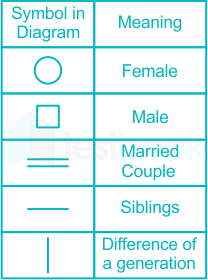
The given question is based on the following information:

P ⊗ Q means ‘P’ is the father of ‘Q’;

P @ Q means ‘P’ is the mother of ‘Q’;

P % Q means ‘P’ is the son of ‘Q’;

P # Q means ‘P’ is the brother of ‘Q’;

If ‘H # J ⊗ L @ G % F’, then how is ‘F’ related to ‘J’?

  1. ((a))

    Son

  2. ((b))

    Grandson

  3. ((c))

    Son-in-law

  4. ((d))

    Father

Show Answer
Answer: ((c))

Son-in-law

A simple family tree diagram showing different relations.

Code Language (P is of Q)
Symbol@%#
MeaningFatherMotherSonBrother

Given Expression: H # J ⊗ L @ G % F

<br>

We analyze the expression from right to left to find the relationship of F to J:

G % F: G is the son of F. (G is male)

L @ G: L is the mother of G. (L is female)

J ⊗ L: J is the father of L. (J is male)

H # J: H is the brother of J. (H is male)

Family Tree Representation (Relevant Part):

F is married to L, and L is the daughter of J.

Therefore, F is the son-in-law of J.

Hence, the correct answer is "Option 3".

32

Three statements showing relationships have been given, which are followed by two conclusions (I) and (II). Assuming that the given statements are true, find out which of the conclusions is/are definitely true.

Statements:

(1) J ≤ L

(2) L < M

(3) D ≥ M

Conclusions:

(I) D ≥ J

(II) J < D

  1. ((a))

    Only conclusion (I) is true

  2. ((b))

    Only conclusion (II) is true

  3. ((c))

    both conclusion(I) and (II) are true 

  4. ((d))

    Neither conclusion (1) nor (II) is true

Show Answer
Answer: ((b))

Only conclusion (II) is true

The given statement is: J ≤ L < M ≤ D

Conclusions:

I. D ≥ J → False (From the combined statement J ≤ L < M ≤ D, we have D > J. Now D ≥ J means either J < D or J = D. So, D > J is a possibility.)

II. J < D → True (Combining the statements: J ≤ L, L < M, and D ≥ M. We get J ≤ L < M ≤ D. This establishes a relationship between J and D as J < D. Hence, this is true).

Therefore, “Only conclusion (II) is true”.

Hence, the correct answer is "Option 2".

33

Eight friends A, B, C, D, E, F, G and H are sitting around a circle, facing at the centre. 'C' is between 'E' and 'F'. 'G' is the neighbour of 'E'. 'F' is on the immediate right of 'B'. 'H' is on the immediate left of 'A'. 'H' is not the neighbour of 'D' or 'E'.

Which of the following statement is true?

  1. ((a))

    'F' is the neighbour of 'G'

  2. ((b))

    'G' is between 'H' and 'E'

  3. ((c))

     'E' is between 'B' and 'F'

  4. ((d))

    'H' is immediate neighbour of 'A' and 'D'

Show Answer
Answer: ((b))

'G' is between 'H' and 'E'

Given: Eight friends A, B, C, D, E, F, G and H are sitting around a circle, facing at the centre.

'F' is on the immediate right of 'B'.

'C' is between 'E' and 'F'.

'G' is the neighbour of 'E'.

'H' is on the immediate left of 'A'.

'H' is not the neighbour of 'D' or 'E'.

Checking Conclusions:

  1. 'F' is the neighbour of 'G'. → False (F's neighbours are C and B).

2) 'G' is between 'H' and 'E'.True (G is between H and E).

  1. 'E' is between 'B' and 'F'. → False (E's neighbours are C and G).

  2. 'H' is immediate neighbour of 'A' and 'D'. → False (H's neighbours are A and G).

Hence, the correct answer is "Option 2".

34

Three statements are given followed by three conclusions (I), (II) and (III). You have to take these statements to be true, even if they seem to be at variance from commonly known facts. Decide which of the given conclusions logically follow(s) from the given statements

Statements:

(1) Some plates are cups.

(2) Some cups are tumblers.

(3) All tumblers are spoons.

Conclusions:

(I) Some spoons are cups

(II) Some cups are plates

(III) Some spoons are plates

  1. ((a))

    Only conclusion (I) follows

  2. ((b))

    Only conclusion (III) follows

  3. ((c))

    Only conclusions (I) and (II) follow

  4. ((d))

    Only conclusions (II) and (III) follow

Show Answer
Answer: ((c))

Only conclusions (I) and (II) follow

Given Statements:

(1) Some plates are cups.

(2) Some cups are tumblers.

(3) All tumblers are spoons.

The least possible Venn diagram for the given statements is:

Conclusions:

I. Some spoons are cups - True (Since all tumblers are spoons, and some cups are tumblers, it logically follows that some cups are spoons).

II. Some cups are plates - True (This is a direct restatement of statement (1) "Some plates are cups." Therefore, some cups are plates must be true).

III. Some spoons are plates - False (There is no definite link between Plates and Spoons, meaning a possibility exists, but it's not a definite conclusion).

So, Only conclusions (I) and (II) follow.

Hence, the correct answer is "Option 3".

35

Choose the Venn diagram from the options which represents the correct relationship amongst the given classes:

Father, Infants, Males

  1. ((a))

  2. ((b))

  3. ((c))

  4. ((d))

Show Answer
Answer: ((d))

The given classes are: Father, Infants, Males.

The relationship between these classes is:

  • All Fathers are Males. This means the circle for Father must be completely inside the circle for Males.
  • Some Infants are Males (male babies), and some are not (female babies). The Infants circle will partially overlap with the Males circle.
  • A Father cannot be an Infant, as an infant is a very young child who has not yet become a parent. Thus, the circle for Father and the circle for Infants must be completely separate.

This relationship is best represented by Option 4, where the Father circle is inside the Males circle, and the Infants circle overlaps the Males circle but not the Father circle.

Hence, the correct answer is "Option 4".

36

Which of the following features is not included in paragraph formatting?

  1. ((a))

    Making text bold

  2. ((b))

    Aligning text

  3. ((c))

    Indenting text

  4. ((d))

    Adjusting space between lines

Show Answer
Answer: ((a))

Making text bold

The correct answer is Making text bold.

Key Points

  • Paragraph formatting refers to the changes applied to the structure and layout of paragraphs in a document.
  • Features included in paragraph formatting are:
  • Aligning text: Allows text to be left, right, center, or justified.
  • Indenting text: Defines how far the paragraph is from the margins.
  • Adjusting space between lines: Controls the line spacing within a paragraph.
  • Making text bold is a feature of character formatting, not paragraph formatting. Character formatting deals with the styling of individual characters or words, such as bold, italic, or underline.

Additional Information

  • Paragraph formatting is essential for improving the readability and presentation of written content.
  • Other common paragraph formatting features include setting borders, background colors, and text alignment within tables.
  • Character formatting is applied to individual text elements, while paragraph formatting is applied to entire paragraphs.
37

The first slide of a presentation in MS-PowerPoint normally has the layout of:

  1. ((a))

    Header slide

  2. ((b))

    Content with caption

  3. ((c))

    Section Header

  4. ((d))

    Title Slide 

Show Answer
Answer: ((d))

Title Slide 

The correct answer is Title Slide

Key Points

  • The first slide of a presentation in MS-PowerPoint is typically called the Title Slide.
  • It serves as the introduction to the presentation and usually contains the title of the presentation along with a subtitle or the presenter's details.
  • The layout of the Title Slide includes placeholders for the title and subtitle, making it visually distinct from content slides.
  • It helps set the tone for the rest of the presentation and provides a professional start.

Additional Information

  • Header Slide: This layout is not typically used as the first slide in MS-PowerPoint presentations. It is meant for headers or section dividers within the presentation.
  • Content with Caption: This layout is used for slides that include textual content alongside images or graphics, but not usually as the first slide.
  • Section Header: This layout is used to introduce new sections in the presentation. It is not suitable for the first slide, which serves as the introduction to the entire presentation.
38

A software program that prohibits pop-up ads from web pages or actual pop-ups caused while coding is called 

  1. ((a))

    Ad blocker

  2. ((b))

    Popup blocker

  3. ((c))

    Firewall

  4. ((d))

    Spam blocker

Show Answer
Answer: ((a))

Ad blocker

The correct answer is Ad blocker.

Key Points

  • An Ad blocker is a software program designed to prevent unwanted advertisements, such as pop-ups, from displaying on web pages.
  • Ad blockers enhance the user experience by eliminating distractions caused by intrusive ads.
  • They can be installed as browser extensions or standalone applications.
  • Ad blockers also improve browsing performance by reducing the amount of data downloaded.

Additional Information

  • Popup Blocker: While similar to ad blockers, popup blockers specifically target popup windows that appear unexpectedly, often during browsing or coding activities.
  • Firewall: A firewall is a security system that monitors and controls incoming and outgoing network traffic based on predetermined security rules, not specifically designed to block ads.
  • Spam Blocker: Spam blockers are programs that filter and prevent unwanted email messages, not web-based advertisements.
39

The _________ key(s) acts as a toggle key. 

  1. ((a))

    Caps lock and Insert

  2. ((b))

    Shift and Insert

  3. ((c))

    Shift and Caps lock

  4. ((d))

    Shift and Ctrl

Show Answer
Answer: ((a))

Caps lock and Insert

The correct answer is Caps Lock and Insert.

Key Points

  • Caps Lock: The Caps Lock key acts as a toggle key. When you press it, it toggles the capital letter functionality on or off. If Caps Lock is on, all alphabetic characters are typed in uppercase until it is pressed again to turn it off.
  • Insert: The Insert key is another toggle key. When activated, it toggles between the "Insert" mode, which allows you to insert text at the cursor, and the "Overwrite" mode, which overwrites existing text.
  • Toggle Keys: Toggle keys are special keys on the keyboard that switch between two states each time they are pressed.

Additional Information

  • Shift Key: The Shift key is not a toggle key; it works as a modifier key to temporarily change the function of another key when pressed.
  • Ctrl Key: The Ctrl key is also a modifier key that works in combination with other keys to perform specific tasks and is not a toggle key.
  • Other Examples of Toggle Keys: The Num Lock and Scroll Lock keys also function as toggle keys, turning specific features on or off.
40

Which key combination is used to indent a paragraph in MS-Word? 

  1. ((a))

    Ctrl +N

  2. ((b))

    Ctrl+O

  3. ((c))

    Ctrl +P

  4. ((d))

    Ctrl+M

Show Answer
Answer: ((d))

Ctrl+M

The correct answer is Ctrl + M.

Key Points

  • In MS-Word, the key combination Ctrl + M is used to indent a paragraph.
  • Indenting a paragraph moves it inward from the left margin, providing better formatting and structure to the document.
  • Other key combinations like Ctrl + N, Ctrl + O, and Ctrl + P have different functions:
  • Ctrl + N: Opens a new document.
  • Ctrl + O: Opens an existing document.
  • Ctrl + P: Opens the Print dialog box.
  • Indenting is commonly used in structured documents, such as reports, essays, and letters.

Additional Information

  • Shortcut keys play a vital role in increasing efficiency while using MS-Word.
  • Some commonly used shortcuts include:
  • Ctrl + S: Saves the current document.
  • Ctrl + Z: Undoes the last action.
  • Ctrl + Y: Redoes the last undone action.
  • Ctrl + X: Cuts the selected content.
  • Ctrl + V: Pastes the copied or cut content.
  • These shortcuts help users quickly perform common tasks without navigating through menus.

Education and Leadership (40 questions)

41

What do you understand by 'Development' in child's growth? 

  1. ((a))

    Irreversible Quantitative change while child grows

  2. ((b))

    Reversible Quantitative change

  3. ((c))

    Qualitative change while child grows

  4. ((d))

    Irreversible Qualitative change 

Show Answer
Answer: ((d))

Irreversible Qualitative change 

Development in child growth refers to the progressive changes in behaviour, abilities, thinking and emotions that make the child qualitatively different from an earlier stage. These changes involve maturation, differentiation and increased complexity in functioning rather than just changes in size or number. 

Key Points

  • Development involves changes in the quality of functioning so that the child can do things differently and more complexly than before.
  • These changes are not simply increases in size or number but are reorganizations of behaviour and mental processes.
  • Once a child attains a higher level of functioning, that qualitative shift rarely reverts back to the earlier form.
  • Examples include moving from crawling to coordinated walking, from concrete to more abstract thinking, and from egocentric to perspective taking in social cognition.
  • Such changes are cumulative and form the basis for further development across domains.
  • Because development emphasizes these lasting qualitative transformations rather than temporary or purely numeric changes, the phrase captures the essence of developmental change.

Hint

  • Irreversible quantitative change confuses development with growth since quantitative changes refer to measurable increases such as height and weight rather than reorganization of functioning.
  • Development reversible and quantitative is inaccurate because development is not primarily about reversible numeric change and typically represents progressive, lasting transformations.
  • Qualitative change is closer to the concept but does not indicate the enduring and progressive nature of development that distinguishes it from transient qualitative fluctuations.

Hence, the correct answer is 'Irreversible Qualitative change'.

42

The following example would best explain 'Moral domain' of the child? 

  1. ((a))

    Argument with friend on social conflict

  2. ((b))

    Differentiating between Good and Bad

  3. ((c))

    Crying over pet dog's death

  4. ((d))

    Distribution of Birthday sweets

Show Answer
Answer: ((b))

Differentiating between Good and Bad

The moral domain of a child refers to the development of values, ideals and principles that help the child judge what is right or wrong. It includes understanding fairness, justice, rules, responsibilities and ethical behaviour.

Key Points

  • Moral development involves internalizing societal norms and making decisions based on conscience rather than external rewards or punishments.
  • Moral development involves learning to evaluate actions, intentions and situations as right or wrong.
  • When a child differentiates between Good and Bad, it shows the ability to make ethical judgments. This act reflects internal understanding of rules, values and consequences that guide decision making.
  • It represents the child's awareness of desirable and undesirable behaviour in social life.

Hint

  • An argument with a friend on a social conflict relates more to the social domain where interactions, cooperation and disagreements are part of social skills.
  • Crying over a pet dog's death belongs to the emotional domain because it reflects feelings, attachment and expression of grief.
  • Distribution of birthday sweets illustrates social and emotional sharing behaviour but does not specifically reflect moral reasoning.

Hence**, the correct answer is 'Differentiating between Good and Bad'.**

43

Which one of the following is an example of Primary Socialising Agency in Education ? 

  1. ((a))

    School

  2. ((b))

    Media

  3. ((c))

    Family

  4. ((d))

    Home

Show Answer
Answer: ((c))

Family

Primary socialisation refers to the earliest stage in a child's life when basic values, habits, language, norms and behaviour patterns are learned. It occurs in the immediate environment where the child first interacts and forms emotional bonds. 

Key Points

  • Primary socialisation happens first in the family because it is the child's earliest social environment.
  • A child learns speech, basic manners, habits, cultural practices and behavioral expectations at home with family members.
  • This setting provides emotional support and teaches early discipline, cooperation and communication. Parents and caregivers model behaviors that the child begins to imitate and internalise.
  • These early lessons strongly shape personality, social conduct and learning readiness.

Hint

  • School acts as a secondary socialising agency because children enter it after early habits and values are formed.
  • Media also contributes to secondary or tertiary socialisation as exposure happens later and builds on earlier learning.
  • Home refers to the physical place where a child lives, but the socialising role is carried out by the family members living within it, not the place itself.

Hence, the correct answer is 'Family'.

44

Which one of the following could be attributed to 'Affective domain' in child's development?

  1. ((a))

    Feeling

  2. ((b))

    Crying

  3. ((c))

    Swimming

  4. ((d))

    Thinking

Show Answer
Answer: ((a))

Feeling

The affective domain in a child’s development refers to emotional growth, feelings, attitudes, values and the way a child responds emotionally to situations. It involves developing sensitivity, expressing emotions appropriately, forming attachments and building self-concept.

Key Points

  • The affective domain is directly connected to emotional experiences and expression.
  • When a child shows feelings, it reflects emotional awareness and the ability to recognise inner states.
  • This involves understanding happiness, sadness, fear, love or anger, which are central aspects of affective development.
  • Such responses guide how the child interacts with others and interprets situations. Feeling is an internal emotional process that builds the foundation for empathy and emotional regulation.

Hint

  • Crying represents an emotional expression but it is a specific behaviour, not a broad indicator of the affective domain like feelings, which cover a wider emotional understanding.
  • Swimming belongs to the psychomotor domain as it involves physical coordination and motor skills.
  • Thinking is part of the cognitive domain which relates to mental activities such as reasoning, problem-solving and processing information.

Hence, the correct answer is 'Feeling'.

45

'Maturation' in child's development is very crucial for ____________ 

  1. ((a))

    Dancing

  2. ((b))

    Learning

  3. ((c))

    Playing

  4. ((d))

    Singing

Show Answer
Answer: ((b))

Learning

Maturation refers to the natural and genetically driven process through which a child’s body and brain develop to a level where certain skills become possible. It includes growth of the nervous system, muscles and cognitive structures that enable the child to perform new tasks.

Key Points

  • Maturation provides the basic readiness needed before learning can take place. A child can learn reading or writing only when the nervous system has matured enough to support these abilities.
  • Similarly, attention span, memory capacity and coordination improve as maturation progresses, making learning smoother.
  • Teachers and parents often wait for developmental readiness because forcing learning before maturation leads to frustration.
  • This readiness plays a central role in language learning, reasoning and problem-solving success.
  • Since learning depends on the maturity of physical and mental structures, maturation is crucial for the process of learning.

Hint

  • Dancing requires motor coordination, but it is considered a skill learned through practice, not solely dependent on maturation.
  • Playing happens naturally at different stages, but it is not the primary area where maturation is considered crucial.
  • Singing is also a skill that develops through exposure and practice rather than maturation alone.

Hence, the correct answer is 'Learning'.

46

The active participation of the child in classroom falls under: 

  1. ((a))

    Social learning

  2. ((b))

    Emotional learning

  3. ((c))

    Cognitive learning

  4. ((d))

    Experimental learning

Show Answer
Answer: ((c))

Cognitive learning

Active participation of a child in the classroom means the child is thinking, responding, questioning and engaging in learning tasks. It shows that the learner is mentally involved in understanding concepts, solving problems and processing information.

Key Points

  • Active participation requires the child to think, analyse and interpret information. It engages mental processes such as understanding, recalling and applying knowledge.
  • When a child asks questions or responds in class, it shows cognitive engagement.
  • This participation helps the learner build concepts and construct meaningful learning. Cognitive involvement results in deeper understanding and better retention of lessons.
  • Therefore, the active participation shown in the classroom directly reflects functioning of the cognitive learning domain.

Hint

  • Social learning refers to learning through interactions, imitation and observation, which may not necessarily require academic participation.
  • Emotional learning deals with feelings, attitudes and emotional expression rather than thinking-based classroom involvement.
  • Experimental learning focuses on hands-on activities and learning by doing, not general classroom participation.

Hence, the correct answer is 'Cognitive learning'.

47

The act of 'Driving car' comes under: 

  1. ((a))

    Affective domain

  2. ((b))

    Psychomotor domain

  3. ((c))

    Emotional domain

  4. ((d))

    Cognitive domain

Show Answer
Answer: ((b))

Psychomotor domain

Human abilities are generally classified into three domains of learning: cognitive, affective and psychomotor. The psychomotor domain deals with physical movement, coordination, motor skills, reflexes and muscular control.

Key Points

  • Driving a car requires coordinated use of hands, feet and eyes, which reflects motor skill development.
  • The driver has to control steering, brakes and gears through practiced physical responses. Such actions depend on muscular coordination and refined motor functioning.
  • It also involves timing, balance and quick physical reactions to road situations. These abilities improve with practice, which is a key feature of psychomotor skills.

Hint

  • Affective domain deals with emotions, attitudes and values, which are not the central elements in driving.
  • Emotional domain relates to expression of feelings but driving requires controlled physical action.
  • Cognitive domain focuses on mental processes like reasoning and problem-solving, which support driving but do not define the act itself.

Hence, the correct answer is 'Psychomotor domain'.

48

'Empathy' is an essential trait of __________ . 

  1. ((a))

    Teacher

  2. ((b))

    Doctor

  3. ((c))

    Professional counseller

  4. ((d))

    Lawyer

Show Answer
Answer: ((c))

Professional counseller

Empathy refers to the ability to understand and share the feelings of another person. It helps in building trust, offering emotional support and responding sensitively to others’ problems. Empathy is especially important in professions that deal with human emotions, personal struggles and mental well-being.

Key Points

  • A counsellor works with people who face emotional, social or psychological difficulties. To help effectively, the counsellor must understand the client’s feelings from their perspective.
  • Empathy allows the counsellor to create a safe, non-judgmental environment for sharing. This emotional connection encourages clients to express their concerns openly.
  • Through empathetic listening, the counsellor guides individuals toward healthier coping strategies. Because their work requires emotional understanding at a deep level, empathy becomes a core trait of a professional counsellor.

Hint

  • A teacher benefits from empathy, but it is not as foundational as it is for counselling.
  • A doctor also needs empathy, but the primary focus is medical diagnosis and treatment.
  • A lawyer deals mainly with legal reasoning and advocacy, where empathy is helpful but not essential to the role.

Hence, the correct answer is 'Professional counsellor'.

49

The following could be an example of physical disability: 

  1. ((a))

    Cerebral Palsy

  2. ((b))

    Autism

  3. ((c))

    Dyslexia

  4. ((d))

    Dysgraphia

Show Answer
Answer: ((a))

Cerebral Palsy

Physical disability refers to a condition that affects a person’s body movement, coordination or control of muscles. It may impact mobility, posture, balance or motor functioning. Such disabilities often arise from neurological, muscular or bone-related conditions.

Key Points

  • Cerebral Palsy affects the brain areas responsible for muscle control and coordination.
  • Children with this condition may have difficulty walking, balancing or performing fine motor tasks. It directly impacts physical movement because muscles become stiff, weak or uncoordinated.
  • This limits the child’s ability to perform normal motor activities independently. Since the condition primarily impairs physical functioning, it is categorized under physical disability.

Hint

  • Autism is a developmental disorder related to communication and social interaction, not physical mobility.
  • Dyslexia is a specific learning disability that affects reading and language processing.
  • Dysgraphia is also a learning disability related to writing skills, unrelated to physical impairment.

Hence**, the correct answer is 'Cerebral Palsy'.**

50

Which one of the following can be attributed to 'Cognitivism'?

  1. ((a))

    Drawing

  2. ((b))

    Painting

  3. ((c))

    Problem-solving

  4. ((d))

    Rote memory

Show Answer
Answer: ((c))

Problem-solving

Cognitivism is a learning theory that focuses on mental processes such as thinking, reasoning, understanding and decision-making. It explains how learners actively process information, organize knowledge and apply it to new situations.

Key Points

  • Problem solving requires analysing a situation using mental processes like reasoning and logical thinking.
  • It involves identifying the issue, evaluating possible solutions and selecting the most effective one. These steps reflect active information processing, which is central to cognitivist learning.
  • Learners draw upon prior knowledge and apply cognitive strategies during problem solving. This process strengthens understanding and supports meaningful learning rather than rote techniques.

Hint

  • Drawing focuses on creativity and motor skills and falls more under psychomotor and creative domains.
  • Painting is also a creative and motor skill-based task, not primarily cognitive in nature.
  • Rote memory involves mechanical repetition without understanding, which contradicts the principles of cognitivism.

Hence**, the correct answer is 'Problem-solving'.**

51

Which one of the following is the secondary socialising agency in the context of learning?

  1. ((a))

    Family

  2. ((b))

    Home

  3. ((c))

    School

  4. ((d))

    Media

Show Answer
Answer: ((c))

School

Socialisation is the process through which a child learns values, norms, behaviours and social skills. The earliest learning happens at home with parents and caregivers, known as primary socialisation. After this stage, the child enters wider social settings where new rules, expectations and interactions shape behavior.

Key Points

  • After the child gains initial learning from the family, school becomes the next major environment for social development.
  • Here the child learns discipline, cooperation, teamwork and social rules beyond the home.
  • Teachers, peers and school activities introduce the child to structured learning and social expectations.
  • This environment shapes attitudes, communication skills and behaviour in a more formal way.
  • School exposes the learner to diversity, shared responsibility and community values.

Hint

  • Family is the primary socialising agency because early habits and basic values are learned there.
  • Home is only the physical space, not the agency that actively socialises the child.
  • Media also contributes to socialisation but is usually considered a tertiary or supplementary agency rather than the main secondary one in educational context.

Hence, the correct answer is 'School'.

52

The 'Learning' at home comes under :

  1. ((a))

    Contextual Learning

  2. ((b))

    Formal Learning

  3. ((c))

    Informal Learning

  4. ((d))

    Non-formal Learning

Show Answer
Answer: ((c))

Informal Learning

Learning does not occur only in formal settings like schools; it also happens naturally in daily life. When a child learns through experiences, interactions and activities at home, the process is unstructured and not guided by a fixed curriculum. 

Key Points

  • Learning at home occurs without a fixed timetable or structured lessons.
  • Children pick up language, manners, values and basic life skills through everyday experiences.
  • Parents and family members guide learning naturally while interacting with the child.
  • This type of learning is not planned or assessed formally like school-based learning.
  • It relies on observation, imitation and participation in household activities.

Hint

  • Contextual learning involves connecting learning to real-life situations but is usually school-associated.
  • Formal learning refers to structured, curriculum-based learning conducted in institutions.
  • Non-formal learning includes organised learning outside school, such as hobby classes, not daily home learning.

Hence, the correct answer is Informal Learning.

53

Acquiring 'Milestones' at regular stages of child growth known as:

  1. ((a))

    Maturation

  2. ((b))

    Growth

  3. ((c))

    Skill development

  4. ((d))

    Developmental Tasks

Show Answer
Answer: ((d))

Developmental Tasks

As children grow, they achieve certain abilities at predictable ages such as sitting, walking, speaking or social interaction. These achievements are called developmental milestones. They indicate whether a child is progressing normally across different areas like physical, cognitive, emotional and social development.

Key Points

  • Developmental tasks are the abilities or skills that a child is expected to achieve at specific stages.
  • These tasks include physical, social, emotional and cognitive milestones appropriate for each age.
  • Achieving them shows that the child is growing in a balanced and expected manner. Each developmental stage has its own set of tasks that build on earlier achievements.
  • When a child acquires milestones such as crawling or forming sentences, these are considered developmental tasks.

Hint

  • Maturation refers to the natural unfolding of biological processes, not the full set of stage-wise milestones.
  • Growth focuses on physical changes like increase in height or weight, not specific abilities.
  • Skill development is the acquisition of specific abilities but does not necessarily follow fixed age-related stages.

Hence, the correct answer is Developmental Tasks.

54

The Socio-emotional dimension of child can be explained through:

  1. ((a))

    Feeling

  2. ((b))

    Facial expression

  3. ((c))

    Loud thinking

  4. ((d))

    Sleeping

Show Answer
Answer: ((b))

Facial expression

The socio emotional dimension of a child includes the ability to understand emotions, express them appropriately and build healthy relationships with others. It reflects how a child manages feelings, interacts socially and responds to situations emotionally.

Key Points

  • Facial expressions show how a child displays emotions like happiness, fear, anger or surprise. They reveal the child’s emotional understanding and ability to express feelings to others.
  • Such expressions help in forming social connections and communicating emotional states.
  • They allow caregivers and peers to understand the child’s needs and reactions. Facial expressions reflect both the emotional and social aspects of development, making them a strong indicator of socio emotional growth.

Hint

  • Feeling represents internal emotional experience but does not show social expression clearly.
  • Loud thinking is related to cognitive processes rather than socio emotional growth.
  • Sleeping is a biological activity linked to physical development, not socio emotional aspects.

Hence, the correct answer is Facial expression.

55

What is the role of 'Maturation' in learning?

  1. ((a))

    It determines readiness in learning

  2. ((b))

    It facilitates achieving milestones

  3. ((c))

    It promotes memory

  4. ((d))

    It would fix learning goals

Show Answer
Answer: ((a))

It determines readiness in learning

Maturation refers to the natural, biological growth processes that prepare a child for learning. It includes the development of the nervous system, muscles, brain functions and sensory abilities.

Key Points

  • Maturation helps a child reach the stage where learning becomes possible. Reading, writing or solving problems require a certain level of brain and motor development.
  • A child can learn to speak or walk only when the required physical structures have matured.
  • Teachers often wait for developmental readiness because learning before maturation leads to frustration.
  • This readiness ensures that the learner can understand, remember and apply new concepts effectively.
  • Thus, maturation acts as a foundation by making the child physically and mentally prepared for learning.

Hint

  • Facilitating milestones refers to overall developmental progress, not specifically the learning readiness created by maturation.
  • Promoting memory is part of cognitive development, whereas maturation mainly affects readiness.
  • Fixing learning goals is done by teachers or curriculum planners, not by biological maturation.

Hence, the correct answer is It determines readiness in learning.

56

Spenser describes education as:

  1. ((a))

    Self learning

  2. ((b))

    Preparation for life

  3. ((c))

    Complete living

  4. ((d))

    Meaningful life

Show Answer
Answer: ((c))

Complete living

Herbert Spencer was a prominent philosopher who defined education in terms of preparing individuals to live a full, productive and meaningful life. According to him, education must equip a person with the knowledge and skills needed to handle all aspects of life such as physical, intellectual, social, moral and vocational.

<br>

Key Points

  • Spencer believed that the purpose of education is not limited to academics but to prepare individuals for all duties of life.
  • He emphasized that education should help a person survive, grow, think and act effectively in real situations.
  • This includes health, livelihood, social responsibilities and moral conduct.
  • By calling education a preparation for complete living, he highlighted the holistic nature of learning.
  • It involves training for every phase of life, from childhood to adulthood.
  • Thus, Spencer’s idea connects education with overall personal and social well being, not just formal learning.

Hint

  • Self learning refers to individual effort and independence in learning, which was not Spencer’s core definition.
  • Preparation for life is close but less comprehensive compared to his broader phrase.
  • Meaningful life focuses on purpose, but Spencer stressed a more practical, all round preparation.

Hence, the correct answer is complete living.

57

The behavioural learning theory is associated with:

  1. ((a))

    Environment

  2. ((b))

    Stimulus - response

  3. ((c))

    Peer pressure

  4. ((d))

    Heredity

Show Answer
Answer: ((b))

Stimulus - response

Behavioural learning theory focuses on observable changes in behavior as a result of learning experiences. It emphasizes that learning occurs through interaction with the environment and that behaviors can be shaped by reinforcement or punishment.

Key Points

  • Behavioral learning is based on the principle that a specific stimulus can trigger a predictable response.
  • For example, a child may learn to say “thank you” when praised or to avoid a behavior that is punished.
  • Learning is measured by changes in observable behavior rather than thoughts or feelings.
  • Reinforcement strengthens the desired response, while punishment decreases undesirable behavior.
  • This connection between stimulus and response forms the foundation of behavioral approaches in education.
  • Because the focus is on external reactions to stimuli, it clearly represents the core idea of behavioral learning theory.

Hint

  • Environment influences learning but is broader and not specific to the stimulus-response mechanism.
  • Peer pressure affects behaviour socially but is not the theoretical basis of behavioural learning.
  • Heredity relates to inherited traits and potential, which behavioral theory does not primarily consider.

Hence, the correct answer is stimulus - response.

58

Name the branch of philosophy that propounded project method:

  1. ((a))

    Naturalism

  2. ((b))

    Idealism

  3. ((c))

    Pragmatism

  4. ((d))

    Realism

Show Answer
Answer: ((c))

Pragmatism

The project method is a child-centered teaching approach where learners actively engage in solving real-life problems or completing meaningful tasks. It emphasizes learning by doing, experimentation and practical application. This method encourages critical thinking, creativity and independence, rather than rote memorization.

Key Points

  • Pragmatism focuses on learning through experience and practical activity.
  • It emphasizes that knowledge is gained by interacting with the environment and applying ideas to real situations.
  • The project method aligns perfectly with this philosophy as it involves active participation, problem-solving and experimentation.
  • Children learn best when they construct knowledge by doing and reflecting on outcomes.
  • Pragmatists like John Dewey advocated projects as a way to develop skills, thinking, and social responsibility.

Hint

  • Naturalism emphasizes learning in harmony with nature and the child’s instincts rather than structured projects.
  • Idealism focuses on abstract reasoning and ideas rather than practical application.
  • Realism stresses understanding the world as it is, with observation and facts, but does not specifically promote projects as a method.

Hence, the correct answer is 'Pragmatism'.

59

What is constructivism in learning?

  1. ((a))

    Learning through logic

  2. ((b))

    Learning by doing

  3. ((c))

    The learner develops knowledge with the help of previous knowledge

  4. ((d))

    Learning by memory

Show Answer
Answer: ((c))

The learner develops knowledge with the help of previous knowledge

Constructivism is a learning theory that emphasizes how learners actively construct their own understanding and knowledge. According to this approach, learning is not just passive reception of information but involves connecting new information to what the learner already knows. 

Key Points

  • ​Constructivism emphasizes that new learning is built upon existing knowledge and experiences.
  • Learners actively interpret and integrate new information rather than simply memorizing it.
  • By linking new concepts to prior understanding, they develop deeper comprehension and critical thinking.
  • This process allows learners to personalize learning and apply it to different contexts.
  • Constructivist methods often include discussion, problem-solving and reflection to facilitate knowledge construction.
  • Hence, learning in this approach is meaningful because it connects past knowledge with new experiences.

Hint

  • Learning through logic focuses on reasoning but does not necessarily involve linking prior knowledge.
  • Learning by doing is related to experiential or pragmatic learning, which emphasizes action more than cognitive construction.
  • Learning by memory involves rote memorization and passive recall, which is contrary to the constructivist approach.

Hence, the correct answer is the learner develops knowledge with the help of previous knowledge.

60

According to psychologists-what is 'learning'?

  1. ((a))

    Directed behaviour

  2. ((b))

    Positive altered behaviour

  3. ((c))

    Focused behaviour

  4. ((d))

    Fixed behaviour

Show Answer
Answer: ((b))

Positive altered behaviour

Psychologists define learning as a relatively permanent change in behaviour or knowledge that occurs as a result of experience or practice. It involves acquiring skills, attitudes, values or understanding that influence how an individual acts in future situations.

Key Points

  • Learning leads to a change in behavior, understanding, or skill that is lasting and constructive.
  • This alteration reflects the acquisition of new knowledge, habits or attitudes. It can be observed in improved performance, better problem-solving, or application of new skills.
  • Such changes are intentional and result from experiences, practice, or instruction. The focus is on the development of behavior that enhances functioning rather than temporary or random changes.
  • Therefore, learning is best described as producing a positive alteration in behavior.

Hint

  • Directed behavior emphasizes goal-oriented action but does not necessarily involve lasting change.
  • Focused behavior refers to attention or concentration, which is part of learning but not the definition itself.
  • Fixed behavior implies rigidity or no change, which is contrary to the concept of learning.

Hence, the correct answer is positive altered behavior.

61

What should be the ideal classroom environment for effective learning? 

  1. ((a))

    Well decorated classroom

  2. ((b))

    Well ventilated classroom

  3. ((c))

    Well equipped with A.V aids classroom

  4. ((d))

    Non-threatening and supportive environment

Show Answer
Answer: ((d))

Non-threatening and supportive environment

The classroom environment plays a crucial role in effective learning. It not only includes physical aspects like space and lighting but also the psychological climate created by the teacher and peers. A positive classroom environment encourages participation, curiosity, risk-taking, and collaboration. 

Key Points

  • A non-threatening environment ensures that students feel safe to express ideas, ask questions, and make mistakes.
  • Supportive interactions with teachers and peers enhance motivation and engagement. Such an environment encourages collaborative learning, problem-solving, and active participation.
  • Students are more likely to focus on learning rather than fear of criticism or punishment. It builds self-confidence, resilience, and positive attitudes towards education.

Hint

  • A well-decorated classroom may make the space visually appealing but does not guarantee learning.
  • A well-ventilated classroom is important for physical comfort but not sufficient for engagement and motivation.
  • A classroom equipped with A.V aids facilitates teaching but cannot replace a supportive and non-threatening atmosphere.

Hence, the correct answer is Non-threatening and supportive environment.

62

Learning by doing is example of: 

  1. ((a))

    Activity based learning

  2. ((b))

    Experiential learning

  3. ((c))

    Cognitive learning

  4. ((d))

    Classical learning

Show Answer
Answer: ((b))

Experiential learning

Learning by doing emphasizes active participation in the learning process, where learners acquire knowledge and skills through direct experience. It is a hands-on approach that encourages exploration, experimentation, problem-solving, and reflection.

Key Points

  • Experiential learning is based on the idea that knowledge is constructed through experience. When a learner engages in tasks, experiments, or real-life activities, they actively process and internalize learning.
  • Reflection on these experiences further enhances understanding and skill development.
  • Learning by doing directly involves interaction with materials, environment, or situations, making knowledge meaningful.
  • It promotes critical thinking, decision-making, and application of concepts in varied contexts.
  • Thus, this method perfectly exemplifies experiential learning where experience is central to acquiring knowledge.

Hint

  • Activity-based learning involves structured activities to teach concepts but may not always involve reflective experiential processes.
  • Cognitive learning focuses on mental processes like thinking, reasoning, and understanding rather than hands-on experience.
  • Classical learning refers to traditional or rote learning methods, not learning through direct experience.

Hence, the correct answer is Experiential learning.

63

A student found helping the blindman to cross the road. It comes under: 

  1. ((a))

    Social activity

  2. ((b))

    Community service

  3. ((c))

    Hidden curriculum

  4. ((d))

    Morality

Show Answer
Answer: ((b))

Community service

Education goes beyond academics and includes activities that develop social responsibility, ethical behaviour, and civic sense. Actions performed by students that benefit others or the community reflect their values, character, and moral development. Such activities encourage empathy, cooperation, and awareness of social needs, preparing learners to contribute positively to society.

Key Points

  • Helping a blind man to cross the road is an action performed for the benefit of someone in the community. It demonstrates social responsibility, kindness, and concern for the welfare of others.
  • Such voluntary actions are purposeful and aimed at improving the well-being of individuals or society.
  • Community service provides practical experiences where learners apply moral values in real-life contexts.
  • It builds empathy, civic sense, and a sense of contribution to society.
  • Since the student’s act is a deliberate service to the community, it clearly represents community service.

Hint

  • Social activity includes general group or recreational activities but may not focus on helping others.
  • Hidden curriculum refers to values and norms learned indirectly at school, not directly through an action.
  • Morality reflects internal ethical understanding but the specific act of helping is better classified as community service.

Hence, the correct answer is community service.

64

A Democratic curriculum should have the following character: 

  1. ((a))

    Entertainment

  2. ((b))

    Leisure

  3. ((c))

    Study tour

  4. ((d))

    Development of integrated personality

Show Answer
Answer: ((d))

Development of integrated personality

A democratic curriculum emphasizes holistic education that prepares learners not only academically but also socially, emotionally, and morally. It values equality, freedom of thought, participation, and personal growth.

Key Points

  • A democratic curriculum seeks to develop all aspects of a learner’s personality – intellectual, emotional, social, moral, and physical.
  • It encourages creativity, critical thinking, problem-solving, and decision-making.
  • Learners are given opportunities to participate actively, voice opinions, and make choices in their learning. This approach fosters self-confidence, empathy, cooperation, and responsible citizenship.
  • By addressing multiple dimensions of growth, it prepares learners for real-life challenges and meaningful participation in society. Hence, the character of developing an integrated personality aligns perfectly with a democratic curriculum.

Hint

  • Entertainment and leisure are supplementary aspects and do not define the core aim of a democratic curriculum.
  • Study tours provide experiential learning but are only one of many strategies and do not represent the curriculum’s fundamental character.

Hence, the correct answer is development of integrated personality.

65

ICT applications in school education enhances: 

  1. ((a))

    Enhances peer learning

  2. ((b))

    Creativity and thinking skills

  3. ((c))

    Interest

  4. ((d))

    Attention

Show Answer
Answer: ((b))

Creativity and thinking skills

ICT (Information and Communication Technology) applications in school education involve the use of digital tools, computers, internet resources, and multimedia to support teaching and learning. 

Key Points

  • ICT tools such as simulations, animations, and educational software encourage students to explore ideas and experiment with solutions.
  • They allow learners to visualize concepts, create projects, and express understanding in innovative ways.
  • Problem-solving activities and interactive tasks foster analytical thinking and reasoning. Students are encouraged to design, plan, and evaluate their own work, enhancing creative abilities.
  • ICT promotes independent and higher-order thinking, going beyond simple knowledge acquisition. Thus, the integration of ICT in education primarily develops creativity and thinking skills.

Hint

  • Enhancing peer learning may occur with ICT but it is not the primary objective.
  • Interest and attention can be stimulated by ICT, but these are outcomes rather than the central enhancement.

Hence, the correct answer is creativity and thinking skills.

66

What is the purpose of assessment in school education ? 

  1. ((a))

    To measure ability of understanding

  2. ((b))

    To assess the subject knowledge

  3. ((c))

    Remediation and counselling

  4. ((d))

    To find out weak areas of the child

Show Answer
Answer: ((d))

To find out weak areas of the child

Assessment in school education is a systematic process of gathering information about a learner’s knowledge, skills, abilities, and overall development. Its purpose goes beyond just marking or grading; it helps teachers understand how well students are learning, identify difficulties, and guide improvement.

Key Points

  • Assessments are used to identify gaps in understanding or skills that need attention. By analyzing performance, teachers can pinpoint specific areas where a child struggles.
  • This information allows targeted interventions, additional support, or remedial instruction. It helps in tailoring teaching strategies to meet the individual needs of students.
  • Such assessment ensures that learning difficulties are addressed before they become obstacles to progress.
  • Hence, finding weak areas ensures that assessment supports learning effectively rather than just judging performance.

Hint

  • Measuring ability of understanding and assessing subject knowledge are components of assessment but are narrower in scope.
  • Remediation and counselling are actions taken after identifying issues, not the direct purpose of assessment itself.

Hence, the correct answer is to find out weak areas of the child.

67

The students can learn better through the activities: 

  1. ((a))

    Conducted in school

  2. ((b))

    Conducted out side the school

  3. ((c))

    Involvement of students in various community related program

  4. ((d))

    School laboratory

Show Answer
Answer: ((c))

Involvement of students in various community related program

Learning is most effective when students actively engage in meaningful activities rather than passively receiving information. Experiential and hands-on experiences help learners connect theory with real-life situations, develop practical skills, and enhance understanding.

Key Points

  • Community-related programs provide real-world contexts where students can apply their knowledge. Such involvement encourages problem-solving, teamwork, and social responsibility.
  • Students learn by observing, interacting, and contributing to the welfare of others, making the learning process meaningful.
  • It develops life skills, civic sense, and empathy alongside academic understanding. Active participation in these programs motivates learners and enhances critical thinking and decision-making.
  • Hence, engaging in community-related programs supports holistic learning beyond the confines of the classroom.

Hint

  • Activities conducted in school provide structured learning but may lack real-life context.
  • Activities outside school may offer exposure but are limited if not connected to purposeful engagement.
  • School laboratories support experimental learning but focus primarily on specific academic concepts rather than holistic development.

Hence, the correct answer is involvement of students in various community-related program.

68

Which of the following quality is essential among school leaders?

  1. ((a))

    Democratic attitude

  2. ((b))

    Transformation leadership

  3. ((c))

    Dictatorship

  4. ((d))

    Servant leadership

Show Answer
Answer: ((a))

Democratic attitude

School leaders play a crucial role in creating a positive learning environment, guiding teachers, and shaping the overall educational climate. Effective leadership in schools involves not only managing administrative tasks but also fostering collaboration, participation, and a sense of responsibility among staff and students.

Key Points

  • A democratic attitude involves listening to others, encouraging participation, and making decisions collaboratively.
  • School leaders with this quality promote a sense of ownership among teachers and students. It creates an inclusive environment where ideas and feedback are valued, leading to better problem-solving.
  • Such leaders foster trust, motivation, and professional growth within the school community. They balance authority with support, ensuring that policies and initiatives are effectively implemented.
  • Hence, a democratic attitude is essential for school leaders to guide the institution constructively and maintain a positive educational environment.

Hint

  • Transformational leadership focuses on inspiring change but is broader and may not always ensure participative decision-making.
  • Dictatorship represents authoritarian leadership, which suppresses collaboration and is not suitable for schools.
  • Servant leadership emphasizes serving others, which is beneficial but does not fully capture the participative and decision-sharing aspect central to school leadership.

Hence, the correct answer is democratic attitude.

69

What should be the quality of school development plan ? 

  1. ((a))

    Adequate fund should be provided

  2. ((b))

    Teachers training program to be carried out

  3. ((c))

    Should have scope for student activities

  4. ((d))

    It should take care of all living and non-living resources for the healthy development of the school

Show Answer
Answer: ((d))

It should take care of all living and non-living resources for the healthy development of the school

A school development plan is a strategic framework that outlines how a school will improve its teaching, learning environment, infrastructure, and overall functioning. It serves as a roadmap for achieving educational goals, ensuring effective use of resources, and fostering holistic growth of students.  

Key Points

  • A quality school development plan addresses both human resources (teachers, staff, students) and material resources (buildings, equipment, technology).
  • It ensures that infrastructure, teaching aids, and learning spaces are adequate and well-maintained.
  • By integrating human and material resources, the plan promotes overall efficiency and effectiveness. It supports teacher development, student engagement, and smooth administrative functioning.
  • Such a holistic approach ensures sustainable development and fosters a healthy, productive learning environment.
  • Hence, considering all resources is central to the comprehensive growth of the school.

Hint

  • Providing adequate funds is necessary but is only one component of a development plan.
  • Carrying out teacher training programs is important but does not cover the full scope of school development.
  • Including scope for student activities is valuable but represents only one part of a comprehensive plan.

Hence, the correct answer is it should take care of all living and non-living resources for the healthy development of the school.

70

What is the quality of good time-table in school?

  1. ((a))

    It should take care of co-curricular activities

  2. ((b))

    It should take care the requirement of teachers, students and administration

  3. ((c))

    It should take care of leisure time activities

  4. ((d))

    It should take care of exam schedule

Show Answer
Answer: ((b))

It should take care the requirement of teachers, students and administration

A good time-table in school is a structured schedule that organizes teaching, learning, and other school activities efficiently. It ensures that academic subjects, co-curricular activities, and administrative requirements are balanced to support holistic development.

Key Points

  • A quality time-table considers the availability and workload of teachers, ensuring they are not overburdened.
  • It accommodates students’ learning needs, attention span, and age-appropriate distribution of subjects.
  • Administrative requirements such as supervision, assembly, and breaks are also integrated effectively.
  • By balancing all these factors, the timetable ensures smooth functioning of the school. It promotes a positive learning environment where both teaching and learning can occur efficiently.
  • Hence, a good time-table is one that meets the needs of teachers,

Hint

  • Taking care of co-curricular activities is important but only one aspect of the timetable.
  • Leisure time activities and exam schedules are also components but do not alone define the quality of a good timetable.

Hence, the correct answer is it should take care the requirement of teachers, students and administration.

71

What is dysgraphia ? 

  1. ((a))

    Inability to speak

  2. ((b))

    Inability to learn

  3. ((c))

    Inability to write

  4. ((d))

    Inconsistant use of letters

Show Answer
Answer: ((c))

Inability to write

Dysgraphia is a type of specific learning disability related to written expression. It affects a child’s ability to write clearly, neatly, and efficiently. Children with dysgraphia may know the content but struggle to put their thoughts on paper.

Key Points

  • Dysgraphia refers to difficulty in performing written tasks even when the child has normal intelligence. The child may struggle with forming letters, maintaining proper spacing, or writing at an age-appropriate speed.
  • This condition affects handwriting, spelling, and the physical act of writing.
  • The difficulty is neurological in nature, not due to lack of effort or teaching.
  • Children may understand concepts well but face challenges expressing them through writing.
  • Hence, dysgraphia is best described as a problem related to the inability to write effectively.

Hint

  • Inability to speak relates to speech disorders, not dysgraphia.
  • Inability to learn is too broad and does not specifically fit dysgraphia.
  • Inconsistent use of letters may occur in dysgraphia but it is a symptom, not the definition itself.

Hence, the correct answer is inability to write.

72

What is the Quantum of Punishment Prescribed for discrimination against Divyangjan ? 

  1. ((a))

    Fine upto Rs. 5 lakhs and imprisonment upto 5 years

  2. ((b))

    Fine upto Rs. 5 lakhs and imprisonment upto 2 years

  3. ((c))

    Fine upto Rs. 50000 and imprisonment upto 1 year

  4. ((d))

    Fine upto Rs. 1 lakh and imprisonment upto 10 years

Show Answer
Answer: ((a))

Fine upto Rs. 5 lakhs and imprisonment upto 5 years

In India, discrimination against Divyangjan (persons with disabilities) is addressed under The Rights of Persons with Disabilities (RPWD) Act, 2016 which provides legal protections and penalties to prevent and punish violations of rights. 

Key Points

  • Under the RPWD Act, discrimination and violation of rights can attract penalties that include imprisonment and fine.
  • For general contraventions, repeated offences can lead to a fine that may extend up to Rs. 5 lakh.
  • In many provisions related to discrimination and denial of rights, imprisonment may extend up to two years along with a fine.
  • This reflects the intent of the law to act as a deterrent against discrimination.
  • Such penalties empower authorities to take action against those who violate disability rights.

Hence, the correct answer is Fine up to Rs. 5 lakhs and imprisonment up to 2 years.

73

What is the major challenge in schools to address mental health issues among children? 

  1. ((a))

    Lack of Infrastructure

  2. ((b))

    Lack of Funds

  3. ((c))

    Lack of Professional Counsellers

  4. ((d))

    Lack of will to do

Show Answer
Answer: ((c))

Lack of Professional Counsellers

Mental health in children is a critical aspect of overall development, affecting learning, behaviour, and social interactions. Schools play a key role in identifying and supporting students with mental health challenges. However, addressing these issues effectively requires trained personnel, structured programs, and supportive infrastructure.

Key Points

  • Many schools face the challenge of having insufficient trained mental health professionals. Without professional counsellors, early identification of emotional, behavioral, or psychological issues becomes difficult.
  • Teachers may notice problems but often lack the expertise to provide appropriate interventions or guidance.
  • Professional counsellors can offer individual or group counselling, design mental health programs, and support teachers and parents.
  • Their presence ensures that children receive timely support, reducing the risk of academic and social difficulties.

​​

Hint

  • Lack of infrastructure and funds are challenges but can be mitigated with planning and community support.
  • Lack of will to act may exist in some contexts but is not the systemic issue as widespread as the shortage of trained counsellors.

Hence, the correct answer is lack of Professional Counsellors.

74

Suggest one example of creating partnership with the industry.

  1. ((a))

    Orientation Programmes

  2. ((b))

    School visit to Industry as a study tour

  3. ((c))

    Through vocational training

  4. ((d))

    Industry shares the resources with the schools

Show Answer
Answer: ((c))

Through vocational training

Partnerships between schools and industry aim to bridge the gap between academic learning and practical skills required in the workplace. Such collaborations help students understand real-world applications of their studies, develop employable skills, and gain exposure to professional environments.

Key Points

  • Vocational training programs in partnership with industries provide students with hands-on skills relevant to specific trades or professions.
  • Industries can offer expert guidance, workshops, and practical exposure aligned with current technological and professional standards.
  • Students gain competencies that improve employability and prepare them for career opportunities. This collaboration ensures that the curriculum remains relevant to industry needs and enhances student learning outcomes.
  • Vocational training is a structured, ongoing partnership where both the school and industry actively contribute to skill development.

Hint

  • Orientation programs provide knowledge but are short-term and less skill-focused.
  • School visits to industry are mainly observational and do not provide in-depth skill development.
  • Industry sharing resources is beneficial but does not necessarily involve active learning or skill-building for students.

Hence, the correct answer is through vocational training.

75

What is significance of excursion in school education ? 

  1. ((a))

    Entertainment

  2. ((b))

    Promotes belongingness among the children

  3. ((c))

    To break monetany

  4. ((d))

    Part of Project Work

Show Answer
Answer: ((b))

Promotes belongingness among the children

Excursions in school education are organized trips outside the school to provide experiential learning opportunities. They expose students to real-world environments, historical sites, cultural places, or natural habitats, helping them connect classroom knowledge with practical experiences.

 Key Points

  • During excursions, students interact closely with peers and teachers in a less formal setting. These shared experiences foster teamwork, cooperation, and social bonding.
  • Children develop a sense of community, mutual respect, and empathy while participating in group activities.
  • Excursions also encourage communication, problem-solving, and collaboration among students.
  • Such experiences strengthen relationships and contribute to a positive classroom culture.
  • Hence, excursions are significant not only for learning but also for promoting belongingness and social cohesion among children.

Hint

  • Entertainment is a byproduct but not the primary educational purpose.
  • Breaking monotony refers to refreshment, not the main significance in education.
  • Part of project work may sometimes involve excursions, but it is not their core significance.

Hence, the correct answer is promotes belongingness among the children.

76

What is the 'Living corner in school' ? 

  1. ((a))

    Aquarium

  2. ((b))

    Park

  3. ((c))

    Garden

  4. ((d))

    Play field

Show Answer
Answer: ((a))

Aquarium

A living corner in a school is a designated area where students can observe and interact with living organisms such as plants, animals, or insects. It is designed to promote experiential learning, curiosity, and environmental awareness.

Key Points

  • An aquarium contains live aquatic animals and plants that students can observe daily. It allows children to study behaviours, life cycles, and interactions within an ecosystem.
  • Students learn to care for living organisms, fostering responsibility and empathy. It provides a hands-on learning experience that supports science education and environmental awareness.
  • An aquarium is manageable within the school environment and can be integrated into lessons on biology or ecology.
  • Hence, an aquarium effectively represents the concept of a living corner in a school.

Hint

  • A park and garden may contain plants and open spaces but are larger outdoor areas not specifically designed as living corners.
  • A play field is primarily for physical activity and does not focus on living organisms or biological observation.

Hence, the correct answer is Aquarium.

77

What is the disadvantage of self assessment ? 

  1. ((a))

    Reluctant to accept weak areas of the school

  2. ((b))

    Unhealthy comparison with other schools

  3. ((c))

    Self contented attitude

  4. ((d))

    Schools tend to be biased

Show Answer
Answer: ((c))

Self contented attitude

Self-assessment in schools involves evaluating their own performance, processes, and outcomes to identify strengths and areas for improvement. 

Key Points

  • When schools assess themselves, there is a tendency to overestimate performance and overlook areas needing improvement. This can lead to complacency and a false sense of achievement.
  • Schools may focus on successes while ignoring weaknesses or challenges that require attention. Such an attitude reduces motivation to implement changes or seek external feedback.
  • Self contentment may prevent proactive measures for improvement and hinder overall development.
  • Hence**, a major disadvantage of self-assessment is fostering a self contented attitude that limits growth.**

Hint

  • Reluctance to accept weak areas is similar but more about denial than self-assessment itself.
  • Unhealthy comparison with other schools is more relevant to benchmarking rather than self-assessment.
  • Schools tending to be biased is a concern, but the key behavioral disadvantage is self-satisfaction leading to stagnation.

Hence, the correct answer is self contented attitude.

78

NCF 2005 recommends: 

  1. ((a))

    Developments of school infrastructure

  2. ((b))

    Better funding for school education

  3. ((c))

    reducing teacher pupil ratio

  4. ((d))

    connecting knowledge to life

Show Answer
Answer: ((d))

connecting knowledge to life

The National Curriculum Framework (NCF) 2005 provides guidelines for school education in India, focusing on making learning more relevant, engaging, and meaningful for children.

Key Points

  • NCF 2005 stresses that school education should not be limited to rote memorization of facts. It advocates for teaching that relates concepts to students’ experiences, social context, and practical situations.
  • By linking knowledge to life, students can see the relevance of what they learn and apply it effectively. This approach promotes critical thinking, problem-solving, and meaningful learning.
  • It ensures that education develops skills, values, and understanding that prepare learners for real-life challenges.

Hence, connecting knowledge to life captures the central philosophy of NCF 2005.

Hint

  • Development of infrastructure, better funding, and reducing teacher-pupil ratio are important for education but are not the primary recommendations of NCF 2005.
  • The framework mainly addresses curriculum, pedagogy, and learning processes rather than administrative measures.
79

The newly proposed design of school curriculum is: 

  1. ((a))

    10 + 2 + 2 + 1

  2. ((b))

    5 + 3 + 3 + 4

  3. ((c))

    5 + 2 + 3 + 5

  4. ((d))

    4 + 3 + 4 + 4

Show Answer
Answer: ((b))

5 + 3 + 3 + 4

The National Education Policy (NEP) 2020 introduced a new school curriculum structure to make education more holistic, flexible, and multidisciplinary. This system aims to reduce rote learning and focus on critical thinking, creativity, and life skills.

Key Points

The new design divides school education into four stages:

  • Foundational stage (5 years): Pre-primary + Grades 1–2, focusing on play-based and activity-based learning.
  • Preparatory stage (3 years): Grades 3–5, introducing more formal subjects with experiential learning.
  • Middle stage (3 years): Grades 6–8, emphasizing higher-order thinking and interdisciplinary learning.
  • Secondary stage (4 years): Grades 9–12, allowing flexibility, vocational education, and multidisciplinary study.

Thus, the correct answer is 5 + 3 + 3 + 4.

80

RTE Act, 2009 section 19 deals with: 

  1. ((a))

    Transfer of students

  2. ((b))

    Recruitment of teachers

  3. ((c))

    Prohibition of unrecognized schools

  4. ((d))

    Formation of school management committee'

Show Answer
Answer: ((d))

Formation of school management committee'

The Right of Children to Free and Compulsory Education (RTE) Act, 2009 is a landmark legislation in India that ensures every child aged 6–14 years has the right to quality education.

Key Points

  • Section 19 mandates the constitution of a School Management Committee (SMC) for every government and aided school.
  • The SMC includes parents, teachers, and community representatives to oversee school functioning.
  • Its responsibilities include monitoring school activities, ensuring enrollment and retention of children, and improving teaching–learning processes.
  • It ensures transparency, accountability, and active community participation in the management of schools.
  • By involving parents and the community, SMCs strengthen governance and contribute to better educational outcomes.

Hint

  • Transfer of students, recruitment of teachers, and prohibition of unrecognized schools are addressed under different sections of the RTE Act, not Section 19.

Hence**, the correct answer is formation of school management committee.**

Subject Specific (100 questions)

81

What will be the value of Mode if value of Median is 35 and value of Mean is 30?

  1. ((a))

    45

  2. ((b))

    35

  3. ((c))

    32.5

  4. ((d))

    30

Show Answer
Answer: ((a))

45

The correct answer is - 45

Key Points

  • Mode, Median, and Mean Relationship
  • The relationship between Mode, Median, and Mean in statistics can be expressed as:

Mode = 3 × Median − 2 × Mean

  • This formula is used when the data is unimodal (has a single mode) and follows a slightly skewed distribution.
  • Given:
  • Median = 35
  • Mean = 30
  • Using the formula:

Mode = 3 × 35 − 2 × 30

  • Mode = 105 − 60 = 45.
  • Thus, the correct answer is 45.

Additional Information

  • Incorrect Options
  • 35: This is the value of the Median, not the Mode. The Mode is calculated using the relationship formula.
  • 32.5: This value is irrelevant to the question and does not result from the given formula or data.
  • 30: This is the value of the Mean, not the Mode. Using the formula, the Mode is calculated as 45.
  • Key Concepts
  • Mode: The most frequently occurring value in a data set.
  • Median: The middle value when data is arranged in ascending or descending order.
  • Mean: The average of all values in a data set.
  • Formula Usage: The formula Mode = 3 × Median − 2 × Mean is particularly helpful in cases of moderately skewed distributions.
82

Marks obtained by nine students in economics are the following:

50, 58, 62, 63, 66, 69, 71, 72 and 75.

What will be the Median Marks? (1) 63

  1. ((a))

    63

  2. ((b))

    66

  3. ((c))

    69

  4. ((d))

    71

Show Answer
Answer: ((b))

66

The correct answer is - 66

Key Points

  • Median
  • The median is the middle value in a data set when the numbers are arranged in ascending or descending order.
  • For a data set with an odd number of values, the median is the middle number.
  • For a data set with an even number of values, the median is the average of the two middle numbers.
  • Data Set
  • The marks obtained by nine students in economics are given as:
  • 50, 58, 62, 63, 66, 69, 71, 72, 75.
  • These values are already arranged in ascending order, so no additional sorting is needed.
  • Finding the Median
  • The total number of data points is 9, which is an odd number.
  • For an odd-numbered data set, the median is the value at the position:
  • (n+1)/2=(9+1)/2=10/2=5(n+1)/2=(9+1)/2=10/2=5

.

  • Thus, the 5th value in the arranged data set is the median.
  • The 5th value is 66.

Additional Information

  • Other Options
  • 63: This is the 4th value in the data set, not the 5th, and hence not the median.
  • 69: This is the 6th value in the data set, not the 5th, and hence not the median.
  • 71: This is the 7th value in the data set, far from the middle point.
  • Importance of Median
  • The median is a measure of central tendency that represents the middle value of a data set.
  • It is not affected by extreme values (outliers) in the data, unlike the mean.
  • It provides a better representation of the central value when the data set is skewed.
83

The Mean marks of 100 students were found to be 50. Later on it was found that a score of 55 was misread as 85. What will be the correct value of Mean?

  1. ((a))

    43.5

  2. ((b))

    48.7

  3. ((c))

    49.7

  4. ((d))

    50.5

Show Answer
Answer: ((c))

49.7

The correct answer is - 49.7

Key Points

  • Correct Mean Calculation:
  • The initial mean marks of 100 students were given as 50, meaning the total marks were 50 × 100 = 5000.
  • It was later discovered that a score of 55 was mistakenly recorded as 85. This error added an extra 85 - 55 = 30 marks to the total.
  • To correct the total marks, subtract the excess marks: 5000 - 30 = 4970.
  • The corrected mean is calculated by dividing the corrected total marks by the number of students: 4970 ÷ 100 = 49.7.

Additional Information

  • Mean:
  • The mean (or average) is calculated by summing up all data values and dividing by the total number of values.
  • It is a measure of central tendency that provides an idea about the average value in a dataset.
  • In this case, the error in recording marks directly impacted the total sum, leading to an incorrect mean.
  • Impact of Errors in Data:
  • Errors in data, such as misreporting or incorrect entries, can significantly alter statistical calculations like mean, median, or mode.
  • Identifying and correcting such errors is essential for accurate analysis and decision-making based on data.
  • Other Options:
  • Options like 43.5, 48.7, and 50.5 could arise from incorrect calculations or assumptions.
  • For example, subtracting incorrect values or failing to account for the total number of students could lead to these wrong results.
84

Followings are the Marks of 10 students in statistics in class 12th examination :

48, 50, 36, 48, 72, 90, 47, 60, 48, 36.

What will be the value of Mode?

  1. ((a))

    36

  2. ((b))

    48

  3. ((c))

    50

  4. ((d))

    47

Show Answer
Answer: ((b))

48

The correct answer is - 48

Key Points

  • Mode:
  • The mode is the value that appears most frequently in a data set.
  • In the given data set: 48, 50, 36, 48, 72, 90, 47, 60, 48, 36, the number 48 appears 3 times, which is the highest frequency compared to other numbers.
  • Therefore, the mode of the data set is 48.

Additional Information

  • Understanding Mode:
  • The mode is a measure of central tendency, alongside the mean and median.
  • It is particularly useful for categorical data or when the most common value is required.
  • If no value repeats in a data set, the data set is said to have no mode.
  • When two values appear with the same highest frequency, the data set is bimodal, meaning it has two modes.
  • Brief Overview of Other Numbers:
  • 36 appears twice in the data set, but does not have the highest frequency.
  • 50, 72, 90, 47, and 60 each appear only once, so they cannot be the mode.
85

Identify the correct formula of Harmonic Mean :

  1. ((a))

    NΣ(X1)\rm \frac{N}{\Sigma(X-1)}

  2. ((b))

    NΣ(1/X)\rm \frac{N}{\Sigma(1/X)}

  3. ((c))

    NΣ(X+1)\rm \frac{N}{\Sigma(X+1)}

  4. ((d))

    NXΣX\rm \frac{NX}{\Sigma X}

Show Answer
Answer: ((b))

NΣ(1/X)\rm \frac{N}{\Sigma(1/X)}

The correct answer is - Option 2

Key Points

  • Harmonic Mean
  • Harmonic Mean is a type of average used in mathematics and statistics, particularly useful when data points are rates or ratios.
  • The formula for Harmonic Mean is given by:

HM=NΣ(1/X)HM=NΣ(1/X)

<br>

where:

  • NN

: Number of observations.

  • Σ(1/X)Σ(1/X)

: The summation of the reciprocals of the individual observations.

  • It is particularly helpful in calculating averages for quantities like speed, efficiency, or rates where the reciprocal relationship exists.
  • Harmonic Mean is always less than or equal to the Arithmetic Mean (AM) and Geometric Mean (GM) for a given dataset.

Additional Information

  • Brief Overview of Other Options
  • **NΣ(X−1)NΣ(X−1)

:** This formula is not related to Harmonic Mean. It incorrectly implies a subtraction operation for calculating averages, which is not relevant in this context.

  • **NΣ(X+1)NΣ(X+1)

:** Similar to the previous option, this formula adds 11

to each observation, which does not align with the definition of Harmonic Mean.

  • **NXΣXNXΣX

:** This formula appears to represent a weighted mean or another type of average, but it is not the Harmonic Mean.

86

What will be the value of standard deviation of the following series?

10, 20, 30, 40, 50, 60, 70

  1. ((a))

    10

  2. ((b))

    15

  3. ((c))

    20

  4. ((d))

    30

Show Answer
Answer: ((c))

20

The correct answer is - 20

Key Points

  • Standard Deviation Calculation:
  • The series provided is: 10, 20, 30, 40, 50, 60, 70.
  • Standard deviation is a measure of the spread of data points around the mean in a dataset.
  • Step 1: Calculate the mean (average):
  • Mean = (Sum of all data points) / (Number of data points).
  • Mean = (10 + 20 + 30 + 40 + 50 + 60 + 70) / 7 = 280 / 7 = 40.
  • Step 2: Calculate the squared deviations from the mean for each data point:
  • (10 - 40)² = (-30)² = 900
  • (20 - 40)² = (-20)² = 400
  • (30 - 40)² = (-10)² = 100
  • (40 - 40)² = (0)² = 0
  • (50 - 40)² = (10)² = 100
  • (60 - 40)² = (20)² = 400
  • (70 - 40)² = (30)² = 900
  • Step 3: Calculate the variance:
  • Variance = (Sum of squared deviations) / (Number of data points).
  • Variance = (900 + 400 + 100 + 0 + 100 + 400 + 900) / 7 = 2800 / 7 ≈ 400.
  • Step 4: Calculate the standard deviation:
  • Standard deviation = √Variance = √400 = 20.
  • Thus, the standard deviation is 20.

Additional Information

  • Standard Deviation Overview:
  • Standard deviation is a statistical measure used to quantify the amount of variation or dispersion in a dataset.
  • A low standard deviation indicates that the data points tend to be close to the mean, whereas a high standard deviation indicates the data points are spread out over a larger range.
  • It is calculated by taking the square root of the variance, which is the average of the squared differences between each data point and the mean.
  • Explanation of Other Options:
  • Option 1 (10): A smaller value like 10 would indicate a much narrower spread of the data. However, the data in this series is spread more widely.
  • Option 2 (15): This value is closer but still underestimates the actual dispersion in the dataset.
  • Option 4 (30): This value overestimates the spread, as the actual standard deviation (20) is lower.
87

Time reversal test is satisfied when?

  1. ((a))

    P01 × P10 = 0

  2. ((b))

    P01 × P10​ > 1

  3. ((c))

    P01 × P10​ = 1

  4. ((d))

    P01 × P10​ < 1

Show Answer
Answer: ((c))

P01 × P10​ = 1

The correct answer is - P01 × P10 = 1

Key Points

  • Time Reversal Test
  • The Time Reversal Test is an important check used in index numbers to verify their consistency.
  • The test states that if the time periods are reversed, the product of the forward and backward indices should equal 1.
  • In mathematical terms, if P01 is the price index for period 1 relative to period 0 and P10 is the price index for period 0 relative to period 1, then P01 × P10 = 1.
  • This ensures symmetry and consistency in the calculation of index numbers over time.
  • For example, if a price index from period 0 to period 1 is 1.2, the index from period 1 to period 0 should be 1/1.2 (which equals approximately 0.833).

Additional Information

  • Explanation of Other Options:
  • If P01 × P10 = 0, this implies either one or both indices are zero, which is logically incorrect as price index numbers cannot be zero under normal circumstances.
  • If P01 × P10 > 1, this violates the condition of the Time Reversal Test, indicating an inconsistency in the index calculation.
  • If P01 × P10 < 1, this also violates the condition of the Time Reversal Test and reflects an asymmetry in the index numbers.
88

Which of the following is/are correct?

(A) In the short-run, As long as average product increases, marginal product is greater than the average product.

(B) The average product starts declining before the marginal product.

  1. ((a))

    Only (A) is correct

  2. ((b))

    Only (B) is correct

  3. ((c))

    Both (A) and (B) are correct

  4. ((d))

    Both (A) and (B) are incorrect

Show Answer
Answer: ((a))

Only (A) is correct

The correct answer is - Only (A) is correct

Key Points

  • Statement (A): In the short-run, as long as average product increases, marginal product is greater than the average product.
  • The marginal product (MP) is the additional output generated by employing one more unit of input, while the average product (AP) is the output per unit of input.
  • In economics, the relationship between MP and AP is such that:
  • When AP is rising, MP is greater than AP because the additional input contributes more to the output than the average.
  • When AP reaches its maximum, MP equals AP because the additional input contributes exactly the same as the average.
  • When AP is falling, MP is less than AP because the additional input contributes less to the output than the average.
  • Thus, Statement (A) is correct as it adheres to this principle of economics.

Additional Information

  • Statement (B): The average product starts declining before the marginal product.
  • This statement is incorrect because:
  • The marginal product always reaches its peak before the average product does, and it starts declining earlier than AP.
  • This is due to the law of diminishing marginal returns, which states that as additional units of an input are employed, the additional contribution of each input eventually decreases.
  • When MP starts declining, AP may still be increasing, but once MP falls below AP, the AP also begins to decline.
89

Which of the following is incorrect?

  1. ((a))

    TFC = AFC × quantity

  2. ((b))

    AVC = TVC / output

  3. ((c))

    SAC = AVC + AFC

  4. ((d))

    SMC = TC / quantity

Show Answer
Answer: ((d))

SMC = TC / quantity

The correct answer is - SMC = TC / quantity

Key Points

  • SMC = TC / quantity
  • The formula provided in the option is incorrect because Short-Run Marginal Cost (SMC) is not calculated by dividing Total Cost (TC) by quantity.
  • SMC represents the additional cost incurred when producing one more unit of output. Its correct formula is SMC = ΔTC / ΔQ, where ΔTC is the change in total cost and ΔQ is the change in quantity.
  • This calculation helps firms analyze how the cost changes with variations in production levels in the short run.

Additional Information

  • TFC = AFC × quantity
  • Total Fixed Cost (TFC) refers to costs that remain constant regardless of output levels, such as rent or salaries.
  • The formula TFC = AFC × quantity is correct because Average Fixed Cost (AFC) is derived by dividing TFC by the quantity of output. Rearranging the formula gives TFC.
  • AVC = TVC / output
  • Average Variable Cost (AVC) is calculated by dividing Total Variable Cost (TVC) by the quantity of output produced.
  • Variable costs are costs that change with the level of output, such as raw material costs.
  • This formula is correct and widely used in cost analysis.
  • SAC = AVC + AFC
  • Short-Run Average Cost (SAC) is the sum of Average Variable Cost (AVC) and Average Fixed Cost (AFC).
  • This relationship holds true because SAC represents the per-unit cost of production considering both variable and fixed costs.
  • The formula is accurate and crucial for determining pricing strategies and production decisions in the short run.
90

In a Cobb - Douglas production function :

q=x1α+x2β\rm q=x_1^α+x_2^β

If α + β > 1, then the production function exhibits:

  1. ((a))

    Increasing returns to scale

  2. ((b))

    Constant returns to scale

  3. ((c))

    Decreasing returns to scale

  4. ((d))

    Cannot be determined on the basis of this information.

Show Answer
Answer: ((a))

Increasing returns to scale

The correct answer is - Increasing returns to scale

Key Points

  • Cobb-Douglas Production Function:
  • The Cobb-Douglas production function is given as q=xα1xβ2q=x1αx2β

, where:

  • qq

= Output

  • x1x1

and x2x2

= Inputs (e.g., labor and capital)

  • αα

and ββ

= Output elasticities with respect to inputs x1x1

and x2x2

, respectively.

  • The sum α+βα+β

determines the nature of returns to scale in the production function.

  • Returns to Scale:
  • The concept of returns to scale refers to how output changes when all inputs are increased proportionally.
  • For the Cobb-Douglas production function:
  • If α+β>1α+β>1

, the production function exhibits increasing returns to scale. This means that doubling the inputs will more than double the output.

  • If α+β=1α+β=1

, the production function exhibits constant returns to scale, where doubling the inputs will exactly double the output.

  • If α+β<1α+β<1

, the production function exhibits decreasing returns to scale, where doubling the inputs will result in less than double the output.

  • **Explanation for α+β>1α+β>1

:**

  • When α+β>1α+β>1

, it implies that the marginal contribution of inputs increases as their quantity increases.

  • This results in a situation where the output increases at a faster rate than the proportional increase in inputs, which is the defining characteristic of increasing returns to scale.

Additional Information

  • Constant Returns to Scale:
  • Occurs when α+β=1α+β=1

.

  • The increase in inputs leads to a proportional increase in output.
  • Decreasing Returns to Scale:
  • Occurs when α+β<1α+β<1

.

  • The increase in inputs leads to a less-than-proportional increase in output.
  • Additional Insights:
  • Returns to scale is a long-run concept where all inputs are variable.
  • The Cobb-Douglas function is widely used in economics to model production processes due to its simplicity and flexibility in representing different types of returns to scale.
91

In a rectangular hyperbola demand curve, the price elasticity of demand will be:

  1. ((a))

    perfectly elastic

  2. ((b))

    perfectly inelastic

  3. ((c))

    unitary elastic 

  4. ((d))

    inelastic

Show Answer
Answer: ((c))

unitary elastic 

The correct answer is - unitary elastic

Key Points

  • Unitary Elasticity in a Rectangular Hyperbola Demand Curve
  • A rectangular hyperbola demand curve represents a unique scenario where total expenditure (price × quantity demanded) remains constant at all points on the curve.
  • Price elasticity of demand measures the responsiveness of quantity demanded to changes in price.
  • In a rectangular hyperbola, the elasticity of demand is always equal to 1 at every point on the curve. This is because any percentage change in price results in an exactly proportional percentage change in quantity demanded.
  • This constant proportionality implies unitary elasticity, meaning the total revenue (price × quantity) does not change despite price fluctuations.

Additional Information

  • Perfectly Elastic Demand
  • In this case, the price elasticity of demand is infinite, meaning even a tiny change in price results in an infinitely large change in quantity demanded.
  • Graphically, this demand curve is a horizontal straight line.
  • Perfectly Inelastic Demand
  • Here, the price elasticity of demand is 0, indicating that quantity demanded remains constant regardless of price changes.
  • Graphically, this demand curve is a vertical straight line.
  • Inelastic Demand
  • In this case, elasticity is less than 1, implying that the percentage change in quantity demanded is smaller than the percentage change in price.
  • This typically applies to essential goods where consumers cannot significantly reduce consumption despite price changes.
92

Correct formula of Cross elasticity of demand is :

  1. ((a))

    ΔQxΔPx×PyQx\rm \frac{\Delta Q_x}{\Delta P_x}\times \frac{P_y}{Q_x}

  2. ((b))

    ΔQxΔPy×PyQx\rm \frac{\Delta Q_x}{\Delta P_y}\times \frac{P_y}{Q_x}

  3. ((c))

    ΔQxΔPy×QxPy\rm \frac{\Delta Q_x}{\Delta P_y}\times \frac{Q_x}{P_y}

  4. ((d))

    ΔQxΔPx×QxPy\rm \frac{\Delta Q_x}{\Delta Px}\times \frac{Q_x}{P_y}

Show Answer
Answer: ((b))

ΔQxΔPy×PyQx\rm \frac{\Delta Q_x}{\Delta P_y}\times \frac{P_y}{Q_x}

The correct answer is - ΔQxΔPy×PyQxΔQxΔPy×PyQx

Key Points

  • Cross Elasticity of Demand
  • Cross elasticity of demand measures the responsiveness of the quantity demanded for a good (QxQx

) to a change in the price of another good (PyPy

).

  • The formula is: ΔQxΔPy×PyQxΔQxΔPy×PyQx

, where:

  • ΔQxΔQx

: Change in quantity demanded of good xx

.

  • ΔPyΔPy

: Change in price of good yy

.

  • PyPy

: Original price of good yy

.

  • QxQx

: Original quantity demanded of good xx

.

  • This formula indicates the relationship between two goods—whether they are substitutes or complements:
  • If the cross elasticity is positive, the goods are substitutes (e.g., tea and coffee).
  • If the cross elasticity is negative, the goods are complements (e.g., cars and fuel).

Additional Information

  • Explanation of Other Options
  • **ΔQxΔPx×PyQxΔQxΔPx×PyQx

:** This is incorrect because it measures the price elasticity of demand, not cross elasticity. Price elasticity focuses on how a change in the price of the same good (PxPx

) affects its quantity demanded (QxQx

).

  • **ΔQxΔPy×QxPyΔQxΔPy×QxPy

:** This is incorrect due to the reversal of the fraction in the formula. The correct formula involves multiplying by PyQxPyQx

, not QxPyQxPy

.

  • **ΔQxΔPx×QxPyΔQxΔPx×QxPy

:** This is incorrect because it mixes elements of price elasticity and cross elasticity, which are distinct concepts.

93

Which of the following is not correct?

  1. ((a))

    PxX + PyY = M

  2. ((b))

    MRSxy=MPyPx\rm MRS_{xy}=\frac{MP_y}{P_x}

  3. ((c))

    MRSxy=PxPy\rm MRS_{xy}=-\frac{P_x}{P_y}

  4. ((d))

    Y=MPyPxPyX\rm Y=\frac{M}{P_y}-\frac{P_x}{P_y}X

Show Answer
Answer: ((b))

MRSxy=MPyPx\rm MRS_{xy}=\frac{MP_y}{P_x}

The correct answer is - MRSxy=MPyPxMRSxy=MPyPx

Key Points

  • MRSxy=MPyPxMRSxy=MPyPx
  • The Marginal Rate of Substitution (MRS) represents the rate at which a consumer is willing to substitute one good (X) for another good (Y) while maintaining the same level of utility.
  • The correct formula for MRS is MRSxy=−PxPyMRSxy=−PxPy

, i.e., the negative ratio of the price of good X to the price of good Y.

  • The given expression MRSxy=MPyPxMRSxy=MPyPx

is incorrect because it does not align with the economic definition of MRS.

  • Instead, it appears to conflate MRS with the marginal product of Y (MPy), which is unrelated to the price ratio used in MRS calculations.

Additional Information

  • PxX + PyY = M
  • This equation represents the budget constraint, where Px and Py are the prices of goods X and Y, respectively, and M is the consumer's income.
  • It shows that the consumer's total expenditure on both goods cannot exceed their income.
  • MRSxy=−PxPyMRSxy=−PxPy
  • This is the correct expression for the Marginal Rate of Substitution (MRS).
  • It indicates the rate at which a consumer is willing to give up good Y to obtain an additional unit of good X while remaining on the same indifference curve.
  • Y=MPy−PxPyXY=MPy−PxPyX
  • This is the rearranged form of the budget constraint equation, solving for Y.
  • It shows the maximum quantity of Y that can be purchased when a certain quantity of X is consumed, taking into account the consumer's income and the prices of both goods.
94

Which of the following is/are correct regarding cardinal utility analysis?

(A) The marginal utility diminishes with increase in consumption of a commodity.

(B) Marginal utility can not be negative

  1. ((a))

    Only (A) is correct

  2. ((b))

    Only (B) is correct

  3. ((c))

    Both (A) and (B) are correct

  4. ((d))

    Both (A) and (B) are incorrect

Show Answer
Answer: ((a))

Only (A) is correct

The correct answer is - Only (A) is correct

Key Points

  • Cardinal Utility Analysis
  • Cardinal utility analysis is based on the assumption that utility (satisfaction) derived from the consumption of goods and services can be measured numerically, e.g., in units like "utils."
  • The principle of diminishing marginal utility is a cornerstone of this analysis, stating that as a person consumes more of a commodity, the additional satisfaction (marginal utility) obtained from each additional unit decreases.
  • Therefore, statement (A) is correct as it aligns with the principle of diminishing marginal utility.
  • Marginal Utility and Negative Values
  • Marginal utility can indeed become negative when consumption of a commodity exceeds a certain point, leading to dissatisfaction. For instance, overeating can cause discomfort, resulting in negative utility.
  • Thus, statement (B) is incorrect, as marginal utility can become negative under such circumstances.

Additional Information

  • Diminishing Marginal Utility
  • This principle is fundamental to understanding consumer behavior and is used to explain the downward-sloping demand curve in economics.
  • For example, a person may enjoy the first slice of pizza immensely, but the satisfaction from the second or third slice will progressively decrease.
  • Cardinal Utility Assumptions
  • Consumers are rational and aim to maximize their total utility.
  • Utility is measurable and additive.
  • Marginal utility of money remains constant, allowing comparisons of different utilities.
95

Which of the following is not correct?

  1. ((a))

    The long run average cost curve is Ushaped.

  2. ((b))

    The downward sloping part of long run average cost curve corresponds increasing returns to scale.

  3. ((c))

    The upward sloping part of long run average cost curve corresponds decreasing returns to scale.

  4. ((d))

    Long run average cost curve cuts the long run marginal cost curve at its minimum point.

Show Answer
Answer: ((d))

Long run average cost curve cuts the long run marginal cost curve at its minimum point.

The correct answer is - Long run average cost curve cuts the long run marginal cost curve at its minimum point.

Key Points

  • Long run average cost curve (LRAC) and long run marginal cost curve (LRMC)
  • The long run average cost curve represents the lowest possible cost per unit of output when all inputs are variable.
  • The long run marginal cost curve shows the additional cost incurred by producing one more unit of output in the long run.
  • In cost theory, the LRMC curve intersects the LRAC curve at its minimum point, not the other way around. This is because when LRMC is less than LRAC, the LRAC is decreasing, and when LRMC is greater than LRAC, the LRAC is increasing. Hence, LRMC must equal LRAC at its minimum point.
  • Therefore, the statement that "Long run average cost curve cuts the long run marginal cost curve at its minimum point" is incorrect.

Additional Information

  • Long run average cost curve is U-shaped
  • The LRAC curve is U-shaped because of economies and diseconomies of scale. Initially, as production increases, average costs decrease due to economies of scale, but after a certain point, average costs rise due to diseconomies of scale.
  • Downward sloping part of LRAC corresponds to increasing returns to scale
  • When the firm experiences increasing returns to scale, production increases at a higher proportion than the increase in input, leading to a fall in average costs. This is represented by the downward-sloping portion of the LRAC curve.
  • Upward sloping part of LRAC corresponds to decreasing returns to scale
  • When a firm experiences decreasing returns to scale, production increases at a lower proportion than the increase in input, leading to a rise in average costs. This is reflected in the upward-sloping portion of the LRAC curve.
96

In case of Perfect Competition, which one is not correct?

  1. ((a))

    Marginal revenue is equal to the price.

  2. ((b))

    Average revenue is higher than the price.

  3. ((c))

    Average revenue is equal to the price.

  4. ((d))

    At equilibrium, Market demand is equal to Market suppl

Show Answer
Answer: ((b))

Average revenue is higher than the price.

The correct answer is - Average revenue is higher than the price.

Key Points

  • A Perfect Competition Market
  • In a perfectly competitive market, all firms are price takers. This means they have no control over the price at which they sell their goods, as prices are determined by the overall market demand and supply.
  • Both average revenue (AR) and marginal revenue (MR) are always equal to the price of the product in perfect competition.
  • Since AR = Price, the statement that "Average revenue is higher than the price" is incorrect.
  • The equality of AR and price is a defining feature of perfect competition.

Additional Information

  • Marginal Revenue Equals Price
  • Under perfect competition, marginal revenue (MR) is equal to the price of the product because firms can sell any quantity of goods at the prevailing market price without affecting it.
  • This is a unique characteristic of perfect competition as firms face a perfectly elastic demand curve.
  • Market Demand Equals Market Supply
  • At equilibrium in a perfectly competitive market, the quantity demanded by consumers is equal to the quantity supplied by producers.
  • This ensures that there is no shortage or surplus in the market, stabilizing prices.
  • Average Revenue Equals Price
  • Average revenue (AR) represents the revenue per unit of output sold. In perfect competition, AR is always equal to the price because all units are sold at the same market price.
  • This feature is central to the concept of perfect competition and illustrates the uniform pricing mechanism in such markets.
97

A binding floor price leads to:

  1. ((a))

    Excess demand

  2. ((b))

    Excess supply

  3. ((c))

    Shortage of demand

  4. ((d))

    Shortage of supply

Show Answer
Answer: ((b))

Excess supply

Got it! Please provide the next question in the format mentioned above, and I'll generate the detailed explanation accordingly.

98

If Price Ceiling is binding in wheat market, it will lead to a situation of:

  1. ((a))

    Shortage of demand

  2. ((b))

    Shortage of supply

  3. ((c))

    Excess demand

  4. ((d))

    Excess supply

Show Answer
Answer: ((c))

Excess demand

The correct answer is - Excess demand

Key Points

  • Price Ceiling
  • A price ceiling is a government-imposed limit on the price charged for a product or service, set below the market equilibrium price to make goods affordable for consumers.
  • If the price ceiling is binding (i.e., effective), it means the price set by the government is below the equilibrium price.
  • This lower price increases demand for the product while simultaneously discouraging supply because producers are less incentivized to produce at the reduced price.
  • The result is a shortage of goods in the market, where the quantity demanded exceeds the quantity supplied, leading to excess demand.

Additional Information

  • Shortage of demand
  • This does not occur in the case of a price ceiling because the lower price encourages more consumers to buy the good, leading to an increase in demand rather than a shortage of it.
  • Shortage of supply
  • While a price ceiling reduces the quantity supplied, the term "shortage of supply" is not accurate. The correct term is "excess demand," which highlights the imbalance between higher demand and lower supply.
  • Excess supply
  • Excess supply occurs when the price is set above the equilibrium level (price floor), leading to more production than consumers are willing to purchase. This is not the case for a binding price ceiling.
99

Given the following demand and supply equations:

Qd = 1200 - P

Qs = 900 + 2P

What will be equilibrium price?

  1. ((a))

    100

  2. ((b))

    200

  3. ((c))

    300

  4. ((d))

    700

Show Answer
Answer: ((a))

100

The correct answer is - 100

Key Points

  • Equilibrium Price
  • The equilibrium price is the price at which the quantity demanded (Qd) equals the quantity supplied (Qs).
  • Given the demand equation: Qd = 1200 - P and the supply equation: Qs = 900 + 2P.
  • To find the equilibrium price, set Qd = Qs:

1200 - P = 900 + 2P

  • Solve for P (price): 1200 - 900 = 2P + P

300 = 3P

P = 100

  • Thus, the equilibrium price is 100.

Additional Information

  • Understanding Demand and Supply Equations
  • The demand equation (Qd) shows the relationship between the price (P) and the quantity of goods consumers are willing to buy.
  • The supply equation (Qs) shows the relationship between the price (P) and the quantity of goods producers are willing to sell.
  • At equilibrium, the market clears, meaning the quantity demanded equals the quantity supplied.
  • Other Incorrect Options (200, 300, 700)
  • If you substitute these values into the equations, Qd ≠ Qs, meaning these prices do not satisfy the condition for equilibrium.
  • For example, if P = 200:
  • Qd = 1200 - 200 = 1000
  • Qs = 900 + 2(200) = 1300
  • Since Qd ≠ Qs, this is not the equilibrium price.
100

If the total expenditure on a good and its price move in opposite direction, the price elasticity will be:

  1. ((a))

    Equal to 1

  2. ((b))

    More than 1

  3. ((c))

    Less than 1

  4. ((d))

    Zero

Show Answer
Answer: ((b))

More than 1

The correct answer is - More than 1

Key Points

  • Price elasticity of demand
  • It measures the responsiveness of the quantity demanded of a good to a change in its price.
  • It is calculated using the formula: Price Elasticity of Demand (PED) = % Change in Quantity Demanded / % Change in Price.
  • If price elasticity is greater than 1, the demand is considered elastic, meaning the quantity demanded is highly responsive to price changes.
  • When expenditure and price move in opposite directions:
  • If the total expenditure on a good decreases when its price increases, or vice versa, it indicates that the percentage change in quantity demanded is larger than the percentage change in price.
  • This situation occurs when the price elasticity of demand is greater than 1 (elastic demand).
  • Elastic Demand (>1):
  • When the price increases, the percentage drop in quantity demanded is so large that the total expenditure decreases.
  • Similarly, when the price decreases, the percentage increase in quantity demanded is so large that the total expenditure increases.

Additional Information

  • Equal to 1 (Unit Elastic Demand):
  • In this case, the percentage change in quantity demanded is equal to the percentage change in price.
  • Total expenditure remains constant, as the increase in price is exactly offset by the decrease in quantity demanded, and vice versa.
  • Less than 1 (Inelastic Demand):
  • Here, the percentage change in quantity demanded is smaller than the percentage change in price.
  • When price increases, total expenditure increases, and when price decreases, total expenditure decreases.
  • Zero (Perfectly Inelastic Demand):
  • In this case, quantity demanded does not change at all, regardless of any change in price.
  • Total expenditure moves in the same direction as the price, increasing when the price increases and decreasing when the price decreases.
101

The shape of unitary elastic demand curve will be:

  1. ((a))

    Rectangular hyperbola

  2. ((b))

    Horizontal

  3. ((c))

    Vertical

  4. ((d))

    Linear

Show Answer
Answer: ((a))

Rectangular hyperbola

The correct answer is - Rectangular hyperbola

Key Points

  • Rectangular Hyperbola
  • A unitary elastic demand curve represents a situation where the percentage change in quantity demanded is equal to the percentage change in price.
  • The total expenditure or revenue remains constant regardless of changes in price or quantity.
  • This curve takes the shape of a rectangular hyperbola, where the product of price and quantity (P × Q) is always constant.
  • For example, if the price decreases, the quantity demanded increases proportionately, ensuring total expenditure remains unchanged.
  • The curve is downward sloping, showing the inverse relationship between price and quantity demanded.

Additional Information

  • Horizontal demand curve
  • A horizontal demand curve represents perfectly elastic demand. In this case, consumers will buy an infinite quantity at a specific price, but demand drops to zero if the price changes.
  • This situation typically occurs in highly competitive markets where identical goods are sold at the same price.
  • Vertical demand curve
  • A vertical demand curve illustrates perfectly inelastic demand, where quantity demanded remains constant regardless of price changes.
  • This happens when consumers cannot reduce consumption despite price increases, such as with essential goods like life-saving medicines.
  • Linear demand curve
  • A linear demand curve depicts a constant slope, where the change in quantity demanded is proportional to the change in price.
  • This curve does not represent unitary elasticity but rather a varying elasticity depending on the position along the curve.
102

Which of the following is true in case of Giffen goods?

  1. ((a))

    Income effect - Substitution effect 

  2. ((b))

    Substitution effect > Income effect

  3. ((c))

     Income effect > Substitution effect

  4. ((d))

    Income and substitution effect work in same direction.

Show Answer
Answer: ((c))

 Income effect > Substitution effect

The correct answer is - Income effect > Substitution effect

Key Points

  • Giffen goods
  • A Giffen good is a type of inferior good where the demand for the good increases as its price increases, which is contrary to the law of demand.
  • This phenomenon occurs due to the income effect being stronger than the substitution effect.
  • When the price of a Giffen good rises, the consumer’s real income decreases significantly, leading them to consume more of the Giffen good as it becomes the most affordable option.
  • For example, in the case of staple foods like bread or rice in low-income households, a price increase may lead to higher consumption because they cannot afford more expensive alternatives.

Additional Information

  • Income Effect
  • The income effect refers to the change in consumption resulting from a change in purchasing power due to a price change.
  • For Giffen goods, the income effect is negative and larger than the substitution effect.
  • This means that as the price rises, the consumer’s real income declines, and they are forced to buy more of the Giffen good since it is a staple and other goods become unaffordable.
  • Substitution Effect
  • The substitution effect occurs when a price change causes a consumer to substitute one good for another.
  • In the case of Giffen goods, the substitution effect exists but is smaller than the income effect, making the overall demand increase with a price increase.
  • Understanding Other Options
  • Income effect - Substitution effect: This implies no relationship between the two effects, which is not true for Giffen goods. The income effect dominates the substitution effect.
  • Substitution effect > Income effect: This is true for normal and most inferior goods but not for Giffen goods, where the income effect outweighs the substitution effect.
  • Income and substitution effect work in the same direction: This is untrue for Giffen goods because the income and substitution effects work in opposite directions, with the income effect dominating.
103

The demand for a good and the price of its complementary goods will be

  1. ((a))

    Positively

  2. ((b))

    Negatively

  3. ((c))

    Will have no relation

  4. ((d))

    Positively and proportionally

Show Answer
Answer: ((b))

Negatively

The correct answer is - Negatively

Key Points

  • Demand for a good and the price of its complementary goods are negatively related:
  • Complementary goods are products that are used together, such as cars and fuel, or printers and ink cartridges.
  • If the price of a complementary good rises, the overall cost of using both products increases, making consumers less likely to buy either product.
  • For example, an increase in the price of fuel may lead to a decrease in the demand for cars, as the cost of owning and operating a car becomes higher.
  • Similarly, if the price of ink cartridges rises, the demand for printers may decrease.
  • This inverse relationship is a fundamental principle in economics, illustrating how interconnected goods influence consumer behavior.

Additional Information

  • Positively related:
  • Complementary goods do not typically have a positive relationship between demand and price. When the price of one rises, the demand for both usually decreases.
  • Such a relationship is more common in substitute goods, where an increase in the price of one good may lead to an increase in the demand for its substitute.
  • No relation:
  • This option is incorrect because complementary goods are inherently connected through their usage; the price of one has an impact on the demand for the other.
  • Positively and proportionally related:
  • While the demand for substitute goods may be positively related to price, complementary goods do not follow this proportional relationship.
  • In complementary goods, the relationship is inverse, not proportional or positive.
104

Suppose X and Y are substitute goods and if Price of Y increases, the demand curve of X will:

  1. ((a))

    Shift rightward

  2. ((b))

    Shift leftward

  3. ((c))

    Remain same

  4. ((d))

    Indeterminate

Show Answer
Answer: ((a))

Shift rightward

The correct answer is - Shift rightward

Key Points

  • Substitute goods
  • Substitute goods are products that can replace each other in consumption.
  • When the price of one good increases, consumers tend to shift their demand toward its substitute, as the substitute becomes relatively cheaper and more attractive.
  • Impact of an increase in the price of Y (substitute good) on X:
  • If the price of good Y increases, consumers will reduce their consumption of Y and instead demand more of good X (the substitute).
  • This will cause the demand curve for good X to shift to the right, indicating an increase in demand at all price levels of X.
  • The rightward shift of the demand curve shows that consumers are now willing to buy more of X due to the higher price of Y.
  • Example:
  • If tea and coffee are substitute goods, and the price of coffee increases, consumers will switch to tea, increasing the demand for tea.
  • This results in the tea demand curve shifting rightward.

Additional Information

  • Shift leftward:
  • This occurs when the demand for a good decreases at all price levels. This would happen if the price of the substitute good (Y) decreases, not increases.
  • Remain same:
  • If there is no change in the price of the substitute good or other external factors, the demand curve for X would remain unchanged.
  • Indeterminate:
  • This option would be valid if there were conflicting factors influencing the demand curve of X, making the direction of the shift unclear. However, in this case, the relationship between substitute goods is clear and predictable.
105

The demand functions of two consumers A and B are given as:

dA = 10 - P

dB = 15 - P

If the price is more than 15, the quantity demanded by A and B respectively are:

  1. ((a))

    0 and 1

  2. ((b))

    1 and 0

  3. ((c))

    5 and 0

  4. ((d))

    0 and 0

Show Answer
Answer: ((d))

0 and 0

The correct answer is - 0 and 0

Key Points

  • Given demand functions:
  • For consumer A: dA=10−PdA=10−P
  • For consumer B: dB=15−PdB=15−P
  • **Demand is determined by the price PP

:**

  • The demand function indicates the relationship between the price and the quantity demanded.
  • If P>15P>15

, substitute PP

into the equations for dAdA

and dBdB

.

  • **Substituting P>15P>15

:**

  • For dA=10−PdA=10−P

:

  • When P>15P>15

, dA=10−PdA=10−P

. Since P>15P>15

, the result will always be negative (e.g., 10−16=−610−16=−6

).

  • Negative demand is economically interpreted as 0 because consumers cannot demand negative quantities.
  • Thus, dA=0dA=0

.

  • For dB=15−PdB=15−P

:

  • When P>15P>15

, dB=15−PdB=15−P

. Similarly, since P>15P>15

, the result will also be negative (e.g., 15−16=−115−16=−1

).

  • Negative demand is again interpreted as 0.
  • Thus, dB=0dB=0

.

  • Conclusion:
  • When the price P>15P>15

, the quantity demanded for both consumers A and B is 00

.

Additional Information

  • Demand Function Overview:
  • A demand function expresses the relationship between the price of a product and the quantity demanded.
  • When the price increases beyond a certain point, the quantity demanded typically decreases as consumers are unwilling or unable to purchase the product.
  • In this scenario, when P>15P>15

, both consumers stop purchasing the product entirely, leading to a demand of 00

.

  • Other options:
  • For prices less than or equal to 15, the demand functions may yield non-zero values.
  • However, when P>15P>15

, as per the mathematical interpretation of the functions, demand for both A and B becomes 00

.

106

Which of the following is not correct in case of Perfect Competition?

  1. ((a))

    Large Market power

  2. ((b))

    Homogenous product

  3. ((c))

    Perfect information

  4. ((d))

    Free entry and exit

Show Answer
Answer: ((a))

Large Market power

The correct answer is - Large Market Power

Key Points

  • Large Market Power
  • Perfect competition is characterized by the absence of market power for any individual firm or buyer.
  • No single firm can influence the price of the product, as prices are determined solely by market forces (demand and supply).
  • All firms in a perfectly competitive market are price takers, meaning they accept the prevailing market price as given.
  • Large market power contradicts the core principles of perfect competition, which emphasize equal footing for all participants in the market.
  • In markets with perfect competition, the products are identical, and consumers can easily switch between sellers without any price differentiation.

Additional Information

  • Homogeneous Product
  • In perfect competition, all products offered by different firms are identical or homogeneous.
  • There is no differentiation in quality, features, or branding, making it impossible for one firm to charge a premium price.
  • Consumers are indifferent to the seller, as all products are perfect substitutes.
  • Perfect Information
  • Perfect competition assumes that all buyers and sellers have complete and accurate information about market conditions, prices, and products.
  • This eliminates the possibility of information asymmetry, ensuring transparency in the market.
  • Perfect information allows consumers to make informed decisions, and firms to adjust their production and pricing strategies accordingly.
  • Free Entry and Exit
  • Free entry and exit are essential characteristics of perfect competition, enabling firms to enter or leave the market without significant barriers.
  • Barriers such as high costs, legal restrictions, or monopolistic practices are absent in perfectly competitive markets.
  • This ensures a dynamic market where firms can respond to changes in demand and supply efficiently.
107

Which of the following Conditions is/are true for a profit maximizing perfectly competitive firm, when profit is positive?

(A) MR = MC

(B) MC curve is downward sloped at the profit maximizing level of output.

(C) Price is greater than AVC in the short run.

  1. ((a))

    Only (A)

  2. ((b))

    Only (A) and (B)

  3. ((c))

    Only (A) and (C)

  4. ((d))

    All (A), (B) and (C)

Show Answer
Answer: ((c))

Only (A) and (C)

The correct answer is - Only (A) and (C)

Key Points

  • (A) MR = MC:
  • This is the fundamental condition for profit maximization for any firm, including a perfectly competitive firm. Marginal revenue (MR) represents the additional revenue from selling one more unit of output, and marginal cost (MC) represents the additional cost of producing one more unit.
  • At the profit-maximizing level of output, MR equals MC because any deviation would result in either lost potential profits or increased losses.
  • For a perfectly competitive firm, MR is equal to the price (P), making the condition effectively P = MC.
  • (C) Price is greater than AVC in the short run:
  • In the short run, a perfectly competitive firm can only continue production if the price is greater than or equal to average variable cost (AVC). If the price falls below AVC, the firm incurs losses greater than its fixed costs, leading to shutdown.
  • When profit is positive, price must be greater than AVC because total revenue exceeds total costs (fixed + variable costs), ensuring that the firm can cover its variable costs and contribute to fixed costs.

Additional Information

  • (B) MC curve is downward sloped at the profit maximizing level of output:
  • This condition is incorrect because for profit maximization, the marginal cost curve must be upward sloping at the point where MR = MC. An upward-sloping MC curve ensures that increasing production beyond the profit-maximizing level would result in higher costs than revenues, preventing further profitability.
  • If the MC curve is downward sloping, it implies diminishing marginal costs, which would encourage the firm to produce more output to maximize profits, contradicting the equilibrium condition.
  • Perfect Competition Overview:
  • A perfectly competitive market is characterized by many buyers and sellers, homogeneous products, and free entry and exit of firms.
  • Firms in such a market are price takers, meaning they accept the market price as given and cannot influence it.
  • Profit maximization occurs at the output level where MR = MC, subject to the condition that price is greater than AVC in the short run.
108

Which of the following reason is/are responsible for shift the supply curve of a firm towards left?

(A) Technological Progress.

(B) Increase in input Prices.

(C) Imposition of a unit tax.

  1. ((a))

    Only (A)

  2. ((b))

    Only (A) and (B)

  3. ((c))

    Only (B) and (C) 

  4. ((d))

    Only (A) and (C)

Show Answer
Answer: ((c))

Only (B) and (C) 

Sure! Please provide the question in the specified HTML format, and I will follow the guidelines and format to provide a detailed explanation as per your request.

109

In Perfect Competition, the demand curve faced by a firm is :

  1. ((a))

    Perfectly elastic

  2. ((b))

    Perfectly inelastic 

  3. ((c))

    Unitary elastic

  4. ((d))

    Inelastic

Show Answer
Answer: ((a))

Perfectly elastic

The correct answer is - Perfectly elastic

Key Points

  • Perfectly elastic demand curve in perfect competition:
  • In a perfectly competitive market, the demand curve faced by an individual firm is perfectly elastic. This means that the firm can sell any quantity of its product at the prevailing market price.
  • This occurs because a firm in perfect competition is a price taker, not a price maker. It has no control over the market price as the price is determined by the forces of demand and supply in the entire market.
  • If the firm tries to charge a price higher than the market price, consumers will switch to other identical suppliers, as there are many firms offering homogeneous products in the market.
  • Similarly, there is no incentive to charge a lower price because the firm can sell all its output at the prevailing market price.
  • The perfectly elastic demand curve is represented graphically as a horizontal line parallel to the x-axis (quantity axis).

Additional Information

  • Perfectly inelastic demand:
  • Perfectly inelastic demand implies that the quantity demanded does not change irrespective of changes in price. This is represented by a vertical demand curve.
  • This concept is not applicable in perfect competition, as consumers can easily switch to other suppliers offering identical products.
  • Unitary elastic demand:
  • Unitary elastic demand occurs when the percentage change in quantity demanded is equal to the percentage change in price.
  • In perfect competition, the demand curve faced by an individual firm is not unitary elastic because the firm sells at a fixed market price.
  • Inelastic demand:
  • Inelastic demand refers to a situation where the percentage change in quantity demanded is less than the percentage change in price.
  • In perfect competition, this does not apply to individual firms because consumers are highly responsive to price changes due to the availability of perfect substitutes.
110

Given the supply curve, if demand curve shifts rightward; the equilibrium quantity and equilibrium price respectively will:

  1. ((a))

    increase and decrease

  2. ((b))

    decrease and increase

  3. ((c))

    decrease and decrease

  4. ((d))

    increase and increase

Show Answer
Answer: ((d))

increase and increase

The correct answer is - Increase and Increase

Key Points

  • Rightward Shift of Demand Curve
  • A rightward shift in the demand curve indicates an increase in demand for a good or service at every price level.
  • This shift could be caused by factors such as an increase in consumer income, a rise in the price of a substitute good, a fall in the price of a complementary good, changes in tastes and preferences, or population growth.
  • Impact on Equilibrium Price
  • The equilibrium price is determined where the quantity demanded equals the quantity supplied.
  • As the demand curve shifts rightward, the intersection point with the supply curve moves upward, resulting in an increase in the equilibrium price.
  • Impact on Equilibrium Quantity
  • The increase in demand also leads to an increase in the quantity of goods sold in the market to meet the heightened demand.
  • Thus, the equilibrium quantity increases as the equilibrium moves to a new point on the supply curve.
  • Conclusion
  • Both the equilibrium price and the equilibrium quantity increase when the demand curve shifts rightward, given the supply curve remains constant.

Additional Information

  • Relevant Concepts
  • Demand Curve: A graphical representation of the relationship between the price of a good and the quantity demanded by consumers.
  • Supply Curve: A graphical representation of the relationship between the price of a good and the quantity supplied by producers.
  • Equilibrium: The point where the quantity demanded equals the quantity supplied, resulting in no excess demand or surplus in the market.
  • Shifts in Demand: A shift in the demand curve occurs when factors other than price (e.g., income, preferences, etc.) change, leading to more or less demand at all price levels.
111

In a Perfectly Competitive Market, each firm employs labour upto the point where Marginal revenue product of labour is :

  1. ((a))

    equal to the price of good produced by the firm

  2. ((b))

    equal to wage rate

  3. ((c))

    less than the wage rate

  4. ((d))

    both 1 and 2

Show Answer
Answer: ((b))

equal to wage rate

The correct answer is - Equal to wage rate

Key Points

  • Marginal Revenue Product of Labour (MRP):
  • The Marginal Revenue Product of Labour represents the additional revenue a firm earns by employing one more unit of labour.
  • It is calculated as the marginal product of labour (MPL) multiplied by the marginal revenue (MR) of the output produced by that additional labour.
  • Profit Maximization in a Perfectly Competitive Market:
  • In a perfectly competitive market, firms aim to maximize their profits by equating the Marginal Revenue Product of Labour (MRP) to the wage rate.
  • If the MRP is greater than the wage rate, the firm would hire more labour, as the additional workers would generate more revenue than their cost.
  • If the MRP is less than the wage rate, the firm would reduce its workforce to avoid losses.
  • Equating the MRP to the wage rate ensures that the firm operates efficiently, employing the optimal number of workers.

Additional Information

  • Option 1 - Equal to the price of the good produced:
  • This is incorrect because the price of the good is determined by market forces in a perfectly competitive market. While the price of the good plays a role in determining marginal revenue, it is not directly equated with the MRP of labour.
  • Option 3 - Less than the wage rate:
  • Firms will not employ labour if the MRP is less than the wage rate, as this would mean the cost of hiring an additional worker exceeds the revenue generated by that worker.
  • Option 4 - Both 1 and 2:
  • This is incorrect because the MRP of labour is equal to the wage rate, not the price of the good produced. The connection between MRP and the price of the good is indirect.
112

If 25 percent increase in price of a good leads to 15 percent decrease in its quantity demand then the price elasticity of demand will be:

  1. ((a))

    Less than 1

  2. ((b))

    Equal to 1

  3. ((c))

    More than 1

  4. ((d))

    Equal to ∞

Show Answer
Answer: ((a))

Less than 1

The correct answer is - Less than 1

Key Points

  • Price Elasticity of Demand
  • Price elasticity of demand is a measure used in economics to determine how the quantity demanded of a good responds to changes in its price.
  • The formula for price elasticity of demand is:

Price Elasticity of Demand (Ed) = (% Change in Quantity Demanded) / (% Change in Price)

  • Calculation Based on Given Data
  • Given:
  • % Change in Price = +25%
  • % Change in Quantity Demanded = -15%
  • Using the formula:
  • Ed = (-15%) / (+25%)
  • Ed = -0.6 (ignoring the negative sign as elasticity is considered in magnitude)
  • Since the calculated elasticity is 0.6, which is less than 1, the demand is said to be inelastic.
  • Implications of Inelastic Demand
  • When demand is inelastic, changes in price result in relatively smaller changes in quantity demanded.
  • This typically occurs for goods that are necessities or have fewer substitutes, making consumers less sensitive to price changes.

Additional Information

  • Equal to 1 (Unit Elastic Demand)
  • Unit elastic demand occurs when the percentage change in quantity demanded equals the percentage change in price.
  • For example, if the price changes by 10%, the quantity demanded changes by exactly 10%.
  • More than 1 (Elastic Demand)
  • Elastic demand happens when the percentage change in quantity demanded exceeds the percentage change in price.
  • For example, if the price changes by 10% and the quantity demanded changes by 20%, the demand is elastic.
  • Equal to Infinity (Perfectly Elastic Demand)
  • Perfectly elastic demand occurs when consumers are extremely sensitive to price changes.
  • A small price increase leads to a complete cessation of demand.
  • This is rare and usually theoretical, often applied to perfectly competitive markets.
113

When AR Curve is downward slopping, MR curve will be ?

  1. ((a))

    Steeper than the AR Curve

  2. ((b))

    Flatter than the AR Curve

  3. ((c))

    Parallel to the AR Curve

  4. ((d))

    Both 1 and 3.

Show Answer
Answer: ((a))

Steeper than the AR Curve

The correct answer is - Steeper than the AR Curve

Key Points

  • When the Average Revenue (AR) curve is downward sloping:
  • AR represents the price per unit of output that the firm receives, and it is also the demand curve of the firm.
  • A downward-sloping AR curve indicates that the firm must lower its price to sell additional units of output, which is typical in imperfect competition (e.g., monopoly, monopolistic competition).
  • Marginal Revenue (MR) curve in relation to the AR curve:
  • The MR curve lies below the AR curve because, for each additional unit sold, the firm must reduce the price of all units, not just the additional one, causing marginal revenue to decline faster than the price.
  • This results in the MR curve being steeper than the AR curve.
  • The steeper slope of the MR curve reflects the diminishing additional revenue as output increases.

Additional Information

  • Flatter than the AR Curve:
  • This is incorrect because MR decreases at a faster rate than AR. The MR curve cannot be flatter than AR in the case of a downward-sloping AR curve.
  • Parallel to the AR Curve:
  • This is incorrect because the MR curve diverges away from the AR curve as output increases, rather than staying parallel to it.
  • Both Steeper and Parallel:
  • This is incorrect because the MR curve is only steeper, not parallel, to the AR curve.
114

In a Perfectly Competitive Market, the Total Revenue increases at:

  1. ((a))

    Increasing rate

  2. ((b))

    Decreasing rate 

  3. ((c))

    Constant rate

  4. ((d))

    Does not increase

Show Answer
Answer: ((c))

Constant rate

The correct answer is - Constant rate

Key Points

  • Constant rate
  • In a perfectly competitive market, each firm is a price taker, meaning they cannot influence the market price and must accept the prevailing price.
  • The price remains constant regardless of the quantity of goods sold, as all firms sell identical products and have perfect information in the market.
  • Total Revenue (TR) is calculated as the product of Price (P) and Quantity (Q): TR = P × Q.
  • Because the price does not change, the Total Revenue increases at a constant rate as the quantity sold increases.
  • This linear relationship between TR and Q reflects the nature of perfect competition, where firms face perfectly elastic demand curves.

Additional Information

  • Increasing rate
  • Total Revenue increasing at an increasing rate is characteristic of markets with increasing marginal revenue, such as monopolistic or oligopolistic markets.
  • In perfect competition, marginal revenue is constant and equal to the price, so TR cannot increase at an increasing rate.
  • Decreasing rate
  • Decreasing rate of Total Revenue occurs in markets where marginal revenue decreases as output increases, such as in monopolistic or imperfectly competitive markets.
  • This is not applicable to perfect competition, where marginal revenue is constant.
  • Does not increase
  • Total Revenue not increasing would imply either no sales or zero price, which contradicts the assumptions of perfect competition where firms sell products at a positive price.
115

Suppose market price of a commodity increases from Rs. 5 to Rs. 20. As a result quantity supplied by a firm increases by 15 units. The price elasticity of supply is 0.5. What is the initial output of this firm ?

  1. ((a))

    30

  2. ((b))

    15

  3. ((c))

    10

  4. ((d))

    5

Show Answer
Answer: ((c))

10

The correct answer is - 10

Key Points

  • Price elasticity of supply (PES) is a measure of the responsiveness of the quantity supplied to a change in price.
  • The formula for PES is:

PES = (% change in quantity supplied) / (% change in price)

  • We are given the following details:
  • Initial price (P1) = Rs. 5
  • New price (P2) = Rs. 20
  • Change in quantity supplied = 15 units
  • PES = 0.5
  • First, calculate the percentage change in price:

% change in price = [(P2 - P1) / P1] × 100

% change in price = [(20 - 5) / 5] × 100 = (15 / 5) × 100 = 300%

  • Next, use the PES formula to calculate the initial quantity supplied (Q1):

PES = (% change in quantity supplied) / (% change in price)

Rearrange to find % change in quantity supplied:

% change in quantity supplied = PES × % change in price = 0.5 × 300 = 150%

  • Let the initial output be Q1. The change in quantity supplied is 15 units, so:

% change in quantity supplied = [(Change in quantity) / (Initial quantity)] × 100

150 = [15 / Q1] × 100

Q1 = 15 / (150 / 100) = 15 / 1.5 = 10

  • Thus, the initial output of the firm is 10 units.

Additional Information

  • Price Elasticity of Supply (PES):
  • PES measures the sensitivity of the quantity supplied to price changes.
  • If PES > 1, supply is elastic (responsive to price changes).
  • If PES < 1, supply is inelastic (less responsive to price changes).
  • If PES = 1, supply is unit elastic (proportional change in supply to price).
  • Calculations for other options:
  • Option 1 (30): If the initial output were 30, % change in quantity supplied would be much lower than 150%, which is inconsistent with the given data.
  • Option 2 (15): If the initial output were 15, the % change in quantity supplied would not match the elasticity of 0.5.
  • Option 4 (5): If the initial output were 5, the % change in quantity supplied would be unrealistically high.
116

In the short run, shut down point of a firm is when? (1)

  1. ((a))

    P ≥ AVC

  2. ((b))

    P ≤ AVC

  3. ((c))

    P ≥ SMC

  4. ((d))

    P = SAC

Show Answer
Answer: ((b))

P ≤ AVC

The correct answer is - P ≤ AVC

Key Points

  • Shut Down Point
  • The shut-down point is a critical point in a firm's operation in the short run.
  • It represents the price level at which the firm is indifferent between continuing operations and shutting down temporarily.
  • This occurs when the price (P) of the product is equal to or less than the average variable cost (AVC). In other words, when P ≤ AVC, the firm cannot even cover its variable costs, making continued operation unsustainable in the short run.
  • If a firm shuts down, it avoids variable costs, but it will still have to bear fixed costs. However, if it continues to operate at P ≤ AVC, it incurs further losses as it cannot cover even the operational costs.

Additional Information

  • Key Concepts and Overview of Other Options
  • P ≥ AVC: This indicates that the price is higher than or equal to the average variable cost. In this case, the firm should continue operations as it is covering its variable costs and contributing to fixed costs.
  • P ≥ SMC (Short-run Marginal Cost): This condition determines the firm's decision to produce additional units, but it does not indicate the shut-down point. It is associated with profit-maximizing output levels.
  • P = SAC (Short-run Average Cost): This occurs when the price equals the total cost per unit (including both fixed and variable costs). While this is a breakeven point, it is not the shut-down point. The firm can still operate at a loss in the short run as long as P > AVC.
117

Which of the following is / are correct ?

(A) A Consumer's perferences, in general, can be shown by an indifference map.

(B) A Consumer's preferences, in general, can also be shown by a utility function.

  1. ((a))

    Only (A)

  2. ((b))

    Only (B)

  3. ((c))

    Both (A) and (B)

  4. ((d))

    Neither (A) nor (B)

Show Answer
Answer: ((c))

Both (A) and (B)

The correct answer is - Both (A) and (B)

Key Points

  • A Consumer's preferences, in general, can be shown by an indifference map (A):
  • An indifference map is a graphical representation of a consumer's preferences across different combinations of goods.
  • Each curve on the map (called an indifference curve) shows combinations of two goods that provide the same level of utility or satisfaction to the consumer.
  • The map reflects the consumer's ranking of preferences, with curves further from the origin representing higher levels of satisfaction.
  • Indifference maps are based on the principle of diminishing marginal rate of substitution, which indicates that as a consumer substitutes one good for another, the willingness to continue the substitution decreases.
  • A Consumer's preferences, in general, can also be shown by a utility function (B):
  • A utility function is a mathematical representation that assigns numerical values to the levels of satisfaction a consumer derives from consuming various bundles of goods.
  • It provides a systematic way to measure and analyze a consumer's preferences and choices.
  • Utility functions can be cardinal (assigning specific numerical values) or ordinal (ranking preferences without numerical values).
  • For example, if U(x, y) = x + 2y, it shows the utility derived from consuming x units of one good and y units of another.
  • Utility functions are widely used in consumer theory to derive demand functions and analyze consumer behavior.

Additional Information

  • Relevance of Indifference Map and Utility Function:
  • Both tools are used in microeconomics to understand and analyze consumer preferences and choices.
  • An indifference map emphasizes the graphical representation of preferences, while a utility function provides a mathematical framework.
  • These tools are complementary and not mutually exclusive, as they address the same underlying concept of consumer preference in different ways.
  • Incorrect Options:
  • Options that state "Only (A)" or "Only (B)" are incorrect because both (A) and (B) are valid and widely accepted methods of representing consumer preferences.
  • The option stating "Neither (A) nor (B)" is also incorrect because both concepts have substantial theoretical foundations and practical applications in economics.
118

Budget deficit is:

  1. ((a))

    the difference between all reciepts and all the expenditure

  2. ((b))

    fiscal deficit minus repayment of loan.

  3. ((c))

    fiscal deficit minus interest payments

  4. ((d))

    the difference between revenue receipts and revenue expenditure.

Show Answer
Answer: ((a))

the difference between all reciepts and all the expenditure

The correct answer is - The difference between all receipts and all the expenditure

Key Points

  • Budget Deficit
  • The budget deficit is defined as the difference between the total government revenue (all receipts) and the total government expenditure during a specific period, usually a financial year.
  • It represents the shortfall where the government's spending exceeds its revenue collection.
  • A budget deficit is an indicator of financial health and reflects the extent of borrowing required to meet the gap.
  • Budget deficits are typically funded by borrowing from domestic or international sources or by printing new currency.

Additional Information

  • Fiscal Deficit Minus Repayment of Loan
  • This refers to the primary deficit, which is a different economic concept. It is calculated by subtracting loan repayments from the fiscal deficit.
  • The primary deficit excludes interest payments, focusing on the actual borrowings made to meet current expenditure beyond existing debts.
  • Fiscal Deficit Minus Interest Payments
  • This refers to the primary deficit as well, but it measures the shortfall excluding interest payments on previous borrowings.
  • It provides a clearer picture of the government's current fiscal stance without the burden of past debt obligations.
  • The Difference Between Revenue Receipts and Revenue Expenditure
  • This describes the revenue deficit, which is distinct from the budget deficit.
  • The revenue deficit focuses only on the revenue component of the budget, excluding capital expenditures and receipts.
119

The Gini Coefficient is used to measure:

  1. ((a))

    Inflation rate

  2. ((b))

    Budget deficits

  3. ((c))

    Unemployment rate

  4. ((d))

    Inquality of income

Show Answer
Answer: ((d))

Inquality of income

Please provide the question in the HTML format as per your sample, and I will follow the requested format and provide a detailed explanation accordingly.

120

In the situation of Liquidity trap, which is correct?

(A) Interest rates are high

(B) Monetary policy becomes ineffective

  1. ((a))

    Only (A)

  2. ((b))

    Only (B)

  3. ((c))

    Both (A) and (B)

  4. ((d))

    Neither (A) nor (B)

Show Answer
Answer: ((b))

Only (B)

The correct answer is - Only (B)

Key Points

  • Liquidity Trap
  • A liquidity trap is an economic situation where interest rates are very low, and monetary policy becomes ineffective in stimulating economic growth.
  • In such a condition, people prefer holding cash rather than investing or spending, even if central banks lower interest rates further or inject more money into the economy.
  • Since monetary policy relies on influencing borrowing and spending through interest rate adjustments, it loses its efficacy in a liquidity trap.
  • Statement (B) - Monetary policy becomes ineffective
  • This is correct because in a liquidity trap, traditional monetary tools, such as lowering interest rates, fail to encourage borrowing and investment.
  • This ineffectiveness happens because consumers and businesses expect low returns on investments and prefer hoarding cash, creating a stagnant economy.

Additional Information

  • Statement (A) - Interest rates are high
  • This is incorrect because a liquidity trap occurs when interest rates are already very low, often near zero.
  • Central banks lower interest rates to encourage borrowing and spending during economic slowdowns, but in a liquidity trap, even these low rates fail to stimulate economic activity.
  • General Characteristics of a Liquidity Trap
  • High levels of savings and low levels of investment.
  • Consumers and businesses are unwilling to spend or invest, even when interest rates are near zero.
  • Central banks may resort to unconventional monetary policies, like quantitative easing (QE), to stimulate the economy.
121

Who among the following was the Chairman of the National Commission on Farmers, constituted by the UPA Government in November 2004 ?

  1. ((a))

    Abhijit Sen

  2. ((b))

    Jagdish Bhagwati

  3. ((c))

    Ashok Mathur

  4. ((d))

    M. S. Swaminathan

Show Answer
Answer: ((d))

M. S. Swaminathan

The correct answer is - M. S. Swaminathan

Key Points

  • M. S. Swaminathan
  • M. S. Swaminathan was the Chairman of the National Commission on Farmers, constituted by the UPA Government in November 2004.
  • He is widely regarded as the "Father of the Green Revolution in India" for his leadership in introducing high-yielding varieties of wheat and rice, which helped India become self-sufficient in food grain production.
  • The National Commission on Farmers was established to address issues faced by the agricultural sector in India, such as farmer suicides, declining agricultural productivity, and rural distress.
  • Under his leadership, the commission submitted several reports aimed at improving the welfare of farmers, ensuring food security, and enhancing agricultural sustainability.
  • One of his key recommendations was to provide Minimum Support Prices (MSP) for crops based on the formula of "cost of production + 50% profit" to ensure fair returns to farmers.
  • His work has significantly impacted agricultural policies in India, aiming to improve the livelihoods of farmers and promote sustainable farming practices.

Additional Information

  • Abhijit Sen
  • Abhijit Sen was an Indian economist and a member of the Planning Commission of India.
  • He contributed significantly to policies on agriculture, rural development, and poverty alleviation.
  • He was not associated with the National Commission on Farmers but was influential in shaping agricultural policy in other capacities.
  • Jagdish Bhagwati
  • Jagdish Bhagwati is an eminent economist known for his work on international trade and globalization.
  • His expertise lies in economic theory and trade policies rather than agriculture or farmer-related issues.
  • He was not involved in the National Commission on Farmers.
  • Ashok Mathur
  • Ashok Mathur was a senior Indian bureaucrat and economist who served in various capacities in the government.
  • He was not associated with the National Commission on Farmers.
122

Which of the following is/ are not included in the revenue expenditure of the govt. of India?

(A) Subsidies

(B) Interest Payments

(C) Repayment of Loans

(D) Salaries of govt. employees

  1. ((a))

    Only (B) and (C)

  2. ((b))

    Only (B)

  3. ((c))

    Only (C)

  4. ((d))

    Only (C) and (D)

Show Answer
Answer: ((c))

Only (C)

The correct answer is - Only (C)

Key Points

  • Repayment of Loans
  • Repayment of loans is considered a capital expenditure and not a revenue expenditure.
  • Capital expenditure refers to spending that results in the acquisition or creation of assets, or reduction in liabilities, such as paying back loans.
  • This type of expenditure does not involve immediate consumption and is aimed at improving the long-term financial position of the government.
  • Revenue expenditure, on the other hand, refers to the routine expenses incurred by the government for its day-to-day functioning and immediate consumption.

Additional Information

  • Subsidies
  • Subsidies are part of revenue expenditure, as they are recurring expenses incurred by the government to provide financial support to different sectors or individuals to promote economic and social welfare.
  • Examples include agricultural subsidies, fuel subsidies, and food subsidies provided under welfare schemes.
  • Interest Payments
  • Interest payments on loans taken by the government are categorized as revenue expenditure.
  • This is because they are recurring payments made to service the debt and do not result in the acquisition of any assets.
  • Salaries of Government Employees
  • Salaries paid to government employees are a part of revenue expenditure, as they are regular expenses required for the functioning of the government.
  • These expenses are considered operational costs and are necessary for maintaining the administrative machinery of the state.
123

Demand Pull inflation occur due to;

(A) High growth of population

(B) Black money in an economy

(C) Deficit financing

  1. ((a))

    Only (A) and (B)

  2. ((b))

    Only (A) and (C)

  3. ((c))

    Only (B) and (C) 

  4. ((d))

    All (A), (B) and (C)

Show Answer
Answer: ((d))

All (A), (B) and (C)

The correct answer is - All (A), (B), and (C)

Key Points

  • Demand-Pull Inflation
  • Demand-pull inflation occurs when the demand for goods and services exceeds their supply in the economy, leading to a general increase in price levels.
  • It is often caused by increased consumer spending, government expenditure, or investment, which drives up aggregate demand.
  • Below are the factors in the given options that contribute to demand-pull inflation:
  • (A) High growth of population
  • A rapidly growing population increases the demand for essential goods and services such as food, housing, and healthcare.
  • When supply cannot keep up with this increased demand, prices rise, contributing to demand-pull inflation.
  • (B) Black money in an economy
  • Black money refers to unaccounted or untaxed wealth in an economy.
  • When people with black money spend excessively on goods and services, it artificially raises demand in the market.
  • This increased demand, without a corresponding increase in supply, fuels demand-pull inflation.
  • (C) Deficit financing
  • Deficit financing occurs when a government prints new money or borrows to cover its budget deficit.
  • This leads to an increase in the money supply in the economy, which raises aggregate demand for goods and services.
  • As supply may not adjust quickly to match this surge in demand, prices rise, resulting in demand-pull inflation.

Additional Information

  • Relevant Concepts Related to the Factors:
  • Population Growth: Rapid population growth leads to increased consumption demand for goods and services, particularly in developing economies. However, if supply-side factors like infrastructure and production do not keep pace, it leads to inflationary pressures.
  • Black Money's Role: Black money increases spending power in the economy but does not contribute to productive activities like investment or savings. This skewed demand for luxury goods, real estate, and other commodities can result in inflation.
  • Deficit Financing: Governments often resort to deficit financing during economic slowdowns to boost demand. However, it must be monitored, as excessive deficit financing can lead to hyperinflation.
124

Which of the following would not help Govt. of India towards fiscal consolidation?

  1. ((a))

    Reducing subsidies

  2. ((b))

    Getting more loans

  3. ((c))

    Increasing taxes

  4. ((d))

    Bringing efficiency in expenditure

Show Answer
Answer: ((b))

Getting more loans

The correct answer is - Getting more loans

Key Points

  • Getting more loans
  • Fiscal consolidation refers to policies aimed at reducing fiscal deficits and debt accumulation over time, thereby ensuring long-term economic stability.
  • Taking more loans does not contribute to fiscal consolidation as it increases the debt burden on the government. Instead of reducing fiscal deficits, it often exacerbates them due to higher interest payments.
  • More loans lead to increased financial liabilities, making it challenging for the government to manage its budget effectively and achieve fiscal stability.
  • This approach does not address structural issues in public finance and can lead to dependency on external or internal borrowing, which is unsustainable in the long term.

Additional Information

  • Reducing subsidies
  • Reducing subsidies is a direct method for fiscal consolidation as it decreases government expenditure.
  • By rationalizing subsidies, the government can allocate resources more efficiently toward productive sectors, reducing fiscal imbalances.
  • Subsidy reduction helps in curbing wasteful spending and ensures funds are used for developmental purposes.
  • Increasing taxes
  • Increasing taxes leads to higher revenue generation for the government, helping to reduce fiscal deficits.
  • This measure ensures a steady inflow of funds, allowing the government to meet its expenditure needs without borrowing excessively.
  • It is an effective fiscal consolidation tool when implemented without burdening lower-income groups disproportionately.
  • Bringing efficiency in expenditure
  • Improving expenditure efficiency involves better utilization of public funds, which helps in reducing waste and achieving targeted outcomes.
  • Efficient expenditure management ensures that fiscal resources are allocated to high-priority areas, enhancing economic productivity.
  • This strategy contributes to fiscal consolidation by optimizing government spending without compromising developmental goals.
125

Which of the following is not a reason for deflation?

  1. ((a))

    Reduction in money supply

  2. ((b))

    Reduction in investment spending

  3. ((c))

    Reduction in credit availibility

  4. ((d))

    Reduction in policy rates by RBI

Show Answer
Answer: ((d))

Reduction in policy rates by RBI

The correct answer is - Reduction in policy rates by RBI

Key Points

  • Reduction in policy rates by RBI
  • Reduction in policy rates by the Reserve Bank of India (RBI) typically aims to increase liquidity in the economy, making borrowing cheaper for individuals and businesses.
  • This leads to an increase in investment and spending, which boosts demand in the economy.
  • Increased demand tends to counter deflation by raising price levels, as opposed to causing deflation.
  • Hence, reducing policy rates by RBI works against deflation, making it not a reason for deflation.

Additional Information

  • Reduction in money supply
  • Deflation occurs when there is a sustained decrease in the general price levels of goods and services.
  • Reduction in the money supply reduces the amount of currency circulating in the economy, leading to lower purchasing power and demand.
  • This decreased demand can result in a drop in prices, contributing to deflation.
  • Reduction in investment spending
  • Investment spending is a key driver of economic growth and demand in an economy.
  • A reduction in investment spending reduces business activities and employment, further decreasing consumer demand.
  • This drop in demand can lead to lower price levels, contributing to deflation.
  • Reduction in credit availability
  • Credit availability plays a crucial role in driving consumer spending and business investment.
  • If credit availability is reduced, borrowing becomes difficult, leading to lower spending and investment.
  • This reduction in overall economic activity can lead to deflation as demand in the economy diminishes.
126

Phillips curve shows the relationship between:

  1. ((a))

    Rate of unemployment and rate of interest

  2. ((b))

    Rate of unemployment and rate of GDP growth

  3. ((c))

    Rate of unemployment and rate of poverty

  4. ((d))

    Rate of unemployment and rate of inflation

Show Answer
Answer: ((d))

Rate of unemployment and rate of inflation

The correct answer is - Rate of unemployment and rate of inflation

Key Points

  • Phillips Curve
  • The Phillips Curve illustrates the inverse relationship between the rate of unemployment and the rate of inflation within an economy.
  • It is based on empirical evidence suggesting that when unemployment is low, inflation tends to rise, and when unemployment is high, inflation tends to decrease.
  • The theory was first proposed by economist A.W. Phillips in 1958, based on his study of wage inflation and unemployment in the UK from 1861 to 1957.
  • In the short run, the Phillips Curve demonstrates the trade-off between inflation and unemployment, meaning policymakers may face a choice between reducing unemployment or controlling inflation.
  • However, in the long run, economists such as Milton Friedman and Edmund Phelps argued that this trade-off does not exist, as the economy tends to adjust to a "natural rate of unemployment" where inflation has no direct relationship with unemployment.

Additional Information

  • Rate of unemployment and rate of interest
  • The rate of interest refers to the cost of borrowing or the reward for saving money, determined by monetary policy or market forces.
  • While interest rates can influence unemployment indirectly (through investment and consumption changes), there is no direct or consistent relationship between these two variables as depicted by the Phillips Curve.
  • Rate of unemployment and rate of GDP growth
  • GDP growth measures the overall economic output of a country. While there is a relationship between unemployment and GDP growth (as described by Okun's Law), it is not the focus of the Phillips Curve.
  • Okun’s Law states that when GDP grows at a higher rate, unemployment tends to decrease, but this is a separate concept from the inflation-unemployment relationship in the Phillips Curve.
  • Rate of unemployment and rate of poverty
  • Unemployment and poverty are related, as higher unemployment can lead to increased poverty rates; however, the Phillips Curve does not address this relationship.
  • Poverty is influenced by a range of factors, including income inequality, access to education, and social policies, which go beyond the scope of the Phillips Curve.
127

Which of the following is/are not correct about Banking Ombudsman scheme?

(A) This scheme was introduced by RBI (Under Section 35A) in 1995

(B) This scheme is for redressal of Customers Complaints against banks

(C) Under this scheme banks do not have the option to appeal before the appellate authority

  1. ((a))

    Only (A)

  2. ((b))

    Only (B)

  3. ((c))

    Only (C)

  4. ((d))

    Only (A) and (C)

Show Answer
Answer: ((c))

Only (C)

The correct answer is - Only (C)

Key Points

  • Banking Ombudsman Scheme
  • The Banking Ombudsman Scheme was introduced by the Reserve Bank of India (RBI) under Section 35A of the Banking Regulation Act, 1949 in the year 1995.
  • It is a mechanism for resolving complaints of customers against banks relating to certain services rendered by them.
  • Under this scheme, customers can file complaints if they are not satisfied with the services provided by banks.
  • Statement (C) is incorrect
  • Under the scheme, banks do have the option to appeal before the Appellate Authority if they are dissatisfied with the Banking Ombudsman’s decision.
  • The Appellate Authority is generally the Deputy Governor of the RBI.
  • This makes Statement (C) factually incorrect.

Additional Information

  • Statement (A) - Correct
  • The Banking Ombudsman Scheme was indeed introduced by the RBI in 1995 under Section 35A of the Banking Regulation Act, 1949.
  • It was created to ensure a faster and cost-effective grievance redressal system for banking customers.
  • Statement (B) - Correct
  • The scheme focuses on the redressal of complaints related to deficiencies in banking services provided by banks or their agents.
  • Examples of grievances include issues with loans, credit cards, internet banking, or failure to adhere to the RBI’s instructions.
128

Which of the following is not correctly matched?

List I (Banks)List II (Headquarter)
1.Corporation BankMangalore
2.Bank of IndiaMumbai
3.Punjab National BankPatiala
4.Allahabad BankKolkata
  1. ((a))

    1

  2. ((b))

    2

  3. ((c))

    3

  4. ((d))

    4

Show Answer
Answer: ((c))

3

The correct answer is - Punjab National Bank (Patiala)

Key Points

  • Punjab National Bank (PNB)
  • The headquarters of Punjab National Bank is located in New Delhi, not Patiala.
  • PNB is one of India’s oldest and largest banks, established in 1894.
  • It has played a significant role in India’s banking sector and economic development.
  • The incorrect matching of its headquarters with Patiala makes this option the correct answer.

Additional Information

  • Corporation Bank (Mangalore)
  • The headquarters of Corporation Bank is correctly located in Mangalore.
  • Corporation Bank was founded in 1906 and was later merged with Union Bank of India in 2020.
  • Mangalore, a city in Karnataka, was historically known for housing several financial institutions.
  • Bank of India (Mumbai)
  • Bank of India’s headquarters is correctly located in Mumbai, Maharashtra.
  • It was founded in 1906 and is a major public-sector bank in India.
  • Mumbai, being India’s financial capital, houses many major banks and financial institutions.
  • Allahabad Bank (Kolkata)
  • Allahabad Bank’s headquarters was correctly located in Kolkata, West Bengal.
  • Founded in 1865, it was one of the oldest joint-stock banks in India.
  • Allahabad Bank was merged with Indian Bank in 2020 as part of government banking reforms.
129

M. S. Verma Committee was related to:

  1. ((a))

    Rural development bank

  2. ((b))

    Restructuring of rural banks

  3. ((c))

    Inflation targeting

  4. ((d))

    Monetary Policy Committee

Show Answer
Answer: ((b))

Restructuring of rural banks

The correct answer is - Restructuring of rural banks

Key Points

  • M. S. Verma Committee
  • The M. S. Verma Committee was set up to examine the issues related to the restructuring and revitalization of Regional Rural Banks (RRBs) in India.
  • The primary objective was to address the operational inefficiencies and financial weaknesses of RRBs to make them viable and self-sustaining entities.
  • It recommended measures such as the rationalization of RRBs, financial restructuring, improving credit delivery systems, and enhancing their governance structure.
  • The committee also aimed to ensure that RRBs could better serve rural areas, particularly small farmers, artisans, and weaker sections of society.
  • Its recommendations played a significant role in improving the performance of RRBs and aligning them with the broader goals of rural development.

Additional Information

  • Rural Development Bank
  • Rural development banks are financial institutions that provide credit to rural areas for agricultural and rural development purposes.
  • Although RRBs contribute to rural development, the primary focus of the M. S. Verma Committee was on restructuring RRBs and not directly on creating or managing rural development banks.
  • Inflation Targeting
  • Inflation targeting refers to a monetary policy framework used by central banks to keep inflation within a specified target range.
  • This concept is not related to the restructuring of rural banks, and the M. S. Verma Committee had no connection with inflation targeting.
  • Monetary Policy Committee
  • The Monetary Policy Committee (MPC) is a statutory body responsible for setting the policy interest rate in India to achieve price stability and economic growth.
  • The M. S. Verma Committee's mandate was unrelated to monetary policy or the MPC.
130

Which of the following pair is not correctly matched 

  1. ((a))

    RBI - Lender of last resort

  2. ((b))

    EXIM Bank - Financing export and import 

  3. ((c))

    ICICI - Public Sector bank

  4. ((d))

    NABARD - Rural development

Show Answer
Answer: ((c))

ICICI - Public Sector bank

The correct answer is - ICICI - Public Sector Bank

Key Points

  • ICICI Bank
  • ICICI Bank is a private sector bank in India, not a public sector bank.
  • It was originally established in 1994 as a banking subsidiary of ICICI Limited, an Indian financial institution.
  • A public sector bank is one in which the government holds a majority share (more than 50%), whereas ICICI Bank is owned by private entities, individual shareholders, and institutional investors.
  • Some examples of public sector banks in India are the State Bank of India (SBI), Punjab National Bank (PNB), and Bank of Baroda.

Additional Information

  • RBI - Lender of Last Resort
  • The Reserve Bank of India (RBI) is referred to as the "Lender of Last Resort" because it provides financial assistance to banks or financial institutions in times of financial crises or liquidity shortages.
  • It ensures the stability of the banking system by providing emergency funding to prevent bank failures.
  • EXIM Bank - Financing Export and Import
  • The Export-Import Bank of India (EXIM Bank) was established in 1982 to finance and promote international trade in India.
  • Its primary objective is to support the export and import of goods and services by providing financial assistance and facilitating trade-related investments.
  • NABARD - Rural Development
  • The National Bank for Agriculture and Rural Development (NABARD) was established in 1982 to promote sustainable rural development in India.
  • It provides financial assistance to rural sectors, including agriculture, cottage industries, and small-scale industries.
  • NABARD plays a critical role in implementing government schemes and policies aimed at rural development.
131

Which of the following statement is/are correct?

(A) RBI changes the repo rate every month to control the money supply in the economy.

(B) Any change in the repo rate by RBI is a signal to banks to revise their rate of interest on deposits and loans.

  1. ((a))

    Only (A)

  2. ((b))

    Only (B)

  3. ((c))

    Both (A) and (B)

  4. ((d))

    Neither (A) nor (B)

Show Answer
Answer: ((b))

Only (B)

The correct answer is - Only (B)

Key Points

  • Statement (B): Any change in the repo rate by RBI is a signal to banks to revise their rate of interest on deposits and loans.
  • The repo rate is the rate at which the Reserve Bank of India (RBI) lends money to commercial banks when they face a shortfall of funds.
  • When the RBI changes the repo rate, it directly impacts the cost of borrowing for banks.
  • If the repo rate increases, borrowing becomes costlier for banks, which prompts them to increase the interest rates on loans and sometimes on deposits. Conversely, a reduction in the repo rate reduces borrowing costs for banks, leading to lower loan and deposit rates.
  • This mechanism ensures that the monetary policy changes made by the RBI are transmitted to the economy through adjustments in banks' lending and deposit rates.
  • Thus, the statement is correct as changes in the repo rate by the RBI act as a directive for banks to revise their interest rates.

Additional Information

  • Statement (A): RBI changes the repo rate every month to control the money supply in the economy.
  • This statement is incorrect because the RBI does not change the repo rate every month. The Monetary Policy Committee (MPC) of the RBI typically meets every two months (bi-monthly) to review and decide on policy rates, including the repo rate.
  • The repo rate is only revised if the MPC deems it necessary to achieve the objectives of monetary policy, such as controlling inflation, stabilizing the currency, or promoting economic growth.
  • While changes in the repo rate influence the money supply, the revision is not a monthly occurrence but a decision based on economic circumstances and policy goals.
  • Additional Explanation of Key Terms:
  • Repo Rate: The rate at which the central bank lends money to commercial banks for short-term needs. It is a key tool for monetary policy.
  • Monetary Policy Committee (MPC): A committee of the RBI responsible for setting the policy interest rates to achieve inflation targeting and economic growth objectives.
  • Transmission Mechanism: The process by which changes in the repo rate by the RBI impact the broader economy through changes in lending and deposit rates of banks.
132

Effect of expansionary Monetary Policy by RBI is:

  1. ((a))

    It increases the cost of borrowing

  2. ((b))

    It decreases the Money supply

  3. ((c))

    It has no effect on rate of interest charged by commercial banks

  4. ((d))

    It increases the money supply

Show Answer
Answer: ((d))

It increases the money supply

The correct answer is - It increases the money supply

Key Points

  • Effect of Expansionary Monetary Policy
  • An expansionary monetary policy is implemented by the Reserve Bank of India (RBI) to stimulate economic growth, especially during periods of economic slowdown or recession.
  • Under this policy, the RBI increases the money supply in the economy by lowering interest rates and reducing the statutory reserve requirements for banks (e.g., Cash Reserve Ratio (CRR) and Statutory Liquidity Ratio (SLR)).
  • As a result, banks have more funds available to lend, which in turn increases liquidity in the economy.
  • This enhanced money supply encourages borrowing and spending by businesses and consumers, thereby boosting investment and economic activity.

Additional Information

  • Decreasing the Cost of Borrowing
  • Expansionary monetary policy often leads to a decrease in interest rates, making borrowing cheaper for businesses and individuals.
  • Lower interest rates encourage investments and consumption, which can stimulate economic growth.
  • Money Supply Dynamics
  • In contrast to restrictive monetary policies, expansionary monetary policies aim to inject more money into the economy rather than decrease it.
  • This is achieved by tools like open market operations (buying government securities), reducing policy rates (like the repo rate), and lowering reserve requirements for banks.
  • Effect on Commercial Banks
  • By lowering the cost of funds for commercial banks, expansionary policies incentivize banks to provide loans at lower interest rates.
  • This leads to increased credit creation, further enhancing liquidity in the economy.
133

Choose the correct statement.

(A) Banks were nationalised in India in 1969 and 1980.

(B) Nationalisation of Banks did bring financial inclusion

  1. ((a))

    Only (A) is correct

  2. ((b))

    Only (B) is correct

  3. ((c))

    Both (A) and (B) are correct

  4. ((d))

    Both (A) and (B) are incorrect

Show Answer
Answer: ((c))

Both (A) and (B) are correct

The correct answer is - Both (A) and (B) are correct

Key Points

  • Nationalisation of Banks in India (1969 and 1980):
  • Bank nationalisation in India occurred in two major phases: the first in 1969 when 14 major banks were nationalised, and the second in 1980 when 6 more banks were brought under government control.
  • The primary aim of nationalisation was to ensure the banking sector served the economy's needs, especially focusing on rural and underdeveloped areas.
  • By nationalising banks, the government sought to reduce the concentration of wealth and provide equitable access to banking services.
  • It was a significant step toward enhancing the reach and efficiency of financial institutions across the country.
  • Financial Inclusion and Impact of Nationalisation:
  • Nationalisation of banks played a pivotal role in promoting financial inclusion in India.
  • With government control, banks expanded their reach to rural areas, offering banking services to the underserved and unbanked population.
  • Priority sector lending norms were introduced, ensuring credit flow to agriculture, small-scale industries, and other neglected sectors.
  • Deposits increased significantly, and the number of branches surged, contributing to economic growth and poverty alleviation.
  • Initiatives like lead bank schemes and regional rural banks further strengthened financial inclusion efforts.

Additional Information

  • Nationalisation Objective:
  • The government aimed to take control of private banks to ensure they serve public interests rather than focusing solely on profits.
  • It was also intended to curb monopolistic practices in the banking sector.
  • Lead Bank Scheme:
  • Introduced in 1969, the scheme assigned specific banks to lead development activities in particular districts.
  • This initiative ensured coordinated efforts in financial planning and credit distribution, especially in rural areas.
  • Regional Rural Banks (RRBs):
  • Established in 1975, RRBs were designed to cater to the credit needs of small and marginal farmers, artisans, and agricultural laborers.
  • They were instrumental in enhancing rural banking services.
134

Which of the following statement regarding Urjit Patel Committee is/are correct?

(A) This committee was appointed to examine the monetary policy framework of RBI.

(B) The committee suggested to adopt the new CPI as nominal anchor for policy recommendation.

(C) It recommended that RBI Governor should not be the Chairman of the Monetary Policy Committee.

  1. ((a))

    Only (A) and (B) 

  2. ((b))

    Only (B) and (C)

  3. ((c))

    Only (A) and (C) 

  4. ((d))

    All (A), (B) and (C)

Show Answer
Answer: ((a))

Only (A) and (B) 

The correct answer is - Only (A) and (B)

Key Points

  • Urjit Patel Committee
  • The Urjit Patel Committee was established in 2013 to review the monetary policy framework of the Reserve Bank of India (RBI).
  • Its main objective was to suggest measures for improving monetary policy effectiveness and transparency.
  • The committee recommended that the Consumer Price Index (CPI), particularly the headline CPI, should serve as the nominal anchor for monetary policy, replacing the Wholesale Price Index (WPI). This was to better reflect inflation as experienced by households.
  • The recommendations of the committee aimed to shift India's monetary policy framework towards inflation targeting, which was formally adopted in 2016.

Additional Information

  • Regarding Option (C):
  • The Urjit Patel Committee did not suggest that the RBI Governor should not be the Chairman of the Monetary Policy Committee (MPC). In fact, the MPC framework that was later adopted specifies that the RBI Governor is the ex-officio Chairman of the MPC.
  • The RBI Governor plays a pivotal role in decision-making within the MPC, which comprises six members: three from the RBI and three external members nominated by the Government of India.
135

Which of the following is not correct?

  1. ((a))

    Banks do not earn any interest on their CRR deposits with RBI

  2. ((b))

    Open market operations of RBI is nothing but sale and purchase of govt, securities in open market

  3. ((c))

    Commercial banks are regulated by the RBI

  4. ((d))

    RBI has nothing to do with foriegn exchange reserves of the country

Show Answer
Answer: ((d))

RBI has nothing to do with foriegn exchange reserves of the country

The correct answer is - RBI has nothing to do with foreign exchange reserves of the country

Key Points

  • The Reserve Bank of India (RBI) is responsible for managing the foreign exchange reserves of India.
  • Foreign exchange reserves include foreign currency assets, gold reserves, Special Drawing Rights (SDRs), and the Reserve Position in the International Monetary Fund (IMF).
  • The RBI actively intervenes in the foreign exchange market to stabilize the Indian currency and manage the exchange rate volatility.
  • It also ensures that there is adequate foreign exchange liquidity in the market to meet the needs of trade and payments.
  • Thus, the statement that "RBI has nothing to do with foreign exchange reserves of the country" is incorrect.

Additional Information

  • Banks do not earn any interest on their CRR deposits with RBI
  • The Cash Reserve Ratio (CRR) is the percentage of a bank's total deposits that it must maintain with the RBI in the form of reserves.
  • Banks do not earn any interest on the amount they keep as CRR with the RBI, as this mechanism is used to control liquidity and inflation in the economy.
  • Open market operations of RBI is nothing but sale and purchase of government securities in the open market
  • Open Market Operations (OMO) are monetary policy tools used by the RBI to regulate liquidity in the economy.
  • The RBI buys government securities to inject liquidity into the banking system and sells them to absorb excess liquidity.
  • This tool is crucial for maintaining price stability and controlling inflation or deflation.
  • Commercial banks are regulated by the RBI
  • The RBI is the central bank of India and serves as the regulatory authority for all commercial banks in the country.
  • It monitors and regulates banking operations to ensure financial stability and compliance with banking laws and policies.
  • It also issues banking licenses, supervises mergers and acquisitions, and ensures overall stability in the banking sector.
136

Which of the following is/are correct about GDP deflator?

(A) It is a comprehensive measure of inflation.

(B) It is derived as a ratio of GDP at current price to GDP at constant price.

  1. ((a))

    Only (A)

  2. ((b))

    Only (B)

  3. ((c))

    Both (A) and (B)

  4. ((d))

    Neither (A) nor (B)

Show Answer
Answer: ((c))

Both (A) and (B)

The correct answer is - Both (A) and (B)

Key Points

  • (A) It is a comprehensive measure of inflation:
  • The GDP deflator provides a broad measure of inflation as it takes into account the price changes of all goods and services produced domestically.
  • Unlike other measures of inflation such as the Consumer Price Index (CPI) or Wholesale Price Index (WPI), the GDP deflator is not restricted to a fixed basket of goods. Instead, it reflects the price changes for the entire economy.
  • This makes the GDP deflator a more comprehensive tool for assessing inflation trends over time.
  • (B) It is derived as a ratio of GDP at current price to GDP at constant price:
  • The GDP deflator is calculated by dividing the nominal GDP (GDP at current prices) by the real GDP (GDP at constant prices) and multiplying the result by 100.
  • This formula reflects the impact of price level changes on the overall GDP and helps distinguish between actual growth in output and changes due to inflation.
  • The formula ensures that the GDP deflator serves as a reliable indicator of inflation within the economy.

Additional Information

  • GDP Deflator Overview:
  • The GDP deflator adjusts for the effects of inflation on the economy, making it a useful tool for policymakers to understand real economic growth.
  • It is often used to compare economic performance over different periods, as it accounts for changes in price levels.
  • Key Differences Between GDP Deflator and CPI/WPI:
  • While CPI and WPI focus on a selected basket of goods and services, the GDP deflator covers all goods and services produced domestically.
  • The CPI measures the cost of living for households, whereas the GDP deflator measures inflation for the economy as a whole.
  • WPI primarily tracks wholesale prices and is less comprehensive compared to the GDP deflator.
137

Which of the following is/are correct about National Rural Livelihood Mission (NRLM) ?

(A) It is a poverty alleviation project implemented by Ministry of Rural Development, Govt. of India.

(B) This scheme works through organising rural poor into Self-Help Groups(SHG) and promote self employment.

  1. ((a))

    Only (A)

  2. ((b))

    Both (A) and (B)

  3. ((c))

    Only (B)

  4. ((d))

    Neither (A) nor (B)

Show Answer
Answer: ((b))

Both (A) and (B)

The correct answer is - Both (A) and (B)

Key Points

  • National Rural Livelihood Mission (NRLM):
  • NRLM is a poverty alleviation program implemented by the Ministry of Rural Development, Government of India.
  • Its aim is to reduce poverty by promoting diversified and gainful self-employment opportunities and skilled wage employment avenues.
  • It empowers rural poor households by mobilizing them into strong institutions like Self-Help Groups (SHGs), federations, and other collectives.
  • The NRLM focuses on building capacity, enabling access to financial resources, and providing market linkages to ensure sustainable livelihoods.
  • The program emphasizes women’s participation, as women constitute a significant part of the rural poor and have demonstrated successful collective action in SHGs.
  • Key Features of NRLM:
  • Organizing into SHGs: The mission organizes rural poor, particularly women, into SHGs to promote self-reliance and mutual support.
  • Financial Inclusion: It facilitates easy access to credit and other financial services.
  • Capacity Building: It provides training and capacity-building opportunities to enhance the skills of the rural poor.
  • Livelihood Promotion: It promotes sustainable livelihoods through farm and non-farm activities.

Additional Information

  • Relevance of Statement (A):
  • Statement (A) correctly states that NRLM is a poverty alleviation initiative by the Ministry of Rural Development.
  • The program is designed to address rural poverty through social mobilization and capacity building.
  • Relevance of Statement (B):
  • Statement (B) is also correct, as organizing rural poor into Self-Help Groups (SHGs) is a core strategy of NRLM.
  • The mission promotes self-employment and entrepreneurship among the rural poor to ensure economic stability and empowerment.
138

Which of the following statement is/are correct?

(A) The FERA of 1973 in India was replaced by FEMA w.e.f. June 2000 by Atal Bihari Vajpayee Government.

(B) This new act deals with foreign exchange civil offences.

  1. ((a))

    Only (A)

  2. ((b))

    Only (B)

  3. ((c))

    Both (A) and (B)

  4. ((d))

    Neither (A) nor (B)

Show Answer
Answer: ((c))

Both (A) and (B)

The correct answer is - Both (A) and (B)

Key Points

  • Foreign Exchange Regulation Act (FERA) of 1973:
  • FERA was introduced in India in 1973 to regulate foreign exchange and ensure proper utilization of foreign exchange resources.
  • It was highly stringent in nature and aimed at controlling all dealings related to foreign exchange in India.
  • However, the act was criticized for being restrictive and unsuitable for India’s liberalized economy post-1991.
  • Replacement by Foreign Exchange Management Act (FEMA):
  • FERA was replaced by FEMA in June 2000 under the leadership of Prime Minister Atal Bihari Vajpayee.
  • FEMA was introduced to facilitate external trade and payments and promote orderly development and maintenance of the foreign exchange market in India.
  • Unlike FERA, FEMA focused more on management rather than regulation, aligning with India’s economic liberalization policies.
  • Civil Offences under FEMA:
  • FEMA deals with civil offences related to foreign exchange, moving away from the criminal approach adopted under FERA.
  • Violations under FEMA are treated as civil offences, and penalties are imposed rather than criminal punishments.
  • This shift made the act more investor-friendly and suitable for the liberalized economic environment of the country.

Additional Information

  • Key Differences between FERA and FEMA:
  • FERA was focused on controlling foreign exchange, whereas FEMA is aimed at facilitating foreign exchange management.
  • Under FERA, violations were treated as criminal offences, while FEMA treats them as civil offences.
  • FERA was not aligned with the liberalized economy of India, which necessitated its replacement with FEMA.
  • Significance of FEMA:
  • FEMA plays a crucial role in promoting external trade and payments, ensuring a stable foreign exchange market.
  • It provides a legal framework for foreign exchange transactions, encouraging foreign investments in India.
139

The Credit Linked Capital Subsidy Scheme is related to which sector:

  1. ((a))

    MSME

  2. ((b))

    Heavy Industries

  3. ((c))

    Airport (Civil Aviation)

  4. ((d))

    Agriculture

Show Answer
Answer: ((a))

MSME

The correct answer is - MSME

Key Points

  • Credit Linked Capital Subsidy Scheme (CLCSS)
  • The Credit Linked Capital Subsidy Scheme (CLCSS) is specifically aimed at Micro, Small, and Medium Enterprises (MSMEs).
  • The scheme provides financial support to MSMEs for upgrading their technology by offering a subsidy of up to 15% on eligible investments in plant and machinery.
  • It is designed to encourage MSMEs to adopt modern technologies and become more competitive in the global market.
  • The scheme covers various sectors such as food processing, textiles, leather, pharmaceuticals, and more under MSMEs.
  • Objective
  • To enhance the productivity and competitiveness of MSMEs by enabling them to adopt advanced technology.
  • To reduce their dependency on outdated equipment and improve the quality of their products and services.
  • Key Benefits
  • MSMEs receive financial assistance to modernize their operations, which helps reduce production costs and improve efficiency.
  • The scheme contributes to creating a more technologically advanced and resilient MSME sector.
  • It aligns with the government’s vision of promoting the "Make in India" initiative and boosting employment through MSME growth.

Additional Information

  • Heavy Industries
  • Heavy industries involve large-scale industrial operations such as steel production, shipbuilding, and machinery manufacturing.
  • These industries often require substantial capital investment and are generally not covered under CLCSS, which focuses on MSMEs.
  • Airport (Civil Aviation)
  • The civil aviation sector includes operations related to airports, airlines, and air transport services.
  • This sector does not fall under the purview of CLCSS, as the scheme is directed toward MSMEs.
  • Agriculture
  • Agriculture refers to farming, livestock, and related activities that involve food production.
  • While agriculture has its own set of subsidies and schemes, it is not a focus area for CLCSS, which targets MSMEs.
140

The Theme of the 12th five year plan was:

  1. ((a))

    Inclusive growth

  2. ((b))

    Faster and reliable growth

  3. ((c))

    Reliable and sustainable growth

  4. ((d))

    Faster, sustainable and more inclusive growth.

Show Answer
Answer: ((d))

Faster, sustainable and more inclusive growth.

The correct answer is - Faster, sustainable, and more inclusive growth

Key Points

  • Faster, sustainable, and more inclusive growth
  • The 12th Five Year Plan of India (2012–2017) focused on achieving faster growth rates while ensuring the sustainability of development processes and addressing the inequalities in society.
  • It emphasized inclusive growth, meaning the benefits of development were to be shared across all sections of society, especially the marginalized and disadvantaged groups.
  • Sustainability was a key aspect, focusing on maintaining ecological balance and reducing the environmental impact of economic activities.
  • The plan aimed to balance economic growth with social and environmental considerations to ensure long-term development.
  • Key sectors targeted included health, education, infrastructure, and energy, with special attention to poverty alleviation, employment generation, and rural development.
  • It set ambitious goals, such as achieving an average GDP growth rate of 8%, reducing poverty by 10 percentage points, and creating a more equitable society.

Additional Information

  • Inclusive Growth
  • While inclusive growth was a key focus of the 12th Five Year Plan, it alone did not encompass the broader goals of sustainability and faster growth required for balanced development.
  • Inclusive growth primarily refers to equitable distribution of the benefits of economic growth across all sections of society.
  • Faster and reliable growth
  • This concept prioritizes accelerating the rate of economic development and ensuring reliability in growth processes.
  • However, it does not address inclusivity or sustainability, which were crucial aspects of the 12th Five Year Plan.
  • Reliable and sustainable growth
  • This option focuses on sustainability but lacks the emphasis on inclusivity and faster growth, which were integral to the 12th Five Year Plan.
141

True expression of National Income is :

  1. ((a))

    NNP at market price + Depreciation

  2. ((b))

    NNP at factor cost + Net indirect taxes

  3. ((c))

    NNP at market price - Net indirect taxes

  4. ((d))

    NNP at factor cost + Indirect tax + Depreciation

Show Answer
Answer: ((c))

NNP at market price - Net indirect taxes

The correct answer is - NNP at market price - Net indirect taxes

Key Points

  • National Income
  • National Income is the total monetary value of all the goods and services produced by a country during a specific period, usually a year, considering only the income earned by the country's residents.
  • It reflects the economic health of the nation and is a critical indicator for policymakers.
  • The most accurate measure of National Income is Net National Product (NNP) at factor cost.
  • Net National Product (NNP) at factor cost is derived by subtracting net indirect taxes (indirect taxes - subsidies) from NNP at market price.

Additional Information

  • Other Relevant Concepts
  • Gross Domestic Product (GDP): Refers to the total value of goods and services produced within a country's borders during a specific period.
  • Net National Product (NNP): It is the GDP adjusted for depreciation of capital assets. NNP = GDP - Depreciation.
  • Market Price vs. Factor Cost: Market price includes indirect taxes and subsidies, while factor cost excludes them. Hence, to calculate National Income (NNP at factor cost), net indirect taxes are subtracted from NNP at market price.
  • Indirect Taxes: Taxes imposed on goods and services, such as GST, VAT, and excise duty, which increase the price of goods/services for consumers.
  • Subsidies: Financial aid or support extended by the government to reduce the price of goods/services for consumers.
  • Brief Overview of Other Options
  • Option 1: Adding depreciation to NNP at market price gives GDP at market price, not National Income.
  • Option 2: Adding net indirect taxes to NNP at factor cost gives NNP at market price, not National Income.
  • Option 4: Adding indirect taxes and depreciation to NNP at factor cost results in GDP at market price, not National Income.
142

Which of the following is not correct?

  1. ((a))

    GDP = GNP - Net factor income from abroad.

  2. ((b))

    GNP = NNP + Depreciation

  3. ((c))

    NDP = GNP-Depreciation Net factor income from abroad

  4. ((d))

    GDP = NNP + Depreciation + Net factor income from abroad

Show Answer
Answer: ((d))

GDP = NNP + Depreciation + Net factor income from abroad

The correct answer is - GDP = NNP + Depreciation + Net factor income from abroad

Key Points

  • GDP = NNP + Depreciation + Net factor income from abroad
  • This formula is incorrect because GDP (Gross Domestic Product) does not include "Net factor income from abroad."
  • GDP refers to the total value of goods and services produced within a country's borders, regardless of whether the income is earned by nationals or foreigners.
  • In contrast, "Net factor income from abroad" is included in GNP (Gross National Product) but not in GDP. Hence, adding "Net factor income from abroad" to NNP (Net National Product) makes the formula incorrect.
  • The correct relationship is: GNP = GDP + Net factor income from abroad, and not the one mentioned in this statement.

Additional Information

  • GDP = GNP - Net factor income from abroad
  • This statement is correct because GDP is derived from GNP by subtracting "Net factor income from abroad."
  • Net factor income from abroad is the difference between income earned by nationals abroad and income earned by foreigners within the country.
  • GNP = NNP + Depreciation
  • This statement is accurate as GNP (Gross National Product) includes NNP (Net National Product) plus depreciation.
  • Depreciation refers to the wear and tear of fixed assets over time.
  • NDP = GNP - Depreciation - Net factor income from abroad
  • This statement is correct. Net Domestic Product (NDP) is calculated by subtracting depreciation and net factor income from abroad from GNP.
  • NDP represents the net value of goods and services produced within a country after accounting for depreciation.
143

Which of the following is not included in revenue receipts of Govt. of India?

  1. ((a))

    Interest on loans from state governments

  2. ((b))

    Profits of PSUs

  3. ((c))

    Fees, Fines and Penalties.

  4. ((d))

    Borrowings.

Show Answer
Answer: ((d))

Borrowings.

The correct answer is - Borrowings

Key Points

  • Borrowings
  • Borrowings are not considered part of revenue receipts; they are classified as capital receipts.
  • Capital receipts refer to funds received by the government that create liabilities or reduce assets. Borrowings create liabilities for the government, as they need to be repaid in the future.
  • Examples of capital receipts include loans raised by the government, disinvestment proceeds, and recovery of loans.
  • Revenue Receipts
  • Revenue receipts are funds received by the government that do not lead to liabilities or reduce assets. They are recurring in nature and form part of the government’s income.
  • Examples include tax revenues, interest received, profits from public sector undertakings (PSUs), and fees, fines, and penalties.

Additional Information

  • Interest on loans from state governments
  • Interest received by the central government from loans given to state governments is part of revenue receipts. It represents income earned by the government.
  • Profits of PSUs (Public Sector Undertakings)
  • Profits earned by public sector enterprises are transferred to the government as income and are categorized under revenue receipts. This helps fund various government expenditures.
  • Fees, Fines, and Penalties
  • Fees, fines, and penalties collected by the government are recurring in nature and are also included in revenue receipts.
  • These are categorized as non-tax revenue for the government.
144

Which of the following statement is/are correct?

(A) Service sector has been the driver of high rate of GDP growth in India during post reform period.

(B) Service sector is the largest contributor in employment and second largest contributor in GDP in India in last two decades.

  1. ((a))

    Only (A)

  2. ((b))

    Only (B)

  3. ((c))

    Both (A) and (B)

  4. ((d))

    Neither (A) nor (B)

Show Answer
Answer: ((a))

Only (A)

The correct answer is - Only (A)

Key Points

  • Service sector has been the driver of high rate of GDP growth in India during the post-reform period (Statement A).
  • The post-reform period in India, beginning in 1991, witnessed major economic liberalization, with significant emphasis on privatization, globalization, and deregulation.
  • During this period, the service sector emerged as the largest contributor to GDP growth, surpassing the agricultural and industrial sectors.
  • It includes industries like information technology (IT), telecommunications, financial services, trade, tourism, and healthcare, which grew rapidly due to policy changes and technological advancements.
  • India became a global hub for IT and IT-enabled services (ITES), with cities like Bengaluru, Hyderabad, and Pune becoming centers of outsourcing and software development.
  • The service sector's contribution to GDP consistently increased in the last few decades, making it a key driver of economic growth.

Additional Information

  • Service sector is the largest contributor in employment and second largest contributor in GDP in India in last two decades (Statement B).
  • This statement is incorrect because the service sector is not the largest contributor to employment in India. The agricultural sector continues to employ the majority of India's workforce, despite its lower share in GDP.
  • However, the service sector has been the largest contributor to GDP in recent years, not the second largest as stated in this option. The industrial sector ranks second in GDP contribution after services.
  • The service sector employs a significant proportion of skilled workers, but its share in overall employment remains lower than agriculture due to the labor-intensive nature of the agricultural sector.
145

Rural Infrastructure Development Fund was instituted in:

  1. ((a))

    RBI

  2. ((b))

    SIDBI

  3. ((c))

    ADB

  4. ((d))

    NABARD

Show Answer
Answer: ((d))

NABARD

The correct answer is - NABARD (Option 4)

Key Points

  • Rural Infrastructure Development Fund (RIDF)
  • The Rural Infrastructure Development Fund (RIDF) was established in 1995-96 by the Government of India.
  • It is managed by the National Bank for Agriculture and Rural Development (NABARD).
  • The primary aim of RIDF is to provide low-cost funding to state governments and state-owned corporations for the development of rural infrastructure.
  • RIDF funds are utilized for projects in areas such as irrigation, rural roads, bridges, health, education, and drinking water systems.
  • It plays a critical role in fostering rural development and improving the standard of living in rural areas.
  • The funds are contributed by scheduled commercial banks that fail to meet the priority sector lending targets as mandated by the Reserve Bank of India (RBI).

Additional Information

  • Relevant Information about Other Options:
  • RBI (Reserve Bank of India):
  • The RBI is India’s central bank and regulatory authority for the banking system.
  • While it oversees financial systems and monetary policies, it does not directly manage developmental funds like RIDF, which is under NABARD’s purview.
  • SIDBI (Small Industries Development Bank of India):
  • SIDBI focuses on fostering the growth of micro, small, and medium enterprises (MSMEs).
  • It is not directly involved in rural infrastructure development, which falls under NABARD's domain.
  • ADB (Asian Development Bank):
  • ADB is a regional development bank that provides loans and grants for development projects in Asia and the Pacific.
  • It is an external agency and does not directly manage India's domestic rural development funds like RIDF.
146

Capital receipts of Government of India do not include:

  1. ((a))

    Interest receipts on loan

  2. ((b))

    Borrowings

  3. ((c))

    Recovery of loan

  4. ((d))

    Receipts from disinvestment of PSUs.

Show Answer
Answer: ((a))

Interest receipts on loan

The correct answer is - Interest receipts on loan

Key Points

  • Interest receipts on loan
  • Capital receipts refer to the income received by the government which either creates liabilities or reduces financial assets.
  • Interest receipts on loans do not fall under capital receipts as they are classified as revenue receipts.
  • Revenue receipts are recurring receipts earned by the government, such as taxes, interest income, dividends, etc., that do not create liabilities or reduce financial assets.
  • Interest receipts are earnings on loans given by the government and do not alter the government's financial asset position. Thus, they are excluded from capital receipts.

Additional Information

  • Borrowings
  • Borrowings by the government are classified as capital receipts because they create liabilities. The government is obligated to repay the borrowed amount in the future.
  • Recovery of loan
  • Recovery of loans is considered a capital receipt as it reduces the government's financial assets. When the government recovers a loan it had previously issued, its assets decrease.
  • Receipts from disinvestment of PSUs
  • Receipts from disinvestment of public sector undertakings (PSUs) are categorized as capital receipts because they reduce the government's ownership in the PSUs, thereby reducing financial assets.
147

If MPC is 0.8 and tax rate is 0.15, what will be the value of tax multiplier ?

  1. ((a))

    -5

  2. ((b))

    -4

  3. ((c))

    -0.65

  4. ((d))

    -3

Show Answer
Answer: ((b))

-4

The correct answer is - -4

Key Points

  • Formula to calculate the tax multiplier:
  • The tax multiplier is given by the formula: Tax Multiplier = - MPC / (1 - MPC × (1 - Tax Rate))
  • Given values:
  • MPC (Marginal Propensity to Consume) = 0.8
  • Tax Rate = 0.15
  • Calculation:
  • First, calculate the denominator: 1 - MPC × (1 - Tax Rate)
  • Substitute the values: 1 - 0.8 × (1 - 0.15)
  • 1 - 0.8 × 0.85 = 1 - 0.68 = 0.32
  • Now calculate the tax multiplier: - MPC / (1 - MPC × (1 - Tax Rate))
  • Substitute the values: - 0.8 / 0.32
  • Result: - 2.5
148

Given the savings function S = -50 + 0.25Y, if investment in an economy increases by Rs. 250

crore,

national income will increase by _____

  1. ((a))

    Rs. 800 Crore

  2. ((b))

    Rs. 900 Crore

  3. ((c))

    Rs. 1000 Crore

  4. ((d))

    Rs. 1200 Crore

Show Answer
Answer: ((c))

Rs. 1000 Crore

The correct answer is - Rs. 1000 Crore

Key Points

  • The savings function is given as S = -50 + 0.25Y:
  • Here, S represents savings, Y represents national income, and -50 is the autonomous saving (savings when income is zero).
  • Marginal propensity to save (MPS) is the coefficient of Y, which is 0.25.
  • Marginal propensity to consume (MPC):
  • MPC and MPS are complementary, and their sum is always equal to 1.
  • Hence, MPC = 1 - MPS = 1 - 0.25 = 0.75.
  • Multiplier effect:
  • The formula for the multiplier is given as 1 / (1 - MPC) or 1 / MPS.
  • Using MPS = 0.25, the multiplier = 1 / 0.25 = 4.
  • Impact of investment increase:
  • When investment increases, the national income increases by the multiplier effect.
  • Given that investment increases by Rs. 250 crore, the increase in national income = multiplier × increase in investment.
  • National income increase = 4 × Rs. 250 crore = Rs. 1000 crore.

Additional Information

  • Calculation of incorrect options:
  • Rs. 800 crore: This would correspond to a multiplier of 3.2 (not consistent with the given MPS of 0.25).
  • Rs. 900 crore: This would correspond to a multiplier of 3.6, which is also inconsistent with the given MPS.
  • Rs. 1200 crore: This would imply a multiplier of 4.8, which is not possible with MPS = 0.25.
  • Multiplier significance:
  • The multiplier reflects the amplified effect of investment on national income.
  • A higher MPC (and lower MPS) results in a larger multiplier.
149

Following is the information of Government Budget of a hypothetical economy:

Revenue expenditure = Rs. 1000 Crore

Revenure Receipts = Rs. 700 Crore

Capital expenditure = Rs.200 crore

Capital Receipts = Rs.400 crore

Non debt creating Capital Receipts = Rs.100 crore

What will be the value of fiscal deficit ?

  1. ((a))

    Rs.300 Crore

  2. ((b))

    Rs. 400 Crore

  3. ((c))

    Rs. 500 Crore

  4. ((d))

    Rs. 600 Crore

Show Answer
Answer: ((b))

Rs. 400 Crore

The correct answer is - Rs. 400 Crore

Key Points

  • Fiscal Deficit
  • Fiscal deficit is defined as the difference between the total expenditure of the government (both revenue expenditure and capital expenditure) and the total receipts (excluding borrowings).
  • The formula to calculate fiscal deficit is as follows:
  • Fiscal Deficit = Total Expenditure - Total Receipts (excluding borrowings)
  • Calculation:
  • Total Expenditure = Revenue Expenditure + Capital Expenditure
  • Revenue Expenditure = Rs. 1000 Crore
  • Capital Expenditure = Rs. 200 Crore
  • Total Expenditure = Rs. 1000 Crore + Rs. 200 Crore = Rs. 1200 Crore
  • Total Receipts (excluding borrowings) = Revenue Receipts + Non-debt creating Capital Receipts
  • Revenue Receipts = Rs. 700 Crore
  • Non-debt creating Capital Receipts = Rs. 100 Crore
  • Total Receipts (excluding borrowings) = Rs. 700 Crore + Rs. 100 Crore = Rs. 800 Crore
  • Fiscal Deficit = Total Expenditure - Total Receipts (excluding borrowings)
  • Fiscal Deficit = Rs. 1200 Crore - Rs. 800 Crore = Rs. 400 Crore

Additional Information

  • Key Terms:
  • Revenue Expenditure: It includes the expenditure that does not result in the creation of assets, such as salaries, subsidies, interest payments, etc.
  • Capital Expenditure: It includes expenditures that lead to the creation of assets or reduction in liabilities, such as infrastructure development or repayment of loans.
  • Revenue Receipts: These are the incomes earned by the government through taxes and non-tax sources like fees, fines, and dividends.
  • Capital Receipts: These are receipts that either create liabilities (like borrowings) or reduce assets (like disinvestment).
  • Non-Debt Creating Capital Receipts: These include receipts that do not create any future repayment obligation, like recovery of loans or proceeds from disinvestment.
150

Investment demand in an economy depends on :

(A) Marginal propensity to consume

(B) Marginal efficiency of capital

(C) Rate of interest

  1. ((a))

    Only (A) and (B)

  2. ((b))

    Only (A) and (C)

  3. ((c))

    Only (B) and (C)

  4. ((d))

    All (A), (B) and (C)

Show Answer
Answer: ((c))

Only (B) and (C)

The correct answer is - Only (B) and (C)

Key Points

  • Investment demand in an economy depends on:
  • Marginal Efficiency of Capital (B):
  • Marginal efficiency of capital is the expected rate of return on an additional unit of capital investment. It measures the profitability of investing in new capital goods.
  • Investors are motivated to invest when the marginal efficiency of capital is high, as it indicates better returns for capital investments.
  • This concept plays a critical role in determining investment levels in an economy because higher profitability encourages greater capital investment.
  • Rate of Interest (C):
  • The rate of interest directly influences the cost of borrowing funds for investment purposes. Lower interest rates make borrowing cheaper, encouraging businesses to invest more in capital goods.
  • Conversely, higher interest rates increase borrowing costs, discouraging investment due to reduced profitability.
  • Thus, the rate of interest is a crucial determinant of investment demand in an economy.

Additional Information

  • Marginal Propensity to Consume (A):
  • Marginal propensity to consume refers to the fraction of an additional unit of income that is spent on consumption rather than saved.
  • While it is an important concept in macroeconomics, it primarily affects aggregate demand and consumption patterns rather than investment demand directly.
  • Investment demand is more influenced by profitability and interest rates rather than the consumption habits of individuals.
151

According to Keynes, involuntary unemployment exist due to:

(A) Deficiency of aggregate demand

(B) Deficiency of aggregate supply.

  1. ((a))

    Only (A)

  2. ((b))

    Only (B)

  3. ((c))

    Both (A) and (B)

  4. ((d))

    Neither (A) nor (B)

Show Answer
Answer: ((a))

Only (A)

The correct answer is - Only (A)

Key Points

  • Keynes' Explanation for Involuntary Unemployment:
  • According to Keynes, involuntary unemployment exists primarily due to a deficiency in aggregate demand in the economy.
  • Involuntary unemployment refers to a situation where individuals are willing to work at the prevailing wage rate but cannot find employment due to insufficient demand for goods and services.
  • When aggregate demand is low, businesses do not produce enough goods and services, leading to reduced hiring and increased unemployment.
  • Keynes argued that this situation required government intervention through fiscal and monetary policies to boost demand and restore full employment.

Additional Information

  • Deficiency of Aggregate Supply:
  • While aggregate supply is important in determining the overall output, Keynes emphasized that involuntary unemployment is not caused by a lack of supply.
  • Keynesian economics assumes that in the short run, supply is relatively stable, and the primary issue lies in the demand side of the economy.
  • Keynesian Economic Perspective:
  • Keynes challenged classical economic theories, which assumed that markets are self-correcting and unemployment would eventually resolve itself through wage flexibility.
  • He argued that wage reductions alone cannot solve unemployment because they would also reduce workers' purchasing power, further lowering aggregate demand.
  • To address unemployment, Keynes proposed policies like public spending, tax cuts, and interest rate reductions to stimulate demand.
152

Which of the following causes cost-push inflation?

(A) Increase in Government expenditure

(B) Increase in wages

(C) Increase in profit margins.

  1. ((a))

    Only (A) and (B)

  2. ((b))

    Only (B) and (C)

  3. ((c))

    Only (A) and (C) 

  4. ((d))

    Only (C)

Show Answer
Answer: ((b))

Only (B) and (C)

The correct answer is - Only (B) and (C)

Key Points

  • Cost-push inflation occurs when the overall price levels in an economy rise due to an increase in the cost of production inputs.
  • Key factors causing cost-push inflation include:
  • Increase in wages (B): Higher wages raise production costs for businesses. Companies often pass these costs on to consumers by increasing the price of goods and services, leading to inflation.
  • Increase in profit margins (C): When businesses increase profit margins, they raise the prices of goods and services, which contributes to cost-push inflation. This is especially impactful when it happens across multiple industries.

Additional Information

  • Increase in Government expenditure (A):
  • While increased government expenditure can lead to demand-pull inflation by raising overall demand in the economy, it is not directly linked to cost-push inflation, which is primarily caused by rising production costs.
  • Cost-push inflation vs Demand-pull inflation:
  • Cost-push inflation is driven by increased costs of production inputs (e.g., wages, raw materials).
  • Demand-pull inflation occurs when demand for goods and services exceeds supply, causing prices to rise.
  • Examples of cost-push inflation:
  • A sudden increase in oil prices, which raises transportation and production costs across industries.
  • Rise in raw material costs due to supply chain disruptions or scarcity.
153

A situation when a high rate of inflation occurs simultaneously with a high rate of unemployment is known as:

  1. ((a))

    Stagnation

  2. ((b))

    Recession

  3. ((c))

    Inflation

  4. ((d))

    Stagflation

Show Answer
Answer: ((d))

Stagflation

The correct answer is - Stagflation

Key Points

  • Stagflation
  • Stagflation refers to an economic situation where high inflation and high unemployment coexist. This is contrary to the typical economic theory, where inflation and unemployment are inversely related.
  • It is considered a challenging economic condition because it combines stagnation (slow economic growth) with inflation (rising prices), making it difficult to address through standard monetary or fiscal policies.
  • Stagflation emerged as a significant phenomenon during the 1970s, especially due to oil price shocks and subsequent economic disruptions.
  • The term challenges traditional economic models like the Phillips Curve, which suggests that inflation and unemployment typically move in opposite directions.

Additional Information

  • Stagnation
  • Stagnation refers to a prolonged period of slow or no economic growth in a country or region.
  • It typically implies a lack of new investments, innovation, or productivity improvements.
  • Unlike stagflation, stagnation does not necessarily involve high inflation.
  • Recession
  • A recession is a period of economic decline, typically characterized by a decrease in GDP, reduced industrial production, and falling employment levels.
  • It is officially recognized when there are two consecutive quarters of negative GDP growth.
  • Recessions often result from demand shocks, financial crises, or policy changes.
  • Inflation
  • Inflation refers to the rate at which the general level of prices for goods and services rises, eroding purchasing power.
  • Moderate inflation is considered normal in a growing economy, but excessive inflation can destabilize economic activity.
  • It is measured using indicators like the Consumer Price Index (CPI) or the Wholesale Price Index (WPI).
154

Which of the following statement is/are correct?

(A) An increase in government expenditure raises GNP. Multiplier determines the size of this increase.

(B) An increase in taxes increases GNP.

  1. ((a))

    Only (A)

  2. ((b))

    Only (B)

  3. ((c))

    Both (A) and (B)

  4. ((d))

    Neither (A) nor (B)

Show Answer
Answer: ((a))

Only (A)

The correct answer is - Only (A)

Key Points

  • Statement (A): An increase in government expenditure raises GNP. Multiplier determines the size of this increase.
  • This is correct because government expenditure is a key component of aggregate demand in an economy.
  • When the government increases its spending, it directly adds to the gross national product (GNP) as it leads to higher demand for goods and services.
  • The concept of the multiplier effect explains how an initial increase in spending leads to a more than proportional increase in national income or GNP. For example, government spending on infrastructure creates jobs and increases household incomes, leading to more consumption and further economic activity.
  • The size of the multiplier depends on factors such as the marginal propensity to consume (MPC) and the marginal propensity to save (MPS). A higher MPC leads to a larger multiplier effect.
  • Statement (B): An increase in taxes increases GNP.
  • This statement is incorrect as an increase in taxes generally reduces disposable income for households and businesses, leading to lower consumption and investment.
  • Lower consumption and investment result in a decline in aggregate demand, which negatively impacts GNP.
  • In rare cases, if the tax revenue is used very effectively for productive government spending, it might offset the negative effect, but this is not generally the case in most economic scenarios.

Additional Information

  • Multiplier Effect:
  • The multiplier effect occurs when an initial change in spending (such as government expenditure) leads to a series of spending rounds, resulting in an overall larger impact on the economy.
  • The formula for the multiplier is: Multiplier = 1 / (1 - MPC), where MPC is the marginal propensity to consume.
  • Components of GNP:
  • GNP includes consumption, investment, government spending, and net exports (exports minus imports).
  • Government spending is a direct component, so its increase positively impacts GNP.
  • Taxation and Aggregate Demand:
  • Taxes reduce disposable income for households, which decreases consumption and savings.
  • Reduced consumption leads to a decrease in aggregate demand and ultimately a reduction in GNP.
155

As per NFHS -5, the infant mortality rate (per 1000 livebirth) in India has declined to:

  1. ((a))

    49.2

  2. ((b))

    45.5

  3. ((c))

    42.7

  4. ((d))

    35.2

Show Answer
Answer: ((d))

35.2

The correct answer is - 35.2

Key Points

  • Infant Mortality Rate (IMR) as per NFHS-5
  • According to the National Family Health Survey (NFHS-5), the infant mortality rate (IMR) in India has declined to 35.2 per 1,000 live births.
  • IMR is a critical indicator of the overall health of a population. It reflects the number of infants dying before reaching one year of age per 1,000 live births in a given year.
  • The improvement in IMR is a result of better healthcare facilities, vaccination programs, awareness campaigns, and nutritional schemes implemented in the country.
  • This decline signifies progress in maternal and child health, as well as in public health services.

Additional Information

  • Other Options
  • 49.2
  • This figure represents the IMR in earlier NFHS rounds or in states with higher IMR. It does not correspond to the NFHS-5 national average.
  • 45.5
  • This is an outdated statistic, reflecting earlier surveys or specific regions with higher IMR.
  • 42.7
  • This figure might have been the IMR during NFHS-4 or for specific areas, but it does not represent the latest NFHS-5 data.
  • Key Initiatives Leading to IMR Decline
  • Mission Indradhanush: Aimed at improving immunization coverage among children and pregnant women.
  • Janani Suraksha Yojana (JSY): Focuses on promoting institutional deliveries to reduce maternal and infant mortality.
  • Nutrition Programs: Schemes like POSHAN Abhiyaan aim to address malnutrition and improve maternal and child health.
  • Improved Access to Healthcare: Initiatives like Ayushman Bharat have strengthened healthcare delivery in rural and urban areas.
156

Read the following statements and choose the correct option:

(A) As per NFHS-5, sex ratio of Haryana has improved from 836 (NFHS-4) to 893 (NFHS-5)

(B) For Kerala during the same period it has deteriorated from 1047 (NFHS-4) to 951 (NFHS-5)

  1. ((a))

    Only (A)

  2. ((b))

    Only (B)

  3. ((c))

    Both (A) and (B)

  4. ((d))

    Neither (A) nor (B)

Show Answer
Answer: ((c))

Both (A) and (B)

The correct answer is - Both (A) and (B)

Key Points

  • Statement (A): "As per NFHS-5, sex ratio of Haryana has improved from 836 (NFHS-4) to 893 (NFHS-5)"
  • The National Family Health Survey (NFHS) is a large-scale survey conducted in India to collect information on a variety of health and demographic indicators, including the sex ratio.
  • Sex ratio refers to the number of females per 1,000 males in the population.
  • Haryana has historically had a low sex ratio due to cultural and societal issues, including gender-based discrimination and female foeticide.
  • The improvement from 836 in NFHS-4 (2015-16) to 893 in NFHS-5 (2019-21) is a significant step towards gender balance and indicates the success of initiatives like Beti Bachao Beti Padhao and stricter enforcement of laws against prenatal sex determination.
  • Statement (B): "For Kerala during the same period it has deteriorated from 1047 (NFHS-4) to 951 (NFHS-5)"
  • Kerala has traditionally had one of the highest sex ratios in India, often surpassing 1,000 females per 1,000 males.
  • However, NFHS-5 data shows a decline in the sex ratio from 1047 in NFHS-4 to 951 in NFHS-5, which is unusual for the state.
  • Possible reasons for this drop could include reporting errors, temporary demographic shifts, or changes in the population sample surveyed.
  • This decline is concerning as Kerala has been a leader in gender equality and social development metrics.

Additional Information

  • National Family Health Survey (NFHS)
  • The NFHS is conducted by the Ministry of Health and Family Welfare (MoHFW) in collaboration with the International Institute for Population Sciences (IIPS), Mumbai.
  • It provides critical data on health, nutrition, fertility, mortality, and family welfare programs in India.
  • NFHS-4 was conducted in 2015-16, while NFHS-5 was carried out in 2019-21, covering all states and union territories.
  • Beti Bachao Beti Padhao (BBBP)
  • A flagship program launched by the Government of India in 2015 to address the declining child sex ratio and promote gender equality.
  • The program focuses on advocacy, community mobilization, and improving access to education and healthcare for girls.
  • It has been particularly effective in states like Haryana, where the sex ratio has shown improvement.
157

Which of the following is/are correct regarding Green Revolution in India?

(A) It increased agricultural production

(B) It also increased agricultural productivity

(C) It reduced regional inequality

  1. ((a))

    Only (A) and (B)

  2. ((b))

    Only (B) and (C)

  3. ((c))

    Only (A) and (C)

  4. ((d))

    Only (A)

Show Answer
Answer: ((a))

Only (A) and (B)

The correct answer is - Only (A) and (B)

Key Points

  • Green Revolution in India
  • The Green Revolution in India refers to a period during the 1960s-70s when the introduction of high-yielding variety (HYV) seeds, chemical fertilizers, pesticides, and advanced irrigation methods significantly boosted agricultural production.
  • (A) Increased agricultural production: The adoption of HYV seeds and modern farming techniques led to a substantial rise in the production of essential crops like wheat and rice, making India self-sufficient in food grain production.
  • (B) Increased agricultural productivity: The Green Revolution improved not only the total quantity of crops produced but also the productivity per unit of land, especially in areas like Punjab, Haryana, and western Uttar Pradesh. This contributed to significant economic benefits.

Additional Information

  • (C) Reduced regional inequality:
  • While the Green Revolution was instrumental in boosting agricultural productivity, its benefits were not evenly distributed across India.
  • The states of Punjab, Haryana, and western Uttar Pradesh witnessed the most significant gains due to favorable irrigation facilities and better infrastructure, whereas eastern and southern states benefited less.
  • This led to an increase in regional inequality rather than reducing it, as the less-developed regions lagged behind in terms of agricultural advancements and economic growth.
  • Other Observations:
  • The Green Revolution played a crucial role in reducing India's dependency on food imports, especially during the 1960s when the country faced severe food shortages.
  • However, it also brought challenges such as soil degradation, increased use of chemical fertilizers and pesticides, and environmental concerns due to overuse of water resources.
158

Read the following statements and choose the correct option:

(A) Share of agriculture in total employment in India has declined significantly between 1999-2000 and 2017-18.

(B) LFPR of female declined very sharply between 2011-12 and 2017-18.

  1. ((a))

    Only (A)

  2. ((b))

    Only (B)

  3. ((c))

    Both (A) and (B)

  4. ((d))

    Neither (A) nor (B)

Show Answer
Answer: ((c))

Both (A) and (B)

The correct answer is - Both (A) and (B)

Key Points

  • (A) Share of agriculture in total employment in India has declined significantly between 1999-2000 and 2017-18:
  • India has witnessed structural changes in its economy over the decades, with a shift away from agriculture towards the industry and services sectors.
  • In 1999-2000, agriculture employed a significant majority of India's workforce; however, by 2017-18, its share in employment had fallen due to increasing urbanization, industrialization, and mechanization of agriculture.
  • As per the Periodic Labour Force Survey (PLFS) and earlier data from NSSO, the share of agriculture in total employment decreased from around 60% in 1999-2000 to approximately 44% in 2017-18.
  • This decline reflects the growing importance of non-agricultural sectors in providing employment opportunities.
  • (B) LFPR (Labour Force Participation Rate) of females declined very sharply between 2011-12 and 2017-18:
  • LFPR is a measure of the active portion of a country's population in the labor force, including those who are employed or actively seeking employment.
  • The female LFPR in India has traditionally been low due to socio-cultural factors, lack of access to education, and limited employment opportunities.
  • Between 2011-12 and 2017-18, the female LFPR saw a sharp decline from about 31% to around 23%, as reported by government surveys like PLFS and NSSO.
  • This decline is attributed to factors such as increased enrollment of women in education, unpaid domestic responsibilities, and lack of suitable job opportunities in rural and urban areas.

Additional Information

  • Structural Transformation in India:
  • Structural transformation refers to the shift in economic activity from agriculture to industry and services sectors as countries develop.
  • In India, this transformation has been slower compared to other developing countries but has been significant enough to reduce agriculture's share in employment and GDP over the years.
  • Reasons for Decline in Female LFPR:
  • Educational Attainment: More women are pursuing higher education, leading to temporary withdrawal from the labor force.
  • Social Norms: Cultural expectations and gender roles restrict women's participation in the workforce.
  • Lack of Opportunities: Limited access to formal sector jobs and the absence of safe and flexible working environments discourage women from entering the labor market.
  • Unpaid Work Burden: Women often shoulder the bulk of unpaid household responsibilities, reducing their ability to participate in paid employment.
159

In India, the last official estimation of poverty was done by Rangarajan Committee in 2014 using the data of consumption expenditure survey 2011-12. The poverty was estimated by this committee ​as:

  1. ((a))

    38.2%

  2. ((b))

    32.5% 

  3. ((c))

    29.5%

  4. ((d))

    23.7%

Show Answer
Answer: ((a))

38.2%

The correct answer is - 0.382

Key Points

  • Poverty Estimation by Rangarajan Committee
  • The Rangarajan Committee, in 2014, provided a revised methodology for estimating poverty in India.
  • It used data from the consumption expenditure survey of 2011-12 conducted by the National Sample Survey Office (NSSO).
  • According to the committee's report, the poverty ratio was calculated as 0.382, which represents 38.2% of the total population living below the poverty line.
  • This calculation was based on a redefined poverty threshold and provided a more realistic measure of poverty in India.

Additional Information

  • 32.5% (Option 2)
  • This refers to the poverty estimate given by the earlier Tendulkar Committee, which reported that 32.5% of the population was below the poverty line based on the 2011-12 consumption data.
  • The Rangarajan Committee revised this figure upward to 38.2%, considering a more comprehensive basket of goods and services in its poverty threshold.
  • 0.295 (Option 3)
  • This value could refer to a different poverty ratio or index, such as the Multidimensional Poverty Index (MPI), but it is not related to the Rangarajan Committee's findings.
  • 0.237 (Option 4)
  • This is unrelated to the poverty estimation by the Rangarajan Committee and does not match any official poverty metrics for the period in question.
160

In which of following five year plan Actual Growth Performance of the Economy was higherthan the targeted growth ?

  1. ((a))

    First Five year Plan

  2. ((b))

    Second Five year Plan

  3. ((c))

    Third Five year Plan

  4. ((d))

    Fourth Five year Plan

Show Answer
Answer: ((a))

First Five year Plan

The correct answer is - First Five Year Plan

Key Points

  • First Five Year Plan (1951-1956)
  • The First Five Year Plan was introduced in 1951 and focused on the development of the agricultural sector, which was a priority post-independence due to food shortages and the need for self-sufficiency.
  • The targeted growth rate for the First Five Year Plan was 2.1% per annum.
  • The actual growth rate achieved during this plan was 3.6% per annum, which exceeded the targeted growth rate.
  • This success can be attributed to increased agricultural productivity, favorable monsoon conditions, and the establishment of key irrigation projects.
  • The plan also emphasized community development and land reforms to boost rural development and agricultural output.

Additional Information

  • Second Five Year Plan (1956-1961)
  • Focused on industrialization with a special emphasis on heavy industries and the public sector.
  • The actual growth rate achieved was 4.0%, which fell short of the targeted growth rate of 4.5%.
  • Third Five Year Plan (1961-1966)
  • The focus was on self-reliant economic growth and agriculture to support other sectors.
  • The actual growth rate was 2.8%, which was much lower than the targeted growth rate of 5.6% due to wars and droughts.
  • Fourth Five Year Plan (1969-1974)
  • Aimed at growth with stability and self-reliance, focusing on reducing inequality and poverty.
  • The actual growth rate was 3.3%, which was lower than the targeted growth rate of 5.7% due to inflation and other challenges.
161

Disguised unemployment means:

  1. ((a))

    Productivity of Labor is Low

  2. ((b))

    Marginal Productivity of labor is Zero 

  3. ((c))

    Alternative Employment is absent 

  4. ((d))

    Average Productivity of Labor is Zero

Show Answer
Answer: ((b))

Marginal Productivity of labor is Zero 

The correct answer is - Marginal Productivity of Labor is Zero

Key Points

  • Disguised unemployment
  • Disguised unemployment refers to a situation where more workers are employed than necessary for a given level of output.
  • In such cases, the removal of some workers does not affect the total output, meaning their marginal productivity is zero.
  • This type of unemployment is commonly observed in agricultural sectors or informal sectors, particularly in developing economies.
  • It indicates inefficiency in resource utilization, where labor is underemployed.
  • For example, in a family farm, excess workers may be involved in farming activities, but their individual contribution to output is negligible or zero.

Additional Information

  • Productivity of Labor is Low
  • Low productivity of labor refers to the situation where workers produce less output per unit of time compared to the optimal level.
  • While low productivity is an issue, it does not imply disguised unemployment. Disguised unemployment specifically refers to situations where marginal productivity is zero.
  • Alternative Employment is Absent
  • This refers to a lack of opportunities for workers to shift to other jobs or industries.
  • While absence of alternative employment may contribute to unemployment in general, it is not a defining feature of disguised unemployment.
  • Average Productivity of Labor is Zero
  • A situation where average productivity of labor is zero implies that no output is being produced by the entire workforce, which is not the case in disguised unemployment.
  • In disguised unemployment, the total output remains unchanged despite the presence of excess workers.
162

Which of the following is/are included while estimating national income using Value added Method ?

(A) Imputed Rent of Owner occupied houses.

(B) Imputed Value of goods produced for self consumption.

(C) Net factor income from abroad.

(D) Value of intermediate consumption.

  1. ((a))

    (A), (B) and (C) 

  2. ((b))

    (A), (B) and (D)

  3. ((c))

    (A), (C) and (D) 

  4. ((d))

    Only (C) and (D)

Show Answer
Answer: ((a))

(A), (B) and (C) 

The correct answer is - (A), (B), and (C)

Key Points

  • (A) Imputed Rent of Owner Occupied Houses
  • While estimating national income using the Value Added Method, the imputed rent of owner-occupied houses is included. This is because owner-occupied houses provide housing services that have a value, even though no monetary transaction occurs.
  • The imputed rent reflects the hypothetical income the owner would receive if they rented out the house. This is considered part of the economy's productive activities.
  • (B) Imputed Value of Goods Produced for Self-Consumption
  • Self-consumed goods are also included in national income estimation because they represent goods and services that are produced but not sold in the market.
  • Examples include agricultural produce consumed by farmers themselves. Although these goods do not enter the market, their value is part of the overall production of the economy.
  • (C) Net Factor Income from Abroad
  • Net Factor Income from Abroad (NFIA) refers to the difference between the income received by residents from abroad and the income paid to non-residents within the domestic economy.
  • NFIA is included in national income estimations as it accounts for earnings from external sources, reflecting the total income earned by a nation's residents.

Additional Information

  • (D) Value of Intermediate Consumption
  • Intermediate consumption refers to the value of goods and services used as inputs in the production process to produce final goods and services.
  • It is excluded from national income estimation because only the value of final goods and services (not inputs) is considered to avoid double counting.
  • For example, the flour used to make bread is intermediate consumption, and only the bread's final value is included in national income.
163

Given the information of an economy below:

C = 50 + 0.8 Yd

t = 0.25

What will be value of multiplier ?

  1. ((a))

    2.25

  2. ((b))

    2.5

  3. ((c))

    4.0

  4. ((d))

    3.0

Show Answer
Answer: ((b))

2.5

The correct answer is - 2.5

Key Points

  • The formula for the multiplier in the context of an economy is:
  • Multiplier = 1 / (1 - MPC × (1 - t)), where:
  • MPC is the marginal propensity to consume (given as 0.8 in this case).
  • t is the tax rate (given as 0.25 in this case).
  • Calculation:
  • Step 1: Substituting the values into the formula:
  • Multiplier = 1 / (1 - 0.8 × (1 - 0.25))
  • Step 2: Calculate the term inside the parentheses:
  • 1 - 0.25 = 0.75
  • 0.8 × 0.75 = 0.6
  • Step 3: Subtract from 1:
  • 1 - 0.6 = 0.4
  • Step 4: Calculate the multiplier:
  • Multiplier = 1 / 0.4 = 2.5
  • The correct multiplier value is 2.5.

Additional Information

  • MPC (Marginal Propensity to Consume):
  • It refers to the proportion of additional income that is spent on consumption. In this case, it is given as 0.8.
  • The higher the MPC, the larger the multiplier effect, as more of the additional income is spent and circulates in the economy.
  • Tax Rate (t):
  • The tax rate reduces the disposable income available for consumption. In this question, the tax rate is given as 0.25 (or 25%).
  • A higher tax rate reduces the effective multiplier by reducing the disposable income that can be spent.
  • Overview of Other Options:
  • Option 1 (2.25): This option assumes a slightly higher effective tax or a lower MPC, which is not consistent with the given data.
  • Option 3 (4): This would be the multiplier if there were no taxes (t = 0), but the question specifies a tax rate of 0.25.
  • Option 4 (3): This assumes a lower effective tax impact, which does not match the given tax rate of 0.25.
164

In Keynesian Model, consumption is determined by:

(A) Level of Income

(B) Price Expectation

(C) Consumer's Preferences

(D) Rate of Interest

  1. ((a))

    (A), (B) and (C)

  2. ((b))

    (A), (B) and (D)

  3. ((c))

    (A), (C) and (D)

  4. ((d))

    Only (A) and (D)

Show Answer
Answer: ((b))

(A), (B) and (D)

The correct answer is - (A), (B), and (D)

Key Points

  • In the Keynesian Model, consumption is primarily determined by the following:
  • Level of Income (A):
  • According to Keynes, consumption is directly tied to income. When individuals earn more, their consumption increases, though not necessarily at the same rate.
  • This relationship is explained by Keynes’ concept of the Consumption Function, which states that consumption is a function of disposable income (income after taxes).
  • The Marginal Propensity to Consume (MPC) plays a vital role in understanding how much of an additional unit of income is spent on consumption.
  • Price Expectation (B):
  • Price expectations influence consumption decisions, particularly in the short term. If people expect prices to rise in the future, they may increase their consumption in the present to avoid higher costs later.
  • Conversely, expectations of falling prices (deflation) may lead individuals to defer consumption, impacting demand negatively.
  • Rate of Interest (D):
  • Although the Keynesian model primarily emphasizes income, the rate of interest also plays a role in determining consumption levels, particularly for durable goods and investment-related purchases.
  • Lower interest rates make borrowing cheaper, encouraging consumers to spend more, while higher rates discourage borrowing and reduce consumption.

Additional Information

  • Consumer's Preferences (C):
  • While consumer preferences do affect individual choices, they are not the primary determinant of consumption in the Keynesian framework.
  • The Keynesian model focuses on macroeconomic factors like income and aggregate demand, rather than individual preferences.
  • Keynesian Model Overview:
  • The Keynesian model emphasizes the role of aggregate demand in driving economic activity, particularly during periods of economic downturns.
  • It considers consumption as a key component of aggregate demand, influenced by factors such as income, expectations, and interest rates.
  • Keynes argued that government intervention might be necessary to stimulate demand and ensure full employment during periods of recession.
165

Which of the following is not a function of RBI ?

  1. ((a))

    Establishes business relations with Central banks of other IMF member countries.

  2. ((b))

    Lending Money to Enterpreneurs

  3. ((c))

    Accepts deposits of Union and State governments

  4. ((d))

    Deals in Foreign Securities

Show Answer
Answer: ((b))

Lending Money to Enterpreneurs

The correct answer is - Lending Money to Entrepreneurs

Key Points

  • Lending Money to Entrepreneurs
  • The Reserve Bank of India (RBI) does not directly lend money to entrepreneurs or individuals. Its primary role is to regulate and oversee the banking system in India.
  • Entrepreneurs typically approach commercial banks, non-banking financial companies (NBFCs), or other financial institutions for loans and funding support.
  • The RBI, as the central bank of India, provides guidelines and frameworks for these banks and financial institutions but does not involve itself in direct lending activities.
  • Policies such as priority sector lending (PSL) are designed by the RBI to ensure that banks allocate a certain portion of their lending to sectors like agriculture, micro-enterprises, and weaker sections, indirectly supporting entrepreneurs.

Additional Information

  • Establishes business relations with Central Banks of other IMF member countries
  • The RBI plays a critical role in establishing and maintaining business relations with the central banks of other IMF member countries. This is part of its function in managing India's foreign exchange and monetary policy.
  • Such relations are essential for coordinating international financial stability and trade, as well as for participating in global institutions like the International Monetary Fund (IMF) and the World Bank.
  • Accepts deposits of Union and State Governments
  • The RBI acts as a banker to the government, both at the central and state levels. It accepts deposits from these governments and provides them with financial services such as managing public debt and issuing government securities.
  • This function is crucial for the smooth management of government finances and monetary policy operations.
  • Deals in Foreign Securities
  • As part of its foreign exchange management role, the RBI deals in foreign securities. It manages India's foreign exchange reserves and ensures stability in the foreign exchange market.
  • Activities such as buying and selling foreign currencies or securities help stabilize the Indian rupee and maintain adequate foreign reserves to meet international obligations.
166

Which of the followings is not among the salient features of Indian economy at the time of independence?

  1. ((a))

    Disparities in Income Distribution

  2. ((b))

    Dominance of Agriculture

  3. ((c))

    Self sufficiency in foodgrains

  4. ((d))

    Lack of Industrialization

Show Answer
Answer: ((c))

Self sufficiency in foodgrains

The correct answer is - Self sufficiency in foodgrains

Key Points

  • Self sufficiency in foodgrains
  • At the time of independence in 1947, India was not self-sufficient in foodgrain production.
  • India was heavily dependent on imports and foreign aid to meet its food requirements.
  • The agricultural sector was underdeveloped, with outdated techniques, low productivity, and a lack of irrigation facilities.
  • The Bengal Famine of 1943, which occurred shortly before independence, highlighted the food crisis and inefficiency of food distribution in the country.
  • It was only after independence, with the implementation of agricultural reforms and the Green Revolution in the 1960s, that India began moving towards self-sufficiency in food production.

Additional Information

  • Disparities in Income Distribution
  • At the time of independence, Indian society was marked by wide income disparities.
  • The British colonial policies had created a significant wealth gap, with a small section of zamindars and industrialists controlling most of the wealth.
  • The majority of the population, particularly farmers and laborers, lived in poverty and struggled to meet basic needs.
  • Dominance of Agriculture
  • The Indian economy was predominantly agrarian at the time of independence, with about 70% of the population engaged in agriculture.
  • Agriculture contributed the largest share to the GDP but was marked by low productivity, lack of modern technology, and dependence on monsoons.
  • Lack of Industrialization
  • India had a very weak industrial base at the time of independence due to British exploitation and policies that discouraged local industries.
  • There were very few large-scale industries, and most of the industrial activity was limited to sectors like textiles and jute.
  • The economy lacked the infrastructure, technology, and skilled labor necessary for industrial growth.
167

For most of its policy decisions RBI uses inflation indics after April 2014:

  1. ((a))

    CPI

  2. ((b))

    WPI

  3. ((c))

    CPI industrial worker

  4. ((d))

    CPI agriculture worker

Show Answer
Answer: ((a))

CPI

The correct answer is - CPI

Key Points

  • Consumer Price Index (CPI):
  • Since April 2014, the Reserve Bank of India (RBI) has adopted the Consumer Price Index (CPI) as the key measure for setting monetary policy and inflation targeting.
  • CPI reflects the changes in the retail prices of goods and services consumed by households, making it a better indicator of price levels affecting the general public.
  • The CPI data is published by the Central Statistics Office (CSO) and covers urban and rural areas, thus providing a comprehensive view of inflation trends.
  • RBI uses CPI because it aligns with global practices, is consumer-centric, and offers a direct measure of the cost of living in the country.
  • The inflation targeting framework, adopted under the Monetary Policy Framework Agreement in 2016, uses CPI-based inflation as the anchor for decision-making.

Additional Information

  • Wholesale Price Index (WPI):
  • WPI measures the price changes in the wholesale market and is not consumer-centric.
  • It tracks the movement of prices at the producer or wholesale level, which has a limited impact on the cost of living for consumers.
  • WPI excludes services, which form a major portion of consumer expenditure.
  • CPI (Industrial Workers):
  • This index specifically measures inflation affecting industrial workers and is less representative of the general population.
  • The scope is restricted to the consumption pattern of industrial workers, making it unsuitable for broad-based monetary policy decisions.
  • CPI (Agricultural Workers):
  • This index represents inflation affecting agricultural laborers, focusing on the rural economy.
  • It does not reflect the overall inflation trends across the country, especially in urban areas.
168

Economic Reforms were introduced by China and India respectively in:

  1. ((a))

    1978, 1991

  2. ((b))

    1981, 1991

  3. ((c))

    1988, 1991

  4. ((d))

    1982, 1991

Show Answer
Answer: ((a))

1978, 1991

The correct answer is - 1978 (China) and 1991 (India)

Key Points

  • Economic Reforms in China (1978):
  • China initiated economic reforms under the leadership of Deng Xiaoping in 1978.
  • The reforms marked the shift from a centrally planned economy to a market-oriented economy.
  • Key aspects included the introduction of Special Economic Zones (SEZs), decentralization of economic decision-making, and privatization in certain sectors.
  • Agriculture saw major reforms, with the "Household Responsibility System" being implemented to improve productivity.
  • These reforms transformed China into one of the fastest-growing economies in the world.
  • Economic Reforms in India (1991):
  • India introduced economic reforms in 1991 under the leadership of Prime Minister P.V. Narasimha Rao and Finance Minister Dr. Manmohan Singh.
  • The reforms were necessitated by a severe balance-of-payments crisis, with foreign exchange reserves dwindling to alarming levels.
  • Key measures included liberalization, privatization, and globalization (LPG reforms).
  • India opened up its economy to foreign investment, reduced import tariffs, and dismantled the License Raj.
  • The reforms led to sustained economic growth and integration into the global economy.

Additional Information

  • Economic Reforms in China:
  • The reforms were characterized by gradual implementation rather than abrupt changes, allowing the economy to adapt smoothly.
  • China's export-driven strategy led to its emergence as a global manufacturing hub.
  • Economic Reforms in India:
  • The reforms were introduced under pressure from international agencies like the International Monetary Fund (IMF), which provided financial assistance in exchange for policy changes.
  • India's reforms included dismantling monopolistic practices and improving fiscal discipline.
  • Overview of Other Options:
  • 1981, 1982, and 1988 for China are incorrect as the reforms officially began in 1978.
  • India's reforms did not occur before 1991, as earlier attempts at economic liberalization were limited and fragmented.
169

Read the statements and choose the right option:

(A) PM Gati Shakti is a Infrastructure development coordination platform

(B) PM Gati Shakti is driven by 7 Infrastructural engines.

  1. ((a))

    Both are correct

  2. ((b))

    Both are incorrect

  3. ((c))

    (A) is correct but (B) is incorrect

  4. ((d))

    (A) is incorrect but (B) is correct

Show Answer
Answer: ((a))

Both are correct

The correct answer is - Both are correct

Key Points

  • PM Gati Shakti is an infrastructure development coordination platform:
  • Launched in October 2021 by the Government of India, PM Gati Shakti aims to facilitate integrated and holistic planning across different ministries and departments to ensure seamless multimodal connectivity.
  • The platform integrates 16 ministries and is designed to remove bureaucratic bottlenecks, improve coordination, and enhance execution speed for infrastructure projects.
  • It provides a Geographic Information System (GIS)-based tool to enable real-time data sharing and decision-making.
  • PM Gati Shakti is driven by 7 infrastructural engines:
  • The framework is based on 7 key sectors or engines of growth: Roads, Railways, Ports, Airports, Waterways, Mass Transport, and Logistics Infrastructure.
  • These engines are considered crucial for economic growth and are interconnected to ensure efficient movement of goods and people.
  • The initiative supports the vision of "Atmanirbhar Bharat" (Self-Reliant India) by promoting domestic manufacturing and reducing logistical costs.

Additional Information

  • Purpose and Features of PM Gati Shakti:
  • The initiative aims to bring all relevant stakeholders on a common platform to streamline infrastructure development.
  • It emphasizes the reduction of logistics costs in India, which are currently higher compared to global standards.
  • The plan also focuses on sustainable infrastructure development, reducing environmental impact, and ensuring the optimal utilization of resources.
  • Impact on Economic Growth:
  • PM Gati Shakti is expected to drive economic growth by creating new job opportunities, enhancing trade, and improving ease of doing business.
  • It aligns with India’s ambition to become a $5 trillion economy by addressing critical bottlenecks in infrastructure and logistics.
  • Digital Integration:
  • The initiative incorporates advanced technologies like Geographic Information Systems (GIS) and Big Data for planning and monitoring projects.
  • The digital platform allows for live tracking of project progress, ensuring transparency and accountability.
170

Read the following statements and choose the correct option:

(A) As per economic survey 2021-2022; India's Conventional Policy approach popularly known as Waterfall approach has dumped in favour of Barbell strategy.

(B) This policy change was brought into play for adjustment in the policies based on real-time information.

  1. ((a))

    (A) is correct but (B) is incorrect

  2. ((b))

    (A) is incorrect but (B) is correct

  3. ((c))

    (B) is the right explanation of (A)

  4. ((d))

    (A) and (B) are contradictory

Show Answer
Answer: ((c))

(B) is the right explanation of (A)

The correct answer is - (B) is the right explanation of (A)

Key Points

  • Barbell Strategy:
  • As per the Economic Survey 2021-2022, India shifted from its conventional "Waterfall approach" to the "Barbell strategy."
  • The Barbell strategy is a risk management framework designed to handle extreme uncertainty. It combines two approaches:
  • One side focuses on safety and resilience, which involves being prepared for shocks.
  • The other side emphasizes flexibility and adaptability to new information and changing circumstances.
  • This approach allows for real-time adjustments in policies and responses, making it suitable for uncertain and volatile times, such as during the COVID-19 pandemic.
  • Waterfall Approach:
  • In contrast, the Waterfall approach is a traditional and linear policy-making framework that follows a sequential process, where each step must be completed before moving to the next.
  • It lacks flexibility and adaptability, making it less effective in volatile or uncertain environments.
  • (B) is the right explanation of (A):
  • Statement (A) correctly mentions the transition from the Waterfall approach to the Barbell strategy as highlighted in the Economic Survey 2021-2022.
  • Statement (B) provides the reasoning behind this shift, emphasizing the need for policy adjustments based on real-time information to address uncertainties and challenges effectively.

Additional Information

  • Relevance of Barbell Strategy in Policy-making:
  • The Barbell strategy gained prominence during the COVID-19 pandemic as it enabled policymakers to address immediate risks while remaining open to new information and insights.
  • It aligns with the need for agility and adaptability in governance, especially in times of global crises or rapid technological changes.
  • This strategy emphasizes the importance of balancing precautionary measures with innovative and flexible solutions to navigate uncertainties.
  • Other Options:
  • The first option is incorrect because statement (A) is correct; the Economic Survey indeed mentions the policy shift.
  • The second option is incorrect because statement (B) is correct; it explains the rationale for the shift to the Barbell strategy.
  • The fourth option is incorrect because statements (A) and (B) are not contradictory; rather, they complement each other.
171

According to budget 2022-23; four priorities of Amrit Kaal are :

  1. ((a))

    PM Gati Shakti ; Inclusive development; Productivity Enhancement and financing of investment.

  2. ((b))

    PM Gati Shakti; Inclusive development; Productivity Enhancement and linking of rivers.

  3. ((c))

    PM Gati Shakti ; Inclusive development; Productivity Enhancement and women empowerment.

  4. ((d))

     ( 1 ) and ( 2 ) is correct but (3) is incorrect.

Show Answer
Answer: ((a))

PM Gati Shakti ; Inclusive development; Productivity Enhancement and financing of investment.

The correct answer is: PM Gati Shakti; Inclusive development; Productivity Enhancement and financing of investment

Key Points

  • PM Gati Shakti
  • PM Gati Shakti is a transformative approach aimed at improving infrastructure planning and execution in India.
  • It focuses on the development of multimodal connectivity, integrating various modes of transport to reduce logistics costs and enhance efficiency.
  • The initiative is designed to ensure seamless movement of goods and services and includes projects like roads, railways, airports, and ports.
  • Inclusive Development
  • Inclusive development emphasizes growth that benefits all sections of society, including marginalized and underprivileged groups.
  • The budget highlights programs for agriculture, education, health, and social welfare to ensure equitable opportunities for all citizens.
  • Special focus has been given to women empowerment, support for farmers, and initiatives for job creation.
  • Productivity Enhancement
  • This priority focuses on increasing efficiency across sectors, fostering innovation, and enabling skill development.
  • Measures include advancements in digital technology, upskilling programs, and incentives for industries to adopt modern production techniques.
  • The goal is to make India globally competitive by improving the productivity of its workforce and industries.
  • Financing of Investment
  • Financing of investment involves provisions to increase capital expenditure and attract private investment for infrastructure projects.
  • The government aims to encourage public-private partnerships (PPPs) and create an ecosystem conducive to investment.
  • Measures include simplifying procedures, incentivizing investors, and ensuring transparency in project execution.

Additional Information

  • Linking of Rivers
  • Although linking of rivers is an important project for water conservation and management, it does not feature as a priority in the Amrit Kaal initiatives as defined in the budget 2022-23.
  • The focus in Amrit Kaal is broader and includes goals aimed at overall economic development rather than specific projects like river linking.
  • Women Empowerment
  • While women empowerment remains critical for inclusive development, it is considered a subset of the broader "inclusive development" priority rather than a distinct standalone goal in the budget.
  • Programs for women are integrated into various schemes under inclusive development but not highlighted separately as part of the four priorities.
172

Which one of following is direct instrument of Monetary Policy?

  1. ((a))

    Cash Reserve Ratio

  2. ((b))

    Open Market Operation

  3. ((c))

    Liquidity Adjustment Facility

  4. ((d))

    Reverse Repo Rate

Show Answer
Answer: ((a))

Cash Reserve Ratio

The correct answer is - Cash Reserve Ratio (CRR)

Key Points

  • Cash Reserve Ratio (CRR):
  • The CRR is a direct instrument of monetary policy used by central banks, such as the Reserve Bank of India (RBI).
  • It requires commercial banks to maintain a certain percentage of their net demand and time liabilities (NDTL) as cash reserves with the central bank.
  • This percentage is determined by the central bank and does not earn interest for banks, making it a powerful tool to control liquidity in the economy.
  • When the CRR is increased, banks have less money available to lend, which reduces liquidity in the market. Conversely, lowering the CRR increases liquidity.
  • It directly impacts the lending ability of banks, thereby influencing credit creation and money supply in the economy.

Additional Information

  • Open Market Operation (OMO):
  • OMO refers to the buying and selling of government securities in the open market by the central bank to regulate liquidity.
  • It is considered an indirect instrument of monetary policy because it influences liquidity through market operations rather than direct mandates.
  • Liquidity Adjustment Facility (LAF):
  • LAF is a tool used by the central bank to manage liquidity on a short-term basis through repo and reverse repo rates.
  • It is not a direct instrument but a mechanism to control liquidity fluctuations in the banking system.
  • Reverse Repo Rate:
  • The reverse repo rate is the rate at which commercial banks park their excess funds with the central bank for a short term.
  • It is an indirect tool to absorb liquidity from the banking system, influencing short-term interest rates.
173

According to Mercantilists view; trade is a :

  1. ((a))

    comparative advantage game.

  2. ((b))

    negative sum game.

  3. ((c))

    zero sum game.

  4. ((d))

    positive sum game.

Show Answer
Answer: ((c))

zero sum game.

The correct answer is - Zero Sum Game

Key Points

  • Zero Sum Game
  • The Mercantilist view of trade is rooted in the concept of a zero-sum game, where one country's gain in wealth or trade is believed to come at the expense of another country's loss.
  • Mercantilism emphasizes the accumulation of wealth (especially gold and silver) by maximizing exports and minimizing imports. This reflects the idea that resources are limited and countries must compete to secure them.
  • Under this perspective, trade is seen as a competition rather than cooperation, with the belief that one nation's economic success must result in another's economic failure.
  • Mercantilists advocate for protectionist policies such as tariffs, subsidies, and restrictions on imports to ensure that a country exports more than it imports.

Additional Information

  • Comparative Advantage Game
  • The concept of comparative advantage was developed by David Ricardo and is foundational to modern economic theories of trade. It suggests that countries should specialize in producing goods where they have a relative efficiency or advantage.
  • This theory promotes mutual benefit and cooperation in trade, making it fundamentally different from the zero-sum perspective of mercantilism.
  • Negative Sum Game
  • A negative sum game occurs when all participants lose or the overall outcome is negative for everyone involved. This is not aligned with the Mercantilist view as they focus on competition and gaining wealth, even if at others' expense.
  • Positive Sum Game
  • A positive sum game indicates that trade can benefit all parties involved, leading to mutual growth and prosperity. This idea aligns with modern economic theories but is contrary to the Mercantilist belief of competition and limited resources.
174

Which of the following WTO agreement cover all internationally traded services?

  1. ((a))

    TRIPS

  2. ((b))

    TRIMS

  3. ((c))

    GATS

  4. ((d))

    PTA

Show Answer
Answer: ((c))

GATS

The correct answer is - GATS

Key Points

  • General Agreement on Trade in Services (GATS):
  • GATS is a World Trade Organization (WTO) agreement specifically designed to cover all internationally traded services.
  • The agreement was established in 1995 as part of the Uruguay Round of negotiations under the WTO framework.
  • It applies to all service sectors except those supplied in the exercise of governmental authority, such as public services like health and education.
  • The primary aim of GATS is to promote trade liberalization in the services sector by reducing barriers to trade and ensuring transparency and predictability.
  • GATS covers various modes of service delivery, categorized into four modes:
  • Mode 1: Cross-border supply (e.g., online services).
  • Mode 2: Consumption abroad (e.g., tourism).
  • Mode 3: Commercial presence (e.g., setting up a branch in another country).
  • Mode 4: Presence of natural persons (e.g., professionals working temporarily in another country).
  • It ensures non-discrimination through key principles such as:
  • Most Favored Nation (MFN) treatment - Equal treatment of all WTO members.
  • National Treatment - Foreign services and service suppliers are treated no less favorably than domestic ones.

Additional Information

  • TRIPS (Trade-Related Aspects of Intellectual Property Rights):
  • TRIPS is a WTO agreement dealing with intellectual property rights (IPR), not services.
  • It sets minimum standards for the protection and enforcement of IPR, such as patents, copyrights, and trademarks.
  • TRIMS (Trade-Related Investment Measures):
  • TRIMS focuses on investment measures that impact trade in goods.
  • It prohibits measures that discriminate against foreign products or restrict trade, such as local content requirements.
  • PTA (Preferential Trade Agreement):
  • PTA refers to trade agreements between countries that provide preferential access to certain products or services by reducing tariffs or other trade barriers.
  • It is not a WTO-wide agreement but rather specific to the countries involved.
175

With reference to the component of 'Bharat Nirman Yojana' which of the following are correct?

(A) Rural Housing

(B) Rural Telephony

(C) Rural electrification

(D) Rural employment

Select the correct answer using the code given below:

  1. ((a))

    (A), (B) and (C)

  2. ((b))

    (B), (C) and (D) 

  3. ((c))

    (A), (C) and (D)

  4. ((d))

    All of the above

Show Answer
Answer: ((a))

(A), (B) and (C)

The correct answer is - Rural Housing, Rural Telephony, and Rural Electrification

Key Points

  • Bharat Nirman Yojana
  • Bharat Nirman Yojana is a flagship program of the Government of India introduced in 2005.
  • It focuses on building and improving rural infrastructure to accelerate rural development.
  • The program includes six key components: Rural Housing, Rural Water Supply, Rural Roads, Irrigation, Rural Telephony, and Rural Electrification.
  • Rural Housing under Bharat Nirman aims to provide affordable housing to rural families, particularly those below the poverty line.
  • Rural Telephony ensures the expansion of telecommunication facilities in remote rural areas, facilitating better connectivity and communication.
  • Rural Electrification focuses on bringing electricity to rural households and villages to improve living standards and foster economic growth.

Additional Information

  • Rural Employment
  • Rural employment is not a component of Bharat Nirman Yojana. It is addressed by separate schemes like the Mahatma Gandhi National Rural Employment Guarantee Act (MGNREGA), which aims to provide wage employment and livelihood security in rural areas.
  • Other components of Bharat Nirman
  • The program also includes Irrigation (to enhance agricultural productivity) and Rural Water Supply (ensuring potable water for rural households).
  • Rural Roads are another critical component, aiming to connect villages with all-weather roads to improve accessibility and transportation.
176

Which one of the following is not correctly matched?

OrganisationYear of Establishment
1.International Monetary Fund(i)1945
2.World Bank(ii)1944
3.World Trade Organisation(iii)1995
4.Asian Development Bank(iv)1966
  1. ((a))

    1

  2. ((b))

    2

  3. ((c))

    3

  4. ((d))

    4

Show Answer
Answer: ((a))

1

Please provide the new question in the HTML format as requested, and I will follow the sample format provided to answer it.

177

Arrange the origin of money in a sequential order:

(I) Metallic money

(II) Commodity money

(III) Paper money

(IV) Plastic money

Select the correct answer using the code given below

  1. ((a))

    (I), (11), (III), (IV)

  2. ((b))

    (IV), (III), (II), (I)

  3. ((c))

    (II), (I), (III), (IV)

  4. ((d))

    (III), (IV), (II), (I)

Show Answer
Answer: ((c))

(II), (I), (III), (IV)

The correct answer is - (II) Commodity money, (I) Metallic money, (III) Paper money, (IV) Plastic money

Key Points

  • Commodity Money
  • This was the earliest form of money, where goods or commodities were used as a medium of exchange.
  • Examples include agricultural products, livestock, or precious stones.
  • Its value was intrinsic as the commodity itself had utility or demand.
  • Metallic Money
  • After the limitations of commodity money, metallic money was introduced.
  • Metals like gold, silver, and copper were used due to their durability, divisibility, and intrinsic value.
  • Coins were minted, which made trading easier and more standardized.
  • Paper Money
  • With the progression of economies, paper money replaced metallic money to address issues like weight and bulkiness.
  • It is a form of representative money and relies on trust in the issuing authority.
  • Paper currency is lightweight and convenient to carry, facilitating large-scale transactions.
  • Plastic Money
  • Plastic money is a modern form of money that includes credit cards, debit cards, and other electronic payment systems.
  • It eliminates the need for physical cash and enhances the convenience of financial transactions.
  • This form of money has gained prominence with the advent of technology and digital banking.

Additional Information

  • Evolution of Money
  • Money has evolved through various stages to address the limitations of earlier forms.
  • From barter systems to commodity money, and further to metallic, paper, and plastic money, each stage has improved the efficiency of transactions.
  • Currently, digital money (like cryptocurrency and e-wallets) is emerging as the next phase of monetary evolution.
  • Importance of Money
  • Money serves as a medium of exchange, a measure of value, a store of value, and a standard of deferred payment.
  • Its evolution reflects the advancement of human civilization and economic systems.
178

Which of the following Commodities is kept outside the purview of GST?

(A) Insurance Products

(B) Petroleum Products

(C) Edible Oils

Select the correct answer using the code given below:

  1. ((a))

    Only (A)

  2. ((b))

    Only (B)

  3. ((c))

    Only (C)

  4. ((d))

    All of the above

Show Answer
Answer: ((b))

Only (B)

The correct answer is - Petroleum Products

Key Points

  • Petroleum Products
  • Petroleum products such as crude oil, natural gas, petrol, diesel, and aviation turbine fuel are kept outside the purview of GST (Goods and Services Tax).
  • These products are still taxed under the existing excise duty and VAT (Value Added Tax) structure imposed by the respective states and the central government.
  • The exclusion of petroleum products from GST was primarily to ensure revenue stability for both the central and state governments, as these commodities contribute significantly to tax revenue.
  • The decision to keep these products outside GST is also influenced by the complexity of transitioning these high-revenue items into the GST framework.

Additional Information

  • Insurance Products
  • Insurance products are under the purview of GST. They are subjected to GST as per the applicable rates, depending on the type of insurance policy.
  • For example, life insurance policies, health insurance, and general insurance policies are taxed under GST with specific rates (generally 18%).
  • Edible Oils
  • Edible oils are also included under GST. They are taxed at lower rates to ensure affordability for consumers.
  • Typically, essential commodities such as edible oils fall under the 5% GST slab, making them subject to GST but not heavily taxed.
179

Which one of the following countries is not the member of the Shanghai Cooperation Organization (SCO)?

  1. ((a))

    Japan

  2. ((b))

    India

  3. ((c))

    China

  4. ((d))

    Pakistan

Show Answer
Answer: ((a))

Japan

The correct answer is - Japan

Key Points

  • Japan
  • Japan is not a member of the Shanghai Cooperation Organization (SCO).
  • The SCO is primarily an Eurasian political, economic, and security alliance focused on cooperation between countries in Central Asia, South Asia, and East Asia.
  • Japan has no historical or geographical ties to the SCO, as its foreign policy focuses more on alliances with Western nations, including the United States, and participation in organizations like G7 and G20.
  • The SCO is centered around regional issues like security, economic cooperation, and combating terrorism, making Japan’s interests outside its scope.

Additional Information

  • India
  • India became a full member of the Shanghai Cooperation Organization (SCO) in 2017.
  • India's membership in the SCO aligns with its interest in regional cooperation, connectivity, and combating terrorism.
  • The SCO provides a platform for India to engage with Central Asian countries and maintain diplomatic ties with China and Russia.
  • China
  • China is one of the founding members of the SCO, established in 2001.
  • China plays a significant role in the organization, focusing on economic cooperation, security, and regional stability.
  • Through the SCO, China actively promotes initiatives like the Belt and Road Initiative (BRI).
  • Pakistan
  • Pakistan joined the SCO as a full member in 2017, alongside India.
  • Pakistan's participation in the SCO is part of its broader strategy to increase regional cooperation and address security concerns.
  • The SCO provides Pakistan with opportunities for diplomatic engagement with neighboring countries and collaboration on counter-terrorism measures.
180

Which of the following is correct?

(A) Sensex is an index number of 30 shares.

(B) The oldest stock exchange of India is BSE.

(C) Futures and options in shares are traded at all stock exchanges of India.

  1. ((a))

    (A) and (B)

  2. ((b))

    (B) and (C)

  3. ((c))

    (A) and (C)

  4. ((d))

    (A), (B) and (C)

Show Answer
Answer: ((a))

(A) and (B)

The correct answer is - (A) and (B)

Key Points

  • Sensex is an index number of 30 shares:
  • The Sensex, also known as the S&P BSE Sensex, is the stock market index of 30 well-established and financially sound companies listed on the Bombay Stock Exchange (BSE).
  • It is considered a benchmark index that represents the overall performance of the Indian stock market.
  • The Sensex is widely followed by investors to measure the health and trends of the Indian equity market.
  • The oldest stock exchange of India is BSE:
  • The Bombay Stock Exchange (BSE) was established in 1875 and is the oldest stock exchange in India.
  • It is one of the largest stock exchanges in the world and is headquartered in Mumbai.
  • BSE is recognized internationally and has played a significant role in the development of the Indian financial market.
  • It introduced advanced electronic trading systems, which improved efficiency and transparency in trading activities.

Additional Information

  • Futures and options in shares are traded at all stock exchanges of India:
  • This statement is incorrect. Futures and options (derivatives trading) are not available at all stock exchanges in India.
  • Derivatives trading is primarily conducted at major exchanges like the National Stock Exchange (NSE) and Bombay Stock Exchange (BSE).
  • Smaller or regional stock exchanges may not offer futures and options trading due to limited infrastructure or low trading volumes.

Attempt this paper under real exam conditions

Timed interface, section switching, instant scoring, and question-by-question analytics — free.

Start Timed Attempt