Official Paper

IDBI Executive Memory Based Paper (Held on: 05 Sep. 2021 Shift 1) (Previous Year Paper)

150 questions · 90 minutes · with answers · free

Test of Reasoning (50 questions)

Directions: Study the following information and answer the given questions.

There are ten persons namely – A, B, C, D, E, F, G, H, I and J, they went for a picnic on either 12th or 15th of March, April, July, September and December.

Only one person went for a picnic on one date. Four person goes between C and E, who goes after C. J goes to picnic in one of the months before C. C does not go in March and on an even date. Two person goes between B and J. G goes on picnic in one of the months which has 30 days but not on 12th. D goes immediately after J. Five persons go between A and I. I go on picnic before H and after F.

1

Who goes the picnic immediately before B?

  1. ((a))

    C

  2. ((b))

    A

  3. ((c))

    H

  4. ((d))

    G

  5. ((e))

    F

Show Answer
Answer: ((a))

C

2

Who goes on picnic on 15th September?

  1. ((a))

    A

  2. ((b))

    F

  3. ((c))

    G

  4. ((d))

    C

  5. ((e))

    H

Show Answer
Answer: ((a))

A

3

In which month, does J go for the picnic?

  1. ((a))

    April

  2. ((b))

    July 

  3. ((c))

    March

  4. ((d))

    September

  5. ((e))

    December

Show Answer
Answer: ((a))

April

4

How many peoples go for the picnic between F and I?

  1. ((a))

    Two 

  2. ((b))

    Six

  3. ((c))

    Three

  4. ((d))

    One

  5. ((e))

    None

Show Answer
Answer: ((a))

Two 

5

Who goes the picnic immediately after G?

  1. ((a))

    A

  2. ((b))

    C

  3. ((c))

    E

  4. ((d))

    I

  5. ((e))

    B

Show Answer
Answer: ((a))

A

6

Directions: In the following question assuming the given statements to be true, find which of the conclusion among given conclusions is/are definitely true and then give your answers accordingly.

Statement:

T ≤ U > S; H > G ≥ M = U; S ≥ R = Q ≥ P

Conclusion:

I. S > P

II. P ≤ S

  1. ((a))

    Only conclusion I follow

  2. ((b))

    Only conclusion II follow

  3. ((c))

    Neither conclusion I nor II follow

  4. ((d))

    Both conclusion I and II follow

  5. ((e))

    None of these

Show Answer
Answer: ((a))

Only conclusion I follow

7

Direction: In the following question assuming the given statement to be true.Find which of the following conclusion(s) among given conclusions is/are definitely true then give your answer accordingly.

Statement:

P = U < H < K ≤ G > N; D ≤ K

Conclusion:

I. D ≥ U

II. P > D

  1. ((a))

    Neither conclusion I nor II is true.

  2. ((b))

    Both conclusion I and II are true.

  3. ((c))

    Only conclusion II is true

  4. ((d))

    Either conclusion I or II is true

  5. ((e))

    Only conclusion I is true.

Show Answer
Answer: ((a))

Neither conclusion I nor II is true.

8

In the following question assuming the given statements to be true, find which of the option among the given options is/are definitely true and then give your answers accordingly.

Statements: A > E > C ; C = D ; E < F

Conclusions:

I. D < E

II. C < A

III. A > F

  1. ((a))

    Either II or III is correct.

  2. ((b))

    Only conclusion III is incorrect.

  3. ((c))

    Neither II nor III are correct.

  4. ((d))

    All conclusions are correct.

  5. ((e))

    Only conclusion II is correct.

Show Answer
Answer: ((a))

Either II or III is correct.

9

Directions: In the following question assuming the given statements to be true, find which of the conclusion among given conclusions is / are definitely true and then give your answers accordingly.

Statement: G > R = O > C < E; R ≤ Y

Conclusions:

I. Y = O

II.Y > O

III. O > E

  1. ((a))

    Only III is True.

  2. ((b))

    Either conclusion I or II are True. 

  3. ((c))

    Only II is True.

  4. ((d))

    Either conclusion II or III are True.

  5. ((e))

    None is True.

Show Answer
Answer: ((a))

Only III is True.

10

Directions: In the following question assuming the given statements to be true, find which of the conclusion among given conclusions is/are definitely true, and then give your answers accordingly.

Statements:

A < B = C < E; P ≤ K = C; K ≤ Z

Conclusions:

I. Z > B

II. C > A

III. P ≤ B

  1. ((a))

    Only II is true

  2. ((b))

    Only I is true

  3. ((c))

    Only II and III are true

  4. ((d))

    Only I and II are true

  5. ((e))

    Only III is true

Show Answer
Answer: ((a))

Only II is true

Direction: Read the following information carefully and answer the questions that follow:

Eight people – P, Q, R, S, T, U, V and W are sitting around a square table (not necessarily in the same order) in such a way that four of them who are sitting at the corners of the table facing outside while other four who are sitting in the middle of each of the four sides facing inside. Each of them likes different colors – Red, Yellow, Green, Orange, Blue, White, Pink, and Black. Two people who are facing the same direction (either inside or outside) are not sitting with each other. The one who likes Blue is not facing outside. U is sitting fifth to the left of the one who likes Blue. Only one person is sitting between U and the one who likes orange. P is sitting third to the right of the one who likes orange. Two persons are sitting between P and W. W doesn’t like orange. Neither W nor P is an immediate neighbor of Q. The one who likes Yellow is sitting third to the right of Q. R and T are the immediate neighbors. R is not an immediate neighbor of W nor he likes orange. The one who likes White is an immediate neighbor of S. S is sitting third to the left of R. The one who likes Red is sitting second to the left of the one who likes green. R neither likes red nor Black.

11

Who among the following likes balck color?

  1. ((a))

    S

  2. ((b))

    V

  3. ((c))

    W

  4. ((d))

    The one who is sitting immediate left of V

  5. ((e))

    The one who is sitting fourth to the right of W

Show Answer
Answer: ((a))

S

12

R likes which color?

  1. ((a))

    White

  2. ((b))

    Red

  3. ((c))

    Pink

  4. ((d))

    Yellow

  5. ((e))

    None of these

Show Answer
Answer: ((a))

White

13

Which of the following statement is not true as per the given information?

  1. ((a))

    T is the facing the one who likes Red color

  2. ((b))

    Q is sitting fifth to the left of the one who likes Blue color

  3. ((c))

    P is an immediate neighbour of R

  4. ((d))

    V is facing to P

  5. ((e))

    The one who likes white color is sitting immediate right of P

Show Answer
Answer: ((a))

T is the facing the one who likes Red color

14

How many people are sitting between R and the one who likes green color, when counted from the right of R?

  1. ((a))

    Two

  2. ((b))

    Three

  3. ((c))

    Four

  4. ((d))

    Five

  5. ((e))

    Six

Show Answer
Answer: ((a))

Two

15

Which of the following combination is correct?

  1. ((a))

    Q, Orange

  2. ((b))

    S, Red

  3. ((c))

    U, White

  4. ((d))

    V, Green

  5. ((e))

    All the above

Show Answer
Answer: ((a))

Q, Orange

16

Directions: In the question below is given a statement followed by two courses of action numbered I and II. You have to assume everything in the statement to be true and on the basis of the information given in the statement, decide which of the suggested course of action logically follow(s) for pursuing.

If a company is incurring a huge losses due to many competitors in the market.

Which of the following statements is a viable course of action?

I. Company should offer a huge discount on all its product and attracts customers.

II. Increase productivity of your staff recognize and reward staff contributions with staff performance reviews, and teach them sales skills

  1. ((a))

    Only I follows.

  2. ((b))

    Only II follows.

  3. ((c))

    Both I and II follow.

  4. ((d))

    Neither I nor II follows.

  5. ((e))

    Either I or II follows.

Show Answer
Answer: ((a))

Only I follows.

17

Directions: A statement is given followed by two inferences I and II. You have to consider the statement to be true even if it seems to be at variance from commonly known facts. You have to decide which of the given inferences, if any, follow from the given statement.

Statement: Due to COVID-19 pandemic, corporates have no other option left other than shutting down their campuses and giving their employees the flexibility of working from homes.

Inference:

I. COVID-19 pandemic have shifted the office of employees to their homes.

II. Corporates do not want to shut down their offices

  1. ((a))

    Only I follows

  2. ((b))

    Only II follows

  3. ((c))

    Either I or II follows

  4. ((d))

    Both I and II follow

  5. ((e))

    Neither I nor II follow

Show Answer
Answer: ((a))

Only I follows

18

Directions: Question below consists of a question and two statements numbered I and II given below it. You have to decide whether the data provided in the statements are sufficient to answer the question.

What is the code for ‘beautiful’?

I. In a certain code language ‘rose is beautiful’ is coded as ‘so iz ut’ and ‘he is handsome’ is coded as ‘eh iz dn’

II. In a certain code language ‘candle light beautiful’ is coded as ‘na gi ut’ and ‘high light candle’ is coded as ‘mn na gi’

  1. ((a))

    Data in statement I alone sufficient to answer the question, while the data in statement II alone are not sufficient to answer the question.

  2. ((b))

    Data in statement II alone are sufficient to answer the question, while the data in statement I alone are not sufficient to answer the question.

  3. ((c))

    Data either in statement I alone or in statement II alone are sufficient to answer the question.

  4. ((d))

    Data in both the statements I and II together are not sufficient to answer the question.

  5. ((e))

    Data in both the statements I and II together are necessary to answer the question.

Show Answer
Answer: ((a))

Data in statement I alone sufficient to answer the question, while the data in statement II alone are not sufficient to answer the question.

19

Direction: The following question consists of two statements numbered I and II. Decide if data given in the statements are sufficient to answer the questions below.

What is the relation between Q and P?

I. A is maternal uncle of X, who is only daughter of F, who is husband of B.

II. Q is mother-in-law of G, who is wife of A, who is son of P.

  1. ((a))

    All the statements are required

  2. ((b))

    Only I sufficient

  3. ((c))

    Only II is sufficient

  4. ((d))

    If either I or II is sufficient.

  5. ((e))

    Question cannot be answered even with the information in both statements.

Show Answer
Answer: ((a))

All the statements are required

20

Direction: In the following question, a given questions is followed by information in three statements. You have to find out the data in which statement (s) is sufficient to answer the question and mark your answer accordingly.

In which direction P with respect to Q?

I. P is northeast of T. T is west of S who is in south of P.

II. S is to the south of P and west of Q.

  1. ((a))

    The data either in statement I alone or in statement II alone are sufficient to answer the question.

  2. ((b))

    The data in both statements I and II together are sufficient to answer the question.

  3. ((c))

    The data in statement I alone are sufficient to answer the question, while the data in statement II alone are not sufficient to answer the question.

  4. ((d))

    The data in statement II alone are sufficient to answer the question, while the data in statement I alone are not sufficient to answer the question.

  5. ((e))

    The data even in both statements I and II together are not sufficient to answer the question.

Show Answer
Answer: ((a))

The data either in statement I alone or in statement II alone are sufficient to answer the question.

Direction: Read the given information and carefully answer the following questions.

A certain number of people are sitting in a straight line, facing south. Some of them like different colors. The distance between two adjacent people is the same.

P sits fourth to the right of Q, who sits sixth to the right of Z. At least two people sit between W and Z. The person who likes red color sits exactly between the person who likes pink color and the person who likes blue color. The person who likes yellow color sits at one of the extreme ends. P does not like the yellow color and V likes blue color. No person sits to the right of P. W likes red color. S is an immediate neighbor of Z but does not like pink color. V, who is an immediate neighbor of Q, sits sixth to the right of the person who likes pink color. Not more than four persons sit between the one who likes yellow and the one who likes Red.

21

How many people are sitting in the row?

  1. ((a))

    9

  2. ((b))

    12

  3. ((c))

    14

  4. ((d))

    15

  5. ((e))

    17

Show Answer
Answer: ((a))

9

22

Who sits exactly between W and P?

  1. ((a))

    Q

  2. ((b))

    The person who likes Pink color

  3. ((c))

    The person who likes Blue color

  4. ((d))

    Z

  5. ((e))

    S

Show Answer
Answer: ((a))

Q

23

Who sits immediately left of Z?

  1. ((a))

    The person who likes red color

  2. ((b))

    Q

  3. ((c))

    P

  4. ((d))

    S

  5. ((e))

    The person who likes blue color

Show Answer
Answer: ((a))

The person who likes red color

24

Which pair among the following sits at the extreme ends?

  1. ((a))

    P, Q

  2. ((b))

    S, W

  3. ((c))

    S, Z

  4. ((d))

    P, V

  5. ((e))

    P, S

Show Answer
Answer: ((a))

P, Q

25

Who likes Yellow?

  1. ((a))

    S

  2. ((b))

    W

  3. ((c))

    P

  4. ((d))

    V

  5. ((e))

    Z

Show Answer
Answer: ((a))

S

26

Direction: Each of the following questions consists of a statement followed by two arguments I and II. In making decision about important questions, it is desirable to be able to distinguish between ‘strong’ arguments and ‘weak’ arguments. ‘Strong’ arguments are those which are both important and directly related to the question. ‘Weak’ arguments are those which are of minor importance and also may not be directly related to the question or may be related to a trivial aspects of the question. Analyze first the statement then the arguments in context of the statement and finally decide which of the arguments hold(s) strong and help(s) formulate the most appropriate opinion on the subject.

Statement: Should there be a ban on product advertising?

Arguments:

I. No. It is an age of advertising. Unless your advertisement is better than your other competitors, the product will not be sold.

II. Yes. The money spent on advertising is very huge and it inflates the cost of the product.

  1. ((a))

    Only argument I is strong

  2. ((b))

    Only argument II is strong

  3. ((c))

    Either I or II is strong

  4. ((d))

    Neither I nor II is strong

  5. ((e))

    Both I and II are strong

Show Answer
Answer: ((a))

Only argument I is strong

Direction: read the following information carefully to answer the questions given below,

Six people A, B, C, D, E and F having different weights but not necessarily in the same order. The weight of B is more than A but less than C. The weight of F is more than D but less than that of B. weight of C is less than E. D is not the lowest in weight. The second-lowest person's weight is 62kg while the third-highest weight is 74 kg.

27

Who is the lowest in weight?

  1. ((a))

    A

  2. ((b))

    D

  3. ((c))

    C

  4. ((d))

    E

  5. ((e))

    B

Show Answer
Answer: ((a))

A

28

What is the possible weight of F?

  1. ((a))

    70 kg

  2. ((b))

    61 kg

  3. ((c))

    54 kg

  4. ((d))

    34 kg

  5. ((e))

    88 kg

Show Answer
Answer: ((a))

70 kg

29

B's weight is less than how many persons?

  1. ((a))

    Two

  2. ((b))

    Three

  3. ((c))

    Four

  4. ((d))

    Five

  5. ((e))

    None of these

Show Answer
Answer: ((a))

Two

Direction: Study the information given below carefully and answer the questions that follow.

Point U is 8m east of point R. Point P is 3m north of point Q. Point U is 10m north of point V. Point W is 8m west of point V. Point R is exactly between point S and point T. Point R is 4m east of point Q. Point T is in 8m south of point S.

30

In which direction is point R with respect to point W?

  1. ((a))

    East

  2. ((b))

    South-East

  3. ((c))

    West

  4. ((d))

    North

  5. ((e))

    North-West

Show Answer
Answer: ((a))

East

31

What is the shortest distance between point P and point R?

  1. ((a))

    5 m

  2. ((b))

    6 m

  3. ((c))

    10 m

  4. ((d))

    4 m

  5. ((e))

    3 m

Show Answer
Answer: ((a))

5 m

32

Four are the same in a certain way thus forms a group. Which among the following does not belong to the group?

  1. ((a))

    P – R

  2. ((b))

    S – U

  3. ((c))

    R – V

  4. ((d))

    Q – W

  5. ((e))

    S – T

Show Answer
Answer: ((a))

P – R

Directions: Study the following information carefully and answer the questions given below.

O, P, Q, R, S, T, and U are seven different boxes and each box has a different item i.e. plate, scrub, umbrella, origami, can, uniform, and cup but not necessarily in the same order.

Box S and P do not have uniform. Box R is kept four boxes above box S and contains umbrella. Box U is placed at the top and contains scrub. Box P is positioned in the middle. Two boxes are placed between P and Q which contains a cup. Origami is placed equidistant to both umbrella and plate. S and T have even number of boxes between them. O does not contain can. T does not contain Origami.

33

How many boxes are there between T and Q, and which box has can in it?

  1. ((a))

    3, P

  2. ((b))

    4, Q

  3. ((c))

    2, T

  4. ((d))

    3, T

  5. ((e))

    4, O

Show Answer
Answer: ((a))

3, P

34

If all boxes are rearranged in dictionary order from bottom to top, then position of how many boxes remains the same?

  1. ((a))

    1

  2. ((b))

    2

  3. ((c))

    3

  4. ((d))

    4

  5. ((e))

    0

Show Answer
Answer: ((a))

1

35

Which box is kept two places above box having uniform?

  1. ((a))

    R

  2. ((b))

    T

  3. ((c))

    U

  4. ((d))

    O

  5. ((e))

    S

Show Answer
Answer: ((a))

R

36

The box having scrub is how many places above box having plate?

  1. ((a))

    4

  2. ((b))

    3

  3. ((c))

    5

  4. ((d))

    1

  5. ((e))

    6

Show Answer
Answer: ((a))

4

37

If plate and origami interchange their places, then what does the box four places below box R has now?

  1. ((a))

    plate

  2. ((b))

    cup

  3. ((c))

    uniform

  4. ((d))

    origami

  5. ((e))

    umbrella

Show Answer
Answer: ((a))

plate

38

If it is possible to make a meaningful word from the fourth, sixth, seventh and eleventh letter from the word ‘ORIENTATION’, which of the following will be the last letter of the word? If no such word can be formed mark ‘X’ as the answer. If more than one word is formed mark ‘Y’ as the answer. 

  1. ((a))

    X

  2. ((b))

    N

  3. ((c))

    E

  4. ((d))

    Y

  5. ((e))

    T

Show Answer
Answer: ((a))

X

39

Direction: In the question below are given three statements followed by three conclusions numbered I, II and III. You have to take the given statements to be true even if they seem to be at variance with commonly known facts. Read all the conclusions and then decide which of the given conclusions logically follows from the given statements disregarding commonly known facts.

Statements:

All shirts are pants.

No trouser is a shirt.

No shorts is a pant.

Conclusions:

I. No shirt is shorts.

II. No shirt is a trouser.

III. All trousers are shorts.

  1. ((a))

    Only I follows

  2. ((b))

    Only I & II follow

  3. ((c))

    Only III follows

  4. ((d))

    Only I & III follow

  5. ((e))

    All follow

Show Answer
Answer: ((a))

Only I follows

40

Direction: In the question below are given three statements followed by three conclusions I, II and III. You have to take the given statements to be true even if they seem to be at variance from commonly known facts. Read all the conclusions and then decide which of the given conclusions logically follows from the given statements disregarding commonly known facts.

Statements:

All schools are colleges.

Some universities are institutions.

No school is university.

Conclusions:

I. All colleges being universities is not a possibility.

II. No college is a university is not a possibility.

III. Some institutions are not schools is not a possibility.

  1. ((a))

    Only I follows

  2. ((b))

    Only II follows

  3. ((c))

    Only III follows

  4. ((d))

    All follows

  5. ((e))

    Only I and III follow

Show Answer
Answer: ((a))

Only I follows

41

Direction: In the question below are given three statements followed by two conclusions numbered I, II and III  .You have to take the given statements to be true even if they seem to be at variance with commonly known facts. Read all the conclusions and then decide which of the given conclusions logically follows from the given statements disregarding commonly known facts.

Statements

Only a few red are blue

No blue is black

All black is white

Conclusions

I.  All blue are white 

II. Some white are red

III. No white are red

  1. ((a))

    Only I follows

  2. ((b))

    Only II follows

  3. ((c))

    Only III follows

  4. ((d))

    Either II or III follows

  5. ((e))

    None follows

Show Answer
Answer: ((a))

Only I follows

42

Direction: In the question below are given three statements followed by three conclusions numbered I, II and III. You have to take the given statements to be true even if they seem to be at variance with commonly known facts. Read all the conclusions and then decide which of the given conclusions logically follows from the given statements disregarding commonly known facts.

Statements:

All Tablets are Syrup

Some Syrup are Pills

Only a few Pills are Vitamins

Conclusions:

I. Some Tablets are Pills

II. Some Pills are not Vitamins

III. No Syrup is Vitamin.

  1. ((a))

    Only I follow

  2. ((b))

    Only II follow

  3. ((c))

    Either II or III follow

  4. ((d))

    Only II and III follow

  5. ((e))

    None follow

Show Answer
Answer: ((a))

Only I follow

43

Directions: In the question below are given two statements followed by two conclusions I, II. You have to take the given statements to be true even if they seem to be at variance from commonly known facts. Read all the conclusions and then decide which of the given conclusions logically follows from the given statements disregarding commonly known facts.

Statements:

Only a few A are B.

Some B are C.

Only a few C are D

Conclusions:

I.All A can be B is a possibility

II.All D can be C is a possibility.

  1. ((a))

    Only I follows

  2. ((b))

    Only II follows

  3. ((c))

    Both I and II follow

  4. ((d))

    Either I or II follow

  5. ((e))

    None follow

Show Answer
Answer: ((a))

Only I follows

Directions: Read the following information carefully and answer the questions that follow.

Eight persons Jiya, Piya, Yash, Darpan, Dev, Shiv, Pihu, and Darsh were born in different Years – 1980, 1983, 1985, 1988, 1991, 1996, 1998 and 2001 but not necessarily in the same order. The present ages calculated based on the year 2021.

Four persons born between Piya and Shiv and Neither of them born in 1980 nor in 2001. One person born between Shiv and Yash. Two years gap between Piya and Darpan. Total number of persons born before Darpan is less than the the total number of persons born after Darpan. Two persons born between Darpan and Pihu. Number of persons born before Dev is same as Number of persons born after Darsh. Jiya born after Dev.

44

What is the age of Yash?

  1. ((a))

    41

  2. ((b))

    38

  3. ((c))

    33

  4. ((d))

    36

  5. ((e))

    30

Show Answer
Answer: ((a))

41

45

How many persons born after Darpan? 

  1. ((a))

    One

  2. ((b))

    Two

  3. ((c))

    Four

  4. ((d))

    Five

  5. ((e))

    Three

Show Answer
Answer: ((a))

One

46

What is the sum of Darpan's age and Yash's age?

  1. ((a))

    59

  2. ((b))

    60

  3. ((c))

    66

  4. ((d))

    63

  5. ((e))

    65

Show Answer
Answer: ((a))

59

47

Who born immediate after Jiya?

  1. ((a))

    Yash

  2. ((b))

    Darpan

  3. ((c))

    Darsh

  4. ((d))

    Dev

  5. ((e))

    Piya

Show Answer
Answer: ((a))

Yash

48

What is the age of Dev?

  1. ((a))

    30

  2. ((b))

    33

  3. ((c))

    41

  4. ((d))

    38

  5. ((e))

    36

Show Answer
Answer: ((a))

30

49

Direction :- Read the question in statement is given followed by two assumptions numbered I and II. Consider the statement and decide which of the given assumptions are Implicit

Statements:

If an athlete fails in a dope test, he will be banned for some years.

Assumptions:

I. Athlete can be banned.

II. It is possible to find out whether the athlete consumed prohibited drinks or supplements.

  1. ((a))

    Only assumption I is implicit

  2. ((b))

    Only assumption II is implicit

  3. ((c))

    Both assumption I and II is implicit

  4. ((d))

    Either assumption I or II is implicit

  5. ((e))

    Neither assumption I nor II is implicit

Show Answer
Answer: ((a))

Only assumption I is implicit

50

Directions: One statement is given, followed by two conclusions, I and II. You have to consider the statement to be true, even if it seems to be at variance from commonly known facts. You are to decide which of the given conclusions be definitely drawn from the given statement.

Statement :

Farmers are protesting against the government. They want to repeal 'Farm bill'. At some place there is fight between Police and farmers. All the citizens are facing lot of trouble.

Conclusion :

I) There is no need of 'Farm bill'.

II) Government imposes lot of extra burden on farmers.

  1. ((a))

    Only I follows.

  2. ((b))

    Only II follows

  3. ((c))

    Either I or II follows

  4. ((d))

    Neither I nor II follows

  5. ((e))

    Both I and II are follows

Show Answer
Answer: ((a))

Only I follows.

Test of Working English Language (50 questions)

51

Directions: In the following question, a sentence is given with four words marked as (A), (B), (C), and (D). These words may or may not be placed in the correct order. Four options with different arrangements of these words have been provided. Mark the option with the correct arrangement as the answer. If no rearrangement is required, mark option (5) as your answer.

The challenges(A) for the differently-abled are tougher, considering the body’s limitations(B) that these athletes first cope with through innate**(C)** willpower, and then there is the secondary task of overcoming society’s sheer(D) skepticism.

  1. ((a))

    A-B

  2. ((b))

    B-C

  3. ((c))

    D-C

  4. ((d))

    B-D

  5. ((e))

    No change required

Show Answer
Answer: ((a))

A-B

52

Directions: In the following question, a sentence is given with four words marked as (A), (B), (C), and (D). These words may or may not be placed in the correct order. Four options with different arrangements of these words have been provided. Mark the option with the correct arrangement as the answer. If no rearrangement is required, mark option (5) as your answer.

There is down(A) a need to talk things up when the chips are surely(B), but ultimately only facts(C) and figures can invest(D) words with meaning.

  1. ((a))

    B-A

  2. ((b))

    C-D

  3. ((c))

    B-C

  4. ((d))

    A-D

  5. ((e))

    No change required

Show Answer
Answer: ((a))

B-A

53

Directions: In the following question, a sentence is given with four words marked as (A), (B), (C), and (D). These words may or may not be placed in the correct order. Four options with different arrangements of these words have been provided. Mark the option with the correct arrangement as the answer. If no rearrangement is required, mark option (5) as your answer.

The U.S. has a rich history of shaping or toppling(A) foreign governments and seeking(B) to influence forces made abroad(C) that had an impact(D) on American shores.

  1. ((a))

    A-B

  2. ((b))

    B-C

  3. ((c))

    C-D

  4. ((d))

    A-D

  5. ((e))

    No change required

Show Answer
Answer: ((a))

A-B

54

Directions: In the following question, a sentence is given with four words marked as (A), (B), (C), and (D). These words may or may not be placed in the correct order. Four options with different arrangements of these words have been provided. Mark the option with the correct arrangement as the answer. If no rearrangement is required, mark option (5) as your answer.

India has a recycled(A) annual volume of plastic(B) waste, of which only about(C) 60% is staggering(D).

  1. ((a))

    D-A

  2. ((b))

    A-B

  3. ((c))

    B-C

  4. ((d))

    C-D

  5. ((e))

    No change required.

Show Answer
Answer: ((a))

D-A

55

Directions: In the following question, a sentence is given with four words marked as (A), (B), (C), and (D). These words may or may not be placed in the correct order. Four options with different arrangements of these words have been provided. Mark the option with the correct arrangement as the answer. If no rearrangement is required, mark option (5) as your answer.

Private companies must be more standards(A) in enforcing their guidelines and reassure(B) users that their transparent(C) for those in power and those in the Opposition are one (D).

  1. ((a))

    C-D 

  2. ((b))

    B-C

  3. ((c))

    C-A

  4. ((d))

    B-A

  5. ((e))

    No change required.

Show Answer
Answer: ((a))

C-D 

56

Directions: In the following question, one part of the sentence may have an error. Find out which part of the sentence has an error and click the button corresponding to it. If the sentence is free from error, click the ''No error'' option.

It is time the Court recognize(A)/ that the electoral bonds scheme,(B)/ by its very nature, undermines(C)/ the voters’ right to know.(D)/ No error(E)

  1. ((a))

    A

  2. ((b))

    B

  3. ((c))

    C

  4. ((d))

    D

  5. ((e))

    No error

Show Answer
Answer: ((a))

A

57

Directions: In the following question, one part of the sentence may have an error. Find out which part of the sentence has an error and click the button corresponding to it. If the sentence is free from error, click the ''No error'' option.

Climate Change in Glasgow, scheduled later this (A)/ year, is to come down with a domestic climate (B)/ plan that explains to the citizens how it will bring (C)/ green development in this decade, specifying a target by sector for each year. (D)/ No error /(E)

  1. ((a))

    A

  2. ((b))

    B

  3. ((c))

    C

  4. ((d))

    D

  5. ((e))

    No error

Show Answer
Answer: ((a))

A

58

Directions: In the following question, one part of the sentence may have an error. Find out which part of the sentence has an error and click the button corresponding to it. If the sentence is free from error, click the ''No error'' option.

The RBI’s officials have in(A)/ recent months maintained an unwavering(B)/ focus on emphasize the need to(C)/ retain the flexible inflation targeting framework.(D)/ No error/(E)

  1. ((a))

    A

  2. ((b))

    B

  3. ((c))

    C

  4. ((d))

    D

  5. ((e))

    No error

Show Answer
Answer: ((a))

A

59

Directions: In the following question, one part of the sentence may have an error. Find out which part of the sentence has an error and click the button corresponding to it. If the sentence is free from error, click the ''No error'' option.

The establishment of tribunals as adjudicatory bodies(A)/ in specific fields are based on the idea(B)/ that specialization and expertise are(C)/ required to decide complex cases of a technical nature. (D)/ No error/(E)

  1. ((a))

    A

  2. ((b))

    B

  3. ((c))

    C

  4. ((d))

    D

  5. ((e))

    No error

Show Answer
Answer: ((a))

A

60

Directions: In the following question, one part of the sentence may have an error. Find out which part of the sentence has an error and click the button corresponding to it. If the sentence is free from error, click the ''No error'' option.

The present regime’s (A)/ eagerness to undermining the (B)/ independent functioning of (C)/ tribunals is quite apparent. (D)/ No error (E)

  1. ((a))

    A

  2. ((b))

    B

  3. ((c))

    C

  4. ((d))

    D

  5. ((e))

    No error

Show Answer
Answer: ((a))

A

61

Directions: Which of the phrases given below the sentence should replace the word/phrase given below in bold in the sentence to make it grammatically correct? If the sentence is correct as it is given and no correction is required, mark 'No correction required as the answer.

The episode is opportunity for those seeking to built a viable alternatives to the Dravidian parties to look beyond the film industry.

  1. ((a))

    opportunity for those seeking to build a viable alternative to the Dravidian parties

  2. ((b))

    opportunity for those seeking to build a viable alternatives to the Dravidian parties

  3. ((c))

    an opportunity for those seeking to built a viable alternative to the Dravidian parties

  4. ((d))

    an opportunity for those seeking to build a viable alternative to the Dravidian parties

  5. ((e))

    No improvement

Show Answer
Answer: ((a))

opportunity for those seeking to build a viable alternative to the Dravidian parties

62

Directions: Which of the phrases given below the sentence should replace the word/phrase given below in bold in the sentence to make it grammatically correct? If the sentence is correct as it is given and no correction is required, mark 'No correction required as the answer.

NASA’s exploration of Mars has focused on finding traces and trails of water that may exist, and relate it to finding an evidence of ancient life.

  1. ((a))

    that may have existed, and relating them to find evidence of ancient life.

  2. ((b))

    that may have existed, and relate it to finding evidence of ancient life.

  3. ((c))

    ​that may exist, and relate it to finding evidence of ancient life.

  4. ((d))

    ​that may have existed, and related it to finding an evidence of ancient life.

  5. ((e))

    No improvement

Show Answer
Answer: ((a))

that may have existed, and relating them to find evidence of ancient life.

63

Directions: Which of the phrases given below the sentence should replace the word/phrase given below in bold in the sentence to make it grammatically correct? If the sentence is correct as it is given and no correction is required, mark 'No correction required as the answer.

The humanitarian approach that has been expected to be the cornerstone of the approach to this conflict have not always been discernible.

  1. ((a))

    the cornerstone of the approach to this conflict has not been always discernible..

  2. ((b))

    the cornerstone of approach to these conflict has not always been discernible..

  3. ((c))

    the cornerstone of the approach to this conflicts have not always been discernible.

  4. ((d))

    the cornerstone of the approach to this conflict has not always been discernible.

  5. ((e))

    No improvement

Show Answer
Answer: ((a))

the cornerstone of the approach to this conflict has not been always discernible..

64

Directions: Which of the phrases given below the sentence should replace the word/phrase given below in bold in the sentence to make it grammatically correct? If the sentence is correct as it is given and no correction is required, mark 'No correction required as the answer.

Many developed countries tend to view India’s reluctance to commit to a net-zero emissions target as recalcitrance, but the climate change crisis originated not here but in the industrialized world, which has used up much of the world’s carbon space.

  1. ((a))

    ​tends to view India’s reluctance to commit to a net-zero emissions target as recalcitrance

  2. ((b))

    ​​tends to view India’s reluctance to commit to a net-zero emissions target as recalcitrant

  3. ((c))

    tend to view Indias reluctance to commit to a net-zero emissions target as recalcitrance

  4. ((d))

    tend to view India reluctance to commit to a net-zero emissions target as recalcitrance

  5. ((e))

    No improvement 

Show Answer
Answer: ((a))

​tends to view India’s reluctance to commit to a net-zero emissions target as recalcitrance

65

Directions: Which of the phrases given below the sentence should replace the word/phrase given below in bold in the sentence to make it grammatically correct? If the sentence is correct as it is given and no correction is required, mark 'No correction required as the answer.

The campaign to improve the excess of households to electricity and clean cooking fuel have been shown to be an important factor.

  1. ((a))

    the excess of households to electricity and clean cooking fuel has been shown

  2. ((b))

    the access of households to electricity and clean cooking fuel has been shown

  3. ((c))

    the access of households to electricity and clean cooking fuel have been shown

  4. ((d))

    the access of households to electricity and cleaned cooking fuel has been showed

  5. ((e))

    No improvement

Show Answer
Answer: ((a))

the excess of households to electricity and clean cooking fuel has been shown

66

Directions: In the following question, a sentence is divided into three parts, given in columns 1, 2 and 3. Match the statements from column 1 with those in columns 2 and 3 and find which of the following triplets given in the options make contextually and grammatically correct sense.

Column 1Column 2Column 3
A. The spacecraft studied the soil around theD. called SAM (or Sample Analysis at Mars), whichP. any ambiguity, the presence of water on Mars for the first time.
B. Mars is comparativelyE.  lander with its robotic arm and was able to establish, withoutQ. contains a suite of spectrometers with the goal of detecting organic compounds on Mars.
C. The Curiosity rover carries an instrumentF. hospitable in terms of temperature, with an approximateR.range between 20 degrees C at the Equator to minus 125 degrees C at the poles.
  1. ((a))

    BDQ

  2. ((b))

    BFR and CDQ

  3. ((c))

    CFP

  4. ((d))

    AFR and CDQ

  5. ((e))

    None of the above

Show Answer
Answer: ((a))

BDQ

67

Directions: In the following question, a sentence is divided into three parts, given in columns 1, 2 and 3. Match the statements from column 1 with those in columns 2 and 3 and find which of the following triplets given in the options make contextually and grammatically correct sense.

Column 1Column 2Column 3
A. The nature of the crime, and whether the juvenileD. Delhi gangrape in which one of the accused was just short of 18 yearsP. to be determined by a Juvenile Justice Board.
B. The amendment passed by the Union Cabinet this week hasE. included for the first time the category of “serious crimes” differentiating itQ. and was therefore tried as a juvenile.
C. This provision received an impetus after 2012F. should be tried as a minor or a child, wasR. from heinous crimes, while retaining heinous crimes.
  1. ((a))

    CDR

  2. ((b))

    AFP

  3. ((c))

    BER

  4. ((d))

    BFQ

  5. ((e))

    BER and AFP

Show Answer
Answer: ((a))

CDR

68

Directions: In the following question, a sentence is divided into three parts, given in column 1, 2 and 3. Match the statements from column 1 with those in columns 2 and 3 and find which of the following triplets given in the options make contextually and grammatically correct sense.

Column 1Column 2Column 3
A. Some of our enlightened corporateD. have sovereign wealth fundsP. are felt by each and every citizen of the country.
B. There is a great window of opportunity to catalyse funding for startupsE.that are emerging from India as providers of technology, products and services to ensure their positive multiplier effectsQ.are known for their mentoring and help to such startups.
C. Close to 50 countries currentlyF. leaders, like Ratan Tata and Sanjiv MehtaR. that play the role of active institutional investors.
  1. ((a))

    AEP

  2. ((b))

    BDQ

  3. ((c))

    CDR

  4. ((d))

    CDR and AEP

  5. ((e))

    ADQ

Show Answer
Answer: ((a))

AEP

Below a passage is given with seven blanks labeled (A)-(G). Below the passage, five options are given for each blank. Choose the word that fits each blank most appropriately in the context of the passage, and mark the corresponding answer.

In a major (A), indigenously developed Light Combat Aircraft Tejas has successfully fired an air-to-air beyond visual (BVR) range missile, demonstrating its overall capability as an effective combat jet, and inched closer to receive final operational clearance. Defence Ministry officials said the test firing of the missile from a Tejas jet was carried out Saturday off the Goa (B) and it met all operational requirements. Earlier, Tejas was given clearance for the deployment of (C) and other missiles. The Indian Air Force had ordered 40 Tejas Mark-1 version and a request for proposal was issued to Hindustan Aeronautics Limited in December for procurement of another batch of 83 Tejas at a cost of around Rs. 50,000 crores. Officials said the successful launch of the BVR missile will (D) issuance of the Final Operational Clearance to the aircraft developed by state-run aerospace behemoth HAL and Aeronautical Development Agency of Defence Research and Development Organisation."The Light Combat Aircraft successfully fired Derby air-to-air BVR Range missile to expand the firing envelope as well as to (E) safe operation of the aircraft," the Defence Ministry said in a statement. It said the missile was launched from the LCA piloted by Wing Commander Siddharth Singh Friday from the firing range off the Goa coast after an exhaustive study of the missile separation characteristics. Defence Minister Nirmala Sitharaman (F) the DRDO and other agencies involved in making Tejas a world-class aircraft. DRDO Chairman S Christopher said with this firing, the Tejas has achieved another major milestone towards FOC certification."Integration of Derby, a BVR class missile, is one of the major objectives of Final Operational Clearance (FOC) of LCA Tejas," said the ministry. The aircraft was (G) by two other Tejas aircraft in close formation to capture the firing event in the specially instrumented high-speed cameras for detailed analysis of the test launch of the missile.

69

Which of the following words most appropriately fits the blank labelled (A)?

  1. ((a))

    Twitch

  2. ((b))

    Jiggle

  3. ((c))

    Milestone

  4. ((d))

    Rattle

  5. ((e))

    Tinkle

Show Answer
Answer: ((a))

Twitch

70

Which of the following words most appropriately fits the blank labelled (B)?

  1. ((a))

    City

  2. ((b))

    Coast

  3. ((c))

    Capital

  4. ((d))

    Countryside

  5. ((e))

    Harbor

Show Answer
Answer: ((a))

City

71

Which of the following words most appropriately fits the blank labelled (C)?

  1. ((a))

    Ornaments

  2. ((b))

    Exuberance

  3. ((c))

    Elation

  4. ((d))

    Armaments

  5. ((e))

    Ecstasy

Show Answer
Answer: ((a))

Ornaments

72

Which of the following words most appropriately fits the blank labelled (D)?

  1. ((a))

    Respite

  2. ((b))

    Despite 

  3. ((c))

    Insight

  4. ((d))

    Foresight

  5. ((e))

    Expedite

Show Answer
Answer: ((a))

Respite

73

Which of the following words most appropriately fits the blank labelled (E)?

  1. ((a))

    Demonstrate

  2. ((b))

    Remonstrate

  3. ((c))

    Reverberate

  4. ((d))

    Enumerate

  5. ((e))

    Commensurate

Show Answer
Answer: ((a))

Demonstrate

74

Which of the following words most appropriately fits the blank labelled (F)?

  1. ((a))

    Glad

  2. ((b))

    Complemented

  3. ((c))

    Supplemented

  4. ((d))

    Concluded

  5. ((e))

    Complimented

Show Answer
Answer: ((a))

Glad

75

Which of the following words most appropriately fits the blank labelled (G)?

  1. ((a))

    Backed

  2. ((b))

    Lacked

  3. ((c))

    Tracked

  4. ((d))

    Sacked

  5. ((e))

    Flanked

Show Answer
Answer: ((a))

Backed

76

Direction: In the question below, there are two statements. Each statement consists of two blanks. You have to choose the option which provides the correct set of words that fit both the blanks in both the statements appropriately and in the same order making them meaningful and grammatically correct. 

There are lots of ________ and sacrifices by the staff of voluntary organizations much of which remain ________.

Among the ________ in the campaign against domestic violence, the option of ________ reporting of violence on the Internet was introduced in June 2010.

  1. ((a))

    conditions, antithetical

  2. ((b))

    innovations, anonymous

  3. ((c))

    interactions, adequately

  4. ((d))

    schemes, abstract

  5. ((e))

    representations, discursive

Show Answer
Answer: ((a))

conditions, antithetical

77

Direction: In the question below, there are two statements. Each statement consists of two blanks. You have to choose the option which provides the correct set of words that fit both the blanks in both the statements appropriately and in the same order making them meaningful and grammatically correct. 

Extravagant expectations should be replaced by a ________ and ________ appreciation of the accomplishments that these NGOs can achieve.

They have a ________ obligation to do all they can to allow ________ talks to begin.

  1. ((a))

    genuine, fallacy

  2. ((b))

    sensible, irrational

  3. ((c))

    reasonable, frivolous

  4. ((d))

    sober, meaningful

  5. ((e))

    ludicrous, thoughtful

Show Answer
Answer: ((a))

genuine, fallacy

78

Direction: In the question below, there are two statements. Each statement consists of two blanks. You have to choose the option which provides the correct set of words that fit both the blanks in both the statements appropriately and in the same order making them meaningful and grammatically correct. 

Faith leaders from around the world have written an open letter to G7 leaders ahead of their ________ on Friday and suggested strongly to ________ vaccine patents.

We must urge the USA at the coming ________ to take real action and ________ visas for all EU citizens.

  1. ((a))

    fortnight, undertake

  2. ((b))

    politics, examine

  3. ((c))

    compliance, contravene

  4. ((d))

    summit, waive

  5. ((e))

    meeting, penalty

Show Answer
Answer: ((a))

fortnight, undertake

79

Direction: In the question below, there are two statements. Each statement consists of two blanks. You have to choose the option which provides the correct set of words that fit both the blanks in both the statements appropriately and in the same order making them meaningful and grammatically correct. 

The French President, Emmanuel Macron, __________ that the G7 wanted to work with Beijing on climate, trade, development and other issues despite __________.

The delegation had __________ that there were no __________ with regard to the reservations to treaties.

  1. ((a))

    reflected, accumulations

  2. ((b))

    commenced, restrictions

  3. ((c))

    asserted, disagreements

  4. ((d))

    announced, concurrence

  5. ((e))

    complicated, insurrections

Show Answer
Answer: ((a))

reflected, accumulations

80

Direction: In the question below, there are two statements. Each statement consists of two blanks. You have to choose the option which provides the correct set of words that fit both the blanks in both the statements appropriately and in the same order making them meaningful and grammatically correct. 

Minister Firhad Hakim, who ________ the Kolkata Municipal Corporation’s Board of Administrators, has ________ the annual urban scourge to what he calls “unfinished drainage projects”.

Steve Lewis, who ________ this company, ________ his success to three main factors.

  1. ((a))

    owns, intersected

  2. ((b))

    hails, contributed

  3. ((c))

    represents, intensified

  4. ((d))

    helms, attributed

  5. ((e))

    acknowledges, designated

Show Answer
Answer: ((a))

owns, intersected

Direction: Rearrange the following sentences (A), (B), (C), (D), (E), and (F) into a meaningful paragraph and then answer the question given below it.

A. Apart from the presence of this pollutant, last month, as representatives from all over the world concluded their climate summit in Paris, officials in Beijing issued China's "red alerts" for smog.

B. Look at the sky in China and it's easy to think that the apocalypse is now.

C. This north‐eastern city saw the harmful pollutant PM 2.5 at a level 40 times greater than what the World Health Organisation considers safe.

D. The country's dismal air isn't new to those who have to breathe it, or to the international community.

E. But recent reports about the "dooms day” smog in Shenyang were alarming.

F. As a result of this warning schools were closed and drivers were told to stay off the road every other day, depending on whether their license plate ended with an even or odd number.

81

Which of the following should be third sentence after the rearrangement?

  1. ((a))

    C

  2. ((b))

    B

  3. ((c))

    A

  4. ((d))

    D

  5. ((e))

    E

Show Answer
Answer: ((a))

C

82

Which of the following should be fourth sentence after the rearrangement?

  1. ((a))

    A

  2. ((b))

    B

  3. ((c))

    C

  4. ((d))

    E

  5. ((e))

    D

Show Answer
Answer: ((a))

A

83

Which of the following should be sixth (last) sentence after the rearrangement?

  1. ((a))

    F

  2. ((b))

    B

  3. ((c))

    A

  4. ((d))

    D

  5. ((e))

    E

Show Answer
Answer: ((a))

F

84

Which of the following should be first sentence after the rearrangement?

  1. ((a))

    F

  2. ((b))

    A

  3. ((c))

    B

  4. ((d))

    E

  5. ((e))

    D

Show Answer
Answer: ((a))

F

85

Which of the following should be second sentence after the rearrangement?

  1. ((a))

    B

  2. ((b))

    A

  3. ((c))

    E

  4. ((d))

    D

  5. ((e))

    C

Show Answer
Answer: ((a))

B

Directions (1-15): Read the following passage carefully and answer the questions given below.

Nidhi Passi, 21, a Mumbai-based fitness professional, had to shift to Mumbai on a rather impromptu notice to take up her new gig in the city. “I am currently living in a temporary accommodation and have to conduct fitness sessions the entire day. I am out most of the time and I eat out as I do not have any other arrangement,” said Passi. While her daily average eating out cost is around ₹300, her monthly expenditure is about 66% of her salary, including other outings with her friends on special occasions. “I am not paying rent now so I find the cost manageable. Once I move into a permanent accommodation, I’ll look for cost-friendly options like a mess,” said Passi. However, currently eating out is not always a necessity but also a means of luxury or a means to get a break from a work-packed week. “It’s not like I don’t get to save at all but this situation is temporary and it’s only a matter of time before my finances get sorted,” she added.

“I go out almost three times a week and it is mostly because I have to meet a friend or there is an official get together.” Diksha Kathayat, 23, brand services manager added.

The phenomenon is not just in Mumbai. Bengaluru-based Samridhi Kaur, 25, a senior executive in a private firm, eats out during weekends to take a break from a long work week. “I end up spending 8% of my monthly salary on eating out during weekends,” said Kaur. She has taken paid subscription of a mobile food application and uses it regularly. “It’s not like I end up going out more or spending extra. Both the food and alcohol options are economically viable so even in the two outings I do in a week, the cost comes down by a good amount,” Kaur said.

Earlier, eating out was just a weekend trend but with millennials increasingly moving to metro cities for their professional life away from their homes, the _______ is increasing. “More than a necessity they consider it as an experience. With this kind of mindset, it becomes difficult to argue with someone on their lifestyle,” said Dilshad Billimoria, director, Dilzer Consultants Private Ltd.

Kaur is not alone as more and more millennials are resorting to eating out only as a means to catch up with friends. Mumbai-based Diksha Kathayat, 23, a brand services manager, ventures out to eat in restaurants only during weekends. “I go out almost three times a week and it is mostly because I have to meet a friend or there is an official get together. It’s a leisurely expenditure as for my daily needs I bank on a mess, which is economical,” she said. Kathayat ends up spending 16% of her monthly salary on eating out but much lesser on her daily needs. “This amount does get a bit dearer to me by the end of the month but then there is no option. At the end of a hectic week, meeting my friends becomes a necessity and meeting outside is the only possibility.” However, she still makes way for savings. “My expenditure on eating out is a little above the line according to my personal finance needs. But this is an expenditure I cannot avoid. Hence I am cutting down on other things so I can have more funds to save for my future.”

This has been a trend across the country as well. According to a study by RedSeer Consulting, millennials spend at least ₹2,500 a month on eating out. The study was conducted between January and March 2018 in more than 10 cities and over 1,000 respondents were surveyed.

Eating out regularly has now become a means of luxury irrespective of the fact that it may corrode future savings. “Around 20% of my clients are millennials and a lot of them spend as high as 30% of their monthly take-home salary just on eating out. Ideally, the percentage should be restricted to 4-5%, considering eating out is not the only thing they need to spend on,” said Rachit Chawla, founder, and chief executive officer, Finway, a Delhi-based financial advisory firm.

Millennials weigh out the cost of this expenditure. “It is also difficult to ask them to curb costs when they start afresh in their professional lives (A) / and eating out expense including other factors like online shopping, streaming services and entertainment costs (B) / can extort a good portion of their salary (C) / and the number can go up as much as 60% of their pay. (D) They may be able to save less than 15% of their pay,” said Billimoria. At the beginning of your career, it is still acceptable to spend more on eating out. However, in the following years, you should try to raise your savings. “If they are able to save even ₹5,000 a month and increase it gradually, owing to the power of compounding they can accumulate close to ₹3.5 crore in 25 years,” Chawla added.

There is no harm in treating yourself to a good lunch or dinner. However, it should not come at the cost of your other needs. Hence, plan your expenses while keeping an eye on your investments.
86

What is the tone of the passage?

  1. ((a))

    Analytical

  2. ((b))

    Factual

  3. ((c))

    Satirical

  4. ((d))

    Gloomy

  5. ((e))

    Both 1 and 2.

Show Answer
Answer: ((a))

Analytical

87

Which of the following is FALSE according to the passage?

  1. ((a))

    Millennials spend at least Rs 2500 a month on eating out.

  2. ((b))

    Millennials consider eating out to be an experience.

  3. ((c))

    If millennials save Rs 5000 a month they will be able to accumulate close to Rs 3.5 crores in 25 years.

  4. ((d))

    Millenials resort to eating out as a means to catch up with friends.

  5. ((e))

    All are False.

Show Answer
Answer: ((a))

Millennials spend at least Rs 2500 a month on eating out.

88

Which of the following will be an appropriate title for the passage?

  1. ((a))

    Eating out trends in metro cities

  2. ((b))

    Eating out by Millennials

  3. ((c))

    The changing perceptions of eating out

  4. ((d))

    Eating out with friends

  5. ((e))

    None of the above

Show Answer
Answer: ((a))

Eating out trends in metro cities

89

Which of the following can be inferred from the passage?

  1. ((a))

    In earlier times, eating out was not considered as a luxury.

  2. ((b))

    Millennials tend to spend more on eating out than older people.

  3. ((c))

    Eating out is so frequent among millennials that most of them are not saving any money.

  4. ((d))

    Millenials tend to eat out more frequently than other people.

  5. ((e))

    None of the Above

Show Answer
Answer: ((a))

In earlier times, eating out was not considered as a luxury.

90

Which of the following is TRUE according to the passage?

  1. ((a))

    Millennials are not interested in accumulating large savings. 

  2. ((b))

    Millennials in metro cities sometimes have no option but to eat out frequently.

  3. ((c))

    The expenses of millennnials are higher than those of older people. 

  4. ((d))

    Millennials tend to spend more on online shopping than on eating out.

  5. ((e))

    None of the above

Show Answer
Answer: ((a))

Millennials are not interested in accumulating large savings. 

91

What are the reasons for millennials to eat out so regularly in metro cities?

I. They regard eating out as a luxury.

II. They regard eating out as a means to catch up with friends.

III. They regard eating out as less expensive and more viable than preparing food at home.

  1. ((a))

    I only

  2. ((b))

    II only

  3. ((c))

    I & II only

  4. ((d))

    II & III only

  5. ((e))

    All of the Above

Show Answer
Answer: ((a))

I only

92

According to the passage which of the following companies conducted a study on the eating out habits of millennials?

  1. ((a))

    Finway

  2. ((b))

    RedSeer Consulting

  3. ((c))

    Dilzer Consultants

  4. ((d))

    Rachit Chawla Consultants

  5. ((e))

    None of the Above

Show Answer
Answer: ((a))

Finway

93

Which of the following will replace the blank given in the passage?

  1. ((a))

    Intensity

  2. ((b))

    Mortality

  3. ((c))

    Requirement

  4. ((d))

    Frequency

  5. ((e))

    All of the Above

Show Answer
Answer: ((a))

Intensity

94

A sentence mentioned in bold is divided into four parts find if there is an error in any part of the sentence and mark that as your answer.

  1. ((a))

    C

  2. ((b))

    D

  3. ((c))

    B

  4. ((d))

    A

  5. ((e))

    No error

Show Answer
Answer: ((a))

C

95

Which of the following is Closest in meaning to the word Impromptu mentioned in the passage?

  1. ((a))

    Unimaginative

  2. ((b))

    Controlled

  3. ((c))

    Spur-of-the-moment

  4. ((d))

    Planned

  5. ((e))

    All of the Above

Show Answer
Answer: ((a))

Unimaginative

96

Which of the following is Closest in meaning to the word Phenomenon mentioned in the passage?

  1. ((a))

    Event

  2. ((b))

    Miracle

  3. ((c))

    Sensation

  4. ((d))

    Lacuna

  5. ((e))

    All of the Above

Show Answer
Answer: ((a))

Event

97

Which of the following is the Closest in meaning to the phrase Above the line as mentioned in the passage?

  1. ((a))

    Intensive

  2. ((b))

    Mild

  3. ((c))

    Excessive

  4. ((d))

    Dependent

  5. ((e))

    None of the Above

Show Answer
Answer: ((a))

Intensive

98

Which of the following is the FARTHEST in meaning of the word Viable as mentioned in the passage?

  1. ((a))

    Iniquitous

  2. ((b))

    Mechanical

  3. ((c))

    Feasible

  4. ((d))

    Unattainable

  5. ((e))

    All of the Above

Show Answer
Answer: ((a))

Iniquitous

99

Which of the following is the FARTHEST in meaning of the word Corrode as mentioned in the passage?

  1. ((a))

    Undermine

  2. ((b))

    Regenerate

  3. ((c))

    Devastate

  4. ((d))

    Diminish

  5. ((e))

    None of the Above

Show Answer
Answer: ((a))

Undermine

100

Which of the following is the FARTHEST meaning of the word Ideally as mentioned in the passage?

  1. ((a))

    Impeccably

  2. ((b))

    Causally

  3. ((c))

    Sinfully

  4. ((d))

    Imperfectly

  5. ((e))

    All of the Above

Show Answer
Answer: ((a))

Impeccably

Test of Quantitative Aptitude (50 questions)

101

In the given question, two equations numbered l and II are given. You have to solve both the equations and mark the appropriate answer-

I. x2 – 5x – 24 = 0

II. y2 – 3y – 40 = 0

  1. ((a))

    x > y

  2. ((b))

    x < y 

  3. ((c))

    x ≥ y

  4. ((d))

    x ≤ y

  5. ((e))

    x = y or relationship between x and y cannot be established

Show Answer
Answer: ((a))

x > y

102

In the given question, two equations numbered l and II are given. Solve both the equations and mark the appropriate answer.

I. x = √529

II. y2 – 21y + 104 = 0

  1. ((a))

    x > y

  2. ((b))

    x < y

  3. ((c))

    x ≥ y

  4. ((d))

    x ≤ y

  5. ((e))

    x = y or relationship between x and y cannot be established.

Show Answer
Answer: ((a))

x > y

103

In the given question, two equations numbered l and II are given. Solve both the equations and mark the appropriate answer.

I. x2 - 8x + 15 = 0

II. y2 - 9y + 14 = 0

  1. ((a))

    x > y

  2. ((b))

    x < y

  3. ((c))

    x ≥ y

  4. ((d))

    x ≤ y

  5. ((e))

    x = y or relation between x and y can not be established.

Show Answer
Answer: ((a))

x > y

104

In the given question, two equations numbered l and II are given. Solve both the equations and mark the appropriate answer.

I. x2 – 7x + 10 = 0

II. y2 + 8y + 15 = 0

  1. ((a))

    x > y

  2. ((b))

    x < y

  3. ((c))

    x ≥ y

  4. ((d))

    x ≤ y

  5. ((e))

    x = y or relation between x and y can not be established.

Show Answer
Answer: ((a))

x > y

105

In the given question, two equations numbered l and II are given. Solve both the equations and mark the appropriate answer.

I. x2 + 9x + 20 = 0

II. 8y2 – 15y + 7 = 0

  1. ((a))

    x > y

  2. ((b))

    x < y

  3. ((c))

    x ≥ y

  4. ((d))

    x ≤ y

  5. ((e))

    x = y or relation between x and y can not be established.

Show Answer
Answer: ((a))

x > y

106

On selling an article at 15% discount, a shopkeeper incurs a loss of 10%. If he sells the same article at 25% discount, then find his profit or loss.

  1. ((a))

    20.6% Profit

  2. ((b))

    20.6% Loss

  3. ((c))

    28.5% Loss

  4. ((d))

    28.5% Profit

  5. ((e))

    12.5% Profit

Show Answer
Answer: ((a))

20.6% Profit

107

A certain distance is cover by a train at a speed of 45 km/hr takes 20 hours, if it covers the same distance in 10 hours, what will be the ratio between intial and final speed?

  1. ((a))

    3 : 4

  2. ((b))

    1 : 2

  3. ((c))

    3 : 2

  4. ((d))

    1 : 1

  5. ((e))

    None of these

Show Answer
Answer: ((a))

3 : 4

108

In a conclave 32% are doctors, 54% are architects and there are 1960 accountants. Calculate how many architects are there in conclave? (Assume only these 3 types of professionals are present in the concalve)

  1. ((a))

    7650

  2. ((b))

    6560

  3. ((c))

    7460

  4. ((d))

    7560

  5. ((e))

    None of these.

Show Answer
Answer: ((a))

7650

109

A goat is tied to a peg at one corner of a square-shaped grass field by a 14 cm long rope. Find the area of that portion which can be grazed by the goat.

  1. ((a))

    49 sqr cm

  2. ((b))

    154 sqr cm

  3. ((c))

    126 sqr cm

  4. ((d))

    99 sqr cm

  5. ((e))

    None of these

Show Answer
Answer: ((a))

49 sqr cm

110

A, B, and C together earn Rs. 6000 per day, A and C together earn Rs. 3760 and B and C together earn Rs. 3040. What is the daily earning of C?

  1. ((a))

    Rs. 1000

  2. ((b))

    Rs. 850

  3. ((c))

    Rs. 1650

  4. ((d))

    Rs. 400

  5. ((e))

    None of the above

Show Answer
Answer: ((a))

Rs. 1000

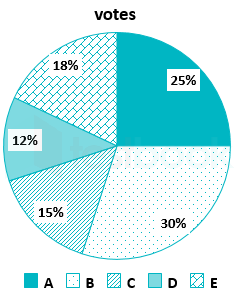
Direction: The following graph shows vote distribution in a village where 5 candidates stood for election**.** Population of the village is 1,20,000.

111

What is ratio of votes received by candidate C to that received by candidate E?

  1. ((a))

    1 : 4

  2. ((b))

    5 : 6

  3. ((c))

    6 : 5

  4. ((d))

    3 : 7

  5. ((e))

    2 : 5

Show Answer
Answer: ((a))

1 : 4

112

Find the average of votes received by candidates B, D and E?

  1. ((a))

    24000

  2. ((b))

    22000

  3. ((c))

    25000

  4. ((d))

    12800

  5. ((e))

    26000

Show Answer
Answer: ((a))

24000

113

If voters that voted for candidate C has a ratio of male and female  7 : 2, find the number of females who voted for C.

  1. ((a))

    3000

  2. ((b))

    5000

  3. ((c))

    6000

  4. ((d))

    4000

  5. ((e))

    8000

Show Answer
Answer: ((a))

3000

114

What is the difference between votes received by candidates A, B and C together to that of D and E together?

  1. ((a))

    44000

  2. ((b))

    48000

  3. ((c))

    50000

  4. ((d))

    45000

  5. ((e))

    60000

Show Answer
Answer: ((a))

44000

115

Find Candidate A got how much more/less percent votes than Candidate B.

  1. ((a))

    20%

  2. ((b))

    25%

  3. ((c))

    30%

  4. ((d))

    12.5%

  5. ((e))

    16.67%

Show Answer
Answer: ((a))

20%

116

What approximate value should come in place of the question mark (?) in the following question?

(15.72)2 + 16.69 × 24.41 - 363.76 ÷ 27.69 + 29.77 = ?

  1. ((a))

    671

  2. ((b))

    651

  3. ((c))

    647

  4. ((d))

    581

  5. ((e))

    681

Show Answer
Answer: ((a))

671

117

What approximate will come in the place of the question mark ‘?’ in the following question?

{√(784.02) - 18.96} ÷ 2.95 = ? ÷ 42.04

  1. ((a))

    105

  2. ((b))

    145

  3. ((c))

    126

  4. ((d))

    180

  5. ((e))

    200

Show Answer
Answer: ((a))

105

118

What approximate will come in the place of the question mark ‘?’ in the following question?

(544.87 ÷ 5.05 + 199.89 ÷ 4.01) ÷ ? = 52.97

  1. ((a))

    4

  2. ((b))

    10

  3. ((c))

    3

  4. ((d))

    5

  5. ((e))

    6

Show Answer
Answer: ((a))

4

119

What approximate value will come in the place of the question mark ‘?’ in the following question?

√224.99 ÷ √25.02 + 63 ÷ (9 × (7/3)) = ?

  1. ((a))

    9

  2. ((b))

    8

  3. ((c))

    7

  4. ((d))

    6

  5. ((e))

    None of the above

Show Answer
Answer: ((a))

9

120

What approximate will come in the place of the question mark ‘?’ in the following question?

89.92 + (279.89/3.98) – 151.92 = ?3

  1. ((a))

    10

  2. ((b))

    4

  3. ((c))

    2

  4. ((d))

    5

  5. ((e))

    8

Show Answer
Answer: ((a))

10

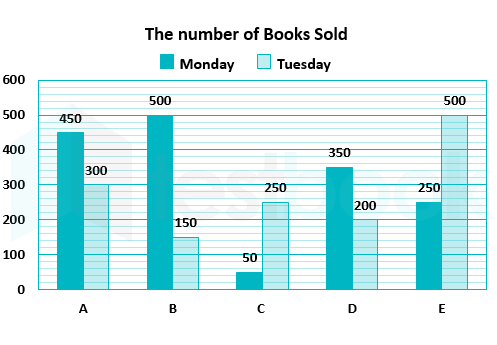
Direction: Study the graph carefully and answer the following question.

The given show the number of books sold by the different store (A, B, C, D and E) on Monday and Tuesday.

121

If the number of books sold by store F on Monday is the average number of the books sold by store C and E on Monday while the number of books sold by store F on Tuesday is 30 more than the number of books sold by store B on Tuesday. Find the total number of books sold by store F.

  1. ((a))

    350

  2. ((b))

    320

  3. ((c))

    330

  4. ((d))

    300

  5. ((e))

    310

Show Answer
Answer: ((a))

350

122

Find the average of total number of books sold by store A and D on both days.

  1. ((a))

    600

  2. ((b))

    650

  3. ((c))

    620

  4. ((d))

    580

  5. ((e))

    610

Show Answer
Answer: ((a))

600

123

Find the difference between the sum of the books sold by A, C and E on Monday and the sum of books sold by B and D on Tuesday.

  1. ((a))

    450

  2. ((b))

    425

  3. ((c))

    400

  4. ((d))

    500

  5. ((e))

    415

Show Answer
Answer: ((a))

450

124

What percent the number of books sold by C on Monday is less than that on Tuesday?

  1. ((a))

    400% 

  2. ((b))

    80%

  3. ((c))

    200%

  4. ((d))

    150%

  5. ((e))

    250%

Show Answer
Answer: ((a))

400% 

125

Find the ratio of the sum of books sold on Monday to the sum of books sold on Tuesday by all store.

  1. ((a))

    7 : 5

  2. ((b))

    8 : 5

  3. ((c))

    8 : 7

  4. ((d))

    5 : 8

  5. ((e))

    9 : 7

Show Answer
Answer: ((a))

7 : 5

126

A can type 100 letters in 5 minutes. B and C typing together can type 50 letters in 2 minutes. If all of them are working together then they can type 90 letters in how many minutes?

  1. ((a))

    4 minutes

  2. ((b))

    3 minutes

  3. ((c))

    2 minutes

  4. ((d))

    5 minutes

  5. ((e))

    None of these

Show Answer
Answer: ((a))

4 minutes

127

The distance between P and Q is 180 km. Car A start moving from P to Q at a speed of 36 km/hr and Car B start moving from Q to P at a speed of 24 km/hr. In what time, car A will cross car B?

  1. ((a))

    3.5 hours

  2. ((b))

    3 hours

  3. ((c))

     2 hours

  4. ((d))

    4 hours

  5. ((e))

    5 hours

Show Answer
Answer: ((a))

3.5 hours

128

A shop is closed on Sunday. The average sales per day for remaining six days is Rs. 8240 and the average sales from Monday to Friday is 9000. The sales on Saturday is?

  1. ((a))

    Rs. 4420

  2. ((b))

    Rs. 4440

  3. ((c))

    Rs. 4240

  4. ((d))

    Rs. 4140

  5. ((e))

    Rs. 5040

Show Answer
Answer: ((a))

Rs. 4420

129

The profit earned after selling a T-shirt for Rs. 575 is the same as loss incurred after selling the same T-shirt for Rs. 295. What is the cost price of the T-shirt?

  1. ((a))

    Rs. 425

  2. ((b))

    Rs. 445

  3. ((c))

    Rs. 430

  4. ((d))

    Rs. 450

  5. ((e))

    None of these

Show Answer
Answer: ((a))

Rs. 425

130

Age of Aman’s Sister and Aman are in ratio 5 : 7. If Age of Aman and his father is in ratio 1 : 2 and age of his father 3 years hence is 45. Find the Age of Aman’s sister.

  1. ((a))

    15 years

  2. ((b))

    18 years

  3. ((c))

    20 years

  4. ((d))

    22 years

  5. ((e))

    10 years

Show Answer
Answer: ((a))

15 years

Direction: Read the data carefully and answer the questions given below.

A college has 1000 students. Ratio of male lecturers and female lectures is 2 : 3. Total number of lecturers in the college is (1/10)th of the total number of students. Number of lecturers present in college on Monday is 20 more than the number of male lecturers. Number of students present in a college on Monday is 10 times the number of female lecturers.

131

What is the ratio of the total number of students present on Monday to the total number of lecturers present on Monday?

  1. ((a))

    13 : 17

  2. ((b))

    10 : 1

  3. ((c))

    4 : 5

  4. ((d))

    6 : 7

  5. ((e))

    1 : 9

Show Answer
Answer: ((a))

13 : 17

132

If 20% of the lecturers working in a college are going to retire next month, then what is the number of lecturers left?

  1. ((a))

    80

  2. ((b))

    70

  3. ((c))

    50

  4. ((d))

    20

  5. ((e))

    30

Show Answer
Answer: ((a))

80

133

The number of students not present on Monday is what per cent of the total number of students?

  1. ((a))

    20%

  2. ((b))

    30%

  3. ((c))

    40%

  4. ((d))

    70%

  5. ((e))

    10%

Show Answer
Answer: ((a))

20%

134

What is the difference between the total numbers of students not present on Monday to the total number of lecturer not present on Monday?

  1. ((a))

    240

  2. ((b))

    360

  3. ((c))

    100

  4. ((d))

    180

  5. ((e))

    350

Show Answer
Answer: ((a))

240

135

If the number of students increased to 1500, then what is the increase in the number of female lecturers. 

  1. ((a))

    10

  2. ((b))

    40

  3. ((c))

    50

  4. ((d))

    70

  5. ((e))

    30

Show Answer
Answer: ((a))

10

Direction - Study the table and gives answer the following Question carefully 

In the table shows Number of bikes sold by different companies over the years

Number of Different Types of bikes Sold by a Company Over the Years (Numbers in Thousands)

Company/year20112012201320142015
A5624655332
B6785924536
C6634562317
D7895134338
E4491318657
136

Find average sale of bikes of all the companies in year 2014.

  1. ((a))

    50

  2. ((b))

    60

  3. ((c))

    70

  4. ((d))

    80

  5. ((e))

    None of these

Show Answer
Answer: ((a))

50

137

What is the difference between total sale of company D and company E over the years.

  1. ((a))

    42

  2. ((b))

    75

  3. ((c))

    45

  4. ((d))

    64

  5. ((e))

    None of these

Show Answer
Answer: ((a))

42

138

Find the average sale of company B over the years is:

  1. ((a))

    60

  2. ((b))

    65

  3. ((c))

    55

  4. ((d))

    75

  5. ((e))

    None of these

Show Answer
Answer: ((a))

60

139

Find the ratio of sale in the year 2012 to the sale in year 2015

  1. ((a))

    329 : 180

  2. ((b))

    180 : 329

  3. ((c))

    56 : 79

  4. ((d))

    79 : 56

  5. ((e))

    None of these

Show Answer
Answer: ((a))

329 : 180

140

Percentage sale of which company is more in the year 2013?

  1. ((a))

    Company B

  2. ((b))

    Company A

  3. ((c))

    Company C

  4. ((d))

    Company D

  5. ((e))

    None of these 

Show Answer
Answer: ((a))

Company B

141

The radius of a circle is 14 cm and the ratio of the perimeter of the circle to the perimeter of a rectangle is 22 : 23. If the breadth of the rectangle is 18 cm then find the length of the rectangle.

  1. ((a))

    30 cm

  2. ((b))

    74 cm

  3. ((c))

    28 cm

  4. ((d))

    110 cm

  5. ((e))

    None of these

Show Answer
Answer: ((a))

30 cm

142

Seats of IT, mechanical and civil in a college are in ratio 4 : 4 : 5. If it is decided to increase the seats by 20%, 50% and 20% respectively in these branches what will be the ratio of increased seats.

  1. ((a))

    4 : 4 : 5

  2. ((b))

    4 : 3 : 7

  3. ((c))

    4 : 5 : 5

  4. ((d))

    5 : 6 : 9

  5. ((e))

    3 : 6 : 7

Show Answer
Answer: ((a))

4 : 4 : 5

143

Alok bought 30 kg of rice at Rs. 8.50 per kg and 20 kg of rice at Rs. 8 per kg. If he has to make a 20% profit, at selling price what rate per kg should he sell the rice?

  1. ((a))

    Rs. 9

  2. ((b))

    Rs. 12

  3. ((c))

    Rs. 8.50

  4. ((d))

    Rs. 8

  5. ((e))

    Rs. 9.96

Show Answer
Answer: ((a))

Rs. 9

144

A bag contains 5 blue balls, 7 green balls and 8 red balls. Two balls are drawn at random. Find the probability of getting at least one green ball.

  1. ((a))

    13/20

  2. ((b))

    56/95

  3. ((c))

    11/50

  4. ((d))

    2/7

  5. ((e))

    43/56

Show Answer
Answer: ((a))

13/20

145

A tank is filled by a pipe in 4 hours. It is observed that due to leakage the tank is filled in 5135\frac{1}{3} hours. Find the time taken by leakage to drain out all the water of the tank.

  1. ((a))

    12 hours

  2. ((b))

    13 hours

  3. ((c))

    15 hours

  4. ((d))

    16 hours

  5. ((e))

    18 hours

Show Answer
Answer: ((a))

12 hours

146

What will come in place of question mark (?) in the following number series?

16, 18, ?, 26, 33, 44

  1. ((a))

    12

  2. ((b))

    23

  3. ((c))

    21

  4. ((d))

    20

  5. ((e))

    None of these

Show Answer
Answer: ((a))

12

147

What should come in place of question mark ‘?’ in the following number series?

1, 3, 15, ?, 945, 10395

  1. ((a))

    75

  2. ((b))

    90

  3. ((c))

    95

  4. ((d))

    105

  5. ((e))

    None of these

Show Answer
Answer: ((a))

75

148

What should come in place of the question mark '?' in the following number series?

2, 5, 11, ?, 47, 95

  1. ((a))

    31

  2. ((b))

    23

  3. ((c))

    21

  4. ((d))

    18

  5. ((e))

    27

Show Answer
Answer: ((a))

31

149

What should come in place of question mark (?) in the following number series?

7, 11, 20, 36, 61, ?

  1. ((a))

    81

  2. ((b))

    91

  3. ((c))

    97

  4. ((d))

    100

  5. ((e))

    64

Show Answer
Answer: ((a))

81

150

What should come in place of the question mark '?' in the following number series?

20, 10, ?, 20, 80, 640

  1. ((a))

    5

  2. ((b))

    20

  3. ((c))

    10

  4. ((d))

    30

  5. ((e))

    None of these

Show Answer
Answer: ((a))

5

Attempt this paper under real exam conditions

Timed interface, section switching, instant scoring, and question-by-question analytics — free.

Start Timed Attempt