Official Paper

ICAR Technician 5 March 2022 Shift 3 (Previous Year Paper)

100 questions · 90 minutes · with answers · free

General Knowledge (25 questions)

1

Which of the following is the correct order of classical languages according to their year of adoption?

  1. ((a))

    Kannada, Sanskrit, Tamil, Odia

  2. ((b))

    Odia, Tamil, Sanskrit, Kannada

  3. ((c))

    Tamil, Kannada, Odia, Sanskrit

  4. ((d))

    Tamil, Sanskrit, Kannada, Odia

Show Answer
Answer: ((d))

Tamil, Sanskrit, Kannada, Odia

The correct answer is Tamil, Sanskrit, Kannada, Odia.

Key Points

  • There are 11 languages that have the ‘Classical’ status in India:
  • These are Tamil (2004), Sanskrit (2005), Kannada (2008), Telugu (2008), Malayalam (2013), and Odia (2014).
  • The five new classical languages of India are Marathi, Pali, Prakrit, Assamese, and Bengali (October 2024).
  • All of them are listed in the Eighth Schedule of the Constitution.
  • The first language to be accorded with classical status was Tamil in 2004.
  • A classical language is a language with an independent literary tradition and a large and ancient body of written literature.

Additional Information

  • Originally there were fourteen languages in the Eighth Schedule of the Indian Constitution, but eight were added during amendments, now 22  languages are there.
AssameseBengaliGujaratiHindiKannada
KashmiriKonkaniMalayalamManipuriMarathi
NepaliOriyaPunjabiSanskritSindhi
TamilTeluguUrduSanthaliBodo
MaithiliDogri

Important Points

  • Sindhi was added by the 21st  Amendment Act, 1967.
  • Konkani, Manipuri and Nepali were added by the  71st Amendment Act, 1992.
  • Bodo, Dogri, Maithili, and Santhali were added by the 92nd Amendment Act, 2003.
2

At which temple did Buddha attain enlightenment?

  1. ((a))

    Arambol

  2. ((b))

    Mahabodhi

  3. ((c))

    Nalanda

  4. ((d))

    Rajgir

Show Answer
Answer: ((b))

Mahabodhi

The correct answer is Mahabodhi.

Key Points

  • The Mahabodhi (Great Enlightenment) Temple is a Buddhist stupa found in Bodhgaya, India.
  • It is the most consecrated site in Buddhism and went by consistently by both Buddhist and Hindu explorers.
  • Numerous Hindus honor the Buddha as an incarnation of Vishnu.

Important Points

  • Four main councils were held in Buddhism.
  • ​The first council was held in 483 BC at Rajgriha in the period of King Ajatshatru.
  • The second council was held in 383 BC at Vaishali in the period of King Kalasoka.
  • The third council was held in 250 BC at Pataliputra in the period of King Ashoka.
  • The fourth council was held in 72 AD in Kashmir during the period of King Kanishka.

Additional Information

  • The date of Gautama Buddha's enlightenment is not known for certain.
  • Gautam Buddha was born in 563 B.C. as Siddhartha, The prince of Kapilvastu in (Nepal).
  • The first sermon of Buddha at Sarnath (Varanasi).
3

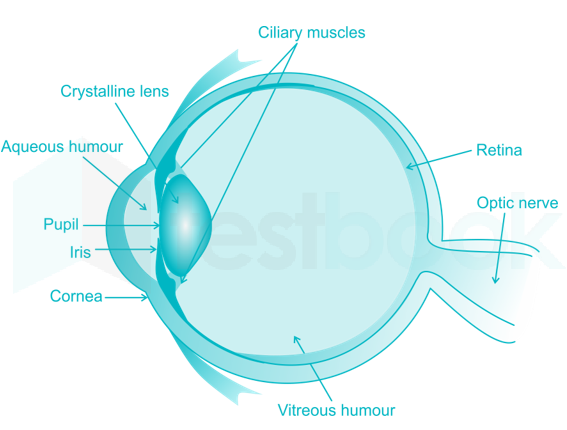
'Anterior Chamber' section is in which part of the eye?

  1. ((a))

    Between the cornea and lens

  2. ((b))

    Between the iris and lens

  3. ((c))

    Front part of eye between Cornea and Iris

  4. ((d))

    Back part of the eye between the lens

Show Answer
Answer: ((c))

Front part of eye between Cornea and Iris

The correct answer is Front part of eye between cornea and Iris.

Key Points

  • Anterior chamber is an angular space.
  • It is the space formed anteriorly by the posterior (inner) surface of the cornea.
  • Posteriorly by the lens within the pupillary aperture, anterior surface of the iris and a part of ciliary body.

Additional Information

  • Pupil visible with the gonioscope if dilated.
  • Iris colors varies between individuals.
  • Ciliary body longitudinal muscle color varies between individuals - may be pale brown, grey, or dark.
  • Aperture at the centre of iris.
4

On 17th January 2022, Arvind Kejriwal flagged off DTC's first electric bus? What is the full form of DTC?

  1. ((a))

    Dadar Transport Corporation

  2. ((b))

    Dharampur Transport Corporation

  3. ((c))

    Delhi Transport Corporation

  4. ((d))

    Dehradun Transport Corporation

Show Answer
Answer: ((c))

Delhi Transport Corporation

The correct answer is Delhi Transport Corporation.

Key Points

  • Arvind Kejriwal flagged off Delhi's first DTC electric bus.
  • Arvind Kejriwal said that the bus takes 1-1.5 hours to charge fully**.**
  • This bus can cover a minimum distance of 120 Kilometers in one full charge**.​**

Additional Information

  • Delhi (as of April 2022)​​
  1. ​Number of Districts: 11
  2. Number of Lok Sabha seats: 7
  3. Number of Rajya Sabha seats: 3
  4. State animal: Nilgai
  5. State bird: House sparrow
5

On 3rd January 2022, who launched the third phase of National Education Alliance for Technology (NEAT)?

  1. ((a))

    Amit Shah

  2. ((b))

    Rajnath Singh

  3. ((c))

    Dharmendra Pradhan

  4. ((d))

    Narendra Modi

Show Answer
Answer: ((c))

Dharmendra Pradhan

The correct answer is Dharmendra Pradhan.

Key Points

  • Dharmendra Pradhan is the current education minister of India, Who launched the 3.0 NEAT (National Alliance for Technology).
  • NEAT will promote Indian Ed-Tech companies (Aatmanirbhar Bharat).
  • Will help B2B & B2C sales Models.
  • A bridge between Ed-Tech companies, Academic institutions, and Students.
  • Will promote Ed-Tech companies to tier-3and Rural students.

Additional Information

  • Portfolio as of (April 2022)
  • Amit Shah is the current Home Minister of India.
  • Rajnath Singh is the current Defence Minister of India.
  • Narendra Modi is the current Prime Minister of India.
6

Koppal Toy Cluster, India's first toy manufacturing cluster is situated in which state?

  1. ((a))

    Maharashtra

  2. ((b))

    Karnataka

  3. ((c))

    Odisha

  4. ((d))

    Telangana

Show Answer
Answer: ((b))

Karnataka

The correct answer is Karnataka.

Key Points

  • Karnataka will have India's first Toy manufacturing cluster in Koppala.
  • This  Cluster will create 40,000 jobs.
  • For this project, the government is likely to the investment of 5000 Crore rupees.
  • Cluster built in a 400 acre SEZ (Special Economic Zone) Koppala near Bengaluru.

Additional Information

  • **Karnataka (as of 2022)**​
  • Number of Districts - 31
  • Lok Sabha seats - 28
  • Rajya Sabha seats - 12
  • Chief Minister - Siddaramaiah since 2023.
7

Sukwa Dukwan dam of Jhansi, which has been recognised as a World Heritage Irrigation Construction by  International Commission on Irrigation and Drainage  (ICID), is situated on which canal?

  1. ((a))

    Sharda

  2. ((b))

    Garai

  3. ((c))

    Adwa

  4. ((d))

    Betwa

Show Answer
Answer: ((d))

Betwa

The correct answer is Betwa.

Key Points

  • Sukwa Dukwan dam is a check dam sort of construction across the River Betwa.
  • It was constructed in 1906 to serve the irrigation and drinking purposes of the water-stressed Bundelkhand region of UP. and MP.
  • It was recently named World Heritage Irrigation Construction.

Additional Information

  • International Commission on Irrigation and Drainage (ICID) is a leading scientific and not-for-profit international organization working in the field of irrigation, and drainage to achieve sustainable agriculture water management.
  • It recognizes structures that have been built 100 years ago and serve the irrigational needs as World Heritage Irrigation Structures.
  • Sharda river is a tributary of River Ghagra.
  • Garai is a distributary of the River Ganga which flows in Bangladesh.
8

Which of the following chemical reactions is a decomposition reaction? (Here A, B, C and D represent any element/ molecule)

  1. ((a))

    AB + C → AC + B

  2. ((b))

    A + B → AB

  3. ((c))

    AB → A + B

  4. ((d))

    AB + CD → AD + BC

Show Answer
Answer: ((c))

AB → A + B

The correct answer is option 3.

Key Points

  • A decomposition reaction is a type of chemical reaction in which a compound breaks down into two or more substances.
  • The starting substance is called reactant and the end substances are called products.

  • Example: Water splits into Hydrogen and Oxygen upon electrical energy.

Additional Information

  • Decomposition reaction generally takes energy to break the existing bonds in the reactant.
  • Based on the type of energy the reactant will be decomposed thermally, electrically, photochemically or in presence of a catalyst.
  • It can be observed practically in many common activities like:​
  1. ​Digestion of food (complex food breaking down into nutrient materials)
  2. Fizz effect in many bottled drinks (CO2 gas bubbles from Carbonic acid)
  3. Baking a cake (SodiumBicarbonate into Sodium Hydroxide and Carbon Dioxide)​
9

Raja Ram Mohan Roy founded Brahmo Samaj and in opposition to the Dharma Sabha, which was founded by _____.

  1. ((a))

    Keshab Chandra Sen

  2. ((b))

    Radha Kant Dev

  3. ((c))

    Govind Ranade

  4. ((d))

    Tek Chand

Show Answer
Answer: ((b))

Radha Kant Dev

The correct answer is Radha Kant Dev.

Key Points

  • Radha Kant Dev is the founder of Dharma Sabha.
  • It was formed in the year 1830.
  • It is based on the idea of opposing the intrusion of the British in religious affairs.
  • It advocated against the social reforms of the Abolition of Sati and Widow Remarriage Act.

Additional Information

  • Keshab Chandra Sen
  • He is a philosopher and social reformer who was initially associated with Brahmo Samaj.
  • He later opposed and came out to support secularism in the reforms.
  • He founded the Indian Reform Association in 1870.
  • Govind Ranade
  • ​He is a scholar and social reformer and was one of the founding members of INC.​
  • He was instrumental in establishing Poona Sarvajanik Sabha and Prarthana Samaj.
  • He is also known as Justice Ranade (Judge of Bombay High Court ).
10

Bhavai, Ghoomar, Kalbelia and Terah Taali dances are associated with which Indian state?

  1. ((a))

    Bihar

  2. ((b))

    Rajasthan

  3. ((c))

    Karnataka

  4. ((d))

    Sikkim

Show Answer
Answer: ((b))

Rajasthan

The correct answer is Rajasthan.

Key Points

  • Famous folk dances of Rajasthan are:
  • Ghumar, Chakri, Ganagor, Jhulan Leela, Jhuma, Suisini, Ghapal, Kalbeliya.
  • ​Bhavai dance can also be seen in some parts of the **Northern parts of Gujarat (apart from Rajasthan).**​

Additional Information

StateFolk Dances
BiharJata-Jatin, Bakho-Bakhain, Panwariya, Sama Chakwa, Bidesia.
KarnatakaYakshagan, Huttari, Suggi, Kunitha, Karga, Lambi
SikkimChu Faat Dance, Sikmari, Singhi Chaam or the Snow Lion Dance, Yak Chaam, Denzong Gnenha, Tashi Yangku Dance, Khukuri Naach, Chutkey Naach, Maruni Dance
11

Which team won the 9th IHAI, National Women Ice Hockey Championship, held at Kaza in Himachal Pradesh?

  1. ((a))

    Ladakh

  2. ((b))

    Himachal Pradesh

  3. ((c))

    Telangana

  4. ((d))

    Chandigarh

Show Answer
Answer: ((a))

Ladakh

The correct answer is Ladakh.

Key Points

  • Ladakh women's team has won the 9th National Women’s Ice Hockey Championship.
  • It was conducted at Kaza in Himachal Pradesh.
  • Teams from Chandigarh, Delhi, Ladakh, Himachal Pradesh, Telangana and ITBP have participated.
  • The championship is conducted by the Ice Hockey Association of India (IHAI).

Additional Information

  • Himachal Pradesh
  • it is a Himalayan hill state in the North India.
  • It is famous for its hill stations and snow-capped mountains.
  • Capital: Shimla
  • CM: Jairam Thakur (as of April 2022)
  • Governor: B Dattatreya (as of April 2022)
12

On 8th January 2022, the Election Commission of India announced general elections for Legislative Assemblies of which states?

  1. ((a))

    Punjab, Uttar Pradesh, Manipur, Goa, Uttarakhand

  2. ((b))

    Punjab, Rajasthan, Manipur, Goa, Uttarakhand

  3. ((c))

    Punjab, Uttar Pradesh, Rajasthan, Goa, Uttarakhand

  4. ((d))

    Rajasthan, Uttar Pradesh, Manipur, Goa, Uttarakhand

Show Answer
Answer: ((a))

Punjab, Uttar Pradesh, Manipur, Goa, Uttarakhand

The correct answer is option 1.

Key Points

  • Punjab​
  • Capital: Chandigarh
  • CM: Bhagawant Mann singh
  • Governor: Bhanwarilal Purohit
  • Assembly seats: 117
  • Parliamentary Constituencies: 13 (LS), 7(RS)​
  • Uttar Pradesh
  • Capital: Lucknow
  • CM: Yogi Adityanath
  • Governor: Anandiben Patel
  • Assembly seats: 404
  • Parliamentary Constituencies: 80(LS), 31(RS)​
  • Manipur
  • Capital: Imphal
  • CM: N Biren Singh
  • Governor: La Ganesan
  • Assembly seats: 60
  • Parliamentary Constituencies: 2 (LS), 1(RS)
  • Goa
  • Capital: Panaji
  • CM: Pramod Sawant
  • Governor: P S Sreedharan Pillai
  • Assembly seats: 40
  • Parliamentary Constituencies: 2(LS), 1(RS)
  • Uttarakhand
  • Capital: Dehradun
  • CM: Pushkar Singh Dhami
  • Governor: Lt Gen Gurmit Singh
  • Assembly seats: 70
  • Parliamentary Constituencies: 5(LS), 3(RS)

​All information as of April 2022

13

In January 2022, who among the following Indian Woman Tennis Players plans her retirement by the end of 2022 season?

  1. ((a))

    Ankita Raina

  2. ((b))

    Sania Mirza

  3. ((c))

    Riya Bhatia

  4. ((d))

    Karman Kaur Thandi

Show Answer
Answer: ((b))

Sania Mirza

The correct answer is Sania Mirza.

Key Points

  • Sania Mirza is an Indian female tennis player, who was a former Doubles No.1.
  • She has won 6 Grand Slams in her career.
  • She is the highest-ranked female tennis player from India with a rank of 27 in mid of 2007.

Additional Information

  • Ankita Raina is one of the Indian female tennis players to enter the top 200 of the WTA rankings with a Bronze in the 2018 Asian Games.
  • Riya Bhatia woman tennis player from India
  • Karman Kaur Thandi is an Indian female tennis player who participated in the 2018 Asian Games.
14

At which place was Moplah Rebellion launched in 1921?

  1. ((a))

    Calcutta

  2. ((b))

    Lucknow

  3. ((c))

    Kerala

  4. ((d))

    Bihar

Show Answer
Answer: ((c))

Kerala

The correct answer is Kerala.

Key Points

  • Moplah rebellion refers to the revolt of the peasants against the local landlords controlled by the British government.
  • This took place in the Malabar region of the erstwhile Madras Presidency which is now the Malappuram area of Kerala, in 1921.
  • The Moplahs are Muslim tenants in the area who practiced agriculture.
  • The feudal system and its shortcomings are the main reason behind the rebellion.
  • The prominent leaders of the rebellion were Ali Musaliyar and Variyankunnath Kunjahammed Haji.

Additional Information

  • Kolkata has been the capital of British India till 1911 when the Indian opposition against the British started in the form of the Battle of Plassey (1757).
  • Lucknow is the capital of the Awadh region which is ruled over Begum Hazrat Mahal of Awadh who played an important role in the Revolt of 1857.
  • Bihar: Santhal Tribal Movement (1855-56) against the establishment of the Permanent Settlement system of 1793. Champaran Satyagraha (1917) against the oppression of Indigo planters.
15

Namgyalma stupa is located in which state?

  1. ((a))

    Himachal Pradesh

  2. ((b))

    Andhra Pradesh

  3. ((c))

    Madhya Pradesh

  4. ((d))

    Uttar Pradesh

Show Answer
Answer: ((a))

Himachal Pradesh

The correct answer is Himachal Pradesh.

Key Points

  • Namgyalma stupa is a Tibetan Buddhist stupa and a monastery belonging to the Dalai Lama tradition.
  • It is located in Dharamsala, Himachal Pradesh.
  • A stupa is a meditation or prayer hall that houses relics of Buddha/Buddhist monks or nuns.

Additional Information

  • Andhra Pradesh
  • Amaravati Stupa
  • Nagarjunakonda
  • Thotalkonda Budhist site, Visakhapatnam
  • ​Madhya Pradesh
  • ​Sanchi Stupa is a famous stupa and is one of the oldest stone structures existing in India.
  • ​Uttar Pradesh
  • Kushinagar is the place where Buddha attained Mahaparinirvana.
  • Dhamekh Stupa at Sarnath.
16

In January 2022, who was appointed as the Chairman of US-India Business Council (USIBC)?

  1. ((a))

    Sumit Aggarwal

  2. ((b))

    Nisha Desai Biswal

  3. ((c))

    Vivek Joshi

  4. ((d))

    Atul Keshap

Show Answer
Answer: ((d))

Atul Keshap

The correct answer is Atul Keshap.

Key Points

  • Atul Keshap is the president of US-India Business Council (USIBC).
  • USIBC is a part of U.S. Chamber of Commerce, helps in creating bilateral relationships in trade and commerce between the two countries.

Additional Information

  • USIBC (US India Business Council) 
  • It is formed in 1975 and has representation of top level companies across the U.S. and India.
  • It is a business advocacy organization between the two countries.
  • It promotes trade relations by suggesting key policy initiatives for bilateral trade between the countries.
  • It helps in maintaining the environment for businesses by providing policy advice, market research.
  • Nisha Desai Biswal is the senior Vice-President of US-India Business Council (USIBC)
  • Vivek Joshi is the current Registrar General & Census Commissioner of India.
17

On 17 January 2022, famous dancer Pandit Birju Maharaj passed away. He was related to which classical dance?

  1. ((a))

    Kathak

  2. ((b))

    Kuchipudi

  3. ((c))

    Bharatanatyam

  4. ((d))

    Sattriya

Show Answer
Answer: ((a))

Kathak

The correct answer is Kathak.

In News

  • Kathak legend Pandit Birju Maharaj died at his home in Delhi on January 17, 2022, after suffering a heart attack.

Key Points

  • Birju Maharaj or Brijmohan Nath Mishra Maharaj was an Indian dancer, a master of the kathak form and a leading exponent of the Kalka-Bindadin Gharana of Lucknow.
  • He became a dance teacher at the age of 13.
  • He won the Sangeet Natak Akademi Award when he was 28.
  • He claimed to have inherited the precision of footwork and the play of the face and neck from his father, and the stylized fluidity of movement from his uncles.
  • He choreographed and composed music for many Indian movies.
  • He was awarded the Padma Vibhushan in 1986.
  • Kathak is the principal dance of northern India and is widely practised in Uttar Pradesh, Rajasthan, Delhi, and Madhya Pradesh.


Additional Information

  • Kuchipudi
  • ​It originated from a village in the Krishna district in Andhra Pradesh.
  • It evolved as a religious art rooting back to the age-old Hindu Sanskrit text Natya Shastra and connects traditionally with temples, spiritual faiths, and travelling bards.
  • Bharatanatyam
  • ​Bharatanatyam is one of the oldest and most popular forms of classical dance that originated in the Tanjore district in Tamil Nadu.
  • The origin of this dance can be traced to the sage Bharata Muni's Natyasastra.
  • Sattriya
  • ​Sattriya is a dance form that is more than 500 years old and comes from the Vaishnavite monasteries of Assam.
  • It is a dance-drama performance art.
18

Muhhamad bin tughlaq passed away at Thatta while battling against whom among the following?

  1. ((a))

    Taghi

  2. ((b))

    Balban

  3. ((c))

    Khusrao Khan

  4. ((d))

    Firishta

Show Answer
Answer: ((a))

Taghi

The correct answer is Taghi.

Key Points

  • MuhhamadTughlaq was the second ruler of the Tughlaq dynasty.
  • He passed away in Thatta while battling in Sindh against Taghi, a Turkish slave.
  • Ferozshah tughaq built Feroz Shah Kotla, peppered Delhi with gardens, constructed canals, and hunting lodges, and repaired Qutub Minar, Hauz Khas, and Surajkund.

Additional Information

  • Balban
  • ​Balban was a slave of Iltutmish, the ruler of the Slave dynasty.
  • He ascended the throne of Delhi in February 1265 AD.
  • He started Sijda and Paibos to the sultan.
  • He introduced the Persian festival Navroz.
  • Khusrau Khan
  • ​Khusrau Khan was the Sultan of Delhi for a very short time period in 1320.
  • Mubarak Shah gave him the title Khusrau Shah.
  • Ghazi Malik or Ghiasuddin Tughlaq defeated Khusrau Khan and founded the Tughluq dynasty.
  • Firishta
  • ​He was a Persian historian, who settled in India and served the Deccan Sultans as their court historian.
  • He was born in 1560 and died in 1620.
19

Sputnik V is launched by which institute?

  1. ((a))

    National Institute of Health

  2. ((b))

    Serum Institute of India

  3. ((c))

    Canadian Institute of Health Science

  4. ((d))

    Gamaleya National Research Institute of Epidemiology and Microbiology

Show Answer
Answer: ((d))

Gamaleya National Research Institute of Epidemiology and Microbiology

The correct answer is Gamaleya National Research Institute of Epidemiology and Microbiology.

Key Points

  • Sputnik V is an adenovirus viral vector vaccine for COVID-19 developed by the Gamaleya Research Institute of Epidemiology and Microbiology in Russia.
  • Sputnik V is the world's first registered vaccine based on a well-studied human adenovirus vector platform, it was registered on 11 August 2020 by the Russian Ministry of Health.
  • The vaccine is named after the first Soviet space satellite.
  • The Gamaleya National Center of Epidemiology and Microbiology is the world’s leading research institution.
  • The center was founded in 1891 as a private laboratory.
  • Since 1949 it bears the name of Nikolai Gamaleya, a pioneer in Russian microbiology studies.

Additional Information

  • National Institute of Health
  • ​The National Institutes of Health (NIH) is a part of the U.S. Department of Health and Human Services.
  • It is the US' medical research agency making important discoveries that improve health and save lives.
  • Serum Institute of India
  • ​Serum Institute of India is the world's largest vaccine manufacturer by number of doses produced and sold globally which includes Polio vaccine, Diphtheria, Tetanus, Pertussis, etc.
  • It was founded in 1966 by Dr. Cyrus Poonawalla with the aim of manufacturing life-saving immuno-biologicals, which were in shortage in the country and imported at high prices.
  • Canadian Institute of Health Science
  • The Canadian Academy of Health Sciences brings together Canada’s top-ranked health and biomedical scientists and scholars to make a positive impact on the urgent health concerns of Canadians.
20

In January 2022, who launched India's first cryptocurrency index IC15?

  1. ((a))

    CryptoOx

  2. ((b))

    CryptoDex

  3. ((c))

    CryptoWire

  4. ((d))

    CryptoCare

Show Answer
Answer: ((c))

CryptoWire

The correct answer is CryptoWire.

Key Points

  • Cryptocurrency app CryptoWire recently launched India's first cryptocurrency index called IC15.
  • This index will measure and monitor the performance of 15 top widely traded cryptocurrencies that are listed on crypto exchanges in the world.
  • CryptoWire claimed that index IC15 is designed to increase the awareness and knowledge of cryptocurrencies among people as well as help in the blockchain ecosystem.
  • The approach for index IC15 is to facilitate market development.
  • The index includes a governance committee (IGC) that comprises leading domain experts, academicians, and industry practitioners.
  • It is aimed to enable market development by offering all possible support to evaluate possibilities for better growth.
21

On 11th January 2022, DRDO successfully flights tested the final deliverable configuration of the Man-Portable Anti-Tank Guided Missile (MPATGM). MPATGM will be manufactured at which place?

  1. ((a))

    Ranikhet, Uttarakhand

  2. ((b))

    Balasore, Odisha

  3. ((c))

    Bhanoor, Telangana

  4. ((d))

    Bikaner, Rajasthan

Show Answer
Answer: ((c))

Bhanoor, Telangana

The correct answer is Bhanoor, Telangana.

Key Points

  • Defense Research and Development Organisation (DRDO) successfully flight tested the Man-Portable Anti-Tank Guided Missile (MPATGM), in its final deliverable configuration.
  • MPATGM will be manufactured by Bharat Dynamics Limited at its facility in Bhanoor, Telangana.
  • The purpose of testing the missile was to check its consistent performance at a minimum range, which is 200-300 meters.
  • MPATGM has already completed a similar successful test for a maximum range of 4,000 meters.
  • With this successful test of the MPATGM, the system is now ready for production in large numbers in India.
  • DRDO is the R&D wing of the Ministry of Defence, Govt of India.
  • Its vision is to empower India with cutting-edge defense technologies and a mission to achieve self-reliance in critical defense technologies and systems.
  • It was founded in 1958.
22

On 16th January 2022, the Chief Minister of Himachal Pradesh Jai Ram Thakur inaugurated which women National Ice Hockey Championship at Ice Skating Rink, Kaza, Himachal Pradesh?

  1. ((a))

    3rd

  2. ((b))

    8th

  3. ((c))

    9th

  4. ((d))

    2nd

Show Answer
Answer: ((c))

9th

The correct answer is 9th.

Key Points

  • Women’s National Ice Hockey Championship 2022
  • Series: 9th
  • Host State: Himachal Pradesh
  • Held at: Kaza area in the Lahaul-Spiti district of Himachal Pradesh
  • Participating States: Ladakh, Delhi, Himachal Pradesh, Chandigarh, Telangana, and Indo-Tibetan Border Police
  • Organized by: Ice Hockey Association of India
  • Winner State: Ladakh

Important Points

  • Ice Hockey Association of India
  • President: Dr Surinder Mohan Bali
  • Himachal Pradesh (as of April 2022)
  • Capital: Shimala (Summer), Dharmshala (Winter)
  • Chief Minister: Jay Ram Thakur
  • Governor: Rajendra Arlekar
  • Bordering States: Punjab, Harayana, Uttarakhand, Jammu Kashmir, and Ladakh
  • International Border: Tibet (China)
23

Which of the following is the only municipal corporation in the world to have more than 80 citizen-based services on WhatsApp chatbot, offering services for citizens, tourists and businesses in the city?

  1. ((a))

    Brihanmumbai Municipal Corporation

  2. ((b))

    Chennai Municipal Corporation

  3. ((c))

    Ahmedabad Municipal Corporation

  4. ((d))

    Delhi Municipal Corporation

Show Answer
Answer: ((a))

Brihanmumbai Municipal Corporation

The correct answer is Brihanmumbai Municipal Corporation.

Key Points

  • Brihan Mumbai Municipal Corp (BMC)
  • This is the only municipal corporation in the world that will be providing more than 80 services on Whatsapp, Chatbot to its citizens.
  • The services include citizen-centric services, tourism, business, etc.
  • It is India's richest municipal corporation.
  • The service is launched virtually by the CM of Maharashtra.

Additional Information

  • Maharashtra (as of April 2022)
  • Capital: Mumbai
  • Chief Minister: Uddhav Thakare
  • Governor: Bhagat Singh Koshyari
  • Bordering States: Gujarat, Madhya Pradesh, Chhattisgarh, Telangana, Karnataka, Goa
24

Which state government has declared to launch an employment mission called 'Rojgar Mission' in January 2022?

  1. ((a))

    Kerala

  2. ((b))

    Karnataka

  3. ((c))

    Chhattisgarh

  4. ((d))

    Himachal Pradesh

Show Answer
Answer: ((c))

Chhattisgarh

The correct answer is Chhattisgarh.

Key Points

  • Rojgar Mission 
  • Chhattisgarh government decided to launch an employment scheme called Rojgar Mission in 2022.
  • The aim of the mission is to provide 12 lakh to 15 lakh jobs in state government in the next five years

Additional Information

  • Chhattisgarh (as of April 2022)
  • Capital: Raipur
  • Chief Minister: Bhupesh Baghel
  • Governor: Anusuiya Uikey
  • Bordering State: Uttar Pradesh, Madhya Pradesh, Maharashtra, Telangana, Andhra Pradesh, Odisha, Jharkhand
25

On 12 January 2022, at which place did ISRO successfully conduct the qualification test of cryogenic engine for the Gaganyaan programme for the duration of 720 seconds?

  1. ((a))

    Himachal Pradesh

  2. ((b))

    Tamil Nadu

  3. ((c))

    Rajasthan

  4. ((d))

    Odisha

Show Answer
Answer: ((b))

Tamil Nadu

The correct answer is Tamil Nadu.

In News 

  • ISRO successfully conduct the qualification test of the cryogenic engine for the Gaganyaan program for the duration of 720 seconds at ISRO Propulsion Complex (IPRC), Mahendragiri, Tamil Nadu.

Additional Information

  • Gaganyaan Mission
  • The Program will undertake a human space flight mission to Low Earth Orbit.
  • This program includes two unmanned missions and one manned mission.
  • GSLV MK-III, launch vehicle will be used to launch Gaganyaan Mission
  • Vyomitra 
  • It is a female-looking humanoid robot developed to function onboard the Gaganyaan.
  • Indian Space Research Organization (ISRO)
  • Established: 15 August 1969
  • Headquarters: Bengaluru, Karnataka
  • Chairman: Dr. S. Somanath

Mathematics (25 questions)

26

If (x + 2y)3 + (2x – y)3 = (3x + y) [Ax2 + By2 + Cxy] , then the value of (3A – B – C) ∶ (A + B + C) is:

  1. ((a))

    5 ∶ 7

  2. ((b))

    3 ∶ 4

  3. ((c))

    1 ∶ 7

  4. ((d))

    2 ∶ 5

Show Answer
Answer: ((a))

5 ∶ 7

Given:

(x + 2y)3 + (2x – y)3 = (3x + y) [Ax2 + By2 + Cxy]

Formula Used:

a3 + b3 = (a + b) (a2 + b2 - ab)

Calculation:

We have to find the value of 

(x + 2y)3 + (2x – y)3 

According to the formula used we can write the above expression as 

⇒ [(x + 2y) + (2x – y)] [(x + 2y)2 + (2x – y)2 – (x + 2y)(2x – y)]

⇒ (3x + y) [x+ 4y2 + 4xy + 4x2 + y2 – 4xy – 2x2 + xy – 4xy + 2y2]

⇒ (3x + y) [3x2 + 7y2 – 3xy]

On comparing the above expression with (3x + y) [Ax2 + By2 + Cxy]

We get A = 3, B = 7 and C = -3

Now, We have to find the value of 

(3A – B – C) ∶ (A + B + C)

⇒ [3 × 3 - 7 - (-3)] : [3 + 7 + (-3)]

⇒ (9 - 7 + 3) : (10 - 3)

⇒ 5 : 7 

∴ The required ratio is 5 : 7.

27

What is the difference (in ₹) between the compound interest when the interest is compounded 5-monthly, and the simple interest on a sum of ₹ P for 1141{1 \over 4} year at 12% p.a.?

  1. ((a))

    618000P{61 \over 8000}P

  2. ((b))

    918000P{91\over 8000}P

  3. ((c))

    418000P{41 \over 8000}P

  4. ((d))

    518000P {51 \over 8000}P

Show Answer
Answer: ((a))

618000P{61 \over 8000}P

Shortcut Trick

Time = 15 months = 3 cycles of 5 months each.

Rate for 5 months = (12% ÷ 12) × 5 = 5% per cycle.

CI for 3 cycles at 5% = 15.7625% of P.

SI for 15 months at 12% p.a. = 12% × (15/12) = 15% of P.

Difference = 0.7625% of P = (7625 ÷ 1000000)P = (61 ÷ 8000)P.

∴ The correct answer is (61/8000)P.

Alternate Method

Given:

Principal = P

Time = 1 1/4 years = 15 months

Rate = 12% per annum

Calculations:

Simple Interest (SI) = (P × R × T) ÷ 100

⇒ SI = (P × 12 × 1.25) ÷ 100 = 15P ÷ 100 = 0.15P

Compound Interest (CI): Compounded 5-monthly

⇒ Number of periods (n) = 15 ÷ 5 = 3

⇒ Rate per period (r) = (12% ÷ 12) × 5 = 5% = 0.05

⇒ CI = P[(1 + r)n − 1]

⇒ CI = P[(1 + 0.05)3 − 1] = P[1.157625 − 1] = 0.157625P

Difference = CI − SI = 0.157625P − 0.15P = 0.007625P

⇒ Difference = (7625 ÷ 1000000)P = (61 ÷ 8000)P

∴ The correct answer is (61/8000)P.

Additional Information

Effective Rate for CI

For 3 periods at rate r%, the effective CI rate is 3r + 3r2/100 + r3/10000 %.

CI vs SI Difference (3 years)

The difference for 3 years is given by P(r/100)2 × (3 + r/100).

Periodic Compounding

If interest is compounded every 'k' months, the new rate is (R/12) × k and the number of periods is (Total months / k).

28

When payment is made online, discount offered is 10%. Additional discount of 5% is given to credit card holders. A person buys an article priced at ₹1,80,000 by paying online and pays through his credit card. How much does he need to pay (in ₹)?

  1. ((a))

    1,50,390

  2. ((b))

    1,53,900

  3. ((c))

    1,59,300

  4. ((d))

    1,50,930

Show Answer
Answer: ((b))

1,53,900

Given:

Marked Price of Article = Rs. 180000

Discount = 10% on online payment 

Additional Discount = 5% on credit card payment

Formula Used:

Selling Price = M.P (100 - D%)/100

Wehre, D = Discount, M.P = Marked Price

Calculation:

We have M.P = Rs. 180000

First Discount = 10%

S.P = 180000 [100 - 10]/100

⇒ S.P = 162000

Additional Discount = 5% for credit card payment 

Final S.P = 162000 × [100 - 5]/100

⇒ Final S.P = 153900

∴ The amont paid by person to the shopkeeper is Rs. 153900.

29

A vessel has 45 litres of solution of alcohol and water, having 60% alcohol. How many litres of the solution must be withdrawn from the vessel and replaced by the same quantity of water so that the resulting solution would have 35% alcohol?

  1. ((a))

    17.5

  2. ((b))

    15.25

  3. ((c))

    18.75

  4. ((d))

    20.25

Show Answer
Answer: ((c))

18.75

Given:

Vessel has 45 litres of solution 

Solution contains 60% alcohol

Resulting solution have 35% alcohol

Calculation:

Let the amount of solution withdraw be x litres

According to the question 

Amount of alcohol = 60% of 45 

⇒ Amount of alcohol = 27 litres

So, The amount of water = 45 - 27 

⇒ Amount of water = 18 litres

Now, According to the question 

After withdrawing x litres 

Amount of alcohol in the solution = 27 - 60% of x

⇒ Amount of alcohol in the solution = 27 - 3x/5

And the total amount of solution is unchanged

So, 45 × 35% = (27 - 3x/5)

⇒ 45 × 35/100 = 27 - 3x/5

⇒ 63/4 =  27 - 3x/5

⇒ 3x/5 = 45/4

⇒ x = 18.75

∴ The amount of water withdrawn is 18.75 litres.

30

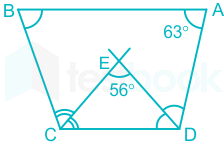
In a quadrilateral ABCD, the bisectors of ∠C and ∠D meet at E. If ∠CED = 56° and ∠A = 63°, then the measure of ∠B is:

  1. ((a))

    54°

  2. ((b))

    63°

  3. ((c))

    67°

  4. ((d))

    49°

Show Answer
Answer: ((d))

49°

Given:

The bisectors of ∠C and ∠D meet at E

∠CED = 56° and ∠A = 63°

Calculation:

According to the question 

∠BCE = ∠DCE = ∠C/2    ----(i)

and ∠ADE = ∠CDE = ∠D/2    ----(ii)

Now, In ΔCDE

∠CED + ∠DCE + ∠CDE = 180°

⇒ 56° + ∠C/2 + ∠D/2 = 180° 

⇒ ∠C/2 + ∠D/2 = 124°

⇒ ∠C + ∠D = 248°    ----(iii)

And we knwo that 

Sum of angle of quadrilateral is 360° 

⇒ ∠A + ∠B + ∠C + ∠D = 360°

⇒ 63° + ∠B + 248° = 360° 

⇒ ∠B =  360° - 311° 

⇒ ∠B = 49°

∴ The measure of ∠B is 49°.

31

Last year, the ratio of the incomes of A and B was 4 ∶ 3. The ratios of their individual incomes of last year and present year are 3 ∶ 4 and 5 ∶ 6, respectively. If their total income for the present year is ₹16.08 lakhs, then the income of A (in ₹ lakhs) for the present year is:

  1. ((a))

    8.4

  2. ((b))

    9.6

  3. ((c))

    7.2

  4. ((d))

    6.6

Show Answer
Answer: ((b))

9.6

Given :

Ratio of income of A and B last year = 4 : 3

A's income last year and present year = 3 : 4

B's income last year and present year = 5 : 6

Total income for present year = ₹ 16.08 lakhs

Calculations :

According to the question,

Ratio of income of A and B last year = 4 : 3

To equate last year income of A and B multiplying the ratio by 5 and 3

Now we have to bring the ratio of incomes of A and B last year in the ratio 4 : 3


∴ The income of A (in ₹ lakhs) for the present year is 9.6.

Alternate MethodGiven :

Ratio of income of A and B last year = 4 : 3

A's income last year and present year = 3 : 4

B's income last year and present year = 5 : 6

Total income for present year = ₹ 16.08 lakhs

Calculations :

Ratio of income of A and B last year = 4 : 3       ----- (1)

Ratio of A's income last year to the present year = 3 : 4        ----- (2)

Ratio of B's income last year to the present year = 5 : 6        ----- (3) 

Multiply 15 in equation (1) and 20 in equation (2) and 9 in equation (3) to equate last year income of A and B

Ratio of income of A and B last year = 60 : 45      ----- (4)

Ratio of A's income last year to the present year = 60 : 80        ----- (5)

Ratio of B's income last year to the present year = 45 : 54        ----- (6)

Using equation (5) and (6)

The ratio of A's present income to B's present income = 80 : 54

So, as given in the question

Total income for present year = ₹ 16.08 lakhs

⇒ 80x + 54x = 16.08

⇒ 134x = 16.08

⇒ x = 16.08/134

⇒ x = 0.12

Present income of A = 80x

Put the value of x, we get

⇒ A's income = 80 × 0.12

⇒ 9.6

∴ The income of A (in ₹ lakhs) for the present year is 9.6.

32

What is the sum of the values of p and q for which the system of equations 2x + 3y = 7; (p + q)x + (2p - q)y = 21 has infinite number of solutions?

  1. ((a))

    4

  2. ((b))

    5

  3. ((c))

    6

  4. ((d))

    7

Show Answer
Answer: ((c))

6

Shortcut Trick

For a system of linear equations to have infinite solutions, the ratios of their coefficients must be equal: a1/a2 = b1/b2 = c1/c2.

Comparing the first and third ratios: 2 / (p + q) = 7 / 21

Simplifying the constant ratio: 7 / 21 = 1 / 3

⇒ 2 / (p + q) = 1 / 3

⇒ p + q = 2 × 3 = 6

∴ The correct answer is 6.

Alternate Method

Given Equations:

  1. 2x + 3y = 7

  2. (p + q)x + (2p − q)y = 21

Condition for Infinite Solutions:

For equations a1x + b1y = c1 and a2x + b2y = c2: a1/a2 = b1/b2 = c1/c2

Calculations:

⇒ a1/a2 = 2 / (p + q)

⇒ b1/b2 = 3 / (2p − q)

⇒ c1/c2 = 7 / 21 = 1 / 3

Equating the first and last parts:

⇒ 2 / (p + q) = 1 / 3

⇒ p + q = 6

Equating the second and last parts to verify:

⇒ 3 / (2p − q) = 1 / 3 ⇒ 2p − q = 9

⇒ Solving p + q = 6 and 2p − q = 9 gives p = 5 and q = 1.

⇒ Sum = p + q = 5 + 1 = 6.

∴ The correct answer is 6.

Additional Information

Unique Solution Condition

A system has a unique solution (intersecting lines) if a1/a2 ≠ b1/b2.

No Solution Condition

A system has no solution (parallel lines) if a1/a2 = b1/b2 ≠ c1/c2.

Consistency of Equations

A system is consistent if it has at least one solution (unique or infinite) and inconsistent if it has no solution.

33

The average weight of 16 boys in a class is 61.25 kg and that of the remaining 10 boys is 45.75 kg. The average weight (in kg) of all the boys in the class (correct to two decimal places) is:

  1. ((a))

    52.59

  2. ((b))

    55.29

  3. ((c))

    59.25

  4. ((d))

    52.95

Show Answer
Answer: ((b))

55.29

Given :

Average weight of 16 boys = 61.25 kg

Average weight of 10 boys = 45.75 kg

Total boys in a class = 26

Calculations : 

Total weight of 16 boys = average weight × number of boys

⇒ 61.25 × 16 = 980 kg

Total weight of 10 boys = average weight × number of boys

⇒ 45.75 × 10 = 457.5 kg

Total weight of all the boys = 980 + 457.5

⇒ 1437.5 kg

Average weight of all the 26 boys in the class = total weight/ total boys

⇒ 1437.5/26

⇒ 55.29 kg

∴ The average weight (in kg) of all the boys in the class is 55.29.

34

The least number that when divided by 6, 15, 36 and 75 leaves the same remainder 3 in each case and is divisible by 11 is:

  1. ((a))

    6303

  2. ((b))

    6003

  3. ((c))

    6330

  4. ((d))

    6033

Show Answer
Answer: ((a))

6303

Given :

A least number when divided by 6, 15, 36 and 75 leaves remainder 3

It is also divisible by 11.

Concept used :

LCM of numbers

Calculations :

LCM of 6, 15, 36 and 75 = 900

The least number completely divisible by 6, 15, 36 and 75 and leaves remainder 3

⇒ 900x + 3

x is a natural number 

Put the value of x = 1, 2, 3, 4, 5, 6. 

The number we get is not divisible by 11

Put x = 7, we get

⇒ 900 × 7 + 3

⇒ 6300 + 3

⇒ 6303

⇒ 6303/11 = 573

∴ The least number completely divisible by 6, 15, 36 and 75 and leaves remainder 3 is 6303.

35

X and Y enter into a business partnership with capital in the ratio 3 ∶ 5. After 5 months, X adds 50% of his capital, while Y withdraws 60% of his capital. What is the share (in ₹ lakhs) of X in the annual profit of ₹10.26 lakhs?

  1. ((a))

    5.89

  2. ((b))

    5.58

  3. ((c))

    4.56

  4. ((d))

    6.24

Show Answer
Answer: ((b))

5.58

Given :

X and Y initial capital = 3 : 5

X capital after 5 months = 150% of initial investment of X

Y capital after 5 months = 40% of initial investment of Y

Annual profit = ₹10.26 lakhs

Formula used :

(X's profit) : (Y's profit) = (X's investment × time period) × (Y's investment × time period)      ----- (1)

Calculations :

Let X's and Y's initial investment be 30 and 50 same as the given ratio

X's capital for the last 7 months = (150/100) × 30 = 45

Y's capital for the last 7 months = (40/100) × 50 = 20

Using equation (i)

⇒ X's profit : Y's profit = (30 × 5 + 45 × 7) : (50 × 5 + 20 × 7)

⇒ X's profit : Y's profit = (465) : (390)

⇒ 31 : 26

Total profit = 31 + 26 units

⇒ 57 units

⇒ (X's profit)/(Total profit) = 31/57

⇒ X's profit = (31/57) × 10.26 lakhs

⇒ 0.54 × 10.26 lakhs

⇒ 5.58 lakhs

∴ The share (in ₹ lakhs) of X is 5.58.

36

The value of

5.169×5.169×5.16964×(0.888)3(5.169)2+(3.552)2+4(0.888)(5.169)\frac{{5.169 \times 5.169 \times 5.169 - 64 \times {{\left( {0.888} \right)}^3}}}{{{{\left( {5.169} \right)}^2} + {{\left( {3.552} \right)}^2} + 4\left( {0.888} \right)\left( {5.169} \right)}}is (1 + k), where k = _____.

  1. ((a))

    0.617

  2. ((b))

    0.623

  3. ((c))

    0.317

  4. ((d))

    0.323

Show Answer
Answer: ((a))

0.617

Given:

5.169×5.169×5.16964×(0.888)3(5.169)2+(3.552)2+4(0.888)(5.169)=1+k\frac{{5.169 \times 5.169 \times 5.169 - 64 \times {{\left( {0.888} \right)}^3}}}{{{{\left( {5.169} \right)}^2} + {{\left( {3.552} \right)}^2} + 4\left( {0.888} \right)\left( {5.169} \right)}} = 1 + k

Formula used:

(a3 - b3) = (a - b)(a2 + ab + b2)       ---- (1)

Calculations:

⇒ 5.169×5.169×5.16964×(0.888)3(5.169)2+(3.552)2+4(0.888)(5.169)=1+k\frac{{5.169 \times 5.169 \times 5.169 - 64 \times {{\left( {0.888} \right)}^3}}}{{{{\left( {5.169} \right)}^2} + {{\left( {3.552} \right)}^2} + 4\left( {0.888} \right)\left( {5.169} \right)}} = 1 + k

⇒ 5.1693(4×(0.888))3(5.169)2+(3.552)2+4(0.888)(5.169)=1+k\frac{{5.169^3 - (4 \times {{\left( {0.888}) \right)}^3}}}{{{{\left( {5.169} \right)}^2} + {{\left( {3.552} \right)}^2} + 4\left( {0.888} \right)\left( {5.169} \right)}} = 1 + k

Using equation (1), we get

⇒ (5.1693.552)((5.169)2+(3.552)(5.169)+(3.552)2)(5.169)2+(3.552)(5.169)+(3.552)2)=1+k\frac{(5.169 - 3.552)((5.169)^2 + (3.552)(5.169) +(3.552)^2)}{(5.169)^2 + (3.552)(5.169) +(3.552)^2)} = 1 + k

⇒ 5.169 - 3.552 = 1 + k

⇒ 1.617 = 1 + k

⇒ k = 0.617

∴ The value of k is 0.617.

37

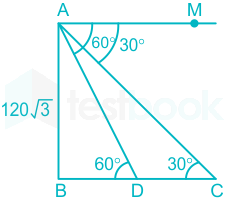
As observed from the top of a light house, 1203 { \sqrt{3}} m above the sea level, the angle of depression of a ship sailing towards it changes from 30° to 60°. The distance (in m) travelled by the ship during period of observation is:

  1. ((a))

    100

  2. ((b))

    240

  3. ((c))

    150

  4. ((d))

    120

Show Answer
Answer: ((b))

240

Given :

Height of the lighthouse = 120√3 m

Calculations :

Since Angle of depression = Angle of inclination

So, ∠MAC = 30° = ∠ACB

And, ∠MAD = 60° = ∠ADB

Using tangent function in ΔABD,

⇒ tan 60° = AB/BD

⇒ √3 = 120√3/BD

⇒ BD = 120

Using tangent function in ΔABC,

⇒ tan 30° = AB/BC

⇒ 1/√3 = 120√3/BC

⇒ BC = 360

DC is the distance travelled by the ship during period of observation

⇒ DC = BC - BD

⇒ DC = 360 - 120

⇒ DC = 240m

∴ Distance (in m) travelled by the ship during period of observation is 240.

38

The value of  7.25+;7.511314/57.25 + ;\frac{{7.5}}{{1 - \frac{1}{{3 - \frac{1}{{4/5}}}}}} is equal to:

  1. ((a))

    22.55

  2. ((b))

    24.75

  3. ((c))

    25.47

  4. ((d))

    27.45

Show Answer
Answer: ((b))

24.75

Calculations:

⇒ 7.25+;7.511314/57.25 + ;\frac{{7.5}}{{1 - \frac{1}{{3 - \frac{1}{{4/5}}}}}}

⇒ 7.25+;7.5113547.25 + ;\frac{{7.5}}{{1 - \frac{1}{{3 - \frac{5}{{4}}}}}}

⇒ 7.25+;7.5117/47.25 + ;\frac{{7.5}}{{1 - \frac{1}{{7/4}}}}

⇒ 7.25+;7.51477.25 + ;\frac{{7.5}}{{1 - \frac{4}{{7}}}}

⇒ 7.25+;7.53/77.25 + ;\frac{{7.5}}{{3/7}}

⇒ 7.25 + 2.5 × 7

⇒ 7.25 + 17.5

⇒ 24.75

∴ The value of 7.25+;7.511314/57.25 + ;\frac{{7.5}}{{1 - \frac{1}{{3 - \frac{1}{{4/5}}}}}} is 24.75

39

The bar graph given shows the sales of articles (in thousand numbers) from five branches of a publishing company during two consecutive years 2003 and 2004.


The total sales of branch A4 for both the years is what percentage of the total sales of branches A1, A2 and A3 taken together for both the years? (Rounded off to the nearest decimal)

  1. ((a))

    28

  2. ((b))

    25

  3. ((c))

    30

  4. ((d))

    24

Show Answer
Answer: ((a))

28

Calculations :

Total sales of branch A4 for both years = 32 + 63

⇒ 95

Total sales of A1, A2 and A3 for both years

⇒ (65 + 83) + (42 + 56) + (38 + 52)

⇒ 148 + 98 + 90

⇒ 336

Percentage of A4 sales to total sales of A1, A2 and A3

⇒ (95/336) × 100

⇒ 9500/336

⇒ 28.27 ≃ 28

∴ The percentage of A4 sales to total sales of A1, A2 and A3 (in thousand numbers) for both years is 28.

40

A sum of ₹50,000 is divided into two parts such that the simple interest on the first part for 4154\frac{1}{5} years at 6236\frac{2}{3}% p.a. is double the simple interest on the second part for 2342\frac{3}{4} years at 4% p.a. What is the difference (in ₹) between the two parts?

  1. ((a))

    8,000

  2. ((b))

    6,000

  3. ((c))

    5,000

  4. ((d))

    4,000

Show Answer
Answer: ((b))

6,000

Given:

Principal = ₹50,000

Rate of interest on the first part = 6236\frac{2}{3} % p.a

Time period for the first part = 4154\frac{1}{5} years 

Rate of interest on the second part = 4% p.a

Time period for the second part = 2342\frac{3}{4} years 

Formula used:

Simple interest = (principal × rate × time)/100

Amount = Principal + Simple interest 

Calculations:

Let Rs. 50,000 be divided into two parts x and y

According to the question,

⇒ (x×215×203)/100=2×(y×114×4)/100(x × \frac{21}{5} × \frac{20 }{3})/100 = 2 × (y × \frac{11}{4} × 4)/100

⇒ x/y = 11/14

Let the ratio of x and y be 11a and 14a

Principal = Rs. 50,000

⇒ 11a + 14a = 50000

⇒ 25a = 50000

⇒ a = 2000

The difference between first part and second part

⇒ 14a - 11a

⇒ 3a

Substituting the value of a, we get

⇒ 3 × 2000

⇒ ₹ 6000

∴ The difference (in ₹) between the two parts Rs. 6000.

41

A leak in the bottom of a tank can empty the full tank in 9 hours. An inlet pipe fills water at the rate of 5 litres per minute. When the tank is full, the inlet is opened and due to the leak the tank gets empty in 12 hours. The capacity of the tank (in litres) is:

  1. ((a))

    10080

  2. ((b))

    10008

  3. ((c))

    18000

  4. ((d))

    10800

Show Answer
Answer: ((d))

10800

Given :

A leak at the bottom empty tank in 9 hours

An inlet fills the tank at 5 litres per minute

When tank is full, the leakage empty it in 12 hours.

Calculations :

Work done by inlet pipe in one hour 

⇒ (1/9) - (1/12)

⇒ (4 - 3)/36

⇒ 1/36

Work done by inlet pipe in one minute

⇒ 136×160\frac{1}{36} × \frac{1}{60}

The capacity of the tank = 36 × 60 × 5

⇒ 10800 litres

∴ The capacity of the tank (in litres) is 10800.

42

A takes 2 hours more than B to cover a distance of 40 km. If A doubles his speed, he takes 1121\frac{1}{2} hours more than B to cover 80 km. To cover a distance of 120 km, how much time (in minutes) will B take travelling at his same speed?

  1. ((a))

    75

  2. ((b))

    80

  3. ((c))

    100

  4. ((d))

    90

Show Answer
Answer: ((d))

90

Given:

A takes 2 hours more than B to cover a distance of 40 km

A doubles his speed and takes 1121\frac{1}{2} hours more than B to cover 80 km

Formula used: 

Distance  = Speed × time      -----(1)

Calculations:

Let the speed of B be x

⇒ Time taken to cover 40 km = 40/x

⇒ A takes 2 hour more = 40/x + 2

So, Speed of A = (40)/(40/x + 2) 

⇒ Speed of A = (20x)/(20 + x)       ----(2)

Now the distance is 80 km

So, Time taken by B = 80/x        -----(3)

⇒ Speed of A when he doubles his speed = (40x)/(20 + x)

So, Time taken by A to cover 80km = 80/[(40x)/(20 + x)]

⇒ Time taken by A to cover 80km = (40 + 2x)/x       -----(4)

Using equation (3) and (4)

⇒ (80/x) + (3/2) = (40 + 2x)/x

⇒ (80/x) + (3/2) = (40/x) + (2)

⇒ (80/x) - (40/x) = (2) - (3/2)

⇒ (40/x) = 1/2

⇒ x = 80

Speed of B = 80 kmph

Using equation (1)

Time taken to cover a distance of 120km = 120/80

⇒ 3/2 hour = 90 minutes

Time (in minutes) will B take travelling at his same speed is 90.

43

The ratios of copper and zinc in alloys A and B are 3 ∶ 4 and 5 ∶ 9, respectively. A and B are taken in the ratio of x ∶ y and melted to form a new alloy C, which has the ratio of copper and zinc as 27 ∶ 43. What is x ∶ y?

  1. ((a))

    1 ∶ 3

  2. ((b))

    2 ∶ 3

  3. ((c))

    3 ∶ 2

  4. ((d))

    3 ∶ 1

Show Answer
Answer: ((b))

2 ∶ 3

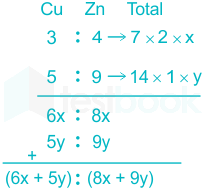
Shortcut Trick 

Now, 

⇒ (6x + 5y)/(8x + 9y) = 27/43

⇒ 258x + 215y = 216x + 243y

⇒ 258x - 216x = 243y - 215y

⇒ 42x = 28y

⇒ x : y = 2 : 3

∴ A and B alloys are taken in the ratio of 2 : 3.


Alternate Method 

Given:

Ratio of copper and zinc in alloy A = 3 : 4

Ratio of copper and zinc in alloy B = 5 : 9

Alloy C has copper and zinc in 27 : 43

Calculations:

Let copper and zinc in alloy A be 3x/7 and 4x/7

Let copper and zinc in alloy B be 5y/14 and 9y/14

Now according to the question,

⇒ 3x7+5y144x7+9y14=2743\frac{\frac{3x}{7}+\frac{5y}{14}}{\frac{4x}{7} + \frac{9y}{14}} =\frac{27}{43}

⇒ 6x+5y148x+9y14=2743\frac{\frac{6x + 5y}{14}}{\frac{8x + 9y}{14}} =\frac{27}{43}

⇒ (6x + 5y)/(8x + 9y) = 27/43

⇒ 43(6x + 5y) = 27(8x + 9y)

⇒ 258x + 215y = 216x + 243y

⇒ 258x - 216x = 243y - 215y

⇒ 42x = 28y

⇒ x : y = 2 : 3

∴ A and B alloys are taken in the ratio of 2 : 3.

44

The break-up (degree wise) of the total number of employees of a company working in five offices, A, B, C, D and E, in a city, in 2020 is shown in the following pie graph.

Total Number of Employees = 3400

The ratio of the number of male and female employees working in office A is 5 ∶ 6 and 50% of the employees in office E are females. Let a be the ratio of the number of male employees in A to that of the female employees in E and b be the ratio of the number of male employees in E to that of the female employees in A. What is the ratio a ∶ b?

  1. ((a))

    15 ∶ 22

  2. ((b))

    27 ∶ 10

  3. ((c))

    40 ∶ 27

  4. ((d))

    10 ∶ 19

Show Answer
Answer: ((c))

40 ∶ 27

Calculation:

Number of employees in office A = (79.2/360) × 3400

⇒ 748

Number of males in office A = 748 × (5/11)

⇒ 340

Number of females in office A = 748 × (6/11) 

⇒ 408

Now, Number of employees in office E = 612

Number of males in office E = 612 ÷ 2 = 306

Number of females in office E = 612 ÷ 2 = 306

Now, According to the question

The value of a = Male emp. of A/ Female emp. of E

⇒ a = 340/306 

And, The value of B = Male emp. of E/ Female emp. of A

⇒ b = 306/408

Now, We have to find a : b

So, a : b = 340/306 :  306/408

⇒ a : b = 340/306 × 408/306

⇒ a : b = 40 ∶ 27

∴ The required ratio is 40 ∶ 27.

45

The base of a right prism is a trapezium whose parallel sides are 11 cm and 15 cm and the distance between them is 9 cm. If the volume of the prism is 1614.6 cm3, then the height (in cm) of the prism is:

  1. ((a))

    13.8

  2. ((b))

    12.6

  3. ((c))

    14.2

  4. ((d))

    15.5

Show Answer
Answer: ((a))

13.8

Given :

Base of the prism is trapezium

parallel sides of trapezium are 11 cm and 15 cm

Height of the trapezium = 9 cm

Volume of the prism = 1614.6 cm3

Formula used :

Area of trapezium = (1/2) × (sum of parallel sides) × height        ------ (1)

Volume of prism = Area of the base × height         ----- (2)

Calculations :

Using equation (1), we get

Area of trapezium = (1/2) × (11 + 15) × 9

⇒ (1/2) × 26 × 9

⇒ 13 × 9 

⇒ 117 cm2

Using equation (2)

Let h be the height of the prism

⇒ Volume of prism with base as trapezium =  Base area of trapezium × height

⇒ 1614.6 = 117 × h

⇒ h = 1614.6/117

⇒ h = 13.8 cm

∴ The height (in cm) of the prism is 13.8 cm.

46

Four men and 5 women can complete a work in 15 days, whereas 9 men and 6 women can complete it in 10 days. To complete the same work in 7 days, how many men should assist 13 women?

  1. ((a))

    5

  2. ((b))

    6

  3. ((c))

    4

  4. ((d))

    8

Show Answer
Answer: ((c))

4

Given :

4 men and 5 women can complete a work in 15 days

9 men and 6 women can complete it in 10 days

Calculations :

Using the concept

Total work = Efficiency × Time

⇒ (4m + 5w) × 15 = (9m + 6w) × 10

⇒ 60m + 75w = 90m + 60w

⇒ 30m = 15w

⇒ m : w = 1 : 2

Total work = (4m + 5w) × 15

⇒ [4 + 5(2)] × 15

⇒ (4 + 10) × 15

⇒ 14 × 15

⇒ 210

Let y be the men assist 13 women in 7 days

So, (y + 13 × 2) × 7 = 210

⇒ (y + 26) = 30

⇒ y = 4

∴ The number of men should assist 13 women is 4.

47

A field roller, in the shape of a cylinder, has a diameter of 1 m and length of 114\frac{1}{4} m. If the speed at which the roller rolls is 15 revolutions per minute, the maximum area (in m2) that it can roll in 1 hour is:

(Take π = 227\frac{{22}}{7}) (nearest to an integer)

  1. ((a))

    3365

  2. ((b))

    3536

  3. ((c))

    3563

  4. ((d))

    3356

Show Answer
Answer: ((b))

3536

Shortcut Trick

Total Area = (Revolutions per minute × Minutes) × (π × diameter × length)

⇒ Area = (15 × 60) × (22/7 × 1 × 1.25)

⇒ Area = 900 × (27.5 / 7)

⇒ Area = 24750 / 7 ≈ 3535.71

⇒ Rounding to the nearest integer, we get 3536.

∴ The correct answer is 3536 m2.

Alternate Method

Given:

Diameter of the roller (d) = 1 m

Length of the roller (h) = 1(1/4) m = 1.25 m

Speed of rolling = 15 revolutions/minute

Time = 1 hour = 60 minutes

Formula Used:

Curved Surface Area (CSA) of a cylinder = π × d × h

Total Area = Total Revolutions × CSA

Calculation:

⇒ Total revolutions in 60 minutes = 15 × 60 = 900

⇒ Area covered in 1 revolution = π × 1 × 1.25

⇒ Area covered in 1 revolution = (22/7) × 1.25 = 27.5 / 7 m2

⇒ Total area rolled in 1 hour = 900 × (27.5 / 7)

⇒ Total area = 24750 / 7 m2

⇒ Total area ≈ 3535.71 m2

⇒ Rounding to the nearest integer, we get 3536 m2.

∴ The correct answer is 3536 m2.

Additional Information

Curved Surface Area of a Cylinder

The lateral or curved surface area is the area of the sides of the cylinder excluding the circular top and bottom. Formula: CSA = 2πrh or πdh.

Total Surface Area of a Cylinder

It includes the curved surface area plus the area of the two circular bases. Formula: TSA = 2πr(h + r).

Concept of Rolling Distance

When a cylindrical roller completes exactly one full revolution, it covers an area on the ground exactly equal to its curved surface area.

48

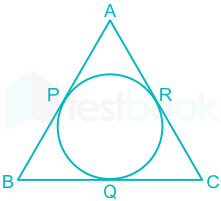
A circle is inscribed in ΔABC, touching AB, BC and AC at the points P, Q and R, respectively. If AB - BC = 4 cm, AB - AC = 2 cm and the perimeter of ΔABC = 36 cm, then PB + AR (in cm) is:

  1. ((a))

    12

  2. ((b))

    10

  3. ((c))

    15

  4. ((d))

    14

Show Answer
Answer: ((d))

14

Given :

AB - BC = 4 cm       ----- (1)

AB - AC = 2 cm       ----- (2)

Perimeter of ΔABC = AB + BC + AC = 36 cm      ----- (3)

Calculations :

Adding the given equation (1), (2) and (3)

⇒ 3AB = 36 + 4 + 2

⇒ 3AB = 42

⇒ AB = 14 cm

⇒ AB = AP + PB

AP = AR (equal tangents)

⇒ AB = AR + PB

⇒ 14 = AR + PB

∴ The value of PB + AR (in cm) is 14.

49

A boat can go 5 km upstream and 4 km downstream in 36 minutes. It can also go 10 km downstream and 8 km upstream in 63 minutes. What is the ratio of the speed of the boat in still water to the speed of the current?

  1. ((a))

    3 ∶ 5

  2. ((b))

    1 ∶ 5

  3. ((c))

    5 ∶ 3

  4. ((d))

    5 ∶ 1

Show Answer
Answer: ((c))

5 ∶ 3

Given :

A boat can go 5 km upstream and 4 km downstream in 36 minutes

Same boat goes 10 km downstream and 8 km upstream in 63 minutes

Concept used :

Speed = Distance/Time

Upstream speed = (speed of boat in still water) - (speed of flow of stream)       ---- (1)

Downstream speed = (speed of boat in still water) + (speed of flow of stream)       ----- (2)

Calculations :

Let the speed of boat in still water be x

Speed of flow of stream be y

Let the downstream and upstream speed be v and u

⇒ 5/u + 4/v = 36/60       ---- (3)

⇒ 8/u + 10/v = 63/60        ----- (4)

Multiply equation (2) with 8 and equation (3) with 5

⇒ 40/u + 32/v = 48/10        ----- (5)

⇒ 40/u + 50/v = 105/20        ----- (6)

Subtract equation (3) from equation (4), we get

⇒ 50/v - 32/v = 105/20 - 48/10

⇒ 18/v = 9/20

⇒ v = 40

Putting value of v in equation (3)

⇒ 5/u + 1/10 = 6/10

⇒ 5/u = 6/10 - 1/10

⇒ 5/u = 5/10

⇒ u = 10

Using equation (1) and (2), we get

⇒ x + y = 40

⇒ x - y = 10

⇒ x = 25 and y = 15

Speed of water in still water : speed of stream = 25 : 15 

⇒ 5 : 3

∴ The ratio of the speed of the boat in still water to the speed of the current is 5 : 3

50

An aggregate of 36% of the total marks is required to pass an examination and 84% to get a First Class with distinction. A student scored 398 marks and failed by 16 marks. How many marks should the student secure to get a First Class with distinction?

  1. ((a))

    976

  2. ((b))

    986

  3. ((c))

    966

  4. ((d))

    956

Show Answer
Answer: ((c))

966

Given :

Total percentage marks required to pass an exam is 36%

84% required to get first distinction.

Student scored 398 marks and failed by 16 marks.

Calculations :

Passing marks required for the examination = (398 + 16)

⇒ 36% of total marks = 414

⇒ (36/100) × Total marks = 414

⇒ Total marks = 11.5 × 100

⇒ 1150

84% of total marks required to get first class with distinction

⇒ 84% of 1150

⇒ (84/100) × 1150

⇒ 42 × 23

⇒ 966

∴ The marks should the student secure to get a First Class with distinction is 966.

Science (25 questions)

51

Identify the FALSE statement about the circulatory system.

  1. ((a))

    Only RBCs transport carbon dioxide between tissues and lungs

  2. ((b))

    The pressure of blood in the circulatory system increases and decreases several times every minute.

  3. ((c))

    The heart is a muscular organ with striations in the muscle fibres.

  4. ((d))

    Plasma transports nitrogenous wastes from the body to the kidneys.

Show Answer
Answer: ((a))

Only RBCs transport carbon dioxide between tissues and lungs

The correct answer is Only RBCs transport carbon dioxide between tissues and lungs.

Concept:

Human circulatory system: 

  • It is also called the blood vascular system.
  • It consists of a muscular chambered heart, a network of closed branching blood vessels, and blood, the fluid which is circulated.

Explanation:

  • Only RBCs transport carbon dioxide between tissues and lungs: False
  • Reason: 20-25% of CO2 is transported by RBC, 70% as bicarbonate, and the rest 7% in the dissolved state by blood plasma.
  • The pressure of blood in the circulatory system increases and decreases several times every minute: True
  • The heart is a muscular organ with striations in the muscle fibres: True
  • Reason: The heart is a muscular organ made up of cardiac muscles which have a striated appearance i.e., alternate light and dark bands.
  • Plasma transports nitrogenous wastes from the body to the kidneys: True
52

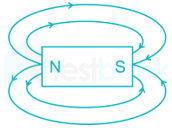
Consider the following statements about a magnetic field.

(i) A magnetic field has both magnitude and direction.

(ii) The direction of magnetic field lines inside a bar magnet is from its south pole to its north pole.

(iii) Magnetic field lines are closed curves.

Select the correct option.

  1. ((a))

    Only (i) is correct

  2. ((b))

    (i), (ii) and (iii) all are correct

  3. ((c))

    (ii) and (iii) are correct

  4. ((d))

    (i) and (iii) are correct

Show Answer
Answer: ((b))

(i), (ii) and (iii) all are correct

The correct answer is (i), (ii) and (iii) all are correct

Concept:

Magnetic field:

  • The area around a magnet where a magnetic force is experienced is called the magnetic field.
  • It is a quantity that has both direction and magnitude, (i.e., Vector quantity).

Explanation:

  • A magnetic field has both magnitude and direction: Correct 
  • Reason: It is a vector quantity.
  • The direction of magnetic field lines inside a bar magnet is from its south pole to its north pole. Correct
  • Magnetic field lines are closed curves. Correct 
  • Outside the magnet, the direction of the magnetic field line is taken from the North pole to the South Pole.
  • Inside the magnet, the direction of the magnetic field line is taken from the South pole to the North pole.
  • Therefore, magnetic field lines are closed curves.

53

Aqueous solution of which of the following will have pH 7?

  1. ((a))

    Magnesium sulphate

  2. ((b))

    Sodium chloride

  3. ((c))

    Potassium carbonate

  4. ((d))

    Ammonium nitrate

Show Answer
Answer: ((b))

Sodium chloride

The correct answer is Sodium chloride.

Concept:

Acid:

  • It is sour in taste.
  • It turns the blue litmus color into red.
  • It has a pH value of less than 7.
  • It is represented by a value less than 7 on the pH scale.

Base:

  • It is bitter in taste and slippery to touch.
  • It turns red litmus color into the blue.
  • It is represented by a value greater than 7 on the pH scale.

Explanation:

pH scale:

  • A scale developed to measure the concentration of hydrogen ions in a solution is known as the pH scale where p in pH implies ‘potenz’ in German.
  • pH scale ranges from 0 (highly acidic) to 14 (highly alkaline).
  • The pH of a neutral solution is 7.

pH values of the aqueous solution of given compounds:

CompoundpH valueAcidic/ basic/ neutral
Magnesium sulphate10.5Basic
Sodium chloride7Neutral
Potassium carbonate11.5Basic
Ammonium nitrate5.43Acidic

The aqueous solution of Sodium chloride has pH 7.

54

What mass of chlorine gas must be taken to completely react with 10 g of hydrogen gas to produce hydrogen chloride gas?

  1. ((a))

    235 g

  2. ((b))

    150 g

  3. ((c))

    298 g

  4. ((d))

    355 g

Show Answer
Answer: ((d))

355 g

The correct answer is 355g.

Concept:

Chemical reaction: 

Molecular mass:

  • The molecular mass of a substance is defined as the sum of the atomic masses of all the atoms present in a molecule of a substance.
  • Therefore, the relative mass of a molecule is expressed as atomic mass units (amu). It can be expressed in grams as well.

Explanation

Molecular mass of H2 = 2 × 1 = 2g 

Molecular mass of Cl2 = 2 × 35.5 = 71g

The balanced chemical equation for the reaction between hydrogen and chlorine gas is as follows:

H2   +    Cl2     =   2HCl

2g        71g         

2g of Hreacts with  Cl2 = 71g

1g of Hwill react with  Cl2 = 71/2 g 

10g of H2 will react with  Cl2 = 71 × 10 / 2 = 71 × 5 = 355g

So, 355g of chlorine gas must be taken to completely react with 10 g of hydrogen gas to produce hydrogen chloride gas.

55

What is the contribution of Theodore Schwann and Matthias Schleiden to Biology?

  1. ((a))

    They described the process of cell division.

  2. ((b))

    They stated that every living being is composed of cells.

  3. ((c))

    They observed cells in animal tissues.

  4. ((d))

    They developed electron microscopy to observe organelles.

Show Answer
Answer: ((b))

They stated that every living being is composed of cells.

The correct answer is they stated that every living being is composed of cells.

Concept:

Cell theory**:**

  • All living organisms are composed of cells and products of cells.
  • All cells arise from pre-existing cells.

Explanation:

Matthias Schleiden:

  • He is a German botanist who in 1838, examined a large number of plants.
  • He observed that all plants are composed of different kinds of cells which form the tissues of the plant.

Theodore Schwann:

  • He was a British Zoologist who in 1839, studied different types of animal cells.
  • On the basis of this, Schwann proposed the hypothesis that the bodies of animals and plants are composed of cells and products of cells.

Schleiden and Schwann together formulated the cell theory and stated that every living being is composed of cells.

Additional Information

Rudolf Virchow:

  • In 1855, he first explained that cells divided and new cells are formed from pre-existing cells (Omnis cellula-e cellula).
  • He modified the hypothesis of Schleiden and Schwann and added the statement that all cells arise from pre-existing cells.
56

Various gases present in air are oxygen, nitrogen, argon and neon. The boiling points of these gases are –183, –196, –186 and –246 degrees Celsius, respectively. These gases are separated from each other by the process of fractional distillation. Which of the following statements about the order in which these gases get separated is correct?

  1. ((a))

    Neon gas will separate out first and oxygen gas in the end.

  2. ((b))

    Neon will liquefy first and oxygen in the end.

  3. ((c))

    Oxygen gas will separate out first and nitrogen gas in the end.

  4. ((d))

    Oxygen will liquefy first and neon in the end.

Show Answer
Answer: ((d))

Oxygen will liquefy first and neon in the end.

The correct answer is Oxygen will liquefy first and neon in the end.

Concept:

Fractional distillation:

  • It is a process by which components in a chemical mixture are separated into different parts (called fractions) according to their boiling points.
  • It is used to purify chemicals and separate mixtures to obtain their components.

Explanation:

Separation of gases by Fractional distillation:

  • Each gas has a characteristic boiling point, defined as the temperature at which it transforms from a liquid into a gas.
  • If we have a random sample of gases, we can separate them by gradually cooling the sample until each component gas liquifies.
  • The gas with a lower boiling point will liquify first and the one with the highest boiling point in the end.

Oxygen will liquefy first and neon in the end.

57

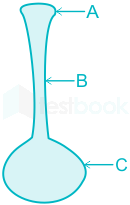
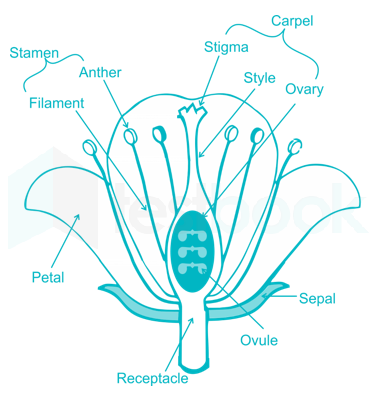
Select correct labels for the given figure.

  1. ((a))

    A - Stigma; B - Style; C - Ovary

  2. ((b))

    A - Stigma; B - Filament; C - Ovary

  3. ((c))

    A - Style; B - Stigma; C - Ovule

  4. ((d))

    A - Style; B - Filament; C - Ovary

Show Answer
Answer: ((a))

A - Stigma; B - Style; C - Ovary

The correct answer is A - Stigma; B - Style; C - Ovary.

Concept:

Flower:

  • A flower can be defined as a specialized structure that bears reproductive organs and takes part in the process of reproduction.
  • It is involved in the formation of fruits and seeds.

Structure of flower:

  • Each flower is supported by a stalk called a pedicle.
  • This stalk leads to a broad basal region of the flower. This part is called the thalamus. Also called the receptacle.
  • A typical flower has four main parts—or whorls—known as the sepals, petals, pistils, and stamens.

Explanation:

Pistil (Carpel):

  • It is the female reproductive part of a flower.
  • It consists of three parts- Stigma, style, and ovary.

Parts of Pistil:

Stigma: The uppermost sticky end of pistil on which pollen grains land.

Style: The long tube between style and ovary through which pollen tube passes on germination. 

Ovary: The swollen base of the ovary which contains ovules.

58

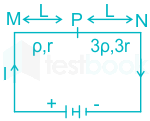
A cylindrical wire MN consists of two equal parts MP and PN. Parts MP and PN are made of material of resistivity ρ and 3ρ and have different radii r and 3r, respectively. A battery is connected across the wire. Let V1 and V2 be the potential differences across MP and PN, respectively. Then (V1 / V2 ) is:

  1. ((a))

    6

  2. ((b))

    3

  3. ((c))

    16\frac{1}{6}

  4. ((d))

    13\frac{1}{3}

Show Answer
Answer: ((b))

3

The correct answer is 3.

Concept:

Resistance:

  • It is the opposition offered to the current passing through a conductor.
  • It is measured in Ohms (Ω).
  • R=ρLA=ρLπr2R = \frac{ρ L}{A} = \frac{ρ L}{π r^2}

Explanation:

The wire MN is divided into 2 equal halves MP and PN.

So, MP = PN = L 

For Wire MP

Length = L, Resisitivity = ρ , and Radius = r

R1 =ρLA=ρLπr2 = \frac{ρ L}{A} = \frac{ρ L}{π r^2}

For wire PN

Length = L, Resisitivity = 3 ρ , and Radius = 3 r

R2 = ρLA=3ρLπ(3r)2=3ρL9πr2\frac{ρ L}{A}= \frac{3ρ L}{π (3r)^2}= \frac{3ρ L}{9π r^2}

Wire MP and PN are in series.

The amount of current remains the same in series connections across the resistors.

Let us assume that current 'I' is passing through the circuit.

Now, V = IR 

V1 = I R1 = I ρ L / π r2

V2 = I R2 = I 3ρ L / 9πr2

 V1/ V2 = IρLπr2\frac{I\rho L}{\pi r^2} / I3ρL9πr2\frac{I3\rho L}{9\pi r^2} = IρLπr2\frac{I\rho L}{\pi r^2} × 9πr2I3ρL\frac{9\pi r^2}{I3\rho L} = 3 

V1/V2 = 3.

59

An object is placed on the principal axis of a convex lens at a point between F1 and 2 F1 (F1 is the principal focus to the left of the lens). The image formed is:

  1. ((a))

    erect and diminished

  2. ((b))

    inverted and enlarged

  3. ((c))

    erect and enlarged

  4. ((d))

    inverted and diminished

Show Answer
Answer: ((b))

inverted and enlarged

The correct answer is inverted and enlarged.

Concept:

Convex lens:

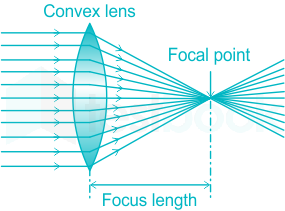
  • A convex lens is thicker at the center than at the edges.
  • It is called a converging lens because the rays of light that pass through it are brought closer together (they converge).
  • When parallel rays of light pass through a convex lens the refracted rays converge at one point called the principal focus.
  • The distance between the principal focus and the center of the lens is called the focal length.
  • A double convex lens has two foci F1 and F2 and two centers of curvature 2F1 and 2F2.

Explanation:

When the object is between F1 and 2F1:

An enlarged, real and inverted image is formed beyond the center of curvature, 2F2 when an object is placed between the center of curvature, 2F1, and principal focus, F1 of a convex lens.

Additional Information All six cases of image formation by the convex lens:

Object positionImage positionNature of imageSize of image
At infinityAt F2Real and invertedPoint sized
Beyond 2F1Between F2 and 2F2Real and invertedDiminished
At 2F1At 2F1Real and invertedSame size
Between F1 and 2F1Beyond 2F2Real and invertedMagnified
At F1At infinityReal and invertedHighly magnified
Between F1 and Oon the same side of the objectVirtual and erectMagnified
60

Which of the following will be formed, when zinc metal is reacted with hydrochloric acid?

  1. ((a))

    Zinc chloride and chlorine gas

  2. ((b))

    Zinc chloride and water

  3. ((c))

    Zinc hydroxide and chlorine gas

  4. ((d))

    Zinc chloride and hydrogen gas

Show Answer
Answer: ((d))

Zinc chloride and hydrogen gas

The correct answer is Zinc chloride and hydrogen gas.

Concept:

Chemical reaction:

  • In a chemical reaction, a new substance is formed which is completely different in properties from the original substance.
  • So, in a chemical reaction, a chemical change takes place.
  • There is a rearrangement of atoms of the compounds taking part in the chemical reaction.
  • The substances which take part in a chemical reaction are called reactants.
  • The new substances produced as a result of a chemical reaction are called products.

Explanation:

Chemical reaction between Zn and HCl:

Zinc re­acts with HCl, re­leas­ing small bub­bles of hy­dro­gen and form­ing zinc chlo­ride Zn­Cl₂.

Zn + HCl → Zn­Cl₂ + H₂↑

61

Which of the following statements about biogas is FALSE?

  1. ((a))

    It can be stored in suitable containers.

  2. ((b))

    It is not a renewable resource.

  3. ((c))

    It burns without emitting smoke.

  4. ((d))

    It has a high heating capacity.

Show Answer
Answer: ((b))

It is not a renewable resource.

The correct answer is that It is not a renewable resource.

Concept:

Renewable Resources: 

  • These resources are abundant in nature and will not exhaust.
  • These resources can be renewed easily or in a short period of time.

Explanation:

Bio-gas: 

  • It is a mixture of gases produced by the anaerobic decomposition of organic matter such as agricultural waste, plant residue, municipal waste, food waste, etc.
  • It comprises methane, carbon dioxide and a small amount of hydrogen sulfide, and moisture.
  • It is produced in biogas plants with the help of methanogens (methane-producing anaerobic bacteria).

Properties of Biogas:

  • It is a renewable source of energy.
  • It has a high heating capacity.
  • It mainly consists of methane that burns without emitting smoke.
  • It can be stored in suitable containers.
62

Which of the following is a biodegradable item?

  1. ((a))

    Food waste

  2. ((b))

    Nylon

  3. ((c))

    Glass

  4. ((d))

    Battery

Show Answer
Answer: ((a))

Food waste

The correct answer is Food waste.

Concept:

Waste materials: 

  • Waste materials are either liquid or solid in form, and their components may be either hazardous or inert in their effects on health and the environment.
  • The term waste is typically applied to solid waste, sewage (wastewater), hazardous waste, and electronic waste.

Explanation:

Biodegradable waste: 

  • Those substances that can be decomposed by the action of decomposers like bacteria and fungi are called biodegradable wastes.
  • For example: organic matter like human excreta, animal waste, dead bodies of plants and animals, leftover food items etc.

​Non-biodegradable waste:

  • Those substances that can not be decomposed by the action of decomposers like bacteria and fungi are called non- biodegradable wastes.
  • For example: plastic, rubber, glass, artificial clothes like nylon, rayon, electronic waste like batteries, etc.
63

Two lenses L1 and L2 of powers, 25 D and  - 25 D respectively, separated by 18 cm are arranged parallel to each other in vertical planes. An object is placed 12 cm left to L1 vertically on the common axis of the lenses. The distance between the original object and the final image is:

  1. ((a))

    24 cm

  2. ((b))

    33 cm

  3. ((c))

    27 cm

  4. ((d))

    36 cm

Show Answer
Answer: ((c))

27 cm

The correct answer is 1.08 m.

Concept:

  • Lens: The transparent curved surface which is used to refract the light and make an image of any object placed in front of it is called a lens.
  • The lens whose refracting surface is upside is called a convex lens and the lens whose refracting surface is inside is called a concave lens or diverging lens.
  • The convex lens is also called a converging lens.

When two or more lenses are in contact with each other then, the equivalent focal length is given by:

1F=1f1+1f2\frac{1}{F} = \frac{1}{{{f_1}}} + \frac{1}{{{f_2}}}

Where f1 and f2 are focal lengths of the two lenses

  • Power is the ability to bend light and it is equal to the reciprocal of the focal length of the lens/mirror in meters.

Power (P) = 1/f

Where f is the focal length of the lens/mirror.

  • The unit of power of a lens is Dioptre when the focal length of the lens is taken in meter (m).
  • The focal length of the concave lens is negative and hence its power is also negative.
  • The focal length of the convex lens is positive and hence its power is also positive.

Lens formula: 1f=1v1u\frac{1}{f}=\frac{1}{v}-\frac{1}{u}  where f is focal length, v is image distance and u is object distance.

Power of lens: It is the reciprocal of the focal length of the lens.

P=1fP=\frac{1}{f} where f is the focal length in meters. 

P = 100f\frac{100}{f} where f is the focal length in centimeters.

Explanation:

For convex lens

Power = 1f\frac{1}{f}

f = 1p\frac{1}{p} = 10025\frac{100}{25} = 4 cm

Given: Object distance, u = -12 cm, Focal length, f = 4 cm

 v=?

1f=1v1u\frac{1}{f}=\frac{1}{v}-\frac{1}{u}

14=1v112\frac{1}{4} = \frac{1}{v} - \frac{1}{-12}

14=1v+112\frac{1}{4} = \frac{1}{v} + \frac{1}{12}

14112=1v\frac{1}{4} - \frac{1}{12} = \frac{1}{v}

1v=3112\frac{1}{v} = \frac{3-1}{12}

1v=212\frac{1}{v} = \frac{2}{12}

v = 6 cm

For concave lens

f = 1p\frac{1}{p} = 10025\frac{100}{-25} = -4 cm

Object distance, u = -18-(-6)= -18 + 6 = -12 cm, focal length, f = -4cm

v = ?

1f=1v1u\frac{1}{f}=\frac{1}{v}-\frac{1}{u}

14=1v112\frac{1}{-4} = \frac{1}{v} - \frac{1}{-12}

14=1v+112\frac{1}{-4} = \frac{1}{v} + \frac{1}{12}

14112=1v\frac{1}{-4} - \frac{1}{12} = \frac{1}{v}

1v=3112=412=13\frac{1}{v} = \frac{-3-1}{12} = \frac{-4}{12} = \frac{-1}{3}

v= -3 cm 

Distance between original object and final image = 12 + (18-3) = 12 + 15 = 27 cm

64

A cylindrical metal wire is reformed so that its length decreases by 40% with no change of volume. Its resistance decreases by:

  1. ((a))

    64%

  2. ((b))

    96%

  3. ((c))

    80%

  4. ((d))

    48%

Show Answer
Answer: ((a))

64%

The correct answer is 64%.

Concept:

Resistance (R): 

  • Resistance is a measure of the opposition to current flow in an electrical circuit.
  • It is measured in ohms, symbolized by the Greek letter omega (Ω).
  • R=ρlAR = \frac{ρ l}{A} where ρ is resistivity, l is length, and A is the area of the cross-section of the wire.

 Explanation: 

Suppose original length = L, Area of cross-section = A, radius of wire = r and Resistance = R

Since the wire is the same, the resistivity ρ will be the same.

After the decrease in length, let us take new length = L', radius of wire = r' and new resistance = R'

L' = 60 L/ 100 ( since there is 40% decrease)

The volume of the wire remains the same ( given).

So, Volume of Original Wire = volume of new wire 

π r2 L = π r ' 2 L'

r2L = r' 2 L'

r' 2 = r2 L /  L'

r' 2 = 100 r2 L / 60 L

r' 2 = 100 r2  / 60 

Decrease in resistance = RRR×100\frac{R-R'}{R} × 100

ρLAρLAρLA×100\frac{\frac{\rho L}{A} -\frac{\rho L'}{A'}}{\frac{\rho L}A} × 100

65

Why should we avoid use of plastics wherever possible?

  1. ((a))

    Because plastics are not strong or durable

  2. ((b))

    Because enzymes cannot breakdown plastics

  3. ((c))

    Because plastics are toxic to our health

  4. ((d))

    Because plastics are expensive to purchase

Show Answer
Answer: ((b))

Because enzymes cannot breakdown plastics

The correct answer is Because enzymes cannot break down plastics.

Concept:

Non-biodegradable waste: 

  • These substances cannot be decomposed by the decomposers like bacteria and fungi into simpler forms.
  • For example, rubber, plastic, electronic waste, etc.

Explanation:

Plastic as a boon:

  • It is lightweight and simple to shape.
  • It is inexpensive.
  • Plastic is strong and tough, and durable.
  • It is used to make many daily usable products like buckets, bottles, pencil boxes, pipes, etc.
  • It is corrosion and chemical resistant.
  • It is water-resistant and has adhesive properties.
  • It is a poor conductor of heat and electricity.
  • It is waterproof and airtight and is used to store several food items.

Plastic as a curse:

  • It is non-biodegradable. There is no enzyme that can break down plastics.
  • Plastics are non-renewable resources.
  • They are toxic and produce toxic fumes when burnt.
  • They are responsible for choking the drains.
  • Recycling plastic is hard and very expensive.
  • Some animals and birds in search of food consume some amounts of plastic, and many of them end up choking.
66

Which of the following solutions will conduct electricity?

(i) Aqueous solution of glucose

(ii) Aqueous solution of acetone

(iii) Aqueous solution of acetic acid

(iv) Aqueous solution of milk of magnesia

  1. ((a))

    (iii) and (iv)

  2. ((b))

    (i) and (iii)

  3. ((c))

    (ii) and (iv)

  4. ((d))

    (ii) and (iii)

Show Answer
Answer: ((a))

(iii) and (iv)

The correct answer is statements (iii) and (iv).

Concept:

Conductivity in aqueous solutions:

  • It is a measure of the ability of water to conduct an electric current.
  • The more ions there are in the solution, the higher its conductivity.

Electrolyte:

  • Electrolytes are salts or molecules that ionize completely in solution. As a result, electrolyte solutions readily conduct electricity.
  • A strong electrolyte is one where many ions are present in the solution and a weak electrolyte is one where few ions are present.

Non-electrolytes:

  • They do not dissociate into ions in solution.
  • Therefore, they do not conduct electricity.

Explanation:

Aq. sol. of glucoseNon-electrolytedo not conduct electricity
Aq. sol. of acetoneNon-electrolytedo not conduct electricity
Aq. sol. of acetic acidElectrolyteconduct electricity
Aq. sol. of milk of magnesiaElectrolyteconduct electricity
67

An object 3.0 cm in height is placed at a distance of 6.0 cm in front of a convex mirror of focal length 12 cm on its principal axis. Following New Cartesian Sign Convention, the image is formed at v = _____ and its height h= _____.

  1. ((a))

    12 cm; 6.0 cm

  2. ((b))

    4.0 cm; -2.0 cm

  3. ((c))

    4.0 cm; 2.0 cm

  4. ((d))

    12 cm; -6.0 cm

Show Answer
Answer: ((c))

4.0 cm; 2.0 cm

The correct answer is 4.0 cm; 2.0 cm.

Concept:

Convex mirror: 

  • The mirror in which the rays diverge after falling on it is known as the convex mirror.
  • Convex mirrors are also known as diverging mirrors.
  • The focal length of a convex mirror is positive according to the sign convention.

Mirror formula = 1f=1v+1u\frac{1}{f} = \frac{1}{v} + \frac{1}{u} 

where v = image distance, u = object distance and f = focal length.

Magnification (m) = height of image / height of object = hi / ho 

Also, m = -v/ u 

So, m = hiho=vu\frac{hi}{ho} = \frac{-v}{u}

Cartesian Sign Convention for Spherical Mirror:

  • All signs are taken from the Pole of the spherical mirror, which is often called the origin or origin point.
  • The sign is taken as – (negative) on the left side of the pole.
  • So, the object distance is always taken as – (negative) in the case of both types of spherical mirrors, i.e. concave and convex mirrors.
  • The sign is taken as + (positive) on the right side of the pole.
  • The height is taken as + (positive) above the principal axis and taken as – (negative) below the principal axis.

​Explanation:

Given: Object distance, u = -6 cm, focal length, f = 12 cm, height of object, ho = 3 cm

1f=1v+1u\frac{1}{f} = \frac{1}{v} + \frac{1}{u} = 1v+16\frac{1}{v} + \frac{1}{-6}

112=1v16\frac{1}{12} = \frac{1}{v} - \frac{1}{6}

1v=112+16\frac{1}{v} = \frac{1}{12} + \frac{1}{6}

1v=1+212\frac{1}{v} = \frac{1+2}{12}

1v=312\frac{1}{v} = \frac{3}{12}

1v=14\frac{1}{v} = \frac{1}{4}

v = 4 cm

m = hiho=vu\frac{hi}{ho} = \frac{-v}{u}

hi3=46=23\frac{hi}{3} = \frac{-4}{-6} = \frac{2}{3}

hi=23×3=2hi = \frac{2}{3} × 3= 2 cm

The image is formed at v = 4.0 cm and its height hI = 2.0 cm.

68

Which of the following methods can be used to separate acetone and water from their mixture?

  1. ((a))

    Chromatography

  2. ((b))

    Fractional distillation

  3. ((c))

    Distillation

  4. ((d))

    By using a separating funnel

Show Answer
Answer: ((c))

Distillation

The correct answer is distillation.

Concept:

Mixture:

  • A mixture is a substance that consists of two or more elements or compounds not chemically combined together.
  • For example, a mixture of salt and sand.

Separation of mixtures:

  • The constituents of mixtures have different physical properties such as density, size of particles, solubility, etc.
  • These differences are used to separate the constituents of the mixtures.

Explanation:

Distillation:

  • It is used to separate two or more miscible liquids that have a large difference between their boiling points.
CompoundBoiling point
Acetone56 ° C
Water100 ° C

So, for separating acetone and water, distillation can be used.

Additional Information

Separating funnel: It is used to separate a mixture of two immiscible liquids, like oil and water using a separating funnel.

Chromatography:  This method is used to separate two or more dissolved solids which are present in a solution in very small quantities.

Fractional distillation: It is used to separate two or more miscible liquids that have small differences between their boiling points.

69

Which of the following substances will react with chlorine gas to form another substance which is soluble in water and its aqueous solution conducts electricity?

  1. ((a))

    Sulphur

  2. ((b))

    Silicon

  3. ((c))

    Graphite

  4. ((d))

    Magnesium

Show Answer
Answer: ((d))

Magnesium

The correct answer is Magnesium.

Concept:

Electrical conductivity: It is the measure of the ability of a substance to carry an electric current.

Chemical reaction:

  • In a chemical reaction, a new substance is formed which is completely different in properties from the original substance.
  • So, in a chemical reaction, a chemical change takes place.
  • There is a rearrangement of atoms of the compounds taking part in the chemical reaction.
  • The substances which take part in a chemical reaction are called reactants.
  • The new substances produced as a result of a chemical reaction are called products.

Explanation:

​Electrolyte:

  • Chemical compounds whose molecules ionize (separate) into positively and negatively charged ions in a solution are called electrolytes.
  • So, they can conduct electricity when dissolved in water ( aqueous solution) or in a molten state.

Non- electrolyte:

  • Chemical compounds that do not ionize when dissolved are non-electrolytes.
  • They are unable to conduct electricity.

The reaction of chlorine gas with Magnesium:

Mg + ClMgCl2

MgCl2 is an electrolyte, so it will dissociate into Mg2+ and Cl- ions when dissolved in water and will conduct electricity. 

70

Sodium metal can be obtained by which of the following processes and at which electrode?

  1. ((a))

    Electrolysis of molten sodium chloride; at cathode

  2. ((b))

    Electrolysis of aqueous solution of sodium chloride; at cathode

  3. ((c))

    Electrolysis of aqueous solution of sodium hydroxide; at anode

  4. ((d))

    Electrolysis of molten sodium oxide; at anode

Show Answer
Answer: ((a))

Electrolysis of molten sodium chloride; at cathode

The correct answer is Electrolysis of molten sodium chloride; at cathode.

Concept:

Electrolysis:

  • Electrolysis is the passage of a direct electric current through an ionic substance that is either molten or dissolved in a suitable solvent.
  • This results in chemical reactions at the electrodes and the separation of materials.
  • During electrolysis, positively charged ions move toward the cathode and negatively charged ions move towards the anode.

Explanation:

Electrolysis of Molten NaCl:

  • When sodium chloride is melted (above 801 °C), and an electric current is passed through the molten salt, then chemical reactions take place at the electrodes.
  • At cathode: Na+ + e- = Na
  • At anode: Cl- = 12\frac{1}{2}Cl2 + e-

Sodium metal can be obtained by electrolysis of molten sodium chloride; at the cathode.

Additional Information

Electrolysis of aqueous NaCl:

  • When an electric current is passed through concentrated sodium chloride solution, hydrogen gas forms at the negative electrode, chlorine gas forms at the positive electrode, and a solution of sodium hydroxide also form.
  • At cathode: 2H+(aq) + 2e- → H2(g)
  • At anode: 2Cl-(aq) → Cl2(g) + 2e-
  • Sodium ions Na+(aq) (from the dissolved sodium chloride) and hydroxide ions OH–(aq) (from the water) stay behind - they form sodium hydroxide solution, NaOH(aq).

71

Which of the following is the correct hierarchy of biological classification of plants?

  1. ((a))

    Kingdom - Order - Class - Genus - Species

  2. ((b))

    Class - Order - Division - Genus - Species

  3. ((c))

    Phylum - Division - Class - Family - Species

  4. ((d))

    Division - Class - Order - Family - Genus

Show Answer
Answer: ((d))

Division - Class - Order - Family - Genus

The correct answer is Division - Class - Order - Family - Genus.

Concept:

Classification of organisms: 

  • Biologists, such as Ernst Haeckel (1894), Robert Whittaker (1969), and Carl Woese (1977) have tried to classify all living organisms into broad categories, called kingdoms.
  • The classification Whittaker proposed has five kingdoms: Monera, Protista, Fungi, Plantae, and Animalia, and is widely used.
  • These groups are formed on the basis of their cell structure, mode, source of nutrition, and body organization.
  • Further classification is done by naming the sub-groups at various levels and forming a hierarchy.

Explanation:

Biological hierarchy:

  • It refers to the systemic organization of organisms into different levels.
  • It was given by Carolus Linnaeus.
  • It organizes living things in descending levels of complexity: kingdom, phylum, class, order, family, genus, and species.
  • Hierarchies are important to inform evolutionary biologists on the way living systems are organized throughout history and theorize how extinct animals function based on their positions on the hierarchy.
72

The refractive index of water and dense flint glass are 1.33 and 1.65, respectively. A ray of light travels from dense flint glass to water. The refractive index of water with respect to dense flint glass is _______ and the light ray bends _______ the normal in water.

  1. ((a))

    0.81; away from

  2. ((b))

    1.24; away from

  3. ((c))

    1.24; towards

  4. ((d))

    0.81; towards

Show Answer
Answer: ((a))

0.81; away from

The correct answer is 0.81; away from.

Concept:

  • Refraction of Light: The bending of the ray of light passing from one medium to the other medium is called refraction.

https://storage.googleapis.com/tb-img/production/20/05/F1_J.K_8.5.20_Pallavi_D3.png

Refractive Index (n):

  • \(n=\frac{sini}{sinr}\), where 'i' =  angle of incidence and 'r' = angle of refraction.
  • Also n=cvn=\frac cv, where c = speed of light in vacuum, and v = speed of light in a medium.

Explanation:​

Relative refractive index:

  • It refers to the refractive index of one material medium with respect to another one.
  • n21=n2n1n_{21}= \frac{n_{2}}{n_{1}}

Refractive index of water with respect to dense flint glass:

  • n = refractive index of water / refractive index of dense flint glass = 1.331.65\frac{1.33}{1.65} = 0.81
  • Greater the refractive index, the denser the medium. Thus, dense flint glass (1.65) is denser than water (1.33).
Denser to rarerrefracted ray moves away from normal
rarer to denserrefracted ray moves towards the normal

The refractive index of water with respect to dense flint glass is 0.81 and the light ray bends away from the normal in water.

73

How many neurons comprise the reflex arc from a touch receptor to a muscle?

  1. ((a))

    One

  2. ((b))

    Two

  3. ((c))

    Four

  4. ((d))

    Three

Show Answer
Answer: ((d))

Three

The correct answer is three.

Concept:

Reflex action: 

  • It is an extremely quick, automatic, sudden action in response to a stimulus.
  • For example-
  • Immediately pulling back of fingers after touching a hot plate.
  • Closing of eyes when flashed with a high-intensity light.
  • Salivation when hungry.

Explanation:

Reflex arc:

  • It is the pathway of nerves involved in a reflex action.
  • Reflex arc involves-
  • Receptors- The sense organ that receives the message from the external environment.
  • Sensory neuron- The neuron that carries the message from the receptor to the central nervous system.
  • Relay neurons- They are found in the brain and spinal cord and link sensory and motor neurons.
  • Motor neuron- The neuron that carries the message from the central nervous system to the effector.
  • Effector- The organ/body part that responds against the stimulus.

So, there are three neurons involved in the reflex arc namely, sensory, relay, and motor neuron.

74

'A geneticist is studying the simultaneous inheritance of two factors (or traits) represented by the two letters A and B. In the cross of AABB × aabb, it will be seen that ______'.

  1. ((a))

    the results depend on whether factors A and B lie on the same chromosome.

  2. ((b))

    we will note that it is experimentally not possible to conduct such a complicated experiment.

  3. ((c))

    the inheritance of one factor (A) will affect the inheritance of the other factor (B).

  4. ((d))

    a simple mathematical formula (9 : 3 : 3: 1) can be derived to predict the outcomes.

Show Answer
Answer: ((a))

the results depend on whether factors A and B lie on the same chromosome.

The correct answer is that the results depend on whether factors A and B lie on the same chromosome.

Concept:

Linkage: 

  • When two genes are present on the same chromosome, the proportion of parental gene combinations is much higher than the non-parental type.
  • This physical association of two genes is termed as linkage.

Explanation:

Inheritance of two genes: 

  • Mendel studied the inheritance of two genes in a dihybrid cross between round yellow and wrinkled green seeds.
  • Parental combinations: Round yellow, RRYY and wrinkled green, rryy.
  • Non- parental combinations: Round green and wrinkled yellow
  • In the first generation, all seeds were round yellow.
  • In the second generation, the progenies were in the ratio 9 round yellow :3 round green :3 wrinkled yellow:1 wrinkled green.
  • This dihybrid cross demonstrates the law of independent assortment i.e., the alleles of two (or more) different genes get sorted into gametes independently of one another.

Chromosomal theory of inheritance:

  • This theory was supported by Thomas Hunt Morgan.
  • He experimented on fruit flies (Drosophila melanogaster).
  • He made a cross between yellow-bodied white-eyed females and brown-bodied red-eyed males.
  • He observed that the two genes did not separate independently of each other and the ratio deviated from 9:3:3:1 significantly.
  • Morgan observed that the two genes were present on the same chromosome and are thus linked.

Thus, In the cross of AABB × aabb, it will be seen that the results depend on whether the factors A and B lie on the same chromosome.

75

Two resistors A (resistance r) and B (resistance 3r) are connected in parallel. This combination is connected in series to two other resistors C (resistance r) and D (resistance 3r) and a battery of EMF E of negligible internal resistance. Let PB and PD be the rate of energy dissipated in resistors B and D, respectively. Then the ratio (PD/P) is:

  1. ((a))

    8

  2. ((b))

    12

  3. ((c))

    16

  4. ((d))

    4

Show Answer
Answer: ((c))

16

The correct answer is 16.

Concept:

Resistance in series:

  • When resistors are connected end-to-end in a circuit, they are said to be in "series."
  • R = R1 + R2 + R3....
  • Current remains the same across all the resistors connected in series.

Resistance in parallel: 

  • When both ends of resistors are connected, they are said to be in parallel.
  • 1/R = 1/R1 + 1/R2 = 1/R3 ....1/Rn
  • The potential difference across all the resistors connected in parallel remains the same.

Electric Power:

  • The energy consumed per unit of time or the rate of doing work is called power.
  • Power = work done / time taken = Vq / t = VI = V2/R = I2R

Explanation:

Resistors A (r) and B (3r)  are in parallel. 

Equivalent resistance, 1/ R1 = 1/r + 1/3r = 1/R1 = (3+1) / 3r = 4/ 3r

R1 = 3r/ 4 Ω 

Now, resistors R1, C (r), and D (3r)  are in series connection.

So, their equivalent resistance, R2 = R1 + C + D = 3r/ 4 + r + 3r = 19r/4 Ω 

Current I = V/R = E19r4\frac{E}{\frac{19r}{4}} = 4E/19r 

Potential difference across resistor B, VB =  I R1  = 4E19r×3r4\frac{4E}{19r} × \frac{3r}{4} = 3E / 19

Energy dissipated by resistor B, PB = V2/ R = VB2 / B = 3E×3E19r×19r3r\frac{\frac{3E × 3E}{19r × 19r}}{3r} = 9E2361×3r\frac{9 E^2}{361 × 3r} = 3E2361×r\frac{3 E^2}{361 × r}

Energy dissipated by resistor D, PD = I2 R = I2 D = (4E19r)2×3r(\frac{4E}{19r})^2 × 3r  = 16E2361r2×3r\frac{16 E^2}{361r^2} × 3r = 16E2361r×3\frac{16 E^2}{361r} × 3

The ratio PD/ PB = 16E2361r×3\frac{16 E^2}{361r} × 3  / 3E2361×r\frac{3 E^2}{361 × r} = 3×16×E2×361r361r×3E2\frac{3 × 16 × E^2 × 361r}{361r × 3 E^2} = 16

Social Science (25 questions)

76

Which of the following is NOT a component of the Human Development Report?

  1. ((a))

    Life expectancy

  2. ((b))

    Sex ratio

  3. ((c))

    Education

  4. ((d))

    Per capita income

Show Answer
Answer: ((b))

Sex ratio

The correct answer is Sex ratio.

Key Points

  • In 1990, Human Development Report introduced a new approach for advancing human wellbeing.
  • The Human Capital Report estimates the Life expectancy, Education, and Per capita income of a country.
  • It is an annual Human Development Index report published by the Human Development Report Office of the United Nations Development Programme.
  • The Human Development Index is a static composite index of life expectancy, education and per capita income which are used to rank countries into four tiers of human development.

Thus, we can say that Sex ratio is not a component of the Human Development Report.

77

The theory proposed by Montesquieu was called _______.

  1. ((a))

    Theory of Division of Labour

  2. ((b))

    Social Contract Theory

  3. ((c))

    Theory of Popular Sovereignty

  4. ((d))

    Theory of Division of Power

Show Answer
Answer: ((d))

Theory of Division of Power

The correct answer is Theory of Division of Power.

Key Points

  • Montesquieu was a French political philosopher of the Enlightenment period.
  • He articulated the Theory of Division of Power.
  • This theory is implemented in many constitutions throughout the world.
  • Dividing political authority into the legislative, executive and judicial powers, he asserted that, in the state that most effectively promotes liberty.
  • According to him, these three powers must be confided to different individuals or bodies acting independently.

 Thus, we can say that the theory proposed by Montesquieu was called Theory of Division of Power.

78

Which is the longest highway in India?

  1. ((a))

    National Highway 44

  2. ((b))

    National Highway 52

  3. ((c))

    National Highway 48

  4. ((d))

    National Highway 27

Show Answer
Answer: ((a))

National Highway 44

The correct answer is National Highway 44.

Key Points

  • A highway is the main road, connecting major towns or cities.
  • The longest highway in India is National Highway 44.
  • It is a major north-south highway in India.
  • It passes through Jammu and Kashmir, in addition to states of Punjab, Haryana, Delhi, Uttar Pradesh, Rajasthan, Madhya Pradesh, Maharashtra, Telangana, Andhra Pradesh, Karnataka and Tamil Nadu.

 Thus, we can say that the longest highway in India is National Highway 44.

79

Disguised unemployment generally exists in which of the following sectors?

  1. ((a))

    Service sector

  2. ((b))

    Manufacturing

  3. ((c))

    Agriculture

  4. ((d))

    Small scale industries

Show Answer
Answer: ((c))

Agriculture

The correct answer is Agriculture.

Key Points

  • Disguised unemployment is unemployment that occurs when productivity is low and too many workers are willing to work.
  • It is an unemployment that does not affect aggregate economic output.
  • It generally exists in the agricultural sector.
  • Disguised Unemployment exists generally in developing countries whose large populations create a surplus in the labor force.

 Thus, we can say that disguised unemployment generally exists in agricultural sector.

80

Lines on the map drawn from the north to the south, measuring the distance from the prime meridian are called:

  1. ((a))

    longitudes

  2. ((b))

    meridians

  3. ((c))

    Parallels

  4. ((d))

    latitudes

Show Answer
Answer: ((a))

longitudes

The correct answer is longitudes.

Key Points

  • Lines on the map drawn from the north to the south, measuring the distance from the prime meridian are called Longitudes.
  • These are imaginary lines that divide the Earth.
  • Longitude is measured in degrees, minutes and seconds.
  • Lines of Longitudes are also called meridians.
  • The Prime Meridian has 0 degrees longitude and divides the earth into eastern and western hemispheres.

Thus, we can say that lines drawn on the map from north to south, measuring the distance from the prime meridian are called longitudes.

81

Raja Man Singh attacked and defeated the Cheros tribe in 1591. Who was he?

  1. ((a))

    Akbar's famous general

  2. ((b))

    Aurangzeb's famous general

  3. ((c))

    Jahangir's famous general

  4. ((d))

    Shahjahan's famous general

Show Answer
Answer: ((a))

Akbar's famous general

The correct answer is Akbar's famous general.

Key Points

  • The Cheros chiefdoms emerged in the present-day Bihar and Jharkhand by the 12th century.
  • They were attacked and defeated by Raja Man Singh.
  • Raja Man Singh was Akbar's famous general.
  • Akbar included Singh in Navratnas or the nine gems of the royal court of Akbar.

 Thus, we can say Raja Man Singh who attacked and defeated the Cheros tribe in 1591 was Akbar's famous general.

82

Who among the following was killed in a massacre in Nepal in the year 2001?

  1. ((a))

    King Birendra

  2. ((b))

    Prime Minister of Nepal

  3. ((c))

    Crown Prince Dipendra

  4. ((d))

    King Gyanendra

Show Answer
Answer: ((a))

King Birendra

The correct answer is King Birendra.

Key Points

  • The Nepalese Royal Massacre occurred on 1 June 2001.
  • Nine members of the royal family, including King Birendra and Queen Aishwarya were killed in a mass shooting.
  • He was shot by his son Dipendra during a dinner party.

 Thus, we can say that King Birendra was killed in a massacre in Nepal in the year 2001.

83

Which of the following options explains human capital of a country?

  1. ((a))

    Working population of the country with the existing productive skills

  2. ((b))

    Total population of the country

  3. ((c))

    Male population of the country

  4. ((d))

    Working and non-working population of the country between 18 and 60 years of age

Show Answer
Answer: ((a))

Working population of the country with the existing productive skills

The correct answer is Working population of the country with the existing produce skills.

Key Points

  • Human Capital of a country is the working population of the country with the existing productive skills.
  • Human capital recognizes the intangible assets and qualities that improve worker performance and benefit the economy.
  • It includes assets like education, training, intelligence, skills, health etc.
  • Investing in people through nutrition, health care, quality education, jobs and skills help develop human capital.

 Thus, we can say that human capital of a country is the working population of the country with existing productive skills.

84

In which year was the State of Punjab divided to form the new State of Haryana?

  1. ((a))

    1967

  2. ((b))

    1966

  3. ((c))

    1965

  4. ((d))

    1964

Show Answer
Answer: ((b))

1966

The correct answer is 1966.

Key Points

  • In 1966, the state of Punjab was divided to form the new form the new state of Haryana.
  • The Punjab Reorganization Act was passed by the Indian parliament on 18 September 1966.
  • It led to dissolving the former state of East Punjab.
  • Out of the former East Punjab, the modern state of Punjab was created, the new state of Haryana was created.
  • City of Chandigarh became the provisional capital of both the Punjab and Haryana.

Thus, we can say that in 1966, the state of Punjab was divided to form the new state of Haryana.

85

Which of the following is a state political party in Haryana?

  1. ((a))

    Indian National Lok Dal

  2. ((b))

    All India United Democratic Front

  3. ((c))

    Samajwadi Party

  4. ((d))

    Rashtriya Lok Dal

Show Answer
Answer: ((a))

Indian National Lok Dal

The correct answer is Indian National Lok Dal.

Key Points

  • State parties are also called regional parties.
  • Indian National Lok Dal is a political party in India, in the state of Haryana.
  • It was founded in 1996 as Haryana Lok Dal.
  • It was founded by Chaudhary Dev Lal.

 Thus, we can say that Indian National Lok Dal is the state political party in Haryana.

86

Which of the following countries had the highest wind energy capacity at the end of 2020?

  1. ((a))

    The US

  2. ((b))

    China

  3. ((c))

    India

  4. ((d))

    Spain

Show Answer
Answer: ((b))

China

The correct answer is China.

Key Points

  • China had the highest wind energy capacity at the end of 2020.
  • It boasts the world's largest capacity for wind energy, totalling over 288 GW at the end of 2020.
  • Wind energy is a well- established source of renewable energy.
  • Wind is used to produce electricity using kinetic energy created by air in motion.

 Thus, we can say that China had the highest wind energy capacity at the end of 2020.

87

Who led the February Revolution that brought down the monarchy in February 1917?

  1. ((a))

    Petrograd

  2. ((b))

    Karl Marx

  3. ((c))

    Marfa Vasileva

  4. ((d))

    Max Weber

Show Answer
Answer: ((a))

Petrograd

The correct answer is Petrograd.

Key Points

  • February Revolution was the first of two revolutions that took place in Russia in 1917.
  • The Petrograd Soviet led the February revolution.
  • The February Revolution brought down the monarchy in February 1917.
  • The monarchy was overthrown and replaced by the Provisional Government.

 Thus, we can say that Petrograd led the February Revolution that brought down the monarchy in February 1917.

Additional Information

  • Karl Marx was a German philosopher, economist, historian, sociologist, political theorist, journalist, critic of political economy, and socialist revolutionary. His best-known titles are the 1848 pamphlet The Communist Manifesto and the four-volume Das Kapital.
  • Marfa Vaileva was a brave woman and machine operator in Lorenz telephone factory. She participated in February revolution in Russia.
  • Max Weber was a German sociologist, historian, jurist and political economist, who is regarded as among the most important theorists of the development of modern Western society. His ideas profoundly influence social theory and research.
88

Which of the following statements is INCORRECT regarding jet streams?

  1. ((a))

    Jet streams are westerly winds.

  2. ((b))

    Jet streams do not cause rains.

  3. ((c))

    Jet streams cause rain in winters in India.

  4. ((d))

    Jet streams are fast flowing winds.

Show Answer
Answer: ((b))

Jet streams do not cause rains.

The correct answer is Jet streams do not cause rains.

Key Points

  • Jet stream is a region of low, narrow, high-speed winds that typically flow northeastward, eastward, and southeastward in the middle and upper troposphere and stratosphere.
  • Jet Streams are characterized by wind motions.
  • They are westerly winds.
  • Jet streams cause rain in winters in India.
  • They are fast flowing winds.

 Thus, we can say that jet streams do cause rains.

89

Which of the following Articles of the Constitution of India cover/s the Rights to Freedom?

  1. ((a))

    Article 19 to 22

  2. ((b))

    Article 29 to 30

  3. ((c))

    Article 32

  4. ((d))

    Article 14 to 18

Show Answer
Answer: ((a))

Article 19 to 22

The correct answer is Article 19 to 22.

Key Points

  • Right to Freedom is one of the six fundamental rights provided by the Constitution of India.
  • Articles 19 to 22 of the Indian Constitution covers the Right to Freedom.
  • Article 19 provides freedom of speech and expression, association, assembly, movement, residence an profession.
  • Article 20 provides protection with respect to conviction for offences.
  • Article 21 provides Right to life and personal liberty.
  • Article 21 A provides Right to elementary education.
  • Article 22 of the constitution provides protection against arrest and detention in certain cases.

 Thus, we can say that Articles 19 to 22 of the Constitution covers the Rights of Freedom.

90

Which of the following pairs is INCORRECTLY matched?

  1. ((a))

    Bomdila pass - Arunachal Pradesh

  2. ((b))

    Banihal pass - Jammu and Kashmir

  3. ((c))

    Nathula pass - Sikkim

  4. ((d))

    Shipkila pass - Uttarakhand

Show Answer
Answer: ((d))

Shipkila pass - Uttarakhand

The correct answer is Shipkila pass- Uttrakhand.

Key Points

  • A pass is a gap or break in high, rugged terrain such as a mountain ridge.
  • Shipki la pass is a mountain pass on the Indo-China border.
  • Bomdila pass is a border pass between Tibets's Cona County and India's Tawang district in Arunachal Pradesh.
  • Banhila pass is a mountain pass in Jammu and Kashmir.
  • Nathula pass connects Sikkim to China's Tibet Autonomous region.

 Thus, we can say that Shipkila pass is not located in Uttrakhand.

91

Which of the following pairs is INCORRECT in the context of types of disasters?

  1. ((a))

    Drought - Climatological disaster

  2. ((b))

    War - Meteorological disaster

  3. ((c))

    Earthquake - Geophysical disaster

  4. ((d))

    Flood - Hydrological disaster

  5. ((e))

    Not Attempted

Show Answer
Answer: ((b))

War - Meteorological disaster

The correct answer is War - Meteorological disaster.

Key Points

  • Disasters can be caused by natural, man-made and technological hazards.
  • Droughts and wildfire are related to climatic conditions and are called climatological disasters.
  • Earthquake is an example of geophysical disaster as it originates from Earth.
  • Flood is a hydrological disaster as it is caused by occurrence, distribution and movement of water on Earth.
  • War is a man-made disaster.
  • Meteorological disasters are cyclones or storms.

 Thus, we can say that War is not a meteorological disaster.

92

What is RPDS with respect to the public distribution system in India?

  1. ((a))

    Redistributed Public Distribution System

  2. ((b))

    Revived Public Distribution System

  3. ((c))

    Revamped Public Distribution System

  4. ((d))

    Regained Public Distribution System

Show Answer
Answer: ((c))

Revamped Public Distribution System

The correct answer is Revamped Public Distribution System.

Key Points

  • The Revamped Public Distribution System (RPDS) was launched in June 1992.
  • It was launched with a view to strengthen and streamline the Public Distribution System (PDS).
  • The RPDS included area approach for ensuring effective reach of the PDS commodities.
  • The Public Distribution System is an Indian food security system established under the Ministry of Consumer Affairs, Food, and Public Distribution.

 Thus, we can say that RPDS with respect to public distribution system in India is Revamped Public Distribution System.

93

In 1992, the Constitution of India was amended to make which tier/tiers of democracy more powerful and effective?

  1. ((a))

    3rd

  2. ((b))

    1st and 2nd

  3. ((c))

    2nd

  4. ((d))

    1st and 3rd

Show Answer
Answer: ((a))

3rd

The correct answer is 3rd.

Key Points

  • The constitution of India was amended in 1992 to make the third tier more powerful and effective.
  • It was a major step towards decentralization.
  • Now it was constitutionally mandatory to hold regular elections to local government bodies.
  • Seats are reserved in elected bodies for SCs, STs and OBCs.
  • At least one-third of all positions are reserved for women.
  • The State governments are required to share some powers and revenue with local government bodies.

 Thus, we can say that in 1992, the Constitution of India was amended to make the third tier of democracy more powerful and effective.

94

Which of the following is NOT a term of loan?

  1. ((a))

    Type of currency

  2. ((b))

    Interest rate

  3. ((c))

    Security

  4. ((d))

    Documentation

Show Answer
Answer: ((a))

Type of currency

The correct answer is type of currency.

Key Points

  • A Loan is the lending of money by one or more individuals, organizations, or other entities to other individuals, organizations etc.
  • Interest rate is the amount a lender charges a borrower and is a percentage of the principal- the amount loaned.
  • Loan security means the the mechanism by which the recipient pledges to repay the loan.
  • Documentation is the documents like personal and business credit reports, bank statements, financial statements required by the lenders.

 Thus, we can say that type of currency is not a term of loan.

95

Who among the following has NEVER been the chief minister of any state in India?

  1. ((a))

    Mayawati

  2. ((b))

    Sucheta Kriplani

  3. ((c))

    Rajkumari Amrit Kaur

  4. ((d))

    Sheila Dikshit

Show Answer
Answer: ((c))

Rajkumari Amrit Kaur

The correct answer is Rajkumari Amrit Kaur.

Key Points

  • Rajkumari Amrit Kaur was an Indian activist and politician.
  • She was the first Health Minister of India.
  • Mayawati was the Chief Minister of Uttar Pradesh.
  • Sucheta Kriplani was the first woman Chief Minister of India.
  • She was the head of Uttar Pradesh from 1963 to 1967.
  • Sheila Dixit was the Chief Minister of Delhi.

 Thus, we can say that Rajkumari Amrit Kaur has never been the chief minister of any state in India.

96

After each census, which of the following is authorized to determine territorial constituencies in India?

  1. ((a))

    Parliament of India

  2. ((b))

    President of India

  3. ((c))

    Chief Election Commissioner

  4. ((d))

    Prime Minister of India

Show Answer
Answer: ((a))

Parliament of India

The correct answer is Parliament of India.

Key Points

  • After each census, the Parliament of India is authorized to determine territorial constituencies in India.
  • Under Article 82, the Parliament enacts a Delimitation Act after every census.
  • Under Article 170, states also get divided into territorial constituencies as per Delimitation Act after every census.
  • Delimitation takes place to provide equal representation to equal segments of population.

 Thus, we can say that after each census, Parliament of India is authorized to determine territorial constituencies in India.

97

Which of the following is NOT an example of a terrestrial eco-system?

  1. ((a))

    Forest

  2. ((b))

    Grassland

  3. ((c))

    Desert

  4. ((d))

    Estuary

Show Answer
Answer: ((d))

Estuary

The correct answer is Estuary.

Key Points

  • Terrestrial ecosystem is a land-based community of organisms and the interactions of biotic and abiotic components in a given area.
  • They differ from aquatic ecosystems by the presence of soil rather than water on the surface.
  • The area covered by terrestrial ecosystem is approximately about 140 to 150 million kilometer square.
  • It covers about 25 to 30 percent of the total Earth's surface.
  • Examples of terrestrial ecosystem are forest, grassland, desert, tundra, taiga.

 Thus, we can say that Estuary is not an example of a terrestrial ecosystem.

98

The Mandal Commission was set up to identify which of the following categories of people?

  1. ((a))

    Physically and mentally disabled people in India

  2. ((b))

    Socially and educationally backward people

  3. ((c))

    Schedule castes

  4. ((d))

    Schedule tribes

Show Answer
Answer: ((b))

Socially and educationally backward people

The correct answer is Socially and educationally backward people.

Key Points

  • The Mandal Commission was a socially and educationally backward classes' commission.
  • It was established in 1979.
  • It was headed by the then Member of Parliament, Bhindeshwari Prasad Mandal.
  • On 31 December 1980, the Mandal commission submitted its report to President N.S. Reddy, recommending ways to advance India's socially and educationally backward classes.
  • The commission developed eleven indicators of social, educational and economic backwardness.

 Thus, we can say that the Mandal Commission was set up to identify socially and educationally backward people.

99

Which country was the major source of cotton for the British until 1862?

  1. ((a))

    China

  2. ((b))

    The US

  3. ((c))

    India

  4. ((d))

    Japan

Show Answer
Answer: ((b))

The US

The correct answer is the US.

Key Points

  • The History of cotton can be traced to domestication.
  • It played an important role in the history of India, Britain and America.
  • United States was the major source of cotton for the British until 1862.
  • By the late 1850s, cotton grown in United States accounted 77 per cent of the 800 million pounds of cotton consumed in Britain.
  • In 1861, Great Britain found itself highly dependent on the white gold shipped out of New York, New Orleans, Charleston, and other American ports.

 Thus, we can say that the United States was the major source of cotton for the British until 1862.

100

Artist Frederic Sorrieu, who painted the idea of Democracy and Social Republic, belonged to which country?

  1. ((a))

    Switzerland

  2. ((b))

    France

  3. ((c))

    Germany

  4. ((d))

    The US

Show Answer
Answer: ((b))

France

The correct answer is France.

Key Points

  • In 1884, Fredric Sorrieu, a French artist, prepared a series of four prints.
  • These prints visualized his dream of the world made up of 'Social and Democratic Republic'.
  • In the first print of the series he shows people of America and Europe marching in a long train and offering homage to the Statue of Liberty as they pass by it.
  • He personified Liberty as a female figure carrying the torch of Enlightenmnet in one hand and the Charter of Man in the other.

 Thus, we can say that Fredric Sorrieu, who painted the idea of Democracy and Social Republic belonged to France.

Attempt this paper under real exam conditions

Timed interface, section switching, instant scoring, and question-by-question analytics — free.

Start Timed Attempt