Official Paper

ICAR Technician 5 March 2022 Shift 2 (Previous Year Paper)

100 questions · 90 minutes · with answers · free

General Knowledge (25 questions)

1

Who among the following was the most prominent campaigner of Hindu Widow Remarriage Act, 1856?

  1. ((a))

    Lord Dalhousie

  2. ((b))

    Ishwar Chandra Vidyasagar

  3. ((c))

    Keshab Chandra Sen

  4. ((d))

    Raja Ram Mohan Roy

Show Answer
Answer: ((b))

Ishwar Chandra Vidyasagar

The correct answer is Ishwar Chandra Vidyasagar.

Key Points

  • The most active campaigner of the Hindu Widow Remarriage Act,1856 during this period was Ishwar Chandra Vidyasagar.
  • A Bengali writer published a pamphlet, "marriage of Hindu widows" and presented a petition to the government on the issue.
  • Due to his efforts, legal obstacles to widow remarriage were removed by law in 1856.
  • Worked for the cause of emancipation of women.
  • Promoted education among girls and **set up institutions for them.**​

Additional Information

  • Lord Dalhousie, the Governor-General from 1848 to 1856  and devised the doctrine.
  • It stated that a kingdom could be annexed if the king died without a male heir.
  • Keshab Chandra Sen was one of the most popular and influential social reformers and religious leaders in the nineteenth century in Bengal.
  • He joined the Brahmo samaj in 1857 and became an active worker by 1859.
  • Raja Ram Mohan Roy is known as the 'Marker of Modern India'.
  • He was the founder of Brahmo Samaj, one of the first Indian socio-religious reform movements**.**
  • He played a major role in abolishing the role of Sati.

2

On 16th January 2022, who among the following inaugurated the 9th Women National Ice Hockey Championship at ice skating rink, Kaza in Lahaul Spiti district?

  1. ((a))

    Sarveen Chaudhary

  2. ((b))

    Jai Ram Thakur

  3. ((c))

    Suresh Bhardwaj

  4. ((d))

    Mahender Singh

Show Answer
Answer: ((b))

Jai Ram Thakur

The correct answer is Jai Ram Thakur.

Key Points

  • On 16th January 2022, CM Jai Ram Thakur inaugurated the 9th Women National Ice Hockey Championship at the Ice Skating rink, Kaza in Lahaul Spiti district,
  • It was for the first time that the national-level ice hockey competition and development camp was being held in Himachal Pradesh.
  • Ice hockey is the most popular game in Uttrakhand, Ladakh, Kashmir, and other Himalayas states.

Additional Information

  • Sarveen Chaudhary is an MLA from Shahpur, Himachal Pradesh.
  • She is the cabinet minister of the BJP ministry in Himachal Pradesh holding Urban, Town, and Country Planning departments.
  • Suresh Bharadwaj is an MLA from Shimla, Himachal Pradesh.
  • He is the cabinet minister of the BJP ministry in Himachal Pradesh holding the ministry of Law and Education departments.
  • Mahendra Singh is an MLA from Dharampur, Mandi.
  • He is the cabinet minister of the BJP ministry in Himachal Pradesh holding the ministry of irrigation and public health, Horticulture, and Sainik welfare Portfolios.
3

As of January 2022, Rojgar Mission by Chhattisgarh Government aims to launch approximately 15 lakh job opportunities in the State, in the next how many years?

  1. ((a))

    Two

  2. ((b))

    Four

  3. ((c))

    Three

  4. ((d))

    Five

Show Answer
Answer: ((d))

Five

The correct answer is Five.

Key Points

  • As of January 2022, Rojgar Mission by Chhattisgarh Government aims to launch approximately 15 Lakh job opportunities in the state, in the next five years.
  • Under the mission, the state government will also leverage the expertise of premier institutions such as the Indian Institute of Technology (IIT), International Institute of Information Technology (IIIT), Indian Institute of Management (IM), and National Institute of Technology (NIT), in the state to generate employment opportunities.

Additional Information

  • Chhattisgarh
  • Number of Districts - 33
  • Lok Sabha seats - 11
  • Rajya Sabha seats - 5
  • State animal - Wild water buffalo
  • State Bird - Common hill myna
4

What is the efficacy of Sputnik V?

  1. ((a))

    36.2%

  2. ((b))

    58.2%

  3. ((c))

    79.9%

  4. ((d))

    97.6%

Show Answer
Answer: ((d))

97.6%

The correct answer is 97.6%.

  • The efficacy of Sputnik V is 97.6%.

Key Points

  • Sputnik V ​
  • It is a Covid-19 vaccine, made by Russia.
  • Based on an analysis of data on the incidence of coronavirus among Russians vaccinated with both vaccine doses between December 5, 2020, and March 31, 2021, the vaccine's efficacy is 97.6%.
  • 'Sputnik - V' name refers to the first Soviet space satellite, Sputnik-1. 
  • Sputnik-1 was launched in 1957 and it boosted space research around the world.
  • It has been approved for use in 71 countries with a total population of 4 billion people.

Additional Information 

  • Carnivac-Cov
  • ​It is the world's first animal vaccine against the novel coronavirus registered in Russia,
  • ZyCoV-D
  • It is India's first COVID-19 vaccine to get approval for children above 12 years.
  • COVAXIN
  • It is India's indigenous COVID-19 vaccine developed by Bharat Biotech International Ltd in collaboration with the Indian Council of Medical Research (ICMR) - National Institute of Virology (NIV).
  • The vaccine is developed using Whole-Virion Inactivated Vero Cell-derived platform technology.
  • It is a 2-dose vaccination regimen with a gap of 28 days between the two doses.
  • COVISHIELD VACCINE
  • The Oxford COVID-19 vaccine Covishield is manufactured by Serum Institute of India, which is the largest vaccine manufacturer in the world.
  • This Pune-based institute has collaborated with AstraZeneca to manufactureCovishield.
  • The vaccine is derived from a common cold virus called adenovirus and similar to coaxing, it is also to be given in two doses.
5

In which year was Sukwa Dukwan dam often known as Niagara Falls of Bundelkhand built?

  1. ((a))

    1806

  2. ((b))

    2016

  3. ((c))

    2006

  4. ((d))

    1906

Show Answer
Answer: ((d))

1906

The correct answer is 1906.

Key Points

  • Sukwa Dukwan Dam
  • It was constructed in 1906 to serve the irrigation and drinking purposes of the water-stressed Bundelkhand region of UP. and MP.
  • It is also known as Niagara Falls of Bundelkhand.
  • It is a check dam sort of construction across the River Betwa.
  • It was recently named World Heritage Irrigation Construction.​

Additional Information

  • 'Dam are the temples of modern India' proclaimed by Jawaharlal Nehru.
  • The oldest dam in India is the Kallanai dam in Tamil Nadu built on the Kaveri river.
  • Tehri Dam is the tallest dam in India, the second tallest in Asia and the eighth tallest in the world.
  • Its height is – 261 meters.
Dam nameRiverLocation
Baglihar DamChenabJammu and Kashmir
Tehri DamBhagirathiUttarakhand
Bhakra NangalSutlejHimachal Pradesh
Sardar SarovarNarmadaGujarat
Hirakud  DamMahanadiOdisha
Nagarjuna Sagar DamKrishnaTelangana
6

Leap Startup Programme is related to which of the following?

  1. ((a))

    Amazon

  2. ((b))

    Facebook

  3. ((c))

    Flipkart

  4. ((d))

    Twitter

Show Answer
Answer: ((c))

Flipkart

The correct answer is Flipkart.

  • Leap Startup Programme is related to Flipkart.

Key Points

  • Flipkart Leap is a flagship startup accelerator program of Flipkart, which identifies broad and relevant market opportunities for its select startups.
  • It was launched in Aug 2020.
  • Under this program, he also helps startups in their success by giving them funds and suggestions.
  • Two new programs – Flipkart Leap Ahead (FLA) and Flipkart Leap Innovation Network (FLIN) have also been launched under Flipkart Leap.

Important Points 

  • Flipcard Leap Ahead (FLA)
  • It is designed to identify promising early-stage startups that have the potential to disrupt the digital ecosystem and provide equity-based funding and growth acceleration.
  • Flipkart Leap Innovation Network (FLIN)
  • The program aims to help the wide pool of startups navigate through the various challenges faced by entrepreneurs.
  • It is the company's initiative to create a community of local entrepreneurs and promote exchange of innovation with tech startups manufacturing products in areas of Flipkart interest.

Additional Information

  • Flipkart
  • An Indian e-commerce company.
  • Founded : 2007
  • Founders : Binny Bansal, Sachin Bansal
  • Headquarters : Bengaluru
7

In January 2022, who among the following launched the Sarthi Mobile App?

  1. ((a))

    DRDO

  2. ((b))

    RBI

  3. ((c))

    SEBI

  4. ((d))

    ICAR

Show Answer
Answer: ((c))

SEBI

The correct answer is SEBI.

Key Points

  • The application provides information about the security market.
  • It also provides information about mutual funds, trading and settlement, KYC process etc.
  • SEBI
  • It stands for Securities and exchange board of India.
  • It came under the Ministry of Finance.
  • It was established in 1988.
  • The Securities and Exchange Board of India was constituted as a non-statutory body on April 12, 1988 through a resolution of the Government of India. The Securities and Exchange Board of India was established as a statutory body in the year 1992.
  • Its headquarters is in Mumbai.
  • Madhabi Puri Beach is the chairperson of SEBI.

Additional Information

  • DRDO
  • It stands for Defence research and development organization.
  • It was established in 1958.
  • The Chairman of DRDO is Samir V Kamat.
  • ​RBI
  • It was established in 1935 under 1934 act.
  • It was nationalized in 1949.
  • The headquarters of RBI is in Mumbai.
  • Present governor of RBI is Shaktikant Das.
  • ICAR
  • It stands for Indian Council of Agriculture Research.
  • It was established in 1929.
  • Director of ICAR is Trilochan Mohapatra.
8

Bharat Subramaniyam who became India’s 73rd chess Grandmaster, belongs to which state?

  1. ((a))

    Tamil Nadu

  2. ((b))

    Himachal Pradesh

  3. ((c))

    Kerala

  4. ((d))

    Andhra Pradesh

Show Answer
Answer: ((a))

Tamil Nadu

The correct answer is  Tamil Nadu.

Key Points

  • Grandmaster is a title awarded to the chess player by the world chess organization FIDE.
  • The headquarters of FIDE is in Lausanne (Switzerland)
  • The current requirement for becoming a Grandmaster:-
  • An Elo rating of at least 2500 points.
  • Two favourable forms a total of at least 27 games in tournaments.
  • As of April 2022 Bharath Subramaniyam Elo rating is 2503 points.

Additional Information

  • Himachal Pradesh
  • The present chief minister of Himachal Pradesh is Jai Ram Thakur.
  • The present Governor of Himachal Pradesh is Rajendra Vishwanath Arlekr.
  • Rajya Sabha seats - 3
  • Lok Sabha seats - 4
  • Kerala
  • The present Chief Minister of Kerala is Pinarayi Vijayan.
  • Present Governor of Kerala is Arif Mohamad Khan.
  • Rajya Sabha seats - 9
  • Lok Sabha seats - 20
  • Andhra Pradesh
  • The present Chief Minister of Andhra Pradesh is YS Jagan Mohan Reddy.
  • The present Governor of Andhra Pradesh is Bishwabhusah Harichandan.
  • Rajya Sabha seats - 11
  • Lok Sabha seats - 25
9

Which of the following is INCORRECT about the charge of fundamental particle?

  1. ((a))

    Electron, −1

  2. ((b))

    Neutron, −2

  3. ((c))

    Proton, +1

  4. ((d))

    Alpha particle, +2

Show Answer
Answer: ((b))

Neutron, −2

The correct answer is Neutron, −2.

Key Points

  • Neutron 
  • The charge on a neutron is zero.
  • Neutron was discovered by James Chadwick in 1932.
  • The mass of a neutron is approximately equal to that of a hydrogen atom.

Additional Information

  • Electron
  • Electron was discovered by J.J.Thomson in 1897.
  • The mass of an electron is about 1/1837 of the mass of a hydrogen atom.
  • Proton
  • It was discovered by Goldstien.
  • The mass of a Proton is approximately equal to that of a hydrogen atom.
  • Alpha particle
  • A helium nucleus emitted in radioactive alpha decay (Alpha Particle)
  • The mass of an alpha particle is equal to the mass of the nucleus of a helium atom.
  • The velocity of alpha rays is approximately 1/10 of the speed of light.
10

At what age did Kathak Maestro Pandit Birju Maharaj Shukla pass away on 17th January 2022?

  1. ((a))

    83

  2. ((b))

    73

  3. ((c))

    53

  4. ((d))

    63

Show Answer
Answer: ((a))

83

The correct answer is 83.   

Key Points

  • Birju Maharaj attained prominence in the Kathak dance form.
  • Pandit Birju Maharaj is also known as Brijmohan Mishra.
  • He belongs to Allahabad Kalka-Bindadin gharana of Kathak.
  • He was honoured with Padma Vibhushan Award in the year 1986.
  • Born: 4 February 1938, Handia
  • Died: 17 January 2022, Delhi
  • He was 83 years of age.
  • Brijmohan Mishra is popularly known as Pandit Birju Maharaj.
  • He is an exponent of the Handia (Rikhipur), Allahabad Kalka-Bindadin Gharana of Kathak dance in India.
  • According to reports, Birju Maharaj was playing with his grandsons late on Sunday night when his health deteriorated and he became unconscious.
  • Post which he was immediately taken to hospital where he was declared dead.
  • The noble soul left for his heavenly abode on 17th Jan 2022.

Additional Information

  • Awards:
  • ​National Film Award for Best Choreography: 2013
  • Sangeet Natak Akademi Awards: 1964
  • Filmfare Award for Best Choreography: 2016
11

In January 2022, Global cryptocurrency super app Cryptowire launched India’s first cryptocurrency index. What is its name?

  1. ((a))

    IC20

  2. ((b))

    IC15

  3. ((c))

    IC10

  4. ((d))

    IC25

Show Answer
Answer: ((b))

IC15

The correct answer is IC15.

In News

  • Recently, CryptoWire, the global crypto app is a special business unit of TickerPlant.
  • It has launched India’s first index of cryptocurrencies, named IC15.
  • India has over 100 million crypto owners, as per the record of BrokerChooser, a broker discovery and comparison platform.
  • It is a rule-based broad market Index by market capitalization.
  • This tracks the performance of the top 15 widely traded liquid cryptocurrencies, in terms of market capitalization.
  • The index includes a governance committee (ICG).

12

The Government of India has approved ₹ 12,031 crore Green Energy Corridor Phase-II. The scheme will help in achieving the target 450 GW installed RE capacity by which year?

  1. ((a))

    2030

  2. ((b))

    2035

  3. ((c))

    2025

  4. ((d))

    2040

Show Answer
Answer: ((a))

2030

The correct answer is 2030.

Key Points 

  • Green Energy Corridor Project for Intra-State Transmission System (InSTS)
  • The Green Energy Corridor(GEC) Project aims at synchronizing electricity produced from renewable sources such as solar and wind with conventional power stations in the grid. Hence statement 2 is correct.
  • Phase I of the Project:
  • It is being implemented by eight renewable-rich states of Tamil Nadu, Rajasthan, Karnataka, Andhra Pradesh, Maharashtra, Gujarat, Himachal Pradesh, and Madhya Pradesh.
  • Under this phase, the target is to install 9,700 circuit km of transmission lines and 22,600 MegaVolt-Amperes(MVA) transformation capacity of substations by 2022.
  • The funding mechanism consists of a 40% Government of India Grant, 20% state equity and a 40% loan from KfW Bank, Germany.
  • Phase II of the Project:
  • It is being implemented in seven States namely, Gujarat, Himachal Pradesh, Karnataka, Kerala, Rajasthan, Tamil Nadu and Uttar Pradesh.
  • Under this phase, the target is to install 10,750 circuit km of transmission lines and 27,500 MegaVolt-Amperes(MVA) transformation capacity of substations by 2025-26.
  • The Centre will provide assistance at 33% of the cost of the project.
  • Prime Minister has pledged to increase the country’s non-fossil fuel power generation capacity to 500GW and meet 50% of its energy requirements from renewable sources by the end of this decade. So there is a need for integration.
  • The scheme will help in achieving the target of 450 GW installed RE capacity by 2030.
  • It will also contribute to the long-term energy security of the country and promote ecologically sustainable growth by reducing the carbon footprint.
13

Who among the following founded the Brahmo Samaj in 1828?

  1. ((a))

    Raja Ram Mohan Roy

  2. ((b))

    Govind Ranade

  3. ((c))

    Devendra Nath Tagore

  4. ((d))

    Tek Chand

Show Answer
Answer: ((a))

Raja Ram Mohan Roy

The correct answer is Ram Mohan Roy

Key Points 

  • Ram Mohan Roy is the prophet of socio-religious movements in India.
  • Ram Mohan Roy is the founder of the  Brahmo samaj in India.
  • He started the religious organization Brahmo samaj  in 1828.
  • He was given the title of Raja by the Mughal emperor Akbar shah II.
  • His principles are based on monotheism.
  • He is considered as the father of the Indian renaissance.
  • He translated the Bhagavat Gita to Bengali.
  • He is one of the main social reformers who campaigned to abolish the practices of sati and child marriage.
  • He is considered as the pioneer of the Indian political movement.​

Additional Information

  • Poona Sarvajanik Sabha:
  • It was founded in 1867 by Mahadeo Govind Ranade and others, with the objective of serving as a bridge between the government and the people. Hence, Pair 1 is correctly matched.
  • It also worked for the legal rights of the peasants.
  • Many prominent leaders of the Freedom struggle like, Lokmanya Tilak were members of this organization.
  • Bombay Presidency Association:
  • It was started by Badruddin Tyabji, Pherozshah Mehta, and K.T. Telang in 1885. Hence, Pair 2 is correctly matched.
  • It was formed in opposition to Ilbert Bill and Lytton’s other reactionary policies.
  • Madras Mahajan Sabha:
  • It was founded in 1884 by M. Viraraghavachari, B. Subramaniya Aiyer, and P. Anandacharlu. Hence, Pair 3 is correctly matched.
  • The organization took a moderate stance on opposing govt policies in the beginning.
14

On 20th January 2022, the 20th AFC women Asian Cup Football Tournament started in which state?

  1. ((a))

    Kerala

  2. ((b))

    Assam

  3. ((c))

    Maharashtra

  4. ((d))

    Odisha

Show Answer
Answer: ((c))

Maharashtra

The correct answer is Maharashtra.

Key Points

  • The 20th edition of the AFC Women's Asian Cup began on 20 January 2022.
  • It holds a special significance for India as this is the second time the country will be hosting the tournament after 1979.
  • It will be held from 20 January to 6 February in India and will see twelve teams compete for the prestigious trophy.
  • Mumbai and Pune hosted the matches in India.

Important Points

  • The teams are divided into three groups.
  • Group A: India, China PR, Iran, Chinese Taipei
  • Group B: Australia, Indonesia, Thailand, Philippines
  • Group C: Japan, Myanmar, South Korea, Vietnam
15

The Smart Cities Mission, MoHUA has launched ‘Smart cities and Academia Towards Action & Research (SAAR)’ programme, a joint initiative of MoHUA, National Institute of Urban Affairs (NIUA) and leading Indian academic institutions of the country. When was NIUA established?

  1. ((a))

    1979

  2. ((b))

    1978

  3. ((c))

    1976

  4. ((d))

    1980

Show Answer
Answer: ((c))

1976

The correct answer is 1976.

Key Points Ministry of Housing and Urban Affairs (MoHUA) has launched the “Smart cities and Academia Towards Action & Research (SAAR)” program.

  • Under the program, 15 architecture & planning institutes of the country will be working with Smart Cities to document projects.
  • undertaken by the Smart Cities Mission.
  • The Smart Cities Mission’s urban projects are lighthouse projects to other aspiring cities.
  • The SAAR project includes 75 urban projects distributed across 47 Smart cities.
  • The documents will capture the learnings from best practices, provide opportunities for engagement on urban development projects to students, and enable real-time information flow between urban practitioners and academia.

Additional Information The NIUA is India’s leading think tank on urban planning and development.

It works on 5 thematic concern :-

  • Urbanization and Economic growth​​​
  • Urban governance and finance
  • Urban infrastructure and built environment
  • Environment, Climate change and Resilience
  • Social development
16

Which of the following languages is NOT in the list of the 8th Schedule of the Constitution of India?

  1. ((a))

    Assamese

  2. ((b))

    Bhojpuri

  3. ((c))

    Bengali

  4. ((d))

    Gujarati

Show Answer
Answer: ((b))

Bhojpuri

The correct answer is Bhojpuri.

Key Points

  • It is found in Article 344 (1) and 351 of the Constitution
  • As of now, there are 22 languages present that are officially recognized by the Indian government.
  • They are (1) Assamese, (2) Bengali, (3) Gujarati, (4) Hindi, (5) Kannada, (6) Kashmiri, (7) Konkani, (8) Malayalam, (9) Manipuri, (10) Marathi, (11) Nepali, (12) Oriya, (13) Punjabi, (14) Sanskrit, (15) Sindhi, (16) Tamil, (17) Telugu, (18) Urdu (19) Bodo, (20) Santhali, (21) Maithili and (22) Dogri.
  • Originally, only 14 languages were mentioned and later, after several amendments, the other languages were added.

Additional Information Schedule of the Indian Constitution

  • There are 12 Schedules in the Constitution of India.
  • The First Schedule of the Indian Constitution contains the name of States and Union Territories.
  • Second Schedule of Indian Constitution contains the provisions in relation to allowances, privileges, emoluments of President of India, Governers of Indian States, Speaker of Lok Sabha & Deputy Speaker of Lok Sabha, Chairman of Rajya Sabha & Deputy, Chairman of Rajya Sabha, Speaker and Deputy Speaker of Legislative Assemblies of the Indian States, Chairman and Deputy, Chairman of Legislative Councils of the Indian States, Supreme Court Judges, High Court Judges and Comptroller & Auditor General Of India (CAG).
  • The third Schedule of the Indian Constitution contains the forms of oath and affirmation for Union Ministers of India, Parliament Election Candidates, Members of Parliament (MPs), Supreme Court Judges, Comptroller and Auditor General, State Ministers, State Legislature Elections’ Candidates, State Legislature Members, and High Court Judges.
  • The fourth Schedule of the Indian Constitution contains the provisions in relation to the allocation of seats for States and Union Territories in the Rajya Sabha.
  • The fifth Schedule of the Indian Constitution contains the provisions in relation to the administration and control of scheduled areas and scheduled tribes.
  • The Sixth Schedule of the Indian Constitution contains the provisions in relation to the administration of tribal areas in the states of Assam, Meghalaya, Tripura, and Mizoram.
  • The Seventh Schedule of the Indian Constitution deals with the three legislative lists i.e. Union, State, and Concurrent.
  • The eighth Schedule of the Indian Constitution deals with the 22 official languages recognized by the Indian Constitution.
  • The Ninth Schedule of the Indian Constitution deals with the state acts and regulations that deal with land reforms and the abolition of the zamindari system. It also deals with the acts and regulations of the Parliament dealing with other matters.
  • The tenth Schedule of the Indian Constitution contains the provisions relating to disqualification of the members of Parliament and State Legislatures on the ground of defection.
  • The Eleventh Schedule of the Indian Constitution contains the provisions that specify the powers, authority, and responsibilities of Panchayats.
  • The Twelfth Schedule of the Indian Constitution contains the provisions that specify the powers, authority, and responsibilities of Municipalities.
17

On 12 January 2022, ISRO successfully conducted the qualification test of cryogenic engine for Gaganyaan programme for how much duration at Propulsion Complex, Mahendragiri, Tamil Nadu?

  1. ((a))

    520 seconds

  2. ((b))

    320 seconds

  3. ((c))

    720 seconds

  4. ((d))

    920 seconds

Show Answer
Answer: ((c))

720 seconds

The correct answer is 720 seconds.

Key Points

  • Cryogenic fuels are used in rocket technology as the extremely low temperature is essential for lifting and placing heavier objects in space.
  • The Indian Space Research Organization, ISRO, unveiled India's Gaganyaan programme for manned space flight in 2023
  • The Gaganyan manned mission to space having 3 crew members will be in space for 5-7 days.
  • The spacecraft will be placed in a low earth orbit of 300-400 km and the total programme cost is expected to be less than Rs 10,000 crores.

Additional Information Tamil Nadu    

  • Present CM of Tamil Nadu Is M.K. Stalin
  • Present Governor of Tamil Nadu Is R.N. Ravi
  • Lok Sabha Seats - 39
  • Rajya Sabha Seats - 18
18

At which place, Muhammad Bin Tughlaq passed away while battling against Taghi, a Turkish slave?

  1. ((a))

    Multan

  2. ((b))

    Thatta

  3. ((c))

    Sialkot

  4. ((d))

    Karachi

Show Answer
Answer: ((b))

Thatta

The correct answer is Thatta.

Key Points

  • Muhammad bin Tughlaq, in 1327, shifted his capital from Delhi to Daulatabad in the Deccan, in present-day Maharashtra.
  • He thought that moving the capital to a central location will help him rule the whole Indian Sub-continent efficiently.
  • Muhammad bin Tughluq was the Sultan of Delhi from 1325 to 1351.
  • He was the eldest son of Ghiyas -ud -Din -Tughlaq, the founder of the Tughluq dynasty.
  • Ibn Battuta, the famous traveller, and jurist from Morocco was a guest at his court and wrote about his empire in his book.
  • Muhammad Bin Tughlaq passed away in Thatta while battling against Taghi, a Turkish slave.

Additional Information

  • Word Ghazi means fighter for Islam.
  • Founded the city of Tughluqabad.
  • The cause of death is the structural collapse of plank on running elephants.
  • The sequence of Delhi sultanate Slave-Khilji-Tughlaq Sayyid-Lodhi.
  • The first Sayyid ruler of Delhi was Khizr Khan.
  • The Lodi dynasty was founded by Bahlul Khan Lodi when he replaced the Sayyid dynasty.
19

Kesaria Stupa was discovered in 1958 during an excavation led by who among the following Archaeologists?

  1. ((a))

    Vibha Tripathi

  2. ((b))

    V. S. Wakankar

  3. ((c))

    K. K. Muhammed

  4. ((d))

    Nayanjot Lahiri

Show Answer
Answer: ((c))

K. K. Muhammed

The correct answer is K. K. Muhammed.

Key Points

  • Buddhist Stupa: Located in Kesariya near Motihari, it is known to be the largest Buddha Stupa in the world.
  • Kesariya stupa was under the rule of Mauryan and Lichchavis during ancient times.
  • The current stupa is believed to date back to the Gupta Dynasty.

Additional Information

  • The Buddhist architecture consists of Chaityas, Viharas, Stupas and Stambhas.
  • This architecture developed in the Indian subcontinent.
  • Chaitya refers to temples, shrines or discussion hall for assemblies and Viharas were for the purpose of living.
  • Chaityas were having stupas in it and Viharas were not.
  • Both Chaitya and Viharas were made of wood and later period by stone-cut architecture.
20

Dhamek stupa is located in which state?

  1. ((a))

    Bihar

  2. ((b))

    Madhya Pradesh

  3. ((c))

    Andhra Pradesh

  4. ((d))

    Uttar Pradesh

Show Answer
Answer: ((d))

Uttar Pradesh

The correct answer is Uttar Pradesh.

Key Points

  • It was built in 249 BCE, later replaced in 500 CE.
  • It was built by Emperor Ashoka of the Maurya Dynasty.
  • It is located at Sarnath, Varanasi, Uttar Pradesh, India.
  • It was built as a Buddhist Pilgrimage.
  • Architectural Style is Buddhist Art and Architecture.
  • Dhamek stupa marks the spot where Buddha gave the first sermon to his first five Brahmin disciples after attaining enlightenment.

Additional Information

  • The Largest concentration of stupas is located in Madhya Pradesh.
  • The stupa is the Sacred relics associated with Buddha.
  • The relics of the Buddha were spread between eight stupas, in Rajagriha, Vaishali, Kapilavastu, Allakappa, Ramagrama, Pava, Kushinagar, and Vethapida
  • During the reign of Ashoka, he erected 84,000 stupas to distribute the relics across India.
21

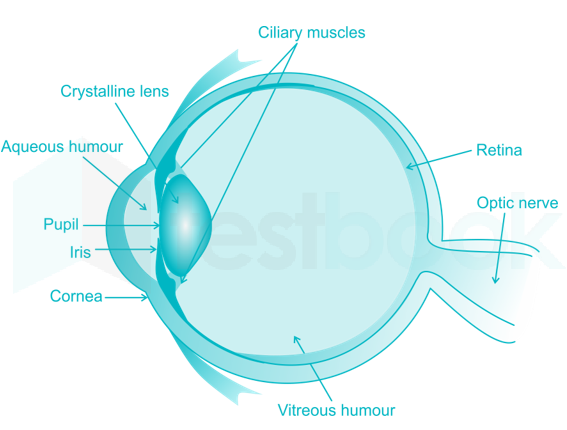
Which part of the eye provides oxygen and nourishment to the outer layer of the retina?

  1. ((a))

    Fovea

  2. ((b))

    Choroid

  3. ((c))

    Ciliary Body

  4. ((d))

    Conjunctiva

Show Answer
Answer: ((b))

Choroid

The correct answer is Choroid.

Key Points

  • Choroid, the thin vascular membrane between the retinal and the sclera.
  • The choroid is composed of layers of blood vessels that provide nourishment of layers of blood vessels that provide nourishment to the outer layer of the retina.

Additional InformationFovea

  • The depression in the very center of the macula where eyesight is sharpest.
  • It is also called the Fovea centralis.

Ciliary Body

  • It is the part of the eye that produces aqueous humor.

Conjunctiva

  • It is a loose connective tissue that covers the surface of the eyeball and reflects back upon itself to form the inner layer of the eyelid.

22

Which of the following matches is NOT correct about the discovery of fundamental particle?

  1. ((a))

    Alpha Particle - JJ Thomson

  2. ((b))

    Electron - JJ Thomson

  3. ((c))

    Proton - E. Goldstein

  4. ((d))

    Neutron - Chadwick

Show Answer
Answer: ((a))

Alpha Particle - JJ Thomson

The correct option is Alpha Particle - JJ Thomson.

Key Points

  • Ernest Rutherford discovered Alpha Particles.
  • Ernest Rutherford was the first person who connected the first Alpha radiation to Helium and later on, identified them as Helium nuclei.
  • He proved this along with Thomas Royds in 1899.

Mistake PointsAccording to NCERT the credit for the discovery of proton was given to E. Goldstein.

Source: https://ncert.nic.in/textbook/pdf/iesc104.pdf  (page 8 of pdf - under the heading "What you have learnt")

Additional Information

Scientist NameDiscoveries
PhotonAlbert Einstein
ElectronJ.J. Thomson
ProtonE. Goldstein
AtomJohn Dalton
NeutronJames Chadwick
Law of MotionIsaac Newton
CoulombCharles-Augustin de Coulomb
23

In January 2022, India successfully test-fires a new version of the Brahmos Supersonic Cruise Missile from which coast?

  1. ((a))

    Balasore, Odisha

  2. ((b))

    Shri Harikota, Andhra Pradesh

  3. ((c))

    Ranikhet, Uttarakhand

  4. ((d))

    Bikaner, Rajasthan

Show Answer
Answer: ((a))

Balasore, Odisha

The correct answer is Balasore, Odisha.

Key Points

  • .The missile hit the designated target precisely.
  • BrahMos missile flies at a speed of 2.8 Mach or almost three times the speed of sound.
  • DRDO had successfully test-fired a naval variant of the BrahMos from a stealth guided-missile destroyer of the Indian Navy, recently.
  • The missile hit the designated target precisely.

Additional Information

  • BrahMos is a joint India-Russia venture, between the DRDO and Russia’s NPO Mashinostroyeniya, which, together, formed the Brahmos Aerospace.
  • The missile derives its name from two rivers: the Brahmaputra in India and the Moskva of Russia.
  • BrahMos Aerospace, the India-Russia joint venture, produces supersonic cruise missile that can be launched from submarines, ships, aircraft, or land platforms.
24

Odisha state has topped in India Skills 2021 National Competition followed by which state?

  1. ((a))

    Punjab

  2. ((b))

    Maharashtra

  3. ((c))

    Kerala

  4. ((d))

    Telangana

Show Answer
Answer: ((b))

Maharashtra

The correct answer is Maharashtra.

Key Points

  • 270 winners of IndiaSkills 2021 National Competition felicitated with 61 golds, 77 silvers, 53 bronze and  medallions of Excellence.
  • The flicilation was held at Talkatora Indoor Stadium, New Delhi.
  • The winners of IndiaSkills 2021 nationals will get a chance to represent the country at the worldSkill international competition to be held in Shanghai, China October 2022.

Additional Information

State/UTGoldSilverBronzeMedallionsTotal
Odisha101891451
Maharashtra8471130
Kerala885425
Telangana22
25

Who launched the country’s first Mobile Honey Processing Van at Sirora in Ghaziabad, Uttar Pradesh?

  1. ((a))

    National Green Tribunal

  2. ((b))

    Khadi and Village Industries Commission

  3. ((c))

    National Bank for Agriculture and Rural Development

  4. ((d))

    Competition Commission of India

Show Answer
Answer: ((b))

Khadi and Village Industries Commission

The correct answer is Khadi and Village Industries Commission.

Key Points

  • India’s first Mobile Honey Processing Van was launched at Village Sirora in Ghaziabad, Uttar Pradesh.
  • It was inaugurated by the Chairman of KVIC, Vinai Kumar Saxena.
  • The Van has been designed by KVIC at its Multi-disciplinary Training Centre, Panjokehra, at a cost of INR 15 lakh.
  • It can process up to 300 KG of honey in 8 hours and also comprises a testing laboratory, which would examine the quality of honey.

Additional Information

  • Khadi and Village Industries come under the Ministry of Small, Cottage, and Medium Enterprises.
  • Its aim is to promote, organize, facilitate and assist in the development of khadi and village industries for rural development.
  • Its headquarters in Mumbai and its six zonal offices are in Bhopal, Delhi, Kolkata, Bangalore, Mumbai, and Guwahati.
  • Also, it has other offices in 28 states for the implementation of its programs.
  • It is based on the vision of Mahatma Gandhi.

Mathematics (25 questions)

26

A boat can go 72 km upstream and the same distance downstream in a total time of 712\frac{1}{2} hours. The speed of the stream is 80% less than the speed of the boat in still water. How much time (in hours) will it take to go 60 km downstream?

  1. ((a))

    3

  2. ((b))

    313\frac{1}{3}

  3. ((c))

    229\frac{2}{9}

  4. ((d))

    212\frac{1}{2}

Show Answer
Answer: ((d))

212\frac{1}{2}

Given:

The speed of the stream is 80% less than the speed of the boat in still water.

The boat can go 72 km upstream and the same distance downstream in a total time of 712\frac{1}{2} hours i.e. 7.5 hours.

Concept used:

While going downstream, the resultant speed is the addition of the speed of the boat in still water and the speed of the stream.

While going upstream, the resultant speed is the difference between the speed of the boat in still water and the speed of the stream.

Time × Speed = Distance

Incremented/Reduced value = Initial value (1 ± change%)

Calculation:

Let the speed of the boat be 100Q kmph in still water.

Hence, the speed of the stream = 100Q × 0.2 = 20Q kmph

Thus,

Upstream speed = (100Q - 20Q) kmph

Downstream speed = (100Q + 20Q) kmph

According to the question,

72/(100Q - 20Q) + 72/(100Q + 20Q) = 7.5

⇒ 72(1/80Q + 1/120Q) = 7.5

⇒ 72 (1/48Q) = 7.5

⇒ 1/Q = 5

⇒ Q = 0.2

⇒ 100Q = 20

⇒ 20Q = 4

Hence, time taken to go 60km downstream = 60/(20 + 4) = 212\frac{1}{2} hours

∴ It will take 212\frac{1}{2} hours to go 60 km downstream.

27

A dealer marks an article at 40% above its cost price and sells it by giving a 5% discount on its marked price and another cash discount of ₹ 124. If he still earns a profit of 25%, what is the marked price (in ₹) of the article?

  1. ((a))

    ₹ 1,953

  2. ((b))

    ₹ 2,170

  3. ((c))

    ₹ 2,232

  4. ((d))

    ₹ 1,736

Show Answer
Answer: ((b))

₹ 2,170

Given:

A dealer marks an article at 40% above its cost price and sells it by giving a 5% discount on its marked price and another cash discount of ₹ 124. 

Gain = 25%

Concept used:

Selling Price = Cost Price × (1 + Gain%)

Selling Price = Marked Price × (1 - Discount%)

Marked Price = Cost Price × (1 + Mark-up%)

Calculation:

Let the cost price be Rs. 100Q.

Hence,

the marked price = 100Q × 1.4 = Rs. 140Q

Final selling price = 140Q × 0.95 - 124 = Rs. (133Q - 124)

According to the question,

(133Q - 124) = 100Q × 1.25

⇒ (133Q - 124) = 125Q

⇒ 8Q = 124

⇒ Q = 15.5

⇒ 140Q = 2170

∴ The marked price of the article is Rs. 2170.

28

In finding the HCF of two positive integers by the division method, the last divisor is 31, and the respective quotients are 1, 1, 5 and 2. What is the LCM of 279 and the greater of the given two numbers?

  1. ((a))

    1953

  2. ((b))

    1440

  3. ((c))

    2232

  4. ((d))

    1674

Show Answer
Answer: ((c))

2232

Shortcut Trick Work backwards from the last divisor: 31 × 2 = 62 62 × 5 + 31 = 341 341 × 1 + 62 = 403 403 × 1 + 341 = 744 (Greater number) LCM(279, 744): 279 = 31 × 9, 744 = 31 × 24 ⇒ 31 × 72 = 2232 ∴ The correct answer is 2232. Alternate Method Given: Last divisor = 31, Quotients = 1, 1, 5, 2

⇒ Let the two numbers be A and B (A > B). ⇒ In long division method, we work from the last remainder (0): ⇒ Fourth Divisor = 31, Quotient = 2 ⇒ Dividend = 31 × 2 = 62 ⇒ Third Divisor = 62, Quotient = 5, Remainder = 31 ⇒ Dividend = 62 × 5 + 31 = 341 ⇒ Second Divisor = 341, Quotient = 1, Remainder = 62 ⇒ Dividend = 341 × 1 + 62 = 403 ⇒ First Divisor = 403, Quotient = 1, Remainder = 341 ⇒ Dividend = 403 × 1 + 341 = 744 ⇒ The greater number is 744. ⇒ To find LCM of 279 and 744: ⇒ 279 = 3 × 3 × 31 ⇒ 744 = 2 × 2 × 2 × 3 × 31 ⇒ LCM = 23 × 32 × 31 = 8 × 9 × 31 = 72 × 31 = 2232 ∴ The correct answer is 2232. Additional Information HCF Division Method Also known as Euclidean Algorithm, where Dividend = Divisor × Quotient + Remainder. Relation between LCM and HCF For two numbers a and b: a × b = HCF(a, b) × LCM(a, b). Co-prime Numbers Two numbers are co-prime if their HCF is 1. Their LCM is simply their product.

29

A can complete a piece of work in 45 days. B is 80% more efficient than A, and C is 25% less efficient than B. B and C together work for 10 days. A alone can complete the remaining work in:

  1. ((a))

    1212\frac{1}{2} days

  2. ((b))

    15 days

  3. ((c))

    1312\frac{1}{2} days

  4. ((d))

    12 days

Show Answer
Answer: ((c))

1312\frac{1}{2} days

Given:

A can complete a piece of work in 45 days.

B is 80% more efficient than A, and C is 25% less efficient than B.

B and C together work for 10 days. 

Concept used:

Total work = Efficiency (Work done per day) × Total time taken

Efficiency is inversely proportional to the time taken.

Incremented/Reduced value = Initial value (1 ± change%)

Calculation:

Hence,

B taken to complete the same work = 45 ÷ (1 + 80%) = 25 days

C taken to complete the same work = 25 ÷ (1 - 25%) = 3313{1 \over 3} days

Let the total work be the LCM of the time taken by individual workers.

LCM (45, 25, 3313{1 \over 3}) = 900

Hence, total work = 900 units

Efficiencies,

A = 900 ÷ 45 = 20 units/day

B = 900 ÷ 25 = 36 units/day

C = 900 ÷ 3312{1 \over 2} = 27 units/day

B and C complete in 10 days = (36 + 27) × 10 = 630 units

A will take to complete the remaining work = (900  630)20{(900\ -\ 630) \over 20} = 1312{1 \over 2} days

∴ A alone will complete the remaining work in 13**12{1 \over 2} days.**

30

If x is the mean proportional between 39 and 156 and y is the third proportional to 24 and 36, then for 6x ∶ 13y = ?

  1. ((a))

    3 ∶ 2

  2. ((b))

    4 ∶ 9

  3. ((c))

    2 ∶ 3

  4. ((d))

    3 ∶ 4

Show Answer
Answer: ((c))

2 ∶ 3

Shortcut Trick

Mean proportional x = √(39 × 156) = √(39 × 39 × 4) = 78

Third proportional y = 362 ÷ 24 = 1296 ÷ 24 = 54

Ratio 6x : 13y = (6 × 78) : (13 × 54)

Ratio = 468 : 702 = 2 : 3

∴ The correct answer is 2 : 3.

Alternate Method

Given:

⇒ Mean proportional x is between 39 and 156.

⇒ Third proportional y is to 24 and 36.

Formula Used:

⇒ Mean proportional between a and b = √(a × b)

⇒ Third proportional to a and b is c, where c = b2 ÷ a

Calculations:

⇒ Mean proportional x = √(39 × 156)

⇒ x = √(39 × 39 × 4)

⇒ x = 39 × 2 = 78

⇒ Third proportional y = 362 ÷ 24

⇒ y = (36 × 36) ÷ 24 = 1296 ÷ 24 = 54

⇒ We need to calculate 6x : 13y

⇒ 6x : 13y = (6 × 78) : (13 × 54)

⇒ 6x : 13y = 468 : 702

⇒ Dividing both values by their common factor 234

⇒ 6x : 13y = 2 : 3

∴ The correct answer is 2 : 3.

Additional Information

Mean Proportional

The mean proportional between two numbers a and b is √(ab). It is the middle term x in the continuous proportion a : x :: x : b.

Third Proportional

The third proportional to two numbers a and b is c, given by the relation a : b = b : c. Simplifying this gives c = b2 ÷ a.

Fourth Proportional

The fourth proportional to three numbers a, b, and c is d, where a : b = c : d. Solving for d gives d = (b × c) ÷ a.

31

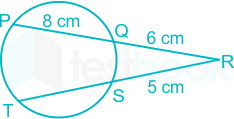
Chords PQ and TS of a circle are produced to meet at a point R. If PQ = 8 cm, QR = 6 cm and SR = 5 cm, then the length (in cm) of TS is∶ 

  1. ((a))

    16.5

  2. ((b))

    17.4

  3. ((c))

    11.8

  4. ((d))

    9.6

Show Answer
Answer: ((c))

11.8

Given:

Chords PQ and TS of a circle are produced to meet at a point R. If PQ = 8 cm, QR = 6 cm, and SR = 5 cm,

Concept used:

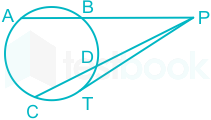
Here, PA & PC are two secants and PT is a tangent at point T on the circle. 

So, we know,

PA × PB =  PC × PD = (PT)2

Calculation:

Hence,

PR × QR =  RT × SR

⇒ (PQ + QR) × QR = RT × 5

⇒ 14 × 6 = RT × 5

⇒ RT = 16.8

⇒ TS + SR = 16.8

⇒ TS = 16.8 - 5

⇒ TS = 11.8

∴ The length of TS is 11.8 cm.

32

The average weight of the students in a class was 45 kg. Later on, 4 students whose weights are 44 kg, 38.5 kg, 42 kg and 44.5 kg joined the class. The average weight of the students was reduced by 0.44 kg. What was the number of students, initially in the class?

  1. ((a))

    26

  2. ((b))

    21

  3. ((c))

    20

  4. ((d))

    16

Show Answer
Answer: ((b))

21

Given: 

The average weight of the students in a class was 45 kg.

Later on, 4 students whose weights are 44 kg, 38.5 kg, 42 kg and 44.5 kg joined the class.

The average weight of the students was reduced by 0.44 kg.

Concept used:

Total = Mean (Average) × number of entities

Calculation:

Let the initial number of students in the class be N.

According to the question,

45 × N + 44 + 38.5 + 42 + 44.5 = (45 - 0.44) × (N + 4)

⇒ 45N + 169 = 44.56N + 178.24

⇒ 0.44N = 9.24

⇒ N = 21

∴ The number of student initially in the class was 21.

33

The internal and external radii of a hollow metallic cylinder are 1.1 cm and 4.3 cm, respectively, and its height is 1623\frac{2}{3} cm. It is melted and recast into a sphere. The surface area (in cm²) of the sphere is:

  1. ((a))

    144 π 

  2. ((b))

    256 π 

  3. ((c))

    196 π  

  4. ((d))

    100 π 

Show Answer
Answer: ((a))

144 π 

Given:

The internal and external radii of a hollow metallic cylinder are 1.1 cm and 4.3 cm, respectively, and its height is 1623\frac{2}{3} cm i.e. 50/3 cm.

It is melted and recast into a sphere. 

Concept used:

Volume of the hollow cylinder = π × (External Radius2 - Internal Radius2) × Height

Volume of a sphere = 4/3 × π × Radius3

Surface area of a sphere = 4π (Radius)2

Calculation:

Volume of the hollow cylinder

⇒ π × (4.32 - 1.12) × 50/3

⇒ 288π cm3

Hence, the volume of the sphere has to be equal to 288π cm3.

Let the radius of the sphere be R cm.

According to the question,

4/3 × π × R3 = 288

⇒ R3 = 216

⇒ R = 6

⇒ 4πR2 = 144π

∴ The surface area of the sphere is 144π cm2.

34

The cost of a pen is 20% less than the cost of a notebook. The total cost of 4 notebooks and 5 pens is ₹ 144. If the cost of a notebook is decreased by 10% and the cost of a pen remains the same, then what is the cost of 5 notebooks and 3 pens?

  1. ((a))

    ₹ 138.60

  2. ((b))

    ₹ 120.50

  3. ((c))

    ₹ 130.80

  4. ((d))

    ₹ 124.20

Show Answer
Answer: ((d))

₹ 124.20

Given:

The cost of a pen is 20% less than the cost of a notebook. The total cost of 4 notebooks and 5 pens is ₹ 144.

Then the cost of a notebook is decreased by 10% and the cost of a pen remains the same,

Concept used:

Incremented/Reduced value = Initial value (1 ± change%)

Calculation:

Let the cost of a notebook be Rs. Q.

Hence, the cost of a pen = Q × 0.8 = Rs. 0.8Q

According to the question,

4 × Q + 5 × 0.8Q = 144

⇒ 8Q = 144

⇒ Q = 18

New cost of a notebook = 18 × 0.9 = Rs. 16.2

Hence, cost of 5 notebooks and 3 pens = 5 × 16.2 + 3 × (0.8 × 18) = Rs. 124.20

∴ The cost of 5 notebooks and 3 pens is Rs. 124.40.

35

In the x liter solution of alcohol and water, the ratio of alcohol and water is 5 ∶ 7. If 5 L alcohol and 11 L water are added to the solution, the percentage of alcohol in the resulting solution becomes 40%. What is the value of x?

  1. ((a))

    72

  2. ((b))

    60

  3. ((c))

    96

  4. ((d))

    84

Show Answer
Answer: ((d))

84

Given:

In x litre solution of alcohol and water, the ratio of alcohol and water is 5 ∶7.

5 L alcohol and 11 L water are added to the solution, the percentage of alcohol in the resulting solution becomes 40%.

Concept used:

Ratio Proportion, and Mixture.

Calculation:

In x litre solution,

Quantity of alcohol = x × 5(7+5){5 \over (7 + 5)} = 5x/12 litre

According to the question,

5x/12 + 5 = (x + 5 + 11) × 40%

⇒ 5x/12 + 5 = (x + 16) × (2/5)

⇒ 5x/12 - 2x/5 = 6.4 - 5

⇒ x/60 = 1.4

⇒ x = 84

∴ The value of x is 84.

36

A sum of ₹ x was invested for 12 years in scheme A which offers simple interest at 8% p.a. The amount received after 12 years was reinvested in scheme B for 212\frac{1}{2} years at compound interest at 12% p.a., compounded 10-monthly. If the interest received from B was ₹ 32,438, then what is the value of x?

  1. ((a))

    45,000

  2. ((b))

    40,000

  3. ((c))

    32,000

  4. ((d))

    50,000

Show Answer
Answer: ((d))

50,000

Given:

A sum of ₹ x was invested for 12 years in scheme A which offers simple interest at 8% p.a.

The amount received after 12 years was reinvested in scheme B for 212\frac{1}{2} years at compound interest at 12% p.a., compounded 10-monthly.

The interest received from B was ₹ 32,438, 

Concept used:

Simple Interest, SI = (P × R × T) ÷ 100

where

P = Principal amount

R = Rate of interest per year

T = Time in years

Compound interest, CI = P(1 + R/100)N - P

where

P = Principal amount

R = Rate of interest per year

N = Time in years

Calculation:

After the first 12 years, the sum becomes = x + x×8×12100{x \times 8 \times 12} \over 100 = Rs. 1.96x

Hence, for scheme B, the principal amount = Rs. 1.96x

Rate of interest 12% p.a. when compounded 10-monthly = 12 ÷ (12/10) = 10%

212\frac{1}{2} years = 30 months

Hence, N (time) = 30 ÷ 10 = 3 

According to the question,

1.96x (1 + 10/100)3 - 1.96x = 32438

⇒ 1.96x (0.331) = 32438

⇒ x = 50000

∴ The value of x is 50000.

37

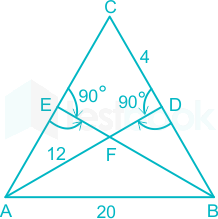
In ΔABC, AD ⊥ BC and BE ⊥ AC, AD and BE intersect at F (inside the triangle). If AB = 20 cm, CD = 4 cm and AD = 12 cm, then what is the length of BE?

  1. ((a))

    8

  2. ((b))

    5105\sqrt{10}

  3. ((c))

    6106\sqrt{10}

  4. ((d))

    16

Show Answer
Answer: ((c))

6106\sqrt{10}

Given:

In ΔABC, AD ⊥ BC and BE ⊥ AC, AD and BE intersect at F (inside the triangle).

AB = 20 cm, CD = 4 cm and AD = 12 cm,

Concept used:

Area of triangle = 1/2 × Base × Height

Pythagoras Theorem

Calculation:

Since angles at D and E are right-angles,

In the case of right-angled ΔADC,

AD2 + CD2 = AC2

⇒ 122 + 42 = AC2

⇒ AC = 4√10

In the case of right-angled ΔADB,

AD2 + BD2 = AB2

⇒ BD2 = 202 - 122

⇒ BD = 16

Considering the area of ΔABC,

1/2 × BE × AC = 1/2 × AD × BC

⇒ BE × 4√10 = 12 × (CD + BC)

⇒ BE × 4√10 = 12 × (4 + 16)

⇒ BE = 240 ÷ 4√10

⇒ BE = 6√10

∴ The length of BE is 6√10 cm.

38

Pipes A and B can fill an empty tank in 30 minutes and 40 minutes, respectively. Both pipes are opened for x minutes and then B is closed and A continues to fill. If the tank was completely filled in a total time of 2212\frac{1}{2} minutes, then what is the value of x?

  1. ((a))

    12

  2. ((b))

    8

  3. ((c))

    9

  4. ((d))

    10

Show Answer
Answer: ((d))

10

Given:

Pipes A and B can fill an empty tank in 30 minutes and 40 minutes, respectively.

Both pipes are opened for x minutes and then B is closed and A continues to fill.

The tank was completely filled in a total time of 2212\frac{1}{2} minutes i.e 22.5 minutes.

Concept used:

Total work = Efficiency (Work done per hour) × Total time taken 

Calculation:

LCM (30, 40) = 120

Let the total capacity of the tank be the LCM of the time taken by pipes to fill it.

Hence, the capacity of the tank = 120 units

Efficiencies,

Pipe A = 120 ÷ 30 = 4 units per minute

Pipe B = 120 ÷ 40 = 3 units per minute

According to the question,

3x + 22.5 × 4 = 120

⇒ 3x = 120 - 90

⇒ x = 10

∴ The value of x is 10.

39

(sinθcosθ)(1+tanθ+cotθ)(cosec2θ)sec3θcosec3θ\frac{{(\sin θ - \cos θ )(1 + \tan θ + \cot θ )(\cos e{c^2}θ )}}{{{{\sec }^3}θ - \cos e{c^3}θ }}, 0º< θ < 90º, is equal to∶

  1. ((a))

    sec θ cosec θ 

  2. ((b))

    cosθ

  3. ((c))

    sinθ

  4. ((d))

    sin θ cos θ 

Show Answer
Answer: ((b))

cosθ

Given:

0º< θ < 90º

Concept used:

tanθ = sinθ/cosθ = 1/cotθ 

A3 - B3 = (A - B) (A+ AB + B2)

sinθ = 1/cosecθ 

cosθ = 1/secθ 

Calculation:

(sinθcosθ)(1+tanθ+cotθ)(cosec2θ)sec3θcosec3θ\frac{{(\sin θ - \cos θ )(1 + \tan θ + \cot θ )(\cos e{c^2}θ )}}{{{{\sec }^3}θ - \cos e{c^3}θ }}

⇒ (sinθcosθ) (1+sinθcosθ+cosθsinθ) cosec2θ1cos3θ  1sin3θ{(sinθ - cosθ)\ (1 + {sinθ \over cosθ} + {cosθ \over sinθ})\ cosec^2θ} \over {{1\over cos^3θ}\ -\ {1\over sin^3θ}}

⇒ (sinθcosθ) (sin2θ + cos2θ + sinθcosθ)sinθ cosθ cosec2θ(sin3θcos3θ)sin3θ cos3θ{(sinθ - cosθ)\ {(sin^2θ\ +\ cos^2θ\ +\ sinθ cosθ) \over sinθ \ cosθ}\ cosec^2θ} \over {(sin^3θ - cos^3θ) \over {sin^3θ\ cos^3θ}}

⇒ (sinθcosθ) (sin2θ + cos2θ + sinθcosθ)(sinθcosθ) (sin2θ + cos2θ + sinθcosθ)cos2θ{(sinθ - cosθ)\ {(sin^2θ\ +\ cos^2θ\ +\ sinθ cosθ)}} \over {{(sinθ - cosθ)\ {(sin^2θ\ +\ cos^2θ\ +\ sinθ cosθ)}} \over {cos^2θ}}

⇒ (sinθcosθ) (sin2θ + cos2θ + sinθcosθ)(sinθcosθ) (sin2θ + cos2θ + sinθcosθ)cos2θ{(sinθ - cosθ)\ {(sin^2θ\ +\ cos^2θ\ +\ sinθ cosθ)}} \over {{(sinθ - cosθ)\ {(sin^2θ\ +\ cos^2θ\ +\ sinθ cosθ)}} \over {cos^2θ}}

⇒ cos2θ 

∴ The required answer is cos2θ.

40

Study the following table and graph and answer the question∶ 

Revenue of the Company ABC in years from 2018 to 2021.

Year2018201920202021
Revenue (in Rs. crores)232204279217
<br>

Profit:%=RevenueExpenditureExpenditure×100Profit:\% = \frac{Revenue-Expenditure}{Expenditure}\times 100

The total profit of the company in 2019 and 2021 is approximately what percent of the total expenditure in 2018 and 2020?

  1. ((a))

    33%

  2. ((b))

    32.6%

  3. ((c))

    31.2%

  4. ((d))

    34%

Show Answer
Answer: ((d))

34%

Calculation: 

Considering, Profit = Revenue - Expenditure

In 2019,

Profit% = 36%

Revenue = 204 Cr.

Let the expenditure be P,

204PP{204 - P}\over P × 100% = 36%

⇒ 1.36P = 204

⇒ P = 150

Expenditure = 150 Cr.

Profit = 54 Cr.

In 2020,

Profit% = 55%

Revenue = 279 Cr.

Let the expenditure be Q,

279QQ{279 - Q}\over Q × 100% = 55%

⇒ 1.55Q = 279

⇒ Q = 180

Expenditure = 180 Cr.

​Profit = 99 Cr.

In 2021,

Profit% = 40%

Revenue = 217 Cr.

Let the expenditure be R,

217RR{217 - R}\over R × 100% = 40%

⇒ 1.40R = 217

⇒ R = 155

Expenditure = 155 Cr.

​Profit = 62 Cr.

In 2018,

Profit% = 45%

Revenue = 232 Cr.

Let the expenditure be S,

232SS{232 - S}\over S × 100% = 45%

⇒ 1.45S = 232

⇒ S = 160

Expenditure = 160 Cr.

​Profit = 72 Cr.

Hence, 

The total profit of the company in 2019 and 2021 = 54 + 62 = 116 Cr.

The total expenditure in 2018 and 2020 = 160 + 180 = 340 Cr.

% = 116/340 × 100% ≈ 34%

∴ The total profit of the company in 2019 and 2021 is approximately 34% of the total expenditure in 2018 and 2020.

41

The value of 0.896×0.752+0.112×1.9840.7×0.034+2.1×(0.322)+(4.2)3+(2.8)3(4.2)2(2.8)2\frac{{0.896 \times 0.752 + 0.112 \times 1.984}}{{0.7 \times 0.034 + 2.1 \times (0.322)}} + \frac{{{{(4.2)}^3} + {{(2.8)}^3}}}{{{{(4.2)}^2} - {{(2.8)}^2}}} is∶

  1. ((a))

    11.08

  2. ((b))

    10.32

  3. ((c))

    10.92

  4. ((d))

    9.68

Show Answer
Answer: ((a))

11.08

Given:

0.896×0.752+0.112×1.9840.7×0.034+2.1×(0.322)+(4.2)3+(2.8)3(4.2)2(2.8)2\frac{{0.896 \times 0.752 + 0.112 \times 1.984}}{{0.7 \times 0.034 + 2.1 \times (0.322)}} + \frac{{{{(4.2)}^3} + {{(2.8)}^3}}}{{{{(4.2)}^2} - {{(2.8)}^2}}}

Concept used:

(a3 + b3) = (a + b)[(a - b)2 + ab]

Calculation:

0.896×0.752+0.112×1.9840.7×0.034+2.1×(0.322)+(4.2)3+(2.8)3(4.2)2(2.8)2\frac{{0.896 \times 0.752 + 0.112 \times 1.984}}{{0.7 \times 0.034 + 2.1 \times (0.322)}} + \frac{{{{(4.2)}^3} + {{(2.8)}^3}}}{{{{(4.2)}^2} - {{(2.8)}^2}}}

⇒ 8961000×7521000+1121000×19841000710×341000+2110×3221000+(4.2+2.8)[(4.22.8)2+4.2×2.8](4.2+2.8)(4.22.8)\frac{{\frac{896}{1000} \times \frac{752}{1000} + \frac{112}{1000} \times \frac{1984}{1000}}}{{\frac{7}{10} \times \frac{34}{1000} + \frac{21}{10} \times \frac{322}{1000}}} + \frac{{{{(4.2+2.8)[(4.2-2.8)^2+4.2\times2.8]}}{{}}}}{{{{(4.2+2.8)(4.2-2.8)}}}}

⇒ 896×752+112×198410000007×34+21×32210000+1.4+4.2×2.8(1.4)\frac{{\frac{896\times752 + 112\times1984}{1000000}}}{{\frac{7\times34+21\times322}{10000}}} + {{{{1.4}}+{{}}}}{{{{\frac{4.2\times2.8}{(1.4)}}}}}

⇒ 112(8×752+1984)10000007(34+3×322)10000+1.4+8.4\frac{{\frac{112(8\times752 + 1984)}{1000000}}}{{\frac{7(34+3\times322)}{10000}}} + 1 .4 + 8.4

⇒ 112(8000)10000007(1000)10000+1.4+8.4\frac{{\frac{112(8000)}{1000000}}}{{\frac{7(1000)}{10000}}} + 1.4 + 8.4

⇒ 1.28+1.4+8.41.28 + 1.4 + 8.4

⇒ 11.08

∴ The required answer is 11.08.

42

A scooty can be bought for ₹ 30,000 cash or for ₹ 9,400 cash down payment followed by 4 equal monthly instalments. If the rate of interest charged is 15% p.a., then what is the value of each instalment, interest being simple? (Nearest to a ₹)

  1. ((a))

    ₹ 5,324

  2. ((b))

    ₹ 5,406

  3. ((c))

    ₹ 5,298

  4. ((d))

    ₹ 5,308

Show Answer
Answer: ((d))

₹ 5,308

Given: 

A scooty can be bought for ₹ 30,000 cash or for ₹ 9,400 cash down payment followed by 4 equal monthly installments.

Rate of interest = 15% p.a.

Concept used:

Simple Interest, SI = (P × R × T) ÷ 100

where

P = Principal amount

R = Rate of interest per year

T = Time in years

Calculation:

Let the monthly installments be Rs. Q per month.

Hence, the first installments will incur interest for 3 months, the second for 2 months, the third for one month, and the last one won't incur any interest. 

Thus, all the installments and interest incurred on them will be equal to the sum of the loan amount and interest incurred on the loan amount.

Loan amount while buying the scooty on monthly installment = 30000 - 9400 = Rs. 20,600

According to the question,

(Q + Q×312×15100{Q × {3 \over 12} × 15} \over 100) + (Q + Q×212×15100{Q × {2 \over 12} × 15} \over 100) + (Q + Q×112×15100{Q × {1 \over 12} × 15} \over 100) +  Q = 20600 + 20600×412×15100{20600 × {4 \over 12} × 15} \over 100

⇒ 4Q + 0.0125 × 6Q = 21630

⇒ 4.075Q = 21630

⇒ Q ≈ 5308

∴ The value of each monthly installment is Rs. 5308.

43

If 4(x2 + z) + y2 + z2 = 4x + 10(y - 3), then what is the value of (2x + 3y + z)?

  1. ((a))

    14

  2. ((b))

    13

  3. ((c))

    12

  4. ((d))

    10

Show Answer
Answer: ((a))

14

Given:

4(x2 + z) + y2 + z2 = 4x + 10(y - 3)

Concept used:

(A + B)2 = A2 + B2 + 2AB

(A - B)2 = A2 + B2 - 2AB

If A2 + B2 + C2 = 0 then, A = B = C = 0 

Calculation:

4(x2 + z) + y2 + z2 = 4x + 10(y - 3)

⇒ 4x2 + 4z + y2 + z2 = 4x + 10y - 30

⇒ (4x2 - 4x) + (y2 - 10y) + (z2 + 4z) = - 30

⇒ (4x2 - 4x + 1) + (y2 - 10y + 25) + (z2 + 4z + 4) = - 30 + 30

⇒ (2x - 1)2 + (y - 5)2 + (z + 2)2 = 0

Hence,

(2x - 1)2 = 0

⇒ 2x = 1

(y - 5)2 = 0

⇒ y = 5

⇒ 3y = 15

(z + 2)2 = 0

⇒ z = -2

Thus, (2x + 3y + z) = 1 + 15 - 2 = 14

∴ The value of (2x + 3y + z) is 14.

44

Study the graph and answer the question∶ 

The ratio of the number of boys to that of girls who passed from school A is 5 ∶ 4 and the ratio of the number of girls to the number of boys who passed from school C is 4 ∶ 3. The total number of girls passed from schools A and C is what per cent of the total number of students who appeared from schools B and D? (Correct to one decimal place)

  1. ((a))

    32.2%

  2. ((b))

    33.5%

  3. ((c))

    30.6%

  4. ((d))

    32.7%

Show Answer
Answer: ((d))

32.7%

Calculation:

In the case of School A,

Passed boys = 5/(5 + 4) × 180 = 100

Passed girls = 180 - 100 = 80

In the case of School C,

Passed boys = 3/(4 + 3) × 175 = 75

Passed girls = 175 - 75 = 100

Hence, 

The total number of girls passed from schools A and C = 80 + 100 = 180

The total number of students who appeared from schools B and D = 225 + 325 = 550

% = 180/550 × 100% ≈ 32.7%

∴ The total number of girls passed from schools A and C is 32.7% of the total number of students who appeared from schools B and D.

45

If the 9-digit number 45069x4y8 is divisible by 44, then what is the value of (5x - 2y) for the maximum value of y?

  1. ((a))

    14

  2. ((b))

    11

  3. ((c))

    17

  4. ((d))

    15

Show Answer
Answer: ((a))

14

Given:

The 9-digit number 45069x4y8 is divisible by 44.

Concept used:

If a number is divided by 44, the number has to be a multiple of 11 and 4.

The divisibility by 11 rule states that if the difference between the sum of the digits at odd places and the sum of the digits at even places of the number is 0 or divisible by 11, then the given number is also divisible by 11.

Calculation:

Since 45069x4y8 has to be divided by 4, the last two digits must be divided by 4.

Hence, y can be 0, 2, 4, 6, 8.

In case of the divisibily by 11,

The sum of odd places = 4 + 0 + 9 + 4 + 8 = 25

The sum of even places = 5 + 6 + x + y = 11 + x + y

The difference = 25 - (11 + x + y) = 14 - (x + y)

Hence in order to be divided by 11, 14 - (x + y) has to be zero. 

Thus,

14 - (x + y) = 0

⇒ (x + y) = 14

⇒ (x + 8) = 14 (Taking the maximum possible value of y)

⇒ x = 6

Hence, (5x - 2y) = 5 × 6 - 2 × 8 = 14

∴ The required value of (5x - 2y) is 14.

46

A man started his journey in the morning. By 10 a.m., he covered 3313\frac{1}{3}% of his journey and at 1:00 p.m. on the same day, he covered 56\frac{5}{6}th part of the journey. At what time in the morning did he start his journey? (assuming his speed as constant throughout)

  1. ((a))

    8:00

  2. ((b))

    7:30

  3. ((c))

    9:00

  4. ((d))

    8:30

Show Answer
Answer: ((a))

8:00

Given:

A man started his journey in the morning. By 10 a.m., he covered 3313\frac{1}{3}% of his journey and at 1:00 p.m. on the same day, he covered 56\frac{5}{6}th part of the journey. 

Concept used:

Time × Speed = Distance

Calculation:

Let the total distance he covered during his journey be 60D units.

By 10 AM, he covered = 60D × 3313\frac{1}{3}% = 20D units

At 1 PM, he covered = 60D × 5/6 = 50D units

Hence, in (1 PM - 10 AM) = 3 hours, he covered = 50D - 20D = 30D units

Thus, his speed = 30D ÷ 3 = 10 units per hour

Time taken to complete remaining journey = (60D - 50D) ÷ 10D = 1 hour

Hence, at 2 PM he would complete his journey.

Total time taken to complete his journey = 60D ÷ 10D = 6 hours

Thus, he started the journey at = 2 PM - 6 hours = 8 AM

∴ He started the journey at 8 AM in the morning.

47

A person sells an article at a certain price. If he sells it at 40% of this selling price, then he has a loss of 4%. If he sells it at its original selling price, then the profit per cent will be:

  1. ((a))

    3712\frac{1}{2}%

  2. ((b))

    50%

  3. ((c))

    140%

  4. ((d))

    45%

Show Answer
Answer: ((c))

140%

Given:

If he sells it at 40% of this selling price, then he has a loss of 4%.

Concept used:

Selling Price = Cost Price × (1 - Loss%)

Selling Price = Cost Price - Loss

Gain percentage = (Selling Price  Cost Price)Cost Price×100%{(Selling\ Price\ -\ Cost\ Price) \over Cost\ Price} \times 100\%

Calculation:

Let the selling price of the article be Rs. 100Q.

According to the question,

if the selling price was (100Q × 40%) i.e. Rs. 40Q, the loss would have been 4%.

Hence, the cost price of the article = 40Q ÷ 0.96 ≈ 41.67Q

Thus, profit% while selling at the original price = 100Q41.67Q41.67Q{100Q - 41.67Q} \over 41.67Q × 100% = 140%

∴ If he sells it at its original selling price, then the profit percentage will be 140%.

48

A vessel is in the form of a hollow hemispherical bowl mounted by a hollow cylinder of certain height. The radius of the bowl is 7 cm and the volume of the vessel is 49283\frac{4928}{3} cm3. What is the outer surface area (in cm²) of the vessel? (Take π = 227\frac{22}{7})

  1. ((a))

    572

  2. ((b))

    528

  3. ((c))

    440

  4. ((d))

    484

Show Answer
Answer: ((a))

572

Given:

A vessel is in the form of a hollow hemispherical bowl mounted by a hollow cylinder of certain height.

 The radius of the bowl is 7 cm and the volume of the vessel is 49283\frac{4928}{3} cm3. 

Concept used:

Volume of a hemisphere = 2π×Radius33{2π × Radius^3 \over 3}

Volume of a cylinder = π × Radius2 × Height

Curved surface area of a cylinder = 2π × Radius × Height

Curved surface area of a hemisphere = 2π × Radius2 

Calculation:

The radius of the hollow hemispherical bowl = The base radius of the hollow cylinder

Hence, the base radius of the hollow cylinder = 7 cm.

Let the height of the cylinder be H cm.

According to the question,

2π×733{2π × 7^3 \over 3} + π × 72 × H = 49283\frac{4928}{3}

⇒ π×723{π × 7^2 \over 3} (14 + 3H) = 49283\frac{4928}{3}

⇒ 14 + 3H = 32

⇒ H = 6

Hence,

the outer i.e. curved surface area of the hollow hemispherical bowl = 2π × 72 = 98π cm2

the outer i.e. curved surface area of the hollow cylinder = 2π × 7 × 6 = 84π cm2

Thus, total outer surface area of the vessel = (98 + 84)π = 572 cm2

∴ The outer surface area of the vessel is 572 cm2.

49

The cost of a table is 200% more than the cost of a chair and the cost of a chair is 20% less than that of an almirah. If the cost of each table and chair is decreased by 25% and the cost of an almirah is increased by 25%, then the percentage increase/decrease in the total cost of 4 tables, 5 chairs and 8 almirahs is: (correct to one decimal place)

  1. ((a))

    decrease by 6.5%

  2. ((b))

    increase by 5.5%

  3. ((c))

    increase by 4.2%

  4. ((d))

    decrease by 6.9%

Show Answer
Answer: ((a))

decrease by 6.5%

Given:

The cost of a table is 200% more than the cost of a chair and the cost of a chair is 20% less than that of an almirah.

Then, the cost of each table and chair is decreased by 25% and the cost of an almirah is increased by 25%.

Concept used:

Incremented/Reduced value = Initial value (1 ± change%)

Calculation:

Let the cost of an almirah be 100Q.

Hence,

the cost of a chair = 100Q × 0.8 = 80Q

the cost of a table = 80Q × 3 = 240Q

the cost of 4 tables, 5 chairs and 8 almirahs = (4 × 240Q + 5 × 80Q + 8 × 100Q) = 2160Q

Now,

the cost of a table = 240Q × 0.75 = 180Q

the cost of a chair = 80Q × 0.75 = 60Q

the cost of an almirah = 100Q × 1.25 = 125Q

the cost of 4 tables, 5 chairs and 8 almirahs = (4 × 180Q + 5 × 60Q + 8 × 125Q) = 2020Q (Hence, the cost has been decreased)

%change = 2160Q2020Q2160Q{2160Q - 2020Q} \over 2160Q × 100% = 6.48% ≈ 6.5% (decrease)

∴ The percentage decrease in the total cost of 4 tables, 5 chairs and 8 almirahs is 6.5%.

50

A, B and C invest capitals in a business in the ratio 8 ∶ 3 ∶ 9. At the end of every quarter, A halves his capital, whereas B doubles his capital and C leaves his capital as it is. At the end of a year, C's share in the total profit is ₹ 9,60,000. What is B's share (in ₹) in the profit?

  1. ((a))

    10,80,000

  2. ((b))

    13,20,000

  3. ((c))

    12,00,000

  4. ((d))

    14,40,000

Show Answer
Answer: ((c))

12,00,000

Given:

A, B and C invest capitals in a business in the ratio 8 ∶ 3 ∶ 9. 

At the end of every quarter, A halves his capital, whereas B doubles his capital and C leaves his capital as it is. At the end of a year, C's share in the total profit is ₹ 9,60,000.

Concept used:

Profit is always divided according to the ratio of the investment made.

Calculation:

Let the common ratio be Q.

Hence, the initial investments of A, B, and C are 8Q, 3Q, and 9Q respectively.

During the one year period,

Investment of A = 8Q × 1/4 + 4Q × 1/4 + 2Q × 1/4 + Q × 1/4 = 15Q/4

Investment of B = 3Q × 1/4 + 6Q × 1/4 + 12Q × 1/4 + 24Q × 1/4 = 45Q/4

Investment of C = 9Q

Ratio of their investment

⇒ 15Q/4 : 45Q/4 : 9Q

⇒ 15 : 45 : 36

⇒ 5 : 15 : 12

Hence, the total profit = 9,60,000 ÷ 12(5+15+12)12 \over (5 + 15 + 12) = Rs. 25,60,000

Thus, B's share = 25,60,000 × 15(5+15+12)15 \over (5 + 15 + 12) = Rs. 12,00,000

∴ B's share of the total profit is Rs. 12,00,000.

Science (25 questions)

51

The primary character distinguishing Kingdom Protista from other Kingdoms in the Whittaker system is the:

  1. ((a))

    Presence of cell membrane

  2. ((b))

    Flexible cell wall

  3. ((c))

    Absence of membrane-bound organelles

  4. ((d))

    Single-celled body

Show Answer
Answer: ((d))

Single-celled body

The correct answer is Single-celled body.

Key Points

  • In the Whittaker system of classification, Kingdom Protista is primarily characterized by organisms that are predominantly unicellular or single-celled.
  • Protists are a diverse assembly of eukaryotic organisms, which means, contrary to option 3, they possess membrane-bound organelles, including nuclei.
  • This group can consist of both autotrophic and heterotrophic organisms and inhabits various aquatic or moist terrestrial environments.
  • The key characteristic that distinguishes Protista in this classification system from other kingdoms is indeed their predominantly single-celled nature, although it is important to note that there are exceptions where protists can form simple multicellular structures or colonies.
  • This attribute is critical for differentiating Protista from other kingdoms in the Whittaker system.

Important Points

The Whittaker system of classification, proposed by Robert H. Whittaker in 1969, is a way of grouping organisms into five kingdoms based on their fundamental differences, especially considering their cell structure, mode of nutrition, and lifestyle. These kingdoms are:

  • Monera: Consists of unicellular organisms with prokaryotic cell organization (lacking a nucleus), such as bacteria.
  • Protista: Includes most unicellular and some simple multicellular eukaryotic organisms. This group is very diverse and serves as a catch-all category for eukaryotes that do not fit into the other kingdoms.
  • Fungi: Comprises mostly multicellular, non-photosynthetic organisms with a distinct cell wall, which includes molds, yeasts, and mushrooms. They are heterotrophic, absorbing nutrients from their environment.
  • Plantae: Encompasses multicellular, predominantly photosynthetic organisms, which are autotrophic, producing food through photosynthesis. It includes mosses, ferns, conifers, and flowering plants.
  • Animalia: Contains multicellular, heterotrophic organisms that are typically mobile at least during part of their life cycle. This kingdom includes all animals, from sponges to humans.

Additional Information

  • Presence of cell membrane: This is a common characteristic of all living cells, both prokaryotic and eukaryotic, across all kingdoms, and not unique to Protista.
  • Flexible cell wall: Some protists do have cell walls, but their flexibility and presence are not consistent across the group, making it an unreliable distinguishing feature. Furthermore, other organisms in different kingdoms also have cell walls.
  • Absence of membrane-bound organelles: This statement is incorrect for Protista, as they are eukaryotic and do have membrane-bound organelles. The absence of such organelles is characteristic of prokaryotes, which are classified under Monera.
52

When light green coloured crystals of ferrous sulphate are strongly heated, the colour changes to brown-red and a gas having smell of burning sulphur evolves. What type of reaction is occurring in this case?

  1. ((a))

    Combination

  2. ((b))

    Decomposition

  3. ((c))

    Double displacement

  4. ((d))

    Oxidation

Show Answer
Answer: ((b))

Decomposition

Concept:

Decomposition reaction:

  • Those reactions in which a compound splits up into two or simpler substances are known as decomposition reactions.
  • Heat, light, or electricity provide energy that breaks a compound into two or simpler compounds.
  • A decomposition reaction is the opposite of a combination reaction.
  • Thermal decomposition:
  • ​When a decomposition reaction is carried out by heating, it is called 'thermal decomposition.
  • The decomposition reaction of calcium carbonate into calcium oxide and carbon dioxide is an example of thermal decomposition.
  • Example:
  • ​2FeSO4 → Fe2O3 + SO2 + SO3​​

Explanation:

  • On heating, ferrous sulfate crystals lose water and anhydrous ferrous sulfate  (FeSO4) is formed. So their colour changes from light green to white. On further heating, anhydrous ferrous sulfate decomposes to form ferric oxide (Fe2O3), and sulfur dioxide (SO2).
  • The colour of crystalline FeSO4 .7H2O is light green. This light green colour changes to a reddish-brown or brown colour upon heating.
  • The colour of ferrous sulfate crystals is green and after heating, the colour becomes white (pale yellow). On heating ferrous sulfate crystals at high temperatures, the products formed are ferric oxide, sulfur dioxide, and sulfur trioxide.

Additional Information 

Precipitation reaction: 

  • Two solutions of soluble salts are mixed resulting in an insoluble solid (precipitate) forming.
  • Such reactions are represented by equations of the following form: A + Soluble salt B  → Precipitate + soluble salt C.​

Double Displacement Reaction-

  • The two reactants exchange ions to form two new compounds in this reaction.
  • In most cases, precipitation takes place.
  • The reaction takes place in this manner→ AB + CD → AD + CB

Neutralization reaction: 

  • An acid and a base react with each other.
  • Generally, the product of this reaction is salt and water.
  • Such reactions are represented by equations of the following form: Acid + Base → Salt + Water.

Combustion reaction: 

  • Oxygen combines with a compound to form carbon dioxide and water.
  • These reactions are exothermic, meaning they give off heat.
  • Such reactions are represented by equations of the following form: A + O2 → H2O + CO2.

Displacement reaction: 

  • One element takes place with another element in the compound.
  • Such reactions are represented by equations of the following form: A + BC → AC + B.

Oxidation Reaction refers to a reaction in which either the addition of Oxygen takes place or the removal of Hydrogen takes place. Rusting is an example of an oxidation reaction.

53

A metal ‘M’ does not occur in native state in nature. Which of the following methods will be suitable for its extraction from the ore?

  1. ((a))

    Roasting

  2. ((b))

    Reduction using aluminium

  3. ((c))

    Electrolytic reduction

  4. ((d))

    Carbon reduction

Show Answer
Answer: ((c))

Electrolytic reduction

Concept:

The electrolytic reduction method is used for the extraction of highly electropositive metals.

  • In the process of electrolysis, ionic substances are decomposed into simpler substances when an electric current is passed through them.
  • Electricity current is the flow of electrons or ions in any conductor. Example: Na, K, Mg, K, etc are obtained by the electrolytic reduction process.
  • The oxides, hydroxide, and chlorides of metals infused state are electrically reduced by using this method. The metals are extracted at the cathode.
  • Metals that are placed high in the reactivity series are highly electropositive and they cannot be reduced by carbon as a reducing agent.

Additional Information

  • Roasting: It is the process in which ore is converted into its oxide by heating it strongly in excess of air.
  • Carbon Reduction (Smelting) : The reduction of oxide ore with carbon at high temperature is known as Smelting.
54

An object 1.0 cm in height is placed at a distance of 15 cm in front of a concave mirror of focal length 10.0 cm on its principal axis. Following New Cartesian Sign Convention, the image is formed at v = ________ and its height hI = ________.

  1. ((a))

    -30 cm; -2.0 cm

  2. ((b))

    -6 cm; 0.4 cm

  3. ((c))

    -30 cm; 2.0 cm

  4. ((d))

    -6 cm; -0.4 cm

Show Answer
Answer: ((a))

-30 cm; -2.0 cm

Concept:

Mirror formula:1f=1v+1u\frac{1}{f} = \frac{1}{v} + \frac{1}{u}, where f = focal length, v = image distance and u = object distance.

Magnification: m = HiHo=vu\frac{Hi}{Ho} = \frac{-v}{u} , where Hi = height of image, Ho = height of object, v = image distance, and u = object distance.

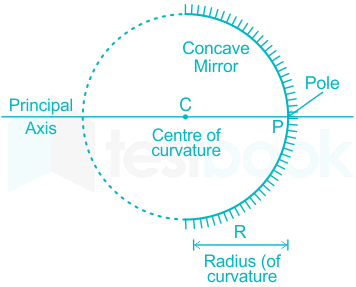
Concave mirror: 

  • It is part of a whole spherical mirror that reflects light from the hollow part.
  • It is a converging mirror because it converges the incident rays at a point.

Explanation:

Given, u = -15 cm        f = -10 cm          h = 1 cm 

1f=1v+1u\frac{1}{f} = \frac{1}{v} + \frac{1}{u}

110=1v+115\frac{1}{-10} = \frac{1}{v} + \frac{1}{-15}

110=1v115\frac{1}{-10} = \frac{1}{v} - \frac{1}{15}

1v=115110\frac{1}{v} = \frac{1}{15}-\frac{1}{10}

1v=2330\frac{1}{v} = \frac{2-3}{30}

1v=130\frac{1}{v} =- \frac{1}{30}

v = -30 cm

m = HiHo=vu\frac{Hi}{Ho} = \frac{-v}{u} = Hi2=(30)15\frac{Hi}{2} = \frac{(30)}{-15} 

Hi = -2 cm

Following New Cartesian Sign Convention, the image is formed at v = -30 cm and its height HI = -2 cm.

55

What is the cause of cataract?

  1. ((a))

    Opacity of the crystalline lens

  2. ((b))

    Distortion of the biconvex lens

  3. ((c))

    Damage to the photosensitive retina

  4. ((d))

    Scarring of cornea making it opaque

Show Answer
Answer: ((a))

Opacity of the crystalline lens

The correct answer is Opacity of the crystalline lens

Cataract:

  • It represents a condition or state of cloudiness in the lens of the eye which results in a blurred, distorted or incomplete vision due to the blockage of light necessary for having a clear vision.
  • In this condition, the lens tissue changes and becomes thicker.
  • Symptoms can include blurred colors, distorted or double vision, luminous halos, and issues related to night vision.
  • Congenital cataract is a cataract that is present at birth. It occurs when a mother contacts German measles in the first three months of pregnancy.
  • A cataract is when your eye's natural lens becomes cloudy. Proteins in your lens break down and cause things to look blurry, hazy, or less colorful.

Additional Information 

Causes of cataracts:

  • Excessive exposure to sunlight.
  • Smoking.
  • Obesity.
  • High blood pressure.
  • Previous eye injury or inflammation.
  • Previous eye surgery.

Precautions after cataract surgery:

  • Don’t rub your eye- Do not use eye baths or irrigators unless they have been prescribed.
  • Avoid harsh rubbing of teeth and hair.
  • Don’t wear makeup.
  • Wear sunglasses
  • Don’t swim
  • Wash hands before and after assisting the person with any procedure such as applying eye drops or cleaning the eye.
56

A mixture is heterogeneous and shows Tyndall effect. It stops showing Tyndall effect after it has been kept for some time. Which of the following about this mixture is correct?

  1. ((a))

    It is a colloid which changes into a solution on keeping for some time.

  2. ((b))

    It is a suspension which does not scatter light when its particles settle down.

  3. ((c))

    It is a colloid which stops scattering light as it changes into a suspension.

  4. ((d))

    It is a suspension which changes into a solution on keeping for some time.

Show Answer
Answer: ((b))

It is a suspension which does not scatter light when its particles settle down.

Concept:

Types of Mixtures:

Homogeneous Mixture:

  • Those mixtures, in which the substances are completely mixed together and are indistinguishable from one another, are called homogeneous mixtures.
  • For example Soda water, Soft drinks, lemonade, salt or sugar solution, etc.

Heterogeneous Mixture:

  • Those mixtures in which the substances remain separate and one substance is spread throughout the other substance as small particles, droplets, or bubbles are called heterogeneous mixtures.
  • All the suspensions and colloids are heterogeneous mixtures.
  • A mixture is heterogeneous and shows Tyndall effect because of the floating particle it behave like colloid solution or scatter light but actually its heterogeneous mixture the particle will settle down after some time and the tyndel effect will diminish hence it doesnt scatter light when particle settle down.
  • For Example: - Sugar and sand mixture, muddy river water, soap solution.

​Explanation:

Colloids:

  • A colloid is a heterogeneous system in which one substance is dispersed (dispersed phase or colloidal particles) in another substance which is called a dispersion medium.

Properties of colloids:

  • A colloid appears to be homogeneous but actually, it is heterogeneous.
  • The particles of most of the colloids cannot be seen even with a microscope.
  • It scatters a beam of light passing through it (Tyndall effect).
  • The size of the solute particle is in the range of 1 to 100 nm.
  • Since they are heterogeneous in nature, centrifugation techniques can be used to separate the particles.
57

How can one vaccinate a person to provide immunity against a particular infectious disease?

  1. ((a))

    By acquiring the disease once in childhood'

  2. ((b))

    By exposing the person to a dead or weak pathogen.

  3. ((c))

    By infecting the person with a virus causing the same disease in animals.

  4. ((d))

    By injecting a very small dose of a pathogen into the person.

Show Answer
Answer: ((b))

By exposing the person to a dead or weak pathogen.

Concept:

Immunity -

  • The ability of an organism to resist infections and defend against disease-causing organisms.
  • Way of protecting oneself from the effects of toxins.
  • The capacity to recognize and tolerate self (own cells and tissues) and reject non-self (foreign cells, tissues, entities, bacteria, viruses, fungi, protozoa)

Explanation:

  • A vaccine is a biological preparation that provides active acquired immunity to a particular infectious disease.
  • A vaccine typically contains an agent that resembles a disease-causing microorganism and is often made from weakened or killed forms of the microbe, its toxins, or one of its surface proteins.
  • The agent stimulates the body's immune system to recognize the agent as a threat, and this process is done by exposing the person to dead or weak pathogen and to further recognize and destroy any of the microorganisms associated with that agent that it may encounter in the future.
  • Vaccines can be prophylactic (to prevent or ameliorate the effects of a future infection by a natural or "wild" pathogen), or therapeutic (to fight a disease that has already occurred, such as cancer).
  • The administration of vaccines is called vaccination. Vaccination is the most effective method of preventing infectious diseases; widespread immunity due to vaccination is largely responsible for the worldwide eradication of smallpox and the restriction of diseases such as polio, measles, and tetanus from much of the world.
  • The effectiveness of vaccination has been widely studied and verified; for example, vaccines that have proven effective include the influenza vaccine, the HPV vaccine, and the chicken pox vaccine.
  • Some vaccines contain live, attenuated microorganisms. Many of these are active viruses that have been cultivated under conditions that disable their virulent properties, or that use closely related but less dangerous organisms to produce a broad immune response.
58

What is composite fish culture?

  1. ((a))

    Raising fish as an integral component of agriculture, as in rice paddy fields.

  2. ((b))

    Imported fish are raised instead of native fish for higher income.

  3. ((c))

    Raising simultaneously multiple fish species occupying different zones in a pond.

  4. ((d))

    Raising freshwater fish in large inland ponds along with shrimp and shellfish.

Show Answer
Answer: ((c))

Raising simultaneously multiple fish species occupying different zones in a pond.

Explanation:

  • Composite fish culture is a method in which different types of fish species are grown together in a single pond.
  • It is also called polyculture.
  • In composite fish culture, five to six different species can be cultured together in a single fish pond.
  • The selected fishes should be from different food habitats to avoid the fight for food.
  • Composite fish culture can increase the yield of the fish.
  • The survival rate of fish is high in composite fish culture.
  • Surface feeders, middle zone feeders, and bottom feeders are the most suitable combinations for composite fish culture.
  • Examples of composite fish culture: Catla feed on the surface of the water, Rohu is middle zone feeders, Mrigal and common carp are bottom feeders, and Grass carp feed on weeds.
59

Which of the following is NOT a use of bleaching powder?

  1. ((a))

    Bleaching of cotton in textile industry

  2. ((b))

    As an oxidising agent in industries

  3. ((c))

    For purification of water

  4. ((d))

    For removing permanent hardness of water

Show Answer
Answer: ((d))

For removing permanent hardness of water

The correct answer is For removing permanent hardness of water.

Key Points

  • Bleaching powder is a pale yellowish powder existing with a strong smell of chlorine.
  • It is soluble in water but due to the presence of impurities, we never observe a clear solution.
  • Its chemical formula is Ca(OCl2) with its chemical name as Calcium hypochlorite.
  • Bleaching powder (CaOCl2 ​) has many uses and some of them are as follows:

Important Points

  • It is used in bleaching dirty clothes in laundering and as a bleaching agent in cotton and linen in the textile industry.
  • Due to the evolution of nascent oxygen.
  • It is used as an oxidizing agent in the chemical industries.
  • It can be used as a disinfectant which can be used for disinfecting water to make it potable.

Additional Information 

  • Washing powder: The chemical name of washing soda is Sodium carbonate Decahydrate and the chemical formulae are Na2​CO3​.10H2​O.
  • Baking powder: Sodium hydrogen carbonate is the chemical term for the baking powder with chemical formulae NaHCO3.
  • Soda ash: Anhydrous Sodium carbonate is known as Soda ash with chemical formulae Na2CO3.
60

In the given figure, which arrow points to a companion cell in the phloem tissue?

A-Sieve tube element, B-Companioni cell, C-Phloem parencyma

  1. ((a))

    Arrow A

  2. ((b))

    Arrow C

  3. ((c))

    Arrow B

  4. ((d))

    Arrow D

Show Answer
Answer: ((d))

Arrow D

Concept:

  • Tissues in plants are classified into two main groups, namely, meristematic and permanent tissues based on whether the cells being formed are capable of dividing or not.
  • Further Permanent tissues are also categorised into 2 types - Simple tissue & Complex tissue.
  • The complex tissues are made of more than one type of cells and these work together as a unit.
  • Xylem and phloem constitute the complex tissues in plants.

Explanation:

  • Phloem is made up of five types of cells: sieve cells, sieve tubes, companion cells, phloem fibres and the phloem parenchyma.
  • Sieve tubes are tubular cells with perforated walls.
  • Except for phloem fibres, other phloem cells are living cells and, phloem fibre is the only dead element
  • Phloem transports food manufactured in the leaves to other parts of the plant.
  • This process of transport of food is called translocation.
  • The food travels through the perforated sieve tube plates.
  • Phloem can transport food in any direction based on the need, thus it is a multidirectional transport.

61

Consider the following statements about a magnetic field.

(i) A magnetic field has both magnitude and direction.

(ii) Magnetic field lines due to a bar magnet originate from its north pole and terminate at its south pole.

(iii) The relative strength of a magnetic field is shown by the degree of closeness of the field lines.

Select the correct option.

  1. ((a))

    (ii) and (iii) are correct

  2. ((b))

    (i) and (ii) are correct

  3. ((c))

    (i), (ii) and (iii) all are correct

  4. ((d))

    (i) and (iii) are correct

Show Answer
Answer: ((c))

(i), (ii) and (iii) all are correct

Concept:

Magnetic field:

  • The area around a magnet where a magnetic force is experienced is called the magnetic field.
  • It is a quantity that has both direction and magnitude, (i.e., Vector quantity).

Explanation:

  • A magnetic field has both magnitude and direction:
  • Reason: It is a vector quantity.
  • The direction of magnetic field lines inside a bar magnet is from its south pole to its north pole.
  • Magnetic field lines are closed curves.
  • Outside the magnet**, the direction of the magnetic field line is taken from the North pole to the South Pole.**
  • Inside the magnet, the direction of the magnetic field line is taken from the South pole to the North pole.
  • Therefore, magnetic field lines are closed curves.

(i) A magnetic field has both magnitude and direction. - Correct

(ii) Magnetic field lines due to a bar magnet originate from its north pole and terminate at its south pole. - Correct

(iii) The relative strength of a magnetic field is shown by the degree of closeness of the field lines. - Correct

62

An object is placed on the principal axis of a convex lens at a point beyond 2F1 (F1 is the principal focus to the left of the lens). The image formed is:

  1. ((a))

    inverted and enlarged

  2. ((b))

    erect and diminished

  3. ((c))

    inverted and diminished

  4. ((d))

    erect and enlarged

Show Answer
Answer: ((c))

inverted and diminished

Concept: 

Convex lenses:

  • A convex lens is thicker at the centre than at the edges.
  • It is called a converging lens because the rays of light that pass through it are brought closer together (they converge).
  • When parallel rays of light pass through a convex lens the refracted rays converge at one point called the principal focus.
  • The distance between the principal focus and the centre of the lens is called the focal length.
  • A double convex lens has two foci F1 and F2 and two centres of curvature 2F1 and 2F2.

Explanation:

Image formation by a convex lens when an object is placed beyond 2F1:

Position of the image- Between F2 and 2 F2

Nature of image- Real and inverted 

Size of image- Diminished 

Additional InformationAll six cases of image formation by the convex lens:

Object positionImage positionNature of imageSize of image
At infinityAt F2Real and invertedPoint sized
Beyond 2F1Between F2 and 2F2Real and invertedDiminished
At 2F1At 2F2Real and invertedSame size
Between F1 and 2F1Beyond 2F2Real and invertedMagnified
At F1At infinityReal and invertedHighly magnified
Between F1 and Oon the same side of the objectVirtual and erectMagnified
63

Two resistors A (resistance r) and B (resistance 2r) are connected in parallel. This combination is connected in series to two other resistor C (resistance r) and D (resistance 2r) and a battery of EMF E of negligible internal resistance. Let PA and PC be the rate of energy dissipated in resistors A and C, respectively. Then the ratio (PC/PA) is:

  1. ((a))

    114\frac{11}{4}

  2. ((b))

    134\frac{13}{4}

  3. ((c))

    94\frac{9}{4}

  4. ((d))

    54\frac{5}{4}

Show Answer
Answer: ((c))

94\frac{9}{4}

Concept:

Resistance in series:

  • When resistors are connected end-to-end in a circuit, they are said to be in "series."
  • R = R1 + R2 + R3....
  • Current remains the same across all the resistors connected in series.

Resistance in parallel: 

  • When both ends of resistors are connected, they are said to be in parallel.
  • 1/R = 1/R1 + 1/R2 = 1/R3 ....1/Rn
  • The potential difference across all the resistors connected in parallel remains the same.

Electric Power:

  • The energy consumed per unit of time or the rate of doing work is called power.
  • Power = work done / time taken = Vq / t = VI = V2/R = I2R

Explanation:

Resistors A (r) and B (3r)  are in parallel. 

Equivalent resistance, 1R1\frac{1}{R_1} = 1r\frac{1}{r} + 12r\frac{1}{2r} = 32r\frac{3}{2r}

R1 = 2r3\frac{2r}{3} Ω 

Now, resistors R1, C (r), and D (2r)  are in series connection.

So, their equivalent resistance,

∴ R2 = R1 + C + D = 2r3\frac{2r}{3}+ r + 2r =  11r3\frac{11r}{3}Ω 

Current I = V/R = 3E11r\frac{3E}{11r}

The potential difference across resistor A, VA =  I R1  = 3E11r×2r3\frac{3E}{11r} × \frac{2r}{3} = 2E11\frac{2E}{11}

Energy dissipated by resistor A, PA = V2/ R = VA2 / RA = 2E×2E11×11r\frac{\frac{2E × 2E}{11 × 11 }}{r} = 4E2121×r\frac{4 E^2}{121 × r}

Energy dissipated by resistor C, PC = I2 R = I2RC = (3E11r)2×r(\frac{3E}{11r})^2 × r  = 9E2121r2×r\frac{9 E^2}{121r^2} × r = 9E2121r\frac{9 E^2}{121r}

The ratio PC/ PA = 9E2121r\frac{9 E^2}{121r}  / 4E2121×r\frac{4 E^2}{121 × r} = 9×E2×121r121r×4E2\frac{9 × E^2 × 121r}{121r × 4 E^2} = 94\frac{9}{4}

64

The length of a cylindrical metal wire is increased by 40% with no change of volume. Its resistance increases by:

  1. ((a))

    40%

  2. ((b))

    48%

  3. ((c))

    80%

  4. ((d))

    96%

Show Answer
Answer: ((d))

96%

Concept:

Resistance (R): 

  • Resistance is a measure of the opposition to current flow in an electrical circuit.
  • It is measured in ohms, symbolized by the Greek letter omega (Ω).
  • R=ρlAR = \frac{ρ l}{A} where ρ is resistivity, l is length, and A is the area of the cross-section of the wire.

Explanation: 

Suppose original length = L, Area of cross-section = A, radius of wire = r and Resistance = R

Since the wire is the same, the resistivity ρ will be the same.

After the increase in length, let us take new length = L', radius of wire = r' and new resistance = R'

L' = 140 L/ 100 = 7L/5 ( since there is 20% increase)

The volume of the wire remains the same ( given).

So, Volume of Original Wire = volume of new wire 

∴ π r2 L = π r ' 2 L'

∴ r2L = r' 2 L'

∴ r' 2 = r2 LL\frac{L}{L'}

∴ r' 2 = 5r27\frac{5r^2}{7}

Increase in resistance = ρLAρLAρLA\frac{\frac{\rho L'}{A'}-\frac{\rho L}{A}}{\frac{\rho L}{A}} × 100

=ρLπr2ρLπr2ρLπr2×100=\frac{\frac{\rho L'}{\pi r'^2} - \frac{\rho L}{\pi r^2}}{ \frac{\rho L}{\pi r^2} } \times 100

=7×7ρL5×5πr2ρLπr2ρLπr2×100=\frac{\frac{7 \times 7 \rho L}{5 \times 5 \pi r^2} - \frac{\rho L}{\pi r^2}}{ \frac{\rho L}{\pi r^2} } \times 100

=4925ρLπr2ρLπr2ρLπr2×100=\frac{\frac{49}{25}\frac{\rho L}{\pi r^2} - \frac{\rho L}{\pi r^2}}{ \frac{\rho L}{\pi r^2} } \times 100

=49ρL25ρL25πr2ρLπr2×100=\frac{\frac{49 \rho L - 25 \rho L}{25\pi r^2}}{ \frac{\rho L}{\pi r^2} } \times 100

=24ρL25πr2×πr2ρL×100=96%= \frac{24 \rho L}{25 \pi r^2} \times \frac{\pi r^2}{ \rho L} \times 100 = 96\%

Thus, the increase in resistance is 96%.

65

What keeps the trachea from collapsing when we exhale?

  1. ((a))

    Protection by the ribs

  2. ((b))

    Rings of cartilage

  3. ((c))

    Strong muscular walls

  4. ((d))

    The vertebral column

Show Answer
Answer: ((b))

Rings of cartilage

Concept:

Human respiratory system 

  • A pair of external nostrils that lead to a nasal chamber through a nasal passage.
  • The nasal chamber opens into the nasopharynx, which is a portion of the pharynx, the common passage for food and air.
  • The nasopharynx opens through the larynx(sound box) into the trachea.

 Trachea

  • It is also known as the windpipe.
  • It is a tube made up of C-shaped rings of cartilage, cartilages are elastic connective tissues that provide flexibility and support to the trachea during the process of breathing.
  • The trachea acts as the passage for the flow of air during breathing.
  • The trachea divides into right and left primary bronchi, each bronchus further divides into very thin terminal bronchioles.
  • The branching network of bronchi, bronchioles and alveoli comprise the lungs.

Explanation:

  • When we exhale the air pressure inside the trachea decreases which can make it collapse,
  • but the rings of cartilage provide support to the walls of the trachea and prevents it from collapsing.

Hence rings of cartilage prevent the trachea from collapsing when we exhale

Additional Information

  • The upper part of the respiratory tract is provided with fine hair-like structures called cilia.
  • If the cilia get destroyed due to smoking or inhaling polluted air, harmful chemicals can reach the lungs and may cause infection, cough and even lung cancer.
66

Which of the following properties of gold are responsible for its use in making ornaments?

  1. ((a))

    High ductility and high malleability

  2. ((b))

    Low ductility and high malleability

  3. ((c))

    High ductility and low malleability

  4. ((d))

    High sonorosity and low melting point

Show Answer
Answer: ((a))

High ductility and high malleability

Explanation:

Ductility:

  • Ductility is the property of a material that enables it to be drawn out or elongated to an appreciable extent before rupture occurs.
  • It is the ability of a metal to exhibit large deformation or plastic response when being subjected to a tensile force.
  • A tension test is done to check or measure ductility.
  • The percentage elongation reported in a tensile test of a material is a measure of its ductility.
  • A material is said to be ductile if the percentage of elongation is more than 5% and if it is less than 5% the material is brittle.
  • Lead, copper, aluminum, and mild steel are typical ductile materials.

Malleability:

  • Malleability is the property by virtue of which a material may be hammered or rolled into thin sheets without rupture. This property generally increases with the increase of temperature.
  • Malleability is the ability of a metal to exhibit large deformation or plastic response when being subjected to compressive force.
  • Lead, soft steel, wrought iron, copper, and aluminum are some materials in order of diminishing malleability.

Since Gold has both High ductility and high malleability, therefore, it is used in making ornaments.

67

One reason that ‘kulhads' are NOT the best disposable teacups is:

  1. ((a))

    raw material used for kulhads is valuable

  2. ((b))

    hot tea dissolves the kulhads to make the leaky

  3. ((c))

    kulhads cannot be recycled and accumulate in dumps

  4. ((d))

    they make the tea taste like mud

Show Answer
Answer: ((a))

raw material used for kulhads is valuable

Explanation:

The use of Kulhads was not an environmentally friendly idea for the following reasons:

  • The top fertile soil (As Raw Material) was used for the production of Kulhads. This will contribute to the loss of the top fertile soil.
  • The Kulhads are made by firing in the oven. As a result, making a large number of Kulhads would require a large amount of fuel.
  • Because the Kulhads are baked, the Kulhads used do not degrade faster.

Additional Information

  • Paper is biodegradable and even compostable, paper cups are not perfect for the planet in their present form.
  • This is because many of today's disposable paper cups have plastic coatings (to render them leak-proof) that negate our ability to recycle them (because the plastic liner cannot be removed from the paper).
  • Paper cups are also combined with chemicals that are potentially harmful to the environment.
68

A cylindrical wire MN consists of two equal parts MP and PN. Parts MP and PN are made of material of resistivity 2ρ and ρ and have different radii r and 2r, respectively. A battery is connected across the wire. Let V1 and V2 be the potential differences across MP and PN, respectively. Then (V1/ V2) is :

  1. ((a))

    4

  2. ((b))

    6

  3. ((c))

    8

  4. ((d))

    16

Show Answer
Answer: ((c))

8

Concept:

Resistance:

  • It is the opposition offered to the flow of current passing through a conductor.
  • It is measured in Ohms (Ω).
  • R = ρL/ A where ρ is resistivity, L is the length of conductor and A is the area of cross-section.

Ohm's Law:

  • Ohm’s law states that the amount of electric current through a metal conductor in a circuit is directly proportional to the voltage impressed across it, for any given temperature.
  • V = IR, where V is voltage, I is current and R is resistance.

Explanation:

In the above-drawn circuit, we can refer to the two sections of wire as two different resistors in series. Current remains same in series connection. So, here we will take current = I. 

For Wire AC

length = L, resistivity= ρ , Radius = r 

Area of cross-section of wire = π r2 = π (r)2 =  π r2

R1 = 2 ρ L/ A = 2ρLπr2\frac{2\rho L}{\pi r^2}

V1 = I R1 = 2IρLπr2\frac{2I\rho L}{\pi r^2}

For wire BC 

length = L, resistivity= ρ , Radius = 2r 

Area of cross-section of wire = 4 π r2

R2 = ρ L/ A = ρL4πr2\frac{\rho L}{4\pi r^2}

V2 = I R2 =  IρL4πr2\frac{I \rho L}{4\pi r^2}

Ratio of V1 to V2 = V1V2\frac{V1}{V2} =  2ρILπr2ρIL4πr2\frac{\frac{2\rho IL}{\pi r^2}}{\frac{\rho I L}{4\pi r^2}} = 2ρILπr2\frac{2\rho IL}{\pi r^2} × 4πr2ρIL\frac{4 \pi r^2}{\rho IL} = 8

The ratio (V1 / V2) is 8 : 1.

69

Two lenses L1 and L2 of powers 20 D and -10 D, separated by 25 cm are arranged parallel to each other in vertical planes. An object is placed 10 cm left to L1 vertically on the common axis of the lenses. The distance between the original object and the final image is:

  1. ((a))

    41 cm

  2. ((b))

    29 cm

  3. ((c))

    38 cm

  4. ((d))

    32 cm

Show Answer
Answer: ((b))

29 cm

Concept:

Lens:

  • The transparent curved surface which is used to refract the light and make an image of any object placed in front of it is called a lens.
  • A convex lens can converge a beam of parallel rays to a point on the other side of the lens

Power of lens:

  • It is equal to the reciprocal of the focal length of the lens/mirror in meters.
  • Power (P) = 1/f, where f is the focal length of the lens/mirror.
  • P = 100f\frac{100}{f} where f is the focal length in centimetres.
  • The unit of power of a lens is Dioptre when the focal length of the lens is taken in meters (m).
  • The focal length of the concave lens is negative and hence its power is also negative.
  • The focal length of the convex lens is positive and hence its power is also positive.

Lens formula: 1f=1v1u\frac{1}{f}=\frac{1}{v}-\frac{1}{u}  where f is focal length, v is image distance and u is object distance.

Explanation:

For the first convex lens, L1

Power = 1f\frac{1}{f}

f = 1p\frac{1}{p} = 10020\frac{100}{20} = 5 cm

Given: Object distance, u = -10 cm, Focal length, f = 5 cm

 v = ?

1f=1v1u\frac{1}{f}=\frac{1}{v}-\frac{1}{u}

15=1v110\frac{1}{5} = \frac{1}{v} - \frac{1}{-10}

15=1v+110\frac{1}{5} = \frac{1}{v} + \frac{1}{10}

v = 10 cm

For the second convex  lens, L2

f = 1p\frac{1}{p} = 10010\frac{100}{-10} = -10 cm

Object distance, u = -(25 - 10) = -15 cm, focal length, f = -10 cm

v = ?

1f=1v1u\frac{1}{f}=\frac{1}{v}-\frac{1}{u}

110=1v115\frac{1}{-10} = \frac{1}{v} - \frac{1}{-15}

1v=110115\frac{1}{v} =- \frac{1}{10} - \frac{1}{15}

⇒ v = -6 cm 

∴ Distance between original object and final image is = 10 + (25 - 6) = 29 cm.

70

The refractive index of turpentine oil and ice are 1.47 and 1.3, respectively. A ray of light travels from ice to turpentine oil. The refractive index of turpentine oil with respect to ice is ________ and the light ray bends ________ the normal in turpentine.

  1. ((a))

    1.12; away from

  2. ((b))

    0.89; away from

  3. ((c))

    0.89; towards

  4. ((d))

    1.12; towards

Show Answer
Answer: ((d))

1.12; towards

Concept:

Refraction of Light: 

  • The bending of the ray of light passing from one medium to the other medium is called refraction.

https://storage.googleapis.com/tb-img/production/20/05/F1_J.K_8.5.20_Pallavi_D3.png

Refractive Index (n):

  • n = sin i / sin r, where 'i' =  angle of incidence  and 'r' = angle of refraction.
  • Also, n = c/v, where c = speed of light in a vacuum, and v = speed of light in a medium.

Explanation:​

Relative refractive index:

  • It refers to the refractive index of one material medium with respect to another one.
  • n21=n2n1n_{21}= \frac{n_{2}}{n_{1}}

Refractive index of glass (dense flint) with respect to turpentine oil:

n=Refractive index of turpentile oil Refractiev index of ice=1.431.3=1.1n= \frac{Refractive \ index \ of \ turpentile\ oil \ }{Refractiev \ index\ of\ ice}= \frac{1.43}{1.3}= 1.1

  • Greater the refractive index, the denser the medium.
  • Thus, turpentile oil (1.43) is denser than ice (1.3).
  • When the ray of light moves from a denser to a rarer medium, the refracted ray moves away from the normal.
  • When the ray of light moves from a rarer to a denser medium, the refracted ray moves towards the normal.
  • Thus, when a light ray will move from ice to glass, it will move towards the normal.

The refractive index of turpentine oil with respect to ice is 1.1 and the light ray bends away from the normal in the dense flint glass.

71

In a chemical reaction, 28 g of carbon monoxide react completely with 16 g of oxygen gas to form 44 g of carbon dioxide. A particular law of chemical combination is being followed in this reaction. Which postulate of Dalton's Theory can explain the law being followed in the above reaction?

  1. ((a))

    The relative number and kind of atoms are constant in a given compound.

  2. ((b))

    Atoms can neither be created nor destroyed in chemical reaction.

  3. ((c))

    Atoms of different elements have different masses.

  4. ((d))

    Atoms combine in small whole number ratios to form compounds.

Show Answer
Answer: ((b))

Atoms can neither be created nor destroyed in chemical reaction.

The correct answer is Atoms can neither be created nor destroyed in the chemical reaction.

Concept:

Atomic theory:

  • It is a scientific theory of the nature of matter, which states that matter is composed of discrete units called atoms.
  • The atomic theory of matter was first proposed by John Dalton.
  • John Dalton (1766-1844) developed the first useful atomic theory of matter.
  • The research he did into colour blindness, led him to be also referred to as Daltonism in his honour.
  • CO (28 g) + 12\frac{1}{2}O2 (16 g) →  CO(44 g)

So in this chemical reaction, the mass of the atom is just transformed into another form but not created nor destroyed.

Important Points

Dalton's atomic theory

  • All matter is made up of tiny, indivisible particles called atoms.
  • All atoms of a specific element are identical in mass, size, and other properties. However, atoms of different elements exhibit different properties and vary in mass and size.
  • Atoms can neither be created nor destroyed. Furthermore, atoms cannot be divided into smaller particles.
  • Atoms of different elements can combine in fixed whole-number ratios to form compounds.
  • Atoms can be rearranged, combined, or separated in chemical reactions.
  • Dalton based his theory on the law of conservation of mass and the law of constant composition.
  • Though Dalton was the first to discover the atomic theory of matter there were certain limitations or drawbacks of his atomic theory which are as follows:-

Limitations of Dalton's Atomic Theory:

  • Atoms consist of particles like electrons, protons, and neutrons but Dalton said atoms are indivisible and can neither be created nor be destroyed.
  • The Discovery of isotopes revealed that the atoms of the same element possess different weights.
72

Variants arise in each generation of living beings. If the environmental conditions have not changed drastically, in terms of evolution, ________.

  1. ((a))

    all variants with no disadvantages survive

  2. ((b))

    only the ones with the best fitness survive

  3. ((c))

    variants that escape from predators survive

  4. ((d))

    the ones that reproduce the fastest survive

Show Answer
Answer: ((a))

all variants with no disadvantages survive

Concept: 

Evolution is the gradual process of accumulation of heritable variations in different life forms with passing generations.

  • The occurrence of variations in characteristics of members of different species with time is the basis of evolution.

Variation is the degree to which offsprings differ from their parents in different characteristics.

  • Organisms which show variations from the other organisms of their group are called variants.
  • For example, humans with different complexions and heights are the variants of same species.
  • In the process of evolution, some species are selected over others by nature and this phenomenon is known as natural selection.

Causes of variation in nature:

  1. ​​Recombination- The formation of new combinations of genes during the process of sexual reproduction, give rise to different characteristics in a population.
  2. Mutation- A sudden change in the genes of an organism or a population due to some errors during cell division or due to some environmental factors like UV radiation.

Explanation:

  • As per the law of natural selection, those variants that are better adapted to the given environmental conditions will survive.
  • survival of variants depends upon:
  • their ability to reproduce
  • competition for available resources

Hence If the environmental conditions have not changed drastically, all variants with no disadvantages survive.

Additional Information Evidence supporting the law of natural selection:

  • In England, before industrialisation, there were more white-winged moths on trees than dark-winged moths but after industrialisation, there were more dark-winged moths in the same area.
  • During the post -the industrialisation period, the tree trunk became dark due to industrial smoke and soot. This lead to easy detection of the white-winged moth by predators and hence, their population decreased.
73

Which of the following is a non-biodegradable item?

  1. ((a))

    Fruit peels

  2. ((b))

    Wood waste

  3. ((c))

    PVC

  4. ((d))

    Paper bag

Show Answer
Answer: ((c))

PVC

Concept:

Waste materials: 

  • Waste materials are either liquid or solid in form, and their components may be either hazardous or inert in their effects on health and the environment.
  • The term waste is typically applied to solid waste, sewage (wastewater), hazardous waste, and electronic waste.

Explanation:

Biodegradable waste: 

  • Those substances that can be decomposed by the action of decomposers like bacteria and fungi are called biodegradable wastes.
  • For example organic matter like human excreta, animal waste, dead bodies of plants and animals, leftover food items, etc.

​Non-biodegradable waste:

  • Those substances that can not be decomposed by the action of decomposers like bacteria and fungi are called non-biodegradable wastes.
  • For example plastic, PVC,  rubber, glass, artificial clothes like nylon, rayon, electronic waste like batteries, etc.
74

A compound 'X', when heated, produces a colourless gas which can extinguish a burning candle; and, a bitter tasting compound which is used for softening of hard water. What is compound ‘X’?

  1. ((a))

    Sodium carbonate decahydrate

  2. ((b))

    Sodium hydrogen carbonate

  3. ((c))

    Sodium carbonate

  4. ((d))

    Sodium hydroxide

Show Answer
Answer: ((b))

Sodium hydrogen carbonate

Concept:

  • Sodium Hydrogen Carbonate is also known as Baking Soda or Sodium Bicarbonate.
  • It's a crystalline solid white that's odourless.
  • It has a density of 2.2 g/mL in its crystalline form and 1.2 g/mL in powder form.
  • It dissolves easily in water.
  • When baking soda is heated, it progressively decomposes to generate sodium carbonate, water, and carbon dioxide gas.
  • The reaction is as follows -
  • 2NaHCO3heatNa2CO3+H2O+CO2\rm 2NaHCO_3 \xrightarrow{heat} Na_2 CO_3 + H_2O +CO_2
  • Hence, the products formed after the decomposition of sodium hydrogen carbonate are - sodium carbonate, water and carbon dioxide.

Explanation:

  • A compound 'X', when heated, produces a colourless gas

(CO2) which can extinguish a burning candle - X - (Sodium hydrogen carbonate).

  • A bitter-tasting compound - (Sodium carbonate).
  • The compound used for softening hard water - (Sodium  carbonate).

Hence the correct option is  (Sodium hydrogen carbonate).

75

Which of the following statements are correct?

(i) S8 is a molecule.

(ii) 03 is compound.

(iii) N3- is an anion.

(iv) Co is an element.

  1. ((a))

    (i) and (iii)

  2. ((b))

    (i), (ii) and (iii)

  3. ((c))

    (i), (iii) and (iv)

  4. ((d))

    (ii), (iii) and (iv)

Show Answer
Answer: ((c))

(i), (iii) and (iv)

Concept:

Molecule: 

The smallest particle of a substance that has all of the physical and chemical properties of that substance. Molecules are made up of one or more atoms. 

  • **S**is the Octasulfer molecule which has 8 Sulfer atoms.

Compound: 

A compound is a material composed of two or more components. Water, carbon dioxide, and table salt are some examples of compounds.

  • O3 is an ozone molecule, not an element the example of compounds are H2O and CO2.

Anion

A negatively charged ion is called an. 'anion' and the positively charged ion, a. 'cation'.

  • N3- is an anion because it is negatively charged.

Element: 

An element is a substance that cannot be split up into two or simpler substances by the means of chemical methods of applying heat, light, or electric energy.,

  • Ag, Au, Mg, Co, etc. all are Examples of Elements.

Explanation:

(i) S8 is a molecule. - Correct

(ii) 03 is compound. - Incorrect

(iii) N3- is an anion. -  Correct

(iv) Co is an element. - Correct

Social Science (25 questions)

76

In which Indian state is the largest wind farm cluster located?

  1. ((a))

    Kerala

  2. ((b))

    Tamil Nadu

  3. ((c))

    Andhra Pradesh

  4. ((d))

    Goa

Show Answer
Answer: ((b))

Tamil Nadu

The largest wind power cluster is located in Kanyakumari district, Tamil Nadu.

  • It is known as Muppandal Wind Farm.
  • It is the third-largest operational onshore wind farm in the world as it has a capacity of 15,000 MW.
  • A wind farm is also called a wind park, wind power station, or wind power plant.
  • The wind is an inexpensive, reliable, and non-polluting source of energy for generating electricity.

Additional Information

  • In addition, Andhra Pradesh, Karnataka, Gujarat, Kerala, Maharashtra, and Lakshadweep have important wind farms.
  • The windmills are used to utilize wind energy.
  • Wind farms are installed in coastal regions, open grasslands, or hilly regions. In the world after Germany, Denmark, the USA, Spain, and the UK India is the fifth largest.
  • In India, the largest wind farm cluster is situated from Nagercoil to Madurai in Tamil Nadu. Besides, Andhra Pradesh, Gujarat, Karnataka, Kerala. Lakshadweep and Maharashtra have important wind farms.
77

In which country are the Pampas grasslands found?

  1. ((a))

    Chile

  2. ((b))

    America

  3. ((c))

    Brazil

  4. ((d))

    Argentina

Show Answer
Answer: ((d))

Argentina

The correct answer is Argentina.

Key Points 

  • Pampas grasslands are situated in Argentina.
  • Found mostly in the interior of the continent.
  • Temperature varies greatly in winter and summer.
  • Rainfall can vary from 25-75cm
  • It doesn't have much diversity in vegetation or animals.
  • Mostly, horses are found here.

Additional Information 

  • Temperate grasslands around the world-
  • Pustaz - Hungary
  • Prairies - North America
  • Pampas - Argentina and Uruguay
  • Veld - South Africa
  • Downs - Australia
  • Canterbury -  New Zealand
  • Steppe - Russia
78

Maps use ________.

  1. ((a))

    Local Conventional Symbols

  2. ((b))

    Universal Conventional Symbols

  3. ((c))

    State Conventional Symbols

  4. ((d))

    National Conventional Symbols

Show Answer
Answer: ((b))

Universal Conventional Symbols

A conventional symbol is a symbol that is widely accepted interpretation.

  • The various features shown on a map are represented by conventional signs or symbols.
  • For example, colors can be used to indicate a classification of roads.
  • Maps use Universal Conventional Symbols

Key Points

  • The universal language of the map can be understood by the way of the Conventional Symbol.
  • Conventional symbols are used in maps.

Additional Information

  • Due to the lack of space in the maps, the mapmakers often use different symbols in order to represent different things on the map surface.
  • And these symbols are known as conventional symbols.
  • There are three types of Conventional symbols:
  • Point Symbols = buildings, dipping tanks, trigonometrically beacons.
  • Line Symbols = railways, roads, power lines, telephone lines.
  • Area Symbols=  used to depict qualitative variations between areas on a map, such as the different states.
79

The characteristic feature of decision making in democracy is _______.

  1. ((a))

    decisions taken by the council of ministers

  2. ((b))

    restricted population participation in decision making

  3. ((c))

    decisions made by the head of the country

  4. ((d))

    transparency to public regarding decisions

Show Answer
Answer: ((d))

transparency to public regarding decisions

Openness will strengthen our democracy and promote efficiency and effectiveness in Government.

  • Government should be transparent.
  • Transparency promotes accountability and provides information for citizens about what their Government is doing.
  • Information maintained by the Federal Government is a national asset.
  • The characteristic feature of decision-making in democracy is transparency to the public regarding decisions.

Important Points 

  • In politics, transparency is used as a means of holding public officials accountable and fighting corruption.
  • In a free society, transparency is the government's obligation to share information with citizens.
  • It is at the heart of how citizens hold their public officials accountable.

Additional Information 

  • Transparency means that a citizen has the right to know about the process of decision-making in the government.
80

Which state of India faces floods in the winters?

  1. ((a))

    Uttar Pradesh

  2. ((b))

    West Bengal

  3. ((c))

    Assam

  4. ((d))

    Tamil Nadu

Show Answer
Answer: ((d))

Tamil Nadu

The correct answer is Tamil Nadu.

Key Points

  • Floods occur when water in the form of surface run-off exceeds the carrying capacity of the river channels and streams and flows into the neighbouring low-lying flood plains.
  • Assam, West Bengal and Bihar are among the high flood-prone states in India.
  • During the months of October-November, India's east coastal regions receive the highest share of rainfall sometimes causing floods.
  • Tamil Nadu experiences floods in the winter.
  • The floods sometimes occur from November to January due to the retreating monsoon in Tamil Nadu.

 Thus, we can say that India's state that faces floods in winter is Tamil Nadu.

81

Which of the following was NOT one of Vladimir Lenin’s three demands in ‘April Theses’?

  1. ((a))

    Give women right to vote

  2. ((b))

    Banks be nationalised

  3. ((c))

    The War be brought to close

  4. ((d))

    Land be transferred to the peasants

Show Answer
Answer: ((a))

Give women right to vote

Lenin's put forward three demands, called as Lenin's 'April Theses'.

  • The war to be brought to an end and Russia should withdraw itself from the war.
  • Land to be transferred to the peasants, thus feudalism to be banned.
  • Banks be nationalised.

"Give women right to vote" is NOT mentioned in the three demands. 

Additional Information

  • Lenin's catalogue of demands included the abolition of all monarchies,
  • the creation of a single state bank, the abolition of the standing army,
  • and the establishment of a sole governing body overseen by the Councils of Workers', Soldiers' and Peasants' Delegates.
82

In which year was the National People’s Party, earlier a state political party, recognised as the national political party?

  1. ((a))

    2018

  2. ((b))

    2016

  3. ((c))

    2019

  4. ((d))

    2017

Show Answer
Answer: ((c))

2019

The correct answer is 2019.

Key Points

  • The National People's Party is a national-level party in India.
  • Earlier it was a state party largely concentrated in Meghalaya.
  • It was accorded a national party in the year 2019.
  • After its presence in four states:
  • Meghalaya
  • Arunachal Pradesh
  • Manipur
  • Nagaland
  • The party was founded by PA Sangama.

 Thus, we can say that the National People's Party was recognised as the national political party in 2019.

Additional Information

  • A national party is a party that secures at least six per cent of the votes in Lok Sabha elections in four states and wins at least four seats in the Lok Sabha.
  • A state party is a party that secures at least six per cent of the total votes in an election to the Legislative Assembly of a state and wins at least two seats.
83

Which of the following statements is NOT true in relation to the impact of the Great Depression of 1929 on India?

  1. ((a))

    India’s import and export nearly halved.

  2. ((b))

    Peasants fell into deeper debt.

  3. ((c))

    The Colonial government reduced revenue demands.

  4. ((d))

    Wheat prices fell by nearly 50%.

Show Answer
Answer: ((c))

The Colonial government reduced revenue demands.

The correct answer is The colonial government reduced revenue demands.

Key Points

  • The Great Depression was a worldwide economic depression between 1929 and 1939 that began after a major fall in stocks in the United States.
  • During this period most parts of the world experienced catastrophic declines in production, employment, incomes and trade.
  • The impact of the Great Depression of 1929 was:
  • India's imports and export nearly halved
  • Peasants fell into deeper debt
  • Wheat prices fell by nearly 50 per cent
  • Peasants' indebtedness increased
  • Though the agricultural prices fell sharply, the colonial government refused to reduce revenue demands.

 Thus, we can say that the colonial government reducing revenue demands in not have an impact on the Great Depression of 1929 India.

84

The Constitution of India was framed between ________.

  1. ((a))

    July 1947 and November 1949

  2. ((b))

    August 1947 and August 1949

  3. ((c))

    December 1946 and November 1949

  4. ((d))

    November 1947 and November 1949

Show Answer
Answer: ((c))

December 1946 and November 1949

The Republic is governed in terms of the Constitution of India which was adopted by the Constituent Assembly on 26th November, 1949 and came into force on 26th January, 1950.

  • The Constitution of India was framed between December 1946 and November 1949
  • The Constituent Assembly took almost three years (two years, eleven months and seventeen days to be precise) to complete its historic task of drafting the Constitution for Independent India. During this period, it held eleven sessions covering a total of 165 days.
  • The Constitution was framed by the Constituent Assembly established under the Cabinet Mission Plan of 1946.
  • The 299 individuals who comprised the Constituent Assembly can therefore rightfully be termed as the founding fathers and mothers of the Republic of India.
  • The Constitution of India was framed by a constituent Assembly set up under the Cabinet Mission Plan of 1946.
85

Which of the following fundamental rights, provided by the Constitution of India would be violated, if a person is denied of a government job on the basis of their caste?

  1. ((a))

    Article 19

  2. ((b))

    Article 16

  3. ((c))

    Article 17

  4. ((d))

    Article 14

Show Answer
Answer: ((b))

Article 16

Article 16 of the fundamental rights, provided by the Constitution of India would be violated if a person is denied a government job on the basis of their caste.

Important Points 

  • Article 16 of the Indian Constitution guarantees equal opportunity to all citizens in matters related to employment in the public sector.
  • Article 16(1) states that there shall be equal opportunity for the citizens in the matter of employment or appointment to any office under the State.

Additional Information

Article 16 in detail: 

  • There shall be equality of opportunity for all citizens in matters relating to employment or appointment to any office under the State.
  • No citizen shall, on grounds only of religion, race, caste, sex, descent, place of birth, residence, or any of them, be ineligible for, or discriminated against in respect of, any employment or office under the State.
  • Nothing in this article shall prevent Parliament from making any law prescribing, in regard to a class or classes of employment or appointment to any office under the Government of, or any local or other authority within, a State or Union territory, any requirement as to residence within that State or Union territory prior to such employment or appointment.
  • Nothing in this article shall prevent the State from making any provision for the reservation of appointments or posts in favor of any backward class of citizens which, in the opinion of the State, is not adequately represented in the services under the State.
  • Nothing in this article shall prevent the State from making any provision for reservation in matters of promotion, with consequential seniority, to any class or classes of posts in the services under the State in favor of the Scheduled Castes and the Scheduled Tribes which, in the opinion of the State, are not adequately represented in the services under the State.
  • Nothing in this article shall prevent the State from considering any unfilled vacancies of a year that are reserved for being filled up in that year in accordance with any provision for reservation made under clause (4) or clause (4A) as a separate class of vacancies to be filled up in any succeeding year or years and such class of vacancies shall not be considered together with the vacancies of the year in which they are being filled up for determining the ceiling of fifty percent. reservation on a total number of vacancies of that year.
  • Nothing in this article shall affect the operation of any law which provides that the incumbent of an office in connection with the affairs of any religious or denominational institution or any member of the governing body thereof shall be a person professing a particular religion or belonging to a particular denomination.
  • Nothing in this article shall prevent the State from making any provision for the reservation of appointments or posts in favor of any economically weaker sections of citizens other than the classes mentioned in clause (4), in addition to the existing reservation and subject to a maximum of ten percent of the posts in each category
86

The Civil Code of 1804 is usually known as

  1. ((a))

    The Equality Code

  2. ((b))

    The Napoleonic Code

  3. ((c))

    Right to Property Code

  4. ((d))

    The Citizen’s Code

Show Answer
Answer: ((b))

The Napoleonic Code

The Civil Code of 1804 is usually known as The Napoleonic Code.

  • This code was enacted on March 21, 1804, and is still extant, with revisions.
  • It was the main influence on the 19th-century civil codes of most countries of continental Europe and Latin America.
  • Napoleonic Code, French Code Napoléon, French civil code enacted on March 21, 1804, and still extant, with revisions.
  • Within the wide swathe of territory that came under his control, Napoleon set about introducing many of the reforms that he had already introduced in France.
  • Through a return to monarchy Napoleon had, no doubt destroyed democracy in France, but in the administrative field, he had incorporated revolutionary principles in order to make the whole system more rational and efficient.
  • The Civil Code of 1804 usually known as the Napoleonic Code did away with all privileges based on birth, established equality before the law, and secured the right to property.
  • This Code was exported to the regions under French control. In the Dutch Republic, Switzerland, Italy, and Germany, Napoleon simplified administrative divisions, abolished the feudal system, and freed peasants from serfdom and manorial dues.
87

In North-West India, rainfall in winter, which is very good for rabi crops, is known as ________

  1. ((a))

    Mahurat

  2. ((b))

    Mausami

  3. ((c))

    Mehak

  4. ((d))

    Mahawat

Show Answer
Answer: ((d))

Mahawat

The correct answer is Mahawat.

Key Points

  • ​Mahawat, in terms of Geography, is asmall amount of winter rainfall due to western and northwestern cyclonic disturbances.
  • This is best for Rabi crops which are grown during the winter season.
  • Major Rabi crops in India include wheat, barley, mustard, sesame, peas, etc.

Additional Information

  • The nature of the winter rainfall in northwestern India is Cyclonic.
  • Frontal (or Cyclonic) Rain is caused by cyclonic activity and it occurs along the fronts of the cyclone.
  • It is formed when two masses of air of different temperature, humidity, and density meets.
88

What does the Right to Freedom of Religion NOT include?

  1. ((a))

    Freedom to impart religious instructions in all schools

  2. ((b))

    Freedom to open religious institutions imparting religious education

  3. ((c))

    Freedom to practice any religion

  4. ((d))

    Freedom to change religion

Show Answer
Answer: ((a))

Freedom to impart religious instructions in all schools

The correct answer is Freedom to impart religious instructions in all schools.

Key Points

  • The Right to Freedom of Religion (Article 25-28) is considered as the hallmark of democracy and is one of the fundamental rights in the constitution of India.
  • Right to freedom of religion states:
  • Article 25- Right of conscience and free profession, practice and propagation of religion
  • Article 26- Freedom to manage religious affairs
  • Article 27- Freedom as to payment of taxes for promotion of any particular religion
  • Article 28- Freedom as to attendance at religious instruction or religious worship in certain educational institutions
  • It includes:
  • Freedom to open religious institutions imparting religious education
  • Freedom to practice any religion
  • Freedom to change religion
  • However, the constitution does not allow forceable conversions.

 Thus, we can say that the Right to Freedom of Religion does not include the freedom to impart religious instructions in all schools.

89

Which of the following institutions comes under the health sector?

  1. ((a))

    UGC

  2. ((b))

    ICMR

  3. ((c))

    NCERT

  4. ((d))

    NCTE

Show Answer
Answer: ((b))

ICMR

The Indian Council of Medical Research (ICMR), New Delhi, the apex body in India for the formulation, coordination, and promotion of biomedical research, is one of the oldest medical research bodies in the world.

  • The Healthcare industry in India comprises hospitals, medical devices, clinical trials, outsourcing, telemedicine, medical tourism, health insurance, and medical equipment.
  • The goal of ICMR is to:  
  • Generate, manage and disseminate new knowledge.
  • Increase focus on research on the health problems of the vulnerable, the disadvantaged, and marginalized sections of society.
  • Harness and encourage the use of modern biology tools in addressing the health concerns of the country.
  • Role of ICMR in COVID 19: 
  • ICMR has been enhancing COVID-19 testing capability across the country by leveraging technology and facilitating innovation in affordable diagnostic kits.
  • Being a novel virus, India had only one laboratory test for COVID-19, at the ICMR- National Institute of Virology, Pune in January 2020.

Additional Information

  • The National Council of Educational Research and Training is an autonomous organisation of the Government of India which was established in 1961 as a literary, scientific and charitable Society under the Societies Registration Act.
  • The University Grants Commission of India is a statutory body set up by the Department of Higher Education, Ministry of Education, Government of India in accordance to the UGC Act 1956 and is charged with coordination, determination and maintenance of standards of higher education.
  • National Council for Teacher Education is a statutory body of Indian government set up under the National Council for Teacher Education Act, 1993 in 1995 is to formally oversee standards, procedures and processes in the Indian education system.
90

Which international institution publishes Human Development Index?

  1. ((a))

    UNDP

  2. ((b))

    UNICEF

  3. ((c))

    UNESCO

  4. ((d))

    UNO

Show Answer
Answer: ((a))

UNDP

The United Nations Development Programme is on the ground in about 170 countries and territories, working to eradicate poverty while protecting the planet.

  • UNDP helps countries to develop strong policies, skills, partnerships, and institutions so they can sustain their progress.
  • The Human Development Report (HDR) is an annual Human Development Index report published by the Human Development Report Office of the United Nations Development Programme (UNDP).
  • UNDP is the international institution that publishes Human Development Index
  • The first HDR was launched in 1990 by the Pakistani economist Mahbub ul Haq and Indian Nobel laureate Amartya Sen.

Additional Information

  • UNDP has worked in India since 1951 in all areas of human development, from democratic governance to inclusive growth, to sustainable energy and climate and disaster resilience. View current vacancies below.
91

Who was the Prime Minister of India when Mandal Commission was established?

  1. ((a))

    Morarji Desai

  2. ((b))

    Atal Bihari Bajpai

  3. ((c))

    Indira Gandhi

  4. ((d))

    Guljari Lal Nanda

Show Answer
Answer: ((a))

Morarji Desai

The Mandal Commission, officially known as the Socially and Educationally Backward Classes Commission (SEBC), was set up on 1st January 1979 by the Indian Government under the then Prime Minister Morarji Desai.

  • It was established with a mandate to "identify the socially or educationally backward classes" of India.
  • The decision was based on a report submitted on 31 December 1980 that recommended reservations for OBCs not just in government jobs but also in central educational institutions.
  • The recommendation was chaired by B.P. Mandal.
92

Which of the following is NOT a name of the popular struggles in Nepal?

  1. ((a))

    Jana Andolan

  2. ((b))

    Swaraj Andolan

  3. ((c))

    Loktantara Andolan

  4. ((d))

    The Revolution of 1951

Show Answer
Answer: ((b))

Swaraj Andolan

The correct answer is Swaraj Andolan.

Key Points

  • Nepal witnessed an extraordinary popular movement in April 2006.
  • The movement was aimed at restoring democracy.
  • Popular struggles in Nepal include:
  • Jana Andolan
  • Loktantrata Andolan
  • The Revolution of 1951
  • Jana Andolan started on 18 February 1990.
  • It brought an end to absolute monarchy and began constitutional monarchy.
  • Loktantra Andolan is the name given to the 2006 Democracy movement in Nepal.
  • It was the political agitations against the direct and undemocratic rule of King Gyanendra of Nepal.
  • The Revolution of 1951 was a political movement against the direct rule of the Rana dynasty.
  • The dynasty ruled for over a period of 104 years.
  • This movement is also known as the Sat Salko Kranti.

 Thus, we can say that Swaraj Andolan is not a name for the popular struggles in Nepal.

93

To which tribe did Genghis Khan belong?

  1. ((a))

    Mongols

  2. ((b))

    Khasi

  3. ((c))

    Turkish

  4. ((d))

    Huns

Show Answer
Answer: ((a))

Mongols

Mongol leader Genghis Khan (1162-1227) rose from humble beginnings to establish the largest land empire in history.

Key Points

  • Genghis Khan belongs to Mongols Tribe.
  • After uniting the nomadic tribes of the Mongolian plateau, he conquered huge chunks of central Asia and China.
  • Genghis Khan was born in Mongolia, sometime around the year 1158.
  • His birth name was Temujin. His father Yesugei [28], the leader of the Borjigin tribe, was a wealthy and powerful man.
  • Mongol, member of a Central Asian ethnographic group of closely related tribal peoples who live mainly on the Mongolian Plateau and share a common language and nomadic tradition.
  • Their homeland is now divided into the independent country of Mongolia (Outer Mongolia) and the Inner Mongolia Autonomous Region of China.
94

Which of the following statements is INCORRECT regarding Public Distribution System in India?

  1. ((a))

    Revamped Public Distribution System was launched in 1992.

  2. ((b))

    Targeted Public Distribution System was launched in 1997.

  3. ((c))

    Public Distribution System was started in 1960.

  4. ((d))

    Antodaya Ann Yojana started in 2005.

Show Answer
Answer: ((d))

Antodaya Ann Yojana started in 2005.

The correct answer is that Antodaya Ann Yojana started in 2005.

Key Points

  • The Public Distribution System in India is the system through which the food procured by FCI is distributed through government-regulated ration shops among the poorer section of society.
  • PDS was started in 1960.
  • Revamped Public Distribution System was launched in 1992.
  • The targeted Public Distribution System was established in 1997.
  • It adopted the principle of targeting 'the poor in all areas.
  • Antodaya Ann Yojana was launched in December 2000.
  • Under this scheme, one crore of the poorest among the BPL families covered under the targeted PDS was identified.
  • Foodgrains were made available to eligible families.

 Thus, we can say that the Antodaya Ann Yojana was started in 2000.

95

Which of the following theories was proposed by Jean Jacques Rousseau?

  1. ((a))

    Theory of Division of Labour

  2. ((b))

    Theory of Popular Sovereignty

  3. ((c))

    Social Contract Theory

  4. ((d))

    Theory of Division of Power

Show Answer
Answer: ((c))

Social Contract Theory

The correct answer is 'Social Contract Theory'.

Key Points

  • In the Social Contract (1762), Rousseau asserts that democracy is incompatible with representative institutions, a position that renders it all but irrelevant to nation-states (see state).
  • The sovereignty of the people, he argues, can be neither alienated nor represented.
  • For Rousseau, the state of nature is relatively peaceful, but a social contract becomes necessary to overcome conflicts that inevitably arise as society grows and individuals become dependent on others to meet their needs.
  • Rousseau assumed that all people are capable of taking the moral standpoint of aiming at the common good and that, if they did so, they would reach a unanimous decision. Thus, in an ideal state, laws express the general will.
  • Rousseau s theory of education emphasized the importance of expression to produce a well-balanced, freethinking child. He believed that if children are allowed to develop naturally without constraints imposed on them by society they will develop towards their fullest potential, both educationally and morally.
  • The state of nature, for Rousseau, is a morally neutral and peaceful condition in which (mainly) solitary individuals act according to their basic urges (for instance, hunger) as well as their natural desire for self-preservation.
96

What is the full form of NABARD?

  1. ((a))

    National Bank for Agriculture and Rural Development

  2. ((b))

    National Bank for Agrarian Development

  3. ((c))

    National Bureau for Agriculture and Rural Development

  4. ((d))

    Natural Base for Agriculture and Rural Development

Show Answer
Answer: ((a))

National Bank for Agriculture and Rural Development

NABARD stands for National Bank for Agriculture and Rural Development.

  • The NABARD scheme aims to provide funds for India's rural infrastructure to enable long-term irrigation practices.
  • Generally offering financial services and aid for the development and improvement of rural India. Planning, implementing, and managing any funding programs for farming and agricultural activities.
  • National Bank for Agriculture and Rural Development (NABARD) was established on 12 July 1982 by an Act of the parliament.
  • Currently, NABARD has made its name among the leading financial institutions in the country, carrying out the vision of agriculture and rural development.
97

Which of the following statements is NOT true regarding Panchayati Raj in India?

  1. ((a))

    At least one-third of all the positions are reserved for women candidates.

  2. ((b))

    State Election Commissions have been created to conduct Panchayat and Municipal Elections.

  3. ((c))

    The Sarpanch has to have at least Senior Secondary School qualification.

  4. ((d))

    It is constitutionally mandatory to hold regular elections to local government bodies.

Show Answer
Answer: ((c))

The Sarpanch has to have at least Senior Secondary School qualification.

The Panchayat system covers the village level (Gram Panchayat), clusters of villages (block Panchayat), and the district level (District Panchayat).

Important Points

Following is the eligibility to become Sarpanch:

  • Should have a minimum age of 21 years.
  • Should be Indian Citizen.
  • Should be stable mentally.
  • Should not have been convicted in any legal case.
  • Some states of India made it mandatory for a person to contest as Sarpanch should have functional toilets.
  • Some states of India made it mandatory for a person to contest as Sarpanch in case of a male candidate from General Category to have been qualified in matriculation exam and in case of women from General or person from Schedule caste they should have qualified in middle standard or 8th class.

Thus, we can say that the statement "the Sarpanch has to have at least Senior Secondary School qualification" is NOT true regarding Panchayati Raj in India.

Key Points

  • Panchayati Raj is a form of government at the village level where each village is responsible for its own activities.
  • Clause (3) of Article 243D of the Constitution ensures participation of women in Panchayati Raj Institutions by mandating not less than one-third reservation for women out of the total number of seats to be filled by direct election and number of offices of chairpersons of Panchayats. Thus, statement 1 is correct.
  • Article 243 K & Article 243 ZA was inserted to establish a State Election Commission in every state as a constitutional body with powers of 'superintendence, direction, and control of the preparation of electoral rolls for, and the conduct of, all elections to the Panchayats and Municipalities in the State. Thus, statement 2 is correct.
  • It is constitutionally mandated to hold regular elections for local government bodies. Thus, statement 4 is correct.
98

Which of the following is NOT the duty of the Election Commission of India?

  1. ((a))

    Issue directions to hold elections

  2. ((b))

    Control and conduct elections

  3. ((c))

    Supervise elections

  4. ((d))

    Conduct local elections

Show Answer
Answer: ((d))

Conduct local elections

The correct answer is to conduct local elections.

Key Points

  • The Election Commission of India is a constitutional body under the ownership of the Ministry of Law and Justice.
  • Article 324 of the Indian Constitution provides for an independent Election Commission for the 'superintendence, direction and control of the electoral roll and the conduct of elections in India.
  • Election Commission of India:
  • issues directions to hold elections
  • control and conduct elections
  • supervise elections
  • To assist the Election Commission of India there is a Chief Electoral Officer in every state.
  • EC is not responsible for the conduct of local body elections.

 Thus, we can say that conducting local elections is not the duty of the Election Commission of India.

Additional Information

  • The State Election Commissions conduct the local elections.
99

What is the width range of a narrow gauge railway track?

  1. ((a))

    0.564 and 0.445 metres

  2. ((b))

    0.876 and 0.736 metres

  3. ((c))

    0.762 and 0.610 metres

  4. ((d))

    0.654 and 0.545 metres

Show Answer
Answer: ((c))

0.762 and 0.610 metres

The gauge of a railway track is defined as the clear minimum vertical distance between the inner sides of the two rails that is the distance between the two tracks on any railway route.

  • There are four different types of railway gauges used in India—broad gauge, standard gauge, narrow gauge, and meter gauge.
  • The distance between two tracks in a standard gauge is 1.435 Mts.
  • It is widely used for metros, monorails, and trams in India. Till 2010, the standard gauge was only in use in the Kolkata tram system but by 2016, the Delhi Metro, the Rapid Metro in Gurgaon, the Bangalore Metro, and Mumbai Metro all use standard gauge.

Important Points

  • 0.762 Mts is the distance between two tracks for a narrow gauge in India.
  • 0.762 and 0.610 meters is the width range of a narrow-gauge railway track.
  • About 2% of the total Indian Railways system (or roughly 1500 km) uses narrow gauge.
  • A narrow gauge is beneficial for lighter locomotives and in mountainous terrain because construction of broad gauges is difficult there.
  • In India, the Darjeeling Mountain Railway and the Kalka Shimla Railway use narrow gauge.
100

Which of the following states of India does NOT have a common frontier with Nepal?

  1. ((a))

    Uttarakhand

  2. ((b))

    Jammu and Kashmir

  3. ((c))

    Uttar Pradesh

  4. ((d))

    Bihar

Show Answer
Answer: ((b))

Jammu and Kashmir

Five Indian states – Uttar Pradesh, Uttarakhand, West Bengal, Sikkim, and Bihar share their borders with Nepal.

  • Jammu and Kashmir do not share its boundary with Nepal.

Additional Information

  • There are five Indian states which shares a border with Nepal. They are Uttarakhand, Uttar Pradesh, Sikkim, West Bengal, and Bihar.
  • Out of these five states, Uttar Pradesh is the state which shares the longest international border with Nepal.

Attempt this paper under real exam conditions

Timed interface, section switching, instant scoring, and question-by-question analytics — free.

Start Timed Attempt