Official Paper

ICAR Technician 5 March 2022 Shift 1 (Previous Year Paper)

100 questions · 90 minutes · with answers · free

General Knowledge (25 questions)

1

Where is Valley of Flowers situated?

  1. ((a))

    Himachal and Uttarakhand Himalayas

  2. ((b))

    Darjeeling and Sikkim Himalayas

  3. ((c))

    North-western Himalayas

  4. ((d))

    Arunachal Himalayas

Show Answer
Answer: ((a))

Himachal and Uttarakhand Himalayas

The correct answer is Himachal and Uttarakhand Himalayas.

Key Points

  • Valley of Flowers is a national park in Chamoli district in the state of Uttarakhand.
  • It was established in 1982.
  • The Valley of Flowers National Park is a UNESCO World Heritage Site and forms one of the two core zones (the other being the Nanda Devi National Park) of the Nanda Devi Biosphere Reserve.
  • It is situated at an altitude of around 3,600 m above sea level.
  • It is known for its meadows of endemic alpine flowers and the variety of flora.
  • This richly diverse area is also home to rare and endangered animals, including the Asiatic black bear, snow leopard, musk deer, brown bear, red fox, and blue sheep.

Additional Information

  • Nanda Devi
  • Nanda Devi is the second-highest mountain in India, after Kangchenjunga, and the highest mountain located entirely within India.
  • It is the 23rd-highest peak in the world with an elevation of around 7816 m.
  • The peak's name means "Bliss-Giving Goddess", and is regarded as the patron goddess of the Garhwal and Kumaon Himalayas.

2

Which of the following facts is NOT correct about Census 2011?

  1. ((a))

    UT with lowest population - Lakshadweep

  2. ((b))

    UT State with lowest population density - Chandigarh

  3. ((c))

    UT State with lowest sex ratio - Daman and Diu

  4. ((d))

    UT State with lowest population growth rate - Lakshadweep

Show Answer
Answer: ((b))

UT State with lowest population density - Chandigarh

The correct answer is Option 2.

Key Points

  • Lakshadweep is the smallest Union Territory in the Indian Union both in terms of area and population.
  • The population of UT of Lakshadweep in Census 2011 is 64429.
  • With this population Lakshadweep contributes 0.01% to the total Indian population of 1,21,01,93,422.
  • The Growth Rate of the Population of Lakshadweep from 2001 to 2011 is 6.23% which is the lowest among all states and union territories.
  • The Sex Ratio in Census 2011 of Daman and Diu was 618 females per 1000 males which is the lowest among all states and union territories of India.

Hence, Options 1, 3, and 4 are correct.

  • Arunachal Pradesh is the state with the lowest population density in India.
  • In the 2011 Census, the population density for Arunachal Pradesh was 17 people per square kilometre.

Hence, Option 2 is incorrect.

Additional Information

  • Census 2011 was the 15th National Census of the Country.
  • Census was introduced in India during the era of Lord Mayo in the year 1872. It came into force in 1881.
  • This census was conducted under the guidance of Mr C. Chandramouli.
  • The slogan of census 2011 was ‘Our Census, Our future’.
3

According to the Planning Commission of India : National Human Development Report, 2011, which state ranked first in the Human Development Index?

  1. ((a))

    Kerala

  2. ((b))

    Haryana

  3. ((c))

    Uttar Pradesh

  4. ((d))

    Himachal Pradesh

Show Answer
Answer: ((a))

Kerala

The correct answer is Kerala.

Key Points

  • Kerala’s rating on the Human Development Index (HDI) is 0.79 is the highest in India.
  • This result is mainly from the vast improvements the state has made in the fields of sanitation, health, education, and poverty reduction.
  • The HDI is a composite index, consisting of three indicators – consumption expenditure (as a proxy for income), education, and health.
  • The top five ranks go to the states of Kerala, Delhi, Himachal Pradesh, Goa, and Punjab.
  • Chhattisgarh, Orissa, Bihar, Madhya Pradesh, Jharkhand, Uttar Pradesh, Rajasthan, and Assam have an HDI below the national average.
  • HDI ranges from 0.79 in Kerala to 0.36 in Chhattisgarh.

Additional Information

  • The National Human Development Report is an attempt to map the state of human development in India.
  • While considering the state of human development and in particular the economic, educational, and health attainments, the report analyses the issue of governance for human development.
  • A database at the national and state level, which includes indicators on economic attainment, educational attainment, health attainment and demography, amenities, governance, and crime, is presented and analyzed for two points of time.
4

How many nuclear reactors does the Indian Government propose to have by 2024?

  1. ((a))

    10

  2. ((b))

    9

  3. ((c))

    8

  4. ((d))

    11

Show Answer
Answer: ((b))

9

The correct answer is 9.

Key Points

  • Indian Government Proposes to have nine(9) nuclear reactors by 2024
  • In addition, twelve (12) more nuclear power reactors have been accorded administrative approval and financial sanction by the Government in June 2017.
  • Thus, twenty-one (21) nuclear power reactors, with an installed capacity of 15700 MW are under implementation,
  • They will envisage progressive completion by the year 2031.
  • The details are as follows:
StateLocation
GujaratKakrapar
RajasthanRawatbhata
Tamil NaduKalpakkam
Tamil NaduKudankulam
HaryanaGorakhpur
RajasthanMini-Banswara
KarnatakaKaiga
Madhya PradeshChutka

Additional Information

  • Nuclear Energy
  • Nuclear Power is the fifth-largest source of generating electricity in India after coal, gas, wind power, and hydroelectricity.
  • India’s Three Stage Nuclear Programme 
  • India’s three-stage nuclear power programme was formulated by Homi Bhabha
  • Stage 1 Pressurised Heavy water Reactors (PHWR)
  • Stage 2 Fast Breeder Reactors (FBR)
  • Stage 3 Thorium Base Reactors (TBR)
  • At present, India has 22 operational nuclear reactors with an installed capacity of about 6,780 MW.
5

Sangeet Natak Akademi set up the Sattriya Kendra in which city of Assam?

  1. ((a))

    Guwahati

  2. ((b))

    Dibrugarh

  3. ((c))

    Tezpur

  4. ((d))

    Jorhat

Show Answer
Answer: ((a))

Guwahati

The correct answer is Guwahati.

Key Points

  • Sangeet Natak Akademi
  • Sangeet Natak Akademi is the apex body in the field of performing arts
  • It was set up in 1953 for the preservation intangible heritage of India
  • The diverse culture of India is expressed in forms of music, dance, and drama.
  • The Sangeet Natak Akademi is an Autonomous Body under the Ministry of Culture.

Additional Information

  • The Regional office of Sangeet Natak Akademi   
  • Sangeet Natak Akademi North-East Centre was set up in the year 2008 at Shillong, Meghalaya
  • This was later shifted to Guwahati, Assam in October 2011 with the aim of better coordination with all states of the North-East.
6

As per the RBI guidelines, what is the minimum period of Inter Corporate Deposits (ICDs)?

  1. ((a))

    7 days

  2. ((b))

    3 weeks

  3. ((c))

    3 days

  4. ((d))

    7 weeks

Show Answer
Answer: ((a))

7 days

The correct answer is 7 days.

Key Points

  • Inter-Corporate Deposits
  • ICDs may be raised by PDs sparingly and should not be used as a continuous source of funds.
  • ICDs accepted by Public Deposits (PDs) should be for a minimum period of one week
  • Following deposits are included in the definition of public deposit
  • Unsecured debentures
  • Inter-Corporate Deposits (ICDs)
  • Money received in trust
  • Security deposits from employees
  • Equated Monthly Investments (EMI) received in advance against lease/hire purchase finance

Additional Information

  • Reserve Bank of India
  • Founded: 1st April 1935
  • Headquarters: Mumbai
  • Governor: Shaktikanta Das (as of April 2022)
7

Who wrote a letter to all the rulers to join the revolt of 1857?

  1. ((a))

    Azimullah Khan

  2. ((b))

    Tantia Tope

  3. ((c))

    Kunwar Singh

  4. ((d))

    Bahadur Shah Zafar

Show Answer
Answer: ((d))

Bahadur Shah Zafar

The correct answer is Bahadur Shah Zafar.

Key Points

  • The Revolt of 1857
  • The Revolt of 1857 is an important landmark in the history of India
  • It occurred during the governor generalship of Lord Canning
  • The introduction of Enfield rifles whose cartridges were said to have a greased cover made of beef and pork sparked off the revolt
  • On March 29, 1857, an Indian sepoy Mangal Pandey, killed two British officers, Hughson and Baugh on the parade at Barrackpore.
  • On 8 April 1857, a young soldier, Mangal Pandey, was hanged to death for attacking his officers in Barrackpore.
  • Some sepoys of the regiment at Meerut refused to do the army drill using the new cartridges, which were suspected of being coated with the fat of cows and pigs.
  • On 9th May 1857 Eighty-five sepoys were dismissed from service and sentenced to ten years in jail for disobeying their officers
  • On 10 May, the soldiers marched to the jail in Meerut and released the imprisoned sepoys.
  • They captured guns and ammunition and set fire to the buildings and properties of the British and declared war on the firangis.
  • The soldiers were determined to bring an end to their rule in the country
  • They forced their way into the palace and proclaimed Bahadur Shah Zafar as their leader
  • He wrote letters to all the chiefs and rulers of the country to come forward and organize a confederacy of Indian states to fight the British.
  • This single step taken by Bahadur Shah had great implications.
8

In November 2021, with which Football Club did SBI partner to promote football in the country?

  1. ((a))

    Kerala Football Club

  2. ((b))

    Goa Football Club

  3. ((c))

    Mumbai Football Club

  4. ((d))

    Jamshedpur Football Club

Show Answer
Answer: ((d))

Jamshedpur Football Club

The correct answer is Jamshedpur Football Club.

Key Points

  • The State Bank of India has signed a strategic agreement with Jamshedpur Football Club (JFC)
  • JFC is a fully owned subsidiary of Tata Steel
  • SBI signed this agreement to promote and support football in India.
  • This is the first of its kind of agreement by SBI in the game of football.
  • Through this agreement, the SBI will become one of the principal sponsors of the JFC, thereby having the SBI logo on Jersey
  • The JRD Tata Sports Complex was set up in Jharkhand by Tata Steels, to conduct ISL (Indian Super League) and promote the sport of Football in India

Additional Information

  • State Bank Of India 
  • Founded: 1st July 1955
  • Headquarters: Mumbai
  • Chairperson: Dinesh Kumar Khara
9

The Chief Minister of which state launched the 'Hamar Apan Budget' portal in December 2021?

  1. ((a))

    Chhattisgarh

  2. ((b))

    Madhya Pradesh

  3. ((c))

    Odisha

  4. ((d))

    Jharkhand

Show Answer
Answer: ((d))

Jharkhand

The correct answer is Jharkhand.

In News

  • Jharkhand CM Hemant Soren launched “Apna Budget Portal” and mobile application.
  • The people of the state will be able to share their valuable suggestions for the next Budget 2022-23 through this portal.

Additional Information 

  • Jharkhand
  • Capital – Ranchi
  • Governor – C. P. Radhakrishnan
  • Chief Minister – Hemant Soren
  • Lok Sabha & Rajya Sabha Seats – 14 & 6
  • Vidhan Sabha & Vidhan Parisad Seats – 81 & 00
  • Important Tourist Sites/Places – Jagannath Temple(Ranchi), Tagore Hill, Betla National Park
10

Who launched the unique face recognition technology for pensioners in November 2021?

  1. ((a))

    Arjun Munda

  2. ((b))

    Nirmala Sitharaman

  3. ((c))

    Jitendra Singh

  4. ((d))

    Pralhad Joshi

Show Answer
Answer: ((c))

Jitendra Singh

The correct answer is Jitendra Singh.

Key Points

  • Union Minister of State for Personnel, Public Grievances, and Pensions Jitendra Singh launched a Unique Face Recognition technology of giving life certificates to central government pensioners and also to those under the EPFO and State.
  • This technology has been extensively used to issue digital life certificates through an intelligent common software “Bhavishya” for all government of India ministries for processing pension cases.

Additional Information 

  • Face recognition technology is a way of recognizing a human face through technology.
  • This technology uses biometrics to map facial features from a photograph or video and compares the information with a database of known faces to find a match.
11

Rabindranath Tagore's Gitanjali was originally written in which language?

  1. ((a))

    English

  2. ((b))

    Hindi

  3. ((c))

    Odia

  4. ((d))

    Bengali

Show Answer
Answer: ((d))

Bengali

The correct answer is Bengali.

Key Points

  • Gitanjali
  • It was originally published in the Bengali language and written by Rabindranath Tagore.
  • It was published on 14th August 1910.
  • The famous poems in this book are Jan Gan Man (National Anthem), Amar Sonar Bangla (National Anthem of Bangladesh), Ekla Cholo Re, etc.
  • This book English version name is Gitanjali: Song Offerings translated by Rabindranath Tagore and published in 1912 by the India Society of London.

Additional Information

  • Rabindranath Tagore (1861-1941)
  • He was born on 7th May 1861 in a Brahmins Family.
  • He was the youngest son of Debendranath Tagore and Sarada Devi.
  • He is also known as Gurudev. (Given by M. Gandhi)
  • He was the first Indian (First in Asia) to win the Nobel Prize in Literature in 1913 for Gitanjali.
  • He was awarded the title of knighthood by the Britishers (King George V) which he returned due to Jallianwala Bagh Massacre in 1919.
  • He founded the Santiniketan and was a leader of the Brahmo Samaj.
12

In December 2021, for which age group has the ZyCov-D vaccine has been included in the Corona vaccination in 7 Indian states?

  1. ((a))

    5-20 years

  2. ((b))

    2-12 years

  3. ((c))

    12-19 years

  4. ((d))

    20-40 years

Show Answer
Answer: ((c))

12-19 years

The correct answer is 12-19 years.

In News

  • ZyCoV-D vaccine is the first covid-19 vaccine for the age group of 12 years and above (12-19 years) who cleared by India’s drug regulator.
  • ZyCoV-D vaccine will initially be used in seven states including Jharkhand, Bihar, Punjab, Maharashtra, Tamil Nadu, UP, and WB.

Key Points

  • ZyCoV-D (Zydus Cadila vaccine)
  • It is developed and manufactured by the Indian pharmaceutical company Cadila Healthcare Ltd.
  • It is the DNA-based vaccine against covid-19.
  • It is the world's first and India’s indigenously developed vaccine for children (12+).

Additional Information

  • Covaxin is developed by Bharat Biotech in collaboration with the Indian Council of Medical Research (ICMR) and National Institute of Virology (NIV).
  • It is developed using whole-virion Inactivated Vero Cell-derived platform technology.
  • Covishield  is developed by AstraZeneca (a British-Swedish Company) and manufactured by the Serum Institute of India (The world’s largest vaccine manufacturer).
  • Sputnik V is developed by the Gamaleya Research Institute of Epidemiology and Microbiology in Russia.
  • Pfizer-BioNTech is developed by Pfizer (an American Company) and BioNTech (a German Biotechnology Company).
13

Which Chinese scholar studied the Buddhist scriptures in India?

  1. ((a))

    Xuan Zhang

  2. ((b))

    Alan Watts

  3. ((c))

    Yi Zhongtian

  4. ((d))

    Huang Baosheng

Show Answer
Answer: ((a))

Xuan Zhang

The correct answer is Xuan Zhang.

Key Points

  • Xuan Zang (Hsuan-tsang)
  • He was a Chinese pilgrim and Buddhist monk.
  • He travelled to India in the 7th Century (629-645 CE).
  • He came to India to gain Buddhism knowledge and collect religious texts.
  • He studied at Nalanda University for five years.
  • He visited India during the reign of Harshvardhan and wrote the **Si-yu-ki book.**​

Additional Information

  • Famous Chinese travellers to India
  • Fa-Hien visited India during the reign of Chandragupta II and wrote the fu-ko-ki book.
  • I-tsing visited India in the 7th Century and described the Nalanda and Vikramshila University.
  • He stayed at Tamralipti for three years and learned Sanskrit.
14

Which of the following is NOT a correct match for Buddhist Architecture?

  1. ((a))

    Stambhas – Lats

  2. ((b))

    Stupas – Topes

  3. ((c))

    Chaityas – Tree

  4. ((d))

    Viharas – Monasteries

Show Answer
Answer: ((c))

Chaityas – Tree

The correct answer is Chaityas – Tree.

 Correct match for Buddhist Architecture

StambhasLats
StupasTopes
ChaityasSacred spots
ViharasMonasteries

Key Points

  • Chaityas - Sacred spots
  • The word chaitya is derived from 'Chita', meaning funeral pyre, and by extension a funeral mound.
  • Chaityas were the places of worship and assembly of monks and contain stupas within the structure at one end.
  • Chaityas were essential to those in Buddhism who gathered for worship.
  • They have a small rectangular door that opens into the domed hall, which is called the Chaitya Hall.
  • The early Chaityas are examples of Indian rock-cut architecture, Which was built inside the cave.
  • Some famous rock-cut chaityas at Bhaja, Nasik, Karli, Ajanta, and Ellora.

Additional Information

  • Stupas – Topes
  • Buddha's relics such as his bodily remains or the objects he used were buried there, these were mounds known as stupas.
  • The stupa (In Sanskrit meaning a heap) originated as a simple semi-circular mound of earth.
  • Gradually, it evolved into a more complex structure, balancing round and square shapes.
  • Above the stupa was the Harmika, a balcony-like structure that represented the abode of the gods.
  • Some famous stupas in India are:
Mahabodhi StupaBodh Gaya
Sanchi StupaMadhya Pradesh
Shanti StupaLeh
Dhamekh StupaSarnath
Kesaria StupaBihar
Maha StupaThotlakunda

  • Viharas – Monasteries
  • This is an example of a rock-cut architect who used to be near the chaityas.
  • It had a central square space, with or without pillars, surrounded by chambers for priests.
  • Primarily it was a residential place for sages or Buddhist priests.
  • Viharas were mostly constructed with brick or carved out of rocks.
  • Some famous viharas are Nalanda Vihar, Odantpuri Vihar.
  • Kanha Caves viharas in the Nasik Caves, 1st century BCE, is one of the earliest.

Stambhas – Lats

  • Stambha, or lay, was a type of pillar with carved inscriptions.
  • It had symbols like elephant and lion on it.
  • It also showed affiliation with Persepolitan architecture.
15

In which state/UT did Piyush Goyal launch India’s first digital food museum in November 2021?

  1. ((a))

    Tamil Nadu

  2. ((b))

    Chandigarh

  3. ((c))

    Delhi

  4. ((d))

    Mumbai

Show Answer
Answer: ((a))

Tamil Nadu

The correct answer is Tamil Nadu.

Key Points

  • Piyush Goyal launched India's first digital food museum in Tamil Nadu in November 2021.
  • It is also known as India's first Food Security Museum.
  • It is located at Thanjavur (birthplace of the FCI), Tamil Nadu, where FCI was inaugurated 56 years ago on 14 January 1965.
  • It is a 1,860 sq ft museum co-developed by the Food Corporation of India (FCI) and Visvesvaraya Industrial and Technical Museum, Bengaluru (Karnataka) with an estimated outlay of Rs 1.1 crore.
  • Museum Showcasing India’s Agri evolution from dependency to self-sufficiency.
  • It also depicts India’s food security story from a “ship to mouth”.

Additional Information

  • India's first war museum is National War Memorial, in Delhi.
  • India's first animal war memorial will be set up in Meerut, Uttar Pradesh. 
  • It will be dedicated to service animals.
  • India's first partition museum is opened in Amritsar.
  • India’s First 'National Maritime Heritage Complex (NMHC)' will be set up at Lothal, Gujarat.
16

In which year did Lord Curzon announce the Partition of Bengal?

  1. ((a))

    1904

  2. ((b))

    1905

  3. ((c))

    1902

  4. ((d))

    1903

Show Answer
Answer: ((b))

1905

The correct answer is 1905.

Key Points

  • Lord Curzon announced the Partition of Bengal on 20 July 1905.
  • The idea was to divide Bengal into two parts: Bengal and Eastern Bengal.
  • The Western Bengal, Bihar, and Orissa were retained under Bengal while the remaining portion of Bengal and Assam formed the Eastern Bengal.
  • Calcutta was made the capital of Bengal and Dhaka was the capital of East Bengal.
  • Lord Curzon argued for the partition of Bengal due to Administrative Convenience.
  • ​At that time Bengal was the centre of great political and freedom struggle.
  • Therefore, the main objective of Lord Curzon was to reduce the influence of Bengali politicians and divide the Bengali people.
  • The partition of Bengal come into effect on effect on Oct 16 1905.
  • The partition of Bengal was abolished by Lord Hardinge II at the Delhi Durbar in 1911.

Additional Information

  • Swadeshi Boycott Movement
  • ​It was a unified reaction against the partition of Bengal in 1905 and continued up to 1908.
  • The Swadeshi movement opposed the British rule and at the same time encouraged the ideas of self-help, indigenous enterprise, national education and the use of Indian languages, hence this movement is known as Swadeshi Movement.
  • It explored new ideas of protest like the boycott of British goods, Rakhi Bandhan and Arandhan.
  • In Deltai Andhra region it was known as Vande Mataram movement.
17

Who is the winner of the men's section of the 36th All India Prize Money Indira Marathon 2021, which was held on 19th November?

  1. ((a))

    Anil Singh

  2. ((b))

    Rampal Sharma

  3. ((c))

    Rahul Kumar Pal

  4. ((d))

    AB Valliappa

Show Answer
Answer: ((d))

AB Valliappa

The correct answer is AB Valliappa.

Key Points

  • AB Valliappa is the winner of me​n's section of the 36th All India Prize Money Indira Marathon 2021, which was held on 19th November.
  • AB Valliappa won the title by clocking a time of 2:20:53 hours.
  • He belongs to Army Sports Institute, Pune.
  • He has received Rs 2,00,000 as prize money.

Important Points

  • In the women's section, Nirmaben Bharat Ji Thakur of Gujarat won the title by clocking 2:50:41.
  • she has also received Rs 2,00,000 as prize money.
  • The first runner-up and second runner-up in both men's and women's categories will get Rs. 1,00,000 and 75,000 as prize money.

Additional Information

  • The 36th All India Prize Money Indira Marathon 2021 was organized in Prayagraj, Uttar Pradesh in November 2021.
  • This race is of a total of 42.195 km.
  • Indira Marathon was started in 1985 in memory of former PM Indira Gandhi.
18

Which of the following drugs are used to reduce anxiety?

  1. ((a))

    Antiseptics

  2. ((b))

    Tranquilizers

  3. ((c))

    Antipyretics

  4. ((d))

    Antibiotics

Show Answer
Answer: ((b))

Tranquilizers

The correct answer is Tranquilizers.

Key Points

  • Tranquillizer drugs are used to reduce anxiety.
  • It has a calming effect and eliminates both the physical and psychological effects of anxiety or fear.
  • Adaptive changes occur in the brain after using these types of drugs and anxiety, depression, sleeplessness and muscle tone return to pre-treatment levels.

Additional Information

  • Antiseptics are used in health care to kill or stop the growth of microbes on the skin and mucous membranes. 
  • it is also used in public and at home for treating minor wounds and cleaning hands.
  • Antipyretics are drugs used to reduce fever or lower body temperature.
  • Paracetamol is used as Antipyretics.
  • Antibiotics are drugs used to fight against the bacteria in our bodies.
  • Antibiotics either kill the bacteria or inhibit their multiplication or reproduction.
  • It is obtained from bacteria or fungi.
  • The first antibiotic was discovered by Alexander Fleming and it was obtained from Penicillium Notatum (a type of fungs).
19

In December 2021, which bank started a savings scheme for women named Mahila Mitra Plus?

  1. ((a))

    Punjab National Bank

  2. ((b))

    State Bank of India

  3. ((c))

    Federal Bank

  4. ((d))

    Union Bank

Show Answer
Answer: ((c))

Federal Bank

The correct answer is Federal Bank.

Key Points 

  • Federal Bank in December 2021 launched an exclusive feature-rich scheme named ‘Mahila Mitra Plus’ for women.
  • It is designed to make financial planning and investments easy for women.
  • It includes: 
  • Exclusive preferential interest rates on housing loans.
  • Processing fee waivers for home loans.
  • Complimentary and customised insurance cover.
  • Women are also encouraged to open savings accounts in the names of their minor children through the provision of Two free FedFirst SB accounts in the name of minor children, with no minimum balance stipulation.

Additional Information

  • Federal Bank is an Indian private sector bank.
  • Headquarters: Kochi.
  • Established: April 23, 1931.
  • Tagline: Your Perfect Banking Partner.
  • Federal Bank has been awarded the ‘Most Effective Bank-Fintech Partnership: Agile and Adaptable’ at the IBSi-Global Fintech Innovation Awards 2021.
  • Federal Bank has launched “FEDDY”, an Artificial Intelligence-powered virtual assistant to help consumers with banking-related queries anytime.
20

In which year did the International Monetary fund (IMF) establish the Poverty Reduction and Growth Facility (PRGF) with the objective to reduce poverty in most of the poorest countries?

  1. ((a))

    October, 1992

  2. ((b))

    September, 1998

  3. ((c))

    September, 1996

  4. ((d))

    September, 1999

Show Answer
Answer: ((d))

September, 1999

The correct answer is September 1999.

Key Points

  • In September 1999, the IMF adopted a new anti-poverty focus for its work in low-income countries.
  • As part of this move, the IMF terminated its Enhanced Structural Adjustment Facility (ESAF) and replaced it with a new lending facility for low-income countries i.e. the Poverty Reduction and Growth Facility (PRGF).
  • The core aim of the PRG facility is to arrive at policies that are more clearly focused on economic growth and poverty reduction and, as a result of better national ownership, more consistently implemented.
  • The new facility has a number of innovations designed to ensure that lending programs are pro-poor and in line with each country's own strategy for reducing poverty.
  • These innovations are complemented by a stronger partnership with the World Bank to increase the effectiveness and sustained impact of our efforts to reduce poverty.

Additional Information

  • International Monetary Fund headquarters is located at Washington D. C in the United States.
  • It was founded in 1944.
  • International Monetary Fund is an Organization of 190 countries.
  • It is working to secure financial stability, facilitate international trade, promote high employment and economic growth and reduce poverty around the world.
  • Pierre-Olivier Gourinchas is the current IMF chief economist.
21

In December 2021, how many goals did football player Cristiano Ronaldo score and set a new record?

  1. ((a))

    900

  2. ((b))

    700

  3. ((c))

    600

  4. ((d))

    800

Show Answer
Answer: ((d))

800

The correct answer is 800.

Key Points

  • ​The full name of Christiano Ronaldo is Cristiano Ronaldo dos Santos Aveiro.
  • Ronaldo is a Portuguese professional footballer who plays as a forward for Serie A club Juventus and captains the Portugal national team.
  • Ronaldo has won five Ballon d'Or awards.
  • Ronaldo has won four European Golden Shoes.
  • He has won 31 major trophies in his career, including seven league titles, five UEFA Champions Leagues, one UEFA European Championship, and one UEFA Nations League title.
  • In December 2021, he scored 800 Career Goals and set a new record.
22

What is the scientific principle behind rocket propulsion?

  1. ((a))

    Faraday's law

  2. ((b))

    Bernoulli's principle

  3. ((c))

    Newton's law

  4. ((d))

    Laws of thermodynamics

Show Answer
Answer: ((c))

Newton's law

  • The scientific principle behind rocket propulsion is based on Newton's third law.
  • It states that for every action (force) in nature there is an equal and opposite reaction
  • The second Law states that the acceleration of an object depends upon the net force acting on the object and the mass of the object.
  • The acceleration of the body is directly proportional to the net force acting on the body and inversely proportional to the mass of the body.
  • Conservation of Momentum: According to this principle, in an isolated system, the vector sum of linear momenta of all bodies of a system is conserved and is not affected due to their mutual action and reaction.
  • If two bodies of different masses collide with each other and there is no external force acting on it them,
23

In November 2021, how many solar power projects worth Rs. 5,250 crore did the Chief Minister of Madhya Pradesh launch?

  1. ((a))

    Three

  2. ((b))

    Four

  3. ((c))

    One

  4. ((d))

    Two

Show Answer
Answer: ((a))

Three

The correct answer is Three.

Key Points

  • Aiming to meet the 50% power demand of Madhya Pradesh through renewable energy, CM Shivraj Singh Chouhan laid the foundation stones for setting up three solar power plans In Madhya Pradesh.
  • The Foundation of Solar power parks was laid in Agar, Shajapur, and Neemuch districts.
  • The project involves a cost of Rs 5250 crores.
  • He also signed contracts with private investors for Pradhan Mantri Kusum yojna while Urja Saksharta Abhiyaan was also launched for the purpose of public awareness in the field of energy conservation.
24

Who among the following was NOT a leader of the moderates?

  1. ((a))

    Aurobindo Ghosh

  2. ((b))

    WC Banerjee

  3. ((c))

    Gopal Krishna Gokhale

  4. ((d))

    George Yule

Show Answer
Answer: ((a))

Aurobindo Ghosh

The correct answer is Aurobindo Ghosh.

Key Points

  • Foundation Of Indian National Congress (INC)
  • The Indian National Congress was founded by AO Hume during the reign of Governor-General Lord Dufferin.
  • Its 1st session was held at Bombay in 1885 under the presidency of W C Banerjee
  • The Congress split into two parts-Moderates and Extremists in the year 1907 at the Surat Session of INC
  • It was also popularly known as 'Surat Split'

Additional Information

  • Comparison between Moderates and Extremists leadership
PhasesModeratesExtremists
Period1885-19051905-1919
MethodologyThey follow the principles of 3P: Petition, Prayer and ProtestThey believe in militant methods
IdeologyThey believe in the efficacy of peaceful and constitutional agitationThey were radical in their approach
LeadersW.C. Banerjee. Surendra Nath Banerjee, Dadabhai Naoroji, Feroze Shah Mehta. Gopalakrishna Gokhale. Pandit Madan Mohan Malaviya. Badruddin Tyabji. Justice Ranade and G.Subramanya AiyarLala Lajpat Rai, Lokmanya Bal Gangadhar Tilak. Bipin Chandra Pal, Aurobindo Ghose Rajnarayan Bose, and  Ashwini Kumar Dutt
25

Who formulated the wave theory of light?

  1. ((a))

    Isaac Newton

  2. ((b))

    Galileo Galilei

  3. ((c))

    Michael Faraday

  4. ((d))

    Christiaan Huygens

Show Answer
Answer: ((d))

Christiaan Huygens

The correct answer is Christiaan Huygens.

Key Points

  • Wave Theory of Light
  • In the late 17th century, scientists were embroiled in a debate about the fundamental nature of light – whether it was a wave or a particle.
  • Sir Isaac Newton was a strong advocate of the particle nature of light.
  • But, the Dutch physicist, Christiaan Huygens believed that light was made up of waves
  • These waves vibrate up and down perpendicular to the direction of the wave propagation and therefore formulated a way of visualizing wave propagation.
  • This became known as ‘Huygens’ Principle‘
  • This theory was proposed by Huygens in 1678.
  • Huygens suggested that each point on the source of light acts as a centre of disturbance from which the waves spread out in all directions,
  • The locus of all the particles in a medium vibrating in the same phase is called the wavefront.
  • The wavefront due to a point source is spherical and due to a line source is cylindrical. The wavefront corresponding to a parallel beam of light rays is the plane.
  • The direction of propagation of the light (ray of light) is perpendicular to the wavefront.
  • Each point on a wavefront acts as a source of a new disturbance called secondary wavelets.
  • Secondary wavelets spread out as spherical secondary wavefronts with the speed of light.
  • The wave theory explains the laws of reflection, refraction, rectilinear propagation, interference, diffraction, as well as dispersion of light.
  • The wave theory fails to explain the photoelectric effect of light.

Mathematics (25 questions)

26

The height of a solid metallic right circular cylinder exceeds the radius of its base by 23 cm. Its total surface area is 1628 cm2. It is melted and recast into a cone of base radius 10.5 cm and height x cm. What is the value of x? (Take π = 227\frac{22}{7} )

  1. ((a))

    30

  2. ((b))

    35

  3. ((c))

    42

  4. ((d))

    40

Show Answer
Answer: ((d))

40

Given:

The height of a solid metallic right circular cylinder exceeds the radius of its base by 23 cm.

Its total surface area is 1628 cm2

Concept used:

The volume of a cone = (1/3) πr2h cubic units

The volume of a cylinder = πr2h cubic units

Total surface area of a cylinder = 2πr(r + h)

r = radius

h = height

Calculation:

According to the question,

h - r = 23

⇒ h = 23 + r

2πr(r + h) = 1628

⇒ r(r + r + 23) = 259

⇒ r(2r + 23) = 259

⇒ 2r2 + 23r = 259

⇒ 2r2 + 23r - 259 = 0

⇒ 2r2 + 37r - 14r - 259 = 0

⇒ r(2r + 37) - 7(2r + 37) = 0

⇒ (2r + 37)(r - 7) = 0

⇒ r = 7 or - 37/2 but radius cannot be in negative

h = 7 + 23 = 30 cm

Now,

π.72 × 30 = 1/3 × π.10.52 × x

⇒ (49 × 30 × 3)/110.25 = x

⇒ 4410/110.25 = x

⇒ x = 40

∴ Required answer is 40

27

Study the following graph and answer the question.

Profit = Income - Expenditure

In 2021, the income of the company over 2020 increases by the same percentage as in 2019 over its preceding year, expenditure in 2021 increases by 20% over 2020, then the profit as a percent of income in 2021 is closest to:

  1. ((a))

    28.5%

  2. ((b))

    40.6%

  3. ((c))

    42.8%

  4. ((d))

    33.3%

Show Answer
Answer: ((d))

33.3%

Calculation:

Income increased in 2019 from 2018 = 540 - 400 = 140

% change = (140/400) × 100 = 35

So, income in 2021 = 600 + 600 × 35%

⇒ 810

Expenditure in 2021 = 450 + 450 × 20%

⇒ 540

Profit = 810 - 540 = 270

Profit % = (270/810) × 100

⇒ 33.3%

∴ The profit as a per cent of income in 2021 is closest to 33.3%

28

The cost of 16 pens is equal to the cost of 21 pencils. If the cost of a pen is decreased by 3313\frac{1}{3}%, and the cost of a pencil remains the same, then the cost of 9 pens and 5 pencils is Rs. 103. What is the total (original) cost of 2 pens and 3 pencils?

  1. ((a))

    Rs. 48

  2. ((b))

    Rs. 45

  3. ((c))

    Rs. 42

  4. ((d))

    Rs. 55

Show Answer
Answer: ((b))

Rs. 45

Given:

The cost of 16 pens is equal to the cost of 21 pencils

Calculation:

Let cost price of each pen be 3a

So, total cost of 16 pens = 3a × 16

⇒ 48a

Now,

48a = cost of 21 pencils

Cost of 1 pencil = 48a/21

After decrease cost of each pen = 3a - 3a × 1/3

⇒ 2a

According to the question,

9 × 2a + 5 × (48a/21) = 103

⇒ 18a + (240a/21) = 103

⇒ 378a + 240a = 2163

⇒ 618a = 2163

⇒ a = 3.5

So, cost of each pen = 3 × 3.5 = 10.5

Cost of each pencil = (48 × 3.5)/21 = 8

So, cost of 2 pens and 3 pencils = 2 × 10.5 + 3 × 8

⇒ 21 + 24

⇒ 45

∴ Required answer is 45

29

In a class of 90 students, 40% are boys and the remaining are girls. The average score of boys in a test is 60% more than that of girls. If the average score of all the boys and girls in the class is 62, then what is the average score of the boys?

  1. ((a))

    80

  2. ((b))

    88

  3. ((c))

    96

  4. ((d))

    72

Show Answer
Answer: ((a))

80

Given:

Total students of class = 90

The average score of the class = 62

The average marks of boys are 60% more than that of girls

Concept used:

Average = Sum of elements/Number of elements

Calculation:

Number of boys in a class = 90 × 2/5 = 36

Number of girls in a class = 90 – 36 = 54

Let the average score of girls be 100a

So, average score of boys = 100a × 160/100 = 160a

According to the question,

54 × 100a + 36 × 160a = 62 × 90

⇒ 5400a + 5760a = 5580

⇒ 11160a = 5580

⇒ a = 5580/11160

⇒ a = 0.5

So, 160a = 160 × 0.5 = 80 i.e average of the boys

∴ The average marks of boys is 80

30

Study the graph and answer the question.

Number of employees in Department B = 432

The ratio of the number of male employees to the number of female employees in department D is 7 : 9 and 3313\frac{1}{3}% of the employees in office E are females, then the difference between the total number of males in departments D and E together and the total number of females in these two departments is x. The value of x lies between:

  1. ((a))

    100 and 110

  2. ((b))

    80 and 90

  3. ((c))

    70 and 80

  4. ((d))

    90 and 100

Show Answer
Answer: ((a))

100 and 110

Calculation:

According to the question,

64.8° = 432

So, 72° = (432/64.8) × 72

⇒ 480

And 75.6° = (432/64.8) × 75.6

⇒ 504

Males in D = 480 × 7/16 = 210

Females in D = 480 × 9/16 = 270

Females in E = 504 × 1/3 = 168

Males in E = 504 - 168 = 336

Total number of males in departments D and E together = 210 + 336

⇒ 546

Total number of females in departments D and E together = 270 + 168

⇒ 438

Difference = 546 - 438

⇒ 108 = x

∴ The value of x lies between 100 and 110

31

A well with depth 10 m and radius 2.1 m is dug up and the soil taken out from it, is spread evenly to form a platform of length 10.5 m and width 5.5 m. What will be the height (in m) of the platform? (Take π = 227\frac{22}{7})

  1. ((a))

    1.8

  2. ((b))

    2.4

  3. ((c))

    2.5

  4. ((d))

    2.8

Show Answer
Answer: ((b))

2.4

Given:

A well with depth 10 m and radius 2.1 m is dug up and the soil taken out from it

Length and width of the platform = 10.5 m, 5.5 m

Concept used:

Volume of the mud dug from the well = πr2h

Calculation:

Radius of the well = 2.1 m

Depth of the well = 10 m

Volume of the mud dug from the well = 22/7 × 2.1 × 2.1 × 10

⇒ 138.6 m3

Area of the rectangular plot where the mud is spread = 10.5 x 5.5

Let the height of the platform be h

Volume of the plot form = Volume of the mud taken from the well

⇒ 10.5 x 5.5 x h = 138.6

⇒ h = 138.6/57.75

⇒ h = 2.4 m

∴ The height (in m) of the platform is 2.4

32

The average of 29 numbers is 45. The average of the first 15 numbers is 38 and the average of the last 15 numbers is 53. If the 15th number is excluded, then what is the average of the remaining numbers? (Correct to one decimal place)

  1. ((a))

    44.2

  2. ((b))

    46.8

  3. ((c))

    44.5

  4. ((d))

    45.4

Show Answer
Answer: ((c))

44.5

Given:

The average of 29 numbers = 45

The average of the first 15 numbers = 38

The average of the last 15 numbers = 53

Concept Used:

Average of a set of numbers = Sum of all the numbers in the set/Number of terms in the set of numbers.

Calculation:

The total of all the 29 numbers = 45 × 29 = 1305

The total of all the first 15 numbers = 38 × 15 = 570

The total of all the last 15 numbers = 53 × 15 = 795

15th number = sum of first 15 numbers + sum of last 15 numbers - sum of 29 numbers

⇒ 570 + 795 - 1305

⇒ 60

Sum of the other 28 numbers excluding 15th term = 1305 - 60 = 1245

The average of the other 28 numbers = 1245/28

⇒ 44.46 ≈ 44.5

∴ The average of the remaining numbers is 44.5

33

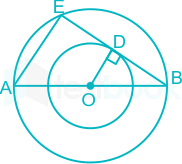
The radii of two concentric circles are 13 cm and 5 cm. AB is the diameter of the bigger circle and BD is a tangent to the smaller circle at point D on it. The length of AD, in cm, is:

  1. ((a))

    2612\sqrt{61}

  2. ((b))

    4154\sqrt{15}

  3. ((c))

    2622\sqrt{62}

  4. ((d))

    4144\sqrt{14}

Show Answer
Answer: ((a))

2612\sqrt{61}

Given:

The radii of two concentric circles are 13 cm and 5 cm respectively.

Concept used:

If two triangles are similar, the ratio of the respective sides will be equal.

Calculation:

In ΔOBD

∠ODB = 90°

OB = 13 cm and OD = 5 cm

So, BD = 12 cm [Pythagoras triplets]

ΔBOD and ΔBAE are similar

AO = BO or AB = 2BO

So, AE = 10 cm [AE = 2OD]

ED = 12 cm [EB = 2DB or ED = DB]

Now, ΔAED, angle E is right angle as the angle is on the semi-circle.

So, AD2 = AE2 + ED2

⇒ AD2 = 100 + 144

⇒ AD2 = 244

⇒ AD = 2612\sqrt{61} cm

∴ The length of AD is  2612\sqrt{61} cm.

34

If 12x2 - 9x - 1 = 0, then what is the value of 4x2+136x24x^2 + \frac{1}{36x^2} ?

  1. ((a))

    76\frac{7}{6}

  2. ((b))

    3512\frac{35}{12}

  3. ((c))

    136\frac{13}{6}

  4. ((d))

    1912\frac{19}{12}

Show Answer
Answer: ((b))

3512\frac{35}{12}

Given:

12x2 - 9x - 1 = 0

Concept used:

(a - b)2 = a2 + b2 - 2ab

Calculation:

12x2 – 9x – 1 = 0

By Divided 6x from both sides we get

⇒ 2x – 3/2 – 1/6x = 0

⇒ 2x – 1/6x = 3/2

Squaring on both sides

⇒ 4x2 + (1/36x)2 - 2 × 2x × (1/6x) = 9/4

⇒ 4x2 + (1/36x)2 = 9/4 + 2/3

⇒ 4x2 + (1/36x)2 = (27 + 8)/12

⇒ 4x2 + (1/36x)2 = 35/12

∴ The required answer is 3512\frac{35}{12}

35

Simplify:

(323÷23:of:1130)×215+14:of:212÷113×445445(3\frac{2}{3}\div\frac{2}{3}:of: \frac{11}{30})\times\frac{2}{15}+\frac{1}{4}:of: 2\frac{1}{2}\div1\frac{1}{3}\times4\frac{4}{5}-4\frac{4}{5}

  1. ((a))

    1120-\frac{11}{20}

  2. ((b))

    12-\frac{1}{2}

  3. ((c))

    215322\frac{15}{32}

  4. ((d))

    21102\frac{1}{10}

Show Answer
Answer: ((a))

1120-\frac{11}{20}

Given:

(323÷23:of:1130)×215+14:of:212÷113×445445(3\frac{2}{3}\div\frac{2}{3}:of: \frac{11}{30})\times\frac{2}{15}+\frac{1}{4}:of: 2\frac{1}{2}\div1\frac{1}{3}\times4\frac{4}{5}-4\frac{4}{5}

Concept used:

Calculation:

(323÷23:of:1130)×215+14:of:212÷113×445445(3\frac{2}{3}\div\frac{2}{3}:of: \frac{11}{30})\times\frac{2}{15}+\frac{1}{4}:of: 2\frac{1}{2}\div1\frac{1}{3}\times4\frac{4}{5}-4\frac{4}{5}

⇒ (113×9022)×215+14:of:212÷113×445445(\frac{11}{3}\times\frac{90}{22})\times\frac{2}{15}+\frac{1}{4}:of: 2\frac{1}{2}\div1\frac{1}{3}\times4\frac{4}{5}-4\frac{4}{5}

⇒ 15×215+14:of:212÷113×44544515\times\frac{2}{15}+\frac{1}{4}:of: 2\frac{1}{2}\div1\frac{1}{3}\times4\frac{4}{5}-4\frac{4}{5}

⇒ 15×215+14:of:52÷43×24524515\times\frac{2}{15}+\frac{1}{4}:of: \frac{5}{2}\div\frac{4}{3}\times\frac{24}{5}-\frac{24}{5}

⇒ 15×215+58÷43×24524515\times\frac{2}{15}+\frac{5}{8}\div\frac{4}{3}\times\frac{24}{5}-\frac{24}{5}

⇒ 15×215+58×34×24524515\times\frac{2}{15}+\frac{5}{8}\times\frac{3}{4}\times\frac{24}{5}-\frac{24}{5}

⇒ 2+942452+\frac{9}{4}-\frac{24}{5}

⇒ 40;+;45;;9620\frac{40;+;45;-;96}{20}

⇒ ;1120\frac{-;11}{20}

∴ Required answer is 1120-\frac{11}{20}.

36

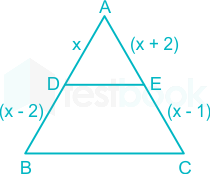
In ΔABC, D and E are the points on sides AB and AC, respectively, such that DE || BC. If AD = x, DB = x - 2, AE = x + 2 and EC = x - 1, then (AB + AE) is equal to:

(all measurements in cm)

  1. ((a))

    12

  2. ((b))

    13

  3. ((c))

    10

  4. ((d))

    9

Show Answer
Answer: ((a))

12

Given:

DE || BC

AD = x

DB = x - 2

AE = x + 2

EC = x - 1

Concept used:

Thales theorem = The line is drawn parallel to one side of a triangle and cutting the other two sides divides the other two sides in equal proportion

a2 - b2 = (a + b)(a - b)

Calculation:

In ΔABC, it is given that DE || BC.

Applying Thales’ theorem, we have,

AD/DB = AE/EC

xx2=x+2x1\rm \frac{x}{x-2} = \frac{x +2}{x-1}

⇒ x(x - 1) = (x + 2)(x - 2)

⇒ x2 - x = x2 - 22

⇒ x = 4

So, AB = x + x - 2

⇒ AB = 4 + 4 - 2

⇒ AB = 6

AE = x + 2

⇒ AE = 4 + 2

⇒ AE = 6

AB + AE = 6 + 6

⇒ AB + AE = 12

∴ Requried answer is 12.

37

If the 5-digit number 699ab is divisible by 11 and 21, then what is the value of (3a - 2b)?

  1. ((a))

    21

  2. ((b))

    17

  3. ((c))

    29

  4. ((d))

    19

Show Answer
Answer: ((a))

21

Given:

5 digit number 699ab is divisible by 11 and 21

Concept used:

When a number is divisible by 3, 7, 11 then it will be divisible by 231

Calculation:

21 = 3 × 7

So we will first evaluate: LCM (3, 7, 11) = 231

The largest possible value of 699ab is 69999

When we divide 69999 by 231 we obtain 6 as the remainder.

So required number = 69999 – 6 = 69993

So, a = 9 and b = 3

Now,

(3a - 2b) = (3 × 9 - 2 × 3)

⇒ (3a - 2b) = 27 - 6

⇒ (3a - 2b) = 21

∴ Required answer is 21

38

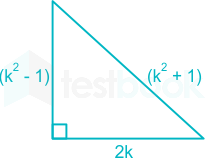
If sec θ + tan θ = k, 0° < θ < 90°, then (k1)22(k+1)22k\frac{(k-1)^2-2}{(k+1)^2-2k} is equal to:

  1. ((a))

    sin θ - cos θ

  2. ((b))

    cos θ + sin θ

  3. ((c))

    sec θ cosec θ

  4. ((d))

    cos θ sin θ

Show Answer
Answer: ((a))

sin θ - cos θ

Given:

sec θ + tan θ = k

Concept used:

sec2 θ - tan2 θ = 1

sinθ = P/H

cosθ = B/H

P2 + B2 = H2

P = perpendicular

B = base

H = hypotenuse

Calculation:

sec θ + tan θ = k      ----(i)

So, sec θ - tan θ = 1/k      ----(ii)

By doing (i) + (ii) we get

sec θ = (k2 + 1)/2k i.e H/B

So,

(k1)22(k+1)22k\frac{(k-1)^2-2}{(k+1)^2-2k}

⇒ k2+12k2k2+1+2k2k\frac{k^2+1-2k-2}{k^2+1+2k-2k}

⇒ k212kk2+1\frac{k^2-1-2k}{k^2+1}

⇒ k21k2+12kk2+1\frac{k^2-1}{k^2+1}-\frac{2k}{k^2+1}

⇒ sin θ - cos θ

∴ The required answer is sin θ - cos θ.

39

A boat rows 5 km upstream and 6 km downstream in a total of 2 hours. It can also row 15 km upstream and 14 km downstream in a total of 512\frac{1}{2} hours. How much time (in hours) will it take to row 32.4 km in still water?

  1. ((a))

    3.6

  2. ((b))

    8.1

  3. ((c))

    5.4

  4. ((d))

    4.8

Show Answer
Answer: ((c))

5.4

Given:

A boat rows 5 km upstream and 6 km downstream in a total of 2 hours.

It can also row 15 km upstream and 14 km downstream in a total of 512\frac{1}{2} hours

Concept used:

Time = Distance/Speed

Downstream = v + u

Upstream = v - u

v = speed of the object

u = speed of the stream

Calculation:

Let the speed of the boat be u and the speed of the stream be v

Now,

5(vu)+6(v+u)=2\rm \frac{5}{(v - u)}+\frac{6}{(v+u)} = 2      ----(i)

15(vu)+14(v+u)=112\rm \frac{15}{(v - u)}+\frac{14}{(v+u)} = \frac{11}2      ----(ii)

By multiplying 3 with eq (i) we get

15(vu)+18(v+u)=6\rm \frac{15}{(v - u)}+\frac{18}{(v+u)} = 6      ----(iii)

Subtracting eq (ii) from eq (iii) we get

4(v+u)=12\frac{4}{(v+u)} = \frac{1}{2}

⇒ v + u = 8 i.e downstream speed

Now,

5(vu)+68=2\rm \frac{5}{(v - u)}+\frac{6}{8} = 2

⇒ 5(vu)=234\rm \frac{5}{(v - u)}= 2 - \frac{3}{4}

⇒ 5(vu)=834\rm \frac{5}{(v - u)}= \frac{8 - 3}{4}

⇒ 5(vu)=54\rm \frac{5}{(v - u)}= \frac{5}{4}

⇒ v - u = 4 i.e upstream speed

v + u = 8     ----(iv)

v - u = 4     ----(v)

By adding eq (iv) and eq (v) we get

2v = 12

⇒ v = 6

Now,

Time = 32.4/6

⇒ 5.4 hours

∴ It will take 5.4 hours to row 32.4 km in still water.

40

Kewal bought 5 tables and 13 chairs for a total of Rs. 14,220. He sold the tables at a profit of 15% and the chairs at a loss of 10%. If his profit in the entire transaction is Rs. 378, then what is the difference (in Rs.) between the cost price of 2 tables and the cost price of 3 chairs?

  1. ((a))

    1260

  2. ((b))

    1280

  3. ((c))

    1250

  4. ((d))

    1240

Show Answer
Answer: ((a))

1260

Given:

Kewal bought 5 tables and 13 chairs for a total of Rs. 14,220. He sold the tables at a profit of 15% and the chairs at a loss of 10%

Profit = Rs. 378

Concept used:

Profit = Selling price - Cost price 

Calculation:

Let the cost price of one table and one chair be Rs. x and Rs. y respectively.

5x + 13y = 14220      ----(1)

According to the question

5x × (15/100) - 13y × (10/100) = 378

⇒ 75x/100 - 130y/100 = 378

⇒ 15x - 26y = 7560      ----(2)

By multiplying 2 with eq (1) we get

10x + 26y = 28440      ----(3)

Adding equation (2) and equation (3)

25x = 36000

⇒ x = 1440

So,

13y = 14220 - 5 × 1440

⇒ 13y = 7020

⇒ y = 540

Now,

Cost of 2 tables = 1440 × 2 = 2880

Cost of 3 chairs = 540 × 3 = 1620

Difference = 2880 - 1620

⇒ 1260

∴ Required answer is Rs. 1260

41

The simple interest on a certain sum for 425\frac{2}{5} years at 9% p.a. is Rs. 1,072.50 more than the compound interest on the same sum for 2 years at 15% p.a., interest compounded 8-monthly. The sum (in Rs.) is:

  1. ((a))

    15,000

  2. ((b))

    15,600

  3. ((c))

    16,500

  4. ((d))

    16,000

Show Answer
Answer: ((c))

16,500

Given:

The simple interest on a certain sum for 425\frac{2}{5} years at 9% p.a. is Rs. 1,072.50 more than the compound interest on the same sum for 2 years at 15% p.a., interest compounded 8-monthly. 

Concept used:

SI = PTR/100

CI = P(1 + r/100)n - P

P = Principal,

R = Rate of interest

n = time

T = time 

r = rate 

Calculation:

Let the principal be 100a

For compound interest, 15% per annum is for 12 months

2 years = 24 months or 3 eight monthly

So, for 8 months it is 15 × 8/12 = 10%

Now, according to the question

100a×22×95×100[100a(1+10100)3100a]=1072.5\rm \frac{100a × 22 × 9}{5× 100}-[100a(1+\frac{10}{100})^3-100a] = 1072.5

⇒ 198a5100a(1110)3+100a=1072.5\rm \frac{198a}{5}-100a(\frac{11}{10})^3+100a = 1072.5

⇒ 198a51331a10+100a=1072.5\rm \frac{198a}{5}-\frac{1331a}{10}+100a = 1072.5

⇒ 39.6a - 133.1a + 100a = 1072.5

⇒ 6.5a = 1072.5

⇒ a = 165

So, 100a = 16500 i.e is principal

∴ The sum is Rs. 16500

42

After working for 6 days, Meena finds that only one-third of the work has been completed. She now employs Nina, who is 40% less efficient than her, and works together till the work is completed. In how many (total) days is the entire work completed?

  1. ((a))

    1714\frac{1}{4}

  2. ((b))

    1312\frac{1}{2}

  3. ((c))

    1114\frac{1}{4}

  4. ((d))

    712\frac{1}{2}

Show Answer
Answer: ((b))

1312\frac{1}{2}

Given:

Nina, who is 40% less efficient than Meena

Concept used:

Efficiency is inversely proportional to the time taken.

Incremented/Reduced value = Initial value (1 ± change%)

Calculation:

In 6 days, the work done by Meena = 1/3

So, Meena can complete a work = 6 × 3 days

⇒ 18 days

Nina will take = 18 ÷ (1 - 40%) = 30 days to complete the same job

Remaining work = 1 - (1/3)

⇒ 2/3

Let more n days to be needed by them to complete the job,

So,

(n/18) + (n/30) = 2/3

⇒ [(5n + 3n)/90] = 2/3

⇒ 8n/90 = 2/3

⇒ 24n = 180

⇒ n = 180/24

⇒ n = 1312\frac{1}{2}

∴ Required time is 1312\frac{1}{2} days

43

Let x be the greatest number which when divides 2871, 4627 and 7700, the remainder in each case is y. The value of (x - y) lies between:

  1. ((a))

    195 and 200

  2. ((b))

    205 and 210

  3. ((c))

    200 and 205

  4. ((d))

    210 and 215

Show Answer
Answer: ((c))

200 and 205

Given:

x be the greatest number which when divides 2871, 4627 and 7700, the remainder in each case is y

Calculation:

According to the question,

Taking the difference

4627 – 2871 = 1756

7700 – 4627 = 3073

7700 – 2871 = 4829

HCF of 1756, 3073 and 4829 (By Factor Method)

The factors of 1756 are: 1, 2, 4, 439, 878, 1756

The factors of 3073 are: 1, 7, 439, 3073

The factors of 4829 are: 1, 11, 439, 4829

So, HCF = 439 = x

Now,

Y = 237

So, (x - y) = 439 - 237

⇒ (x - y) = 202

∴ The value of (x - y) lies between 200 and 205.

44

An article is finally sold at a profit of 40% on its cost price, after passing through two dealers, A and B. If A earned a profit of 25%, then the profit per cent earned by B is:

  1. ((a))

    12%

  2. ((b))

    15.5%

  3. ((c))

    15%

  4. ((d))

    12.5%

Show Answer
Answer: ((a))

12%

Given:

An article is finally sold at a profit of 40%

Profit % of A = 25%

Concept used:

Profit = SP - CP

Profit % = (Profit/CP) × 100

CP = Cost price

SP = Selling price

Calculation:

Let original price was Rs. 100

So,

With 40% profit, the selling price would be

100 + 40% of 100

⇒ Rs. 140

First dealer A makes profit of 25%, then he must have sold it at,

100 + 25% of 100

⇒ Rs. 125

Now, Profit for second dealer = 140 - 125 

⇒ Rs. 15

So,

% Profit of B = (15/125) × 100

⇒ 12%

∴ The required answer is 12%.

45

Let x=(0.47÷0.52)÷2.272x = (0.\overline{47} \div0.5\overline2) \div 2.2\overline{72} and y=135129:of:3311÷517:of:79y = 1\frac{3}{5} - 1\frac{2}{9} :of :3\frac{3}{11} \div5\frac{1}{7} :of: \frac{7}{9}, what is the value of xy\frac{x}{y}?

  1. ((a))

    15\frac{1}{5}

  2. ((b))

    23\frac{2}{3}

  3. ((c))

    53\frac{5}{3}

  4. ((d))

    32\frac{3}{2}

Show Answer
Answer: ((b))

23\frac{2}{3}

Given:

x=(0.47÷0.52)÷2.272x = (0.\overline{47} \div0.5\overline2) \div 2.2\overline{72}

y=135129:of:3311÷517:of:79y = 1\frac{3}{5} - 1\frac{2}{9} :of :3\frac{3}{11} \div5\frac{1}{7} :of: \frac{7}{9}

Concept used:

0.ab=ab990.\overline {ab} =\frac{ab}{99}

c.ab=cabc99c.\overline {ab} =\frac{cab - c}{99}

c.ab=cabca90c.a\overline {b} =\frac{cab - ca}{90}

Calculation:

x=(0.47÷0.52)÷2.272x = (0.\overline{47} \div0.5\overline2) \div 2.2\overline{72}

⇒ x=(4799÷4790)÷2250990x = (\frac{47}{99} \div\frac{47}{90}) \div \frac{2250}{990}

⇒ x=(4799×9047)÷22599x = (\frac{47}{99} \times\frac{90}{47}) \div \frac{225}{99}

⇒ x=9099÷22599x = \frac{90}{99} \div \frac{225}{99}

⇒ x=9099×99225x = \frac{90}{99} \times \frac{99}{225}

⇒ x=25x = \frac{2}{5}

y=135129:of:3311÷517:of:79y = 1\frac{3}{5} - 1\frac{2}{9} :of :3\frac{3}{11} \div5\frac{1}{7} :of: \frac{7}{9}

⇒ y=135119:of:3611÷367:of:79y = 1\frac{3}{5} - \frac{11}{9} :of :\frac{36}{11} \div\frac{36}{7} :of: \frac{7}{9}

⇒ y=1354÷4y = 1\frac{3}{5} - 4 \div4

⇒ y=851y = \frac{8}{5} - 1

⇒ y=8;;55y = \frac{8;-;5}{5}

⇒ y=35y = \frac{3}{5}

So, xy=2535\frac{x}{y} = \frac{\frac{2}{5}}{\frac{3}{5}}

⇒ xy=23\frac{x}{y} = \frac{2}{3}

∴ Required answer is 23\frac{2}{3}.

46

A computer is available for Rs. 71,580 cash or Rs. 12,000 as cash down payment followed by three equal half yearly instalments. If the interest is charged at 20% p.a., compounded half yearly, the interest paid by customer under the instalment plan is:

  1. ((a))

    Rs. 12,294

  2. ((b))

    Rs. 11,248

  3. ((c))

    Rs. 10,245

  4. ((d))

    Rs. 12,498

Show Answer
Answer: ((a))

Rs. 12,294

Given:

Down payment = Rs. 12000

Formula used:

Compound interest = P(1 + R/100)n - P

Total amount = e/(1 + 10/100) + e/(1 + 10/100)2 + e/(1 + 10/100)3 + ........ + e/(1 + 10/100)n

P = Principal,

R = Rate of interest

N = time

E = each installment

Calculation:

Amount to be paid in installments = 71580 - 12000 = Rs. 59580

Let each installment be of Rs. a

Half yearly interest rate = 20/2 = 10%

⇒ 59580 = a/(1 + 10/100) + a/(1 + 10/100)2 + a/(1 + 10/100)3

⇒ a = 59580 × 1331/3310

⇒ a = 23958

Total amount given = 23958 × 3 + 12000

⇒ 71874 + 12000

⇒ 83874

Interest = 83874 - 71580

⇒ 12294

∴ The interest paid by customer under the instalment plan is Rs.7986.

47

A, B and C started a business with their capitals in the ratio 15\frac{1}{5} : 12\frac{1}{2} : 710\frac{7}{10} . After 4 months, A increased his capital by 50% and C decreased his capital by 20%. At the end of a year, B received Rs. 90,000 as a share in the profit, the share of C in the profit is:

  1. ((a))

    Rs. 1,09,200

  2. ((b))

    Rs. 96,000

  3. ((c))

    Rs. 1,16,000

  4. ((d))

    Rs. 48,000

Show Answer
Answer: ((a))

Rs. 1,09,200

Given:

Capital of A, B and C = 15:12:710\frac{1}{5}:\frac{1}{2}:\frac{7}{10}

Concept used:

When the capital share ratio is in fractions we use the LCM method to calculate the capital ratio

Calculation:

LCM of 5, 2, 10 = 10

Suppose capital of A = 10 × 1/5 = 2

Suppose capital of B = 10 × 1/2 = 5

Suppose capital of C = 10 × 7/10 = 7

Total capital of B after end of the year = 5 × 12

⇒ 60

Now, C decreased his capital by 20% which means,

⇒ 7 × 20% = 1.4

C decreased his capital = 7 - 1.4 = 5.6 

Total capital of C after end of the year = 7 × 4 + 5.6 × 8

⇒ 28 + 44.8 = 72.8

According to the question,

60 = 90000

⇒ 1 = 1500

⇒ 72.8 = 109200

So, C's share = Rs. 109200

∴ The share of C in the total profit is Rs. 109200

48

Pipes A and B together can fill an empty tank in x minutes. A alone takes (8 + x) minutes to fill the tank and B alone takes (32 + x) minutes to fill the tank. A and B together fill the tank for 10 minutes. C alone fills the remaining part of the tank in 412\frac{1}{2} minutes. A, B and C together can fill 720\frac{7}{20}th part of the tank in:

  1. ((a))

    225\frac{2}{5} minutes

  2. ((b))

    245\frac{4}{5} minutes

  3. ((c))

    312\frac{1}{2} minutes

  4. ((d))

    314\frac{1}{4} minutes

Show Answer
Answer: ((a))

225\frac{2}{5} minutes

Given:

Pipes A and B together can fill an empty tank in x minutes. A alone takes (8 + x) minutes to fill the tank and B alone takes (32 + x) minutes to fill the tank

Concept used:

If A and B takes a hours and b hours more than time taken by them working together,

Then Time taken by them = √(a.b)

If a pipe can complete a work alone in x hour, then the efficiency (part of the work completed in one day) = 1/x

Total work = LCM of time taken pipes to fill a tank alone

Calculation:

Time taken by A and B together = √(8 × 32)

⇒ 16 minutes

So, time taken by A = 8 + 16 = 24 minutes and B = 16 + 32 = 48 minutes

So in 10 they both will complete (10/24 + 10/48) units of work

⇒ (20 + 10)/48 = 5/8

So, remaining work = 1 - (5/8)

⇒ 3/8

Now C can complete 3/8 of the work in 9/2 minutes

So, C can complete total work in 12 minutes

LCM of 24, 48, 12 = 48 i.e total work

Efficiency of A = 48/24 = 2

Efficiency of B = 48/48 = 1

Efficiency of C = 48/12 = 4

Effiective efficiency = 7

So, 7/20 th of the work = 48 × 7/20 = 16.8

Time = 16.8/7 = 2.4 minutes or 225\frac{2}{5} minutes

∴ Required answer is 225\frac{2}{5} minutes

49

An article is marked Rs. 224 above its cost price. It was sold at a profit of 20% after giving a discount of 15% on its marked price. What is the cost price (in Rs.) of the article?

  1. ((a))

    544

  2. ((b))

    476

  3. ((c))

    486

  4. ((d))

    524

Show Answer
Answer: ((a))

544

Given:

An article is marked Rs. 224 above its cost price.

Profit % = 20

Discount % = 15

Concept used:

SP = MP - MP × Discount%

Profit % = [(SP - CP)/CP] × 100

MP = Marked price

SP = selling price

CP = cost price

Calculation:

Let CP of the article be 100a

So, SP = 100a + 100a × 1/5

⇒ 120a

MP = 120a × 20/17 [∵ 15% = 3/20]

⇒ 2400a/17

According to the question,

(2400a/17) - 100a = 224

⇒ [(2400a - 1700a)/17] = 224

⇒ 700a = 224 × 17

⇒ 700a = 3808

⇒ a = 3808/700

⇒ a = 5.44

So, 100a = 544

∴ The cost price (in Rs.) of the article is 544

50

The driver of a car driving at 82 km/h locates a bus 150 m ahead of him. After 18 seconds, the bus was 90 m behind the car. What is the speed (in km/h) of the bus?

  1. ((a))

    34

  2. ((b))

    36

  3. ((c))

    38

  4. ((d))

    32

Show Answer
Answer: ((a))

34

Given:

Speed of the car = 82km/hr

Formula used:

Speed = Distance/Time

Calculation:

Speed of the car = 82 × (5/18) = (205/9)m/sec

Let the speed of the bus = x m/sec

The difference between the distance covered by the car and bus in 18 seconds = 150 + 90 = 240m

According to the question,

⇒ {(205/9) – x} × 18 = 240

⇒ 410 – 18x = 240

⇒ 18x = 410 - 240

⇒ 18x = 170

⇒ x = 170/18

Speed of bus = (170/18) m/sec

Speed of bus in km/h = (170/18) × 18/5

⇒ 34 km/hr

∴ The speed (in km/h) of the bus 34.

Science (25 questions)

51

How is Copper-T used as a contraceptive?

  1. ((a))

    As a surgical tool for a simple quick reversible surgery

  2. ((b))

    As an oral pill to disrupt normal hormonal cycle in women

  3. ((c))

    Inside the uterus of a woman to block the fallopian tubes

  4. ((d))

    As a reusable barrier to be used during intercourse

Show Answer
Answer: ((c))

Inside the uterus of a woman to block the fallopian tubes

The correct answer is Inside the uterus of a woman to block the fallopian tubes.

Concept:

Contraception:

  • It is the method to prevent pregnancy in women.
  • Any device or chemical which prevents pregnancy in a woman is called a Contraceptive.

Explanation:

Methods of contraception: 

  • Barrier Method
  • Physical devices such as condoms (male) and diaphragm (female-covering on vagina) are used.
  • They prevent the fusion of sperm and egg.
  • Chemical Method
  • The female uses 2 types of pills-oral and vagina.
  • Oral pills are made of specific hormones which prevent the release of the ovum (egg) into the oviduct.
  • Vaginal pills contain chemicals that kill the sperms.
  • Intra-uterine contraceptive device(IUCD) 
  • The IUCD such as copper-T is placed inside the uterus to block the fallopian tube (oviduct).
  • It prevents the implantation of sperms from fertilizing the ovum.
  • Surgical method
  • In males, a small portion of sperm duct is removed by operation and both the cut ends are tied properly (Vasectomy). It prevents the sperms from coming out.
  • In females, a small portion of the oviduct is removed and the cut ends are tied (Tubectomy). It prevents the egg from entering oviducts.
52

Which of the following will turn blue litmus red?

  1. ((a))

    Dry hydrogen chloride gas

  2. ((b))

    Dry ammonia gas

  3. ((c))

    Dry pellets of sodium hydroxide

  4. ((d))

    Aqueous hydrogen chloride

Show Answer
Answer: ((d))

Aqueous hydrogen chloride

The correct answer is Aqueous hydrogen chloride.

Concept:

pH scale:

  • A scale developed to measure the concentration of hydrogen ions in a solution is known as the pH scale where p in pH implies ‘potenz’ in German.
  • pH scale ranges from 0 (highly acidic) to 14 (highly alkaline).
  • The pH of a neutral solution is 7.

Acid:

  • It is sour in taste.
  • It turns the blue litmus colour into red.
  • It is represented by a value Lesser than 7 on the pH scale.

Explanation:

  • Dry acids cannot turn blue litmus red.
  • This is because acidity is due to the presence of H+ ions present in acids.
  • In water, acids dissociate to give H+ ions which in turn change the litmus colour from blue to red.
CompoundTurn blue litmus red
Dry hydrogen chloride gasNo, because there are no H+ ions
Dry ammonia gasNo, because ammonia is a base
Dry pellets of sodium hydroxideNo, because sodium hydroxide is a bse
Aqueous hydrogen chlorideYes, since in an aqueous solution there will be H+ ions

Additional InformationBase:

  • It is bitter in taste and slippery to touch.
  • It turns the red litmus colour into the blue.
  • It is represented by a value greater than 7 on the pH scale.
53

Which of the following statements about milk is true?

  1. ((a))

    Its components can be seen with naked eyes.

  2. ((b))

    It is a homogeneous mixture.

  3. ((c))

    Its components can be separated by sedimentation.

  4. ((d))

    It shows Tyndall effect.

Show Answer
Answer: ((d))

It shows Tyndall effect.

The correct answer is It shows the Tyndall effect. 

Concept:

Types of Mixtures:

  • Homogeneous Mixture:
  • Those mixtures, in which the substances are completely mixed together and are indistinguishable from one another, are called homogeneous mixtures.
  • For example Soda water, Soft drinks, lemonade, salt or sugar solution, etc.
  • Heterogeneous Mixture:
  • Those mixtures in which the substances remain separate and one substance is spread throughout the other substance as small particles, droplets, or bubbles are called heterogeneous mixtures.
  • All the suspensions and colloids are heterogeneous mixtures.
  • For Example: - Sugar and sand mixture, muddy river water, soap solution.

Explanation:

Colloids:

  • A colloid is a heterogeneous system in which one substance is dispersed (dispersed phase or colloidal particles) in another substance which is called a dispersion medium.

Properties of colloids:

  • A colloid appears to be homogeneous but actually, it is heterogeneous.
  • The particles of most of the colloids cannot be seen even with a microscope.
  • It scatters a beam of light passing through it (Tyndall effect).
  • The size of the solute particle is in the range of 1 to 100 nm.
  • Since they are heterogeneous in nature, centrifugation techniques can be used to separate the particles.

Milk is a colloid, thus it will show the Tyndal effect.

54

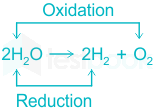
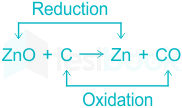
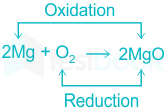
Which of the following is NOT an example of oxidation-reduction reaction?

  1. ((a))

    CaCO3 → CaO + CO2

  2. ((b))

    2Mg + O2 → 2MgO

  3. ((c))

    ZnO + C → Zn + CO

  4. ((d))

    2H20 → 2H2 + O2

Show Answer
Answer: ((a))

CaCO3 → CaO + CO2

The correct answer is CaCO3 → CaO + CO2.

Concept:

Chemical reaction:

  • It is a process in which one or more substances, the reactants, are converted to one or more different substances, the products.
  • A chemical reaction rearranges the constituent atoms of the reactants to create different substances as products.

Explanation:

Oxidation:

  • The addition of oxygen/electronegative element to a substance or removal of hydrogen/electropositive element from a substance is called oxidation.

Reduction:

  • The removal of oxygen/electronegative elements from a substance or the addition of hydrogen/electropositive elements to a substance is called reduction.

​Oxidation and reduction always occur simultaneously, hence, the word “redox” was coined for this class of chemical reactions. 

Decomposition reaction:

  • The opposite of a combination reaction, a complex molecule breaks down to make simpler ones.
  • Such reactions are represented by equations of the following form: AB → A + B.
  • CaCO3 → CaO + CO2 is a decomposition reaction.
55

What is the number of oxygen atoms present in 250 g of glucose?

  1. ((a))

    50.2 × 1023

  2. ((b))

    6 × 10²³

  3. ((c))

    12.044 × 10²³

  4. ((d))

    26 × 1023

Show Answer
Answer: ((a))

50.2 × 1023

The correct answer is 50.2 × 1023.

Concept:

Mole:

  • It is the SI unit of the amount of substance.
  • One mole contains exactly 6.022 ×10²³ atoms/molecules.
  • The mass of one mole of a substance in grams is called its molar mass.
  • The molar mass in grams is numerically equal to atomic/molecular/formula mass in u.
  • So, 1 mole = 6.022 × 10²³ atoms/molecules = Atomic/molecular mass of an element/compound.

Explanation:

The molar mass of glucose (C6H12O6) = 6 × 12 + 12 × 1 + 6 × 16 = 72 + 12 + 96 = 180g 

1 mole of glucose = molar mass of glucose = 6.022 × 10²³ molecules of glucose 

180g of glucose = 6.022 × 10²³ molecules of glucose

1g of glucose = 6.022 × 10²³/ 180 molecules of glucose 

250g of glucose = (250 × 6.022 × 1023)/ 180 molecules of glucose 

One molecule of glucose has six atoms of oxygen. 

So,  (250 × 6.022 × 1023) / 180 molecules of glucose will have atoms of oxygen

=  (6 × 250 × 6.022 × 1023) / 180 = 50.1833 × 1023 = 50.2 × 1023

250g of glucose will have 50.2 × 1023 atoms of oxygen.

56

A metal 'M' reacts with oxygen to form a compound 'X'. Compound 'X' forms salt and water on reaction with both sulphuric acid and potassium hydroxide, separately. Which metal is this?

  1. ((a))

    Aluminium

  2. ((b))

    Copper

  3. ((c))

    Sodium

  4. ((d))

    Iron

Show Answer
Answer: ((a))

Aluminium

The correct answer is Aluminium.

Concept:

Metals:

  • They are the elements that have a tendency to lose electrons.
  • They are electropositive in nature.
  • They are rigid, ductile, malleable, sonorous, and lustrous.

Chemical properties of metals:

  • The metal reacts with oxygen to form metal oxide.
  • Metal + Oxygen → Metal oxide
  • The metal reacts with an acid to form a salt.
  • Metal + Acid → Salt + Hydrogen gas
  • Metals react with water to form oxides or hydroxides.
  • Metal + water → Metal oxide/ hydroxide
  • Metals do not react with alkalis.
  • Metal + Alkali → No reaction

Explanation:

  • Metals react with oxygen to form metal oxide. So. compound X is a metal oxide.
  • Metal oxides can be basic or amphoteric in nature.
  • Amphoteric oxides: Oxides that react with both acid and base to form salt and water.
  • Out of Aluminium, Copper, Sodium and Iron, only Aluminium forms amphoteric oxide.
  • It is given that compound X reacts with both sulphuric acid and potassium hydroxide (base) to form salt and water.
  • Thus, Aluminium is the metal that will react with oxygen to form compound X.
57

In our homes,

(i) all appliances are connected in parallel to the mains;

(ii) all appliances are connected in series to the mains;

(ii) AC is supplied at a frequency of 50 Hz.

Select the correct option.

  1. ((a))

    (i) and (iii) are correct

  2. ((b))

    (ii) and (iii) are correct

  3. ((c))

    Only (i) is correct

  4. ((d))

    Only (ii) is correct

Show Answer
Answer: ((a))

(i) and (iii) are correct

The correct answer is both statements (i) and (iii).

Concept:

Electric current: It is the rate of flow of electrons in a conductor. The SI Unit of electric current is the Ampere. 

Electric circuit: An electric circuit is a path through which electric current flows. 

  • Series circuit:
  • In the series, circuit electrons flow in a single direction.
  • Series circuits can be either opened or closed at a single time.
  • When the circuit breaks, no current flows in the circuit.
  • Parallel circuit:
  • In the parallel circuit, electrons flow in several directions.
  • Different parts of the circuit are connected in different branches.
  • If a circuit breaks in a single direction, electric current flows in another direction.

Explanation: 

Domestic circuit:

  • Electricity is generated at the power station.
  • It is brought to our homes by two thick copper wires or aluminium wires fixed over tall electric poles (or by underground cables).
  • The electricity from the mains is supplied to the houses using three-core wiring. They are
  • The Live wire
  • The neutral wire and
  • The earth wire
  • Live Wire: It is at a high potential of 220 volts. The live wire has red insulation.
  • Neutral wire: It is at the ground potential of zero volt. The neutral wire has black insulation covering.
  • Earth wire: It is a safety measure and does not affect the supply in any way. The green earth wire is connected to a metal plate deep in the earth.
  • The appliances are arranged in parallel circuits in households.
  • Voltage and frequency of the A.C. supplied to our houses are 220 V and 50 Hz respectively.
In our homes, all appliances are connected in parallel to the mainsCorrect
In our homes, all appliances are connected in series to the mains;Incorrect
AC is supplied at a frequency of 50 Hz.Correct
58

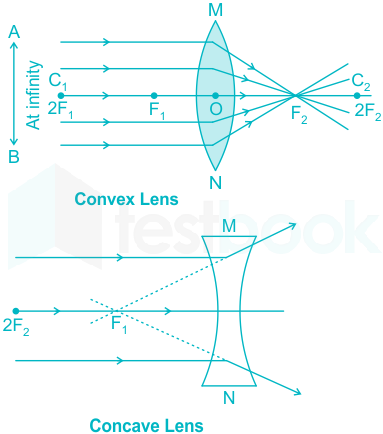
An object is placed on the principal axis of a concave lens at a point between its optical centre (O) and infinity. The image formed is:

  1. ((a))

    Erect and diminished

  2. ((b))

    Inverted and diminished

  3. ((c))

    Inverted and enlarged

  4. ((d))

    Erect and enlarged

Show Answer
Answer: ((a))

Erect and diminished

The correct answer is erect and diminished.

Concept:

Lens:

  • Lenses are spherical materials bounded by at least one spherical surface.
  • Convex lens (or converging lens) and concave lens (or diverging lens) are the two types of lenses bounded by two spherical surfaces.
  • The convex lenses are thicker in the middle compared to the edges and are used in converging light rays.
  • The concave lenses are thicker at the edges compared to the middle and are used in diverging light rays.

Explanation:

Image formation by the concave lens when the object is between its optical centre (O) and infinity:

Position of image: Between the first focus, F1, and the optical center O

Size of image: Diminished 

Nature of image: Virtual and erect 

Thus, the image formed is erect and diminished.

59

What is the function of lysosomes in a cell?

  1. ((a))

    To facilitate excretion in a cell

  2. ((b))

    Synthesis of the cell membrane

  3. ((c))

    To digest material ingested by the cell

  4. ((d))

    To organise the rough ER

Show Answer
Answer: ((c))

To digest material ingested by the cell

The correct answer is To digest material ingested by the cell.

Concept:

Cell organelles:

  • Inside the cell, there are different parts performing different activities to keep the cell alive and functional.
  • These parts are called Cell organelles.

Explanation:

Animal Cell

Explanation :

Endoplasmic reticulum :

  • It is a large network of membrane-bound tubes and sheets.
  • It is of two types: Rough ER and Smooth ER.
  • RER looks rough under the microscope as it has particles called ribosomes.
  • SER helps in the formation of fats and lipids.

Golgi complex :

  • It helps in the synthesis of the cell membrane.
  • It is involved in the formation of lysosomes.

Chloroplast :

  • It is a kind of plastid which have a green pigment called chlorophyll, which imparts green color to it.
  • Chloroplasts help in the process of photosynthesis in plants.

Mitochondria :

  • It is known as the powerhouse of the cell.
  • It stores energy in the form of ATP.

Lysosomes:

  • Lysosomes are small, spherical, sac-like structures that contain several digestive enzymes enclosed in a membrane.
  • They help in the digestion of foreign substances and worn-out cell organelles.
  • They provide protection against bacteria and viruses.
  • They help to keep the cell clean.
  • During the disturbance in cellular metabolism, for example, when the cell gets damaged, lysosomes may burst and the enzymes digest their own cell.
  • Therefore, lysosomes are also known as suicide bags of a cell.
60

Which of the following is a non-biodegradable item?

  1. ((a))

    Grass

  2. ((b))

    Paper

  3. ((c))

    Nylon

  4. ((d))

    Wood

Show Answer
Answer: ((c))

Nylon

The correct answer is nylon.

Concept:

Waste materials: 

  • Waste materials are either liquid or solid in form, and their components may be either hazardous or inert in their effects on health and the environment.
  • The term waste is typically applied to solid waste, sewage (wastewater), hazardous waste, and electronic waste.

Explanation:

Biodegradable WasteNon-biodegradable Waste
The substances that can be decomposed by the action of decomposers like bacteria and fungi.The substances that can not be decomposed by the action of decomposers like bacteria and fungi.
For example organic matter like human excreta, animal waste, dead bodies of plants and animals, leftover food items, natural fabrics like cotton, wool, etc. wood, paper, grass, and so on.For example plastic, rubber, glass, artificial clothes like nylon, rayon, electronic waste like batteries, etc.

Thus,

  • Grass - Biodegradable
  • Paper- Biodegradable
  • Nylon - Non-biodegradable
  • Wood - Biodegradable
61

Two lenses L1 and L2 of powers, 20 D and 10 D respectively, separated by 40 cm are arranged parallel to each other in vertical planes. An object is placed 10 cm left to L1, vertically on the common axis of the lenses. The distance between the original object and the final image is:

  1. ((a))

    60 cm

  2. ((b))

    65 cm

  3. ((c))

    35 cm

  4. ((d))

    40 cm

Show Answer
Answer: ((b))

65 cm

The correct answer is 65 cm.

Concept:

Lens:

  • The transparent curved surface which is used to refract the light and make an image of any object placed in front of it is called a lens.
  • A convex lens can converge a beam of parallel rays to a point on the other side of the lens

Power of lens:

  • It is equal to the reciprocal of the focal length of the lens/mirror in meters.
  • Power (P) = 1/f, where f is the focal length of the lens/mirror.
  • P = 100f\frac{100}{f} where f is the focal length in centimeters.
  • The unit of power of a lens is Dioptre when the focal length of the lens is taken in meters (m).
  • The focal length of the concave lens is negative and hence its power is also negative.
  • The focal length of the convex lens is positive and hence its power is also positive.

Lens formula: 1f=1v1u\frac{1}{f}=\frac{1}{v}-\frac{1}{u}  where f is focal length, v is image distance and u is object distance.

Explanation:

For first convex lens, L1 Power = 20D

Power = 1f\frac{1}{f}

f = 1p\frac{1}{p} = 10020\frac{100}{20} = 5 cm

Given: Object distance, u = -10 cm, Focal length, f = 5 cm

 v=?

1f=1v1u\frac{1}{f}=\frac{1}{v}-\frac{1}{u}

15=1v110\frac{1}{5} = \frac{1}{v} - \frac{1}{-10}

15=1v+110\frac{1}{5} = \frac{1}{v} + \frac{1}{10}

15110=1v\frac{1}{5} - \frac{1}{10} = \frac{1}{v}

1v=2110\frac{1}{v} = \frac{2-1}{10}

1v=110\frac{1}{v} = \frac{1}{10}

v = 10 cm

For second convex  lens, L2 power = 10 D

f = 1p\frac{1}{p} = 10010\frac{100}{10} = 10 cm

Object distance, u = -40-(-10)= -40 + 10 = -30cm, focal length, f = 10 cm

v = ?

1f=1v1u\frac{1}{f}=\frac{1}{v}-\frac{1}{u}

110=1v130\frac{1}{10} = \frac{1}{v} - \frac{1}{-30}

110=1v+130\frac{1}{10} = \frac{1}{v} + \frac{1}{30}

110130=1v\frac{1}{10} - \frac{1}{30} = \frac{1}{v}

1v=3130=230\frac{1}{v} = \frac{3-1}{30} = \frac{2}{30}

v=  15 cm 

Distance between original object and final image =  10 + 40 + 15 = 65 cm.

62

Which of the following materials CANNOT be recycled?

  1. ((a))

    Plastic

  2. ((b))

    Wood

  3. ((c))

    Metal

  4. ((d))

    Glass

Show Answer
Answer: ((b))

Wood

The correct answer is wood.

Concept:

Segregation of Waste: Waste Can be segregated as

  • Bio-Degradable Waste: 
  • Waste that can be decomposed by microorganisms.
  • It includes organic waste, e.g. kitchen waste, vegetables, fruits, flowers, leaves, wood, and paper.
  • Non-Bio Degradable Waste:
  • Waste that cannot be decomposed by microorganisms.
  • It includes plastic, rubber, glass, electronic waste, etc.

Explanation:

Non-Biodegradables can be disposed of by following the 3Rs: 

  • Reduce: If the old objects (bags, water bottles, clothes) are in good condition, it's better to keep using them rather than buying new things.
  • Reuse: Jam or pickle jars or plastic bottles can be used again to store small objects like buttons.
  • Recycle: Paper, glass, some plastics, and metals can be recycled.

 Wood is biodegradable, it can be made into compost but cannot be recycled. 

Additional Information

  • Wood is the correct answer because it cannot be recycled in the same way as plastic, metal, or glass.
  • Recycling means breaking a material down to make new products, and this process doesn't work well for wood.
63

Which of the following statements about acids are correct?

(i) All compounds containing hydrogen are acidic.

(ii) Acids generate H+ ions in aqueous solution.

(iii) Aqueous solution of acids change the colour of turmeric into red.

(iv) Aqueous solution of acids conduct electricity.

  1. ((a))

    (ii), (iii) and (iv)

  2. ((b))

    (ii) and (iv)

  3. ((c))

    (ii) and (iii)

  4. ((d))

    (i), (ii) and (iv)

Show Answer
Answer: ((b))

(ii) and (iv)

The correct answer is statements (ii) and (iv).

Concept:

Acids:

  • The substances that dissociate in an aqueous solution to release H+ ions are acids.
  • They are sour in taste.
  • Their pH range varies from 1 (extremely acidic) to 7 (neutral).

Explanation:

Properties of acids:

  • In an aqueous solution, acids dissociate to release H+ ions.
  • Aqueous solutions of acids are electrolytes i.e., they conduct electricity.
  • Acids change the color of certain acid-base indicates.
  • Two common indicators are litmus and phenolphthalein. Blue litmus turns red in the presence of an acid, while phenolphthalein turns colorless.
  • Turmeric remains yellow in acidic solution and turns red in basic solution.
  • Acids react with active metals to yield hydrogen gas. ​

Acids react with bases to produce a salt compound and water. 

All compounds containing hydrogen are acidic.False, only substances that dissociate in water to release H+ ions are acidic.
Acids generate H+ ions in an aqueous solution.True
The aqueous solution of acids changes the color of turmeric into the red.False, the color of turmeric remains yellow.
The aqueous solution of acids conducts electricity.True
64

A cylindrical metal wire is reformed so that its length decreases by 50% with no change of volume. Its resistance decreases by:

  1. ((a))

    75%

  2. ((b))

    50%

  3. ((c))

    100%

  4. ((d))

    60%

Show Answer
Answer: ((a))

75%

The correct answer is 75%.

Concept:

Resistance (R): 

  • Resistance is a measure of the opposition to current flow in an electrical circuit.
  • It is measured in ohms, symbolized by the Greek letter omega (Ω).
  • R=ρlAR = \frac{ρ l}{A} where ρ is resistivity, l is length, and A is the area of the cross-section of the wire.

 Explanation: 

Suppose original length = L, Area of cross-section = A, radius of wire = r and Resistance = R

Since the wire is the same, the resistivity ρ will be the same.

After the decrease in length, let us take new length = L', radius of wire = r' and new resistance = R'

L' = 50 L/ 100 = L/2( since there is 50% decrease)

The volume of the wire remains the same ( given).

So, Volume of Original Wire = volume of new wire 

π r2 L = π r ' 2 L'

r2L = r' 2 L'

r' 2 = r2 L /  L'

r' 2 = 2 r2 

Decrease in resistance = ρLAρLAρLA\frac{\frac{\rho L'}{A'}-\frac{\rho L}{A}}{\frac{\rho L}{A}} × 100

=ρLπr2ρLπr2ρLπr2×100=\frac{\frac{\rho L}{\pi r^2} - \frac{\rho L'}{\pi r'^2}}{ \frac{\rho L}{\pi r^2} } \times 100

=ρLπr2ρL2×2πr2ρLπr2×100=\frac{\frac{ \rho L}{ \pi r^2} - \frac{\rho L}{2× 2\pi r^2}}{ \frac{\rho L}{\pi r^2} } \times 100

=ρLπr2ρL4πr2ρLπr2×100=\frac{\frac{\rho L}{\pi r^2} - \frac{ \rho L}{ 4\pi r^2}}{ \frac{\rho L}{\pi r^2} } \times 100

=4ρLρL4πr2ρLπr2×100=\frac{\frac{4 \rho L - \rho L}{4\pi r^2}}{ \frac{\rho L}{\pi r^2} } \times 100

=3ρL4πr2×πr2ρL×100=75%= \frac{3 \rho L}{4 \pi r^2} \times \frac{\pi r^2}{ \rho L} \times 100 = 75 \%

Thus, the decrease in length is 75%.

65

An object 3.0 cm in height is placed at a distance of 100 cm in front of a convex mirror of focal length 50.0 cm, on its principal axis. Following New Cartesian Sign Convention, the image is formed at v = _____ and its height hI = _______.

  1. ((a))

    (100/3) cm; 1.0 cm

  2. ((b))

    (100/3) cm; -1.0 cm

  3. ((c))

    -100 cm, 3.0 cm

  4. ((d))

    100 cm; -3.0 cm

Show Answer
Answer: ((a))

(100/3) cm; 1.0 cm

The correct answer is 100/3 cm; 1.0 cm.

Concept:

Convex mirror: 

  • The mirror in which the rays diverge after falling on it is known as the convex mirror.
  • Convex mirrors are also known as diverging mirrors.
  • The focal length of a convex mirror is positive according to the sign convention.

Mirror formula = 1f=1v+1u\frac{1}{f} = \frac{1}{v} + \frac{1}{u} 

where v = image distance, u = object distance and f = focal length.

Magnification (m) = height of image / height of object = hi / ho 

Also, m = -v/ u 

So, m = hiho=vu\frac{hi}{ho} = \frac{-v}{u}

Cartesian Sign Convention for Spherical Mirror:

  • All signs are taken from the Pole of the spherical mirror, which is often called the origin or origin point.
  • The sign is taken as – (negative) on the left side of the pole.
  • So, the object distance is always taken as – (negative) in the case of both types of spherical mirrors, i.e. concave and convex mirrors.
  • The sign is taken as + (positive) on the right side of the pole.
  • The height is taken as + (positive) above the principal axis and taken as – (negative) below the principal axis.

​Explanation:

Given: Object distance, u = -100 cm, focal length, f = 50 cm, height of object, ho = 3 cm

1f=1v+1u\frac{1}{f} = \frac{1}{v} + \frac{1}{u}

150=1v+1100\frac{1}{50} = \frac{1}{v} + \frac{1}{-100}

150=1v1100\frac{1}{50} = \frac{1}{v} - \frac{1}{100}

150+1100=1v\frac{1}{50} + \frac{1}{100}= \frac{1}{v}

2+1100=1v\frac{2+1}{100} = \frac{1}{v}

1v=3100\frac{1}{v} = \frac{3}{100}

v = 100/3 cm

m = hiho=vu\frac{hi}{ho} = \frac{-v}{u}

hi3=1003×100=13\frac{hi}{3} = \frac{-100}{-3 × 100} = \frac{1}{3}

hi=33=1hi = \frac{3}{3} = 1  cm

The image is formed at v = 100/3 cm and its height hI = 1.0 cm.

66

Which of the following is NOT a goal in raising and breeding chickens for commercial poultry farming?

  1. ((a))

    High growth rate on a cheaper diet

  2. ((b))

    Lower the size of laying birds

  3. ((c))

    Ability to tolerate high summer temperatures

  4. ((d))

    Producing more baby chicks

Show Answer
Answer: ((d))

Producing more baby chicks

The correct answer is Producing more baby chicks.

Concept:

Poultry farming:

  • It is the raising of birds domestically or commercially, primarily for meat and eggs but also for feathers.

Broilers:

  • Birds reared solely for the purpose of meat production are called broilers.
  • Within a few weeks, broilers can grow to attain heavyweights.
  • Broilers’ feeds are made to have excess energy to enable them to gain weight.

Layers:

  • Birds reared for the purpose of egg production are called layers.
  • Layers tend not to gain weight and the composition of their feed is made in such a way that it helps them lay eggs without much weight.

Explanation:

Goals for raising and breeding chickens:

  • To reduce the size of laying birds so that fewer baby chicks are produced
  • High growth rate for broilers at a cheap diet
  • Ability to tolerate extreme whether conditions like high summer temperatures

Producing more baby chicks is not a goal for raising and breeding chickens.

67

A ‘Tt’ pea plant produces two types of gametes; one carrying the 'T' factor and the other the 't' factor. When do the two factors separate?

  1. ((a))

    In interphase (between cell division)

  2. ((b))

    At anaphase

  3. ((c))

    At telophase

  4. ((d))

    At metaphase

Show Answer
Answer: ((b))

At anaphase

The correct answer is At anaphase.

Concept:

Cell division:

  • The sequence of events by which a cell duplicates its genome synthesizes the other constituents of the cell, and eventually divides into two daughter cells is termed the cell cycle.
  • The cell cycle is divided into two basic phases:
  • Interphase
  • M phase
  • The M Phase represents the phase when the actual cell division occurs and the interphase represents the phase between two successive M phases.

Explanation:

Meiosis:

  • The specialised kind of cell division that reduces the chromosome number by half resulting in the production of haploid daughter cells is called meiosis.
  • Meiosis involves two sequential cycles of nuclear and cell division called meiosis I and meiosis II but only a single cycle of DNA replication.
  • Four haploid cells are formed at the end of meiosis II.
Meiosis IMeiosis II
Prophase IProphase II
Metaphase IMetaphase II
Anaphase IAnaphase II
Telophase ITelophase II

Prophase II:

  • The nuclear membrane disappears by the end of prophase II .
  • The chromosomes again become compact.

Metaphase II:

  • At this stage, the chromosomes align at the equator.
  • The microtubules from opposite poles of the spindle get attached to the kinetochores of sister chromatids.

<br>

Anaphase II:

  • It begins with the simultaneous splitting of the centromere of each chromosome.
  • It allows the chromatids to move toward opposite poles of the cell by shortening microtubules attached to kinetochores.
<br>

Telophase II:

  • Meiosis ends with telophase II, in which the two groups of chromosomes once again get enclosed by a nuclear envelope.
  • Cytokinesis follows resulting in the formation of a tetrad of cells i.e., four haploid daughter cells.

Thus, the two factors will separate at anaphase.

68

Which of the following properties characterises a reflex action involving the human nervous system?

  1. ((a))

    It occurs at the synapses between nerves.

  2. ((b))

    It is innate; does not need to be taught.

  3. ((c))

    It involves stimulation of gustatory receptors.

  4. ((d))

    It is controlled by the cerebral hemispheres.

Show Answer
Answer: ((b))

It is innate; does not need to be taught.

The correct answer is It is innate; does not need to be taught.

Concept:

Nervous system:

  • The nervous system of all animals is composed of highly specialized cells called neurons.
  • Neurons can detect, receive and transmit different kinds of stimuli.
  • The human nervous system consists of the brain, spinal cord, and nerves.

Explanation:

Reflex action: 

  • It is an extremely quick, automatic, sudden action in response to a stimulus.
  • It does not need to be taught. It is an innate characteristic.
  • It occurs involuntarily, i.e., without conscious effort or thought. So, it is not controlled by cerebral hemispheres.
  • A stimulus is a change in the environment to which an organism responds. It can be heat, sharp objects, light, etc.
  • For example-
  • Immediately pulling back of fingers after touching a hot plate.
  • Closing of eyes when flashed with a high-intensity light.
  • Salivation when hungry.
  • The pathway of nerves involved in a reflex action is called reflect arc.

  • Receptors present in sense organs are stimulated. Gustatory receptors are one of them.

Additional Information

  • Synapse: It is the gap between two neurons.
  • Gustatory receptors: They present on the papillae of the tongue and are used for detecting taste.
69

Read the following statements carefully and identify the FALSE statement regarding human circulatory system.

  1. ((a))

    Valves are present inside veins.

  2. ((b))

    Some veins carry oxygenated blood.

  3. ((c))

    Arteries carry only oxygenated blood.

  4. ((d))

    Arteries have thick walls (thicker than veins).

Show Answer
Answer: ((c))

Arteries carry only oxygenated blood.

The correct answer is Arteries carry only oxygenated blood.

Concept:

Human circulatory system: 

  • It is also called the blood vascular system.
  • It consists of a muscular chambered heart, a network of closed branching blood vessels, and blood, the fluid which is circulated.

Explanation:

Blood Vessels:

  • There are different types of blood vessels in our body each carrying out specialized functions.
  • Three types of blood vessels are Arteries, Veins, and Capillaries.
  • Arteries:
  • These are thick-walled blood vessels that carry oxygenated blood from the heart to different organs.
  • Pulmonary arteries are exceptions because they carry deoxygenated blood from the heart to the lungs, where oxygenation of blood takes place.
  • Veins:
  • These are thin-walled blood vessels that carry deoxygenated blood from different organs to the heart.
  • Pulmonary veins are exceptions because they carry oxygenated blood from the lungs to the heart.
  • Valves are present in veins to prevent back-flow of blood.
  • Capillaries: These are the blood vessels that have single-celled walls.
StatementTrue/false
Valves are present inside veins.True
Some veins carry oxygenated blood.True
Arteries carry only oxygenated blood.False, because pulmonary arteries carry deoxygenated blood.
Arteries have thick walls (thicker than veins).True
70

What is FALSE with respect to Cyclostomes?

  1. ((a))

    They lack upper and lower jaws.

  2. ((b))

    They do not have a notochord.

  3. ((c))

    They have smooth slimy skin.

  4. ((d))

    They are aquatic parasites.

Show Answer
Answer: ((b))

They do not have a notochord.

The correct answer is They do not have a notochord.

Concept:

Chordate:

  • Animals belonging to phylum Chordata are fundamentally characterized by the presence of a notochord, a dorsal hollow nerve cord, and paired pharyngeal gill slits.
  • These are bilaterally symmetrical, triploblastic, and coelomate with the organ-system level of organization.
  • They possess a post-anal tail and a closed circulatory system.
  • Phylum Chordata is divided into three subphyla: Urochordata or Tunicata, Cephalochordata, and Vertebrata.

Explanation:

The subphylum Vertebrata is further divided as follows:

Cyclostomata:

  • All living members of the class Cyclostomata are ectoparasites on some fishes.
  • They have an elongated body bearing 6-15 pairs of gill slits for respiration.
  • Cyclostomes have a sucking and circular mouth without jaws.
  • Their body is devoid of scales and paired fins. The cranium and vertebral column are cartilaginous.
  • Cyclostomes are marine but migrate for spawning in freshwater.
  • After spawning, within a few days, they die. Their larvae, after metamorphosis, return to the ocean.
  • Examples: Petromyzon (Lamprey) and Myxine (Hagfish).
StatementTrue/ false
They lack upper and lower jaws.True, cyclostomes are jawless.
They do not have a notochord.False, they belong to class Chordata, characterized by the presence of notochord.
They have smooth slimy skin.True, they lack scales and thus appear smooth.
They are aquatic parasites.True, they are ectoparasites on other fishes.
71

Which of the following substances will have the maximum energy associated with it?

  1. ((a))

    Water

  2. ((b))

    Ice

  3. ((c))

    Dry ice

  4. ((d))

    Carbon dioxide gas

Show Answer
Answer: ((d))

Carbon dioxide gas

The correct answer is Carbon dioxide gas.

Key Points

  • The kinetic energy of the particles of Carbon Dioxide gas is maximum.
  • The kinetic energy is maximum in the gas because particles can move freely with almost no force of attraction to tie them down.
  • Plasma possesses the most kinetic energy of the fundamental states of matter.
  • This is because the particles in a plasma move faster than the particles.

Additional Information

  • Solids have the lowest kinetic energy as they are tightly packed and vibrate in place.
  • Liquids have comparatively higher kinetic energy so the particles slide past each other.
  • Gases have the most kinetic energy as a result they float around in the air.
72

Three resistors A (8 Ω), B (12 Ω) and C (24 Ω) are connected in parallel. This combination is connected in series to three other resistors D (8 Ω), F (12 Ω) and G (24 Ω) and a 6 V battery of negligible internal resistance. Let PA and PD be the rate of energy dissipated in resistors A and D, respectively. Then the ratio (PD/PA) is:

  1. ((a))

    4

  2. ((b))

    2

  3. ((c))

    8

  4. ((d))

    16

Show Answer
Answer: ((a))

4

The correct answer is 4.

Concept:

Resistance in series:

  • When resistors are connected end-to-end in a circuit, they are said to be in "series."
  • R = R1 + R2 + R3....
  • Current remains the same across all the resistors connected in series.

Resistance in parallel: 

  • When both ends of resistors are connected, they are said to be in parallel.
  • 1/R = 1/R1 + 1/R2 = 1/R3 ....
  • The potential difference across all the resistors connected in parallel remains the same.

Electric Power:

  • The energy consumed per unit of time or the rate of doing work is called power.
  • Power = work done / time taken = Vq / t = VI = V2/R = I2R

Explanation:

Resistors A (8 Ω), B (12 Ω), and C (24 Ω) are connected in parallel.

Equivalent resistance, 1/R1 = 1/8 + 1/12 +1/24 = 3+2+1/ 24 = 6/24 = 1/4 Ω 

R1 = 4 Ω 

Now, the resistors R1, D, F, and G are in series.

R2 = 4 + 8 + 12 + 24 = 48 Ω 

Equivalent current, I in the circuit = V/R2 = 6 / 48 =  1/ 8   A.

Potential difference across C = IR1 = 4/8 = 1/2 V

P= I2D = 1/8 × 1/8 × 8  = 1/8 Watt       (since current remains same in series combination)

P= V2/A = 1/2 × 1/2  ×/ 8 = 1/32 Watt  (since voltage remains same in parallel combination)

The ratio (PD/PA) = 1/8 × 1/32 = 32/8 = 4.

73

Two iron cans are taken. One of them is coated with zinc and the second one is coated with tin. A scratch is made on the coating of both the cans and the cans are kept in open air for some days. In which case the iron can will get rusted?

  1. ((a))

    Only the can coated with zinc will get rusted.

  2. ((b))

    Only the can coated with tin will get rusted.

  3. ((c))

    The can will not get rusted in either case.

  4. ((d))

    Both the cans will get rusted.

Show Answer
Answer: ((b))

Only the can coated with tin will get rusted.

The correct answer is Only the can coated with tin will get rusted.

Concept:

Corrosion:

  • Corrosion is a process of deterioration of a metal as a result of its reaction with air or water (environment) surrounding it.
  • In the case of iron, corrosion is called rusting.
  • Chemically rust is a hydrated form of ferric oxide, Fe2O3 · xH2O.
  • Rusting of iron is generally caused by moisture, carbon dioxide, and oxygen present in the air.

Explanation:

Galvanization:

  • When iron is coated with zinc to prevent it from getting rusted, the process is called galvanization.
  • The zinc layer stops oxygen and water reaching the iron.
  • Zinc is more reactive than iron, so it also acts as a sacrificial metal.
  • This protection works, even if the zinc layer is scratched.
  • Tin, on the other hand, is less reactive than iron and has less affinity for oxygen as compared to zinc.
  • When iron can coated with tin is scratched, the exposed surface of iron will get rusted.
  • But, in the case of Zinc even if it is scratched, the iron will not be rusted.
74

A cylindrical wire AB consists of two parts AC and CB, made of the same material. Parts AC and CB are of lengths 2L and 3L and have different radii r and 2r, respectively. A battery is connected across the wire. Let V1 and V2 be the potential differences across AC and CB, respectively. Then (V1/ V2 ) is:

  1. ((a))

    2

  2. ((b))

    83\frac{8}{3}

  3. ((c))

    43\frac{4}{3}

  4. ((d))

    23\frac{2}{3}

Show Answer
Answer: ((b))

83\frac{8}{3}

The correct answer is 8/3.

Resistance:

  • It is the opposition offered to the flow of current passing through a conductor.
  • It is measured in Ohms (Ω).
  • R = ρL/ A where ρ is resistivity, L is the length of conductor and A is the area of cross-section.

Ohm's Law:

  • Ohm’s law states that the amount of electric current through a metal conductor in a circuit is directly proportional to the voltage impressed across it, for any given temperature.
  • V = IR, where V is voltage, I is current and R is resistance.

Explanation:

In the above-drawn circuit, we can refer to the two sections of wire as two different resistors in series. Current remains same in series connection. So, here we will take current = I. 

For Wire AC

length = 2L, resistivity= ρ , Radius = r 

Area of cross-section of wire = π r2 

R1 = ρ 2L/ A = 2 ρ L /  π r2

V1 = I R1 = I ρ 2 L / π r2

For wire CB 

length = 3L, resistivity= ρ , Radius = 2r 

Area of cross-section of wire = π r2 = π (2r)2 = 4 π r2

R2 = 3ρ L/ A = 3ρ L / 4 π r2 

V2 = I R2 =  3ρ I L /  4π r2

Ratio of V1 to V2 = V1/ V2 =  ρ2ILπr23ρIL4πr2\frac{\frac{\rho 2 IL}{π r^2}}{\frac{3\rho I L}{4π r^2}} = 2ρILπr2\frac{2 \rho IL}{π r^2} × 4πr23ρIL\frac{4π r^2}{3\rho IL} = 8 / 3 

The ratio (V1 / V2) is 8/3.

75

The refractive index of crown glass and dense flint glass are 1.52 and 1.65 respectively. A ray of light travels from crown glass to dense flint glass. The refractive index of dense flint glass with respect to crown glass is ______ and the light ray bends _______ the normal in dense flint glass.

  1. ((a))

    1.09, towards

  2. ((b))

    0.92, away from

  3. ((c))

    1.09, away from

  4. ((d))

    0.92, towards

Show Answer
Answer: ((a))

1.09, towards

The correct answer is 1.09; towards.

Concept:

Refraction of Light: 

  • The bending of the ray of light passing from one medium to the other medium is called refraction.

https://storage.googleapis.com/tb-img/production/20/05/F1_J.K_8.5.20_Pallavi_D3.png

Refractive Index (n):

  • n = sin i / sin r, where 'i' =  angle of incidence  and 'r' = angle of refraction.
  • Also, n = c/v, where c = speed of light in a vacuum, and v = speed of light in a medium.

Explanation:​

Relative refractive index:

  • It refers to the refractive index of one material medium with respect to another one.
  • n21=n2n1n_{21}= \frac{n_{2}}{n_{1}}

Refractive index of glass (dense flint) with respect to turpentine oil:

n=Refractive index of glass (dense flint)Refractiev index crown glass=1.651.52=1.09n= \frac{Refractive \ index \ of\ glass\ (dense\ flint) }{Refractiev \ index\ crown\ glass }= \frac{1.65}{1.52}= 1.09

  • Greater the refractive index, the denser the medium.
  • Thus, dense flint glass (1.65) is denser than crown glass (1.52).
  • When the ray of light moves from a denser to a rarer medium, the refracted ray moves away from the normal.
  • When the ray of light moves from a rarer to a denser medium, the refracted ray moves towards the normal.
  • Thus, when a light ray will move from crown glass to dense flint glass, it will move towards the normal.

The refractive index of glass (dense flint) with respect to crown glass is 1.09 and the light ray bends towards the normal in the dense flint glass.

Social Science (25 questions)

76

Which of the following statements is NOT correct with respect to the Green Revolution?

  1. ((a))

    In India, the Green Revolution started in 1954.

  2. ((b))

    Farmers of Punjab, Haryana and Western Uttar Pradesh were the first to try modern farming methods using High Yielding Variety (HYV) seeds.

  3. ((c))

    High Yielding Variety (HYV) seeds had increased the production levels for grains.

  4. ((d))

    High Yielding Variety (HYV) seeds need a high amount of water, chemical fertilisers and pesticides to produce the best results.

Show Answer
Answer: ((a))

In India, the Green Revolution started in 1954.

The correct answer is that In India, the Green Revolution started in 1954.

Key Points

  • Green Revolution in India started in 1967.
  • The Green revolution within India led to an increase in agricultural production, especially in Haryana, Punjab and Uttar Pradesh.
  • The method of the Green revolution focused on:
  • Using High Yielding Variety (HYV) seeds;
  • Double cropping in the existing farmland; and
  • Continuing expansion of farming areas
  • Farmers of Punjab, Haryana and Western Uttar Pradesh were the first to try modern farming methods using High Yielding Variety (HYV) seeds.
  • High Yielding Variety (HYV) seeds had increased the production levels for grains.
  • HYV seeds need a high amount of water, chemical fertilizers and pesticides to produce the best results.

 Thus, we can say that the in India, the Green revolution started in 1967.

77

Which of the following statements is INCORRECT with respect to the Right to Information (RTI) Act?

  1. ((a))

    The RTI Act replaced the former Freedom of Information Act, 2002.

  2. ((b))

    The Right to Information Act, 2005 proposes a two-tier mechanism for appeal.

  3. ((c))

    The RTI Act guarantees that the Public Information Officer will respond to an application within 32 days.

  4. ((d))

    Cabinet discussions are exempted from RTI.

Show Answer
Answer: ((c))

The RTI Act guarantees that the Public Information Officer will respond to an application within 32 days.

The correct answer is that The RTI Act guarantees that the Public Information Officer will respond to an application within 32 days.

Key Points

  • The Right to Information (RTI) Act replaced the former Freedom of Information Act, 2002.
  • The RTI Act, 2005 proposes a two-tier mechanism for the appeal to deal with complaints of unreasonable denial of information by public authorities.
  • The basic object of the RTI Act is to empower the citizens and promote transparency and accountability in the working of the government.
  • RTI guarantees that the PIO should respond to an application within 30 days.
  • Cabinet discussions are exempted from RTI.

 Thus, we can say that the RTI Act guarantees that the PIO will respond to an application within 30 days.

78

As of 26 January 2019, _______ seats are reserved for the Scheduled Castes and _________ seats are reserved for the Scheduled Tribes in Lok Sabha.

  1. ((a))

    84, 47

  2. ((b))

    91, 41

  3. ((c))

    78, 36

  4. ((d))

    88, 36

Show Answer
Answer: ((a))

84, 47

The correct answer is 84, 47.

Key Points

  • Lok Sabha is the lower house of the Indian Parliament.
  • For constituting Lok Sabha, the country is divided into constituencies.
  • Some seats in the Lok Sabha are reserved for the Scheduled Castes and Scheduled Castes.
  • As of 26 January 2019, 84 seats are reserved for the Scheduled Castes and 47 for Scheduled Tribes in Lok Sabha.

 Thus, we can say that as of 26 January 2019, 84 seats are reserved for the SCs and 47 for STs in the Lok Sabha.

79

Which of the following statements is/are true?

Statements:

I. In India, coastal regions and plateau regions are well irrigated.

Il. Yield is measured as crop produced on a given piece of land during a single season.

  1. ((a))

    Only I

  2. ((b))

    I and Il

  3. ((c))

    Neither I nor Il

  4. ((d))

    Only Il

Show Answer
Answer: ((b))

I and Il

The correct answer is Both I and Il.

Key Points

  • ​Apart from the riverine plains, coastal regions in our country are well-irrigated.
  • In contrast, plateau regions such as the Deccan plateau have low levels of irrigation.
  • Of the total cultivated area in the country a little less than 40 per cent is irrigated even today.
  • In the remaining areas, farming is largely dependent on rainfall.
  • Thus, statement I is correct.
  • Yield is measured as crop produced on a given piece of land during a single season.
  • In agriculture, crop yield also termed as "agricultural output" denote both the evaluation of the yield of a crop per unit area of land in agriculture, as well as seed generation of the plant itself.
  • Thus, statement II is correct.

 Thus, we can say that both the statements are true.

80

Which of the following was NOT a part of the French allegorical figurine 'Marianne'?

  1. ((a))

    The tricolor

  2. ((b))

    The cockade

  3. ((c))

    The red cap

  4. ((d))

    The broken chains

Show Answer
Answer: ((d))

The broken chains

The correct answer is The broken chains.

Key Points

  • Marianne was the French female allegory of Liberty.
  • It was chosen to represent the new regime of the French Republic.
  • Marianne is the national personification of the French Republic with characteristics of liberty and republic with :
  • a red cap;
  • a tricolour; and
  • a cockade
  • Statues of Marianne were erected in public squares to remind the public of national unity.

 thus, we can say that the broken chains are not a part of the French allegorical figurine 'Marianne'.

81

Grameen Bank of Bangladesh was formed in the year _________ .

  1. ((a))

    1983

  2. ((b))

    1970

  3. ((c))

    1981

  4. ((d))

    1976

Show Answer
Answer: ((a))

1983

The correct answer is 1983.

Key Points

  • Grameen Bank of Bangladesh was formed in 1983 by Muhammad Yunus.
  • Muhammad Yunus sought to realise his vision of self-support for the very poorest people by means of loans on easy terms.
  • In 2006, the Grameen Bank received the Nobel Prize for Peace.
  • It is a microfinance organisation and community development bank in Bangladesh.
  • It became an independent bank in 1983.

 Thus, we can say that the Grameen Bank of Bangladesh was formed in the year 1983.

82

Which of the following statements related to the Russian Revolution is correct?

  1. ((a))

    The Battleship 'Aurora' did heavy shelling at Winter palace in February Revolution.

  2. ((b))

    In October Revolution fewer people were killed than in February Revolution.

  3. ((c))

    In October 1917, workers went on a strike at a factory on the right bank.

  4. ((d))

    Petrograd Soviet took place after October Revolution.

Show Answer
Answer: ((b))

In October Revolution fewer people were killed than in February Revolution.

The correct answer is in October Revolution fewer people were killed than in the February revolution.

Key Points

  • The Russian Revolution of 1917 contained two revolutions in 1917.
  • The first of which took place in February, overthrew the imperial government and the second in October, placed Bolsheviks in power.
  • These two revolutions were called February Revolution and the October revolution respectively.
  • In October Revolution, fewer people were killed than in the February revolution.
  • In all, over 1300 people were killed during the protest in February 1917.

 Thus, we can say that in October revolution, fewer people were killed than in February Revolution.

83

The Karachi Session of the Indian National Congress was held in the year _______ and was presided by _________ .

  1. ((a))

    1932; Jawaharlal Nehru

  2. ((b))

    1930; Abul Kalam Azad

  3. ((c))

    1931; Sardar Vallabhbhai Patel

  4. ((d))

    1928; Motilal Nehru

Show Answer
Answer: ((c))

1931; Sardar Vallabhbhai Patel

The correct answer is 1931; Sardar Vallabhbhai Patel.

Key Points

  • The Karachi session of the Indian National Congress was held in 1931.
  • It was presided over by Sardar Vallabhbhai Patel.
  • The Karachi session was conducted in the shadow of three major events:
  • Mahatma Gandhi had been released from prison after the Salt satyagraha;
  • Gandhi-Irwin Pact had been concluded;
  • The British government had executed Bhagat Singh and two of his associates.
  • S.C. Bose had regarded the Karachi session as the pinnacle of Mahatma Gandhi's popularity and prestige.

 Thus, we can say that the Karachi session of the INC was held in 1931 and was presided over by Sardar Vallabhbhai Patel.

84

Consider the given statements related to the creation of Great Britain. Which of the statements are correct?

Statements:

I. The Act of Union between Scotland and England came in 1710.

Il. The Scottish Highlanders were not allowed to speak the Gaelic language.

Ill. In 1801, Ireland was made part of the United Kingdom.

  1. ((a))

    l and II

  2. ((b))

    l , II and Ill

  3. ((c))

    II and Ill

  4. ((d))

    l and Ill

Show Answer
Answer: ((c))

II and Ill

The correct answer is II and III.

Key Points

  • The Act of Union between England and Scotland came up in 1707.
  • It resulted in the formation of the 'United Kingdom of Great Britain'.
  • This meant that English could impose its influence on Scotland.
  • The Catholic clans that inhabited the Scottish highlands suffered terrible repression whenever they attempted to assert their independence.
  • The Scottish Highlanders were forbidden to speak their Gaelic language.
  • Ireland suffered a similar fate.
  • It was made part of the United Kingdom in 1801.

  Thus, we can say that the above statements about the creation of Great Britain are correct.

85

Consider the given statements with respect to Integrated Child Development Services (ICDS). Which of the statements are correct?

Statements:

I. The ICDS scheme was launched on 2 October 1971.

Il. The ICDS scheme aims to improve the nutritional and health status of children in the

age group 0-6 years.

Ill. The ICDS scheme offers pre-school non-formal education.

  1. ((a))

    l and Ill

  2. ((b))

    Il and Ill

  3. ((c))

    I, II land Ill

  4. ((d))

    l and Il

Show Answer
Answer: ((b))

Il and Ill

The correct answer is II and III.

Key Points

  • Integrated Child Development Services (ICDS) was launched on 2 October 1975.
  • It is one of the flagship programmes of the Government of India and represents one of the world's largest and unique programmes for early childhood care and development.
  • The ICDS scheme aims to improve the nutritional and health status of children in the age group of 0-6 years.
  • It offers pre-school non-formal education.
  • It aims at breaking the vicious cycle of malnutrition, morbidity, reduced learning capacity and mortality.

 Thus, we can say that the above statements with regard to Integrated Child Development Services (ICDS) are correct.

86

Earthquakes, volcanic eruptions and landslides can be categorised as:

  1. ((a))

    geological hazards

  2. ((b))

    hydrological hazards

  3. ((c))

    biological hazards

  4. ((d))

    chemical hazards

Show Answer
Answer: ((a))

geological hazards

The correct answer is geological hazards.

Key Points

  • Geological hazards are extreme natural events in the crust of the earth that pose a threat to life and property.
  • Examples of Geological hazards are earthquakes, volcanic eruptions, tsunamis and landslides.
  • These hazards are responsible for the great loss of life and destruction of property.
  • Geological events are distinctive for their extremely rapid onset.
  • Earthquakes give virtually no waring; volcanic eruptions often show slow signs of a general increase in the activity.

 Thus, we can say that earthquakes, volcanic eruptions and landslides can be categorized as geological hazards.

87

The term 'capacity' in disaster management is used to mean:

  1. ((a))

    capacity to cause harm

  2. ((b))

    area subjected to harm from hazard

  3. ((c))

    potential loss in terms of health

  4. ((d))

    availability of resources to the community

Show Answer
Answer: ((d))

availability of resources to the community

The correct answer is the availability of resources to the community.

Key Points

  • The term 'capacity' in disaster management is used to mean the availability of resources to the community.
  • It includes the combination of all the strengths, attributes and resources available within an organization, community or society to manage and reduce disaster risks and strengthen resilience.
  • The capacity building provides the basis for a proactive strategy that starts with the creation of awareness about risk assessment, risk reduction, and risk prevention, while also examining potential threats and their mitigation.

 Thus, we can say that the term 'capacity' in disaster management is used to mean the availability of resources to the community.

88

Who among the following were NOT members of the Drafting Committee of the Constitution of India?

  1. ((a))

    BL Mitter and DP Khaitan

  2. ((b))

    KM Munshi and Mohammed Saadulla

  3. ((c))

    KM Panikkar and HN Kunzru

  4. ((d))

    Alladi Krishnaswami Iyer and N Gopalaswami

Show Answer
Answer: ((c))

KM Panikkar and HN Kunzru

The correct answer is KM Panikkar and HN Kunzru.

Key Points

  • On 29 August 1947, the Constituent Assembly through a resolution appointed a drafting committee to draft the constitution of India.
  • The Drafting Committee had seven members:
  • Aladi Krishnaswami Aiyar
  • N. Gopalaswami
  • B.R. Ambedkar
  • K.M. Munshi
  • Mohammad Saadulla
  • B.L. Mitter
  • D.P. Khaitan

 Thus, we can say that KM Panikkar and HN Kunzru were not members of the Drafting Committee of the Constitution of India.

89

In _______, United Nations came up with 17 Sustainable Development Goals which were aimed to be achieved by _______ .

  1. ((a))

    2015; 2025

  2. ((b))

    2015; 2030

  3. ((c))

    2010; 2025

  4. ((d))

    2010; 2030

Show Answer
Answer: ((b))

2015; 2030

The correct answer is 2015; 2030.

Key Points

  • The UN came up with 17 sustainable Development Goals in 2015 which were aimed to be achieved by 2030.
  • The 2030 Agenda for Sustainable Development provides a shared blueprint for peace and prosperity for people of the world and the planet.
  • There are 17 Sustainable Development Goals (SDGs) which are an urgent call for action by all countries- developed and developing- in a global partnership.
  • The annual SDG reports provide a overview of the world's implementation efforts to date, highlighting areas of progress and where more actions need to be taken.

 Thus, we can say that in 2015, United Nations came up with 17 Sustainable Development Goals which were aimed to be achieved by 2030.

90

The given question consists of two statements: Assertion (A) and Reason (R). Read them carefully and select the most appropriate option.

A: In the 19th century, Corn Laws were introduced in Britain, which restricted the import of corn.

R: Due to an increase in population, the demand for food grains increased and as a consequence prices of food grains also increased.

  1. ((a))

    A is false but R is true.

  2. ((b))

    A is true but R is false.

  3. ((c))

    Both A and R are true and R is not the correct explanation of A.

  4. ((d))

    Both A and R are true and R is the correct explanation of A.

Show Answer
Answer: ((d))

Both A and R are true and R is the correct explanation of A.

The correct answer is Both A and R are true and R is the correct explanation of A.

Key Points

  • Corn laws in English history are laws governing the import and export of grain.
  • In the 19th century, Corn Laws were introduced in Britain.
  • These Corn Laws restricted the import of corn.
  • These laws were important during the grain shortage caused b Briain's growing population and by the blockades imposed by the Napoleonic Wars.
  • Due to an increase in the population, the demand for food grains increased and as a consequence, prices of food grains also increased.
  • Under pressure from landed groups, the government also restricted the import of corn.
  • The Corn Laws were repealed in 1846.

 Thus, we can say that the above statements are correct.

91

Prime Minister Rozgar Yojana (PMRY) was started in the year ________.

  1. ((a))

    1962

  2. ((b))

    1974

  3. ((c))

    1991

  4. ((d))

    1993

Show Answer
Answer: ((d))

1993

The correct answer is 1993.

Key Points

  • Prime Minister Rozgar Yojana (PMRY) was launched in 1993.
  • It was launched to provide self-employment to India's educated youth and women.
  • This scheme offers subsidised financial assistance to set up self-employment ventures in the manufacturing, trading and service sectors.
  • The Central Government sponsors PMRY.

 Thus, we can say that Prime Minister Rozgar Yojana (PMRY) was started in the year 1993.

92

Which of the given statements is/are INCORRECT with respect to Northern Ireland?

Statements:

I. For many years this region was affected by violent and bitter ethno-political conflicts.

II. Around 53% of its population are Protestants.

Ill. The Protestants, represented by Nationalist Parties, demanded that Northern Ireland be unified with the Republic of Ireland.

  1. ((a))

    Only III

  2. ((b))

    II and III

  3. ((c))

    I and II

  4. ((d))

    Only II

Show Answer
Answer: ((a))

Only III

The correct answer is Only III.

Key Points

  • Northern Ireland was affected by violent and bitter ethnopolitical conflicts for many years.
  • The population is divided into two sects of Christianity.
  • Around 53% of the population of Northern Ireland are Protestants.
  • While 44% of them are Roman Catholics.
  • The Catholics were represented by Nationalist parties and Protestants by Unionists.
  • It was in 1988, that the UK government and Nationalists signed a peace traety after which the latter suspended their armed forces.

 Thus, we can say that the statements mentioned above about Northern Ireland are correct.

93

Which of the given statements are correct?

Statements:

I. Olympe de Gouges refuted Constitution and the Declaration of the Rights of the Man and of the Citizen.

Il. She prepared the Declaration of the Rights of the Woman and of the Citizen in 1790.

Ill. In 1793, she criticised the Jacobin government for forcibly closing down women's clubs.

  1. ((a))

    I, II and III

  2. ((b))

    I and II

  3. ((c))

     I and III

  4. ((d))

    II and III

Show Answer
Answer: ((c))

 I and III

The correct answer is I and III.

Key Points

  • Olympe de Gouges was one of the most important politically active women in France.
  • She protested against the Constitution and the Declaration of Rights of Man and Citizen as they excluded women from basic rights.
  • In 1791, she wrote the Declaration of Rights of Woman and Citizen.
  • In 1793, she criticized the Jacobin government for forcibly closing down women's clubs.
  • She was tried by the National Convention which charged her with treason.

 Thus, we can say that the above statements about Olympe de Gouges are correct.

94

The given question consists of two statements: Assertion (A) and Reason (R). Read them carefully and select the most appropriate option.

A: Except in the Nagpur region, the industrial working class did not participate in the Civil Disobedience Movement.

R: Industrialists came closer to Congress.

  1. ((a))

    Both A and R are true and R is not the correct explanation of A.

  2. ((b))

    Both A and R are true and R is the correct explanation of A.

  3. ((c))

    A is false but R is true.

  4. ((d))

    A is true but R is false.

Show Answer
Answer: ((b))

Both A and R are true and R is the correct explanation of A.

The correct answer is Both A and R are true and R is the correct explanation of A.

Key Points

  • The industrial working classes, except Nagpur, did not participate in the Civil Disobedience Movement.
  • This was because industrialists were supporting the movement and Congress was reluctant to include workers' demands as a part of the movement.
  • As Industrialists came close to Congress, the workers did not participate in the movement.
  • The demands of workers were higher wages and proper working conditions.
  • Mahatma Gandhi did not the demands of workers as it would alienate the business classes.

 Thus, we can say that the industrial working class did not participate in the CDM because industrialists came closer to Congress.

95

In which year was the Food Corporations Act passed in the Houses of Parliament?

  1. ((a))

    1956

  2. ((b))

    1964

  3. ((c))

    1965

  4. ((d))

    1960

Show Answer
Answer: ((b))

1964

The correct answer is 1964.

Key Points

  • Food Corporations Act was passed in the Houses of Parliament on 10 December 1964.
  • The Act aimed to provide the establishment of Food Corporations for the purpose of trading in food grains and other foodstuffs.
  • The Food Corporation of India (FCI) was created by the enactment of the Food Corporation Act.
  • FCI is a statutory body established against the backdrop of a major shortage of grains, especially wheat.

 Thus, we can say that the Food Cooperation Act was passed in 1964 in the Houses of Parliament.

96

Which of the following statements with respect to the Indian National Congress is NOT correct?

  1. ((a))

    It was the ruling party at the centre till 1977.

  2. ((b))

    It was the leader of the United Progressive Alliance (UPA).

  3. ((c))

    It was founded in August 1885.

  4. ((d))

    It supports new economic reforms like globalisation.

Show Answer
Answer: ((c))

It was founded in August 1885.

The correct answer is that It was founded in August 1885.

Key Points

  • The Indian National Congress was established on 28 December 1885.
  • It was the ruling party at the centre till 1977.
  • INC is the leader of the United Progressive Alliance (UPA).
  • It supports new economic reforms like globalisation.
  • The INC conducted its first session in Bombay from 28 to 31 December 1885.
  • It was founded by A.O. Hume.

 Thus, we can say that the Indian National Congress was founded in December 1885.

97

Which of the following is NOT a part of the Parliament of India?

  1. ((a))

    Council of Ministers

  2. ((b))

    House of the People

  3. ((c))

    Council of States

  4. ((d))

    President

Show Answer
Answer: ((a))

Council of Ministers

The correct answer is the Council of Ministers.

Key Points

  • The Parliament of India is the supreme legislative body of the Republic of India.
  • It is composed of the President, Rajya Sabha and Lok Sabha.
  • The Rajya Sabha is also known as the Council of States and Lok Sabha, the House of the People.
  • The president is the head of the legislature and has full powers to summon and prorogue either Lok Sabha or Rajya Sabha.

 Thus, we can say that Council of Ministers is not a part of the Parliament of India.

98

Which of the following is an example of environmental vulnerability?

  1. ((a))

    Ability to cope with disaster

  2. ((b))

    Having a physical disability

  3. ((c))

    A person living in a mountainous terrain

  4. ((d))

    A person not having enough resources and money

Show Answer
Answer: ((c))

A person living in a mountainous terrain

The correct answer is A person living in mountainous terrain.

Key Points

  • Environmental vulnerability is defined as a function of environmental exposure, sensitivity and adaptive capacity.
  • The concept of Environmental vulnerability combines two factors, namely biophysical and socioeconomic factors.
  • Biophysical factors are generally associated with environmental exposure while socioeconomic factors are related to sensitivity.
  • An example of environmental vulnerability is a person living in mountainous terrain.
  • Natural resource depletion and resource degradation are key aspects of environmental vulnerability.

 Thus, we can say that if a person is living in a mountanious terrain, it is an example of environmental vulnerability.

99

Which Article of the Constitution of India deals with the composition of the Election Commission?

  1. ((a))

    Article 328

  2. ((b))

    Article 326

  3. ((c))

    Article 324

  4. ((d))

    Article 332

Show Answer
Answer: ((c))

Article 324

The correct answer is Article 324.

Key Points

  • The Election Commission of India is an autonomous constitutional authority.
  • It is responsible for administering election processes in India at the national, state and district levels.
  • Article 324 of the Constitution of India deals with the composition of the Election Commission.
  • It provides that the Election Commission shall consist of the Chief Election Commissioner and such number of other Election Commissioners.

 Thus, we can say that Article 324 of the Indian Constitution deals with the composition of the Election Commission.

100

To eradicate pollution in the river Ganga, the Government of India came up with the Ganga Action Plan (Phase I) in which year?

  1. ((a))

    1984

  2. ((b))

    1985

  3. ((c))

    1994

  4. ((d))

    1995

Show Answer
Answer: ((b))

1985

The correct answer is 1985.

Key Points

  • The First River Action Plan i.e., the Ganga Action Plan (GAP) was taken up by the Ministry of Forests and Environment in 1985.
  • It came up to eradicate pollution in the river Ganga.
  • The ultimate objective of GAP is to have an approach to integrated river basin management considering the various dynamic interactions between abiotic and biotic eco-systems.
  • Phase I of the GAP involved the construction of three new wastewater treatment plants.

 Thus, we can say that to eradicate pollution in the river Ganga, the Government of India came up with the Ganga Action Plan (Phase I) in 1985.

Attempt this paper under real exam conditions

Timed interface, section switching, instant scoring, and question-by-question analytics — free.

Start Timed Attempt