Official Paper

ICAR Technician 4 March 2022 Shift 2 (Previous Year Paper)

100 questions · 90 minutes · with answers · free

General Knowledge (25 questions)

1

Children in what age group usually fall prey to a common childhood disorder called protein-energy malnutrition (PEM), which is mainly caused by a lack of energy, protein and micronutrients?

  1. ((a))

    18 to 24 months

  2. ((b))

    24 to 30 months

  3. ((c))

    13 to 18 months

  4. ((d))

    6 to 12 months

Show Answer
Answer: ((d))

6 to 12 months

The correct answer is 6 to 12 months.

Key Points

  • Children between 6 to 12 months old are generally at high risk of falling prey to Protein-energy malnutrition since they are more vulnerable to infections, especially gastrointestinal and measles.
  • Protein-energy malnutrition or PEM is the condition of lack of energy due to the deficiency of all the macronutrients and many micronutrients.
  • It can occur suddenly or gradually.
  • It can be graded as mild, moderate, or severe.
  • The symptoms of PEM include:
  • Apathy and irritability
  • Weakness.
  • Impaired cognition and consciousness.
  • Temporary lactose deficiency.
  • Diarrhea.
  • PEM can be treated by providing a balanced diet.

2

Who among the following Indian triple jumper received the Arjuna Awards for outstanding performance in Sports and Games 2021?

  1. ((a))

    Suresh Babu

  2. ((b))

    Arpinder Singh

  3. ((c))

    Vijay Singh Chauhan

  4. ((d))

    Renjith Maheswary

Show Answer
Answer: ((b))

Arpinder Singh

The correct answer is Arpinder Singh.

Key PointsTo make a triple jump you must make a raid, a second jump, a third and fall.Arpinder Singh

  • He was born in Punjab.
  • He won the gold medal at the event of Asian Games in 2018.

Suresh Babu

  • Suresh Babu won the bronze medal for long jump in 1978 commonwealth games.
  • He also won the Gold medal in Asian game 1978.

Vijay Singh Chauhan

  • He was born in Uttar Pradesh.
  • Won the Gold Medal in Asian Games 1974.

Renjith Maheswary

  • He was born in Kerala.
  • Won Asian championship in 2007.

Additional Information

  • First Arjuna Award was given in 1961.
  • The Arjuna Award symbol is the Bronze Statue of Arjuna with his “Bow and Scroll”.
  • The sports persons receiving this award are given 15 Lakh Rupees in cash.
  • This is the second-highest sporting honor of India.
  • The award is conferred by the Ministry of Youth Affairs and Sports, Government of India.
  • At present Anurag Thakur is the Minister of Youth Affairs and Sports.
3

According to the report released in May 2021, the Sports Ministry has dedicated how much amount out of the total budget to open 143 Khelo India Centres in 7 states?

  1. ((a))

    Rs. 14.30 Crores

  2. ((b))

    Rs. 24.30 Crores

  3. ((c))

    Rs. 10.30 Crores

  4. ((d))

    Rs. 20.30 Crores

Show Answer
Answer: ((a))

Rs. 14.30 Crores

The correct answer is 14.30 Crores.

Key Points

  • Khelo India is our endeavor to make India one of the top 10 countries in the 2028 olympics.
  • The sports Ministry, in June 2020 planned to open 1000 new Khelo India Centers over a period of 4 years.

Additional Information

  • Present Minister of Youth affairs and Sports is Anurag Thakur.
  • First Khelo India Youth Game organized in 2018 at Delhi.
  • Its headquaters is in New Delhi.
  • Host state for Khelo India 2022 is in Madhya Pradesh (Bhopal).
  • State-Wise Khelo India Centers and Budget allocation:-
StateTotal CentersBudget allocation
Arunachal Pradesh544.12 Crore
Maharashtra363.6 Crore
Karnataka313.1 Crore
Manipur161.6 Crore
Madhya Pradesh440 Lakh
Mizoram220 Lakh
Goa220 Lakh
4

What is India's score in the 'Global Hunger Index 2021 report' prepared by 'Welthungerlife' and 'Concern Worldwide'?

  1. ((a))

    27.5

  2. ((b))

    31.5

  3. ((c))

    35.5

  4. ((d))

    29.5

Show Answer
Answer: ((a))

27.5

The correct answer is 27.5.

Key Points

  • India ranks 101st out of 116 Countries in the 2021 ranking.
  • Global Hunger Index is the 16th edition of the Hunger Index in 2021 (since 2006).
  • Global Hunger Index ranks countries on a 0 to 100 point scale.
  • Global Hunger Index ranks the Countries based on the following Data
  • Undernourishment
  • Child Stunting
  • Child Wasting
  • Child Mortality​

Additional Information

  • India is ranked behind most of the neighboring countries
  • Pakistan - 92
  • Sri Lanka - 65
  • Nepal - 76
  • Bangladesh - 76
5

According to the latest National Family Health Survey (NFHS-5) released in November 2021, India's total fertility rate declined from _______ to 2.0.

  1. ((a))

    2.2

  2. ((b))

    2.3

  3. ((c))

    2.5

  4. ((d))

    2.1

Show Answer
Answer: ((a))

2.2

The correct answer is 2.2.

Key PointsTotal Fertility Rate (TFR) :-

  • Average number of children born to a woman “At the end of her reproductive period”.
  • There are five states whose TFR is higher than 2 :- Bihar (3), Meghalaya (2.9), Uttar Pradesh (2.4), Jharkhand (2.3) and Manipur (2.2).
  • The total fertility rate was found to be the lowest in West Bengal and Maharashtra is 1.6.
  • The survey of NHFS - 5 is Conducted by the Ministry of Health and Family Welfare.
  • The survey provides state and national information for India Based on:
  • Reproductive health
  • Nutrition
  • Fertility
  • Infant and child mortality
  • Maternal and Child health
  • The practice of family planning
  • Utilization and quality of health and family planning services​

Additional Information

  • The Present Minister of Health and Family Welfare is Mansukh L Mandaviya.
  • Sex Ratio: NFHS - 5 data shows there were 1020 Women for 1000 Men.
6

Who among the following Chola emperor built the great Brihadisvara Temple at the Chola capital Thanjavur in the year 1010 CE?

  1. ((a))

    Rajendra I

  2. ((b))

    Rajendra II

  3. ((c))

    Rajadhiraja

  4. ((d))

    Rajaraja Chola I

Show Answer
Answer: ((d))

Rajaraja Chola I

The correct answer is Rajaraja Chola I.

  • Brihdeshwar temple also known as Rajarajeshwar temple is attributed to Lord Shiva.

Key Points

  • Rajaraja Chola I (985 - 1014 CE)
  • Rajaraja Chola I defeated the ruler of Sri Lanka, Mahendra V, and conquered the northern region of Sri Lanka.
  • Rajaraja Chola I conquered Maldives with the help of his mighty navy.
  • He was the first Chola ruler who got the land metered and fixed the tax on the basis of metering.
  • He was a follower of Shaivism.

Additional Information 

Rajendra - I

  • Rajendra-1 defeated the Pala King Mahipala and took the title Gangaikondachola.
  • He built a city called Gangaikondacholapuram.
  • He conquered the whole of Ceylon or Sri Lanka.

Rajendra II

  • Rajadhiraja probably died while fighting with the Chalukya king Someshvara.
  • At the same time Rajendra II consecrated his kingdom in the Rann region.
  • Rajendra II defeated  Someshvara in the battle of Koppam.

Rajadhiraja

  • He was also called Jayamkonda Chola.
  • He destroyed the Chalukyas cities such as Kalyani and planted a Jaystambh at Yadgir.
7

Who holds the national record in long jump with 8.26 metres in the National Championship held in Patiala in March 2021?

  1. ((a))

    Shaili Singh

  2. ((b))

    Murali Sreeshankar

  3. ((c))

    Bahadur Prasad

  4. ((d))

    Anil Kumar

Show Answer
Answer: ((b))

Murali Sreeshankar

The correct answer is Murali Sreeshankar.

Key Points

  • Murali Sreeshankar broke his own national record and won the gold medal in the Federation Cup Senior National Athletics Championships in Patiala, Punjab in March 2021.
  • He jumped for 8.26 meters.
  • After this, he secured his berth for the Tokyo Olympics 2021.
  • Murali Sreeshankar was born in Palakkad, Kerala on March 27, 1999.


Additional Information

Shaili Singh- She is India's ace long jumper. - Shaili Singh belongs to Jhansi, Uttar Pradesh India.
Bahadur PrasadBahadur Prasad Singh is a former Indian middle-distance runner.
Anil KumarAnil Kumar is a male discus thrower from India.
8

When did a German botanist, Matthias Schleiden, conclude that all plant tissues are made up of cells and that an embryonic plant arises from a single cell?

  1. ((a))

    1834

  2. ((b))

    1840

  3. ((c))

    1836

  4. ((d))

    1838

Show Answer
Answer: ((d))

1838

The correct answer is 1838.

Key Points

  • Matthias Schleiden:
  • He is a German botanist who in 1838, examined a large number of plants, and concluded that all plant tissues are made up of cells and that an embryonic plant arises from a single cell.
  • He observed that all plants are composed of different kinds of cells which form the tissues of the plant.
  • Theodore Schwann:
  • He was a British Zoologist who in 1839, studied different types of animal cells.
  • On the basis of this, Schwann proposed the hypothesis that the bodies of animals and plants are composed of cells and products of cells.
  • Schleiden and Schwann together formulated the cell theory and stated that every living being is composed of cells.

Additional Information

  • Cell theory:
  • All living organisms are composed of cells and products of cells.
  • All cells arise from pre-existing cells.
  • Cell theory was first developed in 1839 by Matthias Jakob Schleiden and Theodor Schwann.
  • There are three observations of cell theory:
  • All organisms are made of cells.
  • Cells are the basic units of life.
  • Cells arise from pre-existing cells.
  • The third part was described by Rudolf Virchow in 1858.
9

What is the height of Kanchenjunga, located in the Eastern Himalayas on the border between the state of Sikkim, Northeast India and Eastern Nepal?

  1. ((a))

    8598 m

  2. ((b))

    8848 m

  3. ((c))

    8172 m

  4. ((d))

    8126 m

Show Answer
Answer: ((a))

8598 m

The  correct answer is 8598 m.

Key Points

  • Kanchenjunga is the world's third-highest mountain, with an elevation of 28,169 feet (8598meters).
  • It is situated in the eastern Himalayas on the border between Sikkim state, northeastern India, and eastern Nepal, 46 miles (74 km) north-northwest of Darjiling, Sikkim.

Important Points  

PeakCountryHeight
Mt.EverestNepal8848
KanchenjungaIndia8598
MakaluNepal8481
DhaulagiriNepal8172
Nanga ParbatIndia8126
AnnapurnaNepal8078
Nanda DeviIndia7817
KametIndia7756
Namcha BarwaIndia7756
Gurla MandhataNepal7728

Additional Information

  • Mount Everest is Earth's highest mountain above sea level, located in the Mahalangur Himalaya sub-range of the Himalayas.
  1. The China–Nepal border runs across its summit point.
  2. Its elevation of 8,848.86 m was most recently established in 2020 by the Chinese and Nepali authorities.
  • Dhaulagiri-Dhaulagiri is the seventh highest mountain in the world at 8172 metres above sea level, and the highest mountain in Nepal.
10

In which year was the Census Act enacted in India to provide a plan for conducting population census along with the duties and responsibilities of census officers?

  1. ((a))

    1950

  2. ((b))

    1948

  3. ((c))

    1949

  4. ((d))

    1947

Show Answer
Answer: ((b))

1948

The correct answer is 1948.

Key Points 

  • The Census Act,1948 (Act No.37 of 1948) was amended in 1994.
  • An act to provide for certain matters in connection with the taking of the Census.
  • Whereas it is expedient to provide for the taking of the census in India or any part thereof whenever necessary or desirable and to provide for certain matters in connection with the taking of such census;
  • It is hereby enacted as follows:
  1. This Act may be called the Census Act, 1948.
  2. It extends to the whole of India.​

Additional Information 

  • Census 2011 - Salient features.
  • It is the 15th census since 1872.
  • 7th census since Independence.
  • The largest census in human history ever conducted by any Government till now.
11

What is the name of the mobile app that was launched by the Director General of Police, Nagaland, on 29th November 2021 to enable citizens to get in touch with the police easily?

  1. ((a))

    Call Your Police

  2. ((b))

    Call Your DAN

  3. ((c))

    Call Your NP

  4. ((d))

    Call Your Cop

Show Answer
Answer: ((d))

Call Your Cop

The correct answer is Call Your Cop.

In News 

  • Nagaland DGP T. John Longkumer officially launched the ‘Call your Cop’ mobile App on 29 November 2021 at Police Headquarters in Kohima.
  • The app will enable all citizens of the state, especially those in distress to get in touch directly with the police with just one click.
  • The app was developed by the Police Headquarters CID branch in collaboration with Excellogics Tech Solutions Pvt Ltd.

Additional Information

  • About Nagaland:
  • In 1962, Nagaland was created as a separate state.
  • Its capital is Kohima.
  • Its current Governor is Jagdish Mukhi.
  • Its current Chief Minister is Neiphiu Rio.​
  • It shares an international border with Myanmar.
  • Nagaland has the lowest Scheduled Caste Population.
12

In which year Konkani, Manipur and Nepali were included in the Eighth Schedule of the Constitution of India?

  1. ((a))

    1992

  2. ((b))

    1990

  3. ((c))

    1993

  4. ((d))

    1991

Show Answer
Answer: ((a))

1992

The correct answer is 1992.

Key Points

  • 71st constitution amendment act 1992 deals with the addition of Konkani, Manipuri, and Nepali in the eighth schedule of the constitution of India.

Additional Information

  • Eighth Schedule
  • It is the list of 22 official languages.
  • Part 17 of the Indian constitution describes the official languages in Articles 343 to 351.
  • 14 languages were initially included in the constitution of India.
  • 21st constitution amendment act of 1967 deals with the addition of the Sindhi language.
  • 92nd constitution amendment act of 2003 deals with the addition of Bodo, Dogri, Maithili, And Santhali languages.
13

Which government agency decides the Repo Rate?

  1. ((a))

    Ministry of Finance

  2. ((b))

    Reserve Bank of India

  3. ((c))

    Department of Income Tax

  4. ((d))

    Any Commercial Bank

Show Answer
Answer: ((b))

Reserve Bank of India

The correct answer is The Reserve Bank of India.

Key Points

  • Repo Rate – The interest rate that the RBI lends money to a commercial bank is called the repo rate.
  • Reverse Repo Rate – The interest rate that the RBI borrows money from commercial banks is called the reverse repo rate.
  • It is used by RBI to withdraw money from the market.

Additional Information

  • Reserve Bank of India
  • It was established on April 1, 1935. (Reserve Bank of India Act, 1934)
  • It was initially established in Calcutta but was permanently moved to Mumbai in 1937.
  • It was nationalized in 1949.
  • It is also known as Banker’s Bank (owned by Govt. of India).
  • It regulates the credit and currency system in India.
  • Sir Osborne Smith was the first RBI Governor and C. D. Deshmukh was the first Indian RBI Governor.
  • Important tools of Monetary Policy
  • Cash Reserve Ratio (CRR), Statutory Liquidity Ratio (SLR), Bank Rate, Repo Rate, Reverse Repo Rate, Open Market Operations
14

As per the Union Budget 2021-22, how much funds have been allocated for the establishment and capitalisation of Development Financial Institutions (DFIs)?

  1. ((a))

    Rs. 15,000 crores

  2. ((b))

    Rs. 20,000 crores

  3. ((c))

    Rs. 10,000 crores

  4. ((d))

    Rs. 25,000 crores

Show Answer
Answer: ((b))

Rs. 20,000 crores

The correct answer is Rs 20,000 crores.

Key Points

  • Development Financial Institutions
  • It provides long-term credit for capital-intensive investments spread over a long period and low-yielding rates of return.
  • It provides credit to such sectors as urban infrastructure, mining and heavy industry, and irrigation systems.
  • Union Budget 2022-23
  • According to Article 112 of the Indian Constitution, the union budget of a year is referred to as the Annual Financial Statement (AFS).
  • A financial year begins on 1st April of the current year and ends on 31st March of the following year.

Additional Information

  • Key Highlights of Union Budget 2022-23
  • The Budget 2022 states that India’s economic growth is estimated at 9.2%.
  • Digital Rupee is to be issued by RBI using blockchain technologies.
  • Issuance of E-passport with embedded chip and futuristic technology to be rolled out.
  • Sovereign green bonds are to be issued.
  • The Budget provides an impetus for growth along with four priorities:
  • PM GatiShakti
  • Inclusive Development
  • Financing of investments
  • Productivity Enhancement & Investment, Sunrise opportunities, Energy Transition, and Climate Action
15

Who among the following Sattriya female dancers was awarded the Padma Shri in 2020?

  1. ((a))

    Rinjumoni Saikia

  2. ((b))

    Upasana Mahanta

  3. ((c))

    Srimanta Sankardeva

  4. ((d))

    Indira PP Bora

Show Answer
Answer: ((d))

Indira PP Bora

The correct answer is Indira PP Bora.

  • Sattriya dance is a 500-year-old dance that comes from **Assam state.**​

Key Points

  • In 2022, Padma Awards were given to 128 Persons on the eve of the Country’s 73rd Republic Day.
  • Total Persons in three categories of Padma Awards
  • Padma Vibhushan – 4
  • Padma Bhushan – 17
  • Padma Shri – 107
  • Pranab Mukherjee, Bhupen Hazarika, and Nanaji Deshmukh were awarded by Bharat Ratna 2019.

Important Points

  • Padma Awards 
  • It is one of the highest civilian honours in India and announces annually on the eve of Republic Day.
  • Padma Vibhushan is given exceptional and distinguished service. It is the second-highest civilian award in India.
  • Padma Bhushan is given distinguished service of a high order. It is the third-highest civilian award in India.
  • Padma Shri is given distinguished service. It is the fourth highest civilian award in India.
  • Bharat Ratna 
  • It is the highest civilian award in the country. It is awarded in recognition of exceptional service/performance of the highest order in any field of human endeavor.
16

The Taj Mahal, an immense mausoleum of white marble, was inscribed in the UNESCO World Heritage Site in which year?

  1. ((a))

    1984

  2. ((b))

    1981

  3. ((c))

    1982

  4. ((d))

    1983

Show Answer
Answer: ((d))

1983

The correct answer is 1983.

Key Points

  • Taj Mahal
  • It is an immense mausoleum of white marble.
  • It was built in Agra between 1631 and 1648 by Mughal Emperor Shah Jahan in memory of his wife Mumtaz Mahal.
  • It was made of Ivory white marble.
  • The main architect of the Taj Mahal was Ustad Ahmad Lahori.
  • It is located on the bank of the Yamuna river in Agra, UP.

Additional Information

  • UNESCO
  • Full Name – United Nations Educational, Scientific and Cultural Organization
  • Headquarters – Paris, France
  • Founded – 16 Nov 1945 (London, UK)
  • Director-General – Audrey Azoulay
  • It aimed at promoting world peace and security through international cooperation in education arts, sciences, and culture.
  • At present, there are 40 world heritage sites in India declared by UNESCO.
17

Which prominent French chemist described the principle of conservation of mass in 1789 which states that mass is neither created nor destroyed in chemical reactions?

  1. ((a))

    John Dalton

  2. ((b))

    Antoine Lavoisier

  3. ((c))

    Linus Carl Pauling

  4. ((d))

    Joseph Proust

Show Answer
Answer: ((b))

Antoine Lavoisier

The correct answer is Antoine Lavoisier.

Key Points

  • The Principle of Conservation of Mass was described by Antoine Lavoisier in 1789.
  • "Mass is neither created nor destroyed in chemical reactions".
  • During a chemical reaction, the total mass and number of atoms of the reactants are equal to the total mass and number of atoms of the products.

\(\underset{\rm 80g}{\underbrace{\begin{matrix}\rm CH_4\\ \rm Methane\\ \rm 16g\end{matrix}+\begin{matrix}\rm 2O_2\\ \rm Oxygen\\ \rm 2^{}32g\end{matrix}}}= \underset{\rm 80g}{\underbrace{\begin{matrix}\rm CO_2\\ \rm Carbon \ dioxide\\ \rm 44g\end{matrix}+\begin{matrix}\rm 2H_2O\\ \rm water\\ \rm 2^{}18g\end{matrix}}}\)

Important Points

  • Antoine Lavoisier recognized and also named oxygen (1778) and hydrogen (1783).
  • Antoine Lavoisier is known as "the father of modern chemistry", mainly discovered the Role of oxygen in combustion and respiration, proved the law of conservation, and reformed the chemical nomenclature.

Additional Information

  • John Dalton
  • John Dalton is Known for Dalton's atomic theory and the Law of multiple proportions.
  • Dalton's atomic theory - All Matter is made up of individual particles called Atoms.
  • Linus Carl Pauling 
  • ​Linus Carl Pauling received the 1954 Nobel Prize in Chemistry for his research into "the nature of the chemical bond and its applications to the elucidation of the structure of complex substances".
  • Joseph Proust
  • Joseph Proust gave the Law of Definite Proportion in 1797.
  • Law of Definite Proportion states that "the samples of a compound will always have the same proportion of the elements by mass."
18

The main objective of which legislation was to bring about a change in the management of the East India Company's governance in India?

  1. ((a))

    Regulating Act of 1773

  2. ((b))

    Indian Councils Act of 1892

  3. ((c))

    Government of India Act of 1858

  4. ((d))

    Pitt's India Act of 1784

Show Answer
Answer: ((a))

Regulating Act of 1773

The correct answer is Regulating Act of 1773.

Key Points

  • The main objective of Regulating Act of 1773 was "To Bring about a change in the management of the East India Company's governance in India
  • Regulating Act of 1773:
  • This act was based on the report of the Lord North(British PM) Committee.
  • By this act, the Governance of the East India Company was put under British parliamentary control.
  • By this act, the Governor of Bengal was nominated as Governor-General for all the three Presidents of Calcutta, Bombay, and Madras (Warren Hastings was the first such governor-general).
  • By this act, a Supreme Court was established in Calcutta in 1774.

Additional Information

  • Pitt's India Act, 1784​ 
  • The Act introduced a Board of Controllers (6 members), which was responsible for the company's political issues.
  • By this act, Trade and commerce-related issues were under the purview of the Court of Directors of the company.
  • Government of India Act, 1858​
  • This act granted the British Empire control over India without any popular participation in the administration of the country.
  • This act changed the office of the Governor-General of India to the office of the Viceroy of India. Lord Canning became the first Viceroy of India.
  • Indian Councils Act, 1892
  • The Act increased the number of private members in the central and provincial legislatures.
  • For the first time, the Governing Council had the power to discuss the budget and address questions to the executive.
19

Prime Minister Narendra Modi launched a blockchain-powered technology-based digital degree developed by _________ under the National Blockchain Project in December 2021.

  1. ((a))

    IIT Kharagpur

  2. ((b))

    IIT Kanpur

  3. ((c))

    IIT Delhi

  4. ((d))

    IIT Roorkee

Show Answer
Answer: ((b))

IIT Kanpur

The correct answer is IIT Kanpur.

Key Points

  • Prime Minister Narendra Modi launched a blockchain-powered technology-based digital degree developed by IIT Kanpur under the National Blockchain Project in December 2021 on the occasion of the 54th Convocation Ceremony of IIT Kanpur.
  • The National Blockchain Project has been launched to develop e-governance solutions using blockchain technology.
  • A blockchain is a digital database or ledger where information is stored as "blocks" which together form a "chain".

Additional Information

  • IIT Kanpur and Ordnance Factory Medak (OFMK), Telangana, in a joint effort have developed India's first soft recovery system (SRS) for a supersonic projectile.
  • IIT Roorkee has launched a mobile app, under the Gramin Krishi Mausam Sewa (GKMS) project, named ‘KISAN’ for the farmers.
  • Through this app, agro-meteorological advisory services will be provided to the farmers.
  • IIT Roorkee launches Earthquake Early Warning Mobile App.
  • IIT-Kharagpur develops an Early Cyclone Detection Technique.
20

In which year was the National Bank for Financing Infrastructure and Development Bill passed in Lok Sabha?

  1. ((a))

    2019

  2. ((b))

    2020

  3. ((c))

    2021

  4. ((d))

    2018

Show Answer
Answer: ((c))

2021

The correct answer is 2021.

Key Points

  • The National Bank for Financing Infrastructure and Development Bill was passed in Lok Sabha in 2021.
  • This Act may be called the National Bank for Financing Infrastructure and Development Act, 2021.
  • The act establishes the National Bank for Financing Infrastructure and Development (NBFID) as the principal development financial institution (DFIs) for infrastructure financing.
  • NBFID is set up for providing long-term finance for such segments of the economy where the risks involved are beyond the acceptable limits of commercial banks and other ordinary financial institutions.

Important Points

  • NBFID will be set up as a corporate body with an authorized share capital of one lakh crore rupees.
  • Initially, the central government will own 100% shares of NBFID which may subsequently be reduced up to 26%.
  • Chairman of NBFID is K V Kamath (March 2022).
21

As of September 2021, how many public sector banks are included in the Indian banking system?

  1. ((a))

    14

  2. ((b))

    10

  3. ((c))

    16

  4. ((d))

    12

Show Answer
Answer: ((d))

12

The correct answer is 12.

Key Points

  • As of September 2021, The Indian banking system consists of 12 public sector banks, 22 private sector banks, 46 foreign banks.
  • 12 public sector banks are;
  1. State Bank of India
  2. Punjab National Bank (With Merger of Oriental Bank of Commerce and United Bank of India)
  3. Bank of Baroda
  4. Canara Bank (With Merger of Syndicate Bank)
  5. Union Bank of India (With Merger of Andhra Bank and Corporation Bank)
  6. Bank of India
  7. Indian Bank (With Merger of Allahabad Bank)
  8. Central Bank of India
  9. Indian Overseas Bank
  10. UCO Bank
  11. Bank of Maharashtra
  12. Punjab & Sind Bank.
  • Public Sector Banks (PSBs) in India are those banks whose majority stake (i.e. more than 50%) is owned by the Ministry of Finance, Government of India.
22

A free-standing stone ornamental or arched gateway marking the entrance to a Buddhist temple or stupa consisting of two or three transverse beams leading from the pillars on either side is called ___________.

  1. ((a))

    Torana

  2. ((b))

    Harmika

  3. ((c))

    Medhi

  4. ((d))

    Vedica

Show Answer
Answer: ((a))

Torana

The correct answer is Torana.

Key Points

  • Toranas
  • Toranas typically consist of two pillars carrying two or three transverse beams that extend beyond the pillars on either side.
  • Toranas are associated with Buddhist stupas like the Great Stupa in Sanchi, as well as with Jain and Hindu structures, and also with several secular structures.

Additional Information

  • Harmika
  • A small platform with a railing located on top of a stupa.
  • Medhi
  • A circular terrace surrounded by a three-bar railing in stupa.
  • Vedica
  • A protective fence made of hewn and polished stones that surrounds a Buddhist stupa and symbolically separates the inner sacred from the surrounding secular sphere.
23

In which year did Shimla, Tibet and India sign the Simla Convention, which gave rise to the McMahon Line separating Tibet from India in the eastern region?

  1. ((a))

    1912

  2. ((b))

    1914

  3. ((c))

    1910

  4. ((d))

    1916

Show Answer
Answer: ((b))

1914

The correct answer is 1914.

Key Points

  • The Simla Convention between Great Britain, China, and Tibet, was an ambiguous treaty concerning the status of Tibet negotiated by representatives of the Republic of China, Tibet and Great Britain in Simla in 1914.
  • The Simla Convention provided that Tibet would be divided into "Outer Tibet" and "Inner Tibet".
  • Outer Tibet would "remain in the hands of the Tibetan Government at Lhasa under Chinese suzerainty", but China would not interfere in its administration.
  • "Inner Tibet" would be under the jurisdiction of the Chinese government.
  • The convention with its annexes also defines the boundary between Tibet and China and that between Tibet and British India with the latter coming to be known as the Mcmohan Line.

Additional Information

  • Radcliffe Line
  • On 17 August 1947, the borderline that separated India from Pakistan, known as the Radcliffe Line was revealed.
  • The Radcliffe line is spread through the Rann of Kutch in Gujarat to the international border in Jammu in Jammu & Kashmir, dividing India and Pakistan into two different countries. Radcliffe divided India into three halves:
  • West Pakistan
  • East Pakistan and
  • India
  • It demarcated between the Indian and Pakistani portions of the Punjab Province and Bengal Presidency of British India.
  • It was named after its architect, Cyril Radcliffe, who, as the joint chairman of the two boundary commissions for the two provinces, received the responsibility to equitably divide 450,000 km2 of territory with 88 million people.
  • Today, its western side is part of the India-Pakistan border and its eastern side serves as the Bangladesh-India border (known as International Border now).
24

In January 2022, the United Nations World Food Programme (WFP) signed an agreement with which organisation to improve the effectiveness of the PM-POSHAN scheme?

  1. ((a))

    Food for the hungry Foundation

  2. ((b))

    Uday Foundation

  3. ((c))

    Akshaya Patra Foundation

  4. ((d))

    Feeding India Foundation

Show Answer
Answer: ((c))

Akshaya Patra Foundation

The correct answer is Akshaya Patra Foundation.

Key Points

  • PM-POSHAN scheme is a revamp of Mid Day Meal Scheme.
  • Mid-Day Meal Scheme
  • Launched in 1995 to increase school enrolment and improve the nutritional status of millions of undernourished children across the country.
  • Supreme Court in 2001 ordered state governments to provide free lunches to students in all state-run elementary schools.
  • PM-POSHAN scheme
  • The Union Cabinet approved the Pradhan Mantri Poshan Shakti Nirman or PM-POSHAN in September 2021, for providing one hot cooked meal in Government and Government-aided schools with a financial outlay of Rs 1.31 trillion.
  • Meals will now be extended to students studying in pre-primary levels or BalVatikas of government and government-aided primary schools.
  • Primary and upper primary school children are entitled to 100 grams and 150 grams of food grains per working day each, to ensure a minimum of 700 calories.
  • It has been launched for a period of five years, from 2021-2022 to 2025-2026, with contributions from both Union and state governments.
25

Who is the chairperson of NITI Aayog of India?

  1. ((a))

    Prime Minister

  2. ((b))

    Finance Minister

  3. ((c))

    President

  4. ((d))

    Finance Secretary

Show Answer
Answer: ((a))

Prime Minister

The correct answer is Prime Minister.

Key Points 

  • PM Narendra Modi is the Chairperson of NITI Aayog.
  • The NITI Aayog (National Institution for Transforming India) is a policy think tank of the Government of India, formed on January 1, 2015.
  • Headquarters: New Delhi

Additional Information

  • NITI Aayog replaced Planning Commission with emphasis on the 'Bottom - Up' approach to envisage the vision of Maximum Governance, Minimum Government.
  • On 7 June 2018, the Prime Minister approved the reconstitution of NITI Aayog to include Ex-officio members and Special Invitees consisting of Experts and Specialists with domain knowledge.
  • There will be a maximum of five Ex-Officio members and three Special Invitees from the Union Council of ministers nominated by the Prime Minister.
  • The Governing Council of NITI Aayog, with the Prime Minister as its Chairman, comprises Chief Ministers of all States and Lt. Governors of Union Territories (UTs).

Mathematics (25 questions)

26

The income of A is 48% more than the income of B and the income of C is 25% less than the combined income of A and B. By what percent is the income of C more than the income of A? (Correct to one decimal place)

  1. ((a))

    32.4%

  2. ((b))

    26.8%

  3. ((c))

    27.5%

  4. ((d))

    25.7%

Show Answer
Answer: ((d))

25.7%

Given:

The income of A is 48% more than the income of B

the income of C is 25% less than the combined income of A and B

Calculation:

Let the income of B be 100 unit

So, The income of A = 100 × 148%

⇒ The income of A = 148 

Now, According to the question 

Income of C = (100 + 148) × 75%

⇒ The income of C = 248 × 3/4 = 186

Now,

Income of C - Income of A = 186 - 148

⇒ Income of C - Income of A = 38

So, The required Percent = (38/148) × 100%

⇒ 25.675 ≈ 25.7

∴ The income of C is 25.7% more than that of A.

27

The radius of a sphere is 20 cm. The height of a cylinder inscribed into the sphere is 20% more than the radius of the sphere. What is the ratio of the volume of the cylinder to the volume of the sphere?

  1. ((a))

    14 : 25

  2. ((b))

    3 : 5

  3. ((c))

    7 : 12

  4. ((d))

    72 : 125

Show Answer
Answer: ((d))

72 : 125

Given:

The radius of a sphere is 20 cm

The height of a cylinder is 20% more than the radius of the sphere

Formula Used:

Volume of Speher = 4πR3/3

Volume of Cylinder = πr2h

Where, R = Radius of sphere 

r = Radius of cylinder, h = Height of cylinder

In a right angled Δ 

h2 = p2 + b2

Where, h = Hypotenuse, p = Perpendicular, 

b = Base

Calculation:

Here In this figure AC = 2R = 2 × 20 = 40 cm 

And BC (Height of cylinder) = 120% of 20 = 24 cm 

According to the figure 

ΔABC is a right angled triangle, ∠B = 90° 

So, AC2 = AB2 + BC2

⇒ 402 = AB2 + 242

⇒ AB2 = 1600 - 576

⇒ AB2 = 1024 = 322

⇒ AB (Diameter of base of cylinder) = 32

Radius of cylinder = 32/2 = 16 cm 

Now,

Volume of (Cylinder : Spehere) = πr2h : 4πR3/3

⇒ Volume of (Cylinder : Spehere) = 3r2h : 4R3

⇒ Volume of (Cylinder : Spehere) = 3 (16)2 × 24 : 4(20)3

⇒ Volume of (Cylinder : Spehere) = 3 × 16 × 16 × 24 : 4 × 8000

⇒ Volume of (Cylinder : Spehere) = 72 : 125

∴ The required ratio is 72 : 125.

28

A and B started a business with their investments in the ratio 2 : 3. Both A and B being active partners receive Rs. 36,000 and Rs. 30,000 per month, respectively, as their salaries out of the total profit earned. After x months, if the total profit earned is Rs. 7.68 lakhs and the incomes of A and B are equal, what is the value of x?

  1. ((a))

    10

  2. ((b))

    9

  3. ((c))

    8

  4. ((d))

    6

Show Answer
Answer: ((c))

8

Given:

The ratio of the investment of A and B = 2 : 3

Calculation:

According to the question

The total salary of A = 36000x

The total salary of B = 30000x

Remaining profit after distributing salaries

⇒ 768000 - (36000x + 30000x)

⇒ 768000 - 66000x

Share of A in the remaining profit = (768000 - 66000x) × 2/5

The total profit share of A = 36000x + 25 ×(768000  66000x) 36000x\ +\ {{2\over 5}\ × (768000\ -\ 66000x)}\

 36000x + 307200  26400x = 9600x + 307200\ 36000x\ +\ 307200\ -\ 26400x \ =\ 9600x\ +\ 307200

Share of B in the remaining profit = (768000 - 66000x) × 3/5

The total profit share of B = 30000x + 35 ×(768000  66000x) 30000x\ +\ {{3\over 5}\ × (768000\ -\ 66000x)}\

 30000x + 460800  39600x = 9600x + 460800\ 30000x\ +\ 460800\ -\ 39600x \ =\ -9600x\ +\ 460800

Now, According to the question 

Their total share are same 

So, 9600x + 307200 = -9600x + 460800

⇒ 19200x = 153600

⇒ x = 8 months

∴ The required result will be 8 months.

29

A certain sum amounts of Rs. 5,989.50 in 2 years at 15% p.a, interest compounded 8-monthly. What is the simple interest on the same sum for 4234{2\over 3} years at 19% p.a?

  1. ((a))

    Rs. 3,990

  2. ((b))

    Rs. 4,522

  3. ((c))

    Rs. 4,256

  4. ((d))

    Rs. 3,724

Show Answer
Answer: ((a))

Rs. 3,990

Given:

The compounded amount = Rs. 5989.50

Formula used:

Compounded amount = P ×(1 + R100)TCompounded\ amount\ =\ {P\ \times (1\ +\ {R\over 100})^T}

Simple Interest = P × R × T100{Simple\ Interest\ =\ {P\ \times\ R\ \times\ T\over 100}}      

Where P = Principle, R = Rate and T = Time

Calculation:

Let the simple interest  be X and the principle be P

The effective rate of interest = 15 ×812 = 10%{15\ \times 8\over 12}\ =\ 10\%

The effective time = 2 years = 24 months = 248 = 3{24\over 8}\ =\ 3

According to the question

⇒ 5989.5 = P ×(1 + 10100)35989.5\ =\ {P\ \times (1\ +\ {10\over 100})^3}

⇒ 5989.5 = P ×(1110)35989.5\ =\ {P\ \times {({11\over 10})^3}}

⇒ P = 5989.51.331 = 4500P\ =\ {5989.5\over 1.331}\ =\ 4500

The simple interest on the same sum = 4500 ×143 ×19100 {4500\ \times {14\over 3}\ \times 19\over 100}\

⇒  45 ×143 ×19 = 3990\ {45\ \times {14\over 3}\ \times 19}\ =\ 3990

∴ The required simple interest will be Rs. 3990.

30

A bag contains notes only of Rs. 5, Rs. 10, and Rs. 20. The ratio of the number of Rs. 5 notes to the number of Rs. 10 notes is 11 : 8 and the ratio of Rs. 10 notes to the number of Rs. 20 notes is 10 : 7. The total amount in the bag is Rs. 3,705. The number of Rs. 10 notes in the bag is :

  1. ((a))

    120

  2. ((b))

    88

  3. ((c))

    84

  4. ((d))

    160

Show Answer
Answer: ((a))

120

Given:

The ratio of the number of Rs. 5 notes to the number of Rs. 10 notes is 11 : 8

The ratio of the number of Rs. 10 notes to the number of Rs. 20 notes is 10 : 7

The total amount in the bag is Rs. 3,705

Concept Used:

Number of Rs. 5 notes × 5 = Total amount of Rs. 5 notes 

Number of Rs. 10 notes × 10 = Total amount of Rs. 10 notes 

Number of Rs. 20 notes × 20 = Total amount of Rs. 10 notes 

Calculation:

According to the question 

Rs. 5 notes : Rs. 10 notes = 11 : 8     ----(i)

Rs. 10 notes : Rs. 20 notes = 10 : 7     ----(ii)

On doing (i) × 5 and (ii) × 4, we get 

Rs. 5 notes : Rs. 10 notes = 55 : 40     ----(iii)

Rs. 10 notes : Rs. 20 notes = 40 : 28     ----(iv)

Form equation (iii) and (iv), we get 

Rs. 5 notes : Rs. 10 notes : Rs. 20 notes = 55 : 40 : 28

Now, Let the ratio be x 

So, Number of Rs. 5 notes = 55x 

Number of Rs. 10 notes = 40x 

Number of Rs. 20 notes = 28x 

Now, According to the concept used

55x × 5 + 40x × 10 + 28x × 20 = 3705

⇒ 275x + 400x + 560x = 3705

⇒ 1235x = 3705

⇒ x = 3

So, Rs. 10 notes = 40x

⇒ 40 × 3 = 120

∴ The number of Rs. 10 notes is 120.

31

A cylindrical tank of radius 2122{1\over 2} m and height 3 m is full of water. If 47.1 kilolitre water is taken out from the tank, then to what percent does the water level drop in the tank? (Take π = 3.14)

  1. ((a))

    20%

  2. ((b))

    15%

  3. ((c))

    18%

  4. ((d))

    25%

Show Answer
Answer: ((a))

20%

Shortcut Trick

Total Volume (V) = πr2h = 3.14 × (2.5)2 × 3 = 58.875 m3.

Volume of water removed = 47.1 kilolitres = 47.1 m3.

Remaining Volume = 58.875 − 47.1 = 11.775 m3.

Percentage level drop to = (Remaining Volume ÷ Total Volume) × 100.

⇒ (11.775 ÷ 58.875) × 100 = 1/5 × 100 = 20%.

∴ The correct answer is 20%.

Alternate Method

Given:

Radius (r) = 2.5 m = 5/2 m

Height (H) = 3 m

Water removed = 47.1 kilolitres = 47.1 m3 (since 1 kl = 1 m3)

π = 3.14

Formula Used:

Volume of Cylinder = πr2h

Percentage level = (Current Height ÷ Total Height) × 100

Calculations:

⇒ Base Area of tank = πr2

⇒ Base Area = 3.14 × (2.5)2 = 3.14 × 6.25 = 19.625 m2

⇒ Height of water removed (hremoved) = Volume removed ÷ Base Area

⇒ hremoved = 47.1 ÷ 19.625 = 2.4 m

⇒ New water level height = Total Height − Height removed

⇒ New height = 3 − 2.4 = 0.6 m

⇒ Percentage drop to = (New height ÷ Total height) × 100

⇒ Percentage drop to = (0.6 ÷ 3) × 100

⇒ Percentage drop to = 0.2 × 100 = 20%

∴ The correct answer is 20%.

Additional Information

Volume of a Cylinder

The volume of a cylinder with radius r and height h is given by V = πr2h.

Kilolitre and Cubic Meter Relationship

1 kilolitre (kl) is exactly equal to 1 cubic meter (m3). 1 litre = 1000 cm3.

Percentage Level in Uniform Cross-section

For a tank with a uniform base (like a cylinder or prism), the percentage of volume is directly proportional to the percentage of height.

32

The value of 0.4+0.5670.59(0.226÷0.75)×3.4÷2.54×3.3\frac{{0.\overline 4 + 0.5\overline {67} - 0.5\overline 9 }}{{(0.2\overline {26} \div 0.7\overline 5 ) \times 3.4 \div 2.\overline {54} \times 3.\overline 3 }} lies between:

  1. ((a))

    0.2 and 0.3

  2. ((b))

    0.4 and 0.5

  3. ((c))

    0.1 and 0.2

  4. ((d))

    0.3 and 0.4

Show Answer
Answer: ((d))

0.3 and 0.4

Given:

0.4+0.5670.59(0.226÷0.75)×3.4÷2.54×3.3\frac{{0.\overline 4 + 0.5\overline {67} - 0.5\overline 9 }}{{(0.2\overline {26} \div 0.7\overline 5 ) \times 3.4 \div 2.\overline {54} \times 3.\overline 3 }}

Calculation:

49+567599059590(2262990÷75790)×3410÷254299×3339\frac{\frac{4}{9} + \frac{567 - 5}{990} - \frac{59 - 5}{90}}{(\frac{226 -2}{990} \div \frac{75-7}{90}) \times \frac{34}{10} \div \frac{254- 2}{99} \times \frac{33-3}{9}}

⇒ 49+5629905490(224990÷6890)×3410÷25299×309\frac{\frac{4}{9} + \frac{562}{990} - \frac{54}{90}}{(\frac{224}{990} \div \frac{68}{90}) \times \frac{34}{10} \div \frac{252}{99} \times \frac{30}{9}}

⇒ 440+562594990(43)\frac{\frac{440 + 562 - 594 }{990} }{(\frac{4}{3})}

⇒ 408990(43)\frac{\frac{408}{990} }{(\frac{4}{3})}

⇒ 408990×34=0.309{\frac{408}{990} } \times \frac{3}{4}=0.309

∴ The value lies between 0.3 to 0.4.

33

A dealer buys two articles A and B for Rs. 800 each. He marks them at the same price. He sells A by giving a 35% discount on its marked price and still earns Rs. 175. If he sells B at a discount of 28%, then what is the profit earned on article B?

  1. ((a))

    25%

  2. ((b))

    21%

  3. ((c))

    30%

  4. ((d))

    35%

Show Answer
Answer: ((d))

35%

Given:

The cost price of each A and B is Rs. 800

The marked price of both are the same 

He sells A at a discount of 35% but earns Rs. 175

He sells B at a discount of 28%

Formula Used:

Selling Price = M.P (100 - D%)

Profit% = [(S.P - C.P)/C.P] × 100%

S.P = C.P + Profit

Calculation:

Let the Marked Price (M.P) of articles be x

According to the question 

S.P of A = 800 + 175 

⇒ S.P of A = Rs. 975

Now, S.P of A = M.P × (100 - 35)%

⇒ S.P of A = 13x/20

So, 13x/20 = 975

⇒ x = 1500

So, The M.P of B = Rs. 1500

S.P of B = 1500 × (100 - 28)%

⇒ S.P of B = 1080

Profit on selling B = 1080 - 800 = 280

% Profit on selling B = (280/800) × 100%

∴ The % Profit on selling B is 35%.

34

If x=21x =\sqrt2 - 1 and y=32y= {3\over\sqrt2}, then value of (x - 2y + 1) (x2 + 4y2 + 2y + 2xy + 2x + 1) is:

  1. ((a))

    302 \sqrt2

  2. ((b))

    -522 \sqrt2

  3. ((c))

    -262 \sqrt2

  4. ((d))

    152 \sqrt2

Show Answer
Answer: ((b))

-522 \sqrt2

Given:

 x=21x =√2 - 1 and y=32y= {3\over√2},     ----(i)

Calculation:

At first we have to find the value of (x - 2y + 1)

From (i)

⇒ (√2 - 1) - 2 × 32{3\over √ 2} + 1

⇒ √2 - 3√2 = -2√2     ----(ii)

Now, We have to find the value of 

⇒ (x2 + 4y2 + 2y + 2xy + 2x + 1)

From (i), we have 

⇒ (√2 - 1)2 + 4 × (32)2{({3\over √ 2})^2} + 2 × 32{3\over √ 2} + 2 × (√2 - 1) × 32{3\over √ 2} + 2 × (√2 - 1) + 1

⇒ 2 + 1 - 2√2 + 18 + 3√2 + 6 - 3√2 + 2√2 - 2 + 1

⇒ (x2 + 4y2 + 2y + 2xy + 2x + 1) = 26      ----(iii)

Now, We have to find the value of 

(x - 2y + 1) (x2 + 4y2 + 2y + 2xy + 2x + 1)

So, From (ii) and (iii), we get

⇒ 26 × -2√2 = -52√2

∴ The required result will be -52√2.

35

The LCM of two numbers is 28 times their HCF and the sum of their LCM and HCF is 493. The difference of the two numbers is 51. If s is the sum of the two numbers, then what is the sum of digits of s?

  1. ((a))

    13

  2. ((b))

    16

  3. ((c))

    19

  4. ((d))

    17

Show Answer
Answer: ((b))

16

Given:

The LCM of two numbers = 28 × HCF of two numbers

Sum of LCM and HCF = 493

Difference between numbers = 51

Concept:

LCM:- The least common multiple of two numbers is the smallest non zero common number which is a multiple of both the numbers

HCF:- The highest common factor of two or more numbers is the greatest factor that divides the numbers.

LCM × HCF = Product of Numbers

Calculation:

Let the numbers be X and Y and HCF and

LCM of the numbers be p and q respectively

According to the question

q = 28p and p + q = 493

On solving these, we get

⇒ p + 28p = 493

⇒ 29p = 493

⇒ p = 17 and q = 476

Again, According to the concept used

⇒ XY = 476 × 17 = 8092     ----(1)

⇒ X - Y = 51     ----(2)

⇒ X + Y = s     ----(3)

On solving the equations (1) and (2), we get

⇒ X2 - 51X - 8092 = 0

⇒ X = 119, and Y = 68

⇒ By equation (3)

⇒ X + Y = s

⇒ s = 119 + 68 = 187

The sum of the digits of s = 1 + 8 + 7 = 16

∴ The required result will be 16.

36

The following table shows the revenue (in Rs. crores) and profit percent of a company over five years (2016 to 2020).

Study the table and answer the question:

YearRevenue (in Rs. crores)Profit percent
201623245%
201729765%
201818240%
201921660%
202023758%

Profit % = RevenueExpenditureExpenditure×100 {Revenue - Expenditure \over Expenditure}\times 100

The total profit earned by the company in 2016 and 2020 is what percent of the total profit earned in 2017, 2018 and 2019?

  1. ((a))

    64%

  2. ((b))

    67.6%

  3. ((c))

    63.6%

  4. ((d))

    59.2%

Show Answer
Answer: ((c))

63.6%

Given:

The profit % in 2016 = 45%

The profit % in 2017 = 65%

The profit % in 2018 = 40%

The profit % in 2019 = 60%

The profit % in 2020 = 58%

Formula used:

Profit = P% × [S.P/(100 + P%)]

Where, P = Profit, SP = Selling price, and CP = Cost price

Calculation:

The profit earned in 2016 = 232145 ×45 = 72{232\over 145}\ × 45\ =\ 72

The profit earned in 2017 = 297165 ×65 = 117{297\over 165}\ × 65\ =\ 117

The profit earned in 2018 = 182140 ×40 = 52{182\over 140}\ × 40\ =\ 52

The profit earned in 2019 = 216160 ×60 = 81{216\over 160}\ × 60\ =\ 81

The profit earned in 2020 = 237158 ×58 = 87{237\over 158}\ × 58\ =\ 87

The total profit in 2016 & 2020 = 72 + 87 = 159

The total profit in 2017, 2018, & 2019 = 117 + 52 + 81 = 250

The required percentage = 159250 ×100 = 63.6%{159\over 250}\ × 100\ =\ 63.6\%

∴ The required result will be 63.6%.

37

The average of 54 numbers is 65.5. The average of the first 28 numbers is 54.5 and the average of the last 23 numbers is 78. What is the average of the remaining three numbers? (Correct to one decimal place)

  1. ((a))

    70.6

  2. ((b))

    69.4

  3. ((c))

    72.3

  4. ((d))

    71.8

Show Answer
Answer: ((c))

72.3

Given:

The average of 54 numbers = 65.5

Formula used:

Average = Sum of all the terms/Total number of terms

Calculation:

Let the average of the remaining three numbers be X

According to the question

The sum of the 54 numbers = 65.5 × 54 = 3537

The sum of first 28 numbers = 28 × 54.5 = 1526

The sum of the last 23 numbers = 23 × 78 = 1794

The sum of the last three numbers = 3537 - 1526 - 1794 = 3537 - 3320 = 217

The average of the last three numbers = 217/3 = 72.33

∴ The required result will be 72.3.

38

In x litre solution of acid and water, acid is 62.5%. When 4 litre acid is added to the solution, then the ratio of acid and water in the resulting solution becomes 13 : 7. What is the value of x?

  1. ((a))

    48

  2. ((b))

    72

  3. ((c))

    56

  4. ((d))

    64

Show Answer
Answer: ((c))

56

Shortcut Trick

Initial Acid : Water ratio = 62.5% : 37.5% = 5 : 3.

Resulting ratio after adding 4L Acid = 13 : 7.

Make Water constant: (5 : 3) × 7 = 35 : 21 and (13 : 7) × 3 = 39 : 21.

Increase in Acid = 39 − 35 = 4 units ⇒ 4 units = 4 litres ⇒ 1 unit = 1 litre.

Initial solution x = 35 + 21 = 56 units = 56.

∴ The correct answer is 56.

Alternate Method

Given: Initial volume = x litres, Acid concentration = 62.5%, Added Acid = 4 litres, Final Ratio = 13 : 7.

Formula Used: Ratio = (Component 1) / (Component 2)

⇒ Initial Acid = 62.5% of x = (5/8)x

⇒ Initial Water = 37.5% of x = (3/8)x

⇒ After adding 4 litres of Acid, New Acid = (5x/8) + 4

⇒ New Ratio of Acid to Water = ((5x/8) + 4) ÷ (3x/8) = 13/7

⇒ (5x + 32) ÷ 3x = 13/7

⇒ 7 × (5x + 32) = 13 × 3x

⇒ 35x + 224 = 39x

⇒ 4x = 224

x = 56

∴ The correct answer is 56.

Additional Information

Percentage to Fraction Conversion

Common percentages in mixture problems: 12.5% = 1/8, 37.5% = 3/8, 62.5% = 5/8, and 87.5% = 7/8.

Ratio Balancing Rule

When only one substance is added or removed from a mixture, the quantity of the other substance remains constant. Adjust the ratios such that the constant component has the same number of units.

Initial Mixture Calculation

Total quantity = (Sum of ratio parts) × (Value of one unit). Here, (35 + 21) × 1 = 56.

39

Study the pie chart below and answer the question:

Total number of mobile phones sold by dealers A and B in February = 1944

The ratio of the number of mobile phones sold by dealers A and B in May is 8 : 13 and sold in March is 11 : 4. The difference between the total number of mobile phones sold by dealer A in May and March and the total number of mobile phones sold by dealer B in these two months is x. The value of x lies between:

  1. ((a))

    225 and 230

  2. ((b))

    220 and 225

  3. ((c))

    215 and 220

  4. ((d))

    210 and 215

Show Answer
Answer: ((c))

215 and 220

Given:

The mobile phone was sold by A and B in February = 1944

Formula used:

GM% = GMTM ×100{GM\%}\ =\ {GM\over TM}\ × 100   

Where, GM = Gain marks, and TM = Total marks

Calculation:

Let the total number of mobile phones sold by A and B in all months be X

⇒ X = 194418 ×100{1944\over 18}\ × 100 = 10800

The total mobile sold in May = 10800 × 0.21 = 2268

The total mobile sold in March = 10800 × 0.15 = 1620

The phone was sold in May by A = 821 ×2268 = 864{8\over 21}\ \times 2268\ =\ 864

The phone was sold in May by B = 1321 ×2268 = 1404{13\over 21}\ \times 2268\ =\ 1404

The phone was sold in March by A = 1115 ×1620 = 1188{11\over 15}\ \times 1620\ =\ 1188

The phone was sold in March by B = 415 ×1620 = 432{4\over 15}\ \times 1620\ =\ 432

The total mobile sold by A in March and May = 1188 + 864 = 2052

The total mobile sold by B in March and May = 1404 + 432 = 1836

The required difference = 2052 - 1836 = 216

∴ The required result lies between "215 and 220".

40

A sofa set is available for Rs. 48,500 cash or for Rs. 10,500 cash down payment followed by three equal monthly installments. If the rate of interest charged under installment plan is 16%p.a., then what is the monthly payment, interest being simple?

  1. ((a))

    Rs. 13,400

  2. ((b))

    Rs. 13,000

  3. ((c))

    Rs. 13,200

  4. ((d))

    Rs. 13,500

Show Answer
Answer: ((b))

Rs. 13,000

Given:

A sofa set is available for Rs. 48,500 cash or 

For Rs. 10,500 cash down payment followed by three equal monthly installments

The rate of interest charged under the installment plan = 16% p.a

Calculation:

Let the equal monthly installment be Rs. x

Cash Payment = Rs. 10500

Remaining amount to be paid = Rs. 48500 - 10500

⇒ Rs. 3800

Interest paid at the end of 1st month

⇒ [(3800 × (16/12)]/100

⇒ 15200/300

Principal for 2nd Month = (3800 - x)

Interest for 2nd month  

⇒ [(3800 - x) × (16/12)]/100

⇒ 4(3800 - x)/300

Principal for 3rd Month = (3800 - 2x)

Interest for 3rd month  

⇒ [(3800 - 2x) × (16/12)]/100

⇒ 4(3800 - 2x)/300

Now, According to the question 

3x = 3800 + 15200/300 + 4(3800 - x)/300 + 4(3800 - 2x)/300

⇒ (3x - 3800) × 300 = [15200 + 15200 - 4x + 15200 - 8x]

⇒ 900x - 3800 × 300 = 45600 - 12x

⇒ 912x = 1185600

⇒ x = 1300

∴ The amount of equal installment is 1300.

41

Pipes A and B are filling pipes whereas pipe C is an emptying pipe. Pipes A and B together can fill a tank in 30 hours. A, B and C together takes 3313 {1\over 3}% more time than what A and B together take to fill the tank. How much time (in hours) will C alone take to empty the full tank?

  1. ((a))

    150

  2. ((b))

    100

  3. ((c))

    90

  4. ((d))

    120

Show Answer
Answer: ((d))

120

Given:

The A and B together can fill the tank = 30 hours

Formula used:

W = E × T   

Where, W = Work, E = Efficiency, T = Time

Calculation:

Let A, B, and C alone can fill and empty the tank in A, B, and C hours respectively

According to the question

The one hour work of A = 1A{1\over A}

The one hour work of B = 1B{1\over B}

The one hour work of C = 1C-{1\over C}

When A, B, and C work together then

The time taken by them = 30 ×43 = 40 hours{30\ \times {4\over 3}}\ =\ 40\ hours

⇒ 1A + 1B = 130{1\over A}\ +\ {1\over B}\ =\ {1\over 30}     ----(1)

⇒ 1A + 1B  1C = 140{1\over A}\ +\ {1\over B}\ -\ {1\over C}\ =\ {1\over 40}     ----(2)

From equations (1) and (2)

⇒ 130  1C = 140{1\over 30}\ -\ {1\over C}\ =\ {1\over 40}

⇒ 1C = 130  140{1\over C}\ =\ {1\over 30}\ -\ {1\over 40}

⇒ 1C = 4  3120{1\over C}\ =\ {4\ -\ 3\over 120}

The C can alone empty the tank = 120 hours

∴ The required result will be 120 hours.

42

If one is subtracted from each of the numerator and denominator of a fraction, it becomes 14 {1 \over 4}. If 5 is added to each of the numerator and denominator, the fraction becomes 121\over 2. The difference between 11 times the numerator and 3 times the denominator of the original fraction is:

  1. ((a))

    4

  2. ((b))

    5

  3. ((c))

    6

  4. ((d))

    7

Show Answer
Answer: ((b))

5

Given:

if one is subtracted from the numerator and denominator then it become = 14 {1 \over 4}

If 5 is added to each of the numerator and denominator then fraction = 121\over 2

Calculation:

Let the fraction be xy{x\over y}.

According to the question

⇒ x  1y  1 = 14{x\ -\ 1\over y\ -\ 1}\ =\ {1\over 4}

⇒ 4x - 4 = y - 1

⇒ 4x - y = 3     ----(1)

⇒ x + 5y + 5 = 12{x\ +\ 5\over y\ +\ 5}\ =\ {1\over 2}

⇒ 2x + 10 = y + 5

⇒ 2x - y = - 5     ----(2)

By solving equation (1) and (2)

⇒ x = 4, y = 13

The 11 times the numerator = 11 × 4 = 44

The 3 times the denominator = 3 × 13 = 39

The required difference = 44 - 39 = 5

∴ The required result will be 5.

43

For doing a certain work, A is 60% more efficient than B and B is 10% less efficient than C. C alone can complete the same work in 36 hours. A and B work together for 5 hours. How long (in hours) will C alone take to complete the remaining work?

  1. ((a))

    24.3

  2. ((b))

    24.8

  3. ((c))

    23.8

  4. ((d))

    25.2

Show Answer
Answer: ((a))

24.3

Given:

A is 60% more efficient than B

B is 10% less efficient than C

C alone can complete the work in 36 hours

Formula used:

W = E × T   

Where, W = Work, E = Efficiency, and T = Time

Calculation:

Let the A, and B can complete the work in A, and B, days respectively

And C will complete the remaining work in X days

The efficiency of A = 1A{1\over A}

The efficiency of B = 1B{1\over B}

The efficiency of C = 136{1\over 36}

According to the question

⇒ 910×136 = 1B{9\over 10} \times {1\over 36}\ =\ {1\over B}

⇒ 1B = 140{1\over B}\ =\ {1\over 40}

⇒ 140 ×85 = 1A{1\over 40}\ \times {8\over 5}\ =\ {1\over A}

⇒ 1A = 125{1\over A}\ =\ {1\over 25}

Now, According to the question

⇒ 525 + 540 + X36 = 1{5\over 25}\ +\ {5\over 40}\ +\ {X\over 36}\ =\ 1

By solving the equation

⇒ X = 24.3 hours 

∴ The required time to complete the remaining work by C is 24.3 hours.

Additional Information 

 If we assume total work = 36, then the efficiency of C = 1, B = 0.9 and A = 1.44. When A and B worked together for 5 hours, they completed 5 x (0.9+1.44) =  11.7 out of the total 36 work. So the remaining work 36 -11.7 = 24.3 will be completed by C in 24.3 hours as the efficiency of C is 1.

44

In Δ \DeltaPQR, QS  \bot PR, RT  \bot PQ and QS and RT intersect each other at O. The bisector of ∠OQR and ∠ORQ meet at the same point M. If ∠QPR = 56°, then what is the measure of ∠QMR?

  1. ((a))

    152°

  2. ((b))

    128°

  3. ((c))

    142°

  4. ((d))

    138°

Show Answer
Answer: ((a))

152°

Given:

In ΔPQR, QS  \bot PR, RT  \bot PQ and

QS and RT intersect each other at O

The bisector of ∠OQR and ∠ORQ meet at M

∠QPR = 56°

Formula Used:

In ΔABC if OB and OC are the bisectors of ∠B and ∠C

Then, ∠BOC = 90° + ∠A/2

Calculation:

From Figure 

∠PTO = 180° - 90°    [linear pair of angle]

⇒ ∠PTO = 90°      -----(i)

And, ∠PSO = 180° - 90°    [linear pair of angle]

⇒ ∠PSO = 90°      -----(ii)

Now, In quadrilateral PTSO

∠PTO + ∠P + ∠PSO + ∠TOS = 360° 

⇒ 90° + 56° + 90° + ∠TOS = 360° 

⇒ ∠TOS = 124° = ∠QOR   [Vertically opp. Angle]

Now, In ΔQOR we can see that 

QM and RM are the angle bisectors of ∠OQR and ∠ORQ

So, By the formula Used

∠QMR = 90° + 124°/2 = 152° 

∴ The measurement of ∠QMR is 152°.

45

In a race, Anil beats Bhushan by 30 seconds. In the same race, Bhushan beats Raghav by 60 seconds. Bhushan's speed is the average speed of Anil and Raghav. The time (in seconds) taken by Anil to run the race is:

  1. ((a))

    75

  2. ((b))

    80

  3. ((c))

    90

  4. ((d))

    60

Show Answer
Answer: ((c))

90

Given:

Anil beats Bhushan by 30 seconds

Bhushan beats Raghav by 60 seconds

Bhushan's speed is the average speed of Anil and Raghav

Formula used:

S = DT{S\ =\ {D\over T}}     

Where, S = Speed, D = Distance, and T = Time

Calculation:

Let the time taken by Anil be t sec

So, Time taken by Bhushan = t + 30 sec.

So, Time taken by Raghav = t + 90 sec.

Since, Distance travelled by them is constant 

So, Speed ∝ 1/Time

So, Speed Ratio = 1/t : 1/(t + 30) : 1/(t+ 90)

Now, According to the question 

2/(t + 30) = 1/t + 1/(t+ 90)

⇒ 2 t (t + 90) = (t + 30) (2t + 90)

⇒ 2t2 + 180t = 2t2 + 150t + 2700

⇒ 30t = 2700 

⇒ t = 90 sec

The time taken by A is 90 seconds.

46

The ratio of the speed of the current and the speed of the boat in still water is 3 : 13. The boat goes upstream for 2232 {2\over 3} hours and then returns to the same point. How much time (in hours) will it take on the return journey?

  1. ((a))

    1341{3\over 4}

  2. ((b))

    1141{1\over 4}

  3. ((c))

    1121 {1 \over 2}

  4. ((d))

    123 1{2 \over 3}

Show Answer
Answer: ((d))

123 1{2 \over 3}

Given:

The time is taken by boat upstream = 2232 {2\over 3} hours

Formula used:

S = DT{S\ =\ {D\over T}}   

Where, S = Speed, D = Distance, and T = Time

Calculation:

Let the speed of the boat and speed of the current be 13s and 3s respectively, 

The distance be D and the time taken in return journey be T

The upstream speed = 13s - 3s = 10s

The downstream speed = 13s + 3s = 16s

According to the question

2232 {2\over 3} = D10s{D\over 10s}     ----(1)

T = D16s{D\over 16s}     ----(2)

By equations (1) and (2)

⇒ 2232 {2\over 3} × 10s = T × 16s

⇒ 83{8\over 3} × 10 = 16T

⇒ T = 53{5\over 3}

The time is taken in return journey = 123 1{2 \over 3} hours

∴ The required result will be 123 1{2 \over 3}.

47

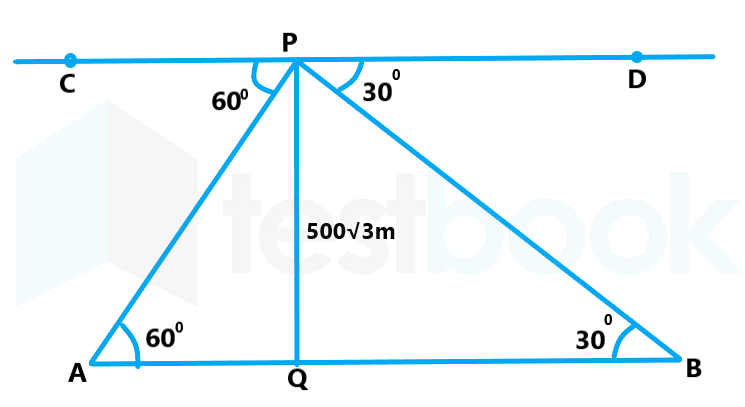
From the top of a pole of height 500√3m, the angles of depression of two points A and B on the ground on opposite sides of it are 60° and 30°, respectively. A car covers the distance between points A and B in 80 seconds. What is the speed (in km/h) of the car?

  1. ((a))

    72

  2. ((b))

    90

  3. ((c))

    108

  4. ((d))

    80

Show Answer
Answer: ((b))

90

Given:

Height of pole = 500√3m

The angle of depression from P on A and B are  60° and 30° respectively

Time taken by Car to travel from A to B = 80 sec

Formula Used:

Speed = Distance/ Time 

1 m/s = 18/5 km/hr

tanθ = p/b

Calculation:

We know that

The angle of depression = Angle of elevation

So, ∠A = ∠APC = 60° and

∠B = ∠BPD = 30°

Now, In ΔAPQ, ∠Q = 90° 

So, tanA = PQ/AQ

⇒ tan60° = (500√3)/AQ

⇒ √3 = 500√3/AQ

⇒ AQ = 500m       ----(i)

And in ΔPQB, ∠Q = 90° 

TanB =  PQ/BQ

⇒ tan30° = (500√3)/BQ

⇒ 1/√3  = (500√3)/BQ

⇒ BQ = 1500m       ----(ii)

Form the figure, we have 

AB = AQ + BQ

Form (i) and (ii)

⇒ AB =  500m + 1500m  = 2000 m

Now, According to the formula used

Speed = (2000/80) m/sec

⇒ Speed = 25 m/sec = 25 × 18/5 km/hr

⇒ Speed = 90 km/hr

∴ The speed of car is 90 km/hr.

48

Chords PR and QS of a circle with centre O, are produced to meet at a point T and PQ is the diameter of the circle. If ∠ROS = 48°, then what is the measure of ∠PTQ?

  1. ((a))

    66°

  2. ((b))

    52°

  3. ((c))

    62°

  4. ((d))

    56°

Show Answer
Answer: ((a))

66°

Shortcut Trick

For a circle where diameter PQ and produced chords PR and QS meet at T:

The direct relation is ∠PTQ = 90° − (∠ROS / 2)

Given ∠ROS = 48°

∠PTQ = 90° − (48° / 2) = 90° − 24° = 66°

∴ The correct answer is 66°.

Alternate Method

Given:

PQ is the diameter of the circle with centre O.

Chords PR and QS meet at T when produced.

∠ROS = 48°

Formula Used:

Angle subtended by an arc at the centre is double the angle at the circumference: ∠Central = 2 × ∠Circumference

Angle formed by two secants outside a circle: ∠T = 1/2 × (Measure of Major Arc − Measure of Minor Arc)

Calculations:

⇒ Arc PQ is a semi-circle, so its measure = 180°.

⇒ The angle subtended by arc RS at the centre is ∠ROS = 48°, so the measure of Arc RS = 48°.

⇒ According to the exterior angle theorem for secants:

⇒ ∠PTQ = 1/2 × (Arc PQ − Arc RS)

⇒ ∠PTQ = 1/2 × (180° − 48°)

⇒ ∠PTQ = 1/2 × 132°

⇒ ∠PTQ = 66°

∴ The correct answer is 66°.

Additional Information

Angle in a Semicircle

Any angle subtended by the diameter at the circumference of the circle is always a right angle (90°).

Inscribed Angle Theorem

The measure of an inscribed angle is half the measure of its intercepted arc. (∠Circumference = 1/2 × Arc measure).

Angles Outside the Circle

If two secants, two tangents, or a secant and a tangent intersect outside a circle, the angle formed is half the positive difference of the intercepted arcs.

49

Amulya sells 662366{2 \over 3}% of his goods at a 30% profit and sells 75% of the remaining goods at a 16% profit and the remaining goods at a 40% loss. If his profit in the entire transaction is Rs. 558, then what is the cost price (in Rs.) of his goods?

  1. ((a))

    2400

  2. ((b))

    3600

  3. ((c))

    3000

  4. ((d))

    2700

Show Answer
Answer: ((d))

2700

Given:

The profit of the entire transaction = Rs. 558

Formula used:

P = SP - CP     

Where, P = Profit, SP = Selling price,

And CP = Cost price

Calculation:

Let the cost price of the good be X

S.P of 662366{2 \over 3} of the goods = 1.30 × 23{2\over 3} × X = 2.63{2.6\over 3}X

S.P of 75% of the remaining goods = 13{1\over 3} × 0.75 × 1.16 × X

0.873{0.87\over 3}X

The reaming goods sell at 40% loss then,

S.P of the goods = 13{1\over 3}× 0.25 × 0.60 × X = 0.153{0.15\over 3}X

The total selling price =  2.63{2.6\over 3}X +  0.873{0.87\over 3}X + 0.153{0.15\over 3} 

3.623{3.62\over 3}X

According to the question

3.623{3.62\over 3}X - X = 558

⇒ 3.62X - 3X = 558 × 3

⇒ 0.62X = 1674

⇒ X = 2700

∴ The cost price of the goods is 2700.

50

If the 9-digit number 9386x378y is divisible by 72, then what is the value of x2+y2x2y2?\frac{{{x^2} + {y^2}}}{{{x^2} - y{}^2}}?

  1. ((a))

    17817\over 8

  2. ((b))

    13513\over 5

  3. ((c))

    41941\over 9

  4. ((d))

    611161\over 11

Show Answer
Answer: ((b))

13513\over 5

Given:

The number = 9386x378y

Concept:

If the sum of digits is divisible by 9 then the number itself is divisible by 9

If the last 3 digits of the number are divisible by 8 then the number itself is divisible by 8

Calculation:

The possible value of y = 4

Then the last three-digit of the number will be divisible by 8 = 7848 = 98{784\over 8}\ =\ 98

The possible value of x = 6

The sum of the digits = 9 + 3 + 8 + 6 + 6 + 3 + 7 + 8 + 4 = 54 which is divisible by 9

Now, x2 + y2 = 62 + 42 

⇒ 36 + 16 = 52

⇒ x2 - y2 = 62 - 42 

⇒ 36 - 16 = 20

The required ratio = 135{13\over 5}

∴ The required result will be 135{13\over 5}.

Science (25 questions)

51

Which of the following techniques will be the most effective for separating very fine mud particles suspended in water?

  1. ((a))

    Crystallisation

  2. ((b))

    Loading

  3. ((c))

    Filtration

  4. ((d))

    Chromatography

Show Answer
Answer: ((b))

Loading

The correct answer is Loading.

Concept

Mixture:

  • A mixture is a substance that consists of two or more elements or compounds not chemically combined together.
  • For example, a mixture of salt and sand.

Separation of mixtures:

  • The constituents of mixtures have different physical properties such as density, size of particles, solubility, etc.
  • These differences are used to separate the constituents of the mixtures.
  • The various physical processes which are used to separate the constituents of a mixture are Loading, crystallization, filtration, chromatography, etc.

Explanation:

Chromatography:

  • Chromatography is a technique of separating two or more dissolved solids which are present in a solution in very small quantities.
  • This separation is based on the fact that though two or more substances are soluble in the same solvent but their solubilities may be different.
  • A special type of paper called “chromatography paper” is used for carrying out separations by chromatography.

Filtration:

  • Filtration is a process by which insoluble solids can be removed from a liquid by using filter paper.
  • A filter paper is a special type of paper that has pores that are tiny enough to let only liquids pass through it.
  • The clear liquid obtained is called filtrate while the insoluble solids left on filter paper are called the residue.

Loading:

  • It is a process in which chemicals like alum are used to increase the rate of sedimentation.
  • The alum particles deposit fine clay particles and make them heavier so that they settle down at the bottom of the beaker easily.

Crystallization:

  • It is a process in which a pure solid is separated from an impure solution in the form of crystals.
  • The mixture is dissolved in the minimum amount of water and then heated strongly.
  • The hot, concentrated solution is allowed to cool and crystals of pure solids are formed.
  • The impure solids remain dissolved in the solution.

So, the most effective technique for separating very fine mud particles suspended in water is loading.

52

Silviculture is a method to help in _______

  1. ((a))

    water harvesting

  2. ((b))

    organic farming

  3. ((c))

    rural livelihoods

  4. ((d))

    restoring forests

Show Answer
Answer: ((d))

restoring forests

The correct answer is restoring forests.

Concept:

Forest conservation: It is the practice of planting and maintaining forested areas for the benefit and sustainability of future generations. 

Explanation:

Silviculture:

  • It is a branch of forestry dealing with the development and care of forests.
  • It can also be defined as the art and science of managing forests for desired outcomes, such as wildlife habitat, aesthetics, and timber production.

Additional Information​ Water harvesting:

  • It is the activity of the direct collection of rainwater.
  • The rainwater collected can be stored for direct use or can be recharged into the groundwater.

Organic farming:

  • It is the agricultural system that uses ecologically based pest controls and biological fertilizers derived largely from animal and plant wastes and nitrogen-fixing cover crops.
ApicultureBee culture- It is the practice of caring for and managing honey bees in order to produce honey and wax. - Bees are commercially raised in apiaries, which are areas where a large number of beehives can be put. - Apiaries are typically established in areas with ample bee pastures, such as areas with flowering plants.
PiscicultureFish culture- Pisciculture is the artificial reproduction, rearing, and transplantation of fish. - This involves the agricultural production of fish for food in tanks or enclosures. - Tilapia catfish and salmon are examples of farm-raised fish.
Poultry FarmingPoultry culture- Poultry farming is the form of animal husbandry which raises domesticated birds such as chickens, ducks, turkeys and geese. - They are reared to produce meat or eggs for food.
SericultureSilkworm culture- The method of raising silkworms and harvesting silk from them is known as sericulture. - Domestic silkmoth caterpillars (also known as ‘Bombyx mori') are the most widely used silkworm species in sericulture.                   ​
ApicultureBee culture- It is the practice of caring for and managing honey bees in order to produce honey and wax. - Bees are commercially raised in apiaries, which are areas where a large number of beehives can be put. - Apiaries are typically established in areas with ample bee pastures, such as areas with flowering plants.
PiscicultureFish culture- Pisciculture is the artificial reproduction, rearing, and transplantation of fish. - This involves the agricultural production of fish for food in tanks or enclosures. - Tilapia catfish and salmon are examples of farm-raised fish.
Poultry FarmingPoultry culture- Poultry farming is the form of animal husbandry which raises domesticated birds such as chickens, ducks, turkeys and geese. - They are reared to produce meat or eggs for food.
SericultureSilkworm culture- The method of raising silkworms and harvesting silk from them is known as sericulture. - Domestic silkmoth caterpillars (also known as ‘Bombyx mori') are the most widely used silkworm species in sericulture.
53

An object 2.0 cm in height is placed at a distance of 120 cm in front of a convex mirror of focal length 40.0 cm, on its principle axis. Following New Cartesian Sign Convention, the image is formed at v = ______ and its height hI = ______.

  1. ((a))

    30 cm; 0.5 cm

  2. ((b))

    60 cm; 1.0 cm

  3. ((c))

    60 cm; -1.0 cm

  4. ((d))

    30 cm; -0.5 cm

Show Answer
Answer: ((a))

30 cm; 0.5 cm

The correct answer is 30 cm; 0.5 cm.

Concept:

Convex mirror: 

  • The mirror in which the rays diverge after falling on it is known as the convex mirror.
  • Convex mirrors are also known as diverging mirrors.
  • The focal length of a convex mirror is positive according to the sign convention.

Mirror formula = 1f=1v+1u\frac{1}{f} = \frac{1}{v} + \frac{1}{u} 

where v = image distance, u = object distance and f = focal length.

Magnification (m) = height of image / height of object = hi / h

Also, m = -v/ u 

So, m = hiho=vu\frac{hi}{ho} = \frac{-v}{u}

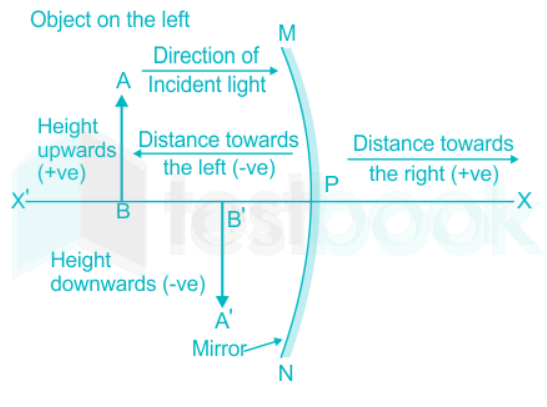
Cartesian Sign Convention for Spherical Mirror:

  • All signs are taken from the Pole of the spherical mirror, which is often called the origin or origin point.
  • The sign is taken as – (negative) on the left side of the pole.
  • So, the object distance is always taken as – (negative) in the case of both types of spherical mirrors, i.e. concave and convex mirrors.
  • The sign is taken as + (positive) on the right side of the pole.
  • The height is taken as + (positive) above the principal axis and taken as – (negative) below the principal axis.

Explanation:

Given: Object distance, u = -120 cm, focal length, f = 40 cm, height of object, h= 2 cm

1f=1v+1u\frac{1}{f} = \frac{1}{v} + \frac{1}{u}(\frac{1}{v} = \frac{4}{120}\)

140=1v+1120\frac{1}{40} = \frac{1}{v} + \frac{1}{-120}

140=1v1120\frac{1}{40} = \frac{1}{v} - \frac{1}{120}

3+1120=1v\frac{3+1}{120} = \frac{1}{v}

4120=1v\frac{4}{120} = \frac{1}{v}

1v=130\frac{1}{v} = \frac{1}{30}

v = 30 cm

m = hiho=vu\frac{hi}{ho} = \frac{-v}{u}

hi2=30120=14\frac{hi}{2} = \frac{-30}{-120} = \frac{1}{4}

hi=24=12=0.5hi = \frac{2}{4} = \frac{1}{2} = 0.5  cm

The image is formed at v = 30 cm and its height hI = 0.5 cm.

54

A metal is extracted from cinnabar ore by strong heating. What are alloys of this metal with other metals collectively known as?

  1. ((a))

    German silver

  2. ((b))

    Nichrome

  3. ((c))

    Amalgam

  4. ((d))

    Steel

Show Answer
Answer: ((c))

Amalgam

The correct answer is Amalgam.

Concept:

Alloy:  An alloy is a homogeneous mixture of two or more metals, or a metal and a non-metal. 

Mineral: Minerals are naturally occurring inorganic solids with a crystalline structure and a definite range of chemical formulas.

Ore: Ores are concentrations of minerals in rock that are high enough to be economically extracted for use.

Explanation:

Cinnabar:

  • It is bright red or brownish-red mineral formed of mercuric sulfide (mercury(II) sulfide).
  • It is found close to areas of volcanic activity and hot springs.
  • It is the main commercial source of mercury.
  • Chemical Formula: HgS.

Amalgam

  • It is an alloy of mercury and one or more other metals.
  • It is crystalline in structure, except for those with a high mercury content, which is liquid.

So, the metal extracted from cinnabar ore by strong heating is Mercury and the alloys of this metal with other metals are collectively known as amalgam.

Additional Information

  • Nichrome: It is an alloy of nickel, chromium, and iron (Ni + Cr + Fe).
  • Steel:  It is an alloy of iron and carbon (Fe + C).
  • German silver: It is an alloy of copper, zinc, and nickel (Cu + Zn + Ni).
55

An archaeologist was digging for fossils. Which fossil is she likely to find in the deepest layers?

  1. ((a))

    Feathered dinosaur

  2. ((b))

    Scaly dinosaur

  3. ((c))

    Bird

  4. ((d))

    Fish

Show Answer
Answer: ((d))

Fish

The correct answer is Fish.

Concept:

Evolution: It is the process by which the various forms of plants, animals, and other life forms have developed due to the accumulation of variations in pre-existing organisms over millions of years.

Fossils:

  • Fossils are the preserved remains of plants and animals whose bodies were buried in sediments, such as sand and mud, under ancient seas, lakes, and rivers.
  • Fossils are commonly found in sedimentary rocks.

Explanation:

Formation of sedimentary rocks:

  • These rocks get their name from the Latin word sedimentum which means settle down.
  • These rocks are formed by the settling down of sediments.
  • Sediments are the smaller particles/fragments that are formed by breaking down rocks when they roll down, crack and hit each other.
  • These sediments are transported by wind, water, etc., and form sedimentary rocks when compressed and hardened.
  • These also contain fossils of plants, animals, and other microorganisms that once lived on them.
  • The oldest fossils are buried in the deepest.

Evolution of animals: ​

  • Life first originated in water.
  • Out of all chordates, fish were the first to evolve, then came amphibians, then reptiles, followed by mammals, and lastly birds.
  • So, on the evolutionary timeline, fish would have evolved first, then scaly dinosaurs (reptile), then feathery dinosaurs (reptile) followed by birds.
  • When we will start digging, we will first find the most recent fossils and as we go deeper and deeper, older and older fossils will be found.
  • Thus, fish are most likely to be found in the deepest layer of the earth.
56

Three resistors A (2 Ω), B (3 Ω) and C (6 Ω) are connected in parallel. This combination is connected in series to three other resistors D (2 Ω), F (3 Ω) and G (6 Ω) and a 6 V battery of negligible internal resistance. Let PG and Pbe the rate of energy dissipated in resistors G and C, respectively. Then the ratio (PG/PC) is:

  1. ((a))

    36

  2. ((b))

    9

  3. ((c))

    27

  4. ((d))

    18

Show Answer
Answer: ((a))

36

The correct answer is 36.

Concept:

Resistance in series:

  • When resistors are connected end-to-end in a circuit, they are said to be in "series."
  • R = R1 + R2 + R3....
  • Current remains the same across all the resistors connected in series.

Resistance in parallel: 

  • When both ends of resistors are connected, they are said to be in parallel.
  • 1/R = 1/R1 + 1/R2 = 1/R3 ....
  • The potential difference across all the resistors connected in parallel remains the same.

Electric Power:

  • The energy consumed per unit of time or the rate of doing work is called power.
  • Power = work done / time taken = Vq / t = VI = V2/R = I2R

Explanation:

Resistors A (2 Ω), B (3 Ω), and C (6 Ω) are connected in parallel.

Equivalent resistance, 1/R1 = 1/2 + 1/3 +1/6 = 3+2+1/ 6 = 6/6 = 1 Ω

Now, the resistors R1, D, F, and G are in series.

R2 = 1 + 2 + 3 + 6 = 12 Ω

Equivalent current, I in the circuit = V/R2 = 6/12 1/2 A.

Potential difference across C = IR1 = 1/2 × 1 = 1/2 V

P= I2G = 1/2 × 1/2 × 6 = 3/2 Watt       (since current remains same in series combination)

P= V2/C = (1/2 × 1/2) / 6 = 1/24 Watt  (since voltage remains same in parallel combination)

The ratio (PG/PC) = 3/2 × 24 = 3 × 12 = 36.

57

In a compound having molecular formula XY, element 'X' belongs to 3rd period and 2nd group, whereas element 'Y' belongs to 2nd period and 16th group. What is the molecular mass of compound XY?

  1. ((a))

    64 u

  2. ((b))

    35 u

  3. ((c))

    40 u

  4. ((d))

    50 u

Show Answer
Answer: ((c))

40 u

The correct answer is 40 u.

Concept:

The Modern Periodic Table:

  • In 1913, Henry Moseley showed that the atomic number of an element is a more fundamental property than its atomic mass.
  • Modern Period Law: The physical and chemical properties of elements are the periodic function of their atomic number.
  • The modern periodic table contains 18 vertical columns known as groups and seven horizontal rows known as periods.
  • On moving from left to right in a period, the number of valence electrons increases from 1 to 8 in the elements present but the number of shells remains the same.
  • All the elements of a group of the periodic table have the same number of valence electrons.

Explanation:

Period:

  • The periods have the same elements that have the same valence shell or the energy shell.
  • The number of elements present in a period can be determined by the formula 2n2, where n is the number of the shell from the nucleus.
  • For example, the first period has two elements only as they have only 1 valence shell and the second period** has **8 elements with 2 shells.
  • Also, the elements have the same no. of shells as their period no. So, an element belonging to period 4 will have 4 shells.

​Groups:

  • The group consists of elements that have the same number of electrons in the valence shell or outermost shell of the atom.
  • The number of shells increases by one unit as the elements move down in the periodic table in a group.
  • Group number indicates the valence electrons of the atom. Group1 and 2 have 1 and 2 valence electrons in the outermost shell respectively.
  • But for group no. 13-18 it is calculated by subtracting 10 from group no. For example, an element belonging to group 13 will have 13-10 = 3 valence electrons.

Element X belongs to the 3rd period and 2nd group.

  • 3rd period means there are 3 shells.
  • 2nd group means 2 valence electrons in its outermost shell.
  • So, its electronic configuration will be 2, 8, 2.
  • Element X is Magnesium with atomic number 12 and an atomic mass of 24 u.
  • Element Y belongs to the 2nd period and 16th group.
  • 2nd period means there are 2 shells.
  • 16th group means 16-10 = 6 valence electrons in the outermost shell.

Electronic configuration = 2, 6 

Element Y is Oxygen with atomic number 8 and atomic mass 16 u.

**The molecular mass of compound XY = mass of X + mass of Y = 24 + 16 = 40 u.**​

58

Yeast are unicellular organisms that can multiply by budding. To which kingdom do they belong?

  1. ((a))

    Plantae

  2. ((b))

    Fungi

  3. ((c))

    Protista

  4. ((d))

    Monera

Show Answer
Answer: ((b))

Fungi

The correct answer is Fungi.

Concept:

Classification of organisms: 

  • Classification is the process of grouping organisms into different categories on the basis of their similarities and dissimilarities.
  • It makes the study of organisms easier and more convenient.

Explanation: 

Five Kingdom classification system:

  • It was given by R.H. Whittaker in 1969.
  • He divided all organisms into five categories namely**, Monera, Protista, Fungi, Plantae, and Animalia.**
  • This classification was based upon certain characteristics like mode of nutrition, thallus organization, cell structure, phylogenetic relationships, and reproduction.
CriteriaMoneraProtistaFungiPlantaeAnimalia
Cell typeProkaryoticEukaryoticEukaryoticEukaryoticEukaryotic
Level of organizationUnicellularUnicellularMulticellular except for yeastTissue/ organTissue/ organ/ organ system
Cell wallPresent (made up of peptidoglycan and mucopeptides)Present in some (made up of cellulose), absent in othersPresent (made up of chitin)Present (made up of cellulose)Absent
NutritionAutotrophic and heterotrophicAutotrophic, heterotrophicHeterotrophicAutotrophicHeterotrophic
OrganismsBacteria, mycoplasmaAmoeba, paramecium,Yeast, mushroomsSpirogyra, ferns, cycas, flowering plantsEuspongia, insects, mammals, reptiles, birds

Yeast belongs to the kingdom Fungi.

59

A cylindrical metal wire is reformed so that its length decreases by 30% with no change of volume. Its resistance decreases by:

  1. ((a))

    69%

  2. ((b))

    41%

  3. ((c))

    30%

  4. ((d))

    51%

Show Answer
Answer: ((d))

51%

The correct answer is 51%.

Concept:

Resistance (R): 

  • Resistance is a measure of the opposition to current flow in an electrical circuit.
  • It is measured in ohms, symbolized by the Greek letter omega (Ω).
  • Ohms is named after George Simon Ohm (1784-1854), a German physicist who studied the relationship between voltage, current and resistance.
  • R=ρlAR = \frac{ρ l}{A} where ρ is resistivity, l is length, and A is the area of the cross-section of the wire.

 Explanation: 

Suppose original length = L, Area of cross-section = A, radius of wire = r and Resistance = R

Since the wire is the same, the resistivity ρ will be the same.

After the decrease in length, let us take new length = L', radius of wire = r' and new resistance = R'

L' = 70 L/ 100 ( since there is 30% decrease)

The volume of the wire remains the same ( given).

So, Volume of Original Wire = volume of new wire 

π rL = π r ' L'

r2L = r' 2 L'

r' 2 = r2 L /  L'

r' = 100 r2 L / 70 L

r' 2 = 100 r2  / 70 

Decrease in resistance = RRR×100\frac{R-R'}{R} × 100

ρLAρLAρLA×100\frac{\frac{\rho L}{A} -\frac{\rho L'}{A'}}{\frac{\rho L}A} × 100

(ρLAρLA)ρLA×100\rm \frac{\left(\frac{\rho L}{A}-\frac{\rho L{'}}{A}\right)}{\frac{\rho L}{A}}\times100

(ρLrr2ρLrr2)ρLrr×100\rm \frac{\left(\frac{\rho L}{r r^2}-\frac{\rho L{'}}{r r'^2}\right)}{\frac{\rho L}{r r'}}\times100

ρπ(Lr270 L180 r2)ρπ×Lr2×100\rm \frac{\frac{\rho}{\pi}\left(\frac{L}{r^2}-\frac{70 \ L}{180\ r'^2}\right)}{\frac{\rho}{\pi}\times\frac{L}{r^2}}\times100

(Lr270 L180 r2)Lr2×100\rm \frac{\left(\frac{L}{r^2}-\frac{70 \ L}{180\ r'^2}\right)}{\frac{L}{r^2}}\times100

100 r1270 Lr2100 r2 r"2Lr2\rm \frac{\frac{100\ r_1^2-70\ Lr^2}{100\ r^2\ r"^2}}{\frac{L}{r^2}}

100×100 r27070 Lr210070r2\rm \frac{\frac{100\times100\ r^2}{70}-70\ Lr^2}{\frac{100}{70}r^2}

10000r24900r270×100×r270\rm \frac{10000r^2-4900r^2}{\frac{70\times100\times r^2}{70}}

=5100 r2100 r2=\frac{5100\ r^2}{100\ r^2}

= 51%

The resistance decreases by 51%.

60

A cylindrical wire AB consists of two equal parts AC and CB. Parts AC and CB are made of materials resistivity ρ and 2 ρ and have different radii 3r and r, respectively. A battery is connected across the wire. Let V1 and V2 be the potential differences across AC and CB, respectively. Then(V2 / V1) is:

  1. ((a))

    9

  2. ((b))

    18

  3. ((c))

    12

  4. ((d))

    6

Show Answer
Answer: ((b))

18

The correct answer is 18.

Concept:

Resistance:

  • It is the opposition offered to the flow of current passing through a conductor.
  • It is measured in Ohms (Ω).
  • R = ρL/ A where ρ is resistivity, L is the length of conductor and A is the area of cross-section.

Ohm's Law:

  • Ohm’s law states that the amount of electric current through a metal conductor in a circuit is directly proportional to the voltage impressed across it, for any given temperature.
  • V = IR, where V is voltage, I is current and R is resistance.

Explanation:

 In the above-drawn circuit, we can refer to the two sections of wire as two different resistors in series. Current remains same in series connection. So, here we will take current = I. 

For Wire AC

length = L, resistivity= ρ , Radius = 3r 

Area of cross-section of wire = π r= π (3r)= 9 π r2

R1 = ρ L/ A = ρ L / 9 π r2

V1 = I R1 = I ρ L / 9 π r2

For wire BC 

length = L, resistivity= 2ρ , Radius = r 

Area of cross-section of wire = π r2 

R2 = 2ρ L/ A = 2ρ L /  π r2

V2 = I R2 =  2ρ I L /  π r2

Ratio of V2 to V1 = V2/ V1 =  2ρILπr2ρIL9πr2\frac{\frac{2\rho IL}{\pi r^2}}{\frac{\rho I L}{9\pi r^2}} = 2ρILπr2\frac{2\rho IL}{\pi r^2} × 9πr2ρIL\frac{9 \pi r^2}{\rho IL} = 2 × 9 = 18 

The ratio (V2 / V1) is 18.

61

An object is placed on the principal axis of a convex lens at 2 F1. The image formed is:

  1. ((a))

    virtual and enlarged

  2. ((b))

    real and diminished

  3. ((c))

    real and enlarged

  4. ((d))

    real and of the same size

Show Answer
Answer: ((d))

real and of the same size

The correct answer is real and of the same size.

Concept: 

 Convex lenses:

  • A convex lens is thicker at the center than at the edges.
  • It is called a converging lens because the rays of light that pass through it are brought closer together (they converge).
  • When parallel rays of light pass through a convex lens the refracted rays converge at one point called the principal focus.
  • The distance between the principal focus and the center of the lens is called the focal length.
  • A double convex lens has two foci F1 and F2 and two centers of curvature 2F1 and 2F2.

Explanation:

Image formed by a convex lens when Object is at 2F1:

A same-sized, real, and inverted image is formed at the center of curvature, 2F2 when the object is placed at the center of curvature, 2F1 of a convex lens.

Additional Information All six cases of image formation by the convex lens:

Object positionImage positionNature of imageSize of image
At infinityAt F2Real and invertedPoint sized
Beyond 2F1Between F2 and 2F2Real and invertedDiminished
At 2F1At 2F2Real and invertedSame size
Between F1 and 2F1Beyond 2F2Real and invertedMagnified
At F1At infinityReal and invertedHighly magnified
Between F1 and Oon the same side of the objectVirtual and erectMagnified
62

When a solution of lead nitrate is mixed with a solution of potassium iodide in a test tube, how do we come to know that a chemical reaction has occurred?

  1. ((a))

    A brown gas is formed.

  2. ((b))

    A precipitate is formed.

  3. ((c))

    A pop sound is evolved.

  4. ((d))

    Brisk effervescence appears.

Show Answer
Answer: ((b))

A precipitate is formed.

The correct answer is A precipitate is formed.

Concept:

Chemical reaction:

  • It is a process in which one or more substances, the reactants, are converted to one or more different substances, the products.
  • A chemical reaction rearranges the constituent atoms of the reactants to create different substances as products.

Explanation:

Types of Chemical Reactions:

Combination reaction:

  • Two or more elements or compounds combine together to form a single compound.
  • Such reactions are represented by equations of the following form:     A + B → AB.

Decomposition reaction:

  • The opposite of a combination reaction, a complex molecule breaks down to make simpler ones.
  • Such reactions are represented by equations of the following form: AB → A + B.

Precipitation reaction:

  • Two solutions of soluble salts are mixed resulting in an insoluble solid (precipitate) forming.
  • Such reactions are represented by equations of the following form: A + Soluble salt B  → Precipitate + soluble salt C.
  • Lead nitrate + Potassium iodide → Lead Iodide (yellow precipitate) + Potassium nitrate
  • Pb(NO3)2 + KI → PbI2  + KNO3

Neutralization reaction:

  • An acid and a base react with each other. Generally, the product of this reaction is salt and water.
  • Such reactions are represented by equations of the following form: Acid + Base → Salt + Water.

Combustion reaction:

  • Oxygen combines with a compound to form carbon dioxide and water.
  • These reactions are exothermic, meaning they give off heat.
  • Such reactions are represented by equations of the following form: A + O2 → H2O + CO2.

Displacement reaction:

  • One element takes place with another element in the compound.
  • Such reactions are represented by equations of the following form: A + BC → AC + B.
63

Study the following figure which shows a cell placed in a hypotonic solution. Arrows indicate the entry or exit of water into or from the cell. Select the true statement.

  1. ((a))

    Only arrow 1 operational (water enters but does not exit).

  2. ((b))

    Both arrows are operational but unequal (the amount of water entering is not equal to the amount of water exiting).

  3. ((c))

    Both arrows are operational and equal (equal amounts of water enter and exit).

  4. ((d))

    Only arrow 2 is operational (water exits but does not enter).

Show Answer
Answer: ((b))

Both arrows are operational but unequal (the amount of water entering is not equal to the amount of water exiting).

The correct answer is Both arrows are operational but unequal (the amount of water entering is not equal to the amount of water exiting).

Concept:

Osmosis: 

  • It is the movement of water molecules through a semi-permeable membrane.
  • The water molecules move from a region of higher concentration to a region of lower concentration.

Types of solutions: 

  • Hypertonic Solution: A solution having a higher concentration of solute with respect to another solution, is called a hypertonic solution.
  • Hypotonic Solution: A solution having a higher concentration of solvent with respect to another solution, is called a hypotonic solution.
  • Isotonic Solution: A solution that has exactly the same water concentration with respect to another solution, is called an isotonic solution.

Explanation:

  • When a cell is placed in a hypotonic solution, the cell has less water and more solute as compared to the solution.
  • The water molecules will move in both directions that is from the solution into the cell and vice versa.
  • But the amount of water entering the cell will be more as compared to the water coming out of it.
  • The net effect seen will be water entering the cell.
64

1.5 moles of calcium carbonate were taken in closed glass vessel and heated at 1200 degrees Celsius. After some time heating was stopped. It was found that 1 mole of calcium carbonate was left unreacted in the glass vessel and 28 g of calcium oxide and 22 g of carbon dioxide were formed. Which of the following laws is demonstrated by these observations?

  1. ((a))

    Law of multiple proportions

  2. ((b))

    Dalton's law

  3. ((c))

    Law of definite proportions

  4. ((d))

    Law of conservation of mass

Show Answer
Answer: ((d))

Law of conservation of mass

The correct answer is the Law of conservation of mass.

Concept:

Law of conservation of mass:

  • It was discovered by Antoine Lavoisier in 1789.
  • It states that mass is neither created nor destroyed in chemical reactions.
  • In other words, the mass of any one element at the beginning of a reaction will equal the mass of that element at the end of the reaction.

Mole:

  • It is the SI unit of the amount of substance.
  • One mole contains exactly 6.022×10²³ atoms/molecules. This number is the fixed numerical value of the Avogadro constant (NA).
  • The mass of one mole of a substance in grams is called its molar mass.
  • The molar mass in grams is numerically equal to atomic/molecular/formula mass in u.

So, 1 mole = 6.022 × 10²³ atoms/molecules = Atomic/molecular mass of an element/compound.

Explanation:

On heating Calcium carbonate,  calcium oxide, and carbon dioxide are formed.

     CaCO3                 +      heat      \to   CaO + CO2

1.5-1 = 0.5 mole                                    28g     22g 

1 mole of  CaCO3  = Molar mass of  CaCO3  = 40 + 12 + 3 × 16 = 52 + 48 = 100 g

0.5 mole of  CaCO3  = 0.5 × 100 = 50 g

According to law of conservation, the total mass of reactants should be equal to total mass of products.

  • Mass of reactant = 50 g
  • Mass of products = mass of CaO + mass of CO= 28 + 22 = 50 g
  • Mass of reactant = Mass of products = 50 g

So, the above chemical reaction demonstrates the Law of conservation of mass.

65

Which substance in our mouth starts corroding and causes tooth decay, when the pH in the mouth becomes less than 5.5?

  1. ((a))

    Calcium hydroxide

  2. ((b))

    Calcium carbonate

  3. ((c))

    Calcium hydroxyapatite

  4. ((d))

    Calcium fluoride

Show Answer
Answer: ((c))

Calcium hydroxyapatite

The correct answer is Calcium hydroxyapatite.

Concept:

Tooth decay: 

  • Tooth decay is damage to a tooth's surface or enamel.
  • It happens when bacteria in our mouth make acids that attack the enamel.
  • Enamel is the hardest part of the human body, made up of calcium phosphate.

Explanation:

Cause of tooth decay:

  • Bacteria in the mouth feed on sugary, starchy foods and drinks (fruit, candy, bread, cereal, sodas, juice, and milk).
  • The bacteria convert these carbohydrates into acids.
  • Tooth decay starts when the pH of the mouth becomes lower than 5.5.
  • Enamel which is composed of calcium phosphate, arranged in a crystal structure called hydroxyapatite, starts to dissolve at such low pH.
  • Tooth decay can lead to cavities (dental caries), which are holes in your teeth.
  • If tooth decay is not treated, it can cause pain, infection, and even tooth loss.

Prevention of tooth decay: Tooth decay can be prevented by 

  • eating a healthy diet,
  • drinking plenty of tap water instead of sugary drinks
  • brushing your teeth twice a day
  • using a fluoride toothpaste
  • flossing once a day.
66

Which of the following is a non-renewable source of energy?

  1. ((a))

    Coal

  2. ((b))

    Solar

  3. ((c))

    Bio-mass

  4. ((d))

    Wind

Show Answer
Answer: ((a))

Coal

The correct answer is Coal.

Concept:

Source of energy:

  • A source of energy is that which is capable of providing enough useful energy at a steady rate over a long period of time.
  • A good source of energy should be :
  • Safe and convenient to use
  • For example; nuclear energy can be used only by highly trained engineers with the help of nuclear power plants. It cannot be used for our household purpose.
  • Easy to transport
  • For example; coal, petrol, diesel, LPG, etc. have to be transported from the places of their production to the consumers.
  • Easy to store
  • For example; huge storage tanks are required to store petrol, diesel, LPG, etc.

Explanation:

Types of sources on the basis of their renewability: 

Renewable sources of energy:

  • These sources of energy are inexhaustible, i.e., they can be replaced as we use them and can be used to produce energy again and again.
  • These are available in an unlimited amount in nature and develop within a relatively short period of time.
  • Example of Renewable Sources of Energy :
  • Solar energy.
  • Wind energy.
  • Water energy (hydro-energy).
  • Geothermal energy.
  • Ocean energy.
  • Biomass energy (firewood, animal dung, and biodegradable waste from cities and crop residues constitute biomass).

Non-renewable sources of energy:

  • These sources of energy are exhaustible and cannot be replaced once they have been used.
  • These sources have been accumulated in nature over a very long period of millions of years.
  • Examples of Non-renewable Sources of Energy :
  • Coal
  • Oil
  • Natural gas
  • All these fuels are called fossil fuels.
67

Study the given table.

Two copper coils A (of 100 turns) and B (of 200 turns) are mounted on insulted stands with planes of the coils in vertical plane. There is an arrangement to change current in coil A. Coil B is connected to a galvanometer.

Time durationCurrent in coil AInduced current
0 - 10sis increased with the same ratei1
10s - 20sis kept constanti2
20s - 30sis decreased with the same ratei3

Select the correct option.

  1. ((a))

    i1 = i2 and are in the same direction.

  2. ((b))

    i1 = i3 and are in the opposite direction.

  3. ((c))

    i1 = i3 and are in the same direction.

  4. ((d))

    i3 = i2 and are in the same direction.

    ×

    duplicate options found. English Question 1 options 2,3

Show Answer
Answer: ((b))

i1 = i3 and are in the opposite direction.

Explanation:

Time durationCurrent in coil AInduced current
0 - 10sis increased with the same ratei1
10s - 20sis kept constanti2
20s - 30sis decreased with the same ratei3

From 0s to 10s the current is increasing at the same rate and induces the current i1 in the coil B.

From 20s to 30s the current is decreasing at the same rate and induces the current i3 in the coil B.

In both cases, the time period is the same and the rate is also the same, so i1 = i3.

As the i1 current is increasing and i3 is decreasing so, their direction will be opposite.

68

An alloy is used for welding electrical wires together. What is the composition of this alloy?

  1. ((a))

    Ni, Zn and Pb

  2. ((b))

    Pb and Sn

  3. ((c))

    Cu and Zn

  4. ((d))

    Zn and Sn

Show Answer
Answer: ((b))

Pb and Sn

The correct answer is Pb and Sn.

Concept:

Alloy:

  • An alloy is a homogeneous mixture of two or more metals, or a metal and a non-metal.
  • Properties of alloys are different from the constituent elements. 
  • They are harder than their constituent metals.
  • They are more resistant to corrosion than pure metals.
  • They are more durable than the metals they are made from.
  • They have less electrical conductivity and melting point than the constituent metals.
  • Some of the properties of constituent elements are retained in the alloy.

Explanation:

List of some important alloys:

Brass

  • It is composed of copper and zinc (Cu + Zn).
  • It is used in making utensils.

Bronze

  • It is composed of copper and tin (Cu + Sn).
  • It is used in making coins, bells, and utensils.

Solder

  • It is composed of lead and tin (Pb + Sn).
  • It is used for soldering (welding electrical wires together).

Stainless steel

  • It is composed of iron, chromium, nickel, and carbon (Fe + Cr + Ni + C).
  • It is used for making utensils and surgical cutlery.
69

Which of the following parts of the eye has muscles?

  1. ((a))

    Cornea

  2. ((b))

    Pupil

  3. ((c))

    Iris

  4. ((d))

    Lens

Show Answer
Answer: ((c))

Iris

The correct answer is Iris.

Concept:

Human Eye: It is a specialized sense organ capable of receiving visual images, which are then carried to the brain.

Explanation:

Structure of the human eye:

The Human Eye: Anatomy, Structure, Working, Function and Defects

Name of the partCharacteristics
CorneaThe transparent spherical membrane covering the front part of the eye
Eye lensTransparent, biconvex structure in the eye
IrisThe dark muscular diaphragm between the cornea and the lens
PupilAn opening between the iris through which light enters the eye
Ciliary musclesMuscles attached to the eye lens
RetinaThe light-sensitive surface of an eye on which the image is formed
Optic nerveThe nerve that connects the retina to the human brain
70

The refractive index of alcohol and ice are 1.36 and 1.31, respectively. A ray of light travels from alcohol to ice. The refractive index of ice with respect to alcohol is _______ and the light ray bends _______ the normal in ice.

  1. ((a))

    0.96; towards

  2. ((b))

    0.96; away from

  3. ((c))

    1.04; towards

  4. ((d))

    1.04; away from

Show Answer
Answer: ((b))

0.96; away from

The correct answer is 0.96; away from.

Concept:

  • Refraction of Light: The bending of the ray of light passing from one medium to the other medium is called refraction.

https://storage.googleapis.com/tb-img/production/20/05/F1_J.K_8.5.20_Pallavi_D3.png

  • The refraction of light takes place on going from one medium to another because the speed of light is different in the two media.
  • The greater the difference in the speeds of light in the two media, the greater will be the amount of refraction.
  • A medium in which the speed of light is more is known as an optically rarer medium and a medium in which the speed of light is less is known as an optically denser medium.

Refractive Index (n):

  • It is the measure of the bending of a ray of light when passing from one medium into another.
  • If 'i' is the angle of incidence of a ray in a vacuum and 'r' is the angle of refraction, then the refractive index n is defined as the ratio of the sine of the angle of incidence to the sine of the angle of refraction; i.e., n = sin i / sin r.
  • It is also equal to the velocity of light (c) of a given wavelength in empty space divided by its velocity v in a substance, or n = c/v.
Light rarer to denserLight goes away from Normal
Light denser to rarerLight comes closer to Normal

Explanation:

Relative refractive index:

  • It refers to the refractive index of one material medium with respect to another one.
  • n21=n2n1n_{21}= \frac{n_{2}}{n_{1}}
  • Refractive index of ice with respect to alcohol = refractive index of ice / refractive index of alcohol = 1.311.36\frac{1.31}{1.36} = 0.96
  • Greater the refractive index, the denser the medium. Thus, alcohol (1.36) is denser than ice (1.31).
  • The refracted ray moves away from the normal when it travels from a denser to a rarer medium.
  • Hence, when the light ray travels from alcohol to ice, the refracted ray will move away from the normal.

The refractive index of ice with respect to alcohol is 0.96 and the light ray bends away from the normal in ice.

71

The pancreas produces many substances responsible for digestion and assimilation of food. In the case of insulin, the pancreas secrete insulin into the _______.

  1. ((a))

    duodenum

  2. ((b))

    bile duct

  3. ((c))

    blood stream

  4. ((d))

    stomach

Show Answer
Answer: ((c))

blood stream

The correct answer is blood stream.

Concept:

Pancreas:

  • It is an elongated organ that is located between the stomach and the small intestine.
  • It contains both exocrine cells that excrete digestive enzymes and endocrine cells that release hormones.
  • It is sometimes referred to as a heterocrine gland because it has both endocrine and exocrine functions.

Explanation:

The endocrine part of the Pancreas:

  • The endocrine cells of the pancreas form clusters called pancreatic islets or the islets of Langerhans.
  • The pancreatic islets contain two primary cell types: alpha cells, which produce the hormone glucagon, and beta cells, which produce the hormone insulin.
  • These hormones regulate blood glucose levels and are released directly into the bloodstream.
  • Glucagon raises blood glucose levels while insulin lower blood glucose levels.

Exocrine part of the Pancreas:

  • Functioning as an exocrine gland, the pancreas excretes enzymes into the small intestine via a duct.
  • These enzymes include trypsin and chymotrypsin to digest proteins; amylase for the digestion of carbohydrates; and lipase to break down fats.
72

A mineral of calcium, on heating at 373 K, forms a substance which is used for making toys, for making surfaces smooth and for supporting fractured bones. What is the name of this substance?

  1. ((a))

    Gypsum

  2. ((b))

    Calcium sulphate monohydrate

  3. ((c))

    Calcium sulphate hemihydrate

  4. ((d))

    Anhydrous calcium sulphate

Show Answer
Answer: ((c))

Calcium sulphate hemihydrate

The correct answer is Calcium sulphate hemihydrate.

Concept:

Calcium Sulphate hemihydrate: 

  • It is popularly known as the Plaster of Paris.
  • Its chemical formula is CaSO4.12\frac{1}{2}H2O

Properties:

  • It is a white powder.
  • It has a remarkable property of setting into a hard mass on wetting with water.

Calcium Sulphate Dihydrate:

  • It is also known as Gypsum.
  • Its chemical formula is CaSO4.2H2O.

Explanation:

Preparation of Calcium Sulphate hemihydrate**:**

  • It is manufactured by heating gypsum at 373 – 393 K or 150° C/300° F.
  • CaSO4·2H2O + Heat → CaSO4·12\frac{1}{2}H2O + 1121\frac{1}{2}H2O
  • On heating gypsum at 373 – 393 K, it loses water molecules and becomes calcium sulphate hemihydrate.

Uses of Calcium Sulphate hemihydrate: It is used in 

  • chemical laboratories for sealing air gaps in apparatus where the air-tight arrangement is required
  • in making smooth surfaces before painting
  • hospitals for setting fractured bones
  • making toys, decorative materials, cheap ornaments, blackboards, cosmetics, casts for statues, etc.

Hence, the substance which is used for making toys, making surfaces smooth and for supporting fractured bones is Calcium Sulphate hemihydrate.

73

What happens to the soil after prolonged application of fertilisers and pesticides?

  1. ((a))

    The soil retains its fertility.

  2. ((b))

    The soil becomes acidic.

  3. ((c))

    The soil becomes alkaline.

  4. ((d))

    The soil becomes barren of life forms.

Show Answer
Answer: ((d))

The soil becomes barren of life forms.

The correct answer is that the soil becomes barren of life forms.

Concept:

Fertilizers: 

  • Fertilizers are chemical substances that are usually rich in selective nutrients like nitrogen, potassium, and phosphorus.
  • These are used by the farmers daily to increase the crop yield

Pesticides:

  • A pesticide is any substance used to kill, repel, or control certain forms of plant or animal life that are considered to be pests.
  • Pesticides include
  • Herbicides for destroying weeds and other unwanted vegetation,
  • Insecticides for controlling a wide variety of insects,
  • Fungicides used to prevent the growth of moulds and mildew,
  • Disinfectants for preventing the spread of bacteria, and
  • Compounds used to control mice and rats.

Explanation:

**Harmful effects of prolonged use of fertilizers and pesticides:**​

  • The synthetic chemicals in fertilizers change soil pH, which adversely affects the health of naturally found soil microorganisms.
  • These altered levels of acidity in the soil eliminate the microorganisms that are beneficial to plants.
  • Pesticides can linger in the soil for years or decades after they are applied, continuing to harm soil health.
  • The studies have shown that prolonged use of pesticides impacts soil organisms in many ways, from increased mortality to reduced reproduction, growth, cellular functions and even reduced overall species diversity.

Thus, we can say that the soil becomes barren of life forms after the prolonged application of fertilizers and pesticides.

74

Two lenses L1 and L2 of powers 5 D and -5 D respectively, separated by 90 cm are arranged parallel to each other in vertical planes. An object is placed 30 cm left to L1 vertically on the common axis of the lenses. The distance between the original object and the final image is:

  1. ((a))

    1.32 m

  2. ((b))

    1.28 m

  3. ((c))

    1.08 m

  4. ((d))

    1.12 m

Show Answer
Answer: ((c))

1.08 m

The correct answer is 1.08 m.

Concept:

  • Lens: The transparent curved surface which is used to refract the light and make an image of any object placed in front of it is called a lens.
  • The lens whose refracting surface is upside is called a convex lens and the lens whose refracting surface is inside is called a concave lens or diverging lens.
  • The convex lens is also called a converging lens.

When two or more lenses are in contact with each other then, the equivalent focal length is given by:

1F=1f1+1f2\frac{1}{F} = \frac{1}{{{f_1}}} + \frac{1}{{{f_2}}}

Where f1 and f2 are focal lengths of the two lenses

  • Power is the ability to bend light and it is equal to the reciprocal of the focal length of the lens/mirror in meters.

Power (P) = 1/f

Where f is the focal length of the lens/mirror.

  • The unit of power of a lens is Dioptre when the focal length of the lens is taken in meter (m).
  • The focal length of the concave lens is negative and hence its power is also negative.
  • The focal length of the convex lens is positive and hence its power is also positive.

Lens formula: 1f=1v1u\frac{1}{f}=\frac{1}{v}-\frac{1}{u}  where f is focal length, v is image distance and u is object distance.

Power of lens: It is the reciprocal of the focal length of the lens.

P=1fP=\frac{1}{f} where f is the focal length in meters. 

P = 100f\frac{100}{f} where f is the focal length in centimeters.

Explanation:

For convex lens

Power = 1f\frac{1}{f}

f = 1p\frac{1}{p} = 1005\frac{100}{5} = 20 cm

Given: Object distance, u = -30 cm, Focal length, f = 20 cm

 v=?

1f=1v1u\frac{1}{f}=\frac{1}{v}-\frac{1}{u}

120=1v130\frac{1}{20} = \frac{1}{v} - \frac{1}{-30}

120=1v+130\frac{1}{20} = \frac{1}{v} + \frac{1}{30}

120130=1v\frac{1}{20} - \frac{1}{30} = \frac{1}{v}

1v=3260\frac{1}{v} = \frac{3-2}{60}

1v=160\frac{1}{v} = \frac{1}{60}

v = 60 cm

For concave lens

f = 1p\frac{1}{p} = 1005\frac{100}{-5} = -20 cm

Object distance, u = -90-(-60)= -90 + 60 = -30cm, focal length, f = -20cm

v = ?

1f=1v1u\frac{1}{f}=\frac{1}{v}-\frac{1}{u}

120=1v130\frac{1}{-20} = \frac{1}{v} - \frac{1}{-30}

120=1v+130\frac{1}{-20} = \frac{1}{v} + \frac{1}{30}

120+130=1v\frac{1}{-20} + \frac{1}{-30} = \frac{1}{v}

120130=1v\frac{1}{-20} - \frac{1}{30} = \frac{1}{v}

1v=3260=560=112\frac{1}{v} = \frac{-3-2}{60} = \frac{-5}{60} = \frac{-1}{12}

v= -12 cm 

Distance between original object and final image = 30 + (90-12) = 30 + 78 = 108 cm = 1.08 m.

75

Which part of the flower forms the seed?

  1. ((a))

    Ovule

  2. ((b))

    Stigma

  3. ((c))

    Style

  4. ((d))

    Ovary

Show Answer
Answer: ((a))

Ovule

The correct answer is ovule.

Concept:

Flower:

  • A flower can be defined as a specialized structure that bears reproductive organs and takes part in the process of reproduction.
  • It is involved in the formation of fruits and seeds.

Explanation:

Structure of flower:

  • Each flower is supported by a stalk called a pedicle.
  • This stalk leads to a broad basal region of the flower. This part is called the thalamus. Also called the receptacle.
  • A typical flower has four main parts—or whorls—known as the calyx, corolla, androecium, and gynoecium.

​Calyx:

  • The outermost whorl of the flower has green, leafy structures known as sepals.
  • The sepals, collectively called the calyx, help to protect the unopened bud.

​Corolla

  • The second whorl is comprised of petals usually, brightly colored collectively called the corolla.
  • They help in pollination by attracting insects.

Androecium

  • The third whorl contains the male reproductive structures and is known as the androecium.
  • The androecium has stamens. Each stamen has an anther and a filament.

​Gynoecium

  • The innermost group of structures in the flower is the gynoecium or the female reproductive part.
  • The carpel is the individual unit of the gynoecium and has a stigma, style, and ovary.
  • Inside the ovary, there are ovules.

The ovule develops into a seed and the ovary develops into fruit after fertilization.​

Social Science (25 questions)

76

The report on national and per capita income is published by which of the following ministries in India?

  1. ((a))

    Ministry of Home Affairs

  2. ((b))

    Ministry of Planning

  3. ((c))

    Ministry of Statistics and Programme Implementation

  4. ((d))

    Ministry of Human Resource Resource Development

Show Answer
Answer: ((c))

Ministry of Statistics and Programme Implementation

Per capita income is national income divided by population size.

  • Per capita income is often used to measure a sector's average income and compare the wealth of different populations.
  • Per capita income is also often used to measure a country's standard of living.
  • The Ministry of Statistics and Programme Implementation (MoSPI) is a ministry of the Government of India concerned with coverage and quality aspects of statistics released.
  • The surveys conducted by the Ministry are based on scientific sampling methods.
  • Ministry of Statistics and Programme Implementation published the report on National and per Capita Income.

Additional Information

  • The Ministry of Home Affairs is a ministry of the Government of India. As an interior ministry of India, it is mainly responsible for the maintenance of internal security and domestic policy. The Home Ministry is headed by the Union Minister of Home Affairs Amit Shah.
  • Ministry of planning: Preparation of Plan and Budget Link, Plan Supplement, etc. Monitoring and review of the implementation of Plan Schemes. Coordination in the matter of planning and development in the State. Overseeing the execution of plan schemes.
  • Ministry of Human Resource Resource Development: Formulating the National Policy on Education and ensuring that it is implemented in letter and spirit. Planned development, includes expanding access and improving the quality of the educational institutions throughout the country, including in the regions where people do not have easy access to education.
77

What does the Right to Freedom NOT include as per the Constitution of India?

  1. ((a))

    Freedom of speech and expression

  2. ((b))

    Freedom of peaceful assembly and to form associations

  3. ((c))

    Freedom to keep slaves

  4. ((d))

    Freedom to reside in any part of the country

Show Answer
Answer: ((c))

Freedom to keep slaves

The six fundamental rights enshrined in the Constitution are considered essential for the functioning of Indian democracy.

  • The right to freedom gives citizens basic freedom with respect to speech and expression, form associations, freedom of personal liberty, freedom to live a life of dignity, etc.

Important Points The right to freedom guarantees freedom for citizens to live a life of dignity among other things. These are given in Articles 19, 20, 21A, and 22 of the Indian Constitution. Article 19 guarantees six freedoms. They are:

  • Freedom of speech and expression
  • The State guarantees freedom of speech and expression to every person in India.
  • However, the State can impose restrictions on the freedom of speech and expression in the interests of the integrity, security, and sovereignty of the country, friendly relations with foreign nations, public order, with respect to defamation, incitement to offense, or contempt of court.
  • Freedom to assemble: The State guarantees every person the freedom to assemble peacefully without arms.
  • However, as above, reasonable restrictions can be imposed in the interests of the sovereignty and integrity of the country and public order.
  • Freedom to form associations/unions/cooperative societies:
  • Again, the State can impose restrictions in the interests of the integrity, security, and sovereignty of the country, friendly relations with foreign nations, for public order, with respect to defamation, incitement to offense or contempt of court.
  • This freedom gives workers the right to form trade unions, which is thus a fundamental right. 
  • The Police Forces (Restriction of Rights) Act, 1966 prohibits police personnel from forming trade unions.
  • The Constitution also allows the Parliament to pass a law restricting the right to form a political association with members of the armed forces, intelligence bureaus, persons employed with telecommunication systems.
  • Freedom to move freely: A citizen of India can move freely throughout the territory of India. But this right can also be restricted on the grounds of security, public order or for protecting the interests of the Scheduled Tribes.
  • Freedom of residence: Citizens of India have the right to reside in any part of the country. Although restrictions can be imposed on the grounds of security, public order or for protecting the interests of the Scheduled Tribes.
  • Freedom of profession: All citizens have the right to carry on any trade or profession/occupation, provided the trade or occupation is not illegal or immoral. Also, the law does not prevent the State from making laws related to technical or professional qualifications required for practising the occupation or trade.

Thus, we can conclude that the Freedom to keep slaves is NOT included in the Right to Freedom as per the Constitution of India.

78

What is the full form of NCMC? It is a committee that is headed by the cabinet secretary.

  1. ((a))

    Natural Crisis Management Committee

  2. ((b))

    National Committee on Mass Communication

  3. ((c))

    National Crisis Management Committee

  4. ((d))

    National Crop Management Committee

Show Answer
Answer: ((c))

National Crisis Management Committee

NCMC stands for National Crisis Management Committee.

  • It is a committee set up by the Government of India in the wake of a natural calamity for effective coordination and implementation of relief measures and operations.
  • It is headed by Cabinet Secretary.
  • National Crisis Management Committee (NCMC) is headed by the Cabinet Secretary.
  • The Prime Minister is the ex-officio chairperson of NDMA.
  • National Committee on Trade Facilitation (NCTF) is again headed by the Cabinet Secretary.

Additional Information 

  • About National Crisis Management Committee
  • It is a committee set up by the Government of India in the wake of the natural calamity for effective coordination and implementation of relief measures and operations
  • It is the country’s apex body to handle any emergency
  • This committee also issues directions to the Crisis Management Group
  • The composition of the Committee 
  • Cabinet Secretary -Chairman,
  • Secretary to Prime Minister- Member
  • Secretary (MHA)- Member
  • Other secretaries of concerned Ministries/Departments & agencies
79

What was Second International?

  1. ((a))

    An international body formed by the communists in 1880

  2. ((b))

    An international body formed by the communists in 1875

  3. ((c))

    An international body formed by socialists in 1870

  4. ((d))

    An international body formed by the Russian revolutionaries in 1875

Show Answer
Answer: ((c))

An international body formed by socialists in 1870

The Second International was an international organization formed by socialists in Europe to coordinate their activities and spread ideas related to socialism all over the world.

  • By the 1870s, socialist ideas spread through Europe.
  • To coordinate their efforts, socialists formed an international body – namely, the Second International.
  • Workers in England and Germany began forming associations to fight for better living and working conditions.
80

The Special Tax levied by the Church on the peasants was called:

  1. ((a))

    Tithes

  2. ((b))

    Fine

  3. ((c))

    Taille

  4. ((d))

    Dues

Show Answer
Answer: ((a))

Tithes

The Special Tax levied by the Church on the peasants was called Tithes.

  • The tithe was a tax on religious contributions and was collected by the church.
  • Taille was a royal tax collected by the state.
  • Vingtième was a direct tax levied on income.

Additional Information

  • The capitation was a poll tax, and it was levied on every adult French citizen
  • The custom of tithing is biblical, many Christians and Jews practice it as part of their faith.
  • The tithe was a tax levied by the church from the peasants, comprising one-tenth of the agricultural produce and the Taille was a tax to be paid directly to the state.
81

Which of the following peaks do the Purvanchal Hills or Eastern Himalayas NOT have?

  1. ((a))

    Himadari Hills

  2. ((b))

    Manipur Hills

  3. ((c))

    Naga Hills

  4. ((d))

    Patkai Hills

Show Answer
Answer: ((a))

Himadari Hills

The correct answer is Himadari Hills.

The Eastern Hills are collectively known as ‘Purvanchal’.

Key Points The Purvanchal Range is the eastern extension of the Himalayas lying in the easternmost parts of India.

  • These mountains are composed of sedimentary rock.
  • The Purvanchal Range comprises the Naga Hills, Manipur Hills, Mizo Hills and Patkai Hills.
  • The Purvanchal Range runs through the states of Arunachal Pradesh, Nagaland, Manipur and Mizoram.
  • They are covered with dense forest; they mostly run as parallel ranges and valleys.
  • Saramati Peak is the highest peak of the Naga Hills.
  • The Purvanchal Mountains, or Eastern Mountains, are a sub-mountain range of the Himalayas in northeast India.

Additional Information Himadari Hills -  The northern-most range is known as the Great or Inner Himalayas or the Himadri.

  • It is the most continuous range consisting of the loftiest peaks with an average height of 6,000 meters.
  • It contains all prominent Himalayan peaks.
82

Which of the following tribes defeated the Mughal rulers 17 times?

  1. ((a))

    Ahoms

  2. ((b))

    Bhils

  3. ((c))

    Gond

  4. ((d))

    Banjara

Show Answer
Answer: ((a))

Ahoms

The Ahom kingdom was a late medieval kingdom in the Brahmaputra Valley in Assam. It maintained its sovereignty for nearly 600 years having successfully resisted Mughal expansion in Northeast India.

  • The foundations of the Ahom Kingdom were laid when the first Ahom king, Chaolung Sukaphaa came from Mong Mao, a kingdom located on the easternmost reach of the Indian subcontinent.

Important Points

 The mighty Ahoms fought and won against the Mughal empire seventeen times.

  • In fact, they were the only dynasty not to fall to the Mughal Empire.
  • The Ahom Kingdom would see its first major engagement against an imperial power in the form of the Mughal Empire in 1615.
  • The Ahom capital of Garhgaon was occupied by the Mughals in 1662, but they were dislodged in subsequent engagements.
  • Finally, during the battle of Saraighat in 1671 the Ahoms under Lachit Borphukan managed to repel a major Mughal invasion and in the process extended their boundaries westward up to the Manas River.
  • Mughal presence in the region would be permanently ended by 1682.
83

Which of the following grasslands are found in North America?

  1. ((a))

    Prairie

  2. ((b))

    Down

  3. ((c))

    Pampass

  4. ((d))

    Veld

Show Answer
Answer: ((a))

Prairie

The correct answer is Prairie.

Key Points

  • In North America, temperate grasslands are called Prairie.
  • Prairies form a belt between forests and deserts, mainly on the Great Plains.
  • Prairies are enormous stretches of flat grassland with moderate temperatures, moderate rainfall and few trees.
  • The Prairies in North America formed as the Rocky mountains grew taller and taller.

 Thus, we can say that Prairies are found in North America.

Additional Information

  • Grasslands in Australia are called down; in South America- Pampas; and in South Africa- Velds.
84

An easterly jetstream called the 'sub-tropical easterly jet stream' blows over peninsular India approximately over _______ during the summer months.

  1. ((a))

    16° south

  2. ((b))

    16° north

  3. ((c))

    14° north

  4. ((d))

    14° south

Show Answer
Answer: ((c))

14° north

An easterly jet stream, called the sub-tropical easterly jet stream blows over peninsular India, approximately over 14°N during the summer months.

  • In summer, the subtropical westerly jet stream moves north of the Himalayas with the apparent movement of the sun.
  • Jet streams are a narrow belt of high altitude (above 12,000 m) westerly winds in the troposphere.
  • The jet streams are high altitude (9000-12000 m) westerly winds between middle latitudes (summer 35°N-45°N; winter 20°N-35°N) in the Northern Hemisphere.

Additional Information 

  • Western Jet Streams: The upper air westerly jet streams are extended up to 20°N-35°N (Nagpur, Raipur latitudes) due to the equator-ward shift of upper air north polar whirl during northern winter (October to February).
  • In the winter season, the upper air westerly jet streams are bifurcated into two branches due to physical obstruction of the Himalayas and Tibetan Plateau.
  • The western cyclonic disturbances are weather phenomena of the winter months brought in by the westerly flow from the Mediterranean region. They usually influence the weather of the north and north-western regions of India.
  • Eastern Jet Stream: The tropical easterly jet stream extends far to the north of Tibet.
  • An easterly jet stream, called the sub-tropical easterly jet stream blows over peninsular India, approximately over 14°N during the summer months.
  • It is the main causative factor for determining the vigour of the summer monsoon in India.
  • In Ealry June, the Northeastern Indian states receive rainfall due to the effects of the easterly jet streams.
85

The Election Commission of India provides which of the following to political parties?

  1. ((a))

    Election Manifesto

  2. ((b))

    Funds for the election

  3. ((c))

    Party Symbol

  4. ((d))

    Party Leader's name

Show Answer
Answer: ((c))

Party Symbol

The Election Commission of India provides party symbols to political parties.

Important Points

The Election Commission of India (ECI) is a Constitutional body established by the Constitution of India to conduct and regulate elections in the country.

  • They are allocated by the Indian election commission.
  • A symbol assigned to the party designated as a national party can not be used by other parties in the country.
  • A symbol assigned to a state party in one state can be allocated to a different state party in another state.
  • The election commission has the right to allow symbols to the political parties.
  • It gives recognition to the national parties, state parties, and regional parties. It sets limits on poll expenses.
  • The commission prepares electoral rolls and updates the voter's list from time to time.
  • It implements the Code of Conduct and punishes any candidate or party that violates it.
  • EC takes decisions on every aspect of conduct and control of elections from the announcement of elections to the declaration of results.​
86

Which of the following is very important for human capital formation?

  1. ((a))

    Investment in buildings and roads

  2. ((b))

    Investment in river valley projects

  3. ((c))

    Investment in entertainment industry

  4. ((d))

    Investment in health and education

Show Answer
Answer: ((d))

Investment in health and education

Human capital formation refers to the process of adding to the stock of human capital over time.

  • It is the process of acquiring and increasing the number of skilled and experienced people.
  • It is essential for the development of an economy.
  • Investment in health and education is very important for human capital formation.

Additional Information

Human capital formation refers to the process of adding to the stock of human capital over time.

  • It is the process of acquiring and increasing the number of skilled and experienced people. It is essential for the development of an economy.
  • It is the process of acquiring and increasing the number of people who* have the skills, education, and experience which are critical for the economic and political development of a country.
  • In other words, human capital formation is the process of adding to the stock of human capital over time.
  • The main aim of human capital formation is to make the human beings in a nation more productive.
  • Human capital formation is the process of transforming the people in a country into workers who are capable of producing goods and services. During this process, relatively unskilled individuals are given the tools they need to contribute to the economy.
87

Which of the following is NOT a level of Panchayati Raj?

  1. ((a))

    Block level

  2. ((b))

    District level

  3. ((c))

    Village level

  4. ((d))

    National level

Show Answer
Answer: ((d))

National level

The Panchayat system covers the village level (Gram Panchayat), clusters of villages (block Panchayat), and the district level (District Panchayat).

  • Panchayati Raj is a form of government at the village level where each village is responsible for its own activities.
  • The Panchayati Raj system is a system of local governance at three levels: Block, District, and Village level.
  • There is no National level in Panchayati Raj.

Additional Information

Panchayati Raj is the oldest system of local government in the Indian subcontinent.

  • Panchayati Raj Institutions as units of local government have been in existence in India for a long time, in different permutations and combinations.
  • However, it was only in 1992 that it was officially established by the Indian Constitution as the third level of India’s federal democracy through the 73rd Amendment Act.
  • The Panchayati Raj Institution (PRI) consists of three levels:
  • Gram Panchayat at the village level
  • Block Panchayat or Panchayat Samiti at the intermediate level
  • Zilla Panchayat at the district level
  • The word “Panchayat” means assembly (ayat) of five (panch) and raj means “rule”.
88

What is 'rinderpest' that spread in Africa in 1890?

  1. ((a))

    It is a plague spread by rats.

  2. ((b))

    It is an infectious disease that killed infants.

  3. ((c))

    It is a viral disease which killed many people in Africa.

  4. ((d))

    It is an acute viral disease of cattle especially buffalo.

Show Answer
Answer: ((d))

It is an acute viral disease of cattle especially buffalo.

Rinderpest – also known as cattle plague – was a disease caused by the rinderpest virus which primarily infected cattle and buffalo.

  • It is an acute viral disease of cattle, especially buffalo.
  • Infected animals suffered from symptoms such as fever, wounds in the mouth, diarrhea, discharge from the nose and eyes, and eventually death.

Additional Information

  • Around the turn of the century, a plague struck Southern Africa.
  • The outbreak in the 1890s killed an estimated 80 to 90% of all cattle in eastern and southern Africa, as well as in the Horn of Africa.
  • Sir Arnold Theiler was instrumental in developing a vaccine that curbed the epizootic.
  • More recently, another rinderpest outbreak that raged across much of Africa in 1982-84 is estimated to have cost at least $500 million.
  • Rinderpest is mainly spread by direct contact and by drinking water that has been infected by the dung of sick animals.
  • The virus spread via droplets so that animals got infected by inhaling sick animals' breath, secretions, or excretions.
  • Rinderpest was a so-called dead-end disease for wild herds as their low population density inhibited the disease's spread.
89

Which of the following is a type of public distribution system introduced by the Government of India in June, 1997?

  1. ((a))

    Senior Citizen Public Distribution System

  2. ((b))

    Tribal Public Distribution System

  3. ((c))

    Mid-Day Meals

  4. ((d))

    Targeted Public Distribution System

Show Answer
Answer: ((d))

Targeted Public Distribution System

In June 1997, the Government of India launched the Targeted Public Distribution System (TPDS) with a focus on the poor.

  • The targeted Public Distribution System is a type of public distribution system introduced by the Government of India in June 1997.

Additional Information

  • The Public Distribution System (PDS) which evolved as a system of management for food and distribution of food grains was relaunched as Targeted Public Distribution System (TPDS) in June 1997.
  • This program is controlled by the Ministry of Consumer Affairs, Government of India.
  • Public Distribution System (PDS) This is a chain of fair price shops (ration shops) through which subsidized food, sugar, and kerosene are given to poor people.
  • A family needs to have a ration card to avail themselves of the facility of PDS.
90

In Revolutionary Europe, liberalism in the economic sphere stood for _______.

  1. ((a))

    Pension to unemployed, old, disabled and women

  2. ((b))

    State monetary help to those who want to set up their own business

  3. ((c))

    Demand of jobs for all who were eligible

  4. ((d))

    Freedom of markets and abolition of state imposed restrictions on the movement of goods and capital

Show Answer
Answer: ((d))

Freedom of markets and abolition of state imposed restrictions on the movement of goods and capital

Liberalism is a political and moral philosophy based on the rights of the individual, liberty, consent of the governed, and equality before the law.

  • In the economic sphere, liberalism stood for the freedom of markets and the abolition of state-imposed restrictions on the movement of goods and capital.

Additional Information 

 Liberalism definition is - the quality or state of being liberal.

  • The revolutions spread across Europe after an initial revolution began in France.
  • The revolutions were essentially democratic and liberal in nature, with the aim of removing the old monarchical structures and creating independent nation-states.
  • After adopting reforms in the 1830s and the early 1840s, Louis-Philippe of France rejected further change and thereby spurred new liberal agitation.
  • The 1848 revolution of the liberals refers to the various national movements pioneered by educated middle classes alongside the revolts of the poor, unemployed and starving peasants and workers in Europe.
91

Which of the following is NOT a power of the Election Commission of India?

  1. ((a))

    It is constitutionally independent body.

  2. ((b))

    It is permanent organisation.

  3. ((c))

    It holds elections of Gram Sabha directly.

  4. ((d))

    It holds Lok Sabha, Rajya Sabha and State elections.

Show Answer
Answer: ((c))

It holds elections of Gram Sabha directly.

The election commission has the right to allow symbols to the political parties.

Important Points

  • It gives recognition to the national parties, state parties, and regional parties.
  • It sets limits on poll expenses.
  • It is a constitutionally independent body.
  • The commission prepares electoral rolls and updates the voter's list from time to time.
  • It holds Lok Sabha, Rajya Sabha, and State elections.
  • EC takes decisions on every aspect of conduct and control of elections from the announcement of elections to the declaration of results.
  • It implements the Code of Conduct and punishes any candidate or party that violates it.
  • It is a permanent organization.

Hence, the Election Commission of India does not hold elections in Gram Sabha directly.

92

Things kept as a guarantee with the money lender for taking loan are known by which of the following terms?

  1. ((a))

    Credit

  2. ((b))

    Collateral

  3. ((c))

    Debt

  4. ((d))

    Debit

Show Answer
Answer: ((b))

Collateral

Collateral is an asset or property that an individual or entity offers to a lender as security for a loan.

  • Things kept as a guarantee with the moneylender for taking a loan are known as Collateral.
  • It is used as a way to obtain a loan, acting as a protection against potential loss for the lender should the borrower default.
  • It is simply an asset, such as a car or home, that a borrower offers up as a way to qualify for a particular loan.
  • It can make a lender more comfortable extending the loan since it protects their financial stake if the borrower ultimately fails to repay the loan in full.
93

On 1 November 1961, India ratified Declaration on Article 3 of the _________.

  1. ((a))

    Convention on the Economic Rights of Women

  2. ((b))

    Convention on the Civil Rights of Women

  3. ((c))

    Convention on the Political Rights of Women

  4. ((d))

    Convention on the Social Rights of Women

Show Answer
Answer: ((c))

Convention on the Political Rights of Women

The correct answer is the Convention on the Political Rights of Women.

Key Points

  • On 1 November 1961, India ratified the Declaration on Article 3 of the Convention on the Political Rights of Women.
  • According to Article 3, Women shall be entitled to hold office and to exercise all public functions, established by national law, on equal terms with men, without any discrimination.
  • The Convention on the Political Rights of Women was approved by the United Nations General Assembly during the 409th plenary meeting.
  • The Convention's purpose is to codify a basic international standard for women's political rights.

 Thus, we can say that on 1 November 1961, India ratified Declaration on Article 3 of the Convention on Political Rights of Women.

94

By which name are the symbols used on a map known?

  1. ((a))

    Representative symbols

  2. ((b))

    Map symbols

  3. ((c))

    Conventional symbols

  4. ((d))

    Physical symbols

Show Answer
Answer: ((c))

Conventional symbols

The signs and symbols used in a map are called Conventional symbols.

  • A map is a representation or a drawing of the earth’s surface or a part of it drawn on a flat surface according to a scale.
  • On the map, one cannot draw mountains, buildings, bridges, rivers, and other features of this planet.
  • Hence some specific symbols are used to denote the vital features.

Additional Information Conventional symbols on the map:

  • One cannot draw on a map the actual shape and size of different features and natural features such as buildings, roads, etc.
  • Hence, they are represented by using certain letters, shades, colors, pictures, and lines.
  • These symbols provide a lot of information in a limited space. All the maps have a universal language that can be understood by everyone.
  • There exists an international agreement regarding the use of these symbols on the map. These are called conventional symbols.
  • Various colors are used for the same purpose. For example, generally blue is used for showing water bodies, brown for mountains, yellow for plateau, and green is used for plains.
95

The movement of April 2006 in Nepal was aimed at _______.

  1. ((a))

    taking more sanctions from the king

  2. ((b))

    making the power of the king stronger

  3. ((c))

    replacing the king with another king

  4. ((d))

    regaining popular control over the government from the king

Show Answer
Answer: ((d))

regaining popular control over the government from the king

The movement of April 2006 was aimed at regaining popular control over the government from the king.

  • Restore democracy was the main aim to start a movement in April 2006, in Nepal.
  • Therefore, the main objective of the April 2006 movement was to restore the democracy of Nepal. May 18th is celebrated as Loktantrik Day, i.e. Democracy Day.

Additional Information

  • King Birendra, who has accepted this transition from absolute monarchy to constitutional monarchy, was killed in a mysterious massacre of the royal family in 2001.
  • King Gyanendra, the new king of Nepal, was not prepared to accept the democratic rule.
  • He took advantage of the weakness and unpopularity of the democratically elected government.
  • In February 2005, the king dismissed the then Prime Minister and dissolved the popularly elected Parliament.
  • The movement of April 2006 was aimed at regaining popular control over the government from the King.
96

Which of the following places in India does NOT have a wind energy farm?

  1. ((a))

    Delhi

  2. ((b))

    Jaisalmer

  3. ((c))

    Tamil Nadu

  4. ((d))

    Andhra Pradesh

Show Answer
Answer: ((a))

Delhi

The correct answer is Delhi.

Key Points

  • Wind Energy is mostly the use of turbines to generate electricity.
  • A wind energy farm is a group of wind turbines in the same location used to produce electricity.
  • Mupanndal Wind Farm is the largest onshore wind farm in India.
  • There is a growing number of wind energy installations in states in India.
  • Tamil Nadu, Jaisalmer, Andhra Pradesh all have wind energy farms.

 Thus, we can say that Delhi does not have a wind energy farm.

97

The State Reorganization Act was passed in:

  1. ((a))

    November 1956

  2. ((b))

    September 1956

  3. ((c))

    October 1956

  4. ((d))

    August 1956

Show Answer
Answer: ((d))

August 1956

The State Reorganization Act was passed on 31st August 1956.

  • An Act to provide for the reorganization of the States of India and for matters connected therewith.
  • The language was the basis of the reorganization of states in India in the year 1956.

Additional Information

  • The Act came into effect at the same time as the Constitution (Seventh Amendment) Act, 1956, which (among other things) restructured the constitutional framework for India's existing states and the requirements to pass the States Reorganisation Act, 1956 under the provisions of Part I of the Constitution of India
  • The States Reorganisation Act of 1956 implemented some of the recommendations of the SRC.
  • In addition to the three Union Territories (UTs) proposed by the SRC.
  • It also established Laccadive, Minicoy & Amindivi Islands, Himachal Pradesh, and Tripura as UTs. It established a total of 14 states in addition to these UTs.
98

Which of the following statements related to the National Commission for Backward Classes in India is INCORRECT?

  1. ((a))

    Schedule castes and schedule tribes are also included in the National Commission for Backward Classes

  2. ((b))

    The First Backward Classes Commission was appointed in 1953 by presidential order.

  3. ((c))

    Article 340 of the Constitution of India deals with Socially and Educationally Backward Classes.

  4. ((d))

    The Chairman of Socially and Educationally Backward Classes Commission was BP Mandal.

Show Answer
Answer: ((a))

Schedule castes and schedule tribes are also included in the National Commission for Backward Classes

National Commission for Backward Classes (NCBC) was initially constituted by the Central Govt by The National Commission for Backward Classes Act, 1993.

  • The commission investigates and monitors all matters relating to the safeguards provided for the socially and educationally backward classes under the Constitution or under any other law to evaluate the working of such safeguards.12-Feb-2019.
  • Scheduled castes and scheduled tribes are not included in the National Commission for Backward Classes.

Additional Information

  • Adhering to Article 340 of the Constitution of India, the First Backward Classes Commission was set up by a presidential order on 29 January 1953 under the chairmanship of Kaka Kalelkar.
  • It is also known as the First Backward Classes Commission, 1955 or the Kaka Kalelkar Commission.
  • National Commission for Backward Classes (NCBC) was initially constituted by the Central Govt by The National Commission for Backward Classes Act, 1993 (27 of 1993) dated 24. 1993 and so far the Commission had been reconstituted 7 times up to 2016.
  • The President has appointed Shri Vijaya Sampla as the Chairman of the sixth National Commission for Scheduled Castes.
  • Shri Arun Halder is the Vice-Chairman. Shri Subhash Ramnath Pardhi and Smt. Anju Bala is the other member of the sixth NCSC.
99

Which of the following is a new addition to the Indian transportation map in 1962 that has added to the economy by transporting crude oil, petroleum and natural gas?

  1. ((a))

    Metro Railway

  2. ((b))

    Pipelines

  3. ((c))

    Waterways

  4. ((d))

    Electric Trains

Show Answer
Answer: ((b))

Pipelines

Pipelines are a new addition to the Indian transportation map in 1962 that has added to the economy by transporting crude oil, petroleum, and natural gas.

  • These petroleum products include gasoline, distillates such as diesel fuel and heating oil, jet fuel, petrochemical feedstocks, waxes, lubricating oils, and asphalt.
  • Pipelines help keep costs low for important consumer goods like gasoline, natural gas, and heating oil.
  • These lower prices provide a direct benefit not only to consumers but also to producers, distributors, and manufacturers of all sizes across the supply chain.

Additional Information

  • HVJ an abbreviation for Hazira-Vijaipur-Jagdishpur (also known as HBJ where B stands for Bijeypur, another name of Vijaipur) is India's first cross-state gas pipeline.
  • There are two types of oil pipelines:
  1. crude oil pipeline and
  2. product pipeline.
  • While the former carries crude oil to refineries, the latter transports refined products such as gasoline, kerosene, jet fuel, and heating oil from refineries to the market.
  • IndianOil operates a network of more than 15,000 km long crude oil, petroleum product and gas pipelines with a throughput capacity of 94.56 million metric tonnes per annum of oil and 21.69 million metric standard cubic meters per day of gas.
100

Who was the first person to have prepared the Human Development Index?

  1. ((a))

    JJ Rousseau, a British citizen

  2. ((b))

    Mahbub ul Haq, a Pakistani economist

  3. ((c))

    JS Varma, an Indian economist

  4. ((d))

    Asraf Ali, a Pakistani economist

Show Answer
Answer: ((b))

Mahbub ul Haq, a Pakistani economist

The first person to have prepared the Human Development Index was a Pakistani economist, Mahbub ul Haq. 

  • The human development concept was pioneered by Pakistani economist Mahbub ul Haq.
  • Mahbub ul Haq (February 1934 –16 July 1998) was a Pakistani economist, international development theorist, and politician who served as the Minister of Finance of Pakistan from 10 April 1985 to 28 January 1986, and again from June to December 1988 as a caretaker.
  • The concept of human development was introduced by Dr Mahbub-ul-Haq.
  • Dr. Haq has described human development as development that enlarges people's choices and improves their lives.
  • People are central to all development under this concept. These choices are not fixed but keep on changing.
  • Mahbub ul Haq was the pioneer in developing the concept of human development.
  • He not only articulated the human development philosophy for making economic development plans but he also provided the world with a statistical measure to quantify the indicators of economic growth with human development.

Attempt this paper under real exam conditions

Timed interface, section switching, instant scoring, and question-by-question analytics — free.

Start Timed Attempt