Official Paper

ICAR Technician 28 Feb 2022 Shift 3 (Previous Year Paper)

100 questions · 90 minutes · with answers · free

General Knowledge (25 questions)

1

Soil is __________.

  1. ((a))

    a compound

  2. ((b))

    an atom

  3. ((c))

    an element

  4. ((d))

    a mixture

Show Answer
Answer: ((d))

a mixture

The correct answer is a mixture.

Key Points

  • Soil is a mixture of organic matter, minerals, gases, liquids, and organisms that together support life.
  • A mixture is a substance that consists of two or more elements or compounds not chemically combined together.
  • For Example - Air is a mixture of gases like oxygen, nitrogen, argon, CO2, and water vapour.
  • Homogeneous and Heterogeneous are types of mixtures.
  • The layer of soil on Earth's surface is called the pedosphere.
  • The study of soil is called **pedology.**​

Additional Information

  • A Compound is when two or more element atoms combine together by either giving up electrons or sharing them.
  • An atom is the smallest unit of matter.
  • Matter is anything that takes up space and volume, atoms consist of a nucleus of protons and neutrons surrounded by electrons.
  • An element is a pure substance that can not be separated into a simpler substance by physical or chemical means.

2

Bhasha Sangam is an initiative of the Ministry of Education under Ek Bharat Shreshtha Bharat, to teach basic sentences of everyday usage in how many Indian languages?

  1. ((a))

    22

  2. ((b))

    11

  3. ((c))

    33

  4. ((d))

    44

Show Answer
Answer: ((a))

22

The correct answer is 22.

Key Points

  • Bhasha Sangam is an initiative of the Ministry of Education under Ek Bharat Shreshtha Bharat, to teach basic everyday usage in 22 Indian languages.
  • Ek Bharat Shreshtha Bharat was announced by the Hon'ble Prime Minister on 31st October 2015 on the occasion of the 140th birth anniversary of Sardar Vallabhbhai Patel.
  • Through this innovative measure, the knowledge of culture.
  • Languages are included in the Eighth Schedule of the Indian Constitution.

Important Points

  • Languages included in this initiative are:-
  1. Assamese
  2. Bengali
  3. Bodo
  4. Dogri
  5. Gujarati
  6. Hindi
  7. Kannad
  8. Kashmiri
  9. Konkani
  10. Maithili
  11. Malayalam
  12. Manipuri
  13. Marathi
  14. Nepali
  15. Odia
  16. Punjabi
  17. Sanskrit
  18. Santhali
  19. Sindhi
  20. Tamil
  21. Telugu and
  22. Urdu.
3

Which app was launched by the Nagaland Police related to the safety of citizens in 2021?

  1. ((a))

    Know your right

  2. ((b))

    Call the Police

  3. ((c))

    Call your friend

  4. ((d))

    Call your Cop

Show Answer
Answer: ((d))

Call your Cop

The correct answer is Call your Cop.

Key Points

  • The Call you Cop mobile app was launched by Nagaland Police.
  • The mobile app holds high-security features that make it difficult to hack.
  • App has phone numbers of Police Officers of Nagaland Police.
  • This app will help to connect the citizens with the Nagaland Police easily.
  • This app was launched by DGP T. John Longkumer at **Police headquarters in Kohima.**​

Additional Information

  • Nagaland (As of 2022)
  • ​Number of Districts - 16
  • Number of Lok Sabha seats - 1
  • Number of Rajya Sabha - 1
  • Formed - 1st December 1963.
  • State Bird - Blyth's Tragopan
4

Till which year did all the three countries India, China and Pakistan have similar growth rates and per capita incomes?

  1. ((a))

    1990

  2. ((b))

    1980

  3. ((c))

    1970

  4. ((d))

    1960

Show Answer
Answer: ((b))

1980

The correct answer is 1980.

Key Points

  • All the countries began their development strategies in a very similar fashion.
  • India made an announcement of its first 5-year plan in the year 1951.
  • However, Pakistan made its 5-year plan announcement in the year 1956.
  • China, on the other hand, made this announcement in the year 1953.
  • Up until the 1980s, all 3 countries had very similar growth rates and **per capita incomes.**​

Additional Information

  • The GDP growth rate improved (from an average of 2.9% in1970s to 5.6% in the 1980s) during the 1980s.
  • July 1991, India has taken a series of measures to structure the economy and improve the BOP position.
  • The new economic policy introduced changes in several areas.
  • ​Liberalisation.
  • Extending Privatisation.
  • Globalization of the economy.
  • Which are known as 'LPG' (Liberalisation, Privatisation, and Globalization).
5

Which of the following elements does NOT involve in the chemical composition of vinegar that we use in cooking?

  1. ((a))

    Carbon

  2. ((b))

    Nitrogen

  3. ((c))

    Hydrogen

  4. ((d))

    Oxygen

Show Answer
Answer: ((b))

Nitrogen

The correct answer is Nitrogen.

Key Points

  • The chemical composition of Vinegar is CH3COOH.
  • The common name is Vinegar.
  • It is often used in food.
  • Acetic acid is vinegar's chemical name.
  • It is also used for the treatment of wounds.
  • Involvements of chemical composition in vinegar are Carbon, Hydrogen, and **Oxygen.**​

Additional Information

  • Nitrogen is present in all living things, including the human body and plants.
  • Nitrogen gas is used in food storage to keep packaged or bulk food fresh.
  • It is also used in the making of electronic parts, for industrial purposes and has many other useful applications.
6

Which of the following is a micronutrient?

  1. ((a))

    Minerals

  2. ((b))

    Carbohydrates

  3. ((c))

    Fats

  4. ((d))

    Proteins

Show Answer
Answer: ((a))

Minerals

The correct answer is Minerals.

Key Points

  • Minerals are a micronutrient.
  • Minerals
  • Minerals are essential for life processes.
  • Human mineral intake represents only about 0.3 % of our total intake of nutrients.
  • Without minerals, we wouldn't be able to use the other 99.7 percent of foods.
  • Plants passively or actively absorb minerals through roots procedures.

Important Points

  • The essentials of an element for a plant are divided into two broad categories on the basis of their quantitative requirements.
  • Macronutrients
  • It is generally present in plant tissues in large amounts (in excess of 10 mmole Kg –1 of dry matter).
  • The macronutrients are:
CarbonHydrogenOxygen
NitrogenPhosphorousSulfur
PotassiumCalciumMagnesium
  • Micronutrients
  • Micronutrients or trace elements are needed in very small amounts (less than 10 mmole Kg –1 of dry matter).
  • The Micronutrients are:
IronManganeseCopper
MolybdenumzincBoron
ChlorineNickel------

Additional Information

Carbohydrates- ​​It is an organic compound in which the ratio of Carbon, Hydrogen, and oxygen is 1 : 2 : 1. - The general form of carbohydrates is sugar and starch. - It is used as fuel for the human body.
Fats- It is an ester of glycerol and fatty acid. - It provides energy to the body. - It remains under the skin and prevents the loss of fat.
Proteins- It is made of 20 types of amino acids. - Approximately 16% of the human body is made up of protein. - It takes part in the formation of cells, protoplasm, and tissues.
7

Which of the following about the Battle of Chausa is INCORRECT?

  1. ((a))

    After this battle Farid Khan accepted the title of Sher Shah.

  2. ((b))

    It took place in 1559.

  3. ((c))

    Humayun was defeated in this battle.

  4. ((d))

    After this battle Humayun flee to Iran.

Show Answer
Answer: ((b))

It took place in 1559.

The correct answer is It took place in 1559.

Key Points

  • The Battle of Chausa took place in June 1539.
  • Battle of Chausa
  • This battle was fought between Humayun and Farid Khan (Sher Shah Suri) on 26th June 1539.
  • Chausa is located in Buxar, Bihar.
  • Humayun was defeated in this battle.
  • After this battle, Farid Khan accepted the title of Sher Shah (Farīd al-Dīn Shēr Shah) as emperor.​

Additional Information

  • Bahar Khan Lohani conferred the title of 'Sher Khan' on Farid Khan because he killed the tiger with one stroke of the sword.
  • In 1540, Shershah Suri defeated Humayun in the battle of Kannauj (Bilgram) and after winning the battle, he ruled Agra and Delhi.​
  • The sequence of the four major battles fought by the Humanyn is as follows:-
  1. Battle of Devra - 1532 AD
  2. Battle of Chausa - 1539 AD
  3. Battle of Kannauj - 1540 AD
  4. Battle of Sirhind - 1555 AD
8

Which bank has been voted ‘India’s Best Bank for SMEs’ at the Asia Money Bank Awards 2021?

  1. ((a))

    ICICI Bank

  2. ((b))

    HDFC Bank

  3. ((c))

    Indusind Bank

  4. ((d))

    Axis Bank

Show Answer
Answer: ((b))

HDFC Bank

The correct answer is HDFC Bank.

Key Points

  • HDFC Bank has been voted ‘India’s Best Bank for SMEs’ at the Asia Money Bank Awards 2021.
  • According to Asia money, HDFC Bank's wholesale banking department, the MSME(micro, small, and medium enterprises) business became the second-largest revenue contributor last year(2020).
  • SME Loans (Small and Medium Enterprises) Loans that meet the financial needs of the Small and Medium Enterprises (SME) segment are known as SME loans.
  • DBS Bank has been voted 'India's Best International Bank 2021' by Asiamoney.

Important Points

  • Asia Money
  • It is a financial publication established in 1989.
  • It provides reports and analyses of the financial and investment markets.
  • It issues reports to capital issuers, borrowers, institutional investors, and senior corporate and government monetary decision-makers with business interests in the Asia Pacific.
  • Enterprises shall be classified as Micro, Small or Medium enterprises according to Investment in Plant & Machinery/equipment and Annual Turnover.
  • Micro enterprises
  • Investment in Plant and Machinery or Equipment: Not more than Rs.1 crore
  • Annual Turnover; not more than Rs. 5 crore
  • Small enterprise
  • Investment in Plant and Machinery or Equipment: Not more than Rs.10 crore
  • Annual Turnover; not more than Rs. 50 crore
  • Medium enterprise
  • Investment in Plant and Machinery or Equipment: Not more than Rs.50 crore
  • Annual Turnover; not more than Rs. 250 crore

Additional Information

BankFounded​HeadquartersCEO (as of March 2022)
Housing Development Finance Corporation (HDFC)1994MumbaiSashidhar Jagdishan
Industrial Credit and Investment Corporation of India (ICICI Bank)1994VadodaraSandeep Bakhshi
Indusind BankApril 1994MumbaiSumant Kathpalia
Axis Bank1993MumbaiAmitabh Chaudhry
9

In December 2021, who was appointed as new MD and CEO of Ujjivan Small Finance Bank?

  1. ((a))

    Sudha Suresh

  2. ((b))

    Nitin Chugh

  3. ((c))

    Samit Kumar Ghosh

  4. ((d))

    Ittira Davis

Show Answer
Answer: ((d))

Ittira Davis

The correct answer is Ittira Davis.

Key Points

  • In December 2021, Ittira Davis was appointed as new MD and CEO of Ujjivan Small Finance Bank.
  • The Bank's board had appointed Ittira Davis as MD and CEO for a term of three years, but RBI has approved her appointment as MD and CEO of Ujjivan SFB for a tenure of one year with effect from January 14.
  • Lttira Davis has an experience of a stint as the Chief Operating Officer of Ujjivan SFB.
  • He joined Ujjivan in March 2015 and led the institution's transition from a Microfinance Institution (MFI) to an SFB.
  • He took the place of Nitin Chugh, who had resigned as MD and CEO.

Ujjivan SFB appoints Ittira Davis as MD & CEO for 3 years , BFSI News, ET  BFSI

Important Points

  • Sudha Suresh
  • Recently(April 2022), ​She has been appointed as an independent director of Ujjivan Small Finance Bank.
  • Prior to this, she has also held the positions of Managing Director and CEO (2017 - 2018) and Chief Financial Officer (2008 - 2017) of Ujjivan Financial Services Limited.
  • Samit Kumar Ghosh
  • He was the former Managing Director and CEO, and Founder of Ujjivan Small Finance Bank Ltd.
  • Nitin Chugh
  • Recently, Nitin Chugh has been appointed by the State Bank of India (SBI) as the Deputy Managing Director (DMD) to run the digital banking operations.
  • He has also been the CEO of Ujjivan Small Finance Bank in the past.

Additional Information

  • Small Finance Bank
  • It has been registered as a Public Limited Company under the Companies Act, 2013 and It gets licensed under the Banking Regulation Act, 1949.
  • The purpose of setting up of small finance banks is to supply credit to small business units, financial inclusion, lending to small and marginal farmers, micro and small scale industries, and other unorganised sector institutions.
  • Ujjivan Small Finance Bank 
  • Founded:- 1 February 2017
  • ​Headquarters:- Bengaluru
  • Founder:- Samit Ghosh
  • MD and CEO:- Lttira Davis
10

Who won the title WTA player of the year 2021 for the second time?

  1. ((a))

    Ashleigh Barty

  2. ((b))

    Emma Raducanu

  3. ((c))

    Carla Suarez Navarro

  4. ((d))

    Barbora Krejcikova

Show Answer
Answer: ((a))

Ashleigh Barty

The correct answer is Ashleigh Barty.

Key Points

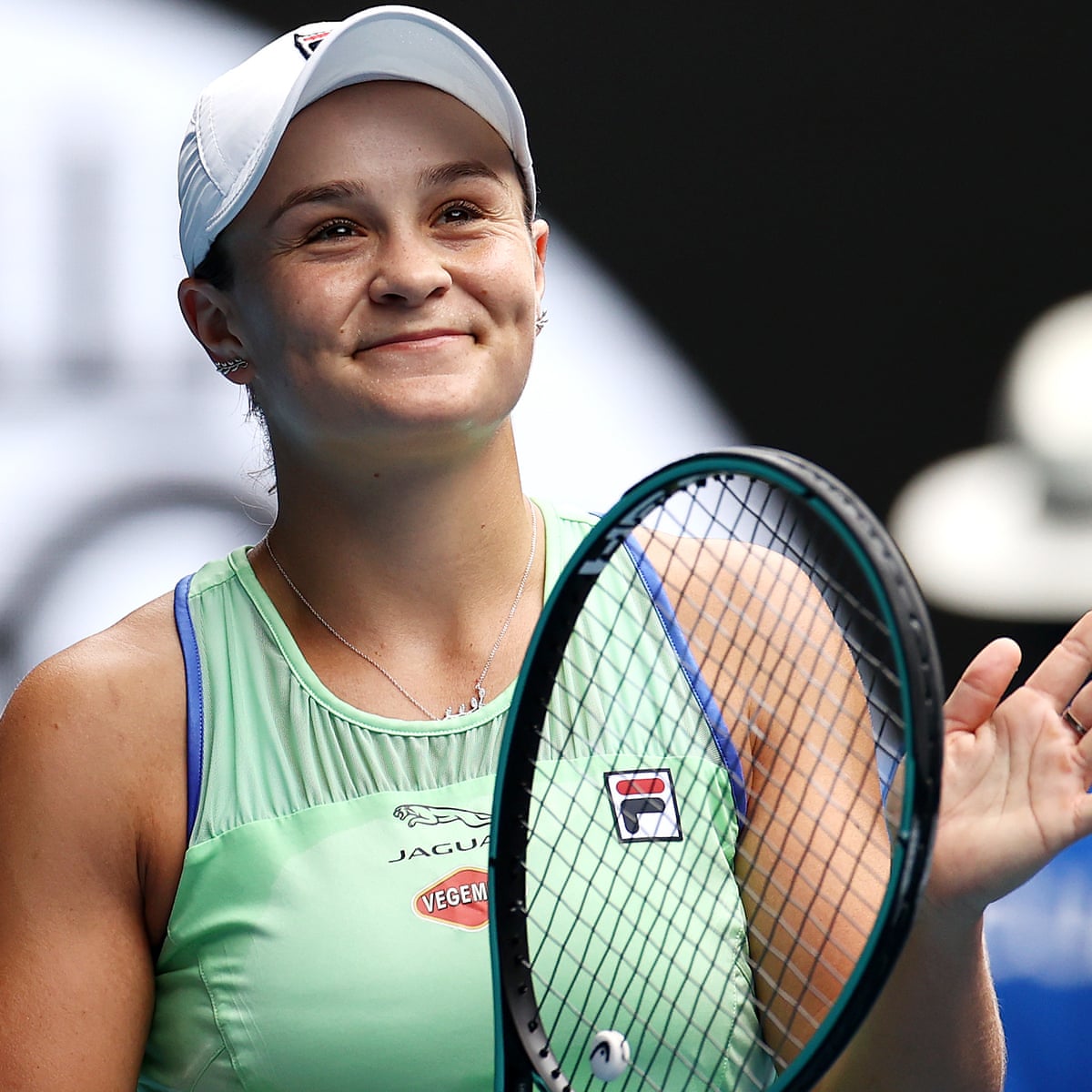
  • Ashleigh Barty won the title WTA player of the year 2021 for the second time.
  • Prior to this, she also earned the WTA Player of the Year award in 2019.
  • The WTA Player of the Year award is awarded by the World Tennis Association to women tennis players who have performed well in the year.

A really tough one': Ashleigh Barty reaches Australian Open fourth round |  Australian Open 2020 | The Guardian

Important Points

  • WTA (Women's Tennis Association) Year award 2021(Women)
  • **Emma Raducanu (**Britain) won the 'WTA Newcomer of the Year award 2021'.
  • Raducanu won the US Open 2021 women's singles title, her first Grand Slam championship.
  • Barbora Krejcikova (Czech Republic) was named the WTA Most Improved Player of the Year 2021.
  • Carla Suarez Navarro(Spain) won the title WTA Comeback Player of the Year award 2021.

Additional Information

  • ATP (Association of Tennis Professionals) Awards 2021(Men)
  • ATP Player of the year - Novak Djokovic
  • Fans’ Favourite Award (Singles) - Roger Federer
  • Ron Bookman Media Excellence Award - Prajwal Hegde (India)
  • ATP Masters 1000 Tournament of the Year -  BNP Paribas Open (Indian Wells)
11

India successfully test-fired the air version of the BrahMos supersonic cruise missile from off the coast of which state, on 8 December 2021?

  1. ((a))

    Andhra Pradesh

  2. ((b))

    Karnataka

  3. ((c))

    Rajasthan

  4. ((d))

    Odisha

Show Answer
Answer: ((d))

Odisha

The correct answer is Odisha.

Key Points

  • BrahMos Missile
  • It is a medium-range supersonic cruise missile.
  • It has been tested from the Integrated Test Range (ITR) at chandipur.
  • Its speed is closer to 3 Mach and ranges up to 290 KM.
  • It works on the fire and forget principle.
  • The name BrahMos is derived from the Brahmaputra of India and the Moskva river of Russia.
  • It is developed by BrahMos Aerospace (a joint venture of India’s DRDO and Russia’s Mashinostroyenia).
  • India signs a deal with the Philipines to sell BrahMos missile.

Additional Information

  • A cruise missile is an unmanned self-propelled (till the time of impact) guided vehicle that flies within the earth’s atmosphere and uses jet engine technology.
  • Subsonic cruise missile travels at a speed lesser than that of sound. (0.8 Mach)
  • Supersonic cruise missile travels at a speed of around 2-3 Mach.
  • A hypersonic cruise missile travels at a speed of more than 5 Mach.
12

Which of the following movements was launched in 1942 under the leadership of Mahatma Gandhi?

  1. ((a))

    Civil Disobedience Movement

  2. ((b))

    Khilafat Movement

  3. ((c))

    Quit India Movement

  4. ((d))

    Non-Cooperation Movement

Show Answer
Answer: ((c))

Quit India Movement

The correct answer Quit India Movement.

Key Points

  • Quit India Movement
  • The slogan ‘Quit India’ was coined by socialist congress leader Yusuf Meher Ali.
  • This movement was launched because of the failure of the Cripps Offer and public discontent against wartime hardships.
  • It was started on 8th August 1942 by Mahatma Gandhi.
  • It is also known as August Movement.
  • The main slogan of this Movement is “Quit India and do or die” which was given by Gandhiji at Gowalia Tank Maidan (August Kranti Maidan).
  • Aruna Asaf Ali operated underground radio and magazine and hoisted a flag at Gowalia tank. She is popularly known as the Grand old lady.

Additional Information

  • Civil disobedient movement
  • It was started in January 1930 by the Indian national congress in the Lahore session.
  • Dandi march began on 12 march 1930 from Sabarmati Ashram and reached Dandi on 6 April and Gandhiji broke the salt law.
  • Non-cooperation movement
  • It was started in September 1920 by Indian National Congress in the Calcutta session.
  • It aims to refuse to cooperate with the government, surrender titles (Kaiser-i-Hind – Gandhiji and Knighthoods – Rabindranath Tagore), and boycott of Govt. schools, offices, and courts.
  • It was suspended in 1922 by Mahatma Gandhi due to the Chauri-Chaura incident.
  • Khilafat Movement was started by two brothers Shoukat Ali and Mohammad Ali against the British Government.
13

At which of the following places did the Chief Minister of Madhya Pradesh NOT launch three solar power projects worth ₹ 5,250 crore in November 2021?

  1. ((a))

    Ujjain

  2. ((b))

    Shajapur

  3. ((c))

    Neemuch

  4. ((d))

    Agar

Show Answer
Answer: ((a))

Ujjain

The correct answer is Ujjain.

Key Points

  • Solar Power Project
  • The CM of Madhya Pradesh Shivraj Singh Chouhan laid foundation stones for setting up three solar power plants of 1500 Megawatt capacity in shajapur, agar, and neemuch at a cost of Rs 5250 Cr.
  • Madhya Pradesh aims to produce 50% electricity through renewable energy.

Additional Information

  • Madhya Pradesh (As of April 2022)
  • Capital – Bhopal
  • Governor – Mangubhai C. Patel (March 2022)
  • Chief Minister – Shivraj Singh Chouhan
  • Loksabha & Rajya Sabha Seats – 29 & 11
  • Vidhan Sabha  – 230
  • Important Places/ tourist sites – Khajuraho Temple, Mahakaleshwar (Ujjain), Bhimbetka cave, Gwalior Fort, Bandhavgarh, Pench, and Kanha National Park, and Sanchi Stupa.
14

Which of the following is the world’s tallest monolithic free-standing structure?

  1. ((a))

    Buddha statue of Hyderabad

  2. ((b))

    Bhojeshwar Temple

  3. ((c))

    Lepakshi Nandi

  4. ((d))

    Gomateshwara

Show Answer
Answer: ((d))

Gomateshwara

The correct answer is Gomateshwara.

Key Points

  • Gomateshwara
  • It is also known as Bahubali.
  • It is an important pilgrimage site of Jainism.
  • According to Jainism, Gomateshwara is the son of Rishabhdev.
  • It is located in Shravanabelagola, Karnataka.
  • It was built in 981 AD by Chamundaraya (Western Ganga Dynasty)
  • It is carved out of a single block of granite and looms on the top of Vindhya Giri hill.

Additional Information

  • Lepakshi Nandi is located in lepakshi, Andhra Pradesh and it was built by Viranna and Virupanna.
  • Bhojeshwar Temple is located in Bhojpur, Madhya Pradesh and was built by Paramara Raja Bhoja.
  • Buddha Statue of Hyderabad is standing on the rock of Gibraltar in the middle of Hussain Sagar Lake.
15

Who is the first Indian woman to win two Olympic medals?

  1. ((a))

    Sakshi Malik

  2. ((b))

    PV Sindhu

  3. ((c))

    Mithali Raj

  4. ((d))

    Deepika Kumari

Show Answer
Answer: ((b))

PV Sindhu

The correct answer is PV Sindhu.

Key Points

  • PV Sindhu is an Indian badminton player.
  • She was born on 5th July 1995 in Hyderabad.
  • She has received the Arjuna Award (2013), Major Dhayan Chand Khel Ratna (2016), Padma Shri (2015), and Padma Bhushan (2020).
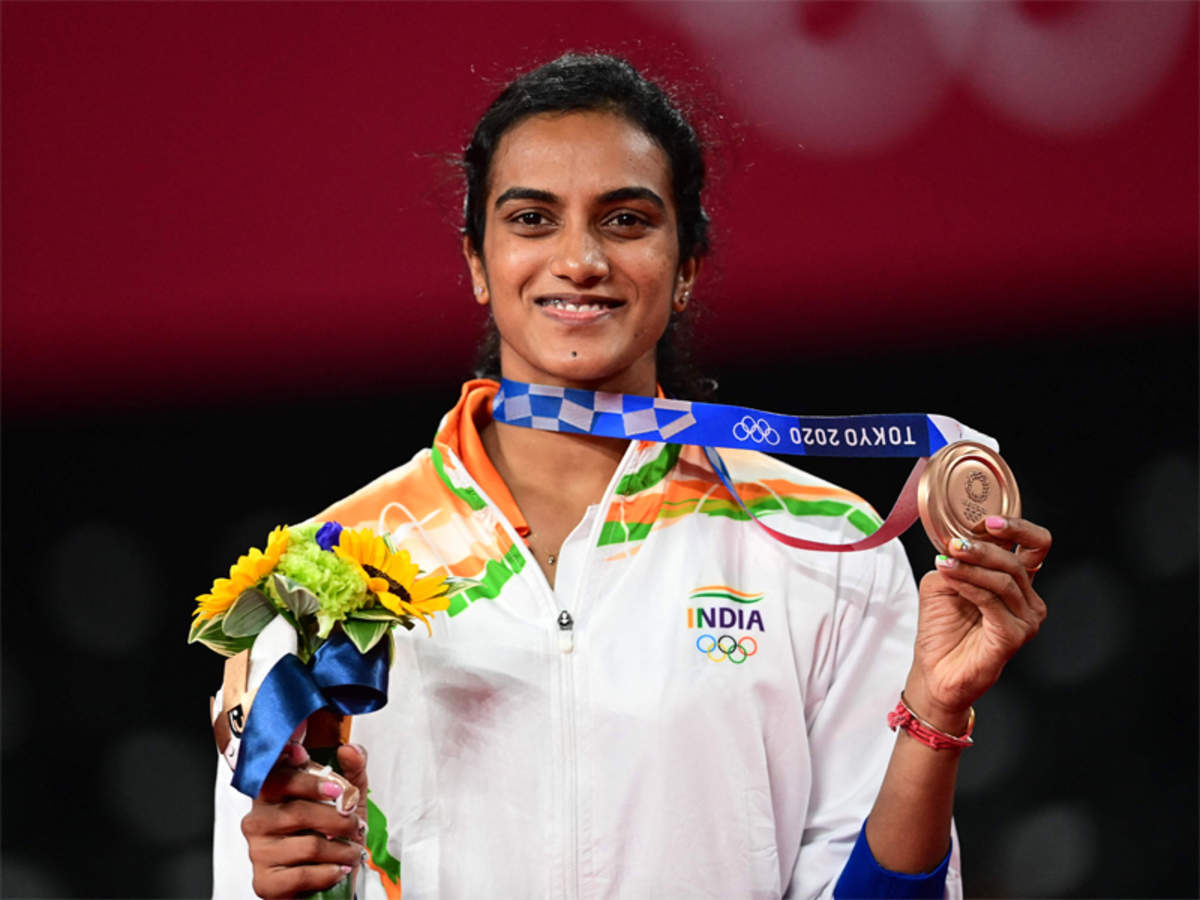
  • She has won the bronze medal in the 2020 Tokyo Olympics and the silver medal in the 2016 Rio Olympics.

PV Sindhu: Sindhu Badminton Records, Ranking, Medal List and Biography |  Tokyo Olympics News - Times of India

Additional Information

  • Summer Olympic
  • It is also known as the Games of the Olympiad.
  • It was managed and run by International Olympic Committee (IOC) which was founded by Baron Pierre de Coubertin
  • The first Summer Olympics was held in Athens in 1896.
  • ​Sakshi Malik is an Indian freestyle wrestler and She won the bronze medal (58 categories) at the Rio 2016 Olympics.
  • MIthali Raj is an Indian Cricket player.
  • Deepika Kumari is an Indian Archer player.
16

Who developed the ZyCoV-D vaccine?

  1. ((a))

    Cipla Limited

  2. ((b))

    Dr. Reddy’s Laboratories

  3. ((c))

    Cadila Healthcare

  4. ((d))

    Lupin Limited

Show Answer
Answer: ((c))

Cadila Healthcare

The correct answer is Cadila Healthcare.

Key Points

  • ZyCoV-D is a DNA plasmid-based COVID-19 vaccine developed by Indian pharmaceutical company Cadila Healthcare, with support from the Biotechnology Industry Research Assistance Council.
  • It is approved for emergency use in India.

Additional Information

  • Cipla Limited is an Indian multinational pharmaceutical company, headquartered in Mumbai, which primarily develops medicines to treat respiratory.
  • Dr. Reddy's Laboratories is an Indian multinational pharmaceutical company located in Hyderabad, made  Indian Drugs and Pharmaceuticals Limited.
  • Lupin Limited is an Indian multinational pharmaceutical company based in Mumbai, Maharashtra, focus areas include paediatrics, cardiovascular, anti-infectives, diabetology, asthma and anti-tuberculosis.
17

Where is Kathak Kendra located?

  1. ((a))

    Jaipur

  2. ((b))

    Delhi

  3. ((c))

    Banaras

  4. ((d))

    Lucknow

Show Answer
Answer: ((b))

Delhi

The correct answer is Delhi.

Key Points

  • National Institute of Kathak Dance, also known as Kathak Kendra.
  • It is the dance institution for the Indian classical dance form of Kathak.
  • Also, a unit of the Sangeet Natak Akademi, India's National Academy of Music, Dance and Drama, was situated in New Delhi in 1964.​

Additional Information

  • The Jawahar Kala Kendra is a multi-arts centre located in the city of Jaipur, India with the purpose of preserving Rajasthani arts and crafts.
  • Krishi Vigyan Kendra and Banaras Hindu University, formerly Central Hindu College, is a collegiate, research university located in Varanasi, Uttar Pradesh, India.
  • The National Botanical Research Institute (NBRI) is a research institute of CSIR in Lucknow, Uttar Pradesh, India.
18

As per National Statistical Survey 2020, what is the literacy rate of Kerala?

  1. ((a))

    98.2%

  2. ((b))

    96.2%

  3. ((c))

    92.2%

  4. ((d))

    94.2%

Show Answer
Answer: ((b))

96.2%

The correct answer is 96.2%.

Key Points

  • With 96.2 per cent literacy, Kerala has the most literate state in the country.
  • Andhra Pradesh bottom with a rate of 66.4 per cent, showed a report based on National Statistical Office (NSO) survey.
  • Kerala implemented social reform in the early **20th century that allowed access to education for lower castes and women.**​

Additional Information

  • TOP 5 STATE LITERACY RATE
KERALA96.2
DELHI88.7
UTTRAKHAND87.6
HIMACHAL PRADESH86.6
ASSAM85.9
19

Ajaz Patel, a cricket player, who took 10 wickets in one inning of a test match, plays for which country?

  1. ((a))

    South Africa

  2. ((b))

    New Zealand

  3. ((c))

    India

  4. ((d))

    Bangladesh

Show Answer
Answer: ((b))

New Zealand

The correct answer is New Zealand.

Key Points

  • Ajaz Patel becomes just the third bowler in the history of men's Test cricket to take all 10 wickets in an innings (Jim Laker in 1956 and Anil Kumble in 1999).
  • Ajaz Yunus Patel is a New Zealand cricketer who plays for Central Districts in domestic cricket.
  • Patel is a slow left-arm orthodox spin bowler. He made his international debut for the New Zealand cricket team in October 2018.

Important Points 

  • Kumble achieved this against Pakistan in the second Test played in Delhi in February 1999.
20

In December 2021, with which finance company has Bank of Baroda signed a memorandum of understanding for sourcing and financing housing loan borrowers under co-lending model?

  1. ((a))

    Centrum Housing Finance Limited

  2. ((b))

    Bajaj Finance Limited

  3. ((c))

    Tata Capital Financial Services Limited

  4. ((d))

    Muthoot Finance Limited

Show Answer
Answer: ((a))

Centrum Housing Finance Limited

The correct answer is Centrum Housing Finance Limited.

Key Points

  • Bank of Baroda (BoB) has signed a memorandum of understanding (MoU) with Centrum Housing Finance (CHFL) for sourcing and financing housing loan borrowers under the co-lending model.
  • Centrum Housing Finance Limited (CHFL) is a housing finance company catering to 'middle class' India and providing financial inclusion to Lower and Middle Income (LMI) families by providing them with a long term housing finance.

Additional Information  

  • Bajaj Finance Limited is a subsidiary of Bajaj Finserv, an Indian non-banking financial company headquartered in the city of Pune, India.
  • Founder: Rahul Bajaj.
  • Tata Capital Limited is a financial and investment service provider in India.
  • ​CEO- Rajiv Sabharwal
  • Headquarters-Mumbai
  • Founded-2007.
  • Muthoot Finance Ltd. is an Indian financial corporation and the largest gold loan NBFC in the country.
  • Headquarters: Kochi
  • Founder: Mathai George Muthoot.
  • Founded: 1939.
21

According to UNDP Human Development Report – 2018, what is the rank of India?

  1. ((a))

    120

  2. ((b))

    130

  3. ((c))

    140

  4. ((d))

    150

Show Answer
Answer: ((b))

130

The correct answer is 130.

Key Points

  • The full form of UNDP is the United Nations Development Programme.
  • Its headquarters are in New York City.
  • It was established in 1965.
  • Head of UNDP is Achim Steiner​

Additional Information

  • The idea of Human Development Index (HDI) was firstly proposed by Pakistani Economist Mahbub-Ul-Haq.
  • The first report of HDI was released in 1990.
  • HDI measured on 3 Dimension:-
  • Sta n dard of Living
  • Health
  • Education

Important Points

  • Norway was in first place.
  • Niger was in last place.
  • The total number of countries participating in it is 189.
  • India’s neighbouring country which performance is better than India.
  • Sri Lanka - 76
  • Mald  ives - 101
22

Corrosion is an example of which type of reaction?

  1. ((a))

    Displacement reaction

  2. ((b))

    Oxidation reaction

  3. ((c))

    Double displacement reaction

  4. ((d))

    Combination reaction

Show Answer
Answer: ((b))

Oxidation reaction

The correct answer is Oxidation reaction.

Key Points Corrosion

  • Corrosion is a natural phenomenon that occurs due to the chemical reaction of metal in presence of Liquid or air.
  • In which pure metal is converted into disintegrated metal.
  • Corrosion occurs due to the loss of electrons.

Additional Information

  • Corrosion is a Redox reaction.
  • A redox reaction is expressed as a transfer of electrons between two reactants which participate in it.
  • It is a combination of Reduction and Oxidation reactions.

Oxidation:- ​​

  • An increase in oxidation state or loss of electrons is known as Oxidation.

Reduction:-

  • A decrease in oxidation state or gain of electrons is known as Reduction.
23

Which of the following statements about Lala Lajpat Rai is INCORRECT?

  1. ((a))

    He was a nationalist from Punjab.

  2. ((b))

    He was active member of the Arya Samaj.

  3. ((c))

    He was popularly known as Punjab Kesari.

  4. ((d))

    He was born in 1855.

Show Answer
Answer: ((d))

He was born in 1855.

The correct answer is He was born in 1855.

Key Points

  • He was popularly known as Punjab Kesar, the Lions of Punjab.
  • He was born in the Dhudike district of Punjab on 28th January 1865.
  • Along with the Bal Gangadhar Tilak and Bipin Chandra Pal, he formed the Lal, Bal, Pal of extremist leaders.
  • A peaceful rally led by Lajpat Rai was started to protest the arrival of members of the Simon Commission in Lahore.
  • Superintendent of Police Scott ordered his officers to “Lathi Charge” the demonstrators.
  • Lala Lajpat Rai was severely injured and died as a result of the altercation.
  • Bhagat Singh planned the killing of Scott in relation to the death of Lala Lajpat Rai.

Additional Information

  • Some of the Important books authored by Lala Lajpat Rai is as follows:-
  • The Story of my Deportation
  • The problem of national education in India.
  • Unhappy India
  • England’s debt to India
  • The message of The Bhagavad Gita
  • The United States of America: A Hindu’s Impressions
  • The depressed classes
24

What is the name of the Indian-origin physician who has been selected by NASA along with nine others to be astronauts for future missions in 2021?

  1. ((a))

    Pradeep Kumar Panja

  2. ((b))

    Anil Menon

  3. ((c))

    Amitabh Chaudhry

  4. ((d))

    Baldev Prakash

Show Answer
Answer: ((b))

Anil Menon

The correct answer is Anil Menon.

Key Points

  • NASA
  • The full form of NASA is the National Aeronautics and Space Administration.
  • It was formed in 1958.
  • Its headquarters are in Washington DC.
  • The administrator of NASA is Bell Nelson.
  • Anil Menon
  • Anil Menon SpaceX flight surgeon selected for NASA as it plans the first human mission to the moon after 50 years.
  • Anil Menon is among the 10 latest trainee astronauts who will join NASA.

Additional Information

  • ISRO (As of 2022)
  • Its full form is Indian Space Research Organization.
  • It was formed in 1969.
  • Its headquarters are in Bengaluru.
  • Chairman of ISRO is S. Somanath.
  • JAXA - Japan Aerospace Exploration Agency.
  • CNSA - China National Space Administration.
  • ESA - The European Space Agency.
  • CNES - The National Center for Space Studies.
  • Roscosmos is a Russian Space Agency.
25

Hoysaleswara temple at Belur is an example of which type of temple?

  1. ((a))

    Nagara

  2. ((b))

    Vesara

  3. ((c))

    Dravida

  4. ((d))

    Mithunas

Show Answer
Answer: ((b))

Vesara

The correct answer is Vesara.

Key Points

  • Hoysaleswara temple is located in the Halebidu so it is also known as the Halebidu temple.
  • It was built by Vishnuvardhan.
  • Hoysaleswara temple is dedicated to Nataraja (Lord Shiva).​

Additional Information 

  • Mainly 3 types of Indian temple architecture

Nagara

  • The Nagara style is mainly associated with the northern parts of India.
  • The Nagara type style is mainly situated in between the Himalayas and Vindhyas region means the northern parts of India.

Dravida

  • Dravida style advanced in the Southern region of India.
  • It is situated between the Krishna and Kaveri River.

Vesara

  • Vesara style is the combination of Nagara and Dravida styles.
  • Vesara style is mainly situated between the Krishna and Vindhyas region.

Mathematics (25 questions)

26

The volume of a solid hemisphere is 5647{ {4} \over 7} cm³. What is its total surface area (in cm²)? (Take π = 227{ {22} \over 7})

  1. ((a))

    4957{ {495} \over 7}

  2. ((b))

    3967{ {396} \over 7}

  3. ((c))

    5947{ {594} \over 7}

  4. ((d))

    4947{ {494} \over 7}

Show Answer
Answer: ((c))

5947{ {594} \over 7}

Shortcut Trick

Convert mixed fraction Volume: 56 4/7 = (56 × 7 + 4) / 7 = 396/7 cm3.

Use formula (2/3)πr3 = 396/7 ⇒ (2/3) × (22/7) × r3 = 396/7.

Simplify: r3 = (396/44) × 3 = 9 × 3 = 27 ⇒ Radius (r) = 3 cm.

Direct formula for TSA: 3πr2 = 3 × (22/7) × 32 = 3 × 22/7 × 9 = 594/7 cm2.

∴ The correct answer is 594/7 cm2.

Alternate Method

Given:

Volume of solid hemisphere (V) = 396/7 cm3

Value of π = 22/7

Formula Used:

Volume (V) = (2/3) × π × r3

Total Surface Area (TSA) = 3 × π × r2

Calculations:

⇒ (2/3) × (22/7) × r3 = 396/7

⇒ (44/21) × r3 = 396/7

⇒ r3 = (396/7) × (21/44)

⇒ r3 = 9 × 3 = 27

⇒ r = √[3]27 = 3 cm

⇒ TSA = 3 × (22/7) × (3)2

⇒ TSA = 3 × (22/7) × 9

⇒ TSA = (66 × 9) / 7 = 594/7 cm2

∴ The correct answer is 594/7 cm2.

Additional Information

Curved Surface Area (CSA)

For a hemisphere, the curved surface area is half that of a sphere: CSA = 2 × π × r2.

Volume of a Sphere

A hemisphere is exactly half of a sphere. Volume of sphere = (4/3) × π × r3.

Total Surface Area of Sphere

Unlike a solid hemisphere which has a flat circular base, a sphere only has a curved surface: TSA (Sphere) = 4 × π × r2.

27

The base of a right pyramid is a square, whose diagonal is 20 cm. The height of the pyramid is 20 cm. The lateral surface area of the pyramid is:

  1. ((a))

    450 cm2

  2. ((b))

    720 cm2

  3. ((c))

    500 cm2

  4. ((d))

    600 cm2

Show Answer
Answer: ((d))

600 cm2

Given:

The base of a right pyramid is a square, whose diagonal is 20 cm.

The height of the pyramid is 20 cm.

Formula used:

The lateral surface area of the pyramid = 12\frac{1}{2} × p × l

Where, 

p, is the perimeter of the base of the pyramid

l, is the slant height of the square pyramid

The slant height of the square pyramid = (a2)2+h2\sqrt{(\frac{a}{2})^2 + h^2}

Where, 

a, is the side length of the square base

h, is the height of the square pyramid

The perimeter of the square = 4a

The diagonal length for a square = √2a

Where, 

a, is the side length of the square

Calculation:

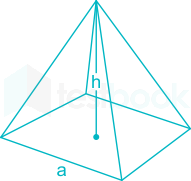
Accoording to the question, the required image is:

The diagonal length for a square,

⇒ d = √2a

⇒ 20 = √2a

⇒ a = 10√2 cm

The perimeter of the square = 4 × 10√2 = 40√2 cm

The slant height of the square pyramid,

⇒ l = (a2)2+h2\sqrt{(\frac{a}{2})^2 + h^2}

⇒ l = (1022)2+202\sqrt{(\frac{10√{2}}{2})^2 + 20^2}

⇒ l = 50+400\sqrt{50+400}

⇒ l = 15√2 cm

The lateral surface area of the pyramid = 12\frac{1}{2} × 40√2 × 15√2 = 600 cm2

∴ 600 cm2 is the lateral surface area of the square pyramid.

28

In ΔABC, ∠A = 90°, AB = 6 cm, AC = 8 cm. A square DEFG is drawn inside the triangle with side FG along BC, E and D on sides AB and AC, respectively. What is the length of the side of the square (in cm)?

  1. ((a))

    247{{24} \over 7}

  2. ((b))

    409{{40} \over 9}

  3. ((c))

    245{{24} \over 5}

  4. ((d))

    12037{{120} \over 37}

Show Answer
Answer: ((d))

12037{{120} \over 37}

Shortcut Trick

According to the question, the required figure is:

In Δ ABC,

BC2 = AB2 + AC2

⇒ BC2 = 62 + 82

⇒ BC2 = 36 + 64

⇒ BC2 = 100

⇒ c = BC = 10 cm

Now, 

x = abca2+b2+ab\frac{abc}{a^2 + b^2 + ab}

⇒ x = 6×8×1062+82+48=12037\frac{6 \times 8 \times 10}{6^2 + 8^2 + 48} = \frac{120}{37} cm

Alternate MethodGiven:

In ΔABC, ∠A = 90°, AB = 6 cm, AC = 8 cm.

A square DEFG is drawn inside the triangle with side FG along with BC, E and D on sides AB and AC, respectively.

Calculation:

According to the question, the required figure is:

In Δ ABC,

BC2 = AB2 + AC2

⇒ BC2 = 62 + 82

⇒ BC2 = 36 + 64

⇒ BC2 = 100

⇒ BC = 10 cm

Now, 

In ΔEBF,

tan(α) = aFB\frac{a}{FB}    ----(1)

In ΔCDG,

tan(α) = CGa\frac{CG}{a}    ----(2)

In ΔABC,

tan(α) = 86\frac{8}{6}       ----(3)

From equation (1) and (3), we get,

⇒ FB = 6a8\frac{6a}{8}

From equation (2) and (3), we get,

⇒ CG = 8a6\frac{8a}{6}

Now, 

BC = CG + a + FB

On substituting the value of the respective variable, we get,

⇒ 10 = 8a6\frac{8a}{6} + a + 6a8\frac{6a}{8}

⇒ 10 = 64a+48a+36a48\frac{64a + 48a + 36a}{48}

⇒ a = 480148\frac{480}{148} = 12037\frac{120}{37}

∴ The side length of the required square (in cm) is 12037\frac{120}{37}.

29

The average age of A, B and C, 7 years ago, was 42 years and the average age of B and C, 9 years ago, was 36 years. What is the present age (in years) of A?

  1. ((a))

    50

  2. ((b))

    57

  3. ((c))

    49

  4. ((d))

    58

Show Answer
Answer: ((b))

57

Given:

The average age of A, B and C, 7 years ago, was 42 years and the average age of B and C, 9 years ago, was 36 years.

Calculation:

Since the average age of A, B and C, 7 years ago, was 42 years,

Therefore, 

The value of the present average age of A, B and C = 42 + 7 = 49 years

The sum of ages of A, B and C = 49 × 3 = 147 years

Since the average age of B and C, 9 years ago, was 36 years,

Therefore, 

The value of the present average age of B and C = 36 + 9 = 45 years

The sum of ages of B and C = 45 × 2 = 90 years

Now, 

The age of A = 147 - 90 = 57 years

∴ The present age (in years) of A is 57.

Additional Information

Since the average age of A and B, n years ago, was T years,

Therefore, 

The value of the present average age of A and B = (T + n) years

30

The expression 342424 { \sqrt[4]{34-24\sqrt2} } × 4+32 { \sqrt{4+3\sqrt2} } simplifies to:

  1. ((a))

    4

  2. ((b))

    2\sqrt2

  3. ((c))

    2

  4. ((d))

    22\sqrt2

Show Answer
Answer: ((b))

2\sqrt2

Shortcut Trick

Express 34 − 24√2 as a perfect square: 18 + 16 − 2(3√2)(4) = (3√2 − 4)2.

The fourth root reduces to a square root: 4√(34 − 24√2) = √(3√2 − 4).

Multiply with the second term: √(3√2 − 4) × √(3√2 + 4).

⇒ √[(3√2)2 − 42] = √(18 − 16) = √2.

∴ The correct answer is √2.

Alternate Method

Given:

Expression: 4√(34 − 24√2) × √(4 + 3√2)

Formula Used:

(a − b)2 = a2 + b2 − 2ab

(a − b)(a + b) = a2 − b2

Calculation:

⇒ First, simplify the expression inside the fourth root: 34 − 24√2

⇒ Split 34 into 18 and 16, and express 24√2 as 2 × 3√2 × 4

⇒ 34 − 24√2 = 18 + 16 − 2(3√2)(4)

⇒ 34 − 24√2 = (3√2)2 + (4)2 − 2(3√2)(4)

⇒ Using the formula, it can be expressed as a perfect square:

⇒ 34 − 24√2 = (3√2 − 4)2

⇒ Taking the fourth root: [ (3√2 − 4)2 ]1/4 = (3√2 − 4)2/4 = √(3√2 − 4)

⇒ Note: 3√2 = √18 and 4 = √16. Since 3√2 > 4, the principal root remains positive.

⇒ Now substitute this simplified term back into the given expression:

⇒ √(3√2 − 4) × √(3√2 + 4)

⇒ Combine both parts under a single square root:

⇒ √[ (3√2 − 4)(3√2 + 4) ]

⇒ Apply the difference of squares formula:

⇒ √[ (3√2)2 − (4)2 ]

⇒ √(18 − 16)

⇒ √2

∴ The correct answer is √2.

Additional Information

Square Root of a Surd

To find the square root of a binomial surd like a − √b, attempt to express it as a perfect square (x − y)2. Always ensure x > y so the principal square root remains a positive real number.

Difference of Squares

The algebraic identity (a − b)(a + b) = a2 − b2 is highly effective for simplifying the product of conjugate surds by completely eliminating the square root terms.

Rules of Indices

The fractional powers of surds follow the rule: m√(an) = an/m. In this problem, taking the fourth root of a perfect square naturally reduces the expression to a square root.

31

A certain sum amounts to ₹16,956 in 4 years and to ₹19,116 in 612{ {1} \over 2} years at a certain rate percent per annum, interest being simple in both cases. The rate of interest p.a. is:

  1. ((a))

    6.5%

  2. ((b))

    7.8%

  3. ((c))

    6.4%

  4. ((d))

    7.5%

Show Answer
Answer: ((c))

6.4%

Shortcut Trick

Interest for 2.5 years = 19,116 − 16,956 = ₹2,160

Interest per year = 2,160 ÷ 2.5 = ₹864

Principal = 16,956 − (864 × 4) = 16,956 − 3,456 = ₹13,500

Rate of interest = (864 ÷ 13,500) × 100 = 6.4%

∴ The correct answer is 6.4%.

Alternate Method

Given:

Amount after 4 years (A1) = ₹16,956

Amount after 6.5 years (A2) = ₹19,116

Formula Used:

Amount (A) = Principal (P) + Simple Interest (SI)

SI = (P × R × T) ÷ 100

Calculations:

⇒ Interest for (6.5 − 4) years = 19,116 − 16,956

⇒ Interest for 2.5 years = ₹2,160

⇒ Interest for 1 year = 2,160 ÷ 2.5 = ₹864

⇒ Interest for 4 years = 864 × 4 = ₹3,456

⇒ Principal (P) = A1 − SI for 4 years

⇒ P = 16,956 − 3,456 = ₹13,500

⇒ Rate of Interest (R) = (SI for 1 year × 100) ÷ P

⇒ R = (864 × 100) ÷ 13,500

⇒ R = 864 ÷ 135 = 6.4%

∴ The correct answer is 6.4%.

Additional Information

Simple Interest Properties

In simple interest, the interest remains constant for every time period as it is always calculated on the original Principal amount.

Direct Rate Calculation

Rate R = (Interest × 100) ÷ (P × T). If T = 1 year, then R = (Interest for 1 year ÷ P) × 100.

Amount Formula

Total Amount A = P (1 + (R × T) ÷ 100), where P is principal, R is rate per annum, and T is time in years.

32

A computer is available for ₹76,800 cash or ₹23,840 cash down payment and three equal half-yearly instalments. If the interest charged is 20% p.a., compounded semi-annually, then the interest charged in the instalment scheme is:

  1. ((a))

    ₹10,968

  2. ((b))

    ₹10,848

  3. ((c))

    ₹10,928

  4. ((d))

    ₹10,878

Show Answer
Answer: ((c))

₹10,928

Given:

A computer is available for ₹76,800 cash or ₹23,840 cash down payment and three equal half-yearly instalments.

The interest charged is 20% p.a., compounded semi-annually.

Formula used:

D = AR×(11(1+R)n)\frac{A}{R} × (1 - \frac{1}{(1+R)^n})

Where, 

D, is the amount due (or amount on which interest is to be applied)

A, is the value of the instalment

R, is the rate of interest applied

n, is the number of instalments

Calculation:

The price of the computer = ₹76,800

The down payment is done for buying the computer = ₹23,840

The remaining amount (which is paid in three equal instalments) = ₹76,800 - ₹23,840 = ₹52,960

The rate of interest applied annually = 20% p.a.

The rate of interest applied semi-annually = 10% p.a.

The number of instalments, n = 3

Now, 

By substituting the value of the respective variable in the required formula, we get,

⇒ ₹52,960 = A10%×(11(1+10%)3)\frac{A}{10\text{\%}} × (1 - \frac{1}{(1+\text{10\%})^3})

⇒ ₹52,960 = A0.1×(11(1+0.1)3)\frac{A}{0.1} × (1 - \frac{1}{(1+0.1)^3})

⇒ ₹52,960 = A0.1×(11(1.1)3)\frac{A}{0.1} × (1 - \frac{1}{(1.1)^3})

⇒ ₹5296 = A × (11000(1331)) (1 - \frac{1000}{(1331)})

⇒ A = ₹21296

The total amount paid in three instalments = ₹21296 × 3 = ₹63888

The interest paid = ₹63888 - ₹52960 = ₹10928

∴ ₹10928 is the interest charged in the instalment scheme.

33

The value of (1.05ˉ1.0\bar{5} ÷ 0.950.\overline{95} ) × 0.4090.4\overline{09} is :

  1. ((a))

    0.45

  2. ((b))

    0.5

  3. ((c))

    0.9

  4. ((d))

    0.25

Show Answer
Answer: ((a))

0.45

Given:

(1.05ˉ÷0.951.0\bar{5} \div 0.\overline{95}) × 0.4090.4\overline{09}

Formula used:

Recurring decimal to fraction conversion:

x.abc = abcab900\frac{abc - ab}{900} (Example for notation)

Calculation:

(1.05ˉ÷0.951.0\bar{5} \div 0.\overline{95}) × 0.4090.4\overline{09} = ?

1.05ˉ=1051090=9590=19181.0\bar{5} = \frac{105 - 10}{90} = \frac{95}{90} = \frac{19}{18}

0.95=95990.\overline{95} = \frac{95}{99}

0.409=4094990=405990=9220.4\overline{09} = \frac{409 - 4}{990} = \frac{405}{990} = \frac{9}{22}

⇒ ? = (1918÷9599\frac{19}{18} \div \frac{95}{99}) × 922\frac{9}{22}

⇒ ? = (1918×9995\frac{19}{18} \times \frac{99}{95}) × 922\frac{9}{22}

⇒ ? = (12×115\frac{1}{2} \times \frac{11}{5}) × 922\frac{9}{22}

⇒ ? = 1110×922\frac{11}{10} \times \frac{9}{22}

⇒ ? = 920\frac{9}{20}

⇒ ? = 0.45

∴ The correct answer is option (1).

34

The tangent at a point P, on a circle with centre O, intersects the diameter BA produced at Q. If ∠QPB = 103o, then what is the measure of ∠PAQ?

  1. ((a))

    103o

  2. ((b))

    97o

  3. ((c))

    107o

  4. ((d))

    1130

Show Answer
Answer: ((a))

103o

Given: 

The tangent at a point P, on a circle with centre O, intersects the diameter BA produced at Q.

∠QPB = 103o

Concept used:

The angle subtended by diameter on any point on the circumference of a circle is 90°.

The angle between a tangent and a chord is equal to the angle in the alternate segment.

Calculation:

According to the question, the required figure is:


As we know,

The angle subtended by diameter on any point on the circumference of a circle is 90°.

So, 

∠BPA = 90°

Now, 

∠BPQ = ∠BPA + ∠APQ

⇒ 103° = 90° + ∠APQ

⇒ ∠APQ = 13°

As per the alternate segment theorem.

∠PBQ = ∠APQ = 13°

In ΔBPA,

∠PBA + ∠BAP + ∠APB = 180°

⇒ 13° + ∠BAP + 90° = 180°

⇒ ∠BAP + 103° = 180°

⇒ ∠BAP = 77°

Now,

∠BAP + ∠PAQ = 180°

⇒ 77° + ∠PAQ = 180°

⇒ ∠PAQ = 103°

The measure of ∠PAQ is 103°.

35

X and Y start their journey at the same time from place A to B and B to A, respectively. After meeting each other on the way, X and Y complete their remaining journey in 549{ {4} \over 9} hours and P hours, respectively. If the speed of X is 2847{{4} \over 7}% more than that of Y, then what is the value of P?

  1. ((a))

    9

  2. ((b))

    8

  3. ((c))

    412{ {1} \over 2}

  4. ((d))

    6

Show Answer
Answer: ((a))

9

Given:

X and Y start their journey at the same time from place A to B and B to A, respectively.

After meeting each other on the way, X and Y complete their remaining journey in 549{ {4} \over 9} hours and p hours, respectively.

The speed of X is 2847{{4} \over 7}% more than that of Y.

Formula used:

SxSy=Ty(AC)Tx(CB)\frac{S_x}{S_y} = \sqrt{\frac{T_{y(AC)}}{T_{x(CB)}}}

Where, 

Sx and Sy are the speed of trains X and Y respectively.

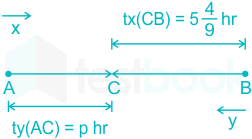
Ty(AC) and Tx(CB) are the time required by train Y and train X to complete the remaining journey after they meet at point C.

Calculation:

According to the question, the required figure is:

Let the speed of Y = 700 kmph

The speed of X = (100% + 2847{{4} \over 7}%) of 700 = 900 kmph

The time required by X to complete the journey from C to B = 549\frac{4}{9} = 499\frac{49}{9} hours

The time required by Y to complete the journey from C to A = P hours

Now, 

⇒ 900700=P499\frac{900}{700} = \sqrt{\frac{P}{\frac{49}{9}}}

⇒ 97=9P49\frac{9}{7} = \sqrt{\frac{9P}{49}}

Take square on both sides, 

⇒ 8149=9P49\frac{81}{49} = {\frac{9P}{49}}

⇒ P = 9 hours

∴  The value of P (in hours) is 9.

36

A and B are partners in a business. A invests ₹3 lakhs more than B. B invests his capital for 712{{1} \over 2} months, while A invests his capital for 212{{1} \over 2} more months than B. If the share of B in the total profit of ₹6.25 lakhs is ₹1.25 lakhs less than the share of A, then what is the capital (in ₹ lakhs) invested by B?

  1. ((a))

    24

  2. ((b))

    20

  3. ((c))

    15

  4. ((d))

    18

Show Answer
Answer: ((a))

24

Given:

A invests  ₹3 lakhs more than B.

B invests his capital for 712{{1} \over 2} months, while A invests his capital for 212{{1} \over 2} more months than B.

The share of B in the total profit of ₹6.25 lakhs is ₹1.25 lakhs less than the share of A,

Calculation:

Let the amount invested by B = ₹x lakhs

The amount invested by A = ₹(x + 3) lakhs

The time of investment of B =  712{{1} \over 2} = 7.5 months

The time of investment of A =  (712{{1} \over 2} + 212{{1} \over 2}) = 10 months

The required ratio for the capital invested = (₹x × 7.5) : (₹(x + 3) × 10)

Now, 

The total profit earned by A and B = ₹6.25 lakhs

Let 'PA' and 'PB' be the profit earned by A and B.

So, 

⇒ PA + PB = ₹6.25 lakhs    ----(1)

The share of B in the total profit is ₹1.25 lakhs less than the share of A,

Therefore,

⇒ PA - PB = ₹1.25 lakhs    ----(2)

By solving the equation (1) and (2), we get,

PA = ₹3.75 lakhs and PB = ₹2.50 lakhs

Now, 

As we know, the ratio in which profit is divided is the same as the ratio of capital invested (product of amount invested and period of investment).

⇒ (₹x × 7.5) : (₹(x + 3) × 10) = 2.5 : 3.75

⇒ (x × 7.5) : (10x + 30) = 2.5 : 3.75

It can be written as:

⇒ 7.5x10x+30=2.53.75\frac{7.5x}{10x + 30} = \frac{2.5}{3.75}

⇒ 7.5x10x+30=23\frac{7.5x}{10x + 30} = \frac{2}{3}

⇒ 22.5x = 20x + 60

⇒ 2.5x = 60

⇒ x = 24

∴ The amount invested by B is ₹24 lakhs.

37

If 2x+13x=5,x02x + { {1} \over 3x}= 5, x ≠ 0 , then what is the value of 27x3+18x327x^3+{{1} \over 8x^3}?

  1. ((a))

    16354{{1635} \over 4}

  2. ((b))

    33758{{3375} \over 8}

  3. ((c))

    31058{{3105} \over 8}

  4. ((d))

    16254{{1625} \over 4}

Show Answer
Answer: ((c))

31058{{3105} \over 8}

Shortcut Trick

Multiply 2x + 1/(3x) = 5 by 3/2 to get the terms for cubing.

⇒ 3x + 1/(2x) = 15/2

Here, a = 3x, b = 1/(2x), so their product ab = 3/2.

Apply the shortcut formula: a3 + b3 = (a + b)3 − 3ab(a + b)

⇒ Value = (15/2)3 − 3 × (3/2) × (15/2) = 3375/8 − 135/4 = 3105/8

∴ The correct answer is 3105/8.

Alternate Method

Given:

2x + 1/(3x) = 5

Formula Used:

(a + b)3 = a3 + b3 + 3ab(a + b)

Calculation:

⇒ Multiply the given equation by 3/2 to adjust the coefficients.

⇒ (3/2) × [2x + 1/(3x)] = (3/2) × 5

⇒ 3x + 1/(2x) = 15/2

⇒ Cubing both sides of the equation:

⇒ (3x + 1/(2x))3 = (15/2)3

⇒ (3x)3 + (1/(2x))3 + 3 × (3x) × (1/(2x)) × (3x + 1/(2x)) = 3375/8

⇒ 27x3 + 1/(8x3) + (9/2) × (15/2) = 3375/8

⇒ 27x3 + 1/(8x3) + 135/4 = 3375/8

⇒ 27x3 + 1/(8x3) = 3375/8 − 270/8

⇒ 27x3 + 1/(8x3) = 3105/8

∴ The correct answer is 3105/8.

Additional Information

Sum of Cubes Formula

The algebraic expansion a3 + b3 = (a + b)(a2 − ab + b2) is widely used for factorization. It can also be expressed directly for value calculation as a3 + b3 = (a + b)3 − 3ab(a + b).

Difference of Cubes Formula

Similarly, the difference of cubes is given by a3 − b3 = (a − b)(a2 + ab + b2) or equivalently a3 − b3 = (a − b)3 + 3ab(a − b).

Reciprocal Term Expansions

For an equation of the form x + 1/x = k, we can quickly determine x3 + 1/x3 = k3 − 3k. When the terms have different coefficients like ax + 1/(bx) = k, the identity adjusts to k3 − 3(a/b)k.

38

A shopkeeper sells, by mistake, an article at 32% less than its original selling price and finds that he gets ₹67.20 less when compared to the original selling price. If he gets a profit of 40% by selling the article at its original selling price, then what is the cost price of the article?

  1. ((a))

    ₹160

  2. ((b))

    ₹150

  3. ((c))

    ₹180

  4. ((d))

    ₹125

Show Answer
Answer: ((b))

₹150

Given: 

A shopkeeper sells, by mistake, an article at 32% less than its original selling price and finds that he gets ₹67.20 less when compared to the original selling price.

If he gets a profit of 40% by selling the article at its original selling price,

Formula used:

C.P = S.P(100% + P%)\frac{\text {S.P}}{(100\text {\% + P\%})}

Where, 

C.P, is the cost price of the article

S.P, is the selling price of the article

P%, is the profit (in per cent)

Calculation:

Let the original selling price of the article = ₹x

The mistaken selling price of the article = (100% - 32%) of ₹x = ₹0.68x

Since the shopkeeper sells, by mistake, an article at 32% less than its original selling price and finds that he gets ₹67.20 less when compared to the original selling price,

Therefore, 

⇒ ₹x - ₹0.68x = ₹67.20

⇒ ₹0.32x = ₹67.20

⇒ x = ₹210

The original selling price of the article = ₹210

The cost price of the article to gain 40% gain = 210(100%+40%)\frac{₹210}{(100\text {\%} + 40\text {\%})} = ₹150

∴ ₹150 is the required cost price of the article.

39

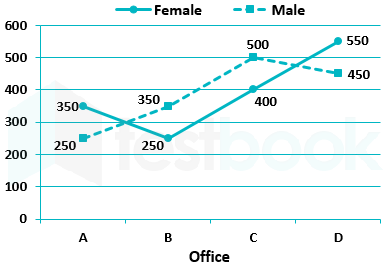
Study the given graph and answer the question that follows.

Number of male and female employees working in offices A, B, C and D of a company

OfficePercentage of employees who got a promotion
MaleFemale
A4244
B4060
C4555
D6430


The total number of female employees in offices B, C and D who got a promotion in what percentage more than the total number of male employees in offices A and C who did not get a promotion? (Correct to one decimal)

  1. ((a))

    28.5%

  2. ((b))

    26.8%

  3. ((c))

    28.2%

  4. ((d))

    27.4%

Show Answer
Answer: ((d))

27.4%

Given:

The number of female employees in office B = 250

The number of female employees in office C = 400

The number of female employees in office D = 550

The number of male employees in office A = 250

The number of male employees in office C = 500

Calculation:

The number of female employees in office B who got a promotion = 60% of 250 = 150

The number of female employees in office C who got a promotion = 55% of 400 = 220

The number of female employees in office D who got a promotion = 30% of 550 = 165

The number of male employees in office A who did not got a promotion = (100% - 42%) of 250 = 145

The number of male employees in office C who did not got a promotion = (100% - 45%) of 500 = 275

The total number of female employees in offices B, C and D who got a promotion = 150 + 220 + 165 = 535

The total number of male employees in offices A and C who did not get a promotion = 145 + 275 = 420

The required percentage = 535420420\frac{535-420}{420}  ≈ 27.4%

∴ The total number of female employees in offices B, C and D who got a promotion is 27.4% more than the total number of male employees in offices A and C who did not get a promotion.

40

The cost of a motorcycle is 60% less than the cost of a car. If the cost of the motorcycle increases by 40% and that of the car decreases by 10%, then what is the percentage increase/decrease in the total cost of 4 cars and 5 motorcycles?

  1. ((a))

    Increases by 613{ {1} \over 3}%

  2. ((b))

    Increases by 623{ {2} \over 3}%

  3. ((c))

    Decreases by 623{ {2} \over 3}%

  4. ((d))

    decreases by 413{ {1} \over 3}%

Show Answer
Answer: ((b))

Increases by 623{ {2} \over 3}%

Shortcut Trick

Let the cost of a car be 100 units, then the cost of a motorcycle is 100 − 60% = 40 units.

Ratio of the initial total cost of 4 cars to 5 motorcycles = (4 × 100) : (5 × 40) = 400 : 200 = 2 : 1.

Net Percentage Change = [(Ratio1 × Change1) + (Ratio2 × Change2)] ÷ Total Ratio

Net Percentage Change = [(2 × −10) + (1 × 40)] ÷ (2 + 1) = (−20 + 40) ÷ 3 = +20 ÷ 3 = +6 23%.

The positive sign denotes an overall increase in the total cost.

∴ The correct answer is 6 23% increase.

Alternate Method

Given:

⇒ Cost of a motorcycle is 60% less than the cost of a car.

⇒ Quantity analyzed: 4 cars and 5 motorcycles.

⇒ Cost Change: Car cost decreases by 10%, Motorcycle cost increases by 40%.

Formula Used:

⇒ Percentage Change = (Net Change ÷ Initial Total Value) × 100

Cost Comparison (4 Cars & 5 Motorcycles)

Initial Cost: 600

New Cost: 640

  • 40 Increase

% Increase = (40 ÷ 600) × 100 = 6 2/3%

Calculations:

⇒ Let the initial cost of 1 car = 100 units.

⇒ Initial cost of 1 motorcycle = 100 − (60% of 100) = 40 units.

⇒ Initial total cost = (4 × 100) + (5 × 40) = 400 + 200 = 600 units.

⇒ New cost of 1 car = 100 − 10% = 90 units.

⇒ New cost of 1 motorcycle = 40 + (40% of 40) = 40 + 16 = 56 units.

⇒ New total cost = (4 × 90) + (5 × 56) = 360 + 280 = 640 units.

⇒ Overall change in cost = 640 − 600 = +40 units.

⇒ Percentage Increase = (40 ÷ 600) × 100 = 400 ÷ 60 = 20 ÷ 3 = 6 23%.

∴ The correct answer is 6 23% increase.

Additional Information

Weighted Average in Percentages

When a whole is divided into distinct parts, the net percentage change is the weighted average of the percentage changes of its components: Net % = (n1x1 + n2x2) ÷ (n1 + n2).

Percentage Change

Percentage change must always be calculated strictly with respect to the initial base value: % Change = (Final Value − Initial Value) ÷ Initial Value × 100.

Successive Percentage Change

If a single value undergoes two successive percentage changes a% and b%, the effective net change is given by the shortcut formula: (a + b + ab ÷ 100)%.

41

A pole of height 4 m is fixed on the top of a tower. The angle of elevation of the top of the pole as observed from a point on the ground is 60o and the angle of depression of the same point from the top of the tower is 45°. The height (in m) of the tower is:

  1. ((a))

    2 (3 \sqrt{3}  +1)

  2. ((b))

    2(23 \sqrt{3}  - 1)

  3. ((c))

    23 \sqrt{3}  + 1

  4. ((d))

    3 \sqrt{3}  + 2

Show Answer
Answer: ((a))

2 (3 \sqrt{3}  +1)

Given:

A pole of height 4 m is fixed on the top of a tower.

The angle of elevation of the top of the pole as observed from a point on the ground is 60o.

The angle of depression of the same point from the top of the tower is 45°.

Formula used:

For the right-angled triangle.

tan(θ) = pb\frac{p}{b}

Calculation:

According to the question, the required figure is:

In ΔABC,

tan(60) = 4+hb\frac{4+h}{b}   

⇒ √3 = 4+hb\frac{4+h}{b}        ----(1)

In ΔDBC,

tan(45∘) = hb\frac{h}{b}

⇒ 1 = hb\frac{h}{b}

⇒ h = b              ----(2)

By using the equation (1) and (2), 

⇒ √3 = 4+hh\frac{4+h}{h}

⇒ √3h = 4 + h

⇒ h × (√3 - 1) = 4

⇒ h = 431×3+13+1\frac{4}{√{3} -1} × \frac{√{3} +1}{√{3} +1}

⇒ h = 4(3+1)(3)21\frac{4(√{3} +1)}{(√{3})^2 -1}

⇒ h = 4(3+1)(31)\frac{4(√{3} +1)}{(3 -1)}

⇒ h = 2 × (√3 + 1) m

∴ 2(√3 + 1) is the required height (in m) of the tower.

42

A dealer offers 35% discount on the marked price of an article and still gains 30%. If the cost of the article increases by 25%, how much discount per cent should he give now on the same marked prize so as to earn 24% profit on the new cost?

  1. ((a))

    22.5%

  2. ((b))

    10%

  3. ((c))

    20.5%

  4. ((d))

    25%

Show Answer
Answer: ((a))

22.5%

Given:

A dealer offers 35% discount on the marked price of an article and still gains 30%.

The cost of the article increases by 25%,

Formula used:

D% = M.PS.PM.P\frac{M.P-S.P}{M.P} × 100

Where, 

D, is the discount per cent

M.P and S.P are the mark price and selling price respectively.

P% = S.PC.PC.P\frac{S.P-C.P}{C.P} × 100

Where, 

S.P and C.P are the selling price and cost price respectively.

Calculation:

Let the mark price of the article = ₹200

Since the dealer offers 35% discount on the marked price of an article,

Therefore,

The selling price of the article = (100% - 35%) of ₹200 = ₹130

Since the dealer earns 30% profit,

Therefore, 

The cost price of the article = 130(100%+30%)\frac{₹130}{(100\text {\%} + 30\text {\%})} = ₹100

Now, 

The increased cost price of the article = (100% + 25%) of ₹100 = ₹125

Since the dealer wants to earned 24% profit,

Therefore, 

The new selling price = (100% + 24%) of ₹125 = ₹155

Now, 

The mark price of the article remains the same = ₹200

The discount per cent = 200155200\frac{₹200-₹155}{₹200} × 100 = 22.5%

∴ 22.5% discount should he give now on the same marked prize so as to earn 24% profit on the new cost.

43

Let x be the least number which when divided by 16, 24, 30, 36 and 45, the remainder in each case is 4, and x is divisible by 28. If the HCF of x and 3193 is y, then what is the sum of the digits of y?

  1. ((a))

    5

  2. ((b))

    10

  3. ((c))

    4

  4. ((d))

    9

Show Answer
Answer: ((c))

4

Given:

Let x be the least number which when divided by 16, 24, 30, 36 and 45, the remainder in each case is 4,

x is divisible by 28.

The HCF of x and 3193 is y.

Calculation:

The L.C.M of 16, 24, 30, 36 and 45 = 720

The least number which when divided by 16, 24, 30, 36 and 45, the remainder in each case is 4 = L.C.M of (16, 24, 30, 36 and 45) + 4 = 720n + 4

The required number which divisible by 28 = (720n + 4) ÷ 28

For n = 1,

The required number = (720(1) + 4) ÷ 28 = (25 × 28) + 24

For n = 2,

The required number = (720(2) + 4) ÷ 28 = (51 × 28) + 16

So,

For n = 4,

The required number = (720(4) + 4) ÷ 28 = (103 × 28)

Therefore, 

The required number, x = 2884

Now, 

The prime factorisation of 2884 = 2 × 2 × 7 × 103

The prime factorisation of 3193 = 31 × 103

The H.C.F of (2884 and 3193), y = 103

According to the question,

The sum of the digits of 103 = 1 + 0 + 3 = 4

∴ The required value of y is 4.

Additional InformationThe least number which when divided by a, b, and c, the remainder in each case is k = L.C.M of (a, b, c) + k

44

For a journey of 100 km, train A takes 30 minutes less time than train B. If the speed of train B is 10 kmph less than that of train A, what is the speed (in km/h) of train A?

  1. ((a))

    60

  2. ((b))

    45

  3. ((c))

    40

  4. ((d))

    50

Show Answer
Answer: ((d))

50

Given:

The distance = 100 km,

Train A takes 30 minutes or 0.5 hours less time than train B.

The speed of train B is 10 kmph less than that of train A

Formula used:

Distance = Speed × Time

Calculation:

Let 's' and 't' be the usual time to travel the required distance.

The time is taken by train B = t hr

The time is taken by train A = (t - 0.5) hr

The speed of the train A = s kmph

The speed of the train B = (s - 10) kmph

The required distance to be travelled = 100 km

Now, 

⇒ s × (t - 0.5) = 100    ----(1)

⇒ (s - 10) × t = 100    ----(2)

On equating the above equations, we get,

⇒ st - 0.5s = st - 10t

⇒ - 0.5s = - 10t

⇒ t = 0.05s    ----(3)

Now, substitute the equation (3) in equation (1), we get,

⇒ s × (0.05s - 0.5) = 100

Multiply the above equation 100 on both sides of the equation,

⇒ 100 × s × (0.05s - 0.5) = 100 × 100

⇒ 5s2 - 50s = 10,000

⇒ 5s2 - 50s - 10,000 = 0

⇒ s2 - 10s - 2000 = 0

⇒ s2 - 50s + 40s - 2000 = 0

⇒ s(s - 50) + 40(s - 50) = 0

⇒ (s + 40)(s - 50) = 0

We get,

s = -40, 50

Since the negative value for speed can not be possible, 

Therefore, 

The speed of the train A = 50 kmph

∴ The speed of train A is 50 kmph.

45

The cost of a shirt is 20% less than the cost of a trouser. The cost of 3 shirts and 5 trousers is ₹1,260 more than the cost of 5 shirts and 2 trousers. What is the cost of 4 shirts and 3 trousers?

  1. ((a))

    ₹4,480

  2. ((b))

    ₹4,840

  3. ((c))

    ₹5,580

  4. ((d))

    ₹4,940

Show Answer
Answer: ((c))

₹5,580

Shortcut Trick

Ratio of the cost of a Shirt (S) to a Trouser (T) = 80 : 100 = 4 : 5.

Cost difference = (3S + 5T) − (5S + 2T) = 37 units − 30 units = 7 units.

7 units = ₹1,260 ⇒ 1 unit = ₹180.

Required cost = 4S + 3T = 4 × 4 + 3 × 5 = 31 units = 31 × 180 = ₹5,580.

∴ The correct answer is ₹5,580.

Alternate Method

Given:

The cost of a shirt is 20% less than the cost of a trouser.

The difference between the cost of (3 shirts + 5 trousers) and (5 shirts + 2 trousers) is ₹1,260.

Calculations:

⇒ Let the cost of a trouser (T) be 5x.

⇒ The cost of a shirt (S) is 20% less = 5x − (20/100 × 5x) = 4x.

⇒ Cost of 3 shirts and 5 trousers = 3(4x) + 5(5x) = 12x + 25x = 37x.

⇒ Cost of 5 shirts and 2 trousers = 5(4x) + 2(5x) = 20x + 10x = 30x.

⇒ Given difference = 37x − 30x = 7x.

⇒ 7x = 1,260 ⇒ x = 1,260 ÷ 7 = 180.

⇒ We need to find the cost of 4 shirts and 3 trousers.

⇒ Required cost = 4(4x) + 3(5x) = 16x + 15x = 31x.

⇒ Required cost = 31 × 180 = 5,580.

∴ The correct answer is ₹5,580.

Additional Information

Ratio & Proportion Basics

When one quantity is given as a percentage of another, converting the percentage directly to a ratio simplifies calculations. For example, 20% less means 80% or 4/5 of the base value.

Linear Equations Setup

Word problems often translate into linear equations. Assigning variables to a common multiplier (like 4x and 5x) prevents fractions and maintains integer relationships.

Unitary Method

Finding the value of 1 base unit first (x = 180) allows easily calculating the value of any other required combination simply by multiplying the unit factor with the target equation.

46

A takes 6 more days than B to complete a certain work. B starts the work and A took over after 4 days and completed the remaining work in 12 days. A and B together can complete 62.5% of the original work in:

  1. ((a))

    612{ {1} \over 2} days

  2. ((b))

    4 days

  3. ((c))

    412{ {1} \over 2} days

  4. ((d))

    6 days

Show Answer
Answer: ((c))

412{ {1} \over 2} days

Given:

A takes 6 more days than B to complete a certain work.

B starts the work and A took over after 4 days and completed the remaining work in 12 days.

Calculation:

The time is taken by B to complete the work = t days

The time is taken by A to complete the work = (t + 6) days

The total work to be done by A and B = L.C.M of (t, t + 6) = t × (t + 6) units

The efficiency of A = t(t+6)(t+6)\frac{t(t + 6)}{(t+6)} = t

The efficiency of B = t(t+6)(t)\frac{t(t + 6)}{(t)} = (t + 6)

Since B starts the work and A took over after 4 days,

Therefore, B worked for first 4 days.

The amount of work done by B in 4 days = 4 × (t + 6) units

The remaining work done by A in 12 days = 12 × t units

Now,

⇒ 4 × (t + 6) + 12t = t × (t + 6)

⇒ 4t + 24 + 12t = t2 + 6t

⇒ 24 + 16t = t2 + 6t

⇒ t2 - 10t - 24 = 0

⇒ t2 - 12t + 2t - 24 = 0

⇒ t(t - 12) + 2(t - 12) = 0

⇒ (t + 2)(t - 12) = 0

We get, t = -2, 12

The total work to be done by A and B = 12 × (12 + 6) = 216 units

The efficiency of A = 12

The efficiency of B = 18

The 62.5% of the original work = 58\frac{5}{8} × 216 = 135 units

The combined efficiency of A and B = 12 + 18 = 30

Let 'TAB' is the time taken by A and B together to complete 62.5% of the original work.

⇒ TAB = 13530\frac{135}{30}

⇒ TAB = 41530\frac{15}{30} = 412\frac{1}{2} days

∴ A and B together can complete 62.5% of the original work in 412\frac{1}{2} days.

47

R varies directly as S and inversely as T. When R = 23{ {2} \over 3} and T = 57{ {5} \over 7}, S = 421{ {4} \over 21}. Find S when  R = 34{ {3} \over 4} and T = 19{ {1} \over 9}.

  1. ((a))

    115{ {1} \over 15}

  2. ((b))

    710{ {7} \over 10}

  3. ((c))

    35{ {3} \over 5}

  4. ((d))

    130{ {1} \over 30}

Show Answer
Answer: ((d))

130{ {1} \over 30}

Given:

R varies directly as S and inversely as T.

When R = 23{ {2} \over 3} and T = 57{ {5} \over 7}, S = 421{ {4} \over 21}.

Calculation:

According to the question,

R ∝ S and R ∝ 1T\frac{1}{T}

Therefore, 

R ∝ ST\frac{S}{T}

⇒ R = kST\frac{kS}{T}

Now, on substituting the value of the respective variable in the above formula, we get,

23\frac{2}{3} = k42157k\frac{\frac{4}{21}}{\frac{5}{7}}

⇒ 23\frac{2}{3} = k415k\frac{4}{15}

⇒ k = 52\frac{5}{2}

Now, 

⇒ R = kST\frac{kS}{T}

The above-obtained formula can be written as:

⇒ S = RTk\frac{RT}{k}

⇒ S = 34×1952\frac{\frac{3}{4} \times \frac{1}{9}}{\frac{5}{2}}

⇒ S = 11252\frac{\frac{1}{12}}{\frac{5}{2}}

⇒ S = 130\frac{1}{30}

∴ The required value of S is 130\frac{1}{30}.

48

Study the given table and answer the question that follows.

Production and Export of sugar by a company ABC (in million kg)

YearProductionExport
2015300200
2016350280
2017420200
2018400260
2019450380
<br>

The average production of sugar in 2015, 2017 and 2019 is approximately what percentage of the total export of sugar in 2015, 2016 and 2018?

  1. ((a))

    52.7%

  2. ((b))

    53.2%

  3. ((c))

    50.6%

  4. ((d))

    51.8%

Show Answer
Answer: ((a))

52.7%

Given:

The production of sugar in 2015 = 300 million kg

The production of sugar in 2017 = 420 million kg

The production of sugar in 2019 = 450 million kg

The export of sugar in 2015 = 200 million kg

The export of sugar in 2016 = 280 million kg

The export of sugar in 2018 = 260 million kg

Calculation:

The average production of sugar in 2015, 2017 and 2019 = 300+420+4503\frac{300+420+450}{3} = 11703\frac{1170}{3} = 390 million kg

The total export of sugar in 2015, 2016 and 2018 = 200 + 280 + 260 = 740 million kg

The required percentage = 390740\frac{390}{740} × 100 ≈ 52.7%

∴ The average production of sugar in 2015, 2017 and 2019 is approximately 52.7% of the total export of sugar in 2015, 2016 and 2018.

49

The average weight of some persons in a group was 68 kg. When 5 more persons with an average weight 73.4 kg joined the group and 8 persons with an average weight 65.5 kg left the group, then the average weight of the persons in the group increased by 1.175 kg. What was the number of persons in the group, initially?

  1. ((a))

    63

  2. ((b))

    33

  3. ((c))

    43

  4. ((d))

    53

Show Answer
Answer: ((c))

43

Given:

The average weight of some persons in a group was 68 kg.

5 persons with an average weight 73.4 kg joined the group.

8 persons with an average weight 65.5 kg left the group,

The average weight of the persons in the group increased by 1.175 kg.

Formula used:

Average weight = Sum of weight of ’n’ peoplen\frac{\text {Sum of weight of 'n' people}}{\text {n}}

Calculation:

Let 'n' be the initial number of persons in the group.

The total weight of 'n' person in the group = (68 × n) kg 

The total weight of the 5 person who joined the group = 73.4 × 5 = 367 kg

The total weight of the 8 person who left the group = 65.5 × 8 = 524 kg

Since the average weight of the persons in the group increased by 1.175 kg,

Therefore,

⇒ 68n+367524n+58\frac{68n + 367 - 524}{n + 5 - 8} = 68 + 1.175

⇒ 68n157n3\frac{68n - 157}{n - 3} = 69.175

⇒ 68n - 157 = 69.175 × (n - 3)

⇒ 68n - 157 = 69.175n - 207.525

⇒ 69.175n - 68n = 207.525 - 157

⇒ 1.175n = 50.525

⇒ n = 43

∴ The initial number of persons in the group is 43.

50

To do a certain work, A is 40% more efficient than B, and C is 25% less efficient than B. Working together, they can complete the work in 20 days. B and C together can complete two-thirds of the same work in:

  1. ((a))

    36 days

  2. ((b))

    21 days

  3. ((c))

    24 days

  4. ((d))

    30 days

Show Answer
Answer: ((c))

24 days

Given:

A is 40% more efficient than B,

C is 25% less efficient than B.

Working together, they can complete the work in 20 days.

Formula used:

Efficiency × Time = Work

Calculation:

According to the question,

The efficiency of A, EA = (100% + 40%) of EB = 1.4EB

The efficiency of C, EC = (100% - 25%) of EB = 0.75EB

Let the working efficiency of B = 1 unit a day

Therefore, 

The efficiency of A, EA = 1.4 units a day

The efficiency of C, EC = 0.75 a day

If they worked together, they can complete the work in 20 days,

The total amount of work done in 20 days,

⇒ (EA + EB + EC) × 20

⇒ (1.4 + 1 + 0.75) × 20

⇒ (3.15) × 20

⇒ 63 units

Now, 

The two-third of the total work = 23\frac{2}{3} × 63 = 42 units

The total time required to complete two-thirds of the work by B and C = 421+0.75\frac{42}{1 + 0.75} = 421.75\frac{42}{1.75} = 24 days

∴ B and C together can complete two-thirds of the same work in 24 days.

Science (25 questions)

51

Which of the following is an endothermic reaction?

  1. ((a))

    Photosynthesis in plants

  2. ((b))

    Burning of magnesium ribbon in air.

  3. ((c))

    Conversion of vegetable matter into compost

  4. ((d))

    Burning of natural gas

Show Answer
Answer: ((a))

Photosynthesis in plants

The correct answer is Photosynthesis in plants.

Concept:

Chemical reaction:

  • A process in which one or more substances, the reactants, are converted to one or more different substances, the products.
  • Substances are either chemical elements or compounds.
  • A chemical reaction rearranges the constituent atoms of the reactants to create different substances as products.

Explanation:

Endothermic reaction:

  • A chemical reaction in which the reactants absorb energy and get converted into products.

Photosynthesis in plants: 

  • It occurs in green plants in the presence of sunlight and chlorophyll.
  • The reactants carbon dioxide and water are converted into glucose and oxygen.
  • CO2 + H2O + Sunlight(Heat) → C6H12O6 + O2
  • ****Solar energy is converted into chemical energy.
  • Since energy is being consumed in photosynthesis, it is termed an endothermic reaction.

Additional Information​ 

Exothermic reaction:

  • A chemical reaction in which heat energy is released.
  • Examples: 
  • Burning of natural gas
  • Conversion of vegetable matter into compost
  • ​Burning of magnesium ribbon in the air.
52

A saturated solution of sugar is prepared by dissolving 62.5 g of it in 250 g of water at 298 K. What is the solubility of sugar in water at this temperature?

  1. ((a))

    25 g per gram of water

  2. ((b))

    50 g per 100 gram of water

  3. ((c))

    0.25 g per gram of water

  4. ((d))

    0.50 g per 100 gram of water

Show Answer
Answer: ((c))

0.25 g per gram of water

The correct answer is 0.25 g per gram of water.

Concept:

  • Solution:  A homogenous mixture of two or more substances. It has two components solute and solvent.
  • Solute: The substance that is dissolved in the solvent.
  • Solvent: The substance in which solute is dissolved.

For example, in a salt solution, salt is solute and water is solvent. 

Explanation:

Solubility: 

The maximum amount of a solute that can be dissolved in 100 g of a solvent at a specified temperature is known as the solubility of that solute in that solvent (at that temperature).

Given: Mass of sugar (solute) = 62.5 g

Mass of water (solvent) = 250g 

Solubility = (Mass of solute / mass of solvent) × 100 

62.5250×100\frac{62.5}{250} × 100

= 25 %  or 25/100 = 0.25 g per gram of water

53

The objective of the 'Chipko' movement was to stop ___________.

  1. ((a))

    the leather industry from dumping their waste products in the rivers

  2. ((b))

    expelling the local people from the forest sanctuary

  3. ((c))

    harvesting wood for a logging company

  4. ((d))

    allowing shepherds to graze in biodiversity hotspots

Show Answer
Answer: ((c))

harvesting wood for a logging company

The correct answer is 

Concept:

Deforestation: It refers to the cutting of trees on a large scale.

Explanation:

Chipko movement:

  • Also called Chipko andolan, it was a nonviolent social and ecological movement by rural villagers, particularly women, in India in the 1970s.
  • It aimed at protecting trees and forests slated for government-backed logging.
  • The movement originated in the Himalayan region of Uttarakhand in 1973 and quickly spread throughout the Indian Himalayas.
  • The Hindi word chipko means “to hug” or “to cling to” and reflects the demonstrators’ primary tactic of embracing trees to impede loggers.
  • This movement was led by Sundarlal Bahunguna.
54

Which of the following statements is true?

  1. ((a))

    The amount of DNA in human brain cell increases as the size of the brain increases.

  2. ((b))

    All somatic human cells have the same amount of DNA in their nuclei.

  3. ((c))

    All human beings have the same amount of DNA in their bodies.

  4. ((d))

    All human cells have the same amount of DNA in their nuclei.

Show Answer
Answer: ((b))

All somatic human cells have the same amount of DNA in their nuclei.

The correct answer is All somatic human cells have the same amount of DNA in their nuclei.

Concept:

DNA: 

  • It stands for Deoxyribonucleic Acid.
  • It is the genetic material found in most organisms and is inherited from one generation to another.
  • It carries all the information about the anatomy (internal structure), physiology ( working of the body organs), and morphology (external appearance) of an organism.
  • It is found inside the nucleus of the cell.

Chromosome:

  • These are the X-shaped structures visible only when the cell is in the dividing phase.
  • They are made up of DNA. DNA condenses to form the chromosomes.

Explanation:

DNA in the Human body:

  • There are two types of cells, somatic and germ cells.
  • Somatic cells are the cells that make up the whole body while germ cells are the gametes that take part in reproduction.
  • Somatic cells have 46 chromosomes while gametes have half of them i.e. 23 chromosomes.
  • Some cells like RBCs ( red blood cells) lack nuclei.

Key Points

StatementTrue / False
The amount of DNA in human brain cells increases as the size of the brain increases.False, because the amount of DNA increases with an increase in the number of cells not with the size of the organ.
All somatic human cells have the same amount of DNA in their nuclei.True, all somatic cells have 46 chromosomes with the nearly same amount of DNA.
All human beings have the same amount of DNA in their bodies.False, some humans suffer from genetic abnormality wherein one or more chromosomes might be deleted or added.
All human cells have the same amount of DNA in their nuclei.False, some cells like RBCs do not have any nuclei, gametes have half the no. of chromosomes, and some immune cells may also have mutations leading to variation in the amount of DNA.
55

Two resistors A (6 Ω) and B (12 Ω) are connected in parallel. This combination is connected in series to two other resistors C (6 Ω) and D (12 Ω) and a 11 V battery of negligible internal resistance. Let Pc and PA be the rate of energy dissipated in resistors C and A, respectively. Then the ratio (PC/PA) is:

  1. ((a))

    94{{9} \over 4}

  2. ((b))

    98{{9} \over 8}

  3. ((c))

    23{{2} \over 3}

  4. ((d))

    29{{2} \over 9}

Show Answer
Answer: ((a))

94{{9} \over 4}

The correct answer is 9/4.

Concept:

Resistance in series:

  • When resistors are connected end-to-end in a circuit, they are said to be in "series."
  • R = R1 + R2 + R3 +....+ Rn
  • Current remains the same across all the resistors connected in series.

Resistance in parallel: 

  • When both ends of resistors are connected, they are said to be in parallel.
  • 1/R = 1/R1 + 1/R2 = 1/R3 ....
  • The potential difference across all the resistors connected in parallel remains the same.

Electric Power:

  • The energy consumed per unit of time or the rate of doing work is called power.
  • Power = work done / time taken = Vq / t = VI = V2/R = I2R

Explanation:

Resistors A (6 Ω), and B (12 Ω) are connected in parallel.

Equivalent resistance, 1/R1 = 1/6 + 1/12  = 2+1/ 12 = 3/12 = 1/4 Ω 

R1 = 4 Ω 

Now, the resistors R1, C, and D are in series.

R2 = 4 + 6 + 12  = 22 Ω 

Equivalent current, I in the circuit = V/R2 = 11 / 22 =  1/ 2   A.

Potential difference across A = IR1 = 4/2 = 2 V

PC = I2C = 1/2 × 1/2 × 6  = 3/2 Watt       (since current remains same in series combination)

PA = V2/A = 2 × 2  × 1/ 6 = 2/3 Watt  (since voltage remains the same in parallel combination)

The ratio (PC/PA) = 3/2 × 2/3 = (3 × 3) / (2 × 2) = 9/4.

56

An object, 1.0 cm in height, is placed at a distance of 15.0 cm in front of a concave mirror of focal length 30.0 cm, on its principal axis. Following New Cartesian Sign Convention, the image is formed at v = _________ and its height h= ________.

  1. ((a))

    30 cm; 2.0 cm

  2. ((b))

    30 cm; -2.0 cm

  3. ((c))

    -30 cm; 2.0 cm

  4. ((d))

    -30 cm; -2.0 cm

Show Answer
Answer: ((a))

30 cm; 2.0 cm

The correct answer is 30 cm; 2.0 cm.

Concept:

Mirror formula:1f=1v+1u\frac{1}{f} = \frac{1}{v} + \frac{1}{u}, where f = focal length, v = image distance and u = object distance.

Magnification: m = HiHo=vu\frac{Hi}{Ho} = \frac{-v}{u} , where Hi = height of image, Ho = height of object, v = image distance, and u = object distance.

Concave mirror: 

  • It is part of a whole spherical mirror that reflects light from the hollow part.
  • It is a converging mirror because it converges the incident rays at a point.

Explanation:

Given, u = -15 cm        f = -30 cm              h = 1 cm 

1f=1v+1u\frac{1}{f} = \frac{1}{v} + \frac{1}{u}

130=1v+115\frac{1}{-30} = \frac{1}{v} + \frac{1}{-15}

130=1v115\frac{1}{-30} = \frac{1}{v} - \frac{1}{15}

1v=130+115\frac{1}{v} = \frac{1}{-30} + \frac{1}{15}

1v=1+230\frac{1}{v} = \frac{-1 + 2}{30}

1v=130\frac{1}{v} = \frac{1}{30}

v = 30 cm

m = HiHo=vu\frac{Hi}{Ho} = \frac{-v}{u} = Hi2=(30)15\frac{Hi}{2} = \frac{-(30)}{-15} 

Hi = 2 cm

Following New Cartesian Sign Convention, the image is formed at v = 30 cm and its height HI = 2 cm.

57

Two elements 'A' and 'B' were burnt in air in two separate jars. The ash formed by their burning was mixed with water to form two separate solutions. Both the solutions turned red litmus blue. Also, on reacting elements 'A' and 'B' with dilute HCL element 'A' produced bubbles of a colourless gas, whereas element 'B' did not react. Which of the following statements is correct about elements 'A' and 'B'?

  1. ((a))

    'A' and 'B' are metals; and 'A' is more reactive than 'B'.

  2. ((b))

    An aqueous solution of BSO4 can be safely stored in a container made of 'A'.

  3. ((c))

    'A' is a metal and 'B' is a non-metal.

  4. ((d))

    'A' and 'B' are non-metals; and 'A' is more reactive than 'B'.

Show Answer
Answer: ((a))

'A' and 'B' are metals; and 'A' is more reactive than 'B'.

The correct answer is 'A' and 'B' are metals; and 'A' is more reactive than 'B'.

Concept:

Chemical reaction:

  • It is a process in which one or more substances, the reactants, are converted to one or more different substances, the products.
  • A chemical reaction rearranges the constituent atoms of the reactants to create different substances as products.

Bases:

  • They are bitter in taste and soapy to touch.
  • They turn red litmus blue.
  • They have a pH value greater than 7.

Explanation:

Solution is basic because it turned red litmus blue.

  • When a substance burns in the air, it reacts with oxygen and forms oxides.
  • Oxides when mixed with water form hydroxides.
  • A substance that turns red litmus blue is basic in nature.
  • Metal oxides and hydroxides are basic in nature.
  • So, elements A and B must be metals.
  • Some reactive metals react with dilute acids like HCl to form salts and hydrogen gas is released in the process.
  • Thus, A will be more reactive than B since it reacts with dilute acid while B does not.
58

Jaundice can be caused by _________.

  1. ((a))

    viruses

  2. ((b))

    bacteria

  3. ((c))

    malnutrition

  4. ((d))

    defective genes

Show Answer
Answer: ((a))

viruses

The correct answer is viruses.

Concept:

Disease: 

  • Disfunctioning of one or more organs or systems of the body, characterized by various signs and symptoms is called a disease.

Types of diseases:

  • Infectious diseases: 
  • ​These diseases spread from one person to another easily.
  • They are caused by germs such as bacteria, viruses, protozoa, etc.
  • Example: Common cold, typhoid, cholera, etc.
  • Non-infectious diseases: 
  • These diseases are caused due to nutritional deficiency, sedentary lifestyle, or genetic defects.
  • These diseases do not spread from one person to another.
  • Example: Night blindness, colour blindness, etc.

Explanation:

Jaundice is a non-infectious disease wherein the liver is affected resulting in a yellowish discolouration of the skin and the white space of the eye.

Jaundice can be caused by a problem in any of the three phases of bilirubin production.

  • Before the production of bilirubin, unconjugated jaundice is caused due to increased levels of bilirubin
  • During the production of bilirubin, jaundice can be caused by:
  • Viruses, including Hepatitis A, chronic Hepatitis B and C, and Epstein-Barr virus infection (infectious mononucleosis).
  • Alcohol.
  • Autoimmune disorders.
  • Rare genetic metabolic defects.
  • Medicines, including acetaminophen toxicity, penicillins, oral contraceptives, etc.
  • After bilirubin is produced, jaundice may be caused by obstruction (blockage) of the bile ducts from:
  • Gallstones.
  • Inflammation (swelling) of the gallbladder.
  • Gallbladder cancer.
  • Pancreatic tumour.

Symptoms : 

  • ​The yellowness of the Skin and Eye Whites
  • Dark Tinge in Urine
  • Vomiting
  • High Fever
  • Lack of Hunger
  • Abnormal Weight Loss
  • Stomach Pain
59

The two factors determining 'Food Security' in India are:

  1. ((a))

    green revolution and reduced wastage of food

  2. ((b))

    production of sufficient food and nutritional value of food

  3. ((c))

    sustainable agriculture and minimal use of agrochemicals

  4. ((d))

    availability of food and access to money

Show Answer
Answer: ((d))

availability of food and access to money

The correct answer is the availability of food and access to money.

Concept:

Food security: It refers to the availability, accessibility, and affordability of food to all people at all times.

Explanation:

Food security has the following dimensions:

  • Availability of Food: It means food production within the country, food imports, and the previous year’s stock stored in government granaries.
  • Accessibility of Food: It means food is within reach of every person.
  • Affordability of Food: It implies that an individual has enough money to buy sufficient, safe, and nutritious food to meet one’s dietary needs.

Key Points

  • India's Efforts for Food Security during the Covid-19 Pandemic:
  • High Production of Foodgrains: India registered an all-time high production of foodgrains at 305 million tonnes as well as in exports during 2020-21, contributing to global food security.
  • KISAN RAIL: It was introduced to transport the essential commodities including perishable horticulture produce, milk, and dairy products from the production centers to the large urban markets.
  • Pradhan Mantri Garib Kalyan Package: Under this scheme, free food grains were provided to 810 million beneficiaries and it has been further extended in which workers will benefit till November 2021.
  • PM Kisan Scheme: More than Rs.1,37,000 Crore have been sent to the bank accounts of over 100 million farmers under this to provide income support to the farmers.

Additional Information

  • Food and Agriculture Organization:
  • FAO is a specialized agency of the United Nations that leads international efforts to defeat hunger.
  • World Food Day is celebrated every year on 16th October to mark the anniversary of the founding of the FAO in 1945.
  • It is one of the UN food aid organizations based in Rome (Italy).
  • Its sister bodies are the World Food Programme and the International Fund for Agricultural Development (IFAD).
  • Initiatives Taken:
  • Globally Important Agricultural Heritage Systems (GIAHS). Monitors the Desert Locust situation throughout the world.
  • The Codex Alimentarius Commission or CAC is the body responsible for all matters regarding the implementation of the Joint FAO/WHO Food Standards Programme.
  • The International Treaty on Plant Genetic Resources for Food and Agriculture.
60

Which of the following will form a heterogeneous mixture with each other?

(i) common salt

(ii) sand

(iii) water

(iv) lemon juice

  1. ((a))

    (i) and (iv)

  2. ((b))

    (ii) and (iv)

  3. ((c))

    (iii) and (iv)

  4. ((d))

    (i) and (iii)

Show Answer
Answer: ((b))

(ii) and (iv)

The correct answer is options (ii) and (iv).

Concept:

Mixtures:

  • A mixture is a substance that consists of two or more elements or compounds not chemically combined together.
  • For Example - Air is a mixture of gases like oxygen, nitrogen, argon, CO2, and water vapour.

Explanation:

Types of Mixtures:

  • Homogeneous Mixture:
  • Those mixtures, in which the substances are completely mixed together and are indistinguishable from one another, are called homogeneous mixtures.
  • For example Soda water, Soft drinks, lemonade, salt or sugar solution, etc.
  • Heterogeneous Mixture:
  • Those mixtures in which the substances remain separate and one substance is spread throughout the other substance as small particles, droplets, or bubbles are called heterogeneous mixtures.
  • All the suspensions and colloids are heterogeneous mixtures.
  • For Example: - Sugar and sand mixture, muddy river water, soap solution.
Common salt + lemon juiceHomogeneous mixture
Sand + lemon juiceHeterogeneous mixture
water + lemon juiceHomogeneous mixture
Common salt + waterHomogeneous mixture
61

A compound 'Z' is used for making baking powder, as an antacid, and in fire extinguishers. On heating, "Z" produces a compound that is used in soap industry. What is the name of the compound 'Z'?

  1. ((a))

    Tartaric acid

  2. ((b))

    Sodium hydrogen carbonate

  3. ((c))

    Sodium chloride

  4. ((d))

    Sodium carbonate

Show Answer
Answer: ((b))

Sodium hydrogen carbonate

The correct answer is Sodium hydrogen carbonate

Concept:

Baking soda:

  • The chemical name of baking soda is sodium hydrogen carbonate (NaHCO3).
  • It is a mild non-corrosive basic salt.

Explanation:

Preparation of Baking Soda:

  • It is produced through the Solvay process by using sodium chloride, sodium chloride, water, and carbon dioxide as raw materials.

NaCl + H2O + CO2 + NH3   → NH4Cl + NaHCO

On heating Sodium hydrogen carbonate, the following reaction takes place:

2NaHCO3 + heat → NaCO3 + H2O + CO2 

Na2 CO3 is used to make washing soda that is used in the soap industry.                                                     

Uses of baking soda:

Baking soda undergoes a reaction with mild edible acid such as tartaric acid to manufacture baking powder.

  • NaHCO3   +  H→ CO + H2O + Sodium salt of acid
  • This carbon dioxide produced makes bread or cake rise thereby making them soft and spongy.

Being alkaline it is also an active ingredient in antacids that acts by neutralizing the excess acid produced in the stomach.

It is also used in soda-acid fire extinguishers.

Thus, compound Z is  Sodium hydrogen carbonate​.

62

Which of the following is the correct sequence of processes used to separate the components of a mixture of common salt, chalk powder and camphor powder?

  1. ((a))

    Sublimation; dissolution in water; filtration; evaporation

  2. ((b))

    Dissolution in water; sublimation; filtration; evaporation

  3. ((c))

    Sublimation; dissolution in kerosene; filtration; evaporation

  4. ((d))

    Dissolution in kerosene; filtration; evaporation; sublimation

Show Answer
Answer: ((a))

Sublimation; dissolution in water; filtration; evaporation

The correct sequence is Sublimation; dissolution in water; filtration; evaporation.

Concept:

  • Sublimation: It is a process of conversion of a solid directly into vapour, without going into the liquid phase.
  • Filtration: It is the process in which solid particles in a liquid or gaseous fluid are removed by the use of a filter medium that permits the fluid to pass through but retains the solid particles.
  • Evaporation: It is the conversion of liquid into vapour below its boiling point.

Explanation:

  • Camphor (ammonium chloride) on heating sublime that is directly converted into vapour. In contrast to this, chalk powder and common salt do not sublime.
  • So, from a mixture, containing ammonium chloride (or camphor), common salt, and chalk powder, ammonium chloride (or camphor) can be easily separated by the process of sublimation.
  • On cooling the vapour of ammonium chloride (or camphor) changes into solid.
  • Common salt is soluble in water but sand is not soluble in water.
  • When a mixture of common salt and chalk powder in water is passed through filter paper, chalk remains on the filter paper but other components of the mixture i.e., common salt and water pass through filter paper.
  • From a solution of common salt in water, common salt can be obtained by evaporation.

So, the correct sequence will be Sublimation; dissolution in water; filtration; evaporation.

63

The refractive index of glass (dense flint) and turpentine oil is 1.65 and 1.47, respectively. A ray of light travels from turpentine oil to glass. The refractive index of glass with respect to turpentine oil is ________ and the light ray bends _______ the normal in glass.

  1. ((a))

    0.89, away from

  2. ((b))

    1.12, away from

  3. ((c))

    0.89, towards

  4. ((d))

    1.12, towards

Show Answer
Answer: ((d))

1.12, towards

The correct answer is 1.12; towards.

Concept:

Refraction of Light: 

  • The bending of the ray of light passing from one medium to the other medium is called refraction.

https://storage.googleapis.com/tb-img/production/20/05/F1_J.K_8.5.20_Pallavi_D3.png

Refractive Index (n):

  • n = sin i / sin r, where 'i' =  angle of incidence  and 'r' = angle of refraction.
  • Also, n = c/v, where c = speed of light in a vacuum, and v = speed of light in a medium.

Explanation:​

Relative refractive index:

  • It refers to the refractive index of one material medium with respect to another one.
  • n21=n2n1n_{21}= \frac{n_{2}}{n_{1}}

Refractive index of glass (dense flint) with respect to turpentine oil:

n=Refractive index of glass(denseflint)Refractiev index of Turpentine oil=1.651.47=1.12n= \frac{Refractive \ index \ of \ glass (dense flint)}{Refractiev \ index\ of\ Turpentine \ oil}= \frac{1.65}{1.47}=1.12

  • Greater the refractive index, the denser the medium.
  • Thus, glass (1.65) is denser than turpentine oil (1.47).
  • When the ray of light moves from a denser to a rarer medium, the refracted ray moves away from the normal.
  • When the ray of light moves from a rarer to a denser medium, the refracted ray moves towards the normal.
  • Thus, when a light ray will move from turpentine oil to glass, it will move towards the normal.

The refractive index of glass (dense flint) with respect to turpentine oil is 1.12 and the light ray bends towards the normal in the glass.

64

Two lenses L1 and L2 of powers, 5.0 D and 4.0 D respectively, separated by 60 cm, are arranged parallel to each other in vertical planes. An object is placed 40 cm left to L1, vertically on the common axis of the lenses. The distance between the original object and the final image is:

  1. ((a))

    140 cm

  2. ((b))

    100 cm

  3. ((c))

    50 cm

  4. ((d))

    zero

Show Answer
Answer: ((d))

zero

The correct answer is Zero.

Concept:

Lens:

  • The transparent curved surface which is used to refract the light and make an image of any object placed in front of it is called a lens.
  • A convex lens can converge a beam of parallel rays to a point on the other side of the lens

Power of lens:

  • It is equal to the reciprocal of the focal length of the lens/mirror in meters.
  • Power (P) = 1/f, where f is the focal length of the lens/mirror.
  • P = 100f\frac{100}{f} where f is the focal length in centimeters.
  • The unit of power of a lens is Dioptre when the focal length of the lens is taken in meters (m).
  • The focal length of the concave lens is negative and hence its power is also negative.
  • The focal length of the convex lens is positive and hence its power is also positive.

Lens formula: 1f=1v1u\frac{1}{f}=\frac{1}{v}-\frac{1}{u}  where f is focal length, v is image distance and u is object distance.

Explanation:

For first convex lens, L1

Power = 1f\frac{1}{f}

f = 1p\frac{1}{p} = 1005\frac{100}{5} = 20 cm

Given: Object distance, u = -40 cm, Focal length, f = 20 cm

 v=?

1f=1v1u\frac{1}{f}=\frac{1}{v}-\frac{1}{u}

120=1v140\frac{1}{20} = \frac{1}{v} - \frac{1}{-40}

120=1v+140\frac{1}{20} = \frac{1}{v} + \frac{1}{40}

120140=1v\frac{1}{20} - \frac{1}{40} = \frac{1}{v}

1v=2140\frac{1}{v} = \frac{2-1}{40}

1v=140\frac{1}{v} = \frac{1}{40}

v = 40 cm

For second convex  lens, L2

f = 1p\frac{1}{p} = 1004\frac{100}{4} = 25 cm

Object distance, u = -60-(-40)= -60 + 40 = -20cm, focal length, f = 25cm

v = ?

1f=1v1u\frac{1}{f}=\frac{1}{v}-\frac{1}{u}

125=1v120\frac{1}{25} = \frac{1}{v} - \frac{1}{-20}

125=1v+120\frac{1}{25} = \frac{1}{v} + \frac{1}{20}

125120=1v\frac{1}{25} - \frac{1}{20} = \frac{1}{v}

1v=45100=1100\frac{1}{v} = \frac{4-5}{100} = \frac{-1}{100}

v= -100 cm 

Distance between original object and final image = 40 + 60 - 100 = Zero.

65

An object is placed on the axis of a concave mirror at a point between the centre of curvature (C) and focus (F). The image is formed at a point:

  1. ((a))

    between F and C

  2. ((b))

    at infinity

  3. ((c))

    beyond C

  4. ((d))

    behind the mirror

Show Answer
Answer: ((c))

beyond C

The correct answer is beyond C.

Concept:

Spherical mirror:

  • A spherical mirror is a mirror that has the shape of a piece cut out of a spherical surface.
  • There are two types of spherical mirrors: concave, and convex.

Explanation:

Concave mirror:

  • It is part of a whole spherical mirror that reflects light from the hollow part.
  • It is a converging mirror because it converges the incident rays at a point.

When the object is between C (Centre of curvature) and F (focus):

Characteristics of Image Formed:

Position: Beyond C

Size: Magnified/ enlarged 

Nature: Real and inverted

Additional Information All six cases of image formation by the concave mirror:

Object positionImage positionNature of imageSize of image
At infinityAt FReal and invertedPoint sized
Beyond CBetween C and FReal and invertedDiminished
At CAt CReal and invertedSame size
Between C and FBeyond CReal and invertedMagnified
At FAt infinityReal and invertedHighly magnified
Between F and POn the backside of the mirrorVirtual and erectMagnified

Convex mirror: 

  • It is part of a whole spherical mirror that reflects light from the bulged-out part.
  • It diverges the incident rays.

66

Which of the given figures shows the condition in a hypermetropic eye?


  1. ((a))

    Figure A

  2. ((b))

    Neither figure A nor figure B

  3. ((c))

    Figure B

  4. ((d))

    Figure A and B both

Show Answer
Answer: ((c))

Figure B

The correct answer is Figure B.

Concept:

Hypermetropia:

  • It is also known as far-sightedness.
  • A person with hypermetropia can see faraway objects clearly but cannot see nearby objects clearly.

Explanation:

Cause of hypermetropia:

  • Due to weakening of the ciliary muscles and/or the decreased flexibility of the lens.
  • The focal length of the eye lens is too long.
  • The eyeball has become too small. ​

<br>

(a) Near point of a Hypermetropic eye

(b)  Hypermetropic eye

<br>

<br>

(c) Correction for Hypermetropic eye


  • The image of a distant object is formed behind the retina and not on the retina.
  • The defect is corrected by using convex lenses.

Additional InformationMyopia (Near-sightedness):

  • A person with Myopia can see nearby objects clearly.
  • A person with myopia cannot see faraway objects clearly.
  • The far point for the myopic eye is nearer than infinity.
  • Cause:
  • Excessive curvature of the eye lens
  • Elongation of eyeball
  • The image of a distant object is formed in front of the retina and not on the retina.
  • Defected is corrected by using Concave lenses such that the lens will bring the image back onto the retina.

Presbyopia:

  • The power of accommodation of the eye usually decreases with ageing.
  • The ciliary muscles weaken and thereby the flexibility of the eye lens reduces.
  • The near point moves away.
  • Spectacles with convex lenses are recommended.
67

Which of the following statements is true?

  1. ((a))

    Fossils are formed when there are mass extinctions.

  2. ((b))

    Soft tissues of plants and animals are not seen in fossils.

  3. ((c))

    Only extinct animals and plants are found as fossils.

  4. ((d))

    We can study only animals (not plants) from fossil records.

Show Answer
Answer: ((b))

Soft tissues of plants and animals are not seen in fossils.

The correct answer is Soft tissues of plants and animals are not seen in fossils.

Concept:

Fossil:

  • A fossil is the mineralized partial or complete form of an organism that has been preserved as a cast, impression, or mold.
  • It gives physical evidence of ancient life and has provided the basis for the theory of evolution.

Explanation:

StatementTrue / false
Fossils are formed when there are mass extinctions.False, because fossils of individual organisms can be formed.
Soft tissues of plants and animals are not seen in fossils.True, because fossils are the dead remains of hard parts of organisms.
Only extinct animals and plants are found as fossils.False, because the dead remains can be of extinct as well existing species as well.
We can study only animals (not plants) from fossil records.False, because impressions or casts of plants are also preserved as fossils.
68

The ozone layer shields the surface of earth from _________ coming from the Sun.

  1. ((a))

    X-rays

  2. ((b))

    infrared rays

  3. ((c))

    gamma rays

  4. ((d))

    ultraviolet radiation

Show Answer
Answer: ((d))

ultraviolet radiation

The correct answer is ultraviolet radiation.

Concept:

Ozone layer:

  • It is a layer of ozone molecules found in the stratosphere (the second layer of the atmosphere).
  • Ozone is a molecule made up of three oxygen atoms, often referenced as O3.

Explanation:

Importance of Ozone layer:

  • The presence of ozone in the stratosphere prevents about 99.5 percent of the sun’s harmful ultraviolet (UV) radiations from reaching the earth’s surface.
  • Thus, protecting humans and other animals from its effect.

Harmful effects of UV Radiations:

  • They lead to aging of the skin, cataracts, sunburn, skin cancer, the killing of many phytoplanktons, damage to fish productivity, etc.
  • It has also been reported that plant proteins get easily affected by UV radiation which leads to the harmful mutation of cells.
  • It also increases the evaporation of surface water through the stomata of the leaves and decreases the moisture content of the soil.

Additional InformationElectromagnetic spectrum:

X-rays:

  • X-rays have higher energy and can pass through most objects, including the body.
  • Medical x-rays are used to generate images of tissues and structures inside the body.

Gamma rays:

  • Gamma rays have the smallest wavelengths and the most energy of any wave in the electromagnetic spectrum.
  • They are produced by the hottest and most energetic objects in the universe, such as neutron stars and pulsars, supernova explosions, and regions around black holes.

Infrared rays:

  • Infrared radiation is a type of radiant energy that's invisible to human eyes but that we can feel as heat.
  • IR is a type of electromagnetic radiation produced when atoms absorb and then release energy.
RadiationRange of wavelengthsTypical wavelengthIncreasing wavelength Decreasing Energy Decreasing frequency
Gamma10-16 m – 10-10 m10-15 m
X-Rays10-13 m – 10-8 m10-10 m
UV10-8 m – 400 nm10-8 m
Visible Light400 nm – 700 nm
Infra-red700 nm – 10-3 m10-5 m
Microwaves10-3 m – 10-1 m10-2 m
Radio waves10-1 m – 106 m102 m
69

The length of a cylindrical metal wire is increased by 20% with no change of volume. Its resistance increases by:

  1. ((a))

    20%

  2. ((b))

    44%

  3. ((c))

    22%

  4. ((d))

    55%

Show Answer
Answer: ((b))

44%

The correct answer is 44%.

Concept:

Resistance (R): 

  • Resistance is a measure of the opposition to current flow in an electrical circuit.
  • It is measured in ohms, symbolized by the Greek letter omega (Ω).
  • R=ρlAR = \frac{ρ l}{A} where ρ is resistivity, l is length, and A is the area of the cross-section of the wire.

Explanation: 

Suppose original length = L, Area of cross-section = A, radius of wire = r and Resistance = R

Since the wire is the same, the resistivity ρ will be the same.

After the increase in length, let us take new length = L', radius of wire = r' and new resistance = R'

L' = 120 L/ 100 = 6L/5 ( since there is 20% increase)

The volume of the wire remains the same ( given).

So, Volume of Original Wire = volume of new wire 

π r2 L = π r ' 2 L'

r2L = r' 2 L'

r' 2 = r2 L /  L'

r' 2 = 5 r2  / 6

Increase in resistance = ρLAρLAρLA\frac{\frac{\rho L'}{A'}-\frac{\rho L}{A}}{\frac{\rho L}{A}} × 100

=ρLπr2ρLπr2ρLπr2×100=\frac{\frac{\rho L'}{\pi r^2} - \frac{\rho L}{\pi r^2}}{ \frac{\rho L}{\pi r^2} } \times 100

=6×6ρL5×5πr2ρLπr2ρLπr2×100=\frac{\frac{6 \times 6 \rho L}{5 \times 5 \pi r^2} - \frac{\rho L}{\pi r^2}}{ \frac{\rho L}{\pi r^2} } \times 100

=3625ρLπr2ρLπr2ρLπr2×100=\frac{\frac{36}{25}\frac{\rho L}{\pi r^2} - \frac{\rho L}{\pi r^2}}{ \frac{\rho L}{\pi r^2} } \times 100

=36ρL25ρL25πr2ρLπr2×100=\frac{\frac{36 \rho L - 25 \rho L}{25\pi r^2}}{ \frac{\rho L}{\pi r^2} } \times 100

=11ρL25πr2×πr2ρL×100=44%= \frac{11 \rho L}{25 \pi r^2} \times \frac{\pi r^2}{ \rho L} \times 100 = 44\%

Thus, the increase in length is 44%.

70

Study the given information.

Consider the magnetic field due to a long solenoid carrying current I.

(i) It is similar to a magnetic field due to a bar magnet.

(ii) Field lines are in the form of parallel lines inside the solenoid.

(iii) The field is uniform inside the solenoid.

Select the correct option.

  1. ((a))

    Only (ii) is correct

  2. ((b))

    All (i), (ii) and (iii) are correct

  3. ((c))

    Only (i) is correct

  4. ((d))

    Both (i) and (ii) are correct

Show Answer
Answer: ((b))

All (i), (ii) and (iii) are correct

The correct answer is statements (i), (ii), and (iii).

Concept:

  • Magnetic field: The region around a magnet in which its force can be experienced.
  • Solenoid:  A long, thin loop of wire, often wrapped around a metallic core, which produces a magnetic field when an electric current is passed through it.

Explanation:

Magnetic field due to a long solenoid carrying current I:

  • The magnetic field around a solenoid is similar to that around a bar magnet.
  • The magnetic field lines move from south to north inside the solenoid and north to south outside the solenoid. Thus, forming closed loops.
  • Inside the solenoid, the magnetic field lines move parallel to each other. Thus, it is uniform inside the solenoid.
  • The magnetic field is strongest inside the solenoid.

StatementTrue / False
It is similar to a magnetic field due to a bar magnet.True
Field lines are in the form of parallel lines inside the solenoid.True
The field is uniform inside the solenoid.True
71

A substance 'X' is bitter in taste and has a soapy feel. It is soluble in water. Which of the following statements is true about 'X'?

  1. ((a))

    'X' is a base and is an alkali

  2. ((b))

    'X' is not an alkali but is a base

  3. ((c))

    'X' is not a base but is an alkali

  4. ((d))

    'X' is a strong acid

Show Answer
Answer: ((a))

'X' is a base and is an alkali

The correct answer is  'X' is a base and is an alkali.

Concept:

pH scale:

  • A scale developed to measure the concentration of hydrogen ions in a solution is known as the pH scale where p in pH implies ‘potenz’ in German.
  • pH scale ranges from 0 (highly acidic) to 14 (highly alkaline).
  • The pH of a neutral solution is 7.
  • An acidic solution is represented by a value less than 7 on the pH scale whereas the basic solution is represented by a value greater than 7 on the pH scale.

Explanation:

Bases:

  • They are bitter in taste.
  • They are slippery and soapy to touch.
  • They turn red litmus blue.
  • Bases soluble in water are called Alkalis.
  • They have a pH greater than 7.

Thus, X is a base as well as an alkali.

Additional Information

Acids:

  • They are sour in taste.
  • They turn blue litmus red.
  • They have a pH lower than 7.
72

Which of the following methods can be used to prevent corrosion of iron? 

(i) Anodising

(ii) Soldering

(iii) Carbonisation

(iv) Galvanisation

(v) Thermit process

  1. ((a))

    (i) and (iv)

  2. ((b))

    (i), (ii) and (iv)

  3. ((c))

    (i), (iv) and (v)

  4. ((d))

    (i), (iii) and (iv)

Show Answer
Answer: ((a))

(i) and (iv)

The correct answer is options (i) and (iv).

Concept:

  • Corrosion: The eating away of the surface of metals due to the action of air, moisture, or chemicals is called corrosion.

Explanation:

The rusting of iron can be prevented by painting, oiling, greasing, galvanizing, chrome plating, anodizing, or making alloys.

  • Galvanization: It is a method of protecting steel and iron from rusting by coating them with a thin layer of zinc.
  • Alloying: An alloy is a homogeneous mixture of two or more metals, or a metal and a non-metal. When iron is mixed with nickel and chromium, we get

stainless steel, which is hard and does not rust.

  • Anodising: It is an electrolytic process in which a layer of oxide is formed on the metal surface making it resistant to further corrosion.
  • Painting, oiling, and greasing form a protective film between air and the surface of iron protecting it from corrosion.

Additional InformationSoldering:

  • It is a joining process used to join different types of metals together by melting solder.
  • Solder is an alloy usually made of tin and lead.

Thermit reaction: 

  • The displacement reaction between iron oxide and aluminum releasing a lot of heat is called the thermit reaction.
  • It is used to join railway tracks or cracked machine parts.

Carbonization: 

  • The dead plants and vegetation due to temperature and high pressure over hundreds of years slowly turned into coal.
  • This slow conversion of dead plants and forests into coal is called the process of carbonization.
73

In Aristotle's system of classification, animals were divided into:

  1. ((a))

    bipeds, quadripeds and multipeds

  2. ((b))

    aerial, aquatic and terrestrial

  3. ((c))

    autotrophic and heterotrophic

  4. ((d))

    acellular, unicellular and multicellular

Show Answer
Answer: ((b))

aerial, aquatic and terrestrial

The correct answer is aerial, aquatic, and terrestrial.

Concept:

Biological classification:

  • The classification is the process of arranging organisms, both living and extinct, into groups based on similar characteristics.
  • The science of naming and classifying organisms is called taxonomy.
  • The term is derived from the Greek word: taxis (“arrangement”) and nomos (“law”).

Explanation:

Aristotle's Classification System:

  • Aristotle was the earliest to attempt a more scientific basis for classification.
  • He used simple morphological characters to classify plants into trees, shrubs, and herbs.
  • He also divided animals into two groups, those which had red blood and those that did not.
  • He further subdivided animals into three categories aerial, aquatic, and terrestrial.​

Additional Information

Two Kingdom Classification System:

  • It was given by Carolus Linnaeus.
  • He divided organisms into two groups autotrophic plants and heterotrophic animals.

Three Kingdom Classification System:

  • In the year 1866, Ernst Haeckel, classified living organisms into three kingdoms i.e. Plantae, Protista, and Animalia.
  • The new kingdom Protista included all those organisms, which lack the capability of tissue differentiation. This group included algae, fungi, and Protozoa.

Four Kingdom Classification System:

  • Copeland in the year 1956, introduced the kingdom-Monera.
  • He categorized organisms into prokaryotes and eukaryotes.
  • Bacteria are the sole members of Kingdom monera. They are prokaryotes.

Five Kingdom Classification System:

  • In the year 1969, RH Whittaker proposed this system.
  • He created a separate group for fungi.
  • The primary criterion for classification here were:
  • Cell structure
  • Modes of nutrition
  • Reproduction
  • Thallus organization
  • Phylogenetic relationship
74

A cylindrical wire AB consists of three equal parts AC, CD and DB, made of the same material but have different radii of cross-sections 2r, 3r and 4r, respectively. A battery is connected across the wire. Let V1, V2 and V3 be the potential differences across AC, CD and DB, respectively. Then:

  1. ((a))

    V1 : V2 : V3 = 36 : 16 : 9

  2. ((b))

    V1 : V2 : V3 = 2 : 3 : 4

  3. ((c))

    V1 : V2 : V3 = 4 : 9 : 16

  4. ((d))

    V1 = V2 = V3

Show Answer
Answer: ((a))

V1 : V2 : V3 = 36 : 16 : 9

The correct answer is V1 ∶ V2 ∶ V3 = 36 ∶ 16 ∶ 9.

Concept:

Ohm's Law:

  • It states that the potential difference between two points is directly proportional to the current passing through the conductor, provided the temperature remains the same.
  • V = IR, where V = potential difference between two points, I = current, R = Resistance.

Resistance:

  • The property of a substance to resist the flow of current through it.
  • R = ρ L / A, where ρ = resistivity, L = length of conductor, and A = area of cross section.

Explanation:

The current remains the same in series combination. 

Let the current flowing through the wire be I ampere. 

For Wire AC

Length = L, Radius = 2r, Area of cross- section = 4π r2

Resistance, R1 =  ρL4πr2\frac{\rho L}{4\pi r^2}

Voltage, V1 = I R1 = IρL4πr2\frac{I\rho L}{4\pi r^2}

For Wire CD

Length = L, Radius = 3r, Area of cross- section = 9π r2

Resistance, R1 =  ρL9πr2\frac{\rho L}{9\pi r^2}

Voltage, V1 = I R1 = IρL9πr2\frac{I\rho L}{9\pi r^2}

For Wire BD

Length = L, Radius = 4r, Area of cross- section = 16π r2

Resistance, R1 =  ρL16πr2\frac{\rho L}{16\pi r^2}

Voltage, V1 = I R1 = IρL16πr2\frac{I\rho L}{16\pi r^2}

The ratio V1: V2 : V3 = IρL4πr2\frac{I\rho L}{4\pi r^2} :  IρL9πr2\frac{I\rho L}{9\pi r^2}   :  IρL16πr2\frac{I\rho L}{16\pi r^2}  = 1/4 : 1/9 : 1/16 = 36 : 16 : 9. 

V1 ∶ V2 ∶ V3 = 36 ∶ 16 ∶ 9.

75

Cork cells are 'water-proof' due to the presence of _________.

  1. ((a))

    suberin

  2. ((b))

    lignin

  3. ((c))

    cutin

  4. ((d))

    cellulose

Show Answer
Answer: ((a))

suberin

The correct answer is suberin.

Concept:

Cork: 

  • As the plants grow older, the outer protective tissue (i.e., epidermis) undergoes certain changes.
  • A strip of the secondary meristem, called cork cambium replaces the epidermis of the stem.

Explanation:

Characteristics of cork cells:

  • The cells are rectangular and their protoplast is vacuolated and contains tannins and chloroplasts.
  • Cells are dead and compactly arranged without intercellular spaces.
  • The walls of cork cells are heavily thickened with an organic substance (a fatty substance), called suberin, which makes these cells impermeable to water and gases.

The function of cork cells:

  • Cork is protective in function.
  • Its cells prevent desiccation (loss of water from the plant body), infection, and mechanical injury.
  • The cork cambium gives off new cells on both sides, thus, forming cork (phellem) on the outer side and the secondary cortex or phelloderm on the inner side.
  • The layer of cells which is cut by cork cambium on the outer side ultimately becomes several layered thick cork (bark) of trees.

Additional Information Lignin: 

  • Lignin is an organic polymer that is abundant in the cell walls of some specific cells like sclerenchyma.
  • It has many biological functions such as water transport, mechanical support, and resistance to various stresses.

Cutin: 

  • It is a waxy water-repellent substance found in the cuticle of plants and is made up of polymerized esters of fatty acids.

Cellulose:

  • It is a polysaccharide made up of repeating units of glucose and is found in the cell wall of plants.

Social Science (25 questions)

76

The following question consists of two statements: Assertion (A) and Reason (R).

Which of the following options is correct regarding these statements?

A: Zollverein was formed in 1834 by the efforts of Prussia and German states.

R: Zollverein diminished the number of currencies and terminated tariff barriers.

  1. ((a))

    Both A and R are true and R is not the correct explanation of A.

  2. ((b))

    A is true but R is false.

  3. ((c))

    A is false but R is true.

  4. ((d))

    Both A and R are true and R is the correct explanation of A.

Show Answer
Answer: ((a))

Both A and R are true and R is not the correct explanation of A.

The correct answer is Both A and R are true and R is not the correct explanation of A.

Key Points

  • In 1834, a Customs Union, known as Zollverein was formed at the initiative of Prussia which was the predecessor of Germany.
  • By 1866 most of the German states became members of this union.
  • It led to the establishment of free trade throughout the country.
  • It helped in awakening the national interest among the people of Germany by fusing individual and provincial interests among them.
  • The main aim was to manage tariffs and policies of the economy within their territories.
77

Which of the given statements with respect to socialism in Europe is correct?

Statements:

I. Radicals wanted a government based on a majority of the country's population.

II. Radicals did not support women’s suffragette movements at all.

  1. ((a))

    Neither I nor II

  2. ((b))

    Only II

  3. ((c))

    Only I

  4. ((d))

     I and II

Show Answer
Answer: ((c))

Only I

Radicals were a collection of individuals who desired a nation where the government was focused on the bulk of the population of the country. Radicals did support women’s suffragette movements at all.

Key Points

  • Radicals wanted a nation in which the government was based on the majority of a country's population.
  • They supported women’s rights and organized various suffragette movements (movements for giving women the right to vote).
  • They were not against the existence of private property but disliked the concentration of it in the lands of few people.
  • Term radical designated a republican or supporter of universal manhood suffrage term radical designated a republican or supporter of universal manhood suffrage

Hence we can conclude in the above statements, Radicals wanted a government based on a majority of the country's population. is true and the second is wrong.

78

Who among the following is known as the ‘Father of Green Revolution’ and is also a Nobel Laureate?

  1. ((a))

    Erich Tschermak

  2. ((b))

    Hem Singh Pruthi

  3. ((c))

    Norman E Borlaug

  4. ((d))

    MS Swaminathan

Show Answer
Answer: ((c))

Norman E Borlaug

The correct answer is Norman E Borlaug.

Key Points

  • Norman E Borlaug was an American agronomist, humanitarian, and Nobel laureate who has been called the “Father of Green Revolution”.
  • Norman E Borlaug was also conferred Nobel Peace Prize in 1970 for his contribution in saving over 1 billion people worldwide, from dying of starvation.

Additional Information

  • Green Revolution started in India in 1966-67.
  • In India, Dr. M.S. Swaminathan is known as the Father of Green Revolution.
  • The green revolution is referred to as a period when Indian agriculture was converted into an industrial system due to the adoption of modern methods and technologies.
  • It included the use of products like High Yielding Variety (HYV) seeds, tractors, irrigation facilities, pesticides and fertilizers which were not used previously or used on a very limited scale.
  • It led to an increase in food grain production, especially in Punjab, Haryana, and Uttar Pradesh.
79

Which of the following statements related to the Reserve Bank of India (RBI) is/are true?

Statements:

I. RBI was established under the Reserve Bank of India Act, 1935.

II. RBI maintains a current account of State Governments for keeping their cash balances.

III. Sir Benegal Rama Rau was the longest serving governor of RBI.

  1. ((a))

    I and III

  2. ((b))

    II and III

  3. ((c))

    I and II

  4. ((d))

    Only II

Show Answer
Answer: ((b))

II and III

The correct answer is Option 2.

Key Points

  • RBI (Reserve Bank of India) is the Central Bank of the country.
  • It was set up on the basis of the recommendations of the Hilton Young Commission.
  • It was established under the Reserve Bank of India Act, 1934.
  • The RBI Act, 1934 requires the Central Government to entrust the Reserve Bank with all its money, remittance, exchange and banking transactions in India and the management of its public debt.
  • All the State Governments are required to maintain a minimum balance with the Reserve Bank, which varies from state to state depending on the relative size of the state budget and economic activity.
  • RBI maintains a current account of State Governments for keeping their cash balances.
  • Sir Benegal Rama Rau, a member of the Indian Civil Service, was the longest serving Governor of the Bank from 1949 to 1957.

Additional Information

  • RBI commenced operations on April 1, 1935.
  • Its first Governor was Sir Osborne Smith.
  • The main purpose of creating RBI was to separate currency and credit from GoI.
  • RBI was nationalised in 1949 and its first Indian Governor was CD Deshmukh.
  • The headquarter of the RBI is in Mumbai.
80

Which of the given statements are true?

Statements:

I. World Trade Organisation (WTO) commenced its operations on 1 April 1998.

II. WTO commenced its operations under the Marrakesh Agreement, signed by 123 countries.

III. As of 2016, the WTO has 164 members.

  1. ((a))

    II and III

  2. ((b))

    I and III

  3. ((c))

    I and II

  4. ((d))

    I, II and III

Show Answer
Answer: ((a))

II and III

The World Trade Organization (WTO) is an intergovernmental organization that regulates and facilitates international trade between nations. WTO commenced its operations under the Marrakesh Agreement, signed by 123 countriesAs of 2016, the WTO has 164 members.

Key Points

  • World Trade Organisation (WTO) commenced its operations on 1 January 1995.
  • But its trading system is half a century older.
  • Since 1948, the General Agreement on Tariffs and Trade (GATT) had given the rules for the system.
  • The second WTO ministerial meeting, held in Geneva in May 1998, included a celebration of the 50th anniversary of the system.
  • WTO commenced its operations under the Marrakesh Agreement, signed by 123 countries.
  • As of 2016, the WTO has 164 members.

Additional Information

  • The World Trade Organization (WTO) deals with the global rules of trade between nations.
  • Its main function is to ensure that global trade flows as smoothly, predictably, and freely as possible.
  • The headquarters of WTO is in Geneva, Switzerland.
  • The WTO facilitates trade in goods, services, and intellectual property among participating countries by providing a framework for negotiating trade agreements, which usually aim to reduce or eliminate tariffs, quotas, and other restrictions.

hence the correct answer from the above statements is, that WTO commenced its operations under the Marrakesh Agreement, signed by 123 countries. and As of 2016, the WTO has 164 members.

81

During the late 19th century, when the issue of designing the national dress was in air, Rabindranath Tagore opined that the Indian national dress should be:

  1. ((a))

    an amalgamation of different dresses of the world

  2. ((b))

    made by combining elements of Hindu and Muslim dress

  3. ((c))

    a combination of Indian and European dress

  4. ((d))

    crafted by taking regional dresses in mind

Show Answer
Answer: ((b))

made by combining elements of Hindu and Muslim dress

The correct answer is option 2.

Key Points

  • Rabindranath Tagore thought of having a national dress to symbolize the Unity of nation.
  • During the discussions, he proposed the design to be a combination of Hindu & Muslim elements.
  • He was also not in favour of combining Indian and European styles.
  • During those times Chapkan (long buttoned coat) was considered for men.

Thus we can say that the correct answer of above statement During the late 19th century, when the issue of designing the national dress was in air, Rabindranath Tagore opined that the Indian national dress should be made by combining elements of Hindu and Muslim dress.

82

When was the Poona Pact, an agreement on the political representation of Depressed Classes, signed between MK Gandhi and BR Ambedkar?

  1. ((a))

    September 1932

  2. ((b))

    January 1929

  3. ((c))

    September 1934

  4. ((d))

    December 1929

Show Answer
Answer: ((a))

September 1932

The correct answer is September 1932.

Key Points

  • It is an agreement between Mahatma Gandhi and BR Ambedkar providing special representation for depressed classes in elections.
  • It took place on 20th September 1932 in Yerawada Prison.
  • This agreement came in the background of probable disruption of harmony because of the extension of a separate electorate for depressed classes announced in the Communal Award of McDonald.

Additional Information

  • Lucknow Pact
  • ​It is an agreement between INC and Muslim League.
  • It took place at Lucknow in December 1916.
  • It provided representation of religious minorities in provincial legislatures and agreed for a common demand for autonomy.
  • It is hailed as symbol of Hindu-Muslim unity.
83

________ and ________ are included in the Union List and State List, respectively.

  1. ((a))

    Census, Education

  2. ((b))

    Communication, Agriculture

  3. ((c))

    Banking, Corporation Tax

  4. ((d))

    Insurance, Forests

Show Answer
Answer: ((b))

Communication, Agriculture

Communication and Agriculture are included in the Union List and State List, respectively.

Key Points

  • Schedule 7 of the constitution contains three lists namely Union, State and Concurrent list.
  • Union List
  • ​Issues regarding national importance and that requires uniformity throughout the country.
  • It has 100 subjects
  • Examples: Defense, External Affairs, Communications, Railways.​
  • State List
  • Issues at the local and regional importance and that requires diversity throughout the country.
  • It has 66 subjects
  • Examples: Agriculture, Land , Law & Order.
  • Concurrent List
  • ​Both Union and State governments can make laws, but in case of overlapping Union law prevails
  • It has 52 subjects
  • Examples: Forests, Education and Trade unions.​

Additional Information

  • Article 246 provided for the division of powers between the Union and State governments.
  • Schedule 7 lists out the entries over which the respective governments exercise their powers.
84

Which of the following statements related to the National Human Rights Commission (NHRC) is correct?

  1. ((a))

    Recommendations made by the NHRC are binding on the concerned government or authority.

  2. ((b))

    The Chairperson holds office for a term of three years or until they attain the age of 70 years, whichever is earlier.

  3. ((c))

    NHRC was established in 1996 under the legislation of the Protection of Human Rights Act, 1996.

  4. ((d))

    The Chairperson of the NHRC is a retired Chief Justice of India or a retired Chief Justice of the High Court.

Show Answer
Answer: ((b))

The Chairperson holds office for a term of three years or until they attain the age of 70 years, whichever is earlier.

The correct answer about NHRC is The Chairperson holds office for a term of three years or until they attain the age of 70 years, whichever is earlier.

Key Points

  • NHRC is a statutory public body that works for promotion and protection of Human Rights.
  • It was established under the Protection of Human Rights Act, 1993.
  • Structure:​​
  • ​Chairperson (retired CJI/Judge of Supreme Court)
  • Members (4)
  • Exofficio members (Chiefs of SC, ST, BC, Minorities, Women & Child Commissions)
  • ​Tenure of Chairperson : 3 years or age 70 years (whichever is earlier).
  • The chairperson is appointed by the President of India on the recommendation of committee of:
  • ​Prime Minister
  • Home Minister
  • Leader of Opposition (Lok Sabha & Rajya Sabha),
  • Speaker (Lok Sabha)
  • Deputy Chairman (Rajya Sabha)
  • ​It acts as a judicial body but with very limited investigative powers.
  • The functions of the Commission are recommendatory in nature.
85

Johann Guttenberg developed the system of printing press by the year _______ and _______ became the first printed book.

  1. ((a))

    1450; Psalter

  2. ((b))

    1377; Jikji

  3. ((c))

    1448; the Bible

  4. ((d))

    1517; Ninety-five theses

Show Answer
Answer: ((c))

1448; the Bible

The correct answer is 1448; the Bible

Key Points

  • John Gutenberg is a German inventor and publisher.
  • He introduced the mechanical printing press to the Modern world
  • The Bible became the first book printed by him in the year 1448.
  • This invention played a key role in the development of many revolutions and helped in the spread of knowledge.
86

Under the Cabinet Mission Plan, the total strength of the Constituent Assembly was ________.

  1. ((a))

    389

  2. ((b))

    296

  3. ((c))

    299

  4. ((d))

    392

Show Answer
Answer: ((a))

389

The correct answer is 389.

Key Points 

  • Cabinet mission plan 1946
  • Clement Attlee, who was the prime minister of the UK, sent a committee of three members to India.

The members are :- 

  • Pethick Lawrance - Secretary of state of India
  • Stafford Cripps - President of the Board of Trade
  • A.V Alexander -  the first lord of the Admiralty

Additional Information Formation of Constitutional Assembly

  • In 1934 M N Roy gave the Idea of constituent assembly.
  • In 1938 Jawahar Lal Nehru demanded the constituent assembly on the behalf of Indian National congress.

In 1946 Cabinet Mission formed constituent  assembly

  • In which there are 389 seat (296 British India and 93 seat from Princely state)
  • First meeting was held on 9th December 1946 (Temporary Permanent President - Sachidanand Sinha)
  • Second meeting was held on 11th December 1946 (Permanent President - Dr Rajendra Prasad)
  • And the Constitutional Advisor was B N Rao.
  • Third meeting was held on 13th December 1946 in which Preamble was represented by Jawahar Lal Nehru.
  • The Preamble was passed on 22nd January 1947.
  • Finally the Constitution of India was made on 26th November 1949
87

Risk mitigation methods such as constructing retaining walls and surface drainage control works are associated with which disaster?

  1. ((a))

    Landslide

  2. ((b))

    Avalanche

  3. ((c))

    Floods

  4. ((d))

    Cloudburst

Show Answer
Answer: ((a))

Landslide

The correct answer is Landslide.

Key Points Disaster

  • A disaster is a natural or or human caused phenomenon that  occurs in most cases suddenly and unexpectedly.
  • Causing severe disturbances to people, objects and environment, resulting in loss of life, property and health of the population.

Additional Information Floods

  • Inundation of land and human settlements by the rise of water in the channels and its spill-over presents the condition of flooding.

Avalanche

  • An Avalanche is a rapid flow of snow down a slope.
  • It can be natural or a consequence of human activity.

Cloudburst

  • A cloudburst is an extreme amount of precipitation in a short period of time.
  • Sometimes accompanied by hail and thunder.
88

In cartography, the abbreviation ‘RF’ stands for:

  1. ((a))

    Respective Fraction

  2. ((b))

    Rational Factor

  3. ((c))

    Representative Fraction

  4. ((d))

    Real Function

Show Answer
Answer: ((c))

Representative Fraction

The correct answer is Representative Fraction. 

Key Points

  • Cartography is the science and technology of making maps to represent geographical areas.
  • Maps are used as research tools and as sources of information.
  • Maps have existed since Egyptian time.
<br>

Additional Information

  • Cartography is the study and practice of making and using maps.
  • Modern cartography constitutes many theoretical and practical foundations of geographic information systems (GIS) and geographic information science.
89

Which of the following statements related to the collectivisation programme of Stalin is/are true?

Statements:

I. Immediately after the 1917 revolution, Stalin’s party members raided kulaks.

II. In 1929, all peasants were compelled to cultivate in kolkhoz.

  1. ((a))

    Only I

  2. ((b))

    Only II

  3. ((c))

    I and II

  4. ((d))

    Neither I nor II

Show Answer
Answer: ((b))

Only II

In 1929, all peasants were compelled to cultivate in the kolkhoz.

Key Points Collectivisation

  • Combining land of various farmers and then performing the agriculture activities on a collective basis.
  • Reason for collectivisation: In 1927, USSR was facing shortage of food grains (especially in towns)
  • All peasants were forced to cultivate in collective farms (Kolkhoz) by party.
  • The number of cattle fell by one - third, between 1929 to 1931.
  • People were severely punished, if they resisted collectivisation.

Kulaks 

  • Kulak is a Russian term for a peasant who owns a prosperous farm, sustainable allotment of land and hired labor.

hence the correct statement about collectivisation programme is in 1929, all peasants were compelled to cultivate in the kolkhoz.

90

What does the word ‘resilience’ mean in the context of disaster management?

  1. ((a))

    Potential loss in terms of living environment

  2. ((b))

    The conditions of a person which expose him to the possibility of being harmed

  3. ((c))

    The ability of a community to resist the effects of disaster

  4. ((d))

    A situation which has the potential to cause harm

Show Answer
Answer: ((c))

The ability of a community to resist the effects of disaster

The correct answer is The ability of a community to resist the effects of the disaster.

Key Points Disaster

  • A disaster is a natural or or human caused phenomenon that  occurs in most cases suddenly and unexpectedly.
  • Causing severe disturbances to people, objects and environment, resulting in loss of life, property and health of the population.

​Disaster Management

  • Disaster management means coordination and an integrated process of planning to prevent danger, mitigation or reduction of risk.
  • And preparedness to deal with any disaster.​

Additional InformationBenefits of Disasters Resilience through Diagram:

91

Which of the given statements related to jute is/are true?

Statements:

I. In 1850, the first jute mill was set up at Rishra.

II. In 2021, India is the leading producer of jute in the world.

  1. ((a))

    Both I and II

  2. ((b))

    Only II

  3. ((c))

    Only I

  4. ((d))

    Neither I nor II

Show Answer
Answer: ((b))

Only II

The correct answer is**, In 2021, India is the leading producer of jute in the world.**

Key Points

  • Bengal is famous for its Jute cultivation because of the suitable climate and water & soil.
  • The first Jute mill in India was set up at Rishra (near Kolkata) in the year 1855
  • It is also called Acland Jute mill as it was established by British entrepreneur George Acland along with a Bengali partner.

Additional Information

  • Jute is a natural fiber with a golden color.
  • The fiber is obtained from the stem of the plant.
  • It is the second most used natural fiber after cotton.
  • It is used in packaging (sacks, bags) and rope making.
  • 80% of the Jute is from Ganga Delta which is spread over India and Bangladesh.
  • India is the leading producer of Jute in the world.
  • West Bengal is the leading producer of Jute in India.
92

Who appoints the Vice Chairman of NITI Aayog?

  1. ((a))

    Prime Minister of India

  2. ((b))

    Finance Minister of India

  3. ((c))

    Governor of RBI

  4. ((d))

    President of India

Show Answer
Answer: ((a))

Prime Minister of India

The correct answer is Prime Minister of India.

Key Points

  • NITI (National Institution for Transforming India) Aayog is an apex level policy think-tank of the Government of India.
  • It was established in 2014 replacing the Planning Commission.
  • It was designed on the prospects of Cooperative Federalism and a Bottom-up approach.
  • The full time working structure of the body consists
  • Chairperson Prime Minister of India
  • Vice-chairperson (appointed by PM)
  • Ex-officio members (4 Union Ministers - nominated by PM)
  • CEO (appointed by PM)​

Additional Information

  • Chairman - Narendra Modi
  • Vice-Chairman -  Suman Bery
  • CEO - B.V.R. Subrahmanyam
  • Full-time Members 
  • V K Saraswat
  • Prof. Ramesh Chand
  • Dr. V K Paul
  • ​Apart from the full-time members, it consists of:
  • ​Governing Council**:**
  • CMs of all states(including Delhi & Puducherry)
  • Lieutenant Governors of UTs
  • ​Regional councils for focussing at the local level issues
  • Special invitees who are experts in various fields.
93

According to _____________ of the Constitution of India, a maximum of 20 members can be chosen to represent union territories in the House of the People.

  1. ((a))

    Article 86(b)

  2. ((b))

    Article 81(b)

  3. ((c))

    Article 91(b)

  4. ((d))

    Article 83(b)

Show Answer
Answer: ((b))

Article 81(b)

The correct answer is Article 81(b).

Key Points

  • Article 81 refers to Composition of the Lok Sabha.
  • The constitution limits the maximum number of representatives in Lok Sabha to 550
  • Article 81 (a) refers to representation from States (530)
  • Article 81 (a) refers to representation from UTs  (20)
  • ​Apart from the representation from state and UTs the President can nominate two(2) Anglo-Indians to the Lok Sabha (Article 331)

Additional Information

  • Article 86(b) Right of President to address and send messages to Houses
  • ​The President can address both the Houses individually or separately
  • The President can also send messages to the House regarding any Bills
  • ​Article 91(b) Dy Chairman/ other person to act as Chairman of Rajya Sabha
  • In case of vacancy of Chairman or when Vice-President acts as President, Deputy Chairman performs the function of Chairman of Rajya Sabha.
  • In case of absence of Dy Chairman, other member of Rajya Sabha appointed by President performs the function of Chairman of Rajya Sabha.
  • ​Article 83(b) Duration of Houses of Parliament
  • Rajya Sabha
  • ​Cannot be dissolved, permamnent in nature
  • 1/3rd of the members retire every second year.
  • Tenure of a member is 6 years
  • ​Lok Sabha
  • ​Term: 5 years subject to the majority enjoyed by the government​​
94

Which institution was created by Bretton Woods Conference to deal with external surplus and deficits of its member nations?

  1. ((a))

    United Nations Educational, Scientific and Cultural Organization (UNESCO)

  2. ((b))

    United Nations Children's Fund

  3. ((c))

    World Bank

  4. ((d))

    International Monetary Fund (IMF)

Show Answer
Answer: ((d))

International Monetary Fund (IMF)

The correct answer is International Monetary Fund (IMF).

Key Points

  • Bretton Woods conference is a meeting of major powers of the world after World War II in 1944.
  • Its main aim is to chalk out a plan for reconstruction of the economy.
  • This conference resulted in two organizations:
  • ​IMF - International Monetary Fund
  • ​for overseeing the world’s monetary stability.
  • ​IBRD - International Bank for Reconstruction and Development
  • for helping low and middle income countries by offering loans.
  • ​​IMF
  • International financial institution that oversees the stability of the monetary system.
  • Headquarters: Washington, D.C., USA
  • Director-General: Kristalina Gerogieva
  • Deputy MD: Gita Gopinath

​​ 

Additional Information

  • World bank
  • Developmental Bank that gives loans to developing countries.
  • It is a group of Five organizations:
  • ​International Bank for Reconstruction and Development (IBRD)
  • International Development Association (IDA)
  • The International Finance Corporation (IFC)
  • Multilateral Guarantee Agency (MIGA)
  • International Centre for the Settlement of Investment Disputes (ICSID)
  • ​Headquarters: Washington DC, USA
  • DIrector-General: David Malpass
  • MD & CFO: Anshula Kant
  • UNICEF (United Nations’s Children Fund)
  • ​An agency of UN that provides developmental aid to children worldwide
  • Headquarters: New York, USA
  • Head: Director-General: Catherine M Russell
  • UNESCO (United Nations Educational, Scientific and Cultural Organization)
  • ​It is an agency of UN that works for world peace by promoting cooperation in the fields of education, culture and sciences.
  • Headquarters: Paris, France.
  • Director-General: Audrey Azoulay.
95

Which of the following is a non-governmental international organisation, which primarily focuses on Human Rights?

  1. ((a))

    Amnesty International

  2. ((b))

    World Trade Organisation

  3. ((c))

    International Monetary Fund

  4. ((d))

    World Health Organisation

Show Answer
Answer: ((a))

Amnesty International

The correct answer is Amnesty International.

Key Points

  • Amnesty International is a non-governmental organization based in London, United Kingdom
  • It was established in 1961 after the famous Universal Declaration of Human Rights, 1948.
  • It works for protection, promotion and research of Human Rights
  • It was awarded the Nobel Peace Prize in 1977.
  • The present Secretary-General is Agnes Callamard
  • International Human Rights Day is observed on December 10.​​

Additional Information

  • World Trade Organisation
  • ​Intergovernmental organization that regulates international trade.
  • Headquarters: Geneva, Switzerland
  • Director-General: Ngozi Okonjo-Iweala
  • International Monetary Fund
  • International financial institution that oversees the stability of the monetary system.
  • Headquarters: Washington DC, USA
  • Director-General: Kristalina Gerogieva
  • Deputy MD: Gita Gopinath
  • World Health Organisation
  • ​An agency under the United Nations(UN) responsible for public health.
  • Headquarters: Geneva, Switzerland
  • Director General: Tedros Adhanom​​

Hence, we can conclude non-governmental international organization, Amnesty International primarily focuses on Human Rights

96

According to the Pocket Book of Agriculture Statistics 2008, in the year 2000-01, India had _______ million hectares of cultivated area.

  1. ((a))

    173

  2. ((b))

    186

  3. ((c))

    201

  4. ((d))

    194

Show Answer
Answer: ((b))

186

The correct answer is 186.

Key Points

  • Pocket Book of Agriculture Statistics provides all the important statistics relating to the agricultural sector in a concise format.
  • Pocket Book of Agriculture Statistics is issued by the Directorate of Economics and Statistics (DES).

Additional Information

  • Directorate of Economics and Statistics (DES) is an attached office of the Department of Agriculture, Cooperation and Farmers Welfare (DAC&FW), is headed by Senior Economic & Statistical Adviser.
  • DES collects, disseminates and publishes statistics on diverse facets of agriculture and related sectors required for policy formulation by the Government.
  • The main objective of the Directorate is to provide important statistics on area, production, land use, cost and yield of principal crops, minimum support prices, to implement schemes related to improvement of agricultural statistics, and carrying out agro-economic research as well as generation and dissemination of agricultural statistics and research and analysis.
  • The Directorate provides inputs to DAC&FW, CACP and also places a large volume of data and information in the public domain for use of all researchers and stakeholders.
97

Which of the given statements are true?

Statements:

I. As in 2021, there are 22 languages in the Eighth Schedule of the Indian Constitution.

II. Bodo, Tamil and Santhali are scheduled languages of India.

III. According to the Census of India held in 2011, only 0.6% of Indians recorded English as their mother tongue.

  1. ((a))

    I, II and III

  2. ((b))

    I and II

  3. ((c))

    II and III

  4. ((d))

    I and III

Show Answer
Answer: ((b))

I and II

As in 2021, there are 22 languages in the Eighth Schedule of the Indian Constitution. Bodo, Tamil and Santhali are scheduled languages of India.

Key Points

  • Originally there were fourteen languages in Eighth Schedule, but eight were added during amendments, now 22  languages are there.
  • These are:
AssameseBengaliGujaratiHindiKannada
KashmiriKonkaniMalayalamManipuriMarathi
NepaliOriyaPunjabiSanskritSindhi
TamilTeluguUrduSanthaliBodo
MaithiliDogri
  • Sindhi was added by the 21st  Amendment Act, 1967.
  • Konkani, Manipuri and Nepali were added by the  71st Amendment Act, 1992.
  • Bodo, Dogri, Maithili, and Santhali were added by the 92nd Amendment Act, 2003.

Mistake Points English language is not used as the Mother tongue in India.

98

In which of the following physiographic divisions of India can one find barchans?

  1. ((a))

    The northern plains

  2. ((b))

    The Peninsular Plateau

  3. ((c))

    The Himalayan mountains

  4. ((d))

    The Indian desert

Show Answer
Answer: ((d))

The Indian desert

The correct answer is The Indian desert.

Key Points

  • Barchans are found in the Indian deserts.
  • Barchans are sand dunes that are crescent (half-moon) shaped.
  • These are commonly seen in desert regions.
  • The direction and intensity of the winds determine the formation of barchans.
  • These sand dunes can only form when winds blow continuously in one direction for a long time.
  • Barchans move along with the wind as erosion and deposition of sand take place.
  • These sand dunes are not exclusive to the Indian deserts.
99

Identify the option that arranges the given events that took place during the French Revolution in the correct chronological order.

I. Declaration of the Rights of Man and of the Citizen

II. Abolition of feudal order

III. Declaration of France as a republic

IV. Declaration of war by National Assembly against Prussia and Austria

  1. ((a))

    II – I – III – IV

  2. ((b))

    II – I – IV – III

  3. ((c))

    IV – II – III – I

  4. ((d))

    I – II – III – IV

Show Answer
Answer: ((b))

II – I – IV – III

The French Revolution was a period of radical political and societal change in France.

Key PointsEvents during the french revolution:

  • The meeting of the Estates-General
  • Abolition of feudal order
  • Declaration of the Rights of Man and of the Citizen
  • Declaration of war by National Assembly against Prussia and Austria
  • Declaration of France as a republic

Important Points France Revolution began with the Estates-General of 1789 and ended with the formation of the French Consulate in November 1799.

Hence the correct order of the french revolution is, the Abolition of the feudal order, Declaration of the Rights of Man and of the Citizen, Declaration of war by National Assembly against Prussia, and Austria Declaration of France as a republic.

100

According to National Sample Survey Organisation, 1999-2000 (55th round) data, _______ and ______ of the population living in rural and urban areas, respectively, belonging to Scheduled Castes, are living below the poverty line.

  1. ((a))

    45.8%; 35.6%

  2. ((b))

    35.9%; 38.3%

  3. ((c))

    34.7%; 29.5%

  4. ((d))

    44.7%; 33.6%

Show Answer
Answer: ((b))

35.9%; 38.3%

The correct answer is 35.9%; 38.3%.

Key Points

National Sample Survey Organisation

  • Acts as the nodal agency for planned development of the statistical system in the country.
  • Lays down and maintains norms and standards in the field of statistics, involving concepts and definitions, methodology of data collection, processing of data and dissemination of results.
  • Organizes and conducts large scale all-India sample surveys for creating the database needed for studying the impact of specific problems for the benefit of different population groups in diverse socio economic areas, such as employment, consumer expenditure, housing conditions and environment, literacy levels, health, nutrition, family welfare, etc.

Hence, we can conclude According to National Sample Survey Organisation, 1999-2000 (55th round) data, 35.9% and 38.3% of the population living in rural and urban areas, respectively, belonging to Scheduled Castes, are living below the poverty line.

Attempt this paper under real exam conditions

Timed interface, section switching, instant scoring, and question-by-question analytics — free.

Start Timed Attempt