Official Paper

ICAR Technician 28 Feb 2022 Shift 2 (Previous Year Paper)

100 questions · 90 minutes · with answers · free

General Knowledge (25 questions)

1

In 2021, Shivalik Small Finance Bank has signed a partnership agreement with which fintech firm to launch India’s first loan against digital gold?

  1. ((a))

    Lendingkart

  2. ((b))

    ZestMoney

  3. ((c))

    Razorpay

  4. ((d))

    Indiagold

Show Answer
Answer: ((d))

Indiagold

The correct answer is Indiagold.

Key Points

  • Shivalik Small Finance Bank and India gold collaborated with each other to launch India's first loan against Digital Gold.
  • It offers instant loans up to Rs 60,000.
  • It starts with a monthly interest rate of only 1%.

Additional Information

  • The Headquarters of Shivalik Small Finance Bank is in Noida (Uttar Pradesh).
  • MD and CEO of Shivalik Small Finance Bank are Suveer Kumar Gupta.

2

Name the aircraft by which India successfully test-fired the air version of the BrahMos supersonic cruise missile from Integrated Test Range, Chandipur off the coast of Odisha, on 8 December 2021.

  1. ((a))

    MiG-21

  2. ((b))

    DRDO Netra

  3. ((c))

    Mi Mi-24

  4. ((d))

    Sukhoi 30 MK-I

Show Answer
Answer: ((d))

Sukhoi 30 MK-I

The correct answer is Sukhoi 30 MK-I.

Key Points

  • DRDO on 8 april 2022 successfully flight-tests Solid Fuel Ducted Ramjet (SFDR) technology at the Integrated Test Range (ITR), Chandipur off the coast of Odisha.
  • DRDO on 27 March 2022 successfully flight-tests India Army version of Medium Range Air to Surface missile at the Integrated Test Range (ITR), Chandipur off the coast of Odisha.
  • DRDO on 23 December 2021 successfully conducted a second flight - test of the indigenously developed conventional Surface to Surface missile ‘Pralay’ from Abdul Kalam Island off the coast of Odisha.

Additional Information

  • BrahMos
  • The name of the BrahMos missile was taken from the Indian Brahmaputra river and the Russian Moscow river.
  • In 2017 Brahmos was first time successfully flight-tested.
  • BrahMos missile is a supersonic cruise missile that can be launched from Land, Aircraft, Ship or Submarine.
  • Sukhoi 30 MK
  • It is a twinjet fighter developed by Russia under the licence of HAL

Important Points

  • 1 Mach = Sound speed.
  • Supersonic means equal to 3.5 Mach.
  • Hypersonic > 5 Mach
  • It is based on the Ramjet engine.​
  • A cruise missile means it can change its path after launching.
3

Which of the following statements about Chittaranjan Das is INCORRECT?

  1. ((a))

    He used to wear British-made clothes.

  2. ((b))

    He was from East Bengal.

  3. ((c))

    He was a lawyer.

  4. ((d))

    He was active in the Non-Cooperation Movement.

Show Answer
Answer: ((a))

He used to wear British-made clothes.

The correct answer is He used to wear British-made clothes.

Key Points

  • Chitranjan Das also known as Deshbandhu.
  • Motilal Nehru and Chitranjan Das, established the Swaraj Party in January 1923.​

Additional Information

  • The Non-Cooperation Movement was launched by Mahatma Gandhi in 1920.
  • It was started due to the Jallianwala Bagh Massacre on 13 April 1919.
  • On 4 february 1922, a group of peasants set fire to a police station in chauri chaura (Uttar Pradesh).
  • Due to which Non Cooperation was ended.
4

Which of the following drugs is used to kill microorganisms?

  1. ((a))

    Antiseptics

  2. ((b))

    Antipyretics

  3. ((c))

    Tranquilizers

  4. ((d))

    Antibiotics

Show Answer
Answer: ((d))

Antibiotics

The correct answer is Antibiotics.

Key Points

  • Antibiotics are substances that are derived from one microorganism in order to kill another microorganism. Antibiotics are effective against bacterial, fungal and parasitic infections.

Important Points

  • Types of Antibiotics:
  • Penicillins - phenoxymethylpenicillin, flucloxacillin and amoxicillin.
  • Cephalosporins - cefaclor, cefadroxil and cefalexin.
  • Tetracyclines - tetracycline, doxycycline and lymecycline.
  • Aminoglycosides - gentamicin and tobramycin.
5

 In November 2021, The Chief Minister of Madhya Pradesh launched three solar power projects worth ₹5,250 crore at:

  1. ((a))

    Shajapur, Agar and Ujjain

  2. ((b))

    Shajapur, Agar and Neemuch

  3. ((c))

    Shajapur, Ujjain and Neemuch

  4. ((d))

    Ujjain, Agar and Neemuch

Show Answer
Answer: ((b))

Shajapur, Agar and Neemuch

The correct answer is Shajapur, Agar and Neemuch.

Key Points

  • Aiming to meet the 50% power demand of Madhya Pradesh through renewable energy, CM Shivraj Singh Chouhan laid the foundation stones for setting up three solar power plants of 1500-megawatt capacity in Shajapur, Agar and Neemuch at a cost of Rs 5,250 crore.

Additional Information

  • 2 units of 550 Megawatt in Agar.
  • 3 units of 450 megawatts in Shajapur.
  • 3 units of 500 megawatts in Neemuch.
  • Power generation will start in March 2023.
6

In November 2021, where was the first air pollution control tower of Uttar Pradesh inaugurated?

  1. ((a))

    Noida

  2. ((b))

    Agra

  3. ((c))

    Gorakhpur

  4. ((d))

    Varanasi

Show Answer
Answer: ((a))

Noida

The correct answer is Noida.

Key Points

  • The Union Minister of Heavy Industries Mahendra Nath Pandey has inaugurated the first air pollution control tower of the state of Uttar Pradesh in Noida.
  • The Air Pollution Control Tower (APCT) prototype has been developed by state-run Bharat Heavy Electricals Ltd (BHEL).
  • The indigenously developed APCT is set up between the DND flyway and the slip road to Noida Expressway.
  • The tower will help to mitigate the rising air pollution problem in the city.

Important Points

  • The tower will clean the polluted air around it and release purified air.
  • Equipped with intake and exhaust fans, the tower will initially run with the help of electricity.
  • The authority, however, plans to run the tower with the help of solar energy later.

Additional Information

  • About Uttar Pradesh:
  • Capital: Lucknow
  • Governor: Anandiben Patel
  • UP Chief minister: Yogi Adityanath
7

Which of the following elements does NOT involve in the chemical composition of the sugar that we eat?

  1. ((a))

    Nitrogen

  2. ((b))

    Carbon

  3. ((c))

    Hydrogen

  4. ((d))

    Oxygen

Show Answer
Answer: ((a))

Nitrogen

The correct answer is Nitrogen.

Key Points

  • Table sugar is the common name for a sugar known as sucrose.
  • It is a type of disaccharide made from the combination of the monosaccharides glucose and fructose.
  • The chemical or molecular formula for sucrose is C12H22O11.
  • That means each molecule of sugar contains 12 carbon atoms, 22 hydrogen atoms and 11 oxygen atoms.​

Important Points

  • The type of sugar called sucrose is also known as saccharose.
  • It is a saccharide that is made in many different plants.
  • Most table sugar comes from sugar beets or sugarcane.
  • The purification process involves bleaching and crystallization to produce a sweet, odourless powder.
  • The English chemist William Miller coined the name sucrose in 1857 by combining the French word sucre, which means "sugar", with the -ose chemical suffix that is used for all sugars.
  • Formulas for Different Sugars:
  • Arabinose - C5H10O5
  • Fructose - C6H12O6
  • Galactose - C6H12O6
  • Glucose - C6H12O6
  • Lactose - C12H22O11
8

On 6 December 2021, whom did Sanjiv Mehta replace as the new President of leading business organisation FICCI?

  1. ((a))

    Shiv Nadar

  2. ((b))

    Uday Shankar

  3. ((c))

    Dr Sangita Reddy

  4. ((d))

    Sandip Somany

Show Answer
Answer: ((b))

Uday Shankar

The correct answer is Uday Shankar.

Key Points

  • The Federation of Indian Chambers of Commerce and Industry (FICCI) announced that Sanjiv Mehta was appointed as its President.
  • Mehta succeeded media industry veteran Uday Shankar.
  • Mehta was also the President of Unilever South Asia (India, Pakistan, Bangladesh, Sri Lanka & Nepal).
  • And is a member of the ‘Unilever Leadership Executive’ which is Unilever’s Global Executive Board.

Important Points

  • FICCI is the largest and oldest apex business organisation in India.
  • It is a non-government, not-for-profit organization. FICCI provides a platform for networking and consensus building within and across sectors.
  • FICCI Founded: 1927

FICCI Headquarters: New Delhi

Additional Information

  • Mr Mehta has done his Bachelors in Commerce (India), and Chartered Accountancy (India) and has also completed his Advanced Management Program (Harvard Business School).
  • Mr Mehta is married to Mona Mehta who too is a Chartered Accountant, and they have twin daughters Naina and Roshni who have studied at MIT, Cornell, and Harvard Universities.
  • A firm believer that ‘doing well’ and ‘doing good’ are two sides of the same coin, he propagates the cause of compassionate capitalism.
  • Mr Mehta was conferred an honorary ‘Doctorate degree in Business Management by Xavier University, Bhubaneswar.
9

Who has become the head of BCCI Anti-Corruption Unit in 2021?

  1. ((a))

    Shabir Hussein Shekhadam Khandwawala

  2. ((b))

    Chetan Sharma

  3. ((c))

    Jay Shan

  4. ((d))

    Sourav Ganguly

Show Answer
Answer: ((a))

Shabir Hussein Shekhadam Khandwawala

The correct answer is Shabir Hussein Shekhadam Khandwawala.

Key Points

  • Shabir Hussein Shekhadam Khandwawala has become the head of BCCI Anti-Corruption Unit 2021.
  • Shabir Hussein Shekhhdam Khandwawala, a 1973 batch IPS officer.
  • He retired as Gujarat DGP in December 2010, After that he was an advisor of Essar Group for 10 years.
  • The BCCI Anti-Corruption Unit is effective from March 2019.
  • This Unit ensures that every event must be fair and **without any corruption.**​

Additional Information

  • Chetan Sharma is the Chairman of the selection committee of the Indian cricket team.
  • Jay Shah is the secretary of BCCI (Board of Control for Cricket in India).
  • Sourav Ganguly is the President of BCCI.
  • BCCI (Board of Control for Cricket in India) is the national governing body for all cricket in India.
  • ​Formed - 1928
  • Headquarter - Mumbai
10

 Who is the winner of ICC Men’s T20 World Cup 2021?

  1. ((a))

    New Zealand

  2. ((b))

    England

  3. ((c))

    West Indies

  4. ((d))

    Australia

Show Answer
Answer: ((d))

Australia

The correct answer is Australia.

Key Points

  • Australia is the winner of the ICC Men's T20 World Cup 2021.
  • The T20 World Cup 2021 was started on 17th October in UAE and Oman.
  • The final match was played between Australia and New Zealand.
  • That was the first time when the Australian cricket team won the T20 World Cup 2021.
  • Australian cricketer Mitchell Marsh was the player of the match in the T20 World Cup 2021.

Additional Information

  • ICC headquarter is located in Dubai, United Arab Emirates.
  • It was established in 1909 by the representatives of Australia, England, and South Africa as Imperial Cricket Conference.
  • The ICC is the global governing body for cricket which is also responsible for all ICC events.
11

In November 2021, who launched India’s first digital food museum in Thanjavur, Tamil Nadu?

  1. ((a))

    Piyush Goyal

  2. ((b))

    Narendra Modi 

  3. ((c))

    Nitin Gadkari

  4. ((d))

    Nirmala Sitharaman

Show Answer
Answer: ((a))

Piyush Goyal

The correct answer is Piyush Goyal.

Key Points

  • In November 2021, Union Minister Piyush Goyal virtually launched India's first digital food museum in Thanjavur, Tamil Nadu.
  • Thanjavur is the birthplace of the FCI that's why Thanjavur was chosen as the site for India's first digital food Museum.
  • This museum has 1,860 square feet co-developed by the Food Corporation of India (FCI) and Technological Museums, Bengaluru and Visvesvaraya Industrial with an estimated outlay of Rs 1.1 crore.

Additional Information

  • Narendra Modi is the 14th Prime Minister of India.
  • Nitin Gadkari is Union Minister for Road Transport and Highways.
  • Nirmala Sitaraman is an Indian economist and currently, she is the Minister of Finance and Corporate Affairs of India.
12

Which of the following statements about ZyCoV-D is INCORRECT?

  1. ((a))

    It will be started in 7 Indian states.

  2. ((b))

    It will be applied to the 12-18 years age group.

  3. ((c))

    It is 66.6% effective.

  4. ((d))

    It is a RNA plasmid-based COVID-19 vaccine.

Show Answer
Answer: ((d))

It is a RNA plasmid-based COVID-19 vaccine.

The correct answer is It is an RNA plasmid-based COVID-19 vaccine.

Key Points

  • ZyCoV-D vaccine for 2022 is India's first indigenously developed plasma DNA vaccine against COVID-19.
  • ZyCoV-D is also the world's first Plasmid DNA vaccine authorized for COVID-19.
  • The vaccine is developed by Zydus Cadila using a non-replicating and non-integrating plasmid carrying the novel coronavirus.
  • This vaccine is fully authorized by the DCGI (Drug Controller General of India).
  • It will be started in 7 Indian states.
  • ​Bihar
  • Jharkhand
  • Maharashtra
  • Punjab
  • Tamil Nadu
  • Uttar Pradesh
  • West Bengal
  • It will be applied to the 12-18 years age group.
  • It is 66.6% effective, Hence options 1,2, and 3 are correct.
  • It is a DNA plasmid-based Vaccine, Hence 4th option is incorrect. ​
13

To which dynasty is Bahlul related?

  1. ((a))

    Lodi

  2. ((b))

    Khilji

  3. ((c))

    Sayyid

  4. ((d))

    Tomar

Show Answer
Answer: ((a))

Lodi

The correct answer is Lodi.

Key Points

  • Bahlul Khan Lodi was the chief of the Pashtun Lodi tribe.
  • Bahlul Lodi was the founder of the Lodi dynasty of the Delhi Sultanate upon the abdication of the last claimant from the Sayyid rule.
  • Bahlul became the Sultan of the **dynasty on 19 April 1451.**​
  • He retained Delhi as his capital.
  • He extended his territory to Jaunpur in 1479, Gwalior, and upper Uttar Pradesh.

Additional Information

  • Khilji Dynasty (1290 - 1320) founder was Jalaluddin Khilji. Alauddin Khilji was the first sultan who introduced the system of Daag and the Huliya in the army.
  • Sayyid Dynasty (1414 -1444) Khizar khan was the founder and previous was governor of Punjab on the behalf of Timur, during Sayyid Dynasty the narrow horseshoe arch was replaced by the true arch, an idea imported directly from Persia.
  • Tomar Dynasty's founder was Anangapal Tomar in 736 CE.
14

‘Micro Plan for Sustainable livelihood for every deprived households’ is the major objective of which programme in India?

  1. ((a))

    Antyodaya Programme

  2. ((b))

    Prime Minister’s Rozgar Yojana

  3. ((c))

    National Food for Work Programme

  4. ((d))

    Rural Employment Generation Programme

Show Answer
Answer: ((a))

Antyodaya Programme

The correct answer is Antyodaya Programme.

Key Points

  • Antyodaya Anna Yojana
  • Antyodaya Anna Yojana was launched on 25th December 2000.
  • ‘Micro Plan for Sustainable livelihood for every deprived household’ is the major objective of this Programme.
  • It was launched to help the poorest of the poor.
  • It provided rice and wheat at a low rate through the public distribution system.
  • It was launched by former Indian Prime Minister A.B. Vajpayee during the 9th five-year plan in India.
  • The scheme was first implemented in Rajasthan.


Additional Information

  • Prime Minister’s Rozgar Yojana (PMRY)
  • Prime Minister Rozgar Yojana was started in 1993 with the aim of creating self-employment opportunities for educated but unemployed youths in rural areas and small towns.
  • Under this scheme, youths are provided support so that they can set up small businesses and industries.
  • National Food for Work Programme (NFFWP)
  • National Food for Work Programme was launched in February 2001.
  • Under this programme, the government provided work to poor people related to the construction of kutcha roads, clearing debris, etc and gave foodgrains instead of wages.
  • Rural Employment Generation Programme (REGP)
  • The Khadi & Village Industries Commission (KVIC) launched and initiated the Rural Employment Generation Programme scheme on 1st April 1995.
  • The programme aims at the generation and expansion of sustainable and continuous employment opportunities in rural and urban areas across the country.
  • Giving a provision to establish and generate micro-enterprises for employment generation.
  • Smooth and easy flow of credit to the micro sector by facilitating the participation of financial institutions.
  • Increase the need for raw materials generated by small scale industries to high scale industries.
15

Which of the following facts about Census 2011 is INCORRECT?

  1. ((a))

    State with least child population – Chandigarh

  2. ((b))

    Highest urbanised state of India – Delhi

  3. ((c))

    Least urbanised state of India – Himachal Pradesh

  4. ((d))

    State with highest child population – Uttar Pradesh

Show Answer
Answer: ((a))

State with least child population – Chandigarh

The correct answer is Option 1.

Key Points

  • Delhi is the highest urbanized state/union territory in India with a 97.50 percent urban population, followed by Chandigarh.
  • Himachal Pradesh is the least urbanized state/union territory, followed by Bihar.
  • Uttar Pradesh is the state/ union territory with the highest child population, followed by Bihar.

Hence, Options 2,3, and 4 are CORRECT.

  • Sikkim is the state/union territory with the least child population in Census 2011.

Hence, Option 1 is INCORRECT.

Important Points 

  • Child Population in regard to the Census of India is described as the population of children in the age group 0-6 years.
  • Even though the population of this age group is included in the total population of the country and the states, it is very important to have accurate statistical data in respect of the population of this age group for framing policies and programmes in the education sector, health sector, etc.

Additional Information

  • Top three literate states/union territories are Kerala - 94.00 %, Lakshadweep - 91.85 %, Mizoram - 91.33 %.
  • Highest sex ratio top states/ union territories are Kerala - 1084, Puducherry - 1037, Tamil Nadu  - 996.
  • Lowest sex ratio states/ union territories are Daman and Diu - 618,  Dadra & Nagar Haveli - 774, Chandigarh - 818.
  • Top three highly populated states are Uttar Pradesh - 199,281,477 (16.49%), Maharashtra - 112,372,972 (9.28%), Bihar - 103,804,637 (8.58%).
16

Who has been named the Men’s World Athlete of the year 2021?

  1. ((a))

    Lionel Messi

  2. ((b))

    Roger Federer

  3. ((c))

    Cristiano Ronaldo

  4. ((d))

    Karsten Warholm

Show Answer
Answer: ((d))

Karsten Warholm

The correct answer is Karsten Warholm.

Key Points

  • 400m hurdler Karsten Warholm from Norway was named men's World Athlete of the Year.
  • Warholm won the men's Athlete of the Year Award for a season in which he broke the men's 400m hurdles world record twice.
  • Warholm also became the first man to run the race in under 46 seconds, achieving that feat in the Tokyo 2020 Olympic final.

PUMA® - PUMA signs long-term partnership with World Champion hurdler Karsten  Warholm

Important Points 

  • Thompson-Herah from Jamaica took the women's World Athlete of the Year Award.
  • She also came close to breaking Florence Griffith Joyner's long-standing women's 100m world record.
  • She won three gold medals in Tokyo Olympics including the 100m and 200m gold in the women's category.

Additional Information

  • Lionel Messi
  • Lionel Messi is an Argentine professional footballer who plays as a forward for Ligue 1 club Paris Saint-Germain.
  • He also captains the Argentina national team.
  • Messi has a record of  winning seven Ballon d'Or awards
  • He also has a record of winning six European Golden Shoes.
  • Cristiano Ronaldo
  • Cristiano Ronaldo is a Portuguese professional footballer who plays as a forward for Premier League club Manchester United.
  • He also captains the Portugal national team.
  • He is currently the top scorer in the history of men's football with 807 goals.
  • He holds the record for the most UEFA Champions League titles (five), and the most goals scored in the competition’s history (141).
  • Roger Federer
  • Roger Federer is a Swiss professional tennis player.
  • He has won 103 Association of Tennis Professionals (ATP) singles titles, the second-most of all time after Jimmy Connors.
  • He has won 20 Grand Slam titles, including a record eight men's singles Wimbledon titles.
  • Roger Federer was the first living person in Switzerland to have a coin minted in his honour in 2019.
17

In December 2021, whom did Ittira Davis replace as new MD and CEO of Ujjivan Small Finance Bank?

  1. ((a))

    Nitin Chug

  2. ((b))

    Sudha Suresh

  3. ((c))

    Rajesh Jogi

  4. ((d))

    Samit Kumar Ghosh

Show Answer
Answer: ((a))

Nitin Chug

The correct answer is Nitin Chug.

Key Points

  • Ittira Davis has been appointed as the MD and CEO in December 2021 for a period of 3 years.
  • Davis has been appointed as MD and CEO to fill the vacancy caused by the resignation of former MD and CEO Nitin Chugh.
  • Ujjivan Small Finance Bank witnessed a large-scale exodus of its directors, with as many as eight board members, including Chugh, making a hasty exit over the last year.

Additional Information

  • Ujjivan Small Finance Bank headquarters: Bengaluru
18

To which Lord/Goddess is the Lakshmana temple at Khajuraho dedicated?

  1. ((a))

    Vishnu

  2. ((b))

    Shiv

  3. ((c))

    Ganesh

  4. ((d))

    Lakshmi

Show Answer
Answer: ((a))

Vishnu

The correct answer is Vishnu.

Key Points

  • The Lakshmana temple is dedicated to Vaikuntha Vishnu - an aspect of Vishnu.
  • Main image is of a three-headed & four-armed sculpture of Vaikuntha Vishnu.
  • The central head is of a human, and two sides of boar (depicting Varaha) and lion (depicting Narashima).

Additional Information

  • The Lakshmana temple was the first of several temples built by the Chandella kings in their newly-created capital of Khajuraho. Between the 10th and 13th centuries, the Chandellas patronized artists, poets, and performers, and built irrigation systems, palaces, and numerous temples out of sandstone.
  • At one time over 80 temples existed at this site, including several Hindu temples dedicated to the gods Shiva, Vishnu, and Surya. There were also temples built to honor the divine teachers of Jainism.
  • Approximately 30 temples remain at Khajuraho today.
  • The original patron of the Lakshmana temple was a leader of the Chandella clan, Yashovarman, who gained control over territories in the Bundelkhand region of central India that was once part of the larger Pratihara Dynasty.
  • Yashovarman sought to build a temple to legitimize his rule over these territories, though he died before it was finished.
  • His son Dhanga completed the work in 954 C.E.
19

Which of the following about basic forms of the Hindu temple is INCORRECT?

  1. ((a))

    Shikhara – Mountain like spire on top

  2. ((b))

    Kalasha – Lower part of the temple

  3. ((c))

    Mandapa – Entrance of temple

  4. ((d))

    Amalaka – Stone like disc at the top

Show Answer
Answer: ((b))

Kalasha – Lower part of the temple

The correct answer is Kalasha – The lower part of the temple.

Key Points

  • Shikhara 
  • Shikhara is a mountain-like spire on top of a temple.
  • Shikhara is found in North Indian temples.
  • Shikhara has a curving shape.
  • Mandapa
  • It is the entrance to the temple.
  • It may be a portico or colonnaded (series of columns placed at regular intervals) hall that incorporates space for a large number of worshippers.
  • Dances and other entertainments are practiced here.
  • Some temples have multiple mandapas in different sizes named Ardhamandapa, Mandapa, and Mahamandapa.
  • Amalaka
  • It is a stone disc-like structure at the top of the temple.
  • they are common in North Indian temples.

Hence, Option 1, 3 and 4 are correct 

  • Kalasha
  • The Kalash is a pointed dome at the top of a temple
  • It is commonly seen in North Indian temples.

Hence, Option 2 is incorrect.

20

Rancidity is an example of which type of reaction?

  1. ((a))

    Combination reaction

  2. ((b))

    Oxidation reaction

  3. ((c))

    Double displacement reactio

  4. ((d))

    Displacement reaction

Show Answer
Answer: ((b))

Oxidation reaction

The correct answer is an Oxidation reaction.

Key Points

  • Rancidity refers to the spoilage of food in such a way that it becomes undesirable for consumption.
  • It is caused by the oxidation of fats and oils present in food.
  • It causes changes in the taste and smell of food.

Additional Information

  • Rancidity can be controlled by
  • Adding antioxidants to foods.
  • Keeping food items in a closed container.
  • Refrigerating food.
  • Replacing oxygen in the containers with another gas.
21

Which of the following dance forms does NOT belong to North India?

  1. ((a))

    Bhangra

  2. ((b))

    Garba

  3. ((c))

    Kathak

  4. ((d))

    Rouf

Show Answer
Answer: ((b))

Garba

The correct answer is Garba.

Key Points

  • Garba
  • Garba is a form of dance that originates from the state of Gujarat in India.
  • It is commonly performed at festivals and on other special occasions.
  • It is a joyful style of dance, based on a circular pattern and characterized by a sweeping action from side to side.

Additional Information

  • Bhangra
  • Bhangra is a type of traditional dance originating in the Majha area of Punjab.
  • The dance is associated primarily with the spring harvest festival, Baisakhi.
  • Kathak
  • Kathak dance originated in Uttar Pradesh in North India.
  • The Kathak dancers communicate stories through rhythmic foot movements, hand gestures, facial expressions, and eye work.
  • Rouf
  • Rouf dance is a traditional and rhythmic folk dance of Jammu and Kashmir.
  • This dance is performed by women wearing colourful clothes during the time of Eid and Ramzan.
22

Where is the Namcha Barwa Peak situated?

  1. ((a))

    Darjeeling and Sikkim Himalayas

  2. ((b))

    Himachal and Uttarakhand Himalayas

  3. ((c))

    North-western Himalayas

  4. ((d))

    Arunachal Himalayas

Show Answer
Answer: ((d))

Arunachal Himalayas

The correct answer is Arunachal Himalayas.

Key Points

  • Namcha Barwa is a mountain in Arunachal Himalayas.
  • It is considered the Eastern point of the Himalayas.
  • It is located in the extreme east of the Indian state of Arunachal Pradesh.
  • The height of Namcha Barwa is about 7782m.
  • Brahmaputra river takes a U-turn on reaching Namcha Barwa.

Additional Information

  • Himalayas
  • The Himalayas are known as young fold mountains. These were formed during the past 10-25 million years ago.
  • These mountains are characterized by faulting, volcanic activities, erosion, and weathering caused by running water, ice, winds, etc.
  • They have deeper and steeper slopes with glacier-capped high peaks.
23

Which of the following movements was launched in 1919 with the support of Mahatma Gandhi?

  1. ((a))

    Non-Cooperation Movement

  2. ((b))

    Civil Disobedience Movement

  3. ((c))

    Khilafat Movement

  4. ((d))

    Quit India Movement

Show Answer
Answer: ((c))

Khilafat Movement

The correct answer is Khilafat Movement.

Key Points

  • Khilafat Movement
  • Launched in 1919 with the support of Mahatma Gandhi.
  • In First World War, Turkey fought against the British.
  • After Turkey’s defeat, the Ottoman caliphate was proposed to be dissolved.
  • Muslims regarded the Sultan of Turkey as their Caliph (religious head of the Muslims).
  • The Khilafat movement was launched under the leadership of the Ali Brothers (Maulana Mohammed Ali and Maulana Shaukat Ali) to persuade the British government not to abolish the caliphate.
  • Mahatma Gandhi supported the movement.

Confusion PointsThe Khilafat Movement, (1919-1922) was a movement of Indian Muslims, led by Muhammad Ali and Shaukat Ali

  • That demanded the following: The Turkish Sultan or Khalifa must retain control over the Muslim sacred places in the erstwhile Ottoman empire; the jazirat-ul-Arab (Arabia, Syria, Iraq, Palestine) must remain under Muslim sovereignty; and the Khalifa must be left with sufficient territory to enable him to defend the Islamic faith.

  • The Congress supported the movement and Mahatma Gandhi sought to conjoin it to the Non-cooperation Movement

Additional Information

  • Non-Cooperation Movement
  • Launched on 5th September 1920 by the Indian National Congress under the leadership of Mahatma Gandhi.
  • Demanded Swaraj or self-rule.
  • Anti-Rowlatt agitation, the Jallianwala Bagh tragedy, Khilafat Movement were the reasons for Non-Cooperation  Movement.
  • On 4th February 1922, an angry mob attacked a police station at Chauri Chau      ra in Gorakhpur district of Uttar Pradesh
  • Gandhiji was compelled to withdraw from the Non-Cooperation Movement.
  • Civil Disobedience Movement
  • Started by Gandhiji on 12th March 1930 with Dandi March.
  • Together with 78 chosen followers, Gandhi walked nearly 375 km from Sabarmati Ashram to Dandi, a village on the Gujarat sea coast.
  • On 6th April 1930, Gandhiji broke the salt law by making salt.
  • This movement resulted in Gandhi-Irwin Pact on 5 March 1931.
  • Quit India Movement
  • Also known as the August Movement or August Kranti.
  • Congress Working Committee passed the Quit India Resolution on 8 August 1942 in Bombay.
  • Gandhiji was the movement’s leader. He gave the slogan – ‘Do or die’.
  • The Movement demanded an immediate end to British rule over India.
24

In November 2021, which app was launched by the Ministry of Education under Ek Bharat Shreshtha Bharat, to teach basic sentences of everyday usage in 22 Indian languages?

  1. ((a))

    Bhasha Sangam

  2. ((b))

    Language Junction

  3. ((c))

    Bhasha Junction

  4. ((d))

    Language Sangam

Show Answer
Answer: ((a))

Bhasha Sangam

The correct answer is Bhasha Sangam.

Key Points

  • Bhasha Sangam is an initiative of the Ministry of Education under Ek Bharat Shreshtha Bharat.
  • This app consists of daily used conversations in various languages.
  • It is designed to teach basic sentences of everyday usage in 22 Indian languages.
  • The idea is to make people acquire basic conversational skills in an Indian language other than their mother tongue.
  • Language learning is also promoted as a skill with a formal credit-earning system.
  • It also facilitates students to embrace the linguistic diversity of our nation and sensitizes them about the richness of our culture, heritage and diversity.
  • It is also in tune with the NEP(National Educational Policy) 2020 emphasis on the promotion of Indian languages.
25

Who was picked as WTA Newcomer of the year 2021?

  1. ((a))

    Emma Raducanu

  2. ((b))

    Barbora Krejcikova

  3. ((c))

    Ashleigh Barty

  4. ((d))

    Carla Suarez Navarro

Show Answer
Answer: ((a))

Emma Raducanu

The correct answer is Emma Raducanu.

Key Points

  • Emma Raducanu is a professional Woman Tennis player from the United Kingdom.
  • She is among the few youngest women players to win a US Open.
  • She won the women’s Singles US Open 2021 title at the age of 19 years.
  • She was voted as WTA Newcomer of the year 2021.
  • She also won the BBC Sports Personality of the Year 2021.

Additional Information

  • Ashleigh Barty
  • ​She is a professional women's Tennis player from Australia.
  • She was at top of the rankings(till March 2022) from 2019 to 2022.
  • She won the women’s Singles Australian Open 2022 & Wimbledon 2021 titles.
  • She is among the youngest players to announce her retirement from tennis in March 2022.
  • Barbora Krejčíková
  • She is a Czech professional tennis player.
  • She is known for her Grand Slam victories in women’s Doubles.
  • She recently won the women's Singles French 2021 title.
  • Carla Suarez Navarro
  • She is a former woman tennis player from Spain.
  • She announced retirement in 2021 from professional tennis after a cancer diagnosis.

Mathematics (25 questions)

26

To do a certain work, the ratio of the efficiencies of A, B and C is 3 : 5 : 6. Working together, they can complete the same work in 15 days. A and C worked together for 7 days. B alone can complete the remaining work in:

  1. ((a))

    30 days

  2. ((b))

    28 days

  3. ((c))

    273527{ {3} \over 5} days

  4. ((d))

    292529{ {2} \over 5} days

Show Answer
Answer: ((d))

292529{ {2} \over 5} days

Given:

A, B, and C can complete the work together = 15 days

Formula used:

W = E × T     Where, W = Work, E = Efficiency, and T = Time

Calculation:

Let the B alone can complete the remaining work be in B days

According to the question

The total work = 15 × (3 + 5 + 6) = 15 × 14 = 210

The 7 days work of A and C = 7 × (3 + 6) = 7 × 9 = 63

The remaining work = 210 - 63 = 147

The B can complete the work = 1475 = 2925 days{147\over 5}\ =\ {29{2\over 5}}\ days

∴ The required result will be 2925 days.{29{2\over 5}}\ days.

27

A, B and C started a business with their capitals in the ratio 13:16:34{{1} \over 3} : {{1} \over 6} : {{3} \over 4} . At the end of every quarter, A halves his capital, whereas B doubles his capital, and C leaves his capital unchanged. At the end of a year. A's share in the total profit was ₹2.5 lakhs. What was the difference (in ₹ lakhs) between the shares in the profit of C and B?

  1. ((a))

    2.4

  2. ((b))

    1.8

  3. ((c))

    2

  4. ((d))

    2.5

Show Answer
Answer: ((c))

2

Given:

The total profit of A = Rs. 2.5 lakhs

Calculation:

Let the difference in the profit of C and B be X

The ratio of investment = 13:16:34{{1} \over 3} : {{1} \over 6} : {{3} \over 4}

After simplifying, the ratio of investment = 8 : 4 : 18

According to the question

Total ratio of capital of A = IA

IA = 8 × 3 + 4 × 3 + 2 × 3 + 1 × 3 

IA = 45

Total ratio of capital of B = IB

IB = 4 × 3 + 8 × 3 + 16 × 3 + 32 × 3

IB = 180

Total ratio of capital of C = IC

IC = 18 × 12 = 216

Now, IA : IB : IC = 5 : 20 : 24

Protit ratio of A : B : C = 5 : 20 : 24

According to the question 

5 unit → 2.5 lakhs

1 unit → 0.5 lakhs

Difference between the profit of C and B = 4 unit 

So, 4 unit = 0.5 × 4 = 2 lakhs

∴ The required result will be 2 lakh.

28

If 4a - 3b = 2 and ab = 14{{1} \over 4}, then what is the value of 64a³  -  27b³ ?

  1. ((a))

    10

  2. ((b))

    18

  3. ((c))

    16

  4. ((d))

    26

Show Answer
Answer: ((d))

26

Given:

4a - 3b = 2 and ab = 14{{1} \over 4},

Formula used:

a3 - b3 = (a - b)3 + 3ab(a - b)

Calculation:

64a³  -  27b³

⇒ (4a)3 - (3b)3

⇒ (4a - 3b)3 + 3 × 4a × 3b (4a - 3b)

⇒ (4a - 3b)3 + 36ab (4a - 3b)

⇒ (2)3 + 36 × 1/4 × 2

⇒ 8 + 18 = 26

∴ The required result will be 26.

29

A fan is available for ₹1,800 cash or for ₹800 cash down payment followed by three monthly instalments of ₹350 each. The rate of (simple) interest p.a. charged under the instalment plan is approximately:

  1. ((a))

    29.5%

  2. ((b))

    28.2%

  3. ((c))

    30.8%

  4. ((d))

    25.6%

Show Answer
Answer: ((c))

30.8%

Given:

The case price = ₹ 1800

Calculation:

Let the rate of interest be R

Interest charged = 800 + 1050 - 1800 = 50

Now principle for the first month = 1800 - 800 = 1000

The principle for second month = 1000 - 350 = 650

The third month principle = 650 - 350 = 300

The total principle = 1000 + 650  + 300 = 1950

The rate of interest on 1950 rupees = 100 × 12 × 501950 = 30.76% 30.80%{50\over 1950}\ =\ 30.76\%\ \approx 30.80\%

∴ The required result will be 30.80%.

30

When the radius of a sphere is increased by 5 cm, its surface area increases by 48407{ {4840} \over 7} cm2 . What is the volume (in cm3) of the original sphere? (Take π = 227{{22} \over 7} ,nearest to an integer)

  1. ((a))

    113

  2. ((b))

    109

  3. ((c))

    112

  4. ((d))

    115

Show Answer
Answer: ((a))

113

Given:

The surface area increased by 48407{ {4840} \over 7}  cm2 by the increase of the radius 5 cm

Formula used:

V = 43 ×π×R3{4\over 3}\ × π × R^3     

A = 4 × π × R2     Where, V = Volume of the sphere, A = Surface area of the sphere and R = Radius of the sphere 

Calculation:

Let the radius of the sphere be R

According to the question

⇒ 4 × π × (R + 5)2 - 4 × π × R2 = 48407{ {4840} \over 7}

⇒ 4 × (22722\over 7) × [R2 + 25 + 10R - R2] = 48407{ {4840} \over 7}

⇒ 25 + 10R = 55

⇒ 10R = 30

⇒ R = 3 cm

The volume of the sphere = 43 ×π×R3{4\over 3}\ × π × R^3 = 43 ×π×33 = 43 ×227 ×33{4\over 3}\ × π × 3^3\ =\ {4\over 3}\ \times {22\over 7}\ \times 3^3 = 113.14 ≈ 113 cm3

∴ The required result will be 113 cm3.

31

A and B start moving from X to Y and Y to X, respectively, at the same time. After meeting each other on the way. A and B take 3 hours 12 minutes and x hours, respectively, to reach their respective destinations. If the speed of A is 25% more than that of B, then what is the value of x ?

  1. ((a))

    4.5

  2. ((b))

    5.5

  3. ((c))

    5

  4. ((d))

    4

Show Answer
Answer: ((c))

5

Given:

Speed of A = 25% more than the speed of B

Formula used:

S = DT{S\ =\ {D\over T}}     Where, S = Speed, D = Distance, and T = Time

Calculation:

Let the distance between X and Y be D and the speed of B and A be 4s and 5s respectively

According to the question

Time is taken by them to meet each other = D(4s + 5s) = D9s{D\over (4s\ +\ 5s)}\ =\ {D\over 9s}

The distance covered by A in D9s{D\over 9s}  hours = D9s ×5s = 5D9{D\over 9s}\ × 5s\ =\ {5D\over 9}

The distance covered by B in D9s{D\over 9s} hours = D9s ×4s = 4D9{D\over 9s}\ × 4s\ =\ {4D\over 9}

The remaining distance for A = D  5D9 = 4D9{D\ -\ {5D\over 9}}\ =\ {4D\over 9}

The remaining distance for B = D  4D9 = 5D9{D\ -\ {4D\over 9}}\ =\ {5D\over 9}

For A 

⇒ (3 + 1260) ×5s = 4D9({3\ +\ {12\over 60})\ × 5s\ =\ {4D\over 9}}

⇒ 3.2 × 5s × 9 = 4D

⇒ 144 = 4D

⇒ D = 36s     ----(1)

For B

⇒ x × 4s= 5D9{5D\over 9}

⇒ 36sx = 5D

By putting the value of D from equation (1)

⇒ 36sx = 5 × 36s

⇒ x = 5

The is taken by B = x = 5 hours

∴ The required result will be 5 hours.

Shortcut Trick We know (Speed of A)/(Speed of B) = √(time taken by B after meeting)/(time taken by A after meeting)

⇒ 5/4 = √x/(16/5)

Squaring both sides we get

⇒ 25/16 = 5x/16

⇒ x = 5

∴ The required result will be 5 hours.

32

The curved surface area (in cm²) of a right circular cone is 2145π and the radius of its base is 33 cm. What is its volume (in cm³ )?

  1. ((a))

    16940π

  2. ((b))

    13552π

  3. ((c))

    20328π

  4. ((d))

    6776π

Show Answer
Answer: ((c))

20328π

Shortcut Trick

Slant height (l) = Curved Surface Area ÷ (π × r) = 2145π ÷ (33π) = 65 cm.

Vertical height (h) = √(l2 − r2) = √(652 − 332) = 56 cm.

Volume = (1/3) × π × r2 × h = (1/3) × π × 33 × 33 × 56.

Volume = 11 × 33 × 56 × π = 20328π cm3.

∴ The correct answer is 20328 π cm3.

Alternate Method

Given:

Curved Surface Area (CSA) of the cone = 2145π cm2

Radius (r) of the base = 33 cm

Formula Used:

  1. CSA = π × r × l (where l is the slant height)
  2. l2 = r2 + h2 (where h is the vertical height)
  3. Volume (V) = (1/3) × π × r2 × h

Calculations:

⇒ 2145π = π × 33 × l

⇒ l = 2145 ÷ 33

⇒ l = 65 cm

⇒ h2 = l2 − r2

⇒ h2 = 652 − 332

⇒ h2 = (65 + 33)(65 − 33) = 98 × 32

⇒ h = √(3136) = 56 cm

⇒ Volume = (1/3) × π × 33 × 33 × 56

⇒ Volume = π × 11 × 33 × 56

⇒ Volume = 20328π cm3

∴ The correct answer is 20328 π cm3.

Additional Information

Total Surface Area (TSA) of a Cone

The TSA includes both the curved surface area and the base area: TSA = πrl + πr2 = πr(l + r).

Relationship with Cylinder

For the same radius and height, the volume of a cone is exactly 1/3rd the volume of a cylinder: Vcone = (1/3)Vcylinder.

Slant Height and Pythagoras

The radius, vertical height, and slant height of a right circular cone always form a right-angled triangle: l = √(h2 + r2).

33

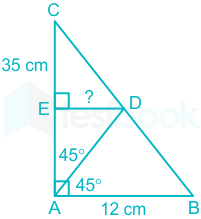
In Δ ABC, AB = 12 cm, AC = 35 cm and ∠A = 90°. The bisector of ∠A meets BC at D. E is a point on AC such that DE ⊥ AC. The length of DE (in cm) is:

  1. ((a))

    42037{{420} \over 37}

  2. ((b))

    42047{{420} \over 47}

  3. ((c))

    44435{{444} \over 35}

  4. ((d))

    44437{{444} \over 37}

Show Answer
Answer: ((b))

42047{{420} \over 47}

Given:

AB = 12 cm and AC = 35 cm

Concept:

Sum of all angles of the triangle = 180° 

Calculation:

Let the right-angle triangle ΔABC and ED be x

⇒ AD is the angle bisector of ∠CAB

⇒ ∠ EAD = 45° 

In ΔEAD

⇒ ∠EAD + ∠DEA + ∠EDA = 180° 

⇒ 45° + 90° + ∠EDA = 180° 

⇒ ∠EDA = 45° 

⇒ EA = ED

⇒ EC = 35 - x

In ΔCED and ΔCAB

⇒ ∠C = ∠ C     (Common)

⇒ ∠CED = ∠CAB = 90° 

⇒ ΔCED ~ ΔCAB

⇒ EDAB = CECA{ED\over AB}\ =\ {CE\over CA}

⇒ x12 = 35  x35{x\over 12}\ =\ {35\ -\ x\over 35}

⇒ 35x = 420 - 12x

⇒ x = 42047{420\over 47}

The length of the DE = 42047{420\over 47} cm

∴ The required result will be 42047{420\over 47} cm.

34

A fruit seller has some apples, bananas, and oranges. The number of apples is 75% more than the number of oranges and the number of bananas is 60% less than the total number of apples and oranges. By what percentage is the number of bananas less than that of apples? (Correct to one decimal place).

  1. ((a))

    37.1%

  2. ((b))

    59.1%

  3. ((c))

    36.4%

  4. ((d))

    54.2%

Show Answer
Answer: ((a))

37.1%

Given:

The number of apples is 75% more than the number of oranges

Formula used:

More or less% = More or less QuantityTotal Quantity ×100%{More \ or \ less\%\ =\ {More \ or \ less \ Quantity\over Total \ Quantity}\ × 100\%}     

Calculation:

Let the number of oranges be X

The number of apples = (1 + 75100) ×X ({1\ +\ {75\over 100}})\ \times X\

⇒  175X100 = 7X4\ {175X\over 100}\ =\ {7X\over 4}

The numbers of bananas = (7X4{7X\over 4} + X) × (1 - 60100{60\over 100})

(7X + 4X4) ×40100 = 11X4 ×410 = 1.1X({7X\ +\ 4X\over 4})\ \times {40\over 100}\ =\ {11X\over 4}\ \times {4\over 10}\ =\ 1.1X

The required percentage = 7X4  1.1X7x4 × 100 {{7X\over 4}\ -\ 1.1X\over \frac{7x}{4}}\ \times\ 100\

⇒  2.67 ×100 = 37.14% 37.1%\ {2.6\over 7}\ \times 100\ =\ 37.14\%\ \approx 37.1\%

∴ The required result will be 37.1%.

35

A can do a piece of work in 45 days. B and C together can do it in 30 days. A and B together completed 80% of the work in 20 days. How many days will C alone take to complete 70% of the remaining work?

  1. ((a))

    15

  2. ((b))

    12

  3. ((c))

    9

  4. ((d))

    10

Show Answer
Answer: ((c))

9

Shortcut Trick(A + B) can do 80% of work in 20 days 

(A + B) can do 100% of work in 20 × 5/4 = 25 days 

Let the total work by 450 units 

Efficiency of A = 450 ÷ 45 = 10 unit/day

Efficiency of (B + C) = 450 ÷ 30 = 15 unit/day

Efficiency of (A + B) = 450 ÷ 25 = 18 unit/day

So, Efficiency of B = 8 unit/day

Efficiency of C = 7 unit/day

Since, A + B completed 80% work 

So, Remaining work = 20%

Now, 70% of remaining total work = 450 × (1/5) × (7/10) = 9 × 7 

∴ Required time taken by C = (9 × 7)/7 = 9 days.


Alternate Method 

Given:

A can do a piece of work = 45 days

B and C together can do a piece of work = 30 days

Formula used:

W = E × T     Where, W = Work, E = Efficiency and T = Time

Calculation:

Let the C alone can complete the work in C days and B alone can complete the work in B days

The efficiency of A = 145{1\over 45}

A and B together can complete the 100% work together = 25 days

⇒ 145 + 1B = 125{1\over 45}\ +\ {1\over B}\ =\ {1\over 25}

⇒ 1B = 125  145{1\over B}\ =\ {1\over 25}\ -\ {1\over 45}

⇒ 1B = 9  5225{1\over B}\ =\ {9\ -\ 5\over 225}

B can complete the work = 2254{225\over 4} days

⇒ 4225 + 1C = 130{4\over 225}\ +\ {1\over C}\ =\ {1\over 30}

⇒ 1C = 130  4225{1\over C}\ =\ {1\over30}\ -\ {4\over 225}

⇒ 1C = 15  8450{1\over C}\ =\ {15\ -\ 8\over 450}

C can complete the work = 4507{450\over 7} days

The 20 days work of for A and B = 2045 + 80225 = 100 + 80225 = 180225{20\over 45}\ +\ {80\over 225}\ =\ {100\ +\ 80\over 225}\ =\ {180\over 225}

The remaining work = 45225 = 15{45\over 225}\ =\ {1\over 5}

The 70% of the work = 710 ×15 = 750{7\over 10}\ × {1\over 5}\ =\ {7\over 50}

C will complete the 70% of the remaining work = 750×4507 = 9 days{7\over 50} × {450\over 7}\ =\ 9\ days

∴ The required result will be 9 days.

36

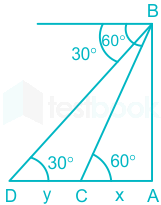
A helicopter still in the air at an altitude of 360 metres finds that two ships are sailing towards it in the same direction. The angles of depression of the ships as observed from the helicopter are 60° and 30°, respectively. The distance between the ships (in m) is:

  1. ((a))

    2403 \sqrt{3}

  2. ((b))

    2703 \sqrt{3}

  3. ((c))

    1203 \sqrt{3}

  4. ((d))

    1803 \sqrt{3}

Show Answer
Answer: ((a))

2403 \sqrt{3}

Given:

The height of the helicopter = 360 metres

Formula used:

tanθ = PerpendicularBase{Perpendicular\over Base}

Calculation:

Let the helicopter be at point B and the two ships be at C and D such that their angles of depression from B are 60° and 30° respectively

⇒ AB = 360 metres, AC = x and DC = y

In ΔCAB

⇒ tan60° = ABCA{AB\over CA}

⇒ √3 = 360x{360\over x}

⇒ x = 3603 = 1203{360\over √{3}}\ =\ {120√{3}}     ----(1)

In ΔABD

⇒ tan30° = ABAD{AB\over AD}

⇒ 13 = 360x + y{1\over √{3}}\ =\ {360\over x\ +\ y}

⇒ x + y = 360√3

By equation (1)

⇒ 120√3 + y = 360√3

⇒ y = 360√3 - 120√3 = 240√3 m

∴ The required result will be 240√3.

37

The average of 25 numbers is 54. The average of the first 8 numbers is 45 and the average of the last 14 numbers is 60. The 9th number is 3 less than the 10th number and the 11th number is 3 more than the 10th number. What is the average of the 9th and 10th numbers?

  1. ((a))

    50

  2. ((b))

    48.5

  3. ((c))

    51

  4. ((d))

    49.5

Show Answer
Answer: ((b))

48.5

Shortcut Trick

Net deviation from the given parts = 8 × (45 − 54) + 14 × (60 − 54) = −72 + 84 = +12

To balance the total average, the remaining 3 numbers must have a reverse deviation of −12.

Sum of 9th, 10th, and 11th numbers = (3 × 54) − 12 = 162 − 12 = 150

Let the 10th number be x. Then (x − 3) + x + (x + 3) = 150 ⇒ 3x = 150 ⇒ x = 50

The 9th number = 50 − 3 = 47. Average of 9th and 10th = (47 + 50) ÷ 2 = 48.5

∴ The correct answer is 48.5.

Alternate Method

Given:

Total numbers = 25, Average = 54

Average of first 8 numbers = 45

Average of last 14 numbers = 60

9th number = 10th number − 3

11th number = 10th number + 3

Formula Used:

Sum of observations = Average × Number of observations

Total 25 numbers (Average = 54)

8 numbers Avg = 45

14 numbers Avg = 60

3

9th, 10th, 11th Sum = 150 (x − 3) + x + (x + 3)

Calculations:

⇒ Total sum of 25 numbers = 25 × 54 = 1350

⇒ Sum of first 8 numbers = 8 × 45 = 360

⇒ Sum of last 14 numbers = 14 × 60 = 840

⇒ Sum of remaining 3 numbers (9th, 10th, and 11th) = 1350 − (360 + 840) = 1350 − 1200 = 150

⇒ Let the 10th number be x.

⇒ The 9th number = x − 3 and the 11th number = x + 3

⇒ (x − 3) + x + (x + 3) = 150

⇒ 3x = 150

⇒ x = 50

⇒ The 10th number = 50

⇒ The 9th number = 50 − 3 = 47

⇒ Average of 9th and 10th numbers = (47 + 50) ÷ 2 = 97 ÷ 2 = 48.5

∴ The correct answer is 48.5.

Additional Information

Basic Average Formula

The arithmetic average is calculated by adding up all the numerical values in a dataset and then dividing by the total count of numbers.

Net Deviation Method

The sum of deviations of all observations from their actual arithmetic mean is exactly zero. This principle is extremely useful to find missing elements rapidly without calculating large multiplications.

Combined Average

When a main group is split into sub-groups, the sum of the combined totals of the sub-groups will always equate back to the total sum of the main parent group.

38

A varies directly as B and inversely as C. When A = 43{ {4} \over 3} and C = 914{ {9} \over 14}, B = 37{ {3} \over 7} When A = 43 \sqrt{3} and B = 30 , then C = ?

  1. ((a))

    5√3

  2. ((b))

    3√5

  3. ((c))

    6√3

  4. ((d))

    6√5

Show Answer
Answer: ((a))

5√3

Given:

A varies directly as B and inversely as C

Formula used:

A ∝ BC{B\over C}

Calculation:

Let the value of C be X

According to the question

⇒ 43 = k × 37914{4\over 3}\ =\ {k} \ \times\ {{3\over 7}\over{9\over 14}}

⇒ 3642 = 3k7{36\over 42}\ =\ {3k\over 7}

⇒ k = 2

When, A = 4√3 and B = 30 then,

⇒ 4√3 = 30kX{}30k\over X

⇒ X = 6043{60\over 4√ {3}} = 153 = 5 ×3 ×33 = 53{15\over √{3}}\ =\ {5\ \times √{3}\ \times √{3}\over √{3}}\ =\ 5√{3}

∴ The required result will be 5√3.

39

Study the given table and answer the question that follows.

Revenue and Expenditure of a company ABC from 2016 to 2020 (in ₹ crores)

YearRevenueExpenditure
2016250175
2017200180
2018280250
2019300275
2020350300


The total expenditure of the company in 2016, 2018 and 2019 is approximately what percentage less than 70% of the total revenue in all the five years?

  1. ((a))

    28.4%

  2. ((b))

    25.8%

  3. ((c))

    27.5%

  4. ((d))

    26.7%

Show Answer
Answer: ((c))

27.5%

Given:

The revenue in 2016, 2017, 2018, 2019, and 2020 = 250, 200, 280, 300, and 350 respectively

The expenditure in 2016, 2018, and 2019 = 175, 250, and 275 respectively

Formula used:

GM%= GMTM ×100{GM\% =\ {GM\over TM}}\ × 100     Where, GM = Gain marks, and TM = Total marks

Calculation:

According to the question

The total revenue of all the years = 250 + 200 + 280 + 300 + 350 = 1380

The 70% of the revenue = 1380 × 0.7 = 966

The total expediture = 175 + 250 + 275 =  700

The required percentage = 966  700966 ×100 = 27.53%{966\ -\ 700\over 966}\ \times 100\ =\ 27.53\%

∴ The required result will be 27.53%.

40

Out of 72 students in a class, the number of boys is 40%more than that of girls. The average score in a Mathematics test of all the students is 58. If the average score of girls is 50% more than that of boys, then what is the average score of girls?

  1. ((a))

    63

  2. ((b))

    60

  3. ((c))

    69

  4. ((d))

    72

Show Answer
Answer: ((d))

72

Given:

The total students = 72

Formula used:

Average = The sum of all the itemsThe total number of items{Average\ =\ {The\ sum\ of\ all\ the\ items\over The\ total\ number\ of\ items}}

Calculation:

Let the number of girls be G

The number of boys = 1.4G

The total students = G + 1.4G = 2.4G

⇒ 2.4G = 72

⇒ G = 30

The number of boys = 72 - 30 = 42

The sum of the numbers of all the students = 58 × 72 = 4176

The sum of the numbers of all boys scored = 42 × A     Where A = Average numbers scored by boys

The sum of the numbers of all girls scored = 30 × 1.5A = 45A

⇒ 42A + 45A = 4176

⇒ 87A = 4176

The average number of boys = A = 48

The average numbers of girls = 48 × 1.5 = 72

∴ The required result will be 72.

41

The value of 241624×4+22{\sqrt[4]{24-16\sqrt{2}} } × {\sqrt{4+2\sqrt{2}} } is:

  1. ((a))

    22\sqrt{2}

  2. ((b))

    4

  3. ((c))

    8

  4. ((d))

    4 2\sqrt{2}

Show Answer
Answer: ((a))

22\sqrt{2}

Given:

The required expression: 241624×4+22{\sqrt[4]{24-16\sqrt{2}} } × {\sqrt{4+2\sqrt{2}} } 

Formula used:

(a - b)2 = a2 + b2 - 2ab

xmn=xmn\sqrt[n]{x^m} = x^{\frac{m}{n}}

(a + b)(a - b) = a2 - b2

Calculation:

The required expression can be written as:

⇒ 2428×8×24×4+22{\sqrt[4]{24-2\sqrt{8 \times 8 \times 2}} } × {\sqrt{4+2\sqrt{2}} }


⇒ 2428×164×4+22{\sqrt[4]{24-2\sqrt{8 \times 16}} } × {\sqrt{4+2\sqrt{2}} }

16+828×164×4+22{\sqrt[4]{16 + 8 -2\sqrt{8 \times 16}} } × {\sqrt{4+2\sqrt{2}} }

⇒ 162+8228×164×4+22{\sqrt[4]{\sqrt{16}^2 + \sqrt{8}^2 -2\sqrt{8 \times 16}} } × {\sqrt{4+2\sqrt{2}} }

⇒ (168)24×4+22{\sqrt[4]{(\sqrt{16 } - \sqrt{8})^2 } } × {\sqrt{4+2\sqrt{2}} }

⇒ (422)24×4+22{\sqrt[4]{(4 - 2\sqrt{2})^2 } } × {\sqrt{4+2\sqrt{2}} }

⇒ (422)×4+22{\sqrt{(4 - 2\sqrt{2}) } } × {\sqrt{4+2\sqrt{2}} }

⇒ (4(22))(4+(22)){\sqrt{(4- (2\sqrt{2}))(4 + (2\sqrt{2})) } }

⇒ (42(22)2){\sqrt{(4^2- (2\sqrt{2})^2) } }

⇒ (168){\sqrt{(16 - 8) } }

⇒ (8)=22{\sqrt{(8) } } = 2 \sqrt{2}

∴ 222 \sqrt{2} is the required answer.

42

Reena sells an article at a profit of 28%. Had she bought it at 30% less and sold for ₹20.10 less, she would have gained 35%. If she sells it for ₹62.70, then what would be the profit /loss percentage?

  1. ((a))

    Loss 2.5%

  2. ((b))

    profit, 4.5%

  3. ((c))

    profit, 2.5%

  4. ((d))

    Loss 4.5%

Show Answer
Answer: ((b))

profit, 4.5%

Given:

Reena sells an article at a profit = 28%

Formula used:

P = SP - CP     Where, P = Profit, SP = Selling price, and CP = Cost price

L = CP - SP     Where, L = Loss, SP = Selling price, and CP = Cost price

Calculation:

Let the cost price of the article be C

According to the question

The selling price of the article = 1.28C

If the cost price is 30% less = 0.7C

The new selling price = 1.28C - 20.10

The new profit = 1.35 × (0.7C)

⇒ 1.28C - 20.10 = 1.35 × (0.7C)

⇒ 1.28C - 20.10 = 0.945C

⇒ 1.28C - 0.945C = 20.10

⇒ 0.335C = 20.10

⇒ C = 60

The cost price = Rs. 60

The new selling price = Rs. 62.70

New profit percentage = 62.70  6060 ×100 = 0.045 ×100 = 4.5% profit{62.70\ -\ 60\over 60}\ \times 100\ =\ 0.045\ \times 100\ =\ 4.5\%\ profit

∴ The required result will be "4.5% profit".

43

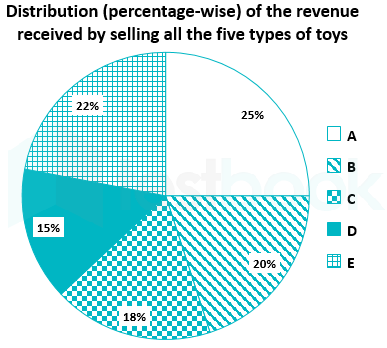
A company manufactures toys of type A, B, C, D and E. The cost of manufacturing per toy of type A, B, C, D and E is ₹240, ₹250, ₹190, ₹210 and ₹260, respectively. All toys which are manufactured are sold. Study the pie charts and answer the question that follows.


Total number of toys manufactured = 1500

Total revenue received = ₹4,00,000

Profit = Selling price - Manufacturing cost

The profit received by selling all toys of type E is what percentage of the total manufacturing cost of toys A and D (nearest to an integer)?

  1. ((a))

    17%

  2. ((b))

    18%

  3. ((c))

    15%

  4. ((d))

    20%

Show Answer
Answer: ((a))

17%

Given:

The total number of toys manufactured = 1500

Formula used:

GM% = GMTM ×100{GM\%\ =\ {GM\over TM}}\ × 100     Where, GM = Gain marks, and TM = Total marks

Calculation:

The total E type of toys = 16 × 1500100{1500\over 100} = 240

The cost price of the all toys type E = 240 × 260 = 62400

The revenue received on selling the toys E = 22 × 400000100{400000\over 100} = 88000

The profit on selling the type E toys = 88000 - 62400 = 25600

The total number of toys A type = 20% of 1500 = 300

The total cost price of toys A type = 300 × 240 = 72000

The total number of toys D type = 25% of 1500 = 375

The total cost price of the toys type D = 375 × 210 = 78750

The total cost price of type A and type D toys = 72000 + 78750 = 150750

The required percentage = 25600150750×100 = 16.98% 17%{25600\over 150750} \times 100\ =\ 16.98\%\ \approx 17\%

∴ The required result will be 17%.

44

A dealer allows 36% discount on the marked price of an article and still gains 25%. If the cost price of the article is reduced by 20%, then how much percentage discount should she give now on the same marked price to earn the same profit percentage as before?

  1. ((a))

    48.8%

  2. ((b))

    52.2%

  3. ((c))

    56%

  4. ((d))

    54.5%

Show Answer
Answer: ((a))

48.8%

Shortcut Trick

Let Marked Price (MP) = 100 units.

Initial SP = 100 − 36% = 64 units.

Initial CP = 64 ÷ 1.25 = 51.2 units.

New SP = (0.8 × Initial CP) × 1.25 = Initial CP = 51.2 units.

New Discount % = 100 − 51.2 = 48.8%.

∴ The correct answer is 48.8%.

Alternate Method

Given:

Initial Discount = 36%

Initial Profit = 25%

New Cost Price = Reduced by 20%

New Profit = 25% (same as before)

Formula Used:

Selling Price (SP) = Marked Price (MP) × (100 − Discount%) ÷ 100

Cost Price (CP) = SP × 100 ÷ (100 + Profit%)

Calculations:

⇒ Let the Marked Price (MP) be 100 units.

⇒ Initial Selling Price (SP) = 100 × (100 − 36) ÷ 100 = 64 units.

⇒ Initial Cost Price (CP) = 64 × 100 ÷ 125 = 51.2 units.

⇒ The new Cost Price is reduced by 20%, so New CP = 51.2 × 0.8 = 40.96 units.

⇒ The dealer earns the same profit of 25%, so New SP = 40.96 × 1.25 = 51.2 units.

⇒ (Notice that New SP = Initial CP, because reducing by 20% and increasing by 25% cancel out exactly: 0.8 × 1.25 = 1).

⇒ New Discount = Marked Price − New Selling Price = 100 − 51.2 = 48.8 units.

⇒ Required Discount Percentage = (48.8 ÷ 100) × 100 = 48.8%.

∴ The correct answer is 48.8%.

Additional Information

Relation between CP and MP

A direct relationship formula connects Cost Price and Marked Price: MP ÷ CP = (100 + Profit%) ÷ (100 − Discount%).

Successive Discounts

When two consecutive discounts of a% and b% are offered, the effective single discount is calculated as (a + b − a×b ÷ 100)%. It always results in a lower effective discount than their straightforward arithmetic sum.

Mark Up Percentage

Mark up percentage is the percentage by which the Marked Price is set above the Cost Price. Mark Up % = (MP − CP) ÷ CP × 100.

45

A sum of ₹18,500 is invested at x % p.a. at simple interest and another sum, which is twice the former, at (x + 2)% p.a. at simple interest. If the interest received on these investments after 312{{1} \over 2} years is ₹25,900, the rate of interest p.a. on the second investment is:

  1. ((a))

    14%

  2. ((b))

    15.5%

  3. ((c))

    12%

  4. ((d))

    12.5%

Show Answer
Answer: ((a))

14%

Given:

The rate of interest = x% per annum

The sum = Rs. 18500

Formula used:

SI = P × T × R100{SI\ =\ {P\ ×\ T\ ×\ R\over 100}}     Where, SI = Simple interest, P = Principle, T = Time, and R = Rate

Calculation:

Let the rate of interest on the second sum be R

The second sum = 2 × 18500 = 37000

According to the question

⇒ 25900 = 18500 × x ×3.5100 + 37000 × (x + 2) × 3.510025900\ =\ {18500\ ×\ x\ × 3.5\over 100}\ +\ {37000\ ×\ (x\ +\ 2)\ ×\ 3.5\over 100}

⇒ 25900 = 18500 × 3.5100 × (x + 2x + 4){25900\ =\ {18500\ ×\ 3.5\over 100}\ ×\ (x\ +\ 2x\ +\ 4)}

⇒ 25900 = (185 × 3.5) × (3x + 4)

⇒ 25900 = 647.5 × (3x + 4)

⇒ 25900 = 1942.5x + 2590

⇒ 1942.5x = 25900 - 2590

⇒ 1942.5x = 23310

⇒ x = 233101942.5 = 12%{23310\over 1942.5}\ =\ 12\%

The rate of interest for the second sum = 12 + 2 = 14%

∴ The required result will be 14%.

46

When 5758, 6610 and 8101 are divided by the greatest number x, the remainder in each case is y. The value of (x - 5y) is:

  1. ((a))

    178

  2. ((b))

    167

  3. ((c))

    175

  4. ((d))

    173

Show Answer
Answer: ((a))

178

Given:

The numbers = 5758, 6610, and 8101

Concept:

HCF is the highest common factor of two or more numbers.

if three no's are divided by the same no the remainder will be the same. It is a concept

Let's take three numbers N1, N2, and N3

N1 = ax + r

N2 = ay + r

N3 = az + r

Where a is a divisor (This will be the HCF), x, y and z are quotients and r is a remainder.

By subtracting the equations we will get-

N1 - N2 = a(x-y)

N2 -N3 = a(y-z)

N3 - N1 = a (z-x)

Calculation:

According to the question

Taking difference

⇒ 6610 - 5758 = 852

⇒ 8101 - 6610 = 1491

⇒ 8101 - 5758 = 2343

The HCF of the (852, 1491, and 2343) = 213

The greatest number = x = HCF = 213

The remainder is obtained when 5758, 6610, and 8101 are divided by x leaving y = 7 as the remainder.

The value of (x - 5y) = 213 - (5 × 7) = 213 - 35 = 178

∴ The required result will be 178.

47

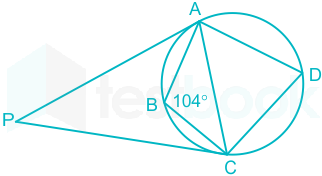
ABCD is a cyclic quadrilateral such that ∠B = 104°. The tangents at A and C meet at a point P. What is the measure of ∠APC?

  1. ((a))

    24°

  2. ((b))

    38°

  3. ((c))

    28°

  4. ((d))

    26°

Show Answer
Answer: ((c))

28°

Given:

The ∠B = 104°

Formula used:

Opposite angles of the cyclic quadrilateral = 180° 

Calculation:

In given cyclic quadrilateral ABCD

⇒ ∠ABC + ∠ADC = 180° 

⇒ ∠ADC = 180° - 104° = 76° 

Since PA is tangent on the circle at point A and AC is the cord which is subtending the angle ∠D = 76°


The angle between a tangent and a chord of a circle is equal to the angle subtended by the chord in the alternate segment of the circle.

In this case, the tangent at point A (line segment PA) and chord AC subtend ∠PAC in the alternate segment, which is equal to the angle ∠D subtended by the same chord AC. Therefore, ∠PAC = ∠D = 76°.

⇒ ∠PAC = ∠D = 76°

Also,

⇒ ∠PAC  =  ∠PCA, (As PA and PC are the tangents of A and C) 

⇒ ∠PAC = ∠PCA = ∠ADC = 76°    

In ΔPAC

⇒ ∠PAC + ∠PCA + ∠APC = 180° 

⇒ 76° + 76° + ∠APC = 180° 

⇒ ∠APC = 180° - 152° = 28° 

∴ The required result will be 28°.

48

The cost of a notebook is 80% more than the cost of a pen. The cost of 5 notebooks and 8 pens is ₹6 more than the cost of 13 pens and 2 notebooks. What is the total cost of 3 pens and 4 notebooks?

  1. ((a))

    ₹153

  2. ((b))

    ₹165

  3. ((c))

    ₹158

  4. ((d))

    ₹145

Show Answer
Answer: ((a))

₹153

Given:

The cost of a notebook is 80% more than the cost of a pen

Therefore the ratio of CP of notebook and pen will be,

NotebookPen=180100=95{Notebook\over Pen } = {180\over100} = {9\over5}

Therefore cost of 1 Notebook = 9x

Cost of 1 Pen = 5x

Now as per the question, the cost of 5 notebooks and 8 pens is ₹6 more than the cost of 13 pens and 2 notebooks,

Therefore,

(9x * 5) + (5x * 8) = 85x - 6 = (5x * 13) + (9x * 2) 

85x - 6 = 83x

2x = 6

x = 3

Therefore cost of 3 pens and 4 notebooks will be -

15x + 36x = 51x 

Where x = 3

Therefore cost of 3 pens and 4 notebooks will be (51 * 3) = ₹153.

49

If the 7-digit number 760x93y is divisible by 72, then what is the value of (3x - 2y)?

  1. ((a))

    3

  2. ((b))

    4

  3. ((c))

    7

  4. ((d))

    2

Show Answer
Answer: ((a))

3

Given:

The number = 760x93y

Concept:

A number is divisible by 8 if last 3 digits of the number divisible by 8

A number is divisible by 9 if the sum of the digit of the number divisible by 9

Calculation:

For divisibility rule of 8

The last three digits of the number = 93y

The possible value of y = 6

For divisibility rule of 9

The sum of the digit of the number = 7 + 6 + 0 + x + 9 + 3 + 6 = 31 + x

The possible value of x = 5,

Then,

⇒ (3x - 2y) = (3 × 5) - (2 × 6) = 15 - 12 = 3

∴ The required result will be 3.

50

The time taken by a boat to go a certain distance upstream is 2.5 of the time taken by it in going the same distance downstream. What is the ratio of the speed of the boat in still water to its speed of going downstream?

  1. ((a))

    7 : 4

  2. ((b))

    5 : 2

  3. ((c))

    5 : 8

  4. ((d))

    7 : 10

Show Answer
Answer: ((d))

7 : 10

Shortcut Trick

Ratio of Time Upstream (Tu) to Time Downstream (Td) = 2.5 : 1 = 5 : 2.

Since Distance is constant, Speed is inversely proportional to Time.

Ratio of Speed Downstream (Sd) to Speed Upstream (Su) = 5 : 2.

Speed of Boat in Still Water (u) = (Sd + Su) ÷ 2 = (5 + 2) ÷ 2 = 3.5 units.

Required Ratio (u : Sd) = 3.5 : 5 = 7 : 10.

∴ The correct answer is 7 : 10.

Alternate Method

Given:

Let Speed of Boat in Still Water be u and Speed of Stream be v.

Speed Downstream (Sd) = u + v | Speed Upstream (Su) = u − v.

Time Upstream (Tu) = 2.5 × Time Downstream (Td).

Calculations:

⇒ Distance = Speed × Time

⇒ (u − v) × Tu = (u + v) × Td

⇒ (u − v) × 2.5 × Td = (u + v) × Td

⇒ 2.5u − 2.5v = u + v

⇒ 1.5u = 3.5v ⇒ u/v = 3.5/1.5 = 7/3

⇒ Let u = 7k and v = 3k.

⇒ Speed Downstream (Sd) = u + v = 7k + 3k = 10k.

⇒ Ratio of u : Sd = 7k : 10k = 7 : 10.

∴ The correct answer is 7 : 10.

Additional Information

Relative Speed in Water

Downstream speed is the sum of boat speed and stream speed (u + v), while upstream speed is the difference (u − v).

Speed of Boat and Stream

Speed of boat in still water (u) = (Sd + Su) ÷ 2 and Speed of stream (v) = (Sd − Su) ÷ 2.

Inverse Proportion Rule

When distance is constant, the ratio of speeds is the inverse of the ratio of times taken: S1/S2 = T2/T1.

Science (25 questions)

51

A cylindrical metal wire is reformed so that its length decreases by 10% with no change of volume. Its resistance decreases by :

  1. ((a))

    10%

  2. ((b))

    19%

  3. ((c))

    20%

  4. ((d))

    9%

Show Answer
Answer: ((b))

19%

The correct answer is 19%.

Concept:

Resistance (R): 

  • Resistance is a measure of the opposition to current flow in an electrical circuit.
  • It is measured in ohms (Ω).
  • R=ρLAR = \frac{ρ L}{A} where ρ is resistivity, l is length, and A is the area of the cross-section of the wire.

Explanation: 

  • Suppose original length = L, Area of cross-section = A, radius of wire = r and Resistance = R
  • Since the wire is the same, the resistivity ρ will be the same.
  • After the decrease in length, let us take new length = L', radius of wire = r' and new resistance = R'

L' = 90 L/ 100 = 9L/10( since there is 10% decrease)

The volume of the wire remains the same ( given).

So, Volume of Original Wire = volume of new wire 

π r2 L = π r ' 2 L'

r2L = r' 2 L'

r' 2 = r2 L /  L'

r' 2 = 10 r2 / 9  

Decrease in resistance = RRR×100\frac{R-R'}{R} × 100

ρLAρLAρLA\frac{\frac{\rho L}{A} -\frac{\rho L'}{A'}}{\frac{\rho L}A}  × 100

ρLπr2ρ9L×910×10πr2ρLπr2×100\rm \frac{\frac{\rho L}{\pi r^2}-\frac{\rho 9 L \times 9}{10\times10\pi r^2}}{\frac{\rho L}{\pi r^2}}\times 100

ρLπr281ρL100πr2ρLπr2×100\rm \frac{\frac{\rho L}{\pi r^2}-\frac{81\rho L}{100\pi r^2}}{\frac{\rho L}{\pi r^2}}\times 100

100ρL81ρL100πr2ρLπr2×100\rm \frac{\frac{100 \rho L-81 \rho L}{100 \pi r^2}}{\frac{\rho L}{\pi r ^2}}\times 100

19ρLπr2×πr2ρL×100\rm \frac{19 \rho L}{\pi r^2}\times \frac{\pi r^2}{\rho L}\times 100

= 19%

Thus, the decrease in length is 19%.

52

The refractive index of glass and kerosene are 1.50 and 1.44, respectively. A ray of light travels from glass to kerosene The refractive index of kerosene with respect to glass is_________ and the light ray bends______ the normal in kerosene.

  1. ((a))

    1.04; away from

  2. ((b))

    1.04; towards

  3. ((c))

    0.96; away from

  4. ((d))

    0.96; towards

Show Answer
Answer: ((c))

0.96; away from

The correct answer is 0.96; away from.

Concept:

Refraction of Light: 

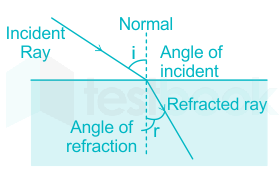
  • The bending of the ray of light passing from one medium to the other medium is called refraction.

https://storage.googleapis.com/tb-img/production/20/05/F1_J.K_8.5.20_Pallavi_D3.png

Refractive Index (n):

  • n = sin i / sin r, where 'i' =  angle of incidence  and 'r' = angle of refraction.
  • Also n = c/v, where c = speed of light in vacuum, and v = speed of light in a medium.

Explanation:​

Relative refractive index:

  • It refers to the refractive index of one material medium with respect to another one.
  • n21=n2n1n_{21}= \frac{n_{2}}{n_{1}}

Refractive index of kerosene with respect to glass:

  • n = refractive index of glass / refractive index of kerosene = 1.441.50\frac{1.44}{1.50} = 0.96
  • Greater the refractive index, the denser the medium.
  • Thus, glass (1.50) is denser than kerosene (1.40).
  • When the ray of light moves from a denser to a rarer medium, the refracted ray moves away from the normal.
  • When the ray of light moves from a rarer to a denser medium, the refracted ray moves towards the normal.
  • Thus, when a light ray will move from glass to kerosene, it will move away from the normal.

The refractive index of kerosene with respect to glass is 0.96 and the light ray bends away from the normal in kerosene.

53

An element 'A' is reacted with dilute hydrochloric acid in a test tube. Bubbles of a colourless gas evolve. This gas burns with a pop sound when a burning matchstick is brought near the mouth of test tube. Based on this observation, which of the following statements is correct?

  1. ((a))

    Element 'A' is non-metal; gas evolved is chlorine

  2. ((b))

    Element 'A' is a metal; gas evolved is chlorine

  3. ((c))

    Element 'A' is a metal: gas evolved is oxygen

  4. ((d))

    Element 'A' is a metal: gas evolved is hydrogen

Show Answer
Answer: ((d))

Element 'A' is a metal: gas evolved is hydrogen

The correct answer is Element 'A' is a metal: gas evolved is hydrogen.

Concept:

Chemical reaction: 

  • It is a process in which one or more substances, the reactants, are converted to one or more different substances, the products.
  • A chemical reaction rearranges the constituent atoms of the reactants to create different substances as products.

Explanation:

Metals react with dilute acids to give salt and hydrogen gas. 

When element 'A' reacts with dilute hydrochloric acid, bubbles of a colourless gas evolve that burn with a pop sound.

The gas is hydrogen, which is inflammable because it will burn on bringing a lit matchstick near it.

So, element A is a metal.

Additional Information Chemical properties of metals:

  • The metal reacts with oxygen to form metal oxide.
  • The metal reacts with an acid to form a salt and hydrogen gas.
  • Metals react with water to form oxides or hydroxides.
  • Metals do not react with alkalis.
54

Two lenses L₁ and L₂ of the same power, +5.0 D, separated by a distance of 90 cm are arranged parallel to each other in vertical planes. An object is placed left to L₁ at a distance of 30 cm, on the common axis of the lenses. The distance between the original object and the final image is:

  1. ((a))

    1.50 m

  2. ((b))

    1.80 m

  3. ((c))

    1.20 m

  4. ((d))

    1.00 m

Show Answer
Answer: ((b))

1.80 m

The correct answer is 1.80m.

Concept:

Lens:

  • The transparent curved surface which is used to refract the light and make an image of any object placed in front of it is called a lens.
  • A convex lens can converge a beam of parallel rays to a point on the other side of the lens.

Power of lens:

  • It is equal to the reciprocal of the focal length of the lens/mirror in meters.
  • Power (P) = 1/f, where f is the focal length of the lens/mirror.
  • P = 100f\frac{100}{f} where f is the focal length in centimetres.
  • The unit of power of a lens is Dioptre when the focal length of the lens is taken in meters (m).
  • The focal length of the concave lens is negative and hence its power is also negative.
  • The focal length of the convex lens is positive and hence its power is also positive.

Lens formula: 1f=1v1u\frac{1}{f}=\frac{1}{v}-\frac{1}{u}  where f is focal length, v is image distance and u is object distance.

Explanation:

For first convex lens, L1

Power = 1f\frac{1}{f}

f = 1p\frac{1}{p} = 1005\frac{100}{5} = 20 cm

Given: Object distance, u = -30 cm, Focal length, f = 20 cm

 v=?

1f=1v1u\frac{1}{f}=\frac{1}{v}-\frac{1}{u}

120=1v130\frac{1}{20} = \frac{1}{v} - \frac{1}{-30}

120=1v+130\frac{1}{20} = \frac{1}{v} + \frac{1}{30}

120130=1v\frac{1}{20} - \frac{1}{30} = \frac{1}{v}

1v=3260\frac{1}{v} = \frac{3-2}{60}

1v=160\frac{1}{v} = \frac{1}{60}

v = 60 cm

For second convex  lens, L2

f = 1p\frac{1}{p} = 1005\frac{100}{5} = 20 cm

Object distance, u = -90-(-60)= -90 + 60 = -30cm, focal length, f = 20cm

v = ?

1f=1v1u\frac{1}{f}=\frac{1}{v}-\frac{1}{u}

120=1v130\frac{1}{20} = \frac{1}{v} - \frac{1}{-30}

120=1v+130\frac{1}{20} = \frac{1}{v} + \frac{1}{30}

120130=1v\frac{1}{20} - \frac{1}{30} = \frac{1}{v}

1v=3260=160\frac{1}{v} = \frac{3-2}{60} = \frac{1}{60}

v= 60 cm 

Distance between original object and final image = 30 + 90 + 60 = 190 cm = 1.80 m.

55

Where is the Sardar Sarovar Project located?

  1. ((a))

    On Mansarovar lake

  2. ((b))

    On river Godavari

  3. ((c))

    On Sardar Patel lake

  4. ((d))

    On river Narmada

Show Answer
Answer: ((d))

On river Narmada

The correct answer is On river Narmada.

Concept:

Dam:

  • A dam is a structure built across a river or stream to hold backwater.
  • Ancient dam builders used natural materials such as rocks or clay.
  • Modern-day dam builders often use concrete.

Importance of dams:

  • Manmade dams create artificial lakes called reservoirs.
  • Reservoirs can be used to store water for farming, industry, and household use.
  • They also can be used for fishing, boating, and other leisure activities. People have used dams for many centuries to help prevent flooding.

Explanation:

Sardar Sarovar Project:

  • Sardar Sarovar Dam (SSD), on the Indian Narmada river, is located in the village of Kevadia in the state of Gujarat.
  • The Sardar Sarovar Project is one of the largest water resources projects in India covering four major states - Maharashtra, Madhya Pradesh, Gujarat, and Rajasthan.
  • The dam will be the third-highest concrete dam (163 meters) in India, the first two being Bhakra (226 meters) in Himachal Pradesh and Lakhwar (192 meters) in Uttarakhand.
  • The reservoir would occupy an area of 37,000 ha. and would have a linear stretch of 214 kilometres of water and an average width of 1.77 kilometres.

Additional Information

DamRiverState
Gangapur DamGodavariMaharashtra
Hirakund DamMahanadiOdisha
Bhakra-Nangal DamSutlejPunjab-Himachal Pradesh border
Tehri DamBhagirathiUttarakhand
56

A farmer growing corn (C) and beans (B) in his field in the given pattern is practicing_________ .

CBCBCB
BCBCBC
CBCBCB
BCBCBC
  1. ((a))

    inter-cropping

  2. ((b))

    sustainable farming

  3. ((c))

    mixed cropping

  4. ((d))

    crop rotation

Show Answer
Answer: ((a))

inter-cropping

The correct answer is inter-cropping.

Concept:

  • Agriculture: It is the practice of growing crops and rearing animals.
  • Crop: A crop is a plant that can be grown and harvested extensively for profit or subsistence.

Explanation:

Inter-cropping:

  • Intercropping is defined as the agricultural practice of growing two or more crops on the same field at the same time in a specific pattern.
  • Crops selected for intercropping normally have different abilities to use the resources available for growth.
  • This leads to yield advantages and increased stability compared to a single crop in a low input system.

Additional InformationSustainable farming: 

  • It is farming that meets the needs of existing and future generations, while also ensuring profitability, environmental health, and social and economic equity.
  • It favours techniques that emulate nature–to preserve soil fertility, prevent water pollution and protect biodiversity.

Mixed cropping:

  • It involves the growing of two or more species or cultivars of the same species simultaneously in the same field but not in a fixed pattern.
  • It is done to reduce the risk of crop failure due to unfavourable conditions.

Crop rotation:

  • It is the successive cultivation of different crops in a specified order on the same fields.
  • Usually, leguminous plants are grown in between cereals to replenish the nutrients in the soil.
57

Substance 'X' turns red litmus blue and substance 'Y' turns blue litmus red. 'X' and 'Y' react with each other to form water and aluminium sulphate. Which of the following statements is true about 'X' and 'Y'?

  1. ((a))

    'X' is aluminium hydroxide; 'Y' is sulphuric acid

  2. ((b))

    'X' is sulphuric acid; 'Y' is aluminium chloride

  3. ((c))

    'X' is sulphuric acid; 'Y' is aluminium hydroxide

  4. ((d))

    'X' is aluminium; 'Y' is sulphuric acid

Show Answer
Answer: ((a))

'X' is aluminium hydroxide; 'Y' is sulphuric acid

The correct answer is 'X' is aluminium hydroxide; 'Y' is sulphuric acid.

Concept:

Acids:

  • They are sour in taste.
  • They turn blue litmus red.
  • Its pH value ranges from 1 to 7 on the pH scale.

Bases:

  • They are bitter in taste and soapy to touch.
  • They turn red litmus blue.
  • Its pH value ranges from 7 to 14 on the pH scale.

Explanation:

  • Substance 'X' turns red litmus blue: It is a base.
  • Substance 'Y' turns blue litmus red: It is an acid.

Given: 'X' and 'Y' react with each other to form water and aluminium sulphate. 

X + Y → H2O + Aluminium sulphate. 

Acid and base react together to form salt and water. 

'X' is aluminium hydroxide; 'Y' is sulphuric acidPossible because X is base and y is acid.
'X' is sulphuric acid; 'Y' is aluminium chlorideNot possible because X is a base
'X' is sulphuric acid; 'Y' is aluminium hydroxideNot possible because X is a base
'X' is aluminium; 'Y' is sulphuric acidNot possible because Aluminium is not a base, aluminium hydroxide is.
58

An object, 3.0 cm in height, is placed at a distance of 3.0 m in front of a convex mirror of focal length 1.5 m, on its principal axis. Following New Cartesian Sign Convention, the image is formed at v =___________ and its height hI =_________ .

  1. ((a))

    -1.0 m; -1.0 cm

  2. ((b))

    1.0m; -1.0 cm

  3. ((c))

    -1.0 m; 1.0 cm

  4. ((d))

    1.0 m; 1.0 cm

Show Answer
Answer: ((d))

1.0 m; 1.0 cm

The correct answer is 1.0 m; 1.0 cm.

Concept:

Convex mirror: 

  • The mirror in which the rays diverge after falling on it is known as the convex mirror.
  • Convex mirrors are also known as diverging mirrors.
  • The focal length of a convex mirror is positive according to the sign convention.

Mirror formula = 1f=1v+1u\frac{1}{f} = \frac{1}{v} + \frac{1}{u} 

where v = image distance, u = object distance and f = focal length.

Magnification (m) = height of image / height of object = hi / ho 

Also, m = -v/ u 

So, m = hiho=vu\frac{hi}{ho} = \frac{-v}{u}

Cartesian Sign Convention for Spherical Mirror:

  • All signs are taken from the Pole of the spherical mirror, which is often called the origin or origin point.
  • The sign is taken as – (negative) on the left side of the pole.
  • So, the object distance is always taken as – (negative) in the case of both types of spherical mirrors, i.e. concave and convex mirrors.
  • The sign is taken as + (positive) on the right side of the pole.
  • The height is taken as + (positive) above the principal axis and taken as – (negative) below the principal axis.

​Explanation:

Given: Object distance, u = -3 m, focal length, f = 1.5 m, height of object, ho = 3 cm

1f=1v+1u\frac{1}{f} = \frac{1}{v} + \frac{1}{u}

11.5=1v+13\frac{1}{1.5} = \frac{1}{v} + \frac{1}{-3}

11.5=1v13\frac{1}{1.5} = \frac{1}{v} - \frac{1}{3}

v = 1 m

m = hiho=vu\frac{hi}{ho} = \frac{-v}{u}

hi3=13\frac{hi}{3} = \frac{-1}{-3}

hi = 1 cm

The image is formed at v = 1 m and its height hI = 1 cm.

59

Which of the following is correct about ammonium chloride?

  1. ((a))

    It is a salt of strong acid and weak base.

  2. ((b))

    It is a salt of weak acid and weak base.

  3. ((c))

    It is a salt of weak acid and strong base.

  4. ((d))

    It is a salt of strong acid and strong base.

Show Answer
Answer: ((a))

It is a salt of strong acid and weak base.

The correct answer is It is a salt of strong acid and a weak base.

Concept:

  • Acid: The substances sour in taste that turn blue litmus red.
  • Base: The substances are bitter in taste, soapy to touch, and turn red litmus blue.
  • Salt: The substances formed by the reaction between an acid and a base.

Explanation:

Strong Acids: 

  • An acid that ionizes completely to give H+ ions in its aqueous solution.
  • Examples: Hydrochloric acid, sulphuric acid, etc.

Weak acid:  

  • An acid that ionizes partially in a solution and gives off only a few of its Hions.
  • Examples: acetic acid, citric acid, etc.

Strong Base:

  • A base that ionizes completely to give OH- ions in its aqueous solution.
  • Examples: Sodium hydroxide, potassium hydroxide, etc

Weak base:

  • A base that ionizes partially in a solution and gives off only a few of its OH- ions.
  • Examples: magnesium hydroxide, ammonium hydroxide, etc.

Ammonium chloride is formed when ammonium hydroxide (a weak base) reacts with hydrochloric acid (a strong acid). 

Thus, it is a salt of strong acid and a weak base.

60

Wires used for electrical connections are made of copper because copper is:

  1. ((a))

    ductile and a thermal conductor

  2. ((b))

    ductile and an electrical conductor

  3. ((c))

    malleable and a thermal conductor

  4. ((d))

    malleable and an electrical conductor

Show Answer
Answer: ((b))

ductile and an electrical conductor

The correct answer is ductile and an electrical conductor.

Concept:

Metals: Elements that have a tendency to lose electrons are called metals.

Physical Properties of metals:

  • State: Metals are solids at room temperature with the exception of mercury, which is liquid at room temperature.
  • Luster: Metals have the quality of reflecting light from their surface and can be polished e.g., gold, silver, and copper.
  • Malleability: Metals have the ability to withstand hammering and can be made into thin sheets known as foils.
  • Ductility: Metals can be drawn into wires.
  • Conduction: Metals are good conductors because they have free electrons. Silver and copper are the two best conductors of heat and electricity.
  • Density: Metals have high density and are very heavy. Iridium and osmium have the highest densities whereas lithium has the lowest density.
  • Melting and Boiling Points: Metals have high melting and boiling points. Tungsten has the highest melting and boiling points whereas mercury has the lowest.

Explanation:

Copper is metal that can be drawn into wires and conduct electricity. 

Thus, it is used to make wires for electrical connections. 

Additional Information Physical properties of non-metals:

  • State: They are solids or gases at room temperature with exception of Bromine which is a liquid.
  • Dullness: They are dull and do not possess any kind of lustre.
  • Malleability: They are non-malleable.
  • Ductility: They are non-ductile.
  • Conduction: They are bad conductors of heat and electricity.
  • Density: They have low density.
  • Melting and Boiling Points: They have low melting and boiling point.
61

A cylindrical wire AB consists of three equal parts AC, CD and DB, made of the same material but have different radii of cross-sections r, 3r and 5r. respectively. A battery is connected across the wire. Let v1, v2 and Vbe the potential differences across AC, CD and DB, respectively. Then :

  1. ((a))

    V₁ ∶ V₂ ∶ V3 = 225 ∶ 25 ∶ 9

  2. ((b))

    V₁ ∶ V₂ ∶ V3 = 1 ∶ 9 ∶ 25

  3. ((c))

    V₁ = V₂ = V3

  4. ((d))

    V₁ ∶ V₂ ∶ V3 = 1 ∶ 3 ∶ 5

Show Answer
Answer: ((a))

V₁ ∶ V₂ ∶ V3 = 225 ∶ 25 ∶ 9

The correct answer is V1 ∶ V2 ∶ V3 = 225 ∶ 25 ∶ 9.

Concept:

Ohm's Law:

  • It states that the potential difference between two points is directly proportional to the current passing through the conductor, provided the temperature remains the same.
  • V = IR, where V = potential difference between two points, I = current, R = Resistance.

Resistance:

  • The property of a substance to resist the flow of current through it.
  • R = ρ L / A, where ρ = resistivity, L = length of conductor, and A = area of cross section.

Explanation:

The current remains the same in series combination. 

Let the current flowing through the wire be I ampere. 

For Wire AC

Length = L, Radius = r, Area of cross- section = π r2

Resistance, R1 =  ρLπr2\frac{\rho L}{\pi r^2}

Voltage, V1 = I R1 = IρLπr2\frac{I\rho L}{\pi r^2}

For Wire CD

Length = L, Radius = 3r, Area of cross- section = 9π r2

Resistance, R2 =  ρL9πr2\frac{\rho L}{9\pi r^2}

Voltage, V2 = I R2 = IρL9πr2\frac{I\rho L}{9\pi r^2}

For Wire BD

Length = L, Radius = 5r, Area of cross- section = 25π r2

Resistance, R1 =  ρL25πr2\frac{\rho L}{25\pi r^2}

Voltage, V3 = I R3 = IρL25πr2\frac{I\rho L}{25\pi r^2}

The ratio V1: V2 : V3 = IρLπr2\frac{I\rho L}{\pi r^2} :  IρL9πr2\frac{I\rho L}{9\pi r^2}   :  IρL25πr2\frac{I\rho L}{25\pi r^2}  = 1 : 1/9 : 1/25 = 225 : 25 : 9. 

V1 ∶ V2 ∶ V3 = 225 ∶ 25 ∶ 9.

62

Study the given information.

Consider the magnitude B of magnetic field at distance r from a straight wire carrying current I.

(i) B increases as I increases

(ii) B decreases as r increases.

(iii) Magnetic field line forms a concentric circle of radius r with centre at the wire.

Select the correct option

  1. ((a))

    All (i), (ii) and (iii) are correct

  2. ((b))

    Both (ii) and (iii) are correct

  3. ((c))

    Both (i) and (iii) are correct

  4. ((d))

    Only (i) is correct

Show Answer
Answer: ((a))

All (i), (ii) and (iii) are correct

The correct statements are All (i), (ii), and (iii) are correct.

Concept:

Magnetic field:

  • The area around a magnet where a magnetic force is experienced is called the magnetic field.
  • It is a quantity that has both direction and magnitude, (i.e., Vector quantity).

Explanation:

Magnetic field around a straight wire:

  • The nature of the magnetic field lines around a straight current-carrying conductor is concentric circles with the center at the axis of the conductor.
  • The strength of the magnetic field is directly proportional to the current (I) through the conductor. B  I
  • The strength of the magnetic field is inversely proportional to the distance (r). B  1/r
  • The direction of the magnetic field lines of force around a conductor is given by Maxwell’s right-hand rule.​

Maxwell’s right-hand rule:

  • ​Imagine that you are holding a current-carrying straight conductor in your right hand such that the thumb points towards the direction of the current.
  • Then your fingers will wrap around the conductor in the direction of the field lines of the magnetic field.
StatementTrue/ false
B increases as I increasesTrue
B decreases as r increasesTrue
The magnetic field line forms a concentric circle of radius r with the centre at the wireTrue
63

Three resistors A (resistance r), B (resistance 2r) and C (resistance 4r) are connected in parallel. This combination is connected in series to three other resistors D (resistance r); F (resistance 2r) and G (resistance 4r) and a battery of EMF E (negligible internal resistance). Let PA and PD be the rate of energy dissipated in resistors A and D, respectively. Then the ratio (PA/PD) is :

  1. ((a))

    849{ {8} \over 49}

  2. ((b))

    1649{ {16} \over 49}

  3. ((c))

    27{ {2} \over 7}

  4. ((d))

    449{ {4} \over 49}

Show Answer
Answer: ((b))

1649{ {16} \over 49}

The correct answer is 16/49.

Concept:

Resistance in series:

  • When resistors are connected end-to-end in a circuit, they are said to be in "series."
  • R = R1 + R2 + R3....
  • Current remains the same across all the resistors connected in series.

Resistance in parallel: 

  • When both ends of resistors are connected, they are said to be in parallel.
  • 1/R = 1/R1 + 1/R2 = 1/R3 ....
  • The potential difference across all the resistors connected in parallel remains the same.

Electric Power:

  • The energy consumed per unit of time or the rate of doing work is called power.
  • Power = work done / time taken = Vq / t = VI = V2/R = I2R

Explanation:

Resistors A (r Ω), B (2r Ω), and C (4r Ω) are connected in parallel.

Equivalent resistance, 1/R1 = 1/r + 1/2r +1/4r = 4+2+1/ 4r = 7/4 r 

R1= 4r/7

Now, the resistors R1, D, F, and G are in series.

R2 = 4r/7 + r + 2r + 4r = (4r + 7r + 14r + 28r) / 7 = 53r / 7

Equivalent current, I in the circuit = V/R27E53r\frac{7E}{53r}

The potential difference across C, V' = IR1 = 7E53r\frac{7E}{53r}  ×  4r7\frac{4r}{7} = 4E / 53

P= I2D =

 (7E53r)2×r=49E2×r53r×53r\rm (\frac{7E}{53r})^2 \times r = \rm \frac{49E^2 × r}{53r ×53r}  = 49E2/ 53 × 53r  (since current remains same in series combination)

PA = V'2/A =  (4E53)2r\frac{(\frac{4E}{53})^2}{r}  =  16E2/ 53 × 53 × r (since voltage remains same in parallel combination)

PA/ PD = 16E253×53×r49E253×53×r\rm \frac{\frac{16E^2}{53 × 53 × r}}{\frac{49 E^2}{53 × 53 × r}} = 16E2×53r×5349E2×53×53r\frac{16E^2 × 53r × 53}{49 E^2× 53 × 53r} = 16 / 49

The ratio (PA/PD) = 16/49.

64

What is a plant callus?

  1. ((a))

    A mass of undifferentiated cells.

  2. ((b))

    The tissue that forms vegetative buds.

  3. ((c))

    A type of plant tumour of stem and leaves.

  4. ((d))

    The permanent tissue sometimes called ground tissue.

Show Answer
Answer: ((a))

A mass of undifferentiated cells.

The correct answer is A mass of undifferentiated cells.

Concept:

**Tissue culture:**​

  • It is the cultivation of plant cells, tissues, or organs on specially formulated nutrient media.
  • Under the right conditions, an entire plant can be regenerated from a single cell.

Explanation:

The process of tissue culture:

  • The explant is removed from the parent plant.
  • Then, the totipotent cells are extracted from the explant.
  • These cells are given nourishment, consisting of sucrose, vitamins, and micronutrients with the plant hormones like auxins, cytokinin, etc.
  • The cells divide and develop as a callus, and the callus further divides and grows as small plantlets.
  • Once the plantlets are grown, they are moved to the nurseries for further growth.

Important terms:

ExplantThe part of the plant body was removed for the extraction of cells.
Totipotency cellThe capability of dividing and growing into a whole plant.
CallusThe undifferentiated mass of cells.
65

The given figure depicts a human heart. LA = left auricle; RA = right auricle; LV = left ventricle; RV = right ventricle. Here oxygenated blood :

  1. ((a))

    enters into LA and exits via LV

  2. ((b))

    enters into RA and exits via LV

  3. ((c))

    enters into LA and exits via RV

  4. ((d))

    enters into RA and exits via RV

Show Answer
Answer: ((a))

enters into LA and exits via LV

The correct answer is enters into LA and exits via LV.

Concept:

Double Circulation:

  • In human beings, the blood passes through the heart twice.
  • Once through the left side and once through the right side.

Explanation:

Structure of the human heart:

  • The heart is divided into right and left halves through a dividing wall called the septum.
  • It has four chambers; two upper chambers called atria and two lower chambers called ventricles.

  • So, the four chambers are the left atrium (LA), right atrium (RA), left ventricle (LV), and right ventricle (RV).

Circulation of blood:

  • The oxygenated blood coming from the lungs enters the LA and then exits through LV.
  • The blood is then transferred to all the body parts through arteries and capillaries.
  • The body consumes oxygen and produces carbon dioxide.
  • The blood gets deoxygenated and carries it to the heart.
  • The deoxygenated blood enters into RA and exits through RV.
  • Then, it goes to the lungs where it is oxygenated.
66

An object is placed on the axis of a concave mirror at a point beyond its centre of curvature. The image formed is :

  1. ((a))

    inverted and of the same size

  2. ((b))

    erect and highly enlarged

  3. ((c))

    inverted and enlarged

  4. ((d))

    inverted and diminished

Show Answer
Answer: ((d))

inverted and diminished

The correct answer is inverted and diminished

CONCEPT:

Concave mirror: 

  • If the inner surface of the spherical mirror is the reflecting surface, then it is called a concave mirror. It is also called a focusing mirror/converging mirror.
  • The size of the image produced by these mirrors can be larger or smaller than the object, depending upon the distance of the object from the mirror.
  • The concave mirror can form both real as well as virtual images of any object.

EXPLANATION:

Characteristics of Image Formed:

Position: Beyond C

Size: Inverted and diminished

Nature: Real and inverted

67

Which of the following changes will be observed, when a copper wire is dipped in an aqueous solution of silver nitrate for some time?

  1. ((a))

    The colour of the solution changes from blue to colourless and a silver solid deposits on copper wire.

  2. ((b))

    The colour of the solution changes from blue to colourless and a brown solid deposits on copper wire.

  3. ((c))

    The colour of the solution changes from colourless to blue and a silver solid deposits on copper wire.

  4. ((d))

    The colour of the solution does not change and a silver solid deposits on copper wire.

Show Answer
Answer: ((c))

The colour of the solution changes from colourless to blue and a silver solid deposits on copper wire.

The correct answer is The colour of the solution changes from colourless to blue and a silver solid deposits on copper wire.

Concept:

Displacement reaction:

  • It is a  chemical reaction wherein a more reactive element displaces the less reactive one from its salt solution.
  • For example, CuSO4 + Fe → FeSO4 + Cu, here Fe is more reactive than Cu.

Explanation:

Reactivity series: It refers to the arrangement of metals in the descending order of their reactivities.

Copper is above silver in the reactivity series indicating that it is more reactive than silver. 

Thus, when a copper wire is dipped in silver nitrate solution, it will displace silver and form a blue-coloured copper nitrate solution.

68

A diet deficient in iodine can lead to disruption of__________.

  1. ((a))

    reproductive cycles

  2. ((b))

    night vision

  3. ((c))

    general metabolism

  4. ((d))

    neuronal pathways

Show Answer
Answer: ((c))

general metabolism

The correct answer is general metabolism.

Concept:

Balanced diet: The diet that contains all the nutrients carbohydrates, fats, proteins, vitamins, and minerals in the right proportion.

Disease: A disease is a condition that negatively affects the normal functioning of the cells, tissues, and organs. It can be caused by germs, lack of a healthy diet, or may even be genetic.

Deficiency disease: A disease that is caused by the lack of essential nutrients or dietary elements such as vitamins and minerals in the human body.

Explanation:

A diet deficient in iodine leads to goiter. 

The thyroid gland located in the neck regions is affected and swells. 

This results in disruption of general metabolism that is controlled by hormones released by the thyroid gland.

Some other vitamin/ mineral deficiency diseases: 

Vitamin/ MineralDeficiency disorder/diseaseSymptoms
Vitamin-ANight Blindnessloss of vision in darkness
Vitamin-B1Beri-berifatigue, weak muscles
Vitamin-CScurvybleeding gums, wounds take longer to heal
Vitamin-DRicketsbones become soft and bend
CalciumBone and tooth decayweak bones and tooth decay
IronAnemiaweakness
69

Phanerogams are distinguished from non-Phanerogams by_______ .

  1. ((a))

    the seeds containing two cotyledons

  2. ((b))

    their differentiated plant body

  3. ((c))

    their ability to bear seeds

  4. ((d))

    the presence of vascular tissue

Show Answer
Answer: ((c))

their ability to bear seeds

The correct answer is their ability to bear seeds.

Concept:

Plant kingdom:

  • It includes eukaryotic, multicellular, autotrophic organisms, that have a cell wall made up of cellulose.
  • It is further subdivided into five divisions- Thallophyta, Bryophyta, Pteridophyta, gymnosperms, and Angiosperms.

Explanation:

Classification of the plant kingdom:

  • The first level of classification is whether the plant body is differentiated into true roots, leaves, and stems.
  • Followed by the presence of vascular tissue and then the ability to bear seeds.
  • Plants are broadly divided into two main categories- Cyptogems (non-phanerogams) and phanerogams.
  • Phanerogams are distinguished from non-Phanerogams by their ability to bear seeds.


70

Which of the following is a biodegradable item?

  1. ((a))

    Nylon

  2. ((b))

    A plastic bag

  3. ((c))

    Cotton

  4. ((d))

    A glass bottle

Show Answer
Answer: ((c))

Cotton

The correct answer is cotton.

Concept:

Waste materials: 

  • Waste materials are either liquid or solid in form, and their components may be either hazardous or inert in their effects on health and the environment.
  • The term waste is typically applied to solid waste, sewage (wastewater), hazardous waste, and electronic waste.

Explanation:

Biodegradable wasteNon-biodegradable waste
The substances that can be decomposed by the action of decomposers like bacteria and fungi.The substances that can not be decomposed by the action of decomposers like bacteria and fungi.
For example organic matter like human excreta, animal waste, dead bodies of plants and animals, leftover food items, natural fabrics like cotton, wool, etc.For example plastic, rubber, glass, artificial clothes like nylon, rayon, electronic waste like batteries, etc.

Thus,

  • Nylon - Non-biodegradable
  • A plastic bag - Non-biodegradable
  • Cotton - Biodegradable
  • A glass bottle - Non-biodegradable
71

How many molecules of water are present in a drop of water weighing 10 g?

  1. ((a))

    0.33 × 1024 

  2. ((b))

    0.177 × 1024

  3. ((c))

    1.08 × 1024

  4. ((d))

    6.022 × 1023

Show Answer
Answer: ((a))

0.33 × 1024 

Concept:

Mole Concept:

  • It is the SI unit of the amount of substance.
  • One mole contains exactly 6.022×10²³ atoms/molecules.
  • The mass of one mole of a substance in grams is called its molar mass.
  • The molar mass in grams is numerically equal to atomic/molecular/formula mass in u.
  • So, 1 mole = 6.022 × 10²³ atoms/molecules = Atomic/molecular mass of an element/compound.

Explanation:

Molar mass of water (H2O) =  2 × 1 + 16 = 18g

1 mole of water = molar mass of water = 6.022 × 10²³ molecules of water

18 g of water = 6.022 × 10²³ molecules of water

1 g of water = 6.022 × 10²³ / 18 molecules of water

10 g of water = 6.022 × 1023 × 10 / 18  molecules of water = 0.33 × 1024 molecules of water

The correct answer is 0.33 × 1024.

Hence, The Correct Option is (1).

72

An element 'X' is present in 15th group and 3rd period of periodic table. If the mass number of an isotope of this element is 33, what is the number of neutrons present in an atom of that isotope?

  1. ((a))

    18

  2. ((b))

    15

  3. ((c))

    13

  4. ((d))

    20

Show Answer
Answer: ((a))

18

The correct answer is 18.

Concept:

  • Atomic number: The number of electrons or protons in an atom.
  • Mass number: The number of protons and neutrons taken together.
  • Isotopes: The elements with the same atomic number but different mass numbers due to the different numbers of neutrons.

Explanation:

Group number: It tells how many valence electrons are present in the outermost shell of the atom.

  • Element X has group number 15. So, the no. of valence electrons is 15-10 = 5.

Period number: It tells how many shells are there in the atom. 

  • Element X belongs to the 3rd period. So, there are 3 shells.

Electronic configuration of Element X = 2, 8, 5.

Its atomic number is 15. Therefore, there are 15 electrons and 15 protons in it. 

The mass number of its isotope is 33.

No. of neutons + no. of protons = 33

No. of neutons + 15 = 33

No. of neutrons = 33 - 15 = 18

73

Which of the following is NOT a mixture?

  1. ((a))

    Rose water in milk

  2. ((b))

    Sand in water

  3. ((c))

    Turmeric powder in water

  4. ((d))

    Ice in water

Show Answer
Answer: ((d))

Ice in water

The correct answer is Ice in water.

Concept:

Mixtures:

  • A mixture is a substance that consists of two or more elements or compounds not chemically combined together.
  • For Example - Air is a mixture of gases like oxygen, nitrogen, argon, CO2, and water vapour.

Explanation:

Types of Mixtures:

  • Homogeneous Mixture:
  • Those mixtures, in which the substances are completely mixed together and are indistinguishable from one another, are called homogeneous mixtures.
  • For example Soda water, Soft drinks, lemonade, salt or sugar solution, etc.
  • Heterogeneous Mixture:
  • Those mixtures in which the substances remain separate and one substance is spread throughout the other substance as small particles, droplets, or bubbles are called heterogeneous mixtures.
  • All the suspensions and colloids are heterogeneous mixtures.
  • For Example: - Sugar and sand mixture, muddy river water, soap solution.
Rosewater in milkHomogeneous mixture
Sand in waterHeterogeneous mixture
Turmeric powder in waterHeterogeneous mixture
Ice in waterIce is a solid form of water, thus they are the same substance and can not be considered as a mixture.
74

When Mendel cross-pollinated a tall pea plant and a short pea plant, in the F1 generation

  1. ((a))

    50% of the progeny plants was short.

  2. ((b))

    75% of the progeny plants was short.

  3. ((c))

    100% of the progeny plants were short.

  4. ((d))

    0% of the progeny plants were short.

Show Answer
Answer: ((d))

0% of the progeny plants were short.

The correct answer is 0% of the progeny plants was short.

Concept:

Monohybrid Cross: A cross between two types of plants of the same species considering only the transmission of one character is called a monohybrid cross.

Explanation:

  • Gregor Johann Mendel used the monohybrid cross to determine the dominant and recessive traits in the case of peas.
  • He crossed true-breeding tall pea plants with true-breeding dwarf pea plants.
  • The homozygous allele for the tall pea plant is represented by TT, and the homozygous allele for the short/dwarf pea plant is represented by tt.
  • A monohybrid cross between the two plants results in the production of a heterozygous genotype (Tt).
  • In terms of phenotype, the F1 generation has all tall pea plants, thus indicating that the tall trait is the dominant trait and the short trait is a recessive trait.

Phenotype: It refers to the external appearance. 

Genotype: It refers to the genetic constitution i.e., the types of genes present in the organism. ​

75

Cells of apical meristem in plants do NOT have_________.

  1. ((a))

    cell walls

  2. ((b))

    vacuoles

  3. ((c))

    chromosomes

  4. ((d))

    nuclear membrane

Show Answer
Answer: ((b))

vacuoles

The correct answer is vacuoles

Concept:

Meristematic tissue:

  • It is formed of undifferentiated cells that keep on dividing and produce new cells throughout plant life.
  • It is found in the growing regions of plants such as the tips of roots, shoots, and branches.

Explanation:

Meristematic tissue is further sub-divided into three types:

Apical meristemGrowing tips of the root, and stem
Lateral meristemIn between vascular bundles as cambium
Intercalary meristemAt the base of the internode

Characteristics of meristematic cells:

  • They are small, undifferentiated, and thin-walled.
  • Cells may be spherical, polygonal, oval, rectangular, etc.
  • The cytoplasm is dense.
  • Vacuoles are absent.
  • The nucleus is prominent and centrally located.

Social Science (25 questions)

76

Who discussed the concept of poverty line in India for the first time using ‘Jail cost of living’ theory?

  1. ((a))

    Dadabhai Naoroji

  2. ((b))

    PC Mahalanobis

  3. ((c))

    Jawaharlal Nehru

  4. ((d))

    Amartya Sen

Show Answer
Answer: ((a))

Dadabhai Naoroji

The correct answer is Dadabhai Naoroji.

Key Points

  • Dadabhai Naoroji (1825-1917)
  • He was the first to discuss the concept of poverty in India
  • He used the concept of the 'Jail cost of living' theory
  • He used the menu for prisoners and appropriate prices to calculate the consumption cost for an adult prisoner.
  • He proposes the Drain of Wealth theory in his famous book 'Poverty and un-British Rule in India'
  • He was also known as 'Grand Old Man of India' and 'Father of Indian Nationalism'

Additional Information

PersonalityContribution in National Movement
P. C. Mahalanobis (1893-1972)- He was an Indian Scientist and Statistician - Founder of Indian Statistical Institute, Kolkata
Jawaharlal Nehru (1889-1964)- He was a principal  leader of the Indian National Movement - He was the author of the famous book ‘The Discovery of India’
Amartya Sen- He is an Indian Economist, Professor, and philosopher. - He received the Nobel Prize for Economics for Welfare Economics in 1998.
77

Who said the following?

“The printing press is the most powerful engine of progress and public opinion is the force that will sweep despotism away.”

  1. ((a))

    James Lackington

  2. ((b))

    Louis-Sebastien Mercier

  3. ((c))

    Desiderius Erasmus Roterodamus

  4. ((d))

    Martin Luther

Show Answer
Answer: ((b))

Louis-Sebastien Mercier

The correct answer is Louis-Sebastien Mercier.

Key Points 

  • Louis-Sebastien Mercier(1740-1814)
  • He was French writer
  • He wrote many plays and novels

Additional Information

  • James Lackington (1746-1815)
  • He was British Bookseller
  • Desiderius Erasmus Roterodamus (1466-1536)
  • He was a Dutch Philosopher
  • Martin Luther (1483-1546)
  • He was a German Priest
  • He translated Bible into German vernacular instead of Latin.
78

The historically famous road Sher-Shah Suri Marg is also known as __________. It runs between ________.

  1. ((a))

    National Highway No.44 ; Srinagar to Kanyakumari

  2. ((b))

    National Highway No.27 ; Porbandar to Silchar

  3. ((c))

    National Highway No.2 ; Dibrugarh to Tuipang

  4. ((d))

    National Highway No.1 ; Delhi and Amritsar

Show Answer
Answer: ((d))

National Highway No.1 ; Delhi and Amritsar

The correct answer is National Highway No.1; Delhi and Amritsar.

Sher Shah Suri had built Grand Trunk road which presently know as National Highway no.1.

Key Points

  • Sher Shah Suri Marg
  • National Highway No.1 is known as Sher Shah Suri  Marg
  • It connects Delhi To Amritsar via Ambala and Jalandhar
  • Previously it was known as Grand Trunk Road (GT Road)
  • It was built by Sher Shah Suri in the 16th century
  • Sher Shah Suri
  • Founder of the Suri Dynasty in India
  • Grand Trunk Road (GT Road)
  • The oldest and longest road in Asia
  • It runs roughly 2400km from Teknaf, Bangladesh to Kabul, Afaghanistan
79

According to their year of formation, identify the option that arranges the given political parties in chronological order.

I. Nationalist Congress Party

II. Communist Party of India

III. Bharatiya Janata Party

IV. All India Anna Dravida Munnetra Kazhagam(AIADMK)

  1. ((a))

    I, III, II, IV

  2. ((b))

    III, IV, I, II

  3. ((c))

    IV, I, II, III

  4. ((d))

    II, IV, III, I

Show Answer
Answer: ((d))

II, IV, III, I

The correct answer is II, IV, III, I.

Key Points

Communist Party of India

  • It is the oldest national party in India
  • Formation: 1925
  • Headquarters: New Delhi
  • Ideology: Communism, Marxism, Leninism
  • ECI Status: National party

All India Anna Dravida  Munnetra  Kazhagam (AIDMK)

  • It is the regional political party of Tamil Nadu and the Puducherry region.
  • Formation: 1972
  • Founder: M. G. Ramchandran
  • Headquarters: Chennai, Tamil Nadu
  • Ideology: Annaism, Dravidianism, Populism, Social Democracy, Social Justice
  • ECI Status: State party

Bharatiya Janata Party

  • It is the ruling political party of India
  • Founded: 1980
  • Founder: Atal Bihari Vajpayee, L. K. Advani
  • Headquarters: New Delhi
  • Ideology: Hindutva, Integral  Humanism, Conservatism, Neoliberalism, Right-wing Populism
  • ECI status: National Party

Nationalist Congress Party

  • It is one of the major state party of India.
  • Founded: 1999
  • Founder: Sharad Pawar, P. A. Sangama, Tariq Anwar
  • Headquarters: New Delhi
  • Ideology: Liberalism, Gandhism
  • ECI Status: National Party
80

In context of disaster management, what denotes the extent to which an individual, community or region is likely to be damaged by the impact of particular hazard ?

  1. ((a))

    Threat

  2. ((b))

    Risk

  3. ((c))

    Hazard

  4. ((d))

    Vulnerability

Show Answer
Answer: ((d))

Vulnerability

The correct answer is Vulnerability.

Key Points

  • The explanation of important terms in the context of Disaster Management is as follows:
  • Vulnerability: Vulnerability of disaster describes the characteristics and circumstances of a community, system, or asset that make it susceptible to the damaging effects of a hazard.
  • Hazard: A potentially damaging physical event, social and economic disruption, or environmental degradation.
  • Risk: Disaster risk is the potential disaster losses in terms of lives, health status, livelihoods, assets, and services that could occur to a particular community or a society over some specified future time period.
  • Threat: A threat can be a generic term for a specific danger, such as an object, situation, behavior, etc

Additional Information

  • Sendai Framework for Disaster Risk Reduction (2015-2030)
  • It is an international agreement related to disaster risk reduction.
  • It was adopted by the United Nations members in 2015 at World Conference on Disaster Risk Reduction held in Sendai, Japan.
  • It is a non-binding agreement.
81

Which of the given statements related to Mexico is/are true?

Statements:

I. Mexico got Independence in 1934.

II. In Mexico, elections are held every six years to elect its President.

III. Institutional Revolutionary Party is the dominating party in Mexico’s politics.

  1. ((a))

    Only III

  2. ((b))

    II and III

  3. ((c))

    I and II

  4. ((d))

    Only I

Show Answer
Answer: ((b))

II and III

Mexico, officially the United Mexican States, is a country in the southern portion of North America. It is bordered to the north by the United States. 

Key Points

The politics of Mexico take place in a framework of a federal presidential representative democratic republic.

  • Mexico got Independence on 27 sepy.1881.
  • The government is based on a congressional system,
  • In Mexico, elections are held every six years to elect its President.
  • Institutional Revolutionary Party is the dominating party in Mexico’s politics.

Additional Information

  • Mexico is currently India’s largest trading partner in Latin America.
  • In the Cold War years, Mexico and India had worked together closely as members of the United Nations (UN), both actively championing the interests of developing countries such as in the Uruguay Round of Trade Negotiations (under the World Trade Organisation.
  • The Indian community in Mexico is estimated to be more than 7,000, comprising mostly software engineers of Indian IT companies

Thus the correct statement regarding Mexico is, elections are held every six years to elect its President and Institutional Revolutionary Party is the dominating party in Mexico’s politics.

82

Which of the following statements related to the Wildlife Protection Act is incorrect?

  1. ((a))

    The Wildlife Protection Act came into force in 1972.

  2. ((b))

    The Act contains seven schedules which provide various degrees of protection to flora and fauna.

  3. ((c))

    National Tiger Conservation Authority was set up under this Act.

  4. ((d))

    It provided for the constitution of a statutory body called National Board for Wildlife.

Show Answer
Answer: ((b))

The Act contains seven schedules which provide various degrees of protection to flora and fauna.

The correct answer is The Act contains seven schedules which provide various degrees of protection to flora and fauna.

Key Points

The Wild Life (Protection) Act, 1972

  • Parliament of India enacted the ACT by the parliament of India on 9 sept1972 for the protection of plants and animal species.
  • The Government of India implemented the Wildlife Protection Act of 1972 with the purpose of efficiently protecting the wildlife of this country and further controlling hunting, smuggling, and illegal trade in wild animals and their derivatives.
  • The National Tiger Conservation Authority (NTCA) has been constituted under section 38 L (1) of Wildlife (Protection) Act, 1972.

Additional Information 

  • It has six schedules that give varying degrees of protection.
  • Schedule I and part II of Schedule II provide absolute protection - offences under these are prescribed the highest penalties.
  • Species listed in Schedule III and Schedule IV are also protected, but the penalties are much lower.
  • The specified endemic plants in Schedule VI are prohibited from cultivation and planting.
83

Which of the following statements related to the prominent Italian fighter Giuedom Giuseppe Garibaldi is/are correct?

Statements:

I. In 1829, he joined the Young Italy movement.

II. During the uprising of Piedmont in 1834, he had to leave Italy.

  1. ((a))

    Neither I and II

  2. ((b))

    Only I

  3. ((c))

    Both I and II

  4. ((d))

    Only II

Show Answer
Answer: ((d))

Only II

The correct answer regarding Italian fighter Giuedom Giuseppe Garibaldi is, During the uprising of Piedmont in 1834, he had to leave Italy.

Important PointsGiuseppe Garibaldi was one of the most celebrated Italian freedom fighters.

  • He came from a family engaged in coastal trade and was a sailor in the Merchant Navy.
  • In 1833, he met Mazzini, joined the Young Italy Movement
  • Participated in a republican uprising in Piedmont in 1834.
  • The uprising was suppressed and Garibaldi had to flee to South America, where he lived in exile till 1848.
  • Guiseppe Garibaldi with armed volunteers acquired the southern kingdom of Italy and the kingdom of two Sicilies and succeeded to drive out the Spanish rulers.
84

Under whose government did the ethnic massacre of Kosovo happen?

  1. ((a))

    Veljko Kadijević

  2. ((b))

    Raif Dizdarević

  3. ((c))

    Borisav Jović

  4. ((d))

    Slobodan Milošević

Show Answer
Answer: ((d))

Slobodan Milošević

The correct answer is Slobodan Milošević.

Key Points 

  • A series of war crimes were committed during the Kosovo War (early 1998 – 11 June 1999).
  • The forces of the Slobodan Milošević regime committed rape, killed many Albanian civilians and expelled them during the war, alongside the widespread destruction of civilian, cultural and religious property.

Additional Information 

Veljko Kadijević was a Serbian general of the Yugoslav People's Army.

  • He was the Minister of Defence in the Yugoslav government from 1988 until his resignation in 1992, which made him de facto commander-in-chief of the JNA during the Ten-Day War in Slovenia and the initial stages of the Croatian War of Independence.
85

It was on ________ when the representatives of the third estate assembled at the tennis court at Versailles and declared themselves as a National Assembly.

  1. ((a))

    14 July 1789

  2. ((b))

    20 June 1789

  3. ((c))

    26 August 1789

  4. ((d))

    5 May 1789 

Show Answer
Answer: ((b))

20 June 1789

The correct answer is 20 June 1789.

Key Points  

Louis XVI called a meeting of the Estates-General to pass his proposals to increase taxes on 5th May 1789. 

  • There the members of the third estate demanded individual voting rights, where each member would have one vote.
  • On 20 June 1789, the members of the Third Estate, who call themselves the National Assembly, assembled in Versailles hall's indoor tennis court
  • They took the Tennis Court Oath, vowing "not to separate, and to reassemble wherever circumstances require until the constitution of the kingdom is established".
  • It was a pivotal event in the French Revolution.

Additional InformationThe French Revolution was a period of radical political and societal change in France that began with the Estates-General of 1789 and ended with the formation of the French Consulate in November 1799. 

  • In May 1789, widespread social distress led to the convocation of the Estates-General, which was converted into a National Assembly in June.
  • Continuing unrest culminated in the Storming of the Bastille on 14 July, 1789 which led to a series of radical measures by the Assembly, including the abolition of feudalism
  • the imposition of state control over the Catholic Church in France, and extension of the right to vote.
86

Which of the following statements is INCORRECT?

  1. ((a))

    The 52nd Amendment of the Constitution of India is related to the Anti-Defection law.

  2. ((b))

    The Anti-Defection Law was added in the Constitution of India as the Tenth Schedule in the year 1971.

  3. ((c))

    According to an order passed by the Supreme Court of India, it is mandatory for every candidate who contests election to file an affidavit giving details of their property and criminal cases pending against them.

  4. ((d))

    According to the Anti-Defection Law, if an MLA changes parties he or she will lose the seat in the legislature.

Show Answer
Answer: ((b))

The Anti-Defection Law was added in the Constitution of India as the Tenth Schedule in the year 1971.

The correct answer is The Anti-Defection Law was added to the Constitution of India as the Tenth Schedule in the year 1971.

Confusion Points

  • The Anti-Defection Law was added to the Constitution of India as the **Tenth Schedule in the year 1985.**​

Key Points

  • Anti-Defection Law
  • The 52nd Constitutional Amendment Act 1985 provides for disqualification by MPs and MLAs from one political party to another political party on the basis of defection and they will also lose their seat in the legislature.
  • It has been made more stringent by the 91st constitutional amendment act 2003.
  • ​Exceptions to Anti-Defection Law
  • 2/3rd of political party members can separate together to form a new political party or join another political party.
87

Which of the following statements is/are correct for advancing monsoon in India?

Statements:

I. A low-pressure zone over the Indian Ocean gets rain in early June.

II. The maximum rainfall in the country is received by the north-eastern part of India.

  1. ((a))

    Only II

  2. ((b))

    I and II

  3. ((c))

    Only I

  4. ((d))

    Neither I nor II

Show Answer
Answer: ((a))

Only II

The correct answer for advancing monsoon in India is, The maximum rainfall in the country is received by the north-eastern part of India.

Key Points

  • Advancing monsoon (The rainy season) in India
  • By early June, the low-pressure condition over the northern plains intensifies and attracts the trade winds of the southern hemisphere.
  • Early in the season, the wind-ward side of the western ghats receives very heavy rainfall, more than 250 cm.
  • The maximum rainfall of this season is received in the north-eastern part of India.
  • Mawsynram in the southern ranges of Khasi hills (Meghalaya) receives the highest average rainfall in the world.
  • Rajasthan and some parts of Gujarat get scanty rainfall.
88

Which of the given statements is/are true?

Statements:

I. In the case of disguised unemployment, people are employed but their actual productivity remains zero.

II. Annual Periodic Labour Force Survey (PLFS) on employment and unemployment is conducted by the Survey of India (SoI) under the Ministry of Labour and Employment.

  1. ((a))

    Neither I nor II

  2. ((b))

    Only I

  3. ((c))

    Only II

  4. ((d))

     I and II

Show Answer
Answer: ((b))

Only I

The statement is In the case of disguised unemployment, people are employed but their actual productivity remains zero.

Important Points

  • **The annual Periodic Labour Force Survey (PLFS) on employment and unemployment is conducted by the National Statistical Office (NSO) under the **Ministry of Statistics and Programme Implementation.

Key Points

  • Disguised Unemployment
  • It is a situation wherein more people are employed than actually needed.
  • It is found in the agricultural and unorganized sectors of India.

Additional Information

  • Seasonal Unemployment – It occurs when an occupation is not in demand at certain seasons.
  • Structural Unemployment – It arises when mismatch between the jobs available in the market and the qualification or skills.
  • Technological Unemployment – People lose their jobs due to technological advancement.
89

Which group of people were NOT in favour of concentration of power to dynastic rulers?

  1. ((a))

    Conservatives

  2. ((b))

    Liberals

  3. ((c))

    Radicals

  4. ((d))

    Democrats

Show Answer
Answer: ((b))

Liberals

The correct answer is Liberals.

Key Points

  • Liberals 
  • They opposed the uncontrolled power of dynastic rulers.
  • They wanted to safeguard the rights of individuals against governments.
  • They argued for a representative, elected for a representative elected Parliamentary government.
  • They did not believe in universal adult franchise.
  • They also did not want the vote for women.

Additional Information

  • Radicals
  • They wanted a nation in which government was based on the majority of a country’s population.
  • Many supported women’s suffragette movements.
  • Radicals opposed the privileges of great landowners and wealthy factory owners.
  • They were not against the existence of private property but disliked the concentration of property in The hands of a few.
  • Conservatives
  • They were opposed to radicals and liberals.
  • Earlier in the eighteenth-century conservatives were generally opposed to the idea of changes.
  • By the nineteenth century, they accepted that some change was inevitable.
  • They believed that the past had to be respected.
  • Change had to be brought about through a slow process.
  • Democrats
  • They believed in democracy and supported democracy.
  • They believe in the political system.
  • They believe in the social equality of all people.
90

Which one of the following statements is incorrect with respect to Mahatma Gandhi National Rural Employment Guarantee Act (MGNREGA)?

  1. ((a))

    Under MGNREGA, one-fourth of the proposed jobs have been reserved for women.

  2. ((b))

    The Mahatma Gandhi National Rural Employment Guarantee Act (MGNREGA) came into force in 2006.

  3. ((c))

    One of the core objective of the Mahatma Gandhi National Rural Employment Guarantee Scheme (MGNREGS) is to strengthen the Panchayati Raj Institutions.

  4. ((d))

    MGNREGA aims to provide 100 days of wage employment in a financial year to every rural household.

Show Answer
Answer: ((a))

Under MGNREGA, one-fourth of the proposed jobs have been reserved for women.

The correct answer is Under MGNREGA, one-fourth of the proposed jobs have been reserved for women.

Key Points

MGNREGA 

  • It was launched in 2005 by Govt. of India. The Mahatma Gandhi National Rural Employment Guarantee Act was notified through the Gazette of India (Extraordinary) Notification dated September 7, 2005; it came into force on February 2, 2006 in 200 backward districts.
  • It is one of the largest work guarantee programs in the world.
  • Under this scheme, One-third of the proposed jobs have been reserved for women.
  • Panchayati Raj Institution is responsible for planning, implementing, and monitoring MGNREGA works.
  • It aims to provide 100 days of wage employment in a financial year to every rural household.​

Additional Information

  • National Rural Employment Guarantee Act 2006 or NREGA, later renamed as the Mahatma Gandhi National Rural Employment Guarantee Act or MGNREGA in 2009
  • It is Indian labour law and social security measure that aims to guarantee the 'right to work'.
  • This act was passed in 23 August 2005 under the UPA government of Prime Minister Manmohan Singh following the tabling of the bill in parliament by the Minister for Rural Development Raghuvansh Prasad Singh.
91

The Imperial Forest Department, the forerunner of Indian Forest Service, was set up by __________ in the year ______ .

  1. ((a))

    Dirk Van Hogendorp ; 1866

  2. ((b))

    George Yule ; 1865

  3. ((c))

    John Lawrence ; 1865

  4. ((d))

    Dietrich Brandis ; 1864

Show Answer
Answer: ((d))

Dietrich Brandis ; 1864

The correct answer is Dietrich Brandis ; 1864.

Key Points

  • The Imperial Forest Department, the forerunner of Indian Forest Service, was set up by Dietrich Brandis in the year 1864.
  • The Imperial Forest Department was started by the then British Indian Government during the year 1864.
  • Dr. Dietrich Brandeis, a German Forest Officer, was appointed Inspector General of Forests by the British Government.​​

Important Points

  • The Imperial Forest Service under the Imperial Forest Department was formed in 1867 by the Government of British India to manage the various natural resources of the vast country.
  • At present, the work of the Imperial Forest Service is done by the Indian Forest Service (IFS).
  • The Indian Forest Service(IFS), is one of the three All India Services.
  • IFS was constituted in the year 1966 under the All India Services Act, 1951 by the Government of India.
  • The subject of "Forestry" was managed by the Federal Government until 1935
  • By the Government of India Act, 1935, it was transferred to the "Provincial List" .​

Additional Information

  • George Yule became the first foreign president of the Indian National Congress, leading the Congress at Allahabad in 1888.
  • John Lawrence's tenure as Governor-General and Viceroy of India was from 1864 to 1869.
92

The Saffir-Simpson scale is used to measure ________ .

  1. ((a))

    vulcanicity

  2. ((b))

    hurricane intensity

  3. ((c))

    tsunami

  4. ((d))

    drought impact

Show Answer
Answer: ((b))

hurricane intensity

The correct answer is hurricane intensity.

Key Points

  • The Saffir-Simpson scale is used to measure hurricane intensity.
  • Saffir -Simpson scale
  • It is a rating system developed by Saffir-Simpson.​
  • It is a standard scale for measuring hurricane intensity as a measure of the damage they do.
  • The Saffir-Simpson Hurricane Wind Scale is a 1 to 5 rating based on a hurricane's sustained wind speed.
  • This scale estimates potential property damage.
  • Hurricanes reaching Category 3 and higher are considered major hurricanes because of the potential for significant loss of life and damage.

Additional Information

  • Palmer Drought Severity Index (PDSI), is used to define and monitor drought.
  • Volcanic Explosivity Index (VEI) is a measure of the explosiveness of volcanic eruptions.
  • Tsunami is measured by coastal tide gages and by tsunami buoys in the deep ocean.
93

According to the estimates of poverty using Tendulkar methodology, for the year 2011-12, the poverty line for a person was fixed at ________ per month for rural areas and __________ per month for urban areas.

  1. ((a))

    ₹848 ; ₹1000

  2. ((b))

    ₹824 ; ₹1024

  3. ((c))

    ₹816 ; ₹1000

  4. ((d))

    ₹860 ; ₹1024

Show Answer
Answer: ((c))

₹816 ; ₹1000

The correct answer is ₹816 ; ₹1000.

Key Points

  • According to the estimates of poverty using Tendulkar methodology, for the year 2011-12, the poverty line for a person was fixed at ₹816 per month for rural areas and ₹1000 per month for urban areas.
  • The percentage of the population living below the poverty line in India is approximately 22% (21.9%)  in years 2011-12. 
  • In Rural India decreased to 25.7 % in 2011-12 (41.8 % in 2004-05)
  • In Urban India decreased to 13.7 % in 2011-12 (25.7 % in 2004-05)
  • In actual terms, there were 26.93 crore people below the poverty line (BPL) in 2011-12.

Important Points

  • Tendulkar's Methodology for poverty estimation is based on Calorie Consumption.
  • ​It is based on the consumption of the items like cereal, pulses, milk, edible oil, non-vegetarian items, vegetables, fresh fruits, dry fruits, sugar, salt & spices, other food etc.
  • In this method, a basket of these goods is made and the monetary value of that goods is calculated taking into account inflation and areas like rural and urban.
  • Poverty Line: A minimum expenditure (or income) that is required to purchase a basket of goods and services necessary to satisfy basic human needs and this minimum expenditure is called the poverty line.
  • The families below this line are called Below Poverty Line (BPL) families
  • The families above this line are called Above Poverty Line (APL) families.
94

Which of the following certification logo scan be found on UPVC pipes to be used in suction and delivery lines of the agricultural pump sets?

  1. ((a))

    HALLMARK

  2. ((b))

    ISI

  3. ((c))

    AGMARK

  4. ((d))

    FPO MARK

Show Answer
Answer: ((b))

ISI

The correct answer is ISI.

Key Points

  • ISI Certification logo scan be found on UPVC pipes to be used in suction and delivery lines of the agricultural pump sets.
  • ISI Certification, IS 13593:1992 is used in suction and delivery lines of the agricultural pump sets.(
  • UPVC stands for Unplasticized Poly Vinyl Chloride
  • The ISI mark is a standard-compliance mark for industrial products in India since 1955.
  • ISI stands for Indian Standards Institution.
  • ISI mark is an assurance of conformity to the specifications.
  • The BIS gives specification for products in terms of material used, method of production, labelling, packing, storage and sale
  • Examples of products bearing ISI mark are ghee, biscuits, detergent, pressure cooker, electric iron, immersion rod, geyser, LPG cylinders, etc.

Additional Information

  • HALLMARK
  • ​Hallmarks are used as a guarantee of purity or fineness of precious metal articles.
  • The objectives of the Hallmarking are to protect the public against adulteration and to obligate manufacturers to maintain legal standards of fineness. In India, at present two precious metals namely Gold and Silver have been brought under the purview of Hallmarking.
  • The mandatory hallmarking of gold jewelery has come into effect from June 16, 2021.
  • AGMARK
  • It is a certification mark employed on Agricultural Products in India.
  • It is in effect since 1937.
  • Directorate of Marketing and Inspection, Government of India is the certifying agency for the AGMARK.
  • FPO MARK
  • FPO stands for Fruit Products Order.
  • It is the mandatory mark for fruit products sold in India.
  • FPO Mark in effect since 1994.
  • It became a mandatory status only after the Food Safety and Standards Act of 2006.
  • Ministry of Food Processing Industries India is the certifying agency for the FPO Mark.
95

Which of the following statements is INCORRECT?

  1. ((a))

    The people of Bolivia started a movement against privatisation of water in 1999.

  2. ((b))

    In 2000, people of the multi-national company fled the city Cochabamba and the government agreed to the demands of the protesters.

  3. ((c))

    In April 2000, the Bolivian government imposed martial law in the country.

  4. ((d))

    The protest against water privatisation was led by the Socialist party in 2001.

Show Answer
Answer: ((d))

The protest against water privatisation was led by the Socialist party in 2001.

The correct answer is The protest against water privatisation was led by the Socialist party in 2001.

Key Points

  • The protest against water privatisation was led by the Socialist party between December 1999 and April 2000.
  • Bolivia Water War
  • It is also known as the Cochabamba Water War, as the water war begins with Cochabamba, the fourth largest city in Bolivia.
  • When the World Bank pressured the government to give up its control over municipal water supplies.
  • The government sold these rights for the city of Cochabamba to a multi-national company (MNC) SEMAPA.
  • The company immediately increased the price of water four times and after the response of this price hike a spontaneous popular protest.
  • This protest was led by the organization called FEDECOR.
  • The water war in Bolivia was fought in the absence of Political Parties.

Additional Information

Bolivia located in western-central South America.

  • The constitutional capital is Sucre, while the seat of government and executive capital is La Paz.
  • Its Currency is Boliviano.
96

Which of the following hills/mountain ranges are a part of Purvanchal Himalayas?

  1. ((a))

    Pir Panjal and Dhauladhar ranges

  2. ((b))

    Patkai hills and Mishmi hills

  3. ((c))

    Karakoram and Zaskar ranges

  4. ((d))

    Mahadeo hills

Show Answer
Answer: ((b))

Patkai hills and Mishmi hills

The correct answer is Patkai hills and Mishmi hills.

Key Points

  • The Purvanchal Range is the extension of the Great Himalaya range in the north-east region of India.
  • It is parallel to Karakoram and Ladakh range.
  • Three hill ranges are the, Garo-khasi-Jaintia and Lushal Hills.
  • It is the most densely forested area and full of flora and fauna in India.
  • These hill region also known for **highest rainfall.**​

Additional Information

  • The Pir Panjal and Dhauladhar ranges are important part of Himachal range.
  • The Karakoram and Zaskar ranges are important of Tibet Himalayan Region.
  • The Mahadeo hills are important of the Satpura Range.
97

In the Preamble of the Constitution of India, which of the following words was added in the 42nd Constitutional Amendment?

  1. ((a))

    Equality

  2. ((b))

    Liberty

  3. ((c))

    Fraternity

  4. ((d))

    Secular

Show Answer
Answer: ((d))

Secular

The correct answer is Secular.

Key Points

  • 42nd Amendment known as 'mini constitution'.
  • Act passed by parliament on 11th November, 1976.
  • Three new words (i.e., Socialist, Secular, and Integrity) were added in **the Preamble.**​

Additional Information

  • Four Directive Principles were added by 42nd Amendment.
  • To secure opportunities for healthy development of children(Article 39).
  • To promote equal justice and to provide free legal aid to the poor (Article 39 A).
  • To take steps to secures the participation of workers in the management of industries (Article 43 A).
  • To protect and improve the environment and to safeguard forests and wild life (Article 48 A).
98

The World Food Summit took place in the year _________ at the FAO headquarters in ________.

  1. ((a))

    1996 ; Rome

  2. ((b))

    1991 ; Geneva

  3. ((c))

    1994 ; Rome

  4. ((d))

    1995 ; Geneva

Show Answer
Answer: ((a))

1996 ; Rome

The correct answer is 1996; Rome.

Key Points

  • World Food Summit was held on 13 - 17 November 1996 at the FAO (Food and Agriculture Organization) in Rome.
  • The objective of the summit was **to renew global commitment at the highest political level to eliminate hunger and malnutrition and to achieve sustainable food for all people.**​

Additional Information

  • The Geneva Peace conference was held on 9 January 1991, to find a peaceful solution to the Iraqi occupation of Kuwait in order to avoid a war between Ba'athists and the United States-backed coalition.
  • The WTO (World Trade Organization) was born out of the General Agreement on Tariffs and Trade (GATT). WTO headquarters in Geneva, Switzerland, formation1 January ,1995.
99

Identify the option that arranges the given events in the correct chronological order.

I. Signing of Munich agreement

II. Signing of Anti - Comintern pact between Germany and Japan

III. Signing of Tripartite pact between Germany, Italy, and Japan

  1. ((a))

    II - III - I

  2. ((b))

    I - III - II

  3. ((c))

    I - II - III

  4. ((d))

    II - I - III

Show Answer
Answer: ((d))

II - I - III

The correct answer is II - I - III.

Key Points

  • The given events must be arranged in chronological order.
  • The signing of Anti - the Comintern pact between Germany and Japan.
  • The signing of the Munich agreement.
  • **The Signing of the Tripartite pact between Germany, Italy, and Japan.**​

Additional Information

  • The Signing of the Anti-Comintern Pact between Germany and Japan in 1936 was one of the truly momentous and horrifying conjectures of the twentieth century.
  • ​The Munich Agreement (1939) stated that Germany would receive the Sudentenland, along with a promise not to take further land from Czechoslovakia.
  • ​The Tripartite Pact on September 27, 1940, Japan signed the Tripartite Pact with Germany and Italy, thus entering the military alliance known as the **"Axis."**​
100

Khilafat Committee was formed in _________ to preserve the Khalifa’s transitory powers.

  1. ((a))

    April 1919

  2. ((b))

    March 1919

  3. ((c))

    April 1920

  4. ((d))

    March 1920

Show Answer
Answer: ((b))

March 1919

The correct answer is March 1919.

Key Points

The Khilafat Movement:-

  • The Khilafat Movement (1919-1924) was a pan-Islamic, political campaign launched by Muslims in British India to influence the British government and to protect the Ottoman Empire during the aftermath of World War I.
  • The position of Caliph after the Armistice of Mudros October 1918 with the military occupation of Istanbul and Treaty of Versailles (1919) fell into a disambiguation along with the Ottoman Empire's existence.
  • This movement was led by Shaukat Ali, Mohammad Ali Jauhar, and **Abul Kalam Azad.**​

Additional Information

  • Non-Cooperation Movement:- Congress passed a resolution to hold the non-cooperation movement in its special national convention held in Calcutta on September 4th,1920. It aimed at educating the people about the British for their brutal killing and also preventing Jallianwalan Bagh like incidents in the future apart from opposing the British rule.

Attempt this paper under real exam conditions

Timed interface, section switching, instant scoring, and question-by-question analytics — free.

Start Timed Attempt