Official Paper

ICAR Technician 28 Feb 2022 Shift 1 (Previous Year Paper)

100 questions · 90 minutes · with answers · free

General Knowledge (25 questions)

1

Who discovered ultra-short radio waves? 

  1. ((a))

    J.J. Thomson

  2. ((b))

    Albert Einstein 

  3. ((c))

    J.C. Bose

  4. ((d))

    Isaac Newton

Show Answer
Answer: ((c))

J.C. Bose

The correct answer is J.C. Bose.

Key Points

  • Jagadish Chandra Bose (J.C. Bose) discovered the ultra-short radio waves.
  • Shortwave radio is radio transmission using shortwave (SW) radio frequencies.
  • Radio waves have the lowest energies, longest wavelengths, and lowest frequencies of any type of electromagnetic (EM) radiation.

 Important Points

  • Jagadish Chandra Bose
  • He invented a Crescograph that could detect very small motions within plant tissues or measure the growth in plants.
  • He proved plants have life.
  • He is known for his work on the wireless transmission of information using microwaves.
  • Bose is known as the Father of wireless telecommunication.

Additional Information

  • J.J. Thomson (1856-1940)
  • He was awarded the Nobel prize in Physics in 1906 for his work on the discovery of electrons.
  • J.J. Thomson was the first one to propose a model for the structure of an atom.
  • Isaac Newton
  • Sir Isaac Newton was a British mathematician, and one of the greatest mathematicians.
  • His discoveries in optics (construction of white light) and mathematics (calculus),
  • He is known for formulating three laws of motion which are Fundamentals of modern physics.
  • He discovered the gravitational forces.
  • Albert Einstein 
  • Albert Einstein was a German-born theoretical physicist.
  • Albert Einstein was awarded to Nobel Prize in Physics in 1921 "for his discovery of the law of the photoelectric effect.
  • He also gives the theory of relativity.

2

In which year did Farid Khan was honoured with the title of Sher Shah?

  1. ((a))

    1539

  2. ((b))

    1598

  3. ((c))

    1511

  4. ((d))

    1579

Show Answer
Answer: ((a))

1539

The correct answer is 1539.

Key Points

  • Farid Khan was honoured with the title of Sher Shah in 1539.
  • In 1539, he defeated Humayun in the battle of Chausa(26 June 1539) and after that, he assumed the title Sher Shah as emperor.
  • Bahar Khan Lohani conferred the title of 'Sher Khan' on Farid Khan because he killed the tiger with one stroke of the sword.
  • In 1540, Shershah Suri defeated Humayun in the battle of kannauj (Bilgram) and after winning the battle, he ruled Agra and Delhi.

Important Points

  • Sher Shah
  • He was the founder of the Suri dynasty, which had its capital at Sasaram.
  • He issued the coin Rupia as a currency and fixed standard weights and measures all over the empire.
  • He also introduced Kabuliyat and Patta as the agricultural equipment of Settlement.
  • He built the Grand Trunk Road that runs from Calcutta to Peshawar.
  • He built Purana Quila in Delhi.
  • He was buried in Sasaram.
  • Administrative Unit and its head in Suri Dynasty.
Administrative UnitHead
Iqta(Province)Haqim and Amin
Sarkar(District)Shiqdar-i-Shiaqdaran and Munsif-i-Munsifan
Pargana(Taluka)Shiqdar and Munsif
Gram(Village)Muqaddam and Amil
3

Which of the following is the biggest language family of India? 

  1. ((a))

    Tibeto-Himalayan languages

  2. ((b))

    Mon-Khmer languages 

  3. ((c))

    North Dravidian language

  4. ((d))

    Indo Aryan language 

Show Answer
Answer: ((d))

Indo Aryan language 

The correct answer is an Indo-Aryan language.

Key Points

  • The biggest language family of India is the Indo-Aryan language.
  • Indo-Aryan languages, also called Indic languages.
  • It is a subgroup of the Indo-Iranian branch of the Indo-European language family.
  • Around 74% of Indians speak a language related to the Indo-Aryan language family.

Important Points

  • Indo-Aryan languages are generally divided into three major divisions: 
  • Old Indo-Aryan group- Vedic Sanskrit was born around this period.
  • Sanskrit is one of the official languages of India and is known as a classical language of the country and is also considered to be the Mother of all Languages
  • Middle Indo-Aryan:- Prakit language was developed during this period.
  • Some languages have originated from Prakrit like Pali, Ardha Magadhi, and Apabharnsha.
  • New (Modern) Indo-Aryan:- This group of languages is mainly spoken in northern and western India.
  • The Indo-Aryan language family includes mostly all languages of northern and western India such as Hindi, Bengali, Marathi, Gujarati, Punjabi, Sindhi, Rajasthani, Assamese, Oriya, Pahari, Bihari, Kashmiri, Urdu, and Sanskrit.

Additional Information

  • Mon-Khmer languages:
  • Mon-Khmer languages have three types Khmer (Cambodian), Mon (a minority language in Myanmar and Thailand), and Vietnamese.
  • North Dravidian language
  • It is part of the Dravidian language group.
  • In this group languages Brahui(Spoken in Baluchistan), Malto(spoken in tribal areas of Bengal and Odisha), and Kurukh(spoken in Bengal, Odhisha, Bihar, and Madhya Pradesh).
  • Telugu is a Dravidian group language, numerically the largest of all Dravidian languages.
  • Malayalam is the smallest and youngest of the Dravidian group.
4

Which of the following facts about Census 2011 is INCORRECT?

  1. ((a))

    State with smallest total area - Goa

  2. ((b))

    State with largest total area - Rajasthan 

  3. ((c))

    State with lowest literacy - Uttar Pradesh

  4. ((d))

    State with the highest literacy - Kerala 

Show Answer
Answer: ((c))

State with lowest literacy - Uttar Pradesh

The correct answer is State with the lowest literacy - Uttar Pradesh.

Key Points

  • According to the census 2011 state with the lowest literacy rate- is Bihar, not Uttar Pradesh.
  • ​According to the census 2011, Uttar Pradesh is the most populous state.

Additional Information

  • Census 2011 was the 15th Census of India.
  • The slogan of Census 2011 was 'Our Census our Future'.
  • Total population of census 2011 - 1,210,193,422.
  • The largest census in human history ever conducted by any Government till now.
  • The Census of  2011 covered.
  • ​640 Districts.
  • 5924 Sub-districts.
  • 5767 Tehsils.
  • 7742 Towns.
  • 6,49,481 Villages.
  • According to the Census 2011
  • The UT (Union Territory)  with the smallest area was Lakshadweep (30 km2).
  • The state with the largest area was Rajasthan (3,42,239  km2).
  • The state with the highest literacy rate was Kerala (94%).
  • The first census of Independent India - 1951.
5

Which of the following elements does NOT involve in the chemical composition of baking powder?

  1. ((a))

    Hydrogen

  2. ((b))

    Carbon

  3. ((c))

    Sodium

  4. ((d))

    Nitrogen

Show Answer
Answer: ((d))

Nitrogen

The correct answer is Nitrogen.

Key Points

  • Baking powder is sodium bicarbonate, which is NaHCO3.
  • Nitrogen is not present in baking powder.
  • Elements involved in baking powder are - Hydrogen, Carbon, Sodium, and Oxygen.
  • Baking soda is used as Antacids, making bread soft, etc.

Additional Information

  • Plaster of Paris is known as Gypsum which is prepared from the chemical compound, Calcium sulphate dihydrate (CaSO4.2H2O)
  • Acetic acid which is known as ethanoic acid is an acidic, colourless liquid and organic compound with the chemical formula (CH3COOH)
6

The Union Minister Jitendra Singh launched unique face recognition technology for ____ in November 2021.

  1. ((a))

    bankers

  2. ((b))

    lawyers

  3. ((c))

    teachers

  4. ((d))

    pensioners

Show Answer
Answer: ((d))

pensioners

The correct answer is pensioners.

Key Points

  • Union Minister launched Jitendra Singh Unique face recognition for pensioners.
  • This face recognition technique of giving life certificates is a historic and far-reaching reform since it will touch the lives of not only 68 lakh central government pensioners but also those under EPFO and state government.
  • Face recognition technology will benefit pensioners across the country in providing Life Certificate by simply using the mobile app.

Additional Information

  • In December 2021, Union Minister Nitin Gadkari inaugurated and laid the foundation stone of the National Highway projects of 240 Km worth 9,119 crore rupees in Meerut and Muzaffarnagar, Uttar Pradesh.
  • In October 2021, Union Minister of State (Independent Charge ) Earth Sciences Dr. Jitendra Singh officially launched India's First Manned Ocean Mission called the "Samudrayan project" in Chennai.
7

Which of the following regarding shapes of Dravida temples is an INCORRECT match? 

  1. ((a))

    Square - kuta

  2. ((b))

    Rectangular - shala

  3. ((c))

    Elliptical - gaja-prishta 

  4. ((d))

    Circular - ayastra

Show Answer
Answer: ((d))

Circular - ayastra

The correct answer is Circular - ayastra.

  • Circular - ayastra: This option is an incorrect match.
  • The term "ayastra" does not correspond to the shape of Dravida temples.
  • While circular-shaped temples do exist, they are not typically associated with Dravida temple architecture.

Key Points

  • Temples architecture of India is divided in **three broad categories.**​
  • Nagara - Northern Style
  • Dravida - South Style
  • Vesara - mixed style
  • ​Dravidian Style
  • In the Southern Dravidian style, the tower or Gopuram consists of progressive smaller stories of pavilions.
  • These temples were square in plan and pyramidal in shape.
  • Included porches (Mandapams) and pillared halls and contained tanks or wells for water to be used for sacred purposes.

Additional Information

  • Square - kuta:
  • This refers to the square-shaped Dravida temple, which is characterized by having a square base or plan.
  • The sanctum sanctorum or the inner shrine of the temple is usually located at the center.
  • Rectangular - shala:
  • This refers to the rectangular-shaped Dravida temple.
  • Similar to the square shape, the rectangular shape of the temple signifies a structure with a rectangular base or plan.
  • The inner shrine is typically placed at the center of the temple.
  • Elliptical - gaja-prishta:
  • This refers to the elliptical-shaped Dravida temple.
  • The term "gaja-prishta" translates to "back of an elephant," and it describes the shape resembling the curve of an elephant's back.
  • The temple has an elliptical or curved outline, with the inner sanctum located at the center.
8

What is the worth of the three solar power projects launched by the Chief Minister of Madhya Pradesh in November 2021?

  1. ((a))

    Rs. 5,250 crore

  2. ((b))

    Rs. 4,250 crore

  3. ((c))

    Rs. 6,250 crore

  4. ((d))

    Rs. 3,250 crore

Show Answer
Answer: ((a))

Rs. 5,250 crore

The correct answer is Rs. 5,250 crores.

Key Points

  • Madhya Pradesh CM launched three solar power projects.
  • CM said power generation will start in March 2023.
  • 3 solar plants of 1500 MW capacity in Shajapur, Agar, and Neemuch.
  • 2 units of 550 MW (350+200) in Agar.
  • 3 units of 450 MW (105+220+125) in Shajapur.
  • 3 units of 500 MW (170+160+170) in Neemuch.
  • 5300 MW is MP's daily solar power generation.

Additional Information

  • Madhya Pradesh
  • Number of Districts - 52
  • Rajya Sabha seats - 11
  • Lok Sabha seats - 29
  • Chief Minister - Shivraj Singh Chauhan
9

Which of the following statements about the Mahila Mitra Plus savings scheme is INCORRECT?

  1. ((a))

    It includes exclusive preferential interest rates on housing loans.

  2. ((b))

    It was launched by Federal Bank.

  3. ((c))

    It includes processing fee waiver for home loans. 

  4. ((d))

    It offers three free FedFirst SB accounts in the name of minor children. 

Show Answer
Answer: ((d))

It offers three free FedFirst SB accounts in the name of minor children. 

The correct answer is Option 4.

Key Points

  • Federal Bank in December 2021 launched an exclusive feature-rich scheme named ‘Mahila Mitra Plus’ for women.
  • It is designed to make financial planning and investments easy for women.
  • It includes: 
  • Exclusive preferential interest rates on housing loans.
  • Processing fee waivers for home loans.
  • Complimentary and customised insurance cover.
  • Women are also encouraged to open savings accounts in the names of their minor children through the provision of Two free FedFirst SB accounts in the name of minor children, with no minimum balance stipulation.

Additional Information

  • Federal Bank is an Indian private sector bank.
  • Headquarters: Kochi.
  • Established: April 23, 1931.
  • Tagline: Your Perfect Banking Partner.
  • Federal Bank has been awarded the ‘Most Effective Bank-Fintech Partnership: Agile and Adaptable’ at the IBSi-Global Fintech Innovation Awards 2021.
  • Federal Bank has launched “FEDDY”, an Artificial Intelligence-powered virtual assistant to help consumers with banking-related queries anytime.
10

In December 2021, which New Zealand cricketer has become the third player to take 10 wickets in an innings of Test?

  1. ((a))

    William Somerville 

  2. ((b))

    Mitchell Santner

  3. ((c))

    Ajaz Patel

  4. ((d))

    Tim Southee

Show Answer
Answer: ((c))

Ajaz Patel

The correct answer is Ajaz Patel.

Key Points

  • On December 4, 2021, Left-arm spinner Ajaz Patel created history by taking all 10 wickets in an innings in the 2nd test match against India.
  • He plays for New Zealand
  • He finished with figures of 10/119.
  • He became the third bowler after Jim Laker and Anil Kumble to achieve the feat.

Additional Information

  • Anil Kumble’s record had come against Pakistan in a Test match at Delhi’s Feroz Shah Kotla in 1999.
  • Ravichandran Ashwin on 6 March 2022 surpassed the legendary Kapil Dev's haul of 434 wickets to become India's second-highest wicket-taker in Test cricket.
  • Anil Kumble tops the charts with 619 wickets.
11

Which country won the Junior Hockey World Cup title 2021?

  1. ((a))

    Argentina 

  2. ((b))

    Russia 

  3. ((c))

    Germany 

  4. ((d))

    Canada

Show Answer
Answer: ((a))

Argentina 

The correct answer is Argentina.

Key Points

  • Argentina beat Germany in the final and won Men’s Junior Hockey World Cup 2021
  • It was held at the Kalinga Stadium in Bhubaneswar, Orissa (India) from 24 November to 5 December 2021.
  • The hosts India were the defending champions but lost to Germany in the semifinals.
  • France and the India finished third and fourth, respectively.
12

Which of the following is about Unit of Energy is INCORRECT?

  1. ((a))

    1 cal = 4.184 J

  2. ((b))

    1 kcal = 1 Cal (Capital C: Nutritional Calorie) 

  3. ((c))

    1000 cal = 1 kcal

  4. ((d))

    1 kWh = 3.6 J

Show Answer
Answer: ((d))

1 kWh = 3.6 J

The correct answer is Option 4.

Key Points

  • 1kWh= 3.6 × 10J
<sup>

Additional Information</sup>

  • Energy
  • It is a scalar quantity.
  • It is defined as the capacity of doing work.
  • Its SI unit is Joule.
13

On 6 December 2021, who was elected as the new President of leading business organisation FICCI?

  1. ((a))

    Sandip Somany

  2. ((b))

    Uday Shankar

  3. ((c))

    Dr Sangita Reddy

  4. ((d))

    Sanjiv Mehta

Show Answer
Answer: ((d))

Sanjiv Mehta

The correct answer is Sanjiv Mehta.

Key Points

  • Sanjiv Mehta, previously Chairman and Managing Director of Hindustan Unilever Limited (HUL) was appointed as Federation of Indian Chambers of Commerce and Industry (FICCI) President.
  • He is also a Director on the Board of Indian School of Business.

Additional Information

  • Federation of Indian Chamber of Commerce and Industry (FICCI):
  • FICCI is a non-governmental trade association.
  • It was established in the year 1927.
  • It was founded by Ghanshyam Das Birla and Purshottamdas Thakurdas.
  • Its headquarters is in New Delhi.
14

Who headed the 10th Five-Year Plan of the National Development Council?

  1. ((a))

    Indira Gandhi

  2. ((b))

    Manmohan Singh

  3. ((c))

    Atal Bihari Vajpayee

  4. ((d))

    Narendra Modi

Show Answer
Answer: ((c))

Atal Bihari Vajpayee

The correct answer is Atal Bihari Vajpayee.

Key Points

  • The 10th five-year plan (2002-07) was headed by former Prime Minister Late Atal Behari Vajpayee.
  • It aimed to achieve an 8 per cent annual GDP growth.
  • It also aimed to reduce the poverty rate by 5% by 2007.
  • It also included reducing gender gaps in literacy and wage rates by at least 50% by 2007.
  • The 11th five-year Plan (2007–2012)  was headed by former Prime Minister Manmohan Singh.
  • It focused on rapid and inclusive growth.
  • It aimed at increasing the growth rate in agriculture, industry, and services to 4%, 10%, and 9% respectively.
  • Note: The Planning Commission has been dissolved and there is no 13th five-year plan.

Additional Information

  • National Development Council (NDC) is the apex body that gives approval to five-year plans in India.
  • It was established on 6th August 1952.
  • The Prime minister is serving as the chairman of the National Development Council.
  • The headquarters of the National Development Council (NDC) is in New Delhi.
  • The first five-year plan is the only five-year plan adopted without the consent of the National Development Council.
  • The first meeting of the NDC was chaired by Jawaharlal Nehru in November 1952.
15

Which of the following movements was launched in 1930 under the leadership of Mahatama Gandhi? 

  1. ((a))

    Quit India Movement

  2. ((b))

    Civil disobedience Movement

  3. ((c))

    Khilafat Movement

  4. ((d))

    Non-Cooperation Movement

Show Answer
Answer: ((b))

Civil disobedience Movement

The correct answer is the Civil Disobedience Movement.

Key Points 

  • Civil Disobedience Movement:
  • The movement started with the breaking of the Salt law at Dandi in March 1930.
  • The Dandi March started from Gandhiji's ashram in Sabarmati to the Gujarati coastal town of Dandi.
  • The movement was called off in the year 1931, and Gandhiji decided to enter into the Gandhi-Irwin Pact.
  • The terms of the Gandhi-Irwin Pact included calling off of the movement, releasing of all prisoners, and manufacturing salt along the coast.
  • The failure of the Second Round Table and the new repression cycle adopted by the British led to the relaunching of the Civil Disobedience Movement in 1932.
  • When Gandhiji returned to India, Nehru, and Ghaffar Khan both were in jail, Congress was declared illegal.
  • Thus, Gandhiji decided to relaunch the movement in 1932. But, it lost its momentum in 1934.

Important Points 

  • The Salt March was notable for at least three reasons.
  • It was this event that first brought Mahatma Gandhi to world attention.
  • The march was widely covered by the European and American press.
  • It was the first nationalist activity in which women participated in large numbers.
  • Kamaladevi was herself one of the numerous women who courted arrest by breaking the salt or liquor laws.
  • The socialist activist Kamaladevi Chattopadhyay had persuaded Gandhiji not to restrict the protests to men alone
  • And perhaps most significant, it was the Salt March which forced upon the British the realization that their Raj would not last forever, and that they would have to devolve some power to the Indians.
16

The Dandi march was started with approximately how many followers? 

  1. ((a))

    70

  2. ((b))

    80

  3. ((c))

    50

  4. ((d))

    60

Show Answer
Answer: ((b))

80

The correct answer is 80.

Key Points

  • On March 12, 1930, Mahatma Gandhi was informed about the plan of action.
  • According to his plan, Gandhi, along with a band of 78 members (approximately 80) of Sabarmati Asharam, was to march from his headquarters in Ahmedabad through the villages of Gujrat for 240 miles.
  • On reaching the coast of Dandi on 6th April 1930, the salt law was to be violated by collecting salt from the beach.
  • The historic march, marking the launch of the Civil Disobedience Movement, began on March 12, and Gandhiji Broke the salt law at Dandi on April 6.
  • Dandi March was organised in the year 1930 from Sabarmati Ashram in Ahmedabad to Dandi, under the leadership of Gandhi.
  • It is also known as the Salt Satyagraha or Civil Disobedience Movement.
  • Lord Irwin was viceroy during the launch of the Civil Disobedience Movement.
  • Sarojini Naidu was among the leaders who accompanied Mahatma Gandhi during the Dandi March.
17

On 1 July 2021, how much efficacy of ZyCoV-D did Cadila Healthcare report against symptomatic COVID-19?

  1. ((a))

    88.8 %

  2. ((b))

    99.9 %

  3. ((c))

    66.6 %

  4. ((d))

    77.7 %

Show Answer
Answer: ((c))

66.6 %

The correct answer is 66.6 %.

Key Points

  • ZyCoV-D vaccine for 2022 is India's first indigenously developed plasma DNA vaccine against COVID-19.
  • ZyCoV-D is also the world's first Plasmid DNA vaccine authorized for COVID-19.
  • The vaccine is developed by Zydus Cadila using a non-replicating and non-integrating plasmid carrying the novel coronavirus.
  • This vaccine is fully authorized by the DCGI (Drug Controller General of India).
  • It will be started in 7 Indian states.
  • ​Bihar
  • Jharkhand
  • Maharashtra
  • Punjab
  • Tamil Nadu
  • Uttar Pradesh
  • West Bengal
  • It will be applied to the 12-18 years age group.
  • It is 66.6% effective.
  • It is a DNA plasmid-based Vaccine.
18

Where are the Naga hills situated? 

  1. ((a))

    North-western Himalayas

  2. ((b))

    Eastern Hills

  3. ((c))

    Arunachal Himalayas

  4. ((d))

    Himachal and Uttrakhand Himalayas

Show Answer
Answer: ((b))

Eastern Hills

The correct answer is Eastern Hills.

Key Points

  • The Purvanchal Range, or Eastern Mountains, is a sub-mountain range of the Himalayas in North-East India.
  • The Purvanchal comprises :
  • The Patkai Hills
  • The Naga Hills
  • Manipur Hills
  • The Mizo Hills
  • The Patkai Hills:
  • The Patkai Hills are the hills on India's north-eastern border with Burma or Myanmar.
  • The Naga Hills:
  • The Naga Hills lie on the border of India and Burma.
  • The Mizo Hills:
  • Mizo Hills is a mountain range in southeastern Mizoram state.
  • Mizo Hills form part of the north Arakan Yoma system.
  • The range is an eastern extension of the Himalayan Range System, in northeastern India.
  • It bends sharply to the south beyond the Dihang River gorge and spreads along the eastern boundary of India with Myanmar.
  • The Purvanchal includes the hill of the Patkai hills, Naga Hills, Mizo Hills, and Manipur hills.
19

Which of the following dance forms does NOT belong to South India?

  1. ((a))

    Kathakali

  2. ((b))

    Kathak

  3. ((c))

    Bharatnatyam

  4. ((d))

    Mohiniyattam

Show Answer
Answer: ((b))

Kathak

The correct answer is Kathak.

Key Points

  • Kathak
  • This word is derived from Katha (Sanskrit Word).
  • They were originally a cast of storytellers in north India (Uttar Pradesh) who used to sing gestures and songs in temples.
  • This dance was spread in India during the Bhakti Movement in the 16th-17th centuries.
  • Famous Kathak dancersBirju Maharaj, Lachu Maharaj, Sambu Maharaj, Shovna Narayan, Sitara Devi.

Additional Information

  • Classical dance in India
Classical DanceState
BharatanatyamTamil Nadu
Manipuri DanceManipur
Odissi DanceOdisha
Kathakali MohiniattamKerala
KuchipudiAndhra Pradesh
SattriyaAssam
20

By which year India does the Indian government propose nine nuclear reactors?

  1. ((a))

    2023

  2. ((b))

    2022

  3. ((c))

    2024

  4. ((d))

    2025

Show Answer
Answer: ((c))

2024

The correct answer is 2024.

Key Points

  • Minister of State for Personnel, Public Grievances, and Pensions Jitendra Singh said, "India will have nine nuclear reactors By 2024" in Rajaya Sabha during the question hour.

Additional Information 

  • The nuclear energy program was launched in India under the leadership of Dr.  Homi Jehangir Bhabha (Father of Atomic Energy Research).
  • India’s first nuclear power reactor was named Apsara and is located in **Tarapur, Maharashtra.**​
Nuclear ReactorStates
TarapurMaharashtra
KaigaKarnataka
KakraparaGujarat
NaroraUttar Pradesh
Kalpakkam Kudankulam (cooperation with Russia)Tamil Nadu
Rawatbhata (cooperation with Canada)Rajasthan
FatehabadGorakhpur, Haryana
21

In December 2021, which finance bank has signed a partnership agreement with fintech firm, Indiagold to launch India's first loan against digital gold? 

  1. ((a))

    Capital Small Finance Bank

  2. ((b))

    Ujjivan Small Finance Bank

  3. ((c))

    AU Small Finance Bank

  4. ((d))

    Shivalik Small Finance Bank

Show Answer
Answer: ((d))

Shivalik Small Finance Bank

The correct answer is Shivalik Small Finance Bank.

Key Points

  • Shivalik Small Finance Bank (SSFB) signed a partnership agreement with fintech firm Indiagold to launch a loan against digital gold.
  • This collaboration will provide instant loans to customers up to Rs 60000 against digital gold.​

Additional Information 

  • Shivalik Small Finance Bank
  • Headquarters – Noida, UP
  • MD & CEO – Anshul Swami
  • Capital Small Finance Bank
  • Headquarters – Jalandhar, Punjab
  • MD & CEO – Sarvjit Singh Samra
  • AU Small Finance Bank
  • Headquarters – Jaipur, Rajasthan
  • MD & CEO – Sanjay Agarwal
  • Ujjivan Small Finance Bank
  • Headquarters – Bengaluru, Karnataka
  • MD & CEO – Ittira Davis
22

In which district of Tamil Nadu did Piyush Goyal launch India's first digital food museum in November 2021?

  1. ((a))

    Thanjavur

  2. ((b))

    Kollam

  3. ((c))

    Malappuram

  4. ((d))

    Kannur

Show Answer
Answer: ((a))

Thanjavur

The correct answer is Thanjavur.

Key Points

  • India’s first digital food museum
  • It has been established by FCI (Food Corporation of India) and VITM (Visvesvaraya Industrial and Technological Museum).
  • Thanjavur is also known as the cultural capital of Tamil Nadu.
  • It is inaugurated through a video conference by the Union Minister of Consumer Affairs Mr. Piyush Goyal.
  • FCI was established on 14th January 1965
  • Chairman and MD is Atish Chandra (March 2022).
23

Who won the finals of Davis Cup, 2021?

  1. ((a))

    Russia

  2. ((b))

    France

  3. ((c))

    Canada

  4. ((d))

    Argentina

Show Answer
Answer: ((a))

Russia

The correct answer is Russia.

Key Points 

  • Russian Tennis Federation (Daniil Medvedev) won the Davis Cup 2021 finals title defeating Croatia.
  • Devis cup 2021 was held in Madrid (Spain), Innsbruck (Austria), and Turin (Italy).

Additional Information

  • Davis Cup
  • This is the international tennis men’s competition.
  • It is managed and run by International Tennis Federation (ITF).
  • It was founded by Dwight Davis in 1900 and began as a challenge match between the USA and the British Isles.
  • USA has won the Davis Cup 32 times and Australia has won 28 times.
24

The Chinese scholar Xuan Zhang studied Buddhist scriptures in ______.

  1. ((a))

    Visakhapatnam

  2. ((b))

    Vijaywada

  3. ((c))

    Kadapa

  4. ((d))

    Tirupati

Show Answer
Answer: ((b))

Vijaywada

The correct answer is Vijaywada.

Key Points

  • The Chinese scholar Xuan Zhang studied Buddhist scriptures in Vijaywada.
  • Xuan Zang stayed in Bezawada (the old name of Vijayawada) for a couple of years.
  • He stayed here to copy and study the Abhidhammapitakam, the last of the three pitakas constituting the Pali canon, the scriptures of Theravada Buddhism.

Important Points

  • Xuan Zhang 
  • Xuan Zhang(also spelled Hsuan Tsang or Hiuen Tsang) is also known as The prince of the travelers.
  • He traveled to India in the year 629–645 CE.
  • He came to India in 629 AD during the reign of Harshavardhana (Vardhana dynasty).
  • He came to India to study the fountainhead of Buddhism.
  • He described the relationship between Indian Buddhism and Chinese Buddhism.
  • He came to India during the early Tang Dynasty (China).​

Additional Information

  • Around 640 C.E, Xuan Zang travelled to Andhradesam to visit the Viharas at Amaravathi and Nagarjunakonda.
  • He also stayed at Amaravathi for a couple of years to study the Abhidhammapitak.
  • He wrote a book Si-yu-ki: Buddhist Records of the Western World in which he described Buddhism and the journey of India and its ruler.
25

In December 2021, for how many years was Ittira Davis appointed as new MD and CEO of Ujjivan Small Finance Bank?

  1. ((a))

    Four

  2. ((b))

    Three

  3. ((c))

    One 

  4. ((d))

    Two

Show Answer
Answer: ((b))

Three

The correct answer is Three.

Key Points

  • Lttira Davis was appointed as new MD and CEO of Ujjivan Small Finance Bank for three years.
  • The Bank's board had appointed Ittira Davis as MD and CEO for a term of three years, but RBI has approved her appointment as MD and CEO of Ujjivan SFB for a tenure of one year with effect from January 14.
  • Davis has an experience of a stint as the Chief Operating Officer of Ujjivan SFB.
  • He joined Ujjivan in March 2015 and led the institution's transition from a Microfinance Institution (MFI) to an SFB.
  • He took the place of Nitin Chugh, who had resigned as MD and CEO.

Additional Information

  • Ujjivan Small Finance Bank 
  • Founded:- 1 February 2017
  • Headquarters:- Bengaluru
  • Founder:- Samit Ghosh
  • MD and CEO:- Lttira Davis

Mathematics (25 questions)

26

A sphere is placed in an inverted hollow conical vessel of base radius 7 cm and vertical height 24 cm. If the highest point of the sphere is at the level of the base of the cone, then what is the ratio of the volume of the sphere to that of the conical vessel? 

  1. ((a))

    63 ∶ 256

  2. ((b))

    21 ∶ 64

  3. ((c))

    63 ∶ 128

  4. ((d))

    21 ∶ 96

Show Answer
Answer: ((c))

63 ∶ 128

Shortcut Trick

Find the slant height (L) of the cone: L = √(242 + 72) = 25 cm.

The radius (r) of the sphere tangent to the slant sides and the base is given by r = (R × H) / (L + R).

Calculation: r = (7 × 24) / (25 + 7) = 168 / 32 = 5.25 cm = 21/4 cm.

Ratio of volumes = [(4/3)πr3] / [(1/3)πR2H] = 4r3 / (R2H) = [4 × (21/4)3] / (72 × 24) = 63/128.

∴ The correct answer is 63 ∶ 128.

Alternate Method

Given:

Base radius of conical vessel (R) = 7 cm

Vertical height of conical vessel (H) = 24 cm

The sphere is placed such that its highest point is at the level of the cone's base.

Formula Used:

Volume of Sphere (Vs) = (4/3) × π × r3

Volume of Cone (Vc) = (1/3) × π × R2 × H

Slant height (L) = √(R2 + H2)

Calculations:

⇒ Slant height L = √(72 + 242) = √(49 + 576) = 25 cm

⇒ Let the radius of the sphere be r. The center of the sphere is at a distance r from the base and the slant sides.

⇒ From similar triangles or geometry of incenter: r / (H − r) = R / L

⇒ r / (24 − r) = 7 / 25

⇒ 25r = 168 − 7r

⇒ 32r = 168 ⇒ r = 168/32 = 5.25 = 21/4 cm

⇒ Vs = (4/3) × π × (21/4)3 = (4/3) × π × (9261/64) = 3087π / 16 cm3

⇒ Vc = (1/3) × π × 72 × 24 = 8 × 49 × π = 392π cm3

⇒ Ratio Vs : Vc = (3087π / 16) / 392π

⇒ Ratio = 3087 / (16 × 392) = 441 / (16 × 56) = 63 / (16 × 8) = 63 / 128

∴ The correct answer is 63 ∶ 128.

Additional Information

Inradius of Cone Cross-section

The radius of the largest sphere that can be fit inside a cone is r = (R × H) / (L + R), which corresponds to the inradius of the triangular cross-section.

Volume Ratios

When a sphere is inscribed in a cylinder of the same radius and height (h = 2r), the volume of the sphere is 2/3 the volume of the cylinder.

Slant Height Property

In any right circular cone, the relationship between slant height L, vertical height H, and base radius R is always L2 = H2 + R2.

27

If cos2 θ + 3 = 3 (cot2 θ + sin2 θ), 0° < θ < 90°, then what is the value of (2 cos θ + 3 sin θ)?

  1. ((a))

    1+332{ 1 + 3\sqrt3 \over 2}

  2. ((b))

    23+12{2\sqrt3 + 1 \over 2}

  3. ((c))

    3+22{\sqrt3 + 2 \over 2}

  4. ((d))

    2+332{2 + 3\sqrt3 \over 2}

Show Answer
Answer: ((d))

2+332{2 + 3\sqrt3 \over 2}

Given:

cos2 θ + 3 = 3 (cot2 θ + sin2 θ), 0° < θ < 90°

Formula used:

sin2(θ) + cos2(θ) = 1

Calculation:

 cos2θ + 3 = 3 (cot2θ + sin2θ)

⇒ cos2θ + 3 = 3 (cot2θ + (1 - cos2θ))

⇒ cos2θ + 3 - 3 + 3 × cos2θ = 3 × cot2θ  

⇒ 4 × cos2θ = 3 × cot2θ 

⇒ 4 × cos2θ = 3 ×cos2(θ)sin2(θ)\frac{\text {cos}^2 (θ)}{\text {sin}^2 (θ)}

⇒ 4 × sin2θ = 3

⇒ sinθ = 32\frac{√3}{{2}}

Since sin(60)=32\text {sin} (60^{∘}) = \frac{√{3}}{2}

∴ θ=60θ = 60^{∘}

Now, on substituting the value the respective variable in the required expression, we get,

⇒ ? = (2 cos (60) + 3 sin (60∘))

⇒ ? = (2 × 12\frac{1}{2} + 3 × 32\frac{√{3}}{2})

⇒ ?=2+332?= \frac{2+3√{3}}{2}

∴ The required value is (2 cos (θ) + 3 sin (θ)) is 2+332\frac{2+3√{3}}{2}.

 Alternate Method

 Calculation:

⇒ cos2θ + 3 = 3 (cot2θ + sin2θ)

⇒ cos2θ + 3 = 3cot2θ + 3sin2θ

⇒ cos2θ + 3 - 3sin2θ = 3cot2θ 

⇒ cos2θ + 3(1 - sin2θ) = 3cot2θ 

⇒ 4cos2θ = 3cos2θ/sin2θ 

⇒ sin2θ = 3/4

⇒ sinθ = √ 3/2

⇒ θ = 60° 

Now, substituting θ = 60° in the given expression

⇒ (2 cos (60∘) + 3 sin (60∘))

⇒ (2 × 12\frac{1}{2} + 3 × 32\frac{√{3}}{2})

⇒ 2+332\frac{2+3√{3}}{2}

∴ The correct answer is 2+332\frac{2+3√{3}}{2}

28

A, B and C entered into a partnership by investing their capitals in the ratio 5 ∶ 6 ∶ 4. A gets 30% of the total profit for managing the business. The remaining profit is divided among them in the ratio of their investments. At the end of a year, the profit of A was Rs. 20,000 more than the sum of the profits of B and C. What was the share of B in the total profit?

  1. ((a))

    Rs. 1,08,000

  2. ((b))

    Rs. 90,000

  3. ((c))

    Rs. 84,000

  4. ((d))

    Rs. 56,000

Show Answer
Answer: ((c))

Rs. 84,000

Given:

The ratio of the investment of A, B, and C = 5 : 6 : 4

Concept Used:

Investment ratio = Profit Ratio 

When time is constant

Calculation:

Let the total profit be P

According to the question

The profit remaining = P - 0.3P = 0.7P

The profit of A = 0.7P ×515 + 0.3P = 8P15{0.7P\ × {5\over 15}}\ +\ 0.3P\ =\ {8P\over 15}

The share of B and C = 0.7P ×1015 = 7P15{0.7P\ × {10\over 15}}\ =\ {7P\over 15}

According to the question  

⇒ 8P15  7P15 = 20000{8P\over 15}\ -\ {7P\over 15}\ =\ 20000

⇒ P = 15 × 20000

⇒ The total profit = 300000

⇒ The profit of B = 0.7P × 615{6\over 15} 

⇒ 0.7 × 300000 × 615{6\over 15} = 84000

∴ The profit of B is 84000.

29

The income of A is Rs. 35,600 per month. He saves 20% of his income. If his monthly income increases by 25% and the expenditure increases by 30%, then his monthly saving increases by: 

  1. ((a))

    Rs. 356

  2. ((b))

    Rs. 385

  3. ((c))

    Rs. 375

  4. ((d))

    Rs. 335

Show Answer
Answer: ((a))

Rs. 356

Given:

The income of A = Rs. 35600

Formula used:

GM = GMTM ×100{GM\ =\ {GM\over TM}\ × 100} Where, GM = Gain marks, and TM = Total marks

Calculation:

Let the savings increase by X per cent

According to the question

The savings of A = 35600 × 15{1\over 5} = 7120

The expenditure of A = 35600 - 7120 = 28480

The new income = 35600 × 54{5\over 4} = 44500

The expenditure of A = 28480 × 1310{13\over 10} = 37024

The new savings of A = 44500 - 37024 = 7476

The saving percentage increase = 7476  71207120 ×100 = 0.05 ×100 = 5%{7476\ -\ 7120\over 7120}\ \times 100\ =\ {0.05}\ \times 100\ =\ 5\%

The monthly saving increased by = 7476 - 7120 = 356

∴ The required result will be Rs. 356.

30

If 2x+3y=522x + 3y = {5 \over 2}  and xy=16xy = {1 \over 6} , then what is the value of (8x3 + 27y3)?

  1. ((a))

    694{69 \over 4}

  2. ((b))

    334{33 \over 4}

  3. ((c))

    658{65 \over 8}

  4. ((d))

    1258{125 \over 8}

Show Answer
Answer: ((c))

658{65 \over 8}

Shortcut Trick

Use the algebraic identity: a3 + b3 = (a + b)3 − 3ab(a + b).

Here, let a = 2x and b = 3y, so a + b = 2x + 3y = 5/2 and ab = (2x)(3y) = 6xy = 6(1/6) = 1.

8x3 + 27y3 = (5/2)3 − 3(1)(5/2) = 125/8 − 15/2.

8x3 + 27y3 = 125/8 − 60/8 = 65/8.

∴ The correct answer is 65/8.

Alternate Method

Given:

2x + 3y = 5/2

xy = 1/6

Formula Used:

(a + b)3 = a3 + b3 + 3ab(a + b)

Calculations:

Taking the cube on both sides of the equation 2x + 3y = 5/2:

⇒ (2x + 3y)3 = (5/2)3

⇒ (2x)3 + (3y)3 + 3(2x)(3y)(2x + 3y) = 125/8

⇒ 8x3 + 27y3 + 18xy(2x + 3y) = 125/8

Substitute the values of xy = 1/6 and 2x + 3y = 5/2:

⇒ 8x3 + 27y3 + 18 × (1/6) × (5/2) = 125/8

⇒ 8x3 + 27y3 + 3 × (5/2) = 125/8

⇒ 8x3 + 27y3 + 15/2 = 125/8

⇒ 8x3 + 27y3 = 125/8 − 15/2

To subtract, make the denominators equal:

⇒ 8x3 + 27y3 = 125/8 − (15 × 4) / (2 × 4)

⇒ 8x3 + 27y3 = 125/8 − 60/8

⇒ 8x3 + 27y3 = 65/8

∴ The correct answer is 65/8.

Additional Information

Sum of Cubes Identity

a3 + b3 = (a + b)(a2 − ab + b2) or a3 + b3 = (a + b)3 − 3ab(a + b).

Difference of Cubes Identity

a3 − b3 = (a − b)(a2 + ab + b2) or a3 − b3 = (a − b)3 + 3ab(a − b).

Square of Binomial

(a + b)2 = a2 + 2ab + b2 and (a − b)2 = a2 − 2ab + b2.

31

The cost of a pen is 64% less than the cost of a notebook. The cost of 5 pens and 3 notebooks is Rs. 120. What is the cost of 8 pens and 5 notebooks?

  1. ((a))

    Rs. 197

  2. ((b))

    Rs. 188

  3. ((c))

    Rs. 180

  4. ((d))

    Rs. 172

Show Answer
Answer: ((a))

Rs. 197

Given:

The cost of pen is 64% less than the cost price of notebook.

Calculation:

Let the cost price of price of the pen be P and cost price of notebook be N

According to the question

⇒ P = 0.36N     ----(1)

⇒ 5P + 3N = 120

⇒ (5 × 0.36N) + 3N = 120

⇒ 1.8N + 3N = 120

⇒ 4.8N = 120

⇒ N = 25 and P = 9

The cost price of 8 pens and 5 notebooks = (9 × 8) + (5 × 25) = 72 + 125 = Rs. 197

∴ The required result will be Rs. 197.

32

Abhi has two items A and B. When he sells A at a loss of 15% and B at a profit of 25%, he has no loss or profit. When he sells A at a profit of 25% and B at a loss of 10%, then he gains Rs. 114. What is the difference between the selling prices of A and B in the first case?

  1. ((a))

    Rs. 80

  2. ((b))

    Rs. 75

  3. ((c))

    Rs. 90

  4. ((d))

    Rs. 60

Show Answer
Answer: ((d))

Rs. 60

Given:

Abhi sell A at profit and loss respectively = 25% & 15%

Abhi sell B at loss and profit respectively = 10% & 25%

Formula used:

P = SP - CP

L = CP - SP     Where, L = Loss, P = Profit, CP = Cost price, and SP = Selling price

Calculation:

Let the cost price of A and B is A and B respectively

According to the question

⇒ 0.85A + 1.25B = A + B

⇒ 85A + 125B = 100A + 100B

⇒ 15A = 25B

⇒ 3A = 5B     ----(1)

⇒ 1.25A + 0.9B = A + B + 114

By multiplying by 100 both sides

⇒ 125A + 90B = 100A + 100B + 11400

⇒ 125A + 18 × 5B = 100A + 20 × 5B + 11400

⇒ 125A + (18 × 3A) = 100A + (20 × 3A) + 11400

⇒ 125A + 54A = 100A + 60A + 11400

⇒ 179A = 160A + 11400

⇒ 19A = 11400

The cost price of A = 600

The cost price of B = 360

The selling price of A in first case = 0.85 × 600 = 510

The selling price of B in first case = 1.25 × 360 = 450

The required difference = 510 - 450 = 60

∴ The required result will be 60.

33

A motorboat can go to 8.4 km downstream and 4.8 km upstream in 1 hour. It can go 17.5 km downstream and 9 km upstream in 2 hours. How much time (in hours) will it take to go 31.2 km in still water?

  1. ((a))

    2.4

  2. ((b))

    1.2

  3. ((c))

    3.9

  4. ((d))

    1.3

Show Answer
Answer: ((a))

2.4

Given:

The motorboat can go 8.4 km downstream and 4.8 km upstream = 1 hour

Formula used:

S = DT{S\ =\ {D\over T}}     Where, S = Speed, D = Distance, and T = Time

Calculation:

Let the upstream speed and downstream speed of the boat be U and D respectively

According to the question

⇒ 8.4D + 4.8U = 1{8.4\over D}\ +\ {4.8\over U}\ =\ 1     ----(1)

⇒ 17.5D + 9U = 2{17.5\over D}\ +\ {9\over U}\ =\ 2     ----(2)

By solving the equation (1) and (2)

⇒ 84U + 48D10 = 175U + 90D20{84U\ +\ 48D\over 10}\ =\ {175U\ +\ 90D\over 20}

⇒ 6D = 7U     ----(3)

By solving the equation (1) and (3)

⇒ D = 14 km/h, U = 12 km/h

The speed of motorboat in still water = 14 + 122 = 13 km/hr{14\ +\ 12\over 2}\ =\ {13\ km/hr}

The time is taken by boat to cover 31.2 km in still water = 31.213 = 2.4 hours{31.2\over 13}\ =\ 2.4\ hours

∴ The required result will be 2.4 hours.

34

A man travels from a point A to B at the speed of 50 km/h and then further from B to C at 75 km/h. Then, he returns from C to A at x km/h. If the ratio of the distance between A to B and B to C is 2 ∶ 3, respectively, and the average speed for the entire journey is 61114961 {11 \over 49} km/h, then what is the value of x ?

  1. ((a))

    65

  2. ((b))

    62.5

  3. ((c))

    64.5

  4. ((d))

    60

Show Answer
Answer: ((d))

60

Given:

The speed of man from point A to B = 50 km/hr

The speed of man from B to C = 75 km/hr

Formula used:

Average speed = Total distanceTotal time{Average\ speed\ =\ {Total\ distance\over Total\ time}}

Calculation:

Let the distance between A to B and B to C be 2d and 3d respectively

So, The distance between A to C = 5d

The total distance = 2d + 3d + 5d = 10d

The total time = 2d502d\over 50 + 3d75{3d\over 75} + 5dx5d\over x 

⇒ 6dx + 6dx + 750d150x = 12dx+750d150x{6dx\ +\ 6dx\ +\ 750d\over 150x}\ =\ {12dx+750d\over 150x}

Now, According to the question 

⇒ 611149 = 10dd(12x+750)150x{61{11\over 49}}\ =\ {10d\over {d(12x + 750)\over 150x}}

⇒ 300049 = 10 ×150x(12x+750){3000\over 49}\ =\ {10\ \times 150x\over (12x+750)}

⇒ 49x = 24x + 1500

⇒ x = 150025 = 60 km/hr{1500\over 25}\ =\ 60\ km/hr

∴ The required result will be 60 km/hr.

35

When 4546, 5398 and 6889 are divided by the greater number m, the remainder in each case is n. What is the value of (2m - 3n)?

  1. ((a))

    189

  2. ((b))

    140

  3. ((c))

    134

  4. ((d))

    207

Show Answer
Answer: ((d))

207

Shortcut Trick

Divisor m = HCF of (5398 − 4546) and (6889 − 5398).

m = HCF(852, 1491) = 213.

n = Remainder of (4546 ÷ 213) = 73.

Required value = 2m − 3n = 2(213) − 3(73).

426 − 219 = 207.

∴ The correct answer is 207.

Alternate Method

Given: Numbers are 4546, 5398, and 6889. When divided by m, each leaves a remainder n.

Formula: If numbers A, B, and C leave the same remainder when divided by m, then m is the HCF of (B − A) and (C − B).

⇒ First difference = 5398 − 4546 = 852

⇒ Second difference = 6889 − 5398 = 1491

⇒ Find HCF(852, 1491):

⇒ 852 = 2 × 2 × 3 × 71 = 4 × 213

⇒ 1491 = 3 × 7 × 71 = 7 × 213

m = 213

⇒ Now, find the remainder n:

n = 4546 ÷ 213

⇒ 4546 = (213 × 21) + 73

n = 73

⇒ Value of 2m − 3n = 2(213) − 3(73)

⇒ 426 − 219 = 207

∴ The correct answer is 207.

Additional Information

HCF of Differences Property

When multiple numbers are divided by a common divisor leaving the same remainder, that divisor must be a factor of the differences between those numbers.

Finding the Constant Remainder

Once the divisor m is identified using HCF, the remainder n can be found by applying the formula n = Number mod m.

General Euclidean Algorithm

For large numbers, HCF(a, b) can be found quickly using the property HCF(a, b) = HCF(b, a mod b).

36

p varies inversely as the square of q. When q = 4.5, p = 1.2. When p = 0.3, then a possible value of q is:

  1. ((a))

    9

  2. ((b))

    2.4

  3. ((c))

    6

  4. ((d))

    13.5

Show Answer
Answer: ((a))

9

Given:

p varies inversely as the square of q

Formula used:

p = kq2p\ =\ {k\over q^2}     Where k = integer

Calculation:

According to the question

⇒ 1.2 = k4.52{1.2\ =\ {k\over 4.5^2}}

⇒ k = 1.2 × 20.25 = 24.3

When p = 0.3

⇒ 0.3 = 24.3q2{24.3\over q^2}

⇒ q2 = 81

The possible value of q = ± 9

∴ The required result will be 9.

37

Study the given graph and answer the question follows.

Percent profit = (IncomeExpenditure)Expenditure×100\rm { (Income - Expenditure) \over Expenditure} \times 100

If the expenditure of companies A and B in 2018 was in the ratio 2 ∶ 3, and the total income of companies A and B was Rs. 355 crores, then what was the total expenditure (in Rs. crores) of A and B together in that year?

  1. ((a))

    245

  2. ((b))

    300

  3. ((c))

    250

  4. ((d))

    275

Show Answer
Answer: ((c))

250

Given:

The expenditure of companies A and B in 2018 = 2 : 3

The profit percentage of A in 2018 = 45%

The profit percentage of B in 2018 = 40%

Formula used:

Profit% = (IncomeExpenditure)Expenditure×100Profit\%\ =\ { (Income - Expenditure) \over Expenditure} × 100

Calculation:

The expenditure of companies A and B is 2e and 3e respectively and the income of A is X

The income of B = 355 - X

The profit of A = X - 2e 

The profit of B = 355 - X - 3e

The profit percentage of A

⇒ 45 = X  2e2e ×100{X\ -\ 2e\over 2e}\ × 100

⇒ 90e = 100X - 200e

⇒ 290e = 100X

⇒ 29e = 10X     ----(1)

The profit percentage of B

⇒ 40 = 355  X  3e3e ×100{355\ -\ X\ -\ 3e\over 3e}\ × 100

⇒ 120e = 35500 - 100X - 300e

⇒ 12e = 3550 - 10X - 30e     ----(2)

By equation (1) and (2)

⇒ 12e = 3550 - 29e - 30e

⇒ 59e + 12e = 3550

⇒ 71e = 3550

⇒ e = 50

The expenditure of A and B in 2018 = 2e + 3e = 5e = 5 × 50 = 250

∴ The required result will be 250.

38

ABCD is a cyclic quadrilateral in which AB = 21 cm, BC = 16.8 cm and CD = 14 cm. If AC bisects BD, then the length of AD is: 

  1. ((a))

    25.2 cm

  2. ((b))

    24.8 cm

  3. ((c))

    18.2 cm

  4. ((d))

    22.8 cm

Show Answer
Answer: ((a))

25.2 cm

Shortcut Trick

In a cyclic quadrilateral ABCD, if diagonal AC bisects diagonal BD, the product of the sides meeting at the endpoints of the bisecting diagonal are equal.

Property: AB × BC = AD × CD

⇒ 21 × 16.8 = AD × 14

⇒ AD = (21 × 16.8) ÷ 14

⇒ AD = 1.5 × 16.8 = 25.2 cm

∴ The correct answer is 25.2 cm.

Alternate Method

Given: AB = 21 cm, BC = 16.8 cm, CD = 14 cm, and diagonal AC bisects BD.

Formula Used: Area of Δ = 1/2 × side1 × side2 × sin(included angle)

Let the diagonals intersect at E. Since AC bisects BD, BE = ED.

⇒ Area(ΔABE) = Area(ΔADE) (Triangles with same altitude from A and equal bases BE = ED)

⇒ Area(ΔCBE) = Area(ΔCDE) (Triangles with same altitude from C and equal bases BE = ED)

⇒ Area(ΔABC) = Area(ΔADC)

⇒ 1/2 × AB × BC × sin(∠B) = 1/2 × AD × CD × sin(∠D)

In a cyclic quadrilateral, opposite angles are supplementary: ∠B + ∠D = 180°.

⇒ sin(∠B) = sin(180° − ∠D) = sin(∠D)

⇒ AB × BC = AD × CD

⇒ 21 × 16.8 = AD × 14

⇒ 352.8 = AD × 14

⇒ AD = 352.8 ÷ 14

⇒ AD = 25.2 cm

∴ The correct answer is 25.2 cm.

Additional Information

Ptolemy's Theorem

For any cyclic quadrilateral, the product of the diagonals is equal to the sum of the products of the opposite sides: AC × BD = (AB × CD) + (BC × AD).

Diagonal Ratio Property

If the diagonals of a cyclic quadrilateral ABCD intersect at E, then AE/EC = (AB × AD) / (CB × CD) and BE/ED = (BA × BC) / (DA × DC).

Area of Cyclic Quadrilateral

Brahmagupta's Formula: Area = √((s−a)(s−b)(s−c)(s−d)), where s is the semi-perimeter (a+b+c+d)/2.

39

A certain sum invested at a certain rate per cent p.a. at simple interest for 3123 {1 \over 2} years amounts to Rs. 16,160 and amounts to Rs. 20,000 in 7127 {1 \over 2} years at the same rate at simple interest. What will be the simple interest on the same sum at double the rate in 2352 {3 \over 5} years?

  1. ((a))

    Rs. 4,875

  2. ((b))

    Rs. 4,680

  3. ((c))

    Rs. 5,070

  4. ((d))

    Rs. 4,992

Show Answer
Answer: ((d))

Rs. 4,992

Given:

The time = 312{3{1\over 2}} years

The amount = Rs. 16160

Formula used:

SI = P ×R ×T100{SI\ =\ {P\ × R\ × T\over 100}}     

Where, SI = Simple interest, P = Principal, R = Rate of interest, and T = Time period

Amount = Principal + SI

Calculation:

Let the principle be Rs. P and the rate of interest be R%

According to the question,

Amount = Principal + SI

⇒ 16160 = P + P ×R ×3.5100{P\ × R\ × 3.5\over 100}

⇒ 1616000 = 100P + 3.5PR

⇒ 1616000 = P × (100 + 3.5R)     ----(1)

Again, Amount = Principal + SI

⇒ 20000 = P + P ×R ×7.5100{P\ × R\ × 7.5\over 100}

⇒ 2000000 = P × (100 + 7.5R)     ----(2)

Now, dividing equation (1) by equation (2) we get,

⇒ 101125= 100 + 3.5R100 + 7.5 R{101\over 125} =\ {100\ +\ 3.5R\over 100\ +\ 7.5\ R}

⇒ 12500 + 437.5R = 10100 + 757.5R

⇒ 757.5R - 437.5R = 12500 - 10100

⇒ 320R = 2400

R% = 7.5% 

Now substituting the value of R% in equation (2) we get,

2000000 = P × (100 + 7.5R)

⇒ 2000000 = P × (100 + 7.5 × 7.5)

⇒ 2000000 = P × (100 + 56.25)

⇒ 2000000 = P × (156.25)

⇒ P = Rs. 12800

SI = \({12800\ ×~ 2 × 7.5\ × 13\over 5\ × 100} \)

⇒ 12800 ×15 ×135 ×100= 4992{12800\ × 15\ × 13\over 5\ × 100} =\ {4992}

∴ The required result will be Rs. 4992.

40

A motorcycle is available for Rs. 1,35,000 cash for Rs. 23,880 cash down payment followed by three equal annual instalments. If the rate of interest is charged is 15% p.a., compounded yearly, then the total interest paid in the instalment scheme is:

  1. ((a))

    Rs. 34,848

  2. ((b))

    Rs. 34,884

  3. ((c))

    Rs. 33,874

  4. ((d))

    Rs. 33,784

Show Answer
Answer: ((b))

Rs. 34,884

Given:

The cost price of the motorcycle = Rs. 135000

Formula used:

A = x(1 + R100) + x(1 + R100)2 + x(1 + R100)3 +...{A\ =\ {x\over {(1\ +\ {R\over 100})}}}\ +\ {x\over {(1\ +\ {R\over 100})^2}}\ +\ {x\over {(1\ +\ {R\over 100})^3}}\ +...      

Where, A = Amount, R = Rate, x = Instalment

Calculation:

Let the total interest paid to be X

According to the question

⇒ 135000  23880= x(1 + 15100) + x(1 + 15100)2 + x(1 + 15100)3 {135000\ -\ 23880 =\ {x\over {(1\ +\ {15\over 100})}}}\ +\ {x\over {(1\ +\ {15\over 100})^2}}\ +\ {x\over {(1\ +\ {15\over 100})^3}}\

⇒ 111120= 20x23 + 400x529 + 8000x12167 {111120 =\ {20x\over {23}}}\ +\ {400x\over {529}}\ +\ {8000x\over12167}\

⇒ 111120= 529 ×20x + 23 × 400x + 8000x12167{111120 =\ {529\ × 20x\ +\ 23\ ×\ 400x\ +\ 8000x \over 12167}}

⇒ 111120= 10580x + 9200x + 8000x12167{111120 =\ {10580x\ +\ 9200x\ +\ 8000x \over 12167}}

⇒ 111120= 27780x12167{111120 =\ {27780x \over 12167}}

⇒ The each instalment = 12167 × 4 = 48668

The total amount paid = 23880 + (3 × 48668) = 23880 + 146004 = 169884

The total interest = 169884 - 135000 = 34884

∴ The required result result will be 34884.

41

Study the given table, which shows the number of students who appeared and passed in class XII examinations from three schools A, B and C, in the years 2017 to 2020, and the answer the question that follows. 

YearSchools
ABC
AppearedPassedAppearedPassedAppearedPassed
2017280200250200240180
2018300240300250280250
2019250180350320300260
2020320270400350380340


The total number of students who appeared from school B in 2017 and 2019 is what percentage less than the total number of students who passed from schools A and C together in 2018 and 2020? (Correct to one decimal place)

  1. ((a))

    55.5%

  2. ((b))

    41.7%

  3. ((c))

    45.45%

  4. ((d))

    43.8%

Show Answer
Answer: ((c))

45.45%

Given:

The number of students who appeared in 2017 and 2019 from school B = 250 and 350 respectively

The number of students passed in 2018 and 2020 from school A = 240 and 270 respectively

The number of students passed in 2018 and 2020 from school C = 250 and 340 respectively

Formula used:

GM%= GMTM ×100{GM\% =\ {GM\over TM}}\ \times 100     Where, GM = Gain marks, TM = Total marks

Calculation:

The students appeared in 2017 and 2019 from school B = 250 + 350 = 600

The total students passed in 2018 and 2020 from school A and C = 240 + 270 + 250 + 340 = 1100

The required percentage = 1100  6001100 ×100 = 45.45%{1100\ -\ 600\over 1100}\ \times 100\ =\ 45.45\%

∴ The required result will be 45.45%.

42

A cylindrical bucket of radius 21 cm and height 24 cm is full of water. The water is emptied into a rectangular tub of length 66 cm and breadth x cm. If the height in the tub rises by 12 cm, then what is the value of x? 

(Take π = 227{22 \over 7})

  1. ((a))

    40

  2. ((b))

    48

  3. ((c))

    42

  4. ((d))

    45

Show Answer
Answer: ((c))

42

Given:

Radius of cylindrical bucket (r) = 21 cm

Height of cylindrical bucket (h) = 24 cm

Length of rectangular tub (l) = 66 cm

Breadth of rectangular tub (b) = x cm

Height of rectangular tub (h) = 12 cm

Formula Used:

Volume of cylinder = πr2h, 

Volume of rectangular cuboid = lbh, Where l =  length, b= breadth, h = height 

Calculation:

In the figure, a cylindrical bucket full of water is emptied into a rectangular tub.

According to the question, 

Volume of water in cylindrical bucket = Volume of water in rectangular tub

⇒ πr2hπ r^2 h  = lbh

⇒ 227×212×24\frac{22}{7} × 21^2 × 24 = 66 × x × 12

⇒ 21 × 24 = x × 12

⇒ x = 42 cm

Breadth of rectangular tub = 42 cm

∴ The value of x is 42 cm.

Additional InformationRight circular cylinder:

  • Curved/Lateral surface area of cylinder = 2πrh2π r h
  • Total surface area of cylinder = 2πr(h+r)2π r (h+r)

Cuboid:

  • Curved/Lateral surface area of cylinder = 2(l+b)h2(l + b)h
  • Total surface area of cylinder = 2(lb+bh+hl)2(lb + bh + hl)


Mistake PointsDifference between curved surface area and total surface area: Total surface area refers to area including the base and the curved surface or lateral surface area refers to the area of only curved part excluding it's base.

43

A can do a piece of work in 40 days. B is 20% less efficient than A and C is 60% more efficient than B. A and B work together for 8 days, then A leaves and C joins B and both together till the work is finished. In how many days is the entire work completed? 

  1. ((a))

    1241312 {4 \over 13}

  2. ((b))

    2041320 {4 \over 13}

  3. ((c))

    182318 {2 \over 3}

  4. ((d))

    211321 {1 \over 3}

Show Answer
Answer: ((b))

2041320 {4 \over 13}

Given:

A alone can complete the work = 40 days

Formula used:

W = E × T     Where, W = Work, E = Efficiency, and T = Time

Calculation:

Let the C work for D days

According to the question

The efficiency of A = 140{1\over 40}

The efficiency of B = 1B{1\over B} = 140 ×45 = 150{1\over 40}\ \times {4\over 5}\ =\ {1\over 50}

The efficiency of C = 1C{1\over C}150 ×85 = 4125{1\over 50}\ \times {8\over 5}\ =\ {4\over 125}

A and B work for 8 days and when C join B and C work for all remaining days

⇒ 840 + 8 + D50 + 4D125 = 1{8\over 40}\ +\ {8\ +\ D\over 50}\ +\ {4D\over 125}\ =\ {1}

⇒ 15 + 8 + D50 + 4D125 = 1{1\over 5}\ +\ {8\ +\ D\over 50}\ +\ {4D\over 125}\ =\ {1}

⇒ 200 + 160 + 20D + 32D1000 = 1{200\ +\ 160\ +\ 20D\ +\ 32D\over 1000}\ =\ 1

⇒ 20D + 32D = 1000 - 360

⇒ 52D = 640

⇒ 13D = 160

The required total number of days to complete the work = 16013 + 8 = 160 + 10413 = 26413 = 20413 days{160\over 13}\ +\ 8\ =\ {160\ +\ 104\over 13}\ =\ {264\over 13}\ =\ {20{4\over 13}}\ days

∴ The required result will be 20413 days.{20{4\over 13}}\ days.

44

If the 5-digit number 459xy is divisible by 3, 7 and 11, then (x2 - y2 + 3xy) is a multiple of which of the following?

  1. ((a))

    13

  2. ((b))

    18

  3. ((c))

    11

  4. ((d))

    7

Show Answer
Answer: ((a))

13

Given:

459xy is divisible by 3, 7 and 11

Concept Used:

Divisibility rule of 3 = If sum of all digit of number is divisible by 3 then whole number is divisible by 3

Divisibility rule of 11 = Sum of odd place digit - sum of even place digit = 0 or multiple of 11

Calculation:

According to the question, 459xy is divisible by 3, 7 and 11

Sum of all digit = 4 + 5 + 9 + x + y = 18 + x + y

⇒ x + y = 0 or multiple of 3     ----(1)

To check the divisibility rule of 11

⇒ 4 + 9 + y - 5 - x = 0 or multiple of 11

If, 8 + y - x = 0

⇒ x - y = 8     ----(2)

In equation (2) only x = 9 and y = 1 will give result 8, but (x + y = 9 + 1) will not satisfy equation (1) because 10 is not a multiple of 3.

And, 8 + y - x = 11

⇒ y - x = 3     ----(3)

In equation (3) only x = 6 and y = 9 will give result 3, and (x + y = 6 + 9) will satisfy equation (1) because 15 is a multiple of 3.

Also checking (459xy = 45969) is divisible by 3, 7 and 11

Now, substituting the value of x = 6 and y = 9 in (x2 - y2 + 3xy), we get

⇒ (x2 - y2 + 3xy) = (62 - 92 + 3 × 6 × 9)

⇒ 36 - 81 + 162

⇒ 117

Now from the above given options only 13 is a multiple of 117.

∴ (x2 - y2 + 3xy) is a multiple of 13.

45

The speed of a train is 42 km/h. It crosses an electric pole in 27 seconds and a platform in 51 seconds. What is the length (in m) of the platform? 

  1. ((a))

    250

  2. ((b))

    315

  3. ((c))

    300

  4. ((d))

    280

Show Answer
Answer: ((d))

280

Shortcut Trick

The extra time taken to cross the platform instead of the pole is directly due to the length of the platform.

Extra time = 51 sec − 27 sec = 24 sec.

Speed in m/s = 42 × (5/18) = 35/3 m/s.

Length of platform = Speed × Extra time = (35/3) × 24 = 35 × 8 = 280 m.

∴ The correct answer is 280 m.

Alternate Method

Given:

Speed of the train = 42 km/h

Time to cross electric pole (T1) = 27 sec

Time to cross platform (T2) = 51 sec

Formula Used:

Distance = Speed × Time

Speed (m/s) = Speed (km/h) × (5/18)

⇒ Speed in m/s = 42 × (5/18) = 35/3 m/s

⇒ Length of train (L) = Speed × Time to cross pole

⇒ L = (35/3) × 27 = 35 × 9 = 315 m

⇒ Total distance to cross platform = Length of train + Length of platform (P)

⇒ L + P = Speed × Time to cross platform

⇒ 315 + P = (35/3) × 51

⇒ 315 + P = 35 × 17

⇒ 315 + P = 595

⇒ P = 595 − 315 = 280 m

∴ The correct answer is 280 m.

Additional Information

Unit Conversion

To convert km/h to m/s, multiply by 5/18. To convert m/s to km/h, multiply by 18/5.

Train Crossing a Point Object

When a train crosses an electric pole, a tree, or a stationary person, the distance covered is equal to the length of the train.

Train Crossing a Large Object

When a train crosses a platform, a bridge, or another stationary train, the distance covered is equal to the Sum of the lengths of the train and the object.

46

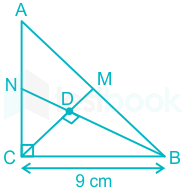
In ∆ ABC, ∠C = 90°, M and N are the mid points of sides AB and AC, respectively. CM and BN intersect at a right angle at D. If BC = 9 cm, then what is the length (in cm) of BN?

  1. ((a))

    962{9\sqrt6 \over 2}

  2. ((b))

    326{3 \over 2} \sqrt6

  3. ((c))

    939 \sqrt3

  4. ((d))

    363 \sqrt6

Show Answer
Answer: ((a))

962{9\sqrt6 \over 2}

Given:

In ∆ ABC, ∠C = 90°

M and N are the mid points of sides AB and AC, respectively.

CM and BN intersect at a right angle at D.

BC = 9 cm.

CONCEPT :

  1. As we know, the intersection point of the medians are called the centroid and the centroid cuts the median in the ratio 2 : 1.

  2. B.P.T Theorem  (If a line joins mid point of two lines then that line is parallel and half of the third side )

  3. Similarity A.A  (If two angles of a triangle are equal to two angles of another triangle then these two triangles are similar to each other)

Calculation:

According to question,

BD : DN = 2x : x  (By concept 1)

Now Δ CDB ∼ Δ NCB (by concept 3)

⇒ BN/BC = BC/DB

⇒ 3x/9 = 9/2x

⇒ 6x2 = 81

⇒ x = √81/√6 

⇒ x = 9/√6

Now,

BN = 3x (BN = BD + DN)

⇒ BN = 3 × (9/√6)

⇒ BN = 9√6/2

The length (in cm) of BN is 9√6/2

Alternate MethodGiven:

In ∆ ABC, ∠C = 90°

M and N are the mid points of sides AB and AC, respectively.

CM and BN intersect at a right angle at D.

BC = 9 cm,

Formula used:

As we know, the intersection point of the medians are called the centroid and the centroid cuts the median in the ratio 2 : 1.

As we know, the circumcenter lies on the mid-point of the hypotenuse of the right angel triangle.

Calculation:

According to the question, the required figure is:

As we know, the intersection point of the medians are called the centroid and the centroid cuts the median in the ratio 2 : 1.

Since CM and BN are median,

Therefore, 

CM : DM = 3x : x

BN : DN = 3x : x

As we know, the circumcenter lies on the mid-point of the hypotenuse of the right angel triangle.

Therefore, 

⇒ CM = AM = BM = 3x

So, 

⇒ AB = 6x

Let AC be 2a.

Since N is the mid-point on the line AC.

⇒ AN = CN = a

In Δ  ABC,

AB2 = AC2 + BC2  

⇒ 36x2 = 4z2 + 81    ----(1)

In Δ CDB,

BC2 = CD2 + BD2  

⇒ 81 = 4x2 + 4y2 

⇒ 4x2 + 4y2 = 81    ----(2)

In Δ CNB,

BN2 = CN2 + BC2  

⇒ 9y2 = z2 + 81     ----(3)

On equating the equation (1) and (3), 

⇒ 36x2 - 36y2 = -243    ----(4)

On equating the equation (2) and (4), 

y = 272√ \frac{27}{2} 

BN = 3y = 3 × 272√ \frac {27}{2} = 962\frac{9 √{6}}{2}

∴ '962\frac{9√{6}}{2}'  is the required answer.

47

The average of 26 numbers is 54.5. The average of the first 15 numbers is 50.4 and that of the last 12 numbers is 62.5. If the 15th number from the beginning is excluded, then what is the average of the remaining numbers?

  1. ((a))

    52.42

  2. ((b))

    53.12

  3. ((c))

    54.8

  4. ((d))

    54.2

Show Answer
Answer: ((b))

53.12

Given:

The average of 26 numbers = 54.5

Formula used:

Average = Sum of all the terms/Total number of terms

Calculation:

Let the average of the remaining number be X

According to the question

The sum of all 26 numbers = 54.5 × 26 = 1417

The sum of all 15 and 12 numbers = (15 × 50.4)  + (12 × 62.5) = 756 + 750 = 1506

The 15th number = 1506 - 1417 = 89

When excluded the 15th number = 1417 - 89 = 1328

The average of the remaining numbers = 132825 = 53.12{1328\over 25}\ =\ 53.12

∴ The required result will be 53.12.

48

A shopkeeper sells toys, each for Rs. 264, after giving a discount of 12%  on the market price. Had he not given any discount, he would have earned a profit of 20%, If the cost price of a toy is decreased by 20%, and he still wants to earn the same percentage of the profit as before, he should sell it for: 

  1. ((a))

    Rs. 240

  2. ((b))

    Rs. 255

  3. ((c))

    Rs. 235

  4. ((d))

    Rs. 250

Show Answer
Answer: ((a))

Rs. 240

Shortcut Trick

Market Price (MP) = 264 ÷ 0.88 = 300

Since 20% profit is earned at MP, CP = 300 ÷ 1.2 = 250

New CP = 80% of 250 = 200

New SP = 120% of 200 = 240

∴ The correct answer is Rs. 240.

Alternate Method

Given: Selling Price (SP1) = Rs. 264, Discount = 12%, Profit (at MP) = 20%

Formula: MP = SP × 100 ÷ (100 − D), CP = MP × 100 ÷ (100 + P)

⇒ Market Price (MP) = 264 × (100 ÷ 88) = 264 ÷ 0.88 = Rs. 300

⇒ Given: If no discount, Profit = 20% ⇒ MP = 120% of CP

⇒ Original Cost Price (CP) = 300 × (100 ÷ 120) = 300 ÷ 1.2 = Rs. 250

⇒ New Cost Price = 250 − 20% of 250 = 250 − 50 = Rs. 200

⇒ New Selling Price (at 20% profit) = 200 × 1.2 = Rs. 240

∴ The correct answer is Rs. 240.

Additional Information

Relation between MP and CP

The direct ratio is MP ÷ CP = (100 + Profit%) ÷ (100 − Discount%).

Profit Percentage Formula

Profit % = [(SP − CP) ÷ CP] × 100. It is always calculated on the Cost Price unless specified.

Discount Calculation

Discount = MP − SP. Discount % is always calculated on the Market Price (MP).

49

The value of 5 - 10 ÷ 10 of 5 - (12 - 15) × 4 ÷ 10 + 15 ÷ 30 × 2 is: 

  1. ((a))

    8

  2. ((b))

    1151 {1 \over 5}

  3. ((c))

    7

  4. ((d))

    4

Show Answer
Answer: ((c))

7

Given:

The expression = 5 - 10 ÷ 10 of 5 - (12 - 15) × 4 ÷ 10 + 15 ÷ 30 × 2

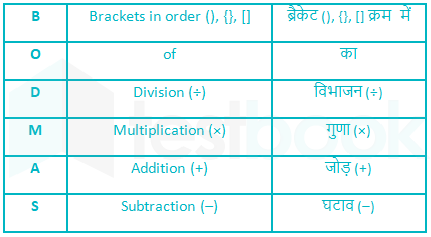
Concept -

Calculation:

⇒ 5 - 10 ÷ 10 of 5 - (12 - 15) × 4 ÷ 10 + 15 ÷ 30 × 2

⇒ 5 - 10 ÷ 50 - (-3) × 4 ÷ 10 + 15 ÷ 30 × 2

⇒ 5 - 15{1\over 5} + 3 × 0.4 + 0.5 × 2

⇒ 5 - 15{1\over 5} + 1.2 + 1

⇒ 5 - 15{1\over 5} + 2.2

⇒ 25  1 + 115 = 355 = 7{25\ -\ 1\ +\ 11\over 5}\ =\ {35\over 5}\ =\ 7

∴ The required result will be 7.7.

50

Pipes A and B can fill a tank in 9 hours and 15 hours, respectively. Both pipes were opened at the same time. After some time, it was found that there was a leak at the bottom of the tank which was capable of emptying the fully filled tank in 221222 {1 \over 2} hours. It was then repaired. If the tank got filled in a total time of 6 hours, then after how much time was the leakage repaired?

  1. ((a))

    2142 {1 \over 4} hours

  2. ((b))

    1141 {1 \over 4}  hours

  3. ((c))

    1121 {1\over2}  hours

  4. ((d))

    2 hours

Show Answer
Answer: ((c))

1121 {1\over2}  hours

Given:

Pipe A can fill the tank = 9 hours

Pipe B can fill the tank = 15 hours

Formula used:

W = E × T     Where, W = Work, E = Efficiency, and T = Time

Calculation:

Let the after T hours leakage be repaired

According to the question

One hours work of pipe A = 19{1\over 9}

One hours work of pipe B = 115{1\over 15}

One hour of work of leakage = 245{2\over 45}

The tank can be filled by A and B in one hour = 19 + 115 = 10 + 690 = 1690 = 845{1\over 9}\ +\ {1\over 15}\ =\ {10\ +\ 6\over 90}\ =\ {16\over 90}\ =\ {8\over 45}

Both A and B can fill the tank = 458 hours{45\over 8}\ hours

Tank filled with leakage = 6 hours

⇒ 69 + 615  2T45 = 1{6\over 9}\ +\ {6\over 15}\ -\ {2T\over 45}\ =\ 1

By solving the equation 

The time is taken to repair the leakage in the tank = T = 112 hours.{1{1\over 2}}\ hours.

∴ The required result will be 112 hours.{1{1\over 2}}\ hours.

Science (25 questions)

51

Which of the following statement is NOT true about colloids? 

  1. ((a))

    Colloidal particles can be separated from a mixture of centrifugation.

  2. ((b))

    Colloids show Tyndall effect.

  3. ((c))

    Colloidal particles cannot be seen with naked eyes. 

  4. ((d))

    Colloids are homogeneous mixtures.

Show Answer
Answer: ((d))

Colloids are homogeneous mixtures.

The correct answer is Colloids are homogeneous mixtures.

Key Points

Concept:

Colloidal solution/ colloid:

  • The type of solution in which the size of the solute particle is in the range of 1 to 100 nm, is called a colloid.
  • A colloid is a heterogeneous system in which one substance is dispersed (dispersed phase or colloidal particles) in another substance which is called a dispersion medium.

Explanation:

Properties of colloids:

  • A colloid appears to be homogeneous but actually, it is heterogeneous.
  • The particles of most of the colloids cannot be seen even with a microscope.
  • It scatters a beam of light passing through it (Tyndall effect).
  • The size of the solute particle is in the range of 1 to 100 nm.
  • Since they are heterogeneous in nature, centrifugation techniques can be used to separate the particles.

Additional Information

StatementTrue/ false
Colloidal particles can be separated from a mixture of centrifugation.True
Colloids show the Tyndall effect.True
Colloidal particles cannot be seen with naked eyesTrue
Colloids are homogeneous mixtures.False
52

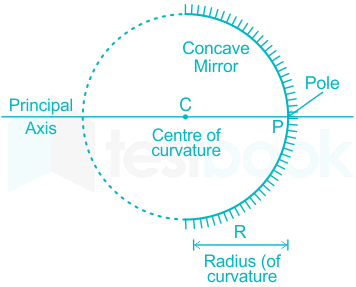
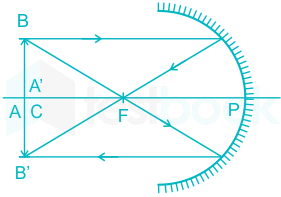
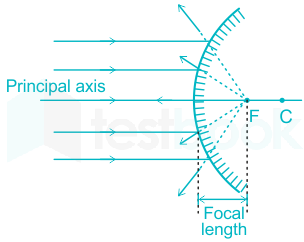
An object is placed at the centre of curvature of a concave mirror. The image found is: 

  1. ((a))

    real and diminished

  2. ((b))

    real and of same size

  3. ((c))

    real and enlarged

  4. ((d))

    virtual and highly enlarged

Show Answer
Answer: ((b))

real and of same size

The correct answer is real and of same size.

Concept:

Spherical mirror:

  • A spherical mirror is a mirror that has the shape of a piece cut out of a spherical surface.
  • There are two types of spherical mirrors: concave, and convex.

Explanation:

Concave mirror:

  • It is part of a whole spherical mirror that reflects light from the hollow part.
  • It is a converging mirror because it converges the incident rays at a point.

When the object is at C (Centre of curvature):

Characteristics of Image Formed:

  • Position of the image - At C
  • Nature of image - Real & Inverted
  • Size - Same as that of the object

Additional InformationConvex mirror: 

  • It is part of a whole spherical mirror that reflects light from the bulged-out part.
  • It diverges the incident rays.

53

When carbon dioxide gas is passed through an aqueous solution of calcium hydroxide, a white precipitate of calcium carbonates is formed, along with water. What inference can be drawn from this chemical reaction? 

  1. ((a))

    Metal carbonates are insoluble in water. 

  2. ((b))

    Non-metallic oxides are acidic in nature.

  3. ((c))

    It is a redox reaction.

  4. ((d))

    Aqueous calcium hydroxide is lime water. 

Show Answer
Answer: ((a))

Metal carbonates are insoluble in water. 

The correct answer is Metal carbonates are insoluble in water

Concept:

Double displacement reaction: 

  • It is a chemical reaction in which two compounds react and exchange their ions forming new products.
  • This reaction often results in the formation of an insoluble compound called a precipitate.

Explanation:

When carbon dioxide gas is passed through an aqueous solution of calcium hydroxide, the following chemical reaction takes place: 

CO2 + Ca(OH)→ CaCO3 ↓ + H2O

A white precipitate of calcium carbonates is formed, along with water.

This is an example of a double displacement reaction. 

The precipitate CaCO3 (metal carbonate) is insoluble in water.

54

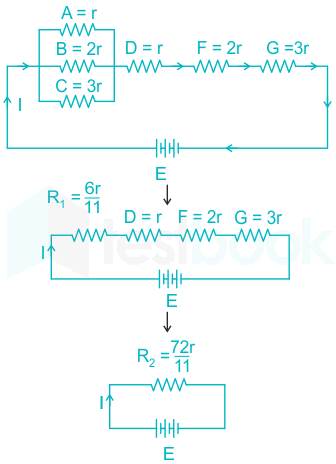
Three resistors A (resistance r), B (resistance 2r) and C (resistance 3r) are connected in parallel. This combination is connected in a series to three other resistors D (resistance r), F (resistance 2r) and G (resistance 3r) and a battery of EMF E (negligible internal resistance). Let PC and PG be the rate of energy dissipated in resistors C and G, respectively. Then the ratio (PC/PG) is:

  1. ((a))

    351{3\over51}

  2. ((b))

    231{2\over31}

  3. ((c))

    5311{5\over311}

  4. ((d))

    4121{4\over121}

Show Answer
Answer: ((d))

4121{4\over121}

Concept:

Resistance in series:

  • When resistors are connected end-to-end in a circuit, they are said to be in "series."
  • R = R1 + R2 + R3....
  • Current remains the same across all the resistors connected in series.

Resistance in parallel: 

  • When both ends of resistors are connected, they are said to be in parallel.
  • 1/R = 1/R1 + 1/R2 = 1/R3 ....
  • The potential difference across all the resistors connected in parallel remains the same.

Electric Power:

  • The energy consumed per unit of time or the rate of doing work is called power.
  • Power = work done / time taken = Vq / t = VI = V2/R = I2R

Calculation:


Resistors A (r Ω), B (2r Ω), and C (3r Ω) are connected in parallel.

Equivalent resistance, 1/R1 = 1/r + 1/2r +1/3r = 6+3+2/ 6r = 11/6 r 

R1= 6r/11

Now, the resistors R1, D, F, and G are in series.

R2 = 6r/11 + r + 2r + 3r = (6r + 11r + 22r + 33r) / 11 = 72r / 11

Equivalent current, I in the circuit = V/R2 = 11E72r\frac{11E}{72r}

Potential difference across C, V' = IR1 = 11E72r\frac{11E}{72r}  ×  6r11\frac{6r}{11} = E / 12

PG = I2G = (11E72r)2(\frac{11E}{72r})^2 × 3r = 121E2×3r72r×72r\frac{121E^2 × 3r}{72r ×72r}  = 121E2/ 72r × 24r  (since current remains same in series combination)

PC = V' 2/C =  (E12)23r\frac{(\frac{E}{12})^2}{3r}  =  E2/ 12 × 12 × 3r (since voltage remains same in parallel combination)

PC/ PE212×12×3r121E272r×24\frac{\frac{E^2}{12 × 12 × 3r}}{\frac{121 E^2}{72r × 24}} = E2×72r×2412×12×3r×121E2\frac{E^2 × 72r × 24}{12 × 12× 3r × 121 E^2} = 4/ 121

The ratio (PC/PG) = 4/121.

55

When comparing two animals, we can say they have analogous organs, if the organs ______. 

  1. ((a))

    perform different functions in both animals but are anatomically very similar

  2. ((b))

    perform the same function in both animals but are anatomically very different

  3. ((c))

    are present in both the animals

  4. ((d))

    perform the same function in both animals

Show Answer
Answer: ((b))

perform the same function in both animals but are anatomically very different

The correct answer is to perform the same function in both animals but is anatomically very different.

Concept:

**Evidence for evolution:**​

  • Fossils
  • Analogous and homologous organs
  • Embryological evidence

Anatomy: It refers to the internal structure of an organism. 

Explanation:

Homologous organs:

  • These organs are similar in origin and structure but perform different functions.
  • For example, the Forelimbs of frogs, lizards, bats, and humans have the same basic structural plan but different functions.
  • The wings help in flight whereas the human forearm helps in various activities.

Analogous organs:

  • These organs have similar functions but are different in structure and origin.
  • For instance, the wings of a bat and a bird are similar in function, but this similarity does not mean that these animals are more closely related.
  • The wings of a bat are just the folds of skin that are stretched between its fingers whereas the wings of birds are modified forearms covered in feathers.

Thus, we can say that analogous organs perform the same function in both animals but are anatomically very different.

56

Arrange the following in the sequence of how we are able to see. 

  1. Cornea
  2. Electrical signal
  3. Iris
  4. Photons
  5. Retina
  1. ((a))

    1 - 4 - 2 - 3 - 5

  2. ((b))

    1 - 3 - 5 - 4 - 2

  3. ((c))

    4 - 1 - 3 -2 - 5

  4. ((d))

    4 - 1 - 3 - 5 - 2

Show Answer
Answer: ((d))

4 - 1 - 3 - 5 - 2

The correct answer is 4 - 1 - 3 - 5 - 2.

Concept:

The Human eye: 

  • Humans have paired eyes that are located in sockets of the skull called orbits.
  • The eyes are one of the sense organs that give the sensation of sight.

Explanation:

Structure of the human eye:

  • The wall of the eyeball is composed of three layers- the outer sclera, middle choroid, and inner retina.
  • The anterior portion of the sclera is called the cornea. It is transparent.
  • The choroid becomes thick in the anterior part to form the ciliary body.
  • The ciliary body continues forward to form a pigmented and opaque structure called the iris which is the visible coloured portion of the eye.
  • A transparent crystalline lens is held in place by ligaments attached to the ciliary body behind the iris.
  • In front of the lens, the aperture surrounded by the iris is called the pupil.
  • The retina has two specialized cells- rods and cones that perceive colour and daylight vision.

The pathway of light rays (photons) entering our eye:

57

An object 1.0 cm in height, is placed at a distance of 25.0 cm in front of a concave mirror of focal length 20.0 cm, on its principal axis. Following New Cartesian Sign Convention, the image is formed at v = ______ and its height hI = ______.

  1. ((a))

    -100 cm; 4.0 cm

  2. ((b))

    100 cm; -4.0 cm

  3. ((c))

    100 cm; 4.0 cm

  4. ((d))

    -100 cm; -4.0 cm

Show Answer
Answer: ((d))

-100 cm; -4.0 cm

The correct answer is -100 cm; -4.0 cm.

Concept:

Mirror formula:1f=1v+1u\frac{1}{f} = \frac{1}{v} + \frac{1}{u}, where f = focal length, v = image distance and u = object distance.

Magnification: m = HiHo=vu\frac{Hi}{Ho} = \frac{-v}{u} , where Hi = height of image, Ho = height of object, v = image distance, and u = object distance.

Concave mirror: 

  • It is part of a whole spherical mirror that reflects light from the hollow part.
  • It is a converging mirror because it converges the incident rays at a point.

Explanation:

Given, u = -25 cm        f = -20 cm              h = 1 cm 

1f=1v+1u\frac{1}{f} = \frac{1}{v} + \frac{1}{u}

120=1v+125\frac{1}{-20} = \frac{1}{v} + \frac{1}{-25}

120=1v125\frac{1}{-20} = \frac{1}{v} - \frac{1}{25}

1v=120+125\frac{1}{v} = \frac{1}{-20} + \frac{1}{25}

1v=5+4100\frac{1}{v} = \frac{-5 + 4}{100}

1v=1100\frac{1}{v} = \frac{-1}{100}

v = -100 cm

m = HiHo=vu\frac{Hi}{Ho} = \frac{-v}{u} = Hi1=(100)25\frac{Hi}{1} = \frac{-(-100)}{-25} = Hi = - 4 cm

Following New Cartesian Sign Convention, the image is formed at v = -100 cm and its height hI = -4 cm.

58

If you are given a 10% (mass by mass) aqueous solution of sugar, what is the mass of sugar dissolved in 180 g of water? 

  1. ((a))

    18 g

  2. ((b))

    1.8 g

  3. ((c))

    10 g

  4. ((d))

    20 g

Show Answer
Answer: ((d))

20 g

The correct answer is 20g

Concept:

  • Solution: A solution has two components i.e., solute and solvent.
  • Solute: The substance that gets dissolved in the solvent.
  • Solvent: The substance in which solute is dissolved.

Mass by mass percentage of solution: (Mass of solute/mass of solute + mass of solvent ) × 100

Explanation:

Let the mass of sugar be x grams.  

Given: Percentage of sugar in water = 10 %

Mass of water = 180 g

Now, Mass percentage of sugar = (mass of sugar/mass of sugar + mass of water) × 100

⇒ 10 = [x / (x + 180)] × 100

⇒ (x + 180) = 10x

⇒ 9x = 180

⇒ x = 180/9 = 20 g 

Mass of sugar = x = 20g

59

The length of a cylindrical metal wire is increased by 10% with no change of volume. Its resistance will increase by: 

  1. ((a))

    11%

  2. ((b))

    21%

  3. ((c))

    20%

  4. ((d))

    10%

Show Answer
Answer: ((b))

21%

The correct answer is 21%.

Concept:

Resistance (R): 

  • Resistance is a measure of the opposition to current flow in an electrical circuit.
  • It is measured in ohms, symbolized by the Greek letter omega (Ω).
  • Ohms is named after George Simon Ohm (1784-1854), a German physicist who studied the relationship between voltage, current and resistance.
  • R=ρlAR = \frac{ρ l}{A} where ρ is resistivity, l is length, and A is the area of the cross-section of the wire.

Explanation: 

Suppose original length = L, Area of cross-section = A, radius of wire = r and Resistance = R

Since the wire is the same, the resistivity ρ will be the same.

After the decrease in length, let us take new length = L', radius of wire = r' and new resistance = R'

L' = 110 L/ 100 = 11 L/ 10( since there is 10% increase)

The volume of the wire remains the same ( given).

So, Volume of Original Wire = volume of new wire 

π r2 L = π r'2 L'

r2L = r'2 L'

r' 2 = r2 L /L'

r' 2 = 10r2L /11 L

r' 2 = 10 r2  / 11

Decrease in resistance = RRR×100\frac{R'-R}{R} × 100

(ρLAρLA)ρLA×100\rm \frac{\left(\frac{\rho L'}{A'}-\frac{\rho L{}}{A}\right)}{\frac{\rho L}{A}}\times100

(ρLπr2ρLπr2)ρLπr2×100\rm \frac{\left(\frac{\rho L'}{\pi r'^2}-\frac{\rho L{}}{\pi r^2}\right)}{\frac{\rho L}{\pi r^2}}\times100

ρLπr2ρLπr2ρLπr2×100\rm \frac{\frac{\rho L'}{\pi r'^2 }-\frac{\rho L}{\pi r^2}}{\frac{\rho L}{\pi r^2}}\times 100

11×11Lρ10×10πr2ρLπr2ρLπr2×100\rm \frac{\frac{11 \times 11 L \rho}{10 \times 10\pi r^2 }-\frac{\rho L}{\pi r^2}}{\frac{\rho L}{\pi r^2}}\times 100

121ρL100πr2ρLπr2ρLπr2×100\rm \frac{\frac{121 \rho L}{100\pi r^2 }-\frac{\rho L}{\pi r^2}}{\frac{\rho L}{\pi r^2}}\times 100

121ρL100ρL100πr2ρLπr2×100\rm \frac{\frac{121 \rho L-100 \rho L}{100\pi r^2 }}{\frac{\rho L}{\pi r^2}}\times 100

21ρL100πr2×100ρL×πr2=21%\rm \frac{21 \rho L}{100 \pi r^2}\times \frac{100}{\rho L}\times \pi r^2=21\%

The resistance increases by 21%.

60

Which of the following is a non-biodegradable item? 

  1. ((a))

    Paper

  2. ((b))

    A plastic bag

  3. ((c))

    Wood

  4. ((d))

    Peels of vegetables

Show Answer
Answer: ((b))

A plastic bag

The correct answer is a plastic bag.

Concept:

Waste materials: 

  • Waste materials are either liquid or solid in form, and their components may be either hazardous or inert in their effects on health and the environment.
  • The term waste is typically applied to solid waste, sewage (wastewater), hazardous waste, and electronic waste.

Explanation:

Biodegradable waste: 

  • Those substances that can be decomposed by the action of decomposers like bacteria and fungi are called biodegradable wastes.
  • For example organic matter like human excreta, animal waste, dead bodies of plants and animals, leftover food items, etc.

​Non-biodegradable waste:

  • Those substances that can not be decomposed by the action of decomposers like bacteria and fungi are called non-biodegradable wastes.
  • For example plastic, rubber, glass, artificial clothes like nylon, rayon, electronic waste like batteries, etc.
61

An element 'X' having atomic number 20 combines chemically with another element 'Y' having atomic number 8 to form a compound 'Z'. Which of the following statements are correct about the compound 'Z'?

(i) The formula of 'Z' is XY2

(ii) Melting point of 'Z' is very high. 

(iii) Molten form of 'Z' does not conduct electricity. 

(iv) 'Z' is soluble in water but insoluble in petrol.

  1. ((a))

    (i), (ii) and (iv) 

  2. ((b))

    (i), (ii) and (iii)

  3. ((c))

    (ii) and (iv) 

  4. ((d))

    (ii) and (iii)

Show Answer
Answer: ((c))

(ii) and (iv) 

The correct answer is statements (ii) and (iv).

Concept:

Atomic number: It is the number of electrons or protons found in an atom.

Electronic configuration:

  • The arrangement of electrons in different shells around the nucleus.
  • There are 7 shells K, L, M, N, and so on.
  • K shell can accommodate only 2 electrons while others can accommodate 8 electrons.

Ionic compounds: The compounds formed by the complete transfer of electrons from one element to another.

Explanation:

Element X

  • Atomic no. of X = 20 ( Calcium)
  • Electronic configuration = 2, 8, 8, 2.
  • Valency = +2, since it will lose 2 electrons

Element Y

  • Atomic no. of  Y = 8 (oxygen)
  • Electronic configuration = 2, 6.
  • Valency = -2, since it will gain 2 electrons

Compound Z

  • 2 electrons will be transferred from element X to element Y and an ionic bond is formed.

The formula for Z will be XY.

The compound will be Calcium oxide (CaO).

StatementTrue / false
The formula of 'Z' is XY2.False, because the formula for Z is XY.
The melting point of 'Z' is very high.True, because Z is an ionic compound and these bonds are very strong.
The molten form of 'Z' does not conduct electricity.False, because ionic compounds conduct electricity in their molten or aqueous state.
Z' is soluble in water but insoluble in petrol.True, because ionic compounds are soluble in polar solvents like water but insoluble in non-polar solvents like petrol

Therefore, statements (ii) and (iv) are correct.

62

A cylindrical wire AB consists of three equal parts AC, CD and DB, made of the same material but have different radii of cross-sections r, 2r and 3r, respectively. A battery is connected across the wire. Let V1, V2 and V3 be the potential differences across AC, CD and DB, respectively. Then:

  1. ((a))

    V1 ∶ V2 ∶ V3 = 36 ∶ 9 ∶ 4

  2. ((b))

    V1 ∶ V2 ∶ V3 = 1 ∶ 4 ∶ 9

  3. ((c))

    V1 = V2 = V3

  4. ((d))

    V1 ∶ V2 ∶ V3 = 1 ∶ 2 ∶ 3

Show Answer
Answer: ((a))

V1 ∶ V2 ∶ V3 = 36 ∶ 9 ∶ 4

The correct answer is V1 ∶ V2 ∶ V3 = 36 ∶ 9 ∶ 4.

Concept:

Ohm's Law:

  • It states that the potential difference between two points is directly proportional to the current passing through the conductor, provided the temperature remains the same.
  • V = IR, where V = potential difference between two points, I = current, R = Resistance.

Resistance:

  • The property of a substance to resist the flow of current through it.
  • R = ρ L / A, where ρ = resistivity, L = length of conductor, and A = area of cross section.

Explanation:

The current remains the same in series combination. 

Let the current flowing through the wire be I ampere. 

For Wire AC

Length = L, Radius = r, Area of cross- section = π r2

Resistance, R1 =  ρLπr2\frac{\rho L}{\pi r^2}

Voltage, V1 = I R1 = IρLπr2\frac{I\rho L}{\pi r^2}

For Wire CD

Length = L, Radius = 2r, Area of cross- section = 4π r2

Resistance, R1 =  ρL4πr2\frac{\rho L}{4\pi r^2}

Voltage, V1 = I R1 = IρL4πr2\frac{I\rho L}{4\pi r^2}

For Wire BD

Length = L, Radius = 3r, Area of cross- section = 9π r2

Resistance, R1 =  ρL9πr2\frac{\rho L}{9\pi r^2}

Voltage, V1 = I R1 = IρL9πr2\frac{I\rho L}{9\pi r^2}

The ratio V1: V2 : V3 = IρLπr2\frac{I\rho L}{\pi r^2} :  IρL4πr2\frac{I\rho L}{4\pi r^2}   :  IρL9πr2\frac{I\rho L}{9\pi r^2}  = 1 : 1/4 : 1/9 = 36 : 9 : 4. 

V1 ∶ V2 ∶ V3 = 36 ∶ 9 ∶ 4.

63

Study the given information. 

Consider the magnitude B and direction of magnetic field as a point along the axis due to a circular coil having n turns and carrying current I. 

(i) B ∝ n

(ii) B ∝ I

(iii) Directions can be found using right - hand thumb rule. 

Select the correct option.

  1. ((a))

    Both (i) and (iii) are correct

  2. ((b))

    Only (ii) is correct 

  3. ((c))

    Only (iii) is correct

  4. ((d))

    Both (ii) and (iii) are correct

Show Answer
Answer: ((d))

Both (ii) and (iii) are correct

The correct answer is Both (ii) and (iii) are correct.

Concept:

Magnetic field (B):

  • The area around a magnet where a magnetic force is experienced is called the magnetic field.
  • It is a quantity that has both direction and magnitude, (i.e., Vector quantity).

Explanation:

Magnetic field due to a current-carrying coil:

  • It is directly proportional to the current passing through the coil i.e., B ∝ I
  • It is directly proportional to the number of turns of the coil  i.e., B ∝ n
  • The direction of the magnetic field can be found with the help of the right-hand thumb rule.
StatementTrue/ false
B ∝ n2False
B ∝ ITrue
Directions can be found using right - hand thumb rule.True

Additional InformationRight-hand thumb rule: 

  • According to Maxwell's right-hand thumb rule if we tend to hold a straight current-carrying wire in our right hand such that our thumb represents the direction of the current then the curls of our fingers would represent the direction of the magnetic field lines.
64

The refractive index of water and kerosene are 1.33 and 1.44, respectively. A ray of light travels from water to kerosene. The refractive index of kerosene with respect to water is ____ and the light ray bends ____ the normal in kerosene. 

  1. ((a))

    1.08; towards 

  2. ((b))

    0.92; towards

  3. ((c))

    0.92; away from

  4. ((d))

    1.08; away from

Show Answer
Answer: ((a))

1.08; towards 

The correct answer is 1.08 : towards.

Concept:

Refraction of Light: 

  • The bending of the ray of light passing from one medium to the other medium is called refraction.

https://storage.googleapis.com/tb-img/production/20/05/F1_J.K_8.5.20_Pallavi_D3.png

Refractive Index (n):

  • n = sin i / sin r, where 'i' =  angle of incidence  and 'r' = angle of refraction.
  • Also n = c/v, where c = speed of light in vacuum, and v = speed of light in a medium.

Explanation:​

Relative refractive index:

  • It refers to the refractive index of one material medium with respect to another one.
  • n21=n2n1n_{21}= \frac{n_{2}}{n_{1}}

Refractive index of kerosene with respect to water:

  • n = refractive index of kerosene / refractive index of water = 1.441.33\frac{1.44}{1.33} = 1.08
  • Greater the refractive index, the denser the medium. Thus, kerosene (1.44) is denser than water (1.33).
  • When the ray of light moves from a denser to a rarer medium, the refracted ray moves away from the normal.
  • When the ray of light moves from a rarer to a denser medium, the refracted ray moves towards the normal.

The refractive index of kerosene with respect to water is 1.08 and the light ray bends toward the normal in kerosene.

65

PH of two solutions, labelled as 'I' and 'II', is 8.2 and 9, respectively. Which of the following statements is true about these solutions?

  1. ((a))

    'I' is more basic than 'II'

  2. ((b))

    'I' is acidic and 'II' is basic

  3. ((c))

    'II' is more acidic than 'I'

  4. ((d))

    'II' is more basic than 'I'

Show Answer
Answer: ((d))

'II' is more basic than 'I'

The correct answer is 'II' is more basic than 'I'.

Concept:

Acid:

  • It is sour in taste.
  • It turns the blue litmus color into red.
  • It has a pH value of less than 7.
  • It is represented by a value less than 7 on the pH scale.

Base:

  • It is bitter in taste and slippery to touch.
  • It turns the red litmus color into the blue.
  • It is represented by a value greater than 7 on the pH scale.

Explanation:

pH scale:

  • A scale developed to measure the concentration of hydrogen ions in a solution is known as the pH scale where p in pH implies ‘potenz’ in German.
  • pH scale ranges from 0 (highly acidic) to 14 (highly alkaline).
  • The pH of a neutral solution is 7.
  • The basic strength increases as we move from 7 to 14 on the pH scale.
  • Thus, 'II' (pH = 9) is more basic than 'I' (pH = 8.2).
66

To which category of reactions does the following chemical reaction belong? 

NaCl(aq) + AgNO3(aq) → NaNO3(aq) + AgCl(s)

  1. ((a))

    Double displacement reaction

  2. ((b))

    Redox reaction

  3. ((c))

    Displacement reaction

  4. ((d))

    Combination reaction

Show Answer
Answer: ((a))

Double displacement reaction

The correct answer is Double displacement reaction.

Concept:

Chemical reaction:

  • It is a process in which one or more substances, the reactants, are converted to one or more different substances, the products.
  • A chemical reaction rearranges the constituent atoms of the reactants to create different substances as products.

Explanation:

  • Double displacement reaction:
  • It is a chemical reaction in which two compounds react and exchange their ions forming new products.
  • This reaction often results in the formation of an insoluble compound called a precipitate.
  • Such reactions are represented by equations of the following form: A+B+ C+D- → A+D- + B-C+

​In the given chemical reaction: 

NaCl(aq) + AgNO3(aq) → NaNO3(aq) + AgCl(s)

The reactants NaCl and AgNOhave exchanged their ions to form NaNO3  and AgCl. 

Thus, it is an example of a double displacement reaction.

<sup>

Additional Information</sup>

Types of Chemical Reactions:

Combination reaction:

  • Two or more elements or compounds combine together to form a single compound.
  • Such reactions are represented by equations of the following form:     A + B → AB.

Decomposition reaction:

  • The opposite of a combination reaction, a complex molecule breaks down to make simpler ones.
  • Such reactions are represented by equations of the following form: AB → A + B.

Displacement reaction:

  • One element takes place with another element in the compound.
  • Such reactions are represented by equations of the following form: A + BC → AC + B.

Redox reaction:

  • It is a reaction in which one species is reduced and the other is oxidized.
  • Reduction means losing Oxygen or gaining hydrogen
  • Oxidation means gaining oxygen or losing hydrogen.
67

Male gametes of flowering plants are called ____. 

  1. ((a))

    sperms

  2. ((b))

    pollen

  3. ((c))

    spores

  4. ((d))

    anthers

Show Answer
Answer: ((b))

pollen

The correct answer is pollen.

Concept:

Flower: 

  • It is the reproductive part of a plant.
  • It has 4 whorls, namely sepals, petals, stamens, and pistil.

Explanation: 

Stamens: 

  • It is the male reproductive part of a plant.
  • It has two components, an anther, and a filament.
  • The filament is the long stalk on the end of which lies the anther.
  • The anther is a bilobed structure that carries microsporangia.
  • This microsporangium produces microspores or pollen grains.
  • Pollen grains are the male gametophytes each of which carries two male gametes.

Additional InformationPistil: 

  • It is the female reproductive part of the flower.
  • It consists of stigma, style, and ovary.
68

Two lenses L1 and L2 of powers, 4.0 D and 5.0 D respectively, separated by 80 cm, are arranged parallel to each other in vertical planes. An object is placed 50 cm, left to L1 vertically on the common axis of the lenses. The distance between the original object and the final image is:

  1. ((a))

    1.90 m

  2. ((b))

    2.10 m

  3. ((c))

    2.00 m

  4. ((d))

    1.80 m

Show Answer
Answer: ((a))

1.90 m

The correct answer is 1.90 m.

Concept:

Lens:

  • The transparent curved surface which is used to refract the light and make an image of any object placed in front of it is called a lens.
  • A convex lens can converge a beam of parallel rays to a point on the other side of the lens

Power of lens:

  • It is equal to the reciprocal of the focal length of the lens/mirror in meters.
  • Power (P) = 1/f, where f is the focal length of the lens/mirror.
  • P = 100f\frac{100}{f} where f is the focal length in centimeters.
  • The unit of power of a lens is Dioptre when the focal length of the lens is taken in meters (m).
  • The focal length of the concave lens is negative and hence its power is also negative.
  • The focal length of the convex lens is positive and hence its power is also positive.

Lens formula: 1f=1v1u\frac{1}{f}=\frac{1}{v}-\frac{1}{u}  where f is focal length, v is image distance and u is object distance.

Explanation:

For first convex lens, L1

Power = 1f\frac{1}{f}

f = 1p\frac{1}{p} = 1004\frac{100}{4} = 25 cm

Given: Object distance, u = -50 cm, Focal length, f = 25 cm

 v=?

1f=1v1u\frac{1}{f}=\frac{1}{v}-\frac{1}{u}

125=1v150\frac{1}{25} = \frac{1}{v} - \frac{1}{-50}

125=1v+150\frac{1}{25} = \frac{1}{v} + \frac{1}{50}

125150=1v\frac{1}{25} - \frac{1}{50} = \frac{1}{v}

1v=2150\frac{1}{v} = \frac{2-1}{50}

1v=150\frac{1}{v} = \frac{1}{50}

v = 50 cm

For second convex  lens, L2

f = 1p\frac{1}{p} = 1005\frac{100}{5} = 20 cm

Object distance, u = -80-(-50)= -80 + 50 = -30cm, focal length, f = 20cm

v = ?

1f=1v1u\frac{1}{f}=\frac{1}{v}-\frac{1}{u}

120=1v130\frac{1}{20} = \frac{1}{v} - \frac{1}{-30}

120=1v+130\frac{1}{20} = \frac{1}{v} + \frac{1}{30}


120130=1v\frac{1}{20} - \frac{1}{30} = \frac{1}{v}

1v=3260=160\frac{1}{v} = \frac{3-2}{60} = \frac{1}{60}

v= 60 cm 

Distance between original object and final image = 50 + 80 + 60 = 190 cm = 1.90 m.

69

Where can we find lymph in the human body?

  1. ((a))

    In intercellular spaces

  2. ((b))

    In the spinal cord

  3. ((c))

    In spaces in the bone marrow

  4. ((d))

    In tiny capillaries 

Show Answer
Answer: ((a))

In intercellular spaces

The correct answer is in intercellular spaces.

Concept:

Lymph:

  • It is a colourless fluid containing specialized cells called lymphocytes that provides immunity to the body.
  • It also carries hormones, and nutrients: and absorbs fats in lacteals present in the intestinal villi.

Explanation:

Lymphatic system:

  • When the exchange of materials takes place between capillaries and tissue, some water and small water-soluble substances move out into spaces between the cells of the tissue.
  • This fluid released into the intercellular spaces is called lymph/ interstitial tissue/ tissue fluid.
  • An elaborate network of vessels called the lymphatic system collects the lymph and drains it back to major veins.
70

The following is a sketch of ______. 

  1. ((a))

    a muscle cell

  2. ((b))

    a bacteria cell

  3. ((c))

    a plant cell

  4. ((d))

    a fat cell

Show Answer
Answer: ((d))

a fat cell

The correct answer is a fat cell.

Concept:

Cell:

  • It is the fundamental unit of life.
  • All organisms are made up of cells.

Explanation:

Structure of cell:

  • A cell has three components:
  • Cell membrane
  • Cytoplasm
  • Nucleus

Variety of cells:

  • Cells can be of different shapes and sizes.
  • There can be different types of cells in an organism.

Given below are some examples of cells found in the human body:

Additional InformationBacterial cell: it is a prokaryotic cell that lacks a well-developed nucleus and other cell organelles. 

Plant Cell: Eukaryotic cell with a cell wall made up of cellulose and chloroplasts containing chlorophyll pigment.

Muscle cell: The special type of cell made up of contractile proteins that provide the muscle the ability to contract and relax.

71

Blue-green algae are also called ______.

  1. ((a))

    cyanobacteria

  2. ((b))

    hetrocysts

  3. ((c))

    mycoplasma

  4. ((d))

    diatoms

Show Answer
Answer: ((a))

cyanobacteria

The correct answer is cyanobacteria.

Concept:

Bacteria: 

  • These are microscopic organisms and the sole members of Kingdom Monera.
  • They are unicellular prokaryotes.

Explanation:

Cyanobacteria:

  • They are also known as Blue-green alga.
  • They have a green pigment similar to chlorophyll a.
  • They are autotrophic in nature i.e., they can make their own food.
  • They are unicellular, colonial, or filamentous.
  • The colonies are generally surrounded by a gelatinous sheath.
  • They often form blooms in polluted water bodies
  • Some of these organisms can fix atmospheric nitrogen in specialized cells called heterocysts, e.g., Nostoc and Anabaena.

Additional InformationMycoplasma: These are the smallest bacteria known that can survive without oxygen and lacks a cell wall.

Diatoms: They are unicellular eukaryotes that belong to the kingdom Protista. They are the chief producers of the oceans.

72

As hot air and water vapour rise from the surface of the Earth to higher levels, the hot air _____.

  1. ((a))

    warms up the whole Earth

  2. ((b))

    helps to form the ozone layer

  3. ((c))

    expands and cools

  4. ((d))

    becomes fog due to condesation

Show Answer
Answer: ((c))

expands and cools

The correct answer is expands and cools.

Concept:

  • Temperature: It is the measure of the degree of coldness and hotness of a substance.
  • Heat: It is a form of energy transferred between two (or more) systems or a system and its surroundings by virtue of temperature difference.
  • Kinetic Energy: It is the energy possessed by an object due to its motion.

Explanation:

  • When air is heated, its temperature rises.
  • This heat energy is converted into kinetic energy and molecules of gases start to move far away from each other.
  • So, the volume of air increases or we can say it expands.
  • Now, this hot air being light in weight moves upwards along with the water vapours.
  • With the increase in height, the temperature starts to fall and the hot air slowly releases its heat energy into its surroundings.
  • Thus, on moving to the higher levels of earth, the hot air expands and cools.
73

You are given three elements 'X', 'Y' and 'Z'. Element 'Y' reacts with an aqueous solution of XSO4; and element 'X' reacts with an aqueous solution of ZSO4. What is the correct order of reactivity of 'X', 'Y' and 'Z'?

  1. ((a))

    Y > X > Z

  2. ((b))

    X > Y > Z

  3. ((c))

    Z > Y > X 

  4. ((d))

    X > Z >Y 

Show Answer
Answer: ((a))

Y > X > Z

The correct answer is Y > X > Z.

Concept:

Displacement reaction:

  • It is a  chemical reaction wherein a more reactive element displaces the less reactive one from its salt solution.
  • For example, CuSO4 + Fe → FeSO4 + Cu, here Fe is more reactive than Cu.

Explanation:

The reaction of element Y with XSO4 :

Y + XSO4 → YSO4

Y being more reactive than X displaces it from its aqueous solution.

The reaction of element X with ZSO4 :

X + ZSO4 → ZSO4

X being more reactive than Z displaces Z from its aqueous solution.

The correct order of reactivity of 'X', 'Y' and 'Z' is Y > X > Z.

74

How many helium atoms are present in 52u of helium? 

  1. ((a))

    13

  2. ((b))

    78.3 × 1023

  3. ((c))

    52

  4. ((d))

    6.02 × 1023

Show Answer
Answer: ((a))

13

The correct answer is 13

Concept:

Atomic Number: It is the number of protons or electrons present in the atom.

Mass number:

  • It is the number of protons and neutrons taken together of an atom.
  • It is measured in the atomic mass unit, amu or simply 'u'.

An element is represented in the following manner:

Explanation:

The atomic mass unit (u) is a standard unit of mass that quantifies mass on an atomic or molecular scale. One atomic mass unit is defined as a twelfth of the mass of a carbon-12 atom, which is approximately 1.66 x 10⁻²⁷ kg. 

Helium (He) has an atomic mass of approximately 4 u.

So, if we have 52 u of helium, we can calculate the number of atoms by dividing the total mass by the mass of one atom:

52 u ÷ 4 u/atom = 13 atoms

So, there are 13 helium atoms in 52 u of helium. So the correct option would be: 13

75

What converts oxygen into ozone in the upper atmosphere? 

  1. ((a))

    Ultraviolet radiation

  2. ((b))

    Isomerizing radiation

  3. ((c))

    Solar radiation

  4. ((d))

    Ionizing radiation

Show Answer
Answer: ((a))

Ultraviolet radiation

The correct answer is Ultraviolet radiation.

Concept:

Ozone layer:

  • It is a layer of ozone molecules found in the stratosphere (the second layer of the atmosphere).
  • Ozone is a molecule made up of three oxygen atoms, often referenced as O3.

Explanation:

Formation of Ozone:

  • Ozone is formed naturally by chemical reactions involving solar ultraviolet radiation (sunlight) and oxygen molecules.
  • In the first step, solar ultraviolet radiation breaks apart one oxygen molecule (O2) to produce two oxygen atoms (O)
  • In the second step, each of these highly reactive atoms combines with an oxygen molecule to produce an ozone molecule (O3).
  • These reactions occur continually whenever solar ultraviolet radiation is present in the stratosphere.

Social Science (25 questions)

76

In context of political traditions of nineteenth century, which group of people rejected the prerogatives of great landlords and rich factory owners? 

  1. ((a))

    Conservatives 

  2. ((b))

    Radicals

  3. ((c))

    Liberals 

  4. ((d))

    Democrats

Show Answer
Answer: ((b))

Radicals

The correct answer is Radicals.

Key Points

  • In the Nineteenth(19th)-century, a Radical group of people rejected the prerogatives of great landlords and rich factory owners.
  • Features of Radicals
  • Radicals disliked the concentration of property in the hands of a few that's why he rejected the prerogatives of great landlords and rich factory owners.
  • He was also not against the existence of private property.
  • In the 19th century, the radical political tradition was developed in Great Britain and Ireland.
  • In India, Radical political tradition appears in the early 20th century.
  • Lala Lajpat Rai, Bal Gangadhar Tilak, and Bipin Chandra Pal were leading radical movements in India.

Additional Information

  • Features of Liberals
  • ​Opposed the uncontrolled power of dynastic rules.
  • Wanted an elected parliamentary government but not in favor of voting rights to women.
  • Not support the voting rights for everyone.
  • Features of Conservatives 
  • ​Believed that the past had to be respected.
  • They support the establishment of traditional institutions of state and policy.
  • They are totally against radicals and liberals.
  • They believed in a monarchy, social hierarchies.
  • Features of Democrats
  • ​Respect for basic human rights
  • A multi-party political system paired with political tolerance
  • A democratic voting system, Democratic governance, and Citizen participation
  • Respect for the rule of law
  • Democratic governance, and Citizen participation
77

According to the poverty estimates in India, in year 2011-12 approximately ____ of the Indian population was below poverty line, as estimated using Tendulkar Methodology. 

  1. ((a))

    35%

  2. ((b))

    41%

  3. ((c))

    22%

  4. ((d))

    14%

Show Answer
Answer: ((c))

22%

The correct answer is 22%.

Key Points

  • According to the poverty estimates in India, in year 2011-12 approximately 22% (21.9%) of the Indian population was below poverty line, as estimated using Tendulkar Methodology.
  • Tendulkar's Methodology for poverty estimation is based on Calorie Consumption.
  • ​It is based on the consumption of the items like cereal, pulses, milk, edible oil, non-vegetarian items, vegetables, fresh fruits, dry fruits, sugar, salt & spices, other food etc.
  • In this method, a basket of these goods is made and the monetary value of that goods is calculated taking into account inflation and areas like rural and urban.

Important Points

  • The percentage of the population living below the poverty line is:
  • In Rural India decreased to 25.7 % in 2011-12 (41.8 % in 2004-05)
  • In Urban India decreased to 13.7 % in 2011-12 (25.7 % in 2004-05)
  • Poverty Line: A minimum expenditure (or income) that is required to purchase a basket of goods and services necessary to satisfy basic human needs and this minimum expenditure is called the poverty line.
  • The families below this line are called Below Poverty Line (BPL) families
  • The families above this line are called Above Poverty Line (APL) families.
78

Under COPRA, the State Commission deals with disputes involving claims between ______ and ______. 

  1. ((a))

    Rs. 1 lakh to Rs. 50 lakh

  2. ((b))

    Rs. 50 lakh to Rs. 1 crore

  3. ((c))

    Rs. 10 lakh to Rs. 50 lakh

  4. ((d))

    Rs. 20 lakh to Rs. 1 crore

Show Answer
Answer: ((d))

Rs. 20 lakh to Rs. 1 crore

The correct answer is Rs. 20 lakh to Rs. 1 crore.

Key Points

  • Under COPRA, the State Commission deals with disputes involving claims between Rs. 20 lakh to Rs. 1 crore.
  • COPRA refers to the Consumer Protection Act.
  • State Commission is a type of consumer court which mainly deals with consumer-related disputes, conflicts, and complaints.
  • State Commission is also known as State Consumer Disputes Redressal Commission (SCDRC)
  • It is a state-level consumer court established by the state government.

Important Points

  • The Consumer Protection Act has been enacted to protect the interests of consumers in India.
  • Consumer Disputes Redressal Agencies under COPRA Act
  • National Consumer Disputes Redressal Commission (NCDRC):
  • It is an apex body of Consumer Courts at the national level
  • It is the highest judiciary of the consumer court.
  • It deals with disputes involving claims over Rs. 1 crore.
  • HQ - New Delhi
  • Established - 1988
  • The First President of NCDRC was Justice V. Balakrishna Eradi.
  • Headed by **- Justice R K Agrawal (**July 1, 2018 to May 4, 2023)
  • State Consumer Disputes Redressal Commission (SCDRC):
  • It has appellate jurisdiction over the District Forum.
  • It deals with disputes involving claims between Rs. 20 lakh to Rs. 1 crore.
  • District Consumer Disputes Redressal Forum (DCDRF):
  • It is a district and lower consumer court.
  • It deals with disputes involving claims below twenty(20) lakh.

Additional Information

  • The Consumer Protection Act,1986 (COPRA) was replaced by the Consumer Protection Act, 2019.
  • The Consumer Protection Act guarantees six Consumers Rights:
  1. Right to Safety
  2. Right to be informed
  3. Right to Choose
  4. Right to be heard
  5. Right to Redressal
  6. Right to Consumer Awareness
79

Identify the option that arranges the following events in the correct chronological order. 

I. Hitler reoccupied Rhineland. 

II. Germany invaded Poland. 

III. Hitler left League of Nations. 

IV. Hitler integrated Austria and Germany.

  1. ((a))

    III - II - I - IV

  2. ((b))

    III - I - IV - II

  3. ((c))

    II - I - IV - III

  4. ((d))

    I - II - III - IV

Show Answer
Answer: ((b))

III - I - IV - II

The correct answer is III - I - IV - II.

Key Points

  • Chronological order must be arranged in which they occur.
  • Hitler left the League of Nations - in 1933
  • Hitler reoccupied Rhineland - in 1936
  • Hitler integrated Austria and Germany - in 1938
  • Germany invaded Poland - in 1939​

Additional Information

  • World War II - The Rise of Hitler
  • ​Adolf Hitler was born on 20 April 1889 in a small Austrian town that bordered Germany.
  • In old German, Adolf means "noble wolf."
  • Hitler was a poor high school student. At the age of 16, Hitler dropped out went from job to job.
  • Served in WW I.
80

At which Congress session was Mahatama Gandhi able to convince other leaders to start a non-cooperation movement in alliance with Khilafat? 

  1. ((a))

    Calcutta session in September 1920

  2. ((b))

    Amritsar session in December 1919

  3. ((c))

    Nagpur session in December 1920

  4. ((d))

    Bombay session in September 1918

Show Answer
Answer: ((a))

Calcutta session in September 1920

The correct answer is Calcutta session in September 1920.

Key Points

  • At Calcutta's session of the Congress in September 1920. Gandhi Ji Convinced other leaders of the need to start a non-cooperation movement in support of Khilafat as well as for swaraj.
  • To defend the Khilafa's temporal powers, a khilafat committee was formed in Bombay in March 1919.
  • At that time young generation of Muslim leaders like the brothers Muhammad Ali and Shaukat Ali.

Additional Information

  • Non-Cooperation Movement was a significant phase of the Indian independence movement from British rule.
  • It was led by Mahatama Gandhi after the Jallianwala Bagh Massacre.
  • It aimed to resist British rule in India through nonviolent means.
81

According to the 'India State of Forest Report 2019', which two north-eastern states have NOT shown a decline in forest cover? 

  1. ((a))

    Assam and Arunachal Pradesh

  2. ((b))

    Assam and Tripura 

  3. ((c))

    Arunachal Pradesh and Meghalaya 

  4. ((d))

    Meghalaya and Nagaland 

Show Answer
Answer: ((b))

Assam and Tripura 

The correct answer is Assam and Tripura.

Key Points

  • According to the 'India State of Forest Report 2019', there has been a decrease of 765km (0.45%) of forest cover in the North East states region.
  • Only Assam and Tripura saw an increase.
  • All the states in the North East region show decline in forest cover except Assam and Tripura.

Additional Information

  • Indian State of Forest Report (ISRF) released by The Ministry for Environment, Forests and Climate Change.
  • ISRF is a biennial publication of the Forest Survey of India (FSI), an organization under the Ministry of Environment Forest and Climate Change.
  • ISRF assesses the forests and tree cover, bamboo resources, carbon stock, and forest fires.
82

Which of the following statements is/are correct regarding equal right to vote? 

Statements:

I. Until 2016, in Saudi Arabia women did not have the right to vote. 

II. In Fiji, the vote of an indigenous Fiji has more value than that of an Indian-Fijian.

  1. ((a))

    Neither I nor II

  2. ((b))

    I and II

  3. ((c))

    Only I

  4. ((d))

    Only II

Show Answer
Answer: ((d))

Only II

The correct answer is In Fiji, the vote of an indigenous Fiji has more value than that of an Indian-Fijian.

Key Points

  • Statement I is correct. Saudi Arabia granted women the right to vote and contest elections only in 2015. Before that, women did not have equal voting rights as men in the country's electoral system.
  • The electoral system of Fiji is such that the value of vote an Indigenous (native) Fiji has more value than that of an Indian-Fijian because following two military coups in 1987, the national constituencies were abolished under pressure from Fijian ethnic-nationalists.
  • Who opposed allowing non-indigenous electors to vote for an indigenous representative.
83

Which of the following pairs of committees of the Constituent Assembly and leaders is INCORRECT? 

  1. ((a))

    Drafting Committee - Dr. BR Ambedkar

  2. ((b))

    Provincial Constitution Committee - Sardar Vallabhbhai Patel

  3. ((c))

    Rules of Procedure Committee - GV Mavalankar

  4. ((d))

    States Committee - Jawaharlal Nehru 

Show Answer
Answer: ((c))

Rules of Procedure Committee - GV Mavalankar

The correct answer is Rules of Procedure Committee - GV Mavalankar.

Key Points

  • Dr. Rajendra Prasad was chairperson of 4 committees in the Constituent Assembly.
  • Committee on the Rules of Procedure.
  • Steering Committee.
  • Finance and Staff Committee.
  • Ad-hoc committee on the National Flag.
  • ​Dr. Rajendra Prasad was President of the Constituent Assembly.
  • G V Mavalankar is popularly known as Dadasaheb, Chairperson of the committee on the function of Constituent Assembly. 
  • The President of the Central legislative assembly from 1946 to 1947, then speaker of the Constituent Assembly of India.
  • Later the first speaker of the Lok Sabha.

Additional Information

  • Dr. BR Ambedkar was Chairman, with other members of the Drafting Committee. He was the former Law Minister of India.
  • Sardar Vallabhbhai Patel was the Chairman of the Provincial Constitution Committee. He was the first Home Minister of India.
  • Jawaharlal Nehru was the Chairman of the Union Constitution Committee. He was the first Prime Minister of India.
84

Which of the following schemes of Government of India targets the 'indigent senior citizens' group? 

  1. ((a))

    Antyodaya Anna Yojana

  2. ((b))

    Vrindhahaar Yojana 

  3. ((c))

    Annapurna Scheme 

  4. ((d))

    Pradhan Mantri Garib Kalyan Anna Yojana

Show Answer
Answer: ((c))

Annapurna Scheme 

The correct answer is Annapurna Scheme.

Key Points

 Annapurna Scheme:

  • The Annapurna Scheme was launched on 1st April 2000.
  • This scheme aims at providing food security to meet the requirement of those senior citizens who, though eligible, have remained uncovered under the National Old Age Pension Scheme(NOAPS).
  • The Central assistance under the Annapurna Scheme is provided to the beneficiaries on fulfilling the following criteria :​
  • The age of the applicant should be 65 years or above.
  • The applicant must be destitute in the sense of having little or no regular means of substance from his/her own source of income or through financial support from family members or other sources
  • The applicant should not be in receipt of a pension under the NOAPS or State Pension Scheme.
  • The beneficiaries are given 10 Kg of foodgrains per month free of cost.

Additional Information

  • Antyodaya Anna Yojana
  • Antyodaya Anna Yojana is the sponsored scheme of the Government of India to provide highly subsidised food to millions of the poorest families.
  • This scheme was developed by the then Union Food and Civil Supplies Minister, N Sri Vishnu.
  • It was launched by the NDA government on 25 December 2000 and was first implemented in the Indian state of Rajasthan.
  • Pradhan Mantri Garib Kalyan Anna Yojana (PMGKAY)
  • Pradhan Mantri Garib Kalyan Anna Yojana is a food security welfare scheme announced by the Government of India on March 26 2020, during the COVID-19 pandemic in India.
  • The scheme aims to feed the poorest citizens of India by providing grain through the Public Distribution System, to all the priority households (ration card holders and those identified by the Antyodaya Anna Yojana scheme).
  • PMGKAY provides 5 kg of rice or wheat per person and 1 kg of dal to each family holding a ration card.
  • The scale of this welfare scheme makes it the largest food security program in the world.
85

Which of the following statements is/are true about innovations in printing technology? 

Statements: 

I. It was Richard Hoe of New York who mastered the power-driven cylindrical press. 

II. This press was capable of printing 15,000 sheets per hour. 

III. It was also helpful in printing all media except newspapers.

  1. ((a))

    I, II and III

  2. ((b))

    Only II 

  3. ((c))

    I and II

  4. ((d))

    Only I

Show Answer
Answer: ((d))

Only I

The correct answer is Option 4.

Key Points

  • By the mid-19th century, Richard M. Hoe of New York had perfected a power-driven cylinder press in which a large central cylinder carrying the type successively printed on the paper of four impression cylinders.
  • This press was capable of printing 8,000 sheets an hour.
  • The press was useful for printing newspapers.
86

Which of the following Schedules of the Constitution of India is related to defection? 

  1. ((a))

    Third Schedule

  2. ((b))

    Fifth Schedule 

  3. ((c))

    Seventh Schedule 

  4. ((d))

    Tenth Schedule

Show Answer
Answer: ((d))

Tenth Schedule

The correct answer is Tenth Schedule.

Key Points

  • Tenth Schedule
  • The Fifty-Second Amendment 1985,  inserted the Tenth Schedule in the  Constitution regarding provisions as to disqualification on the grounds of defection.
  • This law aims to prevent MPs from switching political parties.

Additional Information

  • Third Schedule
  • Forms of Oath and Affirmations of Members of Legislatures, Ministers and Judges.
  • Fifth Schedule
  • Administration and control of Scheduled Areas and Scheduled Tribes.
  • Seventh Schedule
  • Distribution of Power between the Union and the State Government  (Union List, State List and Concurrent List).
87

On which date did the French National Assembly pass the legal order to abolish the feudal system of obligations and taxes? 

  1. ((a))

    4 August 1789

  2. ((b))

    26 August 1789

  3. ((c))

    14 July 1789

  4. ((d))

    5 May 1789

Show Answer
Answer: ((a))

4 August 1789

The correct answer is 4 August 1789.

Key Points

  • One of the central events of the French Revolution was to abolish feudalism
  • It abolished the old rules, taxes and privileges left over from the age of feudalism.
  • The National Constituent Assembly, acting on the night of 4 August 1789, announced, "The National Assembly abolishes the feudal system entirely".
  • It abolished special rights enjoyed by the Second Estate (the nobility) and the First Estate (the Catholic clergy).

Additional Information

  • French Revolution
  • The Revolution started on  5th May, 1789 during the rule of  Louis XVI.
  • The immediate cause of the revolution was the extravagant expenditure and inefficiency by  Louis XV and Louis XVI. Other causes were social inequality, heavy  taxation etc.
  • Montesquieu, Voltaire and Rousseau were the French writers and thinkers of the period.
  • Liberty, Equality and Fraternity was the slogan of the revolution.
88

Which of the following Articles of the Constitution of India deals with protection against arrest and detention in certain cases? 

  1. ((a))

    Article 20

  2. ((b))

    Article 32

  3. ((c))

    Article 22

  4. ((d))

    Article 29

Show Answer
Answer: ((c))

Article 22

The correct answer is Article 22.

Key Points

  • Article 22 - Protection against arrest and detention 
  • No person, who is arrested shall be detained in custody without being informed of the grounds for such arrest nor shall he be denied the right to consult, and to be defended by a legal practitioner of his choice.
  • Every person, who is arrested and detained in custody is to be produced before the nearest Magistrate within a period of 24 hours of arrest and such person cannot be  detained in custody beyond that period without the authority of a Magistrate.
  • Article 22 is not available to an enemy alien and a person arrested or detained under a law providing for preventive detention (detention of a person without trial).
  • The detention of a person cannot exceed three months under the Preventive Detention Law.

Additional Information

  • Article 20 - Protection in respect of  conviction for offences. 
  • It grants  protection against arbitrary and excessive  punishment to an accused person,  whether citizen or foreigner or legal  person like a company or a corporation.
  • Article 32 - Right to Constitutional Remedies
  • Dr BR Ambedkar called Article 32 as the  heart and soul of the Constitution.
  • The Supreme Court and High Courts can be approached for violation or enactment of fundamental rights through five kinds of writs:
  • Habeas corpus is related to personal liberty in cases of illegal detentions and wrongful arrests.
  • Mandamus directs public officials, governments, courts to perform a statutory duty
  • Quo Warranto directs to show by what warrant is a person holding public office
  • Prohibition directs judicial or quasi-judicial authorities to stop proceedings which it has no jurisdiction for.
  • Certiorari is issued for re-examination of an order given by judicial, quasi-judicial or administrative authorities.
  • When it comes to violation of fundamental rights, an individual can approach the High Court under Article 226 or the Supreme Court directly under Article 32.
  • Article 29 - Protection of interests of  minorities. 
  • It provides that any section of  the citizens residing in any part of India having a distinct language, script or culture of its own, shall have the right to conserve the same.
  • Further, no citizen shall be denied admission into any educational institution maintained by the state or receiving aid out of state funds on grounds only of religion, race, caste or language.
89

Which of the following statements related to local government in India is INCORRECT? 

  1. ((a))

    At least one-third of the total number of offices of chairpersons in the panchayats at each level shall be reserved for women.

  2. ((b))

    All the voters in Indian villages are the members of Gram Sabha.

  3. ((c))

    State Election Commission conducts the Panchayat elections. 

  4. ((d))

    Part IX 'The Panchayats' was added in the constitution of India through the 42nd Constitutional Amendment.

Show Answer
Answer: ((d))

Part IX 'The Panchayats' was added in the constitution of India through the 42nd Constitutional Amendment.

The correct answer is option 4.

Key Points

  • The third level of Governance apart from the Union & State governments is Local Governments.
  • This can be seen in Rural areas(Panchayats) & Urban areas(Municipalities).
  • Article 40 directs the government to organize village panchayats & self-governance.
  • The Panchayati system is a three-tier system:
  • District level (Zilla Parishad)
  • Block Level (Panchayat Samiti)
  • Village Level (Panchayat)
  • The Panchayat Raj system is introduced through 73rd Constitution Amendment, 1992.
  • This added Part IX (details of Panchayat system) & Schedule 11(functions of Panchayat)
  • Elections at all three levels are conducted by State Election Commission 243K
  • State Finance Commission at state level suggests the division of revenues 243I
  • Gram sabha at village level is the basic unit of the system with every voter as its member.
  • The head of Panchayat is directly elected but the heads at other levels are elected indirectly.
  • Reservation for SC, ST and Women(not less than 1/3rd) at all levels are provided.
  • Financial resources are provided from state government and it has power to levy tax.
90

The extremely severe cyclonic storm named 'Tauktae' which was in the news in May 2021 had a maximum sustained speed of ______. 

  1. ((a))

    250 - 260 km/h

  2. ((b))

    160-170 km/h

  3. ((c))

    120-150 km/h

  4. ((d))

    90-120 km/h

Show Answer
Answer: ((b))

160-170 km/h

The correct answer is 160-170 km/h.

Key Points

  • Cyclone Tauktae is an Extremely Severe Cyclonic Storm in Arabian Sea that affected the West coast of India
  • It made a landfall on the coast of Gujarat and caused heavy damage to the state.
  • During the cyclone  the speed of the winds were recorded in the range of 160-170 Km/h.

Additional Information

  • Maximum sustained speed refers to the speed of the wind that tells about the severity of a cyclonic storm.
  • Based on this speed the storms are classified as follows:
Super Cyclonic Storm>220 Km/h
Extremely Severe Cyclonic Storm166-220 Km/h
Very Severe Cyclonic Storm118-165 Km/h
Severe Cyclonic Storm89-117 Km/h
Cyclonic Storm63-88 Km/h
Deep Depression51-62 Km/h
Depression31-50 Km/h
91

Which of the following statement(s) is/are correct in the context of production of mineral in India? 

I. Maikal Hills and the plateau region of Bilaspur-Katni are major bauxite producing areas. 

II. The Koderma Gaya-Hazaribagh belt of Jharkhand is important for maganese. 

III. The Durg Bastar-Chandrapur belt is known for its iron ores.

  1. ((a))

    I and III

  2. ((b))

    I, II and III

  3. ((c))

    I and II 

  4. ((d))

    II and III

Show Answer
Answer: ((a))

I and III

The correct answer is option 1.

Key Points

  • Iron
  • Mayurbhanj, Gurmahisani (Odisha)
  • Singhbum (Jharkhand)
  • Bastar, Durg (Chattisgarh)
  • Ballari, Kudremukh (Karnataka)
  • Bauxite
  • ​Eastern Ghats of Odisha
  • Maikal, Bilaspur (Chattisgarh)
  • Kolhapur, Ratnagiri (Maharashtra)
  • Katni, Balaghat (Madhya Pradesh)
  • Manganese
  • ​Found in the belt from Nagpur(MH) to Balaghat(MP)
  • Keonjhar, Rayagada (Odisha)
  • Dharwar, Belgaum(Karnataka)
  • Nagpur, Bhandara(Maharashtra)
  • Balaghat, Chindwara(Madhya Pradesh)
  • Copper
  • ​Balaghat (Madhya Pradesh)
  • Kehtri-Singhbum belt (Rajasthan)
  • Singhbum (Jharkhand)
  • Mica
  • ​Koderma Gaya (Bihar)
  • Hazaribagh (Jharkhand)
  • Nellore (Andhra Pradesh)
92

Which of the given statements is/are true in the context of the Kitto-Hachchiko Movement? 

Statements: 

I. This was non-violent movement that was started in 1984. 

II. During this movement, people plucked the eucalyptus plants and planted saplings of trees that were useful to the people.

  1. ((a))

    I and II

  2. ((b))

    Neither I nor II

  3. ((c))

    Only II

  4. ((d))

    Only I

Show Answer
Answer: ((c))

Only II

The correct answer is option 3.

Key Points

  • Kitto-Hachchiko Movement is a non-violent movement in Karnataka that took place in 1987.
  • The government of Karnataka gave away a vast land for setting up a paper pulp industry for just a nominal lease.
  • The industry planted a large number of Eucalyptus plants in the area.
  • The people and farmers residing in the surrounding areas plucked away eucalyptus plants and planted other useful plants instead.

​Hence the statement I is wrong and the statement II is correct.

93

As of July 2021, which of the following public sector enterprises comes under the 'Maharatna List'? 

  1. ((a))

    Bharat Electronics Limited

  2. ((b))

    Mahanagar Telephone Nigam Limited 

  3. ((c))

    Coal India Limited 

  4. ((d))

    Hindustan Aeronautics Limited 

Show Answer
Answer: ((c))

Coal India Limited 

The correct answer is Coal India Limited. .

Key Points

  • Maharatna companies are PSUs with high performance.
  • There are various parameters like Profit, Turnover, International Presence, Stocklisting to be a Maharatna.
  • They enjoy a level of autonomy in investment decisions.
  • At present there are 10 PSUs in the list.
1National Thermal Power Corporation (NTPC)
2Oil and Natural Gas Corporation (ONGC)
3Steel Authority of India Limited (SAIL)
4Bharat Heavy Electricals Limited (BHEL)
5Indian Oil Corporation Limited (IOCL)
6Hindustan Petroleum Corporation Limited (HPCL)
7Coal India Limited (CIL)
8Gas Authority of India Limited (GAIL)
9Bharat Petroleum Corporation Limited (BPCL)
10Power Grid Corporation of India (POWERGRID)

Additional Information

  • Navaratna companies - 14
  • Miniratna (category I) - 63
  • Miniratna (category II) - 15
  • MTNL, HAL, BEL are Navaratna companies
94

Which of the following statements is/are correct about Giuseppe Garibaldi, prominent Italian freedom fighter? 

Statements: 

I. In 1860, he provided leadership to the Expedition of the Thousand to South Italy.

II. In 1854, he accompanied the army of volunteers to Rome to fight against Papal states.

  1. ((a))

    Both I and II

  2. ((b))

    Only II

  3. ((c))

    Neither I nor II

  4. ((d))

    Only I

Show Answer
Answer: ((d))

Only I

The correct answer is option 4.

Key Points

  • Giuseppe Garibaldi is a famous Italian freedom fighter.
  • He is known for his major contribution in the Italian Unification or Risorgimento.
  • In 1834, he joined the Young Italy movement started by Mazzini.
  • In 1860, he led the famous Expedition of the Thousand to South Italy  against the Bourbon Kingdom(kings of French origin) and the volunteers were called ‘Red shirts’. Hence statement 1 is correct.
  • In 1867, he led an army of volunteers against the Papal states (ruled by the Pope), which was the last obstacle in the unification of Italy. Hence statement 2 is not correct.

Additional Information

  • Risorgimento or the Unification of Italy is a political and social movement that resulted in consolidation of states in the Italian Peninsula.
  • It happened in the background of the defeat of Napoleon in the Battle of Waterloo and Congress of Vienna (1815).
  • Later incidents like the presence of foreign powers and Revolutions of 1848 influenced the feelings of nationalism and liberalism that led to Unification of Italy.
  • Giuseppe Garibaldi, Giuseppe Mazzini, Count Cavour and Victor Emmanuel II are the famous personalities who led the Unification of Italy.
95

Which of the following is NOT considered as a component of 'Terms of Credit'?

  1. ((a))

    Documentation requirement 

  2. ((b))

    Interest rate 

  3. ((c))

    Amount of loan

  4. ((d))

    Collateral

Show Answer
Answer: ((c))

Amount of loan

The correct answer is Amount of Loan.

Key Points

  • Terms of Credit refers to the conditions agreed upon between the borrower and the lender.
  • Every loan agreement includes the terms and conditions called Terms of Credit.

Additional Information

  • Terms of Credit include the following:
  • Interest rate : The rate of interest on the principal borrowed.
  • Collateral: The security required as a backup in case of default.
  • Documentation: It involves all documentation work regarding the payment capacity, assets and other details of the borrower.
  • Mode of Payment: Ways and Duration of loan repayment.
96

A situation which has the potential to cause damage is called: 

  1. ((a))

    threat

  2. ((b))

    risk

  3. ((c))

    vulnerability

  4. ((d))

    hazard

Show Answer
Answer: ((d))

hazard

The correct answer is Hazard.

Key Points

  • Hazard is a condition or event that has a potential to cause injury to life or damage to property or environment.
  • Ex: Floods, Earthquakes, Oil spills, Nuclear accidents etc.

Additional Information

  • Vulnerability
  • ​It  is the degree to which a community or environment gets affected to a Hazard.
  • It depends on the susceptibilty and recovering capability of the subject.
  • Ex: An Island nation is more prone to Tsunamis and if it is a developed area and has strong mechanisms to deal with, it is likely to recover at a faster rate.
  • Risk
  • It is the likelihood of happening something and the probable outcomes, if it happens.
  • Possibility(chance of occurrence) and probability(measuring the chance of occurrence) are two terms related to risk.
  • Ex: Rain is a possibility in monsoon season, amount of rain is the probability so as to predict the consequences like flood etc.
  • Threat
  • It is a general way of describing the danger whether the danger is realised or not.
  • Where as a hazard is a realised danger (which occurs when hazardous sources interact)
97

What is the minimum age requirement to be chosen as a member in Council of States?

  1. ((a))

    21 years

  2. ((b))

    35 years

  3. ((c))

    25 years

  4. ((d))

    30 years

Show Answer
Answer: ((d))

30 years

The correct answer is 30 years.

Key Points

  • The minimum age requirement to be chosen as a member in Council of States is 30 years.
  • ​The ‘Council of States’ is also known as Rajya Sabha.
  • Total number of seats in Council of states (Rajya Sabha) is 250 (present strength is 245).

Important Points

  • Article 84 of the Constitution explains the qualifications for membership of the Parliament.
  • Eligibility Criteria for Membership of Rajya Sabha:
  1. Person must be a citizen of India.
  2. Person must be not less than 30 years of age.
  3. Person must possess such other qualifications as may be prescribed in that behalf by or under any law made by Parliament.

Additional Information

  • Minimum age to be elected for various posts:
PostMinimum Age
President35
Governor35
Member of Rajya Sabha30
Member of Lok Sabha25
Member of Legislative Assembly (MLA)25
Member of Legislative council (MLC)30
98

The Indus Water Treaty, which was signed in the year ____, put regulations in place that specified that India could use ____ of water carried by the Indus river system.

  1. ((a))

    1960, 20%

  2. ((b))

    1955, 20%

  3. ((c))

    1960, 30%

  4. ((d))

    1955, 30%

Show Answer
Answer: ((a))

1960, 20%

The correct answer is 1960, 20%.

Key Points

  • The Indus Water Treaty, which was signed in the year 1960, put regulations in place that specified that India could use 20 % of water carried by the Indus river system.
  • According to this treaty, India used only 20% (33 Million Acre Feet) of water carried by the Indus river system, and rest 80 % (135 Million Acre Feet) used by Pakistan.

Important Points

  • Indus Water Treaty
  • ​signed between India and Pakistan in 1960 and this treaty was brokered by the World Bank.
  • This treaty was signed by India's PM Jawahar Lal Nehru and Pakistan’s President Md. Ayub Khan.
  • By this treaty, waters of the eastern rivers; Sutlej, Beas, and Ravi had been allocated to India, while the western rivers; Indus, Jhelum, and Chenab to Pakistan.
  • According to this treaty, India has the right to generate hydroelectricity through a run of river projects on the western rivers.
  • All the waters of the Eastern Rivers were allocated to India for unrestricted use while India is under obligation to let flow all the waters of the Western Rivers, except for the domestic, non-consumptive, and other uses permitted in the Treaty.

Additional Information

  • Mahakali Treaty
  • signed with Nepal in the year 1996.
  • For Integrated Development of the Mahakali River (known as river 'Sarda' in India), including Sarda Barrage, Tanakpur Barrage, and Pancheshwar Project.
  • Kosi Agreement, 1954 (amended in December 1966) 
  • signed with Nepal for the construction of Kosi Project.
  • Gandak Agreement, 1959 (amended in April 1964)
  • signed with Nepal for the construction of Gandak Project.
  • Ganges Waters sharing Treaty
  • signed with Bangladesh in the year 1996 for sharing of Ganga/Ganges waters at Farakka.
99

Consider the given statements which are the context of Indian nationalism in the 20th century. Which of the statements is/are correct?

Statements: 

I. For the first time the untouchables were organised by MC Rajah in 1929. 

II. Depressed Classes Association was formed by BR Ambedkar in 1930.

III. A separate electorate for Dalits became a point of disagreement between Gandhi and BR Ambedkar in Third Round Table Conference.

  1. ((a))

    Only III

  2. ((b))

    Only I 

  3. ((c))

    II and III

  4. ((d))

    Only II

Show Answer
Answer: ((d))

Only II

The correct answer is option 4 i.e. ​Only II.

Key Points

  • The depressed Classes Association was formed by BR Ambedkar in 1930. Hence statement 2 is correct.
  • He was the voice of the Depressed Classes on every platform.
  • He represented the Depressed Classes in the Round Table Conference.
  • He assured proper representation of the Depressed Classes in public services by earmarking a part of the education grant in the Poona Pact for their upliftment.
  • In 1936, Ambedkar founded the Independent Labor Party which later transformed into the All India Scheduled Castes Federation.

Additional Information

  • A separate electorate for Dalits became a point of disagreement between Gandhi and BR Ambedkar in the Second Round Table Conference not in the third round table conference. Hence, statement 3 is not correct.
  • Gandhi believed that separate electorates for Dalits would slow down the process of their integration into society.
  • M. C. Rajah formed the Depressed Classes Association in Nagpur and became its first elected President in 1926. Hence, statement 1 is not correct.
  • M.C. Rajah became its President and Dr. Ambedkar Vice-President.
  • All India's depressed classes association did not support Ambedkar's Separate electorate for depressed classes.
100

Which of the following statements is/are NOT true with reference to the measurement of earthquakes? 

Statements: 

I. The Mercalli scale measures the intensity of earthquakes on levels ranging from 1 to 9.

II. The Richter scale assigns a numerical value to quantify energy released during an earthquake.

III. The Moment magnitude scale is used to determine the size of an earthquake.

  1. ((a))

    II and III

  2. ((b))

    Only I 

  3. ((c))

    Only III 

  4. ((d))

    I and II

Show Answer
Answer: ((b))

Only I 

The correct answer is Only I.

Key Points

  • The Mercalli scale measures the intensity of earthquakes on levels ranging from 1 to 12. Hence, statement 1 is not correct.
  • Mercalli scale
  • It was developed by Italian seismologist Giusseppe Mercalli.
  • It measures the intensity of an earthquake.
  • This intensity scale shows the visual damage caused by the event.
  • The intensity scale ranges from **1-to 12.**​
  • It is a linear scale to measure an earthquake.

Additional Information

  • Richter scale
  • ​It was developed by Charles F. Ritcher.
  • It measures the magnitude relates to the energy released during the earthquake.
  • The magnitude is expressed in absolute numbers, 0-10.
  • It is a logarithmic scale i.e. a magnitude 5 earthquake is ten times as intense as a magnitude 4 earthquake. Hence, statement  2 is correct.
  • Moment magnitude scale
  • The moment magnitude scale is expressed as MW.
  • It works on a wide range of earthquake sizes and is applicable globally.
  • It is based on the total moment release of the earthquake.
  • It is also based on a logarithmic scale
  • It is capable of measuring M8 ('magnitude 8') and greater events accurately.
  • i.e The Moment magnitude scale is used to determine the size of an earthquake. Hence, statement 3 is correct.

Attempt this paper under real exam conditions

Timed interface, section switching, instant scoring, and question-by-question analytics — free.

Start Timed Attempt