Official Paper

ICAR Technician 2 March 2022 Shift 3 (Previous Year Paper)

100 questions · 90 minutes · with answers · free

General Knowledge (25 questions)

1

Which of the following months in 2021 was observed as the National Cyber Security Awareness Month?

  1. ((a))

    September

  2. ((b))

    November

  3. ((c))

    October

  4. ((d))

    December

Show Answer
Answer: ((c))

October

The correct answer is October.

Key Points

  • The month of October is globally marked as ‘National Cyber Security Awareness Month (NCSAM)’  with the aim of spreading awareness about cyber security.
  • The Ministry of Electronics and Information Technology (MeitY) in association with CERT-IN, NIC and C-DAC observes and organizes unique mass awareness activities.

Additional Information

  • Cyber security has been an important issue in the modern age of digital dependency.
  • It has a potential for misuse that can lead to substantial damage.
  • In these backgrounds, it became essential for securing and protecting data, networks, systems, and privacy from cybercriminals the importance of cyber security has grown.
2

Which of the following players has been selected for the Lifetime Achievement Award for 2021 by the Badminton World Federation Council?

  1. ((a))

    Prannoy Kumar

  2. ((b))

    Prakash Padukone

  3. ((c))

    Chirag Shetty

  4. ((d))

    B Sai Praneeth

Show Answer
Answer: ((b))

Prakash Padukone

The correct answer is Prakash Padukone.

Key Points

  • Prakash Padukone is a former Indian badminton player.
  • He is the first Indian to win the All England Open Badminton Championship.
  • He was world No. 1 in 1980.
  • He was honoured with the Arjuna Award(1972) & Padma Shri(1982).
  • He is the founder of Olympic Gold Quest, a not-for-profit organisation aiming to encourage the best talent in sports.

Additional Information

  • Prannoy Kumar
  • He is an Indian Badminton player from the state of Kerala.
  • He had a career-high rank of World No 8.
  • He won the Gold medal in the 2018 Commonwealth games in the mixed team category.
  • Chirag Shetty
  • He is an Indian badminton player.
  • He along with his partner Satwiksairaj is the first men’s double player to be in the top-10 rankings.
  • He won silver in the 2018 Commonwealth games in Mens’ doubles category.
  • B Sai Praneeth
  • He is an Indian Badminton player from Andhra Pradesh.
  • His best performance is a Bronze medal in the 2019 World Championships.
3

Tech NEEV@75 inaugurated by The Ministry of Science and Technology in November 2021 aims at setting up of 30 Science and Technology Hubs in India for ________ by the end of 2022.

  1. ((a))

    scheduled tribes

  2. ((b))

    economically weaker sections

  3. ((c))

    other backwards classes

  4. ((d))

    scheduled castes

Show Answer
Answer: ((a))

scheduled tribes

The correct answer is Schedule tribes.

Key Points

  • Dr Jitendra Singh inaugurated “Tech NEEV@75” as part of Azadi ka Amrit Mahotsav and interacted with successful start-ups including those from the tribal communities on the occasion of Janjatiya Gaurav Diwas.
  • Under this program, the Government will be setting up 30 Science Technology and Innovation (STI) Hubs in different parts of the country for Scheduled Tribes (STs) by the end of 2022
  • It helps in promoting scientific talent among tribal communities and their overall socio-economic development.

Additional Information

  • Tech NEEV/ नीव @ 75”  is a year-long celebration highlighting the impact of Science Technology Innovation (STI) in empowering communities for creating equitable inclusive economic growth.
  • Government has decided to celebrate 15th November i.e. the birth anniversary of Bhagwan Birsa Munda as “Janjatiya Gaurav Diwas”.
4

Production cost does NOT include ________.

  1. ((a))

    labour force

  2. ((b))

    goods and Services tax

  3. ((c))

    utility expenses

  4. ((d))

    raw material

Show Answer
Answer: ((b))

goods and Services tax

The correct answer is Goods and Services Tax.

Key Points

  • Production cost refers to the expenditure incurred in the process of production of a Good.
  • The major components of production cost are:
  • Direct materials cost of raw materials involved in the production.
  • Labour cost: wages paid to labour for the production.
  • Other manufacturing overheads: include many indirect costs like rent, depreciation, utility expenses
  • Goods & Services Tax is part of the taxation system by the government and has nothing to do with production.

Additional Information

  • The factors of production are:
  • Land refers to the expenses related to rent paid for the production
  • Labour refers to the expenses involving wages of the labour.
  • Capital refers to the expenses in the form of interest on the money
  • Entrepreneurship refers to the expenses in the form of payment to the management for taking the risk.
  • Utility Expenses
  • These are the expenditure incurred for using public utility services like Electricity, Water, Sewage, Telephone bills etc.
  • These are the services used by the producer and may not be directly related to the product but are necessary for the line of production.
5

According to Article 343 (1), the official language of the Union is Hindi in ________ script.

  1. ((a))

    Sarada

  2. ((b))

    Devanagari

  3. ((c))

    Kharosthi

  4. ((d))

    Siddham

Show Answer
Answer: ((b))

Devanagari

The correct answer is Devanagari.

Key Points

  • Article 343 (1) refers to Hindi as the official language of Government of India and the script used for it is Devanagari script.
  • Devanagari script is based on the ancient Brahmi script.
  • It uses 47 characters of which 14 are vowels and 33 are consonants.
  • Apart from Hindi there are other languages like Marathi, Nepali, Bhojpuri, Rajasthani, Brajbasha etc which use the Devanagari script.
  • It is mainly found in the Indian Subcontinent.

Additional Information

  • Sharada 
  • This script also belongs to the family of Brahmmi scripts.
  • It is used in north western parts of the Indian Subcontinent.
  • The major languages using the script were Kashmiri and Sanskrit.
  • It is written from left to right.
  • Kharosthi
  • This is an ancient script used by Saks, Yeuzhi and Kushans.
  • It can be found in the present day Afghanistan and northern Pakistan regions.
  • The languages using the script were Gandhari, Pali.
  • It is written from right to left.
  • Siddham
  • This is a medieval script derived from Gupta script.
  • It is the root for languages like Bengali, Odia, Assamese.
6

As per the Budget 2021-22, under National Infrastructure Pipeline, which sector has the maximum number of projects?

  1. ((a))

    Road

  2. ((b))

    Railways

  3. ((c))

    Energy

  4. ((d))

    Urban

Show Answer
Answer: ((c))

Energy

The correct answer is Energy.

Key Points

  • National Infrastructure Pipeline:
  • NIP is launched in August 2020, for the period of five years 2020-2025.
  • the National Infrastructure Pipeline (NIP) is a first-of-its-kind, whole-of-government exercise to provide world-class infrastructure across India,
  • It will improve the quality of life for all citizens.
  • It aims to showcase investment opportunities in India's infrastructure sector, improve project preparation and attract investments into India.
  • The NIP aims to capture key greenfield and brownfield projects for investments across all economic and social infrastructure sub-sectors on a best-effort basis
  • NIP is a collection of projects and programs totalling INR 102 lakh crore in infrastructure development over the next five years.
  • It follows the government's goal of making India a $5 trillion economy by 2024-25.
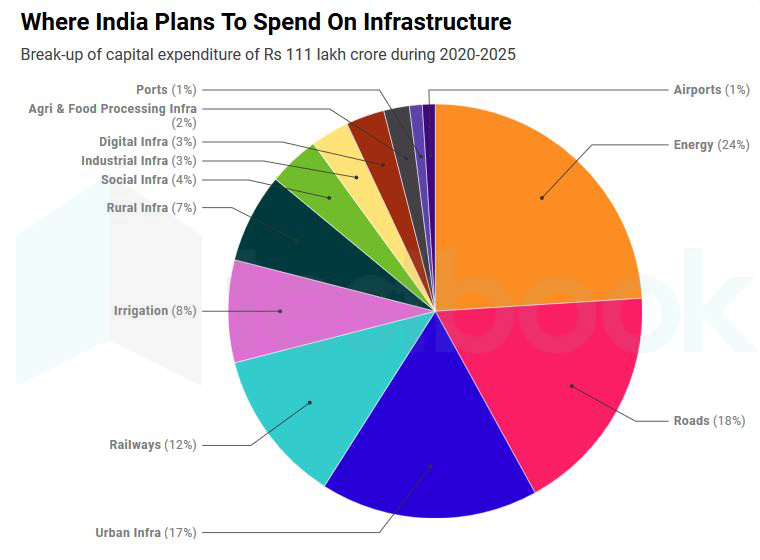
  • NIP covers economic and social infrastructure projects in sectors such as Energy (24%), Roads (19%), Urban (16%), and Railways (13%) that account for almost 70% of India's expected infrastructure capital spending.

7

Which of the following tribes is from Bangladesh?

  1. ((a))

    Lhotshampa

  2. ((b))

    Dhanka

  3. ((c))

    Brokpa

  4. ((d))

    Chakma

Show Answer
Answer: ((d))

Chakma

The correct answer is Chakma.

Key Points

  • Chakma tribe
  • The Chakma or Changma is the largest tribal community in Bangladesh.
  • The Chakmas also live in Tripura, Assam, Mizoram, Arunachal Pradesh, and Burma (Myanmar).
  • In Bangladesh, they are living mostly in the Chittagong Hilly Areas including Cox’s Bazar.
  • The origin of Chakma is from the Mongoloid people who are the people of Southwestern Burma.
  • They talk in their dialect (Arakanese – Indo-European tongue) as well as Bengali.
  • The tribal life, they are very rich in their culture and tradition.
  • The Chakma people are very innovative and adaptive than any other tribal people in Bangladesh.
  • The people of Chakma believe in the religion of Buddhism.
  • They live depending on agriculture.
  • They grow different types of crops following the eco-friendly method known as “Jhum cultivation.”
  • The women of this community wear homemade Pinon and Khadi.
  • The men generally wear the Dhuti.
  • They have their own script in their dialect language.
  • Even the ancient religious books are written in this language in palm

Additional Information

Important Tribes of the world

TribesCountry
AleutsAlaska
BedouinSahara and the Middle East
BushmanKalahari
ChukchiNE Asia, USSR
EskimosGreenland, Alaska, Canada
FulaniWest Africa
8

The brothers Ponniah, Chinnaiah, Sivanandam and Vadivelu are associated with which classical dance form of India?

  1. ((a))

    Kathakali

  2. ((b))

    Bharatanatyam

  3. ((c))

    Kuchipudi

  4. ((d))

    Odissi

Show Answer
Answer: ((b))

Bharatanatyam

The correct answer is Bharatanatyam.

Key Points

  • Bharatanatyam
  • Bharatanatyam is a dance form of Tamil Nadu in southern India.
  • It has grown out of the art of dancers dedicated to temples.
  • It was earlier known as Sadir or Dasi Attam.
  • It is the first of India's traditional dances to be refashioned by a theatre artist and to be exhibited widely both at home and abroad.
  • Bharatanatyam rests on principles of performance and aesthetics set down in classics such as Bharata's Natyashastra.
  • It has a rich repertoire of songs in Telugu, Tamil, and Sanskrit.
  • The present-day format of a Bharatanatyam recital, as well as a valuable part of its musical compositions, were created by the famed ‘Tanjore Quartet’ of the nineteenth-century brothers Ponniah, Chinnaiah, Sivanandam and Vadivelu.
  • Bharatanatyam has a highly evolved language of Nritta, abstract dance.
  • The themes have a wide range spanning human and divine love.
  • They are generally classed under the rubric of shringara (romantic love) and Bhakti (devotion).
  • The music of Bharatanatyam belongs to the Carnatic system of southern India.
  • The musicians accompanying a dance recital include at least one vocalist, a Mridangam (drum)-player, a flutist or violinist, or Veena (lute)-player.
  • The group also includes a Nattuvanar, or dance conductor, who recites the dance syllables as he plays a pair of small bronze cymbals.
9

According to social scientists, which of the following is NOT an indicator of poverty?

  1. ((a))

    More members in a nuclear family

  2. ((b))

    Illiteracy level

  3. ((c))

    Lack of access to safe drinking water

  4. ((d))

    Lack of job opportunities

Show Answer
Answer: ((a))

More members in a nuclear family

The correct answer is More members in a nuclear family.

Key Points

  • Social Indicators of Poverty
  • Illiteracy Level
  • Lack of general resistance due to malnutrition
  • Lack of access to healthcare
  • Lack of Opportunities
  • Lack of access to safe drinking water
  • Lack of access to safe sanitation facilities

Important Points

  • Poverty
  • Poverty is a state or condition in which a person or community lacks the financial resources and essentials for a minimum standard of living.
  • Poverty means that the income level from employment is so low that basic human needs can't be met.
  • According to World Bank 
  • Poverty is pronounced deprivation in well-being and comprises many dimensions.
  • It includes low incomes and the inability to acquire the basic goods and services necessary for survival with dignity.
  • Poverty also encompasses low levels of health and education, poor access to clean water and sanitation, inadequate physical security, lack of voice, and insufficient capacity and opportunity to better one's life.
  • In India, 21.9% of the population lives below the national poverty line in 2011.
  • Causes of Poverty
  1. Population Explosion
  2. Low Agriculture Productivity
  3. Inefficient resource utilization
  4. Low rate of Economic Development
  5. Price Rise
  6. Unemployment
  7. Social Factors
  8. Climatic Factors
10

What is a mirror whose reflecting surface is curved outwards known as?

  1. ((a))

    Rotating mirror

  2. ((b))

    Concave mirror

  3. ((c))

    Plane mirror

  4. ((d))

    Convex mirror

Show Answer
Answer: ((d))

Convex mirror

The correct answer is Convex Mirror.

Key Points

  • Convex Mirror
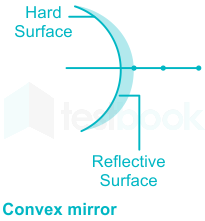
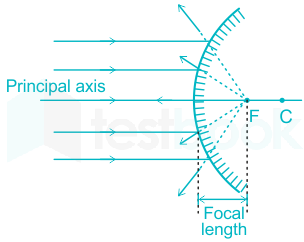
  • A Convex Mirror curves outward like the back of a spoon.
  • In a convex mirror, light originating from the same point will reflect off the mirror surface and diverge.
  • Hence convex mirror is sometimes referred to as a diverging mirror.
  • The type of image formed by these mirrors is always imaginary or virtual.
  • Uses of Convex Mirror
  1. It is used as a rearview mirror in the vehicle because it provides the maximum near field of view.
  2. In Sodium reflector lamp.

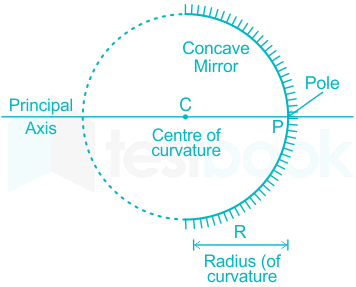
  • Concave Mirror
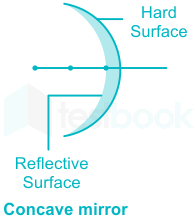
  • A Concave mirror is a mirror that has a slightly inward curve like the inside of a spoon.
  • The Curved surfaces focus parallel rays from a great distance into a single point for enhanced intensity.
  • Uses of Concave Mirror
  1. As a shaving glass
  2. As a reflector for headlights of vehicles, and searchlights.
  3. In Ophthalmoscope examines the eye, ear, and nose doctors.
  4. In Solar cookers.

Confusion Points

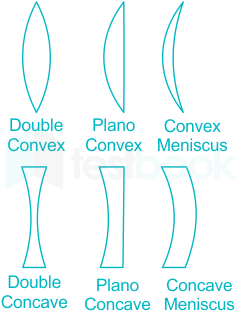
  • Do not confuse between Concave/Convex Lens and Mirror
  • Convex lens
  • The convex lens is also called a converging lens.
  • Concave lens
  • The concave lens is also called a diverging lens.

11

Which of the following is a marine biome?

  1. ((a))

    Pond

  2. ((b))

    River

  3. ((c))

    Estuary

  4. ((d))

    Lake

Show Answer
Answer: ((c))

Estuary

The correct answer is Estuary.

Key Points

  • Estuary:
  • An estuary is a coastal area where a river meets the ocean.
  • It is strongly affected by tidal actions and is very rich in nutrients and consequently very rich in biodiversity too.
  • The organisms here are highly tolerant and many species are endemic. The ecosystem is known to have high food productivity.
  • However, this ecosystem has to be protected from pollution.
  • Various types of marine ecosystems are:
  • Salt marshes
  • Mangrove forests
  • Coral reefs
  • The open ocean
  • The deep-sea ocean
12

Who among the following is the first Indian Squash player to win the Malaysian Open Championships 2021?

  1. ((a))

    Mahesh Mangaonkar

  2. ((b))

    Ramit Tandon

  3. ((c))

    Saurav Ghosal

  4. ((d))

    Ritwik Bhattacharya

Show Answer
Answer: ((c))

Saurav Ghosal

The correct answer is Saurav Ghosal.

Key Points

  • Saurav Ghosal is currently ranked 15th in the world (PSA Men's World Rankings).
  • Saurav has won 5 titles, besides one gold and one silver at the 2014 Asian Games and three bronze medals before that.
  • He is the first Indian Squash player to win the Malaysian Open Championships 2021.

Additional Information

  • Ritwik Bhattacharya, Ramit Tandon, Mahesh Mangaonkar and Joshna Chinappa are other sports players associated with squash.
13

Which of the following is/are referred to as court art of the Mauryan period?

  1. ((a))

    Sculptures

  2. ((b))

    Caves

  3. ((c))

    Pottery

  4. ((d))

    Pillars

Show Answer
Answer: ((d))

Pillars

The correct answer is Pillars.

Key Points 

  • Mauryan art was basically royal art.
  • The use of pillars, stupas, caves, sculptures and pottery was a typical example of Mauryan art.
  • It was divided into 2 parts:
  1. Court art: It flourished with royal initiative.
  • E.g: Pillars, Stupas.
  1. Popular art: It flourished with individual initiative.
  • E.g: Caves, Sculpture, Pottery.
14

On which of the following factors is the Human Development Index NOT based?

  1. ((a))

    Gross National Income index

  2. ((b))

    Net Domestic Product index

  3. ((c))

    Education index

  4. ((d))

    Life expectancy index

Show Answer
Answer: ((b))

Net Domestic Product index

The correct answer is Net Domestic Product index.

Key Points

  • The Human Development Index (HDI) is a statistic composite index of life expectancy, education (mean years of schooling completed and expected years of schooling upon entering the education system), and per capita income indicators, which are used to rank countries into four tiers of human development.
  • The Human Development Index (HDI) is measured on the basis of the Life Expectancy Index (Long and healthy life), Education Index (Knowledge), and Gross National Income index (Standard of Living).
  • The other indices that form the part of the Report are:
  1. Inequality-adjusted Human Development Index (IHDI),
  2. Gender Development Index (GDI),
  3. Gender Inequality Index (GII) and
  4. Multidimensional Poverty Index (MPI).
15

In which of the following years did the second Anglo-Bhutanese war end?

  1. ((a))

    1865

  2. ((b))

    1868

  3. ((c))

    1863

  4. ((d))

    1861

Show Answer
Answer: ((a))

1865

The correct answer is 1865.

Key Points

  • Second Anglo-Bhutanese War:
  • It was a war fought between British India and Bhutan from 1864 to1865.
  • It is also called the Duar War.
  • It was won by British India.
16

The Pradhan Mantri Vaya Vandana Yojana being implemented through Life Insurance Corporation of India is open for subscription up to _______.

  1. ((a))

    31 March 2024

  2. ((b))

    31 March 2023

  3. ((c))

    31 December 2022

  4. ((d))

    31 January 2023

Show Answer
Answer: ((b))

31 March 2023

The correct answer is 31 March 2023.

Key Points

  • The Pradhan Mantri Vaya Vandana Yojana being implemented through LIC (Life Insurance Corporation) of India is open for subscription up to 31 March 2023.
  • Pradhan Mantri Vaya Vandana Yojna is a pension scheme that is started by the Indian Government on 4 May 2017.
  • This pension scheme is for senior citizens age 60 years and above.
  • Assured return of 8% payable monthly for 10 years.
  • Exempted from Service Tax or GST.
  • Loan of up to 75% of purchase price allowed after 3 policy years.
  • Allows for premature exit for treatment of any critical/terminal illness of self or spouse.
17

What is the sticky substance in wet wheat flour which when combined with yeast helps the dough to rise?

  1. ((a))

    Gluten

  2. ((b))

    Secalin

  3. ((c))

    Avenins

  4. ((d))

    Hordein

Show Answer
Answer: ((a))

Gluten

The correct answer is Gluten.

Key Points

  • Gluten is the sticky substance in wet wheat flour which when combined with yeast helps the dough to rise.
  • Gluten is a protein composite found in wheat and related grains.
  • Gluten gives the elasticity to dough, helping it rise and keeps its shape, and often gives the final product and **chewy texture.**​

Additional Information

  • Secalin is a prolamin glycoprotein found in the grey rye, Secale cereal.
  • Secalin is one of the forms of gluten proteins.
  • Avenin, a prolamin like wheat gluten, is only minor.
  • The content of lipids in the floury oats.
  • Hordein is a prolamin glycoprotein, present in barley and some other cereals, together with gladin.
18

In which of the following years was the Indian Infrastructure Finance Company Limited established?

  1. ((a))

    2006

  2. ((b))

    2008

  3. ((c))

    2012

  4. ((d))

    2010

Show Answer
Answer: ((a))

2006

The correct answer is 2006.

Key Points

  • The Infrastructure Finance Company Limited (IIFCL) was established in 2006.
  • IIFCL is a wholly-owned Government of India company that was set up in 2006 to provide long-term financial assistance to viable infrastructure projects through the Scheme for Financing Viable Infrastructure Projects through a Special Purpose Vehicle called India Infrastructure Finance company Ltd.
  • IIFCL has been registered as an NBFC-ND-IFC with the Reserve Bank of India since September 2013 and follows the applicable prudential norms of the RBI.
  • This Company comes under the Government of India Ministry of Finance.
19

On the basis of recommendation of which committee was a Differently-abled Committee formed for differently-abled cricketers by the Board of Control for Cricket in India?

  1. ((a))

    Justice Chandrachud Committee

  2. ((b))

    Justice Reddy Committee

  3. ((c))

    Justice Lodha Committee

  4. ((d))

    Justice Rastogi Committee

Show Answer
Answer: ((c))

Justice Lodha Committee

The correct answer is Justice Lodha Committee.

Key Points

  • On the basis of the recommendation of Justice Lodha Committee was a Differently-abled Committee formed for differently-abled cricketers by the BCCI (Board of Control for Cricket in India).
  • A board of three former disabled cricketers was being awaited for the last several years.
  • On December 4, 2021, in Kolkata, the proposal was accepted to create a differently-abled committee approved in the BCCI's annual meeting.
  • The Differently Abled Cricket Council of India (DCCI) thanked the **BCCI for taking this step.**​

Additional Information

  • Justice Chandrachud Committee was related to Indian Match-fixing Investigation (1997).
  • Justice Reddy Committee regarding the Distance Education Programs being run in the country by various universities.
  • Justice Rastogi Committee regarding the Higher Education and it's role in our society.
20

Which of the following does moving particles possess?

  1. ((a))

    Kinetic energy

  2. ((b))

    Magnetic energy

  3. ((c))

    Electrical energy

  4. ((d))

    Potential energy

Show Answer
Answer: ((a))

Kinetic energy

The correct answer is Kinetic energy.

Key Points

  • The energy that moving particles possess is Kinetic energy.
  • Moving Water and Wind are good examples of Kinetic energy.
  • Kinetic energy includes electrical, radiant thermal, and **sound energy.**​

Additional Information

  • Magnetic Energy that energy is created by the strength of the magnetic field.
  • Electrical energy is that energy where's movement of electrically positive charged particles.
  • Potential energy is a kind of energy stored in objects.
21

The towns were planned in a _________ grid pattern during the Harappan civilisation.

  1. ((a))

    rectangular

  2. ((b))

    semi-circular

  3. ((c))

    circular

  4. ((d))

    pentagonal

Show Answer
Answer: ((a))

rectangular

The correct answer is rectangular.

Key Points

  • The towns were planned in a rectangular grid pattern during the Harappan civilisation.
  • Town planning was the unique feature of the Indus valley civilisation.
  • Harappan cities were planned with chessboard system or grid pattern.
  • A grid pattern is a network of intersecting parallel lines.
  • A grid pattern, means the streets intersect at right angles and form a pattern of squares when viewed from above.

Important Points

  • Common features of Harrapn civilisation Major cities are:
  • A town is divided into two parts: one smaller but higher i.e. Citadel and the other much larger but lower i.e Lower Town or walled.
  • They used baked bricks in construction, which was a unique feature around the world in that time period.
  • The main roads ranged from 9 feet to 30-34 feet wide and were divided into networks of narrow streets.
  • The drainage system was so advanced that first roads were laid with drains and then houses were built along with them.
22

Who among the following ruled Tamil Nadu in Medieval India?

  1. ((a))

    Cholas

  2. ((b))

    Palas

  3. ((c))

    Rashtrakutas

  4. ((d))

    Chalukyas

Show Answer
Answer: ((a))

Cholas

The correct answer is Cholas.

Key Points

  • Cholas ruled Tamil Nadu in Medieval India.
  • Cholas
  • The founder of the Cholas dynasty was Vijayalaya.
  • The Cholas conquered the Kaveri region by defeating the Pallavas in 850 AD (9th century).
  • Vijayalay captured Tanjore in 850 AD.
  • Vijayalaya built the town of Thanjavur and a temple for goddess Nishumbhasudini there.
  • Rajaraja I (985-1014 AD)
  • He built Vridheshwar/ Rajarajeshwar temple at Tanjore.
  • Rajendra I (1014-1044 AD)
  • ​He conquered Orissa, Bengal, and Sri Lanka.
  • He took the title of Gangaikondachola.
  • The last ruler of the Chola Dynasty was Rajendra III.
  • The Chola dynasty was known for its local Self-government.
  • Land revenue and trade tax were the main sources of income for the Chola dynasty.​

Additional Information

DynastyCapitalFounderImportant Facts
Palas(750-1150 AD)Munger (Muddagiri)Gopala- Dharmapala founded Vikramshila University and revived Nalanda University. - Dharmapala participated in the tripartite struggle for Kannauj. - Manipal was known as the second founder of the palas dynasty.
Rashtrakutas (752 -973 AD)Malkhed (Makhad)Dantidurg- Dhruva and Govinda III participated in the tripartite struggle for Kannauj. - The Ellora rock cave was built by Rashtrakuta Kings Krishan-I. - Amoghavarsha sacrificed his life by taking the water tomb in the Tungabhadra river.
Chalukyas(543-755 AD)Vatapi (Vadami)Jay Singh- Pulakeshin II defeated Harshavardhana and assumed the title of 'Parameshwar'. - Ahjole inscription belongs to Pulkeshin II and this inscription was written by his court poet Ravikriti. - The Aihole inscription belongs to Pulakeshin II and was written by his court poet Ravikirti.
23

Which of the following events took place in 1942?

  1. ((a))

    Rowlatt’s Act was passed

  2. ((b))

    Khilafat Movement was launched

  3. ((c))

    Quit India Movement was launched

  4. ((d))

    Simon Commission was boycotted

Show Answer
Answer: ((c))

Quit India Movement was launched

The correct answer is Quit India Movement was launched.

Key Points

  • The Quit India Movement took place on 8 August 1942 due to growing discontent over the proposal of Cripps.
  • Other reasons for the Quit India Movement were high price rise, British pushing India into war, fear of Japanese invasion of India.
  • Congress had passed a resolution on 'Quit India' movement at Gowalia Tank, Mumbai.
  • Most of the leaders were arrested on 9 August 1942 under Operation Zero Hour, which was launched by British.
  • In this movement, Gandhi Ji gave the slogan 'Do or Die'.
  • Yusuf Mehrli gave the slogan 'Quit India'. He was a companion of Mahatma Gandhi.
  • The parallel government was established in Ballia (UP), Tamulak (Bangal), Satara (Maharashtra), and Talchar (Orissa) during this movement.

Additional Information

  • Rowlatt’s Act 
  • ​It was passed in 1919.
  • Viceroy - Lord Chelmsford
  • Aim - To curb sedition activities in India.
  • This act authorized the British government to imprison any person without trial who was suspected of terrorist activity for a minimum period of two years.
  • In protest against this act, Gandhi started Rowlatt Satyagraha.
  • Khilafat Movement 
  • ​It was launched by Muslims of British India led by Mohammad Ali and Shaukat Ali.
  • The reason behind this movement was to protest the Caliphate (Caliph, Sultan of Turkey) and the restrictions imposed by the Treaty of Svres on the Ottoman Empire after World War I.
  • Aim - Restoration of the Khilafat.
  • Simon Commission
  • Appointed - Nov 1927 by the British Government.
  • Arrived in India - on 3 Feb 1928
  • ​No. of member- Seven (7)  British (white) Members of Parliament
  • No Indian representative in it. so it was known as White Commission.
  • Headed by - Lord Simon
  • purpose - Suggest to the British Government regarding Indian constitutional reforms.
  • Simon Go Back" slogan was coined by Yusuf Meherally.
24

​India successfully launched the Supersonic Missile Assisted Release of Torpedo System from the coast of which state in December 2021?

  1. ((a))

    Karnataka

  2. ((b))

    Andhra Pradesh

  3. ((c))

    Odisha

  4. ((d))

    Kerala

Show Answer
Answer: ((c))

Odisha

The correct answer is Odisha.

Key Points

  • India successfully launched the Supersonic Missile Assisted Release of Torpedo System from the coast of Odisha in December 2021.
  • It was successfully launched from Wheeler Island, at Balasore in Odisha.
  • The Supersonic Missile Assisted Torpedo (SMART) was developed by Defence Research and Development Organisation (DRDO) for the Indian Navy.
  • The system has been designed to enhance anti-submarine warfare capability.

Important Points

  • Stand-off Anti-tank (SANT) Missile 
  • It is an indigenous Stand-Off Anti-Tank Missile.
  • The flight test was done by (DRDO) and Indian Air Force (IAF) at the Pokhran range in Rajasthan.
  • It was launched from a Russian-origin Mi-35 helicopter gunship in December 2021.
  • It can neutralize targets at a range of up to 10 km.
  • It has been designed and developed by Research Center Imran, Hyderabad with DRDO.

Additional Information

  • DRDO (As of 2022)
  • Founded: 1958
  • Headquarters: New Delhi
  • Chairperson: Samir Kamat
25

In which of the following states is the localised thunderstorms associated with violent gust and heavy rain known as ‘Kaal Baisakhi’?

  1. ((a))

    West Bengal

  2. ((b))

    Odisha

  3. ((c))

    Meghalaya

  4. ((d))

    Andhra Pradesh

Show Answer
Answer: ((a))

West Bengal

The correct answer is West Bengal.

Key Points

  • In West Bengal is the localised thunderstorms associated with violent gust and heavy rain known as ‘Kaal Baisakhi’.
  • Kaal Baisakhi
  • It is a local rainfall and thunderstorm occur in Assam and West Bengal and in India or Bangladesh.
  • It occurs in the summer season.
  • It harms life and money and generally occurs in the month of Baisakh (April-May), hence it is known as 'Kaal Baisakhi'.
  • It originated from Chota Nagpur Plateau.
  • Since It is caused by winds coming from the north-west direction, they are also called 'norwesters'.

Additional Information

  • During the summer season, strong humid winds start blowing in many places in India, which are known by different names in different places of the country:
  • Norwesters in East India
  • Cherry Blossoms/Coffee Showers
  • It is the local humid wind of Karnataka that is helpful for the coffee plantation and flows in the hot weather season.
  • Mango- shower
  • It is pre-monsoon rainfall and occurs especially in parts of Kerala, Karnataka and Tamil Nadu.
  • It helps in the early ripening of mangoes and hence it is called 'Mango rain' or Mango-shower.

Mathematics (25 questions)

26

PT is a tangent at point C on a circle with centre O and AB is a diameter. When BA is produced, it meets PT at point P. If ∠BPC = 34°, then what is the measure of ∠ACP?

  1. ((a))

    26° 

  2. ((b))

    28°

  3. ((c))

    32°

  4. ((d))

    29°

Show Answer
Answer: ((b))

28°

Given: 

PT is a tangent at point C on a circle with centre O and AB is a diameter. BA is produced, it meets PT at point P.

∠BPC = 34°.

Concept used:

The angle subtended by diameter on any point on the circumference of a circle is 90°.

The angle between a tangent and a chord is equal to the angle in the alternate segment.

Calculation:

According to the question, the required figure is:

As we know,

The angle subtended by diameter on any point on the circumference of a circle is 90°.

So, 

∠ACB = 90°

Now, 

∠BCP = ∠BCA + ∠ACP

⇒ ∠BCP = 90° + θ

As per the alternate segment theorem.

∠PBC = ∠ACP = θ

In ΔPCB,

∠CPB + ∠BCP + ∠CBP = 180°

⇒ 34° + 90° + θ + θ = 180°

⇒  124° + 2θ = 180°

⇒ θ = 28°

Therefore,

∠ACP = θ = 28°

∴ 28° is the required answer.

27

A can complete a certain work in 35 days. B is 40% more efficient than A, and C is 25% more efficient than B. B and C work together for 8 days. The remaining work is completed by A with the help of D in 3123\frac{1}{2} days. D alone can complete 72% of the original work in:

  1. ((a))

    14 days

  2. ((b))

    15 days

  3. ((c))

    18 days

  4. ((d))

    12 days

Show Answer
Answer: ((a))

14 days

Given:

A can complete a certain work in 35 days.

B is 40% more efficient than A, and C is 25% more efficient than B.

B and C work together for 8 days.

The remaining work is completed by A with the help of D in 3123\frac{1}{2} days.

Formula used:

Work = Efficiency × Time

Calculation:

The time is taken by A to complete the work = 35 days

The efficiency of A = 135\frac{1}{35}

Now,

The efficiency of B = (100% + 40%) × 135\frac{1}{35} = 1.435\frac{1.4}{35}

The efficiency of C = (100% + 25%) × 1.435\frac{1.4}{35} = 1.7535\frac{1.75}{35}

The amount of work done by B and C in 8 days = (1.435+1.7535)×8(\frac{1.4}{35} + \frac{1.75}{35}) × 8 = 0.72

The remaining amount of work = 1 - 0.72 = 0.28

Let the time taken by D to complete the work = x days

The efficiency of D = 1x\frac{1}{x}

Since the remaining work is completed by A with the help of D in 3123\frac{1}{2} days,

Therefore,

⇒ (135+1x)×312=0.28(\frac{1}{35} + \frac{1}{x} ) × 3\frac{1}{2} = 0.28

⇒ (135+1x)(\frac{1}{35} + \frac{1}{x} ) × 3.5 = 0.28

⇒ (135+1x)(\frac{1}{35} + \frac{1}{x} ) = 225\frac{2}{25}

⇒ 1x\frac{1}{x} = 9175\frac{9}{175}

Now, 

The time is taken by D to complete 72% of the original work,

⇒ 9175\frac{9}{175} × t = 0.72

⇒ t = 14 days

∴ 14 days is the required answer.

28

The total surface area of a solid hemisphere is 1848 cm2. Its volume is equal to the volume of a right circular cone, whose height is 28 cm. What is the area (in cm2) of the base of the cone? (Take π=227\pi = \frac{{22}}{7})

  1. ((a))

    462

  2. ((b))

    539

  3. ((c))

    308

  4. ((d))

    616

Show Answer
Answer: ((d))

616

Given: 

The total surface area of a solid hemisphere is 1848 cm2.

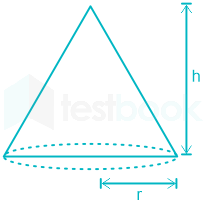
The volume of a solid hemisphere is equal to the volume of a right circular cone, whose height is 28 cm.

(Take π=227π = \frac{{22}}{7})

Formula used:

The total surface area of a solid hemisphere = 3πr2

The volume of the solid hemisphere = 23\frac{2}{3} × π × r3

The volume of the right circular cone = 13\frac{1}{3} × π × R2 × h

The base area of the right circular cone = π × R2

Where,

r, be the radius of the hemisphere

R, is the radius of the right circular cone

h, is the height of the right circular cone

Calculation:

The total surface area of a solid hemisphere, 

⇒ 3πr2 = 1848 

⇒ 3 × 227\frac{22}{7} × r2 = 1848

⇒ r2 = 196

⇒ r = 14 cm

The volume of the solid hemisphere,

⇒ Vhemisphere = 23\frac{2}{3} × π × r3

⇒ Vhemisphere = 23\frac{2}{3} × π × (14)3 cm3

The volume of right circular cone,

⇒ Vcone = 13\frac{1}{3} × π × R2 × h

⇒ Vcone = 13\frac{1}{3} × π × (R)2 × (28)

According to the question,

⇒ Vhemisphere = Vcone

⇒ 23\frac{2}{3} × π × (14)3 = 13\frac{1}{3} × π × (R)2 × (28)

⇒ 2 × (14)3 = (R)2 × (28)

⇒ R2 = 196

Now, 

The base area of right circular cone,

⇒ Acone = π × R2

⇒ Acone = 227\frac{22}{7} × 196

⇒ Acone = 616 cm2

∴ The base area of right circular cone is 616 cm2.

29

(tan2θ+cot2θ+2)÷(11+cosθ+11cosθ)\left( {{{\tan }^2}\theta + {{\cot }^2}\theta + 2} \right) \div \left( {\frac{1}{{1 + \cos \theta }} + \frac{1}{{1 - \cos \theta }}} \right), 0° < θ < 90°, is equal to:

  1. ((a))

    cosec2θ2\frac{{cose{c^2}\theta }}{2}

  2. ((b))

    2cosec2θ

  3. ((c))

    sec2θ2\frac{{se{c^2}\theta }}{2}

  4. ((d))

    2sec2θ

Show Answer
Answer: ((c))

sec2θ2\frac{{se{c^2}\theta }}{2}

Shortcut Trick

Put θ = 60° in the given expression.

Left part = tan260° + cot260° + 2 = (√3)2 + (1/√3)2 + 2 = 3 + 1/3 + 2 = 16/3

Right part = 1 / (1 + cos60°) + 1 / (1 − cos60°) = 1 / (1 + 1/2) + 1 / (1 − 1/2) = 2/3 + 2 = 8/3

Expression value = (16/3) ÷ (8/3) = 2

Checking Option 3: sec260° / 2 = (2)2 / 2 = 4 / 2 = 2 (matches exactly).

∴ The correct answer is sec2θ / 2.

Alternate Method

Given:

(tan2θ + cot2θ + 2) ÷ [1 / (1 + cosθ) + 1 / (1 − cosθ)]

Formula Used:

tan2θ + 1 = sec2θ | cot2θ + 1 = cosec2θ | 1 − cos2θ = sin2θ

Calculations:

⇒ First part = tan2θ + cot2θ + 2

⇒ First part = (tan2θ + 1) + (cot2θ + 1) = sec2θ + cosec2θ

⇒ First part = 1 / cos2θ + 1 / sin2θ = (sin2θ + cos2θ) / (sin2θ × cos2θ)

⇒ First part = 1 / (sin2θ × cos2θ) = sec2θ × cosec2θ

⇒ Second part = 1 / (1 + cosθ) + 1 / (1 − cosθ)

⇒ Second part = [(1 − cosθ) + (1 + cosθ)] / [(1 + cosθ) × (1 − cosθ)]

⇒ Second part = 2 / (1 − cos2θ) = 2 / sin2θ = 2cosec2θ

⇒ Substituting both parts back into the given expression:

⇒ Expression = (sec2θ × cosec2θ) ÷ 2cosec2θ

⇒ Expression = sec2θ / 2

∴ The correct answer is sec2θ / 2.

Additional Information

Pythagorean Trigonometric Identities

The three fundamental identities are: sin2θ + cos2θ = 1, sec2θ − tan2θ = 1, and cosec2θ − cot2θ = 1.

Sum to Product Transformation

A very useful simplification trick for competitive exams: sec2θ + cosec2θ = sec2θ × cosec2θ.

Reciprocal Functions

Remember that cosecθ = 1 / sinθ, secθ = 1 / cosθ, and cotθ = cosθ / sinθ.

30

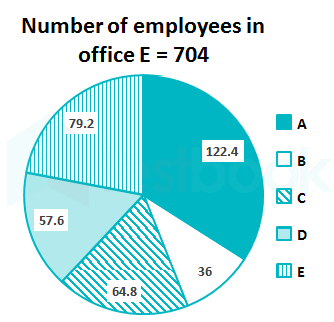
Study the given pie chart and answer the question that follows.

Breakup(degree-wise) of the total number of employees of a company working in departments A, B, C, D. and E

The ratio of male and female employees in office D is 9 : 7 and in office C, it is 4 : 5. The total female employees in offices D and C is what percentage of the total number of employees in offices A and B? (Correct to one decimal place)

  1. ((a))

    38.6%

  2. ((b))

    35.8%

  3. ((c))

    36.2%

  4. ((d))

    37.2%

Show Answer
Answer: ((a))

38.6%

Given:

The ratio of male and female employees in office D is 9 : 7 and in office C, it is 4 : 5.

The total employee in the office E = 704

Calculation:

The degree-wise distribution for the office E = 79.2

The total number of employees in all departments = 36079.2×704=3200\frac{360^{\circ}}{79.2^{\circ}} \times 704 = 3200

The total number of employees in the office D = 57.6360×3200=512\frac{57.6^{\circ}}{360^{\circ}} \times 3200 = 512

The total female employees in offices D = 79+7×512=224\frac{7}{9+7} \times 512 = 224

The total number of employees in the office C = 64.8360×3200=576\frac{64.8^{\circ}}{360^{\circ}} \times 3200 = 576

The total female employees in offices C = 54+5×576=320\frac{5}{4+5} \times 576 = 320

The total number of employees in offices A and B = 122.4+36360×3200=1408\frac{122.4^{\circ} + 36^{\circ}}{360^{\circ}} \times 3200 = 1408

The total female employees in offices D and C = 320 + 224 = 544

The required per cent = 5441408×100\frac{544}{1408} \times 100 = 38.6%

∴ The total female employees in offices D and C is 38.6% of the total number of employees in offices A and B.

31

Seema sells 40% of her goods at a profit of 25%, and 20% of the remaining goods at a loss of 35%, and 25% of the remaining goods at a profit of 15%. In order to get 20% profit in the entire transaction, she must sell the remaining goods at a profit of (correct to one decimal place):

  1. ((a))

    32.8%

  2. ((b))

    36.4%

  3. ((c))

    34.4%

  4. ((d))

    35.2%

Show Answer
Answer: ((c))

34.4%

Given:

Seema sells 40% of her goods at a profit of 25%, 20% of the remaining goods at a loss of 35%, and 25% of the remaining goods at a profit of 15%.

Formula used:

Selling price = (1 + profit%) × Cost price

Selling price = (1 - loss%) × Cost price

Calculation:

Let the total quantity of goods = 100

The cost price of 100 units of goods = ₹100

The selling price for the total quantity of goods for 20% profit = (1+ 20%) of ₹100 = ₹120

In the first case:

The unit cost price of good = ₹1

The selling price of 40% of goods at 25% of profit = (1 + 25%) of (40% of 100) of ₹1 = ₹50

The remaining goods = 100 - (40% of 100) = 60

In the second case:

The selling price of 20% of the remaining goods at 35% of loss = (1 - 35%) of (20% of 60) of ₹1 = ₹7.8

The remaining goods = 60 - (20% of 60) = 48

In the third case:

The selling price of 25% of the remaining goods at 15% of profit = (1 + 15%) of (25% of 48) of ₹1 = ₹13.8

The remaining goods = 48 - (25% of 48) = 36

In the last case:

The selling price for the remaining goods = ₹120 - (₹50 + ₹7.8 + ₹13.8) = ₹48.4

The cost price of 36 units of goods = ₹1 × 36 = ₹36

The required profit per cent = 48.43636×100\frac{₹48.4-₹36}{₹36} × 100 = 34.4%

∴  In order to get 20% profit in the entire transaction, she must sell the remaining goods at a profit 34.4%.

32

A TV is available for Rs. 1,50,000 cash or for Rs. 17,600 as cash down payment and the balance in three equal half-yearly instalments. If the interest is charged at 20% p.a., compounded half-yearly, then the total interest in Rs.) paid by a customer under this instalment scheme is:

  1. ((a))

    26,980

  2. ((b))

    27,440

  3. ((c))

    27,320

  4. ((d))

    26,820

Show Answer
Answer: ((c))

27,320

Given:

A T.V is available for ₹1,50,000 cash or ₹17,600 cash down payment followed by three equal half-yearly instalments.

If the rate of interest charged is 20% p.a., compounded half-yearly.

Formula used:

D = AR×(11(1+R)n)\frac{A}{R} × (1 - \frac{1}{(1+R)^n})

Where, 

D, is the amount due (or amount on which interest is to be applied)

A, is the value of the instalment

R, is the rate of interest applied

n, is the number of instalments

Calculation:

The price of the T.V = ₹1,50,000

The down payment is done for buying T.V = ₹17,600

The remaining amount (which is paid in three equal instalments) = ₹1,50,000 - ₹17,600 = ₹1,32,400

The rate of interest applied (half-yearly) = 20% ÷ 2 = 10%

The number of instalments, n = 3

Now, 

By substituting the value of the respective variable in the required formula, we get,

⇒ ₹1,32,400 = A10%×(11(1+10%)3)\frac{A}{10\text{\%}} × (1 - \frac{1}{(1+\text{10\%})^3})

⇒ ₹1,32,400 × 10% = A × (1103113)(1 - \frac{10^3}{11^3})

⇒ ₹1,32,400 × 0.1 = A × (110001331)(1 - \frac{1000}{1331})

⇒ ₹13,240 = A × (3311331)(\frac{331}{1331})

⇒ A = ₹53,240

The total amount paid in three instalments = ₹53,240 × 3 = ₹1,59,720

The interest paid = ₹1,59,720 - ₹1,32,400 = ₹27,320

∴ ₹27,320 is the interest charged in the instalment scheme.

33

A, B and C enter into a partnership and invest their capitals in the ratio 13:512:12\frac{1}{3}:\frac{5}{{12}}:\frac{1}{2}, Respectively, A receives one-fourth of the total profit for managing the business and the remaining profit is divided between them in the ratio of their investments. At the end of a year, if A gets Rs. 1.26 lakh less than what B and C together get in the profit, then what is the share (in Rs. Lakh) of C is the total profit?

  1. ((a))

    3.78

  2. ((b))

    4.41

  3. ((c))

    3.15

  4. ((d))

    2.52

Show Answer
Answer: ((a))

3.78

Given:

A, B and C enter into a partnership and invest their capitals in the ratio 13:512:12\frac{1}{3}:\frac{5}{{12}}:\frac{1}{2},

A receives one-fourth of the total profit for managing the business.

The remaining profit is divided between them in the ratio of their investments.

At the end of a year, if A gets Rs. 1.26 lakh less than what B and C together.

Calculation:

The ratio in which A, B and C entered into a partnership = 13:512:12\frac{1}{3}:\frac{5}{{12}}:\frac{1}{2}

Now, multiply each part of the ratio by 12.

The ratio in which A, B and C entered into a partnership = 123:5×1212:122=4:5:6\frac{12}{3}:\frac{5× 12}{{12}}:\frac{12}{2} = 4 : 5 : 6

Let the total profit = 60x

According to the question,

The profit earned by A for managing business = 14\frac{1}{4} of 60x = 15x

The remaining profit by A, B and C = 60x - 15x = 45x

The remaining profit is shared by A, B and C in the ratio of 4 : 5 : 6.

Therefore,

The profit earned by A = 415\frac{4}{15}  × 45x = 12x

The profit earned by B = 515\frac{5}{15}  × 45x = 15x

The profit earned by C = 615\frac{6}{15}  × 45x = 18x

Therefore, 

The total profit earned by A = 12x + 15x = 27x

Again according to the question,

The profit earned by A gets w.r.t to B and C together,

⇒ (18x + 15x) - 27x = Rs. 1.26 lakh

⇒ 33x - 27x = Rs. 1.26 lakh

⇒ x = Rs. 1.266\frac{1.26}{6} lakh = Rs. 0.21 lakhs

The profit earned by C = 18x = 18 × 0.21 lakhs = Rs. 3.78 lakhs

∴ The profit earned by C is Rs. 3.78 lakhs.

34

A shopkeeper earns a profit of 20% by selling an article by giving 25% discount on its market price. If the cost price of the article increases by 10%, then how much discount per cent should he give now on the same marked price to earn the same percentage of profit as earlier?

  1. ((a))

    16.5%

  2. ((b))

    17.5%

  3. ((c))

    18%

  4. ((d))

    15%

Show Answer
Answer: ((b))

17.5%

Given:

A shopkeeper earns a profit of 20% by selling an article by giving 25% discount on its marked price.

The cost price of the article increases by 10%.

Formula used:

Selling price = (Cost price) × (1 + Profit%)

Selling price = (Marked price) × (1 - Discount%)

Discount% = Marked PriceSelling PriceMarked Price\frac{\text{Marked Price} - \text{Selling Price} }{\text{Marked Price}} × 100

Calculation:

Let the marked price of the article = ₹100

In the first case:

The selling price after getting 25% discount = (100% - 25%) of ₹100 = ₹75

The cost price of an article on which 20% profit is earned = 75100%+20%\frac{₹75}{100\text {\%} + 20\text {\%}} = ₹62.5

In the second case:

The increased cost price = (100% + 10%) of ₹62.5 = ₹68.75

The selling price of the article for earning 20% profit = (100% + 20%) of ₹68.75 = ₹82.5

The required discount percent = 10082.5100×100\frac{₹100-₹82.5}{₹100} × 100 = 17.5% 

∴ The discount per cent should be given now on the same marked price to earning the same percentage of profit as earlier is 17.5%.

35

A man travels from a city X to city Y. If he travels 25% faster than his usual speed, he would reach Y 15 minutes early. By how many minutes would he be late if he travels 40% slower than his usual speed?

  1. ((a))

    50

  2. ((b))

    40

  3. ((c))

    36

  4. ((d))

    45

Show Answer
Answer: ((a))

50

Given:

A man travels 25% faster than his usual speed, he would reach Y 15 minutes early.

Formula:

Distance = Speed × Time

Calculation:

Let the usual speed of the man = 100 kmph

Let the usual time to reach the destination = 75 min

In the first case:

The increased speed of the man = (100% + 25%) of 100 = 125 kmph

The time required to reach Y from X = 75 min - 15 min = 60 min = 1 hour

The required distance travelled = 125 × 1 = 125 km

In the second case:

The decreased speed of the man = (100% - 40%) of 100 = 60 kmph

The time required to reach Y from X = t min

The required distance travelled,

⇒ 60 × t = 125

⇒ t = 12560\frac{125}{60} × 60 min = 125 min

Therefore, 

The time (in min) by which man reach the destination = 125 min - 75 min = 50 min

∴ By 50 minutes would he be late if he travels 40% slower than his usual speed.

36

The amount received on a sum invested at 8% p.a. simple interest for 3123\frac1 2year exceeds the simple interest on the same sum at the same rate 15 years by Rs. 600. What will be the amount (in Rs.) of the same sum in 5125\frac1 2 year at double the same rate at simple interest?

  1. ((a))

    14,080

  2. ((b))

    13,800

  3. ((c))

    14,000

  4. ((d))

    14,100

Show Answer
Answer: ((d))

14,100

Given:

The amount received on a sum invested at 8% p.a. simple interest for 3123\frac1 2year exceeds the simple interest on the same sum at the same rate 15 years by Rs. 600. 

Formula used:

Simple Interest = Principal×Rate×Time100\frac{\text {Principal} × \text {Rate} × \text {Time}}{100}

Amount = Principal + Interest

Calculation:

Let 'P' be the principal invested.

The rate of interest applied = 8% p.a.

In the first case:

The time of investment = 3123\frac1 2 = 3.5 years

The interest earned = P×8×3.5100\frac{P × 8 × 3.5}{100}

The final amount earned = P + P×8×3.5100\frac{P × 8 × 3.5}{100} = 1.28P

In the second case:

The time of investment = 15 years

The interest earned = P×8×15100\frac{P × 8 × 15}{100} = 1.2P

According to the question,

⇒ 1.28P - 1.2P = Rs. 600

⇒ 0.08P = Rs. 600

⇒ P = Rs. 7500

Now, 

The principal invested = Rs. 7500

The time of investment = 5.5 years

The rate of interest applied = 2 × 8 - 16% p.a.

The simple interest earned = 7500×16×5.5100\frac{7500 \times 16 \times 5.5}{100} = Rs. 6600

The final amount earned = Rs. 7500 + Rs. 6600 = Rs. 14,100

∴ The final amount earned is Rs. 14,100.

37

X varies directly as √Y̅. When Y = 20.25, X = 18. When X = 7.2, then Y =?

  1. ((a))

    4.84

  2. ((b))

    2.56

  3. ((c))

    1.96

  4. ((d))

    3.24

Show Answer
Answer: ((d))

3.24

Given:  

X varies directly as √Y.

When Y = 20.25, X = 18

Calculation:

X ∝ √Y

Remove the proportionality sign by the proportionality constant.

It can be written as:

⇒ X = k(√Y)

For the first case:

Substitute the value of the respective variable in the required expression.

⇒ 18 = k × √(20.25)

⇒ 18 = k × 4.5

⇒ k = 4

For the second case:

⇒ X = k(√Y)

Take square on both sides of the equation.

⇒ X2 = k2 ×(√Y)2

Substitute the value of the respective variable in the required expression.

⇒ 7.22 = 42 × Y

⇒ (8 × 9 × 0.1)2 = 16 × Y

⇒ (64 × 81 × 0.01) = 16 × Y

⇒ Y = (4 × 81 × 0.01)

⇒ Y = 3.24

∴ 3.24 is the required answer.

38

The income of A is 75% more than the income of B, and the income of C is 20% less than the combined incomes of A and B. The income of C is what percentage more than that of A? (Correct to one decimal place)

  1. ((a))

    25.7%

  2. ((b))

    22.8%

  3. ((c))

    24.4%

  4. ((d))

    20.5%

Show Answer
Answer: ((a))

25.7%

Given:

The income of A is 75% more than the income of B, and the income of C is 20% less than the combined incomes of A and B.

Calculation:

The income of B = ₹100

The income of A = (100% + 75%) of ₹100 = ₹175

The combined income of A and B = ₹100 + ₹175 = ₹275

The income of C = (100% - 20%) of ₹275 = ₹220

The required percent = 220175175\frac{₹220-₹175}{₹175} × 100 = 25.7%

∴ The income of C is 25.7% more than that of A.

39

The average weight of some girls in a group is 58.4 kg. When 15 girls of average weight 62.2 kg leave the group or 10 girls of average weight 49.85 kg join the group, the average weight (in kg) of girls in both the cases is equal. What is the number of girls in the group, initially?

  1. ((a))

    65

  2. ((b))

    75

  3. ((c))

    45

  4. ((d))

    55

Show Answer
Answer: ((a))

65

Given:

The average weight of some girls in a group is 58.4 kg.

When 15 girls with an average weight 62.2 kg leave the group or 10 girls with an average weight 49.85 kg join the group, the average weight (in kg) of girls in both cases is equal.

Formula used:

Average = Sum of ’n’ observationn\frac{\text {Sum of 'n' observation}}{\text {n}}

Calculation:

Let the number of girls in the group = x

The total weight of 'x' girls = 58.4 × x = 58.4x kg

In the first case:

15 girls with an average weight 62.2 kg leave the group.

The total weight of 15 girls = 62.2 × 15 = 933 kg

The new average = 58.4x933x15\frac{58.4x - 933}{x - 15}

In the second case:

10 girls with an average weight 49.85 kg join the group.

The total weight of 10 girls = 49.85 × 10 = 498.5 kg

The new average = 58.4x+498.5x+10\frac{58.4x + 498.5}{x + 10}

According to the question,

⇒ 58.4x933x15=58.4x+498.5x+10\frac{58.4x - 933}{x - 15} = \frac{58.4x + 498.5}{x + 10}

⇒ (58.4x - 933)(x + 10) = (58.4x + 498.5)(x - 15)

⇒ 58.4x2 + 584x - 933x - 9330 = 58.4x2 + 498.5x - 876x - 7477.5

⇒ -349x - 9330 = -377.5x - 7477.5

⇒ 28.5x = 1852.5

⇒ x = 65

Initially, the number of girls in the group is 65.

Alternate MethodLet the number of girls in the group be x.

According to the questions

⇒ (58.4 × x - 62.2 × 15)(x + 10) = (58.4 × x + 49.85 × 10)(x - 15)

⇒ (58.4x - 933)(x + 10) = (58.4x + 498.5)(x - 15)

⇒ 58.4x2 - 933x + 584x - 9330 = 58.4x2 + 498.5x - 876x - 7477.5

⇒ - 933x + 584x - 498.5x + 876x = 9330 - 7477.5

⇒ 28.5x = 1852.5

⇒ x = 65

∴ The number of girls in the group initially is 65.

40

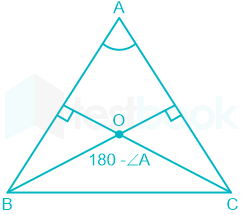
In ΔABC, BE ⊥ AC, CD ⊥ AB and BE and CD intersect at O. The bisectors of ∠OBC and ∠OCB intersect at P. if ∠A = 62°, then what is the measure of ∠BPC?

  1. ((a))

    139° 

  2. ((b))

    128°

  3. ((c))

    149°

  4. ((d))

    118°

Show Answer
Answer: ((c))

149°

Given:

In ΔABC, BE ⊥ AC, CD ⊥ AB and BE and CD intersect at O.

The bisectors of ∠OBC and ∠OCB intersect at P.

∠A = 62°

Formula used:

The intersection of altitude is called orthocenter.

The relationship between the angle made by the orthocenter of a triangle can be seen below figure.

∠BOC = 180 - ∠A

The sum of all three internal angles for a triangle is 180∘.

Calculation:

According to the question, the required figure is:

In ΔABC,

∠BOC = 180∘ - ∠A

⇒ ∠BOC = 180∘ - 62∘

⇒ ∠BOC = 118∘

In ΔBOC,

∠OBC + ∠OCB + ∠BOC = 180∘

⇒ 2x + 2y + 118∘ = 180∘

⇒ 2(x + y) = 62∘

⇒ (x + y) = 31∘

In ΔBPC,

∠PBC + ∠PCB + ∠BPC = 180∘

⇒ x + y + ∠BPC = 180∘

⇒ 31∘ + ∠BPC = 180∘

⇒ ∠BPC = 149∘

∴ The required value of ∠BPC is 149∘.

41

The value of 523÷1235\frac{2}{3} \div 1\frac{2}{3} of 414245+(213+21216)÷213+513×34÷2234\frac{1}{4} - 2\frac{4}{5} + \left( {2\frac{1}{3} + 2\frac{1}{2} - \frac{1}{6}} \right) \div 2\frac{1}{3} + 5\frac{1}{3} \times \frac{3}{4} \div 2\frac{2}{3} is :

  1. ((a))

    54\frac{5}{4}

  2. ((b))

    38\frac{3}{8}

  3. ((c))

    43\frac{4}{3}

  4. ((d))

    32\frac{3}{2}

Show Answer
Answer: ((d))

32\frac{3}{2}

Given:

523÷1235\frac{2}{3} \div 1\frac{2}{3} of 414245+(213+21216)÷213+513×34÷2234\frac{1}{4} - 2\frac{4}{5} + \left( {2\frac{1}{3} + 2\frac{1}{2} - \frac{1}{6}} \right) \div 2\frac{1}{3} + 5\frac{1}{3} × \frac{3}{4} \div 2\frac{2}{3} 

Concept used:

Calculation:

523÷1235\frac{2}{3} \div 1\frac{2}{3} of 414245+(213+21216)÷213+513×34÷2234\frac{1}{4} - 2\frac{4}{5} + \left( {2\frac{1}{3} + 2\frac{1}{2} - \frac{1}{6}} \right) \div 2\frac{1}{3} + 5\frac{1}{3} × \frac{3}{4} \div 2\frac{2}{3}

⇒ 523÷1235\frac{2}{3} \div 1\frac{2}{3} of 414245+(73+5216)÷213+513×34÷2234\frac{1}{4} - 2\frac{4}{5} + \left( {\frac{7}{3} + \frac{5}{2} - \frac{1}{6}} \right) \div 2\frac{1}{3} + 5\frac{1}{3} × \frac{3}{4} \div 2\frac{2}{3} 

⇒ 523÷1235\frac{2}{3} \div 1\frac{2}{3} of 414245+(14+1516)÷213+513×34÷2234\frac{1}{4} - 2\frac{4}{5} + \left( { \frac{14+15-1}{6}} \right) \div 2\frac{1}{3} + 5\frac{1}{3} × \frac{3}{4} \div 2\frac{2}{3} 

⇒ 523÷1235\frac{2}{3} \div 1\frac{2}{3} of 414245+143÷213+513×34÷2234\frac{1}{4} - 2\frac{4}{5} + { \frac{14}{3}}\div 2\frac{1}{3} + 5\frac{1}{3} × \frac{3}{4} \div 2\frac{2}{3} 

⇒ 523÷535\frac{2}{3} \div \frac{5}{3} of 174245+143÷213+513×34÷223\frac{17}{4} - 2\frac{4}{5} + { \frac{14}{3}}\div 2\frac{1}{3} + 5\frac{1}{3} × \frac{3}{4} \div 2\frac{2}{3}

⇒ 523÷8512245+143÷213+513×34÷223 5\frac{2}{3} \div \frac{85}{12}- 2\frac{4}{5} + { \frac{14}{3}}\div 2\frac{1}{3} + 5\frac{1}{3} × \frac{3}{4} \div 2\frac{2}{3}

⇒ 173÷8512245+143÷73+513×34÷83 \frac{17}{3} \div \frac{85}{12}- 2\frac{4}{5} + { \frac{14}{3}}\div \frac{7}{3} + 5\frac{1}{3} × \frac{3}{4} \div \frac{8}{3}

⇒ 173×1285245+143×37+513×34×38 \frac{17}{3} \times \frac{12}{85}- 2\frac{4}{5} + { \frac{14}{3}}\times \frac{3}{7} + 5\frac{1}{3} × \frac{3}{4} \times \frac{3}{8}

⇒ 45145+2+163×932 \frac{4}{5}- \frac{14}{5} + 2 + \frac{16}{3} × \frac{9}{32}

⇒ 45145+2+32 \frac{4}{5}- \frac{14}{5} + 2 + \frac{3}{2}

⇒ 828+20+1510\frac{8-28+20+15}{10}

⇒ 1510\frac{15}{10}

⇒ 32\frac{3}{2}

∴ Required answer is 32\frac{3}{2}.

42

If 1 is subtracted from the numerator and 3 is added to the denominator of a fraction, the fraction becomes 12\frac{1}{2}. If 1 is added to the numerator and 1 is subtracted from the denominator of the original fraction, it becomes 56\frac{5}{6}. What is the sum of the numerator and the denominator of the original fraction?

  1. ((a))

    23

  2. ((b))

    22

  3. ((c))

    21

  4. ((d))

    19

Show Answer
Answer: ((b))

22

Given:

If 1 is subtracted from the numerator and 3 is added to the denominator of a fraction, the fraction becomes 12\frac{1}{2}.

If 1 is added to the numerator and 1 is subtracted from the denominator of the original fraction, it becomes 56\frac{5}{6}

Calculation:

Let the original fraction = ab\frac{a}{b}

In the first case:

⇒ a1b+3=12\frac{a-1}{b+3} = \frac{1}{2}

It can be written as:

⇒ 2 × (a - 1) = b + 3

⇒ 2a - 2 = b + 3

⇒ 2a - b = 5    ----(1)

In the second case:

⇒ a+1b1=56\frac{a+1}{b-1} = \frac{5}{6}

It can be written as:

⇒ 6 × (a + 1) = 5 × (b - 1)

⇒ 6a + 6 = 5b - 5

⇒ 5b - 6a = 11    ----(2)

Multiply the equation (1) by 5 and add to equation (2).

⇒ 4a = 36

⇒ a = 9

Now, substitute the value of 'a' in equation (1), we get,

⇒ 2 × 9 - b = 5

⇒ 18 - 5 = b

⇒ b = 13

The required fraction = ab=913\frac{a}{b} = \frac{9}{13}

The sum of the numerator and the denominator of the original fraction = 9 + 13 = 22

∴ 22 is the required answer.

43

The height of a right circular cone is trisected by two planes parallel to its base at equal distances. The volumes of the three solids, so obtained, starting from the top, are in the ratio:

  1. ((a))

    1 : 8 : 28

  2. ((b))

    1 : 7 : 28

  3. ((c))

    1 : 7 : 19

  4. ((d))

    1 : 8 : 19

Show Answer
Answer: ((c))

1 : 7 : 19

Given:

The height of a right circular cone is trisected by two planes parallel to its base at equal distances.

Formula used:

Cone:

The volume of cone = πr2h3\frac{\pi r^2 h}{3}

Frustum:

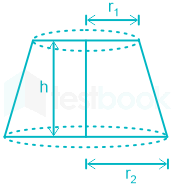
The volume of frustum = πh3(r12+r22+r1r2)\frac{\pi h}{3} (r_1^2 + r_2^2 + r_1r_2)

Calculation:

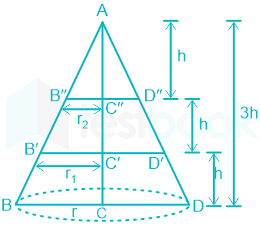
According to the question, the required figure is:

The ΔABC ∼ ΔAB'C'

⇒ ACAC=BCBC\frac{AC}{AC'} = \frac{BC}{B'C'}

⇒ 3h2h=rr1\frac{3h}{2h} = \frac{r}{r_1}

⇒ r123\frac{2}{3}r

The ΔAB''C'' ∼ ΔAB'C'

⇒ ACAC=BCBC\frac{AC''}{AC'} = \frac{B''C''}{B'C'}

⇒ h2h=r2r1\frac{h}{2h} = \frac{r_2}{r_1}

⇒ h2h=3r22r\frac{h}{2h} = \frac{3r_2}{2r}

⇒ r2 = 13\frac{1}{3}r

Now, 

The volume of the cone AB''D'',

⇒ VAB''D'' = π3r22h\frac{\pi}{3} r_2^2h

⇒ VAB''D'' = π3(r3)2h\frac{\pi}{3} (\frac{r}{3})^2h

⇒ VAB''D'' = π27r2h\frac{\pi}{27} r^2h

The volume of frustum cone B''D''B'D',

⇒ VB''D''B'D' = πh3(r12+r22+r1r2)\frac{\pi h}{3} (r_1^2 + r_2^2 + r_1r_2)

⇒ VB''D''B'D' = πh3[(23r)2+(r3)2+(r3)(2r3)]\frac{\pi h}{3} [(\frac{2}{3}r)^2 + (\frac{r}{3})^2 + (\frac{r}{3})(\frac{2r}{3})]

⇒ VB''D''B'D' = πh3[(49r2)+(r29)+(2r29)]\frac{\pi h}{3} [(\frac{4}{9}r^2) + (\frac{r^2}{9}) + (\frac{2r^2}{9})]

⇒ VB''D''B'D' = πh3[79r2]\frac{\pi h}{3} [\frac{7}{9}r^2]

The volume of frustum cone B'D'BD,

⇒ VB'D'B'D' = πh3(r12+r2+r1r)\frac{\pi h}{3} (r_1^2 + r^2 + r_1r)

⇒ VB'D'B'D' = πh3[(23r)2+(r)2+(r)(2r3)]\frac{\pi h}{3} [(\frac{2}{3}r)^2 + (r)^2 + (r)(\frac{2r}{3})]

⇒ VB'D'B'D' = πh3[(49r2)+(9r29)+(6r29)]\frac{\pi h}{3} [(\frac{4}{9}r^2) + (\frac{9r^2}{9}) + (\frac{6r^2}{9})]

⇒ VB'D'B'D' = πh3[199r2]\frac{\pi h}{3} [\frac{19}{9}r^2]

The required ratio = πh27r2:πh3[79r2]:πh3[199r2]\frac{\pi h}{27} r^2 : \frac{\pi h}{3} [\frac{7}{9}r^2] :\frac{\pi h}{3} [\frac{19}{9}r^2] = 1 : 7 : 19

∴ 1 : 7 : 19 is the requried ratio.

44

A tank is attached to 16 pipes, some of them are filling pipes and the remaining are emptying pipes. Each of the filling pipes can fill a tank in 8 hours and each of the emptying pipes can empty a full tank in 10 hours. When the tank is 65% empty, all the pipes are opened at the same time. It takes one hour to fill the tank completely. How many pipes are emptying pipes?

  1. ((a))

    5

  2. ((b))

    8

  3. ((c))

    4

  4. ((d))

    6

Show Answer
Answer: ((d))

6

Given:

The number of pipes attached = 16

The number of filling pipes = x

The number of emptying pipes = 16 - x

The time is taken by a filling pipe to fill the tank = 8 hours

The time is taken from an emptying pipe to emptying the tank = 10 hours 

When the tank is 65% empty, all the pipes are opened at the same time. It takes one hour to fill the tank completely

Formula used:

Efficiency × TIme = Work

Calculation:

Let the capacity of the tank = 1 unit

The time is taken by a filling pipe to fill the tank = 8 hours

The efficiency for filling pipe = 18\frac{1}{8}

The time is taken from an emptying pipe to emptying the tank = 10 hours 

The efficiency of emptying pipe = 110-\frac{1}{10}

Now, 

The efficiency for 'x' filling pipe = x8\frac{x}{8}

The efficiency for '16 - x' emptying pipes = 16x10-\frac{16-x}{10}

The remaining part of the tank which is to be filled = 65% of 1 unit

The time taken to fill the 65% of the tank = 1 hours

According to the question,

⇒ (x8\frac{x}{8} - 16x10\frac{16-x}{10}) × 1 = 65% of 1 unit

⇒ (x8\frac{x}{8} - 16x10\frac{16-x}{10}) =  0.65

⇒ (10x8(16x)80\frac{10x - 8(16 - x)}{80}) =  0.65

⇒ 10x - 128 + 8x =  0.65 × 80

⇒ 18x = 128 + 52

⇒ 18x = 180

⇒ x = 10

The number of emptying pipes = 16 - 10 = 6

∴ The number of emptying pipes is 6.

45

In finding the HCF of two numbers by the division method, the last divisor is 28 and the quotients are 1, 30, 1 and 3, respectively. What is the sum of the two numbers?

  1. ((a))

    7140

  2. ((b))

    6944

  3. ((c))

    7000

  4. ((d))

    6860

Show Answer
Answer: ((c))

7000

Given:

In finding the HCF of two numbers by the division method, the last divisor is 28 and the quotients are 1, 30, 1 and 3, respectively.

Formula used:

Dividend = Divisor × Quotient + Remainder

Calculation:

As per the question, we have to solve the question reverse.

The last divisor, d3 = 28

The respective quotient, q3 = 3

This is the last step in the divisions' method, the remainder is 0.

Now, substitute the value of the respective variables in the above relation.

(Dividend)3 = 28 × 3 + 0

(Dividend)3 = 84

As we know, the last step's dividend will be divisor for the next step and the divisor is now taken as the remainder.

The divisor in this step, d2 = 84

The respective quotient, q2 = 1

The respective remainder, r2 = 28

Now, substitute the respective value in the required relation.

(Dividend)2 = 84 × 1 + 28

(Dividend)2 = 112

Similarly the next step,

(Dividend)1 = 112 × 30 + 84

(Dividend)1 = 3444

Similarly the next step,

(Dividend) = 3444 × 1 + 112

(Dividend) = 3556

The required numbers are 3444 and 3556.

The sum of two numbers = 3444 + 3556 = 7000

∴ 7000 is the required answer.

46

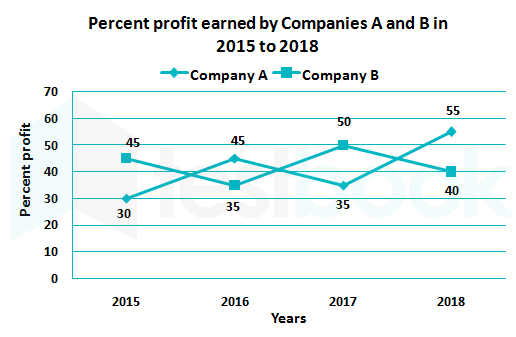
Study the given graph and answer the question that follows.

Profit percent = IncomeInvestmentInvestment×100\frac{\text{Income} - \text{Investment}}{\text{Investment}} × 100

If the income of companies A and B in 2017 are in the ratio 3 : 5, and the total expenditure of both the companies was Rs. 350 crores, then what was the total income (in Rs. crores) of A and B together in that year?

  1. ((a))

    480

  2. ((b))

    448

  3. ((c))

    440

  4. ((d))

    504

Show Answer
Answer: ((d))

504

Given: 

If the income of companies A and B in 2017 are in the ratio 3 : 5,

The total expenditure/investment of both the companies was Rs. 350 crores,

The profit per cent earned by company A in 2017 = 35%

The profit per cent earned by company B in 2017 = 50%

Formula used:

Profit% = IncomeInvestmentInvestment×100\frac{\text{Income} - \text{Investment}}{\text{Investment}} × 100

It can be written as:

Income = Investment × (Profit%)

Calculation:

Let 'IA' and 'IB' are the income of companies A and B in 2017.

Let 'EA' and 'EB' are the expenditure of companies A and B in 2017.

According to the question

The income of company A in 2017, IA = 3x

The income of company B in 2017, IB = 5x

Now,

⇒ EA + E= Rs. 350 crores

IA1+ProfitA+IB1+ProfitB\frac{I_A}{1 + \text{Profit}_A} + \frac{I_B}{1 + \text{Profit}_B} = 350

⇒ IA1+35%+IB1+50%\frac{I_A}{1 + 35\text {\%}} + \frac{I_B}{1 + 50\text {\%}} = 350

⇒ IA1+0.35+IB1+0.50\frac{I_A}{1 + 0.35} + \frac{I_B}{1 + 0.50} = 350

⇒ 3x1.35+5x1.50\frac{3x}{1.35} + \frac{5x}{1.50} = 350

⇒ 4.5x+6.75x2.025\frac{4.5x + 6.75x}{2.025} = 350

⇒ 11.25x2.025\frac{11.25x}{2.025} = 350

⇒ x = 63

Therefore, 

The income of company A in 2017, IA = 3 × 63 = Rs. 189 crores

The income of company B in 2017, IB = 5 × 63 = Rs. 315 crores

Now, 

The income of companies A and B in 2017, = Rs. 189 + Rs. 315 = Rs. 504 crores

∴  The total income (in Rs. crores) of A and B together in 2017 is 504.

47

The average age of A, B and C, 5 years ago, was 21 years. The average age of B and C 3 years from now will be 25.5 years. What is the present age (in years) of A?

  1. ((a))

    31

  2. ((b))

    35

  3. ((c))

    33

  4. ((d))

    36

Show Answer
Answer: ((c))

33

Shortcut Trick

Present Average Age of A, B and C = 21 + 5 = 26 years

Present Average Age of B and C = 25.5 − 3 = 22.5 years

Present Age of A = (Total of A, B, C) − (Total of B, C)

Present Age of A = (26 × 3) − (22.5 × 2) = 78 − 45 = 33 years

∴ The correct answer is 33 years.

Alternate Method

Given:

Average age of A, B, C (5 years ago) = 21 years

Average age of B, C (3 years hence) = 25.5 years

Formula Used:

Total Age = Average Age × Number of Persons

Calculations:

⇒ Sum of ages of A, B, C (5 years ago) = 21 × 3 = 63 years

⇒ Present Sum of ages of A, B, C = 63 + (3 × 5) = 78 years

⇒ Sum of ages of B and C (3 years from now) = 25.5 × 2 = 51 years

⇒ Present Sum of ages of B and C = 51 − (2 × 3) = 51 − 6 = 45 years

⇒ Present age of A = (Present Sum of A, B, C) − (Present Sum of B, C)

⇒ Present age of A = 78 − 45 = 33 years

∴ The correct answer is 33 years.

Additional Information

Average Age Property

If the age of each person in a group increases or decreases by n years, the Average Age of the group also increases or decreases by n years.

Sum and Average Relation

The sum of ages of n people after t years = (Present Sum) + (n × t).

Finding Individual Value

To find the age of a specific person from a group, subtract the sum of the ages of the remaining members from the total sum: A = Sum(All) − Sum(Others).

48

The value of  (0.95÷1.05)÷0.409(0.84÷0.93÷0.54)\frac{{\left( {0.\overline {95} \div 1.0\overline 5 } \right) \div 0.4\overline {09} }}{{\left( {0.\overline {84} \div 0.9\overline 3 \div 0.\overline {54} } \right)}} is:

  1. ((a))

    1231\frac{2}{3}

  2. ((b))

    2162\frac{1}{6}

  3. ((c))

    1131\frac{1}{3}

  4. ((d))

    2132\frac{1}{3}

Show Answer
Answer: ((c))

1131\frac{1}{3}

Given:

(0.95÷1.05)÷0.409(0.84÷0.93÷0.54)\frac{{\left( {0.\overline {95} \div 1.0\overline 5 } \right) \div 0.4\overline {09} }}{{\left( {0.\overline {84} \div 0.9\overline 3 \div 0.\overline {54} } \right)}}

**Concept used:**​​

0.ab=ab990.\overline {ab} =\frac{ab}{99}

c.ab=cabc99c.\overline {ab} =\frac{cab - c}{99}

c.ab=cabca90c.a\overline {b} =\frac{cab - ca}{90}

Calculation:

(0.95÷1.05)÷0.409(0.84÷0.93÷0.54)\frac{{\left( {0.\overline {95} \div 1.0\overline 5 } \right) \div 0.4\overline {09} }}{{\left( {0.\overline {84} \div 0.9\overline 3 \div 0.\overline {54} } \right)}}

⇒ (9599×9010510)×9904094(8499×90939×9954)\frac{{\left( {\frac{95}{99} \times \frac{90}{105 -10} } \right) \times \frac{990}{409 - 4} }}{{\left( {\frac{84}{99} \times \frac{90}{93-9}\times\frac{99}{54} } \right)}}

⇒ (9599×9095)×990405(8499×9084×9954)\frac{{\left( {\frac{95}{99} \times \frac{90}{95} } \right) \times \frac{990}{405} }}{{\left( {\frac{84}{99} \times \frac{90}{84}\times\frac{99}{54} } \right)}}

⇒ 1011×99040553\frac{{ {\frac{10}{11} } \times \frac{990}{405} }}{{{\frac{5}{3} }}}

⇒ 20953\frac{{ {\frac{20}{9} }}}{{ {\frac{5}{3} }}}

⇒ (209)×(35){{\left( {\frac{20}{9} } \right)}}\times{{\left( {\frac{3}{5} } \right)}}

⇒ 43=113\frac{4}{3} = 1\frac{1}{3}

∴ Required answer is 1131\frac{1}{3}

49

If  5x13x=3,x05x -\frac{1}{{3x}}=3,x\ne0, then what is the value of 9x2 + (25x2)-1 ?

  1. ((a))

    411254\frac{{11}}{{25}}

  2. ((b))

    5125\frac{{51}}{{25}}

  3. ((c))

    3353\frac{3}{5}

  4. ((d))

    4254\frac{2}{5}

Show Answer
Answer: ((a))

411254\frac{{11}}{{25}}

Given:

If  5x13x=3,x05x -\frac{1}{{3x}}=3,x\ne0

Formula used:

(a - b)2 = a2 + b2 - 2ab

Calculation:

5x13x=35x -\frac{1}{{3x}}=3

Now, multiply the required expression by 35\frac{3}{5} on both sides of the equation.

⇒ 35×(5x13x)=35×3\frac{3}{5} \times (5x -\frac{1}{{3x}})=\frac{3}{5} \times3

⇒ (3x15x)=95(3x -\frac{1}{{5x}})=\frac{9}{5}

Take square on both sides of the equation,

⇒ (3x15x)2=9252(3x -\frac{1}{{5x}})^2=\frac{9^2}{5^2}

⇒ 9x2+125x22×3x×15x=92529x^2 + \frac{1}{{25x^2}} - 2 \times 3x \times \frac{1}{5x}=\frac{9^2}{5^2}

⇒ 9x2+125x265=81259x^2 + \frac{1}{{25x^2}} - \frac{6}{5}=\frac{81}{25}

⇒ 9x2+125x2=8125+659x^2 + \frac{1}{{25x^2}} =\frac{81}{25} + \frac{6}{5}

⇒ 9x2+125x2=81+30259x^2 + \frac{1}{{25x^2}} =\frac{81 + 30}{25}

⇒ 9x2+125x2=111259x^2 + \frac{1}{{25x^2}} =\frac{111}{25}

⇒ 9x2+125x2=411259x^2 + \frac{1}{{25x^2}} =4\frac{11}{25}

∴ 411254\frac{11}{25}  is the required answer.

50

A boat can go 9 km downstream and 4 km upstream in 2122\frac{1}{2} hours. It can go 15 km downstream and 6 km upstream in 4 hours. How much time will it take to go 8 km downstream and 10 km upstream?

  1. ((a))

    4 hours 10 minutes

  2. ((b))

    3 hours 50 minutes

  3. ((c))

    3 hours 30 minutes

  4. ((d))

    3 hours

Show Answer
Answer: ((b))

3 hours 50 minutes

Shortcut Trick

Let 1/D = x and 1/U = y (D = Downstream, U = Upstream speed).

Eq 1: 9x + 4y = 2.5 | Eq 2: 15x + 6y = 4

Multiply Eq 1 by 3 and Eq 2 by 2 to equate y: 27x + 12y = 7.5 and 30x + 12y = 8.

Subtracting gives 3x = 0.5 ⇒ x = 1/6 ⇒ D = 6 kmph.

Substitute x in Eq 1: 9(1/6) + 4y = 2.5 ⇒ 1.5 + 4y = 2.5 ⇒ 4y = 1 ⇒ y = 1/4 ⇒ U = 4 kmph.

Required Time = 8/6 + 10/4 = 4/3 + 5/2 = (8 + 15)/6 = 23/6 hours = 3 hr 50 min.

∴ The correct answer is 3 hr 50 min.

Alternate Method

Given:

Case 1: 9/D + 4/U = 2.5 hours

Case 2: 15/D + 6/U = 4 hours

Formula Used:

Time = Distance ÷ Speed

Calculations:

⇒ Let 1/D = u and 1/U = v

⇒ 9u + 4v = 2.5 --- (i)

⇒ 15u + 6v = 4 --- (ii)

⇒ Multiply (i) by 3: 27u + 12v = 7.5

⇒ Multiply (ii) by 2: 30u + 12v = 8

⇒ Subtracting: (30u − 27u) = 8 − 7.5 ⇒ 3u = 0.5 ⇒ u = 1/6

⇒ Downstream speed (D) = 6 kmph

⇒ Put u = 1/6 in (i): 9(1/6) + 4v = 2.5 ⇒ 1.5 + 4v = 2.5 ⇒ 4v = 1 ⇒ v = 1/4

⇒ Upstream speed (U) = 4 kmph

⇒ Required Time = 8/D + 10/U = 8/6 + 10/4

⇒ Time = 4/3 + 5/2 = (8 + 15)/6 = 23/6 hours

⇒ Time = 3 hours + 5/6 hours = 3 hours + (5/6 × 60) min = 3 hr 50 min

∴ The correct answer is 3 hr 50 min.

Additional Information

Downstream and Upstream Speeds

Downstream speed (D) = Speed of boat in still water (u) + Speed of stream (v). Upstream speed (U) = u − v.

Still Water Speed Formula

Speed of boat in still water (u) = (D + U) ÷ 2.

Stream Speed Formula

Speed of stream (v) = (D − U) ÷ 2.

Science (25 questions)

51

Two lenses L1 and L2 of powers, 10 D and -(10/3) D respectively, separated by 50 cm are arranged parallel to each other in vertical planes. An object is placed 15 cm left to L1, vertically on the common axis of the lenses. The distance between the original object and the final image is:

  1. ((a))

    73 cm

  2. ((b))

    77 cm

  3. ((c))

    57 cm

  4. ((d))

    53 cm

Show Answer
Answer: ((d))

53 cm

The correct answer is 53.

Concept:

Lens:

  • The transparent curved surface which is used to refract the light and make an image of any object placed in front of it is called a lens.
  • A convex lens can converge a beam of parallel rays to a point on the other side of the lens

Power of lens:

  • It is equal to the reciprocal of the focal length of the lens/mirror in meters.
  • Power (P) = 1/f, where f is the focal length of the lens/mirror.
  • P = 100f\frac{100}{f} where f is the focal length in centimeters.
  • The unit of power of a lens is Dioptre when the focal length of the lens is taken in meters (m).
  • The focal length of the concave lens is negative and hence its power is also negative.
  • The focal length of the convex lens is positive and hence its power is also positive.

Lens formula: 1f=1v1u\frac{1}{f}=\frac{1}{v}-\frac{1}{u}  where f is focal length, v is image distance and u is object distance.

Explanation:

For first convex lens, L1

Power = 1f\frac{1}{f}

f = 1p\frac{1}{p} = 10010\frac{100}{10} = 10 cm

Given: Object distance, u = -15 cm, Focal length, f = 10 cm

 v=?

1f=1v1u\frac{1}{f}=\frac{1}{v}-\frac{1}{u}

110=1v115\frac{1}{10} = \frac{1}{v} - \frac{1}{-15}

110=1v+115\frac{1}{10} = \frac{1}{v} + \frac{1}{15}

110115=1v\frac{1}{10} - \frac{1}{15} = \frac{1}{v}

1v=3230\frac{1}{v} = \frac{3-2}{30}

1v=130\frac{1}{v} = \frac{1}{30}

v = 30 cm

For second convex  lens, L2

f = 1p\frac{1}{p} = 100×310\frac{100 × 3}{-10} = -10 × 3 = -30 cm

Object distance, u = -50-(-30)= -50 + 30 = -20cm, focal length, f = -30cm

v = ?

1f=1v1u\frac{1}{f}=\frac{1}{v}-\frac{1}{u}

130=1v120\frac{1}{-30} = \frac{1}{v} - \frac{1}{-20}

130=1v+120\frac{1}{-30} = \frac{1}{v} + \frac{1}{20}

130120=1v\frac{1}{-30} - \frac{1}{20} = \frac{1}{v}

1v=2360=560\frac{1}{v} = \frac{-2-3}{60} = \frac{-5}{60}

v= -60 / 5 = -12 cm 

Distance between original object and final image = 15 + 50 - 12 = 65 - 12 = 53.

52

An element 'A' belongs to 3rd period and 16th group of the periodic table, what would be its valency?

  1. ((a))

    0

  2. ((b))

    4

  3. ((c))

    2

  4. ((d))

    6

Show Answer
Answer: ((c))

2

The correct answer is 2.

Concept:

The Modern Periodic Table:

  • In 1913, Henry Moseley showed that the atomic number of an element is a more fundamental property than its atomic mass.
  • Modern Period Law: The physical and chemical properties of elements are the periodic function of their atomic number.
  • The modern periodic table contains 18 vertical columns known as groups and seven horizontal rows known as periods.

Key Points

Period:

  • The periods have the same elements that have the same valence shell or the energy shell.
  • The number of elements present in a period can be determined by the formula 2n2, where n is the number of the shell from the nucleus.
  • For example, the first period has two elements only as they have only 1 valence shell and the second period has 8 elements with 2 shells.

​Groups:

  • The group consists of elements that have the same number of electrons in the valence shell or outermost shell of the atom.
  • The number of shells increases by one unit as the elements move down in the periodic table in a group.
  • Group number indicates the valence electrons of the atom. Group1 and 2 have 1 and 2 valence electrons in the outermost shell respectively.
  • But for group no. 13-18 it is calculated by subtracting 10 from the group no. For example, an element belonging to group 13 will have 13-10 = 3 valence electrons.

Electronic configuration:

  • The distribution of electrons around the nucleus in different shells.
  • There are four shells namely K, L, M, and N.
  • Each orbit can hold a maximum of 2n2 electrons, where n is the number of orbits.
  • Only 2 electrons can accommodate in the first shell i.e., shell K.
  • 8 in shell L
  • 18 in shell M
  • 32 in shell N

Explanation:

  • Period number = 3
  • So, Number of shells = Period number = 3
  • Group number = 16
  • So, Valence electrons in outermost shell = Group number - 10 = 16 -10 = 6

Electronic configuration of Element A:

KLM
286
  • Valency refers to the number of electrons lost or gained by an element to complete its duplet or octet.
  • Here, Element A has 6 valence electrons, so it will gain 2 electrons to complete its octet.

Thus, it has a valency = 2.

53

Which of the following processes is required for extracting metal from cinnabar ore?

  1. ((a))

    Roasting

  2. ((b))

    Electrolytic reduction

  3. ((c))

    Thermit process

  4. ((d))

    Calcination

Show Answer
Answer: ((a))

Roasting

The correct answer is Roasting.

Concept:

  • Mineral: A naturally occurring substance with uniform chemical composition is called a mineral.
  • Ore: An ore is a mineral from which a metal can be extracted in a profitable way.

According to the reactivity of metals, different methods are employed to extract metals from their ores.

Reactivity series of metals:

  • Metals of high reactivity; such as sodium, calcium, magnesium, aluminium, etc. are extracted from their ores by electrolytic reduction.
  • Metals of middle reactivity, Iron, zinc, lead, etc. are found in the form of carbonate or sulfide ores. They are either calcinated or roasted.
  • Metals of least reactivity, Mercury and copper, which belong to the least reactivity series, are often found in the form of their sulfide ores. They are roasted and then refined.

Explanation:

  • Cinnabar: It is an ore of Mercury. Its chemical formula is HgS.
  • Mercury is among the least reactive metals in the reactivity series.
  • Its sulfide ore is roasted to extract the Mercury metal.
  • Roasting: The heating of sulfide ores in the presence of excess air to convert them into oxides is known as Roasting.

Extraction of Mercury Metal:

  • Cinnabar (HgS) is first heated in the air.
  • This turns HgS (mercury sulfide or cinnabar) into HgO (mercury oxide) by liberation of sulfur dioxide.
  • 2HgS + 3O2 → 2HgO + 2SO2
  • Mercury oxide so obtained is again heated strongly.
  • This reduces mercury oxide to mercury metal.
  • 2HgO + 2Hg + O2

So, Extracting a metal from cinnabar ore is through Roasting.

Additional Information

  • Electrolytic reduction: Electric current is passed through the molten state of metal ores. Metal being positively charged is deposited over the cathode.
  • Thermit process: It is a chemical reaction between metal and metal oxide. A lot of heat energy is liberated in this reaction.
  • Calcination: The heating of carbonate ores in the limited supply of air to convert them into oxides is known as Calcination.
54

The refractive index of glass (dense flint) and ice are 1.65 and 1.31, respectively. A ray of light travels from ice to glass. The refractive index of glass with respect to ice is ________ and the light ray bends ________ the normal in glass.

  1. ((a))

    1.26; away from

  2. ((b))

    0.79; away from

  3. ((c))

    0.79; towards

  4. ((d))

    1.26; towards

Show Answer
Answer: ((d))

1.26; towards

The correct answer is 1.26; towards.

Concept:

Refraction of Light: 

  • The bending of the ray of light passing from one medium to the other medium is called refraction.

https://storage.googleapis.com/tb-img/production/20/05/F1_J.K_8.5.20_Pallavi_D3.png

Refractive Index (n):

  • n = sin i / sin r, where 'i' =  angle of incidence  and 'r' = angle of refraction.
  • Also, n = c/v, where c = speed of light in a vacuum, and v = speed of light in a medium.

Explanation:​

Relative refractive index:

  • It refers to the refractive index of one material medium with respect to another one.
  • n21=n2n1n_{21}= \frac{n_{2}}{n_{1}}

Refractive index of glass (dense flint) with respect to turpentine oil:

n=Refractive index of glass (dense flint)Refractiev index of water=1.651.31=1.26n= \frac{Refractive \ index \ of \ glass \ (dense \ flint) }{Refractiev \ index\ of\ water}= \frac{1.65}{1.31}=1.26

  • Greater the refractive index, the denser the medium.
  • Thus, glass (1.65) is denser than ice (1.31).
  • When the ray of light moves from a denser to a rarer medium, the refracted ray moves away from the normal.
  • When the ray of light moves from a rarer to a denser medium, the refracted ray moves towards the normal.
  • Thus, when a light ray will move from ice to glass, it will move towards the normal.

The refractive index of glass (dense flint) with respect to ice is 1.26 and the light ray bends towards the normal in the glass.

55

At what PH does tooth decay begin?

  1. ((a))

    Greater than 6

  2. ((b))

    Greater than 8.5

  3. ((c))

    Between 6 to 8.5

  4. ((d))

    Lower than 5.5

Show Answer
Answer: ((d))

Lower than 5.5

The correct answer is Lower than 5.5.

Concept:

pH scale:

  • A scale developed to measure the concentration of hydrogen ions in a solution is known as the pH scale.
  • pH scale ranges from 0 (highly acidic) to 14 (highly alkaline).
  • The pH of a neutral solution is 7.
  • The basic strength increases as we move from 7 to 14 on the pH scale.
  • The acidic strength increases as we move from 7 to 1.

Tooth decay: 

  • Tooth decay is damage to a tooth's surface or enamel.
  • It happens when bacteria in our mouth make acids that attack the enamel.
  • Enamel is the hardest part of the human body, made up of calcium phosphate.

Explanation:

Cause of tooth decay:

  • Bacteria in the mouth feed on sugary, starchy foods and drinks (fruit, candy, bread, cereal, sodas, juice, and milk).
  • The bacteria convert these carbohydrates into acids.
  • Tooth decay starts when the pH of the mouth becomes lower than 5.5.
  • Enamel which is composed of calcium phosphate starts to dissolve at such low pH.
  • Tooth decay can lead to cavities (dental caries), which are holes in your teeth.
  • If tooth decay is not treated, it can cause pain, infection, and even tooth loss.

Additional Information

Prevention of tooth decay: Tooth decay can be prevented  by 

  • Eating a healthy diet,
  • Drinking plenty of tap water instead of sugary drinks
  • Brushing your teeth twice a day
  • Using a fluoride toothpaste
  • Flossing once a day.
56

What mass of hydrochloric acid will contain the same number of hydrogen atoms as are present in 16 g of methane?

  1. ((a))

    73 g

  2. ((b))

    120 g

  3. ((c))

    146 g

  4. ((d))

    114 g

Show Answer
Answer: ((c))

146 g

The correct answer is 146g.

Concept:

Mole:

  • It is the SI unit of the amount of substance.
  • One mole contains exactly 6.022×10²³ atoms/molecules.
  • The mass of one mole of a substance in grams is called its molar mass.
  • The molar mass in grams is numerically equal to atomic/molecular/formula mass in u.
  • So, 1 mole = 6.022 × 10²³ atoms/molecules = Atomic/molecular mass of an element/compound.

​Explanation:

Molar mass of methane (CH4) = 12 + 1 × 4 = 16g

1 mole of methane (CH4)  = Molar mass of methane (CH4) = 6.022 × 10²³ molecules of methane (CH4)

⇒ 16g CH4 contains 6.022 × 10²³ molecules of methane (CH4).

1 molecule of CH4 has 4 H atoms. 

6.022 × 10²³ molecules of methane (CH4) will have H atoms = 4 × 6.022 × 1023 = 2.4088 × 1024

Hydrochloric acid (HCl) has the same number of H atoms as in 16g of CH4.

1 molecule of HCl has 1 H atom. 

2.4088 × 1024 molecules of HCl will have 2.4088 × 1024 H atoms. 

Molar mass of HCl = 1 + 35.5 = 36.5g

1 mole of  HCl = Molar mass of HCl = 6.022 × 10²³ molecules of HCl

⇒  6.022 × 10²³ molecules of HCl = 36.5 g HCl

1 molecule of HCl = 36.5 / 6.022 × 10²³ g

2.4088 × 1024 molecules =  36.5 × 2.4088 × 1024 / 6.022 × 1023 = 36.5 × 4 = 146g 

Thus, 146g of HCl will have the same number of H atoms as are present in 16g of methane.

57

Which region of the Earth is called 'the region of megadiversity'?

  1. ((a))

    The Great Barrier Reef

  2. ((b))

    The Tropical Zone

  3. ((c))

    The Amazon Rain Forest

  4. ((d))

    The African Continent

Show Answer
Answer: ((b))

The Tropical Zone

The correct answer is The Tropical Zone.

Concept:

Biodiversity:

  • It means the diversity of life forms.
  • It is a word commonly used to refer to the variety of life forms found in a particular region.

Explanation:

Region of megadiversity:

  • The warm and humid tropical regions of the earth, between the tropic of Cancer and the tropic of Capricorn, are rich in diversity of plant and animal life.
  • This is called the region of megadiversity.
  • Of the biodiversity on the planet, more than half is concentrated in a few countries - Brazil, Colombia, Ecuador, Peru, Mexico, Zaire, Madagascar, Australia, China, India, Indonesia, and Malaysia.

This middle region is Tropical zone -

What Exactly Are the Tropics or Tropical Zone? The definition has nothing  to do with heat or humidity | I Wanna Know

58

A local system of canal irrigation called 'kulhs' has evolved in parts of 

  1. ((a))

    Uttar Pradesh

  2. ((b))

    Madhya Pradesh

  3. ((c))

    Himachal Pradesh

  4. ((d))

    Uttarakhand

Show Answer
Answer: ((c))

Himachal Pradesh

The correct answer is Himachal Pradesh.

Concept:

  • Irrigation: It refers to the supply of water to land or crops to help growth, typically by means of channels.

Explanation:

Kuhls:

  • These are a traditional irrigation system in Himachal Pradesh-surface channels diverting water from natural flowing streams (khuds).
  • The water from glaciers is channelled into small canals leading to the fields.
  • The kuhls were constructed and maintained by the village community.
  • The system consists of a temporary headwall (constructed usually with river boulders) across a khud (ravine) for storage and diversion of the flow through a canal to the fields.
  • Since in hilly regions it is not possible to make tube wells, kulhs were developed.

Additional Information

Water Harvesting: Water harvesting is a practice to conserve water by collecting rainwater in an organized way.

  • The rainwater is not allowed to flow and get wasted but collected in tanks.
  • The main purpose however is not the collection but the enhancement of groundwater levels.
  • The collected water through tubes is made to recharge groundwater.
  • Maintenance of groundwater is a long term sustainable structure for water conservation.

Other ancient methods of water harvesting in different states of India:

StateWater harvesting system
Rajasthankhadins, tanks, Nadins
MaharashtraBanderas, Tals
Uttar Pradesh & Madhya PradeshBundhis
BiharPyhes, Pynes
JammuEris (tanks)
59

A cylindrical metal wire is reformed so that its length decreases by 25% with no change of volume. Its resistance decreases by:

  1. ((a))

    25%

  2. ((b))

    53.25%

  3. ((c))

    50%

  4. ((d))

    43.75%

Show Answer
Answer: ((d))

43.75%

The correct answer is 43.75 %.

Concept:

Resistance (R): 

  • Resistance is a measure of the opposition to current flow in an electrical circuit.
  • It is measured in ohms, symbolized by the Greek letter omega (Ω).
  • R=ρlAR = \frac{ρ l}{A} where ρ is resistivity, l is length, and A is the area of the cross-section of the wire.

Explanation: 

Suppose original length = L, Area of cross-section = A, radius of wire = r and Resistance = R

Since the wire is the same, the resistivity ρ will be the same.

After the decrease in length, let us take new length = L', radius of wire = r' and new resistance = R'

L' = 75 L/ 100 = 3L/4 ( since there is 25% decrease)

The volume of the wire remains the same ( given).

So, Volume of Original Wire = volume of new wire 

π r2 L = π r ' 2 L'

r2L = r' 2 L'

r' 2 = r2 L /  L'

r' 2 = 4 r2  / 3

Decrease in resistance = ρLAρLAρLA\frac{\frac{\rho L'}{A'}-\frac{\rho L}{A}}{\frac{\rho L}{A}} × 100

=ρLπr2ρLπr2ρLπr2×100=\frac{\frac{\rho L}{\pi r^2} - \frac{\rho L'}{\pi r'^2}}{ \frac{\rho L}{\pi r^2} } \times 100

=ρLπr23×3ρL4×4πr2ρLπr2×100=\frac{\frac{ \rho L}{ \pi r^2} - \frac{3 × 3\rho L}{4 × 4\pi r^2}}{ \frac{\rho L}{\pi r^2} } \times 100

=ρLπr29ρL16πr2ρLπr2×100=\frac{\frac{\rho L}{\pi r^2} - \frac{9 \rho L}{ 16\pi r^2}}{ \frac{\rho L}{\pi r^2} } \times 100

=16ρL9ρL16πr2ρLπr2×100=\frac{\frac{16 \rho L - 9 \rho L}{16\pi r^2}}{ \frac{\rho L}{\pi r^2} } \times 100

=7ρL16πr2×πr2ρL×100=43.75%= \frac{7 \rho L}{16 \pi r^2} \times \frac{\pi r^2}{ \rho L} \times 100 = 43.75 \%

Thus, the decrease in length is 43.75%.

60

An object is placed on the principal axis of a convex lens at a point between focus (F1) and 2F1. The image is formed:

  1. ((a))

    beyond 2F2

  2. ((b))

    between F2 and 2F2

  3. ((c))

    at 2F1

  4. ((d))

    at 2F2

Show Answer
Answer: ((a))

beyond 2F2

The correct answer is beyond 2F2.

Concept: 

Convex lenses:

  • A convex lens is thicker at the centre than at the edges.
  • It is called a converging lens because the rays of light that pass through it are brought closer together (they converge).
  • When parallel rays of light pass through a convex lens the refracted rays converge at one point called the principal focus.
  • The distance between the principal focus and the centre of the lens is called the focal length.
  • A double convex lens has two foci F1 and F2 and two centres of curvature 2F1 and 2F2.

Explanation:

Image formation by a convex lens when object is placed between the focus (F1) and 2F1:

Position of the image- Beyond 2F2

Nature of image- Real and inverted 

Size of image- Magnified

Additional InformationAll six cases of image formation by the convex lens:

Object positionImage positionNature of imageSize of image
At infinityAt F2Real and invertedPoint sized
Beyond 2F1Between F2 and 2F2Real and invertedDiminished
At 2F1At 2F1Real and invertedSame size
Between F1 and 2F1Beyond 2F2Real and invertedMagnified
At F1At infinityReal and invertedHighly magnified
Between F1 and Oon the same side of the objectVirtual and erectMagnified
61

In pea plants, yellow colour of seeds is dominant over green colour. To depict cross fertilisation between pea plants with yellow peas and plants with green peas, we can use the symbols:

  1. ((a))

    yy x gg

  2. ((b))

    YY x gg

  3. ((c))

    Y x y

  4. ((d))

    YY x yy

Show Answer
Answer: ((d))

YY x yy

The correct answer is YY x yy.

Concept:

Genetic cross:

  • Gregor Johann Mendel, also known as the Father of Genetics, experimented on pea plants for seven years from 1856 to 1863.
  • He studied 7 characters namely, plant height, flower colour, flower position, seed colour, seed shape, pod colour, and pod shape.
  • He studied the inheritance pattern by crossing two pure breeding lines for contrasting pairs of traits.
  • He came up with monohybrid and dihybrid crosses, where the inheritance of one and two characters was studied respectively.

Explanation:

Monohybrid Cross between tall and dwarf pea plants:

  • Mendel took purebred tall and dwarf pea plant varieties and cross-pollinated them.
  • He observed that in the first (F1) generation only tall plants were grown.
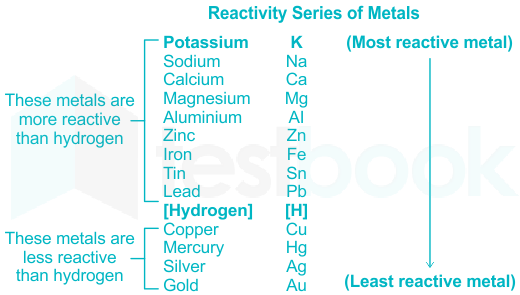
  • But on selfing the F1 generation, the dwarf trait reappeared.
  • He concluded that there is a factor that didn't express itself in the F1 generation while the other one did.
  • The concept of genes was not known at that time.
  • He postulated that there are two factors one for each trait, and only one of them is able to express itself in heterozygous conditions.
  • This factor is called the dominant factor and other that didn't express itself is called the recessive factor.
  • While writing the genotypes, the dominant factor/ gene is represented by a capital letter, while a small letter of the same alphabet is used to denote the recessive factor/ gene.
  • For example, the tall trait is expressed by TT but the dwarf trait by tt.

So, for a cross between yellow-coloured dominant seeds and green-coloured recessive seeds, YY × yy symbols will be used.

62

Which of the following statements is INCORRECT?

  1. ((a))

    Hydride ion is the anion of hydrogen.
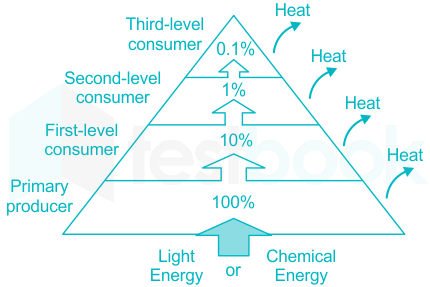
  2. ((b))

    O2 is a molecule of an element.

  3. ((c))

    A positively charged ion is called a cation.

  4. ((d))

    Atomicity of carbon dioxide is 2.

Show Answer
Answer: ((d))

Atomicity of carbon dioxide is 2.

The correct answer is Atomicity of carbon dioxide is 2.

Concept:

Atom:

  • All elements, compounds, or mixtures are composed of some small particles which cannot be further divided into smaller particles. They are known as atoms.
  • They may or may not be capable of independent existence.

Molecule:

  • Molecules refer to the group of two or more atoms chemically bonded together capable of independent existence.

Atomicity:

  • The number of atoms present in a single molecule is called atomicity.
  • Monoatomic molecules are made up of only one single atom. For example, Ar (Argon), He(Helium).
  • Diatomic molecules are made up of two atoms. For example, O(oxygen), N2 (nitrogen), and H(Hydrogen).
  • Polyatomic molecules are made up of many atoms. For example, CO2 (Carbon dioxide), and P4 (Phosphorus).

Ion:

  • An atom either loses or gains an electron to become a charged species called an ion.
  • Metals tend to lose electrons and form cations.
  • non-metals tend to gain electrons from an anion.

Explanation:

StatementTrue/ false
Hydride ion is the anion of hydrogen.True, Hydride (H-), has a negative charge on it. So, it is an anion.  
O2 is a molecule of an element.True, because it has the same types of atoms, it is an element.
A positively charged ion is called a cation.True, because cations have a positive charge.
Atomicity of carbon dioxide is 2.False because CO2 has three atoms, One C-atom, and two O- atoms. Thus, its atomicity is 3, not 2.
63

A motor is a device:

(i) Which converts mechanical energy into electrical energy.

(ii) which converts electrical energy into mechanical energy.

(iii) In which split-ring is used.

Select the correct option.

  1. ((a))

    Only (ii) is correct

  2. ((b))

    (i) and (iii) both are correct

  3. ((c))

    (ii) and (iii) both are correct

  4. ((d))

    Only (i) is correct

Show Answer
Answer: ((c))

(ii) and (iii) both are correct

The correct answer is .(ii) and (iii) both are correct

Concept:

Electric motor:

  • An electric motor is a device that converts electrical energy to mechanical energy.
  • Principle:- It is based on the principle that when a current-carrying conductor is placed in a magnetic field perpendicular to it, it experiences a force.

Explanation:

Parts of an Electric Motor:

  • Power Source: A simple motor usually has a DC power source. It supplies power to the motor armature or field coils.
  • Armature Coil: A rectangular coil ABCD.
  • Field Magnet: The magnetic field helps to produce a torque on the rotating armature coil by virtue of Fleming’s left-hand rule.
  • Armature Core: Holds the armature coil in place and provides mechanical support.
  • Commutator or Split ring: Two disjoint C-shaped rings P and Q. It acts as a commutator (which can reverse the direction of the current).
  • Brushes: It is a device that conducts current between stationary wires and moving parts, most commonly the rotating shaft.

StatementTrue/ false
i. Which converts mechanical energy into electrical energy.False
ii. which converts electrical energy into mechanical energy.True
iii. In which split-ring is used.True

Only statements ii. and iii. are correct.

64

How is Covid-19 transmitted?

  1. ((a))

    Via aerosols and droplets

  2. ((b))

    Via unfiltered water

  3. ((c))

    Via touching the face

  4. ((d))

    Via contaminated blood

Show Answer
Answer: ((a))

Via aerosols and droplets

The correct answer is Via aerosols and droplets.

Concept:

Disease: 

  • Disfunctioning of one or more organs or systems of the body, characterized by various signs and symptoms is called a disease.

Types of diseases:

  • Infectious diseases: 
  • ​These diseases spread from one person to another easily.
  • They are caused by germs such as bacteria, viruses, protozoa, etc.
  • Example: Common cold, typhoid, cholera, etc.
  • Non-infectious diseases: 
  • These diseases are caused due to nutritional deficiency, sedentary lifestyle, or genetic defects.
  • These diseases do not spread from one person to another.
  • Example: Night blindness, colour blindness, etc.

Explanation:

Covid-19:

  • Coronavirus disease (COVID-19) is an infectious disease caused by the SARS-CoV-2 virus.
  • The virus can spread from an infected person’s mouth or nose in small liquid particles when they cough, sneeze, speak, sing or breathe.
  • These particles range from larger respiratory droplets to smaller aerosols.
  • Most people infected with the virus will experience mild to moderate respiratory illness and recover without requiring special treatment.
  • However, some will become seriously ill and require medical attention.
  • Older people and those with underlying medical conditions like cardiovascular disease, diabetes, chronic respiratory disease, or cancer are more likely to develop serious illnesses.

Key Points

The best way to prevent and slow down transmission

  • Be well informed about the disease and how the virus spreads
  • Protect yourself and others from infection by staying at least 1 meter apart from others
  • Wearing a properly fitted mask
  • Washing your hands or use an alcohol-based rub frequently.
  • Get vaccinated when it’s your turn and follow local guidance.
65

A cylindrical wire AB consists of two equal parts AC and CB. Parts AC and CB are made of materials of resistivity ρ and 2ρ and have different radii 2r and 3r, respectively. A battery is connected across the wire. Let V1 and V2 be the potential differences across AC and CB, respectively. Then (V1/V2) is:

  1. ((a))

    38\frac{3}{8}

  2. ((b))

    98\frac{9}{8}

  3. ((c))

    18\frac{1}{8}

  4. ((d))

    118\frac{{11}}{8}

Show Answer
Answer: ((b))

98\frac{9}{8}

The correct answer is 9/8.

Concept:

Resistance:

  • It is the opposition offered to the flow of current passing through a conductor.
  • It is measured in Ohms (Ω).
  • R = ρL/ A where ρ is resistivity, L is the length of conductor and A is the area of cross-section.

Ohm's Law:

  • Ohm’s law states that the amount of electric current through a metal conductor in a circuit is directly proportional to the voltage impressed across it, for any given temperature.
  • V = IR, where V is voltage, I is current and R is resistance.

Explanation:

In the above-drawn circuit, we can refer to the two sections of wire as two different resistors in series. Current remains same in series connection. So, here we will take current = I. 

For Wire AC

length = L, resistivity= ρ , Radius = 2r 

Area of cross-section of wire = π r2 = π (2r)2 = 4 π r2

R1 = ρ L/ A = ρ L / 4 π r2

V1 = I R1 = I ρ L / 4 π r2

For wire BC 

length = L, resistivity= 2ρ , Radius = 3r 

Area of cross-section of wire = 9 π r2 

R2 = 2ρ L/ A = 2ρ L / 9 π r2

V2 = I R2 =  2ρ I L /  9π r2

Ratio of V1 to V2 = V1/ V2 =  ρIL4πr22ρIL9πr2\frac{\frac{\rho IL}{4\pi r^2}}{\frac{2\rho I L}{9\pi r^2}} = ρIL4πr2\frac{\rho IL}{4\pi r^2} × 9πr22ρIL\frac{9 \pi r^2}{2\rho IL} = 9 / 8

The ratio (V1 / V2) is 9/8.

66

Shoots of plants bend towards light    __

  1. ((a))

    as a consequence of secondary growth.

  2. ((b))

    to maximise the rate of photosynthesis.

  3. ((c))

    due to the movement of leaves away from darkness.

  4. ((d))

    due to uneven distribution of auxin.

Show Answer
Answer: ((d))

due to uneven distribution of auxin.

The correct answer is due to the uneven distribution of auxin.

Concept:

Plant hormones:

  • Plant hormones (also known as phytohormones) are organic substances that regulate plant growth and development.
  • Plants produce a wide variety of hormones, including auxins, gibberellins (GA), abscisic acid (ABA), cytokinins (CK), and ethylene (ET).

Explanation:

Auxins:

  • Plant hormones that regulate growth, particularly by stimulating cell elongation in stems are called auxins.

They also play a role in

  • Cell division and differentiation,
  • Fruit development,
  • The formation of roots from cuttings,
  • The inhibition of lateral branching (apical dominance), and
  • In leaf fall (abscission).

Auxin migrates to the darker side of the plant and there they enhance the growth of the cell in comparison to the lighter side of the plant.

Thus, the Shoots of plants bend towards light due to the uneven distribution of auxin.

67

Bleaching powder, represented as CaOCl2, is prepared by which of the following methods?

  1. ((a))

    By reaction of chlorine with dry calcium oxide

  2. ((b))

    By reaction of water with calcium chloride

  3. ((c))

    By reaction of chlorine with dry calcium hydroxide

  4. ((d))

    By reaction of calcium with water and chlorine

Show Answer
Answer: ((c))

By reaction of chlorine with dry calcium hydroxide

The correct answer is By the reaction of chlorine with dry calcium hydroxide. 

Explanation:

Bleaching powder:

  • The chlorine produced on passing electricity through brine solution undergoes a reaction with dry slaked lime [Ca (OH)2] to produce Bleaching powder.
  • The reaction is as follows: Ca(OH)2 + Cl2 → CaOCl2 + H2Owhere, 
  • Ca(OH)2 is calcium hydroxide or dry-slaked lime.
  • Cl2 is chlorine gas
  • CaOCl2 is a bleaching powder or calcioxychlorate. ​

Additional Information

  • Bleaching powder is used for several purposes:
  • As a bleaching agent for bleaching cotton and linen in the textile industry,
  • To bleach wood pulp in the paper manufacturing industry.
  • To bleach washed clothes in the laundry.
  • As an oxidizing agent in many chemical industries.
  • To disinfect drinking water and make it germ-free.
68

You are given three metals 'X', 'Y' and 'Z'. Metal 'X' is found to react with an aqueous solution of both YSO4 and ZSO4 whereas metal 'Z' is found to react only with aqueous solution of YSO4. Based on these observations, select the correct statement from the following.

  1. ((a))

    Solution of YSO4 can be stored in a container made of 'Z'.

  2. ((b))

    Solution of ZSO4 can be stored in a container made of 'X'

  3. ((c))

    Solution of XSO4 can be stored in a container made of 'Y' as well as 'Z'.

  4. ((d))

    Solution of YSO4 can be stored in a container made of 'X' as well as 'Z'.

Show Answer
Answer: ((c))

Solution of XSO4 can be stored in a container made of 'Y' as well as 'Z'.

The correct answer is Solution of XSO4 can be stored in a container made of 'Y' as well as 'Z'.

Concept:

Reactivity series:

  • The metals are arranged in decreasing order of their reactivities.

How does the metal reactivity series work? + Example

Displacement reaction:

  • A more reactive metal displaces a less reactive metal from its salt solution.

Explanation:

  • Metal  'X'  reacts with both YSO4 and ZSO4.
  • It can displace these metals from salts.
  • So, it is more reactive than both Y and Z.
  • 'Z'  reacts only with an aqueous solution of YSO4.
  • Thus, it is more reactive than Y.
  • Order of reactivity: X > Z > Y.
  • If we wish to store an aqueous solution of metal in a metallic container, the container should be made of metal less reactive than the one present in the aqueous solution.
  • Since X is the most reactive of all three metals, its aqueous solution can be stored in the metallic container made of the other two metals (Y and Z).
69

An object 2.0 cm in height is placed at a distance of 20.0 cm in front of a concave mirror of focal length 40.0 cm, on its principal axis. Following New Cartesian Sign Convention, the image is formed at v = ________ and its height h= ________.

  1. ((a))

    -(40/3) cm; -(4.0/3) cm

  2. ((b))

    40 cm; 4.0 cm

  3. ((c))

    40 cm; -4.0 cm

  4. ((d))

    -(40/3) cm; (4.0/3) cm

Show Answer
Answer: ((b))

40 cm; 4.0 cm

The correct answer is 30 cm; 2.0 cm.

Concept:

Spherical mirror:

  • A spherical mirror is a mirror that has the shape of a piece cut out of a spherical surface.
  • There are two types of spherical mirrors: concave, and convex.

Mirror formula:1f=1v+1u\frac{1}{f} = \frac{1}{v} + \frac{1}{u}, where f = focal length, v = image distance and u = object distance.

Magnification: m = HiHo=vu\frac{Hi}{Ho} = \frac{-v}{u} , where Hi = height of image, Ho = height of object, v = image distance, and u = object distance.

Concave mirror: 

  • It is part of a whole spherical mirror that reflects light from the hollow part.
  • It is a converging mirror because it converges the incident rays at a point.

Explanation:

Given, u = -20 cm        f = -40 cm              h = 2 cm 

1f=1v+1u\frac{1}{f} = \frac{1}{v} + \frac{1}{u}

140=1v+120\frac{1}{-40} = \frac{1}{v} + \frac{1}{-20}

140=1v120\frac{1}{-40} = \frac{1}{v} - \frac{1}{20}

1v=140+120\frac{1}{v} = \frac{1}{-40} + \frac{1}{20}

1v=1+240\frac{1}{v} = \frac{-1 + 2}{40}

1v=140\frac{1}{v} = \frac{1}{40}

v = 40 cm

m = HiHo=vu\frac{Hi}{Ho} = \frac{-v}{u} = Hi2=(40)20\frac{Hi}{2} = \frac{-(40)}{-20} 

Hi = 2 × 2 = 4 cm

Following New Cartesian Sign Convention, the image is formed at v = 40 cm and its height HI = 4 cm.

Additional Information

Convex mirror: 

  • It is part of a whole spherical mirror that reflects light from the bulged-out part.
  • It diverges the incident rays.

70

Consider the four molecules - glucose, pyruvate, lactic acid and carbon dioxide. Of these, ________.

  1. ((a))

    Three substances are 3-carbon molecules

  2. ((b))

    Only one substance is a 3-carbon molecule

  3. ((c))

    All four substances are 3-carbon molecules

  4. ((d))

    Two substances are 3-carbon molecules

Show Answer
Answer: ((d))

Two substances are 3-carbon molecules

The correct answer is Two substances are 3-carbon molecules.

Concept:

Respiration:

  • The oxidation of complex carbohydrates to release energy is called respiration.
  • It is of two types Aerobic and anaerobic.
  • Aerobic respiration takes place in the presence of oxygen.
  • Anaerobic respiration takes place in the absence of oxygen.

Explanation:

  • During respiration, glucose (a 6-carbon molecule) is first converted into pyruvate ( a 3-carbon molecule).
  • This process is called glycolysis and it takes place in the cytoplasm of the cell.
  • The pyruvate has three fates.

  • In anaerobic respiration, pyruvate is converted into alcohol and carbon dioxide along with a small release of energy.
  • In aerobic respiration, pyruvate is converted into carbon dioxide and water along with the release of a large amount of energy.
  • A third pathway is seen when a person undergoes vigorous exercise and there is a lack of oxygen in muscle cells.
  • The pyruvate is then converted into lactic acid (a 3-carbon molecule).
MoleculeNo. of carbons
Glucose6
Pyruvate3
Lactic acid3
Carbon dioxide1

So, two substances are 3- carbon molecules.

71

Quick lime reacts with water to give slaked lime and heat. What type of reaction is this?

  1. ((a))

    Combination

  2. ((b))

    Double displacement

  3. ((c))

    Redox

  4. ((d))

    Displacement

Show Answer
Answer: ((a))

Combination

The correct answer is Combination.

Concept:

Chemical reaction:

  • It is a process in which one or more substances, the reactants, are converted to one or more different substances, the products.
  • A chemical reaction rearranges the constituent atoms of the reactants to create different substances as products.

Types of Chemical Reactions:

  • Combination reaction:
  • Two or more elements or compounds combine together to form a single compound.
  • Such reactions are represented by equations of the following form: A + B → AB.
  • Decomposition reaction:
  • The opposite of a combination reaction, a complex molecule breaks down to make simpler ones.
  • Such reactions are represented by equations of the following form: AB → A + B.
  • Displacement reaction:
  • One element takes place with another element in the compound.
  • Such reactions are represented by equations of the following form: A + BC → AC + B.
  • Double displacement reaction: 
  • It is a chemical reaction in which two compounds react and exchange their ions forming new products.
  • This reaction often results in the formation of an insoluble compound called a precipitate.
  • Such reactions are represented by equations of the following form: A+B- + C+D- → A+D- + B-C+

​Explanation:

Reaction between quick lime (CaO) and Water (H2O):

  • When Calcium oxide and water reacts, calcium hydroxide (slaked lime) is formed along with the release of heat energy.
  • CaO + H2O → Ca(OH)2.
  • Here, two compounds (CaO and H2O) are combining together to form a single compound (Ca(OH)2).
  • Thus, it is a combination reaction.
72

Match the scientist with their contributions.

ScientistContribution
1.Robert HookeA.Nucleus
2.Robert BrownB.Protoplasm
3.Jan Evangelista PurkinjeC.Dead cells
D.Living cells
  1. ((a))

    1 - D; 2 - C; 3 - C

  2. ((b))

    1 - C; 2 - A; 3 - B

  3. ((c))

    1 - B; 2 - D; 3 - A

  4. ((d))

    1 - A; 2 - B; 3 - D

Show Answer
Answer: ((b))

1 - C; 2 - A; 3 - B

The correct answer is 1 - C; 2 - A; 3 - B.

Concept:

Cell:

  • It is the structural and functional unit of life.
  • The cell is termed the structural unit of life as it provides structure to our body.
  • The cell is considered the functional unit of life as all the functions of the body take place at the cell level.

Explanation:

Discovery of cell:

  • Cells were discovered by Robert Hooke in 1665.
  • He observed a thin slice of cork under a self-designed microscope.
  • He saw small compartment-like structures similar to honeycomb and named them "Cell".
  • Robert Brown discovered the nucleus in the cell in 1831.
  • Jan Evangelista Purkinje gave the term protoplasm in 1839.
  • Protoplasm is the living material of the cell. Everything inside the plasma membrane including cytoplasm, nucleus, and cell organelles makes the protoplasm.
  • Living cells were discovered by Anton Wan Leeuwenhoek in 1674.
  • Algae Spirogyra was the first living cell observed under a microscope by him.
ScientistContribution
1. Robert HookeC. Dead cells
2. Robert BrownA. Nucleus
3.Jan Evangelista PurkinjeB. Protoplasm

Thus, the correct matchup is 1 - C; 2 - A; 3 - B

73

Three resistors A (4 Ω), B (6 Ω) and C (12 Ω) are connected in parallel. This arrangement is connected in series to three other resistors D (4 Ω), F (6 Ω) and G (12 Ω) and a 12 V battery of negligible internal resistance. Let PA and PD be the rate of energy dissipated in resistors A and D, respectively. Then the ratio (PA /PD) is:

  1. ((a))

    18\frac{1}{8}

  2. ((b))

    14\frac{1}{4}

  3. ((c))

    23\frac{2}{3}

  4. ((d))

    12\frac{1}{2}

Show Answer
Answer: ((b))

14\frac{1}{4}

The correct answer is 1/4.

Concept:

Resistance in series:

  • When resistors are connected end-to-end in a circuit, they are said to be in "series."
  • R = R1 + R2 + R3....
  • Current remains the same across all the resistors connected in series.

Resistance in parallel: 

  • When both ends of resistors are connected, they are said to be in parallel.
  • 1/R = 1/R1 + 1/R2 = 1/R3 ....
  • The potential difference across all the resistors connected in parallel remains the same.

Electric Power:

  • The energy consumed per unit of time or the rate of doing work is called power.
  • Power = work done / time taken = Vq / t = VI = V2/R = I2R

Explanation:

Resistors A (4 Ω), B (6 Ω), and C (12 Ω) are connected in parallel.

Equivalent resistance, 1/R1 = 1/4 + 1/6 +1/12 = 3+2+1/ 12 = 6/12 = 1/2 Ω

R1 = 2 Ω

Now, the  resistors R1, D, F, and G are in series.

R2 = 2 + 4 + 6 + 12 = 24 Ω 

Equivalent current, I in the circuit = V/R2 = 12/ 24 = 1/2 A

Potential difference across A = IR1 =  = 2/2 = 1 V

PA = V2/ A = 1/4  Watt       (since current remains same in series combination)

PD = I2D = 1/2  × 1/2 × 4 = 1 Watt  (since voltage remains same in parallel combination)

The ratio (PA/PD) = 1/4.

74

Given that energy is lost at every level in the food chain, if 1000 units of energy of sunlight falls on a field, how many units of energy will reach the primary consumers?

  1. ((a))

    50% of 10% of 1000 units = 50 units 

  2. ((b))

    10% of 1000 units = 100 units

  3. ((c))

    10% of 1% of 1000 units = 1 unit

  4. ((d))

    1% of 1000 units = 10 units

Show Answer
Answer: ((c))

10% of 1% of 1000 units = 1 unit

The correct answer is 10% of 1% of 1000 units = 1 unit.

Concept:

10% law:

  • This energy transfer law in the food chain was put forth by Lindeman.
  • A pyramid of energy depicts the energy flow from one trophic level to another trophic level in the food chain.
  • According to the 10 percent law, 90% of the energy captured from the previous trophic level is lost as heat to the environment and only 10 percent is made available to the next trophic level.
  • Energy flow is from environmental sunlight to producers, producers to primary consumers, primary consumers to secondary consumers, and so on.

Explanation:

The energy flow:

Primary (100%) → First level/ Primary (10%) → Second-level/ Secondary (1%) → Third level / Tertiary (0.1%).

Sunlight → Producers (Green plants) → Primary consumers (Herbivores) → Secondary Consumers (Primary Carnivores) → Tertiary consumers (Secondary carnivores)

From Sunlight Only 1% of energy is absorbed by the plants.

Sunlight → producers: 1% of 1000 units

10% of the energy will be transferred from producers to primary consumers.

Producers → primary consumers: 10% of 1% of 1000 units = 10/ 100 × 1/100 × 1000 = 10000/10000 = 1 unit

So, 1 unit of energy will reach the primary consumers.

75

Four pairs of plant nutrients are given out of which three are alike in some manner and one is different. Select the pair that is different.

  1. ((a))

    Magnesium and Phosphorus

  2. ((b))

    Copper and Manganese

  3. ((c))

    Calcium and Sulphur

  4. ((d))

    Nitrogen and Potassium

Show Answer
Answer: ((b))

Copper and Manganese

The correct answer is Copper and Manganese.

Concept:

Mineral nutrition:

  • Minerals: These can be defined as the naturally occurring inorganic nutrients that are found deep under the soil.
  • These nutrients are taken up by plants from the soil through their roots.
  • The nutrients perform several functions and take part in various metabolic processes in plant cells.
  • It includes maintenance of osmotic pressure, the permeability of the membrane, enzymatic activity, and many more.

Explanation:

Minerals are categorized as Macronutrients and Micro-nutrients.

Macronutrients:

  • The nutrients present in plants in larger amounts are macronutrients.
  • It includes Nitrogen, calcium, Potassium, Magnesium, Phosphorus, and sulphur.

Micronutrients:

  • The nutrients required in little amounts are known as trace or micronutrients.
  • It includes Iron, Boron, Manganese, Zinc, Copper, Nickel, and Molybdenum.
Magnesium and PhosphorusMacronutrients
Copper and ManganeseMicronutrients
Calcium and SulphurMacronutrients
Nitrogen and PotassiumMacronutrients

Thus, copper and manganese are the odd ones out.

Social Science (25 questions)

76

For an individual to be a human resource, which of the following conditions is generally NOT necessary?

  1. ((a))

    He must be in the age group of 15 to 59 years.

  2. ((b))

    He must have the ability to work.

  3. ((c))

    He must be willing to work.

  4. ((d))

    The individual should be only male.

Show Answer
Answer: ((d))

The individual should be only male.

Human resources refers to the size of the population of a country along with its efficiency, educational qualities, productivity, organisational abilities and farsightedness.

  • People are the greatest resource of the nation.
  • Education and health help in making people a valuable resource.
  • All other resources of nature become significant only when people extract its usefulness.
  • It is people with their demands and abilities that turn them into resources.
  • Hence, human resource is the ultimate resource, but not equally, distributed over the world.
  • They **differ in their educational levels, age, and sex, their numbers and characteristics also keep changing.**​

Additional Information

  • The Government of India has a ministry of Human Resource Development.
  • The ministry was created in 1985 with an aim to improve people's skills.
  • The Government of India started a Prandhan mantri kaushal vikas yojna in 2015 with the objective of encourage aptitude towards employable skills by giving quality training to probable and existing wages earners.

Resources- is everything available in our environment which can be used to satisfy our needs provided, it is technologically accessible, economically feasible and culturally acceptable can be termed as Resources.

Types of resources:

77

During the Mughal period; apart from cash, the salary which mansabdars received was known by the name _______

  1. ((a))

    zabt

  2. ((b))

    jagir

  3. ((c))

    jat

  4. ((d))

    mansab

Show Answer
Answer: ((b))

jagir

The term Mansabdar refers too an individual who holds a mansab, meaning a position or rank. it was a grading system used by the Mughals to fix their rank, salary, and military responsibilities.

  • This System was introduced by Mughal emperor Akbar.
  • Rank and salary were determined by a numerical value called Zat.
  • The higher the Zat, the more prestigious was the noble's position in the court and the larger his salary.
  • 'Zat' indicated the number of soldiers under the Mansabdar.
  • The Mansabdar's military responsibilities required him to maintain a specified number of Sawar or cavalrymen.
  • The Mansabdar brought his cavalrymen for review, got them registered, their horses branded and then received money to pay them as salary.
  • Mansabdar recevied their salaries as revenue assignments called jagirs.
  • Jagir was a feudal land grand given by Mugal empire.
  • Under this system, the powers to govern and collect tax from an estate were given to an official (jagirdar) appointed by the state.
  • During Emperor Akbar,s reign, the mansabdars received their salary from their revenue collected by the Mughals empire from the jagirs allotted to them.
  • The two types of jagir were are conditional jagir and unconditional jagir.
  • In the case of conditional jagir, the governing family had to maintain troops and provide their service to the state whenever required. Also the jagir was reverted back to the state after the death of jagirdar.

​  

Additional Information

 Zabt-  was a land revenue system that was framed during the Mughal period.

  • This system included taking a careful survey of crop yields and prices cultivated for a 10 year period.
  • On this basis tax was fixed on each crop in cash.
  • Each province was divided into revenue circles with its own schedule of revenue rates for individual crops.
  • This system is prevalent in those areas where Mughals administrators could survey the land and keep very careful accounts.
  • This system was not possible in the area of Gujarat and Bengal.
78

The state of ________ was renamed to Karnataka in 1973.

  1. ((a))

    Andhra Pradesh

  2. ((b))

    Mysore

  3. ((c))

    Maharashtra

  4. ((d))

    Gujarat

Show Answer
Answer: ((b))

Mysore

Karnataka was formed on 1 November 1956, with the passage of the States Reorganization Act1956.

  • Originally Karnataka known as the State of Mysore, it was renamed Karnataka in 1973 under the Mysore state (Alteration of Name) Act,1973.
  • The name Karnataka is derived from Karunadu means ‘Lofty Land’.
  • The state is surrounded by the Laccadive Sea and the Arabian Sea in the west, Maharashtra in the northern side, Goa in the north-west side and Andhra Pradesh and Telangana on the eastern side.
  • It is also surrounded by Kerala in south-west and Tamil Nadu, on the south-east side.
  • The state forms a part of the Deccan Plateau, it lies on the western edge of the plateau.

 Additional InformationAndhra Pradesh- was formed on 1 November 1953 with the capital of Kurnool.

  • It is the first linguistic state of India, by taking out the Telugu speaking areas from the State of Madras (now Tamil Nadu).
  • This followed a prolonged popular agitation and the death of Potti Sriramulu, a congressperson of standing after a 56-day hunger strike for the cause.

Maharashtra and Gujarat- were formed on 1 May 1960 by the state Reorganization act 1960. 

  • when the Marathi and Gujarati linguistic areas of the former Bombay state were separated.
  • Gujarat is the 15th state of the Indian Union.
  • Arabian Sea guards the western boundary of Maharashtra, while Gujarat and Madhya Pradesh are on the northern side. Chhattisgarh covers the eastern boundary of the State. Karnataka and Telangana are on their southern side.
  • Gujarat state is bounded by the Arabian Sea in the west, Pakistan and Rajasthan in the north and north-east respectively, Madhya Pradesh in the south-east and Maharashtra in the south.
79

Which of the following is NOT an outcome of democracy?

  1. ((a))

    Guarantees employment to all citizens

  2. ((b))

    Ends exploitation

  3. ((c))

    Promotes equality among citizens

  4. ((d))

    Enhances dignity of individuals

Show Answer
Answer: ((a))

Guarantees employment to all citizens

Democracy is the rule of people or government by people. It is the people who elect representatives and these representatives are answerable and accountable to the people. They are responsive to the needs and expectations of the people.

Key Points 

  • Democracy Promotes equality among citizens, Enhances the dignity of the individual, Improves the quality of decision making, Economic growth and development, Reduction of inequality and poverty, Accommodation of social diversity, Dignity and freedom of the citizens.
  • It also provides a method to resolve conflicts.
  • In a democracy, people will have the right to choose their rulers and people will have control over the rulers. Whenever possible and necessary, citizens should be able to participate in decision-making, which affects them all.
  • Democratic government develops mechanisms for citizens to hold the government accountable and mechanisms for citizens to take part in decision making whenever they think fit.
  • Democracy is based on the idea of deliberation and negotiation.
  • Democracy is the best form of government because it allows us to correct our own mistakes.
80

Which rank does India hold on the Human Development Index according to UNDP Report 2020?

  1. ((a))

    101

  2. ((b))

    121

  3. ((c))

    141

  4. ((d))

    131

Show Answer
Answer: ((d))

131

India ranked 131 among 189 countries on the Human Development Index (HDI) for 2019, according to the Human Development Report (HDR) 2020 released by the United Nations Development Program (UNDP).

Human Development Index (HDI)- is a summary measure of human development. It measures the average achievements in a country in three basic dimensions of human development: A long and healthy life ,Access to knowledge, A decent standard of living.

  • The report was first launched in 1990 by the Pakistani Economist Mahbub ul Haq and Indian Nobel laureate Amartya Sen.
  • According to them, development is all about enlarging people’s choices in order to lead long, healthy lives with dignity.
  • The United Nations Development Program has used his concept of human development to publish the Human Development Report annually since 1990.
  • Norway topped the index, followed by Ireland and Switzerland.
  • HDI value for 2019 is 0.645, which puts the country in the medium human development category, positioning it at 131 out of 189 countries and territories.
  • India, Bhutan, Bangladesh, Myanmar, Nepal, Cambodia, Kenya and Pakistan were ranked among countries with “medium human development" with ranks between 120 and 156.

 Additional InformationUnited Nations Development Program (UNDP)- is the UN’s global development network, an organization advocating for change and connecting countries to knowledge, experience and resources to help people build a better life. 

  • UNDP got birth after the merging of the United Nations Expanded Program of Technical Assistance, created in 1949, and the United Nations Special Fund, established in 1958.
  • UNDP was established in 1965 by the General Assembly of the United Nations.
81

In Revolutionary France, the right to vote was granted exclusively to ________.

  1. ((a))

    women

  2. ((b))

    property owning men

  3. ((c))

    peasants

  4. ((d))

    men

Show Answer
Answer: ((b))

property owning men

In revolutionary France, Suffrage was extended only to men who owned property, Non-propertied men and women were excluded from political rights.

  • For a brief period, under the Jacobins, voting rights were extended to all adult males, but women were again excluded from such rights. Once more, under Napoleon, voting rights were given only to property-owning men.

​ 

Additional Information

French Revolution- was a time of social and political upheaval in France and its colonies that began in 1789 and ended in 1799

  • It lead by liberal and radical ideas who overthrew the Monarchy and influenced the decline of absolute Monarchies in other parts of Europe.

​Main cause of French revolution:

  • Cultural- causes are Enlightenment to think rationally, critically led to lowering the status of Church and Monarch, while promotion of secular, scientific and humanistic values.
  • Social- causes are Aspiration of Bourgeois class to be politically equal to Clergy and the Aristocratic class.
  • Financial- causes are France’s involvement in the American Revolution leading to increased taxation at home and a reduction in privileges​
  • Political- causes are Provincial Courts’ opposition to the reduction in their privileges.

Impact on French Society:

  • Monarchy was abolished and Republic took its place
  • .Political sovereignty is introduced at individual and nation-state level with a centralised government.
  • Serfdom, Feudalism, Slavery were abolished and the influence of Church decreased in personal lives
  • Idea of separation of public and private realm emerged.
  • Idea of Liberty, Equality, Fraternity emerged.​
82

Western Cyclonic Disturbances are brought in India by which of the following jet streams?

  1. ((a))

    Southern jet stream

  2. ((b))

    Polar jet stream

  3. ((c))

    Easterly jet stream

  4. ((d))

    Westerly jet stream

Show Answer
Answer: ((d))

Westerly jet stream

The correct answer is Westerly jet stream

The westerly Jet Stream, a cold wind which pushes down wind to the surface creating a high pressure on the surface.

Key Points

  • These jet streams are located approximately over 27°-30° north latitude, therefore, they are known as subtropical westerly jet streams.
  • Over India, these jet streams blow south of the Himalayas, all through the year except in summer.
  • The western cyclonic disturbances experienced in the north and north-western parts of the country are brought in by this westerly flow in winters.
  • In summer, the subtropical westerly jet stream moves north of the Himalayas with the apparent movement of the sun. Hence, option 4 is correct.

​ 

Additional Information

Jet Stream- is a strong narrow current concentrated along a quasi horizontal axis in the upper troposphere or the stratosphere characterized by strong vertical and lateral wind shear and featuring one or more velocity maxima is called the jet stream.”

  • Jet streams are strong, upper tropospheric flows that are quasi horizontal in nature. They originate due to differential heating of the earth’s surface and form at the boundaries of adjacent air masses with significant temperature differences.

Polar Jet Stream- meanders through the upper stratosphere over the poles. They are present in the convergence zone above the sub polar low pressure belt.

Easterly Jet Stream-occurs near the tropopause over Southeast Asia, India, and Africa during summer.

  • This jet implies a deep layer of warm air to the north of the jet and colder air to the south over the Indian Ocean.
  • The difference in heating and cooling and the ensuing pressure gradient is what drives this jet.​

83

International Airport at Kolkata is known by the name  ______ .

  1. ((a))

    Jyoti Basu International Airport

  2. ((b))

    Netaji Subhash Chandra Bose International Airport

  3. ((c))

    Indira Gandhi International Airport

  4. ((d))

    Jawaharlal Nehru International Airport

Show Answer
Answer: ((b))

Netaji Subhash Chandra Bose International Airport

The international airport in Kolkata is named Netaji Subhash Chandra Bose International Airport located in Dum Dum, West Bengal, India.

  • Netaji Subhash Chandra boss international airport is one of the oldest airports in India.
  • It was earlier known as Dhum Dhum Airport.

Additional InformationSubhas Chandra Bose was an Indian Nationalist, great leader, thinker, and fighter, who defied British authority

  • His famous quote is, “Give me blood, and I shall give you freedom!”
  • His Jayanti is celebrated as ‘Parakram Diwas’ on 23rd January. ​
84

Which of the following conditions should be met for a political party to be recognised as a national party?

  1. ((a))

    The party should be recognised at least in ten states as a state political party.

  2. ((b))

    The party should be recognised at least in six states as a state political party.

  3. ((c))

    The party should be recognised at least in five states as a state political party.

  4. ((d))

    The party should be recognised at least in four states as a state political party.

Show Answer
Answer: ((d))

The party should be recognised at least in four states as a state political party.

A party that secures at least six percent of the total votes in Lok Sabha elections or Assembly elections in four States and wins at least four seats in the Lok Sabha is recognized as a national party.

  • It is recognized as a State party in at least four States

There were six recognized national parties in the country:

  • Aam Aadmi Party (AAP)
  • Bahujan Samaj Party (BSP)
  • Bharatiya Janata Party (BJP)
  • Communist Party of India – Marxist (CPI-M)
  • Indian National Congress (INC)
  • National People's Party (NPP)
85

The Bolshevic Party was renamed to ________  .

  1. ((a))

    Russian Communist Party (Bolshevic)

  2. ((b))

    Russian Revolutionary Party (Bolshevic)

  3. ((c))

    Russian Congress Party (Bolshevic)

  4. ((d))

    Russian Peasants Party

Show Answer
Answer: ((a))

Russian Communist Party (Bolshevic)

In March 1918 the Bolshevik Party was renamed the Russian Communist Party (Bolshevik) in order to distinguish it from Social Democratic parties in Russia and Europe and to separate the followers of Lenin from those affiliated with the nonrevolutionary Socialist International.

Additional InformationVladimir Lenin: Vladimir Lenin, also called Vladimir Ilich Lenin his original name was Vladimir Ilich Ulyanov,.

  • He is inspirer and leader of the Bolshevik Revolution (1917).
  • ​​​He founded the Communist Party in Russia.
  • He is the one who set up the world’s first Communist Party dictatorship.
  • He led the October Revolution of 1917.
  • In the Revolution, the Communists (Bolsheviks) captured power in Russia.
  • Later he ruled the country until his death in 1924.
86

An extraordinary popular movement for restoration of democracy was witnessed in Nepal in which of the following years?

  1. ((a))

    2002

  2. ((b))

    1990

  3. ((c))

    2006

  4. ((d))

    2005

Show Answer
Answer: ((c))

2006

The correct answer is 2006.

  • Nepal was one of the ‘third wave’ countries that had won democracy in 1990.
  • Although the king formally remained the head of the state, the real power was exercised by popularly elected representatives.

Important Points

  1. King Birendra, who has accepted this transition from absolute monarchy to constitutional monarchy, was killed in a mysterious massacre of the royal family in 2001.
  2. King Gyanendra, the new king of Nepal, was not prepared to accept the democratic rule. He took advantage of the weakness and unpopularity of the democratically elected government.
  3. In February 2005, the king dismissed the then Prime Minister and dissolved the popularly elected Parliament. The movement of April 2006 was aimed at regaining popular control over the government from the king.
  4. On 24 April 2006, the last day of the ultimatum, the king was forced to concede all three demands.

Hence, An extraordinary popular movement for the restoration of democracy was witnessed in Nepal in the year 2006.

87

The rural banking system does NOT include which of the following banks?

  1. ((a))

    World Bank

  2. ((b))

    Commercial banks

  3. ((c))

    Land development banks

  4. ((d))

    Regional rural banks

Show Answer
Answer: ((a))

World Bank

The correct answer is World Bank.

  • Rural banking refers to providing banking services to individuals living in rural areas.
  • Rural banking has become integral to the Indian financial markets with a majority of the Indian population still living in rural or semi-urban areas.

Important Points

  1. Today, rural banking includes a set of various financial institutions, particularly regional rural banks (RRBs), cooperatives, commercial banks, self-help groups, and land development banks.
  2. Rural economy growth generally depends on the funds from one interval to another to understand the high-rise productivity in non-agriculture and agriculture areas.
  3. Farmers lend money from different fronts to match the primary investment on fertilizers, seeds, tools, and other personal expenses.

Additional Information

  1. The World Bank is an international financial institution that provides loans and grants to the governments of low- and middle-income countries to pursue capital projects.

Hence, The Rural banking system includes commercial banks, Regional rural banks and Land Development banks. World Bank does not include it.

88

Which of the following hazards has been INCORRECTLY paired with its example?

  1. ((a))

    Hydrological hazard – Flood

  2. ((b))

    Geophysical hazard – Earthquake

  3. ((c))

    Climatological hazard – Drought

  4. ((d))

    Biological hazard – Tsunami

Show Answer
Answer: ((d))

Biological hazard – Tsunami

A natural hazard is a natural phenomenon that might hurt humans and other animals or the environment.

  • A natural disaster is a major adverse event resulting from natural processes of the Earth;
  • Examples include firestorms, dust storms, floods, hurricanes, tornadoes, volcanic eruptions, earthquakes, tsunamis, storms, and other geologic processes.

Important Points

  1. Hydrological hazards are defined as extreme events associated with water occurrence, movement, and distribution, hydrological hazards include droughts and flooding and related events (e.g., landslides and river scour and deposition).
  2. Geological or geophysical hazards originate from internal earth processes. Examples are earthquakes, volcanic activity and emissions, and related geophysical processes such as mass movements, landslides, rockslides, the surface collapses, and debris or mudflows.
  3. Climatological hazards are a hazard caused by long-lived, meso- to macro-scale atmospheric processes ranging from intra-seasonal to multi-decadal climate variability.

Mistake Points

  1. Biological hazards, also known as biohazards, refer to biological substances that pose a threat to the health of living organisms, primarily humans. This can include medical waste or samples of a microorganism, viruses, or toxins (from a biological source) that can affect human health.

Hence, Tsunami is a Hydrological hazard and not a biological hazard.

89

The concept of Panchayati Raj in India was recommended by which of the following committees?

  1. ((a))

    Ashok Mehta Committee

  2. ((b))

    Balwant Rai Mehta Committee

  3. ((c))

    Punchhi Committee

  4. ((d))

    JS Rajput Committee

Show Answer
Answer: ((b))

Balwant Rai Mehta Committee

The correct answer is Balwant Rai Mehta Committee.

Key Points:

  • Panchayati Raj is the system of local self-government of villages in rural India. as opposed to urban and suburban municipalities.
  • It consists of the Panchayati Raj Institutions through which the self-government of villages is realized.

Important Points

  1. The Balwant Rai Mehta Committee, headed by MP Balwantrai Mehta, was a committee appointed by the Government of India in January 1957
  2. To examine the work of the Community Development Programme (1952) and the National Extension Service (1953). To suggest measures to improve their work.
  3. The committee's recommendation was implemented by NDC in January 1958, and this set the stage for the launching of Panchayati Raj Institutions throughout the country.
  4. The committee recommended the establishment of the scheme of ‘democratic decentralization, which finally came to be known as Panchayati Raj.

Hence, The concept of Panchayati Raj institutions is recommended by the Balwant Rai Mehta Committee.

90

Which of the following is NOT one of the characteristics of a secular state?

  1. ((a))

    The government cannot compel any person to pay taxes for the promotion of any religion.

  2. ((b))

    No one can change his or her religion.

  3. ((c))

    Government schools and offices are not supposed to display or promote any one religion.

  4. ((d))

    The Indian State is not ruled by a religious group nor does it support any one religion.

Show Answer
Answer: ((b))

No one can change his or her religion.

A secular state is an idea of secularity, whereby a state is or purports to be officially neutral in matters of religion, supporting neither religion nor irreligion.

  • A secular state claims to treat all its citizens equally regardless of religion and claims to avoid preferential treatment for a citizen based on their religious beliefs, affiliation, or lack of either over those with other profiles.

Important Points

  • In the secular state, any government can not force or compel to pay any type of taxes based on their religion.it is against the secular state principle.
  • Government offices and schools are not supposed to display or promote any religion as they treat all the people on equal ground.
  • India is a secular state and it does not rule by anybody or any religious group which supports one specific religion.

Mistake Points

  • In a secular, every person has the right to follow his or her religion. and anyone can change their religion.

Hence, No one can change his or her religion is not the characteristic of a secular state.

91

The French Revolution led to the end of which form of government in France?

  1. ((a))

    Oligarchy

  2. ((b))

    Monarchy

  3. ((c))

    Aristocracy

  4. ((d))

    Democracy

Show Answer
Answer: ((b))

Monarchy

The correct answer is Monarchy.

  • The French Revolution was a period of radical political and societal change in France that began with the Estates-General of 1789 and ended with the formation of the French Consulate in November 1799.
  • Many of its ideas are considered fundamental principles of liberal democracy.

Important Points

  1. A monarchy is a form of government in which a person, the monarch, is head of state for life or until abdication.
  2. The political legitimacy and authority of the monarch may vary from restricted and largely symbolic, to fully autocratic, and can expand across the domains of the executive, legislative, and judicial.
  3. France before 1789 was an absolute monarchy ruled by the Bourbons. This meant that the authority of the French Crown was not limited by any representative body, such as an elected parliament.
  4. The King was responsible only to God and answerable to no one on Earth. This system of government is also known as absolutism.

Hence, The French revolution led to the end of the Monarchy.

92

Who was the chairman of the Mandal Commission set up in 1979?

  1. ((a))

    OP Mandal

  2. ((b))

    BP Mandal

  3. ((c))

    CL Mandal

  4. ((d))

    SC Mandal

Show Answer
Answer: ((b))

BP Mandal

The correct answer is BP Mandal.

  • The Mandal Commission, the Socially and Educationally Backward Classes Commission (SEBC), was established in India in 1979.
  • By the Janata Party government under Prime Minister Morarji Desai's Tenure.

Important Points

  1. It was headed by B.P. Mandal, an Indian parliamentarian, considered the question of reservations for people to redress caste discrimination and used eleven social, economic, and educational indicators to determine backwardness.
  2. In 1980, based on its rationale that OBCs identified based on caste, social, and economic indicators made up 52% of India's population.
  3. The Commission's report recommended that members of Other Backward Classes (OBC) be granted reservations to 27% of jobs under the Central government and public sector undertakings, thus making the total number of reservations for SC, ST, and OBC 49%.

Hence, BP Mandal was the chairman of the Mandal Commission which was set up in 1979.

93

The art and science of map making is called: 

  1. ((a))

    topography

  2. ((b))

    physiography

  3. ((c))

    mapography

  4. ((d))

    cartography

Show Answer
Answer: ((d))

cartography

The correct answer is Cartography.

  • A map is a symbolic depiction emphasizing relationships between elements of some space, such as objects, regions, or themes.
  • Many maps are static, fixed to paper or some other durable medium, while others are dynamic or interactive.

Important Points

  1. Cartography is the art and science of graphically representing a geographical area, usually on a flat surface such as a map or chart.
  2. It may involve the superimposition of political, cultural, or other non-geographical divisions onto the representation of a geographical area.
  3. Cartography is an ancient discipline that dates from the prehistoric depiction of hunting and fishing territories.

Hence, The art and science of map-making are called Cartography.

94

Antyodaya Anna Yojana was expanded in 2003-2004 to include all of the following EXCEPT:

  1. ((a))

    disabled persons

  2. ((b))

    BPL households headed by widows

  3. ((c))

    terminally ill persons

  4. ((d))

    persons aged 65 years or more with no income

Show Answer
Answer: ((d))

persons aged 65 years or more with no income

A correct answer is a person aged 65 years or more with no income

  • Antyodaya Anna Yojana is the sponsored scheme of the Government of India to provide highly subsidized food to millions of the poorest families.

Important Points

  1. It was launched by the NDA government on 25 December 2000 and was first implemented in the Indian state of Rajasthan.
  2. The Antyodaya Anna Yojana Scheme was expanded in 2003-04 by adding another 50 lakh BPL households.
  3. Headed by widows or terminally ill persons or disabled persons or persons aged 60 years or more with no assured means of subsistence or societal support. Order to this effect was issued on 3rd June 2003.

Mistake Points

  1. The Antyodaya Anna Yojana cover person aged 60 years or more with no income

Hence, Antyodaya Anna Yojana expanded in 2003-04 to include disabled persons, terminally ill persons and BPL households headed by women. It also includes people aged above 60 years or more with no income.

95

In India, the percentage of elected women in Lok Sabha has always been lower than ________.

  1. ((a))

    5%

  2. ((b))

    7%

  3. ((c))

    4%

  4. ((d))

    15%

Show Answer
Answer: ((d))

15%

The correct answer is 15 percent.

  • Gender inequality is a serious concern in most sectors but the gap between men and women has narrowed the least in political representation.
  • Women make up merely 22% of lower houses in parliaments around the world and in India, this number is less than 15% in the ongoing Lok Sabha.

Important Points

  1. At 78 elected women MPs, the 17th Lok Sabha will have the highest number of women representatives ever.
  2. They will account for 14.39% of the entire strength of the Lower House, which was at 12.5% with a total of 65 women MPs in the previous Lok Sabha.
  3. Women’s representation has steadily increased in the Lok Sabha. In the first-ever election, only 5% of the House consisted of women. Now, that has increased to 14%.

Hence,  In India, the percentage of elected women in Lok sabha has always been lower than 15 Percent.

96

Which of the following is the outermost range of the Himalayas?

  1. ((a))

    Pir Panjal

  2. ((b))

    Lesser Himalaya

  3. ((c))

    Dhaula Dhar

  4. ((d))

    Shivaliks

Show Answer
Answer: ((d))

Shivaliks

The correct answer is Shivalik Range.

  • The Himalayas consist of three parallel ranges, the Greater Himalayas known as the Himadri, the Lesser Himalayas called the Himachal, and the Shivalik hills, which comprise the foothills.
  • Mount Everest at a height of 8,848.86m is the highest peak of Himalaya.

Important Points

  1. Siwalik Range, also called Siwalik Hills or Outer Himalayas, Siwalik also spelled Shiwalik, is the sub-Himalayan range of the northern Indian subcontinent.
  2. It extends west-northwestward for more than 1,000 miles (1,600 km) from the Tista River in Sikkim state, northeastern India, through Nepal, across northwestern India, and into northern Pakistan.
  3. The Siwaliks are sometimes considered to include the southern foothills of the Assam Himalayas, which extend eastward for 400 miles across southern Bhutan to the bend of the Brahmaputra River.

Hence, The Shivalik Range is the outermost range of the Himalayas.

97

Many Indians turned into indentured workers due to all of the following reasons EXCEPT:

  1. ((a))

    lands were cleared for mining and plantations

  2. ((b))

    cottage industries declined

  3. ((c))

    land rents were increased

  4. ((d))

    they were attracted to work in the foreign countries

Show Answer
Answer: ((d))

they were attracted to work in the foreign countries

The Indian indenture system was a system of indentured servitude, by which more than one million Indians.

  • They were transported to labor in European colonies, as a substitute for slave labor, following the abolition of the trade in the early 19th century.

Important Points

  1. Many Indians agreed to become indentured laborers to escape the widespread poverty and famine in the 19th century.
  2. Some traveled alone; others brought their families to settle in the colonies they worked in. The demand for Indian indentured laborers increased dramatically after the abolition of slavery in 1834.
  3. Cottage industries declined, and lands cleaned for mining and plantation are some reasons for the indentured labor.
  4. Indian were not attracted to work in foreign countries. But due to reasons, they leave India.

Hence, Indentured labor in India increased due to cottage industries declining and rent being so high.

98

Which of the following statements is correct with reference to Election Commission of India (ECI) ?

  1. ((a))

    ECI is an autonomous constitutional authority responsible for holding and supervising elections.

  2. ((b))

    ECI is an autonomous body under the ownership of Ministry of Law and Justice, Government of India.

  3. ((c))

    ECI is a government body under the Home Ministry of India.

  4. ((d))

    ECI is a private body recognised by the Government of India.

Show Answer
Answer: ((a))

ECI is an autonomous constitutional authority responsible for holding and supervising elections.

The Election Commission of India (ECI), is a constitutionally mandated body that was established in 1950 to foster the democratic process in India.

  • Its Headquarters is in New Delhi.

Important Points

  1. It consists of three members—a chief election commissioner and two other commissioners—who are appointed by the Indian president for six-year terms and who cannot be dismissed from office except by parliamentary impeachment.
  2. The ECI, thus nearly invulnerable to political influences and scrupulously nonpartisan, is charged with conducting fair and orderly elections.
  3. The ECI supervises, directs, and controls the entire electoral process for elections to the national parliament, state legislatures, and the offices of the national president and vice president.

Hence, The election commission of India is a constitutional body responsible for holding the electoral process in India.

99

Which of the following is a descriptive table that depicts wind intensity by a series of numbers?

  1. ((a))

    Beaufort number

  2. ((b))

    Mach number

  3. ((c))

    Reynolds number

  4. ((d))

    Froude number

Show Answer
Answer: ((a))

Beaufort number

The correct answer is Beaufort number.

  • The Beaufort scale is useful for estimating wind power without wind instruments.

Important Points

  1. The Beaufort scale, officially known as the Beaufort wind force scale, is a descriptive table. It depicts the force of the wind by a series of numbers from 0 to 12.
  2. The Beaufort scale goes all the way to 17, but the last five numbers only apply to tropical typhoons. These numbers are only used in the areas around China and Taiwan.
  3. The scale is named for Sir Francis Beaufort of the British Royal Navy. In 1805, he devised a method of describing wind force according to procedures for setting sails on a warship.

Additional Information

  1. The Mach number is the ratio of flow velocity after a certain limit of the sound's speed. In simple words, it is the ratio of the speed of a body to the speed of sound in the surrounding medium.
  2. Reynolds number is a number associated with fluid flow, which represents the relative importance of viscous forces and inertial forces in a fluid.
  3. The Froude number is a hydraulic parameter often used to relate aquatic habitats and biotopes to flow intensity.

Hence, The Beaufort number is a descriptive table that depicts wind intensity by a series of numbers.

100

Which type of natural vegetation is found in Steppe type climatic region?

  1. ((a))

    Large grasslands

  2. ((b))

    Coniferous forests

  3. ((c))

    Deciduous forests

  4. ((d))

    Evergreen forests

Show Answer
Answer: ((a))

Large grasslands

The correct answer is Large grasslands.

  • Grasslands (steppes) are temperate environments, with warm to hot summers and cool to very cold winters; temperatures are often extreme in these midcontinental areas.
  • They are often located between temperate forests and deserts, and annual precipitation falls between the amounts characteristic of those zones.

Important Points

  1. Grassland is largely dominated by grasses, but with annual and perennial forbs intermixed in different proportions in different areas.
  2. The average height of the grass is correlated with rainfall, so there are tall-, medium-, and short-grass prairie zones across a longitudinal gradient from east to west in North America.
  3. The aspect changes considerably between spring when the grasses are green and the forbs are in bloom and midsummer when brown, seeding and dying plants predominate.
  4. Some steppes, especially in more arid areas, are dominated by shrubs (they are designated as shrub-steppes) and differ from deserts primarily in their higher latitudes, lower mean temperatures, and lower diversity.

Hence, Large grassland vegetation is found in steppe-type climatic regions.

Attempt this paper under real exam conditions

Timed interface, section switching, instant scoring, and question-by-question analytics — free.

Start Timed Attempt