Official Paper

ICAR Technician 2 March 2022 Shift 1 (Previous Year Paper)

100 questions · 90 minutes · with answers · free

General Knowledge (25 questions)

1

With which of the following companies has ISRO collaborated with to strengthen research and development of NavIC messaging service?

  1. ((a))

    Vivo

  2. ((b))

    OPPO

  3. ((c))

    Samsung

  4. ((d))

    Nokia

Show Answer
Answer: ((b))

OPPO

The correct answer is OPPO.

Key Points

  • ISRO collaborated with OPPO to strengthen the research and development of the NavIC messaging service.
  • ISRO and Oppo India will exchange technical information on NavIC messaging services to build rapid, ready-to-use, end-to-end application-specific solutions.
  • This will enable the integration NavIC messaging service with the mobile handset platform keeping in mind the need of Indian users.
  • NavIC:
  • NavIC stands for Navigation Indian Constellation.
  • It has been designed by the Indian Space Research Organization (ISRO).
  • It is a messaging service platform, which provides regional navigation services.
  • It provides accurate position information service within an area of about 1500km from its primary service area.

Additional Information

  • Indian Space Research Organization (ISRO) (As of 2022) 
  • Founded: 15th August 1969
  • Founder: Vikram Sarabhai
  • Headquarter: Bengaluru
  • Chairman: Dr S Somanath
2

Where is Kashi Vishwanath Temple located?
  1. ((a))

    Agra

  2. ((b))

    Aligarh

  3. ((c))

    Lucknow

  4. ((d))

    Varanasi

Show Answer
Answer: ((d))

Varanasi

The correct answer is Varanasi.

Key Points

  • Kashi Vishwanath Temple

  • It is a famous Hindu temple dedicated to Lord Shiva.
  • It is located in Varanasi, Uttar Pradesh.
  • It is one of the twelve Jyotirlingas.

Additional Information

  • Uttar Pradesh (As of 2022)
  • Capital: Lucknow.
  • Chief Minister: Yogi Adityanath.
  • Governor: Anandiben Patel.
3

Which of the following forces operates among charged particles?

  1. ((a))

    Gravitational force

  2. ((b))

    Electromagnetic force

  3. ((c))

    Weak nuclear force

  4. ((d))

    Strong nuclear force

Show Answer
Answer: ((b))

Electromagnetic force

The correct answer is Electromagnetic force.

Key Points

  • Electromagnetic Force
  • It is a fundamental force in nature which acts between charged particles and is a combination of all electrical and magnetic forces.
  • The electromagnetic force can be attractive or repulsive in nature.
  • The four Fundamental forces of nature
  1. Gravitational Force
  2. Weak Nuclear Force
  3. Electromagnetic Force
  4. Strong Nuclear Force

Additional Information

ForceStrengthRangeAffects
Gravitational ForceVery WeakInfinite RangeAffects all particles with mass
Weak Nuclear ForceWeak1 x 10^-18Affects all particles
Electromagnetic ForceStrongInfinite RangeAffects all particles with static or moving charge
Strong Nuclear ForceVery Strong1 x 10^-15 mAffects protons and neutrons only
4

Which of the following is an INCORRECT match about political parties and year of formation?

  1. ((a))

    Bahujan Samaj Party - 1990

  2. ((b))

    Rashtriya Janata Dal - 1997

  3. ((c))

    Samajwadi Party - 1992

  4. ((d))

    Nationalist Congress Party - 1999

Show Answer
Answer: ((a))

Bahujan Samaj Party - 1990

The correct answer is Bahujan Samaj Party - 1990.

Key Points

  • Bahujan Samaj party (BSP)
  • It is a national-level political party in India
  • Formation: 1984
  • Founder: Kanshi Ram
  • Headquarters: New Delhi
  • Ideology: Social Equality, Social Justice, Secularism, Human rights, Self-respect
  • ECI Status: National party
  • Rashtriya Janata Dal (RJD)
  • It is the Indian Socialist Party, work in the area of Bihar and Jharkhand
  • Formation: 1997
  • Founder: Lalu Prasad Yadav, Raghuvansh Prasad Singh, Kanti Singh
  • Headquarters: New Delhi
  • Ideology: Socialism
  • ECI Status: State party
  • Samajwadi Party (SP)
  • It is Social Democratic Party based in Uttar Pradesh
  • Formation: 1992
  • Founder: Mulayam Singh Yadav
  • Headquarters: New Delhi
  • Ideology: Social Democracy, Social Conservatism
  • ECI Status: State party
  • Nationalist Congress Party (NCP)
  • It is one of the eight national parties in India
  • Founded: 1999
  • Founder: Sharad Pawar, P. A. Sangama, Tariq Anwar
  • Headquarters: New Delhi
  • Ideology: Liberalism, Gandhism
  • ECI Status: National Party
5

By lifting how much weight did Ajay Singh win the men’s 81 kg category to clinch India’s third gold of the Commonwealth Weightlifting Championship 2021?

  1. ((a))

    222 kg

  2. ((b))

    322 kg

  3. ((c))

    155 kg

  4. ((d))

    255 kg

Show Answer
Answer: ((b))

322 kg

The correct answer is 322 kg.

Key Points

  • Commonwealth Weightlifting Championships 2021
  • Ajay Singh dragged the third gold medal in the Commonwealth Weightlifting Championships 2021 for India.
  • He wins in the Men’s 81 kg category.
  • He lifted a total of 322 kg.
  • He sets a national record in snatch.
  • He became the third Indian weightlifter to directly qualify for the next Commonwealth Games held in Birmingham in 2022.

Additional Information

  • Commonwealth Games (CWG)
  • The first CWG was held in 1930 at Hamilton in Canada and was known as British Empire Games.
  • In 1966 they were renamed as British Commonwealth Games.
  • CWG was held every four years.
  • CWG come second after Olympics in global sports.
  • 2018 CWG was held in Gold Coast Queensland, Australia.
  • 2022 CWG is scheduled to be held in Birmingham, England.
6

India ended the Asian Rowing Championship 2021 with how many medals in total?

  1. ((a))

    Eight

  2. ((b))

    Six

  3. ((c))

    Four

  4. ((d))

    Two

Show Answer
Answer: ((b))

Six

The correct answer is Six.

Key Points

  • Indian rowers won a total of two golds and four silver medals and finished with six medals at the Asian Rowing Championship 2021 held in Thailand.
  • Indian rower Arvind Singh won the gold medal in the men’s lightweight single sculls.
  • The men's double sculls pair of Arjun Lal Jat and Ravi also won gold.
  • India’s overall tally of six medals was one better than in the last edition.
7

In which year after Alivardi Khan did Siraj-ud-Daulah become the Nawab of Bengal?

  1. ((a))

    1657

  2. ((b))

    1756

  3. ((c))

    1675

  4. ((d))

    1765

Show Answer
Answer: ((b))

1756

The correct answer is 1756.

Key Points

  • During Aurangzeb’s time, Murshid Quli Khan was Subedar in Bengal.
  • After the death of Aurangzeb in 1707, the Mughal Administrative system disappeared.
  • Taking advantage the Mughal subedars became independent. These subedars were known as Nawabs.
  • Murshid Quli Khan became independent, he was the founder of an independent empire in Bengal.
  • After the death of Murshid Quli Khan, many independent Nawabs came to rule over Bengal. Alivardi Khan was one such Nawab.
  • Alivardi Khan was the Nawab of Bengal from 1740 to 1756.
  • Siraj-ud-daulah, a young man of 23 years sat on the throne of Nawab of Bengal in 1756 amid plots and counter-plots by his friends and family members.
  • This gave a golden opportunity to East India Company to ally with one faction and gain control over Bengal.

Additional Information

  • Battle of Plassey
  • The East India company planned an attack and Robert Clive bribed Mir Jafar, the commander-in-chief of the Nawab’s army, and also promised him to make him Nawab of Bengal.
  • East India Company teamed with Mir Jaffer to defeat Siraj in Battle of Plassey.
  • The Battle of Plassey was fought at Palashi, on the banks of Bhagirathi river near Calcutta on June 23, 1757.
  • After Siraj ud Daula's defeat, Mir Jaffer was installed as a puppet nawab in Bengal.
  • **The economic drain of the Indian Economy started.**​
8

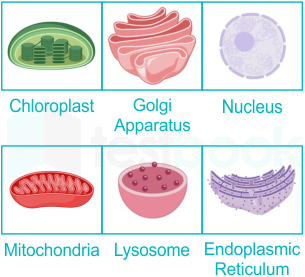
Which of the following cell organelles is INCORRECTLY matched?

  1. ((a))

    Lysosome - Suicidal bag

  2. ((b))

    Mitochondria - Power house

  3. ((c))

    Vacuole - Storage sac

  4. ((d))

    Plasma membrane - Soldier of cell

Show Answer
Answer: ((d))

Plasma membrane - Soldier of cell

The correct answer is Option 4.

Key Points

  • Lysosomes are called suicidal bags of the cell.
  • Lysosomes contain lytic enzymes capable of digesting cells and unwanted materials.
  • They burst open when the cell is damaged.
  • This causes the hydrolytic enzymes to be released.
  • The released enzymes then digest their own cell, causing the cell to die.
  • Mitochondria is the Power House of the cell.
  • Mitochondria are membrane-bound cell organelles (mitochondrion, singular) that generate most of the chemical energy needed to power the cell's biochemical reactions.
  • Chemical energy produced by the mitochondria is stored in a small molecule called adenosine triphosphate (ATP).
  • Mitochondria contain their own small chromosomes.
  • Vacuole is a storage sac.
  • Vacuoles are single membrane organelles that are involved in the storage of water and nutrients in a cell.
  • They enclose the cell sap that contains amino acids, ions, reserved food, waste materials etc.
  • ​Plasma membrane is also known as cell membrane. 
  • It is a selectively permeable membrane ​around the cell.
  • It regulates the entry and exit of materials from the cell.
  • It separates and protects the cell from the surrounding environment.
  • It is made up of phospholipid bilayer.
9

Which of the following is NOT one of the three approaches that government has been following over the years to reduce poverty in India?

  1. ((a))

    Specific Poverty Alleviation Programmes

  2. ((b))

    Growth Oriented Development

  3. ((c))

    Education Level Elevation

  4. ((d))

    Meeting the minimum needs of the poor

Show Answer
Answer: ((c))

Education Level Elevation

The correct answer is Option 3.

Key PointsThe Government's approach to poverty reduction is of three dimensions:

  • Growth- oriented approach
  • It is based on the expectation that the effects of economic growthrapid Increase in gross domestic product and per capita income – would spread to all sections of society and will trickle down to the poor sections also.
  • Rapid Industrial development and transformation of agriculture through a green revolution in select regions would benefit the underdeveloped regions and the more backward sections of the community.
  • Poverty alleviation programs
  • Expanding self-employment programs and wage employment programs are being considered as the major ways of addressing poverty.
  • For example – Rural Employment Generation Programme (REGP), Prime Minister’s Rozgar Yojana (PMRY), and Swarna Jayanti Shahari Rozgar Yojana (SJSRY), Mahatma Gandhi National Rural Employment Guarantee Act (MNREGA).
  • Meeting the minimum needs of the poor
  • India was among the pioneers in the world to envisage that through public expenditure on social consumption needsprovision of food grains at subsidized rates, education, health, water supply, and sanitation – people’s living standards could be improved.
  • Three major programs that aim at improving the food and nutritional status of the poor are the Public Distribution System, Integrated Child Development Scheme, and Midday Meal Scheme.
  • Pradhan Mantri Gram Sadak Yojana and Valmiki Ambedkar Awas Yojana are also attempted in developing Infrastructure and housing conditions.
  • Pradhan Mantri Jan Dhan Yojana is available in which people in India are encouraged to open bank accounts.
10

During lightning, the high temperatures and pressures created in the air convert nitrogen into ________.

  1. ((a))

    nitric acid

  2. ((b))

    nitrogen oxide

  3. ((c))

    ammonia

  4. ((d))

    nitrous acid

Show Answer
Answer: ((b))

nitrogen oxide

The correct answer is nitrogen oxide.

Key Points

  • By physical process during lightning, the high temperatures and pressures are created in the air which converts nitrogen into nitrogen oxide.
  • This is also called nitrogen fixation.

Additional Information

  • Nitrogen fixation
  • Any natural or industrial process that causes free nitrogen (N2), to combine chemically with other elements to form more-reactive nitrogen compounds such as ammonia, nitrates, or nitrites.
11

Which of the following types of Indian dances does NOT involve themes related to Lord Krishna?

  1. ((a))

    Odissi dance

  2. ((b))

    Manipuri dance

  3. ((c))

    Sattriya dance

  4. ((d))

    Mohiniyattam dance

Show Answer
Answer: ((d))

Mohiniyattam dance

The answer is Mohiniyattam dance.

Key Points

  • Mohiniyattam (Kerala)
  • Mohini refers to the feminine avatar of Lord Vishnu
  • Odissi (Odisha)
  • ​Most of the temples in Odisha are related to Vaishnavism.
  • related to Lord Krishna and there are also acts based on Shaktism.
  • Odia literature & Gita Govinda has had much influence on Odissi music
  • ​Manipuri (Manipur)
  • ​This dance has a background of the spiritual love relationship of Radha-Krishna.
  • It is based on the Madhura Rasa
  • Sattriya (Assam)
  • ​developed by the famous Bhakti movement saint Sankaradeva.
  • dances are centred around Lord Krishna & Vaishnavism.

Additional Information

  • There is a classical dance form in India.
Dance formState
BharatanatyamTamil Nadu
KuchipudiAndhra Pradesh
KathakaliKerala
MohiniyattamKerala
OdissiOdisha
SattriyaAssam
KathakNorthern India
ManipuriManipur
12

In December 2021, which organization planned to establish 1000 Atal tinkering labs in Jammu and Kashmir?

  1. ((a))

    NITI Aayog

  2. ((b))

    ISRO

  3. ((c))

    CSIR

  4. ((d))

    DRDO

Show Answer
Answer: ((a))

NITI Aayog

The correct answer is NITI Aayog.

Key Points

  • NITI Aayog planned to establish 1000 ATL (Atal Tinkering Labs) in Jammu & Kashmir.
  • ATL is a project under Atal Innovation Mission (AIM) for establishing laboratories in schools.
  • Its aim is to inculcate the quality of innovation in high school students.
  • Its target is to establish 1000 ATL labs in J&K, of which 187 are planned for the end of 2021-22.

Additional Information

  • NITI Aayog (National Institution for Transforming India)
  • ​It is an apex level policy think-tank of the Government of India.
  • Chairperson: Narendra Modi
  • Vice-chairperson: Shri Suman Bery
  • CEO: Parameswaran Iyer
  • ​ISRO (Indian Space Research Organisation)
  • ​National space agency of India
  • Headquarters: Bengaluru
  • Chairman: S. Somnath
  • Established: 1969
  • CSIR (Council of Scientific and Industrial Research)
  • ​Independent organization funded by Ministry of Science & Technology
  • Headquarters: New Delhi
  • Director-General: Sekhar C Mande
  • Established: 1942
  • ​DRDO (Defence Research and Development Organisation)
  • ​Under Ministry of Defence
  • Headquarters: New Delhi
  • Chairman: Dr Samir V Kamat(As of Sep 2022).
  • Established: 1958
13

In which year did Mahatma Gandhi visit Noakhali and other riot-torn areas to stop communal violence?

  1. ((a))

    1926

  2. ((b))

    1916

  3. ((c))

    1936

  4. ((d))

    1946

Show Answer
Answer: ((d))

1946

The correct answer is 1946.

Key Points

  • The riots in Noakhali took place in the backdrop of unrest due to the demand for partition by the Muslim league.
  • This happened in Noakhali, a place in then Bengal(now in Bangladesh) in the year 1946.
  • Gandhiji visited the place to advocate his message of non-violence.
  • A large scale of atrocities was committed against the members of the Hindu community.
14

The Meenakshi Temple at Madurai is an example of which type of temple?

  1. ((a))

    Dravida

  2. ((b))

    Nagara

  3. ((c))

    Mithunas

  4. ((d))

    Vesara

Show Answer
Answer: ((a))

Dravida

The correct answer is Dravida.

Key Points

  • Dravida type temple is associated with the temples of Southern India or Deccan.
  • Common characteristics of the Dravida style are the Pyramidal elevation of the tower.
  • Meenakshi Temple is located on the southern bank of the Vairagi river in the temple city of Madurai.
  • It is dedicated to Parvati, known as Meenakshi, and her consort, Shiva here named Sundareswarar.
  • Temple was built between 1623 and 1655 CE.
  • It has 14 gopurams (gateway towers), ranging from 45-50m in height.​

Additional Information

  • Nagara Style temple is a temple there is only one peak or Shikara. This type of temple is located in North India. Sun temple at Modhera and Sun Temple at Khajurao are the main examples of Nagara-style temples.
  • Vesara is mix form of Indian temple architecture, with South Indian plan and some shapes those features North Indian details.
15

In December 2021, Mithila Makhana of which state got the GI tag?

  1. ((a))

    Maharashtra

  2. ((b))

    Karnataka

  3. ((c))

    Uttar Pradesh

  4. ((d))

    Bihar

Show Answer
Answer: ((d))

Bihar

The correct answer is **Bihar.**​

Key Points

  • In December 2021, Mithila Makhana of Bihar got the GI (Geographical Indicator) tag.
  • The Geographical Indication (GI) rights, the Geographical Indication Registry (GIR) under the Central Ministry of Commerce has also accepted the petition to rename Bihar Makhana as Mithila Makhana.

Additional Information

  • GI tag is a Geographical Indicator that is a name or sign that appears on particular items and refers to the specific geographic area of origin.
  • There are some important GI tags in Bihar.
  • Madhubani Paintings
  • Shahi Litchi
  • Magahi Paan
  • Silao Khaja
  • Katarni Rice
16

In which year was the Census Act enacted?

  1. ((a))

    1894

  2. ((b))

    1948

  3. ((c))

    1984

  4. ((d))

    1872

Show Answer
Answer: ((b))

1948

The correct answer is 1948.

Key Points

  • The Census Act,1948 (Act No.37 of 1948) was amended in 1994.
  • An act to provide for certain matters in connection with the taking of the Census.
  • Whereas it is expedient to provide for the taking of the census in India or any part thereof whenever necessary or desirable and to provide for certain matters in connection with the taking of such census;
  • It is hereby enacted as follows-
  1. This Act may be called the Census Act, 1948.
  2. **It extends to the whole of India.**​

Additional Information

  • Census 2011 - Salient features.
  • It is the 15th census since 1872.
  • 7th census since Independence.
  • The largest census in human history ever conducted by any Government till now.
17

Now a days, people are replacing artificial sugar with stevia because it has no ______.

  1. ((a))

    Minerals

  2. ((b))

    Fats

  3. ((c))

    Carbohydrates

  4. ((d))

    Vitamins

Show Answer
Answer: ((c))

Carbohydrates

The correct answer is Carbohydrates.

Key Points

  • Nowadays, people are replacing artificial sugar with stevia because it has no carbohydrates.
  • Stevia
  • It is a sugar substitute made from the leaves of the stevia plant.
  • It's about 100 to 300 times sweeter than table sugar
  • It has **no carbohydrates, calories, or artificial ingredients.**​
  • It contains some amount of minerals, fats, and vitamins but it is not good for health.

Additional Information

  • Artificial Sweeteners
  • It is a sugar substitute used in foods and drinks.
  • It does not contain any calories.
  • It can affect hormones and slow down metabolism.
  • Examples of Artificial Sweeteners
Saccharin (Ortho-sulphobenzimide)- The first popular artificial sweetening agent. - Discovered in
1879. - About 550 times as sweet as cane sugar.
Aspartame- Roughly 100 times as sweet as cane sugar. - It is methyl ester of dipeptide formed from aspartic acid and phenylalanine. - Limited use in cold foods and soft drinks.
Alitame- It is a high potency sweetener. - Difficult to control the sweetness of food when using it. - About 2000 times as sweet as cane sugar.
Sucralose- It is a trichloro derivative of sucrose. - Its appearance and taste are like sugar. - It does not provide calories - About 600 times as sweet as cane sugar.
18

DRDO and IAF flight tested helicopter-launched SANT missile from Pokhran ranges on 11 December 2021. What is the full form of SANT?

  1. ((a))

    Solid-Fuel Anti-Tank

  2. ((b))

    Stand-Off Astra-Tank

  3. ((c))

    Stand-Off Agni-Tank

  4. ((d))

    Stand-Off Anti-Tank

Show Answer
Answer: ((d))

Stand-Off Anti-Tank

The correct answer is Stand-Off Anti-Tank.

Key Points

  • DRDO and IAF flight-tested helicopter-launched SANT missile from Pokhran ranges on 11 December 2021.
  • The Full form of SANT is Stand-Off Anti-Tank.
  • It is indigenous stand-off weapons
  • The Range of SANT is up to 10 kms.
  • It has been designed and developed by Research Centre Imarat (RCI), Hyderabad in coordination with other DRDO labs.

Important Points

  • DRDO
  • Chairman - Samir V Kamat
  • Founded: 1958
  • Headquarters: New Delhi
  • IAF (INDIAN AIR FORCE)
  • Founded: 8 October 1932
  • Headquarters: New Delhi
  • Motto - Touch the sky with Glory,नभः स्पृशं दीप्तम् (Taken from Bhagavad Gita)
  • Air Chief Marshal - Vivek Ram Chaudhari (as of August 2022)
19

What is the name of wearable payment solutions launched by Bank of Baroda in December 2021?

  1. ((a))

    Baroda World Wide

  2. ((b))

    Bob World Wide

  3. ((c))

    Baroda World Wave

  4. ((d))

    Bob World Wave

Show Answer
Answer: ((d))

Bob World Wave

The correct answer is Bob World Wave.

Key Points

  • 'bob World Wave' wearable payment solution was launched by the Bank of Baroda in December 2021.
  • bob World Wave is designed to ensure seamless digital payments with just one tap on the device.
  • With the help of bOb World Web, customers can pay up to Rs.5,000/- without any PIN while making purchases from any POS machine enabled for contactless payments.
  • Bank of Baroda has partnered with GOQii for the 'bOb World Wave Smart Health Watch'
  • BOB World Wave also monitors body temperature, heart rate, SpO 2, and blood pressure.
  • Bank of Baroda won the #1 position in overall digital transactions amongst large banks for FY20-21 and it was felicitated by the MeitY Govt of India at the Digital Payments Utsav.

Additional Information

  • Bank of Baroda (As of 2022)
  • Founded: 20 July 1908
  • Headquarters: Vadodara (Gujarat)
  • M.D & CEO: Sanjiv Chadha
  • Tagline: India’s International Bank;
  • Bank of Baroda Amalgamated Banks: Dena Bank & Vijaya Bank in 2019.
20

With the aim to teach how many sentences in 22 scheduled vernacular languages in Devanagari script with translation in English has Bhasha Sangam been launched?

  1. ((a))

    100

  2. ((b))

    120

  3. ((c))

    175

  4. ((d))

    150

Show Answer
Answer: ((a))

100

The correct answer is 100.

Key Points

  • The initiative has been launched with an aim to teach 100 sentences in 22 scheduled vernacular languages in Devnagri script with translation into English.
  • Union Minister of State for Education, Dr Subhas Sarkar announced the launch of Bhasha Sangam, a mobile app that can teach more than 100+ sentences in 22 languages.

Additional Information

  • The app aims to foster the spirit of Ek Bharat Shreshtha Bharat by enabling people across India to learn the different languages of different states of India and come closer to their cultures.
  • 100 sentences are presented in audio and video form with Indian Sign Language.
21

Which of the following expressions represents the conversion of 1 kWh in joules?

  1. ((a))

    1 kWh = 3.6 × 106

  2. ((b))

    1 kWh = 3.6 × 104

  3. ((c))

    1 kWh = 6.3 × 106

  4. ((d))

    1 kWh = 3.6

Show Answer
Answer: ((a))

1 kWh = 3.6 × 106

The correct answer is 1 kWh = 3.6 × 106.

Key Points

  • A unit of energy, equivalent to the energy transferred or expended in one hour by one kilowatt of power is called 1kWh.
  • ​ 1 kWh = 3.6 × 106

Additional Information

  • 1kWh = 1 Unit
  • 1kWh = 1 kW x 1 h
  • =1000 W x 60 x 60 s
  • = 3.6 x 10^6 Ws
  • = 3.6 x 10^6 J [1J = 1Ws]

Important Points

  • Note: Joule is the SI unit of Electrical energy
22

Which of the following states has topped in India Skills Report, 2022, released by Wheebox?

  1. ((a))

    Uttar Pradesh

  2. ((b))

    Maharashtra

  3. ((c))

    Punjab

  4. ((d))

    Kerala

Show Answer
Answer: ((b))

Maharashtra

The correct answer is Maharashtra.

In News

  • In the 9th edition of India Skills Report (ISR) 2022, released by Wheebox, Maharashtra has retained the top position in the list of states with the highest poll of employable talent followed by Uttar Pradesh and Kerala.

Key Points  India Skills Report (ISR) 2022

  • The theme of ISR 2022 – is ‘Rebuilding and Reengineering the Future of Work’.
  • India Skills Report is a full-fledged report about the future of work, education, and skilling to match the talent demand and supply in a growing India.
  • Top 5 States with Highest Employability:
RankStateEmployability %
1stMaharashtra66
2ndUttar Pradesh65
3rdKerala64
4thWest Bengal63
23

Who is the Census Commissioner of India in 2021?

  1. ((a))

    Dr Vivek Joshi

  2. ((b))

    Dr C Chandramouli

  3. ((c))

    Shri Sailesh

  4. ((d))

    DK Sikri

Show Answer
Answer: ((a))

Dr Vivek Joshi

The correct answer is Dr Vivek Joshi.

  • The Census of India in 2021 is the 16th Census.

Key Points

  • The  British Viceroy Lord Mayo started the census in 1872.
  • On a continuous basis, the census started in the year 1881 on a 10-year cycle basis.
  • It was prepared by the National Sample Survey Organization.
  • Under the Ministry of Home Affairs, the office of the Registrar General and Census Commissioner is responsible for the decennial Census.
  • The Census of India in 2021 is the 16th Census.​

Additional Information

  • Some facts from Census 2011
  • Total population in India is 1,21,05,69,573
  • Sex Ratio of India - 943
  • Overall Literacy rate in India - 74%
State with the highest population densityBihar
State with the lowest population densityArunachal Pradesh
Union territory with the lowest population densityAndaman & Nicobar Islands
State with the highest populationUttar Pradesh
State with the lowest populationSikkim
State with the highest sex ratioKerala
State with the lowest sex ratioHaryana
State with the highest literacy rateKerala
State with the lowest literacy rateBihar
24

In November 2021, Shahrukh Khan won the Syed Mushtaq Ali T20 trophy by hitting a six on the final ball. To which state does he belong?

  1. ((a))

    Uttar Pradesh

  2. ((b))

    Tamil Nadu

  3. ((c))

    Maharashtra

  4. ((d))

    Karnataka

Show Answer
Answer: ((b))

Tamil Nadu

The correct answer is Tamil Nadu.

Key Points

  • It is played by Ranji Trophy teams and organized by BCCI.
  • The current President of BCCI is Sourav Ganguly.
  • The present secretary of the BCCI is Jay Sah.
  • Runner up of this tournament is Baroda defeated by 7 wickets.

​Some important domestic cricket tournaments and winner

TrophyWinnerYear
RanjiSaurashtra2019-2020
Vijay HarareHimachal Pradesh2021-2022
DuleepIndia Red2019-2020
DeodharIndia B2019-2020

Additional Information

  • Chief Minister of Tamilnadu is M. K. Stalin.
  • The Governor of Tamilnadu is R.N Ravi.
  • Lok Sabha Seats - 39
  • Rajya Sabha Seats - 18
25

Which state government launched a self-reliant farmer integrated development scheme in 2021?

  1. ((a))

    Kerala

  2. ((b))

    Maharashtra

  3. ((c))

    Punjab

  4. ((d))

    Uttar Pradesh

Show Answer
Answer: ((d))

Uttar Pradesh

The correct answer is Uttar Pradesh.

Key Points

  • The state government has decided to set up at least one Farmer Producer Organization (FPO) in every block of Uttar Pradesh.
  • Under this scheme, a total of 2,725 will be formed.
  • For this scheme, the state government has approved Rs 100 crores.​
  • The motto of this scheme is to increase the incomes of farmers in the state.

Additional Information

  • The current CM of Uttar Pradesh is Yogi Aditya Nath.
  • The present governor of Uttar Pradesh is Anandi Ben Patel.
  • Lok Sabha Seats - 80
  • Rajya Sabha Seats - 31

Mathematics (25 questions)

26

The average of 17 numbers is 55. The average of the first 6 numbers is 49.5 and that of the next 8 numbers is 60.5. The 16th number is 4 less than the 15th number and 6 less than the 17th number. What is the average of the 15th and 17th numbers?

  1. ((a))

    48

  2. ((b))

    46

  3. ((c))

    41

  4. ((d))

    53

Show Answer
Answer: ((d))

53

Given:

The average of 17 numbers = 55

The average of the first 6 numbers = 49.5

The average of the next 8 numbers = 60.5

16th number = 15th number - 4

16th number = 17th number - 6

Formula Used:

Average = Sum of the observations/Total number of observations

Calculation:

According to the questions,

The average of 17 numbers = 55

Sum of 17 numbers = 55 × 17

⇒ 935

The average of the first 6 numbers = 49.5

Sum of first 6 numbers = 49.5 × 6

⇒ 297

The average of the next 8 numbers = 60.5

Sum of next 8 numbers = 60.5 × 8

⇒ 484

Hence, the sum of 15th, 16th and 17th number = 935 - 297 - 484 

⇒ 154

Let the 16th number be x, then

16th number = 15th number - 4

⇒ 15th number = x + 4

16th number = 17th number - 6

⇒ 17th number = x + 6

Hence, 15th number + 16th number + 17th number = 154

⇒ (x + 4) + x + (x + 6) = 154

⇒ 3x = 154 - 10

⇒ x = 48

The average of the 15th and 17th number 

⇒ (x + 4 + x + 6)/2

⇒ (48 + 4 + 48 + 6)/2

⇒ 106/2 = 53

∴ The average of the 15th and 17th numbers is 53.

27

Study the given table and answer the question that follows.

YearProduction (in million tons)
WheatRiceMaize
2016200350300
2017250320340
2018300420350
2019400460360
2020450500400
<br>

The average production of maize during 2016, 2018 and 2020 is approximately what percentage of the total production of wheat, rice and maize in 2017?

  1. ((a))

    33.5%

  2. ((b))

    38.5%

  3. ((c))

    35.8%

  4. ((d))

    34.5%

Show Answer
Answer: ((b))

38.5%

Concept Used:

Average = Sum of all the observations/Total number of observations

Calculation:

According to the question,

Production of maize during 2016 (in million tons) = 300

Production of maize during 2018 (in million tons) = 350

Production of maize during 2020 (in million tons) = 400

The average production of maize during 2016, 2018 and 2020 (in million tons) = (300 + 350 + 400)/3

⇒ 1050/3 = 350

Now, the total production of wheat, rice and maize in 2017 (in million tons) = 250 + 320 + 340 = 910

Required percentage = (350/910) × 100

⇒ 38.46% ≈ 38.5%

∴ The required answer is 38.5%.

28

Simplify: 25\frac{2}{5} of 712\frac{1}{2} ÷ 38\frac{3}{8} - 512\frac{1}{2} ÷ 323\frac{2}{3} of 12\frac{1}{2} + 38\frac{3}{8} × 112\frac{1}{2} ÷ 214\frac{1}{4}

  1. ((a))

    312\frac{1}{2}

  2. ((b))

    712\frac{1}{2}

  3. ((c))

    1114\frac{1}{4}

  4. ((d))

    514\frac{1}{4}

Show Answer
Answer: ((d))

514\frac{1}{4}

Given:

25\frac{2}{5} of 712\frac{1}{2} ÷ 38\frac{3}{8} - 512\frac{1}{2} ÷ 323\frac{2}{3} of 12\frac{1}{2} + 38\frac{3}{8} × 112\frac{1}{2} ÷ 214\frac{1}{4}

Concept Used:

Using the BODMAS rule

image.png

Calculation:

According to the question,​

25\frac{2}{5} of 712\frac{1}{2} ÷ 38\frac{3}{8} - 512\frac{1}{2} ÷ 323\frac{2}{3} of 12\frac{1}{2} + 38\frac{3}{8} × 112\frac{1}{2} ÷ 214\frac{1}{4}

⇒ 25\frac{2}{5} of 152\frac{15}{2} ÷ 38\frac{3}{8} - 512\frac{1}{2} ÷ 113\frac{11}{3} of 12\frac{1}{2} + 38\frac{3}{8} × 112\frac{1}{2} ÷ 214\frac{1}{4}

⇒ 3 ÷ 38\frac{3}{8} - 512\frac{1}{2} ÷ 116\frac{11}{6} + 38\frac{3}{8} × 112\frac{1}{2} ÷ 214\frac{1}{4}

⇒ 3 × 83\frac{8}{3} - 112\frac{11}{2} ÷ 116\frac{11}{6} + 38\frac{3}{8} × 1​​​​12\frac{1}{2} ÷ ​94\frac{9}{4}

⇒ 8 - 112\frac{11}{2} × 611\frac{6}{11} + 38\frac{3}{8} × 32\frac{3}{2} × 49\frac{4}{9}

⇒ 8 - 3 + 14\frac{1}{4}

⇒ 5 + 14\frac{1}{4}

⇒ 20 + 14\frac{20~+~1}{4}

⇒ 214\frac{21}{4} 

⇒ 514\frac{1}{4}

∴ The required answer is 514\frac{1}{4}.

29

A and B started a business with their capitals in the ratio 9 ∶ 13, respectively. They agreed to share the profit in the ratio of their investments. C joins the business with the condition that A, B and C will share the profit equally. C pays a sum of ₹3,08,000 as a premium for goodwill. What will be the share of B in this premium? 

  1. ((a))

    ₹2,04,000

  2. ((b))

    ₹1,87,000

  3. ((c))

    ₹2,38,000

  4. ((d))

    ₹1,70,00

Show Answer
Answer: ((c))

₹2,38,000

Given: 

A and B started a business with their capitals in the ratio 9 ∶ 13, respectively.

They agreed to share the profit in the ratio of their investments.

C joins the business with the condition that A, B and C will share the profit equally.

C pays a sum of ₹3,08,000 as a premium for goodwill.

Concept used:

Investment of A: Investment of B is the same as Profit of A: Profit of B

Calculation used:

Initial case:

The profit distributed between A and B as A : B = 9 : 13

The profit earned by A = 913+9=922\frac{9}{13 + 9} = \frac{9}{22}

The profit earned by B = 1313+9=1322\frac{13}{13 + 9} = \frac{13}{22}

Second case:

The profit earned by A, B and C as A : B : C = 1 : 1 : 1

The profit earned by A = 92213\frac{9}{22} - \frac{1}{3}

The profit earned by B = 11+1+1=13\frac{1}{1+1+1} = \frac{1}{3}

The profit earned by C = 11+1+1=13\frac{1}{1+1+1} = \frac{1}{3}

Now, 

The difference in the profit earned by A in the second case w.r.t first case = 92213=566\frac{9}{22} - \frac{1}{3} = \frac{5}{66}

The difference in the profit earned by B in the second case w.r.t first case = 132213=1766\frac{13}{22} - \frac{1}{3} = \frac{17}{66}

Therefore, 

The ratio in which the premium given by C is divided between A and B = 566:1766\frac{5}{66} : \frac{17}{66} = 5 : 17

The premium obtained by B = 175+17\frac{17}{5+17} × ₹3,08,000 = ₹2,38,000

∴ The premium obtained by B is ₹2,38,000.

30

The radius of a sphere is r cm and the height of a cylinder inscribed in the sphere is 1.2r. What is the ratio of the volume of the cylinder to the volume of the sphere? 

  1. ((a))

    72 ∶ 125

  2. ((b))

    27 ∶ 50

  3. ((c))

    5 ∶ 6

  4. ((d))

    16 ∶ 25

Show Answer
Answer: ((a))

72 ∶ 125

Given:

Radius of a sphere = r cm

Height of a cylinder inscribed in the sphere = 1.2r

Formula Used:

Volume of cylinder = πr2h

Volume of sphere = 4/3 × πr3

Pythagorus theorem:

H2 = P2 + B2

H = hypotenus, P = perpendicular and B = base

Calculation:

Using pythagorus theorem,

BD2 = AD2 + AB2

⇒ d2 = (2r)2 - (1.2r)2

⇒ d2 = 4r2 - 1.44r2 = 2.56r2

⇒ d = 1.6r cm

Radius of cylinder = d/2 = 1.6r/2

⇒ 0.8r cm

According to the question,

Required ratio = (πr2h) : (4/3 × πr3)

⇒ (π × 0.8r × 0.8r × 1.2r) : (4/3 × πr3)

⇒ (0.8 × 0.8 × 1.2) : (4/3)

⇒ 72 : 125

∴ The ratio of the volume of the cylinder to the volume of the sphere is 72 : 125.

31

The distance covered by A in 10 hours is 27 km less than the distance covered by B in 12 hours. The distance covered by B in 8 hours is 712\frac{1}{2} km more than the distance covered by A in 9 hours. If they start moving towards each other from the two ends of a road, 4.2 km in length, at the same time, they will cross each other after:

  1. ((a))

    2313\frac{1}{3} minutes

  2. ((b))

    24 minutes

  3. ((c))

    2423\frac{2}{3} minutes

  4. ((d))

    21 minutes

Show Answer
Answer: ((b))

24 minutes

Given:

Distance covered by B in 12 hours - Distance covered by A in 10 hours = 27 km

Distance covered by B in 8 hours - Distance covered by A in 9 hours = 712\frac{1}{2} km

Distance of a road = 4.2 km

Formula Used:

Distance = Speed × Time

If two objects are travelling in the opposite direction at S1 km/h and S2 km/h respectively such that S1 > S2 then,

Relative speed = S1 + S2

Calculation:

Let the speed of A and B be SA km/h and SB km/h respectively

According to the question,

Distance covered by B in 12 hours - Distance covered by A in 10 hours = 27 km

⇒ 12SB - 10SA = 27     ----(1)

Distance covered by B in 8 hours - Distance covered by A in 9 hours = 712\frac{1}{2} km

⇒ 8SB - 9SA = 152\frac{15}{2}     ----(2)

On solving equation (1) and (2), we get

SA = 4.5 km/h and SB = 6 km/h

Now, time taken to cross each other on a road of 4.2 km in length is

Time = Distance/Speed

⇒ 4.2/(4.5 + 6)

⇒ 4.2/10.5 = 0.4 hour

⇒ 0.4 ×  60 = 24 minutes

∴ Time taken to cross each other on a road of 4.2 km in length is 24 minutes.

Additional Information

  • If two objects are travelling in the same direction at S1 km/h and S2 km/h respectively such that S1 > S2 then,

Relative speed = S1 - S2

  • If two objects are travelling in the opposite direction at S1 km/h and S2 km/h respectively such that S1 > S2 then,

Relative speed = S1 + S2

32

A man travels from point A to B at 40 km/h, further from B to C at 50 km/h, and then further from C to D at 60 km/h. The ratio between the distances AB, BC and CD is 1 ∶ 2 ∶ 3. He returns from D to A at x km/h. If his average speed for the entire journey is 48013\frac{{480}}{{13}} km/h, then what is the value of x ?

  1. ((a))

    3427\frac{2}{7}

  2. ((b))

    3267\frac{6}{7}

  3. ((c))

    2847\frac{4}{7}

  4. ((d))

    2557\frac{5}{7}

Show Answer
Answer: ((c))

2847\frac{4}{7}

Given:

Speed for A to B = 40 km/h

Speed for B to C = 50 km/h

Speed for C to D = 60 km/h

The ratio between the distances AB, BC and CD = 1 ∶ 2 ∶ 3

Speed for D to A = x km/h

Average speed for the entire journey = 48013\frac{{480}}{{13}} km/h

Formula Used:

Average speed = Total distance/Total time

Calculation:

Let the distances between AB, BC and CD be a km, 2a km and 3a km respectively

Total distance between A to D = a + 2a + 3a = 6a km

Total distance between A to D and D to A = 12a km

According to the question,

Average speed = Total distance/Total time

⇒ 48013\frac{{480}}{{13}} = \(\frac{{12a}}{{\frac{a}{40}+\frac{2a}{50}+\frac{3a}{60}+\frac{6a}{x}}}\)

⇒ 40\(({\frac{a}{40}+\frac{2a}{50}+\frac{3a}{60}+\frac{6a}{x}})\) = 13a

⇒ \(({a~+\frac{8}{5}+2a+~\frac{240a}{x}})\) = 13a

⇒ 240x\frac{{240}}{{x}} = 13 - 235\frac{{23}}{{5}}

⇒ 240x\frac{{240}}{{x}} = 425\frac{{42}}{{5}}

⇒ x = 2007\frac{{200}}{{7}}

⇒ x = 2847\frac{4}{7} km/h

∴ The value of x is 2847\frac{4}{7}.

33

A dealer gains 25% when he sells an article by giving 25% discount on its marked price. If the cost price of the article increases by 35% and he still wants to earn 20%, then how much per cent discount should he give on the same marked price?

  1. ((a))

    4.2%

  2. ((b))

    2.8%

  3. ((c))

    3.5%

  4. ((d))

    3.2%

Show Answer
Answer: ((b))

2.8%

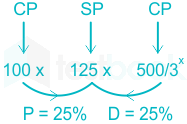
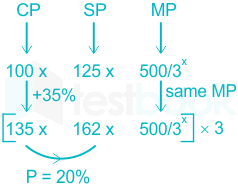
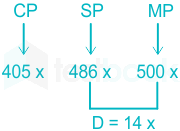
Shortcut TrickGiven:

Profit = 25%

Discount = 25%

Cost price increased to earn 20% = 35%

Calculation:

Let the cost price of an article be Rs. 100x


Discount% = (14x/500x) × 100 = 2.8%

∴ The discount is 2.8%.

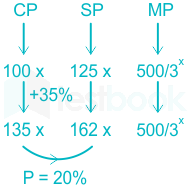
Alternate MethodGiven: 

Profit = 25%

Discount = 25%

Cost price increased to earn 20% = 35%

Formula Used:

SP = CP × {(100 + P%)/100}

MP = SP × {100/(100 – D%)}

Where SP = Selling price, CP = Cost price, MP = Marked price, P = Profit and D = Discount

Calculation:

Let the cost price of an article be Rs. 100x

Selling price of the article when dealer gains 25% profit

SP = CP × {(100 + P%)/100}

⇒ {100x × (100 + 25%)/100}

⇒ 125x

Now, 25% discount is given on marked price

MP = SP × {100/(100 – D%)}

⇒ 125x × (100/75) = (500/3)x

Now, the cost price of the article increases by 35% and he still wants to earn 20%

New CP = 100x + 35% of 100x

⇒ 135x

New SP = 135x × (100 + 20%)/100

⇒ 162x

Discount on same marked price = {(500/3 - 162)/500/3} × 100

⇒ {(500 – 486)/500} × 100 = (14/500) × 100

⇒ 2.8%

∴ The discount is 2.8%.

34

A car is available for ₹4,98,200 cash or ₹60,000 cash down payment followed by three equal annual instalments. If the rate of interest charged is 16% p.a., compounded yearly, then the total interest charged in the instalment plan is:

  1. ((a))

    ₹1,46,314

  2. ((b))

    ₹1,46,137

  3. ((c))

    ₹1,47,136

  4. ((d))

    ₹1,45,163

Show Answer
Answer: ((c))

₹1,47,136

Given:

A car is available for ₹4,98,200 cash or ₹60,000 cash down payment followed by three equal annual instalments.

If the rate of interest charged is 16% p.a., compounded yearly.

Formula used:

D = AR×(11(1+R)n)\frac{A}{R} × (1 - \frac{1}{(1+R)^n})

Where, 

D, is the amount due (or amount on which interest is to be applied)

A, is the value of the instalment

R, is the rate of interest applied

n, is the number of instalments

Calculation:

The price of the car = ₹4,98,200

The down payment is done for buying car = ₹60,000

The remaining amount (which is paid in three equal instalments) = ₹4,98,200 - ₹60,000 = ₹4,38,200

The rate of interest applied annually = 16% p.a.

The number of instalments, n = 3

Now, 

By substituting the value of the respective variable in the required formula, we get,

⇒ ₹4,38,200 = A16%×(11(1+16%)3)\frac{A}{16\text{\%}} × (1 - \frac{1}{(1+\text{16\%})^3})

⇒ ₹4,38,200 × 16% = A × (110031163)(1 - \frac{100^3}{116^3})

⇒ ₹4,38,200 × 16100\frac{16}{100} = A × (110031163)(1 - \frac{100^3}{116^3})

⇒ ₹4,382 × 16 = A × (1253293)(1 - \frac{25^3}{29^3})

⇒ ₹4,382 × 16 = A × (243891562524389)(\frac{24389-15625}{24389})

⇒ ₹4,382 × 16 = A × (876424389)(\frac{8764}{24389})

⇒ ₹8 = A × (124389)(\frac{1}{24389})

⇒ A = ₹1,95,112

The total amount paid in three instalments = ₹1,95,112 × 3 = ₹5,85,336

The interest paid = ₹5,85,336 - ₹4,38,200 = ₹1,47,136

∴ ₹1,47,136 is the interest charged in the instalment scheme.

35

A certain sum amounts to ₹25,300 in 2 years at 7.5% p.a., simple interest. What will be the compound interest on the same sum for the same period at double the rate, if the interest is compounded 8-monthly?

  1. ((a))

    ₹7,282

  2. ((b))

    ₹7,284

  3. ((c))

    ₹7,372

  4. ((d))

    ₹7,248

Show Answer
Answer: ((a))

₹7,282

Shortcut Trick

Total Simple Interest rate = 7.5% × 2 = 15%.

Principal (P) = Amount ÷ (100 + SI)% = 25300 ÷ 115% = ₹22,000.

New Annual Rate = 15%; 8-monthly rate = 15% × (8/12) = 10%.

Time = 2 years = 24 months = 3 periods of 8 months each.

Net Compound Interest % for 3 periods at 10% = 33.1%.

CI = 22000 × 33.1% = ₹7,282.

∴ The correct answer is ₹7,282.

Alternate Method

Given:

Amount (A) = ₹25,300 | Time (T) = 2 years | Rate (R1) = 7.5% p.a. (Simple Interest)

New Rate (R2) = 15% p.a. | Compounding = 8-monthly

Step 1: Calculate the Principal (P)

⇒ Amount = P + (P × R × T) ÷ 100

⇒ 25300 = P + (P × 7.5 × 2) ÷ 100

⇒ 25300 = P + 0.15P = 1.15P

⇒ P = 25300 ÷ 1.15 = ₹22,000

Step 2: Calculate CI for the new condition

⇒ New annual rate = 2 × 7.5% = 15% p.a.

⇒ Interest is compounded 8-monthly.

⇒ Effective rate per period (r) = 15% × (8/12) = 10% per period.

⇒ Total period (n) = 2 years ÷ 8 months = 24 ÷ 8 = 3 periods.

⇒ Amount (Anew) = P × (1 + r/100)n

⇒ Anew = 22000 × (1 + 10/100)3 = 22000 × (1.1)3

⇒ Anew = 22000 × 1.331 = ₹29,282

⇒ Compound Interest (CI) = Anew − P

⇒ CI = 29282 − 22000 = ₹7,282

∴ The correct answer is ₹7,282.

Additional Information

Effective Rate for 8-Monthly Compounding

When interest is compounded k-monthly, the rate per period is (Annual Rate × k/12) and the number of periods is (Total Months ÷ k).

CI vs SI for the First Year

For the first year (or first compounding period), Simple Interest and Compound Interest are equal if the principal and rate are the same.

3-Period CI Shortcut

The effective interest rate for 3 periods at r% is given by: 3r + 3r2/100 + r3/10000. For r = 10%, this equals 30 + 3 + 0.1 = 33.1%.

36

A tank has n pipes attached to it, out of which 2 are outlet pipes and the rest are inlet pipes. Each inlet pipe can fill a tank in 10 hours and each outlet pipe can empty the full tank in 15 hours. When all the pipes are opened together then 9123\frac{2}{3}% part of the tank is filled in 212\frac{1}{2} hours. What is the value of n?

  1. ((a))

    9

  2. ((b))

    8

  3. ((c))

    7

  4. ((d))

    6

Show Answer
Answer: ((c))

7

Shortcut Trick

Let Total Capacity of tank = 30 units (LCM of 10 and 15).

Efficiency of 1 Inlet pipe = +3 units/hr | Efficiency of 1 Outlet pipe = −2 units/hr.

Total filled in 2.5 hrs = 91(2/3)% of 30 = (275/300) × 30 = 27.5 units.

Combined Efficiency = 27.5 ÷ 2.5 = 11 units/hr.

Let number of inlet pipes be x. Total pipes n = x + 2.

3x − 2(2) = 11 ⇒ 3x = 15 ⇒ x = 5. Total pipes n = 5 + 2 = 7.

∴ The correct answer is 7.

Alternate Method

Given:

Number of outlet pipes = 2. Number of inlet pipes = (n − 2).

Inlet rate = 1/10 tank/hr. Outlet rate = 1/15 tank/hr.

Time = 2.5 hours = 5/2 hours. Filled part = 91(2/3)% = 275/300 = 11/12.

Pipe TypeTime (hrs)Total Work (LCM)Efficiency
Inlet1030+3
Outlet1530−2

Calculations:

⇒ Work done in 1 hour = (Total filled part × Total Work) ÷ Time

⇒ Work per hour = (11/12 × 30) ÷ (5/2) = 27.5 ÷ 2.5 = 11 units/hr

⇒ Let number of inlet pipes be x.

⇒ (x × 3) + (2 × −2) = 11

⇒ 3x − 4 = 11

⇒ 3x = 15

⇒ x = 5

⇒ Total pipes n = Inlet + Outlet = 5 + 2 = 7

∴ The correct answer is 7.

Additional Information

Pipes and Cisterns Efficiency

Inlet pipes have positive efficiency (filling), while outlet pipes have negative efficiency (emptying).

Combined Work Formula

Total Work = Combined Efficiency × Total Time. If the tank is being filled, the net efficiency must be positive.

37

When x is subtracted from each of 25, 32, 59 and 80, the numbers so obtained, in this order, are proportional. What is the mean proportional between (3x + 1) and (5x - 4)? 

  1. ((a))

    18

  2. ((b))

    15

  3. ((c))

    30

  4. ((d))

    20

Show Answer
Answer: ((c))

30

Shortcut Trick

Find the difference between the pairs: (32 − 25) = 7 and (80 − 59) = 21.

The ratio of differences is 7 : 21 = 1 : 3.

Apply the cross-multiplication shortcut for x: x = |(3 × 25 − 1 × 59) / (3 − 1)| = |(75 − 59) / 2| = 8.

Mean proportional between (3 × 8 + 1) = 25 and (5 × 8 − 4) = 36 is √(25 × 36).

Result = 5 × 6 = 30.

∴ The correct answer is 30.

Alternate Method

Given: The numbers 25, 32, 59, 80 become proportional when x is subtracted from each.

Formula: If a, b, c, d are in proportion, then a/b = c/d. Mean proportional of m and n is √(m × n).

(25 − x) / (32 − x) = (59 − x) / (80 − x)

(25 − x)(80 − x) = (59 − x)(32 − x)

2000 − 25x − 80x + x2 = 1888 − 59x − 32x + x2

2000 − 105x = 1888 − 91x

2000 − 1888 = 105x − 91x

112 = 14x

x = 8

Now, finding the Mean Proportional between (3x + 1) and (5x − 4):

Term 1 = 3(8) + 1 = 25

Term 2 = 5(8) − 4 = 36

Mean Proportional = √(25 × 36) = 5 × 6 = 30

∴ The correct answer is 30.

Additional Information

Mean Proportional

The mean proportional between two numbers a and b is the value x such that a/x = x/b, calculated as x = √(ab).

Third Proportional

For two numbers a and b, the third proportional c is such that a : b :: b : c, calculated as c = b2/a.

Fourth Proportional

For three numbers a, b, and c, the fourth proportional d is such that a : b :: c : d, calculated as d = (b × c) / a.

Componendo and Dividendo

If a/b = c/d, then (a + b)/(a − b) = (c + d)/(c − d), which is often used to simplify ratio-based equations.

38

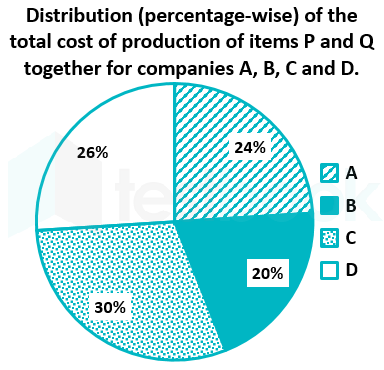
Study the given pie chart and table and answer the question that follows.

CompanyRatio of the cost   of production forPercentage   profit earned for
PQPQ
A792025
B533545
C15174060
D673040
<br>

The total cost of production for P and Q for company A = ₹76.8 crores. The total profit earned by companies B and C together for item P is what percentage less than the total cost of production of item Q for companies A and D together? (Correct to one decimal place)

  1. ((a))

    62.2%

  2. ((b))

    63.6%

  3. ((c))

    60.8%

  4. ((d))

    62.4%

Show Answer
Answer: ((b))

63.6%

Given:

The total cost of production for P and Q for company A = ₹76.8 crores

Calculation:

The total cost of production for P and Q for all companies = ₹76.8 crores24%\frac{\text {₹76.8 crores}}{24 \text {\%}} = ₹320 crores

The total cost of production for P and Q for company A = ₹76.8 crores

The cost of production for item Q for company A = 99+7\frac{9}{9+7} × ₹76.8 crores = ₹43.2 crores

The total cost of production for P and Q for company B = 20% of ₹320 crores = ₹64 crores

The cost of production for item P for company B = 55+3\frac{5}{5+3} × ₹64 crores = ₹40 crores

The profit earned for item P for company B = 35% of ₹40 crores = ₹14 crores

The total cost of production for P and Q for company C = 30% of ₹320 crores = ₹96 crores 

The cost of production for item P for company C = 1515+17\frac{15}{15+17} × ₹96 crores = ₹45 crores

The profit earned for item P for company C = 40% of ₹45 crores = ₹18 crores

The total cost of production for P and Q for company D = 26% of ₹320 crores = ₹83.2 crores

The cost of production for item Q for company D = 76+7\frac{7}{6+7} × ₹83.2 crores = ₹44.8 crores

The total profit earned by companies B and C together for item P = ₹14 crores + ₹18 crores = ₹32 crores

The cost of production for A and D together for item Q = ₹43.2 crores + ₹44.8 crores = ₹88 crores

The required per cent = 883288\frac{88 - 32}{88} × 100 = 63.6%

∴ The total profit earned by companies B and C together for item P is 63.6% less than the total cost of production of item Q for companies A and D together.

39

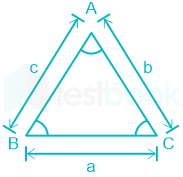
In ΔABC, ∠A  is the largest angle and ∠B is the smallest angle. If the largest angle is twice the smallest angle and the length of the sides of the triangle are consecutive positive integers, then find the length of the largest side (in units).

  1. ((a))

    5

  2. ((b))

    7

  3. ((c))

    8

  4. ((d))

    6

Show Answer
Answer: ((d))

6

Given:

∠A  is the largest angle and ∠B is the smallest angle.

∠A = 2∠B

The length of the sides of the triangle are consecutive positive integers: 

x - 1, x, x + 1

Formula used:

The length of the side of the required triangle directly depends on the value of the angle opposite to that particular side, i.e., the longest side of the triangle is opposite to the largest angle and vice-versa.

Sine rule:

sinAa=sinBb=sinCc\frac{sinA}{a} = \frac{sinB}{b}= \frac{sinC}{c}

Cosine rule:

cosB = a2+c2b22ac\frac{a^2 + c^2 - b^2}{2ac}

Calculation:

The sides correspond to the angles ∠A, ∠B and ∠C of ΔABC are a, b and c respectively.

According to the question,

∠A = 2∠B and the length of the sides of the triangle are consecutive positive integers

So, 

a = x + 1

c = x

b = x - 1

Now, by using the sine rule.

⇒ sin2Bx+1=sinBx1\frac{sin 2B}{x+1} = \frac{sin B}{x-1}

⇒ sin2Bx+1=sinBx1\frac{sin 2B}{x+1} = \frac{sin B}{x-1}

⇒ 2sinBcosBx+1=sinBx1\frac{2sinBcosB}{x+1} = \frac{sin B}{x-1}

⇒ 2cosB=x+1x12cosB = \frac{x+1}{x-1}     ----(1)

Now, by using the cosine rule,

cosB=a2+c2b22accosB = \frac{a^2 + c^2 - b^2}{2ac}

On substituting the value of the respective variable in the above formula, we get,

⇒ cosB=(x+1)2+x2(x1)22(x+1)xcosB = \frac{(x+1)^2 + x^2 - (x-1)^2}{2(x+1)x}

⇒ cosB=(x2+1+2x+x2x21+2x)2x2+2xcosB = \frac{(x^2+1 + 2x + x^2 - x^2-1+2x)}{2x^2+2x}

⇒ cosB=(4+x)2(x+1)cosB = \frac{ (4 + x)}{2(x+1)}    ----(2)

On equating (1) and (2), we get,

⇒ (4+x)(x+1)=x+1x1\frac{ (4 + x)}{(x+1)} = \frac{x+1}{x-1}

⇒ 4x - 4 + x2 - x = x2 + 1 + 2x

⇒ x = 5 units

The length of the largest side, x + 1 = 5 + 1 = 6 units

∴ 6 units is the required answer.

40

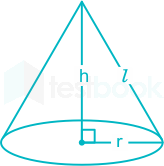
The radius of the base of a right circular cone is 15 cm and its total surface area is 480π. What is the volume (in cm3) of the cone?

  1. ((a))

    600π

  2. ((b))

    720π

  3. ((c))

    570π

  4. ((d))

    540π

Show Answer
Answer: ((a))

600π

Given:

The radius of the base of a right circular cone is 15 cm.

The total surface area is 480π cm2.

Formula used:

The total surface area = πrl + πr2

The volume of the right circular cone = 13\frac{1}{3}πr2h

The slant height of the cone, l = h2+r2\sqrt{h^2 + r^2}

h, is the height of the cone

r, is the radius of the cone

Calculation:

The total surface area,

⇒ πrl + πr2 = 480π

⇒ π(rl + r2) = 480π

⇒ (15 × l + 152) = 480

⇒ 15 × l + 225 = 480

⇒ 15 × l = 255

⇒ l = 17 cm

The slant height of the cone = 17 cm

⇒ l2 = r2 + h2

⇒ 172 = 152 + h2

⇒ 289 = 225 + h2

⇒ h2 = 64

⇒ h = 8 cm

Now, 

The volume of the right circular cone = 13\frac{1}{3}π × 152 × 8 = 600π cm3

The volume of a right circular cone is 600π cm3.

41

If 3x + 2y = 15 and xy = 6, then what is the value of 32\frac{3}{2}x3 + 49\frac{4}{9}y?

  1. ((a))

    95.8

  2. ((b))

    92.5

  3. ((c))

    98.6

  4. ((d))

    97.5

Show Answer
Answer: ((d))

97.5

Given:

3x + 2y = 15 and xy = 6, 

Formula used:

(a + b)3 = a3 + b3 + 3ab(a + b)

Calculation:

3x + 2y = 15

Take cube on both side of the equation,

⇒ (3x + 2y)3 = 153

⇒ 27x3 + 8y3 + (3 × 3x × 2y × (3x + 2y)) = 153

⇒ 27x3 + 8y3 + (18xy × (3x + 2y)) = 3375

⇒ 27x3 + 8y3 + (18 × 6 × 15) = 3375

⇒ 27x3 + 8y3 + 1620 = 3375

⇒ 27x3 + 8y3  = 1755

Now divide the above equation by 18 on both side,

2718\frac{27}{18}x3 + 818\frac{8}{18}y3  = 175518\frac{1755}{18}

⇒ 32\frac{3}{2}x3 + 49\frac{4}{9}y3  = 97.5

∴ 97.5 is the required answer.

42

The cost of 5 notebooks is ₹6 more than the cost of 8 pens. The cost of 3 notebooks is 25% more than the cost of 4 pens. What is the cost of 2 notebooks and 5 pens?

  1. ((a))

    ₹150

  2. ((b))

    ₹180

  3. ((c))

    ₹160

  4. ((d))

    ₹132

Show Answer
Answer: ((a))

₹150

Shortcut Trick

3 Notebooks = 125% of 4 Pens ⇒ 3N = (5/4) × 4P ⇒ 3N = 5P ⇒ Ratio N : P = 5 : 3.

Let N = 5 units, P = 3 units. Given: 5N − 8P = ₹6.

⇒ (5 × 5) − (8 × 3) = 1 unit ⇒ 1 unit = ₹6.

Required: 2N + 5P = (2 × 5) + (5 × 3) = 25 units.

Total cost = 25 units × ₹6 = ₹150.

∴ The correct answer is ₹150.

Alternate Method

Given:

Cost of 5 notebooks = (Cost of 8 pens) + ₹6

Cost of 3 notebooks = 125% of (Cost of 4 pens)

Formula Used:

Percentage Increase: Value = Base × (1 + % Increase/100)

Linear Equations: a1x + b1y = c1

Calculations:

Let the cost of one notebook be N and one pen be P.

⇒ 3N = 4P × (125/100) ⇒ 3N = 4P × (5/4) ⇒ 3N = 5P ⇒ N = 5P/3

Substitute N in the first condition: 5N = 8P + 6

⇒ 5 × (5P/3) = 8P + 6

⇒ 25P/3 − 8P = 6

⇒ (25P − 24P) / 3 = 6 ⇒ P/3 = 6 ⇒ P = ₹18

Substitute P back to find N:

⇒ N = (5 × 18) / 3 = 5 × 6 = ₹30

Required cost for 2 notebooks and 5 pens:

⇒ 2N + 5P = 2(30) + 5(18)

⇒ 60 + 90 = ₹150

∴ The correct answer is ₹150.

Additional Information

Percentage and Ratio Relation

When a value is x% more than another, the ratio is (100+x) : 100. Here, 3N being 25% more than 4P implies 3N/4P = 125/100 = 5/4.

Linear Equations in Two Variables

Equations of the form ax + by = c can be solved efficiently using the substitution method when one variable is easily expressed in terms of the other.

Unitary Method for Ratios

Assigning a common unit 'x' to ratio terms (5x, 3x) helps in converting relative values into absolute values using given differences.

43

Ritu's monthly savings are 28% of her monthly expenditure. If her monthly income increases by 45% and the monthly expenditure increases by 54.1%, then by what percentage do her monthly savings increase?

  1. ((a))

    10.5%

  2. ((b))

    9.1%

  3. ((c))

    11.1%

  4. ((d))

    12.5%

Show Answer
Answer: ((d))

12.5%

Given:

Ritu's monthly savings are 28% of her monthly expenditure.

The monthly income increases by 45% and the monthly expenditure increases by 54.1%.

Calculation:

Let the monthly expenditure of Ritu = ₹100

The monthly savings of Ritu = 28% of ₹100 = ₹28

The initial income of Ritu = ₹100 + ₹28 = ₹128

Now,

The increased monthly income of Ritu = (100% + 45%) of ₹128 = ₹185.6

The increased monthly expenditure of Ritu = (100% + 54.1%) of ₹100 = ₹154.1

Therefore, 

The saving of Ritu = ₹185.6 - ₹154.1 = ₹31.5

The percentage increase in saving = 31.52828\frac{31.5 - 28}{28} × 100 = 12.5%

∴ Ritu's monthly savings increase by 12.5%.

44

Aman travels a certain distance at x km/h. In the return journey, he covers 20% of the same distance in 35% of the time taken to cover the earlier distance. For the remaining part of the return journey, if his speed is y km/h, and he can cover the entire return journey in the same time as for the onward journey, then which of the following is true? 

  1. ((a))

    13y = 16x

  2. ((b))

    8y = 5x

  3. ((c))

    11y = 15x

  4. ((d))

    15y = 19x

Show Answer
Answer: ((a))

13y = 16x

Given:

Aman travels a certain distance at x kmph.

In the return journey, he covers 20% of the same distance in 35% of the time taken to cover the earlier distance.

For the remaining part of the return journey, if his speed is y km/h, and he can cover the entire return journey in the same time as for the onward journey.

Formula used:

Distance = Speed × Time

Calculation:

Let the time of travel for the onward journey = 10 hours

The speed of Aman for onward journey = x kmph

The distance travelled by Aman = 10x km

Now, 

In case of return journey:

In the first part:

The 20% of the distance = 20% of 10x = 2x km

The time required to cover the 20% of the journey = 35% of 10 = 3.5 hours

For the remaining part of the return journey:

The speed of Aman = y kmph

The time required to travel the remaining distance = 10 - 3.5 = 6.5 hours

The distance travelled = 6.5y km

Since the distance of travelled is same in both case are same,

Therefore,

⇒ 10x = 2x + 6.5y

⇒ 8x = 6.5y

⇒ 16x = 13y

∴ 13y = 16x is the required relation.

45

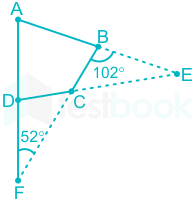
The sides AB and DC of a cyclic quadrilateral ABCD are produced to meet at E and the sides AD and BC are produced to meet at F. If ∠AFB = 52° and ∠FBE = 102°, then what is the measure of ∠BEC?

  1. ((a))

    26°

  2. ((b))

    38°

  3. ((c))

    28°

  4. ((d))

    36°

Show Answer
Answer: ((c))

28°

Given:

The sides AB and DC of a cyclic quadrilateral ABCD are produced to meet at E and the sides AD and BC are produced to meet at F.

∠AFB = 52° and ∠FBE = 102°,

Concept used:

In the case of a cyclic quadrilateral, the value of the interior angle is equal to the opposite exterior angle.

The sum of all internal angles of a triangle is 180.

Calculation:

According to the question, the required figure is:

The value of the interior angle is equal to the opposite exterior angle.

⇒ ∠ ADC = ∠ CBE = 102

The value of a straight angle is 180.

∠ ADC + ∠ CDF = 180∘

⇒ 102∘ + ∠ CDF = 180∘ 

⇒ ∠ CDF = 78∘ 

In ΔCDF,

∠ CDF + ∠ FCD + ∠ DFC = 180∘ 

⇒ 78∘ + ∠ FCD + 52∘ = 180∘ 

⇒ ∠ FCD + 130∘ = 180∘ 

⇒ ∠ FCD = 50∘ 

As we know, vertically opposite angle are equal.

So,

∠ BCE = ∠ FCD = 50 

In Δ BEC,

∠ BEC + ∠ BCE + ∠ EBC = 180

⇒ ∠ BEC + 50 + 102 = 180

⇒ ∠ BEC + 152 = 180

⇒ ∠ BEC = 28

The value of the required angle is 28∘.

46

Rehana bought an article for ₹1,920 and spent ₹130 on its shipping. She sold it at 20% profit. From the money she got then, she bought another article and sold it at 15% loss. What is her overall loss/profit percentage? 

  1. ((a))

    Loss, 5%

  2. ((b))

    Profit, 2%

  3. ((c))

    Loss, 2%

  4. ((d))

    Profit, 5%

Show Answer
Answer: ((b))

Profit, 2%

Given:

Rehana bought an article for ₹1,920 and spent ₹130 on its shipping.

She sold it at 20% profit.

From the money she got then, she bought another article and sold it at 15% loss.

Formula used:

Profit% = S.PC.PC.P\frac{S.P - C.P}{C.P} × 100

Lost% = C.PS.PC.P\frac{C.P - S.P}{C.P} × 100

Calculation:

In the first case:

The total cost price of the article = ₹1,920 + ₹130 = ₹2050

The selling price of the article = (100% + 20%) of ₹2050 = ₹2460

In the second case:

The cost price of another article = ₹2460

The selling price of another article = (100% - 15%) of ₹2460 = ₹2091

Now, 

The cost price (or amount spent on the article) = ₹2050

The selling price of another article (or the money finally with Rehana) = ₹2091

The profit percentage = 209120502050\frac{₹2091-₹2050}{₹2050} × 100 = 2%

The overall profit per cent earned by Rehana is 2%.

47

When 5396, 6248 and 7739 are divided by the greatest number x , the remainder in each case is y. Which of the following is true?

  1. ((a))

    3x - 2y = 274

  2. ((b))

    3x - 7y = 140

  3. ((c))

    2x = 3y

  4. ((d))

    x = 3y

Show Answer
Answer: ((d))

x = 3y

Given:

When 5396, 6248 and 7739 are divided by the greatest number x, the remainder in each case is y.

Calculation:

The difference between first two numbers = 6248 - 5396 = 852

The difference between other two numbers = 7739 - 6248 = 1491

The difference between other two numbers = 7739 - 5396 = 2343

Now, 

The prime factorization of 852 = 2 × 2 × 3 × 71

The prime factorization of 1491 = 3 × 7 × 71

The prime factorization of 2343 = 3 × 11 × 71

The H.C.F of (852, 1491, 2343), x = 3 × 71 = 213

On dividing 5396, 6248 and 7739 by 213, we get the remainder, y = 71

Now, on comparing the value of the respective variable, we get,

⇒ x = 3y

The required relation obtained is x = 3y.

48

The expression (1+cosθ+sinθ)÷(1+cosθsinθ)(secθcosθ)(cotθ+tanθ)(1+sinθ)\frac{{(1 + \cos θ + \sin θ ) \div (1 + \cos θ - \sin θ )}}{{(\sec θ - \cos θ )(\cot θ + \tan θ )(1 + \sin θ )}}, 0° < θ < 90°, is equal to:

  1. ((a))

    tanθ 

  2. ((b))

    cotθ 

  3. ((c))

    secθ 

  4. ((d))

    sinθ 

Show Answer
Answer: ((b))

cotθ 

Shortcut Trick 

Put θ = 30

⇒ (1+cos(30)+sin(30))÷(1+cos(30)sin(30))(sec(30)cos(30))(cot(30)+tan(30))(1+sin(30))\frac{{(1 + \cos (30^{\circ}) + \sin (30^{\circ}) ) \div (1 + \cos (30^{\circ}) - \sin (30^{\circ}) )}}{{(\sec (30^{\circ}) - \cos (30^{\circ}) )(\cot (30^{\circ}) + \tan (30^{\circ}) )(1 + \sin (30^{\circ}) )}}

⇒ (1:+32:+:12):÷(1:+:32:12)(23::32:)(3:+:13):(1:+12:)\frac{\left(1:+\frac{√{3}}{2}:+:\frac{1}{2}\right):\div \left(1:+:\frac{√{3}}{2}:-\frac{1}{2}\right)}{\left(\frac{2}{√{3}}:-:\frac{√{3}}{2}:\right)\left(√{3}:+:\frac{1}{√{3}}\right):\left(1:+\frac{1}{2}:\right)} = √3

Option 1: tan(30∘) = 13\frac{1}{\sqrt{3}}

Option 2: cot(30∘) = √3

Option 3: sec(30∘) 23\frac{2}{\sqrt{3}}

Option 4: sin(30∘) = 12\frac{1}{2}

Option 2 is the correct option.

Alternate Method

Given:

(1+cosθ+sinθ)÷(1+cosθsinθ)(secθcosθ)(cotθ+tanθ)(1+sinθ)\frac{{(1 + \cos θ + \sin θ ) ÷ (1 + \cos θ - \sin θ )}}{{(\sec θ - \cos θ )(\cot θ + \tan θ )(1 + \sin θ )}}

Formula used:

sin2θ + cos2θ = 1 

tanθ = sinθcosθ\frac{sin θ}{cos θ}

cotθ = cosθsinθ\frac{cos θ}{sin θ} 

Calculation:

Let y = (1 + cos(θ) + sin(θ)) ÷ (1 + cos(θ) - sin(θ))

Now, the required expression can be written as:

⇒ y(secθcosθ)(cotθ+tanθ)(1+sinθ)\frac{{y}}{{(\sec θ - \cos θ )(\cot θ + \tan θ )(1 + \sin θ )}}

Now, we will first simplify the variable 'y'.

⇒ y = (1+cosθ+sinθ)(1+cosθsinθ)\frac{{(1 + \cos θ + \sin θ )}}{ (1 + \cos θ - \sin θ )}

⇒ y = cosθ(1+cosθ+sinθ)cosθ(1+cosθsinθ)\frac{{\cos θ(1 + \cos θ + \sin θ )}}{\cos θ (1 + \cos θ - \sin θ )}

⇒ y = cosθ(1+sinθ)+(cos2θ)cosθ(1+cosθsinθ)\frac{{cos θ (1 + \sin θ ) + ( \cos^2 θ)}}{\cos θ (1 + \cos θ - \sin θ )}

⇒ y = cosθ(1+sinθ)+(1sin2θ)cosθ(1+cosθsinθ)\frac{{cos θ (1 + \sin θ ) + ( 1 -sin^2 θ)}}{\cos θ (1 + \cos θ - \sin θ )}

⇒ y = cosθ(1+sinθ)+(1+sinθ)(1sinθ)cosθ(1+cosθsinθ)\frac{{cos θ (1 + \sin θ ) + ( 1 + sin θ)( 1 - sin θ)}}{\cos θ (1 + \cos θ - \sin θ )}

⇒ y = (1+sinθ)(cosθ+1sinθ)cosθ(1+cosθsinθ)\frac{{(1 + \sin θ )(cos θ + 1 - sin θ)}}{\cos θ (1 + \cos θ - \sin θ )}

⇒ y = 1+sinθcosθ\frac{{1 + \sin θ }}{\cos θ }

Now, substitute the value of 'y' in the required expression.

⇒ 1+sinθ(cosθ)(secθcosθ)(cotθ+tanθ)(1+sinθ)\frac{{1 + sin θ}}{{(cos θ)(\sec θ - \cos θ )(\cot θ + \tan θ )(1 + \sin θ )}}

⇒ 1(cosθ)(secθcosθ)(cotθ+tanθ)\frac{1}{{(cos θ)(\sec θ - \cos θ )(\cot θ + \tan θ )}}

⇒ 1(cosθ)(1cosθcosθ)(cosθsinθ+sinθcosθ)\frac{1}{{(cos θ)(\frac{1}{cos θ} - \cos θ )(\frac{cos θ}{sin θ} + \frac{sin θ}{cos θ})}}

⇒ 1(1cos2θ)(cos2θ+sin2θsinθcosθ)\frac{1}{{(1 - \cos^2 θ )(\frac{cos^2 θ + sin^2 θ}{sin θ cos θ} )}}

⇒ 1(sin2θ)(1sinθcosθ)\frac{1}{{( \sin^2 θ )(\frac{1}{sin θ cos θ} )}}

⇒ sinθcosθsin2θ\frac{ sin θ cos θ}{{sin^2 θ }}

⇒ cosθsinθ=cotθ\frac{ cos θ}{{sin θ }} = cot θ

∴ cot(θ) is the required answer.

49

Let x = 1.051.0\overline 5  ÷ 0.950.\overline {95}  × 0.4090.4\overline {09}  and y = (0.75÷0.2260.7\overline 5 \div 0.2\overline {26} ) × (5.09÷1.75.\overline {09} \div 1.7), then the value of xy is:

  1. ((a))

    0.45

  2. ((b))

    4.5

  3. ((c))

    0.54

  4. ((d))

    5.4

Show Answer
Answer: ((b))

4.5

Given:

x = 1.051.0\overline 5  ÷ 0.950.\overline {95}  × 0.4090.4\overline {09}  and y = (0.75÷0.2260.7\overline 5 \div 0.2\overline {26} ) × (5.09÷1.75.\overline {09} \div 1.7)

Formula used:

0.0aˉ=a900.0\bar a= \frac{a}{90}

0.aa=aa990.\overline {aa} = \frac{aa}{99}

0.abc=abca9900.a\overline {bc} = \frac{abc-a}{990}

Calculation:

x = 1.051.0\overline 5  ÷ 0.950.\overline {95}  × 0.4090.4\overline {09}

The above expression can be written as:

⇒ x = ((1+0.05ˉ)(1 + 0.0\bar{5}) ÷ 0.950.\overline{95} ) × 0.4090.4\overline{09}

⇒ x = ((1+590)(1 + \frac{5}{90}) ÷ 9599\frac{95}{99} ) × 4094990\frac{409 - 4}{990}

⇒ x = (90+590 \frac{90+5}{90} ÷ 9599\frac{95}{99} ) × 405990\frac{405}{990}

⇒ x = (9590 \frac{95}{90} ÷ 9599\frac{95}{99} ) × 405990\frac{405}{990}

⇒ x = (9590 \frac{95}{90} × 9995\frac{99}{95} ) × 405990\frac{405}{990}

⇒ x = (9990 \frac{99}{90}) × 405990\frac{405}{990}

⇒ x = 45100\frac{45}{100}

Now,

y = (0.75÷0.2260.7\overline 5 \div 0.2\overline {26} ) × (5.09÷1.75.\overline {09} \div 1.7)

The above expression can be written as:

⇒ y = (0.75÷0.2260.7\overline 5 \div 0.2\overline {26} ) × [(5+0.09)÷1.7(5 + 0.\overline {09}) \div 1.7]

⇒ y = (75790÷2262990\frac{75-7}{90} \div \frac{226-2}{990}) × [(5+999)÷1.7(5 + \frac{9}{99}) \div 1.7]

⇒ y = (6890÷224990\frac{68}{90} \div \frac{224}{990}) × [(50499)÷1.7(\frac{504}{99}) \div 1.7]

⇒ y = (6890×990224\frac{68}{90} × \frac{990}{224}) × [(50499)÷1.7(\frac{504}{99}) \div 1.7]

⇒ y = (681×11224\frac{68}{1} × \frac{11}{224}) × [(50499)÷1.7(\frac{504}{99}) \div 1.7]

⇒ y = (681×11224\frac{68}{1} × \frac{11}{224}) × [(50499)×11.7(\frac{504}{99}) × \frac{1}{1.7}]

⇒ y = (40×122440 × \frac{1}{224}) × 56

⇒ y = 10

Now, 

⇒ xy = 0.45 × 10

⇒ xy = 4.5

∴ The required value of the expression is 4.5.

50

Working together, A and B can do a certain work in 45 days. They work together for 10 days. They complete the remaining work in 28 days with the assistance of C. The work done by C in 3 days is equal to the work done by B in 2 days. A and C together can complete 70% of the original work in:

  1. ((a))

    30 days

  2. ((b))

    36 days

  3. ((c))

    40 days

  4. ((d))

    35 days

Show Answer
Answer: ((b))

36 days

Given:

Working together, A and B can do a certain work in 45 days. They work together for 10 days.

They complete the remaining work in 28 days with the assistance of C.

The work done by C in 3 days is equal to the work done by B in 2 days.

Formula used:

Efficiency × Time = Work

Calculation:

Let 'a', 'b' and 'c' is the working efficiency of A, B and C respectively.

Let the total amount of work required = 45 units

The time is taken by A and B to do a certain work = 45 days

Therefore, 

The combined efficiency of A and B = 4545\frac{45}{45} = 1 unit a per day

⇒ a + b = 1

The amount of work done by A and B in 10 days = 10 units

The remaining work = 45 - 10 = 35 units

The amount of work done A and B in the last 28 days = 28 units

The amount of work done by C in 28 days = 35 - 28 = 7 units

Therefore, 

The efficiency of C = 728=14\frac{7}{28} = \frac{1}{4}

Now, 

Since the work done by C in 3 days is equal to the work done by B in 2 days,

The amount of work done by C in 3 days = c × 3 units

The amount of work done by C in 2 days = b × 2 units

So,

⇒ 3c = 2b

⇒ b = 38\frac{3}{8}

The efficiency of A, a = 1 - 38\frac{3}{8} = 58\frac{5}{8}

Now, 

The combined efficiency of A and C = 14+58\frac{1}{4}+\frac{5}{8} = 78\frac{7}{8}

The 70% of the total work = 70% of 45 = 31.5 units

The time required = 31.578\frac{31.5}{\frac{7}{8}} = 36 days

∴ A and C together can complete 70% of the original work in 36 days.

Science (25 questions)

51

When carbon dioxide gas is passed through lime water, a white precipitate is formed, which dissolves on passing excess of carbon dioxide. The white precipitate dissolves due to the formation of which compound? 

  1. ((a))

    Calcium hydrogen carbonate

  2. ((b))

    Calcium chloride 

  3. ((c))

    Calcium hydroxide

  4. ((d))

    Calcium carbonate

Show Answer
Answer: ((a))

Calcium hydrogen carbonate

The correct answer is Calcium hydrogen carbonate.

Concept:

Chemical reaction:

  • It is a process in which one or more substances, the reactants, are converted to one or more different substances, the products.
  • A chemical reaction rearranges the constituent atoms of the reactants to create different substances as products.

Double displacement reaction: 

  • It is a chemical reaction in which two compounds react and exchange their ions forming new products.
  • This reaction often results in the formation of an insoluble compound called a precipitate.
  • Such reactions are represented by equations of the following form: A+B- + C+D- → A+D- + B-C+

Explanation:

  • When carbon dioxide gas is passed through lime water or calcium hydroxide, double displacement takes place and a white precipitate of calcium carbonate is formed.
  • The chemical equation for the above reaction is as follows: 
  • Ca(OH)2(aq) + CO2 (g) → CaCO3(s) + H2O(l)
  • The calcium carbonate formed is a precipitate and it is not soluble in water. It gives a milky appearance to the solution.
  • When an excess of carbon dioxide gas is passed through the solution, the following reaction takes place: 
  • CaCO3(s) + H2O(l) + CO2(g) → Ca(HCO3)2
  • In the above chemical reaction, the product formed is **calcium bicarbonate or calcium hydrogen carbonate which is soluble in water. **​
52

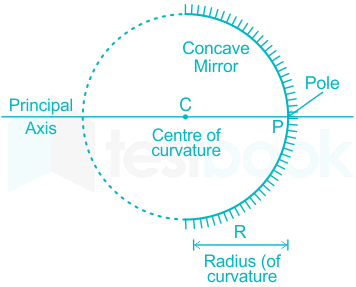
An object is placed on the axis of a concave mirror at its focus (F). The image formed is: 

  1. ((a))

    erect and enlarged

  2. ((b))

    inverted and of the same size

  3. ((c))

    inverted and highly diminished

  4. ((d))

    inverted and highly enlarged 

Show Answer
Answer: ((d))

inverted and highly enlarged 

The correct answer is inverted and highly enlarged.

Concept:

Spherical mirror:

  • A spherical mirror is a mirror that has the shape of a piece cut out of a spherical surface.
  • There are two types of spherical mirrors: concave, and convex.

Explanation:

Concave mirror:

  • It is part of a whole spherical mirror that reflects light from the hollow part.
  • It is a converging mirror because it converges the incident rays at a point.

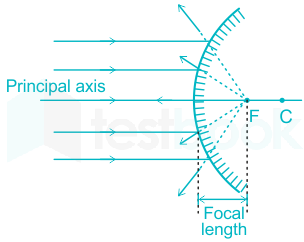
When the object is at F (focus):

Characteristics of Image Formed:

  • Position: At infinity
  • Size: Highly magnified/ enlarged
  • Nature: Real and inverted

Additional Information

All six cases of image formation by the concave mirror:

Object positionImage positionNature of imageSize of image
At infinityAt FReal and invertedPoint sized
Beyond CBetween C and FReal and invertedDiminished
At CAt CReal and invertedSame size
Between C and FBeyond CReal and invertedMagnified
At FAt infinityReal and invertedHighly magnified
Between F and POn the backside of the mirrorVirtual and erectMagnified
53

An element 'X', having atomic number 16, gains two electrons to form an anion X2-. What will he the atomic number of 'X' in the anion?

  1. ((a))

    16

  2. ((b))

    14

  3. ((c))

    20

  4. ((d))

    18

Show Answer
Answer: ((a))

16

The correct answer is 16. 

Concept:

Atomic number:

  • The atomic number of an atom is equal to the number of protons in the nucleus of an atom or the number of electrons in an electrically neutral atom.
  • Atomic number = Number of protons
  • For example, in a magnesium atom, there are 12 electrons and 12 protons.

Explanation:

  • When the element X gains 2 electrons to form an anion X2-, it is no more in an electrically neutral state.
  • An atom is said to be electrically neutral when it has the same number of protons and electrons.

  • Element X has the atomic number 16. So, it has 16 protons and 16 electrons.
  • The anion X2-  has 16 protons and 18 electrons.
  • Since the number of protons is the same, the atomic number remains the same i.e., 16.
54

You are given two liquid mixtures 'X' and 'Y'. Both appear to be homogeneous. but 'X' does not scatter light whereas 'Y' scatters light. Which of the following is true about these two mixtures?

  1. ((a))

    'X' is a true solution; 'Y' is a colloid

  2. ((b))

    'X' is a true solution; 'Y' is a suspension

  3. ((c))

    'X' is a suspension; 'Y' is a colloid

  4. ((d))

    'X' is a colloid; 'Y' is a true solution

Show Answer
Answer: ((a))

'X' is a true solution; 'Y' is a colloid

The correct answer is 'X' is a true solution; 'Y' is a colloid.

Concept:

Mixtures:

  • A mixture is a substance that consists of two or more elements or compounds not chemically combined together.
  • For Example - Air is a mixture of gases like oxygen, nitrogen, argon, CO2, and water vapor.

Types of Mixtures:

  • Homogeneous Mixture:
  • Those mixtures, in which the substances are completely mixed together and are indistinguishable from one another, are called homogeneous mixtures.
  • For example Soda water, Soft drinks, lemonade, salt or sugar solution, etc.
  • Heterogeneous Mixture:
  • Those mixtures in which the substances remain separate and one substance is spread throughout the other substance as small particles, droplets, or bubbles are called heterogeneous mixtures.
  • All the suspensions and colloids are heterogeneous mixtures.
  • For Example: - Sugar and sand mixture, muddy river water, soap solution.

Explanation:

Mixtures can be classified into solutions, colloids, and suspensions on the basis of the size of the particles they are made of.

True SolutionColloidSuspension
It is a form of homogeneous mixtureIt appears to be homogeneous but actually, it is heterogeneousIt is a form of a   heterogeneous mixture
Particle size is less   than 1 nmParticle size range from 1 and 1000 nmParticle size greater than   1000 nm
Particles do not settle   when left undisturbedParticles do not settle downParticles settle down well
Cannot be separated by filtrationCannot be separated by   filtrationCan be separated by   filtration
It does not scatter lightIt Shows the Tyndall effect (scatters light)May scatter light
Particles are not visible to the naked eyeParticles are not visible through the naked eyeParticles are easily visible through the naked eye

X is homogeneous and doesn't scatter light. So, it is a true solution.

Y appears to be homogenous but scatters light. So, it is a colloid.

55

An object, 3.0 cm in height, is placed at a distance of 45.0 cm in front of a concave minor of focal length 30.0 cm, on its principal axis. Following New Cartesian Sign Convention, the image is formed at v = _____ and its height hI = ______ .

  1. ((a))
    • 90 cm; 6.0 cm
  2. ((b))
    • 90 cm; - 6.0 cm
  3. ((c))

    -18 cm; 1.2 cm

  4. ((d))

    -18 cm; - 1.2 cm

Show Answer
Answer: ((b))
  • 90 cm; - 6.0 cm

T he correct answer is -90 cm; -6.0 cm.

Concept:

Spherical mirror:

  • A spherical mirror is a mirror that has the shape of a piece cut out of a spherical surface.
  • There are two types of spherical mirrors: concave, and convex.

Mirror formula:1f=1v+1u\frac{1}{f} = \frac{1}{v} + \frac{1}{u}, where f = focal length, v = image distance and u = object distance.

Magnification: m = HiHo=vu\frac{Hi}{Ho} = \frac{-v}{u} , where Hi = height of image, Ho = height of object, v = image distance, and u = object distance.

Concave mirror: 

  • It is part of a whole spherical mirror that reflects light from the hollow part.
  • It is a converging mirror because it converges the incident rays at a point.

Explanation:

Given, u = -45 cm        f = -30 cm              h = 3 cm 

1f=1v+1u\frac{1}{f} = \frac{1}{v} + \frac{1}{u}

130=1v+145\frac{1}{-30} = \frac{1}{v} + \frac{1}{-45}

130=1v145\frac{1}{-30} = \frac{1}{v} - \frac{1}{45}

1v=130+145\frac{1}{v} = \frac{1}{-30} + \frac{1}{45}

1v=3+290\frac{1}{v} = \frac{-3 + 2}{90}

1v=190\frac{1}{v} = \frac{-1}{90}

v = -90 cm

m = HiHo=vu\frac{Hi}{Ho} = \frac{-v}{u} = Hi3=(90)45\frac{Hi}{3} = \frac{-(-90)}{-45} 

Hi = -2 × 3 = -6 cm

Following New Cartesian Sign Convention, the image is formed at v = -90 cm and its height HI = -6 cm. 

Additional Information

Convex mirror: 

  • It is part of a whole spherical mirror that reflects light from the bulged-out part.
  • It diverges the incident rays.

56

Which of the following is the correct set-up for electrolytic refuting of silver? 

  1. ((a))

    Cathode : pure copper; anode : impure silver; electrolyte : AgNO3(aq)

  2. ((b))

    Cathode : impure silver; anode : pure silver; electrolyte : AgNO3(aq)

  3. ((c))

    Cathode : pure silver; anode : impure silver; electrolyte : AgNO3(aq)

  4. ((d))

    Cathode : pure copper; anode : impure silver; electrolyte : Cu(NO3)2(aq) 

Show Answer
Answer: ((c))

Cathode : pure silver; anode : impure silver; electrolyte : AgNO3(aq)

The correct answer is Cathode: pure silver; anode: impure silver; electrolyte: AgNO3 (aq).

Concept:

Electrolytic refining:

It is a process of refining (removing impurities or other elements) a metal by the process of electrolysis.

Electrolysis:

  • It is the process that uses electric current to run a non-spontaneous chemical reaction.
  • The passage of electric current through a chemical compound causing the decomposition of the compound is called electrolysis.
  • During electrolysis, Positively charged ions move towards the cathode and negatively charged ions move towards the anode.

Electrolytes:

Compounds that undergo ionization and conduct electricity in the molten or dissolved state are called electrolytes.

Explanation:

Electrolytic refining of Metals:

  • In this process, the impure metal is made into the anode and a thin strip of pure metal is made into the cathode.
  • The solution of the metal salt is used as an electrolyte.
  • When current passes through the electrolyte, the pure metal from the anode dissolves into the electrolyte.
  • An equivalent amount of pure metal from the electrolyte is deposited on the cathode.
  • The insoluble impurities settle down at the bottom of the anode and are known as anode mud whereas the soluble impurities go into the solution.

So, for electrolytic refining of Silver following set-up will be needed:

  • Cathode - Pure silver
  • Anode - Impure silver
  • Electrolyte - Salt of Silver like AgNO3 (aq)
57

Which of the following endocrine glands is located in the thoracic region in man?

  1. ((a))

    Pineal

  2. ((b))

    Parathyroid

  3. ((c))

    Pancreas

  4. ((d))

    Pituitary

Show Answer
Answer: ((b))

Parathyroid

The correct answer is Parathyroid.

Concept:

Endocrine Gland:

  • These glands secrete hormones. Hormones are chemical messengers.
  • They are also called ductless glands because they pour their secretions directly into the bloodstream.

Explanation:

GlandLocationHormonesFunctions
HypothalamusBasal part of the forebrainReleasing hormones Inhibiting hormonesStimulates the secretions of pituitary glands inhibits the secretion of the pituitary gland
Pituitary glandAt the base of the brainGrowth hormone Prolactin Thyroid-stimulating hormone Luteinizing hormone Follicle-stimulating hormone Melanocyte stimulating hormoneRegulates growth of body Regulates the growth of mammary glands and production of milk Stimulates the thyroid gland to release its hormone Stimulates testes in males and ovaries in females to release their hormones Regulates sperm formation in males and stimulates growth and development of ovarian follicle in females Regulates pigmentation of the skin
PinealDorsal side of the forebrainMelatoninRegulates  circadian rhythm, the biological clock
ThyroidIn the neck (thoracic part) around the windpipeThyroxine/ tetraiodothyronine (T4) triiodothyronine (T3)Regulates the metabolism of carbohydrates, proteins, and fats
ParathyroidOn the backside of the thyroid gland (thoracic part)Parathyroid hormoneIncreases calcium levels in the blood
AdrenalThe anterior part of each kidneyGlucocorticoids MineralocorticoidsInvolved in Carbohydrate metabolism Regulate the balance of water and minerals
ThymusThe thoracic chamber between the aorta and breast boneThymosinsProvides immunity to the body
PancreasBetween the stomach and small intestineInsulin Glucagonlowers the blood sugar level raises the blood sugar level
TestesScrotal sac (outside abdomen)TestosteroneProduction of sperms and development of secondary sexual characters
ovariesin the abdomenEstrogen ProgesteroneProduction of ova and development of secondary sexual characters maintenance of pregnancy
58

Which of the following statements for the given chemical reaction is true?

Fe2O3 + 2Al → Al2O3 + 2Fe

  1. ((a))

    Iron is getting reduced

  2. ((b))

    Aluminium is getting reduced

  3. ((c))

    Aluminium is the oxidising agent

  4. ((d))

    Iron oxide is the oxidising agent 

Show Answer
Answer: ((d))

Iron oxide is the oxidising agent 

The correct answer is Iron oxide is the oxidizing agent.

Key Points

Chemical reaction:

  • It is a process in which one or more substances, the reactants, are converted to one or more different substances, the products.
  • A chemical reaction rearranges the constituent atoms of the reactants to create different substances as products.

Explanation:

  • Oxidation: The addition of oxygen/electronegative element to a substance or removal of hydrogen/electropositive element from a substance is called oxidation.
  • Reduction: The removal of oxygen/electronegative elements from a substance or the addition of hydrogen/electropositive elements to a substance is called reduction.

​Oxidation and reduction always occur simultaneously, hence, the word “redox” was coined for this class of chemical reactions. 

Reducing agent: The element/compound that removes oxygen or donates hydrogen and itself gets oxidized. 

Oxidizing agent: The element/compound that donates oxygen or removes hydrogen and itself gets reduced. 

Fe2O3 + 2Al → Al2O3 + 2Fe

In the above chemical reaction, 

  • Fe2O3 is getting reduced to Fe.
  • Al is oxidized to Al2O3.
  • Al is the reducing agent.
  • Fe2O3 (iron oxide) is the oxidizing agent.
59

Two resistors A (3 Ω) and B (6 Ω) are connected in parallel. This combination is connected in series to two other resistors C (3 Ω) and D (6 Ω) and a 5.5 V battery of negligible internal resistance. Let PB and PD be the rate of energy dissipated in resistors B and D, respectively. Then the ratio (PB / PD) is:

  1. ((a))

    13\frac{1}{3}

  2. ((b))

    19\frac{1}{9}

  3. ((c))

    49\frac{4}{9}

  4. ((d))

    23\frac{2}{3}

Show Answer
Answer: ((b))

19\frac{1}{9}

The correct answer is 1/9.

Concept:

Resistance in series:

  • When resistors are connected end-to-end in a circuit, they are said to be in "series."
  • R = R1 + R2 + R3 +....+ Rn
  • Current remains the same across all the resistors connected in series.

Resistance in parallel: 

  • When both ends of resistors are connected, they are said to be in parallel.
  • 1/R = 1/R1 + 1/R2 = 1/R3 ....
  • The potential difference across all the resistors connected in parallel remains the same.

Electric Power:

  • The energy consumed per unit of time or the rate of doing work is called power.
  • Power = work done / time taken = Vq / t = VI = V2/R = I2R

Explanation:

Resistors A (3 Ω), and B (6 Ω) are connected in parallel.

Equivalent resistance, 1/R1 = 1/3 + 1/6  = 2+1/ 6 = 3/6 = 1/2 Ω 

R1 = 2 Ω 

Now, the resistors R1, C, and D are in series.

R2 = 2 + 3 + 6  = 11 Ω 

Equivalent current, I in the circuit = V/R2 = 5.5 / 11 =  0.5 = 1/ 2   A.

Potential difference across B = IR1 = 1/2 × 2 = 1 V

P= V2/ D = 1 × 1 /  6 = 1/6 Watt        (since current remains same in series combination)

PD = I2B = 1/2 × 1/2 × 6  = 3/2 Watt     (since voltage remains the same in parallel combination)

The ratio (PB/PD) = 1/6 × 2/3 = 1/ 9.

60

Which of the following is NOT a part of the 'Five Fs' in maintaining sanitary hygiene?

  1. ((a))

    Fingers

  2. ((b))

    Fluids

  3. ((c))

    Flies

  4. ((d))

    Food

Show Answer
Answer: ((d))

Food

Concept:

Sanitation:

Sanitation means all measures that promote

  • Proper disposal of human and animal wastes (solid as well as liquid wastes).
  • It also includes the disposal of hazardous wastes from hospitals/industries/other sources.
  • Use and proper maintenance of toilets.
  • Avoiding open defecation.

Hygiene

  • Hygiene is a set of practices performed for the preservation of health.
  • Hygiene is often associated with our bodies.
  • According to the World Health Organisation (WHO), “Hygiene refers to conditions and practices that help to maintain health and prevent the spread of diseases.”
  • One of the most effective ways to protect ourselves and others from diseases is to adopt good practices of personal hygiene.

Explanation:

The five 'F's

  • Fluids: Protect the water source.
  • Fingers: Wash hands before preparing food.
  • Flies: Cover the food.
  • Fields: Clean vegetables and fruits before use.
  • Flood: Proper drainage system.

These five good habits can protect our bodies from disease.

So, all these options are correct.

61

The 'Amrita Devi Bishnoi Wildlife Protection Award' is given in the memory of Amrita Devi Bishnoi, who sacrificed her life along with 363 others for the protection of 'Khejri' trees in Khejrali village located in ____ .

  1. ((a))

    U.P.

  2. ((b))

    Rajasthan

  3. ((c))

    M.P.

  4. ((d))

    Uttrakhand

Show Answer
Answer: ((b))

Rajasthan

Concept:

Amrita Devi Bishnoi Wildlife Protection Award

  • Since 1978, the 12th of September has been designated as Khejladi Divas.
  • The prize is named after Amrita Devi Bishnoi, who was slain while attempting to safeguard a grove of Khejari trees in Khejarli, Rajasthan, during the Khejarli massacre in 1730.
  • It is a national award for wildlife conservation.

Explanation:

  • Khejadli village is near Jodhpur in Rajasthan.
  • The village got its name because of the many Khejadi trees that grew there.
  • Amrita Devi Bishnoi, a local woman, objected to the tree-felling because it was against the Bishnoi's faith to do so.
  • In 1730 AD, 363 Bishnois in this village gave their life to safeguard the community's precious green Khejri.

The 'Amrita Devi Bishnoi Wildlife Protection Award' is given in the memory of Amrita Devi Bishnoi, who sacrificed her life along with 363 others for the protection of 'Khejri' trees in Khejrali village located in Rajasthan.

Additional Information

Wildlife protection act

  • In the 1960s and 1970s, conservationists demanded a national wildlife protection programme.
  • The Indian Wildlife (Protection) Act was implemented in 1972, with various provisions for protecting habitats.
  • The thrust of the programme was towards protecting the remaining population of certain endangered species by banning hunting, giving legal protection to their habitats, and restricting trade in wildlife.
62

Two lenses L1 and L2 of powers, 5.0 D and -(10/3) D respectively, separated by 50 cm, are arranged parallel to each other in vertical planes. An object is placed 40 cm left to L1, vertically on the common axis of the lenses. The distance between the original object and the final image is:

  1. ((a))

    102.5 cm

  2. ((b))

    72.5 cm

  3. ((c))

    92.5 cm

  4. ((d))

    82.5 cm

Show Answer
Answer: ((d))

82.5 cm

The correct answer is Zero.

Concept:

Lens:

  • The transparent curved surface which is used to refract the light and make an image of any object placed in front of it is called a lens.
  • A convex lens can converge a beam of parallel rays to a point on the other side of the lens

Power of lens:

  • It is equal to the reciprocal of the focal length of the lens/mirror in meters.
  • Power (P) = 1/f, where f is the focal length of the lens/mirror.
  • P = 100f\frac{100}{f} where f is the focal length in centimeters.
  • The unit of power of a lens is Dioptre when the focal length of the lens is taken in meters (m).
  • The focal length of the concave lens is negative and hence its power is also negative.
  • The focal length of the convex lens is positive and hence its power is also positive.

Lens formula: 1f=1v1u\frac{1}{f}=\frac{1}{v}-\frac{1}{u}  where f is focal length, v is image distance and u is object distance.

Explanation:

For first convex lens, L1

Power = 1f\frac{1}{f}

f = 1p\frac{1}{p} = 1005\frac{100}{5} = 20 cm

Given: Object distance, u = -40 cm, Focal length, f = 20 cm

 v=?

1f=1v1u\frac{1}{f}=\frac{1}{v}-\frac{1}{u}

120=1v140\frac{1}{20} = \frac{1}{v} - \frac{1}{-40}

120=1v+140\frac{1}{20} = \frac{1}{v} + \frac{1}{40}

120140=1v\frac{1}{20} - \frac{1}{40} = \frac{1}{v}

1v=2140\frac{1}{v} = \frac{2-1}{40}

1v=140\frac{1}{v} = \frac{1}{40}

v = 40 cm

For second convex  lens, L2

f = 1p\frac{1}{p} = 100×310\frac{-100 × 3}{10} = -30 cm

Object distance, u = -50-(-40)= -50 + 40 = -10cm, focal length, f = -30cm

v = ?

1f=1v1u\frac{1}{f}=\frac{1}{v}-\frac{1}{u}

130=1v110\frac{1}{-30} = \frac{1}{v} - \frac{1}{-10}

130=1v+110\frac{1}{-30} = \frac{1}{v} + \frac{1}{10}

130110=1v\frac{1}{-30} - \frac{1}{10} = \frac{1}{v}

1v=1330=430=17.5\frac{1}{v} = \frac{-1-3}{-30} = \frac{-4}{30} = \frac{-1}{7.5}


v= -7.5 cm 

Distance between original object and final image = 40 + 40 + 10 - 7.5 = 80 + 2.5 = 82.5 cm.

63

A cylindrical metal wire is reformed so that its length decreases by 20% with no change of volume. Its resistance decreases by:

  1. ((a))

    36%

  2. ((b))

    18%

  3. ((c))

    27%

  4. ((d))

    24%

Show Answer
Answer: ((a))

36%

The correct answer is 75%.

Concept:

Resistance (R): 

  • Resistance is a measure of the opposition to current flow in an electrical circuit.
  • It is measured in ohms, symbolized by the Greek letter omega (Ω).
  • R=ρlAR = \frac{ρ l}{A} where ρ is resistivity, l is length, and A is the area of the cross-section of the wire.

 Explanation: 

Suppose original length = L, Area of cross-section = A, radius of wire = r and Resistance = R

Since the wire is the same, the resistivity ρ will be the same.

After the decrease in length, let us take new length = L', radius of wire = r' and new resistance = R'

L' = 80 L/ 100 = 4L/5 ( since there is 20% decrease)

The volume of the wire remains the same ( given).

So, Volume of Original Wire = volume of new wire 

π r2 L = π r ' 2 L'

r2L = r' 2 L'

r' 2 = r2 L /  L'

r' 2 = 5 r2 L /  4L

r' 2 =  5r2 / 4

Decrease in resistance = 

ρLAρLAρLA×100\frac{\frac{\rho L}{A} -\frac{\rho L'}{A'}}{\frac{\rho L}A} × 100

ρLπr24ρL×45×5πr2ρLπr2×100\rm \frac{\frac{\rho L}{\pi r^2}-\frac{4\rho L \times 4}{5\times 5\pi r^2}}{\frac{\rho L}{\pi r^2}}\times 100

25ρL16ρL25πr2ρLπr2×100\rm \frac{\frac{25\rho L-16 \rho L}{25\pi r^2}}{\frac{\rho L}{\pi r^2}}\times 100

9ρL25πr2ρLπr2×100\rm \frac{\frac{9 \rho L}{25\pi r^2}}{\frac{\rho L}{\pi r^2}}\times 100

9×10025\rm \frac{9\times 100}{25}

= 36%

Thus, the decrease in length is 36%.

64

The PH of an aqueous solution of a salt is 4.5. Which of the following about this salt is true?

  1. ((a))

    It is a salt of a strong acid and a weak base.

  2. ((b))

    It is a salt of a weak acid and a weak base.

  3. ((c))

    It is a salt of a weak acid and a strong base.

  4. ((d))

    It is a salt of a strong acid and a strong base. 

Show Answer
Answer: ((a))

It is a salt of a strong acid and a weak base.

The correct answer is It is a salt of a strong acid and a weak base.

Concept:

pH scale:

  • A scale developed to measure the concentration of hydrogen ions in a solution is known as the pH scale where p in pH implies ‘potenz’ in German.
  • pH scale ranges from 0 (highly acidic) to 14 (highly alkaline).
  • The pH of a neutral solution is 7.
  • The basic strength increases as we move from 7 to 14 on the pH scale.

Acid:

  • It is sour in taste.
  • It turns the blue litmus color into red.
  • It has a pH value of less than 7.
  • It is represented by a value less than 7 on the pH scale.

Base:

  • It is bitter in taste and slippery to touch.
  • It turns the red litmus color into the blue.
  • It is represented by a value greater than 7 on the pH scale.

Explanation:

Acid and base react together to form salt and water. 

Weak acid + strong baseBasic salt
Strong acid + weak baseAcidic salt
Strong acid + strong baseNeutral salt
Weak acid + weak baseNeutral salt

The salt formed has a pH value of 4.5. So, it is acidic in nature. 

Thus, it is formed by the reaction between a strong acid and a weak base.

65

Study the given information. 

Consider the force on a current carrying straight conductor in a magnetic field. 

(i) It is perpendicular to the direction of current. 

(ii) It is perpendicular to the magnetic field. 

(iii) Its direction can be found using right-hand thumb rule. 

Select the correct option.

  1. ((a))

    All (i), (ii) and (iii) are correct

  2. ((b))

    Both (i) and (ii) are correct

  3. ((c))

    Only (i) is correct

  4. ((d))

    Only (ii) is correct

Show Answer
Answer: ((b))

Both (i) and (ii) are correct

The correct answer is Both (i) and (ii) are correct.

Concept:

Magnetic field (B):

  • The area around a magnet where a magnetic force is experienced is called the magnetic field.
  • It is a quantity that has both direction and magnitude, (i.e., Vector quantity).

Explanation:

  • A current carrying conductor placed in a magnetic field experiences a force.
  • If the direction of the field and that of the current are mutually perpendicular to each other, then the force acting on the conductor will be perpendicular to both,
  • The direction of the force can be determined using the Fleming’s left-hand rule.

It is perpendicular to the direction of the current.True
It is perpendicular to the magnetic field.True
Its direction can be found using the right-hand thumb rule.False

Additional Information

 Fleming’s left-hand rule:

According to Fleming's left-hand rule, if the thumb, forefinger, and middle finger of the left hand are stretched to be perpendicular to each other as shown in the illustration at left, and if the forefinger represents the direction of the magnetic field, the middle finger represents the direction of the current, then the thumb represents the direction of the force.

66

In the given figure, frogs occupy ______ .

  1. ((a))

    Level 4

  2. ((b))

    Level 1

  3. ((c))

    Level 3

  4. ((d))

    Level 2

Show Answer
Answer: ((c))

Level 3

Concept:

Ecological pyramids

  • A graphical representation of the biomass or bio productivity at each trophic level in a particular ecosystem is known as an ecological pyramid.
  • The base of a pyramid is broad and it narrows towards the apex.
  • This, relationship is expressed in terms of number, biomass or energy.
  • The base of each pyramid represents the producers or the first trophic level while the apex represents the tertiary or top-level consumers.
  • The three types of ecological pyramids that are usually studied are (a) pyramid of number; (b) pyramid of biomass and (c) pyramid of energy.

​Explanation:

Producer

  • The green plant in the ecosystem is called producers.
  • In a terrestrial ecosystem, major producers are herbaceous and woody plants.

Consumer

  • All animals depend on plants (directly or indirectly) for their food needs.
  • They are hence called consumers.

Pyramid of number

  • ​Food webs are a valuable tool for visualising the feeding interactions among creatures in a population, but they are not quantitative.
  • In this process, smaller organisms are many, while larger organisms are few.
  • In the pyramid of numbers, there is an inverse-size metabolic rate.
  • Ecological pyramids in a thousand square meters of grassland.

Producer ⇒ Primary consumer ⇒ Secondary consumer ⇒ Territory consumer.

  • In this pyramid level, 1 belongs to the producer (tree, grass),
  • Level 2 belongs to the primary consumer (grasshopper, insect),
  • Level 3 belongs to the secondary consumer (frog, spiders),
  • Level 4 belongs to the terrestrial consumer carnivorous (snake).

Hence, the frog occupies level 3 in these ecological pyramids.

67

How many moles of carbon dioxide are present in a gas jar containing 1.501 × 10²² molecules of CO2?

  1. ((a))

    0.401

  2. ((b))

    0.25

  3. ((c))

    40.1

  4. ((d))

    0.025

Show Answer
Answer: ((d))

0.025

The correct answer is 0.025.

Concept:

Mole:

  • It is the SI unit of the amount of substance.
  • One mole contains exactly 6.022 × 10²³ atoms/molecules. This number is the fixed numerical value of the Avogadro constant (NA).
  • The mass of one mole of a substance in grams is called its molar mass.
  • The molar mass in grams is numerically equal to atomic/molecular/formula mass in u.

So, 1 mole = 6.022 × 10²³ atoms/molecules = Atomic/molecular mass of an element/compound.

Explanation:

1 mole = 6.022 × 10²³ molecules

⇒ 6.022 × 10²³ molecules of carbon dioxide = 1 mole of carbon dioxide 

⇒ 1 molecule = 1/ 6.022 × 10²³ moles of carbon dioxide 

⇒ 1.501 × 10²² molecules = 1.501 × 10²² / 6.022 × 10²³ moles of carbon dioxide = 0.025 moles of carbon dioxide

68

Which of the following organelles is NOT bound by a membrane?

  1. ((a))

    Nucleus

  2. ((b))

    Ribosome

  3. ((c))

    Lysosome

  4. ((d))

    Golgi apparatus

Show Answer
Answer: ((b))

Ribosome

The correct answer is Ribosome.

Concept:

Cell organelles:

  • These are like small organs present inside the cell.
  • Each of them has distinct structures and Specific functions to perform.
  • Some of them are membrane-bound while some are not.
  • Cell organelles found inside the cell are as follows:
  • Nucleus
  • Endoplasmic reticulum
  • Golgi apparatus
  • Lysosome
  • Ribosome
  • Vacuole
  • Plastids

Explanation:

Ribosomes:

  • These are the protein factories of the cell.
  • They are made up of 2 subunits- one large and one small.
  • They lack a membrane around them.

Additional Information

Nucleus:

  • It is a double membrane-bound structure that contains the genetic material (DNA).
  • It is the control center of the cell.

 Endoplasmic reticulum (ER):

  • These are a network of tubules or sheets or vesicles.
  • They are of two types, rough and smooth.
Rough ERSmooth ER
Ribosomes attached to its surface give a rough appearance under the microscopeRibosomes are not attached to its surface
Synthesizes proteinsSynthesizes fat molecules or lipids

Golgi apparatus:

  • They were first described by Camillo Golgi.
  • These are flat disc-like structures arranged in stacks parallel to each other.
  • They modify, package, and transport the proteins and lipids synthesized by ER in and out of the cell.

Lysosomes:

  • These are small vesicles separated from the Golgi apparatus.
  • They contain strong digestive juices.
  • They digest the foreign particles entering the cell, or damaged cell organelles.
  • That's why they are called waste disposal systems.

​Mitochondria:

  • It is a double membrane-bound sausage-shaped structure.
  • It is called the powerhouse of the cell.
  • It generates ATP molecules through cellular respiration.
  • ATP molecules carry energy that can be used by cells to carry out different functions.

Vacuoles:

  • These are sac-like membrane-bound structures.
  • They either store reserve food material, or waste generated by the cell.
  • They are quite large in plant cells but small in animal cells.

Plastids:

  • These are double membrane-bound structures that contain pigments.
  • They are of three types:
  • Chloroplast - contains chlorophyll, the green pigment, found in leaves and green parts of plants.
  • Chromoplast - contains pigments of different colors, found in petals and fruits of the plant.
  • Leucoplast - colourless, stores carbohydrates, fats, and proteins.colours
69

Which of the following is NOT a method to improve crop yields in India?

  1. ((a))

    Cultivation improvement

  2. ((b))

    Variety improvement

  3. ((c))

    Storage improvement

  4. ((d))

    Protection improvement

Show Answer
Answer: ((c))

Storage improvement

Concept:

Improve crop yields

  • When plants of the same kind are cultivated in one place on a large scale. It is called a crop.
  • Crop yields mean the production of the crop per unit area.
  • More increase in crop yields means less manpower needed in the field.
  • We can find or calculate crop yield by seed ratio.
  • There are different kinds of factors present that improve crop yields.
  • There are 3 types of improvement methods cultivation improvement, variety improvement, and protection improvement.

Explanation:

​Storage improvement

  • They must store the grains in airtight containers to protect them.
  • Farmers store them in metal containers or jute sacks on a small or medium scale.
  • Silos or granaries are preferred on a greater scale.
  • This whole process is called 'storing'.
  • Storing improvement does not help in the improvement of crop yield.

Storage improvement is NOT a method to improve crop yields in India.

Additional InformationCultivation improvement

  • Cultivation improvement is also known as product improvement.
  • Farmers are able to make use of various farming practises and technologies because of the money or financial conditions.
  • They include "no-cost" manufacturing procedures, "low cost" production practices, and "high cost" production practices.

 Verity improvement

  • The good seeds of crops can increase crop yield.
  • By using disease resisting good high production quality seed, seeds that respond to fertilizer can increase it.

Protection improvement

  • The field crops are infested with a significant number of insects, insect pests, and illnesses.
  • If weeds and pests are not handled at the appropriate times, crops can be severely harmed, resulting in the loss of the majority of the yield.
70

The primary reason that smoking cigarettes is bad for our health is that cigarette smoke _____.

  1. ((a))

    inhibits ability of haemoglobin to carry blood

  2. ((b))

    kills the cilia in the upper respiratory tract

  3. ((c))

    destroys normal lung cells and grows cancer cells

  4. ((d))

    weakens muscles participating in breathing

Show Answer
Answer: ((b))

kills the cilia in the upper respiratory tract

The correct answer is kills the cilia in the upper respiratory tract.

Key Points 

Health:

  • According to WHO (World Health Organization), “Health is a state of complete physical, mental, and social well-being and not merely the absence of disease or infirmity.”
  • There are many factors that affect health, such as:
  • Poor diet
  • Genetic disorders
  • Stress, and anxiety
  • Infection from pathogens
  • Intake of unhealthy and unhygienic food
  • Lack of exercise and other physical activities.
  • Drug abuse

Explanation:

**Harmful effects of smoking:**​

  • Cigarette smoking can cause immediate damage to our health.
  • Each puff of cigarette smoke contains a mix of over 7,000 chemicals.
  • When the smoke enters the body it first destroys the cilia, the tiny hairs in the airway that keep dirt and mucus out of the lungs.
  • The smoke then enters the lungs and mixes with the blood that is then carried to the rest of our body contains these toxic chemicals.
  • Tobacco smoke contains carbon monoxide, this deadly gas displaces the oxygen in the blood, depriving the organs of the oxygen they need.
  • Smoking can cause irreversible damage to elastin, the protein that provides the lungs with elasticity. Thus, affecting the breathing efficiency of the lungs.
  • Furthermore,the long term effect of smoking can be seen in the form of lung cancer.
  • In addition to lung cancer, smoking can lead to other respiratory cancers, such as:
  • The oropharynx (the back of the mouth, including parts of the tongue, the soft palate, the side and back of the throat, and the tonsils)
  • Larynx (the “voice box”)
  • Trachea (the “windpipe”)
  • Bronchus (one of two large airways that connect the trachea to the lungs)

Since cilia are the first part of the body to be adversely affected by the smoke, it is the primary reason that smoking cigarettes is bad for our health.

71

The modern system of classification of living beings is based on the principles of:

  1. ((a))

    evolution (homology)

  2. ((b))

    ecology (habitat)

  3. ((c))

    morphology (external appearance)

  4. ((d))

    anatomy (internal structures)

Show Answer
Answer: ((a))

evolution (homology)

The correct answer is evolution (homology).

Concept:

  • Classification: It is the systematic grouping of organisms based on structural or functional similarities or evolutionary history.
  • Evolution: It can be defined as a naturally occurring slow, continuous and irreversible process of change. It is the gradual change of living organisms from pre-existing organisms since the beginning of life into various other forms.
  • Homology: It refers to the similarity of the structure, physiology, or development of different species of organisms based upon their descent from a common evolutionary ancestor.

Explanation:

The modern system of classification of living beings is based on the principles of evolution (homology). 

  • Earlier scientists classified organisms on the basis of their habitat (ecology) into aquatic, and terrestrial.
  • Then, Aristotle classified plants into herbs, shrubs, and trees according to their heights or their external appearance i.e. morphology.
  • Then, anatomy or internal structure was emphasized for classifying organisms, such as cell structure, number of cells, components of the cell wall, etc.
  • With advancements in technology, scientists are now able to study the evolutionary lineage of different organisms by studying their DNA.
  • It has been observed that Birds and Reptiles are made into different categories according to traditional classification systems.
  • But their evolutionary lineage suggests that they are more closely related to reptiles and they should be in the same group.
  • During evolution, new species arose from pre-existing ones.
  • The accumulation of variations in the DNA or the genetic material is one of the reasons for evolution.
  • Thus, by tracing the similarities in DNA, scientists can tell how closely related two species are, and how they can be classified into different groups.
72

When Mendel crossed a tall pea plant with a short pea plant, only tall plants were produced. Of these progeny F1 plants, ______ had dissimilar factors or alleles that determine the height of the pea plant.

  1. ((a))

    Two out of four (50%)

  2. ((b))

    Three out of four (75%)

  3. ((c))

    All (100%)

  4. ((d))

    One out of four (25%)

Show Answer
Answer: ((c))

All (100%)

The correct answer is All (100 %).

Concept:

Monohybrid Cross: A cross between two types of plants of the same species considering only the transmission of one character is called a monohybrid cross.

Phenotype: It refers to the external appearance. 

Genotype: It refers to the genetic constitution i.e., the types of genes present in the organism. 

Allele: The alternative form of genes for the same character. For example, the character height has two traits tallness and dwarfness determined by alleles T and t respectively. 

Explanation:

  • Gregor Johann Mendel used the monohybrid cross to determine the dominant and recessive traits in the case of peas.
  • He crossed true-breeding tall pea plants with true-breeding dwarf pea plants.
  • The homozygous allele for the tall pea plant is represented by TT, and the homozygous allele for the short/dwarf pea plant is represented by tt.
  • A monohybrid cross between the two plants results in the production of a heterozygous genotype (Tt).
  • In terms of phenotype, the F1 generation has all tall pea plants, thus indicating that the tall trait is the dominant trait and the short trait is a recessive trait.

  • All the progenies of the F1 generation have heterozygous Tt condition i.e., they all have two different alleles.
  • Thus, all (100 %) of the progenies have dissimilar alleles or factors to determine the height of the pea plant.
73

The refractive index of water and turpentine oil are 1.33 and 1.47, respectively. A ray of light travels from turpentine oil to water. The refractive index of water with respect to turpentine oil is _____ and the light ray bends ____ the normal in water.

  1. ((a))

    0.90, away from

  2. ((b))

    0.90, towards

  3. ((c))

    1.10, away from

  4. ((d))

    1.10, towards

Show Answer
Answer: ((a))

0.90, away from

The correct answer is 0.90, away from.

Key Points

Concept:

Refraction of Light: 

  • The bending of the ray of light passing from one medium to the other medium is called refraction.

https://storage.googleapis.com/tb-img/production/20/05/F1_J.K_8.5.20_Pallavi_D3.png

Refractive Index (n):

  • n = sin i / sin r, where 'i' =  angle of incidence  and 'r' = angle of refraction.
  • Also, n = c/v, where c = speed of light in a vacuum, and v = speed of light in a medium.

Explanation:​

Relative refractive index:

  • It refers to the refractive index of one material medium with respect to another one.
  • n21=n2n1n_{21}= \frac{n_{2}}{n_{1}}

Refractive index of water (dense flint) with respect to turpentine oil:

n=Refractive index of waterRefractiev index of Turpentine oil=1.331.47=0.90n= \frac{Refractive \ index \ of \ water}{Refractiev \ index\ of\ Turpentine \ oil}= \frac{1.33}{1.47}=0.90

  • Greater the refractive index, the denser the medium.
  • Thus,  turpentine oil (1.47) is denser than water (1.33).
  • When the ray of light moves from a denser to a rarer medium, the refracted ray moves away from the normal.
  • When the ray of light moves from a rarer to a denser medium, the refracted ray moves towards the normal.
  • Thus, when a light ray will move from turpentine oil to water, it will move away from the normal.

The refractive index of water with respect to turpentine oil is 0.90 and the light ray bends away from the normal in the water.

74

A cylindrical wire AB consists of three equal parts AC, CD and DB, made of the same material but have different radius of cross-sections 2r, 1.5r and r. respectively. A battery is connected across the wire. Let V1, V2 and V3 be the potential differences across AC, CD and DB. respectively. Then:

  1. ((a))

    V1 ∶ V2 ∶ V3 = 9 ∶ 16 ∶ 36

  2. ((b))

    V1 ∶ V2 ∶ V3 = 3 ∶ 4 ∶ 6

  3. ((c))

    V1 ∶ V2 ∶ V3 = 2 ∶ 1.5 ∶ 1

  4. ((d))

    V1 = V2 = V3

Show Answer
Answer: ((a))

V1 ∶ V2 ∶ V3 = 9 ∶ 16 ∶ 36

The correct answer is V1 ∶ V2 ∶ V3 = 9 ∶ 16 ∶ 36.

Concept:

Ohm's Law:

  • It states that the potential difference between two points is directly proportional to the current passing through the conductor, provided the temperature remains the same.
  • V = IR, where V = potential difference between two points, I = current, R = Resistance.

Resistance:

  • The property of a substance to resist the flow of current through it.
  • R = ρ L / A, where ρ = resistivity, L = length of conductor, and A = area of cross section.

Explanation:

The current remains the same in series combination. 

Let the current flowing through the wire be I ampere. 

For Wire AC

Length = L, Radius = 2r, Area of cross- section = 4π r2

Resistance, R1 =  ρL4πr2\frac{\rho L}{4\pi r^2}

Voltage, V1 = I R1 = IρL4πr2\frac{I\rho L}{4\pi r^2}

For Wire CD

Length = L, Radius = 1.5 r, Area of cross- section = 2.25 π r2

Resistance, R2 =  ρL2.25πr2\frac{\rho L}{2.25\pi r^2}

Voltage, V2 = I R2 = IρL2.25πr2\frac{I\rho L}{2.25\pi r^2}

For Wire BD

Length = L, Radius = r, Area of cross- section = π r2

Resistance, R1 =  ρLπr2\frac{\rho L}{\pi r^2}

Voltage, V3 = I R3 = IρLπr2\frac{I\rho L}{\pi r^2}

The ratio V1: V2 : V3 = IρL4πr2\frac{I\rho L}{4\pi r^2} :  IρL2.25πr2\frac{I\rho L}{2.25\pi r^2}   :  IρLπr2\frac{I\rho L}{\pi r^2}  = 1/4 : 1/2.25 : 1 = 1/4 : 100/225 : 1 = 1/4 : 4/9 : 1 = 9 : 16 : 36

V1 ∶ V2 ∶ V3 = 9 ∶ 16 ∶ 36.

75

Zinc metal liberates hydrogen gas on reaction with dilute HCl, but hydrogen gas is not liberated, when zinc is reacted with nitric acid. What is the reason for this observation?

  1. ((a))

    Nitric acid oxidises hydrogen gas formed in the reaction. 

  2. ((b))

    Nitric acid does not contain hydrogen.

  3. ((c))

    Zinc is less reactive than hydrogen.

  4. ((d))

    Zinc metal reduces the hydrogen gas formed in the reaction.

Show Answer
Answer: ((a))

Nitric acid oxidises hydrogen gas formed in the reaction. 

The correct answer is Nitric acid oxidizes hydrogen gas formed in the reaction.

Concept:

Chemical properties of metals:

  • The metal reacts with oxygen to form metal oxide.
  • Metal + Oxygen → Metal oxide
  • The metal reacts with an acid to form a salt.
  • Metal + Acid → Salt + Hydrogen gas
  • Metals react with water to form oxides or hydroxides.
  • Metal + water → Metal oxide/ hydroxide
  • Metals do not react with alkalis.
  • Metal + Alkali → No reaction

Explanation:

  • Metals react with dilute acids to form salt and hydrogen gas.
  • The reaction between zinc metal and dilute HCl can be represented by the following equation:
  • Zn (s) +  2HCl (aq.) → ZnCl(aq.) + H(g)
  • But when dilute HCl is replaced by nitric acid i.e., HNO3, different products are formed.
  • The reaction between zinc metal and dilute HNO3 can be represented by the following equation:
  • Zn + 4HNO→ Zn(NO3)+ 2H2O + 2NO2
  • Hydrogen gas is not evolved when a metal reacts with nitric acid.
  • It is because HNO3 is a strong oxidizing agent.
  • It oxidizes the H2 produced into the water and itself gets reduced to any of the nitrogen oxides (N2O, NO, NO2).

Social Science (25 questions)

76

Which of the following statements related to the discontent among peasants in Indian nationalist movements is/are correct?

Statements:

I. Bankim Chandra Chattopadhyay wrote ‘Neel Darpan’ in 1860, which portrayed atrocities of indigo planters.

II. Michael Madhusudan Dutta translated the play ‘Neel Darpan’into English.

  1. ((a))

    Only II

  2. ((b))

    Neither I nor II

  3. ((c))

    I and II

  4. ((d))

    Only I

Show Answer
Answer: ((a))

Only II

The correct answer is only statement II.

Important Points

Due to various atrocities faced by peasants during the British rule, such as high rents, illegal levies, arbitrary evictions, and unpaid labor in Zamindari areas, there were a large number of peasant movements that took place.

  • One important Movement among the peasant movement was Indigo Revolt (1859-62).
  • The farmers were forced to grow Indigo plants to increase their profits.
  • Farmers were discontent with growing indigo because of the low price offered and consequently, they launched a movement for the noncultivation of indigo in Bengal.
  • A play named ‘Nil Darpan’ was written by Dinabandhu Mitra in 1858-59. And it was published in 1860, in Dhaka.
  • The play depicted the treatment of the Indian peasantry by the indigo planters.
  • It however became historically and politically famous after it was translated into English as "The Mirror of Indigo Planters" by  Michael Madhusudan Dutta in 1861.

Hence, only statement II is correct.

77

In which year was the Consumer Protection Bill passed by the houses of Parliament?

  1. ((a))

    1981

  2. ((b))

    1994

  3. ((c))

    1986

  4. ((d))

    1991

Show Answer
Answer: ((c))

1986

The correct answer is 1986.

Key Points

  • The Consumer Protection Bill was passed by both the Houses of Parliament and it received the assent of the President on 24th December 1986.
  • The Consumer Protection Bill, 1986 provided for better protection of the interests of consumers.
  • It sought to promote and protect the rights of consumers such as
  • the right to be protected against the marketing of goods that are hazardous to life and property
  • the right to be informed about the quality, quantity, potency, purity, standard, and price of goods
  • the right to be heard and to be assured that consumers' interests will receive due consideration at appropriate forums;
  • the right to seek redressal against unfair trade practices
  • It provided for the establishment of the Consumer Protection Council to be established at the Central and State level.
  • It also provided for quasi-judicial machinery to be set up at the district, state, and Central levels.

Confusion Points

  • The Consumer Protection Act has been amended several times such as in 1991,1993, 2002, and recently in  2019.
  • So, the Act of 1991 was an Amendment Act. Originally, the Act was passed in 1986.

Additional Information

  • The recent Consumer Protection Amendment Act, 2019 provides for a Central Consumer Protection Authority (CCPA) to promote, protect and enforce the rights of consumers as a class.
  • The CCPA would make interventions to prevent consumer detriment arising from unfair trade practices.

Hence, the correct answer is that the Consumer Protection Bill was passed in 1986.

78

An increase in the GDP of an economy is an indicator of which of the following?

  1. ((a))

    Social welfare

  2. ((b))

    Economic growth

  3. ((c))

    Economic development

  4. ((d))

    Self-reliance

Show Answer
Answer: ((b))

Economic growth

The correct answer is Economic Growth.

Key Points

Gross domestic product (GDP) is the total monetary or market value of all the finished goods and services produced within a country’s borders in a specific period.As a broad measure of overall domestic production, it functions as a comprehensive scorecard of a given country’s economic health.

  • GDP provides an economic snapshot of a country, used to estimate the size of an economy and growth rate.
  • GDP can be calculated in three ways, using expenditures, production, or incomes. It can be adjusted for inflation and population to provide deeper insights.

Hence, the correct answer is that an increase in the GDP of an economy is an indicator of economic growth.

79

The given question consists of two statements: Assertion (A) and Reason (R). Read them carefully and select the most appropriate option.

A: In the year 2013-14, the manufacturing sector emerged as the largest producing sector in India replacing the primary sector.

R: Production of goods at cheap rates in factories led to an increase in consumer demand for goods. This is one of the causes for the shift of total production and

employment from the primary sector to the secondary sector.

  1. ((a))

    Both A and R are true and R is the correct explanation of A

  2. ((b))

    A is false but R is true

  3. ((c))

    Both A and R are true and R is not the correct explanation of A

  4. ((d))

    A is true but R is false

Show Answer
Answer: ((b))

A is false but R is true

The correct answer is that the Assertion is false but the Reason is true.

Key Points

  • Over the forty years between 1973-74 and 2013-14, while production in all the three sectors has increased, it has increased the most in the tertiary sector. As a result, in the year 2013-14, the tertiary sector has emerged as the largest producing sector in India replacing the primary sector.
  • It is because of various reasons such as demand for tertiary sector activities like transport, storage and trade have increased substantially, etc.
  • Due to the introduction of new methods of manufacturing, factories came up and started expanding. Also, the prices of goods produced in factories are much low.
  • People began to use many more goods that were produced in factories at cheap rates.
  • The secondary sector gradually became the most important in total production and employment.

 Hence, from the above, it is clear that the statement in the Assertion is not true but the one stated in Reason is true.

80

Which of the following statements are correct?

Statements:

I. Olympe de Gouges was an important woman political figure in the French Revolution.

II. In 1790, she prepared the Declaration of the Rights of Woman and of the Citizen.

III. She was executed by National Convention.

  1. ((a))

    I and III

  2. ((b))

    II and III

  3. ((c))

    I, II and III

  4. ((d))

    I and II

Show Answer
Answer: ((a))

I and III

The correct answer is that only statements I and III are correct.

Key Points

  • Olympe de Gouges was a playwright and political activist during the French Revolution.
  • She became increasingly politically engaged and an outspoken advocate against the slave trade in the French colonies in 1788.
  • In 1791 she wrote and published the "Declaration of the Rights of Woman and the Citizen." Modeled after the 1789 "Declaration of the Rights of Man and the Citizen" by the National Assembly.
  • Olympe de Gouges was arrested in July 1793, four years after the Revolution began. She was sent to the guillotine in November of that year and was beheaded by the National Convention.

Hence, from the above it is clear that only statements I and III are correct. And Statement II is incorrect.

81

Which of the following pairs of State and formation year is/are correct?

I. Nagaland - 1972

II. Uttarakhand - 2000

III. Arunachal Pradesh - 1987

  1. ((a))

    I and II

  2. ((b))

    II and III

  3. ((c))

    Only II

  4. ((d))

    I and III

Show Answer
Answer: ((b))

II and III

The correct answer is that II and III are the correctly matched pair.

Key Points

  • In 1963, the State of Nagaland was formed by taking the Naga Hills and Tuensang area out of the state of Assam. It became the 16th state of the Indian Union.
  • In 2000, three more new States of Chhattisgarh, Uttarakhand, and Jharkhand were created out of the territories of Madhya Pradesh, Uttar Pradesh, and Bihar, respectively. These became the 26th, 27th, and 28th states of the Indian Union, respectively.
  • In 1987, three new States of Mizoram, Arunachal Pradesh, and Goa came into being as the 23rd, 24th, and 25th states of the Indian Union respectively.
82

In the context of Indian states formation after independence, Operation Polo is associated with which state?

  1. ((a))

    Jammu and Kashmir

  2. ((b))

    Goa

  3. ((c))

    Hyderabad

  4. ((d))

    Sikkim

Show Answer
Answer: ((c))

Hyderabad

The correct answer is Hyderabad.

Key Points 

  • After attaining Independence, the princely states were given three options to decide their future, i.e., accede to India, accede to Pakistan, or remain independent.
  • By 1948 most of the Princely States had acceded to India but the state of Hyderabad had chosen to join neither Pakistan nor India.
  • Following various events in Hyderabad like the rise of razakars and the Telangana uprising,  the Indian government decided to undertake a military operation to annex Hyderabad.
  • On 13th September 1948, the Indian Army launched an attack on Hyderabad; this operation was named ‘Operation Polo’. The Indian Army, in a 5-day battle, annexed Hyderabad from the Nizam and integrated it into the territory of India.

Hence, Hyderabad is the state associated with Operation Polo.

83

According to the Census of India 2011, the Scheduled Castes and the Scheduled Tribes were ______ and ______ of the country’s population, respectively.

  1. ((a))

    19.2% ; 8.6%

  2. ((b))

    16.6% ; 8.6%

  3. ((c))

    7.5% ; 8.6%

  4. ((d))

    25.2% ; 8.6%

Show Answer
Answer: ((b))

16.6% ; 8.6%

The correct answer is 16.6% and 8.6%.

Key Points

census is a procedure of systematically calculating, acquiring, and recording information about the members of a given population

  • According to Census 2011, the number of scheduled tribes in India is 10, 42, 81,034, which is 8.6% of the total population of India.
  • The number of Scheduled Castes is 20,13, 78086, which is 16.6%.

Additional Information

  • The Census of India is conducted every 10 years.
  • Census 2011 was the 15th National census survey conducted by the Registrar General and Census Commissioner of India.
  • Mr. C. Chandramouli is the Commissioner & Registrar General of the Indian 2011 Census.

Hence, According to the Census of India 2011, the Scheduled Castes and the Scheduled Tribes were 16.6% and 8.6% of the country’s population, respectively.

84

Which of the following statements are true for floods in India?

Statements:

I. Tamil Nadu receives flood in winter months.

II. Floods can initiate cascading effects.

III. Humans do not have any role in creating or spreading floods.

  1. ((a))

    I, II and III

  2. ((b))

    II and III

  3. ((c))

    I and III

  4. ((d))

    I and II

Show Answer
Answer: ((d))

I and II

The correct answer is that statements I and II are true.

  • A flood is an overflow of water that submerges the areas that cause the loss of life and economy. A flood can be from a river flood, a dam burst, cyclonic flood, ocean storms, etc.
  • In India, a flood is mainly caused by monsoon bursts in low-lying areas.

Key Points

  • Most parts of India receive rains via the South-West Monsoon in summer.
  • However, in winters, the North-East monsoon winds push back across the nation.
  • Chennai (Tamil Nadu) typically receives most of the rain this way. It's worth noting that El Nino causes deficient rains in India during South-West Monsoon, it becomes the cause of heavy rains during North-East Monsoon.
  • A flood can be due to reasons which can be natural and human-caused.
  • Causes of flood
  • Climate Change
  • Uncertainty in Monsoon
  • Heavy rainfall in a very short duration of time causes floods in low-lying areas.
  • Encroachment of flood room areas
  • Unplanned and unscientific mining in hilly areas
  • Unplanned construction in Urban areas
  • Deforestation

Hence, the statement, "humans do not have any role in creating or spreading floods", is incorrect.

85

According to Budget Estimates, the expenditure on Education as a percentage of GDP rose from _____ in 1951-52 to _____ in 2019-20.

  1. ((a))

    0.64% ; 3.1%

  2. ((b))

    0.43% ; 2.9%

  3. ((c))

    0.73% ; 3.2%

  4. ((d))

    0.73% ; 3.4%

Show Answer
Answer: ((a))

0.64% ; 3.1%

The correct answer is  0.64% and 3.1%.

Key Points

  • The country spent only 3.1% of its GDP on education in 2019-’20 against the 6% recommended by every national policy since 1968. It was 0.64% in 1951-52.
  • In 2019-’20, India allocated Rs 6.43 lakh crore of public funds for education as per the Economic Survey.
  • The Centre accounts for 15% of education spending. The rest came from the states and Union Territories.

Additional Information

  • One of the results of this underspending on public education is that over 10 lakh government schools have remained poorly funded. This is among the reasons why learning outcomes in India have been so poor.
  • The central government contributes to education in two ways: through centrally sponsored schemes and central sector schemes.
86

The United Nations Conference on Environment and Development (UNCED) took place at _____ in the year _____. Convention on biological diversity and _____ were among its major outcomes.

  1. ((a))

    Rio de Janeiro ; 1992 ; Agenda 21

  2. ((b))

    Paris ; 2015 ; nationally determined contributions

  3. ((c))

    Berlin ; 1995 ; UNFCCC

  4. ((d))

    Delhi ; 2019 ; Delhi declaration

Show Answer
Answer: ((a))

Rio de Janeiro ; 1992 ; Agenda 21

The correct answer is Rio de Janerio in the year 1992 with a major outcome as 'Agenda 21'.

Key Points

  • The United Nations Conference on Environment and Development (UNCED), also known as the 'Earth Summit', was held in Rio de Janeiro, Brazil, from 3-14 June 1992.
  • This global conference was held on the occasion of the 20th anniversary of the first Human Environment Conference in Stockholm, Sweden, in 1972. It had participants from 179 countries.
  • The primary objective of the Rio Earth Summit' was to produce a broad agenda and a new blueprint for international action on environmental and development issues.
  • One of the major results of the UNCED Conference was Agenda 21, a daring program of action calling for new strategies to invest in the future to achieve overall sustainable development in the 21st century.

Additional Information

  • The 'Earth Summit' had many great achievements such as:
  • the Rio Declaration and its 27 universal principles,
  • the United Nations Framework Convention on Climate Change (UNFCCC),
  • the Convention on Biological Diversity; and
  • the Declaration on the principles of forest management.
  • The 'Earth Summit' also led to the creation of the Commission on Sustainable Development.
87

Which of the following is an anthropogenic disaster?

  1. ((a))

    Tornado

  2. ((b))

    Drought

  3. ((c))

    Blizzard

  4. ((d))

    Stampede

Show Answer
Answer: ((d))

Stampede

The correct answer is Stampede.

Disasters are serious disruptions to the functioning of a community that exceeds its capacity to cope using its own resources.

Key Points

  • Disasters can be mainly of 2 types, i.e., Natural and Human-caused (Anthropogenic).
  • Natural disasters can be of various types, such as Geophysical (earthquakes, landslides, and volcanic activity), Hydrological (floods and avalanches), Climatological (such as droughts, and wildfires), Meteorological (cyclones, tornados, blizzards, and storms) and Biological (disease epidemics and insect/animal plagues).
  • Human-caused disasters include complex emergencies, conflicts, industrial accidents, stampedes, transport accidents, environmental degradation, and pollution.

Hence, Stampede is an anthropogenic disaster.

88

Which of the given statements is/are true?

Statements:

I. The Seventh Schedule of the Constitution of India deals with legislative subjects between Centre and States.

II. At present, the Union List has 101 subjects and the State List has 52 subjects.

  1. ((a))

    Only I

  2. ((b))

    Only II

  3. ((c))

    Neither I nor II

  4. ((d))

    I and II

Show Answer
Answer: ((a))

Only I

The correct answer is that only statement I is correct.

Key Points

  • The Constitution provides for a three-fold distribution of legislative subjects between the Centre and the states, viz., List-I (the Union List), List-II (the State List) and List-III (the Concurrent List) in the Seventh Schedule.
  • Centre List 
  • The Parliament has exclusive powers to make laws with respect to any of the matters enumerated in the Union List.
  • This list has at present 98 subjects (originally 97 subjects) like defense, banking, foreign affairs, currency, atomic energy, insurance, communication and so on.
  • State List
  • The state legislature has “in normal circumstances” exclusive powers to make laws with respect to any of the matters enumerated in the State List.
  • This has at present 59 subjects (originally 62 subjects) like public order, police, public health and sanitation, agriculture, prisons, local government, fisheries and so on.
  • Concurrent List
  • Both, the Parliament and state legislature can make laws with respect to any of the matters enumerated in the Concurrent List.
  • This list has at present 52 subjects (originally 47 subjects) like criminal law and procedure, civil procedure, marriage and divorce, population control and family planning, electricity, labor welfare etc.

Additional Information

  • The 42nd Amendment Act of 1976 transferred five subjects to Concurrent List from State List, that is, (a) education, (b) forests, (c) weights and measures, (d) protection of wild animals and birds, and (e) administration of justice; constitution and organization of all courts except the Supreme Court and the high courts.

Hence, from the above it is clear that only statement I is correct and statement II is incorrect.

89

In 2018, which committee has submitted its report on Special Economic Zones to the Ministry of Commerce and Industry?

  1. ((a))

    NS Vishwanathan committee

  2. ((b))

    Urjit Patel Committee

  3. ((c))

    Ranganathan Committee

  4. ((d))

    Baba Kalyani Committee

Show Answer
Answer: ((d))

Baba Kalyani Committee

The correct answer is Baba Kalyani Committee.

Key Points

  • The Ministry of Commerce and Industry had constituted a Group of eminent persons under the Chairmanship of Baba Kalyani, Chairman of Bharat Forge Ltd. to study the Special Economic Zone (SEZ) Policy of India on 4th June, 2018.
  • Its objective was to evaluate the SEZ policy towards making it WTO (World Trade Organization) compatible and to maximize potential output of the SEZs.
  • The key recommendations of the Group were:
  • Framework shift from export growth to broad-based Employment and Economic Growth (Employment and Economic Enclaves-3Es).
  • Formulation of separate rules and procedures for manufacturing and service SEZs.
  • Shift from supply driven to demand driven approach for 3Es
  • Enabling framework for Ease of Doing Business (EoDB) in 3Es.

Additional Information

  • An SEZ is a territory within a country that is duty-free and has different business and commercial laws mainly to encourage investment and create employment.
  • SEZs are created to increase the ease of doing business.
  • In India, The Special Economic Zones Act was passed in 2005. The Act came into force along with the SEZ Rules in 2006.
90

Which earthquake measuring scale is based on Earth’s rigidity and the amount and area of slip on the fault?

  1. ((a))

    Richter magnitude scale

  2. ((b))

    Moment magnitude scale

  3. ((c))

    Saffir-Simpson scale

  4. ((d))

    Mercalli intensity scale

Show Answer
Answer: ((b))

Moment magnitude scale

The correct answer is the Moment magnitude scale.

An earthquake is the sudden release of strain energy in the Earth’s crust resulting in waves of shaking that radiate outwards from the earthquake source. An earthquake is the result of plate tectonic activities.

Key Points

  • A seismograph is the primary earthquake measuring instrument.
  • Types of Scales
  • The first widely-used method, the Richter scale, was developed by Charles F. Richter in 1934. It measures the strength of the earthquake by measuring the largest amplitude on the recording.
  • The moment magnitude scale is based on the total moment release of the earthquake. It measures the size of an earthquake in terms of energy released. This scale is based on the seismic moment which is dependent on Earth's rigidity and the amount and area of slip on the fault planes.
  • The Mercalli Intensity Scale measures the intensity of an earthquake by observing its effect on people, the environment, and the Earth's surface.

Additional Information The Saffir-Simpson Hurricane is a Wind Scale. It is a rating system that classifies hurricanes based on their sustained wind speed.

91

Which of the following statements related to the Russian Revolution is correct?

  1. ((a))

    In October 1917, Tsar Nicholas II abdicated the throne.

  2. ((b))

    On 27 February, the Petrograd Soviet of Workers’ and Soldiers’ Deputies was created.

  3. ((c))

    October Revolution of Russia was bloodier than February Revolution.

  4. ((d))

    Finding the situation troublesome, Prime Minister Kerenskii left Petrograd during February Revolution.

Show Answer
Answer: ((b))

On 27 February, the Petrograd Soviet of Workers’ and Soldiers’ Deputies was created.

The correct answer is 'On 27 February, the Petrograd Soviet of Workers’ and Soldiers’ Deputies was created.'

Key Points

  • Russian Revolution, also called the Russian Revolution of 1917, the two revolutions in 1917, the first of which, in February overthrew the imperial government and the second of which, in October, placed the Bolsheviks in power.
  • Key Events during Russian Revolution:
  • In March 1917, the army garrison at Petrograd joined striking workers in demanding socialist reforms, and Czar Nicholas II was forced to abdicate.
  • The Petrograd Soviet of Workers’ and Soldiers’ Deputies was formed on February 27. On March 2 the tsar abdicated. A provisional government was set up, eventually under the premiership of Aleksandr Kerensky.
  • During February RevolutionKerensky (Prime Minister) was the leading political figure and became the Russian Revolution’s first cult of personality.
  • After the Bolsheviks took power, Kerensky tried to consolidate forces for a counter-attack but was not successful.
  • In June 1918 he fled Soviet Russia for good. He visited London and Paris where he called for the Allies’ support in his attempts to fight the Bolsheviks but failed.
  • February Revolution is considered bloodier than the October Revolution.

Hence, from the above, it is clear that all statements except statement 2 are incorrect.

92

What was the immediate outcome of the conference of ambassadors of European states, which was chaired by Duke Metternich?

  1. ((a))

    Civil code of 1804

  2. ((b))

    Calling of Frankfurt parliament

  3. ((c))

    Treaty of Versailles

  4. ((d))

    Treaty of Vienna

Show Answer
Answer: ((d))

Treaty of Vienna

The correct answer is the Treaty of Vienna.

Key Points

  • As the Napoleonic Wars came to a close in the second decade of the 19th century, the Great Powers of Europe (Britain, Prussia, Russia, and Austria) started planning for the postwar world.
  • To bring about a balance of power in Europe and prevent further conflict, they developed what became known as the Concert of Europe, beginning with the Congress of Vienna in 1814-15.
  • Klemens von Metternich (1773-1859), Austrian politician and diplomat chaired the Congress.
  • The Congress of Vienna drew up the Treaty Of Vienna in 1815, with the intention of undoing most of the changes brought about during the Napoleonic wars and creating a new conservative order in Europe.
  • Takeaways from the Treaty of Vienna:
  • The Bourbon dynasty was brought back to power and France lost the territories it had annexed under Napoleon.
  • To prevent French evasion, a series of states were set up on the boundaries of France.
  • This led to the setting up of the kingdom of the Netherlands (inclusive of Belgium) in the north and the kingdom of Genoa (added to Piedmont) in the south.

Hence, the Treaty of Vienna was the immediate outcome of the conference of ambassadors of European states, i.e. Congress of Vienna.

93

Consider the given statements with respect to the creation of Great Britain. Which of the statements are correct?

Statements:

I. Before the 19th century there was no British nation state.

II. The Act of Union united Scotland and England.

III. Wolf Tone’s efforts to keep Ireland united failed in 1798.

  1. ((a))

    I, II and III

  2. ((b))

    II and III

  3. ((c))

    I and II

  4. ((d))

    I and III

Show Answer
Answer: ((b))

II and III

The correct answer is 'II and III'.

Key Points

  • In 1707, the Acts of Union received their Royal assent, thereby abolishing the Kingdom of England and the Kingdom of Scotland and their respective parliaments to create a unified Kingdom of Great Britain with a single Parliament of Great Britain.
  • The Acts of Union, passed by the English and Scottish Parliaments in 1707, led to the creation of the United Kingdom of Great Britain on 1 May of that year.
  • The UK Parliament met for the first time in October 1707.
  • In 1798, there was a rebellion by the United Irishmen, an underground republican society, aimed at establishing the Irish Republic based on the principles of the French Revolution.
  • The rebellion failed in its aim to launch a coordinated nationwide uprising.
  • The military uprising was put down with great bloodshed in the summer of 1798. Some of its leaders, notably Wolfe Tone were killed or died in imprisonment, while many others were exiled.
  • In 1800, the British and Irish Parliaments voted in favor of the union. On 1st January 1801, the new United Kingdom of Great Britain and Ireland was officially born.

Hence, from the above, it is clear that only statements II and III are correct.

94

Which of the following statements is INCORRECT in the context of the Constituent Assembly of India?

  1. ((a))

    On 13 December 1946, Jawaharlal Nehru moved the ‘Objectives Resolution’ in the assembly.

  2. ((b))

    The sixth session of the Constituent Assembly was held on 27 January 1948.

  3. ((c))

    The Constituent Assembly that wrote the Constitution of India had 299 members in it.

  4. ((d))

    The Constituent Assembly adopted the National Flag on 24 January 1947.

Show Answer
Answer: ((d))

The Constituent Assembly adopted the National Flag on 24 January 1947.

The correct answer is that the statement given in option 4  is incorrect.

Key Points

  • The Constituent Assembly was constituted in November 1946 under the scheme formulated by the Cabinet Mission Plan.
  • The Constituent Assembly held its first meeting on December 9, 1946.
  • On December 13, 1946, Jawaharlal Nehru moved the historic ‘Objectives Resolution’ in the Assembly. It laid down the fundamentals and philosophy of the constitutional structure.
  • In addition to the making of the Constitution and enacting ordinary laws, the Constituent Assembly also performed the following functions:
  • It ratified India’s membership of the Commonwealth in May 1949.  It adopted the national flag on July 22, 1947.
  • It adopted the national anthem on January 24, 1950.
  • It adopted the national song on January 24, 1950.
  • It elected Dr. Rajendra Prasad as the first President of India on January 24, 1950.
  • Its 6th session was held on 27th January 1948. On January 24, 1950, the Constituent Assembly held its final session.
  • The constituent assembly that wrote the constitution had 299 members in total. But out of a total of 299 members of the Assembly, only 284 were actually present on that day and signed the Constitution.

Hence, the statement that the 'Constituent Assembly adopted the National Flag on 24 January 1947', is incorrect.

95

Which Article of the Constitution of India is related to the Special Address by the President?

  1. ((a))

    Article 99

  2. ((b))

    Article 83

  3. ((c))

    Article 87

  4. ((d))

    Article 94

Show Answer
Answer: ((c))

Article 87

The correct answer is Article 87.

Key Points

  • All executive power is vested in the President of India. The Council of Ministers headed by the Prime Minister aids and advises the President who exercises his powers in accordance with such advice.
  • Article 87 of the constitution provides two instances when the President specially addresses both Houses of Parliament. The President of India addresses both the Rajya Sabha and the Lok Sabha at the beginning of the first session after each general election when the reconstituted lower house meets for the first time. The President also addresses both the houses at beginning of the first session of each year.
  • The President’s speech essentially highlights the government’s policy priorities and plans for the upcoming year. The address provides a broad framework of the government’s agenda and direction.

Hence, the correct answer is Article 87.

96

Which of the following is a Regional Party of Karnataka?

  1. ((a))

    All India Anna Dravida Munnetra Kazhagam (AIADMK)

  2. ((b))

    Janta Dal (Secular)

  3. ((c))

    Indian Union Muslim League (IUML)

  4. ((d))

    YSR Congress party (YSRCP)

Show Answer
Answer: ((b))

Janta Dal (Secular)

The correct answer is Janta Dal (secular).

Key Points

  • The Janata Dal (Secular) is an Indian political party led by the former Prime Minister of India, H. D. Deve Gowda. It has a political presence mainly in Karnataka. Apart from Karnataka, the party is recognized as a State Party in the states of Kerala and Arunachal Pradesh. It was formed in July 1999 by the split of the Janata Dal party.
  • The All India Anna Dravida Munnetra Kazhagam is a regional party founded by the former chief minister of Tamil Nadu - M. G. Ramachandran (M.G.R.) at Madurai in 1972 as a breakaway faction from the Dravida Munnetra Kazhagam. It has great influence in the state of Tamil Nadu and the union territory of Puducherry.
  • Indian Union Muslim League (IUML) is a regional party based in the Indian state of Kerala. It is recognized as a State Party in Kerala by the Election Commission of India.
  • The Yuvajana Shramika Rythu Congress Party (YSR Congress Party) is an Indian regional political party based in the state of Andhra Pradesh. It was founded by Y. S. Jagan Mohan Reddy.

Hence, The Janata Dal (Secular) is a regional party of Karnataka.

97

Which of the following is NOT a scheduled language of India?

  1. ((a))

    Mundari

  2. ((b))

    Santhali

  3. ((c))

    Bodo

  4. ((d))

    Dogri

Show Answer
Answer: ((a))

Mundari

The correct answer is Mundari.

Key Points

  • 8th Schedule lists the official languages of the Republic of India. Part XVII of the Indian constitution deals with the official languages in Articles 343 to 351.
  • The Eighth Schedule to the Constitution consists of the following 22 languages:-
  • (1) Assamese, (2) Bengali, (3) Gujarati, (4) Hindi, (5) Kannada, (6) Kashmiri, (7) Konkani, (8) Malayalam, (9) Manipuri, (10) Marathi, (11) Nepali, (12) Oriya, (13) Punjabi, (14) Sanskrit, (15) Sindhi, (16) Tamil, (17) Telugu, (18) Urdu, (19) Bodo, (20) Santhali, (21**)** Maithili and (22) Dogri.
  • Of these languages, 14 were initially included in the Constitution.
  • The Sindhi language was added by the 21st Amendment Act of 1967.
  • Konkani, Manipuri, and Nepali were included by the 71st Amendment Act of 1992.
  • Bodo, Dogri, Maithili, and Santhali were added by the 92nd Amendment Act of 2003 which came into force in 2004.

Hence, Mundari is the correct answer.

98

Which of the following statements is INCORRECT?

  1. ((a))

    Western cyclonic disturbances influence the weather of northern and north-western part of India.

  2. ((b))

    There is no well-defined winter season in peninsular India.

  3. ((c))

    Northern plains receive scanty rainfall when the axis of monsoon trough lies over it.

  4. ((d))

    Low pressure over northern plains in early June attracts trade winds of the southern hemisphere

Show Answer
Answer: ((c))

Northern plains receive scanty rainfall when the axis of monsoon trough lies over it.

The correct answer is that statement in option 3 is incorrect.

Key Points

  • The breaks in monsoon are related to the movement of the monsoon trough. For various reasons, the trough and its axis keep on moving northward or southward, which determines the spatial distribution of rainfall.
  • On the other hand, whenever the axis shifts closer to the Himalayas, there are longer dry spells in the plains, and widespread rain occurs in the mountainous catchment areas of the Himalayan rivers.
  • The western cyclonic disturbances are weather phenomena of the winter months brought in by the westerly flow from the Mediterranean region. They usually influence the weather of the north and north-western regions of India.
  • The cold weather season begins in mid-November in northern India and stays till February. But, the peninsular region does not have a well-defined cold season. There is hardly any noticeable seasonal change in temperature patterns during winters due to the moderating influence of the sea.
  • By early June, the low-pressure condition over the northern plains intensifies. It attracts the trade winds of the southern hemisphere.
  • These south-east trade winds originate over the warm subtropical areas of the southern oceans. As these winds blow over warm oceans, they bring abundant moisture to the subcontinent.

Hence, from the above, it is clear that whenever the axis of the trough shifts, it has scanty rainfall, so the statement in option 3 is incorrect.

99

Match the columns.

LeadersRegion
I. Birsa MundaA. Santhal Pargana
II. Siddhu & KanuB. Chotanagpur
III. Alluri Sitaram rajuC. Andhra region
  1. ((a))

    I - A, II - B, III - C

  2. ((b))

    I - B, II - A, III - C

  3. ((c))

    I - A, II - C, III - B

  4. ((d))

    I - B, II - C, III - A

Show Answer
Answer: ((b))

I - B, II - A, III - C

The correct answer is I - B, II-A, III - C.

Key Points

  • Birsa Munda led the Munda Rebellion in the Chota Nagpur region south of Ranchi in 1899-1900.
  • It is the most famous tribal rebellion movement of the 19th century in the subcontinent.
  • The motion was known as Ulgulan or ‘Great Tumult,’ which strived to ascertain Munda Raj and independence.
  • The movement points out the succeeding forces as the cause of the misery the Mundas were suffering.
  • Sidhu Murmu and Kanhu Murmu were the leaders of the Santhal rebellion (1855–1856).
  • The rebellion was held in Santhal Paragana in Jharkhand.
  • The movement was held against both the British colonial authority and the corrupt zamindari system.
  • Alluri Sitarama Raju (4 July 1897 – 7 May 1924) was an Indian revolutionary who waged an armed campaign against British colonial rule in India.
  • Alluri Sitarama Raju took part in the Indian Independence Movement. Alluri led the Rampa Rebellion of 1922 in Andhra Pradesh.
  • The revolt was mainly against the passing of the Madras Forest Act, 1882 which put restrictions on the free movement of tribal communities in the forest land and prevented them from engaging in their traditional Podu agricultural system.
100

At Palais des Nations in Geneva, how many countries signed GATT on 30 October 1947?

  1. ((a))

    24

  2. ((b))

    25

  3. ((c))

    23

  4. ((d))

    27

Show Answer
Answer: ((c))

23

The correct answer is 23.

Key Points

  • On 30 October 1947, the General Agreement on Tariffs and Trade (GATT) was signed by 23 nations at the Palais des Nations in Geneva.
  • The Agreement contained tariff concessions agreed to during the first multilateral trade negotiations and a set of rules designed to prevent these concessions from being frustrated by restrictive trade measures.

Additional Information

  • The 23 founding contracting parties were members of the Preparatory Committee established by the United Nations Economic and Social Council in 1946 to draft the charter of the International Trade Organization (ITO).
  • The ITO was envisaged as the final leg of a triad of post-War economic agencies (the other two were the International Monetary Fund and the International Bank for Reconstruction - later the World Bank).
  • GATT was conceived as an interim measure that put into effect the commercial-policy provisions of the ITO.

Attempt this paper under real exam conditions

Timed interface, section switching, instant scoring, and question-by-question analytics — free.

Start Timed Attempt