Official Paper

RRB PO Prelims Memory Based Paper (Held On: 6 August 2023 Shift 2) (Previous Year Paper)

80 questions · 45 minutes · with answers · free

Reasoning (40 questions)

Direction: Read the given information and answer the following questions:

Eight persons P, Q, R, S, T, U, V and W work in the locomotive department of railways. Each person has a designation in the order of precedence i.e., Director, Principal, Vice Principal (VP), Senior Teacher (ST), Teacher, Assistant Teacher (AT), Librarian and Assistant Librarian (AL). The positions of their designations in descending order are mentioned above such that Director is the senior most position while Assistant Librarian is the lower most position. Q is three designations senior to R who is an immediate junior to P. Two persons hold their designation between V and P. As many persons are junior to Q is the same as senior to S. U is senior to W but not senior to T. U and V are not on immediate nearby designation in the provided order.

1

Who among the following holds the position Librarian and Principal respectively?

  1. ((a))

    Q and S

  2. ((b))

    S and the one who is immediately senior to T

  3. ((c))

    U and Q

  4. ((d))

    S and W

  5. ((e))

    P and R

Show Answer
Answer: ((a))

Q and S

2

How many persons are senior to R?

  1. ((a))

    None

  2. ((b))

    Two

  3. ((c))

    Three

  4. ((d))

    Four

  5. ((e))

    Five

Show Answer
Answer: ((a))

None

3

Which of the following is not true?

I. Only Q is senior to T.

II. V is the senior most person.

III. R is immediately senior to U.

  1. ((a))

    Only I

  2. ((b))

    Only II

  3. ((c))

    Only III

  4. ((d))

    Both I and II

  5. ((e))

    Both II and III

Show Answer
Answer: ((a))

Only I

4

In the below given options there is persons provided, find who among the following is senior most?

  1. ((a))

    R

  2. ((b))

    W

  3. ((c))

    T

  4. ((d))

    P

  5. ((e))

    U

Show Answer
Answer: ((a))

R

5

Which of the following combination is true? 

  1. ((a))

    T- Director

  2. ((b))

    R-Librarian

  3. ((c))

    V-Principal

  4. ((d))

    U-Assistant teacher

  5. ((e))

    R-Assistant teacher

Show Answer
Answer: ((a))

T- Director

6

In a Word “TRANCEDUCE” if the vowel is changed to its succeeded letter and the consonant is changed to its preceding letter, after the arrangement how many letters are repeated more than once?

  1. ((a))

    None

  2. ((b))

    One

  3. ((c))

    Two

  4. ((d))

    Three

  5. ((e))

    Four

Show Answer
Answer: ((a))

None

7

Directions: In the question below there are three statements followed by three conclusions I, II and III. You have to take the three given statements to be true even if they seem to be at variance from commonly known facts and then decide which of the given conclusions logically follows from the three statements disregarding commonly known facts.

Statements:

Only bananas are apples.

Some oranges are bananas.

Only a few oranges are peas.

Conclusions:

I. A few apples can be peas.

II. No peas are bananas.

III. All oranges are peas is a possibility.

  1. ((a))

    Both conclusion I and conclusion II follow

  2. ((b))

    Only conclusion II follows

  3. ((c))

    Only conclusion III follows

  4. ((d))

    Either conclusion I or conclusion II follows

  5. ((e))

    None of the conclusions follows

Show Answer
Answer: ((a))

Both conclusion I and conclusion II follow

8

Directions: In the question below are given three statements followed by two conclusions I and II. You have to take the given statements to be true even if they seem to be at variance from commonly known facts. Read all the conclusions and then decide which of the given conclusions logically follows from the given statements disregarding commonly known facts.

Statements:

Only a few doctors are teachers.

No teacher is a lawyer.

No lawyer is a scientist.

Conclusions:

I. Some teachers can be scientist is a possibility.

II. Some doctors are not lawyers.

  1. ((a))

    None follows

  2. ((b))

    Either I or II follows

  3. ((c))

    Only II follow

  4. ((d))

    Both I and II follows

  5. ((e))

    Only I follow

Show Answer
Answer: ((a))

None follows

9

Directions: In the question below are given three statements followed by two conclusions I and II. You have to take the given statements to be true even if they seem to be at variance from commonly known facts. Read all the conclusions and then decide which of the given conclusions logically follows from the given statements disregarding commonly known facts.

Statements:

All children are cute.

No cute are naughty.

Only a few naughty are not innocent.

Conclusions:

I. No children are naughty.

II. All naughty can never be innocent.

  1. ((a))

    None follows

  2. ((b))

    Either I or II follows

  3. ((c))

    Only II follow

  4. ((d))

    Only I follow

  5. ((e))

    Both I and II follows

Show Answer
Answer: ((a))

None follows

Direction: Read the given instructions and answer the following questions:

Certain number of persons are sitting in a linear row facing in the north direction. Only one person sits between R and P. P sits at one of the ends of the row. Y sits three places away from R. K sits second to the left of Y. Two persons sit between A and K where A is not an immediate neighbour of Y. F sits to the immediate right of A. Number of persons sit to the right of R is same as the number of persons sit to the left of A. Not more than two persons sit to the left of A. F sits to the immediate right of A.

10

If A and F interchange their position, then who sits third to the left of K?

  1. ((a))

    F

  2. ((b))

    A

  3. ((c))

    P

  4. ((d))

    I

  5. ((e))

    Y

Show Answer
Answer: ((a))

F

11

Which among the following is true?

  1. ((a))

    A sits second from the left end

  2. ((b))

    R sits second to the right of P

  3. ((c))

    K sits sixth from the right end

  4. ((d))

    R sits third from the right end

  5. ((e))

    P is the immediate neighbor of K

Show Answer
Answer: ((a))

A sits second from the left end

12

If I sits fifth from the right end, then who among the following is the immediate neighbour of I?

  1. ((a))

    P

  2. ((b))

    A

  3. ((c))

    K

  4. ((d))

    Y

  5. ((e))

    F

Show Answer
Answer: ((a))

P

13

Who sits second to the left of K?

  1. ((a))

    A

  2. ((b))

    Y

  3. ((c))

    F

  4. ((d))

    I

  5. ((e))

    P

Show Answer
Answer: ((a))

A

14

How many persons are sitting in a linear row?

  1. ((a))

    16

  2. ((b))

    15

  3. ((c))

    12

  4. ((d))

    13

  5. ((e))

    14

Show Answer
Answer: ((a))

16

Directions: Study the following information carefully to answer the given questions.

Eight people P, Q, R, S, T, U, V and W are sitting around the circular table but not necessarily in the same order. Some of them are facing the centre and some of them are facing opposite to the centre.

(Person facing the same direction means if one is facing towards the centre then other person is also facing the centre and vice versa. Person facing opposite direction means if one is facing towards the centre then other person is facing outside the circle and vice versa.)

S sits second to the left of Q. Q does not face the centre. P and U are immediate neighbors of S. W sits second to the right of P. R sits third to the left of W. T sits immediate right of V. S sits third to the left of T. S faces the same direction as W. U sits on the immediate right of R. U and V face the same direction as P.
15

Who is an immediate neighbor of W?

  1. ((a))

    T

  2. ((b))

    V

  3. ((c))

    Q

  4. ((d))

    Both 2 and 3

  5. ((e))

    None of these

Show Answer
Answer: ((a))

T

16

Who is sitting exactly opposite to R?

  1. ((a))

    P

  2. ((b))

    U

  3. ((c))

    Q

  4. ((d))

    V

  5. ((e))

    T

Show Answer
Answer: ((a))

P

17

Who sits on the immediate left of R?

  1. ((a))

    V

  2. ((b))

    U

  3. ((c))

    P

  4. ((d))

    T

  5. ((e))

    None of these

Show Answer
Answer: ((a))

V

18

How many people in the given arrangement faces inside?

  1. ((a))

    2

  2. ((b))

    3

  3. ((c))

    4

  4. ((d))

    5

  5. ((e))

    6

Show Answer
Answer: ((a))

2

19

Which of the following statement is correct?

  1. ((a))

    V faces opposite to U

  2. ((b))

    Q sits third to left of U

  3. ((c))

    R and U are immediate neighbors of V

  4. ((d))

    P sits immediate left of Q

  5. ((e))

    S faces opposite to T

Show Answer
Answer: ((a))

V faces opposite to U

20

How many such pair of digits are there in the number '2457816', each of which has as many digits between them in the number (both forward and backward direction) as they have between them in the general numerical order?

  1. ((a))

    One

  2. ((b))

    Two

  3. ((c))

    Three

  4. ((d))

    Four

  5. ((e))

    None 

Show Answer
Answer: ((a))

One

21

Directions: In the following question assuming the given statements to be True, find which of the conclusion among given conclusions is / are definitely True and then give your answers accordingly.

Statements:

Q = G > P ≥ M; U ≤ I ≤ H = L < Q

Conclusions:

I. H > P

II. M > G

  1. ((a))

    Neither I nor II is True

  2. ((b))

    Both I and II are True

  3. ((c))

    Only II is True

  4. ((d))

    Only I is True

  5. ((e))

    Either I and II is True

Show Answer
Answer: ((a))

Neither I nor II is True

22

Directions: In the following question assuming the given statements to be True, find which of the conclusion among given conclusions is/are true and then give your answers accordingly.

Statements: A > B < C = D; D < M < N

Conclusions:

I. B < N

II. N > C

  1. ((a))

    Only I is true

  2. ((b))

    Only II is true

  3. ((c))

    Both I and II are true

  4. ((d))

    Neither I nor II is true

  5. ((e))

    Either I or II is true

Show Answer
Answer: ((a))

Only I is true

23

Directions: In the following question assuming the given statements to be True, find which of the conclusion among given conclusions is/are true and then give your answers accordingly.

Statements: X < Y > Z; Q < Y = P < R

Conclusions:

I. X < Q

II. P > Z

  1. ((a))

    Only I is true

  2. ((b))

    Only II is true

  3. ((c))

    Both I and II are true

  4. ((d))

    Neither I nor II is true

  5. ((e))

    Either I or II is true

Show Answer
Answer: ((a))

Only I is true

Directions: Read the following information carefully and answer the question that follow:

There are seven person Manav, Rohan, Amit, Harsh, Rajat, Mohit and Sumit. Harsh got more marks than Manav and less marks than Rohan. Rohan did not get the highest marks. Amit got more marks than only Sumit & Rajat. Rajat got least marks. Second lowest person got 45 marks.

24

How many marks did Rajat get?

  1. ((a))

    55

  2. ((b))

    58

  3. ((c))

    42

  4. ((d))

    60

  5. ((e))

    53

Show Answer
Answer: ((a))

55

25

How many persons got the least marks than Mohit?

  1. ((a))

    4

  2. ((b))

    3

  3. ((c))

    6

  4. ((d))

    5

  5. ((e))

    2

Show Answer
Answer: ((a))

4

26

If the sum of Sumit and Rohan score is 113 and the sum of Manav and Rohan score is 124. What is the score of Manav?

  1. ((a))

    63

  2. ((b))

    56

  3. ((c))

    51

  4. ((d))

    79

  5. ((e))

    None of these

Show Answer
Answer: ((a))

63

Direction: Read the given instructions and answer the following questions:

A, B, C, D, E and F are six different boxes placed one above another containing different colors namely Orange, Red, Blue, Brown, Yellow, and White but not necessarily in the same order. There are two boxes between B and F. White is not kept immediately above Yellow. Box C is adjacent to B. Box containing the Blue is kept immediately above the Box containing Brown. Only two boxes are between Red and F. E is kept two boxes above C. Two boxes are kept between boxes containing Yellow and Orange, which is kept above Yellow. One box is kept between A and D, which does not have Blue. Box C does not kept at the last.

27

Which among the following is placed immediately below D?

  1. ((a))

    Red

  2. ((b))

    C

  3. ((c))

    A

  4. ((d))

    White 

  5. ((e))

    None

Show Answer
Answer: ((a))

Red

28

Which among the following is true?

  1. ((a))

    D has brown colour

  2. ((b))

    E has Red colour

  3. ((c))

    A has white colour

  4. ((d))

    F has blue colour

  5. ((e))

    C has orange colour

Show Answer
Answer: ((a))

D has brown colour

29

If the boxes are placed according to reverse alphabetical order from bottom to top then how many letters will be remained unchanged?

  1. ((a))

    None

  2. ((b))

    One

  3. ((c))

    Two

  4. ((d))

    Three

  5. ((e))

    Four

Show Answer
Answer: ((a))

None

30

The number of boxes above Orange is same as the number of boxes below.

  1. ((a))

    White

  2. ((b))

    B

  3. ((c))

    Red

  4. ((d))

    A

  5. ((e))

    Orange

Show Answer
Answer: ((a))

White

31

How many boxes are placed above the box having blue colour?

  1. ((a))

    One

  2. ((b))

    Two

  3. ((c))

    Three

  4. ((d))

    Five

  5. ((e))

    None

Show Answer
Answer: ((a))

One

32

If it is possible to make only one meaningful English word with the 1st, 3rd, 6th, and 8th letters of the word ADVANCEMENT, which of the following will be the third letter of that word? If no such word can be made give ‘X’ as the answer and if more than one such word can be made give ‘Y’ as the answer.

  1. ((a))

    C

  2. ((b))

    V

  3. ((c))

    M

  4. ((d))

    X

  5. ((e))

    Y

Show Answer
Answer: ((a))

C

Directions: Study the given information carefully and answer the following questions below.

Ten persons A, B, C, D, E, P, Q, R, S and T are sitting in a row facing North but not necessarily in the same order. S who sits at one of the positions to the left of R is not an immediate neighbour of E. Number of persons sitting between R and P is equal to the number of people sitting between R and T. C and P are neighbours of Q and A respectively. Three persons sit between B and E. R sits fourth to the right of A and fifth to the left of Q.

33

Who sits 2nd to the left of D?

  1. ((a))

    E

  2. ((b))

    B

  3. ((c))

    S

  4. ((d))

    A

  5. ((e))

    Q

Show Answer
Answer: ((a))

E

34

How many persons sit between B and S?

  1. ((a))

    2

  2. ((b))

    1

  3. ((c))

    5

  4. ((d))

    No one

  5. ((e))

    3

Show Answer
Answer: ((a))

2

35

Which of the following pair denotes persons sitting at the ends?

  1. ((a))

    A, Q

  2. ((b))

    A, P

  3. ((c))

    A, R

  4. ((d))

    A, S

  5. ((e))

    A, T

Show Answer
Answer: ((a))

A, Q

36

Who is the neighbour of R and E?

  1. ((a))

    E

  2. ((b))

    D

  3. ((c))

    P

  4. ((d))

    A

  5. ((e))

    S

Show Answer
Answer: ((a))

E

37

Who sits at the immediate left of P?

  1. ((a))

    B

  2. ((b))

    T

  3. ((c))

    C

  4. ((d))

    Q

  5. ((e))

    A

Show Answer
Answer: ((a))

B

Direction: Study the information given below carefully and answer the questions that follow.

An old man starts walking in east direction from point P. He walks for 5m and then turns right from point Q, after walking 4 m he turns left from point R, then he walks for 3 m and turns right from point S. He then walks for 6 m and turns left from point T. He then walks for 8m and turns right from point U. He then walks for 9 m and turns right from point V and walks for 16 m. He then turns left from point W and walks for 3 m and turns left from point X and walks for 5 m and stops at point Y.

38

In which direction is point Y with respect to point Q and at what distance?

  1. ((a))

    South, 23m

  2. ((b))

    North, 25m

  3. ((c))

    East, 22m

  4. ((d))

    South, 22m

  5. ((e))

    West, 21m

Show Answer
Answer: ((a))

South, 23m

39

What is the total distance that the old man covers?

  1. ((a))

    51 m

  2. ((b))

    58 m

  3. ((c))

    59 m

  4. ((d))

    60 m

  5. ((e))

    70 m

Show Answer
Answer: ((a))

51 m

40

What is the shortest distance between point S and point U?

  1. ((a))

    11 m

  2. ((b))

    10 m

  3. ((c))

    12 m

  4. ((d))

    5 m

  5. ((e))

    15 m

Show Answer
Answer: ((a))

11 m

Quantitative Aptitude (40 questions)

41

What should come in place of the question mark '?' in the following number series?

2478, 819, 267, ?, 24, 5

  1. ((a))

    132

  2. ((b))

    104

  3. ((c))

    97

  4. ((d))

    84

  5. ((e))

    134

Show Answer
Answer: ((a))

132

42

What should come in place of the question mark '?' in the following number series?

120, 118, 113, 103, 86, ?

  1. ((a))

    90

  2. ((b))

    70

  3. ((c))

    72

  4. ((d))

    68

  5. ((e))

    60

Show Answer
Answer: ((a))

90

43

What should come in place of the question mark '?' in the following number series?

444, 222, 222, ?, 1776, 14208

  1. ((a))

    333

  2. ((b))

    555

  3. ((c))

    444

  4. ((d))

    111

  5. ((e))

    544

Show Answer
Answer: ((a))

333

44

What should come in place of the question mark '?' in the following number series?

7, 7, 14, 42, ?, 840

  1. ((a))

    140

  2. ((b))

    168

  3. ((c))

    218

  4. ((d))

    560

  5. ((e))

    207

Show Answer
Answer: ((a))

140

45

What should come in place of the question mark '?' in the following number series?

?, 18, 38, 97.5, 295.5

  1. ((a))

    18

  2. ((b))

    11

  3. ((c))

    12

  4. ((d))

    15

  5. ((e))

    None of these

Show Answer
Answer: ((a))

18

46

What should come in place of the question mark '?' in the following number series?

110, 120, 135, 155, 180, ?

  1. ((a))

    200

  2. ((b))

    220

  3. ((c))

    210

  4. ((d))

    230

  5. ((e))

    None of these

Show Answer
Answer: ((a))

200

47

Given below are two quantities named A and B. Based on the given information, you have to determine the relation between the two quantities. You should use the given data and your knowledge of Mathematics to choose between the possible answers.

Quantity A: A man goes certain distance downstream in 2 hours and returns back upstream in 3 hours. If the stream flows at the rate of 4 km/hr, find the time taken by the man to cover the distance in still water.

Quantity B: 3 hours

  1. ((a))

    Quantity A > Quantity B

  2. ((b))

    Quantity A < Quantity B

  3. ((c))

    Quantity A ≥ Quantity B

  4. ((d))

    Quantity A ≤ Quantity B

  5. ((e))

    Quantity A = Quantity B or No relation.

Show Answer
Answer: ((a))

Quantity A > Quantity B

48

Given below are two quantities named A and B. Based on the given information, you have to determine the relation between the two quantities. You should use the given data and your knowledge of Mathematics to choose between the possible answers.

Quantity A: A vessel of 100 liters is filled with milk and water. 80% of milk and 20% of water is taken out of the vessel. It is found that the vessel is vacated by 50%. Find the initial quantity of milk

Quantity B: 60 litres

  1. ((a))

    Quantity A > Quantity B

  2. ((b))

    Quantity A < Quantity B

  3. ((c))

    Quantity A ≥ Quantity B

  4. ((d))

    Quantity A ≤ Quantity B

  5. ((e))

    Quantity A = Quantity B or No relation.

Show Answer
Answer: ((a))

Quantity A > Quantity B

Directions: Answer the questions based on the information given below.

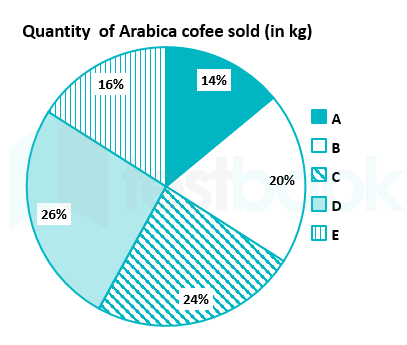
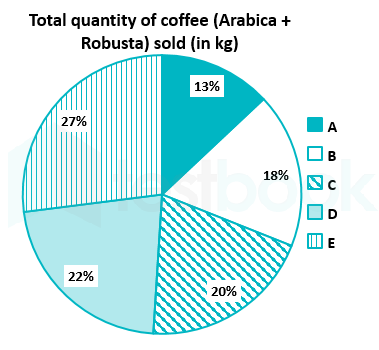
The first pie chart given below illustrates the percentage breakdown of the total quantity of coffee (Arabica + Robusta) sold by five different shopkeepers and the second pie chart depicts the percentage distribution of the quantity of 'Arabica' coffee sold by these same five shopkeepers.

Total quantity of coffee sold by a shopkeeper = Quantity of 'Arabica' coffee sold (in kg) + Quantity of 'Robusta' coffee sold (in kg)

Total quantity of coffee (Arabica + Robusta) sold by all five shopkeepers together = 3600 kg

Quantity of 'Arabica' coffee sold by all five shopkeepers together = 2400 kg

49

The quantity of 'Robusta' coffee sold by shopkeeper 'C' is what percentage of that by shopkeeper 'B'?

  1. ((a))

    84.14%

  2. ((b))

    84.42%

  3. ((c))

    85.28%

  4. ((d))

    85.42%

  5. ((e))

    85.71%

Show Answer
Answer: ((a))

84.14%

50

The combined quantity of 'Robusta' coffee sold by shopkeeper 'A' and shopkeeper 'E' is what percentage of the total quantity of coffee (Arabica + Robusta) sold by shopkeeper 'A' and shopkeeper 'E' together?

  1. ((a))

    33.33%

  2. ((b))

    40%

  3. ((c))

    50%

  4. ((d))

    66.67%

  5. ((e))

    75%

Show Answer
Answer: ((a))

33.33%

51

If the combined quantity of 'Arabica' coffee sold by shopkeeper 'E' and shopkeeper 'F' amounts to 1014 kg, then what is the respective ratio between the quantity of '(Arabica + Robusta)' coffee sold by shopkeeper 'C' and 'Arabica' coffee sold by shopkeeper 'F'?

  1. ((a))

    3 : 7

  2. ((b))

    4 : 7

  3. ((c))

    6 : 7

  4. ((d))

    8 : 7

  5. ((e))

    12 : 7

Show Answer
Answer: ((a))

3 : 7

52

Which shopkeepers among the following sold an equal quantity of 'Robusta' coffee?

  1. ((a))

    'A' and 'B'

  2. ((b))

    'B' and 'C'

  3. ((c))

    'A' and 'D'

  4. ((d))

    'B' and 'D'

  5. ((e))

    'C' and 'D'

Show Answer
Answer: ((a))

'A' and 'B'

53

If the total quantity of coffee (Arabica + Robusta) sold by shopkeeper 'X' is 44.44% more than that sold by shopkeeper 'C', and the quantity of 'Arabica' coffee sold by shopkeeper 'X' is equal to the average total quantity of 'Arabica' coffee sold by shopkeepers 'A', 'B', and 'C' together, then what is the quantity of 'Robusta' coffee sold by shopkeeper 'X'?

  1. ((a))

    576 kg

  2. ((b))

    579 kg

  3. ((c))

    582 kg

  4. ((d))

    585 kg

  5. ((e))

    590 kg

Show Answer
Answer: ((a))

576 kg

54

A right circular cone of maximum volume is cut from a solid right circular cylinder of metal and the volume of the remaining cylinder is 1078 cm3. If the ratio between radius and height of the cylinder is 2: 3, then what was the total surface area of the cylinder initially?

  1. ((a))

    770 cm2

  2. ((b))

    750 cm2

  3. ((c))

    775 cm2

  4. ((d))

    778 cm2

  5. ((e))

    772 cm2

Show Answer
Answer: ((a))

770 cm2

55

Marked price on set of exclusive garments is Rs 2500. Trader gives two successive discounts of 15% and D% and sells it to pratham. Pratham sells the garments with same price at 20% profit to anya. Anya paid Rs 2244 for the same dress. What is the discount offered by the trader?

  1. ((a))

    10%

  2. ((b))

    12%

  3. ((c))

    15%

  4. ((d))

    20%

  5. ((e))

    25%

Show Answer
Answer: ((a))

10%

56

A boat goes a certain distance upstream and comes back downstream to the starting point in 72 min. If the speed of the boat in still water becomes 66.67% of the original, the time taken for the same journey will be 112 min. What is the ratio of the speed of the boat in still water and the speed of the current?

  1. ((a))

    1 : 2

  2. ((b))

    6 : 5

  3. ((c))

    9 : 1

  4. ((d))

    6 : 1

  5. ((e))

    9 : 4

Show Answer
Answer: ((a))

1 : 2

57

Pipe P alone can fill the tank in 18 hours and pipe Q alone can fill the tank in 12 hours. Both pipes opened for 7 hours. The fraction of the tank remained after 7 hours is equal to the fraction of the tank filled by pipe R in one hour. In what time the tank gets filled when all three pipes are opened simultaneously?

  1. ((a))

    7 hours

  2. ((b))

    4 hours

  3. ((c))

    3 hours

  4. ((d))

    9 hours

  5. ((e))

    6 hours

Show Answer
Answer: ((a))

7 hours

Directions: Answer the questions based on the information given below.

A bakery sold a different number of 'cakes' and 'cupcakes' in three different months. The number of 'cakes' sold in January is 80 more than the number of 'cupcakes' sold in the same month. The total number of cakes + cupcakes sold in February is 20% more than that in January. The ratio of the number of 'cupcakes' sold in February to that in March is 6 : 7 respectively. The ratio of the number of 'cakes' sold in January to that in March is 5 : 6 respectively. The number of 'cupcakes' sold in March is 52% of the total number of cakes + cupcakes sold in the same month. The average number of cupcakes sold from January to March is 292.

58

If the selling price of one cake and one cupcake is Rs. 15 and Rs. 12.5 respectively, then find the total revenue generated by the bakery from selling all the cakes and cupcakes in January?

  1. ((a))

    Rs. 6500

  2. ((b))

    Rs. 6700

  3. ((c))

    Rs. 6900

  4. ((d))

    Rs. 7000

  5. ((e))

    Rs. 7100

Show Answer
Answer: ((a))

Rs. 6500

59

If the number of cupcakes sold in May is 50% more than that of cakes and the total number of cakes + cupcakes sold in May is 250 less than that in March then find the number of cupcakes sold in May?

  1. ((a))

    180

  2. ((b))

    210

  3. ((c))

    240

  4. ((d))

    270

  5. ((e))

    300

Show Answer
Answer: ((a))

180

60

If the total number of cakes sold in April is 180 then find the average number of cakes sold by the bakery from January to April?

  1. ((a))

    240

  2. ((b))

    245

  3. ((c))

    250

  4. ((d))

    260

  5. ((e))

    265

Show Answer
Answer: ((a))

240

61

The number of cupcakes sold in February is how much percent more/less than that in January?

  1. ((a))

    48%

  2. ((b))

    52%

  3. ((c))

    56%

  4. ((d))

    60%

  5. ((e))

    64%

Show Answer
Answer: ((a))

48%

62

What is the ratio of the number of cakes sold in February to that in March respectively?

  1. ((a))

    11 : 7

  2. ((b))

    11 : 10

  3. ((c))

    11 : 12

  4. ((d))

    11 : 13

  5. ((e))

    11 : 14

Show Answer
Answer: ((a))

11 : 7

63

What approximate will come in the place of the question mark ‘?’ in the following question?

231.40 + 342.21 – 189.21 = 21.62 × ? – 100.10

  1. ((a))

    20

  2. ((b))

    22

  3. ((c))

    15

  4. ((d))

    18

  5. ((e))

    12

Show Answer
Answer: ((a))

20

64

What approximate will come in the place of the question mark ‘?’ in the following question?

(17)1/2 ÷ (3)1/2 – 1 ÷ (3)1/2 + (35)1/2 ÷ (3)1/2 = (?)1/2

  1. ((a))

    27

  2. ((b))

    29

  3. ((c))

    42

  4. ((d))

    18

  5. ((e))

    None of them

Show Answer
Answer: ((a))

27

65

What approximate will come in the place of the question mark ‘?’ in the following question?

9.891 - [8.992 - {7.796 – 6.610 – 5.190 + 3}] = ?

  1. ((a))

    3.6

  2. ((b))

    0

  3. ((c))

    5.2

  4. ((d))

    4.7

  5. ((e))

    None of them

Show Answer
Answer: ((a))

3.6

66

What approximate value should come in place of “?” in the following equation:

32.98% of 4399.89 – (17.03 × 22.94) = (?)2 – (5.032 × 3.97) + 5.01

  1. ((a))

    34

  2. ((b))

    1156

  3. ((c))

    36

  4. ((d))

    32

  5. ((e))

    None of these

Show Answer
Answer: ((a))

34

67

What approximate will come in the place of the question mark ‘?’ in the following question?

11.04 – 8.97 × 4.03 + 27.05 ÷ 9.02 + 6.97 = ?

  1. ((a))

    -12

  2. ((b))

    -15

  3. ((c))

    -20

  4. ((d))

    -8

  5. ((e))

    0

Show Answer
Answer: ((a))

-12

68

Three persons A, B and C started a business. They invest in the ratio of (1/3) ∶ (1/2) ∶ (1/4). After 6 months A's investment becomes (3/2)th of his initial amount and B investment becomes (1/6)th of his initial amount. At the end of the year, the difference in the profit share of A and B is Rs. 2400. Find C's share.

  1. ((a))

    Rs. 3600

  2. ((b))

    Rs. 2400

  3. ((c))

    Rs. 4800

  4. ((d))

    Rs. 7200

  5. ((e))

    None of these

Show Answer
Answer: ((a))

Rs. 3600

69

Ram covers a distance of 150 kilometres. He covers the first half of the journey by bicycle at a speed of 15 km/h. He completes the remaining half by walking at a speed of 5 km/h. Calculate the time taken by Ram to cover the whole distance.

  1. ((a))

    10 hours

  2. ((b))

    15 hours

  3. ((c))

    20 hours

  4. ((d))

    40 hours

  5. ((e))

    25 hours

Show Answer
Answer: ((a))

10 hours

70

Person A can complete 25% of the work in 4 days, person B can complete 31.25% of the work in 10 days, and Person C can complete the same work in 17 days. If A and B worked together and after 5 days A left the work and C joined B, and after 3 days C also left the work then find how many days (approx) person B will take to complete the remaining work.

  1. ((a))

    8 days

  2. ((b))

    12 days

  3. ((c))

    5 days

  4. ((d))

    15 days

  5. ((e))

    18 days

Show Answer
Answer: ((a))

8 days

71

A shopkeeper sells mixture of chemical and water. A mixture of 90 litres contains chemical and water in the ratio of 4 : 5. When some same quantity of water and chemical added into the mixture then their ratio becomes 13 : 11. The quantity of water in the new mixture is what percent of total quantity of new mixture?

  1. ((a))

    40%

  2. ((b))

    54%

  3. ((c))

    44%

  4. ((d))

    48%

  5. ((e))

    50%

Show Answer
Answer: ((a))

40%

72

Two trains moving towards each other crosses one another in 15 seconds. If both of them move in the same direction one will cross the other in 25 seconds. If both are of the same length, find the ratio of the speed of the faster train to the slower train.

  1. ((a))

    5 ∶ 2

  2. ((b))

    4 ∶ 3

  3. ((c))

    5 ∶ 1

  4. ((d))

    4 ∶ 1

  5. ((e))

    2 ∶ 1

Show Answer
Answer: ((a))

5 ∶ 2

73

Rs. 16000 was invested for three years, partly in scheme A at the rate of 5% simple interest per annum and partly in scheme B at the rate of 8% simple interest per annum. The total interest received at the end was Rs. 3480. What amount of money was invested in scheme A?

  1. ((a))

    Rs. 6500

  2. ((b))

    Rs. 5000

  3. ((c))

    Rs. 8000

  4. ((d))

    Rs. 4000

  5. ((e))

    None of these

Show Answer
Answer: ((a))

Rs. 6500

74

In a primary school, the average weight of male students is 65.9 kg and the average weight of female students is 57 kg. If the average weight of all the students (both male and female) is 60.3 kg and the number of male students in the school is 66, then what is the number of female students in the school?

  1. ((a))

    210

  2. ((b))

    85

  3. ((c))

    112

  4. ((d))

    100

  5. ((e))

    48

Show Answer
Answer: ((a))

210

75

Three persons Dhruv, Danish and Damini contested in an election. The number of voters in the election was 35,500 out of which 10% was declared invalid. Dhruv won the election by receiving 40% of the valid votes. The votes received by Damini is 800 more than the votes received by Danish. What is the difference between the number of votes received by Dhruv and Danish?

  1. ((a))

    2505

  2. ((b))

    3595

  3. ((c))

    4255

  4. ((d))

    5625

  5. ((e))

    1785

Show Answer
Answer: ((a))

2505

Directions: Answer the questions based on the information given below.

The table presented below displays the number of products produced by five distinct companies, along with the corresponding percentage representing the number of products sold by each company.

CompanyTotal number of products manufacturedPercentage of the number of products sold
P520065%
Q450054%
R640075%
S480085%
T540045%


Note : The total number of products manufactured by a company = The number of products sold by the company + The number of products that remain unsold by the company.

76

If the total number of products manufactured by company 'Z' surpasses that of company 'T' by 25%, and if 58% of the total products manufactured by company 'Z' remained unsold, then the number of products sold by company 'Z' is what percentage of the total number of products manufactured by company 'Q'?

  1. ((a))

    60%

  2. ((b))

    63%

  3. ((c))

    65%

  4. ((d))

    66%

  5. ((e))

    68%

Show Answer
Answer: ((a))

60%

77

If both company 'P' and company 'S' sold their products at an identical price of 500 Rs. per unit, then what is the combined total revenue generated by company 'P' and company 'S'?

  1. ((a))

    3530000 Rs

  2. ((b))

    3630000 Rs

  3. ((c))

    3730000 Rs

  4. ((d))

    3830000 Rs

  5. ((e))

    3930000 Rs

Show Answer
Answer: ((a))

3530000 Rs

78

What is the ratio between the combined number of products that remained unsold by company 'Q' and company 'T', and the number of products sold by company 'R'?

  1. ((a))

    21 : 20

  2. ((b))

    23 : 20

  3. ((c))

    27 : 20

  4. ((d))

    29 : 20

  5. ((e))

    31 : 20

Show Answer
Answer: ((a))

21 : 20

79

If the total number of products manufactured by company 'X' accounts for 20% of the total products manufactured by the five given companies collectively, and 60% of the products manufactured by company 'X' remained unsold, then what is the number of products sold by company 'X'?

  1. ((a))

    2044

  2. ((b))

    2064

  3. ((c))

    2084

  4. ((d))

    2104

  5. ((e))

    2124

Show Answer
Answer: ((a))

2044

80

What is the difference between the average number of products sold collectively by companies 'Q', 'R', and 'T', and the average number of products that remained unsold by all the given companies?

  1. ((a))

    1384

  2. ((b))

    1484

  3. ((c))

    1584

  4. ((d))

    1684

  5. ((e))

    1784

Show Answer
Answer: ((a))

1384

Attempt this paper under real exam conditions

Timed interface, section switching, instant scoring, and question-by-question analytics — free.

Start Timed Attempt