Official Paper

RRB PO Prelims Memory Based Paper (Held On: 6 August 2023 Shift 1) (Previous Year Paper)

80 questions · 45 minutes · with answers · free

Reasoning (40 questions)

Directions: Read the given information carefully and answer the following questions.

Eight persons S, T, U, V, W, X, Y, and Z are working in a company on different designations but not necessarily in the same order. The designations are in this order Chief Executive officer (CEO), Chief Technology Officer (CTO), Chief Marketing Officer (CMO), Chief Financial Officer (CFO), Product Manager, Sales Manager, Operations Manager, and Trainee where the Chief Executive officer (CEO) is the senior most designated person and Trainee is the junior most designated person.

 W is three persons senior to Y. At least two persons are junior to Y. One designation is between Y and V. Y is senior to V. S is the Chief Financial Officer (CFO). Z is just senior to S. T is senior to X but not the senior most designated person.

1

 Which of the following statement(s) is /are true to the final arrangement?

  1. ((a))

    Z is the Chief Marketing Officer.

  2. ((b))

    T is the junior most designated person.

  3. ((c))

    Only two persons are senior to T.

  4. ((d))

    V is the senior most designated person.

  5. ((e))

    W is just a senior to U.  

Show Answer
Answer: ((a))

Z is the Chief Marketing Officer.

2

 Four of the following are alike in a certain way as per the given arrangement and thus form a group. Find the one who doesn’t belong to that group.

  1. ((a))

    U-Z

  2. ((b))

    W-S

  3. ((c))

    T-Y

  4. ((d))

    Z-Y

  5. ((e))

    S-T

Show Answer
Answer: ((a))

U-Z

3

How many persons are senior to T?

  1. ((a))

    One

  2. ((b))

    Four

  3. ((c))

    Two

  4. ((d))

    Five

  5. ((e))

    Three

Show Answer
Answer: ((a))

One

4

Who among the following person works as Product Manager?

  1. ((a))

    V

  2. ((b))

    Y

  3. ((c))

    U

  4. ((d))

    Z

  5. ((e))

    W

Show Answer
Answer: ((a))

V

5

How many persons are designated between X and S?

  1. ((a))

    One

  2. ((b))

    Five

  3. ((c))

    Four

  4. ((d))

    Two

  5. ((e))

    Three

Show Answer
Answer: ((a))

One

6

Read the given information carefully and answer the following question.

How many pairs of letters are there in the word “CUSTODIAN” each of which has as many letters between them as in the English alphabetical series (both forward and backward direction) as they have between them in the English alphabetical series?

  1. ((a))

    One

  2. ((b))

    Four

  3. ((c))

    Two

  4. ((d))

    Three

  5. ((e))

    More than four

Show Answer
Answer: ((a))

One

Directions: Study the information below carefully and answer the following questions.

Abdul, Bismi, Carol, Daisy, Esha, Fasna, Gulam and Hari are sitting around a circle some facing towards the centre and some facing outside the centre but not necessarily in the same order. Abdul sits second to left of Carol and Esha sits third to right of Abdul. Only three persons are sitting between Esha and Bismi. Esha faces the opposite direction as Hari faces. Hari sits immediate right of Carol. Daisy sits second to right of Fasna who sits third to the left of Hari. Abdul and Carol are facing opposite direction. Carol sits third to right of Gulam and both facing same direction. Daisy and Bismi are facing same direction as facing Fasna. Esha facing inside the circle.

7

Which of the given is true?

I. Two persons sits between Abdul and Hari

II. Fasna sits to the immediate right of Gulam

III. Abdul and Daisy are seated opposite to each other

Iv. Daisy and Carol are immediate neighbours

V. Esha sits to the immediate right of Fasna

  1. ((a))

    I, II, III

  2. ((b))

    I, II, IV

  3. ((c))

    I, IV, V

  4. ((d))

    I, III, V

  5. ((e))

    I, II, V

Show Answer
Answer: ((a))

I, II, III

8

How many persons are facing outside?

  1. ((a))

    Two

  2. ((b))

    Three

  3. ((c))

    Four

  4. ((d))

    Five

  5. ((e))

    One

Show Answer
Answer: ((a))

Two

9

Abdul sits third to the right of which of the following.

  1. ((a))

    Hari

  2. ((b))

    Carol

  3. ((c))

    Esha

  4. ((d))

    Both I and II

  5. ((e))

    Both I and III

Show Answer
Answer: ((a))

Hari

10

Find the odd one out

  1. ((a))

    Abdul-Daisy

  2. ((b))

    Fasna-Abdul

  3. ((c))

    Carol-Daisy

  4. ((d))

    Gulam-Bismi

  5. ((e))

    Esha-Hari

Show Answer
Answer: ((a))

Abdul-Daisy

11

Which of the following is true?

  1. ((a))

    Esha and Bismi faces same direction

  2. ((b))

    Gulam sits opposite to Daisy

  3. ((c))

    Hari sits second to the left of Fasna

  4. ((d))

    Carol sits to the immediate right of Bismi

  5. ((e))

    Abdul and Gulam are immediate neighbours

Show Answer
Answer: ((a))

Esha and Bismi faces same direction

12

Direction: In the question below are given three statements followed by two conclusions numbered I and II. You have to take the given statements to be true even if they seem to be at variance with commonly known facts. Read all the conclusions and then decide which of the given conclusions logically follows from the given statements disregarding commonly known facts.

Statements:

All alloy are balls.

No balls are cats.

Some cats are dog.

Conclusions:

I. Some alloy are cats.

II. Some balls are dogs.

  1. ((a))

    Only conclusion I follows

  2. ((b))

    Only conclusion II follows

  3. ((c))

    Either conclusion I or II follows

  4. ((d))

    Neither conclusion I nor II follows

  5. ((e))

    Both conclusion I and II follows

Show Answer
Answer: ((a))

Only conclusion I follows

13

In the question, assuming the given statements to be true, find which of the conclusion (s) among the given two conclusions is/are definitely true and then give your answer accordingly.

Statements: 

All Negotiation is Salary. 

Only a few Internship is Salary.

No Unpaid is Internship. 

Conclusions:

I. Some Salary is definitely not Unpaid.

II. No Negotiation is Internship.

  1. ((a))

    Either conclusion I or II follows

  2. ((b))

    Both conclusions I and II follow

  3. ((c))

    Neither conclusion I nor II follows

  4. ((d))

    Only conclusion I follows

  5. ((e))

    Only conclusion II follows

Show Answer
Answer: ((a))

Either conclusion I or II follows

14

Directions: In the question below are given three statements followed by three conclusions I, II and III. You have to take the given statements to be true even if they seem to be at variance from commonly known facts. Read all the conclusions and then decide which of the given conclusions logically follows from the given statements disregarding commonly known facts.

Statements:

Some books are novels.

All novels are fiction.

No fiction is non-fiction.

Conclusions:

I. Some books are fiction.

II. Some novels are not non-fiction.

  1. ((a))

    Only I follows.

  2. ((b))

    Only II follows.

  3. ((c))

    Either I or II follows.

  4. ((d))

    Neither I nor II follows.

  5. ((e))

    Both I and II follows.

Show Answer
Answer: ((a))

Only I follows.

Directions: Read the given information carefully and answer the following questions.

Certain numbers of people are sitting in a row and all of them are facing north direction. Z is sitting at one of the extreme ends. The Number of people sitting between U and Z is the same as the number of people sitting left to the person immediately right of U. L is sitting immediately left of U. Two persons are sitting between Z and J. J is sitting fourth to the right of U. X is sitting third from the left end. The number of people sitting between X and L is the same as those sitting between P and Z.

15

Who among the following person sits immediately left of P?

  1. ((a))

    U

  2. ((b))

    J

  3. ((c))

    X

  4. ((d))

    Z

  5. ((e))

    L

Show Answer
Answer: ((a))

U

16

How many persons sits between L and J?

  1. ((a))

    Two

  2. ((b))

    One

  3. ((c))

    Seven

  4. ((d))

    Ten

  5. ((e))

    Four

Show Answer
Answer: ((a))

Two

17

Who is sitting third to the left of U?

  1. ((a))

    X

  2. ((b))

    J

  3. ((c))

    P

  4. ((d))

    Z

  5. ((e))

    L

Show Answer
Answer: ((a))

X

18

How many persons are sitting to the right of P?

  1. ((a))

    Two

  2. ((b))

    Three

  3. ((c))

    One

  4. ((d))

    Four

  5. ((e))

    Six

Show Answer
Answer: ((a))

Two

19

How many people are sitting in the row?

  1. ((a))

    Ten

  2. ((b))

    Eleven

  3. ((c))

    Nine

  4. ((d))

    Fourteen

  5. ((e))

    Thirteen

Show Answer
Answer: ((a))

Ten

20

Four of the following four letter-clusters are alike in a certain way and one is different. Pick the odd one out.

  1. ((a))

    BCEH

  2. ((b))

    MNPS

  3. ((c))

    TUWZ

  4. ((d))

    JKMP

  5. ((e))

    GHIJ

Show Answer
Answer: ((a))

BCEH

21

How many such pairs of letters are there in the word "ABSORB" which has as many letters between them in the word (in both forward and backward directions), as they have between them in the English alphabetical series?

  1. ((a))

    None

  2. ((b))

    One

  3. ((c))

    Two

  4. ((d))

    Three

  5. ((e))

    Four

Show Answer
Answer: ((a))

None

22

Direction: In the question, assuming the given statements to be true, find which of the conclusion (s) among the given two conclusions is/are definitely true, and then give your answer accordingly.

Statements: S > D = F ≥ G ≥ H ≤ K, Y ≤ H = T

Conclusions:

I. S > Y

II. S > T

  1. ((a))

    Only conclusion I is true

  2. ((b))

    Only conclusion II is true

  3. ((c))

    Either conclusion I or II is true

  4. ((d))

    Neither conclusion I nor II is true

  5. ((e))

    Both conclusion I and II are true

Show Answer
Answer: ((a))

Only conclusion I is true

23

Direction: In the following question, assuming the given statement to be true, find which of the conclusion(s) among the given conclusions is/are definitely true, and then give your answers accordingly.

Statement:

W ≥ E > R < T ≤ Y, Y ≤ U = I ≥ O

Conclusions:

I. I > R

II. E > O

  1. ((a))

    Neither conclusion I nor II is true

  2. ((b))

    Only conclusion I is true

  3. ((c))

    Both conclusion I and II are true

  4. ((d))

    Only conclusion II is true

  5. ((e))

    Either conclusion I or II is true

Show Answer
Answer: ((a))

Neither conclusion I nor II is true

24

Direction: In the following question, assuming the given statement to be true, find which of the conclusion(s) among the given conclusions is/are definitely true, and then give your answers accordingly.

Statement:

O ≥ M > Q = S; M < U = K ≤ W; K > Y = A

Conclusions:

I. Y > Q

II. A < W

III. O > W

  1. ((a))

    Only conclusion I follows

  2. ((b))

    Only conclusion II follows

  3. ((c))

    Either II or III and II follow

  4. ((d))

    Both conclusions II and III follow

  5. ((e))

    All conclusions I, II and III follow

Show Answer
Answer: ((a))

Only conclusion I follows

Directions: Read the given information carefully and answer the following questions.

Six people Pihu, Qush, Rohan, Sam, Uma, and Tina like different products Shirts, Necklace, Mug, Pillow, Candy, and Earrings but not necessarily in the same order. They all are sitting in a queue. Two persons are sitting between the person who likes a Shirt and a Necklace. The person who likes Earrings is sitting immediately below the one who likes Necklace. Uma does not like necklaces. Three persons are sitting between Sam and the one who likes Shirt. Qush sits below Pihu but sits above the one who likes Pillow. Qush and the one who likes Pillow are immediate neighbors. Two persons are sitting between Sam and Tina. Pihu likes Candy and is sitting above Tina. The person who likes Mug is immediately below the one who likes Candy.

25

Which of the following statements is true?

  1. ((a))

    Sam does not like Mug.

  2. ((b))

    Uma likes Shirt.

  3. ((c))

    Three persons are between Pihu and Uma.

  4. ((d))

    Pihu is immediately above Tina.

  5. ((e))

    Rohan is the last in the arrangement.

Show Answer
Answer: ((a))

Sam does not like Mug.

26

Who is immediately above the person who likes Necklace?

  1. ((a))

    Sam

  2. ((b))

    Qush

  3. ((c))

    Tina

  4. ((d))

    Uma

  5. ((e))

    Rohan

Show Answer
Answer: ((a))

Sam

27

How many persons are there between Rohan and Uma?

  1. ((a))

    Five

  2. ((b))

    One

  3. ((c))

    Four

  4. ((d))

    Three

  5. ((e))

    Two

Show Answer
Answer: ((a))

Five

28

Qush likes which product?

  1. ((a))

    Shirt

  2. ((b))

    Earrings

  3. ((c))

    Necklace

  4. ((d))

    Candy

  5. ((e))

    Mug

Show Answer
Answer: ((a))

Shirt

29

Who likes Pillow?

  1. ((a))

    Sam

  2. ((b))

    Uma

  3. ((c))

    Rohan

  4. ((d))

    Tina

  5. ((e))

    Qush

Show Answer
Answer: ((a))

Sam

Directions: Study the following information carefully and answer the questions given below:

A, B, C, N, O, T, V, and Y are the eight members of a family. O is the sister-in-law of A. B is the father of A. B has two grandsons. N is the parent of T. C is the brother-in-law of N, who is a female. Y is the daughter of N. V is the only child of O, who does not have any siblings.

30

If D is married to B then how is N related to D?

  1. ((a))

    Daughter

  2. ((b))

    Son-in-law

  3. ((c))

    Son

  4. ((d))

    Daughter-in-law

  5. ((e))

    Cannot be determined

Show Answer
Answer: ((a))

Daughter

31

Find the odd one out?

  1. ((a))

    O

  2. ((b))

    A

  3. ((c))

    N

  4. ((d))

    Y

  5. ((e))

    C

Show Answer
Answer: ((a))

O

32

If W is the son-in-law of A then how is T related to W?

  1. ((a))

    Father-in-law

  2. ((b))

    Mother-in-law

  3. ((c))

    Sister-in-law

  4. ((d))

    Brother-in-law

  5. ((e))

    Cannot be determined

Show Answer
Answer: ((a))

Father-in-law

Directions: Read the given information carefully and answer the following questions.

Ten persons Q, R, S, T, U, V, W, X, Y, and Z are giving gifts in January, March, April, May, June, August, September, October, November, and December to their friends not necessarily in the same order. X gives a gift in the month which is 30 days only. At least two persons give a gift after X. T gives a gift in the month immediately after X. Only two persons give the gift before Y. Two people give the gift in between Y and Q. Two persons give a gift in between X and R. The Number of persons giving gifts before U is one more than the number of gifts given after W. Z gives the gift before W and after S. U is not the last one to give the gift. Z does not give gifts in June. R and S are not immediate neighbors.

33

 Which of the following combinations is correct?

  1. ((a))

    January- T

  2. ((b))

    March-Z

  3. ((c))

    June-V

  4. ((d))

    October-R

  5. ((e))

    April-W

Show Answer
Answer: ((a))

January- T

34

Which of the following gives the gift immediately before T?

  1. ((a))

    S

  2. ((b))

    X

  3. ((c))

    W

  4. ((d))

    U

  5. ((e))

    V

Show Answer
Answer: ((a))

S

35

How many persons give the gift after R?

  1. ((a))

    One

  2. ((b))

    Seven

  3. ((c))

    Four

  4. ((d))

    Six

  5. ((e))

    Three

Show Answer
Answer: ((a))

One

36

How many persons give the gift between Y and Q?

  1. ((a))

    One

  2. ((b))

    Three

  3. ((c))

    Six

  4. ((d))

    Eight

  5. ((e))

    Two

Show Answer
Answer: ((a))

One

37

Who gives the gift in November?

  1. ((a))

    S

  2. ((b))

    W

  3. ((c))

    Z

  4. ((d))

    X

  5. ((e))

    Q

Show Answer
Answer: ((a))

S

​Directions: Study the following information carefully and answer the questions given below:

Point A is 4m north of point C. Point C is the middle point of point B and point H. Point B is 6m to the west of H. Point F is 10m east of point G, which is 5m south of point H. Point B is north of point D, which is west of point E. Point F is 7m north of point E.

38

What is the shortest distance between Point B and Point E?

  1. ((a))

    22 m

  2. ((b))

    20 m

  3. ((c))

    25 m

  4. ((d))

    28 m

  5. ((e))

    None of these

Show Answer
Answer: ((a))

22 m

39

What is the direction of Point G with respect to Point D?

  1. ((a))

    North East

  2. ((b))

    North West

  3. ((c))

    South West

  4. ((d))

    North

  5. ((e))

    None of These

Show Answer
Answer: ((a))

North East

40

Four among the following five are alike in a certain way thus form a group. Which of the following doesnot belong to the group?

  1. ((a))

    DF

  2. ((b))

    GB

  3. ((c))

    HA

  4. ((d))

    EG

  5. ((e))

    FB

Show Answer
Answer: ((a))

DF

Quantitative Aptitude (40 questions)

Directions: Answer the questions based on the information given below.

A textile company manufactures two different types of articles - type 'X' and type 'Y'. For each 'X' type of article, the ratio of cost price to that of marked price is 8 : 15. Percentage by which profit earned on selling an 'X' type of article is 80% more than the discount allowed on the same article. The total revenue generated from selling 600 articles of type 'X' is 75000 Rs. For each 'Y' type of article, the cost price of an article is 70% of the marked price of same article. Ratio between the profit earned on selling 'Y' type of article to that of discount allowed on same article is 2 : 1. The total revenue generated from selling 700 articles of type 'Y' is 126000 Rs.

41

Find profit earned from selling all articles of type 'Y'?

  1. ((a))

    12000 Rs.

  2. ((b))

    16000 Rs.

  3. ((c))

    20000 Rs.

  4. ((d))

    24000 Rs.

  5. ((e))

    28000 Rs.

Show Answer
Answer: ((a))

12000 Rs.

42

If all articles of type 'X' had been sold without allowing any discount, then find the profit generated by selling all articles of type 'X'?

  1. ((a))

    36000 Rs.

  2. ((b))

    38000 Rs.

  3. ((c))

    40000 Rs.

  4. ((d))

    42000 Rs.

  5. ((e))

    44000 Rs.

Show Answer
Answer: ((a))

36000 Rs.

43

Find the ratio between the selling price of each 'X' type of article and the cost price of each 'Y' type of article?

  1. ((a))

    15 : 22

  2. ((b))

    21 : 26

  3. ((c))

    25 : 28

  4. ((d))

    27 : 31

  5. ((e))

    31 : 35

Show Answer
Answer: ((a))

15 : 22

44

Profit earned on each 'X' type of article is what percentage of the profit earned on each 'Y' type of article?

  1. ((a))

    100%

  2. ((b))

    106.66%

  3. ((c))

    112.5%

  4. ((d))

    114.28%

  5. ((e))

    120%

Show Answer
Answer: ((a))

100%

45

Find the difference between the discount allowed on each 'X' and 'Y' type of article?

  1. ((a))

    5 Rs.

  2. ((b))

    10 Rs.

  3. ((c))

    15 Rs.

  4. ((d))

    20 Rs.

  5. ((e))

    25 Rs.

Show Answer
Answer: ((a))

5 Rs.

46

What approximate value should come in the place of (?) in the following questions?

19.904 % of 29.998 + 25 × 4.102 - 25.021 % of 49.934 = ?

  1. ((a))

    90

  2. ((b))

    94

  3. ((c))

    96

  4. ((d))

    92

  5. ((e))

    91

Show Answer
Answer: ((a))

90

47

What approximate value should come in the place of (?) in the following questions?

119.904 % of 69.998 + 9.879 × 7.102 - 75.021% of 143.934 = ?

  1. ((a))

    44

  2. ((b))

    45

  3. ((c))

    47

  4. ((d))

    48

  5. ((e))

    46

Show Answer
Answer: ((a))

44

48

What approximate value should come in the place of (?) in the following questions?

333.99 + 999.8120 - 30% of 6600.342 = ? × 2.5 + 53 - 23.542

  1. ((a))

    66

  2. ((b))
    • 64
  3. ((c))

    67

  4. ((d))
    • 68
  5. ((e))
    • 78
Show Answer
Answer: ((a))

66

49

What approximate value will come in place of the question mark (?) in the following question?(Note: You are not expected to calculate the exact value.)

123.23 + 45 × 45 - 25% of 499.9 = (99.99 × 49.5)% of 29.9 + ?

  1. ((a))

    522

  2. ((b))

    621

  3. ((c))

    720

  4. ((d))

    424

  5. ((e))

    538

Show Answer
Answer: ((a))

522

50

What approximate value should come in the place of the question mark (?) in the following equation?

(2799.99 ÷ 27.99) × 7.99 - 15.78 = 4.8% of 399.99 + 624.88 + ?

  1. ((a))

    139

  2. ((b))

    145

  3. ((c))

    130

  4. ((d))

    150

  5. ((e))

    155

Show Answer
Answer: ((a))

139

51

At the beginning of a partnership business, the capital of P was 9/4 of Q. After four months P withdrew 1/3 of his capital and after six months Q withdrew 1/2th of his capital. At the end of the year, if the profit incurred is Rs. 88,000. Find the amount received by P.

  1. ((a))

    Rs. 56700

  2. ((b))

    Rs. 61600

  3. ((c))

    Rs. 70300

  4. ((d))

    Rs. 35200

  5. ((e))

    Rs. 26400

Show Answer
Answer: ((a))

Rs. 56700

52

A shopkeeper buys an item for Rs. 500 and sells it at 20% profit but one customer buys it from him at the selling price for 4 years at a simple rate of interest, which is 5% per annum. How much profit percentage is earned by a shopkeeper if interest is also considered as profit?

  1. ((a))

    40%

  2. ((b))

    48%

  3. ((c))

    44%

  4. ((d))

    46%

  5. ((e))

    None of these

Show Answer
Answer: ((a))

40%

53

Two pipes with a leakage are filling a tank. The pipes and the leakage can fill the tank in 18 hrs. But after 3 hrs of working the leakage was observed and repaired. The pipes again started filling the tank and they filled the remaining part in 10 hrs. Find the time taken by the leakage to empty the fully filled tank.

  1. ((a))

    42 hrs

  2. ((b))

    35 hrs

  3. ((c))

    54 hrs

  4. ((d))

    36 hrs

  5. ((e))

    39 hrs

Show Answer
Answer: ((a))

42 hrs

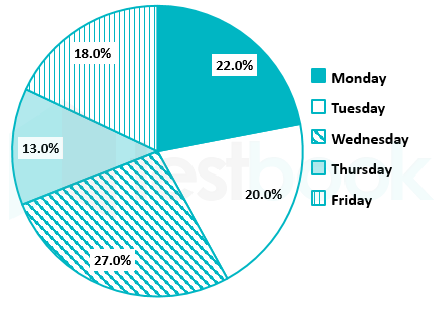
Directions: Study the following pie chart 1 shows the number of persons (Male + Female) attending IBPS exams on five different days such as Monday, Tuesday, Wednesday, Thursday and Friday.


Total number of (Male +Female) attending exams = 1200


<br> <br>


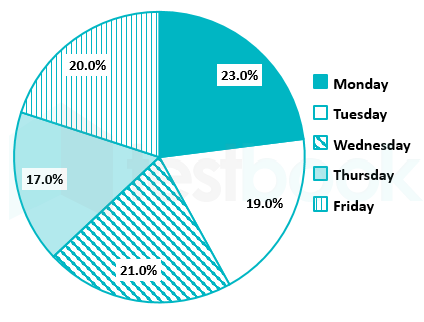
The given pie chart 2 shows the total number of females attending IBPS exams in five different days such as Monday, Tuesday,Wednesday, Thursday and Friday.


Total number of females attending exams = 700


54

Number of absent in male on Wednesday is 23 and the number absents in females on Wednesday is 3. Then find the difference between 1/5th of the number of males applied for the exam on Wednesday and 1/3 of the number of females applied for the exam on Wednesday.

  1. ((a))

    20

  2. ((b))

    25

  3. ((c))

    10

  4. ((d))

    15

  5. ((e))

    12

Show Answer
Answer: ((a))

20

55

If the fees collected for each male for attending exam is Rs. x and fees collected for each female for attending exam is Rs. (x - 50). If the total amount collected for attending the exam on Thursday is Rs.25250. If 20% of the females attending exam on Friday are PWD candidates and fees collected for the PWD candidates are Rs.(x - 100).Find the amount collected for PWD female candidates attending the exam on Friday.

  1. ((a))

    Rs. 3000

  2. ((b))

    Rs. 2500

  3. ((c))

    Rs. 2800

  4. ((d))

    Rs. 1500

  5. ((e))

    Rs. 2250

Show Answer
Answer: ((a))

Rs. 3000

56

If 1/4 th of the sum of the number of males attending exams on Tuesday and Wednesday are from exam center A and  1/2 of the  number of females attending exams on Monday and Wednesday are from exam center B . Find the 17/15 of the  given persons who attend the exam at Centre A and Centre B.

  1. ((a))

    315

  2. ((b))

    255

  3. ((c))

    235

  4. ((d))

    215

  5. ((e))

    275

Show Answer
Answer: ((a))

315

57

If the number of males attending exams on Saturday is 17 more than the number of males attending exams on Monday. And the number of females attending exams on Saturday is 21 more than the females attending exams on Thursday. Find the sum of the 25% of males and 2/7 th of the females attending the exam on Saturday.

  1. ((a))

    60

  2. ((b))

    70

  3. ((c))

    80

  4. ((d))

    40

  5. ((e))

    55

Show Answer
Answer: ((a))

60

58

If 3/7 th of the number of females attending exam on Friday and 1/4 th of the males attending exam on Friday are cleared the preliminary exam, find the total  number of persons not cleared the preliminary exam.

  1. ((a))

    115

  2. ((b))

    137

  3. ((c))

    110

  4. ((d))

    121

  5. ((e))

    130

Show Answer
Answer: ((a))

115

59

What should come in place of the question mark '?' in the following number series?

7, 56, 399, 448, ?, 840, 1183

  1. ((a))

    792

  2. ((b))

    791

  3. ((c))

    733

  4. ((d))

    581

  5. ((e))

    None

Show Answer
Answer: ((a))

792

60

What will come in the place of question mark '?' in the given number series?

23, 130, 945, ?, 94347

  1. ((a))

    8658

  2. ((b))

    8868

  3. ((c))

    8568

  4. ((d))

    6858

  5. ((e))

    6885

Show Answer
Answer: ((a))

8658

61

What should come in place of the question mark '?' in the following number series?

12, 20, 47, 111, ?, 452

  1. ((a))

    205

  2. ((b))

    196

  3. ((c))

    368

  4. ((d))

    236

  5. ((e))

    None of these

Show Answer
Answer: ((a))

205

62

What will come in the place of ‘?’ in the following number series.

29, 21, -42, 21, -84, ?

  1. ((a))

    -112

  2. ((b))

    112

  3. ((c))

    -147

  4. ((d))

    147

  5. ((e))

    -184

Show Answer
Answer: ((a))

-112

63

What will come in place of the question mark (?) in the following series?

2, 12, 30, 56, ?, 132

  1. ((a))

    81

  2. ((b))

    90

  3. ((c))

    64

  4. ((d))

    36

  5. ((e))

    100

Show Answer
Answer: ((a))

81

64

Aman and Deep can complete the work in 1/3rd the times of Jay, While Deep and Jay can complete the same work in 1/5th times of Aman. Together they can complete the work in 20 days. Find the time taken by Aman to complete the work if he works alone.

  1. ((a))

    40

  2. ((b))

    80

  3. ((c))

    120

  4. ((d))

    145

  5. ((e))

    None of the above

Show Answer
Answer: ((a))

40

65

When Rony was born the ratio of ages of his Father and grandfather is 7 : 15. After 4 years of Rony's birth the ratio of Rony and Rony's grandfather is 1 : 16. Then find the ratio of ages of Rony's father and mother when Rony was born if Rony's mother was 22 year old at the time of Rony's birth.

  1. ((a))

    16 : 11

  2. ((b))

    14 : 11

  3. ((c))

    11 : 14

  4. ((d))

    13 : 11

  5. ((e))

    None of these

Show Answer
Answer: ((a))

16 : 11

66

Sunil distributes 15%, 10%, and 20% of his monthly income to his son, daughter, and wife who spends 60%, 60%, and 30% of that amount respectively. If the difference between the total amount left with the children along with wife and Sunil is Rs. 961. What is the monthly income of Sunil?

  1. ((a))

    Rs. 3100

  2. ((b))

    Rs. 3200

  3. ((c))

    Rs. 3000

  4. ((d))

    Rs. 3500

  5. ((e))

    None of these 

Show Answer
Answer: ((a))

Rs. 3100

67

Two cars X and Y start from two places A and B respectively which are 800 km apart at 8 a.m. Both the cars run at an average speed of 50 km/hr towards each other. Car X stops at 9 a.m. and again starts at 10 a.m. While the other car Y continues to run without stopping. When do the two cars cross each other?

  1. ((a))

    3 : 30 pm

  2. ((b))

    4 : 30 pm

  3. ((c))

    2 : 30 pm

  4. ((d))

    5 : 00 pm

  5. ((e))

    None of these

Show Answer
Answer: ((a))

3 : 30 pm

68

In a nursing home the iodine liquid used is of two types the nursing home buys one at Rs. 30 per 100 ml containing 30% iodine & other at Rs. 10 per 100 ml containing 90% water. How much does he pay if he buys 5 litres of the mixture of two containing 17% of iodine?

  1. ((a))

    Rs. 750

  2. ((b))

    Rs. 850

  3. ((c))

    Rs. 1020

  4. ((d))

    Rs. 1190

  5. ((e))

    None of these

Show Answer
Answer: ((a))

Rs. 750

Directions: The following table shows the number of girls students and average number of boys and girls students studying in five different institutions A, B, C, D and E.


Name of the institutionsNumber of girlsAverage number of boys and girls
A80110
B90140
C6080
D6096
E4048
69

1/5 th of the boys students studying in Institution C is what percentage of the 1/4th of the girls students studying in the same institution.

  1. ((a))

    166.67%

  2. ((b))

    116.67%

  3. ((c))

    125%

  4. ((d))

    133.33%

  5. ((e))

    120%

Show Answer
Answer: ((a))

166.67%

70

Find the difference between the average number of boys studying in institution A,B,C, D and E and  the average number of girls studying in the same institution.

  1. ((a))

    64.8

  2. ((b))

    56.3

  3. ((c))

    78.7

  4. ((d))

    57.6

  5. ((e))

    96.8

Show Answer
Answer: ((a))

64.8

71

If 3/11th of the boys studying in institution D and x numbers of boys students from institution F are absent in a class for a particular day. If the average boys students are absent on a particular day is 42 and 25% of the number of boys students from institution F are absent on a particular day. Find total number of boys students in institution F.

  1. ((a))

    176

  2. ((b))

    216

  3. ((c))

    168

  4. ((d))

    172

  5. ((e))

    192

Show Answer
Answer: ((a))

176

72

If 1/3rd, 2/3rd, 1/6th of the girls studying in institution B, C and D respectively are from CSE department then find the ratio between number of girls studying CSE department in institution B and C to the girls studying in institution D in CSE department .

  1. ((a))

    5: 1

  2. ((b))

    5: 2

  3. ((c))

    7: 1

  4. ((d))

    6: 1

  5. ((e))

    7: 2

Show Answer
Answer: ((a))

5: 1

73

If 42.85% of the boys and 25% of the girls students studying in institution A cleared NEET exam then find the total number of students who did not clear the NEET exam from institution A.

  1. ((a))

    110

  2. ((b))

    125

  3. ((c))

    130

  4. ((d))

    140

  5. ((e))

    120

Show Answer
Answer: ((a))

110

74

A man buys a car with a loan of 20 lakh rupees with a simple interest rate of 5% per annum. He put his house on rent for 25,000 per month. With the amount he receives from house rent, he pays the interest on his loan and clears it. In how many years can he repay the loan with interest?

  1. ((a))

    10 years

  2. ((b))

    12 years

  3. ((c))

    13 years

  4. ((d))

    15 years

  5. ((e))

    20 years

Show Answer
Answer: ((a))

10 years

75

A cricketer has an average of 48 after playing for 20 innings. If he scores 240 runs in his next few innings, his average decreases and becomes 40 and then he takes retirement. Find the total number of innings he played till his retirement.

  1. ((a))

    28

  2. ((b))

    26

  3. ((c))

    29

  4. ((d))

    30

  5. ((e))

    27

Show Answer
Answer: ((a))

28

76

Two quantities I and II are given in the following questions. You have to find the values of both I and II by using your knowledge of mathematics and choose the most suitable relation between quantity I and II from the given options.

Quantity I: The passing marks in an exam is 40% of maximum marks, Garima got 190 marks and passed the exam by 30 marks. If Uday is declared failed by 40 marks then find the percentage of maximum marks scored by him.

Quantity II: A seller gets ‘buy 1 get 1 free’ as an offer on an item from the company, but he offers his customer ‘buy 2 get 1 free’ on the same item. What will be the profit percent earned by the seller?

  1. ((a))

    Quantity I > Quantity II

  2. ((b))

    Quantity I < Quantity II

  3. ((c))

    Quantity I = Quantity II or No relation can be established

  4. ((d))

    Quantity I ≥ Quantity II

  5. ((e))

    Quantity I ≤ Quantity II

Show Answer
Answer: ((a))

Quantity I > Quantity II

77

In the following question, two statements are numbered as A and B. On solving these statements, we get quantities A and B respectively. Solve both quantities and choose the correct option.

Quantity I: The perimeter of the square is 56 cm. The side of a square is twice the radius of a circle. The area of the circle is equal to the area of the rectangle. If the length of the rectangle is 4 more than the radius of the circle then finds the perimeter of the rectangle.

Quantity II: 50cm

  1. ((a))

    Quantity I ≥ Quantity II

  2. ((b))

    Quantity I ≤ Quantity II

  3. ((c))

    Quantity I < Quantity II

  4. ((d))

    Quantity I > Quantity II

  5. ((e))

    Quantity I = Quantity II or No relation

Show Answer
Answer: ((a))

Quantity I ≥ Quantity II

78

In the following question, two statements are numbered as A and B. On solving these statements, we get quantities A and B respectively. Solve both quantities and choose the correct option.

Quantity I: P invests Rs.300 into a partnership and Q invests 2/3rd more than the P into a partnership. After 5 months, P and Q add and remove Rs.M respectively. The total profit they had in a year is Rs.1440 and the difference between the profit shares is Rs.150. Find the value of M.

Quantity II: Sam bought a TV set and an oven for Rs.26000. The ratio between the price of the TV set and An oven is 10 : 3. He sells a TV set at 10% of profit and an oven for 5% of the profit. Find the total profit he had in this transaction.

  1. ((a))

    Quantity I ≥ Quantity II

  2. ((b))

    Quantity I ≤ Quantity II

  3. ((c))

    Quantity I < Quantity II

  4. ((d))

    Quantity I > Quantity II

  5. ((e))

    Quantity I = Quantity II or No relation

Show Answer
Answer: ((a))

Quantity I ≥ Quantity II

79

The ratio of the area of a circle to the area of a rectangle is 77 : 18. The length of the rectangle is 36 cm and the ratio of the breadth of the rectangle to the radius of the circle is 2 : 7. Find the product of the diameter of the circle and the breadth of the rectangle. (Take π = 22/7)

  1. ((a))

    142 cm

  2. ((b))

    112 cm

  3. ((c))

    124 cm

  4. ((d))

    144 cm

  5. ((e))

    104 cm

Show Answer
Answer: ((a))

142 cm

80

The ratio of income of two person is 5 : 3 and that of their expenditure is 9 : 5. If they save amount Rs. 1300 and Rs. 900 monthly respectively. Find the difference between their yearly Income.

  1. ((a))

    Rs. 80000

  2. ((b))

    Rs. 160000

  3. ((c))

    Rs. 16000

  4. ((d))

    Rs. 19200

  5. ((e))

    Rs. 192000

Show Answer
Answer: ((a))

Rs. 80000

Attempt this paper under real exam conditions

Timed interface, section switching, instant scoring, and question-by-question analytics — free.

Start Timed Attempt