Official Paper

RRB PO Prelims Memory Based Paper (Held On: 5 August 2023 Shift 2) (Previous Year Paper)

80 questions · 45 minutes · with answers · free

Reasoning (40 questions)

Direction: Read the following information carefully and answer the following questions.

There are ten floors in a building. Ten persons P, Q, R, S, T, U, V, W, Y, and Z live on different floors of the building. The lowermost floor is numbered as one; the floor above it is numbered as two and so on. Z lives on the sixth floor. Three persons are living between Z and U. P lives immediately below U. Five persons are living between P and Q. V lives on an even floor and lives immediately above R. W lives one of the floors below R but not immediately below R. W is not living on odd number floor and live above Q's floor. Y lives above T's floor and below S's floor. S does not live on even floor.

1

Which of the following statements is/are true?

  1. ((a))

    Q lives on the topmost floor.

  2. ((b))

    S lives on the floor immediately below W.

  3. ((c))

    U lives on the floor below Z.

  4. ((d))

    P lives on an odd number of floors.

  5. ((e))

    Three persons are living between V and R.

Show Answer
Answer: ((a))

Q lives on the topmost floor.

2

On which of the floor R lives?

  1. ((a))

    First

  2. ((b))

    Tenth

  3. ((c))

    Second

  4. ((d))

    Ninth

  5. ((e))

    Seventh

Show Answer
Answer: ((a))

First

3

How many persons are living between Y and S?

  1. ((a))

    One

  2. ((b))

    Three

  3. ((c))

    Four

  4. ((d))

    Two

  5. ((e))

    Five

Show Answer
Answer: ((a))

One

4

Which of the following lives on an even number floor?

  1. ((a))

    P

  2. ((b))

    R

  3. ((c))

    Y

  4. ((d))

    Q

  5. ((e))

    T

Show Answer
Answer: ((a))

P

5

Who lives on the lowermost floor?

  1. ((a))

    U

  2. ((b))

    T

  3. ((c))

    V

  4. ((d))

    R

  5. ((e))

    Q

Show Answer
Answer: ((a))

U

6

Direction: In the following question, assuming the given statement to be true, find which of the conclusion(s) among the given conclusions is/are definitely true, and then give your answers accordingly.

Statement:

X > Y ≤ W > O; W < K ≥ M; K < N > L

Conclusions:

I. Y < N

II. M < N

  1. ((a))

    Both I and II follow

  2. ((b))

    ​Only Il follows

  3. ((c))

    Only I follows

  4. ((d))

    Either I or II follows

  5. ((e))

    Neither I nor II follows

Show Answer
Answer: ((a))

Both I and II follow

7

Direction: In this question, the relationship between different elements is shown in the statements. The statements are followed by two conclusions, study the conclusion based on the given statements and select the appropriate answer:

Statements: 2 > 4 ≥ 20 < 22; 20 ≥ 12 > 15; 6 < 13 < 15

Conclusions:

I. 22 > 6

II. 2 > 13

  1. ((a))

    Only conclusion I follows

  2. ((b))

    Only conclusion II follows

  3. ((c))

    Both conclusion I and II follow

  4. ((d))

    Either I or II follows

  5. ((e))

    None follows

Show Answer
Answer: ((a))

Only conclusion I follows

8

Direction: In the following question assuming the given statement to be true, find which of the conclusion among given conclusions is/are definitely true and then give your answers accordingly.

Statements:  A = B > C = D < F < G > H 

Conclusions:

I. A > D

II. C > G

  1. ((a))

    Only I follow

  2. ((b))

    Only II follow

  3. ((c))

    Both follow

  4. ((d))

    Either I or II follow

  5. ((e))

    Neither I nor II follow

Show Answer
Answer: ((a))

Only I follow

9

Direction: In the following question assuming the given statement to be true, find which of the conclusion among given conclusions is/are definitely true and then give your answers accordingly.

Statements: S  U > V > W < X, V > T ≥ O < M

Conclusions:

I. X ≥ V

II. O < S

  1. ((a))

    Only I follow

  2. ((b))

    Only II follow

  3. ((c))

    Both follow

  4. ((d))

    Either I or II follow

  5. ((e))

    Neither I nor II follow

Show Answer
Answer: ((a))

Only I follow

Direction: Read the following information carefully and answer the following questions.

Eight persons A, B, C, D, E, F, G, and H are sitting in a linear row, some of them are facing south and some are facing north. Persons facing north are more than the persons facing south.

Four persons are sitting between E and C none of them are sitting on the extreme end. E is facing north direction. F is sitting immediately right of E. One person is sitting between F and D. The number of persons sitting between D and E is the same as the number of persons between D and G. G is facing north direction. B is sitting second to the left of G. E and D are facing opposite directions. Persons sitting on the extreme ends are facing opposite directions. A is not sitting at the extreme end. A is facing south direction. Immediate neighbors of E are facing opposite directions. G and A are not immediate neighbors.

10

Which of the following statements is/are false?

  1. ((a))

    A and D are facing in the same direction.

  2. ((b))

    H is sitting second to the left of F.

  3. ((c))

    B is facing south direction.

  4. ((d))

    Two persons are sitting between G and D.

  5. ((e))

    C and G are immediate neighbors of each other. 

Show Answer
Answer: ((a))

A and D are facing in the same direction.

11

Who is sitting immediate right of B?

  1. ((a))

    A

  2. ((b))

    H

  3. ((c))

    F

  4. ((d))

    E

  5. ((e))

    C

Show Answer
Answer: ((a))

A

12

How many persons are facing the south direction?

  1. ((a))

    Three

  2. ((b))

    One

  3. ((c))

    Two

  4. ((d))

    Four

  5. ((e))

    Five

Show Answer
Answer: ((a))

Three

13

At what place C is sitting with respect to D?

  1. ((a))

    Immediate right

  2. ((b))

    Second to the right

  3. ((c))

    Immediate left

  4. ((d))

    Second to the left

  5. ((e))

    Third to the right

Show Answer
Answer: ((a))

Immediate right

14

How many persons are sitting between H and A?

  1. ((a))

    Three

  2. ((b))

    Two

  3. ((c))

    One

  4. ((d))

    Four

  5. ((e))

    Five

Show Answer
Answer: ((a))

Three

Direction: Study the following information carefully and answer the given questions;

In a certain code language,

'gu ri st pu' means 'siya is good player',

'st pu ho jt', means 'good player man time',

'st ri jt mt', means 'good is time save',

'gu vx ym nr', means 'siya sing very nice.

15

What would be the code for 'good' in the given language? 

  1. ((a))

    st

  2. ((b))

    pu

  3. ((c))

    ri

  4. ((d))

    gu

  5. ((e))

    ho

Show Answer
Answer: ((a))

st

16

Which of the following means 'player' in that code language? 

  1. ((a))

    pu

  2. ((b))

    st

  3. ((c))

    ri

  4. ((d))

    ho

  5. ((e))

    jt

Show Answer
Answer: ((a))

pu

17

Code 'ri' stands for which word in the given language?

  1. ((a))

    good

  2. ((b))

    is

  3. ((c))

    siya

  4. ((d))

    player

  5. ((e))

    sign

Show Answer
Answer: ((a))

good

18

what is the code for 'nice' in the given language?

  1. ((a))

    pu

  2. ((b))

    ri

  3. ((c))

    vx or ym or nr

  4. ((d))

    tm

  5. ((e))

    ym

Show Answer
Answer: ((a))

pu

19

What would be the code for 'time' in the given language?

  1. ((a))

    jt

  2. ((b))

    ym

  3. ((c))

    ri

  4. ((d))

    gu

  5. ((e))

    vx

Show Answer
Answer: ((a))

jt

20

Directions: In the question below are given three statements followed by three conclusions I, II and III. You have to take the given statements to be true even if they seem to be at variance from commonly known facts. Read all the conclusions and then decide which of the given conclusions logically follows from the given statements disregarding commonly known facts.

Statement: 

Only a few A are B.

All B are C.

Some C are D.

Conclusions:

I. All D is A is a possibility.

II. Some C is A.

III. Some B is D.

  1. ((a))

    Only I and II follows

  2. ((b))

    Only II and III follows

  3. ((c))

    Both I and III follows

  4. ((d))

    All I, II and III follows

  5. ((e))

    None follows

Show Answer
Answer: ((a))

Only I and II follows

21

Direction: In the question below are given three statements followed by three conclusions numbered I, II and III. You have to take the given statements to be true even if they seem to be at variance with commonly known facts. Read all the conclusions and then decide which of the given conclusions logically follows from the given statements disregarding commonly known facts.

Statements:

All Scientists are Nurses.

Only Doctors are Clerks.

Some Engineers are Nurses.

Conclusions:

I. Some Clerks can be Nurses.

II. No Engineers is Doctors.

III. Some Engineers are Doctors.

  1. ((a))

    Only I follows

  2. ((b))

    Both II and III follow.

  3. ((c))

    All follow.

  4. ((d))

    Both I and III follow.

  5. ((e))

    Either II or III follows.

Show Answer
Answer: ((a))

Only I follows

22

Direction: In the question below, there are three statements followed by two conclusions numbered I and II. You have to take the given statements to be true even if they seem to be at variance with commonly known facts. Read all the conclusions and then decide which of the given conclusions logically follows them from the given statements disregarding commonly known facts.

Statements:

Only a few cinema is hall.

Only hall is movie.

No TV is hall.

Conclusions:

I. All hall can never be cinema.

II. No TV is cinema.

  1. ((a))

    Only I follow

  2. ((b))

    Only II follow

  3. ((c))

    Either I or II follow

  4. ((d))

    Both follow

  5. ((e))

    None follow

Show Answer
Answer: ((a))

Only I follow

23

Direction: In the question below, there are three statements followed by two conclusions numbered I and II. You have to take the given statements to be true even if they seem to be at variance with commonly known facts. Read all the conclusions and then decide which of the given conclusions logically follows them from the given statements disregarding commonly known facts.

Statements:

No thief is police.

Some police is woman.

Some man is not woman.

Conclusions:

I. All woman can be man.

II. Some woman is not thief.

  1. ((a))

    Only I follow

  2. ((b))

    Only II follow

  3. ((c))

    None follow

  4. ((d))

    Both I and II follow

  5. ((e))

    Either I or II follow

Show Answer
Answer: ((a))

Only I follow

Direction: Read the following information carefully and answer the following questions.

Seven persons J, K, L, M, N, O, and P are there in a family. They are born in 1960, 1970, 1981, 1983, 1986, 1996, and 2007 not necessarily in the same order. Sum of the ages of L and O is Seventy-nine. The age gap between O and M is the same as the age gap between L and K. The Age of O is greater than M. The Sum of the age of J and N is double the age of P. The Age of M is an even number. The age of J is not less than N.  K is 10 years older than N.

Note: The base year is 2023 for calculating the age of all the family members.

24

Which of the following statements is/are true?

  1. ((a))

    Only two persons are older than P.

  2. ((b))

    N is younger than L.

  3. ((c))

    O is the oldest family member.

  4. ((d))

    J is born in the year 1996.

  5. ((e))

    The age of K is an even number.

Show Answer
Answer: ((a))

Only two persons are older than P.

25

How many persons is/are older than K?

  1. ((a))

    Four

  2. ((b))

    One

  3. ((c))

    Five

  4. ((d))

    Two

  5. ((e))

    Three

Show Answer
Answer: ((a))

Four

26

Who is immediately younger than N?

  1. ((a))

    J

  2. ((b))

    K

  3. ((c))

    O

  4. ((d))

    L

  5. ((e))

    M

Show Answer
Answer: ((a))

J

27

In which year J is born?

  1. ((a))

    2007

  2. ((b))

    1960

  3. ((c))

    1993

  4. ((d))

    1970

  5. ((e))

    1983

Show Answer
Answer: ((a))

2007

28

What is the age of P?

  1. ((a))

    43

  2. ((b))

    16

  3. ((c))

    27

  4. ((d))

    40

  5. ((e))

    37

Show Answer
Answer: ((a))

43

29

How many pair of letters are there in the word "EAGERNESS" that has as many letters between them in the word as in the alphabet?

  1. ((a))

    More than three

  2. ((b))

    Three

  3. ((c))

    One

  4. ((d))

    Two

  5. ((e))

    None

Show Answer
Answer: ((a))

More than three

30

If it is possible to make only one 3-letter English word with the 3rd, 7th and 10th letters of the word 'GOVERNMENT', which of the following will be the second letter from the right end of that word? If no such word can be made give 'X' as the answer and if more than one word can be made give 'W' as the answer.

  1. ((a))

    W

  2. ((b))

    T

  3. ((c))

    V

  4. ((d))

    M

  5. ((e))

    X

Show Answer
Answer: ((a))

W

Directions: Study the information given below carefully and answer the questions that follow.

Aman starts from point A and goes 10m east to reach point B and then takes a right turn and goes 8m to reach point C. From C he takes a right turn and travels 6m to point D and after reaching there he takes a left turn and walks 8m to reach point E. From point E he takes a left turn and walks 6m to finally reach point F.

31

What is direction of point D with respect to point  B?

  1. ((a))

    North

  2. ((b))

    South

  3. ((c))

    Northwest

  4. ((d))

    Southwest

  5. ((e))

    East

Show Answer
Answer: ((a))

North

32

What is the shortest distance between A and C?

  1. ((a))

    ​√184m

  2. ((b))

    18m

  3. ((c))

    ​√154m

  4. ((d))

    √164m

  5. ((e))

    164m

Show Answer
Answer: ((a))

​√184m

33

What is the direction of point A with respect to point point C?

  1. ((a))

    North

  2. ((b))

    South

  3. ((c))

    Southeast

  4. ((d))

    Wst

  5. ((e))

    Northwest

Show Answer
Answer: ((a))

North

34

In the word 'CLIPBOARD', if each vowel is replaced by its succeeding letter and each consonant is replaced by its preceding letter as in the English alphabet then which letter will be the 4th to the left of Q in the new arrangement?

  1. ((a))

    J

  2. ((b))

    A

  3. ((c))

    B

  4. ((d))

    P

  5. ((e))

    O

Show Answer
Answer: ((a))

J

35

If in the number '78742639258' the prime numbered digits are increased by 1, then how many such digits are there in the number thus formed which appear only once?

  1. ((a))

    None

  2. ((b))

    One

  3. ((c))

    Two

  4. ((d))

    Three

  5. ((e))

    Four

Show Answer
Answer: ((a))

None

Direction: Read the following information carefully and answer the following questions.

Seven persons A, B, C, D, E, F, and G will attend a seminar in January, February, March, April, May, June, and July but not necessarily in the same order. The seminars are on Physiology, Biology, History, Sociology, Mathematics, Taxology, and Cardiology.

C will attend the seminar on Mathematics in the month which has 30 days. Two seminars will be conducted between C and the Cardiology seminar. Seminar on Biology is in May month. G will attend a seminar on Physiology. One seminar is between the Cardiology and History seminars. Two seminars are there between C and B who will attend the Sociology seminar. G will attend the seminar immediately before D. E will attend the seminar after A. Neither E nor A will attend the biology seminar.

36

Which of the following information is/are true?

  1. ((a))

    F will attend the seminar in January.

  2. ((b))

    E will attend a Taxology seminar.

  3. ((c))

    D will attend the Biology seminar.

  4. ((d))

    Two persons attend the seminar between Physiology and History.

  5. ((e))

    G will attend the seminar just before B.

Show Answer
Answer: ((a))

F will attend the seminar in January.

37

Who will attend the seminar immediately before E?

  1. ((a))

    D

  2. ((b))

    F

  3. ((c))

    C

  4. ((d))

    B

  5. ((e))

    G

Show Answer
Answer: ((a))

D

38

How many people attended the seminar between Mathematics and Sociology?

  1. ((a))

    Two

  2. ((b))

    Three

  3. ((c))

    Five

  4. ((d))

    One

  5. ((e))

    Four

Show Answer
Answer: ((a))

Two

39

Who will attend the seminar on Cardiology?

  1. ((a))

    E

  2. ((b))

    F

  3. ((c))

    C

  4. ((d))

    D

  5. ((e))

    A

Show Answer
Answer: ((a))

E

40

Who will attend the seminar in February?

  1. ((a))

    A

  2. ((b))

    E

  3. ((c))

    G

  4. ((d))

    B

  5. ((e))

    C

Show Answer
Answer: ((a))

A

Quantitative Aptitude (40 questions)

Directions: The below table shows the total number of persons (Males + Females) working in the four different companies A, B, C and D and the percentage of females working out of total persons (Males + Females) working the respective companies.


Name of the companiesTotal number of persons (Males + Females) workingPercentage of females working
A120030%
B160035%
C180060%
D220040%
41

Females working in company E is 80 more than the average number of females working in all the companies.If the ratio of the number of males to females working in the company E is 17 : 16. Find the total number of persons (male + female) working in  the company E.

  1. ((a))

    1540

  2. ((b))

    1760

  3. ((c))

    1650

  4. ((d))

    1140

  5. ((e))

    1660

Show Answer
Answer: ((a))

1540

42

If 75% of the females working in company C are senior employees and the number of senior employees working in company C is 1170. Find the ratio between the number of male senior employees in company C to the number of female senior employees in the same company.

  1. ((a))

    6: 7

  2. ((b))

    4: 9

  3. ((c))

    3: 4

  4. ((d))

    3: 2

  5. ((e))

    5: 7

Show Answer
Answer: ((a))

6: 7

43

Find the sum of the 5/6 th of the males working in company D and 1/11 th of the females working in the company D

  1. ((a))

    1180

  2. ((b))

    1230

  3. ((c))

    1080

  4. ((d))

    1140

  5. ((e))

    1170

Show Answer
Answer: ((a))

1180

44

If 50% of the males working in company C are above 40 age and 1/8 th of the females working in company C is below 40. find the difference between number of males working in company C above 40 and number of females working in company C below 40 age.

  1. ((a))

    245

  2. ((b))

    225

  3. ((c))

    215

  4. ((d))

    325

  5. ((e))

    275

Show Answer
Answer: ((a))

245

45

If 4/7 th of the males working in company A are officers and 1/6 th of the females working in company A are non officers.Find the number of officers working in company A.

  1. ((a))

    670

  2. ((b))

    820

  3. ((c))

    780

  4. ((d))

    740

  5. ((e))

    630

Show Answer
Answer: ((a))

670

46

In each of these questions a number is wrong in the series. Find out the wrong number.

245, 250, 257, 267, 282, 306, 337

  1. ((a))

    250

  2. ((b))

    267

  3. ((c))

    306

  4. ((d))

    245

  5. ((e))

    337

Show Answer
Answer: ((a))

250

47

In each of these questions a number is wrong in the series. Find out the wrong number.

32, 30, 68, 207, 832, 4165, 24996

  1. ((a))

    30

  2. ((b))

    207

  3. ((c))

    4165

  4. ((d))

    32

  5. ((e))

    68

Show Answer
Answer: ((a))

30

48

In each of these questions a number is wrong in the series. Find out the wrong number.

56, 35, 50, 26, 38, 17, 29

  1. ((a))

    17

  2. ((b))

    38

  3. ((c))

    50

  4. ((d))

    26

  5. ((e))

    29

Show Answer
Answer: ((a))

17

49

In each of these questions a number is wrong in the series. Find out the wrong number.

14, 20, 34, 70, 134, 234, 378

  1. ((a))

    70

  2. ((b))

    134

  3. ((c))

    20

  4. ((d))

    234

  5. ((e))

    14

Show Answer
Answer: ((a))

70

50

In each of these questions a number is wrong in the series. Find out the wrong number.

4, 8,  35, 51, 176, 211, 555

  1. ((a))

    51

  2. ((b))

    211

  3. ((c))

    555

  4. ((d))

    8

  5. ((e))

    176

Show Answer
Answer: ((a))

51

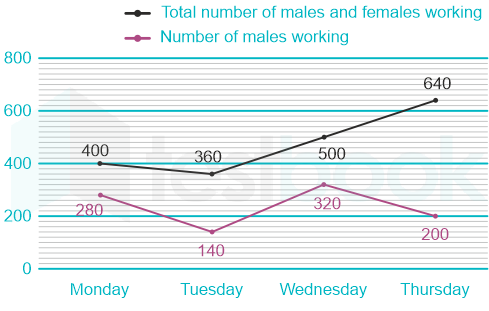
Directions: The line graph below shows the total number of males and females working in a company on four different days Monday, Tuesday, Wednesday ,and Thursday along with the number of males working in respective days.


51

 Find the ratio between the number of males working on Monday and Thursday to the number of females working on Tuesday and Wednesday.

  1. ((a))

    6: 7

  2. ((b))

    4: 5

  3. ((c))

    6: 5

  4. ((d))

    3: 4

  5. ((e))

    2: 1

Show Answer
Answer: ((a))

6: 7

52

Number of males working on Friday is 50 more than the number of males working on Thursday. Number of females working on Friday is 60 more than the number of females working on Thursday.Find difference between number of males and females working on Friday.

  1. ((a))

    210

  2. ((b))

    220

  3. ((c))

    250

  4. ((d))

    270

  5. ((e))

    300

Show Answer
Answer: ((a))

210

53

30% of the total number of persons working on Wednesday are from city P and the number of males working from city P is 40. Find the number of females working in city P.

  1. ((a))

    150

  2. ((b))

    160

  3. ((c))

    110

  4. ((d))

    130

  5. ((e))

    140

Show Answer
Answer: ((a))

150

54

5/7 of the number of males working Tuesday is how much more or less than the 6/9 of the number of females working on Wednesday.

  1. ((a))

    25

  2. ((b))

    15

  3. ((c))

    10

  4. ((d))

    20

  5. ((e))

    None of these

Show Answer
Answer: ((a))

25

55

If 42.85% of the number of males working on Monday are married and 8/11 of the females working on Tuesday are married. Find the number of unmarried males working on Monday and unmarried females working on Tuesday.

  1. ((a))

    240

  2. ((b))

    220

  3. ((c))

    230

  4. ((d))

    250

  5. ((e))

    260

Show Answer
Answer: ((a))

240

56

Age of A, 8 years ago was thrice of B at that time. A's age after 4 years will be twice of B's age after 6 years. If age of C is 6 years less than the average present age of A and B then find the age of C.

  1. ((a))

    34 years

  2. ((b))

    42 years

  3. ((c))

    ​38 years

  4. ((d))

    28 years

  5. ((e))

    None of these

Show Answer
Answer: ((a))

34 years

57

5 men can complete a work in 16 days, which 8 women can complete in 36 days. If 10 men started the work and after 4 days, 12 women joined them then find the total time taken to complete the work.

  1. ((a))

    6

  2. ((b))

    9

  3. ((c))

    7

  4. ((d))

    10

  5. ((e))

    None of these

Show Answer
Answer: ((a))

6

58

A sum of Rs.20,500 is invested at 20% rate of simple interest per annum for 4 years and the amount obtained is invested at 10% per annum compound interest for 2 years. Find the compound interest obtained.

  1. ((a))

    7997

  2. ((b))

    7479

  3. ((c))

    7974

  4. ((d))

    7749

  5. ((e))

    7447

Show Answer
Answer: ((a))

7997

59

A train 480 m long travelling at 90 kmph crosses another train travelling at 144 kmph in opposite direction in 9 seconds. If the second train crosses a platform in 8 seconds then find the length of the platform.

  1. ((a))

    315 m 

  2. ((b))

    275 m

  3. ((c))

    215 m

  4. ((d))

    300 m

  5. ((e))

    None of these

Show Answer
Answer: ((a))

315 m 

60

An article is sold at 25% discount but charged 10% tax on the selling price. If the marked price is 50% above the cost price and the article is sold at Rs.85.5 more than the cost price. Find the cost price of the article.

  1. ((a))

    390

  2. ((b))

    360

  3. ((c))

    420

  4. ((d))

    400

  5. ((e))

    None of these

Show Answer
Answer: ((a))

390

61

In a 180 litres mixture there is 33.33% water and rest milk. If 54 litres of mixture is removed and X litres of milk is added, then the water content will be 25%. Find the value of X.

  1. ((a))

    42

  2. ((b))

    126

  3. ((c))

    21

  4. ((d))

    63

  5. ((e))

    None if these

Show Answer
Answer: ((a))

42

62

In the given questions, two equations numbered I and II are given. You have to solve both the equations and mark the appropriate answer.

I. 3x2 – 18x + 15 = 0

II. 4y2 – 84y + 320 = 0

  1. ((a))

    x > y

  2. ((b))

    x ≤ y

  3. ((c))

    x ≥ y

  4. ((d))

    x < y

  5. ((e))

    x = y or relation between x and y can not be determined.

Show Answer
Answer: ((a))

x > y

63

In the given question, two equations numbered l and II are given. Solve both the equations and mark the appropriate answer.

I. x2 + 39x + 368 = 0

II. y2 + 42y + 425 = 0

  1. ((a))

    x > y

  2. ((b))

    x ≥ y

  3. ((c))

    y > x

  4. ((d))

    y ≥ x

  5. ((e))

    x = y or relationship between x and y cannot be established.

Show Answer
Answer: ((a))

x > y

64

In the given question, two equations numbered l and II are given. Solve both the equations and mark the appropriate answer.

I. 5x2 – 91x + 102 = 0

II. 7y2 – 130y + 187 = 0

  1. ((a))

    x > y

  2. ((b))

    x < y

  3. ((c))

    x ≥ y

  4. ((d))

    x ≤ y

  5. ((e))

    x = y or relationship between x and y cannot be established.

Show Answer
Answer: ((a))

x > y

65

In the given question, two equations numbered l and II are given. Solve both the equations and mark the appropriate answer.

I. 50x2 - 45x + 9 = 0

II. 25y2 - 35y + 12 = 0

  1. ((a))

    x > y

  2. ((b))

    x < y

  3. ((c))

    x ≥ y

  4. ((d))

    x ≤ y

  5. ((e))

    x = y or relationship between x and y cannot be established.

Show Answer
Answer: ((a))

x > y

66

In the following question, two equations numbers I and II are given. you have to solve both equations and give the answer. 

 (I)  x2  - 2.5x - 44 = 0

 (II)  y2 - 0.5y - 52.5 = 0

  1. ((a))

    x > y

  2. ((b))

    x < y

  3. ((c))

    x ≥ y

  4. ((d))

    x ≤ y

  5. ((e))

    If x = y or relation between x and y can not be determined.

Show Answer
Answer: ((a))

x > y

67

The savings of A and B is in the ratio 5:3 and their expenditures are in the ratio 1:2. If A saves 60% of his income then find the ratio of their incomes.

  1. ((a))

    29 : 27

  2. ((b))

    29 : 25

  3. ((c))

    25 : 27

  4. ((d))

    25 : 29

  5. ((e))

    28 : 29

Show Answer
Answer: ((a))

29 : 27

68

There are three numbers A, B and C. If A is reduced by 5 and B is increased by 5 then their values will be equal. If C is increased by 10 and B is increased by 10 then their values will be equal. If sum of A and C is 450 then find the value of B.

  1. ((a))

    330

  2. ((b))

    220

  3. ((c))

    440

  4. ((d))

    110

  5. ((e))

    550

Show Answer
Answer: ((a))

330

69

The question consists of two statements numbered “I and II” given below it. You have to decide whether the data provided in the statements are sufficient to answer the question.

What is the capacity of a jar containing 80% alcohol and remaining soda?

Statement (I): If initially 10 liters of the mixture from the jar is replaced by soda followed by 5 liters of mixture replaced by soda, then the final quantity of alcohol in the jar becomes 28.8 liters.

Statement (II): If 45% of the mixture from the jar is replaced by soda twice, then the percentage of alcohol in the jar becomes 51.5%.

  1. ((a))

    Statement (I) alone is sufficient.

  2. ((b))

    Statement (II) alone is sufficient.

  3. ((c))

    Either (I) or (II) is sufficient.

  4. ((d))

    Neither (I) nor (II) is sufficient.

  5. ((e))

    Both statements I and II together are sufficient.

Show Answer
Answer: ((a))

Statement (I) alone is sufficient.

70

Direction: "The following question is accompanied by two statements (I) and (II). You have to determine which statements(s) is/are sufficient/necessary to answer the questions.

Find the ratio of the speed of Trains.

Statement I: If Length of Train A is 100 m and it crosses a platform double its length in 10 s and Train B crosses the same platform in 20 s.

Statement II: The sum of the speed of Train A and B is 200 m/s and the difference between the speed of Train A and Train B is 50 m/s with speed of A grater than speed of B.

  1. ((a))

    The statement I alone is sufficient to answer the question, but the statement II alone is not sufficient.

  2. ((b))

    The statement II alone is sufficient to answer the question, but the statement I alone is not sufficient.

  3. ((c))

    Both the statements I and II together are needed to answer the question.

  4. ((d))

    Either statement I alone or statement II alone is sufficient to answer the question. 

  5. ((e))

    Neither statement I nor statement II is sufficient to answer the question.

Show Answer
Answer: ((a))

The statement I alone is sufficient to answer the question, but the statement II alone is not sufficient.

71

What approximate value should come in the place of question mark (?) in the following question?

79.99 × [11.98 × (4.982 – 3.982)] ÷ (8.99 × 4.98) = ?% of 433.99

  1. ((a))

    50

  2. ((b))

    64

  3. ((c))

    34

  4. ((d))

    24

  5. ((e))

    44

Show Answer
Answer: ((a))

50

72

What approximate value should come in the place of question mark (?) in the following question?

259.09 ÷ [(4.95)2 + (4.04) of {32.93 ÷  (22.22 ÷1.92)}] = ? - 64.89

  1. ((a))

    95

  2. ((b))

    80

  3. ((c))

    72

  4. ((d))

    89

  5. ((e))

    66

Show Answer
Answer: ((a))

95

73

What approximate value should come in the place of question mark (?) in the following question?

454.95 - 229.99 + ?2 = 14.992 + 26.97 × 179.97 ÷ 20.91

  1. ((a))

    21

  2. ((b))

    29

  3. ((c))

    8

  4. ((d))

    30

  5. ((e))

    15

Show Answer
Answer: ((a))

21

74

What approximate value should come in the place of question mark (?) in the following question?

74.95 – 2.93 × (39.96/7.99 ÷ 0.49) ÷ (9/2.99) + 15.96 = ?

  1. ((a))

    81

  2. ((b))

    90

  3. ((c))

    100

  4. ((d))

    71

  5. ((e))

    85

Show Answer
Answer: ((a))

81

75

What approximate value should come in the place of question mark (?) in the following question?

459.98 ÷ 19.96 × ∛728.98 + (6.96)2 + 24.78 = ∛3374.8 + ?

  1. ((a))

    244

  2. ((b))

    266

  3. ((c))

    240

  4. ((d))

    282

  5. ((e))

    234

Show Answer
Answer: ((a))

244

76

A boat takes 4 hours to cover 'D' km upstream and takes 3 hours to cover 'D - 2' km downstream. If the speed of the stream is 2 km/hr then find the distance covered by the boat in upstream in 3 hours.

  1. ((a))

    42 km

  2. ((b))

    45 km

  3. ((c))

    48 km

  4. ((d))

    51 km

  5. ((e))

    56 km

Show Answer
Answer: ((a))

42 km

77

Raja and Tulsi invested their capitals in a business in the ratio of 3:5 but for some reasons Raja withdraws half the amount after 4 months. If the total profit earned through this business is Rs 16800, then what will be the profit (in Rupees) received by Tulsi after the end of 12 months?

  1. ((a))

    13500

  2. ((b))

    10800

  3. ((c))

    12000

  4. ((d))

    15000

  5. ((e))

    8500

Show Answer
Answer: ((a))

13500

78

Radha bought a box full of candies. The box contained 22 orange candies and 12 blue candies. If 4 candies are picked at random, then what is the probability that 1 orange and 3 blue candies are picked?

  1. ((a))

    31/527

  2. ((b))

    28/531

  3. ((c))

    27/527

  4. ((d))

    31/531

  5. ((e))

    55/527

Show Answer
Answer: ((a))

31/527

79

The distance between the centres of two circles is 15 cm. If the shortest distance between the outer surface of the circles is 4.5 cm and the difference between their radii is 3.5 cm then find the area of the bigger circle.

  1. ((a))

    222 cm2

  2. ((b))

    77 cm2

  3. ((c))

    308 cm2

  4. ((d))

    154 cm2

  5. ((e))

    None of these

Show Answer
Answer: ((a))

222 cm2

80

The average of 3 even numbers is 42 and the average of 3 odd numbers is 39. If the average of largest and second largest even number is 45 and the average of largest and second largest odd number is 44 then find the difference between smallest even and odd numbers.

  1. ((a))

    4

  2. ((b))

    7

  3. ((c))

    11

  4. ((d))

    10

  5. ((e))

    None of these

Show Answer
Answer: ((a))

4

Attempt this paper under real exam conditions

Timed interface, section switching, instant scoring, and question-by-question analytics — free.

Start Timed Attempt