Official Paper

RRB PO Prelims Memory Based Paper (Held On: 4 August 2024 Shift 3) (Previous Year Paper)

80 questions · 45 minutes · with answers · free

Reasoning (40 questions)

Direction: Read the following information carefully and answer the questions based on given information.

There are nine persons D, G, K, L, O, R, S, X and Z sit on a linear row and all are facing towards north direction. K sits second to the left of X. O sits fourth right of S. G does not sit at any extreme end. R sits two places away from S. As many persons sit to the left of X as many persons to the right of L. Neither R nor O is an immediate neighbour of K. D and Z sits adjacent to each other. S does not sit to the right of L. No one sits to the right of Z.

1

Who sits at extreme left end?

  1. ((a))

    Z

  2. ((b))

    R

  3. ((c))

    K

  4. ((d))

    S

  5. ((e))

    L

Show Answer
Answer: ((a))

Z

2

Who sits two places away to the left of G ?

  1. ((a))

    K

  2. ((b))

    S

  3. ((c))

    X

  4. ((d))

    R

  5. ((e))

    None

Show Answer
Answer: ((a))

K

3

How many persons sit to the right of L ?

  1. ((a))

    None

  2. ((b))

    Two

  3. ((c))

    Four

  4. ((d))

    Three

  5. ((e))

    One

Show Answer
Answer: ((a))

None

4

Find the odd one out.

  1. ((a))

    SX

  2. ((b))

    GO

  3. ((c))

    KS

  4. ((d))

    LD

  5. ((e))

    ZD

Show Answer
Answer: ((a))

SX

5

Which of the following statement is the correct statement ?

  1. ((a))

    R sits third left of K.

  2. ((b))

    L sits immediate right to D.

  3. ((c))

    D sits second from left end.

  4. ((d))

    R and G does not sit immediate next to each other

  5. ((e))

    S sits to the left of X.

Show Answer
Answer: ((a))

R sits third left of K.

6

Directions: In the following question assuming the given statements to be true, find which of the conclusion among given conclusions is/are definitely true and then give your answers accordingly.

Statements: K > M ≥ P < U, N > P = E

Conclusions:

I. K < E

II. M > E

  1. ((a))

    Only I is true

  2. ((b))

    Only II is true

  3. ((c))

    Both I and II are true

  4. ((d))

    Either I or II is true

  5. ((e))

    Neither I nor II is true

Show Answer
Answer: ((a))

Only I is true

7

which of the conclusion among given conclusions is/are definitely true and then give your answers accordingly.

Statements: A ≤ W < T = N, A ≥ C = X < B

Conclusions:

I. N > C

II. W ≥ X

  1. ((a))

    Only I is true

  2. ((b))

    Only II is true

  3. ((c))

    Both I and II are true

  4. ((d))

    Either I or II is true

  5. ((e))

    Neither I nor II is true

Show Answer
Answer: ((a))

Only I is true

8

Directions: In the following question assuming the given statements to be true, find which of the conclusion among given conclusions is/are definitely true and then give your answers accordingly.

Statements: H > F ≤ O ≤ L; F ≥ V < D

Conclusions:

I. L ≥ V

II. O > D

  1. ((a))

    Only I is true

  2. ((b))

    Only II is true

  3. ((c))

    Both I and II are true

  4. ((d))

    Either I or II is true

  5. ((e))

    Neither I nor II is true

Show Answer
Answer: ((a))

Only I is true

Direction: Read the following information carefully and answer the questions based on given information.

Eight persons D, G, I, L, M, T, V and X sit on a circular table in such a way that some are facing towards the centre whereas some are facing away from centre but not necessarily in same order. T and G sit immediate right to each other. M and V faces in different direction. I sits second to the left of the person who sits opposite to the one who is an immediate neighbour of M. V sits two places away from L. I sits opposite to X and both faces in same direction. G and L are not immediate neighbours but faces in same direction. I and V do not sit immediate next to each other. L and I face in opposite direction. G and I do not sit immediate next to each other. X faces towards the centre. Not more than two persons face in same direction sitting near to each other. T and D do not face in same direction. T sits third to left of L.

9

Which of the following statement is correct ?

  1. ((a))

    M and V does not sit opposite to each other.

  2. ((b))

    L sits immediate left to D.

  3. ((c))

    I faces away from centre.

  4. ((d))

    M and I sits immediate left to each other.

  5. ((e))

    T faces same direction as of L.

Show Answer
Answer: ((a))

M and V does not sit opposite to each other.

10

Who sits second to the left of the person who sits immediate right to M ?

  1. ((a))

    L

  2. ((b))

    T

  3. ((c))

    D

  4. ((d))

    V

  5. ((e))

    X

Show Answer
Answer: ((a))

L

11

Who sits opposite to the person who sits immediate left to V ?

  1. ((a))

    D

  2. ((b))

    G

  3. ((c))

    L

  4. ((d))

    I

  5. ((e))

    M

Show Answer
Answer: ((a))

D

12

Find the odd one out.

  1. ((a))

    I

  2. ((b))

    G

  3. ((c))

    D

  4. ((d))

    M

  5. ((e))

    L

Show Answer
Answer: ((a))

I

13

Who sits immediate right to X ?

  1. ((a))

    G

  2. ((b))

    V

  3. ((c))

    D

  4. ((d))

    I

  5. ((e))

    L

Show Answer
Answer: ((a))

G

Direction: Read the following information carefully and answer the questions based on given information.

Seven persons D, J, L, M, P, S and U live on seven floor apartment in which bottommost floor is number 1 and topmost floor is number 7 and each person like one different colour which are Black, Blue, Pink, Red, Violet, White and Yellow but not necessarily in same order. Neither S nor U likes Yellow or White colour. U lives one of the floors above D but not immediately above. M lives three floors above the person who likes white colour but not on top floor. P likes either Violet or Red. The person who likes Pink colour lives above the floor of U. L does not like Red or Black colour. J likes either Blue or Yellow. As many person lives above S as many below J. Neither U nor D likes Violet or Blue colour. U lives immediately above the person who like Yellow colour. P does not live below the floor of the person who like Pink colour. S does not live below the floor of the person who likes Black colour. The person who likes Red colour does not live adjacent floor to the one who likes Blue colour. Neither White nor Pink colour is liked by D.

14

How many person live between the person who likes Violet colour and D ?

  1. ((a))

    Two

  2. ((b))

    Three

  3. ((c))

    One

  4. ((d))

    None

  5. ((e))

    Four

Show Answer
Answer: ((a))

Two

15

Which of the following statement is / are correct?

  1. ((a))

    P lives on fifth floor.

  2. ((b))

    S likes Violet colour.

  3. ((c))

    J lives just above M's floor.

  4. ((d))

    L does not like White colour.

  5. ((e))

    U likes Red colour.

Show Answer
Answer: ((a))

P lives on fifth floor.

16

Which of the following combination is correctly matched ?

  1. ((a))

    P - Red

  2. ((b))

    S - Black

  3. ((c))

    L - Yellow

  4. ((d))

    J - Blue

  5. ((e))

    All are correct

Show Answer
Answer: ((a))

P - Red

17

On which floor M lives ?

  1. ((a))

    Seventh

  2. ((b))

    Sixth

  3. ((c))

    Third

  4. ((d))

    Fourth

  5. ((e))

    First

Show Answer
Answer: ((a))

Seventh

18

Who among them likes White colour ?

  1. ((a))

    U

  2. ((b))

    M

  3. ((c))

    L

  4. ((d))

    J

  5. ((e))

    D

Show Answer
Answer: ((a))

U

19

Direction: In the question below are given three statements followed by two conclusions numbered I and II. You have to take the given statements to be true even if they seem to be at variance with commonly known facts. Read all the conclusions and then decide which of the given conclusions logically follows from the given statements disregarding commonly known facts.

Statements :

Few alpha are beta.

Only a few beta are gamma.

A few beta are delta.

Conclusions :

I. A few delta are alpha.

II. Some beta are not gamma.

  1. ((a))

    Only I is true

  2. ((b))

    Only II is true.

  3. ((c))

    Either I or II is true.

  4. ((d))

    Neither I nor II is true.

  5. ((e))

    Both I and II are true.

Show Answer
Answer: ((a))

Only I is true

20

Direction: In the question below are given three statements followed by two conclusions numbered I and II. You have to take the given statements to be true even if they seem to be at variance with commonly known facts. Read all the conclusions and then decide which of the given conclusions logically follows from the given statements disregarding commonly known facts.

Statements :

Only a few motors are electric.

Few electric are generators.

No generator is charger.

Conclusions :

I. Some electric are not charger.

II. Few motor are generator

  1. ((a))

    Only I is true.

  2. ((b))

    Only II is true.

  3. ((c))

    Either I or II is true.

  4. ((d))

    Neither I or II is true.

  5. ((e))

    Both I and II are true.

Show Answer
Answer: ((a))

Only I is true.

21

Direction: In the question below are given three statements followed by two conclusions numbered I, II. You have to take the given statements to be true even if they seem to be at variance with commonly known facts. Read all the conclusions and then decide which of be at variance with commonly known facts. Read all the conclusions and then decide which of the given conclusions logically follows from the given statements disregarding commonly known facts.

Statement:

All books are novels.

Some novels are puzzles.

No puzzle is easy.

Conclusions: 

I. No novel is easy. 

II. Some books being puzzles is a possibility

  1. ((a))

    Either I or II follows

  2. ((b))

    Nither I and II follow

  3. ((c))

    Only II follows

  4. ((d))

    Only I follows

  5. ((e))

    Both I and II follow 

Show Answer
Answer: ((a))

Either I or II follows

22

Direction: In the question below are given three statements followed by two conclusions numbered I and II. You have to take the given statements to be true even if they seem to be at variance with commonly known facts. Read all the conclusions and then decide which of the given conclusions logically follows from the given statements disregarding commonly known facts.

Statements:

Some shirts are pants

Only a few shirts are t-shirts

Few pants are trousers

Conclusions:

 I. Some shirts are not t-shirts

 II. Some pants are shirts

  1. ((a))

    Only I follows

  2. ((b))

    Only II follows

  3. ((c))

    Both I and II follow

  4. ((d))

    Neither I nor II follows

  5. ((e))

    Either I or II follows

Show Answer
Answer: ((a))

Only I follows

Direction: Read the following information carefully and answer the questions based on given information.

In a certain code language,

‘Ram likes only tea’ means ‘awc xyz bej rom’,

‘She likes to sing’ means ‘ klm rsu twy xyz’,

‘Only practice can make a work easy’ means ‘ntu smx jji dnl awc hgp uqo’,

‘Easy things is not worth’ means ‘nop qlx smx zac fim’.

23

What is the code for 'likes' ?

  1. ((a))

    awc

  2. ((b))

    xyz

  3. ((c))

    bej

  4. ((d))

    rom

  5. ((e))

    smx

Show Answer
Answer: ((a))

awc

24

What is the code for 'worth' ?

  1. ((a))

    nop

  2. ((b))

    qlx

  3. ((c))

    smx

  4. ((d))

    zac

  5. ((e))

    Cannot be determined.

Show Answer
Answer: ((a))

nop

25

What is the code for 'only' ?

  1. ((a))

    ntu

  2. ((b))

    smx

  3. ((c))

    hgp

  4. ((d))

    awc

  5. ((e))

    jji

Show Answer
Answer: ((a))

ntu

26

What is the code for 'easy' ? 

  1. ((a))

    jji

  2. ((b))

    nop

  3. ((c))

    zac

  4. ((d))

    smx

  5. ((e))

    Cannot be determined

Show Answer
Answer: ((a))

jji

27

How many such pairs of letters are there in the word ‘ACQUISITION’, each of which has as many letters between them in the word (both forward and backward direction) as they have between them in the English Alphabet?

  1. ((a))

    Seven

  2. ((b))

    Six

  3. ((c))

    Three

  4. ((d))

    Four

  5. ((e))

    Five

Show Answer
Answer: ((a))

Seven

Direction: Read the following information carefully and answer the questions based on given information.

Nine boxes contain different varieties of Chocolates these boxes are labelled as A, B, C, D, E, F, G, H and I and they are placed one above other from bottom to top but not necessarily in same order. Box number 9 will be at top and box number 1 will be at bottom. Only two boxes are placed between Box A and Box B. Box I and Box E are placed adjacent to each other. Box H placed four places away from Box G. Box C is placed immediately below box F and above box D but not necessarily just above D. Box I is placed below Box H but not adjacent. Three boxes are placed between Box I and Box F. Neither Box H nor Box E is the first or last boxes. Box A is not above box D.

28

If G changed its position with H then how many boxes are placed above the box G?

  1. ((a))

    One

  2. ((b))

    Three

  3. ((c))

    Two

  4. ((d))

    More than three

  5. ((e))

    None

Show Answer
Answer: ((a))

One

29

Find odd one out.

  1. ((a))

    AG

  2. ((b))

    DB

  3. ((c))

    IH

  4. ((d))

    CF

  5. ((e))

    EC

Show Answer
Answer: ((a))

AG

30

Which of the following statement is / are correct?

  1. ((a))

    F is placed at bottom position.

  2. ((b))

    I is placed immediately after E.

  3. ((c))

    C is placed just above H.

  4. ((d))

    D is placed between A and G.

  5. ((e))

    More than one option.

Show Answer
Answer: ((a))

F is placed at bottom position.

31

Which of the following box is placed at middle position?

  1. ((a))

    A

  2. ((b))

    B

  3. ((c))

    C

  4. ((d))

    D

  5. ((e))

    I

Show Answer
Answer: ((a))

A

32

Which of the following is the placed at topmost position?

  1. ((a))

    F

  2. ((b))

    G

  3. ((c))

    I

  4. ((d))

    B

  5. ((e))

    A

Show Answer
Answer: ((a))

F

33

How many meaningful English words can be formed, starting with S, with the fourth, the sixth, the ninth and the thirteenth letters of the word CIRCUMSTANCES, using each letter only once in each word? (To be counted from left)

  1. ((a))

    One

  2. ((b))

    Two

  3. ((c))

    None

  4. ((d))

    Three

  5. ((e))

    More than three 

Show Answer
Answer: ((a))

One

Direction: Study the information given below carefully and answer the questions that follow.

Dhruv starts walking in south direction from point X, after walking 4m he turns left from point Y and walks for 3m. He then turns left from point Z and walks for 7m and then turns right from point A and walks for 3m till point B. He then turns right and walks for 10m and then turns right from point C. He then walks for 10m and then turns right from point D and walks for 3m till point E.

34

In which direction is point Z with respect to point E?

  1. ((a))

    North

  2. ((b))

    South-West

  3. ((c))

    North-West

  4. ((d))

    West

  5. ((e))

    East

Show Answer
Answer: ((a))

North

35

What is the shortest distance between point Y and point D?

  1. ((a))

    10m

  2. ((b))

    5m

  3. ((c))

    7m

  4. ((d))

    4m

  5. ((e))

    6m

Show Answer
Answer: ((a))

10m

36

What is the total distance that Dhruv covered?

  1. ((a))

    25m

  2. ((b))

    20m

  3. ((c))

    32m

  4. ((d))

    40m

  5. ((e))

    41m

Show Answer
Answer: ((a))

25m

37

If in the word ‘EXPANSION’ all the vowels are first arranged alphabetically and then all the consonants are arranged alphabetically and then all the vowels are replaced by the previous letters and the consonants are replaced by the next letters from the English alphabet. Which letter will be third from the left end?

  1. ((a))

    Z

  2. ((b))

    D

  3. ((c))

    H

  4. ((d))

    N

  5. ((e))

    O

Show Answer
Answer: ((a))

Z

Direction: Read the following information carefully and answer the questions based on given information.

There are eight members in a family which are J, M, Q, R, S, T, X and Y. There are three married couples in family. No child has single parent. Q is the brother – in – law of S. J is the only sister of S’s wife's father. Y is the grandchild of X. M and T has same gender. Q is the husband of Y’s aunt. M does not have any sibling. Q has only one niece. R is father – in – law of X’s daughter – in – law.

38

Find the odd one out.

  1. ((a))

    RQ

  2. ((b))

    SY

  3. ((c))

    JM

  4. ((d))

    SQ

  5. ((e))

    XT

Show Answer
Answer: ((a))

RQ

39

Which of the following statement is / are correct ?

  1. ((a))

    S is the father of T.

  2. ((b))

    M is the wife of S.

  3. ((c))

    S is the son of X.

  4. ((d))

    Y is the daughter of T.

  5. ((e))

    Y is the son of S.

Show Answer
Answer: ((a))

S is the father of T.

40

How is Y related to X ?

  1. ((a))

    Grandson

  2. ((b))

    Granddaughter

  3. ((c))

    Son

  4. ((d))

    Daughter

  5. ((e))

    None of these

Show Answer
Answer: ((a))

Grandson

Quantitative Aptitude (40 questions)

41

Find the missing number in the series

35, 43, 70, 195, ?, 1869

  1. ((a))

    438

  2. ((b))

    540

  3. ((c))

    538

  4. ((d))

    583

  5. ((e))

    835

Show Answer
Answer: ((a))

438

42

Find the missing number in the series

225, 235, 205, 220, ?, 215

  1. ((a))

    245

  2. ((b))

    230

  3. ((c))

    190

  4. ((d))

    195

  5. ((e))

    200

Show Answer
Answer: ((a))

245

43

Find the missing number in the series

20, 28, 40, 60, 92, ?

  1. ((a))

    48

  2. ((b))

    120

  3. ((c))

    108

  4. ((d))

    140

  5. ((e))

    148

Show Answer
Answer: ((a))

48

44

Find the missing number in the series

0.6, 3, 15, 75, ?, 1875

  1. ((a))

    275

  2. ((b))

    175

  3. ((c))

    375

  4. ((d))

    255

  5. ((e))

    345

Show Answer
Answer: ((a))

275

45

Find the missing number in the series

8, 40, 45, 225, ?, 1150

  1. ((a))

    1125

  2. ((b))

    1175

  3. ((c))

    230

  4. ((d))

    240

  5. ((e))

    250

Show Answer
Answer: ((a))

1125

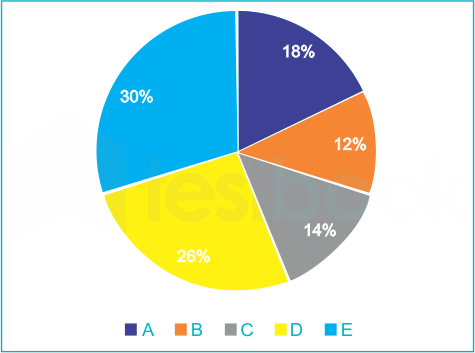
The give pie chart shows the percentage distribution of number of schools in five different cities [A, B, C, D and E].

Total value of pie chart is 6000.

46

Number of schools in city E is 5n. Find the value of [n/5]?

  1. ((a))

    27

  2. ((b))

    72

  3. ((c))

    74

  4. ((d))

    76

  5. ((e))

    82

Show Answer
Answer: ((a))

27

47

Find the difference between total number of schools in city A and C together and total number of schools in city B and D together?

  1. ((a))

    380

  2. ((b))

    360

  3. ((c))

    354

  4. ((d))

    384

  5. ((e))

    322

Show Answer
Answer: ((a))

380

48

Out of total number of school city C, 60% are private school and rest is government school. Out total government school, 25% are English medium school. Find the number of government English medium school in city C?

  1. ((a))

    88

  2. ((b))

    86

  3. ((c))

    98

  4. ((d))

    96

  5. ((e))

    84

Show Answer
Answer: ((a))

88

49

Number of schools in city F is 20% more than the number of schools in city B. Difference between number of schools in city E and F is t. Find the value of 6t?

  1. ((a))

    5616

  2. ((b))

    5846

  3. ((c))

    5966

  4. ((d))

    5864

  5. ((e))

    5264

Show Answer
Answer: ((a))

5616

50

Ratio of boys and girls’ school in city A is 3 : 2 and ratio of boys and girls’ school in city B is 3 : 1. Find the difference between total number of boys and total number girls’ school in city A and B together?

  1. ((a))

    576

  2. ((b))

    586

  3. ((c))

    588

  4. ((d))

    526

  5. ((e))

    564

Show Answer
Answer: ((a))

576

51

Perimeter of a rectangular field is equal to the perimeter of a triangular field whose sides are in the ratio 3:2:4 respectively. lf area of rectangular field is 500 m2 and sides are in the ratio 5:4 respectively, then calculate the longer side of the triangular field.

  1. ((a))

    56

  2. ((b))

    48

  3. ((c))

    40

  4. ((d))

    44

  5. ((e))

    52

Show Answer
Answer: ((a))

56

52

A cistern has an inlet pipe and an outlet pipe. Inlet pipe can fill three-fourth of the cistern in 24 minutes while outlet pipe can empty the one-third filled cistern in 16 minutes. If both the pipes are opened together, then the cistern will be completely filled in-

  1. ((a))

    96

  2. ((b))

    92

  3. ((c))

    84

  4. ((d))

    75

  5. ((e))

    102

Show Answer
Answer: ((a))

96

53

What approximate value should come in the place of question mark (?) in the following question?

10.992 + √99.99 + 203.98 =  1.98 × ? + 114.95

  1. ((a))

    90

  2. ((b))

    95

  3. ((c))

    110

  4. ((d))

    105

  5. ((e))

    120

Show Answer
Answer: ((a))

90

54

What approximate value should come in the place of question mark (?) in the following question?

164.99 – [134.95 – {55.96 ÷ 7.98 – (23.94 - 13.94)}] = ?

  1. ((a))

    14

  2. ((b))

    20

  3. ((c))

    27

  4. ((d))

    34

  5. ((e))

    39

Show Answer
Answer: ((a))

14

55

What approximate value should come in the place of question mark (?) in the following question?

(41.982 + 35.98 × 6.98) – 89.99 × 2.023 = 5.96?/4

  1. ((a))

    12

  2. ((b))

    8

  3. ((c))

    4

  4. ((d))

    16

  5. ((e))

    24

Show Answer
Answer: ((a))

12

56

What approximate value should come in the place of question mark (?) in the following question?

74.98% of 599.99 + 44.99% of 399.99 = ?% of 1574.99

  1. ((a))

    20

  2. ((b))

    25

  3. ((c))

    40

  4. ((d))

    30

  5. ((e))

    35

Show Answer
Answer: ((a))

20

57

What approximate value should come in the place of question mark (?) in the following question?

1279.99 + 7.983 + √? = 10.913 + 19.992 + 8.992

  1. ((a))

    1600

  2. ((b))

    289

  3. ((c))

    464

  4. ((d))

    400

  5. ((e))

    625

Show Answer
Answer: ((a))

1600

58

What approximate value should come in the place of question mark (?) in the following question?

(191.99 - 26.87 × 3.94) ÷ 6.98 + 12.98 × 6.16 = ?

  1. ((a))

    105

  2. ((b))

    95

  3. ((c))

    85

  4. ((d))

    80

  5. ((e))

    90

Show Answer
Answer: ((a))

105

59

In a family, three sons were born for every 3 years one after the other. If the ratio of present ages of father and the eldest son is 15:7 and the average of the present ages of the 3 sons is 18 years. What will be the ratio of the ages of the father and the youngest son after 5 years?

  1. ((a))

    7:3

  2. ((b))

    5:2

  3. ((c))

    5:3

  4. ((d))

    4:1

  5. ((e))

    3:1

Show Answer
Answer: ((a))

7:3

60

Train A of length 80m while moving crosses a pole in 16 seconds. lf it is known that the lengths of train B and train A is in the ratio of 3:1, then how long would it take train B to cross a platform which is half the length of train A if the speed of train B is same as that of train A?

  1. ((a))

    48

  2. ((b))

    56

  3. ((c))

    58

  4. ((d))

    64

  5. ((e))

    44

Show Answer
Answer: ((a))

48

61

Can A and Can B contain a mixture of soda and water in the ratio of 5 : 3 and 7 : 2 respectively If soda and water are taken out in the ratio of P : Q from can A and B respectively to form a new mixture in which the ratio of soda and water is 12 : 5 respectively, then find the value Of P:Q?

  1. ((a))

    6 : 5

  2. ((b))

    8 : 9

  3. ((c))

    5 : 4

  4. ((d))

    4 : 3

  5. ((e))

    3 : 2

Show Answer
Answer: ((a))

6 : 5

62

A boat can covers a certain distance in upstream and same distance in downstream in total of 7 hours 48 minutes, If upstream speed of the boat is 62.5%. of downstream speed of the boat and speed of the stream is 3 km/h, what is the total distance covered by the boat?

  1. ((a))

    86

  2. ((b))

    84

  3. ((c))

    96

  4. ((d))

    98

  5. ((e))

    88

Show Answer
Answer: ((a))

86

63

M and R went for shopping and bought two sarees each at different cost. Cost price of saree bought by R is Rs.250 more than the cost price of saree bought by M. Shopkeeper earned a profit of 20% on selling both the sarees together to R and M which he bought them at total Rs.6000. At what cost did M buy saree?

  1. ((a))

    3375

  2. ((b))

    3285

  3. ((c))

    3655

  4. ((d))

    3875

  5. ((e))

    3475

Show Answer
Answer: ((a))

3375

64

In the given question, two equations numbered l and II are given. Solve both the equations and mark the appropriate answer.

I. 4x2 – 48x + 119 = 0 

II. 2y2 – 39y + 187 = 0

  1. ((a))

    x > y

  2. ((b))

    x ≥ y

  3. ((c))

    x < y

  4. ((d))

    x ≤ y

  5. ((e))

    x = y or relationship between x and y cannot be established.

Show Answer
Answer: ((a))

x > y

65

In the given question, two equations numbered l and II are given. Solve both the equations and mark the appropriate answer.

I. x2 – 39x + 224 = 0 

II. y2 – 12y + 35 = 0

  1. ((a))

    x > y

  2. ((b))

    x ≥ y

  3. ((c))

    y > x

  4. ((d))

    y ≥ x

  5. ((e))

    x = y or relationship between x and y cannot be established.

Show Answer
Answer: ((a))

x > y

66

In these question, two equations (I) and (II) are given. You have to solve both the equations and answer accordingly:

(I) 2x2– 19x + 42 = 0

(II) 2y2 – 11y + 15 = 0

  1. ((a))

    x > y

  2. ((b))

    x ≥ y

  3. ((c))

    y > x

  4. ((d))

    y ≥ x

  5. ((e))

    x = y or the relationship between x and y cannot be established.

Show Answer
Answer: ((a))

x > y

67

In the given question, two equations numbered l and II are given. Solve both the equations and mark the appropriate answer.

I.16x=300×x÷4800{\text{I}}.\frac{{16}}{x} = 300 × x ÷ 4800

II.y2+y272=0{\text{II}}.{y^2} + y - 272 = 0

  1. ((a))

    x > y

  2. ((b))

    x < y

  3. ((c))

    x ≥ y

  4. ((d))

    x ≤ y

  5. ((e))

    x = y or relationship between x and y cannot be established.

Show Answer
Answer: ((a))

x > y

68

In the given question, two equations numbered l and II are given. Solve both the equations and mark the appropriate answer.

I. x2 − 19x − 150 = 0

II. y2 + 24y + 119 = 0

  1. ((a))

    x > y

  2. ((b))

    x < y

  3. ((c))

    x ≥ y

  4. ((d))

    x ≤ y

  5. ((e))

    x = y or relationship between x and y cannot be established.

Show Answer
Answer: ((a))

x > y

69

In the following question two equations are given. You have to solve the equations and mark the answer accordingly.

l. x2 – 29x + 204 = 0

ll. 2y2 – 43y + 176 = 0

  1. ((a))

     x > y

  2. ((b))

    x < y

  3. ((c))

    x ≥ y

  4. ((d))

    x ≤ y

  5. ((e))

    x = y or relation between them cannot be established

Show Answer
Answer: ((a))

 x > y

70

A and B started the business in the ratio of 4 : 6. After 4 months, B withdrew half of his initial investment and A left the business. After 2 more months, C joined with the investment of Rs 8000 which is 2000 more than the initial investment of B. At the end of the year, the difference between the profit share of A and C is Rs 2000. Then find the total profit of the business.

  1. ((a))

     Rs 10400

  2. ((b))

     Rs 9800

  3. ((c))

     Rs 10500

  4. ((d))

     Rs 8000

  5. ((e))

     Rs 7000

Show Answer
Answer: ((a))

 Rs 10400

71

There are three numbers m, n, and p, such that sum of m and n is 144, sum of thrice of n and five times of p is 464, and sum of p and m is 160, then what is the value of p?

  1. ((a))

    62

  2. ((b))

    56

  3. ((c))

    88

  4. ((d))

    64

  5. ((e))

    96

Show Answer
Answer: ((a))

62

The given table shows the total population and ratio of literate and illiterate of total population of four different cities [A, B, C, D and E]

StatePopulationLiterate : Illiterate
A110008 : 3
B2800011 : 3
C360003 : 1
D350005 : 2
72

Find the difference between total number literate people in city C and A together and total literate people in city B and D together?

  1. ((a))

    14000

  2. ((b))

    11000

  3. ((c))

    16000

  4. ((d))

    18000

  5. ((e))

    12000

Show Answer
Answer: ((a))

14000

73

Average number of illiterate people in all city together is 7x. Find the value of x?

  1. ((a))

    1500

  2. ((b))

    1600

  3. ((c))

    1400

  4. ((d))

    1200

  5. ((e))

    1000

Show Answer
Answer: ((a))

1500

74

Ratio of male and female literate people in city C is 5 : 4. Number of illiterate female is 1/3rd of the number literate female. Find the number of illiterate males in city C?

  1. ((a))

    4500

  2. ((b))

    6500

  3. ((c))

    5000

  4. ((d))

    8000

  5. ((e))

    7000

Show Answer
Answer: ((a))

4500

75

Difference between illiterate people in city B and C is [2t + 2000]. Find the value of t?

  1. ((a))

    450

  2. ((b))

    350

  3. ((c))

    650

  4. ((d))

    500

  5. ((e))

    300

Show Answer
Answer: ((a))

450

76

Out of total literate people in city A, 75% are graduate. Out of total graduate 20% are phd degree holder. Find the total number of phd degree holder in city A?

  1. ((a))

    1200

  2. ((b))

    1300

  3. ((c))

    1800

  4. ((d))

    1600

  5. ((e))

    2400

Show Answer
Answer: ((a))

1200

77

While calculating average marks of 60 students, the two digits of original marks of a student are written reversed and thereby average of marks is increased by 0.6 Find the difference between the two digits of marks of the student?

  1. ((a))

    9

  2. ((b))

    4

  3. ((c))

    5

  4. ((d))

    6

  5. ((e))

    3

Show Answer
Answer: ((a))

9

78

Simple interest received on a certain sum at a rate of simple interest of 5% for 2 years is Rs.780. If the rate of interest remains same, what will be the total amount at the time of withdrawal at the end of 5 years.

  1. ((a))

    9750

  2. ((b))

    9250

  3. ((c))

    9650

  4. ((d))

    9450

  5. ((e))

    9950

Show Answer
Answer: ((a))

9750

79

A boat running downstream covers a distance of 12 km in 3 hours while for covering the same distance upstream, it takes 4 hours. What is the speed of the boat in still water?

  1. ((a))

    3.5 km/hr

  2. ((b))

    6.5 km/hr

  3. ((c))

    5.5 m/sec

  4. ((d))

    6.5 m/sec

  5. ((e))

    None of these

Show Answer
Answer: ((a))

3.5 km/hr

80

In an exam, Sonu got 156 marks which was 16 marks more than the pass marks. Rekha got 64% of marks which was 116 marks more than the pass marks. What is the minimum pass percentage in the exam?

  1. ((a))

    25%

  2. ((b))

    35%

  3. ((c))

    30%

  4. ((d))

    20%

  5. ((e))

    None of these

Show Answer
Answer: ((a))

25%

Attempt this paper under real exam conditions

Timed interface, section switching, instant scoring, and question-by-question analytics — free.

Start Timed Attempt