Official Paper

RRB PO Prelims Memory Based Paper (Held On: 4 August 2024 Shift 1) (Previous Year Paper)

80 questions · 45 minutes · with answers · free

Reasoning (40 questions)

Direction : Read  the following information carefully and answer the questions based on given information.

Eight persons G, J, M, O, R, T, U and Y sit on a circular table in such a manner that four persons faces inside rest are facing outside but not necessarily in same order. M faces Y. O and R sits adjacent to each other. The person who sits opposite to U sits two places away from Y who sits immediate right of J. R is not immediate neighbour of the person who faces U. J sits three places away from the person who sits immediate left of T. No two person sit immediately next to each other face in same direction. U and T are not immediate neighbour to each other.

1

Who sits opposite to R ?

  1. ((a))

    G

  2. ((b))

    J

  3. ((c))

    U

  4. ((d))

    T

  5. ((e))

    Y

Show Answer
Answer: ((a))

G

2

Find the odd one out.

  1. ((a))

    Y

  2. ((b))

    G

  3. ((c))

    J

  4. ((d))

    T

  5. ((e))

    O

Show Answer
Answer: ((a))

Y

3

Which of the following statement is/ are incorrect ?

  1. ((a))

    J sits immediate left of U.

  2. ((b))

    M and T sits immediate next to each other.

  3. ((c))

    G sits opposite to O.

  4. ((d))

    O faces towards the center.

  5. ((e))

    All are correct.

Show Answer
Answer: ((a))

J sits immediate left of U.

4

Who sits immediate left of G?

  1. ((a))

    U

  2. ((b))

    M

  3. ((c))

    R

  4. ((d))

    O

  5. ((e))

    J

Show Answer
Answer: ((a))

U

5

If T changes his position with J then who sits immediate left to T ?

  1. ((a))

    R

  2. ((b))

    M

  3. ((c))

    Y

  4. ((d))

    G

  5. ((e))

    U

Show Answer
Answer: ((a))

R

6

Direction: In the question below, there are three statements followed by three conclusions numbered I, II and III. You have to take the given statements to be true even if they seem to be at variance with commonly known facts. Read all the conclusions and then decide which of the given conclusions logically follows from the given statements disregarding the commonly known facts.

Statements:

Only few biscuit are cream.

No cream is sweet.

Every cream is salty.

Conclusions:

I. Some salty are biscuits.   

II. Some salty are not sweet.

III. 10% biscuits are sweet.

  1. ((a))

    Only conclusion I follows

  2. ((b))

    Only conclusion III follows

  3. ((c))

    Only conclusion I and II follow

  4. ((d))

    Only conclusion II follows

  5. ((e))

    None of the conclusion follows

Show Answer
Answer: ((a))

Only conclusion I follows

7

Direction: In the question below, there are three statements followed by two conclusions numbered I and II. You have to take the given statements to be true even if they seem to be at variance with commonly known facts. Read all the conclusions and then decide which of the given conclusions logically follows from the given statements disregarding the commonly known facts.

Statements:

Each bed is sheet.

Every pillow are sheet.

No sheet is blanket.

Conclusions:

I. No bed is blanket.

II. Some bed are pillow.

  1. ((a))

    Only conclusion I follows

  2. ((b))

    Only conclusion II follows

  3. ((c))

    Both I and II follow

  4. ((d))

    Neither I nor II follows

  5. ((e))

    Either I or II follows

Show Answer
Answer: ((a))

Only conclusion I follows

8

Direction: In the question below, there are three statements followed by two conclusions numbered I and II. You have to take the given statements to be true even if they seem to be at variance with commonly known facts. Read all the conclusions and then decide which of the given conclusions logically follows from the given statements disregarding the commonly known facts.

Statements:

Only a few curd are milk.

No milk is cheese.

Some ghee are cheese.

Conclusions:

I. Some curd are ghee.

II. Some curd are not cheese.

  1. ((a))

    Only conclusion I follows

  2. ((b))

    Only conclusion II follows

  3. ((c))

    Both I and II follow

  4. ((d))

    Neither I nor II follows

  5. ((e))

    Either I or II follows

Show Answer
Answer: ((a))

Only conclusion I follows

9

Direction: In the question below, there are three statements followed by two conclusions numbered I and II. You have to take the given statements to be true even if they seem to be at variance with commonly known facts. Read all the conclusions and then decide which of the given conclusions logically follows from the given statements disregarding the commonly known facts.

Statements:

Only a few glass are mirror.

Some mirror are diamond.

No diamond is carbon.

Conclusions:

I. Some mirror are not carbon.

II. At least some glass are carbon.

  1. ((a))

    Only conclusion I follows

  2. ((b))

    Only conclusion II follows

  3. ((c))

    Both I and II follow

  4. ((d))

    Neither I nor II follows

  5. ((e))

    Either I or II follows

Show Answer
Answer: ((a))

Only conclusion I follows

Direction : Read  the following information carefully and answer the questions based on given information.

Ten boxes are placed one above another containing different fruits which are Apple, Banana , Berries, Grapes, Guava, Kiwi, Litchi, Mango, Oranges and Peach but not necessarily in same order. Only three boxes are placed between the box of Banana and the box of Mango. Box of Peach was placed after Box of Berries. Not more than two boxes are placed before box of Grapes. Only one box is placed between the box of Kiwi and the box of Banana which is placed just after the box of Grapes but before the box of Mango. The boxes of Litchi and Guava placed adjacent to the box of Oranges. The box of Berries and the box of Mango are placed immediate next to each other. As many boxes placed between the boxes of Apple and Grapes as many between the boxes of Peach and Mango. The boxes of Berries and Kiwi are not placed adjacent to each other. The box of Litchi is not placed adjacent to the box of Mango.

10

What is the position of box of Apple ?

  1. ((a))

    Just before box of Grapes.

  2. ((b))

    Two places away from box of Litchi.

  3. ((c))

    Just before the box of Kiwi.

  4. ((d))

    Immediately below the box of Berries.

  5. ((e))

    None of these.

Show Answer
Answer: ((a))

Just before box of Grapes.

11

How many boxes are placed between box of Litchi and box of Mango ?

  1. ((a))

    None

  2. ((b))

    Three

  3. ((c))

    One

  4. ((d))

    Two

  5. ((e))

    More than three

Show Answer
Answer: ((a))

None

12

Which of the following statement is/ are correct ?

  1. ((a))

    The box of Oranges are placed just after the box of Litchi.

  2. ((b))

    The box of Berries is placed just before the box of Mango.

  3. ((c))

    The box of Peach is not the last box.

  4. ((d))

    The box of Guava is placed just before the box of Berries.

  5. ((e))

    All are incorrect.

Show Answer
Answer: ((a))

The box of Oranges are placed just after the box of Litchi.

13

Find odd one out.

  1. ((a))

    Kiwi

  2. ((b))

    Banana

  3. ((c))

    Oranges

  4. ((d))

    Mango

  5. ((e))

    Guava

Show Answer
Answer: ((a))

Kiwi

14

As many boxes are placed before the box of Grapes as many after which ?

  1. ((a))

    Box of Guava

  2. ((b))

    Box of Peach

  3. ((c))

    Box of Mango

  4. ((d))

    Box of Berries

  5. ((e))

    Box of Apple

Show Answer
Answer: ((a))

Box of Guava

Direction: Read the following information carefully and answer the questions based on given information.

Seven persons A, G, M, Q, R, V and X sit on a horizontal row and likes different colours which are Black, Grey, Pink, Red, Violet, White and Yellow but not necessarily in same order. Neither G nor A like Red and Grey colour. R sits adjacent to the person who likes Grey colour. The person who likes White colour sits second to the left of G who sits adjacent to the person who likes Violet colour. V sits three places away from the person who likes Yellow colour. R sits immediate right to A. Only Q sits adjacent to M who does not likes Black colour. The person who likes Grey colour sits second from one of the end. Neither Grey nor violet colour liked by Q. V does not sit at any extreme end. The person who likes Black colour sits at one of the extreme end. The person who likes White colour and the person who likes red colour do not sit immediate next to each other.
15

Who sits immediate right to the person who likes Yellow colour ?

  1. ((a))

    G

  2. ((b))

    The person who likes Red colour.

  3. ((c))

    R

  4. ((d))

    The person who likes Violet colour.

  5. ((e))

    None

Show Answer
Answer: ((a))

G

16

Who sits at extreme right end ?

  1. ((a))

    M

  2. ((b))

    The person who likes white colour

  3. ((c))

    The person who likes Black colour.

  4. ((d))

    X

  5. ((e))

    More than one option.

Show Answer
Answer: ((a))

M

17

Find odd one out.

  1. ((a))

    MQ

  2. ((b))

    VX

  3. ((c))

    AR

  4. ((d))

    GQ

  5. ((e))

    RV

Show Answer
Answer: ((a))

MQ

18

Which of the following combination is correctly paired ?

  1. ((a))

    G - Pink

  2. ((b))

    Q - Red

  3. ((c))

    R - Violet

  4. ((d))

    M - White

  5. ((e))

    X - Grey

Show Answer
Answer: ((a))

G - Pink

19

Which of the following statement is correct ?

  1. ((a))

    M sits third left to the person who likes Yellow.

  2. ((b))

    Q does not like Pink colour.

  3. ((c))

    R and V sits adjacent to each other.

  4. ((d))

    X sits at extreme left end.

  5. ((e))

    All are incorrect.

Show Answer
Answer: ((a))

M sits third left to the person who likes Yellow.

Directions: Study the information given below carefully and answer the questions that follow.

A person starts from point A and goes 8 km towards south direction to reach point B and then turns left and then goes 6 km to reach point C. From C he turns left and goes 4 km to reach point D and then turns towards North-East direction and goes for 3 km to reach point E. From point E he takes a right turn and goes 3 km to reach point F and then turn towards south direction and goes for 4 km to reach point G.

20

What is the direction of point G with respect to point A?

  1. ((a))

    South

  2. ((b))

    East

  3. ((c))

    South-East

  4. ((d))

    North-West

  5. ((e))

    South-West

Show Answer
Answer: ((a))

South

21

What is the direction of point B with respect to point G?

  1. ((a))

    West

  2. ((b))

    South

  3. ((c))

    North-West

  4. ((d))

    North

  5. ((e))

    South-East

Show Answer
Answer: ((a))

West

22

What is the shortest distance between points A and C?

  1. ((a))

    5 km

  2. ((b))

    13 km

  3. ((c))

    10 km

  4. ((d))

    12 km

  5. ((e))

    6√2 km

Show Answer
Answer: ((a))

5 km

23

How many pairs of letters are there in the word “SOMETHING” that have the same number of letters between them in the word (in both forward and backward directions), as they have in the English alphabetical series?

  1. ((a))

    Three

  2. ((b))

    Five

  3. ((c))

    Six

  4. ((d))

    Two

  5. ((e))

    Four

Show Answer
Answer: ((a))

Three

Direction: Read the following information carefully and answer the questions based on given information.

Eight persons A, E, I, J, L, O, P and X born on four different months which are April, May, July and September on two different dates which are 13 and 28 on a same year but not necessarily in same order. Two persons born between J and L. X born in the month which has maximum number of days but not on an odd number date. E born in the month which has non prime number of days. A  born before J on the same date. E is not the last person to be born. Neither A nor I born on odd number of days month. P born before E but not immediately before. O born exactly three months before L.

24

Who was born just before A ?

  1. ((a))

    O

  2. ((b))

    P

  3. ((c))

    L

  4. ((d))

    X

  5. ((e))

    None of these

Show Answer
Answer: ((a))

O

25

How many persons born between O and E ?

  1. ((a))

    None

  2. ((b))

    Three

  3. ((c))

    Four

  4. ((d))

    Two

  5. ((e))

    One

Show Answer
Answer: ((a))

None

26

Who was born on 28th May ?

  1. ((a))

    A

  2. ((b))

    O

  3. ((c))

    L

  4. ((d))

    J

  5. ((e))

    X

Show Answer
Answer: ((a))

A

27

Find odd one out.

  1. ((a))

    J

  2. ((b))

    I

  3. ((c))

    P

  4. ((d))

    L

  5. ((e))

    X

Show Answer
Answer: ((a))

J

28

As many persons born before J as many after whom ?

  1. ((a))

    P

  2. ((b))

    A

  3. ((c))

    L

  4. ((d))

    I

  5. ((e))

    X

Show Answer
Answer: ((a))

P

29

In which of the following statements does the expression 'H > L' is definitely true.

  1. ((a))

    J > H < O < L > K ≥ O

  2. ((b))

    H > K = O ≤ L > M ≥ P

  3. ((c))

    O > M < L < G = K ≤ H

  4. ((d))

    R > L < P > K > H ≥ S

  5. ((e))

    H > T < L < W > K ≥ O

Show Answer
Answer: ((a))

J > H < O < L > K ≥ O

30

Directions: In the following question assuming the given statements to be true, find which of the conclusion among given conclusions is/are definitely true and then give your answers accordingly.

Statements: M = F > D; T < N < D; N < F

Conclusions:

I. M = N

II. F < T

III. D < T

  1. ((a))

    Only I is true

  2. ((b))

    Only III is true

  3. ((c))

    Only II is true

  4. ((d))

    Either II or III is true

  5. ((e))

    None is true

Show Answer
Answer: ((a))

Only I is true

31

Directions: In the following question assuming the given statements to be true, find which of the conclusion among given conclusions is/are definitely true and then give your answers accordingly.

Statements: P = Q > T; N < Q < S; R = N

Conclusions:

I. S = N

II. R < P

III. Q > R

  1. ((a))

    Only II is true

  2. ((b))

    Only I is true

  3. ((c))

    Only III is true

  4. ((d))

    Both I and II are true

  5. ((e))

    Both II and III are true

Show Answer
Answer: ((a))

Only II is true

32

Directions: In the following question assuming the given statements to be true, find which of the conclusion among given conclusions is/are definitely true and then give your answers accordingly.

Statements: P ≥ Q > T; S = U < Q; W = P

Conclusion:

I. P > U

II. W > T

III. S < Q

  1. ((a))

    Only I is true

  2. ((b))

    Only III is true

  3. ((c))

    Both I and II are true

  4. ((d))

    Both II and III are true

  5. ((e))

    All are true

Show Answer
Answer: ((a))

Only I is true

Direction : Read  the following information carefully and answer the questions based on given information.

A certain number of persons sit on a row and facing towards north direction. The number of person sit between T and U is one less than that of between R and Q. U sits fifth left of S who sits seven places away from T. Q sits three places away from P who sits six places away from R. As many persons sit to the left of U as many persons to the right of Q. P sits at one of the extreme end. R and S sit immediate next to each other. Not more than 15 persons sit on a row.

33

How many persons sit on a row ?

  1. ((a))

    11

  2. ((b))

    13

  3. ((c))

    9

  4. ((d))

    10

  5. ((e))

    14

Show Answer
Answer: ((a))

11

34

What is the position of S with respect to R ? 

  1. ((a))

    Second to the  left

  2. ((b))

    Immediate right

  3. ((c))

    Immediate left

  4. ((d))

    Third to the right

  5. ((e))

    None of these

Show Answer
Answer: ((a))

Second to the  left

35

Which of the following statement is correct ?

  1. ((a))

    P sits at extreme left end.

  2. ((b))

    Q sits fifth from right end.

  3. ((c))

    U sits just right to T.

  4. ((d))

    As many person sit between T and R as many between R and P.

  5. ((e))

    All are incorrect.

Show Answer
Answer: ((a))

P sits at extreme left end.

36

If R changes its position with P then how many persons sit to the right of R ?

  1. ((a))

    None

  2. ((b))

    One

  3. ((c))

    Two

  4. ((d))

    Three

  5. ((e))

    More than three

Show Answer
Answer: ((a))

None

37

If all the letters of the word ‘DICTIONARY’ are arranged in a way that all the vowels are arranged in the beginning in alphabetical order and then all the consonants are arranged in the alphabetical order, then position of how many letters remains unchanged?

  1. ((a))

    None

  2. ((b))

    Two

  3. ((c))

    Three

  4. ((d))

    Four

  5. ((e))

    Five 

Show Answer
Answer: ((a))

None

Directions: These questions are based on the following information

A family of 9 members, A, B, C, D, E, F, G, H and I go to the party. There are 3 generations having 3 married couples among them. E is the daughter in law of A. G is nephew of D, and son of B. C have only 1 son and 1 daughter. H is the niece of E. E is married to B. C is the grandfather of F who is sister of G. I is the brother in law of B.

38

How many female members are there in a family?

  1. ((a))

    2

  2. ((b))

    3

  3. ((c))

    4

  4. ((d))

    5

  5. ((e))

    6

Show Answer
Answer: ((a))

2

39

How is D related to G?

  1. ((a))

    Sister

  2. ((b))

    Daughter

  3. ((c))

    Paternal Aunt

  4. ((d))

    Maternal Aunt

  5. ((e))

    Brother

Show Answer
Answer: ((a))

Sister

40

Who is C in the party?

  1. ((a))

    A’s wife

  2. ((b))

    B’s sister

  3. ((c))

    G’s husband

  4. ((d))

    F’s brother

  5. ((e))

    A’s husband

Show Answer
Answer: ((a))

A’s wife

Quantitative Aptitude (40 questions)

41

Ratio of speed of boat in still water and speed of stream is 7:2. Boat cover 120 km upstream in 8 hours and x km in 3 hours downstream. Find the value of x?

  1. ((a))

    81

  2. ((b))

    84

  3. ((c))

    96

  4. ((d))

    88

  5. ((e))

    64

Show Answer
Answer: ((a))

81

42

Average employee in office A, B, C, and D is 40 and average employee of office B, C, D, and E is 37. If number of employees in office E is 30. Find the average employee in office A and E?

  1. ((a))

    42

  2. ((b))

    45

  3. ((c))

    39

  4. ((d))

    36

  5. ((e))

    37

Show Answer
Answer: ((a))

42

43

A and B together complete a work in 24 days, A alone complete the work in 60 days. C takes 10 days less than the B takes to complete the work alone. Find the time taken by A, B and C together to complete 3/4th part of the work?

  1. ((a))

    18

  2. ((b))

    20

  3. ((c))

    15

  4. ((d))

    12

  5. ((e))

    10

Show Answer
Answer: ((a))

18

44

In the given question, two equations numbered l and II are given. Solve both the equations and mark the appropriate answer.

l. x2 – 50x + 225 = 0

ll. y2 + 32y – 105 = 0

  1. ((a))

    x > y

  2. ((b))

    y > x

  3. ((c))

    x ≥ y

  4. ((d))

    y ≥ x

  5. ((e))

     x = 0 or relationship between x and y can't be established 

Show Answer
Answer: ((a))

x > y

45

In the given question, two equations numbered l and II are given. Solve both the equations and mark the appropriate answer.

l. 2x2 – 19x + 45 = 0

ll. 3y2 – 17y + 20 = 0

  1. ((a))

    x > y

  2. ((b))

    y > x

  3. ((c))

    x ≥ y

  4. ((d))

    y ≥ x

  5. ((e))

    x = y or relationship between x and y can not be established

Show Answer
Answer: ((a))

x > y

46

Solve the given quadratic equations and establish the relation between them.

I: 3x2 – 12x + 9 = 0

II : 4y2 + 80y + 256 = 0

  1. ((a))

    x > y

  2. ((b))

    x < y

  3. ((c))

    x ≥ y

  4. ((d))

    x ≤ y

  5. ((e))

    x = y, or relation cannot be established

Show Answer
Answer: ((a))

x > y

47

In the given question, two equations numbered l and II are given. Solve both the equations and mark the appropriate answer.

l. 2x2 + 23x + 56 = 0

ll. 12y2 + 41y + 35 = 0

  1. ((a))

    x > y

  2. ((b))

    y > x

  3. ((c))

    x ≥  y

  4. ((d))

    y ≥  x

  5. ((e))

    x = y or relationship between x and y can not be established

Show Answer
Answer: ((a))

x > y

48

Rs. 6400 invest in two schemes. First part gives 12% rate of interest and second part gives 20% rate of interest. Total interest after 2 years is Rs. 2176. Find the amount invest at 12% rate interest?

  1. ((a))

    Rs. 2400

  2. ((b))

    Rs. 3000

  3. ((c))

    Rs. 4000

  4. ((d))

    Rs. 3400

  5. ((e))

    Rs. 4400

Show Answer
Answer: ((a))

Rs. 2400

49

In the given question, two equations numbered l and II are given. Solve both the equations and mark the appropriate answer.

I. 4x2 + 56x – 60 = 0

II. 2y2 + 28y – 240 = 0

  1. ((a))

    if x > y

  2. ((b))

    if x ≥ y

  3. ((c))

    if x < y

  4. ((d))

    if x ≤ y

  5. ((e))

    if x = y or the relationship cannot be established.

Show Answer
Answer: ((a))

if x > y

50

A certain sum P when invested for four years at the rate of 15% p.a. simple interest, amounts to Rs. 26240. What will be the interest earned when (P + 1600) is invested at the same rate of simple interest p.a. for four years?

  1. ((a))

    Rs. 10000

  2. ((b))

    Rs. 10800

  3. ((c))

    Rs. 9850

  4. ((d))

    Rs. 12800

  5. ((e))

    Rs. 10280

Show Answer
Answer: ((a))

Rs. 10000

51

Ratio of length and breadth of rectangle is 5:3. Diameter of circle is 7/5 of the length of rectangle. Circumference of circle is 24 m more than the perimeter of rectangle. Find the area of rectangle?

  1. ((a))

    340

  2. ((b))

    280

  3. ((c))

    216

  4. ((d))

    240

  5. ((e))

    220

Show Answer
Answer: ((a))

340

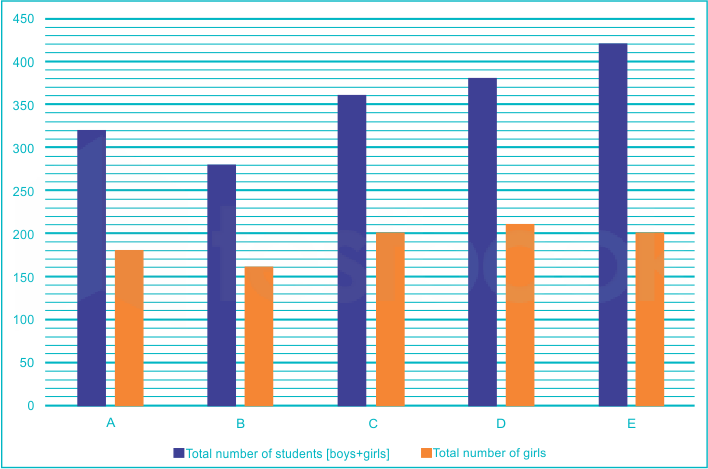
The bar graph shows the total number of students [ boys and girls] and total number of girls in five different [ A, B, C, D and E] schools.

52

Ratio of number of girls in school D and F is 7:8 and ratio of number of boys in school C and F is 8:9. Total number of students in school F?

  1. ((a))

    500

  2. ((b))

    420

  3. ((c))

    440

  4. ((d))

    360

  5. ((e))

    550

Show Answer
Answer: ((a))

500

53

Average number of boys in all school together is 5m. Find the value of m?

  1. ((a))

    32.4

  2. ((b))

    45.2

  3. ((c))

    42.2

  4. ((d))

    36.4

  5. ((e))

    45.6

Show Answer
Answer: ((a))

32.4

54

Find the difference between total number of girls in school C and D together and total number of boys in school C and D together?

  1. ((a))

    70

  2. ((b))

    95

  3. ((c))

    80

  4. ((d))

    90

  5. ((e))

    60

Show Answer
Answer: ((a))

70

55

Ratio of number of students use school bus and number of students who do not use school bus in school A is 5:3. Out of total number of students 50% are who use school bus are girls. Find number of boys who do not use school bus from school A?

  1. ((a))

    60

  2. ((b))

    50

  3. ((c))

    70

  4. ((d))

    55

  5. ((e))

    40

Show Answer
Answer: ((a))

60

56

Out of total number of girls in school B, 40% participate in inter school sports competition. Total number students participate inter school sports competition is 144 from school B. Find the number of boys who don’t participate inter school from school B?

  1. ((a))

    100

  2. ((b))

    50

  3. ((c))

    20

  4. ((d))

    40

  5. ((e))

    60

Show Answer
Answer: ((a))

100

57

Ratio of milk and water is in a container is 5:3, 10 Liters milk and 7 Liters water is added, now ratio of milk and water is 8:5. Find the initial quantity of milk in the mixture?

  1. ((a))

    45

  2. ((b))

    30

  3. ((c))

    24

  4. ((d))

    65

  5. ((e))

    40

Show Answer
Answer: ((a))

45

58

Shikha and Vina invested Rs. 75000 and 125000 respectively. After 5 months, Shikha and Vina withdraw 33.33% and 20% of their respective invested amount and Priya joins with Rs. 100000. Profit after 1 year is Rs. 50160. Find the difference between Shikha’s share and Priya’s share in the profit.

  1. ((a))

    Rs. 456

  2. ((b))

    Rs. 336

  3. ((c))

    Rs. 360

  4. ((d))

    Rs. 1824

  5. ((e))

    None of these

Show Answer
Answer: ((a))

Rs. 456

59

In each of the following number series, a wrong number is given, find out that number.

46, 57, 178, 190, 334, 347, 514

  1. ((a))

    178

  2. ((b))

    190

  3. ((c))

    334

  4. ((d))

    347

  5. ((e))

    514

Show Answer
Answer: ((a))

178

60

In each of the following number series, the wrong number is given, find out that number.

15, 35, 75, 155, 320, 635

  1. ((a))

    35

  2. ((b))

    75

  3. ((c))

    155

  4. ((d))

    320

  5. ((e))

    635

Show Answer
Answer: ((a))

35

61

In each of the following number series, the wrong number is given, find out that number.

34, 51, 85, 121, 187, 221

  1. ((a))

    85

  2. ((b))

    121

  3. ((c))

    187

  4. ((d))

    221

  5. ((e))

    51

Show Answer
Answer: ((a))

85

62

In each of the following number series, the wrong number is given, find out that number.

141, 157, 120, 185, 85, 229

  1. ((a))

    120

  2. ((b))

    85

  3. ((c))

    157

  4. ((d))

    185

  5. ((e))

    141

Show Answer
Answer: ((a))

120

63

In each of the following number series, the wrong number is given, find out that number.

168, 195, 224, 255, 289, 323

  1. ((a))

    168

  2. ((b))

    224

  3. ((c))

    289

  4. ((d))

    323

  5. ((e))

    255

Show Answer
Answer: ((a))

168

64

Two pipes A & B can separately fill a tank in 6 hours and 8 hours respectively. Both the pipes are opened together but pipe B is turned off after 2 hours and 30 minutes. In how much time the tank will be filled completely?

  1. ((a))

    9/2 hours

  2. ((b))

    13/8 hours

  3. ((c))

    19/3 hours

  4. ((d))

    33/8 hours 

  5. ((e))

    17/4 hours

Show Answer
Answer: ((a))

9/2 hours

65

Ram sells a juicer for Rs 1260 and earns a profit of 20%. However, due to recession, demand for goods fall and he has to sell the juicer at only 2/5 of the previous profit %. What will be the new selling price of juicer?

  1. ((a))

    Rs 1082

  2. ((b))

    Rs 1102

  3. ((c))

    Rs 1134

  4. ((d))

    Rs 1230

  5. ((e))

    Rs 1050

Show Answer
Answer: ((a))

Rs 1082

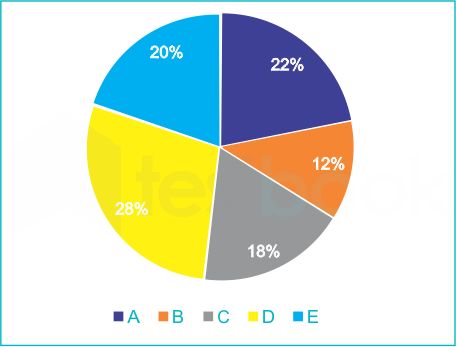
The given pie chart shows the percentage distribution of total number of employees [ Male + Female] in five different company [A, B, C, D and E]

Total number of employees in all companies together is 9000.


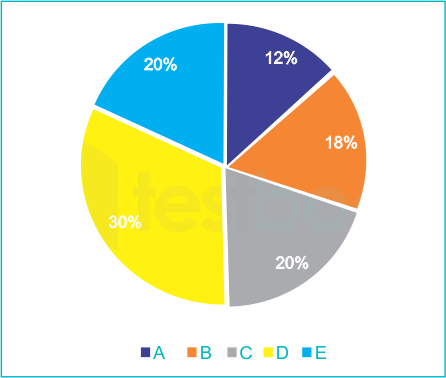
The given pie chart shows the percentage distribution of total number of male employees. Total number of male employees in all companies together is 4000.

66

Find the ratio between number of males in D and E together and number of females in A and B together?

  1. ((a))

    91 : 67

  2. ((b))

    95 : 69

  3. ((c))

    97 : 67

  4. ((d))

    96 : 67

  5. ((e))

    96 : 65

Show Answer
Answer: ((a))

91 : 67

67

Find the difference between the total number of males in company A and B together and total number of females in company D and E together?

  1. ((a))

    1980

  2. ((b))

    1460

  3. ((c))

    1220

  4. ((d))

    1420

  5. ((e))

    1960

Show Answer
Answer: ((a))

1980

68

Difference between number of males and females in company C is 5t and difference between number of males and females in company D is 5n. Find the sum of t + n ?

  1. ((a))

    152

  2. ((b))

    196

  3. ((c))

    134

  4. ((d))

    164

  5. ((e))

    147

Show Answer
Answer: ((a))

152

69

Number of males in company F is 20% more than the number of males in company E. Total number of employees in company F is 25% more than the number of employees in company B. Find the number of females in company F?

  1. ((a))

    1525

  2. ((b))

    1025

  3. ((c))

    1635

  4. ((d))

    1065

  5. ((e))

    1145

Show Answer
Answer: ((a))

1525

70

Out of total number of males, in company A is 40% are married. Total number of married employees in company A is 436. Number of unmarried female in company A is 4x. Find the value of x?

  1. ((a))

    88

  2. ((b))

    35

  3. ((c))

    66

  4. ((d))

    29

  5. ((e))

    77

Show Answer
Answer: ((a))

88

71

Sagar is 5 years older than Sunita. After five years, the ratio between Sagar’s age and Sunita’s age will be 9 : 8 respectively. What will be the Sagar’s age Before 10 years?

  1. ((a))

    30 years 

  2. ((b))

    25 years 

  3. ((c))

    20 years 

  4. ((d))

    27 years 

  5. ((e))

    None of these 

Show Answer
Answer: ((a))

30 years 

72

A bus takes half of the time taken by truck to go from Bombay to Agra. A truck takes 20 hours to go from same journey. What is the speed of the truck if a bus speed is 80 km/hour.

  1. ((a))

    80km/hr

  2. ((b))

    60km/hr

  3. ((c))

    160km/hr

  4. ((d))

    40km/hr

  5. ((e))

    None of these

Show Answer
Answer: ((a))

80km/hr

73

The total number of boys in a hostel is 18 percent more than the total number of girls in the hostel. What is the respective ratio of the total number of boys to the total number of girls in the hostel?

  1. ((a))

    50 : 59

  2. ((b))

    59 : 50

  3. ((c))

    59 : 60

  4. ((d))

    59 : 70

  5. ((e))

    59 : 40

Show Answer
Answer: ((a))

50 : 59

74

Find the approximate value of x in the following question given below

119.98% of 199.97 = x + 39.98% of 389.98

  1. ((a))

    52

  2. ((b))

    64

  3. ((c))

    84

  4. ((d))

    72

  5. ((e))

    60

Show Answer
Answer: ((a))

52

75

Find the approximate value of x in the following question given below

√x = √361.05 - 299.92 ÷ 14.98 + 162.01 ÷ 17.97

  1. ((a))

    49

  2. ((b))

    52

  3. ((c))

    64

  4. ((d))

    72

  5. ((e))

    36

Show Answer
Answer: ((a))

49

76

Find the approximate value of x in the following question given below

(35.97 ×  12.01 ÷ 15.99 + √81.18)2 = x + 25.982

  1. ((a))

    520

  2. ((b))

    620

  3. ((c))

    625

  4. ((d))

    670

  5. ((e))

    640

Show Answer
Answer: ((a))

520

77

Find the approximate value of x in the following question given below

34.97% of 279.88 + √63.97 of 25.12% = x – 13.27

  1. ((a))

    130

  2. ((b))

    145

  3. ((c))

    113

  4. ((d))

    110

  5. ((e))

    124

Show Answer
Answer: ((a))

130

78

Find the approximate value of x in the following question given below

3/11 ×  142.72 + 8/13 ×  325.22 – 4/7 ×  118.85 = x

  1. ((a))

    124

  2. ((b))

    132

  3. ((c))

    171

  4. ((d))

    162

  5. ((e))

    144

Show Answer
Answer: ((a))

124

79

A shopkeeper listed a price of a table as Rs. 675. He gives 33.33% discount on it. If he has gained 20% after selling it, then at what price he bought the table?

  1. ((a))

    475

  2. ((b))

    275

  3. ((c))

    375

  4. ((d))

    200

  5. ((e))

    None of these

Show Answer
Answer: ((a))

475

80

In an examination, every candidate took Hindi or History or both. 66% took Hindi and 59% took History. The total number of candidates was 3000. How many candidates took both Hindi and History?

  1. ((a))

    500

  2. ((b))

    750

  3. ((c))

    542

  4. ((d))

    738

  5. ((e))

    830

Show Answer
Answer: ((a))

500

Attempt this paper under real exam conditions

Timed interface, section switching, instant scoring, and question-by-question analytics — free.

Start Timed Attempt