Who sits third to the left of X?
- ((a))
U
- ((b))
I
- ((c))
D
- ((d))
Z
- ((e))
N
Show Answer
U
80 questions · 45 minutes · with answers · free
Direction: Study the given information carefully and answer the following questions.
Ten people P, T, I, U, J, D, N, Z, Y and X are sitting in a straight line facing North with equal distance between each other.
Less than two persons sit to the left of J. Two persons sit between J and T. P is an immediate neighbour of T. As many persons sit to the right of P sit to the left of U. less than five persons sit between J and U. I sit immediate right of U. X and Z are an immediate neighbour. As many persons sits to the left of N sits to the right of X. Y sits fifth to the left of D.
Who sits third to the left of X?
U
I
D
Z
N
U
Which of the following pairs represents persons seated at the two extreme ends of the line?
XN
JY
ZJ
ZX
NZ
XN
Which of the following statement is definitely true?
U sits to the immediate left of P
Z sits at the extreme left end
None of the given statement is true
D sits third to the right of U
Y sits to the immediate right of N
U sits to the immediate left of P
How many people sit between D and Y?
Six
Four
Two
Five
Three
Six
Four of the following five are alike in a certain way and so form a group. Who among the following does not belong to the group?
DU
PN
JT
IZ
YU
DU
If it is possible to make only one meaningful English word with the 1st, 3rd, 4th, and 5th letters of the word DEPRESSION, which of the following will be the third letter from left of that word? If no such word can be made give ‘X’ as the answer and if more than one such word can be made give ‘Y’ as the answer.
E
R
P
X
Y
E
How many pairs of digits are there in the number “749325” each of which has as many numbers between them in the as series of natural numbers both in backward and forward direction?
Three
Four
One
Five
Two
Three
Directions: Study the following information carefully and answer the questions below-
D, E, F, G, H, I, J and K are eight persons sitting around a round table out of which four are looking towards the centre of the table and four are looking away from the centre of the table. The following facts are also known about their seating arrangement:
K who is three places away to the right of E is opposite to G.
D who is looking towards the centre of the table is to the immediate left of I who is to the immediate right of K.
E is to the immediate left of G who is to the immediate right of J.
D and F are not adjacent to each other. F is to the immediate right of H.
E who is opposite to I is neither adjacent to J nor F.
What is the position of F with respect to K?
Immediate left
Immediate right
Second to the left
Second to the right
None of the above
Immediate left
Who is opposite to D?
E
K
F
H
G
E
Which of the following statement is true?
J and F are sitting opposite to each other and are facing towards the centre of the table.
D is sitting opposite to F.
I and E are adjacent to each other.
D is facing towards the centre of the table.
None of these.
J and F are sitting opposite to each other and are facing towards the centre of the table.
Person opposite to I is looking _______ the centre of the table and is to the ______ of H?
Towards, right
Away from, left
Away from, right
Towards, left
None of these
Towards, right
Who is sitting to the immediate left the person who is sitting opposite to G?
K
E
I
F
H
K
Directions: These questions are based on the following information.
In a family there are eight members - A, B, C, D, E, F, G and H. There are 3 couples. G is the mother of D who is the father of C. D is the nephew of F who is the daughter of E. C’s grandfather is the son of H whose wife is the mother of B. F and B are siblings. A is the daughter-in-law of B.
Who among the following is a couple?
A and B
B and F
D and A
A and G
H and G
A and B
How is C related to G?
C is the granddaughter of G
C is the grandson of G
C is the son of G
C is the daughter of G
Either 1 or 2
C is the granddaughter of G
How is B related to F?
B is the father of F
B is the nephew of F
B is the brother of F
B is the grandfather of F
B is the grandmother of F
B is the father of F
Direction: Read the following information carefully and answer the questions that follow:
Nine people – A, B, C, D, E, F, G, H, and I, visited the dentist in three months namely, January, April, and September, on three different dates, 3rd, 8th, and 23rd of the months, but not necessarily in the same order. No two person visited the dentist on the same day of the same month.
D visited the dentist in one of the months which has 30 days in it. At least three people visited the dentist after D who visited the dentist on a numerically prime date. The two people who visited the dentist between C and E visited in one of the months which has 31 days in it. H visited the dentist on Date 3rd of one of the months. B went for his check up on one of the days before E but I visited the dentist on one of the days before B did. Two people went for their check up between F and A. Nobody visited the dentist between A and G.
When did B visit the dentist?
3rd April
8th September
23rd January
3rd January
23rd April
3rd April
How many people went for the check up after F?
Three
Two
One
Four
More than four
Three
Who visited the dentist last?
I
B
A
G
D
I
Which amongst the following combination represent the people who went to the dentist on 8th of the month?
IFA
BGH
BGE
FCA
HIG
IFA
Who visited the dentist immediately before A?
I
G
F
D
H
I
Direction: In the following question assuming the given statement to be true. Find which of the following conclusion(s) among given conclusions is/are definitely true then give your answer accordingly.
Statement: A > G ≥ H = X < D ≤ S
Conclusion:
I. H > S
II. D > A
None is true
Only I is true
Only II is true
Both I and II are true
Either I or II is true
None is true
Direction: In the following question assuming the given statement to be true, find which of the following conclusion(s) among the given conclusions is/are definitely true then give your answer accordingly.
Statement: A > P < M = V ≥ B; M > K
Conclusion:
I. A > K
II. P < V
Only I is true
Only II is true
Both I and II are true
None is true
Either I or II is true
Only I is true
Directions: In the following question assuming the given statements to be true, find which conclusion among the given conclusions is/are definitely true and then give your answers accordingly.
Statements: L < I = Q ≥ U; I ≤ D > A > T < E
Conclusion:
I. U ≤ D
II. Q > T
Only conclusion I is true
Only conclusion II is true
Both conclusions I and II are true
Either conclusion I or conclusion II is true
None of the conclusion is true
Only conclusion I is true
In the following question, assuming the given statement to be true, find which of the conclusions given below is/are definitely true?
Statement:
X ≤ Y ≤ Z ≤ A < E < D
Conclusions:
X < A
X = A
Only conclusion I follows
Both conclusions follow
Either I or II follows
Only conclusion II follows
Neither I nor II follows
Only conclusion I follows
Direction: In the question below are given three statements followed by two conclusions numbered I and II. You have to take the given statements to be true even if they seem to be at variance with commonly known facts. Read all the conclusions and then decide which of the given conclusions logically follows from the given statements disregarding commonly known facts.
Statements:
Some Cows are Buffalo.
Only a few Buffalo are Camel.
No Camel are Goats.
Conclusions:
I. All Cows are Buffalo.
II. Some Buffalo are not Camel.
Only conclusion I follows
Only conclusion II follows
Both conclusion I and II follow
Either conclusion I or II follows
Neither conclusion I nor II follows
Only conclusion I follows
Direction: In the question below three statements are given followed by two conclusions numbered I and II You have to take the given statements to be true even if they seem to be at variance with commonly known facts. Read all the conclusions and then decide which of the given conclusions logically follows from the given statements disregarding commonly known facts.
Statements:
Only a few Window is a Gate.
Some Door is a Window.
No Rod is a Gate.
Conclusions:
I. All Window can be a Gate.
II. Some Door is a Gate.
Only I follow
Only II follow
Both I and II follows
Neither I nor II follows
Either I or II follows
Only I follow
Directions: In the question below are given three statements followed by two conclusions. You have to take the given statements to be true even if they seem to be at variance with commonly known facts. Read all the conclusions and then decide which of the given conclusions logically follows from the given statements disregarding commonly known facts.
Statement:
Some mobiles are tablets
No tablets are clips
Only a few clips are maps
Conclusions:
Some mobiles are not clips
Some clips are not maps
Only conclusion I follows
Only conclusion II follows
Either conclusion I or II follows
Neither conclusion I nor II follows
Both conclusion I and II follows
Only conclusion I follows
Directions: In the question below are given three statements followed by two conclusions. You have to take the given statements to be true even if they seem to be at variance with commonly known facts. Read all the conclusions and then decide which of the given conclusions logically follows from the given statements disregarding commonly known facts.
Statements:
I. Some coolers are fans.
II. No fan is AC.
III. Only a few AC are heater
Conclusions:
I. All coolers are heater
II. Some coolers are not heaters
Only conclusion I follows
Only conclusion II follows
Either conclusion I or II follows
Neither conclusion I nor II follows
Both conclusion I and II follows
Only conclusion I follows
Directions: Study the following information carefully and answer the given questions.
In a certain code language
‘ri na pi’ means ‘India is great’,
‘pi ua ti ga’ means ‘It is large country’,
‘na ja ga si’ means ‘India have large Population’,
’xa ca ja ka’ means ‘Population requires more resources.
Which of the following definitely does not means ‘resources’ in that code language?
xa
ca
ka
ja
None
xa
Code ‘si’ is for which word in the given language?
India
have
large
population
requires
India
What would be the code for ‘A great country have resources’?
za ga ri xa pi
pi ma za ti ba xa
ri ua si xa za
ja pi ta si ha ma
ga pi si xa
za ga ri xa pi
In a certain language ‘India have more resources than Pakistan’ is coded as ‘pe si na ka xa va’ what would be the code for ‘Pakistan’?
pe
ka
va
either ‘va’ or ‘pe’
si
pe
Code ‘si na ri ba’ is for which of the following sentence in given language?
It have huge resources
India have great resources
India have great culture
It have large resources
India have large resources
It have huge resources
Directions: Read the instructions carefully and answer the question below.
Seven people, L, M, N, O, P, Q, and R, went to a grocery store and spent a certain amount there. No two people spent the same amount.
Two people spent more than Q but less than M. R spent either the least amount or the highest amount. N spent more amount than P. Only one person spent less than L but more than R. At least four people spent more than O.
If O spent Rs. 450, P spent Rs. 700 and M spent Rs. 1000. Then which of the following is the possible amount spent by Q?
Rs. 750
Rs. 1150
Rs. 850
Rs. 600
Rs. 400
Rs. 750
Who spent the highest amount?
L
M
N
O
R
L
Direction: Study the following information carefully and answer the questions as follows
Seven persons – A, B, C, D, E, F and G have come to a party in different coloured cars – red, black, white, green, grey, yellow and maroon but not necessarily in the same order. They hold different positions – AM (Assistant Manager), MG (Manager), DGM (Deputy General Manager), GM (General Manager), CGM (Chief General Manager), ED (Executive Director) and CEO (Chief Executive Officer) . The positions given are in increasing order of seniority. AM is the least junior and the CEO is the most senior. A is senior to only three persons. Person who came in red car is senior to GM, but not the CEO. C is junior to the one who came in white car and senior to DGM. DGM did not come in yellow car. The person who came in white car is not the most senior. B is junior to A but not the least junior and has come in yellow car. F is senior to one came in yellow car and junior to one came in red car. E is junior to GM. The one who came in green car is junior to G and senior to DGM who came in maroon car. F did not come in white car. D came in black car.
Which colour car does CEO has?
Black
White
Green
Red
Grey
Black
Who is Manager?
E
B
F
A
D
E
Who has White car?
CEO
CGM
ED
AM
MG
CEO
Who has maroon colour car?
F
B
A
C
None of these
F
Which combination is not true?
D – CEO
G - ED
A – GM
E – MG
None of these
D – CEO
What will approximately come in the place of the question mark ‘?’ in the following question?
\((3^3 + 66.66% {}of 624)/3^{-2} + 54.55/3^3 = ?\)
3655
3785
3700
3725
3989
3655
Direction: What should come in place of question mark (?) in the following question? (You do not have to calculate the exact value.)
480.02 × 26.04 ÷ 38.89 + (?) = 25 + 54
388
395
385
337
325
388
What approximate value should come in place of question mark (?) in the following question?
5342.01 ÷ 43.98 + 129.01 = ?
250
230
224
200
280
250
What approximate value should come in the place of question mark (?) in the following question?
[22.83 × (1.89)2 × (23.89)2] ÷ {2.01 × √(1295.96)} = (3.08)? + 7.19
4
3
6
5
2
4
What approximate value should come in the place of question mark (?) in the following question?
54.59% of 239.96 + (7.89)3 × 3.94 – 768.08 ÷ 31.94 × 7.98 = ?
1878
2108
1988
1828
1798
1878
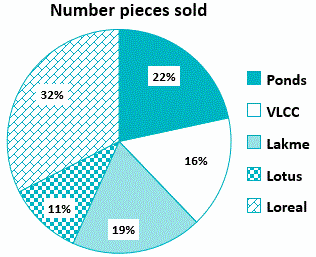
A shopkeeper sold 5 different kinds of cosmetic cream, the number of products sold by the shopkeeper in a month is represented as per the given pie chart. Total number of creams sold by the shopkeeper is 800.
Find the total number of ponds cream sold by the shopkeeper.
186
166
176
192
202
186
What is the difference between the number of products of the Ponds and the Lotus cream sold?
77
88
93
69
83
77
Find the average number cream packets sold by the shopkeeper per day?
23.67
25.5
32.33
26.67
16.67
23.67
What is the sum of the total number of Ponds, Lakme and Lotus cream packets sold by the shopkeeper during the month?
520
416
327
475
422
520
Total number of Lakme cream sold is what percentage of the total number of Loreal cream sold?
59.37%
55.89%
62.23%
52.74%
67.83%
59.37%
Prashant invested Rs. 1500 and Rs. 1000 in two different banks for 2 years. Rate of simple interest offered by 2nd bank is 3% less than the rate of interest offered by 1st bank. If the difference of interest received from both bank is Rs. 150. Find the rate of interest offered by 1st bank.
14%
9%
12%
27%
30%
14%
The average salary in an industry having a staff of 16 engineers and 30 clerks is Rs. 750. The average salary of engineers is Rs. 1200. Find the average salary of clerks.
480
500
510
515
525
480
If the length of a chord is 48 cm which is at a certain distance from the centre of a circle of radius 25 cm. Find distance between chord from centre of the circle?
7 cm
4 cm
5 cm
49 cm
6 cm
7 cm
Directions: Read the following table carefully and answer the questions given below.
The following table shows the number of persons living in five different societies and the percentage of Men, Women and Children.
| Society | Number of Persons | Men | Women | Children |
|---|---|---|---|---|
| A | 1600 | 25% | 30% | 45% |
| B | 1200 | 30% | 40% | 30% |
| C | 1000 | 20% | 40% | 40% |
| D | 1500 | 40% | 40% | 20% |
| E | 2400 | 25% | 25% | 50% |
Find the total number of women living in all the societies together.
2260
2340
2560
2620
2840
2260
Find the ratio between the number of men living in Society D to the number of children living in Society A.
2 : 3
6 : 7
11 : 14
5 : 6
1 : 4
2 : 3
What is the average number of children living in all the societies together?
576
606
616
586
596
576
Number of women living in Society B is what percent of the number of children living in Society E?
33.33%
40%
66.66%
25%
50%
33.33%
Number of males living in Society B is how much percent more than the number of children living in Society D?
20%
33.33%
16.67%
25%
30%
20%
In the question, a number series is given and in the series only one number is wrong. Find the wrong number.
992, 1056, 1122, 1192, 1260, 1332
992
1260
1192
1122
1056
992
In the following number series, only one number is wrong. Find out the wrong number.
3, 7, 15, 39, 63, 127, 255, 511
15
39
63
127
7
15
In the following series one number is wrong, Find out the wrong number.
60, 30, 150, 75, 375, 187.5, 935.5
30
150
75
375
935.5
30
In the following number series, only one number is wrong. Find out the wrong number.
15 18 43 168 511 1240
15
18
43
168
511
15
In the following number series only one number is wrong. Find out the wrong number.
1, 3, 10, 21, 64, 129, 356, 777
21
129
10
356
None of these
21
In alloy A ratio of Iron and Zinc is 3 ∶ 1 and in alloy B the ratio is 3 ∶ 7. They are mixed together in the ratio of 2 ∶ x to make another alloy C. In alloy C ratio of Iron and Zinc becomes 3 ∶ 4. What is the value of x?
3
4
5
6
7
3
The multiplication of Kishan’s age before 3 years and after 6 years is 486. Find out the average of 5 years back age and age of Kishan after 5 years.
20 years
21 years
25 years
22 years
None of the above
20 years
The cost price of a bag is 72% of its marked price. A discount of 46% is given on it. The marked price of toy is equal to the cost price of bag. If the toy was given a discount of 20% which is equal to Rs. 20, what is the loss on the bag (in Rs.)?
32.5
27.5
35
25
28
32.5
Find the relation between x and y.
3x2 – 19x + 28 = 0
5y2 – 18y + 16 = 0
x > y
x < y
x ≤ y
x ≥ y
x = y or relation cannot be established
x > y
In the given question, two equations numbered l and II are given. You have to solve both the equations and mark the appropriate answer.
I. x2 - 66x - 432 = 0
II. y2 - 24y + 140 = 0
x > y
x < y
x ≥ y
x ≤ y
x = y or no relation can be obtained
x > y
In the question, one or more equations(s) is (are) provided. On the basis of these you have to give answer
(i) q2 – 11q + 30 = 0
(ii) 2p2 – 7p + 6 = 0
p = q
p > q
q > p
p ≥ q
q ≥ p
p = q
Two equations I and II are given in each question. On the basis of these equations decide the relation between x and y.
i. 36x2 - 6x - 2 = 0
ii. 36y2 + 18y + 2 = 0
x > y
x < y
x ≥ y
x ≤ y
Can’t say
x > y
In the following question two equations I and II are given. You have to solve both the equations and give answer.
I. x2 + 3x + 2 = 0
II. y2 – 4y + 1 = 0
x > y
x < y
x = y
x ≥ y
x ≤ y
x > y
A group of three friends A, B and C invest 5000 more than B, and B invests 45000. Calculate the share of A in total profit.
$17700
$15600
$11550
$35700
$15355
$17700
In a stream that is running at 4 kmph, a boat goes 15 km upstream and back to the starting point in 2 hours. Find the downstream speed of the boat.
12 kmph
18 kmph
16 kmph
20 kmph
22 kmph
12 kmph
There is a leak in the bottom of the tank. This leak can empty the tank in 15 hours. Tap A alone can fill the tank in 6 hours. Tap A opens for 4 hours after that remaining part of the tank is filled by tap B in 18 hours. When both pipes are opened simultaneously, then in what time tank is completely filled?
5 hours
7 hours
2 hours
10 hours
9 hours
5 hours
A does 4/5 of a work in 24 days. He then, calls in B and they together finish the remaining work in 2 days. How long B alone would take to do the whole work?
30
24
18
15
None of these
30
Directions: Study the following details carefully to answer the questions that follow.
A primary school consists of 1500 students. The ratio of boys to girls is 17 ∶ 13. All the students study in five different classes, class I, II, III, IV and V. 28% of the girls are in class I. 18% of the boys study in class II. One-fifth of the boys study in class V. The ratio of girls to boys in class II is 2 ∶ 3 and 25% of total students are in class III. Girls studying in class V are 60% of the boys studying in the same class. 18% of the girls are in class IV. The remaining girls are in class III. 16% of the boys study in class I and the remaining boys are studying in class IV
What is the number of boys studying in class III?
136
228
253
163
270
136
Number of boys studying in class IV is what per cent of the number of girls studying in the same class?
145.52%
123.42%
169.12%
150.62%
139.32%
145.52%
What is the number of girls studying in class V?
147
182
117
102
130
147
What is the total number of girls studying in class II and IV together?
118
219
81
264
225
118
Number of girls studying in class I is approximately what percent of total number of students in the school?
9%
12%
18%
22%
28%
9%
Timed interface, section switching, instant scoring, and question-by-question analytics — free.
Start Timed Attempt