Official Paper

RRB PO Prelims Memory Based Paper (Held on: 20 August 2022 Shift 2) (Previous Year Paper)

80 questions · 45 minutes · with answers · free

Reasoning (40 questions)

Directions: Read the instructions carefully and answer the questions below:

Ten people M, N, O, P, Q, A, B, C, D and E sitting around a circular table facing towards the center not necessarily in the same order.

D sits third to the right of Q. C sits third to the left of P who sits to the immediate right of Q. Two persons sit between O and C. A is not a neighbor of D and C. Number of persons sitting between C and O is same as number of persons sitting between M and B. B is not a neighbor of C. M is not a neighbor of A. Only one person sits between B and E.

1

How many person sits between E and P, who counted from left of P?

  1. ((a))

    Four

  2. ((b))

    Six

  3. ((c))

    Three

  4. ((d))

    Five

  5. ((e))

    One

Show Answer
Answer: ((a))

Four

2

What is the position of M with respect to A?

  1. ((a))

    Seventh to the left

  2. ((b))

    Sixth to the right

  3. ((c))

    Sixth to the left

  4. ((d))

    Seventh to the right

  5. ((e))

    Fifth to the right

Show Answer
Answer: ((a))

Seventh to the left

3

Who sits third to the left of Q?

  1. ((a))

    A

  2. ((b))

    D

  3. ((c))

    M

  4. ((d))

    N

  5. ((e))

    P

Show Answer
Answer: ((a))

A

4

What is the position of B with respect to O?

  1. ((a))

    Seventh to the left

  2. ((b))

    Sixth to the right

  3. ((c))

    Sixth to the left

  4. ((d))

    Seventh to the right

  5. ((e))

    Fifth to the right

Show Answer
Answer: ((a))

Seventh to the left

5

Who are the immediate neighbors of D?

  1. ((a))

    Q and B

  2. ((b))

    M and N

  3. ((c))

    E and A

  4. ((d))

    B and E

  5. ((e))

    Q and C

Show Answer
Answer: ((a))

Q and B

6

Is it possible to make one meaningful word with the second, the third, the fourth, and the eighth letter of the word ‘AUSPICIOUS’. If one word can be formed then mark ‘X’ as the answer, if more than one word can be formed than mark ‘J’ as an answer. If no word can be formed mark ‘C’ as the answer.

  1. ((a))

    J

  2. ((b))

    S

  3. ((c))

    C

  4. ((d))

    U

  5. ((e))

    X

Show Answer
Answer: ((a))

J

7

How many such pairs of letters are there in the word INTRODUCTION each of which has as many letters between them in the word (in both forward and backward directions), as they have between them in the English alphabetical series?

  1. ((a))

    Three

  2. ((b))

    Four

  3. ((c))

    Five

  4. ((d))

    Six

  5. ((e))

    More than six

Show Answer
Answer: ((a))

Three

Directions: Read the given information carefully and answer the questions below.

Eight people A, B, C, D, E, F, G, and H are staying in a building which has four floors and each floor has two flats. Lower most floor of the building is numbered 1 and top most is numbered 4. And the flats are numbered 1 and 2 such that the left most flat is numbered 1 and the right most is numbered 2. Only one person is staying in each flat.

G who stays on one of the floors below D stays on an even numbered floor and in the even numbered flat. There is only one floor between E and A, but A lives above H.. B and H stay on an odd numbered floor and both stays in same numbered flat. F stays on a floor which is immediately below the floor of E but the flat numbers are not necessarily be the same. F and H are not staying on the same floor. A stays in an odd numbered flat but not below E. C and A are not staying in the same numbered flat and also not on the same floor.

8

D stays on which of the following floor?

  1. ((a))

    4

  2. ((b))

    3

  3. ((c))

    2

  4. ((d))

    1

  5. ((e))

    Cannot be determined

Show Answer
Answer: ((a))

4

9

Which of the following pair of people live on the same floor?

  1. ((a))

    A, E

  2. ((b))

    F, G

  3. ((c))

    H, C

  4. ((d))

    G, D

  5. ((e))

    H, E

Show Answer
Answer: ((a))

A, E

10

B stays on which of the following Floor and Flat respectively?

  1. ((a))

    3, 2

  2. ((b))

    1, 1

  3. ((c))

    2, 1

  4. ((d))

    2, 3

  5. ((e))

    None of these

Show Answer
Answer: ((a))

3, 2

11

Who stays on the floor immediately below G?

  1. ((a))

    A

  2. ((b))

    C

  3. ((c))

    B

  4. ((d))

    F

  5. ((e))

    Both 3 and 4.

Show Answer
Answer: ((a))

A

12

Who is the neighbour of A?

  1. ((a))

    H

  2. ((b))

    G

  3. ((c))

    D

  4. ((d))

    B

  5. ((e))

    C

Show Answer
Answer: ((a))

H

Direction: Read the following information carefully and answer the questions that follow.

12 Judges in a Supreme Court are sitting in two parallel rows containing 6 judges in each row in such a way they are equidistant from each other. In row 1- P, Q, R, S, T and U are sitting and facing North. In row 2- A, B, C, D, E and F are sitting and facing South, but not necessarily in the same order. Each Judge who sits in the first row faces the other judge in 2nd row.

There are three judges between R and S. The one who faces S sits third to the right of C. D faces the one, who sits third to the right of P but does not face R. The one who sits adjacent to B, faces P. There is one person between A and E, and E faces the one who sits to the immediate left of T. Neither T nor U faces C. F doesn’t sit at any of the extreme ends.

13

Who among the following sits between A and E?

  1. ((a))

    B

  2. ((b))

    C

  3. ((c))

    D

  4. ((d))

    Either B or C

  5. ((e))

    F

Show Answer
Answer: ((a))

B

14

What is the position of Q in row 1?

  1. ((a))

    Second from the left

  2. ((b))

    Third from the left

  3. ((c))

    Third from the right

  4. ((d))

    Fourth from the right

  5. ((e))

    None of the above

Show Answer
Answer: ((a))

Second from the left

15

Who sits third to the right of C in row 2?

  1. ((a))

    E

  2. ((b))

    F

  3. ((c))

    D

  4. ((d))

    B

  5. ((e))

    A

Show Answer
Answer: ((a))

E

16

Who faces A in row 1?

  1. ((a))

    T

  2. ((b))

    Q

  3. ((c))

    U

  4. ((d))

    P

  5. ((e))

    R

Show Answer
Answer: ((a))

T

17

Who faces the one who sits 2nd to the right of P in row 2?

  1. ((a))

    F

  2. ((b))

    C

  3. ((c))

    E

  4. ((d))

    A

  5. ((e))

    D

Show Answer
Answer: ((a))

F

Directions: These questions are based on the following information

There is a family of 9 members, B, D, E, G, K, L, M, N and Z. In that family, there are 3 generations having 3 married couples among them. N is the daughter of Z. G is the son of B and the brother of Z. E is the son in law of D. L is the father of K who is the mother of M. Z is the aunt of M. K and G are married couples. D is the husband of B. There are 5 female and 4 male members among them.

18

How is M related to G?

  1. ((a))

    Son

  2. ((b))

    Daughter

  3. ((c))

    Sister

  4. ((d))

    Cousin

  5. ((e))

    Mother

Show Answer
Answer: ((a))

Son

19

Who is the sister-in-law of K?

  1. ((a))

    E

  2. ((b))

    N

  3. ((c))

    M

  4. ((d))

    Z

  5. ((e))

    B

Show Answer
Answer: ((a))

E

20

Who is the aunt of N?

  1. ((a))

    M

  2. ((b))

    Z

  3. ((c))

    K

  4. ((d))

    B

  5. ((e))

    D

Show Answer
Answer: ((a))

M

Direction: Read the following information carefully and answer the questions that follow:

There are seven persons – M, N, O, P, Q, R and S, who boarded a train on different days of a week starting from Monday to Sunday not necessarily in same order. Each of them travelled to different cities among Bengaluru, Delhi, Goa, Kolkata, Mumbai, Patna,Varanasi (not necessarily in same order).

Person travelling to Mumbai does not travel on Sunday. Neither Q nor S travelled to Goa. O is travelling to Varanasi just before R, who is travelling to Kolkata. Three persons travelled between P’s and N’s travelling day. At most two persons travelled after P, who travelled to Bengaluru. One person travelled to Goa on Wednesday. Q does not travel on Monday or Tuesday. M does not visit a city before N’s travelling day. Neither N nor S travels to Mumbai. R does not travel on Saturday or Tuesday.
21

Who among the following travelled to Goa?

  1. ((a))

    O

  2. ((b))

    R

  3. ((c))

    M

  4. ((d))

    N

  5. ((e))

    None of the above

Show Answer
Answer: ((a))

O

22

Which of the following pair is correct?

  1. ((a))

    R, Friday

  2. ((b))

    Q, Mumbai

  3. ((c))

    P, Thursday

  4. ((d))

    N, Tuesday

  5. ((e))

    O, Bengaluru

Show Answer
Answer: ((a))

R, Friday

23

Who travelled to Patna?

  1. ((a))

    N

  2. ((b))

    S

  3. ((c))

    O

  4. ((d))

    Q

  5. ((e))

    Cannot be determined

Show Answer
Answer: ((a))

N

24

How many persons travelled before P’s travelling day?

  1. ((a))

    Four

  2. ((b))

    One

  3. ((c))

    Three

  4. ((d))

    Five

  5. ((e))

    None of the above

Show Answer
Answer: ((a))

Four

25

Who travelled on Thursday?

  1. ((a))

    P

  2. ((b))

    Q

  3. ((c))

    M

  4. ((d))

    N

  5. ((e))

    S

Show Answer
Answer: ((a))

P

26

Direction: In the following question assuming the given statements to be True, find which of the conclusion among given conclusions is/are definitely true and then give your answers accordingly.

Statements: R > B ≥ D; S < V ≤ T ≤ D

Conclusions:

I. B > S

II. V < R

  1. ((a))

    Only II is True

  2. ((b))

    Neither I nor II is True

  3. ((c))

    Both I and II are True

  4. ((d))

    Either I or II is True

  5. ((e))

    Only I is True

Show Answer
Answer: ((a))

Only II is True

27

Direction: In the following question assuming the given statements to be True, find which of the conclusion among given conclusions is/are definitely true and then give your answers accordingly.

Statements: T = U > R ≥ K; E < K ≥ O = Q > L

Conclusions:

I. U > L

II. T ≤ E

  1. ((a))

    Both I and II are True

  2. ((b))

    Only I is True

  3. ((c))

    Either I or II is True

  4. ((d))

    Only II is True

  5. ((e))

    Neither I nor II is true

Show Answer
Answer: ((a))

Both I and II are True

28

Directions: In the following question assuming the given statements to be true, find which conclusion among the given conclusions is/are definitely true and then give your answers accordingly.

Statement:

L < I = P ≥ E > R; L > Q

Conclusions:

I. L < R

II. E ≥ Q

  1. ((a))

    Only I is True

  2. ((b))

    Only II is True

  3. ((c))

    Either I or II is true

  4. ((d))

    Both conclusions I and II are True

  5. ((e))

    None is True

Show Answer
Answer: ((a))

Only I is True

29

Directions: In the following question assuming the given statements to be True, find which of the conclusion among given conclusions is/are definitely true and then give your answers accordingly.

Statements: 

N < M < E = F ≥ H ≥ J ≤ K

Conclusions:

I. E = J              

II. J < E

  1. ((a))

    Only Conclusion I is True.

  2. ((b))

    Only Conclusions II is True.

  3. ((c))

    Either Conclusion I or II is True.

  4. ((d))

    Both Conclusions I and II are True.

  5. ((e))

    Neither Conclusion I nor II is True.

Show Answer
Answer: ((a))

Only Conclusion I is True.

Directions: Study the following information carefully and answer the given questions.

In a certain code of language,

‘something happened world inside’ is written as ‘cgl pqr rmp stu’

‘everything must happened inside’ is written as ‘pmo aqr pqr stu’

‘something must everything happened’ is written as ‘cgl stu pmo aqr’

‘everyone must polite everything’ is written as ‘cdr pdr pmo aqr’

30

What is the code of ‘Happened’?

  1. ((a))

    cgl

  2. ((b))

    pqr

  3. ((c))

    stu

  4. ((d))

    Either cgl or pqr

  5. ((e))

    None of these

Show Answer
Answer: ((a))

cgl

31

What is the code of ‘Everyone’?

  1. ((a))

    cdr

  2. ((b))

    aqr

  3. ((c))

    pmo

  4. ((d))

    pdr

  5. ((e))

    Either cdr or pdr

Show Answer
Answer: ((a))

cdr

32

Which of the following word is coded as ‘cgl’?

  1. ((a))

    Happened

  2. ((b))

    Something

  3. ((c))

    Everything

  4. ((d))

    Everyone

  5. ((e))

    None of these

Show Answer
Answer: ((a))

Happened

33

What is the code of ‘Everything inside’?

  1. ((a))

    pqr cdr

  2. ((b))

    cdr pdr

  3. ((c))

    pqr pmo

  4. ((d))

    aqr pqr

  5. ((e))

    Can't determine

Show Answer
Answer: ((a))

pqr cdr

34

Directions: In the question below are given two statements followed by two conclusions I and II. You have to take the given statements to be true even if they seem to be at variance from commonly known facts. Read all the conclusions and then decide which of the given conclusions logically follows from the given statements disregarding commonly known facts.

Statement:

Some beds are definitely wooden.

Only a few sleep is wooden.

Conclusion:

I. All bed being wooden is a possibility.

II. Some sleep is bed.

  1. ((a))

    Only I follows

  2. ((b))

    Only II follows

  3. ((c))

    Both follows

  4. ((d))

    Either I or II follows

  5. ((e))

    None follows

Show Answer
Answer: ((a))

Only I follows

35

Directions: In the question below are given two statements followed by two conclusions I and II. You have to take the given statements to be true even if they seem to be at variance from commonly known facts. Read all the conclusions and then decide which of the given conclusions logically follows from the given statements disregarding commonly known facts.

Statement:

Only some videos are good.

No good is message.

Conclusion:

I. Some videos are definitely not message.

II. Some messages are videos are a possibility.

  1. ((a))

    Only I follows

  2. ((b))

    Only II follows

  3. ((c))

    None follows

  4. ((d))

    Either I or II follows

  5. ((e))

    Both I and II folllows

Show Answer
Answer: ((a))

Only I follows

36

Direction: In the following question below some statements are given followed by some conclusions. Taking the given statements to be true even if they seem to be at variance from commonly known facts, read all the conclusions and then decide which of the given conclusions logically follows the given statements.

Statements:   

I. No tap is a mug.

II. All mug are gun.

Conclusions

I. Some gun are tap.

II. No tap is a gun.

  1. ((a))

    Only conclusion I follows

  2. ((b))

    Only conclusion II follows

  3. ((c))

    Both conclusions I and II follow

  4. ((d))

    Neither conclusion I or II follows

  5. ((e))

    Either conclusion I or II follows

Show Answer
Answer: ((a))

Only conclusion I follows

37

In the question below there are two statements followed by two conclusions I and II. You have to take the two given statements to be true even if they seem to be at variance from commonly known facts and then decide which of the given conclusions logically follows from the two statements disregarding commonly known facts.

Statements:

All dads are goods

Only a few woods are goods

Conclusions:

I. All woods being dads is a possibility

II. Some goods are woods

  1. ((a))

    Both conclusion I and conclusion II follow

  2. ((b))

    Only conclusion II follows

  3. ((c))

    Only conclusion I follows

  4. ((d))

    Neither conclusion I nor conclusion II follows

  5. ((e))

    None of these

Show Answer
Answer: ((a))

Both conclusion I and conclusion II follow

38

In the question below there are two statements followed by two conclusions I and II. You have to take the two given statements to be true even if they seem to be at variance from commonly known facts and then decide which of the given conclusions logically follows from the two statements disregarding commonly known facts.

Statements:

Some goats are olds

Only a few olds are sheeps

Conclusions:

I. Some sheeps can never be olds

II. All olds can be sheeps

  1. ((a))

    Both conclusion I and conclusion II follow

  2. ((b))

    Only conclusion II follows

  3. ((c))

    Only conclusion I follows

  4. ((d))

    Neither conclusion I nor conclusion II follows

  5. ((e))

    None of these

Show Answer
Answer: ((a))

Both conclusion I and conclusion II follow

Direction: Study the following information carefully and answer the given questions.

Among seven persons A, B, C, D, E, F and G are comparing their weights and each of them is having different weight. E is the second lightest person. G is heavier than exactly three persons. A is heavier than only two persons and F is lighter than only two persons. The weight of C is lighter than D and heavier than F.

39

Which among the following is the lightest person?

  1. ((a))

    E

  2. ((b))

    B

  3. ((c))

    C

  4. ((d))

    D

  5. ((e))

    G

Show Answer
Answer: ((a))

E

40

How many persons are lighter than D?

  1. ((a))

    4

  2. ((b))

    5

  3. ((c))

    6

  4. ((d))

    3

  5. ((e))

    2

Show Answer
Answer: ((a))

4

Quantitative Aptitude (40 questions)

41

Find the wrong term in the following series.

9, 14, 19, 25, 29, 34

  1. ((a))

    14

  2. ((b))

    29

  3. ((c))

    25

  4. ((d))

    34

  5. ((e))

    Answer not known

Show Answer
Answer: ((a))

14

42

In the question, a number series is given and in the series, only one number is wrong. Find the wrong number.

30240, 15120, 10080, 7563, 6048, 5040, 4320

  1. ((a))

    30240

  2. ((b))

    15120

  3. ((c))

    10080

  4. ((d))

    7563

  5. ((e))

    4320

Show Answer
Answer: ((a))

30240

43

In the question, a number series is given and in the series, only one number is wrong. Find the wrong number.

1721, 2183, 2733, 3347, 4061, 4871

  1. ((a))

    1721

  2. ((b))

    2733

  3. ((c))

    4871

  4. ((d))

    4061

  5. ((e))

    2183

Show Answer
Answer: ((a))

1721

44

In the following number series. One number is wrong. Find the wrong number of the series?

3, 4, 12, 38, 103, 228

  1. ((a))

    103

  2. ((b))

    12

  3. ((c))

    38

  4. ((d))

    228

  5. ((e))

    None of these

Show Answer
Answer: ((a))

103

45

In the question, a number series is given and in the series only one term is wrong. Find the wrong term.

160, 2560, 21470, 81920, 163840

  1. ((a))

    160

  2. ((b))

    2560

  3. ((c))

    21470

  4. ((d))

    81920

  5. ((e))

    163840

Show Answer
Answer: ((a))

160

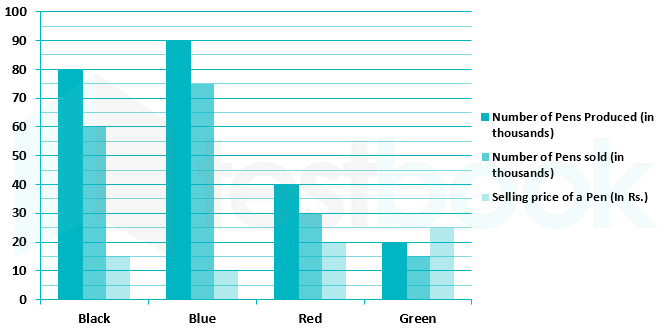
Direction: The Bar graph below shows the number of Pens of different colours produced and sold by a company. Also the selling price of different colour Pens is also shown. Study the graph carefully and answer the questions.

Note: Only sold products should be considered when calculating profit.

46

If the cost price of Green pen is 40% more than the cost price of Red pen and total profit earned by selling both colour pens is Rs. 210000 then find the cost price of Green pen.

  1. ((a))

    Rs. 23.8

  2. ((b))

    Rs. 21

  3. ((c))

    Rs. 18

  4. ((d))

    Rs. 22

  5. ((e))

    Rs. 22.4

Show Answer
Answer: ((a))

Rs. 23.8

47

If the company sold the remaining pens (Produced – Sold) of all colours at 60% of the selling price then find the amount of money collected by selling these remaining pens.

  1. ((a))

    Rs. 465000

  2. ((b))

    Rs. 425000

  3. ((c))

    Rs. 510000

  4. ((d))

    Rs. 480000

  5. ((e))

    Rs. 515000

Show Answer
Answer: ((a))

Rs. 465000

48

If the company was not able to sell remaining Black pens (Produced – Sold) and they got wasted then what is the overall profit/loss occurred to the company? (Cost price of a black pen = Rs. 12)

  1. ((a))

    Rs. 50000 Profit

  2. ((b))

    Rs. 80000 Loss

  3. ((c))

    Rs. 40000 Profit

  4. ((d))

    Rs. 75000 loss

  5. ((e))

    Rs. 60000 Loss

Show Answer
Answer: ((a))

Rs. 50000 Profit

49

Find the difference of average number of pens produced and average number of pens sold of all 4 colours.

  1. ((a))

    11000

  2. ((b))

    12000

  3. ((c))

    12500

  4. ((d))

    11500

  5. ((e))

    13500

Show Answer
Answer: ((a))

11000

50

The profit earned by selling the Blue pens is how much percentage more/less than the profit earned by selling the Red pens. The cost price of a Blue and Red pen is Rs. 8 and Rs. 17.

  1. ((a))

    40% more

  2. ((b))

    20% less

  3. ((c))

    33.34% more

  4. ((d))

    66.67% more

  5. ((e))

    16.67% less

Show Answer
Answer: ((a))

40% more

51

What would be the compound interest obtained on an amount of Rs. 10,000 at the rate of 25% p.a. after 3 years?

  1. ((a))

    Rs. 4,981.25

  2. ((b))

    Rs. 9,531.25

  3. ((c))

    Rs. 9,781.25

  4. ((d))

    Rs. 8,981.25

  5. ((e))

    None of these

Show Answer
Answer: ((a))

Rs. 4,981.25

52

Find the sum of the maximum area of the two semicircle inscribed in a square having perimeter 56 cm.

  1. ((a))

    98π 

  2. ((b))

    49π 

  3. ((c))

    52π

  4. ((d))

    21π 

  5. ((e))

    35π 

Show Answer
Answer: ((a))

98π 

53

After 5 years, the ratio between ages of A and B will be 5 : 8 and after 8 years, the sum of ages will be 71 years. Find the present age of B.

  1. ((a))

    33 years

  2. ((b))

    32 years

  3. ((c))

    28 years

  4. ((d))

    40 years

  5. ((e))

    35 years

Show Answer
Answer: ((a))

33 years

54

Shifa went to market to buy a gift for her mom. The gift she chose was worth Rs. 700 more than the money she had. But, due to the card payment the seller gives her a discount of 20%. Due to which she first bought the gift she chose and with the remaining money she bought a dress worth Rs. 500 from the next shop. Find the M.P of the Gift.

  1. ((a))

    Rs. 6600

  2. ((b))

    Rs. 5500

  3. ((c))

    Rs. 6300

  4. ((d))

    Rs. 6000

  5. ((e))

    Rs. 4600

Show Answer
Answer: ((a))

Rs. 6600

55

Peter, Jack and Mark started a business by investing in the ratio 9 ∶ 13 ∶ 28. After 4 months, Peter and Jack invested 1/3 and 1/4 of their initial investments respectively. After 2 more months, Mark withdrew 1/7 of his initial investment. If Mark received Rs. 156000 as his yearly profit, find the total profit received by the three of them.

  1. ((a))

    Rs. 234000

  2. ((b))

    Rs. 313000

  3. ((c))

    Rs. 329000

  4. ((d))

    Rs. 333000

  5. ((e))

    Rs. 349000

Show Answer
Answer: ((a))

Rs. 234000

56

Directions: Determine the approximate value of ‘?’ in the following question. (You are not expected to calculate the exact value)

1998.8991 ÷ 100.010 – 5.0211 × 2.8998 + 7.0198 = ?

  1. ((a))

    4

  2. ((b))

    6

  3. ((c))

    8

  4. ((d))

    10

  5. ((e))

    12

Show Answer
Answer: ((a))

4

57

What approximate value should come in place of the question mark (?) in the following question?

272.03 × 6.07 + 40.17% of 820 + ? = 2304.81

  1. ((a))

    344

  2. ((b))

    375

  3. ((c))

    412

  4. ((d))

    317

  5. ((e))

    402

Show Answer
Answer: ((a))

344

58

What approximate value should come in place of question mark (?) in the following questions? (You are not expected to calculate the exact value).

780.059 + 49.937 × 30.079 - 59.591 = ?

  1. ((a))

    2660

  2. ((b))

    5000

  3. ((c))

    1280

  4. ((d))

    2550

  5. ((e))

    2220

Show Answer
Answer: ((a))

2660

59

What approximate value should come in place of the question mark (?) in the following question?

19.99% of 699.99 + 15.05% of 799.99 = ?

  1. ((a))

    260

  2. ((b))

    220

  3. ((c))

    180

  4. ((d))

    280

  5. ((e))

    160

Show Answer
Answer: ((a))

260

60

What approximate value should come in the place of question mark (?) in the following question?

87.87 ÷ 22.22 × 8.88 + 14.09 = 10.11 + ?

  1. ((a))

    55

  2. ((b))

    40

  3. ((c))

    45

  4. ((d))

    30

  5. ((e))

    60

Show Answer
Answer: ((a))

55

61

What approximate value will come in place of question mark (?) in the following question?

12.89 × 3.9 + 175.2 – 34.22 ÷ 16.79 × 88 = ?

  1. ((a))

    51

  2. ((b))

    81

  3. ((c))

    72

  4. ((d))

    61

  5. ((e))

    41

Show Answer
Answer: ((a))

51

Directions: Study the following information carefully and answer the following questions.

Total 100y students taking coaching in A, B, and C (coaching names). 72% of students study in A and students study only in C is (1/24) of studying in A. 88 students in both B and C but not in A. Students study only in B is 66 more than students study only in C. Number of students study only in A is (200/3)% more than the students study only in B.

62

What is the total number of students?

  1. ((a))

    800

  2. ((b))

    600

  3. ((c))

    700

  4. ((d))

    900

  5. ((e))

    500

Show Answer
Answer: ((a))

800

63

Students studying only in C is what percent of students in A?

  1. ((a))

    4164\frac{1}{6}%

  2. ((b))

    4174\frac{1}{7}%

  3. ((c))

    6166\frac{1}{6}%

  4. ((d))

    7157\frac{1}{5}%

  5. ((e))

    8168\frac{1}{6}%

Show Answer
Answer: ((a))

4164\frac{1}{6}%

64

What is the number of students studying both in B and C but not in A?

  1. ((a))

    90

  2. ((b))

    88

  3. ((c))

    66

  4. ((d))

    78

  5. ((e))

    72

Show Answer
Answer: ((a))

90

65

What is the difference between the numbers of students studying in A to the number of number of students studying in only A?

  1. ((a))

    355

  2. ((b))

    359

  3. ((c))

    357

  4. ((d))

    400

  5. ((e))

    369

Show Answer
Answer: ((a))

355

66

Find the number of students studying only in A.

  1. ((a))

    160

  2. ((b))

    140

  3. ((c))

    155

  4. ((d))

    145

  5. ((e))

    153

Show Answer
Answer: ((a))

160

67

What approximate value should come in place the of question mark ? in the following question? 

237.76 × 14.98 + ?3 + 184.54 × 3.98 = 5036.75

  1. ((a))

    31

  2. ((b))

    16

  3. ((c))

    27

  4. ((d))

    9

  5. ((e))

    13

Show Answer
Answer: ((a))

31

68

Directions: Determine the approximate value of ‘?’ in the following question. (You are not expected to calculate the exact value)

14% of 75 + ?% of 90 = 31.9

  1. ((a))

    16

  2. ((b))

    24

  3. ((c))

    18

  4. ((d))

    26

  5. ((e))

    30

Show Answer
Answer: ((a))

16

69

What approximate value should come in place of the question mark (?) in the following question?

4999.99 + 71 × 49.99 = ?

  1. ((a))

    8169

  2. ((b))

    7890

  3. ((c))

    8110

  4. ((d))

    9880

  5. ((e))

    8550

Show Answer
Answer: ((a))

8169

70

What approximate value will come in place of question mark in the following question? 

[(15.033)2 – (12.14)2] ÷ (3.0332 + 3.112 × 6.131) = ?

  1. ((a))

    21

  2. ((b))

    3

  3. ((c))

    69

  4. ((d))

    101

  5. ((e))

    147

Show Answer
Answer: ((a))

21

71

Arjun completed a first 420 km of his journey by taxi at 30 km/hr next 240 km by bus at 40 km/hr and rest 540 km by train at 90 km/hr. Calculate the average speed of his journey if he took rest of 4 hours between his journey?

  1. ((a))

    35 km/hr

  2. ((b))

    50 km/hr

  3. ((c))

    40 km/hr

  4. ((d))

    45 km/hr

  5. ((e))

    None of these

Show Answer
Answer: ((a))

35 km/hr

72

A motorboat covers a particular distance downstream in 2 hours while it comes back in 4 hours. If the speed of stream is 3.25 kmph, what is the speed of boat?

  1. ((a))

    2.71 m/s

  2. ((b))

    15 km/hr

  3. ((c))

    13 km/hr

  4. ((d))

    13.5 km/hr

  5. ((e))

    18 m/s

Show Answer
Answer: ((a))

2.71 m/s

73

A train running at a speed of 54 km/hr crosses a platform in 30 seconds. The platform is renovated and its length is doubled. Now, the same train running at same speed crosses the platform in 46 seconds. Find the length of train.

  1. ((a))

    180 metres

  2. ((b))

    200 metres

  3. ((c))

    210 metres

  4. ((d))

    240 metres

  5. ((e))

    450 metres

Show Answer
Answer: ((a))

180 metres

74

A cistern has two pipes which fill it in 15 minutes and 45 minutes respectively. There is also a waste pipe in the cistern. When all the pipes are opened, the empty cistern is full in 30 minutes. How long will the waste pipe take to empty a full cistern.

  1. ((a))

    8 minutes

  2. ((b))

    18 minutes

  3. ((c))

    12 minutes

  4. ((d))

    16 minutes

  5. ((e))

    14 minutes

Show Answer
Answer: ((a))

8 minutes

75

A and B complete a piece of work in 5 days working together. If A had worked twice as fast, the work would have been completed in 4 days. In how many days can A alone complete the work?

  1. ((a))

    20

  2. ((b))

    18

  3. ((c))

    24

  4. ((d))

    15

  5. ((e))

    None of these

Show Answer
Answer: ((a))

20

Directions: A total of 480 students completed their M.tech. from a college in the year 2018. The given table shows the career choices opted by them after their M.Tech. It also gives the ratio of male to female students opting their respective career choices. Study the table and answer the questions that follow.

Career ChoicesTotal number of studentsMale to female ratio
Industry job2647 ∶ 4
Teaching job963 ∶ 5
Phd. Program362 ∶ 1
Preparing for government job603 ∶ 2
Not decided243 ∶ 1
76

What is the ratio of the female students that opted for industry job to that who opted for a teaching job?

  1. ((a))

    4 ∶ 5

  2. ((b))

    5 ∶ 4

  3. ((c))

    5 ∶ 8

  4. ((d))

    8 ∶ 5

  5. ((e))

    None of these

Show Answer
Answer: ((a))

4 ∶ 5

77

The number of male students that opted for teaching job is what percentage more than the number of male students that opted for a Phd. Program?

  1. ((a))

    25%

  2. ((b))

    33.33%

  3. ((c))

    50%

  4. ((d))

    66.67%

  5. ((e))

    20%

Show Answer
Answer: ((a))

25%

78

What is the ratio of the male to female students that passed from the college?

  1. ((a))

    33 ∶ 47

  2. ((b))

    47 ∶ 33

  3. ((c))

    43 ∶ 37

  4. ((d))

    57 ∶ 23

  5. ((e))

    44 : 43

Show Answer
Answer: ((a))

33 ∶ 47

79

If 2/3 of the male students that have not decided their career choice opts for an industry job, what will be the new ratio of male and female students opting for industry job?

  1. ((a))

    8 ∶ 3

  2. ((b))

    11 ∶ 6

  3. ((c))

    15 ∶ 8

  4. ((d))

    23 ∶ 12

  5. ((e))

    3 : 8

Show Answer
Answer: ((a))

8 ∶ 3

80

The number of female students that have not decided their career choice is what part of the total female students that passed from the college? 

  1. ((a))

    1/20

  2. ((b))

    1/27

  3. ((c))

    1/33

  4. ((d))

    1/38

  5. ((e))

    1/28

Show Answer
Answer: ((a))

1/20

Attempt this paper under real exam conditions

Timed interface, section switching, instant scoring, and question-by-question analytics — free.

Start Timed Attempt