Official Paper

RRB PO Prelims Memory Based Paper (Held on: 20 August 2022 Shift 1) (Previous Year Paper)

80 questions · 45 minutes · with answers · free

Reasoning (40 questions)

Direction: read the following information carefully to answer the question given below,

There are eight persons: M, N, O, P, X, Y, Z and R, they all are sitting around a circular table. Some of them are facing towards the center of the table while some of them are facing opposite to center of table but not necessarily in the same way. M sits third to the left of Z. Only one person sits between O and R. M sits third to the right of R. Y sits second to right of M. N sits immediate right of P. N is not immediate neighbor of Z. O sits second to right of N and both of them faces same direction. Y faces away from the Center. Y faces direction Opposite to Z (i.e. if Z is facing outside then Y must be facing inside, and vice-a-versa).  X and Z faces the same direction.

1

Who sits second to the right of R?

  1. ((a))

    O

  2. ((b))

    P

  3. ((c))

    M

  4. ((d))

    N

  5. ((e))

    Z

Show Answer
Answer: ((a))

O

2

Who sits to the immediate left of Z?

  1. ((a))

    N

  2. ((b))

    M

  3. ((c))

    R

  4. ((d))

    P

  5. ((e))

    Y

Show Answer
Answer: ((a))

N

3

Who sits opposite to M?

  1. ((a))

    O

  2. ((b))

    R

  3. ((c))

    Y

  4. ((d))

    X

  5. ((e))

    Z

Show Answer
Answer: ((a))

O

4

Who sits exactly between R and O?

  1. ((a))

    X

  2. ((b))

    M

  3. ((c))

    N

  4. ((d))

    Y

  5. ((e))

    Z

Show Answer
Answer: ((a))

X

5

Who sits opposite to P?

  1. ((a))

    P

  2. ((b))

    M

  3. ((c))

    N

  4. ((d))

    Y

  5. ((e))

    O

Show Answer
Answer: ((a))

P

6

How many such pairs of letters are there in the word 'REFRIGERATOR', each of which has as many letters between them in the word (both forward and backward direction) as they have between them in the English Alphabet

  1. ((a))

    Four

  2. ((b))

    Five

  3. ((c))

    Two

  4. ((d))

    Three

  5. ((e))

    More than five

Show Answer
Answer: ((a))

Four

7

If it is possible to make only one meaningful English word with the the fourth, the sixth, seventh and the eighth letters of the word REACTION, which of the following will be the second letter of that word? If no such word can be made give ‘X’ as the answer and if more than one such word can be made give ‘Y’ as the answer.

  1. ((a))

    N

  2. ((b))

    I

  3. ((c))

    O

  4. ((d))

    X

  5. ((e))

    Y

Show Answer
Answer: ((a))

N

Direction: Study the following information to answer the given questions:

Eight persons A, B, C, D, E, F, G and H attended a meeting in different months among January, April, May and July but not necessarily in same order. Each of them attended on either 13th or 22nd of the month. Each of them attended in the same year. No two persons attended on the same date of same month. Two persons attended meeting between A and G. Same number of persons attended meeting before D as that of after F. C attended on 13th of the month having least number of days. At least three persons attended meeting between C and H. A attended meeting on an even date before G. Two persons attended between F and E.

8

Who attended the meeting on 22nd January?

  1. ((a))

    A

  2. ((b))

    B

  3. ((c))

    C

  4. ((d))

    D

  5. ((e))

    E

Show Answer
Answer: ((a))

A

9

Which of the following statement is false?

  1. ((a))

    G attended meeting in May

  2. ((b))

    Three people attended meeting between A and B

  3. ((c))

    D attended meeting in the month having 31 days

  4. ((d))

    C attended meeting exactly one month after F

  5. ((e))

    All are true

Show Answer
Answer: ((a))

G attended meeting in May

10

Four of the following are the same in a certain way thus forms a group. Which among the following does not belong to the group?

  1. ((a))

    F - A

  2. ((b))

    E - B

  3. ((c))

    C - E

  4. ((d))

    G - B

  5. ((e))

    H - D

Show Answer
Answer: ((a))

F - A

11

Exactly how many persons are there between E, D attended the meeting?

  1. ((a))

    One

  2. ((b))

    Two

  3. ((c))

    Three

  4. ((d))

    More than three

  5. ((e))

    None of these

Show Answer
Answer: ((a))

One

12

On which date the person who attended the meeting just before E, attended the meeting?

  1. ((a))

    13th April

  2. ((b))

    22nd January

  3. ((c))

    13th January

  4. ((d))

    22nd April

  5. ((e))

    13th July

Show Answer
Answer: ((a))

13th April

Directions: A family has seven members namely A, B, C, D, E, F, and G. they are related to each other in the following manner.

F is the only son of A who has three children. C is married to A. E is the maternal aunt of B who is married to D. A and G were of the same gender. Either both or none of the parents are alive.

13

How is F related to D?

  1. ((a))

    Sister-in-law

  2. ((b))

    Brother-in-law

  3. ((c))

    Nephew

  4. ((d))

    Son

  5. ((e))

    None of these

Show Answer
Answer: ((a))

Sister-in-law

14

How is D related to A?

  1. ((a))

    Daughter

  2. ((b))

    Son

  3. ((c))

    Son-in-law

  4. ((d))

    Daughter-in-law

  5. ((e))

    Brother-in-law

Show Answer
Answer: ((a))

Daughter

15

How is G related to E?

  1. ((a))

    niece

  2. ((b))

    nephew

  3. ((c))

    sister

  4. ((d))

    brother-in-law

  5. ((e))

    brother

Show Answer
Answer: ((a))

niece

Direction: Study the information given below carefully and answer the question that follows.


A certain number of persons are sitting in a row facing south direction. Not more than Eighteen persons are sitting in the row. Only one person sits between P and Q. R sits fourth to the left of P. Five persons sit between R and S. Four persons sit between S and T. Not more than six persons sit to the right of S. Number of persons sit between P and T is same as the number of persons sit between Q and U. Q sits to the right of U. Three persons sit between U and V. V sits to the immediate left of R. T and U are not sitting second from the extreme ends of the row.

16

If A sits exactly between S and P, then what is position of R with respect to A?

  1. ((a))

    4th to the left

  2. ((b))

    3rd to the right

  3. ((c))

    immediate right

  4. ((d))

    5th to the left

  5. ((e))

    None of the above

Show Answer
Answer: ((a))

4th to the left

17

Who sits 3rd to the right of V?

  1. ((a))

    R

  2. ((b))

    T

  3. ((c))

    Q

  4. ((d))

    U

  5. ((e))

    None of the above

Show Answer
Answer: ((a))

R

18

How many persons are sitting in a row?

  1. ((a))

    17

  2. ((b))

    15

  3. ((c))

    18

  4. ((d))

    16

  5. ((e))

    None of the above

Show Answer
Answer: ((a))

17

19

Who sits at left end of the row?

  1. ((a))

    R

  2. ((b))

    U

  3. ((c))

    P

  4. ((d))

    V

  5. ((e))

    S

Show Answer
Answer: ((a))

R

20

Who among the following sits at the extreme ends of the row?

  1. ((a))

    P

  2. ((b))

    Q

  3. ((c))

    T

  4. ((d))

    Can’t be determined

  5. ((e))

    V

Show Answer
Answer: ((a))

P

21

Direction: In the following question assuming the given statements to be true, find which of the conclusion(s) among given conclusions is/are definitely true and then give your answers accordingly.

Statement: E < F ≤ G > H ≥ K

Conclusions:

I. F > H

II. G < E

  1. ((a))

    Only conclusion I is true

  2. ((b))

    Only conclusion II is true

  3. ((c))

    Either conclusion I or II is true

  4. ((d))

    Both conclusions I and II are true

  5. ((e))

    Neither conclusion I nor II is true

Show Answer
Answer: ((a))

Only conclusion I is true

22

Directions: In the following question assuming the given statements to be true, find which conclusion among the given conclusions is/are definitely true and then give your answers accordingly.

Statement:

S ≤ L ≤ I = P > E > R; R > Q

Conclusions:

I. P ≥ S

II. I > R

  1. ((a))

    Only I is True 

  2. ((b))

    Only II is True 

  3. ((c))

    Either I or II is true

  4. ((d))

    Both conclusions I and II are True

  5. ((e))

    None is True

Show Answer
Answer: ((a))

Only I is True 

23

Directions: In the following question assuming the given statements to be true, find which conclusion among the given conclusions is/are definitely true and then give your answers accordingly.

Statements: M < A ≥ G = N; E ≤ T = I ≤ S ≤ M

Conclusion:

I. T < M

II. T = M

  1. ((a))

    Only conclusion I is true

  2. ((b))

    Only conclusion II is true

  3. ((c))

    Both conclusions I and II are true

  4. ((d))

    Either conclusion I or conclusion II is true

  5. ((e))

    None of the conclusion is true

Show Answer
Answer: ((a))

Only conclusion I is true

24

Directions: In the following question assuming the given statements to be true, find which conclusion among the given conclusions is/are definitely true and then give your answers accordingly.

Statement:

A ≤ B ≤ C = D > E > F; F > G

Conclusions:

I. D > G

II. E = G

  1. ((a))

    Only I is True 

  2. ((b))

    Only II is True 

  3. ((c))

    Either I or II is true

  4. ((d))

    Both conclusions I and II are True

  5. ((e))

    None is True

Show Answer
Answer: ((a))

Only I is True 

25

Directions: In the following question assuming the given statements to be true, find which of the conclusion among given conclusions is/are definitely true and then give your answers accordingly.

Statement:

J ≥ L > A = N ≤ D; L < K < H

Conclusions:

I. J > N

II. K < J

  1. ((a))

    Only conclusion I is True 

  2. ((b))

    Only conclusion II is True 

  3. ((c))

    Either conclusion I or II is true

  4. ((d))

    Both conclusions I and II are True

  5. ((e))

    None is True

Show Answer
Answer: ((a))

Only conclusion I is True 

Direction: Study the given information carefully and answer the following questions.

Ten boxes with names P, Q, R, S, T, U, V, W, X and Y are placed one above the other in any particular order. Box number 1 is at the top and box number 10 is at the bottom. There are two boxes kept between Y and T. Box R is at the bottom. There are three boxes between box Q and box T. Box P is placed exactly between the box V and box S. The number of boxes between R and X is same as number of boxes between X and T. Box X is at 8th number position. Box Q is immediate below U and immediate above V. Box W is not at even position.

26

Which Box is at the top?

  1. ((a))

    U

  2. ((b))

    T

  3. ((c))

    W

  4. ((d))

    V

  5. ((e))

    Q

Show Answer
Answer: ((a))

U

27

Which of the following box is at position number 5?

  1. ((a))

    U

  2. ((b))

    T

  3. ((c))

    Q

  4. ((d))

    S

  5. ((e))

    V

Show Answer
Answer: ((a))

U

28

Which of the following box is placed between box T and box X?

  1. ((a))

    Q

  2. ((b))

    W

  3. ((c))

    Y

  4. ((d))

    P

  5. ((e))

    S

Show Answer
Answer: ((a))

Q

29

What is the box number of box W?

  1. ((a))

    Five

  2. ((b))

    Six

  3. ((c))

    Four

  4. ((d))

    Two

  5. ((e))

    Seven

Show Answer
Answer: ((a))

Five

30

If U is related to V and P is related to T in certain way, then W is related to which of the following box?

  1. ((a))

    S

  2. ((b))

    R

  3. ((c))

    T

  4. ((d))

    X

  5. ((e))

    Y

Show Answer
Answer: ((a))

S

Direction: Study the information given below carefully and answer the questions that follow.

Sara goes 10 km South from the Market, takes a right turn and goes 24 km to meet Karan. She then goes 15 km North and meets Shaan. She then turns right and goes 30 km to meet Parush. She further goes 9 km South to reach her house and stops there.

31

What is the shortest distance between Shaan and Sara’s House?

  1. ((a))

    3√105 km

  2. ((b))

    2√109 km

  3. ((c))

    3√107 km

  4. ((d))

    3√109 km

  5. ((e))

    2√107 km

Show Answer
Answer: ((a))

3√105 km

32

What is the shortest distance between the market and Karan?

  1. ((a))

    26 km

  2. ((b))

    25 km

  3. ((c))

    26√2 km

  4. ((d))

    24√2 km

  5. ((e))

    27 km

Show Answer
Answer: ((a))

26 km

33

Direction: In the question below are given some statements followed by some conclusions. You have to take given statements to be true even if they seem to be at variance with commonly known facts. Read all the conclusions and then decide which of the given conclusions logically follows from the given statements disregarding commonly known facts.

Statements:

No Cup is Spoon

Only few Spoons are Tiffin

Some Plates are Cup and spoon

Conclusions:

I. All Plates are Tiffin

II. Some Tiffin are Spoons

  1. ((a))

    Only conclusion I follow

  2. ((b))

    Only conclusion II follows

  3. ((c))

    Either conclusion I or II follows

  4. ((d))

    Neither conclusion I nor II follows

  5. ((e))

    Both conclusions I and II follows

Show Answer
Answer: ((a))

Only conclusion I follow

34

Direction: In the question below are given some statements followed by some conclusions. You have to take given statements to be true even if they seem to be at variance with commonly known facts. Read all the conclusions and then decide which of the given conclusions logically follows from the given statements disregarding commonly known facts.

Statements:

Only few Black is White

Only Blue are Red

Some White is blue

Conclusions:

I. Some Blue is White

II. Some White is Black

  1. ((a))

    Only conclusion I follow

  2. ((b))

    Only conclusion II follows

  3. ((c))

    Either conclusion I or II follows

  4. ((d))

    Neither conclusion I nor II follows

  5. ((e))

    Both conclusions I and II follows

Show Answer
Answer: ((a))

Only conclusion I follow

35

Direction: In the question below are given some statements followed by some conclusions. You have to take given statements to be true even if they seem to be at variance with commonly known facts. Read all the conclusions and then decide which of the given conclusions logically follows from the given statements disregarding commonly known facts.

Statements:

Only few Apple are Orange

Some Grapes are Oranges

Some Mangoes are Grapes

Conclusions:

I. Some Apples are Mangoes

II. Some Oranges are Grapes

  1. ((a))

    Only conclusion I follow

  2. ((b))

    Only conclusion II follows

  3. ((c))

    Either conclusion I or II follows

  4. ((d))

    Neither conclusion I nor II follows

  5. ((e))

    Both conclusions I and II follow

Show Answer
Answer: ((a))

Only conclusion I follow

Directions: Read the following information and answer the given questions:

Seven persons P, Q, R, S, T, U and V are seated in a row facing North. Each of them likes different colours: Blue, Red, Yellow, Pink, Green, Purple and Orange. But not necessarily in the same order. Four people sits between T and the one who likes Red. The one who likes Red colour sits at one of the extreme ends of the Row. R who likes Yellow colour sits to the immediate left of T. Two persons sits between R and the one who likes Blue colour. Neither P nor Q is an immediate neighbour of the one who likes Blue colour, both P and Q do not like the blue colour. P does not sit at the end of the row. U who likes Green colour is an immediate neighbour of P. One person sits between U and the one who likes Pink colour. S does not like Pink colour. T does not like Orange colour.
36

Which colour does V likes?

  1. ((a))

    Purple

  2. ((b))

    Orange

  3. ((c))

    Pink

  4. ((d))

    Blue

  5. ((e))

    None of these

Show Answer
Answer: ((a))

Purple

37

Who likes Orange Colour?

  1. ((a))

    T

  2. ((b))

    Q

  3. ((c))

    S

  4. ((d))

    P

  5. ((e))

    None of these

Show Answer
Answer: ((a))

T

38

How many persons are sitting between R and the one who likes Green colour?

  1. ((a))

    4

  2. ((b))

    3

  3. ((c))

    5

  4. ((d))

    1

  5. ((e))

    None of these

Show Answer
Answer: ((a))

4

39

Who is sitting between S and P?

  1. ((a))

    U

  2. ((b))

    R

  3. ((c))

    V

  4. ((d))

    T

  5. ((e))

    None of these

Show Answer
Answer: ((a))

U

40

Which of the following condition is true?

  1. ((a))

    Q- Orange

  2. ((b))

    P- Red

  3. ((c))

    S- Pink

  4. ((d))

    T- Purple

  5. ((e))

    None of these

Show Answer
Answer: ((a))

Q- Orange

Quantitative Aptitude (40 questions)

41

What approximate value should come in place of the question mark (?) in the following question?

√168.99 × 10.01 - 2.99 × ? = (7.04)2

  1. ((a))

    21

  2. ((b))

    24

  3. ((c))

    27

  4. ((d))

    30

  5. ((e))

    33

Show Answer
Answer: ((a))

21

42

What should come in place of question mark in the following question ?

864.02 ÷ 3.99 + 38.05 ÷ 18.98 × 110.01 = ?

  1. ((a))

    330

  2. ((b))

    452

  3. ((c))

    395

  4. ((d))

    436

  5. ((e))

    334

Show Answer
Answer: ((a))

330

43

What approximate value should come in the place of question mark (?) in the following question?

936.43 ÷ 13 ÷ 3.99 × 12 – 13.48 × 13.33 = ?

  1. ((a))

    47

  2. ((b))

    64

  3. ((c))

    50

  4. ((d))

    13

  5. ((e))

    24

Show Answer
Answer: ((a))

47

44

What should come in place of question mark in the following question ?

(63.99)1/3 × 124.989 + 407.05 ÷ 10.98 = ?

  1. ((a))

    537

  2. ((b))

    425

  3. ((c))

    754

  4. ((d))

    224

  5. ((e))

    256

Show Answer
Answer: ((a))

537

45

What approximate will come in the place of the question mark ‘?’ in the following question?

(23.42 + 17.43) ÷ 2 × 4 – 48.25 + 643.86 = ?

  1. ((a))

    521

  2. ((b))

    634

  3. ((c))

    598

  4. ((d))

    676

  5. ((e))

    741

Show Answer
Answer: ((a))

521

46

In the given question, two equations numbered l and II are given. You have to solve both the equations and mark the appropriate answer 

I. x2 – 9x + 20 = 0

II. y2 – 13y + 42 = 0

  1. ((a))

    x > y

  2. ((b))

    x ≥ y

  3. ((c))

    x < y

  4. ((d))

    x ≤ y

  5. ((e))

    x = y or the relation cannot be determined

Show Answer
Answer: ((a))

x > y

47

In the given question, two equations numbered l and II are given. You have to solve both the equations and mark the appropriate answer-

I. y2 – 5y + 6 = 0         

II. 2x2 + 3x – 5 = 0

  1. ((a))

    x > y

  2. ((b))

    x < y

  3. ((c))

    x = y or the relationship cannot be established

  4. ((d))

    x ≥ y

  5. ((e))

    x ≤ y

Show Answer
Answer: ((a))

x > y

48

In the following question, one or two equation(s) is/are given. On their basis you have to determine the relation between x and y and then give answer

I. 10x2 – 7x + 1 = 0

II. 35y2 – 12y + 1 = 0

  1. ((a))

    x < y

  2. ((b))

    x > y

  3. ((c))

    x ≤  y

  4. ((d))

    x ≥ y

  5. ((e))

    x = y

Show Answer
Answer: ((a))

x < y

49

In the given question, two equations numbered l and II are given. You have to solve both the equations and mark the appropriate answer-

I. 3x2 – 7x + 2 = 0

II. 2y2 – 11y + 15 = 0

  1. ((a))

    x < y

  2. ((b))

    x > y

  3. ((c))

    x ≤  y

  4. ((d))

    x ≥ y

  5. ((e))

    x = y or relationship between x and y cannot be established.

Show Answer
Answer: ((a))

x < y

50

In the given question, two equations numbered l and II are given. You have to solve both the equations and mark the appropriate answer

I. x2 - 19x + 84 = 0

II. y2 - 25y + 156 = 0

  1. ((a))

    x > y

  2. ((b))

    x < y

  3. ((c))

    x ≥ y

  4. ((d))

    x ≤ y

  5. ((e))

    x = y or relation cannot be established

Show Answer
Answer: ((a))

x > y

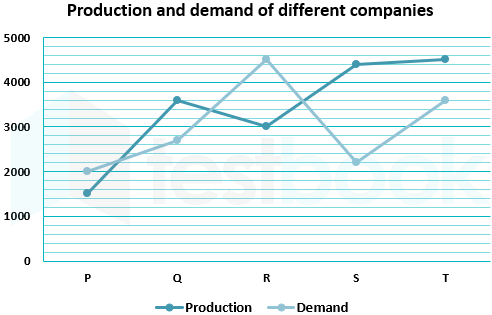
Directions: The following line graph shows the demand and production of different companies.

51

The demand of No of company P is what percent of the production of company R?

  1. ((a))

    20%

  2. ((b))

    331333\frac{1}{3}%

  3. ((c))

    30%

  4. ((d))

    662366\frac{2}{3}%

  5. ((e))

    None of these

Show Answer
Answer: ((a))

20%

52

What is the ratio of the companies having more demand than production to those having more production than demand?

  1. ((a))

    3 : 2

  2. ((b))

    2 : 3

  3. ((c))

    1 : 4

  4. ((d))

    4 : 1

  5. ((e))

    None of these

Show Answer
Answer: ((a))

3 : 2

53

The production of company Q is approximately what percent of the demand of company S?

  1. ((a))

    161%

  2. ((b))

    165%

  3. ((c))

    162%

  4. ((d))

    164%

  5. ((e))

    None of these

Show Answer
Answer: ((a))

161%

54

Find the average production of all the companies?

  1. ((a))

    2800

  2. ((b))

    3000

  3. ((c))

    3400

  4. ((d))

    3600

  5. ((e))

    None of these

Show Answer
Answer: ((a))

2800

55

Find the difference between the production of company P and T and the demand of company R and Q?

  1. ((a))

    1000

  2. ((b))

    1100

  3. ((c))

    1300

  4. ((d))

    900

  5. ((e))

    None of these

Show Answer
Answer: ((a))

1000

56

Find the wrong term in the given series:

80, 70, 55, 35, 10, -20, -50

  1. ((a))

    70

  2. ((b))

    -20

  3. ((c))

    10

  4. ((d))

    -50

  5. ((e))

    None

Show Answer
Answer: ((a))

70

57

Find the wrong term in the given series.

1, 11, 35, 79, 124, 251

  1. ((a))

    35

  2. ((b))

    79

  3. ((c))

    124

  4. ((d))

    251

  5. ((e))

    11

Show Answer
Answer: ((a))

35

58

Find the wrong term in the series.

0, 4, 18, 48, 100, 177, 294

  1. ((a))

    0

  2. ((b))

    18

  3. ((c))

    48

  4. ((d))

    100

  5. ((e))

    177

Show Answer
Answer: ((a))

0

59

Find the odd term out in the series.

361, 355, 348, 323, 274, 153

  1. ((a))

    153

  2. ((b))

    323

  3. ((c))

    355

  4. ((d))

    348

  5. ((e))

    361

Show Answer
Answer: ((a))

153

60

Find the wrong term in the following series.

6, 91, 584, 2935, 11756, 35277, 70558

  1. ((a))

    91

  2. ((b))

    70558

  3. ((c))

    584

  4. ((d))

    2935

  5. ((e))

    35277

Show Answer
Answer: ((a))

91

61

Rohit borrowed Rs. 18000 from Rashmi for 2 years at simple interest of rate 15%. Rohit lent this sum to Raunak at the same rate for the same time but at compound interest. Find the profit earned by Rohit in this transaction.

  1. ((a))

    Rs. 400

  2. ((b))

    Rs. 405

  3. ((c))

    Rs. 410

  4. ((d))

    Rs. 415

  5. ((e))

    Rs. 450

Show Answer
Answer: ((a))

Rs. 400

62

Amit starts a business with Rs.20,000 and Trisha joins the business 5 months later with an investment of Rs.25,000. After a year, they earn a profit of Rs.83,000. Find the shares of Amit and Trisha. 

  1. ((a))

    48000, 34000

  2. ((b))

    38000, 35000

  3. ((c))

    48000, 35000

  4. ((d))

    37000, 38000

  5. ((e))

    35000, 42000

Show Answer
Answer: ((a))

48000, 34000

63

Find the percentage change in area if the length of the rectangle is increased by 10% and breadth is decreased by 20%.

  1. ((a))

    12% decrease

  2. ((b))

    12 % increase

  3. ((c))

    8% decrease

  4. ((d))

    8% increase

  5. ((e))

    None of these 

Show Answer
Answer: ((a))

12% decrease

64

A milkman having 60 liters mixture of milk and water in ratio of 5 : 1.If he added 10 liters milk and 5 liters water in the mixture then what will be the new ratio of milk and water?

  1. ((a))

    4 : 1

  2. ((b))

    5 : 3

  3. ((c))

    4 : 2

  4. ((d))

    3 : 4

  5. ((e))

    4 :3

Show Answer
Answer: ((a))

4 : 1

65

The average weight of with 40 students was 52 kg. 3 students with average weight 20 left and 5 students with average weight 25 joined the class. Find the new average weight of the class?

  1. ((a))

    43

  2. ((b))

    51

  3. ((c))

    4354243\frac{5}{{42}}

  4. ((d))

    5134251\frac{3}{{42}}

  5. ((e))

    45

Show Answer
Answer: ((a))

43

Direction: Read the following table carefully and answer the questions given bellow it.

The table shows the number of students in four different colleges who have enrolled for two courses i.e., Master's Degree and Bachelor's Degree.

CollegesTotal students enrolled for the courses (Master's Degree + Bachelor's Degree)Percentage of students who have enrolled for the Master's Degree
A280045
B250065
C190050
D320060
66

What is the total number of students of all the colleges together?

  1. ((a))

    12,400

  2. ((b))

    11,000

  3. ((c))

    10,400

  4. ((d))

    14,200

  5. ((e))

    10,110

Show Answer
Answer: ((a))

12,400

67

The number of students enrolled for Bachelor's degree in college D is what percent of the total number of students in college B?

  1. ((a))

    47.3%

  2. ((b))

    45%

  3. ((c))

    55%

  4. ((d))

    62.5%

  5. ((e))

    51.2%

Show Answer
Answer: ((a))

47.3%

68

What is the total number of students who have enrolled for Bachelor's degree in colleges B, C and D together?

  1. ((a))

    3115

  2. ((b))

    2990

  3. ((c))

    3120

  4. ((d))

    3105

  5. ((e))

    3110

Show Answer
Answer: ((a))

3115

69

What is the difference between the number of students enrolled in Master's degree of college B and C together and ​the number of students enrolled in Bachelor's degree of college A and C together?

  1. ((a))

    64

  2. ((b))

    85

  3. ((c))

    75

  4. ((d))

    79

  5. ((e))

    80

Show Answer
Answer: ((a))

64

70

What is the ratio of the number of students of college A and C taken together to the number of students of college B and D taken together?

  1. ((a))

    47 : 57

  2. ((b))

    33 : 46

  3. ((c))

    53 : 51

  4. ((d))

    61 : 44

  5. ((e))

    49 : 57

Show Answer
Answer: ((a))

47 : 57

71

The present ages of Shailesh and Ramesh are in the ratio of 14 ∶ 17 respectively. Six years from now, their ages will be in the ratio of 17 ∶ 20 respectively. What is Ramesh’s present age?

  1. ((a))

    17 years

  2. ((b))

    51 years

  3. ((c))

    34 years

  4. ((d))

    28 years

  5. ((e))

    None of these 

Show Answer
Answer: ((a))

17 years

72

The speed of a boat in still water is 6 km/h. Time taken by the boat to cover a certain distance upstream is 3 hours more than the time taken to cover the same distance downstream. If the speed of the stream is 2 km/h, then what is the total distance (upstream and downstream) covered by the boat?

  1. ((a))

    24 km

  2. ((b))

    18 km

  3. ((c))

    36 km

  4. ((d))

    48 km

  5. ((e))

    46 km

Show Answer
Answer: ((a))

24 km

73

Train A crosses a stationary train B in 90 seconds and a pole in 30 seconds with the same speed. The length of the train A is 270 metres. What is the length of the stationary train B?

  1. ((a))

    540 metres

  2. ((b))

    270 metres

  3. ((c))

    810 metres

  4. ((d))

    Cannot be determined

  5. ((e))

    None of these

Show Answer
Answer: ((a))

540 metres

74

Pipes A, B and C together can fill a tank in 6 hours. Pipes A and B together can fill the tank in 9 hours. If pipes A, B and C are opened simultaneously, and after 3 hours, pipes A and B are closed, then how many hours will C alone require to fill the remaining tank?

  1. ((a))

    6

  2. ((b))

    9

  3. ((c))

    12

  4. ((d))

    18

  5. ((e))

    15

Show Answer
Answer: ((a))

6

75

A, B and C complete a work separately in 20, 40 and 60 days respectively. They started together but C left after 4 days of start and A left 3 days before the completion of the work. In how many days will the work be completed?

  1. ((a))

    134913\frac{4}{9}

  2. ((b))

    23

  3. ((c))

    144914\frac{4}{9}

  4. ((d))

    147914\frac{7}{9}

  5. ((e))

    14

Show Answer
Answer: ((a))

134913\frac{4}{9}

Directions: Study the given information carefully and answer the questions given below :

A total of 4500 employees is working in a company in three departments i.e. IT, Medical and Finance. The ratio of male employees to female employees in the organization is 47 : 43. The total number of employees in IT department is 1200. The number of male employees in IT department is same as female employees in Finance department. The ratio of male employees to female employees in Medical department is 17 : 19. The total number of employees in Finance department is 1500. The number female employees in IT department is 500.

76

What is the ratio of the male employees in IT department to that of female employees in Medical department?

  1. ((a))

    10 : 13

  2. ((b))

    14 : 17

  3. ((c))

    17 : 15

  4. ((d))

    9 : 11

  5. ((e))

    14 : 19

Show Answer
Answer: ((a))

10 : 13

77

What is the total number of female employees in Medical department and male employees in Finance department?

  1. ((a))

    1750

  2. ((b))

    1600

  3. ((c))

    1450

  4. ((d))

    1900

  5. ((e))

    1850

Show Answer
Answer: ((a))

1750

78

The number of employees in Finance and IT department is what percent of the total number of employees in the organization?

  1. ((a))

    60%

  2. ((b))

    50%

  3. ((c))

    33.33%

  4. ((d))

    45%

  5. ((e))

    65%

Show Answer
Answer: ((a))

60%

79

What is the difference between the number of employees in Medical department to that of Finance department?

  1. ((a))

    350

  2. ((b))

    250

  3. ((c))

    300

  4. ((d))

    400

  5. ((e))

    150

Show Answer
Answer: ((a))

350

80

What is the ratio of the employees in Medical department to the number of male employees in IT and Finance department together?

  1. ((a))

    6 : 5

  2. ((b))

    3 : 4

  3. ((c))

    6 : 7

  4. ((d))

    2 : 3

  5. ((e))

    3 : 5

Show Answer
Answer: ((a))

6 : 5

Attempt this paper under real exam conditions

Timed interface, section switching, instant scoring, and question-by-question analytics — free.

Start Timed Attempt