F lives on which of the following floor?
- ((a))
First
- ((b))
Second
- ((c))
Fourth
- ((d))
Seventh
- ((e))
Nineth
Show Answer
First
80 questions · 45 minutes · with answers · free
Direction: Study the following information and answer the following question.
Nine persons A, B, C, D, E, F, G, H and I are living in an apartment having Nine floors such that each floor is numbered from 1 to 9 where 9 is the topmost floor and 1 is the lowermost floor. Each person lives on a different floor.
H lives below E while G lives above F. I and E are not immediate neighbors. Five persons are living between B and I. D lives immediately below H on an even-numbered floor but not on the 2nd floor. Only one person lives between D and B. A and C are not at the adjacent floor. C is not at the lowermost floor. A lives above C but below E.
F lives on which of the following floor?
First
Second
Fourth
Seventh
Nineth
First
How many floors are there between B and C?
One
Two
Three
Four
Five
One
Which of the following is true according to the given arrangement of the persons?
A lives on the Fourth Floor.
There is two floors between E and H.
D lives two floors above G.
F lives immediate above C.
E does not live on top floor.
A lives on the Fourth Floor.
Who lives three floors below B?
H
D
C
I
A
H
Find odd one out from the following.
G - I
H - A
B - D
A - G
E - H
G - I
Directions: In the following question assuming the given statements to be True, find which of the conclusion among given conclusions is/are definitely true and then give your answers accordingly.
Statements:
D = F; B > C; D < C; A > B
Conclusions:
I. C ≥ F
II. B > F
Only I is true
Only II is true
Either I or II is true
Neither I nor II is true
Both I and II is true
Only I is true
Direction: In the following question assuming the given statements to be true, find which of the conclusion among given conclusions is/are definitely true and then give your answers accordingly.
Statements:
Y ≤ D ≥ P ≤ V; M ≤ Q = E = Y
Conclusions:
I. E ≥ P
II. Q > D
Only conclusion II is true.
Both conclusions I and II are true.
Only conclusion I is true.
Neither conclusion I nor II is true.
Either conclusion I or II is true.
Only conclusion II is true.
Directions: In the following questions assuming the given statements to be true, find which of the conclusion among given conclusions is/are definitely true and then give your answers accordingly.
Statement: Z > T ≥ U ≥ R = Q ≤ T
Conclusion I: Q ˂ Z
Conclusion II: U ≥ T
Only conclusion I follows.
Only conclusion II follows.
Either conclusion I or II follows.
Neither conclusion I nor II follows.
Both conclusions I and II follow.
Only conclusion I follows.
Directions: In the following question assuming the given statements to be True, find which of the conclusion among given conclusions is/are definitely true and then give your answers accordingly.
Statements:
D ≥ E > F = A ≤ U < L ≥ T = R
Conclusions:
I. F < L
II. D > A
None is True
Both I and II are True
Only II is True
Only I is True
Either I and II is True
None is True
Directions: Study the following information carefully and answer the questions given below:
A transport company piled up seven boxes J, K, L, M, N, O and P one above another which were received from seven different countries i.e. Brazil, Denmark, Finland, Poland, Spain, Vietnam and Hungary but not necessarily in the same order.
There are three boxes between M and J. J is not received from Denmark. There are only two boxes between M and the box which is received from Brazil and Box M is above the box received from Brazil. Box N is not adjacent to the box received from Finland. Box which is received from Finland is above M but not immediately above M. Only three boxes are between L and the box which is received from Finland. The box which is received from Hungary is immediately above L. The box which is received from Poland is immediately above the box P. Only one box is there between K and N. Neither box K nor J is received from Spain.
Which of the following box is received from country Vietnam?
K
L
M
N
J
K
Which of the following condition is correct regarding country Spain with respect to box N?
There are one box between N and the box received from Spain.
N is immediately above of the box received from Spain.
The box received from Spain is related to the box immediately above N.
All of the above is true
None is true
There are one box between N and the box received from Spain.
Find the odd one out:
M - Denmark
O - Spain
J - Poland
P - Hungary
None of these
M - Denmark
From which country is the box ‘O’ received?
Hungary
Brazil
Finland
Poland
Can’t be determined
Hungary
How many box is/are there between M and P?
One
Two
Three
Four
None
One
In a certain code language, 'laptop are mouse' is written as 'gu cu du' and 'mouse are keyboard' is written as 'gu du au'. Which of the following will be the code for 'are'?
gu
Either 1 or 3
du
au
None of these
gu
Directions: Study the following information and answer the given questions.
Eight persons M, R, S, T, H, C, B and K sitting around a circle. Some of them are facing inside the centre while some are facing outside the centre. R sits third to the right of S who is facing inside the centre. C sits second to the left of R. T sits third to the right of C. K sits second to the left of C. M sits second to the right of R. B sits third to the right of M and does not sit second to the right of S.
K and R face the same direction but in opposite direction to B. B and T face the opposite direction. H sits second to the right of B. M and H face the same direction but in opposite direction to T.
How many persons facing inside the circle?
One
Two
Three
Four
Five
One
Who sits between T and B?
R
C
S
M
H
R
How many persons sits between M and B when counted to the left of M?
One
Two
Three
Four
Five
One
Who is fourth to the left of K?
R
T
H
M
C
R
Who is second to the left of C?
K
S
R
H
T
K
If 1 is added to each even digit and 1 is subtracted from each odd digit in the number 7846314 , then how many number/numbers are repeated in the new number formed?
Three
Four
One
Two
None
Three
Four of the following five are alike in certain way based from a group, find the one the does not belong to that group?
EHL
PSW
ILP
RUX
GJN
EHL
Directions: In the question below there are three statements followed by two conclusions- I and II. You have to take the three given statements to be true even if they seem to be at variance with commonly known facts and then decide which of the given conclusions logically follows from the three statements disregarding commonly known facts.
Statements:
Some actions are movies.
Every movie is drama.
None of the dramas are fictions.
Conclusions:
I. Some actions are dramas.
II. No action is fiction.
Only conclusion II follows
Neither conclusion I nor conclusion II follows
Only conclusion I follows
Both conclusion I and conclusion II follow
None of the above
Only conclusion II follows
Directions: In the question below there are three statements followed by two conclusions I and II. You have to take the three given statements to be true even if they seem to be at variance from commonly known facts and then decide which of the given conclusions logically follows from the three statements disregarding commonly known facts.
Statements:
No keyboards are laptops.
Some laptops are monitors.
All lasers are keyboards.
Conclusions:
I. Some Keyboard being monitors is a possibility
II. No lasers are laptops.
Only conclusion I follows
Both the conclusions I and II follow
Neither conclusion I nor II follow
Only conclusion II follows
Either conclusion I or II follows
Only conclusion I follows
Direction: In the question below three statements are given followed by two conclusions numbered I and II. You have to take the given statements to be true even if they seem to be at variance with commonly known facts. Read all the conclusions and then decide which of the given conclusions logically follows from the given statements disregarding commonly known facts.
Statements:
I. Only a few cylinders are designed.
II. Some designed are simple.
III. No rich is a cylinder.
Conclusions:
I. All cylinders being rich is a possibility.
II. Some rich are not simple.
Only conclusion I follows
Only conclusion II follows
Both conclusions follow
None follows
Either conclusion I or II follows
Only conclusion I follows
Directions: In the following questions three statements are given below followed by two conclusions numbered I and II. You have to take the given statements to be true even if they seem to be at variance from commonly known facts. Read both the conclusions and decide which of the given conclusions logically follows from the given statements.
Statements:
I. Few Bowls are Plates.
II. No Plate is Spoon.
III. Some Spoons are Pans.
Conclusions:
I. All Pans being Plates is a possibility.
II. Some Bowls are Spoons.
Only conclusion I is true
Only conclusion II is true
Both conclusions I and II are true
Either conclusion I or II is true
Neither I nor II is true
Only conclusion I is true
Directions: Study the following information carefully and answer the questions given below:
A certain number of people are sitting in a straight line facing North.
Only four people sit between H & G. Fifteen persons are sitting between J and A. D sits second to the left of G. H sits eight from the left end of the line. F sits fourth to the right of D. As many people sit between H and F as between F and B. C sits third to the right of B. The number of people sitting between H and D is one less than the number of people sitting to the right of C. J is sitting sixth to the right of G.
Who among the following persons sits fifth to the right of A?
J
B
F
G
H
J
If K is third from the extreme right end then who among the following person sits fourth to the left of K?
C
B
F
D
An uncertain person
C
How many persons sitting in a row?
20
23
27
25
28
20
Directions: Study the given information and answer the questions that follow.
Point A is 6 meters to the West of B while B is 4 meters to the North of C. G is 7 meters to the West of H and 9 meters to the North of F. E is 8 meters to the south of D. H is 2 meters North of I. F is 16 meters to the to the East of E. D is 6 meters to the West of C.
What is the shortest distance between C and E?
10 meters
12 meters
14 meters
8 meters
None of these
10 meters
What is the direction of I with respect to D?
East
West
South West
South East
North East
East
Directions: Read the following information carefully and answer the questions given below.
In a certain code,
'must respect old rules' is code for 'za la ka ga',
'we respect the elders' is code for 'za fa sa na ,
'we must be elders' is code for ' na la da sa' ,
'be elders respect younger' is code for 'wa sa za da'.
'da' code represnt which word?
be
we
respect
must
elders
be
What is the possible code of "we must respect elders"?
za na za sa
na za sa wa
la na za sa
ga na za sa
na za sa da
za na za sa
'ga' code represent which word?
be
old
respect
rules
either option II or IV
be
if code for 'respect must old' is 'za la ga' then what is the code for 'rules'?
na
da
ka
za
ga
na
Directions: Study the following information carefully and answer the questions given below:
Eight persons P, Q, R, S, T, U, V and W were born on the same date and same month of different years viz. 1961, 1966, 1969, 1972, 1977, 1979, 1985, and 1994 but not necessarily in the same order. The calculation of their age is based on the year 2021.
Two persons were born between the one who was born in an even-numbered year and U, who was born immediately before Q. The number of persons born before Q is as same as the number of persons born after W. The difference between the ages of P and V is 5. Three persons were born between V and U. R was not born in an even-numbered year and was born after S. T was not born immediately after R.
Which of the following pair of person’s name and birth year doesn’t form a group?
V – 1977
Q – 1966
T – 1961
P – 1972
R – 1979
V – 1977
W was born in which year?
1969
1966
1979
1985
None of these
1969
How many people were born between P and Q?
None
One
Two
Three
More than three
None
What is the age difference between R and U?
24
8
18
33
13
24
Who was born in the year 1969?
Q
S
W
R
None of these
Q
What approximate value should come in the place of question mark (?) in the following question?
74.95 – 2.93 × (35.96/5.99 ÷ 2.99) ÷ (1/2.99) + 5.96 = ?
53
67
57
63
47
53
What approximate value should come in the place of question mark (?) in the following question?
24.99% of 399.99 + 44.99% of 599.99 = ? + 59.99% of 499.99
80
90
70
60
100
80
What approximate value will come in place of the question mark (?) in the following questions? (You are not expected to calculate the exact value)
8.001 × 520.09 ÷ ? = √289.03 - 27.97 × 7.02 + 243.1
60
65
70
75
80
60
What approximate value should come in the place of question mark (?) in the following question?
461.98 ÷ 20.96 × ∛728.98 + (6.96)2 = ?
256
241
237
247
226
256
What approximate value should come in the place of question mark (?) in the following question?
27.982 - [17.962 ÷ 26.96] + 5.982 = ? - 69.98
818
758
738
798
878
818
A can do the work in 20 days, while B alone can assemble it in 30 days. If they construct it together and get an installment of Rs. 6300. What is B's offer?
Rs. 5620
Rs. 4520
Rs. 6750
Rs. 1850
Rs. 2520
Rs. 5620
15 years ago the ratio of ages of A and B was 4: 5 years. 5 years hence the ratio of their ages will be 13: 15. Find the ratio between sum and difference of their present ages.
51: 4
47: 55
55: 47
4: 51
None of these
51: 4
475 Liter of mixture contains milk and water in the ratio of 12 : b respectively, after addition of 42 liter of milk and 53 liter of water then the ratio of the milk and water becomes in the resultant mixture becomes 9 : 10 respectively, then find the quantity of water Initially ?
247L
280L
295L
256L
270L
247L
Difference between the total CI and total SI for 2 years on a certain sum at 20% per annum is Rs. 420. What will be the simple interest earned on the same sum at 25% per annum for 3 years?
Rs. 5725
Rs. 6525
Rs. 7375
Rs. 7875
Rs. 7950
Rs. 5725
In the given question, two equations numbered l and II are given. Solve both equations and mark the appropriate answer.
I. y2 – 6y – 112 = 0
II. x2 + 3x – 40 = 0
x ≤ y
x > y
x ≥ y
x < y
x = y or relation between x and y can not be established
x ≤ y
In the given questions, two equations numbered l and II are given. You have to solve both the equations and mark the appropriate answer
I. x2 - 25x + 156 = 0
II. y2 – 23y + 132 = 0
x < y
x > y
x ≤ y
x ≥ y
x = y or the relation between x and y can't be established.
x < y
In the following question, two equations are given. You have to solve the equation and mark the answer accordingly.
I. x2 - 9x + 20 = 0
II. y2 - 27y + 180 = 0
x > y
x < y
x ≥ y
x ≤ y
No relation in x and y or x = y
x > y
In the given question, two equations numbered l and II are given. Solve both the equations and mark the appropriate answer.
I. 2x2 - 33x + 136 = 0
II. 2y2 - 37y + 171 = 0
x > y
x < y
x ≥ y
x ≤ y
x = y or relationship between x and y cannot be established
x > y
In the given question, two equations numbered l and II are given. You have to solve both the equations and mark the appropriate answer -
I. 10x2 – 29x + 10 = 0
II. 4y2 – 11y + 6 = 0
x > y
x < y
x ≥ y
x ≤ y
x = y or relationship between x and y cannot be established
x > y
Direction: "The following question is accompanied by two statements (I) and (II). You have to determine which statements(s) is/are sufficient/necessary to answer the questions.
What will be the length of Train A?
Statement I: The Train A crosses a man running at the speed of 10 m/s in the opposite direction in 10 sec and the speed of the train is x m/s.
Statement II: Train B which has double the speed of Train A and crosses the pole in 5 sec and the length of the Train B is 500 m.
The statement I alone is sufficient to answer the question, but the statement II alone is not sufficient.
The statement II alone is sufficient to answer the question, but the statement I alone is not sufficient.
Both the statements I and II together are needed to answer the question.
Either statement I alone or statement II alone is sufficient to answer the question.
Neither statement I nor statement II is sufficient to answer the question.
The statement I alone is sufficient to answer the question, but the statement II alone is not sufficient.
Direction: The following question is accompanied by two statements (I) and (II). You have to determine which statements(s) is/are sufficient/necessary to answer the questions.
What is the volume of a cylindrical water tank?
Statement I. The sum of radius and height of the cylindrical tank is 28m and ratio of its radius to its height is 1 : 3.
Statement II. Area of the base of the cylindrical tank is 154m2 and height of the cylindrical tank is 21m.
The statement I alone is sufficient to answer the question, but the statement II alone is not sufficient.
The statement II alone is sufficient to answer the question, but the statement I alone is not sufficient.
Both the statements I and II together are needed to answer the question.
Either statement I alone or statement II alone is sufficient to answer the question.
Neither statement I nor statement II is sufficient to answer the question
The statement I alone is sufficient to answer the question, but the statement II alone is not sufficient.
Direction: Each of the questions given below consists of 2 statements, number I and II respectively. Please read the questions carefully and decide which of the statement (s) is / are necessary to answer the questions.
Find the ratio of shares of a partners.
Statement I: Two partners A and B invested Rs. 22,000 each. After 6 months A withdraw Rs. 7,000 and B introduced Rs. 8000 more in the period of 1 year..
Statement II: Total capital invested by A and B is Rs. 2,32,000 and Rs. 3,22,000 for 1 year
The data in statement I alone is sufficient to answer the question, while the data in statement II alone is not sufficient to answer the question.
The data in statement II alone is sufficient to answer the question, while the data in statement I alone is not sufficient to answer the question.
Either statement I or statement II alone is sufficient to answer the question.
The data in both the statements I and II is not sufficient to answer the questions.
The data in both the statement I and II together is necessary to answer.
The data in statement I alone is sufficient to answer the question, while the data in statement II alone is not sufficient to answer the question.
Directions: Answer the questions based on the information given below.
The table given below presents information about the total and unoccupied numbers of rooms in five distinct buildings within a society.
| Building | Total number of rooms | Number of unoccupied rooms |
|---|---|---|
| A | 162 | 90 |
| B | 244 | 144 |
| C | 164 | 108 |
| D | 232 | 136 |
| E | 204 | 120 |
Note: Total number of rooms in a building = Number of occupied rooms in the building + Number of unoccupied rooms in the same building
The sum of the total number of rooms in building 'B' and building 'D' together is what percentage of the sum of the number of 'unoccupied' rooms in building 'C' and building 'E' together?
206.66%
208.77%
209.33%
210.88%
211.44%
206.66%
What is the average total number of 'occupied' rooms in buildings 'A,' 'D,' and 'E' together?
72
75
78
81
84
72
The sum of the number of 'unoccupied' rooms in building 'A' and building 'C together is what percentage more or less than the sum of the number of 'unoccupied' rooms in building 'B' and building 'D' together?
26.14%
27.28%
28.14%
29.28%
30.14%
26.14%
What is the respective ratio between the number of 'occupied' rooms in building 'C' and building 'D' together and the total number of rooms in building 'A' and building 'E' together?
73 : 185
73 : 186
76 : 183
76 : 185
77 : 183
73 : 185
What is the average cost of the total number of rooms in building 'A' if the cost of an 'unoccupied' room is 7200 Rs. and the cost of an 'occupied' room is 9000 Rs. for each room in building 'A'?
7400 Rs.
7500 Rs.
7600 Rs.
7800 Rs.
8000 Rs.
7400 Rs.
Find the wrong term in the following series.
529, 841, 961, 1089, 1681, 1849
529
841
961
1089
1681
529
Find the wrong term in the following series.
312, 156, 234, 585, 2049.5, 9213.75
585
2049.5
234
312
156
585
Find the wrong term in the following series.
12, 25, 50, 150, 600, 3000
12
25
50
600
150
12
Find the wrong term in the following series.
10, 31, 72, 141, 248, 412
10
31
412
248
141
10
Find the wrong number in the given series:
10, 9, 13, 12, 20, -5
-5
9
13
10
12
-5
A and B invested Rs. 6000 and Rs. 12000 respectively in a business. After 6 months C joined and B left 9 months after the starting of the business. If the profit share of C at the end of the year is Rs. 18900 out of the total profit which is Rs. 50400, then find the amount invested by C?
Rs. 12000
Rs. 15000
Rs. 18000
Rs. 21000
Rs. 24000
Rs. 12000
The cost price of an article is Rs. 800. Karan sells it to Arun at a profit of 10%. Arun sells the same article to his customer and earns a profit of 5%. Find the selling price of the article by Arun.
Rs. 100
Rs. 256
Rs. 675
Rs. 122
Rs. 924
Rs. 100
The ratio of the Mother's age named Sangeeta to her daughter's age named Vineeta is 9 : 5. The product of their ages is 1125. The ratio of Sangeeta to Vineeta after five years will be:
1 : 3
2 : 3
3 : 4
5 : 3
None of these
1 : 3
Two boats A and B start towards each other from two places, 455 km apart. Speed of the boats A and B in still water are 28 km/hr and 37 km/hr respectively. If A proceeds downstream and B proceeds upstream, they will meet after?
13 hours
5 hours
15 hours
7 hours
6.5 hours
13 hours
The length of train P and that of train Q is 350m and 440m respectively and their speed is 54 km/hr and 108 km/hr respectively. What will be the sum of time taken by train P and train Q to cross each other while moving in same direction and opposite direction?
56.77 seconds
79.75 seconds
90 seconds
56.77 seconds
Directions: Answer the questions based on the information given below.
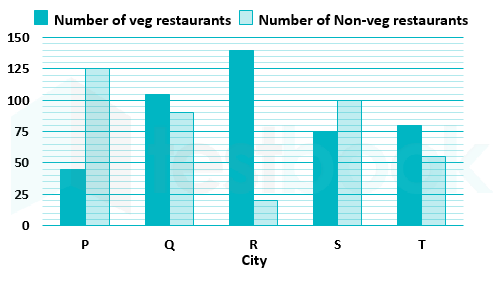
The provided bar graph illustrates the distribution of vegetarian (veg) and non-vegetarian (non-veg) restaurants across five distinct cities.
Note : Total number of restaurants in a city = Number of veg restaurants + Number of non - veg restaurants in the same city.
What is the respective ratio between the total number of restaurants in city 'T' and the number of 'veg' restaurants in city 'P' and city 'Q' together?
3 : 5
5 : 8
9 : 10
15 : 17
27 : 29
3 : 5
The total number of restaurants in city 'R' is what percentage more or less than the total number of restaurant in city 'S'?
5.71%
8.57%
9.37%
11.42%
14.28%
5.71%
If the number of 'veg' restaurant in city 'X' is 40% less than that in city 'T' then what is the number of 'veg' restaurants in city 'X', city 'S' and city 'T' together?
203
213
223
233
243
203
What is the average number of non - veg restaurants in city 'Q', city 'R' and city 'S' together?
55
60
65
70
75
55
If the total number of cafes and restaurants in city 'P' is 220 and the number of cafes in city 'S' is 80% more than that in city 'P' then the total number of cafes in city 'P' and city 'S' together is what percentage more/less than the total number of non veg restaurants in city 'P' and city 'S' together?
33.33%
34.44%
35.55%
36.66%
37.77%
33.33%
The average weight of a group of 60 girls was 46 kg. It was later found that the weight of one of the girls was read as 44 kg. whereas her actual weight was 28 kg. What is the actual average weight of the group of 60 girls?
45 kg
46.73 kg
45.73 kg
48.76
can’t be determined
45 kg
The height of a cylinder is 2 times the radius of base of cylinder. If the area of base of the cylinder is 154 cm2. Find the curved surface area of the cylinder.
356 cm2
560 cm2
616 cm2
486 cm2
455 cm2
356 cm2
Two Pipes A and B can fill the reservoir separately in 25 and 30 minutes respectively, but when the waste pipe is open they together can fill the reservoir in 25 minutes. What is the time taken by the waste pipe to empty the reservoir?
20 minutes
30 minutes
60 minutes
15 minutes
None of these
20 minutes
Timed interface, section switching, instant scoring, and question-by-question analytics — free.
Start Timed Attempt