Official Paper

RRB Officer Scale-I (4 August 2019) Prelims Memory Based Paper (Previous Year Paper)

80 questions · 45 minutes · with answers · free

Reasoning (40 questions)

Direction: Study the following information carefully and answer the questions given below.

Nine people P, Q, R, S, T, U, V, W and X are seated in a straight line facing North but not necessarily in the same order. S and R are sitting at the extreme ends. P sits second to the left of R. T sits third to the left of V. Neither of the two people sitting between U and R is T or V. R and X are not neighbours. S sits third to the left of W.

1

Who among the following sits between V and P?

  1. ((a))

    U

  2. ((b))

    S

  3. ((c))

    T

  4. ((d))

    X

  5. ((e))

    W

Show Answer
Answer: ((a))

U

2

What is the position of X with respect to U?

  1. ((a))

    Third to the left

  2. ((b))

    Fourth to the right

  3. ((c))

    Second to the right

  4. ((d))

    Second to the left

  5. ((e))

    Third to the right

Show Answer
Answer: ((a))

Third to the left

3

Which of the following is a pair of neighbours?

  1. ((a))

    W, U

  2. ((b))

    P, X

  3. ((c))

    S, T

  4. ((d))

    X, V

  5. ((e))

    U, W

Show Answer
Answer: ((a))

W, U

4

How many persons are seated between W and Q?

  1. ((a))

    More than four

  2. ((b))

    Two

  3. ((c))

    Three

  4. ((d))

    Four

  5. ((e))

    One

Show Answer
Answer: ((a))

More than four

5

Which of the following statements is true with respect to the given arrangement?

  1. ((a))

    Two people sit to the left of T

  2. ((b))

    R sits second to the right of V

  3. ((c))

    U and Q are neighbours

  4. ((d))

    Only one person sits to the right of Q

  5. ((e))

    All are true

Show Answer
Answer: ((a))

Two people sit to the left of T

Directions: Study the information given below carefully and answer the questions that follow.

A person starts walking towards the north from point P, after walking 15 m he reaches point A and then he takes a right turn and walks 7 m to reach point Q and after that, he walks in the southern direction and walks 10 m to reach point M. Point B is 5 m east of point M. Point R is 22 m north of B. Point C is 10 m west of R.

6

What is the direction of P with respect to B?

  1. ((a))

    South-east

  2. ((b))

    North-west

  3. ((c))

    South-west

  4. ((d))

    East

  5. ((e))

    None of these

Show Answer
Answer: ((a))

South-east

7

What is the shortest distance between Q and B?

  1. ((a))

    √125 m

  2. ((b))

    √124 m

  3. ((c))

    √135 m

  4. ((d))

    √175 m

  5. ((e))

    √165 m

Show Answer
Answer: ((a))

√125 m

8

What is the direction of R with respect to the person’s initial position?

  1. ((a))

    North

  2. ((b))

    West

  3. ((c))

    South-west

  4. ((d))

    North-East

  5. ((e))

    None of these

Show Answer
Answer: ((a))

North

Direction: Read the instructions carefully and answer the question below.

Eight people L, M, N, O, P, Q, R and S go through a fitness test where their weights are measured. A list was prepared in which the weights of these eight candidates were written in increasing order.

Q is lighter than at least seven of them while M is heavier than at least seven of them. P is heavier than two people while L is lighter than two people. R is heavier than Q but lighter than P. O is heavier than three persons but definitely lighter than S. N is lighter than only one person.

9

If the list is rearranged in decreasing order, who will occupy the second position?

  1. ((a))

    Q

  2. ((b))

    P

  3. ((c))

    M

  4. ((d))

    N

  5. ((e))

    O

Show Answer
Answer: ((a))

Q

10

How many persons are lighter than P?

  1. ((a))

    Four

  2. ((b))

    Three

  3. ((c))

    Two

  4. ((d))

    One

  5. ((e))

    None of these

Show Answer
Answer: ((a))

Four

Direction: Study the following information carefully and answer the question given below.

Some persons are sitting in a straight line. Some are facing South and some are facing North.C is sitting 2nd to the right of B and both are facing opposite direction. F is sitting 5th to the right of A and facing North. G is sitting at 9th position from the left end and facing north. D is sitting 3rd to the left of H and both are facing opposite direction. E is sitting to the immediate right of F and both are facing opposite direction. B is sitting 10th to the right of D and both are facing opposite direction. A is at the extreme left and H is at the right extreme and both are facing North. No seats are available between A and B.

11

Who is sitting at the middle?

  1. ((a))

    F

  2. ((b))

    E

  3. ((c))

    G

  4. ((d))

    D

  5. ((e))

    No one

Show Answer
Answer: ((a))

F

12

Who is sitting 3rd to the left of C?

  1. ((a))

    E

  2. ((b))

    A

  3. ((c))

    B

  4. ((d))

    C

  5. ((e))

    F

Show Answer
Answer: ((a))

E

13

How many seats are there in the row?

  1. ((a))

    15

  2. ((b))

    9

  3. ((c))

    12

  4. ((d))

    16

  5. ((e))

    7

Show Answer
Answer: ((a))

15

14

If the position of C and F is interchanged, then who are immediate neighbours of F?

  1. ((a))

    B

  2. ((b))

    F

  3. ((c))

    E

  4. ((d))

    G

  5. ((e))

    No one

Show Answer
Answer: ((a))

B

15

Who is sitting 6th to the left of H?

  1. ((a))

    G

  2. ((b))

    E

  3. ((c))

    F

  4. ((d))

    C

  5. ((e))

    B

Show Answer
Answer: ((a))

G

There are 3 generations in a family of 6 members. Norya is a grandson of Roshan who is married to Toshin. Rishita is the mother of Drishti who is married to Arvind. Toshin is the father of Arvind but Arvind is not a daughter of Roshan.

16

Who is the daughter-in-law of Roshan?

  1. ((a))

    Rishita

  2. ((b))

    Drishti

  3. ((c))

    Norya

  4. ((d))

    Toshin

  5. ((e))

    None of the above

Show Answer
Answer: ((a))

Rishita

17

How many female members does the family have?

  1. ((a))

    One 

  2. ((b))

    Two

  3. ((c))

    Four

  4. ((d))

    Three

  5. ((e))

    Five

Show Answer
Answer: ((a))

One 

18

If Rishita is married to Vinayak then how is Arvind related to Vinayak?

  1. ((a))

    Son - in - law

  2. ((b))

    Father - in - law

  3. ((c))

    Sister - in - law

  4. ((d))

    Daughter - in law

  5. ((e))

    Mother

Show Answer
Answer: ((a))

Son - in - law

Directions: Study the following information carefully to answer the given questions:

Eight friends - P, Q, R, S, T, U, V and W - are sitting around a circular table, but not necessarily in the same order, three of them are facing inside and the rest are facing outside. Q sits second to the left of R. Only 3 people sit between R and S. T is an immediate neighbour of the one who is second to the left of S. T is not an immediate neighbour of Q and R. P and U are immediate neighbours of each other. W sits second to the left of V. V faces inside. P sits opposite to W.

19

Who sits second to the right of T?

  1. ((a))

    P

  2. ((b))

    U

  3. ((c))

    V

  4. ((d))

    Q

  5. ((e))

    None of the above

Show Answer
Answer: ((a))

P

20

How many people sit between Q and U?

  1. ((a))

    2

  2. ((b))

    3

  3. ((c))

    4

  4. ((d))

    1

  5. ((e))

    None

Show Answer
Answer: ((a))

2

21

Who sits to the immediate left of the person who sits second to the left of W?

  1. ((a))

    Q

  2. ((b))

    R

  3. ((c))

    P

  4. ((d))

    T

  5. ((e))

    None of the above

Show Answer
Answer: ((a))

Q

22

Four of the following options are similar in a particular way, find the odd one out out?

  1. ((a))

    Q

  2. ((b))

    W

  3. ((c))

    U

  4. ((d))

    P

  5. ((e))

    S

Show Answer
Answer: ((a))

Q

23

Four of the following options are similar in a particular way, find the odd one out out?

  1. ((a))

    Q-W

  2. ((b))

    R-V

  3. ((c))

    U-P

  4. ((d))

    T-U

  5. ((e))

    S-T

Show Answer
Answer: ((a))

Q-W

Direction: Read the information carefully and answer the question asked below.

Eight people P, Q, R, S, T, U, V, and W have to attend a meeting in October, November, December, and January in this order. In each month the meeting is on either 7th or 14th of the month. Only one person attends the meeting on a given date.

T attends the meeting on 7th of the month which has only 30 days. Only three people attend the meeting between T and V. Two people attend the meeting between V and S. R does not attend the meeting on 14th of any months. R and P attend the meeting in the same month but not in December. W and S attend the meeting on the same date but W is not the last one to attend the meeting. Q does not attend the meeting on even number date.
24

Who among the following attends the meeting on 14th October?

  1. ((a))

    Q

  2. ((b))

    R

  3. ((c))

    P

  4. ((d))

    S

  5. ((e))

    T

Show Answer
Answer: ((a))

Q

25

Q attends the meeting on which of the following day?

  1. ((a))

    November – 14th

  2. ((b))

    December – 7th

  3. ((c))

    January – 7th

  4. ((d))

    November – 7th

  5. ((e))

    December – 14th

Show Answer
Answer: ((a))

November – 14th

26

How many people attend the meeting between T and W?

  1. ((a))

    None

  2. ((b))

    One

  3. ((c))

    Two

  4. ((d))

    Three

  5. ((e))

    More than three

Show Answer
Answer: ((a))

None

27

Four among the five are the same in a certain way and thus form a group, which of the following does not belong to that group?

  1. ((a))

    R

  2. ((b))

    T

  3. ((c))

    Q

  4. ((d))

    V

  5. ((e))

    U

Show Answer
Answer: ((a))

R

28

Who among the following attends the meeting in November?

  1. ((a))

    T, S

  2. ((b))

    R, P

  3. ((c))

    Q, W

  4. ((d))

    V, U

  5. ((e))

    T, P

Show Answer
Answer: ((a))

T, S

29

In the given word ‘DISCLAIMER’ if the vowels are changed to the next letter and the consonants are changed to the previous letters as per the alphabetical series, then which letter/letters are repeated more than once.

  1. ((a))

    B, J

  2. ((b))

    L

  3. ((c))

    K,L

  4. ((d))

    J,F

  5. ((e))

    F

Show Answer
Answer: ((a))

B, J

30

How many such pairs of letters are there in the word ‘IMPERATIVE’, each of which has as many letters between them in the word (both forward and backward direction) as they have between them in the English Alphabet?

  1. ((a))

    One

  2. ((b))

    Two

  3. ((c))

    Three

  4. ((d))

    Four

  5. ((e))

    More than Four

Show Answer
Answer: ((a))

One

31

Direction: In the question below are given three statements followed by two conclusions numbered I and II. You have to take the given statements to be true even if they seem to be at variance with commonly known facts. Read all the conclusions and then decide which of the given conclusions logically follows from the given statements disregarding the commonly known facts.

Statement:

Some juices are beverages

No beverage is a drink.

Some drinks are teas.

Conclusion:

I. All juices are teas.

II. Some teas are not beverages.

  1. ((a))

    Only I follows

  2. ((b))

    Only II follows

  3. ((c))

    Either I or II follows

  4. ((d))

    Neither I nor II follows

  5. ((e))

    Both I and II follow

Show Answer
Answer: ((a))

Only I follows

32

Direction: In the question below are given three statements followed by two conclusions numbered I and II. You have to take the given statements to be true even if they seem to be at variance with commonly known facts. Read all the conclusions and then decide which of the given conclusions logically follows from the given statements disregarding commonly known facts.

Statement:

Some pins are syringes

Only a few syringes are needles.

No needle is a pins.

Conclusion:

I. All needles being syringes is a possibility.

II. Some syringes are not pins.

  1. ((a))

    Only I follows

  2. ((b))

    Only II follows

  3. ((c))

    Either I or II follows

  4. ((d))

    Neither I nor II follows

  5. ((e))

    Both I and II follow

Show Answer
Answer: ((a))

Only I follows

33

Direction: In the question below are given three statements followed by two conclusions numbered I and II. You have to take the given statements to be true even if they seem to be at variance with the commonly known facts. Read all the conclusions and then decide which of the given conclusions logically follows from the given statements disregarding the commonly known facts.

Statement:

Only a few chemicals are pesticides.

Some pesticides are medicines.

Some medicines are not chemicals

Conclusion:

I. All chemicals can be medicines.

II. Some chemicals are medicines.

  1. ((a))

    Only I follows

  2. ((b))

    Only II follows

  3. ((c))

    Either I or II follows

  4. ((d))

    Neither I nor II follows

  5. ((e))

    Both I and II follow

Show Answer
Answer: ((a))

Only I follows

34

Direction: In the question below are given three statements followed by two conclusions numbered I and II. You have to take the given statements to be true even if they seem to be at variance with commonly known facts. Read all the conclusions and then decide which of the given conclusions logically follows from the given statements disregarding commonly known facts.

Statement:

Only a few dogs are cats.

No cat is a wolf.

Some wolf are dogs.

Conclusion:

I. All wolf are cats.

II. Some dogs are not wolf.

  1. ((a))

    Only I follows

  2. ((b))

    Only II follows

  3. ((c))

    Either I or II follows

  4. ((d))

    Neither I nor II follows

  5. ((e))

    Both I and II follow

Show Answer
Answer: ((a))

Only I follows

35

Direction: In the question below are given three statements followed by two conclusions numbered I and II. You have to take the given statements to be true even if they seem to be at variance with commonly known facts. Read all the conclusions and then decide which of the given conclusions logically follows from the given statements disregarding commonly known facts.

Statements:

Only a few wines are cashews.

Few bottles are wines.

No dot is cashew.

Conclusion:

I. At least some wines are dots.

II. All cashews being bottles is a possibility.

  1. ((a))

    Only I follows

  2. ((b))

    Only II follows

  3. ((c))

    Either I or II follows

  4. ((d))

    Neither I nor II follows

  5. ((e))

    Both I and II follow

Show Answer
Answer: ((a))

Only I follows

Directions: Read the following information carefully and answer the questions which follow:

There are six people living on different floors in the same building having six floors numbered one to six (the ground floor is numbered 1, the floor above it, number 2 and so on and the topmost floor is numbered 6).

Q lives just below the floor of R, whose age is 5 years. Only two people live between the floors on which Q and U live. The one whose age is 10 years lives below Q. The one whose age is 20 years lives on the topmost floor. S does not live on an odd-numbered floor.  S lives on a floor between U and Q and his age is 15 years. U is 5 years elder than P. T does not live on the topmost floor. The one who lives just above T is 3 years elder than T. Q lives on an even-numbered floor but not on the 4th floor.

36

Who amongst the following lives on the floor between the floors on which Q and S live?

  1. ((a))

    R

  2. ((b))

    T

  3. ((c))

    U

  4. ((d))

    P

  5. ((e))

    Cannot be determined

Show Answer
Answer: ((a))

R

37

Who amongst the following lives on floor number 5?

  1. ((a))

    P

  2. ((b))

    Q

  3. ((c))

    T

  4. ((d))

    U

  5. ((e))

    R

Show Answer
Answer: ((a))

P

38

What is the age of Q?

  1. ((a))

    13 years

  2. ((b))

    5 years

  3. ((c))

    25 years

  4. ((d))

    20 years

  5. ((e))

    Either 1) or 2)

Show Answer
Answer: ((a))

13 years

39

How many years U is elder than R?

  1. ((a))

    20 years

  2. ((b))

    10 years

  3. ((c))

    2 years

  4. ((d))

    5 years

  5. ((e))

    7 years

Show Answer
Answer: ((a))

20 years

40

On which of the following floors does R live?

  1. ((a))

    3rd

  2. ((b))

    5th

  3. ((c))

    1st

  4. ((d))

    4th

  5. ((e))

    Cannot be determined

Show Answer
Answer: ((a))

3rd

Quantitative Aptitude (40 questions)

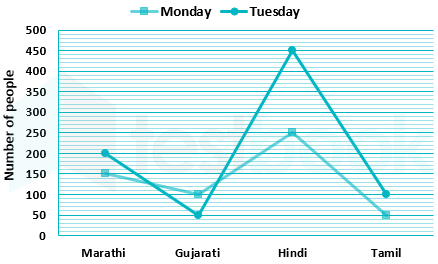
Direction: The following line graph shows the number of Peoples who are working in certain institute and speaks four different language. Study the following data and answer the following questions:

41

The average number of people who speak four languages on Monday is -

  1. ((a))

    129.5

  2. ((b))

    130.5

  3. ((c))

    134

  4. ((d))

    139

  5. ((e))

    137.5

Show Answer
Answer: ((a))

129.5

42

The difference between the number of people who speak Hindi (on Monday and Tuesday) and Gujarati (on Monday and Tuesday) language is -

  1. ((a))

    550

  2. ((b))

    400

  3. ((c))

    350

  4. ((d))

    450

  5. ((e))

    150

Show Answer
Answer: ((a))

550

43

The ratio of the number of people who speaks Marathi language and the number of people who speaks Tamil language on both days -

  1. ((a))

    3 : 1

  2. ((b))

    1 : 7

  3. ((c))

    4 : 7

  4. ((d))

    7 : 3

  5. ((e))

    3 : 4

Show Answer
Answer: ((a))

3 : 1

44

The total number of people who speaks Tamil language on both days is what approximate percent of the total number of people who speak four different languages on both days?

  1. ((a))

    13

  2. ((b))

    11

  3. ((c))

    8

  4. ((d))

    10

  5. ((e))

    14

Show Answer
Answer: ((a))

13

45

If the ratio of male and female who speaks Hindi language on Monday is 7 : 3, then the number of female who speaks Hindi on Monday is what percent of the total number of people who speaks Hindi on both days?

  1. ((a))

    15.40

  2. ((b))

    13.60

  3. ((c))

    10.71

  4. ((d))

    8.95

  5. ((e))

    12.50

Show Answer
Answer: ((a))

15.40

46

In the given question, two equations numbered l and II are given. Solve both the equations and mark the appropriate answer.

I. x2 – 8x + 16 = 0

II. y2 – 7y + 12 = 0

  1. ((a))

    x > y

  2. ((b))

    x < y

  3. ((c))

    x ≥ y

  4. ((d))

    x ≤ y

  5. ((e))

    x = y or no relationship could be established

Show Answer
Answer: ((a))

x > y

47

In the given question, two equations numbered l and II are given. Solve both the equations and mark the appropriate answer.

I. 2x2 – 17x + 36 = 0

II. 2y2 – 13y + 21 = 0

  1. ((a))

    x > y

  2. ((b))

    x < y

  3. ((c))

    x ≥ y

  4. ((d))

    x ≤ y

  5. ((e))

    x = y or no relationship could be established

Show Answer
Answer: ((a))

x > y

48

In the given question, two equations numbered l and II are given. Solve both the equations and mark the appropriate answer.

I. 6x2 – 13x + 2 = 0

II. 2y2 – 19y + 30 = 0

  1. ((a))

    x > y

  2. ((b))

    x < y

  3. ((c))

    x ≥ y

  4. ((d))

    x ≤ y

  5. ((e))

    x = y or no relationship could be established

Show Answer
Answer: ((a))

x > y

49

In the given question, two equations numbered l and II are given. Solve both the equations and mark the appropriate answer.

I. 3x2 – 11x + 6 = 0

II. 2y2 – 7y + 6 = 0

  1. ((a))

    x > y

  2. ((b))

    x < y

  3. ((c))

    x ≥ y

  4. ((d))

    x ≤ y

  5. ((e))

    x = y or no relationship could be established

Show Answer
Answer: ((a))

x > y

50

In the following question, one or two equation(s) is/are given. You have to solve both the equations and find the relation between ‘x’ and ‘y’ and mark the correct answer.

I. x2 = 625

II. y = √625

  1. ((a))

    x > y

  2. ((b))

    x ≥ y

  3. ((c))

    x < y

  4. ((d))

    x ≤ y

  5. ((e))

    x = y or the relation cannot be determined

Show Answer
Answer: ((a))

x > y

51

The current age of A and B is in the ratio 3 ∶ 4. If the ratio of their ages after six years will be 9 ∶ 11, what was the age of B six years ago?

  1. ((a))

    12 years

  2. ((b))

    10 years

  3. ((c))

    20 years

  4. ((d))

    22 years

  5. ((e))

    18 years

Show Answer
Answer: ((a))

12 years

52

Two trains P and Q whose front ends are 539 km apart. They start at the same time towards each other and cross each other after 200 minutes. The ratio of length of these trains is 3 ∶ 2 and their speeds are 90 km/hr and 72 km/hr. Find the difference of the length of these two trains.

  1. ((a))

    50 m

  2. ((b))

    250 m

  3. ((c))

    100 m

  4. ((d))

    200 m

  5. ((e))

    150 m

Show Answer
Answer: ((a))

50 m

Direction: The following table shows the data of people of five different cities. Study the following table and answer the following questions.

CityNumber of PeopleType of peoplePercentage of Female
A2500Working40%
B2000Not working50%
C3000Not working25%
D3500Working20%
E4500Working60%
53

The total number of males who are working out of five cities is-

  1. ((a))

    7800

  2. ((b))

    6100

  3. ((c))

    6800

  4. ((d))

    7500

  5. ((e))

    7000

Show Answer
Answer: ((a))

7800

54

The total number of females of city A is what percent of the total number of people of five city?

  1. ((a))

    10

  2. ((b))

    9.2

  3. ((c))

    8.5

  4. ((d))

    4.5

  5. ((e))

    6.45

Show Answer
Answer: ((a))

10

55

The average number of male people of city A and city C is

  1. ((a))

    1875

  2. ((b))

    1000

  3. ((c))

    1600

  4. ((d))

    1765

  5. ((e))

    1950

Show Answer
Answer: ((a))

1875

56

The ratio of the number of females of five cities to the total number of people from five cities is -

  1. ((a))

    121 : 145

  2. ((b))

    123 : 610

  3. ((c))

    620 : 123

  4. ((d))

    123 : 310

  5. ((e))

    320 : 121

Show Answer
Answer: ((a))

121 : 145

57

The difference in the number of not working male and the number of not working female is -

  1. ((a))

    1500

  2. ((b))

    1300

  3. ((c))

    1075

  4. ((d))

    1250

  5. ((e))

    1180

Show Answer
Answer: ((a))

1500

58

Ram, Raju and Rajat start a business together with initial investment of Rs. 20000, Rs. 30000 and Rs. 25000 respectively. After 8 months, Ram and Raju both withdrew Rs. 10000 from the business. Total profit earned at the end of the year is Rs. 16400. Find out Rajat’s share of profit.

  1. ((a))

    Rs. 5500

  2. ((b))

    Rs. 6500

  3. ((c))

    Rs. 4000

  4. ((d))

    Rs. 6000

  5. ((e))

    Rs. 5000

Show Answer
Answer: ((a))

Rs. 5500

59

A tradesman marks his goods at 40% above its cost price and allows purchasers a discount of 25% on cash payment. The profit, he thus makes, is

  1. ((a))

    5%

  2. ((b))

    10%

  3. ((c))

    12.5%

  4. ((d))

    20%

  5. ((e))

    16%

Show Answer
Answer: ((a))

5%

Direction: There are 1250 total students in 5 different classes in a school. The number of students in class I is 50 less than the number of students in class II. The number of class IV students is 50 more than the number of students in class II. The average number of students in class III and class V is 250. The number of students in class III is 10% less than the number of students in class I.

60

The number of students of class I is -

  1. ((a))

    50

  2. ((b))

    100

  3. ((c))

    250

  4. ((d))

    150

  5. ((e))

    200

Show Answer
Answer: ((a))

50

61

The total number of students of class IV and the number of students of class II is -

  1. ((a))

    500

  2. ((b))

    550

  3. ((c))

    450

  4. ((d))

    300

  5. ((e))

    400

Show Answer
Answer: ((a))

500

62

The number of students of class V is what percent of the total number of students?

  1. ((a))

    25.6

  2. ((b))

    40.5

  3. ((c))

    25

  4. ((d))

    30

  5. ((e))

    22.5

Show Answer
Answer: ((a))

25.6

63

The ratio of the total number of students of class V to the total number of students of class III is -

  1. ((a))

    13 : 15

  2. ((b))

    16 : 9

  3. ((c))

    11 : 12

  4. ((d))

    10 : 9

  5. ((e))

    19 : 11

Show Answer
Answer: ((a))

13 : 15

64

The average number of students of class II and class III is -

  1. ((a))

    180

  2. ((b))

    240

  3. ((c))

    250

  4. ((d))

    150

  5. ((e))

    215

Show Answer
Answer: ((a))

180

65

A boat takes 3 hours and 36 minutes more to travel 20 km upstream than 14 km downstream. If the speed of the boat is 20 kmph then the speed of the stream is -

  1. ((a))

    25 kmph

  2. ((b))

    21 kmph

  3. ((c))

    10 kmph

  4. ((d))

    5 kmph

  5. ((e))

    15 kmph

Show Answer
Answer: ((a))

25 kmph

66

The difference between CI and SI on an amount of Rs. 15625 for 2 years is Rs. 625. What is the rate of interest per annum?

  1. ((a))

    12%

  2. ((b))

    15%

  3. ((c))

    16%

  4. ((d))

    20%

  5. ((e))

    None of these

Show Answer
Answer: ((a))

12%

67

A principal amount of Rs. 45000 gives Interest of Rs. 54000 when invested in simple interest for 6 years. Find the simple interest on half of the principal amount for 3 years at the same rate of interest?

  1. ((a))

    Rs. 17000

  2. ((b))

    Rs. 11900

  3. ((c))

    Rs. 16960

  4. ((d))

    Rs. 13500

  5. ((e))

    Rs. 12000

Show Answer
Answer: ((a))

Rs. 17000

68

Taps A and B can fill a tank full in 3 hours. Tap B alone can fill the empty tank in 2 hours. How long will tap A take to vacate the tank if it is 25% filled. 

  1. ((a))

    1.5 hours

  2. ((b))

    2 hours

  3. ((c))

    2.5 hours

  4. ((d))

    3.2 hours

  5. ((e))

    None of these

Show Answer
Answer: ((a))

1.5 hours

69

Nikhil is thrice as efficient as Kanak and can finish an assignment in 6 days less than Kanak. How many days Kanak will take to finish the same assignment?

  1. ((a))

    4 days

  2. ((b))

    7 days

  3. ((c))

    9 days

  4. ((d))

    11 days

  5. ((e))

    5 days

Show Answer
Answer: ((a))

4 days

70

A car has to cover a distance of 180 km in 30 hours. If it covers half of the journey in 2/5th of the time, the speed to cover the remaining distance in the time left has to be:

  1. ((a))

    5 kmph 

  2. ((b))

    15 kmph 

  3. ((c))

    12 kmph 

  4. ((d))

    7.5 kmph 

  5. ((e))

    30 kmph 

Show Answer
Answer: ((a))

5 kmph 

71

The total cost of 6 eyeliners and 5 lipsticks is Rs. 3080 and that of 3 lipsticks and 8 eyeliners is Rs. 2640. What is the average cost of an eyeliner and 1 lipstick?

  1. ((a))

    Rs. 340

  2. ((b))

    Rs. 490

  3. ((c))

    Rs. 580

  4. ((d))

    Rs. 290

  5. ((e))

    Rs. 300

Show Answer
Answer: ((a))

Rs. 340

72

Three numbers p,q and r are such that p is 200/3% less than q and q is 40% less than r. Find p/q + q/r + p/r.

  1. ((a))

    82/7

  2. ((b))

    None of these

  3. ((c))

    89/15

  4. ((d))

    69/25

  5. ((e))

    41/5

Show Answer
Answer: ((a))

82/7

73

What will come in the place of the question mark ‘?’ in the following question?

7, 14, 40, 103, 227, ?

  1. ((a))

    422

  2. ((b))

    420

  3. ((c))

    356

  4. ((d))

    360

  5. ((e))

    442

Show Answer
Answer: ((a))

422

74

What will come in the place of the question mark ‘?’ in the following question?

23, 27, 18, 34, 9, ?

  1. ((a))

    41

  2. ((b))

    45

  3. ((c))

    44

  4. ((d))

    42

  5. ((e))

    43

Show Answer
Answer: ((a))

41

75

What will come in the place of the question mark ‘?’ in the following question?

1, 4, 9, 17, 29, ?

  1. ((a))

    46

  2. ((b))

    36

  3. ((c))

    44

  4. ((d))

    42

  5. ((e))

    40

Show Answer
Answer: ((a))

46

76

What will come in the place of the question mark ‘?’ in the following question?

44, 53, 48, 57, 52, ?

  1. ((a))

    64

  2. ((b))

    56

  3. ((c))

    61

  4. ((d))

    63

  5. ((e))

    47

Show Answer
Answer: ((a))

64

77

What will come in the place of the question mark ‘?’ in the following question?

4.5, ?, 27, 108, 540, 3240

  1. ((a))

    5

  2. ((b))

    8

  3. ((c))

    16

  4. ((d))

    9

  5. ((e))

    10

Show Answer
Answer: ((a))

5

78

What will come in the place of the question mark ‘?’ in the following question?

6, 4, 5, 11, 45, ?

  1. ((a))

    361

  2. ((b))

    127

  3. ((c))

    457

  4. ((d))

    111

  5. ((e))

    142

Show Answer
Answer: ((a))

361

79

The ratio of investments of A and B is 2 ∶ 3. The ratio of time of investment of A and B is 5 ∶ 4. The profit of A is what percent less than of the profit of B?

  1. ((a))

    24%

  2. ((b))

    16.67%

  3. ((c))

    25%

  4. ((d))

    30%

  5. ((e))

    10%

Show Answer
Answer: ((a))

24%

80

A shopkeeper marked a shirt 40% above the cost price and then gave a discount of 10%. He made a net profit of Rs. 702 after paying a tax of 10% on the gross profit. What is the cost price of the shirt?

  1. ((a))

    3000

  2. ((b))

    4000

  3. ((c))

    5000

  4. ((d))

    5500

  5. ((e))

    None of these

Show Answer
Answer: ((a))

3000

Attempt this paper under real exam conditions

Timed interface, section switching, instant scoring, and question-by-question analytics — free.

Start Timed Attempt