Who is oldest among all?
- ((a))
C
- ((b))
D
- ((c))
F
- ((d))
B
- ((e))
None of the above
Show Answer
C
80 questions · 45 minutes · with answers · free
Direction: Read the following given information carefully and answer the questions.
Eight people A, B, C, D, E, F, G, and H were born on the same date but in different years viz. 1972, 1980, 1958, 1960,1968, 1988,1999, and 1962. (Calculating all ages with respect to the year 2019)
G was born eight years after B. A was born in an even number of years. Only one person was born in the odd number year whose age is multiple of 2. H is the youngest among all. C is not younger than A. The difference between the age of B and the person who was born in the year 1958 is 2 years. B is not older to the F whose age is 61. The age difference between D and E is 10 years. D is 10 years older than the one who is four years younger than G.
Who is oldest among all?
C
D
F
B
None of the above
C
How many persons were born between H and F?
4
6
2
5
None
4
What is the sum of age of persons born between the age of 35 and 60?
304
320
253
299
None of these
304
B is how many years older than C?
18
25
20
15
None
18
Whose current age is same as D's age 10 years ago?
E
C
A
H
None
E
Directions: Pranav and Pranjal starts from the same point. Pranav moves 10 m towards North then takes a right and moves 5 m ahead and finally halt after moving 2 m towards his right . Pranjal walked towards West for 10 m, then he takes a left and moves for next 10 m, then he again turns to his left and moves for 15 m and finally stops after moving 5 m towards his left.
If Pranav cannot see Pranjal shadow then what might be the time, and what is the distance between both of them?
10 am, 13 m
3 pm, 15 m
9 am, 15 m
12 pm, 13 m
9 am, 13 m
10 am, 13 m
If Pranav’s shadow is to the right of Pranjal then what might be the time?
12 am
3 pm
9 am
12 pm
Cannot be determined
12 am
Directions: Study the following information carefully and answer the given questions:
In a certain code language,
‘he who knows Sam’ is written as ‘ma co he mx’.
‘Sam is a bad doctor’ is written as ‘mx mh la sa ox’.
‘Ravi knows Sam’ is written as ‘mx he kl’.
‘who is doctor under Ravi’ is written as ‘kl mh co ze ox’.
What is the code for ‘he’ in the given code language?
ma
he
co
mx
mh
ma
What does the code ‘co’ stand for?
who
knows
he
Sam
Either a) or c)
who
In the given code language, which of the following means ‘a bad doctor’?
la sa mh
sa la ox
os sa mh
Either 1) or 2)
mx mh la
la sa mh
What is the code for ‘doctor’?
kl
ox
mh
ze
Either 2) or 3)
kl
Directions: Study the following information carefully and answer the given questions.
There are seven persons A, B, C, D, E, F and G. Each of them has different heights. B is taller than A and E but not the tallest. F is taller than only G. Equal number of persons are shorter and taller than C.
Who among the following is the tallest?
A
E
F
D
None of the above
A
Direction: Read the following information carefully and answer the questions that are given below.
There are eight persons namely A, B, C, D, E, F, G and H sitting around a square table. Four persons are sitting on the corner of the square table and are facing inside, and four persons are sitting on the edge of the square table and are facing outside. No two consecutive alphabets are sitting next to each other, for example A is not sitting next to B, B is not sitting next to A and C and so on.
B and D are sitting opposite to each other. H sits third to the left of C. A sits on one of the corners. B does not sit on the edge of the square table. A and H are to the immediate right of each other. H is not near to B. E and G are sitting opposite to each other.
Who is sitting second to the left of G?
B
F
A
H
C
B
How many persons are sitting between D and F when counted from the left of D?
Three
Two
Four
Five
One
Three
Who is sitting immediately to the right of B?
C
F
A
E
H
C
Who is sitting opposite to H?
F
A
G
C
E
F
How many persons are sitting between F and A when counted from the left of F?
Five
One
Four
Three
Two
Five
Direction: In the question below are given two statements followed by two conclusions numbered I and II. You have to take the given statements to be true even if they seem to be at variance with commonly known facts. Read all the conclusions and then decide which of the given conclusions logically follows from the given statements disregarding commonly known facts.
Statement:
Only a few Pens are Boats.
All Boats are Ships.
Conclusion:
I. A few Pens are Ships.
II. All Ships being Pens is a possibility.
Only I follows
Only II follows
Either I or II follows
Neither I nor II follows
Both I and II follow
Only I follows
Direction: In the question below are given two statements followed by two conclusions numbered I and II. You have to take the given statements to be true even if they seem to be at variance with commonly known facts. Read all the conclusions and then decide which of the given conclusions logically follows from the given statements disregarding commonly known facts.
Statement:
Only a few Photos are Paints.
Some Paints are Colours.
Conclusion:
I. All Colours can be Paints.
II. Some Photos are not Colours.
Only I follows
Only II follows
Either I or II follows
Neither I nor II follows
Both I and II follow
Only I follows
Directions: In the question below there are three statements followed by three conclusions I, II and III. You have to take the three given statements to be true even if they seem to be at variance from commonly known facts and then decide which of the given conclusions logically follows from the given statements disregarding commonly known facts.
Statements:
I. Some owls are peacock.
II. Some peacocks are hawks.
III. No hawks are squirrels.
Conclusions:
I. No owls are hawks.
II. Some peacocks are not squirrels.
III. Some owls are squirrels.
Only conclusion II follows.
Either conclusion I or II follows
Only conclusion III follows.
Both conclusion II and conclusion III follow
None of the above
Only conclusion II follows.
Directions: In the question below are given two statements followed by two conclusions I, II. You have to take the given statements to be true even if they seem to be at variance from commonly known facts. Read all the conclusions and then decide which of the given conclusions logically follows from the given statements disregarding commonly known facts.
Statements:
No bulb is a tubelight.
No fan is a bulb.
Conclusions:
I. Some bulb is a fan.
II. No tubelight is a fan.
Only I follows
Only II follows
None follows
Both I and II follow
Either I or II follows
Only I follows
Directions: In the question below are given two statements followed by two conclusions I, II. You have to take the given statements to be true even if they seem to be at variance from commonly known facts. Read all the conclusions and then decide which of the given conclusions logically follows from the given statements disregarding commonly known facts.
Statements:
All reds are black.
No white is red.
Conclusions:
I. Some white is black.
II. All black are red.
Only II follows
Only I follows
Either I or II follows
Neither I or II follows
Both I and II follow
Only II follows
Direction: Read the following information carefully and answer the questions that are given below.
There are seven persons namely M, N, O, P, Q, R, and S. They all are sitting in a row facing north. They all belong to seven different cities namely, Delhi, Mumbai, Chennai, Kolkata, Bangalore, Pune and Hyderabad.
The one who belongs to Bangalore sits in the middle of the row. The one who belongs to Delhi sits second from one of the ends of the row. The one who belongs to Mumbai sits third to the right of M. Equal number of persons sit to the left and right of N. M belongs to Delhi. P sits on the right end of the row and belongs to Pune. Three persons are sitting between P and Q. R belongs to Hyderabad and sits two places away to the left of Q. The one who belongs to Chennai sits exactly in between the one who belongs to Mumbai and R. S does not sit next to P.
Who is sitting second to the right of N?
P
S
O
M
R
P
How many persons are sitting between O and M?
Five
Four
Two
Three
One
Five
Who belongs to Chennai?
M
Q
S
O
None of these
M
Who is sitting second to the left of M?
R
Q
N
O
No one
R
Which pair of name – place is not correct?
O – Kolkata
P – Pune
Q – Chennai
M – Bangalore
R – Hyderabad
O – Kolkata
How many pairs of letters are there in the word EXTREME according to the English alphabetical series (both in the forward and backward direction)?
Three
Four
Two
One
None
Three
There are 6 persons in a family namely A, B, C, D, E and F, they all are related to each other in some or the other way. B is the only daughter of C. E is the sister in law of B, but is not married to F. F is the son of A. A has three children. C is the wife of A. How is D related to B?
Sister
Sister-in-law
Brother
Mother
Father
Sister
There are six persons namely A, B, C, D, E and F. They all take leave from office on any one day of the week starting from Monday to Saturday. Only one person takes leave on one day. C is the first person to take a leave. Three persons take leave between D and C. F takes leave just after D. E takes leave on Wednesday. B takes a leave after A. Who takes a leave on Thursday?
A
D
E
B
F
A
Direction: In the following question, assuming the given statements to be true, find which conclusion among the given conclusions is/are definitely true and then give your answers accordingly.
Statements: F = L; K < L; K ≥ D; M < D
Conclusions:
I. F ≥ M
II. L > D
Both I and II are True
Only II is True
Only I is True
Either I or II is True
Neither I nor II is true
Both I and II are True
Direction: In the following question assuming the given statements to be True, find which conclusion among the given conclusions is/are definitely true and then give your answers accordingly.
Statements: H = G > F; A < B ≥ X; B ≤ F
Conclusions:
I. H ≥ A
II. X < F
Both I and II are True
Only II is True
Either I or II is True
Only I is True
Neither I nor II is true
Both I and II are True
Directions: In the following question assuming the given statements to be True, find which of the conclusion among given conclusions is/are definitely true and then give your answers accordingly.
Statements:
A > B ≥ C; E = D ≤ C
Conclusions:
I. B ≥ D
II. A > E
Only II is True
Only I is True
Both I and II are True
None is True
Either I or II follows
Only II is True
Directions: In the following question assuming the given statements to be True, find which of the conclusion among given conclusions is/are definitely true and then give your answers accordingly.
Statements: Q ≤ A < D < K ≤ M = J = F > Z
Conclusions:
I. K > Q
II. F ≥ K
Only II is True
Only I is True
Both I and II are True
Either I or II is True
None is true
Only II is True
Directions: In the following question assuming the given statements to be True, find which of the conclusion among given conclusions is/are definitely true and then give your answers accordingly
Statements: P = Q ≤ R; T = P; T > S
Conclusions:
I. Q < S
II. R < S
Only I is True
Only II is True
Both I and II are True
Either I or II is True
None is True
Only I is True
Direction: Read the following information carefully and answer the questions.
Nine boxes – B1, B2, B3, B4, B5, B6, B7, B8, B9 are placed one above the other not necessarily in the same order. More than three boxes are placed between B2 and B9. B5 is the lowermost box which is not kept immediately below B2. Only four boxes are kept between B3 and B7 which is not the topmost box. Only two boxes are kept between B7 and B6. Less than three boxes are kept below B3. B9 is placed two places below B8 which is kept immediately below B4. B4 is placed on one of the places above B1.
Which box is placed immediately below B1?
B5
B3
B4
B8
Either a or d
B5
How many boxes are placed below B3?
None
Two
Three
One
None of these
None
If B 7 is related to B2 and B3 is related to B9 in a certain way, then B6 is related to?
B8
B4
B1
B3
B5
B8
How many boxes are placed between B7 and B8?
Three
More than three
One
Two
Either a or d
Three
Which of the following box is kept second from the top?
B8
B4
B1
B3
B7
B8
Find the missing number in the given series:
1000, 100, 20, 8, 6.4, ?
10
10.34
10.24
10.14
10.44
10
Find the missing number in the given series:
2, 6, 33, 49, 174, ?
220
210
200
190
180
220
Find the missing number in the given series:
14, 8, 9, 14.5, 30, ?
67
69
71
74
76
67
Find the missing number in the given series:
77, 85, 69, 101, 37, ?
165
110
150
180
135
165
Find the missing number in the given series:
20, 29, 54, 103, 184, ?
290
295
300
305
310
290
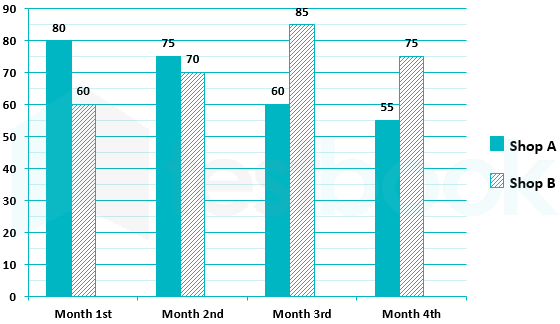
Direction: The given bar graph shows the number of pens sold by two shops A & B in four consecutive months. Study the following data and answer the following questions:
Find the ratio of the number of pens sold by shop A in months 1st and 3rd together to the number of pens sold by shop B in months 2nd and 4th together.
27 : 28
28 : 29
29 : 30
26 : 27
None of these
27 : 28
Find the average of the number of pens sold by shop A in 1st and 3rd months and the number of pens sold by shop B in 3rd and 4th month together.
75
85
72
78
None of these
75
Find that the number of pens sold by shop A in 1st month is how much percent more than the number of pens sold by shop A in 3rd month.
37.5%
42.5%
33.33%
47.5%
None of these
37.5%
What is the difference between the number of pens sold by shop A and B together in month 3th and 4th?
25
15
20
10
None of these
25
Find the ratio of the number of pens sold by shop A in 1st month to the number of pens sold by B in 3rd month.
13 : 14
14 : 15
15 : 16
16 : 17
None of these
13 : 14
A sum of money is invested on simple interest at 1.5% p.a for 8 years yields interest Rs.3000. What will be the simple interest on the same sum at 5% for 6 years.
8000
7500
9500
6000
None of these
8000
The average of 5 term is 50. If the first 4 terms are 45, 37, 80 and 43 what will be the last term?
70
80
75
45
55
70
The ratio between the present age of two friends Arvind and Mahesh is 5 : 6. After 8 years the ratio of their ages will be 7 : 8. Find the sum of Arvind and Mahesh's ages after 10 years.
45
60
64
74
None of these
45
An article was purchased for Rs.93645. Its price was marked up by 30%. It was sold at a discount of 20% on the marked up price. What was the profit percentage on the cost price?
5%
10%
7%
4%
8%
5%
Given below are two quantities named I and II. Based on the given information, you have to determine the relation between the two quantities. You should use the given data and your knowledge of Mathematics to choose among the possible answers.
Quantity I: A certain invested for 2 years at the rate of 12% simple interest. If the simple Interest is Rs.1200. Find the Principal.
Quantity II: Rs. 6000
Quantity I > Quantity II
Quantity I < Quantity II
Quantity I ≥ Quantity II
Quantity I ≤ Quantity II
Quantity I = Quantity II
Quantity I > Quantity II
Given below are two quantities named I and II. Based on the given information, you have to determine the relation between the two quantities. You should use the given data and your knowledge of Mathematics to choose among the possible answers.
Quantity I: An article was sold at Rs. 450. If the profit earned by selling the article is 20%. Find the Cost price.
Quantity II: Rs. 350
Quantity I > Quantity II
Quantity I < Quantity II
Quantity I ≥ Quantity II
Quantity I ≤ Quantity II
Quantity I = Quantity II
Quantity I > Quantity II
Given below are two quantities named I and II. Based on the given information, you have to determine the relation between the two quantities. You should use the given data and your knowledge of Mathematics to choose among the possible answers.
Quantity I: A coin is tossed 3 times. What is the probability of getting a tail each time?
Quantity II: 1/16
Quantity I > Quantity II
Quantity I < Quantity II
Quantity I ≥ Quantity II
Quantity I ≤ Quantity II
Quantity I = Quantity II
Quantity I > Quantity II
Given below are two quantities named I and II. Based on the given information, you have to determine the relation between the two quantities. You should use the given data and your knowledge of Mathematics to choose among the possible answers.
Quantity I: If A goes with 4/5th of his actual speed he reaches the distance 1.5 hours late. What was his actual time (in hours)?
Quantity II: 6
Quantity I > Quantity II
Quantity I < Quantity II
Quantity I ≥ Quantity II
Quantity I ≤ Quantity II
Quantity I = Quantity II
Quantity I > Quantity II
Given below are two quantities named I and II. Based on the given information, you have to determine the relation between the two quantities. You should use the given data and your knowledge of Mathematics to choose among the possible answers.
Quantity I: The income of A and B are in the ratio 4 : 3 and their expenditures are in the ratio 2 : 1. If each saves Rs. 200, then what will the sum of their incomes?
Quantity II: 500
Quantity I < Quantity II
Quantity I > Quantity II
Quantity I ≥ Quantity II
Quantity I ≤ Quantity II
Quantity I = Quantity II
Quantity I < Quantity II
What approximate value should come in the place of x in the following question?
1027.96 = 20% of 4999.98 + 7% of (199.95/x)
0.05
5
0.5
50
2
0.05
What approximate value should come in the place of x in the following question?
257.12 + 187.99x = (49.99)2 + 390.09
16
14
20
18
22
16
What approximate value should come in the place of x in the following question?
(2.99/3.99) × ∛511.99 + 123.9% of 650.11 = x
901
812
821
832
841
901
What approximate value should come in the place of x in the following question?
24.002 × 14.005 – 7.995 × 5.96 = x
280
272
266
255
288
280
What approximate value should come in the place of x in the following question
√784.01 × 7.042 + 351.99 × 24.98% = x
264
244
284
266
224
264
What approximate value should come in the place of x in the following question?
(15.96/11.99) × 143.68 + 29.93% of 439.96 - 155.65 = x
145
168
196
230
285
145
The diameter of the circle is twice the length of the rectangle. The ratio between their areas is 11 : 7 respectively. Then what will be the ratio between the length and breadth of the rectangle?
1 : 2
1 : 4
1 : 7
2 : 1
7 : 1
1 : 2
In a mixture the ratio of milk to water is 4 : 1. If 30 litre of water is added then new ratio becomes 14 : 11. Calculate the initial mixture?
20 litre
65 litre
70 litre
10 litre
30 litres
20 litre
A and B together can do the work in X days. A takes 12 days less than B to complete the whole. If time taken by A to complete the whole working alone is 9 days, then find X.
6.3 days
7 days
5 days
5.5 days
7.2 days
6.3 days
Age of A is 1.5 times of B. The ratio of their ages after 10 years is 4 : 3. then what is the current age of B?
15
45
30
20
25
15
A man rows 10 km upstream and the same distance downstream. The difference in time taken by the man in rowing upstream and downstream is 5min. If the speed of boat is 35 km/hr, what is the speed of the stream?
13 km/ hr
5 km/hr
10 km/hr
7.5 km/hr
3 km/hr
13 km/ hr
There is a 50% increase in an amount in 5 years at certain rate of simple interest. What will be the compound interest of Rs. 15000 for 2 years at the same rate?
1795
3065
3150
1815
1875
1795
A started a business with Rs.10000 after 6 months B joins with Rs.12000. At the end of the year total profit is Rs.96000. Find the share of A in the profit.
Rs. 50000
Rs. 40000
Rs. 80000
Rs. 45000
Rs. 60000
Rs. 50000
Two trains, each having a length of 320 meters moving in the same direction crossed each other in 18 seconds. If the slower train crosses the 200 meters long platform in 26 seconds. Then find the speed in km/hr of the faster train.
180 km/hr
176 km/hr
200 km/hr
182 km/hr
264 km/hr
180 km/hr
To fill the tank Pipe A and Pipe B takes 12hours. Pipe B and Pipe C takes 9 hours to fill the tank and Pipe C and Pipe A together take 15 hours to fill the tank. Find the time taken to fill the tank when Pipe A, Pipe B and Pipe C opened together(approximately).
5 hours
8 hours
9 hours
11 hours
6 hours
5 hours
Three numbers A, B and C are in the ratio of 12 : 15 : 25. If sum of these numbers is 312, Find the difference between A and C.
72
78
65
52
96
72
Direction: Read the following table carefully and answer the following questions:
The table shows the total number of students and the number of girls in three schools A, B & C in two consecutive years.
| Years → | 1999 | 2000 | ||
|---|---|---|---|---|
| School | Total number of students | Number of girls | Total number of students | Number of girls |
| A | 500 | 270 | 600 | 350 |
| B | 400 | 160 | 500 | 250 |
| C | 600 | 270 | 800 | 700 |
Find the number of boys in year 1999 is how much percent more than the number of boys in year 2000 together in all the three schools.
50%
40%
33.33%
30%
None of these
50%
Find the ratio of the total number of boys of school A and B together in year 1999 to the number of boys of school B and C together in 2000.
35 : 47
37 : 45
45 : 37
47 : 35
None of these
35 : 47
Find the average number of boys of all the schools in year 2000.
200
250
300
175
None of these
200
If the total number of students of school B in the year 2001 is 20% more than that of school B in the year 2000 and the number of boys in 2001 is 50% more than that of the number of boys in school B in the year 2000, then find the average number of girls in the year 2001 in all the school together. (The strength of school A and C are constant for year 2000 and 2001).
525
425
325
350
None of these
525
If the total number of boys of school C in the year 2001 is (300/11)% more than that of school C in the year 1999 and the number of girls of school C in the year 2001 is 100% more than that of school C in the year 1999, then find the ratio of number of boys of school C in 2001 to the number of girls of school C in 2001.
7 : 9
3 : 7
5 : 7
5 : 9
None of these
7 : 9
Timed interface, section switching, instant scoring, and question-by-question analytics — free.
Start Timed Attempt