Official Paper

RRB Officer Scale-I 12 Sep 2020 Prelims Memory Based Paper Shift 1 (Previous Year Paper)

80 questions · 45 minutes · with answers · free

Reasoning (40 questions)

Follow the given information to answer the questions.

‘He loves his family’ is written as ‘sup rup mup cup’.

‘My family likes him’ is written as ’mup lup hup bup ’.

‘Everyone loves him’ is written as ’rup hup xup’.

‘He likes animals’ is written as ‘sup tup bup’.

1

What is the code for 'animals'?

  1. ((a))

    hup

  2. ((b))

    cup

  3. ((c))

    lup

  4. ((d))

    bup

  5. ((e))

    tup

Show Answer
Answer: ((a))

hup

2

The code 'hup' is used for which of the following?

  1. ((a))

    his

  2. ((b))

    him

  3. ((c))

    he

  4. ((d))

    None of these

  5. ((e))

    Cannot be determined

Show Answer
Answer: ((a))

his

3

What is the code for 'family'?

  1. ((a))

    sup

  2. ((b))

    rup

  3. ((c))

    cup

  4. ((d))

    mup

  5. ((e))

    Cannot be determined

Show Answer
Answer: ((a))

sup

4

The code 'lup' is used for which of the following?

  1. ((a))

    My

  2. ((b))

    family

  3. ((c))

    likes

  4. ((d))

    him

  5. ((e))

    None of these

Show Answer
Answer: ((a))

My

5

What is the code for 'Everyone'?

  1. ((a))

    rup

  2. ((b))

    hup

  3. ((c))

    xup

  4. ((d))

    None of these

  5. ((e))

    Cannot be determined

Show Answer
Answer: ((a))

rup

Direction: Study the following information carefully to answer the questions given below-

Ten boxes are placed in an almirah such that the box which is at lowest place is numbered as 1st, and the box just above it is numbered as 2nd and so on till the topmost box is numbered as 10th position. Four boxes placed between J and K which is placed on an odd numbered position. The box K is placed below the box J. The box M is placed below the box K. Two boxes are placed between K and L which is placed just below Q box. Box B is placed below the box M. Q box is placed on 7th position. The box I is placed on an even numbered position but above the box P. The box A is placed immediate above the box R.

6

Which box is placed at the bottom?

  1. ((a))

    J

  2. ((b))

    K

  3. ((c))

    I

  4. ((d))

    Data inadequate

  5. ((e))

    None of these

Show Answer
Answer: ((a))

J

7

Which box is placed at the 9th position?

  1. ((a))

    J

  2. ((b))

    P

  3. ((c))

    Q

  4. ((d))

    Data inadequate

  5. ((e))

    None of these

Show Answer
Answer: ((a))

J

8

How many boxes are placed between L and B box?

  1. ((a))

    Three

  2. ((b))

    Two

  3. ((c))

    Four

  4. ((d))

    Seven

  5. ((e))

    None of these

Show Answer
Answer: ((a))

Three

9

Four of the following five are alike in a certain way, based on their position. Which of the following does not belongs to that group?

  1. ((a))

    B

  2. ((b))

    L

  3. ((c))

    K

  4. ((d))

    A

  5. ((e))

    Q

Show Answer
Answer: ((a))

B

10

Choose the correct option?

  1. ((a))

    J box is placed just above L box.

  2. ((b))

    Two boxes are placed between P and Q.

  3. ((c))

    R box is placed at an even numbered position.

  4. ((d))

    K box is placed on at 4th number position.

  5. ((e))

    None of the given option true.

Show Answer
Answer: ((a))

J box is placed just above L box.

Directions: Study the information given below carefully and answer the questions that follow.

Point E is 5 km to the South of point A. Point I is 5 km to the East of point E and point O is 5 km to the South of point I. Point U is 2 km to the West of point O while point V is 3 km to the south of point U. Point W is 3 km to the West of point V and point X is 5 km to the north of point W.

11

What is the distance between A and X?

  1. ((a))

    6 km

  2. ((b))

    8 km

  3. ((c))

    10 km

  4. ((d))

    9 km

  5. ((e))

    12 km

Show Answer
Answer: ((a))

6 km

12

What is the direction of point I with respect to point W?

  1. ((a))

    North-West

  2. ((b))

    West

  3. ((c))

    North- East

  4. ((d))

    East

  5. ((e))

    South-East

Show Answer
Answer: ((a))

North-West

Directions: Study the following information carefully and answer the Questions given below:

Certain number of person is sitting in a row facing towards north direction. Following information is known about them:

Only two persons are sitting between H and C, who is sitting 5th to the right of B. C, is sitting 3rd from the right end. D is sitting at left most end of the row and there are only two persons sitting between D and A. F is sitting exactly in the middle of A and B and 2nd to the right of A.

Not more than two persons are sitting between B and G and G is sitting just next to H. There are only one person is sitting between G and C.

13

how many persons are sitting in the row?

  1. ((a))

    10

  2. ((b))

    12

  3. ((c))

    14

  4. ((d))

    15

  5. ((e))

    None of these

Show Answer
Answer: ((a))

10

14

How many people are sitting between A and B?

  1. ((a))

    1

  2. ((b))

    2

  3. ((c))

    3

  4. ((d))

    4

  5. ((e))

    5

Show Answer
Answer: ((a))

1

15

How many persons are unknown in a row out of total members?

  1. ((a))

    7

  2. ((b))

    8

  3. ((c))

    9

  4. ((d))

    5

  5. ((e))

    None of these

Show Answer
Answer: ((a))

7

16

How many persons are sitting to the left of person which is 3rd to the right of H?

  1. ((a))

    10

  2. ((b))

    11

  3. ((c))

    12

  4. ((d))

    13

  5. ((e))

    14

Show Answer
Answer: ((a))

10

17

How many persons are sitting between F and H?

  1. ((a))

    2

  2. ((b))

    3

  3. ((c))

    4

  4. ((d))

    5

  5. ((e))

    6

Show Answer
Answer: ((a))

2

18

Directions: In the following question assuming the given statements to be True, find which of the conclusion among given conclusions is/are definitely true and then give your answers accordingly.

Statements: R ≤ P ≤ Q; R ≥ S > T ≤ M = U

Conclusions:

I. Q > T

II. R ≥ M

  1. ((a))

    Only II is True

  2. ((b))

    Only I is True

  3. ((c))

    Both I and II are True

  4. ((d))

    Either I or II is True

  5. ((e))

    None is true

Show Answer
Answer: ((a))

Only II is True

19

Directions: In the following question assuming the given statements to be True, find which of the conclusion among given conclusions is/are definitely true and then give your answers accordingly.

Statements:  P < R < D < A < N; P > F = S

Conclusions:

I. A = F

II. F < A

  1. ((a))

    Only II is True

  2. ((b))

    Only I is True

  3. ((c))

    Both I and II are True

  4. ((d))

    Either I or II is True

  5. ((e))

    None is true

Show Answer
Answer: ((a))

Only II is True

20

Direction: In the following question assuming the given statements to be True, find which of the conclusion among given conclusions is/are definitely true and then give your answers accordingly.

Statements: P < Q ≥ G; G ≥ I ≥ E; C ≤ P; C > U

Conclusions:

I. U > I

II. P ≤ E

  1. ((a))

    Both I and II are True

  2. ((b))

    Only II is True

  3. ((c))

    Either I or II is True

  4. ((d))

    Only I is True

  5. ((e))

    Neither I nor II is true

Show Answer
Answer: ((a))

Both I and II are True

21

Directions: In the following question assuming the given statements to be True, find which of the conclusion among given conclusions is/are definitely true and then give your answers accordingly.

Statements: Y = O ≤ G ≤ K = U > L > P; Y = A ≥ R

Conclusions

I. U > R

II. R = U

  1. ((a))

    Only II is True

  2. ((b))

    Only I is True

  3. ((c))

    Both I and II are True

  4. ((d))

    Either I or II is True

  5. ((e))

    None is true

Show Answer
Answer: ((a))

Only II is True

22

Directions: In the following question assuming the given statements to be True, find which of the conclusion among given conclusions is/are definitely true and then give your answers accordingly.

Statements: N ≥ T > P = A ≥ Z = K; N = B > D

Conclusions

I. D ≥ Z

II. B > K

  1. ((a))

    Only II is True

  2. ((b))

    Only I is True

  3. ((c))

    Both I and II are True

  4. ((d))

    Either I or II is True

  5. ((e))

    None is true

Show Answer
Answer: ((a))

Only II is True

Directions: Study the following information carefully and answer the questions given below.

9 friends A, B, C, D, E, F, G, H, and I are sitting around a circular table of which 4 are facing the center while others are facing outside. 3 people are sitting between A who is sitting to the immediate left of E and I who is facing outside. F and D are immediate neighbors of I and are facing the opposite direction. The equal number of persons sits between A and H and A and B. B and D are the immediate neighbors and facing the opposite direction. G sits between A and B and facing outside. C sits third to the right of A and facing the same direction as of G. I is sitting third to the right of H who faces the same direction as that of D.

23

What is the position of the person who is sitting second to the left of F?

  1. ((a))

    Third to the right of G

  2. ((b))

    Third to the right of C

  3. ((c))

    Third to the left of A

  4. ((d))

    Fourth to the right of E

  5. ((e))

    Immediate left of B

Show Answer
Answer: ((a))

Third to the right of G

24

How many people are sitting between H and D if counted from the left of D?

  1. ((a))

    5

  2. ((b))

    2

  3. ((c))

    4

  4. ((d))

    3

  5. ((e))

    6

Show Answer
Answer: ((a))

5

25

Which of the following is true?

  1. ((a))

    F is the immediate neighbor of B.

  2. ((b))

    D is facing the same direction as that of E.

  3. ((c))

    B is third to the right of E.

  4. ((d))

    A, E, H and F are facing towards the center.

  5. ((e))

    A is sitting forth to the right of I.

Show Answer
Answer: ((a))

F is the immediate neighbor of B.

26

What is the position of F with respect to B?

  1. ((a))

    Third to the left

  2. ((b))

    Immediate left

  3. ((c))

    Third to the right

  4. ((d))

    Fifth to the right

  5. ((e))

    Sixth to the right

Show Answer
Answer: ((a))

Third to the left

27

Who is sitting exactly between G and F?

  1. ((a))

    D

  2. ((b))

    H

  3. ((c))

    B

  4. ((d))

    E

  5. ((e))

    I

Show Answer
Answer: ((a))

D

28

How many such pairs of letters are there in the word GRANDEUR each of which has as many letters between them in the word as in the English alphabet (considering both ways).

  1. ((a))

    1

  2. ((b))

    2

  3. ((c))

    3

  4. ((d))

    4

  5. ((e))

    5

Show Answer
Answer: ((a))

1

29

6 person, "A, B, C, D, E, F" goes for a movie on 6 different days from Monday to Saturday. A goes 2 days after D but before Friday. There is a 3 days gap between C and E. B goes on Saturday. F goes immediately before A. Who goes on Wednesday?

  1. ((a))

    E

  2. ((b))

    B

  3. ((c))

    D

  4. ((d))

    F

  5. ((e))

    A

Show Answer
Answer: ((a))

E

30

Directions: Read the following information carefully and answer the given question.

In a number ‘85214796’ if 2 is added to all odd numbers and 1 is subtracted from all even numbers, then what will be the difference between the first digit from left end and the first digit from the right end?

  1. ((a))

    7

  2. ((b))

    6

  3. ((c))

    5

  4. ((d))

    2

  5. ((e))

    3

Show Answer
Answer: ((a))

7

31

In the given word ‘EXPATRIATE’ if the vowels are changed to the next letter and the consonants are changed to the previous letters as per the alphabetical series, then which letter/letters are repeated more than once?

  1. ((a))

    J, O

  2. ((b))

    O, Q

  3. ((c))

    W

  4. ((d))

    Q, J

  5. ((e))

    B, F, S

Show Answer
Answer: ((a))

J, O

Directions: Answer the following questions according to the given statements:

There are eight persons A, B, C, D, E, F, G, and H, who live on four different floors among floor 1, floor 2, floor 3 and floor 4. Each floor has two different flats viz. flat 1 and flat 2.

There are 2 flats on each floor flat 1 – flat 2 from left to right in such a way that flat 1 of the fourth floor is exactly above flat 1 of the third floor and flat 1 of the third floor is exactly above flat 1 of the second floor and other flats are situated in the same way.

C lives one floor above the floor on which B lives. F lives with B who lives two floors below D. B lives on the second floor. E lives in flat 2 of the first floor. G lives on the third floor but not in flat 1. H does not live on the fourth floor but in flat 1. B lives in even numbered flat. A and C live in flat 1 but on different floors.
32

who live in the flat 1 of floor 2?

  1. ((a))

    B

  2. ((b))

    C

  3. ((c))

    F

  4. ((d))

    A

  5. ((e))

    G

Show Answer
Answer: ((a))

B

33

Who lives two floor below the floor on which G lives in the same flat number?

  1. ((a))

    A

  2. ((b))

    F

  3. ((c))

    C

  4. ((d))

    E

  5. ((e))

    None of these

Show Answer
Answer: ((a))

A

34

Who lives on the same floors?

  1. ((a))

    H and G

  2. ((b))

    F and B

  3. ((c))

    C and B

  4. ((d))

    E and D

  5. ((e))

    None of the above

Show Answer
Answer: ((a))

H and G

35

Who live on the fourth floor of flat 2?

  1. ((a))

    H

  2. ((b))

    C

  3. ((c))

    A

  4. ((d))

    E

  5. ((e))

    D

Show Answer
Answer: ((a))

H

36

Which of the following given pair is different from rest?

  1. ((a))

    H and C

  2. ((b))

    G and E

  3. ((c))

    C and F

  4. ((d))

    E and G

  5. ((e))

    B and D

Show Answer
Answer: ((a))

H and C

Direction: Read the given information and answer below questions.

There are seven persons A, B, C, D, E, F and G sitting in a row facing north direction but not necessarily in the same order. Each one has a different age (in years), i.e., 4, 15, 17, 19, 21, 23 and 40 but not necessarily in the same order.

The person whose age is 19 years is sitting between C and F. F is sitting 3rd to the right of E whose age is 6 years more than that of B. A sits just immediately left of B whose age is a multiple of 5 but not more than 20. Age of F is the sum of the ages of E and G. There is only one person who sits to the immediate right of F. C whose age is a two digit prime number sits 3rd to the right of the person whose age is 4 years. Age of D is two years less than the age of G.

37

How many people sit between A and D?

  1. ((a))

    5

  2. ((b))

    4

  3. ((c))

    3

  4. ((d))

    2

  5. ((e))

    None of the above

Show Answer
Answer: ((a))

5

38

What is the age of F?

  1. ((a))

    21 years

  2. ((b))

    40 years

  3. ((c))

    17 years

  4. ((d))

    15 years

  5. ((e))

    19 years

Show Answer
Answer: ((a))

21 years

39

Which of the following is correct?

  1. ((a))

    A sits third to the right of C

  2. ((b))

    Age of F is 19 years

  3. ((c))

    Sum of the age of A and B is same as that of G

  4. ((d))

    Only one person sits between F and D.

  5. ((e))

    Age of C is not a prime number.

Show Answer
Answer: ((a))

A sits third to the right of C

40

Four of the following are alike in a certain way and so form a group. Which of the following does not belong to the group?

  1. ((a))

    BC

  2. ((b))

    GD

  3. ((c))

    GE

  4. ((d))

    AE

  5. ((e))

    CF

Show Answer
Answer: ((a))

BC

Quantitative Aptitude (40 questions)

41

What should come in place of the question mark '?' in the following number series?

3.5, 7, 14, 24.5, 38.5, ?

  1. ((a))

    42

  2. ((b))

    56

  3. ((c))

    52.5

  4. ((d))

    77

  5. ((e))

    49

Show Answer
Answer: ((a))

42

42

What should come in place of the question mark '?' in the following number series?

287, ?, 71, 35, 17, 8

  1. ((a))

    144

  2. ((b))

    143

  3. ((c))

    142

  4. ((d))

    141

  5. ((e))

    140

Show Answer
Answer: ((a))

144

43

What should come in place of the question mark '?' in the following number series?

19, 20, 42, 129, ?, 2605

  1. ((a))

    512

  2. ((b))

    543

  3. ((c))

    555

  4. ((d))

    520

  5. ((e))

    536

Show Answer
Answer: ((a))

512

44

What should come in place of the question mark '?' in the following number series?

3.5, 2.5, 3, 6, 20, ?

  1. ((a))

    91

  2. ((b))

    82

  3. ((c))

    93

  4. ((d))

    84

  5. ((e))

    95

Show Answer
Answer: ((a))

91

45

What should come in place of the question mark '?' in the following number series?

106, 101, 90, 73, 50, ?

  1. ((a))

    31

  2. ((b))

    21

  3. ((c))

    36

  4. ((d))

    27

  5. ((e))

    41

Show Answer
Answer: ((a))

31

46

What should come in place of the question mark '?' in the following number series?

20, 60, 25, 65, 30, ?

  1. ((a))

    35

  2. ((b))

    70

  3. ((c))

    84

  4. ((d))

    95

  5. ((e))

    55

Show Answer
Answer: ((a))

35

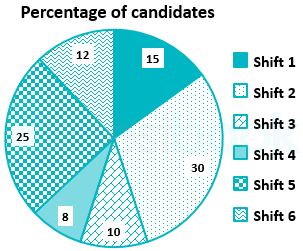
Directions: Read the following Pie chart carefully and answer the following questions:-

The pie chart shows the percentage of candidates in 6 different shifts of an examination.

Total number of candidates = 5500

47

Number of candidates in shift 6 is what percentage more/less than number of candidate in shift 4?

  1. ((a))

    20%

  2. ((b))

    50%

  3. ((c))

    30%

  4. ((d))

    10%

  5. ((e))

    None of these

Show Answer
Answer: ((a))

20%

48

If 215 candidates in shift 2 were absent, then find the number of candidates present in the same shift.

  1. ((a))

    1200

  2. ((b))

    1050

  3. ((c))

    1435

  4. ((d))

    915

  5. ((e))

    1285

Show Answer
Answer: ((a))

1200

49

If ratio of male to female candidates in shift 3 is 6 : 5, then find number of female candidates in shift 3.

  1. ((a))

    350

  2. ((b))

    225

  3. ((c))

    435

  4. ((d))

    250

  5. ((e))

    None of these

Show Answer
Answer: ((a))

350

50

Find the average number of candidates in shift 2, shift 3 and shift 4 together in the examination.

  1. ((a))

    700

  2. ((b))

    660

  3. ((c))

    880

  4. ((d))

    910

  5. ((e))

    750

Show Answer
Answer: ((a))

700

51

The number of candidates in shift 1 is how much more than the number of candidates in shift 4?

  1. ((a))

    260

  2. ((b))

    385

  3. ((c))

    425

  4. ((d))

    360

  5. ((e))

    None of these

Show Answer
Answer: ((a))

260

52

If 40% candidates in shift 6 were failed, then find the number of candidates passed the examination in the same shift.

  1. ((a))

    369

  2. ((b))

    228

  3. ((c))

    426

  4. ((d))

    264

  5. ((e))

    396

Show Answer
Answer: ((a))

369

53

A invest 80% of his income on mutual fund, real estate and insurance in the ratio of 3 ∶ 5 ∶ 7 respectively. Find his saving, if his investment on the mutual fund is Rs. 24,000.

  1. ((a))

    Rs. 1,00,000

  2. ((b))

    Rs. 50,000

  3. ((c))

    Rs. 30,000

  4. ((d))

    Rs. 40,000

  5. ((e))

    Rs. 80,000

Show Answer
Answer: ((a))

Rs. 1,00,000

54

A cylinder of radius 14 cm and height 5 cm is melted and recast into cubes of edge length 2 cm. How many identical cubes will be obtained?

  1. ((a))

    462

  2. ((b))

    385

  3. ((c))

    352

  4. ((d))

    429

  5. ((e))

    484

Show Answer
Answer: ((a))

462

55

A boat takes 2 hours more to travel 45 km upstream than to travel the same distance downstream. If the ratio of the speed of current to the speed of boat is 1 ∶ 4, then find the speed of the current.

  1. ((a))

    5 km/hr

  2. ((b))

    9 km/hr

  3. ((c))

    4 km/hr

  4. ((d))

    6 km/hr

  5. ((e))

    none of these

Show Answer
Answer: ((a))

5 km/hr

56

A mixture contains 15 kg of rice at Rs. 60 per kg and 25 kg of rice at X per kg are mixed and sold at Rs. 97.5 per kg. The profit earned by the seller is 30%. What will be the value of x?

  1. ((a))

    72

  2. ((b))

    84

  3. ((c))

    80

  4. ((d))

    77

  5. ((e))

    70

Show Answer
Answer: ((a))

72

57

If 3 coins are tossed simultaneously, what is the probability of getting at least 2 heads? 

  1. ((a))

    1/3

  2. ((b))

    1/2

  3. ((c))

    1/8

  4. ((d))

    7/8

  5. ((e))

    2/3

Show Answer
Answer: ((a))

1/3

58

A and B on working together can complete a work in 4 days. A alone takes 6 days less than B alone takes. In how many days C alone can complete the work if he is 50% more efficient than B?

  1. ((a))

    8

  2. ((b))

    16

  3. ((c))

    12

  4. ((d))

    14

  5. ((e))

    20

Show Answer
Answer: ((a))

8

59

A shopkeeper marked his article 1500 more than its cost price and gives a discount of 12.5% on it. If the selling price of the article is Rs. 3500, then find profit per cent made by the shopkeeper.  

  1. ((a))

    10%

  2. ((b))

    20%

  3. ((c))

    25%

  4. ((d))

    30%

  5. ((e))

    40%

Show Answer
Answer: ((a))

10%

60

In the given question, two equations numbered l and II are given. Solve both the equations and mark the appropriate answer.

I. x2 – 11x + 30 = 0

II. y2 + 12y + 36 = 0

  1. ((a))

    x > y

  2. ((b))

    x < y

  3. ((c))

    x ≥ y

  4. ((d))

    x ≤ y

  5. ((e))

    x = y or the relationship between x and y cannot be established.

Show Answer
Answer: ((a))

x > y

61

In the given question, two equations numbered l and II are given. Solve both the equations and mark the appropriate answer.

I. x2 + 9x + 20 = 0

II. 8y2 – 15y + 7 = 0

  1. ((a))

    x > y

  2. ((b))

    x < y

  3. ((c))

    x ≥ y

  4. ((d))

    x ≤ y

  5. ((e))

    x = y or the relationship between x and y cannot be established.

Show Answer
Answer: ((a))

x > y

62

In the given question, two equations numbered l and II are given. Solve both the equations and mark the appropriate answer.

I. x3 = 64

II. y2 = 16

  1. ((a))

    x > y

  2. ((b))

    x < y

  3. ((c))

    x ≥ y

  4. ((d))

    x ≤ y

  5. ((e))

    x = y or the relationship between x and y cannot be established.

Show Answer
Answer: ((a))

x > y

63

In the given question, two equations numbered l and II are given. Solve both the equations and mark the appropriate answer.

I. x2 – 20x + 91 = 0

II. y2 + 16y + 63 = 0

  1. ((a))

    x > y

  2. ((b))

    x < y

  3. ((c))

    x ≥ y

  4. ((d))

    x ≤ y

  5. ((e))

    x = y or the relationship between x and y cannot be established.

Show Answer
Answer: ((a))

x > y

64

In the given question, two equations numbered l and II are given. Solve both the equations and mark the appropriate answer.

I. 6x2 + 5x + 1 = 0

II. 2y2 – y – 1 = 0

  1. ((a))

    x > y

  2. ((b))

    x < y

  3. ((c))

    x ≥ y

  4. ((d))

    x ≤ y

  5. ((e))

    x = y or the relationship between x and y cannot be established.

Show Answer
Answer: ((a))

x > y

65

In a school class A have 320 students and class B have 240 students. In class A 40% students not passed and in class B 30% students not passed. Find the overall pass percentage(approximate) of the school. 

  1. ((a))

    64%

  2. ((b))

    35%

  3. ((c))

    62%

  4. ((d))

    37%

  5. ((e))

    48%

Show Answer
Answer: ((a))

64%

66

Two trains of same length moving in opposite direction. Speed of train1 is 54 km/hr and Speed of train2 is 18 km/hr. First train takes 30 seconds to cross the second train. Find the time taken by first train to cross 450 m long platform.

  1. ((a))

    58 sec

  2. ((b))

    64 sec

  3. ((c))

    60 sec

  4. ((d))

    50 sec

  5. ((e))

    75 sec

Show Answer
Answer: ((a))

58 sec

67

6 years ago age of A and B are in the ratio of 7 : 10. 10 years after the sum of ages A and B is 100 years. C is 12 years elder than B. Find the present age of C.

  1. ((a))

    28 years

  2. ((b))

    39 years

  3. ((c))

    58 years

  4. ((d))

    42 years

  5. ((e))

    45 years

Show Answer
Answer: ((a))

28 years

68

A starts from point x at a speed of 15 km/hr and B starts towards A from point y at a speed of 25 km/hr and meet each other after 2 hours at point z. Find the difference in distance between point xz and point yz.  

  1. ((a))

    20 km

  2. ((b))

    30 km

  3. ((c))

    60 km

  4. ((d))

    45 km 

  5. ((e))

    none of these

Show Answer
Answer: ((a))

20 km

69

A shop of mobile phones is closed on Tuesday. The average sale per day for remaining six days of a week is Rs.1564 and the average sale of Wednesday to Sunday is Rs. 1412.4. The sales on Monday is:

  1. ((a))

    2232

  2. ((b))

    2792

  3. ((c))

    2562

  4. ((d))

    2342

  5. ((e))

    2322

Show Answer
Answer: ((a))

2232

70

Three pipes A, B and C were opened to fill a tank. Working alone A, B and C requires 12 minutes, 15 minutes and 20 minutes respectively. Another pipe D, which is outlet pipe, can empty the fully filled tank in 30 minutes working alone. What is the total time taken to fill the tank if all the pipes are simultaneously opened?

  1. ((a))

    3 minutes

  2. ((b))

    12 minutes

  3. ((c))

    6 minutes

  4. ((d))

    8 minutes

  5. ((e))

    5 minutes

Show Answer
Answer: ((a))

3 minutes

71

Given below are two quantities named I and II. Based on the given information, you have to determine the relation between the two quantities. You should use the given data and your knowledge of Mathematics to choose among the possible answers.

Quantity I: A and B completes the work in 15 days while working together. The ratio of their time is 3 : 5. In how many days B alone can complete the work.

Quantity II: 45 days

  1. ((a))

    Quantity I > Quantity II

  2. ((b))

    Quantity I < Quantity II

  3. ((c))

    Quantity I ≥ Quantity II

  4. ((d))

    Quantity I ≤ Quantity II

  5. ((e))

    Quantity I = Quantity II or No relation

Show Answer
Answer: ((a))

Quantity I > Quantity II

72

Given below are two quantities named I and II. Based on the given information, you have to determine the relation between the two quantities. You should use the given data and your knowledge of Mathematics to choose among the possible answers.

Quantity I: In a mixture of 80 litre, Milk and water are in the ratio of 7:1

If 30% of the mixture is taken out, Find the quantity of the water left in the mixture.

Quantity II: 7 litre

  1. ((a))

    Quantity I > Quantity II

  2. ((b))

    Quantity I < Quantity II

  3. ((c))

    Quantity I ≥ Quantity II

  4. ((d))

    Quantity I ≤ Quantity II

  5. ((e))

    Quantity I = Quantity II or No relation

Show Answer
Answer: ((a))

Quantity I > Quantity II

73

Given below are two quantities named I and II. Based on the given information, you have to determine the relation between the two quantities. You should use the given data and your knowledge of Mathematics to choose among the possible answers.

Quantity I: Age of A is 5 times of his son, after 15 years the ratio of age of A and son is 13 : 5, find the age of A (in years)?

Quantity II: 45

  1. ((a))

    Quantity I > Quantity II

  2. ((b))

    Quantity I < Quantity II

  3. ((c))

    Quantity I ≥ Quantity II

  4. ((d))

    Quantity I ≤ Quantity II

  5. ((e))

    Quantity I = Quantity II or No relation

Show Answer
Answer: ((a))

Quantity I > Quantity II

74

Given below are two quantities named I and II. Based on the given information, you have to determine the relation between the two quantities. You should use the given data and your knowledge of Mathematics to choose among the possible answers.

Quantity I: The average age of a group of students is 24 years. When the age of their teacher is also included, the average age increases by 1 year. If the age of the teacher is 36 years, find the number of students in the group.

Quantity II: 11

  1. ((a))

    Quantity I > Quantity II

  2. ((b))

    Quantity I < Quantity II

  3. ((c))

    Quantity I ≥ Quantity II

  4. ((d))

    Quantity I ≤ Quantity II

  5. ((e))

    Quantity I = Quantity II or No relation

Show Answer
Answer: ((a))

Quantity I > Quantity II

75

Given below are two quantities named I and II. Based on the given information, you have to determine the relation between the two quantities. You should use the given data and your knowledge of Mathematics to choose among the possible answers.

Quantity I: A train takes 10 seconds to cross a 120 m long platform and takes 8 seconds to cross another 84 m long platform. What is the length of the train?

Quantity II: 50 m

  1. ((a))

    Quantity I > Quantity II

  2. ((b))

    Quantity I < Quantity II

  3. ((c))

    Quantity I ≥ Quantity II

  4. ((d))

    Quantity I ≤ Quantity II

  5. ((e))

    Quantity I = Quantity II or No relation

Show Answer
Answer: ((a))

Quantity I > Quantity II

Direction: Study the following information carefully and answer the given questions.

The table shows the total number of invited person and the percentage of person who attended the events (A, B, C, D, E) respectively.

EventsInvited PersonPerson who attended the event (in %)
A36050%
B24060%
C42080%
D12075%
E30050%
76

What is the ratio of the number of persons who attended event B to the number of persons who attended the event C?

  1. ((a))

    3 : 7

  2. ((b))

    3 : 8

  3. ((c))

    4 : 3

  4. ((d))

    4 : 7

  5. ((e))

    None of these

Show Answer
Answer: ((a))

3 : 7

77

What is the average of number of persons who attended the events C, D and E?

  1. ((a))

    195

  2. ((b))

    194

  3. ((c))

    192

  4. ((d))

    198

  5. ((e))

    None of these

Show Answer
Answer: ((a))

195

78

Find the percentage of persons who attended the event A is how much more than the number of persons who attended the event D.

  1. ((a))

    80%

  2. ((b))

    100%

  3. ((c))

    90%

  4. ((d))

    75%

  5. ((e))

    None of these

Show Answer
Answer: ((a))

80%

79

Find the difference between the number of persons who attended the events C and D and the number of persons who attended the events B and E.

  1. ((a))

    130

  2. ((b))

    134

  3. ((c))

    136

  4. ((d))

    132

  5. ((e))

    None of these

Show Answer
Answer: ((a))

130

80

Find the ratio of number of persons who did not attend the event B to the total number of persons who were invited for event D.

  1. ((a))

    2 : 3

  2. ((b))

    4 : 5 

  3. ((c))

    2 : 5

  4. ((d))

    15 : 16 

  5. ((e))

    3 : 5

Show Answer
Answer: ((a))

2 : 3

Attempt this paper under real exam conditions

Timed interface, section switching, instant scoring, and question-by-question analytics — free.

Start Timed Attempt