Who is sitting second to the left of I?
- ((a))
A
- ((b))
B
- ((c))
C
- ((d))
D
- ((e))
None of the above
Show Answer
A
80 questions · 45 minutes · with answers · free
Direction: Study the following information carefully and answer the question given below.
Ten persons: A, B, C, D, E, F, G, H, I and J are sitting on a circular table. All of them are facing the centre.
Two persons are sitting between A and B either from left or right. G is sitting third to the left of J and H is sitting second to the right of G. There are four persons sitting between B and D, either from the left or right. J is neither the neighbour of A nor of B. C and I are not neighbours of each other. D is sitting second to the left of A. J is sitting second to the left of E. G is sitting opposite to E. J is not sitting opposite to A. H is sitting opposite to C. F is neighbour of C and B. G is not the neighbour of D.
Who is sitting second to the left of I?
A
B
C
D
None of the above
A
Who is sitting opposite to J?
B
F
H
I
None of these
B
How many persons are sitting between G and C when counting towards left of G?
4 persons
2 persons
6 persons
1 person
None of the above
4 persons
What is the position of D with respect to F?
Fourth to the right
Sixth to the left
Fourth to the left
Second to the right
Seventh to the left
Fourth to the right
Who is sitting fifth to the right of B?
C
E
D
H
I
C
Directions: Read the given information carefully and answer the questions given below:
Seven persons - A, B, C, D, E, F and G like different fruits and eat them on seven different days from Monday to Sunday but not necessarily in the same order. The fruits are - Watermelon, Apple, Banana, Guavas, Grapes, Orange and Kiwi but not necessarily in the same order.
A eats guava immediately after D. E neither eats grapes nor watermelon. D neither eat banana nor watermelon. F eats banana two days before E. The person who eats grapes is the last one. C eats kiwi on Wednesday and there are two people between C and the one who eat the orange. B eats fruit three days after A and does not eat Apple.
Which of the following day and fruit combination is true for C?
Thursday - Banana
Monday - Watermelon
Tuesday - Guava
Wednesday - Kiwi
Wednesday - Orange
Thursday - Banana
Who eats watermelon?
A
B
C
D
E
A
Which of the following statement (s) is / are true?
F eats Banana on Friday
G eats grapes on Sunday
C eats watermelon on Wednesday
B eats Apple on Monday
None of the above
F eats Banana on Friday
Who eats orange?
A
B
C
D
E
A
How many persons eat fruits between C and the one who eats Apple?
1
2
3
4
5
1
Direction: In the following question assuming the given statements to be true, find which of the conclusion among given some conclusion is/are definitely true and then give your answers accordingly:
Statement:
Q > I < N = K ≤ T ≤ E ≤ U ≥ Y > R = P > O = D > J
Conclusions:
I. U > I
II. Y > J
Only conclusion I is true
Only Conclusion II is true
Either conclusion I or II is true
Neither conclusion I nor II is true
Both conclusion I and II is true
Only conclusion I is true
Directions: In the following question assuming the given statements to be true, find which of the conclusion among given conclusions is/are definitely true and then give your answers accordingly.
Statements: C > D > E ≥ G = H < J ≥ K = A
Conclusions:
I. E ≤ J
II. E > J
Either conclusion I or II follows
Only conclusion II follows
Both conclusion I and II follows
Only conclusion I follows
Neither conclusion I nor II follows
Either conclusion I or II follows
Direction: In the following question assuming the given statements to be true, find which of the conclusion(s) among given conclusions is/are definitely true and then give your answers accordingly.
Statements:
E > T ≥ K = R, S > R = U
Conclusions:
I. K < S
II. E > U
Only conclusion I follows
Only conclusion II follows
Both conclusions I and II follow
Neither conclusion I nor II follows
Either conclusion I or II follows
Only conclusion I follows
Direction: In the following question assuming the given statements to be true, find which of the conclusion(s) among given conclusions is/are definitely true and then give your answers accordingly.
Statement:
B ≥ G > Y ≥ W = F < A
Conclusions:
I. F < B
II. G > A
Only conclusion I follows
Only conclusion II follows
Both conclusion I and II follow
Neither conclusion I nor II follows
Either conclusion I nor II follows
Only conclusion I follows
Directions: In the following question assuming the given statements to be true, find which of the conclusion among the given conclusions is/are definitely true and then give your answers accordingly
Statements: X ≤ Y = Z > A = B < C > D > E ≥ F
Conclusions:
I**.** X < Z
II. X = Z
Only I follows
Only II follows
Either I or II follows
Both follows
None follows
Only I follows
Direction: In the question below are given three statements followed by two conclusions numbered I and II. You have to take the given statements to be true even if they seem to be at variance with commonly known facts. Read all the conclusions and then decide which of the given conclusions logically follows from the given statements disregarding commonly known facts.
Statements:
Only a few pencil is pen.
Some pen is eraser.
No eraser is sharpener.
Conclusions:
I. All sharpener can be pencil.
II. Some pen is sharpener.
Only conclusion I follow
Only conclusion II follow
Both conclusionI and II follow
Either conclusion I or II follows
Neither conclusions I nor II follows
Only conclusion I follow
Direction: In the question below are given three statements followed by two conclusions I, and II. You have to take the given statements to be true even if they seem to be at variance with commonly known facts. Read all the conclusions and then decide which of the given conclusions logically follows from the given statements disregarding commonly known facts.
Statement:
Only Rice are Grains
No Wheat is Grains
All Wheat is Pulses
Conclusion:
I. Some Rice are Pulses
II. No Pulses are Rice.
Both I and II follow
Neither I nor II follows
Only I follows
Either I or II follows
Only II follows
Both I and II follow
Direction: In the question below are given three statements followed by two conclusions numbered I and II. You have to take the given statements to be true even if they seem to be at variance with commonly known facts. Read all the conclusions and then decide which of the given conclusions logically follows from the given statements disregarding commonly known facts.
Statements:
No Curd is Amul
only a few Amul is Down
No Down is Rice
Conclusions:
I. Some Curd is Rice
II. Some Down is Curd
Only I follow
Only II follow
Either I or II follows
Neither I nor II follows
Both I and II follows
Only I follow
Directions: In the question below there are three statements followed by two conclusions I and II. You have to take the two given statements to be true even if they seem to be variance with commonly known facts and then decide which of the given conclusions logically follow from the given statements disregarding commonly known facts.
Statements:
Some cat are dog.
All dog are fox.
Some fox are cow.
Conclusion:
I. Some cats are cows is a possibility.
II. Some cows are dog.
If only conclusion I follow
If only conclusion II follow
If conclusion I and II both follow
If neither conclusion I and II follow
If either conclusion I or II follow
If only conclusion I follow
Direction: In the question below are given two statements followed by two conclusions numbered I, II, and III. You have to take the given statements to be true even if they seem to be at variance with commonly known facts. Read all the conclusions and then decide which of the given conclusions logically follows from the given statements disregarding commonly known facts.
Statements:
Some liquids are juice.
Only a few juice are shakes.
All shakes are smoothies.
Conclusions:
I. Some liquids are smoothie.
II. All juice being shakes is a possibility.
None follows
Either I or II follows
Only II follows
Only I follows
Both I and II follow
None follows
In the given word ‘CATER’ if the vowels are changed to the previous letter and the consonants are changed to the next letter as per the alphabetical series, then which letter will occur more than once in the newly formed word?
A
D
U
C
None of the above
A
Select the one which is different from other four alternatives.
MN
AZ
BY
JP
EV
MN
How many such pairs of digits are there in the number ‘935416’, each of which has as many digits between them in the number (both forward and backward direction) as they have between them in the numerical series?
One
Two
Three
Four
More than four
One
Direction: Study the following information and answer the questions given below.
In a certain code language,
“possible on three puzzle” is written as “dy no sm su”
“greater growth mandatory puzzle” is written as “ze ea dy om”
“mandatory possible is important” is written as “su ta nx ea”
“three growth is important” is written as “ta sm om nx”
What is the code for the word 'possible'?
no
sm
dy
su
Either dy or sm
no
If the code for 'the three hard puzzle' is 'dy hx sm ar' then what could be the code for 'the hard'?
hx ar
dy ar
hx sm
ze ar
ta sm
hx ar
What is the possible code for 'on important greater'?
su ta nx
no nx ea
du dy ta
no nx ze
no ta ea
su ta nx
'om' is the code for which of the following?
three
growth
is
important
None of the above
three
Direction: Study the following information carefully and answer the question given below.
In an organization, nine persons: J, K, L, M, N, O, P, Q and R work in three different departments Marketing, Finance and HR. At least two persons work in a department but not more than four can work in a single department.
Only L works with M in the same department. N and K work in two different departments. O works in the HR department. R does not work in the HR department. Q does not work with P but works with J. K who does not work with O and works in the Finance department. Only three people work in the HR department.
Who among the following does not work in the Finance department?
M
J
K
None of the above
Both J and K
M
Who among the following work together?
J and O
K and N
Q and R
N and L
P and M
J and O
Which of the following combination works in Marketing department?
J, K, Q
M, L
P, Q, R
O, P, N
None of the above
J, K, Q
Who among the following works with O?
R
K
N
P
Both N and P
R
Direction: Read the instructions carefully and answer the question below.
Six friends A, B, C, D, E and F have different weights. D weighs more than E but less than A who isn’t the heaviest. B weighs less than only two people and he weighs 78 kg. C weighs 8 kg more than D but 21 kg less than A.
Who is the heaviest among all?
A
B
E
D
F
A
If the average weight of A and B is 83 kg, what will be the weight of A?
60 Kg
88 Kg
66 Kg
70 Kg
Can not be determined
60 Kg
Who has the second lowest weight among all?
A
B
C
D
E
A
Direction: Read the following information carefully and answer the questions that follow:
There are ten persons namely A, B, C, D, E, F, G, H, I and J attending a meeting on either 11th or 16th of January, February, March, April and May.
E attends the meeting in a month which has less than 31 days. Three persons attend the meeting between B and H. F attends the meeting in March. B attends the meeting on the 16th of the month which has the least number of days. A and D attend on odd dates. D attends on the month which has 30 days. Two persons attend the meeting between J and D. J attends the meeting immediately after I. Two persons attend the meeting between G and I. E does not attend the meeting in April.
Who attends the meeting on 11th May?
D
A
I
C
J
D
How many persons attend the meeting between F and J?
5
4
3
7
1
5
Who attends the meeting immediately after F?
A
C
D
G
F
A
In which month does G attend the meeting?
January
February
March
April
May
January
Who attends the meeting immediately before B?
C
D
E
F
G
C
If it is possible to make only one 4 letter meaningful word without repetition of letter with the second, fourth, sixth and the eighth letters of the word ‘DIALOGUE’, which would be the second letter of the word? If more than one such word can be formed, give X as the answer. If no such word can be formed, give K as your answer.
I
E
G
X
K
I
What should come in place of the question mark '?' in the following number series?
1005, 1000, 985, 960, 925, ?
890
885
880
895
None of these
890
What should come in place of the question mark '?' in the following number series?
8, 10, 23, 73, ?
297
289
287
301
None of these
297
What should come in place of the question mark '?' in the following number series?
88, 99, 92, 97, 94, ?
90
98
96
88
91
90
What should come in place of the question mark '?' in the following number series?
44, 46, 50, 58, 74, ?
86
90
94
104
None of these
86
What should come in place of the question mark '?' in the following number series?
500, ?, 250, 750, 187.5
250
700
300
500
None of these
250
What should come in place of the question mark '?' in the following number series?
4, 8, 35, 51, 176, ?
210
212
206
225
None of these
210
In the given question, two equations numbered l and II are given. Solve both the equations and mark the appropriate answer.
I. x2 – 7x + 10 = 0
II. y2 + 8y + 15 = 0
x > y
x < y
x ≥ y
x ≤ y
x = y or relation between x and y can not be established.
x > y
In the given question, two equations numbered l and II are given. Solve both the equations and mark the appropriate answer.
I. x2 + 9x + 20 = 0
II. 8y2 – 15y + 7 = 0
x > y
x < y
x ≥ y
x ≤ y
x = y or relation between x and y can not be established.
x > y
In the given question, two equations numbered l and II are given. Solve both the equations and mark the appropriate answer.
I. x2 + x – 12 = 0
II. y2 + 2y – 15 = 0
x > y
x < y
x ≥ y
x ≤ y
x = y or relation between x and y can not be established.
x > y
In the given question, two equations numbered l and II are given. Solve both the equations and mark the appropriate answer.
I. x2 – 19x + 90 = 0
II. 2y2 – 11y – 63 = 0
x > y`
x < y
x ≥ y
x ≤ y
x = y or relationship between x and y cannot be established
x > y`
In the given question, two equations numbered l and II are given. Solve both the equations and mark the appropriate answer.
I. x2 – 9x + 20 = 0
II. y2 – 27y + 180 = 0
x > y
x < y
x ≥ y
x ≤ y
x = y or relation between x and y can't be established
x > y
In the given question, two equations numbered l and II are given. Solve both the equations and mark the appropriate answer.
I. x2 – 5x – 14 = 0
II. y2 – 16y + 64 = 0
x < y
x > y
x ≤ y
x ≥ y
x = y or the relation between x and y can't be established.
x < y
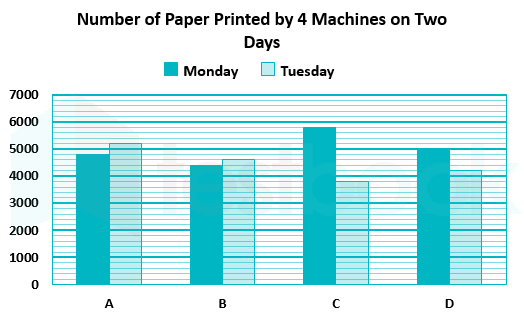
Directions: Study the following bar graph carefully to answer the following questions.
The bar graph shows the number of paper printed by different machines on Monday and Tuesday
Find the average of the total number of papers printed on Tuesday.
4425
4375
4450
4280
4190
4425
Number of papers printed by D on Tuesday is what percent less than number of papers printed by A on Monday?
12.5%
16.66%
8.33%
8.25%
6.25%
12.5%
Find the ratio between the total number of papers printed by machine A and machine D on given days.
23 : 25
25 : 23
55 : 48
48 : 55
24 : 23
23 : 25
Find the difference between the total number of papers printed by machine B and machine C on given days.
500
700
800
600
300
500
Find the total numbers of papers printed on Monday.
18,000
20,000
21,000
19,000
22,000
18,000
The number of papers printed by machine B on Monday is what percent less than that of machine D on Monday?
14%
15%
12%
18%
10%
14%
Direction: Study the table carefully and answer the following questions.
The following table shows the total number of students from four schools learning either French or German.
| School Name | Total number of Students (Boys + Girls) | French |
|---|---|---|
| A | 550 | 250 |
| B | 625 | 330 |
| C | 680 | 380 |
| D | 575 | 240 |
Find the total number of students learning German from all the four schools.
1190
1250
1230
1340
1070
1190
The number of students learning German from school B is what percent more than the number of students learning French from school A?
18%
21%
16%
22%
24%
18%
Find the ratio between the total number of students learning German and French.
40 : 41
41 : 40
41 : 39
39 : 41
None of these
40 : 41
If the ratio between boys and girls in all the schools together is 5 : 4, then find the total number of girls.
1030
970
810
1080
1150
1030
Find the difference between the number of students learning German from school C and that of school D.
25
20
35
10
40
25
Direction: Read the information carefully and answer the following questions:
In a school of 750 students, each student likes atleast one of the three colors- Red, Green and Blue. 109 students like only red color, 150 students like only green color and 125 students like only blue color. The number of students who like red and green colors only is 70% of the students who like only green color. The number of students who like red and blue colors only is 60% of the students who like only blue color. 100 students like all the colors.
Find the number of students who like green and blue colours only.
66
76
86
96
106
66
Find the average number of students who like only one colour.
128
127
126
125
124
128
The number of students who like red and green colors only is how much percent more than the number of students who like red and blue colors only?
35%
40%
45%
50%
42%
35%
What is the difference between the number of students who like only one color and the number of students who like only two colors?
115
116
117
118
119
115
Find the ratio of the number of students who like all three colors to the number of students who like only green color.
1 : 2
2 : 1
1 : 3
4 : 3
2 : 3
1 : 2
A and B invested Rs. 8000 and Rs. 12,000 respectively in a business. B left the business after 6 months. Find the profit of B if the total profit after 1 year is Rs. 35,000.
Rs. 12,000
Rs. 18,000
Rs. 15,000
Rs. 20,000
Rs. 10,000
Rs. 12,000
A train of length 500 m crosses a platform of length 200 m in 10 seconds. Find the time taken by the train to cross a man running in the same direction with the speed of 20 m/s.
12 seconds
10 seconds
15 seconds
18 seconds
13 seconds
12 seconds
Ratio of milk and water in a mixture of 50 litres is 4 : 1. 10 litres of the mixture is taken out from the mixture and then 3 litres of milk and 5 litres of water is added to it. Find the final ratio between milk and water.
33 : 14
36 : 13
34 : 9
35 : 13
None of these
33 : 14
The diameter of a circle is 10.5 cm and the radius of a sphere is twice the diameter of the circle. Find the volume of the sphere.
38,808 cm3
25,996 cm3
30,804 cm3
35,664 cm3
40,132 cm3
38,808 cm3
An amount is invested at the rate of 20% compounded annually and becomes Rs. 8640 after 3 years. Find the amount invested.
Rs. 4500
Rs. 4000
Rs. 4800
Rs. 5500
Rs. 5000
Rs. 4500
A, B and C can complete a work in 12, 20 and 15 days respectively. A and B started the work and worked for 5 days. Find the time taken by C to complete the remaining work.
4 days
5 days
6 days
3 days
None of these
4 days
Ram marked the price of an article by 25% more and then gave a discount of 10% to a customer. Find the price at which he sold the article if its cost is Rs. 5000.
Rs. 5625
Rs. 5500
Rs. 5275
Rs. 6250
Rs. 6000
Rs. 5625
The difference between the ages of Aditya and his mother is 20 years. After 5 years, the age of his mother will be twice Aditya's age that time. Find the present age of Aditya.
12 years
15 years
10 years
20 years
18 years
12 years
A man distributed his salary between his 3 children A, B and C in the ratio of 5 : 4 : 7 respectively. If the amount received by C was Rs. 34,300, then find the total amount the man had.
Rs. 72,800
Rs. 70,400
Rs. 78,400
Rs. 80,800
Rs. 72,600
Rs. 72,800
The average age of 25 students of a class is 16 years. If the age of the class teacher is included, the average increases by 1. Find the age of the class teacher.
40 years
38 years
36 years
42 years
45 years
40 years
Vaibhav scored 25% marks and failed by 32 marks in an examination. Ravi scored 40% marks and got 28 marks more than the passing marks. Find the maximum marks that can be scored in the exam.
410 marks
400 marks
380 marks
350 marks
500 marks
410 marks
The speed of a boat in still water and the speed of a stream are 15 km/hr and 3 km/hr respectively. Find the time taken to cover 72 km from starting point and then return to the starting point.
12 hours
8 hours
10 hours
15 hours
None of these
12 hours
Timed interface, section switching, instant scoring, and question-by-question analytics — free.
Start Timed Attempt