Official Paper

RRB Clerk Prelims Memory Based Paper (Held On: 7 Dec 2025 Shift 2) (Previous Year Paper)

80 questions · 45 minutes · with answers · free

Reasoning (40 questions)

Direction: Read the following information carefully and answer the questions based on given information.

Seven persons K, L, M, N, O, P and Q went for an interview in Accenture on different days of a week starting from Monday to Sunday but not necessarily in same order. Only one person gives an interview on any particular day. Three persons give interview between M and O who is scheduled for interview after M. Q gives interview two days before P. L and N give interview on adjacent days. Q gives interview before M. Not more than one person gives interview between N and K.

1

How many persons give interview between P and O?

  1. ((a))

    None

  2. ((b))

    Two

  3. ((c))

    One

  4. ((d))

    Three

  5. ((e))

    More than three

Show Answer
Answer: ((b))

Two

Here, persons are K, L, M, N, O, P and Q.

  1. Three persons give interview between M and O who is scheduled for interview after M.

  2. Q gives interview two days before P.

  3. Q gives interview before M.

DaysCase – 1Case – 2
PersonsPersons
MondayQ
TuesdayMQ
WednesdayPM
ThursdayP
Friday
SaturdayO
SundayO


  1. L and N give interview on adjacent days.

  2. Not more than one person gives interview between N and K. Therefore, case 2 is eliminated. Hence, the final arrangement is as follows

DaysPersons
MondayQ
TuesdayM
WednesdayP
ThursdayL
FridayN
SaturdayO
SundayK


Hence, two persons give interview between P and O.
2

Which of the following statement(s) is/are correct?

I. Q gives interview just before M.

II. P and L gives interview on adjacent days.

III. N gives interview just before L.

  1. ((a))

    Only II and III

  2. ((b))

    All of these

  3. ((c))

    Only I and II

  4. ((d))

    None of these

  5. ((e))

    Only III

Show Answer
Answer: ((c))

Only I and II

Here, persons are K, L, M, N, O, P and Q.

  1. Three persons give interview between M and O who is scheduled for interview after M.

  2. Q gives interview two days before P.

  3. Q gives interview before M.

DaysCase – 1Case – 2
PersonsPersons
MondayQ
TuesdayMQ
WednesdayPM
ThursdayP
Friday
SaturdayO
SundayO


  1. L and N give interview on adjacent days.

  2. Not more than one person gives interview between N and K. Therefore, case 2 is eliminated. Hence, the final arrangement is as follows

DaysPersons
MondayQ
TuesdayM
WednesdayP
ThursdayL
FridayN
SaturdayO
SundayK


Since, Q gives interview just before M. Therefore, statement I is correct.

P and L gives interview on adjacent days. Therefore, statement II is correct.

N gives interview just after L not before. Therefore, statement III is incorrect.

Hence, the correct statement is only I and II.

3

In a certain way four of the five are alike find the one which does not follow the same pattern?

  1. ((a))

    Q - Tuesday

  2. ((b))

    P - Thursday

  3. ((c))

    N - Saturday

  4. ((d))

    K - Sunday

  5. ((e))

    M - Wednesday

Show Answer
Answer: ((d))

K - Sunday

Here, persons are K, L, M, N, O, P and Q.

  1. Three persons give interview between M and O who is scheduled for interview after M.

  2. Q gives interview two days before P.

  3. Q gives interview before M.

DaysCase – 1Case – 2
PersonsPersons
MondayQ
TuesdayMQ
WednesdayPM
ThursdayP
Friday
SaturdayO
SundayO


  1. L and N give interview on adjacent days.

  2. Not more than one person gives interview between N and K. Therefore, case 2 is eliminated. Hence, the final arrangement is as follows

DaysPersons
MondayQ
TuesdayM
WednesdayP
ThursdayL
FridayN
SaturdayO
SundayK


Since, each combination is incorrectly matched except K who gives interview on Sunday.

Hence, the odd one is K - Sunday.

4

Which of the following statement(s) is/are incorrect?

I. P gives interview on Wednesday.

II. K is the last person who gives interview.

III. No one gives interview between N and O.

  1. ((a))

    All of these

  2. ((b))

    Only II and III

  3. ((c))

    Only I and III

  4. ((d))

    Only I and II

  5. ((e))

    None of these

Show Answer
Answer: ((e))

None of these

Here, persons are K, L, M, N, O, P and Q.

  1. Three persons give interview between M and O who is scheduled for interview after M.

  2. Q gives interview two days before P.

  3. Q gives interview before M.

DaysCase – 1Case – 2
PersonsPersons
MondayQ
TuesdayMQ
WednesdayPM
ThursdayP
Friday
SaturdayO
SundayO


  1. L and N give interview on adjacent days.

  2. Not more than one person gives interview between N and K. Therefore, case 2 is eliminated. Hence, the final arrangement is as follows

DaysPersons
MondayQ
TuesdayM
WednesdayP
ThursdayL
FridayN
SaturdayO
SundayK


Since, P gives interview on Wednesday. Therefore, statement I is correct.

K is the last person who gives interview. Therefore, statement II is correct.

No one gives interview between N and O. Therefore, statement III is correct.

Hence, the incorrect statement is None of these.

5

Who among the following person give interview on Saturday?

  1. ((a))

    L

  2. ((b))

    N

  3. ((c))

    K

  4. ((d))

    O

  5. ((e))

    M

Show Answer
Answer: ((d))

O

Here, persons are K, L, M, N, O, P and Q.

  1. Three persons give interview between M and O who is scheduled for interview after M.

  2. Q gives interview two days before P.

  3. Q gives interview before M.

DaysCase – 1Case – 2
PersonsPersons
MondayQ
TuesdayMQ
WednesdayPM
ThursdayP
Friday
SaturdayO
SundayO


  1. L and N give interview on adjacent days.

  2. Not more than one person gives interview between N and K. Therefore, case 2 is eliminated. Hence, the final arrangement is as follows

DaysPersons
MondayQ
TuesdayM
WednesdayP
ThursdayL
FridayN
SaturdayO
SundayK


Hence, O give interview on Saturday.

Direction: Read the following information carefully and answer the questions based on given information.

Point A is 5 Km to the south of Point B. Point E is 4 Km to the north of point F. Point C is 7 Km to the west of point B. Point G is 9 Km to the east of point F. Point D is 2 Km to the east of point E. Point C is 3 Km to the north of point D.

6

What is the shortest distance between G and A?

  1. ((a))

    6Km

  2. ((b))

    3Km

  3. ((c))

    5Km

  4. ((d))

    2Km

  5. ((e))

    4Km

Show Answer
Answer: ((d))

2Km

  1. Point A is 5 Km to the south of Point B.

2) Point C is 7 Km to the west of point B.

  1. Point C is 3 Km to the north of point D.

  1. Point D is 2 Km to the east of point E.

  2. Point E is 4 Km to the north of point F.

  3. Point G is 9 Km to the east of point F.

Hence, the shortest distance between A and G is 2 Km.

7

Which of the following statement(s) is/are correct?

I. Point A, Point G and Point B makes a straight line.

II. Point E is in Southwest direction of point A.

III. Point G is in Southeast direction of point D.

  1. ((a))

    Only II

  2. ((b))

    Only I and III

  3. ((c))

    Only III

  4. ((d))

    Only I and II

  5. ((e))

    Only II and III

Show Answer
Answer: ((b))

Only I and III

  1. Point A is 5 Km to the south of Point B.

2) Point C is 7 Km to the west of point B.

  1. Point C is 3 Km to the north of point D.

  1. Point D is 2 Km to the east of point E.

  2. Point E is 4 Km to the north of point F.

  3. Point G is 9 Km to the east of point F.

Since, Point A, Point G and Point B makes a straight line. Therefore, statement I is correct.

Point E is in northwest direction of point A not southwest. Therefore, statement II is incorrect.

Point G is in Southeast direction of point D. Therefore, statement III is correct.

Hence, the correct answer is only I and III.

8

What is the position of point E with respect to point B?

  1. ((a))

    Southwest

  2. ((b))

    Northeast

  3. ((c))

    South

  4. ((d))

    North

  5. ((e))

    None of these

Show Answer
Answer: ((a))

Southwest

  1. Point A is 5 Km to the south of Point B.

2) Point C is 7 Km to the west of point B.

  1. Point C is 3 Km to the north of point D.

  1. Point D is 2 Km to the east of point E.

  2. Point E is 4 Km to the north of point F.

  3. Point G is 9 Km to the east of point F.

Since, point E is in Southwest direction of point B.

Hence, the correct answer is Southwest.

9

Direction: In the following question, assuming the given statements to be true, find which of the conclusions I and II given below is/are definitely true and give your answer accordingly.

Statements:

X = C, C ≤ G, G < S, S > K

Conclusions:

I. X = G

II. X < G

  1. ((a))

    Only I is true

  2. ((b))

    Only II is true

  3. ((c))

    Either I or II is true

  4. ((d))

    Neither I nor II is true

  5. ((e))

    Both I and II are true

Show Answer
Answer: ((c))

Either I or II is true

Statement: X = C, C ≤ G, G < S, S > K

On arrangement: X = C ≤ G < S > K

I. X = G → not definitely true (X = C ≤ G < S → X ≤ G)

II. X < G → not definitely true (X = C ≤ G < S → X ≤ G)

Hence, either I or II is true.

10

Direction: In each of the following questions assuming the given statements to be true, find which of the following conclusion I and II given below is/are definitely true and given your answer accordingly.

Statements:

C ≥ L, L > U, U = G, I < G

Conclusions:

I. C > U

II. C < U

  1. ((a))

    Only I is true

  2. ((b))

    Only II is true

  3. ((c))

    Either I or II is true

  4. ((d))

    Neither I nor II is true

  5. ((e))

    Both I and II are true

Show Answer
Answer: ((a))

Only I is true

Given statement: C ≥ L, L > U, U = G, I < G

After combining: C ≥ L > U = G > I

I. C > U → True (C ≥ L > U = G > I → C > U)

II. C < U → False (C ≥ L > U = G > I → U < C)

Hence, only conclusion I is true.

11

Direction: In each of the following questions assuming the given statements to be true, find which of the following conclusion I and II given below is/are definitely true and given your answer accordingly.

Statements:

N < E, E = L, L ≤ S, S = G

Conclusions:

I. G < L

II. E = G

  1. ((a))

    Only I is true

  2. ((b))

    Only II is true

  3. ((c))

    Either I or II is true

  4. ((d))

    Neither I nor II is true

  5. ((e))

    Both I and II is true

Show Answer
Answer: ((d))

Neither I nor II is true

I. G < L → False (N < E = L ≤ G = S → L ≤ G)

II. E = G → False (N < E = L ≤ G = S → E ≤ G)

Hence, Neither I nor II is true

Direction: Read the following information carefully and answer the questions based on given information.

Eight friends G, H, I, J, K, L, M and N went for dinner and sit around a rectangular table such that four persons sit on the corners of the table facing inward while rest of them sit on the middle of the table facing outward direction. J sits to the left of I and both of them facing same direction. M sits second to the right of the one who sits immediate right to K. Two persons sit between G and J. L and I sit immediate left to each other. N sits second to the right of K. N is the neighbor of H and G. H does not sit immediate right to K. J doesn't face inward.

12

Who among the following person sits opposite to I?

  1. ((a))

    H

  2. ((b))

    G

  3. ((c))

    N

  4. ((d))

    K

  5. ((e))

    J

Show Answer
Answer: ((c))

N

Here, friends are G, H, I, J, K, L, M and N.

  1. M sits second to the right of the one who sits immediate right to K.

  2. N sits second to the right of K. 

  1. N is the neighbor of H and G.

  2. H does not sit immediate right to K.

  1. Two persons sit between G and J.

  2. L and I sit immediate left to each other.

  3. J sits to the left of I and both of them facing same direction. Therefore, case 1 is eliminated. Hence, the final arrangement is as follows

Hence, N sits opposite to I.

13

Which of the following statement(s) is/are true regarding H?

I. H sits immediate left to J.

II. N sits immediate left to H.

III. H and K faces in same direction.

  1. ((a))

    Only I

  2. ((b))

    Only II and III

  3. ((c))

    Only I and III

  4. ((d))

    Only II

  5. ((e))

    All of these

Show Answer
Answer: ((a))

Only I

Here, friends are G, H, I, J, K, L, M and N.

  1. M sits second to the right of the one who sits immediate right to K.

  2. N sits second to the right of K. 

  1. N is the neighbor of H and G.

  2. H does not sit immediate right to K.

  1. Two persons sit between G and J.

  2. L and I sit immediate left to each other.

  3. J sits to the left of I and both of them facing same direction. Therefore, case 1 is eliminated. Hence, the final arrangement is as follows

Since, H sits immediate left to J. Therefore, statement I is correct.

N sits immediate right not left to H. Therefore, statement II is incorrect.

H and K faces in opposite direction not same direction. Therefore, statement III is incorrect.

Hence, the correct statement is Only I.

14

In a certain way four of the five are alike find the one which does not follow the same pattern?

  1. ((a))

    HM

  2. ((b))

    LG

  3. ((c))

    KJ

  4. ((d))

    NL

  5. ((e))

    NI

Show Answer
Answer: ((d))

NL

Here, friends are G, H, I, J, K, L, M and N.

  1. M sits second to the right of the one who sits immediate right to K.

  2. N sits second to the right of K. 

  1. N is the neighbor of H and G.

  2. H does not sit immediate right to K.

  1. Two persons sit between G and J.

  2. L and I sit immediate left to each other.

  3. J sits to the left of I and both of them facing same direction. Therefore, case 1 is eliminated. Hence, the final arrangement is as follows

Since, each pair represents persons sitting opposite to each other except whereas N and L do not sit opposite to each other.

Hence, the odd one NL.

15

Which of the following statement(s) is/are incorrect?

I. K faces outward direction.

II. H sits second to the right of L.

III. G and N sits immediate left to each other.

  1. ((a))

    Only II and III

  2. ((b))

    Only I and III

  3. ((c))

    All of these

  4. ((d))

    None of these

  5. ((e))

    Only I and II

Show Answer
Answer: ((d))

None of these

Here, friends are G, H, I, J, K, L, M and N.

  1. M sits second to the right of the one who sits immediate right to K.

  2. N sits second to the right of K. 

  1. N is the neighbor of H and G.

  2. H does not sit immediate right to K.

  1. Two persons sit between G and J.

  2. L and I sit immediate left to each other.

  3. J sits to the left of I and both of them facing same direction. Therefore, case 1 is eliminated. Hence, the final arrangement is as follows

Since, K faces outward direction. Therefore, statement I is correct.

H sits second to the right of L. Therefore, statement II is correct.

G and N sits immediate left to each other. Therefore, statement III is correct.

Hence, the incorrect statement is none of these.

16

Who sits second to the left of the one who sits third to the right of J?

  1. ((a))

    I

  2. ((b))

    N

  3. ((c))

    M

  4. ((d))

    G

  5. ((e))

    K

Show Answer
Answer: ((d))

G

Here, friends are G, H, I, J, K, L, M and N.

  1. M sits second to the right of the one who sits immediate right to K.

  2. N sits second to the right of K. 

  1. N is the neighbor of H and G.

  2. H does not sit immediate right to K.

  1. Two persons sit between G and J.

  2. L and I sit immediate left to each other.

  3. J sits to the left of I and both of them facing same direction. Therefore, case 1 is eliminated. Hence, the final arrangement is as follows

Since, M sits third to the right of J and G sits second to the left of M.

Hence, the correct answer is G.

17

In the given word "INTRODUCE", the letters are arranged in alphabetical series from left to right within the word then which of the following letter comes sixth from the left end?

  1. ((a))

    D

  2. ((b))

    I

  3. ((c))

    N

  4. ((d))

    O

  5. ((e))

    R

Show Answer
Answer: ((d))

O

Given word:- INTRODUCE

Given wordINTRODUCE
RearrangementCDEINORTU


Since, 'O' comes sixth from the left end.

Hence, the correct answer is 'O'.

Direction: Study the following arrangement carefully and answer the questions given below:

X L 5 I € V O 7 % R G $ M 4 J D # P 8 K @ 1 0 E U 2 α 6 X 9 H

18

Which of the following is exactly in the middle of the eleventh element from the left end and the fifteenth element from the right end in the given arrangement?

  1. ((a))

  2. ((b))

    4

  3. ((c))

    2

  4. ((d))

    $

  5. ((e))

    None of these

Show Answer
Answer: ((b))

4

Given series is: (Left) X L 5 I € V O 7 % R G $ M 4 J D # P 8 K @ 1 0 E U 2 α 6 X 9 H (Right)

11th from the left → G

15th from right → #

Terms between G and # are $, M, 4, J, D and 4 is exactly in middle of them.

Hence, 4 is the correct answer.

19

Which of the following is the ninth element to the left of the twentieth element from the left end of the given arrangement?

  1. ((a))

    $

  2. ((b))

    K

  3. ((c))

    G

  4. ((d))

    P

  5. ((e))

    None of these

Show Answer
Answer: ((c))

G

Given series is: (Left)  X L 5 I € V O 7 % R G $ M 4 J D # P 8 K @ 1 0 E U 2 α 6 X 9 H            (Right)

20th element from the left = K

9th element to the left of K = G

(Left)   X L 5 I € V O 7 % R G $ M 4 J D # P 8 K @ 1 0 E U 2 α 6 X 9 H          (Right)

Hence, G is the correct answer.

20

How many such symbols are there in the given arrangement, each of which is immediately preceded by a consonant and immediately followed by a number?

  1. ((a))

    None

  2. ((b))

    One

  3. ((c))

    Two

  4. ((d))

    Three

  5. ((e))

    None of these

Show Answer
Answer: ((b))

One

Given series is: X L 5 I € V O 7 % R G $ M 4 J D # P 8 K @ 1 0 E U 2 α 6 X 9 H

Arrangement required: Consonant → Symbols → Number

(Left)   X L 5 I € V O 7 % R G $ M 4 J D # P 8 K @ 1 0 E U 2 α 6 X 9 H           (Right)

Hence, only one such pair is there, i.e. K @ 1.

21

How many such numbers are there in the given arrangement, each of which is both immediately preceded and immediately followed by a consonant?

  1. ((a))

    None

  2. ((b))

    One

  3. ((c))

    Two

  4. ((d))

    Three

  5. ((e))

    More than three

Show Answer
Answer: ((d))

Three

Given series is: X L 5 I € V O 7 % R G $ M 4 J D # P 8 K @ 1 0 E U 2 α 6 X 9 H

Arrangement required: Consonant → Number → Consonant

(Left)   X L 5 I € V O 7 % R G $ M 4 J D # P 8 K @ 1 0 E U 2 α 6 X 9 H           (Right)

Hence, three such pairs are there i.e. M 4 J, P 8 K and X 9 H

22

How many such consonants are there in the given arrangement, each of which is immediately preceded by a number and immediately followed by a vowel?

  1. ((a))

    None

  2. ((b))

    One

  3. ((c))

    Two

  4. ((d))

    Three

  5. ((e))

    More than three

Show Answer
Answer: ((a))

None

Arrangement required: Number → Consonant → Vowel

Given series is: X L 5 I € V O 7 % R G $ M 4 J D # P 8 K @ 1 0 E U 2 α 6 X 9 H

Clearly no such pair is there.

Hence, none is the correct answer.

23

Directions: In the following question, two statements are given followed by two conclusions I and II. You have to consider the given statements to be true even, if they seem to be at variance with commonly known facts. Read all the conclusions and decide which of the following logically follows from the given statements disregarding the commonly known facts.

Statements:

Some mobiles are pagers.

No mobile is a laptop.

Conclusions:

 I. Some pagers are not laptop.

II. All laptop being pagers is a possibility.

  1. ((a))

    None follows.

  2. ((b))

    Only I follows.

  3. ((c))

    Only II follows.

  4. ((d))

    Either I or II follows.

  5. ((e))

    Both I and II follows.

Show Answer
Answer: ((e))

Both I and II follows.

The least possible Venn diagram for the given statements is as follows,

Conclusions:

 I. Some pagers are not laptop → it is definitely true.

II. All laptop being pagers is a possibility → its possibility is true as shown in the diagram below.

Thus, both conclusion I and II follows.

24

Directions: In the following question, two statements are given followed by two conclusions I and II. You have to consider the given statements to be true even, if they seem to be at variance with commonly known facts. Read all the conclusions and decide which of the following logically follows from the given statements disregarding the commonly known facts.

Statements:

All tables are chairs.

All chairs are beds.

Conclusions:

I. All chairs are tables.

II. All beds being table is a possibility.

  1. ((a))

    Only I follows.

  2. ((b))

    Only II follows.

  3. ((c))

    Both I and II follows.

  4. ((d))

    Neither I nor II follows.

  5. ((e))

    Either I or II follows.

Show Answer
Answer: ((b))

Only II follows.

The least possible Venn diagram for the given statements is as follows,

Conclusions:

I. All chairs are tables → it’s possible but not definite, hence false.

II. All beds being table is a possibility → its possibility is true when all the three coincide as shown in the diagram below.

Thus, only conclusion II follows.

25

Directions: In the question below is given three statements followed by two conclusions I and II. You have to take the given statements to be true even if they seem to be at variances from commonly known facts. Read all the conclusions and then decide which of the given conclusions logically follows from the given statements disregarding commonly known facts.

Statements:

No paper is file.

All files are folders.

Some folders are data.

Conclusions:

I. Some folders are not paper.

II. Some files are data.

  1. ((a))

    If only conclusion I follows.

  2. ((b))

    If only conclusion II follows.

  3. ((c))

    If either conclusion I or II follows.

  4. ((d))

    If neither conclusion I nor II follows.

  5. ((e))

    If both conclusions I and II follows.

Show Answer
Answer: ((a))

If only conclusion I follows.

The least possible Venn diagram is as follows:

Conclusions:

I. Some folders are not paper → True (because no paper is a file and all files are folder. Therefore Some folder are not paper)

II. Some files are data → False (It is possible but not definite)

Hence, only conclusions I follows.

Direction: Read the following information carefully and answer the questions based on given information.

In a certain code language:

‘Rony makes a snowman’ is coded as ‘qm rk vs al’

‘Snowman brings good luck’ is coded as ‘wt nd rk za’

‘Winter brings snowfalls’ is coded as ‘fl oc wt’

‘Rony likes winter season’ is coded as ‘js qm bp oc’

26

What is the possible words for the code 'wt qm'?

  1. ((a))

    Rony likes

  2. ((b))

    Snowman brings

  3. ((c))

    Winter Rony

  4. ((d))

    Snowman winter

  5. ((e))

    Rony brings

Show Answer
Answer: ((e))

Rony brings

According to the given information:

Since, from the above diagram it is clear the 'Rony' is coded as 'qm' and 'brings' is coded as 'wt'.

Hence, the words for the code 'wt qm' is 'Rony brings'.

27

What is the possible word for the code 'fl za'?

  1. ((a))

    Makes good

  2. ((b))

    Snowfalls good

  3. ((c))

    Winter luck

  4. ((d))

    Luck snowfalls

  5. ((e))

    Either 2 or 4

Show Answer
Answer: ((e))

Either 2 or 4

According to the given information:

Since, the code for the word 'snowfalls' can be 'fl' and the word for the code 'za' can be either 'good' or 'luck'. Therefore, the possible words for the code 'fl za' can be either 'snowfalls good' or 'luck snowfalls'.

Hence, the correct answer is either 2 or 4.

28

What is the code for the word 'winter'?

  1. ((a))

    qm

  2. ((b))

    wt

  3. ((c))

    rk

  4. ((d))

    oc

  5. ((e))

    Cannot be determined

Show Answer
Answer: ((d))

oc

According to the given information:

Since, from the given figure it is clear the code for the word 'winter' is 'oc'.

Hence, the correct answer is 'oc'.

29

What is the possible code for 'Snowfalls sleet'?

  1. ((a))

    oc ur

  2. ((b))

    wt mk

  3. ((c))

    fl js

  4. ((d))

    fl ut

  5. ((e))

    nd fl

Show Answer
Answer: ((d))

fl ut

According to the given information:

Since, the possible code for 'snowfalls' can be 'fl' and the word 'sleet' is not given in the coded information so its code will be different from the given codes.

Hence, the possible code for the words 'Snowfalls sleet' is 'fl ut'.

30

If the 'likes a snow' is coded as 'sk al js' then what will be possible code for 'makes season'?

  1. ((a))

    fl bp

  2. ((b))

    rk js

  3. ((c))

    vs bp

  4. ((d))

    al bp

  5. ((e))

    vs js

Show Answer
Answer: ((c))

vs bp

According to the given information:

Since, 'likes a snow' is coded as 'sk al js' then the possible code for 'makes' can be 'vs' and code for 'season' is 'bp'

Hence, the possible code for the word 'makes season' is 'vs bp'.

31

Which of the following letter and number clusters will replace the question mark (?) in the given series?

PC3, RG5, TK7, VO11, ?

  1. ((a))

    WS13

  2. ((b))

    XR15

  3. ((c))

    XS13

  4. ((d))

    SX11

  5. ((e))

    YT15

Show Answer
Answer: ((c))

XS13

Since, the first letters are added by 2 with the previous first letter of the given clusters, the second letters of clusters are added by 4 with the previous second letter of clusters and number are arranged in prime number series.

Hence, the correct answer is XS13.

Direction: Read the following information carefully and answer the questions based on given information.

Six persons A, B, C, D, E and F join a TCS company in three different months June, September and December of two different dates on either 15 or 28 but not necessarily in same order. Not more than one person joins a company on any date of the month. Two persons join between E and D who joins after E. B and C join company on same month. A joins the company before F. B and D join company immediate next to each other. C joins company before F.

32

Who among the following person joins company on 15th September?

  1. ((a))

    E

  2. ((b))

    A

  3. ((c))

    F

  4. ((d))

    C

  5. ((e))

    D

Show Answer
Answer: ((d))

C

Here, persons are A, B, C, D, E and F; months June, September and December; dates 15 and 28.

  1. Two persons join between E and D who joins after E.

  2. B and C join company on same month.

  3. B and D join company immediate next to each other.

MonthsDatesCase – 1Case – 2
PersonsPersons
June15E
28E
September15C
28DB
December15BD
28C


  1. A joins the company before F.

  2. C joins company before F. Therefore, case 2 is eliminated. Hence, the final arrangement is as follows

MonthsDatesPersons
June15A
28E
September15C
28B
December15D
28F


Hence, C joins company on 15th September.

33

In a certain way four of the five are alike find the one which does not follow the same pattern?

  1. ((a))

    AC

  2. ((b))

    EB

  3. ((c))

    CD

  4. ((d))

    BF

  5. ((e))

    AE

Show Answer
Answer: ((e))

AE

Here, persons are A, B, C, D, E and F; months June, September and December; dates 15 and 28.

  1. Two persons join between E and D who joins after E.

  2. B and C join company on same month.

  3. B and D join company immediate next to each other.

MonthsDatesCase – 1Case – 2
PersonsPersons
June15E
28E
September15C
28DB
December15BD
28C


  1. A joins the company before F.

  2. C joins company before F. Therefore, case 2 is eliminated. Hence, the final arrangement is as follows

MonthsDatesPersons
June15A
28E
September15C
28B
December15D
28F


Since, in each pair one person joins company between them except AE where both of them joins company immediate next to each other.

Hence, the odd one is AE.

34

Which of the following statement(s) is/are correct?

I. A joins the company in the month of June.

II. D and F joins company in the same month.

III. E joins company on 15th June.

  1. ((a))

    Only I and II

  2. ((b))

    Only II

  3. ((c))

    All of these

  4. ((d))

    Only II and III

  5. ((e))

    Only I and III

Show Answer
Answer: ((a))

Only I and II

Here, persons are A, B, C, D, E and F; months June, September and December; dates 15 and 28.

  1. Two persons join between E and D who joins after E.

  2. B and C join company on same month.

  3. B and D join company immediate next to each other.

MonthsDatesCase – 1Case – 2
PersonsPersons
June15E
28E
September15C
28DB
December15BD
28C


  1. A joins the company before F.

  2. C joins company before F. Therefore, case 2 is eliminated. Hence, the final arrangement is as follows

MonthsDatesPersons
June15A
28E
September15C
28B
December15D
28F


Since, A joins the company in the on 15th June. Therefore, statement I is correct.

D and F joins company in the December month. Therefore, statement II is correct.

E joins company on 28th June not 15th June. Therefore, statement III is incorrect.

Hence, the correct answer is only I and II.

35

Which of the following statement(s) is/are incorrect?

I. C joins company just after B.

II. B joins company in the month of December.

III. D joins company before B.

  1. ((a))

    Only I

  2. ((b))

    Only II and III

  3. ((c))

    All of these

  4. ((d))

    None of these

  5. ((e))

    Only I and III

Show Answer
Answer: ((c))

All of these

Here, persons are A, B, C, D, E and F; months June, September and December; dates 15 and 28.

  1. Two persons join between E and D who joins after E.

  2. B and C join company on same month.

  3. B and D join company immediate next to each other.

MonthsDatesCase – 1Case – 2
PersonsPersons
June15E
28E
September15C
28DB
December15BD
28C


  1. A joins the company before F.

  2. C joins company before F. Therefore, case 2 is eliminated. Hence, the final arrangement is as follows

MonthsDatesPersons
June15A
28E
September15C
28B
December15D
28F


Since, C joins company just before not after B. Therefore, statement I is incorrect.

B joins company in the month of September not December. Therefore, statement II is incorrect.

D joins company after B not before. Therefore, statement III is incorrect.

Hence, the incorrect statement is all of these.

36

Who among the following person joins company just before C?

  1. ((a))

    A

  2. ((b))

    E

  3. ((c))

    B

  4. ((d))

    D

  5. ((e))

    F

Show Answer
Answer: ((b))

E

Here, persons are A, B, C, D, E and F; months June, September and December; dates 15 and 28.

  1. Two persons join between E and D who joins after E.

  2. B and C join company on same month.

  3. B and D join company immediate next to each other.

MonthsDatesCase – 1Case – 2
PersonsPersons
June15E
28E
September15C
28DB
December15BD
28C


  1. A joins the company before F.

  2. C joins company before F. Therefore, case 2 is eliminated. Hence, the final arrangement is as follows

MonthsDatesPersons
June15A
28E
September15C
28B
December15D
28F


Hence, E joins the company just before C.

Direction: Read the following information carefully and answer the questions based on given information.

In a family of seven members, there are two married couples. O is the father – in – law of X. M has two sons. Y is the uncle of W. P is the brother – in – law of X. K is the brother – in – law of Y. K has one son. P is unmarried.

37

In a certain way four of the five are alike find the one which does not follow the same pattern?

  1. ((a))

    O

  2. ((b))

    K

  3. ((c))

    P

  4. ((d))

    W

  5. ((e))

    X

Show Answer
Answer: ((e))

X

Here, family members are K, M, O, P, W, X and Y.

  1. O is the father – in – law of X.

  2. P is the brother – in – law of X.

  3. P is unmarried.

  1. Y is the uncle of W.

  2. K is the brother – in – law of Y.

  3. M has two sons. Therefore, case 2 is eliminated.

  4. K has one son. Hence, the final arrangement is as follows

Since, each person except X is a male member whereas X is a female member.

Hence, the odd one X.

38

Which of the following statement(s) is/are correct?

I. Y is the brother of P.

II. K is the husband of X.

III. O is the grandfather of W.

  1. ((a))

    Only I

  2. ((b))

    Only II and III

  3. ((c))

    Only I and III

  4. ((d))

    All of these

  5. ((e))

    Only II

Show Answer
Answer: ((b))

Only II and III

Here, family members are K, M, O, P, W, X and Y.

  1. O is the father – in – law of X.

  2. P is the brother – in – law of X.

  3. P is unmarried.

  1. Y is the uncle of W.

  2. K is the brother – in – law of Y.

  3. M has two sons. Therefore, case 2 is eliminated.

  4. K has one son. Hence, the final arrangement is as follows

Since, Y is the brother of X who is the sister - in - law of P. Therefore, statement I is incorrect.

K is the husband of X. Therefore, statement II is correct.

O is the grandfather of W. Therefore, statement III is correct.

Hence, the correct answer is only II and III.

39

How K is related to M?

  1. ((a))

    Son - in - law

  2. ((b))

    Brother

  3. ((c))

    Husband

  4. ((d))

    Son

  5. ((e))

    Cannot be determined

Show Answer
Answer: ((d))

Son

Here, family members are K, M, O, P, W, X and Y.

  1. O is the father – in – law of X.

  2. P is the brother – in – law of X.

  3. P is unmarried.

  1. Y is the uncle of W.

  2. K is the brother – in – law of Y.

  3. M has two sons. Therefore, case 2 is eliminated.

  4. K has one son. Hence, the final arrangement is as follows

Hence, K is the son of M.

40

How many pairs of letters are there in the word "CHANGE" which have as many letters between them as in the English alphabetical series (both in forward and backward direction)?

  1. ((a))

    One

  2. ((b))

    Three

  3. ((c))

    More than three

  4. ((d))

    Two

  5. ((e))

    None

Show Answer
Answer: ((d))

Two

Forward pair: CG

Backward pair: AC

Thus, there are two such pairs formed which have as many letters between them as in the English alphabetical series in the given word "CHANGE".

Hence, the correct answer is two such pairs.

Numerical Ability (40 questions)

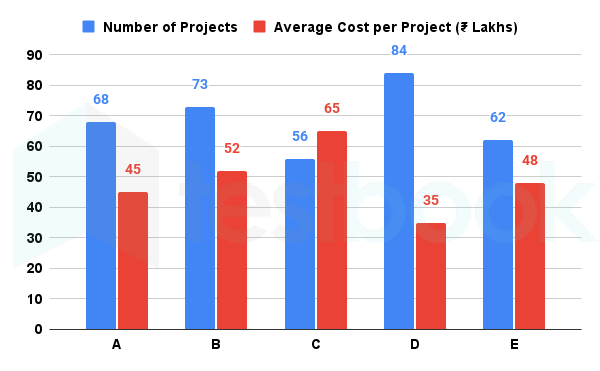
Directions: Study the following bar graph carefully and answer the questions that follow.

The double bar graph shows data regarding five different Managers (A, B, C, D, and E) working in an IT infrastructure company.

  • The Blue Bar represents the Total Number of Projects handled by each manager.
  • The Orange Bar represents the Average Cost per Project (in ₹ Lakhs) for that specific manager.

Note: Total Cost = Number of Projects × Average Cost per Project.

41

A new Manager 'F' handles the same number of projects as the average number of projects handled by A and C. The Average Cost per project for F is equal to the average of the costs per project of B and D. Find the Total Cost of projects handled by Manager F.

  1. ((a))

    ₹2,697 Lakhs

  2. ((b))

    ₹2,745 Lakhs

  3. ((c))

    ₹2,586 Lakhs

  4. ((d))

    ₹2,640 Lakhs

  5. ((e))

    ₹2,810 Lakhs

Show Answer
Answer: ((a))

₹2,697 Lakhs

General Solution:

Given:

Managers A, B, C, D, E with Number of Projects and Average Cost (₹ Lakhs):

A: 68 projects, ₹45

B: 73 projects, ₹52

C: 56 projects, ₹65

D: 84 projects, ₹35

E: 62 projects, ₹48

Total Costs:

⇒ A: 68 × 45 = 3060 (₹ Lakhs)

⇒ B: 73 × 52 = 3796 (₹ Lakhs)

⇒ C: 56 × 65 = 3640 (₹ Lakhs)

⇒ D: 84 × 35 = 2940 (₹ Lakhs)

⇒ E: 62 × 48 = 2976 (₹ Lakhs)

Calculations:

⇒ Projects_F = (68 + 56) ÷ 2 = 62

⇒ Avg cost_F = (52 + 35) ÷ 2 = 87 ÷ 2 = 43.5 (₹ Lakhs)

⇒ Total Cost_F = 62 × 43.5 = 2697 (₹ Lakhs)

Hence, the correct answer is ₹2,697 Lakhs

42

The Total Cost of projects handled by Manager B is what percentage more or less than the Total Cost of projects handled by Manager E?

  1. ((a))

    24.5% more 

  2. ((b))

    27.5% more

  3. ((c))

    21.5% less

  4. ((d))

    27.5% less 

  5. ((e))

    32.5% more

Show Answer
Answer: ((b))

27.5% more

General Solution:

Given:

Managers A, B, C, D, E with Number of Projects and Average Cost (₹ Lakhs):

A: 68 projects, ₹45

B: 73 projects, ₹52

C: 56 projects, ₹65

D: 84 projects, ₹35

E: 62 projects, ₹48

Total Costs:

⇒ A: 68 × 45 = 3060 (₹ Lakhs)

⇒ B: 73 × 52 = 3796 (₹ Lakhs)

⇒ C: 56 × 65 = 3640 (₹ Lakhs)

⇒ D: 84 × 35 = 2940 (₹ Lakhs)

⇒ E: 62 × 48 = 2976 (₹ Lakhs)

Calculations:

⇒ B = 3796 ; E = 2976

⇒ Difference = 3796 − 2976 = 820

⇒ Percent more = (820 ÷ 2976) × 100 ≈ 0.2755 × 100 = 27.55% ≈ 27.5% more

Hence, the correct answer is 27.5% more.

43

Manager C achieved a total revenue of ₹4,368 Lakhs from all projects. Find the Profit earned by Manager C.

  1. ((a))

    ₹728 Lakhs

  2. ((b))

    ₹795 Lakhs

  3. ((c))

    ₹778 Lakhs 

  4. ((d))

    ₹786 Lakhs

  5. ((e))

    ₹790 Lakhs

Show Answer
Answer: ((a))

₹728 Lakhs

General Solution:

Given:

Managers A, B, C, D, E with Number of Projects and Average Cost (₹ Lakhs):

A: 68 projects, ₹45

B: 73 projects, ₹52

C: 56 projects, ₹65

D: 84 projects, ₹35

E: 62 projects, ₹48

Total Costs:

⇒ A: 68 × 45 = 3060 (₹ Lakhs)

⇒ B: 73 × 52 = 3796 (₹ Lakhs)

⇒ C: 56 × 65 = 3640 (₹ Lakhs)

⇒ D: 84 × 35 = 2940 (₹ Lakhs)

⇒ E: 62 × 48 = 2976 (₹ Lakhs)

Calculations:

⇒ C Total Cost = 3640

⇒ C Revenue = 4368 ⇒ Profit_C = 4368 − 3640 = 728 (₹ Lakhs)

Hence, the correct answer is ₹728 Lakhs

44

For Manager E, 50% of the projects were "High-Priority" and the remaining were "Standard". Find the value of the number of 'Standard" projects.

  1. ((a))

    38 

  2. ((b))

    39

  3. ((c))

    33

  4. ((d))

    29

  5. ((e))

    31

Show Answer
Answer: ((e))

31

General Solution:

Given:

Managers A, B, C, D, E with Number of Projects and Average Cost (₹ Lakhs):

A: 68 projects, ₹45

B: 73 projects, ₹52

C: 56 projects, ₹65

D: 84 projects, ₹35

E: 62 projects, ₹48

Total Costs:

⇒ A: 68 × 45 = 3060 (₹ Lakhs)

⇒ B: 73 × 52 = 3796 (₹ Lakhs)

⇒ C: 56 × 65 = 3640 (₹ Lakhs)

⇒ D: 84 × 35 = 2940 (₹ Lakhs)

⇒ E: 62 × 48 = 2976 (₹ Lakhs)

Calculations:

For E — 50% High-Priority, remaining 50% Standard

Number of Standard Projects = 62 × 50 / 100 = 31

Hence, the correct answer is 31.

45

What is the ratio of the Total Cost of all projects handled by Manager A to the Total Cost of all projects handled by Manager D?

  1. ((a))

    49 : 51 

  2. ((b))

    51 : 49 

  3. ((c))

    45 : 47 

  4. ((d))

    15 : 14

  5. ((e))

    17 : 16

Show Answer
Answer: ((b))

51 : 49 

General Solution:

Given:

Managers A, B, C, D, E with Number of Projects and Average Cost (₹ Lakhs):

A: 68 projects, ₹45

B: 73 projects, ₹52

C: 56 projects, ₹65

D: 84 projects, ₹35

E: 62 projects, ₹48

Total Costs:

⇒ A: 68 × 45 = 3060 (₹ Lakhs)

⇒ B: 73 × 52 = 3796 (₹ Lakhs)

⇒ C: 56 × 65 = 3640 (₹ Lakhs)

⇒ D: 84 × 35 = 2940 (₹ Lakhs)

⇒ E: 62 × 48 = 2976 (₹ Lakhs)

Calculations:

Total Cost A : Total Cost D

⇒ 3060 : 2940 = divide by 60 ⇒ 51 : 49

Hence, the correct answer is 51 : 49.

46

The total amount invested by A and B in a business is Rs. 75,000. A invested his capital for 8 months, while B invested his capital for 12 months. At the end of the term, both received an equal share of the profit. What was the amount invested by A?

  1. ((a))

    Rs. 30,000

  2. ((b))

    Rs. 40,000

  3. ((c))

    Rs. 50,000

  4. ((d))

    Rs. 45,000

  5. ((e))

    Rs. 35,000

Show Answer
Answer: ((d))

Rs. 45,000

Given:

Total capital invested by A and B = Rs. 75,000

A invests for 8 months

B invests for 12 months

Both receive equal profit ⇒ Their effective capital (Capital × Time) must be equal.

Let A's capital = x

Then B's capital = 75,000 − x

Condition for equal profit:

A_capital × A_time = B_capital × B_time

x × 8 = (75,000 − x) × 12

Solve:

8x = 12(75,000 − x)

8x = 900,000 − 12x

8x + 12x = 900,000

20x = 900,000

x = 900,000 ÷ 20 = 45,000

A's investment = Rs. 45,000

Hence, the correct answer is Rs. 45,000

47

The total quantity of milk in three containers A, B, and C is 28 litres. The ratio of milk in A, B, and C is initially 4 : 1 : 2. If 4 litres of milk is added to container B, what will be the new ratio of milk in A, B, and C?

  1. ((a))

    3 : 2 : 1

  2. ((b))

    2 : 1 : 1

  3. ((c))

    4 : 3 : 2

  4. ((d))

    1 : 2 : 1

  5. ((e))

    None of the above

Show Answer
Answer: ((b))

2 : 1 : 1

Given:

Total milk = 28 litres

Initial ratio A : B : C = 4 : 1 : 2

Find actual quantities:

Total ratio parts = 4 + 1 + 2 = 7

⇒ 1 part = 28 ÷ 7 = 4 litres

⇒ A = 4 × 4 = 16 L

⇒ B = 1 × 4 = 4 L

⇒ C = 2 × 4 = 8 L

4 litres added to container B:

New B = 4 + 4 = 8 L

New ratio:

A : B : C = 16 : 8 : 8

Divide by common factor 8:

= 2 : 1 : 1

Hence, the correct answer is 2 : 1 : 1

48

The cost price of 12 articles is 2424. The shopkeeper sells these articles at a profit of 25%, then, find the amount gained by the shopkeeper on each article.

  1. ((a))

    48

  2. ((b))

    50

  3. ((c))

    50.5

  4. ((d))

    55.5

  5. ((e))

    None of these

Show Answer
Answer: ((c))

50.5

Given:

C.P of 12 article = Rs. 2424

Profit = 25%

Concept:

Cost price × (100 + Profit %)/100 = Selling price

Where C.P = Cost price, S.P = Selling price

Calculation:

C.P of 12 article = Rs. 2424

C.P of each article:

⇒ 2424/12

⇒ 202

S.P of an article = 202 × (125/100)

⇒ 202 × 5/4

⇒ 252.5

Profit = S.P – C.P

⇒ 252.5 – 202

⇒ 50.5

Rs. 50.5 gained by the shopkeeper on each article.

49

What will come in the place of the question mark ‘?’ in the following question?

37.5 × 2 + 15 ÷ 3 – 14/3 of (?) = 10

  1. ((a))

    6

  2. ((b))

    8

  3. ((c))

    5

  4. ((d))

    10

  5. ((e))

    15

Show Answer
Answer: ((e))

15

Follow BODMAS rule to solve this question, as per the order given below.

Step - 1: Parts of an equation enclosed in 'Brackets' must be solved first, and following BODMAS rule in the bracket -

Step - 2: Any mathematical 'Of' or 'Exponent' must be solved next.

Step - 3: Next, the parts of the equation that contain 'Division' and 'Multiplication' are calculated.

Step - 4: Last but not the least, the parts of the equation that contain 'Addition' and 'Subtraction' should be calculated.

Given expression is

37.5 × 2 + 15 ÷ 3 – 14/3 of (?) = 10 

⇒ 75 + 5 – 14/3 of (?) = 10 

⇒ 70 = 14/3 of (?) 

⇒ ? = 15

50

What will come in the place of the question mark ‘?’ in the following question?

3 × 5/9 of ( 36 ÷ 4 ) × 6 - ? + 5 = 4

  1. ((a))

    40

  2. ((b))

    76

  3. ((c))

    91

  4. ((d))

    26

  5. ((e))

    35

Show Answer
Answer: ((c))

91

Concept:

Follow BODMAS rule to solve this question, as per the order given below, 

CALCULATION :

Given expression :

3 × 5/9 of ( 36 ÷ 4 ) × 6 - ? + 5 = 4

⇒ 3 × 5/9 of (9) × 6 - ? + 5 = 4

⇒ 3 × 5 × 6 - ? + 5 = 4

⇒ 90 - ? + 5 = 4 

⇒ 90 - 4 + 5 = ?

⇒ ? = 91 

∴ ? = 91

51

What will come in the place of the question mark ‘?’ in the following question?

4 × 22.5 ÷ 1.5 + ? –  6 = 30

  1. ((a))

    20

  2. ((b))

    -24

  3. ((c))

    -15

  4. ((d))

    25

  5. ((e))

    18

Show Answer
Answer: ((b))

-24

Given expression : 

4 × 22.5 ÷ 1.5 + ? –  6 = 30

⇒ 4 × 15 + ? – 6 = 30

⇒ 60 + ? - 6 = 30

 ∴ ? = 30 - 60 + 6 = -24

52

What should come in place of the question mark '?' in the following number series?

[(275 - 124) + 42 - 92 - 36)] + 14 = ?

  1. ((a))

    64

  2. ((b))

    36

  3. ((c))

    52

  4. ((d))

    32

  5. ((e))

    None of these

Show Answer
Answer: ((a))

64

Concept used:

Follow BODMAS rule to solve this question, as per the order given below,

Calculation:

Now,

[(275 - 124) + 42 - 92 - 36)] + 14 = ?

⇒ [151 + 16 - 81 - 36] + 14 = ? 

⇒ 50 + 14

⇒ 64 = ?

⇒ ? = 64

∴ The required value  is 64

53

What will come in the place of the question mark ‘?’ in the following question?

75 - 3 × {(62 ÷ 6) ÷ 3} ÷ 13\frac{1}{3} + 13 =?

  1. ((a))

    50

  2. ((b))

    40

  3. ((c))

    60

  4. ((d))

    70

  5. ((e))

    80

Show Answer
Answer: ((d))

70

Follow the BODMAS rule to solve this question, as per the order given below:

75

Step-1: Parts of an equation enclosed in 'Brackets' must be solved first, and in the bracket,

Step-2: Any mathematical 'Of' or 'Exponent' must be solved next,

Step-3: Next, the parts of the equation that contain 'Division' and 'Multiplication' are calculated,

Step-4: Last but not least, the parts of the equation that contain 'Addition' and 'Subtraction' should be calculated.

Now,

75 - 3 × {(62 ÷ 6) ÷ 3} ÷ 13\frac{1}{3} + 13 =?

⇒ 75 - 3 × {(62 × 1/6) ÷ 3} ÷ 13\frac{1}{3} + 13 = ?

⇒ 75 - 3 × {6 ÷ 3} ÷ 13\frac{1}{3} + 13 = ?

⇒ 75 - 3 × 2 × 3/1 + 13 = ?

⇒ 75 - 18 + 13 = ?

⇒ 88 - 18 = ?

⇒ ? = 70

∴ The required value in the place of the question mark (?) is 70

54

What will come in place of the question mark?

220 ÷ 5 ÷ 0.4 + 20 × 3 = ?

  1. ((a))

    170

  2. ((b))

    175

  3. ((c))

    189

  4. ((d))

    128

  5. ((e))

    146

Show Answer
Answer: ((a))

170

Solution:

We have to follow the BODMAS rule

Calculation:

220 ÷ 5 ÷ 0.4 + 20 × 3 = ?

⇒ 44 ÷ 0.4 + 20 × 3 = ?

⇒110 + 20 × 3 = ?

⇒ 110 + 60 = ?

⇒ ? = 170

170 will come in place of question mark

55

What will come in the place of the question mark ‘?’ in the following question?

(42 × 6 × 6) ÷ 36 × 9 = 20% of ?

  1. ((a))

    340

  2. ((b))

    550

  3. ((c))

    270

  4. ((d))

    720

  5. ((e))

    27

Show Answer
Answer: ((d))

720

Given:

(42 × 6 × 6) ÷ 36 × 9 = 20% of ?

Solution:

Follow the BODMAS rule according to the table given below:

Calculation:

(42 × 6 × 6) ÷ 36 × 9 = 20% of ?

⇒ (96 × 6) ÷ 36 × 9 = 20% of ?

⇒ 576 ÷ 36 × 9 = 20% of ?

⇒ 16 × 9 = 20% of ?

⇒ (144 × 100)/20 = ?

⇒ ? = 720

720 will come in place of the question mark

56

What will come in the place of the question mark ‘?’ in the following question?

1367+825157×213=;?13\frac{6}{7} + 8\frac{2}{5} - 1\frac{5}{7} \times 2\frac{1}{3} = ;?

  1. ((a))

    27352\frac{7}{{35}}

  2. ((b))

    1473514\frac{7}{{35}}

  3. ((c))

    1272512\frac{7}{{25}}

  4. ((d))

    89358\frac{9}{{35}}

  5. ((e))

    1893518\frac{9}{{35}}

Show Answer
Answer: ((e))

1893518\frac{9}{{35}}

Concept used:

Follow BODMAS rule to solve this question, as per the order given below:

Calculation:

Considering the given equation

1367+825157×213=;?13\frac{6}{7} + 8\frac{2}{5} - 1\frac{5}{7} × 2\frac{1}{3} = ;?

We can transform each term within the given equation in the p/q form as follows: -

⇒ 97/7 + 42/5 - 12/7 × 7/3 = ?

⇒ 97/7 + 42/5 - 12/3 = ?

⇒ 97/7 + 42/5 - 4 = ?

⇒ 779/35 - 4 = ?

⇒ (779 - 140)/35 = ?

⇒ 639/35 = ? 

⇒ ? = 639/35

⇒ ? = 1893518\frac{9}{{35}}

∴ The required value of "?" in the given equation is ​1893518\frac{9}{{35}}

57

What should come in place of question mark (?) in the following questions?

[(121)2 ÷ 11 × 2] ÷ 44 × 2 – 57 = ?2

  1. ((a))

    4

  2. ((b))

    16

  3. ((c))

    9

  4. ((d))

    8

  5. ((e))

    None of these

Show Answer
Answer: ((d))

8

Concept used:

Follow BODMAS rule to solve this question, as per the order given below:

Calculation:

Considering the given equation

[(121)2 ÷ 11 × 2] ÷ 44 × 2 – 57 = ?2

⇒ [14641 ÷ 11 × 2] ÷ 44 × 2 – 57 = ?2

⇒ [1331 × 2] ÷ 44 × 2 – 57 = ?2

⇒ [2662] ÷ 44 × 2 – 57 = ?2

⇒ 2662 ÷ 44 × 2 – 57 = ?2

⇒ 60.5 × 2 – 57 = ?

⇒ 121 – 57 = ?

⇒ 64 = ?2

⇒ 8 = ?

∴ ? = 8

58

What should come in place of question mark (?) in the following questions?

12167 ÷ 23 × 2 + 386 + ?2 = 2888

  1. ((a))

    48

  2. ((b))

    58

  3. ((c))

    43

  4. ((d))

    38

  5. ((e))

    None of these

Show Answer
Answer: ((d))

38

Concept used:

Follow BODMAS rule to solve this question, as per the order given below:

Calculation:

Considering the given equation

12167 ÷ 23 × 2 + 386 + ?2 = 2888

⇒ 529 × 2 + 386 + ?2 = 2888

⇒ 1058 + 386 + ?2 = 2888

⇒ 1444 + ?2 = 2888

⇒ ?2 = 2888 – 1444

⇒ ?2 = 1444

⇒ ? = 38

? = 38

59

What will come in the place of the question mark ‘?’ in the following question?

∛6859 + √441 – ∛4096 – √576 = ?

  1. ((a))

    1

  2. ((b))

    48

  3. ((c))

    0

  4. ((d))

    -42

  5. ((e))

    None of these.

Show Answer
Answer: ((c))

0

Concept used:

Follow BODMAS rule to solve this question, as per the order given below,

Calculations:

∛6859 + √441 – ∛4096 – √576 = ?

⇒ 19 + 21 – 16 – 24 = ?

⇒ 19 + 21 – 16 – 24 = ?

⇒ 40 – 40 = ?

⇒ ? = 0

 The value of ? is 0

60

Find the value of ‘?’ in the following question.

[122 + (142 – 40)] × 2.5 = ? × 25

  1. ((a))

    25

  2. ((b))

    35

  3. ((c))

    15

  4. ((d))

    30

  5. ((e))

    None of these

Show Answer
Answer: ((d))

30

Concept used:

Follow BODMAS rule to solve the question as per the order given below:

Step 1: Part of an equation enclosed in ‘Brackets’ must be solved first and in the bracket.

Step 2: Any mathematical ‘of’ or ‘Exponent’ must be solved next.

Step 3: Next, the parts of the equation that contain ‘Division’ and ‘Multiplication’ are calculated.

Step 4: Last but not least, the part of the equation that contain ‘Addition’ and ‘Subtraction’ should be calculated.

Now,

Calculations:

Considering the given equation,

[122+ (142 – 40)] × 2.5 = ? × 25

⇒ [122 + (196 – 40)] × 2.5 = ? × 25

⇒ [122 + 156] × 2.5 = ? × 25

⇒ [144 + 156] × 2.5 = ? × 25

⇒ 300 × 2.5 = ? × 25

⇒ 750 = ? × 25

? = 30

61

What should come in place of question mark (?) in the following questions?

25% of 88 × ? ÷ 2 = 66

  1. ((a))

    10

  2. ((b))

    4

  3. ((c))

    6

  4. ((d))

    8

  5. ((e))

    None of these

Show Answer
Answer: ((c))

6

Follow BODMAS rule to solve this question, as per the order given below:

Step-1: Parts of an equation enclosed in 'Brackets' must be solved first, and in the bracket,

Step-2: Any mathematical 'Of' or 'Exponent' must be solved next,

Step-3: Next, the parts of the equation that contain 'Division' and 'Multiplication' are calculated,

Step-4: Last but not least, the parts of the equation that contain 'Addition' and 'Subtraction' should be calculated.

Now,

Calculations:

Considering the following question

25% of 88 × ? ÷ 2 = 66

 ⇒ ¼ × 88 × ? ÷ 2 = 66

⇒ 22 × ? ÷ 2 = 66

⇒ 11 × ? = 66

? = 6

62

What will come in the place of the question mark ‘?’ in the following question?

90 × 1/3 + 49 ÷ 7 – 12 ÷ 3 = ?

  1. ((a))

    27

  2. ((b))

    626

  3. ((c))

    33

  4. ((d))

    7

  5. ((e))

    60

Show Answer
Answer: ((c))

33

Concept used:

Follow BODMAS rule to solve this question, as per the order given below:

Calculation:

90 × 1/3 + 49 ÷ 7 – 12 ÷ 3 = ?

⇒ 90 × 1/3 + 7 – 4 = ?

⇒ 30 + 7 – 4 = ?

⇒ 37 – 4 = ?

⇒ ? = 33

∴ The value of ? is 33

63

Find the value of "?" in the following equation: -

823×72+;49;;7293{8^{\frac{2}{3}}} \times \frac{7}{2} + ;\sqrt {49} ; - ;\sqrt[3]{{729}} = ?

  1. ((a))

    11

  2. ((b))

    10

  3. ((c))

    12

  4. ((d))

    8

  5. ((e))

    7

Show Answer
Answer: ((c))

12

823×72+;49;;7293{8^{\frac{2}{3}}} × \frac{7}{2} + ;\sqrt {49} ; - ;\sqrt[3]{{729}} = ?

(23)23×72+79{({2^3})^{\frac{2}{3}}} × \frac{7}{2} + 7 - 9 = ?

 ⇒ 23×23×72+79{2^{3 × }}^{\frac{2}{3}} × \frac{7}{2} + 7 - 9 = ?

⇒ 2× (7/2) + 7 - 9 = ?

⇒ 14 + 7 - 9 = ?

⇒ 21 - 9 = ?

⇒ ? =  12

∴ The required value of "?" is 12.

64

A train covers two equal distances at the speed of 10 km/h and 20 km/h respectively. Find the average speed of that train to cover the entire distance.

  1. ((a))

    131313{ {1} \over 3} km/h

  2. ((b))

    121412{ {1} \over 4} km/h

  3. ((c))

    111211{ {1} \over 2} km/h

  4. ((d))

    141314{ {1} \over 3} km/h

  5. ((e))

    151315{ {1} \over 3} km/h

Show Answer
Answer: ((a))

131313{ {1} \over 3} km/h

Given:

Speed1 = 10 km/hr

Speed2 = 20 km/hr

Formula Used:

Speed = Distance/Time

Average speed = Total distance/Total Time

Calculation:      

Let's assume that the distance is d km

Time1 = d/10 hour

Time2 = d/20 hour

Total time = d/10 + d/20

Total distance = d + d = 2d km

Average speed = 2dd10+d20\frac{2d}{\frac{d}{10}+\frac{d}{20}}

Average speed = 2d×203d2d \times \frac{20}{3d}

Average speed = 40/3 km/hr

Average speed = 131313\frac{1}{3} km/hr

Average speed is 131313\frac{1}{3} km/hr

The correct option is 1 i.e. 131313\frac{1}{3} km/hr

65

X and Y can complete a piece of work in 30 days and 12 days respectively. They started the work while working on alternate days, starting from X. In how many days the work will be completed?

  1. ((a))

    1525\frac{2}{5} days

  2. ((b))

    1625\frac{2}{5} days

  3. ((c))

    1725\frac{2}{5} days

  4. ((d))

    1825\frac{2}{5} days

  5. ((e))

    1925\frac{2}{5} days

Show Answer
Answer: ((c))

1725\frac{2}{5} days

Given:

X and Y can complete a piece of work in 30 days and 12 days respectively

They started the work while working on alternate days, starting from X

Concept Used:

Work done = efficiency × time

Calculation:

Total work = LCM of (30,12) = 60 unit

Efficiency of X = 60/30 = 2 unit/day

Efficiency of Y = 60/12 = 5 unit/day

While working on alternate days,

In 2 days total work done = 2 + 5 = 7 units

Now multiplying with 8

So, in (8 × 2) = 16 days total work done = (7 × 8) = 56 units

On 17th day X will work, so work done = 56 + 2 = 58 units

Remaining work = 60 - 58 = 2 units, which will be done by Y

Y will do the 2 unit work in = 2/5 days

So, the total work will be completed in 17 + 2/5 = 1725\frac{2}{5} days

∴ The correct answer is option 3

Directions: Study the following table carefully and answer the questions that follow.

The table shows the Total Number of Rooms and the Total Number of Guests staying in five different hotels (A, B, C, D, and E).

Note: All rooms are occupied.

HotelTotal Number of RoomsTotal Number of Guests
A3978
B50105
C45100
D45117
E60150
66

In Hotel A, 2/3rd of the rooms are occupied by "Group P" guests, and the remaining 1/3rd of the rooms are occupied by "Group Q" guests. If Group P consists of 52 guests, what is the average number of guests per room for the rooms occupied by Group Q?

  1. ((a))

    1

  2. ((b))

    2

  3. ((c))

    3

  4. ((d))

    4

  5. ((e))

    5

Show Answer
Answer: ((b))

2

General Solution:

Given:

Hotel A: Rooms = 39, Guests = 78

Hotel B: Rooms = 50, Guests = 105

Hotel C: Rooms = 45, Guests = 100

Hotel D: Rooms = 45, Guests = 117

Hotel E: Rooms = 60, Guests = 150

Calculations:

⇒ Total rooms = 39

⇒ Group P rooms = 2/3 × 39 = 26

⇒ Group Q rooms = 39 − 26 = 13

⇒ Group P guests = 52 ⇒ avg in P = 52 ÷ 26 = 2

⇒ Total guests = 78 ⇒ Group Q guests = 78 − 52 = 26

⇒ Avg in Q = 26 ÷ 13 = 2

Hence, the correct answer is 2.

67

In Hotel C, 5/9th of the rooms are "Deluxe" and the rest are "Standard". If the number of guests staying in Deluxe rooms is 60% of the total guests in the hotel, what is the average number of guests per Standard room?

  1. ((a))

    1

  2. ((b))

    2

  3. ((c))

    3

  4. ((d))

    4

  5. ((e))

    5

Show Answer
Answer: ((b))

2

General Solution:

Given:

Hotel A: Rooms = 39, Guests = 78

Hotel B: Rooms = 50, Guests = 105

Hotel C: Rooms = 45, Guests = 100

Hotel D: Rooms = 45, Guests = 117

Hotel E: Rooms = 60, Guests = 150​

Calculations:

⇒ Total rooms = 45

⇒ Deluxe rooms = 5/9 × 45 = 25

⇒ Standard rooms = 45 − 25 = 20

⇒ Total guests = 100 ⇒ Deluxe guests = 60% × 100 = 60

⇒ Standard guests = 100 − 60 = 40

⇒ Avg per Standard room = 40 ÷ 20 = 2

Hence, the correct answer is 2

68

Find the ratio of the number of guests per room in Hotel B to the number of guests per room in Hotel E.

  1. ((a))

    21:25

  2. ((b))

    4:5

  3. ((c))

    5:6

  4. ((d))

    20:21

  5. ((e))

    21:20

Show Answer
Answer: ((a))

21:25

General Solution:

Given:

Hotel A: Rooms = 39, Guests = 78

Hotel B: Rooms = 50, Guests = 105

Hotel C: Rooms = 45, Guests = 100

Hotel D: Rooms = 45, Guests = 117

Hotel E: Rooms = 60, Guests = 150

Calculations:

⇒ B avg = 105 ÷ 50 = 2.1 = 21/10

⇒ E avg = 150 ÷ 60 = 2.5 = 5/2

⇒ Ratio = (21/10) : (5/2) = (21/10) × (2/5) = 42/50 = 21/25

Hence, the correct answer is 21 : 25

69

Hotel B charges ₹1200 per room and ₹300 per guest as service fee. Hotel C charges ₹1500 per room and ₹250 per guest. What is the difference between the total revenue of Hotel B and Hotel C?

  1. ((a))

    ₹850

  2. ((b))

    ₹1000

  3. ((c))

    ₹1600

  4. ((d))

    ₹925

  5. ((e))

    ₹1050

Show Answer
Answer: ((b))

₹1000

General Solution:

Given:

Hotel A: Rooms = 39, Guests = 78

Hotel B: Rooms = 50, Guests = 105

Hotel C: Rooms = 45, Guests = 100

Hotel D: Rooms = 45, Guests = 117

Hotel E: Rooms = 60, Guests = 150

Calculations:

Hotel B revenue:

= (Room charge × Rooms) + (Guest fee × Guests)

= (1200 × 50) + (300 × 105)

= 60,000 + 31,500

= ₹91,500

Hotel C revenue:

= (1500 × 45) + (250 × 100)

= 67,500 + 25,000

= ₹92,500

Difference = 92,500 – 91,500 = ₹1,000

Hence, the correct answer is ₹1,000.

70

A new Hotel F is opened. The number of rooms in Hotel F is equal to the average number of rooms in Hotels A and C. The number of guests in Hotel F is 20% more than the guests in Hotel B. What is the difference between the average guests per room in Hotel F and Hotel A?

  1. ((a))

    1

  2. ((b))

    2

  3. ((c))

    3

  4. ((d))

    4

  5. ((e))

    5

Show Answer
Answer: ((a))

1

General Solution:

Given:

Hotel A: Rooms = 39, Guests = 78

Hotel B: Rooms = 50, Guests = 105

Hotel C: Rooms = 45, Guests = 100

Hotel D: Rooms = 45, Guests = 117

Hotel E: Rooms = 60, Guests = 150

Calculations:

⇒ Rooms in F = average of A & C = (39 + 45) ÷ 2 = 42

⇒ Guests in F = 20% more than B = 1.2 × 105 = 126

⇒ Avg in F = 126 ÷ 42 = 3

⇒ Avg in A = 78 ÷ 39 = 2

⇒ Difference = 3 − 2 = 1

Hence, the correct answer is 1

71

A and B possess equal amounts of money. A invests his entire amount at a simple interest rate of 8% p.a. for 2 years, while B invests his entire amount at a simple interest rate of 14% p.a. for the same period of 2 years. If the total interest earned by both of them together is Rs. 3,520, then what is the principal amount invested by B?

  1. ((a))

    Rs. 7,500

  2. ((b))

    Rs. 8,000

  3. ((c))

    Rs. 6,800 

  4. ((d))

    Rs. 8,500

  5. ((e))

    Rs. 9,000

Show Answer
Answer: ((b))

Rs. 8,000

Given:

A and B have equal principal = P each.

A invests at 8% SI for 2 years.

B invests at 14% SI for 2 years.

Total interest earned together = Rs. 3,520

Simple Interest formula: SI = (P × R × T) / 100

Calculate interest of each:

Interest by A:

SIA = (P × 8 × 2) / 100 = 16P / 100 = 0.16P

Interest by B:

SIB = (P × 14 × 2) / 100 = 28P / 100 = 0.28P

Total interest:

0.16P + 0.28P = 0.44P

Given:

0.44P = 3,520

Solve for P:

P = 3,520 / 0.44

P = 3,520 ÷ 0.44

P = 8,000

So, B’s principal = Rs. 8,000

Hence, the correct answer is Rs. 8,000

72

In a stationery box, the number of Pens is 40% more than the number of Pencils, and the number of Erasers is 25% less than the number of Pens. If the total number of Pens, Pencils, and Erasers in the box is 690, find the number of Erasers.

  1. ((a))

    200

  2. ((b))

    280

  3. ((c))

    210

  4. ((d))

    240

  5. ((e))

    225

Show Answer
Answer: ((c))

210

Given:

Pens = 40% more than Pencils

Erasers = 25% less than Pens

Total (Pens + Pencils + Erasers) = 690

Formula used:

Pens = Pencils × 1.4

Erasers = Pens × 0.75

Total = Pencils + Pens + Erasers

Calculations:

Let Pencils = x

⇒ Pens = 7/5 × x

⇒ Erasers = 0.75 × Pens = 3/4 × (7/5 x) = 21/20 × x

⇒ Total = x + 7/5 x + 21/20 x

⇒ Total = (20/20 + 28/20 + 21/20) x = 69/20 × x

⇒ 69/20 × x = 690

⇒ x = 690 × 20 ÷ 69 = 200 (Pencils)

⇒ Erasers = 21/20 × x = 21/20 × 200 = 21 × 10 = 210

Hence, the correct answer is 210.

73

5 : 7 is the ratio of the present ages of Vishal and Himanshu respectively. The difference between their ages is 6 years then what is the age of Vishal?

  1. ((a))

    15 years

  2. ((b))

    24 years

  3. ((c))

    17 years

  4. ((d))

    19 years

  5. ((e))

    None of these 

Show Answer
Answer: ((a))

15 years

Given,

The ratio of the present ages of Vishal and Himanshu is 5 : 7.

The difference between their ages is 6 years

Calculations: 

Let the present age of Vishal and Himanshu be 5X and 7X respectively.

Given that

7X - 5X = 6

⇒ 2X = 6

⇒ X = 3

Then  Vishal present age is

⇒ X = 5(3) = 15

∴ The required answer is 15 years

74

The perimeter of a rectangle of length 8 cm and breadth 7 cm is equal to half the perimeter of a square, then find the side of the square 

  1. ((a))

    15 cm 

  2. ((b))

    20 cm 

  3. ((c))

    10 cm         

  4. ((d))

    12 cm 

  5. ((e))

    None of these 

Show Answer
Answer: ((a))

15 cm 

Given:

Length of rectangle = 8 cm

Breadth of rectangle =7 cm

Formula:

Perimeter of square  = 4 × a

Perimeter of rectangle = 2 × (L + B)

Calculations:

Perimeter of a square = 2 × perimeter of a rectangle

Perimeter of a square = 4 × side

Perimeter of a rectangle = 2(length + breadth)

Given Rectangle of length = 8 cm and breadth = 7 cm

Perimeter of a rectangle = 2(8 + 7) = 2 × 15 = 30 cm

So, Perimeter of a square = 4 × side = 2 × perimeter of a rectangle

⇒ 4 × side = 2 × 30

⇒ Side = 15 cm

∴ Side of the square is 15 cm

75

In each of the following number series, the wrong number is given, find out that number.

3, 6, 18, 90, 590, 6930

  1. ((a))

    18

  2. ((b))

    590

  3. ((c))

    6

  4. ((d))

    90

  5. ((e))

    6930

Show Answer
Answer: ((b))

590

The series follows the following pattern:

3 × 2 = 6

6 × 3 = 18

18 × 5 = 90

90 × 7 = 630

630 × 11 = 6930

∴ The wrong term in the series is 590.

76

In each of the following number series, the wrong number is given, find out that number.

7, 11, 27, 61, 127, 227

  1. ((a))

    227

  2. ((b))

    127

  3. ((c))

    61

  4. ((d))

    11

  5. ((e))

    27

Show Answer
Answer: ((c))

61

The series follows the following pattern:

7 + 22 = 11

11 + 42 = 27

27 + 62 = 63

63 + 82 = 127

127 + 102 = 227

∴ The wrong term in the series is 61.

77

In each of the following number series, the wrong number is given, find out that number.

11, 13, 16, 21, 28, 37

  1. ((a))

    21

  2. ((b))

    13

  3. ((c))

    28

  4. ((d))

    37

  5. ((e))

    16

Show Answer
Answer: ((d))

37

The series follows the following pattern:

11 + 2 = 13

13 + 3 = 16

16 + 5 = 21

21 + 7 = 28

28 + 11 = 39

∴ The wrong term in the series is 37.

78

In each of the following number series, a wrong number is given. Find out that number.

36, 19, 18, 27, 54, 135

  1. ((a))

    19

  2. ((b))

    27

  3. ((c))

    54

  4. ((d))

    18

  5. ((e))

    135

Show Answer
Answer: ((a))

19

The series follows the following pattern 

36 × 0.5 = 18

18 × 1 = 18 

18 × 1.5 = 27

27 × 2 = 54 

54 × 2.5 = 135 

∴ The wrong number in the series is 19.

79

In each of the following number series, the wrong number is given, find out that number.

2880, 1400, 480, 120, 24, 4

  1. ((a))

    1400

  2. ((b))

    4

  3. ((c))

    24

  4. ((d))

    480

  5. ((e))

    120

Show Answer
Answer: ((a))

1400

The series follows the following pattern:

2880 ÷ 2 = 1440

1440 ÷ 3 = 480

480 ÷ 4 = 120

120 ÷ 5 = 24

24 ÷ 6 = 4

∴ The wrong term in the series is 1400.

80

if the average score of X and Y is 41.5 , the average score of Y and Z is 62.5 and the average score of Z and X is 54.95, then find the score of W who got 19.45 marks more than Y.

  1. ((a))

    49.05

  2. ((b))

    75.95

  3. ((c))

    53.4

  4. ((d))

    49.5

  5. ((e))

    68.5

Show Answer
Answer: ((e))

68.5

Given:

The average score of X and Y is 41.5

The average score of Y and  Z is 62.5

The average score of Z and X is 54.95

Formula used:

Total Sum = Average × No of terms

Calculation:

Total score of X and Y = 41.5 × 2

X + Y = 83  -------(1)

Total score of Y and Z = 62.5 × 2

Y + Z = 125  -------(2)

Total score of Z and X = 54.95 × 2

Z + X = 109.9  --------(3)

By adding equations (1), (2) and (3)

2 (X + Y + Z) = 83 + 125 + 109.9

X + Y + Z = 317.9/2

X + Y + Z = 158.95   ---------(4)

Subtracting equation (3) from (4),

X + Y + Z - (Z + X) = 158.95 - 109.9

Y = 49.05

Score of W = Y + 19.45 marks

= 68.5

\therefore The correct answer is 68.5.

Attempt this paper under real exam conditions

Timed interface, section switching, instant scoring, and question-by-question analytics — free.

Start Timed Attempt