Official Paper

RRB Clerk Prelims Memory Based Paper (Held On: 19 Sept, 2020 Shift 1) (Previous Year Paper)

80 questions · 45 minutes · with answers · free

Reasoning (40 questions)

Direction: Read the following information carefully and answer the questions that follow:

There are seven persons namely A, B, C, D, E, F, and G. They all are sitting in a row facing north. G sits second from one of the ends. E has equal number of persons to his left and right side. F sits on the extreme left end of the row. There are three persons between F and B. A sits immediate right of C. A does not sit at the extreme end.

1

Who is sitting second to the left of E?

  1. ((a))

    A

  2. ((b))

    C

  3. ((c))

    G

  4. ((d))

    F

  5. ((e))

    B

Show Answer
Answer: ((b))

C

Given names: A, B, C, D, E, F, and G.

Face direction: North

  1. E has equal number of persons to his left and right side.

  2. F sits on the extreme left end of the row.

  1. There are three persons between F and B.

  2. G sits second from one of the ends.

(Here, there will be two cases, Case 1: when G is second from the right end and Case 2: when G is second from the left end).

  1. A sits immediate right of C.

  2. A does not sit at the corner.

(In case 2 A will be at the corner to adjust the statement 5, so we can eliminate case 2 here)

Hence the final arrangement will be as follows:

Hence, C is sitting second to the left of E.
2

How many persons are sitting between A and G?

  1. ((a))

    Five

  2. ((b))

    Two

  3. ((c))

    Four

  4. ((d))

    Three

  5. ((e))

    One

Show Answer
Answer: ((b))

Two

Given names: A, B, C, D, E, F, and G.

Face direction: North

  1. E has equal number of persons to his left and right side.

  2. F sits on the extreme left end of the row.

  1. There are three persons between F and B.

  2. G sits second from one of the ends.

(Here, there will be two cases, Case 1: when G is second from the right end and Case 2: when G is second from the left ed).

  1. A sits immediate right of C.

  2. A does not sit at the corner.

(In case 2 A will be at the corner to adjust the statement 5, so we can eliminate case 2 here.)

Hence the final arrangement will be as follows:

Hence, two persons are sitting between A and G.

3

Who is sitting third from the right end?

  1. ((a))

    D

  2. ((b))

    B

  3. ((c))

    E

  4. ((d))

    A

  5. ((e))

    C

Show Answer
Answer: ((b))

B

Given names: A, B, C, D, E, F, and G.

Face direction: North

  1. E has equal number of persons to his left and right side.

  2. F sits on the extreme left end of the row.

  1. There are three persons between F and B.

  2. G sits second from one of the ends.

(Here, there will be two cases, Case 1: when G is second from the right end and Case 2: when G is second from the left ed).


  1. A sits immediate right of C.

  2. A does not sit at the corner.

(In case 2 A will be at the corner to adjust the statement 5, so we can eliminate case 2 here.)

Hence the final arrangement will be as follows:

Hence, B is sitting third from the right end.

4

How many persons are sitting to the left of G?

  1. ((a))

    Four

  2. ((b))

    Five

  3. ((c))

    One

  4. ((d))

    Two

  5. ((e))

    Three

Show Answer
Answer: ((b))

Five

Given names: A, B, C, D, E, F, and G.

Face direction: North

  1. E has equal number of persons to his left and right side.

  2. F sits on the extreme left end of the row.

  1. There are three persons between F and B.

  2. G sits second from one of the ends.

(Here, there will be two cases, Case 1: when G is second from the right end and Case 2: when G is second from the left ed).


  1. A sits immediate right of C.

  2. A does not sit at the corner.

(In case 2 A will be at the corner to adjust the statement 5, so we can eliminate case 2 here.)

Hence the final arrangement will be as follows:

Hence, five persons are sitting to the left of G.

5

Who is sitting exactly between F and B?

  1. ((a))

    C

  2. ((b))

    B

  3. ((c))

    D

  4. ((d))

    E

  5. ((e))

    A

Show Answer
Answer: ((e))

A

Given names: A, B, C, D, E, F, and G.

Face direction: North

  1. E has equal number of persons to his left and right side.

  2. F sits on the extreme left end of the row.

  1. There are three persons between F and B.

  2. G sits second from one of the ends.

(Here, there will be two cases, Case 1: when G is second from the right end and Case 2: when G is second from the left ed).

  1. A sits immediate right of C.

  2. A does not sit at the corner.

(In case 2 A will be at the corner to adjust the statement 5, so we can eliminate case 2 here.)

Hence the final arrangement will be as follows:

Hence, A is sitting exactly between F and B.

6

If 1 is added to each even digit and 2 is subtracted from each odd digit in the number 45392276, then the sum of digits which are 2nd and 6th from left and right respectively ____.

  1. ((a))

    11

  2. ((b))

    8

  3. ((c))

    4

  4. ((d))

    6

  5. ((e))

    13

Show Answer
Answer: ((c))

4

Given number: 45392276

Even digits: 4, 2, 2, 6

Odd digits: 5, 3, 9, 7

1 is added to each even digit: 5, 3, 3, 7

2 is subtracted from each odd digit: 3, 1, 7, 5

New number: 53173357

Left side 53173357 Right side

2nd number from left: 3

6th number from right: 1

Their sum is: 3 + 1 = 4.

Hence, 4 is the correct answer.

Direction: Study the information given below carefully and answer the questions that follow.

There are eight people J, K, L, M, N, O, P and Q standing in a playground. J is 20 m north of K. O is 15 m south of N. P is 12 m west of Q which is in the middle of J and K. N is 5 m east of M. L is 18 m west of O. M is 5 m north of P.

7

What is the direction of J with respect to L?

  1. ((a))

    East

  2. ((b))

    South

  3. ((c))

    North-east

  4. ((d))

    South-west

  5. ((e))

    west

Show Answer
Answer: ((c))

North-east

Let us draw the diagram according to the information given in the question,

Hence, person J is in North-East of Person L.

8

What is the shortest distance between N and L?

  1. ((a))

    47 m

  2. ((b))

    √231 m

  3. ((c))

    28 m

  4. ((d))

    √549 m

  5. ((e))

    35 m

Show Answer
Answer: ((d))

√549 m

Let us draw the diagram according to the information given in the question,

LO = 18 m and NO = 15 m

By Pythagoras Theorem

LN2 = LO2 + ON2

LN2 = 182 + 152

LN2 = 324 + 225

LN2 = 549 (by taking square roots on both the sides)

LN2 = √549

Hence, the shortest distance between L and N is √549.

9

What is the direction of K with respect to L?

  1. ((a))

    South-East

  2. ((b))

    North-West

  3. ((c))

    East

  4. ((d))

    North

  5. ((e))

    South- West

Show Answer
Answer: ((c))

East

Let us draw the diagram according to the information given in the question,

Hence, K is in East direction with respect to L.

Direction: Read the following information carefully and answer the questions that follow:

There are 6 persons namely A, B, C, D, E, and F. They were born on either 7th or 12th in the month of January, February and March of the same year.

A was born on the even number date of a month having 31 days. Only one person was born between A and B. C is the youngest person. E was born just before C. At least two persons are born between E and D.

10

Who was born on 12th February?

  1. ((a))

    A

  2. ((b))

    C

  3. ((c))

    B

  4. ((d))

    E

  5. ((e))

    D

Show Answer
Answer: ((c))

B

Given names: A, B, C, D, E, and F

Dates given: 7th and 12th

Months given: January, February and March

  1. A was born on the even number date of a month having 31 days.

(Here, we have two cases, Case 1: when A is born on 12 January and Case 2: when A is born on 12 March).

  1. Only one person was born between A and B.

Case 1: when A is born on 12 January

MonthsDatesNames
January7
January12A
February7
February12B
March7
March12
<br>

Case 2: when A is born on 12 March

MonthsDatesNames
January7
January12
February7
February12B
March7
March12A
<br>
  1. C is the youngest person.

(Here, we can eliminate case 2 as in this case A is the youngest person).

  1. E was born just before C.
MonthsDatesNames
January7
January12A
February7
February12B
March7E
March12C
<br>
  1. At least two persons are born between E and D.

Hence, the final arrangement will be as follows:

MonthsDatesNames
January7D
January12A
February7F
February12B
March7E
March12C
<br>

Hence, B was born on 12th February.

11

Who was born just before F?

  1. ((a))

    B

  2. ((b))

    C

  3. ((c))

    D

  4. ((d))

    A

  5. ((e))

    E

Show Answer
Answer: ((d))

A

Given names: A, B, C, D, E, and F

Dates given: 7th and 12th

Months given: January, February and March

  1. A was born on the even number date of a month having 31 days.

(Here, we have two cases, Case 1: when A is born on 12 January and Case 2: when A is born on 12 March).

  1. Only one person was born between A and B.

Case 1: when A is born on 12 January

MonthsDatesNames
January7
January12A
February7
February12B
March7
March12
<br>

Case 2: when A is born on 12 March

MonthsDatesNames
January7
January12
February7
February12B
March7
March12A
<br>
  1. C is the youngest person.

(Here, we can eliminate case 2 as in this case A is the youngest person).

  1. E was born just before C.
MonthsDatesNames
January7
January12A
February7
February12B
March7E
March12C
<br>
  1. At least two persons are born between E and D.

Hence, the final arrangement will be as follows:

MonthsDatesNames
January7D
January12A
February7F
February12B
March7E
March12C
<br>

Hence, A was born just before F.

12

How many persons were born between A and E?

  1. ((a))

    Three

  2. ((b))

    Four

  3. ((c))

    Five

  4. ((d))

    Two

  5. ((e))

    One

Show Answer
Answer: ((d))

Two

Given names: A, B, C, D, E, and F

Dates given: 7th and 12th

Months given: January, February and March

  1. A was born on the even number date of a month having 31 days.

(Here, we have two cases, Case 1: when A is born on 12 January and Case 2: when A is born on 12 March).

  1. Only one person was born between A and B.

Case 1: when A is born on 12 January

MonthsDatesNames
January7
January12A
February7
February12B
March7
March12
<br>

Case 2: when A is born on 12 March

MonthsDatesNames
January7
January12
February7
February12B
March7
March12A
<br>
  1. C is the youngest person.

(Here, we can eliminate case 2 as in this case A is the youngest person).

  1. E was born just before C.
MonthsDatesNames
January7
January12A
February7
February12B
March7E
March12C
<br>
  1. At least two persons are born between E and D.

Hence, the final arrangement will be as follows:

MonthsDatesNames
January7D
January12A
February7F
February12B
March7E
March12C
<br>

Hence, two persons were born between A and E.

13

Which pair of name – date – month is correct?

  1. ((a))

    E – 7th – March

  2. ((b))

    A – 12th – March

  3. ((c))

    F – 12th – January

  4. ((d))

    C – 7th – March

  5. ((e))

    F – 12th – February

Show Answer
Answer: ((a))

E – 7th – March

Given names: A, B, C, D, E, and F

Dates given: 7th and 12th

Months given: January, February and March

  1. A was born on the even number date of a month having 31 days.

(Here, we have two cases, Case 1: when A is born on 12 January and Case 2: when A is born on 12 March).

  1. Only one person was born between A and B.

Case 1: when A is born on 12 January

MonthsDatesNames
January7
January12A
February7
February12B
March7
March12
<br>

Case 2: when A is born on 12 March

MonthsDatesNames
January7
January12
February7
February12B
March7
March12A
<br>
  1. C is the youngest person.

(Here, we can eliminate case 2 as in this case A is the youngest person).

  1. E was born just before C.
MonthsDatesNames
January7
January12A
February7
February12B
March7E
March12C
<br>
  1. At least two persons are born between E and D.

Hence, the final arrangement will be as follows:

MonthsDatesNames
January7D
January12A
February7F
February12B
March7E
March12C
<br>

Hence, E – 7 – March is the correct name – date – month pair.

14

How many persons were born after D?

  1. ((a))

    Four

  2. ((b))

    Five

  3. ((c))

    Three

  4. ((d))

    Two

  5. ((e))

    None

Show Answer
Answer: ((b))

Five

Given names: A, B, C, D, E, and F

Dates given: 7th and 12th

Months given: January, February and March

  1. A was born on the even number date of a month having 31 days.

(Here, we have two cases, Case 1: when A is born on 12 January and Case 2: when A is born on 12 March).

  1. Only one person was born between A and B.


Case 1: when A is born on 12 January

MonthsDatesNames
January7
January12A
February7
February12B
March7
March12
<br>

Case 2: when A is born on 12 March

MonthsDatesNames
January7
January12
February7
February12B
March7
March12A
<br>
  1. C is the youngest person.

(Here, we can eliminate case 2 as in this case A is the youngest person).

  1. E was born just before C.
MonthsDatesNames
January7
January12A
February7
February12B
March7E
March12C
<br>
  1. At least two persons are born between E and D.

Hence, the final arrangement will be as follows:

MonthsDatesNames
January7D
January12A
February7F
February12B
March7E
March12C
<br>

Hence, five persons were born after D.

Directions: Answer the questions based on the sequence of numbers and alphabets given below.

S 4 5 4 S S 4 5 4 S 7 S W 7 5 7 5 W 4 4 4 W C C 5 5 7 C C 7

15

How many numbers are immediately succeeded by an alphabet in the series?

  1. ((a))

    Two

  2. ((b))

    Three

  3. ((c))

    Four

  4. ((d))

    Six

  5. ((e))

    More than Six

Show Answer
Answer: ((d))

Six

Consider the series given:

S 4 5 4 S S 4 5 4 S 7 S W 7 5 7 5 W 4 4 4 W C C 5 5 7 C C 7

We need to find out combinations having

Number Alphabet

Thus, six numbers are immediately succeeded by an alphabet in the series.

Hence, six is the correct answer.

16

Which of the following number/alphabet has the lowest frequency?

  1. ((a))

    C

  2. ((b))

    S

  3. ((c))

    4

  4. ((d))

    5

  5. ((e))

    W

Show Answer
Answer: ((e))

W

Consider the series:

S 4 5 4 S S 4 5 4 S 7 S W 7 5 7 5 W 4 4 4 W C C 5 5 7 C C 7

Total number of C → 4

Total number of S → 5

Total number of 4 → 7

Total number of 5 → 6

Total number of W → 3

Hence, W has the lowest frequency.

17

How many numbers lie between the identical numbers?

  1. ((a))

    One

  2. ((b))

    Two

  3. ((c))

    Three

  4. ((d))

    Four

  5. ((e))

    Five

Show Answer
Answer: ((e))

Five

Consider the following series: _____

S 4 5 4 S S 4 5 4 S 7 S W 7 5 7 5 W 4 4 4 W C C 5 5 7 C C 7

Numbers are 454, 454, 757, 575, 444

Hence, five is the correct answer.

18

How many pairs of consecutive repeated letters (for eg. AA) are there in the series?

  1. ((a))

    One

  2. ((b))

    Two

  3. ((c))

    Three

  4. ((d))

    Four

  5. ((e))

    Five

Show Answer
Answer: ((c))

Three

Consider the following series:

S 4 5 4 S S 4 5 4 S 7 S W 7 5 7 5 W 4 4 4 W C C 5 5 7 C C 7

Hence, according to the above series, three consecutive repeated pairs are there: SS, CC, CC 

Hence three is the correct answer.

19

How many numbers are immediately preceded by 5 in the given series?

  1. ((a))

    Two

  2. ((b))

    Three

  3. ((c))

    Four

  4. ((d))

    Five

  5. ((e))

    Six

Show Answer
Answer: ((d))

Five

Consider the given series:

S 4 5 4 S S 4 5 4 S 7 S W 7 5 7 5 W 4 4 4 W C C 5 5 7 C C 7

Hence, five numbers are there which are immediately preceded by 5:- 54, 54, 57, 55, 57

Hence, five is the correct answer.

20

How many such pairs of letters are there in the word MACHINE each of which has as many letters between them in the word as in the English alphabet (considering both ways).

  1. ((a))

    One

  2. ((b))

    Two

  3. ((c))

    Three

  4. ((d))

    Four

  5. ((e))

    More than four

Show Answer
Answer: ((c))

Three

The given word MACHINE and its positional value given in the table and its pairs in backward and forward directions:

Forward pairs (Left to Right): HI

Backward pairs (Right to Left): IM, EH

There are three pairs in both Backward and Forward direction.

Hence, three is the correct answer.

21

Direction: In the question below there are three statements followed by two conclusions I, and II. You have to take the three given statements to be true even if they seem to be at variance from commonly known facts and then decide which of the given conclusions logically follows from the given statements disregarding commonly known facts.

Statements:

I. Only few feasts are vultures.

II. Only feasts are cards.

III. No vulture is veg.

Conclusions:

I. Some veg are feasts.

II. Some feasts are cards.

  1. ((a))

    Only conclusion I follows.

  2. ((b))

    Only conclusion II follows.

  3. ((c))

    Both conclusions I and II follow.

  4. ((d))

    None of the conclusion follows.

  5. ((e))

    Either conclusion I or II follows.

Show Answer
Answer: ((b))

Only conclusion II follows.

Note:

I. Only few feasts are vultures.

This implies that

All feasts are not vultures.

Some feasts are vultures.

Some feasts are not vultures.

II. Only feasts are cards.

The above statement implies that

All cards are feasts.

No card is vulture.

No card is veg.

The least possible Venn diagram is given below

Conclusions:

I. Some veg are feasts.→ False (it is possible but not definite)

II. Some feasts are cards. → True (as only feasts are cards)

Hence, only conclusion II follows.

22

Directions: In the question below are given two statements followed by two conclusions numbered I and II. You have to take the given statements to be true if they seem to be at variance with commonly known facts. Read all the conclusions and then decide which of the given conclusions logically follows from the given statements disregarding commonly known facts.

Statements:

Only a few flowers are roses.

Only a few roses are not red.

No red is smell.

Conclusions:

I. Some roses are smell.

II. No roses are smell.

  1. ((a))

    Only I follows

  2. ((b))

    Only II follows

  3. ((c))

    Either I or II follow

  4. ((d))

    Neither I nor II follow

  5. ((e))

    Both I and II follow

Show Answer
Answer: ((c))

Either I or II follow

The least possible Venn diagram for the given statements is as follows:

Conclusions:

I. Some roses are smell → False (It is possible but not definite)

II. No roses are smell → False (It is possible but not definite)

Conclusion I and II forms complementary pair.

Thus, either conclusion I or conclusion II follow.

23

Direction: In the question below there are three statements followed by two conclusions I, and II. You have to take the three given statements to be true even if they seem to be at variance from commonly known facts and then decide which of the given conclusions logically follows from the given statements disregarding commonly known facts.

Statements:

I. None of the fumes are volcano.

II. A few volcanoes are active.

III. All active are violent.

Conclusions:

I. Some volcanoes are violent.

II. Some active are not fumes.

  1. ((a))

    Only conclusion I follows.

  2. ((b))

    Only conclusion II follows.

  3. ((c))

    Both conclusions I and II follow.

  4. ((d))

    None of the conclusion follows.

  5. ((e))

    Either conclusion I or II follows.

Show Answer
Answer: ((c))

Both conclusions I and II follow.

Note:

I. None of the fumes are volcano.

The above statement implies that

No fume is volcano.

II. A few volcanoes are active.

The above statement implies that

Some volcanoes are active.

The least possible Venn diagram is given below

Conclusions:

I. Some volcanoes are violent. → True (those volcanoes that are active are also violent)

II. Some active are not fumes.→ True (those active that are volcanoes are not fumes)

Hence, both the conclusion I and II follow.

24

Direction: In the question below there are three statements followed by three conclusions I,II and III. You have to take the three given statements to be true even if they seem to be at variance from commonly known facts and then decide which of the given conclusions logically follows from the given statements disregarding commonly known facts.

Statements:

I. Only Ds are Fi.

II. All Cv are Ds.

III. Few Cv are Qw.

Conclusions:

I. No Ds is Qw.

II. All Fi are Qw.

  1. ((a))

    Only conclusion I follows.

  2. ((b))

    Only conclusion II follows.

  3. ((c))

    Both conclusions I and II follow.

  4. ((d))

    None of the conclusion follows.

  5. ((e))

    Either conclusion I or II follows.

Show Answer
Answer: ((d))

None of the conclusion follows.

Note:

I. Only Ds are Fi.

The above statement implies that

All Fi are Ds.

No Fi is Qw.

No Fi is Cv.

III. Few Cv are Qw.

The above statement implies that

Some Cv are Qw.

The least possible Venn diagram is given below

Conclusions:

I. No Ds is Qw. → False (as Some Qw are Cv and All Cv are Ds)

II. All Fi are Qw.→ False (as only Ds are Fi.)

Hence, none of the conclusion follows.

25

Direction: In the question below, there are three statements followed by two conclusions numbered I and II. You have to take the given statements to be true even if they seem to be at variance with commonly known facts. Read all the conclusions and then decide which of the given conclusions logically follows from the given statements disregarding commonly known facts.

Statements:

All Mango are Banana.

All Banana are Kiwi.

No Banana is Grape.

Conclusions:

I. No Mango is Grape.

II. Some Kiwi is Mango.

  1. ((a))

    Only I follows

  2. ((b))

    Only II follows

  3. ((c))

    Both I and II follows

  4. ((d))

    Neither I nor II follows

  5. ((e))

    Either I or II follows

Show Answer
Answer: ((c))

Both I and II follows

The least possible Venn Diagram for the given statements will be as follows,

I. No Mango is Grape → True (As all mango is banana and no banana is grape, so no mango is grape.)

II. Some Kiwi is Mango → True (This is definitely true)

Hence, ‘Both I and II follows’ is the correct answer.

Direction: Read the following information carefully and answer the questions that follow:

A certain number of persons are sitting in a row facing north. There are 3 persons sitting between A and B. F sits third from one of the extreme ends. Five persons are sitting between B and D. There are more than two persons between F and D. D sits fifth from the left end. A does not sit second to the right of D. Only four persons are there between A and F. E sits exactly between A and B. G sits third to the left of D. One person sits between B and C.

26

How many persons are sitting in the row?

  1. ((a))

    18

  2. ((b))

    20

  3. ((c))

    22

  4. ((d))

    24

  5. ((e))

    16

Show Answer
Answer: ((c))

22

  1. F sits third from one of the extreme ends.

(Here, there will be two cases, Case 1: when F is third from the right end and Case 2: when F is third from the left end).

  1. D sits fifth from the left end.


  1. There are more than two persons between F and D.

(As, in case 2 there is only one person between F and D, we can eliminate case 2 here).

  1. Only four persons are there between A and F.

  1. There are 3 persons sitting between A and B. A does not sit second to the right of D.

  2. Five persons are sitting between B and D.


  1. E sits exactly between A and B.

  2. One person sits between B and C.

  3. G sits third to the left of D.

Hence, the final arrangement will be as follows:

Hence, 22 persons are sitting in the row.

27

How many persons are sitting between A and C?

  1. ((a))

    Eight

  2. ((b))

    Seven

  3. ((c))

    Five

  4. ((d))

    Four

  5. ((e))

    Six

Show Answer
Answer: ((c))

Five

  1. F sits third from one of the extreme ends.

(Here, there will be two cases, Case 1: when F is third from the right end and Case 2: when F is third from the left end).

  1. D sits fifth from the left end.

  1. There are more than two persons between F and D.

(As, in case 2 there is only one person between F and D, we can eliminate case 2 here).

  1. Only four persons are there between A and F.

  1. There are 3 persons sitting between A and B. A does not sit second to the right of D.

  2. Five persons are sitting between B and D.

  1. E sits exactly between A and B.

  2. One person sits between B and C.

  3. G sits third to the left of D.

Hence, the final arrangement will be as follows:

Hence, five persons are sitting between A and C.

28

What is the position of G from the left end?

  1. ((a))

    Third

  2. ((b))

    Second

  3. ((c))

    Fourth

  4. ((d))

    Sixth

  5. ((e))

    Eighth

Show Answer
Answer: ((b))

Second

  1. F sits third from one of the extreme ends.

(Here, there will be two cases, Case 1: when F is third from the right end and Case 2: when F is third from the left end).

  1. D sits fifth from the left end.

  1. There are more than two persons between F and D.

(As, in case 2 there is only one person between F and D, we can eliminate case 2 here).

  1. Only four persons are there between A and F.

  1. There are 3 persons sitting between A and B. A does not sit second to the right of D.

  2. Five persons are sitting between B and D.

  1. E sits exactly between A and B.

  2. One person sits between B and C.

  3. G sits third to the left of D.

Hence, the final arrangement will be as follows:

Hence, the position of G from the left end is second.

​​

29

How many persons are sitting between G and B?

  1. ((a))

    Six

  2. ((b))

    Five

  3. ((c))

    Seven

  4. ((d))

    Nine

  5. ((e))

    Eight

Show Answer
Answer: ((e))

Eight

  1. F sits third from one of the extreme ends.

(Here, there will be two cases, Case 1: when F is third from the right end and Case 2: when F is third from the left end).

  1. D sits fifth from the left end.

  1. There are more than two persons between F and D.

(As, in case 2 there is only one person between F and D, we can eliminate case 2 here).

  1. Only four persons are there between A and F.

  1. There are 3 persons sitting between A and B. A does not sit second to the right of D.

  2. Five persons are sitting between B and D.

  1. E sits exactly between A and B.

  2. One person sits between B and C.

  3. G sits third to the left of D.

Hence, the final arrangement will be as follows:

Hence, eight persons are sitting between G and B.

Directions: Answer the questions based on the information given below:

378 256 431 875 762

30

In each number, 2 is added to the second digit and then the numbers are arranged in descending order. Which number will be the third lowest number after the arrangement?

  1. ((a))

    431

  2. ((b))

    762

  3. ((c))

    378

  4. ((d))

    875

  5. ((e))

    256

Show Answer
Answer: ((a))

431

Given numbers: 378 256 431 875 762

On adding 2 to the second digit: 398 276 451 895 782

On arranging the numbers in descending order: 895 782 451 398 276

451 is the third-lowest number and the corresponding number of that in the actual series is 431

Hence, 451 is the third lowest number which is obtained from 431.

31

In which number the sum of first and second digits is more than 13?

  1. ((a))

    762

  2. ((b))

    378

  3. ((c))

    431

  4. ((d))

    875

  5. ((e))

    256

Show Answer
Answer: ((d))

875

Given numbers: 378 256 431 875 762

Sum of first and second digits,

762 = 7 + 6 = 13

378 = 3 + 7 = 10

256 = 2 + 5 = 7

431 = 4 + 3 = 7

875 = 8 + 7 = 15

Hence, 15 is more than 13 which is obtained from 875.

32

If 1 is subtracted from each number then how many new numbers will be divisible by 5?

  1. ((a))

    One

  2. ((b))

    Two

  3. ((c))

    Three

  4. ((d))

    Four

  5. ((e))

    None

Show Answer
Answer: ((b))

Two

Given numbers: 378 256 431 875 762

On subtracting 1 from each number: 377 255 430 874 761

Hence, two numbers i.e., 255 and 430 are divisible by 5.

33

If first and third digits of the given numbers are subtracted then which of the following number will give the second highest resultant?

  1. ((a))

    875

  2. ((b))

    378

  3. ((c))

    762

  4. ((d))

    431

  5. ((e))

    256

Show Answer
Answer: ((e))

256

Given numbers: 378 256 431 875 762

On subtracting first and third digits,

378 = 8 – 3 = 5

256 = 6 – 2 = 4

431 = 4 – 1 = 3

875 = 8 – 5 = 3

762 = 7 – 2 = 5

Hence, 4 is the second highest resultant which is obtained from 256.

Direction: Read the given information carefully and answer the questions asked below.

Eight people A, B, C, D, J, K, L, and M are sitting around a square table in such a way that four of them sit at four corners of the square while four sit in the middle of each of the four sides. People who are sitting at the corner are facing away from the center while people sitting in the middle are facing the center.

C sits second to the right of L. Only one person sits between C and M when counted from the right of C. A is not an immediate neighbor of M. B faces D who sits immediately to the left of K. K sits at one of the corners.

34

What is the position of K with respect to J?

  1. ((a))

    Third to the right

  2. ((b))

    Third to the left

  3. ((c))

    Immediate left

  4. ((d))

    Immediate right

  5. ((e))

    Fourth to the right

Show Answer
Answer: ((b))

Third to the left

Eight people A, B, C, D, J, K, L and M

1) C sits second to the right of L.


2) Only one person sits between C and M when counted from the right of C.

3) A is not an immediate neighbor of M. B faces D who sits immediately to the left of K.


4) K sits at one of the corners.

Therefore, case 1 gets eliminated.

Thus, the final arrangement is:

Hence, K sits third to the left of J.

35

How many people sit between C and D, when counted in a clockwise direction from D?

  1. ((a))

    None

  2. ((b))

    One 

  3. ((c))

    Two

  4. ((d))

    Three

  5. ((e))

    More than three

Show Answer
Answer: ((e))

More than three

Eight people A, B, C, D, J, K, L and M

1) C sits second to the right of L.


2) Only one person sits between C and M when counted from the right of C.


3) A is not an immediate neighbor of M. B faces D who sits immediately to the left of K.


4) K sits at one of the corners.

Therefore, case 1 gets eliminated.

Thus, the final arrangement is:


There are 4 people between C and D when counted clockwise from D.

Hence, "More than three" is the correct answer.

36

Four among the five are the same in some way and thus form a group, which of the following does not belong to that group?

  1. ((a))

    C

  2. ((b))

    K

  3. ((c))

    L

  4. ((d))

    M

  5. ((e))

    B

Show Answer
Answer: ((e))

B

Eight people A, B, C, D, J, K, L and M

1) C sits second to the right of L.


2) Only one person sits between C and M when counted from the right of C.


3) A is not an immediate neighbor of M. B faces D who sits immediately to the left of K.


4) K sits at one of the corners.

Therefore, case 1 gets eliminated.

Thus, the final arrangement is:

C, K, L, M are sitting at the corners of the table whereas B is sitting at the middle of one of the sides.

Hence, B does not belong to the group.

37

What is true regarding A?

  1. ((a))

    A sits immediate right of K.

  2. ((b))

    A sits second to the right of B

  3. ((c))

    A is an immediate neighbor of C

  4. ((d))

    Both 1 and 2

  5. ((e))

    Both 1 and 3

Show Answer
Answer: ((d))

Both 1 and 2

Eight people A, B, C, D, J, K, L and M

1) C sits second to the right of L.


2) Only one person sits between C and M when counted from the right of C.


3) A is not an immediate neighbor of M. B faces D who sits immediately to the left of K.


4) K sits at one of the corners.

Therefore, case 1 gets eliminated.

Thus, the final arrangement is:


1) A sits immediate right of K. - True

2) A sits second to the right of B - True

3) A is an immediate neighbor of C - False (B and J are immediate neighbours of C)

Hence, "Both 1 and 2" is the correct answer.

38

Who sits second to the right of the person who sits immediate right of D?

  1. ((a))

    K

  2. ((b))

    C

  3. ((c))

    L

  4. ((d))

    J

  5. ((e))

    M

Show Answer
Answer: ((a))

K

Eight people A, B, C, D, J, K, L and M

1) C sits second to the right of L.


2) Only one person sits between C and M when counted from the right of C.


3) A is not an immediate neighbor of M. B faces D who sits immediately to the left of K.


4) K sits at one of the corners.

Therefore, case 1 gets eliminated.

Thus, the final arrangement is:


M sits immediate right of D.

K sits second to the right of M.

Hence, K is the correct answer.

Direction: Read the following information carefully and answer the questions that follow:

There are 7 persons namely A, B, C, D, E, F, and G. They all are arranged according to their weight in the descending order from left to right. B is the second lightest person. The one who is the lightest person has 65 kg of weight. Three persons have their weight between B and G. F is the heaviest of all. D has an equal number of persons who are heavier and lighter than him. D has a weight of 85 kgs. E is just heavier than B. A is heavier than C.

39

What is the average weight of D and C?

  1. ((a))

    55

  2. ((b))

    150

  3. ((c))

    70

  4. ((d))

    60

  5. ((e))

    75

Show Answer
Answer: ((e))

75

Given names: A, B, C, D, E, F, and G.

  1. B is the second lightest person.

  2. The one who is the lightest person has 65 kg of weight.

NamesGB
Weight65
<br>
  1. Three persons have their weight between B and G.

  2. F is the heaviest of all.

NamesFGB
Weight65
<br>
  1. D has an equal number of persons who are heavier and lighter than him.

(Hence, D will be in the middle of the arrangement).

  1. D has a weight of 85 kgs.
NamesFGDB
Weight8565
<br>
  1. E is just heavier than B.

  2. A is heavier than C.

Hence the final arrangement will be as follows:

NamesFGADEBC
Weight8565


Weight of D = 85 kg

Weight of C = 65 kg

Average weight = (85 + 65) / 2 = 150 / 2 = 75

Hence, the average weight of D and C is 75 kg.

40

What is the possible weight of E?

  1. ((a))

    64

  2. ((b))

    86

  3. ((c))

    62

  4. ((d))

    76

  5. ((e))

    90

Show Answer
Answer: ((d))

76

Given names: A, B, C, D, E, F, and G.

  1. B is the second lightest person.

  2. The one who is the lightest person has 65 kg of weight.

NamesGB
Weight65
<br>
  1. Three persons have their weight between B and G.

  2. F is the heaviest of all.

NamesFGB
Weight65
<br>
  1. D has an equal number of persons who are heavier and lighter than him.

(Hence, D will be in the middle of the arrangement).

  1. D has a weight of 85 kgs.
NamesFGDB
Weight8565
<br>
  1. E is just heavier than B.

  2. A is heavier than C.

Hence the final arrangement will be as follows:

NamesFGADEBC
Weight8565
<br>

The weight of E should be between the weight of D (85) and C (65).

Hence, 76 kg is the possible weight of E.

Numerical Ability (40 questions)

41

A shopkeeper marks up the price of an article by 50% and then allows a discount of Rs. 50. If he received a profit of 25% then find the selling price of the article.

  1. ((a))

    Rs. 150

  2. ((b))

    Rs. 200

  3. ((c))

    Rs. 250

  4. ((d))

    Rs. 300

  5. ((e))

    None of these

Show Answer
Answer: ((c))

Rs. 250

Given

Discount = Rs. 50.

Profit percentage = 25%

Calculation

Let cost price be 100x.

Hence, marked price = 150% of 100x = 150x

Now, selling price = MP - Discount = 150x - 50      ---- (1)

Also, if profit is 25%, then selling price = 125% of CP = 125x

From (1), we get

150x - 50 = 125x

⇒ 25x = 50

⇒ x = 2

∴ Selling price = 125x = 125 × 2 = Rs. 250.

42

Amit invested same amount of money for T years and (T + 4) years at simple interest the rate of interest 10% and 20% respectively. The interest received on the amount invested is Rs. 1000 and 4000 respectively. Then find the value of T

  1. ((a))

    4 years

  2. ((b))

    5 years

  3. ((c))

    3 years

  4. ((d))

    6 years

  5. ((e))

    8 years

Show Answer
Answer: ((a))

4 years

Given

Rate of interests = 10% and 20%

Interest received = 1000 and 4000.

Formula

SI = P × R × T/100

Calculation

(P × 10 × T)/100 = 1000

⇒ P = 10000/T      ---- (1)

Also, [P × 20 × (T + 4)/100 = 4000

Putting P from (1), we get

(10000/T) × 20 × (T + 4) = 400000

⇒ 2T + 8 = 4T

⇒ 2T = 8

⇒ T = 4 years.

43

A man rows 24 km upstream in 6 hours and a distance of 35 km downstream in 7 hours. Then the speed of the man in still water is

  1. ((a))

    3 km/hr

  2. ((b))

    5 km/hr

  3. ((c))

    5.5 km/hr

  4. ((d))

    4 km/hr

  5. ((e))

    4.5 km/hr

Show Answer
Answer: ((e))

4.5 km/hr

Given

Man rows 24 km upstream in 6 hours and 35 km downstream in 7 hours.

Formula

Downstream speed = M + S

Upstream speed = M - S

where M = Speed of man in still water and S = Speed of stream.

Calculation

Downstream speed = M + S = 35/7 = 5 km/hr      ---- (1)

Upstream speed = M - S = 24/6 = 4km/h      ---- (2)

Adding (1) and (2), we get

2M = 9

⇒ M = 4.5 km/hr

44

A invested Rs. x and B invested Rs. (x + 800) in a business. After an year, the profit earned from the business is Rs. 6800. If A’s share in the profit is Rs.3200, then find the value of x.

  1. ((a))

    Rs. 6000

  2. ((b))

    Rs. 6400

  3. ((c))

    Rs. 6600

  4. ((d))

    Rs. 5800

  5. ((e))

    Rs. 5400

Show Answer
Answer: ((b))

Rs. 6400

Given

Share of A in profit = 3200

Total profit = 6800

Concept

Ratio of share of profit = Ratio of product of investment and time for which investment has been done.

Here, as time is same for both hence ratio of share in profit will depend only on ratio of investment.

Calculation

Investment by A/Total investment = 3200/6800

⇒ x/(2x + 800) = 8/17

⇒ 17x = 16x + 6400

⇒ x = Rs. 6400.

Alternate Method

Given:

Total profit is Rs. 6,800

A's share in this is 3,200

A & B has invested Rs. x and Rs. (x + 800) respectively

Concept Used:

Amount invested is directly proportional to Profit earned

Calculation:

B's share in Profit,

⇒ Total Profit – A's share

⇒ 6,800 – 3,200 = 3,600

Now as per the concept,

⇒ x/(x + 800) = 3,200/3,600

⇒ x/(x + 800) = 8/9

⇒ 9x = 8x + 6,400

⇒ x = 6,400

∴ The value of x is Rs. 6,400.

45

The Ratio of milk and water in the mixture is 3 : 1. 20 Liters of mixture is taken out from it. If the difference between the milk and water in final mixture is 70 liters, then find the initial quantity of the mixture.

  1. ((a))

    160 litres

  2. ((b))

    240 litrees

  3. ((c))

    250 litres

  4. ((d))

    320 litres

  5. ((e))

    None of these

Show Answer
Answer: ((a))

160 litres

Given

The Ratio of milk and water in the mixture is 3 : 1.

Calculation

Let the initial quantity of milk and water be 3x and x.

Quantity of milk taken out in 20 lt = 20 × (3/4) = 15 lt

Quantity of water taken out in 20 lt = 20 × (1/4) = 5 lt

Final quantity of milk = 3x - 15 and final quantity of water = x - 5

According to question

(3x - 15) - (x - 5) = 70

⇒ 2x - 10 = 70

⇒ 2x = 80

⇒ x = 40

∴ Initial quantity of mixture = 3x + x = 4x = 4 × 40 = 160 lt.

Directions: Read the given table carefully and answer the following questions.

The table given below shows the number of clothes received by 4 shops for dry clean on 4 different days of a week.

Days/ShopsLMNO
Monday39423554
Tuesday35283740
Wednesday53694523
Thursday43413353
46

The number of clothes received by shop O on all days is what percent of that by all shops on Monday?

  1. ((a))

    50%

  2. ((b))

    100%

  3. ((c))

    113.33%

  4. ((d))

    120%

  5. ((e))

    125%

Show Answer
Answer: ((b))

100%

Number of clothes received by shop O on all days = 54 + 40 + 23 + 53 = 170

Number of clothes received by all shops on Monday = 39 + 42 + 35 + 54 = 170

∴ Required percentage = (170/170) × 100 = 100%.

47

What is the difference between the number of clothes received by all shops on Tuesday and Wednesday?

  1. ((a))

    10

  2. ((b))

    30

  3. ((c))

    0

  4. ((d))

    20

  5. ((e))

    50

Show Answer
Answer: ((e))

50

Number of clothes received by all shops on Tuesday = 35 + 28 + 37 + 40 = 140

 Number of clothes received by all shops on Wednesday = 53 + 69 + 45 + 23 = 190

∴ Required difference = 190 - 140 = 50.

48

The number of clothes received by shop M on all days is what percent more/less than the number of clothes received by shop N on all days?

  1. ((a))

    20%

  2. ((b))

    16.67%

  3. ((c))

    30%

  4. ((d))

    13.33%

  5. ((e))

    0%

Show Answer
Answer: ((a))

20%

Number of clothes received by shop M on all days = 42 + 28 + 69 + 41 = 180

Number of clothes received by shop N on all days = 35 + 37 + 45 + 33 = 150

∴ Required percentage = [(180 - 150)/150] × 100 = 20%.

49

What is the ratio of the number of clothes received by shops L and N together on Tuesday to that of by shops M and O together on Monday?

  1. ((a))

    18 : 17

  2. ((b))

    3 : 4

  3. ((c))

    4 : 3

  4. ((d))

    17 : 18

  5. ((e))

    None of these

Show Answer
Answer: ((b))

3 : 4

Number of clothes received by shops L and N together on Tuesday = 35 + 37 = 72

Number of clothes received by shops M and O together on Monday = 42 + 54 = 96

∴ Required ratio = 72 : 96 = 3 : 4.

50

What is the average number of clothes received on Monday, Tuesday, and Thursday by shop L?

  1. ((a))

    36

  2. ((b))

    37

  3. ((c))

    42

  4. ((d))

    39

  5. ((e))

    35

Show Answer
Answer: ((d))

39

Total number of clothes received on Monday, Tuesday, and Thursday by shop L = 39 + 35 + 43 = 117

∴ Required average = 117/3 = 39.

51

What value should come in the place of (x) in the following question?

5376 ÷ 24 + 100 = x

  1. ((a))

    8

  2. ((b))

    18

  3. ((c))

    19

  4. ((d))

    28

  5. ((e))

    None of these

Show Answer
Answer: ((b))

18

Follow BODMAS rule to solve this question, as per the order given below:

Step-1: Parts of an equation enclosed in 'Brackets' must be solved first, and in the bracket,

Step-2: Any mathematical 'Of' or 'Exponent' must be solved next,

Step-3: Next, the parts of the equation that contain 'Division' and 'Multiplication' are calculated,

Step-4: Last but not least, the parts of the equation that contain 'Addition' and 'Subtraction' should be calculated.

Calculations:

5376 ÷ 24 + 100 = x2

⇒ 224 + 100 = x2

⇒ 324 = x2

⇒ x = √324 = 18.

52

What value should come in the place of (x) in the following question?

√576 ÷ √144 – x = 200

  1. ((a))

    -298

  2. ((b))

    -198

  3. ((c))

    -98

  4. ((d))

    -168

  5. ((e))

    -178

Show Answer
Answer: ((b))

-198

Follow BODMAS rule to solve this question, as per the order given below:

Step-1: Parts of an equation enclosed in 'Brackets' must be solved first, and in the bracket,

Step-2: Any mathematical 'Of' or 'Exponent' must be solved next,

Step-3: Next, the parts of the equation that contain 'Division' and 'Multiplication' are calculated,

Step-4: Last but not least, the parts of the equation that contain 'Addition' and 'Subtraction' should be calculated.

Calculations:

√576 ÷ √144 – x = 200

⇒ 24 ÷ 12 - x = 200

⇒ 2 - x = 200

⇒ x = 2 - 200 = -198.

53

What value should come in the place of (x) in the following question?

8 + (112/4) + (72/3) = x

  1. ((a))

    52

  2. ((b))

    55

  3. ((c))

    56

  4. ((d))

    58

  5. ((e))

    60

Show Answer
Answer: ((e))

60

Follow BODMAS rule to solve this question, as per the order given below:

Step-1: Parts of an equation enclosed in 'Brackets' must be solved first, and in the bracket,

Step-2: Any mathematical 'Of' or 'Exponent' must be solved next,

Step-3: Next, the parts of the equation that contain 'Division' and 'Multiplication' are calculated,

Step-4: Last but not least, the parts of the equation that contain 'Addition' and 'Subtraction' should be calculated.

Calculations:

8 + (112/4) + (72/3) = x

⇒ 8 + 28 + 24 = x

⇒ 60 = x.

54

What value should come in the place of (x) in the following question?

80% of x ÷ 25 = 12

  1. ((a))

    325

  2. ((b))

    350

  3. ((c))

    300

  4. ((d))

    375

  5. ((e))

    400

Show Answer
Answer: ((d))

375

Follow BODMAS rule to solve this question, as per the order given below:

Step-1: Parts of an equation enclosed in 'Brackets' must be solved first, and in the bracket,

Step-2: Any mathematical 'Of' or 'Exponent' must be solved next,

Step-3: Next, the parts of the equation that contain 'Division' and 'Multiplication' are calculated,

Step-4: Last but not least, the parts of the equation that contain 'Addition' and 'Subtraction' should be calculated.

Calculations:

80% of x ÷ 25 = 12

⇒ 80/100 × x ÷ 25 = 12

⇒ 4x/5 ÷ 25 = 12

⇒ 4x/5 × 1/25 = 12

⇒ x = (12 × 5 × 25)/4 = 3 × 5 ×  25 = 375 

⇒ x = 375.

55

What value should come in the place of (x) in the following question?

x2 = 3/8 of 1440 + 85

  1. ((a))

    35

  2. ((b))

    25

  3. ((c))

    20

  4. ((d))

    15

  5. ((e))

    30

Show Answer
Answer: ((b))

25

Follow BODMAS rule to solve this question, as per the order given below:

Step-1: Parts of an equation enclosed in 'Brackets' must be solved first, and in the bracket,

Step-2: Any mathematical 'Of' or 'Exponent' must be solved next,

Step-3: Next, the parts of the equation that contain 'Division' and 'Multiplication' are calculated,

Step-4: Last but not least, the parts of the equation that contain 'Addition' and 'Subtraction' should be calculated.

Calculations:

x2 = 3/8 of 1440 + 85

⇒ x2 = 3 × 180 + 85

⇒ x2 = 540 + 85

⇒ x2 = 625

⇒ x = √625 = 25.

56

A train can cross a pole in 45 seconds. The speed of the train is 72 km/h. If the speed of the train is 54 km/h, then how much time will it take to cross pole by the train?

  1. ((a))

    50 sec

  2. ((b))

    40 sec

  3. ((c))

    60 sec

  4. ((d))

    70 sec

  5. ((e))

    80 sec

Show Answer
Answer: ((c))

60 sec

Given:

Speed of train = 72 km/hr

Time is taken by train to cross a pole = 45 sec

Concept:

The distance covered by a train to cross a pole or person is equal to the length of the train.

When we convert speed into m/sec from km/hr we multiply by 5/18.

Formula used:

Distance = speed × time

Calculation:

The speed of the train in m/sec = 72 × (5/18) = 20 m/sec

Now the distance covered by train in 45 sec = 20 × 45 = 900 m.

Thus, the length of train = 900 m.

Now, the speed of train = 54 × (5/18) = 15 m/sec.

So, the time is taken by train to cross pole = 900/15 = 60 sec.

∴ Now the train crosses a pole in 60 sec.

57

The present age of Q is 2 years more than P. The ratio of the age of Q after 2 years and the present age of P is 7: 5 respectively. Then what will be the ratio between the present age of Q and the age of P before 6 years?

  1. ((a))

    1 ∶ 3

  2. ((b))

    2 ∶ 3

  3. ((c))

    3 ∶ 2

  4. ((d))

    3 ∶ 1

  5. ((e))

    None of these

Show Answer
Answer: ((d))

3 ∶ 1

Given:

The present age of Q is 2 years more than P.

The ratio of the age of Q after 2 years and the present age of P = 7: 5

Calculation:

Let the present age of P be x, then the present age of Q will be (x + 2).

After two years the age of Q = x + 4

The ratio of the age of Q after 2 years and the present age of P = (x + 4) ∶ x

Now we compare this ratio with the given ratio of their age after two years

⇒ (x + 4)/x = 7/5

⇒ 5x + 20 = 7x 

⇒ x = 10 years

Now the age of P before 6 years = 10 - 6 = 4 year

And the present age of Q = 10 + 2 = 12 years

Now to find the ratio between the present age of Q and the age of P before 6 years = 12 ∶ 4 = 3 ∶ 1

∴ The ratio between the present age of Q and the age of P before 6 years = 3 ∶ 1

58

The circumference of the circle is 2 cm more than to the perimeter of the rectangle. The length of the rectangle is equal to the diameter of the circle and the breadth of the rectangle is equal to the radius of the circle. Then find the radius of the circle.

  1. ((a))

    8 cm

  2. ((b))

    14 cm

  3. ((c))

    9 cm

  4. ((d))

    7 cm

  5. ((e))

    3.5 cm

Show Answer
Answer: ((d))

7 cm

Given:

The circumference of the circle = 2 cm + (The perimeter of the rectangle)

The length of the rectangle = The diameter of the circle

The breadth of the rectangle = The radius of the circle

Formula used:

The circumference of the circle = 2πr

where, r = radius of circule 

The diameter of the circle,d = 2r

The perimeter of the rectangle = 2 × (length + breadth)

Calculation:

The length of the rectangle = The diameter of the circle = 2r

The breadth of the rectangle = The radius of the circle = r

The circumference of the circle = 2 cm + (The perimeter of the rectangle)

⇒ 2πr = 2 + [2 × (length + breadth)]

⇒ (44/7) × r = 2 + [2 × (2r + r)]

⇒ 44r/7 = 2 + 6r

⇒ 44r = 14 + 42r

⇒ 2r = 14

⇒ r = 7 cm.

∴ The radius of the circle is 7 cm.

59

Pipes A and B together take 20 hours, B and C together take 15 hours, and C and A together take 12 hours to fill a tank. In what time will the tank be filled if all 3 pipes work together?

  1. ((a))

    10 hours

  2. ((b))

    15 hours

  3. ((c))

    12.5 hours

  4. ((d))

    5 hours

  5. ((e))

    7.5 hours

Show Answer
Answer: ((a))

10 hours

Given

Pipes A and B together take 20 hours, B and C together take 15 hours, and C and A together take 12 hours to fill a tank.

Formula

Efficiency = Work done/Time taken

Calculation

Let capacity of tank be 60 units. (LCM of 20, 15 and 12)

Now, efficiency of A and B = 60/20 = 3 units/hr      ---- (1)

Efficiency of B and C = 60/15 = 4 units/hr      ---- (2)

Efficiency of A and C = 60/12 = 5 units/hr      ---- (3)

Adding (1), (2) and (3), we get

2(A + B + C) = 12

⇒ A + B + C = 6

∴ Time taken all three pipes to fill tank = 60/6 = 10 hours.

60

8 women can complete the certain amount of work in 72 days. In how many days can 12 women can do 2/3rd of the same work?

  1. ((a))

    30 days

  2. ((b))

    28 days

  3. ((c))

    20 days

  4. ((d))

    36 days

  5. ((e))

    32 days

Show Answer
Answer: ((e))

32 days

Given

8 women can complete the certain amount of work in 72 days.

Concept

Work done = Efficiency × Time taken

Calculation

Let efficiency of 1 woman = 1 unit/day

Hence, total work = 72 × 8 = 576

Now, 2/3rd of total work = 576 × (2/3) = 384

∴ Time taken by 12 women to complete 2/3rd of work = 384/12 = 32 days.

61

Find the missing number in the given series:

12, ?, 6, 9, 18

  1. ((a))

    9

  2. ((b))

    10

  3. ((c))

    12

  4. ((d))

    8

  5. ((e))

    6

Show Answer
Answer: ((e))

6

12 × 0.5 = 6

6 × 1 = 6

6 × 1.5 = 9

9 × 2 = 18

∴ Missing number is 6.

62

Find the missing number in the given series:

12, 7, 8, 13, ?

  1. ((a))

    25

  2. ((b))

    26

  3. ((c))

    27

  4. ((d))

    28

  5. ((e))

    29

Show Answer
Answer: ((c))

27

12 × 0.5 + 1 = 7

7 × 1 + 1 = 8

8 × 1.5 + 1 = 13

13 × 2 + 1 = 27

∴ Missing number is 27.

63

Find the missing number in the given series:

49, 113, 194, ?, 415

  1. ((a))

    230

  2. ((b))

    256

  3. ((c))

    284

  4. ((d))

    294

  5. ((e))

    324

Show Answer
Answer: ((d))

294

113 - 49 = 64 = 82

194 - 113 = 81 = 92

294 - 194 = 100 = 102

415 - 294 = 121 = 112

∴ Missing number is 294.

64

Find the missing number in the given series:

34, 19, 27, 12, ?

  1. ((a))

    27

  2. ((b))

    8

  3. ((c))

    16

  4. ((d))

    20

  5. ((e))

    4

Show Answer
Answer: ((d))

20

19 - 34 = -15

27 - 19 = 8

12 - 27 = -15

20 - 12 = 8

Here, difference of two consecutive numbers are repeating in -15 and 8.

∴ Missing number is 20.

65

Find the missing number in the given series:

59.7, 61.5, 65.1, 72.3, ?

  1. ((a))

    86.6

  2. ((b))

    84.7

  3. ((c))

    86.7

  4. ((d))

    82.6

  5. ((e))

    84.6

Show Answer
Answer: ((c))

86.7

61.5 - 59.7 = 1.8 = 1.8 × 1

65.1 - 61.5 = 3.6 = 1.8 × 2

72.3 - 65.1 = 7.2 = 1.8 × 4

86.7 - 72.3 = 14.4 =  = 1.8 × 8

∴ Missing number is 86.7.

66

What value should come in the place of (x) in the following question?

1123 + 1029 – 2831 + 702 = x

  1. ((a))

    23

  2. ((b))

    33

  3. ((c))

    43

  4. ((d))

    25

  5. ((e))

    24

Show Answer
Answer: ((a))

23

Follow BODMAS rule to solve this question, as per the order given below.

Step - 1: Parts of an equation enclosed in 'Brackets' must be solved first, and following BODMAS rule in the bracket.

Step - 2: Any mathematical 'Of' or 'Exponent' must be solved next.

Step - 3: Next, the parts of the equation that contain 'Division' and 'Multiplication' are calculated.

Step - 4: Last but not the least, the parts of the equation that contain 'Addition' and 'Subtraction' should be calculated.

Given expression is:

1123 + 1029 – 2831 + 702 = x

⇒ 2854 – 2831 = x

23 = x

67

What value should come in the place of (x) in the following question?

15% of 60 + 50% of 84 = x

  1. ((a))

    54

  2. ((b))

    51

  3. ((c))

    50

  4. ((d))

    48

  5. ((e))

    47

Show Answer
Answer: ((b))

51

Follow BODMAS rule to solve this question, as per the order given below.

Step - 1: Parts of an equation enclosed in 'Brackets' must be solved first, and following BODMAS rule in the bracket.

Step - 2: Any mathematical 'Of' or 'Exponent' must be solved next.

Step - 3: Next, the parts of the equation that contain 'Division' and 'Multiplication' are calculated.

Step - 4: Last but not the least, the parts of the equation that contain 'Addition' and 'Subtraction' should be calculated.

Given expression is:

15% of 60 + 50% of 84 = x

⇒ (3/20) × 60 + (1/2) × 84 = x

⇒ 9 + 42 = x

⇒ 51 = x

∴ The value of ? is 51

68

What value should come in the place of (x) in the following question?

√(62 + 72 + 36) = x  – 50

  1. ((a))

    51

  2. ((b))

    41

  3. ((c))

    61

  4. ((d))

    71

  5. ((e))

    31

Show Answer
Answer: ((c))

61

Follow BODMAS rule to solve this question, as per the order given below.

Step - 1: Parts of an equation enclosed in 'Brackets' must be solved first, and following BODMAS rule in the bracket.

Step - 2: Any mathematical 'Of' or 'Exponent' must be solved next.

Step - 3: Next, the parts of the equation that contain 'Division' and 'Multiplication' are calculated.

Step - 4: Last but not the least, the parts of the equation that contain 'Addition' and 'Subtraction' should be calculated.

Given expression is:

√(62 + 72 + 36) = x – 50

⇒ √(36 + 49 + 36) = x – 50

⇒ √ 121 = x – 50

⇒ 11 = x – 50

⇒ x = 61

69

What value should come in the place of (x) in the following question?

25% of 48 + 20% of x = 60

  1. ((a))

    120

  2. ((b))

    240

  3. ((c))

    360

  4. ((d))

    180

  5. ((e))

    280

Show Answer
Answer: ((b))

240

Follow BODMAS rule to solve this question, as per the order given below:

Step-1: Parts of an equation enclosed in 'Brackets' must be solved first, and in the bracket,

Step-2: Any mathematical 'Of' or 'Exponent' must be solved next,

Step-3: Next, the parts of the equation that contain 'Division' and 'Multiplication' are calculated,

Step-4: Last but not least, the parts of the equation that contain 'Addition' and 'Subtraction' should be calculated.

Calculations:

25% of 48 + 20% of x = 60

⇒ (25/100) × 48 + (20/100) × x = 60

⇒ 12 + x/5 = 60

⇒ x/5 = 48

⇒ x = 240.

70

What value should come in the place of (x) in the following question?

(1/8 of 2320) + (52 + 72) = x2 – 36

  1. ((a))

    20

  2. ((b))

    15

  3. ((c))

    13

  4. ((d))

    17

  5. ((e))

    18

Show Answer
Answer: ((a))

20

Follow BODMAS rule to solve this question, as per the order given below:

Step-1: Parts of an equation enclosed in 'Brackets' must be solved first, and in the bracket,

Step-2: Any mathematical 'Of' or 'Exponent' must be solved next,

Step-3: Next, the parts of the equation that contain 'Division' and 'Multiplication' are calculated,

Step-4: Last but not least, the parts of the equation that contain 'Addition' and 'Subtraction' should be calculated.

Calculations:

(1/8 of 2320) + (52 + 72) = x2 - 36

⇒ 290 + 25 + 49 = x2 - 36

⇒ x2 = 364 + 36

⇒ x2 = 400

⇒ x = √400 = 20.

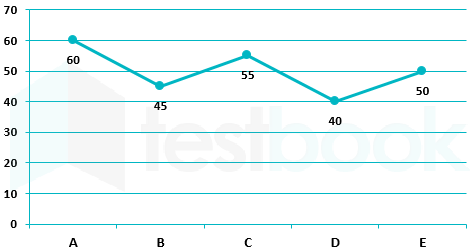
Direction: The following line graph given below shows the number of children in 5 different coaches of Vande Bharat express.

Based on the given line graph answer the following questions:

71

What is the average number of children per coach?

  1. ((a))

    45

  2. ((b))

    48

  3. ((c))

    50

  4. ((d))

    54

  5. ((e))

    56

Show Answer
Answer: ((c))

50

Total number of children = 60 + 45 + 55 + 40 + 50 = 250

∴ Required average = 250/5 = 50.

72

What is the ratio of number of children in coach B and C together to number of children in coach D and E together?

  1. ((a))

    5 : 3

  2. ((b))

    3 : 5

  3. ((c))

    20 : 19

  4. ((d))

    5 : 6

  5. ((e))

    10 : 9

Show Answer
Answer: ((e))

10 : 9

Number of children in coach B and C together = 45 + 55 = 100

Number of children in coach D and E together = 40 + 50 = 90

∴ Required ratio = 100 : 90 = 10 : 9.

73

If in coach B the number of boys is 3/11th of the total number of children in coach C and rest are girls then find the number of girls in coach B.

  1. ((a))

    40

  2. ((b))

    30

  3. ((c))

    25

  4. ((d))

    35

  5. ((e))

    20

Show Answer
Answer: ((b))

30

Number of boys in coach B = (3/11) × Total number of children in coach C

⇒ Number of boys in coach B = (3/11) × 55

⇒ Number of boys in coach B = 15

∴ Number of girls in coach B = 45 - 15 = 30.

74

The number of children in coach C and E together is how much percent more or less than the number of children in A and D together?

  1. ((a))

    5% more

  2. ((b))

    15% less

  3. ((c))

    10% more

  4. ((d))

    8% less 

  5. ((e))

    12% more

Show Answer
Answer: ((a))

5% more

Number of children in coach C and E together = 55 + 50 = 105

Number of children in coach A and D together = 60 + 40 = 100

∴ Required percentage = [(105 - 100)/100] × 100 = 5%.

75

What is the difference between the number of children in coach A and B together to the number of children in coach C, D, and E together?

  1. ((a))

    25

  2. ((b))

    35

  3. ((c))

    45

  4. ((d))

    40

  5. ((e))

    50

Show Answer
Answer: ((d))

40

Number of children in A and B  = 60 + 45 = 105

Number of children in C, D, and E = 55 + 40 + 50 = 145

∴ Required difference = 145 - 105 = 40.

76

What value should come in place of (x) in the following question?

1/6 + 1/12 + 1/18 = 22/x

  1. ((a))

    36

  2. ((b))

    72

  3. ((c))

    48

  4. ((d))

    54

  5. ((e))

    68

Show Answer
Answer: ((b))

72

Follow BODMAS rule to solve this question, as per the order given below:

Step-1: Parts of an equation enclosed in 'Brackets' must be solved first, and in the bracket,

Step-2: Any mathematical 'Of' or 'Exponent' must be solved next,

Step-3: Next, the parts of the equation that contain 'Division' and 'Multiplication' are calculated,

Step-4: Last but not least, the parts of the equation that contain 'Addition' and 'Subtraction' should be calculated.

Now,

Calculations:

1/6 + 1/12 + 1/18 = 22/x

⇒ [(6 + 3 + 2)/36] = 22/x

⇒ 11/36 = 22/x

⇒ x = 72.

77

What value should come in place of (x) in the following question? 

180% of 2048 + 79% of 1840 – 440% of 970 = x

  1. ((a))

    916

  2. ((b))

    756

  3. ((c))

    872

  4. ((d))

    670

  5. ((e))

    578

Show Answer
Answer: ((c))

872

Follow BODMAS rule to solve this question, as per the order given below.

Step - 1: Parts of an equation enclosed in 'Brackets' must be solved first, and following BODMAS rule in the bracket -

Step - 2: Any mathematical 'Of' or 'Exponent' must be solved next.

Step - 3: Next, the parts of the equation that contain 'Division' and 'Multiplication' are calculated.

Step - 4: Last but not the least, the parts of the equation that contain 'Addition' and 'Subtraction' should be calculated.

<br>

Calculation:

180% of 2048 + 79%1840 – 440% of 970 = x

⇒ (180 × 2048)/100 + (79 × 1840)/100 - (440 × 970)100

⇒ 1.8 × 2048 + 7.9 × 184 - 44 × 97

⇒ 3686.4 + 1453.6 - 4268

⇒ 5140 - 4268

⇒ 872

∴ The value of x is 872.

78

What value should come in place of (x) in the following question?

(319.111 + 256.889)1/2 ÷ 6 = x% of 40

  1. ((a))

    15

  2. ((b))

    7

  3. ((c))

    12

  4. ((d))

    8

  5. ((e))

    10

Show Answer
Answer: ((e))

10

Follow BODMAS rule to solve this question, as per the order given below:

Step-1: Parts of an equation enclosed in 'Brackets' must be solved first, and in the bracket,

Step-2: Any mathematical 'Of' or 'Exponent' must be solved next,

Step-3: Next, the parts of the equation that contain 'Division' and 'Multiplication' are calculated,

Step-4: Last but not least, the parts of the equation that contain 'Addition' and 'Subtraction' should be calculated.

Calculations:

(319.111 + 256.889)1/2 ÷ 6 = x% of 40

⇒ 5761/2 ÷ 6 = x × (40/100)

⇒ 24 ÷ 6 = x × (40/100)

⇒ 4 = 2x/5

⇒ x = 10.

79

What value should come in the place of (x) in the following question?

162 + 122 = x2 + 39

  1. ((a))

    11

  2. ((b))

    29

  3. ((c))

    9

  4. ((d))

    21

  5. ((e))

    19

Show Answer
Answer: ((e))

19

Follow BODMAS rule to solve this question, as per the order given below:

Step-1: Parts of an equation enclosed in 'Brackets' must be solved first, and in the bracket,

Step-2: Any mathematical 'Of' or 'Exponent' must be solved next,

Step-3: Next, the parts of the equation that contain 'Division' and 'Multiplication' are calculated,

Step-4: Last but not least, the parts of the equation that contain 'Addition' and 'Subtraction' should be calculated.

Now,

Calculations:

162 + 122 = x2 + 39

⇒ 256 + 144 = x2 + 39

⇒ 400 = x2 + 39

⇒ x2 = 361

⇒ x = √361 = 19.

80

What value should come in the place of (x) in the following question?

12.5% of 6400 – 200 × 3 = x

  1. ((a))

    100

  2. ((b))

    150

  3. ((c))

    200

  4. ((d))

    250

  5. ((e))

    300

Show Answer
Answer: ((c))

200

Follow BODMAS rule to solve this question, as per the order given below:

Step-1: Parts of an equation enclosed in 'Brackets' must be solved first, and in the bracket,

Step-2: Any mathematical 'Of' or 'Exponent' must be solved next,

Step-3: Next, the parts of the equation that contain 'Division' and 'Multiplication' are calculated,

Step-4: Last but not least, the parts of the equation that contain 'Addition' and 'Subtraction' should be calculated.

Now,

Calculations:

12.5% of 6400 – 200 × 3 = x 

⇒ 6400 × (1/8) - 600 = x

⇒ 800 - 600 = x

⇒ x = 200.

Attempt this paper under real exam conditions

Timed interface, section switching, instant scoring, and question-by-question analytics — free.

Start Timed Attempt