Official Paper

RRB Clerk Prelims Memory Based Paper (Held On: 19 August 2023 Shift 2) (Previous Year Paper)

80 questions · 45 minutes · with answers · free

Reasoning (40 questions)

Direction: Read the following information carefully and answer the questions that follow:

In a shop, there are 7 boxes A, B, C, D, E, F, and G kept one above another but not necessarily in the same order. The box at topmost position is numbered 1 and the box at the bottommost position is numbered 7.There are  3 boxes between D and E. Box E is kept above box D. There are 2 boxes between box G and box F. Box B is immediately above the box G. Box C is kept just above box E. Box A is kept in an odd number place.

1

What is the position of box C?

  1. ((a))

    first

  2. ((b))

    second

  3. ((c))

    third

  4. ((d))

    fourth

  5. ((e))

    fifth

Show Answer
Answer: ((a))

first

Boxes: A, B, C, D, E, F, and G.

  1. There are  3 boxes between D and E.

  2. Box E is kept above box D.

  3. Box C is kept just above the box E.

S.NCase 1Case 2
1C
2EC
3E
4
5
6D
7D


  1. There are 2 boxes between box G and box F.
S.NCase 1Case 2
1CG/F
2EC
3E
4G/FF/G
5
6D
7F/GD


  1. Box A is kept in an odd number place.

  2. Box B is kept one box above the box G.

Now case 2 did not follow the above-mentioned information, so terminated, as B can't be placed above G as no space left for B to be placed.

Box B will be place at 3rd position as It is given Box B is placed one box above the box G, which means Box B will be placed immediately above box G, which is possible only when Box B is placed at 3rd position.

Now only position is left that is 5th position so Box A will be placed on 5th position and also 5 is a odd number so this condition is also satisfied here.

S.NBoxes
1C
2E
3B
4G
5A
6D
7F


Hence, box C is kept in the first position
2

How many box kept above the box A?

  1. ((a))

    2

  2. ((b))

    4

  3. ((c))

    5

  4. ((d))

    6

  5. ((e))

    1

Show Answer
Answer: ((b))

4

Boxes: A, B, C, D, E, F, and G.

  1. There are  3 boxes between D and E.

  2. Box E is kept above box D.

  3. Box C is kept just above the box E.

S.NCase 1Case 2
1C
2EC
3E
4
5
6D
7D


  1. There are 2 boxes between box G and box F.
S.NCase 1Case 2
1CG/F
2EC
3E
4G/FF/G
5
6D
7F/GD


  1. Box A is kept in an odd number place.

  2. Box B is kept one box above the box G.

Now case 2 did not follow the above-mentioned information, so terminated, as B can't be placed above G as no space left for B to be placed.

Box B will be place at 3rd position as It is given Box B will be placed immediately above box G, which is possible only when Box B is placed at 3rd position.

Now only position is left that is 5th position so Box A will be placed on 5th position and also 5 is a odd number so this condition is also satisfied here.

S.NBoxes
1C
2E
3B
4G
5A
6D
7F


Hence, 4 boxes kept above box A.

3

How many boxes are there between box C and box G?

  1. ((a))

    2

  2. ((b))

    3

  3. ((c))

    4

  4. ((d))

    5

  5. ((e))

    6

Show Answer
Answer: ((a))

2

Boxes: A, B, C, D, E, F, and G.

  1. There are  3 boxes between D and E.

  2. Box E is kept above box D.

  3. Box C is kept just above the box E.

S.NCase 1Case 2
1C
2EC
3E
4
5
6D
7D


  1. There are 2 boxes between box G and box F.


S.NCase 1Case 2
1CG/F
2EC
3E
4G/FF/G
5
6D
7F/GD


  1. Box A is kept in an odd number place.

  2. Box B is kept one box above the box G.

Now case 2 did not follow the above-mentioned information, so terminated, as B can't be placed above G as no space left for B to be placed.

Box B will be place at 3rd position as It is given Box B is placed one box above the box G, which means Box B will be placed immediately above box G, which is possible only when Box B is placed at 3rd position.

Now only position is left that is 5th position so Box A will be placed on 5th position and also 5 is a odd number so this condition is also satisfied here.

S.NBoxes
1C
2E
3B
4G
5A
6D
7F

Hence, 2 boxes are present between box C and G.

4

How many boxes are kept below the box F?

  1. ((a))

    One

  2. ((b))

    Two

  3. ((c))

    Three

  4. ((d))

    Four

  5. ((e))

    Zero

Show Answer
Answer: ((e))

Zero

Boxes: A, B, C, D, E, F, and G.

  1. There are  3 boxes between D and E.

  2. Box E is kept above box D.

  3. Box C is kept just above the box E.

S.NCase 1Case 2
1C
2EC
3E
4
5
6D
7D


  1. There are 2 boxes between box G and box F.


S.NCase 1Case 2
1CG/F
2EC
3E
4G/FF/G
5
6D
7F/GD


  1. Box A is kept in an odd number place.

  2. Box B is kept one box above the box G.

Now case 2 did not follow the above-mentioned information, so terminated, as B can't be placed above G as no space left for B to be placed.

Box B will be place at 3rd position as It is given Box B is placed one box above the box G, which means Box B will be placed immediately above box G, which is possible only when Box B is placed at 3rd position.

Now only position is left that is 5th position so Box A will be placed on 5th position and also 5 is a odd number so this condition is also satisfied here.

S.NBoxes
1C
2E
3B
4G
5A
6D
7F


Hence, the Zero box kept below box F.

5

Choose the odd one out?

  1. ((a))

    F

  2. ((b))

    A

  3. ((c))

    G

  4. ((d))

    B

  5. ((e))

    C

Show Answer
Answer: ((c))

G

Boxes: A, B, C, D, E, F, and G.

  1. There are  3 boxes between D and E.

  2. Box E is kept above box D.

  3. Box C is kept just above the box E.

S.NCase 1Case 2
1C
2EC
3E
4
5
6D
7D


  1. There are 2 boxes between box G and box F.
S.NCase 1Case 2
1CG/F
2EC
3E
4G/FF/G
5
6D
7F/GD


  1. Box A is kept in an odd number place.

  2. Box B is kept one box above the box G.

Now case 2 did not follow the above-mentioned information, so terminated, as B can't be placed above G as no space left for B to be placed.

Box B will be place at 3rd position as It is given Box B is placed one box above the box G, which means Box B will be placed immediately above box G, which is possible only when Box B is placed at 3rd position.

Now only one position is left that is 5th position so Box A will be placed on 5th position and also 5 is a odd number so this condition is also satisfied here.

S.NBoxes
1C
2E
3B
4G
5A
6D
7F


Four of the following are placed in odd places so they form a group but box G is kept in an even place.

Hence, box G is an odd one.

Directions: Read the following information carefully and answer the questions given below.

Q O & P 6 D 2 M E 9 R ! @ N # 5 1 U 8 A * V 7 T I % $ Y W 3

6

If all the vowels and numbers are dropped then which of the following element will be 13th from the right end?

  1. ((a))

    @

  2. ((b))

    R

  3. ((c))

    M

  4. ((d))

    P

  5. ((e))

    !

Show Answer
Answer: ((c))

M

Given Series

Q O & P 6 D 2 M E 9 R ! @ N # 5 1 U 8 A * V 7 T I % $ Y W 3

As per the given statement, the vowels and numbers are dropped then the series will be, 

Q & P D M R ! @ N # * V T % $ Y W

Therefore 13th element from the right end is, 

Q & P D M R ! @ N # * V T % $ Y W

Hence, M is the correct answer.

7

How many symbols are between the fifth element from the right end and the sixth element from the left end?

  1. ((a))

    Four

  2. ((b))

    Six

  3. ((c))

    Seven

  4. ((d))

    Five

  5. ((e))

    Three

Show Answer
Answer: ((a))

Four

Given series

Q O & P 6 D 2 M E 9 R ! @ N # 5 1 U 8 A * V 7 T I % $ Y W 3

The number of symbols is between the fifth element from the right end and the sixth element from the left end is

Q O & P 6 D 2 M E 9 R ! @ N # 5 1 U 8 A * V 7 T I % $ Y W 3

The symbols are !, @,  #, and *

Hence, Four is the correct answer.

8

Which of the following is the next pair in the series?

Q&P, DME, R@N ___

  1. ((a))

    #18 

  2. ((b))

    18A

  3. ((c))

    5U8

  4. ((d))

    UA*

  5. ((e))

    N1U 

Show Answer
Answer: ((c))

5U8

Given Series

Q O & P 6 D 2 M E 9 R ! @ N # 5 1 U 8 A * V 7 T I % $ Y W 3

 The series: 

Q&P, DME, R@N ___

Q O & P 6 D 2 M E 9 R ! @ N # 5 1 U 8 A * V 7 T I % $ Y W 3

In the same way,

5U8 is the next pair.

9

What is the sum of the numbers which are immediately followed by consonants?

  1. ((a))

    24

  2. ((b))

    33

  3. ((c))

    26

  4. ((d))

    27

  5. ((e))

    None of the above

Show Answer
Answer: ((a))

24

Given Series

Q O & P 6 D 2 M E 9 R ! @ N # 5 1 U 8 A * V 7 T I % $ Y W 3

As per the given information, numbers which are immediately followed by consonants is

Q O & P 6 D 2 M E 9 R ! @ N # 5 1 U 8 A * V 7 T I % $ Y W 3

6 + 2 + 9 + 7 = 24

Therefore, 24 is the sum of the numbers which are immediately followed by consonants.

10

How many numbers are immediately preceded by an alphabet and immediately  followed by a number?

  1. ((a))

    None

  2. ((b))

    One

  3. ((c))

    Two

  4. ((d))

    Three

  5. ((e))

    More than three

Show Answer
Answer: ((a))

None

Given Series

Q O & P 6 D 2 M E 9 R ! @ N # 5 1 U 8 A * V 7 T I % $ Y W 3

As per the given statement, 

the numbers are immediately preceded by an alphabet and followed by a number is none. 

Hence, none is the correct answer.

11

Four of the following four letter-clusters are alike in a certain way and one is different. Pick the odd one out.

  1. ((a))

    PQSU

  2. ((b))

    HIKM

  3. ((c))

    BCEG

  4. ((d))

    RSTY

  5. ((e))

    MNPR

Show Answer
Answer: ((d))

RSTY

All given options, except 'RSTY', have the logic of +1, +2, +2.

In RSTY logic is +1, +1, +5.

Hence, RSTY is the odd one out.

12

Direction: In the following question assuming the given statements to be true, find which of the conclusion among given conclusions is/are definitely true and then give your answers accordingly.

Statement: F ≥ T ≥ H = G ≥ W = Z ≥ L

Conclusions: 

I. L > H

II. F ≥ L

  1. ((a))

    Only I follow

  2. ((b))

    Only II follow

  3. ((c))

    Both I and II follow

  4. ((d))

    Either I or II follows

  5. ((e))

    Neither I nor II follows

Show Answer
Answer: ((b))

Only II follow

Given Statement: F ≥ T ≥ H = G ≥ W = Z ≥ L

Conclusions: 

I. L > H → False (As H = G ≥ W = Z ≥ L → H ≥ L. So, it is false).

II. F ≥ L → True (As F ≥ T ≥ H = G ≥ W = Z ≥ L → F ≥ L. So, it is true).

Hence, Only II follow.

13

Direction: In the following question assuming the given statements to be true, find which of the conclusion among given conclusions is/are definitely true and then give your answers accordingly.

Statements: O = P ≥ N > M; P ≥ X > A = Q

Conclusions: 

I. O = Q

II. P > A

  1. ((a))

    Only I follow

  2. ((b))

    Only II follow

  3. ((c))

    Both I and II follow

  4. ((d))

    Either I or II follows

  5. ((e))

    Neither I nor II follows

Show Answer
Answer: ((b))

Only II follow

Given Statements: O = P ≥ N > M; P ≥ X > A = Q

On combining: M < N ≤ P = O ≥ X > A = Q

Conclusions: 

I. O = Q → False (As O ≥ X > A = Q → O > Q. So, it is false).

II. P > A → True (As P = O ≥ X > A → P > A. So, it is true).

Hence, Only II follow.

14

Direction: In the following question assuming the given statements to be true, find which of the conclusion among given conclusions is/are definitely true and then give your answers accordingly.

Statement: E ≥ W = A < B ≤ S ≤ T < X

Conclusions: 

I. X > W

II. B > X

  1. ((a))

    Only I follow

  2. ((b))

    Only II follow

  3. ((c))

    Both I and II follow

  4. ((d))

    Either I or II follows

  5. ((e))

    Neither I nor II follows

Show Answer
Answer: ((a))

Only I follow

Given Statement: E ≥ W = A < B ≤ S ≤ T < X

Conclusions: 

I. X > W → True (As W = A < B ≤ S ≤ T < X → X > W. So, it is true).

II. B > X → False (As B ≤ S ≤ T < X → B < X. So, it is false).

Hence, Only I follow.

Direction: Read the following information carefully and answer the questions that follow:

A certain number of persons are sitting in a row facing north. A is sitting second from one of the ends. Four persons are sitting between B and D. There are two persons sitting between A and B. D is sitting just left of C. F sits three places away to the right of B. E sits at the extreme right end of the row. G sits to the immediate right of B. Two persons are sitting between C and E.

15

How many persons are sitting in the row?

  1. ((a))

    12

  2. ((b))

    20

  3. ((c))

    14

  4. ((d))

    16

  5. ((e))

    18

Show Answer
Answer: ((c))

14

  1. A is sitting second from one of the ends.

(Here, we will have two cases, Case 1: when A is second from the left end and Case 2: when A is second from the right end).

  1. There are two persons sitting between A and B.

  1. Four persons are sitting between B and D.

  2. D is sitting just left of C.

  1. F sits three places away to the right of B.

(Here, we can eliminate case 2 as A is already three places away to the right of B).

  1. E sits at the extreme right end of the row.

  1. G sits to the immediate right of B.

  2. Two persons are sitting between C and E.

Hence, the final arrangement will be as follows:

Hence, 14 persons are sitting in the row.

16

Who is sitting exactly between A and D?

  1. ((a))

    B

  2. ((b))

    G

  3. ((c))

    F

  4. ((d))

    C

  5. ((e))

    E

Show Answer
Answer: ((b))

G

  1. A is sitting second from one of the ends.

(Here, we will have two cases, Case 1: when A is second from the left end and Case 2: when A is second from the right end).

  1. There are two persons sitting between A and B.


  1. Four persons are sitting between B and D.

  2. D is sitting just left of C.


  1. F sits three places away to the right of B.

(Here, we can eliminate case 2 as A is already three places away to the right of B).

  1. E sits at the extreme right end of the row.

  1. G sits to the immediate right of B.

  2. Two persons are sitting between C and E.

Hence, the final arrangement will be as follows:

Hence, G is sitting exactly between A and D.

17

Who is sitting third to the left of E?

  1. ((a))

    A

  2. ((b))

    B

  3. ((c))

    D

  4. ((d))

    C

  5. ((e))

    F

Show Answer
Answer: ((d))

C

  1. A is sitting second from one of the ends.

(Here, we will have two cases, Case 1: when A is second from the left end and Case 2: when A is second from the right end).

  1. There are two persons sitting between A and B.

  1. Four persons are sitting between B and D.

  2. D is sitting just left of C.

  1. F sits three places away to the right of B.

(Here, we can eliminate case 2 as A is already three places away to the right of B).

  1. E sits at the extreme right end of the row.

  1. G sits to the immediate right of B.

  2. Two persons are sitting between C and E.

Hence, the final arrangement will be as follows:

Hence, C is sitting third to the left of E.

18

How many pair of letters are there in the word "JABBERING" that has as many letters between them in the word as in the alphabet? (Both forward & backward)

  1. ((a))

    Two

  2. ((b))

    Four

  3. ((c))

    One

  4. ((d))

    Three

  5. ((e))

    None of these

Show Answer
Answer: ((d))

Three

Given word: JABBERING

The given word can be represented as follows,

Hence, we can see that 3 such pairs are there → Forward: AB, BG; Backward: GI

So, the answer is three pairs.

19

If it’s possible to make a meaningful word from the 3rd, 5th, 6th, and 7th letters of the word 'MONSTER', then which will be the last letter of the word? Mark ‘X’ if no such word can be formed, ‘M’ if more than 1 such word can be formed.

  1. ((a))

    T

  2. ((b))

    R

  3. ((c))

    X

  4. ((d))

    E

  5. ((e))

    M

Show Answer
Answer: ((e))

M

Given wordMONSTER
Chosen lettersN, T, E, R
Only possible wordsRENT, TERN

RENT - A tenant's regular payment to a landlord for the use of property or land.

TERN- A seabird related to the gulls, typically smaller and more slender, with long pointed wings and a forked tail.

Hence, M is the correct answer.

Directions: Study the information given below and answer the question that follows.

There are six students who have different numbers of books with them. The number of books that R has is the average of the number of books of P and Q. The number of books that A has is the average of the number of books of B and C. B has more books than P but not more than C. At least two members have fewer books than P.

20

Who has the highest number of books?

  1. ((a))

    B

  2. ((b))

    C

  3. ((c))

    P

  4. ((d))

    Q

  5. ((e))

    A

Show Answer
Answer: ((b))

C

Students: A, B, C, P, Q, R.

1) The number of books that A has is the average of the number of books of B and C. It means A has books in between B and C because average always implies the mid value.

2) B has more books than P but not more than C. Hence we have the below order, 

C > A > B > P > __ > __

3) The number of books that R has is the average of the number of books of P and Q. It means R has books in between P and Q.

4) At least two members have less books than P. There are two places remaining in the order R will be in the middle of P and Q because R is the average of P and Q.

So the final arrangement will be ,

C > A > B > P > R > Q

Hence, C has the highest number of books.

21

Which student has books which are between A and P?

  1. ((a))

    R

  2. ((b))

    C

  3. ((c))

    B

  4. ((d))

    Q

  5. ((e))

    Cannot be determined

Show Answer
Answer: ((c))

B

Students: A, B, C, P, Q, R.

1) The number of books that A has is the average of the number of books of B and C. It means A has books in between B and C because average always implies the mid value.

2) B has more books than P but not more than C. Hence we have the below order, 

C > A > B > P > __ > __

3) The number of books that R has is the average of the number of books of P and Q. It means R has books in between P and Q.

4) At least two members have less books than P. There are two places remaining in the order R will be in the middle of P and Q because R is the average of P and Q.

So the final arrangement will be ,

C > A > B > P > R > Q

Hence**, B** has books in between A and P.

22

How many students have more books than R?

  1. ((a))

    One

  2. ((b))

    Two

  3. ((c))

    Three

  4. ((d))

    Four

  5. ((e))

    Five

Show Answer
Answer: ((d))

Four

Students: A, B, C, P, Q, R.

1) The number of books that A has is the average of the number of books of B and C. It means A has books in between B and C because average always implies the mid value.

2) B has more books than P but not more than C. Hence we have the below order, 

C > A > B > P > __ > __

3) The number of books that R has is the average of the number of books of P and Q. It means R has books in between P and Q.

4) At least two members have less books than P. There are two places remaining in the order R will be in the middle of P and Q because R is the average of P and Q.

So the final arrangement will be ,

C > A > B > P > R > Q

Hence, Four students have more books than R.

Directions: Study the information given carefully and answer the questions given below.

Six people, A, B, C, D, E, and F, are living in two different flats, viz., Flat X and Flat Y, of a three-story building, not necessarily in the same order. Flat X is to the west of Flat Y. The lowermost floor is numbered 1, the first floor is numbered 2, and the topmost floor is numbered 3. Floor 2 of Flat X is just above Floor 1 of Flat X and just below Floor 3 of Flat X.

B is to the northwest of E, and one floor is between B and C. D lives just above A in the same flat. D and E do not live on the same floor.

23

Who lives just above C in the same flat?

  1. ((a))

    A

  2. ((b))

    F

  3. ((c))

    D

  4. ((d))

    E

  5. ((e))

    None of these

Show Answer
Answer: ((b))

F

From the given instructions:

  1. B is to the northwest of E and one floor is between B and C. So, here we have three cases:

Case 1;

FloorFlat XFlat Y
3B
2E
1C


Case 2;

FloorFlat XFlat Y
3B
2E
1C


Case 3;

FloorFlat XFlat Y
3B
2
1CE


2) D lives just above A in the same flat.

Case 1;

FloorFlat XFlat Y
3B
2E
1C


Case 2;

FloorFlat XFlat Y
3B
2DE
1AC


Case 3;

FloorFlat XFlat Y
3BD
2A
1CE


So, here we can see that Case 1 is invalid as there is no space to place D and A. So, Case 1 gets eliminated.

  1. D and E do not live on the same floor. 

Case 2;

FloorFlat XFlat Y
3BF
2DE
1AC


Case 3;

FloorFlat XFlat Y
3BD
2FA
1CE


So, here we can see that Case 2 is invalid because D and E lives on same floor. So, Case 2 gets eliminated.

So, Final Arrangement:

FloorFlat XFlat Y
3BD
2FA
1CE


F lives just above C in the same flat.

24

How many people are living between D and E in the same flat?

  1. ((a))

    One

  2. ((b))

    Two

  3. ((c))

    Three

  4. ((d))

    None

  5. ((e))

    None of these

Show Answer
Answer: ((a))

One

From the given instructions:

  1. B is to the northwest of E and one floor is between B and C. So, here we have three cases:

Case 1;

FloorFlat XFlat Y
3B
2E
1C


Case 2;

FloorFlat XFlat Y
3B
2E
1C


Case 3;

FloorFlat XFlat Y
3B
2
1CE


2) D lives just above A in the same flat.

Case 1;

FloorFlat XFlat Y
3B
2E
1C


Case 2;

FloorFlat XFlat Y
3B
2DE
1AC


Case 3;

FloorFlat XFlat Y
3BD
2A
1CE


So, here we can see that Case 1 is invalid as there is no space to place D and A. So, Case 1 gets eliminated.

  1. D and E do not live on the same floor. 

Case 2;

FloorFlat XFlat Y
3BF
2DE
1AC


Case 3;

FloorFlat XFlat Y
3BD
2FA
1CE


So, here we can see that Case 2 is invalid because D and E lives on same floor. So, Case 2 gets eliminated.

So, Final Arrangement:

FloorFlat XFlat Y
3BD
2FA
1CE

One person is living between D and E in the same flat.

25

Find the odd one out.

  1. ((a))

    B

  2. ((b))

    C

  3. ((c))

    D

  4. ((d))

    E

  5. ((e))

    A

Show Answer
Answer: ((e))

A

From the given instructions:

  1. B is to the northwest of E and one floor is between B and C. So, here we have three cases:

Case 1;

FloorFlat XFlat Y
3B
2E
1C


Case 2;

FloorFlat XFlat Y
3B
2E
1C


Case 3;

FloorFlat XFlat Y
3B
2
1CE


2) D lives just above A in the same flat.

Case 1;

FloorFlat XFlat Y
3B
2E
1C


Case 2;

FloorFlat XFlat Y
3B
2DE
1AC


Case 3;

FloorFlat XFlat Y
3BD
2A
1CE


So, here we can see that Case 1 is invalid as there is no space to place D and A. So, Case 1 gets eliminated.

  1. D and E do not live on the same floor. 

Case 2;

FloorFlat XFlat Y
3BF
2DE
1AC


Case 3;

FloorFlat XFlat Y
3BD
2FA
1CE


So, here we can see that Case 2 is invalid because D and E lives on same floor. So, Case 2 gets eliminated.

So, Final Arrangement:

FloorFlat XFlat Y
3BD
2FA
1CE

All options except A lives on odd floor.

So, A is the odd one out.

26

How many total number of people live below D?

  1. ((a))

    Three

  2. ((b))

    One

  3. ((c))

    Two

  4. ((d))

    None

  5. ((e))

    Four

Show Answer
Answer: ((e))

Four

From the given instructions:

  1. B is to the northwest of E and one floor is between B and C. So, here we have three cases:

Case 1;

FloorFlat XFlat Y
3B
2E
1C


Case 2;

FloorFlat XFlat Y
3B
2E
1C


Case 3;

FloorFlat XFlat Y
3B
2
1CE


2) D lives just above A in the same flat.

Case 1;

FloorFlat XFlat Y
3B
2E
1C


Case 2;

FloorFlat XFlat Y
3B
2DE
1AC


Case 3;

FloorFlat XFlat Y
3BD
2A
1CE


So, here we can see that Case 1 is invalid as there is no space to place D and A. So, Case 1 gets eliminated.

  1. D and E do not live on the same floor. 

Case 2;

FloorFlat XFlat Y
3BF
2DE
1AC


Case 3;

FloorFlat XFlat Y
3BD
2FA
1CE


So, here we can see that Case 2 is invalid because D and E lives on same floor. So, Case 2 gets eliminated.

So, Final Arrangement:

FloorFlat XFlat Y
3BD
2FA
1CE

Four people live below D.

27

Which of the following options lives to the northeast of F?

  1. ((a))

    A

  2. ((b))

    D

  3. ((c))

    E

  4. ((d))

    B

  5. ((e))

    C

Show Answer
Answer: ((b))

D

From the given instructions:

  1. B is to the northwest of E and one floor is between B and C. So, here we have three cases:

Case 1;

FloorFlat XFlat Y
3B
2E
1C


Case 2;

FloorFlat XFlat Y
3B
2E
1C


Case 3;

FloorFlat XFlat Y
3B
2
1CE


2) D lives just above A in the same flat.

Case 1;

FloorFlat XFlat Y
3B
2E
1C


Case 2;

FloorFlat XFlat Y
3B
2DE
1AC


Case 3;

FloorFlat XFlat Y
3BD
2A
1CE


So, here we can see that Case 1 is invalid as there is no space to place D and A. So, Case 1 gets eliminated.

  1. D and E do not live on the same floor. 

Case 2;

FloorFlat XFlat Y
3BF
2DE
1AC


Case 3;

FloorFlat XFlat Y
3BD
2FA
1CE


So, here we can see that Case 2 is invalid because D and E lives on same floor. So, Case 2 gets eliminated.

So, Final Arrangement:

FloorFlat XFlat Y
3BD
2FA
1CE

D lives to the northeast of F.

Direction: Study the following information carefully and answer the question given below.

Seven friends A, B, C, D, E, F, and G are seated in a straight line but not necessarily in the same order. Some are facing north while some are facing south. G sits second to the right of E. C is facing in the north direction. D sits at the fourth position from the right end. No two persons sitting together are facing in the same direction. Only three persons are sitting between B and C and neither of them is sitting at any of the ends. A sits third to the right of C.

28

Who sits second to the right of F?

  1. ((a))

    C

  2. ((b))

    B

  3. ((c))

    D

  4. ((d))

    A

  5. ((e))

    None

Show Answer
Answer: ((d))

A

Seven friends - A, B, C, D, E, F, and G.

(1) C is facing in the north direction.

(2) Only three persons are sitting between B and C and neither of them is sitting at any of the ends.

(3) A sits third to the right of C.

(4) D sits at the fourth position from the right end.

(5) No two persons sitting together are facing in the same direction.

(6) G sits second to the right of E.

Now, only F left, therefore the final seating arrangement is as follows:

Hence, A sits second to the right of F.

29

Four of the following options are similar in a particular way, find the odd one out out.

  1. ((a))

    A

  2. ((b))

    E

  3. ((c))

    C

  4. ((d))

    G

  5. ((e))

    F

Show Answer
Answer: ((c))

C

Seven friends - A, B, C, D, E, F, and G.

(1) C is facing in the north direction.

(2) Only three persons are sitting between B and C and neither of them is sitting at any of the ends.

(3) A sits third to the right of C.

(4) D sits at the fourth position from the right end.

(5) No two persons sitting together are facing in the same direction.

(6) G sits second to the right of E.

Now, only F left, therefore the final seating arrangement is as follows:

We can see that all the persons in options are facing south, thus forming a group except C.

Hence, C does not belong to that group.

30

How many people sit between B and D?

  1. ((a))

    One

  2. ((b))

    Two 

  3. ((c))

    Three

  4. ((d))

    Four

  5. ((e))

    None

Show Answer
Answer: ((a))

One

Seven friends - A, B, C, D, E, F, and G.

(1) C is facing in the north direction.

(2) Only three persons are sitting between B and C and neither of them is sitting at any of the ends.

(3) A sits third to the right of C.

(4) D sits at the fourth position from the right end.

(5) No two persons sitting together are facing in the same direction.

(6) G sits second to the right of E.

Now, only F left, therefore the final seating arrangement is as follows:

Hence, one person sits between B and D

31

Who sits to the immediate right of the person who sits third to the right of C?

  1. ((a))

    G

  2. ((b))

    B

  3. ((c))

    F

  4. ((d))

    D

  5. ((e))

    E

Show Answer
Answer: ((d))

D

Seven friends - A, B, C, D, E, F, and G.

(1) C is facing in the north direction.

(2) Only three persons are sitting between B and C and neither of them is sitting at any of the ends.

(3) A sits third to the right of C.

(4) D sits at the fourth position from the right end.

(5) No two persons sitting together are facing in the same direction.

(6) G sits second to the right of E.

Now, only F left, therefore the final seating arrangement is as follows:

We can see that A sits third to the right of C and D sits to the immediate right of A.

Hence, D sits to the immediate right of the person who sits third to the right of C.

32

Which of the following statement is false?

  1. ((a))

    G is facing south.

  2. ((b))

    F sits at one of the end.

  3. ((c))

    E sits to the immediate right of the person who sits second to the left of A.

  4. ((d))

    D sits to the immediate right of the person who sits second to the left of E.

  5. ((e))

    None of these.

Show Answer
Answer: ((c))

E sits to the immediate right of the person who sits second to the left of A.

Seven friends - A, B, C, D, E, F, and G.

(1) C is facing in the north direction.

(2) Only three persons are sitting between B and C and neither of them is sitting at any of the ends.

(3) A sits third to the right of C.

(4) D sits at the fourth position from the right end.

(5) No two persons sitting together are facing in the same direction.

(6) G sits second to the right of E.

Now, only F left, therefore the final seating arrangement is as follows:

We can see that F sits second to the left of A and E does not sit to the immediate right of F.

Hence, E sits to the immediate right of the person who sits second to the left of A is false.

33

Direction: In the question below are given two statements followed by two conclusions numbered I and II. You have to take the given statements to be true even if they seem to be at variance with commonly known facts. Read all the conclusions and then decide which of the given conclusions logically follows from the given statements disregarding commonly known facts.

Statements:

Only a few Pens are Mobile.

No Mobile is Bag.

Conclusions:

I. Some Mobiles are Bags.

II. All Mobiles are Bags.

  1. ((a))

    Only conclusion I follows

  2. ((b))

    Only conclusion II follows

  3. ((c))

    Both conclusion I and II follow

  4. ((d))

    Either conclusion I or II follows

  5. ((e))

    Neither conclusion I nor II follows

Show Answer
Answer: ((e))

Neither conclusion I nor II follows

The least possible diagram for the given statements is as follows;

Conclusions:

I. Some Mobiles are Bags → False (As No Mobile is Bag, no part of Mobile will be Bag. So, it is false)

II. All Mobiles are Bags → False (As No Mobile is Bag, no part of Mobile will be Bag. So, it is false)

Hence, Neither conclusion I nor II follows.

34

Direction: In the question below are given two statements followed by two conclusions numbered I, II. You have to take the given statements to be true even if they seem to be at variance with commonly known facts. Read all the conclusions and then decide which of the given conclusions logically follows from the given statements disregarding commonly known facts.​

Statements:

Some Clips are Copies.

Some Copies are Magazines.

No Magazine is Dictionary.  

Conclusions

l.​ Some Copies are not Dictionary.

II. No Clips are Magzanie.

  1. ((a))

    Only ll follows

  2. ((b))

    Only l follows

  3. ((c))

    Both l and ll are follow

  4. ((d))

    Either l or ll follows

  5. ((e))

    Neither I nor II follows.

Show Answer
Answer: ((b))

Only l follows

The least possible diagram for the given statements is as follows;

Conclusions:

l.​ Some Copies are not Dictionary → True (As common part of Copies and Magazines is not a Dictionary. So, it is true) 

II. No Clips are Magzanie. → False (there is no direct relation between Clip and Magzanie whether it is true or not. So, it is false) 

Hence, Only I Follows.

35

Directions: In the question below are given three statements followed by two conclusions numbered I, and II  .You have to take the given statements to be true even if they seem to be at variance with commonly known facts. Read all the conclusions and then decide which of the given conclusions logically follows from the given statements disregarding commonly known facts.

Statements

Only a few Volume is Display.

No Screen is Tablet.

Some Display is Screen.

Conclusions

I. All Display can never be Tablet.

II. All Tablet can be Display.

  1. ((a))

    Only I follows

  2. ((b))

    Only II follows

  3. ((c))

    Both I and II follows

  4. ((d))

    Neither I nor II follows

  5. ((e))

    Either I or II follows

Show Answer
Answer: ((c))

Both I and II follows

Venn diagram for the given statements are follows

Conclusions

I. All Display can never be Tablet - True (Given Some Display is Screen and No Screen is Tablet Thus Some Display is also not Tablet so All Display can never be Tablet follows)

II. All Tablet can be Display - True (Given Some Display part which is Screen is not Tablet but the remaining part of the Display can be Tablet so All the Tablet can be Display follows)

Hence, Both I and II follows.

Additional Information

 ‘Only a few’ is equivalent to ‘Some’ + ‘Some not’.

If it is given that ‘Only a few A are B’ then conclusions ‘Some A are B’ and Some A are not B’ would always be considered as True.

Direction: Study the following information carefully to answer the given questions.

Seven people – P, Q, R, S, T, U, and W, sit in a row. Some people sit facing North, while the others face South. P sits fourth from the right end of the row, to the immediate right of R, who faces South. The people sitting second from the ends of the row face opposite directions. 3 people sit between T and S, who sits to the immediate right of Q, who sits at an end of the row facing North. More than 2 people sit between U and W, who sits at an end of the row. T, who sits second to the right of P, faces the same direction as P. W faces the same direction as S, who faces the same direction as U.

36

How many people sit facing South?

  1. ((a))

    4 people

  2. ((b))

    3 people

  3. ((c))

    2 people

  4. ((d))

    5 people

  5. ((e))

    1 person

Show Answer
Answer: ((a))

4 people

Given:

Seven people – P, Q, R, S, T, U, and W

Some people sit facing North, while the others face South.

  1. P sits fourth from the right end of the row, to the immediate right of R, who faces South.
  2. The people sitting second from the ends of the row face opposite directions.
  3. 3 people sit between T and S, who sits to the immediate right of Q, who sits at an end of the row facing North.

<br>
  1. More than 2 people sit between U and W, who sits at an end of the row.
  2. T, who sits second to the right of P, faces the same direction as P.
  3. W faces the same direction as S, who faces the same direction as U.

 (Case 1a will not be possible as it will not satisfy point 5)

Final Arrangement:

Hence, four people sit facing South.

37

How many people sit between the people sitting second from the ends of the row?

  1. ((a))

    1 person

  2. ((b))

    2 people

  3. ((c))

    3 people

  4. ((d))

    4 people

  5. ((e))

    Nobody

Show Answer
Answer: ((c))

3 people

Given:

Seven people – P, Q, R, S, T, U, and W

Some people sit facing North, while the others face South.

  1. P sits fourth from the right end of the row, to the immediate right of R, who faces South.
  2. The people sitting second from the ends of the row face opposite directions.
  3. 3 people sit between T and S, who sits to the immediate right of Q, who sits at an end of the row facing North.

<br>
  1. More than 2 people sit between U and W, who sits at an end of the row.
  2. T, who sits second to the right of P, faces the same direction as P.
  3. W faces the same direction as S, who faces the same direction as U.

 (Case 1a will not be possible as it will not satisfy point 5)

Final Arrangement:

S sits second from the left end of the row.

T sits second from the right end of the row.

Hence, three people sit between S and T.

38

Which among the following statements is true?

  1. ((a))

    S faces North

  2. ((b))

    Three people sit facing North

  3. ((c))

    Two people sit between U and W

  4. ((d))

    P and S face the same direction

  5. ((e))

    Five people sit to the right of R

Show Answer
Answer: ((b))

Three people sit facing North

Given:

Seven people – P, Q, R, S, T, U, and W

Some people sit facing North, while the others face South.

  1. P sits fourth from the right end of the row, to the immediate right of R, who faces South.
  2. The people sitting second from the ends of the row face opposite directions.
  3. 3 people sit between T and S, who sits to the immediate right of Q, who sits at an end of the row facing North.

<br>
  1. More than 2 people sit between U and W, who sits at an end of the row.
  2. T, who sits second to the right of P, faces the same direction as P.
  3. W faces the same direction as S, who faces the same direction as U.

 (Case 1a will not be possible as it will not satisfy point 5)

Final Arrangement:

There are 3 people Q, P and T who are facing north.

Hence, the correct answer is Option 2.

39

Which of the following statements is/are correct?

I. Four people sit between Q and T

II. P and Q face the same direction

III. S sits third to the right of R

  1. ((a))

    All the given statements are true

  2. ((b))

    Only Statement II is true

  3. ((c))

    Only Statements I and III are true

  4. ((d))

    Only Statements I and II are true

  5. ((e))

    None of the given statements are true

Show Answer
Answer: ((a))

All the given statements are true

Given:

Seven people – P, Q, R, S, T, U, and W

Some people sit facing North, while the others face South.

  1. P sits fourth from the right end of the row, to the immediate right of R, who faces South.
  2. The people sitting second from the ends of the row face opposite directions.
  3. 3 people sit between T and S, who sits to the immediate right of Q, who sits at an end of the row facing North.

<br>
  1. More than 2 people sit between U and W, who sits at an end of the row.
  2. T, who sits second to the right of P, faces the same direction as P.
  3. W faces the same direction as S, who faces the same direction as U.

 (Case 1a will not be possible as it will not satisfy point 5)

Final Arrangement:

I. Four people sit between Q and T - True

II. P and Q face the same direction - True

III. S sits third to the right of R - True

Hence, the correct answer is Option 1.

40

Four of the five options given below follow a certain logic and form a group, find the odd one out.

  1. ((a))

    W

  2. ((b))

    S

  3. ((c))

    R

  4. ((d))

    U

  5. ((e))

    P

Show Answer
Answer: ((e))

P

Given:

Seven people – P, Q, R, S, T, U, and W

Some people sit facing North, while the others face South.

  1. P sits fourth from the right end of the row, to the immediate right of R, who faces South.
  2. The people sitting second from the ends of the row face opposite directions.
  3. 3 people sit between T and S, who sits to the immediate right of Q, who sits at an end of the row facing North.

<br>
  1. More than 2 people sit between U and W, who sits at an end of the row.
  2. T, who sits second to the right of P, faces the same direction as P.
  3. W faces the same direction as S, who faces the same direction as U.

 (Case 1a will not be possible as it will not satisfy point 5)

Final Arrangement:

The logic followed here is that all the given options are people facing South, except P.

Hence, P is the odd one out.

Numerical Ability (40 questions)

41

What will come in place of ? in the following equation?

32000 × 3/4 × ? × 1/2 = 4800

  1. ((a))

    2/3

  2. ((b))

    3/5

  3. ((c))

    2/5

  4. ((d))

    1/4

  5. ((e))

    4/5

Show Answer
Answer: ((c))

2/5

Follow BODMAS rule to solve this question, as per the order given below,

Step -1- Parts of an equation enclosed in 'Brackets' must be solved first, and in the bracket,

Step -2- Any mathematical 'Of' or 'Exponent' must be solved next,

Step -3- Next, the parts of the equation that contain 'Division' and 'Multiplication' are calculated,

Step -4- Last but not least, the parts of the equation that contain 'Addition' and 'Subtraction' should be calculated.

Given expression is,

⇒ 32000 × 3/4 × ? × 1/2 = 4800

⇒ 8000 × 3 × ? × 1/2 = 4800

⇒ 4000 × 3 × ? = 4800

⇒ 12000 × ? = 4800

⇒ ? = 4800/12000

∴ ? = 4/10 = 2/5

42

What will come in place of question mark (?) in the following question?

 (3584 ÷ 32) – 11 = √?

  1. ((a))

    10021

  2. ((b))

    12001

  3. ((c))

    10221

  4. ((d))

    10201

  5. ((e))

    10012

Show Answer
Answer: ((d))

10201

Concept used:

Follow BODMAS rule to solve this question, as per the order given below:

Given expression is,

(3584 ÷ 32) – 11 = √?

⇒ 112 – 11 = √?

⇒ 101 = √?

⇒ ? = 101 × 101

∴ ? = 10201

43

What approximate value should come in place of the question mark (?) in the following question?

121 ÷ (7/5 × 3/8 × 4/5) = ?

  1. ((a))

    162

  2. ((b))

    288

  3. ((c))

    208

  4. ((d))

    298

  5. ((e))

    198

Show Answer
Answer: ((b))

288

121 ÷ (7/5 × 3/8 × 4/5) = ?

⇒ ? = 121 ÷ (21/50)

⇒ ? = 121 × 50/21

⇒ ? = 6050/21

∴ ? = 288.09 ≈ 288

44

What will come in place of question mark ‘?’ in the following question?

622 – 322 + ?2 = 3144

  1. ((a))

    17

  2. ((b))

    16

  3. ((c))

    19

  4. ((d))

    15

  5. ((e))

    18

Show Answer
Answer: ((e))

18

Using laws of Indices:

(a)m × (a)n = a(m + n)

  1. (a)÷ (a)n = a(m - n)
  2. (am)n = (a)mn
  3. (a)(-m) = 1/am
  4. (a)0 = 1
  5. (a)1/m = m√a

Given expression is,

622 – 322 + ?2 = 3144

⇒ 3844 – 1024 + ?2 = 3144

⇒ 2820 + ?2 = 3144

⇒ ?2 = 3144 – 2820

⇒ ?2 = 324

∴ ? = 18

45

What will come in place of question mark (?) in the following question?

4 + 1/13 of {2600 ÷ (118 – 108)} = ?

  1. ((a))

    30

  2. ((b))

    25

  3. ((c))

    24

  4. ((d))

    28

  5. ((e))

    32

Show Answer
Answer: ((c))

24

Follow BODMAS rule to solve this question, as per the order given below,

Step-1: Parts of an equation enclosed in 'Brackets' must be solved first, and in the bracket,

Step-2: Any mathematical 'Of' or 'Exponent' must be solved next,

Step-3: Next, the parts of the equation that contain 'Division' and 'Multiplication' are calculated,

Step-4: Last but not least, the parts of the equation that contain 'Addition' and 'Subtraction' should be calculated

4 + 1/13 of {2600 ÷ (118 – 108)} = ?

⇒ 4 + 1/13 of {2600 ÷ 10} = ?

⇒ 4 + 1/13 of 260 = ?

⇒ 4 + 20 = ?

∴ ? = 24

46

What will come in place of question mark (?) in the following equation?

30% of 1200 + 50% of 720 = ? of 720

  1. ((a))

    150%

  2. ((b))

    50%

  3. ((c))

    300%

  4. ((d))

    100%

  5. ((e))

    200%

Show Answer
Answer: ((d))

100%

Follow BODMAS rule to solve this question, as per the order given below,

Step-1: Parts of an equation enclosed in 'Brackets' must be solved first, and in the bracket,

Step-2: Any mathematical 'Of' or 'Exponent' must be solved next,

Step-3: Next, the parts of the equation that contain 'Division' and 'Multiplication' are calculated,

Step-4: Last but not least, the parts of the equation that contain 'Addition' and 'Subtraction' should be calculated

30% of 1200 + 50% of 720 = ? of 720

30100×1200;+50100×720;=;?;×;720\Rightarrow \frac{{30}}{{100}} \times 1200; + \frac{{50}}{{100}} \times 720; = ;?; \times ;720

⇒ 360 + 360 = ? × 720

⇒ 720 = ? × 720

⇒ ? = 720/720 = 1

⇒ ? = 100%

47

What will come in place of the question mark (?) in the following question?

704+904+1104+604+704=:?\frac{70}{{4}} + \frac{90}{{4}} + \frac{110}{{4}} + \frac{60}{{4}} + \frac{70}{{4}} =: ?

  1. ((a))

    150

  2. ((b))

    75

  3. ((c))

    125

  4. ((d))

    110

  5. ((e))

    100

Show Answer
Answer: ((e))

100

Follow BODMAS rule to solve this question, as per the order given below,

Step-1: Parts of an equation enclosed in 'Brackets' must be solved first, and in the bracket,

Step-2: Any mathematical 'Of' or 'Exponent' must be solved next,

Step-3: Next, the parts of the equation that contain 'Division' and 'Multiplication' are calculated,

Step-4: Last but not least, the parts of the equation that contain 'Addition' and 'Subtraction' should be calculated

704+904+1104+604+704=:?\frac{70}{{4}} + \frac{90}{{4}} + \frac{110}{{4}} + \frac{60}{{4}} + \frac{70}{{4}} =: ?

Taking L.C.M

⇒ ? = (70 + 90 + 110 + 60 + 70)/4

⇒ ? = 400/4

∴ ? = 100

48

What will come in place of question mark ‘?’ in the following question?

2112 + 692 × 2 – 1111 × 5 + 7324 × 8 = ?

  1. ((a))

    56533

  2. ((b))

    57533

  3. ((c))

    49533

  4. ((d))

    45653

  5. ((e))

    59633

Show Answer
Answer: ((a))

56533

Follow BODMAS rules to solve the equation

Step -1: The part of the equation containing 'Brackets' must be solved first, and in the bracket,

Step -2: Any mathematical 'Of' or 'Exponent' must be solved next,

Step -3: Next, the parts of the equation that contain 'Division' and 'Multiplication' are solved

Step -4: At last, the part of the equation that contains 'Addition' and 'Subtraction' should be solved.

⇒ 2112 + 692 × 2 – 1111 × 5 + 7324 × 8 = ?

⇒ 2112 + 1384 – 5555 + 58592 = ?

⇒ ? = 62088 – 5555 = 56533

∴ ? = 56533.

49

What will come in place of question mark ‘?’ in the following question?

444 × 13 – 48 × 17 + 1216 – 24 × 28 = ?

  1. ((a))

    5550

  2. ((b))

    5350

  3. ((c))

    5500

  4. ((d))

    7550

  5. ((e))

    4650

Show Answer
Answer: ((c))

5500

Trick:

⇒ 444 × 13 – 48 × 17 + 1216 – 24 × 28 = ?

4 can be taken out as a common factor from each term, the answer will also contain a factor of 4 and will be divisible by 4.

⇒ 4[111 × 13 – 12 × 17 + 304 – 6 × 28]

To check divisibility by 4, last two digits of the number must be divisible by 4.

Only option 3 is divisible by 4

∴ 5500 is the answer.

Detailed Solution:

Solution:

We have to follow the BODMAS rule

Calculation:

⇒ 444 × 13 – 48 × 17 + 1216 – 24 × 28 = ?

⇒ 5772 – 816 + 1216 – 672 = ?

⇒ 5500 = ?

∴ ? = 5500.

50

What will come in place of question mark ‘?’ in the following question?

(?)3 = (221 × 845) ÷ 85

  1. ((a))

    17

  2. ((b))

    21

  3. ((c))

    13

  4. ((d))

    25

  5. ((e))

    None of these

Show Answer
Answer: ((c))

13

Follow BODMAS rules to solve the equation

Step -1: The part of the equation containing 'Brackets' must be solved first, and in the bracket,

Step -2: Any mathematical 'Of' or 'Exponent' must be solved next,

Step -3: Next, the parts of the equation that contain 'Division' and 'Multiplication' are solved

Step -4: At last, the part of the equation that contains 'Addition' and 'Subtraction' should be solved.

⇒ (?)3 = (221 × 845) ÷ 85

⇒ (?)3 = (17 × 13 × 13 × 5 × 13) / (17 × 5)

⇒ (?)3 = 13 × 13 × 13

⇒ (?)3 = 2197

∴ ? = 13

51

What will come in place of question mark ‘?’ in the following question?

348 ÷ 29 × 45 + 468 = 3(?)3 + 360

  1. ((a))

    3

  2. ((b))

    4

  3. ((c))

    5

  4. ((d))

    6

  5. ((e))

    None of these

Show Answer
Answer: ((d))

6

Follow BODMAS rules to solve the equation

Step -1: The part of the equation containing 'Brackets' must be solved first, and in the bracket,

Step -2: Any mathematical 'Of' or 'Exponent' must be solved next,

Step -3: Next, the parts of the equation that contain 'Division' and 'Multiplication' are solved

Step -4: At last, the part of the equation that contains 'Addition' and 'Subtraction' should be solved.

⇒ 348 ÷ 29 × 45 + 468 = 3(?)3 + 360

⇒ 348/29 × 45 + 468 = 3(?)3 + 360

⇒ 12 × 45 + 468 = 3(?)3

⇒ 540 + 468 – 360 = 3(?)3

⇒ 1008 – 360 = 3(?)3

⇒ 648 = 3 × (?)3

⇒ 216 = (?)3

∴ ? = 6

52

What will come in place of question mark in the following question?

215+1120=?2\frac{1}{5} + 1\frac{1}{20} = ?

  1. ((a))

    13/4

  2. ((b))

    13/5

  3. ((c))

    15/4

  4. ((d))

    14/5

  5. ((e))

    12/5

Show Answer
Answer: ((a))

13/4

Given expression:

Follow BODMAS rule to solve this question, as per the order is given below,

Step - 1 - Parts of an equation enclosed in 'Brackets' must be solved first,

Step - 2 - Any mathematical 'Of' or 'Exponent' must be solved next,

Step - 3 - Next, the parts of the equation that contain 'Division' and 'Multiplication' are calculated,

Step - 4 - Last but not least, the parts of the equation that contains 'Addition' and 'Subtraction' should be calculated.

215+1120=?2\frac{1}{5} + 1\frac{1}{20} = ?

⇒ ? = 11/5 + 21/20

⇒ ? = (11 × 4 + 21)/20

⇒ ? = (44 + 21)/20

⇒ ? = 65/20

∴ ? = 13/4

53

What will come in place of question mark ‘?’ in the following question?

30% of 150 – 40% of 100 + 25% of 400 = ?

  1. ((a))

    105

  2. ((b))

    100

  3. ((c))

    95

  4. ((d))

    90

  5. ((e))

    80

Show Answer
Answer: ((a))

105

Follow these BODMAS rules to solve the question

Step-1∶ The part of the equation containing 'Brackets' must be solved first and in the bracket,

Step-2∶ Any mathematical 'Of' or 'Exponent' must be solved next,

Step-3∶ Next, the parts of the equation that contains 'Division' and 'Multiplication' is solved

Step-4∶ At last, the part of the equation that contains 'Addition' and 'Subtraction' should be solved.

Given expression is,

30% of 150 – 40% of 100 + 25% of 400 = ?

⇒ 3/10 × 150 - 4/10 × 100 + 25/100 × 400 = ?

⇒ 45 – 40 + 100 = ?

∴ ? = 105

54

What will come in place of question mark ‘?’ in the following question?

152 + 122 - 112 = ? + 72

  1. ((a))

    200

  2. ((b))

    201

  3. ((c))

    199

  4. ((d))

    202

  5. ((e))

    198

Show Answer
Answer: ((c))

199

152 + 122 – 112 = ? + 72

⇒ 225 + 144 –​ 121 = ? + 49

⇒ 248 = ? + 49

∴ ? = 248 –​ 49 = 199

55

Directions: What will come in place of the question mark (?) in the following questions?

432 + 88 × 230 ÷ ? = 652

  1. ((a))

    92

  2. ((b))

    46

  3. ((c))

    23

  4. ((d))

    21

  5. ((e))

    None of these

Show Answer
Answer: ((a))

92

Follow BODMAS rule to solve this question, as per the order given below.

Step-1- Parts of an equation enclosed in 'Brackets' must be solved first, and in the bracket-

Step-2- Any mathematical 'Of' or 'Exponent' must be solved next.

Step-3- Next, the parts of the equation that contain 'Division' and 'Multiplication' are calculated.

Step-4- Last but not least, the parts of the equation that contain 'Addition' and 'Subtraction' should be calculated.

Given expression is,

432 + 88 × 230 ÷ ? = 652

Applying BODMAS Rule;

⇒ 88 × 230 ÷ ? = 652 – 432

⇒ 88 × 230 ÷ ? = 220

⇒ ? = (88 × 230) ÷ 220

⇒ ? = 4 × 23

∴ ? = 92

The below table shows the sum of the  number of persons who like both the music and dance and the percentage of the number of persons who like only dance in four different cities such as A, B, C and D.


CitiesTotal number of persons  who like both dance and musicPercentage of number of persons who like only dance
A55040%
B65052%
C62544%
D57560%
56

1/5 th and 1/3 rd of the persons who likes dance are from city C and City D are graduated and others are non graduated. Find the total number of non graduated persons who like only dance from city C and city D.

  1. ((a))

    350

  2. ((b))

    420

  3. ((c))

    400

  4. ((d))

    450

  5. ((e))

    390

Show Answer
Answer: ((d))

450

General Solution:


City A:

Total number of persons who like both dance and music = 550

Number of  persons who like dance = 550 × ( 40/100) = 220

Number of persons who like music = (550 - 220) = 330


City B:

Total number of persons who like both dance and music = 650

Number of  persons who like dance = 650 × ( 52/100) = 338

Number of persons who like music = (650 - 338) = 312


City C:

Total number of persons who like both dance and music = 625

Number of  persons who like dance = 625 × ( 44/100) = 275

Number of persons who like music = (625 - 275) = 350


City D:

Total number of persons who like both dance and music = 575

Number of  persons who like dance = 575 × ( 60/100) = 345

Number of persons who like music = (575 - 345) = 230


Solution:

Number of graduated persons who likes dance from city C = 275 × 1/5 = 55

Number of non graduated persons who likes dance from city C = 275 - 55 = 220

Number of graduated persons who likes dance from city D = 345 × 1/3 =  115

Number of non graduated persons who likes dance from city D = 345 - 115 = 230

Required total = (220 + 230) = 450

57

Find the difference between the sum of the 1/11th and 1/3 rd of the persons who likes only music from  cities A and B  and the sum of the 1/7 th and 1/5 th of the number of persons who like only music from cities C and D.

  1. ((a))

    48

  2. ((b))

    44

  3. ((c))

    34

  4. ((d))

    38

  5. ((e))

    42

Show Answer
Answer: ((d))

38

General Solution:


City A:

Total number of persons who like both dance and music = 550

Number of  persons who like dance = 550 × ( 40/100) = 220

Number of persons who like music = (550 - 220) = 330


City B:

Total number of persons who like both dance and music = 650

Number of  persons who like dance = 650 × ( 52/100) = 338

Number of persons who like music = (650 - 338) = 312


City C:

Total number of persons who like both dance and music = 625

Number of  persons who like dance = 625 × ( 44/100) = 275

Number of persons who like music = (625 - 275) = 350


City D:

Total number of persons who like both dance and music = 575

Number of  persons who like dance = 575 × ( 60/100) = 345

Number of persons who like music = (575 - 345) = 230


Solution:

1/11 th of the persons who likes only music from city A = 330 ×  1/11 = 30

1/3rd of the persons who likes only  music from city B = 312 ×  1/3 = 104

1/7 th of the persons who likes only music from city C = 350 ×  1/7 = 50

1/5 th of the persons who likes only music from city D = 230 ×  1/5 = 46

Required difference = (30 + 104) - (50 + 46) = 134 - 96 = 38

58

If 7/11 people in city A like only music and singing and total number of people who like singing in city A is 350. Find the number of people who like both dancing and singing.

  1. ((a))

    120

  2. ((b))

    130

  3. ((c))

    140

  4. ((d))

    160

  5. ((e))

    150

Show Answer
Answer: ((c))

140

General Solution:


City A:

Total number of persons who like both dance and music = 550

Number of  persons who like dance = 550 × ( 40/100) = 220

Number of persons who like music = (550 - 220) = 330


City B:

Total number of persons who like both dance and music = 650

Number of  persons who like dance = 650 × ( 52/100) = 338

Number of persons who like music = (650 - 338) = 312


City C:

Total number of persons who like both dance and music = 625

Number of  persons who like dance = 625 × ( 44/100) = 275

Number of persons who like music = (625 - 275) = 350


City D:

Total number of persons who like both dance and music = 575

Number of  persons who like dance = 575 × ( 60/100) = 345

Number of persons who like music = (575 - 345) = 230


Solution:

Number of persons who likes only music and singing from city A = 330 ×  (7/11)  = 210

Number of persons who likes singing from city A = 350

Number of persons who likes dance also likes singing = 350 - 210 = 140

59

Find the ratio between the number of persons who likes dance in city A and D to the number of person  who likes music only in city A and D.

  1. ((a))

    140: 139

  2. ((b))

    129: 122

  3. ((c))

    113: 112

  4. ((d))

    111: 121

  5. ((e))

    137: 123

Show Answer
Answer: ((c))

113: 112

General Solution:


City A:

Total number of persons who like both dance and music = 550

Number of  persons who like dance = 550 × ( 40/100) = 220

Number of persons who like music = (550 - 220) = 330


City B:

Total number of persons who like both dance and music = 650

Number of  persons who like dance = 650 × ( 52/100) = 338

Number of persons who like music = (650 - 338) = 312


City C:

Total number of persons who like both dance and music = 625

Number of  persons who like dance = 625 × ( 44/100) = 275

Number of persons who like music = (625 - 275) = 350


City D:

Total number of persons who like both dance and music = 575

Number of  persons who like dance = 575 × ( 60/100) = 345

Number of persons who like music = (575 - 345) = 230


Number of persons who likes dance from city A = 220

Number of persons who likes dance from city D = 345

Number of persons who likes music from city A = 330

Number of persons who likes music from city D = 230

Required ratio = (220 + 345): (330 + 230) = 565: 560 = 113: 112

60

If 30%, 50%, of the persons who likes only dance from city A and B are males and 20% and 25% of the persons who like only music from city A and B are males. Find the number of males in city A and city B.

  1. ((a))

    355

  2. ((b))

    346

  3. ((c))

    379

  4. ((d))

    369

  5. ((e))

    374

Show Answer
Answer: ((c))

379

General Solution:


City A:

Total number of persons who like both dance and music = 550

Number of  persons who like dance = 550 × ( 40/100) = 220

Number of persons who like music = (550 - 220) = 330


City B:

Total number of persons who like both dance and music = 650

Number of  persons who like dance = 650 × ( 52/100) = 338

Number of persons who like music = (650 - 338) = 312


City C:

Total number of persons who like both dance and music = 625

Number of  persons who like dance = 625 × ( 44/100) = 275

Number of persons who like music = (625 - 275) = 350


City D:

Total number of persons who like both dance and music = 575

Number of  persons who like dance = 575 × ( 60/100) = 345

Number of persons who like music = (575 - 345) = 230


Solution:

Number of males who likes only dance from city A = 220 ×  (30/100) = 66

Number of males who likes only dance from city B = 338 ×  (50/100) = 169

Number of males who likes only music from city A = 330 ×  (20/100) = 66

Number of males who likes only music from city B = 312 ×  (25/100) = 78

Total males in city A and B = (66 + 169 + 66 + 78) = 379

61

Find the wrong term in the series.

7, 8, 17, 45, 91, 172

  1. ((a))

    8

  2. ((b))

    91

  3. ((c))

    172

  4. ((d))

    45

  5. ((e))

    17

Show Answer
Answer: ((d))

45

Given:

7, 8, 17, 45, 91, 172

Calculation:

⇒ 7 + 12 = 8

⇒ 8 + 3= 17

⇒17 + 52 = 42

⇒ 42 + 72 = 91

⇒ 91 + 92 = 172

∴ The wrong term is 45.

62

Find the wrong number in the given series:

12, 24, 72, 372, 2520, 27720

  1. ((a))

    27720

  2. ((b))

    72

  3. ((c))

    24

  4. ((d))

    372

  5. ((e))

    2520

Show Answer
Answer: ((d))

372

12

12 × 2 = 24

24 × 3 = 72

72 × 5 = 360

360 × 7 = 2520

2520 × 11 = 27720

⇒ Multiplication of Prime number.

Mistake Points 2 is a prime number, it is not the series of odd numbers.

∴ The correct answer is option 4.

63

In each of the following number series, the wrong number is given, find out that number.

4, 8, 17, 43, 58, 94.

  1. ((a))

    43

  2. ((b))

    17

  3. ((c))

    58

  4. ((d))

    94

  5. ((e))

    None of the above

Show Answer
Answer: ((a))

43

Calculation:

The pattern of the given series is:

⇒ 4 + 22 = 8

⇒ 8 + 32 = 17

⇒ 17 + 42 = 33

⇒ 33 + 52 = 58

⇒ 58 + 62 = 94

the wrong number in the series is 43.

64

In the following number series, a wrong number is given. Find out the wrong number. 

3, 4, 10, 33, 135, 685

  1. ((a))

    33

  2. ((b))

    135

  3. ((c))

    10

  4. ((d))

    685

  5. ((e))

    3

Show Answer
Answer: ((b))

135

Given:

3, 4, 10, 33, 135, 685

Calculation:

Pattern of the given series can be explained as,

Since 136 will come in place of 135

∴ The required wrong number will be 135.

65

Find the wrong term in the following series.

 81, 100, 122, 152, 183, 220, 261

  1. ((a))

     152

  2. ((b))

     122

  3. ((c))

     183

  4. ((d))

     220

  5. ((e))

     81

Show Answer
Answer: ((b))

 122

Given:

 81, 100, 122, 152, 183, 220, 261

Calculation:

 The series follows the following pattern:

 ⇒ 81+19 = 100

 ⇒ 100+23 = 123

 ⇒ 123+29 = 152

 ⇒ 152+31 = 183

 ⇒ 183+ 37 = 220

 ⇒ 220+41 = 261

 The wrong term is 122.

 Hence, the wrong term in the series is 122.

66

A boat can travel 50 km upstream in 5 hours and 60 km downstream in 4 hours. Determine the speed of the stream.

  1. ((a))

    12.5

  2. ((b))

    5

  3. ((c))

    2.5

  4. ((d))

    6

  5. ((e))

    None of these

Show Answer
Answer: ((c))

2.5

Given:

The boat travels 50 km in 5 hours upstream

The boat travels 60 km in 4 hours downstream

Formula used:

Distance = Speed × Time

Speed of stream = (1/2)(x - y)

Speed in still water = (1/2)(x + y)

Where speed in upstream is x and speed in downstream is y

Calculation:

The boat travels 50 km in 5 hours upstream

So, in one hour it can travel = (50/5) = 10 km

So, the speed upstream is 10 km/h

The boat travels 60 km in 4 hours downstream

So, in one hour it can travel = (60/4) = 15 km

So, the speed downstream is 15 km/h

So, the speed of stream = {(1/2)(15 - 10)} km/h = 2.5 km/h

∴ The speed of the stream is 2.5 km/h.

67

The area of a square is same as area of circle whose radius is 14 cm. If a rectangle of breadth 5 cm is made such that it has same perimeter as square, then what will be its area? (in square cm)

  1. ((a))

    160.8 cm2

  2. ((b))

    189.2 cm2

  3. ((c))

    223.2 cm2

  4. ((d))

    231.6 cm2

  5. ((e))

    244.4 cm2

Show Answer
Answer: ((c))

223.2 cm2

GIVEN :

The area of a square is the same as the circle of radius 14 cm.

If a rectangle of breadth 5 cm.

CALCULATION :

Area of square = (22/7) × 14 × 14 = 616 cm2

Side length of square = √616 = 24.82 cm

Suppose the length of rectangle is L

2(L + 5) = 4 × 24.82

2(L + 5) = 99.28

⇒ L + 5 = 49.64

L = 44.64

∴ Area of rectangle = 44.64 × 5 = 223.2 cm2

68

Due to 20% increase in price, 8 kg less sugar is available for Rs. 480. What should be the quantity of sugar purchased so that there is no change in expenditure?

  1. ((a))

    40 kg

  2. ((b))

    20 kg

  3. ((c))

    48 kg

  4. ((d))

    24 kg

  5. ((e))

    12 kg

Show Answer
Answer: ((a))

40 kg

Let at first, the price of sugar per kg = a

After 20% increase, price of sugar per kg = (a + a × 20/100) = 6a/5

According to problem,

480/a – 480/(6a/5) = 8 [∵ 8 kg less sugar available after price increase]

480/a – 400/a = 8

⇒ 80/a = 8

⇒ a = 10

∴ After 20% increase, price of sugar per kg = 6 × 10/5 = 12

∴ Quantity of sugar purchased = 480/12 = 40kg

Verification Information Initially at Rs. 10, 48 kg sugar was available at expenditure Rs. 480.

Now Due to 20% increase in price,

new price  = Rs. 12 (=10 × 6/5)

New quantity = 40 Kg (= 48 - 8)

New expenditure =40 × 12 = Rs 480 it is same as before "no change"

69

The Average age of 14 kids and their teacher is 15 years. If we exclude the age of the teacher, then the average reduces by 1. What is the teacher’s age?

  1. ((a))

    35 years

  2. ((b))

    32 years

  3. ((c))

    30 year

  4. ((d))

    29 years

  5. ((e))

    15 years

Show Answer
Answer: ((d))

29 years

Formula:

Average = (sum of observation)/( no of observation)

 Given that, the Average age of 14 girls and their teacher is 15 years. If the teacher’s age is excluded, the average reduces by 1.

Let sum of ages of 14 girls be x years and that of the teacher be y years, then

(x + y)/15 = 15

⇒ (x + y) = 225      --------------- (1)

Also, x/14 = 14

⇒ x = 196  

Putting the value of x in equation (1), we get

y = 29 years.

70

Anand wants to sell a shirt at a profit of 25%. He bought it at 20% less and sold it at Rs. 84 less, but still he gained 30%. Find the cost price of shirt.

  1. ((a))

    Rs. 450

  2. ((b))

    Rs. 400

  3. ((c))

    Rs. 500

  4. ((d))

    Rs. 460

  5. ((e))

    Rs. 470

Show Answer
Answer: ((b))

Rs. 400

Given:

Anand wants to sell a shirt at a profit of 25%

He bought it at 20% less and sold it at Rs. 84 less, but still he gained 30%

Calculation:

Let the cost price of shirt be Rs. x

And his assumed selling price is 125% of x = 5x/4

According to question,

The actual cost price of the shirt = 80% of x = 4x/5

And the actual selling price of the shirt = (5x/4 – 84)

Now, (4x/5) × 130% = (5x/4 – 84)

⇒ 26x/25 = 5x/4 – 84

⇒ 5x/4 – 26x/25 = 84

⇒ 21x/100 = 84

⇒ x = 400

∴ the cost price of shirt is Rs. 400

71

Ratio of Nidhi’s age and Amit’ age is 2 ∶ 3. Nidhi's age was 16 years 4 years ago. What is the present age of Amit?

  1. ((a))

    30 years

  2. ((b))

    32 years

  3. ((c))

    33 years

  4. ((d))

    35 years

  5. ((e))

    28 years

Show Answer
Answer: ((a))

30 years

Given:

Ratio of Nidhi’s age and Amit’s age is 2 ∶ 3.

Concept Used:

Ratio concept used.

Calculation:

Let the present of Nidhi and Amit  be 2x and 3x.

Present of Nidhi = (16 + 4)years = 20 years

So, 2x = 20

⇒ x = 10

So, present age of Amit = 3x = 3 × 10 = 30 years

∴ Present age of Amit is 30 years old.

72

In a  50 liters of mixture, the ratio of alcohol and water is 3: 2. What amount of water should be added to make the ratio of 2: 3?

  1. ((a))

    15 liters

  2. ((b))

    20 liters

  3. ((c))

    25 liters

  4. ((d))

    30 liters

  5. ((e))

    22.5 liters

Show Answer
Answer: ((c))

25 liters

In 50 liters of mixture the ratio of alcohol and water is 3:2,

∴ Amount of alcohol in the solution =33+2×50=35×50=30;litres= \frac{3}{{3 + 2}} \times 50 = \frac{3}{5} \times 50 = 30;litres

∴ Amount of water in the solution = 50 – 30 = 20 litres

Now, let the amount of water to be added to the solution in order to adjust the ratio of alcohol to water be x litres.

After adding x litres of water, total water in resulting mixture = (20 + x) litres

The total amount of alcohol in the mixture does not change.

According to the condition given in the question, new ratio of alcohol to water is 2:3.

3020+x=23\therefore \frac{{30}}{{20 + x}} = \frac{2}{3}

⇒ 3 × 30 = 2 × (20 + x)

⇒ 90 = 40 +2x

⇒ 50 = 2x

⇒ x = 25 liters.

73

X, Y, and Z invested Rs. 4500, Rs. 7000 and 9000 respectively to start a gaming club. At the end of two years, they earned a profit of Rs. 16400. What will be Y’s share in the profit?

  1. ((a))

    Rs. 5600

  2. ((b))

    Rs. 5800

  3. ((c))

    Rs. 6200

  4. ((d))

    Rs. 5400

  5. ((e))

    None of the above

Show Answer
Answer: ((a))

Rs. 5600

Given:

X invested = Rs. 4500

Y invested = Rs. 7000

Z invested = Rs. 9000

At the end of 2 years profit earned = 16400

Calculation:

The ratio of the amount invested by X, Y, Z

⇒ 4500 : 7000 : 9000

⇒ 45 : 70 : 90

⇒ 9 : 14 : 18

Total profit = Rs. 16400

Y's share = (14/41) × 16400

⇒ 14 × 400

⇒ Rs. 5600.

∴ Y’s share of profit is Rs. 5600.

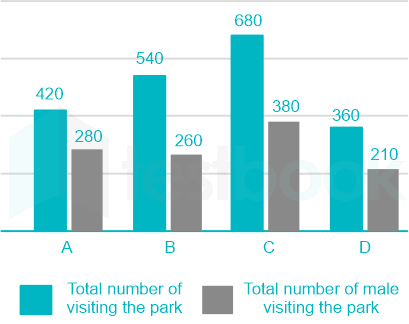
Directions: The below Bar-graph shows the total number of persons  visiting  parks A, B, C and D and the number of male visitors visiting same parks 


Total number of visitors  = Number of males visitors  + Number of females visitors

74

Find the difference between the total number of male visitors visiting all the parks and the total number of female visitors visiting all the parks.

  1. ((a))

    320

  2. ((b))

    230

  3. ((c))

    260

  4. ((d))

    270

  5. ((e))

    220

Show Answer
Answer: ((c))

260

General solution:

Park A: 

Total number of visitors  = 420

Number of males visitors = 280

Number of females visitors = (420 - 280) = 140


Park B: 

Total number of visitors  = 540

Number of male visitors = 260

Number of female visitors = (540 - 260) = 280


Park C: 

Total number of visitors = 680

Number of male visitors = 380

Number of female visitors = (680 - 380) = 300


Park D: 

Total number of visitors  = 360

Number of male visitors = 210

Number of female visitors = (360 - 210) = 150


ParksNumber of male visitorsNumber of female visitors
A280140
B260280
C380300
D210150

Solution:

The total number of male visitors visiting all parks = (280 + 260 + 380 + 210) = 1130

The total number of female visitors visiting all parks = (140 + 280 + 300 + 150) = 870

Required difference = 1130 – 870 = 260

75

If the number of male visitors visiting Park E is 20 more than the number of female visitors visiting Park B. The total number of visitors visiting Park E is 80 more than the total number of visitors visiting Park D. Find the number of female visitors visiting Park E.

  1. ((a))

    160

  2. ((b))

    180

  3. ((c))

    140

  4. ((d))

    110

  5. ((e))

    120

Show Answer
Answer: ((c))

140

General solution:

Park A: 

Total number of visitors  = 420

Number of males visitors = 280

Number of females visitors = (420 - 280) = 140


Park B: 

Total number of visitors  = 540

Number of male visitors = 260

Number of female visitors = (540 - 260) = 280


Park C: 

Total number of visitors = 680

Number of male visitors = 380

Number of female visitors = (680 - 380) = 300


Park D: 

Total number of visitors  = 360

Number of male visitors = 210

Number of female visitors = (360 - 210) = 150


ParksNumber of male visitorsNumber of female visitors
A280140
B260280
C380300
D210150


Solution:

The number of male visitors visiting Park E = 300

The total number of visitors visiting Park E = 360 + 80 = 440

The number of female visitors visiting Park E = 440 – 300 = 140

Directions: The below Bar-graph shows the total number of persons  visiting  parks A, B, C and D and the number of male visitors visiting same parks 


Total number of visitors  = Number of males visitors  + Number of females visitors

76

The number of male visitors in Park D is increased by 28.57% on Tuesday and the number of female visitors in Park D increased by 33.33% on Tuesday. Find the ratio of the total number of visitors on Monday to Tuesday in Park D.

  1. ((a))

    32: 37

  2. ((b))

    35: 41

  3. ((c))

    36: 47

  4. ((d))

    48: 43

  5. ((e))

    23: 27

Show Answer
Answer: ((c))

36: 47

General solution:

Park A: 

Total number of visitors  = 420

Number of males visitors = 280

Number of females visitors = (420 - 280) = 140


Park B: 

Total number of visitors  = 540

Number of male visitors = 260

Number of female visitors = (540 - 260) = 280


Park C: 

Total number of visitors = 680

Number of male visitors = 380

Number of female visitors = (680 - 380) = 300


Park D: 

Total number of visitors  = 360

Number of male visitors = 210

Number of female visitors = (360 - 210) = 150


ParksNumber of male visitorsNumber of female visitors
A280140
B260280
C380300
D210150

Solution:

The number of male visitors visiting on Tuesday = 210 × (9/7) = 270

The number female visitors visiting on Tuesday = 150 × (4/3) = 200

The total number of visitors visiting on Tuesday = 270 + 200 = 470

Required ratio = 360: 470 = 36: 47

77

 If the male and female entry ticket is Rs. 20 per head and Rs. 15 per head respectively in Park B. Find the total amount collected in Park B on Monday.

  1. ((a))

    Rs. 9400

  2. ((b))

    Rs. 9600

  3. ((c))

    Rs. 8600

  4. ((d))

    Rs. 8500

  5. ((e))

    Rs. 9500

Show Answer
Answer: ((a))

Rs. 9400

General solution:

Park A: 

Total number of visitors  = 420

Number of males visitors = 280

Number of females visitors = (420 - 280) = 140


Park B: 

Total number of visitors  = 540

Number of male visitors = 260

Number of female visitors = (540 - 260) = 280


Park C: 

Total number of visitors = 680

Number of male visitors = 380

Number of female visitors = (680 - 380) = 300


Park D: 

Total number of visitors  = 360

Number of male visitors = 210

Number of female visitors = (360 - 210) = 150


ParksNumber of male visitorsNumber of female visitors
A280140
B260280
C380300
D210150

Solution:

The number of male visitors visiting Park B = 260

The total amount collected from male visitors in park B = 260 × 20 = 5200

The number of female visitors visiting Park B = 280

The total amount collected from female visitors in park B = 280 ×15 = 4200

Required amount = 5200 + 4200 = Rs. 9400

78

In Park A, 80% of the male visitors are adults and 70% of the female visitors are adults and the remaining visitors are children. Find the total number of children visitors visited in Park A.

  1. ((a))

    84

  2. ((b))

    96

  3. ((c))

    86

  4. ((d))

    98

  5. ((e))

    88

Show Answer
Answer: ((d))

98

General solution:

Park A: 

Total number of visitors  = 420

Number of males visitors = 280

Number of females visitors = (420 - 280) = 140


Park B: 

Total number of visitors  = 540

Number of male visitors = 260

Number of female visitors = (540 - 260) = 280


Park C: 

Total number of visitors = 680

Number of male visitors = 380

Number of female visitors = (680 - 380) = 300


Park D: 

Total number of visitors  = 360

Number of male visitors = 210

Number of female visitors = (360 - 210) = 150


ParksNumber of male visitorsNumber of female visitors
A280140
B260280
C380300
D210150


Solution:

Number of male visitors = 280

Number of adult male visitors = 280 × (80/100) = 224

Number of child male visitors = 280 – 224 = 56

Number of female visitors = 140

Number of adult female visitors = 140 × (70/100) = 98

Number of child female visitors = 140 – 98 = 42

Required total = 56 + 42 = 98

79

A sum of money is to be distributed among A, B, C and D in the proportion of 2 : 3 : 5 : 4. If C gets Rs. 1200 more than D, then find the share of B?

  1. ((a))

    Rs. 1200

  2. ((b))

    Rs. 2400

  3. ((c))

    Rs. 3600

  4. ((d))

    Rs. 4800

  5. ((e))

    Rs. 6400

Show Answer
Answer: ((c))

Rs. 3600

Let the shares of A, B, C and D be Rs. 2x, Rs. 3x, Rs. 5x and Rs. 4x respectively

Given that C gets Rs. 1200 more than D

⇒ 5x – 4x = 1200

⇒ x = 1200

∴ Share of B = 3 × 1200 = Rs. 3600

80

P is twice efficient than Q, Q is is thrice efficient than R and R does the whole work in 54 days then in how many days P and Q together complete work?

  1. ((a))

    9 days 

  2. ((b))

    5 days 

  3. ((c))

    8 days 

  4. ((d))

    6 days 

  5. ((e))

    7 days 

Show Answer
Answer: ((d))

6 days 

Given:

P = 2Q

Q = 3R

R can complete a work in 54 days

Concept used:

If A does a work in n days then 1-day work of A is 1/n

Calculation:

According to question

Let, P's one day work = 6 unit

⇒ Q's one day work = 3 unit

⇒ R's one day work = 1 unit

R can complete work in 54 days 

⇒ Total work = 1 × 54 = 54 unit

⇒ (P + Q) can complete work in = 54/( 6 + 3)

⇒ 54/9

⇒ 6 days 

∴ P and Q together can complete work in 6 days

Attempt this paper under real exam conditions

Timed interface, section switching, instant scoring, and question-by-question analytics — free.

Start Timed Attempt