Official Paper

RRB Clerk Prelims Memory Based Paper (Held On: 19 August 2023 Shift 1) (Previous Year Paper)

80 questions · 45 minutes · with answers · free

Reasoning (40 questions)

Directions: Study the following information and answer the given questions.

Eight players have their matches on 15th and 26th of four months among January, April, October and December. W is one of the player. Two players have matches between P and Q. R has match on 26th April and immediate before P. T’s match is immediately before S’s match. U’s match is immediately after V’s match but not in the same month. S has match in the month, which has 30 days.

1

How many players have matches after R?

  1. ((a))

    Three

  2. ((b))

    Four

  3. ((c))

    One

  4. ((d))

    Five

  5. ((e))

    Two

Show Answer
Answer: ((b))

Four

Eight persons: P, Q, R, S, T, U, V and W.

1) Two players have matches between P and Q.

2) R has match on 26th April and immediate before P.

3) T’s match is immediately before S’s match.

Case 1Case 2
Month15th26thMonth15th26th
January (31)QMarch (31)
April (30)RMay (31)Q
October (31)PJune (30)P
December (31)July (31)Q
  1. U’s match is immediately after V’s match but not in the same month.

  2.  S has match in the month, which has 30 days.

Case 2
Month15th26th
January (31)WT
April (30)SR
October (31)PV
December (31)UQ

Thus, the above is the final arrangement.

Hence, four players have matches after R.
2

Who among the following players has match on 15th October?

  1. ((a))

    P

  2. ((b))

    S

  3. ((c))

    R

  4. ((d))

    W

  5. ((e))

    Q

Show Answer
Answer: ((a))

P

Eight persons: P, Q, R, S, T, U, V and W.

1) Two players have matches between P and Q.

2) R has match on 26th April and immediate before P.

3) T’s match is immediately before S’s match.

Case 1Case 2
Month15th26thMonth15th26th
January (31)QMarch (31)
April (30)RMay (31)Q
October (31)PJune (30)P
December (31)July (31)Q

4) U’s match is immediately after V’s match but not in the same month.

5)  S has match in the month, which has 30 days.

Case 2
Month15th26th
January (31)WT
April (30)SR
October (31)PV
December (31)UQ

P is on 15th October. 

Hence, correct answer is option 1.

3

Which among the following is true with respect to the given arrangement.

  1. ((a))

    W has match on 26th April

  2. ((b))

    Two people have matches between S and V

  3. ((c))

    P and W have match in the same months.

  4. ((d))

    Q has match on 15th January

  5. ((e))

    Q has the match in the month which have 30 days.

Show Answer
Answer: ((b))

Two people have matches between S and V

Eight persons: P, Q, R, S, T, U, V and W.

1) Two players have matches between P and Q.

2) R has match on 26th April and immediate before P.

3) T’s match is immediately before S’s match.

Case 1Case 2
Month15th26thMonth15th26th
January (31)QMarch (31)
April (30)RMay (31)Q
October (31)PJune (30)P
December (31)July (31)Q

4) U’s match is immediately after V’s match but not in the same month.

5)  S has match in the month, which has 30 days.

Case 2
Month15th26th
January (31)WT
April (30)SR
October (31)PV
December (31)UQ

Two people have matches between S and V - true.

Hence, correct answer is option 2.

4

Who among the following player has match in the same month in which V has match?

  1. ((a))

    Q

  2. ((b))

    W

  3. ((c))

    R

  4. ((d))

    P

  5. ((e))

    S

Show Answer
Answer: ((d))

P

Eight persons: P, Q, R, S, T, U, V and W.

1) Two players have matches between P and Q.

2) R has match on 26th April and immediate before P.

3) T’s match is immediately before S’s match.

Case 1Case 2
Month15th26thMonth15th26th
January (31)QMarch (31)
April (30)RMay (31)Q
October (31)PJune (30)P
December (31)July (31)Q

4) U’s match is immediately after V’s match but not in the same month.

5)  S has match in the month, which has 30 days.

Case 2
Month15th26th
January (31)WT
April (30)SR
October (31)PV
December (31)UQ

P and V have match in the same month.

Hence, correct answer is option 2.

5

Four of the given five are alike in a certain way based on the given arrangement and hence form a group. Which of them does not belong to that group?

  1. ((a))

    T

  2. ((b))

    R

  3. ((c))

    V

  4. ((d))

    Q

  5. ((e))

    S

Show Answer
Answer: ((e))

S

Eight persons: P, Q, R, S, T, U, V and W.

1) Two players have matches between P and Q.

2) R has match on 26th April and immediate before P.

3) T’s match is immediately before S’s match.

Case 1Case 2
Month15th26thMonth15th26th
January (31)QMarch (31)
April (30)RMay (31)Q
October (31)PJune (30)P
December (31)July (31)Q

4) U’s match is immediately after V’s match but not in the same month.

5)  S has match in the month, which has 30 days.

Case 2
Month15th26th
January (31)WT
April (30)SR
October (31)PV
December (31)UQ

S has match in the date of 15th and others have 26th.

Hence, correct answer is option 5.

Direction: Study the following series of sets of numbers. Carefully answer the question given below.

525      852      347      293      174

6

What will be the number obtained if second digit of the smallest number is multiplied with second digit of the largest number?

  1. ((a))

    40

  2. ((b))

    25

  3. ((c))

    20

  4. ((d))

    35

  5. ((e))

    30

Show Answer
Answer: ((d))

35

Given series:- 525       852      347      293      174=

Smallest number = 174

Largest number = 852

Second digit of smallest number:- 7

Second digit of largest number:- 5

Resultant will be:- 7×5 = 35;

Hence, “35” is the correct answer.

7

If one is subtracted from first and third digit from each number and then both are interchanged, then which among them is second lowest number?

  1. ((a))

    852

  2. ((b))

    174

  3. ((c))

    347

  4. ((d))

    525

  5. ((e))

    293

Show Answer
Answer: ((e))

293

Given series:- 525       852      347      293      174

Subtracting 1 from 1st and 3rd digit:- 424       751      246      192      073

Interchanging 1st and 3rd digit:- 424   157      642      291      370

Hence, second lowest number is 291 which resulted from “293”

Hence, “293” is correct answer.

8

If second and third digit of each number is interchanged, then how many prime numbers are there in the given series?

  1. ((a))

    Two

  2. ((b))

    Three

  3. ((c))

    Four

  4. ((d))

    One

  5. ((e))

    Zero

Show Answer
Answer: ((d))

One

Given series:- 525       852      347      293      174

Interchanging 2nd and 3rd digit:- 552       825        374        239        147

Here, “239” only one number which is a prime number.

Hence, “One” is the correct answer.

9

What will be number obtained if 2nd digit of third highest number is added with 3rd digit of the smallest number?

  1. ((a))

    8

  2. ((b))

    9

  3. ((c))

    10

  4. ((d))

    11

  5. ((e))

    12

Show Answer
Answer: ((a))

8

Given series:- 525       852      347      293      174

2nd digit of third highest number is 4 (347 is the 3rd highest number among the given series)

3rd digit of the smallest number is 4 (174 is smallest number among the given series)

Hence, resultant will be:- 4 + 4 = 8;

Hence, “8” is the correct answer.

10

If in each number three digits are arranged in ascending order then which of the following is 2nd largest number?

  1. ((a))

    525

  2. ((b))

    347

  3. ((c))

    293

  4. ((d))

    174

  5. ((e))

    852

Show Answer
Answer: ((e))

852

Given series:- 525       852      347      293      174

Arranging in ascending order:- 255       258        347         239          147

Then 2nd largest number is 258 which resultant from 852.

Hence, “852” is the correct answer.

11

Direction: In the following question assuming the given statements to be True, find which of the conclusion among given conclusions is/are definitely true and then give your answers accordingly.

Statements: E > R ≥ A > B; T ≤ X ≤ B

Conclusions:

I. E ≥ T

II. X < R

  1. ((a))

    Only II is True

  2. ((b))

    Neither I nor II is True

  3. ((c))

    Both I and II are True

  4. ((d))

    Either I or II is True

  5. ((e))

    Only I is True

Show Answer
Answer: ((a))

Only II is True

Given statements: E > R ≥ A > B; T ≤ X ≤ B

On combining: E > R ≥ A > B ≥ X ≥ T

Conclusions:

I. E ≥ T → False (as E > R ≥ A > B ≥ X ≥ T → E > T)

II. X < R → True (as R ≥ A > B ≥ X → R > X)

Hence, only II is True.

12

Direction: In the following question assuming the given statements to be true, find which of the conclusion(s) among given conclusions is/are definitely true and then give your answers accordingly.

Statements: 

F ≥ E = J = K, R = K ≥ T

Conclusions:

I. T < F

II. F = T

  1. ((a))

    Only conclusion I follows

  2. ((b))

    Only conclusion II follows

  3. ((c))

    Both conclusions I and II follow

  4. ((d))

    Either conclusion I or II follows

  5. ((e))

    None follows

Show Answer
Answer: ((d))

Either conclusion I or II follows

Given statements,

F ≥ E = J = K, R = K ≥ T

On combining, we get:

F ≥ E = J = K = R ≥ T

Conclusions**:**

I. T < F → False (F ≥ E = J = K = R ≥ T → F ≥ T).

II. F = T → False (F ≥ E = J = K = R ≥ T → F ≥ T).

Since F ≥ T is true so either conclusion I or II definitely follows.

Hence, the correct answer is either conclusion I or II follows.

13

Direction: In the following question assuming the given statements to be true, find which of the conclusion(s) among given conclusions is/are definitely true and then give your answers accordingly.

Statements: 

P < D ≤ E < K, J = E ≤ Z

Conclusions:

I. P < J

II. D ≤ Z

  1. ((a))

    Only conclusion I follows.

  2. ((b))

    Only conclusion II follows.

  3. ((c))

    Both conclusions I and II follow.

  4. ((d))

    Either conclusion I or II follows.

  5. ((e))

    None follows.

Show Answer
Answer: ((c))

Both conclusions I and II follow.

Given statements,

P < D ≤ E < K,  J = E ≤ Z

On combining: 

P < D ≤ E = J ≤ Z, E < K

Conclusions**:** 

I. P < J → True (as P < D ≤ E = J → P < J).

II. D ≤ Z → True (as D ≤ E ≤ Z → D ≤ Z).

Hence, Both conclusions I and II follow.

Direction: Study the following information carefully and answer the given questions.

In a certain code language,

‘try room hidden paper’ is written as ‘pna drs qut eli’

‘paper cancel track time’ is written as ‘btr axt eli sns’

‘track try room land’ is written as ‘pna xyn qut btr’

‘try time shut down’ is written as ‘lmo sns cef qut’

14

What does ‘sns’ mean in the coded language?

  1. ((a))

    hidden

  2. ((b))

    time

  3. ((c))

    room

  4. ((d))

    land

  5. ((e))

    try

Show Answer
Answer: ((b))

time

The given information can be analysed as follows,

Hence, ‘sns’ means ‘time’ in the coded language.

15

What is the code of ‘shut down’?

  1. ((a))

    xyn btr

  2. ((b))

    qut eli

  3. ((c))

    axt sns

  4. ((d))

    pna drs

  5. ((e))

    lmo cef

Show Answer
Answer: ((e))

lmo cef

The given information can be analysed as follows,

Hence, the code of ‘shut down’ is ‘lmo cef’.

16

What is the code of ‘hidden’?

  1. ((a))

    drs

  2. ((b))

    qut

  3. ((c))

    eli

  4. ((d))

    axt 

  5. ((e))

    cef

Show Answer
Answer: ((a))

drs

The given information can be analysed as follows,

Hence, ‘hidden’ is coded as ‘drs’.

17

What is the code of ‘land’?

  1. ((a))

    btr

  2. ((b))

    cef

  3. ((c))

    drs

  4. ((d))

    xyn

  5. ((e))

    qut

Show Answer
Answer: ((d))

xyn

The given information can be analysed as follows,

Hence, ‘land’ is coded as ‘xyn’.

18

In the coded language, ______ is coded as ‘axt’. 

  1. ((a))

    paper

  2. ((b))

    down

  3. ((c))

    cancel

  4. ((d))

    time

  5. ((e))

    track

Show Answer
Answer: ((c))

cancel

The given information can be analysed as follows,

Hence, ‘cancel’ is coded as ‘axt’

Directions: Study the information given below carefully and answer the questions that follow.

Mira started her journey from point J. Point J is 4 feet east of point K. Point P is 4 feet west of point Q. Point P is 10 feet north of point J. Point S is 10 feet south of point Q. Point R is the midpoint of the path Q and S. Point U is 5 feet north to point V. Point R is 4 feet west of point U.

19

What is the distance between the point K and S?

  1. ((a))

    10 feet

  2. ((b))

    16 feet

  3. ((c))

    4 feet

  4. ((d))

    8 feet

  5. ((e))

    15 feet

Show Answer
Answer: ((d))

8 feet

We have drawn the figure according to the information given in the question,

Distance between point K and point S is ?

KS = KJ + JS

According to the above figure:

KJ = 4 feet, JS = 4 feet

KS = 4 + 4

KS = 8 feet

Hence, ‘8 feet’ is the correct answer.

20

What is the distance between point K and V?

  1. ((a))

    15 m

  2. ((b))

    12 feet

  3. ((c))

    18 feet

  4. ((d))

    12 m

  5. ((e))

    30 feet

Show Answer
Answer: ((b))

12 feet

We have drawn the figure according to the information given in the question,

Distance between point K and point V is ?

KV = KJ + JS + SV

According to the above figure:

KJ = 4 feet, JS = 4 feet, SV = 4 feet

KV = 4 + 4 + 4

KV = 12 feet

Hence, the distance between K and V is 12 feet.

21

In what direction is S with respect to U?

  1. ((a))

    North - East

  2. ((b))

    South - West

  3. ((c))

    East

  4. ((d))

    West

  5. ((e))

    Cannot be determined

Show Answer
Answer: ((b))

South - West

We have drawn the figure according to the information given in the question,

From the above diagram, S is South -West of point U.

22

If in the number, "78546932", the digits are arranged in the descending order, then how many digits remain in the same position in the new number formed?

  1. ((a))

    None

  2. ((b))

    Three

  3. ((c))

    One

  4. ((d))

    Two

  5. ((e))

    More than three

Show Answer
Answer: ((b))

Three

Given,

Number - 78546932

The digits are arranged in descending order. We get, 

Given78546932
Descending Order98765432

Here, 8, 3 and 2 remain in the same position.

Therefore, three is the correct option.

Directions: Read the instructions carefully and answer the question below:

There are seven people i.e. T, U, V, W, X, Y and Z who attended Yoga sessions on different days of the same week from Monday to Sunday but not necessary in same order.

One person attended the session between U and X. Three persons attended the yoga sessions between T and Y. Y attended the sessions before W. X attended the session one of the days after V. T attended the session on one of the days before Thursday. No two persons attend the session immediately before or immediately after according to English alphabet (i.e. T does not attend the session immediately before or after U).

23

How many persons attend Yoga session between Z and W?

  1. ((a))

    One

  2. ((b))

    Four

  3. ((c))

    Three

  4. ((d))

    Five

  5. ((e))

    Two

Show Answer
Answer: ((e))

Two

People: T, U, V, W, X, Y and Z

Days: Monday to Sunday

  1. Three persons attended the yoga sessions between T and Y.

  2. Y attended the sessions before W.

  3. T attended the session on one of the days before Thursday.

DaysCase 1Case 2Case 3
MondayTT
TuesdayT
Wednesday
Thursday
FridayYY
SaturdayWY
SundayWW
<br>
  1. No two persons attend the session immediately before or immediately after according to English alphabet.

  2. X attended the session one of the days after V.

  3. One person attended the session between U and X.

This eliminates case 1 and case 2.

DaysCase 3
MondayV
TuesdayT
WednesdayX
ThursdayZ
FridayU
SaturdayY
SundayW


Hence, two persons attend Yoga session between Z and W.

24

Who attend Yoga session on Friday?

  1. ((a))

    V

  2. ((b))

    U

  3. ((c))

    X

  4. ((d))

    T

  5. ((e))

    Z

Show Answer
Answer: ((b))

U

People: T, U, V, W, X, Y and Z

Days: Monday to Sunday

  1. Three persons attended the yoga sessions between T and Y.

  2. Y attended the sessions before W.

  3. T attended the session on one of the days before Thursday.

DaysCase 1Case 2Case 3
MondayTT
TuesdayT
Wednesday
Thursday
FridayYY
SaturdayWY
SundayWW
<br>
  1. No two persons attend the session immediately before or immediately after according to English alphabet.

  2. X attended the session one of the days after V.

  3. One person attended the session between U and X.

This eliminates case 1 and case 2.

DaysCase 3
MondayV
TuesdayT
WednesdayX
ThursdayZ
FridayU
SaturdayY
SundayW


Hence, U attends Yoga session on Friday.

25

When does V attend Yoga session?

  1. ((a))

    Monday

  2. ((b))

    Tuesday

  3. ((c))

    Wednesday

  4. ((d))

    Thursday

  5. ((e))

    Friday

Show Answer
Answer: ((a))

Monday

People: T, U, V, W, X, Y and Z

Days: Monday to Sunday

  1. Three persons attended the yoga sessions between T and Y.

  2. Y attended the sessions before W.

  3. T attended the session on one of the days before Thursday.

DaysCase 1Case 2Case 3
MondayTT
TuesdayT
Wednesday
Thursday
FridayYY
SaturdayWY
SundayWW
<br>
  1. No two persons attend the session immediately before or immediately after according to English alphabet.

  2. X attended the session one of the days after V.

  3. One person attended the session between U and X.

This eliminates case 1 and case 2.

DaysCase 3
MondayV
TuesdayT
WednesdayX
ThursdayZ
FridayU
SaturdayY
SundayW


Hence, V attends Yoga session on Monday.

26

How many persons attend session after U?

  1. ((a))

    One

  2. ((b))

    Four

  3. ((c))

    Three

  4. ((d))

    Five

  5. ((e))

    Two

Show Answer
Answer: ((e))

Two

People: T, U, V, W, X, Y and Z

Days: Monday to Sunday

  1. Three persons attended the yoga sessions between T and Y.

  2. Y attended the sessions before W.

  3. T attended the session on one of the days before Thursday.

DaysCase 1Case 2Case 3
MondayTT
TuesdayT
Wednesday
Thursday
FridayYY
SaturdayWY
SundayWW
<br>
  1. No two persons attend the session immediately before or immediately after according to English alphabet.

  2. X attended the session one of the days after V.

  3. One person attended the session between U and X.

This eliminates case 1 and case 2.

DaysCase 3
MondayV
TuesdayT
WednesdayX
ThursdayZ
FridayU
SaturdayY
SundayW


Hence, two persons attend session after U.

27

Which of the following statement(s) is / are correct?

i) X attends the Yoga session on Wednesday.

ii) Two persons attend Yoga session between T and X.

iii) W attends the Yoga session on Sunday.

  1. ((a))

    Only statement I is correct.

  2. ((b))

    Only statement II is correct.

  3. ((c))

    Only statement III is correct.

  4. ((d))

    Both statements I and III correct.

  5. ((e))

    Both statements I and II correct.

Show Answer
Answer: ((d))

Both statements I and III correct.

People: T, U, V, W, X, Y and Z

Days: Monday to Sunday

  1. Three persons attended the yoga sessions between T and Y.

  2. Y attended the sessions before W.

  3. T attended the session on one of the days before Thursday.

DaysCase 1Case 2Case 3
MondayTT
TuesdayT
Wednesday
Thursday
FridayYY
SaturdayWY
SundayWW
<br>
  1. No two persons attend the session immediately before or immediately after according to English alphabet.

  2. X attended the session one of the days after V.

  3. One person attended the session between U and X.

This eliminates case 1 and case 2.

DaysCase 3
MondayV
TuesdayT
WednesdayX
ThursdayZ
FridayU
SaturdayY
SundayW


i) X attends the Yoga session on Wednesday. → True

ii) Two persons attend Yoga session between T and X. → False

iii) W attends the Yoga session on Sunday. → True

Hence, statement I and III are correct.

28

If it is possible to make a meaningful word with the 2nd, 5th, 6th and 8th letters of the word “SHORTAGE”, which of the following will be the second letter of that word? If more than one such word can be formed, give 'X' as the answer and if no such word can be formed, give 'Y' as the answer.

  1. ((a))

    H

  2. ((b))

    E

  3. ((c))

    G

  4. ((d))

    X

  5. ((e))

    Y

Show Answer
Answer: ((d))

X

Given- SHORTAGE

2nd, 5th, 6th, and 8th letters are- H, T, A, and E

The meaningful words are - HEAT and HATE

Hence,  More than one word can be formed.  the correct answer will be X

Direction: Study the following information carefully and answer the questions following it.

There are eight person P, Q, R, S, T, U, V and W sitting on a square table but not necessarily in the same order. Four of them are sitting on the middle side of the table facing inside and the rest of them are sitting at the corners of the table facing outside. Q and R sit opposite to each other where Q is not sitting next to V. Three persons are sitting between U and P. S sits second to the right of V.V is sitting at the corner. Two people are sitting between P and T. U sits fifth to the right of S.

29

Who among the following is sitting to the immediate left of T?

  1. ((a))

    W

  2. ((b))

    U

  3. ((c))

    P

  4. ((d))

    V

  5. ((e))

    Q

Show Answer
Answer: ((e))

Q

There are eight persons P, Q, R, S, T, U, V and W sitting on a rectangular table but not necessarily in the same order. Four of them are sitting on the middle side of the table facing inside and rest of them are sitting on the corners of the table facing outside.

  1. V is sitting at the corner.
  2. S sits second to the right of V.

  1. U sits fifth to the right of S.
  2. Three persons are sitting between U and P.

  1. Two people are sitting between P and T.
  2. Q and R sit opposite to each other where Q is not sitting near to V.

The final arrangement is shown here,

Hence, Q is the immediate left of T.

30

Which of the following are sitting at the corners?

  1. ((a))

    WQTU

  2. ((b))

    WTVS

  3. ((c))

    RSPU

  4. ((d))

    PSRV

  5. ((e))

    UTQW

Show Answer
Answer: ((b))

WTVS

There are eight persons P, Q, R, S, T, U, V and W sitting on a rectangular table but not necessarily in the same order. Four of them are sitting on the middle side of the table facing inside and rest of them are sitting on the corners of the table facing outside.

  1. V is sitting at the corner.
  2. S sits second to the right of V.

  1. U sits fifth to the right of S.
  2. Three persons are sitting between U and P.

  1. Two people are sitting between P and T.
  2. Q and R sit opposite to each other where Q is not sitting near to V.

The final arrangement is shown here,

Hence, WTVS are sitting at the corners.

31

From the left of P, how many persons are sitting between P and V?

  1. ((a))

    Two

  2. ((b))

    Three

  3. ((c))

    Four

  4. ((d))

    Five

  5. ((e))

    None of these

Show Answer
Answer: ((c))

Four

There are eight persons P, Q, R, S, T, U, V and W sitting on a rectangular table but not necessarily in the same order. Four of them are sitting on the middle side of the table facing inside and rest of them are sitting on the corners of the table facing outside.

  1. V is sitting at the corner.
  2. S sits second to the right of V.

  1. U sits fifth to the right of S.
  2. Three persons are sitting between U and P.

  1. Two people are sitting between P and T.
  2. Q and R sit opposite to each other where Q is not sitting near to V.

The final arrangement is shown here,

Hence, From the left of P, four persons are sitting between P and V.

32

Which of the following is true?

  1. ((a))

    P is sitting opposite to V

  2. ((b))

    S is sitting to the immediate left of U

  3. ((c))

    T and S are sitting at the corners

  4. ((d))

    P and U are sitting at the corners

  5. ((e))

    None of these

Show Answer
Answer: ((c))

T and S are sitting at the corners

There are eight persons P, Q, R, S, T, U, V and W sitting on a rectangular table but not necessarily in the same order. Four of them are sitting on the middle side of the table facing inside and rest of them are sitting on the corners of the table facing outside.

  1. V is sitting at the corner.
  2. S sits second to the right of V.

  1. U sits fifth to the right of S.
  2. Three persons are sitting between U and P.

  1. Two people are sitting between P and T.
  2. Q and R sit opposite to each other where Q is not sitting near to V.

The final arrangement is shown here,

Hence, T and S are sitting at the corners.

33

Which among the following pairs sits opposite to each other?

  1. ((a))

    U, W

  2. ((b))

    S, Q

  3. ((c))

    W, V

  4. ((d))

    P, S

  5. ((e))

    Q, T

Show Answer
Answer: ((c))

W, V

There are eight persons P, Q, R, S, T, U, V and W sitting on a rectangular table but not necessarily in the same order. Four of them are sitting on the middle side of the table facing inside and rest of them are sitting on the corners of the table facing outside.

  1. V is sitting at the corner.
  2. S sits second to the right of V.

  1. U sits fifth to the right of S.
  2. Three persons are sitting between U and P.

  1. Two people are sitting between P and T.
  2. Q and R sit opposite to each other where Q is not sitting near to V.

The final arrangement is shown here,

Hence, W and V sits opposite to each other.

34

Direction: In the question below are given two statements followed by two conclusions numbered I and II. You have to take the given statements to be true even if they seem to be at variance with commonly known facts. Read all the conclusions and then decide which of the given conclusions logically follows from the given statements disregarding commonly known facts.

Statements:

All lake is river.

Only a few river is ocean.

Conclusions:

I. Some lake is ocean.

II. Some lake is not ocean.

  1. ((a))

    Only conclusions I follow

  2. ((b))

    Only conclusion II follow

  3. ((c))

    Either I or II follows

  4. ((d))

    Neither I nor II follows

  5. ((e))

    Both I and II follow

Show Answer
Answer: ((d))

Neither I nor II follows

Note: Some + Some not is not considered under the Either-or case.

Either - or is the case when only one of the conclusions can be true at a time, but in the case of 'Some + Some not', both the conditions can be true at a time. Hence, 'Some + Some not' is considered as 'either - or' pair.

The least possible Venn diagram for the given statements is as follows: 

Conclusions:

I. Some lake is ocean → False (as there is no relation between lake and ocean. So, it is possible but it is not definite. Hence, some lake is ocean is false).

II. Some lake is not ocean → False (as there is no relation between lake and ocean. So, it is possible but it is not definite. Hence, some lake is ocean is false).

Hence, Neither conclusion I nor II follows.

35

Directions: In the question below are given two statements followed by two conclusions numbered I and II. You have to take the given statements to be true even if they seem to be at variance with commonly known facts. Read all the conclusions and then decide which of the given conclusions logically follows from the given statements disregarding commonly known facts.

Statements:

At least some Video are Online.

Some Online are not Youtube.

Conclusions:

I. Some Online are not Video.

II. All Online are Youtube.

  1. ((a))

    Only I follow

  2. ((b))

    Only II follow

  3. ((c))

    Either I or II follows

  4. ((d))

    Neither I nor II follows

  5. ((e))

    Both I and II follows

Show Answer
Answer: ((d))

Neither I nor II follows

The least possible Venn diagram for the given statements is as follows:

Conclusions:

I. Some Online are not Video → False (As At least some Video are Online, we do not know about the other part of online is video or not, so it is false)

II. All Online are Youtube → False (As Some Online is not Youtube then All Online are Youtube is not possible, so it is false).

Hence, Neither I nor II follows.

Additional Information 

  1. Some X are Y means some part of the X circle is within the Y circle. 2.  No X is Y means circle X and Y are not intersecting at all.
  2. All X is Y means the whole circle X lies within the Y circle.
  3. If there is no exact conclusion for the given statements then the possibility case arises.
  4. If Only X is Y means all Y is X.
  5. Only a few:- Some + Some not.
  6. At least, Many, Few, Most, Seldom, Rarely means Some.
36

Directions: In the question below are given two statements followed by two conclusions numbered I and II. You have to take the given statements to be true even if they seem to be at variance with commonly known facts. Read all the conclusions and then decide which of the given conclusions logically follows from the given statements disregarding commonly known facts.

Statements:

Only a few Earphones are Headset.

Some Headset are Backpack.

Conclusions:

I. All Headset are Earphones.

II. No Backpack is Headset.

  1. ((a))

    Only I follow

  2. ((b))

    Only II follow

  3. ((c))

    Both I and II follow

  4. ((d))

    Either I or II follows

  5. ((e))

    Neither I nor II follows

Show Answer
Answer: ((e))

Neither I nor II follows

The least possible Venn diagram for the given statements is as follows:

Conclusions:

I. All Headset are Earphones → False (As only a few Earphones are Headset, some Headset are already Earphones but another portion of Headset is Earphones or not is possible but not definite, So it is false).

II. No Backpack is Headset → False (As some Headset are Backpack, some portion of Headset is already Backpack so No Backpack is Headset will be false).

Hence, Neither I nor II follows​.

37

How many pair of letters are there in the word “SANITY” which has as many letters (in both forward and backward direction) in between as they have in the English alphabet series?

  1. ((a))

    One

  2. ((b))

    Three

  3. ((c))

    Four

  4. ((d))

    Two

  5. ((e))

    No pair formed

Show Answer
Answer: ((e))

No pair formed

Given Word: SANITY

We can use the positional values of letters/alphabets in the English alphabets series so as to map the letters in an easier manner.

According to the English alphabetical series, the positional values of letters are given as follows:

<br>

The letters are mapped as shown:

Hence, no such pairs of letters in the word "SANITY" which have as many letters between them as English alphabetical series (Both in the backward and forward direction)

Directions: These questions are based on the following information.

There are six member in the family - R, S, A, K, G and P. S is married to A who is mother of G. R is sister- in- law of A. K is grandson of P and only son of R. P has one granddaughter.

38

Which of the following statement is incorrect?

  1. ((a))

    P is grandfather of G

  2. ((b))

    G is cousin of K

  3. ((c))

    S is maternal uncle of K

  4. ((d))

    R is Paternal aunt of G

  5. ((e))

    None of the given statement is correct

Show Answer
Answer: ((a))

P is grandfather of G

From the given information,

S is married to A who is mother of G.

R is sister- in- law of A. K is grandson of P and only son of R. P has one granddaughter. 

As gender of P is not defined we cannot find its relation with anyone. 

Hence, P is grandfather of G is incorrect.

39

How many male member are there in the family?

  1. ((a))

    2

  2. ((b))

    3

  3. ((c))

    1

  4. ((d))

    4

  5. ((e))

    Cannot be determined

Show Answer
Answer: ((e))

Cannot be determined

From the given information,

S is married to A who is mother of G.

R is sister- in- law of A. K is grandson of P and only son of R. P has one granddaughter. 

As gender of P cannot be define hence number of male member in the organisation cannot be determined.

40

How S related to P?

  1. ((a))

    Son

  2. ((b))

    Father

  3. ((c))

    Grandfather

  4. ((d))

    Aunt

  5. ((e))

    cannot be determined

Show Answer
Answer: ((a))

Son

From the given information,

S is married to A who is mother of G.

R is sister- in- law of A. K is grandson of P and only son of R. P has one granddaughter. 

S is son of P.

Numerical Ability (40 questions)

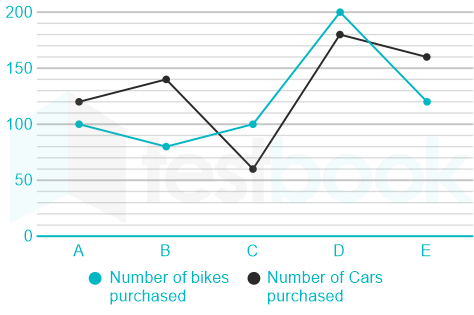
Directions: The following line graph shows the number of cars and bikes purchased  by the five different companies A, B, C, D and E.

41

If the number of bikes purchased by company E is 40 more than company F and the number of cars purchased by company F is 40 more than company E. Find the ratio between the number of bikes purchased in company E and F to the number of cars purchased to the company E and F.

  1. ((a))

    5: 7

  2. ((b))

    5: 9

  3. ((c))

    3: 5

  4. ((d))

    4: 3

  5. ((e))

    3: 8

Show Answer
Answer: ((b))

5: 9

Solution:

Number of bikes purchased by company E = 120

Number of bikes purchased by company F = (120 - 40) = 80

Number of cars purchased by the company E = 160

Number of cars purchased by company F = (160 + 40) = 200

Required ratio = (120 + 80): (160 + 200) = 200: 360 = 5: 9

42

Find the difference between the average number of bikes purchased by all the companies and the average number of cars purchased by all the companies A, B, C, D and E.

  1. ((a))

    16

  2. ((b))

    12

  3. ((c))

    14

  4. ((d))

    18

  5. ((e))

    22

Show Answer
Answer: ((b))

12

Solution:

Average number of bikes purchased by all the companies = (100 + 80 + 100 + 200 + 120)/5 = 120

Average number of cars purchased by all the companies = (120 + 140 + 60 + 180 + 160)/ 5 = 132

Required difference = (132 - 120) = 12

43

If the number of bikes purchased by the company D is increased by x% and the average number of bikes and cars purchased by the company D is 210. Find the value of x.

  1. ((a))

    30%

  2. ((b))

    15%

  3. ((c))

    25%

  4. ((d))

    20%

  5. ((e))

    35%

Show Answer
Answer: ((d))

20%

Solution:

Initial number of bikes and cars purchased in the company D = (200 + 180) = 380

After increasing x% in bike purchase number of bikes and cars purchased in company D = (210 ×  2) = 420

Number of bikes purchase increased = 40

To find the value of x

100 × (240 - 200)/200 = 100 × 40/200 = 20%

44

1/5 th of the bikes purchased by the company C and 1/3rd of the cars purchased by the company C are at the discount price. Find the difference between the number of cars and bikes at the discount price.

  1. ((a))

    10

  2. ((b))

    5

  3. ((c))

    15

  4. ((d))

    0

  5. ((e))

    20

Show Answer
Answer: ((d))

0

Solution:

Number of bikes purchased by the company C = 100

1/5 th of bikes purchased by company C = 100/5 = 20

Number of cars purchased by company C = 60

1/3 rd of cars purchased by company C = 60 × 1/3 = 20

Required difference = (20 - 20) = 0

45

If 20% , 30% of the bikes purchased by the companies A and B respectively are yamaha bikes and 25% and 20% of the cars purchased from the companies A and B are Tata. Find the number of Tata cars and yamaha bikes purchased from company A and B.

  1. ((a))

    116

  2. ((b))

    118

  3. ((c))

    102

  4. ((d))

    122

  5. ((e))

    126

Show Answer
Answer: ((c))

102

Solution:

Number of yamaha bikes purchased by company A = 100 × 20/100 = 20

Number of yamaha bikes purchased by company B = 80 × (30/100) = 24

Number of Tata cars purchased by company A = 120 × (25/100) = 30

Number of Tata cars purchased by company B  = 140 × (20/100) = 28

Required total = (20 + 24 + 30 + 28) = 102

46

What will come in the place of question mark ‘?’ in the following question?

18+163×92134×236=?×53\frac{1}{8} + \frac{{16}}{3} \times \frac{9}{2} - \frac{{13}}{4} \times \frac{{23}}{6} = ? \times \frac{5}{3}

  1. ((a))

    9

  2. ((b))

    5

  3. ((c))

    4

  4. ((d))

    7

  5. ((e))

    None of these

Show Answer
Answer: ((d))

7

Applying BODMAS rule to solve the problem,

Step - 1: Parts of the equation enclosed in ‘Brackets’ must be solved first.

Step - 2: Any mathematical ‘Of’ or ‘Exponent’ must be solved next.

Step - 3: Next the part of the equation which contain ‘Division’ and ‘Multiplication’ must be solved.

Step - 4: Last but not the least, the parts of the equation that contains ‘Addition’ and ‘Subtraction’ must be solved.

Now the given expression,

18+163×92134×236=?×53 18+2429924=?×53 3+57629924=?×53 28024=?×53 280×324×5=? ?=840120\begin{array}{l} \Rightarrow \frac{1}{8} + \frac{{16}}{3} \times \frac{9}{2} - \frac{{13}}{4} \times \frac{{23}}{6} = ? \times \frac{5}{3}\ \Rightarrow \frac{1}{8} + 24 - \frac{{299}}{{24}} = ? \times \frac{5}{3}\ \Rightarrow \frac{{3 + 576 - 299}}{{24}} = ? \times \frac{5}{3}\ \Rightarrow \frac{{280}}{{24}} = ? \times \frac{5}{3}\ \Rightarrow \frac{{280 \times 3}}{{24 \times 5}} = ?\ \Rightarrow ? = \frac{{840}}{{120}} \end{array}

⇒ ? = 7

47

What will come in the place of the question mark ‘?’ in the following question?

43 × 45 + 43 × 55 - 43 × 30 = ?

  1. ((a))

    3010

  2. ((b))

    2010

  3. ((c))

    3030

  4. ((d))

    4010

  5. ((e))

    None of these

Show Answer
Answer: ((a))

3010

Given:

43 × 45 + 43 × 55 - 43 × 30 = ?

Concept used:

Follow the BODMAS rule according to the table given below:

Calculation:

43 × 45 + 43 × 55 - 43 × 30 = ?

⇒ 43(45 + 55 - 30) = ?

⇒ 43(100 - 30) = ?

⇒ 43 × 70 = ?

⇒ 3010

∴ The value of ? is 3010.

48

What will come in the place of the question mark ‘?’ in the following question?

(175 - 25) + √25 - 10 × 6 = ?

  1. ((a))

    75

  2. ((b))

    85

  3. ((c))

    95

  4. ((d))

    105

  5. ((e))

    125

Show Answer
Answer: ((c))

95

Follow BODMAS rule to solve this question, as per the order given below,

Calculation:

(175 - 25) + √25 - 10 × 6 = ?

⇒ 150 + 5 – 60 = ? 

⇒ ? = 95

∴ The required value is 95

49

What will come in the place of the question mark ‘?’ in the following question?

(16900 ÷ 26) + (53 of 10 ÷ 25) = ? × 70

  1. ((a))

    20

  2. ((b))

    10

  3. ((c))

    11

  4. ((d))

    26

  5. ((e))

    None of these

Show Answer
Answer: ((b))

10

Given:

(16900 ÷ 26) + (53 of 10 ÷ 25) = ? × 70

Concept used:

Follow the BODMAS rule according to the table given below:

Calculation:

(16900 ÷ 26) + (53 of 10 ÷ 25) = ? × 70

⇒ 650 + (125 of 10 ÷ 25) = ? × 70

⇒ 650 + (1250 ÷ 25) = ? × 70

⇒ 650 + 50 = ? × 70

⇒ 700 = ? × 70

⇒ ? = 10

∴ The value of ? is 10.

50

What should come in the place of the question mark ‘?’ in the following question?

427 - 112 + (32)2/5 + (9)3/2 – 35 × 4 = ?

  1. ((a))

    164

  2. ((b))

    150

  3. ((c))

    197

  4. ((d))

    100

  5. ((e))

    None of these

Show Answer
Answer: ((c))

197

Given:

427 - 112 + (32)2/5 + (9)3/2 – 35 × 4 = ?

Concept Used:

Follow the BODMAS rule according to the table given below:

Calculation:

427 - 112 + (32)2/5 + (9)3/2 – 35 × 4 = ?

⇒ 427 – 121 + 4 + 27 – 140 = ?

⇒ 427 + 31 – 261 = ?

⇒ 458 – 261 = ?

⇒ ? = 197

The value of ‘?’ is 197.

Additional Information

(32)2/5 = (2 × 2 × 2 × 2 × 2)2/5

⇒ (25)2/5

⇒ (2)5 × (2/5)

⇒ (2)2

⇒ 4

(9)3/2 = (3 × 3) 3/2

⇒ (32)3/2

⇒ (3)2 × (3/2)

⇒ (3)3

⇒ 27

51

What should come in the place of the question mark ‘?’ in the following question?

150/25 –  √625 + 183/3 + 1.2 × 50 = ?

  1. ((a))

    53

  2. ((b))

    48

  3. ((c))

    60

  4. ((d))

    56

  5. ((e))

    None of these

Show Answer
Answer: ((e))

None of these

Given:

150/25 –  √625 + 183/3 + 1.2 × 50 = ?

Concept Used:

Follow the BODMAS rule according to the table given below:

Calculation:

150/25 –  √625 + 183/3 + 1.2 × 50 = ?

⇒ 150/25 –  25  + 183/3 + 1.2 × 50 = ?

⇒ 6 –  25 + 61 + 1.2 × 50 = ?

⇒ 6 – 25 + 61 + 60 = ?

⇒ ? = 102

The value of ‘?’ is 102.

52

What should come in the place of the question mark ‘?’ in the following question?

(√0.1024) + (√0.2401) + (√0.1225) – (√0.6400) = (?)2

  1. ((a))

    0.36

  2. ((b))

    0.6

  3. ((c))

    0.216

  4. ((d))

    0.66

  5. ((e))

    None of these

Show Answer
Answer: ((b))

0.6

Given:

(√0.1024) + (√0.2401) + (√0.1225) – (√0.6400) = (?)2

Concept Used:

Follow the BODMAS rule according to the table given below:

Calculation:

(√0.1024) + (√0.2401) + (√0.1225) – (√0.6400) = (?)2

⇒ (√1024/10000) + (√2401/10000) + (√1225/10000) – (√6400/10000) = (?)2

⇒ (32/100) + (49/100) + (35/100) – (80/100) = (?)2

⇒ (116 – 80)/100 = (?)2

⇒ 36/100 = (?)2

⇒ ? = (√36/100)

⇒ ? = 6/10

⇒ ? = 0.6

∴ The value of ‘?’ is 0.6.


(√0.1024) + (√0.2401) + (√0.1225) – (√0.6400) = (?)2

⇒ 0.32 + 0.49 + 0.35 – 0.8 = (?)2

⇒ 1.16 - 0.8 = (?)2

⇒ 0.36 = (?)2

⇒ ? = √0.36

⇒ ? = 0.6

The value of ‘?’ is 0.6.

53

What will come in the place of the question mark ‘?’ in the following question?

(256)3/4 ÷ [1/(8)1/3] × 640.5 = 2?

  1. ((a))

    12

  2. ((b))

    11

  3. ((c))

    10

  4. ((d))

    9

  5. ((e))

    14

Show Answer
Answer: ((c))

10

Given:

(256)3/4 ÷ [1/(8)1/3]  ×  640.5 = 2?

Concept Used:

(am)n = am × n

am × an = am + n

If am = an then m = n

Calculation:

(256)3/4 ÷ [1/(8)1/3]  ×  640.5 = 2?

⇒ (4)3 × 2 × (82)1/2 = 2 ?

⇒ (22)3 × 2 × 23 = 2 ?

⇒ 26 × 2 × 23 = 2 ?

⇒ 26 + 1 + 3 = 2 ?

⇒ 6 + 1 + 3 = ?

⇒ ? = 10

∴ The value of (?) is 10

54

What will come in the place of the question mark ‘?’ in the following question?

125% of 120 + 55% of 460 - 21 ÷ 7 = 250% of ?

  1. ((a))

    60

  2. ((b))

    100

  3. ((c))

    400

  4. ((d))

    200

  5. ((e))

    160

Show Answer
Answer: ((e))

160

Given:

125% of 120 + 55% of 460 - 21 ÷ 7 = 250% of ?

Concept used:

Follow the BODMAS rule according to the table given below:

Calculation:

125% of 120 + 55% of 460 - 21 ÷ 7 = 250% of ?

⇒ (125/100) × 120 + (55/100) × 460 - 3 = (250/100) × ?

⇒ (5/4) × 120 + (11/20) × 460 - 3 = (5/2) × ?

⇒ 150 + 253 - 3 = (5/2) × ?

⇒ 400 = (5/2) × ?

⇒ ? = 160

∴ 160 should come in place of the question mark (?).

55

What will come in place ‘?’ in the following question?

(? ÷ 7 ÷ 5) × 25 + 125 = 750

  1. ((a))

    35

  2. ((b))

    875

  3. ((c))

    725

  4. ((d))

    25

  5. ((e))

    None of these

Show Answer
Answer: ((b))

875

Given:

(? ÷ 7 ÷ 5) × 25 + 125 = 750

Concept used:

Follow the BODMAS rule according to the table given below:

Calculation:

(? ÷ 7 ÷ 5) × 25 + 125 = 750

⇒ (? ÷ 7 ÷ 5) × 25 = 625

⇒ (? ÷ 7 ÷ 5) = 25

⇒ ? × (1/7) × (1/5) = 25

⇒ ? = 25 × 35

⇒ ? = 875

∴ The value of ? is 875.

<br>

Don't calculate (? ÷ 7/5) = 25

⇒ (? × 5/7) = 25

⇒ ? = 35

This is the wrong way to calculate the value.

56

What will come in the place of the question mark ‘?’ in the following question?

1713+2112=331317{1\over3} +{21{1\over2}} = 33{1\over3}%% of ?

  1. ((a))

    201.5

  2. ((b))

    108.4

  3. ((c))

    116.5

  4. ((d))

    118.9

  5. ((e))

    115.3

Show Answer
Answer: ((c))

116.5

Given:​

1713+2112=331317{1\over3} +{21{1\over2}} = 33{1\over3}%% of ?

Concept Used:

Calculation:

1713+2112=331317{1\over3} +{21{1\over2}} = 33{1\over3}% % of ?

⇒ (52/3) + (43/2) = (1/3) of ?

⇒ (1/3) of (?) = (104 + 129)/6

⇒ ? = 233/2

⇒ ? = 116.5

∴ The value of (?) is 116.5

57

What will come in the place of the question mark ‘?’ in the following question?

(8)3 × (2)5 × (4)5 ÷ {(2)4 × (4)4 } = (8)?/2

  1. ((a))

    1

  2. ((b))
    • 4
  3. ((c))

    4

  4. ((d))
    • 3
  5. ((e))

    2

Show Answer
Answer: ((b))
  • 4

Given:

(8)- 3 × (2)5 × (4)5 ÷ {(2)4 × (4)4 } = (8)?/2

Concept Used:

Formula used:

xm × xn = xm + n

xm ÷ xn = xm - n

Calculation:

(8)- 3 × (2)5 × (4)5 ÷ {(2)4 × (4)4 } = (8)?/2

⇒ (8)- 3 × (8)5 ÷ (8)4 = (8)?/2

⇒ 8(-3 + 5 - 4) = (8)?/2

⇒ 8-2 = (8)?/2

Comparing powers from both sides

⇒ ?/2 = - 2

⇒ ? = - 4

∴ The value of (?) is - 4.


When degrees are the same and base are different.

Then, you can multiply both bases and the degree remains the same.

for example,  (2)5 × (4)5 = (8)5.

58

What will come in the place of the question mark ‘?’ in the following question?

√(113 - 31 + 122) ÷ √(62 × 10 + 52 - 23 × 3) = ?

  1. ((a))

    1

  2. ((b))

    6

  3. ((c))

    4

  4. ((d))

    8

  5. ((e))

    2

Show Answer
Answer: ((e))

2

Given:

√(113 - 31 + 122) ÷ √(62 × 10 + 52 - 23 × 3) = ?

Concept Used:

Calculation:

√(113 - 31 + 122) ÷ √(62 × 10 + 52 - 23 × 3) = ?

⇒ √1444 ÷ √361 = ?

⇒ 38 ÷ 19 = ?

⇒ ? = 2

<br>

∴ The value of ? is 2.

59

What will come in the place of the question mark ‘?’ in the following question?

(256)1/2 × (4)3 × (216)1/3 ÷ 48 = 2?

  1. ((a))

    3

  2. ((b))

    4

  3. ((c))

    6

  4. ((d))

    0

  5. ((e))

    7

Show Answer
Answer: ((e))

7

Given:

(256)1/2 × (4)3 × (216)1/3 ÷ 48 = 2?

Concept Used:

Follow the BODMAS rule according to the table given below:


Calculation:

(256)1/2 × (4)3 × (216)1/3 ÷ 48 = 2?

⇒ 16 × 64 × 6 ÷ 48 = 2?

⇒ 16 × 64 × (1/8) = 2?

⇒ 16 × 8 = 2?

⇒ 27 = 2?

⇒ ? = 7

∴ 7 will come in place of the question mark ('?').

Important Points

If (x)a = (x)b then a = b.

60

What should come in the place of the question mark ‘?’ in the following question?

∛2197 + ∛1728 + ∛3375 = 8 × ?

  1. ((a))

    4

  2. ((b))

    6

  3. ((c))

    5

  4. ((d))

    7

  5. ((e))

    None of these

Show Answer
Answer: ((c))

5

Given:

∛2197 + ∛1728 + ∛3375 = 8 × ?

Concept Used:

Follow the BODMAS rule according to the table given below:

Calculation:

∛2197 + ∛1728 + ∛3375 = 8 × ?

⇒ 13 + 12 + 15 = 8 × ?

⇒ 40 = 8 × ?

⇒ ? = 40/8 = 5

⇒ ? = 5

The value of ‘?’ is 5.

Directions: The following table shows the number of magazines sold by the four different persons A, B, C and D in three different years 2010, 2011 and 2012.


Name of personsNumber of magazine sold in 2010Number of magazine sold in 2011Number of magazine sold in 2012
A201812
B162415
C301421
D251510
61

Cost of each magazine in 2010 is Rs. x and in 2012 it is increased by 50% if the total revenue generated by person A by selling magazine in 2010 and 2012 is Rs. 380. Find the value of x.

  1. ((a))

    20

  2. ((b))

    10

  3. ((c))

    15

  4. ((d))

    12

  5. ((e))

    16

Show Answer
Answer: ((b))

10

Solution:

Cost of each magazine in 2010 = x

Cost of each magazine in 2012 = 150/100 × x = 1.5x

Total revenue generated by selling magazine by person A = (20 × x + 1.5x × 12) = 380

(20x + 18x) = 380

38x = 380

x = 10

62

If 1/4th of the magazines sold by person B in 2010 and 1/7 rd of the number of magazines sold by person C in 2012 is what percentage of the total number of magazines sold by person C in all the years.

  1. ((a))

    13.56%

  2. ((b))

    12.56%

  3. ((c))

    10.76%

  4. ((d))

    18.76%

  5. ((e))

    16.55%

Show Answer
Answer: ((c))

10.76%

Solution:

Number of magazine sold by person B in 2010 = 16

1/4 th of the magazine sold by person B in 2010 = 16/4 = 4

Number of magazine sold by person C in 2012 = 21

1/7 th of the number of magazine sold by person C = 21/7 = 3

Number of magazines sold by person C in all the three years = (30 + 14 + 21) = 65

Required percentage = (4 + 3)/65 × 100 = 10.76%

63

Find sum of the 1/7 th of the number of magazines sold by person C in 2011 and 1/5 th of the number of magazines sold by person D  in 2010.

  1. ((a))

    11

  2. ((b))

    5

  3. ((c))

    7

  4. ((d))

    9

  5. ((e))

    6

Show Answer
Answer: ((c))

7

Solution:

Number of magazines sold by the person C in 2011 = 14

1/7 th of the number of magazines sold by the person C in 2011 = 14/7 = 2

Number of magazine sold by the person D in 2010 = 25

1/5 th of the number of magazines sold by person D in 2010 = 25/5 = 5

Required sum = (2 + 5) = 7

64

If the number of magazines sold by shop E in 2010 is 20% more than the number of magazines sold by person C in 2010 and the number of magazines sold by person E in 2011 and 2012 is increased by 25% and 20% respectively with respect to previous years. Find the total number of magazines sold by shop E.

  1. ((a))

    150

  2. ((b))

    130

  3. ((c))

    135

  4. ((d))

    110

  5. ((e))

    100

Show Answer
Answer: ((c))

135

Solution:

Number of magazines sold by the person C in 2010 = 30

Number of magazines sold by the person E in 2010 = 30 × (120/100) = 36

If the number of magazines sold by person E in 2011 = 36 × (125/100) = 45

Number of magazines sold by person E in 2012 = 45 × (120/100) = 54

Required sum = (36 + 45 + 54) = 135

65

If the number of magazines sold by person A in 2010 is increased by x% then the total number of magazines sold by person A in all the three years is 55. Find the value of x.

  1. ((a))

    20%

  2. ((b))

    15%

  3. ((c))

    25%

  4. ((d))

    12%

  5. ((e))

    18%

Show Answer
Answer: ((c))

25%

Solution:

Total number of magazines sold by person A initially in all the years = (20 + 18 + 12) = 50

Number of increased magazines =(55- 50) = 5

To find the value of x

New increased number of sold magazine = (20 + 5) = 25

Value of x

(25 - 20)/20 ×  100 = 100/4 = 25%

66

What should come in place of the question mark '?' in the following number series?

9, 28, 126, 344, ?, 2198

  1. ((a))

    730

  2. ((b))

    1332

  3. ((c))

    1001

  4. ((d))

    513

  5. ((e))

    1101

Show Answer
Answer: ((b))

1332

The given series is cubes of prime numbers added with 1

23 + 1 = 9

33 + 1 = 28

53 + 1 = 126

73 + 1 = 344

113 + 1 = 1332 = ?

67

What should come in place of question mark ‘?’ in the following number series?

4, 9, 25, 49, ?, 169

  1. ((a))

    81

  2. ((b))

    121

  3. ((c))

    100

  4. ((d))

    125

  5. ((e))

    96

Show Answer
Answer: ((b))

121

The given series is the squares of all the prime numbers

22 = 4

32 = 9

52 = 25

72 = 49

112 = 121

132 = 169

68

What should come in place of question mark ‘?’ in the following number series?

14, 26, 50, 98, 194, ?

  1. ((a))

    475

  2. ((b))

    369

  3. ((c))

    386

  4. ((d))

    430

  5. ((e))

    285

Show Answer
Answer: ((c))

386

14 × 2 – 2 = 26

26 × 2 – 2 = 50

50 × 2 – 2 = 98

98 × 2 – 2 = 194

194 × 2 – 2 = 386

69

What will come in place of ‘?’ in the following number series?

18, 18, 36, 108, 432, ?

  1. ((a))

    1728

  2. ((b))

    1296

  3. ((c))

    1784

  4. ((d))

    1260

  5. ((e))

    2160

Show Answer
Answer: ((e))

2160

The first element in the series is 18.

And,

18 × 1 = 18

18 × 2 = 36

36 × 3 = 108

108 × 4 = 432

432 × 5 = 2160

70

A mixture of sprit and water measure 90 litres. It contains 20% water. How much water should be added to it so that water may be 50%?

  1. ((a))

    50 litres

  2. ((b))

    60 litres

  3. ((c))

    54 litres

  4. ((d))

    70 litres

  5. ((e))

    None of these

Show Answer
Answer: ((c))

54 litres

Given that, mixture of 90 litres of the spirit and water contains 20% water.

In the first mixture

Water = (20/100) × 90 = 18 litres

∴ Spirit = 90 – 18 = 72 litres

After adding some water to the mixture, water became 50% of the new mixture

∴ 72 litres of water in new mixture = 50% of new mixture

∴ Total litres of new mixture = (10050×72)=144;litres\left( {\frac{{100}}{{50}} \times 72} \right) = 144{\rm{;litres}}

So, water to be added = 144 – 90 = 54 litres

71

The average age of 28 students in a class is 15. If the teacher’s age is included, the average increases by one. The age of the teacher is :

  1. ((a))

    25 years

  2. ((b))

    30 years

  3. ((c))

    44 years

  4. ((d))

    40 years

  5. ((e))

    46 years

Show Answer
Answer: ((c))

44 years

Given: average age of 28 students in class = 15

Total age of 28 students in class = 28 × 15 = 420

Let the age of teacher be x years.

If the teacher’s age is included, average age of class = 16

Thus, (420 + x)/29 = 16

⇒ 420 + x = 16 × 29

⇒ 420 + x = 464

∴ x = 44

∴ The age of teacher = 44 years

72

A sum of money at simple interest amounts to Rs. 15950 in 2 years. If the rate of interest is increase by 60%, amount becomes Rs. 16820 in the same time period. The rate of interest is?

  1. ((a))

    5%

  2. ((b))

    6.5%

  3. ((c))

    7%

  4. ((d))

    8%

  5. ((e))

    None of these

Show Answer
Answer: ((a))

5%

Given:

Amount = Rs. 15,950

Time = 2 years

New Amount = Rs. 16,820

Assumption:

Let the rate of interest = x%

Formula used:

Amount = Principal + Interest

Calculation:

Case 1:

P + I = 15950 (where, I = PRN/100)

⇒ P + [P × (x/100) × 2] = 15950

⇒ P + (2Px/100) = 15950

⇒ 2Px/100 = 15950 - P      ----(1)

Case 2:

New interest rate = x% + (60% of x) = x + 0.6x = 1.6x

⇒ P + I = 16820

⇒ P + [P × (160x/100)/100 × 2] = 16820

⇒ P + [2Px/100 × (160/100)] = 16820

⇒ P + [160/100(15950 - P)] = 16820

⇒ 100P + 2552000 - 160P = 1682000

⇒ 60P = 870000

⇒ P = Rs. 14500

Put the value in equation 1,

⇒ 14500 × (x/100) × 2 = 15950 - 14500

⇒ 29000 × (x/100) = 1450

⇒ 290x = 1450

⇒ Rate of Interest = 5%

∴ Required value = 5%

73

Two vessels contain milk and water mixed respectively in the ratio 3 : 5 and 5 : 3. Find the ratio in which these are to be mixed to get a new mixture in which the ratio of milk to water is 3 : 4.

  1. ((a))

    11 : 3

  2. ((b))

    7 : 3

  3. ((c))

    8 : 5

  4. ((d))

    10 : 9

  5. ((e))

    11 : 6

Show Answer
Answer: ((a))

11 : 3


Ratio (Vessle1 : Vessel2)

⇒ (5/8 − 3/7) : (3/7 − 3/8)

⇒ 11 : 3

Detailed solution:

Given

Milk and water ration in Vessels1 = 3 : 5

Milk and water ration in Vessels2 = 5 : 3

Calculation

In the first vessel milk = 3/8 of the mixture

In the second vessel milk = 5/8 of the mixture

It is required to have a mixture in which milk is 3/7 of the new mixture. 

Let 1st mixture : 2nd mixture be 1 : x

So the vol. of resulting mixture = 1 + x

(milk in the 1st mix.) + (milk in the 2nd mix.) = (milk in the resulting mix.)

⇒ (3/8) × 1 + (5/8) × x = (1 + x) × (3/7)

⇒ (3/8) + (5x/8) = (3/7) + (3x/7)

⇒ (5x/8 − 3x/7) = (3/7 − 3/8)

⇒ (35x − 24x)/56 =  (24 − 21)/56

⇒ 11x = 3

∴ x = 3/11

∴ These mixtures are to be mixed in 1 : 3/11 i.e. 11 : 3

74

Bani started a business by investing Rs. 55000 and after 5 months Sandeep joined the business. After a year, the profit between Bani and Sandeep is in a ratio of 11 ∶ 14. What is the amount invested by Sandeep?

  1. ((a))

    Rs. 1,00,000

  2. ((b))

    Rs. 1,10,000

  3. ((c))

    Rs. 1,20,000

  4. ((d))

    Rs. 1,40,000

  5. ((e))

    None of these

Show Answer
Answer: ((c))

Rs. 1,20,000

Given:

Amount invested by Bani = Rs. 55,000

Share of profit of Bani and Sandeep = 11 ∶ 14

Formula used:

(Capital of Bani × Time period of Bani) ∶ (Capital of Sandeep × Time period of Sandeep) = Profit of Bani : Profit of Sandeep

Calculation:

Let the amount invested by Sandeep be Rs. ‘x’.

(Capital of Bani × Time period of Bani) : (Capital of Sandeep × Time period of Sandeep) = Profit of Bani : Profit of Sandeep

⇒ (55000 × 12) ∶ (x × 7) = 11 ∶ 14

⇒ (55000 × 12)/7x = 11/14

⇒ (5000 × 12)/x = 1/2

⇒ x = 1,20,000

The amount invested by Sandeep is Rs. 1,20,000.

  1. If two partners A and B are investing their money for different period of time to run a business then:

(Capital of A × Time period of A) ∶ (Capital of B × Time period of B) = (Profit or Loss of A) ∶ (Profit or Loss of B)

  1. If no information has been provided about the time of investment of a partner, it means that he invests for the entire time.
75

The marked price of the goods for a shopkeeper was X. He marked them at a 20% higher price than the Cost price. Finally he sold the goods at 30% discount. Did he earn a profit or incur a loss percentage?

  1. ((a))

    5.5% Profit

  2. ((b))

    10% Profit

  3. ((c))

    16% Loss

  4. ((d))

    5% Loss

  5. ((e))

    10% Loss

Show Answer
Answer: ((c))

16% Loss

Given:

MRP = 20% more than C.P

Discount = 30%

Concept Used:

Cost price × (100 + Profit %)/100 = Selling price

Discount % = {(MRP - SP)/MRP} × 100

Calculation:

Cost price = CP,  Selling price = SP,  Marked price = MRP

Let CP be 100.

MRP = 20% more than CP

⇒ MRP = 120

Discount = 120 × 30% 

⇒ 36

SP = 120 - 36

⇒ 84 

⇒ Loss = {(100 - 84)/100} × 100

∴ Loss percent is 16%

76

The ages of three boys are consecutive odd numbers. The ratio of the ages of the youngest and the oldest 5 years ago was 4 : 5. Find the age of the middle one, two years hence.

  1. ((a))

    27 years

  2. ((b))

    21 years

  3. ((c))

    24 years

  4. ((d))

    25 years

  5. ((e))

    23 years

Show Answer
Answer: ((d))

25 years

GIVEN:

Ages are consecutive odd numbers.

Youngest : Oldest (5 years ago) = 4 : 5

EXPLANATION:

Let the ages be x, x + 2, x + 4

A.T.Q

(x - 5)/(x + 4 - 5) = 4/5

⇒ 5x - 25 = 4x - 4

⇒ x = 21 years

Required age = 21 + 2 + 2 = 25 years

∴ The answer is 25 years.

77

The area of a rectangle is thrice the area of a square. One side of the square is 4 cm, which is equal to the breadth of the rectangle. Find the length of the rectangle.

  1. ((a))

    10

  2. ((b))

    14

  3. ((c))

    12

  4. ((d))

    20

  5. ((e))

    None of these

Show Answer
Answer: ((c))

12

Given:

One side of the square is 4 cm = Breadth of the rectangle

The area of the rectangle is thrice the area of the square

Formula used:

Area of a square = side2

Area of a rectangle = (Length × Breadth)

Calculation:

So, the area of the square = 42 cm2 = 16 cm2

According to the question, the area of the rectangle = (16 × 3) cm2 = 48 cm2

As per the question, the breadth of the rectangle is 4 cm

So, the length = (48/4) cm = 12 cm

∴ The length of the rectangle is 12 cm.

78

A boat can cover a distance of 48 km in 3 hours in still water. If the speed of the current is 4 km/hr, then find the difference of time of boat to cover the same distance upstream and boat in still water?

  1. ((a))

    2 hour

  2. ((b))

    3 hour

  3. ((c))

    4 hour

  4. ((d))

    1 hour

  5. ((e))

    None of these

Show Answer
Answer: ((d))

1 hour

Given:

Time is taken by boat in still water to cover 48 km = 3 hours

Speed of the current = 4 km/hr

Formula used:

Speed = Distance/Time taken

Upstream speed = Speed of boat in still water - Speed of current

Calculation:

Speed of boat in still water = 48/3 km/hr

⇒ 16 km/hr

Upstream speed = (16 – 4) km/hr

⇒ 12 km/hr

Time is taken to cover the distance upstream = 48/12 hours

⇒ 4 hours

Difference in time = (4 – 3) hour

⇒ 1 hour

∴ The difference in time taken is 1 hour

79

Two pipes A and B can fill a tank in 4 hours together. If these pipes are opened separately, pipe B takes 6 hours more than pipe A. Find the time required by pipe A to fill the tank alone.

  1. ((a))

    3 hrs

  2. ((b))

    6 hrs

  3. ((c))

    12 hrs

  4. ((d))

    9 hrs

  5. ((e))

    None of these

Show Answer
Answer: ((b))

6 hrs

Let A and B take x and (x + 6) hours respectively. Then,

1x+1x+6=14\Rightarrow \frac{1}{x} + \frac{1}{{x + 6}} = \frac{1}{4}

x+6+xx(x+6)=14\Rightarrow \frac{{x + 6 + x}}{{x\left( {x + 6} \right)}} = \frac{1}{4}

⇒ 8x + 24 = x (x + 6)

⇒ x2 – 2x – 24 = 0

⇒ x = 6

Hence, time taken by A = 6 hours.

80

Direction: Find the missing number in the following number series.

67, 82, 98, 118, 147, ?

  1. ((a))

    182

  2. ((b))

    198

  3. ((c))

    174

  4. ((d))

    192

  5. ((e))

    188

Show Answer
Answer: ((d))

192

The number series looks like a difference series by first look.

Series:         67        82     98       118      147     192

Differences:        15      16       20       29        45

Double Diff:               1        4          9       16

Hence, 192 is correct.

Attempt this paper under real exam conditions

Timed interface, section switching, instant scoring, and question-by-question analytics — free.

Start Timed Attempt