Official Paper

RRB Clerk Prelims Memory Based Paper (Held On: 18 August 2024 Shift 2) (Previous Year Paper)

80 questions · 45 minutes · with answers · free

Reasoning (40 questions)

Direction: Study the following information and answer the question.

Seven person James, Henry, Finn, Noah, Lian, Aaron and oliver live on seven different floors of a building but not necessarily in the same order. The lowermost floor of the building is numbered as 1 and topmost floor which is numbered as 7.

There are four people living in between Aaron and Finn floor. Number of person living above Oliver's floor is the same as number of person living below Oliver's floor. Henry does not live below Lian. Floor in which Lian lives is four floors below from James who lives immediately above Aaron floor. There are only two floor below Lian's floor.

1

If all the persons living in building are arranged in alphabetical order starting from top floor how many person will same in there floor?

  1. ((a))

    None

  2. ((b))

    Three

  3. ((c))

    Four

  4. ((d))

    Two 

  5. ((e))

    One

Show Answer
Answer: ((b))

Three

Number of person living above Oliver's floor is the same as number of person living below Oliver's floor. It means Oliver lives in  floor number 4 There are only two floor below Lian's floor.

FloorPerson
7
6
5
4Oliver
3Lian
2
1

Floor in which Lian lives is four floors below from James who lives immediately above Aaron floor. It means There will be three floor in between Lian and James.

FloorPerson
7James
6Aaron
5
4Oliver
3Lian
2
1

There are four people living in between Aaron and Finn floor.  Henry does not live below Lian.

Final arrangement 

FloorPerson
7James
6Aaron
5Henry
4Oliver
3Lian
2Noah
1Finn

After arranging in alphabetical order 

FloorPerson
7Aaron
6Finn
5Henry
4James
3Lian
2Noah
1Oliver

Henry, Lian, and Noah will be in the same place even after the rearrangement. 

Hence three is the correct answer
2

Who lives in floor number five?

  1. ((a))

    Aaron

  2. ((b))

    Henry 

  3. ((c))

    Lian

  4. ((d))

    Oliver

  5. ((e))

    James

Show Answer
Answer: ((b))

Henry 

Number of person living above Oliver's floor is the same as number of person living below Oliver's floor. It means Oliver lives in  floor number 4 There are only two floor below Lian's floor.

FloorPerson
7
6
5
4Oliver
3Lian
2
1

Floor in which Lian lives is four floors below from James who lives immediately above Aaron floor. It means There will be three floor in between Lian and James.

FloorPerson
7James
6Aaron
5
4Oliver
3Lian
2
1

There are four people living in between Aaron and Finn floor.  Henry does not live below Lian.

Final arrangement 

FloorPerson
7James
6Aaron
5Henry
4Oliver
3Lian
2Noah
1Finn

Hence henry lives in floor number five.

3

How many floor are there in between Oliver and Finn floor?

  1. ((a))

    One 

  2. ((b))

    None

  3. ((c))

    Three

  4. ((d))

    Five

  5. ((e))

    Two

Show Answer
Answer: ((e))

Two

Number of person living above Oliver's floor is the same as number of person living below Oliver's floor. It means Oliver lives in  floor number 4 There are only two floor below Lian's floor.

FloorPerson
7
6
5
4Oliver
3Lian
2
1

Floor in which Lian lives is four floors below from James who lives immediately above Aaron floor. It means There will be three floor in between Lian and James.

FloorPerson
7James
6Aaron
5
4Oliver
3Lian
2
1

There are four people living in between Aaron and Finn floor.  Henry does not live below Lian.

Final arrangement 

FloorPerson
7James
6Aaron
5Henry
4Oliver
3Lian
2Noah
1Finn

There are two floor in between Oliver and Finn's floor.

4

Which of the following statement is correct?

  1. ((a))

    Henry lives just above Aaron

  2. ((b))

    Oliver lives immediately below Lian floor 

  3. ((c))

    All the given statement is correct

  4. ((d))

    Noah lives two floor below Oliver floor

  5. ((e))

    There are three floor in between Aaron and Lian's floor

Show Answer
Answer: ((d))

Noah lives two floor below Oliver floor

Number of person living above Oliver's floor is the same as number of person living below Oliver's floor. It means Oliver lives in  floor number 4 There are only two floor below Lian's floor.

FloorPerson
7
6
5
4Oliver
3Lian
2
1

Floor in which Lian lives is four floors below from James who lives immediately above Aaron floor. It means There will be three floor in between Lian and James.

FloorPerson
7James
6Aaron
5
4Oliver
3Lian
2
1

There are four people living in between Aaron and Finn floor.  Henry does not live below Lian.

Final arrangement 

FloorPerson
7James
6Aaron
5Henry
4Oliver
3Lian
2Noah
1Finn

Hence Noah lives two floor below Oliver floor is correct statement.

5

If Noah is related to Aaron and Finn is related to Henry then Lian is related to _____

  1. ((a))

    James

  2. ((b))

    Oliver

  3. ((c))

    Henry 

  4. ((d))

    Aaron

  5. ((e))

    Finn

Show Answer
Answer: ((a))

James

Number of person living above Oliver's floor is the same as number of person living below Oliver's floor. It means Oliver lives in  floor number 4 There are only two floor below Lian's floor.

FloorPerson
7
6
5
4Oliver
3Lian
2
1

Floor in which Lian lives is four floors below from James who lives immediately above Aaron floor. It means There will be three floor in between Lian and James.

FloorPerson
7James
6Aaron
5
4Oliver
3Lian
2
1

There are four people living in between Aaron and Finn floor.  Henry does not live below Lian.

Final arrangement 

FloorPerson
7James
6Aaron
5Henry
4Oliver
3Lian
2Noah
1Finn

Noah is related to Aaron and Finn is related to Henry  there are three floor in between them hence Lian is related to James.

6

Direction: In the question below are given three statements followed by two conclusions numbered I and II. You have to take the given statements to be true even if they seem to be at variance with commonly known facts. Read all the conclusions and then decide which of the given conclusions logically follows from the given statements disregarding commonly known facts.

Statements :

Only a few disk are flip.

A few flip are flop.

No flop is computer.

Conclusions:

I. Few disk are not flip.

II. Some flip are computers

  1. ((a))

    Only I is true.

  2. ((b))

    Only II is true.

  3. ((c))

    Either I or II is true.

  4. ((d))

    Neither I nor II is true.

  5. ((e))

    Both I and II are true.

Show Answer
Answer: ((a))

Only I is true.

The least possible Venn diagram for the given statements is as follows

I. Few disk are not flip →True (Because given only a few means that only some disk are flip remaining are not flip)

II. Some flip are computers → False (Because there is no relation between flip and computers)

Hence, Only I is true.

Important Points

Only a few is the case of some + some not and only few is consider as some.

7

Direction: In the question below are given two statements followed by two conclusions numbered I, II, and III. You have to take the given statements to be true even if they seem to be at variance with commonly known facts. Read all the conclusions and then decide which of the given conclusions logically follows from the given statements disregarding commonly known facts.

Statements:

Only a few pipes are bricks.

No brick is cement.

All cement is powder.

Conclusions:

I. Some pipes being powder is a possibility.

II. Some powder being bricks is a possibility.

  1. ((a))

    None follows

  2. ((b))

    Either I or II follows

  3. ((c))

    Only II follows

  4. ((d))

    Only I follows

  5. ((e))

    Both I and II follow

Show Answer
Answer: ((e))

Both I and II follow

The least possible Venn diagram for the given statements is as follows,

Conclusions:

I. Some pipes being powder is a possibility →True (As we can see that no direct relationship between the two is given, so the part of pipe which is not Brick can be the part of reamining powder which is not cement).

II. Some powder being bricks is a possibility → True (The remaining portion of powder which is not cement, can be the part of bricks, the possibility is true).

Hence, Both I and II follow

8

Direction: In the question below are given four statements followed by four conclusions numbered I, II, III and I You have to take the given statements to be true even if they seem to be at variance with commonly known facts. Read all the conclusions and then decide which of the given conclusions logically follows from the given statements disregarding commonly known facts.

Statements:

Only a few leaves are petals.

Only leaves are flowers.

None of the petals are stems.

Conclusions:

I. Some flowers are stems.

II. No petal is flowers.

  1. ((a))

    Only conclusion I is true.

  2. ((b))

    Only conclusion II is true

  3. ((c))

    Both conclusions I and II are true

  4. ((d))

    Either conclusion I or II is true

  5. ((e))

    Neither of the conclusions is true

Show Answer
Answer: ((b))

Only conclusion II is true

Possible Venn Diagram for given Statements:- 

Conclusions:

Some flowers are stem. → False (as only leaves are flowers.)

No petal is flowers. → True (as only leaves are flowers.)

Hence, Only conclusion II is true.

9

Direction: In the question below are given three statements followed by two conclusions numbered I and II. You have to take the given statements to be true even if they seem to be at variance with commonly known facts. Read all the conclusions and then decide which of the given conclusions logically follows from the given statements disregarding commonly known facts.

Statements:

All men are small.

All small are gentlemen.

Some women is small.

Conclusion:

I. Some gentlemen are women.

II. No woman is a men.

  1. ((a))

    Only I follows

  2. ((b))

    Either I or II follows

  3. ((c))

    None follows

  4. ((d))

    Both I and II follows

  5. ((e))

    Only II follows

Show Answer
Answer: ((a))

Only I follows

The Least possible venn diagram is

conclusion I → True ( As we can see that some gentlemen are women, So this statement is true)

conclusion II → False (From below figure we can see that some women can be men and still all given statements stand true, hence no women is men is possible but not definite)


Hence Only conclusion I follow.

10

Directions: In the question below are given three statements followed by two conclusions I and II. You have to take the given statements to be true even if they seem to be at variance from commonly known facts. Read all the conclusions and then decide which of the given conclusions logically follows from the given statements disregarding commonly known facts.

Statements:

Only a few players are cricketers

Few cricketers are captains

A few captains are rich

Conclusions:

 I. Some cricketers are not players.

 II. Some cricketers are rich.

  1. ((a))

    Only I follows

  2. ((b))

    Only II follows

  3. ((c))

    Both I and II follow

  4. ((d))

    Neither I nor II follows

  5. ((e))

    Either I or II follows

Show Answer
Answer: ((d))

Neither I nor II follows

The least possible Venn diagram for the given statements is as follows

 I. Some cricketers are not players → False (It is a possibility but not definite as we have not given anything about cricketers with respect to the players)

 II. Some cricketers are rich → False (It is a possibility but not definite)

Hence, Neither I nor II follows.

Direction: Following questions are based on five words given below.

PED      DFR      FIK      TIS      SND

(The new words formed after performing the mentioned operations may or may not necessarily be meaningful English words)

11

If all the letters in each of the words is changed to the previous alphabet in the English alphabetical order, how many words having one or more vowels will be formed?

  1. ((a))

    One

  2. ((b))

    Two

  3. ((c))

    Three

  4. ((d))

    Four

  5. ((e))

    None of these

Show Answer
Answer: ((c))

Three

Given words: PED      DFR      FIK      TIS     SND

  1. Changing all letters to previous alphabet as per English alphabetical series:

ODC   CEQ   EHJ   SHR   RMC

  1. Clearly, 3 words ODC   CEQ   EHJ have vowels.

Note: In English alphabetical series there are 5 vowels i.e., A, E, I, O, U and remaining alphabets all are called consonants.

Hence, three words having vowels will be formed.

12

If the given words are arranged in the order as they would appear in a dictionary from right to left, then which of the following will be Fifth from right? 

  1. ((a))

    PED

  2. ((b))

    DFR

  3. ((c))

    FIK

  4. ((d))

    TIS

  5. ((e))

    SND

Show Answer
Answer: ((d))

TIS

Given words: PED      DFR      FIK      TIS      SND

  1. Arranging words in the order as they appear in a dictionary from right to left:

Left side    TIS    SND   PED    FIK   DFR   Right side

Hence, TIS  is the fifth from right.

13

If it possible to make one meaningful English word after rearranging all the alphabets within all words, how many meaningful English words can be formed?

  1. ((a))

    One

  2. ((b))

    Two

  3. ((c))

    Three

  4. ((d))

    Four

  5. ((e))

    All

Show Answer
Answer: ((b))

Two

Given words: PED      DFR      FIK      TIS      SND

Clearly two meaningful word  ITS and SIT can be formed.

Hence, two word can be formed.

14

If the first and last letter of each word is replaced by immediate succeeding letter as per alphabetical series, how many words will have more than one vowel after rearrangement? 

  1. ((a))

    Three

  2. ((b))

    All

  3. ((c))

    Two

  4. ((d))

    One

  5. ((e))

    Four

Show Answer
Answer: ((c))

Two

Given words: PED      DFR      FIK      TIS      SND

  1. First and last letter is replaced by immediate succeeding letter as per alphabetical series:

QEE      EFS      GIL      UIT      TNE

  1. Clearly, two words QEE and UIT has more than one vowel.

Note: In English alphabetical series there are 5 vowels i.e. A, E, I, O, U remaining alphabets are consonants.

Hence, two words have more than one vowel after rearrangement.

15

How many letters are there in the English alphabetical series between second letter of the word which is fourth from the left and the first letter of the word which is first from the right of the given words?

  1. ((a))

    9

  2. ((b))

    11

  3. ((c))

    15

  4. ((d))

    13

  5. ((e))

    12

Show Answer
Answer: ((a))

9

Given words: PED      DFR      FIK      TIS      SND

Left side   PED      DFR      FIK      TIS      SND  Right side

  1. Second letter of the word which is fourth from the left side: PED      DFR      FIK      TIS     

  2. First letter of the word which is first from the right side: SND

  3. Clearly, there are 9 letters between I and S:

J  K  L  M  N  O P Q R S

Hence, 9 letters are between I and S.

16

Directions: Read the following information carefully and answer the given question.

If in the number ‘1835276’ all the odd numbers are replaced with the next digit and all the even numbers are replaced with the previous digit as per the numeric series, then what will be the sum of second digit from left end and the third digit from the right end?

  1. ((a))

    10

  2. ((b))

    8

  3. ((c))

    7

  4. ((d))

    9

  5. ((e))

    6

Show Answer
Answer: ((b))

8

Odd numbers → Next digit

Even numbers → Previous digit

Number1835276
Replaced numbers2746185


Replaced number: 2 7 4 6 1 8 5

Second digit from left end: 7

Third digit from right end: 1

Sum of both the numbers: 7 + 1 = 8

Hence, ‘8’ is the right answer.

Directions: Answer the following question according to the given statements:

In a family having three generation, there are six members P, Q, R, L, T, and C. L is the only son of C, who is the brother of R. T is the wife of L. R is male member of the family. Q is the daughter in law of P, who is grand mother of L. T is not a daughter in law of Q.

17

How is C related to Q?

  1. ((a))

    Daughter in law

  2. ((b))

    Brother in law

  3. ((c))

    Husband 

  4. ((d))

    Cannot be determined 

  5. ((e))

    Sister

Show Answer
Answer: ((b))

Brother in law

Family tree,

1.R is male member of the family

2. L is the only son of C, who is the brother of R 3. T is the wife of L 4. Q is the daughter in law of P, who is grand mother of L. 

Two cases will be 


5.T is not a daughter in law of Q. hence final arrangement will be


Hence C is brother in law of Q.

18

How is L related to R? 

  1. ((a))

    Son 

  2. ((b))

    Son in law

  3. ((c))

    Nephew 

  4. ((d))

    Daughter in law

  5. ((e))

    Niece 

Show Answer
Answer: ((c))

Nephew 

Family tree,

1.R is male member of the family

2. L is the only son of C, who is the brother of R 3. T is the wife of L 4. Q is the daughter in law of P, who is grand mother of L. 

Two cases will be 


5.T is not a daughter in law of Q. hence final arrangement will be


L is the Nephew of R.

19

Which of the following statement is Correct?

  1. ((a))

    R is brother in law of Q

  2. ((b))

    T is daughter in law of P

  3. ((c))

    T is wife of Nephew of Q

  4. ((d))

    None of the given statement is correct

  5. ((e))

    P's son C is married to Q

Show Answer
Answer: ((c))

T is wife of Nephew of Q

Family tree,

1.R is male member of the family

2. L is the only son of C, who is the brother of R 3. T is the wife of L 4. Q is the daughter in law of P, who is grand mother of L. 

Two cases will be 


5.T is not a daughter in law of Q. hence final arrangement will be


Hence, T is the wife of L, who is Nephew of Q.

Directions: Study the following information and answer the below-given questions.

Ten students are sitting in two parallel rows containing five-person each, in such a way that there is an equal distance between adjacent persons. In the first row A, B, C, D, and E are seated and all of them are facing South. In the second row, P, Q, R, S, and T are seated and all of them are facing North. Therefore, in the given seating arrangement, each member seated in a row faces another member of the other row.

T sits third to the left of S. B faces immediate neighbour of T. A sits second to the right of B. Only one person sits between C and E. R and Q are immediate neighbours. Q faces neither B nor C. P doesn’t face D.

20

How many persons are seated between C and D?

  1. ((a))

    None

  2. ((b))

    Two

  3. ((c))

    One

  4. ((d))

    Three

  5. ((e))

    Either one or two

Show Answer
Answer: ((b))

Two

From the given information,

Row 1: A, B, C, D and E are facing South

Row 2: P, Q, R, S and T are facing North

  1. T sits third to the left of S.

Following are the possibilities we get:

Case 1:

Case 2:

  1. B faces immediate neighbor of T.

  2. A sit second to the right of B.

The above conditions are not satisfied in case 2. So, it will be eliminated.

Case 1:

  1. Only one person sits between C and E.

Case 1 (a):

Case 1 (b):

  1. R and Q are immediate neighbours.

  2. Q faces neither B nor C.

  3. P doesn’t face D.

The above conditions are not satisfied in case 1 (b). So, it will be eliminated.

The final arrangement will be as shown below:

Hence, two persons are sitting between C and D.

21

Who amongst the following faces E?

  1. ((a))

    P

  2. ((b))

    Q

  3. ((c))

    R

  4. ((d))

    S

  5. ((e))

    T

Show Answer
Answer: ((b))

Q

From the given information,

Row 1: A, B, C, D and E are facing South

Row 2: P, Q, R, S and T are facing North

  1. T sits third to the left of S.

Following are the possibilities we get:

Case 1:

Case 2:

  1. B faces immediate neighbor of T.

  2. A sit second to the right of B.

The above conditions are not satisfied in case 2. So, it will be eliminated.

Case 1:

  1. Only one person sits between C and E.

Case 1 (a):

Case 1 (b):

  1. R and Q are immediate neighbors.

  2. Q faces neither B nor C.

  3. P doesn’t face D.

The above conditions are not satisfied in case 1 (b). So, it will be eliminated.

The final arrangement will be as shown below:

Hence, Q faces E.

22

Which of the following is true regarding R?

  1. ((a))

    Q and P are immediate neighbors of R.

  2. ((b))

    R sits at one of the extreme ends of the line.

  3. ((c))

    D is an immediate neighbor of the person facing R.

  4. ((d))

    R sits on the immediate left of T.

  5. ((e))

    None of these

Show Answer
Answer: ((e))

None of these

From the given information,

Row 1: A, B, C, D and E are facing South

Row 2: P, Q, R, S and T are facing North

  1. T sits third to the left of S.

Following are the possibilities we get:

Case 1:

Case 2:

  1. B faces immediate neighbor of T.

  2. A sit second to the right of B.

The above conditions are not satisfied in case 2. So, it will be eliminated.

Case 1:

  1. Only one person sits between C and E.

Case 1 (a):

Case 1 (b):

  1. R and Q are immediate neighbors.

  2. Q faces neither B nor C.

  3. P doesn’t face D.

The above conditions are not satisfied in case 1 (b). So, it will be eliminated.

The final arrangement will be as shown below:

Hence, none of these is correct.

23

Who amongst the following are sitting exactly in the middle of the rows?

  1. ((a))

    B, T

  2. ((b))

    E, T

  3. ((c))

    B, R

  4. ((d))

    C, Q

  5. ((e))

    C, R

Show Answer
Answer: ((c))

B, R

From the given information,

Row 1: A, B, C, D and E are facing South

Row 2: P, Q, R, S and T are facing North

  1. T sits third to the left of S.

Following are the possibilities we get:

Case 1:

Case 2:

  1. B faces immediate neighbor of T.

  2. A sit second to the right of B.

The above conditions are not satisfied in case 2. So, it will be eliminated.

Case 1:

  1. Only one person sits between C and E.

Case 1 (a):

Case 1 (b):

  1. R and Q are immediate neighbors.

  2. Q faces neither B nor C.

  3. P doesn’t face D.

The above conditions are not satisfied in case 1 (b). So, it will be eliminated.

The final arrangement will be as shown below:

Hence, B and R are sitting exactly in the middle of the rows.

24

Four of the following five are alike in a certain way and thus form a group. Which is the one that does not belong to that group?

  1. ((a))

    A

  2. ((b))

    D

  3. ((c))

    P

  4. ((d))

    S

  5. ((e))

    Q

Show Answer
Answer: ((e))

Q

From the given information,

Row 1: A, B, C, D and E are facing South

Row 2: P, Q, R, S and T are facing North

  1. T sits third to the left of S.

Following are the possibilities we get:

Case 1:

Case 2:

  1. B faces immediate neighbor of T.

  2. A sit second to the right of B.

The above conditions are not satisfied in case 2. So, it will be eliminated.

Case 1:

  1. Only one person sits between C and E.

Case 1 (a):

Case 1 (b):

  1. R and Q are immediate neighbors.

  2. Q faces neither B nor C.

  3. P doesn’t face D.

The above conditions are not satisfied in case 1 (b). So, it will be eliminated.

The final arrangement will be as shown below:

All persons except Q, are sitting at the extreme ends of the lines.

Hence, Q doesn’t belong to the group.

25

How many such pairs of letters are there in the word 'OBLIGATE', each of which has as many letters between them in the word (both forward and backward direction) as they have between them in the English Alphabet?

  1. ((a))

    One

  2. ((b))

    Two

  3. ((c))

    Three

  4. ((d))

    Four

  5. ((e))

    None

Show Answer
Answer: ((a))

One

One pair is there in the word 'OBLIGATE', each of which has as many letters between them in the word (both forward and backward direction) as they have between them in the English Alphabet.

Mistake Points In this type of question we have to count from A to Z, reverse counting Z to A is not considered. Therefore Y- A is not the correct pair

Directions: Read the instructions carefully and answer the question below.

In a certain code language:

‘Songs are made fun’ is written as ‘qa ne hu mi’.

‘Play daily for hours’ is written as ‘co le du pa’.

‘Daily listen to songs’ is written as ‘ti mi qe du’.

‘Play listen in fun’ is written as ‘zo ne ti co’.

26

What is the code for the word ‘listen’?

  1. ((a))

    hu

  2. ((b))

    mi

  3. ((c))

    qe

  4. ((d))

    co

  5. ((e))

    ti

Show Answer
Answer: ((e))

ti

Clearly, ‘ti’ is the code for the word ‘listen’.

27

What does the code 'du' represent? 

  1. ((a))

    Are

  2. ((b))

    Songs

  3. ((c))

    Daily

  4. ((d))

    Fun

  5. ((e))

    For

Show Answer
Answer: ((c))

Daily

Clearly, the code ‘du’ means ‘daily’.

28

What is the code for the word ‘made’?

  1. ((a))

    du

  2. ((b))

    qa

  3. ((c))

    hu

  4. ((d))

    Either 1 or 2

  5. ((e))

    Either 2 or 3

Show Answer
Answer: ((e))

Either 2 or 3

Clearly, the code for the word ‘made’ is either ‘qa’ or ‘hu’.

29

What could possibly be the code for ‘happy hours’?

  1. ((a))

    le zo

  2. ((b))

    le mi

  3. ((c))

    pa ri

  4. ((d))

    co pa

  5. ((e))

    ne zo

Show Answer
Answer: ((c))

pa ri

The code for the word ‘hours’ is either ‘le’ or ‘pa’. The code for the word ‘happy’ must be different from the codes given in the example.

Hence, ‘pa ri’ could possibly be the code for ‘happy hours’.

30

What does the code 'mi' mean? 

  1. ((a))

    Daily

  2. ((b))

    Songs

  3. ((c))

    Fun

  4. ((d))

    To

  5. ((e))

    In

Show Answer
Answer: ((b))

Songs

Clearly, ‘mi’ is the code for the word ‘songs’.

31

Directions: In the following question assuming the given statements to be true, find which of the conclusion is/are definitely true and then give your answers accordingly.

Statements: X ≥ Y = Z; D > N < Y

Conclusions:

I. N < X

II. Z > D

  1. ((a))

    If only conclusion I is true

  2. ((b))

    If only conclusion II is true

  3. ((c))

    If either I or II is true

  4. ((d))

    If neither I nor II is true

  5. ((e))

    If both I and II are true

Show Answer
Answer: ((a))

If only conclusion I is true

Given statements: X ≥ Y = Z; D > N < Y

On combining: X ≥ Y = Z > N < D

Conclusions:

I. N < X → True (N < Y ≤ X; hence the relation N < X is correct)

II. Z > D → False (Z = Y > N < D; hence the relation between Z and D cannot be determined)

Therefore, only conclusion I is true.

32

Directions: In the following question assuming the given statements to be true, find which of the conclusions is/are definitely true and then give your answers accordingly.

Statements: M > Z ≥ P ≤ U; P = B > K

Conclusions:

I. M > U

II. K < U

  1. ((a))

    If only conclusion I is true

  2. ((b))

    If only conclusion II is true

  3. ((c))

    If either I or II is true

  4. ((d))

    If neither I nor II is true

  5. ((e))

    if both I and II are true

Show Answer
Answer: ((b))

If only conclusion II is true

Given statements: M > Z ≥ P ≤ U; P = B > K

On combining: M > Z ≥ P = B > K; P ≤ U

Conclusions:

I. M > U → False (M > Z ≥ P ≤ U; hence the relation between M and U cannot be determined)

II. K < U → True (K < B = P ≤ U; hence the relation K < U is correct)

Therefore, only conclusion II is true

33

Directions: In the following question assuming the given statements to be true, find which of the conclusion among given conclusions is/are definitely true and then give your answers accordingly.

Statements: E > R < T, V > Z ≥ K = T

Conclusions:

I. V < E

II. R < Z

  1. ((a))

    Only I is True

  2. ((b))

    Only II is True

  3. ((c))

    Both I and II are True

  4. ((d))

    Either I and II is True

  5. ((e))

    Neither I and II is True

Show Answer
Answer: ((b))

Only II is True

Given statements: E > R < T, V > Z ≥ K = T

Combined Statement: V > Z ≥ K = T > R < E

Conclusions:

I. V < E → False ( as V > Z ≥ K = T > R < E → thus clear relation between V and E cannot be determined)

II. R < Z → True ( as Z ≥ K = T > R → R < T = K ≤ Z → R < Z)

Hence, only II is true.

34

Directions: In the following question assuming the given statements to be true, find which of the conclusion among given conclusions is/are definitely true and then give your answers accordingly.

Statements:

M ≤ B < L ≥ P; S > T ≥ P

Conclusions:

L > M

S ≥ P

  1. ((a))

    Only I is True

  2. ((b))

    Only II is True

  3. ((c))

    Both I and II are True

  4. ((d))

    Either I and II is True

  5. ((e))

    Neither I and II is True

Show Answer
Answer: ((a))

Only I is True

Given statements: M ≤ B < L ≥ P; S > T ≥ P

Combined Statement: M ≤ B < L ≥ P ≤ T < S

Conclusions:

L > M → True √as M ≤ B < L → L > B ≥ M → L > M)

S ≥ P → False √as P ≤ T < S → S > T ≥ P → S > P not satisfy the condition)

Hence, Only I is True.

35

Directions: In the following question assuming the given statements to be True, find which of the conclusion among given conclusions is/are definitely true and then give your answers accordingly

Statements: O ≥ M ≤ N; N > P

Conclusions:

I. O > P

II. P < N

  1. ((a))

    Only I is True

  2. ((b))

    Only II is True

  3. ((c))

    Both I and II are True

  4. ((d))

    Either I or II is True

  5. ((e))

    None is True

Show Answer
Answer: ((b))

Only II is True

Given statements: O ≥ M ≤ N; N > P

On combining: O ≥ M ≤ N > P

I. O > P → False (as O ≥ M; M has no direct relation with P, so O has no relation)

II. P < N → True (on combining we conclude this)

Thus, only II follows.

Directions: Read the instructions carefully and answer the question below.

Seven people, L, M, N, O, P, Q, and R, went to a grocery store and spent a certain amount there. No two people spent the same amount.

Two people spent more than Q but less than M. R spent either the least amount or the highest amount. N spent more amount than P. Only one person spent less than L but more than R. At least four people spent more than O.

36

Who spent the second-highest amount in the grocery store?

  1. ((a))

    M

  2. ((b))

    L

  3. ((c))

    N

  4. ((d))

    O

  5. ((e))

    Q

Show Answer
Answer: ((c))

N

People = L M, N, O, P, Q, and R

  1. R spent either the least amount or the highest amount.

  2. Only one person spent less than L but more than R.

It means There is one person in between L and R which is less than L and more than R.

(The second statement clearly indicates that R did not spend the highest amount. This means R spent the least amount and L is at the 5th position.)

L
R


  1. At least four people spent more than O.

(As the statement clearly indicates that O is among the bottom three. There is only one position where we can place O i.e. the 6th position.)

L
O
R


  1. Two people spent more than Q but less than M.

(Implies, M spent the highest amount and Q is at the 4th position.)

M
Q
L
O
R


  1. N spent more amount than P.

(Implies, N is at the 2nd position and P is at the 3rd position as these are the only two position that is left to be filled in the table.)

M
N
P
Q
L
O
R


Clearly, N spent the second-highest amount in the store.

37

If O spent Rs. 450, P spent Rs. 700 and M spent Rs. 1000. Then which of the following is the possible amount spent by Q?

  1. ((a))

    Rs. 750

  2. ((b))

    Rs. 1150

  3. ((c))

    Rs. 850

  4. ((d))

    Rs. 600

  5. ((e))

    Rs. 400

Show Answer
Answer: ((d))

Rs. 600

People = L M, N, O, P, Q, and R

  1. R spent either the least amount or the highest amount.

  2. Only one person spent less than L but more than R.

(The second statement clearly indicates that R did not spend the highest amount. This means R spent the least amount and L is at the 5th position.)

L
R


  1. At least four people spent more than O.

(As the statement clearly indicates that O is among the bottom three. There is only one position where we can place O i.e. the 6th position.)

L
O
R


  1. Two people spent more than Q but less than M.

(Implies, M spent the highest amount and Q is at the 4th position.)

M
Q
L
O
R


  1. N spent more amount than P.

(Implies, N is at the 2nd position and P is at the 3rd position as these are the only two position that is left to be filled in the table.)

M
N
P
Q
L
O
R


As Q spent less than P but more than O, then the only possible amount that lies in the bracket of the spending of O and P is Rs. 600.

38

Who spent the highest amount?

  1. ((a))

    L

  2. ((b))

    M

  3. ((c))

    N

  4. ((d))

    O

  5. ((e))

    R

Show Answer
Answer: ((b))

M

People = L M, N, O, P, Q, and R

  1. R spent either the least amount or the highest amount.

  2. Only one person spent less than L but more than R.

(The second statement clearly indicates that R did not spend the highest amount. This means R spent the least amount and L is at the 5th position.)

L
R


  1. At least four people spent more than O.

(As the statement clearly indicates that O is among the bottom three. There is only one position where we can place O i.e. the 6th position.)

L
O
R


  1. Two people spent more than Q but less than M.

(Implies, M spent the highest amount and Q is at the 4th position.)

M
Q
L
O
R


  1. N spent more amount than P.

(Implies, N is at the 2nd position and P is at the 3rd position as these are the only two position that is left to be filled in the table.)

M
N
P
Q
L
O
R


Clearly, M spent the highest amount.

39

Who has spent the lowest amount?

  1. ((a))

    Q

  2. ((b))

    L

  3. ((c))

    N

  4. ((d))

    R

  5. ((e))

    M

Show Answer
Answer: ((d))

R

People = L M, N, O, P, Q, and R

  1. R spent either the least amount or the highest amount.

  2. Only one person spent less than L but more than R.

(The second statement clearly indicates that R did not spend the highest amount. This means R spent the least amount and L is at the 5th position.)

L
R


  1. At least four people spent more than O.

(As the statement clearly indicates that O is among the bottom three. There is only one position where we can place O i.e. the 6th position.)

L
O
R


  1. Two people spent more than Q but less than M.

(Implies, M spent the highest amount and Q is at the 4th position.)

M
Q
L
O
R


  1. N spent more amount than P.

(Implies, N is at the 2nd position and P is at the 3rd position as these are the only two position that is left to be filled in the table.)

M
N
P
Q
L
O
R


Clearly, R spent the lowest amount.

40

Which person spends an amount immediately above L?

  1. ((a))

    N

  2. ((b))

    M

  3. ((c))

    R

  4. ((d))

    O

  5. ((e))

    Q

Show Answer
Answer: ((e))

Q

People = L M, N, O, P, Q, and R

  1. R spent either the least amount or the highest amount.

  2. Only one person spent less than L but more than R.

(The second statement clearly indicates that R did not spend the highest amount. This means R spent the least amount and L is at the 5th position.)

L
R


  1. At least four people spent more than O.

(As the statement clearly indicates that O is among the bottom three. There is only one position where we can place O i.e. the 6th position.)

L
O
R


  1. Two people spent more than Q but less than M.

(Implies, M spent the highest amount and Q is at the 4th position.)

M
Q
L
O
R


  1. N spent more amount than P.

(Implies, N is at the 2nd position and P is at the 3rd position as these are the only two position that is left to be filled in the table.)

M
N
P
Q
L
O
R


Clearly, Q spends immediately above L.

Numerical Ability (40 questions)

The given table shows the number of tourists visit in five tourist spots [A, B, C, D and E] in the month of July and August.

Tourist spotNumber of Tourist in JulyNumber of Tourist in August
A32002400
B28003600
C24003200
D20003000
E45003500
41

Find the ratio between number of tourists in August in B and D?

  1. ((a))

    2:3

  2. ((b))

    4:7

  3. ((c))

    6:5

  4. ((d))

    4:3

  5. ((e))

    3:2

Show Answer
Answer: ((c))

6:5

Calculation

Number of tourists in August in B = 3600

Number of tourists in August in D = 3000

Ratio = 3600 : 3000 = 6 : 5

42

Ratio of number of tourists in July in E and F is 5 : 6. Number Tourist visit in F in August is 450 more than the same in July. Find the number of Tourist in August in F?

  1. ((a))

    6540

  2. ((b))

    7540

  3. ((c))

    6550

  4. ((d))

    5850

  5. ((e))

    2250

Show Answer
Answer: ((d))

5850

Calculation

July tourists in E = 4500

Let Number of tourists in July in F is x.

Then,

 4500 : x = 5 : 6

⇒ 5x = 27000

⇒ x = 5400

So, July tourists in F = 5400

August = 5400 + 450 = 5850

43

Find the difference between number total number of tourists in July in C and D together and total number of tourists in August in C and D together?

  1. ((a))

    2800

  2. ((b))

    1800

  3. ((c))

    1200

  4. ((d))

    1600

  5. ((e))

    2400

Show Answer
Answer: ((b))

1800

Calculations:

Tourists in July in C and D together = 2400 + 2000 = 4400

Tourists in August in C and D together = 3200 + 3000 = 6200

Difference = 6200 - 4400 = 1800

∴ The difference between the total number of tourists in July in C and D together and the total number of tourists in August in C and D together is 1800.

44

Number of Tourist visit in September in B is 25% more than the number of tourists in August in B. So, Find the number of tourists in September in B?

  1. ((a))

    5500

  2. ((b))

    4600

  3. ((c))

    4900

  4. ((d))

    4500

  5. ((e))

    4200

Show Answer
Answer: ((d))

4500

Calculations:

Number of tourists in August in B = 3600

Tourists in September = Tourists in August + 25% of Tourists in August

Tourists in September = 3600 + (25/100) × 3600

⇒ Tourists in September = 3600 + 900

⇒ Tourists in September = 4500

∴ The number of tourists in September in B is 4500.

45

Ratio of male and female tourist in spot A in July and August together is 3:2. Difference between Male and female tourist in spot in July and August is x. Find the value of 7x?

  1. ((a))

    8890

  2. ((b))

    7840

  3. ((c))

    7260

  4. ((d))

    7790

  5. ((e))

    8460

Show Answer
Answer: ((b))

7840

Calculation

Total tourists in A = 3200 (July) + 2400 (August) = 5600

Ratio (M : F) = 3 : 2

Let males = (3/5) × 5600 = 3360

Females = (2/5) × 5600 = 2240

Difference (x) = 3360 − 2240 = 1120

Then, 7x = 7 × 1120 = 7840

46

The perimeter of the rectangle is 120 cm and the ratio of the length to the breadth of the rectangle is 7:8. Area of square is 4 cm2 more than the area of rectangle. Find the side of square?

  1. ((a))

    30

  2. ((b))

    44

  3. ((c))

    32

  4. ((d))

    36

  5. ((e))

    40

Show Answer
Answer: ((a))

30

Given:

Perimeter of the rectangle = 120 cm

Ratio of length to breadth = 7 : 8

Area of the square is 4 cm² more than the area of the rectangle.

Formula used:

Perimeter of rectangle = 2 × (Length + Breadth)

Area of rectangle = Length × Breadth

Area of square = Side²

Calculations:

Let the length = 7x and the breadth = 8x (from the ratio 7:8).

Perimeter = 2 × (Length + Breadth) = 2 × (7x + 8x) = 120

⇒ 2 × 15x = 120

⇒ 30x = 120

⇒ x = 4

Length = 7x = 7 × 4 = 28 cm

Breadth = 8x = 8 × 4 = 32 cm

Area of rectangle = Length × Breadth = 28 × 32 = 896 cm²

Let the side of the square be 's'.

Area of square = s²

We are given that the area of the square is 4 cm² more than the area of the rectangle:

s² = 896 + 4

s² = 900

⇒ s = √900

⇒ s = 30 cm

∴ The side of the square is 30 cm.

47

A boat covers 64 km in downstream in 4 hours and 48 km in upstream in 6 hours. Find the distance covered by boat in 5 hours still water?

  1. ((a))

    55

  2. ((b))

    60

  3. ((c))

    54

  4. ((d))

    80

  5. ((e))

    72

Show Answer
Answer: ((b))

60

Given:

Downstream distance = 64 km

Time taken for downstream = 4 hours

Upstream distance = 48 km

Time taken for upstream = 6 hours

Formula used:

Speed = Distance ÷ Time

Speed downstream = (Speed of boat + Speed of current)

Speed upstream = (Speed of boat - Speed of current)

Calculations:

Speed downstream = 64 ÷ 4 = 16 km/hr

Speed upstream = 48 ÷ 6 = 8 km/hr

Let the speed of the boat in still water be 'b' km/hr and the speed of the current be 'c' km/hr.

Speed downstream = b + c = 16

Speed upstream = b - c = 8

Now, solving the equations:

b + c = 16

b - c = 8

Add the two equations:

(b + c) + (b - c) = 16 + 8

2b = 24

b = 12 km/hr

The speed of the boat in still water is 12 km/hr.

Now, the distance covered by the boat in 5 hours in still water is:

Distance = Speed × Time

Distance = 12 × 5 = 60 km

∴ The distance covered by the boat in 5 hours in still water is 60 km.

48

A and B entered into a partnership by investing Rs. x and Rs. (x + 5000) respectively. At the end of the year, the ratio of profit share of A to B is 7: 9. Find the value of 7x?

  1. ((a))

    165500

  2. ((b))

    222500

  3. ((c))

    145500

  4. ((d))

    105500

  5. ((e))

    122500

Show Answer
Answer: ((e))

122500

Given:

Investment by A = Rs. x

Investment by B = Rs. (x + 5000)

Profit share ratio of A to B = 7 : 9

Formula used:

Profit share ratio = Investment ratio (since profit is directly proportional to investment)

Calculations:

Let the total profit be P.

The ratio of profit shares of A and B is given as 7:9. So, the profit for A is 7 parts and for B is 9 parts.

The total parts = 7 + 9 = 16 parts.

The profit share of A and B is directly proportional to their investments.

Investment of A / Investment of B = Profit share of A / Profit share of B

So, x / (x + 5000) = 7 / 9

Cross multiplying:

9x = 7(x + 5000)

9x = 7x + 35000

9x - 7x = 35000

2x = 35000

x = 35000 / 2 = 17500

Now, find the value of 7x:

7x = 7 × 17500 = 122500

∴ The value of 7x is Rs. 122500.

49

What will come in the place of the question mark ‘?’ in the following question?

(∛1331) ÷ 11 + 95 × 100 = ?

  1. ((a))

    9000

  2. ((b))

    9500

  3. ((c))

    9501

  4. ((d))

    9401

  5. ((e))

    9400

Show Answer
Answer: ((c))

9501

Concept used:

Calculations:

∛1331 ÷ 11 + 95 × 100 = ?

⇒ 11 ÷ 11 + 9500 = ?

⇒ 1 + 9500 = ?

⇒ 9501 = ?

∴ The value of ? is 9501.

50

What will come in the place of the question mark ‘?’ in the following question?

53 ÷ 57 × 252 of 12 − 125% of 8 = ?

  1. ((a))

    2

  2. ((b))

    10

  3. ((c))

    22

  4. ((d))

    11

  5. ((e))

    23

Show Answer
Answer: ((a))

2

Concept:

Follow BODMAS rule to solve this question, as per the order given below, 

<br>

Calulations:

Given expression is

53 ÷ 57 × 252 of 12 − 125% of 8 = ?

⇒ 53 ÷ 57 × 54 × 12 − 125% of 8 = ?

⇒ (53 / 57) × 54 × 12 − 125% of 8 = ?

⇒ (1 / 54) × 54 × 12 − 125% of 8 = ?

⇒ 1252 {1 \over 25^2} × 252 × 12 - 10 = ?

⇒ 1 × 12 - 10 = ?

∴ ? = 2

51

What will come in the place of question mark?

(7/132) × (528/9) × √64 ÷ (2/9) = ?

  1. ((a))

    98

  2. ((b))

    102

  3. ((c))

    112

  4. ((d))

    106

  5. ((e))

    108

Show Answer
Answer: ((c))

112

Given:

(7/132) × (528/9) × √64 ÷ (2/9)

Concept used:

We have to follow the BODMAS rule

Calculation:

7 × (4/9) × 8 ÷ (2/9) = ?

⇒ 7 × (4/9) × 8 × (9/2) = ?

⇒ (28/9) × 36 = ?

⇒ ? = 28 × 4 = 112

∴ The value of ? is 112.

52

What should come in the place of the question mark ‘?’ in the following question?

18 + 12 × 6 - 12 ÷ 3 + 77 ÷ 11 = ?

  1. ((a))

    73

  2. ((b))

    83

  3. ((c))

    93

  4. ((d))

    133

  5. ((e))

    None of these

Show Answer
Answer: ((c))

93

Concept Used: 

Follow the BODMAS rule according to the table given below:

Calculation:

18 + 12 × 6 - 12 ÷ 3 + 77 ÷ 11 = ?

⇒ 18 + 72 - 4 + 7 = ?

⇒ 18 + 79 - 4 = ?

⇒ ? = 97 - 4

∴ 93 will come in place of the question mark ('?').

53

What will come in the place of the question mark '?' in the following question?

1.6% of 1000 × 2.4% of ? = 288

  1. ((a))

    750

  2. ((b))

    600

  3. ((c))

    890

  4. ((d))

    679

  5. ((e))

    567

Show Answer
Answer: ((a))

750

Concept used:

Follow BODMAS rule to solve this question, as per the order given below,

Calculation:

1.6% of 1000 × 2.4% of ? = 288

⇒ 16 × (2.4/100) of ? = 288

⇒ ? = (288 × 100)/(2.4 × 16)

⇒ ? = 750

∴ The value of ? is 750

54

What will come in the place of the question mark ‘?’ in the following question?

12.5% of 32 + 32.5% of 280 = 92 + (?)

  1. ((a))

    18

  2. ((b))

    15

  3. ((c))

    24

  4. ((d))

    14

  5. ((e))

    25

Show Answer
Answer: ((d))

14

Concept used:

Follow BODMAS rule to solve this question, as per the order given below,

Calculation:

12.5% of 32 + 32.5% of 280 = 92 + (?)

12.5% = 1/8, 

32.5% = 20% + 12.5% = (1/5) + (1/8) = 13/40

Putting the values,

(32/8) + (280/40) × 13 = 81 + (?)

4 + 91 = 81 + (?)

? = 95 - 81 = 14

∴ ? = 14

Alternate Method Fraction value of 12.5% = 1/8

Fraction value of  32.5% = 13/40

12.5% of 32 + 32.5% of 280 = 92 + (?)

⇒ (1/8 × 32) + (13/40 × 280) = 81 + ?

⇒ 4 + 91 = 81 + ?

⇒ 95 = 81 +  ?

⇒ ? = 95 - 81 = 14

55

What will come in the place of question mark?

561256\frac{1}{2}% ;{\rm{of; }}1400{\rm{;}} - {\rm{;}}? = 230

  1. ((a))

    261

  2. ((b))

    461

  3. ((c))

    561

  4. ((d))

    751

  5. ((e))

    761

Show Answer
Answer: ((c))

561

Given:

561256\frac{1}{2}% ;{\rm{of; }}1400{\rm{;}} - {\rm{;}}? = 230

Concept used:

We have to follow the BODMAS rule

Calculation:

113/200 of 1400 – ? = 230

⇒ 791 – ? = 230

⇒ ? = 791 – 230 = 561

∴ The value of ? is 561.

56

What will come in the place of question mark?

(1/19)(7 × 9 – 12 × 4 + 46 ÷ 2) = ?

  1. ((a))

    2

  2. ((b))

    4

  3. ((c))

    6

  4. ((d))

    8

  5. ((e))

    10

Show Answer
Answer: ((a))

2

Given:

(1/19)(7 × 9 – 12 × 4 + 46 ÷ 2)

Concept used:

We have to follow the BODMAS rule

Calculation:

(1/19)(63 – 48 + 23) = ?

⇒ (1/19)(86 – 48) = ?

⇒ (1/19)(38) = ?

⇒ ? = 2

∴ The value of ? is 2.

57

What will come in the place of the question mark '?' in the following question?

(30% of 230 + 10% of 130) = ? + 34

  1. ((a))

    50

  2. ((b))

    55

  3. ((c))

    38

  4. ((d))

    48

  5. ((e))

    56

Show Answer
Answer: ((d))

48

Concept:

Follow BODMAS rule to solve this question, as per the order given below.

Step - 1: Parts of an equation enclosed in 'Brackets' must be solved first, and following BODMAS rule in the bracket -

Step - 2: Any mathematical 'Of' or 'Exponent' must be solved next.

Step - 3: Next, the parts of the equation that contain 'Division' and 'Multiplication' are calculated.

Step - 4: Last but not the least, the parts of the equation that contain 'Addition' and 'Subtraction' should be calculated. 

Calculation:

Given expression is 

(30% of 230 + 10% of 130) = ? + 34

⇒(69 + 13) = ? + 34 

 ⇒ (82) = ? + 34 

⇒ 82 - 34 = ?

∴ ? = 48

58

What value can come in place of the question mark (?) in the question below?

?% of (19154 - 15644) = 92 + 62

  1. ((a))

    10/3

  2. ((b))

    20/3

  3. ((c))

    10

  4. ((d))

    15

  5. ((e))

    20

Show Answer
Answer: ((a))

10/3

Calculation:

We use the BODMAS rule as follows:

According to the rule ‘Bracket’ should be solved first

⇒ ?% of (19154 - 15644) = 92 + 62

⇒ ?% of 3510 = 81 + 36

⇒ (?/100) × 3510 = 117

⇒ ? = (117/351) × 10

⇒ ? = 10/3

∴ Required answer is 10/3.

59

What will come in the place of the question mark ‘?’ in the following question?

66.66% of 480 + 37.5% of 832 = 120 + ?

  1. ((a))

    444

  2. ((b))

    512

  3. ((c))

    332

  4. ((d))

    412

  5. ((e))

    None of these.

Show Answer
Answer: ((b))

512

Given:

66.66% of 480 + 37.5% of 832 = 120 + ?

Concept used:

Follow the BODMAS rule according to the table given below:

Calculation:

66.66% of 480 + 37.5% of 832 = 120 + ?

⇒ 2/3 × 480 + 3/8 × 832 = 120 + ?

⇒ 320 + 312 = 120 + ?

⇒ ? = 512

∴ The value of ? is 512.

60

What will come in the place of the question mark ‘?’ in the following question?

15% of 440 = 25% of ? + 20% of 280

  1. ((a))

    40

  2. ((b))

    50

  3. ((c))

    80

  4. ((d))

    30

  5. ((e))

    20

Show Answer
Answer: ((a))

40

Follow BODMAS rule to solve this question, as per the order given below.

<br>

Step - 1: Parts of an equation enclosed in 'Brackets' must be solved first, and following BODMAS rule in the bracket -

<br>

Step - 2: Any mathematical 'Of' or 'Exponent' must be solved next.

<br>

Step - 3: Next, the parts of the equation that contain 'Division' and 'Multiplication' are calculated.

<br>

Step - 4: Last but not the least, the parts of the equation that contain 'Addition' and 'Subtraction' should be calculated.

<br>

Given expression is

15% of 440 = 25% of ? + 20% of 280

⇒ 66 = 25% of ? + 56

⇒ 10 = 25% of ?

⇒ 10 × 4 = ?

⇒ 40 = ?

⇒ ? = 40

∴ ? = 40

61

What will come in the place of '?' in the following question?

413+2745113=?+2434\frac{1}{3} + 2\frac{7}{4} - 5\frac{{11}}{3} = ? + 2\frac{4}{3}

  1. ((a))

    ;31112; - 3\frac{{11}}{{12}}

  2. ((b))

    ;51112; - 5\frac{{11}}{{12}}

  3. ((c))

    ;41112 ; - 4\frac{{11}}{{12}}

  4. ((d))

    ;61112; - 6\frac{{11}}{{12}}

  5. ((e))

    ;71112; - 7\frac{{11}}{{12}}

Show Answer
Answer: ((a))

;31112; - 3\frac{{11}}{{12}}

Concept used:

Calculation:

413+2745113=?+2434\frac{1}{3} + 2\frac{7}{4} - 5\frac{{11}}{3} = ? + 2\frac{4}{3}

⇒ 413+2745113243=;?4\frac{1}{3} + 2\frac{7}{4} - 5\frac{{11}}{{3}} - 2\frac{4}{3} = ;?

⇒ ? = (4 + 2 – 5 – 2) + 13+7411343\frac{1}{3} + \frac{7}{4} - \frac{{11}}{3} - \frac{4}{3}

⇒ ? = - 1 + 4+21441612\frac{{4 + 21 - 44 - 16}}{{12}}

⇒ ? = - 1 + (-3512\frac{{35}}{{12}})

⇒ ? = -1 - 3512\frac{{35}}{{12}}

⇒ ?=;4712=;31112? = ; - \frac{{47}}{{12}} = ; - 3\frac{{11}}{{12}}

⇒ Hence, ;31112; - 3\frac{{11}}{{12}} is the correct answer.

62

What will come in the place of the question mark ‘?’ in the following question?

(36 × 15) - 40% of (20)2 = ?

  1. ((a))

    320

  2. ((b))

    380

  3. ((c))

    480

  4. ((d))

    360

  5. ((e))

    None of these

Show Answer
Answer: ((b))

380

Concept Used:

We have to follow the BODMAS rule,

Calculation:

(36 × 15) - 40% of (20)2 = ?

⇒ 540 - 40/100 × 400 = ?

⇒ 540 - 160 = ?

⇒ 380 = ?

∴ The value of ? is 380.

63

What will come in the place of the question mark ‘?’ in the following question?

25% of 8284 - 18% of 1500 = ?

  1. ((a))

    1841

  2. ((b))

    1821

  3. ((c))

    1801

  4. ((d))

    1820

  5. ((e))

    1811

Show Answer
Answer: ((c))

1801

Concept Used:

We have to follow the BODMAS rule

Calculation:

25% of 8284 - 18% of 1500 = ?

⇒ 25/100 × 8284 - 18/100 × 1500 = ?

⇒ 2071 - 270 = ?

⇒ ? = 1801

∴ The value of ? is 1801.

64

A sum of Rs.4350 is divided among A, B and C such that A receives 25% more than C and B received 20% more than A. Find the amount received by B?

  1. ((a))

    1560

  2. ((b))

    1740

  3. ((c))

    1250

  4. ((d))

    1640

  5. ((e))

    1960

Show Answer
Answer: ((b))

1740

Given:

Total sum = Rs. 4350

A receives 25% more than C

B receives 20% more than A

Formula used:

Let the amount received by C = x

Amount received by A = x + 25% of x = 1.25x

Amount received by B = 1.25x + 20% of 1.25x = 1.25x + 0.25x = 1.5x

Calculations:

Total amount = x + 1.25x + 1.5x = 4350

3.75x = 4350

x = 4350 / 3.75

x = 1160

Amount received by B = 1.5x = 1.5 × 1160 = 1740

∴ The amount received by B is Rs. 1740.

65

A bus can cover 320 km distance in 8 hours. If speed of another Bus is 25% more than first bus. Find the time taken by the second car to cover 200 km distance?

  1. ((a))

    11

  2. ((b))

    4

  3. ((c))

    5

  4. ((d))

    6

  5. ((e))

    9

Show Answer
Answer: ((b))

4

Given:

Distance covered by first bus = 320 km

Time taken by first bus = 8 hours

Speed of second bus = 25% more than first bus

Distance to be covered by second bus = 200 km

Formula used:

Speed = Distance / Time

Calculations:

Speed of first bus = 320 km / 8 hours = 40 km/h

Speed of second bus = 40 km/h + 25% of 40 km/h = 40 km/h + 10 km/h = 50 km/h

Time taken by second bus to cover 200 km = Distance / Speed

Time = 200 km / 50 km/h = 4 hours

∴ The time taken by the second bus to cover 200 km is 4 hours.

66

Present age of Karan is 25 years. After five years, the ratio of age of Karan to Sangeet will be 6 : 7. Find the age of Sangeet age four years ago?

  1. ((a))

    31

  2. ((b))

    39

  3. ((c))

    28

  4. ((d))

    26

  5. ((e))

    24

Show Answer
Answer: ((d))

26

Given:

Present age of Karan = 25 years

In 5 years, the ratio of age of Karan to Sangeet = 6 : 7

Formula used:

Let the present age of Sangeet = x

After 5 years, age of Karan = 25 + 5 = 30 years

After 5 years, age of Sangeet = x + 5

Calculations:

The ratio of their ages after 5 years = 6 : 7

⇒ (30) / (x + 5) = 6 / 7

⇒ 7 × 30 = 6 × (x + 5)

⇒ 210 = 6x + 30

⇒ 6x = 210 - 30

⇒ 6x = 180

⇒ x = 180 / 6

⇒ x = 30

Present age of Sangeet = 30 years

Age of Sangeet four years ago = 30 - 4 = 26 years

∴ The age of Sangeet four years ago was 26 years.

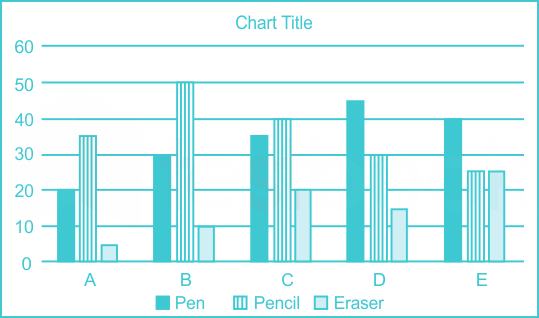
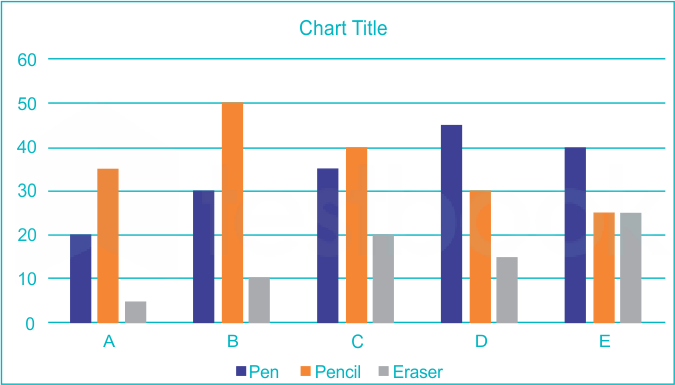
The bar graph shows number of pens, eraser and pencil sold in five shops [A, B, C, D, and E]

67

Ratio of number of Pen and Pencils together sold in shop E and F is 5 : 6. Number of pencils sold in shop F is 29. Find the number of pen sold in shop F?

  1. ((a))

    37

  2. ((b))

    67

  3. ((c))

    88

  4. ((d))

    49

  5. ((e))

    55

Show Answer
Answer: ((d))

49

Calculation

From the given table:

Shop E → Pens = 40, Pencils = 25

So, total in E = 40 + 25 = 65

Let the total number of pens + pencils sold in shop F be x.

According to the ratio:

So, 65/ x = 5/ 6

⇒ 5x = 390

⇒ x = 78

Pens + Pencils in shop F = 78

So, pens in shop F = 78 − 29 = 49

68

Total number of items sold in shop A is what percent of total number of items sold in shop B?

  1. ((a))

    32.5%

  2. ((b))

    87.5%

  3. ((c))

    72%

  4. ((d))

    66.67%

  5. ((e))

    45.45%

Show Answer
Answer: ((d))

66.67%

Calculations:

Total number of items sold in shop A = 20 + 35 + 5 = 60

Total number of items sold in shop B = 30 + 50 + 10 = 90

Percentage = (Total items sold in shop A / Total items sold in shop B) × 100

Percentage = (60 / 90) × 100

Percentage = (2 / 3) × 100 = 66.67%

∴ The total number of items sold in shop A is 66.67% of the total number of items sold in shop B.

69

Number scale sold in shop D is 20% more than the number of erasers sold in same shop. Find the number of scales sold in shop D?

  1. ((a))

    12

  2. ((b))

    36

  3. ((c))

    16

  4. ((d))

    22

  5. ((e))

    18

Show Answer
Answer: ((e))

18

Calculations:

Number of erasers sold in shop D = 15

Number of scales sold in shop D is 20% more than the number of erasers sold.

Number of scales sold = Number of erasers sold + 20% of number of erasers sold

Number of scales sold = 15 + (20/100) × 15

Number of scales sold = 15 + 3 = 18

∴ The number of scales sold in shop D is 18.

70

Find the difference between the average number of pen and pencils sold in all five shop together?

  1. ((a))

    9

  2. ((b))

    7

  3. ((c))

    2

  4. ((d))

    3

  5. ((e))

    6

Show Answer
Answer: ((c))

2

Calculation

Total pens = 20 + 30 + 35 + 45 + 40 = 170

Total pencils = 35 + 50 + 40 + 30 + 25 = 180

Average pens = 170 ÷ 5 = 34

Average pencils = 180 ÷ 5 = 36

Difference = 36 − 34 = 2

71

Total number of items [Pen + Pencils + Eraser] sold in shop D is x + 29. Find the value of x?

  1. ((a))

    55

  2. ((b))

    69

  3. ((c))

    37

  4. ((d))

    88

  5. ((e))

    61

Show Answer
Answer: ((e))

61

Calculations:

Number of pens sold in Shop D = 45

Number of erasers sold in Shop D = 30

Number of pencils sold in Shop D = 15

Total number of items sold in Shop D = Pens + Erasers + Pencils = 45 + 30 + 15 = 90

The total number of items is given as x + 29.

⇒ x + 29 = 90

⇒ x = 90 - 29 = 61

∴ The value of x is 61.

72

A alone can do a work in 18 days, while A and B together can do the same work in 12 days. Find in how many days B alone can do the same work?

  1. ((a))

    24

  2. ((b))

    48

  3. ((c))

    36

  4. ((d))

    32

  5. ((e))

    44

Show Answer
Answer: ((c))

36

Given:

A can do the work in 18 days

A and B together can do the work in 12 days

Formula used:

Work = LCM of days taken

Efficiency = Work ÷ Time

Time taken by B = Total work ÷ (Efficiency of B)

Calculations:

LCM of 18 and 12 = 36 (since HCF = 6)

⇒ Total work = 36 units

⇒ A’s 1 day work = 36 ÷ 18 = 2 units

⇒ A and B’s 1 day work = 36 ÷ 12 = 3 units

⇒ B’s 1 day work = 3 - 2 = 1 unit

⇒ Time taken by B = 36 ÷ 1 = 36 days

∴ B alone can do the work in 36 days.

73

A sold a camera to B at a profit of 20%. If the cost price of the camera for B was Rs. 30,000, what was the cost price of the camera for A?

  1. ((a))

    25000

  2. ((b))

    32000

  3. ((c))

    35000

  4. ((d))

    44000

  5. ((e))

    42000

Show Answer
Answer: ((a))

25000

Shortcut Trick

Let the Cost Price for A be 100%.

A sold it to B at 20% profit, so Selling Price for A = 120%.

This Selling Price is the Cost Price for B.

Given, 120% = Rs. 30,000.

Value of 100% = (30,000 ÷ 120) × 100 = 25,000.

∴ The correct answer is Rs. 25,000.

Alternate Method

Given: Profit% = 20%, Cost Price for B (which is SP for A) = Rs. 30,000.

Formulas: SP = CP × (100 + P%) ÷ 100

⇒ Let CP for A be x.

Selling Price for A = x × (100 + 20) ÷ 100

⇒ 30,000 = x × (120 ÷ 100)

⇒ 30,000 = x × 1.2

⇒ x = 30,000 ÷ 1.2

⇒ x = 25,000

∴ The correct answer is Rs. 25,000.

Additional Information

Cost Price and Selling Price Relationship

When an item is sold from one person to another, the Selling Price for the first person becomes the Cost Price for the second person.

Profit Percentage

Profit% is always calculated on the Cost Price unless stated otherwise. Formula: Profit% = (Profit ÷ CP) × 100.

74

Find the wrong number in the following series :

502, 501, 497, 488, 470, 447

  1. ((a))

    502

  2. ((b))

    497

  3. ((c))

    488

  4. ((d))

    470

  5. ((e))

    447

Show Answer
Answer: ((d))

470

502 = 502502
502 - 12 = 501501
501 - 22 = 497497
497 - 32 = 488488
488 - 42 = 472470
472 - 52 = 447447
75

In each of the following number series, a wrong number is given. Find out that number.

100, 111, 133, 177, 265, 440

  1. ((a))

    440

  2. ((b))

    111

  3. ((c))

    133

  4. ((d))

    177

  5. ((e))

    None of these

Show Answer
Answer: ((a))

440

Calculation:

100

100 + 11 = 111

111 + 22 = 133

133 + 44 = 177

177 + 88 = 265

265 + 176 = 441

∴ Wrong answer is 440

76

In each of the following number series, the wrong number is given, find out that number.

125, 169, 221, 281, 350

  1. ((a))

    350

  2. ((b))

    221

  3. ((c))

    125

  4. ((d))

    169

  5. ((e))

    None of these

Show Answer
Answer: ((a))

350

Calculation:

102+25=125{10^2} + 25 = 125

122+25=169{12^2} + 25 = 169

142+25=221{14^2} + 25 = 221

162+25=281{16^2} + 25 = 281

182+25{18^2} + 25 = 349

∴ Wrong number is 350

77

Find the wrong term in the following number series.

1150, 1342, 1527, 1705, 1876, 2041

  1. ((a))

    1342

  2. ((b))

    1527

  3. ((c))

    1876

  4. ((d))

    1150

  5. ((e))

    2041

Show Answer
Answer: ((e))

2041

Given:

1150, 1342, 1527, 1705, 1876, 2041

Calculation:

1342 – 1150 = 192

1527 – 1342 = 185

1705 – 1527 = 178

1876 – 1705 = 171

2040 – 1876 = 164 

∴ The wrong term is 2041

78

Find the wrong term in the given series.

80, 40, 120, 60, 181, 90, 270

  1. ((a))

    40

  2. ((b))

    120

  3. ((c))

    60

  4. ((d))

    181

  5. ((e))

    90

Show Answer
Answer: ((d))

181

The logic followed here is as follows:

⇒ 80/2 = 40

⇒ 40 x 3 = 120

⇒ 120/2 = 60

⇒ 60 x 3 = 180

⇒ 180/2 = 90

⇒ 90 x 3 = 270

So, the wrong term is 181

Hence, the correct answer is 181.

79

A vessel contains 108 litres of milk and water in the ratio of 5:4. If 20 Liters of milk and 36 liter water is added to the mixture then difference between milk and water in mixture ix Y. Find the value of 7Y?

  1. ((a))

    40

  2. ((b))

    28

  3. ((c))

    32

  4. ((d))

    44

  5. ((e))

    42

Show Answer
Answer: ((b))

28

Given:

Total volume of mixture = 108 liters

Ratio of milk to water = 5:4

Milk added = 20 liters

Water added = 36 liters

Formula used:

Milk in the mixture = (Total mixture) × (Ratio of milk / Total ratio)

Water in the mixture = (Total mixture) × (Ratio of water / Total ratio)

Calculations:

Total ratio of milk and water = 5 + 4 = 9

Milk in the mixture = (108 liters) × (5/9) = 60 liters

Water in the mixture = (108 liters) × (4/9) = 48 liters

After adding milk and water:

New amount of milk = 60 + 20 = 80 liters

New amount of water = 48 + 36 = 84 liters

Difference between milk and water in the mixture = 84 - 80 = 4 liters

Y = 4

7Y = 7 × 4 = 28

∴ The value of 7Y is 28.

80

A man invested Rs 2400 at rate of 20% p.a. on simple interest for T years and received Rs 1440 as interest. Find the value of 2T?

  1. ((a))

    10

  2. ((b))

    6

  3. ((c))

    4

  4. ((d))

    7

  5. ((e))

    8

Show Answer
Answer: ((b))

6

Given:

Principal (P) = ₹2400

Rate (R) = 20% per annum

Interest (I) = ₹1440

Formula used:

Simple Interest (I) = P × R × T / 100

Calculations:

1440 = 2400 × 20 × T / 100

⇒ 1440 = 480 × T

⇒ T = 1440 / 480

⇒ T = 3 years

∴ 2T = 2 × 3 = 6

Attempt this paper under real exam conditions

Timed interface, section switching, instant scoring, and question-by-question analytics — free.

Start Timed Attempt