Official Paper

RRB Clerk Prelims Memory Based Paper (Held On: 18 August 2024 Shift 1) (Previous Year Paper)

80 questions · 45 minutes · with answers · free

Reasoning (40 questions)

Direction: Study the following information to answer the given questions:

Seven boxes P, Q, R, S, T, U and V are kept one above another to form a stack. The topmost box is numbered as 1, the box below it as 2 and so on till the lowermost box which is 7. Equal number of boxes are above and below box R. There is one box between box R and box U. Box P is just above box V, which is an even-numbered box. Box T is above box S and neither box T nor S is adjacent to box R.

1

Which box is just above box R?

  1. ((a))

    Box Q

  2. ((b))

    Box P

  3. ((c))

    Box V

  4. ((d))

    Box T

  5. ((e))

    Box S

Show Answer
Answer: ((a))

Box Q

Boxes: P, Q, R, S, T, U and V.

  1. Equal number of boxes are above and below box R.
  2. There is one box between box R and box U.
Box NumberCase 1Case 2
1
2U
3
4RR
5
6U
7


  1. Box P is just above box V, which is an even-numbered box.
Box NumberCase 1Case 2
1P
2UV
3
4RR
5P
6VU
7


  1. Box T is above box S and neither box T nor S is adjacent to box R. So, case 2 would be invalid. Also, box Q must be box 3.
Box NumberCase 1
1T
2U
3Q
4R
5P
6V
7S
<br>

Hence, box Q is just above box R.

2

Which of the following statement is correct?

  1. ((a))

    Box U is just below box Q

  2. ((b))

    Box R is an odd numbered box

  3. ((c))

    Box T is the topmost box

  4. ((d))

    Two boxes are above box P

  5. ((e))

    All statements are correct

Show Answer
Answer: ((c))

Box T is the topmost box

Boxes: P, Q, R, S, T, U and V.

  1. Equal number of boxes are above and below box R.
  2. There is one box between box R and box U.
Box NumberCase 1Case 2
1
2U
3
4RR
5
6U
7


  1. Box P is just above box V, which is an even-numbered box.
Box NumberCase 1Case 2
1P
2UV
3
4RR
5P
6VU
7


  1. Box T is above box S and neither box T nor S is adjacent to box R. So, case 2 would be invalid. Also, box Q must be box 3.
Box NumberCase 1
1T
2U
3Q
4R
5P
6V
7S


So, Box T is the topmost box.

Hence, "only statement (3)" is correct.

3

If all the boxes are arranged in reverse alphabetical order from top to bottom then which box remains in the same position?

  1. ((a))

    V

  2. ((b))

    S

  3. ((c))

    T

  4. ((d))

    P

  5. ((e))

    U

Show Answer
Answer: ((e))

U

Boxes: P, Q, R, S, T, U and V.

  1. Equal number of boxes are above and below box R.
  2. There is one box between box R and box U.
Box NumberCase 1Case 2
1
2U
3
4RR
5
6U
7


  1. Box P is just above box V, which is an even-numbered box.
Box NumberCase 1Case 2
1P
2UV
3
4RR
5P
6VU
7


  1. Box T is above box S and neither box T nor S is adjacent to box R. So, case 2 would be invalid. Also, box Q must be box 3.
Box NumberBoxesAlphabetical order
1TV
2UU
3QT
4RS
5PR
6VQ
7SP


So, box U remains at the same position when boxes are arranged in reverse alphabetical order from top to bottom.

Hence, the correct answer is "U".

4

How many boxes are above box V?

  1. ((a))

    Two

  2. ((b))

    Five

  3. ((c))

    Three

  4. ((d))

    Four

  5. ((e))

    Six

Show Answer
Answer: ((b))

Five

Boxes: P, Q, R, S, T, U and V.

  1. Equal number of boxes are above and below box R.
  2. There is one box between box R and box U.
Box NumberCase 1Case 2
1
2U
3
4RR
5
6U
7


  1. Box P is just above box V, which is an even-numbered box.
Box NumberCase 1Case 2
1P
2UV
3
4RR
5P
6VU
7


  1. Box T is above box S and neither box T nor S is adjacent to box R. So, case 2 would be invalid. Also, box Q must be box 3.
Box NumberCase 1
1T
2U
3Q
4R
5P
6V
7S
<br>

Hence, five boxes are above box V.

5

Box ________ is the bottommost box.

  1. ((a))

    S

  2. ((b))

    T

  3. ((c))

    U

  4. ((d))

    V

  5. ((e))

    P

Show Answer
Answer: ((a))

S

Boxes: P, Q, R, S, T, U and V.

  1. Equal number of boxes are above and below box R.
  2. There is one box between box R and box U.
Box NumberCase 1Case 2
1
2U
3
4RR
5
6U
7


  1. Box P is just above box V, which is an even-numbered box.
Box NumberCase 1Case 2
1P
2UV
3
4RR
5P
6VU
7


  1. Box T is above box S and neither box T nor S is adjacent to box R. So, case 2 would be invalid. Also, box Q must be box 3.
Box NumberCase 1
1T
2U
3Q
4R
5P
6V
7S


Hence, box S is the bottommost box.

6

If in the word “AUTOMATIC”  all the vowels changes to the next consonant then the word is rearranged in alphabetical order. What is the third letter from the right end?

  1. ((a))

    B

  2. ((b))

    C

  3. ((c))

    I

  4. ((d))

    T

  5. ((e))

    U

Show Answer
Answer: ((d))

T

In the given word “AUTOMATIC” after changing all the vowels to the next consonant we get “BVTPMBTJC”. Now, arranging in alphabetical order we get “BBCJMPTTV”.

Hence, the third letter from the right end is T.

Direction: Read the following information carefully and answer the given questions.

A certain number of persons are sitting in a linear row facing north. D is sitting second from the extreme end. Three persons are sitting between D and E. G sits immediately right of E. The number of persons sitting between G and H is the same as the number of persons sitting to the left of F. F is sitting third to the right of J. J is sitting at one of the extreme ends. H is not an immediate neighbor of D. E is sitting to the left of H. Not more than five persons are sitting to the right of E.

7

What is the position of H with respect to E?

  1. ((a))

    Fourth to the left

  2. ((b))

    Fifth to the right

  3. ((c))

    Second to the right

  4. ((d))

    Fifth to the left

  5. ((e))

    Fourth to the right

Show Answer
Answer: ((b))

Fifth to the right

1) D is sitting second from the extreme end. Three persons are sitting between D and E. G sits immediately right of E. 

2)   J is sitting at one of the extreme ends.  F is sitting third to the right of J.

3) The number of persons sitting between G and H is the same as the number of persons sitting to the left of F. H is not an immediate neighbor of D. 

4) E is sitting to the left of H. Not more than five persons are sitting to the right of E.

In Case 2, E is sitting to the right of H which contradicts the given conditions. So, Case 2 is eliminated.

The Final arrangement is:

Hence, H sits fifth to the right of E.

8

Who among the following person sits second to the left of F?

  1. ((a))

    the one who is sitting immediately left of H.

  2. ((b))

    G

  3. ((c))

    The one who is sitting immediately right of J.

  4. ((d))

    H

  5. ((e))

    the one who is sitting immediately right of E.

Show Answer
Answer: ((c))

The one who is sitting immediately right of J.

1) D is sitting second from the extreme end. Three persons are sitting between D and E. G sits immediately right of E. 

2)   J is sitting at one of the extreme ends.  F is sitting third to the right of J.

3) The number of persons sitting between G and H is the same as the number of persons sitting to the left of F. H is not an immediate neighbor of D. 

4) E is sitting to the left of H. Not more than five persons are sitting to the right of E.

In Case 2, E is sitting to the right of H which contradicts the given conditions. So, Case 2 is eliminated.

The Final arrangement is:

Hence, The one who is sitting immediately right of J(D)sits second to the left of F.

9

Which of the following statements is/are true?

I. Twelve persons are sitting in the row.

II. Three persons are sitting between G and H.

III. G is sitting immediately left of E.

  1. ((a))

    Only II

  2. ((b))

    Only II and III

  3. ((c))

    Only I

  4. ((d))

    Only I and II

  5. ((e))

    Only III

Show Answer
Answer: ((a))

Only II

1) D is sitting second from the extreme end. Three persons are sitting between D and E. G sits immediately right of E. 

2)   J is sitting at one of the extreme ends.  F is sitting third to the right of J.

3) The number of persons sitting between G and H is the same as the number of persons sitting to the left of F. H is not an immediate neighbor of D. 

4) E is sitting to the left of H. Not more than five persons are sitting to the right of E.

In Case 2, E is sitting to the right of H which contradicts the given conditions. So, Case 2 is eliminated.

The Final arrangement is:

Eleven persons are sitting in a row. G is sitting immediately right of E. Hence, Only II statement is true.

10

Directions: In the given question below are given two statements followed by two conclusions numbered I and II. You have to take the given statements to be true even if they seem to be at variance with commonly known facts. Read all the conclusions and then decide which of the given conclusions logically follows from the given statements disregarding commonly known facts.

Statements:

Some doors are open.

No open is close.

Conclusions:

 I. All doors are open.

 II. Some doors are not close.

  1. ((a))

    Only I follows

  2. ((b))

    Only II follows

  3. ((c))

    Both I and II follows

  4. ((d))

    Neither I nor II follows

  5. ((e))

    Either I or II follows

Show Answer
Answer: ((b))

Only II follows

The least possible Venn diagram for the given statements is as follows

Conclusions:

I. All doors are open → False (As we can see, it is possible but not definite. So, all doors are open is false.)

II. Some doors are not close → True (As we can see, some doors are open and no open is close. So, some doors are not close is true.)

Hence, Only II follows.

11

Direction: In the question below are given three statements followed by two conclusions numbered I and II. You have to take the given statements to be true even if they seem to be at variance with commonly known facts. Read all the conclusions and then decide which of the given conclusions logically follows from the given statements disregarding commonly known facts.

Statements:

Only a few bottles are cups.

Few goggles are bottles.

No mouse is cups.

Conclusion:

I. At least some bottles are mouse.

II. All cups being goggles is a possibility.

  1. ((a))

    Only II follows

  2. ((b))

    Only I follows

  3. ((c))

    Either I or II follows

  4. ((d))

    Neither I nor II follows

  5. ((e))

    Both I and II follow

Show Answer
Answer: ((a))

Only II follows

The least possible diagram for the given statements is as follows:

Conclusion:

I. At least some bottles are mouse. → False (As there is no direct relation between bottles and mouse.)

II. All cups being goggles is a possibility. → True (Possibility is possible.)

The possibility diagram is as:

Hence, Only conclusion II follows.

12

Direction: In the question below are given three statements followed by two conclusions numbered I and II. You have to take the given statements to be true even if they seem to be at variance with commonly known facts. Read all the conclusions and then decide which of the given conclusions logically follows from the given statements disregarding commonly known facts.

Statement:

Only a few crickets are football.

Some football are Stops.

No radio is crickets.

Conclusion:

I. All crickets being radio is a possibility.

II. Some radio are definitely not stops.

  1. ((a))

    Only conclusion I follows

  2. ((b))

    Only conclusion II follows

  3. ((c))

    Both conclusion follows

  4. ((d))

    Either conclusion I or II follows

  5. ((e))

    Neither conclusion I nor II follows

Show Answer
Answer: ((e))

Neither conclusion I nor II follows

The least possible Venn diagram for the given statements is as follows:

Conclusion:

I. All crickets being radio is a possibility. → false (because Only a few crickets are football and Some football are Stops and No radio is crickets.)

II. Some radio are definitely not stops. → false (because it is possible but not definite.)

Hence, Neither conclusion I nor II follows.

Directions: Study the following information carefully to answer the given questions:

K # P 3 ? N U = 6 I Z L ↑ @ V M 8 C 2 ↓ G 9 E > 4 H % 5 J * &

13

If all the even digits are skipped from the sequence then which of the following elements is fifth to the right of ‘@'?

  1. ((a))

    9

  2. ((b))

  3. ((c))

    E

  4. ((d))

    G

  5. ((e))

    C

Show Answer
Answer: ((d))

G

Given series:

Left Side          K # P 3 ? N U = 6 I Z L ↑ @ V M 8 C 2 ↓ G 9 E > 4 H % 5 J * &        Right Side

Elements fifth to the right of @ after skipping even digits:

K # P 3 ? N U = I Z L ↑ @ V M C ↓ G 9 E > H % J * &

Hence, the fifth element to the right of ‘@‘ after replacement of all the even digits: G

14

What is the sum of the second prime number from right end and the second composite number from left end?

  1. ((a))

    10

  2. ((b))

    12

  3. ((c))

    15

  4. ((d))

    17

  5. ((e))

    None of these

Show Answer
Answer: ((a))

10

Given series:

Left Side          K # P 3 ? N U = 6 I Z L ↑ @ V M 8 C 2 ↓ G 9 E > 4 H % 5 J * &        Right Side

  1. Second Composite Number from the left end: 8

  2. Second Prime Number from the right end: 2

K # P 3 ? N U = 6 I Z L ↑ @ V M 8 C 2 ↓ G 9 E > 4 H % 5 J * &

Hence, the sum of the numbers: 8 + 2 = 10

15

Four of the following five are alike in a certain way based on their positions in the above arrangement and thus form a group. Which of the following does not belong to that group?

  1. ((a))

    >H%

  2. ((b))

    #3?

  3. ((c))

    V82

  4. ((d))

    IL↑

  5. ((e))

    %J*

Show Answer
Answer: ((c))

V82

Given series:

Left Side          K # P 3 ? N U = 6 I Z L ↑ @ V M 8 C 2 ↓ G 9 E > 4 H % 5 J * &        Right Side

Elements in the options are arranged in the following manner in the given series:

    • 2 = H and H + 1 = %
  1. + 2 = 3 and 3 + 1 = ?

  2. V + 2 = 8 and 8 + 2 = 2

  3. I + 2 = L and L + 1 = ↑

  4. % + 2 = J and J + 1 = *

Hence, V82 does not belong to the group.

16

If all the numbers in the series have been dropped and the remaining elements have reversed their positions starting from the left end to the right end, then which element will be 7th to the right of 12th element from the left end?

  1. ((a))

    @

  2. ((b))

    U

  3. ((c))

    =

  4. ((d))

    Z

  5. ((e))

    ?

Show Answer
Answer: ((b))

U

Given series:

Left Side          K # P 3 ? N U = 6 I Z L ↑ @ V M 8 C 2 ↓ G 9 E > 4 H % 5 J * &         Right Side

When all the numbers in the series have been dropped and the remaining elements have re versed their positions starting from the left end to the right end:

& * J % H > E G ↓ C M V @ ↑ L Z I = U N ? P # K

As, Left + Right = Left

12th from the left + 7th from the right = 19th from the Left

& * J % H > E G ↓ C M V @ ↑ L Z I = U N ? P # K

Hence, in the above arrangement 7th element to the right of 12th element from the left end: U

17

In the following series find the missing element.

K, P, N, Z, L, ___ ?

  1. ((a))

    M

  2. ((b))

    8

  3. ((c))

    V

  4. ((d))

    C

  5. ((e))

    @

Show Answer
Answer: ((c))

V

Given series:

Left Side          K # P 3 ? N U = 6 I Z L ↑ @ V M 8 C 2 ↓ G 9 E > 4 H % 5 J * &        Right Side

Series asked in the question: K, P, N, Z, L, ___

As the elements in this series are arranged in the order of consecutive consonants in the sequence.

Hence, the missing element: V

18

How many pairs of letters are there in the word “MARKETING” that have the same number of letters between them in the word (in both forward and backward directions), as they have in the English alphabetical series?

  1. ((a))

    Three

  2. ((b))

    Two

  3. ((c))

    Four

  4. ((d))

    One

  5. ((e))

    Five

Show Answer
Answer: ((d))

One

Given word: MARKETING

The given word can be represented as follows:

Thus, there is one pair → Backward: GI.

Hence, one is the correct answer.

Directions: Read the following information carefully and answer the questions.

There are six persons A,B,C,D,E,and F are getting different marks. B gets more marks than A but less than D. B gets more marks than E. F gets more marks than C but lower marks than E. C gets more marks than at least one person. The marks scored by F is not an even number.

Note: All the marks are in whole numbers. No one has scored less than 5.

19

The number of persons who score more than E is one less than the number of persons who score less than whom?

  1. ((a))

    C

  2. ((b))

    D

  3. ((c))

    A

  4. ((d))

    E

  5. ((e))

    B

Show Answer
Answer: ((d))

E

Given: There are six persons A,B,C,D,E,and F are getting different marks.

1. B gets more marks than A but less than D. 

From this, we get-

D > B > A

2.  F gets more marks than C but lower marks than E.

From this, we get-

E > F > C

3.  B gets more marks than E. 4. C gets more marks than at least one person.

From this, we get the final sequence as follows:

D > B > E > F > C > A

Therefore, the number of persons who score more than E is one less than the number of persons who score less than E. (2 persons score above E. 3 persons score below E.)

Hence, the number of persons who score more than E is one less than the number of persons who score less than E.

20

If the average of A, C, and E is 17 then what is the possible highest score of F?

  1. ((a))

    35

  2. ((b))

    18

  3. ((c))

    51

  4. ((d))

    49

  5. ((e))

    54

Show Answer
Answer: ((a))

35

Given: There are six persons A,B,C,D,E,and F are getting different marks.

1. B gets more marks than A but less than D. 

From this, we get-

D > B > A

2.  F gets more marks than C but lower marks than E.

From this, we get-

E > F > C

3.  B gets more marks than E. 4. C gets more marks than at least one person.

From this, we get the final sequence as follows:

D > B > E > F > C > A

The average marks of A, C, and E is 17. Therefore, the total score obtained by A, C, and E is = 17 × 3 = 51. 

Now, E scores more than F and all the marks are in whole numbers.

51 or 54 cannot be the maximum score as it will violate the condition the E scores more than F. 

18 or 49 cannot be the the maximum score as it will violate the condition that all the marks are in whole numbers and C scores more than A. 

So, from the given options, the only possible maximum score of F is 35. 

Hence, the maximum possible score of F is 35.

Direction: Study the following information carefully and answer the questions given below.

There are six persons i.e. A, D, R, B, E, and V who lives in a building having three floors such that the ground floor is numbered 1 and above it is 2 and so on up to the top floor is numbered 3. Each of the floors consists of 2 flats -  flat-1 and flat-2. Flat-1 of floor-2 is immediately above flat-1 of floor-1 and immediately below flat-1 of floor-3 and the same way followed by flat-2. Flat 2 is east of Flat 1.

No one lives to the east of B. V lives in a flat on floor 1. E lives immediately below A. R lives immediately below B. R lives below E but in different flat.

21

D lives on which floor and in which flat?

  1. ((a))

    Floor 2 and Flat 2

  2. ((b))

    Floor 3 and Flat 2

  3. ((c))

    Floor 1 and Flat 1

  4. ((d))

    Floor 1 and Flat 2

  5. ((e))

    Floor 3 and Flat 1

Show Answer
Answer: ((b))

Floor 3 and Flat 2

Given: There are six persons i.e. A, D, R, B, E, and V who lives in a building having three floors such that the ground floor is numbered 1 and above it is 2 and so on up to the top floor is numbered 3. Each of the floors consists of 2 flats -  flat-1 and flat-2. Flat-1 of floor-2 is immediately above flat-1 of floor-1 and immediately below flat-1 of floor-3 and the same way followed by flat-2. Flat 2 is east of Flat 1.

Based on the given conditions, we get the following possibilities:

  1. E lives immediately below A.
  2. R lives below E but in different flat .

From these, we get two cases,

Case 1

Flat - 1Flat - 2
Floor 3A
Floor 2E
Floor 1R

Case2

Flat - 1Flat - 2
Floor 3A
Floor 2E
Floor 1R


  1. R lives immediately below B.
  2. No one lives to the east of B. Hence Case 2 gets invalid. 

From these we get,

Flat - 1Flat - 2
Floor 3A
Floor 2EB
Floor 1R


  1. V lives in a flat on floor 1.
  2. D is a person living in the building.

From these, we get the final arrangement,

Flat - 1Flat - 2
Floor 3AD
Floor 2EB
Floor 1VR


Therefore, from the final arrangement we get, D lives on Floor 3 and Flat 2.

Hence, D lives on Floor 3 and Flat 2.

22

Who among them lives on the flat - 2 of floor - 1?

  1. ((a))

    R

  2. ((b))

    None

  3. ((c))

    A

  4. ((d))

    E

  5. ((e))

    V

Show Answer
Answer: ((a))

R

Given: There are six persons i.e. A, D, R, B, E, and V who lives in a building having three floors such that the ground floor is numbered 1 and above it is 2 and so on up to the top floor is numbered 3. Each of the floors consists of 2 flats -  flat-1 and flat-2. Flat-1 of floor-2 is immediately above flat-1 of floor-1 and immediately below flat-1 of floor-3 and the same way followed by flat-2. Flat 2 is east of Flat 1.

Based on the given conditions, we get the following possibilities:

  1. E lives immediately below A.
  2. R lives below E but in different flat .

From these, we get two cases,

Case 1

Flat - 1Flat - 2
Floor 3A
Floor 2E
Floor 1R

Case2

Flat - 1Flat - 2
Floor 3A
Floor 2E
Floor 1R


  1. R lives immediately below B.
  2. No one lives to the east of B. Hence Case 2 gets invalid. 

From these we get,

Flat - 1Flat - 2
Floor 3A
Floor 2EB
Floor 1R


  1. V lives in a flat on floor 1.
  2. D is a person living in the building.

From these, we get the final arrangement,

Flat - 1Flat - 2
Floor 3AD
Floor 2EB
Floor 1VR


Therefore, from the final arrangement we get, R lives above the flat - 2 of floor - 1.

Hence, R lives above the flat - 2 of floor - 1.

23

From the final arrangement, A is related to E the same way B is related to R, then who among the following will be related to B?

  1. ((a))

    V

  2. ((b))

    R

  3. ((c))

    A

  4. ((d))

    D

  5. ((e))

    None

Show Answer
Answer: ((d))

D

Given: There are six persons i.e. A, D, R, B, E, and V who lives in a building having three floors such that the ground floor is numbered 1 and above it is 2 and so on up to the top floor is numbered 3. Each of the floors consists of 2 flats -  flat-1 and flat-2. Flat-1 of floor-2 is immediately above flat-1 of floor-1 and immediately below flat-1 of floor-3 and the same way followed by flat-2. Flat 2 is east of Flat 1.

Based on the given conditions, we get the following possibilities:

  1. E lives immediately below A.
  2. R lives below E but in different flat .

From these, we get two cases,

Case 1

Flat - 1Flat - 2
Floor 3A
Floor 2E
Floor 1R

Case2

Flat - 1Flat - 2
Floor 3A
Floor 2E
Floor 1R


  1. R lives immediately below B.
  2. No one lives to the east of B. Hence Case 2 gets invalid. 

From these we get,

Flat - 1Flat - 2
Floor 3A
Floor 2EB
Floor 1R


  1. V lives in a flat on floor 1.
  2. D is a person living in the building.

From these, we get the final arrangement,

Flat - 1Flat - 2
Floor 3AD
Floor 2EB
Floor 1VR


Therefore, from the final arrangement, A is related to E the same way B is related to R, then D will be related to B.

Hence, A is related to E the same way B is related to R, then D will be related to B.

24

If D interchange her flat with B's flat, then B will live on which floor and in which flat?

  1. ((a))

    Floor 3 and Flat 2

  2. ((b))

    Floor 1and Flat 2

  3. ((c))

    Floor 2 and Flat 2

  4. ((d))

    Floor 2 and Flat 1

  5. ((e))

    Floor 3 and Flat 1

Show Answer
Answer: ((a))

Floor 3 and Flat 2

Given: There are six persons i.e. A, D, R, B, E, and V who lives in a building having three floors such that the ground floor is numbered 1 and above it is 2 and so on up to the top floor is numbered 3. Each of the floors consists of 2 flats -  flat-1 and flat-2. Flat-1 of floor-2 is immediately above flat-1 of floor-1 and immediately below flat-1 of floor-3 and the same way followed by flat-2. Flat 2 is east of Flat 1.

Based on the given conditions, we get the following possibilities:

  1. E lives immediately below A.
  2. R lives below E but in different flat .

From these, we get two cases,

Case 1

Flat - 1Flat - 2
Floor 3A
Floor 2E
Floor 1R

Case2

Flat - 1Flat - 2
Floor 3A
Floor 2E
Floor 1R


  1. R lives immediately below B.
  2. No one lives to the east of B. Hence Case 2 gets invalid. 

From these we get,

Flat - 1Flat - 2
Floor 3A
Floor 2EB
Floor 1R


  1. V lives in a flat on floor 1.
  2. D is a person living in the building.

From these, we get the final arrangement,

Flat - 1Flat - 2
Floor 3AD
Floor 2EB
Floor 1VR


Therefore, from the final arrangement, if D replaces her flat with B's Flat, then B will live on Floor 3 and Flat 2.

Hence, if D replaces her flat with B's Flat, then B will live on Floor 3 and Flat 2.

25

E is in which flat and floor?

  1. ((a))

    Flat 2 and Floor 2

  2. ((b))

    Flat 2 and Floor 3

  3. ((c))

    Flat 1 and Floor 3

  4. ((d))

    Flat 2 and Floor 1

  5. ((e))

    Flat 1 and Floor 2

Show Answer
Answer: ((e))

Flat 1 and Floor 2

Given: There are six persons i.e. A, D, R, B, E, and V who lives in a building having three floors such that the ground floor is numbered 1 and above it is 2 and so on up to the top floor is numbered 3. Each of the floors consists of 2 flats -  flat-1 and flat-2. Flat-1 of floor-2 is immediately above flat-1 of floor-1 and immediately below flat-1 of floor-3 and the same way followed by flat-2. Flat 2 is east of Flat 1.

Based on the given conditions, we get the following possibilities:

  1. E lives immediately below A.
  2. R lives below E but in different flat .

From these, we get two cases,

Case 1

Flat - 1Flat - 2
Floor 3A
Floor 2E
Floor 1R

Case2

Flat - 1Flat - 2
Floor 3A
Floor 2E
Floor 1R


  1. R lives immediately below B.
  2. No one lives to the east of B. Hence Case 2 gets invalid. 

From these we get,

Flat - 1Flat - 2
Floor 3A
Floor 2EB
Floor 1R


  1. V lives in a flat on floor 1.
  2. D is a person living in the building.

From these, we get the final arrangement,

Flat - 1Flat - 2
Floor 3AD
Floor 2EB
Floor 1VR


Therefore, from the final arrangement, E is in Flat 1 and Floor 2.

Hence, E is in Flat 1 and Floor 2.

26

Directions: In the following question assuming the given statements to be true, find which of the conclusion(s) among given conclusions is/are definitely true and then give your answers accordingly.

Statement:

H ≤ A > N = Y < S = D

Conclusions:

I. D > A

II. A > S

  1. ((a))

    Only I follows

  2. ((b))

    Only II follows

  3. ((c))

    Either I or II follow

  4. ((d))

    Neither I nor II follow

  5. ((e))

    Both I and II follow

Show Answer
Answer: ((d))

Neither I nor II follow

Given statement,

H ≤ A > N = Y < S = D

Conclusions:

I. D > A → False (As we can see that A > N = Y < S = D, here the relation between D and A cannot be determined. So, D > A is false)

II. A > S → False (As we can see that A > N = Y < S, here the relation between A and S cannot be determined. So, A > S is false)

Hence, neither I nor II follows.

27

Directions: In the following question assuming the given statements to be true, find which of the conclusion(s) among given conclusions is/are definitely true and then give your answers accordingly.

Statement:

C ≥ Z ≥ H = P > G > W

Conclusions:

I. W < C

II. C ≥ P

  1. ((a))

    Only I follows

  2. ((b))

    Only II follows

  3. ((c))

    Either I or II follow

  4. ((d))

    Neither I nor II follow

  5. ((e))

    Both I and II follow

Show Answer
Answer: ((e))

Both I and II follow

Given statement,

C ≥ Z ≥ H = P > G > W

Conclusions:

I. W < C → True (As we can see that C ≥ Z ≥ H = P > G > W, so W < C is true)

II. C ≥ P → True (As we can see that C ≥ Z ≥ H = P, so C ≥ P is true)

Hence, both I and II follow.

28

Directions: In each of the following questions assuming the given statement to be true, find which of the conclusions among given conclusions is / are definitely true and then give your answers accordingly.

Statement:

S > G > K < J = Y > W < U < O

Conclusions:

I. S > W

II. O < Y

  1. ((a))

    Only Conclusion I follows

  2. ((b))

    Only Conclusion II follows

  3. ((c))

    Either Conclusion I or II follows

  4. ((d))

    Neither Conclusion I nor II follows

  5. ((e))

    Both Conclusion I and II follows

Show Answer
Answer: ((d))

Neither Conclusion I nor II follows

Statement:

S > G > K < J = Y > W < U < O

Conclusions:

I. S > W → False (S > G > K < J = Y > W → As direct relationship between S and W cannot be determined).

II. O < Y → False (Y > W < U < O → As direct relationship between O and Y cannot be determined)

Hence, Neither I nor II follows.

29

Directions: In each of the following questions assuming the given statement to be true, find which of the conclusions among given conclusions is / are definitely true and then give your answers accordingly.

Statement: 

A < T = Y > R < K < L ≤ M > O

Conclusions: 

I. M > R

II. Y > A

  1. ((a))

    Only Conclusion I follows

  2. ((b))

    Only Conclusion II follows

  3. ((c))

    Either Conclusion I or II follows

  4. ((d))

    Neither Conclusion I nor II follows

  5. ((e))

    Both Conclusion I and II follows

Show Answer
Answer: ((e))

Both Conclusion I and II follows

Given Statement: 

A < T = Y > R < K < L ≤ M > O

Conclusions: 

I. M > R → True (R < K < L ≤ M → R < M)

II. Y > A → True (A < T = Y → Y > A)

Hence, Both Conclusion I and II follows.

Direction: Study the following information carefully and answer the questions given below:

Seven persons - A, B, C, D, E, F, and G are sitting in the linear row facing the north but not necessarily in the same order. 

B sits second from one of the ends. Only two persons are sitting between B and A. The number of persons sitting to the left of A is the same as the right of G. The number of persons sitting between A and G is the same as between E and F. E and G are not immediate neighbours. C sits to the right of E but is not an immediate neighbour of B.

30

Who among the following sits immediate left of B? 

  1. ((a))

    The one who sits second to the left of G.

  2. ((b))

    A

  3. ((c))

    F

  4. ((d))

    E

  5. ((e))

    The one who sits third to the left of C .

Show Answer
Answer: ((a))

The one who sits second to the left of G.

Given:

Seven persons - A, B, C, D, E, F, and G - Facing North

1) B sits second from one of the ends.

  1. Only two persons are sitting between B and A.

  2. The number of persons sitting to the left of A is the same as the right of G.

4) The number of persons sitting between A and G is the same as between E and F.

5) E and G are not immediate neighbours.

6) C sits to the right of E but is not an immediate neighbour of B. This is not possible in Case II so it gets eliminated.

Thus, the final arrangement is -

D, who sits second to the left of G, sits immediate left of B.

Hence, the correct answer is The one who sits second to the left of G.

31

Who among the following person sits to the left of A? 

  1. ((a))

    The one who sits fourth from the right end .

  2. ((b))

    B

  3. ((c))

    The one who sits immediate left of G.

  4. ((d))

    D

  5. ((e))

    All of the above

Show Answer
Answer: ((e))

All of the above

Given:

Seven persons - A, B, C, D, E, F, and G - Facing North

1) B sits second from one of the ends.

  1. Only two persons are sitting between B and A.

  2. The number of persons sitting to the left of A is the same as the right of G.

4) The number of persons sitting between A and G is the same as between E and F.

5) E and G are not immediate neighbours.

6) C sits to the right of E but is not an immediate neighbour of B. This is not possible in Case II so it gets eliminated.

Thus, the final arrangement is -

All the persons given in options sit to the left of A.

Hence, the correct answer is All of the above.

Confusion Points

In the question, the person sitting to the left of A is asked and not 'immediate left'.

32

If C is related to A and E is related to F in a certain way, then, who among the following is related to D? 

  1. ((a))

    B

  2. ((b))

    The one who sits third from the left end.

  3. ((c))

    The one who sits immediate left of A.

  4. ((d))

    E

  5. ((e))

    C

Show Answer
Answer: ((b))

The one who sits third from the left end.

Given:

Seven persons - A, B, C, D, E, F, and G - Facing North

1) B sits second from one of the ends.

  1. Only two persons are sitting between B and A.

  2. The number of persons sitting to the left of A is the same as the right of G.

4) The number of persons sitting between A and G is the same as between E and F.

5) E and G are not immediate neighbours.

6) C sits to the right of E but is not an immediate neighbour of B. This is not possible in Case II so it gets eliminated.

Thus, the final arrangement is -

One person is between C & A and E & F.

In the similar way, G, who sits third from the left end is related to D.

Hence, the correct answer is The one who sits third from the left end.

33

How many persons are sitting between C and G? 

  1. ((a))

    More than three

  2. ((b))

    None

  3. ((c))

    One

  4. ((d))

    Two

  5. ((e))

    Three

Show Answer
Answer: ((e))

Three

Given:

Seven persons - A, B, C, D, E, F, and G - Facing North

1) B sits second from one of the ends.

  1. Only two persons are sitting between B and A.

  2. The number of persons sitting to the left of A is the same as the right of G.

4) The number of persons sitting between A and G is the same as between E and F.

5) E and G are not immediate neighbours.

6) C sits to the right of E but is not an immediate neighbour of B. This is not possible in Case II so it gets eliminated.

Thus, the final arrangement is -

Three persons are sitting between C and G.

Hence, the correct answer is Three.

34

What is the position of F with respect to D?

  1. ((a))

    Third to the right 

  2. ((b))

    Third to the left

  3. ((c))

    Second to the right

  4. ((d))

    Second to the left 

  5. ((e))

    None of the above

Show Answer
Answer: ((a))

Third to the right 

Given:

Seven persons - A, B, C, D, E, F, and G - Facing North

1) B sits second from one of the ends.

  1. Only two persons are sitting between B and A.

  2. The number of persons sitting to the left of A is the same as the right of G.

4) The number of persons sitting between A and G is the same as between E and F.

5) E and G are not immediate neighbours.

6) C sits to the right of E but is not an immediate neighbour of B. This is not possible in Case II so it gets eliminated.

Thus, the final arrangement is -

F is third to the left of D.

Hence, the correct answer is Third to the right.

35

If the digits in the number 86435192 are arranged in ascending order, what will be the difference between the digits which are second from the right and fourth from the left in the new arrangement?

  1. ((a))

    One

  2. ((b))

    Two

  3. ((c))

    Three

  4. ((d))

    Four

  5. ((e))

    None

Show Answer
Answer: ((d))

Four

Number: 86435192

Ascending order: (left end) 12345689 (right end)

2nd digit from right: 8; 4th digit from left: 4

Difference = 8 – 4 = 4.

Hence, the difference between the digits which are second from the right and fourth from the left in the new arrangement is 4.

Directions: The following questions are based on the five three-digit numbers given below.

219   462   764   803   129

36

Which of the following numbers will be obtained if the second digit of the lowest number is added to the third digit of the highest number after adding three to each of these digits?

  1. ((a))

    6

  2. ((b))

    9

  3. ((c))

    12

  4. ((d))

    11

  5. ((e))

    8

Show Answer
Answer: ((d))

11

Given series: 219   462   764   803   129

The lowest number in the series = 129

The highest number in the series = 803

The second digit of the lowest number is 2

The third digit of the highest number is 3

On adding 3 to these digits, we get

2 + 3 = 5

3 + 3 = 6

On adding both the digit, we get

5 + 6 = 11

Hence, the required sum is 11

37

In each number, if the digits are arranged in descending order, then how many numbers will remain unchanged?

  1. ((a))

    One

  2. ((b))

    Two

  3. ((c))

    None

  4. ((d))

    Three

  5. ((e))

    Four

Show Answer
Answer: ((a))

One

Given series: 219   462   764   803   129

After arranging the digits in each of the numbering descending order:

921   642   764   830   921

Now,764 is the only number that remains unchanged.

Hence, one is the correct answer.

38

If, in each number, the first and the last digits are interchanged, which of the following will be the second-lowest number?

  1. ((a))

    219

  2. ((b))

    462

  3. ((c))

    803

  4. ((d))

    129

  5. ((e))

    764

Show Answer
Answer: ((c))

803

Given series: 219   462   764   803   129

After the first and the last digits are interchanged, we get the following series:

912   264   467   308   921     

308 is the second-lowest number in the above rearrangement which is obtained from 803.

Hence, 803 is the correct answer.

Note:

Second-lowest number = second number in ascending order.

39

If, in each number, the digits are arranged in ascending order, what will be the sum of the middle digits of each of the numbers?

  1. ((a))

    18

  2. ((b))

    12

  3. ((c))

    17

  4. ((d))

    19

  5. ((e))

    13

Show Answer
Answer: ((c))

17

Given series:219   462   764   803   129

After rearranging the digit in each of the five numbers are arranged in ascending order:

129   246   467   038   129

Sum of middle digits of each of the numbers is

2 + 4 + 6 + 3 + 2 = 17

Hence, the sum of the middle digits of each of the numbers is 17.

40

What will be the number obtained if the second-highest number in the series is added to the lowest number in the series?

  1. ((a))

    923

  2. ((b))

    962

  3. ((c))

    864

  4. ((d))

    853

  5. ((e))

    893

Show Answer
Answer: ((e))

893

Given series: 219   462   764   803   129

The second-highest number in the series = 764

The lowest number in the series = 129

On addition of the second-highest number and lowest number in the series, we get:

129 + 764 = 893

Hence, the required sum is 893.

Note: Second-highest number = the second number after arranging in ascending order.

Numerical Ability (40 questions)

41

What will come in the place of the question mark ‘?’ in the following question?

813.5 × 7291.5 ÷  95.5 = ?

  1. ((a))

    92

  2. ((b))

    94

  3. ((c))

    96

  4. ((d))

    93

  5. ((e))

    95

Show Answer
Answer: ((c))

96

Concept used:

Follow BODMAS rule to solve this question, as per the order given below,

Calculation:

⇒ 813.5 × 7291.5 ÷  95.5 = ?

⇒ 92 × 3.5 × 93 × 1.5 ÷ 95.5 = ?

⇒ 97 + 4.5 - 5.5 = ?

⇒ 96 = ?

∴ The value of ? is 96

42

What will come in the place of the question mark ‘?’ in the following question?

6/11 of 5/7 of 462 - 30 = ?

  1. ((a))

    180

  2. ((b))

    150

  3. ((c))

    160

  4. ((d))

    170

  5. ((e))

    120

Show Answer
Answer: ((b))

150

Concept used:

Follow BODMAS rule to solve this question, as per the order given below,

Calculation:

⇒ 6/11 of 5/7 of 462 - 30 = ?

⇒ 6/11 ×  5/7 × 462 - 30 = ?

⇒ 180 - 30 = ?

⇒ ? = 150

∴ The value of ? is 150.

43

What should come in place of the question mark (?) in the following question?

(13/11) × 143 + (12)3 ÷ 8 + ? = (20)2

  1. ((a))

    13

  2. ((b))

    14

  3. ((c))

    15

  4. ((d))

    16

  5. ((e))

    17

Show Answer
Answer: ((c))

15

Given:

(13/11) × 143 + (12)3 ÷ 8 + ? = (20)2

Concept used:

Follow the BODMAS rule according to the table given below:

Calculation:

(13/11) × 143 + (12)3 ÷ 8 + ? = (20)2

⇒ 169 + 1728 ÷ 8 + ? = 400

⇒ 169 + 216 + ? = 400

⇒ ? = 400 - 385

⇒ ? = 15

∴ 15 should come in place of the question mark (?).

44

What should come in place of the question mark (?) in the following question?

(3/7) × 343 - 25% of 160 + 62 = ? - 1

  1. ((a))

    104

  2. ((b))

    114

  3. ((c))

    124

  4. ((d))

    134

  5. ((e))

    144

Show Answer
Answer: ((e))

144

Given:

(3/7) × 343 - 25% of 160 + 62 = ? - 1

Concept used:

Follow the BODMAS rule according to the table given below:

Calculation:

(3/7) × 343 - 25% of 160 + 62 = ? - 1

⇒ 147 - (25/100) × 160 + 36 = ? - 1

⇒ ? = 147 - 40 + 36 + 1

⇒ ? = 184 - 40

⇒ ? = 144

∴ 144 should come in place of the question mark (?).

45

What will come in place of the question mark?

(625 × 25) ÷ 625 - 10 = ?

  1. ((a))

    10

  2. ((b))

    15

  3. ((c))

    20

  4. ((d))

    28

  5. ((e))

    35

Show Answer
Answer: ((b))

15

Given:

(625 × 25) ÷ 625 - 10 = ?

Concept Used:

Follow BODMAS rule to solve this question, as per the order given below,

Calculation:

(625 × 25) ÷ 625 - 10 = ?

⇒ 25 - 10 = ?

⇒ ? = 15

∴ The required value is 15

46

What will come in the place of the question mark ‘?’ in the following question?

(√ 324 + 18) × 5 + 45 = ?2

  1. ((a))

    20

  2. ((b))

    24

  3. ((c))

    15

  4. ((d))

    18

  5. ((e))

    16

Show Answer
Answer: ((c))

15

Concept used:

We have to follow the BODMAS rule

Calculation:

⇒ (√ 324 + 18) × 5 + 45 = ?2

⇒ (18 + 18) × 5 + 45 = ?2

⇒ 180 + 45 = ?2

⇒ 225 = ?2

⇒ ? = 15

47

What will come in place of the question mark "?" in the following question.

80% of (1.5 × 4 + ?) = 32

  1. ((a))

    27

  2. ((b))

    24

  3. ((c))

    34

  4. ((d))

    25

  5. ((e))

    14

Show Answer
Answer: ((c))

34

Given:

80% of (1.5 × 4 + ?) = 32

Concept Used:

Follow the BODMAS rule according to the table given below:

Calculation:

80% of (1.5 × 4 + ?) = 32

⇒ 4/5 × (6 + ?) = 32

⇒ (6 + ?) = 40

⇒ 34

 34 will come in place of question mark "?".

48

What will come in the place of the question mark ‘?’ in the following question?

88 × 50% of 289 ÷ 17 = ?

  1. ((a))

    648

  2. ((b))

    748

  3. ((c))

    348

  4. ((d))

    368

  5. ((e))

    468

Show Answer
Answer: ((b))

748

Given:

88 × 50% of 289 ÷ 17 = ?

Concept used:

Follow the BODMAS rule according to the table given below:

Calculation:

⇒ 88 × 50% of 289 ÷ 17 = ?

⇒ 88 × 144.5 ÷ 17 = ?

⇒ 88 × 8.5 = ?

⇒ ? = 748

∴ The value of ? will be 748

49

What will come in the place of the question mark "?" in the following question,

4900 ÷ 28 × 444 ÷ 12 = ?

  1. ((a))

    6575

  2. ((b))

    6475

  3. ((c))

    6855

  4. ((d))

    6905

  5. ((e))

    None of these

Show Answer
Answer: ((b))

6475

Given:

4900 ÷ 28 × 444 ÷ 12 = ?

Concept Used:

Follow the BODMAS rule according to the table given below:

Calculation:

4900 ÷ 28 × 444 ÷ 12 = ?

⇒ 700/4 × 444/12

⇒ 175 × 111/3

⇒ 175 × 37

⇒ 6475

The value of 4900 ÷ 28 × 444 ÷ 12 is 6475.

50

What will come in the place of ‘?’ in the following question? 

√144 ÷ 4 × 6 – √196 ÷ √49 + 5 = ?

  1. ((a))

    19

  2. ((b))

    20

  3. ((c))

    21

  4. ((d))

    22

  5. ((e))

    None of the above

Show Answer
Answer: ((c))

21

Concept used:

Calculation:

√144 ÷ 4 × 6 – √196 ÷ √49 + 5 = ?

⇒ 12 ÷ 4 × 6 – 14 ÷ 7 + 5 = ?

⇒ 3 × 6 – 2 + 5  = ?

⇒ 18 – 2 + 5 = ?

⇒ ? = 21

∴ The value of '?' is 21.

51

What will come in the place of the question mark '?' in the following question? 

150 × 2 ÷ 50 + 250 ÷ 5 + 4 = ?

  1. ((a))

    56

  2. ((b))

    58

  3. ((c))

    62

  4. ((d))

    60

  5. ((e))

    54

Show Answer
Answer: ((d))

60

Concept used:

Calculation:

150 × 2 ÷ 50 + 250 ÷ 5 + 4 = ?

⇒ 150 × 2/50 + 250/5 + 4 = ?

⇒ 3 × 2 + 50 + 4 = ?

⇒ 6 + 50 + 4  = ?

⇒ 60 = ?

∴ The value of '?' is 60.

52

What will come in the place of ‘?’ in the following question? 

263 – 345 + 180 × 3% of 20 – 1 = ?

  1. ((a))

    30

  2. ((b))

    24

  3. ((c))

    25

  4. ((d))

    26

  5. ((e))

    29

Show Answer
Answer: ((c))

25

Concept used:

Calculation:

263 – 345 + 180 × 3% of 20 – 1 = ?

263 – 345 + 180 × (3/100 × 20) – 1 = ?

263 – 345 + 180 × 60/100 – 1 = ?

263 – 345 + 18 × 6 – 1 = ?

263 – 345 + 108 – 1 = 25 = ?

∴ The value of '?' is 25.

53

What will come in the place of ‘?’ in the following question?

250 × 24 ÷  12 ÷ 125 + 2 of 3 = ?

  1. ((a))

    7

  2. ((b))

    8

  3. ((c))

    9

  4. ((d))

    10

  5. ((e))

    11

Show Answer
Answer: ((d))

10

Concept used:

Calculation:

250 × 24 ÷ 12 ÷ 125 + 2 of 3 = ?

⇒ 250 × 24/(12 × 125) + 2 × 3 = ?

⇒ 250 × 2/125 + 6 = ?

⇒ 2 × 2 + 6 = ?

⇒ 4 + 6  = ?

⇒ 10 = ?

∴ The value of '?' is 10.

54

What value should come in place of questions (?) in the following equations?

6/5 of 7/8 × 24/21 of 2425 = ?

  1. ((a))

    2910

  2. ((b))

    3220

  3. ((c))

    3450

  4. ((d))

    3870

  5. ((e))

    None of these 

Show Answer
Answer: ((a))

2910

Concept used:

Follow BODMAS rule to solve this question, as per the order given below.

Calculation:

6/5 of 7/8 × 24/21 of 2425 = ?

⇒ 6/5 × 7/8 × 24/21 × 2425 = ?

⇒ ? = 2910

55

What will come in the place of the question mark '?' in the following question?

1728 ÷ 122 × 53 + 40 = ?

  1. ((a))

    1540

  2. ((b))

    1590

  3. ((c))

    1530

  4. ((d))

    1490

  5. ((e))

    1570

Show Answer
Answer: ((a))

1540

Concept used:

Follow BODMAS rule to solve this question, as per the order given below,

Calculation:

1728 ÷ 122 × 53 + 40 = ?

⇒ 1728 ÷ 144 × 125 + 40 = ?

⇒ 12 × 125 + 40 = ?

⇒ 1500 + 40 = ?

⇒ 1540 = ?

∴ The value of ? is 1540

56

In same time, a boat can row double the distance downstream that it can row upstream. If the speed of the stream is 4km/hr, then find the speed of the boat in still water.

  1. ((a))

    8 km/hr

  2. ((b))

    12 km/hr

  3. ((c))

    14 km/hr

  4. ((d))

    16 km/hr

  5. ((e))

    15 km/hr

Show Answer
Answer: ((b))

12 km/hr

Let the speed of boat in still water be x km/hr

Let the time required be t hours

Distance travelled downstream = Speed × Time = (x + 4)t

Distance travelled upstream = (x - 4)t

According to question;

(x + 4)t = 2(x - 4)t

⇒ x + 4 = 2x - 8

⇒ x = 12 km/hr

∴ Speed of boat in still water = 12 km/hr

57

Perimeter of the square is 4/5 of the area of rectangle whose length 11 cm and width is 6 cm less than the length. What is the length of the square?

  1. ((a))

    12 cm

  2. ((b))

    15 cm

  3. ((c))

    121 cm

  4. ((d))

    11 cm

  5. ((e))

    100 cm

Show Answer
Answer: ((d))

11 cm

Given:

Length of rectangle = 11 cm

Perimeter of square = 4/5 × area of rectangle

Breadth of rectangle = Length of rectangle – 6 cm

Formulae Used:

Area of a rectangle = length × breadth

Perimeter of a square = 4 × length

Solution:

Let the side of the square be x cm

Then the perimeter of the square = 4x cm

As length of the rectangle = 11 cm

So, breadth of the rectangle = 11 – 6 = 5 cm

Also, area of the rectangle = 11 × 5 = 55 cm2

Now, perimeter of the square = (4/5) × 55 = 44 cm

⇒ 4x = 44

⇒ x = 11 cm   

∴ Length of the each side of the square is 11 cm

58

The sum of five numbers is 555. If the average of the last two numbers is 145 and the third number is 115, then what will be the average of the first two numbers?

  1. ((a))

    75

  2. ((b))

    135

  3. ((c))

    185

  4. ((d))

    245

  5. ((e))

    295

Show Answer
Answer: ((a))

75

Given:

The five numbers = 555

The average of the last two numbers = 145

The third number = 115

Formula used:

Average = The sum of all numbersThe total numbers{Average\ =\ {The\ sum\ of\ all\ numbers\over The\ total\ numbers}}

Calculation:

Let the average of the first two numbers be X

The sum of the last two numbers = 145 × 2 = 290

The sum of the last three numbers = 290 + 115 = 405

The sum of the first two numbers = 555 - 405 = 150

The average of the first two numbers = 1502 = 75{150\over 2}\ =\ 75

∴ The required result will be 75.

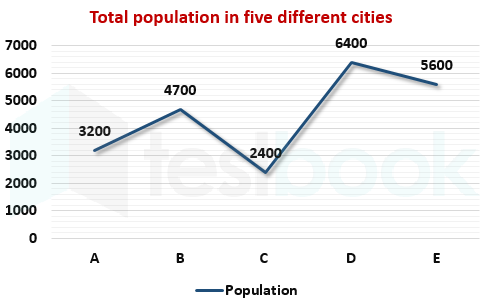
The line graph shows the total population in five different cities [A, B, C, D and E]

59

Out of total population in city D, 75% are literate. Find the illiterate people in city D?

  1. ((a))

    1100

  2. ((b))

    1300

  3. ((c))

    2200

  4. ((d))

    1600

  5. ((e))

    2600

Show Answer
Answer: ((d))

1600

Calculation

Total population in D = 6400

Literate = 75% → Illiterate = 25%

Illiterate people = 25% × 6400 = 1600

60

Number of populations in city F is 20% more than the number of populations in city E. Find the number of populations in city F?

  1. ((a))

    6720

  2. ((b))

    6625

  3. ((c))

    6840

  4. ((d))

    6790

  5. ((e))

    6620

Show Answer
Answer: ((a))

6720

Calculation

Population in E = 5600

20% of 5600 = 0.20 × 5600 = 1120

Population in F = 5600 + 1120 = 6720

61

Ratio of total population in city C and D is m:n. finds the value of m + n. [ Ratio is lowest possible integer]

  1. ((a))

    13

  2. ((b))

    14

  3. ((c))

    19

  4. ((d))

    10

  5. ((e))

    11

Show Answer
Answer: ((e))

11

Calculation

C = 2400, D = 6400

Ratio = 2400:6400 = 3:8 = m:n

So, m + n = 3 + 8 = 11

62

Number of populations in city B is increased by 25%. Find the new population in city B?

  1. ((a))

    6800

  2. ((b))

    6300

  3. ((c))

    5875

  4. ((d))

    6240

  5. ((e))

    6500

Show Answer
Answer: ((c))

5875

Calculation

Original population = 4700

Increase = 25% of 4700 = 0.25 × 4700 = 1175

New population = 4700 + 1175 = 5875

63

Ratio of number of male and female in A is 5:3. Number of females in A is [x + 350]. Find the value of x?

  1. ((a))

    850

  2. ((b))

    750

  3. ((c))

    650

  4. ((d))

    550

  5. ((e))

    950

Show Answer
Answer: ((a))

850

Calculation

Let total parts = 5 (male) + 3 (female) = 8 parts

Total population in A = 3200

1 part = 3200 ÷ 8 = 400

Female population = 3 x 400 = 1200

Given:

so, x + 350 = 1200

⇒ x = 1200 – 350 = 850

64

The income of a company increases 15% per annum. If its income is Rs. 2,40,000, in the year 2015. Then its income in the year 2017 is?

  1. ((a))

    Rs. 3,40,000

  2. ((b))

    Rs. 3,00,000

  3. ((c))

    Rs. 1,50,000

  4. ((d))

    Rs. 3,17,400

  5. ((e))

    None of these

Show Answer
Answer: ((d))

Rs. 3,17,400

Given 

Company’s income in 2015 = Rs. 2,40,000

Income increases annually by = 15%

Formula Used

Income after two year = P {1 + R/100}2

Calculation

Income in the year 2017 = 240000 [1 + 15/100]2

⇒ 240000 [115/100]2

⇒ 240000 × (115/100) × (115/100)

⇒ 240000 × (23/20) × (23/20)

⇒ 600 × 23 × 23

⇒ Rs. 317400

∴ Company’s income in the year 2017 will be Rs. 3,17,400 .


Income in 2017 = Income in 2015 × (100 + P%) × (100 + P%)/(100 × 100) 

Income in 2017 = 240000 × 115/100 × 115/100 = Rs. 3,17,400

65

The total age of Aryan and Brijesh is 10 years more than the total age of Brijesh and Chetan. Chetan is how many years younger than Aryan?

  1. ((a))

    12

  2. ((b))

    10

  3. ((c))

    13

  4. ((d))

    15

  5. ((e))

    20

Show Answer
Answer: ((b))

10

Given,

The total age of Aryan and Brijesh is 10 years more than the total age of Brijesh and Chetan.

Calculations:

(Aryan + Brijesh) - (Brijesh + Chetan) = 10

⇒  Aryan - Chetan = 10

∴ The required answer is 10

66

A man sells his scooter at 5% loss. If he sells it for Rs.  80 more, he would have gained 5%. The cost price of the scooter is.

  1. ((a))

    Rs.  1600

  2. ((b))

    Rs.  1200

  3. ((c))

    Rs.  1000

  4. ((d))

    Rs.  800

  5. ((e))

    Rs.  500

Show Answer
Answer: ((d))

Rs.  800

Given:

a = -5%

b = 5%

R = Rs. 80

Formula used:

Profit% = {R/(b - a) × 100}

Calculation:

Here, a = -5%, b = 5%, R = Rs. 80

⇒ According to the formula,

⇒ CP of scooter = {R/(b - a) × 100}

⇒ 80/(5 + 5) × 100 = Rs. 800

The cost price of the scooter is Rs. 800.

Alternate Method

Let CP = x

⇒ Then, according to the Q.,

⇒ 105x/100 – 95x/100 = 80

⇒ 21x/20 – 19x/20 = 80

⇒ 2x/20 = 80

⇒  x = 800

The cost price of the scooter is Rs. 800.

67

What should come in place of the question mark '?' in the following number series?

9, 16, 30, 58, 114, ?

  1. ((a))

    212

  2. ((b))

    206

  3. ((c))

    226

  4. ((d))

    236

  5. ((e))

    242

Show Answer
Answer: ((c))

226

The series follows the following pattern:

9 × 2 - 2 = 16

16 × 2 - 2 = 30

30 × 2 - 2 = 58

58 × 2 - 2 = 114

114 × 2 - 2 = 226

68

What should come in place of the question mark '?' in the following number series?

8, 16, 19, 76, ?, 486

  1. ((a))

    99

  2. ((b))

    107

  3. ((c))

    81

  4. ((d))

    113

  5. ((e))

    195

Show Answer
Answer: ((c))

81

The series follows the following pattern:

8 × 2 = 16 

16 + 3 = 19 

19 × 4 = 76

76 + 5 = 81

81 × 6 = 486

69

What should come in place of the question mark '?' in the following number series?

13, 17, 26, ?, 67, 103

  1. ((a))

    42

  2. ((b))

    52

  3. ((c))

    48

  4. ((d))

    58

  5. ((e))

    62

Show Answer
Answer: ((a))

42

The series follows the following pattern:

13 + 4 = 17

17 + 9 = 26

26 + 16 = 42

42 + 25 = 67

67 + 36 = 103

70

What should come in place of the question mark '?' in the following number series?

450, 442, 415, 351, 226, ?

  1. ((a))

    100

  2. ((b))

    10

  3. ((c))

    20

  4. ((d))

    90

  5. ((e))

    120

Show Answer
Answer: ((b))

10

The series follows the following pattern:

450 – 23 = 442 

442 – 33 = 415 

415 – 43 = 351 

351 – 53 = 226 

226 – 63 = 10

71

What should come in place of the question mark '?' in the following number series?

13, 15, 18, 23, 30, ?

  1. ((a))

    39

  2. ((b))

    43

  3. ((c))

    45

  4. ((d))

    41

  5. ((e))

    37

Show Answer
Answer: ((d))

41

The series follows the following pattern:

13 + 2 = 15

15 + 3 = 18

18 + 5 = 23

23 + 7 = 30

30 + 11 = 41

Here, we see the difference of consecutive prime number

72

A lady travels a distance of 40 km by car in 20 min. After that she covers another 20 km by a bus in 30 min. What is the average speed of her during the whole journey?

  1. ((a))

    36 km/hr

  2. ((b))

    90 km/hr

  3. ((c))

    72 km/hr

  4. ((d))

    24 km /hr

  5. ((e))

    None of these

Show Answer
Answer: ((c))

72 km/hr

Given:

First distance = 40 km

Time to cover the distance of 40 km by car = 20 min

Second distance = 20 km

Time to cover the distance of 20 km by bus = 30 min

Concept used:

Average speed = Total distance/Total time

Calculation:

Total distance cover by the lady during her whole journey = (40 + 20) km = 60 km

Total time to cover the Whole distance = (20 + 30)/60 = 5/6 hr

According to the question,

⇒ 60/(5/6) = (60 × 6)/5 = 72

∴ Required average speed = 72 km/hr

73

Sid started a business with Rs. 15000 and after 4 months Mohan also joined with some capital. After a year the profit is divided between them in the ratio 5 ∶ 4. How much did Mohan invest?

  1. ((a))

    20000

  2. ((b))

    18000

  3. ((c))

    20400

  4. ((d))

    24000

  5. ((e))

    None of these

Show Answer
Answer: ((b))

18000

Given:

Sid started a business with Rs. 15000.

Profit is divided between them in the ratio 5 ∶ 4

Calculation:

Let, investment of Mohan = Rs. 100x

Sid invested Rs. 15000 for 12 months.

Mohan invested Rs. 100x for (12 – 4) = 8 months.

∴ Ratio of profit of Sid and Mohan = (15000 × 12) ∶ (100x × 8) = 225 ∶ x

According to the question,

⇒ 225 ∶ x = 5 ∶ 4

⇒ x = 225 × (4/5)

⇒ x = 180

∴ Investment of B = Rs. (100 × 180) = Rs. 18000

The table shows the number of Bus and number of car sold in five different cities [A, B, C, D and E]

CityNumber of Bus soldNumber of Car sold
A120320
B80240
C150300
D180420
E160350
74

Number of Bus sold in city B is [x + 30]. Number of Bus sold in city F is 5x. Find the number of bus sold in city F?

  1. ((a))

    230

  2. ((b))

    290

  3. ((c))

    260

  4. ((d))

    250

  5. ((e))

    220

Show Answer
Answer: ((d))

250

Calculation

Bus sold in city B = x + 30

→ Given: Bus sold in city B = 80

So,

x + 30 = 80

⇒ x = 50

Buses sold in city F = 5x = 5 × 50 = 250

Answer: 250 buses in city F

75

Find the difference between average number of bus and average number of cars sold in all cities together?

  1. ((a))

    188

  2. ((b))

    164

  3. ((c))

    122

  4. ((d))

    124

  5. ((e))

    104

Show Answer
Answer: ((a))

188

Calculation

Total Buses = 120 + 80 + 150 + 180 + 160 = 690

Total Cars = 320 + 240 + 300 + 420 + 350 = 1630

Number of cities = 5

Average Buses = 690 / 5 = 138

Average Cars = 1630 / 5 = 326

Difference = 326 - 138 = 188

Answer: 188

76

Ratio of number of Ac and Non ac bus sold in city A is 5 : 3 out of total bus sold in same city. Find the difference between number of Ac and Non ac bus sold in city A?

  1. ((a))

    45

  2. ((b))

    50

  3. ((c))

    65

  4. ((d))

    95

  5. ((e))

    30

Show Answer
Answer: ((e))

30

Calculation

Ratio of AC to Non-AC buses in city A = 5:3. Total buses in city A = 120

Let common multiple be x. So,

AC buses = 5x

Non-AC buses = 3x

Total = 5x + 3x = 8x = 120

⇒ x = 15

AC = 5x = 75

Non-AC = 3x = 45

Difference = 75 - 45 = 30

Answer: 30 buses

77

Number of tractors sold in city B is 25% less than the number of cars sold in same city. Find the number of tractors sold in city B?

  1. ((a))

    110

  2. ((b))

    190

  3. ((c))

    180

  4. ((d))

    120

  5. ((e))

    160

Show Answer
Answer: ((c))

180

Calculation

Cars in city B = 240

25% of 240 = (25/100) × 240 = 60

So, tractors sold = 240 - 60 = 180

Answer: 180 tractors

78

Ratio of total number of buses sold in city D and E together and number of cars sold in city C and D together?

  1. ((a))

    17 : 23

  2. ((b))

    17 : 36

  3. ((c))

    7 : 8

  4. ((d))

    9 : 16

  5. ((e))

    11 : 13

Show Answer
Answer: ((b))

17 : 36

Calculation

Buses in D + E = 180 + 160 = 340

Cars in C + D = 300 + 420 = 720

Ratio = 340 : 720 = 17 : 36

Answer: 17 : 36

79

Twenty litres of a milk solution having 24% milk and remaining water. How many litres of water must be added to make it a 20% solution of milk?

  1. ((a))

    3 litres

  2. ((b))

    4 litres

  3. ((c))

    6 litres

  4. ((d))

    8 litres

  5. ((e))

    None of these

Show Answer
Answer: ((b))

4 litres


The concentration of milk has reduced from 24% to 20% i.e. to 5/6th

The concentration of water now has become 6th of total = 6/5 × 20 = 24 litres

The amount of water added = 24 - 20 = 4 litres

Given:

The initial amount of solution is 20 litres

Calculation:

The initial amount of milk = 24/100 × 20 = 24/5

The initial amount of water = (100 - 24)/100 × 20 = 76/5

Let the amount of water added be x

According to the question;

⇒ 24/5/(76/5 + x) = 20/80

⇒ 24/5/(76/5 + x) = 1/4

⇒ 20/5 = x

⇒ x = 4

The amount of water added is 4 litres.

80

The ratio between the two numbers is 2 : 3. If each number is reduced by 5 then the ratio becomes 1 : 2, then find the first number.

  1. ((a))

    05

  2. ((b))

    10

  3. ((c))

    15

  4. ((d))

    20

  5. ((e))

    25

Show Answer
Answer: ((b))

10

Given:

The initial ratio between the two numbers = 2 : 3

Each number reduced by 5

The final ratio between the two numbers = 1 : 2

Calculation:

Let the first and second number be 2x and 3x respectively.

According to the question,

(2x - 5)/(3x - 5) = 1/2

⇒ 2(2x - 5) = 3x - 5

⇒ 4x - 10 = 3x - 5

⇒ 4x - 3x = 10 - 5

⇒ x = 5

The first number = 2x

⇒ 2 × 5

⇒ 10

∴ The required first number will be 10.

Shortcut Trick


Attempt this paper under real exam conditions

Timed interface, section switching, instant scoring, and question-by-question analytics — free.

Start Timed Attempt