Official Paper

RRB Clerk Prelims Memory Based Paper (Held On: 17 August 2024 Shift 4) (Previous Year Paper)

80 questions · 45 minutes · with answers · free

Reasoning (40 questions)

Direction: Study the following information carefully to answer the given questions.

Six people – A, B, C, D, E, and F, live in a 3 floor apartment building with 2 flats – Alpha and Beta. Flat Alpha is to the West of Flat Beta. D does not live on the same floor as A. F lives below D but not in the same flat as D. B does not live on an even-numbered floor. F does not live on the bottommost floor. C lives below F in the same flat. B lives above A, who lives in Flat Alpha. E lives below F.

1

Who lives on the second floor of Flat Beta?

  1. ((a))

    A

  2. ((b))

    B

  3. ((c))

    C

  4. ((d))

    E

  5. ((e))

    F

Show Answer
Answer: ((e))

F

Given:

Six people – A, B, C, D, E, and F

Flat Alpha is to the West of Flat Beta.

  1. D does not live on the same floor as A.
  2. F lives below D but not in the same flat as D.
  3. F does not live on the bottommost floor.
Case 1 (a)Case 1 (b)
FloorsFlat AlphaFlat BetaFloorsFlat AlphaFlat Beta
3D3D
2F2F
11


  1. C lives below F in the same flat.
  2. B does not live on an even-numbered floor.
  3. E lives below F.
  4. B lives above A, who lives in Flat Alpha.
Case 1 (b)
FloorsFlat AlphaFlat Beta
3DB
2AF
1EC

(Case 1a will not be possible as it will contradict point 7)

Hence, F lives on the second floor of Flat Beta.
2

Four of the five options given below are alike in a certain way and form a group, identify the odd one out.

  1. ((a))

    E

  2. ((b))

    B

  3. ((c))

    D

  4. ((d))

    A

  5. ((e))

    C

Show Answer
Answer: ((d))

A

Given:

Six people – A, B, C, D, E, and F

Flat Alpha is to the West of Flat Beta.

  1. D does not live on the same floor as A.
  2. F lives below D but not in the same flat as D.
  3. F does not live on the bottommost floor.
Case 1 (a)Case 1 (b)
FloorsFlat AlphaFlat BetaFloorsFlat AlphaFlat Beta
3D3D
2F2F
11


  1. C lives below F in the same flat.
  2. B does not live on an even-numbered floor.
  3. E lives below F.
  4. B lives above A, who lives in Flat Alpha.
Case 1 (b)
FloorsFlat AlphaFlat Beta
3DB
2AF
1EC

(Case 1a will not be possible as it will contradict point 7)


The logic followed here is that all the given options are people living on odd numbered floors, except A.

Hence, A is the odd one out.

3

Which of the following statements are correct?

  1. ((a))

    C and E live on the bottommost floor of Flat Alpha and Flat Beta respectively

  2. ((b))

    A lives in the flat as C

  3. ((c))

    D and B live on the top floor of Flat Alpha and Flat Beta, respectively.

  4. ((d))

    B lives below F

  5. ((e))

    C lives on the second floor.

Show Answer
Answer: ((c))

D and B live on the top floor of Flat Alpha and Flat Beta, respectively.

Given:

Six people – A, B, C, D, E, and F

Flat Alpha is to the West of Flat Beta.

  1. D does not live on the same floor as A.
  2. F lives below D but not in the same flat as D.
  3. F does not live on the bottommost floor.
Case 1 (a)Case 1 (b)
FloorsFlat AlphaFlat BetaFloorsFlat AlphaFlat Beta
3D3D
2F2F
11


  1. C lives below F in the same flat.
  2. B does not live on an even-numbered floor.
  3. E lives below F.
  4. B lives above A, who lives in Flat Alpha.
Case 1 (b)
FloorsFlat AlphaFlat Beta
3DB
2AF
1EC

(Case 1a will not be possible as it will contradict point 7)

<br> <br>

Hence, the correct answer is option 3.

4

Which of the following statements is/are correct?

I. B and C live in the same flat

II. A lives above C in different flats

III. F lives in Flat Beta

IV. E lives below D in the same flat

  1. ((a))

    None are correct

  2. ((b))

    All are correct

  3. ((c))

    Only Statement I is correct

  4. ((d))

    Only Statements I and IV are correct

  5. ((e))

    Only Statement III is correct

Show Answer
Answer: ((b))

All are correct

Given:

Six people – A, B, C, D, E, and F

Flat Alpha is to the West of Flat Beta.

  1. D does not live on the same floor as A.
  2. F lives below D but not in the same flat as D.
  3. F does not live on the bottommost floor.
Case 1 (a)Case 1 (b)
FloorsFlat AlphaFlat BetaFloorsFlat AlphaFlat Beta
3D3D
2F2F
11


  1. C lives below F in the same flat.
  2. B does not live on an even numbered floor.
  3. E lives below F.
  4. B lives above A, who lives in Flat Alpha.
Case 1 (b)
FloorsFlat AlphaFlat Beta
3DB
2AF
1EC

(Case 1a will not be possible as it will contradict point 7)


Hence, all the statements are correct.

5

If the residents were rearranged in an 8 floor building in an alphabetical order from the top to bottom, who would live on the fourth floor?

  1. ((a))

    E

  2. ((b))

    D

  3. ((c))

    C

  4. ((d))

    B

  5. ((e))

    A

Show Answer
Answer: ((a))

E

Given:

Six people – A, B, C, D, E, and F

Flat Alpha is to the West of Flat Beta.

  1. D does not live on the same floor as A.
  2. F lives below D but not in the same flat as D.
  3. F does not live on the bottommost floor.
Case 1 (a)Case 1 (b)
FloorsFlat AlphaFlat BetaFloorsFlat AlphaFlat Beta
3D3D
2F2F
11


  1. C lives below F in the same flat.
  2. B does not live on an even numbered floor.
  3. E lives below F.
  4. B lives above A, who lives in Flat Alpha.
Case 1 (b)
FloorsFlat AlphaFlat Beta
3DB
2AF
1EC

(Case 1a will not be possible as it will contradict point 7)

<br>

After rearrangement:

FloorsPeople
8A
7B
6C
5D
4E
3F
2_
1_


Hence, E lives on the fourth floor after the rearrangement.

6

Direction: In the following question assuming the given statements to be True, find which of the conclusion among given conclusions is/are definitely true and then give your answers accordingly.

Statements: U > V ≥ D; K ≥ T ≤ D

Conclusions:

I. T ≤ V

II. K > U

  1. ((a))

    Both I and II are True

  2. ((b))

    Only I is True

  3. ((c))

    Either I or II is True

  4. ((d))

    Only II is True

  5. ((e))

    Neither I nor II is True

Show Answer
Answer: ((b))

Only I is True

Given statements: U > V ≥ D; K ≥ T ≤ D

On combining: U > V ≥ D ≥ T ≤ K

Conclusions:

I. T ≤ V → True (as V ≥ D ≥ T → V ≥ T)

II. K > U → False (as U > V ≥ D ≥ T ≤ K thus clear relation between K and U cannot be determined)

Hence, only I is True.

7

Direction: In the following question assuming the given statements to be True, find which of the conclusion among given conclusions is/are definitely true and then give your answers accordingly.

Statements: X < Q ≤ N = L; H > F > X

Conclusions:

I. H > N

II. F ≤ L

  1. ((a))

    Both I and II are True

  2. ((b))

    Only I is True

  3. ((c))

    Either I or II is True

  4. ((d))

    Only II is True

  5. ((e))

    Neither I nor II is True

Show Answer
Answer: ((e))

Neither I nor II is True

Given statements: X < Q ≤ N = L; H > F > X

On combining: H > F > X < Q ≤ N = L

Conclusions:

I. H > N → False (as H > F > X < Q ≤ N there is opposite sign between H and N. So, It is false)

II. F ≤ L → False (as F > X < Q ≤ N = L there is opposite sign between F and L. So, It is false)

Hence, Neither I nor II is True.

8

Directions: In the following question assuming the given statements to be true, find which of the conclusion among the given conclusions is/are definitely true and then give your answers accordingly.

Statements: A > B ≥ Q; G < C > D = Q

Conclusions:

I. A > C

II. A > D

  1. ((a))

    Only I is true

  2. ((b))

    Only II is true

  3. ((c))

    Either I or II is true

  4. ((d))

    Both I and II is true

  5. ((e))

    Neither I nor II is true

Show Answer
Answer: ((b))

Only II is true

Given Statements: A > B ≥ Q; G < C > D = Q

On combining: A > B ≥ Q = D < C > G

Conclusions:

I. A > C → False (as A > D < C → thus clear relation between A and C cannot be determined).

II. A > D → True ( as A > Q = D)

Therefore, only conclusion II is true

9

Directions: In the following question assuming the given statements to be True, find which of the conclusion among given conclusions is/are definitely true and then give your answers accordingly.

Statements: A < B ≥ C > D ; C < F ; E ≤ D

Conclusions:

I. A < F

II. E < F

  1. ((a))

    Only I is True

  2. ((b))

    Only II is True

  3. ((c))

    Either I or II is True

  4. ((d))

    Neither I nor II is True

  5. ((e))

    Both I and II is True

Show Answer
Answer: ((b))

Only II is True

Given statements: A < B ≥ C > D ; C < F ; E ≤ D

**On combining:**A < B ≥ C > D ≥ E ; C < F

Conclusions:

 I. A < F → False ( As A < B ≥ C < F  →  thus clear relation between A and F cannot be determined)

II. E < F  →True (As F >  C > D  ≥  E  → E < F)

Therfore only conclusion II is True.

Directions: Study the following information carefully to answer the given questions:

N # S 3 @ E B 7 $ 9 I £ O R ! 6 M > 3 % D 5 X & Z 8 < F ? 4 G A

10

How many such vowels are there in the above arrangement each of which are immediately preceded by a symbol and immediately followed by a consonant?

  1. ((a))

    None

  2. ((b))

    Two 

  3. ((c))

    One

  4. ((d))

    Three

  5. ((e))

    More than three

Show Answer
Answer: ((b))

Two 

Given series is:

Left Side N # S 3 @ E B 7 $ 9 I £ O R ! 6 M > 3 % D 5 X & Z 8 < F ? 4 G A Right Side

Arrangement required: Symbol → Vowel → Consonant

Left Side N # S 3 @ E B 7 $ 9 I £ O R ! 6 M > 3 % D 5 X & Z 8 < F ? 4 G A Right Side

Clearly there are two such pairs they are**: @ E B** and £ O R

11

How many such consonants are there in the above arrangement each of which is immediately followed by a symbol and immediately preceded by a symbol?

  1. ((a))

    One

  2. ((b))

    None

  3. ((c))

    Two

  4. ((d))

    Three

  5. ((e))

    More than three 

Show Answer
Answer: ((a))

One

Given series is:

Left Side N # S 3 @ E B 7 $ 9 I £ O R ! 6 M > 3 % D 5 X & Z 8 < F ? 4 G A Right Side

Arrangement required: Symbol → Consonant → Symbol

Left Side N # S 3 @ E B 7 $ 9 I £ O R ! 6 M > 3 % D 5 X & Z 8 < F ? 4 G A Right Side

Clearly there is one such pair i.e., < F ?

12

How many such numbers are there in the above arrangement each of which are immediately followed by a vowel and immediately preceded by a consonant?

  1. ((a))

    Two

  2. ((b))

    None

  3. ((c))

    One

  4. ((d))

    Three

  5. ((e))

    More than three

Show Answer
Answer: ((b))

None

Given series is:

Left Side N # S 3 @ E B 7 $ 9 I £ O R ! 6 M > 3 % D 5 X & Z 8 < F ? 4 G A Right Side

Arrangement required: Consonant → Number → Vowel

Clearly none of the number follows the given condition.

13

If all the symbols in the above arrangement are dropped, then which of the following element will be the seventh element from the left end?

  1. ((a))

    I

  2. ((b))

    M

  3. ((c))

    O

  4. ((d))

    9

  5. ((e))

    7

Show Answer
Answer: ((d))

9

Given series:

Left Side N # S 3 @ E B 7 $ 9 I £ O R ! 6 M > 3 % D 5 X & Z 8 < F ? 4 G A Right Side

If all the symbols are dropped: N S 3 E B 7 9 I O R 6 M 3 D 5 X Z 8 F 4 G A.

Hence, 7th letter from the left end is 9.

14

Four of following five are alike in a certain way based on their positions in the above arrangement and so form a group. Which is the one that does not belong to that group?

  1. ((a))

    S E 3

  2. ((b))

    B 9 7

  3. ((c))

    9 I O

  4. ((d))

    O 6 R

  5. ((e))

    N 3 #

Show Answer
Answer: ((c))

9 I O

Given series:

Left Side N # S 3 @ E B 7 $ 9 I £ O R ! 6 M > 3 % D 5 X & Z 8 < F ? 4 G A Right Side

Here the group is formed in which second element is second next to the third element, and the third element is to the just next of the first element.

Hence, 9 I O does not belong to the group.

15

How many such pairs of letters are there in the word ‘ENLIGHTEN’, each of which has as many letters between them in the word (both forward and backward direction) as they have between them in the English Alphabet?

  1. ((a))

    None

  2. ((b))

    One

  3. ((c))

    Two

  4. ((d))

    Three

  5. ((e))

    More than three

Show Answer
Answer: ((d))

Three

Hence, three pairs are there in the word ‘ENLIGHTEN’, each of which has as many letters between them in the word (both forward and backward direction) as they have between them in the English Alphabet.

Directions: Read the instructions carefully and answer the question below:

Eight persons A1, A2, A3, A4, B1, B2, B3, and B4 sitting around a circular table facing inward with equal distance between them not necessarily in same order. A2 sits third to the right of B3.  B1 is not a neighbor of B4. Only one person sits between A4 and A1.  A3 is not immediate neighbor of A2. B4 is not a neighbor of A1 and A2. B3 sits immediate left of A4.

16

What is the position of B2 with respect to A4?

  1. ((a))

    Second to the right

  2. ((b))

    Immediate right

  3. ((c))

    Immediate left

  4. ((d))

    Third to the right

  5. ((e))

    None of the above

Show Answer
Answer: ((d))

Third to the right

According to the question,

  1. Only one person sits between A4 and A1. 

  2. B3 sits immediate left of A4.

  3. A2 sits third to the right of B3.

  1. B4 is not a neighbor of A1 and A2.

  2. A3 is not immediate neighbor of A2.

  3. B1 is not a neighbor of B4.

Hence, B2 sits third to the right of A4.

17

Who sits second to the right of B2?

  1. ((a))

    A1

  2. ((b))

    A4

  3. ((c))

    B1

  4. ((d))

    B4

  5. ((e))

    None of the above

Show Answer
Answer: ((e))

None of the above

According to the question,

  1. Only one person sits between A4 and A1. 

  2. B3 sits immediate left of A4.

  3. A2 sits third to the right of B3.

  1. B4 is not a neighbor of A1 and A2.

  2. A3 is not immediate neighbor of A2.

  3. B1 is not a neighbor of B4.

Here A3 sits second to the right of B2.

Hence, “None of the above” is the correct answer.

18

Who are the neighbors of B4?

  1. ((a))

    B2 and A4

  2. ((b))

    A1 and A4

  3. ((c))

    B2 and A3

  4. ((d))

    B1 and B2

  5. ((e))

    None of the above

Show Answer
Answer: ((c))

B2 and A3

According to the question,

  1. Only one person sits between A4 and A1. 

  2. B3 sits immediate left of A4.

  3. A2 sits third to the right of B3.

  1. B4 is not a neighbor of A1 and A2.

  2. A3 is not immediate neighbor of A2.

  3. B1 is not a neighbor of B4.

Hence, “B2 and A3” are the neighbors of B4.

19

Who sits immediate right of B4?

  1. ((a))

    A1

  2. ((b))

    B2

  3. ((c))

    A3

  4. ((d))

    A2

  5. ((e))

    None of the above

Show Answer
Answer: ((c))

A3

According to the question,

  1. Only one person sits between A4 and A1. 

  2. B3 sits immediate left of A4.

  3. A2 sits third to the right of B3.

  1. B4 is not a neighbor of A1 and A2.

  2. A3 is not immediate neighbor of A2.

  3. B1 is not a neighbor of B4.

Hence, A3 sits immediate right of B4.

20

What is the position of A4 with respect to B1?

  1. ((a))

    Third to the left

  2. ((b))

    Third to the right

  3. ((c))

    Second to the right

  4. ((d))

    Second to the left

  5. ((e))

    Immediate left

Show Answer
Answer: ((e))

Immediate left

According to the question,

  1. Only one person sits between A4 and A1. 

  2. B3 sits immediate left of A4.

  3. A2 sits third to the right of B3.

  1. B4 is not a neighbor of A1 and A2.

  2. A3 is not immediate neighbor of A2.

  3. B1 is not a neighbor of B4.

Hence, A4 sits immediate left with respect to B1.

21

Direction: In the question below are given three statements followed by two conclusions I and II. You have to take the given statements to be true even if they seem to be at variance from commonly known facts. Read all the conclusions and then decide which of the given conclusions logically follows from the given statements disregarding commonly known facts.

Statements: 

Some winter is summer.

Some summer is days.

No day is night.

Conclusions:

I. Some winter is nights.

II. No winter is night.

  1. ((a))

    Only conclusion I follow

  2. ((b))

    Only conclusion II follows

  3. ((c))

    Conclusion I and II both follow

  4. ((d))

    Neither conclusion I nor conclusion II follows

  5. ((e))

    Either conclusion I or conclusion II follows

Show Answer
Answer: ((e))

Either conclusion I or conclusion II follows

The least possible diagram for the given statements is as follows

Conclusions:

I. Some winter is nights → False (It is possible but not definite)

II. No winter is night → False (It is possible but not definite)

Conclusion I and II is complementary pair.

Hence, Either conclusion I or conclusion II follows.

22

Direction: In each of the following questions, there are three statements which is followed by two conclusions. Choose the conclusions which logically follow from the given statements.

Statements:

No Belt is Bag.

Some Purse are Wallet.

Some wallet are Belt.

Conclusions:

I. Some Purse are Bag.

II. No Bag is Purse.

  1. ((a))

    Only conclusion I follow

  2. ((b))

    Only conclusion II follow

  3. ((c))

    Either conclusion I or II follow

  4. ((d))

    Both conclusions follow

  5. ((e))

    Neither conclusion I or II follow

Show Answer
Answer: ((c))

Either conclusion I or II follow

The least possible Venn diagram is shown below

Conclusions:

I. Some Purse are Bag → False (It is possible but not definite. As no direct relation between Bag and Purse is given).

So it is considered as Cannot be determined.

II. No Bag is Purse → False (It is possible but not definite. As no direct relation between Bag and Purse is given).

Part of Bag can go in Purse.

So, it is considered as Cannot be determined.

Thus conclusion I and II form a complementary pair.

Hence, Either conclusion I or II follow.

Additional Information:

Conditions for the Either Or:

  1. Both the conclusion must be Cannot be determined.
  2. Both the objects in both the conclusion must be same.
  3. If one conclusion is positive, then other should be negative.

Complementary pairs:

  1. All - Some not (Positions of the object should be same in the conclusion)
  2. Some - No
23

Direction: Some statements are given followed by some conclusions. You have to consider the statements to be true even if they seem to be at variance from commonly known facts. You have to decide which of the given conclusions if any, follow from the given statements.

Statements:

At least some Daisy are Camelia.

Only a few Pansy are Poppy.

No Camelia is Pansy.

Conclusions:

I. Some Daisy are not Camelia.

II. All Pansy being Poppy is a possibility.

  1. ((a))

    If only conclusion I follows.

  2. ((b))

    If only conclusion II follows.

  3. ((c))

    If either conclusion I or II follows.

  4. ((d))

    If neither conclusion I nor II follows.

  5. ((e))

    If both conclusions I and II follow.

Show Answer
Answer: ((d))

If neither conclusion I nor II follows.

The least possible Venn diagram for the given statements is as follows-

<br>

Conclusions:

I. Some Daisy are not Camelia → False (It is possible but not definite)

II. All Pansy being Poppy is a possibility → False (As ‘Only a few Pansy are Poppy’, some parts of Pansy will never be Poppy.)

Additional Information:

‘Only a few Pansy are Poppy’ → here the first element is Pansy and the second element is Poppy. So, the statement means ‘some Pansy are Poppy and some parts of Pansy will never be Poppy but all Poppy can be Pansy.

So, only a few = some + some not.

Hence, neither conclusion I nor II follow.

24

Direction: In the question below are given three statements followed by two conclusions numbered I and II. You have to take the given statements to be true even if they seem to be at variance with commonly known facts. Read all the conclusions and then decide which of the given conclusions logically follows from the given statements disregarding commonly known facts.

Statements:

 Some Dog is Cat.

 Some Cat is Tiger.

Only a few tigers are zebra. 

Conclusions:

I.Some Dog is Zebra. 

II. All zebra can be dog.

  1. ((a))

    Only I follows 

  2. ((b))

    None follows

  3. ((c))

    Both I and II follows

  4. ((d))

    Only II follows

  5. ((e))

    Either I Or II follows

Show Answer
Answer: ((d))

Only II follows

The least possible Venn diagram for the given statements is as follows

Conclusions:

I. Some Dogs are Zebra ⇒ False ( As it is possible but not definite, as no direct relation between the two is given).

II. All Zebra can be dog ⇒ True ( As there is no relation between Zebra and Dog, so the possibility is true).

Hence, Only conclusion II follows.

Direction: Following questions are based on five words given below.

BTS      WHN      CKU      POQ      RTN      ZGN    

(The new words formed after performing the mentioned operations may or may not necessarily be meaningful English words)

25

If the second letter of each word is replaced by immediate succeeding letter as per alphabetical series, how many English meaningful words are formed?

  1. ((a))

    Two

  2. ((b))

    Three

  3. ((c))

    None

  4. ((d))

    One

  5. ((e))

    More than three

Show Answer
Answer: ((b))

Three

Given words are: BTS   WHN   CKU   POQ   RTN   ZGN

  1. Replacing second letter of each word by immediate succeeding letter as per alphabetical series: BUS   WIN   CLU   PPQ   RUN   ZHN

  2. Clearly, three English meaningful words BUS, WIN, RUN are formed.

Therefore, three English meaningful words are formed.

26

If all the given words are arranged as per English dictionary from left to right, which word will be 2nd from right side?

  1. ((a))

    CKU

  2. ((b))

    RTN

  3. ((c))

    ZGN

  4. ((d))

    POQ

  5. ((e))

    WHN

Show Answer
Answer: ((e))

WHN

Given words are: BTS   WHN   CKU   POQ   RTN   ZGN

  1. Arranging given words as per English dictionary from left to right:

 Left side   BTS   CKU   POQ   RTN   WHN   ZGN   Right side

Hence, WHN will be 2nd from the right side after rearrangement.

27

If the first letter of each word is replaced by immediate preceding letter as per English alphabetical series, how many words will have no vowels after rearrangement?

  1. ((a))

    One

  2. ((b))

    Three

  3. ((c))

    Four

  4. ((d))

    Five

  5. ((e))

    All

Show Answer
Answer: ((b))

Three

Given words are: BTS   WHN   CKU   POQ   RTN   ZGN

Replacing the first letter to immediate preceding letter as per English alphabetical series:

ATS   VHN   BKU   OOQ   QTN   YGN

Clearly, three words VHN, QTN, YGN have no vowels after rearrangement.

Note: In English alphabetical series there are 5 vowels i.e. A, E, I, O, U else all are consonants.

Hence, three words have no vowels after rearrangement.

28

If in each of the given words, each of the consonants is replaced by their immediate preceding letters in the alphabetical series, than how many words have only one consonant after rearrangement?

  1. ((a))

    One 

  2. ((b))

    Two

  3. ((c))

    Three

  4. ((d))

    Four

  5. ((e))

    None of these

Show Answer
Answer: ((a))

One 

Given words are: BTS   WHN   CKU   POQ   RTN   ZGN

Replacing each consonant of each word to its immediate preceding letter as per alphabetical series: ASR   VGM   BJU   OOP   QSM   YFM

Note: In English alphabetical series there are 5 vowels i.e. A, E, I, O, U else all are consonants.

Hence, one word has only one consonant after rearrangement.

29

How many letters are there between first letter of third word from left side and last letter of third word from right side in English alphabetical series?

  1. ((a))

    12

  2. ((b))

    13

  3. ((c))

    14

  4. ((d))

    15

  5. ((e))

    11

Show Answer
Answer: ((b))

13

Given words are: BTS   WHN   CKU   POQ   RTN   ZGN

Left side   BTS   WHN   CKU   POQ   RTN   ZGN   Right side

  1. First letter of third word from left side: CKU → C

  2. Last letter of third word from right side: POQ → Q

D  E  F  G  H  I  J  K  L  M  N  O  P  Q

Hence, there are 13 letters between first letter of third word from left side and last letter of third word from right side in English alphabetical series.

Directions: Study the following information carefully and answer the questions following it.

There are a certain number of persons sitting in a row facing north. Only three persons are sitting to the right of P. K is sitting to the right of P, but not to the immediate right. K is not sitting at the extreme end. Two persons are sitting between K and N. Only one person is sitting to the left of T and only one person is sitting between T and D. D is one of the neighbours of N. Number of persons sitting between K and N is the same as the number of persons sitting between P and J, who is sitting at one of the extreme ends.

30

How many persons can sit in the row?

  1. ((a))

    Ten

  2. ((b))

    Seven

  3. ((c))

    Six

  4. ((d))

    Nine

  5. ((e))

    Eight

Show Answer
Answer: ((d))

Nine

i) Only three persons are sitting to the right of P.

ii) K is sitting to the right of P, but not to the immediate right.

Iii) Also K is not sitting at the extreme end.

iv) Two persons are sitting between K and N.

v) D is one of the neighbours of N.

vi) Only one person is sitting to the left of T and only one person is sitting between T and D.

vii) The number of persons sitting between K and N is the same as the number of persons sitting between P and J, who is sitting at one of the ends.

Hence, there are nine persons sitting in a row.

31

What is the position of N from the right end?

  1. ((a))

    Second

  2. ((b))

    Third

  3. ((c))

    Fourth

  4. ((d))

    Fifth

  5. ((e))

    None of the above

Show Answer
Answer: ((d))

Fifth

i) Only three persons are sitting to the right of P.

ii) K is sitting to the right of P, but not to the immediate right.

Iii) Also K is not sitting at the extreme end.

iv) Two persons are sitting between K and N.

v) D is one of the neighbours of N.

vi) Only one person is sitting to the left of T and only one person is sitting between T and D.

vii) The number of persons sitting between K and N is the same as the number of persons sitting between P and J, who is sitting at one of the ends.

Hence, the position of N is fifth from the right end.

32

How many persons are sitting between K and T?

  1. ((a))

    Two

  2. ((b))

    One

  3. ((c))

    Four

  4. ((d))

    Three

  5. ((e))

    Five

Show Answer
Answer: ((e))

Five

i) Only three persons are sitting to the right of P.

ii) K is sitting to the right of P, but not to the immediate right.

Iii) Also K is not sitting at the extreme end.

iv) Two persons are sitting between K and N.

v) D is one of the neighbours of N.

vi) Only one person is sitting to the left of T and only one person is sitting between T and D.

vii) The number of persons sitting between K and N is the same as the number of persons sitting between P and J, who is sitting at one of the ends.

Hence, there are five persons sitting between K and T.

Seven boys P, Q, R, S, T, U and X have different weights. X is heavier than Q. P is heavier than only three people. Q is heavier than P. T is heavier than S but lighter than R. U is heavier than R but lighter than Q.

33

How many boys are lighter than U?

  1. ((a))

    Five

  2. ((b))

    Four

  3. ((c))

    Two

  4. ((d))

    Three

  5. ((e))

    None of these

Show Answer
Answer: ((b))

Four

From the given instructions:

  1. X is heavier than Q. Q is heavier than P. P is heavier than only three people. So, we have two cases;

Case 1:

X/ > X/ > Q > P > __ > __ > __

Case 2:

X > Q > __ > P > __ > __ > __

  1. T is heavier than S but lighter than R. U is heavier than R but lighter than Q. So, Case 1 is invalid.

So, Final Arrangement,

X > Q > U > P > R > T > S

Hence, four boys are lighter than U.

34

How many boys are there between Q and T?

  1. ((a))

    Three

  2. ((b))

    One

  3. ((c))

    More than three

  4. ((d))

    Two

  5. ((e))

    None of these

Show Answer
Answer: ((a))

Three

From the given instructions:

  1. X is heavier than Q. Q is heavier than P. P is heavier than only three people. So, we have two cases;

Case 1:

X/ > X/ > Q > P > __ > __ > __

Case 2:

X > Q > __ > P > __ > __ > __

  1. T is heavier than S but lighter than R. U is heavier than R but lighter than Q. So, Case 1 is invalid.

So, Final Arrangement,

X > Q > U > P > R > T > S

Hence, three boys are there boys between Q and T.

35

If it is possible to make only one four-letter meaningful word with the first, third, fourth, and eighth letter of the word ‘ABNORMALITY’, which could be the second letter of the word from the left end? If more than one such word can be formed, give ‘X’ as the answer. If no such word can be formed, give ‘Z’ as your answer.

  1. ((a))

    S

  2. ((b))

    Z

  3. ((c))

    X

  4. ((d))

    O

  5. ((e))

    E

Show Answer
Answer: ((d))

O

Given word: ABNORMALITY

The first, third, fourth, and eighth letters are A, N. O, and L respectively.

There is only one word that can be formed using these letters i.e. LOAN.

Therefore, the second letter from the left end of the word 'LOAN' is O. 

Hence, the required letter is O.

Directions: Study the following information carefully to answer the given questions.

Seven subjects - Chemistry, Physics, English, German, French, Sanskrit and Mathematics are taught in school from Monday to Sunday, not necessarily in the same order. German is taught on the last day of the week. More than two subjects are taught in between Chemistry and Sanskrit. English is taught on Thursday. Sanskrit is taught one of the days after Physics. Chemistry is taught five days before the day German is taught . Mathematics is taught three days before English. English is taught one of the days before French is taught.

36

How many subjects are taught after Physics? 

  1. ((a))

    One 

  2. ((b))

    Two

  3. ((c))

    Four

  4. ((d))

    Three

  5. ((e))

    None

Show Answer
Answer: ((c))

Four

German is taught in the last day of the week. English is teaches on Thursday.

Chemistry is taught five days before the day German is taught . Mathematics is taught three days before English. 

English is taught one of the day before French is taught.  

| Days | Subjects (case1) | Subjects (case2) | | --- | --- | --- | | Monday | Mathematics | Mathematics | | Tuesday | Chemistry | Chemistry | | Wednesday | | | | Thursday | English | English | | Friday | French | | | Saturday | | French | | Sunday | German | German |DaysSubjects (case1)Subjects (case2)MondayMathematicsMathematicsTuesdayChemistryChemistryWednesdayThursdayEnglishEnglishFridayFrenchSaturdayFrenchSundayGermanGerman
DaysSubjects (case1)Subjects (case2)
MondayMathematicsMathematics
TuesdayChemistryChemistry
Wednesday
ThursdayEnglishEnglish
FridayFrench
SaturdayFrench
SundayGermanGerman

Sanskrit is taught one of the day after Physics. 

DaysSubjects (case1)Subjects (case2)
MondayMathematicsMathematics
TuesdayChemistryChemistry
WednesdayPhysicsPhysics
ThursdayEnglishEnglish
FridayFrenchSanskrit
SaturdaySanskritFrench
SundayGermanGerman

More than two subjects are taught in between Chemistry and Sanskrit. Hence case 2 gets eliminated. 

Final arrangement will be

DaysSubjects(case1)
MondayMathematics
TuesdayChemistry
WednesdayPhysics
ThursdayEnglish
FridayFrench
SaturdaySanskrit
SundayGerman

Hence four subjects are taught after Physics.

37

On which date Sanskrit is taught with respect to French?

  1. ((a))

    Immediately after

  2. ((b))

    Immediately before

  3. ((c))

    Two days before 

  4. ((d))

    Two days after 

  5. ((e))

    None of these 

Show Answer
Answer: ((a))

Immediately after

German is taught in the last day of the week. English is teaches on Thursday.

Chemistry is taught five days before the day German is taught . Mathematics is taught three days before English. 

English is taught one of the day before French is taught.  

| Days | Subjects (case1) | Subjects (case2) | | --- | --- | --- | | Monday | Mathematics | Mathematics | | Tuesday | Chemistry | Chemistry | | Wednesday | | | | Thursday | English | English | | Friday | French | | | Saturday | | French | | Sunday | German | German |DaysSubjects (case1)Subjects (case2)MondayMathematicsMathematicsTuesdayChemistryChemistryWednesdayThursdayEnglishEnglishFridayFrenchSaturdayFrenchSundayGermanGerman
DaysSubjects (case1)Subjects (case2)
MondayMathematicsMathematics
TuesdayChemistryChemistry
Wednesday
ThursdayEnglishEnglish
FridayFrench
SaturdayFrench
SundayGermanGerman

Sanskrit is taught one of the day after Physics. 

DaysSubjects (case1)Subjects (case2)
MondayMathematicsMathematics
TuesdayChemistryChemistry
WednesdayPhysicsPhysics
ThursdayEnglishEnglish
FridayFrenchSanskrit
SaturdaySanskritFrench
SundayGermanGerman

More than two subjects are taught in between Chemistry and Sanskrit. Hence case 2 gets eliminated. 

Final arrangement will be

DaysSubjects(case1)
MondayMathematics
TuesdayChemistry
WednesdayPhysics
ThursdayEnglish
FridayFrench
SaturdaySanskrit
SundayGerman

Sanskrit is taught just after French class.

38

Which subject is taught three days before German?

  1. ((a))

    Physics 

  2. ((b))

    Sanskrit

  3. ((c))

    English

  4. ((d))

    Chemistry 

  5. ((e))

    Mathematics 

Show Answer
Answer: ((c))

English

German is taught in the last day of the week. English is teaches on Thursday.

Chemistry is taught five days before the day German is taught . Mathematics is taught three days before English. 

English is taught one of the day before French is taught.  

| Days | Subjects (case1) | Subjects (case2) | | --- | --- | --- | | Monday | Mathematics | Mathematics | | Tuesday | Chemistry | Chemistry | | Wednesday | | | | Thursday | English | English | | Friday | French | | | Saturday | | French | | Sunday | German | German |DaysSubjects (case1)Subjects (case2)MondayMathematicsMathematicsTuesdayChemistryChemistryWednesdayThursdayEnglishEnglishFridayFrenchSaturdayFrenchSundayGermanGerman
DaysSubjects (case1)Subjects (case2)
MondayMathematicsMathematics
TuesdayChemistryChemistry
Wednesday
ThursdayEnglishEnglish
FridayFrench
SaturdayFrench
SundayGermanGerman

Sanskrit is taught one of the day after Physics. 

DaysSubjects (case1)Subjects (case2)
MondayMathematicsMathematics
TuesdayChemistryChemistry
WednesdayPhysicsPhysics
ThursdayEnglishEnglish
FridayFrenchSanskrit
SaturdaySanskritFrench
SundayGermanGerman

More than two subjects are taught in between Chemistry and Sanskrit. Hence case 2 gets eliminated. 

Final arrangement will be

DaysSubjects(case1)
MondayMathematics
TuesdayChemistry
WednesdayPhysics
ThursdayEnglish
FridayFrench
SaturdaySanskrit
SundayGerman

English is taught three days before German.

39

Which subject is taught on Saturday?

  1. ((a))

    German 

  2. ((b))

    French

  3. ((c))

    Sanskrit 

  4. ((d))

    Physics 

  5. ((e))

    None of these

Show Answer
Answer: ((c))

Sanskrit 

German is taught in the last day of the week. English is teaches on Thursday.

Chemistry is taught five days before the day German is taught . Mathematics is taught three days before English. 

English is taught one of the day before French is taught.  

| Days | Subjects (case1) | Subjects (case2) | | --- | --- | --- | | Monday | Mathematics | Mathematics | | Tuesday | Chemistry | Chemistry | | Wednesday | | | | Thursday | English | English | | Friday | French | | | Saturday | | French | | Sunday | German | German |DaysSubjects (case1)Subjects (case2)MondayMathematicsMathematicsTuesdayChemistryChemistryWednesdayThursdayEnglishEnglishFridayFrenchSaturdayFrenchSundayGermanGerman
DaysSubjects (case1)Subjects (case2)
MondayMathematicsMathematics
TuesdayChemistryChemistry
Wednesday
ThursdayEnglishEnglish
FridayFrench
SaturdayFrench
SundayGermanGerman

Sanskrit is taught one of the day after Physics. 

DaysSubjects (case1)Subjects (case2)
MondayMathematicsMathematics
TuesdayChemistryChemistry
WednesdayPhysicsPhysics
ThursdayEnglishEnglish
FridayFrenchSanskrit
SaturdaySanskritFrench
SundayGermanGerman

More than two subjects are taught in between Chemistry and Sanskrit. Hence case 2 gets eliminated. 

Final arrangement will be

DaysSubjects(case1)
MondayMathematics
TuesdayChemistry
WednesdayPhysics
ThursdayEnglish
FridayFrench
SaturdaySanskrit
SundayGerman

Sanskrit is taught on Saturday.

40

Which of the following statement is incorrect?

  1. ((a))

    Sanskrit was taught on Saturday 

  2. ((b))

    French was taught on Saturday

  3. ((c))

    Physics was taught on Wednesday

  4. ((d))

    None of these is incorrect

  5. ((e))

    Chemistry was taught on Tuesday. 

Show Answer
Answer: ((b))

French was taught on Saturday

German is taught in the last day of the week. English is teaches on Thursday.

Chemistry is taught five days before the day German is taught . Mathematics is taught three days before English. 

English is taught one of the day before French is taught.  

| Days | Subjects (case1) | Subjects (case2) | | --- | --- | --- | | Monday | Mathematics | Mathematics | | Tuesday | Chemistry | Chemistry | | Wednesday | | | | Thursday | English | English | | Friday | French | | | Saturday | | French | | Sunday | German | German |DaysSubjects (case1)Subjects (case2)MondayMathematicsMathematicsTuesdayChemistryChemistryWednesdayThursdayEnglishEnglishFridayFrenchSaturdayFrenchSundayGermanGerman
DaysSubjects (case1)Subjects (case2)
MondayMathematicsMathematics
TuesdayChemistryChemistry
Wednesday
ThursdayEnglishEnglish
FridayFrench
SaturdayFrench
SundayGermanGerman

Sanskrit is taught one of the day after Physics. 

DaysSubjects (case1)Subjects (case2)
MondayMathematicsMathematics
TuesdayChemistryChemistry
WednesdayPhysicsPhysics
ThursdayEnglishEnglish
FridayFrenchSanskrit
SaturdaySanskritFrench
SundayGermanGerman

More than two subjects are taught in between Chemistry and Sanskrit. Hence case 2 gets eliminated. 

Final arrangement will be

DaysSubjects(case1)
MondayMathematics
TuesdayChemistry
WednesdayPhysics
ThursdayEnglish
FridayFrench
SaturdaySanskrit
SundayGerman

French was taught on Saturday is incorrect statement.

Numerical Ability (40 questions)

41

A is 20% more than B. B is 25% less than C. Find the ratio between A and C?

  1. ((a))

    6 : 11

  2. ((b))

    5 : 7

  3. ((c))

    9 : 10

  4. ((d))

    11 : 19

  5. ((e))

    17 : 19

Show Answer
Answer: ((c))

9 : 10

Calculation

A = 1.2B (20% more)

B = 0.75C (25% less)

Substitute:

A = 1.2 × 0.75C = 0.9C

Thus,

A : C=0.9

Or, A : C = 9  : 10

42

Average of weight of five persons is 64 kg. Average of 3 girls is 58 kg. Find the average weight of two boys?

  1. ((a))

    85

  2. ((b))

    81

  3. ((c))

    83

  4. ((d))

    73

  5. ((e))

    77

Show Answer
Answer: ((d))

73

Given:

Average weight of 5 persons = 64 kg

Average weight of 3 girls = 58 kg

Calculations:

Total weight of 5 persons = 5 × 64 = 320 kg

Total weight of 3 girls = 3 × 58 = 174 kg

Total weight of the 2 boys = 320 - 174 = 146 kg

Average weight of the 2 boys = 146 / 2 = 73 kg

∴ The average weight of the two boys is 73 kg.

43

If the ratio of number of boys and girls in a school of 1200 students is 5 : 3. How many more girls should be joined to make the ratio 1 : 1?

  1. ((a))

    200

  2. ((b))

    300

  3. ((c))

    120

  4. ((d))

    150

  5. ((e))

    250

Show Answer
Answer: ((b))

300

GIVEN :

Total Students = 1200

Boys : Girls = 5 : 3

Required ratio = 1 : 1


CONCEPT :

Ratio and its types


ASSUMPTION :

Let the number of original number of boys and girls in the school be 5x and 3x


CALCULATION :

According to the question


5x + 3x = 1200

8x = 1200

x = 150

5x = 5 × 150 = 750

3x = 3 × 150 = 450

Let the number of girls joined be y

Now,

750450;+;y;=;11\frac{{750}}{{450; + ;y}}; = ;\frac{1}{1}

750 = 450 + y

y = 300

∴, number of girls added was 300

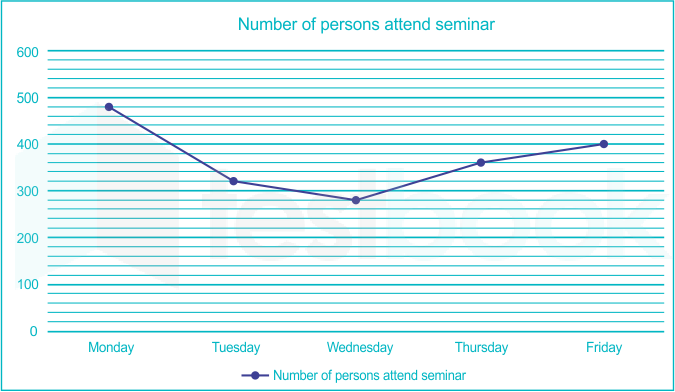
The line graph shows the number of persons attend seminar in five days of a week. 

44

Find the ratio between number of people attend seminar on Tuesday and Wednesday together and number of people attend seminar on Thursday and Friday together?

  1. ((a))

    15 : 19

  2. ((b))

    15 : 17

  3. ((c))

    15 : 29

  4. ((d))

    11 : 19

  5. ((e))

    13 : 19

Show Answer
Answer: ((a))

15 : 19

Calculation

People on Tuesday + Wednesday = 320 + 280 = 600

People on Thursday + Friday = 360 + 400 = 760

Required ratio:

600 : 760 = 15 : 19

Answer: 15 : 19

45

Number of people attend on Saturday is 20% more than the number of people attend seminar on Friday. Find the number of people attend on seminar on Saturday?

  1. ((a))

    420

  2. ((b))

    320

  3. ((c))

    380

  4. ((d))

    480

  5. ((e))

    520

Show Answer
Answer: ((d))

480

Calculation

People attend on Friday = 400

Saturday = 20% more than Friday

Thus:

[ 400 + [(20/100) ×400] = [400 + 80] = 480

480 people on Saturday

46

Find the difference between number of people attend seminar on Monday and Wednesday together and number of people attend seminar on Thursday and Tuesday together?

  1. ((a))

    68

  2. ((b))

    80

  3. ((c))

    85

  4. ((d))

    84

  5. ((e))

    66

Show Answer
Answer: ((b))

80

Calculation

People on Monday + Wednesday =

480 + 280 = 760

People on Thursday + Tuesday =

360 + 320 = 680

Required difference =

760 − 680 = 80

Answer: 80

47

Ratio of number of male and female who attend seminar on Tuesday is 5:3. Value number of number of females attend seminar on Tuesday is 5t. Find the value of t?

  1. ((a))

    24

  2. ((b))

    26

  3. ((c))

    28

  4. ((d))

    30

  5. ((e))

    32

Show Answer
Answer: ((a))

24

Calculation

On Tuesday, male : female = 5 : 3

Total people on Tuesday = 320

Number of females = 3 parts = [320 × 3 / 8] = 120

Given, number of females = 5t

Thus:

5t = 120

So, t = 24

Answer: 24

48

On Monday, 75% people attend seminar out of total number of people register the seminar. Find the number of people register the seminar?

  1. ((a))

    560

  2. ((b))

    720

  3. ((c))

    640

  4. ((d))

    620

  5. ((e))

    690

Show Answer
Answer: ((c))

640

Calculation

On Monday, 75% of registered people attended the seminar.

Let total registered people = x

Given:

75% of x = 480

 X = [480 × 100] / 75 = 640

640 people registered

49

Ratio of milk and water in 630 litre of mixture is 4 : 3. 140 litre mixture taken out. Find the quantity of milk now?

  1. ((a))

    220

  2. ((b))

    240

  3. ((c))

    260

  4. ((d))

    280

  5. ((e))

    250

Show Answer
Answer: ((d))

280

Given:

The ratio of milk to water in 630 liters of mixture is 4:3.

140 liters of the mixture is taken out.

Calculations:

The total parts of the mixture = 4 + 3 = 7 parts.

Quantity of milk in the mixture = (4/7) × 630 = 360 liters of milk.

Quantity of water in the mixture = (3/7) × 630 = 270 liters of water.

When 140 liters of the mixture is taken out, the ratio of milk and water in the 140 liters will also be 4:3.

Milk taken out = (4/7) × 140 = 80 liters.

So, the remaining milk = 360 - 80 = 280 liters.

∴ The quantity of milk now is 280 liters.

50

Simple interest at 8% rate of interest for 10 years is Rs. 17600. Find the principle?

  1. ((a))

    24000

  2. ((b))

    25000

  3. ((c))

    22000

  4. ((d))

    26000

  5. ((e))

    32000

Show Answer
Answer: ((c))

22000

Given:

Rate of interest (r) = 8%

Time (t) = 10 years

Simple Interest (SI) = ₹17,600

Formula used:

SI = P × r × t / 100

Calculations:

17600 = P × 8 × 10 / 100

⇒ 17600 = P × 80 / 100

⇒ 17600 = P × 0.8

⇒ P = 17600 / 0.8

⇒ P = ₹22,000

∴ The principal is ₹22,000.

51

When item sold at Rs. 1400 then there is profit percent is 40%. Find the profit amount when item sold at Rs. 1345?

  1. ((a))

    365

  2. ((b))

    356

  3. ((c))

    345

  4. ((d))

    354

  5. ((e))

    352

Show Answer
Answer: ((c))

345

Given:

When the item is sold at Rs. 1400, profit percent is 40%.

Let the cost price be C.

Formula used:

Profit = Selling Price - Cost Price

Profit percent = (Profit / Cost Price) × 100

Calculations:

Profit percent = 40%, so:

(1400 - C) / C = 40 / 100

⇒ (1400 - C) = 0.4C

⇒ 1400 = 1.4C

⇒ C = 1400 / 1.4 = Rs. 1000

Now, when the item is sold at Rs. 1345, profit = 1345 - 1000 = Rs. 345

∴ The profit amount when the item is sold at Rs. 1345 is Rs. 345.

52

What will come in the place of the question mark ‘?’ in the following question?

24 × 9 + 84 ÷ 14 = (?) + 62

  1. ((a))

    236

  2. ((b))

    186

  3. ((c))

    160

  4. ((d))

    320

  5. ((e))

    None of these.

Show Answer
Answer: ((b))

186

Given:

24 × 9 + 84 ÷ 14 = (?) + 62

Concept used:

Follow the BODMAS rule according to the table given below:

Calculation:

24 × 9 + 84 ÷ 14 = (?) + 62

⇒ 216 + 6 = (?) + 36

⇒ ? = 222 - 36 = 186

The value of ? is 186.

53

What will come in the place of the question mark ‘?’ in the following question?

60% of 135 - (√729 + ?) = 4

  1. ((a))

    90

  2. ((b))

    20

  3. ((c))

    50

  4. ((d))

    30

  5. ((e))

    5

Show Answer
Answer: ((c))

50

Given:

60% of 135 - (√729 + ?) = 4

Concept Used:

Follow the BODMAS rule according to the table given below:

Calculation:

60% of 135 - (√729 + ?) = 4

⇒ 135 × (60/100) - (27 + ?) = 4

⇒ 135 × (3/5) - 27 - ? = 4

⇒ 81 - 27 - 4 = ?

⇒ 50 = ?

 50 will come in place of the question mark ('?').

54

What will come in the place of the question mark ‘?’ in the following question?

 207 - 7√3 × 5√3 = 17 + ?

  1. ((a))

    6

  2. ((b))

    -85

  3. ((c))

    85

  4. ((d))

    95

  5. ((e))

    -95

Show Answer
Answer: ((c))

85

Given

207 - 7√3 × 5√3 = 17 + ?

Concept Used:

Follow the BODMAS rule according to the table given below:

Calculation:

207 - 7√3 × 5√3 = 17 + ?

⇒ 207 - 35 × 3 = 17 + ?

⇒ 207 - 105 = 17 + ?

⇒ 102 - 17 = ?

⇒ ? = 85

 85 will come in place of the question mark ('?').

55

What will come in the place of the question mark ‘?’ in the following question?

(13)2 + √169 × 17 – 26 × √81 = ?

  1. ((a))

    246

  2. ((b))

    256

  3. ((c))

    156

  4. ((d))

    166

  5. ((e))

    None of these.

Show Answer
Answer: ((c))

156

Given:

(13)2 + √169 × 17 – 26 × √81 = ?

Concept used:

Follow the BODMAS rule according to the table given below:

Calculation:

(13)2 + √169 × 17 – 26 × √81 = ?

⇒ (13)2 + √169 × 17 – 26 × √81 = ?

⇒ 169 + 221 – 234 = ?

⇒ ? = 156

The value of ? is 156.

56

What will come in the place of the question mark ‘?’ in the following question?

{16 × 2 + √ 2704}/(? + 4) = 12

  1. ((a))

    2

  2. ((b))

    0.5

  3. ((c))

    1

  4. ((d))

    4

  5. ((e))

    3

Show Answer
Answer: ((e))

3

Concept Used:

Follow the BODMAS rule according to the table given below:


Calculation:

⇒ {16 × 2 + √ 2704}/(? + 4) = 12

⇒ {32 + 52}/(? + 4) = 12

⇒ 84/12 = ? + 4

⇒ 7 = ? + 4

⇒ ? = 3

∴ The value of ? is 3.

57

What value can come in the place of the question mark (?) in the question below?

64 × (?% of 250) + 432 = 3632

  1. ((a))

    10

  2. ((b))

    20

  3. ((c))

    15

  4. ((d))

    30

  5. ((e))

    25

Show Answer
Answer: ((b))

20

Concept used:

Follow the BODMAS rule according to the table given below:

Calculation:

⇒ 64 × (?% of 250) + 432 = 3632

⇒ 64 × ?/100 × 250 = 3632 - 432

⇒ 16 × ? × 10 = 3200

⇒ ? = 20

∴ The value of ? is 20.

58

What will come in the place of the question mark ‘?’ in the following question? 

(12.25 + 8)1/2 × (1000)1/3 = ?

  1. ((a))

    15

  2. ((b))

    20

  3. ((c))

    30

  4. ((d))

    45

  5. ((e))

    10

Show Answer
Answer: ((d))

45

Given:

(12.25 + 8)1/2 × (1000)1/3 = ?

Concept Used:

Follow BODMAS rule to solve this question, as per the order given below,

Calculation:

(12.25 + 8)1/2 × (1000)1/3 = ?

⇒ (20.25)1/2 × (1000)1/3 = ?

⇒ 4.5 × (10) = ?

⇒ ? = 45

∴ The required value is 45

59

What will come in the place of the question mark ‘?’ in the following question?

5/12 × 480 + 150 = ?% of 875

  1. ((a))

    30

  2. ((b))

    35

  3. ((c))

    20

  4. ((d))

    40

  5. ((e))

    25

Show Answer
Answer: ((d))

40

Concept Used:

Follow BODMAS rule to solve this question, as per the order given below, 

Calculation:

⇒ 5/12 × 480 + 150 = ?% of 875

⇒ 200 + 150 = ?/100 × 875

⇒ 350 = ?/100 × 875

⇒ ? = 350 × 100/875

⇒ ? = 40

∴ The value of ? is 40

60

What will come in the place of the question mark ‘?’ in the following question?

(1/10) of (12.5 + 7.5) - 5 = ? - 10

  1. ((a))

    0

  2. ((b))

    5

  3. ((c))

    15

  4. ((d))

    10

  5. ((e))

    7

Show Answer
Answer: ((e))

7

Given:

(1/10) of (12.5 + 7.5) - 5 = ? - 10

Concept:

Follow the BODMAS rule according to the table given below:

Calculation:

(1/10) of (12.5 + 7.5) - 5 = ? - 10

⇒ (1/10) × 20 - 5 = ? - 10

⇒ 2 - 5 = ? - 10

⇒ ? = 10 - 3

⇒ ? = 7

∴ 7 will come in place of the question mark ('?').

61

What will come in the place of the question mark ‘?’ in the following question?

20% of 400 + 40 = ? + 30

  1. ((a))

    58

  2. ((b))

    118

  3. ((c))

    90

  4. ((d))

    110

  5. ((e))

    100

Show Answer
Answer: ((c))

90

Given:  

20% of 400 + 40 = ? + 30

Concept:

Follow the BODMAS rule according to the table given below:

Calculation:

20% of 400 + 40 = ? + 30

⇒ (1/5) × 400 + 40 = ? + 30

⇒ 80 + 40 = ? + 30

⇒ 120 = ? + 30

⇒ ? = 120 - 30

⇒ ? = 90

∴ 90 will come in place of the question mark ('?').

62

What will come in the place of the question mark ‘?’ in the following question?

48% of 250 + 3 × 7 - ? ÷ 9 = 137

  1. ((a))

    4

  2. ((b))

    18

  3. ((c))

    27

  4. ((d))

    54

  5. ((e))

    36

Show Answer
Answer: ((e))

36

Given:

48% of 250 + 3 × 7 - ? ÷ 9 = 137

Concept used:

Follow the BODMAS rule according to the table given below:

Calculation:

48% of 250 + 3 × 7 - ? ÷ 9 = 137

⇒ (48/100) × 250 + 21 - ? ÷ 9 = 137

⇒ 120 + 21 - ? ÷ 9 = 137

⇒ 141 - ? ÷ 9 = 137

⇒ ? ÷ 9 = 4

⇒ ? = 36

∴ 36 should come in place of the question mark (?).

63

What will come in the place of the question mark ‘?’ in the following question?

54% of 150 + 4 × ? = 9% of 2900

  1. ((a))

    35

  2. ((b))

    40

  3. ((c))

    45

  4. ((d))

    50

  5. ((e))

    55

Show Answer
Answer: ((c))

45

Given:

54% of 150 + 4 × ? = 9% of 2900

Concept used:

Follow the BODMAS rule according to the table given below:

Calculation:

54% of 150 + 4 × ? = 9% of 2900

⇒ (54/100) × 150 + 4 × ? = (9/100) × 2900

⇒ 81 + 4 × ? = 261

⇒ 4 × ? = 180

⇒ ? = 45

∴ 45 should come in place of the question mark (?).

64

What will come in the place of question mark ‘?’ in the following question?

20% of 225 + 62 = ?% of 180

  1. ((a))

    80

  2. ((b))

    75

  3. ((c))

    40

  4. ((d))

    50

  5. ((e))

    45

Show Answer
Answer: ((e))

45

Concept used:

We have to follow the BODMAS rule

Calculation:

⇒ 20% of 225 + 62 = ?% of 180

⇒ 20/100 × 225 +  62 = ?/100 × 180

⇒ 45 + 36 = ?/10 × 18

⇒ 81 × 10/18 = ?

⇒ ? = 45

∴ The value of ? is 45.

65

What will come in the place of the question mark ‘?’ in the following question?

20 × 7.5 + √ 225 = ? × 5

  1. ((a))

    24

  2. ((b))

    33

  3. ((c))

    45

  4. ((d))

    25

  5. ((e))

    30

Show Answer
Answer: ((b))

33

Concept Used:

Follow BODMAS rule to solve this question, as per the order given below, 

Calculation:

⇒  20 × 7.5 + √ 225 = ? × 5

⇒ 150 + 15 = ? × 5

⇒ 165 = ? × 5

⇒ ? = 33

∴ The value of ? is 33.

66

What will come in the place of the question mark ‘?’ in the following question?

(212 ÷ 27) × 5 + 180 = ?% of 680

  1. ((a))

    50

  2. ((b))

    30

  3. ((c))

    60

  4. ((d))

    20

  5. ((e))

    40

Show Answer
Answer: ((a))

50

Concept Used:

Follow BODMAS rule to solve this question, as per the order given below, 

Calculation:

⇒ (212 ÷ 27) × 5 + 180 = ?% of 680

⇒ (212 - 7) × 5 + 180 = (?/100) × 680

⇒ 25 × 5 + 180 = (?/10) × 68

⇒ 32 × 5 + 180 = (?/10) × 68

⇒ 160 + 180 = (?/10) × 68

⇒ 340 × (10/68) = ?

⇒ ? = 50

∴ The value of ? is 50

67

Downstream speed of a boat is 16 km /hr. Speed of stream is 40% less than the speed of boat. Find the speed of boat?

  1. ((a))

    11 km /h

  2. ((b))

    10 km /h

  3. ((c))

    12 km/h

  4. ((d))

    18 km/h

  5. ((e))

    9  km /h

Show Answer
Answer: ((b))

10 km /h

Calculation

Let speed of boat = x km/h.

Then, speed of stream = x − 0.4x = 0.6x

Downstream speed = boat + stream 

⇒ x + 0.6x = 1.6x

Given 1.6x = 16.

Thus,

⇒ x = 16/ 1.6 ​= 10 km/h

68

Perimeter of square is 64 m. Length of rectangle is 4 m more than the side of square. Breadth of rectangle is 12 m. Find the area of rectangle?

  1. ((a))

    240

  2. ((b))

    220

  3. ((c))

    260

  4. ((d))

    200

  5. ((e))

    310

Show Answer
Answer: ((a))

240

Calculation

First, side of square:

Side = 64/4 = 16 m

Length of rectangle = 16 + 4 = 20 

Area of rectangle = Length × Breadth = 20 × 12 = 240

69

A and B together complete a work in 20 days. B alone complete the work in 30 days. Find in how many days A alone complete the work?

  1. ((a))

    50

  2. ((b))

    60

  3. ((c))

    40

  4. ((d))

    45

  5. ((e))

    72

Show Answer
Answer: ((b))

60

Calculation

Total work =  LCM of 20 and 30 = 60

Efficiency of B is 60 /30 = 2

Total Efficiency of A and B together is 60/20 = 3

So, efficiency of A is 3 -2 = 1

So, A alone complete the work in 60 / 1 = 60 days

The table graphs shows the number of boys and girls study in five different schools [ A, B, C, D and E].


SchoolNumber of BoysNumber of girls
A420400
B380200
C320400
D580500
E350450
70

Find the difference between total number of boys and total number of girls in all schools together?

  1. ((a))

    120

  2. ((b))

    140

  3. ((c))

    160

  4. ((d))

    320

  5. ((e))

    100

Show Answer
Answer: ((e))

100

Calculation

Total boys = 420 + 380 + 320 + 580 + 350 = 2050

Total girls = 400 + 200 + 400 + 500 + 450 = 1950

Difference = 2050 − 1950 = 100

71

In per 16 students there is one teacher allocated in school E. Find the total number of teachers in school E?

  1. ((a))

    64

  2. ((b))

    50

  3. ((c))

    48

  4. ((d))

    52

  5. ((e))

    62

Show Answer
Answer: ((b))

50

Calculation

Total students in E = 350 + 450 = 800

Students per teacher = 16

Number of teachers = 800 / 16 = 50

Answer: 50 teachers

72

Number of boys in school F is 20% more than number of boys in school E. Total number of students in school F is 950. Find the number of girls in school F?

  1. ((a))

    620

  2. ((b))

    630

  3. ((c))

    530

  4. ((d))

    540

  5. ((e))

    500

Show Answer
Answer: ((c))

530

Calculation

Number of boys in E = 350

Boys in F = 20% more than 350 = [350 + [20/100] × 350]] = 350 + 70 = 420

Total students in F = 950

Girls in F = 950 - 420 = 530

Answer: 530

73

Ratio of number of boys and girls in school C is x:y. Find the value of x + y ? [ratio is lowest possible integer]

  1. ((a))

    3

  2. ((b))

    9

  3. ((c))

    7

  4. ((d))

    6

  5. ((e))

    5

Show Answer
Answer: ((b))

9

Calculation

Boys : Girls in C = 320 : 400

Simplify the ratio:

320 : 400 = 4 : 5

Thus, x = 4 and y = 5

[x + y] = [4 + 5] =9

Answer: 9

74

Total number of students [boys + girls] in school A is approximately what percent of total number of students [ boys + girls] in school B?

  1. ((a))

    141%

  2. ((b))

    145%

  3. ((c))

    225%

  4. ((d))

    120%

  5. ((e))

    85%

Show Answer
Answer: ((a))

141%

Calculation

Total students in A = 420 + 400 = 820

Total students in B = 380 + 200 = 580

Now, required percentage = [820/580] × 100 = 141.38%

Approximate percentage = 141%

75

What should come in place of the question mark '?' in the following number series?

3, 4, 8, 17, 33, ?

  1. ((a))

    67

  2. ((b))

    65

  3. ((c))

    60

  4. ((d))

    53

  5. ((e))

    58

Show Answer
Answer: ((e))

58

Calculation;

The given number series follows the pattern:

⇒ 3 + 12 = 4

⇒ 4 + 22 = 8

⇒ 8 + 32 = 17

⇒ 17 + 42 = 33

⇒ 33 + 52 = 58

The value of ? is 58

76

What will come in the place of the question mark ‘?’ in the following question?

10, 15, 25, ?, 85, 165

  1. ((a))

    45

  2. ((b))

    60

  3. ((c))

    55

  4. ((d))

    75

  5. ((e))

    40

Show Answer
Answer: ((a))

45

Given:

The number series:

10, 15, 25, ?, 85, 165

Concept Used:

Number series following a fixed pattern.

Calculation;

The given number series follows the pattern:

10 + (20 × 5) = 10 + 5 = 15

15 + (21 × 5) = 15 + 10 = 25

25 + (22 × 5) = 25 + 20 = 45

45 + (23 × 5) = 45 + 40 = 85

85 + (24 × 5) = 85 + 80 = 165

∴ The Missing Number in the given number series is 45

77

What should come in place of the question mark ‘?’ in the following number series ?

21, 32, 54, ?, 131, 186

  1. ((a))

    65

  2. ((b))

    87

  3. ((c))

    67

  4. ((d))

    85

  5. ((e))

    None of these

Show Answer
Answer: ((b))

87

Calculation:

The series follows following pattern

⇒ 21

⇒ 21 + (11 × 1) = 32

⇒ 32 + (11 × 2) = 54

⇒ 54 + (11 × 3) = 87

⇒ 87 + (11 × 4) = 131

⇒ 131 + (11 × 5) = 186

∴ The missing number in place of ‘?’ is 87

78

What should come in place of the question mark ‘?’ in the following number series?

20, 21, 29, 56, ?, 245

  1. ((a))

    140

  2. ((b))

    130

  3. ((c))

    125

  4. ((d))

    120

  5. ((e))

    None of these

Show Answer
Answer: ((d))

120

Calculation:

The series follows the following pattern

⇒ 20 + 13 = 21

⇒ 21 + 23 = 29

⇒ 29 + 33 = 56

⇒ 56 + 43 = 120

⇒ 120 + 53 = 245

The Required term in the series will be 120

79

What should come in place of question mark ‘?’ in the following number series?

25, 30, 29, 34, 33, 38, ?

  1. ((a))

    47

  2. ((b))

    27

  3. ((c))

    45

  4. ((d))

    37

  5. ((e))

    None

Show Answer
Answer: ((d))

37

Calculation:

The series follows the following pattern

⇒ 25 + 5 = 30

⇒ 30 – 1 = 29

⇒ 29 + 5 = 34

⇒ 34 – 1 = 33

⇒ 33 + 5 = 38

⇒ 38 – 1 = 37

The value of ? is 37

80

A bag contains 1 Re, 2 Rs and 5 Rs coins in the ratio 5 : 3 : 2 amounting to Rs. 525. Find the number of coins of each type respectively.

  1. ((a))

    100, 50, 100

  2. ((b))

    125, 75, 50

  3. ((c))

    50, 75, 125

  4. ((d))

    150, 25, 75

  5. ((e))

    25, 150, 75

Show Answer
Answer: ((b))

125, 75, 50

let the ratio be x

Number of 1 Re coin = 5x

Number of 2 Rs. Coin = 3x

Number of 5 Rs. Coin = 2x

So, total amount = 5x × 1 + 3x × 2 + 2x × 5 = 21x

But the given amount = 525

So, 21x = 525

Hence, x = 25

So the number of 1 Re coin = 25 × 5 = 125

So the number of 2 Rs. Coin = 25 × 3 = 75

So the number of 5 Rs. Coin = 25 × 2 = 50

Attempt this paper under real exam conditions

Timed interface, section switching, instant scoring, and question-by-question analytics — free.

Start Timed Attempt