Official Paper

RRB Clerk Prelims Memory Based Paper (Held On: 17 August 2024 Shift 2) (Previous Year Paper)

80 questions · 45 minutes · with answers · free

Reasoning (40 questions)

Direction: Study the following information to answer the given questions:

Seven boxes M, N, O, P, Q, R and S are kept one above another to form a stack. The topmost box is numbered as 1, the box below it as 2 and so on till the lowermost box as 7. Box P is three boxes above box O, which is an odd numbered box. Box M is just above box S. Box Q is prime numbered box but not adjacent to box P. Box N is above box R, which is not adjacent to box P.

1

Which box is the topmost box?

  1. ((a))

    Box N

  2. ((b))

    Box M

  3. ((c))

    Box Q

  4. ((d))

    Box R

  5. ((e))

    Box S

Show Answer
Answer: ((a))

Box N

Boxes: M, N, O, P, Q, R and S.

  1. Box P is three boxes above box O, which is an odd numbered box. So, box O can be either box 7 or box 5.

  2. Box Q is prime numbered box but not adjacent to box P. So, box Q can be either box 2 in case 1 or box 7 in case 2.

Box NumberCase 1Case 2
1
2QP
3
4P
5O
6
7OQ


  1. Box M is just above box S.
Box NumberCase 1Case 2
1
2QP
3M
4PS
5MO
6S
7OQ


  1. Box N is above box R, which is not adjacent to box P. (So, case 1 would be invalid)
Box NumberBoxes
1N
2P
3M
4S
5O
6R
7Q
<br>

Hence, box N is the topmost box.

2

How many boxes are above box O?

  1. ((a))

    Five

  2. ((b))

    Three

  3. ((c))

    Four

  4. ((d))

    Two

  5. ((e))

    Six

Show Answer
Answer: ((c))

Four

Boxes: M, N, O, P, Q, R and S.

  1. Box P is three boxes above box O, which is an odd numbered box. So, box O can be either box 7 or box 5.

  2. Box Q is prime numbered box but not adjacent to box P. So, box Q can be either box 2 in case 1 or box 7 in case 2.

Box NumberCase 1Case 2
1
2QP
3
4P
5O
6
7OQ


  1. Box M is just above box S.
Box NumberCase 1Case 2
1
2QP
3M
4PS
5MO
6S
7OQ


  1. Box N is above box R, which is not adjacent to box P. (So, case 1 would be invalid)
Box NumberBoxes
1N
2P
3M
4S
5O
6R
7Q
<br>

Hence, four boxes are above box O.

3

If all the boxes are arranged in alphabetical order from top to bottom then which box remains at same position?

  1. ((a))

    Box M

  2. ((b))

    Box R

  3. ((c))

    Box Q

  4. ((d))

    Box S

  5. ((e))

    Box P

Show Answer
Answer: ((b))

Box R

Boxes: M, N, O, P, Q, R and S.

  1. Box P is three boxes above box O, which is an odd numbered box. So, box O can be either box 7 or box 5.

  2. Box Q is prime numbered box but not adjacent to box P. So, box Q can be either box 2 in case 1 or box 7 in case 2.

Box NumberCase 1Case 2
1
2QP
3
4P
5O
6
7OQ


  1. Box M is just above box S.
Box NumberCase 1Case 2
1
2QP
3M
4PS
5MO
6S
7OQ


  1. Box N is above box R, which is not adjacent to box P. (So, case 1 would be invalid)
Box NumberBoxesAlphabetical order
1NM
2PN
3MO
4SP
5OQ
6RR
7QS
<br>

Hence, box R remains at the same position when boxes are arranged in alphabetical order from top to bottom.

4

Box _______ is just above box O.

  1. ((a))

    M

  2. ((b))

    P

  3. ((c))

    N

  4. ((d))

    S

  5. ((e))

    Q

Show Answer
Answer: ((d))

S

Boxes: M, N, O, P, Q, R and S.

  1. Box P is three boxes above box O, which is an odd numbered box. So, box O can be either box 7 or box 5.

  2. Box Q is prime numbered box but not adjacent to box P. So, box Q can be either box 2 in case 1 or box 7 in case 2.

Box NumberCase 1Case 2
1
2QP
3
4P
5O
6
7OQ


  1. Box M is just above box S.
Box NumberCase 1Case 2
1
2QP
3M
4PS
5MO
6S
7OQ


  1. Box N is above box R, which is not adjacent to box P. (So, case 1 would be invalid)
Box NumberBoxes
1N
2P
3M
4S
5O
6R
7Q
<br>

Hence, box S is just above box O.

5

How many boxes are there between P and R?

  1. ((a))

    Two

  2. ((b))

    None

  3. ((c))

    Four

  4. ((d))

    Three

  5. ((e))

    One

Show Answer
Answer: ((d))

Three

Boxes: M, N, O, P, Q, R and S.

  1. Box P is three boxes above box O, which is an odd numbered box. So, box O can be either box 7 or box 5.

  2. Box Q is prime numbered box but not adjacent to box P. So, box Q can be either box 2 in case 1 or box 7 in case 2.

Box NumberCase 1Case 2
1
2QP
3
4P
5O
6
7OQ


  1. Box M is just above box S.
Box NumberCase 1Case 2
1
2QP
3M
4PS
5MO
6S
7OQ


  1. Box N is above box R, which is not adjacent to box P. (So, case 1 would be invalid)
Box NumberBoxes
1N
2P
3M
4S
5O
6R
7Q
<br>

Hence, there are three boxes between P and R.

Direction: Study the following information carefully and answer the below questions.

A family consists of seven members and two married couples. No single parent has a child. B is the father-in-law of O. P is the brother-in-law of O and vice versa. S is the only daughter of V who is the maternal grandmother of H. P has only one brother. H is the daughter of S.S and G is siblings.

6

How G is related to S?

  1. ((a))

    Sister

  2. ((b))

    Brother

  3. ((c))

    Sister-in-law

  4. ((d))

    Brother-in-law

  5. ((e))

    Can't be determined

Show Answer
Answer: ((b))

Brother

Given person: B, G, H, O, P, S, and V

  1. A family consists of seven members and two married couples.

  2. No single parent has a child. B is the father-in-law of O.

  3. P is the brother-in-law of O and vice versa.

  1. S is the only daughter of V who is the maternal grandmother of H.

  2. P has only one brother.

  3. H is the daughter of S.

  4. S and G are siblings.

Therefore, the final arrangement is, 

Hence, G is the brother of S.

7

Which of the following statement is true?

  1. ((a))

    B has only one son

  2. ((b))

    V is the mother-in-law of P

  3. ((c))

    V has three kids

  4. ((d))

    H is the only son of O

  5. ((e))

    None of the above

Show Answer
Answer: ((c))

V has three kids

Given person: B, G, H, O, P, S, and V

  1. A family consists of seven members and two married couples.

  2. No single parent has a child. B is the father-in-law of O.

  3. P is the brother-in-law of O and vice versa.

  1. S is the only daughter of V who is the maternal grandmother of H.

  2. P has only one brother.

  3. H is the daughter of S.

  4. S and G are siblings.

Therefore, the final arrangement is, 

Hence, V has three kids is the correct answer.

8

Who among the following is Uncle of H?

  1. ((a))

    G

  2. ((b))

    P

  3. ((c))

    S

  4. ((d))

    B

  5. ((e))

    Both G and P

Show Answer
Answer: ((e))

Both G and P

Given person: B, G, H, O, P, S, and V

  1. A family consists of seven members and two married couples.

  2. No single parent has a child. B is the father-in-law of O.

  3. P is the brother-in-law of O and vice versa.

  1. S is the only daughter of V who is the maternal grandmother of H.

  2. P has only one brother.

  3. H is the daughter of S.

  4. S and G are siblings.

Therefore, the final arrangement is, 

Hence, Both G and P are the uncles of H.

9

Direction: Some statements are given followed by some conclusions. You have to consider the statements to be true even if they seem to be at variance from commonly known facts. You have to decide which of the given conclusions if any, follow from the given statements.

Statements:

All Phone are Laptop.

Only a few Laptop are Stylus.

No Laptop is Tablet.

Conclusions:

I. All Stylus can be Tablet.

II. No Tablet is Phone.

  1. ((a))

    If only conclusion I follows.

  2. ((b))

    If only conclusion II follows.

  3. ((c))

    If either conclusion I or II follows.

  4. ((d))

    If neither conclusion I nor II follows.

  5. ((e))

    If both conclusions I and II follow.

Show Answer
Answer: ((b))

If only conclusion II follows.

The least possible Venn diagram for the given statements is as follows-

Conclusions:

I. All Stylus can be Tablet → False (As some Stylus are Laptop and no Laptop are Tablet, so that Stylus which are Laptop will never be Tablet)

II. No Tablet is Phone → True (As ‘All phones are laptops’ and ‘No Laptop is Tablet’)

Hence, only conclusion II follows.

10

Direction: In the question below are given three statements followed by two conclusions numbered I and II. You have to take the given statements to be true even if they seem to be at variance with commonly known facts. Read all the conclusions and then decide which of the given conclusions logically follows from the given statements disregarding commonly known facts.

Statements:

All roses are blue.

No blue is green.

Only a few green are white.

Conclusions:

I. All roses can never be green.

II. Some white can be blue.

  1. ((a))

    Only conclusion I follows.

  2. ((b))

    Either conclusion I or conclusion II follows.

  3. ((c))

    None follows.

  4. ((d))

    Both conclusion I and II follow.

  5. ((e))

    Only conclusion II follow.

Show Answer
Answer: ((d))

Both conclusion I and II follow.

The least possible Venn diagram for the given statements is as follows

Conclusions:

I. All roses can never be green → True (All roses are blue and no blue is a green, so rose can never be green)

II. Some white can be blue → True (This is a possibility which can be true as shown below)

Hence, both conclusion I and II follow.

Additional Information:

  1. Only a few green are white. → Some green are white + Some green are not white.
  2. The word 'can be' depicts possibility.
11

Direction: In the question below are given three statements followed by two conclusions numbered I and II. You have to take the given statements to be true even if they seem to be at variance with commonly known facts. Read all the conclusions and then decide which of the given conclusions logically follows from the given statements disregarding commonly known facts.

Statements:

All maps are roads.

Some roads are circles.

No circle is a line.

Conclusions:

I. Some lines being road is a possibility.

II. No map is a line.

  1. ((a))

    Both conclusion I and II follow.

  2. ((b))

    Only conclusion II follows.

  3. ((c))

    Either conclusion I or conclusion II follows.

  4. ((d))

    Only conclusion I follows.

  5. ((e))

    Neither conclusion I nor conclusion II follows.

Show Answer
Answer: ((d))

Only conclusion I follows.

The least possible Venn diagram for the given statements is as follows

Conclusions:

I. Some lines being road is a possibility → True (Possibility is true as shown below)

II. No map is a line → False (It is a possibility but not definite)

Hence, only conclusion I follows.

Direction: Study the given information carefully and answer the following questions-

VET     CLA     XAW     DAS     NAS

12

In the given words, if we replace the first and third letters of each word with the letters which come immediately before and after them respectively in the English alphabet, then how many words thus formed are meaningful?

  1. ((a))

    Two

  2. ((b))

    Three

  3. ((c))

    One

  4. ((d))

    Four

  5. ((e))

    None of the above

Show Answer
Answer: ((b))

Three

If we replace the first and third letters of each word with the letters which come immediately before and after them respectively in the English alphabet, then the words formed are as follows:

VET → UEU

CLA → BLB

XAW → WAX

DAS → CAT

NAS → MAT

Of these words, WAX, CAT, and MAT are meaningful.

Hence, three meaningful words are formed.

13

In the given words, if the first letter is interchanged with the third letter, and after that, the second letter is interchanged with the first letter, then how many words thus formed starts with a vowel?

  1. ((a))

    One

  2. ((b))

    Two

  3. ((c))

    Three

  4. ((d))

    Four

  5. ((e))

    Five

Show Answer
Answer: ((d))

Four

From the given information it can be clearly seen that at first the first and the third letters are interchanged, and after that, the first and second letters are interchanged.

Let us consider “123” as a word containing three letters.

Now, if we interchange the first and the third letter, we get “321”.

Again, if we interchange the first and the second letters in the word “321”, we get a new word i.e. “231”.

So, this is the ultimate operation that we have to apply over the given words and as a result, we get:

VET → ETV

CLA → LAC

XAW → AWX

DAS → ASD

NAS → ASN

Thus, we can see that ETV, AWX, ASD, and ASN are the four words that start with a vowel.

Hence, there are four words that start with a vowel.

14

Arrange the given words, in alphabetical order according to the English dictionary, from left to right. Which word thus formed comes at the second place from the right end after the rearrangement?

  1. ((a))

    VET

  2. ((b))

    DAS

  3. ((c))

    CLA

  4. ((d))

    XAW

  5. ((e))

    NAS

Show Answer
Answer: ((a))

VET

If we arrange the given words in alphabetical order according to the English dictionary from left to right, we get:

Left End CLA   DAS  NAS  VET  XAW Right End

Hence, VET is the word that is at the second place from the right end after rearrangement.

15

If the second and the third letters are interchanged within the given words, then how many words thus formed will not end with a vowel?

  1. ((a))

    Five

  2. ((b))

    Three

  3. ((c))

    Two

  4. ((d))

    Four

  5. ((e))

    One

Show Answer
Answer: ((e))

One

If the second and the third letters are interchanged within the given words, then we have:

VET → VTE

CLA → CAL

XAW → XWA

DAS → DSA

NAS → NSA

Thus, CAL is the only word that does not end with a vowel.

Hence, only one will not end with a vowel.

16

If the given words are arranged in reverse dictionary order from left to right, then find the number of letters in the English alphabet that lies in between the second letter from the left end and the second letter from the right end?

  1. ((a))

    11

  2. ((b))

    12

  3. ((c))

    10

  4. ((d))

    9

  5. ((e))

    None of the above

Show Answer
Answer: ((c))

10

If the given words are arranged in reverse dictionary order from left to right, then we get the words as follows:

Left End XAW  VET  NAS  DAS  CLA Right End

Second letter from the left end → A

Second letter from the right end → L

The letters in the English alphabet that come in between A and L are B, C, D, E, F, G, H, I, J, K.

Hence, there are ten letters between A and L.

17

If it is possible to make only one meaningful English word with the 2nd, 4th, 5th, and 8th letters of the word STRENGTH, which of the following will be the third letter of that word? If no such word can be made give ‘X’ as the answer and if more than one such word can be made give ‘Y’ as the answer.

  1. ((a))

    T

  2. ((b))

    N

  3. ((c))

    Y

  4. ((d))

    X

  5. ((e))

    E

Show Answer
Answer: ((e))

E

Given WordS T R E N G T H
Chosen lettersT, E, N, H
possible wordTHEN
<br>

Hence, the third letter is E.

Mistake Points

  • HENT is a word that is no longer in use. So, it should not be considered.

Directions: Read the following information carefully and answer the questions given below.

A certain number of people are sitting in a row facing the North direction. Four people are sitting between C and T. Five people are sitting between E and C. K is sitting second to the right of E. T is sitting exactly between O and V, who is sitting third to the right of C. Only three persons are sitting to the left of K and O is sitting second to the left of I.

18

How many people are sitting in the row?

  1. ((a))

    Thirteen

  2. ((b))

    Fourteen

  3. ((c))

    Seventeen

  4. ((d))

    Twenty

  5. ((e))

    Eighteen

Show Answer
Answer: ((c))

Seventeen

According to the given information,

1. Four people are sitting between C and T.

2. Five people are sitting between E and C.

3. K is sitting second to the right of E.

4. T is sitting exactly between O and V, who is sitting third to the right of C.


5. Only three persons are sitting to the left of K and O is sitting second to the left of I. Here the case (i) - A, case (ii) - A and case (ii) - B gets eliminated as it is given that only three people sit to the left of K.

Hence, Seventeen is the correct answer.

19

Who is sitting second to the left of O?

  1. ((a))

    I

  2. ((b))

    V

  3. ((c))

    C

  4. ((d))

    T

  5. ((e))

    K

Show Answer
Answer: ((d))

T

According to the given information,

1. Four people are sitting between C and T.

2. Five people are sitting between E and C.

3. K is sitting second to the right of E.

4. T is sitting exactly between O and V, who is sitting third to the right of C.


5. Only three persons are sitting to the left of K and O is sitting second to the left of I. Here the case (i) - A, case (ii) - A and case (ii) - B gets eliminated as it is given that only three people sit to the left of K.


Hence, T is the correct answer.

20

How many people are sitting between K and T?

  1. ((a))

    Six

  2. ((b))

    Five

  3. ((c))

    Seven

  4. ((d))

    Ten

  5. ((e))

    Eight

Show Answer
Answer: ((e))

Eight

According to the given information,

1. Four people are sitting between C and T.

2. Five people are sitting between E and C.

3. K is sitting second to the right of E.

4. T is sitting exactly between O and V, who is sitting third to the right of C.


5. Only three persons are sitting to the left of K and O is sitting second to the left of I. Here the case (i) - A, case (ii) - A and case (ii) - B gets eliminated as it is given that only three people sit to the left of K.

Hence, Eight is the correct answer.

Directions: Read the following information carefully and answer the questions.

Six events, A, B, C, D, E, and F take place on two different dates, 7th and 22nd, of three different months, August, September, and October. All the information given are not necessarily in the same order. 

Event B takes place immediately after event E. Event D takes place in the month of September. Event C is the last event to take place. Event A doesn't take place in the month of August. Event F takes place on the first available date in the month of September.

21

Which is the first event to take place?

  1. ((a))

    A

  2. ((b))

    F

  3. ((c))

    D

  4. ((d))

    E

  5. ((e))

    B

Show Answer
Answer: ((d))

E

Given: Six events, A, B, C, D, E, and F take place on two different dates, 7th and 22nd, of three different months, August, September, and October. 

Based on the given conditions, we get the following possibilities:

1. Event D takes place in the month of September. Event C is the last event to take place.

Combining these, we get-

MONTHSDATESEVENT
CASE 1CASE 2
AUGUST7TH
22ND
SEPTEMBER7THD
22NDD
OCTOBER7TH
22NDCC


2. Event F takes place on the first available date in the month of September. 

This eliminates Case 1 from above and we get-

MONTHSDATESEVENT
AUGUST7TH
22ND
SEPTEMBER7THF
22NDD
OCTOBER7TH
22NDC


3. Event A doesn't take place in the month of August. 

From this, we get-

MONTHSDATESEVENT
AUGUST7TH
22ND
SEPTEMBER7THF
22NDD
OCTOBER7THA
22NDC


4. Event B takes place immediately after event E. 

From this we get the final arrangement as follows-

MONTHSDATESEVENT
AUGUST7THE
22NDB
SEPTEMBER7THF
22NDD
OCTOBER7THA
22NDC


Therefore, from the above arrangement, we see that event E is the first event to take place. 

Hence, event E is the first event to take place.

22

Which event takes place on the 22nd of September?

  1. ((a))

    E

  2. ((b))

    C

  3. ((c))

    A

  4. ((d))

    F

  5. ((e))

    D

Show Answer
Answer: ((e))

D

Given: Six events, A, B, C, D, E, and F take place on two different dates, 7th and 22nd, of three different months, August, September, and October. 

Based on the given conditions, we get the following possibilities:

1. Event D takes place in the month of September. Event C is the last event to take place.

Combining these, we get-

MONTHSDATESEVENT
CASE 1CASE 2
AUGUST7TH
22ND
SEPTEMBER7THD
22NDD
OCTOBER7TH
22NDCC


2. Event F takes place on the first available date in the month of September. 

This eliminates Case 1 from above and we get-

MONTHSDATESEVENT
AUGUST7TH
22ND
SEPTEMBER7THF
22NDD
OCTOBER7TH
22NDC


3. Event A doesn't take place in the month of August. 

From this, we get-

MONTHSDATESEVENT
AUGUST7TH
22ND
SEPTEMBER7THF
22NDD
OCTOBER7THA
22NDC


4. Event B takes place immediately after event E. 

From this we get the final arrangement as follows-

MONTHSDATESEVENT
AUGUST7THE
22NDB
SEPTEMBER7THF
22NDD
OCTOBER7THA
22NDC


Therefore, from the above arrangement, we see that event D takes place on the 22nd of September. 

Hence, event D takes place on the 22nd of September.

23

Which is the second last event to take place?

  1. ((a))

    B

  2. ((b))

    F

  3. ((c))

    D

  4. ((d))

    A

  5. ((e))

    C

Show Answer
Answer: ((d))

A

Given: Six events, A, B, C, D, E, and F take place on two different dates, 7th and 22nd, of three different months, August, September, and October. 

Based on the given conditions, we get the following possibilities:

1. Event D takes place in the month of September. Event C is the last event to take place.

Combining these, we get-

MONTHSDATESEVENT
CASE 1CASE 2
AUGUST7TH
22ND
SEPTEMBER7THD
22NDD
OCTOBER7TH
22NDCC


2. Event F takes place on the first available date in the month of September. 

This eliminates Case 1 from above and we get-

MONTHSDATESEVENT
AUGUST7TH
22ND
SEPTEMBER7THF
22NDD
OCTOBER7TH
22NDC


3. Event A doesn't take place in the month of August. 

From this, we get-

MONTHSDATESEVENT
AUGUST7TH
22ND
SEPTEMBER7THF
22NDD
OCTOBER7THA
22NDC


4. Event B takes place immediately after event E. 

From this we get the final arrangement as follows-

MONTHSDATESEVENT
AUGUST7THE
22NDB
SEPTEMBER7THF
22NDD
OCTOBER7THA
22NDC


Therefore, from the above arrangement, we see that event A is the second last event to take place. 

Hence, event A is the second last event to take place.

24

How many events take place between B and C?

  1. ((a))

    Four

  2. ((b))

    None

  3. ((c))

    Three

  4. ((d))

    Two

  5. ((e))

    One

Show Answer
Answer: ((c))

Three

Given: Six events, A, B, C, D, E, and F take place on two different dates, 7th and 22nd, of three different months, August, September, and October. 

Based on the given conditions, we get the following possibilities:

1. Event D takes place in the month of September. Event C is the last event to take place.

Combining these, we get-

MONTHSDATESEVENT
CASE 1CASE 2
AUGUST7TH
22ND
SEPTEMBER7THD
22NDD
OCTOBER7TH
22NDCC


2. Event F takes place on the first available date in the month of September. 

This eliminates Case 1 from above and we get-

MONTHSDATESEVENT
AUGUST7TH
22ND
SEPTEMBER7THF
22NDD
OCTOBER7TH
22NDC


3. Event A doesn't take place in the month of August. 

From this, we get-

MONTHSDATESEVENT
AUGUST7TH
22ND
SEPTEMBER7THF
22NDD
OCTOBER7THA
22NDC


4. Event B takes place immediately after event E. 

From this we get the final arrangement as follows-

MONTHSDATESEVENT
AUGUST7THE
22NDB
SEPTEMBER7THF
22NDD
OCTOBER7THA
22NDC


Therefore, from the above arrangement, we see that three events take place between B and C. 

Hence, three events take place between B and C.

25

Which event takes place immediately after event B?

  1. ((a))

    A

  2. ((b))

    C

  3. ((c))

    D

  4. ((d))

    E

  5. ((e))

    F

Show Answer
Answer: ((e))

F

Given: Six events, A, B, C, D, E, and F take place on two different dates, 7th and 22nd, of three different months, August, September, and October. 

Based on the given conditions, we get the following possibilities:

1. Event D takes place in the month of September. Event C is the last event to take place.

Combining these, we get-

MONTHSDATESEVENT
CASE 1CASE 2
AUGUST7TH
22ND
SEPTEMBER7THD
22NDD
OCTOBER7TH
22NDCC


2. Event F takes place on the first available date in the month of September. 

This eliminates Case 1 from above and we get-

MONTHSDATESEVENT
AUGUST7TH
22ND
SEPTEMBER7THF
22NDD
OCTOBER7TH
22NDC


3. Event A doesn't take place in the month of August. 

From this, we get-

MONTHSDATESEVENT
AUGUST7TH
22ND
SEPTEMBER7THF
22NDD
OCTOBER7THA
22NDC


4. Event B takes place immediately after event E. 

From this we get the final arrangement as follows-

MONTHSDATESEVENT
AUGUST7THE
22NDB
SEPTEMBER7THF
22NDD
OCTOBER7THA
22NDC


Therefore, from the above arrangement, we see that event F takes place immediately after event B. 

Hence, event F takes place immediately after event B.

26

How many pairs of letters are there in the word “STATEMENT” each of which has as many letters between them as in the English alphabetical series in both forward and backward directions?

  1. ((a))

    Four

  2. ((b))

    Three

  3. ((c))

    Two

  4. ((d))

    One

  5. ((e))

    None

Show Answer
Answer: ((b))

Three

The alphabets are positioned in the following order:

The word can be presented as follows,

Forward: ST, AE

Backward: NT

Hence, we can see that 3 such pairs are there.

Direction: Study the following information carefully and answer the questions given below.

In a certain code language:

'practice things regularly for results' is written as 'ma iv tw rb pb',

'satisfaction comes in good results' is written as ' fa vc jk nd pb',

'learn regularly with good results' is written as 'aa tw vx nd pb',

'satisfaction is with continue practice' is written as 'fa lm vx cq ma'.

27

What is the code for 'practice regularly'?

  1. ((a))

    uv jk

  2. ((b))

    ma tw

  3. ((c))

    pb tw

  4. ((d))

    ma rb

  5. ((e))

    None of these

Show Answer
Answer: ((b))

ma tw

The codes are as follows:

Hence, The code for 'practice regularly' is 'ma tw'

28

What is the code for 'results with practice'?

  1. ((a))

    ma vx tw

  2. ((b))

    jk fa pb 

  3. ((c))

    ma vx pb

  4. ((d))

    pb vx fa

  5. ((e))

    None follows

Show Answer
Answer: ((c))

ma vx pb

The codes are as follow:

Hence, The code for 'results with practice' is 'ma vx pb'.

29

What is the code for 'continue'?

  1. ((a))

    cq

  2. ((b))

    fa

  3. ((c))

    lm

  4. ((d))

    Either I or II

  5. ((e))

    Either I or III

Show Answer
Answer: ((e))

Either I or III

The codes are as follows:

Hence, The code for 'continues' is 'cq' or 'lm'.

30

What is the code for 'results'?

  1. ((a))

    tw

  2. ((b))

    rb

  3. ((c))

    Either 'tw' or 'pb'

  4. ((d))

    pb

  5. ((e))

    None follows

Show Answer
Answer: ((d))

pb

The codes are as follows:

Hence, The code for 'results' is 'pb'.

31

What would be the possible code for 'practice daily'?

  1. ((a))

    ma uv

  2. ((b))

    pb cq

  3. ((c))

    rb fa

  4. ((d))

    tw lu

  5. ((e))

    ma iv

Show Answer
Answer: ((a))

ma uv

The codes are as follows: 

Hence, The code for 'practice daily' is 'ma uv'.

32

Directions: In the following question assuming the given statements to be true, find which of the conclusion among given conclusions is/are definitely true and then give your answers accordingly.

Statements: 

P < Q = R; V ≤ S ≤ T < R

Conclusions:

I. T > V

II. T = V

  1. ((a))

    Only Conclusion I is True

  2. ((b))

    Only Conclusions II is True.

  3. ((c))

    Either Conclusion I or II is True.

  4. ((d))

    Both Conclusions I and II are True.

  5. ((e))

    Neither Conclusion I nor II is True.

Show Answer
Answer: ((c))

Either Conclusion I or II is True.

Given statements: V ≤ S; P < Q = R; S ≤ T < R

On combining: P < Q = R > T ≥ S ≥ V

Conclusions:

I. T >V → False (as T ≥ S ≥ V → T ≥ V)

II. T = V → False (as T ≥ S ≥ V → T ≥ V)

Note: Conclusion I and II form a complementary pair.

Hence, either conclusion I or II is true.

33

Directions: In the following question assuming the given statements to be true, find which of the conclusion among given conclusions is/are definitely true and then give your answers accordingly

Statements: 

Z = K = R; J = S < P = M = Z

Conclusions:

I. M = R

II. Z > J

  1. ((a))

    Only Conclusion I is True.

  2. ((b))

    Only Conclusions II is True.

  3. ((c))

    Either Conclusion I or II is True.

  4. ((d))

    Both Conclusions I and II are True.

  5. ((e))

    Neither Conclusion I nor II is True.

Show Answer
Answer: ((d))

Both Conclusions I and II are True.

Given statements: Z = K = R; J = S < P = M = Z

On combining: J = S < P = M = Z = K = R

Conclusions:

I. M = R → True (as M = Z = K = R → therefore M = R)

II. Z > J → True (as Z = P > S = J → therefore Z > J)

Hence, both conclusions I and II are True.

34

Directions: In the following question assuming the given statements to be true, find which conclusion among the given conclusions is/ are definitely true and then give your answers accordingly.

Statements: A > J ≤ P; Q > R = T < P

Conclusions:

I. A > R

II. J < Q

  1. ((a))

    Only II is true 

  2. ((b))

    Only I is true 

  3. ((c))

    Both I and II are true

  4. ((d))

    Neither I nor II is true 

  5. ((e))

    Either I or II is true 

Show Answer
Answer: ((d))

Neither I nor II is true 

Given statements: A > J ≤ P; Q > R = T < P

On combining: A > J ≤ P > T = R < Q  

I. A > R → False (A > J ≤ P > T = R → thus clear relation between A and R cannot be determined)

II. J < Q → False (J ≤ P > T = R < Q  → thus clear relation between J and Q cannot be determined)

Therefore, neither I nor II is true

35

Directions: - Relationship between different elements is shown in the statements below. These Statements are followed by 2 Conclusions. Mark your answer on the basis of given statements and conclusions.

Statement: P ≥ Q = K > R, J ≤  K

Conclusions:  

I) P  ≥ J

II) P > R

  1. ((a))

    None follows

  2. ((b))

    Both follow

  3. ((c))

    Only I follows

  4. ((d))

    Only II follows

  5. ((e))

    Either I) or II) follows

Show Answer
Answer: ((b))

Both follow

i) P  ≥ J: True (P ≥ Q = K ≥ J)

II) P > R: True (P ≥ Q = K > R)

Hence, both follow.

Direction: Study the following information carefully and answer the questions given below:

Seven persons have different designations - Chief Executive Officer (CEO), Chief Operating Officer (COO), Chief Financial Officer (CFO), Chief Technology Officer (CTO), Chief Marketing Officer (CMO), Chief Legal Officer (CLO) and Chief Information Officer (CIO) in a company. The order of seniority is the same as given above - (CEO) is the senior-most designation and (CIO) is the junior-most designation. 

Three designations are there between D and E. D is not the senior most person but senior to the person who is CTO. One person has a designation between G and H. E is just junior to H. C is senior to H. B is senior to C but junior to A. G is junior to E.

36

Who among the following person is the CTO?

  1. ((a))

    C

  2. ((b))

    G

  3. ((c))

    B

  4. ((d))

    H

  5. ((e))

    None of these

Show Answer
Answer: ((a))

C

Given:

Seven persons

Seven designations - Chief Executive Officer (CEO), Chief Operating Officer (COO), Chief Financial Officer (CFO), Chief Technology Officer (CTO), Chief Marketing Officer (CMO), Chief Legal Officer (CLO) and Chief Information Officer (CIO).

The order of seniority is the same as given above - (CEO) is the senior-most designation and (CIO) is the junior-most designation.

Now,

  1. Three designations are there between D and E.

  2. D is not the senior most person but senior to the person who is CTO.

DesignationsCase ICase II
CEO
COOD
CFOD
CTO
CMO
CLOE
CIOE
  1. One person has a designation between G and H.

  2. E is just junior to H.

DesignationsCase ICase IICase III
CEO
COODD
CFODG
CTOG
CMOHH
CLOHEE
CIOEG
  1. G is junior to E. So cases I and III get eliminated.

  2. C is senior to H.

  3. B is senior to C but junior to A.

Thus, the final arrangement is -

DesignationsCase II
CEOA
COOD
CFOB
CTOC
CMOH
CLOE
CIOG


C is the CTO.

The correct answer is C.

37

Which among the following is the designation of B?

  1. ((a))

    COO

  2. ((b))

    CFO

  3. ((c))

    CTO

  4. ((d))

    CMO

  5. ((e))

    CEO

Show Answer
Answer: ((b))

CFO

Given:

Seven persons

Seven designations - Chief Executive Officer (CEO), Chief Operating Officer (COO), Chief Financial Officer (CFO), Chief Technology Officer (CTO), Chief Marketing Officer (CMO), Chief Legal Officer (CLO) and Chief Information Officer (CIO).

The order of seniority is the same as given above - (CEO) is the senior-most designation and (CIO) is the junior-most designation. 

Now,

1) Three designations are there between D and E.

  1. D is not the senior most person but senior to the person who is CTO.
DesignationsCase ICase II
CEO
COOD
CFOD
CTO
CMO
CLOE
CIOE
  1. One person has a designation between G and H.

  2. E is just junior to H. 

DesignationsCase ICase IICase III
CEO
COODD
CFODG
CTOG
CMOHH
CLOHEE
CIOEG

5) G is junior to E. So cases I and III get eliminated.

6) C is senior to H.

7) B is senior to C but junior to A.

Thus, the final arrangement is -

DesignationsCase II
CEOA
COOD
CFOB
CTOC
CMOH
CLOE
CIOG


CFO is the designation of B

The correct answer is CFO.

38

How many persons are junior to D?

  1. ((a))

    Four

  2. ((b))

    One

  3. ((c))

    Two

  4. ((d))

    Three

  5. ((e))

    Five

Show Answer
Answer: ((e))

Five

Given:

Seven persons

Seven designations - Chief Executive Officer (CEO), Chief Operating Officer (COO), Chief Financial Officer (CFO), Chief Technology Officer (CTO), Chief Marketing Officer (CMO), Chief Legal Officer (CLO) and Chief Information Officer (CIO).

The order of seniority is the same as given above - (CEO) is the senior-most designation and (CIO) is the junior-most designation. 

Now,

1) Three designations are there between D and E.

  1. D is not the senior most person but senior to the person who is CTO.
DesignationsCase ICase II
CEO
COOD
CFOD
CTO
CMO
CLOE
CIOE
  1. One person has a designation between G and H.

  2. E is just junior to H. 

DesignationsCase ICase IICase III
CEO
COODD
CFODG
CTOG
CMOHH
CLOHEE
CIOEG

5) G is junior to E. So cases I and III get eliminated.

6) C is senior to H.

7) B is senior to C but junior to A.

Thus, the final arrangement is -

DesignationsCase II
CEOA
COOD
CFOB
CTOC
CMOH
CLOE
CIOG


Five persons are junior to D.

The correct answer is Five.

39

Who among the following person is immediately senior to G?

  1. ((a))

    H

  2. ((b))

    A

  3. ((c))

    C

  4. ((d))

    E

  5. ((e))

    D

Show Answer
Answer: ((d))

E

Given:

Seven persons

Seven designations - Chief Executive Officer (CEO), Chief Operating Officer (COO), Chief Financial Officer (CFO), Chief Technology Officer (CTO), Chief Marketing Officer (CMO), Chief Legal Officer (CLO) and Chief Information Officer (CIO).

The order of seniority is the same as given above - (CEO) is the senior-most designation and (CIO) is the junior-most designation. 

Now,

1) Three designations are there between D and E.

  1. D is not the senior most person but senior to the person who is CTO.
DesignationsCase ICase II
CEO
COOD
CFOD
CTO
CMO
CLOE
CIOE
  1. One person has a designation between G and H.

  2. E is just junior to H. 

DesignationsCase ICase IICase III
CEO
COODD
CFODG
CTOG
CMOHH
CLOHEE
CIOEG

5) G is junior to E. So cases I and III get eliminated.

6) C is senior to H.

7) B is senior to C but junior to A.

Thus, the final arrangement is -

DesignationsCase II
CEOA
COOD
CFOB
CTOC
CMOH
CLOE
CIOG


E is immediately senior to G.

The correct answer is E.

40

How many persons are designated between H and A?

  1. ((a))

    Four

  2. ((b))

    One

  3. ((c))

    None

  4. ((d))

    Two

  5. ((e))

    Three

Show Answer
Answer: ((e))

Three

Given:

Seven persons

Seven designations - Chief Executive Officer (CEO), Chief Operating Officer (COO), Chief Financial Officer (CFO), Chief Technology Officer (CTO), Chief Marketing Officer (CMO), Chief Legal Officer (CLO) and Chief Information Officer (CIO).

The order of seniority is the same as given above - (CEO) is the senior-most designation and (CIO) is the junior-most designation. 

Now,

1) Three designations are there between D and E.

  1. D is not the senior most person but senior to the person who is CTO.
DesignationsCase ICase II
CEO
COOD
CFOD
CTO
CMO
CLOE
CIOE
  1. One person has a designation between G and H.

  2. E is just junior to H. 

DesignationsCase ICase IICase III
CEO
COODD
CFODG
CTOG
CMOHH
CLOHEE
CIOEG

5) G is junior to E. So cases I and III get eliminated.

6) C is senior to H.

7) B is senior to C but junior to A.

Thus, the final arrangement is -

DesignationsCase II
CEOA
COOD
CFOB
CTOC
CMOH
CLOE
CIOG


Three persons are designated between H and A.

The correct answer is Three.

Numerical Ability (40 questions)

41

Direction: Find the missing series?

13, 37, 109, 325, ?

  1. ((a))

    935

  2. ((b))

    973

  3. ((c))

    485

  4. ((d))

    328

  5. ((e))

    970

Show Answer
Answer: ((b))

973

Calculation:

37 - 13 = 24

109 - 37 = 72

325 - 109 = 216

The differences between consecutive terms are 24, 72, and 216.

Notice that each difference is a multiple of 24:

72 = 24 × 3

216 = 24 × 9

The next difference should be 24 × 27 = 648 (since 3² = 9 and 3³ = 27).

Now, add this difference to the last number in the series:

325 + 648 = 973

∴ The missing term in the series is 973.

42

Direction: Find the missing series?

12, 18, 36, 90, 270, ?

  1. ((a))

    850

  2. ((b))

    945

  3. ((c))

    670

  4. ((d))

    430

  5. ((e))

    780

Show Answer
Answer: ((b))

945

Calculation:

18 ÷ 12 = 1.5

36 ÷ 18 = 2

90 ÷ 36 = 2.5

270 ÷ 90 = 3

The factors between consecutive terms are increasing by 0.5 each time: 1.5, 2, 2.5, 3.

To find the next term, multiply 270 by 3.5 (since the next factor should be 3.5):

270 × 3.5 = 945

∴ The missing term in the series is 945.

43

Direction: Find the missing series?

14, 23, 34, 47, ?

  1. ((a))

    58

  2. ((b))

    62

  3. ((c))

    75

  4. ((d))

    80

  5. ((e))

    12

Show Answer
Answer: ((b))

62

Calculation:

23 - 14 = 9

34 - 23 = 11

47 - 34 = 13

The differences between consecutive terms are 9, 11, and 13. These are increasing by 2 each time.

The next difference should be 15 (since 13 + 2 = 15).

Now, add this difference to the last number in the series:

47 + 15 = 62

∴ The missing term in the series is 62.

44

Direction: Find the missing series?

?, 154, 147, 136, 123, 106

  1. ((a))

    159

  2. ((b))

    160

  3. ((c))

    132

  4. ((d))

    154

  5. ((e))

    205

Show Answer
Answer: ((a))

159

Calculation:

154 - 147 = 7

147 - 136 = 11

136 - 123 = 13

123 - 106 = 17

The differences between consecutive terms are 7, 11, 13, and 17. These differences are increasing by prime numbers.

The next difference should be 5 (the previous prime number before 7).

Now, add 5 to 154 to find the missing number:

154 + 5 = 159

∴ The missing term in the series is 159.

45

Direction: Find the missing series?

2978, ? , 746, 374, 188,95

  1. ((a))

    1490

  2. ((b))

    1230

  3. ((c))

    1550

  4. ((d))

    6340

  5. ((e))

    1500

Show Answer
Answer: ((a))

1490

Calculation:

2978, ? , 746, 374, 188,95

Here logic used is:

2978           1490          746             374            188          95

          1588          744            372             186           93

                    ÷ 2            ÷ 2              ÷ 2              ÷ 2

∴ Missing tern is 1490.

46

6 years hence, age of A is 22 years. The sum of the present ages of A & B is 48 years. C is 10years younger than B. find the age of C.

  1. ((a))

    42 years

  2. ((b))

    20 years

  3. ((c))

    25 years

  4. ((d))

    22 years

  5. ((e))

    50 years

Show Answer
Answer: ((d))

22 years

Given:

6 years hence, age of A is 22 years.

Present age of A + B is 48 years.

C is 10 years younger than B.

Formula used:

Let the present age of A be x, the present age of B be y, and the present age of C be z.

Calculation:

6 years hence, the age of A = 22 years, so present age of A is:

x + 6 = 22

⇒ x = 22 - 6 = 16 years

The present age of A + B is 48 years:

x + y = 48

Substitute x = 16 into this equation:

16 + y = 48

⇒ y = 48 - 16 = 32 years

C is 10 years younger than B, so the present age of C is:

z = y - 10 = 32 - 10 = 22 years

∴ The present age of C is 22 years.

47

A scores 4 marks less than B, B got 12 marks less than passing marks. A’s marks is 80% of the passing marks. Find the marks scored by B.

  1. ((a))

    54

  2. ((b))

    72

  3. ((c))

    58

  4. ((d))

    68

  5. ((e))

    66

Show Answer
Answer: ((d))

68

Given:

A scores 4 marks less than B.

B got 12 marks less than passing marks.

A’s marks is 80% of the passing marks.

Formula used:

Let the passing marks be P.

Let the marks scored by B be B marks, and A’s marks will be A marks.

Calculation:

From the given information:

A = B - 4 (A scores 4 marks less than B)

B = P - 12 (B got 12 marks less than passing marks)

A = 0.8 × P (A’s marks is 80% of the passing marks)

Now substitute the value of A from the second equation into the third equation:

B - 4 = 0.8 × P

Substitute B = P - 12 into this equation:

(P - 12) - 4 = 0.8 × P

P - 16 = 0.8 × P

Now, solve for P:

P - 0.8P = 16

0.2P = 16

P = 16 / 0.2 = 80

The passing marks are 80. Now, substitute P = 80 into the equation for B’s marks:

B = P - 12 = 80 - 12 = 68

∴ The marks scored by B is 68.

48

A person invested Rs. 9,000 at certain rate of simple interest for 7 years. If the ratio between total interest received and the principal amount is 7 : 10. Find the value of simple interest.

  1. ((a))

    Rs. 5,400

  2. ((b))

    Rs. 6,300

  3. ((c))

    Rs. 1,500

  4. ((d))

    Rs. 2,500

  5. ((e))

    None of these

Show Answer
Answer: ((b))

Rs. 6,300

Given:

Principal amount (P) = Rs. 9,000

Time (T) = 7 years

Ratio between total interest and principal = 7 : 10

Formula used:

Simple Interest (SI) = (P × R × T) / 100

Calculation:

We are given that the ratio of the total interest (SI) to the principal amount (P) is 7 : 10. This means:

SI / P = 7 / 10

Substitute P = 9000 into the equation:

SI / 9000 = 7 / 10

SI = (7 / 10) × 9000

SI = 6300

∴ The simple interest is Rs. 6300.

Given table graph represent the number of shirts, jeans and trousers sold by five different shops. Read the graph and answer the following questions carefully.

ShopsShirtsJeansTrousers
A764844
B209075
C754522
D2211088
E442590
49

Find the ratio of sum of shirts sold by A & B to that of trousers sold by C, D & E respectively.

  1. ((a))

    12 : 15

  2. ((b))

    12 : 27

  3. ((c))

    12 : 25

  4. ((d))

    2 : 3

  5. ((e))

    None of these

Show Answer
Answer: ((c))

12 : 25

Given:

Shirts sold by A = 76

Shirts sold by B = 20

Trousers sold by C = 22

Trousers sold by D = 88

Trousers sold by E = 90

Calculation:

Sum of shirts sold by A and B = 76 + 20 = 96

Sum of trousers sold by C, D, and E = 22 + 88 + 90 = 200

The ratio of the sum of shirts sold by A and B to the sum of trousers sold by C, D, and E is:

Ratio = 96 / 200 = 24 / 50 = 12 / 25

∴ The ratio is 12 : 25.

50

Jeans sold by shop B is what percent of trousers sold by shop B.

  1. ((a))

    100%

  2. ((b))

    120%

  3. ((c))

    75%

  4. ((d))

    80%

  5. ((e))

    None of these

Show Answer
Answer: ((b))

120%

Given:

Jeans sold by shop B = 90

Trousers sold by shop B = 75

Calculation:

To find the percentage, we use the formula:

Percentage = (Jeans sold by shop B / Trousers sold by shop B) × 100

Percentage = (90 / 75) × 100 = 1.2 × 100 = 120%

∴ Jeans sold by shop B is 120% of trousers sold by shop B.

51

What is the difference between shirts sold by all shops and jeans sold by all shops.

  1. ((a))

    75

  2. ((b))

    78

  3. ((c))

    76

  4. ((d))

    81

  5. ((e))

    45

Show Answer
Answer: ((d))

81

Calculation:

Shirts sold by all shops:

Shop A: 76, Shop B: 20, Shop C: 75, Shop D: 22, Shop E: 44

Total shirts sold = 76 + 20 + 75 + 22 + 44 = 237

Jeans sold by all shops:

Shop A: 48, Shop B: 90, Shop C: 45, Shop D: 110, Shop E: 25

Total jeans sold = 48 + 90 + 45 + 110 + 25 = 318

Difference between shirts sold and jeans sold = 318 - 237 = 81

∴ The difference between shirts sold by all shops and jeans sold by all shops is 81.

52

Find shirts sold by B & E is how much more/less than trousers sold by D.

  1. ((a))

    24

  2. ((b))

    33

  3. ((c))

    32

  4. ((d))

    40

  5. ((e))

    15

Show Answer
Answer: ((a))

24

Given:

Shirts sold by B = 20

Shirts sold by E = 44

Trousers sold by D = 88

Calculation:

Total shirts sold by B and E = 20 + 44 = 64

Now, find the difference between the total shirts sold by B and E and trousers sold by D:

Difference = 88  - 64 = -24

∴ Shirts sold by B and E are 24 less than trousers sold by D.

53

Find the average number of shirts sold by all shops together.

  1. ((a))

    65.8

  2. ((b))

    42.6

  3. ((c))

    50.9

  4. ((d))

    47.4

  5. ((e))

    45.3

Show Answer
Answer: ((d))

47.4

Calculation:

Total shirts sold = 76 + 20 + 75 + 22 + 44 = 237

Number of shops = 5

Average number of shirts sold = Total shirts sold / Number of shops

Average = 237 / 5 = 47.4

∴ The average number of shirts sold by all shops together is 47.4.

54

Tom can alone complete the work in 8 days while Tom & Jerry together can complete the same work in 2232\over3 days. Find the number of days required by Jerry alone to complete double work.

  1. ((a))

    4 days

  2. ((b))

    6 days

  3. ((c))

    8 days

  4. ((d))

    10 days

  5. ((e))

    12 days

Show Answer
Answer: ((c))

8 days

Given:

Tom can complete the work in 8 days.

Tom and Jerry together can complete the work in 2232\over3 days.

Calculation:

Total work = LCM( 8, 8/3) = 8 units

Efficiency of Tom = 8/8 = 1 unit per day

Efficiency of Tom and Jerry = (8 × 3)/8 = 3 unit per day

Efficiency of Jerry = 3 - 1 = 2 unit per day

Double work = 8 × 2 = 16 units

Days required by Jerry alone to complete double work = 16/2 = 8 days

∴ Option 3 is the correct answer.

55

Speed of boat to that of speed of stream is 7 : 2. If the boat covers certain distance downstream in 1 hour then find the time(in minutes) taken by boat to cover the same distance in upstream.

  1. ((a))

    108 mins

  2. ((b))

    122 mins

  3. ((c))

    112 mins

  4. ((d))

    120 mins

  5. ((e))

    200 mins

Show Answer
Answer: ((a))

108 mins

Given:

The speed of the boat to the speed of the stream is in the ratio 7 : 2.

The boat covers a certain distance downstream in 1 hour.

Let the speed of the boat be 7x and the speed of the stream be 2x.

Calculation:

The effective speed of the boat downstream is the sum of the boat's speed and the stream's speed:

Speed downstream = 7x + 2x = 9x

It is given that the boat covers a certain distance downstream in 1 hour. So, the distance covered downstream is:

Distance = Speed × Time = 9x × 1 = 9x

Now, to cover the same distance upstream, the effective speed of the boat is the difference between the boat's speed and the stream's speed:

Speed upstream = 7x - 2x = 5x

The time taken to cover the same distance upstream is:

Time = Distance / Speed = 9x / 5x = 9 / 5 hours

Converting the time to minutes (since 1 hour = 60 minutes):

Time in minutes = (9 / 5) × 60 = 108 minutes

∴ The time taken by the boat to cover the same distance upstream is 108 minutes.

56

What appro×imate value should come in the place of ‘?’ in the following questions.

(150) × 2 ÷ (12 ÷ 0.5) × 2 × 1.2 = ?

  1. ((a))

    38

  2. ((b))

    32

  3. ((c))

    35

  4. ((d))

    30

  5. ((e))

    40

Show Answer
Answer: ((d))

30

Calculation:

(150) × 2 ÷ (12 ÷ 0.5) × 2 × 1.2 = ?

(150) × 2 ÷ 24 × 2.4 = ?

(150) × 2/24 × 2.4 = ?

15 × 2/24 × 24 = ?

30

∴ Option 4 is the correct answer.

57

What appro×imate value should come in the place of ‘?’ in the following questions.

(18×?)÷120×60+48=54{(18\times?)}\div120 \times60 + 48 = 54

  1. ((a))

    4/5

  2. ((b))

    7/8

  3. ((c))

    2/3

  4. ((d))

    9/7

  5. ((e))

    5/7

Show Answer
Answer: ((c))

2/3

Calculation:

(18×?)÷120×60+48=54{(18 × ?)}÷120 × 60 + 48 = 54

⇒ (18 × ?) ÷ 120 × 60 = 54 - 48

⇒ (18 × ?) ÷ 120 × 60 = 6

⇒ (18 × ?) ÷ 120 = 6 ÷ 60

⇒ (18 × ?) ÷ 120 = 1/10

⇒ (18 × ?) = 1/10 × 120

⇒ 18 × ? = 12

⇒ ? = 12 ÷ 18

⇒ ? = 2/3 

∴ The value of '?' is 2/3 ​.

58

What appro×imate value should come in the place of ‘?’ in the following questions.

(5 × 27 × 2) ÷ ? = 108

  1. ((a))

    2(1/2)

  2. ((b))

    3(1/2)

  3. ((c))

    4

  4. ((d))

    5/4

  5. ((e))

    None of these

Show Answer
Answer: ((a))

2(1/2)

Calculation:

(5 × 27 × 2) ÷ ? = 108 

270 ÷ ? = 108 

270 ÷ 108 = ?

? = 5/2

? = 2(1/2)

∴ Option 1 is the correct answer.

59

What appro×imate value should come in the place of ‘?’ in the following questions.

12.5 + 155.5 + 120 - 130 = 125 + ?

  1. ((a))

    33

  2. ((b))

    30

  3. ((c))

    31

  4. ((d))

    35

  5. ((e))

    40

Show Answer
Answer: ((a))

33

Calculation:

12.5 + 155.5 + 120 - 130 = 125 + ?

First, simplify the left side:

12.5 + 155.5 = 168

168 + 120 = 288

288 - 130 = 158

Now, the equation becomes:

158 = 125 + ?

Subtract 125 from both sides:

? = 158 - 125

? = 33

∴ The value of '?' is 33.

60

What appro×imate value should come in the place of ‘?’ in the following questions.

3313\frac{1}{3} ÷ 150 × 80 + ? = 3279\frac{7}{9}

  1. ((a))

    15

  2. ((b))

    20

  3. ((c))

    25

  4. ((d))

    40

  5. ((e))

    50

Show Answer
Answer: ((a))

15

Calculation:

3313\frac{1}{3} ÷ 150 × 80 + ? = 3279\frac{7}{9}

⇒ 100/3 ÷ 150 × 80 + ? = 295/9

⇒ 100/3 × 1/150 × 80 + ? = 295/9

⇒ 2/3 × 1/3 × 80 + ? = 295/9

⇒ 160/9 + ? = 295/9

⇒ ? = 295/9 - 160/9

⇒ ? = 135/9 = 15

∴ Option 1 is the correct answer.

61

What appro×imate value should come in the place of ‘?’ in the following questions.

85 ÷ 100 × ? × 15 = 5763

  1. ((a))

    480

  2. ((b))

    400

  3. ((c))

    512

  4. ((d))

    452

  5. ((e))

    560

Show Answer
Answer: ((d))

452

Calculation:

85 ÷ 100 × ? × 15 = 5763 

⇒ 85/100 × ? × 15 = 5763 

⇒ 17/20 × ? × 15 = 5763 

⇒ 17/4 × ? × 3 = 5763 

⇒ ? = 5763 × 4/51

⇒ ? = 113 × 4

⇒ ? = 452

62

What appro×imate value should come in the place of ‘?’ in the following questions.

1600 ÷ (24)2 × 1.2 = ?

  1. ((a))

    5(1/3)

  2. ((b))

    2

  3. ((c))

    3(1/3)

  4. ((d))

    5(2/3)

  5. ((e))

    None of these

Show Answer
Answer: ((c))

3(1/3)

Calculation:

1600 ÷ (24)2 × 1.2 = ?

1600 ÷ 576 × 1.2 = ?

1600/576 × 1.2 = ?

? = 400/144 × 1.2

? = 40/144 × 12

? = 40/12

? = 10/3 = 3(1/3)

∴ Option 3 is the correct answer.

63

What appro×imate value should come in the place of ‘?’ in the following questions.

(1536/512×?6)=12\sqrt{(1536/512\times ?-6)} = 12

  1. ((a))

    40

  2. ((b))

    60

  3. ((c))

    45

  4. ((d))

    50

  5. ((e))

    None of these

Show Answer
Answer: ((d))

50

Calculation:

(1536/512×?6)=12\sqrt{(1536/512× ?-6)} = 12

(3×?6)=12\sqrt{(3× ?-6)} = 12

(3 × ? - 6) = 144

3 × ?  = 150

? = 50

∴ Option 4 is the correct answer.

64

What appro×imate value should come in the place of ‘?’ in the following questions.

14×45150×3433=?\frac{1}{4}\times \frac{45}{150}\times\sqrt[3]{343}=?

  1. ((a))

    21/40

  2. ((b))

    22/47

  3. ((c))

    12/17

  4. ((d))

    13/67

  5. ((e))

    None of these

Show Answer
Answer: ((a))

21/40

Calculation:

14×45150×3433=?\frac{1}{4}\times \frac{45}{150}\times\sqrt[3]{343}=?

14×310×7=?\frac{1}{4}\times \frac{3}{10}\times7=?

? = 21/40

∴ Option 1 is the correct answer.

65

What appro×imate value should come in the place of ‘?’ in the following questions.

72 × 105 ÷ ? + 63 = 567

  1. ((a))

    12

  2. ((b))

    13

  3. ((c))

    14

  4. ((d))

    15

  5. ((e))

    20

Show Answer
Answer: ((d))

15

Calculation:

72 × 105 ÷ ? + 63 = 567 

⇒ 72 × 105 ÷ ? = 567 - 63

⇒ 72 × 105 ÷ ? = 504

⇒ 7560 ÷ ? = 504

⇒ ? = 7560 ÷ 504

⇒ ? = 15

∴ The value of '?' is 15.

66

What appro×imate value should come in the place of ‘?’ in the following questions.

17/8 × ?/51 × 4/9 = 20/27

  1. ((a))

    45

  2. ((b))

    40

  3. ((c))

    25

  4. ((d))

    20

  5. ((e))

    None of these

Show Answer
Answer: ((b))

40

Calculation:

17/8 × ?/51 × 4/9 = 20/27

⇒ (17 × ? × 4) / (8 × 51 × 9) = 20 / 27

⇒ (68 × ?) / (3684) = 20 / 27

⇒ 68 × ? = (20 × 3684) / 27

⇒ 68 × ? = 73680 / 27

⇒ 68 × ? = 2720

⇒ ? = 2720 / 68

⇒ ? = 40

∴ The value of '?' is 40.

67

What appro×imate value should come in the place of ‘?’ in the following questions.

2252 + 1176 + ? + 75 = 3503

  1. ((a))

    0

  2. ((b))

    6

  3. ((c))

    1

  4. ((d))

    3

  5. ((e))

Show Answer
Answer: ((a))

0

Calculation:

2252 + 1176 + ? + 75 = 3503

3503 + ? = 3503

⇒ ? = 3503 - 3503

⇒ ? = 0

∴ The value of '?' is 0.

68

What appro×imate value should come in the place of ‘?’ in the following questions.

(?)3+(600)=725(?)^3+ (600) = 725

  1. ((a))

    5

  2. ((b))

    6

  3. ((c))

    7

  4. ((d))

    8

  5. ((e))

    None of these

Show Answer
Answer: ((a))

5

Calculation:

(?)3+600=725 (?)^3 + 600 = 725

First, subtract 600 from both sides to isolate the cube term:

(?)3=725600 (?)^3 = 725 - 600

(?)3=125 (?)^3 = 125

Now, take the cube root of both sides to solve for '?':

?=1253 ? = \sqrt[3]{125}

?=5 ? = 5

∴ The value of '?' is 5.

69

What appro×imate value should come in the place of ‘?’ in the following questions.

? × 12 × 3/4 + 120 = 786

  1. ((a))

    65

  2. ((b))

    74

  3. ((c))

    78

  4. ((d))

    56

  5. ((e))

    60

Show Answer
Answer: ((b))

74

Calculation:

? × 12 × 3/4 + 120 = 786

First, subtract 120 from both sides:

? × 12 × 3/4 = 786 - 120

? × 12 × 3/4 = 666

Now, simplify the left side:

? × (12 × 3/4) = 666

? × 9 = 666

Now, divide both sides by 9:

? = 666 ÷ 9

? = 74

∴ The value of '?' is 74.

70

What appro×imate value should come in the place of ‘?’ in the following questions.

345.5 + 125 + 112 - 34 = ?

  1. ((a))

    548.5

  2. ((b))

    550

  3. ((c))

    340

  4. ((d))

    112

  5. ((e))

    None of these

Show Answer
Answer: ((a))

548.5

Calculation:

345.5 + 125 + 112 - 34 = ?

First, add the numbers on the left side:

345.5 + 125 = 470.5

470.5 + 112 = 582.5

Now, subtract 34:

582.5 - 34 = 548.5

∴ The value of '?' is 548.5.

71

If the perimeter of circle is 66m which is 3/4th of actual perimeter of the circle. Find the area of circle.

  1. ((a))

    616 m2

  2. ((b))

    512 m2

  3. ((c))

    343 m2

  4. ((d))

    589 m2

  5. ((e))

    215 m2

Show Answer
Answer: ((a))

616 m2

Given:

The perimeter (circumference) of the circle is 66 meters, which is 3/4th of the actual perimeter of the circle.

Formula used:

Perimeter (Circumference) of circle = 2πr

Let the actual perimeter of the circle be C, and we know that:

3C/4 = 66 

Calculation:

First, find the actual perimeter C by multiplying both sides of the equation by 4/3:

C = 66 × 4/3 = 88 m

Now, use the formula for the perimeter of a circle, C = 2π r, to find the radius:

88 = 2 × 22/7 × r

r = (88 × 7)(2 × 22) = 616/44= 14 m

Now, use the formula for the area of a circle, A = πr2, to find the area:

A = 22/7 × 142

A = 22/7 × 196 = 4312/7 = 616 m2

∴ The area of the circle is 616 m².

72

If population of a town in year 2022 is 4520 and the population of same town is 5650 in the year 2023. Find the percentage increase in population.

  1. ((a))

    15%

  2. ((b))

    35%

  3. ((c))

    25%

  4. ((d))

    20%

  5. ((e))

    50%

Show Answer
Answer: ((c))

25%

Given:

Population of the town in 2022 = 4520

Population of the town in 2023 = 5650

Formula used:

Percentage increase in population = (New Population - Old Population) / Old Population × 100

Calculation:

Percentage increase = (5650 - 4520) / 4520 × 100

Percentage increase = 1130 / 4520 × 100

Percentage increase = 0.25 × 100 = 25%

∴ The percentage increase in population is 25%.

73

Average of numbers A, B & C is 60. If the ratio of sum of A & B to that of C is 7 : 2, then find the value of B. Given that value of A is 20 more than B.

  1. ((a))

    40

  2. ((b))

    80

  3. ((c))

    90

  4. ((d))

    100

  5. ((e))

    60

Show Answer
Answer: ((e))

60

Given:

Average of A, B, and C = 60

The ratio of the sum of A and B to C is 7:2.

A is 20 more than B.

Calculation:

Average of A, B, and C = (A + B + C) / 3 = 60

A + B + C = 60 × 3 = 180

Also, we are given that (A + B) / C = 7 / 2. Therefore:

A + B = (7 / 2) × C

From A = B + 20, substitute this into the equation A + B = (7 / 2) × C:

(B + 20 + B) = (7 / 2) × C

2B + 20 = (7 / 2) × C

Now, we also know that A + B + C = 180. Substitute A = B + 20 into this equation:

(B + 20) + B + C = 180

2B + 20 + C = 180

C = 180 - 2B - 20

C = 160 - 2B

Now substitute C = 160 - 2B into the equation 2B + 20 = (7 / 2) × C:

2B + 20 = (7 / 2) × (160 - 2B)

2B + 20 = 560 - 7B

2B + 7B = 560 - 20

9B = 540

B = 540 / 9 = 60

∴ The value of B is 60.

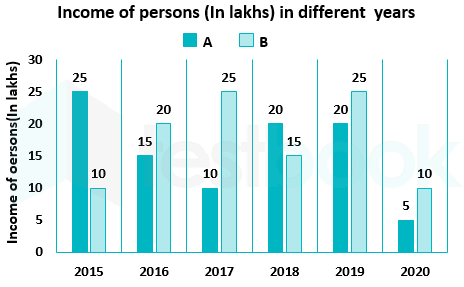
Direction: Read the bar graph carefully and answer the following questions:

The bar graph shows the income of two persons A and B from the years 2015 to 2020.

74

The income of A in 2014 is 12% more than that of B in 2017, then what will be the ratio between the income of A in 2016 and 2018 together and that of A in 2014 and B in 2020 together?

  1. ((a))

    34 ∶ 37

  2. ((b))

    35 ∶ 38

  3. ((c))

    2 ∶ 3

  4. ((d))

    38 ∶ 35

  5. ((e))

    1 ∶ 1

Show Answer
Answer: ((b))

35 ∶ 38

Given:

YearIncome of persons(In lakhs) in different years
AB
20161520
20171025
20182015
2020510
<br>

The income of A in 2014 = 12% more than the income of B in 2017

Calculation:

The income of A in 2014 = 25 lakhs × (100 + 12)%

⇒ 25 × (112/100)

⇒ 112/4

⇒ Rs. 28 lakhs

The total income of A in 2016 and 2018 together = 15 + 20

⇒ Rs. 35 lakhs

The total income of A in 2014 and B in 2020 together = 28 + 10

⇒ Rs. 38 lakhs

The required ratio = 35 : 38

∴ The ratio between the income of A in 2016 and 2018 together and that of A in 2014 and B in 2020 together will be 35 ∶ 38.

75

If the profit of B in 2019 is 20% of total income of B in 2019, then what will be its expenditure in 2019?

  1. ((a))

    Rs. 20 lakhs

  2. ((b))

    Rs. 25 lakhs

  3. ((c))

    Rs. 15 lakhs

  4. ((d))

    Rs. 21 lakhs

  5. ((e))

    Rs. 19 lakhs

Show Answer
Answer: ((a))

Rs. 20 lakhs

Given:

The income of B in 2019 = Rs. 25 lakhs

The profit of B in 2019 = 20% of total Income

Formula Used:

Profit = Income - Expnediture 

Calculation:

Income = 25,00,000

Profit is 20% of total income of B in 2019.

⇒ Profit = 25,00,000 × (20/100)

⇒ Profit = 5,00,000

⇒ Expenditure = 25,00,000 - 5,00,000

⇒ Expenditure = 20,00,000

∴ The expenditure of B in 2019 will be Rs. 20 lakhs.

76

If the ratio of income and expenditure of A in 2017 is 5 ∶ 2 and saving of B in 2019 is 27% more than that of A in 2017, then find the expenditure of B in 2019.

  1. ((a))

    Rs. 17 lakhs

  2. ((b))

    Rs. 16.38 lakhs

  3. ((c))

    Rs. 17.38 lakhs

  4. ((d))

    Rs. 15 lakhs

  5. ((e))

    Rs. 14 lakhs

Show Answer
Answer: ((c))

Rs. 17.38 lakhs

Given:

YearIncome of persons(In lakhs) in different years
AB
20192025
20171025
<br>

The ratio of income and expenditure of A in 2017 = 5 ∶ 2

The saving of B in 2019 = 27% more than the saving of A in 2017

Formula Used:

Income = Expenditure + Saving

Calculation:

Let the income and expenditure of A in 2017 be Rs. 5x and Rs. 2x.

According to the question,

5x = Rs. 10 lakhs

⇒ x = Rs. 2 lakhs

⇒ 2x = Rs. 4 lakhs

The expenditure of A in 2017 = Rs. 4 lakhs

The saving of A in 2017 = Income - Expenditure

⇒ 10 - 4

⇒ Rs. 6 lakhs

The saving of B in 2019 = 6 × (100 + 27)%

⇒ 6 lakhs × (127/100)

⇒ Rs. 7.62 lakhs

Hence the expenditure of B in 2019 = Income - Saving

⇒ (25 - 7.62) lakhs

⇒ 17.38 lakhs

∴ The expenditure of B in 2019 will be Rs. 17.38 lakhs.

77

The income of A increases by 30%, 20% and 40% respectively in 2016, 2017 and 2019, then what will be the ratio of income of A in these three years now?

  1. ((a))

    24 ∶ 39 ∶ 56

  2. ((b))

    56 ∶ 39 ∶ 24

  3. ((c))

    22 ∶ 56 ∶ 39

  4. ((d))

    39 ∶ 24 ∶ 56

  5. ((e))

    33 ∶ 24 ∶ 56

Show Answer
Answer: ((d))

39 ∶ 24 ∶ 56

Given:

YearIncome of persons(In lakhs) in different years
AB
20161520
20171025
20192025
<br>

The income of A in 2016 now = 30% more than the initial income of A in 2016 

The income of A in 2017 now = 20% more than the initial income of A in 2017

The income of A in 2019 now = 40% more than the initial income of A in 2019

Calculation:

The income of A in 2016 now = 15 × (100 + 30)%

⇒ {15 × (130/100)} lakhs

The income of A in 2017 now = 10 × (100 + 20)%

⇒ {10 × (120/100)} lakhs

The income of A in 2019 now = 20 × (100 + 40)%

⇒ {20 × (140/100)} lakhs

The ratio of income of A in 2016 and 2017 now = {15 × (130/100)}/{10 × (120/100)}

⇒ 13 : 8 ---(1)

The ratio of income of A in 2017 and 2019 now = {10 × (120/100)}/{20 × (140/100)}

⇒ 3 : 7 ---(2)

Now multiply by 3 in equation (1) and 8 in equation (2) respectively,

The ratio of income of A in 2016 and 2017 now = 39 ∶ 24

The ratio of income of A in 2017 and 2019 now = 24 ∶ 56

Hence the ratio of income of A in 2016, 2017 and 2019 now = 39 ∶ 24 ∶ 56

∴ The ratio of income of A in 2016, 2017 and 2019 now will be 392456.

78

If the profit of A in 2016 is 20% of total Income of A in 2016 and the ratio of expenditure of A in 2016 to that of B in 2017 is 4 ∶ 5, then find the saving of B in 2017.

  1. ((a))

    Rs. 15.625 lakhs

  2. ((b))

    Rs. 12.5 lakhs

  3. ((c))

    Rs. 14 lakhs

  4. ((d))

    Rs. 9 lakhs

  5. ((e))

    Rs. 10 lakhs

Show Answer
Answer: ((e))

Rs. 10 lakhs

Given:

YearIncome of persons(In lakhs) in different years
AB
20161520
20171025
<br>

The profit of A in 2016 = 20% of Total Income

The ratio of expenditure of A in 2016 to that of B in 2017 = 4 ∶ 5

Formula Used:

Expenditure = Income × {100/(100 + Profit )}

Income = Expenditure + Saving

Calculation:

Profit of A in 2016 = 20% of 15 lakh = 3 lakh

So, Expenditure of A in 2016 = 15 - 3 = 12 lakh

Let the expenditure of A in 2016 and B in 2017 be Rs. 4x and Rs. 5x

Now, 4x = 12 lakhs

⇒ x = 3 lakhs

⇒ 5x = 15lakhs

The expenditure of B in 2017 = Rs. 15 lakhs

The saving of B in 2017 = Income - Expenditure

⇒ (25 - 15) lakhs

⇒ 10 lakhs

∴ The saving of B in 2017 will be Rs. 10 lakhs.

79

Zoya invested certain amount and after 8 months her friend also joined her with double the Zoya’s investment. If the profit of Zoya’s friend is Rs. 5,584 then find the profit difference between Zoya and her friend.

  1. ((a))

    Rs. 2,792

  2. ((b))

    Rs. 2,500

  3. ((c))

    Rs. 1,200

  4. ((d))

    Rs. 2,000

  5. ((e))

    Rs. 5,550

Show Answer
Answer: ((a))

Rs. 2,792

Given:

Zoya's friend's profit = Rs. 5,584

Calculation:

Investment ratio of Zoya and her friend = 3:2 (based on amount and time).

Friend’s profit = (2 / 5) × Total profit = 5,584

Total profit = 5,584 × (5 / 2) = 13,960

Zoya's profit = (3 / 5) × 13,960 = 8,376

Profit difference = Zoya's profit - Friend's profit = 8,376 - 5,584 = 2,792

∴ The profit difference between Zoya and her friend is Rs. 2,792.

80

In a container the ratio of mixture of milk and water is 5 : 2. If 10 litres of water is added to the mixture, then the difference between milk and water becomes 20 litres. Find the initial quantity of mixture.

  1. ((a))

    105 l

  2. ((b))

    42 l

  3. ((c))

    60 l

  4. ((d))

    85 l

  5. ((e))

    70 l

Show Answer
Answer: ((e))

70 l

Given:

The initial ratio of milk and water is 5 : 2.

10 litres of water is added to the mixture.

The difference between the quantity of milk and water becomes 20 litres.

Let the initial quantity of the mixture be X litres.

Calculation:

Since the ratio of milk to water is 5:2, we can say:

Milk = (5 / 7) × X

Water = (2 / 7) × X

After adding 10 litres of water, the new quantity of water becomes:

Water = (2 / 7) × X + 10

The difference between the amount of milk and water is given as 20 litres:

Milk - Water = 20

Substitute the values for milk and water:

(5 / 7) × X - [(2 / 7) × X + 10] = 20

Now, simplify the equation:

(5 / 7) × X - (2 / 7) × X - 10 = 20

(3 / 7) × X - 10 = 20

Now, add 10 to both sides:

(3 / 7) × X = 30

Now, multiply both sides by 7/3:

X = (30 × 7) / 3

X = 70

∴ The initial quantity of the mixture is 70 litres.

Attempt this paper under real exam conditions

Timed interface, section switching, instant scoring, and question-by-question analytics — free.

Start Timed Attempt