Official Paper

RRB Clerk Prelims Memory Based Paper (Held on: 17 August 2019) (Previous Year Paper)

80 questions · 45 minutes · with answers · free

Reasoning (40 questions)

Direction: Study the following information carefully to answer the given questions.

Seven persons namely P, Q, R, S, T, U, and V are sitting around a circular table facing towards the center but not necessarily in the same order.

U is sitting 3rd to the right of R. Two persons are sitting between Q and S. S is sitting to the immediate right of U. T is sitting 2nd to the left of Q. V is not the immediate neighbour of T.

1

Who is sitting to the immediate left of T?

  1. ((a))

    S

  2. ((b))

    P

  3. ((c))

    Q

  4. ((d))

    R

  5. ((e))

    V

Show Answer
Answer: ((b))

P

7 people: P, Q, R, S, T, U and V

Arrangement: Facing the centre

1) U is sitting 3rd to the right of R.

2) S is sitting to the immediate right of U.

3) Two persons are sitting between Q and S.

4) T is sitting 2nd to the left of Q.

  1. V is not the immediate neighbour of T.

This is the final arrangement.

Hence, P is sitting to the immediate left of T.
2

Who is sitting 2nd to the right of V?

  1. ((a))

    S

  2. ((b))

    U

  3. ((c))

    R

  4. ((d))

    P

  5. ((e))

    None of these

Show Answer
Answer: ((a))

S

7 people: P, Q, R, S, T, U and V

Arrangement: Facing the centre

1) U is sitting 3rd to the right of R.

2) S is sitting to the immediate right of U.

3) Two persons are sitting between Q and S.

4) T is sitting 2nd to the left of Q.

  1. V is not the immediate neighbour of T.

This is the final arrangement.

Hence, S is sitting 2nd to the right of V.

3

What is the position of U with respect to Q?

  1. ((a))

    Immediate right

  2. ((b))

    5th to the right

  3. ((c))

    3rd to the left

  4. ((d))

    Immediate left

  5. ((e))

    2nd to the right

Show Answer
Answer: ((e))

2nd to the right

7 people: P, Q, R, S, T, U and V

Arrangement: Facing the centre

1) U is sitting 3rd to the right of R.

2) S is sitting to the immediate right of U.

3) Two persons are sitting between Q and S.

4) T is sitting 2nd to the left of Q.

  1. V is not the immediate neighbour of T.

This is the final arrangement.

Hence, U is sitting 2nd to the right of Q.

4

Which of the following statements is false about R?

  1. ((a))

    R is sitting exactly between T and Q

  2. ((b))

    R is sitting 2nd to the right of P

  3. ((c))

    R is sitting 4th to the left of S

  4. ((d))

    R is sitting 2nd to the right of V

  5. ((e))

    R is sitting 3rd to the left of U

Show Answer
Answer: ((d))

R is sitting 2nd to the right of V

7 people: P, Q, R, S, T, U and V

Arrangement: Facing the centre

1) U is sitting 3rd to the right of R.

2) S is sitting to the immediate right of U.

3) Two persons are sitting between Q and S.

4) T is sitting 2nd to the left of Q.

  1. V is not the immediate neighbour of T.

This is the final arrangement.

Hence, 'R is sitting 2nd to the right of V' is the false statement.

5

Four among five are same in a certain way and thus form a group. Which of the following does not belong to that group?

  1. ((a))

    RV

  2. ((b))

    ST

  3. ((c))

    UP

  4. ((d))

    VP

  5. ((e))

    QU

Show Answer
Answer: ((d))

VP

7 people: P, Q, R, S, T, U and V

Arrangement: Facing the centre

1) U is sitting 3rd to the right of R.

2) S is sitting to the immediate right of U.

3) Two persons are sitting between Q and S.

4) T is sitting 2nd to the left of Q.

  1. V is not the immediate neighbour of T.

This is the final arrangement.

RV - one person (Q) is sitting between R and V when counted from the right of R

ST - one person (P) is sitting between S and T when counted from the right of S

UP - one person (S) is sitting between U and P when counted from the right of U

VP - two persons (U and S) are sitting between V and P.

QU - one person (V) is sitting between Q and U when counted from the right of Q

Hence, 'VP' does not belong to the group.

6

In the following question below are given two statements followed by two conclusions. Taking the given statements to be true even if they seem to be at variance from commonly known facts, read all the conclusions and then decide which of the given conclusion logically follows the given statements.

Statements:

I. Some people are missing.

II. All men are missing.

Conclusions:

I. Some men are people.

II. All people are missing.

  1. ((a))

    Only I follows

  2. ((b))

    Only II follows

  3. ((c))

    Both I and II follow

  4. ((d))

    Neither I nor II follows

  5. ((e))

    Either I or II follows

Show Answer
Answer: ((d))

Neither I nor II follows

Consider the following least possible Venn diagram,

Conclusions:

I. Some men are people →False It is possible but not definite)

II. All people are missing → False (It is possible but not definite)

Hence, neither conclusion I or II follows.

7

Direction: In the question below are given two statements followed by two conclusions numbered I and II. You have to take the given statements to be true even if they seem to be at variance with commonly known facts. Read all the conclusions and then decide which of the given conclusions logically follows from the given statements disregarding commonly known facts.

Statement:

Only a few oval are circle.

All circle is bread.

Conclusion:

I. Some oval are bread.

II. No oval is bread.

  1. ((a))

    Only I follows

  2. ((b))

    Only II follows

  3. ((c))

    Either I or II follows

  4. ((d))

    Neither I nor II follows

  5. ((e))

    Both I and II follow

Show Answer
Answer: ((a))

Only I follows

The least possible diagram for the given statements is as follows

Conclusions:

I. Some oval are bread. → True (A part of oval which is circle is also bread)

II. No oval is bread. → False (It is definitely false)

Hence, only I follows.

8

Direction: In the question below are given two statements followed by two conclusions numbered I and II. You have to take the given statements to be true even if they seem to be at variance with commonly known facts. Read all the conclusions and then decide which of the given conclusions logically follows from the given statements disregarding commonly known facts.

Statement:

All scientists are intelligent.

Only a few scientists are politicians.

Conclusion:

I. Some intelligent are not scientist.

II. Some politicians are intelligent.

  1. ((a))

    Only I follows

  2. ((b))

    Only II follows

  3. ((c))

    Either I or II follows

  4. ((d))

    Neither I nor II follows

  5. ((e))

    Both I and II follow

Show Answer
Answer: ((b))

Only II follows

The least possible diagram for the given statements is as follows

Conclusions:

I. Some intelligent are not scientists. → False (it is possible but not definite)

II. Some politicians are intelligent. → True (Politicians who are scientists are also intelligent)

Hence, only II follows.

Directions: Study the information given below carefully and answer the questions that follow.

A, B, C, D, E, F and G are seven people standing at a certain distance from one another. A is 12 m north of B. C is 14 m East of A. D is 30 m south of C. E is 28 m West of B. F is 18 m South of E. G is standing exactly in the middle of C and D.

9

E is in which direction with respect to C?

  1. ((a))

    West

  2. ((b))

    South-West

  3. ((c))

    East

  4. ((d))

    North-East

  5. ((e))

    North

Show Answer
Answer: ((b))

South-West

Hence, E is in south-west direction with respect to C.

10

What is the shortest distance between F and D?

  1. ((a))

    42

  2. ((b))

    48

  3. ((c))

    35

  4. ((d))

    40

  5. ((e))

    43

Show Answer
Answer: ((a))

42

Hence, the shortest distance between F and D = (28 + 14) m = 42m.

11

G is in the which direction with respect to A?

  1. ((a))

    South

  2. ((b))

    West

  3. ((c))

    South-East

  4. ((d))

    North

  5. ((e))

    North-West

Show Answer
Answer: ((c))

South-East

Hence, G is in south-east direction with respect to A.

Direction: Read the information carefully and answer the questions asked below.

A certain number of people are sitting in a straight line and all are facing in the North direction.

D is sitting 2nd from the right side in the row. H is sitting 5th to the right of B. Q is to the immediate left of B. Only three persons are sitting between D and H. P is sitting 4th to the left of M. Only 8 persons are sitting between Y and M, also Y is sitting to the left of P. Q is sitting 3rd to the right of M.

12

How many people are there in the row?

  1. ((a))

    20

  2. ((b))

    21

  3. ((c))

    18

  4. ((d))

    24

  5. ((e))

    27

Show Answer
Answer: ((d))

24

1.D is sitting 2nd from the right side in the row.

2.Only three persons are sitting between D and H.

3.H is sitting 5th to the right of B.

4.Q is the immediate left  neighbor of B

5.Q is sitting 3rd to the right of M.

6.Only 8 persons are sitting between Y and M, also Y is sitting to the left of P.

Hence there are 24 people in the row.

13

If G is sitting 3rd to the left of H, then what is the position of G from left side?

  1. ((a))

    11th

  2. ((b))

    13th

  3. ((c))

    20th

  4. ((d))

    9th

  5. ((e))

    16th

Show Answer
Answer: ((e))

16th

1.D is sitting 2nd from the right side in the row.

2.Only three persons are sitting between D and H.

3.H is sitting 5th to the right of B.

4.Q is the immediate left  neighbor of B

5.Q is sitting 3rd to the right of M.

6.Only 8 persons are sitting between Y and M, also Y is sitting to the left of P.

 If G is sitting 3rd to the left of H

Hence G is on 16th position from left side.

14

How many persons are sitting between P and H?

  1. ((a))

    12

  2. ((b))

    10

  3. ((c))

    8

  4. ((d))

    0

  5. ((e))

    17

Show Answer
Answer: ((a))

12

  1. D is sitting 2nd from the right side in the row.
  2. Only three persons are sitting between D and H.
  3. H is sitting 5th to the right of B.

  1. Q is the immediate left  neighbor of B
  2. Q is sitting 3rd to the right of M.
  3. Only 8 persons are sitting between Y and M, also Y is sitting to the left of P.

Hence 12 people are sitting between P and H

15

Which of the following statement in false?

  1. ((a))

    B is sitting 11th from the right side

  2. ((b))

    Only 7 persons are there between P and B

  3. ((c))

    Y is sitting at the extreme position

  4. ((d))

    P is sitting on Q's right

  5. ((e))

    P is sitting fifth to the right of Y.

Show Answer
Answer: ((d))

P is sitting on Q's right

1.D is sitting 2nd from the right side in the row.

2.Only three persons are sitting between D and H.

3.H is sitting 5th to the right of B.

4.Q is the immediate left  neighbor of B

5.Q is sitting 3rd to the right of M.

6.Only 8 persons are sitting between Y and M, also Y is sitting to the left of P.

P is toward left of Q hence statement  "P is sitting on Q's right" is False.

16

What is the position of D with respect to M?

  1. ((a))

    10th to the left

  2. ((b))

    13th to the left

  3. ((c))

    10th to the right

  4. ((d))

    13th to the right

  5. ((e))

    Immediate neighbours

Show Answer
Answer: ((d))

13th to the right

1.D is sitting 2nd from the right side in the row.

2.Only three persons are sitting between D and H.

3.H is sitting 5th to the right of B.

4.Q is the immediate left  neighbor of B

5.Q is sitting 3rd to the right of M.

6.Only 8 persons are sitting between Y and M, also Y is sitting to the left of P.

Hence D is 13th to right of P.

17

Directions: In the following question assuming the given statements to be true, find which of the conclusion among given conclusions is /are definitely true and then give your answers accordingly.

Statement: M > U > L ≤ N; L ≥ Y > A

Conclusions:

I. Y < N

II. Y = N

  1. ((a))

    Both I and II are true

  2. ((b))

    Only II

  3. ((c))

    Only I is true

  4. ((d))

    Either I or II is true

  5. ((e))

    None is true

Show Answer
Answer: ((d))

Either I or II is true

Given: M > U > L ≤ N; L ≥ Y > A

On combining: M > U > L ≥ Y > A; N ≥ L ≥ Y > A

I. Y < N ⇒ False (as N ≥ L ≥ Y so it is also possible that N = Y)

II. Y = N ⇒ False (as N ≥ L ≥ Y so it is also possible that N > Y)

Here conclusion I and II form complimentary pair.

Therefore, either conclusion I or II follows.

18

Directions: In the following question, assuming the given statements to be true, find which of the conclusion among given conclusions is/are definitely true and then give your answers accordingly.

Statement: M ≥ O ≥ G = R ≥ N = T

Conclusion I: M = T

Conclusion II: T ˂ M

  1. ((a))

    Only conclusion I follows.

  2. ((b))

    Only conclusion II follows.

  3. ((c))

    Either conclusion I or II follows.

  4. ((d))

    Neither conclusion I nor II follows.

  5. ((e))

    Both conclusions I and II follow.

Show Answer
Answer: ((c))

Either conclusion I or II follows.

Given statement: M ≥ O ≥ G = R ≥ N = T

I. M = T → False (as M ≥ O ≥ G = R ≥ N = T → M ≥ T).

II. T ˂ M → False (as M ≥ O ≥ G = R ≥ N = T → M ≥ T)

Here, conclusions I and II form a complementary pair.

So, either conclusion I or II follows.

19

Direction: In the following question assuming the given statement to be true. Find which of the following conclusion(s) among given conclusions is/are definitely true then give your answer accordingly.

Statement: A < B < C, D ≥ E = F ≥ G > C

Conclusion:

I. B < E

II. G ≤ D

  1. ((a))

    None is true

  2. ((b))

    Only II is true

  3. ((c))

    Both I and II are true

  4. ((d))

    Only I is true

  5. ((e))

    Either I or II is true

Show Answer
Answer: ((c))

Both I and II are true

Given Statements: A < B < C, D ≥ E = F ≥ G > C

On combining: A < B < C < G ≤ F = E ≤ D

Conclusions:

I. B < E → True (as B < C < G ≤ F = E → B < E)

II. G ≤ D → True (as G ≤ F = E ≤ D → G ≤ D)

Hence, both I and II are true.

20

Directions: In the following question assuming the given statements to be True, find which of the conclusion among given conclusions is/are true and then give your answers accordingly.

Statements: P > Q = R < S; R < Y < Z

Conclusions:

I. Q > Z

II. Y > P

  1. ((a))

    Only I is true

  2. ((b))

    Only II is true

  3. ((c))

    Both I and II are true

  4. ((d))

    Neither I nor II is true

  5. ((e))

    Either I or II is true

Show Answer
Answer: ((d))

Neither I nor II is true

Given statements: P > Q = R < S; R < Y < Z

On combining: P > Q = R< Y < Z; Q = R < S

Conclusions:

I. Q > Z → False (as Q = R < Y < Z → Q < Z)

II. Y > P → False (as P > R and Y > R → thus no clear relation between Y and P can be determined)

Hence, neither conclusion I nor II is True.

21

How many pairs of letters are there in the word “MINUTE” which have as many letters between them as in the English alphabetical series in both forward and backward directions?

  1. ((a))

    One

  2. ((b))

    Two

  3. ((c))

    Three

  4. ((d))

    Four

  5. ((e))

    None

Show Answer
Answer: ((b))

Two

Given Word: MINUTE 

The given word can be represented as follows:

Thus, there are two such pairs EI and TU.

Hence, two pairs of letters EI and TU are there in the word ‘MINUTE’, which have as many letters between them as in the English alphabetical series in both forward and backward directions.

22

In the following question, select the odd letters from the given alternatives.

  1. ((a))

    DFGE

  2. ((b))

    UWXV

  3. ((c))

    QTSR

  4. ((d))

    JLMK

  5. ((e))

    MOPN

Show Answer
Answer: ((c))

QTSR

The pattern followed here is:


Hence, "QTSR" is odd among the given letters.

Direction: Read the following information carefully and answer the questions asked below.

There are ten persons sitting in two parallel rows. Five persons M, N, O, P,  and Q are sitting in one row facing South and five persons A, B, C, D, and E are sitting in another row facing North but not necessarily in the same order. Each person from one row faces exactly one person from the other row.

A is sitting to the immediate left of D and none of them is sitting at the any of the corners. B is sitting 2nd to the left of D. Q is sitting to the immediate left of the one who is sitting opposite to B. M is sitting 2nd to the right of Q. N and P are immediate neighbours of each other whereas P is sitting at one of the corners. E is sitting exactly opposite to the one who is sitting 4th to the right of P.

23

Who is sitting opposite to P?

  1. ((a))

    B

  2. ((b))

    D

  3. ((c))

    C

  4. ((d))

    E

  5. ((e))

    A

Show Answer
Answer: ((c))

C

10 persons: A, B, C, D, E, M, N, O, P and Q

Facing South: M, N, O, P and Q

Facing North: A, B, C, D and E

1) A is sitting to the immediate left of D and none of them is sitting at the any of the corners.

2) B is sitting 2nd to the left of D.

3) Q is sitting to the immediate left of the one who is sitting opposite to B.

4) M is sitting 2nd to the right of Q.

Therefore, case 1 gets eliminated.

5) N and P are immediate neighbours of each other whereas P is sitting at one of the corners.

6) E is sitting exactly opposite to the one who is sitting 4th to the right of P. 

This is the final arrangement.

Hence, C is sitting opposite to P.

24

Who among the following sits in the middle of the row?

  1. ((a))

    Q

  2. ((b))

    B

  3. ((c))

    N

  4. ((d))

    D

  5. ((e))

    O

Show Answer
Answer: ((a))

Q

10 persons: A, B, C, D, E, M, N, O, P and Q

Facing South: M, N, O, P and Q

Facing North: A, B, C, D and E

1) A is sitting to the immediate left of D and none of them is sitting at the any of the corners.

2) B is sitting 2nd to the left of D.

3) Q is sitting to the immediate left of the one who is sitting opposite to B.

4) M is sitting 2nd to the right of Q.

Therefore, case 1 gets eliminated.

5) N and P are immediate neighbours of each other whereas P is sitting at one of the corners.

6) E is sitting exactly opposite to the one who is sitting 4th to the right of P. 

This is the final arrangement.

Q sits in the middle of the row facing South.

A sits in the middle of the row facing North.

Hence, among the given options, Q sits in the middle of the row.

25

In a certain way, D is related to Q, B is related to M then C is related to which of the following?

  1. ((a))

    M

  2. ((b))

    P

  3. ((c))

    O

  4. ((d))

    Q

  5. ((e))

    N

Show Answer
Answer: ((e))

N

10 persons: A, B, C, D, E, M, N, O, P and Q

Facing South: M, N, O, P and Q

Facing North: A, B, C, D and E

1) A is sitting to the immediate left of D and none of them is sitting at the any of the corners.

2) B is sitting 2nd to the left of D.

3) Q is sitting to the immediate left of the one who is sitting opposite to B.

4) M is sitting 2nd to the right of Q.

Therefore, case 1 gets eliminated.

5) N and P are immediate neighbours of each other whereas P is sitting at one of the corners.

6) E is sitting exactly opposite to the one who is sitting 4th to the right of P. 

This is the final arrangement.

Q is sitting to the immediate right of the one who is sitting opposite to D.

B is sitting to the immediate right of the one who is sitting opposite to M.

Similarly, C is sitting to the immediate right of the one who is sitting opposite to N.

Hence, C is related to N among the given options.

26

How many people sit between O and P?

  1. ((a))

    One

  2. ((b))

    Two

  3. ((c))

    Three

  4. ((d))

    None

  5. ((e))

    None of these

Show Answer
Answer: ((b))

Two

10 persons: A, B, C, D, E, M, N, O, P and Q

Facing South: M, N, O, P and Q

Facing North: A, B, C, D and E

1) A is sitting to the immediate left of D and none of them is sitting at the any of the corners.

2) B is sitting 2nd to the left of D.

3) Q is sitting to the immediate left of the one who is sitting opposite to B.

4) M is sitting 2nd to the right of Q.

Therefore, case 1 gets eliminated.

5) N and P are immediate neighbours of each other whereas P is sitting at one of the corners.

6) E is sitting exactly opposite to the one who is sitting 4th to the right of P. 

This is the final arrangement.

Hence, two people sit between O and P.

27

Four among five are similar in a certain way thus form a group. Which among the following does not belong to that group?

  1. ((a))

    P

  2. ((b))

    M

  3. ((c))

    C

  4. ((d))

    B

  5. ((e))

    E

Show Answer
Answer: ((d))

B

10 persons: A, B, C, D, E, M, N, O, P and Q

Facing South: M, N, O, P and Q

Facing North: A, B, C, D and E

1) A is sitting to the immediate left of D and none of them is sitting at the any of the corners.

2) B is sitting 2nd to the left of D.

3) Q is sitting to the immediate left of the one who is sitting opposite to B.

4) M is sitting 2nd to the right of Q.

Therefore, case 1 gets eliminated.

5) N and P are immediate neighbours of each other whereas P is sitting at one of the corners.

6) E is sitting exactly opposite to the one who is sitting 4th to the right of P. 

This is the final arrangement.

P, M, C and E are sitting at the extreme ends of their respective rows whereas B is not.

Hence, B does not belong to the group.

Direction: Study the following information carefully and answer the questions given below.

There are six-persons P, Q, R, S, T, and U with different weights. T is lighter than only one person. U is heavier than S but lighter than Q. R is heavier than Q. Person S is not the lightest one. The person who is the second lightest weighs 58 kgs and the person who is the heaviest weighs 117 kg.

28

What could be the weight of P?

  1. ((a))

    60

  2. ((b))

    58

  3. ((c))

    55

  4. ((d))

    72

  5. ((e))

    59

Show Answer
Answer: ((c))

55

Six persons: P, Q, R, S, T, and U 

T is lighter than only one person

U is heavier than S but lighter than Q. R is heavier than Q.

Order is: R > Q > U > S

since S is not the lightest one, P is lightest among them and R will be Heaviest.

S is the second lightest and his weight is 58kgs.

Hence, the possible weight of P is 55kgs.

29

Who among the following persons is the lightest one?

  1. ((a))

    T

  2. ((b))

    Q

  3. ((c))

    U

  4. ((d))

    P

  5. ((e))

    S

Show Answer
Answer: ((d))

P

Six persons: P, Q, R, S, T, and U 

T is lighter than only one person.

U is heavier than S but lighter than Q. R is heavier than Q.

Order is: R > Q > U > S

since S is not the lightest one, P is lightest among them and R will be Heaviest.

Hence P is the lightest among them.

30

If the summation of weights of T and R is 230 Kgs and summation of weights of S and U is 120, then what is the summation of weights of the T and U?

  1. ((a))

    166

  2. ((b))

    184

  3. ((c))

    190

  4. ((d))

    157

  5. ((e))

    175

Show Answer
Answer: ((e))

175

Six persons: P, Q, R, S, T, and U 

T is lighter than only one person

U is heavier than S but lighter than Q. R is heavier than Q.

Order is: R > Q > U > S

since S is not the lightest one, P is lightest among them and R will be Heaviest.

T + R = 230 

R = 117

Hence, T = 113.

S + U = 120 

S = 58

Hence, U = 62.

T + U = 113 + 62 = 175

Hence, the summation of weights of the T and U is 175.

Direction: Study the following information carefully to answer the given questions:

N 6 & F K ~ G U 7 S # A 8 Z T * E W P 5 B € X @ J Z H 4 I ^ 3 V O 2 C

31

How many such consonant are there in the above arrangement each of which is immediately followed by a vowel but not immediately preceded by a symbol?

  1. ((a))

    None

  2. ((b))

    One

  3. ((c))

    Two

  4. ((d))

    Three

  5. ((e))

    More than three

Show Answer
Answer: ((b))

One

In this given series:

N 6 & F K ~ G U 7 S # A 8 Z T * E W P 5 B € X @ J Z H 4 I ^ 3 V O 2 C

Required pattern: no symbol → consonant → vowel

Hence, there is only one consonant which is immediately followed by a vowel but not immediately preceded by a symbol: 3 V O.

Hence, the answer is one.

32

Four of the following five are alike in a certain way based on their positions in the above arrangement and so form a group. Which is the one that does not belong to that group?

  1. ((a))

    KFG

  2. ((b))

    A#Z

  3. ((c))

    E*P

  4. ((d))

    €B@

  5. ((e))

    4HZ

Show Answer
Answer: ((e))

4HZ

Given series:

N 6 & F K ~ G U 7 S # A 8 Z T * E W P 5 B € X @ J Z H 4 I ^ 3 V O 2 C

Let's check each option:

KFG: F is to the immediate left of K, G is second to the right of K.

A#Z: # is to the immediate left of A, Z is second to the right of A.

E*P : * is to the immediate left of E, P is second to the right of E.

€B@: B is to the immediate left of €, @ is second right to the of €.

4HZ: H is to the immediate left of 4, Z is second to the left of 4.

Except for 4HZ, the rest of them follow the above-mentioned pattern.

Hence, 4HZ does not belong to the group.

33

Which of the following is the six to the left of the twenty-seven element from the left end of the above arrangement?

  1. ((a))

  2. ((b))

    B

  3. ((c))

    5

  4. ((d))

    O

  5. ((e))

    None of these

Show Answer
Answer: ((b))

B

Given series:

N 6 & F K ~ G U 7 S # A 8 Z T * E W P 5 B € X @ J Z H 4 I ^ 3 V O 2 C

As Left – Left = Left

⇒ 6th from the Left – 27th to the Left = 21st from the Left

Now, N 6 & F K ~ G U 7 S # A 8 Z T * E W P 5 B € X @ J Z H 4 I ^ 3 V O 2 C

Clearly, 21st from the Left is B.

34

How many such symbols are there in the above arrangement each of which is immediately preceded by a number and followed by an alphabet?

  1. ((a))

    None

  2. ((b))

    Two

  3. ((c))

    One

  4. ((d))

    Three

  5. ((e))

    More than three

Show Answer
Answer: ((c))

One

In the given series:

N 6 & F K ~ G U 7 S # A 8 Z T * E W P 5 B € X @ J Z H 4 I ^ 3 V O 2 C

Required pattern: Number → Symbol → Alphabet

Hence, there is one symbol which is immediately preceded by a number and followed by an alphabet: 6 & F.

Hence, the answer is one.

35

If all the symbols and numbers of the above arrangement are dropped, then which of the following will be the tenth from the left end?

  1. ((a))

    E

  2. ((b))

    U

  3. ((c))

    I

  4. ((d))

    9

  5. ((e))

    None of these

Show Answer
Answer: ((a))

E

Given series:

N 6 & F K ~ G U 7 S # A 8 Z T * E W P 5 B € X @ J Z H 4 I ^ 3 V O 2 C

If all the symbols and numbers are dropped:

N F K G U S A Z T E W P B X J Z H I V O C

10th from the left end

Then, letter that is 10th from left end is ‘E’.

Direction: Read the given information carefully and answer the following question.

Seven persons A, B, C, D, E, F and G live in a seven storey building such that ground floor is numbered 1 and the top floor is numbered 7. C lives on even number floor above floor number 3.Only two people live between A and E. Only two people live between F and C. B lives immediately above F. More than two persons live between A and B. G lives on one of the floors above D.

36

How many persons live above G?

  1. ((a))

    None

  2. ((b))

    One

  3. ((c))

    Two

  4. ((d))

    Three

  5. ((e))

    Four

Show Answer
Answer: ((a))

None

  1. C lives on even number floor above floor number 3.

  2. Only two people live between F and C. B lives immediately above F.

  3. Only two people live between A and E.

Case 1: Case 2:

FloorPersonPerson
7
6CA/E
5A/E
4BC
3FE/A
2E/AB
1F


  1. More than two persons live between A and B. (This eliminates case 1)

  2. G lives on one of the floors above D.

Case 2:

FloorPerson
7G
6A
5D
4C
3E
2B
1F


Hence, no one lives above G.

37

How many persons live between A and C?

  1. ((a))

    None

  2. ((b))

    One

  3. ((c))

    Two

  4. ((d))

    Three

  5. ((e))

    None of these

Show Answer
Answer: ((b))

One

  1. C lives on even number floor above floor number 3.

  2. Only two people live between F and C. B lives immediately above F.

  3. Only two people live between A and E.

Case 1: Case 2:

FloorPersonPerson
7
6CA/E
5A/E
4BC
3FE/A
2E/AB
1F


  1. More than two persons live between A and B. (This eliminates case 1)

  2. G lives on one of the floors above D.

Case 2:

FloorPerson
7G
6A
5D
4C
3E
2B
1F


Hence, only one person lives between A and C.

38

Who among the following lives just below C?

  1. ((a))

    D

  2. ((b))

    G

  3. ((c))

    E

  4. ((d))

    B

  5. ((e))

    F

Show Answer
Answer: ((c))

E

  1. C lives on even number floor above floor number 3.

  2. Only two people live between F and C. B lives immediately above F.

  3. Only two people live between A and E.

Case 1: Case 2:

FloorPersonPerson
7
6CA/E
5A/E
4BC
3FE/A
2E/AB
1F


  1. More than two persons live between A and B. (This eliminates case 1)

  2. G lives on one of the floors above D.

Case 2:

FloorPerson
7G
6A
5D
4C
3E
2B
1F


Hence, E lives just below C.

39

Who among the following lives between E and F?

  1. ((a))

    C

  2. ((b))

    A

  3. ((c))

    D

  4. ((d))

    B

  5. ((e))

    Cannot be determined

Show Answer
Answer: ((d))

B

  1. C lives on even number floor above floor number 3.

  2. Only two people live between F and C. B lives immediately above F.

  3. Only two people live between A and E.

Case 1: Case 2:

FloorPersonPerson
7
6CA/E
5A/E
4BC
3FE/A
2E/AB
1F


  1. More than two persons live between A and B. (This eliminates case 1)

  2. G lives on one of the floors above D.

Case 2:

FloorPerson
7G
6A
5D
4C
3E
2B
1F


Hence, B lives between E and F

40

Four out of five are same in a certain way and thus form a group. Which among the following does not belong to that group?

  1. ((a))

    G – 6

  2. ((b))

    A – 5

  3. ((c))

    D – 3

  4. ((d))

    E – 2

  5. ((e))

    B – 1

Show Answer
Answer: ((c))

D – 3

  1. C lives on even number floor above floor number 3.

  2. Only two people live between F and C. B lives immediately above F.

  3. Only two people live between A and E.

Case 1: Case 2:

FloorPersonPerson
7
6CA/E
5A/E
4BC
3FE/A
2E/AB
1F


  1. More than two persons live between A and B. (This eliminates case 1)

  2. G lives on one of the floors above D.

Case 2:

FloorPerson
7G
6A
5D
4C
3E
2B
1F


Person – Floor just below that person, is given.

Clearly, ‘D - 3’ does not belong to the group.

Numerical Ability (40 questions)

41

A is 6 years older than B. The ratio of ages of B and C is 9 ∶ 5. If the age of C is 30 years, find the age of A.

  1. ((a))

    60 years

  2. ((b))

    80 years

  3. ((c))

    54 years

  4. ((d))

    56 years

  5. ((e))

    55 years

Show Answer
Answer: ((a))

60 years

Let the ages of B and C be 9x and 5x

So that 5x = 30

⇒ x = 6

Now B’s age will be 9x = 9 × 6 = 54

Now A is 6 years older than B So A’s age will be 54 + 6 = 60 years

42

Find the wrong number in the given series:

21, 32, 54, 86, 131, 186

  1. ((a))

    32

  2. ((b))

    186

  3. ((c))

    131

  4. ((d))

    86

  5. ((e))

    54

Show Answer
Answer: ((d))

86

21 + 11 = 32

32 + 22 = 54

54 + 33 = 87

87 + 44 = 131

131 + 55 = 186

43

Find the wrong number in the given series:

9, 10, 6, 15, 4, 24

  1. ((a))

    10

  2. ((b))

    15

  3. ((c))

    4

  4. ((d))

    24

  5. ((e))

    6

Show Answer
Answer: ((c))

4

9 + 12 = 10

10 - 22 = 6

6 + 32 = 15

15 - 42 = -1

-1 + 52 = 24

44

Find the wrong number in the given series:

3, 5, 8, 17, 33, 58, 94

  1. ((a))

    17

  2. ((b))

    33

  3. ((c))

    58

  4. ((d))

    94

  5. ((e))

    5

Show Answer
Answer: ((e))

5

⇒ 3 + 12 = 4

⇒ 4 + 22 = 8

⇒ 8 + 32 = 17

⇒ 17 + 42 = 33

⇒ 33 + 52 = 58

⇒ 58 + 62 =94 

Hence option 5 is correct.

45

Find the wrong number in the given series:

84, 96, 83, 95, 80, 94, 81

  1. ((a))

    80

  2. ((b))

    95

  3. ((c))

    83

  4. ((d))

    94

  5. ((e))

    81

Show Answer
Answer: ((a))

80

⇒ 84 + 12 = 96

⇒ 96 – 13 = 83

⇒ 83 + 12 = 95

⇒ 95 – 13 = 82

⇒ 82 + 12 = 94

⇒ 94 - 13 = 81

Hence option 1 is correct.

46

Find the wrong number in the given series:

4, 11, 25, 46, 74, 129, 151

  1. ((a))

    46

  2. ((b))

    129

  3. ((c))

    74

  4. ((d))

    151

  5. ((e))

    25

Show Answer
Answer: ((b))

129

The pattern in the given series is:

 4 + 7 = 11

⇒ 11 + 14 = 25

⇒ 25 + 21 = 46

⇒ 46 + 28 = 74

⇒ 74 + 35 = 109

⇒ 109 + 42 = 151

Hence the wrong number in the series is 129

47

The ratio of the salary of a male and a female is 6 ∶ 5. After 20% increment the salary of a male becomes Rs. 216 and the salary of a female increased by 4%. Find the salary of a female after increment.

  1. ((a))

    Rs. 180

  2. ((b))

    Rs. 156

  3. ((c))

    Rs. 150

  4. ((d))

    Rs. 160

  5. ((e))

    Rs. 125

Show Answer
Answer: ((b))

Rs. 156

GIVEN :

The ratio of the salary of a male and a female is 6 ∶ 5.

After 20% increment the salary of a male becomes Rs. 216 and the salary of a female increased by 4%.


ASSUMPTION :

Let salary of male and female be 6x and 5x

20% increment in male salary became 216


CALCULATION :

⇒ 6x × 1.2 = 216

⇒ x = 30

Female salary after increment 0f 4% become 5x × 1.04 = 5.2x

                                                                          5.2 × 30 = 156

Hence option 2 is correct

48

The price of (x – 2) number of pencils and x number of pens is Rs. 328. The price of a pencil is Rs. 4 while the price of a pen is Rs. 20. Find the price of x pencils and (x – 3) pens.

  1. ((a))

    Rs. 250

  2. ((b))

    Rs. 276

  3. ((c))

    Rs. 280

  4. ((d))

    Rs. 260

  5. ((e))

    Rs. 225

Show Answer
Answer: ((b))

Rs. 276

⇒ 4 × (x – 2) + 20x = 328

⇒ x = 14

Now price of 14 pencil and 11 pen will be

⇒ 14 × 4 + 11 × 20

⇒ 276

Hence option B is correct.

49

In this question two equations numbered I and II are given. You have to solve both the equations and find out the correct option.

I. x2 - 5x - 24 = 0

II. y2 - 7y - 18 = 0

  1. ((a))

    If x ≥ y

  2. ((b))

    If x ≤ y

  3. ((c))

    If x > y

  4. ((d))

    If x < y

  5. ((e))

    If relationship between x and y cannot be established or x = y.

Show Answer
Answer: ((e))

If relationship between x and y cannot be established or x = y.

I. x2 - 5x - 24 = 0

⇒ (x - 8) (x + 3) = 0

⇒ x = 8, - 3

II. y2 - 7y - 18 = 0

⇒ (y - 9) (y + 2) = 0

⇒ y = 9, - 2


Value of XValue of YRelation
89x < y
8-2x > y
–39x < y
–3-2x < y

Hence, relationship between x and y cannot be established

50

Directions: In this question two equations numbered I and II are given. You have to solve both the equations and find out the correct option.

I. x2 - 6x + 9 = 0

II. y2 - 11y + 24 = 0

  1. ((a))

    x ≥ y

  2. ((b))

    x ≤ y

  3. ((c))

    x > y

  4. ((d))

    x < y

  5. ((e))

    If relationship between x and y cannot be established or x = y.

Show Answer
Answer: ((b))

x ≤ y

I. x2 - 6x + 9 = 0

⇒ (x - 3) (x - 3) = 0

⇒ x = 3

II. y2 - 11y + 24 = 0

⇒ (y - 8) (y - 3) = 0

⇒ y = 3, 8

Hence, x ≤ y

51

Directions: In this question two equations numbered I and II are given. You have to solve both the equations and find out the correct option.

I. x2 – 208 = 233

II. y2 + 47 – 371 = 0

  1. ((a))

    If x ≥ y

  2. ((b))

    If x ≤ y

  3. ((c))

    If x > y

  4. ((d))

    If x < y

  5. ((e))

    If relationship between x and y cannot be established or x = y.

Show Answer
Answer: ((e))

If relationship between x and y cannot be established or x = y.

I. x2 = 441 ⇒ x = ±21

II. y2 = 371 – 47 ⇒ y = ±18

Value of xValue of yResult
+21+18x>y
+21-18x>y
-21+18x<y
-21-18x<y

For one value x is greater and for one x is smaller than y. 

Hence, relationship cannot be established between x and y.

52

Directions: In this question two equations numbered I and II are given. You have to solve both the equations and find out the correct option.

I. x2 – x – 42 = 0

II. y2 + y – 30 = 0

  1. ((a))

    x > y

  2. ((b))

    x < y

  3. ((c))

    x ≥ y

  4. ((d))

    x ≤ y

  5. ((e))

    x = y or no relationship could be established

Show Answer
Answer: ((e))

x = y or no relationship could be established

I. x2 – x – 42 = 0

⇒ x2 – 7x + 6x – 42 = 0

⇒ x(x – 7) + 6(x – 7) = 0

⇒ x = 7, x = –6

II. y2 + y – 30 = 0

⇒ y2 + 6y – 5y – 30 = 0

⇒ y(y + 6) – 5(y – 6) = 0

⇒ y = –6, y = 5


Comparison between x and y (via Tabulation):
Value of xValue of yRelation
75x > y
7-6x > y
-65x < y
-6-6x = y

Relationship cannot be determined

53

Directions: In this question two equations numbered I and II are given. You have to solve both the equations and find out the correct option.

I. x2 – 17x + 72 = 0

II. y2 – 17y + 70 = 0

  1. ((a))

    x > y

  2. ((b))

    x < y

  3. ((c))

    x ≥ y

  4. ((d))

    x ≤ y

  5. ((e))

    x = y or no relationship could be established

Show Answer
Answer: ((e))

x = y or no relationship could be established

⇒ x2 – 9x – 8x + 72 = 0

⇒ x(x – 9) – 8(x – 9) = 0

⇒ x = 9 ,  8

⇒ y2 – 17y + 70 = 0

⇒ y2 – 10y – 7y + 70 = 0

⇒ y(y – 10) – 7(y – 10) =0

⇒ y = 10 , 7

When x = 9, y = 10, then x < y

When x = 9, y = 7, then x > y

When x = 8, y = 10, then x < y

When x = 8, y = 7, then x > y

∴ Relationship cannot be determine

54

The circumference of two different circles is 132 cm and 88 cm respectively. Find the difference between the radius of both the circles.

  1. ((a))

    7 cm

  2. ((b))

    8 cm

  3. ((c))

    10 cm

  4. ((d))

    14 cm

  5. ((e))

    9 cm

Show Answer
Answer: ((a))

7 cm

Let the radius be r1 and r2,

So for the first circle

⇒ 2π (r1) = 132

⇒ r1 = 21,

And for second circle

⇒ 2π (r2) = 88

⇒ r2 = 14

∴ r1 – r2 = 7 cm

Hence option 1 is correct.

55

A boat covers 36 km upstream in 2 hours and 66 km downstream in 3 hours. Find the speed of the boat in still water.

  1. ((a))

    20 km/hr

  2. ((b))

    22 km/hr

  3. ((c))

    32 km/hr

  4. ((d))

    16 km/hr

  5. ((e))

    18 km/hr

Show Answer
Answer: ((a))

20 km/hr

Given:

Distance travelled in Downstream & upstream = 66 km & 36 kms respectively.

Time taken in Downstream & Upstream = 3 & 2 hours.

Assumption:

Let x be the speed of boat and y be the speed of current

Formula used:

Downstream speed = Speed of boat in still water + Speed of river

Upstream speed = Speed of boat in still water - Speed of river

Calculation:

When boat goes upstream x – y = 362\frac {36} 2 = 18 km/hr    –-– (i)

When boat goes downstream x + y = 663\frac{66}3 = 22 km/hr     ––– (ii)

By adding eq (i) and (ii)

⇒ 2x = 40

⇒ x = 20 km/hr

Hence the speed of the boat in still water is 20 km/hr.

56

What should come at the place of ‘?’ in the following question?

23 × 32 ÷ (90 ÷ ?) = √64

  1. ((a))

    10

  2. ((b))

    12

  3. ((c))

    20

  4. ((d))

    15

  5. ((e))

    18

Show Answer
Answer: ((a))

10

Concept used:

Follow BODMAS rule to solve this question, as per the order given below, 

Calculation:

23 × 32 ÷ (90 ÷ ?) = √64

Let the unknown number be x.

⇒ 8 × 9 ÷ (90 ÷ x) = 8

⇒ 72 ÷ (90/x) = 8

⇒ 72 × x/90 = 8

⇒ 8x/10 = 8

⇒ x = 8 × 10/8 = 10

∴ The value of ? is 10.

57

What should come at the place of ‘?’ in the following question?

64 + 60 ÷ (30 ÷ 3) = (?) ÷ 20

  1. ((a))

    1440

  2. ((b))

    1400

  3. ((c))

    1600

  4. ((d))

    1540

  5. ((e))

    1660

Show Answer
Answer: ((b))

1400

Follow BODMAS (Brackets, Of, Division, Multiplication, Addition, Subtraction) rule to solve this question, as per the order given below,

Step-1- Parts of an equation enclosed in 'Brackets' must be solved inside the bracket first,

Step-2-  Then any mathematical 'Of' or 'Exponent' must be solved,

Step-3- Next, the parts of the equation that contain 'Division' and 'Multiplication' are calculated,

Step-4- Last but not least, the parts of the equation that contain 'Addition' and 'Subtraction' should be calculated.

64 + 60 ÷ (30 ÷ 3) = (?) ÷ 20

⇒ 64 + 60 ÷ 10 = x/ 20

⇒ 64 + 6 = x/ 20

⇒ x = 1400

Hence option 2 is correct

58

What value should come in place of the question mark ‘?’ in the following question?

(9/2 + 4) × 8 = ? × 10

  1. ((a))

    7.8

  2. ((b))

    8.8

  3. ((c))

    6.8

  4. ((d))

    5.4

  5. ((e))

    3.5

Show Answer
Answer: ((c))

6.8

Concept:

Follow BODMAS rule to solve this question, as per the order given below, 

Calculations:

(9/2 + 4) × 8 = ? × 10

⇒ (9 + 8)/2 × 8 = x × 10

⇒ 17 × 4 = x × 10

⇒ x = 68/ 10

⇒ x = 6.8

Hence option 3 is correct.

59

What should come at the place of ‘?’ in the following question?

16/18 of 75/2 of 11/85 of ? = 220

  1. ((a))

    56

  2. ((b))

    54

  3. ((c))

    66

  4. ((d))

    51

  5. ((e))

    61

Show Answer
Answer: ((d))

51

16/18 of 75/2 of 11/85 of ? = 220

⇒ (16/ 18) × (75/ 2) × (11/ 85) × x = 220

⇒ x = (220 × 18 × 2 × 85)/ (16 × 75 × 11)

⇒ x = 51

Hence option 4 is correct.

60

What should come at the place of ‘?’ in the following question?

122 – ? = √784

  1. ((a))

    126

  2. ((b))

    136

  3. ((c))

    125

  4. ((d))

    116

  5. ((e))

    120

Show Answer
Answer: ((d))

116

122 – ? = √784

⇒ 144 – x = 28

⇒ x = 116

Hence option 4 is correct.

61

What should come at the place of ‘?’ in the following question?

(? – 0.5) ÷ 0.2 = 120 ÷ 3

  1. ((a))

    6.5

  2. ((b))

    7.5

  3. ((c))

    9.5

  4. ((d))

    8.8

  5. ((e))

    8.5

Show Answer
Answer: ((e))

8.5

(? – 0.5) ÷ 0.2 = 120 ÷ 3

⇒ x – 0.5 = 40 × 0.2

⇒ x = 8.5

Hence option 5 is correct.

62

What should come in place of the ‘?’ in the following question?

80% of (2.5 × 4 + ?) = 24

  1. ((a))

    20

  2. ((b))

    30

  3. ((c))

    10

  4. ((d))

    25

  5. ((e))

    24

Show Answer
Answer: ((a))

20

80% of (2.5 × 4 + ?) = 24

⇒ 0.8 × (10 + x) = 24

⇒ 8 + 0.8x = 24

⇒ x = 20

Hence option 1 is correct.

63

What should come at the place of ‘?’ in the following question?

1251/3 × 271/3 × 1254/3 = 15 × 5?

  1. ((a))

    5

  2. ((b))

    3

  3. ((c))

    1

  4. ((d))

    2

  5. ((e))

    4

Show Answer
Answer: ((e))

4

Follow BODMAS (Brackets, Of, Division, Multiplication, Addition, Subtraction) rule to solve this question, as per the order given below,

Step-1- Parts of an equation enclosed in 'Brackets' must be solved inside the bracket first,

Step-2-  Then any mathematical 'Of' or 'Exponent' must be solved,

Step-3- Next, the parts of the equation that contain 'Division' and 'Multiplication' are calculated,

Step-4- Last but not least, the parts of the equation that contain 'Addition' and 'Subtraction' should be calculated.

1251/3 × 271/3 × 1254/3 = 15 × 5?

⇒ 5 × 3 × 54 = 15× 5x

⇒ 15 × 5 4 = 15× 5x

⇒ x = 4

Hence option 4 is correct.

64

What should come at the place of ‘?’ in the following question?

15% of 120 × 25% of 180 = (?) – 52

  1. ((a))

    840

  2. ((b))

    810

  3. ((c))

    835

  4. ((d))

    785

  5. ((e))

    825

Show Answer
Answer: ((c))

835

15% of 120 × 25% of 180 = (?) – 52

⇒ 0.15 × 120 × 0.25 × 180 = x – 25

⇒ 18 × 45 = x– 25

⇒ x = 835

Hence option 3 is correct.

65

What should come at the place of ‘?’ in the following question?

43 × 84 ÷ 82 = 2? × 4

  1. ((a))

    12

  2. ((b))

    10

  3. ((c))

    8

  4. ((d))

    6

  5. ((e))

    7

Show Answer
Answer: ((b))

10

43 × 84 ÷ 82 = 2? × 4

⇒ 43 × 84 – 2 = 2x × 4

⇒ 43 × 82 = 2x × 4

⇒ 43 × 42 × 22 = 2x × 4

⇒ 45 × 22 = 2x × 4

⇒ 4 × 44 22 = 2x × 4

⇒ 4 × 210 = 2x × 4

⇒ x = 10

Option 2 is correct.

66

What should come at the place of ‘?’ in the following question?

√144 × √81 - (6)2 = ? + (8)2

  1. ((a))

    6

  2. ((b))

    8

  3. ((c))

    10

  4. ((d))

    12

  5. ((e))

    16

Show Answer
Answer: ((b))

8

Concept Used:

Calculation:

√144 × √81 - (6)2 = ? + (8)2

⇒ 12 × 9 - 36 = ? + 64

⇒ 108 - 100 = ?

⇒ ? = 8

∴ The required value of "?" is 8

67

The marked price of a product is Rs. 340 more than the cost price. If a 15% discount is offered at the marked price then the profit percent on the product is 27.5%, find the cost price of the product.

  1. ((a))

    Rs. 550

  2. ((b))

    Rs. 600

  3. ((c))

    Rs. 350

  4. ((d))

    Rs. 440

  5. ((e))

    Rs. 680

Show Answer
Answer: ((e))

Rs. 680

Given:

Marked Price (MP) is greater than the Cost Price (CP) by Rs.340

Discount offered = 15%

Profit = 27.5%

Formulae Used:

SP = [(100 – %discount)/100] × MP

SP = [(100 + %profit)/100] × CP

%Profit = [(SP – CP)/CP] × 100

Calculation:

Let the CP of the article be x

So, the MP = x + 340

For a discount of 15%, the Selling Price is:

SP = [(100 – 15)/100] × (x + 340) = 0.85x + 289

SO, the profit% is calculated as:

27.5% = {[(0.85x + 289) – x]/x} × 100

⇒ 11560 – 6x = 11x

⇒ x = 11560/17 = 680

∴ The Cost Price of the article is Rs.680

Shortcut Trick We know that,

C.P/M.P = (100 - D%)/(100 + P%)

C.P/M.P = (100 - 15%)/(100 + 27.5%)

C.P/M.P = 85/127.5

C.P/M.P = 2/3

Difference of M.P and C.P = 3 - 2 = 1 Unit

1 Unit = 340

Then, 2 unit = 680 

So, C.P = Rs. 680

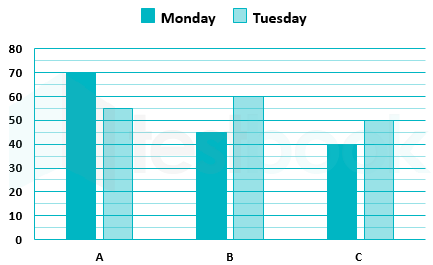
Directions: The bar graph provided below gives the sales of books from three booksellers A, B and C during two consecutive days i.e. Monday and Tuesday. Study the following graph carefully and answer the following question.

68

The total sales made by C in two days is what percent of the total sales made by A in two days?

  1. ((a))

    78%

  2. ((b))

    72%

  3. ((c))

    122%

  4. ((d))

    139%

  5. ((e))

    82%

Show Answer
Answer: ((b))

72%

Total sales made by C = 40 + 50 = 90

Total sales made by A = 70 + 55 = 125

∴ Required Percentage = (90/125) × 100 = 18/25 = 72%

69

What is the average sales made by all the booksellers for the day of Tuesday?

  1. ((a))

    65

  2. ((b))

    45

  3. ((c))

    75

  4. ((d))

    55

  5. ((e))

    60

Show Answer
Answer: ((d))

55

Sales made by A on Tuesday = 55

Sales made by B on Tuesday = 60

Sales made by C on Tuesday = 50

∴ Required average = (55 + 60 + 50)/3 = 55

70

What is the ratio of the total sales made by B in two days and the total sales made by C in two days?

  1. ((a))

    6 : 7

  2. ((b))

    5 : 4

  3. ((c))

    7 : 6

  4. ((d))

    11 : 9

  5. ((e))

    25 : 18

Show Answer
Answer: ((c))

7 : 6

Total sales made by B in both the days = 45 +h 60 = 105

Total sales made by C in both the days = 40 + 50 = 90

∴ Required ratio = 105 : 90 = 7 : 6

71

The total sales made by A on Tuesday is what per cent more or less than the total sales made by C on Monday?

  1. ((a))

    20%

  2. ((b))

    27.27%

  3. ((c))

    10%

  4. ((d))

    25%

  5. ((e))

    37.5%

Show Answer
Answer: ((e))

37.5%

Total sales made by A on Tuesday = 55

Total sales made by C on Monday = 40

∴ Required Percentage = [(55 – 40)/40] × 100 = 37.5%

72

Find the ratio of the total number of books sold by A and C on Monday to the number of books sold by B and C on Tuesday.

  1. ((a))

    1 : 2

  2. ((b))

    3 : 2

  3. ((c))

    1 : 1

  4. ((d))

    2 : 3

  5. ((e))

    23 : 21

Show Answer
Answer: ((c))

1 : 1

Total number of books sold by A and C on Monday = 70 + 40 = 110

Total number of books sold by B and C on Tuesday = 60 + 50 = 110

∴ Required Ratio = 110 : 110 = 1 : 1

73

A does a work in 36 days and B does the same work in 60 days. In how many days they together will do the 1/6th part of the same work?

  1. ((a))

    15/2 days

  2. ((b))

    25/4 days

  3. ((c))

    15/4 days

  4. ((d))

    16/7 days

  5. ((e))

    7/4 days

Show Answer
Answer: ((c))

15/4 days

A’s one day work is 1/ 36 and B’s one day work is 1/ 60

Together they can complete the work in one day is,

⇒ 1/ 36 + 1/ 60 = 8/ 180

Whole work will complete in 180/ 8

And 1/ 6th of the work will completed in 180/ 8 × 1/ 6 = 15/ 4

Hence option 3 is correct.

74

A train is going in the north direction at a speed of 18 m/sec from a point while another train is going in the south direction at a speed of 12 m/sec from the same point. In how much time would the distance between both the trains be 367.2 km?

  1. ((a))

    3.4 hours

  2. ((b))

    3.2 hours

  3. ((c))

    3.6 hours

  4. ((d))

    4 hours

  5. ((e))

    4.8 hours

Show Answer
Answer: ((a))

3.4 hours

Concept Used:

When trains running in opposite direction crosses each other then, Relative Speed = S1 + S2

Distance = Speed × Time

Formula Used:

Time taken by both the trains to cross each other completely =

(Sum of length of the trains)/(sum of speed of the trains)

{∵ Trains are crossing each other, they travel in opposite directions}

Calculations:

Let T be the time taken to complete the distance

⇒ (18 + 12) × 18/ 5 = 367.2/ T

⇒ T = 367.2/ 108

⇒ T = 3.4 hour

Option 1 is correct.

Additional Information

When two objects travelling in the same direction,

their relative speed = |Speed of A - Speed of B|

When two objects travelling in the opposite direction,

their relative speed = |Speed of A + Speed of B|

Directions: Questions are based on the table which represents the total sales of mobiles by 3 persons in five months. Study the table carefully and answer the following questions below.

PersonsMonths
JuneJulyAugustSeptemberOctober
A801101056055
B85100506580
C70859560100
75

What is the average sales of the mobiles by A all the months together?

  1. ((a))

    75

  2. ((b))

    82

  3. ((c))

    84

  4. ((d))

    55

  5. ((e))

    78

Show Answer
Answer: ((b))

82

Total sales made by A in all the months together = 80 + 110 + 105 + 60 + 55 = 410

∴ Required Average = 410/5 = 82

76

The total sales made by A and B in the month of September is what percent of the total sales made by B and C in the month of October?

  1. ((a))

    80%

  2. ((b))

    69.4%

  3. ((c))

    66.66%

  4. ((d))

    70%

  5. ((e))

    45%

Show Answer
Answer: ((b))

69.4%

Total sales made by A and B in the month of September = 60 + 65 = 125

Total sales made by B and C in the month of October = 80 + 100 = 180

∴ Required Percentage = (125/180) × 100 = 69.4%

77

Find the ratio between the total mobiles sold by A in the month of August, September and October to the total mobiles sold by C in June, July and August.

  1. ((a))

    22 : 25

  2. ((b))

    32 : 37

  3. ((c))

    11 : 16

  4. ((d))

    26 : 31

  5. ((e))

    24 : 29

Show Answer
Answer: ((a))

22 : 25

Total mobiles sold by A in the month of August, September and October = 105 + 60 + 55 = 220

Total mobiles sold by C in the month of June, July and August = 70 + 85 + 95 = 250

∴ Required Ratio = 220 : 250 = 22 : 25

78

The total mobiles sold by A in all months together is approximately what percent more than the total mobiles sold by B and C in both months of August and September?

  1. ((a))

    58%

  2. ((b))

    52%

  3. ((c))

    64%

  4. ((d))

    48%

  5. ((e))

    44%

Show Answer
Answer: ((b))

52%

Total mobiles sold by A in the months together = 80 + 110 + 105 + 60 + 55 = 410

Total mobiles sold by B and C in the month of August and September = 50 + 65 + 95 + 60 = 270

∴ Required Percentage = [(410 – 270) / 270] × 100 = 51.85% ≈ 52%

79

Find the difference of total mobiles sold in the month of September and October together to total mobiles sold in the month of July and August?

  1. ((a))

    115

  2. ((b))

    145

  3. ((c))

    120

  4. ((d))

    130

  5. ((e))

    125

Show Answer
Answer: ((e))

125

Total mobiles sold in the month of September and October together = 185 + 235 = 420

Total mobiles sold in the month of July and August together = 295 + 250 = 545

∴ Required Difference = 545 – 420 = 125

80

In a 64 liter of mixture of milk and water, the quantity of water is 20 liter and the rest is milk. 1/4th of the mixture is taken out. How much milk should be added in the mixture so that the quantity of milk would be 3 times the quantity of water?

  1. ((a))

    15 liter

  2. ((b))

    18 liter

  3. ((c))

    21 liter

  4. ((d))

    16 liter

  5. ((e))

    12 liter

Show Answer
Answer: ((e))

12 liter

Given:

Quantity of water in the mixture = 20 liter

Quantity of milk in the mixture = (64 - 20) = 44 liter

Calculation:

1/ 4th of the mixture is taken out

Means quantity of milk has taken out 

⇒ 1/ 4th of 44 = 11 liter

And the quantity of water has taken out

⇒ 1/ 4th of 20 = 5 liter

Remaining Quantities of milk and water is 33 liter of milk and 15 liters of water

Ratio of milk and water required in the new mixture after addition of milk,

3 : 1

⇒ (33 + x) / 15 = 3 / 1

⇒ 33 + x = 45

⇒ x = 12

∴ 12 liter of milk should be added in the mixture.

Attempt this paper under real exam conditions

Timed interface, section switching, instant scoring, and question-by-question analytics — free.

Start Timed Attempt