Official Paper

RRB Clerk Prelims Memory Based Paper (Held On: 14 August 2022 Shift 1) (Previous Year Paper)

80 questions · 45 minutes · with answers · free

Reasoning (40 questions)

Direction: Study the following information carefully and answer the question given below.

E, R, K, S, A and G are six friends who have their birthdays either on 11th or 18th of three different months - March, May and November but not necessarily in the same order. No two persons have a birthday on the same day. R has a birthday on the 18th of the month. E does not have her birthday in the last. Number of persons having birthdays before K is same as the number of persons having birthdays after R . Only two persons have a birthday before G. E has a birthday in a month having 30 days. Not more than two persons have a birthday after S. R and A have their birthdays in different months.

1

How many persons have their birthdays between R and G?

  1. ((a))

    Two

  2. ((b))

    Three

  3. ((c))

    None

  4. ((d))

    One

  5. ((e))

    Four

Show Answer
Answer: ((a))

Two

6 Friends: E, R, K, S, A and G

Birthday dates: Either on 11th or 18th

Months: March, May and November

1) Only two persons have a birthday before G.

  1. R has a birthday on the 18th of the month.

  2. Number of persons having birthdays before K is same as the number of persons having birthdays after R.

Case 1

MonthsDateFriends
March (31 days)11th
March (31 days)18thR
May (31 days)11thG
May (31 days)18th
November (30 days)11thK
November (30 days)18th


Case 2

MonthsDateFriends
March (31 days)11thK
March (31 days)18th
May (31 days)11thG
May (31 days)18th
November (30 days)11th
November (30 days)18thR


  1. E has a birthday in a month having 30 days.

  2. Not more than two persons have a birthday after S.

Case 1

MonthsDateFriends
March (31 days)11thA
March (31 days)18thR
May (31 days)11thG
May (31 days)18thS
November (30 days)11thK
November (30 days)18thE


Case 2

MonthsDateFriends
March (31 days)11thK
March (31 days)18thA
May (31 days)11thG
May (31 days)18thS
November (30 days)11thE
November (30 days)18thR


  1. R and A have their birthdays in different months.

Thus, case 1 gets eliminated.

MonthsDateFriends
March (31 days)11thK
March (31 days)18thA
May (31 days)11thG
May (31 days)18thS
November (30 days)11thE
November (30 days)18thR


Hence, two persons have their birthdays between R and G.
2

Who among the following birthday(s) is between 11th May and 18th November?

  1. ((a))

    Only S

  2. ((b))

    Only G

  3. ((c))

    Both S and G

  4. ((d))

    Both S and E

  5. ((e))

    Only R

Show Answer
Answer: ((d))

Both S and E

6 Friends: E, R, K, S, A and G

Birthday dates: Either on 11th or 18th

Months: March, May and November

1) Only two persons have a birthday before G.

  1. R has a birthday on the 18th of the month.

  2. Number of persons having birthdays before K is same as the number of persons having birthdays after R.

Case 1

MonthsDateFriends
March (31 days)11th
March (31 days)18thR
May (31 days)11thG
May (31 days)18th
November (30 days)11thK
November (30 days)18th


Case 2

MonthsDateFriends
March (31 days)11thK
March (31 days)18th
May (31 days)11thG
May (31 days)18th
November (30 days)11th
November (30 days)18thR


  1. E has a birthday in a month having 30 days.

  2. Not more than two persons have a birthday after S.

Case 1

MonthsDateFriends
March (31 days)11thA
March (31 days)18thR
May (31 days)11thG
May (31 days)18thS
November (30 days)11thK
November (30 days)18thE


Case 2

MonthsDateFriends
March (31 days)11thK
March (31 days)18thA
May (31 days)11thG
May (31 days)18thS
November (30 days)11thE
November (30 days)18thR


  1. R and A have their birthdays in different months.

Thus, case 1 gets eliminated.

MonthsDateFriends
March (31 days)11thK
March (31 days)18thA
May (31 days)11thG
May (31 days)18thS
November (30 days)11thE
November (30 days)18thR


Hence, both S and E birthday is between 11th May and 18th November.

3

R's birthday is on which date?

  1. ((a))

    11th March

  2. ((b))

    18th March

  3. ((c))

    11th May

  4. ((d))

    11th November

  5. ((e))

    18th November

Show Answer
Answer: ((e))

18th November

6 Friends: E, R, K, S, A and G

Birthday dates: Either on 11th or 18th

Months: March, May and November

1) Only two persons have a birthday before G.

  1. R has a birthday on the 18th of the month.

  2. Number of persons having birthdays before K is same as the number of persons having birthdays after R.

Case 1

MonthsDateFriends
March (31 days)11th
March (31 days)18thR
May (31 days)11thG
May (31 days)18th
November (30 days)11thK
November (30 days)18th


Case 2

MonthsDateFriends
March (31 days)11thK
March (31 days)18th
May (31 days)11thG
May (31 days)18th
November (30 days)11th
November (30 days)18thR


  1. E has a birthday in a month having 30 days.

  2. Not more than two persons have a birthday after S.

Case 1

MonthsDateFriends
March (31 days)11thA
March (31 days)18thR
May (31 days)11thG
May (31 days)18thS
November (30 days)11thK
November (30 days)18thE


Case 2

MonthsDateFriends
March (31 days)11thK
March (31 days)18thA
May (31 days)11thG
May (31 days)18thS
November (30 days)11thE
November (30 days)18thR


  1. R and A have their birthdays in different months.

Thus, case 1 gets eliminated.

MonthsDateFriends
March (31 days)11thK
March (31 days)18thA
May (31 days)11thG
May (31 days)18thS
November (30 days)11thE
November (30 days)18thR


Hence, R birthday is on 18th November.

4

Who among the following has a birthday on 18th March

  1. ((a))

    S

  2. ((b))

    G

  3. ((c))

    A

  4. ((d))

    K

  5. ((e))

    R

Show Answer
Answer: ((c))

A

6 Friends: E, R, K, S, A and G

Birthday dates: Either on 11th or 18th

Months: March, May and November

1) Only two persons have a birthday before G.

  1. R has a birthday on the 18th of the month.

  2. Number of persons having birthdays before K is same as the number of persons having birthdays after R.

Case 1

MonthsDateFriends
March (31 days)11th
March (31 days)18thR
May (31 days)11thG
May (31 days)18th
November (30 days)11thK
November (30 days)18th


Case 2

MonthsDateFriends
March (31 days)11thK
March (31 days)18th
May (31 days)11thG
May (31 days)18th
November (30 days)11th
November (30 days)18thR


  1. E has a birthday in a month having 30 days.

  2. Not more than two persons have a birthday after S.

Case 1

MonthsDateFriends
March (31 days)11thA
March (31 days)18thR
May (31 days)11thG
May (31 days)18thS
November (30 days)11thK
November (30 days)18thE


Case 2

MonthsDateFriends
March (31 days)11thK
March (31 days)18thA
May (31 days)11thG
May (31 days)18thS
November (30 days)11thE
November (30 days)18thR


  1. R and A have their birthdays in different months.

Thus, case 1 gets eliminated.

MonthsDateFriends
March (31 days)11thK
March (31 days)18thA
May (31 days)11thG
May (31 days)18thS
November (30 days)11thE
November (30 days)18thR


Hence, A birthday is on 18th March.

5

How many people have a birthday after K?

  1. ((a))

    Five

  2. ((b))

    Four

  3. ((c))

    Three

  4. ((d))

    Two

  5. ((e))

    One

Show Answer
Answer: ((a))

Five

6 Friends: E, R, K, S, A and G

Birthday dates: Either on 11th or 18th

Months: March, May and November

1) Only two persons have a birthday before G.

  1. R has a birthday on the 18th of the month.

  2. Number of persons having birthdays before K is same as the number of persons having birthdays after R.

Case 1

MonthsDateFriends
March (31 days)11th
March (31 days)18thR
May (31 days)11thG
May (31 days)18th
November (30 days)11thK
November (30 days)18th


Case 2

MonthsDateFriends
March (31 days)11thK
March (31 days)18th
May (31 days)11thG
May (31 days)18th
November (30 days)11th
November (30 days)18thR


  1. E has a birthday in a month having 30 days.

  2. Not more than two persons have a birthday after S.

Case 1

MonthsDateFriends
March (31 days)11thA
March (31 days)18thR
May (31 days)11thG
May (31 days)18thS
November (30 days)11thK
November (30 days)18thE


Case 2

MonthsDateFriends
March (31 days)11thK
March (31 days)18thA
May (31 days)11thG
May (31 days)18thS
November (30 days)11thE
November (30 days)18thR


  1. R and A have their birthdays in different months.

Thus, case 1 gets eliminated.

MonthsDateFriends
March (31 days)11thK
March (31 days)18thA
May (31 days)11thG
May (31 days)18thS
November (30 days)11thE
November (30 days)18thR


Hence, five people have a birthday after K.

6

In each of the questions below are given some statements followed by two conclusions. You have to take the given statements to be true even if they seem to be at variance with commonly known facts. Read all the conclusions and then decide which of the given conclusions logically follows from the given statements disregarding commonly known facts.

Statements:

All Books are Bags.

No bags are pens.

Only few pens are cats.

No cats are books.

Conclusion

I: All bags are cats.

II: Some bags are not cats.

  1. ((a))

    If only conclusion I follows.

  2. ((b))

    If only conclusion II follows.

  3. ((c))

    If either conclusion I or II follows.

  4. ((d))

    If neither conclusion I nor II follows.

  5. ((e))

    If both conclusions I and II follow.

Show Answer
Answer: ((b))

If only conclusion II follows.

The least possible Venn diagram is as follows:

Conclusion:

I: All bags are cats: False (No direct relation between Bags and cats, it is possible but not definite)

II: Some bags are not cats: True (The part of Bags which is books can never be cats as no cats are books)

Hence, Only II follows.

7

In each question below are given some statements followed by some conclusions. You have to take the given statements to be true even if they seem to be at variance with commonly known facts. Read all the conclusions and then decide which of the given conclusions logically follows from the given statements, disregarding commonly known facts.

Statements:

Some tigers are goats.

No goat is rat.

All dogs are rats.

Conclusions:

I. All rat are tigers.

II. Some rats are not tigers.

  1. ((a))

    Only I follows

  2. ((b))

    Both I and II follow

  3. ((c))

    Only II follows

  4. ((d))

    Neither follows

  5. ((e))

    Either I or II follows

Show Answer
Answer: ((e))

Either I or II follows

The best possible Venn diagram is,

Conclusions:

I. All rat are tigers: False( As no direct relation is given between rat and tigers, it is possible but not definite)

II. Some rats are not tigers: False( As no direct relation is given between rat and tigers, it is possible but not definite)

Conclusion I and II form a complementary pair.

Hence, Either I or II follows

Key Points

Conditions for Either - Or 

  1. Subject and predicate should be the same
  2. Both the individual conclusions should be false
  3. One conclusion should be positive and one conclusion should be negative
  4. There should either one of the following pairs present in the conclusions
  • All + Some not
  • Some + No
8

Direction: In the question below are given two statements followed by two conclusions numbered I and II .You have to take the given statements to be true even if they seem to be at variance with commonly known facts. Read all the conclusions and then decide which of the given conclusions logically follows from the given statements disregarding commonly known facts.

Statements

Only a few animal are cat

Some animal are dog

Conclusions

I. All Cat are animal

II. Some cat are Dog

  1. ((a))

    Only II follow

  2. ((b))

    Both I and II follow

  3. ((c))

    Either I or II follow

  4. ((d))

    Only I follow

  5. ((e))

    Neither I nor II follow

Show Answer
Answer: ((e))

Neither I nor II follow

Statements

Only a few animal are cat → Some part of Animal are overlapping with Cat and some part of animal are not cat

Some animal are dog → Some part of animal are overlapping with dog 

Venn diagram for the given statements are follows.

Conclusions

I. All Cat are animal → False ( some part of animal are not cat but remaining part of the animal can be cat so, this possible statement not definite hence false)

II. Some cat are Dog → False( some dog are cat or not is definite it can be a possible case but not definite)

Hence Neither I nor II follow is the correct answer.

9

Direction: In the question below are given three statements followed by two conclusions numbered I and II. You have to take the given statements to be true even if they seem to be at variance with commonly known facts. Read all the conclusions and then decide which of the given conclusions logically follows from the given statements disregarding commonly known facts.

Statements:

Some red are blue.

No red are black.

All black are pink.

Conclusions:

I. Some pink are black.

II. Some red are pink.

  1. ((a))

    Only 1 follows

  2. ((b))

    Only 2 follows

  3. ((c))

    Both 1 and 2 follows

  4. ((d))

    Either 1 or 2 follows

  5. ((e))

    Neither 1 nor 2 follows.

Show Answer
Answer: ((a))

Only 1 follows

The least possible Venn diagram is as follows:

Conclusions:

I. Some pink are black. → True (As it is given  all black are pink this imply that some pink are black.)

II. Some red are pink. → False (As there is no definite relation between red and pink. Therefore this is possible but not definite).

Hence, only 1 follows.

Directions: Study the following information carefully and answer the question given below:

A, B, C, D, and E are there in a family of three generations. There is only one married couple. B is the father of C who has one daughter. C doesn’t have a sibling. E is the mother of A who is a female. D has only one brother. D is an unmarried female.

10

How is A related to B?

  1. ((a))

    Daughter-in-law

  2. ((b))

    Granddaughter

  3. ((c))

    Wife

  4. ((d))

    Mother

  5. ((e))

    None of these

Show Answer
Answer: ((b))

Granddaughter

Given person: A, B, C, D, and E

  1.  There is only one married couple.

  2. B is the father of C who has one daughter.

  3. C doesn’t have a sibling. 

  1. E is the mother of A who is a female.

  2. D has only one brother.

  3. D is an unmarried female.

Therefore, the final arrangement is,

Hence, A is the granddaughter of B.

11

How many female member in the family?

  1. ((a))

    None

  2. ((b))

    One

  3. ((c))

    Two

  4. ((d))

    Three

  5. ((e))

    More than three

Show Answer
Answer: ((d))

Three

Given person: A, B, C, D, and E

  1.  There is only one married couple.

  2. B is the father of C who has one daughter.

  3. C doesn’t have a sibling. 

  1. E is the mother of A who is a female.

  2. D has only one brother.

  3. D is an unmarried female.

Therefore, the final arrangement is,

Hence, Three female members in the family.

12

How is C related to D?

  1. ((a))

    Father

  2. ((b))

    Sister-in-law

  3. ((c))

    Nephew

  4. ((d))

    Mother

  5. ((e))

    Niece

Show Answer
Answer: ((c))

Nephew

Given person: A, B, C, D, and E

  1.  There is only one married couple.

  2. B is the father of C who has one daughter.

  3. C doesn’t have a sibling. 

  1. E is the mother of A who is a female.

  2. D has only one brother.

  3. D is an unmarried female.

Therefore, the final arrangement is,

Hence, C is the Nephew of D.

Directions: Read the following information carefully and answer the questions given below:

P, Q, R, S, T, U, and V have to go on a trip to Mumbai in a week. Starting the week from Monday but not necessarily in the same order. (Assume that they go on the trip in the same month of the year.) 

Q go on the trip on Thursday. Only one person goes on the trip between Q and V. P go on the trip immediately after V. The number of people who go on the trip before P is the same as the number of people who go on the trip after R. Only one person goes on the trip between R and S. U go on the trip after S.

13

how many people go on the trip between R and U?

  1. ((a))

    5

  2. ((b))

    4

  3. ((c))

    3

  4. ((d))

    2

  5. ((e))

    1

Show Answer
Answer: ((c))

3

Persons: P, Q, R, S, T, U, and V

I. Q goes on the trip on Thursday. 

II. Only one person goes on the trip between Q and V. 

III. P goes on the trip immediately after V.

Case 1:Case 2:
DaysPersonPerson
Monday
TuesdayV
WednesdayP
ThursdayQQ
Friday
SaturdayV
SundayP


IV. The number of people who go on the trip before P is the same as the number of people who go on the trip after R. 

V. Only one person goes on the trip between R and S. 

VI. U go on the trip after S. Hence case 1 is eliminated.

The final arrangement is as:

DaysPerson
MondayR
TuesdayT
WednesdayS
ThursdayQ
FridayU
SaturdayV
SundayP


Hence, 3 people go on the trip between R and U.

14

Find the odd one?

  1. ((a))

    UP

  2. ((b))

    QV

  3. ((c))

    SU

  4. ((d))

    TV

  5. ((e))

    RS

Show Answer
Answer: ((d))

TV

Persons: P, Q, R, S, T, U, and V

I. Q goes on the trip on Thursday. 

II. Only one person goes on the trip between Q and V. 

III. P goes on the trip immediately after V.

Case 1:Case 2:
DaysPersonPerson
Monday
TuesdayV
WednesdayP
ThursdayQQ
Friday
SaturdayV
SundayP

IV. The number of people who go on the trip before P is the same as the number of people who go on the trip after R. 

V. Only one person goes on the trip between R and S. 

VI. U go on the trip after S. Hence case 1 is eliminated.

The final arrangement is as:

DaysPerson
MondayR
TuesdayT
WednesdayS
ThursdayQ
FridayU
SaturdayV
SundayP


There is only one person go on the trip between UP, QV, SU, and RS thus forms a group except for the TV.

Hence, TV is the odd one.

15

On which of the following days does P have to go on the trip?

  1. ((a))

    Sunday

  2. ((b))

    Monday

  3. ((c))

    Wednesday

  4. ((d))

    Saturday

  5. ((e))

    Tuesday

Show Answer
Answer: ((a))

Sunday

Persons: P, Q, R, S, T, U, and V

I. Q goes on the trip on Thursday. 

II. Only one person goes on the trip between Q and V. 

III. P goes on the trip immediately after V.

Case 1:Case 2:
DaysPersonPerson
Monday
TuesdayV
WednesdayP
ThursdayQQ
Friday
SaturdayV
SundayP

IV. The number of people who go on the trip before P is the same as the number of people who go on the trip after R. 

V. Only one person goes on the trip between R and S. 

VI. U go on the trip after S. Hence case 1 is eliminated.

The final arrangement is as:

DaysPerson
MondayR
TuesdayT
WednesdayS
ThursdayQ
FridayU
SaturdayV
SundayP

Hence, P goes on the trip on Sunday.

16

Who among the following has to go on the trip on Wednesday?

  1. ((a))

    T

  2. ((b))

    V

  3. ((c))

    S

  4. ((d))

    P

  5. ((e))

    Q

Show Answer
Answer: ((c))

S

Persons: P, Q, R, S, T, U, and V

I. Q goes on the trip on Thursday. 

II. Only one person goes on the trip between Q and V. 

III. P goes on the trip immediately after V.

Case 1:Case 2:
DaysPersonPerson
Monday
TuesdayV
WednesdayP
ThursdayQQ
Friday
SaturdayV
SundayP


IV. The number of people who go on the trip before P is the same as the number of people who go on the trip after R. 

V. Only one person goes on the trip between R and S. 

VI. U go on the trip after S. Hence case 1 is eliminated.

The final arrangement is as:

DaysPerson
MondayR
TuesdayT
WednesdayS
ThursdayQ
FridayU
SaturdayV
SundayP


Hence, S goes on the trip on Wednesday.

17

On which of the following days does V have to go on the trip?

  1. ((a))

    Sunday

  2. ((b))

    Monday

  3. ((c))

    Friday

  4. ((d))

    Saturday

  5. ((e))

    Tuesday

Show Answer
Answer: ((d))

Saturday

Persons: P, Q, R, S, T, U, and V

I. Q goes on the trip on Thursday. 

II. Only one person goes on the trip between Q and V. 

III. P goes on the trip immediately after V.

Case 1:Case 2:
DaysPersonPerson
Monday
TuesdayV
WednesdayP
ThursdayQQ
Friday
SaturdayV
SundayP


IV. The number of people who go on the trip before P is the same as the number of people who go on the trip after R. 

V. Only one person goes on the trip between R and S. 

VI. U go on the trip after S. Hence case 1 is eliminated.

The final arrangement is as:

DaysPerson
MondayR
TuesdayT
WednesdayS
ThursdayQ
FridayU
SaturdayV
SundayP


Hence, V goes on the trip on Saturday.

Direction: Study the following information carefully to answer the given questions.

Eight people sitting in two parallel rows in such a way that the person in one row face the persons sitting in other row. A3, A5, A7, A9 are sitting in Row 1 facing south and A2, A4, A6 and A8 are sitting in Row 2 facing north. One person sits between A6 and A8. A9 does not sit at any extreme end of a row. The person who faces A4 is an immediate neighbour of A9. No person sits to the right of A5. The person who faces A5 is a neighbour of A6. A3 does not sit at any of the extreme end. A9 is sitting immediate right of A3.

18

Who sits opposite to A5?

  1. ((a))

    A2

  2. ((b))

    A6

  3. ((c))

    A4

  4. ((d))

    Either (1) or (2)

  5. ((e))

    Either (1) or (3)

Show Answer
Answer: ((e))

Either (1) or (3)

According to the question,

Row 1: A3, A5, A7, A9 (facing south)

Row 2: A2, A4, A6, A8 (facing north)

  1. No person sits to the right of A5.

  2. The person who faces A5 is a neighbour of A6.

  3. One person sits between A6 and A8.

  1. The person who faces A4 is an immediate neighbour of A9.

  2. A9 does not sit at any extreme end of a row.

  3. A3 does not sit at any of the extreme end.

7)  A9 is sitting immediate right of A3.

From the above arrangement, Either A2 or A4 sits opposite to A5.

Hence, “Either (1) or (3)” is the correct answer.

19

Who faces the one who is immediate neighbour of A8?

  1. ((a))

    A5

  2. ((b))

    A3

  3. ((c))

    A7

  4. ((d))

    Either (1) or (2)

  5. ((e))

    Either (1) or (3)

Show Answer
Answer: ((b))

A3

According to the question,

Row 1: A3, A5, A7, A9 (facing south)

Row 2: A2, A4, A6, A8 (facing north)

  1. No person sits to the right of A5.

  2. The person who faces A5 is a neighbour of A6.

  3. One person sits between A6 and A8.

  1. The person who faces A4 is an immediate neighbour of A9.

  2. A9 does not sit at any extreme end of a row.

  3. A3 does not sit at any of the extreme end.

7)  A9 is sitting immediate right of A3.

Hence, “A3” faces the A4 who is the only neighbour of A8.

20

If A4 is an immediate neighbour of A8, four of them are alike in a certain way in the arrangement and thus form a group. Which is the one that doesn’t belong to the group?

  1. ((a))

    A7

  2. ((b))

    A2

  3. ((c))

    A5

  4. ((d))

    A3

  5. ((e))

    A8

Show Answer
Answer: ((d))

A3

According to the question,

Row 1: A3, A5, A7, A9 (facing south)

Row 2: A2, A4, A6, A8 (facing north)

  1. No person sits to the right of A5.

  2. The person who faces A5 is a neighbour of A6.

  3. One person sits between A6 and A8.

  1. The person who faces A4 is an immediate neighbour of A9.

  2. A9 does not sit at any extreme end of a row.

  3. A3 does not sit at any of the extreme end

7)  A9 is sitting immediate right of A3.

From the above arrangement, all of them are placed at the end except A3.

Hence, “A3” is the odd one and doesn’t belong to the group.

21

What is the position of A7 with respect to A5?

  1. ((a))

    Second to the right

  2. ((b))

    Third to the right

  3. ((c))

    Third to the left

  4. ((d))

    Second to the left

  5. ((e))

    Immediate right

Show Answer
Answer: ((c))

Third to the left

According to the question,

Row 1: A3, A5, A7, A9 (facing south)

Row 2: A2, A4, A6, A8 (facing north)

  1. No person sits to the right of A5.

  2. The person who faces A5 is a neighbour of A6.

  3. One person sits between A6 and A8.

  1. The person who faces A4 is an immediate neighbour of A9.

  2. A9 does not sit at any extreme end of a row.

  3. A3 does not sit at any of the extreme end.

7)  A9 is sitting immediate right of A3.

Hence, A7 sits third to the left of A5.

22

Who sits opposite to A9?

  1. ((a))

    A4

  2. ((b))

    A6

  3. ((c))

    A2

  4. ((d))

    Either (2) or (3)

  5. ((e))

    Either (1) or (2)

Show Answer
Answer: ((b))

A6

According to the question,

Row 1: A3, A5, A7, A9 (facing south)

Row 2: A2, A4, A6, A8 (facing north)

  1. No person sits to the right of A5.

  2. The person who faces A5 is a neighbour of A6.

  3. One person sits between A6 and A8.

  1. The person who faces A4 is an immediate neighbour of A9.

  2. A9 does not sit at any extreme end of a row.

  3. A3 does not sit at any of the extreme end.

7) 

Hence, “A6” placed opposite to A9.

23

Directions: In the following question assuming the given statement to be true, find which of the conclusion among the given conclusions is/are definitely true and then give your answers accordingly.

Statement: A ≥ S ≥ D ≤ F ≤ G ≤ I < K

Conclusions:

I. D < G

II. K > D

  1. ((a))

    Only conclusion I follows

  2. ((b))

    Only conclusion II follows

  3. ((c))

    Both I and II are follow

  4. ((d))

    Either conclusion I or II follows

  5. ((e))

    Neither conclusion I or II follows

Show Answer
Answer: ((b))

Only conclusion II follows

Given Statements: A ≥ S ≥ D ≤ F ≤ G ≤ I < K

Conclusions:

I. D < G → False (D ≤ F ≤ G → D ≤ G)

II. K > D → True (as D ≤ F ≤ G ≤ I < K → its clear K > D)

Hence, only conclusion II follows

24

Directions: In the following question assuming the given statement to be true, find which of the conclusion among the given conclusions is/are definitely true and then give your answers accordingly.

Statement: Q > W > E ≥ R ≥ T = P < Y

Conclusions:

I. Q ≥ Y

II. Y > E

  1. ((a))

    Only conclusion I follows

  2. ((b))

    Only conclusion II follows

  3. ((c))

    Both I and II are follow

  4. ((d))

    Either conclusion I or II follows

  5. ((e))

    Neither conclusion I nor II follows

Show Answer
Answer: ((e))

Neither conclusion I nor II follows

Given Statement: Q > W > E ≥ R ≥ T = P < Y

Conclusions:

I. Q ≥ Y → False (Relation cannot be determined between Q and Y)

II. Y > E → False (Relation cannot be determined between Y and E)

Hence, Neither conclusion I nor II follows

25

Directions: In the following question assuming the given statement to be true, find which of the conclusion among the given conclusions is/are definitely true and then give your answers accordingly.

Statement: D > T > S = C ≤ X ≤ E ≤ G

Conclusions:

I. S < E

II. E = S

  1. ((a))

    Only conclusion I follows

  2. ((b))

    Only conclusion II follows

  3. ((c))

    Both I and II are follow

  4. ((d))

    Either conclusion I or II follows

  5. ((e))

    Neither conclusion I or II follows

Show Answer
Answer: ((d))

Either conclusion I or II follows

Given Statement: D > T > S = C ≤ X ≤ E ≤ G

Conclusions:

I. S < E → False (we can’t say because S = C ≤ X ≤ E → S ≤ E)

II. E = S → False (we can’t say because S = C ≤ X ≤ E → S ≤ E)

Therefore, the conclusion I and II form a complementary pair.

Hence, either conclusion I or II follows.

26

How many pair of letters are there in the word “INSURANCE” which has as many letters (in both forward and backward direction) in between as they have in English alphabet series?

  1. ((a))

    One 

  2. ((b))

    Two

  3. ((c))

    Three

  4. ((d))

    More than three

  5. ((e))

    None of these

Show Answer
Answer: ((a))

One 

According to the given question,

The forward pairs are - AC

Hence, there is only one pair.

27

If it is possible to make only one meaningful English word with the third, the fifth, the seventh, eighth and the tenth letters of the word CALCULATIVE, which of the following will be the second last letter of that word? If no such word can be made, give ‘X’ as the answer and if one or more than one such word can be made, give ‘Y’ as the answer.

  1. ((a))

    V

  2. ((b))

    L

  3. ((c))

    X

  4. ((d))

    T

  5. ((e))

    Y

Show Answer
Answer: ((b))

L

Given Word: CALCULATIVE

Third, the fifth, the seventh, eighth and the tenth letter : L, U, A, T, V

The word that can be formed is: VAULT

The second last letter of the word: L

Hence, ‘L’ is the correct answrer.

Direction: The following question is based on the five three-digit numbers given below.

684    145    529    574    169

28

If all the digits are arranged in ascending order within the number then which of the following is the highest number?

  1. ((a))

    684

  2. ((b))

    145

  3. ((c))

    529

  4. ((d))

    574

  5. ((e))

    169

Show Answer
Answer: ((a))

684

Given sequence is:

684    145    529    574    169

As per the given information, all the digits are arranged in ascending order within the number.

The series is,

684 → 468

145 → 145

529 → 259

574 → 457

169 → 169

Therefore, the highest number is 468.

Hence, the correct answer is 684.

29

If the first digit of each is dropped and the second and the third digit are interchanged with each other, then which of the following will become the highest?

  1. ((a))

    684

  2. ((b))

    145

  3. ((c))

    529

  4. ((d))

    169

  5. ((e))

    None of these

Show Answer
Answer: ((d))

169

Given sequence is:

684    145    529    574    169

As per the given information, the first digit of each is dropped and the second and the third digit are interchanged then the series will be,

684 → 48

145 → 54

529 → 92

574 → 47

169 → 96

Therefore, the highest number is 96.

Hence, 169 is the correct answer.

30

If one is subtracted from each number then how many of the following number is a perfect square?

  1. ((a))

    One

  2. ((b))

    Two

  3. ((c))

    Three

  4. ((d))

    More than three

  5. ((e))

    None

Show Answer
Answer: ((a))

One

Given sequence is:

684    145    529    574    169

As per the given information, one is subtracted to each number then the sequence is

683     144     528      573      168

Therefore, 144 is the number which is a perfect square of 12.

Hence, one is the correct answer.

31

If the first and last digits are interchanged within the number, which of the following numbers is the second highest?

  1. ((a))

    684

  2. ((b))

    145

  3. ((c))

    529 

  4. ((d))

    574

  5. ((e))

    169

Show Answer
Answer: ((c))

529 

Given sequence is:

684    145    529    574    169

As per the given information, a first digit and the last digit are interchanges within the number the sequence will be,

486      541        925       475        961

The number which is the second-highest is 925.

Hence, the correct answer is 529.

32

If first digit of the highest number is divided by the second digit of the second lowest number then the resultant is ?

  1. ((a))

    1

  2. ((b))

    2

  3. ((c))

    3

  4. ((d))

    4

  5. ((e))

    None of these.

Show Answer
Answer: ((a))

1

Given sequence is:

684    145    529    574    169

As per the given information, the first digit of the highest number is divided by the second digit of the second-lowest number.

Therefore, the increasing order of the given sequence is,

(Lowest number) 145   169     529   574   684 (Highest number)

The first digit of the highest number = 6

the second digit of the second-lowest number = 6

6/6 = 1

Hence, the resultant is 1.

Direction: Study the following information carefully and answer the given questions.

In a certain code language,

sun is heated but nice well → ctd awr tux fou nyc kpx 

cool girls home are sun → ctx tux nxw pqr sit

laptop home but girls well → pqr tar ctd nxw fou

try pour heated sun cool → nyc tux nor pst sit

well cool love great health → sit pox asw fou ktr

33

What is the code for "heated laptop health are sun"

  1. ((a))

    tar nyc tux ctx ktr

  2. ((b))

    tux nyc tar fou pst

  3. ((c))

    tux ctx nyc tar asw

  4. ((d))

    Either Option 1 or 3 is correct

  5. ((e))

    Either Option 2 or 3 is correct

Show Answer
Answer: ((d))

Either Option 1 or 3 is correct

Code for health: Either pox, asw, or ktr

Code for laptop: tar

Code for heated: nyc

Code for are: ctx

Code for sun: tux

Hence, Either Option 1 or 3 is the correct answer.

34

What is the code for "well but cool" ?

  1. ((a))

    asw ktr ctx

  2. ((b))

    fou ctd pst

  3. ((c))

    pox awr nor

  4. ((d))

    fou ctd sit

  5. ((e))

    None of these

Show Answer
Answer: ((d))

fou ctd sit

Code for well: fou

Code for but: ctd

Code for cool: sit

Hence, fou sit ctd is the correct answer.

35

What is the possible code for "nor tux"

  1. ((a))

    pour great

  2. ((b))

    great sun

  3. ((c))

    try sun

  4. ((d))

    try pour

  5. ((e))

    try heated

Show Answer
Answer: ((c))

try sun

Word for the code nor: Either try or pour

Word for the code tux: sun

Hence, try sun is the correct answer

36

What will be the code for the word "heated are home well cool girls"

  1. ((a))

    asw sit pqr ctd fou nyc

  2. ((b))

    abw sit pqr ctx fou awr

  3. ((c))

    nyc sit pst ctx fou pox

  4. ((d))

    nyc sit pqr ctx fou nxw

  5. ((e))

    nyc fou kpx ctx pox asw

Show Answer
Answer: ((d))

nyc sit pqr ctx fou nxw

Code for the word heated: nyc

Code for the word are: ctx

Code for the word home: pqr/ nxw

Code for the word well: fou

Code for the word cool: sit

Code for the word girls:  pqr/ nxw

Hence, nyc sit pqr ctx fou nxw is the correct answer.

37

If 2 is added to each even digit and 1 is subtracted from each odd digit in the number 96235741, then what is the product of digits which is 5th and 3rd from left and right respectively?

  1. ((a))

    10

  2. ((b))

    2

  3. ((c))

    24

  4. ((d))

    8

  5. ((e))

    6

Show Answer
Answer: ((c))

24

Given number: 96235741

Before96235741
Addition and subtractionOdd – 1Even + 2Even + 2Odd – 1Odd – 1Odd – 1Even + 2Odd – 1
After88424660


The 5th digit from the left end is 4 and the 3rd digit from the right end is 6.

So, Product = 4 × 6 = 24

Hence, 24 is the correct answer.

Read the given information carefully and answer the questions:

Point P is 10m north of point Q. Point Q is 15m west of point R. Point S is 10m north of point R. Point S is 25m north of point T. Point W is 8m east of S. Point U is 8m east of point T. Point U is 20m south of point V.

38

What is the shortest distance between point R and point V?

  1. ((a))

    10m

  2. ((b))

    15m

  3. ((c))

    √89m

  4. ((d))

    2√3m

  5. ((e))

    None of these

Show Answer
Answer: ((c))

√89m

Given points: P, Q, R, S, T, U, V, and W.

1)Point P is 10m north of point Q. Point Q is 15m west of point R.

  1. Point S is 10m north of point R. Point S is 25m north of point T.

  2. Point W is 8m east of S. Point U is 8m east of point T.

  3.  Point U is 20m south of point V.

Therefore, the diagram is,  


On applying the Pythagoras theorem, we get the shortest distance between point R and V.

RV2=64+25〖RV〗^2=64+25

=89=√89

=89m=√89 m

Hence**, 89√89 m is the shortest distance between points R and V.**

39

Find the odd one out.

  1. ((a))

    PQ

  2. ((b))

    SR

  3. ((c))

    ST

  4. ((d))

    VU

  5. ((e))

    RV

Show Answer
Answer: ((e))

RV

Given points: P, Q, R, S, T, U, V, and W.

1)Point P is 10m north of point Q. Point Q is 15m west of point R.

  1. Point S is 10m north of point R. Point S is 25m north of point T.

  2. Point W is 8m east of S. Point U is 8m east of point T.

  3.  Point U is 20m south of point V.

Therefore, the diagram is,  


PQ: P is to the north of Q

SR: S is to the north of R

ST: S is to the north of T

VU: V is to the north U

RV: R is to the south west of V

Hence, RV is the odd one.

40

What is the shortest distance between point W and Point V?

  1. ((a))

    3m

  2. ((b))

    5m

  3. ((c))

    8m

  4. ((d))

    12m

  5. ((e))

    None of these

Show Answer
Answer: ((b))

5m

Given points: P, Q, R, S, T, U, V, and W.

1)Point P is 10m north of point Q. Point Q is 15m west of point R.

  1. Point S is 10m north of point R. Point S is 25m north of point T.

  2. Point W is 8m east of S. Point U is 8m east of point T.

  3.  Point U is 20m south of point V.

Therefore, the diagram is,  

Hence, the shortest distance between point W and Point V is 5m.

Numerical Ability (40 questions)

41

What will come in the place of the question mark ‘?’ in the following question?

(3/8) of (4/5) of (5/6) of 7450 = ?

  1. ((a))

    1862.5

  2. ((b))

    2862.5

  3. ((c))

    1634.5

  4. ((d))

    1734.5

  5. ((e))

    None of these

Show Answer
Answer: ((a))

1862.5

Concept used:

Follow BODMAS rule to solve this question, as per the order given below,

Calculation:

(3/8) of (4/5) of (5/6) of 7450 = ?

⇒ (3/8) × (4/5) × (5/6) × 7450 = ?

⇒ 7450/4 = ?

⇒ 1862.5 = ?

∴ The value of ? is 1862.5

42

What will come in the place of the question mark ‘?’ in the following question?

75 + [(85 – 32) of 20] = ?

  1. ((a))

    1170

  2. ((b))

    1135

  3. ((c))

    1150

  4. ((d))

    1280

  5. ((e))

    None of these

Show Answer
Answer: ((b))

1135

Given:

75 + [(85 – 32) of 20] = ?

Concept used:

We have to follow the BODMAS rule

C:\Users\Testbook\Desktop\dasdsasfdertet5342423.PNG

Calculation:

75 + [(85 – 32) of 20] = ?

⇒ 75 + (53 of 20) = ?

⇒ 75 + 1060 = ?

⇒ 1135 = ?

∴ The value of ? is 1135.

43

What will come in the place of ‘?’ in the following question?

55 × 35 – 25 × 35 = ? + 80

  1. ((a))

    1030

  2. ((b))

    1120

  3. ((c))

    1220

  4. ((d))

    1430

  5. ((e))

    None of these

Show Answer
Answer: ((e))

None of these

Concept used:

Follow BODMAS rule to solve this question, as per the order given below,

Calculations:

55 × 35 – 25 × 35 = ? + 80

⇒ 35(55 - 25) = ? + 80

⇒ 35 × 30 = ? + 80

⇒ ? = 1050 - 80

⇒ ? = 970

∴ The value of ? is 970.

44

What value should come in place of questions (?) in the following equations?

√1444 + √5184 = 22 × ?

  1. ((a))

    3

  2. ((b))

    4

  3. ((c))

    5

  4. ((d))

    6

  5. ((e))

    None of these

Show Answer
Answer: ((c))

5

Follow BODMAS rule to solve this question, as per the order given below.

Calculation:

√1444 + √5184 = 22 × ?

⇒ 38 + 72 = 22 × ?

⇒ 110 = 22 × ?

⇒ ? = 5

∴ The value of ? is 5.

45

What will come in the place of question mark?

\(25{\rm{% ;of; }}2500 - 33\frac{1}{3}% ;{\rm{of; }}27 = {\rm{;}}?\)

  1. ((a))

    316

  2. ((b))

    416

  3. ((c))

    516

  4. ((d))

    616

  5. ((e))

    716

Show Answer
Answer: ((d))

616

Given:

\(25{\rm{% ;of; }}2500 - 33\frac{1}{3}% ;{\rm{of; }}27\)

Concept used:

We have to follow the BODMAS rule

Calculation:

(25/100) of 2500 – (1/3) of 27 = ?

⇒ 625 – 9 = ?

⇒ ? = 616

∴ The value of ? is 616.

46

What will come in the place of the question mark '?' in the following question?

16.67% of 366 – 12.5% of 96 = ? × 7

  1. ((a))

    15

  2. ((b))

    19

  3. ((c))

    7

  4. ((d))

    5

  5. ((e))

    11

Show Answer
Answer: ((c))

7

Concept Used:

Follow the BODMAS rule according to the table given below:

Calculations:

16.67% of 366 – 12.5% of 96 = ? × 7 

⇒ (1/6) × 366 – (1/8) × 96 = ? × 7      [12.5% = 1/8, 16.67% = 1/6]

⇒ 61 – 12 = ? × 7 

⇒ 49 = ? × 7 

⇒ ? = 49/7 

⇒ ? = 7

∴ The value of ? is 7.

47

What will come in the place of the question mark ‘?’ in the following question?

21.6 − 18.8 − 3 + 3.8 × 3 = ?

  1. ((a))

    14.2

  2. ((b))

    12.4

  3. ((c))

    12.6

  4. ((d))

    12.2

  5. ((e))

    11.2

Show Answer
Answer: ((e))

11.2

Given:

21.6 − 18.8 − 3 + 3.8 × 3 = ?

Concept Used:

Calculation:

21.6 – 18.8 – 3 + 3.8 × 3 = ?

⇒ 2.8 – 3 + 11.4 = ?

⇒ ? = 14.2 – 3

∴ ? = 11.2

48

What will come in place of the question mark ‘?’ in the following question?

60% of 80 ÷ 16 × 30% of 70 = ?

  1. ((a))

    60

  2. ((b))

    61

  3. ((c))

    62

  4. ((d))

    63

  5. ((e))

    65

Show Answer
Answer: ((d))

63

Follow these BODMAS rules to solve the question

Given expression is,

60% of 80 ÷ 16 × 30% of 70 = ?

⇒ 48 ÷​ 16 ×​ 21 = ?

⇒ 3 ×​ 21 = ?​

∴ ? = 63

49

What value can come in place of the question mark (?) in the question below?

(9/4) + (31/6) – (33/8) = ? + (13/12)

  1. ((a))

    53/24

  2. ((b))

    55/12

  3. ((c))

    53/13

  4. ((d))

    55/13

  5. ((e))

    None of the above

Show Answer
Answer: ((a))

53/24

Calculation:

We use the BODMAS rule as follows:

⇒ (9/4) + (31/6) – (33/8) = ? + (13/12)

⇒ (27 + 62)/12 – (33/8) – (13/12) = ?

⇒ (89/12) – (13/12) – (33/8) = ?

⇒ (76/12) – (33/8) = ?

⇒ (19/3) – (33/8) = ?

⇒ (152/24) – (99/24) = ?

⇒ ? = 53/24

∴ The required answer is 53/24.

50

What will come in the place of the question mark ‘?’ in the following question?

29 × ∛27 + 113 = (?)2 + 79

  1. ((a))

    11

  2. ((b))

    12

  3. ((c))

    121

  4. ((d))

    10

  5. ((e))

    21

Show Answer
Answer: ((a))

11

Given:  

29 × ∛27 + 113 = (?)2 + 79

Concept Used:

Follow the BODMAS rule according to the table given below:

Calculation:

29 × ∛27 + 113 = (?)2 + 79

⇒ 29 × 3 + 113 = (?)2 + 79

⇒ 87 + 113 - 79 = (?)2

⇒ 121 = (?)2

⇒ ? = √121

⇒ ? = 11

∴ 11 will come in place of the question mark ('?').

51

What will come in the place of the question mark ‘?’ in the following question?

(1/11) of 440 - (1/8) of 640 = 10 × ?

  1. ((a))

    4

  2. ((b))

    10

  3. ((c))

    -4

  4. ((d))

    -10

  5. ((e))

    -8

Show Answer
Answer: ((c))

-4

Given:  

(1/11) of 440 - (1/8) of 640 = 10 × ?

Concept Used:

Follow the BODMAS rule according to the table given below:

Calculation:

(1/11) of 440 - (1/8) of 640 = 10 × ?

⇒ 40 - 80 = 10 × ?

⇒ -40 = 10 × ?

⇒ ? = -40/10

⇒ ? = -4

∴ -4 will come in place of the question mark ('?').

52

What will come in the place of the question mark ‘?’ in the following question?

9 × 24 ÷ 6 + 10 × 6 = ?

  1. ((a))

    104

  2. ((b))

    96

  3. ((c))

    100

  4. ((d))

    75

  5. ((e))

    120

Show Answer
Answer: ((b))

96

Given:

9 × 24 ÷ 6 + 10 × 6 = ?

Concept used:

Follow BODMAS rule to solve this question, as per the order given below,

Calculation:

9 × 24 ÷ 6 + 10 × 6 = ?

⇒ 9 × 4 + 10 × 6 = ?

⇒ 36 + 60 = ?

⇒ ? = 96

53

A can do a work in 18 days. He started the work and worked for 9 days alone and after that completed the work with B in 4 days. How many days both take to complete the work?

  1. ((a))

    6 days

  2. ((b))

    12 days

  3. ((c))

    10 days

  4. ((d))

    8 days 

  5. ((e))

    None of the above

Show Answer
Answer: ((d))

8 days 

Given

A can do a work in 18 Days

He started the work and worked for 9 days alone and after that completed the work with B in 4 days.

Formula Used 

Work = Time × Efficiency

Calculation

According to the question,

Let the efficiency of A be x and B be y

⇒ 18 × x = 9 × x + (x + y)× 4

⇒ 18x = 13x + 4y

⇒ 5x = 4y

⇒ x/y = 4/5

Per Day efficiency of A is 4 and B is 5

Total work = Man efficiency × Day

⇒ 4 × 18 = 72 unit

Complete the work together

⇒ Total work/Efficiency of A and B

⇒ 72/9

⇒ 8 Days

∴ The work completed together in 8 days.

54

In the business of stitching bags Pooja, seema and rutu shared the profit in the ratio 5 : 7 : 8. They had partnered for 14 months, 8 months and 7 months respectively. What was the ratio of their investments?

  1. ((a))

    20 : 49 : 64

  2. ((b))

    49 : 64 : 20

  3. ((c))

    64 : 20 : 49

  4. ((d))

    Can't be determined 

  5. ((e))

    None of these

Show Answer
Answer: ((a))

20 : 49 : 64

Given:

Profit ratio of Pooja : seems : rutu = 5 : 7 : 8

Formula:

Profit = Investment × time

Calculations:

Let their investments be

Pooja Rs. x for 14 months,

Seema Rs. y for 8 months and

Rutu Rs. z for 7 months respectively.

Then, 14x : 8y : 7z = 5 : 7 : 8.

⇒ 14x/8y ​= 5/7

⇒ 98x = 40y

⇒ Y = 49​x/20

⇒ And, 14x/7z ​= 5/8

⇒ 112x = 35z

⇒ z = 112​x/35 = 16​x/5

⇒ x : y : z = x : 49​x/20 : 16​x/5 = 20 : 49 : 64

 Ratio of their investments is 20 : 49 : 64

55

If the diagonal of a square is √2 times the diagonal of a rectangle, whose perimeter and breadth are 62 cm and 7 cm respectively, then find 40% of the difference between the area of the square and the rectangle.

  1. ((a))

    180 cm2

  2. ((b))

    180.28 cm2

  3. ((c))

    182.80 cm2

  4. ((d))

    457 cm2

  5. ((e))

    793 cm2

Show Answer
Answer: ((c))

182.80 cm2

Given:

The diagonal of a square = √2 × (The diagonal of a rectangle)

The perimeter of the rectangle = 62 cm

The breadth of the rectangle = 7 cm

Formula Used:

(i) For Rectangle,

Diagonal of rectangle = √(L2 + B2)

Area of rectangle = L × B

Perimeter of rectangle, P = 2(L + B)

Where, L = Length of rectangle 

B = Breadth of rectangle 

P = Perimeter of rectangle

(ii) For Square,

Diagonal of square = √2 × (Side of square)

Area of square = (side)2

Calculation:

P = 2(L + B)

⇒ 62 = 2(L + 7)

⇒ L = (62/2) - 7

⇒ L = 31 - 7

⇒ L = 24 cm

Length of the rectangle = 24 cm

Area of rectangle = L × B

⇒ Area of rectangle = 24 × 7

⇒ 168 cm2

Diagonal of rectangle = √(L2 + B2)

⇒ √{(24)2 + (7)2}

⇒ √625

⇒ 25 cm

According to the question,

Diagonal of square = 25√2 cm

⇒ √2 × (Side of square) = 25√2

⇒ Side of square = 25 cm

Area of square = (25)2

⇒ 625 cm2

Required difference = (625 - 168) cm2

⇒ 457 cm2

40% of the required difference = 40% of 457

⇒ (40/100) × 457

⇒ 182.80 cm2

∴ 40% of the difference between the area of the square and the rectangle will be 182.80 cm2.

Direction: Read the following table carefully and answer the following questions:

Items/Shops (Sales in Hundreds)TrendsMaxPantaloonsLifestyle
Clothes30355540
Footwear45503035
Cosmetics65203525
Watches20101518
56

Find the difference between the number of sales of Trends and Lifestyles shops for four items. 

  1. ((a))

    25

  2. ((b))

    34

  3. ((c))

    42

  4. ((d))

    28

  5. ((e))

    38

Show Answer
Answer: ((c))

42

Total sales of Lifestyles for four items = 40 + 35 + 25 + 18 = 118

Total sales of Trends for four items = 30 + 45 + 65 + 20 = 160

Required difference = 160 – 118 = 42

57

Find the sales of Footwear of Pantaloons is approximately what percent of total sales of Pantaloons.

  1. ((a))

    26%

  2. ((b))

    22%

  3. ((c))

    34%

  4. ((d))

    41%

  5. ((e))

    31%

Show Answer
Answer: ((b))

22%

Total sales of Pantaloons for four items = 55 + 30 + 35 + 15 =135

Sales of Footwear of Pantaloons = 30

Required percentage =

⇒ 30/135 × 100

⇒22.22% ≈ 22%

58

Find the ratio between the sales of Cosmetics and Clothes for four shops.

  1. ((a))

    19: 22

  2. ((b))

    22: 25

  3. ((c))

    17 : 23

  4. ((d))

    29: 32

  5. ((e))

    25 : 29

Show Answer
Answer: ((d))

29: 32

Total sales of Cosmetics for four shops in hundreds = 65 + 20 + 35 + 25 = 145

Total sales of Cloths for four shops in hundreds = 30 + 35 + 55 + 40 = 160

Required ratio =

⇒ 145: 160

⇒ 29: 32

59

Find the average number of sales of Max for four items.

  1. ((a))

    2875

  2. ((b))

    2675

  3. ((c))

    2865

  4. ((d))

    2775

  5. ((e))

    2785

Show Answer
Answer: ((a))

2875

Total sales of Max for four items = 3500 + 5000 + 2000 + 1000 = 11500

Required average = 11500/4 = 2875

60

Find the number of Watches sales is approximately what percent less than the number of Footwear sales for four shops?

  1. ((a))

    58%

  2. ((b))

    51%

  3. ((c))

    54%

  4. ((d))

    65%

  5. ((e))

    61%

Show Answer
Answer: ((e))

61%

Total sales of Footwear for four shops(in hundreds) = 45 + 50 + 30 + 35 = 160

Total sales of Watches for four shops (in hundreds)= 20 + 10 + 15 + 18 = 63

Required percentage =

⇒(160 – 63)/160 × 100%

⇒ 60.625% ≈ 61%

61

Rs 1176 are divided into two parts in such a way that three-fifths of the first part and two-seventh of the second part is in the ratio 3 : 2. The first part is?

  1. ((a))

    RS 686

  2. ((b))

    Rs 782

  3. ((c))

    Rs 510

  4. ((d))

    Rs 490

  5. ((e))

    Rs 440

Show Answer
Answer: ((d))

Rs 490

Given:

Amount = Rs 1176

3/5 of first : 2/7 of second = 3 : 2

Calculation:

Let the parts be a and b

So, 3a/5 : 2b/7 = 3 : 2

⇒ 21a/10b = 3/2

⇒ a/b = 5/7

⇒ a = 1176/12 × 5 = 490

∴ The first part is Rs. 490.

62

Pipe P can fill a tank in 44 minutes and Pipe R can fill a tank in 33 minutes. If the pipes are opened alternatively for 2 minutes each starting with pipe P. Then, in how much time the tank is filled?

  1. ((a))

    31 minutes

  2. ((b))

    38 minutes

  3. ((c))

    35 minutes

  4. ((d))

    30 minutes

  5. ((e))

    23 minutes

Show Answer
Answer: ((b))

38 minutes

Given:

Pipe P can fill a tank in 44 minutes

Pipe R can fill a tank in 33 minutes.

Calculation:

Total capacity of tank = 132 units

⇒ Tank filled in 1 minute by pipe P = 3 units (i.e. 132 / 44)

⇒ Tank filled in 1 minute by pipe R = 4 units (i.e. 132 / 33)

⇒ Tank filled in first minute by pipe P = 3 units

⇒ Tank filled in second minute by pipe P = 3 units

⇒ Tank filled in third minute by pipe R = 4 units

⇒ Tank filled in fourth minute by pipe R = 4 units

So, in 4 minutes tank is filled = 14 units

⇒ in first 36 minutes tank is filled = 126 units

remaining 6 units will be filled by pipe P in next 2 minutes.

∴ 38 minutes are required to fill that tank

63

In a election a candidate who gets 85% of the votes is elected by a margin of 910 votes. What is the total number of votes polled?

  1. ((a))

    1500

  2. ((b))

    1200

  3. ((c))

    1300

  4. ((d))

    1400

  5. ((e))

    1600

Show Answer
Answer: ((c))

1300

Given:

Elected candidate = 85% of votes.

Formula used:

X% of Y = (X × Y)/100

Calculation:

⇒ 85% - 15% = 910

⇒ 70% = 910

⇒ 100% = (910/70) × 100 = 1300

∴ The total number of votes polled is 1300.

64

The speed of three cars A, B and C are in the ratio 5 ∶ 6 ∶ 8 . What is the ratio between the time taken by these cars to travel the same distance?

  1. ((a))

    25 ∶ 12 ∶ 15

  2. ((b))

    24 ∶ 20 ∶ 15

  3. ((c))

    4 ∶ 2 ∶ 15

  4. ((d))

    12 ∶ 21 ∶ 19

  5. ((e))

    None of these

Show Answer
Answer: ((b))

24 ∶ 20 ∶ 15

Given:

Speed of three cars are in the ratio 5 ∶ 6 ∶ 8

Concept used:

Speed = 1/time      ----(When distance is equal)

Calculation:

Let, the total distance be d

Speed of A car = 5x

Speed of B car = 6x

Speed of C car = 8x

Time taken to cover the distance by car A = d/5x

Time taken to cover the distance by car B = d/6x

Time taken to cover the distance by car C = d/8x

According to the question,

⇒ (d/5x) ∶ (d/6x) ∶ (d/8x)

⇒ (1/5) ∶ (1/6) ∶ (1/8)

⇒ 24 ∶ 20 ∶ 15

∴ Require time ratio = 24 ∶ 20 ∶ 15.

65

A group of 5 friends have average height of 162 cm. What will be the average height of this group when two friends of average height 156 cm join the same group ?

  1. ((a))

    150 cm.

  2. ((b))

    162 cm.

  3. ((c))

    162.5 cm.

  4. ((d))

    160.3 cm.

  5. ((e))

    165 cm.

Show Answer
Answer: ((d))

160.3 cm.

Given:

Average height of 5 friends = 162 cm, 2 friends join the group and their average height is 156 cm

Formula used:

Average height = total height/no of persons

Calculation:

After joining two friends

Total height = 5 × 162 + 2 × 156

⇒ 810 + 312

⇒ 1122

Total no of persons = 7

Average height of this group = 1122/7 = 160.3

∴ Average height of this group should be 160.3 cm.

66

In each of the following number series, the wrong number is given, find out that number.

480, 96, 24, 8, 4, 1

  1. ((a))

    1

  2. ((b))

    480

  3. ((c))

    96

  4. ((d))

    24

  5. ((e))

    8

Show Answer
Answer: ((a))

1

The series follows the following pattern:

480 ÷ 5 = 96                                          

96 ÷ 4 = 24

24 ÷ 3 = 8

8 ÷ 2 = 4

4 ÷ 1 = 4

∴ The wrong term in the series is 1

67

In each of the following number series, the wrong number is given, find out that number.

34, 41, 54, 67, 86, 109

  1. ((a))

    34

  2. ((b))

    41

  3. ((c))

    67

  4. ((d))

    54

  5. ((e))

    86

Show Answer
Answer: ((d))

54

The series follows the following pattern:

34 + 7 = 41

41 + 11 = 52

52 + 15 = 67

67 + 19 = 86

86 + 23 = 109

∴ The wrong term in the series is 54.

68

In each of the following number series, the wrong number is given, find out that number.

17, 20, 25, 32, 43, 55

  1. ((a))

    25

  2. ((b))

    20

  3. ((c))

    43

  4. ((d))

    55

  5. ((e))

    32

Show Answer
Answer: ((d))

55

The series follows the following pattern:

17 + 3 = 20

20 + 5 = 25

25 + 7 = 32

32 + 11 = 43

43 + 13 = 56

∴ The wrong term in the series is 55.

69

In each of the following number series, the wrong number is given, find out that number.

76, 78, 73, 82, 66, 91

  1. ((a))

    73

  2. ((b))

    78

  3. ((c))

    66

  4. ((d))

    91

  5. ((e))

    82

Show Answer
Answer: ((b))

78

The series follows the following pattern:

76 + 12 = 77

77 - 22 = 73

73 + 32 = 82

82 - 42 = 66

66 + 52 = 91

∴ The wrong term in the series is 78.

70

In each of the following number series, the wrong number is given, find out that number.

35, 50, 63, 80, 99, 122

  1. ((a))

    63

  2. ((b))

    80

  3. ((c))

    122

  4. ((d))

    99

  5. ((e))

    50

Show Answer
Answer: ((b))

80

The series follows the following pattern:

62 – 1 = 35

72 + 1 = 50

82 – 1 = 63

92 + 1 = 82

102 – 1 = 99

112 + 1 = 122

∴ The wrong term in the series is 80.

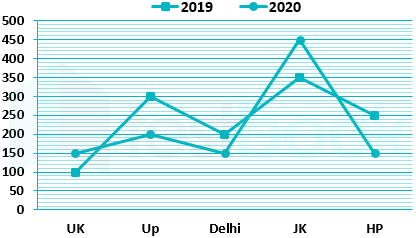
Directions: Read the following line diagram carefully and answer the question given below it. Production of pulses (in tonnes) by five states during the given two years:

71

Find the total production of the Pulse by the state UK, UP, Delhi, JK, and HP in the years 2020?

  1. ((a))

    1100

  2. ((b))

    1300

  3. ((c))

    1700

  4. ((d))

    900

  5. ((e))

    None of these

Show Answer
Answer: ((a))

1100

Given:

The production of the Pulse by the state UK, UP, Delhi, JK, and HP in 2020 = 150, 200, 150, 450, 150

Formula used

Total production of the Pulse in 2020 = production by the state UK + Production by the state UP + Production by the state Delhi + Production by the state JK + Production by the state HP

Calculation

The total production of the Pulse in 2020 = 150 + 200 + 150 + 450 + 150

Then,

The total production of the Pulse in 2020 by the state UK, UP, Delhi, JK, and HP = 1100

72

What is the ratio between the production of the Pulse by the state UK, Delhi, and HP in 2019 and the production of the Pulse UP, JK, and the UK in 2020?

  1. ((a))

    13 : 18

  2. ((b))

    15 : 22

  3. ((c))

    17 : 19

  4. ((d))

    11 : 16

  5. ((e))

    None of these

Show Answer
Answer: ((d))

11 : 16

Given:

The Production of the Pulse by the State UK, Delhi, and HP in 2019 = 100, 200, and 250

The production of the Pulse by the state UP, JK, and the UK in 2020 = 200, 450, and 150

Formula used

Ratio = Total production of the Pulse in 2019 by the state UK, Delhi, and HP ÷  total production of the Pulse in 2020 by the state UP, JK, and the UK

Calculation

Ratio = (100 + 200 + 250) ÷ (200 + 450 + 150)

Ratio = 550 ÷ 800

Ratio = 11 ÷ 16

73

What is the average tones production of the Pulse by the state HP, Delhi, and JK in 2019?

  1. ((a))

    326.66 tones

  2. ((b))

    366.66 tones

  3. ((c))

    256.66 tones

  4. ((d))

    266.66 tones

  5. ((e))

    None of these

Show Answer
Answer: ((d))

266.66 tones

Given:

The production of the Pulse by the state HP, Delhi, and JK in 2019 = 250, 200, and 350

Formula used

The Average tones production of the Pulse = total production of the Pulse in 2019 state HP, Delhi, and JK ÷ total number of the state

Calculation

The average tones production of the Pulse = (250 + 200 + 350) ÷ 3

The average tones production of the Pulse = 800 ÷ 3

The average tones production of the Pulse = 266.66 tones

74

The Production in the state UK and Delhi increased by 20% and 40% respectively from 2020 to 2021. What was the total production of the Pulse by the state UK and Delhi together in 2021?

  1. ((a))

    175 tones

  2. ((b))

    470 tones

  3. ((c))

    280 tones

  4. ((d))

    390 tones

  5. ((e))

    None of these

Show Answer
Answer: ((d))

390 tones

Given:

The Production of the Pulse by the state UK in 2020 = 150 and increased 20%

The Production of the Pulse by the state Delhi in 2020 = 150 and increased 40%

Formula used

Total Production of the Pulse by state UK and Delhi in 2021 = after increased the production of the Pulse by State UK + after increased the production of the Pulse by state Delhi

The increased production of the Pulse = given Production of the Pulse × increased percentage ÷ 100

Calculation

 The total production increased by the state UK = 150 + 150 × 20 ÷ 100

The total production of the Pulse by the state UK = 150 + 30 = 180

The total production increased by the state Delhi = 150 + 150 × 40 ÷ 100

The total production of the Pulse by the state Delhi = 150 + 60 = 210

Then total production of the Pulse by the state UP and the sate Delhi in 2021 = 180 + 210 = 390 tones

75

The Production of the Pulse by the State UP increased/decreased by what percentage from 2019 to 2020?

  1. ((a))

    65%

  2. ((b))

    33.33%

  3. ((c))

    75%

  4. ((d))

    35%

  5. ((e))

    None of these

Show Answer
Answer: ((b))

33.33%

Given:

The production of the Pulse by State UP = 300 in 2019

The production of the Pulse by State UP = 200 in 2020

Formula used

Percentage of the Pulse in UP decreased = (Greatest production of Pulse – Smallest production of the Pulse) ÷ Greater production of the Pulse × 100

Calculation

The Percentage of the Pulse in UP decreased = (300 - 200) ÷ 300 × 100

The percentage of Pulse in UP decreased = 100 ÷ 300 × 100

The percentage of Pulse in UP decreased = 33.33% 

∴ The Production of the Pulse by the State UP decreased by 33.33% from 2019 to 2020

76

Ratio between time taken to cover same distance in upstream to downstream is 5 : 3. If speed of stream is 4 km/hr then find time taken to cover 96km in upstream?

  1. ((a))

    8 hours

  2. ((b))

    6 hours

  3. ((c))

    16 hours

  4. ((d))

    12 hours

  5. ((e))

    15 hours

Show Answer
Answer: ((a))

8 hours

if distance is same, then speed is inversely proportional to time taken

⇒ ratio between speed in upstream to downstream is 3 : 5

Let speed of boat in upstream and downstream be 3x and 5x respectively.

speed of stream = (5x - 3x)/2 = 4

⇒ x = 4

upstream speed = 3x = 3 × 4 = 12 km/hr

∴  time taken to cover 96km in upstream = 96/12 = 8 hours

77

A sum of ₹ 2550 was lent partly at 7% and partly at 9% per annum simple interest. The total interest received after 4 yr was ₹ 800, find the ratio of the money lent at 7% to that lent at 9%.

  1. ((a))

    55 : 39

  2. ((b))

    79 : 21

  3. ((c))

    31 : 10

  4. ((d))

    59 : 43

  5. ((e))

    65 : 42

Show Answer
Answer: ((d))

59 : 43

Given: 

A sum of ₹ 2550 was lent partly at 7% and partly at 9% per annum simple interest.

The total interest received after 4 yr was ₹ 800

Calculation:

Let the Sum lent at 7% = P

Then, Sum lent at 9% = (2550 – P)

Then,

[(P x 7 x 4)/100] + [{(2550 - P) x 9 x 4}/100] = 800

⇒ 7P + 22950 – 9P = 80000/4

⇒ - 2P = 20000 – 22950

⇒ - 2P =  - 2950

⇒ P = Rs. 1475

Now,

Sum lent at 9% = 2550 – 1475

⇒ Rs. 1075

Required ratio = 1475 : 1075 = 59 : 43

Therefore the correct answer is 59 : 43

78

In a vessel, milk and water are in a ratio of 3 : 5. In the second vessel, the milk and water are in the ratio of 3 : 2. In what ratio should these two mixtures be mixed to form a new mixture in which the milk and water are in the ratio 2 : 3?

  1. ((a))

    1 : 8

  2. ((b))

    6 : 1

  3. ((c))

    7 : 1

  4. ((d))

    8 : 1

  5. ((e))

    None of these

Show Answer
Answer: ((d))

8 : 1

Given:

The ratio of milk and water in the first vessel = 3 : 5

The ratio of milk and water in the second vessel = 3 : 2

The ratio of milk and water in the final mixture = 2 : 3

Concept used:

(New quantity of milk/New quantity of water) = (Quantity of milk taken from first vessel + Quantity of milk taken from the second vessel)/(Quantity of water taken from first vessel + Quantity of water taken from the second vessel)

Calculation:

Let the mixture from the two-vessel be mixed in the ratio x : y.

Quantity of milk taken from the first vessel = 3x/8

Quantity of water taken from the first vessel = 5x/8

Quantity of milk taken from the second vessel = 3y/5

Quantity of water taken from the second vessel = 2y/5

Then, {(3x/8) + (3y/5}/{(5x/8) + (2y/5)} = 2/3

⇒ {(15x + 24y)/40}/{(25x + 16y)/40} = 2/3

⇒ 3(15x + 24y) = 2(25x + 16y)

⇒ 45x + 72y = 50x + 32y

⇒ 50x – 45x = 72y – 32y

⇒ 5x = 40y

⇒ x/y = 8/1

∴ The first and second ratio is mixed in the ratio 8 : 1.

79

If Rohit is as much elder than Virat as he is younger to Jadeja and sum of ages of Virat and Jadeja is 36 years, then find Rohit’s age.

  1. ((a))

    18 years

  2. ((b))

    20 years

  3. ((c))

    22 years

  4. ((d))

    24 years

  5. ((e))

    16 years

Show Answer
Answer: ((a))

18 years

GIVEN :

Rohit is as much elder than Virat as he is younger to Jadeja,

Sum of ages of Virat and Jadeja is 36 years.

CALCULATION :

Let the present age of Rohit be x years and he is younger to Jadeja by y years

Hence, Jadeja’s age = (x + y) years

Virat’s age = (x – y) years

According to the question,

Jadeja’s age + Virat’s age = 36

⇒ (x + y) + (x – y) = 36

⇒ 2x = 36

⇒ x = 18 years

∴ Rohit’s age is 18 years.

Shortcut Trick

Present age of Rohit = (sum of ages)/2 = 36/2 = 18 years

Rohit’s age is 18 years.

80

When a pen is sold for Rs. 50, there is a loss of 20%. What is the cost price of the commodity?

  1. ((a))

    Rs. 64.40

  2. ((b))

    Rs. 62.5

  3. ((c))

    Rs. 43

  4. ((d))

    Rs. 43.20

  5. ((e))

    Rs. 65

Show Answer
Answer: ((b))

Rs. 62.5

Given:

S.P. of pen = 50

Loss % = 20% 

Formula used 

C.P. = (100/100 - loss%) × S.P.)

Calculations:  

⇒ C.P. Of Pen = (100/80 × 50)

⇒ C.P. Of Pen = 500/8

⇒ C.P. Of Pen =  Rs. 62.5

∴ The required answer is Rs. 62.5

Attempt this paper under real exam conditions

Timed interface, section switching, instant scoring, and question-by-question analytics — free.

Start Timed Attempt