Official Paper

RRB Clerk Prelims Memory Based Paper (Held On: 13 August 2023 Shift 4) (Previous Year Paper)

80 questions · 45 minutes · with answers · free

Reasoning (40 questions)

Direction: Read the following information carefully and answer the question that follows.

Six boxes -  P, Q, R, S, T and U are placed one above the other but not necessarily in the same order. Only two boxes are placed between box S and U. Box R is immediately above box U. More than two boxes are placed below box T. Box Q is immediately below box S. Box S is neither placed at the top nor at the bottom. Box P is placed below box T and box T is not at the Top.

1

Which box is placed immediately above box T?

  1. ((a))

    P

  2. ((b))

    U

  3. ((c))

    Q

  4. ((d))

    S

  5. ((e))

    R

Show Answer
Answer: ((b))

U

Six boxes -  P, Q, R, S, T and U.

1) Only two boxes are placed between box S and U. 

  1. Box R is immediately above box U. 

3) Box S is neither placed at the top nor at the bottom. 

4) Box Q is immediately below box S.

Case 1:Case 2:Case 3:
BoxBoxBox
R
US
SQ
QR
SRU
QU
<br>

5)  More than two boxes are placed below box T. 

6) Box P is placed below box T and box T is not at the Top.

This will eliminate case 2 and case 3.

Therefore, the final arrangement is as:

Box
R
U
T
P
S
Q
<br>

Hence, box U is immediately above box T.
2

Which of the following statement is true?

  1. ((a))

    Only two boxes are placed between U and P.

  2. ((b))

    Box T is paced exactly between box R and P.

  3. ((c))

    Box S is immediately below box P.

  4. ((d))

    Number of boxes above box U is same as number of boxes below P.

  5. ((e))

    Box R is immediately below box T.

Show Answer
Answer: ((c))

Box S is immediately below box P.

Six boxes -  P, Q, R, S, T and U.

1) Only two boxes are placed between box S and U. 

  1. Box R is immediately above box U. 

3) Box S is neither placed at the top nor at the bottom. 

4) Box Q is immediately below box S.

Case 1:Case 2:Case 3:
BoxBoxBox
R
US
SQ
QR
SRU
QU
<br>

5)  More than two boxes are placed below box T. 

6) Box P is placed below box T and box T is not at the Top.

This will eliminate case 2 and case 3.

Therefore, the final arrangement is as:

Box
R
U
T
P
S
Q
<br>

Checking each option:

Option 1:  Only two boxes are placed between U and P. → False.

Option 2: Box T is paced exactly between box R and P. → False.

Option 3: Box S is immediately below box P. → True.

Option 4: Number of boxes above box U is same as number of boxes below P. → False.

Option 5: Box R is immediately below box T. → False.

Hence, option (3) is true.

3

How many boxes are placed between Box R and Box S?

  1. ((a))

    3

  2. ((b))

    2

  3. ((c))

    4

  4. ((d))

    1

  5. ((e))

    None

Show Answer
Answer: ((a))

3

Six boxes -  P, Q, R, S, T and U.

1) Only two boxes are placed between box S and U. 

  1. Box R is immediately above box U. 

3) Box S is neither placed at the top nor at the bottom. 

4) Box Q is immediately below box S.

Case 1:Case 2:Case 3:
BoxBoxBox
R
US
SQ
QR
SRU
QU
<br>

5)  More than two boxes are placed below box T. 

6) Box P is placed below box T and box T is not at the Top.

This will eliminate case 2 and case 3.

Therefore, the final arrangement is as:

Box
R
U
T
P
S
Q
<br>

Hence, 3 boxes are placed between box R and S.

4

Four of them are alike in a certain way and form a group. Which of the following does not belong to the group?

  1. ((a))

    R - U

  2. ((b))

    T - P

  3. ((c))

    P - S

  4. ((d))

    S - Q

  5. ((e))

    P - Q

Show Answer
Answer: ((e))

P - Q

Six boxes -  P, Q, R, S, T and U.

1) Only two boxes are placed between box S and U. 

  1. Box R is immediately above box U. 

3) Box S is neither placed at the top nor at the bottom. 

4) Box Q is immediately below box S.

Case 1:Case 2:Case 3:
BoxBoxBox
R
US
SQ
QR
SRU
QU
<br>

5)  More than two boxes are placed below box T. 

6) Box P is placed below box T and box T is not at the Top.

This will eliminate case 2 and case 3.

Therefore, the final arrangement is as:

Box
R
U
T
P
S
Q
<br>

All the given options (R - U, T - P, P - S, and S - Q) except option (P - Q) are immediate boxes to each other.

Hence, P - Q is different from the other.

5

Which box is placed at the top?

  1. ((a))

    R

  2. ((b))

    U

  3. ((c))

    Q

  4. ((d))

    P

  5. ((e))

    T

Show Answer
Answer: ((a))

R

Six boxes -  P, Q, R, S, T and U.

1) Only two boxes are placed between box S and U.

  1. Box R is immediately above box U. 

3) Box S is neither placed at the top nor at the bottom. 

4) Box Q is immediately below box S.

Case 1:Case 2:Case 3:
BoxBoxBox
R
US
SQ
QR
SRU
QU
<br>

5)  More than two boxes are placed below box T. 

6) Box P is placed below box T and box T is not at the Top.

This will eliminate case 2 and case 3.

Therefore, the final arrangement is as:

Box
R
U
T
P
S
Q
<br>

Hence, box R is placed at the top.

6

In a certain code language, 'MAGNET' is written as 'OEMTIV'. How is 'PURPLE' written in that code language?

  1. ((a))

    RYVXPG

  2. ((b))

    RYGPVX

  3. ((c))

    RYXVPG

  4. ((d))

    RYXPVG

  5. ((e))

    RVGPVX

Show Answer
Answer: ((c))

RYXVPG

The pattern for the code is as follows:

Similarly,

Hence, 'PURPLE' is coded as 'RYXVPG'.

Directions: Study the following information and answer the given questions.

A certain number of persons are sitting in a row facing north. Two persons sit between G and S, who sits fourth to the right of R. Only six people sit to the left of G. H sits at the extreme left end of the row. Two persons sit between H and N. The number of persons sitting between N and G is the same as the number of persons sitting between S and the one who is sitting at the extreme right end of the row.

7

Who is sitting to the immediate right of R?

  1. ((a))

    G

  2. ((b))

    S

  3. ((c))

    H

  4. ((d))

    N

  5. ((e))

    None of them

Show Answer
Answer: ((a))

G

Given: A certain number of persons are sitting in a row facing north

  1. H sits at the extreme left end of the row

  2. Two persons sit between H and N

<br>

3) Only six people sit to the left of G.

  1. Two persons sit between G and S, who sits fourth to the right of R

<br>
  1. The number of persons sitting between N and G is the same as the number of persons sitting between S and the one who is sitting at the extreme right end of the row.

<br>

Hence, G is sitting immediate right of R.

8

How many persons are sitting in a row?

  1. ((a))

    10

  2. ((b))

    11

  3. ((c))

    13

  4. ((d))

    12

  5. ((e))

    9

Show Answer
Answer: ((c))

13

Given: A certain number of persons are sitting in a row facing north

  1. H sits at the extreme left end of the row

  2. Two persons sit between H and N

<br>

3) Only six people sit to the left of G.

  1. Two persons sit between G and S, who sits fourth to the right of R

<br>
  1. The number of persons sitting between N and G is the same as the number of persons sitting between S and the one who is sitting at the extreme right end of the row.

<br>

Hence, 13 persons are sitting in a row.

9

Who is sitting between N and G?

  1. ((a))

    H

  2. ((b))

    S

  3. ((c))

    R

  4. ((d))

    None of these

  5. ((e))

    No one

Show Answer
Answer: ((c))

R

Given: A certain number of persons are sitting in a row facing north

  1. H sits at the extreme left end of the row

  2. Two persons sit between H and N

<br>

3) Only six people sit to the left of G.

  1. Two persons sit between G and S, who sits fourth to the right of R

<br>
  1. The number of persons sitting between N and G is the same as the number of persons sitting between S and the one who is sitting at the extreme right end of the row.

<br>

Hence, R is sitting between N and G.

10

What is the position of N with respect to S?

  1. ((a))

    Third to the right

  2. ((b))

    Fourth to the right

  3. ((c))

    Fourth to the left

  4. ((d))

    fifth to the right

  5. ((e))

    sixth to the left

Show Answer
Answer: ((e))

sixth to the left

Given: A certain number of persons are sitting in a row facing north

  1. H sits at the extreme left end of the row

  2. Two persons sit between H and N

<br>

3) Only six people sit to the left of G.

  1. Two persons sit between G and S, who sits fourth to the right of R

<br>
  1. The number of persons sitting between N and G is the same as the number of persons sitting between S and the one who is sitting at the extreme right end of the row.

<br>

Hence, N is sitting sixth to the left of S.

11

How many persons are sitting between R and S?

  1. ((a))

    1

  2. ((b))

    2

  3. ((c))

    3

  4. ((d))

    4

  5. ((e))

    5

Show Answer
Answer: ((c))

3

Given: A certain number of persons are sitting in a row facing north

  1. H sits at the extreme left end of the row

  2. Two persons sit between H and N

<br>

3) Only six people sit to the left of G.

  1. Two persons sit between G and S, who sits fourth to the right of R

<br>
  1. The number of persons sitting between N and G is the same as the number of persons sitting between S and the one who is sitting at the extreme right end of the row.

<br>

Hence, 3 persons are sitting between R and S**.**

Direction: Read the following information carefully and answer the questions that follow.

Seven people P, Q, R, S, T, U and V. All of them have their birthdays in different months namely January, March, April, May, June, July and August. No two persons share the same birthday month. P's birthday is in January. There are the same number of person having their birthday before and after R. Only one person's birthday is there between S and R. Q's birthday is in the month having 31 days but not in August. There are two person's birthday between Q and V. T's birthday is before U's birthday. Q's birthday is not before R.

12

In which month does S have his birthday?

  1. ((a))

    March

  2. ((b))

    April 

  3. ((c))

    May

  4. ((d))

    June

  5. ((e))

    July

Show Answer
Answer: ((a))

March

  1. P's birthday is in January.

  2. There are the same number of person having their birthday before and after R. ‘

  3. Only one person's birthday is there between S and R.

  4. Q's birthday is in the month having 31 days but not in August.

  5. There are two person's birthday between Q and V.  

  6. T's birthday is before U's birthday

CASE 1CASE 2
January (31)PJanuary (31)P
March (31)SMarch (31)Q
April (30)VApril (30)T
May (31)RMay (31)R
June(30)TJune(30)V
July (31)QJuly (31)S
August (31)UAugust (31)U


  1. Q's birthday is not before R.  (This eliminates case 2)
CASE 1
January (31)P
March (31)S
April (30)V
May (31)R
June(30)T
July (31)Q
August (31)U


Hence, S's birthday is in march.

13

Whose birthday is in the month of June?

  1. ((a))

    Q

  2. ((b))

    R

  3. ((c))

    S

  4. ((d))

    T

  5. ((e))

    U

Show Answer
Answer: ((d))

T

  1. P's birthday is in January.

  2. There are the same number of person having their birthday before and after R. ‘

  3. Only one person's birthday is there between S and R.

  4. Q's birthday is in the month having 31 days but not in August.

  5. There are two person's birthday between Q and V.  

  6. T's birthday is before U's birthday

CASE 1CASE 2
January (31)PJanuary (31)P
March (31)SMarch (31)Q
April (30)VApril (30)T
May (31)RMay (31)R
June(30)TJune(30)V
July (31)QJuly (31)S
August (31)UAugust (31)U


  1. Q's birthday is not before R.  (This eliminates case 2)
CASE 1
January (31)P
March (31)S
April (30)V
May (31)R
June(30)T
July (31)Q
August (31)U


Hence, T's birthday is in June.

14

How many persons have their birthday before Q?

  1. ((a))

    One

  2. ((b))

    Two

  3. ((c))

    Three

  4. ((d))

    Four

  5. ((e))

    More than Four

Show Answer
Answer: ((e))

More than Four

  1. P's birthday is in January.

  2. There are the same number of person having their birthday before and after R. ‘

  3. Only one person's birthday is there between S and R.

  4. Q's birthday is in the month having 31 days but not in August.

  5. There are two person's birthday between Q and V.  

  6. T's birthday is before U's birthday

CASE 1CASE 2
January (31)PJanuary (31)P
March (31)SMarch (31)Q
April (30)VApril (30)T
May (31)RMay (31)R
June(30)TJune(30)V
July (31)QJuly (31)S
August (31)UAugust (31)U


  1. Q's birthday is not before R.  (This eliminates case 2)
CASE 1
January (31)P
March (31)S
April (30)V
May (31)R
June(30)T
July (31)Q
August (31)U


Five persons have their birthday before Q.

Hence, More than four is the correct answer.

15

Four among the five are same in a certain way thus form a group. Who among the following is odd one out

  1. ((a))

    P

  2. ((b))

    S

  3. ((c))

    R

  4. ((d))

    T

  5. ((e))

    Q

Show Answer
Answer: ((d))

T

  1. P's birthday is in January.

  2. There are the same number of person having their birthday before and after R. ‘

  3. Only one person's birthday is there between S and R.

  4. Q's birthday is in the month having 31 days but not in August.

  5. There are two person's birthday between Q and V.  

  6. T's birthday is before U's birthday

CASE 1CASE 2
January (31)PJanuary (31)P
March (31)SMarch (31)Q
April (30)VApril (30)T
May (31)RMay (31)R
June(30)TJune(30)V
July (31)QJuly (31)S
August (31)UAugust (31)U


  1. Q's birthday is not before R.  (This eliminates case 2)
CASE 1
January (31)P
March (31)S
April (30)V
May (31)R
June(30)T
July (31)Q
August (31)U


All of them having birthday in the month which has 31 days except T

Hence, T is odd one out.

16

Who is having his birthday at the last?

  1. ((a))

    U

  2. ((b))

    V

  3. ((c))

    R

  4. ((d))

    T

  5. ((e))

    None of the above given option

Show Answer
Answer: ((a))

U

  1. P's birthday is in January.

  2. There are the same number of person having their birthday before and after R. ‘

  3. Only one person's birthday is there between S and R.

  4. Q's birthday is in the month having 31 days but not in August.

  5. There are two person's birthday between Q and V.  

  6. T's birthday is before U's birthday

CASE 1CASE 2
January (31)PJanuary (31)P
March (31)SMarch (31)Q
April (30)VApril (30)T
May (31)RMay (31)R
June(30)TJune(30)V
July (31)QJuly (31)S
August (31)UAugust (31)U


  1. Q's birthday is not before R.  (This eliminates case 2)
CASE 1
January (31)P
March (31)S
April (30)V
May (31)R
June(30)T
July (31)Q
August (31)U

Hence, U has his birthday at last.

Directions: Study the following information carefully and answer the questions given below:

Point A is 8m south of point F. Point B is 5m east of point H, which is 4m north of point E. Point G is 15m west of point D, which is 9m south of point B. Point C is 7m south of point G. Point A is 5m west of point E.

17

What is the direction of Point C with respect to Point F?

  1. ((a))

    South East

  2. ((b))

    North East

  3. ((c))

    South West

  4. ((d))

    North West

  5. ((e))

    None of These

Show Answer
Answer: ((c))

South West

As per the given information,

  1. Point A is 8m south of point F.

  2. Point B is 5m east of point H,

  3. H is 4m north of point E.

  4. Point G is 15m west of point D,

  5. D is 9m south of point B.

  6. Point C is 7m south of point G.

  7. Point A is 5m west of point E.

Therefore the final arrangement is, 

 Hence, South West is the direction of Point C with respect to Point F

18

What is the total distance between F and B?

  1. ((a))

    22m

  2. ((b))

    20m

  3. ((c))

    18m

  4. ((d))

    25m

  5. ((e))

    None of these

Show Answer
Answer: ((a))

22m

As per the given information,

  1. Point A is 8m south of point F.

  2. Point B is 5m east of point H,

  3. H is 4m north of point E.

  4. Point G is 15m west of point D,

  5. D is 9m south of point B.

  6. Point C is 7m south of point G.

  7. Point A is 5m west of point E.

Therefore the final arrangement is, 

 the total distance between  F and B is

= 8 + 5 + 4 + 5

= 22 m

 Hence, 22m is the total distance between  F and B.

19

Assume that there is a Point Y, which is in in the middle of Point F and Point A then what is the distance between Point Y and Point H?

  1. ((a))

    10 m

  2. ((b))

    3 m 

  3. ((c))

    5 m

  4. ((d))

    15 m

  5. ((e))

    4 m

Show Answer
Answer: ((c))

5 m

As per the given information,

  1. Point A is 8m south of point F.

  2. Point B is 5m east of point H,

  3. H is 4m north of point E.

  4. Point G is 15m west of point D,

  5. D is 9m south of point B.

  6. Point C is 7m south of point G.

  7. Point A is 5m west of point E.

Therefore the final arrangement is, 

As per the question, 

Hence, 5m is the distance between Pont Y and Point H.

20

Direction: In the following question assuming the given statement to be True, find which of the conclusion among given conclusions is/are definitely true and then give your answers accordingly.

Statement: J ≤ K < T = A ≥ W = C

Conclusion:

I) W = T

II) T > W

  1. ((a))

    Only II is true

  2. ((b))

    Both I and II are true

  3. ((c))

    Either I or II is true

  4. ((d))

    Only I is true

  5. ((e))

    Neither I nor II is true

Show Answer
Answer: ((c))

Either I or II is true

Statement: J ≤ K < T = A ≥ W = C

i) W = T ⇒ False (as T = A ≥ W ⇒ T ≥ W thus the relation between W and T cannot be established)

ii) T > W ⇒ False (as T = A ≥ W ⇒ T ≥ W thus the relation between W and T cannot be established) 

So, T ≥ W means either T > W or T = W

Hence, either I or II is true.

21

Direction: In the following question assuming the given statement to be True, find which of the conclusion among given conclusions is/are definitely true and then give your answers accordingly.

Statement: C = B < F ≤ H > R = D ≥ K

Conclusion: 

I) F > D

II) R > B

  1. ((a))

    Both I and II are true

  2. ((b))

    Only I is true

  3. ((c))

    Only II is true

  4. ((d))

    Either I or II is true

  5. ((e))

    Neither I nor II is true

Show Answer
Answer: ((e))

Neither I nor II is true

Statement: C = B < F ≤ H > R = D ≥ K

i) F > D ⇒ False (as F ≤ H > R = D, thus relation between F and H cannot be determined)

ii) R > B ⇒ False (as B < F ≤ H > R, thus relation between R and B cannot be determined)

Hence, neither I nor II is true.

22

Direction: In the following question assuming the given statement to be True, find which of the conclusion among given conclusions is/are definitely true and then give your answers accordingly.

Statement: E > T ≥ F > Z = V < I ≤ R

Conclusion: 

I) V < T

II) R > Z

  1. ((a))

    Only I is true

  2. ((b))

    Both I and II are true

  3. ((c))

    Only II is true

  4. ((d))

    Neither I nor II is true

  5. ((e))

    Either I or II is true

Show Answer
Answer: ((b))

Both I and II are true

Statement: E > T ≥ F > Z = V < I ≤ R

i) V < T ⇒ True (as T ≥ F > Z = V ⇒ T > V or V < T)

ii) R > Z ⇒ True (as Z = V < I ≤ R ⇒ Z < R or R > Z) 

Hence, both I and II are true.

23

Direction: In the question below, there are two statements followed by two conclusions numbered I and II. You have to take the given statements to be true even if they seem to be at variance with commonly known facts. Read all the conclusions and then decide which of the given conclusions logically follows from the given statements disregarding the commonly known facts.

Statements:

Some teacher are boss.

All boss are employee.

Conclusions:

I. All teacher are employee.  

II. Some employee are boss.

  1. ((a))

    Only conclusion I follows

  2. ((b))

    Only conclusion II follows

  3. ((c))

    Both I and II follow

  4. ((d))

    Neither I nor II follows

  5. ((e))

    Either I or II follows

Show Answer
Answer: ((b))

Only conclusion II follows

The least possible Venn diagram for the given statements is as follows,


Conclusion:

I. All teacher are employee → False (it is possible but not definite)

II. Some employee are boss → True (as all boss are employee)

Hence, only conclusion II follows.

Direction: In the question below are given three statements followed by two conclusions numbered I and II. You have to take the given statements to be true even if they seem to be at variance with commonly known facts. Read all the conclusions and then decide which of the given conclusions logically follows from the given statements disregarding commonly known facts.

24

Statements:

All Teacher is Professor

All Professor are Dentist 

Conclusion:

All Dentists are Teacher

All teachers are Dentists

  1. ((a))

    Only I follows

  2. ((b))

    Only II follows

  3. ((c))

    Only I and II follows

  4. ((d))

    Either I & II follows

  5. ((e))

    Neither I nor II follows

Show Answer
Answer: ((b))

Only II follows

The least possible Venn diagram for the given statements is as follows,

Conclusions:

I. All Dentists are Teachers → False (as All the teacher is Dentist, Some part of Dentist not Teacher. So, it is false) 

II. All teachers are Dentists  → True (All Teacher is Professor and All Professor are Dentist 

hence all teachers are dentists ) 

 Hence, only II follows.

25

Direction: In the question below are given two statements followed by two conclusions numbered I and II. You have to take the given statements to be true even if they seem to be at variance with commonly known facts. Read all the conclusions and then decide which of the given conclusions logically follows from the given statements disregarding commonly known facts.

Statements:

All Rooms are House.

No House is Flat.

Conclusions:

I. Some Houses are Room.

II. No Room is Flat.

  1. ((a))

    Only I follows

  2. ((b))

    Only II follows

  3. ((c))

    Either I or II follow

  4. ((d))

    Neither I nor II follow

  5. ((e))

    Both I and II follow

Show Answer
Answer: ((e))

Both I and II follow

The least possible Venn diagram for the given statements is as follows

Conclusions:

I. Some Houses are Room → True (As we can see, all Rooms are House. So, some Houses are Room is true.)

II. No Room is Flat → True (As we can see, all Rooms are House and no House is Flat. So, no Room is Flat is true.)

Hence, both I and II follow.

Direction: Study the following arrangement carefully and answer the questions given below:

H M @ L 1 9 A 3 X & 8 W 5 ! F C V # % N K 7 2 Z a Q B G € µ T

26

How many such consonants are there in the given arrangement, each of which is immediately followed by a number?

  1. ((a))

    None

  2. ((b))

    Four

  3. ((c))

    Three

  4. ((d))

    Two

  5. ((e))

    One

Show Answer
Answer: ((c))

Three

Given series is: (Left) H M @ L 1 9 A 3 X & 8 W 5 ! F C V # % N K 7 2 Z a Q B G € µ T (Right)

Arrangement required: Consonant → Number

(Left)   H M @ L 1 9 A 3 X & 8 W 5 ! F C V # % N K 7 2 Z a Q B G € µ T       (Right)

Hence, three such pairs are there i.e. L1, W5, K7

27

How many elements are there between 19thelement from right and 21stelement from the left end of the given arrangement?

  1. ((a))

    Five

  2. ((b))

    Seven

  3. ((c))

    Nine

  4. ((d))

    Eleven

  5. ((e))

    Thirteen 

Show Answer
Answer: ((b))

Seven

Given series is: (Left) H M @ L 1 9 A 3 X & 8 W 5 ! F C V # % N K 7 2 Z a Q B G € µ T (Right)

19th element from right end is ‘5’

and 21st element from the left end is ‘K’.

Given series is: (Left) H M @ L 1 9 A 3 X & 8 W 5 ! F C V # % N K 7 2 Z a Q B G € µ T (Right)

Clearly, there are 7 elements between  the19th element from the right and the 21st element from the left end of the arrangement: !, F, C, V, #, %, N

Hence, seven is the correct answer.

28

How many such symbols are there in the given arrangement, each of which is immediately preceded and immediately followed by a letter?

  1. ((a))

    Two

  2. ((b))

    One

  3. ((c))

    Three

  4. ((d))

    More than Four

  5. ((e))

    Four

Show Answer
Answer: ((b))

One

Given series is: (Left) H M @ L 1 9 A 3 X & 8 W 5 ! F C V # % N K 7 2 Z a Q B G € µ T (Right)

Arrangement required: Letter → Symbol → Letter

Left side: H M @ L 1 9 A 3 X & 8 W 5 ! F C V # % N K 7 2 Z a Q B G € µ T : Right side

Hence, only one such pair is there i.e. M@L.

29

Which of the following is the sixth to the right of the fifteenth element from the left end of the given arrangement?

  1. ((a))

    V

  2. ((b))

  3. ((c))

    K

  4. ((d))

    A

  5. ((e))

    µ

Show Answer
Answer: ((c))

K

Given series is: (Left) H M @ L 1 9 A 3 X & 8 W 5 ! F C V # % N K 7 2 Z a Q B G € µ T (Right)

Left + Right = Left

15th from the left + 6th to the right = 21st from the left

(Left) H M @ L 1 9 A 3 X & 8 W 5 ! F C V # % N K 7 2 Z a Q B G € µ T (Right)

Clearly, 21st from the left is ‘K’.

Hence, K is the correct answer.

Direction: The following questions are based on the five three- digit number given below.

821  497  133  986  577

30

If first digit and last digit of each number are interchanged and then arranged in increasing order then which of the following will be second highest number?

  1. ((a))

    497

  2. ((b))

    821

  3. ((c))

    577

  4. ((d))

    133

  5. ((e))

    986

Show Answer
Answer: ((c))

577

Given series: 821 497 133 986 577

On interchanging first and last digit,

821 → 128

497 → 794

133 → 331

986 → 689

577 → 775

Arranging in increasing order: 128 331 689 775 794

Hence, “775” is the second highest number.

Hence, 577 is the correct answer.

31

If 1 is subtracted from the second digit of each number and 1 is added to the last digit of each number then which of the following will not be divisible by 4?

  1. ((a))

    497

  2. ((b))

    577

  3. ((c))

    133

  4. ((d))

    821

  5. ((e))

    986

Show Answer
Answer: ((e))

986

Given series: 821 497 133 986 577

Subtracting 1 from second digit and adding 1 to the last digit:

812 488 124 977 568

Hence, “977” is the only number which is not divisible by 4.

32

If in each number three digits are arranged in descending order, which of the following number is the second lowest among them?

  1. ((a))

    986

  2. ((b))

    497

  3. ((c))

    133

  4. ((d))

    821

  5. ((e))

    577

Show Answer
Answer: ((e))

577

Given series: 821 497 133 986 577

In each number three digits arranged in descending order

New series obtained:  821 974 331 986 775

Hence, “775” is second lowest number.

33

Four letters - cluster have been given, out of which three are alike in some manner and one is different select the odd letter cluster.

  1. ((a))

    JB

  2. ((b))

    DH

  3. ((c))

    KA

  4. ((d))

    EJ

  5. ((e))

    None

Show Answer
Answer: ((d))

EJ

The pattern followed here is :

  1. JB

J (10) + B (2) = 12

  1. DH

D (4) + H (8) = 12

  1. KA

K (11) + A(1) = 12

4. EJ

E (5) + J (10) = 15

Resultant of all options is “12” except “EJ”

Hence, ‘EJ’ is odd among them.

Direction: Study the following information carefully and answer the question.

Eight friends A, B, C, D, E, F, G, and H are sitting around a square table in such a way that four of them sit at four corners while four sit in the middle of each of the four sides. The ones who sit at the four corners face the centre while those who sit in the middle of the sides face outside from the centre.

D sits at the corner of the table. G sits second to the right of D. Only two people sit between G and B. C is one of the immediate neighbours of B. H sits second to the left of C. E sits second to the left of F. G is not an immediate neighbour of F.

34

Four of the following five are alike in a certain way and hence form a group which of the following does not belong to the group?

  1. ((a))

    B

  2. ((b))

    A

  3. ((c))

    E

  4. ((d))

    F

  5. ((e))

    H

Show Answer
Answer: ((e))

H

As per the given information,

  1. D sits at the corner of the table. G sits second to the right of D. Only two people sit between G and B.

  1. C is one of the immediate neighbors of B. H sits second to the left of C.

  1. E sits second to the left of F. G is not an immediate neighbor of F. As no proper place of E, Hence case-2 ruled out.

Therefore, the final arrangement will be, 


All, except H, are facing outside the center.

H is the odd one out.

35

Which of the following statement is correct regarding A?

I ) A is facing towards the centre.

II ) A sits in the middle of H and G.

III ) A sits fourth right of D.

  1. ((a))

    Only I is correct.

  2. ((b))

    Only II is correct.

  3. ((c))

    Only III is correct.

  4. ((d))

    Both I and II is correct

  5. ((e))

    Both II and III is correct

Show Answer
Answer: ((b))

Only II is correct.

As per the given information,

  1. D sits at the corner of the table. G sits second to the right of D. Only two people sit between G and B.

  1. C is one of the immediate neighbors of B. H sits second to the left of C.

  1. E sits second to the left of F. G is not an immediate neighbor of F. As no proper place of E, Hence case-2 ruled out.

Therefore, the final arrangement will be, 


A sits in the middle of H and G is the correct answer.

36

How many persons sits between A and C, when counted from the right of C?

  1. ((a))

    None

  2. ((b))

    One

  3. ((c))

    Two

  4. ((d))

    Three

  5. ((e))

    More than Three

Show Answer
Answer: ((e))

More than Three

As per the given information,

  1. D sits at the corner of the table. G sits second to the right of D. Only two people sit between G and B.

  1. C is one of the immediate neighbors of B. H sits second to the left of C.

  1. E sits second to the left of F. G is not an immediate neighbor of F. As no proper place of E, Hence case-2 ruled out.

Therefore, the final arrangement will be, 

Four persons sit between C and A, when counted from the right of C.

37

________ Sits second right of ________?

  1. ((a))

    B, F

  2. ((b))

    G, H

  3. ((c))

    E, B

  4. ((d))

    F, A

  5. ((e))

    D, H

Show Answer
Answer: ((a))

B, F

As per the given information,

  1. D sits at the corner of the table. G sits second to the right of D. Only two people sit between G and B.

  1. C is one of the immediate neighbors of B. H sits second to the left of C.

  1. E sits second to the left of F. G is not an immediate neighbour of F. As no proper place of E, Hence case-2 ruled out.

Therefore, the final arrangement will be, 


B sits second to the right of F.

38

Which of the following person sits third right of A?

  1. ((a))

    C

  2. ((b))

    H

  3. ((c))

    G

  4. ((d))

    D

  5. ((e))

    F

Show Answer
Answer: ((d))

D

As per the given information,

  1. D sits at the corner of the table. G sits second to the right of D. Only two people sit between G and B.

  1. C is one of the immediate neighbors of B. H sits second to the left of C.

  1. E sits second to the left of F. G is not an immediate neighbor of F. As no proper place of E, Hence case-2 ruled out.

Therefore, the final arrangement will be, 


D sits third right of A.

39

How many pairs of letters are there in the word “MASERATI” that has many letters between them in the word as in the alphabet?

  1. ((a))

    Five

  2. ((b))

    Three

  3. ((c))

    One

  4. ((d))

    Four

  5. ((e))

    None of the above

Show Answer
Answer: ((e))

None of the above

The given word is represented as follow,

Hence we got two pairs- EI and RT.

Hence, “None of the above” is the correct answer.

40

If it is possible to make only one meaningful English word with the second, the fourth, the fifth, and the sixth letters of the word ACTION, which of the following will be the second letter of that word? If no such word can be made give ‘X’ as the answer and if more than one such word can be made give ‘Y’ as the answer.

  1. ((a))

    N

  2. ((b))

    I

  3. ((c))

    O

  4. ((d))

    X

  5. ((e))

    Y

Show Answer
Answer: ((e))

Y

Given WordA C T I O N
Chosen LettersC I O N
Only possible wordCOIN , ICON
<br>

Hence, 'Y' is the correct answer.

Numerical Ability (40 questions)

41

Niya can complete work in 10 and Niya and kriya together can complete the work in 6 days. If Riya is 20% more efficient then kriya then in how many days will Riya complete work when working alone?

  1. ((a))

    12.5 days

  2. ((b))

    12 days

  3. ((c))

    15 days

  4. ((d))

    5 days

  5. ((e))

    4 days

Show Answer
Answer: ((a))

12.5 days

Given:

Time taken by Niya alone to complete the work = 10 days

Time taken by Niya and Kriya to complete the work = 6 Days

Riya = 20% more efficient then kriya

Formula used:

(1/t) = (1/t1) + (1/t2)

Where, t = time taken to complete whole work,

t1 and t2 = time taken by 1 and 2 to complete work alone

Efficiency = (Total work)/(Time taken)

Calculation:

Let time taken by Kriya be x days.

⇒ (1/6) = (1/10) + (1/x)

⇒ (1/x) = (1/6) - (1/10)  (5 - 3)/30 

⇒ (1/x) = (5 - 3)/30

⇒ (1/x) = 2/30

⇒ x = 30/2 

⇒ x = 15

Time taken by Kriya = 15 days.

If Riya is 20% more efficient than kriya

So, time to complete the work by Riya = 15/{(100 + 20)/100} 

⇒ 1500/120

⇒ 12.5 days

∴ Riya alone can complete the work in 12.5 days.

Alternate Method Let total work = 30

Efficiency of Niya = 3 

Then efficiency of Kriya = 5 - 3 = 2

Riya is 20% more efficient then kriya then

Efficiency of kriya = 1.2 × 2 = 2.4

Riya complete work when working alone = 30/2.4 = 12.5 days.

42

Shubham invested Rs. 2250 in a business and after some time Shivam also join him and invested Rs. 2500. At the end of year Shivam received Rs. 2750 profit out of Rs. 6050. After how much time did he join the business.

  1. ((a))

    9 months

  2. ((b))

    6 months

  3. ((c))

    3 months

  4. ((d))

    4 months

  5. ((e))

    8 months

Show Answer
Answer: ((c))

3 months

Given:  

Shubham invests Rs.2250, and after some time Shivam invests Rs. 2500

Calculation: 

Let the time after which Shivam invest his rupees be x

⇒ Shubham's Profit = 6050 - 2750 = 3300 Rs.

⇒ Shivam's profit = 2750 Rs.

The ratio of the profit = 3300 : 2750

⇒  6 : 5

Because the ratio of the capital is equals to the ratio of the profit then,

⇒ 2250 × 12 : 2500 × x = 6 : 5

⇒ 5 ( 2250 × 12) = 6 ( 2500 × x)

⇒  x = 9 months

∴  Shivam invested after 3 months.

43

The cost price of 12 items is equal to the selling price of 8 items. If the marked price of an item is Rs.1500 and the discount offered is 20% on the marked price. What is the the profit percentage of an item?

  1. ((a))

    50%

  2. ((b))

    40%

  3. ((c))

    45%

  4. ((d))

    38%

  5. ((e))

    35%

Show Answer
Answer: ((a))

50%

Let the cost price of an item be Rs.A.

Selling price of 8 items = Rs.12A

Selling price of an item = 12A/8 = Rs. 3A/2

Marked price of an item = Rs.1500

Selling price of an item = 1500 × 80/100 = Rs.1200

⇒ 3A/2 = 1200

⇒ A = Rs.800

The cost price of an item = Rs.800

Profit percentage = (1200 – 800)/800 × 100

∴ Profit percentage = 50%

44

What should come in place of the question mark '?' in the following number series?

156, 110, 72, 42, 20, ?

  1. ((a))

    12

  2. ((b))

    2

  3. ((c))

    6

  4. ((d))

    5

  5. ((e))

    None of these

Show Answer
Answer: ((c))

6

Given:

156, 110, 72, 42, 20, ?

Calculation:

From the above series, the logic can be explained as:

13 × 12 = 156

11 × 10 = 110

9 × 8 = 72

7 × 6 = 42

5 × 4 = 20

3 × 2 = 6

∴ The required value of "?" is 6.

Alternate Method

Calculation:

The logic of the above series can be explained as below

∴ The required value of "?" is 6.

45

What should come in place of the question mark '?' in the following number series?

12, 16, 25, 41, 66, ?

  1. ((a))

    101

  2. ((b))

    106

  3. ((c))

    102

  4. ((d))

    122

  5. ((e))

    120

Show Answer
Answer: ((c))

102

Given:

12, 16, 25, 41, 66, ? 

Calculation:

The series follows the following pattern

⇒ 12 + 22 = 16

⇒ 16 + 32 = 25

⇒ 25 + 42 = 41

⇒ 41 + 52 = 66

⇒ 66 + 62 = 102

∴ The required value of ? is 102

46

What should come in place of the question mark '?' in the following number series?

6, 6, 12, 36, 144, ?

  1. ((a))

    620

  2. ((b))

    700

  3. ((c))

    720

  4. ((d))

    520

  5. ((e))

    820

Show Answer
Answer: ((c))

720

Given:

6, 6, 12, 36, 144, ?

Calculation:

The series follows the following pattern:

6 × 1 = 6

6 × 2 = 12

12 × 3 = 36

36 × 4 = 144

144 × 5 = 720

∴ 720 will come in place of the question mark ('?').

47

Which number will replace the question mark (?) in the following series?

107, 222, 352, 512, ?, 1072

  1. ((a))

    615

  2. ((b))

    696

  3. ((c))

    712

  4. ((d))

    625

  5. ((e))

    732

Show Answer
Answer: ((e))

732

Given:

107, 222, 352, 512, ?, 1072

Calculation:

Pattern of the given series can be explained as:

∴ The value '?' is 732.

48

What should come in place of the question mark '?' in the following number series?

20, 33, 50, 69, 92, ?

  1. ((a))

    196

  2. ((b))

    121

  3. ((c))

    169

  4. ((d))

    100

  5. ((e))

    132

Show Answer
Answer: ((b))

121

The correct answer is: 2


Given:

20, 33, 50, 69, 92, ?

Calculation:

the given series follows the following pattern:

20 + 13 = 33

33 + 17 = 50

50 + 19 = 69

69 + 23 = 92

92 + 29 = 121

here; 13 , 17 , 19 , 23 & 29 are prime numbers.

∴ 121 will come in place of ?

49

What will come in the place of the question mark ‘?’ in the following question?

95 ÷ 19 + √49 – 27 ÷ 9 = √?

  1. ((a))

    81

  2. ((b))

    121

  3. ((c))

    100

  4. ((d))

    169

  5. ((e))

    None of these.

Show Answer
Answer: ((a))

81

Given:

95 ÷ 19 + √49 – 27 ÷ 9 = √? 

Concept used:

Follow the BODMAS rule according to the table given below:

Calculation:

95 ÷ 19 + √49 – 27 ÷ 9 = √? 

⇒ 5 + 7 – 3 = √?

⇒ 9 = √?

⇒ ? = 81

The value of ? is 81.

50

What will come in the place of the question mark ‘?’ in the following question?

840 ÷ 14 + 6 × 9 + ? = 187

  1. ((a))

    73

  2. ((b))

    72

  3. ((c))

    71

  4. ((d))

    74

  5. ((e))

    None of these.

Show Answer
Answer: ((a))

73

Given:

840 ÷ 14 + 6 × 9 + ? = 187

Concept used:

Follow the BODMAS rule according to the table given below:

Calculation:

840 ÷ 14 + 6 × 9 + ? = 187

⇒ 60 + 54 + ? = 187

⇒ 114 + ? = 187

⇒ ? = 187 - 114 = 73

The value of ? is 73.

51

What will come in the place of the question mark ‘?’ in the following question?

200 ÷ 8 of 5 + 12.5 × 20 = 5 × ?

  1. ((a))

    15

  2. ((b))

    51

  3. ((c))

    61

  4. ((d))

    41

  5. ((e))

    55

Show Answer
Answer: ((b))

51

Given:  

200 ÷ 8 of 5 + 12.5 × 20 = 5 × ?

Concept Used:

Follow the BODMAS rule according to the table given below:

Calculation:

200 ÷ 8 of 5 + 12.5 × 20 = 5 × ?

⇒ 200 ÷ 40 + 12.5 × 20 = 5 × ?

⇒ (200/40) + 250 = 5 × ?

⇒ 5 + 250 = 5 × ?

⇒ 255 = 5 × ?

⇒ ? = 255/5

⇒ ? = 51

∴ 51 will come in place of the question mark ('?').

52

What will come in the place of the question mark ‘?’ in the following question?

(2197)1/3 + 192 - 122 = ? - (60 × 5)

  1. ((a))

    630

  2. ((b))

    430

  3. ((c))

    530

  4. ((d))

    730

  5. ((e))

    None of these

Show Answer
Answer: ((c))

530

Given:

(2197)1/3 + 192 - 122 = ? - (60 × 5)

Concept used:

Follow the BODMAS rule according to the table given below:

Calculation:

(2197)1/3 + 192 - 122 = ? - (60 × 5)

⇒ 13 + 361 - 144 = ? - 300

⇒ 374 - 144 = ? - 300

⇒ 230 + 300 = ?

⇒ ? = 530

∴ The value of ? is 530.

53

What will come in the place of the question mark ‘?’ in the following question?

(25% of 900 + ? + 22 × 62)  = 282

  1. ((a))

    615

  2. ((b))

    215

  3. ((c))

    315

  4. ((d))

    515

  5. ((e))

    415

Show Answer
Answer: ((e))

415

Given:

(25% of 900 + ? + 22 × 62)  = 28

Concept used:

Follow the BODMAS rule according to the table given below:

Calculation:

(25% of 900 + ? + 22 × 62)  = 282

⇒ [(1/4) × 900 + ? + 4 × 36) = 282

⇒ (225 + ? + 144) = 282

⇒ (225 + ? + 144) = 784

⇒ 369 + ? = 784

⇒ ? = 415

∴ The value of ? is 415.

54

What will come in the place of the question mark ‘?’ in the following question?

40% of (2.5 × 4 + ?) = 24

  1. ((a))

    40

  2. ((b))

    60

  3. ((c))

    50

  4. ((d))

    30

  5. ((e))

    None of these

Show Answer
Answer: ((c))

50

Given:

40% of (2.5 × 4 + ?) = 24

Concept used:

Follow the BODMAS rule according to the table given below:

Calculation:

40% of (2.5 × 4 + ?) = 24

⇒ 40% of (10 + ?) = 24

⇒ 4 + 0.4(?) = 24

⇒ 0.4(?) = 20

⇒ ? = 50

∴ The value of ? is 50.

Alternate Method

Calculation:

40% of (2.5 × 4 + ?) = 24

⇒ 40% of (10 + ?) = 24

⇒ (10 + ?) = 60

⇒ ? = 50

∴ The value of ? is 50.

55

What will come in the place of the question mark ‘?’ in the following question?

45% of 400 + 20% of ? = 25% of 40

  1. ((a))

    -170

  2. ((b))

    -850

  3. ((c))

    850

  4. ((d))

    -85

  5. ((e))

    170

Show Answer
Answer: ((b))

-850

Given:  

45% of 400 + 20% of ? = 25% of 40

Concept Used:

Follow the BODMAS rule according to the table given below:

Calculation:

45% of 400 + 20% of ? = 25% of 40

⇒ (45/100) × 400 + (20/100) × ? = (25/100) × 40

⇒ 45 × 4 + (?/5) = 40/4

⇒ 180 + (?/5) = 10

⇒ ?/5 = 10 - 180

⇒ ?/5 = -170

⇒ ? = -850

∴ -850 will come in place of the question mark ('?').

56

What will come in the place of the question mark ‘?’ in the following question?

33.33% of 36 × ?% of 30 = 3600

  1. ((a))

    1200

  2. ((b))

    900

  3. ((c))

    950

  4. ((d))

    1000

  5. ((e))

    560

Show Answer
Answer: ((d))

1000

Given:

33.33% of 36 × ?% of 30 = 3600

Concept Used:

Calculation:

33.33% of 36 × ?% of 30 = 3600

⇒ 1/3 of 36 × ?% of 30 = 3600

⇒ 12 × ?% of 30 = 3600

⇒ ?% of 30 = 3600/12

⇒ ? = (300 × 100)/30

⇒ ? = 1000

∴ 1000 will come in place of the question mark ('?').

Additional Information

F1_Harshit.S_09-06-21_Savita_D1.png

57

What will come in the place of the question mark ‘?’ in the following question?

12.5 × 30 - √324 = ?2 - ∛64

  1. ((a))

    19

  2. ((b))

    9

  3. ((c))

    29

  4. ((d))

    20

  5. ((e))

    18

Show Answer
Answer: ((a))

19

Given:

12.5 × 30 - √324 = ?2 - ∛64

Concept Used:

Follow the BODMAS rule according to the table given below:

Calculation:

12.5 × 30 - √324 = ?2 - ∛64

⇒ 375 - 18 = ?2 - 4

⇒ 357 + 4 = ?2

⇒ 361 = ?2

⇒ ? = 19

∴ 19 will come in place of the question mark ('?').

58

What should come in place of the question mark (?) in the following question?

162 + (5/8) of 344 + ? = 500

  1. ((a))

    19

  2. ((b))

    23

  3. ((c))

    29

  4. ((d))

    31

  5. ((e))

    17

Show Answer
Answer: ((c))

29

Given:

162 + (5/8) of 344 + ? = 500

Concept used:

Follow the BODMAS rule according to the table given below:

Calculation:

162 + (5/8) of 344 + ? = 500

⇒ 256 + (5/8) of 344 + ? = 500

⇒ 256 + 215 + ? = 500

⇒ ? = 500 - 471

⇒ ? = 29

∴ 29 should come in place of the question mark (?).

59

What will come in the place of the question mark ‘?’ in the following question?

12.5% of 256 + 11.11% of 729 = ?

  1. ((a))

    213

  2. ((b))

    113

  3. ((c))

    103

  4. ((d))

    203

  5. ((e))

    None of these

Show Answer
Answer: ((b))

113

Given:

12.5% of 256 + 11.11% of 729 = ?

Concept used:

Follow the BODMAS rule according to the table given below:

Calculation:

12.5% of 256 + 11.11% of 729 = ?

⇒ (1/8) × 256 + (1/9) × 729 = ?

⇒ 32 + 81 = ?

⇒ ? = 113

The value of '?' is 113.

Hint

Percentage to Fraction table

60

What should come in place of the question mark '?' in the following question?

(19 × 23) × 16 ÷ 38 = ? × 8

  1. ((a))

    38

  2. ((b))

    16

  3. ((c))

    23

  4. ((d))

    19

  5. ((e))

    None of these

Show Answer
Answer: ((c))

23

Given:

(19 × 23) × 16 ÷ 38 = ? × 8

Concept used:

Follow the BODMAS rule according to the table given below:

Calculation:

(19 × 23) × 16 ÷ 38 = ? × 8

⇒ (19 × 23) × (16/38) = ? × 8

⇒ 23 × 8 = ? × 8

⇒ ? = 23

∴ The value of '?' will be 23.

61

What will come in the place of the question mark ‘?’ in the following question?

30% of 150 + ?% of 500 = 105

  1. ((a))

    11

  2. ((b))

    10

  3. ((c))

    12

  4. ((d))

    14

  5. ((e))

    15

Show Answer
Answer: ((c))

12

Given: 

30% of 150 + ?% of 500 = 105

Concept Used:

Follow the BODMAS rule according to the table given below:

Calculation:

30% of 150 + ?% of 500 = 105

⇒ (30/100) × 150 + (?/100) × 500 = 105

⇒ 3 × 15 + ? × 5 = 105

⇒ ? × 5 = 105 - 45

⇒ ? × 5 = 60

⇒ ? = 12

∴ 12 will come in place of the question mark ('?').

62

What should come in the place of the question mark '?' in the following question?

8920 - 3708 + 1128 = 2619 + ?2

  1. ((a))

    41

  2. ((b))

    47

  3. ((c))

    61

  4. ((d))

    67

  5. ((e))

    53

Show Answer
Answer: ((c))

61

The correct answer is: 3

Given:

8920 - 3708 + 1128 = 2619 + ?2

Calculation:

8920 - 3708 + 1128 = 2619 + ?2

⇒ 10048 - 3708 = 2619 + ?2

     6340 = 2619 + ?2

⇒ 3721 = ?2

⇒ ? = 61

∴ The value of '?' is 61

63

What will come in place of question mark (?) in the following question ?

 444.44 + 44.44 + 41 + 0.44 + 0.04 = ?

  1. ((a))

     512.24

  2. ((b))

     530.36

  3. ((c))

     502.36

  4. ((d))

     515.36

  5. ((e))

     495.96

Show Answer
Answer: ((b))

 530.36

Solution :

 Given :

 ⇒ 444.44 + 44.44 + 41 + 0.44 + 0.04 = ?

 ⇒ 444.44 + 85.44 + 0.44 + 0.04 = ?

 ⇒ 444.44 + 85.44 + 0.48 = ?

 ⇒ 529.88 + 0.48 = ?

 ⇒ ? = 530.36

 Hence 530.36 is the correct answer.

Directions: Answer the questions based on the information given below.

The table provided illustrates the sales figures for electronic products, namely Televisions (TVs), Mobile devices, and Air Conditioners (ACs), across three distinct electronic shops.

ShopNumber of TVs soldNumber of Mobiles soldNumber of ACs sold
A40120100
B2060100
C80160200
64

Total number of electronic products (TV + Mobile + AC) sold by shop 'X' is 42.85% of that by shop 'A' and shop 'C' together and the number of TVs, Mobiles and ACs sold by shop 'X' in the ratio of 4 : 14 : 7 respectively then find the respective ratio between the number of ACs sold by shop 'X' and the number of TVs sold by shop 'C'?

  1. ((a))

    6 : 5

  2. ((b))

    9 : 8

  3. ((c))

    11 : 10

  4. ((d))

    17 : 16

  5. ((e))

    21 : 20

Show Answer
Answer: ((e))

21 : 20

ShopNumber of TVs soldNumber of Mobiles soldNumber of ACs soldTotal products sold
A4012010040 + 120 + 100 = 260
B206010020 + 60 + 100 = 180
C8016020080 + 160 + 200 = 440
Total140340400880


Total number of electronic products (TV + Mobile + AC) sold by shop 'X' = (3/7) × (260 + 440) = 300

The number of ACs sold by shop 'X' = (7/25) × 300 = 84

Required ratio = 84 : 80 = 21 : 20

Hence, the correct answer is 21 : 20.

65

What is the total average revenue generated from the sale of Televisions (TVs) by all three electronic shops combined, considering the prices of 10000 Rs., 25000 Rs., and 15000 Rs. set by shops A, C, and B respectively for each TV sold?

  1. ((a))

    750000 Rs.

  2. ((b))

    780000 Rs.

  3. ((c))

    840000 Rs.

  4. ((d))

    870000 Rs.

  5. ((e))

    900000 Rs.

Show Answer
Answer: ((e))

900000 Rs.

ShopNumber of TVs soldNumber of Mobiles soldNumber of ACs soldTotal products sold
A4012010040 + 120 + 100 = 260
B206010020 + 60 + 100 = 180
C8016020080 + 160 + 200 = 440
Total140340400880


Total average revenue generated from the sale of TVs by all three electronic shops together = 40 × 10000 + 20 × 15000 + 80 × 25000 = 2700000 Rs.

Required total average revenue generated = 2700000/3 = 900000 Rs.

Hence, the correct answer is 900000 Rs.

66

Out of the total mobiles (4G + 5G) sold by shop 'D', the number of '4G' mobiles sold by shop 'D' is 10% of the total number of mobiles (4G + 5G) sold by all three shops together. Given that the total number of mobiles sold by shop 'D' (4G + 5G) equals the total number of mobiles sold by all three shops combined, find the difference between the number of '5G' mobiles sold by shop 'D' and the number of 'ACs' sold by shop 'B'.

  1. ((a))

    206

  2. ((b))

    216

  3. ((c))

    226

  4. ((d))

    236

  5. ((e))

    246

Show Answer
Answer: ((a))

206

ShopNumber of TVs soldNumber of Mobiles soldNumber of ACs soldTotal products sold
A4012010040 + 120 + 100 = 260
B206010020 + 60 + 100 = 180
C8016020080 + 160 + 200 = 440
Total140340400880


The total number of 'Mobiles' (4G + 5G) sold by all three given shops = 340

The number of '4G' Mobiles sold by shop 'D' = 340 × 10% = 34

The number of '5G' Mobiles sold by shop 'D' = 340 - 34 = 306

Required difference = 306 - 100 = 206

Hence, the correct answer is 206.

67

Out of the total number of electronic products (Online + Offline) sold by shop 'A', the number of 'Online' electronic products sold by shop 'A' 60 is less than the number of 'Offline' electronic products sold by the same shop then find the sum of the number of 'Offline' electronic products sold by shop 'A' and the number of 'Mobiles' sold by shop 'C'?

  1. ((a))

    310

  2. ((b))

    320

  3. ((c))

    330

  4. ((d))

    340

  5. ((e))

    350

Show Answer
Answer: ((b))

320

ShopNumber of TVs soldNumber of Mobiles soldNumber of ACs soldTotal products sold
A4012010040 + 120 + 100 = 260
B206010020 + 60 + 100 = 180
C8016020080 + 160 + 200 = 440
Total140340400880


The total number of electronic products (Online + Offline) sold by shop 'A' = 260

Let the number of 'Online' electronic products sold by shop 'A' = x

And, the number of 'Offline' electronic products sold by shop 'A' = y

ATQ, x + y = 260 ...(i)

And, y - x = 60 ...(ii)

Adding (i) + (ii) 

⇒ 2y = 320

⇒ y = 160

The number of 'Offline' electronic products sold by shop 'A' = y = 160

Required sum = 160 + 160 = 320

Hence, the correct answer is 320.

68

If the number of 'Plasma' TVs sold is 20% of the total number of TVs (LCD + Plasma) sold by shop 'A' then the number of 'LCD' TVs sold by shop 'A' is what percent of the number of 'Mobiles' sold by shop 'B'?

  1. ((a))

    52.33%

  2. ((b))

    52.66%

  3. ((c))

    53.33%

  4. ((d))

    53.66%

  5. ((e))

    54.33%

Show Answer
Answer: ((c))

53.33%

ShopNumber of TVs soldNumber of Mobiles soldNumber of ACs soldTotal products sold
A4012010040 + 120 + 100 = 260
B206010020 + 60 + 100 = 180
C8016020080 + 160 + 200 = 440
Total140340400880


The number of 'Plasma' TVs sold by shop 'A' = 20% × 40 = 8

The number of 'LCD' TVs sold by shop 'A' = 40 - 8 = 32

Required% = (32/60) × 100 = 53.33%

Hence, the correct answer is 53.33%.

69

Two places P and Q are 180 km apart. Two trains start from P and Q towards each other at the same time and meet after 4 hours. If the speed of one train is 13kmph faster than the other, find the speed of both trains?

  1. ((a))

    29,15

  2. ((b))

    29,16

  3. ((c))

    28,15

  4. ((d))

    28,16

  5. ((e))

    None of these

Show Answer
Answer: ((b))

29,16

Given:

Distance between two places = 180km

Trains meet at the time = 4hrs

Concept used:

The relative speed between two trains if they are moving in opposite directions = (x + y)kmph

Distance = Time × speed

Calculation: 

Let the speed of the train starts from P place  = x kmph

let the speed of the train starts from Q place = y kmph

According to the information given in the question 

Distance between two places = 180km

Relative speed between trains = (x + y)kmph

The time after which the trains meet each other = 4hrs

Distance = Time × speed

180 = 4 × (x + y)

x + y =  45.......................................................... (1)

Now, according to the information in the given question

Difference between speeds of both trains

x - y = 13........................................................... (2)

Adding equations (1) and (2),

2x = 58

So, x = 29

Put this in equation (2),

29 - y = 13

y = 16.

So,

x = 29 , y = 16

Hence the speeds of both trains are 29kmph and 16kmph.

70

The present age of mother is four times the present age of her son. 8 years hence, the ratio of ages of mother and son becomes 16:5. If x is the square of the present age of son, then what will be the value of (x+2)?

  1. ((a))

    450

  2. ((b))

    481

  3. ((c))

    486

  4. ((d))

    485

  5. ((e))

    480

Show Answer
Answer: ((c))

486

Shortcut Trick

Ratio of Mother to Son: Present = 4 : 1 and After 8 years = 16 : 5.

Equating ratio difference: (4:1)×11 and (16:5)×3 → 44:11 and 48:15.

Change in units = 15 − 11 = 4 units → 8 years. So, 1 unit = 2 years.

Present age of son = 11 units × 2 = 22 years.

Value of x = 222 = 484. Then, x + 2 = 484 + 2 = 486.

∴ The correct answer is 486.

Alternate Method

Given: Present ratio M : S = 4 : 1. Let ages be 4s and s.

Formula: Ratio = (Initial Age + Time) ÷ (Initial Age + Time)

⇒ (4s + 8) ÷ (s + 8) = 16 ÷ 5

⇒ 5 × (4s + 8) = 16 × (s + 8)

⇒ 20s + 40 = 16s + 128

⇒ 4s = 88

⇒ s = 22

⇒ x = s2 = 222 = 484

⇒ x + 2 = 484 + 2 = 486

∴ The correct answer is 486.

Additional Information

Ratio Difference Method

To solve age problems quickly, ensure the difference between ratio parts remains constant over time by multiplying with the cross-difference.

Square of Numbers

Memorizing squares up to 30 helps in fast calculations. For example, 212 = 441, 222 = 484, 232 = 529.

Ages Property

The difference between the ages of two people always remains constant, regardless of how many years pass.

71

If the difference between the CI and SI for 2 years at the rate of 20% on a sum of Rs. P is Rs. 224 then find the value of P ?

  1. ((a))

    Rs. 5200

  2. ((b))

    Rs. 5400

  3. ((c))

    Rs. 5600

  4. ((d))

    Rs. 5800

  5. ((e))

    Rs. 5900

Show Answer
Answer: ((c))

Rs. 5600

Given :

Difference between the SI and CI for 2 years = 224 Rs.

Rate of interest = 20%

Time period = 2 years

Calculation :

Difference between the SI and CI for 2 years = 224

⇒ P × (20/100)2 = 224

⇒ P = 5600 Rs.

Hence, the correct answer is 5600 Rs.

72

A man rows upstream 10 km and downstream 25 km taking 15 hours each time. If L represents the sum of the rate of man and rate of stream, then find the value of (3/5) of L.

  1. ((a))

    3/2

  2. ((b))

    3/5

  3. ((c))

    5/3

  4. ((d))

    1

  5. ((e))

    1/5

Show Answer
Answer: ((d))

1

Given:

Upstream distance = 10 km

Downstream distance = 25 km

Time taken in each case = 15 hours

Formula used:

Distance = speed × time

Calculation:

Let the man rows in still water at the rate of x km/hr 

And the rate of stream be y km/hr

Then, man's rate in downstream = (x + y) km/hr

And man's rate in upstream = (x - y) km/hr

∴ The time taken in downstream = 25/x + y 

And the time taken in upstream = 10/x - y

⇒25/(x + y) = 15   &   10/(x - y) = 15

⇒15x + 15y = 25   &   15x - 15y = 10

By adding these two,

30x = 35 

⇒x = 35/30 = 7/6 km/hr

By putting x = 35/30

15(35/30) + 15y = 25

⇒15y = 15/2

⇒y = 1/2 km/hr 

Now, L = x + y

⇒ 3/5 (L)= (7/6 + 1/2) × 3/5

⇒3/5 × 10/6 = 1

The value of (3/5)L is 1

73

A mixture of 343 litres of wine and water is to be distributed in the ratio of 5 : 2. How much more water should be added so that the new mixture contains wine and water in the ratio of 5 : 3?

  1. ((a))

    49 litres

  2. ((b))

    30 litres

  3. ((c))

    40 litres

  4. ((d))

    39 litres

  5. ((e))

    50 litres

Show Answer
Answer: ((a))

49 litres


The initial quantity of mixture = 343 litres

Initial ratio of mixture = 5 : 2

The final ratio of mixture = 5 : 3

Initial quantity of wine = 5 units

Initial quantity of water = 2 units

According to the question,

(5 + 2) units = 343 litres

⇒ 7 units = 343 litres

⇒ 1 unit = 49 litres

From the initial and final ratio of the mixture, we can see that quantity of water is increased by 1 unit.

So, the quantity of water added = 1 unit

⇒ 49 litres

∴ The quantity of water added is 49 litres.

Traditional Method:

Given:

The initial quantity of mixture = 343 litres

Initial ratio of mixture = 5 : 2

The final ratio of mixture = 5 : 3

Calculation:

Let initial quantity of wine and water be 5x and 2x.

5x + 2x = 343

⇒ 7x = 343

⇒ x = 49

Initial quantity of wine = 5x

⇒ 5 × 49

⇒ 245 litres

Initial quantity of sugar = 2x

⇒ 2 × 49

⇒ 98 litres

Let the water to be added in new mixture be x litres.

According to the question,

245/(98 + x) = 5/3

⇒ 245 × 3 = 5(98 + x)

⇒ 735 = 490 + 5x

⇒ 5x = 245

⇒ x = 49

∴ The quantity of water added is 49 litres.

Directions: Answer the questions based on the information given below.

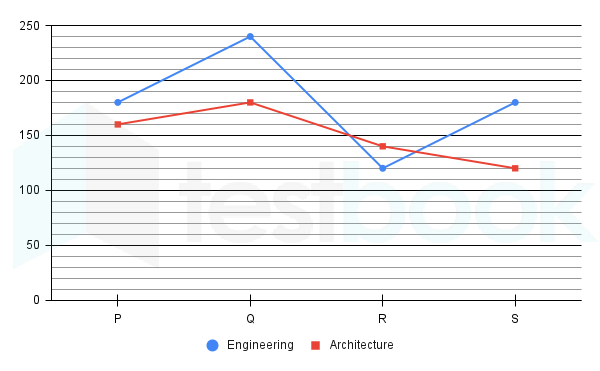
The line graph given below shows the enrollment figures of students in two distinct courses, namely 'Engineering' and 'Architecture', across four different colleges.

Total enrollment in a college = Student enrollment in 'Engineering' course of the college + Student enrollment in 'Architecture' course of the same college.

74

What is the average total enrollment of students in colleges 'A', 'P', 'S', and 'B' combined, considering that the total enrollment in college 'A' is 150% of the enrollment in the 'Architecture' course in college 'S', and the ratio of total enrollment in college 'A' to that in college 'B' is 5:6 respectively.

  1. ((a))

    244

  2. ((b))

    249

  3. ((c))

    254

  4. ((d))

    259

  5. ((e))

    264

Show Answer
Answer: ((d))

259

College'Engineering' course enrollment'Architecture' course enrollmentTotal enrollment in the college
P180160180 + 160 = 340
Q240180240 + 180 = 420
R120140120 + 140 = 260
S180120180 + 120 = 300
Total7206001320


Total enrollment in college 'A' = 150% × 120 = 180

Total enrollment in college 'B' = (6/5) × 180 = 216

Total enrollment of students in colleges 'A', 'P', 'S', and 'B' together = (180 + 340 + 300 + 216) = 1036

Required average = 1036/4 = 259

Hence, the correct answer is 259.

75

The combined student enrollment in the 'Architecture' course at colleges 'P', 'R', and 'S' is what percent more/less than the combined total student enrollment in the 'Engineering' course across the same set of colleges?

  1. ((a))

    10%

  2. ((b))

    12.5%

  3. ((c))

    15%

  4. ((d))

    18.75%

  5. ((e))

    20%

Show Answer
Answer: ((b))

12.5%

College'Engineering' course enrollment'Architecture' course enrollmentTotal enrollment in the college
P180160180 + 160 = 340
Q240180240 + 180 = 420
R120140120 + 140 = 260
S180120180 + 120 = 300
Total7206001320


The combined student enrollment in the 'Architecture' course at colleges 'P', 'R', and 'S' = 160 + 140 + 120 = 420

The combined student enrollment in the 'Engineering' course at colleges 'P', 'R', and 'S' = 180 + 120 + 180 = 480

Required% = [(480 - 420)/480] × 100 = 12.5%

Hence, the correct answer is 12.5%.

76

What is the difference in the total enrollment fees between the 'Engineering' course and the 'Architecture' course at college 'P', given that the enrollment fee for the 'Engineering' course is 59000 Rs and for the 'Architecture' course is 69000 Rs?

  1. ((a))

    240000 Rs.

  2. ((b))

    330000 Rs.

  3. ((c))

    420000 Rs.

  4. ((d))

    510000 Rs.

  5. ((e))

    600000 Rs.

Show Answer
Answer: ((c))

420000 Rs.

College'Engineering' course enrollment'Architecture' course enrollmentTotal enrollment in the college
P180160180 + 160 = 340
Q240180240 + 180 = 420
R120140120 + 140 = 260
S180120180 + 120 = 300
Total7206001320


Total enrollment fee for the 'Engineering' course in college 'P' = 180 × 59000 = 10620000 Rs.

Total enrollment fee for the 'Architecture' course in college 'P' = 160 × 69000 = 11040000 Rs.

Required difference = 11040000 - 10620000 = 420000 Rs.

Hence, the correct answer is 420000 Rs.

77

What is the difference in the total student enrollment between colleges 'R' and 'S' at the end of the year, assuming that 20% of the students enrolled in the 'Engineering' course at college 'R' and 25% of those in college 'S' cancelled their enrollments midway through the year, while the student enrollment in the 'Architecture' course remains unchanged?

  1. ((a))

    9

  2. ((b))

    11

  3. ((c))

    13

  4. ((d))

    19

  5. ((e))

    21

Show Answer
Answer: ((d))

19

College'Engineering' course enrollment'Architecture' course enrollmentTotal enrollment in the college
P180160180 + 160 = 340
Q240180240 + 180 = 420
R120140120 + 140 = 260
S180120180 + 120 = 300
Total7206001320


Students from the 'Engineering' course at college 'R' who cancelled their enrollment  = 20% × 120 = 24

The total student enrollment in college 'R' at the end of the year = (120 - 24) + 140 = 236

Students from the 'Engineering' course at college 'S' who cancelled their enrollment  = 25% × 180 = 45

The total student enrollment in college 'S' at the end of the year = (180 - 45) + 120 = 255

Required difference = 255 - 236 = 19

Hence, the correct answer is 19.

78

How many total students from college 'Q' are selected to represent the college in a competition if it is given that 83.33% of those enrolled in the 'Engineering' course and 60% of those in the 'Architecture' course have been chosen to represent the college in the competition?

  1. ((a))

    268

  2. ((b))

    278

  3. ((c))

    288

  4. ((d))

    298

  5. ((e))

    308

Show Answer
Answer: ((e))

308

College'Engineering' course enrollment'Architecture' course enrollmentTotal enrollment in the college
P180160180 + 160 = 340
Q240180240 + 180 = 420
R120140120 + 140 = 260
S180120180 + 120 = 300
Total7206001320


Students selected from the 'Engineering' course to represent the college 'Q' = 83.33% × 240 = 200

Students selected from the 'Architecture' course to represent the college 'Q' = 60% × 180 = 108

Required sum = 200 + 108 = 308

Hence, the correct answer is 308.

79

The ratio between the length of the rectangle and side of the square is 3 : 5 and the area of the square is 625 m2 then find the breadth of the rectangle if the area of the rectangle is 90 m2.

  1. ((a))

    3 m

  2. ((b))

    6 m

  3. ((c))

    4 m

  4. ((d))

    2 m

  5. ((e))

    None

Show Answer
Answer: ((b))

6 m

Given:

Area of square is = 625 m2

Calculation:

Let be assume the length of rectangle 3p, side of square 5p.

Area of square = (5p)2

⇒ 625 = 25p2

⇒ p = 5 m

Length of rectangle = 3 × 5 = 15 m

Area of rectangle = Length × breadth

⇒ 90 = 15 × breadth

⇒ Breadth = 6 m

The required result is 6 m.

80

There are N students in a school Out of these, 69% students play cricket and 49% students play Hockey and 54 students play both cricket and hockey. Then, find the value of N?

  1. ((a))

    600

  2. ((b))

    500

  3. ((c))

    400

  4. ((d))

    300

  5. ((e))

    350

Show Answer
Answer: ((d))

300

Given:

Total number of students = N

Students who play cricket = 69%

Students who play hockey = 49%

Students who play both cricket and hockey = 54

Concept:

Venn Diagram

Calculation:

Suppose, the number of students who play both cricket and hockey = x%

Therefore, students who play only cricket = (69 – x)%

Students who play only hockey = (49- x)%

⇒ (69 – x) + x% + (49 – x)% = 100%

⇒ 118% - x% = 100%

⇒ x% = 18%

Given 18% → 54

⇒ 1% → 3

⇒ 100% → 300

∴ N = 300

Attempt this paper under real exam conditions

Timed interface, section switching, instant scoring, and question-by-question analytics — free.

Start Timed Attempt