Official Paper

RRB Clerk Prelims Memory Based Paper (Held On: 13 August 2023 Shift 3) (Previous Year Paper)

80 questions · 45 minutes · with answers · free

Reasoning (40 questions)

Direction: Read the following information carefully and answer the question that follows.

Eight players are sitting in the two parallel rows each containing four players in such a way that they are equidistance from each other. In row – 1 Q, R, T & V are sitting and facing south. In row – 2 A, D, E & B are sitting and facing north, but not necessarily in the same order. Each player who sits in the first row facing another player in the second row.

A sit at any one of the external ends. Two-players sit between T and V, who faces the one who sits immediate right of D. E sits to immediate left of D. R faces the one who sits immediate right of E. The one who is facing V is third to the right of A.

1

Who among following faces D?

  1. ((a))

    Q

  2. ((b))

    T

  3. ((c))

    R

  4. ((d))

    V

  5. ((e))

    Cannot be determined

Show Answer
Answer: ((c))

R

Row – 1: Q, R, T & V

Row – 2: A, D, E & B

  1. A sit at any one of the external ends.

  1. Two-player sits between T and V who face the one player immediately right of D.

  1. The one who is facing V is third to the right of A. E is the immediate left of D.

(Here, by statement 3 we eliminate case 2)

4) R faces the one who sits immediate right of E.

Here, the remaining players complete the vacant position.

Hence, the final arrangement will be as follows:

Hence, D faces R.

2

Four of the following five belong to a group in a certain way, which of the following does not belong to that group?

  1. ((a))

    T

  2. ((b))

    E

  3. ((c))

    A

  4. ((d))

    V

  5. ((e))

    B

Show Answer
Answer: ((b))

E

Row – 1: Q, R, T & V

Row – 2: A, D, E & B

  1. A sit at any one of the external ends.

  1. Two-player sits between T and V who face the one player immediately right of D.

  1. The one who is facing V is third to the right of A. E is the immediate left of D.

(Here, by statement 3 we eliminate case 2)

4) R faces the one who sits immediate right of E.

Here, the remaining players complete the vacant position.

Hence, the final arrangement will be as follows:

According to the given information T, A, V and B are sitting at extreme ends but E is not sitting at any endpoint.

Hence, “E” does not belong to the group.

3

Who among the following faces Q?

  1. ((a))

    D

  2. ((b))

    A

  3. ((c))

    B

  4. ((d))

    E

  5. ((e))

    None of these

Show Answer
Answer: ((d))

E

Row – 1: Q, R, T & V

Row – 2: A, D, E & B

  1. A sit at any one of the external ends.

  1. Two-player sits between T and V who face the one player immediately right of D.

  1. The one who is facing V is third to the right of A. E is the immediate left of D.

(Here, by statement 3 we eliminate case 2)

4) R faces the one who sits immediate right of E.

Here, the remaining players complete the vacant position.

Hence, the final arrangement will be as follows:

Hence, E and Q are facing each other.

4

How many players sit to the right of E?

  1. ((a))

    One

  2. ((b))

    Two

  3. ((c))

    Three

  4. ((d))

    Four

  5. ((e))

    None

Show Answer
Answer: ((b))

Two

Row – 1: Q, R, T & V

Row – 2: A, D, E & B

  1. A sit at any one of the external ends.

  1. Two-player sits between T and V who face the one player immediately right of D.

  1. The one who is facing V is third to the right of A. E is the immediate left of D.

(Here, by statement 3 we eliminate case 2)

4) R faces the one who sits immediate right of E.

Here, the remaining players complete the vacant position.

Hence, the final arrangement will be as follows:

Therefore, two players are sitting to the right of E.

5

Which of the following statement is correct?

  1. ((a))

    R is second to the right of T.

  2. ((b))

    T is facing B.

  3. ((c))

    B sits immediate right of D.

  4. ((d))

    T is sitting exactly between Q and V.

  5. ((e))

    None of these

Show Answer
Answer: ((c))

B sits immediate right of D.

Row – 1: Q, R, T & V

Row – 2: A, D, E & B

  1. A sit at any one of the external ends.

  1. Two-player sits between T and V who face the one player immediately right of D.

  1. The one who is facing V is third to the right of A. E is the immediate left of D.

(Here, by statement 3 we eliminate case 2)

4) R faces the one who sits immediate right of E.

Here, the remaining players complete the vacant position.

Hence, the final arrangement will be as follows:

Hence, B sits immediate right of D.

Direction: Study the following information carefully to answer the question given below-

Kartik is wife of Nitish. Nitish is the grandfather of Resav. Kartik has only one child(son) who is married to Tousif’s child. Tousif has only two children, i.e. one son, and one daughter. Krishna is the granddaughter of Tousif. Varun is the brother-in-law of the son of Tousif. Sahil and Rana are the children of Tousif. Ranjit is married to the son of Tousif. Krishna is the niece of Sahil and is Ranjit’s child. Only consider the given persons.

6

How is Resav related to Tousif?

  1. ((a))

    Grandson

  2. ((b))

    Niece

  3. ((c))

    Nephew

  4. ((d))

    Granddaughter

  5. ((e))

    Cannot be determined

Show Answer
Answer: ((e))

Cannot be determined

Now draw the Family tree diagram using the following notations:

From the given information:

1. Kartik is wife of Nitish. Nitish is the grandfather of Resav. Kartik has only one child(son) who is married to Tousif’s child. Tousif has only two children,i.e. one son, and one daughter.

From these statements, we can clearly determine that Nitish is the husband of Kartik and they have only one male child who is married to the daughter of Tousif who has only two children, i.e. one son, and one daughter. Since Nitish has only one child(son), Resav is the son or daughter of the only son of Nitish.

2. Krishna is the granddaughter of Tousif. Ranjit is married to the son of Tousif. Krishna is Ranjit’s child.

From these statements, it can be clearly determined that Ranjit who is married to the son of Tousif has a daughter whose name is Krishna.

3. Varun is the brother-in-law of the son of Tousif.

From this statement, it can be said that Varun is the husband of the daughter of Tousif.

4. Krishna is the niece of Sahil. Sahil and Rana are the children of Tousif.

From these statements, it is clear that Sahil is the sister of Ranjit’s husband. So, Sahil is the daughter of Tousif. Therefore, Rana is the son of Tousif as Tousif has only two children,i.e. one son and one daughter.

We cannot determine the gender of Resav and Tousif.

So the final family tree diagram is:

From the above family tree diagram, it can be stated that Resav is the son or daughter of Sahil.

Sahil is the daughter of Tousif.

So, Resav is either the grandson or the granddaughter of Tousif.

Hence, We cannot determine how Resav is related to Tousif since we do not know the gender of Resav.
7

How is Ranjit related to Sahil?

  1. ((a))

    Brother 

  2. ((b))

    Brother-in-law

  3. ((c))

    Sister

  4. ((d))

    Sister-in-law

  5. ((e))

    None of the above

Show Answer
Answer: ((d))

Sister-in-law

Now draw the Family tree diagram using the following notations:

From the given information:

1. Kartik is wife of Nitish. Nitish is the grandfather of Resav. Kartik has only one child(son) who is married to Tousif’s child. Tousif has only two children,i.e. one son, and one daughter.

From these statements, we can clearly determine that Nitish is the husband of Kartik and they have only one male child who is married to the daughter of Tousif who has only two children, i.e. one son, and one daughter. Since Nitish has only one child(son), Resav is the son or daughter of the only son of Nitish.

2. Krishna is the granddaughter of Tousif. Ranjit is married to the son of Tousif. Krishna is Ranjit’s child.

From these statements, it can be clearly determined that Ranjit who is married to the son of Tousif has a daughter whose name is Krishna.

3. Varun is the brother-in-law of the son of Tousif.

From this statement, it can be said that Varun is the husband of the daughter of Tousif.

4. Krishna is the niece of Sahil. Sahil and Rana are the children of Tousif.

From these statements, it is clear that Sahil is the sister of Ranjit’s husband. So, Sahil is the daughter of Tousif. Therefore, Rana is the son of Tousif as Tousif has only two children,i.e. one son and one daughter.

We cannot determine the gender of Resav and Tousif.

So the final family tree diagram is:

From the above family tree diagram, it can be stated that Ranjit is the wife of the brother of Sahil.

Hence, Ranjit is the sister-in-law of Sahil.

8

How is Rana related to Krishna?

  1. ((a))

    Maternal uncle

  2. ((b))

    Father

  3. ((c))

    Paternal uncle

  4. ((d))

    Son

  5. ((e))

    Cannot be determined

Show Answer
Answer: ((b))

Father

Now draw the Family tree diagram using the following notations:

From the given information:

1. Kartik is wife of Nitish. Nitish is the grandfather of Resav. Kartik has only one child(son) who is married to Tousif’s child. Tousif has only two children,i.e. one son, and one daughter.

From these statements, we can clearly determine that Nitish is the husband of Kartik and they have only one male child who is married to the daughter of Tousif who has only two children, i.e. one son, and one daughter. Since Nitish has only one child(son), Resav is the son or daughter of the only son of Nitish.

2. Krishna is the granddaughter of Tousif. Ranjit is married to the son of Tousif. Krishna is Ranjit’s child.

From these statements, it can be clearly determined that Ranjit who is married to the son of Tousif has a daughter whose name is Krishna.

3. Varun is the brother-in-law of the son of Tousif.

From this statement, it can be said that Varun is the husband of the daughter of Tousif.

4. Krishna is the niece of Sahil. Sahil and Rana are the children of Tousif.

From these statements, it is clear that Sahil is the sister of Ranjit’s husband. So, Sahil is the daughter of Tousif. Therefore, Rana is the son of Tousif as Tousif has only two children,i.e. one son and one daughter.

We cannot determine the gender of Resav and Tousif.

So the final family tree diagram is:

From the above family tree diagram, it can be stated that Krishna is the daughter of Rana and Ranjit. And Rana is the husband of Ranjit.

Hence, Rana is the father of Krishna.

9

Directions: In the following question assuming the given statements to be true, find which of the conclusion among given some conclusion is/are definitely true and then give your answers accordingly:

Statement: M = T ≥ U ≥ P = S ≤ W = Q < X > Y 

Conclusions:

I) M = Q.

II) T > X.

  1. ((a))

    Only conclusion I follows

  2. ((b))

    Only Conclusion II follows

  3. ((c))

    Both I and II follows

  4. ((d))

    Either I or II follows

  5. ((e))

    Neither I nor II follows

Show Answer
Answer: ((e))

Neither I nor II follows

Given statement: M = T ≥ U ≥ P = S ≤ W = Q < X > Y 

Conclusions:

I) M = Q → False (As, M = T ≥ U ≥ P = S ≤ W = Q → There is no definite relation between the two can be determined).

II) T > X → False (As, T ≥ U ≥ P = S ≤ W = Q < X → There is no definite relation between the two can be determined).

Hence, Neither I nor II follows.

10

Directions: In the following question assuming the given statements to be true, find which of the conclusion among given conclusions is/are definitely true and then give your answers accordingly.

Statements:

L > S ≥ P = R ≥ Y > B = F

Conclusions:

I. S > Y

II. S = Y

  1. ((a))

    Only I follows

  2. ((b))

    Only II follows

  3. ((c))

    Either I or II  follows

  4. ((d))

    None follows

  5. ((e))

    Both I and II follows

Show Answer
Answer: ((c))

Either I or II  follows

Given statements:

L > S ≥ P = R ≥ Y > B = F

Conclusion :

I. S > Y→ False (S ≥ P = R ≥ Y → So S ≥ Y)

II. S = Y → False (S ≥ P = R ≥ Y → So S ≥ Y)

Here both conclusion making a complementary pair because both are false and between the '≥' sign present.

Hence, Either I or II follows.

11

Direction: In the following question assuming the given statement to be True, find which of the conclusion among given conclusions is/are definitely true and then give your answers accordingly. 

Statement: F > L < R < G = D ≥ E < Z

Conclusion: 

I) R < F 

II) D > Z

  1. ((a))

    Only I is true

  2. ((b))

    Only II is true

  3. ((c))

    Either I or II is true

  4. ((d))

    Both I and Ii are true

  5. ((e))

    Neither I nor II is true

Show Answer
Answer: ((e))

Neither I nor II is true

Statement: F > L < R < G = D ≥ E < Z

i) R < F ⇒ False (as F > L < R thus no relation can be established between R and F)

ii) D > Z ⇒ False (as D ≥ E < Z thus no relation can be established between D and Z)

Hence, neither I nor II is true.

Direction: Study the following information carefully and answer the questions given below.

In a certain code language

‘One should make right choice’ is written as ‘ka th ja lo pu’

‘Go ahead turn one right’ is written as ‘qi lo rn se th’

‘Turn to make a choice’ is written as ‘ja ve nu qi ka’

‘Go and win right choice’ is written as ‘de ja om lo rn’

12

What is the code for the word ‘one’?

  1. ((a))

    qi

  2. ((b))

    lo

  3. ((c))

    th

  4. ((d))

    ka

  5. ((e))

    pu

Show Answer
Answer: ((c))

th

On identifying the words and their respective codes that are common in different sentences, we get:

Clearly, ‘th’ is the code for the word ‘one’.

13

What does the code ‘qi’ mean?

  1. ((a))

    Win

  2. ((b))

    Right

  3. ((c))

    Ahead

  4. ((d))

    Go

  5. ((e))

    Turn

Show Answer
Answer: ((e))

Turn

On identifying the words and their respective codes that are common in different sentences, we get:

Clearly, the code ‘qi’ means ‘turn’.

14

What is the code for the word ‘choice’?

  1. ((a))

    ja

  2. ((b))

    nu

  3. ((c))

    ve

  4. ((d))

    lo

  5. ((e))

    om

Show Answer
Answer: ((a))

ja

On identifying the words and their respective codes that are common in different sentences, we get:

Clearly, the code for the word ‘choice’ is ‘ja’.

Directions: Study the following information carefully to answer the given questions:

A # @ 9 C B Z L $ 5 S % 9 O 4 + 7 ! K M N = 1 M 5 7 G H

15

How many such symbols are there in the above arrangement each of which is immediately followed by a number?

  1. ((a))

    2

  2. ((b))

    4

  3. ((c))

    3

  4. ((d))

    5

  5. ((e))

    1

Show Answer
Answer: ((d))

5

Left Side  A # @ 9 C B Z L $ 5 S % 9 O 4 + 7 ! K M N = 1 M 5 7 G H  Right Side

Symbols are there in the above arrangement each of which is immediately followed by a number is  @ 9, % 9, $ 5,  + 7,  = 1.

Hence, there are 5 such symbols in the above arrangement each of which is immediately followed by a number.

16

In the above arrangement which is the 13th element to the left of the 2nd  element from the right end?

  1. ((a))

    O

  2. ((b))

    9

  3. ((c))

    4

  4. ((d))

    G

  5. ((e))

    H

Show Answer
Answer: ((a))

O

Left Side  A # @ 9 C B Z L $ 5 S % 9 O 4 + 7 ! K M N = 1 M 5 7 G H  Right Side.

2nd  element from the right end is G and the 13th element from the left side of G is O.

Hence, O is the 13th element to the left of the 2nd  element from the right end.

17

How many symbols are there in the above arrangement between the 4th  element from the left end and the 3rd element from the right end?

  1. ((a))

    6

  2. ((b))

    4

  3. ((c))

    5

  4. ((d))

    7

  5. ((e))

    3

Show Answer
Answer: ((c))

5

Left Side  A # @ 9 C B Z L $ 5 S % 9 O 4 + 7 ! K M N = 1 M 5 7 G H  Right Side.

4th element from the left side is 9 and 3rd element from the right side is 7.

Symbols are there in the above arrangement between the 4th element from the left end and the 3rd element from the right side: $, %, +, =,!

Hence, only 5 symbols are there in the above arrangement between the 4th element from the left end and the 3rd element from the right end.

18

If all the symbols in the above arrangement are dropped, then which of the following will be the 12th element from the left end?

  1. ((a))

    7

  2. ((b))

    4

  3. ((c))

    K

  4. ((d))

    O

  5. ((e))

    S

Show Answer
Answer: ((a))

7

Left Side  A # @ 9 C B Z L $ 5 S % 9 O 4 + 7 ! K M N = 1 M 5 7 G H  Right Side.

If all the symbols are dropped:  A 9 C B Z L 5 S 9 O 4 7 K M N 1 M 5 7 G H 

12th element from the left end:  A 9 C B Z L 5 S 9 O 4 7 K M N 1 M 5 7 G H 

Hence, 7 is the 12th element from the left end.

Direction: Study the following information and answer the following question.

There are Seven Points that are at a certain distance with respect to each other. Point Q is 8 m west of P. Point T is 11m North of Q. Point O is 5m west of point T. Point R is 9m south of point O. Point M is 12 m east of Point R. Point G is 2m south of Point M.

19

What is the direction of point T with respect to point G?

  1. ((a))

    North west

  2. ((b))

    South east

  3. ((c))

    West

  4. ((d))

    North

  5. ((e))

    South

Show Answer
Answer: ((a))

North west

As per the given information,

  1. There are Seven Points that are at a certain distance with respect to each other.

  2. Point Q is 8 m west of P. Point T is 11m North of Q.

  3. Point O is 5m west of point T.

  4. Point R is 9m south of point O.

  5. Point M is 12 m east of Point R.

  6. Point G is 2m south of Point M.


Therefore the final arrangement is, 

Hence, North west is the direction of point T with respect to point G.

20

What is the shortest distance between point M and point O?

  1. ((a))

    13 m

  2. ((b))

    12 m

  3. ((c))

    9 m

  4. ((d))

    15 m

  5. ((e))

    14 m

Show Answer
Answer: ((d))

15 m

As per the given information,

  1. There are Seven Points that are at a certain distance with respect to each other.

  2. Point Q is 8 m west of P. Point T is 11m North of Q.

  3. Point O is 5m west of point T.

  4. Point R is 9m south of point O.

  5. Point M is 12 m east of Point R.

  6. Point G is 2m south of Point M.

Therefore the final arrangement is, 


Hence, 15m is the shortest distance between point M and point O.

21

What is the distance as well as direction of point P with respect to point G?

  1. ((a))

    2m, West

  2. ((b))

    4m, North east

  3. ((c))

    1m, east

  4. ((d))

    3m, South west

  5. ((e))

    2m, South

Show Answer
Answer: ((c))

1m, east

As per the given information,

  1. There are Seven Points that are at a certain distance with respect to each other.

  2. Point Q is 8 m west of P. Point T is 11m North of Q.

  3. Point O is 5m west of point T.

  4. Point R is 9m south of point O.

  5. Point M is 12 m east of Point R.

  6. Point G is 2m south of Point M.

Therefore the final arrangement is, 

Hence, 1m, east is the distance as well as the direction of point P with respect to point G.

Direction: Study the following information carefully to answer the given questions.

Eight people A, B, C, D, E, F, G and H going on vacation on two different dates i.e. 11th and 24th in four months i.e. March, May, June and July but not necessarily in the same order. C goes on an even number date and the month which has an even number of days. One person goes between C and F. Two persons go between F and A. Three people go between A and G. A goes before F. D goes immediately before E but in a different month. B goes before H who goes immediately before F.

22

How many people go between the one who goes on 11th May and H?

  1. ((a))

    One

  2. ((b))

    Three

  3. ((c))

    Two

  4. ((d))

    More than three

  5. ((e))

    None of these

Show Answer
Answer: ((b))

Three

From the given instructions:

Eight people A, B, C, D, E, F, G and H going on vacation on two different dates i.e. 11th and 24th in four months i.e. March, May, June and July but not necessarily in the same order. So, we can draw a structure as,

MonthDatePerson
March11th
March24th
May11th
May24th
June11th
June24th
July11th
July24th


  1. C goes on an even number date and the month which has an even number of days. One person goes between C and F. 

Here, the only even number days month is June. So, C goes on 24th June. So, here we have two cases:

PersonPerson
MonthDateCase1Case2
March11th
March24th
May11th
May24thF
June11th
June24thCC
July11th
July24thF


  1. Two persons go between F and A. A goes before F.
PersonPerson
MonthDateCase1Case2
March11thA
March24th
May11th
May24thF
June11thA
June24thCC
July11th
July24thF


  1. Three people go between A and G.
PersonPerson
MonthDateCase1Case2
March11thGA
March24th
May11th
May24thF
June11thAG
June24thCC
July11th
July24thF


  1. D goes immediately before E but in a different month.
PersonPerson
MonthDateCase1Case2
March11thGA
March24thDD
May11thEE
May24thF
June11thAG
June24thCC
July11th
July24thF


  1. B goes before H who goes immediately before F. So, here Case 2 gets eliminated because there is no place available immediately before F in Case 2.
PersonPerson
MonthDateCase1Case2
March11thGA
March24thDD
May11thEE
May24thBF
June11thAG
June24thCC
July11thHB
July24thFH


So, Final Arrangement:

MonthDatePerson
March11thG
March24thD
May11thE
May24thB
June11thA
June24thC
July11thH
July24thF

Three people go between the one who goes on 11th May and H.

23

Who goes immediately before C?

  1. ((a))

    H

  2. ((b))

    E

  3. ((c))

    A

  4. ((d))

    B

  5. ((e))

    F

Show Answer
Answer: ((c))

A

From the given instructions:

Eight people A, B, C, D, E, F, G and H going on vacation on two different dates i.e. 11th and 24th in four months i.e. March, May, June and July but not necessarily in the same order. So, we can draw a structure as,

MonthDatePerson
March11th
March24th
May11th
May24th
June11th
June24th
July11th
July24th


  1. C goes on an even number date and the month which has an even number of days. One person goes between C and F. 

Here, the only even number days month is June. So, C goes on 24th June. So, here we have two cases:

PersonPerson
MonthDateCase1Case2
March11th
March24th
May11th
May24thF
June11th
June24thCC
July11th
July24thF


  1. Two persons go between F and A. A goes before F.
PersonPerson
MonthDateCase1Case2
March11thA
March24th
May11th
May24thF
June11thA
June24thCC
July11th
July24thF


  1. Three people go between A and G.
PersonPerson
MonthDateCase1Case2
March11thGA
March24th
May11th
May24thF
June11thAG
June24thCC
July11th
July24thF


  1. D goes immediately before E but in a different month.
PersonPerson
MonthDateCase1Case2
March11thGA
March24thDD
May11thEE
May24thF
June11thAG
June24thCC
July11th
July24thF


  1. B goes before H who goes immediately before F. So, here Case 2 gets eliminated because there is no place available immediately before F in Case 2.
PersonPerson
MonthDateCase1Case2
March11thGA
March24thDD
May11thEE
May24thBF
June11thAG
June24thCC
July11thHB
July24thFH


So, Final Arrangement:

MonthDatePerson
March11thG
March24thD
May11thE
May24thB
June11thA
June24thC
July11thH
July24thF

A goes immediately before C.

24

Which statement/s is/are true according to the final arrangement?

I. D goes immediately after G.

II. Four people go between F and E.

III. H goes in a month which has an even number of days.

  1. ((a))

    Only I and II

  2. ((b))

    Only II and III

  3. ((c))

    Only I and III

  4. ((d))

    All are true

  5. ((e))

    None is true

Show Answer
Answer: ((a))

Only I and II

From the given instructions:

Eight people A, B, C, D, E, F, G and H going on vacation on two different dates i.e. 11th and 24th in four months i.e. March, May, June and July but not necessarily in the same order. So, we can draw a structure as,

MonthDatePerson
March11th
March24th
May11th
May24th
June11th
June24th
July11th
July24th


  1. C goes on an even number date and the month which has an even number of days. One person goes between C and F. 

Here, the only even number days month is June. So, C goes on 24th June. So, here we have two cases:

PersonPerson
MonthDateCase1Case2
March11th
March24th
May11th
May24thF
June11th
June24thCC
July11th
July24thF


  1. Two persons go between F and A. A goes before F.
PersonPerson
MonthDateCase1Case2
March11thA
March24th
May11th
May24thF
June11thA
June24thCC
July11th
July24thF


  1. Three people go between A and G.
PersonPerson
MonthDateCase1Case2
March11thGA
March24th
May11th
May24thF
June11thAG
June24thCC
July11th
July24thF


  1. D goes immediately before E but in a different month.
PersonPerson
MonthDateCase1Case2
March11thGA
March24thDD
May11thEE
May24thF
June11thAG
June24thCC
July11th
July24thF


  1. B goes before H who goes immediately before F. So, here Case 2 gets eliminated because there is no place available immediately before F in Case 2.
PersonPerson
MonthDateCase1Case2
March11thGA
March24thDD
May11thEE
May24thBF
June11thAG
June24thCC
July11thHB
July24thFH


So, Final Arrangement:

MonthDatePerson
March11thG
March24thD
May11thE
May24thB
June11thA
June24thC
July11thH
July24thF

Only I and II is true.

25

Who goes immediately before H?

  1. ((a))

    The one who goes immediately before A

  2. ((b))

    The one who goes immediately after B

  3. ((c))

    The one who goes immediately after G

  4. ((d))

    The one who goes immediately after A

  5. ((e))

    None of these

Show Answer
Answer: ((d))

The one who goes immediately after A

From the given instructions:

Eight people A, B, C, D, E, F, G and H going on vacation on two different dates i.e. 11th and 24th in four months i.e. March, May, June and July but not necessarily in the same order. So, we can draw a structure as,

MonthDatePerson
March11th
March24th
May11th
May24th
June11th
June24th
July11th
July24th


  1. C goes on an even number date and the month which has an even number of days. One person goes between C and F. 

Here, the only even number days month is June. So, C goes on 24th June. So, here we have two cases:

PersonPerson
MonthDateCase1Case2
March11th
March24th
May11th
May24thF
June11th
June24thCC
July11th
July24thF


  1. Two persons go between F and A. A goes before F.
PersonPerson
MonthDateCase1Case2
March11thA
March24th
May11th
May24thF
June11thA
June24thCC
July11th
July24thF
  1. Three people go between A and G.
PersonPerson
MonthDateCase1Case2
March11thGA
March24th
May11th
May24thF
June11thAG
June24thCC
July11th
July24thF
  1. D goes immediately before E but in a different month.
PersonPerson
MonthDateCase1Case2
March11thGA
March24thDD
May11thEE
May24thF
June11thAG
June24thCC
July11th
July24thF


  1. B goes before H who goes immediately before F. So, here Case 2 gets eliminated because there is no place available immediately before F in Case 2.
PersonPerson
MonthDateCase1Case2
March11thGA
March24thDD
May11thEE
May24thBF
June11thAG
June24thCC
July11thHB
July24thFH


So, Final Arrangement:

MonthDatePerson
March11thG
March24thD
May11thE
May24thB
June11thA
June24thC
July11thH
July24thF


The one who goes immediately after A i.e. C goes immediately before H.

26

Who goes on May 24th?

  1. ((a))

    E

  2. ((b))

    C

  3. ((c))

    D

  4. ((d))

    F

  5. ((e))

    B

Show Answer
Answer: ((e))

B

From the given instructions:

Eight people A, B, C, D, E, F, G and H going on vacation on two different dates i.e. 11th and 24th in four months i.e. March, May, June and July but not necessarily in the same order. So, we can draw a structure as,

MonthDatePerson
March11th
March24th
May11th
May24th
June11th
June24th
July11th
July24th


  1. C goes on an even number date and the month which has an even number of days. One person goes between C and F. 

Here, the only even number days month is June. So, C goes on 24th June. So, here we have two cases:

PersonPerson
MonthDateCase1Case2
March11th
March24th
May11th
May24thF
June11th
June24thCC
July11th
July24thF


  1. Two persons go between F and A. A goes before F.
PersonPerson
MonthDateCase1Case2
March11thA
March24th
May11th
May24thF
June11thA
June24thCC
July11th
July24thF


  1. Three people go between A and G.
PersonPerson
MonthDateCase1Case2
March11thGA
March24th
May11th
May24thF
June11thAG
June24thCC
July11th
July24thF


  1. D goes immediately before E but in a different month.
PersonPerson
MonthDateCase1Case2
March11thGA
March24thDD
May11thEE
May24thF
June11thAG
June24thCC
July11th
July24thF


  1. B goes before H who goes immediately before F. So, here Case 2 gets eliminated because there is no place available immediately before F in Case 2.
PersonPerson
MonthDateCase1Case2
March11thGA
March24thDD
May11thEE
May24thBF
June11thAG
June24thCC
July11thHB
July24thFH


So, Final Arrangement:

MonthDatePerson
March11thG
March24thD
May11thE
May24thB
June11thA
June24thC
July11thH
July24thF


B goes on May 24th​.

27

Direction: In the question below are given three statements followed by two conclusions numbered I and II You have to take the given statements to be true even if they seem to be at variance with commonly known facts. Read all the conclusions and then decide which of the given conclusions logically follows from the given statements disregarding commonly known facts.

Statements:

Only a few Red is White

Some White is Black

All Black is Green

Conclusions:

I. Some Red is not White

II. Some Green is Red

  1. ((a))

    Neither I nor II

  2. ((b))

    Only I follow

  3. ((c))

    Only II follow

  4. ((d))

    Both I and II follows

  5. ((e))

    Either I or II follows

Show Answer
Answer: ((b))

Only I follow

The least possible Venn diagram for the given statements is as follows:

Conclusions:

I. Some Red is not White → True (As only a few means some and some not, Only a few Red is White means some red is white and some red is not white. So, it is true)

II. Some Green is Red → False (As there is no direct relation between green and red some green is red is possible but not definite. So, it is false)

Hence, Only I follow

28

Direction: In the question below are given two statements followed by two conclusions numbered I, and II. You have to take the given statements to be true even if they seem to be at variance with commonly known facts. Read all the conclusions and then decide which of the given conclusions logically follows from the given statements disregarding commonly known facts.

Statements

Some laptop are telephone

All telephone are mobile

Conclusions

I. Some laptop are mobile

II. No laptop is mobile

  1. ((a))

    Only conclusion I follows

  2. ((b))

    Only conclusion II follows

  3. ((c))

    Both conclusion I and II follows

  4. ((d))

    Either conclusion I or II follows

  5. ((e))

    Neither conclusion I nor II follows

Show Answer
Answer: ((a))

Only conclusion I follows

Venn diagram for the given statements is as follows.

Conclusions:

I. Some laptop are mobile - True (Given Some laptop are telephone and All telephone are mobile so the part of laptop which is telephone is also mobile thus Some laptop are mobile is true) 

II. No laptop is mobile -  False (Given Some laptop are telephone and All telephone are mobile so the part of laptop which is telephone is also mobile thus No laptop is mobile  is false)

Hence, Only conclusion I follows.

29

Direction: In the question below are given three statements followed by two conclusions numbered I and II. You have to take the given statements to be true even if they seem to be at variance with commonly known facts. Read all the conclusions and then decide which of the given conclusions logically follows from the given statements disregarding commonly known facts.

Statements:

Only a few Laptop is a Computer.

All Computer is Red.

Some Laptop is a Mouse.

Conclusions:

I. Some Laptop is a Computer.

II. Some Laptop is not a Computer.

  1. ((a))

    Either I or II follow

  2. ((b))

    Both I and II follow

  3. ((c))

    Only I follow

  4. ((d))

    Only II follow

  5. ((e))

    Neither I nor II 

Show Answer
Answer: ((b))

Both I and II follow

The least possible Venn diagram for the given statements is as follows:

Conclusions:

I. Some Laptop is a Computer → True (As Only a few Laptop is Computer means that some laptop is a computer and some laptop is not a computer. So, it is true)

II. Some Laptop is not a Computer → True (As Only a few Laptop is Computer means that some laptop is a computer and some laptop is not a computer. So, it is true)

Hence, Both I and II follow.

Important Points 

Only a few concepts

Only a few means 'some + some not'.

Only a few A is B means Some A is B and Some A is not B.

Directions: Study the following information carefully and answer the questions given below:

Seven people are sitting in a linear row. Some of them were facing north while some of them were facing south.

P is sitting fourth to the right of Q. Q is sitting at one of the ends. Two people are sitting between P and S. R is sitting to the immediate left of S. U is sitting to the immediate right of T. V is sitting second to the left of T. P is sitting to the right of V who is facing south. T and R face in the same direction. U and P face in the same direction as the person sitting to the immediate left of R.

30

Who is sitting in the middle of the row?

  1. ((a))

    P

  2. ((b))

    R

  3. ((c))

    T

  4. ((d))

    V

  5. ((e))

    S

Show Answer
Answer: ((d))

V

Given:-

Persons - Seven

Some of them were facing north while some of them were facing south.

Now,

1) Q is sitting at one of the ends. Here two possibilities exist.

2) P is sitting fourth to the right of Q. We cannot determine the direction of P yet.


3) Two people are sitting between P and S. It is possible only in single direction in both cases.

4) R is sitting to the immediate left of S. It means S is facing South in Case I and North in Case II.

5) U is sitting to the immediate right of T. It means one of them is sitting at the end in both cases.

  1. V is sitting second to the left of T. It means U is sitting at the end and T is facing North in Case I and South in Case II.

Case I -

7) P is sitting to the right of V who is facing south. If V faces South, P will be on the left of V in Case I. So, it gets eliminated.

  1. T and R face in the same direction. It means R faces the South direction.

  2. U and P face in the same direction as the person sitting to the immediate left of R. The person sitting to the immediate left of R is S. S is facing North so U and P also face North direction.

The final arrangement is -

V is sitting in the middle of the row.

Hence, the correct answer is V.

31

How many persons are sitting between T and S?

  1. ((a))

    One

  2. ((b))

    Two

  3. ((c))

    Three

  4. ((d))

    Four

  5. ((e))

    More than Four

Show Answer
Answer: ((c))

Three

Given:-

Persons - Seven

Some of them were facing north while some of them were facing south.

Now,

1) Q is sitting at one of the ends. Here two possibilities exist.

2) P is sitting fourth to the right of Q. We cannot determine the direction of P yet.

3) Two people are sitting between P and S. It is possible only in single direction in both cases.

4) R is sitting to the immediate left of S. It means S is facing South in Case I and Noth in Case II.

5) U is sitting to the immediate right of T. It means one of them is sitting at the end in both cases.

  1. V is sitting second to the left of T. It means U is sitting at the end and T is facing North in Case I and South in Case II.

7) P is sitting to the right of V who is facing south. If V faces South, P will be on the left of V in Case I. So, it gets eliminated.

  1. T and R face in the same direction. It means R faces the South direction.

  2. U and P face in the same direction as the person sitting to the immediate left of R. The person sitting to the immediate left of R is S. S is facing North so U and P also face North direction.

The final arrangement is -

Three persons are sitting between T and S

Hence, the correct answer is Three.

32

U is related to T in the same way as P is related to V. Which of the following is S related to, following the same pattern?

  1. ((a))

    Q

  2. ((b))

    R

  3. ((c))

    P

  4. ((d))

    T

  5. ((e))

    U

Show Answer
Answer: ((a))

Q

Given:-

Persons - Seven

Some of them were facing north while some of them were facing south.

Now,

1) Q is sitting at one of the ends. Here two possibilities exist.

2) P is sitting fourth to the right of Q. We cannot determine the direction of P yet.

3) Two people are sitting between P and S. It is possible only in single direction in both cases.

4) R is sitting to the immediate left of S. It means S is facing South in Case I and Noth in Case II.

5) U is sitting to the immediate right of T. It means one of them is sitting at the end in both cases.

  1. V is sitting second to the left of T. It means U is sitting at the end and T is facing North in Case I and South in Case II.

7) P is sitting to the right of V who is facing south. If V faces South, P will be on the left of V in Case I. So, it gets eliminated.

  1. T and R face in the same direction. It means R faces the South direction.

  2. U and P face in the same direction as the person sitting to the immediate left of R. The person sitting to the immediate left of R is S. S is facing North so U and P also face North direction.

The final arrangement is -

U and T are sitting to the immediate right of each other. In the same way, P is related to V. Q is sitting to the immediate right of S. Thus, Q is related to S following the same pattern.

Hence, the correct answer is Q.

33

Which of the following is true regarding R?

  1. ((a))

    R is sitting second to the left of Q.

  2. ((b))

    R is not an immediate neighbour of V.

  3. ((c))

    R is sitting third to the left of T.

  4. ((d))

    R sits at one of the extreme ends of the line.

  5. ((e))

    R faces North.

Show Answer
Answer: ((c))

R is sitting third to the left of T.

Given:-

Persons - Seven

Some of them were facing north while some of them were facing south.

Now,

1) Q is sitting at one of the ends. Here two possibilities exist.

2) P is sitting fourth to the right of Q. We cannot determine the direction of P yet.

3) Two people are sitting between P and S. It is possible only in single direction in both cases.

4) R is sitting to the immediate left of S. It means S is facing South in Case I and Noth in Case II.

5) U is sitting to the immediate right of T. It means one of them is sitting at the end in both cases.

  1. V is sitting second to the left of T. It means U is sitting at the end and T is facing North in Case I and South in Case II.

7) P is sitting to the right of V who is facing south. If V faces South, P will be on the left of V in Case I. So, it gets eliminated.

  1. T and R face in the same direction. It means R faces the South direction.

  2. U and P face in the same direction as the person sitting to the immediate left of R. The person sitting to the immediate left of R is S. S is facing North so U and P also face North direction.

The final arrangement is -

Among the given options, only the statement 'R is sitting third to the left of T' is true.

Hence, the correct answer is R is sitting third to the left of T.

34

How many persons face North direction?

  1. ((a))

    One

  2. ((b))

    Two

  3. ((c))

    Three

  4. ((d))

    Four

  5. ((e))

    Cannot be determined

Show Answer
Answer: ((c))

Three

Given:-

Persons - Seven

Some of them were facing north while some of them were facing south.

Now,

1) Q is sitting at one of the ends. Here two possibilities exist.

2) P is sitting fourth to the right of Q. We cannot determine the direction of P yet.

3) Two people are sitting between P and S. It is possible only in single direction in both cases.

4) R is sitting to the immediate left of S. It means S is facing South in Case I and Noth in Case II.

5) U is sitting to the immediate right of T. It means one of them is sitting at the end in both cases.

  1. V is sitting second to the left of T. It means U is sitting at the end and T is facing North in Case I and South in Case II.

7) P is sitting to the right of V who is facing south. If V faces South, P will be on the left of V in Case I. So, it gets eliminated.

  1. T and R face in the same direction. It means R faces the South direction.

  2. U and P face in the same direction as the person sitting to the immediate left of R. The person sitting to the immediate left of R is S. S is facing North so U and P also face North direction.

The final arrangement is -

Total three persons face North direction.

Hence, the correct answer is Three.

Direction: The following questions are based on the five three-digit numbers given below.

625    278    246    945    234

35

If all three-digit numbers are arranged in ascending order after arranging the digits within the number in ascending order, which of the following will be the lowest number?

  1. ((a))

    625

  2. ((b))

    278

  3. ((c))

    246

  4. ((d))

    945

  5. ((e))

    234

Show Answer
Answer: ((e))

234

Given series: 625    278    246    945    234

After arranging digits within number in ascending order: 256    278    246    459    234

After arranging three-digit numbers in ascending order: 234    246    256    278    459

Hence, 234 is the lowest number.

36

If in each number, all the digits are added and then 3 is added to all the odd numbers thus formed, and 3 is subtracted to all the even numbers formed, then which is the second highest number among the resultants?

  1. ((a))

    16

  2. ((b))

    19

  3. ((c))

    10

  4. ((d))

    12

  5. ((e))

    14

Show Answer
Answer: ((a))

16

Given series: 625    278    246    945    234

After adding the digits in each number, and adding or subtracting 3 accordingly, we get

6 + 2 + 5 = 13 ⇒ Odd number and 13 + 3 = 16

2 + 7 + 8 = 17 ⇒ odd number and 17 + 3 = 20

2 + 4 + 6 = 12 ⇒ even number and 12 - 3 = 9

9 + 4 + 5 = 18 ⇒ even number and 18 - 3 = 15

2 + 3 + 4 = 9 ⇒ Odd number and 9 + 3 = 12

Hence, 16 is the second highest number obtained.

Note:

Second-highest number means the second number after arranging in descending order.

37

If the positions of the first and third digits within each number are interchanged, then which of the following will be the third highest number in the new arrangement?

  1. ((a))

    526

  2. ((b))

    432

  3. ((c))

    549

  4. ((d))

    642

  5. ((e))

    872

Show Answer
Answer: ((c))

549

Given number series: 625    278    246    945    234

After interchanging first and third digits

The newly formed series will be: 526    872    642    549    432

Hence, 549 is the third highest number.

Note: Third-highest number = third number after arranging the numbers in descending order.

38

If in the given set of numbers, 1 is added to the last digit and 1 is subtracted from the first digit, then which number will be second from the right if the new series is arranged in descending order?

  1. ((a))

    846

  2. ((b))

    135

  3. ((c))

    147

  4. ((d))

    179

  5. ((e))

    526

Show Answer
Answer: ((c))

147

Given number series: 625    278    246    945    234

On adding 1 to the last digit and subtracting 1 from the first digit, we get 526    179    147    846    135

After rearranging the series in descending order, we get:

846    526    179    147    135

Hence, 147 is the second number from right.

39

How many such pairs of letters are there in the word EXTROVERT each of which has as many letters between them in the word (in both forward and backward directions), as they have between them in the English alphabetical series?

  1. ((a))

    4

  2. ((b))

    3

  3. ((c))

    1

  4. ((d))

    0

  5. ((e))

    2

Show Answer
Answer: ((e))

2

Given Word:- EXTROVERT

The word can be represented as follow,

Here we got two pairs- XR and OR.

Hence, “2” is the correct answer.

40

If it is possible to make only one meaningful 4-letter English word with the 1st, 5th, 6th and 9th letters of the word 'COMPARTMENT', which of the following will be the third letter from the left end of that word? If no such word can be made give 'O' as the answer and if more than one such word can be made give 'L' as the answer.

  1. ((a))

    O

  2. ((b))

    R

  3. ((c))

    L

  4. ((d))

    C

  5. ((e))

    E

Show Answer
Answer: ((c))

L

Given word: COMPARTMENT

1st, 5th, 6th and 9th letters of the word COMPARTMENT are: C, A, R and E

Combining and un-jumbling the letters we get: CARE, RACE and ACRE

Since 3 words are possible from the letters.

Hence, the answer is L.

Numerical Ability (40 questions)

Directions: Study the following data and answer the following questions:

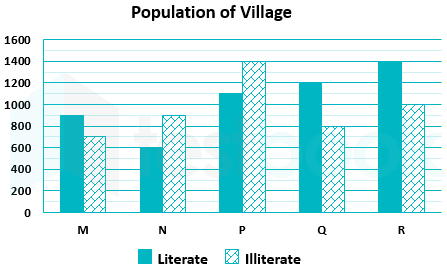
Following Bar graph shows the literate and illiterate population of five villages.

Total population = literate population + illiterate population

41

Find the difference between the literate and illiterate population of five villages.

  1. ((a))

    300

  2. ((b))

    550

  3. ((c))

    750

  4. ((d))

    600

  5. ((e))

    400

Show Answer
Answer: ((e))

400

Given:

Total literate population of five villages = 900 + 600 + 1100 + 1200 + 1400 = 5200

Total illiterate population of five villages = 700 + 900 + 1400 + 800 + 1000 = 4800

Required difference =

= 5200 – 4800

= 400

42

The illiterate population of village P is approximately what percent more than the literate population of same village?

  1. ((a))

    27%

  2. ((b))

    29%

  3. ((c))

    30%

  4. ((d))

    33%

  5. ((e))

    36%

Show Answer
Answer: ((a))

27%

Calculation:

Literate population of village P = 1100

Illiterate population of village P = 1400

Required percentage = [(1400 – 1100)/1100] × 100

⇒ [300/1100] × 100

⇒ 27.27% ≈ 27%

∴ Required percentage is 27%

43

Find the ratio between the total population of village N and village R.

  1. ((a))

    1 : 3

  2. ((b))

    6 : 7

  3. ((c))

    9 : 1

  4. ((d))

    5 : 8

  5. ((e))

    8 : 9

Show Answer
Answer: ((d))

5 : 8

Given:

Total population of village N = 600 + 900 = 1500

Total population of village R = 1400 + 1000 = 2400

Required ratio =

= 1500 : 2400

= 5 : 8

44

The literate population of village Q is approximately what percent of the total population of village Q?

  1. ((a))

    75%

  2. ((b))

    55%

  3. ((c))

    65%

  4. ((d))

    60%

  5. ((e))

    70%

Show Answer
Answer: ((d))

60%

Given:

Total  population of village Q = 1200 + 800 = 2000

Total literate population of village Q = 1200

Required percentage =

= 1200/2000 × 100

= 60%

45

Find the average Literate population of five villages.

  1. ((a))

    1100

  2. ((b))

    1200

  3. ((c))

    1250

  4. ((d))

    1360

  5. ((e))

    1040

Show Answer
Answer: ((e))

1040

Given:

Total literate population of five villages =

= 900 + 600 + 1100 + 1200 + 1400 = 5200

Required average = 5200/5 = 1040

46

A can complete a certain work in 36 days, and B can complete the same work in P days. Find the time taken by them to complete the whole work while working together, where P is the missing term in the given series. 

30, 42, 56, (?), 90, 110,132.

  1. ((a))

    16 days

  2. ((b))

    4 days

  3. ((c))

    12 days

  4. ((d))

    24 days

  5. ((e))

    8 days

Show Answer
Answer: ((d))

24 days

Given:

A completes the work in 36 days

B completes the same work in P days

Where P is the missing term in the given series

Concept Used:

If A takes 'x' days and B takes 'y' days to complete a certain work, then

Total work = LCM of (x and y)

Time taken to complete the work = Total work/efficiency

Calculation:

The pattern in the given number series is as follows:

30 + 12 = 42

42 + 14 = 56

56 + 16 = 72

72 + 18 = 90

90 + 20 = 110

110 + 22 = 132

Thus, the missing term, P = 72

Now, A takes 36 days to complete the work

B takes 72 days to complete the work

LCM of (36 and 72) is 72.

Let the total work be 72 units.

Efficiency of A = 72/36 = 2 units

Efficiency of B = 72/72 = 1 unit

Total efficiency of A and B = 2 + 1 = 3 units

The time taken to complete the work when both worked together is,

⇒ 72/3 = 24 days

Hence, the correct answer is 24 days.

47

What should come in place of question Mark ‘?’ in the following number series?

300, ?, 148, 221, 441, 1101.5

  1. ((a))

    115.5

  2. ((b))

    150.5

  3. ((c))

    149

  4. ((d))

    151

  5. ((e))

    None of these

Show Answer
Answer: ((c))

149

300 * 0.5 - 1 = 149

149 * 1 -1 = 148

148* 1.5 - 1 = 221

221 * 2 - 1 = 441 

441 * 2.5 - 1 = 1101.5

∴ The correct answer is 149.

48

Find the wrong term in the following series.

 27, 25, 22, 17, 10, 1

  1. ((a))

    17

  2. ((b))

    25

  3. ((c))

    22

  4. ((d))

    10

  5. ((e))

    1

Show Answer
Answer: ((e))

1

Given series:

 27, 25, 22, 17, 10, 1

Calculation :

 The series follows the following pattern:

 ⇒ 27 - 25 = 2

 ⇒ 25 - 22 = 3

 ⇒ 22 - 17 = 5

⇒ 17 - 10 = 7

⇒ 10 - (-1) = 11

 The wrong term is 1

 Hence the wrong term in the series is 1.

49

What should come in place of the question mark '?' in the following number series?

18, 36, (?), 432, 2160, 12960

  1. ((a))

    110

  2. ((b))

    112

  3. ((c))

    76

  4. ((d))

    108

  5. ((e))

    72

Show Answer
Answer: ((d))

108

Given Series:

18, 36, (?), 432, 2160, 12960

The logic followed here is as follows:

⇒ 18 x 2 = 36

⇒ 36 x 3 = 108

⇒ 108 x 4 = 432

⇒ 432 x 5 = 2160

⇒ 2160 x 6 = 12960

Hence, 108 will come in the place of (?).

50

What should come in the place of (?) in the given series?

2, 4, 12, 60, 420, (?)

  1. ((a))

    5220

  2. ((b))

    5120

  3. ((c))

    4620

  4. ((d))

    4520

  5. ((e))

    4120

Show Answer
Answer: ((c))

4620

Given Series:

2, 4, 12, 60, 420, (?)

The logic followed here is as follows:

⇒ 2 x 2 = 4

⇒ 4 x 3 = 12

⇒ 12 x 5 = 60

⇒ 60 x 7 = 420

⇒ 420 x 11 = 4620

Hence, 4620 will come in the place of (?).

Directions: Read the following table carefully and answer the questions given below.

The following table shows the total number of electronic items (Mobile + Laptop) sold by five stores A, B, C, D, E and it also shows the ratio between the number of Mobile sold and the number of Laptop sold by all the stores respectively.

StoreTotal number of electronic items soldMobile : Laptop
A12001 ∶ 5
B20003 ∶ 2
C24005 ∶ 3
D17001 ∶ 3
E23003 ∶ 7
51

Find the ratio between the total number of mobile sold by all the stores and the total number of laptop sold by all the stores.

  1. ((a))

    1117 ∶ 803

  2. ((b))

    2117 ∶ 803

  3. ((c))

    803 ∶ 1117

  4. ((d))

    403 ∶ 803

  5. ((e))

    None of these

Show Answer
Answer: ((c))

803 ∶ 1117

Given:

From the given data, we can calculate the number of iPhones and Android phones sold by store A, B, C, D, E

So, the number of iPhones sold by store A = {1200 × (1/6)} = 200

The number of Android phones sold by store A = (1200 - 200) = 1000

Similarly, we can calculate other data and put those data in a table

ShopTotal number of electronic items soldTotal number of Mobile soldTotal number of Laptop sold
A12002001000
B20001200800
C24001500900
D17004251275
E23006901610


Calculation:

The total number of mobile sold by all the stores = (200 + 1200 + 1500 + 425 + 690) = 4015 

The total number of laptop sold by all the stores = (1000 + 800 + 900 + 1275 + 1610) = 5585

So, the required ratio = 4015 ∶ 5585 = 803 ∶ 1117

∴ The ratio between the total number of mobile sold by all the stores and the total number of laptop sold by all the stores is 803 ∶ 1117.

52

Among all of the stores which store sold the maximum number of mobile?

  1. ((a))

    A

  2. ((b))

    D

  3. ((c))

    E

  4. ((d))

    B

  5. ((e))

    C

Show Answer
Answer: ((e))

C

Given:

From the given data, we can calculate the number of mobile and laptop sold by store A, B, C, D, E

So, the number of mobile sold by store A = {1200 × (1/6)} = 200

The number of laptop sold by store A = (1200 - 200) = 1000

Similarly, we can calculate other data and put those data in a table

ShopTotal number of electronic items soldTotal number of Mobile soldTotal number of Laptop sold
A12002001000
B20001200800
C24001500900
D17004251275
E23006901610


Calculation:

From the table that we made from the given data, we can easily say that store C sold the maximum number of mobile. 

∴ Among all the stores, store C sold the maximum number of mobile.

53

Find the average number of mobile sold by all the stores.

  1. ((a))

    1003

  2. ((b))

    803

  3. ((c))

    703

  4. ((d))

    403

  5. ((e))

    513

Show Answer
Answer: ((b))

803

Given:

From the given data, we can calculate the number of mobile and laptop sold by store A, B, C, D, E

So, the number of mobile sold by store A = {1200 × (1/6)} = 200

The number of laptop sold by store A = (1200 - 200) = 1000

Similarly, we can calculate other data and put those data in a table

ShopTotal number of electronic items soldTotal number of Mobile soldTotal number of Laptop sold
A12002001000
B20001200800
C24001500900
D17004251275
E23006901610


Calculation:

The total number of mobile sold by all the stores = (200 + 1200 + 1500 + 425 + 690) = 4015

So, the average = (4015/5) = 803 

∴ The average number of mobile sold by all the stores is 803.

54

The number of Mobile sold by store A is what percentage more or less than the number of laptop sold by store E?

  1. ((a))

    77.57%

  2. ((b))

    72.57%

  3. ((c))

    78.57%

  4. ((d))

    87.57%

  5. ((e))

    87.75%

Show Answer
Answer: ((d))

87.57%

Given:

From the given data, we can calculate the number of mobile and laptop sold by store A, B, C, D, E

So, the number of mobile sold by store A = {1200 × (1/6)} = 200

The number of laptop sold by store A = (1200 - 200) = 1000

Similarly, we can calculate other data and put those data in a table

ShopTotal number of electronic items soldTotal number of Mobile soldTotal number of Laptop sold
A12002001000
B20001200800
C24001500900
D17004251275
E23006901610


Calculation:

The number of Mobile sold by store A = 200

The number of Laptop sold by store E = 1610

So, the difference = (1610 - 200) = 1410 

So, the required percentage = {(1410/1610) × 100} = 87.57%

∴ The number of laptop sold by store A is 87.57% less than the number of mobile sold by store E.

55

What is the difference between the number of Laptop sold by store A, store C and store D and the number of Mobile sold by store B and store E?

  1. ((a))

    1285

  2. ((b))

    2185

  3. ((c))

    1825

  4. ((d))

    1582

  5. ((e))

    None of these

Show Answer
Answer: ((a))

1285

Given:

From the given data, we can calculate the number of mobiles sold by store A, B, C, D, E

So, the number of mobile sold by store A = {1200 × (1/6)} = 200

The number of laptop sold by store A = (1200 - 200) = 1000

Similarly, we can calculate other data and put those data in a table

ShopTotal number of electronic items soldTotal number of Mobile soldTotal number of Laptop sold
A12002001000
B20001200800
C24001500900
D17004251275
E23006901610


Calculation:

The total number of laptop sold by store A, store C, store D = (1000 + 900 + 1275) = 3175

The total number of mobile sold by store B and store E = (1200 + 690) = 1890

So, the required difference = (3175 - 1890) = 1285

∴ The difference between the number of laptop sold by store A, store C and store D and the number of mobile sold by store B and store E is 1285.

56

75% of the students passed in an examination. If 2 more students had passed the examination, 80% would have been successful. How many students are there in the class?

  1. ((a))

    45

  2. ((b))

    40

  3. ((c))

    50

  4. ((d))

    32

  5. ((e))

    60

Show Answer
Answer: ((b))

40

Given:

Let the total number of students be x

Calculation:

According to the question

x × (80/100) - x × (75/100) = 2

⇒ (80x/100) - (75x/100) = 2

⇒ 5x/100 = 2

⇒ x = 2 × (100/5)

⇒ x = 40

∴ The correct answer is 40.

Shortcut Trick:

We know 75% = 3/4

Let Total student = 4

⇒ 80% × 4 = 3.2

⇒ 3.2- 3 = 0.2

⇒ 0.2 = 4

∴ Total students = 40

57

The average age of eight members of a family is 45 years. If one of them is excluded the average is decreases by 2 years. Find the age of excluded person

  1. ((a))

    59 years 

  2. ((b))

    78 years 

  3. ((c))

    50 years 

  4. ((d))

    45 years 

  5. ((e))

    None of these

Show Answer
Answer: ((a))

59 years 

Given:

Average age of eight members = 45 years

Formula Used:

Average = Sum of observation/No. of observation

Calculation:

Total age of eight members of a family = 45 × 8 = 360 years

After excluding one person’s age,

The new average age of Seven family members = 45 - 2 = 43 years

New Total age of Seven members of a family = 43 × 7 = 301 years

Then the age of excluded person

⇒ Total age of eight members – New total age Seven family members

⇒ 360 – 301

⇒ 59 years

∴ The age of excluded person is 59 years.

Shortcut Trick

The age of excluded person = 2 × 8 + 43 = 59 years.

∴ The age of excluded person is 59 years.

58

There are Rs. 8200 in a purse. The ratio of Rs. 50, Rs. 20, and Rs. 10 notes are 4:6:9 respectively. Then find how many notes of Rs. 20 are there in the purse.

  1. ((a))

    96

  2. ((b))

    120

  3. ((c))

    150

  4. ((d))

    102

  5. ((e))

    126

Show Answer
Answer: ((b))

120

Given:

There are Rs. 8200 in a purse.

The ratio of Rs. 50,  Rs. 20, and Rs. 10 notes = 4:6:9

Calculation:

Let's assume the number of 50 Rs., 20 Rs., and 10 Rs. notes = 4x, 6x, and 9x

⇒ (50 × 4x) + (20 × 6x ) + (10 × 9x) = 8200 

⇒ 200x + 120x + 90x = 8200

⇒ 410x = 8200

⇒ x = 20

So the number of 20 Rs. notes = 20 × 6 = 120

⇒ 120

Hence, the correct answer is option 2.

59

The perimeter of rectangle is 4 times the perimeter of square of side 20 cm. If length of rectangle is 5 times the side of square, then area of square is what percent of area of a rectangle?

  1. ((a))

    10.5%

  2. ((b))

    3.6%

  3. ((c))

    7.5%

  4. ((d))

    12.5%

  5. ((e))

    6.67%

Show Answer
Answer: ((e))

6.67%

GIVEN :

Side of a square = 20 cm

Perimeter of rectangle is 4 times the perimeter of square.

Length of rectangle is 5 times the side of square.


CALCULATION :

Length of rectangle = 20 × 5 = 100 cm

Perimeter of a square = 4 × 20 = 80 cm

Perimeter of a rectangle = 4 × 80 = 320 cm

Then,

⇒ 320 = 2(length and breadth)

⇒ 160 = 100 + breadth

Breadth = 160 – 100 = 60 cm

Area of rectangle = length × breadth = 100 × 60 = 6000 cm2

Area of a square = 20 × 20 = 400 cm2

Required percentage = (400/6000) × 100 = 6.67%

60

Vany and Manu started a business investing an amount of Rs. 9600 and Rs. 8400 respectively. If the total profit at the end of a year is Rs. 3300 then find the share of Vany.

  1. ((a))

    1650

  2. ((b))

    1760

  3. ((c))

    1870

  4. ((d))

    1540

  5. ((e))

    None of these

Show Answer
Answer: ((b))

1760

Given:

Amount invested by Vany = Rs. 9600

Amount invested by Manu = Rs. 8400

Total profit = Rs. 3300

Calculation:

As we know,

If the period of investment is the same for each partner, then the profit or loss is divided in the ratio of their investments.

The ratio of amount invested of Vany and Manu:

⇒ 9600 : 8400

⇒ 8 : 7

Share of Vany = {Vany/(Vany + Manu)} × Total profit

⇒ {8/(8 + 7)} × 3300

⇒ (8/15) × 3300

⇒ 8 × 220

⇒ 1760

The share of Vany is Rs. 1760.

Important Points

  • If the period of investment is the same for each partner, then the profit or loss is divided in the ratio of their investments.
  • If two partners A and B are investing their money for different period of time to run a business then:

(Capital of A × Time period of A) : (Capital of B × Time period of B) = Profit of A : Profit of B

61

If the price of a sugar increases from Rs.45 to Rs.50 per kg. By how much percentage the consumption of sugar is reduced, if the expenditure remains same?

  1. ((a))

    15%

  2. ((b))

    5%

  3. ((c))

    10%

  4. ((d))

    1%

  5. ((e))

    20%

Show Answer
Answer: ((c))

10%

Let original consumption be 100kg.

New consumption = M kg

Given,

⇒ 100 × 45 = M × 50

⇒ M = 90kg

Required percentage reduction =

= (100 – 90)/100 × 100

= 10%

62

A sum of Rs. 41 is made up of 100 coins that are either 20 paise coins or 50 paise coins. Find out how many 20 paise coins are there in the total amount.

  1. ((a))

    47

  2. ((b))

    43

  3. ((c))

    27

  4. ((d))

    63

  5. ((e))

    30

Show Answer
Answer: ((e))

30

Let there are x coins of 20 paise and y coins of 50 paise.

Total amount made up = Rs. 41

Then, total value = 0.2x + 0.5y = 41   …………………………(i)

Total no. of coins = 100

Then, x + y = 100

⇒ x = 100 – y         …………………………(ii)

Substituting the value of x from eq. (ii) in the eq.(i)…

0.2 (100 – y) + 0.5y = 41

⇒ 20 – 0.2y + 0.5y = 41

⇒ 0.3y = 41 – 20

⇒ y = 21/0.3 = 70

Then, x = 100 – 70 = 30

∴ There are 30 coins of 20 paise in the total amount.

63

X, Y and Z can do a piece of work in 60, 90 and 180 days respectively. In how many days X can do the work if he is assisted by Y and Z on every third day?

  1. ((a))

    45

  2. ((b))

    15

  3. ((c))

    75

  4. ((d))

    60

  5. ((e))

    25

Show Answer
Answer: ((a))

45

Given:

X can do the work = 60 days 

Y can do the work = 90 days

Z can do the work = 180 days 

Concept used:

Total work = LCM 

Formula used:

Efficiency = (Total work)/(Total Time)

Calculations:

X can complete the work in = 60 days

∴ X’s 1 day’s work = 1/60

Y can complete the work in = 90 days

∴ Y’s 1 day’s work = 1/90

Z can complete the work in = 180 days

∴ Z’s 1 day’s work = 1/180

X completes 1/30 work in 2 days.

∴ (X + Y + Z)’s 3rd day work,

1/60 + 1/90 + 1/180

⇒ 6/180

⇒ 1/30

(X + Y + Z) can do 1/30 + 1/30 work in 3 days = 1/15

∴ They can complete the work in = 15 × 3 = 45 days

Total work = LCM(60, 90, 180) = 180 

PersonTimeTotal workEfficiency
X601803
Y901802
Z1801801

Work done by X in first 2 days = 3 × 2 = 6 

Third day work done by X, Y, and Z = 3 + 2 + 1 = 6 

Total work done by X, Y and Z in three days = 6 + 6 = 12 

TimeWork completed
312
3 × 15 = 45 days12 × 15 = 180

∴ They can complete the work in 45 days

64

A train 260 m long is running at a speed of 78 km/h. In what time, it will pass a platform having length 65 meters?

  1. ((a))

    8 seconds

  2. ((b))

    15 seconds

  3. ((c))

    24 seconds

  4. ((d))

    10 seconds

  5. ((e))

    None of these

Show Answer
Answer: ((b))

15 seconds

We know that:

(Note): When a train passes a platform or a long object, the distance travelled by the train, while crossing that object, would be equal to the sum of the length of the train and length of that object.
<br>

 ⇒ Speed of the train = 78 km/h=78×518 m/s78\ km/h = 78 \times {5 \over {18}}\ m/s

=653m/s= {{65} \over 3}m/s

⇒ Distance travelled = 260 + 65 = 325 meters,

∴ Time required = distancespeed{{distance} \over {speed}}

=260+65653=325653=15 seconds= {{260 + 65} \over {{{65} \over 3}}} = {{325} \over {{{65} \over 3}}} = 15\ seconds

= 15 seconds.

Hence, train will pass the platform in 15 seconds.

65

A vessel contains a mixture of two liquids milk and water in the ratio 3 : 1. When 7 liters of mixture are replaced by same quantity of water then, the ratio of milk and water becomes 4 : 5. How many liters of milk were initially there in the vessel?

  1. ((a))

    8.23

  2. ((b))

    11.06

  3. ((c))

    12.88

  4. ((d))

    15

  5. ((e))

    17.33

Show Answer
Answer: ((c))

12.88

Given:

Ratio of milk and water in mixture =  3 : 1

Mixture drawn off and replaced with water = 7 litres

Final ratio of milk and water = 4 : 5

Concept used:

Amount of milk and water drawn will be as per the initial ratio given

Calculation:

Let the initial quantity of milk and water in the mixture be 3x and x respectively

Amount of milk drawn = 7 × (3/4) = 5.25 litres

Amount of water drawn = 7 × (1/4) = 1.75 litres

Now, according to the question,

(3x - 5.25)/(x - 1.75 + 7) = 4/5

⇒ 15x - 26.25 = 4x + 21

⇒ 11x = 47.25

So, initial amount of milk = (47.25/11) × 3

⇒ 12.886 ≈ 12.88 litres

∴ Initial amount of milk in the mixture is 12.88 litres

66

The list price (marked price) of an article is Rs. 2000 and is available at two successive discounts of 40% and 30%, then the selling price of the article, in rupees, is

  1. ((a))

    Rs. 560

  2. ((b))

    Rs. 660

  3. ((c))

    Rs. 720

  4. ((d))

    Rs. 840

  5. ((e))

    Rs. 1680

Show Answer
Answer: ((d))

Rs. 840

Given that first discount = 40%

We know that marked price – discount = selling price

⇒ 2000 – 40/100 × 2000 = selling price

⇒ selling price = Rs. 1200

Now this selling price will become the marked price for successive discount 30%

⇒ marked price – discount = selling price

⇒ 1200 – 30/100 × 1200 = selling price

∴ Selling price of the article = Rs. 840

67

What value will come in the place of the question mark ‘?’ in the following question?

[90 ÷ 6 × (24 - 8 ÷ 4) ÷ 11] = ?

  1. ((a))

    30

  2. ((b))

    33

  3. ((c))

    35

  4. ((d))

    50

  5. ((e))

    45

Show Answer
Answer: ((a))

30

Concept used:

Follow BODMAS rule to solve this question, as per the order given below.

Step - 1: Parts of an equation enclosed in 'Brackets' must be solved second, and following BODMAS rule in the bracket

Step - 2: Any mathematical 'Of' or 'Exponent' must be solved next.

Step - 3: Next, the parts of the equation that contain 'Division' and 'Multiplication' are calculated.

Step - 4: Last but not least, the parts of the equation that contain 'Addition' and 'Subtraction' should be calculated.

Calculations:

[90 ÷ 6 × (24 - 8 ÷ 4) ÷ 11] = ?

⇒ [90 ÷ 6 × (24 - 2) ÷ 11] = ?

⇒ [90 ÷ 6 × 2] = ?

⇒ [15 × 2] = ?

⇒ ? = 30

Hence, 30 will come in the place of (?).

68

What will come in the place of the question mark ‘?’ in the following question?

(11)² × 8 ÷ 2 - (12)² + 20 = ?² -1

  1. ((a))

    21

  2. ((b))

    18

  3. ((c))

    19

  4. ((d))

    16

  5. ((e))

    22

Show Answer
Answer: ((c))

19

Concept used:

Follow BODMAS rule to solve this question, as per the order given below.

Step - 1: Parts of an equation enclosed in 'Brackets' must be solved second, and following BODMAS rule in the bracket

Step - 2: Any mathematical 'Of' or 'Exponent' must be solved next.

Step - 3: Next, the parts of the equation that contain 'Division' and 'Multiplication' are calculated.

Step - 4: Last but not least, the parts of the equation that contain 'Addition' and 'Subtraction' should be calculated.

Calculations:

(11)² × 8 ÷ 2 - (12)² + 20 = ?² -1

⇒ 121× 8 ÷ 2 - 144 + 20 = ?² -1

⇒ 121× 4 - 144 + 20 = ?² -1

⇒ 484 - 144 + 20 = ?² -1

⇒ 504 - 144 = ?² -1

⇒ 360 = ?² -1

⇒ ?² = 361

⇒ ?² = 19

Hence, 19 will come in the place of (?).

69

What will come in the place of the question mark (?) in the following equation?

(25 + 68 - 42) + (54/9 × 4) = ? + 17

  1. ((a))

    54

  2. ((b))

    55

  3. ((c))

    60

  4. ((d))

    58

  5. ((e))

    68

Show Answer
Answer: ((d))

58

Follow BODMAS rule to solve this question, as per the order given below.

Step - 1: Parts of an equation enclosed in 'Brackets' must be solved first, and following BODMAS rule in the bracket -

Step - 2: Any mathematical 'Of' or 'Exponent' must be solved next.

Step - 3: Next, the parts of the equation that contain 'Division' and 'Multiplication' are calculated.

Step - 4: Last but not the least, the parts of the equation that contain 'Addition' and 'Subtraction' should be calculated.

Given expression is

(25 + 68 - 42) + (54/9 × 4) = ? + 17

⇒ (25 + 68 - 42) + (6 × 4) = ? + 17

⇒ 51 + 24 = ? + 17

⇒ 51 + 24 - 17 = ?

⇒ ? = 58

Hence, 58 will come in the place of (?).

70

What value should come in place of the question mark (?) in the following question?

1280/4 x 3/6 + 490/7 + ? = 25 x 12

  1. ((a))

    70

  2. ((b))

    50

  3. ((c))

    60

  4. ((d))

    80

  5. ((e))

    30

Show Answer
Answer: ((a))

70

Solution :

Concept used :

Follow the BODMAS rule to solve this question, as per the question is given below:

Step 1: Parts of an equation enclosed in ' Brackets ' must be solved first and in the bracket,

Step 2: Any mathematical ' of ' or 'exponent' must be solved next,

Step 3: Next, The part of the equation that contains 'Division' and 'multiplication' are calculated,

Step 4: Last but not least, the parts of the equation that contains 'Addition ' and 'Subtraction' should be calculated.

⇒ 1280/4 x 3/6 + 490/7 + ? = 25 x 12

⇒ 320 x 1/2 + 490/7 + ? = 25 x 12

⇒ 160 + 70 + ? = 300

⇒ ? = 300 - 230

⇒ ? = 70

Hence, the correct answer is option 1.

71

What will come in the place of the question mark (?) in the following question?

(525 × 24) ÷ 4 + 50 = ? × 225 ÷ 45

  1. ((a))

    652

  2. ((b))

    668

  3. ((c))

    640

  4. ((d))

    678

  5. ((e))

    618

Show Answer
Answer: ((c))

640

Solution :

Concept used :

Follow the BODMAS rule to solve this question, as per the question is given below:

Step 1: Parts of an equation enclosed in ' Brackets ' must be solved first and in the bracket,

Step 2: Any mathematical ' of ' or 'exponent' must be solved next,

Step 3: Next, The part of the equation that contains 'Division' and 'multiplication' are calculated,

Step 4: Last but not least, the parts of the equation that contains 'Addition ' and 'Subtraction' should be calculated

Given :

⇒ (525 × 24) ÷ 4 + 50 = ? × 225 ÷ 45

⇒ 12600 ÷ 4 + 50 = ? × 5

⇒ 3150 + 50 = ? × 5

⇒ 3200 = ? × 5

⇒ ? = 3200/5

⇒ ? = 640

Hence, 640 is the correct answer.

72

What will come in place of the question mark (?) in the following question?

25% of (4/13) of (13/17) of (34/50) of 3100 = ?

  1. ((a))

    114

  2. ((b))

    124

  3. ((c))

    134

  4. ((d))

    144

  5. ((e))

    164

Show Answer
Answer: ((b))

124

Concept used :

Follow the BODMAS rule to solve this question, as per the question is given below:

Step 1: Parts of an equation enclosed in ' Brackets ' must be solved first and in the bracket,

Step 2: Any mathematical ' of ' or 'exponent' must be solved next,

Step 3: Next, The part of the equation that contains 'Division' and 'multiplication' are calculated,

Step 4: Last but not least, the parts of the equation that contains 'Addition ' and 'Subtraction' should be calculated.

Calculations:

 ⇒ 25% of (4/13) of (13/17) of (34/50) of 3100 = ?

 ⇒ ? = 1/4 x 4/13 x 13/17 x 34/50 x 3100 

 ⇒ ? = 2/50 x 3100 

 ⇒ ? = 124

Hence, our required answer is 124.

73

What approximate value should come in the place of question ?

40% of 250 + 82 = ?2 - (4 × 8 )

  1. ((a))

    28

  2. ((b))

    39

  3. ((c))

    14

  4. ((d))

    26

  5. ((e))

    52

Show Answer
Answer: ((c))

14

40% of 250 + 82 = ?2 - (4 × 8 )

⇒40 × 250 / 100 + 64 = ?2 - 32

⇒100 + 64 = ?2 - 32

⇒ 164 + 32 = ?2

⇒ ?2 = 196

⇒ ? = 14

74

What will come in the place of the question mark ? in the following question ?

(24 × 525) ÷ 8 + 50 = ? × 225 ÷ 45

  1. ((a))

    450

  2. ((b))

    325

  3. ((c))

    425

  4. ((d))

    625

  5. ((e))

    515

Show Answer
Answer: ((b))

325

Solution :

 Concept used :

 Follow the BODMAS rule to solve this question, as per the question is given below:

 Step 1: Parts of an equation enclosed in ' Brackets ' must be solved first and in the bracket,

 Step 2: Any mathematical ' of ' or 'exponent' must be solved next,

 Step 3: Next, The part of the equation that contains 'Division' and 'multiplication' are calculated,

 Step 4: Last but not least, the parts of the equation that contains 'Addition ' and 'Subtraction' should be calculated

 Given :

⇒(24 × 525) ÷ 8 + 50 = ? × 225 ÷ 45 

⇒(24 × 525) / 8 + 50 = ? × 225 / 45 

⇒ 525 × 3 + 50 = ? × 5

⇒ 1575 + 50 = ? × 5

⇒ 1625 = ? × 5

⇒ ? = 1625 / 5

⇒ ? = 325

Hence 325 is the correct answer.

75

What will come in the place of the question mark ? in the following question ?

(182 + 20% of 450 - 1961/2) = ? ×10

  1. ((a))

    26

  2. ((b))

    28

  3. ((c))

    32

  4. ((d))

    35

  5. ((e))

    40

Show Answer
Answer: ((e))

40

Solution :

 Concept used :

 Follow the BODMAS rule to solve this question, as per the question is given below:

 Step 1: Parts of an equation enclosed in ' Brackets ' must be solved first and in the bracket,

 Step 2: Any mathematical ' of ' or 'exponent' must be solved next,

 Step 3: Next, The part of the equation that contains 'Division' and 'multiplication' are calculated,

 Step 4: Last but not least, the parts of the equation that contains 'Addition ' and 'Subtraction' should be calculated

 Given :

⇒ (182 + 20% of 450 - 1961/2 ) = ?×10

⇒ ( 324 + 20 × 450 / 100 - (14)2×1/2 ) = ? × 10

⇒ ( 324 + 90 - 14 ) = ?× 10

⇒ ( 310 + 90 ) = ? × 10

⇒ ? = 400 / 10

⇒ ? = 40

Hence 40 is the correct answer.

76

What will come in place of question mark (?) in the following question ?

 2824 + 6822 + 9644 + 2955 = ?

  1. ((a))

     22245

  2. ((b))

     21225

  3. ((c))

     22275

  4. ((d))

     20450

  5. ((e))

     21456

Show Answer
Answer: ((a))

 22245

Solution :

 ⇒ 2824 + 6822 + 9644 + 2955 = ?

 ⇒ 9646 + 9644 + 2955 = ?

 ⇒ 19290 + 2955 = ?

 ⇒  ? = 22245

 Hence 22245 is the correct answer.

77

What will come in place of question mark (?) in the following question ?

 2700 ÷ 36 × 75 + 152 + 10% of 290 = ?

  1. ((a))

     5879

  2. ((b))

     6123

  3. ((c))

     6056

  4. ((d))

     5789

  5. ((e))

     6239

Show Answer
Answer: ((a))

 5879

Solution :

Concept used :

 Follow the BODMAS rule to solve this question, as per the question given below:

 Step 1: Parts of an equation enclosed in ' Brackets ' must be solved first and in the bracket,

 Step 2: Any mathematical ' of ' or 'exponent' must be solved next,

 Step 3: Next, The part of the equation that contains 'Division' and 'multiplication' are calculated,

 Step 4: Last but not least, the parts of the equation that contains 'Addition ' and 'Subtraction' should be calculated.

Given :

 ⇒ 2700 ÷ 36 × 75 + 152 + 10% of 290 = ?

 ⇒ 75 × 75 + 15 × 15 + 10 × 290 / 100 = ?

 ⇒ 5625 + 225 + 29 = ?

 ⇒ 5625 + 254 = ?

 ⇒ ? = 5879

 Hence 5879 is the correct answer.

78

What will come in the place of the question mark '?' in the following question?

 (16)2 × (4)4 ÷ (64)2 = (4)?

  1. ((a))

     6

  2. ((b))

     7

  3. ((c))

     5

  4. ((d))

     2

  5. ((e))

     3

Show Answer
Answer: ((d))

 2

Given : 

  (16)2×(4)2 ÷ (64)2 = (4)?

 Calculations : 

 (16)2 × (4)4 ÷ (64)2 = (4)?

   (42)× (4)4 ÷ (43)2 = (4)?

 ⇒ (4)4 × (4)4 ÷ (4)6 = (4)?

 ⇒ (4)8 ÷ (4)6 = (4)?

 ⇒ (4)(8-6) = (4)?

 ⇒ (4)2 = (4)?

 ⇒ ? = 2

 Hence 2 will come in the place of '?'.

79

What will come in the place of the question mark ‘?’ in the following question?

(125÷1516)×?=4(1\frac{2}{5}÷1\frac{{5}}{{16}}) \times ? = 4

  1. ((a))

    3343\frac{3}{4}

  2. ((b))

    4344\frac{3}{4}

  3. ((c))

    2342\frac{3}{4}

  4. ((d))

    1341\frac{3}{4}

  5. ((e))

    None of these

Show Answer
Answer: ((a))

3343\frac{3}{4}

Concept used:

Follow the BODMAS rule according to the table given below: 

Calculation:

(125÷1516)×?=4(1\frac{2}{5}÷1\frac{{5}}{{16}}) × ? = 4

⇒ [(7/5) ÷ (21/16)] × ? = 4

⇒ (16/15) × ? = 4

⇒ (4/15) × ? = 1

⇒ ? = 15/4

∴ The value of ? is 3343\frac{3}{4}

80

What should come in the place of the question mark ‘?’ in the following question?

125% of 444 + (5/8) of 808 - 100 + ? = 1195

  1. ((a))

    255

  2. ((b))

    235

  3. ((c))

    225

  4. ((d))

    245

  5. ((e))

    None of these

Show Answer
Answer: ((b))

235

Given:

125% of 444 + (5/8) of 808 - 100 + ? = 1195

Concept Used:

Follow the BODMAS rule according to the table given below:

Calculation:

125% of 444 + (5/8) of 808 - 100 + ? = 1195

⇒ (5/4) × 444 + (5/8) × 808 - 100 + ? = 1195

⇒ 555 + 505 - 100 + ? = 1195

⇒ 1060 - 100 + ? = 1195

⇒ ? = 1195 - 960

⇒ ? = 235

The value of ‘?’ Is 235.

Attempt this paper under real exam conditions

Timed interface, section switching, instant scoring, and question-by-question analytics — free.

Start Timed Attempt