Official Paper

RRB Clerk Prelims Memory Based Paper (Held On: 13 August 2023 Shift 2) (Previous Year Paper)

80 questions · 45 minutes · with answers · free

Reasoning (40 questions)

Directions: Study the following information and answer the given questions.

Seven persons, W, I, N, D, O, B and J live on different floors of a 7 storey building. The bottommost floor is numbered 1 and the topmost most floor is numbered 7. J lives immediately above W, who lives on the 4th floor. Two persons live between W and B. I lives immediately below O, who lives below J and above B.

1

Who live on the topmost floor?

  1. ((a))

    J

  2. ((b))

    N

  3. ((c))

    D

  4. ((d))

    O

  5. ((e))

    Either 2) or 3)

Show Answer
Answer: ((e))

Either 2) or 3)

Floor no: 1 to 7

Person: W, I, N, D, O, B and J

  1. J lives immediately above W, who lives on the 4th floor.

  2. Two persons live between W and B.

Case 1Case 2
FloorPersonFloorPerson
7B7
66
5J5J
4W4W
33
22
11B
<br>
  1. I lives immediately below O, who lives below J and above B.
Case 2
FloorPerson
7D/N
6D/N
5J
4W
3O
2I
1B
<br>

The above table will be the final solution.

Hence, Either D or N is live on the topmost floor.

2

Who lives on the 2nd floor?

  1. ((a))

    I

  2. ((b))

    O

  3. ((c))

    W

  4. ((d))

    B

  5. ((e))

    J

Show Answer
Answer: ((a))

I

Floor no: 1 to 7

Person: W, I, N, D, O, B and J

  1. J lives immediately above W, who lives on the 4th floor.

  2. Two persons live between W and B.

Case 1Case 2
FloorPersonFloorPerson
7B7
66
5J5J
4W4W
33
22
11B
<br>
  1. I lives immediately below O, who lives below J and above B.
Case 2
FloorPerson
7D/N
6D/N
5J
4W
3O
2I
1B
<br>

The above table will be the final solution.

Hence, I lives on the 2nd floor.

3

How many people live between D and N?

  1. ((a))

    Two

  2. ((b))

    Three

  3. ((c))

    Four

  4. ((d))

    No one

  5. ((e))

    Either 1) or 3)

Show Answer
Answer: ((d))

No one

Floor no: 1 to 7

Person: W, I, N, D, O, B and J

  1. J lives immediately above W, who lives on the 4th floor.

  2. Two persons live between W and B.

Case 1Case 2
FloorPersonFloorPerson
7B7
66
5J5J
4W4W
33
22
11B
<br>
  1. I lives immediately below O, who lives below J and above B.
Case 2
FloorPerson
7D/N
6D/N
5J
4W
3O
2I
1B
<br>

The above table will be the final solution.

Hence, no one lives between D and N.

4

If D lives immediately above J then on which floor N will live?

  1. ((a))

    5th

  2. ((b))

    6th

  3. ((c))

    7th

  4. ((d))

    2nd

  5. ((e))

    4th

Show Answer
Answer: ((c))

7th

Floor no: 1 to 7

Person: W, I, N, D, O, B and J

  1. J lives immediately above W, who lives on the 4th floor.

  2. Two persons live between W and B.

Case 1Case 2
FloorPersonFloorPerson
7B7
66
5J5J
4W4W
33
22
11B
<br>
  1. I lives immediately below O, who lives below J and above B.

4) If D lives immediately above J, then N will live on the 7th floor

Case 2
FloorPerson
7N
6D
5J
4W
3O
2I
1B
<br>

The above table will be the final solution.

Therefore, N will live on the 7th floor if D lives immediately above J.

5

Who lives exactly middle of the building?

  1. ((a))

    D

  2. ((b))

    N

  3. ((c))

    O

  4. ((d))

    W

  5. ((e))

    B

Show Answer
Answer: ((d))

W

Floor no: 1 to 7

Person: W, I, N, D, O, B and J

  1. J lives immediately above W, who lives on the 4th floor.

  2. Two persons live between W and B.

Case 1Case 2
FloorPersonFloorPerson
7B7
66
5J5J
4W4W
33
22
11B
<br>
  1. I lives immediately below O, who lives below J and above B.
Case 2
FloorPerson
7D/N
6D/N
5J
4W
3O
2I
1B
<br>

The above table will be the final solution.

Hence, W lives exactly middle of the building.

Directions: Study the following information carefully [s1] and the questions given below.

2 @ 5 K A 7 6 3 2 @ T 8 € V 7 % B 3 E G MP©QT M P © Q T % 3 U B 6 5 #

6

How many such letters are there in the above arrangement, each of which is immediately followed by a letter but not immediately preceded by a letter?

  1. ((a))

    four

  2. ((b))

    three

  3. ((c))

    two

  4. ((d))

    more than four

  5. ((e))

    none of these

Show Answer
Answer: ((d))

more than four

Given series: 2 @ 5 K A 7 6 3 2 @ T 8 € V 7 % B 3 E G MP©QT M P © Q T % 3 U B 6 5 #

Letters, which are immediately followed by a letter but not immediately preceded by a letter

2 @ 5 K A 7 6 3 2 @ T 8 € V 7 % B 3 E G MP©QT M P © Q T % 3 U B 6 5 #

Therefore, there are 5 letters. Which are immediately followed by a letter but not preceded by a letter: 5KA, 3EG, $MP, ©QT and 3UB

Hence, “more than four” is the correct answer.

7

Which of the following elements will be twelfth to the right of the eighth element from the left end of the given arrangement?

  1. ((a))

    E

  2. ((b))

    H

  3. ((c))

    G

  4. ((d))

    6

  5. ((e))

    $

Show Answer
Answer: ((c))

G

Given series:

Left side: 2 @ 5 K A 7 6 3 2 @ T 8 € V 7 % B 3 E G MP©QT M P © Q T % 3 U B 6 5 # Right

side

Eighth element from the left end – 3

Twelfth element to the right of eighth element from the left end (3) – G

Therefore, “G” will be twelfth to the right of the eighth element from the left end of the given arrangement

Hence, “G” is the correct answer.

8

How many such consonants are there in the above arrangement, each of which are immediately followed by a symbol and preceded by a vowel?

  1. ((a))

    two

  2. ((b))

    one

  3. ((c))

    three

  4. ((d))

    More the four

  5. ((e))

    None of these

Show Answer
Answer: ((b))

one

Given series: 2 @ 5 K A 7 6 3 2 @ T 8 € V 7 % B 3 E G MP©QT M P © Q T % 3 U B 6 5 #

Consonants which are immediately followed by a symbol and preceded by a vowel

2 @ 5 K A 7 6 3 2 @ T 8 € V 7 % B 3 E G MP©QT M P © Q T % 3 U B 6 5 #

Therefore, there is only one consonant which is immediately followed by a symbol and preceded by a vowel: EG$

Hence, “one” is the correct answer.

9

If all the symbols are dropped then which among the following elements will be the fifteenth element from the right end?

  1. ((a))

    B

  2. ((b))

    G

  3. ((c))

    %

  4. ((d))

    2

  5. ((e))

    V

Show Answer
Answer: ((e))

V

Given series: 2 @ 5 K A 7 6 3 2 @ T 8 € V 7 % B 3 E G MP©QT M P © Q T % 3 U B 6 5 #

If all the symbols are dropped then the series will be as follows:

Left end: 2 5 K A 7 6 3 2 T 8 V 7 B 3 E G M P Q T 3 U B 6 5: Right end

Fifteenth element from the right end – V

Hence, “V” is the correct answer.

Direction: Answer the questions based on the information given below:

Six persons A, B, C, D, E and F are comparing their heights. No two persons are of the same height. F is taller than A, who is taller than D and C. Only two persons are shorter than E, but neither of them is C. D is not the shortest person.

10

Who among the following is the shortest among all?

  1. ((a))

    A

  2. ((b))

    D

  3. ((c))

    F

  4. ((d))

    E

  5. ((e))

    B

Show Answer
Answer: ((e))

B

Six persons : A, B, C, D, E and F

  1. F is taller than A, who is taller than D and C.

F > A > D/C

  1. Only two persons are shorter than E, but neither of them is C.

_ > _ > _ > E > _ > _

  1. D is not the shortest person.

The arrangement is F > A > C > E > D > B.

The final arrangement is : F > A > C > E > D > B.

Hence, B is shortest among all.

11

How many persons are shorter than A?

  1. ((a))

    One

  2. ((b))

    Two

  3. ((c))

    Three

  4. ((d))

    Four

  5. ((e))

    None of these

Show Answer
Answer: ((d))

Four

Six persons : A, B, C, D, E and F

  1. F is taller than A, who is taller than D and C.

F > A > D/C

  1. Only two persons are shorter than E, but neither of them is C.

E > >

  1. D is not the shortest person.

The arrangement is F > A > C > E > D > B.

The final arrangement is : F > A > C > E > D > B.

Hence, four persons are shorter than A.

12

Who among the following is shorter than E?

  1. ((a))

    D

  2. ((b))

    A

  3. ((c))

    F

  4. ((d))

    C

  5. ((e))

    None of these

Show Answer
Answer: ((a))

D

Six persons : A, B, C, D, E and F

  1. F is taller than A, who is taller than D and C.

F > A > D/C

  1. Only two persons are shorter than E, but neither of them is C.

E > >

  1. D is not the shortest person.

The arrangement is F > A > C > E > D > B.

The final arrangement is : F > A > C > E > D > B.

Hence, D is shorter than E.

13

Who among the following is shorter than A but taller than E?

  1. ((a))

    F

  2. ((b))

    D

  3. ((c))

    B

  4. ((d))

    C

  5. ((e))

    None of the above

Show Answer
Answer: ((d))

C

Six persons : A, B, C, D, E and F

  1. F is taller than A, who is taller than D and C.

F > A > D/C

  1. Only two persons are shorter than E, but neither of them is C.

E > >

  1. D is not the shortest person.

The arrangement is F > A > C > E > D > B.

The final arrangement is : F > A > C > E > D > B.

Hence, C is shorter than A but taller than E.

14

Direction: In the question below are given two statements followed by two conclusions numbered I and II. You have to take the given statements to be true even if they seem to be at variance with commonly known facts. Read all the conclusions and then decide which of the given conclusions logically follows from the given statements disregarding commonly known facts.

Statement:

Only a few lemons are apples.

All mangoes are apples.

Conclusion:

I. Some lemons are mangoes.

II. All lemons are apples.

  1. ((a))

    Only I follows

  2. ((b))

    Only II follows

  3. ((c))

    Either I or II follows

  4. ((d))

    Neither I nor II follows

  5. ((e))

    Both I and II follow

Show Answer
Answer: ((d))

Neither I nor II follows

The least possible diagram for the given statements is as follows

Conclusions:

I. Some lemons are mangoes → False (It is given that all mangoes are apples)

II. All lemons are apples → False (It is given that only a few lemons are apples)

Hence, neither I nor II follows.

15

Direction: In the question below are given two statements followed by two conclusions numbered I and II. You have to take the given statements to be true even if they seem to be at variance with commonly known facts. Read all the conclusions and then decide which of the given conclusions logically follows from the given statements disregarding commonly known facts.

Statement:

Only a few bags are bottles.

Only a few baskets are bottles.

Conclusion:

I. Some baskets are bottles.

II. No bottle is basket.

  1. ((a))

    Only I follows

  2. ((b))

    Only II follows

  3. ((c))

    Either I or II follows

  4. ((d))

    Neither I nor II follows

  5. ((e))

    Both I and II follow  

Show Answer
Answer: ((a))

Only I follows

The least possible diagram for the given statements is as follows

Conclusions:

I. Some baskets are bottles → True (It is possible)

II. No bottle is basket → False (It is false as only a few baskets are bottles)

Hence, Only I follows.

16

Direction: In the question below, there are two statements followed by two conclusions numbered I and II. You have to take the given statements to be true even if they seem to be at variance with commonly known facts. Read all the conclusions and then decide which of the given conclusions logically follows from the given statements disregarding commonly known facts.

Statements:

Some Table are Chairs.

Some Chairs are Bench.

Conclusions:

I. All Chairs are Table.

II. Some Tables are Bench.

  1. ((a))

    Only I follows

  2. ((b))

    Only II follows

  3. ((c))

    Both I and II follows

  4. ((d))

    Neither I nor II follows

  5. ((e))

    Either I or II follows

Show Answer
Answer: ((d))

Neither I nor II follows

The least possible Venn Diagram for the given statements will be as follows,

I. All Chairs are Table → False (It is possible, but not definite.)

II. Some Tables are Bench → False (It is possible, but not definite, as no direct relationship between the two is given).

Hence, Neither I nor II follows.

17

Direction: In the question below, there are two statements followed by two conclusions numbered I and II. You have to take the given statements to be true even if they seem to be at variance with commonly known facts. Read all the conclusions and then decide which of the given conclusions logically follows from the given statements disregarding commonly known facts.

Statements:

All Paint are Wall.

No Wall is Tall.

Conclusions:

I. No Paint are Tall.

II. Some Paint are Tall.

  1. ((a))

    Only I follows

  2. ((b))

    Only II follows

  3. ((c))

    Both I and II follows

  4. ((d))

    Neither I nor II follows

  5. ((e))

    Either I or II follows

Show Answer
Answer: ((a))

Only I follows

The least possible Venn Diagram for the given statements will be as follows,

I. No Paint are Tall → True (As all paint are wall and no wall is tall. Thus, No paint are tall.)

II. Some Paint are Tall → False (This is definitely not true)

Hence, ‘Only I follows’ is the correct answer.

Direction: Following questions are based on five words given below.

(The new words formed after performing the mentioned operations may or may not necessarily be meaningful English words)

EDC     TGF     VBJ     QAL     KJU

18

If in each word, we interchange both alphabets present at odd positions, how many words ending with vowels will be formed?

  1. ((a))

    Four

  2. ((b))

    Three

  3. ((c))

    One

  4. ((d))

    Two

  5. ((e))

    None of These

Show Answer
Answer: ((c))

One

Given words are: EDC     TGF     VBJ     QAL     KJU

Odd positions: 1st and 3rd positions

On interchanging both alphabets of each word present at odd positions

CDE     FGT     JBV     LAQ     UJK

Clearly, only one word, CDE ending with vowel will be formed.

Hence, only one word will be formed.

Note: In English alphabetical series there are 5 vowels i.e. A, E, I, O, U else all are consonants.

19

If the first and last alphabet of each word is changed to the previous alphabet and the middle alphabet is changed to its next alphabet in the English alphabetical series, how many words having only consonants will be formed?

  1. ((a))

    One

  2. ((b))

    Three

  3. ((c))

    Four

  4. ((d))

    Two

  5. ((e))

    Five

Show Answer
Answer: ((d))

Two

Given words are: EDC     TGF     VBJ     QAL     KJU

On changing the first and last alphabet of each word to the previous alphabet and the middle alphabet to its next alphabet in the English alphabetical series:

DEB     SHE     UCI     PBK     JKT

Clearly, two words PBK and JKT having only consonants will be formed.

Hence, two words will be formed.

Note: In English alphabetical series there are 5 vowels i.e. A, E, I, O, U else all are consonants.

20

If in each of the words, all the alphabets are arranged in English alphabetical order within the word, how many words will end with a consonant?

  1. ((a))

    Three

  2. ((b))

    Four

  3. ((c))

    One

  4. ((d))

    Two

  5. ((e))

    None

Show Answer
Answer: ((a))

Three

Given words are: EDC     TGF     VBJ     QAL     KJU

On arranging alphabets within the word in English alphabetical order:

CDE     FGT     BJV     ALQ     JKU

Clearly, three words, FGT, BJV and ALQ will end with a consonant.

Note: In English alphabetical series there are 5 vowels i.e. A, E, I, O, U else all are

Hence, three words will end with a consonant.

21

How many letters are there in the English alphabetical series between the first letter of the word which is second from the left and the second letter of the word which is first from the right of the given words?

  1. ((a))

    Three

  2. ((b))

    Five

  3. ((c))

    Eight

  4. ((d))

    Nine

  5. ((e))

    Eleven

Show Answer
Answer: ((d))

Nine

Given words are: EDC     TGF     VBJ     QAL     KJU

The second word from the left is TGF and its first letter is T

First word from the right is KJU and its second letter is J

There are nine letters between J and T in the English alphabetical series, namely, K, L, M, N, O, P, Q, R, S.

Hence, nine is the correct answer.

22

Direction: In the following question assuming the given statements to be true, find which of the conclusion among the given conclusion is/are definitely true, and then give your answers accordingly.

Statements: A ≥ B ≥ C = D; D ≥ E < F < G

Conclusion:

I. B > E

II. E = B

  1. ((a))

    Only I follows

  2. ((b))

    Only II follows

  3. ((c))

    Either I or II follows

  4. ((d))

    Neither I nor II follows

  5. ((e))

    Both I and II follow

Show Answer
Answer: ((c))

Either I or II follows

Given Statements: A ≥ B ≥ C = D; D ≥ E < F < G

On combining: A ≥ B ≥ C = D ≥ E < F < G

Conclusion:

I. B > E → False (As A ≥ B ≥ C = D ≥ E < F < G → B ≥ E. So, it is false)

II. E = B → False (As A ≥ B ≥ C = D ≥ E < F < G → B ≥ E. So, it is false)

As B ≥ E → B > E or E = B

Hence, Either I or II follows.

23

Direction: In the following question assuming the given statements to be true, find which of the conclusion among given conclusions is/are definitely true and then give your answers accordingly.

Statement: E ≥ W = A < B ≤ S ≤ T < X

Conclusions: 

I. E > T

II. A = X

  1. ((a))

    Only I follow

  2. ((b))

    Only II follow

  3. ((c))

    Both I and II follow

  4. ((d))

    Either I or II follows

  5. ((e))

    Neither I nor II follows

Show Answer
Answer: ((e))

Neither I nor II follows

Given Statement: E ≥ W = A < B ≤ S ≤ T < X

Conclusions: 

I. E > T → False (As E ≥ W = A < B ≤ S ≤ T there is no relation between E and T because of the opposite sign between E and T).

II. A = X → False (As A < B ≤ S ≤ T < X → A < X. So, it is false).

Hence, Neither I nor II follows.

24

Direction: In the following question assuming the given statements to be true, find which of the conclusion among given conclusion is/are definitely true and then give your answers accordingly.

Statement: M > N > O > P > Q < A = B < F

Conclusions:

I. M < A

II. N < Q

  1. ((a))

    Only II follows

  2. ((b))

    Only I follows

  3. ((c))

    Both I and II follow

  4. ((d))

    Either I or II follows

  5. ((e))

    Neither I nor II follows

Show Answer
Answer: ((e))

Neither I nor II follows

Given Statement: M > N > O > P > Q < A = B < F

Conclusions:

I. M < A → False (As M > N > O > P > Q < A = B < F, there is no relation between M and A because the signs between M and A are opposite. So, it is false).

II. N < Q → False (As M > N > O > P > Q < A = B < F → N > Q. So, it is false).

Hence, Neither I nor II follows.

25

If 1 is added to each even digit and 1 is subtracted from each odd digit in the number 724536986, then the sum of digits which is 5th from right end and 4th from left end respectively ________.

  1. ((a))

    5

  2. ((b))

    6

  3. ((c))

    8

  4. ((d))

    11

  5. ((e))

    10

Show Answer
Answer: ((b))

6

Given number is 724536986

Now we add 1 in all even digits and subtract 1 from all odd digits.

After the arrangement we get:

635427897

The 5th digit from the right end is 2 and the 4th digit from the left end is 4. so, the sum is 4 + 2 = 6

Hence, the correct answer is 6.

26

If it is possible to make a meaningful word with the first, third, and eighth letters of the word "PREDOMINANT" which of the following will be the second letter from the right end of that newly formed word? If more than one such word can be made, give M as the answer and if no such word can be made, give Y as the answer.

  1. ((a))

    P

  2. ((b))

    N

  3. ((c))

    E

  4. ((d))

    M

  5. ((e))

    Y

Show Answer
Answer: ((c))

E

The first, third, and eighth letters of the word PREDOMINANT are P, E, and N respectively. 

1st letter → P,   3rd letter → E, and 8th letter → N

So, PEN is a meaningful word.

Hence, E is the second letter from the right end.

Directions: Study the following information and answer the given questions.

Seven people A, B, C, D, E, F and G are sitting around a circular table facing the centre. A sits second to the left of D. E is third to the right of D. C sits third to the right of G, who is not an immediate neighbour of E. B sits second to the right of G.

27

Who sits second to the right of E?

  1. ((a))

    A

  2. ((b))

    C

  3. ((c))

    D

  4. ((d))

    F

  5. ((e))

    B

Show Answer
Answer: ((a))

A

People: A, B, C, D, E, F and G.

  1. A sits second to the left of D.

  2. E is third to the right of D.

  1. C sits third to the right of G, who is not an immediate neighbour of E.

Case1:

Case 2:

  1. B sits second to the right of G.

In Case 2, the above conditions are not satisfied in this case and thus eliminated.

The remaining F is between E and A.

The final arrangement will be:

<br>

Hence, A sits second right of E.

28

What is the position of A with respect to C?

  1. ((a))

    Third to the left

  2. ((b))

    Third to the right

  3. ((c))

    Second to the left

  4. ((d))

    Second to the right

  5. ((e))

    None of these

Show Answer
Answer: ((b))

Third to the right

People: A, B, C, D, E, F and G.

  1. A sits second to the left of D.

  2. E is third to the right of D.

  1. C sits third to the right of G, who is not an immediate neighbour of E.

Case1:

Case 2:

  1. B sits second to the right of G.

In Case 2, the above conditions are not satisfied in this case and thus eliminated.

The remaining F is between E and A.

The final arrangement will be:

<br>

Hence, A is third to the right of C.

29

Who is third to the left of G?

  1. ((a))

    D

  2. ((b))

    A

  3. ((c))

    E

  4. ((d))

    C

  5. ((e))

    B

Show Answer
Answer: ((c))

E

People: A, B, C, D, E, F and G.

  1. A sits second to the left of D.

  2. E is third to the right of D.

  1. C sits third to the right of G, who is not an immediate neighbour of E.

Case1:

Case 2:

  1. B sits second to the right of G.

In Case 2, the above conditions are not satisfied in this case and thus eliminated.

The remaining F is between E and A.

The final arrangement will be:

<br>

Hence, E is third to the left of G.

30

If E and G interchanges their positions, who will be the third to the right of D?

  1. ((a))

    G

  2. ((b))

    A

  3. ((c))

    C

  4. ((d))

    E

  5. ((e))

    F

Show Answer
Answer: ((a))

G

People: A, B, C, D, E, F and G.

  1. A sits second to the left of D.

  2. E is third to the right of D.

  1. C sits third to the right of G, who is not an immediate neighbour of E.

Case1:

Case 2:

  1. B sits second to the right of G.

In Case 2, the above conditions are not satisfied in this case and thus eliminated.

The remaining F is between E and A.

The final arrangement will be:

<br>

If E and G interchanges their position:

Hence, G is third right of D.

31

Four of the following five are alike in a certain way, based on the information given above and so form a group. Which is the one that does not belong to the group?

  1. ((a))

    DB

  2. ((b))

    EF

  3. ((c))

    FA

  4. ((d))

    GD

  5. ((e))

    CB

Show Answer
Answer: ((e))

CB

People: A, B, C, D, E, F and G.

  1. A sits second to the left of D.

  2. E is third to the right of D.

  1. C sits third to the right of G, who is not an immediate neighbour of E.

Case1:

Case 2:

  1. B sits second to the right of G.

In Case 2, the above conditions are not satisfied in this case and thus eliminated.

The remaining F is between E and A.

The final arrangement will be:

<br>

In all except CB, the second person is sitting to the immediate right of first one. In CB, B is sitting to the immediate left of C.

Hence, B is sitting immediate left of C.

32

How many pairs of letters are there in the word “REMEMBER” that have the same number of letters between them in the word (in both forward and backward directions), as they have in the English alphabetical series?

  1. ((a))

    Six

  2. ((b))

    Five

  3. ((c))

    Three

  4. ((d))

    One

  5. ((e))

    Four

Show Answer
Answer: ((d))

One

The alphabets are positioned in the following order:

Given word:  REMEMBER

The given word can be represented as follows:

Thus, there is one pair → Forward: MR.

Hence, one is the correct answer.

Direction: Study the given information carefully and answer the following questions.

In a family of seven members A to G, there are three married couples. A is the father of D, who is the wife of C. F is the paternal uncle of E, who is the daughter of B. G is the husband of E. B is the mother-in-law of C.

33

Who is the husband of B?

  1. ((a))

    D

  2. ((b))

    B

  3. ((c))

    C

  4. ((d))

    F

  5. ((e))

    A

Show Answer
Answer: ((e))

A

From the given information

  1. A is the father of D, who is the wife of C.

  2. B is the mother-in-law of C.

  3. F is the paternal uncle of E, who is the daughter of B.

  4. G is the husband of E.

Hence, A is the husband of B.

34

How is C related to E?

  1. ((a))

    Brother-in-law

  2. ((b))

    Brother

  3. ((c))

    Son

  4. ((d))

    Cousin

  5. ((e))

    daughter-in-law

Show Answer
Answer: ((a))

Brother-in-law

From the given information

  1. A is the father of D, who is the wife of C.

  2. B is the mother-in-law of C.

  3. F is the paternal uncle of E, who is the daughter of B.

  4. G is the husband of E.

Hence, C is the brother-in-law of E.

35

How many males are in the family?

  1. ((a))

    4

  2. ((b))

    3

  3. ((c))

    5

  4. ((d))

    2

  5. ((e))

    Cannot be determined

Show Answer
Answer: ((a))

4

From the given information

  1. A is the father of D, who is the wife of C.

  2. B is the mother-in-law of C.

  3. F is the paternal uncle of E, who is the daughter of B.

  4. G is the husband of E.

Hence, there are four males in the family.

Directions: Read the instructions carefully and answer the question below.

Seven friends, P, N, M, A, D, R, and H, purchase seven different books The lion, Wonderland, Catch22, Pride, Brave world, The Grapes, and Middle march, but not necessarily in the same order.

A and R purchased Middle march and Wonderland but not necessarily in the same order. Either H or R purchase Pride. Neither P nor N purchased The lion. D purchase either The Grapes or Brave world. P does not purchase Catch22. A and P purchase Brave world and Wonderland but not necessarily in the same order.

36

Who purchased The Lion?

  1. ((a))

    P

  2. ((b))

    N

  3. ((c))

    M

  4. ((d))

    A

  5. ((e))

    D

Show Answer
Answer: ((c))

M

1)A and R purchased Middle march and Wonderland but not necessarily in the same order

EmployeeBook
P
N
M
AMiddle march/Wonderland
D
RMiddle march/Wonderland
H


  1. Either H or R purchase Pride.
EmployeeBook
P
N
M
AMiddle march/Wonderland
D
RMiddle march/Wonderland
HPride
  1. Neither P nor N purchased The lion.

  2. D purchase either The Grapes or Brave world.

EmployeeBook
P
N
MThe lion
AMiddle march/Wonderland
DThe Grapes/Brave world
RMiddle march/Wonderland
HPride


  1. P does not purchase Catch22.
EmployeeBook
P
NCatch22
MThe lion
AMiddle march/Wonderland
DThe Grapes/Brave world
RMiddle march/Wonderland
HPride


6)A and P purchase Brave world and Wonderland but not necessarily in the same order.

(With respect to statement 1, it is clear that A purchased Wonderland and accordingly, P purchase Brave world. Also, as P purchase Brave world, implies, D must be purchasing The Grapes. R purchase Middle march.)

EmployeeBook
PBrave world
NCatch22
MThe lion
AWonderland
DThe Grapes
RMiddle march
HPride

M purchased The lion.

37

H purchased which of the books?

  1. ((a))

    Catch22

  2. ((b))

    The lion

  3. ((c))

    Braveworld

  4. ((d))

    Middle march

  5. ((e))

    Pride

Show Answer
Answer: ((e))

Pride

1)A and R purchased Middle march and Wonderland but not necessarily in the same order

EmployeeBook
P
N
M
AMiddle march/Wonderland
D
RMiddle march/Wonderland
H


2) Either H or R purchase Pride.

EmployeeBook
P
N
M
AMiddle march/Wonderland
D
RMiddle march/Wonderland
HPride

3) Neither P nor N purchased The lion.

4) D purchase either The Grapes or Brave world.

EmployeeBook
P
N
MThe lion
AMiddle march/Wonderland
DThe Grapes/Brave world
RMiddle march/Wonderland
HPride


5) P does not purchase Catch22.

EmployeeBook
P
NCatch22
MThe lion
AMiddle march/Wonderland
DThe Grapes/Brave world
RMiddle march/Wonderland
HPride


6)A and P purchase Brave world and Wonderland but not necessarily in the same order.

(With respect to statement 1, it is clear that A purchased Wonderland and accordingly, P purchase Brave world. Also, as P purchase Brave world, implies, D must be purchasing The Grapes. R purchase Middle march.)

EmployeeBook
PBrave world
NCatch22
MThe lion
AWonderland
DThe Grapes
RMiddle march
HPride

H purchase the Pride book

38

Who purchased Brave world?

  1. ((a))

    A

  2. ((b))

    P

  3. ((c))

    Both A and P

  4. ((d))

    Cannot be determined 

  5. ((e))

    N

Show Answer
Answer: ((b))

P

1)A and R purchased Middle march and Wonderland but not necessarily in the same order

EmployeeBook
P
N
M
AMiddle march/Wonderland
D
RMiddle march/Wonderland
H


2) Either H or R purchase Pride.

EmployeeBook
P
N
M
AMiddle march/Wonderland
D
RMiddle march/Wonderland
HPride

3) Neither P nor N purchased The lion.

4) D purchase either The Grapes or Brave world.

EmployeeBook
P
N
MThe lion
AMiddle march/Wonderland
DThe Grapes/Brave world
RMiddle march/Wonderland
HPride


5) P does not purchase Catch22.

EmployeeBook
P
NCatch22
MThe lion
AMiddle march/Wonderland
DThe Grapes/Brave world
RMiddle march/Wonderland
HPride


6)A and P purchase Brave world and Wonderland but not necessarily in the same order.

(With respect to statement 1, it is clear that A purchased Wonderland and accordingly, P purchase Brave world. Also, as P purchase Brave world, implies, D must be purchasing The Grapes. R purchase Middle march.)

EmployeeBook
PBrave world
NCatch22
MThe lion
AWonderland
DThe Grapes
RMiddle march
HPride

P purchased Brave world book

39

Who purchased Wonderland?

  1. ((a))

    P

  2. ((b))

    N

  3. ((c))

    R

  4. ((d))

    D

  5. ((e))

    A

Show Answer
Answer: ((e))

A

1)A and R purchased Middle march and Wonderland but not necessarily in the same order

EmployeeBook
P
N
M
AMiddle march/Wonderland
D
RMiddle march/Wonderland
H


2) Either H or R purchase Pride.

EmployeeBook
P
N
M
AMiddle march/Wonderland
D
RMiddle march/Wonderland
HPride

3) Neither P nor N purchased The lion.

4) D purchase either The Grapes or Brave world.

EmployeeBook
P
N
MThe lion
AMiddle march/Wonderland
DThe Grapes/Brave world
RMiddle march/Wonderland
HPride


5) P does not purchase Catch22.

EmployeeBook
P
NCatch22
MThe lion
AMiddle march/Wonderland
DThe Grapes/Brave world
RMiddle march/Wonderland
HPride


6)A and P purchase Brave world and Wonderland but not necessarily in the same order.

(With respect to statement 1, it is clear that A purchased Wonderland and accordingly, P purchase Brave world. Also, as P purchase Brave world, implies, D must be purchasing The Grapes. R purchase Middle march.)

EmployeeBook
PBrave world
NCatch22
MThe lion
AWonderland
DThe Grapes
RMiddle march
HPride

A purchased wonderland.

40

Which of the following statement is true?

I: A purchased wonderland

II: R purchased The grapes 

III: D purchased The Grapes

  1. ((a))

    Only II

  2. ((b))

    Only I and III

  3. ((c))

    Only I and II

  4. ((d))

    None of these

  5. ((e))

    Only III

Show Answer
Answer: ((b))

Only I and III

1)A and R purchased Middle march and Wonderland but not necessarily in the same order

EmployeeEmployer
P
N
M
AMiddle march/Wonderland
D
RMiddle march/Wonderland
H


2) Either H or R purchase Pride.

EmployeeEmployer
P
N
M
AMiddle march/Wonderland
D
RMiddle march/Wonderland
HPride

3) Neither P nor N purchased The lion.

4) D purchase either The Grapes or Brave world.

EmployeeEmployer
P
N
MThe lion
AMiddle march/Wonderland
DThe Grapes/Brave world
RMiddle march/Wonderland
HPride


5) P does not purchase Catch22.

EmployeeEmployer
P
NCatch22
MThe lion
AMiddle march/Wonderland
DThe Grapes/Brave world
RMiddle march/Wonderland
HPride


6)A and P purchase Brave world and Wonderland but not necessarily in the same order.

(With respect to statement 1, it is clear that A purchased Wonderland and accordingly, P purchase Brave world. Also, as P purchase Brave world, implies, D must be purchasing The Grapes. R purchase Middle march.)

EmployeeEmployer
PBrave world
NCatch22
MThe lion
AWonderland
DThe Grapes
RMiddle march
HPride


Statement I and III is true.

Numerical Ability (40 questions)

Directions: Answer the questions based on the information given below.

The given table below shows the number of employees working in two distinct sectors, namely 'Manufacturing' and 'Service', across four different companies.

CompanyNumber of employees working in the 'Manufacturing' sectorNumber of employees working in the 'Service' sector
A100300
B840360
C440360
D360540
41

If the total number of employees (Manufacturing + Service) in company 'X' is 20% more than the average total number of employees (Manufacturing + Service) in all four given companies together and the number of employees working in the 'Manufacturing' sector of company 'X' is 45.45% of the total number of employees working in the same company then what is the average total number of employees working in the 'Service' sector of company 'B' and company 'X' together?

  1. ((a))

    450

  2. ((b))

    460

  3. ((c))

    470

  4. ((d))

    480

  5. ((e))

    490

Show Answer
Answer: ((a))

450

CompanyNumber of employees working in the 'Manufacturing' sectorNumber of employees working in the 'Service' sector
A100300
B840360
C440360
D360540
Total17401560


Total number of employees (Manufacturing + Service) in all four given companies together = (1740 + 1560)/4 = 825

Total number of employees (Manufacturing + Service) in company 'X' = 120% × 825 = 990

Number of employees working in the 'Service' sector of company 'B' = 54.55% × 990 = 540

Required average = (540 + 360)/2 = 450

Hence, the correct answer is 450.

42

If the average salary of all the employees (Manufacturing + Service) working in company 'B' is 60000 Rs. and the average salary of all the employees working in the 'Manufacturing' sector of company 'B' is 54000 Rs, then find the average salary of all the employees working in the 'Service' sector of the same company?

  1. ((a))

    60000 Rs.

  2. ((b))

    64000 Rs.

  3. ((c))

    74000 Rs.

  4. ((d))

    80000 Rs.

  5. ((e))

    84000 Rs.

Show Answer
Answer: ((c))

74000 Rs.

CompanyNumber of employees working in the 'Manufacturing' sectorNumber of employees working in the 'Service' sector
A100300
B840360
C440360
D360540
Total17401560


Let the average salary of all the employees working in the 'Service' sector of company 'B' = x Rs.

ATQ, 840 × 54000 + x × 360 = (840 + 360) × 60000

⇒ 7 × 54000 + x × 3 = 10 × 60000

⇒ 3x = 222000

⇒ x = 74000 Rs.

Hence, the correct answer is 74000 Rs.

43

If 45% of the employees who are working in the 'Manufacturing' sector of company 'A' are females which is 35 less than the number of female employees working in the 'Manufacturing' sector of company 'C', then how many male employees working in 'Manufacturing' sector of company 'C'?

  1. ((a))

    300

  2. ((b))

    320

  3. ((c))

    340

  4. ((d))

    350

  5. ((e))

    360

Show Answer
Answer: ((e))

360

CompanyNumber of employees working in the 'Manufacturing' sectorNumber of employees working in the 'Service' sector
A100300
B840360
C440360
D360540
Total17401560


The number of female employees working in the 'Manufacturing' sector of company 'A' = 45% × 100 = 45

The number of female employees working in the 'Manufacturing' sector of company 'C' = 45 + 35 = 80

The number of male employees working in the 'Manufacturing' sector of company 'C' = 440 - 80 = 360

Hence, the correct answer is 360.

44

If the number of employees who are working in the 'Service' sector of company 'D' and company 'E' are in the ratio of 9 : 8 respectively, then find the total number of employees who are working in the 'Service' sector of company 'A' and company 'E' together?

  1. ((a))

    760

  2. ((b))

    780

  3. ((c))

    800

  4. ((d))

    820

  5. ((e))

    840

Show Answer
Answer: ((b))

780

CompanyNumber of employees working in the 'Manufacturing' sectorNumber of employees working in the 'Service' sector
A100300
B840360
C440360
D360540
Total17401560


Number of employees who are working in the 'Service' sector of company 'E' = (8/9) × 540 = 480

Total number of employees who are working in the 'Service' sector of company 'A' and company 'E' together = 300 + 480 = 780

Hence, the correct answer is 780.

45

What is the ratio between the total number of employees working in the 'Service' sectors of company 'C' and company 'D' together and the number of employees working in the 'Manufacturing' sector of company 'B'?

  1. ((a))

    5 : 3

  2. ((b))

    8 : 7

  3. ((c))

    10 : 9

  4. ((d))

    15 : 14

  5. ((e))

    20 : 21

Show Answer
Answer: ((d))

15 : 14

CompanyNumber of employees working in the 'Manufacturing' sectorNumber of employees working in the 'Service' sector
A100300
B840360
C440360
D360540
Total17401560


Total number of employees working in the 'Service' sectors of company 'C' and company 'D' together = 360 + 540 = 900

Required ratio = 900 : 840 = 15 : 14

Hence, the correct answer is 15 : 14.

46

In a set of three numbers, the average of first two numbers is 7, the average of last two numbers is 9 and the average of first and last number is 8. Find the average of these numbers.

  1. ((a))

     8

  2. ((b))

     9

  3. ((c))

     7

  4. ((d))

    11

  5. ((e))

     6

Show Answer
Answer: ((a))

 8

Let these numbers are A, B and C 

⇒ A+ B = 7×2

⇒ A+ B = 14  ----- eq 1

Average of last numbers is 9

⇒ B + C = 9×2

⇒ B + C = 18   ------- eq 2

Average of first and last number is 8

⇒ A + C = 8× 2

⇒ A + C = 16 --------- eq 3

subtract eq 1 and eq 2 

We get, A - C = -4 ------ eq 4

Then add eq 3 and eq 4

We get value of A = 6 

Then get the value of B = 8 and C = 10

Average of these numbers = ( 6+8+10) / 3

⇒ 24 / 3

⇒ 8

Hence 8 is the correct answer.

47

Ratio of still water speed of a boat to speed of of current is 3:1. It covers 45 km in downstream in X hours and 27 km in upstream in (X + 1/2) hours. Find speed of boat in upstream. 

  1. ((a))

    8 km/h

  2. ((b))

    9 km/h

  3. ((c))

    6 km/h

  4. ((d))

    5 km/h

  5. ((e))

    11 km/h

Show Answer
Answer: ((b))

9 km/h

let, speed of current and speed of boat in still water be y km/h and 3y km/h respectively.

According to the question,

45/4y = X ........ (1)

27/2y = (X + 1/2) .......(2)

From equation (1) and (2) comparing the value of X we get

(45/4y) = (27/2y) - 1/2

⇒ (45/4y) - (27/2y) = - 1/2

⇒ - (9/4y) =  - 1/2

⇒ 2y = 9

Speed of boat in upstream = 3y - y = 2y = 9 km/hr

Hence, the correct answer is option 2.

48

A and B can complete a work in 20 days and 30 days respectively. If A and B start working together but after some time B left the work because of which the whole work was completed in 16 days. Find the time after which B left the work?

  1. ((a))

    4 days

  2. ((b))

    7 days

  3. ((c))

    6 days

  4. ((d))

    9 days

  5. ((e))

    8 days

Show Answer
Answer: ((c))

6 days

Given:

A can complete the work in = 20 days

B can complete the work in  =  30 days

The whole work was completed in  = 16 days

Concept used :

1 day work = (Total work /No. of days)

Solution:

Total work = 60 (L.C.M of 20 days & 30 days)

 Work completed by A in 1 day = (60/20) = 3       

 Work completed by B in 1 day = (60/30) = 2

The whole work was completed in  = 16 days

A completed  work  = 3 × 16 = 48 

left work = (60 - 48) = 12 

Now, the left work done by B = (12 / 2) = 6 days

Hence B left work after 6 days.

49

In mixture A, the ratio of oil to water is 5:11. If we add 15 liters of oil and 14 liters of water to this mixture then the ratio of water to oil becomes 16:9. Then find 83.33% of the total initial mixture.

  1. ((a))

    90 liters

  2. ((b))

    80 liters

  3. ((c))

    75 liters

  4. ((d))

    65 liters

  5. ((e))

    84 liters

Show Answer
Answer: ((b))

80 liters

Shortcut Trick

Initial Ratio (Oil:Water) = 5 : 11 (Total 16 units)

Final Ratio (Oil:Water) = 9 : 16 (Note: water to oil was 16:9)

Using Cross-Multiplication Method: (5 × 16) − (11 × 9) units = (11 × 15) − (5 × 14) units is wrong here. Correct setup: (5 × 16 − 11 × 9) units = (14 × 9 − 15 × 16)

|80 − 99| units = |126 − 240| ⇒ 19 units = 114 ⇒ 1 unit = 6 liters

Initial Mixture = 16 × 6 = 96 liters. 83.33% (5/6) of 96 = 80 liters.

∴ The correct answer is 80 liters.

Alternate Method

Given: Initial Ratio Oil:Water = 5:11. Final Ratio Water:Oil = 16:9.

Formula Used: Ratio × constant = Actual Quantity.

⇒ Let Initial Oil = 5x and Initial Water = 11x.

⇒ (5x + 15) / (11x + 14) = 9 / 16

⇒ 16 × (5x + 15) = 9 × (11x + 14)

⇒ 80x + 240 = 99x + 126

⇒ 99x − 80x = 240 − 126

⇒ 19x = 114 ⇒ x = 6

Total Initial Mixture = 5x + 11x = 16x = 16 × 6 = 96 liters.

Required Value = 83.33% of 96 = (5/6) × 96

⇒ 5 × 16 = 80 liters.

∴ The correct answer is 80 liters.

Additional Information

Fractional Percentage Values

83.33% is equivalent to the fraction 5/6. Memorizing common fractions like 16.66% = 1/6 and 66.66% = 2/3 helps in faster calculation.

Cross-Multiplication Trick in Ratios

When both parts of a ratio are increased by different amounts, (Initial Ratio 1 × Final Ratio 2 − Initial Ratio 2 × Final Ratio 1) units = (Added Value 2 × Final Ratio 1 − Added Value 1 × Final Ratio 2).

Mixture Replacement

If a part of the mixture is removed, the ratio of ingredients in the remaining mixture and the removed part remains the same as the initial ratio.
50

Dinesh calculates his profit percentage on the cost price whereas Mahesh calculates his profit percentage on the selling price. They find that the difference in their profits is Rs. 200. If the selling price of both of them are the same and both of them get 20% profit, find their selling price.

  1. ((a))

    8000

  2. ((b))

    7000

  3. ((c))

    4000

  4. ((d))

    6000

  5. ((e))

    None of these

Show Answer
Answer: ((d))

6000

Given:

Difference between their profits = 200

Profit gain by Mahesh and Dinesh both = 20%

Formula used:

Gain or loss percent = (Loss or gain/Cost price) × 100

Concept used:

Profit = Selling Price – Cost Price

Loss = Cost Price – Selling Price

Calculation:

Let the selling price for both of them be Rs. x.

Cost price of Dinesh = x × {(100 - 20)/100}

⇒ x × {80/100}

⇒ 4x/5

Cost price of Mahesh = x × {100/(100 +20)}

⇒ x × {100/120}

⇒ 5x/6

Dinesh’s profit = x – (4x/5)

⇒ x/5

Mahesh’s profit = x – (5x/6)

⇒ x/6

Difference of their profits = (x/5) – (x/6) = 200

⇒ x/30 = 200

⇒ x = 6000

The selling price for both of them is Rs. 6000.

51

What should come in the place of (?) in the given series?

82, 101, 63, ?, 44, 139, 25

  1. ((a))

    120

  2. ((b))

    126

  3. ((c))

    142

  4. ((d))

    132

  5. ((e))

    130

Show Answer
Answer: ((a))

120

Solution :

The series follows the following pattern :

⇒82 + 19 = 101

⇒101 - 38 = 63

⇒63 + 57 = 120

⇒120 - 76 = 44

⇒44 + 95 =139

⇒139 - 114 = 25

⇒ The missing term in the series will be 120.

Hence, 120 is the correct answer.

52

What should come in the place of (?) in the given series?

640, 320, 480, 1200, ? ,18900

  1. ((a))

    3800

  2. ((b))

    3968

  3. ((c))

    4216

  4. ((d))

    4484

  5. ((e))

    4200

Show Answer
Answer: ((e))

4200

Solution :

The series follows the following pattern:

⇒640 × 0.5 = 320

⇒320 × 1.5 = 480

⇒480 × 2.5 = 1200

⇒1200 × 3.5 = 4200

⇒4200 × 4.5 = 18900

⇒ The missing term in the series will be 4200.

Hence, 4200 is the correct answer.

53

What should come in the place of (?) in the given series?

22, 28, 16, 34, 10, 40, ?

  1. ((a))

    4

  2. ((b))

    12

  3. ((c))

    22

  4. ((d))

    18

  5. ((e))

    15

Show Answer
Answer: ((a))

4

Solution :

The series follows the following pattern :

⇒22 + 6 = 28

⇒28 - 12 = 16

⇒16 + 18 = 34

⇒34 - 24 = 10

⇒10 + 30 = 40

⇒40 - 36 = 4

⇒ The next term in the series will be 4.

Hence, 4 is the correct answer.

54

What should come in the place of (?) in the given series?

25, 52, 107, 219, 445, ?

  1. ((a))

    890

  2. ((b))

    898

  3. ((c))

    899

  4. ((d))

    900

  5. ((e))

    901

Show Answer
Answer: ((e))

901

The logic followed here is as follows:

⇒ 25 * 2 + 2 = 52

⇒ 52 * 2 + 3 = 107

⇒ 107 * 2 + 5 = 219

⇒ 219 * 2 + 7 = 445

⇒ 445 * 2 + 11 = 901

Hence, 901 will come in the place of '?'.

55

What should come in the place of (?) in the given series?

19, 23, 29, 31, 37, ?

  1. ((a))

    41

  2. ((b))

    43

  3. ((c))

    47

  4. ((d))

    53

  5. ((e))

    57

Show Answer
Answer: ((a))

41

The given series is consecutive prime number.

19, 23, 29, 31, 37, 41

Hence, 41 will come in the place of '?'.

56

What will come in the place of the question mark ‘?’ in the following question?

328 ÷ 8 + 25 × 2.4 + ? = (11)2

  1. ((a))

    21

  2. ((b))

    22

  3. ((c))

    20

  4. ((d))

    23

  5. ((e))

    24

Show Answer
Answer: ((c))

20

Given:

328 ÷ 8 + 25 × 2.4 + ? = (11)2

Concept used:

Follow the BODMAS rule according to the table given below:

Calculation:

328 ÷ 8 + 25 × 2.4 + ? = (11)2

⇒ 41 + 60 + ? = 121

⇒ 101 + ? = 121

⇒ ? = 20

∴ 20 should come in place of the question mark (?).

57

What will come in the place of the question mark ‘?’ in the following question?

18 × 60 - 20 × 48 - 80 = ?

  1. ((a))

    120

  2. ((b))

    80

  3. ((c))

    60

  4. ((d))

    40

  5. ((e))

    50

Show Answer
Answer: ((d))

40

Given:

18 × 60 - 20 × 48 - 80 = ?

Concept Used:

Follow the BODMAS rule according to the table given below:

Calculation:

18 × 60 - 20 × 48 - 80 = ?

⇒ 1080 - 960 - 80 = ?

⇒ 120 - 80 = ?

⇒ ? = 40

∴ 40 will come in place of the question mark ('?').

58

What will come in the place of the question mark ‘?’ in the following question?

40% of √225 + 25% of ∛64 = 49 ÷ ?

  1. ((a))

    7

  2. ((b))

    14

  3. ((c))

    21

  4. ((d))

    10

  5. ((e))

    12

Show Answer
Answer: ((a))

7

Given:

40% of √225 + 25% of ∛64 = 49 ÷ ?

Concept Used:

Follow the BODMAS rule according to the table given below:

Calculation:

40% of √225 + 25% of ∛64 = 49 ÷ ?

⇒ (40/100) × 15 + (25/100) × 4 = 49/?

⇒ (600/100) + (4/4) = 49/?

⇒ 6 + 1 = 49/?

⇒ 7 = 49/?

⇒ ? = 49/7

⇒ ? = 7

∴ 7 will come in place of the question mark ('?').

59

What will come in the place of the question mark ‘?’ in the following question?

225 ÷ 15 + 598 ÷ 13 + ? = 25% of 2500

  1. ((a))

    574

  2. ((b))

    518

  3. ((c))

    564

  4. ((d))

    550

  5. ((e))

    523

Show Answer
Answer: ((c))

564

Given:

225 ÷ 15 + 598 ÷ 13 + ? = 25% of 2500

Concept Used:

Calculation:

225 ÷ 15 + 598 ÷ 13 + ? = 25% of 2500

⇒ 15 + 46 + ? = 625

⇒ ? = 625 - 15 - 46

⇒ ? = 564

∴ The value of (?) is 564.

60

What should come in the place of the question mark ‘?’ in the following question?

​√169 + √225 - √196 ÷ √49 × √289 =?

  1. ((a))

    6

  2. ((b))

    36

  3. ((c))

    -6

  4. ((d))

    -36

  5. ((e))

    None of these

Show Answer
Answer: ((c))

-6

Given:

​√169 + √225 - √196 ÷ √49 × √289 =?

Concept Used:

Follow the BODMAS rule according to the table given below:

Calculation:

​√169 + √225 - √196 ÷ √49 × √289 =?

⇒ 13 + 15 - 14 ÷ 7 × 17 = ?

⇒ 28 - (2 × 17) = ?

⇒ ? = 28 - 34

⇒ ? = -6

The value of ‘?’ Is -6.

61

What should come in the place of the question mark ‘?’ in the following question?

1560 + 1280 + 1820 + 240 = (?)2

  1. ((a))

    55

  2. ((b))

    70

  3. ((c))

    80

  4. ((d))

    50

  5. ((e))

    None of these

Show Answer
Answer: ((b))

70

Given:

1560 + 1280 + 1820 + 240 = (?)2

Concept Used:

Follow the BODMAS rule according to the table given below:

Calculation:

1560 + 1280 + 1820 + 240 = (?)2

⇒ (?)2 = 4900

⇒ ? = √4900

⇒ ? = 70

The value of ‘?’ Is 70.

62

What should come in the place of the question mark ‘?’ in the following question?

14.28% × 420 + 28.56% × 420 + 120 = ?

  1. ((a))

    280

  2. ((b))

    320

  3. ((c))

    300

  4. ((d))

    350

  5. ((e))

    None of these

Show Answer
Answer: ((c))

300

Given:

​14.28% × 420 + 28.56% × 420 + 120 = ?

Concept Used:

Follow the BODMAS rule according to the table given below:

Calculation:

​14.28% × 420 + 28.56% × 420 + 120 = ?

⇒ ​(1/7) × 420 + (2/7) × 420 + 120 = ?

⇒ ​60 + 120 + 120 = ?

⇒ ? = 300

The value of ‘?’ Is 300.


​14.28% × 420 + 28.56% × 420 + 120 = ?

⇒ ​(1/7) + (2/7 ) × 420 + 120 = ?

⇒ ​(3/7) × 420 + 120  = ?

⇒ ? = 180 + 120

⇒ ? = 300

∴ The value of ‘?’ Is 300.

Hint

14.28% = 1/7

28.56% = 2/7

63

What should come in the place of the question mark ‘?’ in the following question?

(13 + 7)% of 625 = ? - 10% of 102

  1. ((a))

    125

  2. ((b))

    225

  3. ((c))

    135

  4. ((d))

    235

  5. ((e))

    None of these

Show Answer
Answer: ((c))

135

Given:

(13 + 7)% of 625 = ? - 10% of 102 

Concept used:

Follow the BODMAS rule according to the table given below:

Calculation:

(13 + 7)% of 625 = ? - 10% of 102 

⇒ 20% of 625 = ? - 10% of 102

⇒ (1/5) × 625 = ? - (1/10) × 100

⇒ 125 = ? - 10

⇒ ? = 135

∴ The value of '?' is 135.

Hint

Percentage to fraction table:

64

What should come in the place of the question mark ‘?’ in the following question?

144 × (9.09)% of 121 ÷ 132 = ?

  1. ((a))

    13

  2. ((b))

    11

  3. ((c))

    15

  4. ((d))

    12

  5. ((e))

    None of these

Show Answer
Answer: ((d))

12

Given:

144 × (9.09)% of 121 ÷ 132 = ?

Concept used:

Follow the BODMAS rule according to the table given below:

Calculation:

144 × (9.09)% of 121 ÷ 132 = ?

⇒ 144 × (1/11) × 121 ÷ 132 = ?

⇒ 144 × 11 × (1/132) = ?

⇒ 144 × (1/12) = ?

⇒ ? = 12

∴ The value of '?' is 12.

Hint

Percentage to fraction table:

65

What will come in the place of the question mark ‘?’ in the following question?

96% of 625 + 360 = ? + (23/25) of 575

  1. ((a))

    331

  2. ((b))

    681

  3. ((c))

    768

  4. ((d))

    591

  5. ((e))

    431

Show Answer
Answer: ((e))

431

Given:

96% of 625 + 360 = ? + (23/25) of 575

Concept Used:

Calculation:

96% of 625 + 360 = ? + (23/25) of 575

⇒ (24/25) × 625 + 360 = ? + (23/25) of 575

⇒ ? = 24 × 25 - 23 × 23 + 360

⇒ ? = 600 - 529 + 360

⇒ ? = 71 + 360

⇒ ? = 431

∴ The value of (?) is 431.

66

What will come in the place of the question mark ‘?’ in the following question?

(∛1331 × 136) ÷ 17 + 20% of 650 = ?

  1. ((a))

    119

  2. ((b))

    320

  3. ((c))

    218

  4. ((d))

    285

  5. ((e))

    167

Show Answer
Answer: ((c))

218

Given:

(∛1331 × 136) ÷ 17 + 20% of 650 = ?

Concept Used:

Calculation:

(∛1331 × 136) ÷ 17 + 20% of 650 = ?

⇒ (11 × 136) ÷ 17 + (1/5) × 650 = ?

⇒ ? = 88 + 130

⇒ ? = 218

∴ The value of (?) is 218.

67

What will come in the place of the question mark ‘?’ in the following question?

65% of 860 + (3/7) of 343 – 78 + ? = 961

  1. ((a))

    324

  2. ((b))

    333

  3. ((c))

    484

  4. ((d))

    681

  5. ((e))

    125

Show Answer
Answer: ((b))

333

Given:

65% of 860 + (3/7) of 343 – 78 + ? = 961

Concept Used:

Calculation:

65% of 860 + (3/7) of 343 – 78 + ? = 961

⇒ 559 + 147 - 78 + ? = 961

⇒ ? = 961 - 706 + 78

⇒ ? = 333

∴ The value of (?) is 333.

68

What should come in place of the question mark (?) in the following question?

√? × 49 + 729 ÷ 92 × 6 = 60% of 825

  1. ((a))

    36

  2. ((b))

    49

  3. ((c))

    64

  4. ((d))

    81

  5. ((e))

    100

Show Answer
Answer: ((d))

81

Given:

√? × 49 + 729 ÷ 92 × 6 = 60% of 825

Concept used:

Follow the BODMAS rule according to the table given below:

Calculation:

√? × 49 + 729 ÷ 92 × 6 = 60% of 825

⇒ √? × 49 + 729 ÷ 81 × 6 = (60/100) × 825

⇒ √? × 49 + 54 = 3/5 × 825

⇒ √? × 49 + 54 = 495

⇒ √? × 49 = 441

⇒ √? = 9

⇒ ? = 81

∴ 81 should come in place of the question mark (?).

69

What should come in the place of the question mark ‘?’ in the following question?

440 + 1825 ÷ 25 + 102 = 215 + ?

  1. ((a))

    375

  2. ((b))

    400

  3. ((c))

    425

  4. ((d))

    450

  5. ((e))

    None of these

Show Answer
Answer: ((b))

400

Given:

440 + 1825 ÷ 25 + 102 = 215 + ?

Concept Used:

Follow the BODMAS rule according to the table given below:

Calculation:

440 + 1825 ÷ 25 + 102 = 215 + ?

⇒ 440 + (1825/25) + 102 = 215 + ?

⇒ 440 + 73 + 102 - 215 = ?

⇒ ? = 400

The value of ‘?’ Is 400.

70

What will come in the place of the question mark ‘?’ in the following question?

166.67% of 108 + ? = 150% of 700 - 70

  1. ((a))

    640

  2. ((b))

    740

  3. ((c))

    800

  4. ((d))

    900

  5. ((e))

    None of these

Show Answer
Answer: ((c))

800

Given:

166.67% of 108 + ? = 150% of 700 - 70

Concept Used:

Follow the BODMAS rule according to the table given below:

Calculation:

166.67% of 108 + ? = 150% of 700 - 70

⇒ (5/3) × 108 + ? = (3/2) ×  700 - 70

⇒ 180 + ? = 1050 - 70

⇒ 180 + ? = 980

⇒ ? = 980 - 180

⇒ 800

The value of ‘?’ Is 800.

Hint

166.66% = 5/3

150% = 3/2

Directions: Answer the questions based on the information given below.

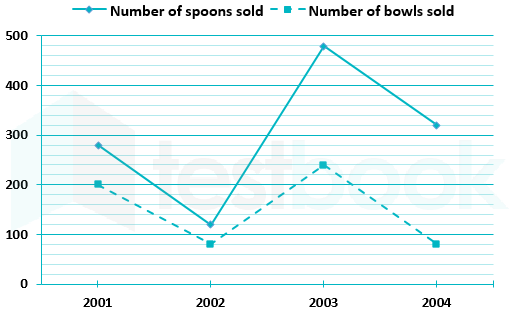
The line graph given below shows the number of 'Spoons' and the number of 'Bowls' sold by company 'X' over the course of four distinct years.

71

If the respective number of 'Bowls' sold by company 'Y' in 2002 and that by company 'Z' are 20% and 40% less than the number of 'Spoons' sold by company 'X' in the same year and company 'Y' and company 'Z' sold each bowl at a price of 105 Rs. and 75 Rs. respectively, then what is the total sales generated by company 'Y' and company 'Z' together in 2002?

  1. ((a))

    13680 Rs.

  2. ((b))

    14580 Rs.

  3. ((c))

    15480 Rs.

  4. ((d))

    16380 Rs.

  5. ((e))

    17580 Rs.

Show Answer
Answer: ((c))

15480 Rs.

YearNumber of 'Spoons' soldNumber of 'Bowls' sold
2001280200
200212080
2003480240
200432080
Total1200600


Number of 'Bowls' sold by company 'Y' in 2002 = 120 × 80% = 96

Number of 'Bowls' sold by company 'Z' in 2002 = 120 × 60% = 72

Total sales generated by company 'Y' and company 'Z' together in 2002 = 96 × 105 + 72 × 75 = 15480 Rs.

Hence, the correct answer is 15480 Rs.

72

If the total number of knives sold by company 'X' in 2002 and that in 2004 is 12.5% and 25% less than the number of 'Bowls' sold by the company in the same years respectively, then find the total number of knives sold by company 'X' in 2002 and that in 2004 together?

  1. ((a))

    120

  2. ((b))

    130

  3. ((c))

    140

  4. ((d))

    150

  5. ((e))

    160

Show Answer
Answer: ((b))

130

YearNumber of 'Spoons' soldNumber of 'Bowls' sold
2001280200
200212080
2003480240
200432080
Total1200600


Number of knives sold by company 'X' in 2002 = 87.5% × 80 = 70

Number of knives sold by company 'X' in 2004 = 75% × 80 = 60

Total number of knives sold by company 'X' in 2002 and that in 2004 together = 70 + 60 = 130

Hence, the correct answer is 130.

73

What is the difference between the average total number of 'Spoons' sold by the company from 2001 to 2004 and the average total number of 'Bowls' sold by the company over the same period?

  1. ((a))

    150

  2. ((b))

    160

  3. ((c))

    180

  4. ((d))

    200

  5. ((e))

    220

Show Answer
Answer: ((a))

150

YearNumber of 'Spoons' soldNumber of 'Bowls' sold
2001280200
200212080
2003480240
200432080
Total1200600


Required difference = (1200 - 600)/4 = 150

Hence, the correct answer is 150.

74

If the number of 'Spoons' sold by the company in 2005 is 75% more than that by the company in 2004, then the number of 'Spoons' sold by the company in 2005 is what percent more or less than than the number of 'Spoons' sold by the company in 2003?

  1. ((a))

    7.14%

  2. ((b))

    8.33%

  3. ((c))

    12.5%

  4. ((d))

    16.66%

  5. ((e))

    20%

Show Answer
Answer: ((d))

16.66%

YearNumber of 'Spoons' soldNumber of 'Bowls' sold
2001280200
200212080
2003480240
200432080
Total1200600


The number of 'Spoons' sold by the company in 2005 = 1.75% × 320 = 560

Required% = [(560 - 480)/480] × 100 = 16.66%

Hence, the correct answer is 16.66%.

75

What is the respective ratio between the total number of 'Spoons' sold by the company in 2001 and 2002 together and the total number of 'Bowls' sold by the company in 2003 and 2004 together?

  1. ((a))

    1 : 1

  2. ((b))

    4 : 3

  3. ((c))

    5 : 4

  4. ((d))

    8 : 7

  5. ((e))

    10 : 9

Show Answer
Answer: ((c))

5 : 4

YearNumber of 'Spoons' soldNumber of 'Bowls' sold
2001280200
200212080
2003480240
200432080
Total1200600


The total number of 'Spoons' sold by the company in 2001 and 2002 together = 280 + 120 = 400

The total number of 'Bowls' sold by the company in 2003 and 2004 together = 240 + 80 = 320

Required ratio = 400 : 320 = 5 : 4

Hence, the correct answer is 5 : 4.

76

The area of the circle is 2464 cm2 and the ratio of the breadth of the rectangle to radius of the circle is 6:7. If the circumference of the circle is equal to the perimeter of the rectangle, then what is the area of the rectangle.

  1. ((a))

    1536cm2

  2. ((b))

    1546cm2

  3. ((c))

    1556cm2

  4. ((d))

    1566cm2

  5. ((e))

    1576cm2

Show Answer
Answer: ((a))

1536cm2

Shortcut Trick

For Area of Circle = 2464 cm2, the Radius (r) is always 28 cm and Circumference is 176 cm.

Breadth (b) = (6/7) × 28 = 24 cm.

Perimeter 2(l + 24) = 176 ⇒ l + 24 = 88 ⇒ Length (l) = 64 cm.

Area of Rectangle = 64 × 24 = 1536 cm2.

∴ The correct answer is 1536 cm2.

Alternate Method

Given: Area of circle = 2464 cm2, Ratio (b : r) = 6 : 7, Circumference = Perimeter.

Formula Used: Area = πr2; Circumference = 2πr; Perimeter = 2(l + b); Area = l × b.

⇒ πr2 = 2464

⇒ (22/7) × r2 = 2464

⇒ r2 = 2464 × (7/22) = 112 × 7 = 784

⇒ r = √784 = 28 cm

⇒ Circumference = 2 × (22/7) × 28 = 176 cm

⇒ Breadth (b) = (6/7) × 28 = 24 cm

⇒ Perimeter of Rectangle = 2(l + b) = 176

⇒ l + 24 = 88 ⇒ l = 64 cm

⇒ Area of Rectangle = 64 × 24 = 1536 cm2

∴ The correct answer is 1536 cm2.

Additional Information

Standard Circle Values

For r = 7, Area = 154, Circumference = 44. Since Area ∝ r2, if r is multiplied by 4 (r=28), Area is multiplied by 16 (154 × 16 = 2464).

Mensuration Formulas

Rectangle Perimeter = 2(Length + Breadth) and Circle Circumference = 2πr. For competitive exams, memorizing squares up to 30 is essential (√784 = 28).

77

If the difference between the compound interest (compounded annually) and simple interest earned on a certain sum invested at a rate of 10% p.a. for 2 years, is Rs 202. Find the sum invested.

  1. ((a))

    20200

  2. ((b))

    18000

  3. ((c))

    10200

  4. ((d))

    19200

  5. ((e))

    20500

Show Answer
Answer: ((a))

20200

Let, sum invested be Rs. X

Compound interest earned = X × [1 + (10/100)2 - 1] = Rs. 0.21X

Simple interest earned = (X × 10 × 2)/100 = Rs. 0.2X

According to question,

0.21X - 0.2X = 202

0.01X = 202

X = 20200

Hence, correct answer is option 1.

78

Humpy and Dumpy are two friends. They decided to start a business together. Humpy’s invest 4 times the investment of Dumpy and his investment period was 3 times the investment periods of Dumpy. If Dumpy get Rs. 6000 as profit, then find their total profit.

  1. ((a))

    Rs. 78,000

  2. ((b))

    Rs. 68,000

  3. ((c))

    Rs. 42,000

  4. ((d))

    Rs. 52,000

  5. ((e))

    Rs. 62,000

Show Answer
Answer: ((a))

Rs. 78,000

Given∶

Humpy invest 4 times the investment of Dumpy.

Humpy investment period is 3 times the investment period of Dumpy.

Dumpy get Rs. 6000 as profit.

Formula used∶

Basic rules of ratio and proportion.

Calculation∶

Let Dumpy invested Rs. x for y months.

And Humpy invested Rs. 4x for 3y months.

So, the ratio for Humpy’s profit to Dumpy’s profit,

Humpy ∶ Dumpy = (4x × 3y) ∶ (x × y) = 12xy ∶ xy = 12 ∶ 1

Sum of the ratio of profit = 12 + 1 = 13

Dumpy’s profit ∶ total profit = 1 ∶ 13

Let the total profit be Rs ‘z’ then,

1/13 = 6000/z

z = 6000 × 13 = 78,000

The total profit is Rs. 78,000.

79

There is a group of 3 people, Ajay, Raj and their teacher. The age of teacher is 1.5 times the age of ajay and raj is 5 years older than ajay. If the average age of group is 25 years, then find the ratio of ages of ajay and raj.

  1. ((a))

    2:3

  2. ((b))

    1:4

  3. ((c))

    4:5

  4. ((d))

    3:5

  5. ((e))

    4:7

Show Answer
Answer: ((c))

4:5

Given:

Age of teacher = 1.5 × age of ajay

Age of raj = age of ajay + 5

Calculation:

Let ajay's age be x years

⇒ Teacher's age = 1.5x

And raj's age = x + 5

∴ According to question,

x + 1.5x + x + 5/3 = 25

⇒ 3.5x + 5 = 25 × 3

⇒ 3.5x = 75 - 5

⇒ x = 70/3.5

⇒ x = 20 years

∴ Teacher's age = 1.5 × 20 = 30 years

 Ajay's age = 20 years

And raj's age = 20 + 5 = 25 years

∴ Required ratio = 20:25

= 4:5

The ratio of ages of ajay and raj = 4:5

80

A, B, C starts a partnership. The capital of A, B, C are in the ratio of 10 : 9 : 6 and the time period of A : B is in the ratio of 2 : 3. B gets Rs.10, 800 shares out of a total loss of Rs.26, 000. A invests capital in the business for 8 months, find how many months was C invests his capital ?

  1. ((a))

    11 months

  2. ((b))

    12 months

  3. ((c))

    8 months

  4. ((d))

    10 months

  5. ((e))

    9 months

Show Answer
Answer: ((b))

12 months

GIVEN :

The capital of A, B, C are in the ratio of 10 : 9 : 6.

The ratio of time period of A : B is 2 : 3.

B gets Rs.10, 800 shares out of a total loss of Rs.26, 000.


FORMULA USED :

L1 : L2 : L= I1 × T1  : I2 × T2 : I3 × T3

Here, L = Loss, I = Investment, T = Time


CALCULATION :

The capital of A, B, C are in the ratio of 10 : 9 : 6.

The ratio of time period of A : B is 2 : 3.

A invests capital in the business for 8 months 

Then, the time period of B = 8/2 × 3 = 12 months

Let the time period of C be x.

Then, A : B : C = 10 × 8 : 9 × 12 : 6 × x   

⇒ A : B : C = 40 : 54 : 3x

According to the question:

B gets Rs.10, 800 shares out of a total loss of Rs.26, 000.

Then, 5494+3x×26000=10800\frac{{54}}{{94 + 3x}} \times 26000 = 10800

⇒ 130 = 94 + 3x

⇒ 3x = 36

⇒ x = 12

∴ The C invests his capital for 12 months.

Attempt this paper under real exam conditions

Timed interface, section switching, instant scoring, and question-by-question analytics — free.

Start Timed Attempt