Official Paper

RRB Clerk Prelims Memory Based Paper (Held On: 13 August 2023 Shift 1) (Previous Year Paper)

80 questions · 45 minutes · with answers · free

Reasoning (40 questions)

Eight members M, N, O, P, Q, R, S, and T are sitting in two rows with an equal number of members in each row. Members of one row are facing north and those in the other row are facing south. Each member in one row is sitting exactly opposite a member in the other row.

Only one person sits between S and Q, who sits in the row facing north. R is an immediate neighbour of P. Q did not sit at any extreme end of the row. S faces P, who sits second to the right of N. P is not an immediate neighbour of T, who faces O. Q is an immediate neighbor of O.

1

Who sits between M and O?

  1. ((a))

    S

  2. ((b))

    R

  3. ((c))

    Q

  4. ((d))

    T

  5. ((e))

    P

Show Answer
Answer: ((c))

Q

Persons: M, N, O, P, Q, R, S, and T.

  1. Only one person sits between S and Q, who sits in the row facing north.

  2. Q did not sit any extreme end of the row. S faces P, who sits second to the right of N.

  1. P did not sit immediate neighbor of T, who faces O.

4) Q is an immediate neighbor of O.

5) R is an immediate neighbor of P. 

Hence, Q sits between M and O.

2

What is the position of R with respect to N?

  1. ((a))

    Third to the left

  2. ((b))

    Immediate right

  3. ((c))

    Immediate left

  4. ((d))

    Second to the right

  5. ((e))

    Third to the right

Show Answer
Answer: ((b))

Immediate right

Persons: M, N, O, P, Q, R, S, and T.

  1. Only one person sits between S and Q, who sits in the row facing north.

  2. Q did not sit any extreme end of the row. S faces P, who sits second to the right of N.

  1. R is an immediate neighbor of P.

  2. P did not sit immediate neighbour of T, who faces O.

5) Q is an immediate neighbor of O. 

Hence, R sits immediate right of N.

3

What is the position of M?

  1. ((a))

    Opposite to R

  2. ((b))

    Immediate right of S

  3. ((c))

    Immediate left of Q

  4. ((d))

    Only 1, 2 and 3 are true

  5. ((e))

    None of these

Show Answer
Answer: ((d))

Only 1, 2 and 3 are true

Persons: M, N, O, P, Q, R, S, and T.

  1. Only one person sits between S and Q, who sits in the row facing north.

  2. Q did not sit any extreme end of the row. S faces P, who sits second to the right of N.

  1. P did not sit immediate neighbor of T, who faces O.

4) Q is an immediate neighbor of O.

5) R is an immediate neighbor of P. 

M is opposite to R, M is immediate right of S and M is immediate left of Q.

Hence, M is opposite to R, immediate right of S, and immediate left of Q.

4

If R interchange his position to O, what is the position of S with respect to R?

  1. ((a))

    Opposite

  2. ((b))

    Placed diagonally opposite 

  3. ((c))

    Three places to its left 

  4. ((d))

    Immediately adjacent

  5. ((e))

    Two places to its right 

Show Answer
Answer: ((c))

Three places to its left 

Persons: M, N, O, P, Q, R, S, and T.

  1. Only one person sits between S and Q, who sits in the row facing north.

  2. Q did not sit any extreme end of the row. S faces P, who sits second to the right of N.

  1. Q is an immediate neighbor of O.

  2. P did not sit immediate neighbor of T, who faces O.

5) R is an immediate neighbor of P.

R lies only at the extreme position, the position of S with respect to R will be three places to the left. The arrangement will be as follows.

Hence, If R lies only at the extreme position, S will be three places to the left of R.

5

Who sits extreme end of the row?

  1. ((a))

    S, T

  2. ((b))

    Q, P

  3. ((c))

    P, M

  4. ((d))

    O, N

  5. ((e))

    S, R

Show Answer
Answer: ((a))

S, T

Persons: M, N, O, P, Q, R, S, and T.

  1. Only one person sits between S and Q, who sits in the row facing north.

  2. Q did not sit any extreme end of the row. S faces P, who sits second to the right of N.

  1. P did not sit immediate neighbor of T, who faces O.

4) Q is an immediate neighbor of O.

5) R is an immediate neighbor of P. 

Hence, S and T sits extreme end of the row.

Direction: Study the following series of sets of numbers. Carefully answer the question given below.

324      825      583      978      159

6

What will be number obtained if 2nd digit of largest number is added with 1st digit of 2nd smallest number?

  1. ((a))

    16

  2. ((b))

    17

  3. ((c))

    13

  4. ((d))

    10

  5. ((e))

    14

Show Answer
Answer: ((d))

10

Given Series:- 324       825      583      978      159

The largest Number is=978> 825> 583>324> 158

The largest number is= 978

 Second smallest is= 324

Then we have to look for the digit mentioned in the question-  2nd digit of the largest number is added with 1st digit of 2nd smallest number which is:

Second digit of largest number:- 7 (978 is largest number)

First digit of 2nd smallest number:- 3 (324 is 2nd smallest number)

Resultant will be:- 7 + 3 = 10;

Hence, “10” is the correct answer.

7

If 1 is added to second digit and 1 is subtracted to third digit then which among them is third largest number?

  1. ((a))

    825

  2. ((b))

    324

  3. ((c))

    159

  4. ((d))

    978

  5. ((e))

    583

Show Answer
Answer: ((e))

583

Given Series:- 324          825            583              978            159

Adding 1 to second digit:-334          835          593            988            169

Subtraction 1 to third digit:- 333           834           592            987     168

Hence, 592 is third largest number which resulted from 583.

Hence, “583” is correct answer.

8

If in each number three digits are arranged in ascending order then which of the following is 2nd largest number?

  1. ((a))

    324

  2. ((b))

    159

  3. ((c))

    978

  4. ((d))

    583

  5. ((e))

    825

Show Answer
Answer: ((d))

583

Given Series:- 324    825    583    978    159

Numbers arranged in ascending order:- 234             258            358              789            159

Hence, 2nd largest number is 358 which resulted from 583.

Hence, “583” is correct answer.

9

If first and third digits are interchanged then how many prime number are there in the following series?

  1. ((a))

    One

  2. ((b))

    Two

  3. ((c))

    Three

  4. ((d))

    Zero

  5. ((e))

    Four

Show Answer
Answer: ((d))

Zero

Given Series:- 324    825    583    978    159

First and third digits are interchanged:- 423      528       385      879        951

Hence, from the above series none of the numbers is a prime number.

Hence, “Zero” is the correct answer.

10

What will be the number obtained when 3rd digit of 2nd highest number is multiplied by 2nd digit of smallest number?

  1. ((a))

    49

  2. ((b))

    36

  3. ((c))

    30

  4. ((d))

    25

  5. ((e))

    20

Show Answer
Answer: ((d))

25

Given Series:- 324          825            583              978            159

3rd digit of 2nd highest number:- 5(825 is 2nd highest number)

2nd digit of smallest number:-  5(159 is smallest number)

Hence, resultant will be:- 5×5 = 25;

Hence, “25” is the correct answer.

11

Direction: Study the information given below carefully and answer the questions that follow.

Arpit is father of Vineet, who is brother-in-law of Arman. Reeta is mother -in-law of Mahima. Kriti is sister of Vineet. Mahima and Vineet are married. Kriti is married. How is Arman related to Kriti?

  1. ((a))

    Wife

  2. ((b))

    Father

  3. ((c))

    Husband

  4. ((d))

    Son

  5. ((e))

    None of the above

Show Answer
Answer: ((c))

Husband

Below table represents symbols used to draw a family tree,

We can draw the following Family Tree from the information given above:

So, Arman is husband of Kriti.

Hence, Husband is the correct answer.

Read the following information carefully and answer the given questions:

Certain number of persons are sitting in a row facing north. Three persons sit between T and Q who sits immediate left of L. Four persons sit between L and S. M sits third from one of the ends. Three persons sit between M and P. O sits six places away from P but not at the end. N neither sits to the right of O nor at any of the ends. Only one person sit between M and R, R who has only one neighbour. T sits to the left of O but not immediate left. Not more than two persons sit to the left of T. Not more than one person lives between M and S who sits to the left of M. T sits to the immediate right of N. Not more than 7 persons sit between O and S. O sits to the left of Q.

12

How many persons are sitting in the row?

  1. ((a))

    21

  2. ((b))

    24

  3. ((c))

    19

  4. ((d))

    17

  5. ((e))

    Cannot be determined

Show Answer
Answer: ((d))

17

According to the given information:

1) M sits third from one of the ends.

  1. Three persons sit between M and P.

  2. O sits six places away from P but not at the end.

As the position of M cannot me determined, two cases will be formed.

Case 1:

Case 2:

4) Only one persons sit between M and R who has only one neighbour.

Case 1:

Case 2:

5) N neither sits to the right of O nor at any of the ends.

6) T sits to the left of O but not immediate left.

7) Not more than two persons sit to the left of T.

8) T sits to the immediate right of N.

If T sits to the left of O, then point 7 will not be applicable in case 1. So it will be cancelled.

9) Three persons sit between T and Q who sits immediate left of L.

10) Four persons sit between L and S.

11) Not more than one person lives between M and S who sits to the left of M.

12) Not more than 7 persons sit between O and S.

Hence, there are 17 persons in the row.

13

How many persons are sitting between L and P?

  1. ((a))

    Three

  2. ((b))

    Two

  3. ((c))

    One

  4. ((d))

    Four

  5. ((e))

    Six

Show Answer
Answer: ((b))

Two

According to the given information:

1) M sits third from one of the ends.

  1. Three persons sit between M and P.

  2. O sits six places away from P but not at the end.

As the position of M cannot me determined, two cases will be formed.

Case 1:

Case 2:

4) Only one persons sit between M and R who has only one neighbour.

Case 1:

Case 2:

5) N neither sits to the right of O nor at any of the ends.

6) T sits to the left of O but not immediate left.

7) Not more than two persons sit to the left of T.

8) T sits to the immediate right of N.

If T sits to the left of O, then point 7 will not be applicable in case 1. So it will be cancelled.

9) Three persons sit between T and Q who sits immediate left of L.

10) Four sit between L and S.

11) Not more than one person lives between M and S who sits to the left of M.

12) Not more than 7 persons sit between O and S.

Hence, two persons are sitting between L and P.

14

What is the position of S with respect to R?

  1. ((a))

    Immediate left

  2. ((b))

    Third to the left

  3. ((c))

    Immediate right

  4. ((d))

    Fourth to the right

  5. ((e))

    Fourth to the left

Show Answer
Answer: ((e))

Fourth to the left

According to the given information:

1) M sits third from one of the ends.

  1. Three persons sit between M and P.

  2. O sits six places away from P but not at the end.

As the position of M cannot me determined, two cases will be formed.

Case 1:

Case 2:

4) Only one persons sit between M and R who has only one neighbour.

Case 1:

Case 2:

5) N neither sits to the right of O nor at any of the ends.

6) T sits to the left of O but not immediate left.

7) Not more than two persons sit to the left of T.

8) T sits to the immediate right of N.

If T sits to the left of O, then point 7 will not be applicable in case 1. So it will be cancelled.

9) Three persons sit between T and Q who sits immediate left of L.

10) Four persons sit between L and S.

11) Not more than one person lives between M and S who sits to the left of M.

12) Not more than 7 persons sit between O and S.

Hence, S sits fourth to the left of R.

15

Direction: In the following question assuming the given statements to be true, find which of the conclusion(s) among given conclusions is/are definitely true and then give your answers accordingly.

Statements: 

M = F, R ≤ J, M > J, I ≥ F

Conclusions:

I.  R < F

II. I > J

  1. ((a))

    Only conclusion I follows

  2. ((b))

    Only conclusion II follows

  3. ((c))

    Both conclusions I and II follow

  4. ((d))

    Either conclusion I or II follows

  5. ((e))

    None of the conclusions follows

Show Answer
Answer: ((c))

Both conclusions I and II follow

Given statements,

M = F, R ≤ J, M > J, I ≥ F

On combining, we get: 

R ≤ J < M = F ≤ I

Conclusions:

I. R < F → True (R ≤ J < M = F → R < F).

II. I > J → True (J < M = F ≤ I → J < I).

Hence, the correct answer is both conclusions I and II follow.

16

Direction: In the following question assuming the given statements to be true, find which of the conclusion(s) among given conclusions is/are definitely true and then give your answers accordingly.

Statements: 

T ≥ E = W, V < R < Q = W, T ≤ P

Conclusions:

I. Q < P 

II. P = Q

  1. ((a))

    Only conclusion I follows

  2. ((b))

    Only conclusion II follows

  3. ((c))

    Both conclusion I and II follow

  4. ((d))

    Either conclusion I or II follows

  5. ((e))

    None of the conclusions follows

Show Answer
Answer: ((d))

Either conclusion I or II follows

Given statements,

T ≥ E = W, V < R < Q = W, T ≤ P

On combining, we get:

V < R < Q = W = E ≤ T ≤ P 

Conclusions:

I. Q < P → False (Q = W = E ≤ T ≤ P → Q ≤ P).

II. P = Q → False (Q = W = E ≤ T ≤ P → Q ≤ P).

Since Q ≤ P is true so either conclusion I or II definitely follows.

Hence, the correct answer is either conclusion I or II follows.

17

Direction: In the following question assuming the given statements to be true, find which of the conclusion among the given conclusions is/are definitely true and then give your answers accordingly.

Statements: W > Q > Z ≤ L; N < C ≤ Z

Conclusions:

I. W > N

II. N ≤ L

  1. ((a))

    Only II is True

  2. ((b))

    Neither I nor II is True

  3. ((c))

    Both I and II are True

  4. ((d))

    Either I or II is True

  5. ((e))

    Only I is True

Show Answer
Answer: ((e))

Only I is True

Given statements: W > Q > Z ≤ L; N < C ≤ Z

On combining: W > Q > Z ≥ C > N; L ≥ Z ≥ C > N

Conclusions:

I. W > N → True (as W > Q > Z ≥ C > N → W > N)

II. N ≤ L → False (as L ≥ Z ≥ C > N → L > N)

Hence, only I is True.

18

Direction: In the following question assuming the given statements to be true, find which of the conclusion among the given conclusions is/are definitely true and then give your answers accordingly.

Statements: F > K ≥ D; S ≥ D ≥ U > V

Conclusions:

I. V < K

II. F > S

  1. ((a))

    Only I is True

  2. ((b))

    Neither I nor II is True

  3. ((c))

    Both I and II are True

  4. ((d))

    Either I or II is True

  5. ((e))

    Only II is True

Show Answer
Answer: ((a))

Only I is True

Given statements: F > K ≥ D; S ≥ D ≥ U > V

On combining: F > K ≥ D ≥ U > V; F > K ≥ D ≤ S

Conclusions:

I. V < K → True (as K ≥ D ≥ U > V → K > V)

II. F > S → False (as F > K ≥ D ≤ S thus clear relation between F and S cannot be determined)

Hence, only I is True.

Direction: Read the following information carefully and answer the given questions:

There are six person A, B, C, D, E and F and all of them purchase different article. Only one person purchase article before A. E purchase before B and D but not before A. Only one person purchased article after D. F purchased the article in the last.

19

Who among the following is the first to purchase the article?

  1. ((a))

    D

  2. ((b))

    A

  3. ((c))

    C

  4. ((d))

    F

  5. ((e))

    E

Show Answer
Answer: ((c))

C

Six members: A, B, C, D, E and F

1) Only one person purchase article before A. E purchase before B and D but not before A. 

 ____  > A >_____ >_____ >_____ >_____

2) Only one person purchased article after D. 

3) F purchased the article in the last.

_____ > A >_____ >_____ > D > F

4) E purchase before B and D but not before A. 

_____ > A > E > B > D > F

Only C is remaining, so C will be the first person to purchase the article

So, the final arrangement will be as follows:

C > A > E > B > D > F

Hence, C is the first person to purchase the article.

20

Which of the following statement is correct?

  1. ((a))

    Two person brought the article between A and D

  2. ((b))

    D is the third person to purchase the article 

  3. ((c))

    E is second person to purchase the article 

  4. ((d))

    None of the given statement is Correct

  5. ((e))

    All the given statement is Correct

Show Answer
Answer: ((a))

Two person brought the article between A and D

Six members: A, B, C, D, E and F

1) Only one person purchase article before A. E purchase before B and D but not before A. 

 ____  > A >_____ >_____ >_____ >_____

2) Only one person purchased article after D. 

3) F purchased the article in the last.

_____ > A >_____ >_____ > D > F

4) E purchase before B and D but not before A. 

_____ > A > E > B > D > F

Only C is remaining, so C will be the first person to purchase the article

So, the final arrangement will be as follows:

C > A > E > B > D > F

21

Number of person purchase the article between C and B is same as that of between E and ____

  1. ((a))

    C

  2. ((b))

    B

  3. ((c))

    A

  4. ((d))

    D

  5. ((e))

    F

Show Answer
Answer: ((e))

F

Six members: A, B, C, D, E and F

1) Only one person purchase article before A. E purchase before B and D but not before A. 

 ____  > A >_____ >_____ >_____ >_____

2) Only one person purchased article after D. 

3) F purchased the article in the last.

_____ > A >_____ >_____ > D > F

4) E purchase before B and D but not before A. 

_____ > A > E > B > D > F

Only C is remaining, so C will be the first person to purchase the article

So, the final arrangement will be as follows:

C > A > E > B > D > F

Number of person purchase the article between C and B is same as that of between E and F

22

Find the odd one from the following options. 

  1. ((a))

    DE

  2. ((b))

    FB

  3. ((c))

    BA

  4. ((d))

    BC

  5. ((e))

    EC

Show Answer
Answer: ((d))

BC

Six members: A, B, C, D, E and F

1) Only one person purchase article before A. E purchase before B and D but not before A. 

 ____  > A >_____ >_____ >_____ >_____

2) Only one person purchased article after D. 

3) F purchased the article in the last.

_____ > A >_____ >_____ > D > F

4) E purchase before B and D but not before A. 

_____ > A > E > B > D > F

Only C is remaining, so C will be the first person to purchase the article

So, the final arrangement will be as follows:

C > A > E > B > D > F

Except BC number of person between all the mention pair is two.

23

If each person is assigned a number based on the order in which they purchase an article, starting with the number 10 in consecutive order, what would be the possible number assigned to person B?

  1. ((a))

    10

  2. ((b))

    11

  3. ((c))

    13

  4. ((d))

    12

  5. ((e))

    14

Show Answer
Answer: ((c))

13

Six members: A, B, C, D, E and F

1) Only one person purchase article before A. E purchase before B and D but not before A. 

 ____  > A >_____ >_____ >_____ >_____

2) Only one person purchased article after D. 

3) F purchased the article in the last.

_____ > A >_____ >_____ > D > F

4) E purchase before B and D but not before A. 

_____ > A > E > B > D > F

Only C is remaining, so C will be the first person to purchase the article

So, the final arrangement will be as follows:

C > A > E > B > D > F

B will be given 13 starting number 10 from C.

Seven people A, B, C, D, E, F and G are living in a seven story building, where the bottommost floor is numbered as 1, topmost is numbered as 7. All the people are not necessarily living in the same order. E lives on one of the floor below third floor. Three people are living between F and E. Two people are living between C and F. G lives immediately below D, who lives on an odd numbered floor. A lives above B, who does not live adjacent to C.

24

How many people live between the one who lives on floor numbered 6 and B?

  1. ((a))

    Two

  2. ((b))

    Four

  3. ((c))

    One

  4. ((d))

    Three

  5. ((e))

    None

Show Answer
Answer: ((b))

Four

From the given instructions:

Seven people A, B, C, D, E, F and G are living in a seven story building, where the bottommost floor is numbered as 1, topmost is numbered as 7. So, we can draw a structure as:

FloorPerson
7
6
5
4
3
2
1


  1. E lives on one of the floor below third floor. So, here we have two cases;
Case 1Case 2
FloorPersonPerson
7
6
5
4
3
2E
1E


  1. Three people are living between F and E.
Case 1Case 2
FloorPersonPerson
7
6F
5F
4
3
2E
1E


  1. Two people are living between C and F.
Case 1Case 2
FloorPersonPerson
7
6F
5F
4
3C
2EC
1E


  1. G lives immediately below D, who lives on an odd numbered floor.
Case 1Case 2
FloorPersonPerson
7D
6FG
5DF
4G
3C
2EC
1E


  1. A lives above B, who does not live adjacent to C. So, here Case 2 gets eliminated.
Case 1Case 2
FloorPersonPerson
7AD
6FG
5DF
4GA
3CB
2EC
1BE


So, Final Arrangement:

FloorPerson
7A
6F
5D
4G
3C
2E
1B


Four people live between the floor numbered 6 and B.

25

Who lives immediately above C?

  1. ((a))

    D

  2. ((b))

    F

  3. ((c))

    E

  4. ((d))

    G

  5. ((e))

    None of these

Show Answer
Answer: ((d))

G

From the given instructions:

Seven people A, B, C, D, E, F and G are living in a seven story building, where the bottommost floor is numbered as 1, topmost is numbered as 7. So, we can draw a structure as:

FloorPerson
7
6
5
4
3
2
1


  1. E lives on one of the floor below third floor. So, here we have two cases;
Case 1Case 2
FloorPersonPerson
7
6
5
4
3
2E
1E


  1. Three people are living between F and E.
Case 1Case 2
FloorPersonPerson
7
6F
5F
4
3
2E
1E


  1. Two people are living between C and F.
Case 1Case 2
FloorPersonPerson
7
6F
5F
4
3C
2EC
1E


  1. G lives immediately below D, who lives on an odd numbered floor.
Case 1Case 2
FloorPersonPerson
7D
6FG
5DF
4G
3C
2EC
1E


  1. A lives above B, who does not live adjacent to C. So, here Case 2 gets eliminated.
Case 1Case 2
FloorPersonPerson
7AD
6FG
5DF
4GA
3CB
2EC
1BE


So, Final Arrangement:

FloorPerson
7A
6F
5D
4G
3C
2E
1B


G lives immediately above C.

26

How many people live above E?

  1. ((a))

    Six

  2. ((b))

    Four

  3. ((c))

    Five

  4. ((d))

    Three

  5. ((e))

    None of these

Show Answer
Answer: ((c))

Five

From the given instructions:

Seven people A, B, C, D, E, F and G are living in a seven story building, where the bottommost floor is numbered as 1, topmost is numbered as 7. So, we can draw a structure as:

FloorPerson
7
6
5
4
3
2
1


  1. E lives on one of the floor below third floor. So, here we have two cases;
Case 1Case 2
FloorPersonPerson
7
6
5
4
3
2E
1E


  1. Three people are living between F and E.
Case 1Case 2
FloorPersonPerson
7
6F
5F
4
3
2E
1E


  1. Two people are living between C and F.
Case 1Case 2
FloorPersonPerson
7
6F
5F
4
3C
2EC
1E


  1. G lives immediately below D, who lives on an odd numbered floor.
Case 1Case 2
FloorPersonPerson
7D
6FG
5DF
4G
3C
2EC
1E


  1. A lives above B, who does not live adjacent to C. So, here Case 2 gets eliminated.
Case 1Case 2
FloorPersonPerson
7AD
6FG
5DF
4GA
3CB
2EC
1BE


So, Final Arrangement:

FloorPerson
7A
6F
5D
4G
3C
2E
1B


Five people live above E.

27

Which statement is true according to the final arrangement?

I. D lives on floor numbered 5.

II. One people live between D and C.

III. Five people live between A and B.

  1. ((a))

    Only I

  2. ((b))

    Only I and III

  3. ((c))

    Only II and III

  4. ((d))

    Only I and II

  5. ((e))

    All are true

Show Answer
Answer: ((e))

All are true

From the given instructions:

Seven people A, B, C, D, E, F and G are living in a seven story building, where the bottommost floor is numbered as 1, topmost is numbered as 7. So, we can draw a structure as:

FloorPerson
7
6
5
4
3
2
1


  1. E lives on one of the floor below third floor. So, here we have two cases;
Case 1Case 2
FloorPersonPerson
7
6
5
4
3
2E
1E


  1. Three people are living between F and E.
Case 1Case 2
FloorPersonPerson
7
6F
5F
4
3
2E
1E


  1. Two people are living between C and F.
Case 1Case 2
FloorPersonPerson
7
6F
5F
4
3C
2EC
1E


  1. G lives immediately below D, who lives on an odd numbered floor.
Case 1Case 2
FloorPersonPerson
7D
6FG
5DF
4G
3C
2EC
1E


  1. A lives above B, who does not live adjacent to C. So, here Case 2 gets eliminated.
Case 1Case 2
FloorPersonPerson
7AD
6FG
5DF
4GA
3CB
2EC
1BE


So, Final Arrangement:

FloorPerson
7A
6F
5D
4G
3C
2E
1B


All options are true.

28

Who live adjacent to D?

  1. ((a))

    F

  2. ((b))

    C

  3. ((c))

    G

  4. ((d))

    Both F and G

  5. ((e))

    None of these

Show Answer
Answer: ((d))

Both F and G

From the given instructions:

Seven people A, B, C, D, E, F and G are living in a seven story building, where the bottommost floor is numbered as 1, topmost is numbered as 7. So, we can draw a structure as:

FloorPerson
7
6
5
4
3
2
1


  1. E lives on one of the floor below third floor. So, here we have two cases;
Case 1Case 2
FloorPersonPerson
7
6
5
4
3
2E
1E


  1. Three people are living between F and E.
Case 1Case 2
FloorPersonPerson
7
6F
5F
4
3
2E
1E


  1. Two people are living between C and F.
Case 1Case 2
FloorPersonPerson
7
6F
5F
4
3C
2EC
1E


  1. G lives immediately below D, who lives on an odd numbered floor.
Case 1Case 2
FloorPersonPerson
7D
6FG
5DF
4G
3C
2EC
1E


  1. A lives above B, who does not live adjacent to C. So, here Case 2 gets eliminated.
Case 1Case 2
FloorPersonPerson
7AD
6FG
5DF
4GA
3CB
2EC
1BE


So, Final Arrangement:

FloorPerson
7A
6F
5D
4G
3C
2E
1B


Both F and G lives adjacent to D.

29

How many such pairs of digits are there in the number ‘8943651424’, each of which has as many digits between them as in the number series (both forward and backward direction) ?

  1. ((a))

    2

  2. ((b))

    4

  3. ((c))

    7

  4. ((d))

    More than 7

  5. ((e))

    3

Show Answer
Answer: ((d))

More than 7

The logic follows here is:

The given number can be represented as shown below:

In the forward direction → "89", "14", 46", "35".

In the backward direction → "25", "26", "29", "56", "59", "69", "34".

So, Eleven pairs are there in the number ‘8943651424’, each of which has as many digits between them as in the number series (both forward and backward direction).

Hence, the correct answer is "More than 7".

Directions: Study the following information carefully to answer the given questions:

R € 3 W 8 C $ D © K 2 ® 7 T F 5 U £ Z 1 % 6 A @ X 4 Q H &

30

In the above arrangement, which of the following is the seventeenth element to the right of a symbol which is immediately followed by a digit and immediately preceded by an alphabet?

  1. ((a))

    @

  2. ((b))

    Z

  3. ((c))

    1

  4. ((d))

    5

  5. ((e))

    £

Show Answer
Answer: ((b))

Z

Given series:

Left Side   R € 3 W 8 C $ D © K 2 ® 7 T F 5 U £ Z 1 % 6 A @ X 4 Q H &   Right Side

Symbol immediately followed by a digit and immediately preceded by an alphabet: Alphabet > Symbol > Digit

R € 3 W 8 C $ D © K 2 ® 7 T F 5 U £ Z 1 % 6 A @ X 4 Q H &

As there is only one symbol immediately followed by a digit and immediately preceded by an alphabet i.e. 

Hence, the element which is seventeenth to the right of € is Z.

31

How many letters are there in the above arrangement which is/are immediately followed by a symbol and immediately preceded by a digit?

  1. ((a))

    Four

  2. ((b))

    Three

  3. ((c))

    Two

  4. ((d))

    One

  5. ((e))

    Zero

Show Answer
Answer: ((b))

Three

Given Series:

Left Side   R € 3 W 8 C $ D © K 2 ® 7 T F 5 U £ Z 1 % 6 A @ X 4 Q H &   Right Side

Alphabets followed immediately by a symbol and preceded immediately by a Digit: Digit > Alphabets > Symbol

R € 3 W 8 C $ D © K 2 ® 7 T F 5 U £ Z 1 % 6 A @ X 4 Q H &

Hence, there are three such alphabets which are followed by a symbol and preceded by a digit: 8 C $, 5 U £, 6 A @

32

How many symbols are there in the above arrangement which is/are immediately followed and immediately preceded by a digit?

  1. ((a))

    5

  2. ((b))

    6

  3. ((c))

    7

  4. ((d))

    2

  5. ((e))

    9

Show Answer
Answer: ((d))

2

Given Series:

Left side   R € 3 W 8 C $ D © K 2 ® 7 T F 5 U £ Z 1 % 6 A @ X 4 Q H &   Right side

Symbols immediately followed and immediately preceded by a digit: Digit > symbol > Digit.

R € 3 W 8 C $ D © K 2 ® 7 T F 5 U £ Z 1 % 6 A @ X 4 Q H &

So, there are two such symbols which are immediately followed and immediately preceded by a digit i.e. ® and %.

Hence, There are 2 Symbols  ® and %.

33

If we drop all the symbols and letters from the above series, find the average of the digits that are at the third and seventh place from the left end in the new series.

  1. ((a))

    4

  2. ((b))

    5

  3. ((c))

    6

  4. ((d))

    7

  5. ((e))

    8

Show Answer
Answer: ((a))

4

Given Series:

Left side   R € 3 W 8 C $ D © K 2 ® 7 T F 5 U £ Z 1 % 6 A @ X 4 Q H &   Right side

If all the symbols and alphabets are removed then the new series will be:

3 8 2 7 5 1 6 4

So, the third digit from the left end = 2

and, the seventh digit from the left end = 6

Now, the average between two numbers is defined as half of the sum of the given two numbers.

Therefore, average of third and seventh digit from the left end i.e. 2 and 6 = (2 + 6)/2 = 8/2 = 4.

Hence, 4 is the correct answer.

34

Four of the following five are alike in a certain way based on their positions in the above arrangement and so form a group. Which is the one that does not belong to that group?

  1. ((a))

    RW3

  2. ((b))

    K7®

  3. ((c))

    @Q4

  4. ((d))

    5Z£

  5. ((e))

    Z6A

Show Answer
Answer: ((e))

Z6A

Given Series:

Left side   R € 3 W 8 C $ D © K 2 ® 7 T F 5 U £ Z 1 % 6 A @ X 4 Q H &   Right side

The pattern followed here is:

RW3 → R + 3 = W and W - 1 = 3.

K7®  → K + 3 = 7 and 7 - 1 = ®.

@Q4 → @ + 3 = Q and Q - 1 = 4.

5Z£  → 5 + 3 = Z and Z - 1 = £.

Z6A  → Z + 3 = 6 and 6 - 1 = %. (But A given in option as Z6A)

Hence Z 6 A doesn't belong to that group.

35

Direction: In the question below are given two statements followed by two conclusions numbered I and II. You have to take the given statements to be true even if they seem to be at variance with commonly known facts. Read all the conclusions and then decide which of the given conclusions logically follows from the given statements disregarding commonly known facts.

Statements:

Only a few Pens are Pencil.

No Pencil is Ball.

Conclusions:

I. Some Pencil are Ball.

II. Some Pencil are not Ball.

  1. ((a))

    Only conclusion I follows

  2. ((b))

    Only conclusion II follows

  3. ((c))

    Both conclusion I and II follow

  4. ((d))

    Either conclusion I or II follows

  5. ((e))

    Neither conclusion I nor II follows

Show Answer
Answer: ((b))

Only conclusion II follows

Concept:

  1. Only a few is a conditional statement which means only a certain part. For eg. if the statement is only a few A is B means only a specific part of the A is B and the remaining part of the A is not B.

a) Only a few - means only "some" not "all".

b) "few" is same as "some".

c) Only "A is B" is same as "all B are A".

2. In this case following conclusions:

  • All A being B is a possibility will be false.
  • All B being A is a possibility will be true.
  • Some A are not B is true.
  • Some B are not A is false.
  • Some A are B is true.
<br>

We can say that it is a conditional statement which is a combination of some and some not both.

The least possible diagram for the given statements is as follows;

Conclusions:

I. Some Pencil are Ball → False (as No Pencil is Ball, no part of Pencil will be Ball. So, it is false)

II. Some Pencil are not Ball → True (as No Pencil is Ball, some part of Pencil will also not be Ball. So, it is true)

Hence, only conclusion II follows.

36

DIRECTIONS: In the question below are given two statements followed by two conclusions. You have to take the given statements to be true even if they seem to be at variance with commonly known facts. Read all the conclusions and the decide which of the given conclusions logically follows from the given statements disregarding the commonly known facts.

Statements: 

 I. Only a few chairs are lights.

 II. Some lights are not laptops.

Conclusions: 

 I. Some chairs are not laptops.

 II. All chairs can never be lights.

  1. ((a))

    Only conclusion I follows.

  2. ((b))

    Only conclusion II follows.

  3. ((c))

    Either conclusion I or conclusion II follows.

  4. ((d))

    Neither Conclusion I nor conclusion II follows

  5. ((e))

    Both the Conclusions follows

Show Answer
Answer: ((b))

Only conclusion II follows.

The least possible Venn diagram,

Conclusion:

I. Some chairs are not laptops → False (It is possible but not definite as there is not specific relation between chairs and laptops, Hence some chain are not laptops is false)

 II. All chairs can never be lights → True ( as only a few chairs are lights, hence all chairs can never be lights is true)

Hence, only conclusion II follows.

37

In each of the questions below are given some statements followed by some conclusions. You have to take the given statements to be true even if they seem to be at variance with commonly known facts. Read all the conclusions and then decide which of the given conclusions logically follows from the given statements disregarding commonly known facts.

Statements:

All drop is rain.

Only a few summer is rain.

Some winter is not summer.

Conclusions:

I.Some drop is winter.

II. No drop is winter.

  1. ((a))

    Only II follows

  2. ((b))

    Both I and II follow

  3. ((c))

    Only I follows

  4. ((d))

    Either I or II follows

  5. ((e))

    None follows

Show Answer
Answer: ((d))

Either I or II follows

The best possible Venn diagram is, 

Conclusions:

I.Some drop is winter: False( As no relation is given between drop and winter, it is possible but not definite)

II. No drop is winter: False( As no relation is given between drop and winter, it is possible but not definite)

Conclusion I and II form a complementary pair.

Hence, Either I or II follows is the correct answer.

Directions: Study the given information and answer the questions that follow.

Point A is 6 meters to the West of B while B is 4 meters to the North of C. G is 7 meters to the West of H and 9 meters to the North of F. E is 8 meters to the south of D. H is 2 meters North of I. F is 16 meters to the to the East of E. D is 6 meters to the West of C.

38

What is the shortest distance between C and E?

  1. ((a))

    10 meters

  2. ((b))

    12 meters

  3. ((c))

    14 meters

  4. ((d))

    8 meters

  5. ((e))

    None of these

Show Answer
Answer: ((a))

10 meters

1) Point A is 6 meters to the West of B.

  1. B is 4 meters to the North of C.

  2. D is 6 meters to the West of C.

  3. E is 8 meters to the south of D.

  4. F is 16 meters to the to the East of E.

<br>
  1. G is 7 meters to the West of H and 9 meters to the North of F.

  2. H is 2 meters North of I.


The distance between C and E is :

Applying Pythagoras Theorem

CE = (62+82)√\left(6^2+8^2\right)100√100 = 10 meters

Hence, the shortest distance between C and E is 10 m.

39

What is the direction of I with respect to D?

  1. ((a))

    East

  2. ((b))

    West

  3. ((c))

    South West

  4. ((d))

    South East

  5. ((e))

    North East

Show Answer
Answer: ((d))

South East

1) Point A is 6 meters to the West of B.

  1. B is 4 meters to the North of C.

  2. D is 6 meters to the West of C.

  3. E is 8 meters to the south of D.

  4. F is 16 meters to the to the East of E.

  1. G is 7 meters to the West of H and 9 meters to the North of F.

  2. H is 2 meters North of I.


Hence,  I is in South East direction with respect to D.

40

If a point X is laying in the South of H and East of C, What is the shortest distance between D and X?

  1. ((a))

    25 m

  2. ((b))

    23 m

  3. ((c))

    24 m

  4. ((d))

    28 m

  5. ((e))

    None of these

Show Answer
Answer: ((b))

23 m

1) Point A is 6 meters to the West of B.

  1. B is 4 meters to the North of C.

  2. D is 6 meters to the West of C.

  3. E is 8 meters to the south of D.

  4. F is 16 meters to the to the East of E.

  1. G is 7 meters to the West of H and 9 meters to the North of F.

  2. H is 2 meters North of I.


From the picture we see the distance between D and I is equal to the total distance of EF and GH. 

Hence the distance is = (16 + 7) = 23 meters.

Numerical Ability (40 questions)

The below table shows the number of male and females working in four different places K, L,M and N.


Name of the placesMalesFemales
K850750
L770720
M820900
N640700
41

Find the average number of males working in all the places K, L,M and N.

  1. ((a))

    780

  2. ((b))

    770

  3. ((c))

    850

  4. ((d))

    860

  5. ((e))

    820

Show Answer
Answer: ((b))

770

Solution:

Number of males working in place K = 850

Number of males working in place  L = 770

Number of males working in place M = 820

Number of males working in place N = 640

Required average = (850 + 770 + 820 + 640)/4 = 770

The below table shows the number of male and females working in four different places K, L,M and N.


Name of the placesMalesFemales
K850750
L770720
M820900
N640700
42

Find the sum of the number of males working in place K , M and number of females in L and N.

  1. ((a))

    2760

  2. ((b))

    3090

  3. ((c))

    2460

  4. ((d))

    2240

  5. ((e))

    3460

Show Answer
Answer: ((b))

3090

Solution:

Number of males working in place K = 850

Number of males working in place M = 820

Number of females working in place L = 720 

Number of females working in place N = 700

Required total = (850 + 820 + 720 + 700) = 3090

43

25% of the males working in place N is what percentage of the 1/5 th of the females working in place K

  1. ((a))

    115.97%

  2. ((b))

    110.89%

  3. ((c))

    106.667%

  4. ((d))

    102.77%

  5. ((e))

    123.89%

Show Answer
Answer: ((c))

106.667%

Solution:

Number of males working in place N = 640

Number of females working in place K = 750

25% of the number of males working in place N = 640 * (25/100) = 160

1/5 th of number of females working in place K = 750/5 = 150

Required percentage = 160/150 * 100 = 106.667%

44

1/11 of the males working in the places L is how much more or less than the 1/10 of the females working in places M.

  1. ((a))

    35

  2. ((b))

    25

  3. ((c))

    20

  4. ((d))

    30

  5. ((e))

    15

Show Answer
Answer: ((c))

20

Solution:

Number of males working in place L = 770

1/11 th of number of males = 770/11 = 70

Number of females working in place M = 900

1/10 th of number of females working in place M = 900/10 = 90

(90 - 70) = 20

45

If 20% of males from place K and 25% of females from place L are married, find the sum of the number of unmarried males in place K and unmarried females from place L.

  1. ((a))

    1170

  2. ((b))

    1220

  3. ((c))

    1320

  4. ((d))

    1420

  5. ((e))

    1380

Show Answer
Answer: ((b))

1220

Solution:

Number of males working in place K = 850

Number of females working in place L = 720

Number married males = 850 * (20/100) = 170

Number of married females = (720) * (25/100) = 180

Number of unmarried males = (850 - 170) = 680

Number of unmarried males = (720 - 180) = 540

Required sum = (680 + 540) = 1220

46

What will come in the place of the question mark ‘?’ in the following question?

(4/11) of 143 + (7/15) of 120 = 50% of (?)

  1. ((a))

    196

  2. ((b))

    216

  3. ((c))

    225

  4. ((d))

    206

  5. ((e))

    235

Show Answer
Answer: ((b))

216

Given:

(4/11) of 143 + (7/15) of 120 = 50% of (?)

Concept Used:

Calculation:

(4/11) of 143 + (7/15) of 120 = 50% of (?)

⇒ (4/11) × 143 + (7/15) × 120 = (50/100) × (?)

⇒ 52 + 56 = ?/2

⇒ ? = 108 × 2 = 216

∴ The value of (?) is 216

47

What approximate value should come in the place of the question mark ‘?’ in the following question?

11.11% of 99.11 + 22.22% of 98.97 - 9.99% of 100 = ?

  1. ((a))

    34

  2. ((b))

    21

  3. ((c))

    23

  4. ((d))

    33

  5. ((e))

    20

Show Answer
Answer: ((c))

23

Given:

11.11% of 99.11 + 22.22% of 98.97 – 9.99% of 100 = ?

Concept Used:

Follow the BODMAS rule according to the table given below:

Calculation:

Since we need to find out the approximate value, we can write these values to their nearest integers.

11.11% of 99.11 + 22.22% of 98.97 - 9.99% of 100 = ?

⇒ 11.11% of 99 + 22.22% of 99 - 10% of 100 = ?

⇒ (1/9) × 99 + (2/9) × 99 - (1/10) × 100 = ?

⇒ 11 + 22  - 10 = ?

⇒ 33 - 10 = ?

⇒ ? = 23

The value of ‘?’ Is 23.

<br>

Alternate Method

11.11% of 99 + 22.22% of 99 - 10% of 100 = ?

⇒ (1/9) × 99 + (2/9) × 99 - (1/10) × 100 = ?

⇒ {(1/9) + (2/9)} × 99 - 10 = ?

⇒ (1/3) × 99 - 10 = ?

⇒ 33 - 10 = ?

⇒ ? = 23

∴ The value of ‘?’ Is 23.

48

What should come in the place of the question mark ‘?’ in the following question?

(5/6) + (7/5) + (2/3) + (3/10) = ? + (47/15)

  1. ((a))

    11/30

  2. ((b))

    1/15

  3. ((c))

    4/15

  4. ((d))

    7/30

  5. ((e))

    None of these

Show Answer
Answer: ((b))

1/15

Given:

(5/6) + (7/5) + (2/3) + (3/10) = ? + (47/15)

Concept Used:

Follow the BODMAS rule according to the table given below:

Calculation:

(5/6) + (7/5) + (2/3) + (3/10) = ? + (47/15)

⇒ (5/6) + (7/5) + (2/3) + (3/10) - (47/15) = ?

⇒ (25 + 42 + 20 + 9 - 94)/30 = ?

⇒ ? = 2/30

⇒ ? = 1/15

The value of ‘?’ Is 1/15.

49

What will come in the place of the question mark ‘?’ in the following question?

235×11926×623=?2\frac{3}{5} \times 1\frac{{19}}{{26}} \times 6\frac{2}{3} = ?

  1. ((a))

    10

  2. ((b))

    13

  3. ((c))

    12

  4. ((d))

    15

  5. ((e))

    30

Show Answer
Answer: ((e))

30

Given:

235×11926×623=?2\frac{3}{5} × 1\frac{{19}}{{26}} × 6\frac{2}{3} = ?

Concept Used:

Follow the BODMAS rule according to the table given below:

Calculation:

235×11926×623=?2\frac{3}{5} × 1\frac{{19}}{{26}} × 6\frac{2}{3} = ?

⇒ (13/5) × (45/26) × (20/3) = ?

⇒ (9/2) × (20/3) = ?

⇒ 3 × 10 = ?

⇒ ? = 30

∴ 30 will come in place of the question mark ('?').

50

What will come in the place of the question mark '?' in the following question?

 (16)2 × (4)4 ÷ (64)2 = (4)?

  1. ((a))

     6

  2. ((b))

     7

  3. ((c))

     5

  4. ((d))

     2

  5. ((e))

     3

Show Answer
Answer: ((d))

 2

Given : 

  (16)2×(4)2 ÷ (64)2 = (4)?

 Calculations : 

 (16)2 × (4)4 ÷ (64)2 = (4)?

   (42)× (4)4 ÷ (43)2 = (4)?

 ⇒ (4)4 × (4)4 ÷ (4)6 = (4)?

 ⇒ (4)8 ÷ (4)6 = (4)?

 ⇒ (4)(8-6) = (4)?

 ⇒ (4)2 = (4)?

 ⇒ ? = 2

 Hence 2 will come in the place of '?'.

51

What will come in the place of the question mark '?' in the following question?

230 + 40% of 45 - 55 ÷ 5 = ? - 216 ÷ 6

  1. ((a))

    233

  2. ((b))

    273

  3. ((c))

    263

  4. ((d))

    293

  5. ((e))

    303

Show Answer
Answer: ((b))

273

Given:

230 + 40% of 45 - 55 ÷ 5 = ? - 216 ÷ 6

Concept used:

Follow the 'BODMAS' Rule

B ⇒ Bracket, O ⇒ of, D ⇒ Division, M ⇒ Multiplication, A ⇒ Addition, S ⇒ Subtraction

Calculation:

⇒ 230 + 40% × 45 - 55 ÷ 5 = ? - 216 ÷ 6

⇒ 230 + 18 - 11 = ? - 36

⇒ ? = 273

∴ The value of ? is 273.

52

What value should come in place of the question mark (?) in the following question?

16 × 15 + 20% of 350 - √225 × 3 = 53% of ?

  1. ((a))

    500

  2. ((b))

    495

  3. ((c))

    485

  4. ((d))

    515

  5. ((e))

    525

Show Answer
Answer: ((a))

500

Solution :

Concept used :

Follow the BODMAS rule to solve this question, as per the question is given below:

Step 1: Parts of an equation enclosed in ' Brackets ' must be solved first and in the bracket,

Step 2: Any mathematical ' of ' or 'exponent' must be solved next,

Step 3: Next, The part of the equation that contains 'Division' and 'multiplication' are calculated,

Step 4: Last but not least, the parts of the equation that contains 'Addition ' and 'Subtraction' should be calculated.

⇒ 16 × 15 + 20% of 350 - √225 × 3 = 53% of ?

⇒ 240 + 70 - (15 × 3) = 53/100 × ?

⇒ 240 + 70 - 45 = 53/100 × ?

⇒ 310 - 45 = 53/100 × ?

⇒ 265 × 100/53 = ?

⇒ 500 = ?

Hence, the correct answer is option 1.

53

What will come in the place of the question mark (?) in the following equation?

78 × 16 + 285 + 648 - 17 × 25 = ?

  1. ((a))

    1760

  2. ((b))

    1756

  3. ((c))

    1744

  4. ((d))

    1749

  5. ((e))

    None of these

Show Answer
Answer: ((b))

1756

Follow BODMAS rule to solve this question, as per the order given below.

Step - 1: Parts of an equation enclosed in 'Brackets' must be solved first, and following BODMAS rule in the bracket -

Step - 2: Any mathematical 'Of' or 'Exponent' must be solved next.

Step - 3: Next, the parts of the equation that contain 'Division' and 'Multiplication' are calculated.

Step - 4: Last but not the least, the parts of the equation that contain 'Addition' and 'Subtraction' should be calculated.

Given expression is

78 × 16 + 285 + 648 - 17 × 25 = ?

⇒ 1248 + 285 + 648 - 425 = ?

⇒ 2181 - 425 = ?

⇒ ? = 1756

Hence, 1756 will come in the place of (?).

54

What will come in the place of the question mark ‘?’ in the following question?

(953 + 487 - 220) ÷ 5 = 482 - 62 + ?

  1. ((a))

    -165

  2. ((b))

    -196

  3. ((c))

    -176

  4. ((d))

    -162

  5. ((e))

    None of these

Show Answer
Answer: ((c))

-176

Concept:

Follow BODMAS rule to solve this question, as per the order given below.

Step - 1: Parts of an equation enclosed in 'Brackets' must be solved first, and following the BODMAS rule in the bracket -

Step - 2: Any mathematical 'Of' or 'Exponent' must be solved next.

Step - 3: Next, the parts of the equation that contain 'Division' and 'Multiplication' are calculated.

Step - 4: Last but not least, the parts of the equation that contain 'Addition' and 'Subtraction' should be calculated.

Calculation:

Given expression is 

(953 + 487 - 220) ÷ 5 = 482 - 62 + ?

⇒ 1220 ÷ 5 = 482 - 62 + ?

⇒ 244 = 482 - 62 + ?

⇒ 244 + 62 - 482 = ?

⇒ - 176

Hence, 176 will come in the place of (?).

55

What will come in the place of the question mark ‘?’ in the following question?

5.6 ÷ (0.8)2 × 6 - 225 ÷ 15 = ?

  1. ((a))

    32.5

  2. ((b))

    27.5

  3. ((c))

    31.5

  4. ((d))

    33.5

  5. ((e))

    37.5

Show Answer
Answer: ((e))

37.5

Concept:

Follow BODMAS rule to solve this question, as per the order given below.

Step - 1: Parts of an equation enclosed in 'Brackets' must be solved first, and following the BODMAS rule in the bracket -

Step - 2: Any mathematical 'Of' or 'Exponent' must be solved next.

Step - 3: Next, the parts of the equation that contain 'Division' and 'Multiplication' are calculated.

Step - 4: Last but not least, the parts of the equation that contain 'Addition' and 'Subtraction' should be calculated.

Calculation:

Given expression is 

5.6 ÷ (0.8)2 × 6 - 225 ÷ 15 = ?

⇒ 5.6 ÷ 0.64 × 6 - 225 ÷ 15

⇒ 8.75 × 6 - 15

⇒ 52.5 - 15

⇒ 37.5

Hence, 37.5 will come in the place of (?).

56

What will come in the place of the question mark ‘?’ in the following question?

125 ÷ 25% of 500 × 2 + 800 ÷ 20 × 5 = ? - 325

  1. ((a))

    525

  2. ((b))

    537

  3. ((c))

    555

  4. ((d))

    527

  5. ((e))

    None of these

Show Answer
Answer: ((d))

527

Concept used:

Follow BODMAS rule to solve this question, as per the order given below.

Step - 1: Parts of an equation enclosed in 'Brackets' must be solved second, and following BODMAS rule in the bracket

Step - 2: Any mathematical 'Of' or 'Exponent' must be solved next.

Step - 3: Next, the parts of the equation that contain 'Division' and 'Multiplication' are calculated.

Step - 4: Last but not least, the parts of the equation that contain 'Addition' and 'Subtraction' should be calculated.

Calculations:

125 ÷ 25% of 500 × 2 + 800 ÷ 20 × 5 = ? - 325

⇒ 125 ÷ 125 × 2 + 40 × 5 = ? - 325

⇒ 1 × 2 + 200 = ? - 325

⇒ 202 = ? - 325

⇒ ? = 527

Hence, 527 will come in the place of (?).

57

What value will come in the place of the question mark ‘?’ in the following question?

20% of 800 + 16 × 32 – 1/6 of 1200 = 80 + ?

  1. ((a))

    390

  2. ((b))

    388

  3. ((c))

    384

  4. ((d))

    389

  5. ((e))

    392

Show Answer
Answer: ((e))

392

Concept used:

Follow BODMAS rule to solve this question, as per the order given below.

Step - 1: Parts of an equation enclosed in 'Brackets' must be solved second, and following BODMAS rule in the bracket

Step - 2: Any mathematical 'Of' or 'Exponent' must be solved next.

Step - 3: Next, the parts of the equation that contain 'Division' and 'Multiplication' are calculated.

Step - 4: Last but not least, the parts of the equation that contain 'Addition' and 'Subtraction' should be calculated.

Calculations:

20% of 800 + 16 × 32 – 1/6 of 1200 = 80 + ?

⇒ 160 + 16 × 32 – 200 = 80 + ?

⇒ 160 + 512 – 200 = 80 + ?

⇒ 672 – 200 = 80 + ?

⇒ 672 – 200 - 80 = ?

⇒ ? = 392

Hence, 392 will come in the place of (?).

58

What value will come in the place of the question mark ‘?’ in the following question?

45 × 3 + 7 + ? + 36 ÷ 6 × 9 = 100

  1. ((a))

    96

  2. ((b))

    100

  3. ((c))

    120

  4. ((d))

    110

  5. ((e))

    -96

Show Answer
Answer: ((e))

-96

45 × 3 + 7 + ? + 36 ÷ 6 × 9 = 100

⇒ 45 × 3 + 7 + ? + 6 × 9 = 100

⇒ 135 + 7 + ? + 54 = 100

⇒ 196 + ? = 100

⇒ ? = 100 - 196

⇒ ? = -96

59

What value will come in the place of the question mark ‘?’ in the following question?

2400 ÷ 12 – {26 × 6 + (32 – 5 × 6)} = ?

  1. ((a))

    45

  2. ((b))

    54

  3. ((c))

    42

  4. ((d))

    40

  5. ((e))

    39

Show Answer
Answer: ((c))

42

Concept used:

Follow BODMAS rule to solve this question, as per the order given below.

Step - 1: Parts of an equation enclosed in 'Brackets' must be solved second, and following BODMAS rule in the bracket

Step - 2: Any mathematical 'Of' or 'Exponent' must be solved next.

Step - 3: Next, the parts of the equation that contain 'Division' and 'Multiplication' are calculated.

Step - 4: Last but not least, the parts of the equation that contain 'Addition' and 'Subtraction' should be calculated.

Calculations:

2400 ÷ 12 – {26 × 6 + (32 – 5 × 6)} = ?

⇒ 2400 ÷ 12 – {26 × 6 + (32 – 30)} = ?

⇒ 2400 ÷ 12 – {26 × 6 + 2} = ?

⇒ 2400 ÷ 12 – 158 = ?

⇒ 200 - 158 = ?

⇒ 42

Hence, 42 will come in the place of (?).

60

What value will come in the place of the question mark ‘?’ in the following question?

(1700 + 1800 – 1300 + 1800 ) ÷ ? = 200 + (5)2 + 25

  1. ((a))

    21

  2. ((b))

    16

  3. ((c))

    18

  4. ((d))

    22

  5. ((e))

    24

Show Answer
Answer: ((b))

16

Concept used:

Follow BODMAS rule to solve this question, as per the order given below.

Step - 1: Parts of an equation enclosed in 'Brackets' must be solved second, and following BODMAS rule in the bracket

Step - 2: Any mathematical 'Of' or 'Exponent' must be solved next.

Step - 3: Next, the parts of the equation that contain 'Division' and 'Multiplication' are calculated.

Step - 4: Last but not least, the parts of the equation that contain 'Addition' and 'Subtraction' should be calculated.

Calculations:

(1700 + 1800 – 1300 + 1800 ) ÷ ? = 200 + (5)2 + 25

⇒ 4000 ÷ ? = 200 + 25 + 25

⇒ 4000 ÷ ? = 250

⇒  ? = 4000/250

⇒ ? = 16

Hence, 16 will come in the place of (?).

61

The ratio of present age of A and B is 1 : 3 and the ratio of present age of A and C is 2 : 3. The difference between the present age of A and C is 2 years. 14 years hence, find the sum of ages of A, B, and C.

  1. ((a))

    70

  2. ((b))

    64

  3. ((c))

    60

  4. ((d))

    56

  5. ((e))

    68

Show Answer
Answer: ((b))

64

Shortcut Trick

Combine the ratio of A : B (1 : 3) and A : C (2 : 3) by making A common: A : B : C = 2 : 6 : 3.

Difference between A and C (3 − 2 = 1 unit) is given as 2 years.

Present total units = 2 + 6 + 3 = 11 units ⇒ 11 × 2 = 22 years.

Sum after 14 years = 22 + (3 × 14) = 22 + 42 = 64 years.

∴ The correct answer is 64 years.

Alternate Method

Given: Ratio A : B = 1 : 3 and Ratio A : C = 2 : 3.

Formula: Sum of ages = (A + B + C) + (3 × years hence).

⇒ To unify ratios, multiply A : B by 2: A : B = 2 : 6.

⇒ Unified ratio A : B : C = 2 : 6 : 3.

⇒ Difference (C − A) = 3x − 2x = x.

⇒ Given x = 2 years.

⇒ Present age of A = 2 × 2 = 4, B = 6 × 2 = 12, C = 3 × 2 = 6.

⇒ Present sum = 4 + 12 + 6 = 22 years.

⇒ Sum after 14 years = 22 + (14 + 14 + 14) = 22 + 42 = 64 years.

∴ The correct answer is 64 years.

Additional Information

Ratio Equalization

To combine two ratios (A:B and A:C), make the common term (A) equal by multiplying both ratios with appropriate constants.

Age Sum Property

When calculating the sum of ages of n people after t years, the total sum increases by n × t years.

Age Difference Property

The difference between the ages of two individuals remains constant at any point in time.

62

A and B entered into a partnership with 8 : 9 as the ratio of their investment, respectively. After 6 months A left the business. At the end of the year, total profit is 5200. Find the share of A.

  1. ((a))

    2300

  2. ((b))

    5000

  3. ((c))

    6500

  4. ((d))

    1600

  5. ((e))

    None of these

Show Answer
Answer: ((d))

1600

Given: A invested for 6 months and B invested for 12 months. Ratio of their investment is 8:9.

Concept Used:

(A's investment) × (Time A invested for)/(B's investment) × (Time B invested for) = (A's share)/(B's share)

Calculation:

Let us assume that A invested 8x for 6 months and B invested 9x for a year, which is 12 months.

(A’s share)/(B’s share) = (8x × 6)/(9x × 12)

⇒ 4 : 9

Total profit is 5200.

The share of A will be = (5200) × 4/13

⇒ 1600

∴, the share of A will be rupees 1600.

63

Ratio of milk and water in a mixture of 48 litres is 3 : 1. 10 litres of the mixture is taken out from the mixture and then 20 litres of water is added to it. Find the final difference between milk and water.

  1. ((a))

    2

  2. ((b))

    4

  3. ((c))

    3

  4. ((d))

    1

  5. ((e))

    None of these

Show Answer
Answer: ((d))

1

Shortcut Trick

Remaining Mixture = 48 − 10 = 38 litres.

Milk = (3/4) × 38 = 28.5 litres | Water = (1/4) × 38 = 9.5 litres.

New Water = 9.5 + 20 = 29.5 litres.

Difference = |28.5 − 29.5| = 1 litre.

∴ The correct answer is 1 litre.

Alternate Method

Initial Ratio of Milk : Water = 3 : 1

Total Parts = 3 + 1 = 4 units

⇒ 4 units = 48 litres → 1 unit = 12 litres

Initial Milk = 36 litres, Initial Water = 12 litres

⇒ In 10 litres mixture removed: Milk = (3/4) × 10 = 7.5 litres, Water = (1/4) × 10 = 2.5 litres

Remaining Milk = 36 − 7.5 = 28.5 litres

Remaining Water = 12 − 2.5 = 9.5 litres

Final Water = 9.5 + 20 = 29.5 litres

Final Difference = |28.5 − 29.5| = 1 litre

∴ The correct answer is 1 litre.

Additional Information

Mixture Removal Property

When a portion of a mixture is removed, the ratio of components in the remaining mixture stays the same as the original ratio.

Alligation Rule

Quantity of Cheaper / Quantity of Dearer = (Rate of Dearer − Mean Rate) / (Mean Rate − Rate of Cheaper). This is used for mixing two varieties.

Replacement Formula

Final Quantity = Initial Quantity × [1 − (Removed Amount / Total Capacity)]n, where n is the number of replacement operations.

64

The area of a rectangle is half of the area of a circle. The area of the circle is 154 square meters. If the breadth of the rectangle is 1/7 of the radius, what is the perimeter of the rectangle?

  1. ((a))

    154

  2. ((b))

    156

  3. ((c))

    158

  4. ((d))

    147

  5. ((e))

    163

Show Answer
Answer: ((b))

156

Give

Area of circle = 154 sq.m

The breadth of the rectangle = 1/7 of the circle's radius

Formula used:

Area of Circle = πr²

Area of Rectangle = half of the Area of Circle = 154/2 = 77 sq.m

Perimeter of Rectangle = 2 × (Length + Breadth)

Calculation:

First, we need to determine the radius of the circle from its area.

⇒ Area of circle = πr2

⇒ 154 = πr2

⇒ r2 = 154/π = 49

So, r (radius) = √49 = 7 m (taking the square root of both sides)

Then, we calculate the breadth of the rectangle, which is 1/7th of the radius of the circle:

⇒ Breadth = r/7 = 7/7 = 1 m

To determine the length of the rectangle, we use the fact that the Area of the rectangle is equal to Length × Breadth:

⇒ 77 sq.m (Area of the rectangle) = Length × 1 m

So, Length = 77 / 1 = 77 m

Finally, the perimeter of the rectangle is:

⇒ Perimeter = 2 × (Length + Breadth) = 2  ×  (77 m + 1 m) = 2  ×  78 m = 156 m

So, the perimeter of the rectangle is 156 meters.

65

If the SI on a certain Sum when invested at 12% per annum for 3 years is Rs. 1440, then find the amount obtained on the same sum if it is invested at 10% compounded annually for 2 years.

  1. ((a))

    Rs. 4040

  2. ((b))

    Rs. 4800

  3. ((c))

    Rs. 4000

  4. ((d))

    Rs. 4840

  5. ((e))

    Rs. 4900

Show Answer
Answer: ((d))

Rs. 4840

Given:

Amount after 3 years = Rs. 1440

Rate of interest = 12%

Amount invested after 2 years at 10% ci annually.

Formula used:

SI = PRT / 100

A = P × [1 + (R / 100)]T

Where , A = Final Amount

P = Principal

R = Rate of interest

T = Time period

Calculation:

1440 = (P × 12 × 3) / 100

⇒ P = Rs. 4000

Now, CI = 4000(1 + (10/100)]2

⇒ Rs. 4000 × (1.10)2

⇒ 4000 × 1.21

⇒ Rs. 4840

∴ Amount obtained on the same sum is Rs. 4840

66

A shopkeeper gains 20% after selling a laptop on 12% discount, if the marked price of the laptop is Rs. 48,000 then find the cost price of the laptop.

  1. ((a))

    Rs. 32,500

  2. ((b))

    Rs. 35,200

  3. ((c))

    Rs. 33,200

  4. ((d))

    Rs. 36,800

  5. ((e))

    Rs. 36,900

Show Answer
Answer: ((b))

Rs. 35,200

Given:

Marked price of the laptop is Rs. 48,000

The profit of the shopkeeper is 20%

Given discount on the laptop is 12%

Formula used:

SP = {(100 + P%)/100} × CP

Where, SP is selling price, CP is cost price and P is profit

SP = {(100 - D%)/100} × MP

Where, D is discount and MP is marked price

Calculations:

The marked price of the laptop is Rs. 48,000

According to question, we have

The selling price of the laptop is

⇒ SP = {(100 - D%)/100} × MP

⇒ SP = {(100 - 12)/100} × 48,000

⇒ SP = (88/100) × MP

⇒ SP = 0.88 × 48,000

⇒ SP = Rs. 42,240

So, the selling price of the laptop is Rs. 42,240

And, the cost price of the laptop is

⇒ SP = {(100 + P%)/100} × CP

⇒ 42,240 = {(100 + 20)/100} × CP

⇒ 42,240 = 1.2 × CP

⇒ CP = 42,240/1.2

⇒ CP = Rs. 35,200

∴ The cost price of the laptop is Rs. 35,200

Alternate Method

Discount = 12% of marked price

SP = MP - Discount = 25 -3 = 22 unit

Gain = 20%

SP = CP + Profit = 5 + 1 = 6 unit

So, CP = 110 units

SP = 132 units

MP = 150 units

According to question, we have

Marked price is Rs. 48,000

⇒ 150 units = Rs. 48,000

⇒ 1 units = Rs. 320

⇒ 110 units = Rs. 320 × 100

⇒ 110 units = Rs. 35,200

So, the CP is Rs. 35,200

∴ The cost price of the laptop is Rs. 35,200


Required cost price is

⇒ CP = {48,000 × (100 – 12)}/(100 + 20)

⇒ CP = (48,000 × 88)/120

⇒ CP = Rs. 35,200

∴ The cost price of the laptop is Rs. 35,200
67

Pipe A can fill a tank in 6 hours. Due to a leak at the bottom, it takes 9 hours for the pipe A to fill the tank. In what time can the leak alone empty the full tank.

  1. ((a))

    54

  2. ((b))

    20

  3. ((c))

    15

  4. ((d))

    18

  5. ((e))

    None

Show Answer
Answer: ((d))

18

Solution:

Given:

Pipe A can fill tank = 6 hours

Pipe A and leakage pipe both can fill tank = 9 hours

Calculation:

⇒ 1/6 + 1/B = 1/9

⇒ 1/B = 1/9 – 1/6

⇒ 1/B = (2 – 3)/18

⇒ 1/B = - 1/18

Leakage can empty tank in 18 hours.

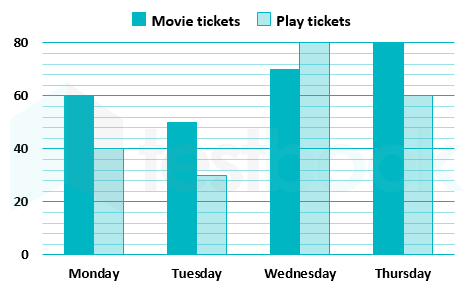
The bar graph shows the number of play tickets and number of movie tickets sold on four different days.

68

If 16.667% of the number of movie tickets sold on Monday are for movie A and 1/4th of the number of play tickets sold on Thursday are for playing game P. Find the total tickets  sold for movie A on Monday and game P on Thursday.

  1. ((a))

    10

  2. ((b))

    25

  3. ((c))

    20

  4. ((d))

    15

  5. ((e))

    30

Show Answer
Answer: ((b))

25

Solution:

Number of movie tickets sold on Monday = 60

Number of movie tickets sold for movie A = 60 * 1/6 = 10

Number of play tickets sold for Thursday = 60

Number of play tickets sold for game P on Thursday= 60 * 1/4 = 15

Required total = (10 + 15) = 25

69

For Friday, the number of play tickets sold was 30 more than that of Thursday and the number of movie tickets sold was 40 more than that of on Wednesday. Find the total number of tickets sold on Friday.

  1. ((a))

    210

  2. ((b))

    230

  3. ((c))

    190

  4. ((d))

    200

  5. ((e))

    160

Show Answer
Answer: ((d))

200

Solution:

Number of play tickets sold on Thursday = 60

Number of play tickets sold on Friday = (60 + 30) = 90

Number of movie tickets sold on Wednesday = 70

Number of movie tickets sold on Wednesday = (70 + 40) = 110

Required total = (90 + 110) = 200

70

Find the sum of the total number of movie tickets sold on Monday and Thursday and number of play tickets sold on Tuesday and Wednesday.

  1. ((a))

    240

  2. ((b))

    250

  3. ((c))

    210

  4. ((d))

    270

  5. ((e))

    200

Show Answer
Answer: ((b))

250

Solution:

Number of movie tickets sold on Monday = 60

Number of movie tickets sold on Thursday = 80

Number of play tickets sold on Tuesday = 30

Number of play tickets sold on Wednesday =  80

Required total = (60 + 80 + 30 + 80) = 250

71

1/3 rd of movie tickets sold on Monday is what percentage of the 1/8 th of the play tickets sold on Wednesday.

  1. ((a))

    230%

  2. ((b))

    200%

  3. ((c))

    220%

  4. ((d))

    250%

  5. ((e))

    210%

Show Answer
Answer: ((b))

200%

Solution:

Number of movie tickets sold on Monday = 60

1/3 rd of movie tickets sold on Monday = 60/3 = 20

Number of play tickets sold on Wednesday = 80

1/8 of the play tickets sold on Wednesday = 80* 1/8 = 10

Required percentage = 20/10 * 100 = 200%

72

Find the difference between 1/2 of the total number of movie tickets sold in all the given days and 1/3 rd of play tickets sold in all the given days.

  1. ((a))

    80

  2. ((b))

    60

  3. ((c))

    120

  4. ((d))

    110

  5. ((e))

    100

Show Answer
Answer: ((b))

60

Solution:

Number of movie tickets sold all the days = (60 + 50 + 70 + 80) = 260

1/2 of the number of movie tickets sold = (260/2) = 130

Number of play tickets sold in all the given days = (40 + 30 +  80 + 60) = 210

1/3rd of the play tickets sold = 210/3 = 70

Required difference = (130 - 70) = 60

73

Find the wrong term in the following series.

 12, 25, 50, 150, 600, 3000

  1. ((a))

    12

  2. ((b))

    25

  3. ((c))

    50

  4. ((d))

    600

  5. ((e))

    150

Show Answer
Answer: ((a))

12

Given series:

 12, 25, 50, 150, 600, 3000

Calculation :

 The series follows the following pattern:

 ⇒ 25 x 1 = 25

 ⇒ 25 x 2 = 50

 ⇒ 50 x 3 = 150

⇒ 150 x 4 = 600

⇒ 600 x 5 = 3000

 Hence the wrong term in the series is 12.

74

Find the wrong term in the following series.

225, 204, 179, 146, 97, 10

  1. ((a))

    225

  2. ((b))

    204

  3. ((c))

    10

  4. ((d))

    97

  5. ((e))

    146

Show Answer
Answer: ((c))

10

Given series:

225, 204, 179, 146, 97, 10

Calculation :

 The series follows the following pattern:

⇒ 225 - 21 = 204

⇒ 204 - 25 = 179

⇒ 179 - 33 = 146

⇒ 146 - 49 = 97

⇒ 97 - 81 = 16

 The wrong term is 10

 Hence the wrong term in the series is 10.

75

Find the wrong term in the following series.

25, 14, 14, 21, 42, 105

  1. ((a))

    14

  2. ((b))

    25

  3. ((c))

    21

  4. ((d))

    42

  5. ((e))

    105

Show Answer
Answer: ((b))

25

Given series:

25, 14, 14, 21, 42, 105

Calculation :

 The series follows the following pattern:

28 x 0.5 = 14

⇒ 14 x 1 = 14

⇒ 14 x 1.5 = 21

⇒ 21 x 2 = 42

⇒ 42 x 2.5 = 105

 The wrong term is 25

 Hence the wrong term in the series is 25.

76

Find the wrong term in the following series.

130, 154, 178, 204, 232, 262

  1. ((a))

    130

  2. ((b))

    154

  3. ((c))

    178

  4. ((d))

    204

  5. ((e))

    232

Show Answer
Answer: ((a))

130

Given series:

130, 154, 178, 204, 232, 262

Calculation :

 The series follows the following pattern:

⇒ 11 + 112 = 132

⇒ 10 + 122 = 154

⇒ 9 + 132 = 178

⇒ 8 + 142 = 204

⇒ 7 + 152 = 232

⇒ 6 + 162 = 262

 The wrong term is 130

 Hence the wrong term in the series is 130.

77

Find the wrong term in the following series.

29, 60, 31, 54, 35, 51

  1. ((a))

    29

  2. ((b))

    60

  3. ((c))

    31

  4. ((d))

    51

  5. ((e))

    35

Show Answer
Answer: ((d))

51

Given series:

29, 60, 31, 54, 35, 51

Calculation :

 The series follows the following pattern:

⇒ 29 + 31 = 60

⇒ 60 - 29 = 31

⇒ 31 + 23 = 54

⇒ 54 - 19 = 35

⇒ 35 + 17 = 52

 The wrong term is 51

 Hence the wrong term in the series is 51.

78

The average weight of 15 students is reduced by 2 kg when one of them weighing 52 kg was replaced by a new student. Find the weight of the new student.

  1. ((a))

    36 kg

  2. ((b))

    22 kg

  3. ((c))

    42 kg

  4. ((d))

    32 kg

  5. ((e))

    40 kg

Show Answer
Answer: ((b))

22 kg

Given:

Total students = 15

After replacement the average of weight reduced by 2 kg.

Formula used:

Average weight = Total weight of all students/Number of students

Calculation:

Let the average weight of 15 students before replacement be y kg.

Sum of weight of all 15 students before replacement = 15y

Now, a student of 52 kg is removed from the group and is replaced by another student.

Let the weight of this new student be x kg.

New sum of weights of students = (15y – 52 + x ) kg

According to question,

The new average weight of the group = y – 2

⇒ y – 2 = (15y - 52 + x)/15

⇒ 15y - 30 = 15y – 52 + x

⇒ x = 22

∴ Weight of the new student is 22 kg.

79

A swimmer can swim at a speed of 12 km/h in still water. If a river is flowing at a speed of 2 km/h, then how much time will the swimmer take to swim 6 km upstream?

  1. ((a))

    40 min

  2. ((b))

    36 min

  3. ((c))

    28 min

  4. ((d))

    30 min

  5. ((e))

    None of these

Show Answer
Answer: ((b))

36 min

Formula:

D = S × T

Effective upstream speed = x – y

where "x" and "y" are the speed of the swimmer and river respectively. 

D = Distance in km.

S = Speed in km/hr

T = Time in hours

Calculation:

Effective upstream speed = 12 - 2 = 10 km/hr

Time taken to swim 6 km upstream = 6106\over10 hour

Time taken in minutes = 6106\over10 × 60 = 36 minutes.

The total time taken is 36 minutes.

80

Efficiency ratio of A, B and C is 2 : 3 : 5. C can fill the tank in 20 days. Time required for A and B to fill the tank is?

  1. ((a))

    15

  2. ((b))

    20

  3. ((c))

    25

  4. ((d))

    12

  5. ((e))

    18

Show Answer
Answer: ((b))

20

Given:-

Efficiency ratio = 2 : 3 : 5

Time for C = 20 days.

Concept:-

Efficiency is inversely proportional to time.

Calculation:-

Efficiency ratio of A and C = 2 : 5

Time ratio of A and C = 5 : 2

Time of A = (5 / 2) × 20 = 50 hours.

Efficiency ratio of B and C = 3 : 5

Time ratio of B and C = 5 : 3

Time of B = (5 / 3) × 20 = 100 / 3 hours.

Time for A and B = 1 / 50 + 3 / 100 = 20 hours.


Time can directly be found out by adding efficiency of A and B.

Given:-

Efficiency ratio of A, B & C = 2 : 3 : 5

Calculation:-

Efficiency of (A + B) : C = 5 : 5 = 1 : 1

∴ Time required by (A + B) = Time required by C = 20 hours.

Attempt this paper under real exam conditions

Timed interface, section switching, instant scoring, and question-by-question analytics — free.

Start Timed Attempt