Official Paper

RRB Clerk Prelims Memory Based Paper (Held On: 13 August 2022 Shift 1) (Previous Year Paper)

80 questions · 45 minutes · with answers · free

Reasoning (40 questions)

Directions: In a group of 6 Persons A, B, C, D, E and F each have different heights. A is taller than E but not as tall as F. B and F are not the tallest and also C is the shortest. B is taller than F.

1

If the height of A is 172 cm then what can be the height of C?

  1. ((a))

    178 cm

  2. ((b))

    180 cm

  3. ((c))

    173 cm

  4. ((d))

    175 cm

  5. ((e))

    167 cm

Show Answer
Answer: ((e))

167 cm

From statement 1,

F > A > E

From statement 2,

D > B > F > A > E > C

 C is shorter than A in height.

 Hence, the height of C must be below 172 cm, the only option is 5.
2

Who comes between F and C in terms of height?

  1. ((a))

    B and E

  2. ((b))

    A, B and E

  3. ((c))

    A and E

  4. ((d))

    C and E

  5. ((e))

    None of these

Show Answer
Answer: ((c))

A and E

From statement 1,

F > A > E

From statement 2,

D > B > F > A > E > C

Hence, persons who come between F and C are A and E.

3

Who is the tallest among all?

  1. ((a))

    A

  2. ((b))

    D

  3. ((c))

    E

  4. ((d))

    B

  5. ((e))

    None of these

Show Answer
Answer: ((b))

D

From statement 1,

F > A > E

From statement 2,

D > B > F > A > E > C

Hence, the tallest among 6 people is D.

Direction: Study the following arrangement carefully and answer the questions given below:

L ? 8 K Z 6 U 3 & 9 5 $ R + Z 4 @ G A T # E 7 S ! 3

4

How many such numbers are there in the above arrangement each of which is immediately followed by vowel and preceded by consonant?

  1. ((a))

    Two

  2. ((b))

    One

  3. ((c))

    Three

  4. ((d))

    Four

  5. ((e))

    None of these

Show Answer
Answer: ((b))

One

Left side L ? 8 K Z 6 U 3 & 9 5 $ R + Z 4 @ G A T # E 7 S ! 3 Right side

So, there is one such number which is followed by vowel and preceded by consonant i.e. Z 6 U.

Hence, one is the correct answer.

5

What is the sum of the numbers between & and # in the arrangement?

  1. ((a))

    20

  2. ((b))

    32

  3. ((c))

    18

  4. ((d))

    17

  5. ((e))

    19

Show Answer
Answer: ((c))

18

Left side L ? 8 K Z 6 U 3 & 9 5 $ R + Z 4 @ G A T # E 7 S ! 3 Right side

Numbers between & and # are 9, 5 and 4

So, the sum is 9 + 5 + 4 = 18

Hence, 18 is the correct answer.

6

How many symbols are there between the fourth element from the right end and R?

  1. ((a))

    Four

  2. ((b))

    Three

  3. ((c))

    Two

  4. ((d))

    One

  5. ((e))

    None of these

Show Answer
Answer: ((b))

Three

Left side L ? 8 K Z 6 U 3 & 9 5 $ R + Z 4 @ G A T # E 7 S ! 3 Right side

Fourth element from the right = 7

Symbols which are between the fourth element from the right end and R

L ? 8 K Z 6 U 3 & 9 5 $ R + Z 4 @ G A T # E 7 S ! 3

So, there are three such symbols between 7 and R.

Hence, three is the correct answer.

7

If we drop all the symbols from the above arrangement then which among the following is thirteenth element from the right end?

  1. ((a))

    3

  2. ((b))

    6

  3. ((c))

    U

  4. ((d))

    Z

  5. ((e))

    None of these

Show Answer
Answer: ((a))

3

Left side L ? 8 K Z 6 U 3 & 9 5 $ R + Z 4 @ G A T # E 7 S ! 3 Right side

So, if we drop all the symbols we get:

L 8 K Z 6 U 3 9 5 R Z 4 G A T E 7 S 3

Then the thirteenth element from right end will be: 3

Hence, 3 is the correct answer.

8

What should come in place of ? in the following series based on the above arrangement?

L8Z, 639, 5RZ, ?, #7!

  1. ((a))

    95@

  2. ((b))

    4@G

  3. ((c))

    4GT

  4. ((d))

    4@T

  5. ((e))

    None of these

Show Answer
Answer: ((c))

4GT

Left side L ? 8 K Z 6 U 3 & 9 5 $ R + Z 4 @ G A T # E 7 S ! 3 Right side

We have to find the missing combination in this series: L8Z, 639, 5RZ, ?, #7!

L + 2 = 8 and 8 + 2 = Z; Z + 1 = 6

6 + 2 = 3 and 3 + 2 = 9; 9 + 1 = 5

5 + 2 = R and R + 2 = Z; Z + 1 = 4

4 + 2 = G and G + 2 = T; T + 1 = #

+ 2 = 7 and 7 + 2 = !; ! + 1 = 3

Hence, 4GT is the correct answer.

There is family of seven member having three generations. There are more than four females in the family. A is the father of B. L is married to the only son of G. L has an unmarried sibling K. B is the nephew of K. C is the child of A. G is the mother of A. H is the parent of L.

9

How H is related to L?

  1. ((a))

    mother

  2. ((b))

    father

  3. ((c))

    either 1) or 2)

  4. ((d))

    Cannot be determined

  5. ((e))

    None of the above

Show Answer
Answer: ((a))

mother

The below table represents symbols used to draw a family tree,

Given:

1) family of seven member having three generations

  1. There are more than four females in the family.

  2. A is the father of B. L is married to the only son of G.


  1. L has an unmarried sibling K. B is the nephew of K. 

5) C is the child of A. G is mother of A. 


H is the parent of L.

Here  A, B are male members therefore remaining members are definitely are female as it is given that more than 4 females in the family.

We can draw the following Family Tree from the information given above:

Hence, H is the mother of L.

10

How is C related to G?

  1. ((a))

    Grandmother

  2. ((b))

    Daughter

  3. ((c))

    Granddaughter

  4. ((d))

    Sister

  5. ((e))

    Cannot be determined

Show Answer
Answer: ((c))

Granddaughter

The below table represents symbols used to draw a family tree,

Given:

1) family of seven member having three generations

  1. There are more than four females in the family.

  2. A is the father of B. L is married to the only son of G.

  1. L has an unmarried sibling K. B is the nephew of K. 

  1. C is the child of A. G is mother of A. 

H is the parent of L.

Here A, B are male members therefore remaining members are definitely are female as it is given that more than 4 females in the family.

We can draw the following Family Tree from the information given above:

Hence, C is the granddaughter of G.

11

How is K related to A?

  1. ((a))

    Sister - in- law

  2. ((b))

    Brother - in- law

  3. ((c))

    Son

  4. ((d))

    Daughter

  5. ((e))

    Cannot be determined

Show Answer
Answer: ((a))

Sister - in- law

The below table represents symbols used to draw a family tree,

Given:

1) family of seven member having three generations

  1. There are more than four females in the family.

  2. A is the father of B. L is married to the only son of G.


  1. L has an unmarried sibling K. B is the nephew of K. 

5) C is the child of A. G is mother of A. 


H is the parent of L.

Here  A, B are male members therefore remaining members are definitely are female as it is given that more than 4 females in the family.

We can draw the following Family Tree from the information given above:

Hence, K is the Sister-in-law of A.

12

How many pairs of letters are there in the word “LEMON” each of which has as many letters between them as in the English alphabetical series in both forward and backward directions?

  1. ((a))

    Two

  2. ((b))

    Four

  3. ((c))

    Five

  4. ((d))

    Three

  5. ((e))

    One

Show Answer
Answer: ((a))

Two

Given word: LEMON

The alphabets are positioned as in the following order,

The given word can be represented as follows,

In forward direction: LO.

In backward direction: NO.

Hence, there are Two pairs of letters.

13

If the letters of the word ‘BOUQUET’ are arranged as they appear in the English alphabetical order, then how many letters will remain in their original order.

  1. ((a))

    One

  2. ((b))

    Two

  3. ((c))

    Three

  4. ((d))

    Four

  5. ((e))

    None

Show Answer
Answer: ((b))

Two

  1. Given word: BOUQUET’

  2. The arrangement of letters of a word in English alphabetical order are:

BOUQUET
BEOQTUU


Hence, there are two letters which will remain in their original position.

Directions: Following questions are based on the five three-digit numbers given below:

369 717 922 625 434

14

If all the numbers are arranged in descending order from left to right then which of the following will be the product of the first and last digits of the number which is second from right end?

  1. ((a))

    16

  2. ((b))

    30

  3. ((c))

    27

  4. ((d))

    49

  5. ((e))

    18

Show Answer
Answer: ((a))

16

Given Series: - 369 717 922 625 434

When all the numbers are arranged in descending order from left to right, we get

922 717 625 434 369

Second number from right end number is 434.

So, product of the first and last digits is 4 × 4 = 16.

Hence, the correct answer is 16.

15

If the positions of the first and third digits of each group of the number is interchanged, what will be the sum of the first and second digits of the third lowest number thus formed?

  1. ((a))

    13

  2. ((b))

    15

  3. ((c))

    9

  4. ((d))

    11

  5. ((e))

    7

Show Answer
Answer: ((e))

7

Given Series: - 369 717 922 625 434

When first and third digit of each number is interchanged, we get

963 717 229 526 434

Third lowest number is 526

The sum of the first and second digits = 5 + 2 = 7.

Hence, the correct answer is 7.

16

If one is subtracted from each odd digit and one is added to each even digit of each of the numbers, what will be the difference between the third digit and the first digit of the highest number thus formed?

  1. ((a))

    Zero

  2. ((b))

    6

  3. ((c))

    4

  4. ((d))

    2

  5. ((e))

    5

Show Answer
Answer: ((e))

5

Given Series: - 369 717 922 625 434

When 1 is subtracted from each odd number and 1 is added to each even number, we get

278 606 833 734 525

Highest number formed is 833.

The difference between the third digit and the first digit is 8 – 3 = 5.

Hence, the correct answer is 5.

17

what will be the resultant if the first digit of the highest number is divided by the third digit of the second lowest number?

  1. ((a))

    0.5

  2. ((b))

    1

  3. ((c))

    2

  4. ((d))

    2.2

  5. ((e))

    2.25

Show Answer
Answer: ((e))

2.25

Given Series: - 369 717 922 625 434.

The highest number is 922 and the second lowest number is 434.

First digit of the highest number is 9 and third digit of second lowest number is 4

So, the resultant is = 9 ÷ 4 = 2.25 after divition.

Hence, the correct answer is 2.25.

18

If all the digits in each of the numbers are arranged in descending order within the group of number from left to right then which of the following will be the second lowest number?

  1. ((a))

    369

  2. ((b))

    717

  3. ((c))

    922

  4. ((d))

    625

  5. ((e))

    434

Show Answer
Answer: ((d))

625

Given Series: - 369 717 922 625 434

When each digit are arranged in descending order within the number, we get

963 771 922 652 443

Second lowest number is 652.

Hence, the correct answer is 625 .

19

How many meaningful English words can be formed, starting with E, with the second, the fifth, and the sixth letters of the word MARKET, using each letter only once in each word?

  1. ((a))

    Three

  2. ((b))

    Two

  3. ((c))

    One

  4. ((d))

    None

  5. ((e))

    More than three

Show Answer
Answer: ((c))

One

Word: MARKET

2nd letter = A; 5th letter = E; 6th letter = T

Letters given: AET

Words possible starting with E: EAT.

Hence, only 1 such word is possible.

  1. In the above question we have to find the word which is start from the letter 'E'.

Eight persons - A, B, C, D, E, F, G and H live in a building of 4 floors and 2 flats - Flat 1 and Flat 2. Flat 1 is to the west of Flat 2 and Flat 1 of Floor 1 is immediately below Flat 1 of Floor 2 and Flat 2 of Floor 1 is immediately below Flat 2 of Floor 2 and so on. There are two floors between B and C. B lives above C and they live in different flats. A lives west of D but on the odd number of floor. F lives immediately above and in the same flat as of C. No person lives west of G who lives on the fourth floor. H does not live on floor number one.

20

Who lives just East of F ?

  1. ((a))

    A

  2. ((b))

    C

  3. ((c))

    D

  4. ((d))

    H

  5. ((e))

    B

Show Answer
Answer: ((d))

H

Eight persons - A, B, C, D, E, F, G and H

Floor - 1 to 4, Flat - 1 and 2

  1. There are two floor between B and C. B lives above C in the different flats. So here two possibilities for this.
Case - ICase - II
FloorFlat -1Flat -2Flat - 1Flat - 2
4BB
3
2
1CC


2) A lives just west of D but on the odd number of floors. So, here remaining odd number floor is number 3. F lives just above C

Case - ICase - II
FloorFlat -1Flat -2Flat - 1Flat - 2
4BB
3ADAD
2FF
1CC


  1. No person lives west of G who lives on fourth floor.

In Case - II B lives on flat - 1 so G lives between flat - 2, So here B lives west of G. It contradict the given condition no person lives west of G so here Case - II gets cancelled. 

Case - I
FloorFlat -1Flat -2
4GB
3AD
2F
1C


  1. H does not live on floor number one. So H will live on floor number 2. There is only one place remaining for the E, on floor number 1.
Case - I
FloorFlat -1Flat -2
4GB
3AD
2FH
1CE


Hence, H lives just east of F.

21

On which Floor B lives?

  1. ((a))

    First

  2. ((b))

    Second

  3. ((c))

    Third

  4. ((d))

    Fourth

  5. ((e))

    None

Show Answer
Answer: ((d))

Fourth

Eight persons - A, B, C, D, E, F, G and H

Floor - 1 to 4, Flat - 1 and 2

  1. There are two floor between B and C. B lives above C. So here two possibilities for this.
Case - ICase - II
FloorFlat -1Flat -2Flat - 1Flat - 2
4BB
3
2
1CC


2) A lives just west of D but on odd number of floor. So, here remaining odd number floor is number 3. F lives just above C

Case - ICase - II
FloorFlat -1Flat -2Flat - 1Flat - 2
4BB
3ADAD
2FF
1CC


  1. No person lives west of G who lives on fourth floor.

In Case - II B lives on flat - 1 so G lives between flat - 2, So here B lives west of G. It contradict the given condition no person lives west of G so here Case - II gets cancelled. 

Case - I
FloorFlat -1Flat -2
4GB
3AD
2F
1C


  1. H does not live on floor number one. So H will live on floor number 2. There is only one place remaining for the E, on floor number 1.
Case - I
FloorFlat -1Flat -2
4GB
3AD
2FH
1CE


Hence, B lives on Fourth Floor.

22

Who lives just below H ?

  1. ((a))

    A

  2. ((b))

    B

  3. ((c))

    C

  4. ((d))

    D

  5. ((e))

    E

Show Answer
Answer: ((e))

E

Eight persons - A, B, C, D, E, F, G and H

Floor - 1 to 4, Flat - 1 and 2

  1. There are two floor between B and C. B lives above C. So here two possibilities for this.
Case - ICase - II
FloorFlat -1Flat -2Flat - 1Flat - 2
4BB
3
2
1CC


2) A lives just west of D but on odd number of floor. So, here remaining odd number floor is number 3. F lives just above C

Case - ICase - II
FloorFlat -1Flat -2Flat - 1Flat - 2
4BB
3ADAD
2FF
1CC


  1. No person lives west of G who lives on fourth floor.

In Case - II B lives on flat - 1 so G lives between flat - 2, So here B lives west of G. It contradict the given condition no person lives west of G so here Case - II gets cancelled. 

Case - I
FloorFlat -1Flat -2
4GB
3AD
2F
1C


  1. H does not live on floor number one. So H will live on floor number 2. There is only one place remaining for the E, on floor number 1.
Case - I
FloorFlat -1Flat -2
4GB
3AD
2FH
1CE


Hence, E lives just below H.

23

Which of the following pair is correct ? 

  1. ((a))

    Floor - 2 Flat - 1 - H

  2. ((b))

    Floor - 3 Flat - 2 - D

  3. ((c))

    Floor - 4 Flat - 2 - G

  4. ((d))

    Floor - 1 Flat - 2 - C

  5. ((e))

    Floor - 3 Flat - 1 - F

Show Answer
Answer: ((b))

Floor - 3 Flat - 2 - D

Eight persons - A, B, C, D, E, F, G and H

Floor - 1 to 4, Flat - 1 and 2

  1. There are two floor between B and C. B lives above C. So here two possibilities for this.
Case - ICase - II
FloorFlat -1Flat -2Flat - 1Flat - 2
4BB
3
2
1CC


2) A lives just west of D but on odd number of floor. So, here remaining odd number floor is number 3. F lives just above C

Case - ICase - II
FloorFlat -1Flat -2Flat - 1Flat - 2
4BB
3ADAD
2FF
1CC


  1. No person lives west of G who lives on fourth floor.

In Case - II B lives on flat - 1 so G lives between flat - 2, So here B lives west of G. It contradict the given condition no person lives west of G so here Case - II gets cancelled. 

Case - I
FloorFlat -1Flat -2
4GB
3AD
2F
1C


  1. H does not live on floor number one. So H will live on floor number 2. There is only one place remaining for the E, on floor number 1.
Case - I
FloorFlat -1Flat -2
4GB
3AD
2FH
1CE


Hence, Floor - 3 Flat - 2 - D is correct pair.

24

Which Floor Flat Combination is correct for E ?

  1. ((a))

    Floor 1 Flat 2

  2. ((b))

    Floor 2 Flat 1

  3. ((c))

    Floor 3 Flat 2

  4. ((d))

    Floor 4 Flat 1

  5. ((e))

    Floor 2 Flat 2

Show Answer
Answer: ((a))

Floor 1 Flat 2

Eight persons - A, B, C, D, E, F, G and H

Floor - 1 to 4, Flat - 1 and 2

  1. There are two floor between B and C. B lives above C. So here two possibilities for this.
Case - ICase - II
FloorFlat -1Flat -2Flat - 1Flat - 2
4BB
3
2
1CC


2) A lives just west of D but on odd number of floor. So, here remaining odd number floor is number 3. F lives just above C

Case - ICase - II
FloorFlat -1Flat -2Flat - 1Flat - 2
4BB
3ADAD
2FF
1CC


  1. No person lives west of G who lives on fourth floor.

In Case - II B lives on flat - 1 so G lives between flat - 2, So here B lives west of G. It contradict the given condition no person lives west of G so here Case - II gets cancelled. 

Case - I
FloorFlat -1Flat -2
4GB
3AD
2F
1C


  1. H does not live on floor number one. So H will live on floor number 2. There is only one place remaining for the E, on floor number 1.
Case - I
FloorFlat -1Flat -2
4GB
3AD
2FH
1CE


Hence, Floor - 1 Flat - 2 is correct combination.

Directions: Study the given information carefully and answer the following questions below.

Seven persons A, B, C, D, E, F and G are sitting in a straight line facing north at equal distance from each other, but not necessarily in the same order.

B sits at the extreme right end of the row. E sits exactly between G and B. D sits third to the left of C and A sits second to the right of D. G sits second to the left of B. Only two persons sit between F and G.

25

How many persons sit between B and C?

  1. ((a))

    Four

  2. ((b))

    Three

  3. ((c))

    One

  4. ((d))

    Five

  5. ((e))

    Two

Show Answer
Answer: ((e))

Two

Seven persons - A, B, C, D, E, F and G.

  1. B sits at the extreme right end of the row.
  2. E sits exactly between G and B.
  3. G sits second to the left of B.

  1. Only two persons sit between F and G.
  2. D sits third to the left of C and A sits second to the right of D.

Hence, there are two persons sit between B and C.

26

Who sits at the extreme left end of the row?

  1. ((a))

    C

  2. ((b))

    D

  3. ((c))

    E

  4. ((d))

    F

  5. ((e))

    G

Show Answer
Answer: ((b))

D

Seven persons - A, B, C, D, E, F and G.

  1. B sits at the extreme right end of the row.
  2. E sits exactly between G and B.
  3. G sits second to the left of B.

  1. Only two persons sit between F and G.
  2. D sits third to the left of C and A sits second to the right of D.

Hence, D sits at the extreme left end of the row.

27

Who sits exactly in the middle of the line?

  1. ((a))

    C

  2. ((b))

    D

  3. ((c))

    E

  4. ((d))

    F

  5. ((e))

    G

Show Answer
Answer: ((a))

C

Seven persons - A, B, C, D, E, F and G.

  1. B sits at the extreme right end of the row.
  2. E sits exactly between G and B.
  3. G sits second to the left of B.

  1. Only two persons sit between F and G.
  2. D sits third to the left of C and A sits second to the right of D.

Hence, C sits exactly in the middle of the line.

28

What is the position of A with respect to D?

  1. ((a))

    Third to the right

  2. ((b))

    Second to the left

  3. ((c))

    Third to the left

  4. ((d))

    Second to the right

  5. ((e))

    Immediate right

Show Answer
Answer: ((d))

Second to the right

Seven persons - A, B, C, D, E, F and G.

  1. B sits at the extreme right end of the row.
  2. E sits exactly between G and B.
  3. G sits second to the left of B.

  1. Only two persons sit between F and G.
  2. D sits third to the left of C and A sits second to the right of D.

Hence, A is sitting second to the right of D.

29

Direction: In the question below, there are two statements followed by two conclusions numbered I and II. You have to take the given statements to be true even if they seem to be at variance with commonly known facts. Read all the conclusions and then decide which of the given conclusions logically follows from the given statements disregarding commonly known facts.

Statements:

Only few cold are colder.

Only few hotter are colder.

Conclusions:

I. No cold is hotter is a possibility.

II. All cold are hotter.

  1. ((a))

    Only conclusion I follows

  2. ((b))

    Only conclusion II follows

  3. ((c))

    Both I and II follow

  4. ((d))

    Neither I nor II follows

  5. ((e))

    Either I or II follows

Show Answer
Answer: ((a))

Only conclusion I follows

The least possible Venn diagram for the given statements is as follows,

Conclusion:

I. No cold is hotter is a possibility True

II. All cold are hotter False (It is possible but not definite)

Hence, only conclusion I follows.

30

Direction: In the question below, there are two statements followed by two conclusions numbered I and II. You have to take the given statements to be true even if they seem to be at variance with commonly known facts. Read all the conclusions and then decide which of the given conclusions logically follows from the given statements disregarding commonly known facts.

Statements:

Only few way are rank.

No rank is count.

Conclusions:

I. All rank are way.

II. Some way are not count.

  1. ((a))

    Only conclusion I follows

  2. ((b))

    Only conclusion II follows

  3. ((c))

    Both I and II follow

  4. ((d))

    Neither I nor II follows

  5. ((e))

    Either I or II follows

Show Answer
Answer: ((b))

Only conclusion II follows

The least possible Venn diagram for the given statements is as follows,

Conclusion:

I. All rank are way False (It is possible but not definite)

II. Some way are not count True (as the part containing both rank and way, cannot be part of count)

Hence, only conclusion II follows.

31

Direction: In the question below, there are two statements followed by two conclusions numbered I and II. You have to take the given statements to be true even if they seem to be at variance with commonly known facts. Read all the conclusions and then decide which of the given conclusions logically follows from the given statements disregarding commonly known facts.

Statements:

Some sea are song.

Only few song are ocean.

Conclusions:

I. Some sea are ocean.

II. All ocean are song.

  1. ((a))

    Only conclusion I follows

  2. ((b))

    Only conclusion II follows

  3. ((c))

    Both I and II follow

  4. ((d))

    Neither I nor II follows

  5. ((e))

    Either I or II follows

Show Answer
Answer: ((d))

Neither I nor II follows

The least possible Venn diagram for the given statements is as follows,

Conclusion:

I. Some sea are ocean False (It is possible but not definite)

II. All ocean are song False (It is possible but not definite)

Hence, neither conclusion I nor II follows.

Direction: Read the given information carefully and answer the questions asked below.

Eight people A, B, C, D, W, Y, X, and Z are sitting around a square table in such a way that four of them sit at four corners of the square while four sit in the middle of each of the four sides. People who are sitting in the middle are facing outside the center while people sitting at the corner are facing the center. C sits second to the left of W. Three people are sitting between C and X. D is not facing outside. X and A are sitting immediately right to each other. W is not sitting adjacent to A. B is not sitting adjacent to C. B is sitting opposite to Y. Y and Z are not sitting adjacent to each other.

32

Who is sitting opposite to A?

  1. ((a))

    B

  2. ((b))

    C

  3. ((c))

    W

  4. ((d))

    Z

  5. ((e))

    X

Show Answer
Answer: ((d))

Z

According to the given information,

  1. C sits second to the left of W.
  2. Three people are sitting between C and X. 

  1. X and A are sitting immediately right to each other.
  2. W is not sitting adjacent to A.

  1. B is sitting opposite to Y.
  2. B is not sitting adjacent to C.

  1. Y and Z are not sitting adjacent to each other.
  2. D is not facing outside. Here case 2 gets eliminated.

So, Z is sitting opposite to A.

33

Who is sitting third to the left of B?

  1. ((a))

    A

  2. ((b))

    D

  3. ((c))

    Y

  4. ((d))

    W

  5. ((e))

    C

Show Answer
Answer: ((b))

D

According to the given information,

  1. C sits second to the left of W.
  2. Three people are sitting between C and X. 

  1. X and A are sitting immediately right to each other.
  2. W is not sitting adjacent to A.

  1. B is sitting opposite to Y.
  2. B is not sitting adjacent to C.

  1. Y and Z are not sitting adjacent to each other.
  2. D is not facing outside. Here case 2 gets eliminated.

So, D is sitting third to the left of B.

34

Four of the following five are alike in a certain way. Find the odd one out?

  1. ((a))

    C

  2. ((b))

    W

  3. ((c))

    X

  4. ((d))

    D

  5. ((e))

    A

Show Answer
Answer: ((e))

A

According to the given information,

  1. C sits second to the left of W.
  2. Three people are sitting between C and X. 

  1. X and A are sitting immediately right to each other.
  2. W is not sitting adjacent to A.

  1. B is sitting opposite to Y.
  2. B is not sitting adjacent to C.

  1. Y and Z are not sitting adjacent to each other.
  2. D is not facing outside. Here case 2 gets eliminated.

So, except A all the other people are facing the center.

35

Who is sitting adjacent to Y?

  1. ((a))

    CZ

  2. ((b))

    DA

  3. ((c))

    DC

  4. ((d))

    BW

  5. ((e))

    None of these

Show Answer
Answer: ((c))

DC

According to the given information,

  1. C sits second to the left of W.
  2. Three people are sitting between C and X. 

  1. X and A are sitting immediately right to each other.
  2. W is not sitting adjacent to A.

  1. B is sitting opposite to Y.
  2. B is not sitting adjacent to C.

  1. Y and Z are not sitting adjacent to each other.
  2. D is not facing outside. Here case 2 gets eliminated.

So, D and C are sitting adjacent to Y.

36

Who is sitting third to the right of the person sitting immediately left of X?

  1. ((a))

    Z

  2. ((b))

    Y

  3. ((c))

    W

  4. ((d))

    D

  5. ((e))

    None of the above

Show Answer
Answer: ((e))

None of the above

According to the given information,

  1. C sits second to the left of W.
  2. Three people are sitting between C and X. 

  1. X and A are sitting immediately right to each other.
  2. W is not sitting adjacent to A.

  1. B is sitting opposite to Y.
  2. B is not sitting adjacent to C.

  1. Y and Z are not sitting adjacent to each other.
  2. D is not facing outside. Here case 2 gets eliminated.

B is sitting immediate left of X, and C is sitting third to the right of B.

So, C is sitting third to the right of the person sitting immediately left of X.

Direction: Study the following information carefully and answer the given questions.

An uncertain number of people are sitting in a row facing north and are at equal distance between them. S is sitting third from the extreme end. Two people are sitting between S and F. T is sitting second to the right of F. A is sitting exactly in between E and F. Six people are sitting between T and V, who does not sit at any end. Number of people sitting to the right of G is same as the people sitting to the left of E. G is sitting to sixth to the right of T. A is adjacent to E. Two people are sitting between P and R, who is sitting to the right of V.

37

Which of the following statements is true?

  1. ((a))

    One person sitting is between P and T.

  2. ((b))

    V is to the immediate left of G.

  3. ((c))

    Only two people are sitting to the right of G.

  4. ((d))

    F is sitting second to the right of S.

  5. ((e))

    Four people are sitting to the left of A.

Show Answer
Answer: ((e))

Four people are sitting to the left of A.

(1) S is sitting third from the extreme end.

(2) Two people are sitting between S and F.

(3) T is sitting second to the right of F.

(4) A is sitting exactly between E and F. A is adjacent to E.

(5) Six people are sitting between T and V, who does not sit at any end.

(6) G is sitting to sixth to the right of T. Case (II) eliminates here.

(7) Number of people sitting to the right of G is same as the people sitting to the left of E.

(8) Two people are sitting between P and R who is sitting to the right of V. Therefore, the final seating arrangement is as follows:

Hence, option 5 is true.

38

Number of people sitting to the right of A is same as to the left of _____.

  1. ((a))

    G

  2. ((b))

    P

  3. ((c))

    T

  4. ((d))

    S

  5. ((e))

    R

Show Answer
Answer: ((b))

P

(1) S is sitting third from the extreme end.

(2) Two people are sitting between S and F.

(3) T is sitting second to the right of F.

(4) A is sitting exactly between E and F.  A is adjacent to E.

(5) Six people are sitting between T and V, who does not sit at any end.

(6) G is sitting to sixth to the right of T. Case (II) eliminates here.

(7) Number of people sitting to the right of G is same as the people sitting to the left of E.

(8) Two people are sitting between P and R who is sitting to the right of V. Therefore, the final seating arrangement is as follows:

Hence, number of people sitting to the right of A is same as to the left of P.

39

How many people are sitting between A and G?

  1. ((a))

    Two

  2. ((b))

    Four

  3. ((c))

    Six

  4. ((d))

    Eight

  5. ((e))

    Can't be determined

Show Answer
Answer: ((d))

Eight

(1) S is sitting third from the extreme end.

(2) Two people are sitting between S and F.

(3) T is sitting second to the right of F.

(4) A is sitting exactly between E and F. A is adjacent to E.

(5) Six people are sitting between T and V, who does not sit at any end.

(6) G is sitting to sixth to the right of T. Case (II) eliminated here.

(7) Number of people sitting to the right of G is the same as the people sitting to the left of E.

(8) Two people are sitting between P and R who is sitting to the right of V. Therefore, the final seating arrangement is as follows:

Hence, eight persons are sitting between A and G.

40

How many people are there in the row?

  1. ((a))

    14

  2. ((b))

    20

  3. ((c))

    17

  4. ((d))

    9

  5. ((e))

    10

Show Answer
Answer: ((c))

17

(1) S is sitting third from the extreme end.

(2) Two people are sitting between S and F.

(3) T is sitting second to the right of F.

(4) A is sitting exactly between E and F. A is adjacent to E.

(5) Six people are sitting between T and V, who does not sit at any end.

(6) G is sitting to sixth to the right of T. Case (II) eliminates here.

(7) Number of people sitting to the right of G is same as the people sitting to the left of E.

(8) Two people are sitting between P and R who is sitting to the right of V. Therefore, the final seating arrangement is as follows:

Hence, 17 persons are there in the row.

Numerical Ability (40 questions)

41

What will come in place of the question mark ‘?’ in the following question?

(21% of 3600) – (36% of 1050) = ?

  1. ((a))

    445

  2. ((b))

    345

  3. ((c))

    476

  4. ((d))

    378

  5. ((e))

    None of the above

Show Answer
Answer: ((d))

378

Given:

(21% of 3600) – (36% of 1050) = ?

Concept used:

Follow the BODMAS rule according to the table given below:

Calculation:

⇒ (21% of 3600) – (36% of 1050) = ?

⇒ (21/100 × 3600) – (36/100 × 1050) = ?

⇒ 756 – 378 = ?

⇒ 378 = ?

 The value of ? is 378

42

What will come in the place of the question mark ‘?’ in the following question?

?144=3648\sqrt {\frac{?}{{144}}} = \frac{{36}}{{48}}

  1. ((a))

    81

  2. ((b))

    82

  3. ((c))

    80

  4. ((d))

    78

  5. ((e))

    none of these

Show Answer
Answer: ((a))

81

Given:

?144=3648\sqrt {\frac{?}{{144}}} = \frac{{36}}{{48}}

Concept used:

Simplification

Calculation:

⇒ ?144=3648\sqrt {\frac{?}{{144}}} = \frac{{36}}{{48}}

⇒ ?12=34\frac{{\sqrt ? }}{{12}} = \frac{3}{4}

⇒ ?=12×34\sqrt ?= \frac{{12 \times 3}}{4}

⇒ ?=9\sqrt ? = 9

Squaring on both sides we get,

∴ ? = 81

43

What will come in the place of the question mark ‘?’ in the following question?

56 × ? – 768 = 576

  1. ((a))

    27

  2. ((b))

    54

  3. ((c))

    24

  4. ((d))

    63

  5. ((e))

    42

Show Answer
Answer: ((c))

24

Given:

56 × ? – 768 = 576

Concept used:

Follow the BODMAS rule according to the table given below:

Calculation:

Using the BODMAS rule

⇒ 56 × ? – 768 = 576

⇒ 56 × ? = 576 + 768

⇒ 56 × ? = 1344

⇒ ? = 1344/56

⇒ ? = 24

24 will come in place of ‘?’

44

What will come in place of question mark (?) in the following question?

(72 – 62 – 3) + 12 = ?

  1. ((a))

    12

  2. ((b))

    15

  3. ((c))

    14

  4. ((d))

    22

  5. ((e))

    8

Show Answer
Answer: ((d))

22

Given:

(72 – 62 – 3) + 12 = ?

Concept used:

Calculation:

(72 – 62 – 3) + 12 = ?

⇒ 49 - 36 - 3 + 12 = ?

⇒ (49 + 12) - 36 - 3 = ?

⇒ 61 - 39 = ?

⇒ ? = 22

The value of ‘?’ is 22.

45

What will come in the place of the question mark ‘?’ in the following question?

25% of 340 + 17 – 21 = ?

  1. ((a))

    91

  2. ((b))

    81

  3. ((c))

    87

  4. ((d))

    84

  5. ((e))

    75

Show Answer
Answer: ((b))

81

Concept used:

Follow BODMAS rule to solve this question as per the order given below,

Calculation:

25% of 340 + 17 – 21 = ?

⇒ 85 + 17 – 21 = ?

⇒ 102 – 21 = ?

⇒ ? = 81

The value of ? is 81.

46

What value should come in place of question mark (?) in the question?

(√225 + 6) × 7 = 3 × ?

  1. ((a))

    49

  2. ((b))

    7

  3. ((c))

    54

  4. ((d))

    45

  5. ((e))

    None of these

Show Answer
Answer: ((a))

49

Concept used:

Follow BODMAS rule to solve this question as per the order given below,

Calculation:

(√225 + 6) × 7 = 3 × ?

⇒ (15 + 6) × 7 = 3 × ?

⇒ 21 × 7 = 3 × ?

⇒ 147 = 3 × ?

⇒ ? = 49

The value of ? is 49.

47

What value should come in place of question mark (?) in the question?

(216 ÷ 3) + 9 = ?/5

  1. ((a))

    405

  2. ((b))

    45

  3. ((c))

    54

  4. ((d))

    415

  5. ((e))

    None of these

Show Answer
Answer: ((a))

405

Concept used:

Follow BODMAS rule to solve this question as per the order given below,

Calculation:

(216 ÷ 3) + 9 = ?/5

⇒ 72 + 9 = ?/5

⇒ 81 = ?/5

⇒ ? = 405

The value of ? is 405.

48

What should come in the place of (?) in the following question

435+514458=?4 \frac {3}{5} + 5\frac{1}{4} - 4 \frac {5}{8} = ?

  1. ((a))

    59405\frac{9}{40}

  2. ((b))

    47404 \frac{7}{40}

  3. ((c))

    3

  4. ((d))

    2

  5. ((e))

    None of these 

Show Answer
Answer: ((a))

59405\frac{9}{40}

Concept used:

Follow the BODMAS 

rule to solve this question, as per the order given below:

Step-1: Parts of an equation enclosed in 'Brackets' must be solved first and in the bracket,

Step-2: Any mathematical 'Of' or 'Exponent' must be solved next,

Step-3: Next, the parts of the equation that contain 'Division' and 'Multiplication' are calculated,

Step-4: Last but not least, the parts of the equation that contain 'Addition' and 'Subtraction' should be calculated.

Now,

435+514458=?4 \frac {3}{5} + 5\frac{1}{4} - 4 \frac {5}{8} = ?


⇒ (4 + 5 - 4) + 3/5 + 1/4 -5/8 = ?

⇒ 5 + (24 + 10 - 25)/40 = ?

⇒ 5 + 9/40 = ?

⇒ 59405\frac{9}{40}= ?

∴ In the place of question(?) 5940 5\frac{9}{40}will come

49

What should come in place of question mark (?) in the following question?

3542 ÷ 22 + 200 = ?2

  1. ((a))

    20

  2. ((b))

    29

  3. ((c))

    22

  4. ((d))

    19

  5. ((e))

    None of these

Show Answer
Answer: ((d))

19

Given:

3542 ÷ 22 + 200 = ?2

Concept used:

Calculation:

Considering the following given question

3542 ÷ 22 + 200 = ?2

⇒ 161 + 200 = ?2

⇒ 361 = ?2

⇒ 19 = ?

The value of ? is 19.

50

What will come in the place of the question mark ‘?’ in the following question?

30% of 30 – 12 + 7 = ?

  1. ((a))

    5

  2. ((b))

    4

  3. ((c))

    8

  4. ((d))

    7

  5. ((e))

    None

Show Answer
Answer: ((b))

4

Concept:

This type of question can be solved by the help of BODMAS

Follow BODMAS rule to solve this question, as per the order given below

Step – 1: Parts of an equation enclosed in ‘Brackets’ must be solved first and, in the bracket,

Step – 2: Any mathematical ‘Of’ or ‘Exponent’ must be solved next,

Step – 3: Next, the parts of the equation that contain ‘Division’ and ‘Multiplication’ are calculated,

Step – 4: Last but not least, the parts of the equation that contain ‘Addition’ and ‘Subtraction’ should be calculated.

Calculation:

30% of 30 – 12 + 7 = ?

⇒ 9 – 12 + 7

⇒ 16 – 12

⇒ 4

The required result will be 4.

51

What will come in place of the question mark (?) in the following question?

75% of 480 + (?)2 = 5544

  1. ((a))

    70

  2. ((b))

    89

  3. ((c))

    72

  4. ((d))

    69

  5. ((e))

    78

Show Answer
Answer: ((c))

72

Calculation:

75% of 480 + (?)2 = 5544

⇒ 360 + (?)2 = 5544

⇒ (?)2 = 5544 – 360

⇒ (?)2 = 5184

⇒ ? = √5184

⇒ ? = 72

72 will come in place of question mark

52

What will come in place of the question mark (?) in the following question?

? + 548 = 65% of 1500

  1. ((a))

    327

  2. ((b))

    456

  3. ((c))

    427

  4. ((d))

    526

  5. ((e))

    462

Show Answer
Answer: ((c))

427

Concept used:

Follow BODMAS rule to solve this question, as per the order given below:

Calculation:

? + 548 = 65% of 1500

⇒ ? + 548 = 975

⇒ ? = 975 – 548

⇒ ? = 427

 The value of ? is 427

53

What will come in the place of ‘?’ in the following question?

125 × 55 = 5? × (25)2

  1. ((a))

    -8

  2. ((b))

    8

  3. ((c))

    -4

  4. ((d))

    4

  5. ((e))

    None of these

Show Answer
Answer: ((d))

4

Concept used:

Follow BODMAS rule to solve this question, as per the order given below,

Calculation:

125 × 55 = 5? × (25)2

⇒ 53 × 55 = 5? × 54

⇒ 53+5 = 5? + 4

⇒ 58 = 5? + 4

On comparing the powers,

⇒ 8 = ? + 4

⇒ 8 – 4 = ?

⇒ 4 = ?

 The value of ? is 4

54

What will come in the place of the question mark ‘?’ in the following question?

{(7776)1/5 × 1296} = (6)?

  1. ((a))

    6

  2. ((b))

    8

  3. ((c))

    4

  4. ((d))

    5

  5. ((e))

    3

Show Answer
Answer: ((d))

5

Concept :

Follow BODMAS rule to solve this question, as per the order given below,

image (4)

Calculations:

Given expression is

{(7776)1/5 × 1296} = (6)?

⇒ (6 × 1296) = 6?

⇒ (6 × 64) = 6?

⇒ (61 + 4) = 6?

⇒ 65 = 6?

∴ ? = 5

55

What will come in the place of the question mark ‘?’ in the following question?

50% of 2500 – 20% of 1725 = ?

  1. ((a))

    1005

  2. ((b))

    1000

  3. ((c))

    905

  4. ((d))

    900

  5. ((e))

    915

Show Answer
Answer: ((c))

905

Concept used:


Calculation:

Considering the given equation

50% of 2500 – 20% of 1725 = ?

⇒ (1/2)  × 2500 – (1/5) × 1725 = ?

⇒ 1250 – 345 = ?

⇒ ? = 905

∴ The value of ? is 905

56

Two taps A and B can empty a cistern in 2 hours and 60 minutes respectively. If both the taps are opened simultaneously then in how much time both the taps together will empty the completely filled tank?

  1. ((a))

    30 minutes

  2. ((b))

    25 minutes

  3. ((c))

    47 minutes

  4. ((d))

    40 minutes

  5. ((e))

    16 minutes

Show Answer
Answer: ((d))

40 minutes

Given:

Tap A can empty a tank in 120 minutes (i.e. 2 hours)

Tap B can empty a tank in 60 minutes

Calculation:

⇒ Total capacity of the tank = 120 units

⇒ Tank empty by tap A in 1 minute = 1 unit (i.e. 120 / 120)

⇒ Tank empty by tap B in 1 minute = 2 units (i.e. 120 / 60)

⇒ Tank empty in 1 minute when both the pipes are opened simultaneously = 3 units

∴ Full tank empty by both the pipes = 40 minutes (i.e. 120 / 3)

57

A shopkeeper earns a profit of 35% when he sells articles at a discount of 10%. What will be the profit percentage if he gives 20% discounts?

  1. ((a))

    20%

  2. ((b))

    17.5%

  3. ((c))

    25%

  4. ((d))

    15%

  5. ((e))

    12.5%

Show Answer
Answer: ((a))

20%

Given:

Profit % = 35%

Discount % = 10%

Formula:

Profit = SP - CP

Profit % = (SP - CP)/CP × 100

Calculation:

Let cost price of an article be Rs. 100

⇒ 35 = (SP - 100)/100 × 100

Selling price = Rs. 135

Then,

⇒ 135 = marked price × (100 - 10)/100

⇒ Marked price = Rs. 150

Selling price when discount is 20% = 150 × (100 - 20)/100 = Rs. 120

∴ Profit % when discount is 20% = (120 - 100)/100 × 100 = 20%

58

A invests Rs. 10000 for 2 years at 10% per annum while B invests Rs. 18000 for 3 years at 20% per annum. Then find the difference between the simple interest earned by A and B.

  1. ((a))

    Rs. 9400

  2. ((b))

    Rs. 8200

  3. ((c))

    Rs. 8500

  4. ((d))

    Rs. 8800

  5. ((e))

    Rs. 9200

Show Answer
Answer: ((d))

Rs. 8800

Given:

For A,

P = Rs. 10,000

Rate = 10% & Time = 2 years

For B,

P = Rs. 18,000

Rate = 20% & Time = 3 years

Formula used:

Simple interest  = (P × R × T)/100

Calculation:

Simple interest earned by A = (10000 × 2 × 10)/100 = Rs 2000

Simple interest earned by B = (18000 × 3 × 20)/100 = Rs 10,800

∴ Required difference = 10,800 - 2000 = Rs 8,800.

59

A starts a business with Rs. 4000 and B joins the business 4 months later with an investment of Rs. 5000. After a year, they earn a profit of Rs. 22000. Find the shares of A and B.

  1. ((a))

    10000 , 12000

  2. ((b))

    12000, 10000

  3. ((c))

    24000, 20000

  4. ((d))

    24000, 12000

  5. ((e))

    20000, 10000

Show Answer
Answer: ((b))

12000, 10000

Given: 

A’s share : B’s share =  4000 × 12 : 5000 × (12 – 4)

A's share : B's share =  6 : 5

Calculation:

Let the share of A = 6x,

And the share of B = 5x

According to the question, 

⇒ 6x + 5x = 22000   

⇒ 11x = 22000

⇒ x = Rs.2000

⇒ Share of A = 6x 

Put the value of x 

⇒  6 × 2000 

⇒ A's share = Rs.12,000

And  B's share  = 5x

Put the value of x 

⇒ 5 × 2000 =

⇒ B's share = Rs.10,000

∴ Share of A and B are Rs. 12,000 & Rs. 10,000.


Shares of A and B could be determined by the following method also.

⇒ As;share=611×22000=Rs.12000A's;share = \frac{6}{{11}} \times 22000 = Rs.12000

⇒ Bs;share=511×22000=Rs.10000B's;share = \frac{5}{{11}} \times 22000 = Rs.10000

∴ Share of A and B  Rs. 12000 & Rs. 10000.

60

The area of the rectangle is 13\frac{1}{3}rd of the area of the square. The area of the square is 576 cm2. If breadth of rectangle is 12 cm. What is the perimeter of rectangle ?

  1. ((a))

    43 cm

  2. ((b))

    50 cm

  3. ((c))

    56 cm

  4. ((d))

    66 cm

  5. ((e))

    None of these

Show Answer
Answer: ((c))

56 cm

Given:  

The area of the rectangle = 13\frac{1}{3} × The area of the square

The area of the square = 576 cm2

The breadth of the rectangle = 12 cm 

Formula Used: 

The area of rectangle = Length × Breadth

The perimeter of rectangle = 2 × (Length + Breadth)

Calculation:

The area of the square = 576 cm2

The area of the rectangle = 13\frac{1}{3} × The area of the square

⇒ The area of the rectangle = 13\frac{1}{3} ×  576 cm2 = 192 cm2

The breadth of the rectangle = 12 cm 

The area of rectangle = Length × Breadth

⇒ 192 = Length × 12

⇒ Length = 16 cm

The perimeter of rectangle = 2 × (Length + Breadth)

⇒ The perimeter of rectangle = 2 × (16 + 12)

⇒ The perimeter of rectangle = 2 × 28

⇒ The perimeter of rectangle = 56 cm

∴ The perimeter of rectangle is 56 cm.

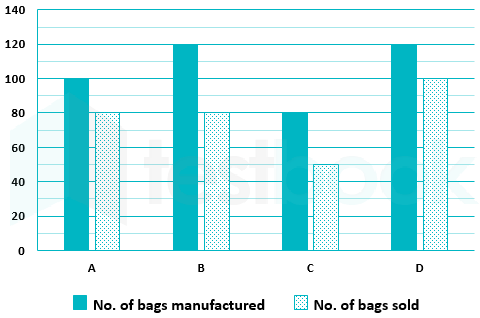
Direction: Given bar graph shows the number of bags manufactured by 4 different companies and the number of bags sold by them.

61

The number of bags unsold for companies C and D together is of what percent of the number of bags sold by companies A and B together?

  1. ((a))

    57.14%

  2. ((b))

    33.33%

  3. ((c))

    83.33%

  4. ((d))

    31.25%

  5. ((e))

    62.5%

Show Answer
Answer: ((d))

31.25%

Number of bags unsold for companies C and D together = (80 – 50) + (120 – 100) = 50

Number of bags sold by companies A and B together= 80 + 80 = 160

∴ Required percent = 50/160 × 100 = 31.25%

62

What is the average of number of bags sold by all the companies?

  1. ((a))

    77.5

  2. ((b))

    27.5

  3. ((c))

    105

  4. ((d))

    47.5

  5. ((e))

    86

Show Answer
Answer: ((a))

77.5

Total number of bags sold by all  the companies = 80 + 80 + 50 + 100 = 310

∴ Required average = 310/4 = 77.5

63

By what percent, the number of bags manufactured by company B is more/less than that of company C?

  1. ((a))

    66.67%

  2. ((b))

    33.33%

  3. ((c))

    100%

  4. ((d))

    25%

  5. ((e))

    50%

Show Answer
Answer: ((e))

50%

Number of bags manufactured by company B = 120

Number of bags manufactured by company C = 80

∴ Required percent = (120 – 80)/80 × 100 = 50%

64

What is the ratio of the number of bags sold by companies B and C together to the number of bags unsold for company D?

  1. ((a))

    13 : 4

  2. ((b))

    13 : 2

  3. ((c))

    13 : 10

  4. ((d))

    7 : 10

  5. ((e))

    7 : 2

Show Answer
Answer: ((b))

13 : 2

Total number of bags sold by company B and C = 80 + 50 = 130

Number of bags unsold for company D = 120 – 100 = 20

∴ Required ratio = 130 : 20 = 13 : 2

65

What is the difference between the total number of bags unsold for companies A, B and C together and the number of bags manufactured by company D?

  1. ((a))

    40

  2. ((b))

    20

  3. ((c))

    50

  4. ((d))

    30

  5. ((e))

    10

Show Answer
Answer: ((d))

30

Total number of bags unsold for companies A, B, and C = (100 – 80) + (120 – 80) + (80 – 50) = 90

Number of bags manufactured by company D = 120 

∴ Required difference = 120 – 90 = 30

66

In each of the following number series, the wrong number is given, find out that number.

54, 58, 49, 65, 42, 76

  1. ((a))

    76

  2. ((b))

    58

  3. ((c))

    42

  4. ((d))

    65

  5. ((e))

    49

Show Answer
Answer: ((c))

42

The series follows the following pattern:

54 + 22 = 58

58 – 32 = 49

49 + 42 = 65

65 – 52 = 40

40 + 62 = 76  

∴ The wrong term in the series is 42.

67

In each of the following number series, the wrong number is given, find out that number.

45, 46, 40, 51, 35, 60

  1. ((a))

    45

  2. ((b))

    46

  3. ((c))

    51

  4. ((d))

    35

  5. ((e))

    40

Show Answer
Answer: ((e))

40

The series follows the following pattern:

45 + 12 = 46

46 - 22 = 42

42 + 32 = 51

51 - 42 = 35

35 + 52 = 60

∴ The wrong term in the series is 40.

68

In each of the following number series, the wrong number is given, find out that number.

50, 35, 44, 31, 42, 27

  1. ((a))

    35

  2. ((b))

    42

  3. ((c))

    44

  4. ((d))

    27

  5. ((e))

    31

Show Answer
Answer: ((c))

44

The series follows the following pattern:

50 – 15 = 35

35 + 11 = 46

46 – 15 = 31

31 + 11 = 42

42 – 15 = 27

∴ The wrong term in the series is 44.

69

In each of the following number series, the wrong number is given, find out that number.

9, 17, 33, 65, 129, 255

  1. ((a))

    255

  2. ((b))

    33

  3. ((c))

    17

  4. ((d))

    65

  5. ((e))

    9

Show Answer
Answer: ((a))

255

The series follows the following pattern:

9 × 2 - 1 = 17

17 × 2 - 1 = 33

33 × 2 - 1 = 65

65 × 2 - 1 = 129

129 × 2 - 1 = 257

∴ The wrong term in the series is 255.

70

In each of the following number series, the wrong number is given, find out that number.

10, 29, 12, 31, 14, 32

  1. ((a))

    12

  2. ((b))

    29

  3. ((c))

    14

  4. ((d))

    32

  5. ((e))

    10

Show Answer
Answer: ((d))

32

The series follows the following pattern:

32 + 1 = 10

33 + 2 = 29

32 + 3 = 12

33 + 4 = 31

32 + 5 = 14 

33 + 6 = 33

∴ The wrong term in the series is 32.

71

A container has capacity of 20 litres and is full of milk. 10 Litre of milk is taken out of it and replaced by same quantity of water again 10 litres of mixture is taken out and replaced by equal quantity of water. How much milk is left in the mixture.

  1. ((a))

    25 litres

  2. ((b))

    5 litres

  3. ((c))

    10 litres

  4. ((d))

    15 litres

  5. ((e))

    None of these

Show Answer
Answer: ((b))

5 litres

Given 

A container has capacity of 20 litres .

Formula used 

Milk left in container after n operations/Original quantity of milk in container

Calculation

Here, number of operations is 2, that is n = 2

Now,  Milk left in container after n operations/Original quantity of milk in container

⇒ ((20 – 10)/20)2 × 20

⇒ (10/20)2 × 20

⇒ 1/4 × 20 = 5 litre

∴ 5 litre of milk is left in the mixture.

72

If a person's monthly income is Rs. 6500 and he spent 10% of his income on rent and 25% on food and other purposes, what amount of money did he save from his monthly income?

  1. ((a))

    4550

  2. ((b))

    4225

  3. ((c))

    4050

  4. ((d))

    4535

  5. ((e))

    None of the above

Show Answer
Answer: ((b))

4225

Given:

Monthly income of the person = Rs. 6500

Spent on rent = 10%

Spent on Food and other purpose = 25%

Concept:

Saving = Income ─ Expenditure

Calculation:

Total expenditure = 10% + 25% = 35% = 6500 × (35/100) = Rs.2275

∴ Total savings = (6500 ─ 2275) = Rs. 4225

73

The ratio of present ages of Ajay and Atul is 4 : 9. The ratio of their ages 9 years ago was 1 : 3. Find the ratio of their ages 6 years from now.

  1. ((a))

    2 : 1

  2. ((b))

    1 : 3

  3. ((c))

    3 : 1

  4. ((d))

    1 : 2

  5. ((e))

    2 : 7

Show Answer
Answer: ((d))

1 : 2

GIVEN:

Ajay : Atul (present) = 4 : 9

Ajay : Atul (9 years ago) = 1 : 3

EXPLANATION:

Let the ages of Ajay and Atul be 4x and 9x respectively.

A.T.Q

4x - 9/9x - 9 = 1/3

12x - 27 = 9x - 9

3x = 18 x = 6

∴ Ajay's age = 4x = 24 yrs

Atul's age = 9x = 54 yrs

Age ratio after 6 years = (24 + 6)/(54 + 6) = 1 : 2

∴ The ratio will be 1 : 2

74

A man can row 60 km upstream in the same time as 120 km downstream. If it can row 300 km upstream in 10 hours, find the speed of the boat in still water.

  1. ((a))

    30 km/hr

  2. ((b))

    25 km/hr

  3. ((c))

    45 km/hr

  4. ((d))

    20 km/hr 

  5. ((e))

    50 km/hr

Show Answer
Answer: ((c))

45 km/hr

Solution:

Let the speed of the boat in still water be u km/hr and the speed of the stream is v km/hr.

Formula Used:

Speed while travelling downstream = u + v

Speed while travelling upstream = u – v

Calculations:

Time(upstream) = (Distance/Speed)upstream = 60/(u - v)

Time(downstream) = (Distance/Speed)downstream = 120/(u + v)

It is given that he can row 60km upstream in the same time as 120 km downstream.

⇒ 60/(u - v) = 120/(u + v)

⇒ u + v = 2u – 2v

⇒ 3v = u

⇒ u : v = 3 : 1

Let u = 3x and v = x

Speed(upstream) = u – v = 3x – x = 2x km/hr

It can row 300 km upstream in 10 hours.

⇒ 2x = 300/10

⇒ x = 15

⇒ u = 3x = 15 × 3 = 45 km/hr

75

There are four consecutive even numbers, such that the average of the last and the first number is 11, find the difference between the second and the third number. 

  1. ((a))

  2. ((b))

  3. ((c))

    3

  4. ((d))

    4

  5. ((e))

    5

Show Answer
Answer: ((b))

Given :

There are four consecutive even numbers, such that the average of the last and the first number is 11.

Calculations :

Let the numbers be 2x, (2x + 2), (2x + 4) and (2x + 6)             (numbers are even)

According to the question 

Average of the first and the last is 11 

So, 

(2x + 2x + 6)/2 = 11 

⇒ 4x + 6 = 22 

⇒ 4x = 16 

⇒ x = 4 

So the number are 8, 10, 12 and 14 

Difference between the second and the third number = 12 - 10 

⇒ 2 

∴ The correct answer will be option number 2 

Alternate Method

Calculations:

Here, all four numbers are consecutive even number and the difference between two consecutive even number is 2.

So, the difference between the second and the third number is 2

∴ The correct answer will be option number 2

Direction: Read the following table carefully and answer the following questions:

The following table shows four different jobs in three different years.

Jobs/Years200120022003
Reporters400550720
Anchors500400600
Editors640750530
Journalists420650500
76

Find the approximate average number of Reporter jobs in three years.

  1. ((a))

    563

  2. ((b))

    557

  3. ((c))

    571

  4. ((d))

    584

  5. ((e))

    591

Show Answer
Answer: ((b))

557

Given:

Jobs/Years200120022003
Reporters400550720


Calculations:

Total number of Reporter jobs in three years = 400 + 550 + 720

= 1670

⇒ Required average = 1670/3

∴ Required average = 556.66 ≈ 557

77

Find the number of jobs in the year 2001, which is approximately what percent less than the number of jobs in the year 2003.

  1. ((a))

    21%

  2. ((b))

    26%

  3. ((c))

    17%

  4. ((d))

    12%

  5. ((e))

    33%

Show Answer
Answer: ((c))

17%

Total number of jobs in year 2001 = 400 + 500 + 640 + 420 = 1960

Total number of jobs in year 2003 = 720 + 600 + 530 + 500 = 2350

Required percentage =

⇒ (2350 – 1960)/2350 × 100%

⇒ 16.59% ≈ 17%

∴ The required percentage is 17%.

78

Find the ratio between the number of Journalists to Anchors in three years.

  1. ((a))

    157 : 150

  2. ((b))

    147 : 130

  3. ((c))

    119 : 130

  4. ((d))

    153 : 140

  5. ((e))

    None of these

Show Answer
Answer: ((a))

157 : 150

Total number of Journalists jobs in three years = 420 + 650 + 500 = 1570

Total number of Anchors jobs in three years = 500 + 400 + 600 = 1500

Required ratio = 1570: 1500

= 157: 150

∴ Required ratio is 157: 150

79

Find the difference between the jobs in the years 2002 and 2001.

  1. ((a))

    190

  2. ((b))

    290

  3. ((c))

    390

  4. ((d))

    490

  5. ((e))

    310

Show Answer
Answer: ((c))

390

Total number of Jobs in the year 2002 = 550 + 400 + 750 + 650 =2350

Total number of jobs in the year 2001 = 400 + 500 + 640 + 420 = 1960

Required difference = 2350 – 1960 = 390

∴ Required difference is 390

80

Find the number of Editors in 2002 which is approximately what percent of the total Editors jobs in three years.

  1. ((a))

    43%

  2. ((b))

    39%

  3. ((c))

    35%

  4. ((d))

    27%

  5. ((e))

    51%

Show Answer
Answer: ((b))

39%

Total number of Editors jobs in three years = 640 + 750 + 530 = 1920.

Number of Editors jobs in the year 2002 = 750

Required percentage =

⇒ 750/1920 × 100

⇒ 39.06% ≈ 39%

∴ The required percentage is 39%.

Attempt this paper under real exam conditions

Timed interface, section switching, instant scoring, and question-by-question analytics — free.

Start Timed Attempt