Official Paper

RRB Clerk Prelims Memory Based Paper (Held On: 12 August 2023 Shift 1) (Previous Year Paper)

80 questions · 45 minutes · with answers · free

Reasoning (40 questions)

Direction: Study the following information to answer the given questions:

Eight persons S, T, U, V, W, X, Y and Z sit around the square table. Four persons sit on the corners while four persons sit on the sides. Persons on each corner face towards the center while persons on each side face away from the center. V and W are adajcnet to each other. Y sits second to the left of U and both face in same direction. S and Z are immediate left of each other. T sits opposite to Z. U does not sit adjacnet to Z. Neither V nor X face away from the center.

1

Who sits immediate right of Z?

  1. ((a))

    X

  2. ((b))

    Y

  3. ((c))

    W

  4. ((d))

    U

  5. ((e))

    T

Show Answer
Answer: ((c))

W

Persons: S, T, U, V, W, X, Y and Z.

  1. S and Z are immediate left of each other.
  2. T sits opposite to Z. 

  1. Y sits second to the left of U and both face in same direction.
  2. U does not sit adjacnet to Z. 

  1. V and W are adajcnet to each other.
  2. Neither V nor X face away from the center. So, case 2 won’t be possible. 

Hence, W sits immediate right of Z.
2

_____ sits second to the left of X.

  1. ((a))

    V

  2. ((b))

    U

  3. ((c))

    Z

  4. ((d))

    T

  5. ((e))

    W

Show Answer
Answer: ((d))

T

Persons: S, T, U, V, W, X, Y and Z.

  1. S and Z are immediate left of each other.
  2. T sits opposite to Z. 

  1. Y sits second to the left of U and both face in same direction.
  2. U does not sit adjacnet to Z. 

  1. V and W are adajcnet to each other.
  2. Neither V nor X face away from the center. So, case 2 won’t be possible. 

Hence, T sits second to the left of X.

3

Four are the same in a certain way thus forms a group. Which among the following does not belong to the group?

  1. ((a))

    T

  2. ((b))

    V

  3. ((c))

    Z

  4. ((d))

    S

  5. ((e))

    X

Show Answer
Answer: ((d))

S

Persons: S, T, U, V, W, X, Y and Z.

  1. S and Z are immediate left of each other.
  2. T sits opposite to Z. 

  1. Y sits second to the left of U and both face in same direction.
  2. U does not sit adjacnet to Z. 

  1. V and W are adajcnet to each other.
  2. Neither V nor X face away from the center. So, case 2 won’t be possible. 

All face towards the center except S.

Hence, S does not belong to the group.

4

How many persons sit between Y and V when counted from the right of Y?

  1. ((a))

    Three

  2. ((b))

    Two

  3. ((c))

    Four

  4. ((d))

    One

  5. ((e))

    Five

Show Answer
Answer: ((b))

Two

Persons: S, T, U, V, W, X, Y and Z.

  1. S and Z are immediate left of each other.
  2. T sits opposite to Z. 

  1. Y sits second to the left of U and both face in same direction.
  2. U does not sit adjacnet to Z. 

  1. V and W are adajcnet to each other.
  2. Neither V nor X face away from the center. So, case 2 won’t be possible. 

Hence, two persons sit between Y and V when counted from the right of Y.

5

If the direction of each of the person is inverted then who sits third to the left of S?

  1. ((a))

    T

  2. ((b))

    V

  3. ((c))

    W

  4. ((d))

    Z

  5. ((e))

    Y

Show Answer
Answer: ((a))

T

Persons: S, T, U, V, W, X, Y and Z.

  1. S and Z are immediate left of each other.
  2. T sits opposite to Z. 

  1. Y sits second to the left of U and both face in same direction.
  2. U does not sit adjacnet to Z. 

  1. V and W are adajcnet to each other.
  2. Neither V nor X face away from the center. So, case 2 won’t be possible. 

If the directions are inverted:

Hence, T sits third to the left of S.

6

If it is possible to make only one meaningful English word with the second, the fourth, the fifth and the tenth letters of the word COMPROMISE, which of the following will be the second letter of the word from the right side? If no such word can be made give ‘X’ as the answer and if more than one such word can be made give ‘Y’ as the answer.

  1. ((a))

    O

  2. ((b))

    E

  3. ((c))

    P

  4. ((d))

    Y

  5. ((e))

    X

Show Answer
Answer: ((d))

Y

Given WordCOMPROMISE
Chosen LettersO P R E
Only Possible WordROPE, PORE, REPO
<br>

Hence, the correct answer is Y.

7

How many pairs of letters are there in the word "CONSISTENCY" each of which have as many letters between them in the word as they have between them in the English alphabetical series?

  1. ((a))

    Five

  2. ((b))

    Four

  3. ((c))

    Two

  4. ((d))

    Three

  5. ((e))

    More than five

Show Answer
Answer: ((e))

More than five

There are six pairs

Hence, there are more than five pairs.

Alternate Method:

We can use the place values of the letters and then we can find how many letters are there in between the letters. (we can use this method only when we remember all the letters place values)

When nothing specific about forward or backward is given in the question, we have to take both directions,

8

Direction: In the question below are given two statements followed by two conclusions numbered I and II. You have to take the given statements to be true even if they seem to be at variance with commonly known facts. Read all the conclusions and then decide which of the given conclusions logically follows from the given statements disregarding commonly known facts.

Statements:

Some pens are mobile.

All mobiles are digital.

Conclusions:

I. Some pens are digital.

II. All pens are digital.

  1. ((a))

    Only I follows

  2. ((b))

    Only II follows

  3. ((c))

    Both I and II follow

  4. ((d))

    Either I or II follow

  5. ((e))

    None follows

Show Answer
Answer: ((a))

Only I follows

The least possible Venn diagram for the given statements is as follows:

Conclusions:

I. Some pens are digital → True ( as some pens are mobiles and all mobiles are digital)

II. All pens are digital → False ( it is possible but not definite)

Hence, only I follows.

9

Direction:- In the question below are given two statements followed by two conclusions numbered I, II. You have to take the given statements to be true even if they seem to be at variance with commonly known facts. Read all the conclusions and then decide which of the given conclusions logically follows from the given statements disregarding commonly known facts.

Statements:

All Eggs are Hen.

Some Hen are Chicks.

Conclusion:

I. Some Eggs are Chicks.

II. No eggs is Chicks.

  1. ((a))

    Only I follows.

  2. ((b))

    Only II follows

  3. ((c))

    Both I and II follows

  4. ((d))

    Either I or II follows

  5. ((e))

    None follows

Show Answer
Answer: ((d))

Either I or II follows

Answer:- 4)

The possible Venn diagram according to the statement is as follows,

I. Some Eggs are Chicks → False( it is possible, but not definite because no relation between Eggs and chicks)

II. No eggs is Chicks → False ( it is possible, but not definite because no relation between Eggs and chicks)

Both conclusions are complementary to each other

Hence, Either I or II follows

Additional Information

What is complementary pair?

I. Both conclusions have to be False

II. Both Conclusions should have the same variables.

III. One conclusion should be positive and the other conclusions should be negative.

Complementary pairs:

(All and Some not)

(some and No)

10

Direction: In the question below are given two statements followed by two conclusions numbered I and II. You have to take the given statements to be true even if they seem to be at variance with commonly known facts. Read all the conclusions and then decide which of the given conclusions logically follows from the given statements disregarding commonly known facts.

Statement:

All pictures are Bright.

Only a few Pictures are Dark.

Conclusion:

I. Some Bright are Dark.

II. Some Pictures are not Dark.

  1. ((a))

    Only I follows

  2. ((b))

    Only II follows

  3. ((c))

    Either I or II follows

  4. ((d))

    Neither I nor II follows

  5. ((e))

    Both I and II follow

Show Answer
Answer: ((e))

Both I and II follow

The least possible diagram for the given statements is as follows

Conclusions:

I. Some Bright are Dark → True (It is definite)

II. Some Pictures are not Dark → True (It is definite as it is given that only a few Pictures are Dark)

Hence, both I and II follows.

These questions are based on the following information.

There are 7 members in family A, B, C, D, E, F and G. A is the sister of B. D is the wife of B. E is the son of D. G and E are brothers. F is the father of B. C is paternal grandmother of E.

11

How A related to F?

  1. ((a))

    Son

  2. ((b))

    Daughter

  3. ((c))

    Son-in-law

  4. ((d))

    Brother

  5. ((e))

    None of These

Show Answer
Answer: ((b))

Daughter

From the given information,

Given Information –

  1. A is the sister of B.

  2. D is the wife of B.

  3. E is the son of D.

  4. G and E are brothers.

  5. F is the father of B.

  6. C is paternal grandmother of E.

We can draw following Family Tree from information given above

Hence, ‘Daughter’ is the correct answer

12

How G related to C?

  1. ((a))

    Son

  2. ((b))

    Brother

  3. ((c))

    Son-in-low

  4. ((d))

    Grandson

  5. ((e))

    None of These

Show Answer
Answer: ((d))

Grandson

From the given information,

Given Information –

  1. A is the sister of B.

  2. D is the wife of B.

  3. E is the son of D.

  4. G and E are brothers.

  5. F is the father of B.

  6. C is paternal grandmother of E.

We can draw following Family Tree from information given above

Hence, ‘Grandson is the correct answer

13

How F related to D?

  1. ((a))

    Father

  2. ((b))

    Father-in-law

  3. ((c))

    Brother

  4. ((d))

    Son

  5. ((e))

    None of These

Show Answer
Answer: ((b))

Father-in-law

From the given information,

Given Information –

  1. A is the sister of B.

  2. D is the wife of B.

  3. E is the son of D.

  4. G and E are brothers.

  5. F is the father of B.

  6. C is paternal grandmother of E.

We can draw following Family Tree from information given above

Hence, ‘Father- in-law’ is the correct answer.

Directions: Study the following information carefully to answer the given questions:

N # S 3 @ E B 7 $ 9 I £ O R ! 6 M > 3 % D 5 X & Z 8 < F ? 4 G A

14

How many such numbers are there in the above arrangement each of which are immediately followed by a vowel and immediately preceded by a consonant?

  1. ((a))

    Two

  2. ((b))

    None

  3. ((c))

    One

  4. ((d))

    Three

  5. ((e))

    More than three

Show Answer
Answer: ((b))

None

Given series is:

Left Side N # S 3 @ E B 7 $ 9 I £ O R ! 6 M > 3 % D 5 X & Z 8 < F ? 4 G A Right Side

Arrangement required: Consonant → Number → Vowel

Clearly none of the number follows the given condition.

15

How many such consonants are there in the above arrangement each of which is immediately followed by a symbol and immediately preceded by a symbol?

  1. ((a))

    One

  2. ((b))

    None

  3. ((c))

    Two

  4. ((d))

    Three

  5. ((e))

    More than three 

Show Answer
Answer: ((a))

One

Given series is:

Left Side N # S 3 @ E B 7 $ 9 I £ O R ! 6 M > 3 % D 5 X & Z 8 < F ? 4 G A Right Side

Arrangement required: Symbol → Consonant → Symbol

Left Side N # S 3 @ E B 7 $ 9 I £ O R ! 6 M > 3 % D 5 X & Z 8 < F ? 4 G A Right Side

Clearly there is one such pair i.e., < F ?

16

How many such vowels are there in the above arrangement each of which are immediately preceded by a symbol and immediately followed by a consonant?

  1. ((a))

    None

  2. ((b))

    Two 

  3. ((c))

    One

  4. ((d))

    Three

  5. ((e))

    More than three

Show Answer
Answer: ((b))

Two 

Given series is:

Left Side N # S 3 @ E B 7 $ 9 I £ O R ! 6 M > 3 % D 5 X & Z 8 < F ? 4 G A Right Side

Arrangement required: Symbol → Vowel → Consonant

Left Side N # S 3 @ E B 7 $ 9 I £ O R ! 6 M > 3 % D 5 X & Z 8 < F ? 4 G A Right Side

Clearly there are two such pairs they are**: @ E B** and £ O R

17

If all the symbols in the above arrangement are dropped, then which of the following element will be the seventh element from the left end?

  1. ((a))

    I

  2. ((b))

    M

  3. ((c))

    O

  4. ((d))

    9

  5. ((e))

    7

Show Answer
Answer: ((d))

9

Given series:

Left Side N # S 3 @ E B 7 $ 9 I £ O R ! 6 M > 3 % D 5 X & Z 8 < F ? 4 G A Right Side

If all the symbols are dropped: N S 3 E B 7 9 I O R 6 M 3 D 5 X Z 8 F 4 G A.

Hence, 7th letter from the left end is 9.

18

Four of the following four letter - clusters are alike in a certain way and one is different. Pick the odd one out.

  1. ((a))

    BCAD

  2. ((b))

    WXVY

  3. ((c))

    OPNQ

  4. ((d))

    FHEG

  5. ((e))

    STRU

Show Answer
Answer: ((d))

FHEG

BCAD → B + 1 = C, C - 2 = A, A + 3 = D.

WXVY → W + 1 = X, X - 2 = V, V + 3 = Y.

OPNQ → O + 1 = P, P - 2 = N, N + 3 = Q**.**

FHEG → F + 2 = H, H - 3 = E, E + 2 = G.

STRU → S + 1 = T, T - 2 = R, R + 3 = U.

Hence, FHEG is the odd one out.

Direction: The following questions are based on five words given below.

ZEN WAR DIP LAW DEW

19

When the first and third letter of each word is interchanged, then how many meaning full word will be formed?

  1. ((a))

    3

  2. ((b))

    2

  3. ((c))

    4

  4. ((d))

    1

  5. ((e))

    None

Show Answer
Answer: ((b))

2

Given words: ZEN WAR DIP LAW DEW

Interchange the first and third letter in each word.

New words: NEZ RAW PID WAL WED

Here we get two meaningful words RAW and WED.

Hence, the correct answer is 2.

20

If words are arranged according to the alphabetical series from right to left, which word is immediate right of the third word from the right end?

  1. ((a))

    ZEN

  2. ((b))

    LAW

  3. ((c))

    DEW

  4. ((d))

    DIP

  5. ((e))

    WAR

Show Answer
Answer: ((d))

DIP

Given words: ZEN WAR DIP LAW DEW

  1. Arrange the words according to alphabetical series.

ZEN WAR LAW DIP DEW

  1. Word immediate right of the third word from the right end.

ZEN WAR LAW DIP DEW

Here we get the word DIP which is immediate right of third word from the right end.

Hence, the correct answer is DIP.

21

If the second and third letter of each of the words is interchanged then how many words will end with a consonant?

  1. ((a))

    1

  2. ((b))

    2

  3. ((c))

    3

  4. ((d))

    4

  5. ((e))

    0

Show Answer
Answer: ((e))

0

Given words: ZEN WAR DIP LAW DEW

Interchange the second and third letter within the word.

ZNE WRA DPI LWA DWE

Here we get no words that end with a consonant.

Hence, the correct answer is 0.

22

If each Consonant is changed to the previous letter in the alphabetical series and each vowel is changed to the next letter in the alphabetical series, then how many words contain at least one vowel?

  1. ((a))

    1

  2. ((b))

    2

  3. ((c))

    3

  4. ((d))

    4

  5. ((e))

    0

Show Answer
Answer: ((a))

1

Given words: ZEN WAR DIP LAW DEW

Consonant is changed to the previous letter in the alphabetical series and each vowel is changed to the next letter in the alphabetical series.

New words: YFM VBQ CJO KBV CFV

Here we get only one word which contains at least one vowel.

Hence, the correct answer is 1.

Direction: Study the following information carefully and answer the given questions.

Six boxes namely A, B, C, G, H and K are placed in a row one above the another but not necessarily in the same order. One box is placed in between C and K. Two boxes are placed in between K and B, where the latter is below the former. The number of boxes below B is one less than the number of boxes above A. H is an immediate neighbor of A.

23

How many boxes are placed in between box H and B?

  1. ((a))

    One

  2. ((b))

    Two

  3. ((c))

    Three

  4. ((d))

    Four

  5. ((e))

    None

Show Answer
Answer: ((d))

Four

Boxes: A, B, C, G, H and K.

  1. One box is placed in between C and K
CASE 1CASE 2
CK
KC


  1.  Two boxes are placed in between K and B, where the latter is below the former.
CASE 1CASE 2
CK
KC
B
B


  1. The number of boxes below B is one less than the number of boxes above A.
CASE 1CASE 2ACASE 2B
C
AAK
KKA
C
CB
BB


  1. H is an immediate neighbour of A. So, CASE 1 and CASE 2B is eliminated.
CASE 2A
H
A
K
C
B


Thus, the final arrangement is,

Boxes
H
A
K
G
C
B


Thus, four boxes are placed in between box H and B.

24

Which among the following is the immediate neighbour of C?

  1. ((a))

    A and K

  2. ((b))

    H and C

  3. ((c))

    B and H

  4. ((d))

    K and C

  5. ((e))

    G and B

Show Answer
Answer: ((e))

G and B

Boxes: A, B, C, G, H and K.

  1. One box is placed in between C and K
CASE 1CASE 2
CK
KC


  1.  Two boxes are placed in between K and B, where the latter is below the former.
CASE 1CASE 2
CK
KC
B
B


  1. The number of boxes below B is one less than the number of boxes above A.
CASE 1CASE 2ACASE 2B
C
AAK
KKA
C
CB
BB


  1. H is an immediate neighbour of A. So, CASE 1 and CASE 2B is eliminated.
CASE 2A
H
A
K
C
B


Thus, the final arrangement is,

Boxes
H
A
K
G
C
B


Thus, box G and B are the immediate neighbour of box C.

25

The number of boxes placed below K is same as the number of boxes placed above________________

  1. ((a))

    A

  2. ((b))

    C

  3. ((c))

    G

  4. ((d))

    B

  5. ((e))

    H

Show Answer
Answer: ((c))

G

Boxes: A, B, C, G, H and K.

  1. One box is placed in between C and K
CASE 1CASE 2
CK
KC


  1.  Two boxes are placed in between K and B, where the latter is below the former.
CASE 1CASE 2
CK
KC
B
B


  1. The number of boxes below B is one less than the number of boxes above A.
CASE 1CASE 2ACASE 2B
C
AAK
KKA
C
CB
BB


  1. H is an immediate neighbour of A. So, CASE 1 and CASE 2B is eliminated.
CASE 2A
H
A
K
C
B


Thus, the final arrangement is,

Boxes
H
A
K
G
C
B


The number of boxes placed below K is same as the number of boxes placed above G.

26

Find the odd one out.

  1. ((a))

    H and K

  2. ((b))

    G and A

  3. ((c))

    B and G

  4. ((d))

    H and G

  5. ((e))

    C and K

Show Answer
Answer: ((d))

H and G

Boxes: A, B, C, G, H and K.

  1. One box is placed in between C and K
CASE 1CASE 2
CK
KC


  1.  Two boxes are placed in between K and B, where the latter is below the former.
CASE 1CASE 2
CK
KC
B
B


  1. The number of boxes below B is one less than the number of boxes above A.
CASE 1CASE 2ACASE 2B
C
AAK
KKA
C
CB
BB


  1. H is an immediate neighbour of A. So, CASE 1 and CASE 2B is eliminated.
CASE 2A
H
A
K
C
B


Thus, the final arrangement is,

Boxes
H
A
K
G
C
B


Thus, H and G is the odd one out.

27

Which among the following is false regarding box A?

I. A is placed second from the top

II. Three boxes are placed in between B and A

III. The number of boxes below C is equal to number of boxes above A.

  1. ((a))

    Only I

  2. ((b))

    Only II

  3. ((c))

    Only III

  4. ((d))

    Both II and III

  5. ((e))

    None is false

Show Answer
Answer: ((e))

None is false

Boxes: A, B, C, G, H and K.

  1. One box is placed in between C and K
CASE 1CASE 2
CK
KC


  1.  Two boxes are placed in between K and B, where the latter is below the former.
CASE 1CASE 2
CK
KC
B
B


  1. The number of boxes below B is one less than the number of boxes above A.
CASE 1CASE 2ACASE 2B
C
AAK
KKA
C
CB
BB


  1. H is an immediate neighbour of A. So, CASE 1 and CASE 2B is eliminated.
CASE 2A
H
A
K
C
B


Thus, the final arrangement is,

Boxes
H
A
K
G
C
B


All are true.

Thus, none of the following is false regarding box A.

Direction: Study the following information carefully and answer the given questions.

Seven persons i.e., A, B, C, D, E, F and G are working in the Indian Navy. Their designations rank in descending order are Admiral, Vice Admiral, Rear Admiral, Commodore, Captain, Commander and Lieutenant but not necessarily in the same order. A is neither the Captain nor Commodore. A ranks lower than E and B. Three persons rank between B and D. Two people rank between G and C, where C ranks lower than G. G is not the Vice Admiral. F works as Rear Admiral. The number of persons who rank higher than D is equal to the number of persons who rank lower than C.

28

Which among the following is True?

I. The number of persons ranking higher and lower of G is same

II. A ranks two designation lower than F

III. Two persons rank higher than E

IV. C is the Lieutenant

  1. ((a))

    Both II and III

  2. ((b))

    Both III and IV

  3. ((c))

    Both I and III

  4. ((d))

    Both I and IV

  5. ((e))

    Both II and IV

Show Answer
Answer: ((d))

Both I and IV

Persons: A, B, C, D, E, F and G

Designations: Admiral, Vice Admiral, Rear Admiral, Commodore, Captain, Commander and Lieutenant

  1. F works as Rear Admiral.
DesignationPersons
Admiral
Vice Admiral
Rear AdmiralF
Commodore
Captain
Commander
Lieutenant


  1. Two people rank between G and C, where C ranks lower than G.  3. G is not the Vice Admiral.
DesignationCASE 1CASE 2
AdmiralG
Vice Admiral
Rear AdmiralFF
CommodoreCG
Captain
Commander
LieutenantC


  1. The number of persons who rank higher than D is equal to the number of persons who rank lower than C. So, CASE 1 is eliminated.
DesignationCASE 2
AdmiralD
Vice Admiral
Rear AdmiralF
CommodoreG
Captain
Commander
LieutenantC


  1. Three persons rank between B and D. 
DesignationCASE 3
AdmiralD
Vice Admiral
Rear AdmiralF
CommodoreG
CaptainB
Commander
LieutenantC


  1. A is neither the Captain nor Commodore. So, A works as Commander.
  2. A ranks lower than E and B. So, E works as Vice Admiral.

Thus, the final arrangement is,

DesignationPersons
AdmiralD
Vice AdmiralE
Rear AdmiralF
CommodoreG
CaptainB
CommanderA
LieutenantC


Thus, I and IV is true.

29

What is the designation of E?

  1. ((a))

    Admiral

  2. ((b))

    Vice Admiral

  3. ((c))

    Rear Admiral

  4. ((d))

    Commodore

  5. ((e))

    Captain

Show Answer
Answer: ((b))

Vice Admiral

Persons: A, B, C, D, E, F and G

Designations: Admiral, Vice Admiral, Rear Admiral, Commodore, Captain, Commander and Lieutenant

  1. F works as Rear Admiral.
DesignationPersons
Admiral
Vice Admiral
Rear AdmiralF
Commodore
Captain
Commander
Lieutenant


  1. Two people rank between G and C, where C ranks lower than G.  3. G is not the Vice Admiral.
DesignationCASE 1CASE 2
AdmiralG
Vice Admiral
Rear AdmiralFF
CommodoreCG
Captain
Commander
LieutenantC


  1. The number of persons who rank higher than D is equal to the number of persons who rank lower than C. So, CASE 1 is eliminated.
DesignationCASE 2
AdmiralD
Vice Admiral
Rear AdmiralF
CommodoreG
Captain
Commander
LieutenantC


  1. Three persons rank between B and D. 
DesignationCASE 3
AdmiralD
Vice Admiral
Rear AdmiralF
CommodoreG
CaptainB
Commander
LieutenantC


  1. A is neither the Captain nor Commodore. So, A works as Commander.
  2. A ranks lower than E and B. So, E works as Vice Admiral.

Thus, the final arrangement is,

DesignationPersons
AdmiralD
Vice AdmiralE
Rear AdmiralF
CommodoreG
CaptainB
CommanderA
LieutenantC


Thus, E works as Vice Admiral.

30

Four of the following five are alike in a certain way and thus form a group. Which one doesn’t belong to that group?

  1. ((a))

    F and D

  2. ((b))

    G and A

  3. ((c))

    E and F

  4. ((d))

    B and C

  5. ((e))

    E and G

Show Answer
Answer: ((c))

E and F

Persons: A, B, C, D, E, F and G

Designations: Admiral, Vice Admiral, Rear Admiral, Commodore, Captain, Commander and Lieutenant

  1. F works as Rear Admiral.
DesignationPersons
Admiral
Vice Admiral
Rear AdmiralF
Commodore
Captain
Commander
Lieutenant


  1. Two people rank between G and C, where C ranks lower than G.  3. G is not the Vice Admiral.
DesignationCASE 1CASE 2
AdmiralG
Vice Admiral
Rear AdmiralFF
CommodoreCG
Captain
Commander
LieutenantC


  1. The number of persons who rank higher than D is equal to the number of persons who rank lower than C. So, CASE 1 is eliminated.
DesignationCASE 2
AdmiralD
Vice Admiral
Rear AdmiralF
CommodoreG
Captain
Commander
LieutenantC


  1. Three persons rank between B and D. 
DesignationCASE 3
AdmiralD
Vice Admiral
Rear AdmiralF
CommodoreG
CaptainB
Commander
LieutenantC


  1. A is neither the Captain nor Commodore. So, A works as Commander.
  2. A ranks lower than E and B. So, E works as Vice Admiral.

Thus, the final arrangement is,

DesignationPersons
AdmiralD
Vice AdmiralE
Rear AdmiralF
CommodoreG
CaptainB
CommanderA
LieutenantC


Thus, E and F is the odd one out.

31

If D and G are interchanged in their designations, then how many persons rank lower than D?

  1. ((a))

    One

  2. ((b))

    Two

  3. ((c))

    Three

  4. ((d))

    None

  5. ((e))

    Four

Show Answer
Answer: ((c))

Three

Persons: A, B, C, D, E, F and G

Designations: Admiral, Vice Admiral, Rear Admiral, Commodore, Captain, Commander and Lieutenant

  1. F works as Rear Admiral.
DesignationPersons
Admiral
Vice Admiral
Rear AdmiralF
Commodore
Captain
Commander
Lieutenant


  1. Two people rank between G and C, where C ranks lower than G.  3. G is not the Vice Admiral.
DesignationCASE 1CASE 2
AdmiralG
Vice Admiral
Rear AdmiralFF
CommodoreCG
Captain
Commander
LieutenantC


  1. The number of persons who rank higher than D is equal to the number of persons who rank lower than C. So, CASE 1 is eliminated.
DesignationCASE 2
AdmiralD
Vice Admiral
Rear AdmiralF
CommodoreG
Captain
Commander
LieutenantC


  1. Three persons rank between B and D. 
DesignationCASE 3
AdmiralD
Vice Admiral
Rear AdmiralF
CommodoreG
CaptainB
Commander
LieutenantC


  1. A is neither the Captain nor Commodore. So, A works as Commander.
  2. A ranks lower than E and B. So, E works as Vice Admiral.

Thus, the final arrangement is,

DesignationPersons
AdmiralD
Vice AdmiralE
Rear AdmiralF
CommodoreG
CaptainB
CommanderA
LieutenantC


Thus, If D and G are interchanged in their designations, then three persons rank lower than D.

32

Who among the following rank higher than A but lower than F?

I. E and D

II. G and B 

III. B and A

  1. ((a))

    Only III 

  2. ((b))

    Both I and II

  3. ((c))

    Only I

  4. ((d))

    Both I and III

  5. ((e))

    Only II

Show Answer
Answer: ((e))

Only II

Persons: A, B, C, D, E, F and G

Designations: Admiral, Vice Admiral, Rear Admiral, Commodore, Captain, Commander and Lieutenant

  1. F works as Rear Admiral.
DesignationPersons
Admiral
Vice Admiral
Rear AdmiralF
Commodore
Captain
Commander
Lieutenant


  1. Two people rank between G and C, where C ranks lower than G.  3. G is not the Vice Admiral.
DesignationCASE 1CASE 2
AdmiralG
Vice Admiral
Rear AdmiralFF
CommodoreCG
Captain
Commander
LieutenantC


  1. The number of persons who rank higher than D is equal to the number of persons who rank lower than C. So, CASE 1 is eliminated.
DesignationCASE 2
AdmiralD
Vice Admiral
Rear AdmiralF
CommodoreG
Captain
Commander
LieutenantC


  1. Three persons rank between B and D. 
DesignationCASE 3
AdmiralD
Vice Admiral
Rear AdmiralF
CommodoreG
CaptainB
Commander
LieutenantC


  1. A is neither the Captain nor Commodore. So, A works as Commander.
  2. A ranks lower than E and B. So, E works as Vice Admiral.

Thus, the final arrangement is,

DesignationPersons
AdmiralD
Vice AdmiralE
Rear AdmiralF
CommodoreG
CaptainB
CommanderA
LieutenantC


Thus**, Only II is the answer.**

33

Directions: In the following question assuming the given statements to be True, find which of the conclusion among given conclusions is / are definitely True and then give your answers accordingly.

Statement: K = L > F ≥ G; B ≥ C > R = F

Conclusion:

I: B > G

II: L ≥ C

  1. ((a))

    Only I is true

  2. ((b))

    None is true

  3. ((c))

    Only II is true

  4. ((d))

    Both I and II are true

  5. ((e))

    Either I or II is true

Show Answer
Answer: ((a))

Only I is true

Given Statement: K = L > F ≥ G; B ≥ C > R = F

On combining: K = L > F = R < C ≤ B; K = L > F = R ≥ G; B ≥ C > R = F ≥ G     

Conclusion

I. B > G → True

II. L ≥ C → False (clear relation between L and C cannot be determined)

Hence, “Only I is true” is the correct answer.

34

Directions: In the following question assuming the given statement to be true, find which of the conclusion among the given conclusions is/are definitely true and then give your answers accordingly.

Statement: G ≥ H = I ≤ M > N ≥ O ≥ P

Conclusions:

I. G > M

II. H ≥ M

  1. ((a))

    Only conclusion I follows

  2. ((b))

    Only conclusion II follows

  3. ((c))

    Both I and II are follow

  4. ((d))

    Either conclusion I or II follows

  5. ((e))

    Neither conclusion I nor II follows

Show Answer
Answer: ((e))

Neither conclusion I nor II follows

Given Statements: G ≥ H = I ≤ M > N ≥ O ≥ P

Conclusions:

I. G > M → False (Relation cannot be determined between G and M)

II. H ≥ M → False (H = I ≤ M → H ≤ M)

Hence, Neither conclusion I nor II follows

35

Directions: In the following question assuming the given statement to be true, find which of the conclusion among the given conclusions is/are definitely true and then give your answers accordingly.

Statement: W ≤ E ≤ R = T = U = V ≥ X

Conclusions:

I. R = V

II. W ≥ T

  1. ((a))

    Only conclusion I follows

  2. ((b))

    Only conclusion II follows

  3. ((c))

    Both I and II are follow

  4. ((d))

    Either conclusion I or II follows

  5. ((e))

    None of these

Show Answer
Answer: ((a))

Only conclusion I follows

Given Statements: W ≤ E ≤ R = T = U = V ≥ X

Conclusions:

I. R = V → True (as R = T = U = V → its clear R = V)

II.W ≥ T → False (W ≤ E ≤ R = T → W ≤ T)

Hence, only conclusion I follows.

36

Directions: In the following question assuming the given statement to be true, find which of the conclusion among the given conclusions is/are definitely true and then give your answers accordingly.

Statement: X < P ≤ S ≥ Q ≥ Z >A

Conclusions:

I. S = Z

II. S > Z

  1. ((a))

    Only conclusion I follows

  2. ((b))

    Only conclusion II follows

  3. ((c))

    Both I and II are follow

  4. ((d))

    Either conclusion I or II follows

  5. ((e))

    Neither conclusion I nor II follows

Show Answer
Answer: ((d))

Either conclusion I or II follows

Given Statements: X < P ≤ S ≥ Q ≥ Z >A

Conclusions:

I. S = Z → False (we can’t say because S ≥ Q ≥ Z → S ≥ Z)

II. S > Z → False (we can’t say because S ≥ Q ≥ Z → S ≥ Z)

Therefore, the conclusion I and II form a complementary pair.

Hence, either conclusion I or II follows.

37

Direction: In the following question assuming the given statements to be true, find which of the conclusion among given conclusions is/are definitely true and then give your answers accordingly.

Statements: S ≥ P > Q = R > M

Conclusions:

I. S ≥ R

II. M < P

  1. ((a))

    Both I and II are True

  2. ((b))

    Only I is True

  3. ((c))

    Either I or II is True

  4. ((d))

    Only II is True

  5. ((e))

    Neither I nor II is true

Show Answer
Answer: ((d))

Only II is True

Given statements: S ≥ P > Q = R > M

Conclusions:

I. S ≥ R → False (as S ≥ P > Q = R → S > R)

II. M < P → True (as P > Q = R > M → P > M)

Hence, only II is True.

Directions:- Read the following comprehension answer the following questions carefully.

A certain number of people are sitting in a row facing towards the north. C is sitting at one end. Only two people are sitting between C and A. Only Four people are sitting between A and R. Only one person sitting between A and B, and B is not an immediate neighbor of C. Only two people sitting between R and D. Q is sitting second to the right of D. T is sitting second to the right of Q. No one sits to the right of T.

38

How many people are sitting in the row?

  1. ((a))

    Thirteen

  2. ((b))

    Seventeen 

  3. ((c))

    Ninteen 

  4. ((d))

    Eleven

  5. ((e))

    Sixteen

Show Answer
Answer: ((e))

Sixteen

1- C is sitting at one end. 

2- Only two people are sitting between C and A. 

3- Only Four people are sitting between A and R. 

Case-1

Case-2


4- Only one person sitting between A and B, and B is not an immediate neighbor of C. 

5- Only two people are sitting between R and D. 

6- Q is sitting second to the right of D. 

7- T is sitting second to the right of Q.  

Case-1 


Case-2


8- No one sits to the right of T. So case-2 gets eliminated. 

So, Final arrangement,


Hence, Sixteen  people are sitting the line.

39

How many people are sitting between A and D?

  1. ((a))

    Eight

  2. ((b))

    Seven

  3. ((c))

    Four

  4. ((d))

    Ten

  5. ((e))

    One

Show Answer
Answer: ((b))

Seven

1- C is sitting at one end. 

2- Only two people are sitting between C and A. 

3- Only Four people are sitting between A and R. 

Case-1

Case-2


4- Only one person sitting between A and B, and B is not an immediate neighbor of C. 

5- Only two people are sitting between R and D. 

6- Q is sitting second to the right of D. 

7- T is sitting second to the right of Q.  

Case-1 


Case-2


8- No one sits to the right of T. So case-2 gets eliminated. 

So, Final arrangement,


Hence, Seven people are sitting between A and D.

40

What is the position of R with respect to Q?

  1. ((a))

    Forth to the left

  2. ((b))

    Third to the right

  3. ((c))

    Fifth to the right

  4. ((d))

    Fifth to the left

  5. ((e))

    Immediate right

Show Answer
Answer: ((d))

Fifth to the left

1- C is sitting at one end. 

2- Only two people are sitting between C and A. 

3- Only Four people are sitting between A and R. 

Case-1

Case-2


4- Only one person sitting between A and B, and B is not an immediate neighbor of C. 

5- Only two people are sitting between R and D. 

6- Q is sitting second to the right of D. 

7- T is sitting second to the right of Q.  

Case-1 


Case-2


8- No one sits to the right of T. So case-2 gets eliminated. 

So, Final arrangement,


Hence, R is fifth to the left of Q.

Numerical Ability (40 questions)

Direction: Read the table carefully and answer the following questions:

The table shows the number of items purchased in a store over a five months 

MonthsStore
MobileCameraLaptop
January854560
February705055
March758550
April1006535
May609580
41

Find the difference between the total number of Mobile and the total number of Laptop purchased in all the given months.

  1. ((a))

    100

  2. ((b))

    110

  3. ((c))

    120

  4. ((d))

    130

  5. ((e))

    140

Show Answer
Answer: ((b))

110

Calculation:

Total number of mobile purchased = 85 + 70 + 75 + 100 + 60

⇒ 390 

Total number of Laptop purchased= 60 + 55 + 50 + 35 + 80

⇒ 280 

Now, required difference = 390 - 280

⇒ 110 

∴  the difference between the total number of Mobile and the total number of Laptop purchased in all the given months is 110.

42

Find the ratio of Laptop purchased in January and May month together to Camera purchased in the month February, March and April months together.

  1. ((a))

    1: 1

  2. ((b))

    4: 5

  3. ((c))

    5 : 7

  4. ((d))

    3 : 2

  5. ((e))

    7 : 10

Show Answer
Answer: ((e))

7 : 10

Calculation:

Number of  Laptop purchased in January and May month  = 60 + 80

⇒ 140 

Number Camera purchased in the month February, March and April months  = 50 + 85 + 65

⇒ 200 

Now, required ratio = 140 ∶ 200

⇒ 7 ∶ 10

the ratio of Laptop purchased in January and May month together to Camera purchased in the month February, March and April months toge​ther is 2 ∶ 3.

43

If the number of Mobile purchased in month June is (3/5)th of the total number of items in month of April then, the number of Mobile purchased in month March is what percent of the number of Mobile purchased in month June?

  1. ((a))

    50%

  2. ((b))

    60%

  3. ((c))

    62.5%

  4. ((d))

    70%

  5. ((e))

    30%

Show Answer
Answer: ((c))

62.5%

Given:

the number of Mobile purchased in month June =  (3/5)th of the total number of items in month of April

Formula used:

Percentage = (Favourable value/Base value) × 100

Calculation:

the total number of items in month of April = 100 + 65 + 35

⇒ 200 

So, the number of Mobile purchased in month June = (3/5) × 200

⇒ 120 

the number of Mobile purchased in month March = 75

Now, required percentage = (75/120) × 100

⇒ 62.5%

the number of Mobile purchased in month March is 62.5% of the number of Mobile purchased in month June

44

The total number of items purchased in month of March is how much percent more than that purchased in Month of February?

  1. ((a))

    5%

  2. ((b))

    10%

  3. ((c))

    20%

  4. ((d))

    120%

  5. ((e))

    40%

Show Answer
Answer: ((c))

20%

Formula used:

Percentage = (Favourable value/Base value) × 100

Calculation:

 total number of items in month of Feb = 70 + 50 + 55

⇒ 175 

 total number of items in month of March = 75 + 85 + 50

⇒ 210 

Now, required difference = 210 - 175

⇒ 35 

Then, required percent = (35/175) × 100

⇒ 20%

 total number of items in month of March is 20% more than that in Month of February

45

Find the average number of items in all the months together.

  1. ((a))

    200

  2. ((b))

    202

  3. ((c))

    220

  4. ((d))

    204

  5. ((e))

    205

Show Answer
Answer: ((b))

202

Formula used:

Average = (Sum of values)/(Number of values)

Calculation:

Total number of items in month of January = 85 + 45 + 60 = 190 

Total number of items in month of February= 70 + 50 + 55 = 175 

Total number of items in month of March= 75 + 85 + 50 = 210 

Total number of items in month of April= 100 + 65 + 35 = 200 

Total number of items in month of May= 60 + 95 + 80 = 235 

So, total number of items in all the months = 190 + 175 + 210 + 200 + 235 = 1010 

Now, the required average = 1010/5

⇒ 202 items

∴ The average number of items in all the months together is 202.

46

What should come in place of question mark (?) in the following question?

263 – 12 × √25 + 462 ÷ 21 = ?

  1. ((a))

    215

  2. ((b))

    235

  3. ((c))

    230

  4. ((d))

    225

  5. ((e))

    None of these

Show Answer
Answer: ((d))

225

Concept used:

Follow BODMAS rule to solve this question, as per the order given below,

Calculation:

263 – 12 × √25 + 462 ÷ 21 = ?

⇒ 263 – 12 × √25 + 22 = ?

⇒ 263 – 12 × 5 + 22 = ?

⇒ 263 – 60 + 22 = ?

⇒ 285 – 60 = ?

⇒ 225 = ?

The value of ? 225

47

What will come in the place of the question mark ‘?’ in the following question?

80% of 440 + 20% of 220 = ? × 10%

  1. ((a))

    3960

  2. ((b))

    3760

  3. ((c))

    4760

  4. ((d))

    5760

  5. ((e))

    3800

Show Answer
Answer: ((a))

3960

Concept used:

Follow BODMAS rule to solve this question, as per the order given below,

Calculations:

80% of 440 + 20% of 220 = ? × 10%

⇒ 352 + 44 = ? × (1/10)

⇒ 396 = ?/10

⇒ ? = 3960

∴ The value of ? is 3960

48

What will come in the place of ‘?’ in the following question?

18 ÷ 7 ÷ 5 × 10⁵ + 210 = ?

  1. ((a))

    254

  2. ((b))

    244

  3. ((c))

    214

  4. ((d))

    264

  5. ((e))

    274

Show Answer
Answer: ((d))

264

Concept used:

Follow BODMAS rule to solve this question, as per the order given below,

Calculations:

18 ÷ 7 ÷ 5 × 10⁵ + 210 = ?

⇒ (18/35) × 105 + 210 = ?

⇒ 54 + 210 = ?

⇒ ? = 264

The value of ? is 264

49

What will come in the place of ‘?’ in the following question?

61 × 25 – 15 × 25 = ? + 30

  1. ((a))

    112

  2. ((b))

    1120

  3. ((c))

    1180

  4. ((d))

    1150

  5. ((e))

    1130

Show Answer
Answer: ((b))

1120

Concept used:

Follow BODMAS rule to solve this question, as per the order given below,

Calculations:

61 × 25 – 15 × 25 = ? + 30

⇒ 1525 – 375 = ? + 30

⇒ 1150 = ? + 30

⇒ ? = 1120

∴ The value of ? is 1120

50

What will come in the place of ‘?’ in the following question?

1331 ÷ 11 + 90 × 104 = ?

  1. ((a))

    9485

  2. ((b))

    9481

  3. ((c))

    10205

  4. ((d))

    9495

  5. ((e))

    10106

Show Answer
Answer: ((b))

9481

Concept used:

Follow BODMAS rule to solve this question, as per the order given below,

Calculations:

1331 ÷ 11 + 90 × 104 = ?

⇒ 121 + 9360 = ?

⇒ 9481 = ?

The value of ? is 9481

51

What will come in place of the question mark?

25% of 160 + 30% of 200 = 20% of ?

  1. ((a))

    200

  2. ((b))

    300

  3. ((c))

    500

  4. ((d))

    600

  5. ((e))

    400

Show Answer
Answer: ((c))

500

Solution:

We have to follow the BODMAS rule

Calculation:

25/100 × 160 + 30/100 × 200 = 20/100 × ?

40 + 60 = 1/5 × ?

100 = 1/5 × ?

⇒ ? = 500

52

What will come in the place of the question mark ‘?’ in the following question?

(√1024 × 20) ÷ 16 + 142 = ?

  1. ((a))

    242

  2. ((b))

    246

  3. ((c))

    234

  4. ((d))

    236

  5. ((e))

    none of these

Show Answer
Answer: ((d))

236

Concept Used:

We have to follow the BODMAS rule,

Calculation:

(√1024 × 20) ÷ 16 + 142 = ?

⇒ (32 × 20) ÷ 16 + 196 = ?

⇒ 640 ÷ 16 + 196 = ?

⇒ 40 + 196 = ?

⇒ 236 = ?

∴ The value of ? is 236.

53

What will come in the place of the question mark ‘?’ in the following question?

7 × 1.5 ÷ 4 – 2.8 × 0.5 = ?

  1. ((a))

    49/40

  2. ((b))

    49/30

  3. ((c))

    48/40

  4. ((d))

    49/50

  5. ((e))

    49/45

Show Answer
Answer: ((a))

49/40

Given:

7 × 1.5 ÷ 4 – 2.8 × 0.5 

Concept used:

We have to follow the BODMAS rule

Calculation:

7×1510÷42810×5107 \times \frac{{15}}{{10}} \div 4 - \frac{{28}}{{10}} \times \frac{5}{{10}} = ?

⇒ 7×32÷4145×127 \times \frac{3}{2} \div 4 - \frac{{14}}{5} \times \frac{1}{2} = ?

⇒ 7×3;8757 \times \frac{{3;}}{8} - \frac{7}{5} = ?

⇒ 21875\frac{{21}}{8} - \frac{7}{5} = ?

⇒ 1055640\frac{{105 - 56}}{{40}} = ?

⇒ ? = 4940\frac{{49}}{{40}}

 The value of ? is 49/40.

54

What will come in place of the question mark ‘?’ in the following question?

[(72)2 ÷ 24 × 8] ÷ 24 = 6 × ?

  1. ((a))

    13

  2. ((b))

    14

  3. ((c))

    15

  4. ((d))

    11

  5. ((e))

    12

Show Answer
Answer: ((e))

12

Given:

[(72)2 ÷ 24 × 8] ÷ 24 = 6 × ?

Concept used:

Follow BODMAS rule to solve this question, as per the order given below,

Calculation:

[(72)2 ÷ 24 × 8] ÷ 24 = 6 × ?

⇒ [(72 × 72) ÷ 24 × 8] ÷ 24 = 6 × ?

⇒ [(72 × 3) × 8] ÷ 24 = 6 × ?

⇒ [216 × 8] ÷ 24 = 6 × ?

⇒ 1728 ÷ 24 = 6 × ?

⇒ 72 = 6 × ?

⇒ 12 = ?

∴ The value of ? is 12

55

What will come in place of the question mark ‘?’ in the following question?

2160 ÷ 36 – 5 × 8.2 = ?

  1. ((a))

    23

  2. ((b))

    24

  3. ((c))

    21

  4. ((d))

    22

  5. ((e))

    19

Show Answer
Answer: ((e))

19

Given:

2160 ÷ 36 – 5 × 8.2 = ? 

Concept used:

Follow the BODMAS rule according to the table given below:

Calculation:

Using the BODMAS rule

2160 ÷ 36 – 5 × 8.2 = ? 

⇒ 60 – 41 = ?

⇒ 19 = ?

 The value of ? is 19

56

What will come in the place of question mark ‘?’ in the following question:

90% of 100 – 20 + 60% of 30 – 16 = ?

  1. ((a))

    72

  2. ((b))

    94

  3. ((c))

    82

  4. ((d))

    100

  5. ((e))

    16

Show Answer
Answer: ((a))

72

Given:

90% of 100 – 20 + 60% of 30 – 16 = ?

Concept used:

Follow the BODMAS rule according to the table given below:

Calculation:

90% of 100 – 20 + 60% of 30 – 16 = ?

⇒ (90/100) × 100 – 20 + (60/100) × 30 – 16 = ?

⇒ 90 – 20 + 18 -16

⇒ 108 – 36 = 72

∴ The value of ? is 72

57

What will come in the place of the question mark ‘?’ in the following question?

(∛1331 × √144) ÷ 2 + 3 = ?

  1. ((a))

    67

  2. ((b))

    69

  3. ((c))

    70

  4. ((d))

    71

  5. ((e))

    75

Show Answer
Answer: ((b))

69

Concept used: 

Follow BODMAS rule to solve this question, as per the order given below,

Calculation:

(∛1331 × √144) ÷ 2 + 3 = ?

⇒ (11 × 12) ÷ 2 + 3 = ?

⇒ 132 ÷ 2 + 3 = ?

⇒ 66 + 3 = ?

⇒ 69 = ?

∴ The value of ? is 69

58

What will come in the place of ‘?’ in the following question?

1500 – 5% of 700 – 13 × 5 = ?

  1. ((a))

    1000

  2. ((b))

    1200

  3. ((c))

    1300

  4. ((d))

    1400

  5. ((e))

    None of the above

Show Answer
Answer: ((d))

1400

Concept used:

Follow BODMAS rule to solve this question, as per the order given below,

Calculation:

1500 –  5% of 700 – 13 × 5 = ?

1500 – (5/100) × 700 – 13 × 5 = ?

1500 – 35 –  65 = ?

1500 –  100 = ?

? = 1400

∴ The value of the '?' is 1400.

59

What will come in the place of ‘?’ in the following question?

15 × 12 ÷  6 ÷  30 + 22 = ?

  1. ((a))

    1

  2. ((b))

    2

  3. ((c))

    3

  4. ((d))

    4

  5. ((e))

    5

Show Answer
Answer: ((e))

5

Concept used:

Follow BODMAS rule to solve this question, as per the order given below,

Calculation:

15 × 12 ÷  6 ÷  30 + 22 = ?

15 × (12/6)/30 + 4 = ?

15 × 12/(6 × 30) + 4 = ?

15 × (1/15) + 4 = ?

1 + 4 = ?

? = 5

∴ The value of the '?' is 5.

60

What will come in the place of ‘?’ in the following question?

∛729 ÷ 9 of 3 + √25 ÷ √9 = √?

  1. ((a))

    1

  2. ((b))

    4

  3. ((c))

    9

  4. ((d))

    16

  5. ((e))

    25

Show Answer
Answer: ((b))

4

Concept used:

Follow BODMAS rule to solve this question, as per the order given below,

Calculation:

∛729 ÷ 9 of 3 + √25 ÷ √9 = √?

9 ÷ 27 + 5 ÷ 3 = √?

9 ÷ 27 + 5 ÷ 3 = √?

9/27 + 5/3 = √?

(1 + 5)/3 = √?

2 = √?

? = 4

∴ The value of '?' is 4.

61

What should come in place of the question mark '?' in the following number series?

24, 27, 32, 39, ?, 59

  1. ((a))

    42

  2. ((b))

    48

  3. ((c))

    46

  4. ((d))

    52

  5. ((e))

    58

Show Answer
Answer: ((b))

48

The series follows the following pattern:

23 + 12 = 24

23 + 22 = 27

23 + 32 = 32

23 + 42 = 39

23 + 52 = 48

23 + 62 = 59

62

What should come in place of the question mark '?' in the following number series?

4, 8, 17, 33, 60, ?

  1. ((a))

    90

  2. ((b))

    102

  3. ((c))

    100

  4. ((d))

    80

  5. ((e))

    110

Show Answer
Answer: ((c))

100

Given:

4, 8, 17, 33, 60, ?

Calculation:

The series follows the following pattern:

∴ 100 will come in place of the question mark (?).

63

What should come in place of the question mark '?' in the following number series?

127, 138, 158, 187, 225, ?

  1. ((a))

    272

  2. ((b))

    262

  3. ((c))

    250

  4. ((d))

    372

  5. ((e))

    242

Show Answer
Answer: ((a))

272

Given:

127, 138, 158, 187, 225, ?

Calculation:

The series follows the following pattern:

∴ 272 will come in place of the question mark (?).

64

What should come in place of the question mark '?' in the following number series?

12, ?, 6, 9, 18, 45, 135

  1. ((a))

    10

  2. ((b))

    15

  3. ((c))

    9

  4. ((d))

    6

  5. ((e))

    8

Show Answer
Answer: ((d))

6

Given:

12, ?, 6, 9, 18, 45, 135

Calculation:

12 × 0.5 = 6

6 × 1 = 6

6 × 1.5 = 9

9 × 2 = 18

18 × 2.5 = 45

45 × 3 = 135

∴ ? = 6

65

What should come in place of the question mark '?' in the following number series?

71, 73, 79, 83, ?, 97

  1. ((a))

    85

  2. ((b))

    87

  3. ((c))

    90

  4. ((d))

    89

  5. ((e))

    93

Show Answer
Answer: ((d))

89

All numbers are consecutive prime numbers.

71, 73, 79, 83, 89, 97

Directions: Study the chart and answer the following questions.

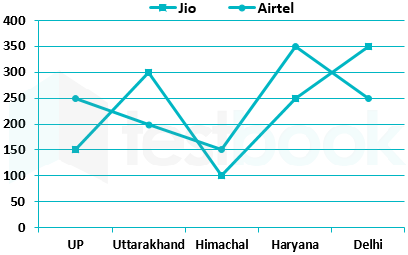
The line graph show number of Jio and Airtel users in 5 different states.

66

Jio users in Uttarakhand are how much percentage more than Airtel users in Himachal?

  1. ((a))

    50%

  2. ((b))

    150%

  3. ((c))

    100%

  4. ((d))

    1%

  5. ((e))

    None of these

Show Answer
Answer: ((c))

100%

Given:

Number of Jio users in Uttarakhand = 300

Number of Airtel users in Himachal = 150

Calculations:

Percentage difference = {(300 – 150)/150} × 100

⇒ (150/150) × 100

⇒ 100%

∴ Jio users in Uttarakhand are 100% more than Airtel users in Himachal.

67

What is the difference of Jio users in Haryana and Airtel users in Delhi?

  1. ((a))

    250

  2. ((b))

    1

  3. ((c))

    100

  4. ((d))

    0

  5. ((e))

    50

Show Answer
Answer: ((d))

0

Given:

Number of Jio users in Haryana = 250

Number of Airtel users in Delhi = 250

Calculations:

Difference of Jio users in Haryana and Airtel users in Delhi = 250 – 250

⇒ 0

∴ Difference of Jio users in Haryana and Airtel users in Delhi is 0

68

What is the ratio of Jio users in Delhi to Airtel users in UP?

  1. ((a))

    8 : 5

  2. ((b))

    5 : 8

  3. ((c))

    7 : 5

  4. ((d))

    5 : 7

  5. ((e))

    None of these

Show Answer
Answer: ((c))

7 : 5

Given:

Number of Jio users in Delhi = 350

Number of Airtel users in UP = 250

Calculations:

Ratio of Jio users in Delhi to Airtel users in UP = 350 : 250

⇒ 7 : 5

∴ The ratio of Jio users in Delhi to Airtel users in UP is 7 : 5

69

What is the average of Jio users in Delhi, Uttarakhand and Haryana?

  1. ((a))

    900

  2. ((b))

    300

  3. ((c))

    600

  4. ((d))

    200

  5. ((e))

    None of these

Show Answer
Answer: ((b))

300

Given:

Number of Jio users in Delhi = 350

Number of Jio users in Uttarakhand = 300

Number of Jio users in Haryana = 250

Formula used:

Average = Sum of values/Number of values

Calculations:

Average of Jio users in Delhi, Uttarakhand and Haryana = (350 + 300 + 250)/3

⇒ 900/3

⇒ 300

∴ The average of Jio users in Delhi, Uttarakhand and Haryana is 300

70

How many total Airtel users are there in all five states together?

  1. ((a))

    1250

  2. ((b))

    1200

  3. ((c))

    1150

  4. ((d))

    1000

  5. ((e))

    None of these

Show Answer
Answer: ((b))

1200

Given:

Number of Airtel users in UP = 250

Number of Airtel users in Uttarakhand = 200

Number of Airtel users in Himachal = 150

Number of Airtel users in Haryana = 350

Number of Airtel users in Delhi = 250

Calculations:

Total Airtel users in all five states together = 250 + 200 + 150 + 350 + 250

⇒ 1200

∴ Total Airtel users in all five states together are 1200

71

The circumference of a circle is half of the perimeter of a rectangle. The area of the circle is 1386 m2. What is the area of the rectangle, if the breadth of the rectangle is 100 m?

  1. ((a))

    2600m2

  2. ((b))

    2800m2

  3. ((c))

    3000m2

  4. ((d))

    3200m2

  5. ((e))

    3400m2

Show Answer
Answer: ((d))

3200m2

Area of a circle = πr2

1386 = 22/7*r2

1386*(7/22) = r2

r 2 = 441

 r = 21 cm

Circumference of a circle = 2πr = 2*(22/7)*21 = 132 cm

Perimeter of the rectangle = 2*132 = 264 m

264 = 2*(l + 100)

264 = 2l + 200

2l = 264 - 200

l = 64/2

l = 32

Area of the rectangle = 32*100 = 3200m2

72

Renu starts business with Rs. 27,000, after 3 months shubham join with Rs. 50,000 and after 6 months from the starting of a buisness kavia joins with Rs. 63,000. What would be ratio of profit sharing at the end of year?

  1. ((a))

    75 : 63 : 54

  2. ((b))

    18 : 25 : 21

  3. ((c))

    75 : 54 : 63

  4. ((d))

    63 : 54 : 75

  5. ((e))

    54 : 63 : 75

Show Answer
Answer: ((b))

18 : 25 : 21

Given:

Renu = 12 months, Rs. 27,000

Shubham = Rs. 50,000, 9 months

Kavia = Rs. 63,000, 6 months

Calculation:

Total investment by renu = 12 × 27,000

⇒ Total investment by shubham = 50,000 × 9

⇒ Total investment by kavia = 63,000 × 6

Ratio = (12 × 27,000) : (50,000 × 9) : (63,000 × 6)

⇒ 54 : 75 : 63

⇒ 18 : 25 : 21

∴ Ratio of profit sharing of renu, shubham and kavia is 18 : 25 : 21

Hint

Instead of calculating investment by each and then finding the ratio, calculate the investment by putting them in ratio format to save the efforts

73

A and B can do a piece of work in 12 days. B and C can do it in 15 days while C and A can do it in 20 days. In how long will they complete it cooperating?

  1. ((a))

    25

  2. ((b))

    10

  3. ((c))

    30

  4. ((d))

    20

  5. ((e))

    26

Show Answer
Answer: ((b))

10

Given:

(A + B) can do work in = 12 days

(B + C) can do work in = 15 days

(A + C) can do work in = 20 days

Calculation:

(A + B) 1 day work = 1/12

(B + C) 1 day work = 1/15

(C + A)   day work = 1/20

⇒ 2(A + B + C)'s 1 day work = (1/12 + 1/15 + 1/20) = 12/60 = 1/5 

⇒ (A + B + C) `s 1 day work = ((1/2) × (1/5)) = 1/10

∴ working together they can complete the work in 10 days.

74

A can complete a work in 42 days, B is 20% more efficient than A. Find the time taken by A and B together to complete the work.

  1. ((a))

    17(1/11) days

  2. ((b))

    19(1/11) days

  3. ((c))

    21(1/13) days

  4. ((d))

    18(3/13) days

  5. ((e))

    None of these

Show Answer
Answer: ((b))

19(1/11) days

Given:

Time taken by A to complete the work = 42 days

Percentage more efficiency of B than A = 20%

Concept used:

Total time taken = Total work/(Efficiency of A + Efficiency of B)

Calculation:

We know that, if efficiency is more than the time taken is less.

Time taken by B to complete the work = 42 × {100/(100 + 20)}

⇒ 42 × {5/6}

⇒ 210/6

⇒ 35 days

Work is done by A in a day = 1/42

Work is done by B in a day = 1/35

Work is done by A and B both in a day = (1/42) + (1/35)

⇒ {(5 + 6)/210}

⇒ 11/210

Time taken by A and B to complete the work = 210/11

⇒ 19(1/11) days

∴ The time taken by A and B to complete the work is 19(1/11) days.

75

Two successive discounts of 25% and X% were given on the marked price of a bag, find the value of X, if the sum of the marked price and the selling price is Rs 3700 and there difference is Rs 1300.

  1. ((a))

     46%

  2. ((b))

     36%

  3. ((c))

     26%

  4. ((d))

     56%

  5. ((e))

     28%

Show Answer
Answer: ((b))

 36%

MP + SP = Rs 3700  ------ eq1

MP - SP = Rs 1300 ------eq2

Add eq1 and eq2, we get the value of MP

⇒2MP = 5000

⇒MP = 2500

Put the value of these in any eq we get SP of an article 

⇒SP = 3700 - 2500

⇒SP = 1200

SP of a bag is Rs 1200

MP is Rs 2500

Give two discounts of 25% and X%

⇒2500 × 25% = 2500 × 1/4 = 625

⇒2500 - 625 = 1875 

And again give discount of X% 

SP is 1875 - 1200 = 675 

X% discount = (675 / 1875 ) × 100

⇒36% 

Hence 36% is the correct answer.

76

5 year ago, age of Diya and the present age of Shiva is in the ratio of 4 : 5. After 7 years, the age of Diya and Shiva will be in the ratio of 4 : 3. Find the age of Shiva after 10 years.

  1. ((a))

     18 years

  2. ((b))

     15 years 

  3. ((c))

     20 years 

  4. ((d))

     17 years 

  5. ((e))

     16 years 

Show Answer
Answer: ((b))

 15 years 

Age of Diya in 5 years ago be 4x 

Present age of Diya is 4x +5

Present age of Shiva is 5x

After 7 years age of Diya is 4x+5+7 = 4x+12

and age of Shiva is 5x+7 years 

their ratio of age after 7 years be 4 : 3

⇒ (4x+12) / (5x+7) = 4 / 3

⇒ 12x+36 = 20x+28

⇒ 36- 28 = 20x - 12x 

⇒ 8x = 8

⇒ x= 1

Present age of Shiva is 5x = 5×1 → 5years 

Age after 10 years = 10+5 = 15 years 

Hence 15 years is the correct answer.

77

Aman invested "x" and after 6 months Sachin invested (x + 6000). The ratio of annual total profit and Aman's profit is 5 : 2. Find the value of x.

  1. ((a))

     3200

  2. ((b))

     4500

  3. ((c))

     5500

  4. ((d))

     3000

  5. ((e))

     3600

Show Answer
Answer: ((d))

 3000

Aman invested money X for 12 months 

 Sachin invested money X+6000 for 6 months 

 Ratio of total profit to Aman's profit = 5  : 2

 Aman is 2 unit and then Sachin is 3 unit 

 ⇒   x×12 / ( x+6000) ×6 = 5 / 2

 ⇒ 2x / (x+6000) = 2 / 3

 ⇒ 6x = 2x+12000

 ⇒ 6x - 2x = 12000

 ⇒ 4x = 12000

 ⇒ x =3000

 Hence 3000 is the correct answer.

78

In an election, The winner gets 60% of the total votes and wins the election by 1200 votes then find the number of total voters in the election.

  1. ((a))

    6000

  2. ((b))

    8000

  3. ((c))

    10000

  4. ((d))

    12000

  5. ((e))

    5000

Show Answer
Answer: ((a))

6000

Given:

The winner gets 60% of the total votes and wins the election by 1200 votes.

Calculation:

Let the total number of voters be x.

The number of votes that winner gets = 60% of x

⇒ Winner’s vote = 60 × x/100

⇒ Winner’s vote = 3x/5

Loser’s vote = (x – 3x/5)

⇒ Loser’s vote = 2x/5

Margin of their votes = {(3x/5) – (2x/5)}

⇒ 1200 = x/5

⇒ x = 6000 

∴ The total number of voters in the election is 6000.

Alternate Method

As we know that winners gets 60% of total 100% votes then the loser will 40% votes and winner will win by 20% votes.

Let the number of voters be x

x × 20/100 = 1200

⇒ x × 1/5 = 1200

⇒ x = 6000

 The total number of voters in the election is 6000

79

Kamna bought a refrigerator with 15% discount on the listed price. If he bought it with 20% discount, he would have saved Rs. 100. Find the marked price of the refrigerator.

  1. ((a))

    Rs. 1500

  2. ((b))

    Rs. 3000

  3. ((c))

    Rs. 2000

  4. ((d))

    Rs. 5400

  5. ((e))

    Rs. 5600

Show Answer
Answer: ((c))

Rs. 2000

Given:

Discount = 15%

Difference in cost price is Rs. 100 due to change in discount percentage.

Calculation:

Let the marked price is Rs. x

When discount is 15%, then price is 85x / 100 [i.e. (x - 15% of x)]

When discount is 20%, then price is 80x / 100 [i.e. (x - 20% of x)]

According to question:

⇒ (85x / 100) - (80x / 100) = 100

⇒ 5x / 100 = 100

⇒ x = Rs. 2000

∴ Required marked price = Rs. 2000

80

A train of length (y + 30) meters cross a man moving at the speed of 4 m/s in the opposite direction of the train in 10 seconds and the same train cross a man in 26 seconds if the man is moving in the same direction of a train. Find the speed of the train.

  1. ((a))

    19 m/s

  2. ((b))

    15 m/s

  3. ((c))

    9 m/s

  4. ((d))

    25 m/s

  5. ((e))

    3 m/s

Show Answer
Answer: ((c))

9 m/s

Given:

Length of train = (y + 30) meters

Speed of man = 4 m/s

Formula used:

Time = distance/speed

Calculation:

Let the speed of train be s m/s

⇒ (y + 30) / (s + 4) = 10

⇒ y + 30 = 10s + 40     ….(1)

(y + 30) / (s – 4) = 26 ….(2) (If train and man moved in same direction.)

⇒ y + 30 = 26s – 104

From (1) and (2)

⇒ 10s + 40 = 26s – 104

⇒ - 16s = -104 – 40

⇒ 16s = 144

⇒ s = 9 m/s

∴ Speed of train is 9 km/h

Attempt this paper under real exam conditions

Timed interface, section switching, instant scoring, and question-by-question analytics — free.

Start Timed Attempt