Official Paper

RRB Clerk Prelims Memory Based Paper (Held On: 10 August 2024 Shift 3) (Previous Year Paper)

80 questions · 45 minutes · with answers · free

Reasoning (40 questions)

Directions: Read the following information carefully and answer the questions.

Seven persons, M, T, A, G, K, V and U live in seven different floors, one above another but not necessarily in the same order. The first floor is numbered as 1, the second floor is numbered as 2, and so on.

T lives on the floor that immediately above U. K lives on the floor which is sixth from the top. Only two persons live above M. U lives two floors below M. V lives four floors above K. A doesn't live on the first floor. V doesn't live above A.

1

Who lives on the first floor?

  1. ((a))

    K

  2. ((b))

    T

  3. ((c))

    A

  4. ((d))

    G

  5. ((e))

    V

Show Answer
Answer: ((d))

G

Given: Seven persons live on seven different floors numbered as 1, 2 and so on.

Based on the given conditions, we get the following possibilities-

1.K lives on the floor which is sixth from the top. Only two persons live above M. From these, we get-

FLOOR NO.PERSON
7
6
5M
4
3
2K
1


  1. U lives two floors below M. T lives on the floor that immediately above U. From these, we get-
FLOOR NO.PERSON
7
6
5M
4T
3U
2K
1


3. V lives for floors above K. A doesn't live on the first floor. V doesn't live above A. From these, we get the final table as follows-

FLOOR NO.PERSON
7A
6V
5M
4T
3U
2K
1G


Therefore, from the final table, we see that G lives on the first floor.

Hence, G lives on the first floor.
2

Who lives three floors below V?

  1. ((a))

    G

  2. ((b))

    K

  3. ((c))

    T

  4. ((d))

    U

  5. ((e))

    A

Show Answer
Answer: ((d))

U

Given: Seven persons live on seven different floors numbered as 1, 2 and so on.

Based on the given conditions, we get the following possibilities-

1.K lives on the floor which is sixth from the top. Only two persons live above M. From these, we get-

FLOOR NO.PERSON
7
6
5M
4
3
2K
1


2. U lives two floors below M. T lives on the floor that immediately above U. From these, we get-

FLOOR NO.PERSON
7
6
5M
4T
3U
2K
1


3. V lives for floors above K. A doesn't live on the first floor. V doesn't live above A. From these, we get the final table as follows-

FLOOR NO.PERSON
7A
6V
5M
4T
3U
2K
1G


Therefore, from the final table, we see that U lives three floors below V.

Hence, U lives three floors below V.

3

How many persons live below V?

  1. ((a))

    None

  2. ((b))

    Two

  3. ((c))

    One

  4. ((d))

    Five

  5. ((e))

    Three

Show Answer
Answer: ((d))

Five

Given: Seven persons live on seven different floors numbered as 1, 2 and so on.

Based on the given conditions, we get the following possibilities-

1.K lives on the floor which is sixth from the top. Only two persons live above M. From these, we get-

FLOOR NO.PERSON
7
6
5M
4
3
2K
1


2. U lives two floors below M. T lives on the floor that immediately above U. From these, we get-

FLOOR NO.PERSON
7
6
5M
4T
3U
2K
1


3. V lives for floors above K. A doesn't live on the first floor. V doesn't live above A. From these, we get the final table as follows-

FLOOR NO.PERSON
7A
6V
5M
4T
3U
2K
1G


Therefore, from the final table, we see that five persons live below V. 

Hence, five persons live below V.

4

Who lives on the fifth floor when counted from the top?

  1. ((a))

    T

  2. ((b))

    M

  3. ((c))

    U

  4. ((d))

    K

  5. ((e))

    G

Show Answer
Answer: ((c))

U

Given: Seven persons live on seven different floors numbered as 1, 2 and so on.

Based on the given conditions, we get the following possibilities-

1.K lives on the floor which is sixth from the top. Only two persons live above M. From these, we get-

FLOOR NO.PERSON
7
6
5M
4
3
2K
1


2. U lives two floors below M. T lives on the floor that immediately above U. From these, we get-

FLOOR NO.PERSON
7
6
5M
4T
3U
2K
1


3. V lives for floors above K. A doesn't live on the first floor. V doesn't live above A. From these, we get the final table as follows-

FLOOR NO.PERSON
7A
6V
5M
4T
3U
2K
1G


Therefore, from the final table, we see that U lives on the fifth floor when counted form the top.

Hence, U lives on the fifth floor when counted form the top.

5

The number of persons living between M and G is the same as the number of people living below whom?

  1. ((a))

    U

  2. ((b))

    K

  3. ((c))

    A

  4. ((d))

    G

  5. ((e))

    T

Show Answer
Answer: ((e))

T

Given: Seven persons live on seven different floors numbered as 1, 2 and so on.

Based on the given conditions, we get the following possibilities-

1.K lives on the floor which is sixth from the top. Only two persons live above M. From these, we get-

FLOOR NO.PERSON
7
6
5M
4
3
2K
1


2. U lives two floors below M. T lives on the floor that immediately above U. From these, we get-

FLOOR NO.PERSON
7
6
5M
4T
3U
2K
1


3. V lives for floors above K. A doesn't live on the first floor. V doesn't live above A. From these, we get the final table as follows-

FLOOR NO.PERSON
7A
6V
5M
4T
3U
2K
1G


Therefore, from the final table, we see that the number of persons living below M and G is the same as the number of persons living below T. 

Hence, the number of persons living below M and G is the same as the number of persons living below T.

6

Direction: In the question below are given three statements followed by two conclusions numbered I and II. You have to take the given statements to be true even if they seem to be at variance with commonly known facts. Read all the conclusions and then decide which of the given conclusions logically follows from the given statements disregarding commonly known facts.

Statements:

All Rose is Lily. 

Only a few lily is lotus.

No lotus is daisy.

Conclusions:

I. Some daisy can be rose.

II.some lily is not daisy.

  1. ((a))

    Only I Follows 

  2. ((b))

    Only II follows

  3. ((c))

    Either I Or II follows

  4. ((d))

    Neither I Nor II follows

  5. ((e))

    Both I and II follows

Show Answer
Answer: ((e))

Both I and II follows

Solutions:

The least possible Venn diagram for the given statements is as follows

Conclusions:

  1. Some daisy can be Rose ⇒ True ( As there is no relation between daisy and Rose, so it is possible)
  2. Some Lily is not daisy ⇒ True ( As lily which is lotus can never be a daisy, so some lily is not daisy is true)

Hence, Both conclusions I and II follow.

7

Direction: In the question below are given three statements followed by two conclusions numbered I and II. You have to take the given statements to be true even if they seem to be at variance with commonly known facts. Read all the conclusions and then decide which of the given conclusions logically follows from the given statements disregarding commonly known facts.

Statements:

Only captain is america.

Only a few captain are hydra.

Few hydra are bucky.

Conclusions:

I. No bucky is captain.

II. Some america is bucky.

  1. ((a))

    Only I follows 

  2. ((b))

    Only II follows 

  3. ((c))

    Both I and II follow

  4. ((d))

    Neither I nor II follows

  5. ((e))

    Either I or II follows

Show Answer
Answer: ((d))

Neither I nor II follows

Solution:

The least possible Venn diagram for the given statements is as follows,

Conclusions:

I. No bucky is captain. →  False (it is possible but not definite, because no direct relation between bucky and captain is given)

II. Some america is bucky. →  False (because only captain can be america)

Hence, Neither I nor II follows is the correct answer.

Additional Information:

Only captain is america means all america is captain and no other element can be america.

Only a few captain are hydra means some captains are hydra and some are not.

8

Direction: In the question below are given three statements followed by two conclusions numbered I and II. You have to take the given statements to be true even if they seem to be at variance with commonly known facts. Read all the conclusions and then decide which of the given conclusions logically follows from the given statements disregarding commonly known facts.

Statements:

No cup is a mug.

Some mugs are chairs.

Some chairs are tables.

Conclusions:

I. Some mugs are table.

II. No chair is a cup.

  1. ((a))

    Only conclusion I follows.

  2. ((b))

    Only conclusion II follows.

  3. ((c))

    Either conclusion I or conclusion II follows.

  4. ((d))

    Both conclusion I and II follow.

  5. ((e))

    Neither conclusion I nor conclusion II follows.

Show Answer
Answer: ((e))

Neither conclusion I nor conclusion II follows.

The least possible Venn diagram for the given statements is as follow

Conclusions:

I. Some mugs are table → False (It is possible but not definite)

II. No chair is cup → False (It is possible but not definite) 

Hence, neither conclusion I nor conclusion II follows.

Direction: Study the following arrangement carefully and answer the questions:

H % 1 P ! F S ? * X 7 C T 4 $ 9 3 > @ / 6 N Q 5

9

How many letters are immediately preceded by consonants and immediately followed by a symbol?

  1. ((a))

    None

  2. ((b))

    One

  3. ((c))

    Two

  4. ((d))

    Three

  5. ((e))

    Four

Show Answer
Answer: ((b))

One

Given series: H % 1 P ! F S ? * X 7 C T 4 $ 9 3 > @ / 6 N Q 5

  1. Letters which are immediately preceded by consonants and immediately followed by a symbol

H % 1 P ! F S ? * X 7 C T 4 $ 9 3 > @ / 6 N Q 5

Hence, only one letter is there which is immediately preceded by consonants and immediately followed by a symbol i.e. FS?

10

If all the numbers are dropped from the above arrangement, which of the following will be the fifth to the right of fourth from the left end?

  1. ((a))

    ?

  2. ((b))

    S

  3. ((c))
  4. ((d))

    X

  5. ((e))

    C

Show Answer
Answer: ((d))

X

Given Series: H % 1 P ! F S ? * X 7 C T 4 $ 9 3 > @ / 6 N Q 5

  1. On dropping all the numbers, the arrangement is

Left Side H % P ! F S ? * X C T $ > @ / N Q Right Side

Right Side + Left Side = Left Side

5th to the Right + 4th to the Left = 9th from the Left

Left Side H % P ! F S ? * X C T $ > @ / N Q Right Side

Hence, X is fifth to the right of fourth to the left end.

11

If all the symbols are dropped from the arrangement then what would be the sixth element from the right end?

  1. ((a))

    9

  2. ((b))

    T

  3. ((c))

    4

  4. ((d))

    C

  5. ((e))

    7

Show Answer
Answer: ((a))

9

Given Series: H % 1 P ! F S ? * X 7 C T 4 $ 9 3 > @ / 6 N Q 5

  1. On dropping all the symbols, the arrangement is

Left Side H 1 P F S X 7 C T 49 3 6 N Q 5 Right Side

  1. Element which is sixth from the right end

Left Side H 1 P F S X 7 C T 4 9 3 6 N Q 5 Right Side

Hence, 9 is sixth from the right end.

12

What is the sum of the numbers between the element ‘*’ and ‘>’?

  1. ((a))

    24

  2. ((b))

    17

  3. ((c))

    19

  4. ((d))

    23

  5. ((e))

    21

Show Answer
Answer: ((d))

23

Given Series: H % 1 P ! F S ? * X 7 C T 4 $ 9 3 > @ / 6 N Q 5

  1. Numbers between ‘*’ and ‘>’

H % 1 P ! F S ? * X 7 C T 4 $ 9 3> @ / 6 N Q 5

Hence, the sum of the numbers between ‘*’ and ‘>’ = 7 + 4 + 9 + 3 = 23

13

In the given arrangement, how many numbers are there which are immediately followed by a symbol?

  1. ((a))

    None

  2. ((b))

    One

  3. ((c))

    Two

  4. ((d))

    Three

  5. ((e))

    Four

Show Answer
Answer: ((c))

Two

Given Series: H % 1 P ! F S ? * X 7 C T 4 $ 9 3 > @ / 6 N Q 5

  1. Numbers which are immediately followed by a symbol

H % 1 P ! F S ? * X 7 C T 4 $ 9 3 >@ / 6 N Q 5

Hence, two numbers are there which are immediately followed by a symbol- 4$ and 3>

Directions: Study the following information and answer the given questions.

Eight people are sitting in two parallel rows containing four people each, in such a way that there is an equal distance between adjacent persons. In row-1, A, B, C, and D are seated and all of them are facing south. In row-2, E, Q, R, and S are seated and all of them are facing north. Therefore, in the given seating arrangement each member seated in a row faces another member of the other row.

Only two people sit between B and C. S is an immediate neighbor of who faces C. Only one person sits between S and R. R is not an immediate neighbor of E. Q faces D, who is an immediate left of A.

14

How many people sit between Q and who faces A?

  1. ((a))

    Four

  2. ((b))

    Two

  3. ((c))

    None

  4. ((d))

    One

  5. ((e))

    Three

Show Answer
Answer: ((c))

None

People: A, B, C, D, E, Q, R, and S.

  1. Only two people sit between B and C.

  2. S is an immediate neighbor of who faces C.

  3. Only one person sits between S and R. R is not an immediate neighbor of E.

  4. Q faces D.

  1. D is an immediate left of A.

Hence, no one sits between Q and who faces A.

15

Which of the following is true?

  1. ((a))

    A and Q sit extreme end

  2. ((b))

    S faces B

  3. ((c))

    Only one person sits between E and R

  4. ((d))

    S and Q are immediate neighbors to each other

  5. ((e))

    Only two people sit between A and B

Show Answer
Answer: ((d))

S and Q are immediate neighbors to each other

People: A, B, C, D, E, Q, R, and S.

  1. Only two people sit between B and C.

  2. S is an immediate neighbor of who faces C.

  3. Only one person sits between S and R. R is not an immediate neighbor of E.

  4. Q faces D.

  1. D is an immediate left of A.

Hence, S and Q are immediate neighbors to each other is true.

16

Who amongst the following sits second to the left of C?

  1. ((a))

    Who faces E

  2. ((b))

    B

  3. ((c))

    Who faces R

  4. ((d))

    A

  5. ((e))

    Who faces Q

Show Answer
Answer: ((e))

Who faces Q

People: A, B, C, D, E, Q, R, and S.

  1. Only two people sit between B and C.

  2. S is an immediate neighbor of who faces C.

  3. Only one person sits between S and R. R is not an immediate neighbor of E.

  4. Q faces D.

  1. D is an immediate left of A.

Hence, the one who faces Q sits second to the left of C.

17

Four of the following five are alike in a certain way and so form a group. Which is the one that does not belong to the group?

  1. ((a))

    B

  2. ((b))

    S

  3. ((c))

    A

  4. ((d))

    Q

  5. ((e))

    D

Show Answer
Answer: ((a))

B

People: A, B, C, D, E, Q, R, and S.

  1. Only two people sit between B and C.

  2. S is an immediate neighbor of who faces C.

  3. Only one person sits between S and R. R is not an immediate neighbor of E.

  4. Q faces D.

  1. D is an immediate left of A.

All except B does not sit at any end of the line.

Hence, B is the one that does not belong to the group.

18

Who sits extreme end of the row?

  1. ((a))

    A, Q

  2. ((b))

    C, R

  3. ((c))

    D, S

  4. ((d))

    S, A

  5. ((e))

    B, S

Show Answer
Answer: ((b))

C, R

People: A, B, C, D, E, Q, R, and S.

  1. Only two people sit between B and C.

  2. S is an immediate neighbor of who faces C.

  3. Only one person sits between S and R. R is not an immediate neighbor of E.

  4. Q faces D.

  1. D is an immediate left of A.

Hence, C and R sit the extreme end of the row.

19

Find the odd one out among the given alternatives. 

  1. ((a))

    I,J,L

  2. ((b))

    R,S,U

  3. ((c))

    D,E,G

  4. ((d))

    L,M,P

  5. ((e))

    W,X,Z

Show Answer
Answer: ((d))

L,M,P

The logic followed here is:

The second letter has been obtained by adding 1 to the face value of the first letter and the third letter has been obtained by adding 2 to the face value of the second letter. 

Now, we check the given options one by one to find the odd one out as follows:

  1. I,J,L → This pattern clearly follows the logic as mentioned above.  2. R,S,U → This pattern clearly follows the logic as mentioned above.  3. D,E,G → This pattern clearly follows the logic as mentioned above.  4. L,M,P → This pattern clearly doesn't follow the logic as mentioned above. We have to add 3 to the face value of M to get P.  5. W,X,Z → This pattern clearly follows the logic as mentioned above. 

Therefore, we see that L,M,P is the odd one out. 

Hence, L,M,P is the odd one out.

Direction: The following questions are based on the five three-digit numbers given below.

309     312     319     324     327

20

If the difference of first and third digits in each of the three-digit numbers is multiplied by 3 then which of the following option comes in one of the result?

  1. ((a))

    15

  2. ((b))

    9

  3. ((c))

    18

  4. ((d))

    6

  5. ((e))

    21

Show Answer
Answer: ((c))

18

Given series: 309     312     319     324     327

On finding the difference between the first and third digit we get:

309 → 6

312 → 1

319 → 6

324 → 1

327 → 4

On multiplying the difference with 3:

309 → 6 × 3 → 18

312 → 1 × 3 → 3

319 → 6 × 3 → 18

324 → 1 × 3 → 3

327 → 4 × 3 → 12

Here only 18 is available in the result.

Hence answer is 18.

21

If the digits in all the three-digit numbers are clubbed and arranged in the ascending order then which of the following will be the 12th digit from left side?

  1. ((a))

    0

  2. ((b))

    1

  3. ((c))

    2

  4. ((d))

    3

  5. ((e))

    4

Show Answer
Answer: ((e))

4

Given series: 309     312     319     324     327

When all the digits are clubbed then the series becomes:

309312319324327

On arranging the digits clubbed in ascending order from left side, we get:

011222333334799

12th digit in the result is 4.

Hence answer is 4.

22

Which of the following could be the difference between the given highest and lowest number?

  1. ((a))

    15

  2. ((b))

    16

  3. ((c))

    17

  4. ((d))

    18

  5. ((e))

    19

Show Answer
Answer: ((d))

18

Given series: 309     312     319     324     327

Finding the highest number and lowest number, we get the maximum difference between two three-digit numbers:

Highest Number = 327

Lowest Number = 309

Difference = 327 - 309 = 18

Hence, the answer is 18.

23

When all the middle digits of three-digit numbers are added, then which of the following will be the result?

  1. ((a))

    3

  2. ((b))

    4

  3. ((c))

    5

  4. ((d))

    6

  5. ((e))

    7

Show Answer
Answer: ((d))

6

Given series: 309     312     319     324     327

Considering the middle digits of all the given numbers:

0     1     1     2     2

Adding the middle digits, the sum becomes 0+1+1+2+2 =6 

Hence answer is 6.

24

If the numbers that are divisible by 3 are added then that sum is not divisible by which of the following?

  1. ((a))

    2

  2. ((b))

    3

  3. ((c))

    4

  4. ((d))

    6

  5. ((e))

    7

Show Answer
Answer: ((e))

7

Given series: 309     312     319     324     327

The numbers that are divisible by 3 are 309, 312, 324, and 327

On adding the number, we get:

309 + 312 + 324 + 327 = 1272

1272 is not divisible by 7 in the given options.

Hence answer is 7.

25

Directions: In each of the following questions assuming the given statement to be true, find which of the conclusions among given conclusions is / are definitely true and then give your answers accordingly.

Statement: A > N = Q > T ≤ Y ≤ S < U

Conclusions: 

I. T < S

II. T = S

  1. ((a))

    Only Conclusion I follows

  2. ((b))

    Only Conclusion II follows

  3. ((c))

    Either Conclusion I or II follows

  4. ((d))

    Neither Conclusion I or II follows

  5. ((e))

    Both Conclusion I and II follows

Show Answer
Answer: ((c))

Either Conclusion I or II follows

Given Statement: A > N = Q > T ≤ Y ≤ S < U

Conclusion: 

I. T < S → False (T ≤ Y ≤ S → T ≤ S)

II. T = S → False (T ≤ Y ≤ S → T ≤ S)

But they form complementary pair.

Hence, Either I or II follows.

26

Directions: In each of the following questions assuming the given statement to be true, find which of the conclusions among given conclusions is / are definitely true and then give your answers accordingly.

Statement: H > K ≤ L = M < N < Q = S

Conclusions:

I. M < S

II. Q < K

  1. ((a))

    Only Conclusion I follows

  2. ((b))

    Only Conclusions II follows

  3. ((c))

    Either Conclusion I or II follows

  4. ((d))

    Neither Conclusion I nor II follows

  5. ((e))

    Both Conclusion I and II follows

Show Answer
Answer: ((a))

Only Conclusion I follows

Given Statement: H > K ≤ L = M < N < Q = S

Conclusions:

I. M < S → True (M < N ≤ Q = S → M < S)

II. Q < K → False (K ≤ L = M < N < Q → K < Q)

Hence, Only conclusion I follows.

27

Directions: In each of the following question assuming the given statements to be true, find which of the conclusion among given conclusions is / are definitely true and then give your answers accordingly.

Statements: A > B = C < D < P > Q

Conclusions: 

I. A < D 

II. P > C

  1. ((a))

    Only I is true

  2. ((b))

    Only II is true

  3. ((c))

    Either I or II is true

  4. ((d))

    Neither I nor II true

  5. ((e))

    Both I and II true

Show Answer
Answer: ((b))

Only II is true

Given Statement: A > B = C < D < P > Q

Conclusions:

I. A < D → False ( A > B = C < D no definite relationship between A and D can be determined).

II. P > C → True (C < D < P → P > C)

Hence, Only II is true

28

If it is possible to make only one four-letter meaningful word with the fourth, seventh, eighth, and sixteenth letter of the word ‘ACKNOWLEDGEMENTS’, which could be the second letter of the word from the right end? If more than one such word can be formed, give ‘X’ as the answer. If no such word can be formed, give ‘Z’ as your answer.

  1. ((a))

    S

  2. ((b))

    Z

  3. ((c))

    X

  4. ((d))

    N

  5. ((e))

    E

Show Answer
Answer: ((d))

N

Given word: ACKNOWLEDGEMENTS

The fourth, seventh, eighth, and sixteenth letters are N, L, E, and S respectively.

There is only one word that can be formed using these letters i.e. LENS.

Therefore, the second letter from the right end of the word 'LENS' is N. 

Hence, the required letter is N.

Direction: Read the given information carefully and answer the following questions.

A person went to the supermarket to buy six products. The products he buys are Clips, Cheese, Chocolates, Pens, Milk, and Scissors but not necessarily in the same order. The product that is bought first is placed at the top and is numbered as 1 and the product that is bought last is placed at the bottom and is numbered as 6.

Two products were bought between Pens and Chocolates. Cheese was the last item to be bought. Scissors were bought two products before Cheese. Pens were the second product to be bought. Clips weren't the first product to be bought.

29

Which is the second last product to have been bought?

  1. ((a))

    Clips

  2. ((b))

    Scissors

  3. ((c))

    Milk

  4. ((d))

    Chocolates

  5. ((e))

    Cheese

Show Answer
Answer: ((d))

Chocolates

Given: A person went to the supermarket to buy six products. The products he buys are Clips, Cheese, Chocolates, Pens, Milk, and Scissors but not necessarily in the same order. 

Based on the given conditions, we get the following possibilities-

  1. Cheese was the last item to be bought. Scissors were bought two products before Cheese. From these, we get-
NO.PRODUCT
1.
2.
3.
4.SCISSORS
5.
6.CHEESE


2.  Pens were the second product to be bought. Two products were bought between Pens and Chocolates. From these, we get-

NO.PRODUCT
1.
2.PENS
3.
4.SCISSORS
5.CHOCOLATES
6.CHEESE


3. Clips weren't the first product to be bought. From this, we get the final table as follows-

NO.PRODUCT
1.MILK
2.PENS
3.CLIPS
4.SCISSORS
5.CHOCOLATES
6.CHEESE


Therefore, from the final table, we see that chocolates is the second last product to have been bought. 

Hence, chocolates is the second last product to have been bought.

30

What is the number of products that were bought between Pens and Clips?

  1. ((a))

    One

  2. ((b))

    Four

  3. ((c))

    Two

  4. ((d))

    Three

  5. ((e))

    Zero

Show Answer
Answer: ((e))

Zero

Given: A person went to the supermarket to buy six products. The products he buys are Clips, Cheese, Chocolates, Pens, Milk, and Scissors but not necessarily in the same order. 

Based on the given conditions, we get the following possibilities-

1. Cheese was the last item to be bought. Scissors were bought two products before Cheese. From these, we get-

NO.PRODUCT
1.
2.
3.
4.SCISSORS
5.
6.CHEESE


2.  Pens were the second product to be bought. Two products were bought between Pens and Chocolates. From these, we get-

NO.PRODUCT
1.
2.PENS
3.
4.SCISSORS
5.CHOCOLATES
6.CHEESE


3. Clips weren't the first product to be bought. From this, we get the final table as follows-

NO.PRODUCT
1.MILK
2.PENS
3.CLIPS
4.SCISSORS
5.CHOCOLATES
6.CHEESE


Therefore, from the final table, we see that no products were bought between Pens and Clips.  

Hence, zero products were bought between Pens and Clips.

31

Which product was bought immediately before Pens?

  1. ((a))

    Clips

  2. ((b))

    Scissors 

  3. ((c))

    None

  4. ((d))

    Milk

  5. ((e))

    Cheese

Show Answer
Answer: ((d))

Milk

Given: A person went to the supermarket to buy six products. The products he buys are Clips, Cheese, Chocolates, Pens, Milk, and Scissors but not necessarily in the same order. 

Based on the given conditions, we get the following possibilities-

1. Cheese was the last item to be bought. Scissors were bought two products before Cheese. From these, we get-

NO.PRODUCT
1.
2.
3.
4.SCISSORS
5.
6.CHEESE


2.  Pens were the second product to be bought. Two products were bought between Pens and Chocolates. From these, we get-

NO.PRODUCT
1.
2.PENS
3.
4.SCISSORS
5.CHOCOLATES
6.CHEESE


3. Clips weren't the first product to be bought. From this, we get the final table as follows-

NO.PRODUCT
1.MILK
2.PENS
3.CLIPS
4.SCISSORS
5.CHOCOLATES
6.CHEESE


Therefore, from the final table, we see that Milk was bought immediately before Pens.  

Hence, Milk was bought immediately before Pens.

32

What is the number of products that were bought before Chocolates?

  1. ((a))

    One

  2. ((b))

    Zero

  3. ((c))

    Four

  4. ((d))

    Three

  5. ((e))

    None

Show Answer
Answer: ((c))

Four

Given: A person went to the supermarket to buy six products. The products he buys are Clips, Cheese, Chocolates, Pens, Milk, and Scissors but not necessarily in the same order. 

Based on the given conditions, we get the following possibilities-

1. Cheese was the last item to be bought. Scissors were bought two products before Cheese. From these, we get-

NO.PRODUCT
1.
2.
3.
4.SCISSORS
5.
6.CHEESE


2.  Pens were the second product to be bought. Two products were bought between Pens and Chocolates. From these, we get-

NO.PRODUCT
1.
2.PENS
3.
4.SCISSORS
5.CHOCOLATES
6.CHEESE


3. Clips weren't the first product to be bought. From this, we get the final table as follows-

NO.PRODUCT
1.MILK
2.PENS
3.CLIPS
4.SCISSORS
5.CHOCOLATES
6.CHEESE


Therefore, from the final table, we see that four products were bought before chocolates.  

Hence, four products were bought before chocolates.

33

The number of products bought after Clips is the same as the number of products that were bought before?

  1. ((a))

    Pens

  2. ((b))

    Milk

  3. ((c))

    Chocolates

  4. ((d))

    Scissors

  5. ((e))

    Cheese

Show Answer
Answer: ((d))

Scissors

Given: A person went to the supermarket to buy six products. The products he buys are Clips, Cheese, Chocolates, Pens, Milk, and Scissors but not necessarily in the same order. 

Based on the given conditions, we get the following possibilities-

1. Cheese was the last item to be bought. Scissors were bought two products before Cheese. From these, we get-

NO.PRODUCT
1.
2.
3.
4.SCISSORS
5.
6.CHEESE


2.  Pens were the second product to be bought. Two products were bought between Pens and Chocolates. From these, we get-

NO.PRODUCT
1.
2.PENS
3.
4.SCISSORS
5.CHOCOLATES
6.CHEESE


3. Clips weren't the first product to be bought. From this, we get the final table as follows-

NO.PRODUCT
1.MILK
2.PENS
3.CLIPS
4.SCISSORS
5.CHOCOLATES
6.CHEESE


Therefore, from the final table, we see that the number of products bought after Clips is the same as the number of products that were bought before Scissors and that is three products. 

Hence, the number of products bought after Clips is the same as the number of products that were bought before Scissors.

Directions: Read the following information carefully and answer the questions.

An uncertain number of persons are sitting in a linear row, facing the north.

Only three persons sit between S and L. U sits second to the left of L. Only four persons sit to the left of N. K sits third to the left of R. Only one person sits between K and N. M sits fourth from the right end of the row. G sits seventh to the left of M. N sits second to the right of V. M sits second to the right of L. The number of persons sitting between R and G is two. L sits to the right of S.

34

Who sits to the immediate left of S?

  1. ((a))

    L

  2. ((b))

    M

  3. ((c))

    N

  4. ((d))

    G

  5. ((e))

    K

Show Answer
Answer: ((d))

G

Given: An uncertain number of persons are sitting in a linear row, facing the north.

Based on the given conditions, we get the following arrangements:

  1. M sits fourth from the right end of the row. M sits second to the right of L. G sits seventh to the left of M. From these, we get-

  1. The number of persons sitting between R and G is two. Only three persons sit between S and L. L sits to the right of S. From these, we get-

  1. K sits third to the left of R. Only four persons sit to the left of N. Only one person sits between K and N. From these, we get-

  1. N sits second to the right of V. From this, we get the final arrangement as follows:

From the final arrangement, we see that G sits to the immediate left of S.

Hence, G sits to the immediate left of S.

35

How many persons sit between K and L?

  1. ((a))

    12

  2. ((b))

    14

  3. ((c))

    10

  4. ((d))

    18

  5. ((e))

    13

Show Answer
Answer: ((c))

10

Given: An uncertain number of persons are sitting in a linear row, facing the north.

Based on the given conditions, we get the following arrangements:

  1. M sits fourth from the right end of the row. M sits second to the right of L. G sits seventh to the left of M. From these, we get-

  1. The number of persons sitting between R and G is two. Only three persons sit between S and L. L sits to the right of S. From these, we get-

  1. K sits third to the left of R. Only four persons sit to the left of N. Only one person sits between K and N. From these, we get-

  1. N sits second to the right of V. From this, we get the final arrangement as follows:

From the final arrangement, we see that 10 persons sit between K and L.

Hence, 10 persons sit between K and L.

36

What is resultant remainder when the total number of persons sitting in the row is divided by 6?

  1. ((a))

    4

  2. ((b))

    5

  3. ((c))

    1

  4. ((d))

    3

  5. ((e))

    2

Show Answer
Answer: ((b))

5

Given: An uncertain number of persons are sitting in a linear row, facing the north.

Based on the given conditions, we get the following arrangements:

  1. M sits fourth from the right end of the row. M sits second to the right of L. G sits seventh to the left of M. From these, we get-

  1. The number of persons sitting between R and G is two. Only three persons sit between S and L. L sits to the right of S. From these, we get-

  1. K sits third to the left of R. Only four persons sit to the left of N. Only one person sits between K and N. From these, we get-

  1. N sits second to the right of V. From this, we get the final arrangement as follows:

From the final arrangement, we see that a total of 23 persons are sitting in the row.

Now, 23 ÷ 6 gives us 3 as the quotient and 5 as the remainder.

Hence, the required remainder is 5.

37

How many pairs of letters are there in the word “TACKIFIES” each of which has as many letters between them in the word (in the forward direction) as they have between them in the English alphabetical order?

  1. ((a))

    Three

  2. ((b))

    Four

  3. ((c))

    One

  4. ((d))

    Five

  5. ((e))

    Two

Show Answer
Answer: ((c))

One

The alphabets are positioned in the following order:

The word can be represented as follows:

In forward direction: “CF”

Thus, there is one pair of letters in the word “TACKIFIES” as according to the English alphabetical series.

Hence, one is the correct answer.

Directions: Study the following information carefully and answer the given questions below:

A person starts walking from A towards the east direction to reach B, which is 15 m east of A. He then takes a right turn and walks 20 m to reach point C. From point C, he takes a left turn and walks 15 m to point P. Then again, he takes a left turn and walks 10 m to point E. From E, he takes a left turn and walks 20 m to reach point F. He then takes a right turn and walks 5 m to reach G and finally takes a left turn to reach point H, which is 10 m away from G.

38

In which direction is point B with respect to point F?

  1. ((a))

    North west

  2. ((b))

    South east

  3. ((c))

    North

  4. ((d))

    South west

  5. ((e))

    North east

Show Answer
Answer: ((e))

North east

According to the given information, we get the following figure,

Hence, Point B is in the North-East direction with respect to F.

39

Four of the following five belongs to a group based on their directions, find the one that does not belong to that group?

  1. ((a))

    A, G

  2. ((b))

    F, C

  3. ((c))

    B, P

  4. ((d))

    H, F

  5. ((e))

    P, E

Show Answer
Answer: ((e))

P, E

According to the given information, we get the following figure,

The first point is in North West from the second point.

Hence, Option D is different.

40

What is the direction of C with respect to E?

  1. ((a))

    North

  2. ((b))

    South 

  3. ((c))

    North East

  4. ((d))

    South West

  5. ((e))

    North West

Show Answer
Answer: ((d))

South West

According to the given information, we get the following figure,

Hence, Point C is in the South West direction with respect to F.

Numerical Ability (40 questions)

41

A mixture of milk and water has a ratio of 11:3. If 26 liters of milk are added to the mixture, and then another 13 liters of milk are added, the final ratio of milk to water is 12:3. What was the initial quantity of milk in the mixture?

  1. ((a))

    410 litres

  2. ((b))

    429 liters

  3. ((c))

    432 liters

  4. ((d))

    443 liters

  5. ((e))

    None of these

Show Answer
Answer: ((b))

429 liters

Given:

Initial ratio of milk to water = 11 : 3

26 liters of milk is added, then another 13 liters of milk is added.

Final ratio of milk to water = 12 : 3

Let:

Initial quantity of milk = 11x liters

Initial quantity of water = 3x liters

26 liters + 13 liters = 39 liters

Final milk = 11x + 39

(11x + 39) : 3x = 12 : 3

(11x + 39) / 3x = 4

11x + 39 = 12x

39 = 12x - 11x

x = 39

Initial milk = 11x = 11 x 39 = 429 liters

The initial quantity of milk in the mixture was 429 liters.

42

A bull can plow a field in 5 days, and a buffalo can plow the same field in 10 days. How many days will it take for 3 bulls and 2 buffaloes to plow the field together?

  1. ((a))

    1.25 days

  2. ((b))

    2 days

  3. ((c))

    1.5 days

  4. ((d))

    2.75 days

  5. ((e))

    2.5 days

Show Answer
Answer: ((a))

1.25 days

Bull's work rate = 1 field / 5 days = 1 / 5 field/day

Buffalo's work rate =1 field / 10 days = 1 / 10 field/day

3 Bulls = 3 × 1 / 5 = 3 / 5 field/day

2 Buffaloes = 2 × 1 / 10 = 2 / 10 = 1 / 5 field/day

Total work rate = (3 / 5) + (1 / 5) = 4 / 5 field/day

Time = Total Work / Work Rate =  1field / (4/5 field/day) = 5 / 4 days = 1.25 days

Thus, the correct answer is 1.25 days.

43

The difference between two numbers is 30. The smaller number is 13 more than half of the greater number. What is the greater number?

  1. ((a))

    56

  2. ((b))

    64

  3. ((c))

    72

  4. ((d))

    86

  5. ((e))

    94

Show Answer
Answer: ((d))

86

Let the greater number be x.

Then, the smaller number = (x/2) + 13 

Given:

Difference = x - [(x/2) + 13] = 30

x - (x/2) - 13 = 30

x/2 = 30 + 13

x/2 = 43

x = 86

Thus, the correct answer is 86.

44

The perimeter of a rectangle is 40 cm, and the difference between its length (l) and breadth (b) is 6 cm. What is the area of the rectangle?

  1. ((a))

    84 cm²

  2. ((b))

    91 cm²

  3. ((c))

    96 cm²

  4. ((d))

    100 cm²

  5. ((e))

    108 cm²

Show Answer
Answer: ((b))

91 cm²

Given:

Perimeter (P) = 40 cm

Difference between length and breadth = l - b = 6 cm

Perimeter formula for a rectangle:

P = 2(l + b)

Substituting the given perimeter:

2l + b = 40

l + b = 20.......................(Equation 1)

Given difference:

l - b = 6............................(Equation 2)

Add Equation 1 and Equation 2:

(l + b) + (l  - b) = 20 + 6

2l = 26

l = 13cm

Substitute l = 13 into Equation 1:

13 + b = 20

b = 7cm

A = l × b = 13 × 7 = 91cm2

Thus, the correct answer is 91 cm²

Directions: Read the data carefully and answer the following questions. 

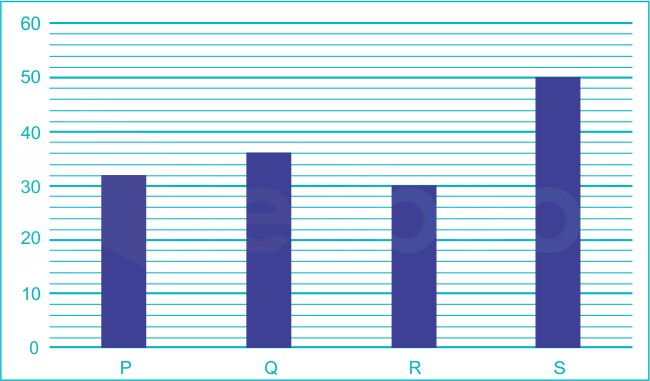
Below is the bar graph which shows the number of books sold by four different shops P, Q, R and S on Saturday. 

45

The number of books sold by Shop S is what percentage more than those sold by Shop P?

  1. ((a))

    38.21%

  2. ((b))

    69.98%

  3. ((c))

    56.25%

  4. ((d))

    45.45%

  5. ((e))

    None of the above

Show Answer
Answer: ((c))

56.25%

Books sold by P = 32

Books sold by S = 50

Difference = 50 (S) - 32 (P) = 18

Percentage increase = 18 / 32 × 100% = 56.25%

Thus, the correct answer is 56.25%.

46

If Shop Q sold 25% more books on Sunday than on Saturday, how many books did it sell on Sunday?

  1. ((a))

    40

  2. ((b))

    45

  3. ((c))

    50

  4. ((d))

    35

  5. ((e))

    55

Show Answer
Answer: ((b))

45

Books sold by Q on Saturday = 36

If Shop Q sold 25% more books on Sunday than on Saturday , then

Sunday sales = 36 (Saturday) + 25% of 36 = 36 + 9 = 45

Thus, the correct answer is 45.

47

If shop P and Q combined, sold 25% of their total books to online customers, how many total books were sold to offline customers by shop P and Q combined?

  1. ((a))

    54

  2. ((b))

    51

  3. ((c))

    56

  4. ((d))

    58

  5. ((e))

    57

Show Answer
Answer: ((b))

51

Given Data:

Shop P sold 32 books

Shop Q sold 36 books

Total books P + Q = 32 + 36 = 68

Online sales = 25% × 68 = 0.25 × 68 = 17

Offline sales = Total books - Online sales = 68 - 17 = 51

Thus, 51 books were sold to offline customers by Shop P and Q combined.

48

What is the ratio of the total books sold by Shops P and R to those sold by Shops Q and S?

  1. ((a))

    31 : 43

  2. ((b))

    30 : 43

  3. ((c))

    31 : 45

  4. ((d))

    30 : 45

  5. ((e))

    32 : 43

Show Answer
Answer: ((a))

31 : 43

Sum of books sold by P and R:

P + R = 32 + 30 = 62

Sum of books sold by Q and S:

Q + S = 36 + 50 = 86

Ratio = 62:86=31:4362:86 = 31:43

Thus, the correct answer is 31:43.

Directions: Read the data carefully and answer the following questions. 

The table given below shows the number of tasks completed by 4 persons in 4 different months. 

Months / PersonsABCD
March53334143
April23456953
May40372835
June54354239
49

If Person A completes 5 times his April tasks and Person D completes 4 times his May tasks in July, what is the ratio of their July tasks?

  1. ((a))

    17:22

  2. ((b))

    23:28

  3. ((c))

    20:27

  4. ((d))

    19:24

  5. ((e))

    25:32

Show Answer
Answer: ((b))

23:28

Person A (July): 5 × 23 = 115

Person D (July): 4 × 35 = 140

Ratio = 115:140 = 23:28.

50

What is the average number of tasks completed in March, April, and June by shop D?

  1. ((a))

    38

  2. ((b))

    39

  3. ((c))

    45

  4. ((d))

    42

  5. ((e))

    40

Show Answer
Answer: ((c))

45

Total Tasks = 43 (March) + 53 (April) + 39 (June) = 135

Average = Total Tasks / Number of Months = 135 / 3 = 45

Thus, the average number of tasks completed by Shop D in March, April, and June is 45.

51

What is the ratio of the number of tasks completed by B and D together in April to tasks completed by A and C together in March? 

  1. ((a))

    49:47

  2. ((b))

    12:13

  3. ((c))

    47:49

  4. ((d))

    13:12

  5. ((e))

    7:9

Show Answer
Answer: ((a))

49:47

From the table:

Tasks completed by B in April = 45

Tasks completed by D in April = 53

Total tasks completed by B and D together in April:

45 + 53 = 98

From the table:

Tasks completed by A in March = 53

Tasks completed by C in March = 41

Total tasks completed by A and C together in March:

53 + 41 = 94

The ratio of tasks completed by B and D together in April to tasks completed by A and C together in March is:

98 / 94 = 49 / 47

Thus, the ratio is 49:47.

52

The number of tasks completed by C in all months is what percent more/less than the number of clothes tasks completed by B in all months?

  1. ((a))

    20%

  2. ((b))

    16.67%

  3. ((c))

    30%

  4. ((d))

    13.33%

  5. ((e))

    0%

Show Answer
Answer: ((a))

20%

From the table:

March: 41

April: 69

May: 28

June: 42

Total tasks by C:

41 + 69 + 28 + 42 = 180

From the table:

March: 33

April: 45

May: 37

June: 35

Total tasks by B:

33 + 45 + 37 + 35 = 150

Difference = Total tasks by C - Total tasks by B = 180 - 150 = 30

The percentage difference is calculated relative to the total tasks completed by B:

Percentage Difference =Difference / Total tasks by B × 100 = 30 / 150 × 100 = 20%

Thus, the number of tasks completed by Person C in all months is 20% more than the number of tasks completed by Person B in all months.

53

What is the difference between the number of tasks completed by all in April and May? 

  1. ((a))

    30

  2. ((b))

    10

  3. ((c))

    0

  4. ((d))

    20

  5. ((e))

    50

Show Answer
Answer: ((e))

50

From the table, the number of tasks completed by each person in April is:

A: 23

B: 45

C: 69

D: 53

Total tasks in April:

23 + 45 + 69 + 53 = 190

From the table, the number of tasks completed by each person in May is:

A: 40

B: 37

C: 28

D: 35

Total tasks in May:

40 + 37 + 28 + 35 = 140

Difference = Total Tasks in April Total Tasks in May = 190 - 140 = 50

Thus, the difference between the number of tasks completed by all in April and May is 50.

54

The number of tasks completed by A in all months is what percent of that by all persons in June? 

  1. ((a))

    50%

  2. ((b))

    100%

  3. ((c))

    120%

  4. ((d))

    150%

  5. ((e))

    180%

Show Answer
Answer: ((b))

100%

From the table:

Tasks completed by A in March = 53

Tasks completed by A in April = 23

Tasks completed by A in May = 40

Tasks completed by A in June = 54

Total tasks completed by A:

53 + 23 + 40 + 54 = 170

From the table:

Tasks completed by A in June = 54

Tasks completed by B in June = 35

Tasks completed by C in June = 42

Tasks completed by D in June = 39

Total tasks completed by all persons in June:

54 + 35 + 42 + 39 = 170

Percentage = Tasks by A / Tasks by All in June × 100 = 170 / 170 × 100 = 100%

Thus, the number of tasks completed by Person A in all months is 100% of the tasks completed by all persons in June.

55

What will come in the place of the question mark ‘?’ in the following question? 

11.11% of 819 + 55% of 400 = ?

  1. ((a))

    311

  2. ((b))

    211

  3. ((c))

    121

  4. ((d))

    131

  5. ((e))

    111

Show Answer
Answer: ((a))

311

GIVEN:

11.11% of 819 + 55% of 800 = ?

FORMULA USED:

These types of questions, the knowledge of conversion from percentage to fraction should be known.

Fraction2/311/203/201/9
Percentage (%)66.66551511.11


Concept :

Follow BODMAS rule to solve this question, as per the order given below.

Step - 1: Parts of an equation enclosed in 'Brackets' must be solved first, and following BODMAS rule in the bracket -

Step - 2: Any mathematical 'Of' or 'Exponent' must be solved next.

Step - 3: Next, the parts of the equation that contain 'Division' and 'Multiplication' are calculated.

Step - 4: Last but not the least, the parts of the equation that contain 'Addition' and 'Subtraction' should be calculated.

CALCULATION:

11.11% of 819 = (1/9) × 819 = 91

55% of 400 = (11/20) × 400 = 220

Given expression is

11.11% of 819 + 55% of 400 = ?

⇒ 91 + 220 = ?

⇒ 311 = ?

∴ ? = 311

56

What will come in place of the question mark (?) in the following question?

8 × 6 + 3 - 6/2 = ?

  1. ((a))

    45

  2. ((b))

    48

  3. ((c))

    34

  4. ((d))

    54

  5. ((e))

    25

Show Answer
Answer: ((b))

48

Follow BODMAS rule to solve this question, as per the order given below.

Step-1: Parts of an equation enclosed in 'Brackets' must be solved first, and following BODMAS rule in the bracket -

Step-2: Any mathematical 'Of' or 'Exponent' must be solved next.

Step-3: Next, the parts of the equation that contain 'Division' and 'Multiplication' are calculated.

Step-4: Last but not the least, the parts of the equation that contain 'Addition' and 'Subtraction' should be calculated.

Since, we need to find out the approximate value, we can write these values to their nearest integers.

Given expression is

8 × 6 + 3 - 6/2 = ?

⇒ 48 + 3 - 3 = ?

⇒ ? = 48

57

What value should come in the place of the question mark ‘?’ in the following question?

4000 + 500 ÷ 50 - 820 = 10 × ?

  1. ((a))

    315

  2. ((b))

    138

  3. ((c))

    319

  4. ((d))

    212

  5. ((e))

    313

Show Answer
Answer: ((c))

319

Follow BODMAS rule to solve this question, as per the order given below.

Step-1: Parts of an equation enclosed in 'Brackets' must be solved first, and following BODMAS rule in the bracket -

Step-2: Any mathematical 'Of' or 'Exponent' must be solved next.

Step-3: Next, the parts of the equation that contain 'Division' and 'Multiplication' are calculated.

Step-4: Last but not the least, the parts of the equation that contain 'Addition' and 'Subtraction' should be calculated.

Since, we need to find out the approximate value, we can write these values to their nearest integers.

Given expression is

4000 + 500 ÷ 50 - 820 = 10 ×?

⇒ 4000 + 10 - 820 = 10 × ?

⇒ ? = 319

58

What will come in the place of the question mark ‘?’ in the following question?

1/16 of 48 + 97% of ? = ?

  1. ((a))

    80

  2. ((b))

    85

  3. ((c))

    90

  4. ((d))

    95

  5. ((e))

    100

Show Answer
Answer: ((e))

100

Concept used:

Calculation:

1/16 of 48 + 97% of ? = ?

⇒ 1/16 × 48 + 97/100 × ? = ?

⇒ 3 + 0.97 × ? = ?

⇒ 3 = ?(1 - 0.97)

⇒ 3 = 0.03 × ?

⇒ ? = 3/0.03

⇒ ? = 100

∴ The value of ? is 100.

The double "?" indicates that there is one unknown at 2 places in the question

59

What will come in the place of the question mark ‘?’ in the following question?

512(1/9) × 729(1/6) = ?(1/2)

  1. ((a))

    25

  2. ((b))

    49

  3. ((c))

    36

  4. ((d))

    40

  5. ((e))

    21

Show Answer
Answer: ((c))

36

Follow BODMAS rule to solve this question, as per the order given below.

Step-1: Parts of an equation enclosed in 'Brackets' must be solved first, and following BODMAS rule in the bracket -

Step-2: Any mathematical 'Of' or 'Exponent' must be solved next.

Step-3: Next, the parts of the equation that contain 'Division' and 'Multiplication' are calculated.

Step-4: Last but not the least, the parts of the equation that contain 'Addition' and 'Subtraction' should be calculated.

Since, we need to find out the approximate value, we can write these values to their nearest integers.

CALCULATION:

512(1/9) × 729(1/6) = ?(1/2)

⇒ 512(1/3 × 1/3) × 729 (1/3 × 1/ 2) = ?1/2

⇒ 81/3 × 91/2 = ?1 / 2

⇒ 2 × 3 = ?1/2

⇒ 6 = ?1/2

∴ ? = 36.

60

What will come in the place of the question mark ‘?’ in the following question? 

65% of 800 – 56 ÷ ? = 29

  1. ((a))

    5

  2. ((b))

    6

  3. ((c))

    7

  4. ((d))

    8

  5. ((e))

    9

Show Answer
Answer: ((c))

7

Concept used:

Follow BODMAS rule to solve this question, as per the order given below.

Calculation:

65% of 800 – 56 ÷ ? = 29

⇒ 520 – 56 ÷ ? = 512

⇒ 520 – 512 = 56 ÷ ?

⇒ 8 = 56 ÷ ?

⇒ ? = 7

∴ The value of ? is 7

61

What will come in the place of the question mark ‘?’ in the following question? 

720 – (1/3) of 450 = 6 × ?

  1. ((a))

    30

  2. ((b))

    40

  3. ((c))

    95

  4. ((d))

    60

  5. ((e))

    70

Show Answer
Answer: ((c))

95

Concept used:

Follow BODMAS rule to solve this question, as per the order given below.

Calculation:

720 – (1/3) of 450 = 6 × ?

⇒ 720 – 150 = 6 × ?

⇒ 570/6 = ?

⇒ ? = 95

∴ The value of ? is 95

62

What will come in the place of question marks '?' in the following question?

[992 ÷ 32 × 5 + (360 ÷ 45)] =?

  1. ((a))

    160

  2. ((b))

    173

  3. ((c))

    150

  4. ((d))

    163

  5. ((e))

    168

Show Answer
Answer: ((d))

163

Follow BODMAS rule to solve this question, as per the order given below, 

Step-1: Parts of an equation enclosed in 'Brackets' must be solved first, and in the bracket, 

Step-2: Any mathematical 'Of' or 'Exponent' must be solved next, 

Step-3: Next, the parts of the equation that contain 'Division' and 'Multiplication' are calculated, 

Step-4: Last but not least, the parts of the equation that contain 'Addition' and 'Subtraction' should be calculated 

[992 ÷ 32 × 5 + (360 ÷ 45)] =? 

⇒[31 × 5 + (8)] = ?

⇒ [155 + 8] = ?

∴ ? = 163

63

What will come in place of question mark (?) in the following equation?

56 ÷ √? × 30 = 6720

  1. ((a))

    1/4

  2. ((b))

    1/2

  3. ((c))

    1/16

  4. ((d))

    1/8

  5. ((e))

    1/12

Show Answer
Answer: ((c))

1/16

Follow BODMAS rule to solve this question, as per the order given below,  

Step-1: Parts of an equation enclosed in 'Brackets' must be solved first, and in the bracket, 

Step-2: Any mathematical 'Of' or 'Exponent' must be solved next, 

Step-3: Next, the parts of the equation that contain 'Division' and 'Multiplication' are calculated, 

Step-4: Last but not least, the parts of the equation that contain 'Addition' and 'Subtraction' should be calculated 

56 ÷ √? × 30 = 6720

⇒ (56 × 30)/√? = 6720

⇒ 1/√? = 6720/(56 × 30)

⇒ 1/√? = 4

∴ ? = 1/16

64

What will come in the place of the question mark ‘?’ in the following question?

1/4 of 42 – 12 of 1500% + 32 = ?

  1. ((a))
    • 167
  2. ((b))
    • 180
  3. ((c))

    239

  4. ((d))

    209

  5. ((e))

    199

Show Answer
Answer: ((a))
  • 167

Follow BODMAS rule to solve this question, as per the order given below.

Step - 1: Parts of an equation enclosed in 'Brackets' must be solved first, and following BODMAS rule in the bracket -

Step - 2: Any mathematical 'Of' or 'Exponent' must be solved next.

Step - 3: Next, the parts of the equation that contain 'Division' and 'Multiplication' are calculated.

Step - 4: Last but not the least, the parts of the equation that contain 'Addition' and 'Subtraction' should be calculated.

Given expression is

1/4 of 42 – 12 of 1500% + 32 = ?

⇒  4 – 12 × 15 + 9 = ?

⇒ 4 – 180 + 9 = ?

∴ ? = - 167

65

What will come in the place of the question mark ‘?’ in the following question?

15% of 500 + 12% of 250 – 102 = ?

  1. ((a))

    1

  2. ((b))

    2

  3. ((c))

    3

  4. ((d))

    4

  5. ((e))

    5

Show Answer
Answer: ((c))

3

Follow BODMAS rule to solve this question, as per the order given below.

Step - 1: Parts of an equation enclosed in 'Brackets' must be solved first, and following BODMAS rule in the bracket -

Step - 2: Any mathematical 'Of' or 'Exponent' must be solved next.

Step - 3: Next, the parts of the equation that contain 'Division' and 'Multiplication' are calculated.

Step - 4: Last but not the least, the parts of the equation that contain 'Addition' and 'Subtraction' should be calculated.

Given expression is

15% of 500 + 12% of 250 – 102 = ?

⇒ 75 + 30 – 102 = ?

⇒ 3 = ?

∴ ? = 3

66

What will come in place of question mark (?) in the following equation?

105 + 35 – 23 × 5 = √?

  1. ((a))

    25

  2. ((b))

    5

  3. ((c))

    125

  4. ((d))

    100

  5. ((e))

    625

Show Answer
Answer: ((e))

625

Follow BODMAS rule to solve this question, as per the order given below, 

Step-1: Parts of an equation enclosed in 'Brackets' must be solved first, and in the bracket, 

Step-2: Any mathematical 'Of' or 'Exponent' must be solved next, 

Step-3: Next, the parts of the equation that contain 'Division' and 'Multiplication' are calculated, 

Step-4: Last but not least, the parts of the equation that contain 'Addition' and 'Subtraction' should be calculated 

105 + 35 – 23 × 5 = √?

⇒ 140 – 115 = √?

⇒ 25 = √?

∴ ? = 625

67

What will come in place of question mark (?) in the following equation?

∛512 × √36 – ? × 16 = 16

  1. ((a))

    5

  2. ((b))

    4

  3. ((c))

    2

  4. ((d))

    1

  5. ((e))

    3

Show Answer
Answer: ((c))

2

Given:

∛512 × √36 – ? × 16 = 16

Concept:

Calculation:

∛512 × √36 – ? × 16 = 16

⇒ 8 × 6 – ? × 16 = 16

⇒ 48 – ? × 16 = 16

⇒ 48 – 16 = ? × 16

⇒ 32 = ? × 16

∴ ? = 2

68

What will come in the place of the question mark '?' in the following question?

(84 × 16 ÷ 4 of 3 - 2) = ? - 45

  1. ((a))

    150

  2. ((b))

    145

  3. ((c))

    155

  4. ((d))

    156

  5. ((e))

    134

Show Answer
Answer: ((c))

155

Concept:

Follow BODMAS rule to solve this question, as per the order given below.

Step - 1: Parts of an equation enclosed in 'Brackets' must be solved first, and following BODMAS rule in the bracket -

Step - 2: Any mathematical 'Of' or 'Exponent' must be solved next.

Step - 3: Next, the parts of the equation that contain 'Division' and 'Multiplication' are calculated.

Step - 4: Last but not the least, the parts of the equation that contain 'Addition' and 'Subtraction' should be calculated.

Calculation:

Given expression is 

(84 × 16 ÷ 4 of 3 - 2) =? - 45 

⇒ (84 × 16 ÷ 12 - 2) =? - 45 

⇒ (84 × (4/3) - 2) =? - 45 

⇒ (112 - 2) = ? - 45

⇒ 110 + 45 =?

∴ ? = 155

69

What will come in place of question mark (?) in the following equation?

14% of 300 + 18% of 500 = ?

  1. ((a))

    122

  2. ((b))

    138

  3. ((c))

    128

  4. ((d))

    132

  5. ((e))

    118

Show Answer
Answer: ((d))

132

Follow BODMAS rule to solve this question, as per the order given below, 

Step-1: Parts of an equation enclosed in 'Brackets' must be solved first, and in the bracket, 

Step-2: Any mathematical 'Of' or 'Exponent' must be solved next, 

Step-3: Next, the parts of the equation that contain 'Division' and 'Multiplication' are calculated, 

Step-4: Last but not least, the parts of the equation that contain 'Addition' and 'Subtraction' should be calculated 

14% of 300 + 18% of 500 = ?

⇒ 42 + 90 = ?

∴ ? = 132

70

The ratio of present ages of two friends Leo and David is 4 : 3. After 5 years the ratio of their ages become 9 : 7. What is the difference between their ages?

  1. ((a))

    5 years

  2. ((b))

    15 years

  3. ((c))

    20 years

  4. ((d))

    10 years

  5. ((e))

    25 years

Show Answer
Answer: ((d))

10 years

Given:

Age of Leo : Age of David = 4 : 3

Age of Leo after 5 years : Age of David after 5 years = 9 : 7

Calculation:

Let us assume,

Present age of Leo = 4x

Present age of David = 3x

Difference in their ages = 4x – 3x = x

ATQ,

(4x + 5)/(3x + 5) = 9/7

⇒ 28x + 35 = 27x + 45

⇒ x = 10

∴ Difference in their ages is 10 years.

71

The mean of five number is 30. if one of the number is excluded, the mean reduced by 4. Find the excluded number.

  1. ((a))

    36

  2. ((b))

    38

  3. ((c))

    46

  4. ((d))

    48

  5. ((e))

    34

Show Answer
Answer: ((c))

46

Given: 

Mean of 5 number = 30

When one of the numbers is excluded, the mean gets reduced by 4.

Calculation:

Sum of these 5 number = (30 × 5) = 150

Mean of the remaining 4 numbers = (30 - 4) = 26

Sum of these remaining 4 number = (26 × 4) = 104

Excluded number = (Sum of the given 5 numbers) - (sum of the remaining 4 numbers) = 150 - 104  =  46

∴ The excluded number is 46

72

Subhash fetched a certain sum and earned a simple interest is Rs. 4005 at the rate of 9% per annum in 5 years. What is the sum?

  1. ((a))

    Rs. 8900

  2. ((b))

    Rs. 9000

  3. ((c))

    Rs. 8000

  4. ((d))

    Rs. 7500

  5. ((e))

    None of these 

Show Answer
Answer: ((a))

Rs. 8900

Given:

Interest = 4005

Rate = 9%

Time = 5 years

Formula:

Simple interest = Principal × rate × time/100

Calculations:

Principal = (100 × 4005)/5 × 9

⇒ (100 × 4005)/45

⇒ Rs 8900

∴ The sum is Rs. 8900

73

Ratio of income of A and B is 3 : 2 and ratio of their expenditure is 8 : 5 if they save 6000 and 5000 rupees respectively. Find the income of A.

  1. ((a))

    Rs. 10000

  2. ((b))

    Rs. 30000

  3. ((c))

    Rs. 40000

  4. ((d))

    Rs. 25000

  5. ((e))

    Rs. 50000

Show Answer
Answer: ((b))

Rs. 30000

GIVEN :

Ratio of income of A and B = 3 : 2

Ratio of expenditure of A and B = 8 : 5


CONCEPT :

Ratio method


ASSUMPTION :

Let the income of A and B be 3x and 2x respectively

And, let the expenditure of A and B be 8y and 5y respectively


CALCULATION :

According to question

3x – 8y = 6000     ----(1)

2x – 5y = 5000     ----(2)

By equating equation 1 and 2

We get x = 10,000 and y = 3000

So, income of A = 3 × 10000 = Rs. 30,000

74

What should come in place of the question mark '?' in the following number series?

10, 14, 41, 66, 409, ?

  1. ((a))

    490

  2. ((b))

    1138

  3. ((c))

    1090

  4. ((d))

    1740

  5. ((e))

    530

Show Answer
Answer: ((e))

530

The series follows the following pattern:

10 + 22 = 14

14 + 33 = 41

41 + 52 = 66

66 + 73 = 409

409 + 112 = 530

75

What should come in place of the question mark '?' in the following number series?

9, 18, 54, 216, ?, 6480

  1. ((a))

    980

  2. ((b))

    1080

  3. ((c))

    1020

  4. ((d))

    920

  5. ((e))

    880

Show Answer
Answer: ((b))

1080

The series follows the following pattern:

9 × 2 = 18

18 × 3 = 54

54 × 4 = 216

216 × 5 = 1080

1080 × 6 = 6480

76

What should come in place of the question mark '?' in the following number series?

100, 89, 79, 68, 58, ?

  1. ((a))

    45

  2. ((b))

    46

  3. ((c))

    47

  4. ((d))

    48

  5. ((e))

    49

Show Answer
Answer: ((c))

47

The series follows the following pattern:

100 – 11 = 89

89  – 10 = 79

79  – 11 = 68

68 – 10 = 58

58 – 11 = 47

∴ The missing term in the series is  47.

77

What should come in place of the question mark '?' in the following number series?

2, 7, 14, ?, 34, 47

  1. ((a))

    21

  2. ((b))

    22

  3. ((c))

    23

  4. ((d))

    24

  5. ((e))

    25

Show Answer
Answer: ((c))

23

The series follows the following pattern:

2 + 5 = 7

7 + 7 = 14

14 + 9 = 23

23 + 11 = 34

34 + 13 = 47

∴ The missing term in the series is 23.

78

What should come in place of the question mark '?' in the following number series?

24, 28, 36, 52, 84, ?

  1. ((a))

    148

  2. ((b))

    168

  3. ((c))

    108

  4. ((d))

    156

  5. ((e))

    132

Show Answer
Answer: ((a))

148

The series follows the following pattern:

24 + 4 = 28

28 + 8 = 36

36 + 16 = 52

52 + 32 = 84

84 + 64 = 148

79

Manisha scores 35% and fail by 15 marks while Deepti scores 45% marks and get 35 more than the passing marks. Find the passing marks.

  1. ((a))

    180

  2. ((b))

    200

  3. ((c))

    165

  4. ((d))

    190

  5. ((e))

    175

Show Answer
Answer: ((d))

190

Given:

Manisha scores 35% and fail by 15 marks

Deepti scores 45% marks and get 35 more than the passing marks

Calculations:

Let total number in examination be x.

Manisha’s passing marks = x × 35/100 + 15

Deepti’s passing marks = x × 45/100 – 35

⇒ x × 35/100 + 15 = x × 45/100 – 35

⇒ 10x/100 = 50

⇒ x = 500

Manisha’s score = 500 × 35/100 = 175

Deepti’s score = 500 × 45/100 = 225

Passing marks = 225 – 35 = 190

∴ Passing marks = 190.

80

X and Y entered into a partnership with their capitals in the ratio 5 : 2. At the end of 10 months, X withdraw his capital. If they receives the profit in the ratio 5 : 1, Find how long Y capital was used?

  1. ((a))

    3 months

  2. ((b))

    4 months

  3. ((c))

    6 months

  4. ((d))

    5 months

  5. ((e))

    8 months

Show Answer
Answer: ((d))

5 months

Given:

Ratio of X and Y capital = 5 : 2.

Formula used:

Share of profit = amount invested × time period

Calculation:

Ratio of share of profit = X : Y

(5 × 10) : (2 × t) = 5 : 1; t = 5 months

Attempt this paper under real exam conditions

Timed interface, section switching, instant scoring, and question-by-question analytics — free.

Start Timed Attempt