Official Paper

RRB Clerk Prelims Memory Based Paper (Held On: 10 August 2024 Shift 1) (Previous Year Paper)

80 questions · 45 minutes · with answers · free

Reasoning (40 questions)

Direction: Study the given information carefully and answer the following questions.

Seven people P, Q, R, S, T, U and V live on different floors in the same building having seven floors numbered one to seven. The first floor is numbered one, the floor above it is numbered two and so on till the topmost floor is numbered as seven.

Three persons live between Q and V. V lives on the floor immediately above U, who does not live on an odd numbered floor. Two persons live between Q and R. P does not live below S. The number of people living above T is equal to the number of people living below V.

1

Who lives on the floor just above S?

  1. ((a))

    S

  2. ((b))

    P

  3. ((c))

    Q

  4. ((d))

    U

  5. ((e))

    T

Show Answer
Answer: ((a))

S

2

How many persons live below the floor on which R live?

  1. ((a))

    3

  2. ((b))

    5

  3. ((c))

    2

  4. ((d))

    6

  5. ((e))

    4

Show Answer
Answer: ((a))

3

3

P lives on which of the following floor number?

  1. ((a))

    2

  2. ((b))

    6

  3. ((c))

    4

  4. ((d))

    1

  5. ((e))

    5

Show Answer
Answer: ((a))

2

4

Which of the following pairs lives on the first floor and the topmost floor respectively?

  1. ((a))

    S, Q

  2. ((b))

    T, S

  3. ((c))

    Q, S

  4. ((d))

    P, S

  5. ((e))

    T, R

Show Answer
Answer: ((a))

S, Q

5

S is related to floor number 4, R is related to floor number 7 in a certain way. V is related to which of the following floor number in the same way?

  1. ((a))

    1

  2. ((b))

    6

  3. ((c))

    3

  4. ((d))

    5

  5. ((e))

    2

Show Answer
Answer: ((a))

1

Direction: Study the given information carefully and answer the following questions.

A man started from his house and travels 8 km eastwards to point P and then turns right and travels 4 km to reach Q. He again turns right and travels 3 km to reach R. He then turns left and travels the same distance he covered between P and Q and reaches S. Lastly he turned right and travelled 5 km to reach his office.

6

In which direction is his office if calculated from the starting point?

  1. ((a))

    East

  2. ((b))

    South – East

  3. ((c))

    North – West

  4. ((d))

    West

  5. ((e))

    South

Show Answer
Answer: ((a))

East

7

What is the shortest distance between P and S?

  1. ((a))

    12 km

  2. ((b))

    23;km\sqrt {23} {\rm{;km}}

  3. ((c))

    73;\sqrt {73} {\rm{;}}km

  4. ((d))

    72;km\sqrt {72} {\rm{;km}}

  5. ((e))

    3 km

Show Answer
Answer: ((a))

12 km

8

In which direction is the point S if calculated from the starting point?

  1. ((a))

    North

  2. ((b))

    South-East

  3. ((c))

    South-West

  4. ((d))

    East

  5. ((e))

    West

Show Answer
Answer: ((a))

North

Direction: Study the following information carefully and answer the given questions.

In a certain code language,

‘quoted the project agenda’ is written as ‘ac ce aa ae’,

‘call added the plan’ is written as ‘cc aa ba ab’,

‘project plan for people’ is written as ‘cc ee ac ea’

’agenda project people plan’ is written as ‘ac cc ee ce’

9

Which of the following means ‘quoted’ in that code language?

  1. ((a))

    ac

  2. ((b))

    ce

  3. ((c))

    aa

  4. ((d))

    Either (1) or (2) or (3)

  5. ((e))

    ae

Show Answer
Answer: ((a))

ac

10

Code ‘ab’ is for which word in the given language?

  1. ((a))

    call

  2. ((b))

    added

  3. ((c))

    the

  4. ((d))

    plan

  5. ((e))

    Either 1) or 2)

Show Answer
Answer: ((a))

call

11

What would be the code for ‘call for agenda’?

  1. ((a))

    ac ae ba

  2. ((b))

    ab ba ce

  3. ((c))

    ca cc ac

  4. ((d))

    ce ea ba

  5. ((e))

    ab ee ba

Show Answer
Answer: ((a))

ac ae ba

12

Which of the following means ‘agenda’ in that code language?

  1. ((a))

    ac

  2. ((b))

    cc

  3. ((c))

    ce

  4. ((d))

    Either (1) or (2) or (3)

  5. ((e))

    ae

Show Answer
Answer: ((a))

ac

13

Which of the following means ‘for’ in that code language?

  1. ((a))

    ea

  2. ((b))

    ee

  3. ((c))

    ac

  4. ((d))

    Either (1) or (2) or (3)

  5. ((e))

    cc

Show Answer
Answer: ((a))

ea

14

How many pairs of letters are there in the word “ZYGOTENES” each of which has as many letters between them in the word (in the backward direction) as they have between them in the English alphabetical order

  1. ((a))

    Three

  2. ((b))

    Four

  3. ((c))

    One

  4. ((d))

    Five

  5. ((e))

    Two

Show Answer
Answer: ((a))

Three

15

If it is possible to make only one 4 letters meaningful word without repetition of the letter with the second, sixth, eighth and twelfth letters of the word ‘ACQUAINTANCE’, which would be the third letter of the word? If more than one such word can be formed, give X as the answer. If no such word can be formed, give K as your answer.

  1. ((a))

    I

  2. ((b))

    E

  3. ((c))

    T

  4. ((d))

    K

  5. ((e))

    X

Show Answer
Answer: ((a))

I

Direction: Study the following information carefully and answer the question given below.

Renu, Raj, Kamal, Sarita, Aditya and Gaurav are six friends who have their birthdays either on 11th or 18th of three different months - March, May and November but not necessarily in the same order. No two persons have a birthday on the same day. Raj has a birthday on the 18th of the month. Renu does not have her birthday in the last. Number of persons having birthdays before Kamal is same as the number of persons having birthdays after Raj. Only two persons have a birthday before Gaurav. Renu has a birthday in a month having 30 days. Not more than two persons have a birthday after Sarita. Raj and Aditya have their birthdays in different months.

16

How many persons have their birthdays between Raj and Gaurav?

  1. ((a))

    Two

  2. ((b))

    Three

  3. ((c))

    None

  4. ((d))

    One

  5. ((e))

    Four

Show Answer
Answer: ((a))

Two

17

Who among the following has a birthday on 18th March

  1. ((a))

    Sarita

  2. ((b))

    Gaurav

  3. ((c))

    Aditya

  4. ((d))

    Kamal

  5. ((e))

    Raj

Show Answer
Answer: ((a))

Sarita

18

How many people have a birthday after Kamal?

  1. ((a))

    Five

  2. ((b))

    Four

  3. ((c))

    Three

  4. ((d))

    Two

  5. ((e))

    One

Show Answer
Answer: ((a))

Five

19

Who among the following birthday(s) is between 11th May and 18th November?

  1. ((a))

    Only Sarita

  2. ((b))

    Only Gaurav

  3. ((c))

    Both Sarita and Gaurav

  4. ((d))

    Both Sarita and Renu

  5. ((e))

    Only Raj

Show Answer
Answer: ((a))

Only Sarita

20

Raj's birthday is on which date?

  1. ((a))

    11th March

  2. ((b))

    18th March

  3. ((c))

    11th May

  4. ((d))

    11th November

  5. ((e))

    18th November

Show Answer
Answer: ((a))

11th March

Direction: The following questions are based on the five three-digit numbers given below.

447    347    565    842    443

21

If, in each number, the 1st and 3rd digits are multiplied, then the resultant of how many numbers will be divisible by 3?

  1. ((a))

    One

  2. ((b))

    Two

  3. ((c))

    Three

  4. ((d))

    Four

  5. ((e))

    None

Show Answer
Answer: ((a))

One

22

If, in each number, 2 is added to the 2nd digit, and then the positions of the 2nd and the 3rd digits are interchanged, then which number in the given series will give the highest number?

  1. ((a))

    447

  2. ((b))

    347

  3. ((c))

    565

  4. ((d))

    842

  5. ((e))

    443

Show Answer
Answer: ((a))

447

23

If, in each number, 3 is subtracted from the 2nd digit, then which number of the given series gives the lowest number?

  1. ((a))

    447

  2. ((b))

    347

  3. ((c))

    565

  4. ((d))

    842

  5. ((e))

    443

Show Answer
Answer: ((a))

447

24

If all the three-digit numbers are arranged in descending order after arranging the digits within each number in descending order, then which of the following will be the highest number?

  1. ((a))

    447

  2. ((b))

    347

  3. ((c))

    565

  4. ((d))

    842

  5. ((e))

    443

Show Answer
Answer: ((a))

447

25

Directions: In the question below are given three statements followed by three conclusions I, II, and III. You have to take the given statements to be true even if they seem to be at variance from commonly known facts. Read all the conclusions and then decide which of the given conclusions logically follows from the given statements disregarding commonly known facts.

Statements:

All cups are plates.

No plate is glass.

Some glasses are bowls.

Conclusions:

I. No cup is a glass.

II. Some plates being bowls is a possibility.

  1. ((a))

    Only I follows

  2. ((b))

    Either I or II follows

  3. ((c))

    Only II follows

  4. ((d))

    Both I and II follow

  5. ((e))

    None follow

Show Answer
Answer: ((a))

Only I follows

26

Directions: In the question below are given three statements followed by two conclusions numbered I and II. You have to take the given statements to be true even if they seem to be at variance with commonly known facts. Read all the conclusions and then decide which of the given conclusions logically follows from the given statements disregarding commonly known facts.

Statements:

Only a few books are lights.

No lights are bulbs.

Some bulb is clock.

Conclusions:

I. All clocks are books.

II. Some books are not lights.

  1. ((a))

    Only I follow

  2. ((b))

    Either I or II follow

  3. ((c))

    Only II follow

  4. ((d))

    None Follow

  5. ((e))

    Both I and II follow

Show Answer
Answer: ((a))

Only I follow

27

Direction: In the question below are given three statements followed by two conclusion numbered I and II. You have to take the given statements to be true even if they seem to be at variance with commonly known facts. Read all the conclusions and then decide which of the given conclusions logically follows from the given statements disregarding commonly known facts.

Statements:

All Phone are Mobile.

Only Few Charger are Phone.

No Laptop is a Mobile.

Conclusion:

I. Some Mobile is charger.

II. No Laptop is a Phone.

  1. ((a))

    Only I follow

  2. ((b))

    Only II follow

  3. ((c))

    Either I or II follow

  4. ((d))

    Neither I nor II follow

  5. ((e))

    Both I and II follow

Show Answer
Answer: ((a))

Only I follow

DIRECTION: Study the following information carefully to answer the given questions:

Six persons S, T, U, V, W and X bought six different products viz. Laptop, Mobile, TV, Printer, Hard Disc and Earphone one after other but not necessarily in the same order. No two persons bought the same thing.

Not more than three persons bought products before the one who bought earphone. There are two persons who bought products between U and the one who bought Earphone. U neither buy at first nor at last. Two persons bought product between V who bought Laptop and the one who bought TV. U did not buy TV. X bought Hard Disc three persons after T. V did not buy after U. T did not buy earphone. W did not buy TV. Number of persons bought before W is two less than the number of persons bought after T. T did not buy before everyone. The one who bought mobile bought two persons after the one who bought Printer. Printer was not bought immediately before V.

28

Which of the following statement is incorrect?

  1. ((a))

    V bought two persons before the one who bought Printer

  2. ((b))

    The one who bought Earphone bought immediately before T

  3. ((c))

    There are three persons between the one who bought Printer and the one who bought Hard Disc

  4. ((d))

    U bought mobile

  5. ((e))

    None of these

Show Answer
Answer: ((a))

V bought two persons before the one who bought Printer

29

Four of the following five are alike is a certain way. Which of the following does not belong to the group?

  1. ((a))

    V- Laptop

  2. ((b))

    W- Earphone

  3. ((c))

    U- TV

  4. ((d))

    X- Hard Disc

  5. ((e))

    S- TV

Show Answer
Answer: ((a))

V- Laptop

30

Who among the following did buy mobile?

  1. ((a))

    X

  2. ((b))

    V

  3. ((c))

    The one who bought immediately after T

  4. ((d))

    The one who bought three persons after W

  5. ((e))

    The one who bought exactly between V and T

Show Answer
Answer: ((a))

X

31

Who bought at the third position?

  1. ((a))

    The one who bought three persons before X

  2. ((b))

    The one who bought immediately after the one who bought Laptop

  3. ((c))

    None of these

  4. ((d))

    The one who bought immediately after the one who bought Earphone

  5. ((e))

    Both option 1 and 4

Show Answer
Answer: ((a))

The one who bought three persons before X

32

If W and U interchange their positions, then who among the following bought two persons after U?

  1. ((a))

    The one who bought just before the one who bought TV

  2. ((b))

    The one who bought immediately above X

  3. ((c))

    The one who bought at last

  4. ((d))

    The one who bought Laptop

  5. ((e))

    The one who bought TV

Show Answer
Answer: ((a))

The one who bought just before the one who bought TV

33

Directions: In the following question assuming the given statements to be true, find which conclusion among the given conclusions is/are definitely true and then give your answers accordingly.

Statement:

P > Q = R ≥ S; T ≥ U ≤ V = S

Conclusions:

I. Q ≥ V

II. P > U

  1. ((a))

    Only I is True

  2. ((b))

    Only II is True 

  3. ((c))

    Either I or II is true

  4. ((d))

    Both conclusions I and II are True

  5. ((e))

    None is True

Show Answer
Answer: ((a))

Only I is True

34

Direction: In the following question assuming the given statement to be true. Find which of the following conclusion(s) among given conclusions is/are definitely true then give your answer accordingly.

Statement: K < L ≤ M < N < R ≥ S > T

Conclusion:

I. R > L

II. K < S

  1. ((a))

    None is true

  2. ((b))

    Only II is true

  3. ((c))

    Both I and II are true

  4. ((d))

    Only I is true

  5. ((e))

    Either I or II is true

Show Answer
Answer: ((a))

None is true

35

Directions: In the following questions assuming the given statements to be true, find which of the conclusion among given conclusions is/are definitely true and then give your answers accordingly.

Statements: Q ˃ P ≤ S ≥ M = O ˃ R

Conclusion I: R ˂ S

Conclusion II: Q ˃ O

  1. ((a))

    Only conclusion I follows.

  2. ((b))

    Only conclusion II follows.

  3. ((c))

    Either conclusion I or II follows.

  4. ((d))

    Neither conclusion I nor II follows.

  5. ((e))

    Both conclusions I and II follow.

Show Answer
Answer: ((a))

Only conclusion I follows.

Directions: Read the given information carefully and answer the following questions.

Each of the six persons Somya, Rohit, Chintu, Amit, John, and Preeti has a different number of chocolates. The numbers of chocolates they have are 2, 3, 5, 6, 8, and 10 but not necessarily in the same order.

The Number of chocolate Rohit has is the product of John and Chintu’s chocolate. Amit’s chocolate is the sum of John and Somya's chocolate. Amit does not have the maximum number of chocolates. Somya has less chocolate than John

36

Who has the maximum number of chocolates?

  1. ((a))

    Amit

  2. ((b))

    Preeti

  3. ((c))

    Rohit

  4. ((d))

    John

  5. ((e))

    Chintu

Show Answer
Answer: ((a))

Amit

37

How many chocolates Preeti has?

  1. ((a))

    Ten

  2. ((b))

    Eight

  3. ((c))

    two

  4. ((d))

    Three

  5. ((e))

    Six

Show Answer
Answer: ((a))

Ten

38

What is the difference of the number of chocolates Chintu and Amit have?

  1. ((a))

    Six

  2. ((b))

    Eight

  3. ((c))

    Two

  4. ((d))

    Three

  5. ((e))

    Ten

Show Answer
Answer: ((a))

Six

39

How many such pairs of digits are there in the number ‘19577142’, each of which has as many digits between them in the number (both forward and backward direction) as they have between them in the Numeric Series?

  1. ((a))

    2

  2. ((b))

    3

  3. ((c))

    4

  4. ((d))

    5

  5. ((e))

    More than 5

Show Answer
Answer: ((a))

2

40

In the word 'ENVIRONMENT', all the vowels are first arranged alphabetically and then all the consonants are arranged alphabetically and then all the vowels are replaced by the previous letters and the consonants are replaced by the next letters from the English alphabet. Which letter will be the 5th one from the left end?

  1. ((a))

    O

  2. ((b))

    D

  3. ((c))

    S

  4. ((d))

    W

  5. ((e))

    N

Show Answer
Answer: ((a))

O

Numerical Ability (40 questions)

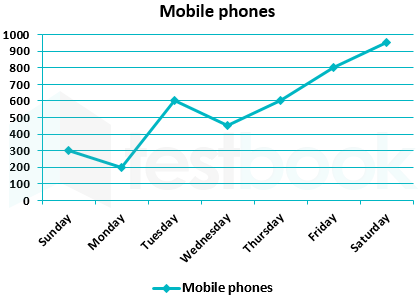
Direction: Study the given line graph carefully and answer the given questions accordingly.

Given line graph shows the sales of mobile phones in a showroom on different days of a week.

41

Which day has the highest percent increase in sales as compared to the preceding day?

  1. ((a))

    Tuesday

  2. ((b))

    Wednesday

  3. ((c))

    Saturday

  4. ((d))

    Friday

  5. ((e))

    Monday

Show Answer
Answer: ((a))

Tuesday

42

Number of mobile phones sold on Wednesday is how much percent of the number of mobile phone sold on Tuesday?

  1. ((a))

    50%

  2. ((b))

    60%

  3. ((c))

    75%

  4. ((d))

    45%

  5. ((e))

    80%

Show Answer
Answer: ((a))

50%

43

Find the difference between the highest number of mobiles sold and the lowest number of mobiles sold in the given week?

  1. ((a))

    750 

  2. ((b))

    475

  3. ((c))

    950

  4. ((d))

    375

  5. ((e))

    850

Show Answer
Answer: ((a))

750 

44

Find the ratio of the number of mobiles sold on Wednesday and Saturday together to the number of mobiles sold on Sunday, Tuesday and Friday together?

  1. ((a))

    17 : 14

  2. ((b))

    14 : 17

  3. ((c))

    12 : 17

  4. ((d))

    17 : 12

  5. ((e))

    12 : 14

Show Answer
Answer: ((a))

17 : 14

45

What is the total number of mobile phones sold on all the given days? 

  1. ((a))

    4100

  2. ((b))

    3700

  3. ((c))

    3900

  4. ((d))

    3950

  5. ((e))

    3600

Show Answer
Answer: ((a))

4100

46

In what time will Rs. 500 give Rs. 50 as interest at the rate of 5% per annum on simple interest?

  1. ((a))

    2 years

  2. ((b))

    3 years

  3. ((c))

    4 years

  4. ((d))

    5 years

  5. ((e))

    None of these

Show Answer
Answer: ((a))

2 years

47

The ratio of the base to the height of right angled triangle is 5 ∶ 4. If the area of right angled triangle is 160 cm2, what is the height of triangle?

  1. ((a))

    16 cm

  2. ((b))

    18 cm

  3. ((c))

    20 cm

  4. ((d))

    25 cm

  5. ((e))

    12 cm

Show Answer
Answer: ((a))

16 cm

48

Find the value of x.

42 ÷ 6 ×  3 + 5 – (8 + 7) + 123 = x

  1. ((a))

    128

  2. ((b))

    134

  3. ((c))

    126

  4. ((d))

    122

  5. ((e))

    118

Show Answer
Answer: ((a))

128

49

What approximate value should come in the place of the question mark (?) in the following question?

(34.99 + 24.96 × 3.98) ÷ 14.95 + 44.92 = ?

  1. ((a))

    40

  2. ((b))

    45

  3. ((c))

    54

  4. ((d))

    60

  5. ((e))

    64

Show Answer
Answer: ((a))

40

50

What approximate value should come in the place of the question mark (?) in the following question?

44.96 + 74.99 - 140.25 + √? = 75.12

  1. ((a))

    5625

  2. ((b))

    7225

  3. ((c))

    9025

  4. ((d))

    105

  5. ((e))

    2425

Show Answer
Answer: ((a))

5625

51

What is the value of the question mark (?) in the equation below?

? = 50% of 360 + 25% of 800

  1. ((a))

    320

  2. ((b))

    340

  3. ((c))

    360

  4. ((d))

    380

  5. ((e))

    310

Show Answer
Answer: ((a))

320

52

What will come in the place of '?' in the following question? 

450 / 15 × (28 − 12 ) + 32 = ?

  1. ((a))

    480

  2. ((b))

    492

  3. ((c))

    512

  4. ((d))

    504

  5. ((e))

    534

Show Answer
Answer: ((a))

480

53

Find the approximate value of x in the following question given below

16.982 + 6.993 - 447.98 ÷ 8.02 = x2

  1. ((a))

    34

  2. ((b))

    36

  3. ((c))

    28

  4. ((d))

    24

  5. ((e))

    32

Show Answer
Answer: ((a))

34

54

What (approximate value) should come in the place of (?) for the expression given below?

599.57 + 5.95 × 9.79 - 15.87 ÷ 3.88 = ?

  1. ((a))

    656

  2. ((b))

    756

  3. ((c))

    876

  4. ((d))

    More than one of the above

  5. ((e))

    None of the above

Show Answer
Answer: ((a))

656

55

Simplify:

412×32÷4812+4\rm \frac{4}{12}\times \frac{3}{2}\div \frac{4}{8}-12+4

  1. ((a))

    -8

  2. ((b))

    -7

  3. ((c))

    8

  4. ((d))

    More than one of the above

  5. ((e))

    None of the above

Show Answer
Answer: ((a))

-8

56

What is the value of √(513 - √144 - √81 - √64)

  1. ((a))

    22

  2. ((b))

    21

  3. ((c))

    28

  4. ((d))

    More than one of the above

  5. ((e))

    None of the above

Show Answer
Answer: ((a))

22

57

What approximate value should come in the place of the question mark (?) in the following question?

184.92 - 14.92 × 5.99 + 71.99 ÷ 5.95 = ?

  1. ((a))

    107

  2. ((b))

    117

  3. ((c))

    127

  4. ((d))

    97

  5. ((e))

    137

Show Answer
Answer: ((a))

107

58

The value of (16.5 × 3 - 35 ÷ 5 - 3 × 13.5) is 

  1. ((a))

    2

  2. ((b))

    12

  3. ((c))

    -2.5

  4. ((d))

    More than one of the above

  5. ((e))

    None of the above

Show Answer
Answer: ((a))

2

59

What approximate value should come in the place of (?) in the following questions?

(343.01)1/3 + (1023.64) 1/2 + 55.02% of 810 = 222.02 + 2.2992 + ?

  1. ((a))

    261

  2. ((b))

    262

  3. ((c))

    265

  4. ((d))

    263

  5. ((e))

    264

Show Answer
Answer: ((a))

261

60

Find the value of x.

x + 276 - 150 = 137 + 264 - 331 + 211

  1. ((a))

    185

  2. ((b))

    125

  3. ((c))

    145

  4. ((d))

    155

  5. ((e))

    175

Show Answer
Answer: ((a))

185

61

Find the approximate value of x in the following question given below

2308.96 + x – 355.96 + 28.972 = 343.95

  1. ((a))

    -2750

  2. ((b))
    • 2650
  3. ((c))

    -2450

  4. ((d))
    • 2350
  5. ((e))
    • 2250
Show Answer
Answer: ((a))

-2750

62

Find the approximate value of x in the following question given below

(35.97 ×  12.01 ÷ 15.99 + √81.18)2 = x + 25.982

  1. ((a))

    520

  2. ((b))

    620

  3. ((c))

    625

  4. ((d))

    670

  5. ((e))

    640

Show Answer
Answer: ((a))

520

63

The ratio of the present ages of Sonam and Reeta is 6 : 5 respectively. Five years ago the ratio was 5:4. What will be the age of Sonam after 7 years?

  1. ((a))

    37

  2. ((b))

    32

  3. ((c))

    20

  4. ((d))

    Cannot be determined

  5. ((e))

    None of these

Show Answer
Answer: ((a))

37

64

A and B together can do a piece of work in 8 days. A alone can do this work in 12 days. In how many days can B alone do the same work?

  1. ((a))

    22

  2. ((b))

    23

  3. ((c))

    24

  4. ((d))

    More than one of the above

  5. ((e))

    None of the above

Show Answer
Answer: ((a))

22

65

A 100 m long train passes a 350 m long platform in 54 seconds. Another train which is 20% more in length and its speed is also 20% more than that of the first train. In how much time will another train take to cross the platform?

  1. ((a))

    40 sec

  2. ((b))

    47 sec

  3. ((c))

    50 sec

  4. ((d))

    More than one of the above

  5. ((e))

    None of the above

Show Answer
Answer: ((a))

40 sec

66

Find the missing number in the number series.

82, 84, 90, 102, ?, 152

  1. ((a))

    128

  2. ((b))

    126

  3. ((c))

    122

  4. ((d))

    132

  5. ((e))

    124

Show Answer
Answer: ((a))

128

67

Find the missing number in the series

35, 43, 70, 195, ?, 1869

  1. ((a))

    438

  2. ((b))

    540

  3. ((c))

    538

  4. ((d))

    583

  5. ((e))

    835

Show Answer
Answer: ((a))

438

68

Find the missing number in the series

1, 7, -5, 13, ?, 19

  1. ((a))

    37

  2. ((b))

    35

  3. ((c))
    • 37
  4. ((d))

    11

  5. ((e))
    • 11
Show Answer
Answer: ((a))

37

69

Find the missing number in the series

15, 21, 29, 39, ?, 65

  1. ((a))

    52

  2. ((b))

    50

  3. ((c))

    51

  4. ((d))

    41

  5. ((e))

    40

Show Answer
Answer: ((a))

52

70

Find the missing number in the series

8, 16, 48, 192, 960, ?

  1. ((a))

    5560

  2. ((b))

    5650

  3. ((c))

    5670

  4. ((d))

    5760

  5. ((e))

    5570

Show Answer
Answer: ((a))

5560

71

A and B enter into a partnership. A contributed ₹ 5000 for 8 months and B ₹ 6000 for 5 months. Find A’s share in a total profit of ₹ 8400. 

  1. ((a))

    ₹ 4800

  2. ((b))

    ₹ 2400

  3. ((c))

    ₹ 3600

  4. ((d))

    ₹ 5600 

  5. ((e))

    None of these

Show Answer
Answer: ((a))

₹ 4800

72

What is the cost price of an article that is sold at a 10% profit, and the selling price is Rs 11,000?

  1. ((a))

    20,000

  2. ((b))

    14,000

  3. ((c))

    12,500

  4. ((d))

    More than one of the above

  5. ((e))

    None of the above

Show Answer
Answer: ((a))

20,000

73

Two numbers are in the ratio 2 : 5. If their product is 810, find the sum of the numbers.

  1. ((a))

    45

  2. ((b))

    81

  3. ((c))

    63

  4. ((d))

    50

  5. ((e))

    49

Show Answer
Answer: ((a))

45

74

The ratio of number of blue and red cards in a pack is 5 : 3. The difference between the number of blue and red cards is 60. Find the total number of cards in a pack.

  1. ((a))

    270

  2. ((b))

    240

  3. ((c))

    180

  4. ((d))

    210

  5. ((e))

    200

Show Answer
Answer: ((a))

270

75

A store man offers a discount of 30% on his items, If Marked price of an item is Rs. 400. Find the Selling price of an item?

  1. ((a))

    400

  2. ((b))

    280

  3. ((c))

    450

  4. ((d))

    600

  5. ((e))

    550

Show Answer
Answer: ((a))

400

Directions: The table shows the total number of participants in two different games carrom and chess and number of participants in chess games in four different days in a competition.


DaysTotal number of participants in carrom and chessNumber of participants in chess
Monday400250
Tuesday350150
Wednesday300200
Thursday450250
76

If 1/3rd of the number of participants in carrom on Monday and 1/4th of the number of participants in chess on Wednesday are females. Find the sum of the number of females participating in carrom on Monday and in chess on Wednesday.

  1. ((a))

    100

  2. ((b))

    200

  3. ((c))

    150

  4. ((d))

    125

  5. ((e))

    110

Show Answer
Answer: ((a))

100

77

If the number of participants in chess on Monday, Tuesday, Wednesday, and Thursday is increased by 20%, 40%, 50% and 20%. Find the total number of participants in chess from all the days.

  1. ((a))

    1120

  2. ((b))

    1110

  3. ((c))

    1130

  4. ((d))

    1140

  5. ((e))

    1150

Show Answer
Answer: ((a))

1120

78

The number of participants in carrom on Friday is 80 more than that of Thursday and the number of participants in chess on Friday is 70 more than that of Thursday. Find the sum between 1/4th of the participants in carrom on Friday and 1/8th of the participants in chess on Friday.

  1. ((a))

    110

  2. ((b))

    120

  3. ((c))

    150

  4. ((d))

    160

  5. ((e))

    130

Show Answer
Answer: ((a))

110

79

Find the ratio between the total number of participants in carrom on Monday and Tuesday to the total number of participants in carrom on Wednesday and Thursday.

  1. ((a))

    7: 6

  2. ((b))

    6: 7

  3. ((c))

    5: 4

  4. ((d))

    3: 2

  5. ((e))

    7: 9

Show Answer
Answer: ((a))

7: 6

80

If 20% of the number of participants in chess on Monday and 1/2 of the number of participants in carrom on Wednesday are pro players. Find the sum of the number of pro players participants in chess on Monday and in carrom on Wednesday. 

  1. ((a))

    150

  2. ((b))

    120

  3. ((c))

    100

  4. ((d))

    80

  5. ((e))

    90

Show Answer
Answer: ((a))

150

Attempt this paper under real exam conditions

Timed interface, section switching, instant scoring, and question-by-question analytics — free.

Start Timed Attempt