Official Paper

RRB Clerk Prelims Memory Based Paper (Held on: 08 August 2021 Shift 1) (Previous Year Paper)

80 questions · 45 minutes · with answers · free

Reasoning (40 questions)

Directions: Study the following information carefully to answer the given questions:

S M P 6 3 * $ A 4 L N @ Z 5 # V U 7 E 8 B % T Y X G 2 I & 9 W

1

Which of the following is the third to the left of the fifteenth from the left end ?

  1. ((a))

    @

  2. ((b))

    5

  3. ((c))

    U

  4. ((d))

    7

  5. ((e))

    None of these

Show Answer
Answer: ((a))

@

Given series:

Left side  S M P 6 3 * $ A 4 L N @ Z 5 # V U 7 E 8 B % T Y X G 2 I & 9 W  Right side   

As, Left - Left = Left

15th from the left - 3rd from the left = 12th from the left side

Clearly, 12th from the left is ‘@’

Hence, ‘@’ is the correct answer.

2

How many such Vowels are there in the above arrangement each of which is immediately followed by an even number and immediately  preceded by a symbol ?

  1. ((a))

    One

  2. ((b))

    Two

  3. ((c))

    Three

  4. ((d))

    Four

  5. ((e))

    None

Show Answer
Answer: ((a))

One

Given series:

Left side  S M P 6 3 * $ A 4 L N @ Z 5 # V U 7 E 8 B % T Y X G 2 I & 9 W  Right side

Required arrangement: Symbol → Vowel → Even number

Vowels immediately followed by an even number and preceded by a symbol

S M P 6 3 * $ A 4 L N @ Z 5 # V U 7 E 8 B % T Y X G 2 I & 9 W

Hence, there is only one vowel which is immediately followed by an even number and preceded by a symbol: $ A 4

3

Four of the following five are alike in a certain way based on their positions in the above arrangement and so form a group. Which is the one that does not belong to that group?

  1. ((a))

    A 4 *

  2. ((b))

    T B Y 

  3. ((c))

    V 5 U

  4. ((d))

    P S 6

  5. ((e))

    9 I W

Show Answer
Answer: ((a))

A 4 *

Given series:

Left side  S M P 6 3 * $ A 4 L N @ Z 5 # V U 7 E 8 B % T Y X G 2 I & 9 W  Right side

Here the group is formed in which the second element is the second left of the first element and third element is the immediate right of the first element.

Where as in A 4 * , Second element is immediate right of the first and third element is second left of the first element. Here, we can say that logic for this is just opposite from the all other.

Hence, ‘A 4 *’ does not belong to the group.

4

How many such numbers are there in the above arrangement each of which is immediately followed by a vowel and immediately preceded by a consonant?

  1. ((a))

    One

  2. ((b))

    Two

  3. ((c))

    Three

  4. ((d))

    Four

  5. ((e))

    None

Show Answer
Answer: ((a))

One

Given series:

Left side  S M P 6 3 * $ A 4 L N @ Z 5 # V U 7 E 8 B % T Y X G 2 I & 9 W  Right side

Required arrangement: Consonant → Number → Vowel

Numbers which are immediately followed by a vowel and immediately preceded by a consonant:

S M P 6 3 * $ A 4 L N @ Z 5 # V U 7 E 8 B % T Y X G 2 I & 9 W

Hence, there is only one number which is immediately followed by a vowel and immediately preceded by a consonant: G 2 I

5

If all the symbols in the above arrangement are dropped, then which of the following will be the fifteenth from the left end?

  1. ((a))

    E

  2. ((b))

    7

  3. ((c))

    8

  4. ((d))

    B

  5. ((e))

    U

Show Answer
Answer: ((a))

E

Given series:

Left side  S M P 6 3 * $ A 4 L N @ Z 5 # V U 7 E 8 B % T Y X G 2 I & 9 W  Right side 

  1. If all the symbols are dropped then we have the series:

Left side  S M P 6 3 A 4 L N Z 5 V U 7 E 8 B T Y X G 2 I 9 W  Right side

  1. 15th letter or number from the left end is E

Hence, the letter fifteenth  from the left end is ‘E

Direction: Study the following information carefully and answer the following questions.

An uncertain number of person is sitting in a row facing towards North. Q is sitting second from the left end. S is sitting seventh to the right of M. L is sitting exactly in between Q and S. O is sitting second to the left of R. Only two people are sitting between Q and M. Only one person is sitting between S and O. P is sitting immediately to the left of N who is sitting third to the right of R.

6

Who is sitting at the extreme right end of the row?

  1. ((a))

    No One

  2. ((b))

    Q

  3. ((c))

    R

  4. ((d))

    N

  5. ((e))

    M

Show Answer
Answer: ((d))

N

  1. Q is sitting second from the left end.

  2. Only two people are sitting between Q and M.

  1. S is sitting seventh to the right of M. 

  2. L is sitting exactly in between Q and S. 

  1. Only one person is sitting between S and O. 

  2. O is sitting second to the left of R. 

  3. P is sitting immediately to the left of N who is sitting third to the right of R.

Hence, N is sitting to the right end of the row.

7

How many persons are sitting in the row?

  1. ((a))

    14

  2. ((b))

    16

  3. ((c))

    19

  4. ((d))

    20

  5. ((e))

    21

Show Answer
Answer: ((c))

19

  1. Q is sitting second from the left end.

  2. Only two people are sitting between Q and M.

  1. S is sitting seventh to the right of M. 

  2. L is sitting exactly in between Q and S. 

  1. Only one person is sitting between S and O. 

  2. O is sitting second to the left of R. 

  3. P is sitting immediately to the left of N who is sitting third to the right of R.

Hence, 19 people are sitting in the row.

8

Which of the following statement is correct regarding P?

  1. ((a))

    P sits second to the right of N

  2. ((b))

    P sits second to the left of R

  3. ((c))

    P is second from one the extreme ends

  4. ((d))

    P is immediate right of N

  5. ((e))

    None of the given statement is true

Show Answer
Answer: ((c))

P is second from one the extreme ends

  1. Q is sitting second from the left end.

  2. Only two people are sitting between Q and M.

  1. S is sitting seventh to the right of M. 

  2. L is sitting exactly in between Q and S. 

  1. Only one person is sitting between S and O. 

  2. O is sitting second to the left of R. 

  3. P is sitting immediately to the left of N who is sitting third to the right of R.

Hence, N is sitting at the extreme right end of the row.

9

How many people are sitting in between L and O?

  1. ((a))

    Four

  2. ((b))

    Five

  3. ((c))

    Six

  4. ((d))

    Seven

  5. ((e))

    More than seven

Show Answer
Answer: ((c))

Six

  1. Q is sitting second from the left end.

  2. Only two people are sitting between Q and M.

  1. S is sitting seventh to the right of M. 

  2. L is sitting exactly in between Q and S. 

  1. Only one person is sitting between S and O. 

  2. O is sitting second to the left of R. 

  3. P is sitting immediately to the left of N who is sitting third to the right of R.

Hence, six people are sitting in between L and O.

10

Who is exactly between O and P?

  1. ((a))

    L

  2. ((b))

    S

  3. ((c))

    M

  4. ((d))

    R

  5. ((e))

    N

Show Answer
Answer: ((d))

R

  1. Q is sitting second from the left end.

  2. Only two people are sitting between Q and M.

  1. S is sitting seventh to the right of M. 

  2. L is sitting exactly in between Q and S. 

  1. Only one person is sitting between S and O. 

  2. O is sitting second to the left of R. 

  3. P is sitting immediately to the left of N who is sitting third to the right of R.

Hence, R is exactly between O and P.

11

How many such pairs of digits are there in the number ‘3614729’, each of which has as many digits between them in the number (both forward and backward direction) as they have between them in the numerical series?

  1. ((a))

    Two

  2. ((b))

    Three

  3. ((c))

    Four

  4. ((d))

    Five

  5. ((e))

    More than five

Show Answer
Answer: ((e))

More than five

Total 7 pairs are possible. 

Hence, More than five is the correct answer.

12

Direction: In the following question assuming the given statements to be true, find which of the conclusion among the given two conclusion(s) is /are definitely true, and then give your answers accordingly.

Statements:

P ≤ Q = R ≥ S ≥ T < U

Conclusions:

I. P < U

II. Q ≥ T

  1. ((a))

    Only conclusion I follow

  2. ((b))

    Only conclusion II follow

  3. ((c))

    Either conclusion I or II follows

  4. ((d))

    Neither conclusion I nor II follows

  5. ((e))

    Both conclusion I and II follow

Show Answer
Answer: ((b))

Only conclusion II follow

Given statement: P ≤ Q = R ≥ S ≥ T < U

Conclusions:

I. P < U → False (As P ≤ Q = R ≥ S ≥ T < U; no clear relation between P and U)

II. Q ≥ T → True (Q = R ≥ S ≥ T)

Hence, only conclusion II follow.

13

Direction: In the following question assuming the given statements to be true, find which of the conclusion(s) among given conclusions is/are definitely true and then give your answers accordingly.

Statement: 

A ≥ H > B = F < G < W

Conclusions:

I. W > B

II. A > G

  1. ((a))

    Only conclusion I follows

  2. ((b))

    Only conclusion II follows

  3. ((c))

    Both conclusions I and II follow

  4. ((d))

    Either conclusion I or II follows

  5. ((e))

    None follows

Show Answer
Answer: ((a))

Only conclusion I follows

Given statement,

A ≥ H > B = F < G < W

Conclusions:

I. W > B → True (B = F < G < W → B < W i.e. W > B).

II. A > G → False (A ≥ H > B = F < G → A > F < G, thus a clear relation between A and G cannot be determined).

Hence, the correct answer is only conclusion I follows.

14

Directions: In the following question assuming the given statements to be True, find which of the conclusion among given conclusions is / are definitely true and then give your answers accordingly.

Statements:

Q ≥ N < B = U > D ≥ Y > W < O

Conclusions:

I. N < U

II. U > W

  1. ((a))

    Only I follows

  2. ((b))

    Only II follows

  3. ((c))

    Both I and II follow

  4. ((d))

    Either I or II follows

  5. ((e))

    None follows

Show Answer
Answer: ((c))

Both I and II follow

Given statement: Q ≥ N < B = U > D ≥ Y > W < O

Conclusions:

I. N < U → True (As N < B = U, N < U)

II. U > W → True (As U > D ≥ Y > W, U > W)

Hence, Both conclusion I and II follows.

15

Directions: In the following question assuming the given statements to be true, find which of the conclusion among the given conclusions is/ are definitely true and then give your answers accordingly

Statements: H ≥ X < R < D ≥ F > Y

Conclusions:

I. H ≥ Y

II. Y > H

  1. ((a))

    Only II is True

  2. ((b))

    Both I and II are True

  3. ((c))

    Either I or II is True

  4. ((d))

    Only I is True

  5. ((e))

    Neither I nor II is True

Show Answer
Answer: ((c))

Either I or II is True

Given statements: H ≥ X < R < D ≥ F > Y

Conclusions:

I. H ≥ Y → False (as H ≥ X < R < D ≥ F > Y, thus clear relation cannot be determined)

II. Y > H → False (as H ≥ X < R < D ≥ F > Y, thus clear relation cannot be determined)

Therefore, Conclusion I and Conclusion II forms complementary pair

Hence, Either I or II is true

NOTE:

If all three possible conditions (<, >, =) between any two entities are included in conclusions, and both the conclusion are individually false then it would be a case of ‘either-or’.

Direction: Study the following information carefully to answer the given questions.

Seven boxes A, B, C, D, E, F and G are kept one above the other to form a stack but not necessarily in the same order. More than three boxes are kept between A and E. Box E is kept above Box A.  Box G is kept below box B. Two boxes are kept between B and G. Box A is kept immediately below box G. Two boxes are kept between F and C. Box C is not kept above G.

16

How many boxes are kept above box D?

  1. ((a))

    None

  2. ((b))

    One

  3. ((c))

    Two

  4. ((d))

    Three

  5. ((e))

    None of the above given option is true

Show Answer
Answer: ((c))

Two

  1. Two boxes are kept between B and G.

  2.  Box G is kept below box

  3. Box A is kept just below box G.

  4. More than three boxes are kept between A and E.

CASE 1CASE 2CASE 3
EE
EB
BB
G
GGA
AA
<br>
  1. Box C is not kept above G.  (This eliminates case 1 and case 2)

  2. Two boxes are kept between F and C.

CASE 3
E
B
D
F
G
A
C
<br>

Hence, two boxes are kept above ox D.

17

Which among the following box is kept just above G?

  1. ((a))

    C

  2. ((b))

    D

  3. ((c))

    E

  4. ((d))

    F

  5. ((e))

    B

Show Answer
Answer: ((d))

F

  1. Two boxes are kept between B and G.

  2.  Box G is kept below box

  3. Box A is kept just below box G.

  4. More than three boxes are kept between A and E.

CASE 1CASE 2CASE 3
EE
EB
BB
G
GGA
AA
<br>
  1. Box C is not kept above G.  (This eliminates case 1 and case 2)

  2. Two boxes are kept between F and C.

CASE 3
E
B
D
F
G
A
C
<br>

Hence, box F is kept just above G.

18

Number of box above D is same as number of box below ________?

  1. ((a))

    A

  2. ((b))

    B

  3. ((c))

    E

  4. ((d))

    F

  5. ((e))

    G

Show Answer
Answer: ((e))

G

  1. Two boxes are kept between B and G.

  2.  Box G is kept below box

  3. Box A is kept just below box G.

  4. More than three boxes are kept between A and E.

CASE 1CASE 2CASE 3
EE
EB
BB
G
GGA
AA
<br>
  1. Box C is not kept above G.  (This eliminates case 1 and case 2)

  2. Two boxes are kept between F and C.

CASE 3
E
B
D
F
G
A
C
<br>

Hence, number of box above D is same as number of box below G.

19

Which of the following statement is NOT TRUE regarding arrangement?

  1. ((a))

    Box F is kept below E. 

  2. ((b))

    Five boxes are kept between F and A

  3. ((c))

    Box D is not kept above Box G

  4. ((d))

    Both 1) and 3)

  5. ((e))

    Both 2) and 3)

Show Answer
Answer: ((e))

Both 2) and 3)

  1. Two boxes are kept between B and G.

  2.  Box G is kept below box

  3. Box A is kept just below box G.

  4. More than three boxes are kept between A and E.

CASE 1CASE 2CASE 3
EE
EB
BB
G
GGA
AA
<br>
  1. Box C is not kept above G.  (This eliminates case 1 and case 2)

  2. Two boxes are kept between F and C.

CASE 3
E
B
D
F
G
A
C
<br>

Hence, Both 2) and 3) is not true is the correct answer.

20

Which of the following box is kept at the top?

  1. ((a))

    D

  2. ((b))

    E

  3. ((c))

    B

  4. ((d))

    F

  5. ((e))

    None of the given option is true

Show Answer
Answer: ((b))

E

  1. Two boxes are kept between B and G.

  2.  Box G is kept below box

  3. Box A is kept just below box G.

  4. More than three boxes are kept between A and E.

CASE 1CASE 2CASE 3
EE
EB
BB
G
GGA
AA
<br>
  1. Box C is not kept above G.  (This eliminates case 1 and case 2)

  2. Two boxes are kept between F and C.

CASE 3
E
B
D
F
G
A
C
<br>

Hence, E is kept at the top.

21

In a certain code language "FRIED" is written as "QEJCD", "PLANT" is written as "KOBSM" how is "SHOWN" written in that code language?

  1. ((a))

    RGPVM

  2. ((b))

    VMPRG

  3. ((c))

    GRPMV

  4. ((d))

    TIPXO

  5. ((e))

    GRNMV

Show Answer
Answer: ((c))

GRPMV

Hence, "SHOWN" is written as "GRPMV".

22

Point A is 6 m north of B. Point C is 8 m west of B. Point D is 4 m north of point C. Point D is 5 m West of E, which is 4m south of point F. Point F is in which direction with respect to A?

  1. ((a))

    North

  2. ((b))

    North East

  3. ((c))

    South West

  4. ((d))

    North West

  5. ((e))

    South East

Show Answer
Answer: ((d))

North West

Hence, Point F is in north west direction with respect to point A.

23

Directions: In the question below are given two statements followed by two conclusions. You have to take the given statements to be true even if they seem to be at variance with commonly known facts. Read all the conclusions and then decide which of the given conclusions logically follows from the given statements disregarding commonly known facts.

Statements:

All Tiles are Floors

Only a few Floors are Paint

Conclusions:

I. Some Tiles are Paint

II. No Tiles are Paint

  1. ((a))

    Only I follow

  2. ((b))

    Only II follow

  3. ((c))

    Both I and II follow

  4. ((d))

    Either I or II follow

  5. ((e))

    Neither I nor II follow

Show Answer
Answer: ((d))

Either I or II follow

The least possible venn diagram for the given statements is:

Conclusions:

I. Some Tiles are Paint → False (It is possible but not definite, because no definite relation is given between the elements, therefore we will consider it as false.)

II. No Tiles are Paint → False (It is possible but not definite, because no definite relation is given between the elements, therefore we will consider it as false.)

Here in conclusions I and II, we have common elements and both the conclusions are false. The conclusions start with 'Some' and 'No'. Hence it is Either or case.

Hence, Either I or II follow, is the correct answer.

24

Directions: In the question below are given two statements followed by two conclusions. You have to take the given statements to be true even if they seem to be at variance with commonly known facts. Read all the conclusions and then decide which of the given conclusions logically follows from the given statements disregarding commonly known facts.

Statements:

I. Some tables are chairs

II. Only a few chairs are bed

Conclusions:

I. Some chairs are bed

II. Some chairs are not bed

  1. ((a))

    Only conclusion I follows

  2. ((b))

    Only conclusion II follows

  3. ((c))

    Either conclusion I or II follows

  4. ((d))

    Neither conclusion i nor IIfollows

  5. ((e))

    Both conclusion I and II follows

Show Answer
Answer: ((e))

Both conclusion I and II follows

The least possible venn diagram for the given statements is:

Conclusions:

I. Some chairs are bed → True (As the relation of “only a few” is given between the elements which implies that “some” and “some not” both are true)

II. Some chairs are not bed → True (As the relation of “only a few” is given between the elements which implies that “some” and “some not” both are true)

Hence, Both conclusion I and II follows.

25

Direction: In the question below are given two statements followed by two conclusions numbered I and II. You have to take the given statements to be true even if they seem to be at variance with commonly known facts. Read all the conclusions and then decide which of the given conclusions logically follows from the given statements disregarding commonly known facts.

Statements:

Only a few boy is girl.

Some girl is child.

Conclusions:

I. Some boy is not girl.

II. Some child is boy.

  1. ((a))

    Only conclusion I follow 

  2. ((b))

    Only conclusion II follow

  3. ((c))

    Either I or II follows

  4. ((d))

    Neither I nor II follows

  5. ((e))

    Both conclusion I and II follow

Show Answer
Answer: ((a))

Only conclusion I follow 

The least possible Venn diagram for the given statements is as follows:

Conclusions:

I. Some boy is not girl → True (as only a few boy is girl which means some boy is girl and some boy is not girl. So, Some boy is not girl is true).

II. Some child is boy → False (as there is no relation between child and boy. So, it is possible but it is not definite. Hence, Some child is boy is false).

Hence, Only conclusion I Follows.

26

Direction: In the question below are given two statements followed by two conclusions numbered I, and II. You have to take the given statements to be true even if they seem to be at variance with commonly known facts. Read all the conclusions and then decide which of the given conclusions logically follows from the given statements disregarding commonly known facts.

Statement:

Only a few shirts are pants

All pants are trousers

Conclusion :

I. Some trousers are shirts 

II. No shirts are trousers

  1. ((a))

    Only II follow

  2. ((b))

    Both I and II follow

  3. ((c))

    Either I or II follow

  4. ((d))

    Only I follow

  5. ((e))

    Neither I nor II follow

Show Answer
Answer: ((d))

Only I follow

The least possible Venn diagram for the given statements is as follows:

Conclusion :

I. Some trousers are shirts → True (As per the statement only a few shirts are pants and all pants are trousers then the portion of shirts inside pants will be trousers as well. So this is true)

II. No shirts are trousers → False (As per the statement only a few shirts are pants and all pants are trousers then the portion of shirts inside pants will be trousers as well. So this is false)

Hence, Only I follow.

27

Direction: In the question below are given two statements followed by two conclusions numbered I and II. You have to take the given statements to be true even if they seem to be at variance with commonly known facts. Read all the conclusions and then decide which of the given conclusions logically follows from the given statements disregarding commonly known facts.

Statements:

Only a few Door is Fan.

No Fan is Book.

Conclusions:

I. Some Fan is not Book.

II. No Book is Door.

  1. ((a))

    Only conclusion I follows

  2. ((b))

    Only conclusion II follows

  3. ((c))

    Both conclusion I and II follow

  4. ((d))

    Either conclusion I or II follows

  5. ((e))

    Neither conclusion I nor II follows

Show Answer
Answer: ((a))

Only conclusion I follows

The least possible diagram for the given statements is as follows;

Conclusions:

I. Some Fan is not Book → True (As No Fan is Book, some part of Fan will also not be Book. So, it is true)

II. No Book is Door → False (As there is no direct relation between Book and Door it is possible but not definite. So, it is false)

Hence, only conclusion I follows.

Directions: Study the following information and answer the given questions.

There are eight people P, Q, R, S, T, U, V and W sitting around a circular table all are facing toward the centre. Two persons are sitting between P and Q. U is sitting immediately right of Q. Two persons are sitting between Q and R. T is sitting opposite to R. V is sitting to the immediate right of P. S is sitting second to the right of W.

28

Who is sitting second to the right of T?

  1. ((a))

    U

  2. ((b))

    V

  3. ((c))

    P

  4. ((d))

    Q

  5. ((e))

    R

Show Answer
Answer: ((a))

U

There are eight people P, Q, R, S, T, U and V sitting around a circular table all are facing toward the centre.

  1. Two persons are sitting between P and Q.

  1. U is sitting immediately right of Q.

  1. Two persons are sitting between Q and R

  1. T is sitting opposite to R.

Case II got eliminated.

)

  1. V is sitting to the immediate right of P.
  2. S is sitting second to the right of W.

Hence, U is sitting second to the right of T.

29

Who is sitting opposite to P?

  1. ((a))

    W

  2. ((b))

    Q

  3. ((c))

    U

  4. ((d))

    V

  5. ((e))

    R

Show Answer
Answer: ((c))

U

There are eight people P, Q, R, S, T, U and V sitting around a circular table all are facing toward the centre.

1. Two persons are sitting between P and Q.

  1. U is sitting immediately right of Q.

  1. Two persons are sitting between Q and R

  1. T is sitting opposite to R.

Case II got eliminated.

  1. V is sitting to the immediate right of P.
  2. S is sitting second to the right of W.

Hence U is sitting opposite to P.

30

Who is sitting fourth to the left of S?

  1. ((a))

    Q

  2. ((b))

    P

  3. ((c))

    R

  4. ((d))

    U

  5. ((e))

    T

Show Answer
Answer: ((a))

Q

There are eight people P, Q, R, S, T, U and V sitting around a circular table all are facing toward the centre.

1. Two persons are sitting between P and Q.

  1. U is sitting immediately right of Q.

  1. Two persons are sitting between Q and R

  1. T is sitting opposite to R.

Case II got eliminated.

  1. V is sitting to the immediate right of P.
  2. S is sitting second to the right of W.

Hence, Q is sitting fourth to the left of S.

31

How many persons are sitting between P and U?

  1. ((a))

    One

  2. ((b))

    Two

  3. ((c))

    Three

  4. ((d))

    Four

  5. ((e))

    Five

Show Answer
Answer: ((c))

Three

There are eight people P, Q, R, S, T, U and V sitting around a circular table all are facing toward the centre.

1. Two persons are sitting between P and Q.

  1. U is sitting immediately right of Q.

  1. Two persons are sitting between Q and R

  1. T is sitting opposite to R.

Case II got eliminated.

  1. V is sitting to the immediate right of P.
  2. S is sitting second to the right of W.

Hence, Three persons are sitting between P and U.

32

Who is sitting third to the right of Q?

  1. ((a))

    R

  2. ((b))

    P

  3. ((c))

    S

  4. ((d))

    T

  5. ((e))

    U

Show Answer
Answer: ((a))

R

There are eight people P, Q, R, S, T, U and V sitting around a circular table all are facing toward the centre.

1. Two persons are sitting between P and Q.

  1. U is sitting immediately right of Q.

  1. Two persons are sitting between Q and R

  1. T is sitting opposite to R.

Case II got eliminated.

  1. V is sitting to the immediate right of P.
  2. S is sitting second to the right of W.

Hence, R is sitting third to the right of Q.

33

If the letters in the word "BROWNIE" are rearranged as they appear in the English alphabetical series from left to right then the position of how many letters will remain unchanged after the rearrangement?

  1. ((a))

    None

  2. ((b))

    One

  3. ((c))

    Two

  4. ((d))

    Three

  5. ((e))

    Four

Show Answer
Answer: ((b))

One

WordBROWNIE
Alphabetically arrangedBEINORW
<br>

Hence, Only one such alphabet is there that is remain at the same position.

Directions: These questions are based on the following information.

There are 8 member A, B, C, D, E, F and G in a family. A is grandfather of F and father of C. B is mother of G. E is mother of F, and wife of C. G is sister of C. D is mother of E. F is sister of H.

34

How G is related to H?

  1. ((a))

    Aunt

  2. ((b))

    Mother

  3. ((c))

    Sister

  4. ((d))

    Mother-in-law

  5. ((e))

    Father

Show Answer
Answer: ((a))

Aunt

From the given information, 

1. A is grandfather of F and father of C. 2. E is mother of F and wife of C. 3. B is mother of G. 4. G is sister of C.

  1. D is mother of E.
  2. F is sister of H.

Hence, G is Aunt of H.

35

How C is related to D?

  1. ((a))

    Son

  2. ((b))

    Son-in-law

  3. ((c))

    Brother

  4. ((d))

    Father

  5. ((e))

    Husband

Show Answer
Answer: ((b))

Son-in-law

From the given information, 

1. A is grandfather of F and father of C. 2. E is mother of F and wife of C. 3. B is mother of G. 4. G is sister of C.

  1. D is mother of E..
  2. F is sister of H.

Hence, C is Son-in-law of D.

Direction: Read the given information carefully and answer the questions asked below.

Seven people  A, B, C, D, E, F, and G live on seven different floors of a building but not necessarily in the same order. The lowermost floor of the building is numbered as 1 and topmost floor is numbered as 7. A does not live on the topmost floor. B lives immediately below F. C lives on an even-numbered floor. Three people live between F and C. The number of people living between F and D is equal to the number of people living between D and C. More than four people live between E and G. B lives on one of the floors below G.

36

Who among the following lives on the sixth floor?

  1. ((a))

    G

  2. ((b))

    F

  3. ((c))

    A

  4. ((d))

    B

  5. ((e))

    E

Show Answer
Answer: ((b))

F

Seven people: A, B, C, D, E, F, and G

Floors (from bottom to top) – 1 to 9

  1. C lives on an even-numbered floor.

  2. Three people live between F and C. 

  3. The number of people living between F and D is equal to the number of people living between D and C.

  4. B lives immediately below F.

Case 1

Floors(From top to bottom)People
7
6C
5
4D
3
2F
1B


Case 2

Floors(From top to bottom)People
7
6F
5B
4D
3
2C
1


  1. More than four people live between E and G. Hence, case 1 is eliminated.

  2. B lives on one of the floors below G

Floors(From top to bottom)People
7G
6F
5B
4D
3A
2C
1E


Hence, ‘F’ lives on the sixth floor.

37

How many people live between G and B?

  1. ((a))

    Three

  2. ((b))

    Four

  3. ((c))

    Two

  4. ((d))

    One 

  5. ((e))

    Five

Show Answer
Answer: ((d))

One 

Seven people: A, B, C, D, E, F, and G

Floors (from bottom to top) – 1 to 9

  1. C lives on an even-numbered floor.

  2. Three people live between F and C. 

  3. The number of people living between F and D is equal to the number of people living between D and C.

  4. B lives immediately below F.

Case 1

Floors(From top to bottom)People
7
6C
5
4D
3
2F
1B


Case 2

Floors(From top to bottom)People
7
6F
5B
4D
3
2C
1


  1. More than four people live between E and G. Hence, case 1 is eliminated.

  2. B lives on one of the floors below G

Floors(From top to bottom)People
7G
6F
5B
4D
3A
2C
1E


Hence, ‘F’ lives on the sixth floor.

Hence, only one person lives between G and B.

38

Four of the following five options are alike in a certain way, find out the odd one?

  1. ((a))

    B and A

  2. ((b))

    A and G

  3. ((c))

    C and E

  4. ((d))

    E and G

  5. ((e))

    G and B

Show Answer
Answer: ((c))

C and E

Seven people: A, B, C, D, E, F, and G

Floors (from bottom to top) – 1 to 9

  1. C lives on an even-numbered floor.

  2. Three people live between F and C. 

  3. The number of people living between F and D is equal to the number of people living between D and C.

  4. B lives immediately below F.

Case 1

Floors(From top to bottom)People
7
6C
5
4D
3
2F
1B


Case 2

Floors(From top to bottom)People
7
6F
5B
4D
3
2C
1


  1. More than four people live between E and G. Hence, case 1 is eliminated.

  2. B lives on one of the floors below G

Floors(From top to bottom)People
7G
6F
5B
4D
3A
2C
1E


Hence, ‘F’ lives on the sixth floor.

In all options except option 3, the person is living on the odd-numbered floor.

But, in option 3, C is living on the second floor (even-numbered floor). E is living in floor which is not prime. 

Hence, ‘C’ is the correct answer.

39

Who among the following lives two floors below A?

  1. ((a))

    E

  2. ((b))

    C

  3. ((c))

    B

  4. ((d))

    D

  5. ((e))

    F

Show Answer
Answer: ((a))

E

Seven people: A, B, C, D, E, F, and G

Floors (from bottom to top) – 1 to 9

  1. C lives on an even-numbered floor.

  2. Three people live between F and C. 

  3. The number of people living between F and D is equal to the number of people living between D and C.

  4. B lives immediately below F.

Case 1

Floors(From top to bottom)People
7
6C
5
4D
3
2F
1B


Case 2

Floors(From top to bottom)People
7
6F
5B
4D
3
2C
1


  1. More than four people live between E and G. Hence, case 1 is eliminated.

  2. B lives on one of the floors below G

Floors(From top to bottom)People
7G
6F
5B
4D
3A
2C
1E


Hence, ‘F’ lives on the sixth floor.

Hence, ‘E’ lives two floors below A.

40

Which of the following statements are correct according to the given arrangement?

  1. ((a))

    Three people lives between F and E.

  2. ((b))

    G lives on the topmost floor. 

  3. ((c))

    D lives immediately above B.

  4. ((d))

    C lives on the third floor.

  5. ((e))

    F lives on an odd numbered floor.

Show Answer
Answer: ((b))

G lives on the topmost floor. 

Seven people: A, B, C, D, E, F, and G

Floors (from bottom to top) – 1 to 9

  1. C lives on an even-numbered floor.

  2. Three people live between F and C. 

  3. The number of people living between F and D is equal to the number of people living between D and C.

  4. B lives immediately below F.

Case 1

Floors(From top to bottom)People
7
6C
5
4D
3
2F
1B


Case 2

Floors(From top to bottom)People
7
6F
5B
4D
3
2C
1


  1. More than four people live between E and G. Hence, case 1 is eliminated.

  2. B lives on one of the floors below G

Floors(From top to bottom)People
7G
6F
5B
4D
3A
2C
1E


Hence, ‘F’ lives on the sixth floor.

  1. Three people lives between F and E → Incorrect (Four people lives between F and E)

  2. G lives on the topmost floor → Correct.

  3. D lives immediately above B → Incorrect (D lives immediately below B)

  4. C lives on the third floor → Incorrect (C lives on the second floor)

  5. F lives on an odd-numbered floor → Incorrect (F lives on the sixth number floor)

Hence, ‘G lives on the topmost floor’ is the correct answer.

Numerical Ability (40 questions)

41

What will come in the place of the question mark ‘?’ in the following question? 

55 × 45 + 205 - 15 × 12 = (?)

  1. ((a))

    45

  2. ((b))

    55

  3. ((c))

    50

  4. ((d))

    60

  5. ((e))

    None of these

Show Answer
Answer: ((c))

50

Concept used:

Follow the BODMAS rule according to the table given below: 

Calculation:

55 × 45 + 205 – 15 × 12 = (?)2 

⇒ 2475 + 205 – 15 × 12 = (?)2

⇒ 2475 + 205 – 180 = (?)2

⇒ 2680 – 180 = (?)2

⇒ 2500 = (?)2

⇒ ? = 50

∴ The value of ? is 50

42

What will come in the place of the question mark ‘?’ in the following question? 

40% of 50% of 3/4 of 2400 = ?

  1. ((a))

    3600

  2. ((b))

    36

  3. ((c))

    360

  4. ((d))

    366

  5. ((e))

    None of these

Show Answer
Answer: ((c))

360

Concept used:

Follow the BODMAS rule according to the table given below: 

Calculation:

40% of 50% of 3/4 of 2400 = ? 

⇒ 40% × 50% × 3/4 × 2400 = ?

⇒ (40/100) × (50/100) × 3/4 × 2400 = ?

⇒ 2/5 × 1/2 × 3/4 × 2400 = ?

⇒ (6/40) × 2400 = ?

⇒ ? = 360

∴ The value of ? is 360

43

What will come in the place of the question mark ‘?’ in the following question? 

272 × 425 ÷ (?)2 = 400

  1. ((a))

    15

  2. ((b))

    13

  3. ((c))

    17

  4. ((d))

    27

  5. ((e))

    None of these

Show Answer
Answer: ((c))

17

Concept used:

Follow the BODMAS rule according to the table given below: 

Calculation:

272 × 425 ÷ (?)2 = 400

⇒ 115600 ÷ (?)2 = 400

⇒ (?)2 = 115600/400

⇒ (?)2 = 289

⇒ ? = 17

∴ The value of ? is 17

44

What will come in the place of the question mark ‘?’ in the following question?

56 ÷ 14 × 4 – 316 + ?2 = 100

  1. ((a))

    10

  2. ((b))

    20

  3. ((c))

    30

  4. ((d))

    25

  5. ((e))

    None of these

Show Answer
Answer: ((b))

20

Concept used:

Follow the BODMAS rule according to the table given below:

Calculation:

56 ÷ 14 × 4 – 316 + ?2  = 100

⇒ 4 × 4 – 316 + ?2 = 100

⇒ 16 – 316 + ?2 = 100

⇒ ?2 = 100 + 316 – 16

⇒ ?2 = 416 – 16

⇒ ?2 = 400

⇒ ? = 20

∴ The value of ? is 20

45

What will come in the place of the question mark ‘?’ in the following question? 

729 ÷ 27 + 23 × 5 - ? = 36% of 200

  1. ((a))

    40

  2. ((b))

    66

  3. ((c))

    50

  4. ((d))

    70

  5. ((e))

    None of these

Show Answer
Answer: ((d))

70

Concept used:

Follow the BODMAS rule according to the table given below: 

Calculation:

729 ÷ 27 + 23 × 5 - ? = 36% of 200

⇒ 729 ÷ 27 + 23 × 5 – ? = (36/100) × 200

⇒ 729 ÷ 27 + 23 × 5 – ? = 72

⇒ 27 + 23 × 5 – ? = 72

⇒ 27 + 115 – ? = 72

⇒ 142 – ? = 72

⇒ ? = 142 – 72

⇒ ? = 70

∴ The value of ? is 70

Direction: The following tabulation shows the collection of books by A, B, and C for five different months. Study the following data and answer the following questions∶

Number of books/MonthJulyAugustSeptemberOctoberNovember
A86901096648
B100681197536
C30507654105
46

Number of books collected by C in November is how much more/less than Number of books collected by B in July?

  1. ((a))

    25

  2. ((b))

    50

  3. ((c))

    30

  4. ((d))

    16

  5. ((e))

    None of these

Show Answer
Answer: ((e))

None of these

Calculation:

Number of books collected by C in November = 105

Number of books collected by B in July = 100

Required = (105 – 100)

⇒ 5

∴ None of these

47

What is ratio of number of books collected by A and C together in August to number of books collected by B and C together in July?

  1. ((a))

    1 : 1

  2. ((b))

    14 : 13

  3. ((c))

    13 : 14

  4. ((d))

    7 : 6

  5. ((e))

    None of these

Show Answer
Answer: ((b))

14 : 13

Calculation:

Number of books collected by A and C in August = (90 + 50)

⇒ 140

Number of books collected by B and C in July = (100 + 30)

⇒ 130

Required ratio = (140 : 130)

⇒ 14 : 13

∴ Required ratio is 14 : 13

48

Which month has the minimum number of books?

  1. ((a))

    July

  2. ((b))

    August

  3. ((c))

    September

  4. ((d))

    October

  5. ((e))

    November

Show Answer
Answer: ((e))

November

Calculation:

Total number of books in July = (86 + 100 + 30) = 216

Total number of books in August = (90 + 68 + 50) = 208

Total number of books in September = (109 + 119 + 76) = 304

Total number of books in October = (66 + 75 + 54) = 195

Total number of books in November = (48 + 36 + 105) = 189

Required minimum number of books in November

∴ The minimum number of books in month is November

49

What is the difference between number of book collected by B in november to number of book collected by A in July and August together?

  1. ((a))

    120

  2. ((b))

    135

  3. ((c))

    155

  4. ((d))

    140

  5. ((e))

    none of these

Show Answer
Answer: ((d))

140

Calculation:

Number of book collected by B in November = 36

Number of book collected by A in July and August = (86 + 90)

⇒ 176

Required difference = (176 – 36)

⇒ 140

∴ Required difference is 140

50

What is the average of number of books collected by A in all the given month except September and November?

  1. ((a))

    87

  2. ((b))

    67

  3. ((c))

    77

  4. ((d))

    57

  5. ((e))

    None of these

Show Answer
Answer: ((e))

None of these

Calculation:

Total numbers of books collected by A in July and August and October = (86 + 90 + 66)

⇒ 242

Required average = (242/3)

⇒ 80.66

∴ Required average is 80.66

51

The area of a square and a rectangle are equal. The length of the rectangle is 8 cm more than the length of any side of the square and the breadth is 6 cm less than the length of any side of the square. The perimeter (in cm) of the rectangle will be:

  1. ((a))

    120 cm

  2. ((b))

    80 cm

  3. ((c))

    100 cm

  4. ((d))

    140 cm

  5. ((e))

    160 cm

Show Answer
Answer: ((c))

100 cm

Given:

Length of the rectangle = (side of square + 8 cm)

Breadth of the rectangle = (side of square – 6 cm)

Formula used:

Area of rectangle = Length × Breadth

Area of square = (side)2 

Perimeter of rectangle = 2(Length + Breadth)

Calculation: 

Let side of a square be a

Let Length and Breadth of a rectangle be l and b respectively

a= (l × b)

⇒ a2 = [(a + 8) × (a – 6)]

⇒ a2 = a2 – 6a + 8a – 48

⇒ 2a = 48 cm

⇒ a = 24 cm

⇒ l = (a + 8) = (24 + 8)

⇒ 32 cm

⇒ b = (a – 6) = (24 – 6)

⇒ 18 cm

Perimeter of rectangle = 2(32 + 18) cm

⇒ 100 cm

∴ Perimeter of rectangle is 100 cm

52

25 litres of a mixture contains alcohol and water in the ratio 1 : 4. If 5 litres of water is mixed in it, the percentage of alcohol in the new mixture will be

  1. ((a))

    20%

  2. ((b))

    25%

  3. ((c))

    11.11%

  4. ((d))

    14.28%

  5. ((e))

    16.66%

Show Answer
Answer: ((e))

16.66%

Given:

Ratio of alcohol and water in 25 litres of mixture = 1 : 4

Water is added in mixture = 5 litres

Calculation:

Quantity of alcohol in mixture = (1/5 × 25) litres

⇒ 5 litres

Quantity of Water in mixture = (25 – 5) litres

⇒ 20 litres

New quantity of water added in mixture = (5 + 20) litres

⇒ 25 litres

Now required percentage of alcohol =(5/30) × 100

⇒ 16.66%

∴  The new mixture is 16.66%

53

A student goes to college at the rate of 5 km/h and reaches 12 minutes late. If he travels at the speed of 8 km/h he is 15 minutes early. Find the distance between his college and his starting point?

  1. ((a))

    7 km

  2. ((b))

    9 km

  3. ((c))

    5 km

  4. ((d))

    6 km

  5. ((e))

    8 km

Show Answer
Answer: ((d))

6 km

Given:

Time taken to cover 5 km = 12 min late

S1 = 5 km/hr = 25/18 m/s, t1 = t + (12 × 60) sec = t1 = (t + 720) sec 

Time taken to cover 8 km = 15 min early

S2 = 8 km/hr = 20/9 m/s, t2 = t + (15 × 60) sec = t2 = (t - 900) sec 

Formula used:

Distance =  Speed × Time

Calculation:

D1 = S1 × t1

D1=2518×(t+720) mD_1=\frac{25}{18} \times (t+720)~m............(1)

D2 = S2 × t2

D2=209×(t900) mD_2=\frac{20}{9} \times (t-900)~m................(2)

But the distance between his college and his starting point is same, i.e. D1 = D2

So, by equating both equations, 

2518×(t+720)=209×(t900)\frac{25}{18} \times (t+720) =\frac{20}{9} \times (t-900)

5t + 3600 = 8t - 7200

t = 3600 sec = 1 hr

So, by equation (1)

D1=2518×(t+720) mD_1=\frac{25}{18} \times (t+720)~m

D1=2518×(3600+720) mD_1=\frac{25}{18} \times (3600+720)~m

D1 = 6000 m = 6 km

Alternate Method

Calculation:

Let the distance between his college and his starting point = x km

According to question,

⇒ x/5 – x/8 = (12 + 15)/ 60

⇒ (8x – 5x)/40 = 9/20

⇒ x = (18 / 3) km

⇒ 6 km

∴ Required distance is 6 km

54

The ratio between the upstream speed of boat and the speed of current is 7 : 1. If the boat can cover 70 km upstream in 5 hours, then find the distance it can cover running downstream in 5 hours

  1. ((a))

    75 km

  2. ((b))

    85 km

  3. ((c))

    80 km

  4. ((d))

    95 km

  5. ((e))

    90 km

Show Answer
Answer: ((e))

90 km

Given:

Ratio of upstream speed and speed of current = 7 : 1

Distance covered upstream in 5 hours = 70 km

Concept used:

Speed of Boat = Upstream speed + Speed of current

Downstream speed = Speed of boat + Speed of current

Calculation:

Upstream speed = (70/5) km/hr

⇒ 14 km/hr

Let the upstream speed and speed of current be 7x and x respectively

Now, 7x = 14 km/hr

⇒ x = 2 km/hr

Speed of boat = (14 + 2) km/hr

⇒ 16 km/hr

Downstream speed = (16 + 2) km/hr

⇒ 18 km/hr

Distance covered downstream in 5 hours = (18 × 5) km

⇒ 90 km

∴ Distance covered by boat downstream in 5 hours is 90 km

55

The sum of five consecutive even and four consecutive odd number is 96. Find the difference between highest even number and lowest odd number among them if smallest even number is 4.

  1. ((a))

    7

  2. ((b))

    1

  3. ((c))

    3

  4. ((d))

    5

  5. ((e))

    None of these

Show Answer
Answer: ((b))

1

Given:

Sum of 5 consecutive even numbers and 5 consecutive odd numbers = 96

Smallest even number = 4

Calculation:

5 consecutive even numbers = 4, 6, 8, 10 and 12

Let the smallest odd numbers be x

4 odd numbers = x, (x + 2), (x + 4) and (x + 6)

Now, According to the question,

4 + 6 + 8 + 10 + 12 + x + x + 2 + x + 4 + x + 6 = 96

⇒ 40 + 4x + 12 = 96

⇒ 4x + 52 = 96

⇒ 4x = 44

⇒ x = 11

Lowest odd number = 11

Highest even number = 12

Required difference = 12 – 11

⇒ 1

∴ The required difference is 1

56

In a family, the average age of a father and a mother is 33 years. The average age of the father, mother and their only son is 25 years. What is the age of the son?

  1. ((a))

    16 years

  2. ((b))

    9 years

  3. ((c))

    6 years

  4. ((d))

    12 years

  5. ((e))

    18 years

Show Answer
Answer: ((b))

9 years

Given:

The average age of father and mother = 33 years

Average of father, mother, and son = 25 years

Formula used:

Sum of all observations = Average × Number of observations

Calculation:

The average age of father and mother = (33×2) years

⇒ 66 years

The average age of the father, mother, and son = (25×3) years

⇒ 75 years

Required age of son = (75 - 66) years

⇒ 9 years

∴ The age of the son is 9 years

57

What should come in place of the question mark '?' in the following number series?

9, 10, 6, 15,  ?,  24

  1. ((a))

    31

  2. ((b))

    -1

  3. ((c))

    24

  4. ((d))

    6

  5. ((e))

    None of these

Show Answer
Answer: ((b))

-1

Calculation:

The series follows the following pattern:

⇒ 9 + 1 = 10

⇒10 – 4 = 6

⇒ 6 + 9 = 15

⇒ 15 – 16 = -1

⇒ -1 + 25 = 24

or 

⇒ 9 + 12 = 10

⇒10 – 22= 6

⇒ 6 + 32 = 15

⇒ 15 – 42 = -1

⇒ -1 + 52 = 24

∴ The value of? is -1

58

What should come in place of the question mark '?' in the following number series?

7, 3.5, 3.5, 7, 28, ?

  1. ((a))

    56

  2. ((b))

    168

  3. ((c))

    224

  4. ((d))

    140

  5. ((e))

    None of these

Show Answer
Answer: ((c))

224

Calculation:

The series follows the following pattern:

⇒ 7 × 0.5 = 3.5

⇒ 3.5 × 1 = 3.5

⇒ 3.5 × 2 = 7

⇒ 7 × 4 = 28

⇒ 28 × 8 = 224

∴ The value of ? is 224

59

What should come in place of the question mark '?' in the following number series?

3, 17, 45, 87, ?, 213

  1. ((a))

    133

  2. ((b))

    143

  3. ((c))

    153

  4. ((d))

    152

  5. ((e))

    None of these

Show Answer
Answer: ((b))

143

Calculation:

The series follows the following pattern:

⇒ 3 + 14 = 17

⇒ 17 + 28 = 45

⇒ 45 + 42 = 87

⇒ 87 + 56 = 143

⇒ 143 + 70 = 213

∴ The value of ? is 143

60

What should come in place of the question mark '?' in the following number series?

6, 10, 15, 22, 32, ?

  1. ((a))

    46

  2. ((b))

    36

  3. ((c))

    42

  4. ((d))

    32

  5. ((e))

    None of these

Show Answer
Answer: ((a))

46

Calculation:

The series follows the following pattern:

⇒ 6 + 4 + 0 = 10

⇒ 10 + 4 + 1= 15

⇒ 15 + 5 + 2  = 22

⇒ 22 + 7+ 3 = 32

⇒ 32 + 10 + 4 = 46

∴ The value of ? is 46

61

What should come in place of the question mark '?' in the following number series?

6, 5, 9, 26, ?, 514

  1. ((a))

    129

  2. ((b))

    77

  3. ((c))

    102

  4. ((d))

    103

  5. ((e))

    None of these

Show Answer
Answer: ((d))

103

Calculation:

The series follows the following pattern:

⇒ 6 × 1 – 1 = 5

⇒ 5 × 2 – 1 = 9

⇒ 9 × 3 – 1 = 26

⇒ 26 × 4 – 1 = 103

⇒ 103 × 5 – 1 = 514

∴ The value of ? is 103

62

A train moving at a speed of 36 km/hr crosses a standing man in 10 seconds. Find the time taken by it to cross a platform of 60 m.

  1. ((a))

    10 s

  2. ((b))

    6 s

  3. ((c))

    12 s

  4. ((d))

    16 s

  5. ((e))

    20 s

Show Answer
Answer: ((d))

16 s

Shortcut Trick

Speed in m/s = 36 × 5/18 = 10 m/s.

Train Length = Speed × Time = 10 × 10 = 100 m.

Total Distance to cross platform = 100 + 60 = 160 m.

Time Required = 160 ÷ 10 = 16 s.

∴ The correct answer is 16 s.

Alternate Method

Given:

Speed of train = 36 km/hr

Time to cross man = 10 s

Length of platform = 60 m

Formula Used:

Speed = Distance ÷ Time

1 km/hr = 5/18 m/s

Calculations:

⇒ Speed = 36 × (5/18) = 10 m/s

⇒ Length of Train (Lt) = Speed × Timeman = 10 × 10 = 100 m

⇒ Total Distance to cross platform = Lt + Length of Platform = 100 + 60 = 160 m

⇒ Time to cross platform = Total Distance ÷ Speed = 160 ÷ 10 = 16 s

∴ The correct answer is 16 s.

Additional Information

Relative Speed

When two objects move in the same direction, relative speed = S1 − S2. In opposite directions, relative speed = S1 + S2.

Crossing Stationary Objects

To cross a point object (man, pole), distance = train length. To cross an extended object (bridge, platform), distance = train length + object length.

Unit Conversion

To convert km/hr to m/s, multiply by 5/18. To convert m/s to km/hr, multiply by 18/5.

63

Two equal sums were borrowed at 8% p.a. for 2 years and 3 years respectively. The difference in the interest was Rs. 96. Find the equal sum borrowed.

  1. ((a))

    1200

  2. ((b))

    800

  3. ((c))

    2400

  4. ((d))

    1600

  5. ((e))

    None of these

Show Answer
Answer: ((a))

1200

Given:

Rate of interest = 8%

Time period of investment = 2 years and 3 years

Difference in interest = Rs. 96

Formula used:

SI = PRT/100

Calculation:

Let the sum borrowed be Rs. x

Now, SI for 2 years = Rs. (x × 8 × 2)/100

⇒ Rs. 4x/25

Now, SI for 3 years = Rs. (x × 8 × 3)/100

⇒ Rs. 6x/25

According to the question,

(6x/25) – (4x/25) = Rs. 96

⇒ 2x/25 = Rs. 96

⇒ x/25 = Rs. 48

⇒ x = Rs. 1200

∴ The equal sum borrowed is Rs. 1200

Shortcut Trick

Calculation:

Rate of interest = 8%

Time period of investment = 2 years and 3 years

Difference in interest = Rs. 96

Difference is of 1 year, so 8% = Rs. 96

Then, 100% = Rs. (96/8) × 100

⇒ Rs. 1200

∴ The equal sum borrowed is Rs. 1200

64

Two person A and B  can do a work in 60 days and 40 days respectively. They started the work together but A left after some time and B finished the remaining work in 10 days. After how many days A leave?

  1. ((a))

    12 days

  2. ((b))

    15 days

  3. ((c))

    8 days

  4. ((d))

    18 days

  5. ((e))

    none of these

Show Answer
Answer: ((d))

18 days

Given:

Time taken to complete the work by A = 60 days

Time taken to complete the work by B = 40 days

Remaining work finished by B = 10 days

Concept used:

Efficiency = Total work / Time

Calculation:

LCM of 60 and 40 = 120 units = Total work

Efficiency of A = 120/60

⇒ 2 units/days

Efficiency of B = 120/40

⇒ 3 units/days

Remaining work completed by B alone = 3 × 10 days = 30 units 

So, time taken by A and B together work 

⇒ Total work – Work completed by B alone /Efficiency of A and B

⇒ (120 – 30) / (2 + 3)

⇒ (90/5) days

⇒ 18 days

∴ A leave the work after 18 days

65

A person spends 25% of his annual income on house rent. 15% on travelling and 45% on miscellaneous things. If he saves Rs. 13500 annually, then the personal spending on miscellaneous things is

  1. ((a))

    Rs. 90000

  2. ((b))

    Rs. 40500

  3. ((c))

    Rs. 45000

  4. ((d))

    Rs. 45500

  5. ((e))

    Rs. 30000

Show Answer
Answer: ((b))

Rs. 40500

Given:

Spending on house rent = 25%

Spending on travelling = 15%

Spending on miscellaneous things = 45%

Annual saving = Rs. 13,500

Calculation:

Let total salary = 100%

Expenditure = (25% + 15% + 45%)

⇒ 85%

Her saving = 100% – 85%

⇒ 15%

Let her salary be x 

Then, (15x/100) = 13,500

⇒ Rs. 90,000

Required spending on miscellaneous things =  Rs. (45% of 90,000)

⇒Rs. (45/100) × 90,000

⇒ Rs. 40,500

∴ The personal spending on miscellaneous things is Rs. 40,500

66

An amount of  money is to be divided among A, B and C in the ratio 4 : 5 : 7 respectively. If the amount received by A and B is Rs. 1000 more than amount received by C, The total amount received by A and B together is 

  1. ((a))

    Rs. 5500

  2. ((b))

    Rs. 8000

  3. ((c))

    Rs. 4500

  4. ((d))

    Rs. 6000

  5. ((e))

    none of these

Show Answer
Answer: ((c))

Rs. 4500

Given:

Ratio of amount of money = 4 : 5 : 7

Amount of A and B = Rs. 1000 more than C

Calculation:

Let the amount received by A and B and C be 4x and 5x and 7x respectively

⇒ (4x + 5x) = 1000 + 7x

⇒ 9x = 1000 + 7x

⇒ 2x = 1000

⇒ x = 500

Required amount received by A and B together = (4 × 500 + 5 × 500)

⇒ (2000 + 2500)

⇒ Rs. 4500

∴ Total amount received by A and B = Rs. 4500

67

The cost price of an article is 70% of the marked price. The gain percentage after allowing a discount of 9% on the marked price is

  1. ((a))

    20%

  2. ((b))

    25%

  3. ((c))

    30%

  4. ((d))

    can't be determined

  5. ((e))

    none of these

Show Answer
Answer: ((c))

30%

Given:

CP is 70% of the MP

Discount = 9%

Formula used:

Gain = SP –  CP

Gain % = gain/CP × 100

Calculation:

Let MP of the article be RS. x

CP of the article = (x × 70)/100 

⇒ 70x/100

SP of the article = x × (100 – 9) / 100

⇒ 91x/100

Gain = (91x/100) – (70x/100)

⇒ Rs. 21x/100

Hence , gain % = (21x/100) / (70x/100) × 100

⇒ 21/100 × 100/70 × 100

⇒ 30%

∴ Gain percentage is 30%

68

What will come in the place of the question mark ‘?’ in the following question? 

(255 - 55) ÷ 4 × 15 - 504 ÷ 3 = ?

  1. ((a))

    82

  2. ((b))

    76

  3. ((c))

    582

  4. ((d))

    85

  5. ((e))

    None of these

Show Answer
Answer: ((c))

582

Concept used:

Follow the BODMAS rule according to the table given below: 

Calculation:

(255 - 55) ÷ 4 × 15 – 504 ÷ 3 = ?

⇒ 200 ÷ 4 × 15 – 504 ÷ 3 = ?

⇒ 50 × 15 – 504 ÷ 3 = ?

⇒ 50 × 15 – 168 = ?

⇒ 750 – 168 = ?

⇒ ? = 582

∴ The value of ? is 582

69

What will come in the place of the question mark ‘?’ in the following question?

20% of 36 + 40% of 60 = ?

  1. ((a))

    32.1

  2. ((b))

    31.2

  3. ((c))

    30.2

  4. ((d))

    23.2

  5. ((e))

    30.8

Show Answer
Answer: ((b))

31.2

Concept used:

Calculation:

 ⇒ 20% of 36 + 40% of 60 = ?

⇒ (20/100) × 36 + (40/100) × 60 = ?

⇒ (7.2 + 24) = ?

⇒ ? = 31.2

∴ The value of ? is 31.2

70

What will come in the place of the question mark ‘?’ in the following question? 

√5625 ÷ 15 × 21 ÷ 3 + 5 = ?

  1. ((a))

    40

  2. ((b))

    8

  3. ((c))

    30

  4. ((d))

    25

  5. ((e))

    None of these

Show Answer
Answer: ((a))

40

Concept used:

Follow the BODMAS rule according to the table given below: 

Calculation:

√5625 ÷ 15 × 21 ÷ 3 + 5 = ?

⇒ 75 ÷ 15 × 21 ÷ 3 + 5 = ?

⇒ 5 × 21 ÷ 3 + 5 = ?

⇒ 5 × 7 + 5 = ?

⇒  35 + 5 = ?

⇒ ? = 40

∴ The value of ? is 40

71

What will come in the place of the question mark ‘?’ in the following question?

(125÷1516)×?=4(1\frac{2}{5}÷1\frac{{5}}{{16}}) \times ? = 4

  1. ((a))

    3343\frac{3}{4}

  2. ((b))

    4344\frac{3}{4}

  3. ((c))

    2342\frac{3}{4}

  4. ((d))

    1341\frac{3}{4}

  5. ((e))

    None of these

Show Answer
Answer: ((a))

3343\frac{3}{4}

Concept used:

Follow the BODMAS rule according to the table given below: 

Calculation:

(125÷1516)×?=4(1\frac{2}{5}÷1\frac{{5}}{{16}}) × ? = 4

⇒ [(7/5) ÷ (21/16)] × ? = 4

⇒ (16/15) × ? = 4

⇒ (4/15) × ? = 1

⇒ ? = 15/4

∴ The value of ? is 3343\frac{3}{4}

72

What will come in the place of the question mark ‘?’ in the following question?

√324 ÷ (3/19) - 87 = ?

  1. ((a))

    20

  2. ((b))

    37

  3. ((c))

    17

  4. ((d))

    27

  5. ((e))

    15

Show Answer
Answer: ((d))

27

Concept used:

Calculation:

√324 ÷ 3/19 – 87 = ?

⇒ 18 ÷ (3/19) – 87 = ?

⇒ 18 × (19/3) – 87 = ?

⇒ 114 – 87 = ?

⇒ ? = 27

∴ The value of ? is 27

73

What will come in the place of the question mark ‘?’ in the following question? 

(3/4)3 × (2/3)÷ ? = 1/624

  1. ((a))

    52

  2. ((b))

    72

  3. ((c))

    62

  4. ((d))

    82

  5. ((e))

    None of these

Show Answer
Answer: ((a))

52

Concept used:

Follow the BODMAS rule according to the table given below:

Calculation:

(3/4)3 × (2/3)4 ÷ ? = 1/624

⇒ (27/64) × (16/81) ÷ ? = 1/624

⇒ 1/12 ÷ ? = 1/624

⇒ ? = 624/12

52

∴ The value of ? is 52

74

What will come in the place of the question mark ‘?’ in the following question?

3685 - 4228 + 3120 ÷ 2 = ?

  1. ((a))

    1117

  2. ((b))

    1017

  3. ((c))

    1701

  4. ((d))

    1710

  5. ((e))

    1700

Show Answer
Answer: ((b))

1017

Concept used:

Calculation:

3685 - 4228 + 3120 ÷ 2 = ?

⇒ 3685 – 4228 + 1560 = ?

⇒ 5245 – 4228 = ?

⇒ ? = 1017

∴ The value of ? is 1017

75

What will come in the place of the question mark ‘?’ in the following question?

224/4 + 64 × 3 = ?

  1. ((a))

    238

  2. ((b))

    243

  3. ((c))

    245

  4. ((d))

    248

  5. ((e))

    None of these

Show Answer
Answer: ((d))

248

Concept used:

Follow the BODMAS rule according to the table given below:

Calculation:

⇒ 224/4 + 64 × 3 = ?

⇒ 56 + 64 × 3 = ?

⇒ 56 + 192 = ?

⇒ ? = 248

∴ The value of ? is 248

Directions: Study the graph to answer the questions below:

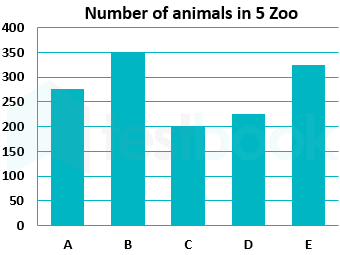
The following bar graph shows the number of animals in 5 Zoo A, B, C, D, and E.

76

Number of animals in A is what% more than that of C?

  1. ((a))

    52.75%

  2. ((b))

    33.33%

  3. ((c))

    37.5%

  4. ((d))

    40.25%

  5. ((e))

    None of these

Show Answer
Answer: ((c))

37.5%

Calculation:

Numbers of animals in A = 275

Numbers of animals in C = 200

Required percentage = [(275 – 200)/200] × 100

⇒ [75/200] × 100

⇒ 37.5%

∴ The required percentage is 37.5%

77

Find the average of total number of animals in all the zoo.

  1. ((a))

    375

  2. ((b))

    175

  3. ((c))

    300

  4. ((d))

    275

  5. ((e))

    None of these

Show Answer
Answer: ((d))

275

Calculation:

 Total number of animals in all the zoo =(275 + 350 + 200 + 225 + 325)

⇒ 1375

Required average = (1375/5)

⇒ 275

∴ Average of total numbers of animals is 275

78

Find the ratio of total number of animals in A and B together and that of C and D together.

  1. ((a))

    25: 17

  2. ((b))

    22: 25

  3. ((c))

    5: 4

  4. ((d))

    4: 5

  5. ((e))

    None of these

Show Answer
Answer: ((a))

25: 17

Calculation:

Numbers of animals in A and B together = (275 + 350)

⇒ 625

Numbers of animals in C and D together = (200 + 225)

⇒ 425

Required ratio = (625 : 425)

⇒ 25 : 17

∴ The ratio of total number of animals in A and B together and that of C and D together is 25 : 17

79

If number of animals in B is increased by 40%, then find the difference between number of animals in B and C.

  1. ((a))

    225

  2. ((b))

    175

  3. ((c))

    250

  4. ((d))

    275

  5. ((e))

    290

Show Answer
Answer: ((e))

290

Calculation:

Numbers of animals in B = 350

Animals increased in B = (350 × 140)/100

⇒ 490

Numbers of animals in C = 200

Required difference = (490 – 200)

⇒ 290

∴ Difference between B and C is 290

80

Find the number of animals in C and E together is what percent more than the number of animals in A and D together

  1. ((a))

    10%

  2. ((b))

    5%

  3. ((c))

    15%

  4. ((d))

    25%

  5. ((e))

    7%

Show Answer
Answer: ((b))

5%

Calculation:

Numbers of animals in C and E = (200 + 325)

⇒ 525

Numbers of animals in A and D = (275 + 225)

⇒ 500

Required percentage = [(525 – 500)/500] × 100

⇒ [25/500] × 100

⇒ 5%

∴ Required percentage is 5%

Attempt this paper under real exam conditions

Timed interface, section switching, instant scoring, and question-by-question analytics — free.

Start Timed Attempt