Official Paper

IBPS Clerk Prelims Memory Based Paper (Held On: 24 August 2024 Shift 1) (Previous Year Paper)

100 questions · 60 minutes · with answers · free

Reasoning Ability (35 questions)

Direction: Read the given information carefully and answer the following questions.

A person went to the market to buy eight items. The products he buys are Scissors, Milk, Cheese, Flour, Pulses, Watches, Bread, and Lamp but not necessarily in the same order. The Product that is bought first placed at the top is numbered 1 and the product that is bought last placed at the bottom and numbered 8. 

Number of products bought after Cheese is less than, the number of products taken after Milk. More than two products are taken between Flour and Scissors. Only three products are taken after Scissors. One product is bought between Lamp and Scissors. Four products are bought between Watch and Bread. Bread and Cheese are not bought in the end. The Watch is bought before Milk.

1

How many products are bought between Lamp and Bread?

  1. ((a))

    Four

  2. ((b))

    Five

  3. ((c))

    Three

  4. ((d))

    Two

  5. ((e))

    One

Show Answer
Answer: ((a))

Four

2

Which Product is bought just before Scissors?

  1. ((a))

    Milk

  2. ((b))

    Pulses

  3. ((c))

    Flour

  4. ((d))

    Lamp

  5. ((e))

    Cheese

Show Answer
Answer: ((a))

Milk

3

If all the products are bought in the alphabetical order from the one product which is bought first, then how many products remain in the same position?

  1. ((a))

    Two

  2. ((b))

    Three

  3. ((c))

    Four

  4. ((d))

    One 

  5. ((e))

    None

Show Answer
Answer: ((a))

Two

4

How many products are bought before Bread?

  1. ((a))

    One

  2. ((b))

    Six

  3. ((c))

    Five

  4. ((d))

    Three

  5. ((e))

    Four

Show Answer
Answer: ((a))

One

5

Which of the following statements is/are true according to the final arrangement?

I) Only two products are bought between Cheese and Flour.

II) Pulses are bought in the end.

III) As many products are bought between Lamp and Watch as between Scissors and Cheese.

  1. ((a))

    Only I

  2. ((b))

    Only II

  3. ((c))

    Only III

  4. ((d))

    Only II and III

  5. ((e))

    Only I and Only II

Show Answer
Answer: ((a))

Only I

Direction: Read the following and answer the given questions:

Six friends M, N, O, P, Q, and R each got different marks in the examination. P score more than R. All having lesser marks than O. M score more than Q and less than R.P does not score maximum marks. The one who scores the least marks scores 31 marks. Q score is not an odd number. The one who scores the 4th highest score 52 marks.

6

Who score the least marks?

  1. ((a))

    N

  2. ((b))

    R

  3. ((c))

    Q

  4. ((d))

    M

  5. ((e))

    O

Show Answer
Answer: ((a))

N

7

Who among the following person has scored third highest marks?

  1. ((a))

    Q

  2. ((b))

    R

  3. ((c))

    N

  4. ((d))

    O

  5. ((e))

    Either R or N

Show Answer
Answer: ((a))

Q

8

If P's score is 61 marks then what may be the score of R?

  1. ((a))

    58

  2. ((b))

    68

  3. ((c))

    51

  4. ((d))

    64

  5. ((e))

    None of these

Show Answer
Answer: ((a))

58

9

Direction: In the student of the following question assuming the given statement to be true, find which of the conclusion among given conclusions is/are definitely true and then give your answers accordingly.

Statements: B ≥ C ≤ D > F, C > A < O

Conclusions:

I. B > O

II. O ≥ B

  1. ((a))

    Only I follow

  2. ((b))

    Only II follow 

  3. ((c))

    Both follows.

  4. ((d))

    None follow

  5. ((e))

    Either I or II follow.

Show Answer
Answer: ((a))

Only I follow

10

Direction: In the following question, assuming the given statement to be true, find which of the conclusion(s) among the given conclusions is/are definitely true, and then give your answers accordingly.

Statement:

E ≥ H < N ≤ D = Y, H > Q = R

Conclusions:

I. Y > Q

II. D > R

  1. ((a))

    Only I follows

  2. ((b))

    Only Il follows

  3. ((c))

    Both  I and II follow

  4. ((d))

    Either I or II follows

  5. ((e))

    Neither I or II follows

Show Answer
Answer: ((a))

Only I follows

11

Direction: In the following question, assuming the given statement to be true, find which of the conclusion(s) among the given conclusions is/are definitely true, and then give your answers accordingly.

Statement:

X ≥ H > R = W, S < W ≥ L > P

Conclusions:

I. H > P

II. S > L

  1. ((a))

    Only I follows

  2. ((b))

    Only Il follows

  3. ((c))

    Either I or II follows

  4. ((d))

    Neither I or II follows

  5. ((e))

    Both I and II follow

Show Answer
Answer: ((a))

Only I follows

12

Direction: In the following question assuming the given statement to be true, find which of the conclusion among given conclusions is/are definitely true and then give your answers accordingly.

Statements: R M < N = O, S N > A

Conclusions:

I. A < M

II. S > M

  1. ((a))

    Both follow

  2. ((b))

    None follow

  3. ((c))

    Either I or II follow

  4. ((d))

    Only II follow

  5. ((e))

    Only I follow

Show Answer
Answer: ((a))

Both follow

13

Direction: In the following question assuming the given statement to be true, find which of the conclusion among given conclusions is/are definitely true and then give your answers accordingly.

Statements: L < M < N > O, P Q = R O

Conclusions:

I. Q < M

II. Q ≥ M

  1. ((a))

    Only I follow

  2. ((b))

    Only II follow

  3. ((c))

    Both follow

  4. ((d))

    Either I or II follow

  5. ((e))

    Neither I nor II follow

Show Answer
Answer: ((a))

Only I follow

Eight persons- A, B, C, D, E, F, G and H were born in the same year of different months such as January, March, April, May, July, September, October and December but not necessarily in the same order. The consecutive alphabetical name of the persons was not born in consecutive months. A was born in the month which has an even number of days. Only three persons were born between A and B. Two persons were born between C and D who was born an adjacent month to A.F was born in July. C was born before D. The number of persons born after C was equal to the number of persons born before H. G was not born in the month of March.

14

How many persons were born between G and the one who was born in March?

  1. ((a))

    One

  2. ((b))

    Two

  3. ((c))

    Three

  4. ((d))

    Four

  5. ((e))

    Five

Show Answer
Answer: ((a))

One

15

Four of the following five are alike in a certain way and hence form a group. Which of the following one does not belong to the group?

  1. ((a))

    D

  2. ((b))

    F

  3. ((c))

    H

  4. ((d))

    B

  5. ((e))

    A

Show Answer
Answer: ((a))

D

16

The number of persons born before E is one less than the number of persons born after ____?

  1. ((a))

    D

  2. ((b))

    G

  3. ((c))

    H

  4. ((d))

    B

  5. ((e))

    A

Show Answer
Answer: ((a))

D

17

Who among the following was born after A but before F?

  1. ((a))

    D

  2. ((b))

    G

  3. ((c))

    H

  4. ((d))

    B

  5. ((e))

    A

Show Answer
Answer: ((a))

D

18

In a certain way, G is related to B in the same way D is related to F then who among the following person is related to H?

  1. ((a))

    G

  2. ((b))

    B

  3. ((c))

    F

  4. ((d))

    A

  5. ((e))

    None of these

Show Answer
Answer: ((a))

G

19

If 1 is added to each even digit and 2 is subtracted from each prime digit in the number 73384563, then what is the sum of digits which is 4th and 6th from left and right respectively?

  1. ((a))

    11

  2. ((b))

    8

  3. ((c))

    9

  4. ((d))

    10

  5. ((e))

    16

Show Answer
Answer: ((a))

11

20

There are four words given in each option that follows a certain logic, if the second letter from the left of each word is taken then a meaningful word can be formed, find the odd one which does not follow the same pattern. 

  1. ((a))

    DPKI, LINL, HAET, JRER 

  2. ((b))

    KTDN, QPON, REOT, WSRU.

  3. ((c))

    NBRT, MDOK, CISU, QREP

  4. ((d))

    BRMI, YTOL, KUST, MHTR 

  5. ((e))

    AXSE, NBVC, KHGR, RYTD

Show Answer
Answer: ((a))

DPKI, LINL, HAET, JRER 

Directions: Study the following information carefully to answer the given questions:

M 1 E & D 2 G 9 $ F @ 4 N Z W © 8 C Y A * 6

21

How many such numbers are there in the above arrangement each of which is immediately preceded by a consonant and followed by a vowel?

  1. ((a))

    Two

  2. ((b))

    Three

  3. ((c))

    One

  4. ((d))

    None

  5. ((e))

    More than three

Show Answer
Answer: ((a))

Two

22

If all the numbers in the above arrangement are dropped, then which of the following will be the tenth from the right end?

  1. ((a))

    $

  2. ((b))

    D

  3. ((c))

    F

  4. ((d))

    Z

  5. ((e))

    None of these

Show Answer
Answer: ((a))

$

23

Four of following five are alike in a certain way based on their positions in the above arrangement and so form a group. Which is the one that does not belong to that group?

  1. ((a))

    ME2

  2. ((b))

    G$4

  3. ((c))

    NWC

  4. ((d))

    YA6

  5. ((e))

    None of these

Show Answer
Answer: ((a))

ME2

24

How many letters are there between the fourth element from the left end and the eleventh element from the right end of the given arrangement?

  1. ((a))

    None

  2. ((b))

    One

  3. ((c))

    Two

  4. ((d))

    Three

  5. ((e))

    More than three

Show Answer
Answer: ((a))

None

25

Which of the following is the fifth to the left of the eleventh element from the right end of the above arrangement?

  1. ((a))

    H

  2. ((b))

    G

  3. ((c))

    %

  4. ((d))

    D

  5. ((e))

    None of these

Show Answer
Answer: ((a))

H

Directions: Study the following information and answer the given questions.

Eight people A, B, C, D, P, Q, R and S are sitting around a circle facing the center. They are not necessarily seated in the mentioned order. Only one person is sitting between P and S. Two people are sitting between S and D. Q sits second to the left of R and Q is one of the immediate neighbour of D. Equal number of people are sitting between A and C when counting from left and right of A. A is the immediate neighbour of neither S nor P. B is sitting third to the left of P.

26

Who is sitting third to the right of P?

  1. ((a))

    Q

  2. ((b))

    A

  3. ((c))

    D

  4. ((d))

    C

  5. ((e))

    B

Show Answer
Answer: ((a))

Q

27

How many people are sitting between R and C, when counted from the left of R?

  1. ((a))

    One

  2. ((b))

    Three

  3. ((c))

    Four

  4. ((d))

    Two

  5. ((e))

    Five

Show Answer
Answer: ((a))

One

28

Who is sitting opposite to S?

  1. ((a))

    D

  2. ((b))

    A

  3. ((c))

    R

  4. ((d))

    Q

  5. ((e))

    P

Show Answer
Answer: ((a))

D

29

Who is sitting exactly between S and P, when counted from the left of S?

  1. ((a))

    B

  2. ((b))

    D

  3. ((c))

    R

  4. ((d))

    Q

  5. ((e))

    A

Show Answer
Answer: ((a))

B

30

Who is sitting third to the left of D?

  1. ((a))

    B

  2. ((b))

    S

  3. ((c))

    R

  4. ((d))

    C

  5. ((e))

    A

Show Answer
Answer: ((a))

B

31

If it is possible to make only one meaningful English word with the 1st, 3rd, 5th, and 10th letters of the word MECHANICAL, which of the following will be the third letter of that word? If no such word can be made give ‘X’ as the answer and if more than one such word can be made give ‘Y’ as the answer.

  1. ((a))

    M

  2. ((b))

    L

  3. ((c))

    C

  4. ((d))

    X

  5. ((e))

    Y

Show Answer
Answer: ((a))

M

32

If 3 is subtracted from all the digits greater than 5 and 2 is added to all the digits less than 5 in the number '847239671', then how many digits are repeated in the newly formed number?

  1. ((a))

    Three

  2. ((b))

    Two

  3. ((c))

    None

  4. ((d))

    Five

  5. ((e))

    Four

Show Answer
Answer: ((a))

Three

Directions: Read the following information carefully and answer the questions.

An uncertain number of persons are sitting in a linear row, facing the north.

J sits fifth from the right end of the row. Only six persons sit between K and B. X sits second to the right of B. U sits third to the right of J. S sits fourth to the right of K. L sits to the immediate right of R.  Five persons sit between X and J. K sits second from the left end of the row. G sits to the immediate left of S. D sits third from the right end of the row. L sits third to the right of X.

33

How many persons are seated in the row?

  1. ((a))

    22

  2. ((b))

    20

  3. ((c))

    19

  4. ((d))

    21

  5. ((e))

    23

Show Answer
Answer: ((a))

22

34

Who sits sixth to the left of D?

  1. ((a))

    B

  2. ((b))

    K

  3. ((c))

    G

  4. ((d))

    R

  5. ((e))

    X

Show Answer
Answer: ((a))

B

35

Who sits exactly at the middle of the row?

  1. ((a))

    B

  2. ((b))

    R

  3. ((c))

    L

  4. ((d))

    S

  5. ((e))

    X

Show Answer
Answer: ((a))

B

English Language (30 questions)

36

Direction: In the following sentence, identify the erroneous part. Choose the corresponding option as your answer. In case there is no mistake, choose option 5 ‘No Error’.

In the modern world, (A)/ technology playing (B)/ an integral role (C)/ in our daily lives.(D)/ No Error (E)

  1. ((a))

    A

  2. ((b))

    B

  3. ((c))

    C

  4. ((d))

    D

  5. ((e))

    E

Show Answer
Answer: ((a))

A

37

Direction: In the sentence below, identify the part with an error. Mark the corresponding option. If the sentence is error-free, opt for option 5, ‘No Error’.

The missing dog (A)/ was founded (B)/ by the river bank (C)/ by a fisherman.(D)/ No Error (E)

  1. ((a))

    A

  2. ((b))

    B

  3. ((c))

    C

  4. ((d))

    D

  5. ((e))

    E

Show Answer
Answer: ((a))

A

38

Direction: One part of the sentence given below contains an error. Find this part and choose the corresponding option. If the sentence does not have an error, pick option 5 ‘No Error’.

He preferred (A)/ coffee then (B)/ tea because (C)/ it was stronger.(D)/ No Error (E)

  1. ((a))

    A

  2. ((b))

    B

  3. ((c))

    C

  4. ((d))

    D

  5. ((e))

    E

Show Answer
Answer: ((a))

A

39

Direction: In the following question, one part of the sentence has an error. Read the sentence to find the error and mark the corresponding option. If the sentence has no error choose option 5 ‘No Error’ as your answer.

The nature (A)/ of the crime was (B)/ such so it led (C)/ to wide public outrage.(D)/ No Error (E)

  1. ((a))

    A

  2. ((b))

    B

  3. ((c))

    C

  4. ((d))

    D

  5. ((e))

    E

Show Answer
Answer: ((a))

A

Directions: Read the given passage carefully to answer the following questions. Each question will have five alternatives as its answer. Choose the correct option as your answer.

In the 21st century, Indian agriculture continues to be a foundational pillar of the economy, employing nearly half of the nation’s workforce and contributing significantly to GDP. The sector's evolution is marked by a blend of traditional methods and modern technologies, aiming to boost productivity and sustainability amidst changing climatic and economic landscapes. Indian agriculture is structured around two main crop seasons: Kharif and Rabi. Kharif crops are sown at the beginning of the monsoon season in June and harvested in September or October. Key Kharif crops include rice, maize, cotton, and soybeans. Rice, in particular, is a staple for a large segment of the population and is extensively cultivated in states like Punjab, Tamil Nadu, and Andhra Pradesh. Rabi crops are planted during the winter months of October to December and harvested in the spring from April to June. Significant Rabi crops include wheat, barley, chickpeas, and mustard. Wheat stands out as a crucial staple in northern India, with Punjab, Haryana, and Uttar Pradesh being the leading producers. In recent years, Indian agriculture has increasingly embraced modernization. The advent of high-efficiency irrigation systems, such as drip and sprinkler irrigation, has revolutionized water usage, ensuring crops get adequate moisture even in regions with inconsistent rainfall. Precision farming technologies using drones and GPS have become more widespread, allowing farmers to monitor crop health and optimize resource use. Digital platforms and mobile applications are also changing the landscape. Apps that provide real-time weather updates, market prices, and agricultural advice are empowering farmers with timely information. E-commerce platforms and online marketplaces are giving farmers direct access to consumers, reducing dependency on intermediaries and improving profitability.

Despite these advancements, the sector faces significant challenges. Climate change poses a substantial risk, with increasingly unpredictable weather patterns affecting crop yields and making every ___________ a critical event for farmers. In addition, the harvest must be properly stored to avoid post-harvest losses and ensure food security during adverse conditions. Land fragmentation remains a problem, complicating mechanization efforts. Moreover, water scarcity is a persistent issue, particularly in states like Maharashtra and Rajasthan. To address these issues, sustainable agricultural practices are being promoted. Agroforestry, integrated pest management, and organic farming are gaining traction as environmentally friendly alternatives to conventional methods. The government is also active in this area, with initiatives like the Pradhan Mantri Fasal Bima Yojana (PMFBY) providing crop insurance to mitigate risks from natural disasters, and the Soil Health Card Scheme offering soil health assessments to optimize fertilizer use. Looking ahead, the future of Indian agriculture will likely hinge on innovation and sustainability. Climate-resilient crop varieties are being developed to withstand extreme weather conditions, and initiatives aimed at enhancing rural infrastructure are in progress. Collaborative efforts between the government, private sector, and research institutions are crucial for driving growth and ensuring food security for India’s vast population.
40

According to the passage, when are Kharif crops harvested in India?

  1. ((a))

    January to March

  2. ((b))

    April to June

  3. ((c))

    July to August

  4. ((d))

    September to October

  5. ((e))

    November to December

Show Answer
Answer: ((a))

January to March

41

Which states are the leading producers of rice in India?

  1. ((a))

    Maharashtra, Gujarat, and Madhya Pradesh

  2. ((b))

    Punjab, Tamil Nadu, and Andhra Pradesh

  3. ((c))

    Bihar, West Bengal, and Odisha

  4. ((d))

    Karnataka, Kerala, and Assam

  5. ((e))

    Haryana, Rajasthan, and Gujarat

Show Answer
Answer: ((a))

Maharashtra, Gujarat, and Madhya Pradesh

42

Which of the following has not been cited as a modern agricultural technology used in India?

  1. ((a))

    High-efficiency irrigation systems

  2. ((b))

    Precision farming technologies

  3. ((c))

    Satellite-based weather forecasting

  4. ((d))

    Digital platforms and mobile applications

  5. ((e))

    E-commerce platforms for farmers

Show Answer
Answer: ((a))

High-efficiency irrigation systems

43

Which of the following statements can be inferred from the passage?

A) The adoption of modern technologies in Indian agriculture has contributed to increased efficiency.

B) Land fragmentation makes it difficult to implement large-scale mechanization in Indian agriculture.

C) Government initiatives are essential in mitigating risks and promoting sustainable agricultural practices.

  1. ((a))

    Only A

  2. ((b))

    Only B

  3. ((c))

    Only C

  4. ((d))

    Both A and C

  5. ((e))

    All A, B, and C

Show Answer
Answer: ((a))

Only A

44

According to the passage, which of the following statements is incorrect?

A) Kharif crops are sown at the beginning of the monsoon season.

B) Precision farming technologies are rarely used in Indian agriculture.

C) Sustainable practices such as organic farming are gaining traction.

  1. ((a))

    Only A

  2. ((b))

    Only B

  3. ((c))

    Only C

  4. ((d))

    A and C

  5. ((e))

    B and C

Show Answer
Answer: ((a))

Only A

45

Which of the following phrases should come in the blank taken from the passage: ‘Despite these advancements, the sector faces significant challenges. Climate change poses a substantial risk, with increasingly unpredictable weather patterns affecting crop yields and making every ______ a critical event for farmers.’

  1. ((a))

    year

  2. ((b))

    monsoon

  3. ((c))

    harvest

  4. ((d))

    growing season

  5. ((e))

    irrigation cycle

Show Answer
Answer: ((a))

year

46

Which of the following words is similar in meaning to "event" in the context of the passage?

  1. ((a))

    catastrophe

  2. ((b))

    incident

  3. ((c))

    occurrence

  4. ((d))

    celebration

  5. ((e))

    achievement

Show Answer
Answer: ((a))

catastrophe

47

Which of the following words is similar in meaning to "store" in the context of the passage?

  1. ((a))

    hoard

  2. ((b))

    discard

  3. ((c))

    manufacture

  4. ((d))

    distribute

  5. ((e))

    deplete

Show Answer
Answer: ((a))

hoard

48

Which of the phrases given in the options should replace the word phrase that is underlined in the sentence to make it grammatically correct? If the sentence is correct as it is and no correction is required, select 'No correction required' as the answer.

She was married for three years when she gave her first civil services attempt.

  1. ((a))

    has been married

  2. ((b))

    had been married

  3. ((c))

    is married

  4. ((d))

    have been married

  5. ((e))

    No correction required

Show Answer
Answer: ((a))

has been married

49

Which of the phrases given in the options should replace the word phrase that is underlined in the sentence to make it grammatically correct? If the sentence is correct as it is and no correction is required, select 'No correction required' as the answer.

With the threat of riots breaking out, you need not to go to that city.

  1. ((a))

    need not to have gone

  2. ((b))

    need not gone

  3. ((c))

    need not to gone

  4. ((d))

    need not go

  5. ((e))

    No correction required

Show Answer
Answer: ((a))

need not to have gone

50

Which of the phrases given in the options should replace the word phrase that is underlined in the sentence to make it grammatically correct? If the sentence is correct as it is and no correction is required, select 'No correction required' as the answer.

Although he is my subordinate, he is senior than me in service.

  1. ((a))

    to me

  2. ((b))

    then me

  3. ((c))

    as me

  4. ((d))

    like me

  5. ((e))

    No correction required

Show Answer
Answer: ((a))

to me

51

Direction: Evaluate the following word, accompanied by three sentences containing it. Determine the sentence(s) that accurately convey the meaning of the given word.

Knee

A. She had to sit out the game because she injured her knee during practice.

B. The tailor measured the length of the pants from the waist to the knee.

C. He decided to knee around the lake for a morning jog.

  1. ((a))

    Only A

  2. ((b))

    Both A & B

  3. ((c))

    Only C

  4. ((d))

    All A, B & C

  5. ((e))

    None of these

Show Answer
Answer: ((a))

Only A

52

Directions: In the following sentence, four words given in bold are marked as A, B, C, and D, which are possible pairs to be interchanged. Choose the pair(s) of words that need to be interchanged to make the sentence grammatically correct and meaningful. If no interchange is required, mark option 5 i.e., "No interchange required" as your answer.

The adept (A) scientist found a conducive (B) environment for her research, leading to acrimonious (C) discoveries despite profound (D) debates among colleagues.

  1. ((a))

    C-D

  2. ((b))

    B-D

  3. ((c))

    D-A

  4. ((d))

    A-B

  5. ((e))

    No interchange required

Show Answer
Answer: ((a))

C-D

53

Directions: In the following sentence, four words given in bold are marked as A, B, C, and D, which are possible pairs to be interchanged. Choose the pair(s) of words that need to be interchanged to make the sentence grammatically correct and meaningful. If no interchange is required, mark option 5 i.e., "No interchange required" as your answer.

Understanding the pivotal (A) complexities of a situation is manifold (B) in resolving disputes, as it requires being cognizant (C) of various perspectives (D) in arguments.

  1. ((a))

    C-D

  2. ((b))

    A-B

  3. ((c))

    C-A and B-D

  4. ((d))

    D-A and C-B

  5. ((e))

    No interchange required

Show Answer
Answer: ((a))

C-D

54

Directions: In the following sentence, four words given in bold are marked as A, B, C, and D, which are possible pairs to be interchanged. Choose the pair(s) of words that need to be interchanged to make the sentence grammatically correct and meaningful. If no interchange is required, mark option 5 i.e., "No interchange required" as your answer.

The imposition (A) of written grammar on spoken language impedes (B) speaking disconnect (C), highlighting the competence (D) between formal rules and spoken communication.

  1. ((a))

    C-D

  2. ((b))

    A-C

  3. ((c))

    B-D

  4. ((d))

    D-C and B-A

  5. ((e))

    No interchange required

Show Answer
Answer: ((a))

C-D

55

Directions: In the following sentence, four words given in bold are marked as A, B, C, and D, which are possible pairs to be interchanged. Choose the pair(s) of words that need to be interchanged to make the sentence grammatically correct and meaningful. If no interchange is required, mark option 5 i.e., "No interchange required" as your answer.

Bitcoin emerged from early internet communities with mainstream (A) ideals, promising an alternative (B) to libertarian (C) finance amid the dot-com boom's collapse (D).

  1. ((a))

    D-A

  2. ((b))

    A-C

  3. ((c))

    B-D

  4. ((d))

    C-D

  5. ((e))

    No interchange required

Show Answer
Answer: ((a))

D-A

56

Directions: Select the most appropriate word to fill in the blank.

The investor sold all of his stocks after having a _______ about the market crashing.

  1. ((a))

    Impervious

  2. ((b))

    Premonition

  3. ((c))

    Inattention

  4. ((d))

    Reverie

  5. ((e))

    Abstraction

Show Answer
Answer: ((a))

Impervious

57

Directions: Select the most appropriate word to fill in the blank.

After his wife left him, he walked around in a _______ condition for months.

  1. ((a))

    Mirthful

  2. ((b))

    Blithesome

  3. ((c))

    Jocund

  4. ((d))

    Lugubrious

  5. ((e))

    Optimistic

Show Answer
Answer: ((a))

Mirthful

58

Fill in the blanks with the appropriate word.

Sumit is an expert on Chinese ceramics, psychology the history of crime, and a host of other_______ subjects.

  1. ((a))

    Simple

  2. ((b))

    Familiar

  3. ((c))

    Recondite

  4. ((d))

    Fleck

  5. ((e))

    Dreary

Show Answer
Answer: ((a))

Simple

59

Fill in the blanks with the appropriate word.

My grandmother's________ face broke into a smile when she saw my result.

  1. ((a))

    Freshened

  2. ((b))

    Revived

  3. ((c))

    Smooth

  4. ((d))

    Wizened

  5. ((e))

    Dewy

Show Answer
Answer: ((a))

Freshened

60

Fill in the blanks with the appropriate word.

The authorities fearing a______ of their power, called for a meeting to discuss agenda.

  1. ((a))

    Inversion 

  2. ((b))

    Infusion 

  3. ((c))

    Predilection

  4. ((d))

    Subversion

  5. ((e))

    Prediction

Show Answer
Answer: ((a))

Inversion 

Directions: Rearrange the following sentences in the proper sequence to form a meaningful paragraph and then answer the questions given below.

A. Additionally, these regions play a crucial role in regulating emotions and behaviors that are vital for social interactions.

B. This complex network of neurons is responsible for higher-order functions, including thinking, reasoning, and decision-making.

C. The prefrontal cortex, located at the front of the brain, is one of the most evolved regions in humans.

D. Damage to this area can result in significant changes in personality and social behavior, highlighting its importance.

E. Neuroscientists have long studied the prefrontal cortex to understand its impact on human cognition and social dynamics.

61

Which of the following should be the first sentence after rearrangement?

  1. ((a))

    A

  2. ((b))

    B

  3. ((c))

    C

  4. ((d))

    D

  5. ((e))

    E

Show Answer
Answer: ((a))

A

62

Which of the following should be the second sentence after rearrangement?

  1. ((a))

    B

  2. ((b))

    A

  3. ((c))

    C

  4. ((d))

    D

  5. ((e))

    E

Show Answer
Answer: ((a))

B

63

Which of the following should be the third sentence after rearrangement?

  1. ((a))

    C

  2. ((b))

    A

  3. ((c))

    B

  4. ((d))

    D

  5. ((e))

    E

Show Answer
Answer: ((a))

C

64

Which of the following should be the fourth sentence after rearrangement?

  1. ((a))

    E

  2. ((b))

    D

  3. ((c))

    A

  4. ((d))

    C

  5. ((e))

    B

Show Answer
Answer: ((a))

E

65

Which of the following should be the last sentence after rearrangement?

  1. ((a))

    D

  2. ((b))

    E

  3. ((c))

    C

  4. ((d))

    A

  5. ((e))

    B

Show Answer
Answer: ((a))

D

Numerical Ability (35 questions)

66

What should come in place of the question mark '?' in the following number series?

31, 32, 28, 37, ?, 46

  1. ((a))

    25

  2. ((b))

    21

  3. ((c))

    31

  4. ((d))

    11

  5. ((e))

    15

Show Answer
Answer: ((a))

25

67

What should come in place of the question mark '?' in the following number series?

6, 7, 16, 51, ?, 1045

  1. ((a))

    198

  2. ((b))

    208

  3. ((c))

    218

  4. ((d))

    188

  5. ((e))

    228

Show Answer
Answer: ((a))

198

68

What should come in place of the question mark '?' in the following number series?

45, 47, 50, 55, 62, ?

  1. ((a))

    71

  2. ((b))

    75

  3. ((c))

    69

  4. ((d))

    78

  5. ((e))

    73

Show Answer
Answer: ((a))

71

69

What should come in place of the question mark '?' in the following number series?

10, 11, 24, 75, ?, 1525

  1. ((a))

    298

  2. ((b))

    368

  3. ((c))

    286

  4. ((d))

    304

  5. ((e))

    326

Show Answer
Answer: ((a))

298

70

What should come in place of the question mark '?' in the following number series?

3, 4, 8, 35, ?, 176

  1. ((a))

    54

  2. ((b))

    56

  3. ((c))

    58

  4. ((d))

    51

  5. ((e))

    52

Show Answer
Answer: ((a))

54

71

The ratio of the length to the breadth of a rectangle is 4 : 3, and the area of the rectangle is 300 square units. If the breadth of the rectangle is decreased by 20% and the length is increased by 10%, what will be the new perimeter of the rectangle?

  1. ((a))

    54 cm

  2. ((b))

    68 cm 

  3. ((c))

    76 cm

  4. ((d))

    45 cm

  5. ((e))

    60 cm

Show Answer
Answer: ((a))

54 cm

72

A, B, and C together can complete a work in 4 days. B and C together can complete the work in 20/3 days. How many days will it take for A alone to complete 60% of the work?

  1. ((a))

    4 days

  2. ((b))

    5 days

  3. ((c))

    6 days

  4. ((d))

    7 days

  5. ((e))

    8 days

Show Answer
Answer: ((a))

4 days

73

A invests an amount for 9 months, and B invests an amount for 12 months. After 1 year, their profit ratio is 9 : 16. Find the ratio of their investments.

  1. ((a))

    3 : 4

  2. ((b))

    4 : 5

  3. ((c))

    4 : 7

  4. ((d))

    2 : 9

  5. ((e))

    3 : 5

Show Answer
Answer: ((a))

3 : 4

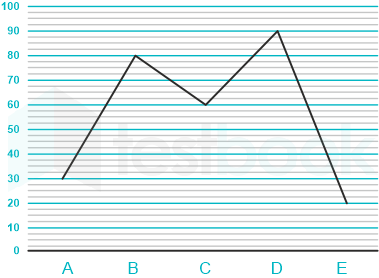
Directions: The given line graph below shows the number of foods (Veg + Non veg) ordered by males in the five different restaurants ,A, B, C, D and E.

74

Find the ratio between the number of foods ordered by males in restaurant A and C to the number of foods ordered by males in restaurant B and D.

  1. ((a))

    12: 17

  2. ((b))

    7: 19

  3. ((c))

    8: 17

  4. ((d))

    3: 5

  5. ((e))

    9: 17

Show Answer
Answer: ((a))

12: 17

75

If the number of foods ordered by males at the restaurant E 40% are vegetarian. Then find the difference between 50% of non vegetarian foods ordered by males and the number of vegetarian foods ordered by the males in restaurant E.

  1. ((a))

    1

  2. ((b))

    3

  3. ((c))

    2

  4. ((d))

    4

  5. ((e))

    5

Show Answer
Answer: ((a))

1

76

If the number of food ordered by males in restaurant D is 30% of the total foods ordered at restaurant D and remaining foods are ordered by others. Find the total number of foods ordered by the other in the restaurant D.

  1. ((a))

    180

  2. ((b))

    200

  3. ((c))

    210

  4. ((d))

    230

  5. ((e))

    240

Show Answer
Answer: ((a))

180

77

Number of foods ordered by males at restaurant F is 10 more than the average number of foods ordered by the males in all the given restaurants. If 26 orders at restaurant F are vegetarian foods then find the number of non vegetarian foods ordered at the restaurant F.

  1. ((a))

    60

  2. ((b))

    20

  3. ((c))

    40

  4. ((d))

    30

  5. ((e))

    50

Show Answer
Answer: ((a))

60

78

Number of food ordered by the females at restaurant  C is 5 times the difference between the number of foods ordered by the males in restaurant A and restaurant E. Find the total number of orders received by the restaurant C by both the male and females.

  1. ((a))

    100

  2. ((b))

    90

  3. ((c))

    110

  4. ((d))

    130

  5. ((e))

    140

Show Answer
Answer: ((a))

100

79

Two numbers are in the ratio 4 : 5. If 10 is added to the numerator and 2 is subtracted from the denominator, the ratio becomes 5 : 6. What is the sum of both numbers?

  1. ((a))

    530

  2. ((b))

    430

  3. ((c))

    630

  4. ((d))

    730

  5. ((e))

    830

Show Answer
Answer: ((a))

530

80

A boat can cover 168 km upstream in 12 hours, if speed of the boat in still water is thrice the speed of the current, then find the downstream distance covered in 5 hours ?

  1. ((a))

    128km

  2. ((b))

    140km

  3. ((c))

    130km

  4. ((d))

    170km

  5. ((e))

    160km

Show Answer
Answer: ((a))

128km

81

What will come in the place of the question mark ‘?’ in the following question?

1680% of 75 ÷ 20 + ? = 123

  1. ((a))

    65

  2. ((b))

    70

  3. ((c))

    50

  4. ((d))

    60

  5. ((e))

    None of these

Show Answer
Answer: ((a))

65

82

What value should come in place of question mark(?) in the question? 

3/2 of (3.4 + 2.6) + 2/3 of 6/2 = ?

  1. ((a))

    10

  2. ((b))

    11

  3. ((c))
    • 11
  4. ((d))

    9

  5. ((e))

    7

Show Answer
Answer: ((a))

10

83

What will come in the place of the question mark ‘?’ in the following question?

25% of 420 + 132 + 24 = ?% of 1450

  1. ((a))

    25

  2. ((b))

    18

  3. ((c))

    15

  4. ((d))

    20

  5. ((e))

    None of these

Show Answer
Answer: ((a))

25

84

What will come in the place of the question mark ‘?’ in the following question?

(√144 + 16) × 5 + 10 × 42 = ?

  1. ((a))

    200

  2. ((b))

    400

  3. ((c))

    300

  4. ((d))

    350

  5. ((e))

    None of these

Show Answer
Answer: ((a))

200

85

What will come in the place of question mark (?) in the following question?

25 × (13/39) × 120 – 40 × 10 × 2 = ?

  1. ((a))

    100

  2. ((b))

    200

  3. ((c))

    300

  4. ((d))

    400

  5. ((e))

    500

Show Answer
Answer: ((a))

100

86

What will come in the place of the question mark ‘?’ in the following question?

√144 + √(64 of 4 ÷ 4) + 5 = 5?

  1. ((a))

    1.5

  2. ((b))

    2

  3. ((c))

    3

  4. ((d))

    2.5

  5. ((e))

    3.5

Show Answer
Answer: ((a))

1.5

87

What will come in place of the question mark?

√(9 + √256) + 2+ 3 = 4?

  1. ((a))

    2

  2. ((b))

    4

  3. ((c))

    3

  4. ((d))

    5

  5. ((e))

    1

Show Answer
Answer: ((a))

2

88

What will come in the place of the question mark ‘?’ in the following question?

26 × 19 + 232 - 52% of 1350 = x

  1. ((a))

    321

  2. ((b))

    284

  3. ((c))

    355

  4. ((d))

    322

  5. ((e))

    221

Show Answer
Answer: ((a))

321

89

What will come in the place of the question mark ‘?’ in the following question?

(608.40 × ?) ÷ 225 + 37 = 375

  1. ((a))

    114

  2. ((b))

    125

  3. ((c))

    157

  4. ((d))

    168

  5. ((e))

    135

Show Answer
Answer: ((a))

114

90

What will come in place of question mark (?) in the following question?

15% of 600 + 20% of 1000 = ?

  1. ((a))

    290

  2. ((b))

    270

  3. ((c))

    280

  4. ((d))

    260

  5. ((e))

    None of these

Show Answer
Answer: ((a))

290

91

What will come in the place of the question mark ‘?’ in the following question?

89% of 624 + 1220 – 1020 = ?

  1. ((a))

    755.35

  2. ((b))

    755.36

  3. ((c))

    755.46

  4. ((d))

    755.26

  5. ((e))

    None of these

Show Answer
Answer: ((a))

755.35

92

What will come in the place of the question mark '?' in the following question?

∛1728 × ∛4096 ÷ ∛512 = ?

  1. ((a))

    24

  2. ((b))

    36

  3. ((c))

    30

  4. ((d))

    12

  5. ((e))

    16

Show Answer
Answer: ((a))

24

93

What will come in the place of the question mark ‘?’ in the following question?

10 + 12 of 12 – 44 × 11 = ?

  1. ((a))

    300

  2. ((b))

    -297

  3. ((c))

    -330

  4. ((d))

    0

  5. ((e))

    -280

Show Answer
Answer: ((a))

300

94

What will come in the place of the question mark ‘?’ in the following question:

20% of 60 + 30% of 90 + 36 = ?

  1. ((a))

    82

  2. ((b))

    75

  3. ((c))

    65

  4. ((d))

    85

  5. ((e))

    94

Show Answer
Answer: ((a))

82

95

What will come in the place of the question mark ‘?’ in the following question:

35% of 180 + 45% of 180 = 180 – ?

  1. ((a))

    40

  2. ((b))

    42

  3. ((c))

    36

  4. ((d))

    48

  5. ((e))

    50

Show Answer
Answer: ((a))

40

96

The ratio of Milk and Water in the container is 3 : 2 . If 15 liter mixture is taken out and replaced by the Milk, the ratio become 3 : 1 then find the total quantity of mixture in the container is: 

  1. ((a))

    25 litres 

  2. ((b))

    20 litres

  3. ((c))

    15 litres 

  4. ((d))

    Can't be determined

  5. ((e))

    None of these 

Show Answer
Answer: ((a))

25 litres 

97

In 2019, a person had an amount of ₹17,500, which increased by 20% every year. In 2021, the person spent 69% of the amount they had. What was the remaining savings?

  1. ((a))

    ₹8,812

  2. ((b))

    ₹7,812

  3. ((c))

    ₹9,812

  4. ((d))

    ₹6,812

  5. ((e))

    ₹4,812

Show Answer
Answer: ((a))

₹8,812

98

A person invests a certain amount for 2 years at an interest rate of 20% per annum under compound interest. The same person invests the same amount for 2 years at a 30% interest rate under simple interest. The difference between the compound interest and simple interest after 2 years is ₹896. What is the invested amount?

  1. ((a))

    ₹6600

  2. ((b))

    ₹6700

  3. ((c))

    ₹5600

  4. ((d))

    ₹4600

  5. ((e))

    ₹5100

Show Answer
Answer: ((a))

₹6600

99

Two articles have the same cost price. Article A is sold at a 20% profit, and Article B is sold at a 30% loss. The overall loss incurred is ₹50. At what price should Article B be sold so that the seller gets an overall 40% profit?

  1. ((a))

    Rs. 800

  2. ((b))

    Rs. 500

  3. ((c))

    Rs. 700

  4. ((d))

    Rs. 1000

  5. ((e))

    Rs. 900

Show Answer
Answer: ((a))

Rs. 800

100

A train with a speed of 72 km/h crosses a pole in 16 seconds. If the speed is increased by 12 m/s, calculate the time it will take to cross the pole.

  1. ((a))

    20 seconds

  2. ((b))

    30 seconds

  3. ((c))

    50 seconds

  4. ((d))

    10 seconds

  5. ((e))

    60 seconds

Show Answer
Answer: ((a))

20 seconds

Attempt this paper under real exam conditions

Timed interface, section switching, instant scoring, and question-by-question analytics — free.

Start Timed Attempt