Official Paper

IBPS Clerk Prelims Memory Based Paper (Held on:09 December 2018) (Previous Year Paper)

100 questions · 60 minutes · with answers · free

English (30 questions)

Read the passage given below and then answer the questions given below the passage.

About six crore people every year, or 7,000 people per hour, slip into poverty in India due to healthcare expenses, Ayushman Bharat- Pradhan Mantri Jan Arogya Yojana CEO Indu Bhushan said Saturday. AB-PMJAY Chief Executive Officer Indu Bhushan was speaking at a health conference organised by the Goa Institute of Management.

The Ayushman Bharat-PMJAY programme launched by Prime Minister Narendra Modi on September 23 is touted as the world's largest government funded healthcare programme aimed at benefiting 50 crore people.

Mr Bhushan hailed the country's efforts in reducing poverty, but said, "At the same time, we see that about six crore fall into poverty every year because of catastrophic healthcare expenses. I was astounded by the number. Six crore people means 7,000 people every hour."

Calling the situation a "leaking bucket", he said, "Though a lot of effort is being put to bring people out of poverty, due to health expenses, people are slipping into poverty; which is puzzling." Speaking about what he termed were paradoxes in the last 70 years in India's health sector, Mr Bhushan said, "One of the major paradoxes is that 70 per cent health needs of the country are supported by the private sector and only 30 per cent by the public sector."

Talking about other ironies, he said people from abroad were flying to India to get quality medical treatment at cheap rates, while large sections of its own citizens didn't have access to good health facilities. The AB-PMJAY CEO pointed out that despite India emerging as fastest growing (major) economy in the world, its budgetary provision for health had remained stagnant at 1-1.4 per cent over the years.
1

After reading the passage, which of the following statements can be definitely said about the The Ayushman Bharat-PMJAY programme?

  1. ((a))

    It is causing 7,000 people to fall into poverty due to healthcare expenses every hour

  2. ((b))

    It is aimed at attracting more foreigners to get quality medical treatment at cheap rates

  3. ((c))

    It is one of the largest government-funded programmes to help poor people who are sick

  4. ((d))

    All of the above

  5. ((e))

    None of the above

Show Answer
Answer: ((a))

It is causing 7,000 people to fall into poverty due to healthcare expenses every hour

2

Consider the following idiom/phrase from the passage. Which of the following options reflect its meaning?

Leaking bucket

  1. ((a))

    Owning only poor quality resources

  2. ((b))

    Not having enough ways to utilize something very beneficial

  3. ((c))

    Having to lose one’s resources constantly due to some fundamental anomaly

  4. ((d))

    Losing something important in exchange for something unimportant or bad

  5. ((e))

    Wanting to achieve something big with no resources or means

Show Answer
Answer: ((a))

Owning only poor quality resources

3

Which of the following statements is CORRECT?

A. 30 percent of the healthcare needs of the public is supported by the private sector.

B. According to Mr. Bhushan, 7000 people fall into the trap of poverty due to health expenses every hour.

C. The Indian healthcare has no more than 1-1.4 percent allocation out of the total budget.

  1. ((a))

    Only A

  2. ((b))

    Only C

  3. ((c))

    Both B and C

  4. ((d))

    Both A and B

  5. ((e))

    A, B and C

Show Answer
Answer: ((a))

Only A

4

Which of the following are the paradoxes of India, as observed by Mr. Indu Bhushan?

  1. ((a))

    Only 30% of the health needs are supported by the public sector while a vast majority of the needs are served by the private sector

  2. ((b))

    India is a hub of medical tourism for foreign citizens but many Indian nationals have no access to healthcare facilities

  3. ((c))

    India has an emerging economy but only around 1% of its budget is apportioned for healthcare needs of the citizens

  4. ((d))

    Only 1 and 2

  5. ((e))

    1, 2 and 3

Show Answer
Answer: ((a))

Only 30% of the health needs are supported by the public sector while a vast majority of the needs are served by the private sector

5

Consider the following word from the passage. Which of the following options give a word with similar meaning?

Astounded

  1. ((a))

    Recalcitrant

  2. ((b))

    Irreverent

  3. ((c))

    Barbaric

  4. ((d))

    Flabbergasted

  5. ((e))

    Expedited

Show Answer
Answer: ((a))

Recalcitrant

6

In the following question, two columns are given, containing three phrases each. A phrase from the first column may or may not connect with a phrase from the second column to make a grammatically and contextually correct sentence. There are five options, four of which display the sequence(s) in which the phrases can be joined to form a correct sentence. If none of the phrases make a correct sentence, mark ‘None of these’ as your answer.

Column (1)Column (2)
(A) The central government has asked all colleges to return(D) at the time of submission of the admission applications to reduce paperwork.
(B) Colleges and universities will now be allowed to collect advance fees(E) admission fees of aspiring students if they withdraw or cancel their admission.
(C) The government has asked institutions to not collect original personal or academic certificates(F) for a semester or for up to one year from a student, instead of the entire duration of a course.
  1. ((a))

    A-D

  2. ((b))

    C-E and B-D

  3. ((c))

    B-E

  4. ((d))

    C-D

  5. ((e))

    None of these

Show Answer
Answer: ((a))

A-D

7

In the following question, two columns are given, containing three phrases each. A phrase from the first column may or may not connect with a phrase from the second column to make a grammatically and contextually correct sentence. There are five options, four of which display the sequence(s) in which the phrases can be joined to form a correct sentence. If none of the phrases make a correct sentence, mark ‘None of these’ as your answer.

Column (1)Column (2)
(A) Even though Nebraska Man was a short lived "missing link", it(D) must be verified and tested by outside scientists in order to prove its veracity.
(B) While scientists clamor to find bones of ancient human ancestors to add to the fossil record;(E) others have tried to create fossils they claim are the "missing link" of human evolution.
(C) This is a basic tenet of science where discoveries of a scientific nature(F) tells of a very important lesson to paleontologists and archaeologists working in the field.
  1. ((a))

    B-D

  2. ((b))

    C-F 

  3. ((c))

    A-F and A-D

  4. ((d))

    A-E and B-F

  5. ((e))

    None of these

Show Answer
Answer: ((a))

B-D

8

In the following question, two columns are given, containing three phrases each. A phrase from the first column may or may not connect with a phrase from the second column to make a grammatically and contextually correct sentence. There are five options, four of which display the sequence(s) in which the phrases can be joined to form a correct sentence. If none of the phrases make a correct sentence, mark ‘None of these’ as your answer.

Column (1)Column (2)
(A) There are a variety of ways to solve math problems and(D)  a variety of tools to assist with the calculation process.
(B) Like reading, the majority of people(E) which graphs to use, not how to construct them.
(C) Math today requires decisions about(F) are born with the ability to do math.
  1. ((a))

    A-E

  2. ((b))

    B-F

  3. ((c))

    C-F and B-D

  4. ((d))

    B-D and B-E

  5. ((e))

    None of these

Show Answer
Answer: ((a))

A-E

9

In the following question, two columns are given, containing three phrases each. A phrase from the first column may or may not connect with a phrase from the second column to make a grammatically and contextually correct sentence. There are five options, four of which display the sequence(s) in which the phrases can be joined to form a correct sentence. If none of the phrases makes a correct sentence, mark ‘None of these’ as your answer.

Column (1)Column (2)
(A) Hypnosis is a trance state(D) to zone out for short distances or hundreds of miles.
(B) A Driver experiencing highway hypnosis may(E) perform an action without consciously thinking about them.
(C) Automaticity is the ability to(F) in which a person drives a motor vehicle in a normal, safe manner yet has no recollection.
  1. ((a))

    A-D and B-E

  2. ((b))

    C-E and B-E

  3. ((c))

    B-F

  4. ((d))

    A-E and B-F

  5. ((e))

    None of these

Show Answer
Answer: ((a))

A-D and B-E

10

In the following question, two columns are given, containing three phrases each. A phrase from the first column may or may not connect with a phrase from the second column to make a grammatically and contextually correct sentence. There are five options, four of which display the sequence(s) in which the phrases can be joined to form a correct sentence. If none of the phrases makes a correct sentence, mark ‘None of these’ as your answer.

Column (1)Column (2)
(A) Every book has a theme and we often(D)  both authors and readers because they are experiences we can relate to.
(B) The universal themes are popular among(E)  see the same theme in many books.
(C) The theme is a message that we take away from(F)  the book and it is defined by the symbols or a motif.
  1. ((a))

    A-D and B-F

  2. ((b))

    B-E

  3. ((c))

    C-E and B-F

  4. ((d))

    A-F

  5. ((e))

    None of these

Show Answer
Answer: ((a))

A-D and B-F

11

Fill in the blanks.

If _______ he were to meet the girl again as she was leaving her house at Number 9, Atlas Mansion—what would then become of us?

  1. ((a))

    Sonorous

  2. ((b))

    Perchance

  3. ((c))

    Decadent

  4. ((d))

    Astride

  5. ((e))

    None of the above

Show Answer
Answer: ((a))

Sonorous

12

Fill in the blanks.

As he moved forward, the _______ sky at twilight rose to meet him with its growing shadow horses.

  1. ((a))

    Refulgent

  2. ((b))

    Cantankerous

  3. ((c))

    Promulgate

  4. ((d))

    Caliginous

  5. ((e))

    None of the above

Show Answer
Answer: ((a))

Refulgent

13

Fill in the blanks.

But given its age and its purpose this painting ought not be misconstrued in the contemporary, _______ sense.

  1. ((a))

    Pejorative

  2. ((b))

    Prerogative

  3. ((c))

    Litany

  4. ((d))

    Encomiast

  5. ((e))

    None of the above

Show Answer
Answer: ((a))

Pejorative

14

Fill in the blank.

She appeared there all _______ and careless in her dress, but yet she appeared all beautiful and charming.

  1. ((a))

    Punctilious

  2. ((b))

    Supercilious

  3. ((c))

    Zealous

  4. ((d))

    Abnegation

  5. ((e))

    None of the above

Show Answer
Answer: ((a))

Punctilious

15

Fill in the blank.

There he saw the disfigured and _______ corpse of his father and realized there was no glory in this war.

  1. ((a))

    Insouciant

  2. ((b))

    Vignette

  3. ((c))

    Torrefy

  4. ((d))

    Eviscerated

  5. ((e))

    None of the above

Show Answer
Answer: ((a))

Insouciant

16

In the question given below, the sentence is divided into three parts I, II and III. For each part an alternate statement is also given. You have to determine if a part requires correction, and then mark that as your answer.

Trade quotas are “non-tarif” trade barriers / that limit the number of specific products that / can imported over a set period of time. 

I. Trade quotas are “non-tariff” trade barriers

II. those limit the number of specific products that

III. can imported over a set period of time

  1. ((a))

    I only

  2. ((b))

    II only 

  3. ((c))

    Both I and II

  4. ((d))

    Both I and III

Show Answer
Answer: ((a))

I only

17

In the question given below, the sentence is divided into three parts I, II and III. For each part an alternate statement is also given. You have to determine if a part requires correction, and then mark that as your answer.

The Supreme Court ruling that a state must have a / compelled interest in public welfare and demonstrate that a law is narrowly tailored in order / to restrict an individual's right to free exercise under the First Amendment. 

I. The Supreme Court ruled that a state must have a

II. compelling interest in public welfare and demonstrate that a law is narrowly tailored in order

III. to restricting an individual's right to free exercise under the First Amendment.

  1. ((a))

    I only

  2. ((b))

    II only 

  3. ((c))

    I, II and III

  4. ((d))

    Both I and II

  5. ((e))

    Both II and III

Show Answer
Answer: ((a))

I only

18

In the question given below, the sentence is divided into three parts I, II and III. For each part an alternate statement is also given. You have to determine if a part requires correction, and then mark that as your answer.

Limiting the supply of a certain imported product, while / increasing prices paid by consumers, allow local producers a chance / to improve their position in the market by filling the unmet demand. 

I. Limited the supply of a certain imported product, while

II. increasing prices paid by consumers, allows local producers a chance

III. to improving their position in the market by filling the unmet demand.

  1. ((a))

    I, II and III

  2. ((b))

    Both II and III

  3. ((c))

    I only

  4. ((d))

    Both I and II

  5. ((e))

    II only 

Show Answer
Answer: ((a))

I, II and III

19

In the question given below, the sentence is divided into three parts I, II and III. For each part an alternate statement is also given. You have to determine if a part requires correction, and then mark that as your answer.

In politics and public policy, nationalism is a (I)/ doctrine which mission is to protect a nation's right to self-govern and shield (II)/ fellows residents of a state from global economic and social pressures. (III)

I. In politics and public policy, nationalism is an

II. doctrine the mission of which is to protect a nation's right to self-govern and shield

III. fellow residents of a state from global economic and social pressures.

  1. ((a))

    Both II and III

  2. ((b))

    III only

  3. ((c))

    I, II and III

  4. ((d))

    II only 

  5. ((e))

    Both I and II

Show Answer
Answer: ((a))

Both II and III

20

In the question given below, the sentence is divided into three parts I, II and III. For each part an alternate statement is also given. You have to determine if a part requires correction, and then mark that as your answer.

With geo-political factors impacting crude prices, India needs to have a / good oil hedging policy as the volatility will continue to rise, former Reserve Bank / of India (RBI) governor, Raghuram Rajan says on Wednesday.

I. With geo-political factors impact crude prices, India needs to have a

II. good oil hedging policy as the volatility will continue to rised, former Reserve Bank

III. of India (RBI) governor, Raghuram Rajan said on Wednesday.

  1. ((a))

    Both II and III

  2. ((b))

    I, II and III

  3. ((c))

    III only

  4. ((d))

    Both I and II

  5. ((e))

    II only 

Show Answer
Answer: ((a))

Both II and III

21

The following sentences form a paragraph. The sentences are numbered as P, Q, R, S and T. These sentences are not given in their proper order. Read the sentences and choose the alternative that arranges them in correct order.

P. Though throughout his career, Stella shifted to a more exuberant use of color, shapes and curving forms.

Q. He calls this artistic development an evolution from Minimalism to Maximalism.

R. His earliest celebrated works were painted in black.

S. Frank Stella is considered one of the greatest living artists in the modern art world today. 

T. Frank Stella is an American artist known for developing a Minimalist style that rejected the emotionality of Abstract Expressionism.

  1. ((a))

    QRSPT

  2. ((b))

    SQPTR

  3. ((c))

    STRPQ

  4. ((d))

    PSQRT

  5. ((e))

    RQSPT

Show Answer
Answer: ((a))

QRSPT

22

The following sentences form a paragraph. The sentences are numbered as P, Q, R, S and T. These sentences are not given in their proper order. Read the sentences and choose the alternative that arranges them in correct order.

P. Unlimited protectionism eventually harms the country’s ability to compete in international trade.

Q. Protectionism is a type of trade policy by which governments attempt to prevent or limit competition from other countries.

R. Traditionally, governments employ four main methods of implementing protectionist policies.

S. While it may provide some short-term benefit, particularly in poor or developing nations;

T. Out of these, the most commonly applied protectionist practices are tariffs, also called “duties,”.

  1. ((a))

    TSQPR

  2. ((b))

    RQSPT

  3. ((c))

    STRPQ

  4. ((d))

    SRQPT

  5. ((e))

    QSPRT

Show Answer
Answer: ((a))

TSQPR

23

The following sentences form a paragraph. The sentences are numbered as P, Q, R, S and T. These sentences are not given in their proper order. Read the sentences and choose the alternative that arranges them in correct order.

P. But it is actually not the end of a boy's Jewish education.

Q. While a special religious service or ceremony is not required for a boy to become a Bar Mitzvah;

R. Over the centuries a greater and greater emphasis has been placed on the ceremony as a rite of passage of sorts. 

S. In modern practice, the bar mitzvah ceremony usually requires much more preparation and participation.

T. The bar mitzvah ceremony is a milestone life-cycle event in the life of a Jewish boy and is the culmination of years of study;

  1. ((a))

    PQSRT

  2. ((b))

    TPQRS

  3. ((c))

    QSRTP

  4. ((d))

    QRTSP

  5. ((e))

    TQSPR

Show Answer
Answer: ((a))

PQSRT

24

The following sentences form a paragraph. The sentences are numbered as P, Q, R, S and T. These sentences are not given in their proper order. Read the sentences and choose the alternative that arranges them in correct order.

P. Snakes use their venom cautiously, injecting amounts sufficient to disable prey or to defend against predators.

Q. Venom is composed of a combination of proteins, enzymes, and other molecular substances.

R. These toxics substances work to destroy cells, disrupt nerve impulses, or both.

S. Snake venom is the poisonous, typically yellow fluid stored in the modified salivary glands of venomous snakes.

T. While snake venom is poisonous and deadly, researchers also use its components to develop drugs to treat human diseases.

  1. ((a))

    PQSTR

  2. ((b))

    QSPRT

  3. ((c))

    RQSTP

  4. ((d))

    SQRPT

  5. ((e))

    QSRPT

Show Answer
Answer: ((a))

PQSTR

25

The following sentences form a paragraph. The sentences are numbered as P, Q, R, S and T. These sentences are not given in their proper order. Read the sentences and choose the alternative that arranges them in correct order.

P. Prominent examples of implementation of the Reagan Doctrine included Nicaragua, where the United States covertly assisted the Contra rebels fighting to oust the Cuban-backed Sandinista government.

Q. By assisting armed resistance movements in Africa, Asia, and Latin America, Reagan sought to “roll back” the influence of communism on the governments in those regions.

R. The Reagan Doctrine was a strategy implemented by U.S. President Ronald Reagan intended to eradicate communism and end the Cold War with the Soviet Union.

S. Functionally, it combined the tense brand of Cold War atomic diplomacy with the addition of overt and covert assistance to anti-communist guerrilla “freedom fighters.”

T. In Afghanistan, too, the U.S. provided material support to the Mujahideen rebels fighting to end the Soviet occupation of their country.

  1. ((a))

    RQSPT

  2. ((b))

    RSQPT

  3. ((c))

    QSRTP

  4. ((d))

    PTQSR

  5. ((e))

    PQSRT

Show Answer
Answer: ((a))

RQSPT

26

Three sentences are given below, with each highlighting a word. Choose the alternative that reflects a grammatically and contextually correct usage.

A. Sadly, hunger and poverty were not considered as extenuating circumstances by the court.

B. The doctor decided to vitiate and get the patient back in his hospital that day.

C. There were different tenets on that hill; which Suzie loved to play with.

  1. ((a))

    Only A

  2. ((b))

    Only B

  3. ((c))

    Both A and B

  4. ((d))

    Both B and C

  5. ((e))

    Only C

Show Answer
Answer: ((a))

Only A

27

Three sentences are given below, with each highlighting a word. Choose the alternative that reflects a grammatically and contextually correct usage.

A. The hat lied bequeath the table upon which currently the thousang Petunias were kept for the Lady.

B. The professor looked for a contrive but alas, there was no relief to be found there. 

C. The ministry has proved itself to be quite adept at tackling such minor issues on a daily basis.

  1. ((a))

    Only B

  2. ((b))

    Both A and B

  3. ((c))

    Only C

  4. ((d))

    Both B and C

  5. ((e))

    Only A

Show Answer
Answer: ((a))

Only B

28

Three sentences are given below, with each highlighting a word. Choose the alternative that reflects a grammatically and contextually correct usage.

A. And by then the results from the survey had debunked most of the deeply held ideals by the Planning Commission.

B. The roads seemed especially savant that night; with the yellow rays of the setting sun.

C. Wiith a bombastic sigh; she walked out of the room; and my life, forever.

  1. ((a))

    Both A and B

  2. ((b))

    Only B

  3. ((c))

    Both B and C

  4. ((d))

    Only C

  5. ((e))

    Only A

Show Answer
Answer: ((a))

Both A and B

29

Three sentences are given below, with each highlighting a word. Choose the alternative that reflects a grammatically and contextually correct usage.

A. It was the recant of the water that he was most afraid of; more than even the wrath of the King.

B. The members had hoped to cajole the President into approving the party's agenda.

C. Einstein thought of him as a man of facile and shallow intellect and would not respond.

  1. ((a))

    Only B

  2. ((b))

    Both A and B

  3. ((c))

    Only A

  4. ((d))

    Both B and C

  5. ((e))

    Only C

Show Answer
Answer: ((a))

Only B

30

Three sentences are given below, with each highlighting a word. Choose the alternative that reflects a grammatically and contextually correct usage.

A. The senator had been profligate for quite some time due to the elections.

B. No matter where she went, she was always followed by their salacious gazes.

C. The Trump administration is notorious for its castigating policies and rash decisions.

  1. ((a))

    Both A and B

  2. ((b))

    Both B and C

  3. ((c))

    Only B

  4. ((d))

    Only A

  5. ((e))

    Only C

Show Answer
Answer: ((a))

Both A and B

Reasoning Ability (35 questions)

31

Arrange the letters in the word "PLATFORM" in ascending order as per the English alphabetical series. Find which alphabet will be 4th from the the right end.

  1. ((a))

    P

  2. ((b))

    O

  3. ((c))

    M

  4. ((d))

    L

  5. ((e))

    None of these

Show Answer
Answer: ((a))

P

32

How many pair of digits in forward and backward direction are there in the number “523687” that has as many numbers between them as in the numerical series?

  1. ((a))

    Three

  2. ((b))

    One

  3. ((c))

    Four

  4. ((d))

    Two

  5. ((e))

    None of these

Show Answer
Answer: ((a))

Three

Direction: Read the following instruction carefully and answer the questions that follow:

Certain people are sitting in a row facing North. There are as many people to the right of Z as there are to the left of Z. Y is third to the left of U who sits fourth from one of the extreme ends of the row. T sits at one of the extreme ends of the row. There are five persons sitting between T and W. X sits exactly in the middle of T and W. Two persons sits between W and Z. Y does not sit at one of the extreme ends of the row. There are as many persons sitting between Y and V as many are sitting between W and Y.

33

Who is sitting exactly in the middle of Z and U?

  1. ((a))

    Y

  2. ((b))

    Z

  3. ((c))

    U

  4. ((d))

    V

  5. ((e))

    Cannot be determined

Show Answer
Answer: ((a))

Y

34

How many persons are sitting in the row?

  1. ((a))

    20

  2. ((b))

    21

  3. ((c))

    24

  4. ((d))

    19

  5. ((e))

    17

Show Answer
Answer: ((a))

20

35

How many persons are sitting to the right of Y?

  1. ((a))

    7

  2. ((b))

    9

  3. ((c))

    6

  4. ((d))

    5

  5. ((e))

    8

Show Answer
Answer: ((a))

7

36

Which of the following statement is incorrect?

  1. ((a))

    X sits fifth to the right of Y.

  2. ((b))

    Z sits ninth to the right of T.

  3. ((c))

    V and T sit at the extreme ends.

  4. ((d))

    W is sitting to the left of Y.

  5. ((e))

    None of the above.

Show Answer
Answer: ((a))

X sits fifth to the right of Y.

37

Who is sitting sixth to the right of X?

  1. ((a))

    Z

  2. ((b))

    V

  3. ((c))

    X

  4. ((d))

    T

  5. ((e))

    U

Show Answer
Answer: ((a))

Z

Directions: Study the following information and answer the given questions.

Eight people J, K, L, M, N, O, P and Q are sitting around a circular table facing center, not necessarily in the same order. The following information is given:

K is not adjacent to both P and L. M is second to the right of Q and third to the left of L. P and L are neighbours, but P is not sitting opposite to M who is not sitting opposite J. M and K are adjacent to each other. J is neither opposite to O nor adjacent to M. M and O are not neighbours.

38

Who is sitting opposite to J?

  1. ((a))

    M

  2. ((b))

    N

  3. ((c))

    P

  4. ((d))

    K

  5. ((e))

    O

Show Answer
Answer: ((a))

M

39

Who among the following is sitting adjacent to O?

  1. ((a))

    M

  2. ((b))

    N

  3. ((c))

    P

  4. ((d))

    K

  5. ((e))

    L

Show Answer
Answer: ((a))

M

40

Who is sitting second to the left of N?

  1. ((a))

    M

  2. ((b))

    N

  3. ((c))

    P

  4. ((d))

    K

  5. ((e))

    L

Show Answer
Answer: ((a))

M

41

Four of the following are alike in a certain way and so form a group. Which is the one that does not belong to the group?

  1. ((a))

    JN

  2. ((b))

    KL

  3. ((c))

    PQ

  4. ((d))

    OP

  5. ((e))

    OM

Show Answer
Answer: ((a))

JN

42

If P and J have interchanged their places, then who is to the immediate left of M?

  1. ((a))

    M

  2. ((b))

    J

  3. ((c))

    P

  4. ((d))

    K

  5. ((e))

    L

Show Answer
Answer: ((a))

M

43

Direction: In the question below are given three statements followed by two conclusions numbered I and II. You have to take the given statements to be true even if they seem to be at variance with commonly known facts. Read all the conclusions and then decide which of the given conclusions logically follows from the given statements disregarding commonly known facts.

Statement:

All bats are lions.

Some cats are lions.

No cat is a tiger.

Conclusion:

I. Some tigers can be bats.

II. No cat is bat.

  1. ((a))

    Only conclusion I follows.

  2. ((b))

    Only conclusion II follows.

  3. ((c))

    Either conclusion I or conclusion II follows.

  4. ((d))

    Neither conclusion I nor conclusion II follows.

  5. ((e))

    Both conclusion I and conclusion II follow.

Show Answer
Answer: ((a))

Only conclusion I follows.

44

Direction: In the question below are given two statements followed by two conclusions numbered I and II. You have to take the given statements to be true even if they seem to be at variance with commonly known facts. Read all the conclusions and then decide which of the given conclusions logically follows from the given statements disregarding commonly known facts.

Statement:

Some pen drives are CDs.

Some CDs are disks.

Conclusion:

I. Some disks are pen drives.

II. No disk is a pen drive.

  1. ((a))

    Only conclusion I follows.

  2. ((b))

    Only conclusion II follows.

  3. ((c))

    Either conclusion I or conclusion II follows.

  4. ((d))

    Neither conclusion I nor conclusion II follows.

  5. ((e))

    Both conclusion I and conclusion II follow.

Show Answer
Answer: ((a))

Only conclusion I follows.

45

In the question below are given two statements followed by two conclusions numbered I and II. You have to take the given statements to be true even if they seem to be at variance with commonly known facts. Read all the conclusions and then decide which of the given conclusions logically follows from the given statements disregarding commonly known facts.

Statement:

No exercise is dance.

All dances are nests.

Conclusion:

I. Some nests are definitely exercises.

II. All exercises can be nest.

  1. ((a))

    Only conclusion I follows.

  2. ((b))

    Only conclusion II follows.

  3. ((c))

    Either conclusion I or conclusion II follows.

  4. ((d))

    Neither conclusion I nor conclusion II follows.

  5. ((e))

    Both conclusion I and conclusion II follow.

Show Answer
Answer: ((a))

Only conclusion I follows.

Direction: Study the following information carefully and answer the given questions.

In a certain code language:

‘famous do are efforts’ is written as ‘ab ca ce zx'.

‘trip pan high do’ is written as 'ar os rs zx'.

‘trip run best are’ is written as ‘ca tq os pj’ and

‘do famous are high’ is written as ‘ab ar ca zx’.

46

Which of the following code is used for ‘high’ in this code language?

  1. ((a))

    ab

  2. ((b))

    ca

  3. ((c))

    zx

  4. ((d))

    ar

  5. ((e))

    Either 1) or 4)

Show Answer
Answer: ((a))

ab

47

Which of the following word for code 'pj'?

  1. ((a))

    famous

  2. ((b))

    are

  3. ((c))

    do

  4. ((d))

    Either 'high' or 'trip'

  5. ((e))

    Either 'best' or 'run'

Show Answer
Answer: ((a))

famous

48

Which of the following codes can be used for ‘famous people’ in the code language?

  1. ((a))

    ab ce

  2. ((b))

    rs ab

  3. ((c))

    ab ou

  4. ((d))

    ca ab

  5. ((e))

    ab ar

Show Answer
Answer: ((a))

ab ce

49

What is the code for ‘do high’?

  1. ((a))

    ca ab

  2. ((b))

    os tq

  3. ((c))

    pj ca

  4. ((d))

    ar zx

  5. ((e))

    rs ce

Show Answer
Answer: ((a))

ca ab

The following questions are based on the three digits numbers given below:

758      839      246      197      564

50

If the first and third digits of each number are interchanged, then which one will be the third largest number?

  1. ((a))

    564

  2. ((b))

    839

  3. ((c))

    197

  4. ((d))

    246

  5. ((e))

    758

Show Answer
Answer: ((a))

564

51

If one is added to the first digit of all the odd numbers and 2 is added to the first digit of all the even numbers, then in how many numbers digits are repeating more than once?

  1. ((a))

    Two

  2. ((b))

    Three

  3. ((c))

    One

  4. ((d))

    Four

  5. ((e))

    None

Show Answer
Answer: ((a))

Two

52

After arranging in descending order from left to right, which of the following will be the third from the right end?

  1. ((a))

    839

  2. ((b))

    564

  3. ((c))

    758

  4. ((d))

    246

  5. ((e))

    197

Show Answer
Answer: ((a))

839

53

In which of the following numbers is the sum of its digits the lowest?

  1. ((a))

    246

  2. ((b))

    758

  3. ((c))

    197

  4. ((d))

    564

  5. ((e))

    839

Show Answer
Answer: ((a))

246

Direction: There are 8 boxes of different colour viz. Green, Blue, Pink, Black, Orange, Yellow, White and Red, which are kept one above other.

There are four boxes between Pink and Red box. There are two boxes between Red box and Green box. Three boxes are kept between Orange and Green box. Two boxes are kept between Orange and Blue box. Only one box is kept between Blue and Black box. The Black coloured box is not kept immediately above or below the Orange coloured box. There are two boxes between White and Yellow box. The White coloured box is kept above Red coloured box but not on the top.

54

Which of the following box is kept immediately above Red coloured box.

  1. ((a))

    Orange

  2. ((b))

    White

  3. ((c))

    Red

  4. ((d))

    Black

  5. ((e))

    None of these

Show Answer
Answer: ((a))

Orange

55

Which coloured box is kept at the bottom?

  1. ((a))

    Orange

  2. ((b))

    Red

  3. ((c))

    Pink

  4. ((d))

    Yellow

  5. ((e))

    None of these

Show Answer
Answer: ((a))

Orange

56

What is the position of Black box with respect to Pink box?

  1. ((a))

    Immediate above

  2. ((b))

    Two places below 

  3. ((c))

    Immediate below

  4. ((d))

    Two places above

  5. ((e))

    None of these

Show Answer
Answer: ((a))

Immediate above

57

How many boxes are kept between Yellow and Orange coloured box.

  1. ((a))

    2

  2. ((b))

    3

  3. ((c))

    1

  4. ((d))

    4

  5. ((e))

    None

Show Answer
Answer: ((a))

2

58

Which box is kept at the top?

  1. ((a))

    Pink

  2. ((b))

    Red

  3. ((c))

    Orange

  4. ((d))

    Yellow

  5. ((e))

    None of these

Show Answer
Answer: ((a))

Pink

Directions: Read the following information carefully and answer the questions that follow:

Eight people P, Q, R, S, T, U, V and W have their birthdays, but not necessarily in the same order, in eight different months of the same year, namely January, February, March, June, July, August, October and December.

W has birthday in the month of December. R has birthday in a month which has less than 31 days. Moreover, only two people have birthdays between R and S. Only one person has birthday before Q. Only three people have birthdays between Q and T. P has birthday immediately before T and both have birthdays in the months having 31 days. Number of people between P and V are same as number of people between V and U.

59

Whose birthday is in February?

  1. ((a))

    R

  2. ((b))

    T

  3. ((c))

    S

  4. ((d))

    Q

  5. ((e))

    None of these

Show Answer
Answer: ((a))

R

60

Who among the following has birthdays in the month of January and June respectively?

  1. ((a))

    U, R

  2. ((b))

    R, U

  3. ((c))

    U, S

  4. ((d))

    R, T

  5. ((e))

    None of these

Show Answer
Answer: ((a))

U, R

61

How many people have birthdays between the month in which V and P have birthdays?

  1. ((a))

    2

  2. ((b))

    4

  3. ((c))

    3

  4. ((d))

    No one

  5. ((e))

    None of these

Show Answer
Answer: ((a))

2

62

Who has birthday before T but after R?

  1. ((a))

    S

  2. ((b))

    U

  3. ((c))

    P

  4. ((d))

    Q

  5. ((e))

    None of these

Show Answer
Answer: ((a))

S

63

S’s birthday is in the month of?

  1. ((a))

    June

  2. ((b))

    February

  3. ((c))

    October

  4. ((d))

    August

  5. ((e))

    None of these

Show Answer
Answer: ((a))

June

Study the following information carefully and answer the question based on it.

A is only son of P. B is child of Y. Y is married to P. J is father of only Y and S. Q's only daughter is married to S.

64

If X is only aunt of B, how X is related to Q?

  1. ((a))

    Son

  2. ((b))

    Husband

  3. ((c))

    Daughter

  4. ((d))

    Daughter-in-law

  5. ((e))

    Aunt

Show Answer
Answer: ((a))

Son

65

How A is related to J?

  1. ((a))

    Grandfather

  2. ((b))

    Son

  3. ((c))

    Aunt

  4. ((d))

    Grandson

  5. ((e))

    Husband

Show Answer
Answer: ((a))

Grandfather

Numerical Ability (35 questions)

66

Working together, A and B can complete a given task in 24 days. If the efficiencies of A and B are in the respective ratio of 3 ∶ 2, in how many days can B complete half of the task?

  1. ((a))

    18

  2. ((b))

    30

  3. ((c))

    15

  4. ((d))

    20

  5. ((e))

    10

Show Answer
Answer: ((a))

18

67

If the diagonal of a square of perimeter 60 cm is equal to the length of a rectangle(R) and R's breadth is 10√2 cm, what is R's area? (in cm2)

  1. ((a))

    150√2 

  2. ((b))

    150

  3. ((c))

    None of these

  4. ((d))

    300

  5. ((e))

    600

Show Answer
Answer: ((a))

150√2 

68

Jar-A contained a mixture of milk and water in the respective ratio of 5 ∶ 1. The difference between quantities of milk and water in Jar-A was 32 litre. If 12 litres of mixture was taken out and 1.5 litres of water was added to Jar-A. What will be the new respective ratio between quantities of milk and water in Jar-A?

  1. ((a))

    None

  2. ((b))

    4 ∶ 1

  3. ((c))

    9 ∶ 2

  4. ((d))

    3 ∶ 1

  5. ((e))

    11 ∶ 2

Show Answer
Answer: ((a))

None

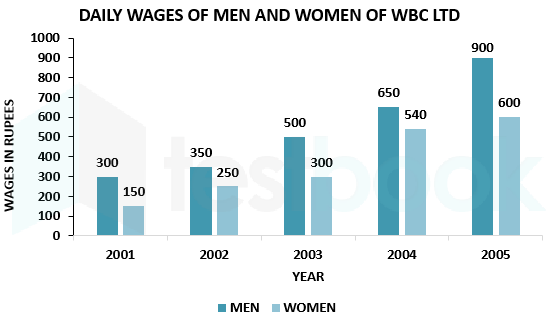
Directions: The following Bar Graph given below shows the daily wages of both men and women working in WBC Ltd. Company. Interpret the table and answer the questions carefully.

69

What is the ratio of men’s wages in the year 2001 and the sum of wages of women in the years 2001 and 2005?

  1. ((a))

    23 ∶ 33

  2. ((b))

    45 ∶ 33

  3. ((c))

    60 ∶ 1

  4. ((d))

    2 ∶ 5

  5. ((e))

    5 ∶ 4

Show Answer
Answer: ((a))

23 ∶ 33

70

What is the average of all the daily wages of the women from the year 2001 to 2005?

  1. ((a))

    Rs. 443

  2. ((b))

    Rs. 368

  3. ((c))

    Rs. 788

  4. ((d))

    Rs. 15

  5. ((e))

    Rs. 122

Show Answer
Answer: ((a))

Rs. 443

71

What is the comparison for the average differences of men’s wages and women’s wages for all the consecutive years?

  1. ((a))

    Men’s average > Women’s average

  2. ((b))

    Men’s average < Women’s average

  3. ((c))

    Men’s average = Women’s average

  4. ((d))

    Men’s average ≈ Women’s average

  5. ((e))

    Not sufficient data

Show Answer
Answer: ((a))

Men’s average > Women’s average

72

What is the average of the differences between two consecutive years for the daily wages of the women?

  1. ((a))

    Rs. 50

  2. ((b))

    Rs. 400

  3. ((c))

    Rs. 112.5

  4. ((d))

    Rs. 20

  5. ((e))

    Rs. 60

Show Answer
Answer: ((a))

Rs. 50

73

What is the average of the daily wages from all the years for Men in the WBC Ltd?

  1. ((a))

    Rs. 500

  2. ((b))

    Rs. 540

  3. ((c))

    Rs. 450

  4. ((d))

    Rs. 440

  5. ((e))

    Rs. 335

Show Answer
Answer: ((a))

Rs. 500

74

Ram covered a distance of 125 km by car and motorcycle. The car's speed was 50% more than the motorcycle's speed and the time taken by car and motorcycle were equal.What distance did Ram cover by motorcycle? (in km)

  1. ((a))

    75

  2. ((b))

    60

  3. ((c))

    64

  4. ((d))

    90

  5. ((e))

    50

Show Answer
Answer: ((a))

75

75

When a 2 digit number 'x' is reversed, the number so formed is 63 more than 'x'.If the sum of digits of 'x' is 11, what is the value of x.

  1. ((a))

    48

  2. ((b))

    52

  3. ((c))

    29

  4. ((d))

    50

  5. ((e))

    40

Show Answer
Answer: ((a))

48

76

What will come in place of '?' in the following question?

?+2.8+5.63.52.1=15\frac{{? + 2.8 + 5.6}}{{3.5 - 2.1}} = 15

  1. ((a))

    2.86

  2. ((b))

    3.4

  3. ((c))

    12.6

  4. ((d))

    13.1

  5. ((e))

    None of the above

Show Answer
Answer: ((a))

2.86

77

What will come in place of '?' in the following question?

84% of 500 - 25% of ? = 350

  1. ((a))

    245

  2. ((b))

    145

  3. ((c))

    280

  4. ((d))

    169

  5. ((e))

    None of these

Show Answer
Answer: ((a))

245

78

What will come in place of '?' in the following question?

(220 ÷ 2?) ÷ 214 = √256

  1. ((a))

    8

  2. ((b))

    2

  3. ((c))

    10

  4. ((d))

    -2

  5. ((e))

    1.5

Show Answer
Answer: ((a))

8

79

What will come in place of '?' in the following question?

527?14=38\frac{5}{{27 - ?}} - \frac{1}{4} = \frac{3}{8}

  1. ((a))

    46

  2. ((b))

    28

  3. ((c))

    19

  4. ((d))

    29

  5. ((e))

    None of these

Show Answer
Answer: ((a))

46

80

What will come in place of '?' in the following question?

35×119×318=?\frac{3}{5} \times 1\frac{1}{9} \times 318 = ?

  1. ((a))

    234

  2. ((b))

    212

  3. ((c))

    124

  4. ((d))

    186

  5. ((e))

    None of these

Show Answer
Answer: ((a))

234

81

What will come in place of '?' in the following question?

735×112=?36.97 - \frac{3}{5} \times 1\frac{1}{2} = ? - 36.9

  1. ((a))

    42

  2. ((b))

    44

  3. ((c))

    43

  4. ((d))

    45

  5. ((e))

    None of these

Show Answer
Answer: ((a))

42

82

What will come in place of '?' in the following question?

0.36 ÷ ? ÷ 0.02 = 90

  1. ((a))

    2 × 10-1

  2. ((b))

    2 × 101

  3. ((c))

    5 × 10-1

  4. ((d))

    5 × 101

  5. ((e))

    None of these

Show Answer
Answer: ((a))

2 × 10-1

83

What will come in place of '?' in the following question?

6 + 52 + 82 = ? × 5

  1. ((a))

    21

  2. ((b))

    20

  3. ((c))

    19

  4. ((d))

    11

  5. ((e))

    None of these

Show Answer
Answer: ((a))

21

84

What will come in place of '?' in the following question?

142 - 32 - 43 = ?

  1. ((a))

    134

  2. ((b))

    144

  3. ((c))

    184

  4. ((d))

    124

  5. ((e))

    114

Show Answer
Answer: ((a))

134

85

What will come in place of '?' in the following question?

82 + (72 - 20) × 5 = ?

  1. ((a))

    209

  2. ((b))

    112

  3. ((c))

    118

  4. ((d))

    120

  5. ((e))

    None of these

Show Answer
Answer: ((a))

209

86

Direction: In the following question, two equations numbered I and II are given. You have to solve both the equations and give answer.

I. x2 - 3x + 2 = 0

II. 4y2 - 8y + 3 = 0

  1. ((a))

    If x > y

  2. ((b))

    If x < y

  3. ((c))

    If x ≥ y

  4. ((d))

    If x ≤ y

  5. ((e))

    If x = y or no relation can be established. 

Show Answer
Answer: ((a))

If x > y

87

Direction: In the following question, two equations numbered I and II are given. You have to solve both the equations and give answer.

I. 4x2 + 11x + 6 = 0

II. 2y2 + 11y + 15 = 0

  1. ((a))

    If x > y

  2. ((b))

    If x < y

  3. ((c))

    If x ≥ y

  4. ((d))

    If x ≤ y

  5. ((e))

    If x = y or no relation can be established. 

Show Answer
Answer: ((a))

If x > y

88

Direction: In the following question, two equations numbered I and II are given. You have to solve both the equations and give answer.

I. x2 = 36

II. y2 - 13y + 42 = 0

  1. ((a))

    If x > y

  2. ((b))

    If x < y

  3. ((c))

    If x ≥ y

  4. ((d))

    If x ≤ y

  5. ((e))

    If x = y or no relation can be established. 

Show Answer
Answer: ((a))

If x > y

89

Directions: In the following question, two equations numbered I and II are given. You have to solve both the equations and give answer.

I. x2 - 15x + 56 = 0

II. y2 - 11y + 28 = 0

  1. ((a))

    If x > y

  2. ((b))

    If x < y

  3. ((c))

    If x ≥ y

  4. ((d))

    If x ≤ y

  5. ((e))

    If x = y or no relation can be established. 

Show Answer
Answer: ((a))

If x > y

90

In the following questions two equations numbered I and II are given. You have to solve both the equations and give answer.

I. x2 + 3x - 18 = 0

II. y2 - 9y + 20 = 0

  1. ((a))

    if x > y

  2. ((b))

    if x ≥ y

  3. ((c))

    if x < y

  4. ((d))

    if x ≤ y

  5. ((e))

    if x = y or the relationship cannot be established

Show Answer
Answer: ((a))

if x > y

91

The population of a town is 21000. If the population increases at the rate of 10% per annum for the rest 2 years, find the final population?

  1. ((a))

    30000

  2. ((b))

    28000

  3. ((c))

    25410

  4. ((d))

    26200

  5. ((e))

    None of these

Show Answer
Answer: ((a))

30000

92

Taps A and B can fill a tank full in 3 hours. Tap B alone can fill the empty tank in 2 hours. How long will tap A take to vacate the tank if it is 25% filled. 

  1. ((a))

    1.5 hours

  2. ((b))

    2 hours

  3. ((c))

    2.5 hours

  4. ((d))

    3.2 hours

  5. ((e))

    None of these

Show Answer
Answer: ((a))

1.5 hours

93

Vijay invests a principal amount of Rs. 300000 in a fixed deposit for 2 years. The rate at which he invests is 20% per annum. What will be the simple interest earned by him at the end of his investment tenure?

  1. ((a))

    Rs. 22000

  2. ((b))

    Rs. 13000

  3. ((c))

    Rs. 120000

  4. ((d))

    Rs. 15600

  5. ((e))

    None of these

Show Answer
Answer: ((a))

Rs. 22000

94

What will come in place of '?' in the following question?

65, 69, 60, 76, 51, ?

  1. ((a))

    87

  2. ((b))

    83

  3. ((c))

    84

  4. ((d))

    80

  5. ((e))

    86

Show Answer
Answer: ((a))

87

95

What should come in place of '?' in the following number series?

5, 9, 23, 52, 101, ?

  1. ((a))

    124

  2. ((b))

    136

  3. ((c))

    175

  4. ((d))

    118

  5. ((e))

    None of these

Show Answer
Answer: ((a))

124

96

What should come in place of '?' in the following number series?

6, 3, 3, 6, 24, ?

  1. ((a))

    132

  2. ((b))

    198

  3. ((c))

    192

  4. ((d))

    190

  5. ((e))

    None of these

Show Answer
Answer: ((a))

132

97

What should come in place of '?' in the following number series?

4, 11, 25, 53, ?, 221

  1. ((a))

    116

  2. ((b))

    104

  3. ((c))

    109

  4. ((d))

    114

  5. ((e))

    106

Show Answer
Answer: ((a))

116

98

What should come in place of '?' in the following number series?

6, 7, 16, 51, ?, 1045

  1. ((a))

    204

  2. ((b))

    208

  3. ((c))

    206

  4. ((d))

    202

  5. ((e))

    None of these

Show Answer
Answer: ((a))

204

99

The length and breadth of a rectangle are in the ratio 3 : 7. Perimeter of the given rectangle is 80 m. Find the area of the rectangle.

  1. ((a))

    396 m2

  2. ((b))

    316 m2

  3. ((c))

    336 m2

  4. ((d))

    350 m2

  5. ((e))

    348 m2

Show Answer
Answer: ((a))

396 m2

100

The present age of A and B are in the ratio 9 : 11. Twelve years hence the ratio of their ages will be 13 : 15. Find the age of B, fourteen years from now.

  1. ((a))

    22 years

  2. ((b))

    28 years

  3. ((c))

    47 years

  4. ((d))

    37 years

  5. ((e))

    26 years

Show Answer
Answer: ((a))

22 years

Attempt this paper under real exam conditions

Timed interface, section switching, instant scoring, and question-by-question analytics — free.

Start Timed Attempt