Official Paper

IBPS Clerk Prelims Memory Based Paper (Held on:08 December 2018) (Previous Year Paper)

100 questions · 60 minutes · with answers · free

English (30 questions)

1

A sentence/part of the sentence is emboldened. Five alternatives are given to the emboldened part which will improve the sentence. Choose the correct alternative and choose the option corresponding to it. In case no improvement is needed, click the button corresponding to "No improvement required"

She could not exit her children out of sight even for a few hours.

  1. ((a))

    Forced her child

  2. ((b))

    No correction required

  3. ((c))

    Like her children

  4. ((d))

    Let her children

  5. ((e))

    Abandon the child

Show Answer
Answer: ((a))

Forced her child

2

A sentence/part of the sentence is emboldened. Five alternatives are given to the emboldened part which will improve the sentence. Choose the correct alternative and choose the option corresponding to it. In case no improvement is needed, click the button corresponding to "No improvement required"

There are only two locations which accomodates all the requirements of our guests.

  1. ((a))

    Likely to accomodated

  2. ((b))

    That understood

  3. ((c))

    No correction required

  4. ((d))

    Considerably evaluates

  5. ((e))

    Which meet

Show Answer
Answer: ((a))

Likely to accomodated

3

A sentence/part of the sentence is emboldened. Five alternatives are given to the emboldened part which will improve the sentence. Choose the correct alternative and choose the option corresponding to it. In case no improvement is needed, click the button corresponding to "No improvement required".

The possibility of failure is the biggest deterrent to the trying avoiding risks

  1. ((a))

    Try for avoid

  2. ((b))

    The trial to avoid

  3. ((c))

    The avoidance

  4. ((d))

    No correction required

  5. ((e))

    Those avoiding

Show Answer
Answer: ((a))

Try for avoid

4

A sentence/part of the sentence is emboldened. Five alternatives are given to the emboldened part which will improve the sentence. Choose the correct alternative and choose the option corresponding to it. In case no improvement is needed, click the button corresponding to "No improvement required"

The author went to law school but eventually dropped out due to lack of interest

  1. ((a))

    Mostly dropping out

  2. ((b))

    Will drops out

  3. ((c))

    To dropped out

  4. ((d))

    No correction required

  5. ((e))

    Now dropped from

Show Answer
Answer: ((a))

Mostly dropping out

5

A sentence/part of the sentence is emboldened. Five alternatives are given to the emboldened part which will improve the sentence. Choose the correct alternative and choose the option corresponding to it. In case no improvement is needed, click the button corresponding to "No improvement required".

A lot rides on the company we keep as the opinions of our peers affect the way we deal with circumstances

  1. ((a))

    No correction required

  2. ((b))

    Having dealt with

  3. ((c))

    We deal by

  4. ((d))

    Dealing with

  5. ((e))

    To deal on

Show Answer
Answer: ((a))

No correction required

6

A sentence/part of the sentence is emboldened. Five alternatives are given to the emboldened part which will improve the sentence. Choose the correct alternative and choose the option corresponding to it. In case no improvement is needed, click the button corresponding to "No improvement required"

The accessibility of the internet and its reach in remote locations is why reason it so popular.

  1. ((a))

    No correction required

  2. ((b))

    Why

  3. ((c))

    The reason for

  4. ((d))

    How result is

  5. ((e))

    What makes it

Show Answer
Answer: ((a))

No correction required

7

Directions: Given below is a word, followed by three sentences that consist of that word. Identify the sentence(s) that express(es) the meaning of the word. Choose option 5 ''None of the above'' if the word is not suitable in any of the sentences.

WAIT

(A) Wait your options before investing

(B) How long must we wait?

(C) The longer we wait time the less is the chance of recovery

  1. ((a))

    Only A

  2. ((b))

    Only A and C

  3. ((c))

    Only B and C

  4. ((d))

    Only B

  5. ((e))

    None of the above

Show Answer
Answer: ((a))

Only A

In the given question, a passage with seven blanks labelled (A)-(G) is given. You are required to fill the correct word in the blanks.

A person’s quality of life can be disrupted due to(A)different reasons. One important yet underestimated cause for that is sleep loss (National Sleep Foundation 2007). Working(B)are constantly increasing along with an emphasis on active leisure. In certain jobs, people face_(C)__restriction. Some professions such as health care, security and transportation require working at night. In such fields, the effect of acute total sleep deprivation (SD) on performance is crucial. Furthermore, people tend to stretch their capacity and compromise their nightly sleep, thus becoming chronically sleep deprived.

When considering the(D)of sleep loss, the distinction between total and partial SD is important. Although both conditions induce several negative effects (E)impairments in cognitive performance, the underlying mechanisms seem to be somewhat different. Particularly, results on the recovery from SD have suggested different physiological processes. In this review, we separately(F)the effects of acute total and chronic partial SD and describe the effects on cognitive performance. The emphasis on acute total SD reflects the quantity of studies carried out(G)with partial SD. The effects of aging and gender, as well as interindividual differences, are discussed. We concentrate on the studies that have been published since 1990.

8

Which of the following fits the blank labelled (A)?

  1. ((a))

    Many

  2. ((b))

    Small

  3. ((c))

    Due

  4. ((d))

    Reasons

  5. ((e))

    Much

Show Answer
Answer: ((a))

Many

9

Which of the following fits the blank labelled (B)?

  1. ((a))

    Late

  2. ((b))

    Start

  3. ((c))

    Hours

  4. ((d))

    Years

  5. ((e))

    On

Show Answer
Answer: ((a))

Late

10

Which of the following fits the blank labelled (C)?

  1. ((a))

    Run

  2. ((b))

    Sleep

  3. ((c))

    State

  4. ((d))

    Fast

  5. ((e))

    Food

Show Answer
Answer: ((a))

Run

11

Which of the following fits the blank labelled (D)?

  1. ((a))

    Causes

  2. ((b))

    Affect

  3. ((c))

    Start

  4. ((d))

    Raise

  5. ((e))

    Effects

Show Answer
Answer: ((a))

Causes

12

Which of the following fits the blank labelled (E)?

  1. ((a))

    Excluding

  2. ((b))

    Pairing

  3. ((c))

    Stating

  4. ((d))

    Including

  5. ((e))

    None of the above

Show Answer
Answer: ((a))

Excluding

13

Which of the following fits the blank labelled (F)?

  1. ((a))

    Correct

  2. ((b))

    Consider

  3. ((c))

    Talk

  4. ((d))

    Called

  5. ((e))

    None of the above

Show Answer
Answer: ((a))

Correct

14

Which of the following fits the blank labelled (G)?

  1. ((a))

    Collapsed

  2. ((b))

    Sharing

  3. ((c))

    Rule

  4. ((d))

    Compared

  5. ((e))

    All of the above

Show Answer
Answer: ((a))

Collapsed

Read the given passage carefully and answer the questions that follow.

There are friends that you have polite chats with, and there are your best friends. They're the people who root for you, no matter what. You tell them your deepest, darkest secrets, and instead of heading for the door, they stick around and your bond with them grows stronger.

A friend recently sent me news about some phenomenal successes he is enjoying in a new business venture. I responded enthusiastically about his amazing gifts. He e-mailed back: "You, my friend, are too much! But I must say, I love having my own cheering section!" I responded, without even thinking, "What are friends for?"

Precisely! Friendship is about being what a hero of mine described as "balcony people" instead of "basement people." Basement people are those who live in our minds, telling us we will never amount to anything, that we are doomed to fail and that we are royal screw-ups. Balcony people are those who are consistently cheering us on. "Go for it," they say to our attempts to find our voice, to live in ever-widening circles, to dare, to create, to break through our lives' sound barriers. While not all of us are made to be married or to live in an intentional formal community, be it a kibbutz, ashram, monastery, convent or commune, all of us are created to live in some form of friendship. Friendships are what help us be human. 

My best friends and I get together regularly to share the deepest part of life, the part that is about being as opposed to doing. Sure, we speak about what we do in our jobs, our other relationships, our spiritual, athletic, medical, familial doings. But the experiential, life-giving juice that feeds our soul and binds us together over the years and takes us to ever deeper dimensions is the conversation we have at the being level. That's the place where your soul stands naked before someone else and receives unconditional acceptance in return.

From time to time, we speak about what an exasperation-free oasis our friendship is. Both of us have had some important relationships that soured because someone got exasperated with us. Not that we didn't deserve it. But there is something about my best friends, who just don't get exasperated with me, no matter how much I deserve it. As a result, I am not guarded with them, and when we fall back into old patterns of thinking, "If I tell him this, the friendship is over," that's where we have over the years taken the risk to tell it all. That's where the friendship is made even stronger.
15

What is a suitable title for the given passage?

  1. ((a))

    What Are Friends For?

  2. ((b))

    Friendship

  3. ((c))

    Friends and Enemies

  4. ((d))

    Friends and Family

  5. ((e))

    Both 1 and 2

Show Answer
Answer: ((a))

What Are Friends For?

16

Which of the following words is the closest in meaning to 'exasperate'?

  1. ((a))

    Angry

  2. ((b))

    Excited

  3. ((c))

    Fiesty

  4. ((d))

    Happy

  5. ((e))

    None of the above

Show Answer
Answer: ((a))

Angry

17

Which of the following words is opposite in meaning to 'enthusiastic'?

  1. ((a))

    Eager

  2. ((b))

    Indifferent

  3. ((c))

    Restless

  4. ((d))

    Apologetic

  5. ((e))

    None of the above

Show Answer
Answer: ((a))

Eager

18

What is the kind of friendship that the author is talking about?

  1. ((a))

    A friendship that started in high school

  2. ((b))

    A friendship that knows no bounds of age or gender

  3. ((c))

    A friendship where you don't have to stay guarded

  4. ((d))

    A friendship that lasts forever

  5. ((e))

    None of the above

Show Answer
Answer: ((a))

A friendship that started in high school

19

What does the author mean by the phrase 'heading for the door'?

  1. ((a))

    Leaving someone

  2. ((b))

    Running into a door

  3. ((c))

    Facing a door

  4. ((d))

    Being stuck in a dilemma

  5. ((e))

    Both 1 and 4

Show Answer
Answer: ((a))

Leaving someone

20

Who are 'balcony people'?

  1. ((a))

    The people who hate us

  2. ((b))

    The people who spy on us

  3. ((c))

    The people who constantly cheer us on

  4. ((d))

    The people who betray us

  5. ((e))

    The people who abandon us

Show Answer
Answer: ((a))

The people who hate us

21

What are some of the things that the author talks about with his best friends?

  1. ((a))

    Relationships

  2. ((b))

    Work

  3. ((c))

    Health

  4. ((d))

    Family

  5. ((e))

    All of the above

Show Answer
Answer: ((a))

Relationships

22

What does the author seem to value the most about his best friends?

  1. ((a))

    That they never leave him even when he faulters

  2. ((b))

    That they love him

  3. ((c))

    That they talk about important things

  4. ((d))

    That they are nice people

  5. ((e))

    All of the above

Show Answer
Answer: ((a))

That they never leave him even when he faulters

23

This question comprises 3 sentences - A, B, and C each of which comprises a sentence using the word DUE. Identify the sentences where the word has been correctly used and mark that combination.

(A) The next round of talks is not due till January

(B) The bill is due at the end of the month.

(C) Do your due diligence before investing

  1. ((a))

    Only A and B

  2. ((b))

    Only B and C

  3. ((c))

    All A, B and C

  4. ((d))

    Only C

  5. ((e))

    Only A

Show Answer
Answer: ((a))

Only A and B

24

In the following question, some part of the sentence may have errors. Find out which part of the sentence has an error and select the appropriate option. If a sentence is free from error, select 'No Error'.

The minister promised (A)/ a written response (B)/ to the journalist's (C)/ question regarding a polls (D).

  1. ((a))

    A

  2. ((b))

    B

  3. ((c))

    C

  4. ((d))

    D

  5. ((e))

    No error

Show Answer
Answer: ((a))

A

25

In the following question, some part of the sentence may have errors. Find out which part of the sentence has an error and select the appropriate option. If a sentence is free from error, select 'No Error'.

The candidate's 'teamwork' skills (A)/ and determination convinced (B)/ the recruiters that he was (C)/ perfect to the job (D)

  1. ((a))

    B

  2. ((b))

    A

  3. ((c))

    No error

  4. ((d))

    C

  5. ((e))

    D

Show Answer
Answer: ((a))

B

26

In the following question, some part of the sentence may have errors. Find out which part of the sentence has an error and select the appropriate option. If a sentence is free from error, select 'No Error'.

The anecdote shared (A)/ by the main speaker (B)/ provided some light relief (C)/ at the conference (D)

  1. ((a))

    B

  2. ((b))

    D

  3. ((c))

    C

  4. ((d))

    A

  5. ((e))

    No error

Show Answer
Answer: ((a))

B

27

In the following question, some part of the sentence may have errors. Find out which part of the sentence has an error and select the appropriate option. If a sentence is free from error, select 'No Error'.

It is good ideas (A) / to study the culture (B)/ and lay of the country (C)/ you are going to visit(D)

  1. ((a))

    B

  2. ((b))

    D

  3. ((c))

    C

  4. ((d))

    A

  5. ((e))

    No error

Show Answer
Answer: ((a))

B

28

In the following question, some part of the sentence may have errors. Find out which part of the sentence has an error and select the appropriate option. If a sentence is free from error, select 'No Error'.

She is working (A)/ dedicatedly (B)/ in that company (C)/ for thirteen years. (D)

  1. ((a))

    A

  2. ((b))

    B

  3. ((c))

    C

  4. ((d))

    D

  5. ((e))

    No error

Show Answer
Answer: ((a))

A

29

In the following question, some part of the sentence may have errors. Find out which part of the sentence has an error and select the appropriate option. If a sentence is free from error, select 'No Error'.

Please come (A)/ on time (B)/ so that we don't (C)/ miss the train. (D)

  1. ((a))

    A

  2. ((b))

    B

  3. ((c))

    C

  4. ((d))

    D

  5. ((e))

    No error

Show Answer
Answer: ((a))

A

30

In the following question, some part of the sentence may have errors. Find out which part of the sentence has an error and select the appropriate option. If a sentence is free from error, select 'No Error'.

I don't (A)/ feel well (B)/ unless I will (C)/ go to the party.​ (D) No error.

  1. ((a))

    A

  2. ((b))

    B

  3. ((c))

    C

  4. ((d))

    D

  5. ((e))

    No error

Show Answer
Answer: ((a))

A

Reasoning Ability (35 questions)

Directions: The following questions are based on the series of numbers given below.

7 1 2 5 9 6 3 8 4 5 3 2 7 8 5 1 6 4 3 9 2 1 7 6 9 8 3 6 2 1 5 4 9

31

Product of 6th number from extreme left and 9th number from extreme right?

  1. ((a))

    54

  2. ((b))

    55

  3. ((c))

    65

  4. ((d))

    78

  5. ((e))

    45

Show Answer
Answer: ((a))

54

32

How many  5 are immediately followed by perfect square?

  1. ((a))

    One

  2. ((b))

    Two

  3. ((c))

    Four

  4. ((d))

    Three

  5. ((e))

    None

Show Answer
Answer: ((a))

One

33

How many even numbers are there between 10th number from extreme left and 7th no. from the extreme right?

  1. ((a))

    6

  2. ((b))

    5

  3. ((c))

    8

  4. ((d))

    7

  5. ((e))

    9

Show Answer
Answer: ((a))

6

34

How many odd numbers are preceded and succeeded by even number?

  1. ((a))

    One

  2. ((b))

    Two

  3. ((c))

    Three

  4. ((d))

    Four

  5. ((e))

    More than Four

Show Answer
Answer: ((a))

One

35

How many pairs of letters are there in the word “DECLARING“ which have as many letters between them in the word as in alphabetical series(in both forward and backward directions)?

  1. ((a))

    Three

  2. ((b))

    Two

  3. ((c))

    One

  4. ((d))

    Four

  5. ((e))

    More than four

Show Answer
Answer: ((a))

Three

Direction: Study the following information carefully and answer the given questions.

Eight people viz. A, B, C, D, P, Q, R and S have to deliver lectures on 10th & 25th of different months viz. May, June, September and December but not necessarily in the same order. Not more than 2 person will give lecture in the same month. Only one of the given persons will deliver lecture on each day.

A delivers his lecture on 10th of a month which has only 30 days. Only 3 lectures have been given between A & B. P delivers the lecture immediately after B. Number of person who give lecture after P is same as the number of person who give lecture before Q. Only 2 person give lecture between Q & C. R and C give their lecture in the same month. D gives the lecture before S.

36

Who gives the lecture immediately after R?

  1. ((a))

    Q

  2. ((b))

    C

  3. ((c))

    P

  4. ((d))

    A

  5. ((e))

    None of these.

Show Answer
Answer: ((a))

Q

37

Four of the following are same in some pattern thus forms a group. Who doesn’t belong to the group?

  1. ((a))

    P

  2. ((b))

    R

  3. ((c))

    D

  4. ((d))

    S

  5. ((e))

    C

Show Answer
Answer: ((a))

P

38

Who gives the lecture on 10th December?

  1. ((a))

    B

  2. ((b))

    R

  3. ((c))

    A

  4. ((d))

    Q

  5. ((e))

    S

Show Answer
Answer: ((a))

B

39

How many lectures have been delivered after D?

  1. ((a))

    2

  2. ((b))

    4

  3. ((c))

    3

  4. ((d))

    5

  5. ((e))

    1

Show Answer
Answer: ((a))

2

40

Who among the following doesn’t deliver the lecture in a month of 31 days?

  1. ((a))

    P

  2. ((b))

    B

  3. ((c))

    Q

  4. ((d))

    S

  5. ((e))

    A

Show Answer
Answer: ((a))

P

Direction: Study the following information carefully and answer the questions given below.

Six students A, B, C, D, E and F. Each of them has different heights. C is taller than only one student. D is taller than C but shorter than A. E is taller than A and F but not the tallest. B is taller than F. The height of the second tallest among them is 119 cm. One who is the third shortest among them is having the height of 102 cm.

41

Who among the following is the tallest?

  1. ((a))

    A

  2. ((b))

    B

  3. ((c))

    E

  4. ((d))

    D

  5. ((e))

    Can’t say

Show Answer
Answer: ((a))

A

42

Who among the following is the third shortest?

  1. ((a))

    A

  2. ((b))

    B

  3. ((c))

    E

  4. ((d))

    D

  5. ((e))

    Can’t say

Show Answer
Answer: ((a))

A

43

What is the possible height of B?

  1. ((a))

    117 cm

  2. ((b))

    123 cm

  3. ((c))

    119 cm

  4. ((d))

    107 cm

  5. ((e))

    102 cm

Show Answer
Answer: ((a))

117 cm

Direction: Study the following information carefully and answer the given questions.

Twelve people are sitting in 2 rows, 6 in each. D, E, F, J, K and L in row 1 facing North and S, T, U, X, Y and Z in row 2 facing South but not necessarily in the same order. People in both row face each other.

D sits at 2nd position from one of the ends of the row. Only 2 people sit between D and E. The one who faces E sits to the immediate left of S. Only 2 people sit between T and S. Two people sit between J and the one who faces T. J faces one of the immediate neighbors of U. X sits second to the left of U. U sits at one of the positions to the right of Z. More than 2 people sit between F and the one who faces Z. K sits at one of the positions to the left of L.

44

Who among the following faces U?

  1. ((a))

    K

  2. ((b))

    J

  3. ((c))

    F

  4. ((d))

    L

  5. ((e))

    D

Show Answer
Answer: ((a))

K

45

How many person sit between F and the one who faces X?

  1. ((a))

    2

  2. ((b))

    4

  3. ((c))

    3

  4. ((d))

    1

  5. ((e))

    None

Show Answer
Answer: ((a))

2

46

What is the position of T with respect to S?

  1. ((a))

    3rd to the left

  2. ((b))

    3rd to the right

  3. ((c))

    2nd to the left

  4. ((d))

    2nd to the right

  5. ((e))

    None of these

Show Answer
Answer: ((a))

3rd to the left

47

Four of the following are similar in some pattern thus forms a group. Who among then doesn’t belong to the group?

  1. ((a))

    T

  2. ((b))

    K

  3. ((c))

    F

  4. ((d))

    Z

  5. ((e))

    L

Show Answer
Answer: ((a))

T

48

Who sits opposite to the one who sits 2nd to the left of S?

  1. ((a))

    L

  2. ((b))

    D

  3. ((c))

    K

  4. ((d))

    F

  5. ((e))

    None of these

Show Answer
Answer: ((a))

L

B and R are only children of C. H is the grandson of C. Only one of the children of C is married. Q is married to R. F and Q are daughters of J.

49

How F is related to H?

  1. ((a))

    Aunt

  2. ((b))

    Uncle

  3. ((c))

    Sister

  4. ((d))

    Mother

  5. ((e))

    Neice

Show Answer
Answer: ((a))

Aunt

50

If M is the mother of Q then how B is related to H?

  1. ((a))

    Aunt

  2. ((b))

    Uncle

  3. ((c))

    Sister

  4. ((d))

    Mother

  5. ((e))

    Cannot be determined

Show Answer
Answer: ((a))

Aunt

51

How R is related to J?

  1. ((a))

    Son-in-law

  2. ((b))

    Son

  3. ((c))

    Uncle

  4. ((d))

    Brother

  5. ((e))

    Nephew

Show Answer
Answer: ((a))

Son-in-law

Direction: Study the following information carefully and answer the question given below.

Eight persons A, B, C, D, E, F, G and H sits on a square shape table with four sitting at corners and facing inside while those sitting at the edges faces outside, B faces the centre and C is third to the right of B. Three people are sitting between D and E, A is second to the left of D. Two person sits between E and F. H sits immediately left of D. D is facing inside.

52

Who was sitting opposite to E?

  1. ((a))

    A

  2. ((b))

    D

  3. ((c))

    C

  4. ((d))

    H

  5. ((e))

    F

Show Answer
Answer: ((a))

A

53

Who was sitting second to left of H?

  1. ((a))

    G

  2. ((b))

    A

  3. ((c))

    C

  4. ((d))

    F

  5. ((e))

    Either A or C

Show Answer
Answer: ((a))

G

54

What was the position of C with respect to A?

  1. ((a))

    Immediate right

  2. ((b))

    Immediate left

  3. ((c))

    Third to right

  4. ((d))

    Third to left

  5. ((e))

    Opposite

Show Answer
Answer: ((a))

Immediate right

55

How many people were sitting between A and D from the right of A?

  1. ((a))

    One

  2. ((b))

    Two

  3. ((c))

    Three

  4. ((d))

    Four

  5. ((e))

    None

Show Answer
Answer: ((a))

One

56

Which of the following does not belong the group?

  1. ((a))

    F – C

  2. ((b))

    B – A

  3. ((c))

    D – E

  4. ((d))

    H – G

  5. ((e))

    G – B

Show Answer
Answer: ((a))

F – C

57

In the following question, three statements are given followed by two conclusions I, II. You have to consider the given statements to be true even if they seem to be at variance with commonly known facts. Read all the conclusions and decide which of the following logically follows from the given statements disregarding the commonly known facts.

Statements:

No date is a fruit.

All fruits are juices.

No juice is a soup.

Conclusions:

I. All soups can never be juices.

II. No soup is a date.

  1. ((a))

    Only I follows

  2. ((b))

    Only II follows

  3. ((c))

    Both I and II follow

  4. ((d))

    Either I or II follows

  5. ((e))

    None follows

Show Answer
Answer: ((a))

Only I follows

58

Directions: In the following question, three statements are given followed by two conclusions I, II. You have to consider the given statements to be true even if they seem to be at variance with commonly known facts. Read all the conclusions and decide which of the following logically follows from the given statements disregarding the commonly known facts.

Statements:

  1. Some words are letters.

  2. Some letters are alphabets.

  3. All alphabets are sentences.

Conclusions:

  1. At least some words are alphabet.

  2. No word is an alphabet.

  1. ((a))

    Only I follows

  2. ((b))

    Only II follows

  3. ((c))

    Either I or II follows

  4. ((d))

    Neither I nor II follows

  5. ((e))

    Both I and II follows

Show Answer
Answer: ((a))

Only I follows

59

Directions: In the following question, three statements are given followed by two conclusions I, II. You have to consider the given statements to be true even, if they seem to be at variance with commonly known facts. Read all the conclusions and decide which of the following logically follows from the given statements disregarding the commonly known facts.

Statements:

Some words are letters.

Some letters are alphabets.

All alphabets are sentences.

Conclusions:

I. Atleast some letters are sentences.

II. All sentences are words.

  1. ((a))

    Only I follows

  2. ((b))

    Only II follows

  3. ((c))

    Both I and II follow

  4. ((d))

    Either I or II follows

  5. ((e))

    Neither I nor II follows

Show Answer
Answer: ((a))

Only I follows

60

Directions: In the following question, two statements are given followed by two conclusions I, II. You have to consider the given statements to be true even, if they seem to be at variance with commonly known facts. Read all the conclusions and decide which of the following logically follows from the given statements disregarding the commonly known facts.

Statements:

All cakes are fruits.

No biscuit is a jam.

Conclusions:

I. All biscuits are cakes.

II. No cake is a jam.

  1. ((a))

    Only I follows

  2. ((b))

    Only II follows

  3. ((c))

    Either I or II follows

  4. ((d))

    Neither I nor II follow

  5. ((e))

    Both I and II follows

Show Answer
Answer: ((a))

Only I follows

Direction: Study the following information carefully and answer the questions given below.

Seven persons – P, Q, R, S, T, U, and V are traveling in seven different places which are – Mumbai, Chennai, Bangalore, Jaipur, Kolkata, Pune and Haridwar but not necessarily in the same order.

P travels neither to Pune nor to Jaipur. R travels not before U. There are three persons between the one who travels to Mumbai and the one who travels to Kolkata. Q travels to Haridwar after the one who travels to Kolkata. S travels to Chennai. The one who travels immediately after the one who travels to Chennai, travels to Pune. U travels exactly between S and V. U travels immediately after the one who travels to Mumbai. There are three persons between the one who travels to Pune and the one who travels to Jaipur.

61

Who among the following travels to Jaipur?

  1. ((a))

    V

  2. ((b))

    T

  3. ((c))

    U

  4. ((d))

    Q

  5. ((e))

    P

Show Answer
Answer: ((a))

V

Direction: Study the following information carefully and answer the questions given below.

Seven persons – P, Q, R, S, T, U, and V are travelling in seven different places which are – Mumbai, Chennai, Bangalore, Jaipur, Kolkata, Pune and Haridwar but not necessarily in the same order.

P travels neither to Pune nor to Jaipur. R travels not before U. There are three persons between the one who travels to Mumbai and the one who travels to Kolkata. Q travels to Haridwar after the one who travels to Kolkata. S travels to Chennai. Only one person travels between S and V. The one who travels immediately after the one who travels to Chennai, travels to Pune. U travels exactly between S and V. U travels immediately after the one who travels to Mumbai. There are three persons between the one who travels to Pune and the one who travels to Jaipur.

62

Who among the following persons travels in between U and T?

  1. ((a))

    V

  2. ((b))

    R

  3. ((c))

    P

  4. ((d))

    Q

  5. ((e))

    Can’t say

Show Answer
Answer: ((a))

V

63

V travels to which among the following places?

  1. ((a))

    Jaipur

  2. ((b))

    Bangalore

  3. ((c))

    Mumbai

  4. ((d))

    Pune

  5. ((e))

    Can’t say

Show Answer
Answer: ((a))

Jaipur

64

Who among the following travels to Kolkata?

  1. ((a))

    U

  2. ((b))

    R

  3. ((c))

    P

  4. ((d))

    Q

  5. ((e))

    None of these

Show Answer
Answer: ((a))

U

65

Which among the following is true?

  1. ((a))

    P travels before Q

  2. ((b))

    T travels after V

  3. ((c))

    R travels after S

  4. ((d))

    None of these

  5. ((e))

    Both 1) and 3)

Show Answer
Answer: ((a))

P travels before Q

Numerical Ability (35 questions)

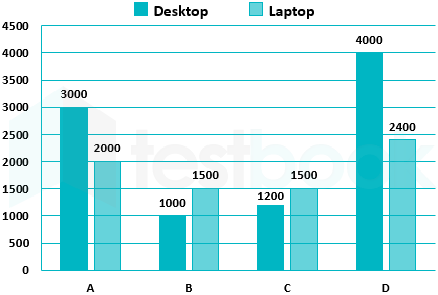
Directions: Below bar graph represents the number of desktops and laptops in four labs A, B, C and D. Study the graph and answer the following questions:

66

What is the sum of desktops in lab A and C, and laptops in lab B and D?

  1. ((a))

    1200

  2. ((b))

    8100

  3. ((c))

    5400

  4. ((d))

    9000

  5. ((e))

    None of these

Show Answer
Answer: ((a))

1200

67

What is the difference between desktops in lab D to laptops in lab C?

  1. ((a))

    2000

  2. ((b))

    3000

  3. ((c))

    2500

  4. ((d))

    1000

  5. ((e))

    750

Show Answer
Answer: ((a))

2000

68

What is the ratio of laptops in lab D to desktops in lab D?

  1. ((a))

    2 : 1

  2. ((b))

    3 : 5

  3. ((c))

    4 : 9

  4. ((d))

    3 : 7

  5. ((e))

    None of these

Show Answer
Answer: ((a))

2 : 1

69

Laptops in lab A is what percent of desktop in lab D?

  1. ((a))

    52%

  2. ((b))

    50%

  3. ((c))

    62%

  4. ((d))

    71%

  5. ((e))

    None of these

Show Answer
Answer: ((a))

52%

70

What is the approximate average number of laptops in labs A,C and D?

  1. ((a))

    1926

  2. ((b))

    1967

  3. ((c))

    1867

  4. ((d))

    1600

  5. ((e))

    2100

Show Answer
Answer: ((a))

1926

71

A person lent a sum of Rs. 9000 on simple interest at 10% per annum for 3 years. Find the difference in interest received by him, if he had lent the same sum on compound interest at 20% per annum for 2 years.

  1. ((a))

    Rs. 1960

  2. ((b))

    Rs. 1160

  3. ((c))

    Rs. 1260

  4. ((d))

    Rs. 2700

  5. ((e))

    Rs. 1240

Show Answer
Answer: ((a))

Rs. 1960

72

A person travels from A to B with a speed of 6 km/hr in 120 min, if his speed becomes 15 km/hr, then find the difference in time.

  1. ((a))

    80 mins

  2. ((b))

    72 mins

  3. ((c))

    48 mins

  4. ((d))

    36 mins

  5. ((e))

    108 mins

Show Answer
Answer: ((a))

80 mins

73

Length and breadth of a rectangle are in the ratio of 4 ∶ 3. If the area of rectangle is 108 m2, find the area of square whose side is equal to the breadth of the rectangle.

  1. ((a))

    44 m2

  2. ((b))

    56 m2

  3. ((c))

    81 m2

  4. ((d))

    58 m2

  5. ((e))

    None of these

Show Answer
Answer: ((a))

44 m2

74

A boat goes 8 km upstream in 2 hours and 12 km downstream in 1.5 hours. Find the speed of current.

  1. ((a))

    6 km/hr

  2. ((b))

    8 km/hr

  3. ((c))

    2 km/hr

  4. ((d))

    4 km/hr

  5. ((e))

    12 km/hr

Show Answer
Answer: ((a))

6 km/hr

75

A purchased three quantities of radio for Rs. 2100 of equal cost price. If profit percentage is 20%, then find the profit on each quantity.

  1. ((a))

    Rs. 120

  2. ((b))

    Rs. 140

  3. ((c))

    Rs. 280

  4. ((d))

    Rs. 200

  5. ((e))

    Rs. 100

Show Answer
Answer: ((a))

Rs. 120

76

The average weight of 10 boys is increased by 1.5 kg when Arjun whose weight is 45 kg is replaced by Rohan. Find the weight of Rohan?

  1. ((a))

    64 kg

  2. ((b))

    60 kg

  3. ((c))

    68 kg

  4. ((d))

    72 kg

  5. ((e))

    None of these

Show Answer
Answer: ((a))

64 kg

77

What will come in place of '?' in the following question?

3 × 63 + 74 ÷ √4 - √121 = ?

  1. ((a))

    210

  2. ((b))

    129

  3. ((c))

    215

  4. ((d))

    240

  5. ((e))

    281

Show Answer
Answer: ((a))

210

78

Find the value of ? in the following question?

4×9×13×28104×63=?\frac{{4 \times 9 \times 13 \times 28}}{{104 \times 63}} = \sqrt ?

  1. ((a))

    2

  2. ((b))

    4

  3. ((c))

    6

  4. ((d))

    5

  5. ((e))

    8

Show Answer
Answer: ((a))

2

79

What will come in place of '?' in the following question?

13+16+18=5?\frac{1}{3} + \frac{1}{6} + \frac{1}{8} = \frac{5}{?}

  1. ((a))

    12

  2. ((b))

    6

  3. ((c))

    8

  4. ((d))

    10

  5. ((e))

    1

Show Answer
Answer: ((a))

12

80

What will come in place of '?' in the following question?

52 + 20 × 4 - 16 = ?

  1. ((a))

    89

  2. ((b))

    68

  3. ((c))

    78

  4. ((d))

    28

  5. ((e))

    34

Show Answer
Answer: ((a))

89

81

What will come in place of '?' in the following question?

155 + 20 × 4 - 176 = ? + 21

  1. ((a))

    46

  2. ((b))

    44

  3. ((c))

    38

  4. ((d))

    76

  5. ((e))

    -22

Show Answer
Answer: ((a))

46

82

What will come in place of '?' in the following question?

50% of ? + 30% of 80 = 124

  1. ((a))

    360

  2. ((b))

    280

  3. ((c))

    200

  4. ((d))

    250

  5. ((e))

    120

Show Answer
Answer: ((a))

360

83

What will come in place of '?' in the following question?

√49 + 62 = 39 + 102 - ?

  1. ((a))

    96

  2. ((b))

    100

  3. ((c))

    120

  4. ((d))

    92

  5. ((e))

    88

Show Answer
Answer: ((a))

96

84

What will come in place of '?' in the following question?

314+512+718=?3\frac{1}{4} + 5\frac{1}{2} + 7\frac{1}{8} = ?

  1. ((a))

    15.8

  2. ((b))

    16.2

  3. ((c))

    19.4

  4. ((d))

    18.2

  5. ((e))

    11.8

Show Answer
Answer: ((a))

15.8

85

What will come in place of '?' in the following question?

1903 ÷ 11 + 2331 ÷ 7 = ?

  1. ((a))

    508

  2. ((b))

    506

  3. ((c))

    570

  4. ((d))

    521

  5. ((e))

    None of these

Show Answer
Answer: ((a))

508

86

What will come in place of '?' in the following question?

4.5 × 2 + 18 × 3 = ? - 120

  1. ((a))

    182

  2. ((b))

    156

  3. ((c))

    146

  4. ((d))

    177

  5. ((e))

    183

Show Answer
Answer: ((a))

182

87

If 1 is added to 30% of a number and the result so obtained is divided by 7, the output is 103. Find the original number.

  1. ((a))

    3500

  2. ((b))

    3600

  3. ((c))

    3200

  4. ((d))

    2400

  5. ((e))

    2600

Show Answer
Answer: ((a))

3500

88

100 chocolates are distributed between A, B and C. A has 9 more than B and C has 2 less than A. Find the number of chocolates C has.

  1. ((a))

    39

  2. ((b))

    28

  3. ((c))

    35

  4. ((d))

    36

  5. ((e))

    37

Show Answer
Answer: ((a))

39

89

What should come in place of '?' in the following number series?

4, 8, 24, 96, 480, ?

  1. ((a))

    2680

  2. ((b))

    1680

  3. ((c))

    2880

  4. ((d))

    2400

  5. ((e))

    960

Show Answer
Answer: ((a))

2680

90

What should come in place of '?' in the following number series?

112, 87, 67, 52, 42, ?

  1. ((a))

    38

  2. ((b))

    27

  3. ((c))

    37

  4. ((d))

    35

  5. ((e))

    36

Show Answer
Answer: ((a))

38

91

What should come in place of '?' in the following number series?

11, 15, 21, 29, 39, ?

  1. ((a))

    52

  2. ((b))

    51

  3. ((c))

    61

  4. ((d))

    41

  5. ((e))

    50

Show Answer
Answer: ((a))

52

92

What should come in place of '?' in the following number series?

23, 27, 18, 34, 9, ?

  1. ((a))

    46

  2. ((b))

    45

  3. ((c))

    40

  4. ((d))

    34

  5. ((e))

    25

Show Answer
Answer: ((a))

46

93

What should come in place of '?' in the following number series?

11, 14, 22, 40, 73, ?

  1. ((a))

    116

  2. ((b))

    126

  3. ((c))

    132

  4. ((d))

    112

  5. ((e))

    122

Show Answer
Answer: ((a))

116

94

Presently Naman is six years younger than Anu and Anu is 10 years younger than Bittu. Six years hence the respective ratio between Bittu’s age and Naman’s age will be 3 ∶ 2. Find Anu’s present age?

  1. ((a))

    32 years

  2. ((b))

    28 years

  3. ((c))

    20 years

  4. ((d))

    30 years

  5. ((e))

    None of these

Show Answer
Answer: ((a))

32 years

95

At 20% discount the selling price of a refrigerator is Rs 24,000, what is the selling price if the discount is 30%?

  1. ((a))

    Rs 12,000

  2. ((b))

    Rs 14,640

  3. ((c))

    Rs 21,000

  4. ((d))

    Rs 30,000

  5. ((e))

    Rs 40,000

Show Answer
Answer: ((a))

Rs 12,000

Directions: Read the caselet given below and answer the questions that follow:

The population of town A and B is 800 and 1200 respectively. If the percentage of farmers in town A is 30% of the population and of town B is 60% of the population.The ratio of male to female in town A is 2 : 3, and the ratio of male to female in town B is 7 : 5. Farmers of town A works for 9 hours a day and of B works for 6 hours a day.

96

What is the ratio of number of farmer-hours of a day of town A to town B?

  1. ((a))

    3 : 2

  2. ((b))

    4 : 3

  3. ((c))

    8 : 3

  4. ((d))

    1 : 2

  5. ((e))

    2 : 3

Show Answer
Answer: ((a))

3 : 2

97

What is the difference between the number of females of town A and B?

  1. ((a))

    60

  2. ((b))

    20

  3. ((c))

    90

  4. ((d))

    120

  5. ((e))

    200

Show Answer
Answer: ((a))

60

98

What is the total number of males of town A and B?

  1. ((a))

    1120

  2. ((b))

    720

  3. ((c))

    1020

  4. ((d))

    1220

  5. ((e))

    None of these

Show Answer
Answer: ((a))

1120

99

The number of female in town A is what percentage of the total number of male and female in town B?

  1. ((a))

    32%

  2. ((b))

    36%

  3. ((c))

    40%

  4. ((d))

    50%

  5. ((e))

    24%

Show Answer
Answer: ((a))

32%

100

What is the average number of farmers in both town A and B?

  1. ((a))

    300

  2. ((b))

    320

  3. ((c))

    480

  4. ((d))

    960

  5. ((e))

    1920

Show Answer
Answer: ((a))

300

Attempt this paper under real exam conditions

Timed interface, section switching, instant scoring, and question-by-question analytics — free.

Start Timed Attempt