The ninth and the tenth of this month are Monday and Tuesday _________.
((a))
figuratively
((b))
retrospectively
((c))
respectively
((d))
rightfully
Show Answer
Answer: ((c))
respectively
Let us look at the meanings of the given words:
Figuratively - not using words to mean something literal; metaphorically
For e.g.- he man flew out the front door, figuratively.
Retrospectively - with consideration of past events or situations
For e.g.-Their actions could only be understood retrospectively.
Respectively - separately or individually and in the order already mentioned
For e.g.- Their sons, Ben and Jonathan, were three and six respectively.
Rightfully - according to a legitimate right or claim to property, position, or status
For e.g.- She could rightfully claim that she is one of the world's leading authorities on the topic.
<br>
In the context of the given sentence, we use an adverb that will help us enumerate two items (Monday and Tuesday) that refer back to a previous part of the statement (ninth and tenth, in that order). Out of the given options, respectively fits the context perfectly.
The complete sentence should be:
The ninth and the tenth of this month are Monday and Tuesday respectively.
Hence, option 3 is correct.
2
It is ________ to read this year’s textbook ________ the last year’s.
((a))
easier, than
((b))
most easy, than
((c))
easier, from
((d))
easiest, from
Show Answer
Answer: ((a))
easier, than
We can see from the context of this sentence that a comparison is being made between two items.
Hence, we will use the comparative form of the adjective 'easy' i.e. 'easier'.
Also, when comparing two things, the comparative forms of adjectives are paired with the preposition 'than'.
For example: He is taller than his brother.
Out of the given options, only option 1 has both the correct words that fit the context of the blanks.
3
A rule states that in order to drink beer, one must be over 18 years old. In a bar, there are 4 people. P is 16 years old, Q is 25 years old, R is drinking milkshake and S is drinking a beer. What must be checked to ensure that the rule is being followed?
((a))
Only P’s drink
((b))
Only P’s drink and S’s age
((c))
Only S’s age
((d))
Only P’s drink. Q’s drink and S’s age
Show Answer
Answer: ((b))
Only P’s drink and S’s age
A rule states that in order to drink beer, one must be over 18 years old.
P is 16 years old – as P’s age is lower than 18, we need to check his drink
Q is 25 years old – as Q’s age is greater than 18 no need to check his drink
R is drinking milkshake – as R is drinking milkshake no need to check his age
S is drinking a beer – as S is drinking beer, we need to check his age
So, we need to check P’s drink and S’s age.
4
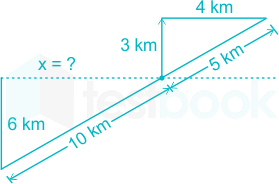
Fatima starts from point P, goes North for 3 km, and then East for 4 km to reach point Q. She then turns to face point P and goes 15 km in that direction. She then goes North for 6 km. How far is the from point P, and in which direction should she go to reach point P?
((a))
8 km, East
((b))
12 km, North
((c))
6 km, East
((d))
10 km, North
Show Answer
Answer: ((a))
8 km, East
The path of Fatima is shown
From the figure
x2 + 62 = 102
x2 = 64
x = 8 km
Hence, Fatima should move 8 km to East.
5
500 students are taking one or more courses out of Chemistry, Physics, and Mathematics. Registration records indicate course enrolment as follows: Chemistry (329), Physics (186), Mathematics (295), Chemistry and Physics (83), Chemistry and Mathematics (217), and Physics and Mathematics (63). How many students are taking all 3 subjects?
“If you are looking for a history of India, or for an account of the rise and fall of the British Raj, or for the reason of the cleaving of the subcontinent into two mutually antagonistic parts and the effects this mutilation will have in the respective sections, and ultimately on Asia, you will not find it in these pages; for though I have spent a lifetime in the country, I lived too near the seat of events, and was too intimately associated with the actors, to get the perspective needed for the impartial recording of these matters.”
Which of the following statements best reflects the author’s opinion?
((a))
An intimate association does not allow for the necessary perspective.
((b))
Matters are recorded with an impartial perspective.
((c))
An intimate association offers an impartial perspective.
((d))
Actors are typically associated with the impartial recording of matters.
Show Answer
Answer: ((a))
An intimate association does not allow for the necessary perspective.
Out of the given options, the sentence in option 1 i.e. 'An intimate association does not allow for the necessary perspective.' best reflects the opinion stated by the author in the final part of the sentence. It is the opinion that the closer we are to a particular topic or subject, the more biased is our perspective towards it.
Option 2 i.e. 'Matters are recorded with an impartial perspective.' is vague and does not convey much information.
Option 3 i.e. 'An intimate association offers an impartial perspective.' is completely contradictory to the author's opinions, which state that an intimate association offers a partial perspective.
Option 4 i.e. 'Actors are typically associated with the impartial recording of matters.' is factually distorted and also fails at reflecting any part of the author's opinions.
Hence, the correct answer is option 1.
7
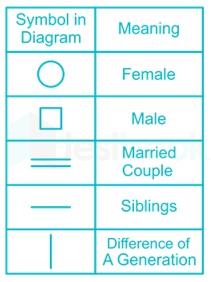
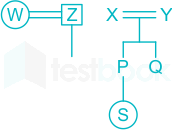
Each of P, Q, R, S, W, X, Y and Z has been married at most once. X and Y are married and have two children P and Q. Z is the grandfather of the daughter S of P. Further, Z and W are married and are parents of R. Which one of the following must necessarily be FALSE?
((a))
X is the mother-in-law of R
((b))
P and R are not married to each other
((c))
P is a son of X and Y
((d))
Q cannot be married to R
Show Answer
Answer: ((b))
P and R are not married to each other
The given information can be represented as shown below.
Z is the grandfather of the daughter S through R. So, P and R are the parents of S and it implies that P and R are married to each other.
So, the statement “P and R are not married to each other” is necessarily false.
8
1200 men and 500 women can build a bridge in 2 weeks. 900 men and 250 women will take 3 weeks to build the same bridge. How many men will be needed to build the bridge in one week?
((a))
3000
((b))
3300
((c))
3600
((d))
3900
Show Answer
Answer: ((c))
3600
Let one man can complete work in x weeks and one woman can complete in y weeks
In 1 day work completed by man =x1
In 1 day work completed by woman =y1
According to questions
x1200+y500=21
x900+y250=31
⇒ x = 3600
1 man can complete in 3600 weeks to complete work in 1 week, 3600 men are required
9
The number of 3-digit numbers such that the digit 1 is never to the immediate right of 2 is
((a))
781
((b))
791
((c))
881
((d))
891
Show Answer
Answer: ((c))
881
Total number of 3 digits numbers
= 999 - 99 = 900
Case I:
21 are together as shown
Total cases = 10
Case 2:
21 are together as shown
Total cases where 1 comes to right of 2 = 10 + 9 = 19
Total cases where 1 does not come to immediate right of 2 = 900 - 19 = 881
10
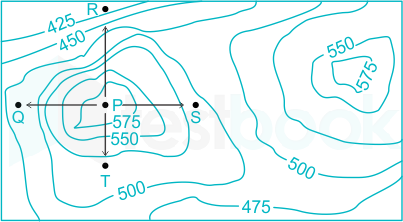
A contour line joins locations having the same height above the mean sea level. The following is a contour plot of a geographical region. Contour lines are shown at 25 m intervals in this plot.
Which of the following is the steepest path leaving from P?
((a))
P to Q
((b))
P to R
((c))
P to S
((d))
P to T
Show Answer
Answer: ((b))
P to R
The steepest path will be the one where there will be maximum number of contour lines.
P to Q → 4 contour lines
P to R → 7 contour lines
P to S → 3 contour lines
P to T → 3 contour lines
Hence, steepest path is from P to R.
Electronics and Communication Engineering (55 questions)
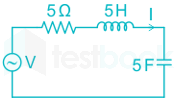
In the circuit shown, V is a sinusoidal voltage source. The current I is in phase with the voltage V. The ratio amplitude;of;voltage;across;resistoramplitude;of;voltage;across;capacitor is _______.
16
A connection is made consisting of resistance A in series with a parallel combination of resistances B and C. Three resistors of value 10 Ω, 5 Ω, 2 Ω, are provided. Consider all possible permutations of the given resistors into the positions A, B, C, and identify the configurations with maximum possible overall resistance, and also the ones with minimum possible overall resistance. The ratio of maximum to minimum values of the resistances (up to second decimal place) is __________.
17
An LTI system with unit sample response h[n] = 5δ[n] - 7δ [n - 1] + 7δ [n - 3] - 5δ [n - 4] is a
((a))
low-pass filter
((b))
high-pass filter
((c))
band-pass filter
((d))
band-stop filter
Show Answer
Answer: ((c))
band-pass filter
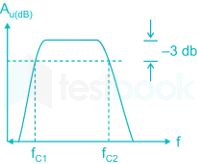
Bandpass Filter:
This filter passes a certain band of frequencies and blocks low and high frequencies.
It has two corner frequencies, smaller (fc1) and larger (fc2).
It attenuates signals with frequencies below fc1 and above fc2.
The input x(t) and the output y(t) of a continuous-time system are related as:
\(y\left( t \right) = \mathop \smallint \limits_{t - T}^t x\left( u \right)du\)
The system is:
((a))
linear and time-variant
((b))
linear and time-invariant
((c))
non-linear and time-variant
((d))
non-linear and time-invariant
Show Answer
Answer: ((b))
linear and time-invariant
Concept:
To prove that a given system is a linear, it has to satisfy both the homogeneity and superposition property.
And to prove a given system to be Time Invariant, the input is first delayed and the output is noted. Then, the output is delayed by the same amount, and is noted.
If both the output; i.e. the output when the input is delayed and delayed output are equal, then the system is said to be time invariant.
Calculation:
Given system \( \Rightarrow y\left( t \right) = \mathop \smallint \limits_{t - T}^t x\left( u \right)dx\)
Delaying the input first;
x(u) → x(u – t0)
let, u – t0 = λ
du = dλ
When, u = t – T
λ = t – t0 – T
and when u = t,
λ = t – t0
So, \(y\left( t \right) = \mathop \smallint \limits_{t - {t_0} - T}^{t - {t_0}} x\left( \lambda \right)d\lambda ;;; \ldots \left( i \right)\)
Now, when the output is delayed by the same amount we get;
We observe that both equation (i) and equation (ii) are equal,
So the system is Time-Invariant.
The system is also linear because integral of an input is a linear operation.
19
An n-channel enhancement mode MOSFET is biased at VGS > VTH and VDS > (VGS - VTH), where VGS is the gate-to-source voltage, VDS is the drain-to-source voltage and VTH is the threshold voltage. Considering channel length modulation effect to be significant, the MOSFET behaves as a
((a))
voltage source with zero output impedance
((b))
voltage source with non-zero output impedance
((c))
current source with finite output impedance
((d))
current source with infinite output impedance
Show Answer
Answer: ((c))
current source with finite output impedance
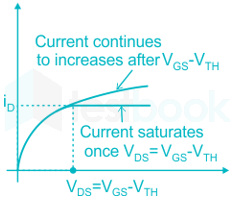
Ideal enhancement MOSFET is a MOSFET which saturates when VDS ≥ VGS - VT and allows a constant current to flow across it even after a further increase in VDS.
But for a non-ideal MOSFET (i.e. MOSFET in which channel length modulation effect is significant), a change in VDS beyond VGS - VT, will result in a further increase in current beyond saturation. This effect is known as channel length modulation.
The output characteristics will now become:
now is no longer infinite.
20
An npn BJT is operating in the active region. If the reverse bias across the base-collector junction is increased, then
((a))
The effective base width increases and common-emitter current gain increases
((b))
The effective base width increases and common-emitter current gain decreases
((c))
The effective base width decreases and common-emitter current gain increases
((d))
The effective base width decreases and common-emitter current gain decreases
Show Answer
Answer: ((c))
The effective base width decreases and common-emitter current gain increases
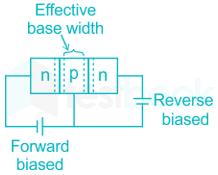
As the reverse-biased base-collector voltage is increased, the transition (or) the depletion region of the base-collector junction is increased resulting in the extension of this region more towards P-side (or base side), thereby reducing the effective base width.
This reduction in the effective base-width results in the increase in current gain as well because of the increase in the slope of concentration gradient variation from the emitter side to the collector side.
21
Consider an n-channel MOSFET having width W, length L, electron mobility in the channel μn and oxide capacitance per unit area Cox. If gate-to-source voltage VGS = 0.7 V, drain-to-source voltage VDS = 0.1 V, (μn Cox) = 100 μA/V2, threshold voltage VTH = 0.3 V and (W/L) = 50, then the transconductance gm (in mA/V) is ____________
22
The output V0 of the diode circuit shown in the figure is connected to an averaging DC voltmeter. The reading on the DC voltmeter in Volts, neglecting the voltage drop across the diode, is _________.
23
In the figure, D1 is a real silicon p-n junction diode with a drop of 0.7 V under forward bias condition and D2 is a Zener diode with breakdown voltage of -6.8 V. The input Vin(t) is a periodic square wave of period T, whose one period is shown in the figure.
Assuming 10τ ≪ T, where τ is the time constant of the circuit, the maximum and minimum values of the output waveform are respectively,
((a))
7.5 V and -20.5 V
((b))
6.1 V and -21.9 V
((c))
7.5 V and -21.2 V
((d))
6.1 V and -22.6 V
Show Answer
Answer: ((a))
7.5 V and -20.5 V
Concept:
When forward biased, a p-n junction diode will allow current to flow with a voltage drop of VR (Voltage drop) and acts as on open circuit when reverse biased.
Also, a Zener diode is a device used for voltage regulation; i.e. to maintain a constant voltage at the load.
This voltage is called the Zener voltage (or breakdown Zener Voltage VZ .)
Also, A capacitor doesn’t allow a sudden change in the voltage (i.e. V0+ = V0- )
Calculation:
During the positive half-cycle, the circuit will be as shown:
So, the output voltage for the positive half-cycle
⇒ Vout + 6.5 V – 14 V = 0 (Applying KVL)
⇒ Vout = 14 – 6.5 V = 7.5 V
When the Vin switches now to the negative cycle the capacitor will still be at the same voltage of 6.5 V.
V0+(C) = 6.5 V only
The circuit for negative half-cycle in as shown:
So, at t = 0+ (i.e. just after switching from positive half cycle to negative half cycle)
Vout + 6.5 + 14 = Vout (Applying KVL)
Vout = -14 – 6.5 = - 20.5 V
As the time increases, the capacitor voltage will start decreasing resulting in less output voltage.
So, the maximum Vout will be 7.5 V
And the minimum Vout will be -20.5 V
24
Consider the circuit shown in the figure. Assume base-to-emitter voltage VBE = 0.8 V and common-base current gain (α) of the transistor is unity.
The value of the collector-to-emitter voltage VCE (in volt) is __________
25
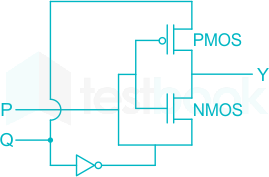
For the circuit shown in the figure, P and Q are the inputs and Y is the output.
The logic implemented by the circuit is
((a))
XNOR
((b))
XOR
((c))
NOR
((d))
OR
Show Answer
Answer: ((b))
XOR
⇒ If P = high:
PMOS is OFF
NMOS is ON
then y = Q̅
⇒If P = low
PMOS is ON
NMOS is OFF
then y = Q
The truth table of the above will be as shown:
\(\left. {\begin{array}{*{20}{c}} P&Q&Y\ 0&0&0\ 0&1&1\ 1&0&1\ 1&1&0 \end{array}} \right}\) So, Y = P̅ Q + P Q̅
= P ⊕ Q
So, Ex – OR Operation is being performed.
26
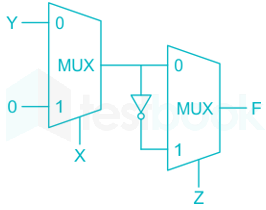
Consider the circuit shown in the figure.
The Boolean expression F implemented by the circuit is
((a))
XˉYˉZˉ+XY+YˉZ
((b))
XˉYZˉ+XZ+YˉZ
((c))
XˉYZˉ+XY+YˉZ
((d))
XˉYˉZˉ+XZ+YˉZ
Show Answer
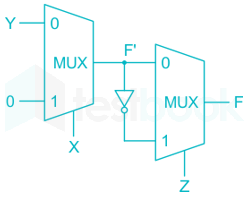
Answer: ((b))
XˉYZˉ+XZ+YˉZ
F' = X̅.Y + X.0 = X̅.Y
F = Z̅.F' + Z.F̅'
= Z̅.(X̅.Y) + Z.(X̅.Y)' ---(1)
XY=X+Y
Using the above in Equation (1):
= Z̅.X̅.Y + Z.(X + Y̅)
= X̅YZ̅ + XZ + Y̅Z
27
In a DRAM,
((a))
periodic refreshing is not required
((b))
information is stored in a capacitor
((c))
information is stored in a latch
((d))
both read and write operations can be performed simultaneously
Show Answer
Answer: ((b))
information is stored in a capacitor
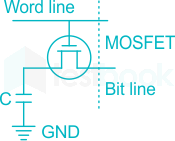
In a DRAM, a capacitor to store a bit of data is used along with a MOSFET (transfer device) which acts as a switch. The circuit is as shown –
In a DRAM:
Periodic refreshing is required.
The information is stored in a capacitor.
Both read and write operations cannot be performed simultaneously.
28
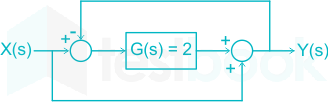
For the system shown in the figure, Y(s)/X(s) = _________.
29
Consider the state space realization
\(\left[ {\begin{array}{{20}{c}} {{{\dot x}_1}\left( t \right)}\ {{{\dot x}_2}\left( t \right)} \end{array}} \right] = \left[ {\begin{array}{{20}{c}} 0&0\ 0&{ - 9} \end{array}} \right]\left[ {\begin{array}{{20}{c}} {{x_1}\left( t \right)}\ {{x_2}\left( t \right)} \end{array}} \right] + \left[ {\begin{array}{{20}{c}} 0\ {45} \end{array}} \right]u\left( t \right),\) with the initial condition \(\left[ {\begin{array}{{20}{c}} {{x_1}\left( 0 \right)}\ {{x_2}\left( 0 \right)} \end{array}} \right] = \left[ {\begin{array}{{20}{c}} 0\ 0 \end{array}} \right].\)
where u(t) denotes the unit step function. The value of
t→∞limx12(t)+x22(t) is ________.
30
Which of the following statements is incorrect?
((a))
Lead compensator is used to reduce the settling time.
((b))
Lag compensator is used to reduce the steady state error.
((c))
Lead compensator may increase the order of a system.
((d))
Lag compensator always stabilizes an unstable system.
Show Answer
Answer: ((d))
Lag compensator always stabilizes an unstable system.
Concept:
Lag Compensation adds a pole at origin (or for low frequencies).
Lag Compensation to reduce the steady-state error of the system.
An unstable system is a system that has at least one pole at the right side of the s-plane.
So, even if we add a lag compensator to an unstable system, it will remain unstable.
Explanation:
If an already unstable system has a CLTP =(s−3)(s+2)K
After using a lag compensator the CLTP = s(s−3)(s+2)K
The system is still unstable.
31
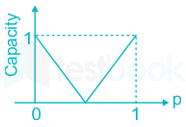
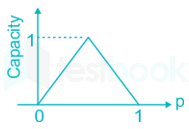
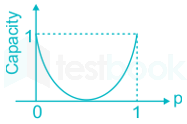
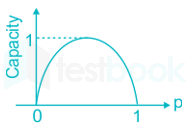
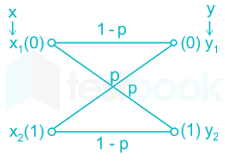
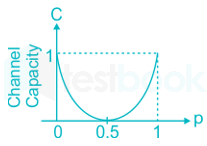
Which one of the following graphs shows the Shannon capacity (channel capacity) in bits of a memoryless binary symmetric channel with crossover probability p?
((a))
((b))
((c))
((d))
Show Answer
Answer: ((c))
Concept:
Binary symmetric channel:
The channel capacity per manage symbol for which the unit is bits/symbol is defined as the maximum value of mutual information and can be written as;
Cm = max [I(x, y)]
When I(x, y) = Mutual information
Cm = 1 + plog2 P + (1 - p) log2 (1 - p) … (1)
Calculation:
From Equation-(1) the capacity is varying logarithmically.
Let, p = cross over probability ‘or’ probability of error.
For p = 0;
From Equation - (1),
Cm = 1;
For p =21
Cm=1+21log2(21)+(1−21)log2(1−21)
= 0
And for p = 1;
Cm = 1
Since the capacity varies logarithmically, the complete graph will be as shown:
Option (C) →
32
Consider the random process
X (t) = U + Vt,
Where U is a zero-mean Gaussian random variable and V is a random variable uniformly distributed between 0 and 2. Assume that U and V are statistically independent. The mean value of the random process at t = 2 is __________
33
A sinusoidal message signal is converted to a PCM signal using a uniform quantizer. The required signal-to-quantization noise ratio (SQNR) at the output of the quantizer is 40 dB. The minimum number of bits per sample needed to achieve the desired SQNR is __________ .
34
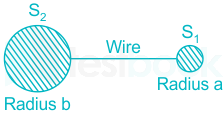
Two conducting spheres S1 and S2 of radii a and b (b > a) respectively, are placed far apart and connected by a long, thin conducting wire, as shown in the figure.
For some charge placed on this structure, the potential and surface electric field on S1 are Va and Ea, and that on S2 are Vb and Eb, respectively. Then, which of the following is CORRECT?
((a))
Va = Vb and Ea < Eb
((b))
Va > Vb and Ea > Eb
((c))
Va = Vb and Ea > Eb
((d))
Va > Vb and Ea = Eb
Show Answer
Answer: ((c))
Va = Vb and Ea > Eb
When two conducting bodies are connected by a conducting wire, change will flow from one body with a higher electric potential to the other body with lower electric potential, till their potentials becomes equal i.e.,
Va = Vb
⇒4πϵaQ1=4πϵbQ2
(∵ Potential at the surface of a conducting sphere Q/4πϵr)
So, Q2Q1=ba ---- (1)
Now, Ea=4πϵa2Q1
(∵ Electric field at the surface of the conducting sphere = Q/4πϵr2)
And, Ea=4πϵb2Q1
∴EbEa=Q2Q1.a2b2
Using equation (1)
⇒EbEa=ab
⇒ Given, b > a
So, Ea > Eb
35
A two-wire transmission line terminates in a television set. The VSWR measured on the line is 5.8. The percentage of power that is reflected from the television set is ___________.
Passengers try repeatedly to get a seat reservation in any train running between two stations until they are successful. If there is 40% chance of getting reservation in any attempt by a passenger, then the average number of attempts that passengers need to make to get a seat reserved is ____________.
40
The minimum value of the function f(x)=31x(x2−3) in the interval - 100 ≤ x ≤ 100 occurs at x = __________.
41
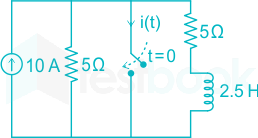
The switch in the circuit, shown in the figure, was open for a long time and is closed at t = 0.
The current i(t) (in ampere) at t = 0.5 seconds is __________
42
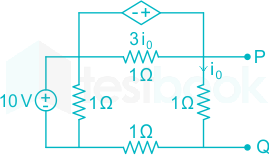
Consider the circuit shown in the figure.
The Thevenin equivalent resistance (in Ω) across P-Q is ___________
43
Consider an LTI system with magnitude response
\(\left| {H\left( f \right)} \right| = \left{ {\begin{array}{*{20}{c}} {1 - \frac{{\left| f \right|}}{{20}},}&{\left| f \right| \le 20}\ {0,}&{\left| f \right| > 20} \end{array}} \right.\)
Then the average power of the output signal y(t) is ____________.
44
The transfer function of a causal LTI system is H(s) = 1/s. If the input to the system is x(t) = [sin (t)/πt] u(t), where u(t) is a unit step function, the system output y(t) as t → ∞ is ________.
45
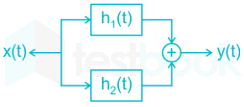
Consider the parallel combination of two LTI systems shown in the figure.
The impulse response of the systems are
h1(t) = 2δ(t + 2) - 3δ(t + 1)
h2(t) = δ(t - 2).
If the input x(t) is a unit step signal, then the energy of y(t) is ___________ .
46
A MOS capacitor is fabricated on p-type Si (Silicon) where the metal work function is 4.1 eV and electron affinity of Si is 4.0 eV. EC - EF = 0.9 eV, where EC and EF are the conduction band minimum and the Fermi energy levels of Si, respectively. Oxide ϵr = 3.9, ϵo = 8.85 × 10⁻¹⁴ F/cm, oxide thickness tox = 0.1 μm and electronic charge q = 1.6 × 10⁻¹⁹ C. If the measured flat band voltage of this capacitor is -1 V, then the magnitude of the fixed charge at the oxide-semiconductor interface, in nC/cm2, is ________.
47
For a particular intensity of incident light on a silicon p-n junction solar cell, the photocurrent density (JL) is 2.5 mA/cm2 and the open-circuit voltage (Voc) is 0.451 V. Consider thermal voltage (VT) to be 25 mV. If the intensity of the incident light is increased by 20 times, assuming that the temperature remains unchanged, Voc (in volts) will be ___________.
(Take the ideality factor, η = 2 for Silicon)
48
Two n-channel MOSFETs, T1 and T2, are identical in all respects except that the width of T2 is double that of T1. Both the transistors are biased in the saturation region of operation, but the gate overdrive voltage (VGS - VTH) of T2 is double that of T1, where VGS and VTH are the gate-to-source voltage and threshold voltage of the transistors, respectively. If the drain current and transconductance of T1 are ID1 and gm1 respectively, the corresponding values of these two parameters for T2 are
((a))
8ID1 and 2gm1
((b))
8ID1 and 4gm1
((c))
4ID1 and 4gm1
((d))
4ID1 and 2gm1
Show Answer
Answer: ((b))
8ID1 and 4gm1
Concept:
n-channel MOSFET biased in saturation region will result in a current given by:
⇒ID=2LWμCox(VGS−Vth)2
And the transconductance is defined as gm=∂VGS∂ID
⇒gm=2LWμCox(VGS−Vth)
Calculation:
Given, two transistors T1 and T2 which are identical in all respects except for width and gate overdrive voltage (VGS - Vth).
For T1 MOSFET,
gm1 ∝ W1 (VGS - Vth)1 and ID1 ∝ W1 (VGS - Vth)21
Similarly for T2, gm2 ∝ W2 (VGS - Vth)2 and ID2 ∝ W2 (VGS - Vth)22
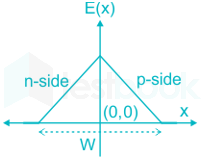
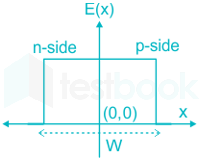
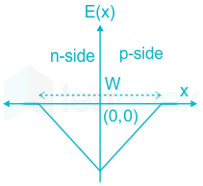
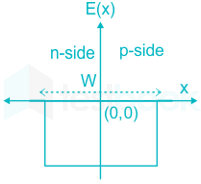
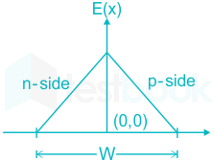
An abrupt p-n junction (located at x = 0) is uniformly doped on both p and n sides. The width of the depletion region is W and the electric field variation in the x-direction is E(x). Which of the following figures represents the electric field profile near the p-n junction?
((a))
((b))
((c))
((d))
Show Answer
Answer: ((a))
Concept:
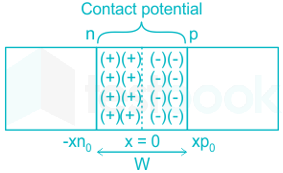
When two ‘p’ type and ‘n’ type semiconductors come into contact to form a p-n junction diode as shown in the figure, there is a diffusion of majority carries which takes place, leaving behind uncompensated ions behind, as shown;
Application:
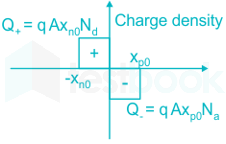
The figure for charge density within the transition region is as shown below:
According to Poisson’s equation, the electric field is given as
dxdE(x)=ϵq(Nd+−Na−)
This shows that E(x) will vary linearly with distance.
So, the electric field distribution is as shown:
50
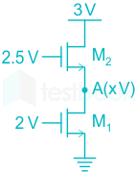
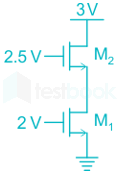
Assuming that transistors M1 and M2 are identical and have a threshold voltage of 1 V, the state of transistors M1 and M2 are respectively
((a))
Saturation, Saturation
((b))
Linear, Linear
((c))
Linear, Saturation
((d))
Saturation, Linear
Show Answer
Answer: ((c))
Linear, Saturation
For the given figure,
Let x be the voltage at node A.
Now, VDS2=3−x
VGS2−Vt=2.5−x−1
= 1.5 - x
We observe that, VDS2 is always > VGS2−Vt
So, M2 will always be in saturation.
Assuming M1 to be in saturation, we calculate the saturation current as shown.
(IDSat)1 = (IDSat)2
⇒ Kn(VGS - Vt)21 = Kn (VGS - Vt)22
⇒ (2 - 1)2 = (2.5 - x - 1)2
⇒ 1 = 1.5 - x
x = 0.5 V
If ‘x’ were to be 0.5 V then for M1,
VDS = x - 0 = 0.5 V
and VGS - Vt = 1 V
So, VDS < VGS - Vt
This shows that our assumption is wrong, and M1 cannot be in saturation.
So, M1 is in cut off.
51
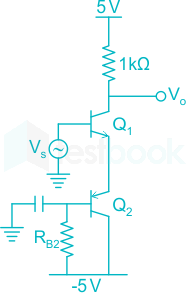
In the circuit shown, transistors Q1 and Q2 are biased at a collector current of 2.6 mA. Assuming that transistor current gains are sufficiently large to assume collector current equal to emitter current and thermal voltage of 26 mV, the magnitude of voltage gain Vo/Vs in the mid-band frequency range is ___________ (up to second decimal place).
52
In the voltage reference circuit shown in the figure, the op-amp is ideal and the transistors Q1, Q2 … Q32 are identical in all respects and have infinitely large values of common-emitter current gain (β). The collector current (Ic) of the transistors is related to their base-emitter voltage (VBE) by the relation IC = IS exp (VBE/VT), where IS is the saturation current. Assume that the voltage Vp shown in the figure is 0.7 V and the thermal voltage VT = 26 mV.
The output voltage Vout (in volts) is _________
53
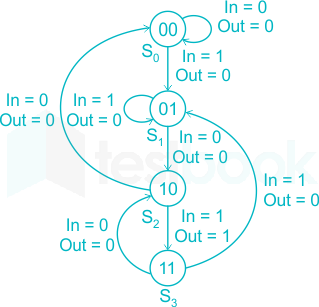
The state diagram of a finite state machine (FSM) designed to detect an overlapping sequence of three bits is shown in the figure. The FSM has an input ‘In’ and an output ‘Out’. The initial state of the FSM is S0.
If the input sequence is 10101101001101, starting with the left-most bit, then the number of times ‘Out’ will be 1 is _________
54
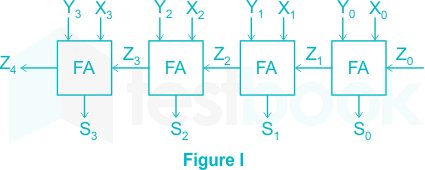
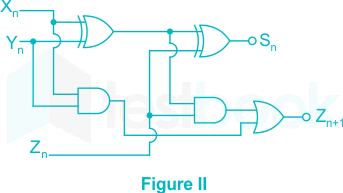
Figure I shows a 4-bit ripple carry adder realized using full adders and Figure II shows the circuit of a full-adder (FA). The propagation delay of the XOR, AND and OR gates in Figure II are 20 ns, 15 ns and 10 ns, respectively. Assume all the inputs to the 4-bit adder are initially reset to 0.
At t = 0, the inputs to the 4-bit adder are changed to X3X2X1X0 = 1100, Y3Y2Y1Y0 = 0100 and Z0 = 1. The output of the ripple carry adder will be stable at t (in ns) = ____________
55
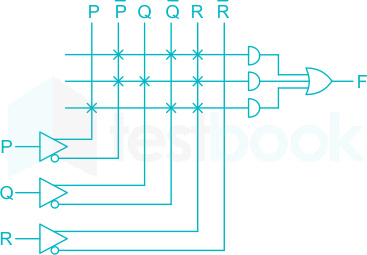
A programmable logic array (PLA) is shown in the figure.
The Boolean function F implemented is
((a))
PˉQˉR+PˉQR+PQˉRˉ
((b))
(Pˉ+Qˉ+R)(Pˉ+Q+R)(P+Qˉ+Rˉ)
((c))
PˉQˉR+PˉQR+PQˉR
((d))
(Pˉ+Qˉ+R)(Pˉ+Q+R)(P+Qˉ+R)
Show Answer
Answer: ((c))
PˉQˉR+PˉQR+PQˉR
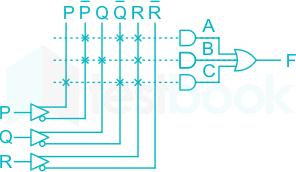
Fromthe given figure
A = P̅ Q̅ R
B = P̅ Q R
C = P Q̅ R
F = A + B + C
= P̅ Q̅ R + P̅ Q R + P Q̅ R
56
A unity feedback control system is characterized by the open-loop transfer function
G(s)=s3+ks2+2s+12(s+1)
The value of k for which the system oscillates is _________
57
A second-order LTI system is described by the following state equations.
dtdx1(t)−x2(t)=0
dtdx2(t)+2x1(t)+3x2(t)=r(t)
where x1(t) and x2(t) are the two state variables and r(t) denotes the input. The output c(t) = x1(t). The system is
((a))
undamped (oscillatory)
((b))
underdamped
((c))
critically damped
((d))
overdamped
Show Answer
Answer: ((d))
overdamped
The number of the system can be determined by finding its transfer function.
A unity feedback control system is characterized by the open-loop transfer function
G(s)=s3+3s2+1010K(s+2)
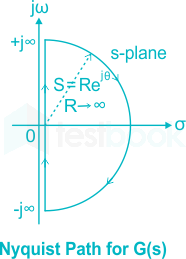
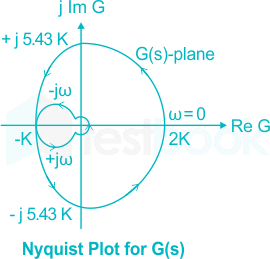
The Nyquist path and the corresponding Nyquist plot of G(s) are shown in the figures below.
If 0 < K < 1, then the number of poles of the closed-loop transfer function that lie in the right-half of the s-plane is
((a))
0
((b))
1
((c))
2
((d))
3
Show Answer
Answer: ((c))
2
Concept
From Nyquist criteria we have
N = P
Where,
N = Number of encirclements of point (-1, j0) by G(s) H(s) plot, the positive direction of encirclement being Anticlockwise.
P = Number of open loop poles in RHS of s-plane.
Z = Number of closed loop poles in RHS of s-plane
Calculations:
P = open loop RHS poles
C.E = s3 + 3s2 + 0s +10
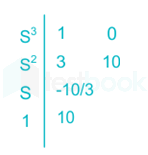
From RH Criteria
Number of sign changes = P = 2
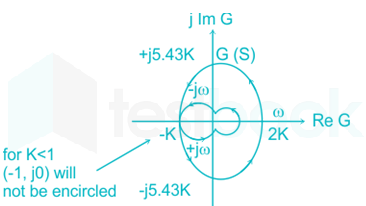
For 0 < K < 1
N = 0
From Nyquist criteria
N = P – Z
= 2 – Z
Z = 2
Number of poles of the closed loop transfer function that lie in RHS = 2
59
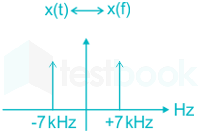
The signal x(t) = sin (14000 πt), where t is in seconds, is sampled at a rate of 9000 samples per second. The sampled signal is the input to an ideal low pass filter with frequency response H(f) as follows:
\(H\left( f \right) = \left{ {\begin{array}{*{20}{c}} {1,}&{\left| f \right| \leqslant 12kHz} \ {0,}&{\left| f \right| > 12kHz} \end{array}} \right..\)
What is the number of sinusoids in the output and their frequencies in kHz?
((a))
Number = 1, frequency = 7
((b))
Number = 3, frequencies = 2, 7, 11
((c))
Number = 2, frequencies = 2, 7
((d))
Number = 2, frequencies = 7, 11
Show Answer
Answer: ((b))
Number = 3, frequencies = 2, 7, 11
Given signal x(t) = sin (1400 πt)
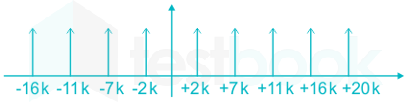
When sampled at a frequency of 9K samples second. The frequency spectrum shifts to the right by nfs and to the left by -nfs. (where, n = ±0, ±1 ….)
The output spectrum will be as follows:
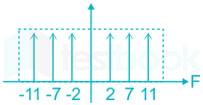
When this is passed through an ideal low pass filter with H(f) given as
\(H\left( f \right) = \left{ {\begin{array}{*{20}{c}} {1,}&{\left| f \right| \leqslant 12kHz} \ {0,}&{\left| f \right| > 12kHz} \end{array}} \right..\)
The output will be then
So, the number of Sinusoids at the output will be = 3,
With frequencies = 2, 7, 11.
60
The unmodulated carrier power in an AM transmitter is 5 kW. This carrier is modulated by a sinusoidal modulating signal. The maximum percentage of modulation is 50%. If it is reduced to 40%, then the maximum unmodulated carrier power (in kW) that can be used without overloading the transmitter is _________
61
A modulating signal given by x(t) = 5 sin (4π 103t - 10π cos 2π 103t) V is fed to a phase modulator with phase deviation constant kp = 5 rad/V. If the carrier frequency is 20 kHz, the instantaneous frequency (in kHz) at t = 0.5 ms is ___________.
62
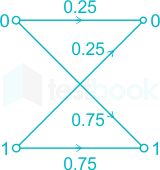
Consider a binary memoryless channel characterized by the transition probability diagram shown in the figure.
The channel is
((a))
lossless
((b))
noiseless
((c))
useless
((d))
deterministic
Show Answer
Answer: ((c))
useless
Concept: (i) For lossless channel H(X/Y) = 0
(ii) For the channel to be deterministic; H(Y/X) = 0
(iii) For the channel to be noiseless, (H(x/y) = H(y/x) = 0)
Application: From the given channel, the channel matrix will be:
So, H(Y/X) ≠ 0; the channel is not determinant as well.
(iii) For the channel to be noiseless,
(H(x/y) = H(y/x) = 0)
But, H(x/y) ≠ H(y/x) ≠ 0
Say it is not noiseless as well.
So, the channel is useless.
63
An electron (q1) is moving in free space with velocity 105 m/s towards a stationary electron (q2) far away. The closest distance that this moving electron gets to the stationary electron before the repulsive force diverts its path is _________ × 10-8 m.
[Given, mass of electron m = 9.11 × 10⁻³¹ kg, charge of electron e = -1.6 × 10⁻¹⁹ C, and permittivity ε0 = (1/36π) × 10-9 F/m]
64
Standard air-filled rectangular waveguides of dimensions a = 2.29 cm and b = 1.02 cm are designed for radar applications. It is desired that these waveguides operate only in the dominant TE10 mode with the operating frequency at least 25% above the cutoff frequency of the TE10 mode but not higher than 95% of the next higher cutoff frequency. The range of the allowable operating frequency f is
((a))
8.19 GHz ≤ f ≤ 13.1 GHz
((b))
8.19 GHz ≤ f ≤ 12.45 GHz
((c))
6.55 GHz ≤ f ≤ 13.1 GHz
((d))
1.64 GHz ≤ f ≤ 10.24 GHz
Show Answer
Answer: ((b))
8.19 GHz ≤ f ≤ 12.45 GHz
Concept:
Cut-off frequency of waveguide (rectangular)
⇒fc=2C(am)2+(bn)2;;;;…(1)
Dominant mode in rectangular waveguide (a > b) is TE10 and the cutoff frequency is defined as;
fc(10)=2Ca21=2aC
Calculation:
fc(10)=2aC=2×2.293×1010=6.554;Hz
Desired operating frequency = 25% more than fc(10)
(1+0.25)fc(10)=1.25fc(10)=1.25×6.55
= 8.199 Hz
Using equation (1), we calculate different cut-off frequency for higher modes to find the next dominant mode,
fc for TE01 mode = 14.74 Hz
fc for TE11 mode = 16.4 Hz
and
fc for TE20 mode = 13.144 Hz
So, TE20 is the next higher cut-off frequency,
95% of 13.144 Hz
⇒ 12.484 GHz
65
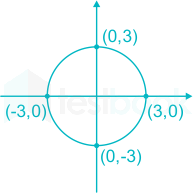
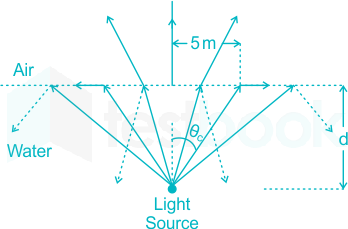
The permittivity of water at optical frequencies is 1.75 ε0. It is found that an isotropic light source at a distance d under water forms an illuminated circular area of radius 5 m, as shown in the figure. The critical angle is θc.